Shared posts

23 Oct 16:11

Seek to know how your buyer thinks: Madlibs w/ @jayhidalgo

by Craig Rosenberg

Today’s Madlibs guest is Jay Hidalgo. First, a story: I knew Jay’s brother and business partner Carlos for years before I met Jay. The running joke between us was that Jay didn’t exist. For years I accused Carlos of fabricating his existence. Two things have happened since then: (1) I have met Jay and he is one of the greatest guys I know. (2) Since my brother Paul has been running the Funnelholic, Jay can now accuse me of creating a false persona. Ahh, the fun and games of those of us hanging out in the glorious world of b2b sales and marketing. Jay has started a new company, The Barzel Group, and he is coaching marketers to demand generation success. And he is PASSIONATE about what he is doing. It’s fun talking to him about it because he really loves it. Jay and I both love the show Psych so before moving to Madlibs, I thought I would include a Psych shout-out:

Psych, Jay Hidalgo, Funnelholic

And now, Jay Hidalgo’s Madlibs:

  1. The b2b buyer is in control
  2. The biggest innovation in marketing is the mobile wallet
  3. The coolest thing happening in b2b marketing is the slow awakening to a buyer centered approach
  4. My favorite marketing book is not really a marketing book. The Anatomy of Peace, Arbiner Institute.
  5. My favorite social media channel is Twitter
  6. Social media for b2b is misunderstood
  7. b2b video is on the rise
  8. In b2b, the idea of a funnel is also misunderstood
  9. The first thing every marketer should do is seek to know how their buyer thinks
  10. Content marketing is a new label on something that has been done by successful marketers for years
  11. The biggest mistake marketers make is starting with tactics
  12. The biggest myth in b2b marketing is that buyers can be “sold to”
  13. My favorite marketing technology besides marketing automation is Bufferapp
  14. Besides revenue, the metric every marketer must track is funnel conversions
  15. My most forgettable marketing experience is having an entire campaign shut down because “the company president’s wife didn’t like it”.
  16. Mobile marketing is the next wave
  17. The next “hot-thing” in marketing will be I just said, mobile marketing :-)
  18. In 2015, marketing will use the same principles, but with new and improved tools
  19. Over the next couple years in marketing, I can’t wait to see the use of hologram messages, like Princess Lea’s message to Obi Wan
  20. Madlibs with the Funnelholic is not as much fun as trying to convince that Funnelholic that I actually exist

Demand generation, b2b marketingJay Hidalgo is President of The Barzel Group, creator of Demand Gen Coach. For 20 years, he has been helping enterprise, mid market and small companies develop and build buyer research, demand generation, and lead management programs. Jay has been a frequent speaker at various conferences and seminars about demand generation and lead management, and is recognized as a thought leader in the industry. Prior to The Barzel Group, he co-founded and served as Chief Revenue Officer at ANNUITAS, a demand process firm. Jay has brought his expertise to companies such as Herman Miller, Ariba, NCR, Rubbermaid, X-rite and Pitney Bowes, among others.
Craig Rosenberg is the Funnelholic and a co-founder of Topo. He loves sales, marketing, and things that drive revenue. Follow him on Google+ or Twitter

22 Oct 16:34

Get More Readers with Content Marketing “Curb Appeal”

by Bob Geller

I recently saw a blog post that seemed extremely relevant and interesting; but the piece lacked one thing that caused me to ignore it: a posting date. I was doing some research, and had no interest in wasting time on last year’s news. It might actually have been posted just five minutes before, but that … Continue Reading

Get More Readers with Content Marketing “Curb Appeal” by Bob Geller - Maximize Social Business - Maximize Social Business - Your Social Media for Business Resource ... Featuring Contributions from Global Thinkers . This copyrighted content was originally published on Maximize Social Business and may not be republished on any other website or in any other format without explicit permission from the publisher.


Related Stories

22 Oct 15:25

It’s Time For CMOs To Tap Into The Power Of Personalization

by Paul Dunay

Posted in eCommerceOptimizationPersonalization

marble-personalization3

According to Forrester Research, U.S. e-commerce sales are expected to hit $370 billion by 2017 – that’s 10 percent of retail sales. These are some pretty staggering figures that brands and their CMOs cannot afford to ignore. More than anything, it’s a harsh reminder of just how much revenue they stand to lose if they get the online experience wrong.

Consumers today are finicky and want what they want, now. Some place the highest premium on loyalty and trust in a brand or product. Others, bound by the unstable economy, prefer deep discounts and bargains. And then there’s the ever-growing population of consumers who are always connected and always on, thanks to their smartphones and tablets. As different as consumers are, they all want to feel like the brands and products they use are tailored specifically for them. By providing personalized, relevant and unique content in line with consumers’ likes and dislikes, purchase behaviors and demographic profiles, they’ll increase eyeballs to their online or mobile sites, boost traffic and, most important, drive short-term and long-term sales. Here are five reasons why CMOs cannot ignore the power of personalization any longer, or they may soon be shutting their doors.

Make data your best friend.

It’s unfortunate, but a lot of brands these days are still guessing their way through their website design and e-commerce strategy. As smart and creative as most brands think they are, the numbers don’t lie. Data can be one of the most inexpensive and smart listening tools a brand can have in its arsenal. I can’t stress enough the importance of brands analyzing what works and what’s missing the mark with all of their design changes through A/B and multivariate testing. That kind of data is more apt to deliver real insights into who their audience is, what types of content and information they want, and where they are making those purchases. All of those learnings, in turn, can result in increased clicks, higher conversion rates, more revenue and happier customers.

Reach the right audience.

What is the demographic profile of your primary customers? Are a significant portion of your online customers also smartphone and tablet owners? Does product pricing influence the purchase decisions of your customers? The identity of your customers, their demographic profiles, what types of information they value as well as when and where they are making purchases are all insights that can help you reach the right audience at the right time with the right content – whether it’s in the form of emails, product recommendations or social promotions. So doesn’t it make sense to test and optimize your website to reach the right audience at the right time with the right content?

Be relevant, unique and indispensable.

One of the best ways to attract and retain customers is to make your brand and products so relevant, unique and indispensable that they would suffer if they went elsewhere. According to Forrester’s 2012 North American Brand Performance Study, being indispensable commands greater preference, and that means a higher likelihood that customers are going to keep spending their hard-earned dollars with your brand across multiple channels. One way to satisfy consumers’ high standards is to make product recommendations as personal and strategic as possible. Showing the right products in the best way on the right pages can result in higher site traffic, longer engagement times on landing pages and more sales. That’s a win-win for both brands and consumers.

Smartphones and tablets drive e-commerce growth.

If you think investing the time, resources and dollars into testing and optimizing your site for smartphones and tablets isn’t that urgent, think again. According to eMarketer, 15 percent of online retail sales this year will take place via mobile devices, which is up from 11 percent in 2012. Overall, U.S. retail m-commerce sales are predicted to reach nearly $39 billion in 2013, up 56.5 percent from 2012 and almost triple the amount spent in 2011.

But not every smartphone and tablet is the same; each device type, model and platform comes with its own unique set of features and functions. Failing to optimize and personalize your website for the smaller screen could very well mean the difference between being profitable and going bankrupt.

Forge meaningful social relationships.

Social media has forever changed the way we use the Internet and consume information. Once considered to be a new “fad,” social media is now an integral part of consumers’ daily lives. A study by Forrester Research found that 45 percent of people on social networks have interacted with a brand through social media over the previous three months. It’s especially interesting to see that 71 percent of online adults are accessing social networking sites at least monthly.

Despite how popular and “cool” it’s become for brands to have a social presence on sites like Facebook, Twitter, Instagram and Pinterest, many have done so without any real strategy or testing behind them. How often do you hear brands bragging about reaching 1 million fans or “likes” on their Facebook page? But these metrics aren’t tied in any way to ROI and sales. Incorporating social data into your overall personalization program can convert those actions into leads and revenue. Isn’t that what really matters to your business?


Related posts:

  1. Why CMO’s Need To Be More Involved in Ecommerce If the $42.3 billion spent online this past holiday season...
  2. More Traffic? Or More Conversions? No Contest. The reality is, if you provide a really stellar online...
  3. 4 Ways E-commerce Can Drive Conversions From Green Initiatives Going green, online—is it worth it? The short answer is...

Related posts brought to you by Yet Another Related Posts Plugin.

YARPP
22 Oct 15:16

Cover story: Whats wrong with our economic picture? – Albuquerque Business First

by Mark Lautman

Cover story: Whats wrong with our economic picture? – Albuquerque Business First.

New Mexico’s economy is dangerously dependent on government, and when it comes to exports, on a single company, Intel Corp.

</p>
<p>
View Slideshow

Dennis Domrzalski
Reporter-Albuquerque Business First
Email  | LinkedIn  | Reporter RSS Feed

New Mexico’s economy is dangerously dependent on government, and when it comes to exports, on a single company,Intel Corp.

There isn’t much diversity in an economy that’s had one of the weakest postrecession recoveries among the states. A recent Brookings Institution report said the Albuquerque metropolitan area remained mired in a mostly nonexistent recovery in the second quarter. The area ranked 89th among the nation’s largest 100 metro areas in its recovery from the recession’s lowest point.

Long known for its dependence on the government sector – particularly the federal government – New Mexico now faces a double whammy of economic dependency. Its anemic manufacturing sector, and in particular its international export sector, is primarily dependent on one company: Intel Corp.

In 2012, over half of the state’s $3 billion in international exports came from Intel, according to the New Mexico Economic Development Department.

Another recent Brookings Institution study found that nearly 33 percent of the Albuquerque metropolitan area’s 2012 exports were microprocessors — meaning mostly Intel.

The national headlines have only served to highlight New Mexico’s dependence on a single company and on the government. The federal government shutdown and the threat of temporary closures of Los Alamos National Laboratory and Sandia National Laboratories, coupled with the recent news that Intel will shrink its Rio Rancho workforce by 400, have the state’s economic and business leaders calling the state’s double dependency dangerous.

For David Buchholtz, an Albuquerque attorney and board member of the Santa Fe think tank Think New Mexico, the situation has reached a crisis point.

Beverlee McClure, president of the Association of Commerce and Industry, said New Mexico’s economy has been hit by “the perfect storm” of government dependency, a small private sector and a lack of diversity within the private sector.

Economic developer Mark Lautman, owner of Lautman Economic Architecture, said the state needs to be shaken by the shoulders out of its economic stupor. Lautman and state Sen. Ken Martinez, D-Gallup, are leading a statewide jobs push. Early findings: New Mexico will need 160,000 economic base jobs in the next 10 years just to get back to prerecession employment levels.

Stephan Helgesen, an international export consultant, called the double dependency “unhealthy.”

For Steve Vierck, president and CEO of the New Mexico Partnership, a private nonprofit that works to attract companies to the state, our economy is vulnerable because of its dependence on Intel and the government sector.

Numbers help tell the dependency story. Twenty-four percent of New Mexico’s jobs are in the government sector, according to the Census Bureau.

While Intel’s 3,000 employees account for 10 percent of the state’s manufacturing jobs, the company accounted for 52 percent of the state’s total exports of goods. That number’s down from 66 percent in 2008, but increases or decreases with Intel’s yearly output. Intel declined comment for this story.

New Mexico has a strong oil and gas and mining sector, but its manufacturing sector, which accounts for the vast majority of international exports, is small. Of the state’s workforce, 3.6 percent are in manufacturing, and that number has been shrinking over the past decade.

And manufacturing’s share of the state’s GDP, at 7.4 percent, is one of the lowest in the nation. Manufacturing and export jobs bring outside money into the economy and help it grow.

In addition, 78 percent of the state’s manufacturing businesses have fewer than 20 employees. Only four companies have 500 or more workers.

How do we fix it?

Ideas on how New Mexico can diversify its economy range from attracting a huge amount of economic base jobs in the next decade to building a big closing fund that could help attract businesses to passing a right-to-work law. One thing seems certain to business leaders: there’s not much time left.

Dale Dekker Principal | Dekker/Perich/Sabatini The situation we are in is both a threat and an opportunity. We have built up a heck of a lot of human capital in the services industry. We know how to do work for the government. We need to figure out how to export some of that government contractor expertise. We have to figure out who the customers are in a global economy that would want to tap into the R&D and contract support capabilities that we have in this community. We have some very strong human capital that is out there that is highly skilled and highly trained.

Steve Vierck President and CEO | New Mexico Partnership We have one large employer in a very dominating economic sector. We are glad to have Intel, but it leaves you more vulnerable when you have one large company rather than having a spectrum of firms filling up different parts of the chain in the sector. We need more aircraft carrier types of companies where we can fill in supply networks. As an example, if Eclipse [Aviation] builds back its business and produces more aircraft, they will once again be an exporter and that supply chain will fill back in as well. You are kind of hanging out there when you have one-of-a-kind in any industry.

David Buchholtz Board member | Think New Mexico We are in a crisis mode for a bunch of things. If you look outside of Albuquerque, dairy, oil and natural gas are also important to the state’s economy. But in the Albuquerque area, much of the economy is local, state and federal government and the service industries that live to provide those government entities: doctors, lawyers, retail and all of the service groups. The absence of right-to-work legislation in New Mexico critically hinders economic development, particularly in regard to attracting manufacturing businesses to the state because we don’t make their list.

Stephan Helgesen CEO | Second Opinion Marketing & Communications There has to be an economic development intervention in the state. It’s not just the think tanks that have to get involved, but ordinary people. Manufacturing companies need to get together to form consortiums and export trading companies. We ought to think about creating consortiums for small companies, which are most of the businesses in the state, and for new businesses and entrepreneurs. We also have a credit crunch here. Small businesses do not have the capital to create capitalization within their organizations that will help them not only survive the recession, but thrive.

Beverlee McClure President | Association of Commerce & Industry It’s the perfect storm with the federal government shutdown. Any time you are dependent on one sector, it makes you a lot more vulnerable. The good news is that there is a recognition that we need to broaden the base of the private sector. It has to be a thoughtful and strategic process. When we think of economic base jobs that bring in new money, we sometimes think of a widget and we overlook our high-tech firms that offer technical services. They are exporting services. When you look at manufacturing you have to look at water, and that’s probably a big barrier to bringing in new manufacturers.

How some people are tackling the problem

Fred Nathan Executive Director Think New Mexico Santa Fe think tank Think New Mexico has tackled some big problems, including eliminating the sales tax on groceries and reforming the New Mexico Public Regulation Commission. Now, the organization has set its sights on the state’s economy and its lack of diversity. Think NM has developed a three-point program it hopes will create a base for beginning to build the state’s private sector. The proposal includes offering in-state tuition at the state’s universities to international STEM (science, technology, engineering and mathematics) students, a one-stop shop for business licensing and a postperformance tax incentive program that rewards companies after they expand in New Mexico. Think NM Executive Director Fred Nathan said the postperformance incentive idea is based on what Utah has done to attract businesses. Utah doesn’t give companies tax breaks to come to the state. It offers tax rebates after they come to the state, or for existing businesses, after they add jobs. Nathan said New Mexico’s dependence on the government sector and its weak private sector require action. “Clearly this imbalance is more evidence that we need to strengthen New Mexico’s private sector economy,” Nathan said. “That is why Think New Mexico’s latest policy study recommends that New Mexico establish a postperformance tax incentive to help local businesses expand and to encourage businesses to relocate here. Utah established a similar incentive five years ago and it has led to the creation of more than 25,000 new jobs with quality employers like Boeing, eBay, Proctor and Gamble and Oracle. “It is urgent that the Legislature and the governor make this a top priority in the upcoming session,” he said. Nathan said Think NM’s proposal is a starting point, and that the organization recommends things it believes it can get through the state Legislature.

Secretary New Mexico Economic Development Department While New Mexico is dependent on one company for more than half of its manufactured exports, the lopsided situation has gotten a little better in the past four years and several sectors have increased their exports. In 2008, fabricated metals, for instance, accounted for $98 million of the state’s exports. In 2012, that had increased to $230.6 million, according to the New Mexico Economic Development Department. Exports of petroleum and coal products grew from $1.9 million in 2008 to $72.1 million in 2012, fueled by Mexico’s and Latin America’s need for refined products, said the department’s Ed Herrera. NMEDD Secretary Jon Barela said efforts to diversify New Mexico’s economy are working, although slowly. “The numbers bear out that while Intel is a large percentage of exports from New Mexico, it is a declining percentage. In the last couple of years we’ve seen tremendous growth in fabricated metal products, food manufacturing, plastics and rubber products and petroleum and energy-related products,” Barela said. “We are working on a geographic approach [to exports] that focuses our products on the most likely export targets. “For example, our trade with Mexico has doubled in the last two years, and the trade with Mexico is not semiconductors. It has been natural gas, fabricated metal and plastic products and transportation equipment. “Job growth has been across the board in the private sector. Our private sector job growth has been pushing 2 percent in New Mexico, but with government jobs lost” the overall job growth rate has been 1 percent, he said. Even with the expansion of other export sectors in recent years, the percentage of Intel’s exports has fallen because of its export output. In 2008, the company exported $1.8 billion worth of goods. In 2009 that fell to $382 million. In 2012 it was back at $1.7 billion. Ed Herrera Director Office of International Trade, New Mexico Economic Development Department Small companies in New Mexico that want to try to develop export business have an ally in the New Mexico Economic Development Department. In 2012, the state received a $300,000 grant from the U.S. Small Business Administration to help small companies develop export markets. Called the State Trade Export Promotion (STEP) program, the effort works to help the state’s small businesses by getting them to trade shows and putting them in contact with foreign companies that might want to buy their goods. Last year 23 New Mexico companies participated in the program, which led to $300,000 in exports and the potential for another $300,000, said Ed Herrera, director of the Office of International Trade for NMEDD. While the dollar amount for exports isn’t large, it is a start, and the help companies can get is valuable. “Typically, first-time exporters look to the United Kingdom, Canada or Australia because there are no language barriers,” Herrera explained. “We can help them navigate those barriers and help them do what they do best, which is sell a product.” Under the STEP program, small businesses can get booths at trade shows and the department can help set up meetings with foreign firms. If an overseas trade mission is in order, NMEDD will provide New Mexico companies with interpreters, and in Mexico, transportation to and from their meetings. “All those barriers, be they cultural or structural, are swept aside and the firms can concentrate on getting more business,” Herrera added. To qualify for the STEP program, businesses have to meet certain SBA guidelines, including being profitable and having production in the state. “They cannot be operating at a loss, but if they recorded $1 in profit they would qualify,” Herrera said.

Mark Lautman Owner Lautman Economic Architecture Mark Lautman constantly reminds everyone he talks with about the need for more economic base jobs in New Mexico. An economic base job is one where at least 60 percent of the goods or services it produces are sold out-of-state or out of the country. Those economic base jobs bring new money into a community or state and grow the economy. Without them, an economy will stagnate, Lautman says. Each economic base job creates at least 1.5 service sector jobs. Without those economic base jobs, there wouldn’t be much of a service sector, Lautman adds. “You can’t grow an economy by adding 10,000 new laundromats,” Lautman says. Now, Lautman and the leadership of the New Mexico Legislature have launched what might be the most aggressive and comprehensive economic development effort in the state’s history. It’s called the Interim Jobs Council, and it involves dozens of state political and business leaders who are in the process of developing a comprehensive economic development strategy for the state. The council’s initial report calls for the state to create or add 160,000 economic base jobs in the next 10 years. State Sen. Ken Martinez, D-Gallup, who’s leading the effort, said it’s the first time anyone has looked at job creation on a strategic, statewide level. All the major players, from counties to regional councils of government, to industry sector leaders, to labor, to lawmakers from both political parties to the executive branch are involved in the effort, Martinez said. “The No. 1 issue in our state right now is jobs, and if you ask any New Mexican what they care about most, it is good jobs,” Martinez said. The Jobs Council has developed job-number targets by industry sector and by geographic regions of the state. The interesting thing, Martinez said, is that all of the jobs figures have been developed by council participants without any coaching. In other words, there is agreement on what needs to be done and on what can be done. “I want to make jobs the hallmark of my tenure as speaker,” Martinez said.

505.348.8306 | dfdomrzalski@bizjournals.com

22 Oct 15:11

Are Your Sales Managers The Walking Dead?

by Josiane Feigon

Have you noticed the Walking Dead prowling around your sales organization lately? These dangerous, overpaid Sales Manager Zombies may have survived some of the toughest sales years in history, but they’re dead meat in today’s New Normal sales landscape. Worse, they’ve infected their teams – treating them like robots, asking for stale performance standards, and disrupting the flow.

zombies-nintendo1

This week the Sales 2.0 Conference is happening in San Francisco. It is a clear reminder to all sales professionals that the end-of-the-sales-world as we know it is here. As a top inside sales trainer with more than 20 years invested in building my business, I know that we can no longer survive, let alone thrive, if we insist on the same old rules and habits.

Kill the zombies now! Put a stop to these flesh-eating sales practices and habits that are sucking out the very core of sales success:

  1. By now, everyone should understand the value that inside sales brings to an organization. But there are still VP’s out there who map the inside and field with unrealistic ratios, forcing small inside sales teams into service and support roles for tons of outdated field reps.
  2. Building inside sales organizations the right way is a complex science that pays attention to the people, process, and technology. But many organizations do not build them from the inside out. Instead they hire talent, load them up with shiny tools, measure them through stale dashboards, and keep raising sales quotas.
  3. Managers continue to coach and mentor their teams, but they still expect the same old results. This stale thinking is gnawing at their team’s sales psyche and bleeding their creativity and resourcefulness dry.
  4. Field sales partners have no place to hide anymore. Their great looks and shiny grey suits are not getting them any appointments with customers. Let the inside sales teams of the dungeons and show them what we can do!
  5. Mini-zombie team members are gathering speed. They come in expecting to have your job in the next few months, they reluctantly make calls, they rarely have human conversations (can you say “arrghhh”?), and they stalk customers without stopping—chasing them on their cell phones, sending them unsolicited meeting requests, and begging them for just a little more time.
  6. The customers are finally standing up against these zombies: they realized that they simply don’t need salespeople to survive. So they cancel meetings, refuse PowerPoint death marches, and have mentally shut-down, just like the government.

Be a smart sales manager — resist the sales zombie apocalypse! Your sales survival depends on adopting the latest Sales 2.0 practices — the ones that actually work. Retain your brain, maintain an open and creative mind, and find stability and success amidst the chaos.  


Sign up for Upcoming Webinars & Events

  1. Metrics that Matter for Inside Sales 2.0 - October 29, 2013, webinar with Zilliant
  2. How to Build and Run Inside Sales Teams in the Digital Age - November 5, 2013, webinar with Matt Heinz
  3. 10 Reasons Why Inside Sales Will Displace Field Sales Teams by 2015 - November 12, 2013, AA-ISP Dallas Keynote Speech
  4. Hiring and Managing a Winning Team of Disruptive Millennials – November 21, 2013, webinar with Citrix Online

Check Out Our New Manifesto

Smart Sales Managers are the New Normal


Josiane is a regular contributor to the AllBusiness and Salesforce blogs! Sign up to these RSS feeds and get regular updates.

  1. AllBusiness Experts - (RSS: Top Stories)
  2. Salesforce – (RSS: Sales Blog)

Sales Conferences and Kick-offs are right around the corner, so schedule a few hours for Josiane to come in an shake things up with your team. Her fun, memorable, and engaging Smart Talk is all about picking up speed in today’s 2.0 ecosystem. The rules have changed, have you?


Pleeeeeeeeze! Can you nominate Smart Sales Manager to be considered for the book awards with Top Sales World?

Here’s the nomination form - deadline is November 1st.

The post Are Your Sales Managers The Walking Dead? appeared first on TeleSmart Communications.

22 Oct 15:10

How The Best Sales VPs Manage Opportunities

by Drew Zarges

The VP of Sales is pulled in a thousand different directions.  However, the greatest share of their time is still spent in the field.  Rule of thumb is a VP should spend 25%-40% of their time on prospect calls. Most VPs fall within this range.  However there is a key difference between the World Class and Average VPs: WHERE they spend their time.

Sign-up here to get the Sales VP Allocation Time Tracker and Sales Stage Checklist.  Identify where you are spending your time.  Then execute the stage activities you need to win. In addition, you'll receive all of the other tools deigned to help you make your number in 2014. You'll also be registered for our annual Research Tour.

Sales Stage time tracker


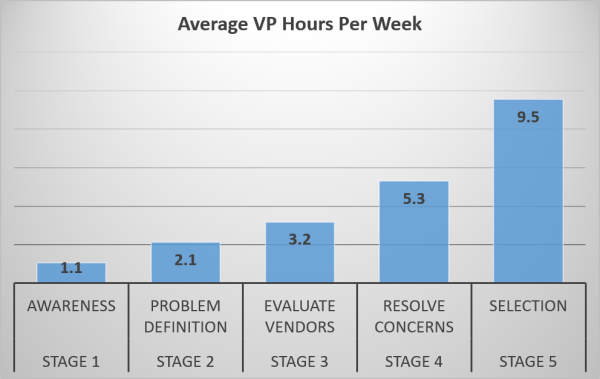
Average VPs predominantly engage in late stage deals. The typical sales VP looks at late-stage opportunities.  They can’t let one opportunity slip, regardless of its importance.   They want to be in every negotiation meeting and contract signing.  This is the Sales VP Super Closer role.   It is a flawed approach.  Below is an example of a Super Closer VP’s time allocation by sales stage:

Average VP of Sales Hours Per Week By Stage resized 600

Here is why this approach doesn’t work. 

1)      No Credibility: The customer just sees another suit fly in at the end of the deal.  Here are the thoughts running through his head:

a)      What value is this guy with a Rolex going to add?

b)      “Does he not trust the rep?”

c)       “Does he know anything about me or my company?”

2)      Bad Behavior: This occurs when a VP is trying to push the customer to close.  The rep may have done a fantastic job throughout the process.  However, the VP views it as his job to “get the deal done”.  This means throwing out a discount the rep couldn’t offer.  Super Closer indeed.  By closing all the deals, the VP justifies his existence. Meanwhile, he is reducing the average sales price on every closing. 

3)      The Third Month Traffic Jam: At the end of the quarter, the VP can’t close every opportunity.  Now the Reps who depended on the VP are flying solo.  The ones accustomed to the VP swooping in to “save the deal” are in trouble.  Meanwhile, the VP is frantically chasing deals all month.  They don't have enough time.  

Now let's see how the "A" VPs allocate their time:

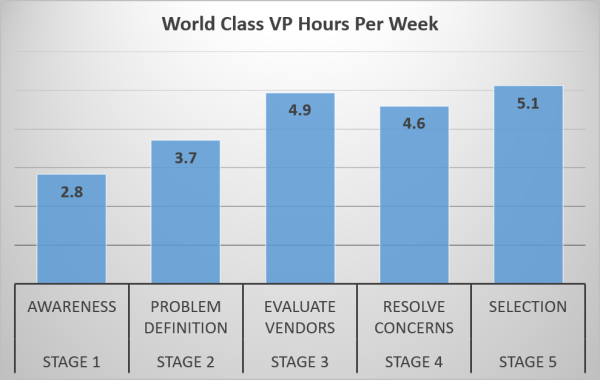
World Class VPs only engage the opportunities that will make or break their quarter.  The best look at all the deals in their pipeline.  Then they hone in on those crucial to the number.  They are present on these throughout the entire sales cycle.  Below is a chart showing the average time an "A" VP spends by stage:

World Class Vp of Sales Hours Per Week resized 600

Here is why this approach works:

1)      The Customer Feels Important: The VP of Sales engages early and often.  This shows the company’s commitment to their prospect. Any issues or dilimmas are handled early and promptly.

2)      The Rep Gives It His Best Effort: Sales Reps want to look good in front of their boss. I's get dotted and T's get crossed.  Nothing falls through the cracks. In turn the VP adds insight and value based on experience with other Key Account opportunities. They coach the sales rep on best practices for other opportunities. The VPs presence ensures near perfect execution.

3)      The Urge to Negotiate Is Reduced: The Average VP comes in to close on price.  The World Class VP differentiates his offering early.  He eases the customer’s concerns throughout the process.  Through the quality of interactions, the product and company is viewed uniquely.  Price will always be an issue, but it won't be the main one.

Another finding: the World Class VP doesn’t allocate their time evenly throughout the quarter.  During the first two months, most of her time is spent developing opportunities.  The final month, her time chart looks very similar to an average VP.  This is because she is closing out key deals for the quarter.   Below is the monthly breakdown:

World Class VP of Sales Montlhy Hours Distribution resized 600

The VP isn’t running down late stage deals all quarter.  But when it’s time to accelerate, they are perfectly positioned

Which deals are you spending your time on?  Sign-up for our VP of Sales Allocation Time Tracker and Sales Stage Checklist.  You’ll identify where you need to spend your time.  You’ll also get a checklist to ensure you're completing the correct activities. 

Author: Drew Zarges

sbi on linkedin

Follow @DrewZarges

Follow @MakingTheNumber

If you enjoyed this post, never miss one again by subscribing your Email Here and/or subscribing to the RSS Here.

22 Oct 15:08

VIDEO SALES TIP: You’ve Got Customers You Need to Fire

by TheSalesHunter

Some customers are a tremendous drain on  your resources. And you need to fire them.

I know what you’re thinking — that the whole idea of “firing” a customer seems very counter-productive.  Truth is, though, that some customers cost you more money than they are worth.  More often than not, you didn’t see they were headed in that direction when you first made the sale.

But now, for the sake of protecting your profit and sales motivation, these high maintenance customers need to go.

To see what I mean, check out this video:

Copyright 2013, Mark Hunter “The Sales Hunter.” Sales Motivation Blog. 

22 Oct 15:08

10 Things Every Sales Manager Should Know About Sales Performance [Infographic]

How well do you know your sales team? To find out how most salespeople feel about missed quotas, the lead pipeline, and sales performance, check out the following infographic. Read the full article at MarketingProfs
22 Oct 15:07

80% of Sales Jobs Will Change In the Next 3 Years

sales jobsIt is a fact. Many sales experts are telling us that 80% of sales roles will change by 2016. That doesn't necessarily mean that 8 out of 10 salespeople will lose their jobs. But it does mean that most of us are going to have to change the way we sell.

We already know that the way we communicate is changing. The way we learn is changing, as we use the internet to research and keep up to date. And, the way we develop relationships is changing as we connect with people through social media sites like LinkedIn and Twitter. 

And of course the way we buy and sell is changing forever. If you'd like to learn fresh strategies that actually work in today's business environment, check out Top Sales World (TSW), a unique site dedicated exclusively to the profession of sales.

TSW draws the industry's best known sales experts (including me) who provide unparalleled advice in the form of how to guides, articles, web-based master classes, roundtables and so much more. It's the world's first online "sales hypermarket" with the shelves stacked with every conceivable resource that front-line sales professionals and their managers could possibly need -- and it's all free. 

You will love this short video.

After you have watched it, get yourself over to Top Sales World, and join with thousands of like-minded sales professionals, who are committed to winning – you will not find many losers over there!

22 Oct 15:07

Sneaking Around for Extra Sales Leads

by Lawrence Anderson

“When major brands face a situation where low-cost competitors are stealing share, many smart companies don’t try to fight low-cost competition head on; instead they develop a second brand—a ‘fighter brand.’ This allows the original brand to retain its customer base and its premium price.”

This was the premise of Tim Williams as he describes a common but rarely mentioned strategy that employs ‘stealth brands.’ Reading it again though, I think it can also be a warning sign that price isn’t always the advantage of smaller vendors.

Competition is tough enough already when big-name companies like Oracle, SAP, and Microsoft stay at the top of their game. It’s easy to believe that making your offer smaller and less expensive seems like the only way you can strike a blow to these tech giants.

But when you throw in stealth brands into the game, that advantage is lost because it clearly shows that the giants can compete with their own small-sized offerings. Can you still compete?

The answer is yes. You may have lost the price advantage but that doesn’t necessarily mean your competition has gained much (not to mention, there is another price that larger brands must pay to go stealth).

  • Affiliation – As attested by Williams, stealth brands still need a level of authenticity and independence from the mainstream brand. Otherwise, it wouldn’t be stealth (even with the price advantage).
  • Quality – Just think of the ‘stealth brand’ as another competitor. They’re offering a lower price but what will that mean for their quality? Like all the others, you should see if their products can actually rival yours and aren’t just purely depending on branding power.
  • Experience – Smaller businesses end up targeting smaller markets that are overlooked from the perspectives of larger corporations. As a result, you may have more experience with these smaller markets compared to ‘stealth brands’ that were just built up in response to them.
  • Sneaking Around for Extra Sales Leads image url 2Independence – Finally, whereas a ‘stealth brand’ may not be truly independent, you are truly the captain of your own ship as it were. You don’t answer to a larger enterprise because the only enterprise you’re marketing is your own.

It’s like you’re a clan of ninjas or spies and you’re sneaking about where the big players aren’t looking. They secretly send those who try to sneak around as much as you but that don’t necessarily mean they can do it better. Price isn’t the only advantage you have!

Sneaking Around for Extra Sales Leads image ERP14

22 Oct 14:59

Focus on Benefits and Buyer Motivation to Make Sales

by Personal Branding Blog

One mistake made by many new business owners is focusing on the features of their products or services when advertising. Having great features is important to building a successful business, but advertising features is not the most effective way to market your product or service. Consumers don’t care much about your great features. What they care about is how your great features can help them. In other words, you need to translate your features into the value they give your customer. Being fast is a feature, whereas same-day delivery is a benefit.

Focus on Benefits and Buyer Motivation to Make Sales image shutterstock 140302666 300x200When reframing your features into benefits, you also need to consider why your market will by your product or service. There are many reasons consumers buy, but here are three common motivations and how you can use them to entice buyers.

Solve a problem: Solving a problem is one of the most common reasons people buy. Successful marketers understand this and as a result they sell the solution. Ted Levitt famously said, “People don’t want to buy a quarter-inch drill, they want a quarter-inch hole.” If a man needs a drill to make a hole, he doesn’t care so much about the drill’s weight, number of bits or warranty as much as being able to drill a hole. The successful drill marketer will sell the hole not the drill. If your product or service can solve a problem, focus on selling the solution. If you sell diet products, focus health, energy and sex appeal over losing fat. If you’re chiropractor, sell pain-free, active living over straight backs and adjustments.

Feel good: Many people buy to make themselves feel better. Do women really need a Prada bag? Probably not. But owning one makes them feel good. We see this phenomena each time Apple introduces a knew i-product. People are lined up around the stores wanting to have the latest and greatest gadget. There are plenty of other gadgets these people can own, but they spend hours, maybe even days in line because having the new i-product makes them feel good. But feeling good isn’t just about prestige, importance or superficiality. Consumers buy healthy foods or organic products because it makes them feel good. Many people buy from socially conscious businesses because they enjoy the feeling that they’re a part of a movement or helping others. People like to feel successful, cool, hip and sexy, which is why many marketers use tactics that suggest their products can lead to these feelings.

Fear: I’m not a big fan of catering to fear, but it is an effective method of marketing. People are afraid of many things, real and imagined. As a result, they like to buy things that alleviate their fears, whether it’s a security system to avoid home invasions, financial products to avoid poverty, or vitamins to avoid poor health. If your product can help eliminate fear, your focus should be on selling the feeling of security.

There are many other reasons people choose to buy from one business over another. These reasons include convenience, price, loyalty and more. Whatever their motivation for buying is, it’s your job to tap into it by creating marketing materials that speak to their needs and wants. This is done by converting the features that make your business great into benefits that meet your market’s needs and desires.

Author:

Leslie Truex is a career design expert who has been helping people find or create work that fits their lifestyle goals since 1998 through her website Work-At-Home Success. She is the author of “The Work-At-Home Success Bible” and “Jobs Online: How To Find a Get Hired to a Work-At-Home Job”. She speaks regularly on career-related topics including telecommuting and home business.

22 Oct 14:58

Three Sales 2.0 Conference Takeaways That Can Save Your Sales Team

by Brock Heath

There were so many great, engaging ideas and presentations at this year’s Sales 2.0 Performance Management Conference, the two days seemed to fly right by. Expect more posts about a few specific topics of particular interest.

HeaderSPM2013_limited


There were also some broader themes that kept popping up in different ways throughout the conference. If you popped your head in at any time these past two days, you would probably hear presenters and attendees talking about…

  1. Focusing on People FIRST

    There’s a whole lot of talk about technology in sales these days. CRM tools, commission automation, and the latest live metrics dashboards are all great — and the effect of social media and mobile technology on buying behavior is huge. But the Sales 2.0 panelists have a great point: Organizations need to focus on questions at the people-level first before investing their time on questions about technology. Many panelists and speakers — including Anthony Innarino, Gerhard Geschwandtner, and Lisa McLeod on Thursday — suggested that companies were never going to benefit from new tech as long as they continued mishandling their talent and management.

    I think a lot of this people-talk among our crowd is a natural reaction to the dominance of social media. Organizations are interested in (and sometimes confused about) how to have an attractive, comforting, and engaging human touch on this powerful new medium. With all the blatant advertising being shoved in your face every day on social media and the web (and it’s only going to get worse, people), this concern makes a lot of sense. Customer 2.0 does a lot of the buying process on their own. They don’t want to be sold to, they want to find great content and meaningful professional relationships at a distance. Sales reps, too, are looking for the human touch — in the office, from the people they work with. And that means managers, folks.

  2. Management Needs More Attention!

    The Sales 2.0 conference had a number of presentations focused on management, and one thing was abundantly clear: when it comes to training and tracking management, everyone seems to be in the dark. The majority of sales managers were promoted individual contributors, selected because of their high sales figures. But is that really a management skill? When Norman Behar asked his Sales 2.0 breakout group how many of their companies had anything in place that identified a clear front-line sales management skill-set and a way to practice and nurture it, not one hand went up. I’m talking zero. Folks, this is not good.

    According to Behar (who cited CSO Insights), companies that have a sales management effort that “needs improvement” see only 48% of their reps make quota, on average. And companies that boast management training that “exceeds expectations”? That leads to 68% of reps making quota. There is clearly a huge opportunity staring many companies right in the face: invest in selecting and developing your managers!

    Looks like there’s a corporate movement out there to re-focus on developing and improving sales management. It’s in the early stages yet, but it’s already gaining speed. I’d jump on board if I were you!

  3. Get Serious about Company Culture

    Yep, everyone’s still having that discussion about how to create a “winning culture,” as Jill Rowley of Oracle put it. Steve DeMarco or Xactly encouraged us to stop splitting people up into generations. They  pointed out plenty of management and culture tactics that work across all the generations employed in sales: aligning compensation with company goals, engaging through metrics, using contests and spiffs, defining a career path (this is a big one, especially for newcomers), and following sales compensation best practices.

Lisa McLeod and Norman Behar both commented that providing coaching and getting it right was vital to creating a positive company culture. And that brings us back to the importance of management training. For sales training to stick, management needs to understand how to support and maintain it. In the end, it’s the quality of management that drives a company’s culture and it’s sales.

The post Three Sales 2.0 Conference Takeaways That Can Save Your Sales Team appeared first on TeleSmart Communications.

22 Oct 14:58

Simple Strategy to Turn Lost Sales Into Sales Success

lost salesThe other day I was at the Olive Garden talking to a prospective client over lunch. He was telling me about all the challenges his sales organization was facing.

Setting up appointments with new prospects was a nightmare. Decisions were taking longer and longer to make. Competition was everywhere, undercutting their proposals.

His reps were frustrated, discouraged.

“If only they could all be like Paula,” he said, shaking his head in frustration. “Can you clone her?

I laughed, but my curiosity was piqued. “Tell me more,” I said.

It seems that Paula was having a really good year, despite everything that was going on. She cracked into a few big accounts that she'd targeted at the beginning of the year. Despite losing some business to competitors, she'd won more than her share without major discounting.

Even the numerous obstacles that seemed to totally derail the other sales reps, only set her back temporarily.

“Let me guess,” I interrupted. “Those setbacks almost seem to energize her. Right?”

My client, who was about to take a bite of fettuccine, set down his fork. Looking at me quizzically, he said almost in a whisper, “How did you know? That's exactly what happens.”

I smiled slowly, but couldn't keep the twinkle out of my eyes. I leaned forward and whispered, “Paula kisses the frogs.”

My client burst out laughing. It certainly wasn't the answer he expected. But, it was the truth.

Over the years I've met other Paulas and they're usually top performers. What differentiates them from other sellers is their approach to the setbacks (or ugly frogs) they invariably encounter in selling.

When faced with tough times, frog kissers like Paula reframe those obstacles into personal challenges. Rather than getting discouraged or blaming others, they ask:

  • How can I tackle this new situation?
  • What other options can I try?
  • What can I learn by kissing this frog

With their creative energies ignited, new options and alternatives emerge. Limitations become possibilities. They experiment with different approaches, willing to grow in the process. As a result, frog kissers are often able to transform their lost sales into successes.

So here's my challenge to you. In the next month you're likely to run into a few sales problems such as disinterested prospects, angry customers, delayed decisions, or cut-throat competitors. This time, instead of getting upset, go kiss the frogs. 

18 Oct 16:10

Under the Magnifying Glass: The Power of Transaction Price Management

by PPS
Anton Malygin, Director, PwC
How many companies can truly say they analyze their day-to-day operations?  How much yield is regularly lost every day in revenue leakage, unjustified discounts, and underpriced transactions?

That’s not just numbers, that’s leaking profit. Robert Marvin and Anton Malygin are getting out the magnifying glass and giving you the “single source of truth view” in their workshop Effective Transaction Price Management: Unlocking Pricing Value for Your Organization. 


Robert Marvin, Director, PwC
Come prepared to learn the analysis of transactions and their revealing nature, including:

1. The value of transaction price management, key benefits and opportunity areas for transaction price management initiatives,
2. How analytics can be leveraged to provide transparency and generate one consistent “single source of truth” view, using information about customers and products at the transaction level,
3. Requirements to effectively execute transaction price management and make it sustainable. 

Marvin and Malygin will also be identifying areas of up-sell and cross-sell opportunities, ultimately helping attendees to boost their bottom line.  They will be at the PPS Conference in Next Week in Atlanta

18 Oct 16:08

3 Ways You Can Influence Buyers

Photo by stugstugLots of thoughts go through buyers' minds when they're evaluating service providers. Do the people at the company understand my problems? Do they care about my challenges? Have they helped similar organizations in my industry? What's their level of expertise?

And the first place they stop to try and get those questions answered is your website. That means you must have information on your site that answers them, says Jill Konrath in her video 5 Things Prospects Expect to Find on Your Website.

The top three things on her list include:

18 Oct 16:07

2 Ways To Develop & Retain Your Young Sales Talent in 2014

by Blake Cavignac

91% of millennials expect to stay in a job for less than three years.

This study along with many others might be one of the reasons that support the claims of older generations – Millennials are disloyal and entitled.

Being a millennial, I have always thought these statement were a generalization of poor leaders.

However there’s no arguing the facts.  The surveys are accurate.  We are changing jobs much more than their predecessors.

So as a leader in your company you have a choice.

You can accept these facts, throw in the towel and continue down the path of frustration and disdain toward the millennial generation…

OR

You can understand what drives us and use this information to your advantage.

For those who have chosen the latter, read on.

2 Ways To Develop & Retain Talent

Stephen Covey said it best:

2 Ways To Develop & Retain Your Young Sales Talent in 2014 image Stephen Covey2 600x336

If you do not make the time to get to know the millennials within your company, it’s likely they’ll become disengaged and disinterested in helping your company achieve its vision.

Here are 2 ways that will help avoid this from happening while turning millennials into your most loyal advocates.

1 – The “Meaning” Work

My first job out of college was in the commercial real estate industry.  I was tenant rep broker that would help businesses lease office space.

Long story short, I failed miserably.

When reflecting on this experience, it became clear that the root of my failure came from the meaning that I associated with my job.

“I help businesses lease office space.”

This in no way excited me.

As every rookie or veteran salesperson knows, if don’t believe in what you’re selling, then all the rejections and failures that you have to endure will drive you into the ground and keep you there.

“In order to become a great salesperson you have to sell yourself on what you’re selling first.  You have to be utterly convinced and believe in what you’re selling so strongly that you become unreasonable.  That you think it’s detrimental and unethical not to convince someone to buy from you.”

Had I been more mature and adopted the mentality above, I would have realized that my job was much more than just helping people lease office space.

Here’s what I mean:

Behind payroll, the office lease is oftentimes the most costly expense for business owners. Therefore identifying the best space and negotiating favorable terms for their lease plays a critical role on the bottom line of their business.  In addition this also affects the future of every single employee along with the members in their families.

Now the “meaning” of work takes on a whole new purpose.

I believe it’s critical that you constantly communicate the importance of what you’re selling to your young sales talent.

By adding meaning to our work, not only will it deliver a strong sense of purpose to what we are selling but it it will drive us to produce at higher levels.

2 – Be a Mentor

With all the negative generalizations being thrown around about millennials it’s easy to assume that we don’t want feedback or guidance on how we are doing or how we can get better.

In fact, oftentimes we are at fault for giving off this perception.

Regardless, I strongly recommend that you don’t buy into it.  What you should buy into is the importance of our development and growth.

My reasons are as follows:

Effort vs. Production 

Growing up many of us were told that we deserved the best.  This was supported by the act of receiving praise and trophies for giving any level of effort regardless of the outcome.

Now transfer these habits to the business world. We both know they’re not going to fly. Effort means nothing if you don’t produce.

This could explain why many of us feel entitled to a raise or promotion – because “we gave an effort”.

That’s why it’s critical that you clearly establish the expectations immediately.

But that’s not enough.

You must consistently reinforce these expectations while giving us the mentorship, coaching and tools needed to succeed.

If this does not happen we will continue to assume that by giving effort we will receive praise and compensation.

However, when there is no doubt in our mind that we will be rewarded through production along with receiving constant support and guidance from you, it will help us breakthrough barriers and destroy limiting beliefs.

New Projects and Initiatives

From my experience, the best mentors I’ve had are the ones who challenged me on a daily basis.  They were always pushing me outside my comfort zone.  This came in the form of many exercises however the one that made the biggest impact was taking ownership of new projects and initiatives within the company.

I’m assuming you have many new and innovative ideas you want to implement in your company but you just don’t have the time to execute.

This is a perfect opportunity to hand off the initiative to one of your young salespeople.

If your response to this is:

“I just need them focused on prospecting, making calls, producing…”, I understand.  However I think you should consider the following.

We as humans have proven to be terrible at predicting what will make us happy.  One of the bigger differences between millennials and other generations is that we seem to be taking more of a “trial and error” approach to finding what makes us happy.  So if we are not happy in our current job, we think we will find more happiness in the next job.  Thus the reason for all the job-hopping.

By giving us new projects and initiatives, not only will you see your ideas come to life but you will be playing a critical role in our development.  You will be creating a culture of flexibility within your organization, which is something we as millennials seek.

Herein lies the key to earning our loyalty:

Show us that you’re looking out for our best interest and we will go above and beyond to return the favor.

18 Oct 16:07

A Valuable Sales Lesson – From A Cat!

by Frank Rumbauskas

You can learn a lot from a cat.

How to sell, for starters.

You see, cats and dogs are very different. We have one of each in our house, and if I want the dog to come over, it’s pretty simple – I call her over! 9 times out of 10, she jumps up and trots right on over, happy to see me!

The cat, on the other hand, is a different story. If you try to call a cat over, it will ignore you. The harder you try, the more you will be ignored.

Totally opposite of the dog.

And guess what – sales prospects aren’t dogs. They’re cats, and if you want to get them buying from you, you need to learn and understand “cat theory.”

Cat Theory
Cat theory is simple: It states that it’s up to you to get the cat to come over. You’re the one taking the action. However, you must trick the cat into believing that it is the cat’s own idea to respond to you.

In other words, you’re really getting the cat to come over, because you want her to. But she believes it’s her own decision – that she’s doing it of her own accord.

Sales prospects are exactly the same way. That’s why direct sales approaches trigger an instant, subconscious sales resistance in people.

Think about it. When you’re walking through a shopping mall or other market place, and salespeople at those kiosks yell to you to come over and look at whatever useless trinket they’re selling, your first reaction is to shut down and either ignore them, or give a polite “no thank you.”

By contrast, an intelligently constructed store window, containing goods you would like to have, does the polar opposite: It entices you to draw nearer, take a closer look, and possibly enter the store to buy.

You may have thought it was your own idea to go into the store, but in reality, the store’s staff made you come in. They set things up to draw you in, while letting you believe it was your own idea to do so.

And that’s how cat theory works in the real-world of selling. You must create the ideal circumstances to get prospects to come to you, ready to buy, while letting them believe they did it all on their own.

Using This In The Real World
Cat theory applies across the spectrum of sales situations, from prospecting all the way to the culmination of the sale (enticing them to buy instead of “closing” them).

It’s in prospecting, however – or more precisely, lead generation – that it’s most effective.

When you create the ideal circumstances to get qualified prospects to come to you, much like that store window, they do just that – and the balance of power is in your favor, since the prospect approached you rather than the other way around.

18 Oct 15:58

Two Words a Sales Manager NEVER Wants to Hear

by TheSalesHunter

3801982 medium 199x300 Two Words a Sales Manager NEVER Wants to Hear photoIf and Then: The two words no sales manager ever wants to hear.

If you’re hearing them, then you have a problem you need to deal with quickly.

Let’s put these two words into context.

Salespeople are quick to come up with a reason why they are not successful.

Typically, it is something like “the price is too high.”  The reasoning goes like this:  If we could cut our price, then I know I could close more sales.”

If it’s not price, it’s something else. “If only we could do it this way, then I know I would have more customers.”

This is nothing more than the typical blame game played by salespeople when they can’t sell.

The simply blame something else or try to mask their blame.  To them, by positioning it with the words “if” and “then,” they believe it’s brilliantly strategic.

Thinking they’re strategic is the last thing that comes into the sales manager’s mind.  As a sales manager, what I would be thinking is how the salesperson is trying to scramble to cover their lack of sales competency in closing a sale.

Hearing the words “if” and “then” in a sentence from a salesperson should only invoke one question.  What is the real reason they aren’t making the sale?

Sales managers should not be suckered into believing for a minute the salesperson is onto something.   Keep in mind, this trick is most frequently used by experienced salespeople when they are working for a new sales manager.

The issue is not “if” and “then.”

The issue is what is it going to take for the salesperson to understand the needs of the customer and make an offer that will address the opportunity.

Copyright 2013, Mark Hunter “The Sales Hunter.” Sales Motivation Blog.

button receive a free9 300x51 Two Words a Sales Manager NEVER Wants to Hear photo

18 Oct 15:58

On-Boarding New Sales Reps is Not an HR Job

by peaksales
ID-10043295

Image courtesy of basketman / FreeDigitalPhotos.net

In many companies, there is an assumption that the Human Resources department should handle the on-boarding of new employees. Whether or not the HR department does a greta job of on-boarding new sales reps (and they often do), here are the main reasons why the sales department should play a very active role in on-boarding sales reps:

1. Sales Knowledge - To be successful in sales requires intimate knowledge of markets, customers, products and sales methods. Often these change on a regular basis and no other department in an organization can possibly have as much visibility as the sales department when it comes to crucial current insight in these areas.

2. Infrastructure – In many companies there is limited access to the sales systems – for security reasons – which can compromise training if performed outside of the sales team. It is critical that a new sales reps learns how to leverage these tools from day one.

3. Sales Culture – The sales team has its own rhythm and pace. Getting exposed to this is critical to hitting stride as quickly as possible and this can only be achieved through full immersion early on.

Read about our structured approach to on-boarding new sales hires: The First 90 Days – Your Guide to Making New Sales Hires Produce Fast.

To your success!

18 Oct 15:10

Sales Training Article: Look at Your Sales Swing

by Customer Centric Selling

Sales Training Article: Who's Looking at Your "Sales Swing"?

Frank Visgatis, President & Chief Operating Officer, CustomerCentric Selling® - The Sales Training Company

Image courtesy of Pat138241 at FreeDigitalPhotos.net

sales training workshopsButch Harmon.

Hank Haney.

Sean Foley.

Do you know what these three people have in common?

They were all hired by Tiger Woods, possibly the greatest golfer of all time, to coach him. That's right, even the best in the world rely on coaching and guidance from objective third parties to keep them on track, tweak their form when necessary and help them maximize the impact of their practice sessions.

So, my question to you is this: who is looking at your "sales swing"?

Do you have someone who can provide you with consistent reminders, feedback and instruction or are you navigating the hazards of the selling world on your own?

Sign up for one of our sales training workshops so we can take a look at your sales swing and get you on the right course to winning more sales. 

Ideally your sales coach is the person that you report to. However, too often, while sales managers would like to help by carving out time to role play, conduct skill development exercises and help fill in the blanks when information or training you've received already hits a bump in the road, the realities of every day life and work can sidetrack the best of intentions. Trying to coordinate schedules, plan around actual customer calls, or even the coach's ability to properly execute can all be challenges.

At CustomerCentric Selling®, we have always championed the importance of the sales manager in the implementation of sales process. In fact, we currently offer a free, one-day Sales Process Management™ sales training workshop, twice per year, that is open to anyone that has attended the full CCS® sales training workshop. Even with that, travel is required and the dates are fixed so, as a result, we have only scratched the surface of the audience that could truly benefit from this service.

So, what's the solution?

I'm pleased to let you know that we have launched My CCS® Coach, a SaaS-based coaching reinforcement tool that is available to any CCS® alumni (at no charge!) for the first 60 days of access.

My CCS® coach delivers on-demand, just-in-time, situation-specific learning and reinforcement for salespeople and sales managers. No more juggling to coordinate your schedule with your manager, remembering to log into a fixed schedule webinar or trying to justify a trip to Denver or Boston for a one-day sales training workshop.

If you've been through CustomerCentric Selling® in the past and would like take advantage of this value-add service, please check out My CCS® Coach! If you will be going through the training in the near future, this will be integrated directly into your learning experience.

Tiger Woods understands the value of having a coach on call. Don't you, as a sales professional, deserve the same?


sales training companyNeed some help with your sales performance? Take a look at the sales training workshops available to you and improve sales performance.

Read more sales training articles from CustomerCentric Selling® - The Sales Training Company.

17 Oct 13:37

4 Ways to Win New Customers on Social Media (and Keep Them)

by Chris Smith

4 Ways to Win New Customers on Social Media (and Keep Them) image 4 Ways to Win New Customers on Social Media and Keep Them

Winning new customers on social media can be difficult; if ever there was a platform that suffers from information overload, its social media. Think of the reams of Tweets that pour out when a major event takes place, or the amount of status updates that are published on a daily basis on Facebook. Getting attention and earning trust in an environment where your content is swept away almost as quickly as it is published is extremely difficult.

Winning new customers and keeping them on social media, I’d argue, is even harder. Loyal customers are defined by their affection towards you, and a simple like or follow isn’t necessarily indicative of this. No, to gain real benefits from your following, you need to earn their loyalty and affection rather than having them see a couple of your posts, get bored and then move on to the next brand.

This was a distinction I once struggled with. As a relative newcomer to social media marketing (I found my first job in the industry in 2012), I still consider myself a relative novice and would have once considered gaining a like or follow as a ‘done deal’; it’s not. In fact, it’s the beginning of a long relationship. And, like any relationship, you need to frequently check your behaviour to make sure you’re keeping the other half on side.

So, inspired by Mitt’s previous post on ‘11 Ways to Stop Bleeding Social Media Followers‘, I’ve come up with four more things to think about when trying to win the undying loyalty of new followers…

#1. Don’t be banal

My personal social media pet-hate (trust me, I rant about it a lot) is banal content. You know the kind; a brand will post a picture of a sandy beach somewhere with a brief instruction to LIKE if you like holidays or SHARE if you LOVE holidays. It’s meaningless, it serves no purpose and, over time, it’s bound to lose you followers.

Without wanting to pick on a single brand for doing this, the Condescending Corporate Brand Page on Facebook is pretty much the ‘what not to do’ guide to social media, and collates the ‘best of’ banal content from around Facebook and the wider web. This little gem below is the perfect example of social media content that might get engagement, but not the kind of engagement that’ll drive conversions or provide you with any return on investment.

4 Ways to Win New Customers on Social Media (and Keep Them) image Share Topics That Relate To Your Brand on Facebook

Instead, focus on topics that bear some semblance of meaning in the lives of your followers. It could be a debate regarding an important issue relating to your industry, links to interesting posts (some of your own, some from other sources) or even just a funny yet relevant picture.

A brand doing all of the above exceptionally well at the moment are BrewDog, a Scottish company who craft beers and lagers. Take a look at their page and you’ll see behind the scenes pictures of their brewing process, a few posts and stories on the beers themselves and a generally feel-good community willing to respond to the company. I feel like having a beer just by looking at the page!

4 Ways to Win New Customers on Social Media (and Keep Them) image Your Facebook Page Posts Should Reflect Your Brand

Part of this is down to the exceptional company image BrewDog have crafted for themselves over the past year or so, proving the effectiveness of getting your company image and tone of voice finalised before you start hitting social media!

4 Ways to Win New Customers on Social Media (and Keep Them) image Don’t Just Engage But Build a Community on Facebook

A good general way to approach social media content creation is to question whether you’d share the same information with a personal friend face-to-face. Would you really ask them whether they like holidays? You might, but it’d probably make you the guy everyone tries to get away from at parties. I suppose the short version of this, really, is to be interesting and be entertaining!

If you’re struggling to come up with a content plan for social media, these ten questions to ask when creating a social media plan from Entrepenuer are pretty useful!

#2. Be personable

Social media is frequently touted as a customer service channel, and while it undoubtedly does serve this function, it has arguably led to brands being unable to communicate with their fans on a personal level. Instead, they resort to comments and messages that read more like pre-prepared press statements rather than something someone would say in the real world.

While anything you choose to say to a follower on social media should be considered in advance, the actual conveying of that message should be done in a personable and relatable way. Be warm and friendly, don’t be afraid to crack a joke every now and again – just act like a human interacting with another human face-to-face would.

One of the best examples of a big brand doing this is, surprisingly, a brand account dedicated specifically to customer service. ASOS Here To Help is a dedicated customer service channel for ASOS and is easily one of the best examples of brand customer service I’ve seen on social media. Check out the tone they choose to use:-

4 Ways to Win New Customers on Social Media (and Keep Them) image Respond to Customers Tweets With Personable Messages

Every response is tailored specifically to the customer they’re addressing and frequently uses colloquial language; it’s a real life approach to dealing with real life people. Check out the timestamps on those tweets too; ASOS are getting messages at an extremely frequent rate yet still don’t resort to pre-prepared responses. A testament, if one was needed, to the power of being personable.

One technique I really like using for social media content is to directly engage with customers in the first person rather than referring to the entire company in the second person. There’s something about using ‘I’ that disarms a customer and allows you to engage on a more personal level.

For more guidance on coming up with a tone of voice on social media, I recommend checking out this post from Marketing Land, which outlines 20 great examples and some guidance on developing your own tone of voice!

#3. Don’t be afraid of debate

This is related to point one; don’t be afraid to instigate some debate around your brand and related topics. The example in point one is the perfect illustration of the type of question you want to avoid asking your followers; everyone likes holidays, so there’s nothing to be discussed. It’s a shameless vanity metric builder that provides no real value.

A real debate, however, can help to build your brand as an authority in your field. Pick out some interesting topics that you think might interest your followers and pitch them out; ask questions and encourage people to share their views. Just make sure to properly manage any debate you instigate; anyone expressing hateful or potentially controversial views needs to be managed (via blocking or otherwise), as does anyone sending out abuse to other followers.

‘Debate’ is quite a daunting term, what with all the political connotations the word throws up. But debates can be fun and thought-provoking without having to have much gravitas; in fact, I’d say that fun should be the first objective when instigating a debate on Facebook! One of my favourite brands doing this at the moment is American Soda, a small British company who import American candy. Here’s an example of one of the many debates they instigated; Red Vines vs. Twizzlers. Simple, but it gets people talking…and probably sold a few of each product too!

4 Ways to Win New Customers on Social Media (and Keep Them) image Ask Questions and Generate Debates on Social Media

A bit of healthy debate on a post can add some personality to your brand’s social presence and draw more engagement. Crucially, this engagement is more likely to lead to conversions and traffic to your site in the future as the debate you’re instigating is relevant to your brand.

#4. Don’t lose focus

This is possibly more focused on the marketer rather than the fans of a page, but it’s something that’s worth bearing in mind. There’s nothing quite like a like counter or follower count spiralling upwards to get to the head of a social media marketer; this can lead to the marketer losing focus and treating their brand’s social presence as a vanity project.

By doing this, you risk running into some of the issues discussed above by publishing content solely designed to draw in likes without any consideration paid to the ‘end game’ of social media marketing; increased brand awareness, traffic and conversions for your brand.

Success can also lead to you resting on your laurels and ‘churning’ out new content similar to previous posts on the basis that it worked before. This leads to a repetitive experience for your followers and is one of the surest ways to start losing followers.

So, stay focused, have a content plan and never let success get to your head!

Content plans can be difficult to come up with from scratch; this great (and free!) template from Hubspot is a good base from which to develop your own.

Winning and retaining new customers is hard, but not impossible. By being personable, interesting and keeping your content fresh and focused, you can maintain a social following that’ll bring innumerable benefits to your business.

How do you win customers with social media? Are there any tips you like to share with us? Please leave your comments below.

17 Oct 13:36

Do You Sell Using a “Push” or “Pull” Strategy?

by TheSalesHunter

5107530 medium 300x225 Do You Sell Using a Push or Pull Strategy? photoWhen asked this question, most salespeople respond by saying they use a “push” sales strategy.

They say this based on how they view a typical sales call being one where the salesperson is convincing or showing the customer all of the features and benefits of what they offer.

I believe this approach is totally wrong, and it is the reason why more sales calls wind up going nowhere.

If we shift to a “pull” strategy, I feel we will have a much higher close ratio and, better yet, do it with a higher margin.  The “push” and “pull” concept has been key to marketing for years. When we say “pull,” it refers to creating incentives at the customer level that encourage them to buy the product.

“Push” marketing is focused around loading up the channel, advertising heavily and trying to convince the customer to buy.   (Yes, I know the true marketing definitions of these are much more complex. I’m just trying to be simple in the context of this blog.)

A “pull” strategy for sales is one where the customer comes to believe the product you have is the one they have to buy.  Beauty is when the customer believes this, price becomes less of an issue.

A “pull” sales strategy is centered around you, the salesperson, asking questions to get the customer to reveal the needs they have and the outcomes the desire. By asking questions, you’re allowing the customer to drive the discussion — or so they think — and thus they will be far more likely to convince themselves.

Once they have convinced themselves, there is no stopping them and  they will be adamant about buying to satisfy their need.

Take a look at your sales process. Is it geared around you telling the customer and “pushing” the customer?  How much of your presentation is geared toward pulling? Easiest thing you can do to begin moving from a “push” to a “pull” approach is by asking more questions.  Make it your objective to add 5 more questions to each sales presentation you make.  You’ll be amazed at what happens next.

A “pulling” sales strategy where you allow the customer to pull you along will result in not only more sales, but also more sales at a higher profit.

Copyright 2013, Mark Hunter “The Sales Hunter.” Sales Motivation Blog.

button receive a free9 300x51 Do You Sell Using a Push or Pull Strategy? photo

17 Oct 13:36

How Online Content Can Drive Your Business Growth

by Guest Post

How Online Content Can Drive Your Business Growth written by Guest Post read more at Small Business Marketing Blog from Duct Tape Marketing

Thursday is guest post day here at Duct Tape Marketing and today’s guest is Cassie Roberson – Enjoy!

Every day thousands of people go online in search of useful information or communication through social networks. This is where your prospective customers are. So, the next question is how to get their attention and to lead them to your service offering.

Saying “Don’t try to sell but try to help” at first might sound questionable, but actually this is how it works with online marketing. Online content is the first step in communication with a large number of potential customers. So, bring in some online interaction with your target audience.

1. Create content that builds credibility

how-online-content-can-drive-your-business-growth1

Photo Credit Flickr

Don’t limit yourself with just writing a description of products you sell or services you provide. In addition to your website create an online platform where you will give professional advices and share useful information with people (a blog, Facebook page, Twitter account or altogether).

In order to build a long-term relationship with a customer you need to make an impression of a reliable and trustful company. Instead of pushing to buy something from you, give them advice on how to make the right decision.

Don’t be reluctant in providing information. The more you give the more you get back. Remember that if a visitor doesn’t find valuable information on your page, he would likely turn away and find it somewhere else; after all they are just a click away. In case if visitors do find helpful tips on your business page, you will instantly earn their trust as a professional.

2. Go social

how-online-content-can-drive-your-business-growth3

Photo Credit Intersection Consulting via photopin cc ]

You have definitely heard about Social Media Marketing (or SMM) which is technically an online form of word-of-mouth marketing. A great thing about SMM is that business insiders are able to initiate and control company’s presence in social networks. Millions of people somewhere online are waiting for your signal to act. But before throwing a rod you need to lure the fish.

Business promotion in social networks is again all about building credibility and visibility. You have to create content that people will share and spread throughout the community. So, do not pack your Facebook page with commercial offers which are not the best posts to collect “likes”. Ideally your social posts should contain 80% of useful information or interesting facts and only 20% of promotion. Providing helpful and valuable content makes people respect your expertise.

Also do not forget to make it easy to share your posts on blog and website. To get even better results maximize your content through publishing on multiple platforms. Ask your staff, colleagues and partners to help you share a new post through their personal social network accounts.

3. Visualize

“Better to see once than hear a hundred times” works best in case with online content. Instead of posting another 800 word article just share with visitors an impressive picture, short video or animated slideshow. You can also combine text and visual elements – support your article with pictures, charts or even animation.

Studies have shown that combining information visual cues with text content can dramatically improve information retention; which is your ultimate goal in sharing content.

“Overall animation increases performance with better learning results and less effort. However, visual cues rated better than replacing visual text with spoken text. Multimedia materials using both words and pictures have the highest instructional efficiency for retention and transfer.” 1

To make visitors share your content it shouldn’t just be interesting but outstanding. Try to use the best tools you can find for information visualization. There is numerous software to create animation, infographics or slideshows online. One of the easiest and quite powerful visualization is Presenter by Easy WebContent. This free web application lets you combine pictures, text, icons, audio and video just drag-and-dropping the elements to canvas. EWC Presenter might become a great source of inspiration for creating your next blog post.

As soon as you are on the right spot with well-crafted and easy-to-share content, you will see multiple results, including but not limited to:

  • Top positions in search engine listings
  • Thousands of potential clients engaged
  • Better awareness about your business
  • Motivation for potential customers to order your product or service
  • Collecting useful personal information about target audience

All these indirect impacts could lead at the end to expansion of sales and better financial results. So, what are you waiting for? It’s time to start improving your content management right now.

References:

1 – Research Summary “Animation: How does animation affect cognitive load?” University of South Alabama


cassie_roberson_bio_pictureCassie Roberson is a freelance writer mainly specializing in Business, Marketing and Web Design. Before writing for blogs she used to work as a financial manager for a small web design company, later got involved in numerous marketing & promotion projects (including content marketing and SMM) and even graphic design projects. With her Business degree, design and photography passion, she finally decided to become a full-time freelancer and continue sharing valuable content with online readers.

Related posts:

  1. Which Online Marketing Tools Lead to Substantial Growth? Thursday is guest post day here at Duct Tape Marketing...
  2. 3 Step Content Marketing Audit for Small Business Marketers Thursday is guest post day here at Duct Tape Marketing...
  3. 7 Most Important Online Marketing Tactics for Any Small Business Building an effective online presence these days has moved beyond...
17 Oct 13:33

Are Your Buyer Personas More About You Than Your Buyers?

by Tony Zambito
Are Your Buyer Personas More About You Than Your Buyers? image 3415909302 994e48e81f m

mirror image (Photo credit: Identity Photogr@phy)

Recently, I was asked if I would help review a set of completed buyer personas. It turned out to be an interesting exercise. As I usually find when helping people with their questions and challenges. This particular instance resurfaced one of the major pitfalls of buyer persona developments. Which is all too common today.

Context

Recently, we are seeing buyer persona development become a concern for content marketing and product marketing. The focus is narrowly defined to meet campaign needs and short-term objectives. The needs are pressing and no doubt folks are under the gun to hit targets. There are discussions on what to do to reach and convert more buyers – quickly. It is within this context buyer persona development efforts can be seen as a quick panacea to solve a major headache.

The Problem

This context is causing problems for teams attempting buyer persona development. Led to believe it takes a few short calls or running a couple of data reports to create buyer personas, teams resort to win/loss data interviews. Yes, some insights are gained. However, many are lost through this inadequate method.

This approach is leading to widespread self-referential treatment of buyer personas. A short name for this is – projection. The short summary of projection is:

Within the context of our existing situation and status quo, we project our own thoughts, attitudes, beliefs, and ideas onto customers. This results in buyer personas, which are more a reflection of status quo thinking and not revelation of new and profound deep insight.

This problem is more prevalent as companies attempt to move quickly, not invest in adequate qualitative research, and view buyer personas as a checklist for campaigns.

Win-Loss is a Loss

The quick remedy for most companies has been to resort to conventional win-loss interviews. This approach is prone to self-referential treatment of buyer personas. Conducted in the context of a recent deal or purchase, it is loaded with biases and projection. These types of interviews have their place in business. Buyer persona development is not one of them.

The Real Need

The real need facing B2B organizations today is to understand how buyers are changing their behaviors and attitudes towards buying. This type of understanding is critical to future aspirations for growth and new innovations. Companies today, without this understanding, will wind up on a treadmill of recycling campaign after campaign every quarter in the hopes of meeting short-term targets. As well all know we eventually burn out on a treadmill. And, so do buyers.

What To Do

B2B companies can take the following steps to avoid self-referential buyer understanding, which makes buyer personas non-useful:

  • Clearly identify your problem. Companies are jumping into buyer persona development efforts without clearly identifying their problems. The companies who have benefited from buyer personas have done so by beginning with a clear understanding of a problem statement. Not perceiving such efforts as a checklist item.
  • Get out of status quo and pressure-filled context. When pressure builds, it is natural for organizations and people to make attempts for initiatives to fit the situation. Tying buyer persona development too closely to a short-term objective, such as launching a campaign in one-month, will result in little value.
  • Commit to qualitative buyer research. B2B companies need to resist the temptation or advice to jump into conventional win-loss interviewing as a substitute for qualitative buyer research. There are no short cuts when it comes to conducting the adequate amount and techniques needed to gain insights, which changes the future direction of organizations.
  • Create a new language about the buyer. Current language about the buyer is woefully loaded with jargon and detachment. Many of you know what I am talking about. We focus on “buying criteria”, “priorities”, “initiatives”, and other business jargon laced terminologies. These can get in the way of unraveling the deeper insights we need on buyers today. They keep us in the status quo.

Companies today must check against their current status quo thinking about buyers. Being careful to not influence with self-referential code and projecting one’s own beliefs on customer views. What matters most is to understand what buyers think, the context in which they think, and why they think as they do. Only then can a company develop meaningful views of their buyers with the aim of helping them fulfill their goals.

17 Oct 13:31

The Role of Emotion in Business Sales

emotionIt's often been said that people buy with their hearts and justify their purchases with their heads.

Now, this might be a cliché, but it is true.

People think this is mostly a consumer thing. It isn’t. Business buyers buy on emotion and justify with their heads, too.

I know one particular situation where there was a consulting firm, and the consultants spent 5 months selling to a particular client and could not make the sale. No dice.

Now the ROI story, it was great. The company could invest $2 million and get $8 million in cost savings at a minimum over the coming years. But the consulting firm still didn’t sell it and they didn’t know why...

17 Oct 13:31

Preparing Now for Sales Success in 2014

by Wendy Weiss

Preliminary data from 500+ sales organizations that have already taken part in CSO Insights 20thannual Sales Performance Optimization (SPO) study show that 94% of companies are raising revenue targets for next year.

If you are struggling to hit quota this year, how can you possibly be expected to achieve even higher targets next year?

Help is at hand …

Top Sales World is a unique site dedicated exclusively to the profession of sales. TSW draws the industry’s best-known sales experts – including me – who provide unparalleled information in the form of how-to-guides, articles, and web-based Masterclasses and Roundtables, plus so much more.

TSW is the world’s first online “sales hypermarket,” with the shelves stacked with every conceivable resource front-line sales professionals and their managers could possibly need, including:

  • Top Sales Management – an area dedicated to sales leaders.
  • Top Sales Articles – where we re-publish and reward the best written work.
  • Top Sales Blogs – the top 50 sales and marketing blogs in one location.
  • Top Sales Tips – a daily nugget from the best minds in the business.
  • Top Sales Interviews – downloadable recordings on the latest topics.
  • Top Sales Roundtables – we bring together a group of top sales experts every month.
  • Top Sales White Papers – all free to download and digest.
  • Top Sales Events – we keep everyone updated on what’s happening and where.
  • Top Sales Books – a library full of all the best sales books ever written.
  • Top Sales Masterclasses – regular short, sharp online sessions delivered by the masters of sales.
  • Top Sales Training/Coaching – we only recommend the companies that are “best of breed.”
  • Top Sales Awards – the annual awards that reward outstanding contribution to the sales space.
  • Top Sales & Marketing Influencers – each year we select the top 50.

Finally, Top Sales monthly magazine, now with a readership of more than 150k.

Every person who sells something (that would be just about everyone) knows that their sales success depends upon their staying current and on top of their game. And every salesperson, no matter the amount of their experience, needs support, excellent resources, practical tips and information, and a professional, seasoned expert they can turn to.

Top Sales World is THE Most Significant Online, Worldwide Sales Community on the Internet. Period!

Watch this amazing short video – and then get over to Top Sales World

17 Oct 13:31

It Takes Guts to Lead from the Bottom Up [Note to Sales Leadership]

by Keenan

Do you have the guts to lead from the bottom up? Does your sales team feel safe coming to you with product problems, market concerns, competitive challenges? Do you actively solicit the ideas and advice of your front line sales people? If they tell you quota is too high, do you dismiss them as winers or do you embrace their concern as a real concern of the business. When sales tells you the price is too high, do you listen with concern that you may be missing something in the market and therefore losing deals, or do you blame sales for not being able to sell? When sales approaches you with concern about the product not being competitive any longer, do you thank them for identifying it and bring it to your attention or do you assume they don’t know how to sell it and that they lack product knowledge?

The commander in the field is always right and the rear echelon is wrong unless proved otherwise.

–Colin Powel

Building a competitive, highly functional sales team requires a collaborative and engaged team. The days of hierarchical, sell or hit the bricks are over. The selling world has changed. Buyers are more informed. Competitors are better armed. Customer are more vocal. Technology moves faster. Opportunities are more complex and product competitive advantages don’t last as long. Selling in today’s environment requires a team approach, top down AND bottom up.

To be a bottoms up leader takes guts. You have to be willing to know you’re wrong more often than you are right. You have to have the humility to know that those under you will have as many good ideas as you and are right just as often. You have to accept the team as an intellectual contributor, not just a numbers contributor.

The only way bottoms up works is if you create an environment that embraces dialog. It’s easy to “say” you are open to insight and ideas, it’s another thing to create an environment where people feel safe. It’s too easy for your management team to lean towards your way of thinking. It’s the safe route. But, compliance and agreement doesn’t bubble up great ideas, new information or alert you when things are going wrong. The goals is to make people feel safe in expressing their opinions and sharing their insight, even if it is contrary to what you think. Safety is the key word, your team must feel safe to disagree, or have alternative view points.

It’s not enough to say you’re not always right and that you want other opinions. You have to create an environment that makes it safe for people to say it.

Accepting you don’t have all the answers, embracing the fact you will be wrong 50% of the time requires humility and takes guts. Do you have the guts to be the type of leader required today? It’s not easy. But it works.

17 Oct 13:31

The Secret to Success in Sales

by S. Anthony Iannarino

The Secret to Success in Sales is a post from: The Sales Blog | S. Anthony Iannarino

The secret to success in sales is sales enablement.

It’s not sales enablement, it’s marketing.

It’s not marketing, it’s demand generation.

Not really demand generation but lead generation.

It’s not marketing. It’s social media marketing. That’s the secret.

I mean, it’s social selling.

Or the compensation plan.

Or the perquisites.

No, it’s a repeatable and effective sales process. That’s it, for sure!

Wait, it’s the right sales force automation.

Connected via mobile applications.

No. It’s a compelling value proposition.

I know! It’s hiring the right salespeople.

The secret is the right hiring evaluations.

It’s data.

It’s metrics.

It’s the right sales targets.

It’s market opportunity and timing.

17 Oct 13:30

12 Ways To Find Sales From The LinkedIn “Iceberg”

by James Potter

Many only start to look when the “little black book” of people they know is emptied, run out and a client free zone and then they think it’s time for LinkedIn.

One of the starting points when I talk to sales leaders in a business is what do we do on LinkedIn to get more clients ….

12 Ways To Find Sales From The LinkedIn “Iceberg” image help buttonWhen you explore this more the reality is that they have maximised the potential (they think) of all of their existing “list”, (which often translates as current and past clients), and are now looking for the next one. They have often tried connecting to clients to tell them about themselves, messaging clients directly with InMail, promoting (spamming) into groups about them and how fabulous they are and yet it hasn’t worked (shocker eh?).

The reality is that they have all they need to get the next client, the client for tomorrow, the next month and the next year already there in front of them, or in reality below them they just didn’t realise.

LinkedIn is just like an iceberg and often you don’t realise you’re only stood on the tip! You have only scratched the surface. Some years ago LinkedIn did some research to discover that most only used around 5% of the functionality, but I reckon it has got better, maybe 10% now.

It’s the 90% below the water which helps you to make millions in new sales using LinkedIn but don’t just take my word for it, look at the recommendations we have from clients.

12 Ways To Find Sales From The LinkedIn “Iceberg” image Iceberg 1024x576

As an indication of some of the places you can find clients:-

  1. Your own network – Yes that’s right, all the people you know (you wouldn’t connect to people you don’t know would you?). You haven’t become wallpaper on LinkedIn? All those people that you know, like and trust and they in turn know, like and trust you. That goodwill that people have for you as someone that they know, perhaps reminding them of you, your proposition, it’s value to them (not you!) and how you help will unlock your next sale. I know how old fashioned – talking to people.
  2. Referrals – LinkedIn is a huge referral engine if you use it properly. Delivering millions of referrals to people each year. The best introduction in the world is a client to a person they know, your next potential client. All your connections know nice people, perhaps you can get introduced? Just talk to your network, get LinkedIn to send you referral lists and make the platform work for you.
  3. Connection requests – You know all those people that send you invites, most of which you don’t know, well you could always try talking to them, I know how quaint and old fashioned. You would be amazed what opportunities unfold when you actually talk to some, revolutionary isn’t it? Just talk to them.
  4. Company followers – You know all those hundreds or thousands of people that follow your organisation on LinkedIn – ever wondered why they might do that? Ever thought about talking to them? Getting introduced via your network, leveraging an InMail message or reaching out through a group? You know talk to people, find out why, what tempted them to do it, any questions they had and more. All those people virtually “stood” there watching the company and you do …. Nothing with them (just talk to them!)
  5. People that interact with you on LinkedIn – all those people that comment, like or share your content are helping you on LinkedIn, have you ever thought to say thank you or talk to them too? Who knows what you might discover.
  6. Groups – Groups can be a lot of noise, a lot of time and often they lack real discussions as people shout a lot, LinkedIn is not social media you know? If you can find a group with real discussions (as opposed to read my blog about me, my proposition or how fabulous I am), one where people share insight, half a story about how to progress and then you can start to engage and interact with the people in the group, to raise your profile as “someone that knows”, an expert or a go to guy / girl. You can then talk to people privately within the group and start having 121 interactions and really talk to people – I know that talking thing again.
  7. Status messages – I bet if I was to meet you out at a networking event or mixer and asked you what you were up to you would quickly say I’m working with this industry or delivering this outcome, but on LinkedIn most suddenly turn mute, silent, no communication, no shared value and hence no inquiries. Talk to people, share a little positivity and good news like you would in a room of people, not shout buy my stuff as that equals a guaranteed fail.
  8. Company status messages – Company profiles are fabulous, one of my very favorite bits of functionality. I could rave about these for ages but let’s just say if you want to message all the people in a certain demographic be it industry, location, level, role, function or whatever you can as long as there are over 100 of them. Imagine being able to present a company profile in a local language only, wherever they looked from. Image a version that looked like it only addressed that demographic. You can do that on LinkedIn! Not sure how just message me.
  9. Content marketing – It’s the current “big thing”, but the reality is (drum roll please) it is just … talking to people. Share a little of your insight and expertise, share some content in the form of words, pictures, YouTube (it plays inside LinkedIn you know?), presentations, PDFs …. In fact over 50 types of media. Imagine the engagement, the conversation you might start, the virality of people sharing, commenting, liking your “stuff” and then the conversations that follow and the orders you might get when … you talk to people.
  10. People that look at you – There is a whole blog about this last week which you can find here . If someone has looked at you try engaging with them via your own network, using an InMail message if you have a premium account or getting in touch via a group and talk to them. Say thanks for looking and more.
  11. New roles – LinkedIn will happily tell you about every connection that at level one (those that you have invited or accepted invites from) that gets a new role. Imagine that real time news! You know when you meet people face to face (often weeks or months later) and they tell you they have a new role and you say well done, well why not do it the same day on LinkedIn. Imagine the value they put in your relationship and timeliness? Now imagine that you fix a reminder in LinkedIn’s CRM (did you know LinkedIn has a light CRM? to call them in a few weeks and ask how the new role is going and would a catch up call or coffee be helpful? Imagine how nice a catch up with them would be now reality has bitten. They already know you and your value!
  12. Endorsements, birthdays, awards, photographs and more – All those interactions on LinkedIn give you the perfect excuse to talk to people you might have not spoken to in a while. Use it as an excuse to say thanks, hi, how you doing and more. You know … talk to people.

12 Ways To Find Sales From The LinkedIn “Iceberg” image safe door

As you might have spotted there’s some common themes here – talking to people, imagining you are there with them – and that’s without talking about profiles (want to check what yours is like?) or social proof .

By being you (like you would be face to face) and making LinkedIn work you will never need to worry about the next client, the next introduction or the next sale. They are all there, just below your feet, under the surface of LinkedIn and to get there you don’t need oxygen or a premium upgrade you just need to take a step to learn how.

If you don’t know how then perhaps we should talk? You know that quaint old fashioned communication that we used to do a lot of!

17 Oct 13:30

Marketing automation gives inside sales an edge

by Craig Rosenberg
Today’s guest post is from Shawn Naggiar, Chief Revenue Office of Act-on Software. Inside sales has historically been viewed as something of a red-headed stepchild: challenging, dynamic,...