Shared posts

17 Oct 13:32

The CEO’s Hiring Guide for Sales Leaders

by Andrew Urteaga

ceos guide hiring sales leadersAs CEO, you have developed a strong corporate strategy for 2014.  Your corporate strategy has to align with your sales strategy.  Implementing the strategy is where the pain lies.  It is also the greatest cost to the organization. 

You need leaders that can help you execute the strategy.  Unfortunately, top executives do a poor job of selecting the right talent.  You are not alone.  A recent survey showed 55% of executives are poor at identifying talent.  This is why talent becomes so critical to the success of your strategy.

This post is about the key competencies your sales leader needs to possess.  Sign up for SBI’s 7thannual research tour. "How to Make Your Number in 2014: A Sales Strategy You Can Execute". Participate and learn how best in class organization get this right.  You can also download the “Top 25 Sales Leader Competencies” tool.

Top 25 Sales Leader Competencies

What is causing the change?

  1. Change in your customers- Because of the internet buyers know more about your solution than ever before.  A shift that has left your sales team looking from the outside in.  The complexity of your solution has also made it difficult to close a deal.  You need a new type of leader to guide the way.
  2. Intense Competition- Increased commoditization driven by old and new rivals in the market place.  Every deal comes down to price and a slugfest with the bad guys.  This will dramatically affect profit margins and the lifecycle of your competitive advantage.  You need a leader that can mobilize the sales force to outpace the competition.
  3. Sales Reps expectations – A younger workforce is bringing new skills sets to the workplace.  These new workers with exceptional technological skills demand organizations to respond to their needs.  In a tight market, the “war on talent” is not slowing down.  You need a leader that is a “talent magnet”.
  4. Internal collaboration- Sales, Marketing, Product Development, and HR are all operating in silos.  Leaders with different agendas are a major cause for corporate initiatives to fail. Resources are wasted. In turn, the sales force is less equipped to succeed. 

How to find tomorrow’s leader?

There is no doubt that external and internal forces in the market have changed.  However, the competencies you look for in a leader have not.  You need to throw away your old interview guides and build a new scorecard.  Below are some of the key sales competencies your leader needs today.  Download the “Top 25 Sales Leader Competencies” and get all 25 key sales competencies.  Hiring for these competencies ensures your leaders are helping you make the number.

  1. Change Management- The ability to effectively navigate and strategize during times of change and disruption.  How well does you leader understand changes in the buyer?  Have they built a strategy and equipped the team to face these challenges?  Leaders who can foresee changes without major disruptions to sales will maximize revenue.
  2. Managing Vision and Purpose-Building and implementing corporate strategic goals.  Conducting business conversations with sales reps based on their strategic goals and mapping solutions.  This is the ability to connect corporate strategy with sales strategy.  Leaders who can connect the field to corporate create higher levels of engagement.  This leads to more reps exceeding quota.
  3. Social Prospecting- Prospect both new and existing accounts through use of social techniques.   How do your customers buy?  What are the best routes to reach key decision makers inside your key accounts?  78% of reps that use social media to sell out perform their peers.
  4. Social Intelligence- Defined as the use of social techniques for generating revenue from new prospects.  Does your leader have a social strategy?  Your customers live in social media and so should your sales leader. Your sales leader needs to answer this question.  Excelling in this area creates more at bats for your team.  More at bats lead to more closed opportunities.

Successful identification and hiring of quality leaders is the single biggest driver of growth.  CEO’s are shifting their focus to a new kind of leader.  One that can help identify, prioritize and help navigate tomorrow’s sales force.  Equipped with these competencies a leader can help you make the number in 2014.

Author: Andrew Urteaga

sbi on linkedin

Follow @UrteagaSBIi

Follow Sales Benchmark Index @MakingTheNumber

If you enjoyed this post, never miss one again by subscribing your Email Here and/or subscribing to the RSS.

17 Oct 13:32

Sales Managers – It’s What You Say and How You Say It

by Janet Spirer
Sales Managers – It’s What You Say and How You Say It image iStock 000012479982Small 150x150

Sales Managers – it’s what you say and how you say it

A hallmark of a great sales manager is being a good communicator. It matters what you say and how you say it.

For example, front-line sales managers are the critical screens through which messages travel from top management to the sales team. Having a clear-shared vision of the strategic direction of the company is one of the key success factors for building a high performing sales team.

Sales managers also have to be good communicators if they are going to be effective coaches. These are but two examples for why sales managers must be able to craft and deliver clear and compelling messages.

Sales managers who have mastered the art and science of communication follow these principles:

  1. They use actions to support the “talk”. For example, if sales managers believe sales reps should spend more time meeting with customers, they start holding their sales teams accountable for spending more time in the field.
  2. They intentionally share messages using language that ties back to the salesperson’s concerns. For example, let’s say you have a sales rep that isn’t making quota. Feedback on actions that might help him improve the sales rep’s selling skills will be better received when the suggestions demonstrate how they well help achieve quota.
  3. They don’t bog down the conversation with excessive detail. Specifics are important, but there is detail and there is detail. Before the conversation, figure out how much detail you need to share – based on the issue at hand and the salesperson’s preference and ability for handling detailed suggestions.
  4. Important information should not be shared in 140 characters. How you say it is not just the words you use, but also the medium you choose to share those words. Texting and even email are great for short messages, quick updates, or even immediate congratulations. Important messages are still best done face-t0-face … or at least voice-to-voice.

If you found this post helpful, you might want to join the conversation and subscribe to the Sales Training Connection.

17 Oct 13:32

5 Crucial Sales Process Steps - Explained

by pipelinersales

A sales process is a systematic, repeatable series of steps that map out and track interaction with prospects from their first point of engagement with your business through to a close.
17 Oct 13:32

How to Effectively Motivate Your Sales Team

by Ross Simmonds

How to Effectively Motivate Your Sales Team image money motivates maybe

Rewarding sales teams with money is a tactic that employers have used for decades. However, in recent years, economists, psychologists and sociologist alike claim that money may not motivate all people.

Perhaps Notorious B.I.G. was on to something when he coined the line, “Mo Money Mo Problems”.

Cash incentives, whether through bonus systems, pay increases or commissions have long been used to motivate sales teams to close more deals. While the ideology that reward enhances performance holds true today, it’s not always effective for all employees.

Let me explain.

Daniel Pink, author of To Sell is Human: The Surprising Truth About Moving Others, first illustrated the concept that not all employees are motivated by cash incentives two years ago in this Ted Talk:

According to Pink, cash incentives work well for employees who perform small straightforward tasks. Conversely, when the work is more complex and requires conceptual creative thinking, cash doesn’t rule everything. In fact, it’s financial incentives that can have a reverse impact and take away from performance.

Money is a motivator; there’s no denying that. And if we don’t pay our employees enough they won’t perform as expected or be likely to stick around. But it’s not all about the might dollar; here are a few ways to motivate your team that aren’t based on cash incentives:

1. Empower Employees

A great motivator is empowerment. Employees that are empowered to make decisions, solve problems and pitch innovative ideas, not only enhances employee satisfaction but it also engages employees. When we have autonomy in our job we are more likely to perform better, we are more committed to the company and feel pride in our work.

2. Growth and Development

As human beings, we naturally strive for improvement. We seek challenges and find solutions to improve our lives, our careers and our relationships with others. Pink describes this type of motivation as “mastery”, that people just want to be better at stuff. Employees are motivated by the desire to produce work that’s seen as a valuable contribution to the company.

3. Inspire Purpose

It’s important for organizations to inspire a sense of purpose in employees. I can remember in school when learning complex and intricate math theories, thinking,

“I’ll never use this, what’s the purpose in this?” When employees understand their unique role in the success of an organization they are motivated to perform well and gain a deeper satisfaction in their work.

The concept of motivating by inspiring a sense of purpose leads to flow in employees. “Flow” is described as a mental state of complete energized focus, involvement and enjoyment in the process of an activity.

Understanding how to effectively motivate our sales teams is beneficial to the success of our organizations and the happiness of our employees.

What are some effective ways you motivate your sales team? What are the desired and actual results of these techniques?

17 Oct 13:31

How Does Visual Content Equal Sales?

by Penney Fox

How Does Visual Content Equal Sales?  image how does visual content equal sales 600x469

Everybody’s Talking At Me

Everyone is sharing visual content. Think about it, how many times have you seen a funny picture and you clicked that share button? And how many of those images were posted by one of your favorite companies from their fan page at the top of your news feed?

In the last couple of years, there’s been a rise in social media networks highlighting visual content. Personally, I love it. I think it makes marketing more engaging and quite honestly, less boring than a bunch of words telling me that I need to buy something. Show me a funny picture of a dog trying to use your product and you’ve got my attention.

And I’m not the only one. A study conducted by an online marketing program Shareaholic found that Pinterest drives more sales and web traffic than Google+, YouTube and Linkedin COMBINED. They discovered that people are more willing to click on that ‘pay for it here’ button if they saw how they could use it in their own lives.

Visual Content Facts and Figures

If that statement about Pinterest doesn’t convince you, take a look at these stats from MDG Advertising:

  1. Content with images receives 94% more total views than content with just text.
  2. 67% of customers consider detailed images to be more important than a list of the product description and customer ratings.
  3. When making a buying decision, 60% of consumers are more likely to consider or contact a business if they see images about their products show up in search results.
  4. Facebook’s marketing statistics have shown us that businesses will see a 37% increase in engagement when their Facebook posts include photos or some type of graphics.

So how does a photo make me sales?

It really comes to down to this: the majority of consumers are visual learners. When given a choice between reading a 10 page product guidebook or looking at a how-to-do-this picture, most people will take the graphic and then spend an hour trying to figure out which one is Part A and where is Slot C. That’s just how our minds work.

I want you to start thinking about the images you use to promote your business. Stop just throwing your logo up on your Facebook posts. You’re not teaching anyone how to do anything by showing us how what your logo looks like.

Is there a way to creatively show someone using your service? Let them imagine themselves see how cool it is to use your stuff. Create images to help them envision how your products can solve their problems.

And here’s a little marketing secret about images: They help with the SEO of your website. When you include your keywords, company name and product or service in the ALT tag of your images, your images will come up when someone searches for that topic.

Don’t forget to add your keywords as the name of your image when you post them on your Facebook fan page or pin them on Pinterest. Both of these sites have a graphic search function and your images will pop up with a link to your website.

Here’s your equation for more sales:

Engaging images + keywords in alt tags and image titles = an image linking to where they can buy the exact same thing that they just clicked on. And that’s how a photo can make you a sale.

Photo credit: Betsy’s market stop

PS Struggling to figure out how to use social media marketing? I have the answers to your questions and probably even more than you realize you had with my new Strategy Builder workbook that will be released on November 1st. This workbook will take you through a step-by-step process to help you create successful social media campaigns. Click here to enter your email and get notified when we launch the Strategy Builder workbook on November 1st!
16 Oct 16:32

Facebook, Pinterest and Twitter Traffic Referrals Up 54% in Past Year

by dannywong1190
Facebook, Pinterest and Twitter are dominating. These three social media power players collectively accounted for 15.22% of overall traffic last month. Given their community and share-friendly nature, it’s no surprise that they top the list in traffic referrals and have grown more than 54% each in share of overall visits.

read more

16 Oct 16:25

14 Things Great Salespeople Always Do That Average Salespeople Only Think About

by TheSalesHunter

1733641 medium 300x297 14 Things Great Salespeople Always Do That Average Salespeople Only Think About photo

What separates great from average, and what do you need to do if you want to step up your sales game?

Here is what I’ve found in having worked with thousands of salespeople over my 15 years of sales consulting — and before that, nearly 20 years of sales with 3 Fortune 500 companies:

1. Great salespeople set goals. But unlike average salespeople who also set goals, great salespeople are continually measuring their performance and looking for ways to achieve their goals.

2.  Great salespeople don’t settle for average. They are continually looking to not just make a number, but also to blow past the number.  At the end of a year, they don’t shut down because a number is in the bank. They keep going.

3.  Great salespeople know their job is to help those around them succeed. Average salespeople are all about making sure they win.   To the great salesperson, winning is what it’s all about, but only if others win with them.

4.  Great salespeople understand what service is all about. They know what matters is not how they measure service, but how their customers measure it.

5.  Great salespeople like to hear the word “no” from a customer. This tells them they need to change, and they listen and learn from what the customer shares.  In fact, great salespeople love to hear rejection early on in a sales call, because they know the most valuable asset they have is their own time.

6.  Great salespeople value time and never end a day without knowing what they’re going to accomplish the next day. It’s the same way they approach each week, month, quarter and year.

7.  Great salespeople are optimists not just while they’re on the job, but also in everything they do. They’re the people others gravitate toward in all types of situations, and as a result, they understand the importance of leadership.

8.  Great salespeople know they have to be continually evolving their sales process. They understand what worked for them last year may not work this year, and as a result, they are continually looking to refine their process.

9.  Great salespeople own the process. They don’t pass blame and they don’t allow excuses to come up as to why they weren’t able to accomplish something.   The last thing a great salesperson will do is throw somebody under the bus to make themselves look good.  To them, sales is truly a team activity.

10.  Great salespeople don’t stop at the end of the day.  To them the end of the day is that point in time where average salespeople call it a day.  Great salespeople understand how success is being available 24/7.  To them 24/7 is not a hassle because they truly love what they do and they love even more the ability to help their customers.

11.  Great salespeople live by a code of ethics and standards, not just when things are going well, but more importantly, when things aren’t going well.  To them the measure of a person is how they handle things when mistakes are made, problems arise and chaos abounds.  To them this is the time where they get to separate themselves from everyone else.

12.  Great salespeople are proud of what they do. They love sales not in an arrogant manner, but in a respectful manner. It’s this same manner they approach every person with whom they come in contact.  The pride and love they have is seen in the level of confidence they have, regardless of the type of situation.

13. Great salespeople do not rely upon a canned presentation.  For that matter, they don’t like presentations, because they know to truly understand the needs of the customer, they have to listen. That means having a discussion with the customer.

14.  Finally, great salespeople know success is not what they did yesterday, but success is what they will do today.  They live in the now and, at the same time, are always mindful about tomorrow.

Yes, there is a difference between greatness and merely being average.  What is awesome to me about this list is each item is not something a person is born with, but rather these are skills and traits that anyone can learn.

Are you average or great?  The decision is yours.

Copyright 2013, Mark Hunter “The Sales Hunter.” Sales Motivation Blog.

16 Oct 16:23

They Grow Up So Fast: How 7 Brands Made It Big Practically Overnight

by manderson@hubspot.com (Meghan Keaney Anderson)

fast-company-growthAny business owner will tell you: Overnight success can happen -- it just takes 5 to 10 years of work first.

Stories of companies with meteoric rises abound, and it may seem like they've been fated from the very beginning.

For many, however, growth hasn't always been straight and even. These companies just made some smart marketing decisions that led to some serious growth spurts along the way.  

Let's take a look at some of the decisions that proved to be watershed for seven companies and led to major increases in traffic, revenue, and brand evangelism.

1) Uber

When Boston Public School buses went out of commission in early October due to a worker strike, thousands of parents were left trying to find alternative avenues for their children to get to school. Uber, a mobile app that connects riders to taxis and car services, took this event as an opportunity to help.

After the idea was first raised by an Uber user on Twitter, the company began offering free rides to Boston Public School students stranded by the strike. The good gesture resulted in news coverage from major publications, including the New York Times, Venture Beat and, of course, the Boston Globe. It also exposed a new audience to Uber: parents in need of a safe way to transport their children.  

This isn't the first time that Uber has offered to help out during a time of crisis. In March, after a fire left a massive section of Boston without power and caused subway service to halt, Uber offered rides out of the darkened neighborhood for half off. Also, after the 2013 Boston Marathon bombing, Uber provided free rides to area hospitals.

Through these standout actions, Uber has ingratiated itself in the local community, spread brand awareness, and grown significantly as a result. In the last year, according to Inc. Magazine, Uber has expanded rapidly from 12 to 35 cities and grown its revenue by 18% a month

Takeaway: It's essential to pay attention to current events and where your business can fit in.

2) Feedly

In March 2013, Google announced plans to shut down its beloved RSS reader, Google Reader. The decision left millions of Google Reader users abuzz with concern. Where would they go? Would they have to rebuild all of their feeds?

Feedly, an upstart RSS reader, jumped on the opportunity to win over the Google Reader expats. It announced a one-click migration and pursued a number of thought leaders to try their service out. The company spoke directly to the Google Reader audience and created a ton of content for likely searches, such as "Google Reader Alternatives."

By the end of the campaign, Feedly had secured the lion's share of Google Reader customers and its user numbers tripled from 4 million to more than 13 million. A day after the paid tier became available, the company sold out of its 5,000 Pro accounts.

Takeaway: Change is your friend. Be watchful of an evolving marketplace and be quick to act on new partnership opportunities or sudden needs (even if you don't have all of the answers figured out).

3) Pinterest

If there was ever a case for an overnight success, it would be Pinterest.

In 2011, the social medium's traffic grew 40x in six monthsPew Research shows a 286% increase in Pinterest use between 2011-12. The site skyrocketed from 700,000 users to more than 20 million, with 15% of Internet users now on Pinterest.

But even Pinterest's founders will tell you that success was 4 years in the making. Even still, how did Pinterest accumulate such wide use in such a short amount of time? The answer is layered, but key to it was how deeply the company built social sharing into to the product.  

Social media wasn't an afterthought with Pinterest -- it was a central artery of the way the site operated. When you join Pinterest, you automatically sync up with your connections from other social media networks, enabling you to avoid the cold-start syndrome of having to build a community from scratch.

The company also made sharing content on its site exceedingly easy with a bookmarklet and social sharing integrations. According to ShareThis, this year, Pinterest is closing in on email as the third-most popular way to share behind Facebook and Twitter.  

Takeaway: We can't all have our own share buttons, but what can we learn from this? For starters, think about sharing as an integral part of the website visitor experience. Identify the natural places where sharing could occur (e.g. after a purchase or consumption of a piece of content) and make sharing an easy and nearly intuitive part of that interaction. 

4) FireRock

Exponential growth isn't reserved for web-based companies alone. FireRock, a HubSpot customer, saw significant bursts in growth after getting serious with its social media strategy. FireRock manufactures high-quality, pre-engineered masonry products, including indoor and outdoor fireplaces, chimneys, outdoor ovens, and fire pits.

Beyond having a useful blog, FireRock has one of the best Pinterest accounts I've seen from a B2B company. It helps that the company creates really beautiful stone fireplaces, so the imagery is captivating, but it also knows how to optimize Pinterest for its business. FireRock smartly tags its posts by geography and focuses on visual content that spreads well. Five months after it began focusing its social media strategy, FireRock increased its reach by 330% and saw a related increase (189% over eight months) in website visits.

Takeaway: Know your channels. FireRock knew it had the sort of visual content that would do well on Facebook and Pinterest and targeted its efforts there. You may have content better suited to LinkedIn, Twitter, or another network. 

5) ROGETECH

Founded in mid-2011, ROGETECH is an IT distribution company specializing in industrial barcodes, tablets, and scanners. The company is also a very new company competing in an older market with established brands. At launch, it knew it needed a way to differentiate from all the other IT distribution companies. The company was starting from scratch, with no email list, domain authority, followers, or fans. 

In short, ROGETECH knew that to unseat the incumbents, it'd need to win at the search box. It started a strategy of blogging and content creation around a very strategically cultivated keyword list. Not knowing what kind of results it'd see, the company decided to run it as a three-month experiment.

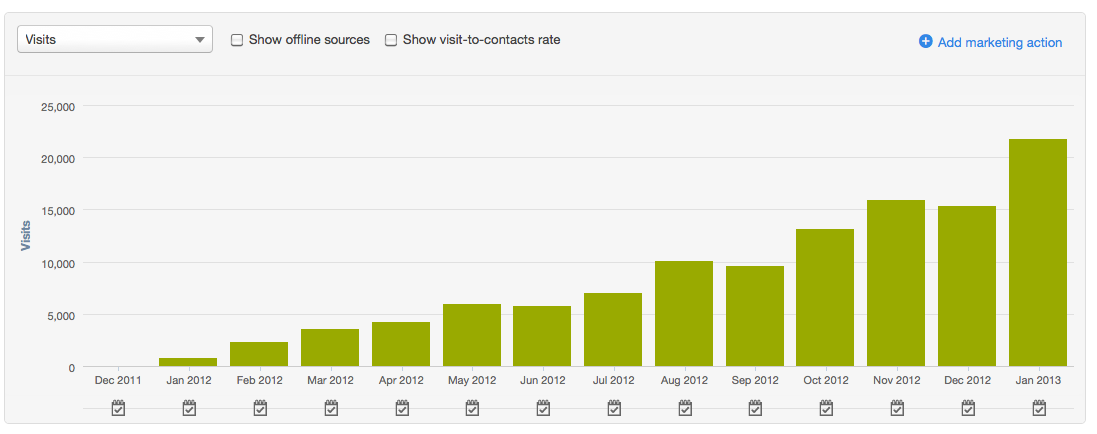
Andre Jensen of Inbound MD, an inbound marketing agency that worked with ROGETECH, explains: "We started blogging in mid-December 2011. The month of December 2011, they had 77 unique visitors from organic traffic. After just one month of blogging, they had 695. Two months after, 2,296 organic visits. Three months, they reached 3,454.”  

The company centered its posts around technology trends, IT distribution, and tips for successful purchase in the IT industry. This way, it had posts that were both industry-specific and appealing to the masses. One of its most popular blog posts, “What is the Barcode and How it Works,” talks about what a barcode is, how it works, and how a computer interprets it. The company didn't blog haphazardly. Instead, it stuck to a schedule and well-researched key search phrases.

In one year, as a result of all of its efforts, its traffic grew 4,000% and it found that 84% of it was being generated organically through search results, without additional cost to the company. The firm also built a great foundation for future growth, climbing to the number-one rank on Google for nearly all of the products it sells.

Takeaway: Know your competitors' weaknesses. If no one is really dominating the search results for your key terms, go after them. Make a plan to unseat bigger, more established companies with agile content creation. 
rogetech

ROGETECH Organic Traffic Growth for 2013

6) The Rodon Group

It's amazing what can happen when a marketing campaign taps into a larger cultural issue. The Rodon Group, a HubSpot customer and manufacturer of plastic injection molding services, was an unlikely candidate for the national spotlight, and yet, after a brief campaign focused on U.S. vs. overseas production, that's exactly what the company got.  

In 2012, The Rodon Group's president, Michael Araten, drew media attention to what he saw as a trend in manufacturing contracts coming back to the U.S. due to supply chain complications and shipping expenses. “We’re in year three of what I think will be a 10-year transition back to U.S. manufacturing as a world leader,” he explained to Businessweek.

His interviews with Businessweek were accompanied by others, including ones with CNBC and The Today Show. The Rodon Group was even visited by President Obama, where he spoke about the importance of keeping American manufacturing and family-owned businesses competitive.

But how did he get the national spotlight to begin with? It all started with a campaign the company ran to promote U.S. manufactured plastic injection molding as more affordable than using overseas companies in China. The campaign was anchored on an ebook entitled "Top 10 Critical Reasons to Bring Your Plastic Injection Molding Back to the U.S." and supporting posts and materials to compare and contrast its services with those of overseas companies.

Takeaway: This campaign worked for a couple of reasons.

  1. It struck a national chord: The campaign was about more than the company. It focused on an emerging trend that could affect the economy, jobs, and entire industry. It can be easy to get caught in the day-to-day of your job, so try to keep an eye for the larger context in which your company is working. 
  2. It was well-timed: With national elections coming up, the company knew all eyes would be on the economy and jobs. What external milestones could help bump up the newsworthiness of your company or products? 

7) Human Rights Campaign

Nonprofit organizations and political action committees are among the best at galvanizing wide support in a targeted amount of time. There is perhaps no better example of accumulating momentum around a given event than the United For Marriage campaign run by the Human Rights Campaign in 2012.

The campaign, which ran for two weeks, leveraged the timing of an impending Supreme Court deliberation to launch a major public action campaign.  

Core to the virality of the campaign was the freedom its audience had to adapt its logo and materials to reflect themselves. Business partners -- from Bud Light, to Bonobos, to HBO, to Smirnoff -- all adapted the iconic logo with their own. The campaign not only put a message out, but it also gave people the platform to personalize that message.  

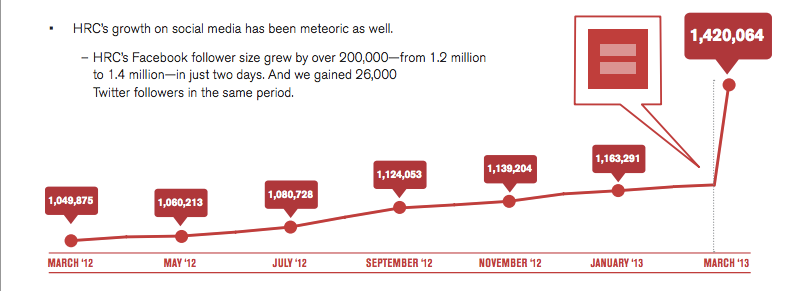
Much like The Rodon Group campaign, the HRC campaign had a concentrated timeline that hung on a major Supreme Court decision date. The timeline upped the urgency for action and gave participants a sense that this would be a limited-time activity. The company's results were outstanding. Below is just a segment of its results -- you can find the full results here, which include this stat: 700,000 unique visitors were recorded for the campaign website, 86% of whom were brand new to the organization

www.hrc.org_files_assets_resources_SupremeCourt_Accomplishments-FINAL.pdf

Takeaway: Give your campaigns a clear start and end date and funnel your entire marketing focus into them. By concentrating all channels and activities toward one goal and milestone, you can increase the urgency and reasons for involvement. 

There's no such thing as luck in marketing -- only opportunities spotted and acted upon. These companies range wildly in size, mission, industry, and audience, but one commonality that unites them all. They paid attention to the world around them and the experience of their users or customers. They noticed trends, gaps, and opportunities and they were strategic in how they tackled them.

The combination of observation, action, timeliness, and measurement are at the heart of each of these efforts. What can your company adjust to better position yourself to do the same? Let us know below!
free intro to inbound marketing ebook

subscribe to the hubspot marketing blog

16 Oct 16:23

12 Insightful Marketing Insiders You Should Follow on Twitter

by mbushery@hubspot.com (Matthew Bushery)

follow-twitterWhile you can undoubtedly learn a thing or two (okay, a lot more than that) just by reading up about all-things inbound in our marketing section, there's lots more to learn from the many, many great marketing minds that share their knowledge with everyone online -- particularly on Twitter.

From prolific bloggers, to social media strategists, to revered marketing publications, there are a lot of distinct voices discussing the latest trends and relaying their unique perspectives about inbound marketing. With tons of people you could potentially follow, how do you pick the ones that will add the most value in your Twitter stream?

While we definitely didn't have room to include the all of the marketing folks and entities we greatly respect, we figured this'd be an optimal list to get you going. Here are several of the best marketing-related Twitter accounts out there today.

1) Ann Handley

Follow @marketingprofs ann-handley-headshot

Every marketer, whether you're new to the game or an experienced veteran, can definitely gain expert knowledge from following Handley. The Head of Content for MarketingProfs tweets only the best posts and insights from real marketing pros (along with the occasional inspirational quote from time to time).

2) Paul Roetzer

Follow @paulroetzer paul-roetzer

Roetzer and his agency, PR 20/20, have a bit of history with HubSpot, as the company was one of our first Value-Added Resellers (or VARs). He wrote the book on how to run a marketing agency ... no, literally, he wrote the book: The Marketing Agency Blueprint. In addition to his substantial marketing know-how, he's also an avid tweeter of the latest agency, social, and tech news.

3) Lee Odden

Follow @leeodden lee-odden

Having spent many years in the wide world of digital marketing, Odden is definitely someone to track on The Twitter. The CEO of TopRank Online Marketing provides regular insights on the latest marketing data and trends that can greatly assist marketing firms small and large.

4) Amy Porterfield

Follow @AmyPorterfield amy-porterfield

Porterfield has roughly 70,000 followers for a reason: She's well-versed in the ways of wooing them with great content. The social media strategist not only has extensive knowledge related to social best practices, but she's also not shy in tweeting other thoughtful content on the subject from industry experts you might not know.

5) Contagious Magazine

Follow @contagious contagious-magazine

Contagious features a vast offering of content on its site -- which it tweets often. Tweeting anything from video case studies to the most recent marketing and tech happenings, Contagious always fills its followers in on the latest, major goings-on in the industry.

6) Jason Falls

Follow @JasonFalls jason-falls

Falls is a very accomplished content creator, having co-authored two books on marketing and founded the website Social Media Explorer. On top of all that, he regularly converses with fellow marketers and posts his own thoughts on industry happenings on Twitter (both of which he does quite humorously).

7) Brian Clark

Follow @copyblogger brian-clark

Under the @copyblogger Twitter handle, Clark relays numerous tips and tricks for content creators regarding how they can better their work, including advice on storytelling and growing an audience. A must-follow for those looking to substantially better their blogs.

8) Content Marketing Institute

Follow @CMIContent content-marketing-institute

Many marketers are likely already aware of CMI from its Content Marketing World conference, but if you're not, you should be. If you're not following the organization on Twitter already, we recommend doing so: you'll see plenty-a-tweet regarding best mobile marketing practices, how to develop social strategies, and tips for creating valuable content.

9) Social Media Today

Follow @socialmedia2day social-media-today

This site has social media covered, thanks to contributions from a substantial amount of respected social media minds. Social Media Today's Twitter feed is constantly buzzing with unique B2B and B2C tips and the latest in-depth stats related to Facebook, Twitter, and pretty much every other major social site.

10) Jeanne Hopkins

Follow @jeannehopkins jeanne-hopkins

She's written at length about how to do mobile marketing right. She's an accomplished marketing exec (and was at one point on the HubSpot team). And she tweets all the important and up-to-date industry news, trends, and tips marketers could ever dream to learn, including posts from the blog of her current company, Continuum. Trust us: Follow her and you'll be all the better for it.

11) Econsultancy

Follow @Econsultancy econsultancy

This account leads followers to an array of helpful marketing resources -- from comprehensive data compiled by expert marketers to informative blog posts from industry thought leaders. All in all, a great place for marketing pros to learn from one another.

12) Brent Leary

Follow @BrentLeary brent-leary-1

When it comes to sniffing out the best marketing blog posts and reports to share with other marketers, Leary is top-notch. The Co-Founder and Partner of CRM Essentials also finds the time to retweet other marketing insiders and converse with other Twitter-ers in the industry. In other words, his account is thought leadership exemplified.

What other marketing- and business-related Twitter accounts should industry members be following? Give us your suggestions in the comments!

Image credit: Kooroshication

attract customers with twitter and vine

subscribe to the hubspot marketing blog

16 Oct 16:20

A Copywriter’s Take on Subject Lines

by Darcy Silvers Grabenstein

While email subscribers sign up for emails to save money on products/services, keep up with industry trends or simply to be entertained, those of us in the industry usually have ulterior motives when opting in to an email list. I subscribe to hundreds of emails – and to email subscription services like Milled, Mailboxr, Patroneer and The Swizzle – so I can keep swipe files on everything from copy to design to offers and more.

Often, I come across emails with subject lines that are so clever (or so bad) I’ve just got to share them with my colleagues. So sit back and enjoy the show….

A purr-fectly good example of a bad subject line

One of my copywriting mentors would cringe every time he saw “purr-fectly” used in conjunction with any cat-related product. I feel the same way about the use of “Egg” in this 87-character (!) Golf Warehouse subject line (bold emphasis is mine): Eggcellent Easter Savings! Free Ship + Egg-stra 10-15% Off Clubs, Clothes, Shoes & Bags.

The Golf Warehouse email design is not as lame as its subject line. However, the email doesn’t show any product. At the very least, it would have made for an interesting A/B test of offer vs. product.

A Copywriter’s Take on Subject Lines image eggs

I’ll give Golf Warehouse credit for creating a colorful, quasi-interactive, Easter-themed offer. It’s easier to carry out a holiday theme if your products tie in to the holiday, such as gift baskets, or if your company name ties in, as in this subject line from Newegg: NewEGG HUNT: Come Crack Our Mystery Egg!

It is possible, however, to use holiday-related terms in your subject line, even if you have no direct tie-in to the specific holiday. This Bealls subject line is one example (bold emphasis mine): Hop Online for An Extra Day of Lowest Prices…. What I like about this subject line is that it uses a different verb (“hop” instead of “shop”) for the call to action. I’ve used a similar tactic in a subject line for an Easter sale reminder email: Hop to it! Sale ends today.

Great minds think alike

I’ll often find emails in my inbox with the same or very similar copy. Whether it’s a case of coincidence or copy(cat)writing, it makes me do a double-take (pun intended). Here are a couple of back-to-school emails promoting backpacks that caught my eye. The first one, from Journeys, had this subject line: We’ve Got Your Back. The design does a good job of showing breadth of product, but I would’ve preferred an inset with a close-up of one backpack so I could see more detail.

A Copywriter’s Take on Subject Lines image journeys

The other email, from Jack Spade, had this subject line: Got your back. But that’s where the similarities end. This copy kicks Journeys’ butt, so to speak. It starts with a clever but on-target headline: ONE STRAP, TWO STRAP. The copy is concise, but filled with just enough details to encourage click-through (and aid in purchase decision): hands-free utility, starting at $125, sturdy materials. And the imagery shows the backpack in use.

A Copywriter’s Take on Subject Lines image jackspade

During seasonal promotions such as back to school (and even more so during the Christmas season), it’s difficult to make your emails stand out with all the inbox clutter. This Sony email has a subject line that, while on the long side at 70 characters, hits the target audience and gives savings specifics: Big Deals on Campus | Save up to $500 on PCs + exclusive student offers.

A Copywriter’s Take on Subject Lines image sony

Those of us who started in the industry as direct-mail marketers often compare the subject line of the email to the teaser of the envelope. It must be compelling enough for the recipient to want to read more. Otherwise, the both the email and the DM piece end up in the trash.

This post first appeared on the Only Influencers blog.

16 Oct 16:20

10 Marketing Cheat Sheets

by Brian Morris

Are marketers allowed to cheat? Sure they are, especially when so many outstanding marketing cheat sheets are available to guide you through different marketing processes and help you increase your return on investment, conversion rates, and profits. I’m not sure how a marketer could cheat, anyway, unless they were to do something illegal such as blatantly steal ad copy and design or trade secrets.

Outside of that, nearly all marketing is copycat work – it’s a science, after all, that has determined what marketing materials, copy, designs, and offers work and what do not. To deviate from what works is an injustice; so marketing is all about packaging proven strategies in new ways that help define your brand and attract customers.

Naturally, the world of marketing is constantly evolving. Marketing must respond to new technologies and customer trends.  One of the best ways to maintain relevancy and cut the legwork out of planning your marketing strategy is to take advantage of cheat sheets that show you how to market. Not every strategy will work for your business, of course, but it’s a good idea to try the “tried-and-true” marketing strategies and measure their success rates before you try new marketing ploys. For your guidance, here are 10 marketing cheat sheets designed to help you achieve sales success.

1. Content marketing cheat sheet by Marketo

Marketo’s content marketing cheat sheet isn’t incredibly visually appealing, but it does include excellent information for how to market effectively with content. A must-read for any marketer.

10 Marketing Cheat Sheets image 10 marketing cheat sheets EDITED 1 600x214

2. The 4 C’s of social media by CYNC Design

Learn how to leverage content, conversation, community and connections to fuel a prominent social media presence.

10 Marketing Cheat Sheets image 10 marketing cheat sheets EDITED 2

3. The viral marketing cheat sheet by KISSMetrics

Do you know what it takes to make your marketing efforts go viral? This cheat lends insight into what drives viral status.

10 Marketing Cheat Sheets image 10 marketing cheat sheets EDITED 3 600x245

4. The ultimate Facebook marketing cheat sheet by Pamela Vaughan

This web-based cheat sheet covers 35 critical points for effectively marketing on Facebook.

10 Marketing Cheat Sheets image 10 marketing cheat sheets EDITED 4

5. Path to social success by Tammy Lam

Perhaps the best social media marketing cheat sheet you can get. Lam walks you through a detailed 12-month, step-by-step process to increase your social media presence. Start today, and you could own your social media space in just one year.

10 Marketing Cheat Sheets image 10 marketing cheat sheets EDITED 5

6. Moz SEO cheat sheet

Want to make sure your search engine optimization is in order for effective search marketing? Follow the advice from Moz, the SEO experts.

10 Marketing Cheat Sheets image 10 marketing cheat sheets EDITED 6

7. Marketing metrics that matter by Matt Wesson

Some marketing metrics are just for show, others reveal the real meat and potatoes of how effective your marketing truly is. This cheat sheet demonstrates the difference.

10 Marketing Cheat Sheets image 10 marketing cheat sheets EDITED 7 600x189

8. Inbound marketing cheat sheet by Marketo

Ensure all your inbound marketing bases are covered with this excellent cheat sheet by Marketo.

10 Marketing Cheat Sheets image 10 marketing cheat sheets EDITED 8 600x108

9. Marketing automation cheat sheet by Anvil Media

Do you know what marketing automation is and how it can help your business? This cheat sheet covers the nitty gritty.

10 Marketing Cheat Sheets image 10 marketing cheat sheets EDITED 9

10. Copywriting cheat sheet by Vertical Response

Learn how to write copy for email, your website and social media with this cheat sheet. Hint: each involves a different approach to content marketing.

10 Marketing Cheat Sheets image 10 marketing cheat sheets EDITED10 600x389

16 Oct 16:20

A/B Experimenting: Perform Tests That Can’t Be Ignored

by Miles Gotcher

A/B Experimenting: Perform Tests That Can’t Be Ignored image AB testing 300x171If you want to convince people to change the way they do something, you’d better make a solid argument as to why. That’s a lesson I’ve learned from A/B testing our email marketing campaigns and landing pages here at Marketo. If you can’t defend your test’s validity, pinpoint your variables, and back your results with statistical analysis, nobody will adopt the changes you propose.

So what’s the best way to convince people? Treat your A/B tests like the experiments that they are. Outline your experiment, compile your data, and let the numbers speak for themselves. Need a refresher course in statistical significance? Check out our ultimate guide to test statistics, which will help you explain your results clearly and with confidence — even if your team members are allergic to math.

If your company has been shrugging off your results as coincidental or not applicable, here’s how to frame and present your email and landing page A/B tests:

1) Isolate a single variable as your test variable, and identify your control

Your control is the unchanged version of your email or landing page – the version you’ve already been using. You’ll want to isolate one variable of the control to isolate and change; this should be whichever variable you think is affecting results. When it’s time to present your findings, it will be crucial that you left all other variables unchanged. By only changing and testing one variable per A/B test, you can more precisely attribute any difference in results.

I recently conducted a simple email marketing A/B test, in which I changed a single aspect of our “From” address. In this test, I used our usual “From” address (“Marketo Premium Content”) as my control, and tried a personal “From” address on half of my emails:

Control:

A/B Experimenting: Perform Tests That Can’t Be Ignored image From address NOT personal

Test:

A/B Experimenting: Perform Tests That Can’t Be Ignored image From address personal

With approximately 1000 more opens and 500 more clicks, the personal address was much more successful. Our confidence level was 99%, meaning that our results were 99% reliable, rather than due to chance. For a test like this, a confidence level above 95% is commonly considered “statistically significant.” And because I’d isolated only one factor, I was able to easily identify the reason for the higher number of clicks. Marketo now uses personal names in our email mailings whenever we can.

2) Formulate a hypothesis

Before you test, make a prediction about what performance results you believe may be influenced by the test, how they will be affected, and why. It’s important to be open to any results – this will help you convince your team that your results are scientific, rather than based on your intuition. For example, I recently ran an A/B test on two versions of a follow-up email – one with a banner image, and one without.

A/B Experimenting: Perform Tests That Can’t Be Ignored image follup email campaigns

My hypothesis was that the email with a banner image (on the right) would have a higher click-to-open rate. The banner makes the email more dynamic and exciting, and gives the reader a second “Download Now” button. In fact, the email without a banner showed a 12% increase in the click-to-open rate (with a 99% confidence). The results were surprising, but compelling.

3) Use a large enough sample size

The larger the sample size, the stronger your results will be. That being said, you obviously want to use the winning version as soon as you can, and if you start too big, you’ll have half of a huge group receiving a less effective email. The best practice is to start out on the smaller side, keeping in mind that you can always repeat the email test if your company needs extra convincing. Or you can leave the landing page test running a little longer to build the sample size.

Unsure of how many tests you should run? Find out how many versions you should run, or the number of days you should run each version, with our Landing Page Split Calculator.

4) Eliminate the possibility of confounding variables

Be sure to control for any extraneous factors that could be affecting the results. This takes Step 1 (isolating a single variable) into more depth. To reduce these factors, you don’t just need to leave your control unchanged – you also need to send your test emails at the same time, have your two versions of the landing page running simultaneously, and make sure that the test is randomized. For example, if you’re using Marketo, you can send the two versions of your email to a random sample of 50% of your designated emailing list. You can also have the traffic to your landing page URL split equally to the two different versions of your landing page.

5) Draw appropriate conclusions

Now it’s time to take a look at the results and see what you can learn. First, determine whether a statistically significant difference exists between your two versions. Instead of performing the significance tests yourself, you can simply search online for “A/B testing significance calculator, or “email testing significance calculator.” It’s never a bad idea to use two different online calculators to double check your results.

For instance, recently I ran a test to determine the best CTA placement in an email. In this subtle but effective test, I found that the left-aligned CTA button version had 90 more clicks than the center-aligned CTA button. I used a calculator to determine that these results had a 95% confidence score, making the left-aligned CTA button a clear winner.

A/B Experimenting: Perform Tests That Can’t Be Ignored image Call to action center versus left

A confidence level of 95% or more is a great threshold for picking a winner. If your results weren’t significant, consider trying again with a larger sample size. If your results were significant, you should carefully identify what they can be applied to in the future. For example, the results of a test for a tradeshow follow up email may not apply to an email invitation for a webinar.

To Summarize:

Your goal is to make sure that your testing efforts aren’t in vain, and to improve the performance of your team’s emails and landing pages. When you’ve eliminated all confounding variables, can back up your data with a significant pool, and have considered an appropriate response, you’ll be able to present your findings with confidence.

If you can say, “The test version of our webinar registration landing showed a significantly higher conversion rate than the control, with a 99% confidence level,” people will pay attention to your recommendation. When it comes to A/B testing, it’s hard to argue with a scientific approach.

16 Oct 16:19

11 Steps to an Effective Landing Page

by Sherry Lamoreaux

11 Steps to an Effective Landing Page image SEOYou’ve built the perfect offer. You’ve crafted the ideal email, which will go out to your own fabulous list and your new channel partner’s very fresh one. Now you need to give those eager buyers a landing page that will give them what they really want: a short, targeted path to conversion. Here’s how to produce the perfect landing page:

1. Develop a short creative brief
Know exactly what you want, and pin down any variables. Develop a short creative brief that specifies the landing page’s objectives, target audience, primary offer, headline, supporting copy, images, and form requirements. If you’re working with a designer, use this creative brief as a way to articulate your requirements.

2. Use other landing pages for inspiration
Reference other pages that you think can serve as inspiration for the page you’re about to design. It’s almost always better to reference an existing landing page when designing a new one. Remember that Albert Einstein quote? “Creativity is the art of hiding your sources.”

3. Block out the overall structure of your landing page
Block out the overall structure of the page using a simple wireframing tool or even PowerPoint. You’re not creating a final design here – you’re just playing with the elements of the overall layout to make sure that the page makes sense. If you’re working with a designer, this will serve as a way to indicate your expectations.

4. Make the form pop off the page
Lay out the page so that the form and call to action pop. Place the form above the fold and use a color treatment for the form that contrasts with the rest of the page.

5. Design a high-impact headline
Use a high impact font treatment to highlight the page headline. The headline needs to grab the attention of the prospect and clearly articulate the value they’ll receive in exchange for completing the form. But be sure to use web-safe fonts, so you can be confident people see the page as you intend.

6. Point everything at the form
Make sure that each element on the page guides the prospect to the form. For example, you can use visual cues such as arrows that direct the prospect’s gaze to the form and call to action.

11 Steps to an Effective Landing Page image target marketingThe headline stands out, and the blue bubble and arrows make it clear what action to take.

7. Design your form button
Pay particularly close attention to the design of your form button. Use a color treatment such as green, red, or orange, as well as a bold, impactful font.

8. Use bullet points to organize copy
Remember: prospects won’t read your landing page – they’ll scan it. So make it easy to consume by using bullet points made up of one high-impact sentence each. Don’t try to say everything; pick the three points that matter most to your buyers.

9. Use plenty of white space
Make sure that there is plenty of white space on the landing page so that prospects can easily consume the information you’re presenting. Use enough white space so that prospects can scan the page and quickly identify the headline and form in particular.

11 Steps to an Effective Landing Page image social influencerBullets and white space make this landing page easy to read. The call to action is obvious.

10. Minimize the number of links on the page
Minimize the number of links on the page so that prospects can focus on the form and call to action. In fact, some landing pages have no links.

11. If appropriate, showcase a happy customer
You may be able to incorporate a “hero shot” into the page that showcases a happy customer. Make sure the image is high quality and, if possible, align the image so that Happy Customer’s gaze is directed towards the form. You can also use another type of image such as a picture of your product, but make sure it’s related to the primary offer. If your product is intangible or industrial, you may need to get creative with other types of images that provide an emotional connection.

Got all that? Ready, set, go – for an effective landing page that converts.

16 Oct 16:19

Vimeo vs. YouTube: How to Implement Social Video Marketing

by Jamie Cartwright

Vimeo vs. YouTube: How to Implement Social Video Marketing image vimeo vs youtube which is better 600x250

If there’s a fault in Inbound Marketing strategy, it’s that it prioritizes content creation that benefits multiple areas of a business’ online presence. For instance, blogging is so eagerly encouraged because blog writing 1) draws customers in with new content, 2) provides more pages for search engine optimization, and 3) is a natural situation for calls-to-action that enable companies to “nurture leads” and commence e-mail marketing campaigns.

Another example is the specific ways in which companies prioritize social media platforms. LinkedIn is the top option for many marketers because of the way company pages and groups are ideal for prompting users to head to the home site. In addition, LinkedIn is an inherent social exchange for blogging because it is specifically oriented toward B2B/professional users.

So—what’s the slight fault in this strategy? It’s that when Inbound Marketers focus entirely on the content areas that inherently have multiple advantages, they tend to lose out on the content creation that is more demonstrative of a business’ uniqueness.

Visual Content is Beneficial Without Helping SEO

In a recent post, we pointed out eighteen companies that are especially great on Instagram. Imagine the kind of engagement they’re getting from consumers that companies limited to blogging and tweeting are not. Yes, there is no way Instagram has the kind of SEO benefit that a blog provides, and yes, photography and video production are often time intensive activities. But, which option holds more potential for showing off your company culture, text or imagery? Which has a higher probability of going viral, blogs or video? Which is a more crowded online environment—blogging or video sharing?

You see what I’m getting at. Building a solid content force is advantageous on multiple levels, but if you can’t reach into visual media, it will be hard to tell that you have something attractive to offer consumers or potential clients. This is where social video marketing comes into play.

Forget SEO for a second, and think about total engagement. On Facebook, Twitter, and LinkedIn, most companies don’t aim to make each social interaction into a site visit. Instead, they build an audience and forge ways that that audience naturally reaches the home site. This is the goal for social video marketing.

Engaging Social Video Marketing

The aim is to use sites like Vimeo, YouTube, Instagram, or Vine to share flavorful social content that reaches your audience in new, exciting ways. Today, we’ll be talking about the non-rapid social video sites, YouTube and Vimeo.

Often, we think of these two sites as video hosts. You upload your video, choose an embed option and put it right into your website. In this form, Vimeo and YouTube only help you avoid hosting large files (benefiting page load speed). This isn’t social video marketing.

The better choice is to both embed and engage the social networks of these video platforms. Think about Vimeo or Youtube as a potential audience, just as you do with LinkedIn or Facebook. Imagine which personas you’re aiming to engage, and draw up a full strategy on what your objectives are for the platform. But which platform should you use?

A Comparison of Vimeo vs. YouTube

Here is the real comparison of today. When you think of Vimeo and YouTube, the two big social video sites online, you really should imagine two different cultures of social video sharing.

First, YouTube is a site that grew out of video blogging (or vlogging). Consistently, it’s been an option in which lightly edited video is situated alongside high-quality professional film making, and both types have huge success in gathering views. People tend to utilize “found film,” video content that others have created, and often, there is a conversation of response videos.

For some businesses, this side of YouTube society could be a huge point of engagement. Depending on your audience, “How To” videos, films that show off company culture, and fun demonstrations are entirely appropriate. And the big advantage with YouTube, is that it has the largest number of potential viewers (i.e. visitors) of any video sharing site.

YouTube is also a good choice because it is fully aligned with Google Plus. So, your account is the same, and share-ability is increased. Also, because Google has your site information within YouTube and Google Plus, your YouTube page will often appear alongside your website in search results.

But YouTube’s popularity has its down sides. Yes, you can be “found” more easily because there is a larger audience, but you can also get lost in the magnitude of YouTube activity. If you don’t actively engage in the various pseudo-communities on YouTube (channels, topics, social trends, etc.), it will be difficult to really produce the effect of social video marketing.

The other option, of course, is Vimeo. To users who know it, many people think of Vimeo as the hoity-toity of social video sites. To post, you need to produce high-quality videos that are edited and well-produced. The goal is to create video that impresses rather than to show off your skill with a webcam.

To me, Vimeo screams professionalism in the same way that LinkedIn does. If you want to show your business off to people who pay attention to good film production (such as B2B clients), engage audiences on Vimeo. Analysts will note that Vimeo’s visiting population is smaller and total uploads per month is lower than YouTube, but if you’re good, Vimeo is a chance to be a bigger fish in a smaller pond (14 million registered accounts vs. 1 billion on YouTube).

As most people note, Vimeo is well liked by artists and interaction designers because it has a cleaner look than YouTube. Just like YouTube, it can be embedded easily, but Vimeo has the added convenience of not placing ads before or after your videos. This is a distraction that has become increasingly annoying about YouTube, even when you’re just embedding a video on your site.

Conclusion

So, as you plan how you want to expand your content and social media marketing, consider how your business could play into the realms of social video. You might spend more time creating high-quality content and you might have to invest in building a following, as you probably had to do with Twitter or Facebook, but you could gain a unique edge on drawing people to your products and services.

Vimeo vs. YouTube: How to Implement Social Video Marketing image 2e0eeb56 5659 433e b1fa eef4827c6bba1

16 Oct 16:19

The One Marketing Mistake That Costs You 75% of Your Page Views

by Ron VanPeursem

There are a number of basic marketing mistakes that can hurt your page views. Poor user interface on your site; poorly written content; boring or irrelevant post titles; lack of optimization (url, description, anchor text, etc.). But let’s talk about the content marketing mistake (a very common one) that can cost you, on average, 75% of your normal volume of page views.

Talk too much about yourself: lose 75% of your readers

But according to the statistics at Content Marketing Institute, the one marketing mistake that can cost you 75% of your normal page views is TO TALK ABOUT YOURSELF!

If we don’t talk about ourselves, who will?!!The One Marketing Mistake That Costs You 75% of Your Page Views image trust then selling1 300x300

Yes, as we’ve written about before, this is not just a Branding No-no, this is also a content marketing death wish. It’s never been very polite to talk about yourself, so this shouldn’t come as such a surprise, but in fact, it IS a bit surprising to many of us. Branding, Advertising and Marketing have — for so long — been seen as efforts to tell everyone about our great array of products and services. Our rhetorical question is, “If we don’t talk about ourselves, who will?!”

Well, fortunately, there’s a good answer for that question. If we’re willing to produce and provide content that really satisfies a need or answers a question that our target reader has, then THEY will be the ones to eventually be talking about us! This approach to marketing can be labeled as Inbound Marketing, or as “Give-to-Get” marketing. It’s related also to what I call “Reality Marketing”. But the main point is this: if we provide content that adds value to the reader by addressing a real need that they have, then they will engage more with our content, they will share it with their friends, and they will develop a sense of trust in our Brand. At that point, THEY will be the ones to look further into our products and services and come looking for that information about ourselves that we chose not to force upon them.

People look for your goods and services AFTER they trust you

Joe Pulizzi observes, in his article last month about Epic Content Marketing, that the normal content at CMI — which is educational, and designed to answer people’s real questions — will suffer a 75% loss in page views when they publish a piece of content about themselves. CMI’s experience is very similar to what we see at Shift Digital Media: people will look for your goods and services AFTER they’ve developed trust in your Brand.

So…create content that provides relevant help for your target readers’ questions. Talk about yourself LATER, when they’re the ones asking you about your company!

16 Oct 16:19

Free Marketing Ideas Part 6 – Start Producing Videos

by Zach Heller

Free Marketing Ideas Part 6 – Start Producing Videos image attraction marketing 1011

Welcome to the latest edition of my new weekly blog series, “Free Marketing Ideas”. Each week I will identify and explain a simple marketing idea that you can employ at low or no cost. Last week’s topic was Add Your Business to Yelp.

This Week’s Topic = Start Producing Videos

Did you know that the number two search engine behind Google is actually YouTube? YouTube gets more searches every day than Yahoo or Bing. That’s all you need to know to understand the power that videos have in today’s marketplace.

But a presence on YouTube is not the only reason your company should be producing videos. With the rise in popularity of Vine and Instagram Video, and the move away from long form text content online, companies that are producing videos have a better chance of capturing the attention on consumers.

And getting started does not have to mean bringing in an expert video crew and paying thousands of dollars. You can get started with little more than a digital camera or smartphone and someone in your organization who can work simple video editing software like iMovie or Windows Movie Maker.

With only those tools, you can create simple video tutorials featuring someone in your organization. You can also create simple video slideshows, showing product shots and adding a voiceover to explain the benefits and value of your offering.

Another idea is to get your customers involved. Video testimonials, or live testimonials within larger videos can have a huge impact on your marketing efforts. Most satisfied customers will be happy to participate without getting anything for it.

The key is, just get started. Once you have videos, you can feature them on your website, on YouTube, Facebook, and other marketing channels. People are more likely to watch videos than read text. So give the consumers what they’re looking for.

Share your thoughts on this idea, and other free marketing ideas in the comments section below and keep the conversation going!

16 Oct 16:18

5 Questions Every B2B Lead Generation Company Must Mull Over

by Judy Caroll

5 Questions Every B2B Lead Generation Company Must Mull Over image 5 Questions every B2B Lead Generation Company must mull over

The luxury that a marketer may have if he’s in the Business-to-Consumer (B2C) industry is that he can just pour in the right ingredients into the mix and the product will practically cook itself. That is not to demean their efforts, which are for sure very intensive, but the fact that their audience is the general buying public makes it largely easier for them to perform marketing.

In Business-to-Business (B2B) lead generation, however, buyers’ interests are not easily gained by preppy, bourgeois-esque publicity. The B2B audience is more or less “experts” in the field they are in, and they generally have the tendency to rationalize their purchases by learning about the product or service.

That in turn makes it a little bit more complicated for B2B marketers to evaluate the well-being of their marketing campaigns. It’s more than just asking “Are people buying our products ?” but it entails a lot more concerns to consider:

Does your target market know you?
Oblivion is marketing hell, and the first thing you should shoot for is recognition. If you’re a company that sells, say, technology products and software, the least that you could ask for is for your audience to know you exist, considering the tight competition in the IT industry. That should be your basic requirement; ask yourself, have people heard about my company?

Are you getting good traffic?
The biggest chunk of your B2B lead generation efforts will most likely come from inbound traffic, and if you’re getting none of that, then you should be worried, and you might as well just take down your site.

Do your visitors get converted?
It isn’t enough that people visit your blog almost every day to read your posts and see updates on events; they have to get converted to customers, or at least provide leads for future use. A lot of sites get an awful lot of traffic but end up not increasing sales anyway.

Are you attracting the right people?
Even when people do sign up for newsletters or contact your sales team, what are the realistic odds that they will convert? For all you know, you could be driving the wrong people (or perhaps the right people but for the wrong reasons). Make necessary adjustments to point your aim at the people who are actually going to make business.

Is your sales cycle functional?
Your sales cycle (in partnership with your sales team) is the machine that takes in the heap of fish, takes out the bones, processes the meat, adds the sauce, and puts the finished product inside shiny aluminum cans. If it’s not working, then your leads would just remain as they are – just plain leads.

16 Oct 16:18

REALLY Listening to Customers Requires Skill

by Jeannie Walters

REALLY Listening to Customers Requires Skill image Listen DaVinci esqueIsn’t it so great when you feel really heard? When you feel like the listener is engaged deeply in what you’re saying? Ever have a tense situation diffuse quickly simply because of that feeling? Your customers want that, too.

And yet listening to customers is difficult.

Gathering the right feedback is difficult. Understanding how to take action on that feedback is extremely difficult. And yet it’s a critical step in creating a superior customer experience.

We encourage all our clients to have the leadership listen to customers in the customers’ own words. That can be much more motivating to a CEO than a blip in percentage on a report.

But there are some pretty big challenges to listening and responding to customers.

  • The truth can hurt. Your star employee might be your customer’s worst nightmare. It’s hard to hear the truth.
  • Your processes seem immobile. If complaints happen because of one of those big, daunting, seemingly impossible-to-change processes, it’s easier to ignore what you hear.
  • Customers are often people who don’t want to let you down. They’ve invested in the relationship, too. And if you’ve never asked how they’re doing, how are they supposed to tell you when they’re considering leaving you for good?
  • Asking the right questions is half the battle. But which ones are right?
  • Asking too often can lead to survey fatigue, so then you’ll stop getting anything!
  • Incentivizing employees to achieve more on a survey from customers can lead to behavior akin to begging or bribery from those employees. Not exactly what you want!
  • There are too many people communicating with your brand on social media! How can you keep up?

And then there’s the next step…acting on that feedback you’ve so carefully gathered.

Guess what? More challenges!

  • Who is responsible for those irritations to customers that don’t fit neatly into the org chart?
  • How do you know what to work on first?
  • What if you have limited resources? Where can you invest to make the most impact?
  • How can you ask the right questions next time?
  • What if leadership doesn’t care about that particular issue? What if customers might complain but not defect? Should you invest in fixing those issues?

REALLY Listening to Customers Requires Skill image ListenDistorted600px

Listening is really a key part of not just setting up a customer centric strategy but also keeping ahead of your competition. But listening, in all its deceptive simplicity, is hard.

We’ll be exploring this idea throughout the month, along with great examples of those who do it well.

Ready to join us? We of course would love to HEAR what you have to say! It’s a give and take and we can’t wait to learn from you this month, too.

Image Credits: ky_olsen, quinn.anya via Creative Commons

16 Oct 16:17

Supercharge Your Inbound Marketing Measurement Toolbox

by Bradley Smith

As marketers, we are more than abstract ideas. We believe that measuring the results of our recommendations is critical to demonstrating success. After all, if we can’t benchmark and improve, we’re failing ourselves and our clients. We read industry news, we research, we brainstorm, we ideate, we measure, we analyze, we report, we refine. Supercharge Your Inbound Marketing Measurement Toolbox image inbound marketing toolbox

Fortunately, we have a plethora of tools at our fingertips to help measure our efforts. But every once in a while, the exact tool we need doesn’t exist. That’s when we really get excited—because we’re presented with the opportunity to solve an internal need, and possibly share that tool with other marketer’s so they can also reap the benefits. Here are a few tools we’ve created that have solved some of our needs. We’d like to share them with you.

PageSpeed Insights API: Identify page speed issues of top-performing pages

In an effort to Make the Web Faster, Google released access to their PageSpeed Insights Tool and API. The purpose of the tool originated from research Google published back in June 2009. Soon after the research was published, the Firefox and Chrome PageSpeed extensions were released. Eventually, Google created an online tool which allowed users to input any web page and get back page-specific recommendations. Recently, Google released access to the PageSpeed Insights API which allows developers to plug into the tool and utilize the data returned as they see fit.

So, why is page speed important? Page speed supports on-site user metrics. Good on-site metrics support powerful on-site content. Googlebot, which crawls your site, can only understand your site’s content and topics up to a certain point. Google supplements its understanding of your website’s content with users’ reactions to your content via on-site metrics. Metrics that fall under on-site metrics include bounce rate, conversions, time on site and pages per visit. These are all based on how users interact with your site. Google has the ability to understand certain user metrics whether you have Google Analytics installed or not. If Google thinks your site has awesome content, but the on-site user metrics don’t support their understanding of your site, your site rankings will decrease.

When Google released the PageSpeed Insights API, we saw it as an opportunity to measure the page speed of top performing pages across targeted websites. So we created a tool that can look at any number of URLs for a site and provide a heat map based on recurring issues. We’ve made this tool available to you via Google Drive. You can download it here. Instructions for using the tool can be found here.

Social Analytics Timeline: Track the social data for any URL over time

This tool simply allows us to quickly see social metrics and measure social metrics over time for any one URL. Use cases for this tool include tracking overall social response for a blog post, a useful online tool or a great piece of content. Using this tool, you input a URL, select your time zone and watch the social metrics roll in over time. This tracks top level social metrics for Twitter, Facebook, LinkedIn, Google+ and Pinterest for your selected URL. You have the ability to look at each social network individually and see how that networks performance has increased over time. It utilizes the Google Charts available in Google Drive to output interactive charts which you can use to drill down into a certain time period and view social metrics. In a future release of this tool, we’ll track a specific URLs Google Analytics data alongside the social metrics. You can access this tool from here. Instructions for using the tool can be found here.

Give us your feedback

Use these tools and let us know how they fit into your toolbox in the comments!

Image credit: Austin and Zak

16 Oct 16:17

Time to Get Fresh With Your Email Marketing

by John W Hayes

I have a philosophy that has served me well throughout many areas of life: Never go back.

Think about it.

Have you ever had the most amazing vacation (great resort, amazing service, unbelievable food, fun people) only to be left disappointed on a return visit? Or perhaps you’ve been tempted back to an employer only to quickly realize why you left them in the first place?

Like I say – never go back.

Perhaps I have a short attention span, but for me (and many of your subscribers), things that were once fresh and exciting can quickly grow tired and dull. Yes – overfamiliarity can lead to contempt.

This is why as email marketers we need to mix things up now and again.

We need to keep our subscribers on their toes and ensure they never get bored.

Running your campaigns to a regular schedule might help you through your working day, week or month – but it will do little to inspire repeat opens and continuous engagement. Because of this you need to remember two things:

  1. A marketer should never plan their campaigns around their own needs (you should already be sold on the product or service you market); always think of your target market first.
  2. Once subscribers stop engaging with your emails on a regular basis, they are on a slippery slope to becoming an ex-subscriber.

This is why I constantly urge marketers to kill their dull, uninspiring newsletters and shake up their marketing efforts.

Great marketers plan their campaigns around products, services and their subscribers’ needs – not days of the week, their own convenience or simply out of (bad) habit. They constantly look to improve their campaigns and are always ready to experiment, test and improve because subscriber fatigue and the resulting fall in engagement is wasteful, damaging and, let’s face it, nowhere near as satisfying as keeping things fresh and exciting.

This is an edited version of a post which first appeared on the iContact Email Marketing Blog.

John W. Hayes takes his Content Marketing Boot Camp to Bristol on November 28, 2013. For full details or to book your seat at this full day event click here.

16 Oct 16:17

Social Media Success Today

by Patrick Murphy

Social Media Success Today image like1Social media is not a fad; it is now a fact of life online. And it’s not just for 20-somethings; it is popular with all age groups and businesses.  Social media is about helping you to market your products, professional services or nonprofit cause.  Naturally the first step is to plan your social media marketing to fit your goals, then learn and begin to use social media sites, then consolidate your online marketing with your other efforts.  But why?

Wide Range of Benefits from Social Media

Social media lets you showcase yourself with “clients, prospects” and the press. You can stay in close touch at no cost, particularly if you increase your site’s visibility by making it appealing to search engines. Social media is not just for the young and it is not a fad. People of all ages use it, and the platform is expanding. Multiply your impact by following the “RESULTS” guidelines:

  • “Recommit to marketing” – Your previous marketing efforts did not work? Try again.
  • “Expect success” – Optimists win; pessimists lose
  • “Seek partners” – This could be someone you hire, a friend or a relative.
  • “Understand your audience” – Focus on what your prospects want to buy, not what you hope to sell.
  • “Look for win-win scenarios” – For example, a lawyer and a CPA could present a joint seminar for small business owners on a topic where both have expertise.
  • “Take strategic action” – Plan your activities based on the targets you want to reach.
  • “Stay visible” – Maintain a constant presence online.

Getting Started with Social Media

Begin with a SWOT analysis: List your “strengths, weaknesses, opportunities and threats.” Then develop a business plan that targets your “top three business goals.” Align your marketing plans with your objectives and your “target audience.” Be sure you pinpoint the right audience for your products or services. Set priorities. Define “your transformative value,” that is, the way you solve your customers’ problems. Define the “irresistible difference” that makes your offering special.

To succeed on the Internet, you must find your “true voice” and use it to tell your “real story.” Discover your true voice by paying attention to how you speak and the specific words you use. Ask your clients, employees and friends to describe you and your business or practice. Write down the nouns and verbs they use, and put these words to work in your online communications. Your real story could be about you, your firm, your products or services, and case studies that demonstrate the benefits your customers receive. Everyone loves stories. Make sure you have good ones to tell online. Your voice and your story support your branding by flagging the elements that make you special. Add the right “tagline or slogan,” logo, “30-second elevator speech,” and online and offline communications. Make sure your social media profiles match your brand.

To develop your specific social media-marketing plan, set up five columns of information. List your objectives, target audiences, current marketing actions, costs and the social media you plan to use in marketing your business or practice. Now that you have a clearer picture of what you are working with, evaluate your current marketing activities. Do they make sense? Are they efficient and cost effective? Social media is “free” in terms of sign-up cost, but it is not free regarding your time. Develop a marketing budget listing the funds required and the time you will need to spend. Make your marketing action plan detailed enough to be productive. Break each task into action steps like these:

  • Target three social media sites that your customers use. Read their terms of service.
  • See how your competitors present themselves on these sites.
  • Prepare a digital photo, biography, and “links to your website and blog.”
  • Check out the groups on the sites that relate to your expertise.
  • Sign up and create pages about yourself on each site.
  • Upload appropriate content, for example, “articles, news items, tips, forum questions, photos” and other information.
  • Each day, ask 30 people to become followers, and add new content twice weekly

Remember Be Prepared for Social Media

Social media can send people to your website, so make sure it is ready for a bigger audience. Is your site clean, clear and up to date? Does it showcase you and your company? Use RSS to feed your Twitter and blog content, your podcasts and your online videos to your website. Audio Acrobat lets you create a personal audio greeting that you can embed in your site.

All the different ways you can use social media to connect with prospects allow you to build trust and spark sales. Social media enables the most effective selling technique: the relationship-building soft sell.

If you are unsure how social media help your business, simply ask Alex!

Digital Marketing Analytics

Digital Analytics is ready to help. Whatever your business goals, you’ll find powerful insights into which campaigns really drive visits, sales and other actions from your users. Read our guide on using digital marketing analytics for your business.

16 Oct 16:17

Why You Can’t Write Off Email Marketing…It Beats Social Media

by Louis Foong

Why You Can’t Write Off Email Marketing...It Beats Social Media image B2b email marketing 300x202There is no getting away from the fact that social media must be part of your marketing mix, but how is social actually doing in delivering what your B2B organization needs – leads, conversions, customers and sales? Not very well, from what studies and statistics are showing. Email marketing, on the other hand, soldiers valiantly on and remains the most effective B2B communication and conversion tool after organic search. Let’s put it this way—mature can be sexy you know!

Take a look at these statistics and reasons why email should still be a priority in your overall B2B marketing strategy:

  • A recent study by Custora shows that Email has nearly 3 times as many users as Facebook and Twitter combined. That’s nearly 3 billion users. And email traffic over the Internet is more than four times that used by everything else viewed over the Web each day, including videos and images.
  • According to the same Custora survey, customer acquisition by email has quadrupled over the last four years and now accounts for almost 7% of customer acquisitions, with organic search still the most effective at 16%. Social falls way, way behind.
  • The study also indicates that an email customer is 11% more valuable than the average. Once again, good old organic search customer is the winner with 50% more value than the average. Social is down there at 23% LESS valuable than the average. Are you sure you are spending your marketing budget wisely if you have abandoned email for social media?

People have been saying, “The money is in the (email) list” since email came of age. Email lists became the big thing back in the 1990s and early 2000s. Then along came new, bright, shiny toys like social media to play with, and email seemed to be losing ground. But while email is no longer the preferred personal communications channel among the younger generation, for business communication, it still rocks. And the money is still in the list. But it needs to be a segmented, target and frequently cleansed list.

Some more research and statistics worth considering:

  • An Economist Intelligent Unit survey of UK and US users in 2013 showed that email ranks as the top outreach channel for all stages of the purchasing process.
  • Mobile email growth, according to EmailMonday has risen until it accounts for 15-65% of email opens (depending on targeting etc), with more than 25% of emails now being read on a smart phone.
  • Yet, only 27% of marketers say they will be adopting mobile marketing strategies in the near future, so there is a wide open opportunity for B2B forward thinkers here, because…get this… mobile email use is predicted to grow 28% in 2014.

More and more businesses are equipping staff with smart phones across all levels of the corporate domain. They are doing this in an attempt to help with unified communications, the increase in tele-workers, and the required mobility of many employees beyond the workplace. Think for a moment about the potential target audience that gives you.

Don’t forget how your email message appears on a mobile phone though. If it looks bad, or doesn’t fit to screen, your list will shrink as people unsubscribe.

For almost any organization, creating compelling content for an email campaign is still the biggest challenge. An eMarketer survey shows 55% of B2B and 52% of B2C respondents citing content as the hardest tactic to execute. However, 71% B2B and 65% B2C say this is the most effective tactic still. Content remains the undisputed king, in email as well as digital marketing.

And not to be negative but what if those social media networks and tools you are using now, and relying on instead of email for your B2B communications, vanish or decline significantly? It may seem unlikely that Facebook with more than 1.1 billion users is going to disappear overnight, but there is already evidence that the younger generation are leaving Facebook to their moms and grandmothers.

Those Gen Yers may not be today’s customers, but they definitely will be tomorrow’s. And they will still be using email for communicating with businesses, and will still use email at work for their business dealings too. It appears that the constancy of the platform, its professional appearance, simplicity of use and the fact it just works, is more important than shiny, bright, exciting social media.

How does your company use email marketing for B2B lead generation and customer acquisition? I look forward to your thoughts—do leave me a comment.

Image: Shutterstock

16 Oct 16:10

How LinkedIn Got $10M by Making Weakness Look Like Strength

by Ryan Tate
Reid Hoffman posted the pitch he used to win over investors for LinkedIn in 2004. It turns out he was fantastic at putting weak numbers in a good light.


16 Oct 16:07

Where Are All the Women Entrepreneurs?

by Jonathan Verney
Building a business is never easy, but do women entrepreneurs have an extra hurdle to overcome?


By now, nearly everyone with a pulse knows the names Richard Branson, Steve Jobs, Mark Zuckerberg, Larry Page, Sergey Brin and Bill Gates. They’re not just entrepreneurs, they’re rock stars. They started their startups from the ground up, and out of their sandcastle dreams they managed to build an empire or two. But what about their female counterparts? Where are all the female rock stars?

Actually, they’re everywhere.

From Silicon Valley to Sydney; from Bahrain to Brazil; from Manchester to Mumbai and everywhere in between, women entrepreneurs have been starting and building multi-million dollar companies and doing so at a faster rate than men over the past decade. Currently, there are more than 8.6 million women-owned businesses in the United States alone, generating over $1.3 trillion in revenue. So why does the public know so little about them? And why, in spite of this rapid growth, are there still so many more male-run than female-run startups?

Women Entrepreneurs as part startup of eco-system

The answers are complex, so I turned to someone in a great position to help me understand. Andrea Guendelman is a cross-border financing lawyer based in Boulder, Colorado. But more importantly, she’s connected to thousands of women entrepreneurs from all over the world. Just a year ago, she co-created and produced Common Pitch Chile, the biggest innovation and entrepreneurship event ever held in South America. Andrea GuendelmanIt attracted 10,000 participants and featured Al Gore as keynote speaker. This year she co-produced Boulder, Co.-based Startup Phenomenon Women with her partner Carrie Van Heyst, the first in a series of networking events designed to inform, encourage and inspire entrepreneur women. Over 600 high powered entrepreneurs attended.


Women are not going into computer sciences

Andrea says one of the reasons there are so few female tech entrepreneurs is that “women are not going into the sciences and math – the tech world.” Of the 120,000 computer-science graduates in the U.S. each year, only 11 per cent are women – and the numbers are declining. Another reason for the dearth of female tech entrepreneurs is limited access to capital. Most venture capitalists want to invest in high growth startups – companies that can quickly scale. But women tend to be underrepresented in those kinds of companies.

Women Entrepreneurs as % of CS Grads

Andrea also points out that women’s “selling skills need improving.” In her experience, women entrepreneurs tend to lack the confidence and “bravado” that male entrepreneurs have (some might call it chutzpah), and that can hurt them when it comes to attracting funding. They also tend to be perfectionists and sometimes need to get all their ducks in a row before plunging ahead with the business. But businesses are never perfect, and neither is timing.

Women entrepreneurs have exceptional networking and leadership skills

That said, women entrepreneurs have tremendous untapped strengths in other areas. For example, Andrea notes that women are exceptionally good at building effective ecosystems and nurturing communities. In fact, women tend to have more advanced networking, leadership and nurturing skills – three of the reasons why Andrea continues to champion their cause so passionately.

To broaden my perspective, Andrea suggested I talk to some of the women in her business network. One of the first women I talked to was Fran Maier, the dynamic cofounder of Match.com, the world’s first online dating service. Fran left Match.com in 1998 and went on to join TRUSTe (pronounced “trustee”), transforming it from a non-profit to a very successful for-profit, venture-backed company. TRUSTe has become one of the world’s leading Data Privacy Management companies, and Fran now serves as its board Chair. Fran is not only a successful serial entrepreneur, she’s currently mentoring half a dozen female startups (and some male startups as well).

Women dominate social media

“Networking used to be a male preserve,” says Fran, “but the Internet has changed everything. Women already dominate many of the big social media networks such as Twitter and Facebook, and they’re taking advantage of the ‘social web’ to build their business networks”. On the down side, she notes that the Venture Capital world is predominantly male, and men tend to relate better to male entrepreneurs. When women present their business case, VCs often say “I don’t get it.” They’ve even been known to “not get it” when the business has customers and revenue and is cash flow positive!

Only 8 per cent of venture backed companies are women-owned. Only 11 per cent of venture capital partners are female. Only 15 per cent of angel investors are female. And only 9 per cent of board members are female, which is even lower than the already low percentage of women on public boards (16 per cent).

Women Entrepreneurs in Startup Eco-System

Fran certainly doesn’t feel all the blame for these numbers can be laid at the feet of outsiders. Some of the barriers are self-inflicted. For example, women entrepreneurs tend not to be as aggressive and persistent as they could be, and they are hesitant to jump in and “make the deal” the way men often do. Fran also agrees with Andrea that there simply aren’t enough women going into the sciences – specifically engineering. Unfortunately, the lack of women software “geeks” tends to reinforce a stereotype in the minds of many funders who unconsciously favour the unshaven young male techno-nerd in a hoodie over the well-dressed female with a credible plan and the motivation to carry it out.

Fran’s message: target women and the products they buy

Yet, some of the world’s greatest entrepreneurs have come from sales and marketing, so there’s no need for women to be discouraged if they don’t have techie credentials. Fran’s key message to women entrepreneurs is this: target women’s products and the women who buy them “because they’re just like you. It’s a huge market – women represent nearly three quarters of all purchasing power.” At the same time, women consumers often feel misunderstood by the merchants they buy from. This is the classic “unmet need” that so many marketing case studies showcase. As Fran said in a recent keynote address she gave at a Women 2.0 conference: “The women you’re targeting are very much YOU. Go out and get her!”

As a result of my talks with Andrea and Fran, three big questions remain:

  • One: Do women think “big” enough?
  • Two: Where are the female VCs?
  • Three: What concrete steps can women entrepreneurs take to get on an even footing with men?


Let us know your thoughts in the comment section below, and stay tuned for Part 2 because fast-rising entrepreneurs Sara Sutton Fell (FlexJobs.com), Kelly Hoey (Women Innovate Mobile) and Meena Mansharamani (GoGo squeeZ, Pup to Go) will provide some intriguing answers.

For part 2 of this post, “An Action Plan for Women Entrepreneurs”, please click here.


The post Where Are All the Women Entrepreneurs? appeared first on Feed The Beast.

16 Oct 16:05

Top Sales Trainer, John Barrows Drops Serious Knowledge in this Short Video

by Greg Klingshirn

JohnBarrowsHeader-01

With the rise of marketing automation tools & sales list providers, generating prospects is becoming easier than ever. But reaching out, having a logical conversation, and getting your foot in the door is still up to the sales rep. Who better to teach us than a sales trainer that works with the likes of Salesforce.com and LinkedIn?

That’s John Barrows.

Owner of J. Barrows, John focuses on providing actionable training showing sales reps how to actually do every step, from writing emails to engaging clients on the phone.

John has some great tips of prospecting, engaging, and truly helping customers. Check out the video:

16 Oct 16:05

Sales Effectiveness Tip: The Art of a Really Good e-Calendar Meeting Invitation

by Will Brooks

Will Brooks
EVP & Director of Marketing, The Brooks Group

I’ve noticed that sending and receiving e-calendar invitations is something that we all do every day, but that really hasn’t gotten the attention it deserves in the context of how to use it effectively as a salesperson.

So, believe it or not, I’ve concluded that sending a really great calendar invitation to tee up a sales presentation is bordering on being an art.  You’re probably thinking that’s completely absurd, so let me explain!

I attend a good number of vendor sales presentations.  Regardless of whether they’re delivered face-to-face or on the phone, I typically ask the salesperson or meeting organizer to email me a calendar invitation so that it will automatically be loaded into my calendar when I accept it.

Note: I personally use Apple iCal across all of my devices so I love that accepting an invitation via email loads the appointment in all of my calendars, virtually guaranteeing I’ll get a reminder.  I’d guess this is a common practice.

So, here’s a typical scenario:

Let’s say I have an initial conversation or email exchange with a salesperson who is selling something of interest to me.  Following the initial conversation or email, I ask that person to schedule a meeting (usually in a week or so, depending on my schedule) and shoot me an invitation for the formal sales presentation or product demo.

I get the meeting invitation via email and when I do, I’m busy (typical) so I quickly check out the name of the sender, see it’s from the person with whom I just spoke and quickly accept the invitation.  It’s loaded into my calendar.

A week or more goes by and it’s time for the meeting, so up pops the meeting reminder on my iPhone.

Great, right?  Not always.  Here’s the problem…

Many times, the reminder just says something like “Call with Will Brooks.”

The sender has basically used the calendar invitation as a personal reminder to himself or herself to call me!

That doesn’t help me at all!  I know that I’ll be on the call, but the real question I’m having a week or more after my initial conversation with whoever sent me the invite is who else is going to be on the call???

And, as a side note, because of the way the invitation was written, I don’t know what the call or meeting is going to be about.  So…if I have the time prior to the call, I’ll go back through my email and try to find correspondence about this appointment.  If I’m lucky, I’ll find it.  Rare is the occasion when I actually have time to research the nature of an appointment, though.

Now, I’ll bet that I’m not alone in having this scenario unfold for me.  So, below is a sales effectiveness best practice recommendation.

When you email an e-calendar invitation, be sure to put in the subject something like:

“Call with [Insert Your Own Name Here] about [Insert The Name Of Your Product/Service Here].”

In the meeting details, try to include everything your prospect or customer will need to get context around the meeting as well as information that will help them attend the meeting or the call.  Including details about the location, call-in number, etc. will be highly beneficial in facilitating a smooth meeting in which all attendees can focus on the meaningful purpose of the appointment (your product or service) and not the distracting logistics of the meeting itself.

Why this is important:

When you get in alignment with the way that people want to buy, selling becomes much, much easier.  Part of that is to make it easy for the buyer(s) to do business with you.  Simply paying attention to the details can get you much further in your selling efforts.

Have any other tips to make the logistical aspects of selling easier?  Share them below!

- @WilliamPGBrooks

The post Sales Effectiveness Tip: The Art of a Really Good e-Calendar Meeting Invitation appeared first on Sales Evolution.

16 Oct 16:04

Non-Financial Rewards for Sales People

by peaksales
Image courtesy of phanlop88] / FreeDigitalPhotos.net

Image courtesy of phanlop88 / FreeDigitalPhotos.net

We have written about the linkage between money and sales rep behavior (see links below), but money is not the only way to motivate your sales team members and there may be times when you need to motivate using additional methods or alternatives to financial rewards.

Here are some of the key ways to motivate reps using non-monetary rewards:

1. Recognition – Most people appreciate being recognized for their accomplishments. Certainly, many sales people are competitive and will enjoy the spotlight when they have done well. The recognition can be a big shout out in front of the whole team or a simple pat on the back fro a job well done, but in any case, this is one of the easiest and most powerful ways to reward your reps.

2. Gifts and Prizes – Sales people love a good competition! Prizes such as trips, trinkets, gift certificates, gas cards and dinner vouchers can create great incentives for reps to over-achieve.

3. Flex Hours – I have never been big on working hours, placing more emphasis on achieving goals. So for the reps that meet or exceed targets, I have always given them the opportunity to work flex hours or take some time off. This always proved to be a big motivator in spite of the fact that overachievers typically aren’t interested in a whole lot of time off.

4. Training – If your organization is large enough you can offer the opportunity to be mentored by a senior member of the team when someone meets their targets. This offers a unique chance for the motivated to advanced their career.

5. Status – Similar to recognition, formal achievement awards work very well for rewarding sales reps.  President’s Club is the typical program that companies set up to recognize sales achievement, however other awards such as profit, customer wins, and customer service awards can also be useful in motivating positive behavior and providing appreciated rewards to the sales reps.


Click below to see other posts on using financial rewards to motivate the sales force.

Money and its Influence on Sales Behaviour

Sales Comp Plans and The Age-Old Debate About What Motivates Sales Reps

Are Sales Reps Motivated by Money

To your success…

16 Oct 16:03

[Video] The Only Sales Letter You'll Ever Need to Write

If you're like most sellers, you want to create the perfect message -- one that your prospects will read and immediately pick up the phone to invite you into their offices.

You agonize over what to include in it. You struggle to find just the right words to showcase your expertise without sounding like you're a braggart. You wonder just how much you should include about your company, products and services.  And sometimes, you even write to me for advice!

Here's the deal. You need to get over it. There is no perfect sales letter. It's virtually impossible to craft just one message that is guaranteed to get results. People are busy. On a bad day, they'll delete or throw out even the best message. Plus, different decision makers care about different things,

So, instead of fretting about perfection, focus on crafting a series of messages that you'll send out over time. Research is showing that it's taking between 8-14 contacts to actually have a conversation with a human being.

Knowing that should free you from trying to craft the perfect message. Spread your value proposition over multiple emails, voice mails and sales letters. Stress just one point in each.

That's what it takes to set up meetings today. I can't sprinkle any fairy dust on you to give you different results. You just need to do the work!

sales letter

16 Oct 16:03

Sales Training Article: What You Should Not Say

by Customer Centric Selling

Sales Training Article: What You Should NOT Say

John Holland, Chief Content Officer, CustomerCentric Selling® - The Sales Training Company

Image courtesy of Imagery Majestic at FreeDigitalPhotos.net

the sales training companyMost sellers, sales managers and executives of vendor organizations are rightfully concerned about what is said during buyer interactions. My first mentor in sales was a wise man (not my manager) that took me under his wing. One of the many things Dick instilled in me was the perspective that knowing what not to say in certain situations is critical to success or failure. This advice remains valid to this day. I wanted to share some instances where I believe a seller's first impulse can make the job of selling more difficult that it otherwise needs to be.

To learn how to become a better salesperson, sign up for a sales training workshop and add more skills to your toolbelt. 

When buyers ask about pricing before sellers have had a chance to learn about their needs and develop potential value, my suggestion is to try to avoid getting dragged into premature cost discussions. Consider making a response like: "We're early in our discussions. I'm hesitant to provide pricing until I better understand your requirements. Can we defer the pricing discussion until we get to that point?" Most buyers will allow you to go further, a major advantage because as potential value is established, price becomes less important.

If a buyer persists in wanting estimated pricing, many sellers choose to give a range. When taking this approach, how often will buyers remember and bring up the lower figure later in buying cycles? My preference is to offer a "not to exceed" figure. Hopefully this approach can minimize pricing issues down the road.

When buyers want to begin negotiations, try to qualify them. We encourage sellers to negotiate only after buyers indicate that they are the vendor of choice. If the buyer isn't to that point, my suggestion is to acknowledge that the buyer has further work to do in evaluating their options. If and when he or she decides you are the vendor of choice, at that point suggest both parties try to finalize terms. If sellers are "Column A" buyers will come back to them.

Once good faith negotiations have started, stop selling! Continued attempts to sell will make sellers appear defensive. Buyers may find it annoying. If you are the vendor of choice, the selling is done and the last step is to arrive at mutually acceptable terms, so just focus on that.

During negotiations if a buyer asks for pricing that is lower than what you can provide, my advice is to resist the temptation to tell them there's no way you can get to that level of discount. Doing so can make discussions more adversarial than they need to be. I suggest sellers respond by taking a stand (value, cost of delay, ask if the buyer would like to take anything out, etc.) and try to move negotiation forward. This approach can reduce the chance that the buyer will hang onto a number that you can't get to.

After a successful close shake hands with buyers, say you look forward to working with them, briefly tell them the next few steps, thank them for the business and leave. As a manager I saw more than a few situations where sellers continued to sell after closing the business and jeopardized getting the order.

A final thought: Throughout buying cycles, thoughtful pauses before addressing buyer questions can be used effectively. Knee-jerk answers (things that shouldn't be said?) can be troublesome. Calm, measured responses minimize the chance of going down the wrong path and are likely to be better received by buyers.


sales training companyNeed some help with your sales performance? Take a look at the sales training workshops available to you and improve sales performance.

Read more sales training articles from CustomerCentric Selling® - The Sales Training Company.

16 Oct 16:03

Why we’re going to need fewer, smarter B2B sales people

by Bob Apollo


According to projections by Gerhard Gschwandtner (CEO of SellingPower magazine) and others, we’re going to need to employ far fewer sales people by the end of the current decade - and the trend is already kicking in.

From the demand side, there are many explanations for this trend - amongst them the modern, digitally-savvy prospect’s understandable tendency to delay wanting to engage with a sales person until far later in their buying decision process, and the rise of “self-service” B2B sales models.

Traditional behaviours are increasingly irrelevant

BrainyAnd from the supply-side, despite the fact that the one thing that a bad sales person typically can sell is themselves, profiling tools are making it a lot easier to recognise the common characteristics of top performing sales people and to avoid hiring duffers - If only we knew what to look for, because that has changed.

The changes in buying behaviour - as evidenced by the research that led to the publication of The Challenger Sale - also mean that traditional “relationship” or “solution” sales behaviours are becoming increasingly ineffective, irrelevant and downright irritating to the modern buyer.

Riding the downward curve

Whether you agree with the size and scale of the downsizing - Gschwandtner controversially predicted that, of the 18 million salespeople currently in the United States, fewer than 3 million will be needed by 2020 - there’s clearly a fundamental change underway.

Whatever the slope of the curve, we’re clearly going to need fewer out-and-out B2B sales people. We manifestly need far fewer of the old-fashioned ogres, and the sooner we flush them out, the better. But there’s an obvious consequence: we need the remaining members of the sales species to be far smarter.

We need a new level of sales intelligence

The modern sales person can’t rely on a sales script, or a rigid sales process. They have to be smart enough to able to listen, react and adapt to what’s going on around them whilst still keeping control of the sales conversation. They need to be able to add value to every customer interaction, and to help the prospect see things from a fresh perspective.

After every conversation, we want every qualified prospect to feel that they learned something useful from the discussion, and that they want to learn more. By the way, we’ve still got a long way to go: a recent Forrester study revealed that only 1 in 8 meetings with a sales person were rated “valuable” by the prospect.

Intellectual intelligence is necessary but not sufficient

Some level of raw intellectual intelligence is obviously necessary, as is a strong sense of “always be learning” curiosity on the part of the sales person. But that of itself is not enough.

We need our sales people to be emotionally intelligent - they must be able to “tune in” to the prospect and to establish rapport with them…

We need our sales people to demonstrate digital intelligence - they must be able to master the new rules of web-based information gathering…

We need our sales people to demonstrate cognitive intelligence - they must have the ability to reason, and to uncover the patterns in the information they are absorbing…

…and we need our sales people to be socially intelligent - they must be able to actively participate in social media and not just use it as a research tool

Training isn’t enough

Some of these forms of intelligence can be clearly taught, but some of them are innate. Some of the old school battle-wagons are simply going to be unconvertible - and the kindest thing to do for them would be to help them recognize and confront the issue. It may be time for a new career.

Is this person smart enough to work for us?

I think that some of the key questions that interviewers probably need to ask themselves when evaluating potential new sales hires are:

Is this person smart enough to work for us? If they aren’t likely to measurably move the average intelligence of your sales force up a few notches, they probably aren’t good enough to join them

Is this person smart enough to have their prospects believe that every interaction has been worthwhile? If not, and if you care about your brand, they probably aren’t good enough to represent you

Does this person visibly demonstrate a balance of intellectual, emotional cognitive and digital intelligence - and yet still have the potential to develop further? I guess you know the answer to this one

In a world of fewer, smarter sales people…

We’re heading towards a world of fewer, smarter sales people. How many of your existing sales people are going to be able to shape up? And if they are not, are you prepared to wait for your sales numbers to fall into irreversible decline before you do something about it?