Shared posts

15 Nov 15:49

Human Behavior and The Art of Psychological Pricing: Looking Into the Mind of the Buyer

by PPS
Peering into the depths of the human psyche can be an enlightening or disturbing path, depending on how you approach it. 

Everyone is trying to crack into the “mind  of the buyer,” to establish habits and decision making processes to enhance bottom line growth.  Dr. Florian Bauer may be closest to figuring it out. 

In his workshop The Art of Psychological Pricing: Applying Behavioral Economics in B2B and B2C Pricing, Dr. Bauer will take you through the science of pricing research and strategy from a psychological standpoint, drawing on a validated and award-winning framework of his design. 

He will move beyond the classical assumptions and educate attendees on real life decision processes, including:

Recent research insights on human decision making for deriving successful pricing strategies,
A conceptual framework that will better leverage behavioral economics in a pricing strategy,
The pros and cons of pricing tools such as Price Sensitivity Meter or Conjoint Analysis and how to modify and complement these methods to avoid risks and pitfalls,
How to convert insights into optimizing price level, structure, dynamics, and communication. 

Dr. Florian Bauer will be teaching the workshop The Art of Psychological Pricing: Applying Behavioral Economics in B2B and B2C Pricing at the PPS 9th Annual European & Global Conference and Workshops in Berlin, Germany in December. 

 
01 Nov 17:44

The Sales Metrics You Should Be Focusing On

by Tom Searcy

There is no shortage of sales metrics out there, but which ones are worth your time and attention? Sales guru Tom Searcy explains which metrics will actually help you make money.

I recently had a chance to speak with Jason Jordan, Co-Author of "Cracking the Sales Management Code," and Partner of Vantage Point Performance. Anyone interested in the state of sales metrics and making real money through better sales leadership would benefit from Jason's research.

As part of a a study conducted by Vantage Point and the Sales Education Foundation, his research identified 306 different metrics that were considered critical by sales leadership. The analysis broke these metrics into three categories: Sales Activities, Sales Objectives, and Business Results.

  • Sales Activities--These represent the 17 percent of the metrics that have the greatest degree of manageability by sales leaders. They include time spent coaching representatives, number of calls and appointments made, as well as call plan completion.
  • Sales Objectives--These are the things that are less in the control of the sales management and sales personnel and more directly in the control of the prospect. New customer acquisition, customer retention, and product mix are examples of these metrics.
  • Business Results--These are the final outcomes of the revenue generation process including the financial measures of revenue growth, profit margin, and customer satisfaction.

The Ah-Ha Discoveries...

1) Most of what is measured is outside of management's ability to control. The research indicates that 83 percent of what is being tracked by our CRM and sales systems is just reporting, not influencing in nature.

2) Management is about influencing outcomes. Metrics are often about tracking progress and outcomes. If we want to use our sales metrics more effectively, the effort needs to be on those things that are within our control--Sales Activities.

In our conversation, we lamented the imbalance in available support for developing sales managers when compared to the wealth of training for sales people. I asked Jason what he thought the most impactful things that a sales manager should spend time with sales people in order to get better results. Here's what he said:

"If you could only spend time with each sales person on one activity to increase that person's performance it would be selection. Sales people need assistance in discerning the best opportunities on which to spend their time. This takes the experience and objective review of a sales manager in order to keep sales people from being overly optimistic about the wrong opportunities or chasing the next bright shiny object of potential.

If there were only one area of effort, it would be in coaching sales representatives. This is most important in the early stages of the sales process for each of the accounts that has been rigorously vetted."

The challenges I would offer to the reader:

1) What are you tracking as sales metrics? If you can focus your time predominately on those sales activity metrics over which your sales people have the greatest amount of influence, then your time is forward focused, not reporting based.

2) How do your sales people see your management efforts? If they see your efforts as focused on helping them to choose their targets and manage their time, then you are working in a high-yield way.

3) What do your reports really tell you? The research indicates that 5 out of 6 of the metrics look towards history, not influence.

You can find out more about Jason Jordan's research at http://bit.ly/VDyPaG .


31 Oct 16:23

7 Ways Twitter Can Help Juice Your Content Creation

by ltoner@hubspot.com (Lisa Toner)

twitter-content-creationThere are plenty of ways marketers can use Twitter for business that you probably already know about, like prospecting, customer service, and lead generation.

But as inbound marketers, we know that content creation is also one of our top priorities. So ... is Twitter a tool we can use for that, too?

Abso-tweetin'-lutely! Twitter and content creation have become an integral part of our day-to-day marketing lives in the past few years, so why not marry the two together to make life a little easier (and our marketing more successful)?

Here are a few ways you can generate ideas for your content via Twitter, as well as promote your awesome marketing content through Twitter.

(If you want to learn more about using Twitter to improve your business, join us for a free webinar taking place on Tuesday, November 5, 2013 at 2:30 PM GMT. It's the first in a two-part series with Twitter's Brian Lavery and HubSpot's Laura Fitton.)

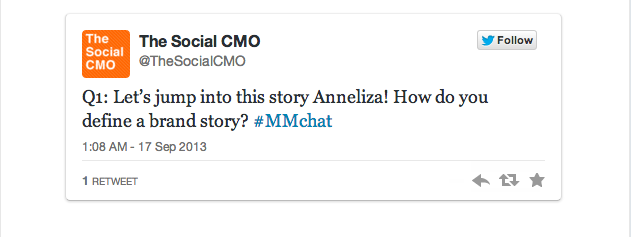
1) Set Up or Participate in Twitter Chats

You don't even need to host a Twitter chat to get all the benefits that they offer for content creation. Participate in a relevant chat by a credible industry expert, and note the interesting questions people ask -- they are likely similar challenges your customers face. For instance, #MMChat, which takes place on a Monday night and is hosted by @JeffAshcrost, is a good one if you're looking to hear from industry leaders from the marketing and social media world. These chats can not only help you shape your content with fascinating quotes and new insights -- they can actually teach you about new things that'll make you a more diverse content creator.

TweetChat

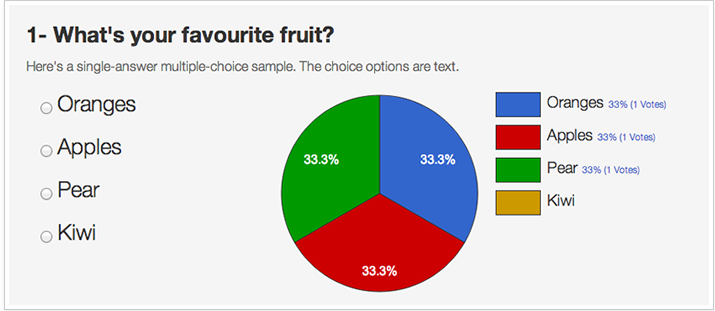
2) Get Crowdsourced Data and Opinions

Let's not overcomplicate things here. Asking your followers a straight up question can be a simple solution to getting an idea for a piece of content, or adding a more democratic voice to a controversial subject matter.

TwtPoll is a cool survey tool you can use to create a one- or multiple-question survey to send out to your followers. And if you're using the responses to generate blog and offer topics, you're ensuring that your content is answering the questions that matter to your target persona.

Screen_Shot_2013-10-29_at_13.35.35

3) Leverage Industry Influencers

Use a website like FollowerWonk to find industry influencers, and foster relationships that allow you to contact them for co-marketing opportunities or quotes.

For instance, we at HubSpot often ask subject matter experts to contribute tips and advice in our content -- even crowdsource entire pieces of content like we did in this blog post about defining inbound marketing. We can then subsequently promote that content through the expert's network, as well as our own, expanding the reach of the content.

ExpertTweet

All Twitter users want great information to share with their network, so establishing a new partnership with experts will be mutually beneficial for both of your followings. Promote the content using their Twitter handle, and create a hashtag that you can both use when tweeting about it so you can track the content's journey.

4) Comarket With Your Customers

Your customers are awesome! You love them, and they love you. (Right? Right.) So why not show them just how much you think of them by including them in your next content piece?

What have they learned from you that they could teach someone else in their shoes? Carry out several interviews of your top customers and turn their journeys into lessons you can teach to your audience and prospects. Talk about the challenges they overcame and how they did it (this is a case study, people!). These tweets can be used over and over again to add an element of social proof to your content that will help you gain more credibility.

CustomerTweet

When the piece is ready to go out, make sure your customer has a promotion plan in place to help you spread the good word on Twitter. Again, use their Twitter handle to give them full credit for their contribution, and use a hashtag you both can use to track the campaign's progress.

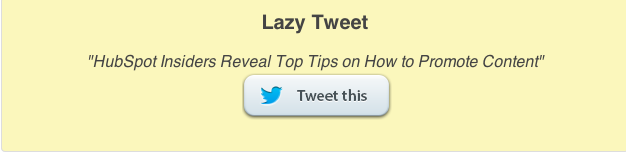
5) Provide Lazy Tweets

We are having a lot of fun here at HubSpot at the moment with lazy tweets. We embed them in our emails, ebooks, guides, etc. Using a website like Click to Tweet, you can quickly and freely create a link that, when clicked, creates a pre-populated tweet, making it super easy for your reader to share your content on Twitter. You should @mention any contributors in the lazy tweet and again, use a hashtag or tracking URL to see just how much extra reach your content got from lazy tweets, specifically.

Screen_Shot_2013-10-29_at_13.44.38

6) Use Twitter Search to Identify Content Topics

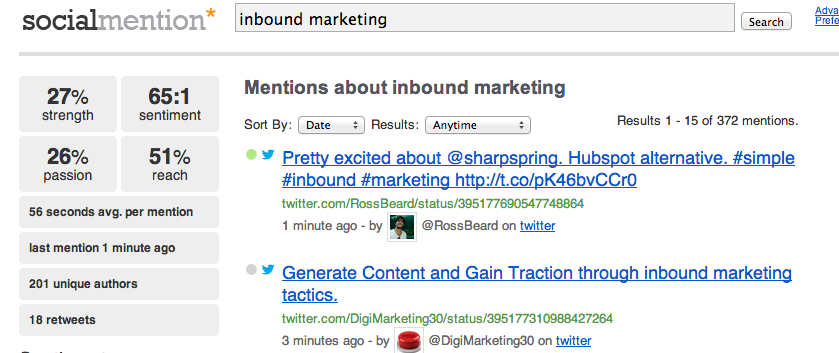
Using the Twitter Search application, you can easily search for common challenges and problems that your customers and prospects are facing. This can bring you tons of blog titles if you search on the right terms. Social Mention is a great tool for searching Twitter, as well as other social networks for conversations that center around your keywords. It allows you to export the search results into a .csv file where you can use it for keyword research and for planning out content topics.

SocialMention

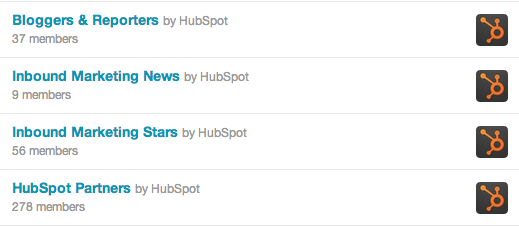
7) Make Lists of Tweeple Who Inspire You

Making Twitter Lists is an easy-breazy way to aggregate awesome content on topics that you're interested in. Reading what others are writing about often provides the inspiration you need to brainstorm your own topics. Don't plagiarise though! (I hope that goes without saying.)

TwitterLists

To learn more about how Twitter can help grow your business -- through content creation and other methods -- register for our latest free webinar, How to Grow Your Business on Twitter. The first part of the two-part webinar takes place Tuesday, November 5th from 2:30-3:30 PM GMT.

get your remarkable content ideas guide

subscribe to the hubspot marketing blog

31 Oct 16:22

Searching for Buried Treasure: Finding Prospects on LinkedIn

by Craig Rosenberg

Today’s guest post is from my buddy Robert Koehler who is a Sales Product Consultant for LinkedIn Sales SolutionsI have known him for years and he was one of the smartest guys I know and he loves writing…My fingers are crossed we can keep him contributing!  Enjoy his post below. (it’s awesome)

Last year our family went ‘Geocaching’ to find buried treasure. My seven- year-old defined treasure as buying him a smoothie. My ten-year-old interpreted this as a guarantee of finding him enough gold to fund the mansion he craves. In reality Geocaching is a ‘free real world outdoor treasure hunt’ app that helps you find hidden containers that someone else has left for you to discover.

In the driveway we turned on the app. To our joy we determined that the first treasure was miraculously buried right outside of our fence! After finding zero containers, one rattlesnake and the air pump that I had been searching for the last six months, we realized that the app was not showing us the treasure but rather our current location.

Finding prospects on LinkedIn Is like our Geocaching experience. Over 250 million members- real people, not a third party database- have left ‘hidden nuggets’ for you to discover. However you need to know your current location and have a map for finding the treasure.

Linkedin selling, social selling

Your current location: Where are you now?

1. Before you start searching, have a great LinkedIn sales oriented profile with a professional photo, headline and summary. This helps ensure that once you’ve found and reached out to prospects that they’ll want to respond. My definition of social selling is ‘leveraging your [LinkedIn] social profile to fill your pipeline through the right people, insights and relationships

Best practices:

  • Focus your summary and profile on how you can help clients rather than just your recent resume accomplishments
  • Use rich media such as video, Powerpoints and PDF’s to ‘not just say it but to display it’

2. Build a quality network. The more connections you have, the more your second and third degree connections will grow exponentially and the more prospects you will see in your search results. In general if you are in sales and have fewer than 350 LinkedIn connections you should focus on making one new connection a day. Reach out to past and present colleagues, customers, and friends and family that are business professionals.

Best practices:

  • Only connect with people with who you have already had some two way interaction: think quality, not quantity.
  • Always personalize your connection requests so that people know who you are and why you want to connect; it’s an opportunity to building a relationship and a conversation. A cold connection request is as uninspiring as a cold call or a cold email.
  • Use the phone, email or LinkedIn introduction requests to initiate contact with a prospect; only use connection requests to build on a conversation, next step or relationship.
The map to finding the treasure
  1. Before you go hunting make sure that you know what you are trying to identify. What are the accounts, location, roles, titles and keywords that will lead you to your target prospects? Who are the people that you ideally want to be connecting with?
  2. Start searching.
  3. Conduct both keyword searches as well as specific field searches. When you do a keyword search on LinkedIn it searches a member’s entire profile. A specific field search narrows your search for those titles, keywords or other criteria solely in that specific field. For instance you can search with people who only have “HR Director” OR “Director of HR” in their current LinkedIn title .The top sellers on LinkedIn do very targeted searches combining multiple keywords, locations, titles and other variables.
  4. Use keyword modifiers such as OR and AND to expand or narrow your search. For instance since many LinkedIn members list their titles in different ways, you should consider doing a keyword search for “CFO” OR “Chief Financial Officer” to ensure that you are catching as many appropriate prospects as possible. By searching on “Mobile Communications” AND “Purchasing” (keywords in quotes, the modifier in CAPS), which requires that both keywords be present in a member’s profile, you can narrow your search to prospects more likely to be involved in purchasing mobile solutions.
  5. Filter your search results using the filters on the left hand side of the search results. Always prioritize second degree over third degree connections because there is at least one person that can potentially introduce you to a second degree connection. This increases warmer introductions and reduces the need for cold calling that research shows is increasingly ineffective. (note: premium subscribers and LinkedIn Sales Navigator users can gain access to additional premium filters such as ‘seniority’, ‘functional area’ and ‘company size’).
  6. Looking up the profiles of individual prospects in your search results, make sure you look at ‘People Also Viewed’. This feature shows you the other LinkedIn members that people who viewed this profile also viewed. Frequently this provides a quick roadmap of other executives and peers at a named account or shows a number of prospects in similar roles.
  7. Join and search LinkedIn Groups. On average top sellers belong to over thirty LinkedIn groups. Every seller should belong to at least five LinkedIn groups. Additionally you can send a private message to any mutual LinkedIn group member.

Like our geocaching trip where we ultimately ventured to ‘Turtle Cove’ (really, I’m not making this up) and stumbled upon one of the old local stops of the Pony Express shrouded in weeds and overgrown brush, you never know what treasure you’ll find until you start searching. By knowing where you’re starting and having a plan you’ll move far beyond the limited number of prospects in your immediate back yard.

Linkedin, social sellingRobert Koehler is a Sales Product Consultant for LinkedIn Sales Solutions. You can find him on LinkedIn (of course)


 Geocaching photo provided by  WiredRyo

31 Oct 16:18

10 Examples of Brilliant Email Marketing (and Why They're So Great)

by gsoskey@hubspot.com (Ginny Soskey)

BU010710At one point or another, we all need inspiration to do our jobs better. It doesn't matter whether you're a marketing veteran who has navigated through years of changing technology or a newbie fresh out of college -- we all need to see examples of outstanding content. It helps us get through creative ruts, make the case to our boss for experimentation, and make our own marketing even better.

Most of the time, inspiration is easy to find because most marketing content is publicly available. You can scour the internet or go on your favorite social network to see what your connections are talking about.

But there's one marketing channel that is really, really hard to find good examples of unless you're already in the know: email. There's nothing casual about it -- you either need to be subscribed to an email list or stumble on a roundup kinda like this one to find great examples of emails. And even if you're subscribed to good emails, you're often getting bombarded day after day by them, so it's hard to notice the gems.

Because of the difficulty to find good examples on email, we decided to do the scouring for you. What we found were 10 examples of effective email marketing. Read on to find out which emails we chose and get the lowdown on what makes them great -- or just keep on scrolling to get a general feel for each. However you like to be inspired is fine by us!

And if you want to learn what you need to create a five-star email, we've developed a handy guide to help you out!

1) BuzzFeed

I already have a soft, soft spot for BuzzFeed content (70 pictures of dogs in their Halloween costumes, anyone?), but that isn't the only reason I fell in love with its emails.

First of all, BuzzFeed has awesomely written subject lines and preview text. They are always short and punchy -- which fits in perfectly with the rest of BuzzFeed's content. I especially love how the preview text will accompany the subject line.

For example, if the subject line is a question, the preview text is the answer. Or if the subject line is a command (like the one below), the preview text seems like the next logical thought right after it:

buzzfeed_inbox

Once you open up the email, the copy continues to be great ... but that's all been out-shadowed by something else. Just take a look at that glorious alt text action happening where the BuzzFeed logo and first image should be. The email still conveys what it is supposed to convey -- and looks great -- whether you use an image or not, and that's definitely something to admire.

Without images:
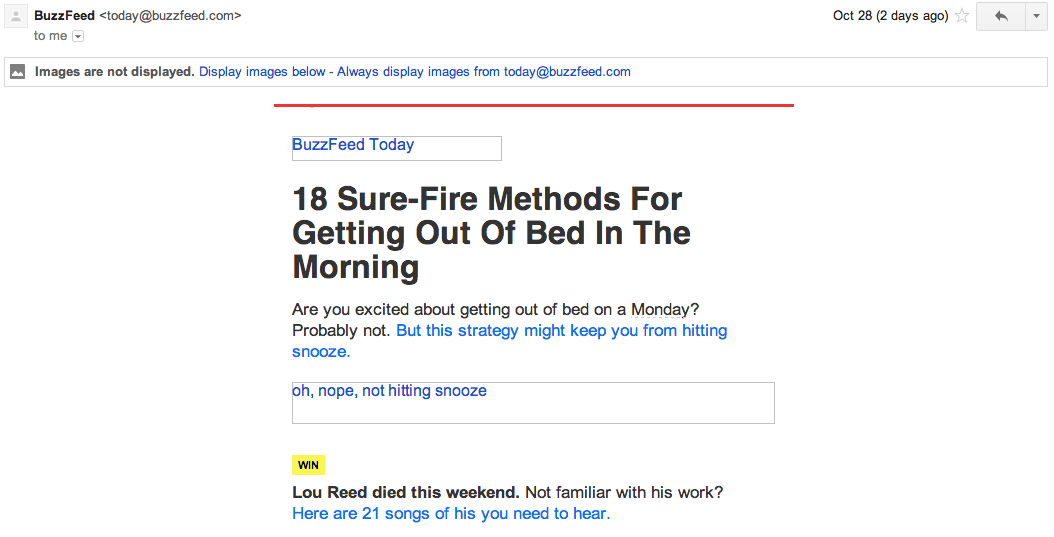
buzzfeed_alt_text

With images:

buzzfeed_images_enabled

2) Brain Pickings

On first glance, you probably wouldn't choose this email as the best email you've seen in a while. If you're not an avid Brain Pickings reader, I'd guess you'd be incredibly overwhelmed when opening it -- I know I was.

But the reason I included this email here is because it's brilliant for its reader persona. People who read Brain Pickings are intellectual, avid readers. Chances are, they love classic literature or highbrow pop culture -- and maybe a bit of both. An email that takes you a full minute to scroll through and is also chock-full of interesting information is the perfect email for them. 

So if you're trying to improve your email open and clickthrough rates, try experimenting with different content lengths. Who knows? Your leads and customers may like something completely different than you imagined.

brainpickings_email

3) RunKeeper

Lots of people hate on email newslettersThere's too much going on! There's no focus! They're the worst emails ever! I'm not going to argue that there aren't bad email newsletters out there -- because there certainly are -- but more people are doing them right than most assume. 

Take a look at RunKeeper's email newsletter below, for example. Off the bat, it's just beautiful. The images used all evoke various emotions -- laughter, intrigue, happiness, or just plain admiration -- so you naturally want to click.

Honestly, I don't even focus on the copy in this email because the images are so awesome. The newsletter layout is also visually pleasing -- more prominent stories get more prominent space -- so you know what you should be clicking on. All in all, the email is just gorgeous.

runkeeper_desktop

Bonus: It's gorgeous on mobile too. The design is completely responsive and easy to use on my phone. I'm not scrolling for ages, and my fat fingers can actually click on the right things. 

runkeeper-phone

4) 1-800 CONTACTS

When people talk about email marketing, lots of them forget to mention transactional emails. These are the automated emails you get in your inbox after taking an action on something on a website. This could be anything from filling out a form to purchasing a product. Often, these are plain text emails are those that you set and forget. 

Well, 1-800 CONTACTS took an alternate route. Its ordering process is long -- you have to order contacts, get your specific lens prescriptions filled, then get it shipped. So, to keep customers in the loop, 1-800 CONTACTS sends automated emails with a progress bar to tell you where in the ordering process you are.

With the progress bar, you don't even need to read the email -- you know immediately where you are in the whole process so you can move on to better things.

1800-contacts

5) Salt House Inn

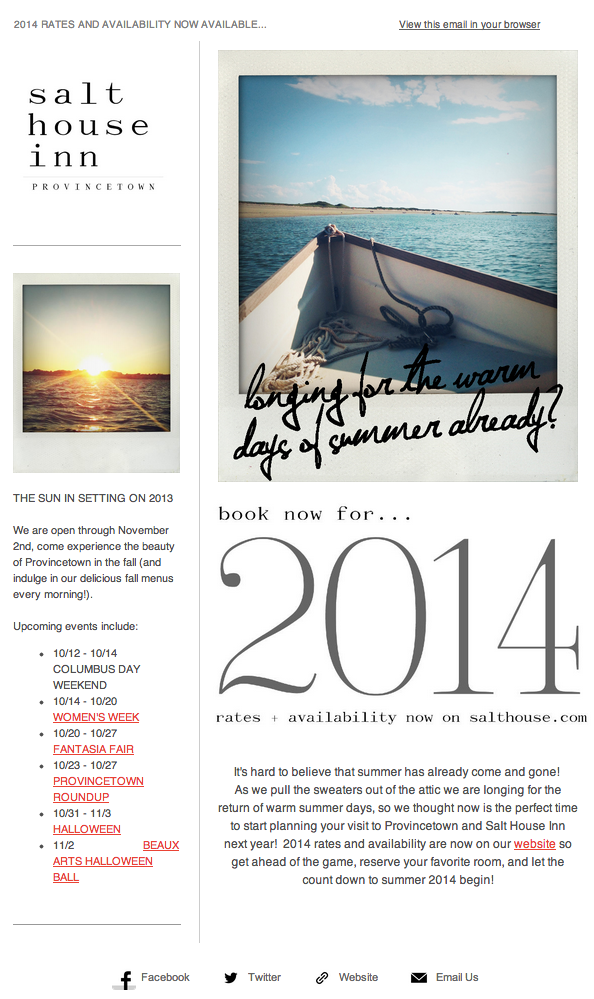
Like RunKeeper, Salt House Inn's emails have gorgeous imagery -- and on closer inspection, you can see that they didn't spend a dime on them. Oh, I'm not talking about the image quality -- that is way above par. But do you recognize the telltale square shape? Pretty filters? Yup, those images are from Instagram, and they're gorgeous.

The lesson here: Make use of whatever visual assets you have to make your emails look gorgeous. Whether you are using free stock photos, icons, or just images from your own Instagram account, you have the opportunity to make your subscribers notice and clickthrough on gorgeous graphics. 
salt_house_inn

6) Nosh.On.It

I've been a huge fan of Nosh.On.It for a while -- the company sends yummy yummy recipes to my inbox every day. But I didn't just include it because of its delicious recipes ... I'm truly a fan of its emails. I love its layout: it features three distinct sections (one for the chef, one for the recipe, and one for the tip) in every single email it sends. This means you don't have to go hunting to find the most interesting part of its blog posts -- you know exactly where to look after an email or two. 

I also love Nosh.On.It's "Forward to a Friend" call-to-action in the top-right of the email. Emails are super shareable on -- you guessed it -- email, so you should also think about reminding your subscribers to forward your emails to friends, coworkers, or heck, even family! 

NoshOn.It

7) Eurostar

After I got this email, I knew exactly what I wanted to do: win a trip of a lifetime to London and Paris. Why? You can probably guess: Besides the gorgeous pictures of two beautiful cities, Eurostar also has some pretty in-your-face CTAs in this email. I love how a CTA is featured above and below the fold to take the same action -- it appeals to both the impatient and the scrupulous. 

The writer in me also loves how Eurostar opens its email. "Bonjour," it says, immediately making you think of walking the streets of Paris, maybe popping into a creperie. That simple language choice spoke more about the marketing offer than the entire email did. 

Eurostar

8) AT&T

I normally hate on AT&T (and pretty much all phone companies), but I thought this example from Marketing Land was a brilliant use of responsive design. Yes, the imagery looks great on both devices -- the colors are bright, and it's not too hard to scroll and click -- but the mobile email actually has features that make sense for you to do if you're on mobile.

Notice the "call now" button -- on the left (the desktop), it's a written out number. On the right? A simple CTA that lets you call someone now because you're already on your phone. It's also given more prominent placement than "shop now" because people call on phones much more often than shop. Smart, smart marketers.

ATT-responsive_thumb-600x358

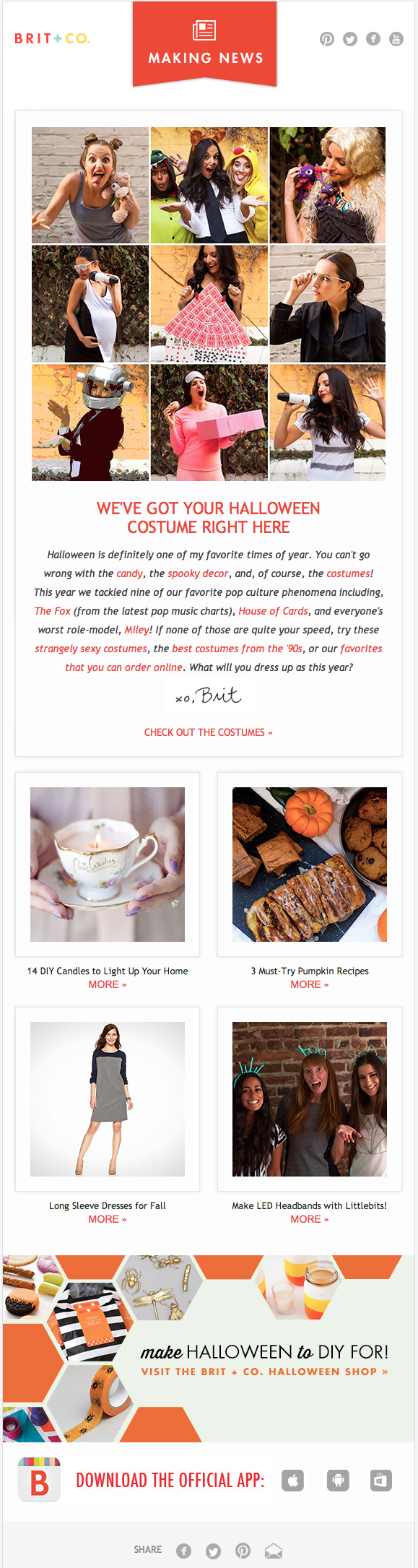
9) Brit + Co

An essential element of an email subject line is to set expectations of the email inside. For example, if you're going to offer a coupon, you want to let your subscribers know that the email contains it right in the subject line. Seems simple, right? It's not always.

Setting expectations -- and then delivering on them within the email -- can be difficult. Thus, why I love this email from Brit + Co. Here's the subject line:

brit_co_

And then here's the email:

brit_co

When Brit + Co said "Look No Further" in the subject line, the company wasn't kidding. Right away, you see nine costume ideas -- of course, in gorgeous photos. Even though you have to click through to see all of the costumes, you believe the promise that you won't have to do more research for costume ideas -- and then, feel okay clicking on the email.

I'd take a guess that Brit + Co's CTR on this email was huge. Delivering on expectations set in the subject line is definitely a best practice we all should follow. 

10) Uber

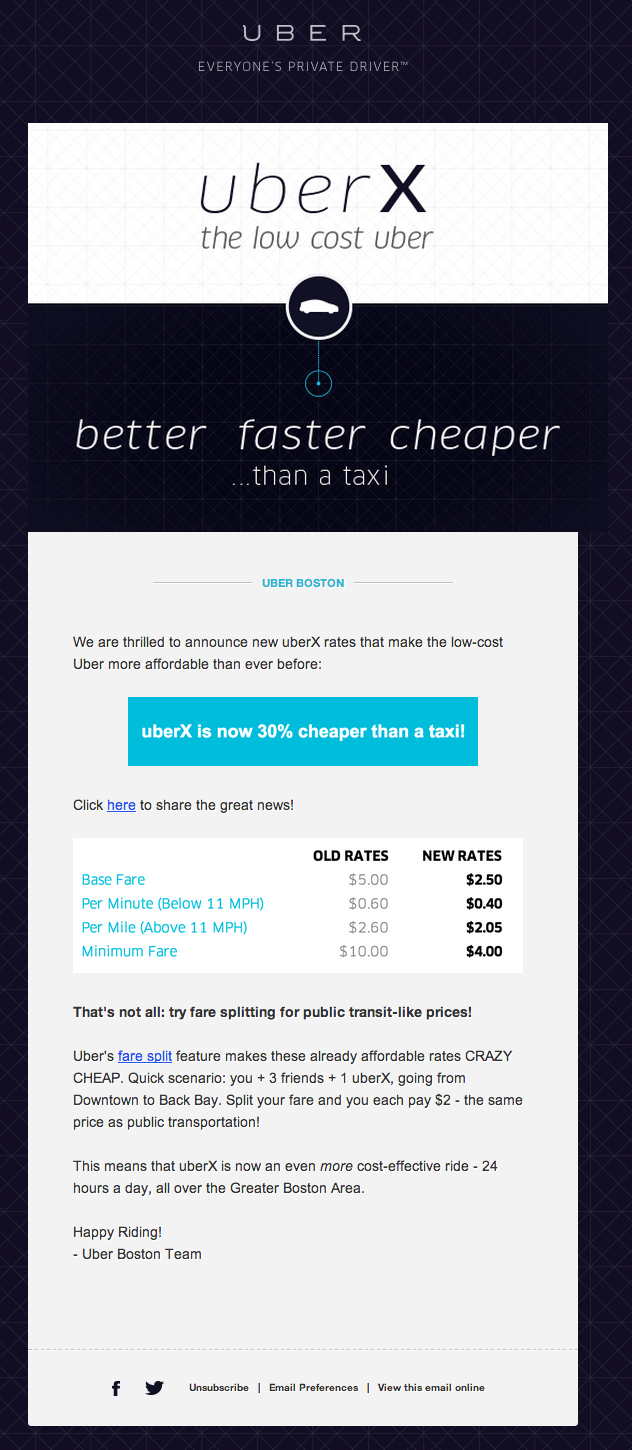
Last, but certainly not least, we have Uber's email. Design-wise, this email takes the cake. It's super easy to scan, making it easy for you to digest what it's about without reading any of the copy at all.

Give it a quick once-over -- what do you notice? The "better faster cheaper than a taxi" slogan that appears above the fold, the neon blue box that says Uber X is 30% cheaper than a taxi, and then the new rate ... which is exactly what Uber wants you to know.

Because this email is about driving awareness of a new product rather than converting someone to become a lead or customer, that's all you really should be noticing. So hats off to Uber for using design to better communicate its message!
Uber

These are just some of our favorite emails. Who sends you emails that you love? Share your favorites in the comments, and we'll check them out for future posts like these.

anatomy of a five-star email ebook

subscribe to the hubspot marketing blog

31 Oct 16:12

20 Ways To Get Your Content In Front Of Early-Stage B2B Buyers

by Derek Edmond
A recent article in BtoB Magazine highlights how marketing to the electronics engineering vertical is changing due to technological innovation and the demands of a more specialized (and time-constrained) workforce. The focus of the article centers around content marketing designed to attract buyers...

Please visit Search Engine Land for the full article.
31 Oct 16:11

Sales Training Article: Aligning with the 80 Percent

by Customer Centric Selling

Sales Training Article: Aligning with the 80%

By John Holland, Chief Content Officer, CustomerCentric Selling® - The Sales Training Company

Image courtesy of Stuart Miles at FreeDigitalPhotos.net

Challenger Sale has created a great deal of buzz in the sales training space over the last year or so. Their approach has its roots in an article written by The Chasm Group describing provocative selling that appeared in the Harvard Business Review 3 or 4 years ago. The concept is to start buying cycles by telling buyers about leading edge approaches that are being or could be used in their industries.

sales training workshopsDespite embracing Geoffrey Moore's work by expanding on this approach, Challenger Sale casts a blind eye to the core concepts described in his books (i.e. Crossing The Chasm and Inside The Tornado) that describe at what point in product life cycles different buyers are likely to buy.

Innovators and early adopters (10-20% of the potential market) are most likely to be interested and/or buy very early in product cycles. These buyers evaluate offerings quickly, may see business applications vendors had not thought of, willingly take risks, and often view implementing disruptive offerings as a competitive advantage. Vendors with "hot new offerings" can lead with product. Early market buyers "get it." Some buy. There actually isn't much selling to be done as the early market chooses to buy. Decisions are quick because they want to buy early in product cycles. They savor the chance to be the "first on the block" to implement.

The majority of buyers want to follow, not lead. How many people do you know that want a recommendation from a friend or other source before they will try a new restaurant, read a book, buy a car of go and see a movie? Most buyers are followers, not leaders.

Geoffrey Moore highlights potential problems for vendors with new offerings. There aren't enough early market buyers to achieve revenue targets. Vendors that gain traction by leading with offerings will have difficulty "crossing the chasm" to mainstream market buyers that comprise the lion's share of the potential (80-90%). These buyers do not want to be "first or early" in buying offerings. They are likely to ask questions like:

  • What other companies have bought this offering?
  • What other companies in our space have bought?
  • What types of results have been achieved?
  • How much market share does a vendor have?
  • How financially stable is the vendor?
  • Are there at least 3 different vendors that can be evaluated and compared?

Buying cycles proceed glacially in contrast to the early market. It isn't unusual for RFI's or RFP's to be issued. Instead of welcoming disruption, the mainstream market resists change whenever possible. They prefer making no decision if there appears to be a chance of making a wrong decision. They respond poorly to sellers that lead with product. Their preference is to have sellers share business results others have achieved early in the process. References to being first or early to buy are likely to have them realize this isn't a "safe" choice and defer evaluating the offering until a later time (no decision).

Register for one of the CustomerCentric Selling® sales training workshops to avoid "no decisions."

Geoffrey Moore suggests vendors should not approach the mainstream market until they have a "beachhead" of clients. When they do, sellers must be patient in explaining potential usages and business outcomes because these buyers won't "get it" by sitting through product pitches. In many instances the "chasm" must be crossed vertical segment by vertical segment.

Pursuing markets by challenging buyers with new or unproven offerings aligns with early market buyers. While vendors can buy lists of potential prospects, none of them will have a category for "early market buyer" for individuals or companies as a whole. Provocative selling calls on Mainstream Market buyers who will likely alienate them and are premature, absent beachheads that have been established and measurable results that have been achieved.

Challenger Sales defines 5 different types of sellers, but fails to recognize the 5 different types of buyers Geoffrey Moore identified:

  • Innovators and Early Adopters comprising the Early Market
  • Early Majority, Late Majority and Laggards comprising the Mainstream Market

Revenue outcomes are optimized when sellers align with buyers. For example, it is important for sellers to take a different approach with buyers that have done research via the Internet versus those that haven't. Early Market approaches conflict with how Mainstream Market buyers want to buy and are unlikely to deliver the desired top line results.


sales training companyNeed some help with your sales performance? Take a look at the sales training workshops available to you and improve sales performance.

Read more sales training articles from CustomerCentric Selling® - The Sales Training Company.

31 Oct 16:11

Five Reasons LinkedIn is the Best Sales Database in the World. And Five Reasons it is Not.

by Kyle Porter

LinkedInDatabaseHeader

Let’s jump straight in. What makes LinkedIn great for salespeople?

1. There are a Quarter of a Billion Professional Profiles

LinkedIn basically houses resumes for the professional universe. And estimates state that over 90% of these are “public” meaning they are openly available to the general public. It’s the best home for your prospects.

2. User Updated Profiles

Legacy data systems that are updated by third parties, LinkedIn users have  ”social pressure” to keep their profile up to date. There’s a big difference here. Life is so dynamic and people change so frequently – this is the only true database that stays fresh. We estimate it to be 90% accurate in terms of names and titles.

3. So Much Information!

LinkedIn has more professional information than other sales databases. Work history, photos, colleges attended, interests, endorsements, connections, etc. It’s the professional data mecca…especially for salespeople.

4. Easily Searchable (in LinkedIn and Google)

Finding a new prospect (or vein of prospects) is a breeze. The advanced search feature allows you to really dive in to the segments of the market you care most about. And since there are over 200 million public profiles, you can also use Google to search across the database. Google helps you find people outside your network or those who match parameters that are unsearchable natively in LinkedIn.

5. Ability to Connect & Share

This is where LinkedIn makes the move from sales database to social network. There’s power in “connecting” with the people you know and care about. It’s valuable to share content and information with your followers and to see who is connected to who in general. LinkedIn is the best social network for professional sellers.

—-
So we get it, LinkedIn’s great. The information is definitely there, but companies still use other data platforms for their sales information. Why is that? Here are the answers:

1. No Contact Info for Non-Connections

Most of the prospects you want to initiate relationships with ARE NOT already connections. So how do you find their email address? One idea is the Rapportive method but that is quite timely. It makes the platform less valuable to salespeople.

Workaround: we built Prospector to enable you to capture contact email information for non connections. Using special software, we are able to identify a large % of user’s corporate email addresses and deliver them back to you

2. No Simple Export

When we started to build sales tools, we shadowed prospecting reps and marketers. You know what we found? A LOT OF COPY AND PASTE! Yuck. If you’re working through hundreds or even just 10 per day, it sucks to copy and paste all the information you need.

Workaround: Prospector enables you to export your searches to Salesforce CRM or spreadsheets. Through a simple browser extension, you can now get all that information you need straight out of LinkedIn.  

3. Blocked Profiles

Profiles in LinkedIn are sometimes inaccessible. If you’re not close in connections you might see a First Name with just Last Initial. When you come across these, it slows down making contact.

Workaround: Prospector give you a simple method for running searches of LinkedIn data in Google. Since most profiles are public, using this allows you to see Full Name for more contacts than if you were actually in LinkedIn.

4. No Job Change Alerts for Non-Connections

When your connections change jobs on LinkedIn they’ll send you an email. Without being connected though, you can’t tell if your people have changed jobs without going to their pages everyday. The more people you’re interested in, the harder this becomes.

Workaround: Job Change Alerts from SalesLoft connects straight into your CRM. Through a simple report, you can tell us who is important to you. We’ll find them and follow them for job change alerts…regardless of whether or not they’re connected to you.

5. No News Feed for Non-Connections

We love the LinkedIn news feed, and as a sales pro, you can get a lot of value by following the companies you’re trying to sell to. LinkedIn also has a slick new feature where they email you with news stories that quote or include your contacts. But what they don’t do is know the people and companies that you care about in CRM. Therefore they can’t deliver you news on those “non-connected” entities.

Workaround: With News Alerts, you can sync your CRM and SalesLoft will find the accounts you care about. You can pick and choose the ones you like and follow them for news articles.

LinkedIn has all the information you need, the issue is capturing it and making it quickly actionable for your revenue outreach team. Get smart about using 3rd party tools that help you leverage the power of LinkedIn data and please let us know how we can help in any day. It would put a big smile on our face to hear from you after this post :)

31 Oct 16:11

Want To Increase Your Inbound Marketing Leads? Add More Content!

by Mike Lieberman

Want To Increase Your Inbound Marketing Leads? Add More Content! image contentmarketing resized 600 238x300There are many tactics involved in the practice of inbound marketing, content marketing being one of them. Too many people confuse the two terms or believe that content marketing and inbound marketing are one in the same. While they are similar, these two notions of marketing are separate entities.

Think of inbound marketing as the rebirth of advertising. Back in the day, advertising consisted of billboards, print ads and radio spots. These are considered “outbound” marketing tactics. In contrast, inbound marketing consists of search engine optimization, social media marketing, and content marketing. New age, new marketing. With inbound marketing, our goal is to engage the right targeted audience and pull them in, as opposed to pushing out advertisements to as many people as possible.

Inbound marketing is the root, and from there stems content marketing.

We’re all familiar with the classic sales funnel; before agreeing to a sale with your business, a potential client must first consider your business. Before considering it, they must be aware of it. Content marketing adds to this funnel with continuous contact during and after a sale. Because inbound marketing focuses so heavily on engaging prospects and forming relationships, content marketing is essential to pushing that process along.

What does content marketing consist of? Well, from content marketing stems your specific marketing tools – e-Books, whitepapers, infographics and webinars. Certain content should be sent to certain prospects, depending on what stage of the sales funnel they are in. You can measure this with a content map, which is essentially a map that tracks who the content was sent to, and at what point in the sales funnel. You need to make sure you’re sending your targets the most relevant content at the right time.

Just as there are inbound marketing campaigns, there are also content marketing campaigns. An inbound campaign involves content, email marketing and video marketing. A content marketing campaign is a bit more specific and, just as it sounds, focuses only on content. You send content to a specific target and you measure the results. If your ROI isn’t what you had hoped for, you need to switch up your content or your target.

31 Oct 16:11

Selling the Pitch: 3 Lessons for Sales Reps from the World Series

by Sabrina Cote

Selling the Pitch: 3 Lessons for Sales Reps from the World Series image Boston is a baseball town, and if you forget it for even a second we have an ample supply of beard-adorned fans to remind you…at every street corner, every T station, every restaurant, every- …well, you get the idea. Everywhere you turn in this neck of the woods, people are talking about baseball, so why would we be any different?

As we await the next oddity in a World Series that already includes a game-ending obstruction call and a game-ending pickoff, let’s talk about some of the aspects of baseball that you can plan for – and what sales reps can learn from all this baseball talk.

Know the landscape and adapt

For every American League team, the opportunity to play in the World Series is accompanied by the challenge of adapting to National League rules. In order to be successful, the Red Sox not only needed to study their competition, but also go into the game with a solid understanding of their strengths and how to capitalize on them within the National League style of play.

This is much the same for sales reps as they prepare to meet with potential customers.  In order to be the expert in the room and the best possible resource for the prospect, reps must be in tune with the competitive landscape, and how specific strengths of their solutions set them apart from the competition.  In addition, it’s essential that reps have a clear understanding of their potential customer’s needs and how their solutions can address key areas of those challenges.

The key to helping sales reps get trained up on product offerings, and prepare for client meetings is providing them with a way to efficiently access the content they need.  Portals that house training materials and content to engage prospects are both effective way to organize resources for the sales team.

Identify winning combinations at every stage of the game

The Red Sox success in the series so far can be attributed at least in part to their intelligent use of personnel.  Without the position of designated hitter on the National League scorecard, to Sox have employed some creative substitution to get the most out of David Ortiz’ bat throughout the meat of the game, before switching to Mike Napoli for his defense to solidify the victory.

Similar to how the right players, in the right positions, at the right point in the game can be crucial to the outcome, identifying the most relevant content for each stage of the sales cycle is vital to the success of the deal.  This infographic offers some useful tips for determining which types of content are best suited to engage potential customers in each part of the sales funnel.

Analyze the stats and act on the data

This series has had no shortage of unique and impressive statistics (not least of which is David Ortiz’ astounding .714 series batting average through five games), but what’s most important about all these statistics is the informed action that they have enabled the managers to take. With insights into the intricate details of things like how certain hitters fare against right or left-handed pitchers, the Sox have been able to make educated decisions about how to manage their bullpen to retire the Cardinals batting order.

The same is true for sales reps. Once they’ve shared a piece of content with a potential customer, they’ll want to know whether it was viewed, what parts of that content were most interesting to the buyer, and how best they can follow up.

As we head into game six of this iconic series, and as the sights and sounds of historic Fenway set the scene for what will surely be a record setting series on a number of fronts, let’s not overlook the valuable lessons that can be gleaned from the game.

More Sales Enablement Tips: Download Our eBook

Image Credit: ESPN.com

31 Oct 16:11

Video Marketing is the New Black: How to Drive Sales and Marketing Success

Check out this LaunchPoint presentation with Marketo, Ceros, and Wistia and discover how to implement a killer video marketing strategy that helps drive sales and marketing success!
31 Oct 16:11

Piecing Together a Passionate Sales Pitch

by Katie Nice

Piecing Together a Passionate Sales Pitch image unique selling proposition  unique selling point  usp 300x193

Starting sales pitches with a simple question can reduce the conversion rate of those pitches by 60 percent or more, according to sales analytics firm Vovici. That single statistic underscores just how volatile a sales pitch can be in connecting with consumers and producing sales opportunities. While the structure of a sales pitch can vary depending on the allotted time, the audience hearing the pitch, and the industry and/or products being sold through the pitch, one thing is constant: Prospective customers respond to passion. By building a sales pitch that exudes passion for the product or services being sold, consumers are more likely to be engaged and interested, which will ultimately increase brand interest and conversion opportunities.

1. Keep Your Emotions in Check

Passion is important, but it needs to be controlled. Consumers might not respond well to a sales pitch that boils over with energy but fails to focus on the practicality and tangible worth of the product or service being sold. As an editorial in YSF Magazine notes, excessive eagerness to sell and grow a business can “paradoxically” result in a loss of sales opportunities. For this reason, salespersons need to get a tight grip on their body language and tone in sales pitches, conveying their passion for a business without resorting to effusive theatrics.

2. Research the Consumer Motivation

Every audience is different, even if the pitch is focused on the same business solution. Whether it’s a women’s business conference, a local small business organization, or interested prospects brought together by a common problem or need, it’s imperative to customize your speech to tap in to individual consumer motivations. The differences in approach may be slight, but catering your pitch to each individual audience — even in small ways — will improve the relevancy of your pitch and speak more directly to the needs and wants of that audience. If the rest of your pitch has been properly developed, improved conversion rates should follow.

3. Emphasize Your Passion for Delivering a Solution

Effective business leaders and sales professionals like GoDaddy founder Bob Parsons understand that consumers want to know what’s in it for them — and early on in the sales pitch. One of the first goals of any passionate sales pitch is to give clear reasons why consumers should care about what you’re pitching.

When you’re crafting your sales pitch, the Australian Businesswomen’s Network recommends addressing your product or service from the consumer’s perspective. Highlight a problem those targets have faced and walk them through the process of how your product or service can rectify those needs. Be solution-oriented, tapping into consumer desires to trigger an emotional response to match your passionate pitch.

4. Delay the Call-to-Action, Let Product Speak for Itself

Some sales pitches aim to move as quickly as they can from the introduction to the call-to-action. This might work for some industries, and among some consumer bodies, but a passionate pitch should keep in mind the power of relevant, relatable content.

If your sales pitch is speaking directly to consumer needs and connecting with those prospects, then all of your content is essentially operating as a call-to-action. The need will be apparent among consumers, and the call-to-action can grow organically from those consumer desires. Don’t feel rushed to bring consumers to the point-of-sale. If you’re confident in the product or service being sold, allow its solution potential time to inspire its own call-to-action.

Here’s a great example of an effective sales pitch, and you can read more about it here:

Watch this video on YouTube.

photo by: photosteve101

31 Oct 16:10

Test Your Sales Negotiation Skills: New Simulation

negotiation

Negotiations are everywhere. From negotiating important sales opportunities to negotiating with our kids at bedtime, we’re constantly working to reach agreement with others. In this game of give and take, it’s too easy to get stuck, make mistakes, and lose big.

Are you...

... getting beaten up in negotiations?

... dealing with savvy corporate purchasing departments?

... getting pushed to focus on price over value?

... losing deals you should have won?

... unsure how to respond to common buyer tactics?

... making an effort to “win-win” and still losing?

31 Oct 16:10

How Does Teleprospecting Fit Into an Inbound Sales Methodology?

by Megan Toohey

How Does Teleprospecting Fit Into an Inbound Sales Methodology? image inbound outbound marketing resized 600

Let’s get this straight: teleprospecting does not exclusively refer to cold calling. It is the process salespeople use in order to prospect a lead on the phone.  Whereas cold calling can be impersonal and yield poor results, properly teleprospecting can humanize the interaction between a salesperson and a prospect through the use of helpful dialogue centered around prospect’s pain points, not the salesperson’s products. When you combine this process with an inbound sales methodology, you have a potent mix for success.

What is an inbound sales methodology?

Inbound sales requires you to transform from your traditional approach of buying lists, cold calling, and selling hard to a context-based, consultative sales process. That means you need to transform the way you target accounts, the way you prospect them, the way you connect with these prospects, and the way prospects perceive you as a salesperson.

Teleprospecting in an inbound sales process

Properly Target Your Accounts

Teleprospecting plays a role in every step of the inbound sales methodology. Before you make that call, you need to properly target your accounts. You only have so many hours in a day, so you want to make sure you are selecting the accounts that are the best fit for your company’s products or services to call. Take advantage of marketing lead intelligence combined with buyer’s context to understand your prospects’ areas of interest. Are they downloading whitepapers addressing a particular issue in your industry? Clicking on your website’s pricing page? Determine where your prospect is in the buying cycle.

Properly Prospect Your Leads

If you research your prospect effectively and leverage sales tools to monitor your communication attempts with a prospect, you’ll be much more likely to connect with them. Teleprospecting starts before that first connect call in inbound sales – the combination of voicemails and emails you leave for a prospect should reflect your expertise and willingness to help your prospects achieve their goals. This is the set-up for that connect call, during which you actually have a two-way conversation with a prospect. Make sure you incentivize them enough (“I’d like to pass on a few tips to increase your site traffic,” for example) to want to call back.

Properly Connect With Your Leads

In inbound sales, successful connects are the result of a combination of marketing intelligence, buyer’s context, external research (such as looking at their LinkedIn and Twitter accounts), and effective monitoring. Now, you are into the meat of teleprospecting: prospecting new business for your company via technology (the telephone). This is where this process can get a bad reputation and be confused with a cold call: oftentimes, the salesperson will go into an elevator pitch and completely disregard the fact that each prospect is a unique set of variables that can’t be addressed with the same playbook.

Your teleprospecting needs to be context-driven – based on what your prospect is telling you – not product-driven. If you can turn your call into a consultative process in which you are working with a prospect to help them improve their business, you are practicing effective inbound selling.

Change Your Prospects’ Perception of You

In your prospects’ minds, teleprospecting can be, and often is, lumped into the pile of old-school sales tactics (cold calling, buying lists). This is not your fault, but it is not your prospects’ faults either. They have been conditioned to respond negatively to a barrage of impersonal, pushy sales calls over the years, and so the first instinct they have is to hang up.

When you teleprospect in the context of inbound selling, you’re identifying prospects who are more likely to listen, because your product or service is a better fit. When you reach out to them via email and voicemail for a connect, you can include helpful content specific to that prospect. When you get them on the phone, you’ve already positioned yourself as a helpful consultant ready to listen and provide advice, not a traditional salesperson. Through your conversation on the phone, you can cement that positive view. Remember, people buy from people they like.

How Does Teleprospecting Fit Into an Inbound Sales Methodology? image c9d1dca6 0e10 4fdd b5db 946b73ccbddc

Want to Learn the Latest Teleprospecting Best-Practices from the Experts?

31 Oct 16:10

5 Monsters of Lead Loss: Spooky Ways to Scare off New Leads [Infographic]

by Tiffany Monhollon

You put a lot of effort and investment into getting more leads for your business. But have you ever thought about how easy it can be to scare off new leads? Your business could be suffering from this problem – and you might not even know it. So, we put together a list of five (scarily common) ways many businesses lose leads (and what you can do to avoid them).

5 Monsters of Lead Loss: Spooky Ways to Scare off New Leads [Infographic] image 773289

We Present: The 5 Monsters of Lead Loss 1) The Ghost of Unanswered Phones Phone calls are important for any small business because they’re one of the top ways new customers initially contact a company. In fact, 51% of ReachLocal readers said in a recent poll that the primary way new customers contact them is via phone. But there’s no better way to kill a lead than when a prospect calls your business and you don’t answer. All the life, energy, and investment you spent on trying to drive calls to your business simply die when you leave your phone vacant and unattended. Save your lead management from this monster by making sure you have a living soul ready to answer each call that comes through. 2) The Zombie of Bad Call Handling Have you ever listened in on the phone calls your business answers? If you did, you might be surprised just how mindlessly some people treat new leads. If you don’t give your staff the knowledge and sales skills to handle each call that comes in, you might be just as well off with zombies answering the phone. So, make sure everyone on your team is well versed on exactly how to handle all the types of phone inquiries your business regularly receives. 3) The Skeleton of Sketchy Information Even the best phone handling can die before its time if just a skeletal amount of information is gathered from a customer. Without a system in place that requires people to collect and store all the right information, you might have to lay too many leads in the graveyard of sketchy information for eternity. Getting the right information from a new contact enables you to follow up with them in a timely manner. Did you know that according to Insidesales.com, the odds of making contact with a new lead drop by 3000x if you wait more than 5 hours to call them back? You’re more likely to successfully turn a contact into a new lead if you do it quickly – and you can’t follow up with people unless you’ve got all their information. So, make sure to put a system in place that requires everyone who answers to the phone to capture details like the name, phone number, email address, and call details from each prospect that calls your business. 4) The Demon of Ignoring Hot Leads Some leads are hot. Red hot. When a lead gets to a point when they are talking about your product and service options, getting a quote, or setting up an appointment, they probably want to do business with you. Why would you banish them into the fires of ignored leads? It sounds unthinkable, but sadly, it happens every day. Don’t ignore hot leads or treat them like they aren’t a priority. Put a system in place that helps you identify and quickly follow up with leads who are ready to buy. 5) The Grim Reaper of Poor Follow Up All leads deserve your time and attention: you brought them to life through your marketing efforts! Don’t kill your leads through neglect (even if they’re not ready to buy now). Instead, follow up regularly using emails and phone calls to show their existence matters to you (and that you’d like to win their business!) Lead nurturing is a great way to make sure you are following up regularly with all your leads. And, companies using lead nurturing campaigns report 45% higher ROI than those not using lead nurturing. What Are Your Monsters of Lead Loss? Is your business a victim of any of these monsters of lead management? Are there other (perhaps less terrifying) ways your business is leaking leads? Discover more about the problem of lead loss at our new educational website DontLeakLeads.com where you can find more insights, tools, and advice on what to do about lost leads.

31 Oct 16:09

How to Protect Your Data When a Sales Executive Hits the Road

by Tom Lowery

A good sales account executive can be a great benefit; prospecting for new business, understanding the needs of customers and nurturing relationships with current ones. And after the sale, a good account executive will maintain those relationships.

But what happens when your company is in the middle of an opportunity to land a great client and, just as things are hotting up, the exec quits — and takes all relevant information with them?

At this point, everyone starts to scramble for contact information, status reports and meeting notes. I’ve seen owners in a panic and enraged at the realization that they can’t even be sure who the contact person is for the potential new client. Why? Because there’s no system in place to document meetings and interactions (actionable data). And that’s when your competition can grab that opportunity right out from under your nose. It happens a lot. Ask Travis Davis.

How to Protect Your Sales Team

Davis is the President and CEO of Point N Time Software, makers of Meeting Mapper for Salesforce, which was recently selected for the Mobile App Showcase at Dreamforce ’13. (Note: Other than the fact that I’ve written about Point N Time previously, I have no personal or financial connection to the partners or their company.)How to Protect Your Data When a Sales Executive Hits the Road image Travis caption

“If there’s no CRM system in place,” says Davis, “some or all of the following are bound to happen:

  • All the opportunity information leaves with the outgoing account executive.
  • You push (remove from your forecast) the opportunity.
  • You lose the opportunity.
  • The competition fills the void.

“The best way to reduce the risk is to use a meeting app that works well with your CRM system. Picture a new account executive in his/her first meeting since taking over the opportunity,” continues Davis. “If he/she isn’t able to hit the ground running due to lack of information, whose fault is that? Not theirs, that’s for sure.

“But when the new exec knows all the players, the roles they play, their stance (for, against, etc.) and has actionable data, just think of how a customer will react when this new account executive doesn’t have to ask the same questions the previous one did. It’s not another first meeting; it’s the continuation of the sales process.”

What’s Around to Choose From?

I’ve done a fair amount of research, and I’ve got to admit I’m having trouble finding other apps that appear to have an intuitive design or even work side by side with CRM systems.

In fact, nearly everything I found were “event apps,” which seem to be another animal. I asked Mike Williams, VP of Operations at Point N Time, to confirmed the difference:

“Yes, those event apps are in a completely different functional category. There are apps that you can find on the itunes app store that have some similar functionality for taking meeting notes (e.g. Meeting Pad, Meeting+, Meeting Gold), but none I’ve seen so far integrate fully with a CRM system.”How to Protect Your Data When a Sales Executive Hits the Road image Mike Photo1

A system learning curve should be easily negotiated by just about anyone. Users shouldn’t have to spend more 30 minutes to review meeting data in order to understand the landscape of opportunity. And information shouldn’t leave with the departing executive; the actionable data should always be stored.

An intelligent, well-regulated organization ensures that the sales cycle continuity remains independent of the account executive. Having been a financial controller for three decades, my experience has taught me that no one person should be the sole controller of this or any other business procedure.

Gaining momentum is hard — regaining it even harder. By implementing a worthwhile app to salvage your expensive CRM system, sales cycles are maintained and the competition can’t fill a void if there isn’t one. I’m sure many share Davis’ experiences and frustrations. It’s worth exploring apps like this in an effort to get hold of your CRM system and make it work for you, as opposed to hiring people to work for it.

What kind of experiences have you had? Have you tried using an app that might streamline the system or perhaps replace it? I’d welcome your feedback.

30 Oct 14:25

Amazon's Kindle Matchbook Offers Cheap Ebook Versions of Books You Own

by Alan Henry

Amazon's Kindle Matchbook Offers Cheap Ebook Versions of Books You Own

Amazon unveiled Kindle Matchbook today, a new service that offers affordable eBook versions of some of the physical books you've already purchased from Amazon. If the books qualify, you can get the Kindle versions for between $0.99 and $2.99, and future books you buy that qualify will get you the same deal.

Read more...

30 Oct 14:15

What Medical Sales is Doing Right To Reduce Unemployment

by Robyn Melhuish

You’ve probably heard a lot about what certain industries are doing wrong these days. From failing to hire the right employees to bad management techniques, unemployment can stem more from what an industry does wrong, as opposed to solely blaming it on a bad economy. With a national unemployment rate of 7.2 percent, many industries still have a long way to go before high unemployment rates are a thing of the past.

But what about industries that are doing it right? What about those niches that have beaten the odds and are still seeing areas of growth — especially in a time when all you hear about is the opposite? It may sound out of the ordinary, but there are industries that are doing well. After suffering through the recession, and more recently, weathering concerns about the Affordable Care Act, unemployment in medical sales appears to be decreasing — overall job growth in healthcare is trending upward.

Across the country, overall job growth for medical sales is trending upward. So, what is medical sales doing right in terms of keeping employees on board and reducing that unemployment number — and what lessons can other industries take away from it?

Competitive salaries

First things first: A career in medical sales offers competitive compensation. With an average total income of $133,654, medical sales professionals are some of the highest earners in the healthcare industry. Plus, a career in medical sales typically comes with incentives like commissions, another added bonus to the industry.

How this reduces unemployment: Money talks! It’s hard to walk away from a profession that not only takes care of its employees financially, but also offers a playing field where they can make more based on performance.

Room for growth

If you want to be a competitive employer, you have to offer your employees more than just attractive offers for today. You have to make them want to stay for tomorrow, too. A career in medical sales does just that: Income steadily rises as the years of experience increase and you don’t have to be in the game for years to make money. In fact, income increases significantly between the 20 to 30 and 31 to 40 age groups.

How this reduces unemployment: Professionals want to be in a career that can offer them more down the road, especially as their cost of living increases or for when they start a family. Being in an industry which offers them room for growth, both monetarily and professionally, are great reasons to stick around.

Varying job duties

It’s never a dull moment in the medical sales industry. You may have a firm grasp at selling biotech products, you could be leading C-suite meetings, or you may even be in the operating room with a doctor talking about products. At any given time, you may be asked to travel across country to meet with a new client or check out a new commodity that just came on the market. Medical sales is a whirlwind of job duties, keeping you on your toes and making you want to be in the field.

How this reduces unemployment: Varying duties means there’s more to do than an average job, increasing engagement and room for growth. Plus, with more chances for advancement comes less chances your employee will bail due to lack of fulfillment.

Innovation

The medical sales profession is filled with innovation and advancement. There’s always something new going on, whether it’s a breakthrough medical device or a test which can help save lives. So, if healthcare innovation is always occurring, companies can expand their operations, have higher than average revenue streams, and are more attractive to current and future employees.

How this reduces unemployment: More growth means more jobs. More jobs means bigger opportunities for your current workers and open spots for newcomers. The combination of these keeps the unemployment rate for medical sales low because there’s always favorable circumstances for your employees.

If you’re looking to improve the current employment rate in your niche, take a look at what medical sales can teach you. Competitive salaries, room for growth, varying job duties, and innovation are all ways you can improve the current state of your organization, as well as reduce employee turnover and unemployment in the long-run.

What do you think? Do you think the lessons from the medical sales industry can help you to reduce unemployment?

30 Oct 14:14

Gamification: Fad or the Next Big Thing in Sales?

by Cristina Gomez

57444173 - silver medalWe recently sat down with Rajat Paharia, author of Loyalty 3.0: How to Revolutionize Customer and Employee Engagement with Big Data and Gamification, to learn about how sales organizations are using gamification to motivate sales performance and modify seller behaviors among other things.

Gamification, say the experts, is the application of gaming principles to business contexts. Recently, we have seen a trend towards sales organizations gamifying various initiatives that range from basic training, to social selling skills and CRM adoption.

Many members do report seeing, at least anecdotally, significant increases in employee engagement and motivation as a result of their gamification efforts. But the question we all want an answer to is whether or not gamification is here to stay.

Paharia, at least, would argue yes. According to him, the ROI of gamification is in the lift in performance that sales organizations realize from better motivating sales reps through leveraging data. As he rightly points out, companies rarely dedicate resources to analyzing the data that they have on their employees and using it to better engage and motivate what is arguably their biggest asset.  Ask yourself: do Facebook and Netflix know more about your sales employees than you do? The sales organizations that are collecting data, learning about their employees, and using that data to design gamification initiatives that motivate better performance, are rapidly gaining a competitive advantage in the marketplace.

And how exactly are organizations motivating their reps through gamification? What Paharia explains is that gamification takes proven motivational techniques such as leveling-up and leaderboards, which video game designers have used for years to motivate players, and applies them to sales contexts. Consider the few examples below:

  1. Game Levels— Levels indicate long-term progress, signal achievement and show gamer status in the gaming community.
  2. Fast feedback—Players receive visual and audible real-time feedback on actions.
  3. Performance tracking and transparency—Players can easily track where they stand, see their progress towards game goals in real time, and review their historical performance.

In other words, what gamification does is it allows sales organizations to frame work in the fun language of games in order to engage and motivate sales reps.  As Paharia illustrates in his book, Gamification is motivating reps through data, which is made visible and digestible for users, and that ultimately informs the user experience.

CEB Sales Members, review our latest research on Gamification, and listen to our webinar on Gamification: The Hottest Trend in Sales Training, to learn about our conversation with D.E. Master Blenders 1753, and how you can design and implement your own gamification initiative.

Also, do you think gamification is here to stay? Share your thoughts with us.

30 Oct 14:14

Using Webinar Behaivor to Qualify Leads

by Shelby Britton

Live webinars offer a unique opportunity to qualify leads on the spot using real-time behavior. Last week I talked about qualifying leads using webinar content.  Now let’s take lead qualification to the next level.  The rich and interactive experience webinars offer give B2B marketers unique and valuable information about the registrants they’ve attracted.  Marketers who use every possible opportunity to measure webinar attendee interest during the event are gaining sales’ trust and driving better results. Here are 7 ways to qualify webinar leads based on behavior:

  • Attendance: This is the most obvious one, so let’s get this one out of the way.  Attended or not attended is the most basic way to look at this one. Using Webinar Behaivor to Qualify Leads image attend 300x12911Capturing information on duration of attendance can also be useful.  Consider assigning a higher score to a lead that stays for the entire webinar versus someone that attends but leaves early, and an even lower score for a no show. However, keep in mind that the act of registering, at a minimum, demonstrates interest in the content you’ve offered even for a no show.
  • Recording views: Tracking the recording views of each registrant tells an even fuller story. If someone did not attend, but watches the recording, Using Webinar Behaivor to Qualify Leads image recording views 300x11513they’ve still taken the time to consume your content and most likely just had a conflict – life happens.  If someone did attend and still watches the recording, this indicates strong interest as they are reviewing the content again – or feel it’s worthwhile to share with a colleague.
  • Breakout session: Adding a breakout session to the end of a webinar (especially best practice or thought leadership webinars) for a short demo of your product/service is a great way to identify current shoppers.  (See previous blog for more info.) Tracking their attendance to this session is very valuable information for the sales team.
  • Poll answers: This is an easy tactic to add to your webinar, and an easy one to get wrong.  While this is a great way to capture useful information Using Webinar Behaivor to Qualify Leads image poll 300x12011about your attendees, be strategic.  For instance, be sure you’re not asking something you already know based on the registration information you’ve collected or based on the content of the webinar. Beware of collecting information without giving value first. The Virtual Presenter has some great ideas and suggestions to consider. Assigning specific answers differing scores will add to your overall lead behavior qualification score.
  • File downloads: This is a less-used but extremely valuable behavior to track.  Consider giving each file type a unique score – for instance, if someone downloads the PPT from the presenter that’s not as valuable as if they downloaded a solution overview about your product or service.  You’ll want to be sure to give that action a high score and let sales know what they downloaded specifically.
  • Questions: Q&A is used during most webinars to answer technical questions and manage questions for the presenter.  Depending on the content of Using Webinar Behaivor to Qualify Leads image Behave 300x10011the webinar, attendees may be asking questions about your product and service as well.  Having a way to flag the questions that indicate shopping behavior or strong interest is extremely valuable. Whether you wrap this behavior up into an overall score or simply pass the information to sales, be sure not to overlook the richness of the information collected during Q&A.

  • Overall engagement: Measuring chat participation, use of emoticons, participation in polls and activity during Q&A can give you and the sales team an overall sense of how engaged each attendee was during the webinar and therefore get a general sense of their interest level.  Some platforms will give you this overall engagement score automatically.  If not, you’ll need to find a way to use your marketing automation or CRM systems to roll this data up into an overall score. If you don’t have a way to wrap up all the behaviors into a nice neat score, consider taking steps toward passing all the behavioral information you’re collecting to sales in a meaningful way.

Webinars, above all other marketing tactics, give marketers a unique opportunity to interact with prospective clients and qualify leads based on real-time behavior. While live events offer interactivity, they do not offer the ease and richness of tracking attendees’ actions that digital events provide. Can you think of other ways to use webinar attendee behavior to qualify your leads?

30 Oct 14:14

Even in Sales There Are No Quick Fixes

by Monika D'Agostino

Social Media and available technology have changed our world and the way we do business and it has made us more impatient. Now, more than ever we are hoping for a Quick Fix and advertising campaigns feed into that trend. Whether it’s losing weight or finding a spouse, you will find offerings for a solution for pretty much anything your heart desires but the big question is – will it work?

From my point of view, wanting to lose weight quickly (while it sounds intriguing) is not a good idea, because often the pounds come right back if you don’t change your lifestyle and don’t even get me started on finding a spouse. In my book “Dating & Selling and why they are so Similar” I write about it in detail.

These days we expect things to change immediately

So, basically we are conditioned to expect things to change in a short period of time and that also shows in the way we do business. We start skipping steps, we think that content marketing and using Social Media can replace effective prospecting or client management, but the reality is that as humans we still want to be treated with respect and we want to feel special. Whether it’s in a dating situation or in the business world. I don’t think there is anybody out there who would want to feel like a mass target.

Sales is a Process

Recently, I have seen trends in the sales world where sales people are encouraged to use a mass outreach, playing the numbers game rather than doing account planning, researching their prospect base and picking up the phone.

It’s the opposite of customer centric or consultative selling. It’s a very tactical approach where the focus is on key words, marketing campaigns and social media channels and sales people forget to be strategic.

Consultative Selling is a process and like with every process it needs to be developed and followed. Once you start skipping steps, the results will not be what you expect. It’s very similar to dieting. When you follow your diet plan only every second day, the pounds will not drop.

Here are some areas that we teach in our Consultative Sales Program to help sales people stay on track.

Plan your accounts

As a sales person you need to know your top target accounts and how to develop business within these organizations. Who are the decision makers, who are the influencers, what are the challenges the industry experiences, and how does my product/service fit into their business model?

Research

Sales people need to research the industry, the target company and the people they prospect. Before a sales person picks up the phone or writes an email, they need to understand how their offering could be of benefit to the prospect. And here is also where Social Media comes effectively into play. Researching people on LinkedIn is something that every mindful sales people should do.

Speak your customer’s language

People digest information in different ways. Some prospects will prefer email, others will be more responsive to a phone call. Some people are visual, others digest information orally. In our program participants learn to understand how their prospects and clients best  respond and absorb information. This is crucially important once sales people get deeper into the sales process.

Listen, listen, listen

Consultative and Customer Centric Selling is all about listening and providing value to the client. It’s not about pushing a sale no matter what. It’s about listening to your prospect’s needs and finding a way to best serve them. This will not only help sales people sell more, it will result in more profitable accounts and additional revenue from existing clients who will have confidence in your company to be a trusted advisor.

Pick up the phone!

Finally, one of my favorite tips. Pick up the phone! Too many sales people rely on email and social media to connect with prospects and/or clients. When you prospect and you are mindful, people do appreciate a phone call as long as you have something of value to say and you are not pitching them. With existing clients, phone calls are necessary to stay in touch, to be connected and to understand how needs might have changed. This also presents enormous up-selling opportunities.

30 Oct 14:11

4 Steps to Hiring Your Next Sales Ops Superstar

by Patrick Seidell

The responsibilities of Sales Operations continue to evolve.  You require a team of proactive, strategic professionals.  Making a bad hiring decision going into next year puts you behind the eight ball.  A bad hire costs a ton more than just recruiting, salary and benefits.describe the image

If you’re comfortable hiring an average player, stop reading.  If you recognize the positive impact of hiring a top tier contributor, read on. Average hiring won’t improve team productivity or boost credibility and trust from sales leadership.  Your productivity and credibility are directly related to the quality of your team.

On average, within 18  months a new hire will no longer be with you.  The reasons are varied.  The individual may lack key competencies or doesn’t fit your culture.  To get the Sales Ops Leader Hiring Guide, click here.  In doing so, you’ll also get access to SBI’s Annual Research report.

As you move into next year, it’s time to upgrade your team.  Today’s Sales Ops leaders are looking for unique individuals.  Key competencies that ideal sales operations candidates possess include:

  • Technical expertise – data mining, analytics, tools design.  These competencies enable more efficient and effective support for sales.
  • Sales aptitude – persuasion, resourcefulness, communication and problem-solving.  This will help build team credibility with sales and improve support of your initiatives.  
  • Business Acumen – intelligence, adaptability, insight generation.  What your customers care about is essential to supporting sales.  Buyer-centric approaches will directly support revenue acquisition.  Know how your buyers buy to keep your team aligned.
  • Executive Presence – presentation skills, dealing with ambiguity, courage.  Your team has to be able to effectively interact at all levels.  Having these capabilities extends your ability to drive needed change.

Gone are the days when all you need are number crunchers.  Data has to be put in context and bring insights to leadership.  Your team also needs to have a clear understanding of selling.  Sales Ops needs to be “outside-in”.  Your customer is sales and you need to know what they routinely go through.  Sales Ops professionals with sales experience carry more credibility.

Can your team members read a customer’s annual report and extract insight?  What about their ability to present and persuade an audience?

But here’s the real issue – how do you go about screening, evaluating and selecting for these competencies?  There are 4 steps to do this right.

4 Steps to Hiring a Sales Ops Superstar

Step 1 – Build a Role Scorecard

What’s required of this individual to be successful?  Be as specific as you can.  Just saying “produce sales reports” doesn’t help.  Ensure that expectations are clear, measurable and drive the right behavior.  Specify that presenting key findings to sales leadership on a regular basis is required.  What tangible benefit will the role bring?  What are the specific competencies needed to succeed?

Include sample reports and the types of insights to be derived as examples.  By building this scorecard, you can screen candidates with the end result in mind.  Additionally, if personnel leave, having this detail makes transition much easier.

Step 2 – Conduct Competency-Based Interviews

Interviews that ask questions like “Where do you want to be in 5 years?” are a waste.  Asking candidates what they would do in specific scenarios help you understand their thought process.  Getting specific examples of when they’ve exhibited resourcefulness gives you tangible input.  Capturing a specific approach they took delivering insight with data provides real results in context.

Step 3 – Reference Checks

This is not a “check-box” exercise.  This interview is used to weed out those touting glowing accomplishments that are really “vapor-ware”.  During the initial screening, tell candidates you’ll be connecting directly with past bosses.  If the candidate can’t connect you with prior supervisors, put up the warning lights.  Would the boss re-hire them?  Now you have the ability to validate the candidates self-view.

When connecting with the reference, ask questions without obvious answers.  Don’t tell the supervisor the role – ask them what the candidate is best suited for.  Ask them why they left the company.  Ask them to describe specific areas of deficiency and strength.

Step 4 – Job Tryouts

Have the candidate show they have the capabilities needed.  A word of caution here – Some candidates may seek outside help.  Specify that the work needs to be done without assistance.  Have the candidate confirm this clear understanding.  Tell them their continued candidacy depends on complying with this stipulation.

This step gives you a demonstration of their capabilities in tasks you’ve designed.  Put the candidate into the crucible.  Enable them to ask questions for clarity.  Insert some ambiguity to force them to make assumptions.  Compare the work product across the 2-3 candidates that made it to this point.  This step will weed out those that talk a good game but won’t deliver.

Your success as a leader depends most heavily on the quality of your team.  Fill your team with average players and get average results.  Take a rigorous approach to hiring superstars and results will follow.  Get your Sales Op Leader Hiring Guide here.

Sales Ops Leader Hiring Guide

 Author: Patrick Seidell

sbi on linkedin

Follow @pseidell

Follow @MakingTheNumber

If you enjoyed this post, never miss one again by subscribing your Email Here and/or subscribing to the RSS Here. Comments are welcome below.

30 Oct 14:09

How to Generate Twitter Leads With Their New Lead Generation Cards

by John Bonini
Are you struggling to generate leads on Twitter? Wondering how to display richer data in a tweet? In this article, I’ll show you four steps to getting more leads with Twitter lead generation cards. Why Twitter Lead Generation Cards? There are 500 million tweets sent every day (according to Twitter’s recent IPO documentation). That’s a [...]
29 Oct 14:44

Generating Sales Leads For Your Cloud-based Mobile Applications Company

by Judy Caroll

Generating Sales Leads For Your Cloud based Mobile Applications Company image Generating Sales Leads For Your Cloud based Mobile Applications Company DONE

In today’s digital economy, you need to be constantly connected. As a marketer, you need to be able to access customer data at all times, from anywhere you might be, using any mobile or computing device to be able to do your B2B lead generation job quickly. Due to that reason, keeping data in a physical storage location in your office will be impractical. This is also the same thing that your sales leads prospects would also be experiencing. Now, if your company is a cloud-based mobile applications firm, then you are exactly what these people need. You just have to sell them the idea of such cloud-based services. And there are plenty of reasons for you to tell.

First of all, assure them that they do not need to have an in-depth understanding how a specific process works. As long as the service works well for them, then they should use it. As a mobile applications firm, you can tell them that your service will make their job easier, without the hassle of knowing anything complicated. Now that is one of the strongest selling points of your business. Let your B2B leads prospects do their thing, and let you do the rest.

Second, try going for start-up firms. These are the people who are most likely in need of quick connectivity with their customers, but at a lower cost compared to the competition. Of course, they will demand greater flexibility on your part, but if you can deliver, then you will be more successful in your B2B appointment setting attempts. You just have to be responsive to what they need from you. Adaptability is the name of the game with these prospects.

Third, try focusing your business on technology as a service. This kind of platform removes the need for them to purchase new equipment, leaving you to do the job. While this may require you to provide high capital input, considering that you will be serving more than one customer, then this is a feasible set-up. The only thing required from you is to sell yourself to a lot of prospects. This calls into mind that you should market your business well.

Lastly, consider also the marketing tools you can use. Remember that direct marketing mediums like email and telemarketing gets you straight to your prospects, but these would be perfect for upfront selling purposes. If you are just after nurturing the relationship with B2B leads, then you had better use other means, like social media. Still, it might even better if you just use all of them at the same time.

Remember, you should try getting in touch with your prospects first. As a mobile applications company, you have the ability to handle the varying needs of your prospects. You only have to be flexible and attentive to what the market trends are. Keep that in mind, and your lead generation efforts can be more effective. Will that be hard? Not really. Think of as just another day in your office.

Read more blogs on b2b lead generation and appointment settings HERE

29 Oct 14:44

The Sales Lion Needs to Come Out of His Den

by Michael Gerard

Last week, speaker, marketer and author of Inbound and Content Marketing Made Easy, Marcus Sheridan, the self-acclaimed “The Sales Lion” wrote a controversial blog post “Why Curated Content on Your Website is an Ineffective Waste of Time”.

Sheridan demonstrates a lack of understanding of what curation really is, and furthermore, he is confused by how it benefits marketers. Instead, he advocates for solely creating content, and not curating other people’s content.

Here are areas where the Sales Lion is just flat wrong.

Content Curation can establish you as a Trusted Source

Sheridan comes from the world view that your marketing must be all about me, me, me. Your content marketing must be only your voice, focused on only your brand. In his post, Sheridan asks a series of rhetorical questions, that are actually very easy to answer:

“But when your website consists mainly of articles from other sites, how in the world will that establish YOUR company as the trusted and expert voice at what you do?”

In the buying cycle, buyers make a decision by consuming three types of content: Peer content (produced by other buyers), Expert content (produced by third-party subject matter experts like trade publications and analysts) and lastly, vendor content (the content that you produce as a part of your own content marketing).

The Sales Lion Needs to Come Out of His Den image Peer Vendor Expert Chart Curata

Marcus is is saying that as a content marketer, you should only provide your buyers with your vendor content. There are a few issues with this:

  • Buyers trust vendor content the least. Vendor content is normally seen as partisan, biased even when created with the end buyer in mind.
  • Buyers will go elsewhere for expert and peer content. Left to their own accord, buyers will go find other resources online for a fuller, more comprehensive understanding. They may search on Google, or find other subject matter sites.

Marcus’s thought process goes something like this: Once buyers come to your site, they will not go anywhere else before making a purchase. Therefore, it’s only a marketer’s loss to profusely link to third party off-site content. Linking to third party content can only hurt conversion rates and will drive people away from your brand. Therefore curation is an “ineffective waste”.

But the foundation of his argument is flawed. Unless you are selling a low consideration, commoditized consumer purchase like a phone calling card, once buyers come to your site, they will go elsewhere as part of the purchase process. They will visit other vendor sites. They will read reviews by other buyers. They will search online to see what experts think. This whole process, in fact, may take weeks or months depending on how high consideration of the purchase is.

By carefully and regularly curating content from around the web, you can establish yourself as a trusted and expert starting point for your buyer’s online journey as it pertains to your topic area. Read more about this area at STOP Egocentric Marketing.

Content Curation can help you generate leads

Next in Sheridan’s article he asks a few other rhetorical questions to cast doubt on curation:

“How will it generate leads? How will it help you earn new customers?”

But the answers are quite simple as to how curation can help generate leads and customers. As you become a trusted authority, by being an information resource for your buyers, they become not just leads but high quality leads.

Here’s how it usually works:

  • A good content curator, who regularly publishes content on a specific topic, becomes a reliable, reputable and comprehensive source of information. For real world examples, see the Content Curation Lookbook.

  • A loyal and dedicated audience begins to rely on the curation as a vital source of information.

  • In order to stay on top of the curated content, the audience subscribes to the curator either by joining an email newsletter list, subscribing to an RSS feed, or following the curator on a social media channel. You can read more about why subscription metrics are so important for curator.

  • Now that the curator has their audience’s attention, the curator can draw them closer to their brand through mid-funnel content, or even more aggressively by entering their email address into a marketing automation lead nurture program.

The Sales Lion Needs to Come Out of His Den image 4 arrows Brand to Buyers to Brand Curata

Not only does this work extremely well in terms of lead quantity, but it greatly improves the lead quality as well. Why? Because individuals who come in through curated content are genuinely interested; and over time they become genuinely educated about your topic by being exposed to relevant content. Here’s a recent case study in Marketing Sherpa about how one company increased their list size and lead quality solely through curation.

Curation can Lead to Conversions

Marcus’s next criticism of curation goes as follows:

“Furthermore, can you imagine anyone ever saying, ‘I came to your site and I loved everyone else’s content so much that I decided to do business with you…’?”

Yes, I can not only imagine this, but I have seen companies win business through curated content. Tooting your own horn through your own content is not optimal — it’s egocentric and not credible to a buyer. Contrast that with a curated approach where your original content is juxtapositioned with third party content that validates your point of view. If an analyst, or a trade publication has the same perspective as you, that makes you all the more credible — and can lead buyers to do business with you. Your audience will appreciate the value of differing perspectives, the curated content can support your own marketing message, and you will be in a better position to support a strong supply of content on a regular basis at a reduced cost.

For further reading, here’s a whole eBook The Open and Shut Case for Content Curation with the benefits and ROI of curation.

Google likes Content Curation

Sheridan tries to create some FUD (Fear, Uncertainty, Doubt) about curation by citing a Google video about webspam content violations.

But the video is completely out of context. The video never talks about curated content. Instead it talks about syndicated content. There’s a very large distinction between the two that Marcus fails to understand.

  • Aggregated and syndicated content — typically done through automated means is shunned by Google because it adds little value to the end reader and is often irrelevant to the topic at hand.

  • Curated content is valued by Google if done right. A good curator is selective about what she or he publishes. A good curator doesn’t just copy and paste, they also add annotation and commentary. And a good curator is ethical and doesn’t use the full text of the original content.

The Sales Lion Needs to Come Out of His Den image Aggregation Curation Creation Spectrum Curata

In fact, just a few months ago, Google’s own SEO guru, Matt Cutts created a video where he explicitly extols curation and its value, while simultaneously chastising aggregated content.

Why the Sales Lion Needs to Come out of His Den

I recently published a blog post about the 4 Steps to Content Marketing Enlightenment (you can see the gist of it in the graphic below).

The Sales Lion Needs to Come Out of His Den image 4 Steps to Content Marketing Englightenment by Curata

The Sales Lion is on step two right now, the Egocentric: Content Out marketing strategy. He has done a great job educating and inspiring many marketers (including myself) about the virtues of content marketing through his own amazing success selling fiberglass pools. He encourages marketers to create content that’s focused on the buyer, by polling sources like your sales team, or looking at your search analytics for questions that your audience may have.

But beyond that, he’s falling short. Enlightened marketers realize that while buyer inquiries need to be answered by your brand, your buyers will ultimately look for answers to those same questions from other market perspectives as well. If you can bring those points of view into your own content, into your own site, and incorporate them into your own voice, you will help guide your buyers.

The only way to do that is by coming out of your own den, recognizing that you’re not the only one with a valid viewpoint, and curating others’ voices as well.

29 Oct 14:44

B2B Sales Nurturing: Turning Closed Lost Into Closed Won

by John McTigue

B2B Sales Nurturing: Turning Closed Lost Into Closed Won image b2b sales nurturingIf you’re an inbound marketer, you know about lead nurturing. That’s what you do to turn more raw leads into qualified sales leads, and ultimately into customers. In B2B, however, it’s not that simple. Clever content marketing, drip email or personalization are rarely sufficient to close the deal. That’s why we will always need a sales team to carry the ball across the goal line, but sales reps need to nurture their prospects, too. Here are a few tried-and-true ways.

Be Proactive

Don’t wait for a prospect to get back to you with meeting times or responses to your questions. Control the dialogue and the timing. When you get that first notification a lead is ready (by direct form request or marketing automation), call him right away. If he can’t talk now, set up a meeting for later in the day or early tomorrow. You need to strike while the idea of contacting you is still fresh in his mind. During that first meeting, your mission is to build rapport and trust through conversation. That should help you to understand his needs and qualify him at the same time.

Be Valuable

You have to assume your prospect will be talking to other sales reps, and she is likely to hear a similar story to yours. Don’t use a stock story. Instead, listen for opportunities to add value. Tell her something she doesn’t already know—some insight into one or more of her pain points you have encountered and solved. If you have some time before the first call, do some in-depth research on her company, personnel moves and opportunities for increasing revenue or market share. Suggest some new ways she could attack the market or improve productivity. Now you’re on your way to becoming a valuable asset, not another contestant in a beauty contest.

Leverage Your Team

As soon as you can, bring your leaders and experts into the conversation. Your prospects will appreciate the interest and commitment you are showing, and your experts can add even more value to the conversation by directly addressing their needs. It’s always a good idea to provide a “test drive,” showing your prospective customers what it will be like to work with you and the level of professionalism and collaboration they can expect. This step also shows the size and depth of your capabilities, which may be an important differentiator in the evaluation process.

Meet Their Teams

The converse of leveraging your team is also true. You want to meet the people who will be involved in evaluating your sale and managing the project once the deal is consumated. This is important because you will ultimately have to convince them you provide the best solution for their needs. If you rely on a single point of contact, you may find he or she does a relatively poor job with internal sales and fails to convince the decision makers. Ask for a broader audience early in the sales process. If you wait for a final review, you may find that the decision has already been made behind closed doors without your participation.

Provide More Than a Quote

You could just send your prospects a standard quote or statement of work, but is that enough? Why not go the extra mile and provide something more valuable? Take the time to prepare a customized report that addresses their specific needs in depth and provides examples of your work with current customers. Not just testimonials, but real use cases in which you provide insights into what worked well and lessons learned. Your prospects will appreciate the time and effort you put into the report and the details that answer not only scope and price questions but also the “how” and “why” behind your strategies and processes.

Be Patient But Responsive

B2B sales cycles can be long, running months or even years due to the level of investment, competitive environment and due diligence required in the decision making process. It can be frustrating at times for the sales rep trying to meet quotas and justify the time and manpower required for sales nurturing. Stay in touch with your prospects, not with terse emails requesting an update, but with additional ideas and relevant content that add value to the ongoing conversation. Mix up your nurturing with calls, voicemails, email and personalized content on your website. Pay attention to their activity on your website using tools like HubSpot’s Signals that notify you instantly when a lead is engaging. Timing is everything in sales, so if you see an uptick in activity, why not give them a quick call to see if you can help. It’s a balancing act between being overly aggressive and not responsive enough, but you should be able to gauge how proactive you can be from previous conversations and actions you have taken.

Your sales process will evolve over time, but it’s important to take note of the approaches that win and those that consistently fail. By constantly updating your process with winning strategies and tactics, you can close more deals and gain a reputation for success that will generate even more sales.

How do you nurture your sales prospects?

Photo Credit: thetaxhaven

B2B Sales Nurturing: Turning Closed Lost Into Closed Won image 63d78f5c 8add 45c5 af5b 6a9eb15127162

29 Oct 14:44

The 7 Secrets of a Highly Successful Sales Team

by Susan Guinto

I have managed a sales team before, and I must admit, it was not a joy-ride. Sales meetings can make anyone squirm, and periodic reviews are not something anyone would look forward to. Not all salespersons are created equal. And it can be a source of pain that while there’s a sales superstar that has already reached his target, the others are still struggling with their numbers.

Success in selling should not be a complicated process, and if you are struggling to get your sales team to get their act together, here are some tips we can learn from Stephen Covey’s book, “The 7 Habits of Highly Successful People”.

The 7 Secrets of a Highly Successful Sales Team image salesteam

Photo credit: http://en.wikipedia.org

It worked for me, and I hope that it’ll work for you, too! Here they are…

Habit 1: Be proactive

Encourage your team and tell them not to let others dictate their actions – or inaction. A sale doesn’t just happen. They have to make it happen. They shouldn’t blame the economy, the buyers, or worse, the product they are selling, for not being able to close a deal. Instead of focusing on the negative, a proactive salesperson focuses on the things he can control. He starts by having a complete understanding of his product, then listing to prospects with specific problems that he knows his product can solve, and finally creating a strategy on how to best approach them.

Habit 2: Begin with the end in mind

Make your team understand the wisdom in knowing that all things are created twice. First, inside their head. Second, in its physical manifestation. With a clear vision in their mind, they are sure to make every move that is actually a step closer to their goal.

Habit 3: Put first things first

The third habit combines the first and second. Once they have learned to be proactive and became clear with their targets, it’s time to act and ensure that no time is wasted in actions that wouldn’t add to their bottom line. It’s learning to say “no” to things that’ll take time to finally materialize into revenue, and saying “yes” to the “low-hanging fruits” that are already there for the picking.

Habit 4: Think win-win

Remind your team that sales may be a very competitive field, but you don’t really have to make others suffer just so you can win all the time. In selling, you don’t just sell for profit but rather for the value the product can bring to the customer and the problem it can solve for them. Sales is never a one-sided affair. Make your customers win, and you’ll win more big time!

Habit 5: Seek first to understand, then, be understood

Tell your team to listen to their customers, and listen hard. Most of the time, communication just get cut short somewhere, and it’s very hard to go back to the main point of why they’re talking in the first place. Teach them to listen with an intent to understand rather an intent to reply.

Habit 6: Synergize

The adage “A chain is only as strong as its weakest link,” can never ring more true when applied to a sales team. It doesn’t matter if you have one kick-ass salesperson if all the others are lagging behind. At the end of the day, all the revenues they generate are the entire performance of the whole team. And no matter how you look at it, other departments will see you as one. Let the sales superstar share best practices, and let the ones who are struggling share what they think their roadblocks are, so that solutions may be made and processes to be put into place.

Habit 7: Sharpen the saw

Let your team learn continuously. Make them learn about new technology, attend training, seminars and events. It may make them take a day or two off from their sales goals, but you’ll never know if attending those events may be the exact thing that will take them to that “Aha!” moment to close that long-coveted sale.

Which amongst these tips do you find to be the most relevant for your sales team? We would definitely love to see what you think in the comments below!

29 Oct 14:43

Perceived Business Risks Quickly Become Sales Objections – by Jill Konrath

by Robert Terson
I’ll never forget my meeting with the VP of Sales for a hot telecom company. They’d loved my proposal, so I figured we were getting together to kick off the project. “I’m afraid I have bad news for you,” the VP said. “We think your training program is superior to the other ones we’ve looked […]
29 Oct 14:43

How Sales Leaders Balance the Love and Hate of Q4

by Matt Sharrers

There is nothing more stressful than Q4 for a VP of Sales. Couple that with preparing for 2014 and you are maxed out. You are sprinting to finish the current year. You are jockeying for a fair ’14 number. You feel like a human yo-yo. You need to balance the two.

Schedule a review of your 2014 plan at your office here. We will review your plan and leave you with suggestions to improve it. We will use Sales Leader’s Q4 Critical Path Guide.

During this session you will receive input on 3 critical path items:

  1. Your Number — How you can influence receiving a fair number from your boss.
  2. Your Customer — What has changed and how this impacts your plan.
  3. Your Talent — How to improve your sales manager’s performance.

You only have one chance to get a fair number, more headcount and more budget. Don’t miss it.

Director of Sales

The Love and Hate of Q4

You love the pressure of Q4. Your calendar is jammed with big meetings. You are getting daily texts with updates on the largest deals. You are strategizing with Sales Managers and reps. This is your version of playoff time.

You hate the politics of Q4. Your boss is asking you to come to corporate. You are required to participate in planning sessions. To make matters worse, everybody in the planning sessions (finance, product, training, HR) has never made a number. You think to yourself “here I am justifying my number to people who don’t have one”. You have to play the game.


The implications of you not being deeply engaged in 2014 planning are many:

  • Bad EarningsYou get an unfair number. Once this happens, you have 12 months of making your base pay.  Time to start looking for a job.
  • Talent ExodusYour team turns over. When the team sees an unreasonable number, they lose faith in your ability. It signals to them that you don’t carry any weight at corporate.
  • Career Stagnation — You know how hard it is to recover from a bad year. You become expendable. Always easier to fire the coach than replace all the players.

How You Avoid Losing the 2014 Battle

Pick the right ones. You have been doing this long enough. You know that there are certain things your EVP of Sales has no control over. Focus on what you can change.

#1Customers & Prospects:  The most important thing is your customer/prospect. Do you have a structured approach to understand how they buy through their eyes? In this report we heard from over 15,000 B2B buyers. The buyers are busy. They have a huge to do list. They are suffering information overload. They buy differently now than a year ago. If your sales process does not reflect an informed buyer, start there.  A buying process map will help you solve this.VP of Sales

What You Get — A sales tool that maps the decision making process of your product or service.

What This Means to You — Your sales team can get in early and sell the way customers buy.

How This Helps You — You can impact Q4 deals while building new skills for a great start to 2014.

This tool will get you going in under a week.

#2Rep and Manager Skills:  You are debating what training you should do at your Q1 sales kickoff. There are a host of options. Find out what your team wants first. Give them 4 categories that reps care about most. Territory, leads, compensation plan and their boss. Ask them one question. The answers will typically fall into one of the four categories

"What is the biggest obstacle standing in your way of making the 2014 number?"

Once you receive the answers back, focus your skill building on this area. It should be a program, not an event. It can be designed now and rolled out at the Q1 meeting. Leaving the Q1 meeting, you have a reinforcement plan. You will be addressing the core needs a rep has. For example:

Territory They need help targeting which prospects/customers have the highest propensity to buy. They might need help with account level cross sell strategies. You could focus Q1 training on detailed reviews of their patch at the account level. If this is what they want, no needs for some outside speaker delivering a 90 minute talk.

LeadsThey need more opportunities with target prospects because marketing cannot deliver all the leads. They know who they want, but they don’t have access. Focus Q1 training on modern prospecting using social selling. Show them how to generate appointments without any dependencies on others.

You can see the complete list of Critical Path Items here.

The Next 4 Weeks — Your Plan

  1. Walk through the Critical Path Guide.
  2. Strategize for the corporate meetings by using the preparation tool. This will help you get a fair number.
  3. Execute the rep and manager preparation. This will help you prepare your plan without disrupting your team in Q4.
The Sales Leader’s Q4 Critical Path Guide

At times, you feel restricted by corporate. The critical path items will ensure you maintain balance between Q4 and 2014. It will give you the best chance to control your destiny. Is there anything else you are doing to prepare? Please leave a comment. Your peers would enjoy learning from you.

Author: Matt Sharrers

Follow @MattSharrers

Follow @MakingTheNumber

Matt Sharrers on Google+

If you enjoyed this post, never miss one again by subscribing your Email Here and/or subscribing to the RSS Here.

29 Oct 14:43

Three Rules for Converting Online Leads Into Sales

It's OK, you can say it: Online leads are a pain in the neck. One problem is that many firms treat online leads like traditional leads, but online leads are live--more like an inbound phone call or a face-to-face customer. Read the full article at MarketingProfs