Shared posts

17 Feb 21:09

Are The Two Most Powerful Motivations To Take Action Missing From Your Sales Presentation?

by Simon Hazeldine
Neuroscience research shows us that a fundamental organising and operating principle of the human brain that drives your customer’s thinking, behaviour and action is to avoid and move away from anything that is perceived to be painful, dangerous or threatening, and to move towards anything that is pleasurable, comforting or rewarding.


At its core this is a hardwired survival instinct of the human brain.  It has played a vital role in our evolution and although it may not always be as practically useful in our safe, modern world (our brains have not changed significantly in 100,000 years) at an unconscious level it is still driving our behaviour and that of our customers.  


 “Everything you do in life is based on your brains determination to
minimise danger or maximise reward.  Minimise danger, maximise
reward is the organising principle of the brain.”
Dr Evian Gordon
Author of “Integrative Neuroscience”


Although the “stay away” and the “towards reward” drives are active all the time in the human brain, it is the away from drive that is stronger and faster.  If we consider the almost constant dangers our primitive ancestors experienced it makes evolutionary sense to prioritise keeping us safe.


This perhaps explains the fact that metaphorically speaking people will be prepared to pay more for help to climb out of a hole than to stop themselves falling into the hole in the first place!

At a conscious and particularly unconscious level (about 95% of all cognitive activity occurs below conscious awareness in the more primitive parts of the brain) your customer’s brain will be constantly asking “stay away” from pain and “towards reward” questions such as:

Does this ease my pain / solve my problems / ease my frustrations / reduce my stress / keep my job safe / get my boss off my back / stop me getting sacked / stop me looking stupid, incompetent, incapable?


Does this bring me pleasure / make me look good / get me approval / get me some more time / make me more money / help me to achieve results / make a wise decision / be positively recognised / achieve my targets / get my bonus / get me promoted?


When you are asking questions of your customers in order to understand their needs, make sure that you uncover the problems and pain they are experiencing.  If you can show their brains how to move away from these to something more rewarding then they will be interested.


Take a close look at your sales proposals and presentations.  Do they incorporate and harness these powerful motivating forces?  Do you clearly show your customer’s brain how it can “stay away” from pain and move “towards reward”? 


Help your customer to understand the costs and impact associated with the current problems or challenges they are experiencing. Help them to realise what this is costing them.  The more “stay away” motivation you can stimulate the less likely they are to do nothing.


If you are selling business to business three types of "pain" that you can stimulate are financial (money wasted, lost or not gained etc), emotional (stress, frustration, low morale etc) and strategic (things that are preventing the customer from getting to where they want to get to with their business.

Then show them the rewards and benefits of a desirable future state that they will experience once their problems have been solved by the purchase of your product and service.  Provide the “towards reward” motivation for your customer’s brain to move towards.


When you have these two motivating forces activated position your product or service as the vehicle that will take them from where they are now to where they want to be.  You can position yourself as the enabler that helps them to achieve their desired goals.


When you do this your customer’s brain is going to say “yes” to your proposal.


Simon Hazeldine MSc FinstSMM is an international speaker and consultant in the areas of sales, negotiation, performance leadership and applied neuroscience. 
He is the bestselling author of five business books:
  • Neuro-Sell: How Neuroscience Can Power Your Sales Success
  • Bare Knuckle Selling
  • Bare Knuckle Negotiating
  • Bare Knuckle Customer Service
  • The Inner Winner
To learn more about Simon's keynote speeches and other services please visit:

To subscribe to Simon's hard hitting "Selling and Negotiating Power Tips newsletter please visit:
www.SellingAndNegotiatingPowerTips.com



18 Nov 15:24

Social Media and the Bystander Effect

by Guest Author

shutterstock_1360440

Guest post by Francisco Dao, noted tech author and founder of 50Kings

If you logged on to any of your social media accounts this past Monday you undoubtedly saw an outpouring of posts thanking our veterans for their sacrifice along with multiple links to the typhoon Haiyan disaster in the Philippines. As I scrolled through my feeds I started to wonder if the appearance of support was actually discouraging people from helping either group. How many people decided posting was enough? Have social media platforms become the ultimate example of the bystander effect where nobody does anything because they assume someone else will?

The bystander effect is a well documented sociological occurrence in which people do not offer assistance when others are present. Instead, they share. The more people who appear to be available to help, the less likely any one of them will help. In some cases, such as the murder of Kitty Genovese which brought the bystander effect to the public’s attention, nobody will step up to provide assistance because everyone assumes somebody else will.

If you consider that social media platforms such as Facebook and Twitter resemble massive online rooms full of people, they present the perfect conditions for the bystander effect to take hold. Most of us have hundreds of Facebook friends, surely someone will step up and offer aid, right? Considering so many of them are posting about the issue it’s not an unreasonable assumption, but when everyone assumes the same thing, nobody ends up doing anything.

My friend Brian Solis led a project for the United Nations in 2010 to help increase awareness of Malaria in Africa and also generate $10 donations for bed nets. He found that initially most people shared rather than donated, essentially accomplishing just one of the two goals. In his research to uncover why, he found that people believed that their act of sharing was worth much more than a $10 contribution. He found that people truly thought that their digital influence or social capital equated to tens or even hundreds of individual donations from their connections. This inflated sense of net worth in social, if not reassessed individually, will only bankrupt the real nature and value of the network effect as Brian would say.

What happens when everyone believes they have excessive digital influence and social capital?

When we delve deeper into the factors that contribute to the bystander effect, we find that distant problems shared on social media present the ideal conditions for lack of action.

1. Ambiguity of need. If people aren’t sure what kind of help someone needs, they are less likely to offer. In the case of veterans, some need help but many are successful. Furthermore, most people don’t know how or where to offer assistance. The veterans administration? Find a random charity? Give a dollar to the guy on the corner who claims to be a veteran? Both the need and the manner of providing aid are ambiguous. In the case of typhoon Haiyan, the problem is literally on the other side of the world. All we know is what we see in pictures and what we know from a few links that might have a donation button. Social media helps us share our sentiments but does little to clarify the ambiguity of the problem at hand.

2. Cohesiveness of the group. A group which shares strong bonds between its members is more likely to offer help over one with weak bonds. Social media bonds are largely virtual. We don’t really know many of our social media connections at all. Using myself as an example, I have 911 Facebook friends and I’d estimate I’m legitimately friends with maybe 100 of them. The rest are basically entries in an online Rolodex. A social media group is likely to be far less cohesive than one you would encounter in the real world.

3. The option/possibility of diffusing responsibility. As I mentioned earlier, the larger the group the less likely people are to step in and help. In a small group, it is unreasonable to assume that someone else, or someone more qualified, is available to provide aid. But in a large group, it becomes easier to assume that there are people who are better equipped to offer assistance, and therefore easier for any one person to ignore the problem based on the assumption that someone else will take responsibility. In a giant “room” such as a social media platform, it is no stretch to take for granted that someone else will be there to help.

Returning to veteran’s day and typhoon Haiyan, I’m curious to see how our actions compare to what we display on social media. How many of you posted or tweeted some message of thanks to veterans without contributing anything of value that might be helpful to a veteran in need? How many of you shared a link about typhoon Haiyan without donating anything to aid in the Philippines? I’ll volunteer myself as the first hypocrite. I didn’t post about veterans day but I did share links about typhoon Haiyan and until I wrote this post, I had not contributed. I have now.

The social psychology of the bystander effect is proven and likely working against you. Don’t let social media turn you into a do-nothing.

18 Nov 15:19

Google Quietly Rolls-Out “In-Market Buyers” Targeting To Reach Imminent Purchasers

by Ginny Marvin
Though it hasn’t been officially announced, Google has started rolling out a new targeting feature on the Google Display Network in AdWords called In-Market Buyers. Listed under Interest Categories, the new In-Market Buyers segments are designed to target visitors whose site visitation habits...

Please visit Search Engine Land for the full article.
18 Nov 15:19

The hidden pressures on your buyers

by Corporate Visions

If you’re like a lot of salespeople, you’ve probably found that negotiations with purchasing have become a lot more competitive lately. As you’ve sat at your desk planning for those tough, tension-filled negotiations, you’ve likely wondered what you can do to manage the situation more effectively and negotiate a better deal.

Hidden-Pressures-on-Buyers-VideoYou need more power! Power in a negotiation is your ability to influence or create a positive outcome. Watch this video and download the checklist to find out how you can get more power and win a better deal by understanding ALL of the pressures the other side is under – not just the obvious ones.

18 Nov 15:18

The Most Important Step in the Sales Process

by pmrolli

The Most Important Step in the Sales Process- Leads, Prospecting, Qualifying, Needs Analysis, Proposal, Objections, Closing.
18 Nov 15:18

CMO: Sales People are Cavemen

by John Staples

sales marketing new buyerYour world-class marketing machine is not delivering the return on the investment. The marketing lead conversion rate is not even close to a 30% revenue contribution. You double-check everything you’re doing; and find no root causes on your end. If you are like most CMOs, here’s the problem: You’re way ahead of Sales. The competencies required by Sales for Marketing to be successful are just not there.

Does the CSO/VP of Sales even understand how Marketing works? Does he or she understand the competencies required to support the new buyer?

Something needs to change for sales to benefit from your marketing programs. This means that a new set of competencies is required. Social prospecting, technology proficiency and content production are just a few. Download the complete list of 10 sales competencies required by reps for marketing to be successful.

The Last Mile of Lead Generation

How can you expect to close the “last mile” of lead generation? The plain fact is that the rep is a sales caveman.  Accepting a Sales Qualified Lead (SQL) and maximizing the value requires new competencies. For most “A” player sales reps, this is how they continue to make the number. If you’re like your peers, only 30% of your company’s reps are “A” players. That means 70% of the sales team is unable to maximize the value from marketing.

There are many root causes for poor lead conversion. You need a way to identify the sales competency gap that’s causing your “last mile” conversion issues.

Before You Meet with the Sales Leader

Download the 10 sales rep competency requirements and review them. Then walk into the CSO’s office and have a frank discussion. Find out how the sales leader feels. Has the sales force kept pace with the market? Have they acquired the necessary modern competencies?

To be confident when walking into the CSO’s office you need solid evidence.  Start with an audit of the sales team’s LinkedIn profiles and activities. Have they set up their profiles to reflect both their personal and the company brand? Is the profile set up based on your buying process maps? What’s the quality of the contacts in their network? Are they even connected to their customers?  Have they tagged the connections in their network to reflect the personas you built? Have they leveraged their network to create referrals within new logo accounts?

The audit will confirm that your hypothesis is valid. The sales team is not evolving at the pace of marketing.

Getting the Most from Sales Cavemen

As CMO, are you treating sales like cavemen? You should. Sales people are simple. Incent them correctly and you get what you want. Mis-align incentives and you get nothing. Help them sell more, and you gain adoption. But if you waste valuable selling time, you will certainly alienate them.

It turns out that the best CMO must also be a great salesman. You've built the Cadillac of marketing programs; now the challenge is to gain field adoption. This means that getting Sales to use the tools requires you to be the best salesmen in the company. Perhaps you’ve rolled out marketing automation, a new collaboration tool like Jive or Chatter or even a new CRM. Whatever the case, these solutions require the sales team to evolve to maximize your investment.

Your Situation is Unique

No two sales forces are alike. The depth and breadth of rep competency levels can vary widely. The specific sales competency requirements depend on your current sales evolution status. Here are 3 common sales transitions that impact the last mile and require an evolved sales team.

  1. Transition of Legacy Sales Force: Too often companies maintain the same sales force when launching new products or going beyond the legacy products. They cling to the folks that got them where they are today. In many cases they delay the tough decisions and it costs them their job. If you’re implementing a modern marketing program with a legacy sales force, you’re wasting money.
  2. New Vertical Expansion:  The goal is new logo acquisitions from an untapped vertical. This requires the ability to perform social prospecting extremely well. Your efforts to launch marketing campaigns into a new vertical are at risk. Unless the sales team has strong social prospecting capabilities, you won’t see the close rates you need.
  3. Selling through the Channel: Let’s face it. The loyalty of most channel partners is dwindling. It’s an uncommon partner who will lose a deal instead of switching to a competitive solution. Brand loyalty is rarely the channel partner’s strong suit. This requires marketing and sales to get closer to the end customer. Social referral generation is an essential competency to sell through a partner. Your success in marketing directly to end users depends on an evolved sales force. If the sales team can’t generate social referrals, the marketing ROI will be unacceptable.

Take the Next Step

Download the 10 competencies required by sales for marketing to be successful. Also, I invite you to sign-up for our 7th annual research tour: "How to Make Your Number in 2014:  A Sales Strategy You Can Execute."  There is only 1 week left to secure a spot. Participate and learn what marketing requires of sales to Make the Number in 2014.

 10 Sales Rep Competency Requirements for Marketing

Take the opportunity to learn more about what your peers are doing to make the number. If you have any questions or concerns contact me at john.staples@salesbenchmarkindex.com. I’ll spend 30 minutes walking you through the Sales Rep Competencies required by Marketing and why you can’t be successful without them.

Author: John Staples

Follow @JohnStaplesSBI

sbi on linkedin

If you enjoyed this post, never miss one again by subscribing your Email Here and/or subscribing to the RSS Here.

18 Nov 15:18

Two Prerequisites for an Ideal Sales Conversation

by Jack Malcolm

puzzle piecesWe began this series with a description of what an ideal sales conversation looks and sounds like. Part 2 listed the 7 Barriers to the Ideal Sales Conversation. Today we focus on the prerequisites to reaching that ideal.

First, let’s recap: According to my definition, the ideal sales conversation is a:

genuine and productive dialogue between individuals who share a common purpose

In effect, it’s one in which two (or more) minds think together. That can only happen when both sides trust each other enough to open up, and are willing and able to learn from and to teach the other.

It’s primarily the job of the salesperson to ensure that the conditions are in place for trust to exist. For the first, here’s a quote that anyone in sales will recognize:

They don’t care how much you know until they know how much you care.

But caring is not enough to establish trust; good intentions are useless unless you can deliver. They also have to have confidence in your competence. So, the corollary to this is:

They don’t care how much you care until they know how much you know.

You need both—concern and competence—to achieve an ideal sales conversation. To put both those words into even plainer English, you have to care and to know.

Caring

I can’t say too much about this aspect without climbing up on my soap box and preaching, so let me just put it this way. Sales is a great career for making money, but the paradox is that the real money comes to those who don’t make it their number one concern. The best way to get what you want is to help clients and customers get what they want—and much more importantly—what they need.

You don’t get caring from reading a blog post; you either have it or you don’t, and customers can tell.

The practical reason for caring during the sales conversation is that it will put you in the outside-in frame of mind; it will make you curious and genuinely interested in what they have to say, and customers can tell that, too.

Knowing

Until trust is firmly established, information is like currency; you have to spend some to get some back. That’s how your initial knowledge will make the difference between an interrogation and a willing exchange of information and ideas. Knowledge of that customers want and need comes from business acumen and preparation.

Business acumen is a prerequisite because it’s the best way to open up a productive dialogue. It’s the best way to translate your product knowledge into insights about how to improve your customer’s business operations and then express those improvements in the language of increased revenues, lower costs, greater cash flow, and reduced risks.

Remember, you get sent to who you sound like, and without business acumen, you will be stuck at the influencer level. You can still have great sales dialogues at this level, but they will not be as productive as those with high-level decision makers.

Business acumen has to be supplemented with preparation, because the perception of value is highly personal, and every company and every situation is unique.  It’s one thing to know in general that your solution may lower costs and improve cash flow; it’s on a different level entirely to know the specifics about your counterpart’s costs and cash flow.

Your depth of preparation will send a loud and clear message that you take it seriously; it is a clear signal about both your caring and your knowledge.

The best thing about caring and knowing is that they can be mutually reinforcing. The more you know about a customer, the more you care; the more you care, the more you want to know.

18 Nov 15:13

Rewarding a Customer with Sales and Marketing Alignment

by Jennifer Dodson

Today is the big day. PlayStation 4 (PS4) is going to arrive any minute. This is the story of unexpected surprises leading up to the sale.

Technology Overload

As soon as I heard about PS4, I knew we’d be getting one. My husband loves to play video games. A fact I accepted early in our relationship. Keep in mind; we already have Wii, Xbox 360, PS3, Nintendo DS, Nintendo DS3D, Super Nintendo, and N64. Not to mention laptops, smartphones, ereaders, and tablets. I’m sure he’ll let me know if I missed something.

So when the time came to preorder, our group of friends searched high and low for the best deal. Of course, the companies offering pre-orders knew they’d sell out regardless of bundles, discounts, etc.

What influenced decision?

Shipping

A few years ago I joined Amazon Prime. It’s the most cost-effective membership I’ve ever had. For a low fee, you get guaranteed 2-day shipping. Often for only a little more, it can be at your door in a day. Soon you can even get Sunday delivery. Of course, this means that he has to wait for the delivery to take place. He won’t be able to stand in a line and pick up first thing in the morning.

Big Data

We get emails showing us other products related to our. Their “customers also bought” section has contributed to higher credit card bills on a regular basis. They have the data and know how to use it to drive sales and help customers.

Relationships

Amazon takes care of us. When the price on something falls, we get a refund or credit. When something goes wrong, they make up for it. They ask us what we think and do something about our feedback.

What does that all come down to?

Strong Brands Matter

While the items above influenced our decision, it really wasn’t much of a thought process. Amazon’s taken care of us for years. We trust they’ll take care of us.

Pay attention to your competition

A month ago, news leaked that Target was going to offer “Buy 2 Get 1 Free” on PS4 games. Sales on new released games, this far out of holiday season, are unheard of. So immediately, reminders were on our calendar. Notifications were set. It was a done deal games would be purchased from this sale. Or so I thought.

Not long after, Amazon matched the sale. On top of that, they offered anyone who pre-ordered with them, a “Buy 1 Get 1” deal. Needless to say, Amazon got our sale and we now have five PS4 games.

So why did they do more?

A long history of good service initiated to the original order. Matching the competition led to more sales. Amazon could have stopped there and didn’t. For the past week, I’ve been seeing coupon codes for free downloadable content. Something they didn’t have to do to get the sale.

Today, I got a coupon for $30 off a Kindle Fire. They know that people who like game consoles also like other technical things (did you see how many devices we own!). Magically, while I wasn’t in the market for a tablet, I started considering if it would be a good idea to get one.

Not to mention, all of these offers drove both my husband and I to the site more. Once on there, you see suggestions based on past purchases and things other customers have bought with it.

What can you do?

Here are a few tips on how your business can align sales and marketing:

  • Let marketing and sales data talk to each other. Use sales to drive marketing decisions. Let marketing drive sales.
  • Listen to your customers. Chances are they are telling you what they want. You just need to be prepared to listen and act on it.
  • Create an experience. The more memorable and enjoyable an experience, the more likely a person is to buy again. Your marketing is more effective. Your sales team doesn’t need to work as hard.
  • Constantly Evaluate. Sales and marketing alignment is an ongoing process. You can’t create a system and let it run its course. If you want success you need to constantly evaluate what’s working and what’s not. The sooner you can act on those items, the better.
18 Nov 15:13

The Differences Between Online, Offline Leads and How Each Impacts Lead Conversions

by caradelany

No matter your market, sales leads come from two very important-but vastly different-sources. Online leads, or offline leads. While both of these lead streams are vital to the success of business, many businesses are handling these leads in a “One size fits all” manner. www.salesforce.com has created an infographic entitled “The Differences between Online, Offline Leads and How Each Impacts Lead Conversions” with easy to follow directions on how to correctly handle both types of leads. 40% of offline face-to-face prospects are converted into customers, and 18.5% of online customers are converted into customers. Online customers may be more sensitive to sales tactics, as 23% of leads reported feeling too much pressure during the follow up stage, while 17% of offline leads reported too much pressure. But where is the perfect middle for online sales? The key is the first hour. The first hour is essential to converting those leads into customers. Potential customers that received a response to a query within an hour were 60 times as likely to convert as those that had to wait over 24 hours. They were 7 times as likely after that hour had passed, and after 20 hours, you can kiss that lead goodbye. Only .9% of companies surveyed followed up within the first five minutes. Those first five minutes are essential to a sale. And what’s more, is that only 29% of companies followed up within four hours. This infographic gives an easy-to-follow map detailing how to convert leads-both online and offline-into sales, along with tips and tricks from the pros that any salesperson can follow. Feel free to share or comment on this infographic from www.salesforce.com entitled “The Differences between Online, Offline Leads and How Each Impacts Lead Conversions”
18 Nov 15:12

A Step-by-step Guide to Sales Success

by caradelany

It’s an understatement to say that sales isn’t easy. From difficult customers to burnout, the salesperson faces a constant struggle. In order to be a successful salesperson, you have to have a vast skillset and a bottomless pit of self-motivation. Do you think you have what it takes? www.salesforce.com has created an infographic entitled “A Step-by-step Guide to Sales Success” detailing everything you need to know in order to be an accomplished salesperson. Let’s take a look! Sales starts with your attitude. This infographic lists every personality trait you need to have in order to be a successful salesperson. Self-motivation, commitment, respect-they are all important parts of a salesperson. Check yourself before you wreck your sale! When it comes to making contact with your customer, this infographic details everything you need to know in order to get the best response out of your customer, along with how to complete a successful sales call. The discovery call can be a huge stumbling block for salespeople. This infographic gives you an easy to follow guide on how to prepare for the call, get the customer talking, and how to address your customer’s concerns. This infographic also covers how to leave a voicemail that will guarantee a call back. Email communication is also covered in this infographic, so you can be sure that each email makes a lasting impression. Feel free to like, share, and comment on this infographic from www.salesforce.com, entitled “A Step-by-step Guide to Sales Success”.
18 Nov 15:12

How to Increase Sales the Smart Way

by Ian Altman

How to Increase Sales the Smart Way image 111213 CastNet

When you are not hitting your growth objectives for your business, it is easy to panic. When members of your sales organization do not seem to have enough good opportunities on their plate, it is easy to think about asking them to drive more activity. It might seem like expanding your focus and casting a wide net is a good approach. In fact, doing just the opposite is the smart way to produce results and increase sales. Let me explain.

Use a Narrow Field of Focus

When you take photographs, if you make it so that everything is in focus, nothing stands out. Some of the best photographers use a narrow field of focus. A narrow field of focus makes the primary subject crystal clear and everything else blends into the background. This technique requires more skill, but the result is worth it because you end up with a higher quality photo.

The same holds true for how you identify proper sales targets. Let’s say your prospects rate your message from 0-10. What number would your message need to register on their rating scale in order to get them to raise their hand and seek your help? For most organizations, “8” is the turning point. If your current message is too broad, it might reach a broad audience. However, it only hits each person at a 3 or 4… not an 8 or higher. What that means is that your message falls on deaf ears.

Identifying and then reaching the right audience requires three steps.

  1. Identify the Customer’s Rant
  2. Craft Your Message
  3. Deliver Great Content

Identify Rant and Craft Your Message

In a recent article, I shared the concept of starting with an elevator rant and then getting to your Same Side Selling Elevator Pitch. The abridged version is that you need to define a problem that your customer would see at an 8 or higher in terms of severity that you are great at solving. Your message then candidly illustrates that you are there to see if they have that need, and recognize that your great solution is only great for the right situation.

Deliver Great Content

Attracting clients who have an interest or need for problems you solve is easier today than it was years ago. If your door squeaked when you opened it, you would probably search for “How to stop a squeaking door.” You have been trained to search for the problem and the Internet will deliver the answer.

Search engine optimization companies come in two flavors: One group works hard to create the illusion of valuable content about a given topic. The second groups works to engage your team to actually create valuable content. Here’s a hint: It costs less and is more effective to actually create great content instead of creating the illusion of great content.

For one idea on how to attract new clients, be sure to read Trent Dyrsmid’s article on how to leverage content marketing as part of a comprehensive growth strategy. How Content Marketing Has Forever Changed How to Attract Clients and How You Can Take Advantage of This Shift

Buyers and Sellers Both See Scarcity

I had the honor of addressing a group of medical device pioneers at Johns Hopkins University recently. One of the inventors said “The problem is that there are no investors who care about devices.” A couple of days later, I was speaking with a venture capitalist in the medical device arena and he commented “I can’t find any new technology worthy of an investment.” Ironically, the only gap is that the two parties had not yet found each other (yes – I made the introduction).

If you create great content describing the problem you are uniquely positioned to solve, then those facing the problem that need a solution will be beating a path to your door (or website).

It’s Your Turn

What problem is your ideal client facing? Why are you the best on the planet to solve that issue?

18 Nov 15:12

Two Questions Stumping Social Media Sales People

by Jonathan Payne

Two Questions Stumping Social Media Sales People image social media questions

Anyone who sits down with clients to discuss social media always gets a handful of common questions. How do I know social media will work for me? What’s the ROI? How can social media help my business? What in the hell is Pinterest?

Even this painful one still comes up from time to time:

“Twitter? Who cares if I’m having a sandwich or brushing my teeth?”

Most social media sales people are ready for those questions. They have the answers waiting on the tip of their tongue, because they’ve been asked so many times. But there are some huge questions business owners frequently ask that I’ve seen stump sellers.

Maybe these questions are so simple and obvious to advocates of social media that it’s difficult to verbalize an answer to the layperson.

Whatever the reason, are you getting stumped by the questions below when you sit down with potential clients?

Question 1: Why Should I Care About Social Media?

Consumers expect to be engaged not only when they walk through the doors of your business, but also when they walk out of your doors. Every second of every day.

Marketing is no longer about throwing ads at mass audiences hoping they’ll stick. Calculated responses to letters are a thing of the past. It’s not even as much about taking a customer service call between the hours of 9-5 anymore. In the words of The Now Revolution author, Jay Baer:

“Business is now about near-instantaneous responses; about making the best decisions you can with the extremely limited information you have; about every customer being a reporter, and every reporter being a customer; about winning and losing customers in real time, every second of every day.”

Every second of every day.

Two Questions Stumping Social Media Sales People image whocares

Image Credit: thirdoptionmen.org

Consumers want to have conversations with you, to experience your brand’s personality first-hand. They want to be treated like people – people with aspirations, emotions, wants and needs, and unique personalities.

Social media enables your business to take advantage of these consumer expectations. It allows you to turn simple transactions into long-term, valuable relationships with your customers by showing you genuinely care to converse with and understand them.

All of that, while incredibly important, is a bit fluffy, right? Maybe you need some hard evidence to convince you social media is a good path to go down. Got it!

Consumers Are Moving Away from Traditional Marketing

If I told you most of the marketing dollars you spend are getting less and less effective, how would you react? Because that’s exactly what’s happening if you market using a traditional mentality — in the sense that your marketing and advertising is more about yelling toward the consumer than it is about conversing with them and earning their trust.

Take a second to check out the image below from a recent Nielsen Ratings survey about consumer trust in advertising. Notice any trends? Trust in radio ads, 41%. Trust in TV, magazine, and outdoor ads, 47%. Even online banner and text ads are terribly untrustworthy to consumers.

Earned media beats traditional advertising according to Nielsen survey [Click to Tweet This!]

Two Questions Stumping Social Media Sales People image Advertising2

If you go down the list, it’s obvious “earned media” is starting to take a dominant position, and social media falls right square in the middle of this. The people who choose your business after reading a positive recommendation on Facebook aren’t choosing you just to be nice. The people who choose to check out your product line after a friend sends a tweet about your product are browsing for a reason.

They do those things because they were exposed to your business through a medium they trust — an online review, a friend, a family member. There’s a unique feeling when your friend recommends something compared to when the loud-mouth on TV recommends something. It’s along the lines of, “My friends wouldn’t steer me wrong, but that guy on the TV…he’s just trying to manipulate me for cash.”

So, what of the advertising that focuses on yelling messages at giant audiences, telling them how they should feel and what they should buy? Not doing so hot, right?

Why spend so much money on marketing traditionally when it’s evident consumers distrust being approached with that mentality? Why not reallocate some of your marketing funds toward areas of higher trust, areas that are much more likely to heavily influence a purchase?

Question 2: Why Would Anyone Talk About MY Business on Social Media?

If you make it through that first question, it’s almost inevitable you’ll face this next question in some form.

It goes a little something like this:

Client: “Okay, consumers are using social media. Got it! I personally have no interest in playing around on Facebook or Twitter. You couldn’t pay me to take time out of my day to talk about other businesses on social media! Why would anyone else take time to interact with or talk about my business on social media?”

The unsatisfying answer is people care to talk about your business today for the same reasons they always have.

Let’s make sure we’re on the same page: The roots of marketing and communication haven’t changed.

Word-of-mouth recommendations are still the king of marketing (especially for a small business). The biggest change brought about by the dominance of social media is the amplification of word-of-mouth.

But that begs the question: “Why do consumers talk, at all, about my business?”

Why Can’t We Consumers Keep Our Mouths Shut?

Two Questions Stumping Social Media Sales People image consumers talking social media

Consumers don’t hold back when it comes to chatting about things they buy. Why not?

That question digs a little deeper into the psychology of consumption. We could go all sorts of directions with this and get ridiculously complicated with all the research that’s been done, but here’s my relatively simple take.

As consumers, we like to confirm our purchases were good purchases and we like to complain about bad purchases. We like to talk to other people and get their opinions about buying the latest gadget or even some new low involvement product like cereal that tastes awesome. We like to know we’re not downright insane when we buy something, then complain that it didn’t actually fulfill the need.

Consumers are pretty chatty about what they buy if you think about it. Take a minute to reflect on some of the conversations you had today with your co-workers, husband or wife, mom or dad…hell, maybe even your dog.

Did you discuss any recent purchases, big or small? Talk about any new products coming out?

The simple fact of the matter is we, as consumers, like to “show off” things we purchase or complain when we feel like we got screwed. This is nothing new or revolutionary. It’s as old as buying and selling. It’s as old as bartering.

Some of this talk is a desire to flex our muscles and show we have the wealth to buy stuff, but most of the time it’s simply a desire to maintain our own sanity by seeking confirmation from friends and family that we made good purchases (or that we’re right in being upset about a purchase).

So, answering the question of why anyone would want to talk about your business on social media…

Because, damn it, we’re human beings and affirmation from those around us is a basic need! It’s always been that way. Social media is nothing more than the modern medium through which this basic need is often fulfilled.

If you want to place your bet against social media…if you truly think no one wants to talk about the product and service you sell, then you’re placing your bet against human nature. Is that a bet you’re comfortable taking?

Image: FreeDigitalPhotos.net

18 Nov 15:11

Sales Paradox: Sales Reps Don’t Use Stuff That Works – An STC Classic

by Richard Ruff
Sales Paradox: Sales Reps Don’t Use Stuff That Works – An STC Classic image corvette cropped 150x150

A Classic – ’63 Corvette

Each year companies spend a lot of time, money, and effort implementing sales training and sales coaching efforts to help their sales team learn new sales methodologies and processes. There is some good news and some bad news.

The good news is we know that adoption of a well-designed sales methodology positively impacts results. The Accenture report of the 2012 Sales Performance Optimization Study by CSO Insights documents that correlation.

In their analysis – Sales reps achieved 70% of their sales targets when they used their company’s sales methodology 90% of the time.

On the other hand, the percentage of time the sales targets were reached dropped to 55% for sales reps that used their company’s sales methodology only 75% of the time. Regardless of the specific productivity metric used – that difference is a big deal.

So if you use it – the world is a better place. The bad news is most sales reps don’t use it. The researchers point out – “sales representatives are not consistently using their organization’s sales methodology.” A lot of sales people are not using the adopted sales methodology a lot of the time.

Let’s take a look at this paradox. First, let’s explore why sales reps might not adopt a new sales methodology and than examine some ideas that could help improve the adoption numbers.

For the first quest, let’s suspend disbelief for a moment and assume we have the technology to tap into the thought patterns of sales reps that are not adopting the methodologies. Here are some of the things we might hear:

  • “I tried some of the ideas – but my approach works fine – easier to stay with the Ghost You Know.”
  • “This is just the Flavor of the Month –we’ll forget all about this stuff in 6 months.”
  • “I didn’t try the stuff but it looks hard – plus it is different.”
  • “I’ll Pick and Chose – take some of this stuff, add some of the ideas from my last company that worked and then add some of the thoughts from that book I got when I first started selling.”
  • “I like this stuff but my manager is not into coaching so I think it’s going to be difficult to get really good at this all by myself.”
  • “I think I’ll wait and see what others do.”

Now, the moral of the story is some version of these types of reasons will exist in most adoption efforts. So one has to get a handle on what they are and do something about it when it comes to designing the implementation process.

When it comes to implementing a sales methodology via training, one of the neglected truisms is – most sales training adoption would be twice as effective if twice the time was spent on what you do before and after the training. There are all kinds of payoffs to taking this proposition seriously. Here, let’s focus on specific before and after ideas that might help sales people actually use stuff.

Before the Program. There needs to be a well-thought out communication plan for positioning and promoting the upcoming sales training. Some of the questions that need to be addressed are: Why are we introducing a new sales methodology now? Why did we select this particular methodology? What are we expecting to accomplish? What is the long-term implementation and coaching plan for the adoption?

Communications must be forthcoming more than once and must be from a variety of key players in the sales organization. One e-mail from the Sales Training Director will not carry the day. Ideally influential members of the sales team were involved in the initial planning. If so, they should serve as ambassadors for the training.

In every organization there are some unique things that can be done to facilitate adoption. In addition there are some steps that are universally helpful:

  • Coaching. A specific sales coaching plan needs to be developed before the sales training is rolled out. The top sales leadership should communicate the plan so there are some common expectations about coaching across the front-line sales managers and the sales team.
  • Updating. No sales methodology works perfectly – particularly when first implemented. What is and is not working needs to be identified – some of the ideas need to be leveraged and some need to be fine-tuned.
  • Success Stories. Success stories need to be compiled and promoted – sales reps that are doing a particularly successful job utilizing the methodology should be publically recognized.
  • Promoting. On an ongoing basis, top sales management needs to talk about the adoption and promote the effort that the sales team is doing – praise helps.

We know that the adoption of a well-designed sales methodology can improve sales productivity. We also know that in many implementations a significant number of sales reps will not consistently use the methodology.

Now, the saddest telling point about this paradox is – there are people in most organizations that know what needs to be done before and after the training to address the problem. But in the frenzy of launching a major adoption effort – things get deleted or watered down due to lack of funding, or competing priorities, or conflicts between departments – to mention but a few. These obstacles are not immutable and this paradox need not be paralyzing.

18 Nov 15:11

The Missing Driver Of Sales Excellence

by Matt Sharrers

sales leader listening to marketListening To the Market.

You are busier than you have ever been. You are finalizing plans for 2014. You wonder what initiatives should be part of next year’s plan. You are so internally focused, you might be missing something.

Many of the answers to a sales leader’s execution problems are in the market.  This post is focused on how listening to the market accelerates field execution.

Listening to the market has many connotations. Let’s define what it is:


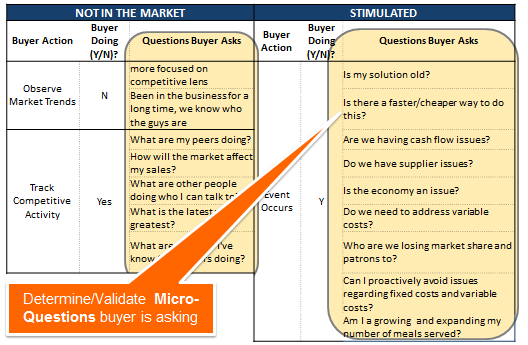
What IS listening to the market—A way to monitor the buying behaviors of your customers that give you a competitive advantage.

What DOES listening to the market do—It ensures you are focused on the market problems of your ideal customers allowing you to sell more effectively.

What does it MEAN to listen to the market—You will make the number in less time, with less effort and outsell the competition.

To understand how sales forces have prioritized this initiative, click here. You will receive the Sales Leaders Listening Tool.

Sales Leader\u0026#39\u003Bs Listening Tool

The Execution Problem You Face

As a VP of Sales, lack of execution drives you crazy. You spend time with one of your ‘A’ player managers and say “if only everybody executed like that?” There are a few reasons why sales teams don’t execute:

  1. No Process—If you don’t give them a process, you can expect sustained execution.
  2. No Coaching—If you don’t have sales management coaching and reinforcing the process, execution fails.
  3. Wrong Process—If you give them a process but it doesn’t reflect reality, they will stop executing. It isn’t effective.

Why You Care

You get paid to make the quarterly number. You are constantly measured against your internal peers. Results still dictate 80% of where you are in the stack rank. You can’t afford to have your team executing the wrong things.

Listening in Disguise

There is nothing more important than understanding your customer’s objectives and obstacles. Knowing what they fear and what is important to them, in their terms.  Listening to the market is not having one of the slogans below on a banner. It isn’t enough to mention these phrases in ameeting and then “get back to work”:

  • We are customer centric.
  • The customer is at the heart of everything we do.
  • Customer first.
  • The customer is our lifeblood.

Many organizations talk a good game but they fail to execute. Listening to the market is not done twice per year through market research projects. It is not customer satisfaction scores. Listening to the market is daily discipline.  This is the skill that separates sales forces who will make the number from those who don’t. Why? Because they adapt faster than competitors. They are more nimble. They are more in sync with buyer needs.

How To Listen

There are 8 different ways that sales forces listen. To see the complete list, click here.  We will explore a couple of them:

#1 Sales Calls—Every sales call is a research call.  Every single interaction with a buyer is an opportunity to listen. Yet sales organizations don’t capture all of the lessons. In order to transfer knowledge from one call to the next, you must use a Buying Process Map.

How— A rep has a sales call. They attempt to spot where the buyer is in their journey. They execute the call and listen to the different questions the buyer asks. They immediately transfer the questions from the buyer against what the BPM tells them.

Benefit—A different rep has a call on a similar buyer in another territory. They can use these learnings. The sharing is done via Yammer or Jive or SFDC chatter. It is quick, real time and structured. It is customer focused.

Perhaps these were the questions they thought would be asked. Perhaps they were different. Either way, the rest of the sales force benefits. Marketing benefits as well. They are always looking for real time customer feedback to produce content.

#2 Win/Loss Calls—We are surprised when sales forces don’t utilize some form of win/loss/no decision interviews. This is another pure way to listen to the market.

HowImmediately after a win or loss, the customers/prospect is contacted. It must be done by an objective third party. This could be marketing or sales operations. You could hire a third party. To ensure these interviews are effective, they must be done against your sales process.

Benefit Where did you go the wrong direction and why? What did the competitor do that caused them to gain favor? What changes need to be made to your sales process to reflect learnings? Using this form of listening ensures the sales team doesn’t make the same mistake repeatedly.

How You Should React

To get started:

  1. Download the Listening Tool Guide.
  2. Start by picking three forms of listening.
  3. Assign a different form of listening to three of your Managers for 30 days.
  4. Publish what you learn.
  5. Don’t wait for perfection. Some listening is better than none.

Sales forces that make the number in 2014 will have a natural discipline of listening. They can then react and better serve the needs of their customers.  Are you listening to your market?

Author: Matt Sharrers

Follow @MattSharrers

Follow @MakingTheNumber

Matt Sharrers on Google+

If you enjoyed this post, never miss one again by subscribing your Email Here and/or subscribing to the RSS Here.

18 Nov 15:11

3 Ways to Begin Sales and Marketing Alignment Today

by Tim Moorhead

Most business leaders know that aligning sales and marketing will lead to faster revenue cycles, higher customer satisfaction and increased company morale. So, why do so little companies actually align sales and marketing?

It’s not really shocking that sales and marketing departments are not always on the same page. There are a variety of reasons for this disconnect. Maybe the sales force is not using the right messaging to prospects. Or perhaps marketing has an altered view of the sales cycle. Whatever the case may be, when sales and marketing operate in silos – everyone loses.

Here are three easy ways to align your sales and marketing right now:

Start Fresh: Generally speaking, sales are the key operation in companies in which everything revolves around. That’s not really a surprise – if your sales department can’t sell anything, you don’t have a company. On the flip side, marketers often feel as if they get put into a support role and view the sales force as an adversary.

Why not start fresh by trying to understand the obstacles each side faces? Sales team: Invite marketing to your meetings. Marketing: Ask the sales force to evaluate your campaigns before launch. Getting this conversation started is the first step on the path of sales and marketing alignment.

Develop Consistency: One of the biggest discrepancies between the sales force and marketing department is messaging. The blame game and finger pointing occur far too often over what a qualified sales lead is. Sales will blame marketing of delivering low quality leads and marketing will call sales out for being lazy. Both sides need to sit down and define high quality leads, what qualifies as an opportunity and other benchmarks. Having a common language with common definitions will help reduce these arguments.

Join Forces: Do you have a sales and marketing committee? No? Get one. This can be a excellent forum for both sales and marketing leaders to meet to discuss current initiatives, priorities and future ideas. Additionally, the sales and marketing committee should establish accountability and determine performance metrics. Not only will this help keep things from getting thrown to the wayside, but also it will ensure a conversation between sales and marketing is always occurring.

Fact: Sales and marketing operating in silos is a problem. Aligning sales and marketing in your organization will take time and require some shifting of company culture. Encourage your sales and marketing teams to go into this process with an open mind for a smoother transition. In the end, you will be happy you did this.

18 Nov 15:11

How Do Inside Sales Reps Stay Focused Throughout The Day?

by Samantha Goldman

How Do Inside Sales Reps Stay Focused Throughout The Day? image stay focused in school resized 600When you come into work on a Monday morning after a fun and relaxing weekend, planning for your week is probably the last thing on your mind. But Mondays are the most important day of the week because you can plan what you are going to accomplish each day. Staying focused is a heavily discussed topic online and in the office. There are hundreds of things you can try, and everyone has their own ways to keep themselves motivated throughout the day, but I believe everyone can benefit from the following tips:


Have a routine. Now, you do not want to get into a routine in the sense that you wander through the day doing mindless tasks in order to hit numbers or give the illusion you are busy. You want to enjoy your routine and make it work. Some people work better checking emails and touching base with clients first thing in the morning. If you like dialing when you get to work, call those prospects you can catch early, or those European prospects that are just coming back from lunch. You know yourself better than any of your directors and colleagues; do what is going to work best for you, but make sure you are maximizing your work time.

Give your brain small breaks. Don’t be afraid to walk around a few times and look away from your cubicle space. Grab some water from the cooler. Chat with your boss in person rather than via email. Hand deliver that memo to marketing. It is OK to break up your teleprospecting when you have time between meetings and scheduled calls. Turn away from the computer and discuss a really good or interesting call with a coworker. This can help clear your mind and recharge from the task list you know you have to finish before the day is over.

Clear off your desk. If you walk down any office hall, including AG’s, you’ll notice a variety of cleanliness on sales reps’ desks. Some people have scripts and client information pinned up everywhere, and other people have pictures of friends and family lining a cubicle wall. Both of these are fine, as I believe you should have some personal items in your space at work. The issue comes up when you are sifting through information while on a prospect call and cannot find what you need in a timely manner. Have a drawer with supplies you use almost daily, but don’t keep extra pens and notebooks on the desktop. Save your desk space for things you are focusing on at that time. If you have multiple clients, try to separate your information on each project before making dials. Also, take some time to physically clean your desk once in awhile. This can help your focus as well, so you are not staring at a dusty computer screen.

Remember water and snacks. This might sound silly, but I have trouble focusing if I don’t have my water bottle with me at my desk. Talking on the phone all day requires hydrating. Again, I know this sounds silly, but it’s true. Keeping small snacks in a drawer like granola bars or fruit can also help keep your brain focused on the list of To-Dos for the day. If your mind is wandering towards 12 p.m. and what’s for lunch, you are not going to be passing quality leads.

Do you have any tips that work well for you when trying to focus on daily activities?

How Do Inside Sales Reps Stay Focused Throughout The Day? image 6fba5642 e238 4197 ba75 fc105d58df952

How Do Inside Sales Reps Stay Focused Throughout The Day? image 07f0bf66 1dcb 40ea acd9 7c4ff5605ab06

18 Nov 15:11

An S.O.S. From Sales Ops to Company Leadership

by Patrick Seidell

Hitting the RocksListen up Chief Sales Officer.  Take note CEO, marketing leader and CIO.  It’s time that Sales Operations gets your undivided attention.  They are uniquely positioned to improve the performance of your organization.  Opportunity is ripe.  Take advantage and sail ahead.  Do nothing and risk running aground on the rocky shoreline.
Download the Leaders Guide to Sales Ops Enablement by clicking here.  Find out if your company is maximizing the benefits this team can deliver.

There are multiple reasons why Sales Ops needs your attention now.

    • Perspective: They have a ground-floor view of the essentials.  Sales, marketing, IT, strategy, operations and customer service.  Sales Ops hears it all and is involved in all in some way.  They know how it fits holistically.
    • Access: Although Sales Ops is within sales, they know all the people and the data.  Constantly peppered by the field, they know how the organization really operates.  When you need that summary report yesterday, Sales Ops is your go-to.  Billing problems for a client, they can help get it corrected.  Service issues, they have a line on resolution.
    • Impact: Sales Ops directly influences performance of the sales team.  Well-designed sales dashboards for reps and leaders.  Efficient allocation of personnel.  Territories and quotas that maximize output.  Compensation that drives performance.
    • Competence:  Sales ops teams have the right people to get the job done.  Often, sales, finance, marketing and IT professionals all converge in this group.  Great sales ops leaders orchestrate these resources like no one else.  Deployed correctly, this is like a Navy S.E.A.L. team to handle any situation.
    • Timing: The opportunity is now.  Two years ago might have been too early.  Next year is certainly too late.  The convergence of data, systems and processes needs your attention now.  Buyer changes demand your action today.

Remove the Roadblocks

As a leader, you’re wondering what’s keeping you from getting more from this group.  The most frequent obstacles can all be removed.

  • People - Sales Ops needs to get great talent.  Enable Sales Ops to pay well for their positions.  Let them to design the team that’s suited to the challenge.  This means hiring hybrids that have great technical ability and business acumen.  Link some incentive to making the revenue goal.  Valuable resources cost money.
  • Data – This is when you get the CIO involved.  Your sales ops team needs the right data.  They need it on platforms they can use.  IT has to provide the organization with a single, clear view of a customer.  The time of CIO’s hiding behind the “Great Oz” curtain must end.  IT needs to enable the commercial aspects of your business.  Complex scoping documentation and bureaucracy has to go. The technology is there, delivering solutions can’t wait any longer.
  • Trust: If you’ve given them the funding, it’s time to trust.  Let them prove they can deliver and then let em’ go. 
  • Endorsement: Sales Ops needs your direct and visible support.  When your Executive Committee meets, you need one version of the truth.  Marketing and sales need alignment.  With your support, Sales Ops can help achieve that.  Endorse Sales Ops as the source of truth for commercial success.  Back up your Sales Ops leader and the insight they deliver.
  • Influence: Don’t let Sales Ops get trampled on.  Shut-down that whining Sales Director that keeps complaining about some worthless, one-off report.  Give Sales Ops the “air cover” they need to deliver lasting impact.  Let sales management see that they carry weight in key decisions.
  • Latitude: Often, Sales Ops isn’t given the freedom to develop new approaches.  They are bogged down with tactical duties. Initiatives that are done because “we’ve always done it this way” require reevaluation.  Throw out the status quo.

With the right people, tools, support, and clout, Sales Ops can transform the organization.  Imagine the possibilities.  Buyer Persona research living in your CRM.  Delivering dashboards in 20% of the time.  Conducting predictive analysis to find better prospects.  Providing a holistic view of customer performance and related interactions.

The list goes on and Sales Ops is positioned to deliver.  But without your direct and focused support, they can’t do it.  Invest the time and resources – the return will impress the most jaded CFO. 

Consider this an S.O.S. from Sales Ops.  Answer with speed and foresight and set a new
course.  Ignore it and watch your competitors sail by.

Leaders Guide to Sales Ops Enablement

 Author: Patrick Seidell

sbi on linkedin

Follow @pseidell

Follow @MakingTheNumber

If you enjoyed this post, never miss one again by subscribing your Email Here and/or subscribing to the RSS Here. Comments are welcome below.

18 Nov 15:10

4 Easy Tips to Develop Effective Sales and Marketing Messaging

by Lydia Vogtner

4 Easy Tips to Develop Effective Sales and Marketing Messaging image 43804251

Many companies struggle to figure out their brand’s message, whether an elevator pitch or detailed messaging that informs conversations and content.

This post is for small or fast-moving companies that don’t have the budget or patience for sophisticated research and processes to develop their brand’s messaging approach —but still want to be strategic, smart and thoughtful about what they say and write so that they stand out from the competition.

4 tips for shaping a good story and messaging approach

4 Easy Tips to Develop Effective Sales and Marketing Messaging image 63428031

1. Think insights and bottoms-up vs. opinions and top-down

If you start from a place of insight vs. opinion, you are more likely to get the effect you need which is an impression from the listener/reader/visitor that: “This is a company that gets me”.

One of the biggest mistakes companies make when developing their messaging approach is for a group of executives to sit in a room and say: “What do we want to say about ourselves? What do we do? What are we all about? What is our mission?” Wrong.

The conversation you should start with is: “Who is our target audience? What do they care about most and how are we able to help?” If you start here you will likely land in a different place on how you talk about your value proposition. Your mission, ideas and opinions will still come into play, but it’s better if you start with the target customer’s business problems and mindset.

For example: Look at these two introduction messages about a company in the IT services space. One is derived from the executive team’s standard pitch; the other from interviews and case studies with its best and most profitable customers.

  1. Internally-focused intro: For businesses needing a high quality, robust IT infrastructure and better solutions to manage threats, security issues and network problems, ABC, Inc. is the best company to meet your needs.
  2. Customer-problem focused intro: For businesses with– complex IT needs that inhibit business enablement, or– an outdated IT infrastructure that increases exposure to risks/threats, overburdens you from a cost perspective, and prevents your employees from effectively serving clients and managing business priorities…

Intro #2 speaks to themes from top customers that ABC’s solutions and expertise helped them improve in two critical areas: focusing on business priorities and controlling costs. Knowing that, which message do you think will most likely get the attention of a new prospect?

The point is that the team may not have gotten to the 2nd one if it had restricted its messaging-building process to the opinions of company employees. The more you can learn about your customer’s true problems (as well as how they talkabout those problems in natural conversation), the better.

2. Think vision

Think ahead about what you hope people will say about you (unsolicited), and what you want the ultimate effect to be from all the messaging you “put out there” across multiple touch points. Drawing from customer insights and your unique value proposition, write down visionary statements of how you want people to feel about your brand and the impact you want from content that you will likely distribute.

A good way to approach this is to picture your best customers in a focus group after experiencing your value for a certain period. If for example, a facilitator were to ask your customer, “What has been the single best part of your experience with ABC, Inc.?” – what do you hope the customer would say?

Perhaps your vision for their response is: “The best part of our experience with ABC was their attention to detail and phenomenal customer service.” Or, “The best part was that the training was hands-on and specific to our issues. We were able to integrate their product into our workflow very quickly.”

The point is to back into your story and messaging (as well as your offering and brand experience) from the future and a place of vision.

4 Easy Tips to Develop Effective Sales and Marketing Messaging image 15615061

3. Think frequently asked questions

I once overheard a CEO say to a sales rep: “As you think about your message for a sales call, consider the most frequently asked questions you get when first introducing what our product does. This shows what people care about most and what you should lead with or be prepared to talk about in a meaningful way.”

This is good advice and can inform a brand’s core message plus angles for video demos, webinars, email campaigns, social media posts and such.

This is also where insights from frontline employees are a good supplement to customer research, as these folks often have a deeper understanding of the customer’s FAQ, needs and wants than executives do.

4. Think story first, then messaging

Use the insights you’ve gathered to help you see and confirm what your brand’s Story is. Think like a journalist—journalists decide what their story is based on research and insights they’ve gathered, i.e. they lay it all out, look down on it and say: “What is all of this revealing? What is bubbling up as a theme? What’s really going on here?”  From there they work on angles and messaging to bring the story to life.

Whiteboard everything you’ve learned in tips 1-3 and use that as the starting point for brainstorming. See what’s bubbling up as the potential Story and iterate from there. Helpful hint: If you have a large team or a complicated business, you might want to invest in a facilitator for this exercise to help ensure that you stay focused and keep egos out of the equation.

The point is:
Developing a good messaging approach is not easy (ok, so I fudged a little on the title), but it’s not rocket science either. If at a minimum you ensure all conversations and decisions about your messaging are centered on customer insights (along with some input from frontline staff), you will be on your way to successfully differentiating yourself. This is one of the best changes you can make in your process to improve results and it doesn’t necessarily cost more money to do so.

15 Nov 15:47

Sales Success Starts with You

Pointing at YouIt may seem obvious or even cliché, but you are the source of your success. There is no secret, magic wand, or silver bullet to create success for you.

The thing is many people forget or don't realize how much they have to do. Whether it's generating leads, developing client relationships, or leading a sales team, each requires commitment on your part. Each requires you to take the lead, not wait for someone else to do it—or for it to happen on its own.

Here are a few sales situations in which your lead makes all the difference in the world:

15 Nov 15:47

Is Your Customer Prepared For Your Sales Call?

by David Brock

Richard Ruff wrote a great article on Sales Call Planning, it provoked me to extend the discussion–with a twist.

We know sales call planning is important. We want to make we are prepared, we want to be sure we achieve our goals, we want to move the customer through their buying process, we want to make sure we create value in each call. As a side note, we know these things are critical, but I’m amazed by the number of sales people who continue to “wing it” in sales calls.

But effective sales calls and meetings are a two way street. We want to make sure our customer is prepared for the sales call. If they aren’t prepared, regardless of how well prepared we are, we won’t be as effective or impactful as we can be. Likewise, our customers won’t feel their time has been well spent.

So it’s critical that our customers are prepared, as well as us!

Isn’t that presumptive and arrogant? Absolutely not! No one wants to waste their time. To me, it’s a demonstration both of our respect for the customer and our professionalism.

How do we make sure the customer is prepared for the meeting? Simple, we share our plan with them. We do this by providing an agenda in advance and agreeing on the agenda. we can share objectives or goals for the meeting, “Tom, in our meeting on Wednesday, this is what I hope we can achieve…….” The magic to this, is we are aligning ourselves with customers in advance of the meeting. We are collaborating with the customer to maximize our shared success in the meeting. We are laying the groundwork for making decisions and taking actions in the meeting.

Doing this helps both us and the customer to:

  • Assure the right people are involved and participating.
  • Identify potential concerns or issues up front, so we can be prepared to address them in the meeting.
  • Assure we both are prepared with the information/data critical to the meeting.
  • Assure that we are aligned with our expectations.
  • Assure that we actually accomplish something, moving forward in the buying/selling process.

Doubters will say, “Why do you want to reveal what you want to achieve in advance?” That question is based on old, misguided thinking about sales, thinking that somehow we have to hide our goals and agenda. People know I’m meeting with them because I believe I can help them achieve their goals through the solutions I provide. In short, they know I’m trying to get them to select and buy my solutions. So why hide that?

Why not be purposeful, and direct? Why not simply say, “This is what I hope we can achieve in this meeting?”

Upon reading that last sentence, people ask, “What if they say that’s not do-able?” To my mind, this is wonderful, my immediate response is, “Why do you feel this way?” I might probe, “What could we change about the agenda to achieve this goal? Or I might ask, “What do you think we can accomplish instead?”

Before we conduct the meeting, this process forces both us and the customer to align around the goals of the meeting, and that we both want to accomplish something.

Make sure you are prepared for your sales calls and meetings. But go a step further, engage your customer in the planning process, make sure they are prepared for the meeting, as well.

You and your customer will be amazed by what you can achieve. Each participant becomes more effective and impactful. We create much greater value for the customer by helping them move through their buying process effectively. We assure both the customer and we use our time most effectively.

15 Nov 15:47

This is the Time to Re-design Your Sales Planning Process

by Mukesh Gupta

Right now is the most important time of the year for a sales leader. Its the time when you not only are trying to support your teams to meet their annual quotas, but also supposedly need to be in the planning mode to make decisions on the sales quotas for the subsequent years.

If you are like most sales leaders that I have known, you are finding it difficult to maintain a balance among both these activities. And in most cases, the closure of the year takes more precedence than planning for the next year, which would be best to avoid by better planning at the start of the year.

So, how do you decide what sales figures you want to aspire for and how do you allocate the sales quotas?

Do you decide on a % increase on the current year sales figures as the aspiration? Say 15% year-on-year growth in top-line. Is this handed down to you by the CEO or the board of directors? Do you then add some cushion and divide this among your direct reports based on the markets and volumes that they currently run, who in turn do the same to their direct reports and this continues till you have reached the sales executive and communicated his quotas. There is always some negotiation at every level. Since both the parties know that this is a given, it loses its validity and people plan for these push-backs in the original quotas being suggested.

Now the sales executives are left to create a sales plan that can help them achieve their quotas. Smart sales executives create a plan for atleast 40% more revenue to ensure that there are no surprises at the end of the year and starts executing the plan with his set of accounts.

Now imagine that you also do the following exercise at the start of the year:

In November, you get your sales teams to take a day or two off and block it for planning. You could get the entire sales team do this on the same day or spread this out for different days for different teams. You inform all your sales executives to look at the accounts that they manage and come up with sales plays with each of these accounts. Then they identify the potential revenue from each of these sales plays. They create 3 estimates – Best case, Worst Case and Probable case. Based on the sales play, current macro conditions and the relationship with the customer, also estimate where they are in their buying process. Repeat this process with all their customers. Then you add the revenue potential for all the three scenarios from all the sales executives and also know the stage in which each account is in the sales process. This gives you a good idea of your pipeline from your existing customers/prospects. You also ask each one of your sales executives to come up with a list of 10-15 accounts in their market whom they would like to do business with and what would be the potential sales plays for those accounts, if they could come up with one. You would need to then take this list to your marketing teams and get them to create a plan on how they could support your team to get these customers interested in your products and services. You then set the quotas of the sales executives based on the worst case scenario and if you have to set sales quotas for the sales managers, set them based on the most probable or best case scenarios. Alternately, you could set the sales quotas of your sales executives based on the most probable scenario and measure your sales manages based on the % of their direct reports who achieve their quotas.

If your organization is like most organizations that I have come across, you would find that the revenue potential is much higher than any percentage increase in revenue that you had originally planned to achieve. In addition to that, you now also have a sales play defined for each one of your existing customers and the prospects already in the pipeline.

Now, it is very important for you as a sales leader to do this exercise in the last quarter of the year so that the entire team realizes that the planning process is as important as the sales closure for the quarter. This is the cultural shift that you could effect. Also, this ensures that the entire team is involved in the planning process and not just the sales leaders. This entire process will also ensure that you hit the ground running when the year starts. This process also ensures that your sales executives will not just concentrate on customers where there are current deals being planned but also continue to build his relationship with all his customers.

These are my thoughts. What do you think? Is this level of planning achievable? Do share your thoughts by commenting below or by tweeting your thoughts to me at @rmukeshgupta.

15 Nov 15:43

The Sales Call Preparation Technique your Team Needs to Know

by Scott Gruher

Soon you will receive your quota for next year.  As a Sales Leader you'll ask, “How can I make this number?”  This article will help you make quota one sales call at a time.  We are going to discuss a simple sales call preparation technique. Sales Leaders that implement it will get better results.   

Sales people don’t typically do a good jobCurve Ball preparing for tough questions in calls.  They understand the goal of the call.  They plan out the opening of the call.  But a curve ball question catches them off guard.  And if they aren’t good a hitting curves, sales calls go sideways fast.
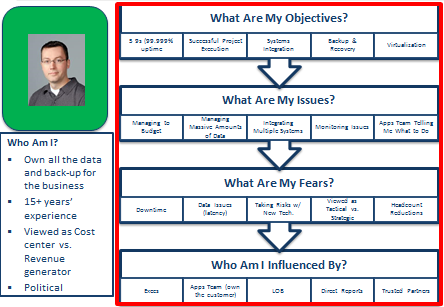
As a Sales Leader, you can’t be present during every sales interaction.  Your role is to ensure your team is prepared.  Try this technique to help with call preparation.

Have your sellers write down 5 questions they don’t want to get asked.  Then discuss the plan to address each question. 

By signing up for our Annual Research Tour here, you’ll get the 5 Question Coaching Tool. This tool will help your sales people gain advances in sales calls.  In addition you will receive access to a number of other useful resources.  Dashboards, metrics and reports that will help you and your team execute.

The 5 Question Coaching Tool

 Here are examples of tough questions Sales People get asked:

  • What is your 5 year product roadmap?
  • Can you provide references from our industry and company size?
  • Can you give me a cost estimate? (early stage)
  • Why is your competitor less expensive?
  • Can we do a proof of concept?

Your customer is asking these questions to determine the level of personal risk.  They are trying to determine if you and your solution are credible.  Failing to have a confident response can heighten the risk the customer feels.  This can lead to a stalled or lost deal.  With a little planning, this result is avoidable. 


Make the five questions test a part of your sales leadership routine. 

Have your team follow these steps:

1. Review the buyer persona for each buyer that will be in the meeting.  Look at their objectives, issues, fears, and what influences them.  This will help your reps anticipate what questions will be surfaced.


Persona


2. Identify where the buyer is in their buying journey.  Use a Buyer Process Map (BPM) to do so.  As illustrated below, you need to identify the stage and key buyer action.  Then you review the micro-questions in that key buyer action.  This will help you narrow in on the questions you may be asked in the meeting.


BPM Blog Visual


3. For major interactions, have your Rep note the top 5 tough questions they anticipate.  Ask that they send the 5 question coaching tool to you before the meeting.

4. Rep sets a 15-30 minute call with you to discuss responses prior to the call.  Go question by question and challenge the response.  Play devil’s advocate and ensure the Rep is prepared. 

5. Rep discusses the questions and responses with any internal resources attending the call.  Each resource should know who will respond to each question and how.  One cavalier response by an overlay resource could discomfort the customer. 

6. Post Call: review what questions were surfaced and how the Rep responded.  This will help the Rep pinpoint the buyer’s location on the BPM.  It will also prepare them for future calls with the customers.   

Ensuring your team is prepared for tough questions will keep them from losing credibility.  In every sales call you either decrease or increase the risk each buyer feels.  Deals stall or get lost when the risk outweighs the perceived benefit.  Ensure your team is not heightening risk and they will win more deals.

Sign-up here to get the 5 Question Coaching Tool.


Author: Scott Gruher

sbi on linkedin

Follow @ScottGruher

Follow Sales Benchmark Index @MakingTheNumber

If you enjoyed this post, never miss one again by subscribing your Email Here and/or subscribing to the RSS.

15 Nov 15:43

Why IT and Sales Need to Become Best Friends

by Tom Diamond

Why IT and Sales Need to Become Best Friends image KS110117 300x200 resized 600

Contrary to popular belief, the Information Technology (IT) Department is much more than the tech people you go to when something is broken. One of the first things I learned during my IT education is that IT’s purpose is to bridge the gap between the needs of a business and the available technology.

In today’s world, it seems like the amount of technology available is growing exponentially by the hour. Smartphones and CRM systems have replaced handwritten notes and Rolodexes. As faster Internet speeds develop, we are able to stay connected with prospects across the globe easier than ever before.

Let’s look at how Sales and IT can benefit from each other if they learned how to better communicate with one another.

Sales

As I said before, technology is growing at an incredible rate. Most salespeople are busy building relationships and generating revenue, as they should be. These people do not have the time to devote to learning a system on their own. All that does is reduce the revenue that is used to fill everyone’s paycheck at the end of the week. Instead, salespeople should learn to coordinate with IT professionals who have more training with new technologies and are equipped to help teach a company how best to utilize current and emerging technologies.

The likely result is that not only will salespeople stop wasting time trying to figure out new technologies, they will use them to their full advantage and uncover more time in their day to do what they do best: build relationships.

IT

The Wall Street Journal recently released an article regarding the stereotypes surrounding IT employees. We all know them: nerds with pocket protectors who likely still live in their parents basement and play computer games until all hours of the morning.

That is not a true nor fair assessment of IT professionals. In fact, as the article points out, more IT professionals are entering the workplace with degrees in something other than computer science or IT. However, these stereotypes portray that IT professionals have a hard time communicating with other departments. While it is a stereotype, to some extent I believe it is true. Dealings with computers, software, networks, etc. can be very technical and difficult to explain. This is where the sales department comes in. Salespeople are excellent communicators who may be able to help teach IT better communication skills.

As I mentioned before, IT’s goal is to bridge the gap between business needs and technology, so it is crucial that IT keeps an open dialogue going with different departments throughout the company, especially sales. The more communication there is between the two departments, the better understanding there will be on how to evaluate and maximize the efficiency of the sales process, which will hopefully generate more sales, leading to an increase in company revenue.

Sales and IT cannot continue to function as two independent departments, but must begin to work side by side as one unit. Remember Sales, IT isn’t there just to fix your computers when they crash. They can help build a system to improve your ability to successfully do your job. And remember IT, salespeople might talk a lot and might talk fast, but get to know them and their challenges, because solving their technology needs can help generate more revenue for your company, which is never a bad thing.

Why IT and Sales Need to Become Best Friends image 8fd4e9b0 464d 4690 a173 fe6a26d625111

Why IT and Sales Need to Become Best Friends image 07f0bf66 1dcb 40ea acd9 7c4ff5605ab09

15 Nov 15:43

Case Study:: Inbound Marketing: Tech brand increases online sales 271% with original content and influencer outreach

Introducing a product or service under the umbrella of a recognizable brand is a luxury. Often, marketers are tasked with launching under a name that's not well-known in the industry, and if you're a brand-new name, the incline steepens. Learn how Afinia, a new and unknown company in the space, developed its desktop 3D printer to become a major player in an established industry through a hands-on social media approach, website content that features its customers, and a major appeal to the education community.
15 Nov 15:43

Why Phone Calls and Meetings Don’t Result in Sales

by Ian Altman

Why Phone Calls and Meetings Don’t Result in Sales image 100713 TRUEFit

I recently received a sales call from an individual saying he “wanted to setup time to meet with me about his firm.” The caller’s introduction was vague and gave me no information into what services his firm provided. It turns out the caller was an investment advisor. I explained to the caller that my current financial advisor is a close friend and someone whom I trust with my life. Therefore, a meeting would not be a good use of our time. He responded, “I see you have a big network. Even if you don’t have a need, maybe you could refer me to some of your contacts.” Even if one of my personal contacts did need a financial advisor, does this guy think I would refer them to a complete stranger? Not so much.

What Went Wrong?

The problem with the caller’s approach is that his goal was to get a meeting. Someone told him “If you want to grow your business, it’s all a numbers game. Make as many phone calls and get as many meetings as possible. The more people you contact, the more business you’ll get.” Good theory, but it just doesn’t work that way anymore. You need a better way to quickly evaluate opportunities and determine which ones are worth the pursuit.

How to Be Selective

In my book, Upside Down Selling, I share a case study of Excella Consulting who doubled their growth rate in the first year. What makes their story interesting is that they accelerated growth while pursuing dramatically fewer opportunities. And another client recently told me that they are on track to double their quarterly revenue, while offering fewer than half of the sales demos they gave the prior quarter. In fairness, simply doing less is not enough to get results. You need a way to objectively review your opportunities and take emotion out of the evaluation. When evaluating potential opportunities businesses often focus on demographic data. The most popular criteria include how many employees, how much revenue, or how many locations. While that data gives you some insight, here is a better approach. First, determine if the client has an issue worth solving. Once you determine the problem is worth solving, then focus on whether or not they are a TRUE fit.

What is a TRUE fit?

I created a spreadsheet tool to identify whether or not an opportunity is a TRUE fit. It breaks opportunities into four categories:

T-erms: The Business terms

R-elationship: Are you on the inside or outside? Are they rooting for you? Are they confiding in you, or the preferred vendor they want to have help them?

U-pside: What is the potential to replicate, expand, reference, or create new business from this deal?

E-xpertise: How close does this project fit with your companies’ greatest strengths and strategic objectives?

Though the TRUE spreadsheet tool has a predefined set of parameters, you can tailor it with each client to suit their needs. Simply evaluate your client for each item on a scale from 1-10, and then see graphically how the opportunity fits with their needs. I will happily share this valuable spreadsheet tool with you for free. To receive a copy of the spreadsheet, send me a direct message on Twitter @GrowMyRevenue with your email address asking for the TRUE fit tool. Follow the TRUE fit steps and you’ll quickly appreciate why the goal is finding the right fit, not getting a meeting.

It’s Your Turn

What criteria do you find to be most valuable in determining if an opportunity is the right fit for you?

15 Nov 15:43

How Video Marketing Can Drive Sales to Your Business

by Ron Johnson

The Internet has become the leading advertising medium in today’s consumer market. The evolution of wireless Internet, high-speed connections and powerful smartphones is allowing businesses to connect with consumers in real-time. Statistics are showing that the majority of people have daily access to the Internet. Meanwhile, direct mail and print media marketing is becoming less popular in favor of technology-based mass communication. The latest trend in online advertising is video marketing. Video marketing lets businesses reach their website visitors on a more personal and engaging level. If you want to take advantage of the latest in Internet marketing and get an edge on your competition, it’s time to investigate video marketing. Here are three powerful ways to make video marketing work for your business.

Adding videos to your website can increase your search engine rankings and improve clickthroughs. Video has been shown to increase Google rankings by up to fifty percent. While not always the case, this is an impressive statistic and exemplifies the importance of learning about video marketing. After all, your website just isn’t working hard enough for you if people aren’t seeing it.

Video marketing helps you to speak directly to your potential customers. Instead of just relying on text and graphics, you get present your businesses message in a way you feel is relevant to your customers. Video marketing is your opportunity to demonstrate a new product, describe the philosophy behind your services or simply communicate with your customers on a personal level.

By linking your videos to your social media sites you can rapidly expand your customer base. YouTube is the second most popular search engine in the world. By putting videos on your businesses’ YouTube page and linking back to your website, you are adding millions of potential viewers to your website’s traffic.

Video marketing has established a solid place in the world of online business advertising. In this day and age you can’t afford to be left behind.

Question about video marketing for your business? Get in touch with CyberOptik today for a consultation.

15 Nov 15:43

How to Offer Competitive Sales Compensation When Recruiting Across Different Sectors

by peaksales

Sales compensationWhen trying to attract top sales talent to your company, offering competitive compensation is critical. This usually means offering an achievable total compensation which is at or above what other competing employers are prepared to offer the sales professional(s) you are seeking to hire.

The definition of competitive compensation gets a little blurry when hiring someone from outside your sector. Different sectors often have completely different pay scales and compensation structures. For instance reps selling  enterprise software often receive relatively large base salaries with a multiple 6 figure total income at target, and on the other hand, selling office document management solutions often involves a full commission position with only a small percentage of reps in the market making above 6 figures. What might seem like an average compensation to a senior enterprise rep would be a very high compensation to a senior office solutions rep and while it would be unusual for an enterprise software company to hire from outside its sector, it certainly happens.

In this case, the issue of paying market is set aside as the enterprise software company could pay under market to attract a sales person from another sector that typically pays less. That is…as long as the candidate has no other suitors and it is important to keep in mind that once a person enters a new sector, they are going to ultimately learn what is “market” compensation. The employer has the advantage of insight in the short term and may elect to elects to pay the new rep less than what other top reps in the industry are paid, but once the rep realizes what they are worth, and especially if they are successful, they may decide that they are being under paid and seek opportunities elsewhere.

At Peak we want our customer’s reps to be motivated and to be consistent and reliable producers so we help our customers create win-win relationships with sales staff. When it comes to hiring candidates from outside the employer’s sector, we always advise taking a good look at how valuable the rep will be to the company, be transparent in the negotiations and pay them fairly which means paying them the same rate as other reps with the same experience and output. There is nothing worse than working hard to find rare and great sales talent and then losing it.

To your success!

Image courtesy of Stuart Miles | freedigitalphotos.net


15 Nov 15:42

Five Ways to Generate Leads on YouTube

by Nicole Karlis

Five Ways to Generate Leads on YouTube image youtube leads

Billions of people browse YouTube each month — here are a few ways to start an effective YouTube marketing strategy.

Any business can launch a YouTube channel, you don’t have to be a film or entertainment company to do that. Video is a form of content that’s continuing to rise in popularity. It can be a great addition to your content strategy — especially since it drives a younger and more diverse audience. According to YouTube, about one billion unique users visit YouTube each month. “Thousands of channels are making six figures a year,” YouTube says. Neilsen also reports that YouTube reaches more people between the ages 18-34 than any cable network. Business owners would be foolish to not take advantage of this huge market. Getting people to view your YouTube videos isn’t enough though, you need to convert a substantial amount of viewers to paying clients. Keep reading for five lead-generating strategies.

1. Use Annotations

YouTube allows you to add annotations to uploaded videos. Annotations are links embedded into the video that take users to another site. This is one of the best ways to convert prospects into customers. You can use annotations to embed your call to action into your video. For example, place an annotation in the video stating, “Click here to sign up for a free trial.”

Annotations are a good conversion strategy because they add variety to your videos and provide links without making viewers feel like you’re trying to market to them. Experiment with placing annotations in various spaces in your video or varying your annotations throughout. Make some annotations contain outbound links and others contain info blurbs to see what viewers resonate with most.

2. Create Personalized Videos

Creating a personalized version of your video for a specific prospect demonstrates that you are thinking of him or her. For example, you could create a video that directly answers a prospect’s question and share it with that prospect. This makes the prospect feel special and increases the chance that he or she will buy from you. As an added bonus, the prospect may share the video with his or her friends, giving you a bigger customer base to work with.

3. Brand Your Videos

Make sure people know your videos are part of your company’s offerings. At the very least, you should have an intro card at the beginning of your video and a card with your logo at the end. That way, when people run across your videos online, they can associate the content with your company. Make sure to have your website in your video or video description as well as in your YouTube page, so that people can locate you online. After all, people have to know who you are before their interest in your videos can translate into sales.

4. Use the Social Aspects of the Medium

YouTube isn’t like advertising on television. Viewers don’t usually have the ability to discuss TV ads with the producer; YouTube allows them to participate. Make it easy for them by enabling comments and responding to them right away. You can also devote future videos to popular comments. If your viewers feel their voice is being heard, they will become devoted to your company.

5. Partner With Influential People

Don’t try to build an audience and convert everybody all on your own. Instead, find out who the most influential YouTube users are in your field. Approach these people about doing a collaborative video on a topic of mutual interest. Make your topic as interactive as possible to raise interest. If you succeed, you’ll have the benefit of accessing a much bigger audience. Your credibility will also rise as a result of partnering with an expert, which will help increase your conversion rates.

How have you leveraged YouTube to find your audience? Share your stories with us below.

15 Nov 15:33

B2B Sales + Marketing: You Get Delegated to the Person You Sound Like

by Bob Apollo

Sales training traditionally encourages B2B sales people to “call high” – in fact, it’s hard to keep track of all the articles and publications focused on selling to the C-level (a simple Google search reveals over 100 million hits).

“Thought leadership” is no less fashionable amongst the B2B marketing community (over 200 million hits). But if you want to engage at the right level, and stay there as opposed to being bumped down the decision-making stack, you need to bear one simple principle in mind at all times: you’ll get delegated to the person you sound like.

Step aside Professor Higgins

B2B Sales + Marketing: You Get Delegated to the Person You Sound Like image Tin Can PhoneI’m not referring here to posh vs. working class or regional accents, although they can clearly sometimes play a part in the communication process. I’m thinking instead about what you choose to communicate, and the words and phrases you use to communicate with.

The problem is particularly profound in technology-based businesses, where there’s an unhealthy habit of communicating in terms of feeds and speeds, bits and bytes, features and functions and price and delivery – compounded by a collection of impenetrable acronyms and gobbledygook.

Focusing on Higher Things

Firstly, your chances of engaging with a C-Level Executive (or any level of senior manager) with this sort of language are vanishingly small. Maybe even worse, if you manage to luck your way into a conversation with them and you base your discussion around these sorts of topics, getting delegated to a functionary in the basement (virtual or otherwise) is maybe the best thing you can hope for. Your chances of getting a return visit to the corner office will have been blown forever.

Senior executives are focused on higher things (maybe that’s why many of them have corner offices on the top floor), and if you seek to engage in a conversation with them, you’ve got to focus on the issues that matter to them. As we’ve already identified, how much faster/cheaper/better your product or service is probably won’t appear anywhere on their “interesting topics” list.

C-level executives are focused on visions and strategies. They are – at least when they initially engage – more likely to be interested in the journey they are taking their organisation on, rather than the fine details of the destination. They are interested in issues and insights, and in learning from the experiences of others who are in or have been through a similar situation to their own.

They want to be educated. They will give you more of their time if they feel that they will learn something valuable in return. But heaven help you if you bore the pants off them by talking about how great your company or your “solutions” are, or wasting their time with other irrelevances.

Don’t confuse market leadership with thought leadership

This doesn’t just apply to sales conversations – if you want to establish any sort of meaningful marketing connection at a senior level, you need to apply the same sort of thinking to what you choose to communicate. And please don’t confuse market leadership with thought leadership.

Even if you are the biggest player in your space, using that as the basis for communication can only accelerate the speed with which you’re going to be replaced by a smaller but faster and more relevant competitor. Thought leadership isn’t about you – it’s about the perspectives, the insights and the learning you’ve accumulated that are going to be interesting to your audiences.

So please – watch your language. Choose what you plan to communicate carefully. Make sure that you audience values what they hear from you. Don’t be boring. Earn the right to continue the discussion. Because if you don’t, you’ll get delegated to the person you sound like. Or never get the conversation started in the first place.

15 Nov 15:32

Sales Training Article: Rethinking the Sellers Role - Continued

by Customer Centric Selling

Sales Training Article: Complex Sales and Rethinking the Seller's Role - Continued

By John Holland, Chief Content Officer, CustomerCentric Selling® - The Sales Training Company

Image courtesy of hin255 at FreeDigitalPhotos.net

This article is a continuation of our last blog post that can be read here.

Once an outcome has been identified, the seller should ask what capabilities the buyer has found in their research that could help achieve the desired outcome. This may be the first time the buyer tries to map parts of the offering to an outcome. After their response, the seller should do a thorough diagnosis. For complex offerings the requirements will seldom be complete. If a seller can help a buyer identify additional requirements, they will have added value during the conversation.

It becomes important to see if the seller and the person that initially contacted them can gain access to higher levels to create a cost vs. benefit to justify the expenditure being considered. Left to their own devices, internal evaluations done without executive involvement often end badly. As with inept sellers, DIY "buyers" often lead with product and fail to establish value when doing internal selling for offerings they've researched.

For less competent sellers proactive contacts are often with lower levels in which case it is important identify potential business outcomes and gain access to Key Players. The danger in doing so is a bottom up sales means sellers may be calling on buyers that can't buy but can say they aren't interested in pursuing an evaluation of the offering.

sales training workshopsChanging the Buyer-Seller Dynamic
A competent seller's involvement in evaluations that start at non-Key Player levels should increase the number of purchase decisions. In the same way vendors worry about cost of sales (time/effort/money spent on losses or no decisions), many employees waste time as self-appointed "buying committees" lacking business vision or acumen. Decades of perceived manipulation by sellers has jaded buyers into evaluating complex offerings without seller involvement. I believe the pendulum has swung too far, but in order to change buyer behavior it is incumbent upon vendors to migrate reps from "educators" to consultative sellers. In other word empowering sellers to execute business outcome rather than product sales.

For complex offerings, transactional relationships hurt vendors and customers. Buyers rightfully expect more from vendors, including insights into how to better run their businesses. Buyer results should improve with implementation support. The challenge is for vendors/clients to share a commitment to deliver/achieve results. It would be a long term win-win for both parties.

For more insight into selling in today's buyer marketplace, register for a sales training workshop and get your copy of Rethinking the Sales Cycle.


sales training companyNeed some help with your sales performance? Take a look at the sales training workshops available to you and improve sales performance.

Read more sales training articles from CustomerCentric Selling® - The Sales Training Company.