Shared posts

15 Nov 15:48

The Death of the Economic Buyer

by S. Anthony Iannarino

The Death of the Economic Buyer is a post from: The Sales Blog | S. Anthony Iannarino

There is no longer an economic buyer. Just as the power sponsor has been replaced by power sponsors (plural), there are now economic buyers (also plural).

Every stakeholder is responsible for a line on the profit and loss report, is being asked to make a greater financial contribution to their organization, and is being charged with managing their costs.

You have to be able to respond to concerns about price with answers about costs.

You have to be able to help translate the value you create to improved performance, and ultimately, to improved financial performance.

You have to be an educator, teaching your clients about the unseen soft costs that, while not possessing their own line on a profit and loss statement, wreak havoc on the bottom line.

And perhaps most importantly, you are going to have to be able to equip the economic buyers in your client’s organization to defend the investment that they are making in your solution.

The economic buyer is dead. Long live the economic buyers.

15 Nov 15:48

How to design a buyer-centric B2B solution

by Hugh Macfarlane
Our whole approach to designing solutions for B2B buyers is back to front. We have our design teams build the product or service and then ask Sales and Marketing to think about the market and their needs, and somehow make the solution fit the need.   Our indulgent approach to solutioning, and our general ignorance of buyer needs, force business buyers to tyre kick - they iterate through various solutions until they become clear about what they need, then the go shopping for real and choose one. And we complain that they wasted our time.   Wrong - we forced them down this path by not thinking the buyers journey through in the first place.   In this video blog, Hugh lays out a buyer-centric approach to building solutions that B2B buyers can't resist.

read more

14 Nov 13:48

A Review of “How To Be Interesting” While Sitting Beside a Drunk on an Airplane

by Dan Pontefract

It wasn’t long into a trip from Vancouver to Washington, DC when my female seatmate asked the flight attendant for a glass of white wine.

Departure time was 9:00am.

AM = ante meridian or as I like to say, “aromatic meritage”.

By 10:00am she was on her third glass and by half past the hour the Chilean Sauvignon Blanc bottle was no more. I asked myself if airlines recycle.

I also wondered if I might have to perform CPR or at least donate my ‘sickness bag’.

But where would I spit out my gum?

Aghast, I ironically suggested to her — after removing my earbuds and pausing Arcade Fire’s Reflektor (“it’s a reflection, of a reflection, of a reflection”, etc.) — that she should try the Italian Pinot Grigio next.

So she did.20131108-223833.jpg

I can’t make this stuff up.

It was at this precise moment that I sought out some inspiration. At least a distraction from the Rob Ford cousin next to me. (Surely, you’ve heard) Perhaps I needed a little break from the constant waving interruption of a bottle being poured. I needed to divert my attention from the saucy tornado guzzling vino lady beside me drinking as if the apocalypse was upon us.

I flipped open the Kobo app on my iPad. There it was. A book I forgot about but knew I had to read. I mean c’mon, if Dave Gray says “she’s funny as hell” I’m in. Besides, there were no empty seats in business class so I was stuck with what’s her name.

Fellow Northwest resident Jessica Hagy and I — she’s in Seattle and I’m in Vancouver, and no she’s not the drunk beside me — have never met, but I’ve always enjoyed lurking around her work, be it Forbes, New York Times or even her blog. She’s quirky, insightful and can tell it like it is in cartoons, pictures, doodles or charts. (Yes, she uses words too …. sometimes)

The prose I’m referring to is “How To Be Interesting (In 10 Simple Steps)” and it’s unlike any book I’ve read before. (Editor’s note: Dan has only read two books – Flat Army and The Giving Tree)

20131109-091821.jpg

©Jessica Hagy | Workman Publishing Company

First off, it’s light. No, not because I read it as a weightless digital file but because it’s her thoughts and only her thoughts. There are no references whatsoever — no research papers to attribute and nary a single statistic to surface — and there are no stories, quotes or interviews. She wants you to be interesting but if you’re interested in being interesting — see what I did there? — you’ll have to keep interested in her own personal interests of being interesting. (I’ll stop now, but forgive me … the lady beside was a wino whacko)

It is written counter to Flat Army. I have a lot of stats, research bits and stories. I was confused at first, but then I got it.

It’s Jessica. It’s all Jessica.

Her tact is to mix short, specific sentences — often witty, always pertinent, sometimes provocative — with touching, comedic and thoughtful graphics, alongside some larger size bumper sticker-esque slogans in an attempt to persuade you to be — wait for it — more interesting.

It’s doodling life lessons.

She never once used, “don’t worry, be happy” either.

That got points from the Bobby McFerrin hate club. (Editor’s note: Dan loves  a cappella)

Her plotline focused on ten simple steps. They are:

20131109-091830.jpg

©Jessica Hagy | Workman Publishing Company

1) Go Exploring
2) Share What You Discover
3) Do Something, Anything
4) Embrace Your Weirdness (Editor’s note: she had Dan at embrace)
5) Have a Cause
6) Minimize The Swagger (Editor’s note: I think she hates the Fonz)
7) Give It a Shot
8) Hop Off the Bandwagon
9) Grow a Pair (Editor’s note: ummm …)
10) Ignore the Scolds

I read her book in about 45 minutes. It was the same amount of time it took my seatmate to ingest the rest of the Pinot Grigio bottle, but hey, who’s counting? (Editor’s note: that’s two bottles in 135 minutes)

Truthfully and in all seriousness, I loved “How To Be Interesting“. It was full not only of sage advice but of a-ha moments. I thought I might already be performing many of her suggestions so perhaps it was more of a needed affirmation — not because of my now highly intoxicated seatmate but due to the past few years of tough change management actions I’ve encountered and initiated both personally and professionally.

Her book spoke to me. (Editor’s note: can books speak?)

20131109-091839.jpg

©Jessica Hagy | Workman Publishing Company

It’s not only a wise piece of prose, it’s got gumption. It’s got punch. It makes you think. It inspires you to think differently. It ensures you contemplate singing out loud and not simply by yourself in the shower. (Editors note: don’t sing out loud if you shower with your wife)

That’s what a good book should deliver. It needs to make you do things differently. It at least needs to be contemplative.

Some will scoff. A few will coin it fridge magnet material.

I disagree.

Buy it. At least gift it to someone. (Editor’s note: not Dan, he bought it already)

Nice writing and doodling Jessica. Thank you for putting yourself out there. It was very ‘interesting’. (Editor’s note: just stop)

Is there white wine in the fridge honey? I’ve developed a wine pang for some odd reason.

14 Nov 13:46

How To Build Referrals With Social Sales

by Craig Jamieson

Who wants referrals? You do, that’s who. Everybody loves referrals and what’s not to love about them! Somebody knows somebody else who can potentially use your product or service and they have advised that person that you are numero uno. While this could be a topic for another article, you would also like to be … Continue Reading

How To Build Referrals With Social Sales by Craig Jamieson - Maximize Social Business - Maximize Social Business - Your Social Media for Business Resource . This copyrighted content was originally published on Maximize Social Business and may not be republished on any other website or in any other format without explicit permission from the publisher.


Related Stories

14 Nov 13:46

The Dumbest Sales Tip – Ever

Wow, the old-school sales myths never seem to die, do they?

It happened again the other day: In conversation with a salesperson, she said the best time to contact prospects is before & after hours, and during lunch hour, when they tend to be alone in the office.

Yawn….

I had to hold myself back from calling her an idiot.

You see, the only business owners inefficient and disorganized enough to be in the office during all those odd hours probably can’t pay their bills, nor do they have the means to buy from you.

The smart ones are letting their employees run the show during those hours – if anyone is in at all – or they’re at networking & master mind groups with other business owners.

But it was the idea of calling at lunchtime that really blew my mind, because I’d recently witnessed just that – at a restaurant, of all places!

The Infamous Lunchtime Cold Call

I was sitting in a casual restaurant, near the kitchen, when the phone rang and the owner answered. Sure enough, it was an idiot making a cold call. (Really, who is dumb enough to cold call a freaking RESTAURANT at lunchtime???)

The owner, who isn’t overly friendly to begin with, answered the phone. “No we do not have a website,” I heard him say. “No, we don’t want a website!” I heard him yell. Finally he slammed the phone down and hung up on the annoying cold caller.

(FYI: This place is already hugely popular and is constantly packed, hence why the owner doesn’t want a website to make it even more over-capacity.)

What Went Wrong?

Why didn’t this restaurant owner want to meet with the cold-calling web designer? What made him slam the phone down in anger, when the cold-caller refused to take “no” for an answer?

That’s simple: He wasn’t a qualified prospect!

And therein lies one of the two biggest problems with cold calling: It simply fails to find enough qualified prospects to keep you fat and happy. (The other major problem is that it’s an unacceptably huge time drain, but that’s a topic for another email.)

The study done by Baylor University I recently told you about concluded that it takes an experienced salesperson 7.5 hours to get one qualified appointment. A lot of people balked at that and emailed back, “I get way more than one appointment in that much time!” But they’re missing the key point: The study only considers a qualified appointment with someone who is ready, willing, and able to buy – now.

And cold calling simply doesn’t find enough of them to make it worth your while.

So do yourself a big favor: STOP cold calling, and START using effective, intelligent, Information Age methods to start bringing qualified prospects to YOU! 

14 Nov 13:46

Who Should Interview Your Sales Candidates?

by peaksales

Sales Recruiter InterviewFor the sales manager, there is a lot of pressure to fill an open spot, and if not carefully managed, this pressure can impair the objective analysis that is required to make a great right hiring choice. As Bob Nadeau, Director, Professional Sales Program, Plymouth State University, points out,

It’s human nature to help people, and managers are used to coaching employees. When they ask follow-up questions to an incomplete or inaccurate answer, they tend to ask it in a leading way.

He suggests interviewing candidates by asking questions in a neutral way which will be unnatural and may require practice.

He also recommends having candidates interview with multiple people in your company who are not as close to your favorite candidate and who is more likely assess the candidate objectively. Your boss, colleagues or HR team members would make good potential peers to conduct additional interviews with candidates, asking modified version of the same behavioral questions. In all cases, the interviews should be scripted and be designed to assess the core traits and capabilities of the person being interviewed.

I have always found it very useful to put any potential hire through multiple interviews with different members of team to gather different perspectives, drill down on details and make sure there are no inconsistencies from meeting to meeting that might represent a red flag. I have also sought ways to test candidate’s patience a bit, by stringing out these meetings, to see how they react to the stress that they will undoubtably face when performing sales if they were on my team. Thoroughness and discipline in the hiring process leads to better hires, so this is the rationale behind Peak’s structured sales recruiting and hiring process and this is why we recommend to our customers that they test the candidates in many different ways. Each sales hire is critical.

To your success!

Reference- Sales Education Foundation Annual Review 2013
Image courtesy of franky242 | FreeDigitalPhotos.net


14 Nov 13:46

Why the Wrong Chief Sales Officer Got Hired

by Steve Loftness

Your Chief Sales Officer (CSO) left. Or maybe he/she needs to leave.  Either way, when a new CSO is needed, use a structured approach. This position is too important to leave to some subjective thumbs-up/thumbs-down exercise.  Instead, top HR and Sales leaders follow a detailed checklist of tasks.  This post introduces the necessary tasks for a successful CSO search. As well, emerging practices from top sales organizations are discussed for 3 key tasks. Future posts will delve into the best practices for other tasks.

Use a structured process to hire a CSO, not a subjective exercise.

To assist you further, download the CSO Search Checklist. You can access it when you sign up for SBI’s Sales & Marketing Research Review here. This no-cost tour presents findings from SBI’s research in 2013. You’ll have access to a host of guides, templates and tools.

The CSO Search Checklist

The title might be CSO, Chief Revenue Officer, SVP Sales or similar. It is the executive in charge of sales at your organization.  We’ve found that such a crucial role requires a structured approach to hire. There are 30 or so tasks to undertake including:

  • Determine the confidentiality level of the search process
  • Identify in-flight initiatives that should wait for the new CSO to start
  • Craft CSO competency interview guides
  • Build a target sourcing plan
  • Administer a controlled scenario or work tryout

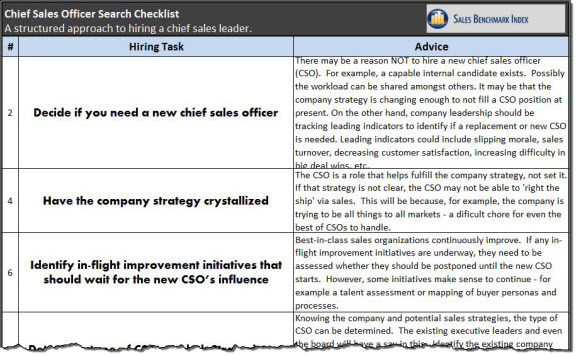
The complete list includes the tasks and related advice, like this:

csosearchchecklistsnippet

Register for our Make the Number Tour to get the complete list. The tasks can be quickly imported for use as a project management plan. Below are 3 of the tasks with explanations.

1. Identify A-level Competencies of a CSO

Your company requires a different set of competencies than other companies. For the CSO position, define which top competencies will ensure the number gets hit. My colleague Andrew Urteaga blogged about the top 25 competencies for a sales leader.  This list is a great starting point.  From here, decide which ones to focus on in your CSO search. 

The competencies must be those that fit your culture, but also drive winning behaviors. They are closely linked to another task – determining the type of CSO needed.  For example, should the new CSO be a Strategist or one who is execution heavy.  That determination will drive which competencies to select.

These competencies are needed for later tasks including “developing the CSO hiring profile”.

2. Develop a CSO Onboarding Plan

Finding the right CSO will be fruitless if they don’t become productive quickly.  An effective onboarding plan should include these components:

  • Knowledge – learning to understand the company, market, processes, offerings, etc.
  • Activities – actual performance of key tasks at appropriate times to improve learning and uncover coaching needs
  • Enculturation – knowledge and activities specially designed to reveal culture and involve the new CSO

The plan must match the level – a Sales Rep plan can’t be used as the basis for this. Create it from scratch with ample input from the peer executives and sales subordinates.

An onboarding plan must be created before recruiting and hiring start. It helps determine if a candidate could progress successfully through.  Also, it can be used as an attractive perk to candidates – they will know that they’ll be brought into their new position carefully.

3. Hold an Interview Day

There are two parts to an interview day for each candidate.  TopGrading for Sales suggests “work and life history” and “competency” interviews.  Since each of these could take up to 4 hours, it could be one full day.  Or, it could be split into multiple days.   Any candidate that declines this intense effort should be removed from consideration.

The Work and Life History interview is basically a “conversational résumé”. It uses the information in the career history form that the candidate supplied.  This interview reveals not only the integrity of the information, but also candidate motivations.

The competency assessment poses scenarios with questions that the candidate responds to.  This interview results in a rating for each competency (A, B, or C player).  The results are used for the hiring decision and, potentially, for development planning.

Whoever will be performing these interviews should be experienced in the process. Also, he/she will need the appropriate competency assessment assessor guide.

Next Steps

These are just 3 of the 30+ tasks to perform when hiring a CSO. Get the complete list by registering here.  Future posts will provide more advice on other tasks. If you are starting a CSO search, you need this tool. Without it, your doubts will linger on whether you’ve found the right sales leader.

Chief Sales Officer Search Checklist


Author: Steve Loftness

sbi on linkedin

Follow @SteveLoftness

Follow @MakingTheNumber

If you enjoyed this post, get free updates by subscribing by Email or RSS.

14 Nov 13:46

The Future of Sales Training

by Jonathan Kilroy

blueglobewithcomputerSales training is a constant concern and focus for sales organizations, especially large organizations with dispersed sales force. We recently had a member come to us hoping to learn how other companies are training their salespeople using new forms of technology.

Technologically-based training, while far more scalable than traditional face-to-face training, has its own set of challenges. These hurdles range from rep engagement and training retention, to infrastructure capabilities, technology know-how, and prohibitive cost. These were among the potential pitfalls that our member was trying to avoid, or at least plan around, before implementing a new training curriculum.

We profiled five member companies, asking first for a description of their sales force and sales training teams, followed by an outline of the types of training the companies offer with a focus on recent technological advancements.

All of the profiled companies delivered training to reps with a combination of self-paced training through an LMS, in-person instructor-led training, and virtual classroom sessions. Executives reported that this blend allowed for the maximum reach and flexibility of training options for their diverse sales force.

Every company we spoke to had invested in or investigated technology advancements for sales training. One of the most compelling developments was the proliferation of mobile apps intended not only for quick hit training reinforcement, but also for on-the-go sales support. Another valuable technology was high quality video conferencing that acted essentially as a virtual classroom where 15-20 reps could learn from an off-site instructor. While executives agreed that these technologies had their benefits, they were quick to caution the establishment of these training channels as a standard. Compatibility issues complicated mobile app development and global infrastructure inadequacies hindered video conferencing.

Ultimately, executives stressed the importance of the content over the technology used to deliver training. While technology integration is a future certainty, engagement, relevance, and reinforcement were cited as the most important factors to effective training, regardless of delivery method.

CEB Sales Members, check out the full report: Delivering Training to a Large, Dispersed Sales Force and use the profiles to compare your organization’s training automation potential.

14 Nov 13:45

Resume of Corporate Sales Manager

by mohitlakhmani

Infographic resume is the best way to make your presence more visible in front of employer when he gets so many regular resumes. Infographic resume actually help both recruiter and job seeker. Job seeker will be visible from crowd and recruiter will find easy to understand candidate qualification, identity, experiences as IG resume help to separate each category by using different illustration and typography. So this is the example of one corporate sales manager resume. Tags - infographic, Data visualization, Mohit, graphics, mglmedia, employer, job, crowd, visible, hiring, organization, recruiter, professional
14 Nov 13:45

You Are the Ultimate Sales Technology!

by TheSalesHunter
Rnordman

Reading this book now

Pick up the Damn Phone Cover e1383840824145 You Are the Ultimate Sales Technology! photoI must admit that I was hooked on Joanne Black’s new book the moment I read the line…

“Whether you read this book in 2013, 2023 or 3013, you will witness much change throughout your lifetime. But one thing never changes: People do business with people, not with technology.”

I also happen to like the line, “The digital world — as great as it is — threatens personal connections.”

And those two lines were in the INTRO of  Joanne’s new book, “Pick Up the Damn Phone! How People, Not Technology, Seal the Deal.”  She also wrote a great sales book called “No More Cold Calling.”

I’m a bit a junkie for sales books and sales techniques, and Joanne’s new book does not disappoint. It certainly is timely as well, seeing how we have a growing appetite for technology, sometimes to our detriment.

Even so, this is not a book that bashes technology.

No, instead Joanne looks at how we can become better at integrating technology without losing our genuine ability and desire to interact face-to-face and over the phone with customers and prospects.  Joanne didn’t write the book in a vacuum, but was wise to interview sales professionals for their perspectives as well.

Joanne’s heart is with referral selling, and it’s no wonder why.  She understands it incredibly well and has a passion for helping salespeople like yourself build success on the disciplined approach of referral selling.  As she says, referral selling is a “must have” sales initiative.

If you are looking for a practical book chock full of good ideas and written in a conversational style that’s easy to grasp, then invest in yourself with “Pick Up the Damn Phone!

Copyright 2013, Mark Hunter “The Sales Hunter.” Sales Motivation Blog.

button receive a free9 300x51 You Are the Ultimate Sales Technology! photo

14 Nov 13:45

Sales Professionals: Learn to Lose, Learn to Fail

by Mike Ricciardelli

Sales Professionals: Learn to Lose, Learn to Fail image learn to fail resized 600Have you heard the news lately?  You know, the story about the parent filing a “bullying” complaint against a rival town because his son’s high school football team got beat badly?  The final tally was 91-0.

Woody Allen has said, “Showing up is 80% of life.”

But let’s be real here: Just because you show up doesn’t make you special or deserving of anything.  Are we coddling our younger generations to believe that everyone’s a winner and everyone should get some form of positive recognition just for “showing up?”  Show up and you’ll get a medal, a nice shiny one so it glistens on your wall from the light of your bedroom window.

What’s so bad about losing anyways? I’ve learned so much more from my downfalls than from any of my proudest accomplishments.  Going back to that high school football team, I would hope that they would watch and analyze the tapes from that game and work their tails off to never let that happen again.  If they go out and beat the next team they play convincingly, imagine what a boost of confidence that would be for them.  That’s learning from failure!  That’s growing and that’s how you learn to win!

If you’re reading this, I will tell you straight up – I want you to fail at some point.  Yes, that’s right, I want you to fail.  Dodging events that could lead to failure is way too easy because it doesn’t require any strenuous effort on your part.  As a result, it leaves us basking in the shade of mediocrity and a person never really reaches their full potential acting like that.

I want you to fail because how you react afterwards will truly depict your character.

You know why I think our country in general tends to root for the underdogs?  I think it’s because the underdogs usually have a way more interesting back story, a back story that involves a past of losing and consistent failures.

These are the types of people we root for because we see and hear about what they go through to get where they are and that’s what is deserving of recognition. As the picture above shows, you have to make a few mistakes before finally breaking through into success.

In terms of innovations and risk taking, Steve Jobs was probably the most notorious serial failure of our generation.  But obviously he was also the most successful individual, arguably, in the world.  He had some big time failures throughout his tenure of obscurity and up through the ranks at Apple and NeXT Computer, but it didn’t stop him, it didn’t make him hesitant or gun shy.  When allowing yourself to take big risks, failures are bound to happen… but that’s OK.  It’s OK!  Don’t take it so personally — most of the time it’s not even your fault!  I feel like Robin Williams grabbing onto the shoulders of Matt Damon in “Good Will Hunting,” purposefully trying to break Damon down so he can finally accept the past and just move on with his life.

If you have big dreams, you’ll fail along the way. I don’t doubt that.  So take losing as a sign that your will is there. Take it as a sign that you’re on the path that will lead you to where you want to be.

But along the way, just remember to be humble, grateful and always maintain good intentions.

Sales Professionals: Learn to Lose, Learn to Fail image 49c4943b e150 418f 9be2 fc3bf3fee2a3

Sales Professionals: Learn to Lose, Learn to Fail image 07f0bf66 1dcb 40ea acd9 7c4ff5605ab07

14 Nov 13:45

Sales Strategy: From Vision to Execution

by Ryan Tognazzini

Increasingly, companies are missing the number because they lack a formal sales strategy.Sales Strategy   From Vision to Execution resized 600 Your industry peers are getting smarter. Many are not making the number because a sales strategy is absent.


You may be wondering how prepared your sales team is heading into next year. It’s likely the board has increased your number. This year felt like a stretch for you. Next year’s number feels impossible. You’re beginning to ask yourself if the team can pull this off.

As you plan for next year, a defined sales strategy is a must have. If this is out of alignment, the team won’t get it done.

By signing up for our Annual Research Tour here, you’ll get the CEO’s Sales Strategy Assessment. In addition you will receive access to a number of other useful resources.  Dashboards, metrics and reports that will help you and your team execute.

CEO’s Sales Strategy Assessment


What is a Sales Strategy?

This is a commonly used term. If you google “sales strategy,” you can read for hours on the subject. Here is a definition for you:

A Sales Strategy is the operating plan for your sales force. It allocates resources effectively to increase revenues and reduce selling costs. It means you can get more out of your sales force.

For sales, this is where the rubber meets the road. A sales strategy is your roadmap for sales. It is their blueprint for executing your vision.

Signs of Trouble

A few indications your sales strategy is not working for you:

  • Missing the # - Your reps are trying to be all things to all people. They lack focus on your target market. Examples here are wide ranges in either revenue/deal or margin/deal. Your reps have no consistency in customer size or type. You miss the number because they thrash. Resources are not effectively allocated.
  • Field Execution – When you set your vision, it falls on deaf ears. A spot check of your last few initiatives revealed they never got implemented. You ask a rep how they are using the new process. It’s met with a blank stare. There is no standard operating procedure (SOP) for how these things get done.
  • Talent – The performance of your sales team is driven by a handful of individuals. The top 10%ers create 80%+ of your results. The other 90% are an anchor pulling you down. The type of talent required to execute the strategy is not clearly defined.

If the impossible is going to become possible, you need this fixed now.

5 Steps to Salvation

There are 5 components to a world class sales strategy. Here they are with definitions, benefits and success metrics:

  1. Defining the Marketplace – Establish the ideal target customers who will purchase your products/solutions. A must-have if you are to properly allocate your sales resources.
    1. Benefit – Gives you the ability to prioritize your customer/prospect base. You can market to customers who are best suited to purchase your products. You can put your best sales resources on your best opportunities.
    2. Success Metrics – higher win rates, higher average deal size/margin
  2. Launching New Products – Enables sales to successfully sell new products. Additionally, requires sales be involved in the development of your new products. They are the eyes and ears of your customers. This input is critical and often missed by your peers.
    1. Benefit – Gives your reps formal training before the new product hits the street. Involves sales early to ensure products are developed with your customers in mind.
    2. Success Metric – new product sales goal attainment in year 1
  3. Routes to Market – It’s likely you don’t need a field sales force for all routes to market. This step allows you to determine where your resources will have the biggest impact. Other options include: inside sales, channels/resellers, online, etc.
    1. Benefit – Allows you to maximize resources and reduce selling costs.
    2. Success Metrics – revenue/sales head, cost/sales head
  4. Sales Execution – These are the processes sales uses to execute the strategy. How demand is generated. How opportunities become customers. The tools they require to be successful.
    1. Benefit – Formal playbooks and a process to drive field adoption and execution.
    2. Success Metrics – win rates, funnel growth, ramp to productivity
  5. Talent – Understanding of items 1-4 tells you what type of talent you need to execute. You can now identify and hire ‘A’ player sales talent.
    1. Benefit – More ‘A’ players means your average productivity/head increases. Your vision happens because you have talent that executes.
    2. Success Metrics – productivity/head, turnover reduction, cost of sales

For sales to be successful, these items need to exist in your organization. They cannot be shelf-ware. They need clear definition, success metrics and a plan to execute. This is where your vision becomes executable.

Call to Action

In our Annual Research Tour, we cover key components of developing a sales strategy. If you’re feeling like your vision isn’t being executed, this session will help. Additionally, you’ll get access to the CEO’s Sales Strategy Assessment to help. Sign-up here.

Author: Ryan Tognazzini

sbi on linkedin

Follow @RyanTognazzini

Follow Sales Benchmark Index @MakingTheNumber

If you enjoyed this post, never miss one again by subscribing your Email Here and/or subscribing to the RSS.

14 Nov 13:44

10 Rules for Great Sales Coaching

by Donal Daly

Over the last number of years I have given a lot of thought to Sales Performance Management.  I think that most experienced practitioners and observers recognize that the front-line sales manager is the key to scaling sales performance. But it is a really hard job. And if sales managers are in fact the linch-pin of the sales organization, then when sales management fails, sales fails. Bouncing from task to task, managing up, out and wide, getting to the important tasks often suffers under the pressure of the urgent. One of the important tasks that get relegated to the ‘I-know-I-should-do-it-but-I-just-can’t-get-to-it’ bucket is sales coaching. I thought that I would share some thoughts here on how you might make what every coaching time that you have most effective.

But first, some facts:

  • According to SEC/CEB, Coaching can improve sales productivity by 88%
  • Per Gallup, when sales coaching is effectively deployed, customer loyalty increases by 56%.
  • This is not surprising given that in a recent report from CEB, 53% of customers see the ‘Purchase Experience’ as the primary driver of customer loyalty.
  • Sales Management Association conducted a study looking at issues that are “important to sales force success” and examined the resource that was applied to those initiatives.  Sales Coaching stands alone, as being recognized as being important but not getting the attention it deserves.
  • According to a separate Sales Management Association study, most sales managers are spending less than 5% of their time on sales coaching. Perhaps given all of the time they are spending on all of the other activity, perhaps this is not a surprise.  But it is still worrisome.

We looked at why Sales Managers don’t coach, and saw a combination of (1) the lack of time, and (2) uncertainty about what to look for as two of the major obstacles.  As you would probably expect from me – I believe that technology and smart automation has a huge role to play in resolving both of these issues to empower the sales manager to (a) understand the vulnerabilities in his/her team and (b) provide coaching to help the team members improve.  (Disclosure: This is precisely what we do with Dealmaker Sales Performance Insight.)

But it is worth stepping back to consider what good coaching looks like:

Here are my 10 Rules for Great Sales Coaching

(I want to thank all of the experienced practitioners who contributed/validated/improved my work in creating a list and then reducing it to a manageable number of just 10!)


1. Collaborative:  collaborative

->

Coaching should be a joint process. It is not about the manager telling the sales person what to do.  It must be viewed as connected to a shared positive purpose, with agreed expectations and suggested preparation.  You may jointly want to progress a deal, learn from a loss, or review strategy – but the emphasis needs to be on jointly – it must be a two-way flow.

2. Regular Cadence:cadence

->

Coaching should be embedded in how you manage your sales business. If centered around deal reviews, assessment of account plans, discussing a sales process, coaching should not be viewed as an event.  Regular, scheduled coaching sessions will develop a consciousness and familiarity with the process that will grease the wheels and make each coaching session less challenging and more productive.

3. Consistent Framework:  framework

->

Consider, for example, a Deal Review.  You should create a consistent framework that the sales team is familiar with.  You might start with an overview of the deal, allow for clarification questions, identify risks and vulnerabilities and then brainstorm solutions and strategy.  Do it the same way every time and it will flow more easily.

4. Apply Buyer’s View:buyer

->

In truth there is only one perspective that really matters, and that is what the customer thinks.  Remember that the impact on a customer of a bad buying decision is typically greater than the impact on a sales person of a lost deal.  So the sales manager, or others in the coaching session, should take the perspective of the buyer. Honestly answer the question: “If I was the customer, would I buy from us?”  It’s a great lens to use to focus your thinking on what the customer cares about.

5. Look for Evidence:  evidence

->

Always look for evidence.  When presented with comments like “Joe Smith really likes us,” or “We have strong compelling event,” you should always respond with questions like “How do we know?”  Be clear about the evidence of customer action that helps support those assertions.

6. Elicit Critical Thinking:thinking

->

The role of the coach is to elicit critical thinking from the sales person.  Start with “If we were to lose the deal, or fail in this account, what would be the top three reasons?”  Then, when these risks have been identified, allow the sales person to come up with their own answers.  This critical thinking is a muscle that can be developed with progress.

7. Praise Good Insight:  good-insight

->

People respond to praise – particularly in front of their peers.  If you don’t acknowledge or recognize valuable contribution, you are less likely to get that same contribution again.  You audience will think either that you don’t get the value – or think that you are too important (in your own mind) to respect their opinions.

8. Be Objective & Curious:  curious

->

As Albert Einstein said, “Never stop questioning.”  Remove any bias that you have about account, the opportunity or the sales person.  Remain objective and seek the truth that will serve you all.

9. Don’t Take Over:  no-control

 ->

It is not your job to close the deal, be too prescriptive on strategy or directive on the next action.  Don’t feel that you are the only one who can call the customer, or do the research, or plan the account.  You are trying to develop new behaviors and that only happens with practice.  Don’t take over.

10. Document Actions:document

->

If the coaching session was worth doing, then it is worth recording what happened, the insights you learned, and the actions that were agreed, and then follow up.

  ———————————————————–


Post to Twitter

14 Nov 13:43

B2B Complex Sales: process is no substitute for emotional intelligence

by Bob Apollo


Many sales leaders believe that having a sales process is important - as evidenced by the over 300 million references on Google to the term. But in most complex sales environments, having an over-prescriptive sales process can actually damage your chances of winning.

I’ve seen too many situations where a sales person is so keen to move to the next stage of the defined sales process that they fail to ask the questions or, (even worse) actually listen to the answers they have already been given that could give them clues about where the buyer was and what it would take to move things forward.

Just to be clear: in simple, low-value, single-call transactional sales environments where you can’t afford to employ smart sales people, having a straightforward and well defined sales process can help you make the most of the skills you employ in your organisation.

Flexible frameworks vs. rigid processes

AdaptabilityBut in lengthy, high-value complex sales environments with multiple stakeholders, your sales “process” should be a flexible framework that incorporates the latest best practices but also allows an intelligent sales person to go off-piste from time to time as long as they have the ultimate destination in mind.

You might think of traditional, highly-defined sales processes as a journey between two places using well-defined and clearly-signposted highways. If the route you’ve chosen is blocked, there may not be many alternatives.

But you are better thinking of complex sales as either a cross-country journey in an all-terrain vehicle, or a cross-town taxi journey with many alternative side streets to dive down if the traffic ahead comes to a stop.

In both of the latter two cases, you still have a destination in mind - but you’re constantly reacting and adapting to the local terrain. You might even, from time to time, choose to retrace your steps in order to adopt a better route.

No "one best way"

There is no “one best way” - and that’s surely true of most complex buying environments. You have a destination, but you’re constantly evaluating your progress, and reviewing whether you need to adjust your strategy in order to make better progress.

What you need is a framework, a sense of direction and a compass. You need to have some smart questions up your sleeve, but even more importantly you need to listen, adapt and respond to what you learn from the prospect. You need a set of tools that you can call upon to dig yourself out of a hole or bridge a previously impenetrable obstacle.

You need to continually review your progress, and evaluate the options open to you. Faced with such complex terrain, having a plan certainly helps, but having the emotional intelligence to recognise where you are right now and adjust or adapt that plan is essential.

Aids to navigation

A rigid, sales-stage defined process won’t help. But neither will anarchy. And that’s where a well-defined framework with alternative options to navigate around obstacles and move things forward is so helpful.

The framework must be based not on a notional sales process but on facilitating the prospect’s buying decision process. Progress must be measured in the prospect’s terms (where are they in their journey?) and not on yours, and it’s vital that you can recognise the key milestones in their process.

The changing role of sales and marketing

Thinking in these terms causes you to recognise what you really need from your sales people and from your marketing department. Your sales people must be smart, creative, adaptable, good listeners and with high levels of emotional intelligence. They need to contribute to the collective learning that supports the framework.

You may think that this is a tough ask, but I’ve never heard an effective argument to the contrary - that you’d be better off hiring sales people to do a complex job when the individual clearly depends on following a pre-defined routine.

Marketing’s role changes, as well: their responsibilities need to embrace the creation of tools that help the sales person to diagnose where the prospect is in their decision making process, and programmes that help to eliminate or bypass the most common obstacles that could prevent progress.

Clear, simple and wrong

H.L. Mencken observed that “for every complex problem there is an answer that is clear, simple, and wrong.” Thanking that a rigid, prescriptive sales process will improve performance in a complex sales environment appears simple and clear, but it is unquestionably wrong.

It’s not just your sales people and your marketers that need to get smart…


14 Nov 13:43

Rejection and the DNA of Sales People

by Keenan

The other day I was listening to a RadioLab podcast called Cut and Run. It was a RadioLab short. I love RadioLab. You can listen the the podcast here. This particular show tried to answer the question why Kenyan long distance runners are so much better than everyone else? I’ve always known that Kenyan’s are really good at long distance, but what I didn’t know is that it’s not all Kenyan’s. It’s Kenyan’s from one particular region of western Kenya and even more specific, it’s one particular tribe from this region called the Kalenjin.

The Kalenjin make up .06% of the worlds population. However, from this one tribe comes more accomplished long-distance runners than anywhere else in the world.

For example:

There have only been 5 American high school runners who have broken 4 minute mile. However, there’s one H.S. in Kenyan that had 4 sub 4 milers all at the same time.

There have only been 17 American men in history who have run a marathon in less than 2 hours and 10 seconds.  In October of 2011 there were 32 Kalenjin who did it under 2:10.

These numbers are absolutely crazy. The Kalenjin’s success is far above and beyond the rest of the world and it’s baffling. Scientists, sports scientists etc. have been trying to figure out why for years. How can such a small population of people create such dominant athletes in a single sport? What is different about them or their environment?

There are many theories. The podcast looks at many of them, and like most things it suggests it’s more then one unique element. It’s the combination of many things. One of these elements however, really got my attention. The theory is that one of the reasons the Kalenjin are such great runners is because of their ability to withstand intense amounts of pain.

The Kalenjin, for the most part, still participate in teenage circumcision. They still practice a ritual where teenagers go through a sort of hell week (two weeks actually) where they are cut, beaten, and subjected to intense pain in order to prepare them for their circumcision. According to the podcast, when young men are circumcised their faces are covered with mud that is left to dry. The dry mud cracks with any facial contortions, alerting the tribe to the fact the the young man is in pain and therefore a coward for not being able to withstand it. Yes, you read that correctly. The journey to manhood for the Kalenjin is the ability to be circumcised with a sharp stick and endure the pain by not showing ANY emotion or reaction. Those that do react to the pain, (crack the mud) are considered weak cowards, relegated to the lowest class of the tribe.

Here is the hypothesis. In addition to being genetically predisposed to running long distances, it is argued the Kalenjin are also predisposed to the pain tolerance, through cultural practices, required to overcome the pain that accompanies long distance running. It is a know fact that part of excelling at endurance sports is the ability to withstand the pain and discomfort associate with pushing your body for such a long period of time. The argument is that this ritual around circumcision and pain tolerance has Kalenjin better prepared to manage the pain associated with endurance running.

What does this all have to do with sales?

This story got me wondering. Is there something like the ability to withstand pain in successful runners that exists in sales? I think there is. It’s the ability to withstand and tolerate rejection.

I have no real data, but I believe those sales people who are impervious to the emotional toll of rejection and the discomfort that comes from being told no are for more successful than those who aren’t.

I’m curious what this community thinks. Do you think sales people who are better at tolerating rejection are better sales people? Do you think handling rejection is in their DNA? Or, do you think there is another skill set that the best of the best in sales have the rest of us don’t?

I’d love to hear what this community thinks.


14 Nov 13:43

Lifecycle Management: Four Ways to Boost Sales and Brand Loyalty

by Kelly Crothers

Successful marketing is both proactive and personalized. It’s all about offering products and services at the right time, with the right message and for the right reason. Customers tune in when your marketing message is in sync with their product and service needs. Conversely, they’ll block out cookie-cutter sales and marketing pitches that don’t address their most important pain points.

Lifecycle Management: Four Ways to Boost Sales and Brand Loyalty image lifecycle management 300x219So, how can you identify the issues your customers are now facing or the solutions they’re looking for? The answer lies in product and service lifecycle management, which, in today’s information-driven world, is fueled by the various data sources that exist across your supply chain – from CRM systems, to point of sale systems, ERP platforms and more. By carefully aggregating and analyzing this data, you’ll be able to discover buying patterns and detect what’s top of mind for your customers and, in turn, you can better serve them with the right offerings just when they need them.

Best practice methodologies for lifecycle management start with consolidating relevant data into a single system of record, and then enriching the data to ensure quality and completeness. The next step is to create a campaign that brings it all together. First, mine through the data to identify a customer group – large or small – that has common product or service needs on their business radar, then craft your sales pitch or offer accordingly. You’ll win your customers’ trust and gain more of their business if you take the time to analyze the data carefully and create a powerful sales message and call to action to drive your campaign.

With the above in mind, here are four common ways to increase sales and boost brand loyalty through use of effective product and service lifecycle management:

  1. Products Without Service Agreements: Known in the business world as unattached assets, products that don’t carry service agreements put customers in a vulnerable position – sometimes without them even realizing it. If the product fails or breaks, there is no service agreement in place to ease the pain, time and cost of getting a replacement, so pointing out an unattached asset to your customer can make you a hero and generate extra revenue for your business. Your data analysis and lifecycle management efforts will allow you to uncover the “unattached assets” that exist across your installed base. By taking action on this sales opportunity, your business stands to offer a valuable service that builds stronger ties with the customer.
  2. Warranty and Service RenewalsCustomers rely on warranties for peace of mind on their investments and they can also save businesses the hassle of dealing with damaged or faulty merchandise, but sometimes warranties – as well as other service contracts — expire without the customer or provider taking notice, leaving both parties high and dry in case of disaster. To avoid this situation, closely track your warranties and service contracts, and as they’re about to expire, reach out to your customers with a warranty extension or service renewal offer. This will help build brand loyalty and is a value-add for your sales team.
  3. Cross-Sell and Upsell: As customer needs shift, they may want to scale up, scale down, augment the way they use your products and services or try a new vendor altogether – which means it’s a crucial time to remind them why they chose your company in the first place and how you can work with them over the long haul to benefit their business. Reach out to these clients by offering a consumable item that relates to a recent purchase; or a new accessory product; or even by suggesting a new or more economical solution that might be more suited to their business. Just by staying in touch with your customers they’ll get the sense that you understand their needs and they’ll reward you in the end.
  4. Product End of Life: Caring for and communicating with customers who are approaching the “end of life” with products or service contracts can greatly impact their readiness to re-sign or re-purchase.  Whether it’s a big purchase decision that will require a sales cycle of six months or longer, or one that can be made in an instant, presenting a new offer at the right time is essential for customer retention.

The bottom line is to remember that you’re in business to help your customers solve a challenge, meet a deadline or run their business better and smarter. By supporting them at each stage of the product or service lifecycle, you’re providing value, and value is the key to creating lasting customer relationships in an economy in which brand loyalty doesn’t come easy.

14 Nov 13:43

How to Generate Business Leads at Trade Shows

by pipelinersales

Trade shows tend to be themed and so will attract people who are interested, at some level, in the products or services that you offer. Moreover, tend to be one of the most expensive forms of lead generation strategy. Here are 7 hot tips designed to multiply the ROI of your show investment:
14 Nov 13:43

Collaboration Tools Can Drive Sales

by Katerina Roemer

Collaboration Tools Can Drive Sales image cogsCollaboration between employees is important. It can lead to better business decisions and processes, thereby driving revenue. However, the collaborative space needs to have tools that can enhance worker productivity, especially with the increasing mobile workforce. Therefore, businesses must select a solution that provides a robust set of features to make collaboration easy for everyone. Channel Pro contributor Guy Coen recently discussed how companies can leverage these tools to improve sales.

Having the correct collaboration tools in place improves business meetings by making them more interactive, as employees can share ideas and data from laptops, tablets and smartphones, which increases the productivity of the meetings and can help define sales goals for their workers.

However, there are considerations that companies need to make when selecting their collaboration solution. First and foremost, the tools must allow for collaboration to be fast and easily done from anywhere. Going hand-in-hand with this is allowing employees to share information quickly from the device they choose to use. Connectivity is also key to ensuring that every worker can communicate with whomever they need to.

A unified communications solution can do just that, as it integrates voice, video, email and messaging capabilities, making it simple for those who need to share ideas. Fonality offers a robust UC solution with plenty of features to help improve business communications and collaboration.

Using these tools gives companies an advantage
But what value does implementing a UC solution bring to a company? According to Telecom Reseller contributor Rob Bellmar, collaboration tools can break down barriers between departments and create a more unified workplace, which leads to improved efficiency in doing business.

Bellmar believes that companies that are quick to implement these solutions can gain a competitive advantage by getting the most out of the employee resources they have. For example, a business could take members from two different departments to make a specialized team to focus on a single problem that requires knowledge from both sides. It also allows them to collaborate with business partners easier as well. By gaining these advantages, companies can rocket themselves towards the top of the market.

“To be a leader today, success starts with making ‘I’m going to work’ a state of being rather than a physical destination. Empower staff by giving them the tools they need to break down whatever barriers stand in their way,” wrote Bellmar. “Then you will be prepared to take advantage of the collaboration economy.”

14 Nov 13:43

Sales Training Article: Rethinking the Sellers Role

by Customer Centric Selling

Sales Training Article: Complex Sales and Rethinking the Seller's Role 

By John Holland, Chief Content Officer, CustomerCentric Selling® - The Sales Training Company

sales training workshopsImage courtesy of imagerymajestic at FreeDigitalPhotos.net

Over the years it has been generally accepted that part of a salesperson's job is educating buyers. Extensive product training allowed sellers to "teach" buyers. I always cringed when thinking of sellers as educators. It never made sense to educate buyers unless or until they expressed a business issue (personal or on behalf of their enterprise) that they'd be willing to spend money to achieve with an offering. In trying to allow sellers to qualify opportunities I believe this is more important than ever. Given the changes in buying, it may be an opportune time to take a fresh look.

Sign-up for a sales training workshop to learn how to sell effectively in today's buyer marketplace.

Buyer access to volumes of product information has reduced and perhaps eliminated buyer expectations of being educated by salespeople. The self-service approach (ATM's; gas stations; airline kiosks; etc.) is here to stay. Generally speaking non-Key Player titles interested in offerings:

  • Research them via the Internet (Websites; social networking)
  • Enjoy their anonymity
  • Don't want seller influence or manipulation when determining requirements
  • Limit the number of sellers they interact with to "short list" vendors

While empowered buyers present challenges for vendors, I view this development as a positive change, but it raises the question of what a salesperson's role in this age of 24x7x365 product information is. Product knowledge will add little value for buyers that have researched vendor offerings in a given space. This rings especially true for technical buyers.

I submit a seller's role has been and continues to be helping buyers understand how offerings can be used to improve business results. Other parts of a seller's job are to help organizations determine fit, potential payback and implementation efforts.

If you take a step back, for A Players sellers most buying cycles begin one of two ways:

  • Proactively contact executive level buyers and take them from latent to active need to achieve a desired business outcome. Starting at executive levels is important because if there isn't an identified need, there is no budget. Sellers should call at or near levels that can fund new initiatives (often by reallocating existing budget).

With executives, sellers should avoid getting "into the weeds" in discussing offerings. After identifying a desired business outcome the conversation likely should be at a "10,000 foot elevation." The buyer should understand why the outcome can't be achieved and the capabilities needed to address them. If value is created in the buyer's mind, sellers can execute "top down" sales resulting in shorter buying cycles and larger transactions.

  • Inbound contacts from mid level or lower "buyers" are far more offering-focused. Buyers want to be treated respectfully and calls are different because they are aware of offerings available in the market (usually beyond those of the vendor they contact). Sellers should try to get a sense for research they've done and let buyers articulate requirements they've determined. Ultimately, the seller should help determine the value (business outcome) that can be achieved through the use of the offering being considered. This may well be an outcome for a higher title within the organization.

Once an outcome has been identified, the seller should... Check back in our next post to read the rest of this article!


sales training companyNeed some help with your sales performance? Take a look at the sales training workshops available to you and improve sales performance.

Read more sales training articles from CustomerCentric Selling® - The Sales Training Company.

14 Nov 13:42

Sales Recruiting Humor

by peaksales

Sales recruiterI heard this joke a couple of days ago and thought it was worth passing along:

HR Rep: Here is a stack of resumes for your open sales position.

Hiring Manager: Can you please show me the good resumes.

HR Rep: Here you go. [hands over a dozen resumes]

Hiring Manager:  [Takes the resumes and throws six of them in a waste basket, then hands the other six back to the HR Rep] I will interview these six.

HR Rep: What about the ones you just threw away??!

Hiring Manager: They were unlucky and I don’t hire unlucky sales people.


Note – The joke above sounds ridiculous, but if we are honest we have to accept that luck is a big part of sales success. Fortunately, luck is often not happenstance. The rep that works consistently hard and smart, will create more good luck .

Image Courtesy of stockimages | freedigitalphotos.net


14 Nov 13:42

How a Winery Uses Social Media to Increase Sales and Brand Loyalty

by Louise Julig
How can wineries use social media to increase sales when the law prohibits them from giving away product samples? Whitehall Lane, a 20-year-old Napa Valley winery run by the Leonardini family, has hit on a winning social media formula that pays dividends in both increased sales and brand loyalty. Wineries face special challenges in promoting [...]
14 Nov 13:42

Avigilon Announces Promotions in Marketing and Sales Leadership to Support Global Growth

Vancouver, BC, November 13, 2013--Avigilon Corporation (TSX: AVO), a leader in high-definition (HD) surveillance solutions, today announced the promotion of two of its top performers: Bryan Schmode to executive vice president of global sales and marketing, and Pedro Simoes to senior vice president of global sales.
14 Nov 13:42

How To Better Generate Sales Leads In The IT Industry

by Belinda Summers

How To Better Generate Sales Leads In The IT Industry image How To Better Generate Sales Leads In The IT Industry DONE6

Among the most profitable industries that you will note today would be in IT and software, there is no question about it. In today’s market, everything and everyone is connected, in some way or another, through IT and software products and services. Now, if your business desires to partner up or enter into a venture with these companies, then you have to make sure that your B2B lead generation campaign is working well.

Of course, the issue of how to effectively generate sales leads is something that has bothered a lot of marketers even up to this day. This can be a very complex affair for those who know. Still, if you know the basics on this, then you would be in a good path. And here is how you do it:

    1. Do really good research – yes, you may have heard this probably a hundred times, but nothing really beats good research before you start your B2B appointment setting process. You see, there are so many things that you need to know about in your prospects. What problems do they have? What solutions are they using? What options are they considering? These are just some questions that you would want answered.
    2.  Give room for spontaneity – if there is anything that potential B2B leads really hate from marketers, it is them hearing something akin to canned speech. Who wants to hear a formulaic sales pitch, anyway? A good marketer would know how to tailor fit their sales pitch, allowing for spontaneous speeches and presentations. That will add some color to the sales process.
    3. Get your presentation ready – in the event that you are going to meet your business prospects, or perhaps a demonstration is to be made, you have to make sure that everything you do is working perfectly. Remember, first impressions last a long time. You do not want to mess up with your presentations in front of your business prospects, so get all your materials ready beforehand.
    4.  Asking properly – for you to effectively craft a winning business solution, you need to know, in-depth, what are the real issues that are plaguing your business prospects. And you can only find that out if you ask the right questions. Only then will you be able to come up with an actual answer to their business concerns. Conducting a telemarketing survey might be a really good investment on your part.
    5. Make sure you follow up – that is the one thing that a lot of marketers tend to forget. In order for your business prospects to remember you, you need to make sure that your first contact with them is followed up by another one soon. This could take many forms, like brochures, a little business call, perhaps an invitation to a webinar, etc. All these are very good ways in making your follow-ups more successful.

Really, a lot of other things can still be done in making your B2B lead generation campaign in the IT and software market more successful in the end. The five above? That is just to get you started.

This content originally appeared at Callbox Blog.

14 Nov 13:41

Sales Call Planning – When is a Greater Investment Warranted?

by Richard Ruff
Sales Call Planning – When is a Greater Investment Warranted? image Sales Coaching 1 150x150

Sales Call Planning

It’s difficult to overemphasize the importance of sales call planning. It works and you need to do it. You should commit time to planning for every sales call in advance. How much time? Sometimes it may be just a few minutes.

However, there are situations when salespeople need to invest more time in pre-call preparation and planning.

  • Senior Executives. In the B2B major accounts market the expectations of senior executives are higher than ever. So you have to be prepared. As a baseline being prepared means you understand the industry and company. But you also need an understanding of the company’s business challenges. When meeting with senior executives you must in advance be knowledgeable about the challenges the company faces and have insights and a point of view about the path forward.
  • New Products. The investment in bringing a new product to market is substantial. The more innovative the product, the more new sales challenges there are to overcome. When the products or solutions are new entries to the marketplace, the salesperson must deal with new customers and new sales challenges, such as: a different buying process, new call points, and new objections. This warrants more sales call planning time.

In B2B major accounts, sales call planning should be viewed from two perspectives: plan for both the information you want to get from the customer and the information you want to give to the customer. Either way, it’s not a simply “more is better.” Given where you are in the sales cycle what information do you need for moving forward and what information would be of value to the customer?

In some situations it’s useful to translate your sales call plan into a meeting agenda that is shared with the customer. There are two advantages of sharing an agenda with customers before a sales call.

  • The customer can add to your initial outline for the meeting – minimizing surprises during the sales call.
  • You can vet the agenda with other people at your company who might know the customer as well as your internal champions in the customer organization to see how it will resonate with the customer.

In regard to asking colleagues, you may find out that someone has recently visited the customer. This prevents you from being caught off guard. In addition, demonstrating internal communication is always a plus. Checking with your colleagues also makes you aware of what your company has done before with this customer in your department and in other divisions.

Are there other information sources salespeople should look at when it comes to upping their pre-call planning game? Absolutely. Here is a starting list.

  • Review the customer website
  • Review company financial reports, like Annual Reports, 10-K, 8-K and press releases, too
  • Read recent articles on the company and industry
  • Look at profiles available online, such as Hoovers.com
  • Become familiar with the backgrounds of the people you will be meeting with via LinkedIn

If you typically sell to a certain industry, immerse yourself in the literature of that industry. Join their associations, get their newsletters, review their websites, read blogs, and join LinkedIn groups.

If you sell to the same decision makers, focus on associations that represent these positions, like VPs of Sales or CIOs, so you can learn more about the challenges they are facing.

Sales call preparation and planning are always important. But some situations are more critical than others because the payoffs of getting it right or wrong are more significant.

If you found this post helpful, you might want to join the conversation and subscribe to the Sales Training Connection.

14 Nov 13:41

Dropbox's Big Plan to Turn Everyone Into Its Personal Sales Team

by Marcus Wohlsen
Dropbox hopes its new business features will make it easier than ever to persuade reluctant bosses to embrace the app their employees are already using anyway.


14 Nov 13:41

The Danger of Upselling in Sales

by Ian Altman

The Danger of Upselling in Sales image 092313 Upselling

Anyone who has ever placed an order at a fast food restaurant has heard the question “Would you like fries with that?” Fast food establishments use this technique, referred to as upselling, to grow the size of an order. It is easy to understand why upselling is effective in a food establishment: Your guest is already dining with you, so offering something to complement their meal is not seen as too pushy. Often, the average sale could increase by 20%. But, in business-to-business sales, upselling is a dangerous tactic.

Focus on How to Solve or Serve over Sell

In his book, To Sell is Human, Daniel Pink urges readers to use the term “Up-serve” instead of “Up-sell.” You might ask “Up-Sell, Up-Serve… What’s the difference?” If you teach your team to upsell, you are teaching your people to focus internally. Meaning, the customer does not care about how much you sell. Instead, they care about their issues. When you use the term “Up-serve,” you teach your team that your first priority needs to be focused on the customer, not your own product or service.

The subtle difference is that up-serving requires you to uncover needs that are important to your client, and serve those needs. If you focus on solving more client challenges, then you are adding value for your clients, and they’ll happily pay for the value you deliver. So, the up-serve naturally results in an upsell.

Research

In a recent study from Software Advice called The Great Retail Experience Race: Local vs. National, researchers looked at small businesses compared to global brands like Starbucks, Nordstrom, Panera, Barnes & Noble, and Apple. They looked at how often the salespeople introduced new items or tried to “upsell” the customer. In the case of Panera, it was almost a certainty that the staff would ask if the customer wanted to add a bakery item for $0.99.

The key take away in their research may be something that the typical reader could overlook. The highest performing brands outside of food service, Nordstrom and Apple, both score high numbers in making a personal or emotional connection. At Nordstrom, when the customer said “I’m looking for a gift for my brother for under $100,” the Nordstrom associate asked “What does your brother like to do?”

Top performers do not jump at an opportunity to sell as soon as the customer indicates a desire to buy something. Rather, they realize that the greatest way to build trust and loyalty is to take the time to understand the customer’s situation. Tweet it if you agree!

The Nordstrom rep could have immediately showed the customer items that cost around $100. Instead, by learning more about the customer, and the gift recipient, they could artfully present the right solutions that would best fit the intended recipient.

The Lesson

With so many options to purchase, those selling products or services must realize that understanding more about your client is a way to stand out from the competition. Focus on their goals, objectives, and how they might measure their results six months out from now. This approach demonstrates that you are not just there to make a sale, but are interested in the client’s outcome. Unless you are a restaurant, upselling is probably going to translate to “upsetting” to your customers. Remember to serve not sell.

Your Turn

When did an upsell turn you away? Are there times when a rep asking more questions increased your comfort dealing with them?

14 Nov 13:41

Two Things to Sell in Every Sales Conversation

by AmyK Hutchens

Whether you’re selling widgets, waffles, whiffle balls or wastebaskets, people purchase your product for only two reasons: good feelings and a solution to their problem. The mistake most sales people make is they think the good feelings are about them, not the Prospect’s feelings about him or herself, and they believe the solution needs to be their idea, not the Customer’s own good idea. How do you get it right? Focus on selling good feelings and solutions, not features and benefits.

First, people decide to purchase your product or service because it makes them feel good about themselves. It makes them feel smart, happy, confident, hopeful or perhaps even ecstatic, but the bottom line is that a positive feeling is generated about themselves, not necessarily your product. For example, no one “needed” an iPad when it was first introduced. BUT, they wanted one…why, because it was cool and so were they for having one of the coveted devices.

Second, people purchase your product or service because it provides a solution to their problem: a solution they choose, not a decision they are coerced into. People love good ideas, particularly their own.

What feelings are you selling?
If you want your potential customer to buy something from you, sell them on themselves first. Too many sales people start with pain points and the cheesy line, “What keeps you up at night?” This plan of attack is exactly that – an attack. And it doesn’t make your prospect feel very good. In fact, they might even feel so defensive they figure out a way to go elsewhere.

In order for your Prospect to make the “logical” decision to buy from you, they need to have a positive emotion associated with the purchase. In order for the Prospect to finally say, “Yes, I want to buy from you” the mammalian part of their brain has to be silently communicating to them, “I feel good about the decision I’m making. It’s smart of me to make this purchase.”

Most of us commonly mistake good feelings as: I need to get my customer to like me. If the customer thinks I’m great, then I increase my chances of closing the sale. This is not entirely the case. Humans are more egocentric than we give them credit for in the above assumption. Instead of worrying so much about whether the potential customer likes you, focus on whether he feels comfortable and confident with himself when he is with you. If the customer feels you are validating him, making him feel comfortable and confident, then he will like you because you positively reflect good feelings toward him. It is not about winning over the positive associations the customer has about you, the Seller, but making sure the customer feels good about himself, the Buyer. Building client rapport begins with making the customer feel confident about himself, not about proving your confidence levels to the customer. If you can validate the customer and make him feel good about himself, his liking you won’t even be an issue.

What solutions are you selling?
Sales people who close more frequently and consistently know there is always an underlying need to a surface want. The gal who wants to purchase a hammer really needs to hang a picture or build a bookcase. The guy who wants to purchase new accounting software needs eight hours of his week back, and fewer irate emails in his inbox. Award winning hospitals, once done administering medical care to patients, realize that in order to stay in business and provide excellent service they need to take on the persona of being in the hotel business. They know the solutions to the underlying needs of excellent room service, reservations and providing acceptable accommodations, however brief the stay.

What are the underlying needs involved with your product or service and how are you providing these solutions? Ask your Prospect the right questions to find out the solutions she truly seeks. What does she need this product or service to do for her? What will she gain? How will she define “success” from this purchase?

When you sell your Prospects’ brain what it wants: positive emotions about themselves to support the logical decision of purchasing your product or service to gain the solution to their real underlying needs, you will hear “Yes” a lot more often!

Want even more tips and techniques for increasing your sales in Q4 and making 2013 your best sales year yet? Click here for more great neuro-sales information.

14 Nov 13:41

Email Marketing: Are You Talking Yourself Out of Sales?

by John W Hayes

I once knew a salesperson who didn’t know when to shut up.

Don’t get me wrong – he was a lovely chap and was universally liked by everyone who met him. He was enthusiastic, punctual and handled his client list with utmost professionalism. His only real fault was that he kept on talking long after the prospect was ready to sign the contract and become a customer.

Occasionally, he would talk so much that he would start planting seeds of doubt in his prospects’ minds, and a dead cert for a sale would become a dead loss.

If he didn’t talk himself out of business, he certainly delayed the process and therefore was a long way from efficient, so he struggled to meet his targets.

Knowing When to Shut Up

One of the best pieces of sales advice I have ever been given is this: When meeting a prospect, ask  first if he or she is ready to buy now or if he or she would like more information about the prospect or service you are offering.

If you are selling to someone like me who researches every single purchase before engaging with a salesperson (and actually hates being sold to), chances are that you are really going to shorten your sales cycle and hopefully hit your targets before the end of the month or quarter.

Get-to-the-Point Email Marketing

Many email marketers find themselves with a similar problem. Their marketing copy just doesn’t get to the point, and they find that even if their campaigns are opened and consumed, they don’t drive the kind of sales they were hoping for.

The solution to this problem is to keep your messages short and to the point and include multiple calls to action in your email campaigns, offering your recipients the opportunity to “learn more” or “buy now” no matter how far into your email they read.

Your first call to action should be placed near the top of your campaign, with another at the bottom of your marketing copy (even with relatively short messages). If you employ long copy, you should ensure you place regular calls to action throughout this copy.

This is increasingly important in the mobile environment, where scrolling backward and forward through copy looking for the button or link that lets you take the next step can be a major pain.

As sales and marketing professionals, we need to focus on asking for the business. Your subscribers know that you are in the business of selling (why else would you be sending them an email marketing campaign?), so you need to make it as easy as possible for them to buy.

Have you ever talked yourself out of a sale? Share your comments below.

This post first appeared on the iContact Email Marketing Blog.

14 Nov 13:40

Where Should You Spend Your Sales Coaching Time?

by Kevin Davis

As a sales manager, if you are managing your time well, and balancing priorities enough to be coaching your reps –congratulations!! A big dilemma faced by most sales managers, though, is how to coach and more importantly whom do you commit the bulk of your sales coaching time to? Who you coach is every bit as important as how you coach.

Where Should You Spend Your Sales Coaching Time? image sales coaching time

Like most sales managers, you likely have some “A” players, your top performers. You also some have “C” players — the people who are always at the bottom in terms of results and attitudes. And most of your reps are “B” players — the people in the middle.

Where do you currently spend most of your one-on-one coaching time? Lots of sales managers tell me that they spend their coaching time on the “A” players, helping to win the biggest deals, or on the “C” players because those people need the most help. Both of those approaches, however, are not where you are going to get the biggest bang for your buck. That’s right… your biggest payoff from coaching will come from placing extra emphasis on your “B” players.

In our Sales Coaching & Leadership Workshop, sales managers rate their salespeople using a tool we call the “Success Profile,” and the outcome for managers is a better understanding of who they should apply extra coaching time to. The “Success Profile” groups salespeople according to their skill and will. Skill being a salesperson’s aptitude or proficiency at applying your company’s sales process. And Will is more of an individual’s interest in improving… and most importantly, their willingness to be coached.

Once you have these ratings, look for the high payoff coaching candidates — the people who have a lot of will to improve, who will listen to your advice and then act on it. That’s where you want to spend a majority of your one-on-one coaching time. You should include any new hires in this category, too, since they deserve enough of your time so they can learn the ropes before becoming self sufficient.

As for the others, you need to find ways to keep your “A” players engaged. If they are enthusiastic, ask them to become a mentor for a newer rep. If their motivation is low, find out what is demotivating them and see if new opportunities or challenges can get them more excited about the job. Sit down with them and help them rediscover their personal goals.

The trickiest group to deal with are your “C” players. Your HR department won’t like it if you ignore these people, and they are owed your attention simply by being part of your team. But you can’t ignore the fact that even great coaching is unlikely to have a major positive impact on the results that people in this group achieve. So look for ways to leverage your time and impact with the “C” players. For example, work with them as a group, in meetings or webinars.

Leadership is, in part, the ability to make the right choice about how to apply yourself on the job. When you move a B player up to an A player you create competition at the top of your sales team. And the sales results will certainly follow.

14 Nov 13:40

New Research Reveals That Pinterest Is Driving More E-Commerce Sales Than Ever

by Cooper Smith

Social Media Insights is a daily newsletter from Business Insider Intelligence that collects and delivers the top social media news first thing every morning. You can sign up to receive Social Media Insights here or at the bottom of this post.


According to a new study by Piqora, A pin on Pinterest generates $0.78 in sales, on average on e-commerce sites, which is 25% more than what it drove in the fourth quarter of 2012. What's more, a pin is repinned (a form of sharing) 10 times on average. For comparison, the average tweet on Twitter is only retweeted slightly more than 1% of the time. Another interesting point made is that pins are "frozen in time," in that they tend to be pinned and repinned often over time, rather than fading away like a typical Facebook or Twitter post. That's because Pinterest is not focused on user feeds, but on category pages and popular sections.

Although Pinterest is demonstrating potential as a platform for transactions, the real opportunity in social commerce is shepherding consumers through the funnel end-to-end. We talk about this notion of social commerce in greater detail in a recent research report. (Piqora via TechCrunch) 

In Other News …

Advertisers can now target users on Twitter by which operating system and version they use, specific device, and Wi-Fi connectivity. (Twitter Blog)

Snapchat's owners turned down a $3 billion acquisition offer from Facebook. (Wall Street Journal) 

WeChat now has 272 million monthly active users, up 15% from the previous quarter. (Tencent)

Dropbox now has 200 million users. (TechCrunch)

Google generates more revenue than the magazine and newspaper industries in the U.S. (Business Insider)

Foursquare's head of product is leaving the company. (All Things D)

Join the conversation about this story »