Shared posts

08 Jan 17:06

How to Double Your Marketing & Sales ROI

by Dan McDade

Sales Lead Cold CasesIn the same way that forensic units use state-of-the-art techniques to solve criminal cold cases, companies can use “business forensic techniques” to get to the bottom of their very own sales cold cases.

In other words, every company with a pulse has mounds of cold cases in the form of lightly-worked and unworked leads. In an optimized salesforce, certain forensic practices that identify and deal with these unworked leads should become standard.

What are the top 3 “cold case” forensic techniques? Find out in this week’s PowerMinute.


PowerMinute™ is a series of 1 minute videos produced to give you helpful tips to energize your lead generation results.


By Dan McDade


08 Jan 17:06

Top 7 Reasons Why Inside Sales Reps Fail

by Mike Ricciardelli

Top 7 Reasons Why Inside Sales Reps Fail image bigstockphoto crossing out failure and writi 4820592 resized 600Let’s just get this out of the way first and foremost: You don’t really need a college degree to get into sales.  It absolutely goes a long way if you have one but I know plenty of people who don’t have degrees and are in sales.  I went to an all business school and sales wasn’t an option as a Major concentration, and just recently it’s been added to the curriculum as a Minor.

But yet, there are millions of sales people in this world who never went to school for sales or business.  The turnover is higher than most of any other profession and the pay discrepancy has incredible highs and lows. Some of the top performing sales reps can earn more than their own CEO and the lowest performing sales reps might not even have a base salary to lean on.

Here are 7 reasons why sales people often fail:

  1. Not working smart and efficiently:  Low performing sales reps waste time on chasing people who will never buy and prospect companies that don’t fit the target profile.

  2. First call demos and presentations:  Rather than spending time conversing with their customer and understanding their true needs and beliefs, these people present vanilla, canned demos that, at best, might be somewhat tailored to their prospect.

  3. Lack of tracking capabilities:  How can you track what you’re doing if you don’t know what you’ve done?  If they don’t efficiently track their work in a CRM or if they don’t even use one, it usually correlates with under-performance.

  4. Objection handling fail:  Great salespeople kill objections before they’re even a thought in a prospect’s’ mind.  Unsuccessful reps stumble and let the objection kill the flow of their conversation.

  5. Crunch time scrambling:  Bad sales reps are hectically trying to hit their quotas at the end of the month or quarter, where the high performing reps are starting strong.  There should not be a sense of desperation when trying to close a deal, because the good sales reps are in control over the process and that results in more closed deals.

  6. Stuck in the “buddy” mentality:  Great reps are personable but intertwine the action of earning respect and trust along the way.  They don’t waste a prospect’s time with useless banter out of the insecure desire for their prospect to “like” them.

  7. Too many preconceived notions:  A lot of reps commonly get in their own way and trap themselves in a bubble that prevents them from getting where they want to go.  They often have preconceived notions about what will happen and it tends to be captured in a negative light.

Sales reps, watch out for these indicators and learn to succeed in sales. Regardless of your education or background, you can become a successful sales rep by concentrating on improving the above areas.

Top 7 Reasons Why Inside Sales Reps Fail image c3d9e769 c3ae 4116 b4a8 6d0e19bf9fd5

Top 7 Reasons Why Inside Sales Reps Fail image

08 Jan 17:06

Four Habits of Great Sales Coaches

by Kevin Davis

Effective sales coaching is the daily investment you make in developing the success of others. Here are four habits that the best sales coaches work into their daily routine:

Share your real-life experiences

The principles of success that you learned as a sales professional deserve to be taught! And there is no better way to teach others than through the sharing of your personal stories and examples. It may take you a bit longer, but it is well worth it.

Think through your biggest sales wins, and losses. What did you do right?

If a leader can’t get a message across clearly and motivate others to act on it, then having a message is of little use. For this reason, you will often hear a great sales coach say, “For example…” because they know that their personal stories are the most effective way to communicate.

Lead by example

I know you’re thinking, “yeah, sure. Everybody says this.” But do you actually do it?

For example, surely you wouldn’t want your salespeople to go to a customer meeting without thinking through their agenda, objectives, and next steps. But do you do the same when you meet with your team? Are you prepared with an agenda and objectives? If not, what kind of message does that send?

Similarly, I bet you want your salespeople to do more listening than talking when they deal with prospects and customers. Which do you do more of when you’re dealing with them? Are you a listener or a talker?

Your salespeople are watching everything you do, so these little things count for a lot. So take a critical look at all of your interactions with your sales team. What kind of example are you setting? You must set a standard of excellence, not just talk about the importance of others being excellent.

Teach salespeople to slow down

Last Summer I was watching a San Francisco Giants baseball game. It was the bottom of the 9th, the Giants were ahead 2-1. The Giants’ relief pitcher walked the first three batters he faced. Bases loaded, no outs.

That’s when Giants manager Bruce Boche strode to the mound … and the relief pitcher subsequently struck out the next three batters he faced. The Giants won the game.

In the post-game press conference a reporter asked Boche what he said to the relief pitcher. Boche said he told his pitcher, “Slow down. Don’t rush the pitch.”

Boche went on to explain…. “In a stressful situation a pitcher can be so anxious about what will happen when the ball crosses the plate that he forgets about the mechanics of what he needs to do to make an effective pitch.”

The sales profession, too, is chock-full of stress. Your salespeople often forget about their mechanics. They rush their pitch, and can end up losing the game.

Effective sales coaches get their salespeople to slow down, by which I mean that they teach their salespeople to think through the mechanics of what they need to be doing at each stage of the sales process. They help salespeople identify what the customer needs to do to move to the next step in their buying process, and then provide that customer with the right information to make that step happen quickly.

Focus on ABC – Always Be Coaching

Less effective sales managers take a hands-off approach with their salespeople. They don’t bother to coach, unless or until one of their salespeople fails or has a lousy month. Then the manager inflicts a coaching process on the poor producer. This is the equivalent of saying, “When you fail, I’ll coach you. But otherwise you’re on your own.”

In contrast, great sales coaches make it a point to coach somebody before noon every day. They schedule coaching like an appointment in their calendar. They look for opportunities to coach and teach every day.

Building New Habits

At the peak of famed motivation researcher Abraham Maslow’s “hierarchy of needs” is “self actualization” — the desire to become everything that one is capable of becoming. So, proactive sales coaching motivates your salespeople to grow and improve. To build a more motivated sales team, implement these four coaching habits. Pick one and stick with it until it becomes natural behavior, then move on to the next one. And by the next New Year’s Day, you can look back on your best year ever!

07 Jan 16:02

Feel Like You're Fighting With Your Keywords? 7 Ways to Win

by paige@halfabubbleout.com (Paige Gilbert)

punching-bagAs the content manager at Half a Bubble Out, part of my job the past couple quarters has been to focus on improving our performance around 11 different keywords.

However, we’ve been doing this keyword rotation long enough now that we got to a point where it felt like we were fighting the keywords. We were having trouble coming up with original angles, and quickly becoming impatient with the content creation process. It just feels likes we’ve been there, done that, you know?

Since I have the privilege of reading and editing each and every blog article that we post, I’ve recognized patterns during these last 9 months about how our staff members brainstorm ideas, create headlines, and use the keywords -- and how sometimes our crazy ideas actually turn into great blog posts! So I thought I'd share some of the strategies we use when it feels like the well of ideas for important keywords is running dry. I hope one of these strategies will help you, too.

1) Become the Super Researcher

The Super Researcher just can’t get enough. They could sit all day and research (and if they aren’t careful, they will). The Super Researcher is very detail oriented and it’s important to them to provide some real meat in their blog posts, not just fluffy samples. They do this by researching, reading, and clicking on just about anything that looks interesting.

The thing is, the Super Researcher actually does have a sort of superpower when it comes to research. They’re able to find some of the most random -- yet interesting and relevant -- articles and find original tie-ins to something seemingly unrelated. Like the article our staff member wrote on baby boomers and social media.

If you like researching, try this approach to research, read, and relate it to your keyword.

2) Become the New Angler

The New Angler sees things differently. They can take a keyword phrase that has been done over and over again and totally rock it to appeal to a different business persona.

For example, one of our keyword phrases has been “what makes a good website.” Instead of focusing on a different aspect of what DOES make a good website, the New Angler might do something like this: “What Makes an Otherwise Good Website Completely Useless.” Totally made a 180 with the keyword.

I love this because I’m so not a New Angler -- so I love it when I see it. If you’re stuck on how to use your keyword, try looking at it in a negative light “what not to do…” or “5 elements you’re missing." It might spark an idea.

3) Become the Case Studier

The Case Studier sees how things work together. If an individual or company has done something right -- or wrong for that matter -- recognize it and talk about how it relates to your keyword.

The same is true for your own company, too. If you have a client or have performed a service that you think is exceptionally noteworthy -- write about it in an educational manner (not a promotional one).

Here's an example of how to use a keyword phrase and relate it to a case study: We used the phrase “why is social media important” and wrote a blog post about WestJet and how its recent Christmas Miracle video went viral with the help of social media. Check it out to see an example of this technique in action.

4) Become the Newsjacker

First of all, if you're unfamiliar with newsjacking, here's an article that'll get you caught up to speed.

Now, this type of keyword strategy probably isn’t the best because it’s kind of dependent on what news is out there -- but when it works. it works like a charm, and is one of the best ways to add a fresh perspective to a seemingly tired keyword phrase. So jump on that bandwagon!

The Newsjacker is skilled at using their knack for always knowing what’s going on, and applying it to their keyword. If Facebook just announced a new feature called “Promoted Posts,” for instance, use that to talk about how it can help you with lead generation techniques for your business. (Did you guess that “lead generation techniques” was the keyword?)

5) Become the Life Lessoner

The Life Lessoner does just that -- uses things they’ve learned or experiences they’ve had, and writes about it.

Write what you know. It’s a good place to start. The Life Lessoner is honest, sometimes sentimental, and knows themselves well enough to be able to use a keyword phrase and relate it to a piece of their life. It can be as simple as talking about an experience with a client that taught you to view a situation differently, or as "out there" as relating the public transit in Boston at Inbound to what makes a good website. (And it worked. Take a look here.)

6) Become the Out-of-the-Box Thinker

The Out-of-the-Box Thinker isn’t afraid to try new ideas. They might just work! And ... they might also suck. But you won’t know until you try.

One way to think outside the box when writing content is rethinking the format that content appears in. For instance, if you're used to writing how-to and list posts, perhaps you should try creating those posts in the form of a video, a piece of static visual content, or even a list of memes. Even if the idea seems a little too bizarre, remember that you can rebound quickly from a poorly performing piece of content ... just write something else!

7) Become the Whatever Comes to Minder

I didn’t reveal the name of each lovely co-worker I identify with each keywording style above -- I thought it would be fun for them to try and figure it out -- but I will say that the “Whatever Comes to Minder” is me.

I get my writing inspiration from the strangest places sometimes. For instance, I had a toenail fungus keyword looming over my head. It's for a podiatrist client, and while reading The Foot Book by Dr. Seuss to my one year old daughter, I was inspired to write a blog offering foot care tips from a podiatrist and Dr. Seuss. The client enjoyed it, and maybe even more importantly, I enjoyed writing it.

Another example ... one day I was driving in my car and the song “More than Words” by Extreme came on, and it gave me the idea to write about how your blog is more than words; you know, all that other stuff Google cares about like conversion rates, social shares, etc. The Whatever Comes to Minder will have something totally random just pop into their mind and wonder if they could use a keyword and create a blog out of it. If this happens to you, don’t brush this off. Just write it down because I’m willing to bet you’ll think of some inspiring ways to create excellent, keyword-friendly content.

Hopefully one or all of the strategies we use at Half a Bubble Out helped you. When you feel like you’re fighting your keyword, talk to those around you and relate your keyword to the world around you. Every good fighter has a team that surrounds them. Use yours to get your keyword fight on.

download learning seo from the experts ebook cta

subscribe to the hubspot marketing blog

07 Jan 16:02

Lead Nurturing: How to Woo Your Prospects in Four Steps

by Alexandra Burnett

Find out how lead nurturing can increase your conversion rates in 4 simple steps with this quick and handy guide.

Lead Nurturing: How to Woo Your Prospects in Four Steps image Article Lead generation how to woo your prospects in four steps10

Building a strong relationship with your prospects is key to getting them to convert – here are four steps to treating them right and reaping the rewards.

1. Keep in touch

Everyone knows that any good relationship is built on communication, so don’t expect prospects to buy into your product after receiving their first sales email. They’re going to need a bit of encouragement, so ensure that you stay in regular contact with a lead nurturing program and remind them that you’re there to drive optimum engagement with your brand. Think drip marketing and keep your brand at the front of their mind with a steady stream of communications.

That said, email frequency and engagement are negatively correlated. So don’t be needy - 35.4% of consumers say frequency is the primary reason for unsubscribing from a brand’s emails, and 75% say they would resent a brand following an email deluge - and you’ll only end up being marked as spam while you’re at it. Absence makes the heart grow fonder, after all - unless you’re Barack Obama.

The charts don’t lie, so by all means, show you’re interested – but remember to play it cool.

2. Get up close and personal

Showing that you’re listening to your prospects is a surefire way to win them over, and there’s no better way to go about that than to tailor your approach to their needs and experiences. There are various ways of going about this:

3. Stand out from the crowd

It’s estimated that by 2016, the number of business emails sent and received per day will total over 143 billion - so that means you’re going to have to work even harder to get your message read.

The key to keeping your prospects hot is to stand out in a crowded inbox – and first impressions count, so it’s worth making sure you’re armed with a killer subject line. Here are some email subject line strategies that will increase your open rates:

  • Be clear and specific. Honesty is the best policy, after all.
  • Tailor your subject line to your audience. What did we say about getting personal?
  • Customise the from field. ‘The name’s @yourcompany.com; sales @yourcompany.com’. That’s just not smooth.

4. Learn from your mistakes

The road to happily ever after is a long and winding one and, like we say, discovering a best practice approach is all about trial and error. You’re not going to get anywhere lead nurturing to someone new if you don’t try and understand what gets them going, and that’s why it’s worth doing your homework on how A/B split testing works so you can use it to better inform your long game. Split testing will let you find out important things such as:

  • When they most want to hear from you. Find out the best day of the week to make your move, and what time of day they’re most likely to read your emails.
  • What type of subject line works best. Hard sell? Soft sell? Long and descriptive or short and sweet?
  • Where your call to action should go. Where will it see the most click-throughs?

Remember:

1. Keep communication regular (but don’t be a spammer!).

2. Personalise your emails according to your prospect and their actions.

3. Come up with a catchy subject line to get your email read in a busy inbox.

4. Use A/B testing to hone your approach and get the best response.

To find out how you can get customers from creating content download your free eGuide now: Content Marketing 2014

07 Jan 16:01

Breaking Through the White Noise of Content Marketing

by Pat Hume

In today’s crowded social media space, brands must provide their target audience with a continuous stream of relevant content to stay engaged. If not, the brand becomes lost in the white noise of peers and competitors offering their own content. Trapit’s recent study confirms that while marketers spend more than a quarter of their time on content marketing, most believe that’s still not enough.

No surprise, given that the majority of marketers believe that a proper content strategy means sharing an average of 15 pieces of content a day. Meeting this demand isn’t easy, as nearly half say they’re unable to keep up with their organization’s content demands. This is why content curation has become integral to any content marketing campaign. However, sixty percent of marketers cite difficulty finding original content that peers or competitors aren’t also curating, signifying how great the need to curate unique content really is.

Staying Ahead of the Noise

Traditional and social media outlets have become flooded with the same white noise of content. With the same sources and the same stories threading their way through countless social media posts and blogs, it’s hard for brands to stand out. If your company is sharing the same news as everyone else, what’s the incentive for an audience to listen to you?

The solution is to create a more personalized content experience for audiences, offering content that no other company can. While this is key to a content strategy, tracking real-time content – and personalizing it for different audiences – can seem impossible. Personalization and relevancy may not be priorities when marketers are already struggling to find original content to share.

The New Curation is Intelligent Automation

Marketers clearly need a better way to curate and personalize content for audiences, especially as the demand for content continues to increase and competition for attention gets fiercer. New content curation solutions will have to offer intelligent and automated capabilities. And, with this kind of technology, audiences will no longer have to endure reading the same stories on every channel. Brands can become go-to resources for news and insights by leveraging solutions that discover and deliver unique, relevant content in real-time, creating a personalized experience every time.

07 Jan 16:01

6 Tips For Lead Generation: Get Business Without Begging For It

by Ashwin Satyanarayana

6 Tips For Lead Generation: Get Business Without Begging For It  image Screen Shot 2014 01 06 at 11.10.42 pm

Years have passed. Generations have come and gone. Trade and business has been on for ages, and it still is.

Yet, lead generation is an obsession with every marketer, business owner, medium and large business. It positions itself as a true answer to business problems. Who can possibly deny the possibility of positive cash flow and profits thanks to an effective lead generation strategy?

The strategy, however, isn’t a straight path, “follow this and you’ll get that” approach.

Lead generation always matters, and it’ll continue to do so.

Here are a few tips to get it right:

Lead generation isn’t straightforward

Here’s a marketing secret: no one gives a flying squirrel about you. No one cares that you showed up with a $1000 logo and a $50,000 website backed by another $2.3 billion in VC funds.

The only thing your prospects want to know is this:

  • How do you solve that burning, “this keeps me awake swatting mosquitoes in the night while I stare at the ceiling” problem?
  • How efficiently, quickly, and consistently will you solve this problem?
  • How personable, approachable, and cool are you?

Now, with businesses backing their front porches with solid products and services, this shouldn’t have been a problem.

Yet, it is.

Products and services are expected to solve problems. It’s the granular, almost invisible layers of requirements that your prospects have that seem to cause problems for businesses.

Leads don’t come because you showed up

Did you stop to think why inbound marketing is all the rage? Do you know why your blogs and effective social media presence leads to sales, brand building, engagement, and traction?

It’s because you are putting in all the work leading to the final transactions (and then some more) to build up trust, the “likeability factor”, and paving the path to long-term relationships with your prospects through inbound marketing.

Expensive or not—Inbound Marketing works like a switch for businesses because suddenly it’s not about products or services anymore. It’s about value, relationships, and trust.

Line up your marketing elements for a cause

The cause: conversions, results, traffic, sales, transactions, opt-ins for your newsletters, and subscribers for your blog.

Go ahead and fill up the blank:

This set of campaigns is to help us generate [Insert Number] in [Insert Goal Here] by [Insert Time Frame].

Campaigns roll out for each set of those blanks you’ll fill.

Once you decide what you are launching marketing campaigns for, it’s time to line up your marketing elements to get those results.

For instance, let’s assume that your goals were to launch a campaign to help you generate “6000” “Opt-in subscribers for email” in a year.

You’ll need at least one free giveaway (I’d recommend more) like an eBook or a Webinar, a well-developed landing page, and CTA buttons that work. You’ll need a strategic set of initiatives to achieve relevant traffic and conversions that’ll help you create a database of leads. You’ll then nurture those leads.

Engagement is key

I call it engagement because it sounds nice.

You could call it anything you want. Maybe you think of engagement as conversations on Twitter, posting answers on Quora or LinkedIn, or maybe even American Express Open Forum. You could call it anything but the key is in “giving”, “solving Problems”, and “showing up when you are needed”. Here’s how it plays out (whether it ends up in a sale or not):

6 Tips For Lead Generation: Get Business Without Begging For It  image allbiz1
I call it the circle of love and trust. You’ll need that before you think of lead generation. If all you had to do were to throw money at campaigns and seek leads, you’d go exactly as far as your money lasts.

Take the “Content. Trust. Love” route and you’d be able to do a lot much with much less.

Consistency is Key

Your social media presence or your blog posts, eBooks or any other forms of content you’d create will all need a consistent delivery. As magazine subscribers expect magazines to arrive at a particular frequency, your content delivery will now have to meet those expectations.

Apologies won’t work. Your reputation takes a beating. Your brand value dwindles. Your subscribers lose hope and unsubscribe.

If you believe that lead generation is a happy event that you’d like to boast about, you couldn’t step back on the super-human effort it takes to generate leads in the first place, can you?

Have systems in place

So, you did what you were told.

Leads pour in consistently through the awning gap at the top of the sales funnel. You’ll need an efficient way to score leads, track your most relevant leads, purge the irrelevant ones, and then setup a long-lasting program to nurture leads to help convert leads into sales.

Technology, as always, can help you develop efficient processes and even semi-automate your workflow. Plug into CRM systems, use email marketing to your advantage, outreach through social channels, and keep records of every piece of communication on every prospect or customer.

I’ll admit that none of these steps are easy.

Business isn’t a walk in the park anyway. You got to do what you got to do.

How do you generate leads for your business? Do you count on “spraying and praying” or “generating leads through trust, love, and engagement”?

Img Credits: Alex (Eflon)

07 Jan 16:01

10 Great Alternatives to the Google Keyword Research Tool

by Pam Dyer

Keyword research is a fundamental part of content marketing.

10 Great Alternatives to the Google Keyword Research Tool image seo content marketingIt is an indispensable tool for developing a potent inbound marketing strategy and improving SEO. Search engines favor compelling content, but you won’t generate much traffic if you don’t include the words and phrases people are most interested in and actively searching for. Because many of the available keyword research tools are confusing and counterintuitive, the process can be challenging and time-consuming.

The valuable insights offered by keyword research will inform your strategic process by identifying exactly what your customers want, need, and are concerned about. The demise of Google’s Keyword Tool, the most popular of its kind, has left marketers scrambling for alternatives. Viewed as an essential mechanism for conducting research on keyword phrases, it offered lots of useful information about popularity, competition, and phrase variations. It has been rebranded as Google AdWords Planner, which offers much less functionality and requires users to have an AdWords account in order to use it.

What to do?

10 best alternatives to the Google Keyword Tool

Here are ten keyword research tools that I’ve found to be good replacements for Google’s Keyword Tool. Check them out and see if they’re a fit for your keyword research routine:

Free keyword research tools

  • WordStream Keyword Tool has a huge database and enables you to customize searches by filtering adult keywords or “nichefying” results. It also offers options for identifying negative keywords, keyword grouping, and finding keyword niches. The full, paid version delivers thousands of results for some keywords, with the top 100 available for free.
  • Wordtracker reveals high-performing keywords in minutes via its easy-to-use interface. It shows you what people are searching for, gives you a multitude of suggestions for keyword phrases, and computes how much competition you might face for the terms you select. A free account is required.
  • SEO Book Keyword Tool offers search volumes by market for Google, Yahoo, and Bing and links them to related global search results; links to Google Trends, Google Suggest, Google Synonyms, Yahoo! Suggest, and Keyword Discovery keyword research results; links to vertical databases like Topix, Google Blogsearch, and Del.icio.us; and much more.
  • Ubersuggest makes good use of Google Suggest and other suggest services. You can instantly get thousands of keyword ideas from real user queries. It also offers vertical results for images, news, shopping, video, and recipes.
  • Keyword Eye helps you simplify your keyword research. The visual tool displays keywords in increasing or decreasing sizes based on their search volume or AdWords competition. 10 free keyword searches per day are allowed, with 100 results delivered per report. You also receive great data about your competitors.

Paid keyword research tools

  • MOZ retrieves the top 10 rankings for any keyword, then assigns that keyword a difficulty score based on the pages that currently rank for that word. View search volume data for your keywords, then pull up the SERP to see the top 10 results for each term. Competitive keyword analysis metrics show you where a competitor is ready to be bumped out.
  • KeywordSpy tracks all search advertising activity in any given industry, which empowers you with marketing analytics, SEO intelligence, competitors’ keywords and their ad copies, and much more valuable information.
  • SEMrush helps you discover your competitor’s organic and paid keywords in search. You can search by your competitor’s domain or search for competitors using specific keywords. You can see volumes, trends, and other data across ten different Google regional domains and Bing. You can also enter your site or that of a competitor to see the top 10 organic keywords for which it ranks.
  • Keyword Discovery helps you identify the keywords that your customers are using, related keywords you need to look at, and common spelling mistakes, as well as how your industry’s keywords are impacted by seasonal search trends.
  • Advanced Web Ranking offers a keyword research tool that brings data from Google AdWords, Google Webmaster API, Google Trends, Google Suggest, 7Search, SEMRush, Wordtracker, and Yahoo API Related Keyword Search together in one place, helping you to identify efficient keywords and find your competitors’ best keywords.
07 Jan 16:00

Top 10 Digital Marketing Trends To Watch Out This 2014 (Infographic)

by Jomer Gregorio

2014 has arrived and it is during this period when wise business owners plan ahead and lay out their Digital Marketing budget and strategies for the coming year 2014. Many would look back at what transpired during 2013, identifying what worked and what did not in their digital marketing efforts. This could be an attempt on the part of the business owner to try and re-use these strategies and get the same results they received this year.

Technically speaking, using the same digital strategies should deliver the same results, right? Apparently, that is not the case. Digital marketing trends are influenced by the rapidly changing online marketplace and the proliferation of various channels, gadgets and devices where people can access the internet even while on the go. Keeping abreast with these new digital marketing trends and strategies can help your brand, product or service get much more marketing mileage and reach even more targeted audiences – all potential customers.

As more and more businesses grow more adept and more mature in digital marketing strategies, experts predict 2014 to be a very interesting year for internet marketing. In this note, Digital Marketing Philippines would like to present the following digital marketing trends to watch out this 2014 – and beyond.

The infographic:

Top 10 Digital Marketing Trends To Watch Out This 2014 (Infographic) image Top 10 Digital Marketing Trends to Watch Out This 2014

Embedded from Digital Marketing Philippines

07 Jan 16:00

4 Simple Secrets of B2B Social Selling

by Barbara Weaver Smith

4 Simple Secrets of B2B Social Selling image four keys

What in the world is “social selling” and why should you care?

Two valid questions. Since I raised them, it’s up to me to make the first cut. And then I hope you’ll chime in as well!

I define “Social selling” as orchestrating a B2B sale in an environment full of and surrounded by social media. For example,

  • Your company’s website, your blog, your eNewsletters, white papers, and other online sales or marketing tools and templates.

  • Online social membership sites such as LinkedIn, Twitter, Facebook, Pinterest, Quora, Google and so on.

  • Your competitors’ websites, blogs and Enewsletters.

  • Online sites that review and/or evaluate products and service offerings in your market space.

The key understanding about social selling is this: Your contacts, prospects, competitors and industry analysts gather information about your offerings, without your knowledge and beyond your control. You may like this trend or despise it, but your revenue depends on whether you reject it or embrace it.

In the old days of selling, the sellers closely guarded all of the sales knowledge—price, availability, discounts, competition—and buyers were at the mercy of sellers’ willingness (or not) to share information. Today, information is cheap or free. Some of us remember when your doctor would check your blood pressure and not tell you the result! Or still the occasional car seller pretending to see the manager in order to quote you the bottom line price! Those are hopelessly outdated ways of doing business.

Today’s corporate buyers will conduct major research about you, your company, your history, your products, your services, your finances, and your reputation long before anyone takes a meeting. I hope you are doing the same, but this post is about “what will they learn?”

I say corporate “buyers” — plural — because many people influence a large company’s buying decisions. Two buyers are easy to spot: (1) the assigned purchasing or procurement officer and (2) the end user of your product/service, the key C-level person in charge of that division. But there are many more — perhaps the IT department, legal counsel, human resources, training, customer service, logistics — you know who’s involved in your complex sales.

The odds are very high that in a big deal, each of the buyers is using social media to check out your team even prior to their first contact with you.Therefore, you should exert maximum control over how your company presents itself online and through social media.

1. Start at Home.

Be sure that your own website and blog offer interesting, compelling, client-centered stories and examples to present your company’s reputation, your products, your services, and your differentiators. If you are wondering how to do this, I’ll offer a few key principles:

  • Look at your prospective clients’ websites and be at least as professional as they are.

  • Refrain from anything “cute” that will mark you as too small or too local.

  • Post brief professional bios and contact information for key people in all functional areas.

  • Be certain that key information about your products and services is available on your site.

  • Leave plenty of ways that interested customers may contact you.

  • Maintain a blog with frequent entries, written by a variety of team members, focused on customers’ interests and needs.

2. Include Your Team.

Once you have your own website under control, lead your team into the social media space. I always recommend starting with LinkedIn. Invest in professional head shots for each of your employees. Provide them with training about how to write a LinkedIn profile, how to join and contribute to groups, and how to post links to interesting items in your blog and website. Your employees will extend your reach and most definitely build your team’s reputation. Be explicit about what you expect from a professional standpoint.

3. Watch Competitors.

Pay attention to your competitors’ websites as well. You don’t want to copy them of course, but you should always know how they are positioning, differentiating, and selling. They are a significant part of the complex sale landscape.

4. Behave Like Leaders.

  • Ask your marketing team to follow online services that report on trends and activities in your industry. Work towards being thought leaders in these online locations.

  • Devote some strategic planning time to various ways in which you can use social media to promote your company as a source of relevant ideas, information, and solutions in your industry.

You know what? It isn’t really about “selling” at all. It’s about your entire team claiming online spaces of influence and using the space and your connections to educate your prospective customers. You can start small and, especially, track your efforts and results and bring new contacts into your sphere of influence.

I’d love to know what you are doing and what’s working for you. Your comments below are welcome!

07 Jan 15:46

How To Get Your Most Important Buyers to Open Up and Trust You (a Real-Life Sales Script)

by Kyle Porter

TrustHeader

It was a big moment for me. I had just managed to get my dream prospect to open up and share his business goals. He was the SVP of sales overseeing 300+ executives and had huge plans for the year ahead. He likely thought he’d give ‘this startup’ 15 minutes and then never talk to me again.

It was my job to change all that so I started the call like this:

Prospect, thanks for taking the time to speak with me today. Here is the reason for my call:

I’ve spoken with a handful of your reps and understand some of their challenges. Our customers use us to get more accurate prospect data allowing them to conduct more meaningful sales conversations and close more business. Based on what I’ve heard, I have a strong hypothesis we can be helpful.

Does that sound reasonable?

He responded with an affirmative and I asked the next question:

Great. I’d love to start by understanding your role better. Could you share details of your objectives? especially as it relates to gathering prospect data?

He began to open up and share his story. I listened intently (I cannot emphasize that part enough).

I responded to his story with profoundly confronting questions: “why is it that way?” and “what made you decide to do that?” “did you try….” “and how did that work out for you?”

Once we built trust based on my genuine understanding of his business, it was my turn to speak . I recapped his story and asked him if I got it right.

Then I dropped the most important question:

Do you mind if I share a few challenges I see with that strategy?

It was a turning point in the opportunity. His response was epic:

That’s why I took the call with you.

And then it was on. It was my turn to introduce him to ideas and concepts I know intimately that could help his business. It was time to transfer my acute knowledge on the topic of prospecting and sales data and to learn if our product would be suitable.

And that’s the point of this post:

In sales, YOU are the product, and the product is ‘problem resolution’

The top buyers out there want to improve their business and you can be the key to doing that. Not your product…but you.

Since our first call, we’ve had two more in depth and the sale is progressing well.

We all know that our buyers do business with the reps they like and trust. But sometimes we forget that trust is best built on genuine understanding and shared values.

Intent listening is the key to building influence. Asking the right questions is the path to genuine understanding (I learned that the hard way, but I could have just read it in The Joshua Principal, one of the best sales books ever written).

Your first job is to sell trust and understanding. Then together, you and your client can explore the potential fit and value for what you offer.

This concept was quite a revelation for me and it took some time in my career to break the habits of leading with features and benefits.

Does the story relate to you at all?

07 Jan 15:41

Sales Questions: What Types of Questions Do You Ask?

by TheSalesHunter

4953779 medium 300x225 Sales Questions: What Types of Questions Do You Ask? photoI’m not talking about asking “open” or “closed” questions or those various types of questions designed to move us closer to a sale.

What I’m talking about are questions that move us from being a tactical salesperson concerned about a single sale to being a strategic salesperson focused on long-term growth.

Here’s my perspective on how I break things down:

Lousy salespeople ask customers questions the salesperson already knows the answer to.

Average salespeople ask customers questions the salesperson doesn’t have the answer to, but the customer has the ability to answer.

Great salespeople ask customers questions that neither the salesperson nor the customer can answer.

Think about this for a bit and what it means to the relationship a salesperson has with their customer.

Salespeople are always looking to gain a level of comfort and there is nothing wrong with that.

What is wrong is how the salesperson goes about being comfortable.

New salespeople or lousy salespeople are quick to play the ego card with the customer.  They think they can make the customer feel comfortable by the salesperson being the smartest person in the room.

Sure, the strategy can and does work initially, but long-term it doesn’t get the salesperson anywhere.  In time they have to increase their skill set, which means all but the lousiest of salespeople naturally wind up growing out of this phase.

Most salespeople fall into “average category” and ask customers questions they know the customer can answer.  This, however, doesn’t really stretch the customer to explore other needs they may have.

It’s the great salesperson who is so confident they don’t mind asking customers questions that neither the customer nor the salesperson can answer.  Not only is the salesperson confident, they also know they’ve made the customer feel comfortable.

What type of questions are you asking?
Copyright 2014, Mark Hunter “The Sales Hunter.” Sales Motivation Blog. 

button receive a free9 300x51 Sales Questions: What Types of Questions Do You Ask? photo

07 Jan 15:40

Start-Ups: How to Structure the Core of Your Sales Conversations

by Gerhard Gschwandtner
Today’s post is by Rajesh Setty, president of WittyParrot, blogger, and award-winning teacher at the Founder Institute. When it comes to winning business if you’re a start-up, you rarely want or need to engage in “feel good” sales conversations. You want conversations that move the needle in a positive direction. It is important to be aware of this, because many of your sales conversations may happen because the other party is curious about what you are doing rather than seeking to fulfill a need by utilizing what you have to offer. Before you determine how to structure the core of...
07 Jan 15:40

5 Reasons High Quality Content Is Your Best Sales Tactic

by Katherine Dollar

5 Reasons High Quality Content Is Your Best Sales Tactic image 5ReasonsContent BlogpostYou’ve heard – and maybe you even agree – that content creation is an effective marketing tactic. Did you know, though, that content also is one of your best sales tactics?

Too often, marketing and sales departments march to their own drummers, so to speak, rarely collaborating or joining efforts. Not only does this cause unnecessary internal tension and havoc, it also provides a confusing and less-than-pleasant experience for prospective customers traveling through your sales funnel.

Let’s look at why and how content works as a sales tactic:

1. Consumers educate themselves. We live in a world where buyers educate themselves. How many times have you searched the Internet for a service or product review? Everything we could want to know is a click away, so why would anyone want to talk to a salesperson before doing some independent research? Consider the B2B scenario where purchases are large investments and, often, long-nurtured relationships. The decision maker is going to want all the information available. When you provide high-quality content that educates audiences on your services, expertise and thought leadership, you’re providing them the information they need to make a decision they can feel good about. The fact you’re providing this information online means a prospect can educate himself at his own leisure, versus setting aside time in a busy work day to schedule a call he’s probably not ready to have.

2. Efficiency. If you’re in B2B sales, you know having extra materials to give prospects helps close the deal. Imagine if your prospects could receive such materials before your first conversation. By providing whitepapers, case studies, testimonials and the like on your website, you’re preparing your sales team for success. Your team will have more time to visit with ready-to-buy leads than educating those who are still deciding whether or not they want to work with your company, or whether they even need your service or product.

3. Brand messaging control. Control of your brand messaging is absolutely essential. Content creation is a form of documentation that tells the complex story of your brand. With some work, it will do so in a compelling, readable way. Effective content helps control the way employees, media, brand advocates, clients and prospects share your story. Equip them with content to share, and you’ll have less to worry about when it comes to word-of-mouth marketing.

4. Thought leadership. When your executive team’s ideas and expertise are represented online and throughout the media, you can’t help but be seen as an authority on your subject. Give your sales team the opportunity to show off your interviews, byline articles and other notable mentions in vertical publications. Let them point out how industry peers and influential figures are looking to your company for trends and innovation.

5. Online authority. Ranking highly on the search engine results pages (SERPs) says something about your brand. People know that search engines such as Google and Bing are always tweaking algorithms to guarantee the most- relevant information is provided when they search for a keyword. When you show up on the first page for industry keywords, it tells audiences that you are one of the most relevant sources of expertise. The same works with social media. Company Facebook, Twitter and LinkedIn pages often appear on the first page of the SERPS when a brand name is searched. If you have a large following on these networks, it tells the prospective customer that you’ve been endorsed and have a healthy, genuine reputation.

How are you using quality content to help the sales process?

07 Jan 15:40

3 Steps to Closing Sales Faster

We all want to be able to close more sales and do it faster.
Problem is too many salespeople wind up spending all of their time chasing sales that simply take too long to close.
Let’s look at 3 things you can do now that will help you close more sales faster.
First, only spend time with those people who can buy.
Makes sense, but too many times the salesperson finds out too late that the person with whom they’ve been talking is only an intermediary who must ultimately gain approval from someone else.
Best way around is by asking, “How have you bought things like this before?”  Asking this way is non-threatening, and by asking in a non-threatening approach, the customer won’t feel intimidated by the question.
Second, put the element of time into the sales process very early.
When we’re talking time, we’re looking at it from both your end as the salesperson and the customer’s end.  The easiest manner is again by asking questions to get the customer thinking that buying now or earlier than they initially expected is going to help them.
Once they provide you with a fact, run with it by asking a follow-up question — with the idea to begin magnifying the importance of buying soon.  A few sample questions you can ask early might include:
“What is the benefit for you to have this now?”
“If we can get this early, how would it help you with everything else you have going on?”
The same goes for how you express urgency. Don’t hesitate to bring things up such as “the calendar is filling fast and I want to make sure we have enough time.”
Third, ask for the order now.
Make it simple and easy. Offer the customer the means to step into the buying process in a way that require minimum risk on their part.
Your goal here is to gain the initial sale, which you can then leverage into the next sale. It is always far easier to gain a second sale from a customer who has already bought once from you than it is to find a totally new customer.
With that being said, the easier you make the first sale, the easier and even faster it will be for you to secure the next sale.

We all want to be able to close more sales and do it faster.

Problem is too many salespeople wind up spending all of their time chasing sales that simply take too long to close.

Let’s look at 3 things you can do now that will help you close more sales faster.

First, only spend time with those people who can buy.

Makes sense, but too many times the salesperson finds out too late that the person with whom they’ve been talking is only an intermediary who must ultimately gain approval from someone else.

Best way around is by asking, “How have you bought things like this before?”  Asking this way is non-threatening, and by asking in a non-threatening approach, the customer won’t feel intimidated by the question.

Second, put the element of time into the sales process very early.

When we’re talking time, we’re looking at it from both your end as the salesperson and the customer’s end.  The easiest manner is again by asking questions to get the customer thinking that buying now or earlier than they initially expected is going to help them.

Once they provide you with a fact, run with it by asking a follow-up question — with the idea to begin magnifying the importance of buying soon.  A few sample questions you can ask early might include:

“What is the benefit for you to have this now?”

“If we can get this early, how would it help you with everything else you have going on?”

The same goes for how you express urgency. Don’t hesitate to bring things up such as “the calendar is filling fast and I want to make sure we have enough time.”

Third, ask for the order now.

Make it simple and easy. Offer the customer the means to step into the buying process in a way that require minimum risk on their part.

Your goal here is to gain the initial sale, which you can then leverage into the next sale. It is always far easier to gain a second sale from a customer who has already bought once from you than it is to find a totally new customer.

With that being said, the easier you make the first sale, the easier and even faster it will be for you to secure the next sale.

07 Jan 15:40

Five Questions For Maximizing Your Sales Production System

by Michael Webb

What parts of your sales operation are working well? What parts are the most frustrating? Here are five important questions that will make your sales and marketing more productive. Fixing any of these five areas will produce big returns for your organization.

1) How are Customers Actually Using Your Product or Service? 
Having the right products and services is hugely important. Unfortunately, most companies still make things customers don’t really want. You can turn this around by basing your product development, your marketing, and your sales process on solid Voice of Customer evidence. You can even integrate your salespeople into this effort. For example, on a trip to Japan, one executive I know observed a sales report open on a worktable in a robotics manufacturing plant. It caught his eye because rather than having words and numbers, it contained sketches of the product in use by a customer, with detailed illustrations of how the customer had modified the grippers for their application. This market research, which was free, ultimately lead the the robotics company to offer new types of grippers, and the salesperson had something new that his customers really needed. 

2) Are You Taking Advantage of What Your People Already Know? 
For a product launch years ago, purchased extensive (and expensive) market research data telling the salespeople which companies in their territories were prospects. Our jaws dropped in unison when we realized that 50% to 60% of that so-called data on companies in our territories was wrong. I’ve since learned that this is not atypical: just last week a client confided that the $260k they had spent to get the results of a government-sponsored study of their customers was almost a complete waste of their lead generation money. How much cheaper would it be to have initiated a mindset for documenting what distributors and salespeople already know about their customer’s businesses via the company's CRM system?

3) How Well Have You Identified the Telltale Signs of Qualified Opportunities?
How do you know when your marketing is wasteful? It’s when salespeople won’t follow up on leads provided to them. It happens for one of three reasons:

   1) they don’t believe the leads are worth their time (they may have evidence for this)
   2) they don’t have a good way to identify the high-quality leads and thus are overworked
   3) they have too many high-quality leads, so some are falling through the cracks

Any one of these situations means lots of time and energy is going down the drain. For example, often marketers are not rewarded for the quality of their leads and may not know how to generate them in any case. Unfortunately, many executives (who should know better) mistake high activity for the likelihood of results. Nothing could be further from the truth! Only high quality implies likelihood of results. Giving your team a (statistically) valid way of qualifying their leads and opportunities is fundamental to improving lead quality, and sales productivity.

4) Are You Trying to Get Prospects to Do Things They Are Not Ready to Do?
Once you find someone who is likely to buy, marketers and sellers who believe “it’s a numbers game” tend to make big mistakes. In an effort to maximize their results, they maximize their activities–the number of products, promotions, leads, demonstrations, and proposals they produce. Instead of learning what is important to the customer, they tend to “do what they’re supposed to do”:

  1) Talk about their product or service before prospects want to know (boring!)
  2) Assume their product is best without proper evidence (arrogant!)
  3) Waste time and money on demonstrations, samples, and proposals the prospect really didn’t ask for (wishful thinking)
  4) Make offers and deals when their prospects don’t buy their proposals on the assumption that price is a motivator (it often it isn’t unless you make it one)
  5) Fool themselves into thinking customers should buy and business will get better (head in the sand)

Getting higher output while requiring lower input comes from doing different things, not more of the same things. Companies need to design interactions which tell them what the customer is ready to do and encourage them to take the next baby step. It is much easier to help the customer do what they want to do instead of what they don’t.

5) Are You Earning Trust in Customer Relationships?
The cost of keeping a loyal customer is much cheaper than finding a new one, but apparently not to accountants and lawyers who never have to sell anything. Consider these examples of companies that manage their relationships with customers poorly. They deserve the publicity:

  • The Fireman’s Fund Insurance Company happily took my premiums for 21 years, during which time I had one claim for less than the amount of the annual premium. Then, in year 22 of my “relationship” with them, winter ice tore down my gutters, and my garage and cars were vandalized, for a total of about $5k in damage. Owing to the “relationship” we had, they cancelled my policy. (No lie.) I’m not loyal to Fireman’s Fund any more.
  • We’ve all had longstanding relationships with the telephone companies, the cable TV companies, and credit card companies too. Yet they still don’t recognize our phone number when we call them, wonder if we speak Spanish, require us to enter long account numbers on the phone, and  can’t remember them during the long hold times they give us, so the agents we talk to have to ask for them again. That’s not to mention the poor service you often get once you do get through on the phone.
  • Bob, an engineer friend of mine, had his 4-year-old Maytag dishwasher go down. Since it was right before the Christmas holiday, Sears repair service would not answer his call. Facing a gaggle of relatives and a holiday party, he took the machine apart himself and found that a circuit board had burned through. He was able to replace the $100 part the next day through an Internet parts store. Then he called Maytag to return the defective part and to recover at least some of his money. Their response? A cheerful, empathetic e-mail pointing out he had made an “unauthorized repair” and they would therefore pay zero.

These problems occur before the sale too. Have you ever felt like salespeople were jumping out from behind every rock when it came time for you to buy something? Customers get irritated when the only reason salespeople come around is to get their money. On the other hand, if someone seems to always come up with something useful and helpful you listen, and if you trust them you are likely to buy.

Companies that devise productive interactions with customers throughout their life cycle have a tremendous advantage. One client I worked with discovered that their prospects needed a template for proposing and cost justifying their systems to management, a process which took place when budgets were set … at least a year before any transaction  was even possible, long before they usually began talking with salespeople.

Another client realized they could profitably sell training on the advanced modes of their product, typically about 18 months after its initial installation. What’s more, learning advanced modes made customers less comfortable with competitive products down the road. These discoveries created great ways for these companies to interact with customers–and make more money from them–at times when the customer was not ready to buy their main product offer.

Maximize Your Sales Production System
When it comes to the sales process, companies that leave things up to the salespeople get what they get. Instead, take a strategic look at all stages of Customer’s Journey, the stages of how customers solve their problems. This can reveal ways of interacting with customers that are more profitable in the long run and are genuinely more appreciated by customers as well.

Michael J. Webb
www.salesperformance.com

07 Jan 15:40

5 Reasons You Should Rethink Inside Sales

by Ryan Tognazzini

inside sales forceLeading a large sales organization is becoming more challenging each year. Your market and buyers are changing rapidly. It seems like things used to change every couple years. Now, they change every couple months.

Buyers you’ve sold to for years may soon be gone. Their jobs have become obsolete with technology. One day, they are there buying. Next day? Gone. Your reps throw their hands up. “What do you expect me to do,” they ask.

With all of these changes, it complicates how you organize your sales resources. Perhaps you’ve tried putting more (or different) feet on the street. You’ve done things like:

  • Adding new logo hunters
  • Hiring people with industry experience
  • Hiring people with product expertise

In the end, it’s not working. It takes too long to hire them. It takes too long to make them productive. It doesn’t make an impact on the in-year number.

Maybe it’s time to re-think how you’re organized. But how? In what way? You’re wondering if your competitors are re-organizing to respond to these changes.

The answer is “yes,” but many aren’t putting more feet on the street. They are putting more feet in the building. Their own buildings. In the form of inside sales.  

Get a jump on this by downloading the Inside Sales Sniff Test. It has 5 critical questions to ask your customers about what they want. It will help determine if you should consider inside sales.

Inside Sales Sniff Test

5 Reasons to Consider Inside Sales


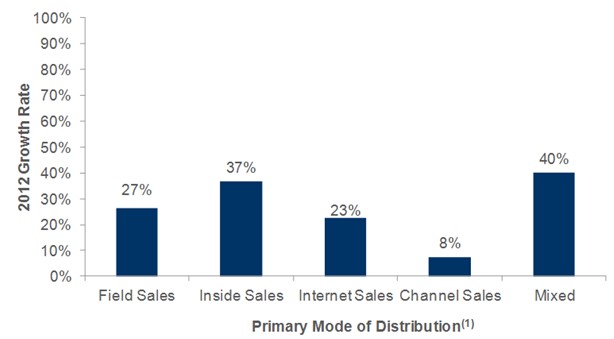
  1. Market Growth – The role of inside sales has grown steadily over the past 5 years. A 2012 Pacific Crest SaaS survey shows most growth is coming from inside sales. We are seeing this more and more across all industries, not just SaaS. Your market is shifting. So should you.

 SaaS_Inside_Sales_Growth

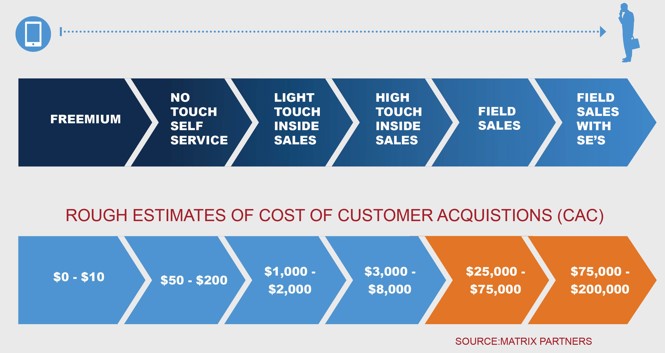
  1. Customer Acquisition Cost (CAC) – The cost to acquire customers is a huge focus of B2B companies and investors. The below image is from Matrix Partners. Notice field sales isn’t recommended until you hit a $25K CAC. Using expensive field resources drives up CAC and extends your time to break-even cost. It’s a fact: Inside sales costs less and reduces CAC.

 Customer_Acquisition_Cost

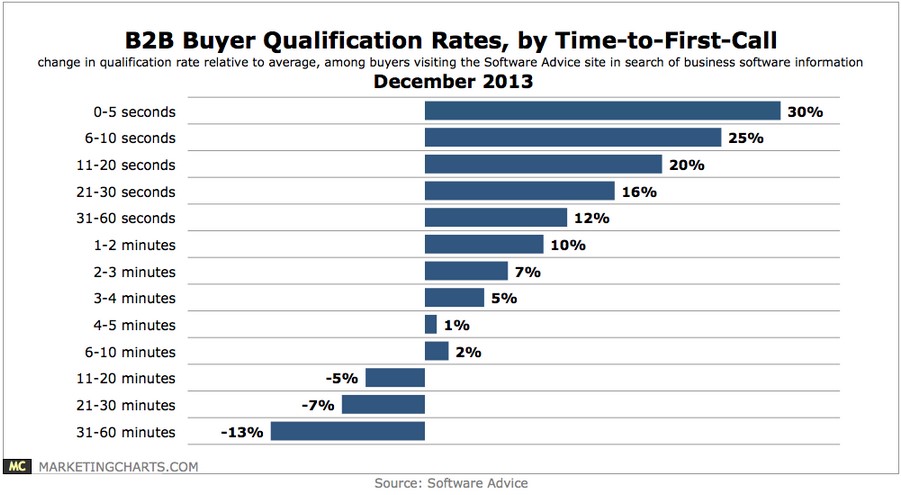
  1. Speed – Coupled with CAC is time to respond to active demand. That is, leads and customers actively looking for solutions like yours. Marketing is working harder (ie spending more) to compete for your buyer’s attention. Yet, field sales often ignores these leads. A December, 2013 study by marketingcharts.com proves the need for speed. Your chances of qualifying a lead increase by 30% if contacted within 5 seconds. Wait > 30 minutes and you are 13% less likely to qualify a new lead.

 B2B_Buyer_Qualification_Rates

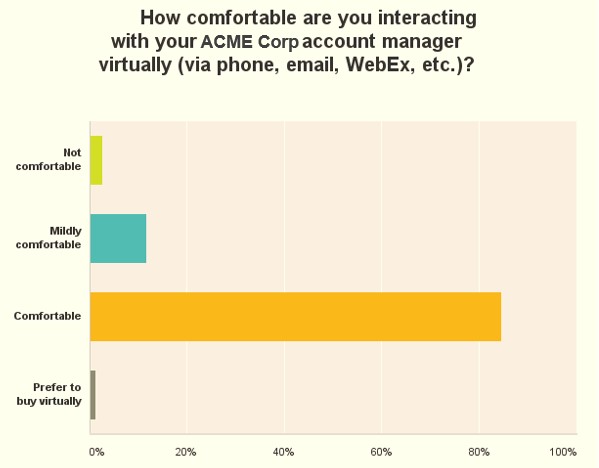
  1. Changing Buyer – Your buyers want to engage with field sales reps less and less. They don’t have time. Many buyers are on the road constantly. Or, there are multiple buyers in various locations. Recent SBI research reveals customers increasingly prefer to buy virtually. Technology and buyer location enables this. Companies are embracing these changes with inside sales.

 The_Changing_Buyer

  1. New Hire Ramp-to-Productivity – New hire ramp is becoming more challenging. Reps are hired, put on an island and expected to produce. Ramp time is taking closer to 2 years when it should be less than 1. Managers don’t have time to spend with their reps. Enablement in a decentralized field breaks down.

Centralized inside sales increases field adoption and execution. You have a captive audience. Training, process improvement and enablement can be done daily, if needed. Ramp-to-productivity is shortened, getting you results faster from new hires.

What to Do Now

50% of solving a problem is defining it correctly. If you’re seeing some of these signs, it warrants further investigation. Start by downloading the Inside Sales Sniff Test. The customer is the #1 indicator of a market shift. You should start with them before thinking about re-organizing. This should take you about 3 weeks.

If the Sniff Test validates your assumptions, you’ve now defined the problem. If your competition has already done this, you have catching up to do. Stay tuned for my next post on how to think through inside sales options.

Author: Ryan Tognazzini

sbi on linkedin

Follow @RyanTognazzini

Follow Sales Benchmark Index @MakingTheNumber

If you enjoyed this post, never miss one again by subscribing your Email Here and/or subscribing to the RSS.

07 Jan 15:39

How to Create Written Content that Generates Leads

by Andy Crestodina

Do you need more leads? Are you looking for creative ways to use your blog content to improve your conversion process? In this article, you’ll discover how to identify and patch the weaker part of your funnel by writing the right type of content. How Content Drives Leads Written content works in many ways. Some [...]

This post How to Create Written Content that Generates Leads first appeared on Social Media Examiner. Social Media Examiner - Your Guide to the Social Media Jungle

07 Jan 15:35

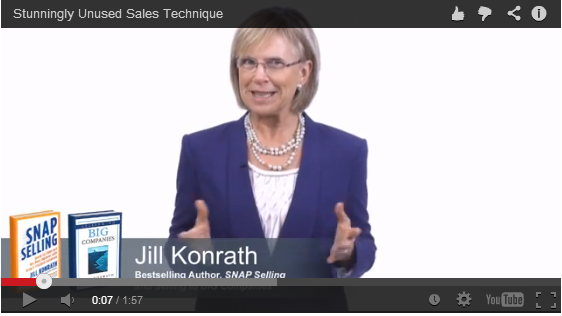
[Video] Stunningly Unused Sales Technique

Asking good sales questions is pivotal to your sales success. But, that's not what I'm here to talk about today. Instead, we're going to focus on what happens AFTER you ask these questions.

And, it's no secret that you need to be a good listener. To most people, that's a big duh!

But here's the deal. After asking a sales question, if the prospect hasn't responded in 2-3 seconds, the average seller jumps in to fill the silence.

You heard me right. Two to three seconds is the most people can stand before they start blathering. They might talk about their company, product or service. Or, they'll ask another question, hoping that will help. It doesn't.

You just sound like every other self-serving salesperson and your credibility goes down the drain.

One last stat for you. Research shows that if you ask a really good sales question that requires your prospect to think, it takes them 8-10 seconds to respond. That means that every time you butt in, you lose information that could help you get their business.

So what's the solution? Learning to get comfortable with silence. It was one of the hardest things I ever did. It was painful to sit there and not say anything.

Then one day, I discovered a way to deal with it. I simply started counting one-one thousand, two-one thousand, three-one thousand - all the way up to ten. If my prospect hadn't answered by then, it was time for me to reframe the question.

The result? I gained invaluable insights into their business, priorities, challenges, objectives and decision process.

Next time you're with a prospect, give this sales technique a shot. You'll be uncomfortable at first. That's guaranteed. But you'll also be amazed at the responses you get! sales technique

07 Jan 15:35

Inside Sales Power Tip 147 – Be Three Again

by Lori Richardson

curiosity sell like a three year oldIf you are lucky enough to have a three-year-old in your life, then you’ll definitely know what I’m talking about. If you don’t, you should borrow one, under the guise of babysitting for a family member or friend –  and then work to have some conversations. Yes, I’m half-kidding, but also know that if you have NOT been around little kids for a while, you are really missing out on the basics of people skills as well as sales fundamentals.

Have a conversation with a three-year-old and your bound to get some of this:

“Why?”

“But why?”

“Why?”

There is an innate, honest curiosity three-year-olds have that turns somewhere around age 4 or 5.  Three-year-olds are excited about sounds, and when something changes – like rain into snow. If you put a hat on, sometimes they’ll ask you why you did that.

Imagine just for a moment if you had such curiosity for your prospective buyers.

Why did they go to that page on your website?

Why is your first contact in Operations rather than Sales?

How does the reporting structure work at that company?

Why is your sales opportunity stalled if you thought you talked to everyone involved and there was perceived need for your services?

Why do they open your emails but stopped replying?

You can apply the principles of “why”, “how”, “when”, “what”, “where”, and “who” throughout your conversations with buyers.

Maximize Curiosity These Ways:

  •  Don’t make it sound like an interrogation. Learn the difference between curiosity and rapid-fire questions
  • Be thoughtful about your questions. Decide on one or two most important ones rather than a list of them
  • Be conscious of your tone, energy level, and pace. Since you’re talking by phone, listen for nuances
  • One or two questions can be sent via email – especially if there was one thing you forgot to ask when you talked
  • The best way to learn about a buyer is to get them to talk. When they give you a short answer, say, “Tell me more about that….”

But I’m Not Good at Asking Questions

So start simply by thinking of three main questions you’d like answered or discussed in the next call you have with your prospect.

You can always email a couple more, or call them back with the additional question.

Bounce back what they said – not like a parrot, but like you really heard it.

When they say, “We really have had more trouble with turnover in 2013 than we’ve had in the past 5 years”

Answer back, “So lots of trouble with turnover this past year  – would you say that’s been your BIGGEST problem?”

Note that I’m not just repeating everything they say – that is parroting – and it can sound patronizing – so mix it up.

Where to Start

Look through some of the sales opportunities you are working on. Do you know everything there is to know about your prospects? Start with what you don’t know yet, but what would be helpful to know to move this opportunity forward

A Great Question When Some Time has Elapsed Since You Last Talked to your Prospective Customer

Once you have greeted your contact on the phone, I like to ask this right away -

“Has anything changed since we last talked?”

This gives you a starting point for your conversation. Often a deal can be stalled because something did change. See what has. If you are not satisfied that you know enough, ask more questions.

Also check out:

Powerful Questions Help Qualify Sales Opportunities

Inside Sales Power Tip – Listen

Please share your ideas with our readers!

Lori Richardson - Score More SalesLori Richardson is recognized as one of the “Top 25 Sales Influencers for 2013″ and one of “20 Women to Watch in Sales Lead Management for 2013″. Lori speaks, writes, trains, and consults with inside and outbound sellers in technology and services companies. Subscribe to the award-winning blog and the “Sales Ideas In A Minute” newsletter for sales strategies, tactics, and tips in selling. Increase Opportunities. Expand Your Pipeline. Close More Deals.

email  lori@scoremoresales.com | View  My LinkedIn Profile

The post Inside Sales Power Tip 147 – Be Three Again appeared first on Score More Sales.

07 Jan 15:34

Using LinkedIn to Build Sales Pipeline

by Koka Sexton

Using LinkedIn to Build Sales Pipeline image How to Build Your Sales Pipeline LinkedIn Header

How to Build Your Sales Pipeline

With so many sources to find leads and sales prospects, sales professionals these days should be able to build a sales pipeline easily. The problem is that with so many different options, it can be hard to know which ones to focus on. As a result, sales professionals end up wasting time and money using social selling efforts in unproductive ways. Here are some tips on how to effectively build your sales pipeline.

1. Disqualify Unlikely Prospects

Having an enormous pipeline doesn’t make a difference if it’s built around people who aren’t likely to buy from you. Streamline your social selling efforts in the beginning to save a lot of time and money in the long run. LinkedIn Sales Navigator can help you find high-quality contacts by using targeted searches to ensure that you can get in touch with prospects that are more likely to turn into leads. This will greatly increase the effectiveness of your efforts and help increase the impact of your social selling.

2. Customize Your Approach

Your approach to each prospect will be much more successful if you understand their needs and background. LinkedIn can give you instant access to the interests and background information of all of your connections and first-degree connections, meaning that you can approach each one with a tailored approach and personal touch. On a person’s LinkedIn profile, you will find their endorsements, social media activity, etc. that will give you insight into how best to connect with them. This will improve your chances of keeping interested parties in your sales pipeline instead of causing them to react adversely to your approach and drop out.

3. Use Referrals

LinkedIn can make social selling much less daunting by granting you the ability to make personal connections with prospects rather than cold calling. Sales leads are much more likely to come through with referrals, and it takes little time or cost to make them happen. Leveraging your LinkedIn network this way will help you maximize your social selling efforts and build your sales pipeline more effectively.

Sources:

http://blog.hubspot.com/blog/tabid/6307/bid/10943/3-Strategies-to-Get-More-Sales-Referrals-With-LinkedIn.aspx

06 Jan 15:29

Great Work Provocation

by Michael Bungay Stanier

What has this inspired for you today?

Get provoked daily. Sign up our Great Work Provocations.

Like a shot of espresso in the morning without the caffeine.
Feel free to share – Blog it, Facebook it, Pin it…anyway you like.

06 Jan 15:28

Hiring Social Media Experts: Guidance for (Rookie) Buyers

by Courtney Hunt

Hiring Social Media Experts: Guidance for (Rookie) Buyers image computer help wanted 400 clr7

Hiring Social Media Experts: The Buyer’s Responsibility

Recently I shared Social Media Experts: Why Organizations Need Them, which counters some of the most frequent criticisms of the notion of social media experts and articulates the need for social media expertise. In that post I noted that much of the criticism of social media experts is rooted in the fact that many of them lack true depth of knowledge and experience, which is a fair but incomplete assessment of the “social swindler” dilemma. Yes, there are many self-proclaimed experts who are more interested in making a buck by jumping on hot opportunities than developing their craft – and even greater numbers of folks who mean well but are simply naïve, unaware that their knowledge and skills are limited and their experience is narrow and shallow.

But this isn’t just a seller’s problem. Buyers – especially social media rookies – play a significant role in the proliferation and prevalence of swindlers and fakes as well, because they:

  • Are often too eager to find a quick fix, a silver bullet, a simple, one-size-fits-all solution to the challenges they face.
  • Tend to focus on the immediate term rather than viewing the acquisition of digital expertise as a long-term investment.
  • Underestimate the importance of finding the right skill set, as well as the appropriate strategic and tactical perspectives.
  • Assume that because the platforms and tools are free or low-cost, and relatively easy to use, the expertise required to leverage them effectively should also require a minimal outlay of cash.
  • Think (often erroneously) that younger workers are inherently superior at digital engagement, weighting personal experiences with specific platforms and activities more heavily than general work experience and professional expertise.
  • Believe that past successes alone are effective predictors of future performance.

Organizations looking to buy social technology services and/or hire in-house social media resources need to become more educated consumers and smarter buyers. With that in mind, this post offers general hiring guidance for acquiring social media expertise and specific guidance for interviewing prospective employees and service providers.

Hiring Social Media Experts: Degrees of Expertise

To reiterate a point I made in the previous post, it’s important to recognize that there is no single definition of expertise and no “one-size-fits-all” model to leveraging that expertise. The most appropriate expert for a given purpose in a particular organization will depend on factors like the organization’s:

  • Strategic goals and objectives, both short term and longer term
  • Industry and client characteristics
  • Level  of technological sophistication
  • Financial resources
  • Employee skill levels and capacity

In 2011, Rand Fishkin created a chart that offers a nice starting point for understanding different levels of social media expertise. I would argue that we can distinguish different levels of social media professionals the same way we might professionals in other functional areas: coordinators, analysts, managers, designers, planners, strategists, and advisors. Some organizations will need to acquire or develop individuals with expertise at all these levels, whereas others will only need some of them. For some the best solution will be to bring the expertise in house; for others it will be to use one or more service providers. And of course the right solution will change over time, as technology and an organization’s circumstances and needs continue to evolve.

Hiring Social Media Experts: General Approach

Generally speaking, an organization’s approach to hiring social media professionals should be the same as the approach it would use to hire professionals in other disciplines like accounting, finance, law, human resources – and yes, marketing too. That means there needs to be a clear sense of the service/job requirements, well-articulated evaluation criteria, a disciplined interview process, and reference checking.

More specifically, hiring best practices dictate that buyers should engage in the necessary due diligence to ensure:

  • They avoid charlatans who claim to have expertise they don’t really possess.
  • The people they hire have the social media know-how they need.
  • Social media expertise is complemented by other relevant expertise, including:
    • Specific functional areas (e.g., marketing, human resources, knowledge management, project management)
    • Skill sets (e.g., writing ability, community management)
    • Industries (e.g., healthcare, non-profit, consumer products, manufacturing)

This due diligence is necessary whether an organization is hiring a consultant to provide advice and counsel, an individual or firm to outsource work to, or an employee.

Hiring Social Media Experts: Interview Questions

It’s relatively easy to benchmark the requirements for social media and digital technology professionals of all stripes by looking at job board postings and requests for proposals, and by evaluating the digital engagement of key competitors, clients, and other relevant organizations. Once the requirements are identified, it’s relatively easy to do a preliminary screen of applicants to eliminate those who are clearly unqualified or misqualified.

What is likely to be tougher for many organizations is knowing how to further differentiate candidates during the interview process. Here are some questions buyers can ask – and what to look for in their answers:

Q: How would you define or describe social media to a novice?

Can they describe the underlying technologies – not just the most popular platforms – in easy-to-understand terms? Can they provide historical and operational context for today’s digital tools?

Q: What are the main public social media platforms and tools? What are some I may not have heard of?

Can they name platforms besides LinkedIn, Twitter, Facebook, YouTube?

Can they identify platforms and tools that are commonly used and relevant but less obvious as social media technologies than the major platforms? See the Social Media Quotient (SMQ) Quiz I developed for examples.

Q: How would you describe (pick a platform) to me? Does that platform make sense for our organization to use? Why or why not? What platforms should we be using and why?

Do they recognize that not all platforms are appropriate for all organizations?

Can they provide a cogent assessment of what tools are best for your organization and why?

Q: How long have you been using social media and in what capacities? What have you learned from your experiences?

  • Have they been intimately involved in creating and/or managing a digital presence, either for themselves or an organization?
  • Can they describe their own growth and development, recognize their increasing sophistication, and acknowledge they’re still learning?

Q: How do you respond to people who say that social media is a fad, or that it has no real business value, or that it’s not worth the risks?

Can they provide strong evidence of the permanence of new digital technologies (beyond obvious facts like the number of Facebook users and the anticipated Twitter IPO valuation)?

Are they able to respond to the naysayers’ arguments in terms that would make sense to them and demonstrate why enlightened self-interest can lead them to adopt and embrace new technologies?

Q: What are some of the most important risks to address when it comes to social media use? What approach(es) to risk management do you recommend?

Can they articulate some of the key risks with respect to commercial and employment laws?

Are they aware of the specific considerations in specific industries (e.g., financial services, health care)?

Do they offer pragmatic solutions to manage risks that balance the interests of multiple stakeholders?

Q: Tell me about some social media failures and mistakes (either yours or others). What can we learn from them?

Can they quickly provide examples?

Can they explain what happened and how the mistake reflects the risks and hazards of social media?

Can they identify the best ways to respond to and/or prevent these problems?

Q: What knowledge, skills, and abilities do you think are most critical for a social media professional? What do you consider your greatest strength(s)?

Do they go beyond the obvious competencies like being an enthusiastic user and enjoying cyber-interactions? For more on specific competencies, check out the lists in Digital Era Competencies: How Do You Stack Up?

Do they identify the importance of strong technical skills like writing across multiple media, knowing html, creating/editing content in multiple media types (e.g., images, videos, podcasts), and analytics?

Do they recognize that digital engagement can be a tedious grind – hours of boredom punctuated by moments of crisis – and not consistently fun and exciting?

Q: How would you measure social media success in our organization?

Are they able to put common metrics (e.g., number of followers/fans, Klout scores) in proper perspective?

Can they describe the differences between short- and long-term measures of success?

Do they talk about alternative measures for evaluating success (e.g., relative improvements over time)?

Q: What are your go-to resources for social media? What books, bloggers, and/or websites do you like best?

Do they recognize they’re still learning and that staying current via reading (not just doing) is critical?

Can they quickly rattle off resources in each category?

Hiring Social Media Experts: Putting it All Together

The specific questions buyers should use will depend on the type and level of expertise they’re looking for. Buyers don’t necessarily need to know the answers to these questions themselves to judge the responses effectively. What they should look for is how the candidate responds, the same way they would for other technical jobs they may not completely understand. In addition to the specific tips above, here are a few general things to look for:

  • Tempered rather than unabashed enthusiasm for new technologies
  • Recognition of how different technologies can be used to meet goals and objectives and the importance of integrating them with other initiatives
  • Respect rather than disdain for social media rookies
  • Understanding of the challenges to social media success (e.g., resistance to change, political issues, resource constraints)
  • Lessons learned from experience (theirs or others), as well as recognition of the need and a commitment to continuous learning.

As always, I invite people to raise questions and offer additional insights and resources. More guidance on assessing and hiring social media experts would be particularly useful for social media rookies. Thanks!

Original post on the Denovati SMART Blog.

06 Jan 15:22

What Percentage of Revenue Should B2B Companies Spend on Marketing and Sales?

by Ian Dainty

What Percentage of Revenue Should B2B Companies Spend on Marketing and Sales? image Budget1This is a great question, and one that many B2B companies struggle with. Let’s look at the B2B marketing budgets of two of the most successful B2B companies in the past 40+ years.

These two companies are IBM and Microsoft.

First of all, nobody has ever accused either of these two companies of having the best technology, and yet both of them have survived through many recessions, to become two of the most successful companies in history.

They both had technology that was good enough. They both had, and still have, products and services that meet the needs of their current customers and marketplace. Their technology works well enough to meet those needs.

And yet ironically, both have been sued by the US government for predatory and monopolistic business practices.

And when Steve Jobs was alive, Apple also fit into this category. And to this day, they still do, but a few people are predicting Apple’s downfall now too. We’ll have to see.

It’s interesting to note that all of these companies are technology companies, where there has been exponential growth and decline in many other technology companies.

It should also be noted that IBM has gained much of its revenue from services over the past 10 to 15 years. But a lot of that service revenue is helping their clients use technology better.

So, what do these three companies spend on marketing and sales?

It was difficult to find what Apple spends on marketing and sales, because all of their internal salaries are put into the same bucket in the financial reporting.

However, IBM and Microsoft split their marketing and sales expenses into one expense item. Both of these companies spend between 21% and 23% of revenue every year on marketing and sales.

Paradoxically, they each spend only about 15% of revenue on Research and Development. This means they spend 50% more of revenue on marketing and sales then they do on R&D. Apple spends about 30% of revenue on marketing, sales and administration expenses, but also about 15% on R&D.

Does your company spend in that ratio on marketing and sales?

So why would three of the most successful technology companies in history spend 50% more on marketing and sales than on R&D.

Because they know that you really don’t have to have the best technology to succeed, you MUST, however, have the best marketing. Steve Jobs was one of the greatest marketers that ever lived.

When I joined IBM Canada in the mid 70’s, they put me, and several hundred other new recruits, through a nine month training program, with about 25 people in each class. They trained us in three basic categories.
1. How computers work.
2. General business knowledge, like finance, operations, etc.
3. Marketing and sales.

And by far, the most time was spent on marketing and sales. How best to sell their products and services, with all kinds of role plays for selling to clients.

Now selling and marketing were quite different back then, but I want you to understand my point. IBM knew that the best way to grow their business was to produce the best marketers and sales people any company could have. And IBM made sure you were, or you didn’t last with the company.

IBM doesn’t train like that any more. I assume because of costs. And I haven’t found any technology companies that train their sales people and marketers at all any more, and haven’t for about the last thirty years. And yet, when technology people hire sales and marketers, they expect these people to be fully trained. What a paradox.

So, what does your company spend on marketing and sales?

You need to be the best marketer in your marketplace to succeed in today’s Internet world. You need to spend at least 15% of your revenues on marketing and sales, and preferably over 20% of revenues to really grow.

If you do not spend at least 15% of revenues on sales, and more on marketing, then your company will have a very difficult time not just growing, but even surviving.

06 Jan 15:15

What the Problems In Your Sales Funnel Reveal

by S. Anthony Iannarino

What the Problems In Your Sales Funnel Reveal is a post from: The Sales Blog | S. Anthony Iannarino

You can find sales problems by looking into your funnel (or pipeline, if you prefer).

Top of the Funnel

Top of the funnel problems are easy to identify.

If you look at the value of your pipeline and the number doesn’t change from week to week, you are staring down the barrel of a loaded gun.

If you test these opportunities by walking through whatever method you use to qualify only to find they fail your tests, you are looking at a very bleak future. [By the way, the most important test as to whether an opportunity is qualified or not is whether your dream client agrees to explore change and makes the commitment to change.]

Middle of the Funnel

If the middle of the funnel is empty, you really have a top of the funnel problem. You aren’t qualifying real opportunities, or you aren’t gaining the right commitments.

Mostly middle of the funnel problems show up as stalled opportunities. If you skip stages of the sales process you can wind up with stalled deals. Almost always what is skipped over is a difficult to gain commitment, one that if it had been gained would have moved the opportunity forward.

Deals also die in the middle of the funnel when you try to forgo the necessary consensus-building. That’s one way to run a good opportunity right into a ditch. Without consensus, the status quo wins.

Bottom of the Funnel Problems

Deals get stuck here when you are missing consensus, when you haven’t created enough value, when you haven’t effectively addressed risk, when new stakeholders (like purchasing and legal) enter the process, and when you fail to outline and gain agreement on what steps will be taken next.

Without a compelling reason to change, deals get stuck at the bottom. Without resolving your dream clients fears, the risk can keep them from moving forward. A lot of salespeople worry about asking to engage with purchasing or legal, but the sooner you deal with that reality, the sooner you move your deal forward (and the sooner your client gets the benefit of your solution).

Your sales funnel reveals the areas of your sales game that you need to improve.

Questions

What does your funnel look like? Draw it.

What does the shape reveal about how you sell?

What problems are common amongst the clustered deals in your pipeline?

What needs to change to get things moving?

06 Jan 15:14

New Sales. Simplified. Goes Back to College

by Mike

Post image for New Sales. Simplified. Goes Back to College

My oldest son is a junior in high school. We’ve been ramping up our college research, visiting campuses (free copy of my book to the first three people who contact me and correctly identify the university pictured above), and on Saturday morning he took the ACT for the first time. It brought to mind this great post Dr. Dawn Deeter of Kansas State University and the National Strategic Selling Institute wrote back in the fall of 2012. Of all the reviews and feedback we’ve received about New Sales. Simplified., this was one of my favorites. Since college is taking up a lot of mental bandwidth this weekend, Mizzou was victorious in the Cotton Bowl Friday night, and the anticipation is building for the BCS Championship Game on Monday, it seemed like a good time to re-share Dr. Deeter’s review.

New Sales. Simplified. Goes to College

I just finished reading Mike Weinberg’s book New Sales. Simplified. I highly recommend it to anyone interested in building or improving prospecting and new business development skills.

I love this book!

To give you a little more background, I am a Professor and Director of the National Strategic Selling Institute (NSSI) at Kansas State University where I teach professional selling to undergraduate students. Through the NSSI, we also promote sales as a viable career option for undergraduates by hosting professional development events, workshops, bringing in guest speakers, and coaching the K-State Sales Team. The Sales Team competes at various sales competitions around the country.

After reading Mike’s book I knew it was perfect for the students in my Advanced Selling classes. His clear, no nonsense writing style results in an enjoyable, easy-to-read book. More importantly, the book is filled with actionable items that will improve the performance of any rep seeking to improve new business development skills.

Let me provide an example. I have been training a team of students for the World Collegiate Sales Open sponsored by the Professional Sales Program at Northern Illinois University. This sales competition is based on phone skills. In the first round students leave a voice mail; if they do well in that round the students move to a live phone call with a gatekeeper. Success in round two leads to a live phone call with the prospect, and success in round 3 leads to a face- to-face meeting. We just completed the first round. I used Mike’s book (along with some personal coaching from Mike) to prepare the students for Round 1.

The transformation of my college sophomores, juniors and seniors into experienced inside salespeople was amazing. By sharpening their sales stories and creating power statements (Chapter 8 from New Sales. Simplified.the students were able to leave compelling voice mail messages that focused on the customer rather than on the product. They asked if they could visit with the prospect instead of meet. They requested a call back from the prospect, but also noted that they would call again. They used casual, comfortable voice tones so that they sounded human rather than robotic (Chapter 9). These pieces of advice came directly from Mike’s book.

Given my students’ success, it occurred to me that I might also be able to use Mike’s advice as I work to sell sponsorships in our program to firms. Utilizing the same instructions I gave to my students, I worked to sharpen my sales story and create a power statement. The results were almost startling.

I have been recommending this book to everyone I know; I even carry it around with me and reference it from time to time. Developing phone sales skills will be a major part of my Advanced Selling Class this spring, and I’m pleased New Sales. Simplified. will be there to guide us!

Deeter-Schmelz2011webDawn Deeter-Schmelz is the Director of the National Strategic Selling Institute at Kansas State University and the J.J. Vanier Distinguished Professor of Relational Selling and Marketing. She says she has the best job in the world — teaching great K-State students how to become outstanding professional salespeople! You can reach Dr. Deeter via e-mail at ddeeter@k-state.edu or find her on Twitter.


06 Jan 15:14

The 6 Most Important Ways To Generate And Use Social Proof To Increase Online Sales

by steve olenski
Those of us in the marketing, advertising space just love when we can append a catchy name to a given subject matter. Such is the case with "social proof." It has many definitions including "a psychological phenomenon where people assume the actions of others reflect correct behavior for a given situation."

read more

06 Jan 15:14

How To Educate Your Prospects And Make More Sales At The Same Time

by Arun Sivashankaran

Ever have a friend who’s having relationship problems or going through a bad breakup?

It seems like they could just go on and on about it forever. It’s like a switch goes off. Even the shy types can’t resist spilling all the grim little details.

When someone has a problem, they can’t stop talking (and thinking) about it.

You can use this to build your credibility and make sales online.

You just need the right strategy to do it…

How To Educate Your Prospects And Make More Sales At The Same Time image Wellesley College Tower CourtPhoto Credit: Jared and Corin via Wikimedia Commons

Selling Online is an Art, Not a Shouting Match

Trying to sell to prospects online like the guy yelling, “hot dogs!” over and over again at a baseball game just doesn’t work.

That “strategy” works well enough at a ballpark, but that’s because you’re stuck there for hours and there isn’t much other food available. It doesn’t fly online, when your prospects have so many other options.

An aggressive, hardnosed approach online can drive your prospects straight into the digital arms of your competitors.

Plenty of businesses recognize this. So they change their tactics, but they get confused when their softer sales messages don’t give them the results they’re looking for.

Where Many Businesses Go Wrong

How To Educate Your Prospects And Make More Sales At The Same Time image mistakesPhoto Credit: doobybrain via Flickr

Many businesses go too far in their quest to avoid getting lumped together with used car salesmen in their prospects’ minds.

In their quest to keep everything above board and not be salesy, they manage to take the “sales” out of “selling.”

Their new approach gets them plenty of credibility and trust from their visitors. But it doesn’t get them the revenue they need to pay their mortgage and grow their business.

What these people need is a balanced approach. They need a way to get people to know, like, and trust them and still get them engaged enough to take action and buy their products.

A Time-Tested, Balanced Solution

Remember the friend from the beginning of this post? The one who couldn’t stop talking about their relationship woes?

The solution to your marketing dilemma goes back to that. It wears many hats – content marketing, “selling through education,” and relationship marketing are just a few—but businesses have been using the techniques for centuries.

John Deere has been doing this since 1895, when they published a magazine showing farmers how to become more profitable. Jell-O started 9 years later, when their salesmen gave out cookbooks featuring Jell-O-based desserts.

The principles boil down to the same basic idea: give your prospects content they find valuable by educating them on topics they can’t get enough of—their problems and frustrations—to build credibility and drive sales.

It sounds like a tall order, but it’s simpler than you might think.

The Blueprint to a Better Marketing Strategy (and More Sales)

How To Educate Your Prospects And Make More Sales At The Same Time image 640px Joy Oil gas station blueprintsPhoto Credit: Joy Oil Co Ltd via Wikimedia Commons

Most people won’t bother listening to you in today’s online space unless they feel they’re getting something valuable in return.

That’s the foundation of a more effective marketing strategy. You need to create content people find valuable and deliver it to create a feeling of reciprocal exchange.

Most businesses fail on both of these points. They don’t create content their visitors find valuable or interesting. Even if they do, plenty of them screw up when it comes to presenting it in a way that builds trust and credibility while still getting sales.

Let’s take a look at these stumbling blocks to figure out how you can overcome them:

Step 1. Creating Valuable Content

How To Educate Your Prospects And Make More Sales At The Same Time image Apollo synthetic diamondPhoto Credit: Wikimedia Commons

Most content online is a dime a dozen at best and a complete waste of time at first. The competition’s growing every day, but you can come out on top if you learn and apply a few timeless principles.

Here are a few fundamentals to creating content that educates visitors and motivates them to act:

Target the Right Audience

You might think your content’s valuable… but valuable to whom?

It’s easy to write about topics you find interesting personally, but bore your ideal customers to tears. You might want to talk about your job promotion, but your friend just wants to talk about their relationship problems.

Make sure you’re laser-focused on topics that would interest your ideal customers. Not your competitors or others in your industry. And definitely not just you.

Identify Emotional Pain Points Behind Visitors’ Problems

People buy based on emotions, and then they justify their decisions using logic. That’s why it’s so important to tap into the emotional root of your visitors’ frustrations.

Your friend with the relationship problems doesn’t have any interest in reading a psychology textbook about why the relationship went wrong. They just want to engage with you on an emotional level (at least at first).

Take a moment to think about what you’re really selling. Unveil the curtains that get to the emotional core of things. Why do your prospects want the result you can deliver?

You aren’t selling a weight loss drug. You’re selling newfound confidence, a better marriage, and looking great in a swimsuit.

Content that hits emotional buttons engages people, makes them receptive to share it, and eager to come back for more.

Consider Content From Related Niches

No one said you could only produce content specifically about your little niche.

But most businesses follow this like it’s a federal law. They pump out the same kind of content over and over again. It doesn’t take long to exhaust the topic and start to bore people.

If you’re a real estate agent specializing in starter homes, you don’t just have to talk about real estate. You could also talk about other things first time homeowners would find useful: home security, interior design, lawn care, landscaping, etc.

Don’t be afraid to mix it up. Creating content about related industries will help you educate your prospects and add value to their lives in a way most of your competitors won’t. It’ll make you memorable for all the right reasons.

Do Some Competitor Research

Your competitors might have marketing issues of their own to sort out, but that doesn’t mean they haven’t ever hit on any hidden gold.

Check out the content they produce on their blogs, podcasts, and videos. Focus on the most popular articles—the ones that get people riled up in the comments section and have the most social shares—for new topic ideas.

Pay attention and watch out for patterns and trends. Your competitors might’ve found a few emotional hot buttons that engage customers just like the ones you’re after.

You can create content within similar topics to better your chances of getting people engaged and coming back for more.

Stand Out

How is your content different than ocean of information already available?

Your marketing won’t thrive if you pump out dry, predictable content that your customers have seen 100 times already.

Just like with your product or service, your content should have its own Unique Selling Proposition (or USP). It should be clear why people should pay attention to you instead of anyone else.

How you choose to distinguish yourself is up to you. You just need to make sure there’s something that your content can do for people that nobody else’s can.

Step 2. Delivering The Goods

How To Educate Your Prospects And Make More Sales At The Same Time image 2505291978 0d89ac259bPhoto Credit: fortinbras via Flickr

Creating great content is just half the battle…

How you package and distribute your content has a huge effect on whether someone will pay attention to it long enough to get hooked. If they can’t do that, most people won’t end up becoming customers.

Email Autoresponders

Email autoresponders are one of the best tools for educating your prospects and gradually move them closer to becoming customers.

Sign up with an email provider and configure your autoresponder sequence. Then set up an irresistible opt-in form and you’re ready to go!

You can’t expect potential customers to come back to your site multiple times before buying, and a smart email marketing campaign removes that burden. You get to deliver a consistent stream of valuable content to the intimate setting of their email inbox.

Check out this excellent article from Brennan Dunn for some tips about setting up an email course. Another great strategy is to sign up to as many great email marketers’ lists as you can and watch how they operate. Derek Halpern, Ben Settle, and Marie Forleo are great people to start with.

Reports and White Papers

Reports, white papers, and other similar “long-form” content are great ways to deliver a huge shot of value to your visitors all at once.

You can make these available as free downloads on your website, or you can use them as an incentive to get visitors to opt-in to your email list.

Don’t know what to write out? Think of one problem your ideal customers would love to solve. Design and package your content as the solution to that problem. You don’t have to do too much with this.

The Path to Long-Term Relationships and Profits

If you can find a way to tap into the emotional root of your prospects’ problems, you can make people happy to learn from and respond to your marketing materials.

Selling through education takes more work than paying for traffic, but it puts you on the building long-term relationships and an expanding base of loyal customers.

How do you find valuable content to deliver to your prospects? Leave us a comment below and let us know!

06 Jan 15:13

Are You Ready for Increased Sales and Exposure?

by Ebony Grimsley
Are You Ready for Increased Sales and Exposure? image above promotions company ar

Above Promotions Company. Are You Ready for Success? PR Digital Marketing. 

Kudos to you for surviving another year in business! While you are working hard to prepare your brand for the new year, there may be a few lingering questions you have on your mind. You may be wondering if the activities you are doing now or planning to do in the new year will really help your public relations and marketing plan. You may be afraid to ask yourself this question, but I will ask it of you on your behalf. Are you ready for increased sales and exposure in the new year? Are you creating a plan for success in 2014?

Ask yourself the following questions.

  • Will you be incorporating digital marketing practices from 2013 in 2014?
  • Have you planned for changes in your publicity and marketing materials?
  • Are your tracking tools covering all marketing channels?
  • Do you have strategic partnerships in place?

If you answered “yes” to all of the questions above, congratulations as you’re probably on the right track. If you answered any questions with a no, you should take the next couple of weeks and make sure you can turn any no’s into yes’. Gather with your team or connect with a professional agency. Either way you will need to make sure you have these areas covered in order to see growth this year.

Here are a few reasons why you need to pursue incorporating these topics into your public relations and marketing campaigns.

1. Consumers are on-the-go. The majority of their research takes place online and often when they are actively about to make a purchase.

2. The message and even the products and services from last year are some times no longer sufficient to grab the interest of your demographic. Stay fresh.

3. In order for you to know what works and your actual ROI on a factual basis instead of intuitive, you must be able to measure results of your efforts. This will provide the opportunity to make changes and decrease the amount of time it takes for a consumer to purchase from you.

4. Your brand can reach more consumers when partnering strategically with other industries. The right partnership can ensure increased sales and exposure.

It may be difficult, but you must honestly review your business and make sure you set your goals, strategy and analysis plan.

Again, it may be easier to help get you on the right path with an experienced agency by your side. Being non-biased is an art form for agencies. Plus, their knowledge can help reduce the length of time it takes to increase your bottom line over you tripping and attempting to learn what may work.

If you are unsure about the success of your business for 2014. It’s not too late to set your business up for success this new year.

What do you think? Do you feel ready? Are there any points above you still have questions on? Be sure to comment below. Your response may be used in future posts.

06 Jan 15:13

Seven steps for building a successful sales process

by Steli Efti
For tech entrepreneurs without sales experience, here’s how you build a sales process for your startup from the ground up.