Shared posts

22 Jan 00:47

Is The Challenger Really a New Phenomenon?

by Dan Zamudio

The premise of The Challenger Sale is that star salespeople engage customers around their business issues and offer fresh ideas for improving financial performance. The Challenger rep stands above all the rest. They crush their competition and their quota.

They teach for differentiation, tailor the message, and take control of the conversation. The Corporate Executive Board (CEB) landed on these core Challenger skills based on extensive seller and buyer-side research. Their survey of hundreds of frontline sales managers showed that the best performing salespeople across industries and demographics were those that:

  • Offer the customer a unique perspective
  • Have strong two-way communication skills
  • Know their customer’s individual value drivers
  • Can identify the economic drivers of their customer’s business
  • Are comfortable discussing money
  • Can pressure the customer

From a buyer perspective, the research showed that buyers were most disposed to give their business to sellers that:

  • Offer unique and valuable perspectives on the market
  • Help the buyer navigate alternatives
  • Provide ongoing advice or consultation
  • Help the buyer avoid potential land mines
  • Educates them on new issues and outcomes

One of the most “startling” (my quotes) findings according to the good folks at CEB was that Challenger-type salespeople outperformed Relationship-type sellers by a wide margin.

I’m a big advocate of The Challenger approach to selling, in large part because it is the most scientific study and codification of sales excellence since Dr. Neil Rackham’s SPIN Selling research in the 1980’s, but after noodling on the various findings and revelations for a bit, I couldn’t help but wonder:

  • Is the notion that the most effective and best performing salespeople embody Challenger qualities really a new phenomenon?
  • If this same research was conducted 10-20 years ago, would the findings have been substantially similar?
  • Haven’t executive buyers ALWAYS (not just in the last two decades) preferred to buy from salespeople who could “teach” them how to improve their bottom-line or increase their competitive advantage or significantly move the needle on metrics they care about?
  • Haven’t the best salespeople always been those that surfaced the risk of the status quo?
  • Haven’t well-selected and constructed customer success stories always been the best way to tailor for resonance and point to the seller’s solution as the optimal path forward?
  • Is it really so astonishing that The Challenger will outperform The Relationship Builder every single day of the week?

That last point really got me in a tizzy. Doesn’t it stand to reason that a salesperson operating in a complex sales scenario who understands the customer’s world in the context of the buyer’s value drivers, most pressing issues, and industry key trends; provides insights that provoke the buyer to reconsider the implications of their current situation; and offers suggestions that resonate with the buyer’s ambitions will close more business than a salesperson whose most redeeming qualities are getting along with others, likability, and being generous with their time?

It’s a little like saying that after endless hours of studying game tape that NFL coaches concluded that Richard Sherman is a better cornerback than Mr. Rogers. I refer to Mr. Rogers of ‘Wonderful Day in the Neighborhood’ fame, not Carlos Rogers, the San Francisco 49ers defensive back. Although for Niner fans of which I am one, unfortunately, Mr. Sherman is substantially more adept at stifling wide receivers than our Mr. Rogers.

Think about the best salespeople you encountered B.C. (Before Challenger). Use the Challenger characteristics noted in the bullet points above as a checklist to discern if the top performers that come to mind meet the Challenger criteria. Chances are they do – now we just have a name for it.

Heck, if you’re a fan of Mad Men, there might have even been sightings of Challenger reps in pre-historic times.

What’s your perspective?

10 Jan 15:17

Pinpointing Influencers in B2B Sales Using Big Data

by Nicolette Beard

Don’t let the term “Big Data” scare you off; just because there is a ton of customer data available at your fingertips, does not mean it’s unmanageable. In fact, thanks to predictive analytics, you can take that information and increase overall marketing effectiveness across multiple channels.

So what is big data?

According to IBM, we create 2.5 quintillion bytes of data every day. Did you realize that 90% of worldwide data was created in the last two years alone? This data comes from multiple sources and from every field across the globe.

Big data analytics examines this colossal amount of data to find patterns, relationships and correlations that aid organizations in making better business decisions.

Companies of any size can find an opportunity to analyze big data and use that information to improve their existing processes and fill their B2B sales funnel. But, the big question becomes how can marketing and sales cut through the noise created by so much data to find valuable insights?

A Wall Street Journal study noted that while most companies are deploying these technologies they still don’t know how to derive value from this data. That’s what this 29-minute webinar will show you.

Listen on demand to Enterprise Sales Predictions: How to Use Big Data to Predict Sales and Forecast Revenue.

With a predictive analytics model, or as Amanda Kahlow, from 6Sense Insights, refers to it as an Enterprise Sales Predication (ESP) model, marketing departments can show true value to sales based on relative spikes in data points, such as where the buyer is in the buying cycle. Thanks to marketing automation and advanced statistical modeling, this wealth of information can now pinpoint milestone events that present not only a “buy” signal, but also what product that visitor is likely to purchase with an 85% accuracy rate.

Pinpointing Influencers in B2B Sales Using Big Data image ESP What is it11

The complexity of understanding the B2B sales cycle due to large volumes of numerous digital interactions across multiple channels has grown exponentially. Predictive analytics can tie these different touch points to predict new opportunities. With that information, you can customize appropriate relevant content objects to meet their most immediate needs depending where they are in the sales cycle.

For example, you can set up a visitor early in the buying cycle to receive targeted content for by showing comparison charts versus someone deep in the buying cycle who may respond to a financing offer.

How does the ESP model work?

Predictive analytics aggregates data looking for patterns of activity, and then maps the interaction to create a formula unique to your product or service. Because no two companies are alike and the multiple inbound channels vary, predictive analytics finds the right map to fit your problem and predict sales cycles unique to your company.

Big data can predict sales and revenue forecasts by taking and validating all the incoming possibilities from web and demand-based data to IP sources to pinpoint interest level from a specific company. Unlike a B2C purchase decision, which is based on a one-to-one interaction, a B2B sale may require 100 or more people coming to your business website before you ever receive a purchase order.

This modeling engine analyzes hundreds, even thousands of models, correlating multiple channels of interaction data (web, call, email, CRM, social, search, call center, marketing automation) and storing it in real time. With an overlay “decision engine,” marketing can identify where to route the lead using a rules-based threshold, increasing opportunities and revenue.

While big data may seem daunting, there are steps you can take to navigate this brave new world. Listen to the webinar, Enterprise Sales Predictions: How to Use Big Data to Predict Sales and Forecast Revenue to learn how. Access it now with a FREE trial to the Online Marketing Institute. Get instant access now.

10 Jan 15:17

Lead Generation Lies That are Wreaking Havoc with Your Sales

by Dan McDade

Lead Generation LiesLast August I wrote a blog for Top Sales World titled “Lead Generation Hogwash: The Top 7 Lies.”

I detailed 7 lies to be aware of to avoid a lead generation disaster (read the blog for the specifics):

  1. Any list will do.
  2. Voicemails are a waste of time.
  3. Outbound calling is interruption marketing.
  4. Write it and they will come.
  5. Automated systems accurately score (prioritize) leads.
  6. Give up after 1 – 2 calls. You are better off calling someone who actually wants to talk with you.
  7. More leads are better than fewer leads

I received a lot of positive feedback about the article and decided to ask our PointClear PowerViews Alumni (those who have been on the PowerViews show) for their input on the most dangerous lead gen lies out there.

Here’s what they had to say:

Ardath Albee | Marketing Interactions

A form completion is a lead. Hogwash! A form completion is an expression of potential interest in what your copy describes that the person will get in exchange for their information. Period. The only intent a person has when completing the form is to gain access to what you’ve promised. Why marketers refuse to acknowledge this reality is beyond me, but it’s also a reason that salespeople continue to ignore the leads sent to them by marketing. And, it’s irritating to your prospects. Their fear that you’ll turn on the hard sale based on that form is one reason they lie. Dirty data doesn’t help and is costly to clean up. Wouldn’t it make more sense to respect the interaction?

Craig Rosenberg | The Funnelholic

Leads suck. If a great conversion rate is 30% of leads to sales qualified leads then 7 out of 10 failed to pass through. If a six-sigma consultant looked at that type of waste, they would freak out. The truth is, it's okay. Actually I take that back, it’s not okay if you pass those 10 leads to quota-carrying sales reps. It is okay if you filter those leads via a combination of lead nurturing and sales development (or lead qualification) before you pass to your sales team.

Paul Gillin |Paul Gillen Blog

Sales is all about value for the dollar. Value is important, but B2B buyers are often deeply invested at a personal level in the decisions they make. Jobs or even careers may be on the line, so make an effort to understand your buyers' fears, ambitions and motivations so that you can sell a solution they can be comfortable with. Remember that they're buying a relationship as much as a product. Are you someone they can relate to?

Ginger Conlon |DM News

One touch is enough. Reading the “7 Lies” post reminded me of a conference presentation I saw years ago. The speaker asked an attendee to hammer a nail into a board with only one strike. Of course, the speaker easily pulled out the nail. He then asked the attendee to strike the nail 12 times. The nail stuck. His point: One contact, even two or three, is rarely enough for sales or marketing to connect with customers deeply enough that there’s real interest. Consistency is essential. And today, that consistency needs to reach across channels.

Jamie Turner |60 Second Communications

Social Media Marketing is an effective lean gen channel for B2C but not as much for B2B. Au contraire – B2B companies often struggle more than B2C to create a personal brand that prospects can connect with and trust. When B2B marketers use social channels like LinkedIn and Twitter to showcase thought leadership they create an opportunity to gain credibility with key decision makers and potentially take relationships with prospects and existing customers to another level. Social is a huge door opener and a great way to participate in conversations that would otherwise never exist.

James Obermayer |Sales Lead Management Association

Jim has lies, lies and more damn lies (he provided 28, I picked my favorite 5):

  1. Telemarketing doesn’t work, I get calls every night and I hate ‘em.
  2. Our products are so good we don’t need leads.
  3. We don’t ask qualifying questions on our web form, I hate them.
  4. Marketing is a variable expense. Cut it and we’ll never miss it.
  5. Those leads are a month old, they’ve already bought.

Reader, what say you? Do you agree/disagree with these lies? Any others you would add? I look forward to hearing and sharing your thoughts with our ViewPoint community.


By Dan McDade

10 Jan 15:17

Why Individuals No Longer Rule on Sales Teams

by Brent Adamson

Companies have long developed and managed their sales people differently from other employees, placing great emphasis on individual performance. To foster it, they often give sales its own learning and development team, recruiting specialists, compensation plan, and management and IT systems — but now they’re finding that those differences can hinder success as much as they support it.

Our colleagues in CEB’s HR practice have documented an extraordinary shift in the relationship between individual achievement and business unit profitability, both across the enterprise and within the sales function. From 2002 to 2012, the impact of individuals’ task performance on unit profitability companywide decreased, on average, from 78% to 51%. But the impact of employees’ “network performance” — that is, how much people give to and take from their coworkers — increased from 22% to 49%. Even in sales, network performance now accounts for about 44% of the impact.

On the most effective sales teams, particularly B2B, the individual no longer reigns supreme. Strong sellers don’t merely execute their day-to-day tasks well; they also engage with their colleagues to marshal resources, wrangle involvement, and coordinate people’s capabilities. As we discuss in our recent HBR article, “Dismantling the Sales Machine,” they rely on collective, even crowd-sourced, skills in ways that weren’t possible just a few short years ago.

Take, for example, a large media company we work with that invested in an internal social-networking platform for the commercial organization. The goal was to help sales reps exchange information about complex accounts. In the few years since the system has been in place, cross-sales have increased, cycle times have declined, and conversion rates have gone up. In one account alone, the improvements have driven $3.5 million in incremental revenue. Collaboration is better not only among the reps selling into different parts of that customer organization but also across the product and marketing teams charged with building and positioning broader solutions for the customer. Because sales reps are more directly networked with their colleagues through technology, they more easily aggregate skills, knowledge, and experience to uncover new opportunities and to debate tactics for generating business.

What’s most interesting about this story is that it’s the same sales force, by and large, with significantly better performance. Its structure, skills, metrics, and rewards have mostly remained the same. The key difference is the degree to which reps have taken advantage of new technology (largely built into their CRM system) to share and learn from one another. It’s a true network effect: the value of all of that shared information increases dramatically as more and more reps opt in to learn and, in turn, share with one another. Network behavior isn’t something you drive through compliance; you enable it through opportunity.

As organizations have begun to see the benefits of collaboration, they’ve also, unsurprisingly, started to change their sales incentives and reward systems. For instance, the sales function at Microchip, a global leader in semiconductors, has jettisoned the traditional highly leveraged variable comp plans based on individual performance. Instead, it’s taking an approach that looks strikingly similar to what you’d find elsewhere in the company: competitive base salaries coupled with a small variable component based on company and unit performance. The results? Record growth and profitability, increased rep engagement, and near-zero attrition. (For more about Microchip’s experience, see Daniel Pink’s HBR article “A Radical Prescription for Sales.”)

Such a dramatic change to the compensation system — what many consider the heart and soul of the successful sales machine — will seem far too disruptive and risky to a lot of companies. But at the very least, data and emerging experience both clearly indicate that every commercial leader should ask: To what degree are our current metrics and reward systems stifling the kind of collective, collaborative work necessary to sell effectively as an organization? How can we signal to our reps that network performance is not only desirable but expected? It’s something that star-performing reps figured out on their own long ago.

We’ve also seen an increase in importance of network performance at the manager level. Sales managers were once viewed as inspectors and enforcers of individual reps’ compliance to a prescribed set of activities. But research by our team in CEB’s Sales practice suggests that the best ones operate quite differently today: They facilitate idea exchange across their teams, use collective brainstorming to figure out how to unstick stuck deals, and borrow effective approaches to talent management and rep development from peers in other areas of the business.

A manufacturing company in the aerospace industry, for example, has organized managers from across the organization into standing cohorts that meet monthly to discuss common issues and identify creative solutions to problems their teams face. What might seem at first glance like a big drain on selling time is really a powerful way of tapping collective knowledge, experience, and expertise to address tough challenges individual managers might not have recognized, let alone solved, on their own. The cohorts serve as a strong reminder — and formal “permission” — to deliberately build connections with colleagues.

All this raises some important questions for commercial leaders: How would you score your sales reps on network performance? Are they tapping the knowledge and skills around them? Or are they still focused largely on succeeding as individuals — encouraged by their managers and organizational metrics and rewards to “avoid the distractions of the rest of the company”? Going forward, our research indicates, the answers to those questions will matter a great deal — and the old adage that sales reps are coin-operated individuals should no longer apply.

Culture That Drives Performance
An HBR Insight Center
10 Jan 15:17

Busting the Myth of Sales Disintermediation

by Gerry Murray
Are IT Buyers so self sufficient that sales people will no longer be needed? Much was made in 2013 of the notion that IT Buyers make a large percent of their decision before engaging with sales. Every major market research company had its own number but they all ranged north of 50%, a scary thought especially if it represented a rising trend.

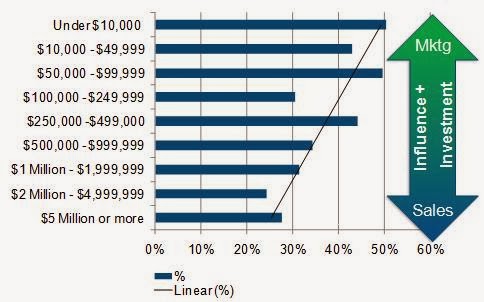
As shown in the figure below, enterprise IT buyers actually rely very heavily on vendor input for enterprise solutions. Buyers can make categorical decisions like "we need a new CRM or billing system." But they need a great deal of information from marketing, sales and technical sales in order to complete their decision making processes.

Finding the Right Mix of Marketing and Sales Engagement

Q.        What percent of your decision for an enterprise-level purchase when multiple vendors are competing for your business has been made by the time you first speak with a salesperson?
Source: IDC's 2013 IT Buyer Experience Survey, n = 193

The implications for supporting customer journeys is significant. For purchases that are low cost, familiar and low risk customers want to be as self sufficient as possible. And sellers need them to be because it costs too much for even telesales or online chat to support these transactions. At the other end of the spectrum of course it gets far more complex and that translates into opportunity for vendors - if they are truly aligned with the buyer's journey

One of the most important value adds that most sales and marketing lacks is the need to educate customers on how to buy as much as what to buy. For costly complex purchases, customers need guidance on:
  1. How to evaluate the strategic priority of the solution as well as the technical and business benefits
  2. How to build consensus across line of business, corporate IT and other key players in the decision making process.


According to our latest IT Buyer Experience research, marketing and sales teams that provide this insight early and often will help buyers make their decisions up to 40% faster, putting them ahead of the competition and ahead of forecast.

For more information on this and related research please contact me at gmurray(at)idc(dot)com.
Copyright 2011 IDC. Complete articles may be reposted. Reproduction in part is forbidden unless specifically authorized. All rights reserved. Please contact IDC for information on republishing or web rights.
10 Jan 15:16

Becoming a Game Changer for Sales & Marketing

by Patrick Murphy

Becoming a Game Changer for Sales & Marketing image Game ChangerEvery brand wants to own the exemplar position. The process takes four not-so-easy steps:
Step 1: “Concept Generation”

To come up with the next best thing, explore “unmet needs” or improve “organizational creativity.” Sometimes traditional or ethnographic research and observation can uncover an unmet need. For instance, Best Buy’s research noted that unfamiliar technology was difficult for customers to install and frustrating to use. This gave birth to The Geek Squad, a team of IT professionals who help customers to use and understand electronics they purchase from Best Buy.

Sometimes new ideas come from customer feedback. Arm & Hammer discovered that customers were placing boxes of baking soda in refrigerators to absorb odors. The company capitalized on this by promoting that application and expanding into other deodorizing products. Social media makes it easier to get input from customers. Dell operates a site called Ideastorm, and Starbucks has the MyStarbucks Idea site. LEGO relies on buyers to test new products, offer suggestions and submit designs. Some companies successfully take high-end products and create less expensive versions for emerging markets. In other cases, new technologies spawn new products. For example, Microsoft’s Encarta encyclopedia CD-ROM made Funk & Wagnalls’s printed encyclopedias obsolete, and Encarta later became obsolete itself before closing in 2009.

Organizations must promote creativity to find such category-changing innovations. Try to do the following:

  • “Be curious” – Toyota asks “why” over and over as a method of problem solving.
  • “Soak in information” – Ideas come from anywhere, so broad knowledge is essential.
  • “Access diverse people” – Varying perspectives, backgrounds and experiences generate different ideas and viewpoints.
  • “Know and use brainstorming” – Regular brainstorming sessions will help you generate new ideas.
  • “Force new perspectives” – Challenge convention and think in new ways. For example, can a surgeon learn something from working in a fast-food diner?
  • “Don’t look only for breakthrough ideas” – Sometimes a simple idea is the best one.

Step 2: “Concept Evaluation”

First, offerings must fit an organization’s strategy, and then the idea must be appropriate for the market. Not every good idea is. For instance, in the 1990s, AT&T attempted to enter three new business segments – mobile phones, computers and cable broadband – and lost billions. When considering a new offering, ask three questions: “Is there a market?” “Can we compete and win?” and “Will a market leadership position endure?” Companies must have the capabilities – production, distribution, and so on – in place to ensure the success of the new product or service.

Enough customers must show interest to make an idea worth the time and money to execute it. A niche should have growth potential and staying power. Brand practitioners must differentiate between trends and passing fads. For example, Schwinn, a leading bike manufacturer, misread the emerging enthusiasm for mountain biking and failed to enter the subcategory, with damaging results. The opposite is also true: If too many competitors crowd a category or subcategory, or an exemplar already exists, bide your time.

Step 3: “Defining and Managing the Category or Subcategory”

The process of winning the dominant position in a category or subcategory begins with defining up to five primary associations that are related to your product or your service. Probably one or two of these associations will drive the brand’s popularity. For example, when the Westin hotel chain introduced the Heavenly Bed, it formed a whole new hotel category around a premium sleep experience. Your differentiating function or benefit can come from a great design innovation, a new look, a high standard of customer service, a niche focus, a distinct price advantage, a new application, or a special feature or mix of features. A brand might also create or lead a category based on customers’ emotional associations with the brand. For example, people who are passionate about eating healthy foods relate to the philosophy of Whole Foods Market. Culture, shared interests, passion for an activity and corporate responsibility programs influence the customer-brand relationship.

Step 4: “Creating Barriers”

Exemplars and first entrants in a category or subcategory enjoy a period of little or no competition. This leads to above-normal profits for a significant time. How significant depends on how well the brand erects barriers that prevent competitors from entering the category or places them at a disadvantage when they try. Competitive barriers include:

  • “Investment” expense – The cost of entering the category outweighs the benefits.
  • “Compelling benefit” – Customers perceive the exemplar brand to be the most 
authentic and credible.
  • “Relationship with customers” – Buyers’ emotional attachment to a brand goes beyond its practical benefits.
  • Integral in “the category or subcategory” – The connection between brand and category is so strong that customers can’t consider the category without it.
10 Jan 15:16

Why Individuals No Longer Rule on Sales Teams

by Brent Adamson

Companies have long developed and managed their sales people differently from other employees, placing great emphasis on individual performance. To foster it, they often give sales its own learning and development team, recruiting specialists, compensation plan, and management and IT systems — but now they’re finding that those differences can hinder success as much as they support it.

Our colleagues in CEB’s HR practice have documented an extraordinary shift in the relationship between individual achievement and business unit profitability, both across the enterprise and within the sales function. From 2002 to 2012, the impact of individuals’ task performance on unit profitability companywide decreased, on average, from 78% to 51%. But the impact of employees’ “network performance” — that is, how much people give to and take from their coworkers — increased from 22% to 49%. Even in sales, network performance now accounts for about 44% of the impact.

On the most effective sales teams, particularly B2B, the individual no longer reigns supreme. Strong sellers don’t merely execute their day-to-day tasks well; they also engage with their colleagues to marshal resources, wrangle involvement, and coordinate people’s capabilities. As we discuss in our recent HBR article, “Dismantling the Sales Machine,” they rely on collective, even crowd-sourced, skills in ways that weren’t possible just a few short years ago.

Take, for example, a large media company we work with that invested in an internal social-networking platform for the commercial organization. The goal was to help sales reps exchange information about complex accounts. In the few years since the system has been in place, cross-sales have increased, cycle times have declined, and conversion rates have gone up. In one account alone, the improvements have driven $3.5 million in incremental revenue. Collaboration is better not only among the reps selling into different parts of that customer organization but also across the product and marketing teams charged with building and positioning broader solutions for the customer. Because sales reps are more directly networked with their colleagues through technology, they more easily aggregate skills, knowledge, and experience to uncover new opportunities and to debate tactics for generating business.

What’s most interesting about this story is that it’s the same sales force, by and large, with significantly better performance. Its structure, skills, metrics, and rewards have mostly remained the same. The key difference is the degree to which reps have taken advantage of new technology (largely built into their CRM system) to share and learn from one another. It’s a true network effect: the value of all of that shared information increases dramatically as more and more reps opt in to learn and, in turn, share with one another. Network behavior isn’t something you drive through compliance; you enable it through opportunity.

As organizations have begun to see the benefits of collaboration, they’ve also, unsurprisingly, started to change their sales incentives and reward systems. For instance, the sales function at Microchip, a global leader in semiconductors, has jettisoned the traditional highly leveraged variable comp plans based on individual performance. Instead, it’s taking an approach that looks strikingly similar to what you’d find elsewhere in the company: competitive base salaries coupled with a small variable component based on company and unit performance. The results? Record growth and profitability, increased rep engagement, and near-zero attrition. (For more about Microchip’s experience, see Daniel Pink’s HBR article “A Radical Prescription for Sales.”)

Such a dramatic change to the compensation system — what many consider the heart and soul of the successful sales machine — will seem far too disruptive and risky to a lot of companies. But at the very least, data and emerging experience both clearly indicate that every commercial leader should ask: To what degree are our current metrics and reward systems stifling the kind of collective, collaborative work necessary to sell effectively as an organization? How can we signal to our reps that network performance is not only desirable but expected? It’s something that star-performing reps figured out on their own long ago.

We’ve also seen an increase in importance of network performance at the manager level. Sales managers were once viewed as inspectors and enforcers of individual reps’ compliance to a prescribed set of activities. But research by our team in CEB’s Sales practice suggests that the best ones operate quite differently today: They facilitate idea exchange across their teams, use collective brainstorming to figure out how to unstick stuck deals, and borrow effective approaches to talent management and rep development from peers in other areas of the business.

A manufacturing company in the aerospace industry, for example, has organized managers from across the organization into standing cohorts that meet monthly to discuss common issues and identify creative solutions to problems their teams face. What might seem at first glance like a big drain on selling time is really a powerful way of tapping collective knowledge, experience, and expertise to address tough challenges individual managers might not have recognized, let alone solved, on their own. The cohorts serve as a strong reminder — and formal “permission” — to deliberately build connections with colleagues.

All this raises some important questions for commercial leaders: How would you score your sales reps on network performance? Are they tapping the knowledge and skills around them? Or are they still focused largely on succeeding as individuals — encouraged by their managers and organizational metrics and rewards to “avoid the distractions of the rest of the company”? Going forward, our research indicates, the answers to those questions will matter a great deal — and the old adage that sales reps are coin-operated individuals should no longer apply.

Culture That Drives Performance
An HBR Insight Center
10 Jan 15:16

The Difference Between Performance Reviews and Sales Coaching

by Keenan

Every time I ask a V.P. of Sales/CSO  or even a sales manager if they have coaching methodology in place, I always get a similar answer; “Yes, we do them once or twice a year.” I then ask, are those your “performance reviews” and of course, the answer is yes.

Let me help everyone out — doing performance reviews is NOT coaching.

Performance reviews are exactly that, they are “reviews” designed to review performance. They are designed to evaluate if someone has achieved their goals and objectives. Their purpose is to evaluate how someone has done over a particular period of time. Did they meet the goals? Did they deliver on the objectives? Did they operate in the appropriate fashion, etc?  Performance reviews look back over 6 months or a year and tell the sales person if they’re doing a good job or not. It’s that simple.

Coaching  however isn’t a review of performance, but rather an evaluation of approaches, methodologies, execution and behavior. Coaching sessions are designed to evaluate in game effort and execution. Coaching isn’t designed to say whether or not your performing well or not, but rather to determine where your mechanics could use improvement, regardless of how well you are performing.

Try this analogy on. Tom Brady goes 22 for 27 in completions, throws three touchdowns and no interceptions. A review of his performance will tell you he performed brilliantly. 20 for 27 is an 81% completion percentage. Three touchdowns and no interceptions is a great day. From a “performance” perspective, he did great. From a coaching perspective however, the door is swung open much wider. The coaching will look at how he read the defense, his throwing mechanics, his pocket presence, his audible decisions, and more. The purpose of coaching is to see where Tom can improve, REGARDLESS of how well he did in the game or even that season. Coaching is a subset or the engine of performance. Coaching is designed to enhance performance not evaluate it.

Here is the fun part, the majority of sales people WANT more coaching or better coaching. Coaching isn’t like a new CRM or more meetings, it’s actually something sales people want. 57% of sales people say they want more coaching and 60% say they want better coaching. Your teams want coaching, they want direction, they want to be better. As their manager, leader it’s your job to give it to them.

Stop looking at performance reviews as coaching, they aren’t. Build a coaching approach that allows you to coach each direct report on an an ongoing basis. I like to do it every 6 weeks.  Build a coaching framework that outlines exactly what you’ll be coaching them on. Hint: it should align with the outcomes and behaviors necessary to do the job well. Coaching Brady on how well he can block, break a tackle or catch a ball is wasted effort.

Once you have embedded an ongoing coaching methodology into your organization, performance reviews instantly become a cake walk. Coaching sessions act as the foundation to performance reviews. They allow you and your direct report to understand their strengths and weaknesses and how they are affecting performance as you go, not just once or twice a year.

Do you have a coaching methodology AND a performance review process? You should!

Become a coach. Spend 60% to 70% of your time coaching and developing your people. It’s where the win is, I promise.

If you need a structure, you can download my team engagement cadence below, it’s what I use and what I share with my clients.

coaching

09 Jan 16:20

A Practical Guide to Planning a Successful Inbound Marketing Campaign

by manderson@hubspot.com (Meghan Keaney Anderson)

inbound-campaign-guideWelcome to January -- a time of new energy, new calendars, and lots and lots of planning. Whether you're planning your marketing strategy as a whole or developing a specific marketing campaign to achieve a particular goal, a little structure can help to reduce a daunting task to a manageable one.

You'll find help with this structuring below, where I've outlined numerous steps we take when planning our own campaigns at HubSpot. So go on -- use our outline below to get your marketing going strong to start 2014!

Identify your audience.

Whether you're creating a marketing strategy for your entire company or developing a campaign for a particular product launch, defining your audience is the most fundamental step. It is the difference between a generic message that falls flat and a campaign that really resonates.

When you're building your marketing plan, start by developing the audience profile, often called a persona. Your profile should include the following components:

  • Demographics
  • Values
  • Biggest challenges
  • How you solve those challenges
  • Current perceptions of your company/product
  • Common objections

Jumpstart: 9 Questions You Need to Ask When Developing Buyer Personas

Set benchmarks and goals.

You need to know where you are to get where you're going. Before launching into a campaign, take stock of the current traffic to your site and the leads and customers generated by similar campaigns in the past. Use those as benchmarks to set goals for this campaign.

Your goals should me more concrete than "raising awareness" and more achievable than "tripling sales in a month." Aim to create what marketers call SMART goals -- specific, measurable, attainable, relevant, and timebound. For example: "Generate [number] leads focused on [topic/product] by [date]."

Here are a couple of examples of HubSpot’s goals from a recent product launch. The product we were launching was Social Inbox, a social monitoring and publishing tool. We wanted to generate a ton of activity around the topic of social media to establish our expertise and pull in a specific type of lead.

  • "Generate 5,000 leads who are interested in social media marketing by June 30, 2013."
  • "Improve rank for the keyword 'social monitoring' from 5th to 2nd on Google by June 30, 2013."

SMART goals for a campaign should fold-up into and support the SMART goals you've created for your marketing strategy as a whole.

Jumpstart: SMART goal-setting template

Choose keywords and optimize for search.

As part of your marketing plan, you'll want to zero in on the keywords you want to rank for as a result of the campaign. These are the words you can prioritize in your headlines and across your content. The goal here is not to stuff keywords, but rather to be consistent in the terms you use to optimize for search. 

Jumpstart: 4 Helpful Tools for Identifying the Right Keywords

Create a tracking URL.

At the end of your campaign, you're going to want to measure everything together to see how each of your campaign components contributed to the end-goals you set. To do this in a unified way, you'll need to create a tracking URL for use across your campaign efforts. You can get a step-by-step guide of how to create a tracking URL here.

Note: If you're a HubSpot customer, you can actually skip this step and instead use the new Campaigns app in HubSpot. The Campaigns app enables you to plan, run, and measure a campaign in one place without needing to code up tracking URLs.

Develop offers and landing pages.

Now that you have all of the fundamentals of your marketing campaign down, you'll want to create content offers to attract potential customers and landing pages to convert those visitors.

Make sure your main landing page elements, like the headline and meta description, include the keywords that you decided to optimize for. 

Jumpstart: A collection of templates from HubSpot to help you create your offers

Choose your promotion channels and get the word out.

Send an email.

If you've got an existing list of contacts who might be interested in the content, feature the content offer in a newsletter or create a dedicated email send for it. Include social share buttons in the email, and make sure to include your tracking URL when you link to the report (again, HubSpot customers, you don't need to do this). 

Jumpstart: The Anatomy of a 5-Star Email

Write related blog posts.

Blogs are a great, search-friendly way to attract people to your offer. Repurpose part of your offer as a blog post and link to the landing page for the full content or write about similar topics to generate interest in the focus area. 

Jumpstart: How to Turn One Idea Into a Bottomless Backlog of Blog Posts

Share content on social media.

Schedule continuous social content about your offer throughout the length of your campaign. Don't just post the same thing every day. Instead, mix it up and see which converts best. Remember: If you're not using HubSpot, use a tracking URL.  

Jumpstart: Social media publishing schedule template

Consider paid search and other channels.

Other channels can be a part of your inbound campaign, too -- just be sure you're tracking them all together so you know how they are each contributing to your campaign.  

Jumpstart: Template for managing your AdWords campaign

Nurture leads generated through your offers.

Your campaign doesn’t end when leads convert on your landing page. To guide your new leads to a point at which they may be ready to talk to your sales team, attach a lead nurturing campaign or series of relevant follow-up emails to your offer. In a lead nurturing series, each email should helpfully nudge the lead to the next step of their decision process. 

Jumpstart: An Introduction to Lead Nurturing

Report on your results.

Take a breath -- your marketing plan is complete and your campaign is up and running. After it's launched, go back to your original goals and use analytics to see how well you're faring against them. 

Google Analytics

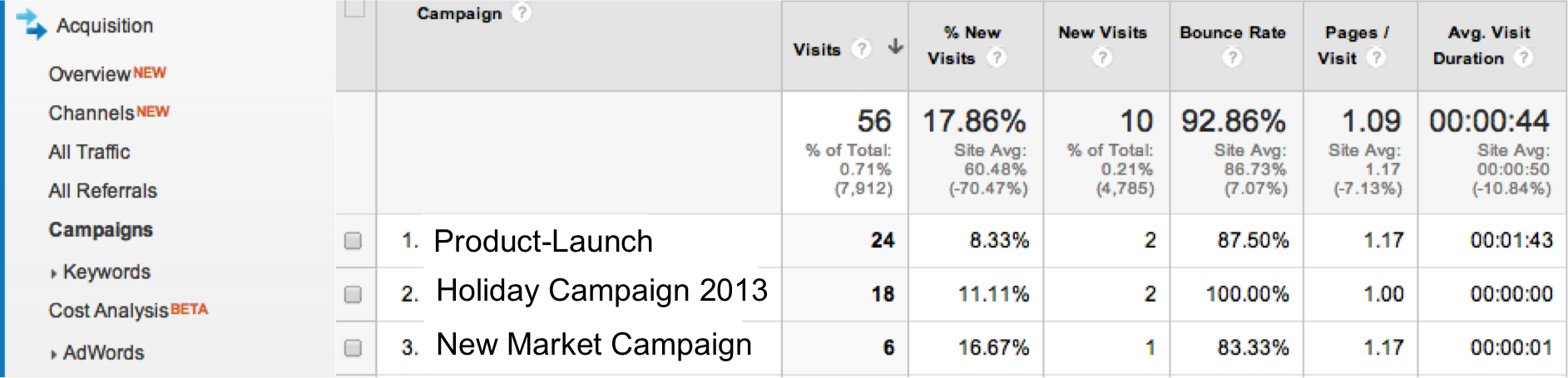
If you've set up your tracking URLs properly, you'll be able to see how many visits your campaign generated in the acquisition menu of Google Analytics, as shown in the image below. Sign in to Google Analytics, click 'Acquisition' in the left column, and then click 'Campaigns' to see your campaign traffic. 


HubSpot

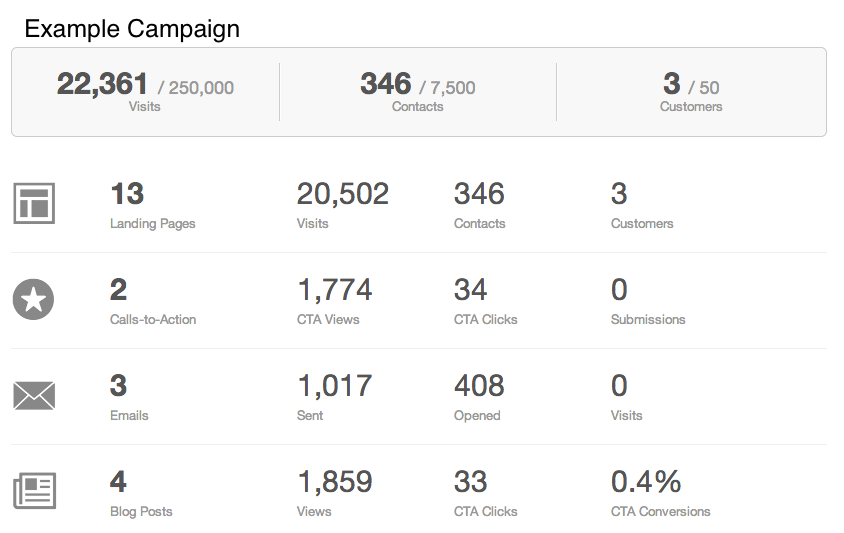
If you're a HubSpot customer, you can organize, execute, and measure your campaigns directly from the Campaign app. This will show you how many visits, contacts, and customers your campaign generated against your goals and how each promotion channel contributed to those outcomes.

There it is folks -- your recipe for an airtight marketing campaign. Want to remember this for next time? We made a simple, one-page checklist for you to hang at your desk or save to your computer.

If you're a HubSpot customer, there's also an entire Campaign-in-a-Box kit, including 10 different planning worksheets and a guide to using the new Campaigns app in HubSpot.

Now go out there and launch something remarkable!

Got some advice on how to put together a comprehensive inbound marketing plan? Be sure to share your thoughts below!

inbound marketing campaign free guide

subscribe to the hubspot marketing blog

09 Jan 16:20

Why B2B Marketing in 2014 must be about Content + Context + Conversation

by Bob Apollo


Content Marketing SpendFirst, a tip of the hat to David Meerman Scott and Doug Kessler for inspiring some of the ideas in this blog. In Isaac Newton’s words, It is only by standing on the shoulders of such giants that I have been able to see so far. I only hope that I can add value to their thinking without tumbling to the ground in the process.

Content marketing has emerged as one of the key growth areas for B2B marketing in 2014. It seems like everyone is jumping on the bandwagon. And yet, as Doug Kessler so eloquently explains, we are in the process of drowning in a deluge of drivel masquerading as thought leadership. It’s just that Doug didn’t use the word “drivel”. More on that later.

Diverting the deluge of drivel

How can we avoid contributing to this deluge of drivel? David Meerman Scott - referring to a conversation with Greg Alexander at Sales Benchmark Index - highlighted the important linkage between content and context.

Context is about the individual salesperson tailoring, targeting and interpreting the content generated by the marketing department so that it resonates with the specific interests of the individual prospect. It’s what the authors of The Challenger Sale refer to as “tailoring for relevance”.

It’s a great idea, but there’s a potential obstacle. Your top-performing, most customer-empathetic sales people are probably doing this as a matter of course. But they only represent a tiny proportion of the total sales population. The rest are probably going to need some help.

Changing the marketing mindset

Your content creators are the obvious people to turn to. But it’s going to require a change in the traditional attitudes I observe in a lot of B2B marketing departments and their agencies. You see, the creation of content isn’t the end in itself, and its publication does not indicate that the job is done.

In the complex B2B sales environments most of my clients operate in, the purpose of content must to be to stimulate and provoke the target audience, to make them want to learn more - and to encourage them to engage in a sales conversation.

In fact, if content isn’t designed with this ultimate goal of engagement in mind, you’ve got to question what its purpose is. The engagement might not be immediate. It might require regular nurturing. But at the end of the day, content must stimulate conversation.

Content must stimulate conversation

The implications for content creators are profound. It means that no piece of marketing content ought to be created without a clear sense of the sort of conversation it is intended to stimulate - and that means that every piece of content ought to be accompanied by context-setting conversation guidelines that every sales person can use with confidence.

But this thinking brings a clear advantage - if we choose to only create content that is designed to stimulate an insightful conversation with a key stakeholder in a target prospect about an issue that’s important to them, we’d all end up generating (and consuming) a lot less crap. Dang it, I used Doug’s c-word. But it was in a good cause, wasn’t it?

Taking this conversation forward...

If these ideas resonated with you, who are you going to share them with? How will you tailor it for relevance to your situation? And what sort of direction do you want the subsequent conversation to go in? Assuming you’ll end up talking with someone with responsibility for content marketing, here are a few talking points to get that conversation started:

    • What pieces of content have you got under development?
    • What role in what sort of company are the pieces aimed at?
    • What leads you to believe they might be interested in reading it?
    • What are you doing to try and stimulate them to engage?
    • What have you done to equip our sales people to have an insightful conversation?
    • What do you expect to happen next?

I think (and hope) that bringing together content + context + conversation is going to represent the Holy Trinity (if not the Holy Grail) for B2B content marketers in 2014, but, as ever, I’m interested in your experiences and opinions...


09 Jan 16:19

Why Selling Your Company Might Actually Make Sense

by Andrew Silver

Taking some chips off the table can be an excellent idea.

Many business owners are like gamblers. When their company is doing well, they are winning and the cash is piling up. They can’t imagine walking away and foregoing all the potential profit. But a wise gambler knows it is impossible to beat the house over a long period of time, and they cash in while they're ahead. Like a wise gambler, business owners should realize that cashing in today while business is booming is a great way to beat the odds and come out on top - even if they think they could win more by staying in the game. As that famous Kenny Rogers song reminds us, “You have to know when to hold 'em-- and know when to fold 'em! Know when to walk away - and when to run.”

Almost all successful business owners believe that their company’s future looks bright. After all, sales and profits are up and will certainly continue to grow. Therefore, the value of the company should continue to increase as well, right? So, they ask, “Why should I sell my company today when it’s going to be worth more tomorrow?” The simple answer is: Stuff happens. Bad stuff. Key employees leave. Customers defect. Competition intensifies. Owners age, get sick, or become fatigued. As it turns out, predicting the future of even the most successful businesses through the lens of today’s performance is not foolproof.

In early 2007, a business owner came to Allegiance Capital to discuss selling his company. The company was doing very well, and was poised for even more growth. Based upon potential future growth, he decided to delay the sale. However, the Great Recession hit, and the company’s value declined approximately 30%. Recently, he called to say that he is now ready to sell his company, because it had finally returned to its 2007 performance levels. No one can control the economy any more than they can control the cards being dealt at a blackjack table.

Even if you believe your company will be worth more tomorrow than today, and you trust your ability to sustain steady growth amidst market changes, you should still consider the time value of money. For example, would you rather have $99 today or $100 one year from now? Most people would take the money today. How about $50 today vs. $100 in one year? Most will wait for the $100. This illustrates the time value of money.

The value of a dollar invested in a business today is determined by the risk involved in the business compared to other types of investments. For example, a low-risk business services company with a solid customer base, a high level of repeat business, very fragmented competition, and low capital requirements faces less risk of loss. The owner can be fairly confident in their financial projections, and won’t take the $50 being offered today. They will wait for the $100 because the business is very stable with minimal risk.

A biotech entrepreneur developing a new drug faces an entirely different scenario. The new drug could be a financial home run, but the company could just as easily strike out if the drug doesn’t prove effective. Only after thorough testing, FDA approval, and the investment of large amounts of capital will the owner know if the business is a winner. The owner may be willing to take the $50 today, as opposed to rolling the dice for a shot at $100 in the future.

Unknown risks may also be lurking around the corner that cannot be predicted or controlled. New competitors can move in, new, expensive technology can replace proven methods, and finally, the owner’s health can deteriorate. If you knew you could sell all or part of your company today and deposit some number of millions of dollars into your financial portfolio, would you do it? Even if you knew the value of the company could rise in the future?

Selling all or part of the company enables the owner to take some chips off the table while the company is still performing well, and it provides two distinct benefits. It ensures the owner’s personal financial future, and it taps into any future success as the company grows. Even if the owner’s health declines or the company performance dips, the funds invested from the sale will still be available.

Selling for less today may be your first step to a more stable financial future tomorrow. Don’t gamble with your financial future. You can sell and still stay in the game.


09 Jan 16:19

10 Phrases Great Speakers Never Say

by Jeff Haden

Want to ruin a presentation in seconds? Just drop in one of these sentences.

While it's really hard to immediately win over a crowd, it's really easy for a speaker to lose the room within the first few minutes of a presentation.

To make sure you don't lose your audience, here's Boris Veldhuijzen van Zanten, serial entrepreneur and founder of TwitterCounter and The Next Web, with ten things you should never say during your presentations:

1. "I'm jet-lagged/tired/hungover."

Not sure where this comes from, but one in five presentations at any conference starts with an excuse: "They only invited me yesterday," or, "I'm really tired from my trip," or some other lame excuse the audience really doesn't want to hear.

We, the audience, just want to see you give it your best. If you feel like crap and can't give it your best, maybe you should have cancelled. Take a pill, drink an espresso and kill it!

2. "Can you hear me? Yes you can!"

This is how many people start their talks. They tap a microphone three times, shout, "Can you all hear me in the back?" and then smile apologetically when it becomes clear that, yes everybody can hear them, but no one raised their hand.

It isn't your responsibility to check the audio. There are people for that. (And if there aren't, test the volume ahead of time.)

But if you do speak into the microphone and get the impression it's not working, just relax, count to three, and try again. If you still think the sound isn't working, calmly walk to the edge of the stage and discreetly ask the moderator to check for you.

Throughout, smile at the audience and look confident. Assume everything works until proven otherwise, then stay calm and wait for a fix.

3. "I can't see you because the lights are too bright."

Yes, when you are on stage the lights are bright and hot and it will be difficult to see the audience. But they don't have to know about all that.

Just stare into the dark, smile often, and act like you feel right at home. Feel free to walk into the audience if you want to see them up close.

And don't cover your eyes to see people but politely ask the lights person to turn up the lights in the room if you want to count hands or ask the audience a question. Even better, talk to the lights people in advance so they know when you will ask them to raise the lights.

4. "I'll get back to that later."

If you happen to stumble on an audience eager to learn and interact, grab that chance and enjoy it. If someone has a question you will address in a later slide just skip to it right away.

If someone is brave enough to raise their hand and ask you a question, compliment them and invite the rest of the audience to do the same. Never delay anything.

5. "Can you read this?"

The common rule is to make the font size on your slides twice the size of the average age of the audience. Yes, that means that if you expect the audience to be 40 then on average you are stuck with a font size of 80 points.

You won't be able to fit a lot of text on the slide, which is a good thing and brings us to the next point.

6. "Let me read this out loud for you."

Never ever, ever, ever in a million years add so much text to a slide that people will spend time reading it. And if you do, make damn sure you don't read it out loud for them.

The best way to lose your audience's attention is to add text to a slide. Here's what happens when you have more than four words on a slide: people start reading it. And what happens when start reading? They stop listening to you.

Only use short titles on slides, and memorize any text you want the audience to read. Or, if you must include an awesome three-sentence quote, announce that everyone should read the quote and then be quiet for six to ten seconds so they can actually read it.

7. "Shut off your phone/laptop/tablet."

Once upon a time you could ask an audience to shut off their devices. Not anymore. Now people tweet the awesome quotes you produce or take notes on their iPads. Or they play solitaire or check Facebook.

You can ask for the audience to turn their phones to silent mode, but apart from that you just have to make sure that your talk is so incredibly inspiring they will close their laptops because they don't want to miss a second.

Demanding attention doesn't work. Earn attention instead.

8. "You don't need to write anything down or take photos; the presentation will be online later."

It is really cool that you will upload your presentation later. But if it's a good presentation it won't contain too many words (see point 4) and won't be of much use to the audience.

For many people the act of writing is an easy way to memorize something they've heard. In short, allow people to do whatever they want during your presentations.

9. "Let me answer that question."

Of course it is awesome if you answer a question right away, but you need to do something else first. Often the question from an audience member will be clear to you but not to the rest of the audience.

So please say, "I'll repeat that question first so everybody can hear it," and then answer it.

Plus, when you make a habit of repeating questions, that gives you a little more time to think of an awesome answer.

10. "I'll keep it short."

This is a promise no one keeps. But a lot of presentations start that way!

The audience really doesn't care if you keep it short or not. They've invested their time and just want to be informed and inspired. So say, "This presentation is going to change your life," or, "This presentation is scheduled to take 30 minutes, but I'll do it in 25 minutes so you can go out and have a coffee earlier than expected."

Then all you have to do is keep that promise, which brings me to the last point.

Bonus tip: "What, I'm out of time? But I have 23 more slides!"

If you come unprepared and need more time than allowed, you've screwed up. You must practice your presentation and make it fit within the allotted time.

Better yet, end five minutes early and ask if anyone has questions. If they don't, invite them for a coffee to talk one-on-one. Giving an audience five minutes back earns their respect and gratitude. Taking an extra five annoys and alienates them.

Conclusion: come prepared, be yourself and be professional. The audience will love you for being clear, for being serious, and for not wasting their time.


09 Jan 16:05

How Does Your B2B Brand Reflect On Your Buyers?

by ArdathAlbee
Rnordman

Good POV

Fun-house-mirrorI've been reading a lot of posts lately about making emotional connections with B2B buyers, along with reminders not to forget their personal side. But this doesn't mean to start looking at them as B2C consumers - even though they are when they're away from the office. In professional mode, "personal" is a bit different.

And for all of you wondering - this does not mean that 2 dogs and a house in the suburbs is information that will help you.

Personal attributes for a B2B buyer are still related to the role they play at work. Some of the most basic questions of a personal nature that cross B2B buyers' minds include:

  • How will this decision affect my career?
  • Will this decision help save my job during the reorganization that will happen with the upcoming merger?
  • Will solving this problem help me earn a promotion?
  • Will this decision increase the value my company sees in me?

But when you look beyond those considerations, how does their perception of your brand influence their thinking? Is what they come across representative of the way you want your brand to be seen? Is their experience consistent across channels?

Could the way you represent yourself across channels be costing you business?

Below are a few situations to consider:

  • What will my peers and colleagues think if I choose them?
  • They're too hip and cool for our conservative culture. Will my executive team believe there is really enough substance?
  • They're really conservative - will they bring the innovative ideas I'll need in the future? Then again, I can probably trust them not to take a flyer...
  • They have some really smart people working for them - their blog is awesome - but every time the corporate Twitter handle Tweets it's about sports stuff or product discounts. Given how much the solution we're looking at costs, if my CFO ever sees that...
  • I asked a sales guy an industry question he couldn't answer yesterday. Today he sent me a link to a great thread where thought leaders were weighing in. It wasn't even produced by his company. I like this guy!
  • My friend just emailed me a link to a LinkedIn discussion where a gal at a company we're considering buying a solution from got defensive about something one of my colleagues posted. Uh oh...
  • I'm so tired of webinars that are really sales pitches. When they don't provide the value they promise on a webinar, will they deliver if you buy? It makes me wonder if they'd always be trying to upsell me if I became their customer.
  • Every time I get an email from this company I can't wait to see what they sent me. It's always great stuff. And if I can't use it, I know someone who can and forward it along. They make me look good.

Are any of these happening at your brand? Obviously, I've painted a picture that includes good and bad stuff. Even exagerated some of it to make a point. But this stuff actually happens. I've heard versions of most of these brought up in meetings. I've been forwarded links to stuff with WTF? notes from my clients and colleagues.

The truth is, social media and user-generated content and channel proliferation has created a version of reality that often reminds me a lot of high school. Operating in this environment is a lot like working under a microscope. But, if so, we need to adjust - and fast!

The truth of the matter is that you'll never be a fit for everyone. Making sure that your brand is aligned with your target markets is the best a company can hope for. Still a big task, but made more manageable. Putting buyers at the center of what you do also helps.

But this reality is also a rallying cry for working together. For breaking down silos and opening the lines of communication to help get everyone on the same page. Sure, they'll be outliers, but when each of us is by extension representative of the brand we're affiliated with, more thought needs to be given.

If the social media team isn't talking to the demand gen team who isn't talking to the web marketing team or the events team or the PR team and none of them are talking with the sales team - what are the chances that your brand is being perceived by your buyers in a way that's costing you sales?

When will we "get" it?

Step into your buyers' shoes and go take a look at your brand from the outside-in. Go look at all the channels through the experience your buyers will have. What do you think?

Are you inspired? Energized? Intrigued? Or are you disappointed, even alienated?

What one thing can you do today to shift the status quo?

Just take one step and then work on the next one. Once you recognize the issue, it's often taking that first step that's the hardest. You can do it. I have faith.

09 Jan 16:01

How to Drive Sales With Content Marketing

by Aaron Aders

How brand propinquity can drive leads and sales online through content marketing and digital PR.

Sociologists define propinquity as the human phenomenon that close proximity (physical or psychological) will greatly increase the likelihood of developing friendships. Friendships are crucial to sales, since we must earn our prospect's trust to move forward with a partnership.

Tom Martin, author of The Invisible Sale, recently gave a presentation that explains how organizations can use propinquity in content marketing to drive more sales. Businesses that do this effectively are able to place a high volume of branded content in strategic positions that develop brand propinquity in your marketplace. In other words, your prospects run into your branded content more often than your competitors.

This increased proximity of branded content increases the probability that your brand will gain favor with your target audience. However, there is one caveat--this brand preference only applies to high quality and helpful content. Bad content in close proximity to your target audience can have the reverse effect.

If your organization is willing to develop high quality content and build strategic PR relationships, then your brand can develop propinquity in your marketplace that will develop lead generation and sales online. Here's how to do it:

Define Your Propinquity (P) Points

The first step to developing propinquity in your marketplace is to define your propinquity points. These can be media outlets, blogs, news aggregators and social networks that are core to your industry. It is also worthwhile to dig deep into your buyer personae and target niche communities or groups of buyers. Tying niche interests together in ways that your competition has not yet discovered can uncover fresh sales opportunities. These niche interests can be discovered through a process called Keyword Mapping.

Keyword Mapping

Discovery requires the ability to truly listen and 'learn your prospect's language' to find keywords that lead to P-points. Dig deep into conversations happening on blogs, forums and social networks. Tools like Experian Hitwise, Compete.com and others can give great data and insight to help keyword mapping, but the qualitative aspects of the online conversations must be understood to communicate in a way that will be receptive among your target audience. Use these keywords to discover the best P-point opportunities.

Social Listening

Social listening tools give insight into historical and real-time conversations that are happening in your marketplace, and are another great way to discover P-points. Use one of the many free social listening tools to understand the topics and influencers in your industry. Build lists on Twitter to follow these influencers and understand what is important to them. Research the most shared URLs to understand what content is 'sticky' with your target audience. All of these are great ways to discover P-points.

Classify Your P-Points

Divide your P-points into one of two categories: Embassies and Outposts.

Embassies are the high quality niche communities that might not have the largest audience, but most likely have the highest concentration of your buyer personae. This is the best place to drive referral traffic, authoritative branded content endorsements and really increase brand propinquity among your target audience. Put your efforts here first.

The second category is outposts. These are more broad audiences, such as a general news website or social network. These broad audiences are not as targeted as embassies and the lead generation and referral traffic will not be as rich. However, outposts are very effective in scaling digital brand endorsements via audience syndication, which is extremely valuable to SEO objectives. Be sure to mix in a few outposts when placing content on P-points.

Develop Brand Propinquity in Your Marketplace

Content marketing and digital PR is an effective way to drive genuine trust in your marketplace through higher brand propinquity. High quality content on relevant embassies and outposts will drive trust among visitors and search engines alike, which ultimately turn into sales for your business. If you are new to content marketing, then kick-off 2014 with a robust content marketing campaign to develop online leads & sales through high quality brand propinquity.


09 Jan 15:59

In Sales, Can You Manage What You’re Measuring?

by Jason Jordan

It goes without saying that there is a significant amount of pressure on every sales force to deliver its number. Sales management plays a crucial role in reaching that objective, but can sales performance really be managed? I mean, tactically managed? Our research suggests that it can… sort of.

Vantage Point Performance and the Sales Education Foundation recently conducted a study on the measurement and management of sales forces. We collected thousands of data points from sales leaders in various industries regarding which sales metrics they anxiously monitor on their dashboards, from top-line revenue growth down to the number of sales calls made per month. The data points revealed 306 metrics considered by leadership to be key to effective sales management. But which ones really mattered?

We looked at each metric individually and asked the question, “Can this metric be managed?” Our criteria for managing became that a frontline sales manager could directly influence the metric by asking someone to do something differently and experience the desired change in the metric. Our research confirmed our suspicion that some numbers just can’t be managed, no matter how hard sales leaders try. However, our research also revealed that some numbers can be managed, yet we found that few organizations are actively managing the metrics that are manageable.

We found three different classes of sales metrics, each with its own managerial value and purpose. At the highest level, the sales forces in our study were measuring what we call Business Results. Business Results are the metrics, such as revenue and market share, that represent the culmination of an entire organization’s efforts. As much as sales managers talk about “managing revenue” or “managing market share,” Business Results are ultimately unmanageable. If sales managers could directly manage revenue, then every sales force in the world would exceed its target. “We need more revenue,” would sound from the top. “No problem,” would echo from the bottom. But this doesn’t happen.

We also found that there was a second kind of sales metric that, while not directly manageable, could be heavily influenced — Sales Objectives. Sales Objectives are the specific targets that an organization asks a sales force to reach, like winning certain customers or selling certain products. But Sales Objectives are not directly manageable either. To acquire new customers or sell certain types of products requires consent from buyers, and we all know that buyers are prickly market participants.

What sales managers can control are the third class of metric: Sales Activities. These are the numbers sales managers collect, such as the number of sales calls or percentage of account plans completed. This is very tactical stuff – the stuff that salespeople and their managers actually do. Sales Activities are the metrics that can actually be managed. Want more sales calls each week? Make it happen, sales force. Want more account plans completed? Make that happen, too. You might encounter process or compliance issues, but that’s why you have sales management.

Of course the other metrics are important, but those numbers are lagging indicators. Business Results and Sales Objectives today are the result of Sales Activities last quarter. If a sales force makes more sales calls (a Sales Activity), then it will probably acquire more new customers (a Sales Objective). If more customers are acquired, more sales will likely follow (a Business Result). Or if your sales force does better account planning (a Sales Activity), it will probably do a better job of retaining and growing its customers (a Sales Objective), and if your sales force retains and grows your customers, revenue will pour in the door (a Business Result).

Once senior leadership realizes that the path to increased revenue is a little more nuanced than just riding the sales herd harder, this cause and effect relationship is astoundingly powerful. Sales leaders need to steer their sales force in the right direction with good, crisp Sales Objectives. With clear Sales Objectives, the sales force can better identify what Sales Activities will move the needle. Should I be doing more prospecting or more major account management this week? Well, it depends on which Sales Objective I’m pursuing… new customer acquisition or key account growth. Clarity of task is a powerful motivator.

The only bad news we took from our research is that companies don’t actually measure the metric they can control — Sales Activities. In our study, we found that of all the metrics being used to “manage” sales performance, only 17% were Sales Activities, 24% were Business Results, and 59% were Sales Objectives. That means that 83% of all the numbers on all of the sales dashboard are completely unmanageable. That’s a lot of time spent wringing hands over things you can’t control.

So think about what your sales force does, and think about what you measure. If you’re not confident that your sellers are doing the right things between Monday and Friday, then you might want to give some consideration to that cause-and-effect relationship — Sales Activities drive Sales Objectives that drive Business Results. And if you’re not measuring Sales Activities, then it’s kind of hard to be certain your lagging indicators are going to reveal a healthy company. More time wringing those hands.

09 Jan 15:52

Marketing VS Sales: Yeah, There’s A Difference

by Brooke Ballard

Ah, the age old battle: Marketing VS Sales.

Some people swear that marketing drives sales, and others would bet their life that sales doesn’t need marketing to thrive.

Whichever your belief, it’s really good to know the difference between the two!

Marketing VS Sales: Yeah, There’s A Difference image B2 marketing VS sales

Marketing VS Sales: The Breakdown

Goals

  1. Marketing: With marketing the goal is always centered around positioning. What’s positioning? Simply put, it means to align your brand with your particular niche or industry; it’s the marketer’s constant need to make an impression on current and would-be customers.
  2. Sales: With sales it’s no secret that the goal is always more — you guessed it — sales! With quotas to meet, there’s not much room for anything else.

State Of Mind

  1. Marketing: For marketers to achieve continued success, they must operate around a integrated marketing strategy. This means helping with branding, messaging, communications, and sales.
  2. Sales: Sales associates usually do not worry about an overarching strategy when it comes to garnering more sales, rather use tried-and-true tactics (such as making 100 sales calls each week) to determine success.

Knowledge Base

  1. Marketing: There are literally thousands of technical aspects a marketer must know to employ, measure, and report on their campaigns. Advertising & PPC; Web Design & Analytics; Database Management and/or CRM; Automation; Statistics and Reporting, etc.
  2. Sales: Execution, or better known to sales reps as, “making shiz happen.” This is their main concern and main responsibility; experience and “who you know” plays a big role here.

I Heart _____!

  1. Marketing: While smart marketers love the customer (because they realize the consumer shapes the brand), at the end of the day they must love, support and continue to reinvent the brand.
  2. Sales: Meanwhile, smart sales reps love their customers. By focusing on the customer and their needs, they can boost repeat business and referrals, and that just means more execution and more SALES!

Audience

  1. Marketing: The marketing department has large shoes to fill when it comes to providing the types of content and messaging each brand needs because they not only have to focus on the customer, they have to make efforts to reach investors and manage public relations.
  2. Sales: Again, sales has the luxury of worrying about their #1 – the customer!

Perspective

  1. Marketing: While marketing focuses on the brand (hey, it’s what they love!), I believe we’re seeing a shift to be more customer-centric. I’m not sure the consumer will ever take first place with the marketing department, but in my mind they should be a very close second.
  2. Sales: If you know any hardcore sales reps, you KNOW they’ve got the customers back – often times more so than the company’s. It makes sense since these people are their bread and butter, but sales reps would do themselves a favor by learning to present the company in a better light (and work hand-in-hand with marketing).

Marketing VS Sales: Yeah, There’s A Difference image sales

Comparisons

Essentially both marketing and sales aim to increase brand exposure and revenue. Additionally, both sales and marketing work to convert prospects to paying and loyal customers.

Differences

Marketing involves a “one to many” approach to meet the outlined goals, while sales uses a “one to one” strategy.

Sales can be tactic based because they are working in shorter cycles with push-based tactics, whereas marketing must create a long-term strategy based on pull-based tactics.

Marketing VS Sales: Yeah, There’s A Difference image marketing strategy

Marketing & Sales Need To Work Together

Good marketers are adding value to the sales process. Good sales reps are giving invaluable information to marketers about the current landscape as well as customer feedback.

It takes a diligent effort from both teams to continuously reach out and touch prospective clients through the pipeline.

Have you developed a process for aligning these two important aspects of business? Let us know how you navigate the balancing act in the comments section below!

See you in the social sphere!

09 Jan 15:48

3 Ways Financial Services Companies Can Use Video to Increase Leads

by Alex Sobal

3 Ways Financial Services Companies Can Use Video to Increase Leads image Filming A CommercialThough 2013 saw a huge upswing in the total number of businesses using inbound marketing strategies, there are still several industries that have been slow to hop on the inbound bandwagon. One of these industries is the financial services sector. And while the financial industry must comply with strict regulations that determine what their content can and can’t say, as businesses and consumers continue to tune out traditional, outbound strategies, financial companies can’t afford to keep ignoring inbound – especially visual content.

Why so slow to take off?

As mentioned above, one of the biggest reasons inbound marketing has been so slow to take off in the financial industry is because there are strict regulations on what the content is allowed to say. However, not only have marketers been limited in the language they can use, financial companies are often forced to deal with prolonged purchase cycles, as most consumers do tons of research before applying for a loan, switching banks, or making new investments.

Why should my business even consider inbound marketing then?

Though the reasons above have certainly attributed to making inbound marketing more difficult for financial companies, what they forget to mention is the industry’s complexity and the difficulties most people have when it comes to understanding industry jargon. Because people have a hard time understanding the services your business offers, this means they’ll have plenty of questions that they need answered (contributing to the long purchase cycle). In fact, did you know 37% of American adults use the internet just to search for financial information (stock quotes, interest rates, etc.)?! Without an established web presence, you could cause your business to miss out on thousands of new lead opportunities!

What should I be doing to get noticed?

For starters, if your business isn’t using social media, you’ll want to get started right away (you can download our step-by-step guide right here). If you’re a little behind, don’t worry! Because of the lag in inbound implementation by financial service companies, businesses are still seeing a 31% year-over-year growth on social media. Otherwise, for those who have already established a social media presence, it’s time to shift your focus towards content creation. However, instead of just writing another blog post or eBook, your financial company should try re-shifting its focus and create a unique, branded video.

Why video?

Not only is visual content one of the most popular trends in inbound marketing today (YouTube is the 2nd most popular search engine behind Google), it’s actually been proven to be one of the most effective forms of content as well. In fact, the average person can retain 95% of video after 72 hours, as opposed to retaining a mere 10% of the text they’ve read, or 65% of an image they’ve seen. Take into consideration that over 4 billion online videos are watched each day and that consumers are 46% more likely to investigate a product after watching an online video about it, and you start to realize just how big of an impact video can make for your business.

But how?

There are two big mistakes financial service companies make when creating an online video: trying to make a video that goes viral and not connecting the consumer with the video.

While you obviously want people to find, watch, and share your video, you want them to do it for the right reasons. If your goal is to help consumers better understand the mortgage preapproval process, make sure that’s what they takeaway from your video! Businesses and consumers alike are very serious about their finances, so when they come to you for help or advice, don’t waste their time with irrelevant information for the sake of laughs. However, at the same time, it’s also important that your videos aren’t so cut and dry, they’re unwatchable. Instead, use humor that distract from your message and create a connection to your audience by using story telling to help paint picture of what your business can do for them.

In order to optimize the effectiveness of your videos, try making some that appeal to several different needs. For example:

  • “_________ for Dummies” – as mentioned before, the financial industry is full of services and terminology that the general public just doesn’t understand. To help establish your business as experts in the industry, try making some short videos that answer some of your customers’ most commonly asked financial questions.
  • “Financing for __________” – one of the most important things businesses and consumers look for when selecting a financial service company is one that truly understands their unique needs. Because bank accounts, investments, and loans all come in different amounts and sizes, it’s important your customers select the one that’s the best overall fit for them. For instance, if you’re targeting college students, make a video that explains the benefits and features of your student checking accounts.
  • The “look what you can accomplish with us” video – Whereas other product videos might show off the features you get when selecting a certain service, this video focuses on the end result, and what you can accomplish using those features.

Now that you know what you should be doing, check out some of these excellent examples from financial service firms that are doing inbound marketing right:

American Express – #PassionProject

PNC Bank – Virtual Wallet

Need a few pointers on the video equipment needed to make high quality videos like the pros – including cameras, mics, and editing software? If so, then check out this helpful blog post by clicking the button below:

3 Ways Financial Services Companies Can Use Video to Increase Leads image learn more button

Image Credit 1

09 Jan 15:48

Employees: A New Sales and Marketing Channel

by Dick Beedon

More and more companies are starting to implement strategies and systems to leverage customers, employees and 3rd party influencers to become sales and marketing channels.  And they are doing it with great success.  In this blog I will touch on:

  1. Why employees make a good sales and marketing channel
  2. What employees can do to drive sales and marketing productivity
  3. The benefits of activating and automating employees to become brand advocates
  4. Why now?

1) There are many reasons why employees have the potential to be a powerful sales and marketing channel for your brand.  First, in today’s connected world, employees can reach their social networks on the brands behalf, easily and often.  They have a strong voice.  In addition, employees are typically very knowledgeable about your products and services and a good percentage of them are passionate about the company.  Lastly, their friends listen to them and they can drive your brands message.  More than ever before, buyers look to a trusted source before making a purchase decision.  Employees can and will reach out to their social networks and spread a brand’s message, especially if they are encouraged and enabled to do so.

2) Employees do many things that are very important to the brand.  They can:

  • Refer their friends.
  • Recruit new hires and great talent
  • Amplify marketing messages
  • Forward content about new products and promotions
  • Write testimonials

Even better? They can do these things at scale.

3) The benefits are impressive.  Leads are the lifeblood of all companies and by enabling and encouraging employees to refer their friends, brands can:

  • Build brand awareness and build a highly positive reputation
  • Generate the highest quality leads – leads that drive new customer acquisition
  • Create higher levels of employee enthusiasm and loyalty to your company
  • Save money and lower risk when compared to traditional advertising and marketing initiatives

4) Why now?  Although employee advocacy isn’t a new concept, in the past it has been an operational nightmare to create and manage these programs. But today’s technology has made it easy for administrators to set up, support and manage advocacy programs.  Technology makes it easy to:

  • Enroll employees into the program
  • Provide employees the tools to easily reach out to their networks
  • Track and manage all the workflows and controls so brands can measure results
  • Automate the process of brands thanking and nurturing employees for their contributions so they continue to advocate on behalf of the brand

This is not a future pipedream. Mobilizing employees, customers and 3rd party influencers to leverage their trusted relationships is happening everywhere because it is smart business: they are a sales and marketing channels of the future.

09 Jan 15:48

How a Glove Manufacturer Exceeded Sales Goals with Multi-Touch Email & Teleprospecting

by Laurie Beasley

How a Glove Manufacturer Exceeded Sales Goals with Multi Touch Email & Teleprospecting image water flowerIn the previous four posts on the importance of multi-touch lead nurturing, we discussed what it takes to deliver a qualified, sales-ready lead. In summary, we said:

  • Marketing is now required to generate more of the higher quality sales-ready leads defined by the sales organization.
  • This isn’t easy to do. Marketing automation can’t make it happen alone.
  • You’re going to have to plan for multiple touches and multiple channels unique to each market and buying conditions.
  • To shorten the process: have a comprehensive plan, targeted lists, segmented messaging, compelling offers, great creative (email, direct mail, etc.), a plan for personal touches (tele-prospecting)—and track the metrics so you can adjust.
  • We also said that marketing must take over the job of pre-qualifying leads. The leads that come in from marketing automation software or over-the-transom inquiries simply do not contain the level of data that Sales requires to justify their limited time and sales resources.

In this post, we’re we’ll take a look at a real-world scenario in which a major manufacturer of industrial gloves put these principles into action and reaped the benefits.

RELATED CLASS: How To Understand Your Buyers: 5 Insights for Better B2B Marketing

Multi-Touch Lead Nurturing Case Study: Glove Manufacturer

The ABC Glove Corporation (not the real name—we can’t reveal it in this post) is a leader in the field of industrial gloves. The average value of a new customer account to ABC is high—around $50,000 per customer per year. The target contact is a decision maker in safety, operations or purchasing within metal manufacturing industries.

ABC’s ambitious goal was to gain $2.5 million in incremental sales. The corporation’s marketing department tried everything: pay-per-click advertising, email, tradeshows and more—but could not acquire enough qualified sales leads to hit this target. ABC called us in to help them take a fresh and more productive approach.

RELATED CLASS: Enterprise Sales Predictions: How to Use Big Data to Predict Sales & Increase Revenue

First, we identified the “sales-ready A lead” criteria based on their selling process and marketplace. Then we did some simple, back-of-the-napkin analysis of the needs of the lead-to-sales funnel. Based on the estimations of the vice president of marketing, we found that achieving an incremental $2.5 million in annual sales at $50,000 per sale meant they would have to close 50 new sales in a year. At a 20% proposal close rate, they needed 250 qualified sales opportunities in the proposal stage. At a 25% conversion rate (qualified sales-ready A leads to proposal rate), ABC needed 1,000 “Qualified A” leads in the sales team pipeline. And the conversion rate of marketing inquiry level (MQL) leads to sales-ready A leads is 10%. The bottom line: ABC Corporation needed 10,000 MQLs in the top of the demand generation funnel process to be able to hit their incremental sales target.

Why wouldn’t email alone work?

The VP of marketing estimated that on the high end, the available universe of companies in metal manufacturing was roughly 7,500. If ABC emailed all 7,500 and got a 1% inbound response, that would equal 75. If 50% of those leads filled out a form, that would result in 35 marketing-level MQL leads and only 7.5 Sales-ready A leads. ABC would have to email to this list at least 285 times to get the 10,000 marketing-level leads in the pipeline. (But it is unlikely that every email would result in a 1% inbound response as the response rates from this small audience would decline over time.)

So email alone could not achieve the sales goals.

Multi-Touch and Multi-Channel Solution

Under the conditions of this small but highly valuable target market, we determined that ABC needed a much higher lead-to-sale conversion process to meet their sales goals. We recommended a multi-touch and multi-channel sequence of email and tele-prospecting with comprehensive metrics benchmarking.

How a Glove Manufacturer Exceeded Sales Goals with Multi Touch Email & Teleprospecting image sales funnel

RELATED CLASS: How to Setup a Lead Management Process

We normally recommend testing different approaches with a small sample of prospects to see which approach stimulates the highest response level. In this case, we tested two offers: a book about physical safety in the metal manufacturing environment versus the offer of a free pair of gloves. The VP of marketing suggested the offer of a free pair of gloves because in his experience, the prospect would request a sample pair in any case, so he felt this would short-circuit the process to some degree. We were less certain, as we have found in the past that a free sample sometimes feels like too much of a commitment early in the relationship. We also tested two lists, an in-house list versus a rental list.

The test showed that the appeal of the offer was about equal between the gloves and the book. We went with the gloves for the final campaign because sooner or later, the prospect would request a free pair of gloves anyway. Both lists performed equally well.

The multi-touch lead nurturing process involved:

  • Initial email campaign
  • Initial call (left voice message or in some accounts we must be directed to proper contact)
  • Call to engage new contact in the value prop and offers
  • Email to correct contact, and or email content as requested to support our dialog
  • Call to complete the value prop and offer conversation, listen to needs and pain points and gather those critical data points into the lead qualification script-record, and if qualified, close on ABC sales rep appointment

Remember that we have been saying it takes seven to 13-plus touches to deliver a sales-ready lead? In this case, the average number of touches was 4.28. Why did our campaign for ABC require so few touches? The answer is embedded in what we’ve been saying all along:

  • Have a good list (few incorrect contacts)
  • Develop creative that captures hearts and minds and have follow up content and dialog to support it
  • Offer something of high perceived value
  • Optimize the value proposition delivery by adding teleprospecting to the mix. This creates a personal relationship with the prospect. Remember: people buy from people, and prospects don’t share their qualifying pain points online.

While we can’t share final numbers for incremental sales for this client, we do know that the client’s sales team is delighted with the results and they are continuing to implement our multi-touch, multi-channel approach.

Learn how to nurture more leads to qualified with an effective marketing automation program.

Watch Marketing Automation Best Practices for Success, and get expert advice to build your case for marketing automation, select the right solution, develop the right people with the right skills, and define your implementation strategy. Get instant access to this class now

09 Jan 15:47

Sales training: keep it simple…and quick to value

by Corporate Visions

Today’s sales professionals are faced with unprecedented and important changes in their world of work:

  • Increased use of online resources that provide instant access to real-time information. This helps accelerate the sales process…but also makes it harder for sales reps to focus, concentrate, and avoid distraction.
  • Higher levels of information overload from that same technology.  The flood of data from company email, CRM systems, and personal use of knowledge tools has helped create an “I want it now” expectation from sales reps when it comes to job-related information access.
  • Intensifying response time compression, an increased pressure from customers and colleagues for 24/7 availability, increased speed of response, and reduced time out of field to quickly solve problems.  Customers want answers faster…and so do today’s sales training participants.

These changes, and others like them, have made it more important than ever to deploy training that is simple, memorable, and quick to value for the sales team.

Yet many organizations still implement sales training that is overly complex, quickly forgotten, and slow to produce value for participants; training that describes complicated sales process models that are hard to remember and apply; training that makes logical sense, but is forgotten a month later in the field.

What can be done? Deployment of online training and tools is key for success. More importantly, an increased focus on the application of bite-sized learning content in the field can address the need for training delivered when you need it, where you need it.

The results of this approach? Higher levels of user adoption of sales training content, more focused field coaching, increased “stickiness” of key skills…and both larger and more profitable customer relationships.

09 Jan 15:47

2014 HotList and Inside Sales Trends Report – Hot off the Press

by Josiane Feigon

14 in 2014 Inside Sales Trends CHappy New Year!

 
We just released our popular Hotlist: What’s In/Out in 2014 in Sales and our long-awaited 14 in 2014 Inside Sales Trend Report is out- this annual report is loaded with sales/marketing/social direction for this New Year. 

Download your copy now! 

The post 2014 HotList and Inside Sales Trends Report – Hot off the Press appeared first on TeleSmart Communications.

08 Jan 17:06

How CRM Can Help You Build And Retain Stronger Sales Teams

by Lauren Licata

How CRM Can Help You Build And Retain Stronger Sales Teams image 750x240xHow To Build and Retain Stronger Sales Teams With CRM.png.pagespeed.ic .GvAk1Gl2F71 600x192

A CRM application can help your team create follow-up strategies for salesmanage and enhance your sales pipeline, and turn sales data into actionable insights.  But did you ever think that it can also help you manage and improve the team itself?  It can help a team member with onboarding and training all the way through goal-tracking and self-assessment and improvement.  It will also keep the whole team focused on the practices that lead to successful sales. Here are a few ways a CRM tracking tool can help retain stronger sales teams:

Train new employees faster – and the right way

The sooner you can get new employees up to speed, the sooner they’ll be engaged in their work and equipped to make a sale. Leadership IQ, a research and management consulting firm, reports 67% of employees learn about their jobs from co-workers. According to a Fast Company article by Paul Glover, this means new employees engage in “behavior modeling” – copying their coworkers instead of their bosses.  Even though this kind of behavior modeling is inevitable and natural, it is also potentially dangerous. Equip new hires with a variety of resources. In addition to training education, introduce them to business critical tools, like your CRM right away. For example, let’s say you hire a promising new sales representative.  They were a top performer at their last job, and their enthused about your product – a combination that gives you high hopes for them.  On their first day, introduce them to your CRM.  Instead of just providing tips and tasks that work for your more successful reps. use the application to demonstrate that their daily tasks and goals are defined by the hard data at their fingertips.  This will help them grasp how your company manages its sales pipeline and what metrics you take seriously.

Establish clear performance metrics and make rep’s accountable

According to Elena Bajic, Forbes Contributor, you should establish well defined metrics for evaluating an employee’s contribution to achieving goals. Using the CRM, you and your team can outline individual actionable steps that lead to a successful sale from calls to appointments to meetings and finally closes.  Once these steps are identified, you can use the hard data provided by the CRM to set initial goals that will enable them to meet their monthly sales quotas.   For instance, as a new employee, you may only expect a rate of 10% in setting appointments, but by the end of the year, they’ll need an 80% appointment set rate and 32 closed sales to keep up with the rest of the team.  If you look at Base CRM’s won deals report, what percentage of appointments has lead to closed deals? Your new potential star is going to need to see at least 40 people a month to meet the 32closed sales quota.  You can also see that 20% of all appointments are dropped, so they’ll need to send up 50 meetings in order to actually meet with 40.  And, if only 20% of the calls they make result in meetings, they’ll need to make at least 500 calls a month.  Now they know exactly which steps to take to hit the ground running!

Empower employees to own their pipeline – and commission

Once hard at work, employees can track their own progress on the road to their goals.  For example, Base’s dashboard shows them how much business they’re bringing in, and helps them calculate their commissions.  Most CRM’s should have this capability. This can be a huge help to team members just starting out as they get a feel for the company, the pace of the job, and how the CRM can help them. But it’s also a great tool for the rest of the team.  Underperformers will know when they need to catch up, and can use their CRM to see exactly where in the pipeline their sales are falling off.   For this, Base tracks specific metrics that give your team an added edge.  Need to know what time of day the most successful appointment sets are happening?  No problem – your sales team can record this in their CRM as they place call, and then assess Base’s compiled data to put your team’s focus where it will count.

A CRM application can get your team started in the right way – and never miss a step as they turn data into actionable tasks they can accomplish.  The ability to  know what to do and how and when to do it will keep the whole team confident and focused as they close sale after sale to meet their goals.

* This post originally appeared on the Base blog.

08 Jan 17:06

Three trends in sales training you can’t miss

by Corporate Visions

TrainingIndustry-Three-Emerging-Trends-ThumbnailImportant changes in the B2B sales environment are prompting significant changes in the requirement for sales training. Companies are now demanding that sales training not just deliver skills and tools, but do it in ways that helps selling happen faster.

To learn how leading companies are responding to this challenge, check out this provocative article from Training Industry Quarterly.

08 Jan 17:06

3 Ways Financial Services Companies Can Use Video to Increase Leads

by asobal_weidert
Though 2013 saw a huge upswing in the total number of businesses using inbound marketing strategies, there are still several industries that have been slow to hop on the inbound bandwagon. One of these industries is the financial services sector.

read more

08 Jan 17:01

3 Thoughts On Stopping Sales Rep Turnover

by Matt Bertuzzi

hiring sales women
A couple of emails hit my inbox last week back-to-back.

The first was from Glassdoor, Best Places to Work 2014, announcing their 6th annual employee choice awards. The second was from Craig Ferrara of AG Salesworks, 7 Things I Want My Inside Sales Team To Know For 2014.

Now, I love Glassdoor. It's the best way to get the inside dish on the Pros and Cons of working at a given company. So I wondered, what if I grabbed a bunch of those reviews and compared them to Craig’s list?

Experiment time!

Here is the process I used:

  • Logged into Glassdoor and picked out the B2B tech companies from the Top 50
  • Drilled into Sales reviews only (inside, AEs, SDRs, etc.)
  • Exported the most recent 100 reviews

I got busy parsing and found something pretty interesting.

Craig pretty much nailed it

I doth my cap, Mr. Ferrara.

From those 100 sales reviews, I identified 3 themes that came up over and over again. I want to overlay Craig’s advice with a few actual quotes from those reps.

1) Craig says: I will always try to make it fun

  • Humor - I laugh more here than I've ever laughed in any job. Period.
  • Collaboration and teamwork are some of the things that sets _______ apart and make coming to work every day exciting.
  • The tenured and long-timers that are still around are incredible. They're not only the best in the company, they're the best in the industry.

2) Craig says: I will encourage professional & personal growth

  • Incredibly talented employees from diverse backgrounds - we all have much to learn from each other both inside and outside the office.
  • _______ won’t give you a map when you're hired...but if you succeed in the role you're given and prove yourself and earn trust, they'll actually allow you to create your own path.
  • Management takes a genuine interest in helping employees transform their careers and learn new skills.

3) Craig says: I will always try to make myself available

  • Bi-weekly All Hands Call (with CEO) is impressive and unheard of based on other companies I've been a part of.
  • Sr management does an excellent job of communicating, It's consistent, across all management levels.
  • The first week I was here the CEO introduced himself personally to me. Management's door is ALWAYS open.

Definitely take a look at the full 7 things post over at AG Salesworks. I took a quick look at tech companies with extremely low reviews. Take my word for it, not pretty stuff. Here's a sample of the good, bad & ugly. 

What do you think? Have any thoughts to add on stopping sales rep turnover?

Here’s to a successful 2014. Good selling!
  

Matt Bertuzzi

About Matt Bertuzzi

Matt writes about inside sales metrics & trends. He is co-author of The Outbound Index.

Connect on Twitter and Googe+.

08 Jan 17:01

The Worst Sales Call of 2013

by Mark Synek

In 2013 our consultants attended 463 live sales calls.  We always compare notes with each other, singling out especially successful or poor appointments.  In October, we participated in the worst sales call of the year.  Why was this call the winner of this dubious honor?  The appointment was bad.  But it was our pre-call interview with the sales rep that clinched it. All identifying details have been changed to protect the client.  Here’s the story:

Worst Sales Call resized 600

We met “Robert” in the lobby of a Courtyard Marriott in the Bay Area.  We’d been hired by the client to implement true Social Prospecting.  Social Prospecting gets sales reps net new sales appointments inside their dream prospects.  The client told us Robert was a “social seller.”  So we asked to ride with him on some sales calls. 

Download the SBI Social Prospecting Implementation Comparison Guide here.  Learn the differences between simple software training and true social prospecting adoption.

Social Prospecting Implementation Comparison Guide

Over bad coffee Robert told us he’d embraced LinkedIn.  “I have almost 1200 connections” he said.  Indeed, he had reached out to us earlier with a generic request to connect.  He told us (with some pride!) that he’d received an “Invitation Restriction.”  An Invitation Restriction occurs when too many LinkedIn users indicate they don’t know you.   “For a while I couldn’t connect with anyone without knowing their e-mail address.  That slowed me down a little” Robert said. 

We asked Robert for his approach.  “First I made my profile look great by listing all my strengths” he said.  “Then I connected with everyone else who works here.  Then I connected with all my current customers.  Then I learned to search.  I used a search to identify IT Directors and started connecting with them” (Robert sells enterprise software).   

“Now when I prospect, I look at the connections of my connections.  I send notes asking for introductions.”  We asked if this was working.  “Sometimes” Robert said.  “But usually I don’t hear back.  People are busy.  Also I send a lot of information about my products to all my connections.” 

So Robert was successfully using LinkedIn to annoy potential customers.  OK.  After all this, the appointment was almost anti-climactic.  Yes, Robert had successfully used LinkedIn to connect with the prospect.  And the appointment itself went well – the prospect was a nice guy.  That is, until the end. 

“I think we had a good first appointment today” concluded Robert.  “I’ll return with the information we discussed.  And thanks for accepting my LinkedIn invitation.  Would you mind introducing me to some of your LinkedIn connections?” 

“Why would I do that?” asked the prospect.  “You haven’t even shown me a proposal yet.  I certainly haven’t bought your software.  All I asked for was more information.” 

Robert moved to recover.  “Well I can understand that.  But we really hit it off today.  Would you consider recommending me to others?” 

The prospect’s demeanor changed.  “You’re way over your skis here, son” he said.  “We have a good first appointment and suddenly you want me to introduce you?  To who, specifically?  And why?  If I’m introducing you, then I am attaching my name to yours.  That ain’t happening.  Certainly not at this point.  Then you ask for a recommendation?  Why am I recommending you?  What does that even look like?”  

The final straw?  Robert didn’t even understand the prospect’s last question was rhetorical.  “Well I can make it easy.  I can write a letter and email it to you.  Then you just post it on my profile.” 

Our consultant wanted to disappear into the floor. 

Worst Sales Call Award resized 600

How did this rep get it so wrong?  Ironically, the worst sales call this year was the result of good intentions.  The CSO was an early believer in using LinkedIn for prospecting.  First he bought LinkedIn “Sales Plus” licenses for 130 sales reps.  The annual investment was about $62,000; the 3 year investment was $187,000.  For training, LinkedIn provided live and recorded webinars.  They also provided tip sheets, eLearning modules, and on demand learning videos.  This was software training – nothing more.  It focused on usage of the LinkedIn software.  It did not focus on the creation of net new opportunities. 

Dissatisfied with the outcome, about a year ago the CSO hired "experts."  They came from a company claiming to be "the leading social selling consulting firm.”  This 3 month project actually caused sales to decline because it distracted everybody.   These “experts” used the entire 2013 SKO meeting to “train” the sales force.  Weekly follow up webinars offered LinkedIn “tips.”  Webinar participation was mandatory.  Appointments actually decreased. 

This CSO, with the support of his CEO, then hired SBI.  The objective of this 1 year engagement is to move away from “social selling training.”  The company will gain first-mover advantage by creating a real social sales force.  This is a lot more than a simple training effort.   A social sales force combines process, people, and technology and is a transformational project. 

The best part?  No more awkward sales calls, annoyed prospects, and embarrassed consultants.  Download the SBI Social Prospecting Implementation Comparison Guide here.  Learn the differences between simple software training and true social prospecting adoption.

Author: Mark Synek

sbi on linkedin

Follow @MarkSynek

Follow @MakingTheNumber

If you enjoyed this post, never miss one again by subscribing your Email Here and/or subscribing to the RSS.

08 Jan 17:01

In Sales, Can You Manage What You’re Measuring?

by Jason Jordan

It goes without saying that there is a significant amount of pressure on every sales force to deliver its number. Sales management plays a crucial role in reaching that objective, but can sales performance really be managed? I mean, tactically managed? Our research suggests that it can… sort of.

Vantage Point Performance and the Sales Education Foundation recently conducted a study on the measurement and management of sales forces. We collected thousands of data points from sales leaders in various industries regarding which sales metrics they anxiously monitor on their dashboards, from top-line revenue growth down to the number of sales calls made per month. The data points revealed 306 metrics considered by leadership to be key to effective sales management. But which ones really mattered?

We looked at each metric individually and asked the question, “Can this metric be managed?” Our criteria for managing became that a frontline sales manager could directly influence the metric by asking someone to do something differently and experience the desired change in the metric. Our research confirmed our suspicion that some numbers just can’t be managed, no matter how hard sales leaders try. However, our research also revealed that some numbers can be managed, yet we found that few organizations are actively managing the metrics that are manageable.

We found three different classes of sales metrics, each with its own managerial value and purpose. At the highest level, the sales forces in our study were measuring what we call Business Results. Business Results are the metrics, such as revenue and market share, that represent the culmination of an entire organization’s efforts. As much as sales managers talk about “managing revenue” or “managing market share,” Business Results are ultimately unmanageable. If sales managers could directly manage revenue, then every sales force in the world would exceed its target. “We need more revenue,” would sound from the top. “No problem,” would echo from the bottom. But this doesn’t happen.

We also found that there was a second kind of sales metric that, while not directly manageable, could be heavily influenced — Sales Objectives. Sales Objectives are the specific targets that an organization asks a sales force to reach, like winning certain customers or selling certain products. But Sales Objectives are not directly manageable either. To acquire new customers or sell certain types of products requires consent from buyers, and we all know that buyers are prickly market participants.

What sales managers can control are the third class of metric: Sales Activities. These are the numbers sales managers collect, such as the number of sales calls or percentage of account plans completed. This is very tactical stuff – the stuff that salespeople and their managers actually do. Sales Activities are the metrics that can actually be managed. Want more sales calls each week? Make it happen, sales force. Want more account plans completed? Make that happen, too. You might encounter process or compliance issues, but that’s why you have sales management.

Of course the other metrics are important, but those numbers are lagging indicators. Business Results and Sales Objectives today are the result of Sales Activities last quarter. If a sales force makes more sales calls (a Sales Activity), then it will probably acquire more new customers (a Sales Objective). If more customers are acquired, more sales will likely follow (a Business Result). Or if your sales force does better account planning (a Sales Activity), it will probably do a better job of retaining and growing its customers (a Sales Objective), and if your sales force retains and grows your customers, revenue will pour in the door (a Business Result).

Once senior leadership realizes that the path to increased revenue is a little more nuanced than just riding the sales herd harder, this cause and effect relationship is astoundingly powerful. Sales leaders need to steer their sales force in the right direction with good, crisp Sales Objectives. With clear Sales Objectives, the sales force can better identify what Sales Activities will move the needle. Should I be doing more prospecting or more major account management this week? Well, it depends on which Sales Objective I’m pursuing… new customer acquisition or key account growth. Clarity of task is a powerful motivator.

The only bad news we took from our research is that companies don’t actually measure the metric they can control — Sales Activities. In our study, we found that of all the metrics being used to “manage” sales performance, only 17% were Sales Activities, 24% were Business Results, and 59% were Sales Objectives. That means that 83% of all the numbers on all of the sales dashboard are completely unmanageable. That’s a lot of time spent wringing hands over things you can’t control.

So think about what your sales force does, and think about what you measure. If you’re not confident that your sellers are doing the right things between Monday and Friday, then you might want to give some consideration to that cause-and-effect relationship — Sales Activities drive Sales Objectives that drive Business Results. And if you’re not measuring Sales Activities, then it’s kind of hard to be certain your lagging indicators are going to reveal a healthy company. More time wringing those hands.

08 Jan 17:01

Sales Training Article: Market for New Offerings

by Customer Centric Selling

Sales Training Article: Market for New Offerings

By John Holland, Chief Content Officer, CustomerCentric Selling® - The Sales Training Company

Image courtesy of Stuart Miles at FreeDigitalPhotos.net

When asked if their organizations are "customer-centric" it would be hard to imagine senior executives giving anything but affirmative answers. In fairness, most believe they put customers first. My suggestion is that they look in a mirror and ask what changes have been made to their Product Development process within the last decade to align new offerings with buyer needs.

sales training workshopsIn many organizations, Product Development is isolated from users and customers. When new offerings are announced the hope is that the capabilities offered will somehow be useful and desired by the market. In taking this approach companies fail to "start with the end in mind" as Stephen Covey espoused for so many years.

Sign-up for one of these available sales training workshops to start your year with the end in mind - success.

I'm working with a client that is going beyond lip service to align with their markets. They enjoy 3 advantages in trying to become more customer-centric when developing new offerings:

1. They are a relatively small organization ("silos" have been broken down)

2. They offer services

3. They have clearly defined market segments

With my help, they've defined the titles of typical members of buying committees and menus of business outcomes those titles would like to achieve. Their next step is identifying reasons those outcomes can't be achieved and developing capabilities to address those reasons. This approach virtually ensures that new offerings align with buyer needs.

Within CustomerCentric Selling®, when creating sales ready messaging® there are two different approaches and applications for our process:

  • With existing offerings you define titles/business outcomes, map existing capabilities and then create diagnostic questions to determine which ones are relevant to buyers.
  • For new offerings after defining titles/business outcomes, start by defining reasons that outcomes can't be achieved and design capabilities to address those reasons.

Vendors with new offerings that allow buyers to improve business results and messaging for more consistent positioning by their sales teams can enjoy a sustainable competitive advantage. Buyer requirements should drive product development. Selling is easier for offerings that buyers need.


sales training companyNeed some help with your sales performance? Take a look at the sales training workshops available to you and improve sales performance.

Read more sales training articles from CustomerCentric Selling® - The Sales Training Company.

08 Jan 17:01

Call It a Comeback: Small Business Sales Rebound

by Jeremy Quittner

The number of businesses sold last year jumped to levels not seen since the Great Recession.

It may be time to break out that leftover champagne for a post-New Year tipple--though you may want to hold off on your best bottle.

The pace for sales of small businesses exceeds levels not seen since 2008, according to the 2013 annual report released Wednesday by BizBuySell, an online marketplace that connects business buyers and sellers.

The number of transactions in the report blows past the sluggish sales logged during the Great Recession, increasing about 50 percent to 7056 completed transactions in 2013 compared to last year, and BizBuySell is ringing the bells of recovery, if cautiously.

“People believe this recovery has a solid footing now, and the conditions are such with small business performance as measured by revenue and cash flow, that it appears the economy is moving in the right direction," Curtis Kroeker, group general manager of BizBuySell.com says.

Businesses sold for a median $180,000 in 2013, a 12 percent increase compared to 2012. Median revenue for businesses increased 13 percent to $405,905 for the same period. (This year's median sale number represents a 20 percent increase over 2010, the trough of the recession, while median revenue increased 19 percent for the same period.)

The report also shows the gathering might of small businesses in their increasing cash flow levels, which jumped nearly 10 percent to a median $97,000 compared to 2012 and 17 percent compared to 2010.

At the same time, buyers still hold the upper hand, paying on average 0.59 times revenue and 2.21 times cash flow. Prior to the economic meltdown in 2008, buyers paid 0.69 times revenue and 2.76 times cash flow, according to BizBuySell.

The biggest winners last year were restaurant and retail businesses. Sales of these companies increased 78 percent and 71 percent respectively in 2013 compared to the previous year.

And BizBuySell expects the growth to continue in 2014.

"The number of transactions in a given quarter will stay strong and hopefully go higher than what we saw in 2013," Kroeker says.


08 Jan 17:00

What Happens When Sales Leads Get Poor Customer Service

by Belinda Summers

What Happens When Sales Leads Get Poor Customer Service image What Happens When Sales Leads Get Poor Customer Service DONE2

You know, the funny thing about being in business is that we tend to assume that we know how to best serve our customers. Unfortunately, that is far from the truth. The only people who knows and understands how sales leads should be best treated would be themselves.

That is the reality of B2B lead generation. No matter how hard you do things, there will always be someone who will not be happy with what you have done. But that is no reason for you to be sloppy in your customer service. If you do, then things can really go south. I tell you, when that happens, it can get really hard to get back up.

So, what will happen when your B2B appointment setting campaign gets a bad rep?

1. They leave you – this is the most common result of less than satisfactory service. A good rule of thumb you should remember is that a quarter of your current customers (no matter how long they stayed) will leave once they receive less than stellar customer service.

2. They back out – now this would be a real pain during your B2B leads transactions. You would certainly be frustrated if a business prospect you could have had backs off from the negotiations. If there is anything to blame, then you could probably blame them to sloppy customer service. Your best bet is that half of the ones who walked away were because of that.

3. They get angry – now that would be a real pain, especially if all they do is shout at you. But that is to be expected, especially if you used B2B telemarketing, and even more so if poor customer service got involved. In retrospect, if we can trace all the reasons that people give why telemarketers are so bad, then most of these would be bad customer service.

4. They spread the word – if there is anything that would totally mess up your sales, then it has to be customers and business prospects that were not happy with the way you treated them. Honestly, a good product may be good, but that does not matter if the people selling it do not put the customers’ perception as priority.

As you can see, customer service means a big thing in terms of B2B leads generation. I mean, it is not about the product that you sell. Everyone can offer the same thing. What really makes a difference in your B2B lead generation is the kind of customer experience that you provide them. Try putting yourself in their shoes.

Would you buy something from someone who does not properly serve you? Who does not please you with their actions? Who actually gives you some doubts over their reliability? Surely, these are just some reason why you would not make a purchase, right?

Really, if you are a marketer, you should be sure to make your customer service is top notch. That is one half of a successful B2B appointment setting campaign.

This content originally appeared at Leads Generation Marketing Blog