Shared posts

01 Aug 18:16

New vCard in RDF Ontology draft

by Ivan Herman

The Semantic Web Interest Group has published a new draft for the vCard-in-RDF Ontology, edited by Renato Iannella and James McKinney. The new draft updates the previous version by aligning it with the latest IETF vCard specification, ie, RFC6350.

This is a draft; If you wish to make comments regarding this document, please send them to semantic-web@w3.org (subscribe, archives). The goal is to publish an Interest Group Note once there is a consensus in the community.

13 Jun 06:03

Kolmogorov Complexity of Categories. (arXiv:1306.2675v1 [math.CT])

by Noson S. Yanofsky

Kolmogorov complexity theory is used to tell what the algorithmic informational content of a string is. It is defined as the length of the shortest program that describes the string. We present a programming language that can be used to describe categories, functors, and natural transformations. With this in hand, we define the informational content of these categorical structures as the shortest program that describes such structures. Some basic consequences of our definition are presented including the fact that equivalent categories have equal Kolmogorov complexity. We also prove different theorems about what can and cannot be described by our programming language.

13 Jun 05:53

Efficient universal blind computation. (arXiv:1306.2724v1 [quant-ph])

by Vittorio Giovannetti, Lorenzo Maccone, Tomoyuki Morimae, Terry G. Rudolph

We give a cheat sensitive protocol for blind universal quantum computation that is efficient in terms of computational and communication resources: it allows one party to perform an arbitrary computation on a second party's quantum computer without revealing either which computation is performed, or its input and output. The first party's computational capabilities can be extremely limited: she must only be able to create and measure single-qubit superposition states. The second party is not required to use measurement-based quantum computation. The protocol requires the (optimal) exchange of O(J log(N)) single-qubit states, where J is the computational depth and N is the number of qubits needed for the computation.

11 Jun 06:57

A Framework for Software-as-a-Service Selection and Provisioning. (arXiv:1306.1888v1 [cs.DC])

by Elarbi Badidi
Evenson.not.org

#arxiv #saas #sla

As cloud computing is increasingly transforming the information technology landscape, organizations and businesses are exhibiting strong interest in Software-as-a-Service (SaaS) offerings that can help them increase business agility and reduce their operational costs. They increasingly demand services that can meet their functional and non-functional requirements. Given the plethora and the variety of SaaS offerings, we propose, in this paper, a framework for SaaS provisioning, which relies on brokered Service Level agreements (SLAs), between service consumers and SaaS providers. The Cloud Service Broker (CSB) helps service consumers find the right SaaS providers that can fulfil their functional and non-functional requirements. The proposed selection algorithm ranks potential SaaS providers by matching their offerings against the requirements of the service consumer using an aggregate utility function. Furthermore, the CSB is in charge of conducting SLA negotiation with selected SaaS providers, on behalf of service consumers, and performing SLA compliance monitoring.

05 Jun 20:04

NASA's Curiosity Mars Rover Nears Turning Point

by Marc Boucher

NASA's Mars Science Laboratory mission is approaching its biggest turning point since landing its rover, Curiosity, inside Mars' Gale Crater last summer.

Curiosity is finishing investigations in an area smaller than a football field where it has been working for six months, and it will soon shift to a distance-driving mode headed for an area about 5 miles (8 kilometers) away, at the base Mount Sharp.

In May, the mission drilled a second rock target for sample material and delivered portions of that rock powder into laboratory instruments in one week, about one-fourth as much time as needed at the first drilled rock.

"We're hitting full stride," said Mars Science Laboratory Project Manager Jim Erickson of NASA's Jet Propulsion Laboratory, Pasadena, Calif. "We needed a more deliberate pace for all the first-time activities by Curiosity since landing, but we won't have many more of those."


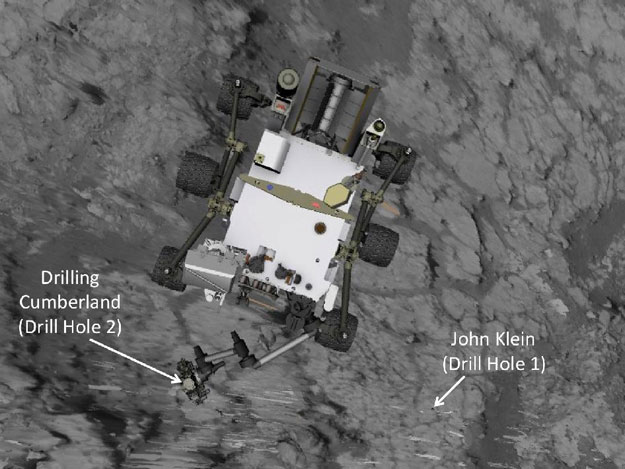
This image produced from software used for planning drives of NASA's Mars rover Curiosity depicts the location and size of the rover when it was driven into position for drilling into rock target "Cumberland." Cumberland was the mission's second drilling target. This image also shows the proximity to the first drilling target, "John Klein," which is about nine feet (2.75 meters) away from the Cumberland target. To get from one to the other, the rover backed away from John Klein, pivoted, and pulled forward toward Cumberland. Curiosity arrived at the depicted position during the 274th Martian day, or sol, of the rover's work on Mars (May 14, 2013). The outline of the rover is from Rover Sequencing and Visualization Program software, with ground imagery from a mosaic of images taken by Curiosity's Navigation cameras. Image credit: NASA/JPL-Caltech

No additional rock drilling or soil scooping is planned in the "Glenelg" area that Curiosity entered last fall as the mission's first destination after landing. To reach Glenelg, the rover drove east about a third of a mile (500 meters) from the landing site. To reach the next destination, Mount Sharp, Curiosity will drive toward the southwest for many months.

"We don't know when we'll get to Mount Sharp," Erickson said. "This truly is a mission of exploration, so just because our end goal is Mount Sharp doesn't mean we're not going to investigate interesting features along the way."


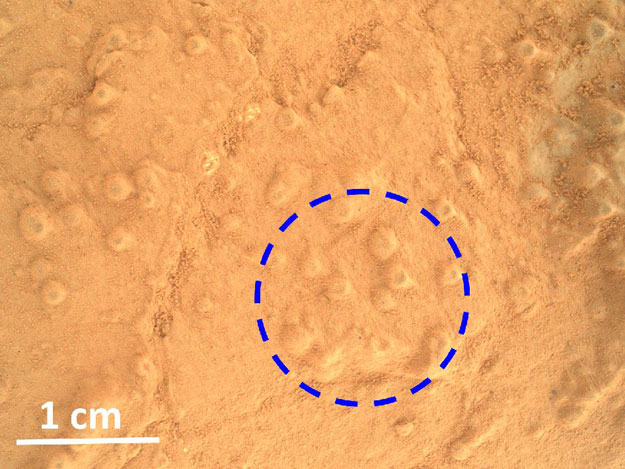
This image taken by the Mars Hand Lens Imager (MAHLI) on NASA's Mars rover Curiosity shows the texture of the patch of flat-lying bedrock called "Cumberland," which was the mission's second target for use of the rover's sample-collecting drill. Cumberland was selected to be similar to the first, "John Klein," but with a slightly greater concentration of erosion-resistant granules that cause surface bumps. The bumps are concretions, or clumps of minerals that formed when water soaked the rock long ago. Analysis of a sample containing more material from these concretions could provide information about the variability within the rock layers of both drill targets, John Klein and Cumberland. This image was taken on the 279th Martian day, or sol, of the mission (May 19, 2013) from a distance of 2 inches (5 centimeters). Credit: NASA/JPL-Caltech/MSSS.

Images of Mount Sharp taken from orbit and images Curiosity has taken from a distance reveal many layers where scientists anticipate finding evidence about how the ancient Martian environment changed and evolved.

While completing major first-time activities since landing, the mission has also already accomplished its main science objective. Analysis of rock powder from the first drilled rock target, "John Klein," provided evidence that an ancient environment in Gale Crater had favorable conditions for microbial life: the essential elemental ingredients, energy and ponded water that was neither too acidic nor too briny.

The rover team chose a similar rock, "Cumberland," as the second drilling target to provide a check for the findings at John Klein. Scientists are analyzing laboratory-instrument results from portions of the Cumberland sample. One new capability being used is to drive away while still holding rock powder in Curiosity's sample-handling device to supply additional material to instruments later if desired by the science team.


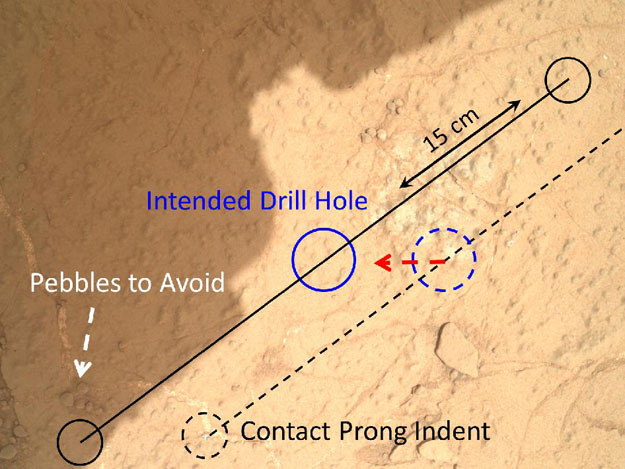
This image demonstrates how engineers place the drill carried by NASA's Mars rover Curiosity onto rock targets. They first set down the drill's two stabilizing prongs near the target, as shown by the dashed line. From there, they assess the placement of the prongs in relation to the target to determine the correct, final placement of the drill. This approach allows for higher accuracy, both to hit the target and avoid placing a prong on unstable areas or pebbles. This image of the "Cumberland" drill target was taken by the Mars Hand Lens Imager (MAHLI) on the 279th Martian day, or sol, of the mission (May 19, 2013), from a distance of 9.8 inches (25 centimeters). Image credit: NASA/JPL-Caltech/MSSS.

For the drill campaign at Cumberland, steps that each took a day or more at John Klein could be combined into a single day's sequence of commands. "We used the experience and lessons from our first drilling campaign, as well as new cached sample capabilities, to do the second drill campaign far more efficiently," said sampling activity lead Joe Melko of JPL. "In addition, we increased use of the rover's autonomous self-protection. This allowed more activities to be strung together before the ground team had to check in on the rover."

The science team has chosen three targets for brief observations before Curiosity leaves the Glenelg area: the boundary between bedrock areas of mudstone and sandstone, a layered outcrop called "Shaler" and a pitted outcrop called "Point Lake."

JPL's Joy Crisp, deputy project scientist for Curiosity, said "Shaler might be a river deposit. Point Lake might be volcanic or sedimentary. A closer look at them could give us better understanding of how the rocks we sampled with the drill fit into the history of how the environment changed."


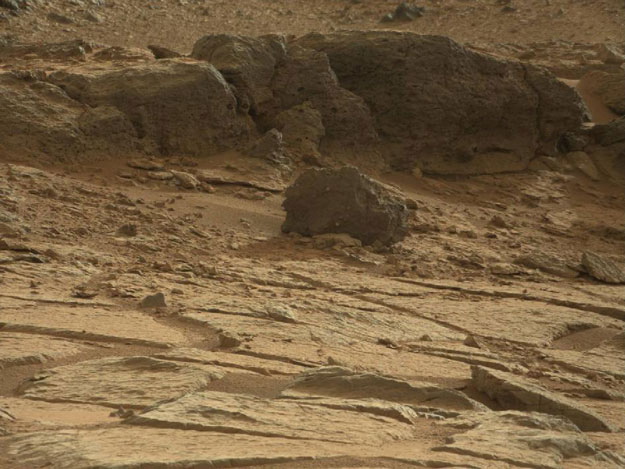
One priority target for a closer look by NASA's Mars rover Curiosity before the rover departs the "Glenelg" area east of its landing site is the pitted outcrop called "Point Lake," in the upper half of this image. The outcrop as seen from this angle is about 7 feet (2 meters) wide and 20 inches (50 centimeters) high. The texture, with its voids or cavities, sets Point Lake apart from other outcrops in the vicinity. A closer inspection may yield information about whether it is a volcanic or sedimentary deposit. This image was taken by the right (telephoto-lens) camera of the Mast Camera (Mastcam) on the rover during the 193rd Martian day, or sol, of Curiosity's work on Mars (Feb. 20, 2013). It is presented here in raw color, as recorded by the camera under Martian lighting conditions. Credit: NASA/JPL-Caltech/MSSS.

JPL, a division of the California Institute of Technology, Pasadena, manages the Mars Science Laboratory Project for NASA's Science Mission Directorate in Washington. For more about the mission, visit: http://www.nasa.gov/msl and http://mars.jpl.nasa.gov/msl.

05 Jun 19:59

Designer Dai Fujiwara for Camper Mori Bag Collection

by Denise Taw

Designer Dai Fujiwara for Camper Mori Bag Collection

We take a look at the recently launched Mori (meaning forest, in Japanese) bag and accessories collection between Camper and designer, Dai Fujiwara. A former Issey Miyake designer, Dai Fujiwara employs the use of knitwear and paper designing techniques to produce functional bags with an interesting look. Made from 64% paper and 36% polyester, these Japanese made bags feature a variety of bags – messengers, backpacks, totes and wallets. Though they may not be suitable for everyone aesthetically, the idea of sustainability and Japanese innovation once again takes center stage in the collection. Ranging from $100 – $240, the Mori collection is now available in stores and online at Camper.


Designer Dai Fujiwara for Camper Mori Bag Collection is a post by Denise Taw on Selectism.

19 May 18:23

Prove or disprove

by John

From Concrete Mathematics:

Incidentally, when we’re faced with a “prove or disprove,” we’re usually better off trying first to disprove with a counterexample, for two reasons: A disproof is potentially easier (we just need one counterexample); and nit-picking arouses our creative juices. Even if the given assertion is true, out search for a counterexample often leads us to a proof, as soon as we see why  a counterexample is impossible. Besides, it’s healthy to be skeptical.

16 May 14:58

NASA Collaborates with Google and USRA for Quantum Artificial Intelligence Lab

by Marc Boucher
Evenson.not.org

#quantum information science
#goog #nasa

Quantum computing may be the key to solving some of the most challenging computer science problems. This is why Google in collaboration with NASA and the Universities Space Research Association today announced that they will launch the Quantum Artificial Intelligence Lab.

The lab will be hosted at NASA's Ames Research Center and Google has stated their goal is "to study how quantum computing might advance machine learning."

The lab will initially be home to D-Wave Systems Inc. new 512-qubit quantum computer, the D-Wave Two™. D-Wave, a Canadian company with offices in Palo Alto, bills itself as the first commercial quantum computing company.

Google in a post on their Research Blog today said "Machine learning is all about building better models of the world to make more accurate predictions. If we want to cure diseases, we need better models of how they develop. If we want to create effective environmental policies, we need better models of what's happening to our climate. And if we want to build a more useful search engine, we need to better understand spoken questions and what's on the web so you get the best answer."

"Classical computers aren't well suited to these types of creative problems. Solving such problems can be imagined as trying to find the lowest point on a surface covered in hills and valleys. Classical computing might use what's called "gradient descent": start at a random spot on the surface, look around for a lower spot to walk down to, and repeat until you can't walk downhill anymore. But all too often that gets you stuck in a "local minimum" -- a valley that isn't the very lowest point on the surface."

"That's where quantum computing comes in. It lets you cheat a little, giving you some chance to "tunnel" through a ridge to see if there's a lower valley hidden beyond it. This gives you a much better shot at finding the true lowest point -- the optimal solution."

USRA will manage the science operations for the collaboration which will benefit its researchers by having an allocation of 20% of the computing time.

Installation of the new D-Wave Two™ at NASA Ames and is expected to be operation by Q3.

24 Apr 05:53

Information-theoretic postulates for quantum theory. (arXiv:1203.4516v3 [quant-ph] UPDATED)

by Markus P. Mueller, Lluis Masanes

Why are the laws of physics formulated in terms of complex Hilbert spaces? Are there natural and consistent modifications of quantum theory that could be tested experimentally? This book chapter gives a self-contained and accessible summary of our paper [New J. Phys. 13, 063001, 2011] addressing these questions, presenting the main ideas, but dropping many technical details. We show that the formalism of quantum theory can be reconstructed from four natural postulates, which do not refer to the mathematical formalism, but only to the information-theoretic content of the physical theory. Our starting point is to assume that there exist physical events (such as measurement outcomes) that happen probabilistically, yielding the mathematical framework of "convex state spaces". Then, quantum theory can be reconstructed by assuming that (i) global states are determined by correlations between local measurements, (ii) systems that carry the same amount of information have equivalent state spaces, (iii) reversible time evolution can map every pure state to every other, and (iv) positivity of probabilities is the only restriction on the possible measurements.

Donate to arXiv

18 Apr 09:57

Aliasing and the Heisenberg uncertainty principle.

by Dan Piponi
Evenson.not.org

#quantum Dirac's Comb

TL;DR

The Dirac comb is an example of a wavefunction whose position and momentum aren't fuzzy.

Introduction

The Heisenberg uncertainty principle says that if you have a particle in some state and observe either its momentum or its position then the products of the standard deviations of distributions of the outcomes satisfy this identity:

I think many people have a mental picture a bit like this:

You can know the position and momentum with some degree of fuzziness and you can trade the fuzziness between the two measurements as long as the product of their sizes is larger than ℏ/2.

Here's another way of thinking about that kind of picture (assuming some units I haven't specified):

position = 123.4???
momentum = 65?.???
The idea is that the question mark represents digits we don't know well. As you move towards the right in the decimal representation our certainty in the accuracy of the digit quickly goes downhill to the point where we can't reasonably write digits.

But this picture is highly misleading. For example, the following state of affairs is also compatible with the uncertainty principle, in suitably chosen units:

position = ...???.123...
momentum = ...???.654...

In other words, it's compatible with the uncertainty principle that we could know the digits beyond the decimal point to as much accuracy as we like as long as we don't know the digits before the point. It trivially satisfies Heisenberg's inequality because the variance of the position and the momentum aren't even finite quantities.

But being compatible with Heisenberg uncertainty isn't enough for something to be realisable as a physical state. Is there a wavefunction that allows us to know the digits to the right of the decimal point as far as we want for both position and momentum measurements?

Sampling audio and graphics

Maybe surprisingly, the worlds of audio and graphics can help us answer this question. Here's what a fraction of a second of music might look like when the pressure of the sound wave is plotted against time:

But if we sample this signal at regular intervals, eg. at 44.1KHz for a CD, then we can graph the resulting signal as something like this:

The red curve here is just to show what the original waveform looked like. The black vertical lines correspond to regular samples and we can represent them mathematically with Dirac delta functions multiplied by the amplitude measured at the sample.

There is a well known problem with sampling like this. If you sample a signal that is a sine wave sin(ωt) at rate f then the signal sin((ω+2πnf)t) will generate exactly the same samples for any integer n. The following illustration shows what might happen:

The two waveforms are sampled at the same regular intervals (shown by vertical lines) and give exactly the same amplitudes at those samples.

This forms the basis for the famous Nyquist-Shannon sampling theorem. You can reconstruct the original signal from regularly spaced samples only if it doesn't contain frequency components higher than half your sampling rate. Otherwise you get ambiguities in the form of high frequency parts of the signal masquerading as low frequency parts. This effect is known as aliasing. As a result, the Fourier transform of a sampled function is periodic with the "repeats" corresponding to the aliasing.

In the audio world you need to filter your sound to remove the high frequencies before you sample. This is frequently carried out with an analogue filter. In the 3D rendering world you need to do something similar. Ray tracers will send out many rays for each pixel, in effect forming a much higher resolution image than the resolution of the final result, and that high resolution image is filtered before being sampled down to the final resulting image. The "jaggies" you get from rendering polygons are an example of this phenomenon. It seems like jaggies have nothing to do with the world of Fourier transforms. But if you compute the Fourier transform of a polygonal image, remove suitable high frequency components, and then take the inverse Fourier transform before sampling you'll produce an image that's much more pleasing to the eye. In practice there are shortcuts to achieving much the same effect.

The connection to physics

Now consider a particle whose wavefunction takes the form of the Dirac comb:

This is a wavefunction that is concentrated at multiples of some quantity a, ie. ∑δ(x-an) summing over n = ...,-1,0,1,2,... If the wavefunction is ψ(x) then the probability density function for the particle position is |ψ(x)|². So the particle has a zero probability of being found at points other than those where x=na. In other words, modulo a, the particle position is given precisely.

But what about the particle momentum. Well the wavefunction has, in some sense, been sampled onto the points na, so we expect that whatever the momentum distribution is it'll be ambiguous modulo b where ab=ℏ. In fact, if we take the Fourier transform of the Dirac comb we get another Dirac comb. So in the frequency domain we get the same kind of phenomenon: the momentum is concentrated at integer multiples of b. So now we know we have a wavefunction whose uncertainty precisely fits the description I gave above. We know the position precisely modulo a and the momentum precisely modulo b. In some sense this isn't contrived: we know the momentum modulo b precisely because of the aliasing that results from knowing the position modulo a.

What this means

The message from this is that position-momentum uncertainty isn't fuzziness. At least it's not fuzziness in the ordinary sense of the word.

And in reality

I'm not very experienced in attaching numbers to results from theoretical physics so I'd find it hard to say how accurately we can create a Dirac comb state in reality. When we measure a position using interferometry techniques we automatically compute the position modulo a wavelength so this isn't an unusual thing to do. Also an electron in a periodic potential may take on a form that consists of a train of equally spaced lumps. Even if not described exactly by a Dirac comb, we can still know the position modulo a and the momentum modulo b much more accurately than you might expect from a naive interpretation of the Heisenberg uncertainty principle as fuzziness.

Exercises
1. Investigate approximations to the Dirac comb: eg. what happens if we sum only a finite number of Dirac deltas, or replace each delta with a finite width Gaussian, or both.
2. Investigate the "twisted" Dirac comb: ∑δ(x-an)exp(inθ) where θ is some constant.
18 Apr 09:11

Backblaze Mobile is Alive!

by Yev

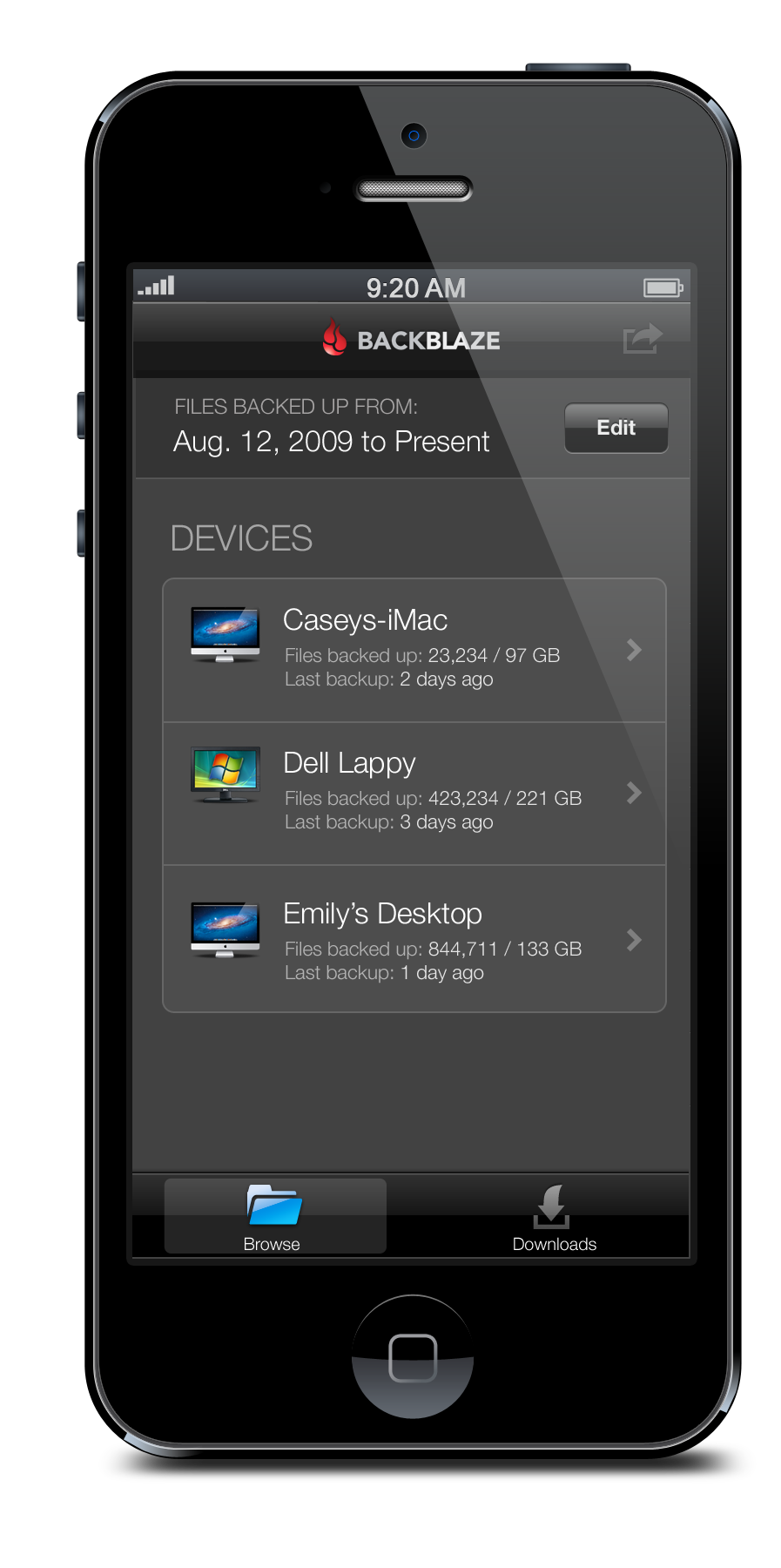
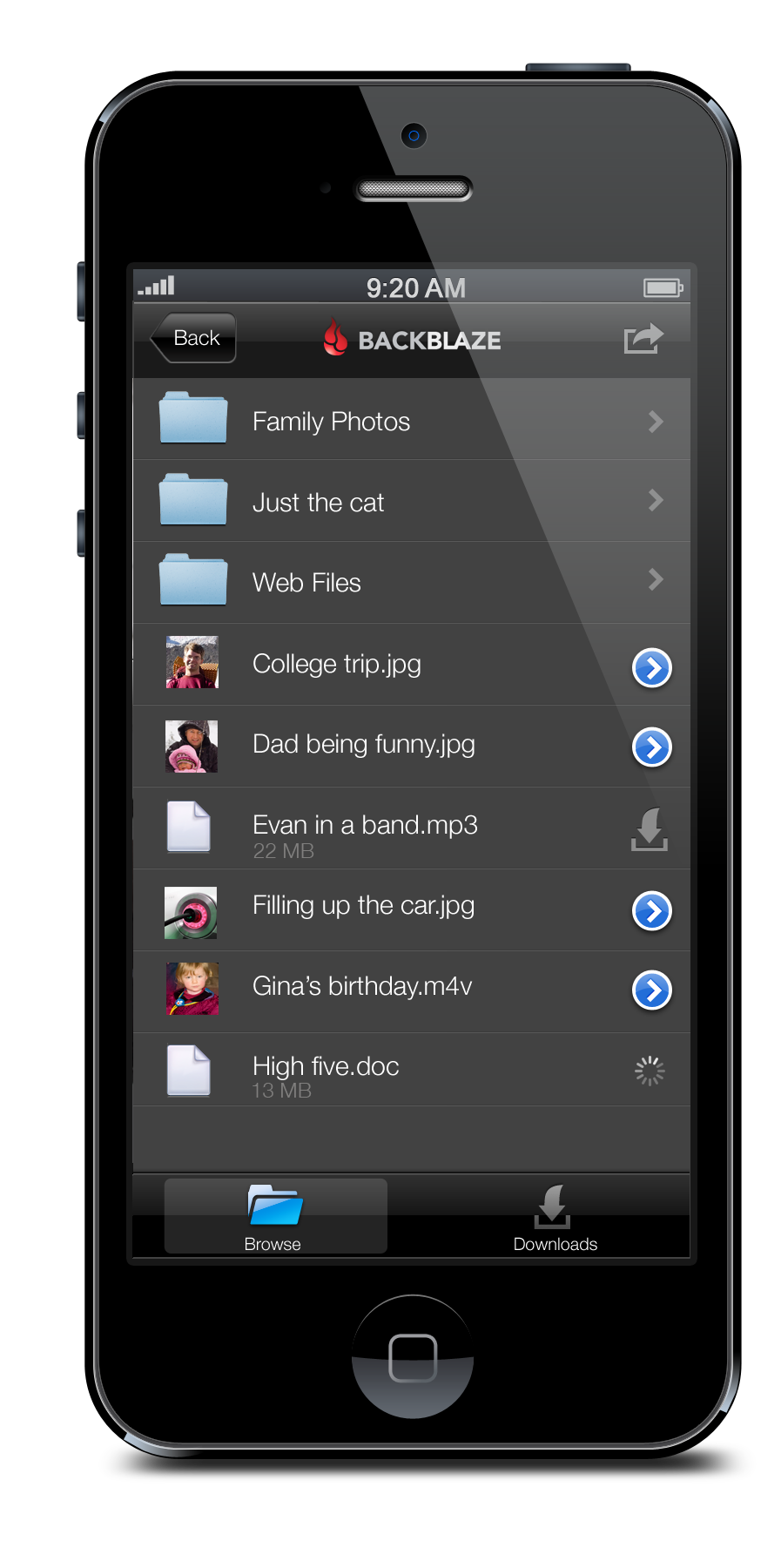
We announced Backblaze Mobile a few months ago, and while it took a little longer than expected (we couldn’t help but add in features) Backblaze Mobile for iPhone is now ready for you! That’s right! If you have a Backblaze account, you’ll now be able to access your online backup on the go, from your iOS device! What about Android? That’s coming up next, stay tuned!

What Does Backblaze Mobile Do?
Backblaze Mobile is a free app, available in the App Store, that allows you to access, download, experience, and share all of the data that’s been uploaded from your desktop or laptop and to your active Backblaze account.

Access Download Experience Share
(click on any picture above to see it in full size)

How it Works:

Access: After signing in to your Backblaze account, you’ll see a list of all the computers (Windows and/or Macs) you are backing up with Backblaze online backup. Select one of these computers. Next you’ll see all the drives for that system that Backblaze currently has backed up. This can include multiple internal as well as connected external USB, Firewire and Thunderbolt drives.

Download: The folders and files are organized just like those on your computer, so the files you want are easy to find. Once you’ve located your file it can be downloaded to the iPhone. Remember, the current the file size limit for a single file is 30 MB. You can download as many files as you want and you can see a list of your recently downloaded files by selecting the “downloads” button.

Experience: Once the file is downloaded you can see and/or hear the file. Viewing a PDF, listening to a MP3, or previewing a Microsoft Word doc are all possible. You’ll be able to see and/or hear all the file types your iPhone knows how to present.

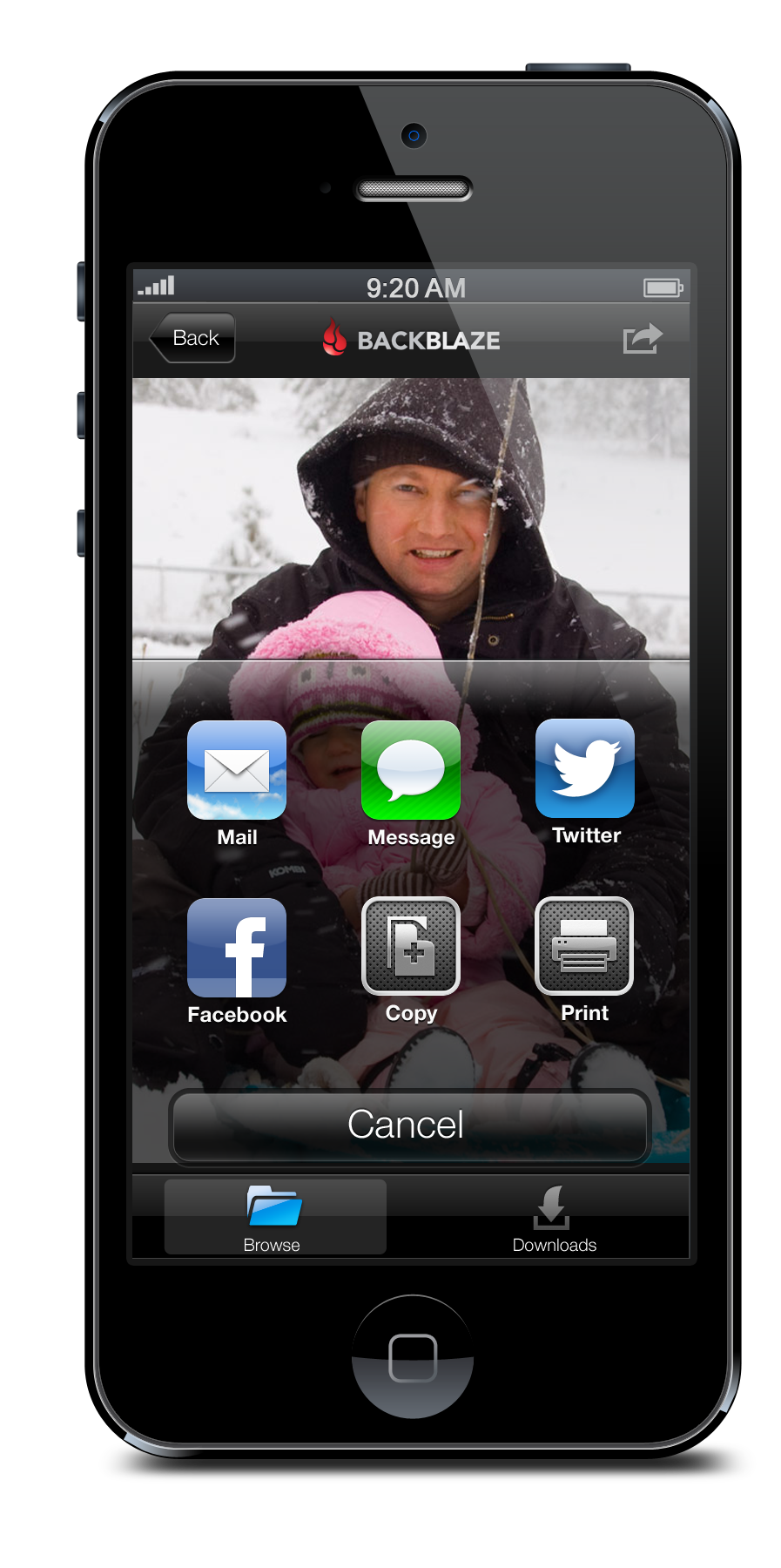
Share: Once you’re sure you have the right file you can share it. The options you get depend on the type of file, for example, if the file is an MP3, you may not see the “print” option, but it will be present for a JPG or GIF file.

Take Control!

The Backblaze Mobile app will give you greater access to all the data you’ve backed up with Backblaze throughout the years. Forgot a presentation? No problem, just download it to your phone. Have a picture on your computer that you want to show to a friend? No problem, just download it to your phone. Hanging out with friends and remember a fun picture you took, and then have an urge to post it to Facebook and tag them in it? No problem, just download it to your phone and share it! With Backblaze Mobile you can finally take control of your data.

Have questions? Check out the Backblaze Mobile FAQ!

15 Apr 15:54

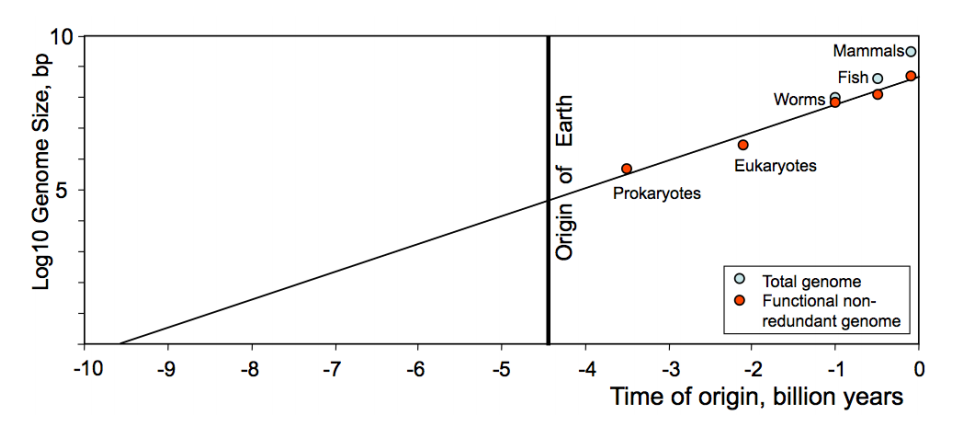
Moore's Law and the Origin of Life

As life has evolved, its complexity has increased exponentially, just like Moore’s law. Now geneticists have extrapolated this trend backwards and found that by this measure, life is older than the Earth itself.


15 Apr 07:58

Computer Security Legend Mudge Leaves DARPA for Google Job (Arik Hesseldahl/AllThingsD)

Arik Hesseldahl / AllThingsD:
Computer Security Legend Mudge Leaves DARPA for Google Job  —  Peter Zatko, the computer hacking expert better known by the handle Mudge, says he's leaving his job as a program manager at DARPA to join Google.  He announced the change overnight on Twitter.  —  Zatko joined DARPA …

15 Apr 07:56

Iterations: How Five Real Economists Think About Bitcoin's Future (Semil Shah/TechCrunch)

Semil Shah / TechCrunch:
Iterations: How Five Real Economists Think About Bitcoin's Future  —  There isn't just a bubble in the Bitcoin economy, there's a bubble in the number of posts about Bitcoin.  I'll pile on, even after this week's mini-crash, but with a twist.  A few weeks ago, I wrote some brief notes …

15 Apr 07:46

Why Heisenberg can't stop atomic collapse

by Dan Piponi
Evenson.not.org

#qm showing the argument from Feynmann about the Heisenberg uncertainty principle pushing the minimal distance of electron is a bit misleading.

TL;DR

A heuristic argument to show that hydrogen atoms are stable and have a minimum energy level is wrong. I will assume undergraduate level quantum mechanics in the discussion.

Introduction

There's a popular argument used to explain why atoms are stable. It shows there is a lower bound on the energy level of an electron in the atom that makes it impossible for electrons to keep "falling" forever all the way down to the nucleus. You'll find it not only in popular science books but in courses and textbooks on quantum mechanics.

A rough version of the argument goes like this: the closer an electron falls towards the nucleus the lower its potential energy gets. But the more closely bound to the nucleus it is, the more accurately we know its position and hence, by Heisenberg's uncertainty principle (HUP), the less accurately we know its momentum. Increased variance in the momentum corresponds to an increase in kinetic energy. Eventually the decrease in potential energy as the electron falls is balanced by an increase in kinetic energy and the electron has reached a stable state.

The problem is, this argument is wrong. It's wrong related to the kind of heuristic reasoning about wavefunctions that I've talked about before.

Before showing it's wrong, let's make the argument a bit more rigorous.

Bounding wavefunctions

The idea is to show that for any possible normalised wavefunction ψ of an electron in a Coulomb potential, the expected energy is bounded below by some constant. So we need to show that
is bounded below where
and p is momentum.
Consider a wavefunction that is confined mainly around the nucleus so

The first fact we need is that Heisenberg uncertainty principle tells us that 
(assuming we're in a frame of reference where the expected values of p and x are zero).

If the wavefunction is spread out with a standard deviation of a then the electron is mostly around a distance a from the nucleus. So the second fact is that we can roughly approximate the expected value of 1/r as 1/a.

Combine these two facts and we get, roughly, that
I hope you can see that the right hand side, as a function of a, is bounded below. The graph of the right hand side as a function of a looks like:
It's now an exercise in calculus to find a lower bound on the expected energy. You can find the details in countless places on the web. Here a link to an example from MIT, which may have come directly from Feynman's Lectures on Physics.

The problem

The above discussion assumes that the wavefunction is basically a single packet confined around a distance a from the nucleus, something like that graphed above. But if a lower energy state can be found with a different wavefunction the electron will eventually find it, or an even lower energy state. In fact, by using a wavefunction with multiple peaks we will find that the Heisenberg uncertainty principle doesn't give a lower bound at all.

We'll use a wavefunction like this:
It has a packet around the origin just like before but it also has a sharp peak around r=l. As I'm showing ψ as a function of r this means we have a shell of radius l.


Let's say

where ψ1 is normalized and peaked near the original and ψis our shell of radius l. Assume no overlap between ψ1 and ψ2.

In this case you can see that we can make
as large as we like by making l as large as we like while still leaving us free to make the central peak whatever shape we want. This means that the estimate of 
coming from HUP can be made as small as we like while making the central peak as close to a Dirac delta as we want. Informally, HUP controls of the overall spread of the wave function but not the spread of individual peaks within it.

For a large enough shell, ψcontributes little to the total expected potential energy, but ψ1 can contribute an arbitrarily low amount because we can concentrate it in areas where 1/r is as large as we want. So we can make the total expected potential energy as low as we like. And yet we can also keep the estimate of the kinetic energy given by HUP as close to zero as we like. So contrary to the original argument, the Heisenberg uncertainty principle doesn't give us a lower bound on the energy at all. The argument is wrong.

But wait, we know there is a lowest energy state...

Yes, the energy of a wavefunction in a Coulomb potential is in fact bounded below. After all, atoms are stable. But the Heisenberg uncertainty principle doesn't show it. The inequality in HUP becomes an equality when the wavefunction is a Gaussian function. It provides a good bound for functions that are roughly Gaussian, ie. that form a single "lump". But it provides only weak bounds for wavefunctions with multiple peaks and in this case it's not the appropriate tool to use.

The Heisenberg uncertainty principle is an inequality about ordinary functions interpreted in the context of quantum mechanics (QM). The field of functional analysis provides many such inequalities. A great paper by Lieb, The Stability of Matter, gives an inequality due to Sobolev that can also be interpreted in the context of QM. Sobolev's inequality is more appropriate when considering the hydrogen atom and it gives a good lower bound, demonstrating that the hydrogen atom is stable after all.

But wait, the Heisenberg uncertainty principle argument gives the right energy...

Getting a correct answer doesn't always justify the methods. I can give at least two reasons why the original method appears to work.

1. The HUP gives a good bound for wavefunctions that are roughly Gaussian. The lowest energy level for the hydrogen atom is given (very roughly) by such a function. So an estimate based on HUP should be roughly correct. However, HUP alone can't tell us that the lowest energy state is Gaussian. The argument is only useful if we can get this information from somewhere else.

2. You can get an estimate for the lowest energy level of the hydrogen atom (assuming it exists) by dimensional analysis. Invalid physical arguments that are dimensionally correct will often give the correct result because there is only one dimensionally correct expression possible.

But wait, it's just a heuristic argument...

Heuristic arguments are crucial to physics. But when similar heuristic arguments give opposite results they become problematic. In particular, it's no good saying an argument is inexact or qualitative when it gives a bound on the energy that isn't just off by an order of magnitude, but completely fails to give a bound at all. Part of the issue here is that the Coulomb potential goes to infinity as r goes to zero and so more care is required. The HUP argument above can be adapted to give good results when the potential is bounded below, for example it gives a reasonable estimate for square wells.

But there may be a clever way of using HUP to bound the energy that I haven't seen. If you can see it, please tell me.

The source

Most of what I said above I learnt from the excellent paper on the Stability of Matter by Lieb that I mentioned above.
09 Apr 05:57

QWERTY Sofa Bed by ZO_loft

by Jeff Carvalho
Evenson.not.org

#sofa for #startup

QWERTY Sofa Bed by ZO loft

Pescara, Italy’s own, ZO_loft is design and architecture firm that seems to love irony in all forms of work. Be it their agency name or the development of this QWERTY sofa  bed made in the form of soft keyboard keys, like the ones your tapping on while sitting or sleeping in it.

What makes the QWERT quite interesting is that each of those key-shaped sofa cushions is height-adjustable via the included remote control: a very helpful addition for those looking to be l33t in their interior design. #nerds

QWERTY Sofa Bed by ZO_loft is a post by Jeff Carvalho on Selectism.

05 Apr 17:40

Grow an Endless Supply of Celery from an Old Celery Stalk

by Melanie Pinola
Click here to read Grow an Endless Supply of Celery from an Old Celery Stalk This little indoor gardening project might mean never having to buy celery again. Turn the base end of a bunch of celery (which you'd normally throw out or compost) into a celery plant, for an everlasting supply of the vegetable. More »


05 Apr 12:14

Freicoin - easy-to-use demurrage currency

05 Apr 09:16

Roger Ebert, RIP

by John Scalzi

There is a hole that can’t be filled. One of the greats has left us. Roger Ebert has passed away at the age of 70. suntm.es/Z4EIOF

— Suntimes (@Suntimes) April 4, 2013

I can’t say that I ever spoke to Roger Ebert, but I can say I was once in the same room with him — specifically, the critics’ screening room in Chicago, where as the entertainment editor for my college newspaper I watched a terrible movie called Farewell to the King, and he and Gene Siskel were there as well, sitting, if I remember correctly, in the back of the little theater. Other critics were snarking and catcalling the screen (I mentioned it wasn’t a very good film), and either Siskel or Ebert (it was dark and I was facing the screen) told them to shut it. They shut it. After the movie was done I rode down in the elevator with him. And that was my brush with greatness, film critic style.

For all that I consider Ebert to be one of my most important writing teachers. He was my teacher in a real and practical sense — I was hired at age 22 to be a newspaper film critic, with very little direct practical experience in film criticism (not withstanding Farewell to the King, I mostly reviewed music for my college paper). I was hired in May of 1991, but wouldn’t start until September, which left me the summer to get up to speed. I did it by watching three classic movies a night (to the delight of my then-roommates), and by buying every single review book Roger Ebert had out and reading every single review in them.

He was a great teacher. He was passionate about film — not just knowledgeable about films and directors and actors, but in love with the form, in a way that came through in every review. Even when a movie was bad, you could tell that at least part of the reason Ebert was annoyed was because the film failed its medium, which could achieve amazing things. But as passionate as he was about film, he wasn’t precious about it. Ebert loved film, but what I think he loved most of all was the fact that it entertained him so. He loved being entertained, and he loved telling people, in language which was direct and to the point (he worked for the Sun-Times, the blue collar paper in town) what about the films was so entertaining. What he taught me about film criticism is that film criticism isn’t about showing off what you know about film, it was about sharing what made you love film.

I saw how much Roger Ebert loved film that summer, through his reviews and his words. By the end of the summer, I loved film too. And I wanted to do what he did: Share that love and make people excited about going to the movies, sitting there with their popcorn, waiting to be entertained in the way only film can entertain you.

I left newspaper film criticism — not entirely voluntarily — but even after I left that grind I still loved writing about film and went back to it when I could. I wrote freelance reviews for newspapers, magazines and online sites; I’ve published two books about film. Every year I make predictions about the Oscars here on the site. And I can tell you (roughly) the domestic box office of just about every studio film since 1991. All of that flows back to sitting there with Roger Ebert’s words, catching the film bug from him. There are other great film critics, of course (I also have a soft spot for Pauline Kael, which is not entirely surprising), but Ebert was the one I related to the most, and learned the most from.

In these later years and after everything that he’d been through with cancer and with losing the ability to physically speak, I read and was contemplative about the essays and pieces he put up on his Web site. Much of that had nothing to do with film criticism, but was a matter of him writing… well, whatever. Which meant it was something I could identify with to a significant degree, since that is what I do here. It would be foolish to say that Ebert losing his physical voice freed him to find his voice elsewhere. What I think may be more accurate was that losing his physical voice reminded Ebert that he still had things he wanted to say before he ran out of time to say them.

His Web essays have a sharp, bright but autumnal quality to them; the leaves were still on the trees but the colors were changing and the snap was in the air. It seemed to me Ebert wrote them with the joy of living while there is still life left. I loved these essays but they also made me sad. I knew as a reader they couldn’t last. And of course they didn’t.

I had always meant to send Ebert a copy of Old Man’s War, for no other reason than as a token of appreciation. I knew he was a science fiction geek through and through (he had a penchant for giving science fiction films an extra star if they were especially groovy in the departments of effects and atmosphere). I wanted to sign the book to him and let him know how much his work meant to me — and for him to have the experience of the book before the movie, whenever that might be. I tried getting in touch with one of his editors at the Sun-Times, who I used to freelance for in college, to get it to him, but never heard back from her. Later it would turn out he and I had the same film/tv agent, who offered to forward on the book for me. I kept meaning to send off the book. I never did. I regret it now.

Although he can’t know it now, I still think it’s worth saying: Thank you, Roger Ebert, for being my teacher and for being such a good writer, critic and observer of the world. You made a difference in my life, and it is richer for having your words in it.


05 Apr 09:10

Cook Your Cupboard Wants Your Photos of Food You Own but Don't Know How to Cook

by Alan Henry
Evenson.not.org

c.f. Virtual Kitchen circa 2005. Optimize by pairing human curation with machine learned categories on input images.

Click here to read Cook Your Cupboard Wants Your Photos of Food You Own but Don't Know How to Cook Have a few ingredients in your cupboard you're not too familiar with, or don't know how to prepare? Cook Your Cupboard wants to see them. Send in your submission, and a panel of chefs may get back to you to let you know the best way to prepare it, or use the ingredients you included in the photo together. More »


05 Apr 09:00

Shanghai markets close over bird flu

Chinese officials in the city of Shanghai order the temporary closure of its poultry markets due to the H7N9 bird flu outbreak.
05 Apr 08:58

Christophe Rhodes: 3 Apr 2013

I released SBCL 1.1.6 before the weekend, after the customary one-week period of code freeze and request for testing. Unfortunately, it turns out that the release contains a bug which affects a substantial number of quicklisp libraries: the compiler's transformation of svref was sped up, but unfortunately without sufficient generality, so code doing svref on a symbol-macro fails to compile.

This bug has been fixed in the master branch; this post is somewhat in the vein of a public service announcement: don't use SBCL 1.1.6 if your code or anything it depends on does svref on a symbol-macro. (If it does, a quick workaround is to replace the svrefs with arefs). As well as the public service announcement, though, I have a question for the wider community: how can we encourage testing the code and clearly communicating the results just before the release happens rather than just after? It's somewhat frustrating to have a week-long code freeze, then bug reports of serious issues a few hours after the release is made... and unfortunately answers of the form "just test everything yourself during the freeze period" aren't currently practical. Maybe someday.
05 Apr 08:56

Scientists turn dreams into eerie short films with an MRI scan

by Adi Robertson
Evenson.not.org

A Scanner Darkly slumbers towards Bethlehem

5601052853_d6e9761f17_z_large

A group of scientists from Kyoto has managed to successfully analyze and "record" the basic elements of what people see when they dream. The idea of recording dreams has been a mainstay in science fiction, but also a frequent goal for researchers. As Smithsonian Magazine writes, this group designed its study based on the premise that brains react to "seeing" objects with repeatable patterns that can be measured with MRI. If a machine can recognize the patterns well enough, it can reverse-engineer them, giving us a window into what's going on inside people's heads while they dream.

Three participants were selected for a study and asked to sleep for several three-hour blocks in an MRI scanner. Once they fell asleep, scientists woke them...

Continue reading…

05 Apr 08:54

The RDF Virtual Machine

Marko A. Rodriguez and Joshua Shinavier recently submitted a paper entitled “The RDF Virtual Machine” to arXiv and for peer-review.

Abstract: The Resource Description Framework (RDF) is a standard semantic network data model that is used to create machine-understandable descriptions of the world, and is the basis of the Semantic Web. This article discusses the application of RDF to the representation of computer software and virtual computing machines. The Semantic Web is posited as not only a web of data, but also as a web of programs and processes.

The article discusses both Neno/Fhat and Ripple (also see this blog entry) and presents some categories for thinking about the various aspects of Semantic Web programming languages and their respective interpreters/virtual machines.

Some interesting uses cases for these frameworks are presented in the last part of the article. These include:

Open computing: an extension of Open Data in which algorithms, virtualized computing machines, and underlying hardware computing resources are made publicly available.
Distribute computing: in which the process is moved to the data, as opposed to the data to the process (see image above).
Reflective computing: as computational processes reside in the URI/literal address space, reflection from the API to the RVM is possible.
05 Apr 08:33

An alternative proof of Wigner theorem on quantum transformations based on elementary complex analysis. (arXiv:1304.1376v2 [quant-ph] UPDATED)

by Amaury Mouchet (FRDP, LMPT)
Evenson.not.org

#quantum #information #theory

According to Wigner theorem, transformations of quantum states which preserve the probabilities are either unitary or antiunitary. This short communication presents an elementary proof of this theorem that significantly departs from the numerous ones already existing in the literature. The main line of the argument remains valid even in quantum field theory where Hilbert spaces are non-separable.

24 Mar 08:54

Other Interesting arXiv Papers This Week

24 Mar 08:47

The permanent revolution

by Charlie Stross

(I just felt the need to lift a comment I posted on an earlier thread up here where it belongs.)

Quoth a commenter, to whom I felt the need to reply:

Things change. Technology accelerates it. The only thing up for debate is the timing.

This is a statement of ideology, not of fact.

For most of the duration of the human species, change has not been an overriding influence on our lives. In fact, it's only since roughly 1800 that you couldn't live your entire life using only knowledge and practices known to your mother and father. We are undeniably living through the era of the Great Acceleration; but it's probably[*] a sigmoid curve, and we may already be past the steepest part of it.

An interesting point is that this ideology works very well as a match for the political ideology of revolutionary republicanism which emerged in the 18th 17th century, and which pretty much everyone reading this blog[**] is in complete agreement with — the ideology that replaced the Divine Right of Kings and the Great Chain of Being as an organisational paradigm with "Liberte, Egalite, Fraternite" (or, in bastardized form, Freedom, Equality of Opportunity [to make money], and Patriotism).

The doctrine of continual change through technology is not value-neutral; it feeds into the continual disruption that enables the permanent revolution of the anti-monarchists to roll forward, and prevents the oligarchs who sit astride the juggernaut from becoming too comfortable. It is in principle possible to suppress change; the problem is that suppression is a sub-optimal strategy in a polycentric world with competing interests. But once the capital imbalances that are driving development in the developing world and immiseration of the proletariat in the post-democratic first world subside, stasis will become an increasingly attractive policy to the oligarchs. (When the Great Acceleration stops, my guess is that the oligarchy will ossify into a nobility, and eventually a monarchical-system-in-all-but-name, within a century at most. And there are already worrying signs that this is happening.)

Please don't deny that you are a believer in this revolutionary ideology — and it is revolutionary; so much so that Republican Democracy, Fascism, and Communism are just minor doctrinal disputes within it. It's okay to admit it here; I'm a supporter of this ideology, too. None of us are supporters of feudal monarchism; we're all the inheritors of the early Jacobins. Which makes us revolutionaries.

But it's important to understand that virtually the entire mainstream of political and social discourse today is radical and revolutionary by historical standards. (Hell, the concept of sociology itself is a construct of the revolutionary philosophers.) This is not an historically normative set of touchstone ideas to run a society on. We're swimming in the tidal wave set running by an underwater earthquake two centuries ago — and like fish that live their entire lives in water, we are unable to see our circumstances as the anomaly that they are, or to know whether it's all for the best.

And, as Oliver Cromwell put it, "I beseech you, in the bowels of Christ, think it possible you may be mistaken."

[*] I'm discounting singularities here.

[**] Except you, Moldbug.

20 Mar 20:03

About nothing

by Joe Marshall

Here's a way to quickly compute the leftmost digit of a number:

(define (leftmost-digit radix n)
  (if (> radix n)
      n
      (let ((leftmost-digit-pair (leftmost-digit (* radix radix) n)))
 (if (> radix leftmost-digit-pair)
     leftmost-digit-pair
     (quotient leftmost-digit-pair radix)))))

It's harder to compute the remaining digits.

19 Mar 09:02

IndieAuth: Sign in with your domain name

IndieAuth, March 19, 2013


Here we go: "This is an IndieAuth login prompt. To use it, you'll need to:
  • Add a link on your home page to your various social profiles (Twitter, Github, etc) with the attribute rel="me"
  • Ensure your profiles link back to your home page.

Read the full setup instructions." From thwe web page: "IndieAuth is part of the Indie Web movement to take back control of your online identity. Instead of logging in to websites as 'you on Twitter' or 'you on Facebook', you should be able to log in as just 'you'. We should not be relying on Twitter or Facebook to provide our authenticated identities, we should be able to use our own domain names to log in to sites everywhere." See also RelMeAuth.  I should note that this doesn't work for me, and I'm pretty sure I've followed the instructions correctly. #indieweb [Link] [Comment]

19 Mar 07:45

US Treasury Guidance on Virtual Currencies (aka Bitcoins)