
IKEA Monkey
Shared posts
10 Sep 01:19
#422 Hanging in there and hanging on
by Neil Pasricha
 We’re all pretty much the same.
Packed tightly in our skintight skin is a bumpy clump of slippery organs and brittle bones. Yes, you’re a pile of bones, I’m a bucket of blood, you’re a slab of muscle, I’m a chunk of chub. And no matter what we got squeezing through our veins, zooming through our brains, and dripping out our drains, one big thing just always remains.
 We’re all pretty much the same.
We’re all pretty much the same.
We’re all pretty much the same.
Baby brains buzz and little eardrums pop, baby lungs breathe deep and little eyelids flop, but as we grow up and grow older maybe we start letting differences be our guide, start choosing our own adventures, start carving paths and curving wide. We settle into ourselves, settle into our skin, settle into our lives, and find the comforts within…
 We grow up, we grow older, some grow hotter, some grow colder. We focus on our tastes, on our preferences and our choices, we find our kinds of friends, we read our kinds of voices. We might cut deep paths, we may turn others away, we may deepen our divides, we may have nothing nice to say.
But way down deep in our stomachs, way down deep in our hearts, we can always remember that no matter which way we turn, which lessons we learn, which bridges we burn…
 We’re all pretty much the same.
We’re all pretty much the same.
No matter what money we earn, what chances we churn, what choices we spurn…
We’re all pretty much the same.
We’re all pretty much the same.
 Because we’ve all got cracks and chips, we’ve all got sores and scratches, we’ve all got doubts and dreams, we’ve all got hearts with patches. We laugh and cry, we soar and sink, we go up and down, we stop and think. Behind your favorite things, behind your bestest friends, behind your fears and doubts… we’re all waiting here again.
We’re all in this big show together.
We’re all singing the same song.
We’re all walking into the future.
As we all keep hanging on.
AWESOME!
 Photos from: here, here, here, here, here, and here
The post #422 Hanging in there and hanging on appeared first on 1000 Awesome Things.
10 Sep 01:01

‘Get a Weapon’
by Sandra Sidi
IKEA MonkeyThis is a really powerful essay
“Duck and cover!” a mechanized voice screamed. The ground shook and the window rattled. I rolled from my bed to the floor of my trailer and felt for the armor I’d forgotten in my office. I lay there and sweated and swore. The voice from the loudspeaker urged me to get away from the windows. I was inside a tin can.
I crawled to the door. My hand was on the knob when I realized I was naked. The next impact knocked the air conditioner to the floor. I grabbed a light-blue cotton robe and bolted.
To hear more feature stories, see our full list or get the Audm iPhone app.
I raced along a row of sandbags, one hand holding the robe closed. The duck-and-cover bunkers were 100 feet away. Another series of explosions, and I hit the rocks. I was lying there, panting, when I saw a bright-yellow bunker tucked behind a row of sandbags and palm trees. I was up, running, full out. My robe fell open and flew out behind me.
Another hit. I was 20 feet away. Ten. Five. I crashed into the duck-and-cover, yanking my robe closed.
More than a dozen men squatted there and looked at me. Soldiers in military fatigues, some without shirts; contractors in cargo shorts and polos; other men in nothing but boxers. The curly hair on their chests rose and fell with their labored breathing. I should have slept in clothes, but my air conditioner was broken. The rounds hit like deep drums, but we were safe, packed together in 50 square feet of concrete.
I leaned against the wall and tried to stop my legs from shaking. Two more men in boxers joined us. A bearded, sunburned soldier stared at my feet. A half-dressed contractor took furtive looks at my neck. A marine offered me the one chair inside the bunker. “You always say thank you when we buzz you through,” he said, smiling kindly. These men went outside the wire every day, in all that danger, that heat. They were heroes. They were lonely.
The bearded soldier’s eyes met mine and held. He looked away. I pulled my robe tighter.
Finally, the attack ceased, and the sirens quieted. Back in my trailer, I dressed and slipped my embassy ID around my neck. I ran my fingers through my hair and braided it as I left the Riverside Trailer Compound, where I lived, and threaded through the rows of sandbags, then past the statue of Saddam Hussein, its half-head lying in the sand. Behind me, thick plumes of smoke rose into the sky.
I showed my badge at the palace entrance, coded into my office. I walked past flashing TV sets and translators in headphones typing at their keyboards. When I arrived at my desk, I put my head down. It was 6:30 a.m.
Some hours later, my brown ballet flats tapped softly on the marble floor. It was 2007, and the U.S. military and State Department were working out of Saddam’s Republican Palace, in Baghdad. I walked next to a woman I’ll call Morgan, who was new and whom I’d met only the night before. At 23, she was two years older than I was. She wore her long brown hair down, though she wouldn’t for long. The men were excited about her. She carried a Bible, and I remember thinking this would help her.
Men watched as we passed beneath an ornate ceiling of red-and-green marble and rows of glittering chandeliers. The table of women was at the back of the palace dining facility—DFAC to all of us. We couldn’t see one another socially much, with our crazy work schedules, but we walked together whenever possible, and gathered for meals, six or seven of us, our trays loaded with barbecue and biscuits and salads drenched in ranch dressing. We were all happy to see Morgan. Grateful for another young woman to talk to, and perversely relieved by the addition of another female to absorb the male attention.
One of us was State Department, another a civilian analyst, and others military police, or MPs. There was a cropped-haired, soft-voiced woman in the National Guard who dreamed of starting a goat farm. Beside her was a Naval Academy graduate with shin splints and swollen ankles from carrying 80 pounds on 10-mile marches. She could barely pull her boots on. None of us had the security clearance to know what she did. I was a civilian, ferried over by third-party contractors to provide analytical support for Rear Admiral Gregory Smith, the new head of public affairs for the Multi-National Force in Iraq. This was my first job out of college.
Nicole joined us at the table. Ex-Army, she was now a doctoral student and civilian analyst collecting research on democracy-building in Iraq. “Iraq’s had a real ass-kicking this month,” she announced. “Qahtaniya bombing toll over 500 now.”
Theresa, an MP, mused that we hadn’t figured out how to bring democracy to the Middle East, but we had managed to bring Southern fried chicken and grits. Theresa was tiny, with more positive energy than a sunflower. She did security checks on the perimeter and was Command Sergeant Major Holcomb’s assistant driver.
Two soldiers stood up, craning to get a glance at us. One pointed.
“What do the men gain from it being like this?” That was Silvana (a pseudonym), an economic analyst with several master’s degrees. She’d just filed a sexual-harassment complaint against her supervisor. The food in front of her was untouched, as it often was.
“Before I came here,” said Ann (another pseudonym), the National Guardsman with goat-farm fantasies, “I used to like them—men, I mean.”
Morgan, the newbie, said she’d hoped that she might meet a guy in Iraq, but not so much anymore.
“The odds are good,” Nicole replied, repeating one of her mantras, “but the goods are odd.”
We came for love of country, for patriotism, for money. We came to escape debt or marriages. We came because of television—Alias and Buffy the Vampire Slayer. We came for adventure, for service. We came because someone had suggested we wouldn’t dare.
I grew up in the Washington, D.C., area, and, like many of my high-school classmates, I was shaken by the 9/11 attack on the Pentagon. Inspired to help my country, I chose political science as my major in college and studied three languages, including Arabic. Just before graduating, I was offered a job by the CIA’s Middle East desk, though I’d have to wait a year or more to get security clearance and would have little control over my assignment. I was thrilled to have been selected by the CIA, but I was also impatient and impulsive, and hadn’t given much thought to exactly what kind of work I wanted to do, or where. So when a government contractor pitched me by phone—Three weeks and you’ll be in Baghdad—I said yes.
Before I deployed, I stood in a line with other contractors and soldiers at Fort Benning, in Georgia, waiting for our physicals. The contractor in front of me wore a shirt with fake blood splattered up the side—a makeshift kidney wound—and the words i’m okay at the top. We started talking about his home in St. Petersburg, Florida, which is where my mother lives. We spoke of boats and streetlights and dolphins. He had gray hair and friendly lines around his eyes. He asked where I was headed.
“Baghdad,” I said. “The embassy.”
“How old are you?” he asked.
“Twenty-two,” I lied. My birthday was five months away.
He frowned. “Have they issued you a firearm?” I shook my head. He nodded and looked out at the line of men behind us. The creases in his forehead were like rails of a train track. He turned back to me and leaned close. “A tall blonde? Get a weapon,” he said. They called his name. He looked up at the nurse and then back to me. “Get a weapon,” he repeated, and walked away.
I’d thought he meant for insurgents.
From the moment I stepped outside my trailer, when I stood in line at the dining hall, when I ran to the duck-and-cover, when I sat at my desk, the male soldiers watched. For some, I was the first woman without a hijab they’d seen in months. Men with enormous hands, with shoulders the width of door frames, with pistols strapped to their thighs—they watched.
I read before I went to Iraq that women made up one in 10 American soldiers in the country, but I had no idea where all those women were. The ratio seemed closer to one in 20, even 30. I counted how many women were in a room the second I entered. Twenty-nine men, three women. Sixty-three men, two women. Forty-four men, one woman: me.
I wore my hair in a tight braid. I didn’t wear shorts. I wore shoes that hid my toes. I put on sweaters in 117-degree heat. Even so, my body was everywhere.
My eyes met the other women’s when we passed in the hall, when I threw my trash away at the DFAC, when I was buzzed through the guard stations. How are you? Are you okay? Are we safe?
The men gossiped about us; we’d meet them in a professional capacity and find that they already knew our hometowns, our alma maters, our marital status. They openly made bets about who was going to get pregnant, who was going to get an STD. We overheard conversations we wished we hadn’t—like after my first briefing of the admiral, when one analyst in my office observed to another, “I think she’ll do well,” and the other answered, “Just another woman trying to use her body to get ahead.” Or the four contractors who didn’t see me reading in a chair behind them as they watched a female translator for the State Department:
“Fuck, look at that.”
“Is she seeing anyone?”
“Not since they sent that old bird home.”
“Well, that ass has got to be fucked.”
“Do you know where she lives?”
“Riverside 242.”
We worked 14-, 16-, 18-hour days. We put in as many hours as the men—we made sure of this. Women who’d been there longer offered advice: Be sure to engage with them, we were told. Don’t get too close, we were warned. Say Yes, sir. Do not ever say Yes, sir.
Some of us were married, had kids back home. One of us was quietly going through a divorce. Theresa had deployed to Iraq with her mother, also a soldier, while Ann had come with her husband, who, like her, was a staff sergeant. When we sat together in the DFAC, talking, he’d sit a few tables behind, drinking coffee, her lookout. They lived together in a married trailer and held hands while lying on the floor during shellings. Some of us were looking to date. Others couldn’t be bothered with men. A number of us were virgins.
During my breaks, I’d lie on a gold couch in the main palace entryway, which was usually empty because the side entrances were safer. I’d run my fingers over the gilt of Saddam’s chairs and along the smooth marble railings. I’d stare at the gorgeous geometric patterns of the ceiling until images emerged. My mother’s favorite blue dress. The sun striking the Potomac River, where we used to swim. My own eyes and breasts and legs and feet, misshapen and rearranged like in a cubist painting.
I was lucky. Rear Admiral Smith made it known from his first day in theater that he’d personally punish any sex offenders. This made a difference, I think. A colonel from Psychological Operations once propositioned me on behalf of his son—Honey, with him you’ll be breathing twice as hard. In the office, though, I was fairly safe. The only sexual slurs came from a fellow analyst who had a habit of calling me “Twat.” But I’d lived such a sheltered life that I didn’t know what the word meant, so I wasn’t bothered by it.
My job was to inform the admiral of the most “strategic” events that occurred in Baghdad on a given day—incidents that would affect our operations, the stability of the Iraqi government, or our highest-priority alliances. Each evening, I chose six events to highlight.
Not long after my arrival, a translator, Nazir (a pseudonym), reached out to provide guidance. I’d passed the exams that tested regional knowledge and the ability to respond to hypothetical foreign-policy and security challenges, but I was the only analyst without a master’s degree. Nazir helped me keep track of the latest faction to boycott the prime minister and which new militia was splintering off from the last new militia. He’d find important events for me before they were reported anywhere in English, allowing me to give the admiral the most up-to-the-minute information. He was funny and took me to social gatherings with Iraqi nationals that, as a non–Middle Easterner, I wouldn’t have had access to. Those first weeks, I don’t know what I would have done without him.
On a mortar-free day roughly a month into my deployment, I sat outside the palace. The air was like the inside of a hair dryer. A squad of soldiers jogged around the T-walls, the 12-foot slabs of reinforced concrete lining the embassy compound. After they went by, I saw Nazir and waved.
“Do you want to smoke?” he asked.
I didn’t smoke but appreciated the invitation. “Sure, Nazir. Thanks.” We walked to a picnic table, passing a roped-off section of dirt with a sign in bold letters: do not walk on the grass. We laughed.
He lit a cigarette for me, which I held awkwardly. “You look tired,” he said. I shrugged. Three soldiers passed our table; the shortest one blew me a kiss. “You seem to have caught their attention,” Nazir said.
“They wouldn’t be so hot for me if they knew how clueless I am.” I looked at the sand and thought of another soldier far away.
Nazir’s eyebrows rose. “You’ve never had a boyfriend?”
“Not really,” I admitted. I didn’t think what I had qualified as a boyfriend. I’d spent the past two years in love—a love consummated, at this point, exclusively via email—with an Israeli soldier 700 miles away whom I’d met on an academic fellowship in Israel.
“Do you mean to tell me,” Nazir said, “that you’re a virgin?”
I mumbled something, then decided to ignore the question. Nazir chuckled. He took a long pull on his cigarette.
What would possess me to provide such an intimate detail? Now I can recognize my extreme loneliness in a place where men looked at me and tried to attract my notice, but rarely spoke to me as a friend. I also see my naïveté. I never imagined that a man old enough to be my father, a highly respected professional whose knowledge and experience far eclipsed mine, could be interested in me.
Nazir put his arm gently around my shoulder. “How about we change that, dear?”
Thank God for Morgan. Practically overnight, we became as close as sisters. I was also good friends with Theresa and Nicole, but they weren’t around as much. I could almost always find Morgan to walk with. A public-affairs officer for the State Department, she’d deal with journalists while I briefed the admiral, and then we’d find a corner somewhere to talk.
One day, Morgan was a bit quiet at lunch. I asked her why, and she blushed. A half-empty bottle of sexual lubricant had been left on her desk, and her colleagues had watched, laughing, as she found it.
We women drank. We picked up smoking. We flirted and slept with several men or, like me, hunched our shoulders and stayed out of their way as much as possible. Some of us loved Baghdad, no one more than Nicole, the doctoral student. She swore as well as the men and had jaw-length red hair so thick, it looked like a crash helmet. She barely seemed to notice the lack of women.
We desperately missed our families. I’d think of my 10-year-old brother, who was still into Pokémon cards. (Secretly, I was too.) We dreamed of home. For me, it was the leafy college campus filled with women I’d left only weeks before. For Morgan, her twin brother, who was preparing to deploy to Afghanistan. Theresa dreamed of her two little boys; she feared they wouldn’t know her when she returned home.
There were women who, like Silvana, reported their male bosses for sexual harassment. But I worked for a man as decent as he was powerful. A man who listened to me in the briefings, who sought out my opinion in a room full of majors and colonels. And when the security situation deteriorated, and the mortars and rockets began hitting the palace with frightening accuracy, he refused to allow me to accompany him to the broadcast room, because the hallway had floor-to-ceiling windows.
Three months into my deployment, Silvana vanished. She just stopped coming to work, no word to any of us. I emailed her, called her cell. We asked around, but no one knew.
“Bet she broke her contract,” Morgan said. “She’s probably home.”
“Good for her,” Theresa said. “Who could work for that creep?”
“I hope he gets AIDS,” the Naval Academy graduate said, massaging her shins.
We discussed how to respond to Iranian encroachment in Basra. “That’s easy,” Nicole cracked. She moved a chunk of red hair from one side of her face to the other. “Tell them to watch it, or we’ll fuck up Iran the same way we fucked up Iraq.”
Genius! We laughed.
I wish I could say that we were more curious about what was going on in Silvana’s office, but we didn’t have any way to speak about our vulnerability in an environment that placed a premium on female toughness and resourcefulness. I didn’t tell the others, not even Morgan, how the same day Silvana disappeared, Nazir had put his hand on my neck and whispered, “Have you thought about my question?” It’s not that we didn’t care about Silvana—we did—but we also wanted to be in Baghdad. We wanted it badly. We feared the noise coming from her corner would show as lie the truth we most valued: I belong here. Women belong here.
We had fun, too. We slid down the marble railings of the palace when no one was looking. Hanging out in Saddam’s golden chairs, we ate tangy, Army-issued granola bars, which actually weren’t bad. We used Morgan’s State Department status—she had the longest leash of any of us—to get our names on a helicopter transport and flew over blue pools surrounded by sand and could hardly breathe at their beauty. We got drunk at Italian-embassy functions and marveled at the authority we’d been given to broker deals, transport top-secret government papers, and shape policy decisions for America’s generals.
Morgan started an all-female Bible study. I can’t say my faith was thriving in Baghdad, but I never missed a meeting. Oh, the joy and freedom of being a woman among women, of letting my guard down. It was additional relief to be around Morgan, because she was fearless. She would run the perimeter, where most of us were too afraid to go by ourselves. She would swim—actually be seen in a swimsuit by dozens of drooling men—in Saddam’s pool. She formed a soccer team with Italian-army guys. “They don’t care that I’m the only girl,” Morgan said, “and they never go easy on me, either.”
It wasn’t long, however, before posters were plastered around the embassy with a photo of Morgan’s five teammates and a description—in English and Italian—of all the things a certain unidentified female soccer player would do to them, one-on-one or all together. “There was no one else they could have been describing but me,” Morgan said grimly.
To be close to any man, no matter how platonic the association, was to have your reputation questioned. The five guys ran around the base and tore down every poster.
There was a young marine who worked at one of the palace’s side entry points, and whenever he manned the booth it took me three times as long to be screened. I didn’t know if he didn’t understand how to work the buzzer or just liked to be in my company, but I didn’t mind. He looked like my little brother: stiff blond hair, smooth face, crooked nose. Every Tuesday and Thursday, we’d peer at each other through two-inch-thick, bulletproof yellow glass.
I remember one of these interactions in particular. I held up my badge. He fumbled with the buzzer and then it sounded, but the door didn’t open; he must have released the button too soon. Through the glass, I heard him clear his throat. There was a pause, some shuffling, and a sound like something falling off a desk. A muffled curse. I fought a smile.
After I’d finally made it through, I turned toward him and smiled, because he was awkward, because he looked like my brother, because there was thick glass between us, or because I was so tired of not smiling. For a moment he simply looked at me, then nodded, like I was his superior. In his eyes there was gratitude and respect.
“I know all the spots,” Nazir whispered, leaning over my desk, his hand on my shoulder. A male co-worker—the same one who’d said I was trying to use my body to get ahead—fed a folder into the shredder, looking at me with disgust. He was convinced I’d pursued Nazir.
I’d wake to the siren; I’d wake to the call to prayer. I’d wake to throwing myself on the floor as mortar rounds crashed down around me. “You know I’m a very determined man,” Nazir said. I read reports about sectarian protests and Sunni marginalization. “I think I’ve been very patient,” Nazir said. I read reports about kidnappings and IEDs. “You’re so selfish,” Nazir said.
“Please stop,” I told Nazir, but never anything more. I had almost no knowledge then of what constituted sexual harassment, never mind that it was illegal.
I was also keenly aware of the importance of Nazir’s work. He’d often catch videos on Arab channels of U.S. military convoys being blown up by IEDs, videos that everyone knew fueled the influx of foreign fighters. Thanks to Nazir’s detection, they could swiftly be taken off the air, saving American lives.
I’d call the faraway soldier I loved and tell him nothing about the harassment. I wanted so badly to tell him, but he was in combat, and I worried that any additional stress would compromise his safety. My silence was a way of protecting him from the knowledge that he could do nothing to protect me.
Most times I saw Nazir, he asked for sex. But in the briefings with the admiral, a translator wasn’t necessary, and there I grew strong. I was creative, adaptive; I was correct. The admiral requested my work regularly. I was assigned to write a high-profile section of the Battlefield Update Assessment, which was sent to General Petraeus, the Pentagon, and the White House every morning. A paper I wrote was recommended by the Defense Intelligence Agency as required reading for all incoming personnel. One day, I asked the co-worker who called me “Twat” what the word meant. His face flushing, he haltingly explained, and never called me that again. Four months into my deployment, Morgan got a cook to make a cake for my 22nd birthday. General Petraeus called to tell me I had written diffuse instead of defuse in the Battlefield Update Assessment. He joked about it; he was kind. It snowed in Baghdad for the first time in living memory, and we ran outside to see thin white flakes falling on sand, and I thought it was possible that this was where I was supposed to be.
I’d begun ad hoc humanitarian visits to Iraqi families around Baghdad, and the admiral volunteered to join me. While many flag officers considered this an unnecessary security risk, he rarely missed a trip. “I can’t wait for the runs out to the families on Thursday,” the admiral said after the briefing one day. “My wife made a quilt for Sabine and the kids.”
Thinking of this moment now, I feel sad, because I almost told him about Nazir then, and I could have. He surely would have helped, but I was too shy, too embarrassed to say words like proposition and sex and help me.
Seven months into my deployment, I hadn’t seen Theresa for four days. I asked the marines at the door if they knew where she was, and they told me to check the front gardens, which sounded strange, because no one would be so reckless as to go there in the middle of the day. Yet when I arrived, I saw her brown bun peeking out from inside the dry fountain.
I trotted over to her, about to make a fuss about being out there in daylight and rush us both inside, but I quickly realized that if we sat inside the fountain, we were protected from shrapnel on four sides. Only a direct hit would kill us, which seemed like good enough odds.
The fountain was strangely magnificent. Giant stone fish leaped from nonexistent water. I climbed in beside the fish, but Theresa didn’t look at me. I sat next to her and nudged her with my shoulder. She sort of smiled.
“Where you been?” I asked.
“I was at karaoke night,” she said quietly.
I laughed. “For four days?”
“But there was no one to walk home with.” Her voice was hoarse as she told me she’d seen and spoken with him, the guard, many times before, though never alone. She said “Good evening,” as she always did when she entered her trailer compound. “He held out his hand and smiled, like for me to shake it,” Theresa said, and that’s when the guard yanked her toward him and forcibly kissed her. “I twisted away from him. I just kept trying to twist away, looking to see if anyone was around. Anybody.”
I took her hand. It was so small.
The guard grabbed Theresa by the hair, and she kept saying, “I have to go. I need to go.” Theresa told me her thoughts ran on a loop as he dragged her. I’m going to be raped. Is this cheating on my husband? Why is this happening to me? When he released his grip to undo her jacket, she ran. “The whole time, running, I thought he was going to shoot me in the back,” Theresa said.
We watched a brown bird land on the opposite side of the fountain. “Even my mother’s been assaulted, you know.” She sat quietly for a moment before adding, “Several times.”
“Theresa, can I do something? Help you report—”
“I did. I just—” She shook her head. “I didn’t react how I thought I would. I thought I’d be …”
Theresa was furious with herself that she hadn’t fought back. Despite her training, she’d frozen in fear. And she was upset that she’d lied in her report. She’d provided the location and unit of the soldier who tried to assault her but claimed not to have seen his face because she’d forgotten her glasses. Theresa knew exactly who he was. She lied because he was armed and lived only a few trailers away from hers—how might he retaliate if she named him? She hoped the other soldiers in his unit would identify him, because there had been only one guard on post at the time. They didn’t.
There were other stories. Stories of supervisors using their trailer keys to enter female subordinates’ rooms, stories of gang rape. There was the American translator, a civilian who worked down the hall from me, who whispered, “I came here a confident person.” And the enlisted soldier, the only female in her squad, who sat across from me one afternoon in the DFAC, having just come in from outside the wire. Her sunburned face was peeling as she said, lightly, that she’d slept with most of the men in her squad. When I smiled awkwardly and asked if she had wanted to, she said, “I guess I don’t really know how not to. They keep me alive.”
She looked toward the other end of the cafeteria, where her squad sat eating. One of the soldiers caught her eye and waved amiably. She turned back to me. “You know, sometimes I feel like a piece of dirt, blowing in whichever direction anyone chooses.”
And there was Theresa’s rage and guilt when the guard who assaulted her assaulted another female soldier only weeks later.
Not long after Theresa and I talked in the fountain, she and Ann completed their deployments. Morgan, Nicole, and I watched them preparing to depart in armored buses called Rhinos. Standing together, saluting stiffly, they looked beautiful, and we were proud of them. I started to cry, thinking I’d never see them again. Nicole turned to comfort me. “Go back to the palace. Walk those halls as a lion,” she said.
In Morgan’s trailer a few weeks later, we struggled to open a bottle of wine without a corkscrew so that we could break the rule against drinking. “I don’t have cups,” Morgan said, when the cork finally yielded to a combination of a knife and a screwdriver. “We’ll just have to take it straight from the bottle,” Nicole said.
We lay in Morgan’s bed, and she started talking about her brother, a helicopter pilot, but she wasn’t saying her words right. “You’re drunk,” we teased, and then she started saying she couldn’t feel her limbs and her tongue was swollen and she couldn’t breathe, and we were calling an ambulance.
Morgan was medevaced to London, where it was discovered that she’d suffered a flare-up of a rare autoimmune syndrome. A week later, when we spoke on the phone, she said, “I’m so worried about you all. I’ll be back soon.” My voice was stern, mean even, when I replied, “Morgan, don’t ever come back here,” and hung up.
I’d been in Iraq eight months when the Sadr City cease-fire began to fall apart, in March 2008. Rockets rained into the embassy compound. The mortars and sniper fire were so accurate that we took to wearing our flak vests inside buildings.
At night in my trailer, the aluminum ceiling above my bed shone like a bullet. I imagined the roof peeling back like wrapping paper, my body sprayed on the walls. I slept a few hours a night, less. Everyone looked terrible, unshaven, white-faced. I walked slowly down the hallway, dragging my hand along the red mosaic of the wall. My shirt was untucked. My hair hung around my shoulders, long and oily.
When rockets took out several trailers and a prominent financial analyst in the embassy was killed, we were required to remain inside the palace at all times. I briefed on the same bombings in the same markets day in, day out, and then tried to find a place in the palace to put my cot, though the siren rarely shut up long enough for us to sleep for more than 20 minutes at a time. In the open areas, men were everywhere, dozens of hungry eyes. I’d set up my cot in the DFAC or a hallway and lie there watching every boot that passed, looking and not looking at every face. I lived in fear that Nazir would discover me while I slept.
I’d heard that the theater in the basement was safe and that the siren was muted. So one evening I waited until the basement hallway was clear, pulled my hoodie over my head, and walked quickly inside. In the pitch-black room, I could see nothing, but instantly I heard a chorus of snoring. Did I breathe like a woman?
I made my way forward, my shins bumping into soft bodies and metal frames. I almost forgot myself and said “Excuse me.” I set up my cot in the dark and lay down. I was so tired. I heard the man beside me snoring, slow and gentle. I rolled over and my hand fell off the cot onto his. The frame of his cot was warm from his body. I drew back quickly and stuffed my hands into my hoodie, but sometime during the night I reached out and touched the warm metal again.
This went on for weeks. Every night I looked for somewhere, anywhere, I could sleep alone or at least with another woman. Eventually I wandered into one of Saddam’s conference rooms. It had two massive floor-to-ceiling windows. One mortar and anyone in the room would be vapor. The men would be mad to choose this place, I thought. I dragged my cot in there and slept for the first long stretch in days.
A few days into the ban on going outside, I decided to violate orders and go to the post-office trailer to send my family a letter. We’d been discouraged from mentioning via email or phone how dire the situation in the embassy compound really was, but I was desperate to communicate with my parents. Or maybe I just got lazy. It’s tiring, trying to stay alive all the time. I put on full gear and helmet and waited for lunchtime, when mortars were fewer. Running, I could make the trip in less than five minutes.
I stood by the door for a moment, and when I heard nothing, I pushed outside, jogging toward the post office. And then the sirens blared. “Incoming!”
The next thing I knew, I was facedown in the gravel at the foot of the post-office stairs. I’m so stupid. How could I have done this to my family? Don’t let me die. Don’t let me die.
The earth isn’t hard like we think it is. It snaps like a rubber band. The first mortar landed. The second one lifted me off the ground. I crawled to the nearest T-wall, a few feet away. I didn’t hear the third impact at all; I only felt air heavy as water roll over me.
“Are you hit?”
I opened my eyes. The marine with the crooked nose from the other side of the yellow glass—he must have seen me leave the palace. His mouth moved again. The roar was so loud.
“Are you hit?”
“No,” I whispered. He picked me up by my vest with one hand. I swayed to the left, and he caught me in his arms. Another crash near the pool. He spun me so that I faced the palace and shoved me hard. Go! Then he ran toward the mortar rounds in search of more casualties. Toward them. I thought how brave that man was. How were we supposed to report one of these guys? Maybe the soldier who harassed or even molested you didn’t save your life, but what about someone else’s? Do you report a man who is mission-critical?
Back at the palace, I sat in my office, still in full gear and helmet. I didn’t remember walking there. Commander Scott Rye was speaking to me. What’s wrong? Why are you wearing your helmet? I’d been knocked briefly unconscious by the blast, and I’d be diagnosed with a concussion. He helped me up and half-carried me to the palace infirmary.
“I’m sorry I’m like this,” I mumbled. The infirmary was full, so we waited in the hall. I was leaning on him and then lying in his lap, which embarrassed me, and I apologized again. Commander Rye was a reserved, professional man. We had rarely spoken, but that afternoon he wiped the layer of dust and sand from my face, patted my head, tried to soothe me.
“I can’t sleep here,” I mumbled. Men, men everywhere.
“Sure you can.”
I must have trusted him. I did sleep.
It wasn’t an easy decision, but I gave my two weeks’ notice several days after the mortar attack that picked me up and dropped me near the post-office stairs. It is miraculous that nothing worse happened to me other than being very scared. Ann, with her bodyguard husband, made it to the end relatively unscathed and started her goat farm. Morgan recovered in London and returned to Baghdad after I left. Once she returned home, Theresa became pregnant with her third child and retired from the military, which she’d always miss. The Naval Academy graduate recovered from her shin splints and became a lieutenant commander. And Nicole, with her wild red hair, who liked to announce her arrival in the dining hall with a coffee cup slammed on the table and the words Iraq’s had a real ass-kicking this month, Nicole who loved Baghdad—she was blown up in a municipal building in Sadr City. The bomb had been placed for the Iraqi politicians she was meeting. In one of the last emails she sent, she wrote, “I love this job!”
In 2008, the Pentagon ramped up efforts to prevent sexual assault and make offenders more accountable. Since then there has been a substantial drop in incidents: from approximately 34,200 in 2006 to 14,900 in 2016, based on a confidential survey. Yet recent data suggest that the number has risen, with 20,500 victims of sexual assault in 2018. It’s hard to know exactly what to make of this, but one finding is particularly surprising: Despite the #MeToo movement, service members were somewhat less likely to report an assault in 2018 than they were in 2016, based on comparing figures in the confidential survey with reported incidents.
Sometimes I wonder if it’s the nature of warfare itself that is to blame for the persistence of sexual abuse in the military. We ask men to do violence in service to the state, to be paragons of hypermasculinity. Can we simultaneously ask them to change the way they perform masculinity toward women? Can we ask them to make safe spaces for women in war?
But Rear Admiral Smith treated women with respect, treated us simply as colleagues united in a common mission. Commander Rye did too. The men of the Italian Personal Security Detail did too. As do thousands of soldiers performing their duty honorably under great stress.
In a photograph of me taken during this time, my face is nearly transparent from lack of sunlight, deep blues and purples framing my eyes. When I look at that photograph, I remember a 21-year-old woman learning how to make strategic battlefield assessments about where to sleep, what to wear, how to engage with male co-workers without risking sexual assault. I lasted about a year in Iraq. I don’t know whether I could have lasted longer. Maybe I could have withstood the pressures of IEDs and mortars and stray fire over the Tigris and a workload more appropriate for three analysts if not for the less explicable, less tangible pressure of the ratio: too many men paying too much attention.
10 Sep 00:48

Paramount's remaking Face/Off, as if it can improve upon perfection
by Randall Colburn on News, shared by Randall Colburn to The A.V. Club
IKEA Monkeywhy
They remade Poltergeist and we balked. They remade Aladdin and we laughed. Now, they’re remaking Face/Off. And we riot. Deadline reports that Paramount Pictures has hired one of the Sonic The Hedgehog screenwriters to reboot John Woo’s absolutely perfect 1997 action thriller. Have they considered just eating a peach…
10 Sep 00:39
What Happens Now to the More Than 1 Million People on the U.S.' Terrorist Watchlist
by Gaby Del Valle
IKEA MonkeyIf everyone's on it, nobody's on it. It's like the "terror color code" system where we never went below orange. It becomes meaningless.
A federal judge ruled Wednesday that the government’s Terrorist Screening Database, aka the terrorist watchlist, unconstitutionally violates the due process rights of the people on it — but that doesn’t necessarily mean the list is going away. The government and the Council on American-Islamic Relations, the group that brought the case before the judge, have 30 days to propose alternatives, the judge said.
The watchlist, which was created in 2003, is an amalgamation of several federal databases comprised of people the government has deemed “known or suspected terrorists.” But for years, civil rights organizations have warned that more than 1 million innocent people have been added to the list without their knowledge and without an opportunity to appeal the decision — and advocates say the overwhelming majority of those added to the list are targeted because they’re Arab or Muslim.
Carolyn Homer, an attorney with CAIR who represented 23 U.S. citizens who suspected they’d been added to the list, said the government’s position has long been, “You’re not allowed to know if you’re on it, much less why.”
“That’s the fundamental due process problem,” Homer told VICE News. Judge Anthony Trenga of the Eastern District of Virginia agreed in his ruling in favor of CAIR.
Read more: The U.S. doesn't prosecute far-right groups as terrorists. Here's how it could.
“The court concludes that the risk of erroneous deprivation of plaintiffs’ travel-related and reputational liberty interests is high, and the currently existing procedural safeguards are not sufficient to address that risk,” Trenga wrote in his opinion. Put simply, the watchlist, which had ballooned to 1.2 million people as of June 2017, isn’t even that good at identifying terrorists.
The end of the watchlist?
Trenga instructed both CAIR and the government to propose a path forward.
“I think the ball is in the government’s court,” said Carl Tobias, a professor at the University of Richmond School of Law. “They have the burden of persuading the judge that there’s a reason for this list and they can satisfy the Constitution in the way they use it.”
Joshua Stueve, a spokesperson for the United States attorney for the Eastern District of Virginia, didn’t respond to VICE News’ request for comment by press time. But the Justice Department urged the judge to dismiss the case, and the government’s position has long been that the watchlist needs to remain secret for national security purposes, according to the New York Times.
Homer, the CAIR attorney, said the next round of briefings is due in 30 days. “Our fundamental position at CAIR is that no innocent person who has had no connection to criminal activity — has never been investigated or charged or convicted, certainly, of any violent crime — should be on the watchlist,” she said. “We're going to say that there needs to be some form of telling people they're on the watchlist and why, and giving them a remedy, likely in court, to challenge the government labeling them as a suspected terrorist.”
The government maintains that the list needs to remain secret to be effective, but Robert Knowles, an associate professor at the University of Baltimore School of Law, said the watchlist includes hundreds of thousands of people who have no real connection to terrorism.
“It’s both over-inclusive, in that it includes many, many people for whom there’s no credible connection to terrorist activity, and it’s also under-inclusive in that it doesn’t include people the government should be keeping an eye on,” Knowles, who previously represented 16 Yemeni detainees at Guantanamo Bay, told VICE News.
The FBI’s Terrorist Screening Center maintains the list, but other federal agencies like Customs and Border Protection, help enforce it and can “nominate” people it thinks should be added to the list. In practice, people who are added to the watchlist are typically subject to additional screening at airports, pulled aside for hours of intensive questioning by border officers after returning to the country, and often have their computers, phones, or other personal electronics temporarily seized during these encounters. Some people get moved from the watchlist to the “no-fly” list, which means they can’t travel by air to or from the U.S., or even over U.S. airspace.
“The watchlist is strongly based on associational information. When you’re on the watchlist, whenever you cross a U.S. border, CBP grabs your phone and copies the complete contents of your phone,” said Homer, the CAIR attorney. “So CBP will take your complete list of contacts, upload it to an intelligence database, and then nominate your friends and family to the watchlist.”
Read more: The UK now considers far-right terror as dangerous as Islamic extremism.
Being put on the watchlist doesn’t just make it harder to travel: the federal government shares the list with local and state governments and law enforcement agencies, as well as with some private companies. In one instance, a man had his bank account closed after being put on the watchlist.
Knowles said it’s possible that the government could propose an amended watchlist with fewer people on it.
“The remedy would have to be some sort of systematic fix. It would be something that would require a lot of work and a lot of time,” he said. “My guess is that the court would give the government an opportunity — say, over a period of time — to reform the database and put safeguards in place so that it's not including people who don't belong in it.”
Cover: Passengers wait to go through a screening area at Seattle-Tacoma International Airport, Monday, Jan. 4, 2010, in SeaTac, Wash. (AP Photo/Elaine Thompson)

10 Sep 00:39
American Airlines Mechanic Charged With Sabotaging a Plane Loaded with Passengers
by Tim Marcin
IKEA Monkeywha the FUCK
An American Airlines mechanic was arrested Thursday on charges of sabotaging navigation equipment on a plane with 150 passengers awaiting takeoff.
The man’s apparent motive? He was mad about a stall in union contract negotiations.
The New York Times, citing a criminal complaint, reported that Abdul-Majeed Marouf Ahmed Alani told authorities he messed with the air data module system on a flight from Miami to the Bahamas on July 17.
Surveillance video reportedly shows Alani inserting a piece of foam in a compartment under the cockpit to tamper with the air data module system. The navigation system Alani allegedly tampered with is tasked with tracking a plane’s pitch — how the plane is aligned — and air speed as well as other key information.
If the aircraft had taken off, the pilots would’ve been forced to fly it manually because the plane’s computer would’ve received no data from the system, according to the Herald.
Fortunately, nobody was hurt in the incident: The pilots received an error alert when they powered the aircraft’s engines. The flight was aborted and the alleged tampering was subsequently found during an inspection, the Miami Herald reported.
“At American, we have an unwavering commitment to the safety and security of our customers and team members and we are taking this matter very seriously,” American Airlines said in a statement.
Alani was charged with willfully damaging, destroying or disabling an aircraft and, if convicted, could face up to two decades in prison, according to the Times.
“Alani stated that his intention was not to cause harm to the aircraft or its passengers,” the criminal complaint said, via the Times. “Alani explained to law enforcement that he was upset at the stalled contract dispute between the union workers and American Airlines, and that this dispute had affected him financially. Alani claimed that he tampered with the target aircraft in order to cause a delay or have the flight canceled in anticipation of obtaining overtime work.”
American and the mechanic’s union have been sparring over contract negotiations since the American-US Airways merger in 2015. American even sued its mechanic unions in May, claiming they were engaging in an illegal slowdown of work.
Cover: This July 17, 2019 file photo shows American Airlines planes at Phoenix Sky Harbor International Airport in Phoenix. (AP Photo/Ross D. Franklin)

10 Sep 00:26

Trump Is Not Well
by Peter Wehner
During the 2016 campaign, I received a phone call from an influential political journalist and author, who was soliciting my thoughts on Donald Trump. Trump’s rise in the Republican Party was still something of a shock, and he wanted to know the things I felt he should keep in mind as he went about the task of covering Trump.
At the top of my list: Talk to psychologists and psychiatrists about the state of Trump’s mental health, since I considered that to be the most important thing when it came to understanding him. It was Trump’s Rosetta stone.
I wasn’t shy about making the same case publicly. During a July 14, 2016, appearance on C-SPAN’s Washington Journal, for example, I responded to a pro-Trump caller who was upset that I opposed Trump despite my having been a Republican for my entire adult life and having served in the Reagan and George H. W. Bush administrations and the George W. Bush White House.
“I don’t oppose Mr. Trump because I think he’s going to lose to Hillary Clinton,” I told Ben from Purcellville, Virginia. “I think he will, but as I said, he may well win. My opposition to him is based on something completely different, which is, first, I think he is temperamentally unfit to be president. I think he’s erratic, I think he’s unprincipled, I think he’s unstable, and I think that he has a personality disorder; I think he’s obsessive. And at the end of the day, having served in the White House for seven years in three administrations and worked for three presidents, one closely, and read a lot of history, I think the main requirement for president of the United States … is temperament, and disposition … whether you have wisdom and judgment and prudence.”
That statement has been validated.
Donald Trump’s disordered personality—his unhealthy patterns of thinking, functioning, and behaving—has become the defining characteristic of his presidency. It manifests itself in multiple ways: his extreme narcissism; his addiction to lying about things large and small, including his finances and bullying and silencing those who could expose them; his detachment from reality, including denying things he said even when there is video evidence to the contrary; his affinity for conspiracy theories; his demand for total loyalty from others while showing none to others; and his self-aggrandizement and petty cheating.
It manifests itself in Trump’s impulsiveness and vindictiveness; his craving for adulation; his misogyny, predatory sexual behavior, and sexualization of his daughters; his open admiration for brutal dictators; his remorselessness; and his lack of empathy and sympathy, including attacking a family whose son died while fighting for this country, mocking a reporter with a disability, and ridiculing a former POW. (When asked about Trump’s feelings for his fellow human beings, Trump’s mentor, the notorious lawyer Roy Cohn, reportedly said, “He pisses ice water.”)
The most recent example is the president’s bizarre fixation on falsely insisting that he was correct to warn that Alabama faced a major risk from Hurricane Dorian, to the point that he doctored a hurricane map with a black Sharpie to include the state as being in the path of the storm.
“He’s deteriorating in plain sight,” one Republican strategist who is in frequent contact with the White House told Business Insider on Friday. Asked why the president was obsessed with Alabama instead of the states that would actually be affected by the storm, the strategist said, “You should ask a psychiatrist about that; I’m not sure I’m qualified to comment.”
We have repeatedly heard versions of that sentiment over the course of Trump’s presidency. It’s said that speculating on Trump’s mental health is inappropriate and unwise, especially for those who are not formally trained in the field of psychiatry or psychology.
That’s true, up to a point. Yes, it is best to leave it to experts to determine whether Trump satisfies the criteria for a clinical diagnosis of antisocial personality disorder, narcissistic personality disorder, some combination of both, or nothing at all.
But if a clinical diagnosis is beyond my own expertise, Trump’s psychological impairments are obvious to all who are not willfully blind. On a daily basis we see the president’s chaotic, unstable mind on display. Are we supposed to ignore that?
An analogy may be helpful here. If smoke is coming out from under the hood of your car, if you notice puddles of oil under it, if the engine is overheating and you smell burning oil, you don’t have to be a car mechanic to know that something is wrong with your car.
Accepting the reality about Trump’s disordered personality is important and even essential. For one thing, it will help us to better react to Trump’s freak show.
Even now, almost a thousand days into his presidency, the latest Trump outrage elicits shock and disbelief in people. The reaction is, “Can you believe he said that and did this?”
To which my response is, “Why are you surprised?” It’s a shock only if the assumption is that we’re dealing with a psychologically normal human being. We’re not. Trump is profoundly compromised, acting just as you would imagine a person with a disordered personality would. Many Americans haven’t yet come to terms with the fact that we elected as president a man who is deeply damaged, an emotional misfit. But it would be helpful if they did.
Among other things, it would keep us feeling less startled and disoriented, less in a state of constant agitation, less susceptible to provocations. Donald Trump thrives on creating chaos, on gaslighting us, on creating antipathy among Americans, on keeping people on edge and off balance. He wants to dominate our every waking hour. We ought not grant him that power over us.
It might also take some of the edge off the hatred many people feel for Trump. Seeing him for what he is—a terribly damaged soul, a broken man, a person with a disordered mind—should not lessen our revulsion at how Trump mistreats others, at his cruelty and dehumanizing actions. Nor should it weaken our resolve to stand up to it. It does complicate the picture just a bit, though, eliciting some pity and sorrow for Trump.
But above all, accepting the truth about Trump’s mental state will cause us to take more seriously than we have our democratic duty, which is to prevent a psychologically and morally unfit person from becoming president.
The office is too powerful, and the consequences are too dangerous, to allow a person to become president who views morality only through the prism of whether an action advances his own narrow interests, his own distorted desires, his own twisted impulses. When an individual comes to believe his interests and those of the nation he leads are one and the same, it opens the door to all sorts of moral and constitutional devilry.
Whether or not his disorders are diagnosable, the president’s psychological flaws are all too apparent. They were alarming when he took the oath of office; they are worse now. Every day Donald Trump is president is a day of disgrace. And a day of danger.
09 Sep 21:17

Your Petty Dating Dealbreakers
by Maria Sherman
IKEA MonkeyHands. A guys hands can turn me on or off in an instant. And if he scrapes his fork on his teeth, I'm out.
Allow me to begin with a caveat: dealbreakers in a relationship don’t mean shit. If you are a human who dates other humans, there just some behaviors that you cannot accept. Some are fine, like, don’t date a racist. Easy. Done. Others are just excuses, a reason to look for flaws in someone to protect yourself from…
09 Sep 13:46

R.I.P. Chris March, Project Runway finalist and Bravo TV star
by William Hughes on News, shared by William Hughes to The A.V. Club
IKEA MonkeyAw man! His season was the same as Christian Siriano and I remember when he made a skirt out of human hair, and it was insane and amazing, and he seemed like such a fun, nice, creative dude. :(
Chris March has died. A former finalist on the fourth season of Project Runway—as well as a well-known and celebrated costumer and designer in his own right—March reportedly died of a heart attack earlier this week. He was 54.
07 Sep 19:47


Laura Ingraham Triggers All The Libs Who Think She Can't Drink A Steak Or Eat Light Bulbs
by Robyn Pennacchia
IKEA MonkeyDo people like her really think they look or sound smart when they do this? Do they think anybody actually is ***Triggered*** by this?
If there is one thing that Laura "The Marina Abramovic of the Right" Ingraham is tired of, it is liberals like us going around telling her that she should not eat light bulbs or drink steak with a straw. It's all she ever hears! "Hey Laura, don't chew glass!", "Hey Laura, a steak cannot actually fit through a straw. Maybe put it in a blender first, if this is something you are committed to doing?" But Laura is not going to let us keep her down or tell her what she can and cannot eat. Which is why, we have to assume, she decided last night on her show to attempt to eat a dinner of steak and light bulbs through a straw.
Naturally, she included a little trigger warning for those of us who might be too delicate for such an act of defiance.
"Okay. A warning, here it is, the ultimate trigger sculpture, kind of culinary sculpture, it has everything that Democrats hate," Ingraham said. "Steak, plastic straws, and light bulbs. And if I could have put an SUV on this I would have."
I have to admit, I actually would have been a little "triggered" if Laura Ingraham ate a light bulb on live television, seeing as how that would likely result in blood pouring out of her mouth. That is some pretty horrifying imagery! I would, however, watch her eat an SUV. I would never, ever try stop Laura Ingraham from eating an SUV.
But what is this? Is it performance art? Is it pica? Is it like the thing where I sometimes want to chew ice because I'm anemic? I've heard of people who suddenly started wanting to eat dirt because they were pregnant or anemic, so maybe Laura Ingram needs to start taking some iron pills?
Alas, it seems as though she was not eating this appealing looking meal because she has pica or because liberals think that chewing glass is bad, but rather because sometimes, liberals talk about little things people can do to murder the planet less. Things like making light bulbs more energy efficient, not using plastic straws and eating less meat because part of the reason the Amazon is burning is because people are eating too much meat. And they say these things and make these suggestions without even considering how super fun and cool Laura Ingraham thinks it is to specifically do things that fuck with the planet. Because how is the planet going to understand that we own it if we don't put it in it's place every so often?
The fact is, most of us have pretty nuanced views on these things. Like, I do eat meat, but I'm trying to eat less of it. I do not think plastic straws should be outright banned, because many people with disabilities need them in order to be able to drink, and we just don't have a suitable replacement for them yet. Those of us who can should use biodegradable or reusable straws (I prefer the silicone ones, because I do not like wet paper in my mouth and am pretty sure I'd chip a tooth on the metal kind), or at least reuse the plastic ones as many times as we can. And perhaps recycle them as cat toys for our weird cats who for some reason like them better than actual cat toys.
I think there is room for compromise here. We can discuss things we can do to murder the planet a little more slowly, and Laura Ingraham and her friends can mind their own damn business and eat light bulbs all day, rather than having weird panic attacks over some hypothetical future where we will come for their cheeseburgers. There is room for all kinds here!
[Mediaite]
Wonkette is independent and fully funded by readers like you. Click below to tip us!
How often would you like to donate?
Just once
Monthly
Select an amount (USD)
$2$25$5$50$10$100$15$500$20$1000
05 Sep 05:20

The Jeremy Renner app will have to be the dumbest app in heaven now
by William Hughes on News, shared by William Hughes to The A.V. Club
IKEA Monkeyupdate
The disparate subjects of human nature and Jeremy Renner nature collided tragically this week, as the official Jeremy Renner app, which has existed on the internet since—Jesus, really?—2017, has apparently announced that it’s being shuttered. The news came after people confirmed what we’ve all suspected all along:…
04 Sep 20:51

This 88-minute compilation of 2000s TV commercials is quite the journey
by Gwen Ihnat on News, shared by Gwen Ihnat to The A.V. Club
IKEA Monkeyohhhh my god
The 2000s weren’t that long ago, right? But this labor of love by YouTuber Jennifer Titus, which consists of an hour-and-a-half of TV commercials from the decade, transports us to what feels like an entirely different era. That is a lot of extreme flavor (like Fruit Loop cereal straws) and wannabe coolness (remember…
04 Sep 20:39

I Broke The Official Jeremy Renner App By Posting The Word "Porno" On It
by Stefan Heck
IKEA MonkeyI have no words
The Butterfly Effect is the idea that a solitary flap of a butterfly’s wings will eventually result in a hurricane halfway across the globe. In the interests of moving forward as a society, and because I don’t think I’ve seen a butterfly in, like, four years, I believe it is time to retire this term and go with…
04 Sep 20:34

Watch Kevin Sorbo fight Antifa in this batshit trailer
by Britt Hayes on News, shared by Britt Hayes to The A.V. Club
IKEA MonkeyJust when I thought that "Richard Gere kills all the millennials" movie was the craziest thing I"d see all day...
Kevin Sorbo’s career has become a series of escalating, faith-based dares—each more ridiculous than the last. His latest cinematic subversion (if we’re being kind) is The Reliant, which is, according to Google, based on a 2017 novel by Patrick Johnston—who just so happens to be the screenwriter of this here motion…
04 Sep 18:11
ScarJo, Laura Dern, and Adam Driver Hit Venice
by Jessica
IKEA MonkeyLaura Dern's dress is amazing
Looking pretty good, most of them. PS: Laura Dern rules.
04 Sep 18:06

Apple Cancels Deranged-Sounding Richard Gere Show About Millennials Driving Vietnam Vets to Do Mass Shootings
by Katherine Krueger on Splinter, shared by Rebecca Fishbein to Jezebel
IKEA Monkeywhaaaat
There’s simply no accounting for taste: Apple is reportedly ditching its gritty drama Bastards, which was slated to star Richard Gere as a Vietnam vet who unites with his grieving friend to go on a killing spree over.....millennials.
01 Sep 18:36
Trump's Personal Assistant Was Reportedly Fired for Saying He 'Couldn't Pick Tiffany Out of a Crowd'
by Emily Alford on The Slot, shared by Emily Alford to Jezebel
IKEA MonkeyIs she wrong

31 Aug 23:53

Tomi Lahren Admits That Her Very Patriotic Leggings Were Made In China
by Robyn Pennacchia
IKEA Monkeylol
WELL HELLO.
As you may recall, last week, Tomi Lahren debuted her new line of "athleisure wear," which she assured us were way more American and patriotic than all of the other commie athleisure brands out there. As you may also recall, just a few hours after Wonkette published my little article on Tomi's latest venture, I discovered that this very patriotic line of $80 yoga pants for women who don't hate America was, in fact, made in China.
My investigative efforts were swiftly lauded the next day by the Daily Mail, which actually spelled my last name correctly this time. Thanks, Daily Mail!
And yesterday, Tomi finally broke down and admitted that THE MOST PRO-AMERICA GUN LEGGINGS IN ALL THE WORLD were not, in fact, made in America.
Sure, they'd love to make their YAY AMERICA GUN LEGGINGS in America, but like, that would mean paying people a fair wage and spending even more money making sure the place they worked was safe to work in. How is that fair? Surely, if American workers would agree to make only $3.60 an hour, as Chinese workers do (unless they worked in Ivanka's factory, in which case they made much less than that), Tomi would be only too happy to make her leggings here, in America. Especially if we rolled back safety regulations to a pre-Triangle Shirtwaist Factory Fire level.
Of course, for most people, the whole point of buying things made in America is not so much to wave a flag and go "HOORAY FOR AMERICA" as it is that our wages are higher and that we do have more safety regulations. The whole problem with sweatshops in the first place are the low wages and the dangerous working conditions. That is why they are bad! I should not have to explain this to anyone.
I also shouldn't have to explain that companies like Alexo do not fuck over workers in other countries and pass the savings onto you, the consumer. Those leggings are not $80 because that is the best deal they can give, they are $80 because that is what they think people will pay for them. And given who they are marketing to, they're probably not wrong.
In case you do want to buy some leggings and yoga pants that are made in America, here is a handy dandy list of companies that make them. I am even pleased to report that one of these companies, Evolution Activewear, makes yoga pants with knee pads in them, which is so much more brilliant than yoga pants with a gun holster. At least for those of us with a whole bony knee situation! Also, there is OnlyLeggings.com, a site I have actually bought stuff from before. They're like $16-$25 over there, which I contend is an appropriate amount of money to spend on leggings without built-in knee pads. Also you can buy leggings from independent designers on Etsy. There are many options available!
Anyway! It's Labor Day Weekend, so I'm taking it easy... which means that this is now your open thread! Enjoy!
Wonkette is independent and fully funded by readers like you. Click below to tip us!
How often would you like to donate?
Just once
Monthly
Select an amount (USD)
$2$25$5$50$10$100$15$500$20$1000
28 Aug 03:12
Flight Attendant Annoyed By Lizzo Attempting To Stuff Giant Inflatable Ass Into Overhead Compartment
by The Onion
IKEA Monkeyloooooool

26 Aug 15:51
 Doggone it, why didn't we think of it?
READ MORE...
Doggone it, why didn't we think of it?
READ MORE...
This Beagle-Shaped Airbnb Is Puptastic
by Kenya Foy
IKEA MonkeyI'll move right in
Doggone it, why didn't we think of it?
READ MORE...
26 Aug 13:47
The Photos From the Premiere of The Fanatic Are Just…Something Else
by Jessica
IKEA MonkeyWhoa, bald Travolta looks really good???
Fred Durst directed this movie. Yes, THAT Fred Durst.
24 Aug 17:55

The Amazon Cannot Be Recovered Once It’s Gone
by Robinson Meyer
IKEA MonkeyI can't wrap my brain around this. It feels like we're watching the world end around us.
The Amazon is burning. There have been more than 74,000 fires across Brazil this year, and nearly 40,000 fires across the Amazon, according to Brazil’s National Institute for Space Research. That’s the fastest rate of burning since record-keeping began, in 2013. Toxic smoke from the fires is so intense that darkness now falls hours before the sun sets in São Paulo, Brazil’s financial capital and the largest city in the Western Hemisphere.
The fires have captured the planet’s attention as little else does. The Amazon is the world’s largest and most diverse tract of rainforest, with millions of species and billions of trees. It stores vast amounts of planet-warming carbon dioxide and produces 6 percent of the planet’s oxygen.
So the Amazonian fires—which have been blazing for weeks and notoriously received less coverage than Notre Dame’s burning roof— seem like a potent symbol of humanity’s indifference to environmental disorder, including climate change.
But climate change is not the primary cause of the wildfires. Unlike, say, most California blazes—which are sparked by accident and then intensified by climate change—the Amazonian fires are not wildfires at all. These fires did not start by lightning strike or power line: They were ignited. And while they largely affect land already cleared for ranching and farming, they can and do spread into old-growth forest.
[Read: Trees could change the climate more than scientists thought]
So the two scariest numbers for understanding the fires are this: There are 80 percent more fires this year than there were last summer, according to the Brazilian government. This surge in burning has accompanied a spike in deforestation in general. More than 1,330 square miles of the Amazon rainforest have been lost since January, a 39 percent increase over the same period last year, according to The New York Times.
Why are these figures so important? Because Brazil’s political leadership has changed in the past year. On January 1, Jair Bolsonaro, a far-right populist who has openly pined for his country’s authoritarian past, was sworn in as president. During his campaign, he promised to weaken the Amazon’s environmental protections—which have been effective at reducing deforestation for the past two decades—and open up the rainforest to economic development.
[Read: The success of paying people not to cut down trees]
Now he is making good on that promise. The three Brazilian states with the worst spikes in fire this year are all governed by Bolsonaro’s allies, according to Richard Black, a former BBC journalist and the current director of the nonprofit Energy and Climate Intelligence Unit. The states governed by Bolsonaro’s political opponents have actually seen a decline in fires. And according to allegations by the global news site OpenDemocracy, leaked documents show that Bolsonaro’s government intends to strategically prevent conservation projects in the Amazon.
But recognizing that the fires are a political problem as well as an environmental one does not make solving them any easier. Bolsonaro has found success in part by casting himself in opposition to the rich global North. When asked about the fires, he implied that environmental NGOs were behind the burning. After President Emmanuel Macron of France called the fires a crisis, tweeting that “our house is burning,” Bolsonaro co-opted his words, accusing him of a “misplaced colonial mindset.”
That cynical attack points to the difficulty of a remedy. The Amazon rainforest does, in some sense, belong to Brazilians and the indigenous people who live there. But as a store of carbon, it is fundamental to the survival of every person. If destroyed or degraded, the Amazon, as a system, is simply beyond humanity’s ability to get back: Even if people were to replant half a continent’s worth of trees, the diversity of creatures across Amazonia, once lost, will not be replenished for roughly 10 million years. And that is 33 times longer than Homo sapiens, as a species, has existed.
23 Aug 23:06

KING TRUMP HEREBY ORDERS Hahahahahahahahahahaha Shut Up
by Evan Hurst
IKEA MonkeyHis tweet about the stock market is just further proof that his dementia is unchecked and getting worse. He has brain disease and the Republicans are just sitting on their hands. It's appalling.
And when they had platted a crown of thorns, they put it upon his head, and a reed in his right hand: and they bowed the knee before him, and mocked him, saying, Hail, King of the Jews! (Matthew 27:29-30 KJV)
President Chosen One is having a day. You probably don't want to look at your 401K right now, because China just announced $75 billion in retaliatory tariffs meant to hit Trump right where it hurts (on his ego, and also on his base), which started the markets off fucked this morning. This made Orange Shithole Jesus very angry, and when Orange Shithole Jesus is very angry, he summons all the powers in his tiny little hamster paws, and starts screaming at the world on Twitter. Of course, in so doing, he said something that made all of America and the rest of the Twitter-connected world keel over laughing at him, and not with him:
Hahahahahahahahahahahahahaha LOLOLOLOLOLOL go fuck yourself.
King Trump HEREBY ORDERS American companies to stop doing business with China -- not that the Trump companies are going to stop manufacturing there or anything! -- as if he has the authority to HEREBY ORDER them to do jackshit. He also HEREBY ORDERS all the shipping companies to look through their boxes to see if China has mailed any drugs recently. He HEREBY ORDERS! Because apparently he thinks he controls industry now. Yup.

With equal force of law, Wonkette would also like to HEREBY ORDER one million-eleventy ameros to be deposited in our bank account by end of day, and also HEREBY ORDER Justin Trudeau to acknowledge that he is our new husband. It is only right and proper.
Of course, he is also mad at the Fed, because this is their fault, and not the fault of his dumbfuck trade war:
So anyway, now there are one gabillion #IHerebyOrder tweets on the internet, and all of them are making fun of He Who Shall Not Be Mocked. Also, the stock market took an even bigger dip when Shitmouth started tweeting, so that's awesome.
Trump is probably "hereby ordering" things for a couple reasons. First of all, we think he really does believe that Article II gives him the authority to do "whatever I want," because he is a fucking idiot who doesn't know anything about the Constitution. At the same time, there is likely a deep, sick, diseased place deep within Donald Trump's soul -- OBJECTION! Assumes facts not in evidence, namely that Trump possesses a soul -- that knows that he is the laughingstock of the world, whose "hereby orders" are largely ignored even by White House staff and the Pentagon. So all of the parts of Trump that exist to silence that dark place in his soul are literally screaming right now, "I HEREBY ORDER! I HEREBY ORDER!", desperately hoping, praying, wailing into the ether for someone who's actually important, someone whose respect he craves, to bow down to him.
And yet no one who matters ever bows. And they never will.
Daniel Dale, the CNN reporter who is basically the real-time historian of the Trump presidency at this point, notes that Trump drops "herebys" for the same reason he tells made-up "sir" stories:
In related news, Trump is headed to the G7 this weekend, by which we mean he's going to a meeting with a bunch of world leaders who think he's a cringeworthy piece of shit. Therefore, Wonkette HEREBY ORDERS Trump to spend his entire weekend having a bunch more Twitter tantrums, since that's an order that will actually come true.
LATE BREAKING UPDATE: Trump has an explanation for why the stock market is hemorrhaging right now:
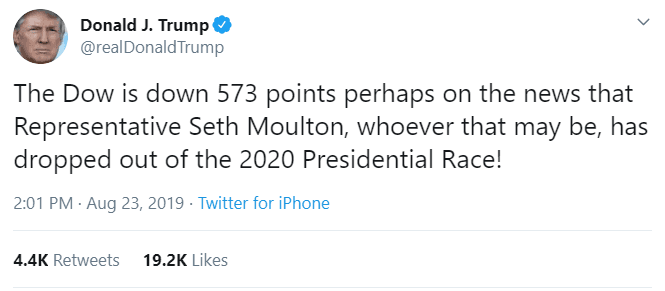
That's it. This week is over. No more news.
Follow Evan Hurst on Twitter RIGHT HERE, DO IT RIGHT HERE!
Wonkette is ad-free and funded ONLY by YOU, our dear readers. If you love Wonkette, SUPPORT WONKETTE.
How often would you like to donate?
Just once
Monthly
Select an amount (USD)
$2$25$5$50$10$100$15$500$20$1000
23 Aug 14:13
$1M surprise found in banana shipments
IKEA MonkeyThere's always money in the banana stand
Grocery workers in three Washington state supermarkets discovered over $1M in cocaine packed in banana shipments.


21 Aug 04:35

Holy crap, Lana Wachowski is directing a new Matrix sequel starring Keanu Reeves and Carrie-Anne Moss
by Britt Hayes on News, shared by Britt Hayes to The A.V. Club
IKEA Monkey.....what???
As it turns out, those denials of a new Matrix sequel were every bit as much of an illusion as that damned spoon. Variety brings the rather surprising news that Lana Wachowski—one-half of the duo behind the original trilogy—is returning to direct a fourth installment in The Matrix series. And in a whoa-worthy turn of…
21 Aug 00:43
It Sure Looks Like Russia Is Trying to Cover Up Fallout From the Skyfall Nuclear Missile Accident
by Greg Walters
IKEA MonkeyHave they even heard of Chernobyl???
Russia has stopped sharing data from multiple nuclear monitoring stations near the location of a nuclear accident that killed seven people this month, and the official silence is fueling fears of a coverup.
Russia appears to be trying to hide details of the suspected Aug. 8 explosion of a prototype “Skyfall” cruise missile, which aims to achieve limitless range thanks to an onboard nuclear-powered engine, independent nuclear weapons experts told VICE News.
“This event has been hugely embarrassing for the authorities, and they're doing almost everything they can to minimize its significance and suppress information about it,” said Joshua Pollack, an expert on nuclear weapons at the Middlebury Institute for International Studies. “They’re running in the opposite direction, trying to hide the details and obfuscate.”
READ: Everything We Know About Russia’s Nuclear “Skyfall” Missile and That Mysterious Explosion
Official data show a spike in radioactivity near the blast site that was too low to cause real danger to humans. But the lack of transparency is fueling anxiety. Russian media have reported local officials doing things that don’t inspire confidence.
Regional authorities reportedly placed a bulk-order for gas masks. A temporary evacuation was ordered, then rescinded. Russian intelligence officers reportedly forced doctors treating the injured to sign non-disclosure agreements.
The bungled response is drawing comparisons to the notorious cover-up of the far-more-deadly Chernobyl nuclear disaster of the 1980s, although so far no one is suggesting that the threat to public health is anywhere near that bad.
“It’s as if they learned nothing from Chernobyl,” said Pollack.
Data blackout
Officials have said that a nuclear propulsion system exploded on an offshore testing site in the far-northern White Sea, blasting researchers into the water and causing radiation levels in the nearby city of Severodvinsk to jump some 16-times normal background levels for 30 minutes.
But Russia stopped sharing data from four radiation monitoring stations shortly after the explosion with the Comprehensive Test Ban Treaty Organization, or CTBTO, a spokesperson for the group established to monitor nuclear weapons testing wrote in an email to VICE News on Tuesday.
Freezing out international observers immediately after a nuclear accident is “not a good look,” said Ankit Panda, an Adjunct Senior Fellow in the Defense Posture Project at the Federation of American Scientists.
“This was a troubling development that suggests an attempt to conceal radionuclide data,” Panda said.
A pair of stations close the blast stopped sharing data two days after the Aug. 8 explosion, and two sites much farther away in Russia’s remote eastern territories went dark Aug. 13, the spokesperson said. One of those further stations is now back online, along with a fifth that had a brief blackout, the official said.
The organization also released a map of the likely flow of detectable radiation that shows a widening cloud of radioactive gas spreading from far-northern Russia toward the south, over Russia’s more-populated eastern regions and into central Asia and the middle east.
While the map is hypothetical, it suggests that a radioactive plume might well have passed over some of the very stations that have now gone silent.
Russia: Your map is “absurd”
Russian President Vladimir Putin reassured his countrymen that they have nothing to worry about.
“There is no threat there,” Putin said in a press conference on Monday. “I’m getting reports from our military and civilian experts, and we don’t see any serious changes.”
On Tuesday, Putin’s spokesman, Dmitry Peskov, dismissed the CTBTO’s map as “absurd.”
A top Russian Foreign Ministry official noted that sharing data with the CTBTO is “purely voluntary” for Russia, since several signatories — including the U.S. — haven’t ratified the corresponding treaty.
Russia may be attempting to stop Western officials from learning more about its weapons program by reading data from the explosion, or alternatively, attempting to stop panic from spreading among the broader population, experts said.
But that lack of transparency, however, is prompting both criticism and attempts by outsiders to piece together the details of what happened from outside sources.
Radioactive bodies
The week after the blast, local authorities announced an auction for over 1,000 gas masks, Russia’s Open Media news outlet reported, although it cited an anonymous local official insisting the order was a routine replenishment of supplies.
Filling the information vacuum, a local ecologist from the town of Severodvinsk named Alexei Klimmov warned locals not to eat any fish caught near the offshore nuclear blast area.
“I advise people not to go fishing in Dvina Bay,” he told Russian outlet Real Time.
Doctors at the regional Arkhangelsk Regional Clinical Hospital weren’t informed that three bodies arriving in plastic sheets might be radioactive, according to The Moscow Times.
The next day, officials from Russia’s fearsome FSB intelligence agency arrived at the hospital to make the doctors sign non-disclosure agreements, the paper said, citing unnamed local doctors.
One of those doctors told the paper that a recent tweet by the creator of the recent HBO miniseries about the Chernobyl disaster, Craig Mazin, had been exactly right.
Two days after the blast, Mazin tweeted: “It’s happening again.”
Cover: This video grab from RU-RTR Russian television on Thursday, March 1, 2018, purports to show the launch of what President Vladimir Putin said is Russia's new nuclear-powered intercontinental cruise missile. President Vladimir Putin declared Thursday that Russia has developed a range of new nuclear weapons, claiming they can't be intercepted by enemy. (RU-RTR Russian Television via YouTube)

16 Aug 19:03

Single parenting looks significantly harder in the first images of Netflix's sci-fi drama Raising Dion
by Shannon Miller on News, shared by Shannon Miller to The A.V. Club
IKEA MonkeyYooooo I am super hyped about this. I remember sharing the back in 2015 when it came out and I am really hoping this is as good as these images look.
Having finally escaped developmental purgatory, Netflix has released the first images of the upcoming Michael B. Jordan-produced sci-fi drama Raising Dion. Per a recent press release, “Raising Dion follows the story of a woman named Nicole (Alisha Wainwright), who raises her son Dion (newcomer Ja’Siah Young) after the…
07 Aug 18:08

Watch as thousands of happy Pikachus dance across this Japanese city
by Alani Vargas on News, shared by Alani Vargas to The A.V. Club
IKEA MonkeySure, ok
Pikachu as voiced by Ryan Reynolds is pretty good, but you know what screams “party”? Hundreds of Pikachu overrunning a city, dancing and just being their cute selves. Now that’s a good time, and it’s exactly what’s consuming the Japanese city of Yokohama this week, according to Sora News 24. On Yokohama’s website,…
07 Aug 04:05

Sundance winner One Child Nation spotlights a very dark chapter of China’s recent past
by Lawrence Garcia on Film, shared by Lawrence Garcia to The A.V. Club
IKEA MonkeyBefore I was an embryo, my parents tried for nearly 8 years to conceive. They were told by doctors than after 8 years, my mom was likely infertile, and they should pursue their dream of parenthood in other ways. They started the process of adopting a Chinese daughter. During this time, Chinese girls were abundant adoption prospects due to the 1 child policy and my parents had strong ties to the church - which had a heavy hand in these adoption schemes. My parents had a daughter picked out and everything. There was a girl they were planning to adopt. Then my mom got pregnant and they ceased moving forward with that process. My mom went on to have 4 more children (so much for that doctor's assessment of her "infertility".) I often wonder what happened to that Chinese girl. I hope she had a good life. I truly do.
In 1979, China launched its one-child policy, which legally prohibited most parents from having more than a single child. A drastic attempt to curb the nation’s urgent population crisis, it would go on to shape an entire generation. The repercussions of the program—still being felt today, both in China and…
07 Aug 03:04
Why Is It That 23 Billionaires Love Pete Buttigieg But Zero Billionaires Love Me?
by Katie McDonough on The Slot, shared by Katie McDonough to Jezebel
IKEA MonkeyHow are there 23 billionaires in America
