Shared posts

06 May 05:25

What Not Dying Looks Like

It’s always odd to hear people say RSS is dead. The fact is, RSS is easily the most successful stealth, insurgent technology on the web. It is pervasive and is the engine for much of the Internet.

Apple uses it to syndicate computer updates. Your podcast subscriptions rely on RSS. Every Wordpress blog is RSS enabled and every major news site is broadcasting via RSS. They’re all syndicated. They all have an RSS feed. It’s the background hum of the Internet.

There are millions of feeds out there, continually connecting users to their favorite content. Just about everything online except Facebook and Twitter is available via RSS.

Even more importantly, RSS has proven to be resilient and durable regardless of what corporate interests want to do with it. Netscape invented the underlying code in the late 90’s, and then took away all documentation and support in 2001 after AOL bought them out. But even that didn’t slow the dissemination. 

And then last year, the biggest player on the Internet took its ball and went home when Google killed its Reader. Despite the fact that Google retired the most popular RSS application on the Net, it did not affect RSS in any appreciable way. All of those feeds are still available and users are still getting their content delivered exactly as they want it. What greater proof is there of the resiliency of RSS?

In fact, what might have seemed like a disaster at first is perhaps the best thing that could happen to the technology. Remember, RSS is a technology and a service; it is not a product. AOL thought they could squash this great idea, but a community of developers took the idea and ran. Then Google thought they could abandon the technology and assumed everyone would gravitate to their social networks instead.

In fact, any number of companies can go out of business, but nobody can stop anybody from publishing and reading RSS feeds. 

However, just because a technology is widely available does not guarantee success. What makes RSS truly powerful is that users still have the control. The beauty of the system is it that no one can force you to be tracked and no one can force you to watch ads. There are no security issues I am aware of and no one ever has to know what feeds you subscribe to. This may be the last area of the Internet that you can still say things like this.

Google Reader was a monopolist product built on an anti-monopolist technology. Now that they’re gone, RSS is once again anyone’s game. You’re going to see a lot more innovation and new stuff for RSS. I never know if its supposed to be a blessing or a curse to live in interesting times. But I have to believe this RSS is entering maybe the most interesting time in its long history.

02 May 10:38

Facebook's Whatsapp buy could pay off if the app meets its goal of billion users

Sandeep Monangi

Interesting M&A strategy by google !!

In February the news that Facebook would pay an astounding $19 billion to acquire text-messaging start-up Whatsapp caused jaws to drop across the tech world and beyond. The agreement, the fifth-largest technology deal ever, offers interesting lessons to guide business negotiators through their most important deals.

In 2009 Ukrainian immigrant Jan Koum and a friend, Brian Acton, launched Whatsapp with the goal of creating a text-messaging application that would connect users with family and friends abroad at a low cost. Since its inception Whatsapp has been ad-free. It now has 450 million global users who pay a 99-cent annual fee for the service.

In 2012 Facebook founder/CEO Mark Zuckerberg approached Koum about the possibility of acquiring his business. Concerned about Facebook's pervasive use of ads and anxious to maintain his company's independence, Koum showed little interest. Nonetheless a friendship developed between the two men in the course of numerous hikes and dinners.

"As we got to know each other," Koum told The Wall Street Journal, "we got to respect each other more."

Facebook wasn't the only high-tech company courting Whatsapp. In 2013 Google made an "odd" proposal to Whatsapp, according to Internet news Web site The Information: It offered millions for the right to be notified if the messaging app entered into acquisition talks with other companies. The unusual "right to know" offer reportedly was hatched by Google mergers-and-acquistions chief Don Harrison after the company was burned by Facebook's $1 billion purchase of Instagram in 2012.

Whatsapp wisely rejected the offer, perhaps anticipating that Facebook would have lost interest if Google had been welcomed into the competition.

Early this past February Whatsapp received its official offer from Zuckerberg. Framing it as a partnership, Zuckerberg affirmed that Facebook would not try to force ads on Whatsapp or otherwise complicate the app, Koum says.

Around this time, according to The Information, Google also entered the race, going so far as to notify Sequoia Capital, Whatsapp's venture-capital investor, that it was prepared to outbid Facebook no matter what the cost. Whatsapp refused to engage with Google, however, reportedly viewing Facebook as a better match and suspecting that Google was interested primarily in thwarting its competitor.

Zuckerberg and Koum mapped out an arrangement whereby Whatsapp would operate separately from the social-media behemoth. At Zuckerberg's insistence, Koum also agreed to accept a seat on Facebook's board of directors. The $19 billion deal was struck.

Talking to the Journal, Koum focused on his and Zuckerberg's common goals rather than on their differences: "We have a shared mission of connecting the world and making it more open," he said.

Did Facebook overpay for Whatsapp? The deal could pay off if the app meets its goal of a billion users. The acquisition also will give Facebook the stronger presence it has been seeking on mobile devices.

Moreover, the prospect of losing to a competitor can be a legitimate reason to overpay for a commodity, according to Harvard Business School and Harvard Law School professor Guhan Subramanian. In so-called all-pay auctions, each bidder believes that it will suffer in the marketplace if a competitor gets the target company. In the end the winning bidder overpays, but perhaps suffers less than the losing bidder.

Viewed in this light, Facebook's possible overpayment is rational, rather than a sign of competitive arousal, the type of "auction fever" that leads bidders to try to win at any cost.

Meanwhile, across Silicon Valley, both hopes and fears that the deal would spark a new wave of exorbitant start-up acquisitions abounded. Concern is growing that the Whatsapp purchase marks the start of a high-tech bubble like the dot-com bubble that burst at the turn of this century.

Here are some standout negotiating moves in the Whatsapp purchase.

A STRONG RELATIONSHIP.

Zuckerberg won over Koum by patiently pursuing his friendship and trust. Ultimately Koum came to view their differences as compatible rather than insurmountable, forging close ties that should serve them well when, inevitably, problems arise in their partnership.

A CALCULATED OVERPAYMENT.

Often the winner of an auction or other intensely competitive negotiation relishes only a short-term victory, as there is a good chance he or she overpaid for the prize. Sometimes the best way to avoid overpaying in an auction is to stay out of it entirely. When your analysis suggests that you would suffer if a competitor won the prize, however, overpayment may be a rational move.

INNOVATIVE THINKING.

Though the strategy didn't work this time, Google's Don Harrison came up with a novel negotiating strategy in the "right to know" offer, one that he or others may adopt more successfully in the future. The strategy could help companies stay informed about potentially beneficial opportunities and also scare off competitors.

(This article first appeared in the Negotiation newsletter, published by the Program on Negotiation at Harvard Law School, www.pon.harvard.edu.)

Copyright © 2014 Times Internet Limited. All rights reserved.

02 May 05:23

Comic for April 30, 2014

29 Apr 11:07

A totally simply way Google could have avoided f***ing up Google+

I’ve been meaning to write this blog post for a year, and I might as well get it out there now that I’ve just read that Google is backing away from Google+.

It’s not surprising that Google is getting away from Google+.  It was actually a really good product, but the thing has had zero traction with real people.

But, I have to be honest, the way Google has handled Google+ has totally pissed me off.  No, I’m not among the legions who have been unhappy about Google integrating Google+ into all of their other products.

I’m pissed because Google blew an amazing opportunity.  Google possessed a totally simple and easy way to make Google+ practical and relevant, but somehow, I don’t know how, they f***ed it up.

What am I talking about?  Let’s rewind to March 13, 2013:

We have just announced on the Official Google Blog that we will soon retire Google Reader (the actual date is July 1, 2013). We know Reader has a devoted following who will be very sad to see it go.

Naturally, there was a lot of reaction and angry Reader users.

But, Google could have avoided angry Reader users and given Google+ a massive boost by simply integrating Reader into Google+.

Yes, just that simple…make it so that you could follow an RSS feed as though it were another user in G+.  Make it so that you could put RSS feeds into circles, and share them, just like you do with other G+ users.

If Google would have done that G+ would have taken off like wildfire and nobody would have ever looked back.  I have no idea why they didn’t, but for some reason the lost potential has irritated me for a year.  And, here we are now, with the whole effort going down the tubes.

What a waste.

29 Apr 08:57

Transcript of Narendra Modi’s interview for job of a C++ programmer

by Guruprasad

Narendra Modi recently gave an interview for a job of C++ programmer. Here is the full transcript:

Modi

Modi dressed up for the occasion

Interviewer: Welcome, Mr Modi. I was actually expecting you to be here by 3 PM and you are entering now at 4.30 PM. Why so late?

Modi: Dekhiye, I actually started very early at 1 PM and was planning to reach here by 2 PM itself. But as soon as I stepped out of my house, to my utter surprise, I found thousands of people from my village, who had come to shower me with their blessings. Dancing and lighting firecrackers, most of them accompanied me all the way till the entrance of your office. Peep out of the window and you can see a sea of people out there. They call it Modi wave.

Interviewer: That’s fine. Just wanted to know if your delay was due to any inconvenience in finding our address. Anyway, let’s begin now. Tell me about yourself.

Modi: Dekhiye, baat yeh hai ki.. The village I hail from has a rich history of more than 1000 years. It is the place where Mahatma Gandhi was born. But a Shehzada and his family who are no way related to the Mahatma, are misusing his name and cheating all of us. The people in my village cannot be cheated by such sweet talks because they are hard working and are highly proud of themselves.

Interviewer: Ok, ok. Calm down. I was asking you to tell me about yourself and not about your village and Shehzadas. Let’s keep that aside and go to the next question. Tell me about the relevant experience you have related to the project and how you can contribute to our software?

Modi: First thing. Your software which was written in C++, is almost 25 years old now and has become legacy code. Moreover, your programmers have been focusing too much only on Windows platform. Why don’t you have software releases for Mac & Linux? By focusing only on one platform and not on others, your programmers have become pseudo-programmers. I will change the whole software by rewriting it in Java because I believe in portability. My mantra is “Write once, run everywhere”. By coding it in Java, the software will run on all platforms without any discrimination. Release to all platforms, deny to none.

Interviewer: That’s very interesting and we had never thought about it before. What do you think about code maintenance?

Modi: Yes, good that you brought out this topic. I had gone through all the previous release notes of your software and I was surprised to find that the total size of your software has been only between 500-600 MB over the last few years. There is absolutely no development. I believe in development model where growth must be shown year after year. Why are you still stuck at 600 MB and releasing it over CDs when we have 4.7 GB DVDs these days? Give me 30 days and I will add more code to increase the size to 4 GB. Every time a software version is released, I will advertise it to all of our customers & users on social media which will boost the brand value of the company.

Interviewer: You seem to be knowledgeable in release management & marketing as well. Anyway, let’s limit this interview only to programming because that is what the job profile is for. What do you think about null pointer checks? Do you follow null checks in your code?

Modi: Never!! Null pointer checks have become a tokenism nowadays. I have downloaded & scanned software source code from IBM Mainframes dating back to 1960 and I have never seen any null pointer checks in their code. These days, it has become a habit for programmers to enclose every tiny part of their code within null pointer checks just to prove that they are “high level programmers” but they are just pseudo-programmers. I am not going to do such a showoff because I believe only in real output rather than tokenism.

Interviewer: That’s an interesting ideology. Now I am running out of time and would like to finish this interview with this final question. We interviewed 3 other candidates before you today. Tell me why should we hire you instead of them?

Modi: Just before entering your office, I saw all those 3 candidates laughing and discussing with each others. They are all hand in glove with each other and each one is a B team of another. They have actually not come to get a job but their plan is to stop me from getting this job.

The first candidate does not even know to code and his resume was actually prepared by his mother with fake project details. In fact, if you had asked him for his passport, you would have realized that his original name is different from what he calls himself using a fake name.

The next candidate is a pseudo-programmer who never misses null pointer check and preaches others also to follow null pointer checks, but fills his code with unnecessary special status and special cases, leading to stack overflow.

The 3rd candidate is actually a stress tester who throws all kinds of values as inputs hoping that at least one of them will make the system unstable or crash the software. I heard that he had once intentionally written a 370 line vulnerable maths division code and entered values as 49 for numerator and zero for denominator to crash his own software. He used to run that software throughout the day and find pleasure in crashing his own trivial software.

Whereas look at my resume. I have already been a C programmer for 12 years with solid experience and now if you provide me an opportunity, I can become a C++ programmer. The code that I write will run on all platforms without any discrimination and the software will increase in size for every release, showing real development.

Interviewer: You have great oratory skills as well, Mr Modi. Anyway, I am done with the interview. You may leave now. Our HR team will get back to you on May 16.

29 Apr 06:37

Transcript of Arvind Kejriwal’s interview for job of a C++ programmer

by Guruprasad

Arvind Kejriwal recently gave an interview for a job of C++ programmer. Here is the full transcript:

Kejriwal Interview

Kejriwal giving interview.

Interviewer: Welcome, Mr. Kejriwal. Please have a seat.

Kejriwal: Nah! I am an aam programmer and I sit on the floor. I actually wanted to sit outside your office entrance, but your HR team insisted me to attend the interview inside the office only. So here I am.

Interviewer: That’s fine with me. Please push the chair aside and sit comfortably on the floor. Now, tell me something about yourself.

Kejriwal: Let me first tell something about the programmer whom you gave “Best programmer” award last month. He is actually corrupt. I have done complete survey of your company and the 10 million lines of code of your software product. I have 370 pages of reports which shows that the code he has written has caused the maximum number of memory corruptions. You are encouraging his corrupt acts by giving him awards and promotions, and this is setting a bad precedent to others. This cannot last long. Rest of the employees will not forgive you.

Interviewer: Ok, ok, calm down. I asked you to tell me about yourself, not about our employees. Anyway, lets leave that aside. Now tell me what relevant experience you have for this project and how you can contribute to the software?

Kejriwal: Look, I might not have the relevant experience, but my intentions are good. Give me some time, and atleast I will do something. I am here to clean up your code from memory corruption, memory leaks & compiler warnings, and change the whole software system. You might have sold millions of copies of your software and earned billions of dollars but don’t forget that your customers are fed up of your autocratic software which does not give them any flexibility. I will change the software architecture also completely.

Interviewer: That is interesting. Why do you think our software is autocratic & how do you intend to change the architecture?

Kejriwal: I believe in Swaraj. Power in the hands of the user. Everything must run on referendum. For example, your software assumes that a document has to be auto-saved every 3 minutes. Why? Instead, I will change the software and introduce a pop-up box which comes up once in every 3 minutes asking “Do you want to auto-save the document? Yes/No?“. Let the user decide whether he wants to auto save or not.

When the user double clicks on an icon, it should come with a popup asking “Did you really double click the icon? Yes/No?“. If he clicks on Yes, it should come up with another popup asking “Did you double click it in order to open the document? Yes/No?“. Only if he clicks Yes again, it should open the document. Power in the hands of the user. The user should feel the he controls the software, not the other way round.

Interviewer: That is impressive indeed. We had never thought of it. Do you have any more ideas for our software solution?

Kejriwal: Of course! Consider your customer service. Whenever a user’s software crashes, it sends a report automatically to your support center. When a user has a problem or doubt, he directly calls your call center. I think this is a totally outdated concept and needs a complete overhaul.

Interviewer: Is it so? Tell us how do you intend to overhaul it?

Kejriwal: I will come up with “Customer Darbar” process. If a user has a problem, he has to wait till the weekend. Every Sunday morning, I will conduct the “Customer Darbar” where all the users who have faced problems will come with a print out of their problem statement and start assembling outside the office from 8 AM. I will go at 10 AM and personally collect all those print outs from them and submit it to our support center, which will then take over from there and resolve those issues. “Customer Darbar” is my highly sophisticated, patented idea, which can be applied to transform the company.

Interviewer: Excellent idea!! I am sure it will “transform” our company. Coming to the next question. What is your take on security? Do you think a programmer should write code keeping security considerations in mind? You know, there can be virus attacks anytime.

Kejriwal: I am totally against security. Why does a code need security? All the code that I write will be aam software code and it does not require any security or anti-virus. In spite of it, if the rival company plants a virus and it affects a certain feature of our software, there should be a referendum pop-up box saying “So-and-So feature is affected due to a virus attack” and depending on user’s input, the software will either delete the feature itself, or shut down the computer if the user does not respond within 49 seconds.

Interviewer: That is a mind-blowing idea. Now I am running out of time and would like to finish this interview with this final question. We interviewed 3 other candidates before you today. Tell me why should we hire you instead of them?

Kejriwal: I was sitting in your parking lot since 8 AM today and I have seen all the candidates who attended your interview. The first candidate came in a Tata Indica. This proves that he is an agent of Tata. The second candidate had a Reliance CDMA phone, and that proves he is an Ambani agent.

The 3rd candidate was very silent and even when the parking attendant greeted him, he did not greet back and went silently. Why was he silent? His silence is a proof of his confession and that he is hiding his guilt. I tried to get his attention by coughing loudly but he did not even turn towards me. I was very curious and went to the parking spot where he had parked his vehicle. I was shocked to find that it was actually a huge SUV and there were several stickers of Mickey Mouse & other characters. Upon close observation, I noticed a small sticker of Disney’s Pluto as well on the SUV’s tyre frame.

That explains it all! Pluto is a puppy. Pluto sticker on SUV tyre. Connect the dots: “Puppy under SUV”. He must be a communal fascist with blood in his hands, and that’s why he does not have the guts to face anybody.

Now you tell me, do you want a Tata agent, Ambani agent, communal fascist, or an aam programmer?

Interviewer: You have great investigation skills, Mr. Kejriwal. Anyway, I am done with the interview. You may leave now. Our HR team will get back to you on May 16.

28 Apr 04:52

New Apple patent seeks to prevent drivers from texting

LONDON: American tech giant Apple has filed a patent application for a system that aims to make texting at the wheel impossible by blocking drivers from sending messages on cell phones.

The system creates "lock-out mechanisms" to disable cell phones from performing certain functions, such as texting, while one is driving.

The patent describes how sensors in a mobile phone could tell how quickly a person was moving and would be sensitive enough to work out whether a person was in the driving seat or in a safe operating area of a vehicle, allowing passengers to text as normal.

"A handheld computing device can provide a lock-out mechanism without requiring any modifications or additions to a vehicle," the patent said.

"The device can comprise a motion analyser, a scenery analyser and a lock-out mechanism. The motion analyser can detect whether the handheld computing device is in motion beyond a predetermined threshold level.

"The scenery analyser can determine whether a holder of handheld computing device is located within a safe operating area of a vehicle.

"And the lock-out mechanism can disable one or more functions of the handheld computing device based on output of the motion analyser, and enable the one or more functions based on output of the scenery analyser," it said.

The patent further develops the idea and says the vehicle itself could contain technology that could effectively block the signal to a phone inside a moving car.

It is not clear how this could ensure that passengers' phones would not be affected, a newspaper reported.

The patent application, which was filed in 2008, but only published and granted recently, also said that police report that their ability to catch drivers texting is limited "because the texting device can be used out of sight (eg on the driver's lap), thus making texting even more dangerous.

"Texting while driving has become so widespread it is doubtful that law enforcement will have any significant effect on stopping the practice," the patent said.

Earlier this month, it was reported that Apple has filed a patent for 'transparent texting' technology to make texting while walking safer by replacing the text background with a live video feed of whatever is in front of the smartphone user.

Copyright © 2014 Times Internet Limited. All rights reserved.

28 Apr 04:47

Online Only Booking & Dynamic Pricing for IRCTC Special Premium Trains

by Lakshmi Sivadas

The IRCTC has introduced 48 special premium that trains can only be reserved online and will have its fares change dynamically.

irctcThe service was first introduced in December 2013. Base price of the fares will be at par with that of the Rajdhani tatkal tickets, and will increase as demand increases for the trains.

The special premium trains will only commute during certain seasons and will have AC II tier, and III tier coaches with Rajdhani like facilities in it. With an advance reservation period of 15 days, agents will not be allowed to book tickets on these trains. Tickets once booked on the special premium trains, can also not be cancelled or refunded.

The move will help IRCTC plug losses arising from the passenger ticketing segment which was estimated to be Rs 26,000 cr as of December 2013. However, with prices beginning at Rajdhani like fares at over  Rs 2K and 1.5K and changing thanks to the scarcity of seats and rise in demand, wouldn’t it be preferable to book an airline ticket?

Recommended Read: Five things IRCTC ticketing site must fix: A geek’s wishlist for IRCTC/Indian Railways

The post Online Only Booking & Dynamic Pricing for IRCTC Special Premium Trains appeared first on NextBigWhat.

25 Apr 08:33

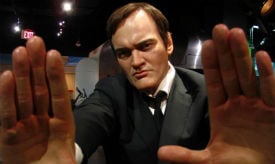
Viewing Pirated Material Is Not Direct Copyright Infringement, Judge Tells Tarantino

by Andy

Back in January, Quentin Tarantino discovered that a copy of an unreleased screenplay to potential future movie The Hateful Eight had been made available to the public without his permission. He’d shared the document with six individuals and either one of them – or someone linked to them – had leaked it.

Shortly after dozens of news articles appeared online, news site Gawker reported that following a “temper tantrum” Tarantino had decided that he would no longer make a Hateful Eight movie. The next day The Wrap reported it had obtained a copy of the script and within hours it was being made available by the AnonFiles.com file-hosting site. From there it appeared on Scribd.com, viewable to millions of visitors.

But while people would have to find the script themselves if they were interested, Gawker later made the process significantly easier by publishing an article titled “Here is the Leaked Quentin Tarantino Hateful Eight Script” containing links to both AnonFiles and Scribd. Gawker refused to take down the links when asked, although both AnonFiles and Scribd both removed the file.

Through his legal team an enraged Tarantino accused Gawker of encouraging copyright infringement, but Gawker fought back saying that in the course of its reporting the links were protected under “fair use” doctrine. On January 27, Tarantino’s lawyers filed a complaint alleging copyright infringement against 10 ‘Doe’ defendants and contributory copyright infringement against Gawker.

Yesterday, however, the lawsuit received a substantial setback.

In order for a defendant to be found liable for contributory copyright infringement there must first be evidence of direct infringement carried out by others. In other words, to proceed against Gawker, Tarantino’s lawyers needed to show that visitors to Gawker’s site who read the article in question actually clicked the links to AnonFiles or Scribd and went on to commit direct infringement on the script.

“However, nowhere in these paragraphs or anywhere else in the Complaint does Plaintiff allege a single act of direct infringement committed by any member of the general public that would support Plaintiff’s claim for contributory infringement. Instead, Plaintiff merely speculates that some direct infringement must have taken place,” wrote U.S. District Judge John F. Walter in his ruling.

Adding more problems for Tarantino, the Judge said that even if there were allegations that individuals had accessed the links in the Gawker article in order to read the script, that would still not support Tarantino’s claim for contributory infringement. Citing a previous case involving adult magazine publisher Perfect 10, Judge Walter said that simply viewing the script would not be enough.

“Even if Plaintiff alleged that individuals accessed the links contained in Defendant’s article in order to read Plaintiff’s script, such an allegation would still not support Plaintiff’s contributory infringement claim against Defendant. Simply viewing a copy of allegedly infringing work on one’s own computer does not constitute the direct infringement necessary to support Plaintiff’s contributory infringement claim,” the Judge wrote.

“In addition, based on the allegations of the Complaint, there can be little doubt that Plaintiff has a strong claim for direct infringement against Doe 1, a/k/a AnonFiles.com. However, Plaintiff has not alleged and it is highly unlikely that Plaintiff will be able to plead facts demonstrating that Defendant somehow induced, caused, or materially contributed to the infringing conduct by publishing a link to the screenplay after it was wrongfully posted on AnonFiles.com.”

In light of the above, Gawker’s ‘fair use’ defense was not addressed.

“The Court concludes that the fair use arguments, albeit persuasive and potentially dispositive, are premature and the Court declines to consider those arguments until Plaintiff has had an opportunity to demonstrate that he can state a viable claim for contributory copyright infringement,” the decision reads.

While round one goes to Gawker, Tarantino’s legal team now has until May 1 to submit its amended complaint and stage a comeback.

Source: TorrentFreak, for the latest info on copyright, file-sharing and anonymous VPN services.

23 Apr 17:07

More Details (And Photos) Of Amazon's Upcoming 3D Smartphone Leak

by Alnoor

Smartphones from online retail giant Amazon have been in the pipeline for years now, but the wait my be soon coming to an end if recent rumours and leaks are to be believed.


Recently the Wall Street Journal reported that Amazon's first smartphone will be unveiled in June this year, and will go on sale in the third quarter. Now thanks to BGR, we get to see images of the alleged smartphone, confirming the multi camera setup that will make for a glassless 3D experience.


According to BGR, the phone will have a total of six cameras – one primary (13MP) imaging camera on the back, one secondary front facing camera, and four other low-power infrared cameras situated at the four corners of the screen.

The device's extra cameras supposedly track the position of the user's face and eyes in relation to the display. This allows Amazon's software to make constant adjustments to the on-screen elements, altering the perspective of visuals on the screen. The end result of this trickery should make for a 3D experience without the use of any special glasses, no matter which angle the user views the screen from.


Apart from the plethora of cameras, the device will come with a 4.7-inch display featuring a resolution of 720p rather than the 1080p resolution many flagship smartphones now come with. Powering the device will be an unnamed Qualcomm Snapdragon processor and 2GB of RAM. The phone will run a heavily customised version of Google's Android, similar to the one that powers Amazon's Kindle Fire tablets.

With the most novel aspect of the phone being the 3D software interface, Amazon has supposedly tried to use the technology in as many areas as possible. Starting right from the lockscreen, the phone will come with several wallpapers with perspectives that shift when the user tilts the screen in any orientation.


Apart from this even app icons will have a 3D effect, as will core user interface elements. In the WSJ report, Amazon is already approaching third-party developers to make use of the feature in their apps and games. Amazon itself will make its various digital stores 3D compatible, allowing users to view product images in 3D.


BGR adds that the phone displayed in the images wears a sort of case that is meant to ward off prying eyes from the final design of the device. Moreover, this is just one of many smartphones that Amazon is currently working on, and another more entry-level device could be launched in the months following the launch of the 3D smartphone.

TAGS: Mobile Phones, Open Source Android, Amazon, 3D Smartphone, Qualcomm Snapdragon

16 Apr 05:17

Google Takes Stand Against Apple

by Rick Merritt
Three Google software engineers defended Samsung against charges it infringed five Apple patents while a Samsung exec called the original iPhone "niche."
16 Apr 05:16

10 World-Class Apps from Indian App Developers

by Lakshmi Sivadas

Thousands of app developers in India, but only a handful of apps that make a mark. This a list of 10 Indian Apps that have succeeded in being world class.

The post 10 World-Class Apps from Indian App Developers appeared first on NextBigWhat.

15 Apr 06:36

With Cortana, Windows catches up with Apple's iOS and Google's Android in a major way


By Anick Jesdanun

NEW YORK: Yay, it's Nick! How can I help?

Thanks for asking, Cortana. And thanks for making the Windows phone software better, Microsoft.

With the new Cortana virtual assistant, Windows catches up with Apple's iOS and Google's Android in a major way. Microsoft takes some of the best parts of Apple's and Google's virtual assistants and adds a few useful tools of its own. The result is Cortana, named after an artificial-intelligence character in Microsoft's "Halo" video games.

The new Windows system, Windows Phone 8.1, has several other new features, which I'll review separately Tuesday.

The update, including Cortana, will come with new phones starting next month, while existing phones will be able to download it for free in the coming months. On Monday, Microsoft is making a preview version available to software developers. I was able to test that version over the past week.

Apple's Siri virtual assistant on iPhones and iPads has a feisty personality. She has good comebacks for such questions as, "What is the meaning of life?"She's also helpful with directions, restaurant recommendations and appointment reminders. Google Now on Android phones is boring by comparison, but it's better at anticipating your needs and giving you information before you even ask.

Cortana combines Siri's personality with Google Now's knack for anticipation.

Cortana also incorporates a feature for blocking calls, texts and notifications during times of your choosing, while letting you set exceptions for specific people or emergencies (defined as someone trying to call again within three minutes). That feature is separate on iPhones and Samsung's Android phones. Cortana will also identify the name of songs heard in a retail store or bar, while you need separate apps such as SoundHound or Shazam on other phones.

Copyright © 2014 Times Internet Limited. All rights reserved.

15 Apr 06:35

Will Yahoo's foray on television succeed?

By David Carr

Yahoo, a company that seems like a permanent adolescent in search of an identity, is about to try a new persona: high-quality television programmer.

According to The Wall Street Journal, the company's chief executive, Marissa Mayer, is "looking for series that are ready to launch and don't require a lot of development."

Well, aren't we all?

At a time when the culture is addicted to high-end television narratives, Yahoo wants in on the action, partly because while its site may have (flat) traffic - 700 million global visits a month - and (declining) revenue, it has zero cachet and no discernible way forward.

For many years, digital media players watched longingly as HBO and then AMC, FX and Showtime managed to rise above the clutter on television, where Americans still spend five hours a day. So last year, when Netflix broke through with "House of Cards," it made sense that companies like Amazon, Hulu and Yahoo would want to follow suit.

There are signs that it is working - streaming for Amazon Prime tripled in the last year and the company has introduced its own device, Fire TV, which will fight for shelf space in your home along with Apple TV, Chromecast and Roku. At the same time, Comcast is seeking a merger that will give it the scale to invest in technology, and HBO Go is pushing to follow the consumer onto mobile.

"People always want to be what they aren't," said Jonah Peretti of BuzzFeed when we discussed the crisscross the other day.

The prize is dear. Winning in the distribution of high-end content is about mining an audience, and you can't blame technology companies for believing they have relevant skill sets.

Silicon Valley has capitalized on its ability to create compelling software that animates devices and, very often, the people sitting in front of them. Surely, industry executives believed, they could head down the coast 400 miles and make a different kind of software using stars and sophisticated production values with some success. How hard could it be?

The answer is, very hard indeed.

"It is the pure arrogance of the newly rich and the newly powerful to think content is easy," said John Landgraf, chief executive of FX Networks, which has had success with "Justified," "The Americans" and "Sons of Anarchy." "Breaking through in a cluttered marketplace requires expertise in all of the elements of storytelling. There are so many ways it can go wrong."

It can be done, as HBO has demonstrated. Right now, despite all the competitors who are trying to eat its lucrative lunch, the premium cable service is crushing it.

"Game of Thrones," a fantasy-inspired epic, has become an unlikely bona fide hit, with 6.6 million people tuning in for the premiere of its fourth season. "True Detective," a moody swamp-noir set in Louisiana, became a much-talked about win this winter, and "Silicon Valley" is about to have a moment, nailing the greedy hippie ethos that makes the tech world such a compelling, silly place. Comedies like "Veep" and "Girls" did well enough to earn their spots as well as their renewals.

But in the years leading up to those successes, not even HBO seemed able to be HBO. Using its tried and true formula of funding proven auteurs, the network followed up "The Sopranos" with "Luck," "John From Cincinnati," "Treme" and "The Newsroom" - shows that it was equally proud of but that failed to connect with an audience. A company executive described the period as "those years we don't talk about."

I have covered television (and film) long enough to know that wandering around Sunset Boulevard with a big bag of money shopping for programming is more likely to result in a mugging than a hit show. It requires connections in the agency world, technical muscle, moody writers, fragile stars - the list goes on. And even if you navigate all those shoals adroitly - spending large amounts of money the whole way - there also has to be some luck, a serendipitous grab of the zeitgeist. It's a tough racket.

Hollywood and Silicon Valley regard each other with mutual suspicion. The entertainment industry is viewed as a metric-free place of profligate whimsy by the engineering culture, and the valley in turn is seen as a place that has no regard for intellectual property and that has a profound lack of taste.

"Say what you will about Hollywood, the mechanism for finding talent is actually pretty good," said Mike Judge, a former programmer in Silicon Valley who went on to make "Beavis and Butt-Head," "Office Space" and, most recently, HBO's "Silicon Valley."

"People in Silicon Valley are generally smarter than people in Hollywood, but it takes a different kind of intelligence to make television, especially a lot of it, and do it well," Judge said. "Telling stories requires lots of skills, not just making people laugh, but also who does the best color correction."

Yahoo is especially unplugged from that world. In her move to differentiate on quality, Mayer has looked at more than 100 projects and is leaning hard on Kathy Savitt, Yahoo's chief marketing officer, according to The Journal. But neither has much significant history in the entertainment business, and Mickie Rosen and Erin McPherson, two executives familiar with the media business, recently left the company.

This is not the first time that Yahoo has made a big push into Hollywood - in 2004, it had a well-covered foray into major productions with major stars, an effort that ended in naught.

"This is a very hard business with a very high reward," said James McQuivey, an analyst at Forrester Research. "Yahoo feels compelled to do it because of problems that they have and the opportunity it represents, but they have a lot less skill and knowledge than the other players."

He added, "Finding a big audience that uses you to make their life easier or more convenient, as Yahoo has by creating something useful, is very different than providing a cultural experience that scratches a very deep part of the brain."

"House of Cards" is a great aiming point for other digital players, but that achievement was not easy. Begin with the fact that Netflix was able to collect years of data on consumers through its video rental service. It already had a significant distribution platform in television, something that Yahoo, which lives on desktop and mobile, sorely lacks.

Netflix booked David Fincher, a director with proven commercial and creative credentials, to produce the series, then pushed it into the public consciousness with a blunt force marketing campaign on and off the service.

Before "House of Cards," Netflix made "Lilyhammer," which entered the water like an Olympic dive, without so much as a ripple. Two series that followed, "Hemlock Grove" and "Arrested Development," came and went without a lot of bounce. "Orange Is the New Black" may have turned heads, but it will be years before Netflix has the kind of batting average that will put it in the front ranks of programmers.

In terms of technology companies that have prospered over the long haul in entertainment, I can think only of what Apple did with Pixar before selling it to Disney. In that case, vast processing power was paired with an absolute devotion to great stories. No other lasting success comes to mind.

For Yahoo, changing lanes from creating and hosting short-form video content to making lush, dramatic narratives is a bit like expecting a good sprinter to run a marathon.

With all the money sloshing around, maybe it's time I consider pitching a series of my own. In the one I'm thinking about, the much-lauded chief executive of a tech company decides to go Hollywood in search of an identity and any kind of win. High jinks, plenty of mordant humor and a trail of tears ensue.

Copyright © 2014 Times Internet Limited. All rights reserved.

15 Apr 06:35

Google buys solar-powered drone maker Titan Aerospace

NEW YORK: Google Monday announced that it is acquiring Titan Aerospace, a maker of solar-powered drones that could be used to boost Internet access to remote areas.

"It's still early days, but atmospheric satellites could help bring Internet access to millions of people, and help solve other problems, including disaster relief and environmental damage like deforestation," said a Google spokesman in an email to AFP.

"It's why we're so excited to welcome Titan Aerospace to the Google family."

Google did not release the financial terms of the transaction. Titan's drones are able to run for five years at an altitude of some 65,000 feet (19,812 meters). They can perform similar functions to geostationary satellites, but are less costly.

Google, meanwhile, is developing Project Loon, which uses large balloons for transmitting Internet signals to regions that are not now connected.

Facebook, another tech titan interested in spreading the Internet to new territory, was reportedly interested in acquiring Titan.

But Facebook instead announced in late March that it was acquiring Ascenta, a British firm specializing in unmanned solar-powered vehicles.

Copyright © 2014 Times Internet Limited. All rights reserved.

12 Apr 05:50

Sci-fi Movies That Don’t Involve Aliens. P2.

by bspcn

Eternal Sunshine of the Spotless Mind

Sci-FI Genre: Advanced Technology Genre: RomCom Stars: Jim Carrey, Kate Winslet Why you should watch it: Charming, smart, wonderful. If you could erase your ex from your memories, would you? Trailer: http://www.youtube.com/watch?v=lnSgSe2GzDc Where to watch it: http://www.sockshare.com/file/4C0FE1B4C28A9889

Moon (As mentioned in comments on previous post)

Sci-Fi Genre: Space & another that I can’t say or I will ruin it Genre: Thriller/Drama Stars: Sam Rockwell, Kevin Spacey Why you should watch it: I will borrow a tagline from a previous commenter. A man works in a spaceship alone on a moon. He gets a visitor- him. Trailer: http://www.youtube.com/watch?v=twuScTcDP_Q Where to watch: It’s on Netflix !

Children of Men

Sci-Fi Genre: Dystopian/Epidemic Genre: Drama Stars: Clive Owens, Julianne Moore Why you should watch it: For one it is beautifully shot and directed. It’s about a world where women have been infertile for 20+ years. And suddenly, one gets pregnant. Trailer: http://www.youtube.com/watch?v=2VT2apoX90o Where to watch: http://www.firedrive.com/file/78C24304DFDFC004

Sunshine

Sci-Fi Genre: Space (No Aliens obvs they’re scary) Genre: Thriller Stars: Cillian Murphy, Chris Evans, Rose Byrne Why you should watch it: It’s a space movie without Aliens! It’s set in the future when the sun is about to go-out, so almost pre-apocalyptic. ALSO CHRIS EVANS *heart eyes* Trailer: http://www.youtube.com/watch?v=YZ2-xR54UDU Where to watch: http://www.sockshare.com/file/80JSA88MPCOWOCO

Primer

Sci-Fi Genre: Time-Travel Genre: Drama/Thriller Stars: Shane Carruth, David Sullivan Why you should watch it: An amazing low budget indie that all my physics major friends say is the most accurate depiction of time-travel. Trailer: http://www.youtube.com/watch?v=4CC60HJvZRE Where to watch: http://www.sockshare.com/file/6PJ832HY7AKOGK8

TiMER

Sci-Fi Genre: Advanced Technology Genre: RomCom Stars: Emma Caulfeild, John Patrick Amedori Why you should watch it: It’s about an implanted device that tells you the exact time you will meet your soulmate. Almost everyone has one. The movie weighs the pros and cons of knowledge of the future. Trailer: http://www.youtube.com/watch?v=_Iq_KE61Gio Where to watch: On netflix!

Frailty

Sci-Fi Genre: Biblical?Angelic? Genre: More Pyschological Thriller than Sci-fi Stars: Bill Paxton, Matthew McConaughey Why you should watch it: It stars a young Matthew McConaughey, and explores faith and belief. Bill Paxton plays a father who claims he can ‘see’ those possessed by demons, and gets his sons to assist in the killing of them. Trailer: http://www.youtube.com/watch?v=mW6TlPMHXgk Where to watch: http://www.firedrive.com/file/1F6A5A340D41EF58 . PART 3: http://imgur.com/gallery/b3gTD SCI-FI TV SHOWS: http://imgur.com/gallery/ifYI2
12 Apr 05:37

Apple's deep pockets: What $159 billion could do

Big technology companies have a problem anyone would love to have: They are sitting on vast amounts of cash.

According to a report by Moody's Investors Service, U.S. companies outside the financial industry were sitting on a combined $1.64 trillion of cash by the end of 2013. And tech giants like Apple, Google and Microsoft had the most.

Apple topped the list, with nearly $159 billion. A decade ago, before the iPhone came along, the company was holding about $5.5 billion. Laid out in dollar bills, Apple's current stockpile would cover around 630 square miles.

Apple seems happy to let its trove sit untouched, though the company has not said why.

John Maynard Keynes, the economist, argued that companies tend to hoard cash for three reasons: to perform day-to-day transactions, to protect themselves in the event business slows, and to prepare to make investments should opportunity arise.

Apple certainly isn't using its cash for acquisitions. Compared to its competitors, the company spends very little money buying technologies new or old.

Google has spent billions on video sites, robots, driverless-car technology and artificial intelligence software. Amazon has bought robot-makers, e-commerce services and hardware startups. And Facebook has spent more than $20 billion in just the last two months on a messaging platform and virtual reality technology.

Yet Apple has barely broken the skin over the last decade, buying AuthenTec, a fingerprint sensor company; Siri, the voice service; and Topsy, a data analytics company.

Apple has never even made a single acquisition more than $1 billion. Where are the robots, the driverless cars, the virtual reality goggles?

In an interview in February with The Wall Street Journal, Timothy D. Cook, Apple's chief executive, said the company had looked at big companies but had no urge to buy for the sake of buying.

"The money is also not burning a hole in our pocket where we say let's make a list of 10 and pick the best one," Cook said. He said Apple was "not going to go out and buy something for the purposes of just being big."

But the money is burning a hole in the pockets of investors who want Apple to use some of its cash to pay dividends, buy back stock or both. Carl Icahn, the vocal billionaire investor, is leading the charge.

Rick Lane, an analyst with Moody's who wrote the report on the company's cash holdings, said Apple could be holding onto some of its cash for a rainy day. Apple once fell on "very difficult times," he said, "and had to rely on, in part, the kindness of others."

"Without having to rely on the capital markets, which can be mercurial, it's a kind of self-insurance to have that cash on hands for the times when things go bump in the night," he said.

So what could Apple buy with its miles of cash?

Compared to Google, Apple seems to be focused on the here and now rather than the far-off future. (Google is building autonomous robots and cars.)

Apple could leapfrog its competitors and go all in, picking up Mars. (Yes, the planet.) NASA scientists recently said a human mission to Mars with the goal of building a colony would cost about $160 billion. NASA even floated the idea that big corporations could sponsor the trip.

If going from iPads to interplanetary missions seems like a stretch, maybe Apple could explore transportation on Earth.

Last year Philip W. Schiller, Apple's senior vice president for worldwide marketing, said that before the company built the iPhone, executives had discussed building a car.

Rather than start from scratch, Apple could take less than 20 percent of its cash and pick up Tesla for around $30 billion. Paint the cars white, slap on an Apple logo, dot an "i" before crossing the "t" - and you have an entirely new product category: iTesla.

Of course, Apple would immediately want to jump into the driverless car market - since that is clearly the future of the industry - so the company could buy a few artificial intelligence labs and pick up whichever robotics companies Google hasn't already.

Or Apple could stick with communications. There are very few companies Apple relies on more than the telecommunications giants. While Apple designs and builds its iPhones and iPads on its own, the company still needs Verizon, AT&T, Sprint and T-Mobile to connect those gadgets to music, video and the Internet.

Why not just bypass the telecom companies? T-Mobile, which boasts the fastest Internet service on the planet, is currently worth about $26 billion, about 16 percent of Apple's cash. Sprint is a little more expensive, with a market value of $37 billion. But Apple could pick up both and still have more than $90 billion left.

Microsoft can probably feel Apple's pain. In 2002, Microsoft was rich, sitting on $36 billion. While Bill Gates always believed that Microsoft should have enough cash on hand to operate for a year without making a penny, investors disagreed, calling for a dividend.

Microsoft tried to hold out, saying it wouldn't bow to investors' demands. Under pressure, the company finally relented, and it issued its first dividend.

We all know what happened to Microsoft in the decade that followed.

Copyright © 2014 Times Internet Limited. All rights reserved.

12 Apr 05:37

Disney has Marvel Superhero movie roadmap out to 2028

by noreply@blogger.com (brian wang)
Businessweek feature Kevin Feige who is masterminding the Marvel Superhero movies at Disney.

Clearly Disney will be making Marvel superhero, Pixar animation and Star Wars on a very regular basis forever.

Detailed Roadmap at least out to series 4 of Avengers, Captain America and Iron Man, but maybe out to series 6 and 2028 or so

Marvel has a universe of thousands of characters it controls entirely. That means Feige can produce an unlimited number of films with interweaving story lines and characters, creating a vast audience for almost any Marvel movie.

There’s a map of films reaching far into the next decade on the wall of Feige’s office. “It’s like looking through the Hubble telescope. You go, ‘What’s happening back there? I can sort of see it,’ ” he laughs. “They printed out a new one recently that went to 2028.”

Read more »
05 Apr 04:49

Google Patents Method of Keeping Pirate Apps at Bay

by Andy

google-bayRegular users of the Google Play store will be aware that apps sometimes appear which are very similar to already established apps. These clones are often designed to take advantage of successful apps’ popularity by ripping off their code in order to generate advertising revenue.

These kinds of apps aren’t knowingly welcomed by most Android users, with people preferring the real deal if at all possible. That said, keeping them off the Google Play store is easier said than done, so they can get installed by significant numbers of people should they sneak through. Google, however, is planning to do something about that in the future.

Following an application in July 2013, Google Inc. has now been awarded a patent which should help the company keep pirated and cloned content off its Play store. The system itself is fairly complex, but the way it works is relatively simple to explain.

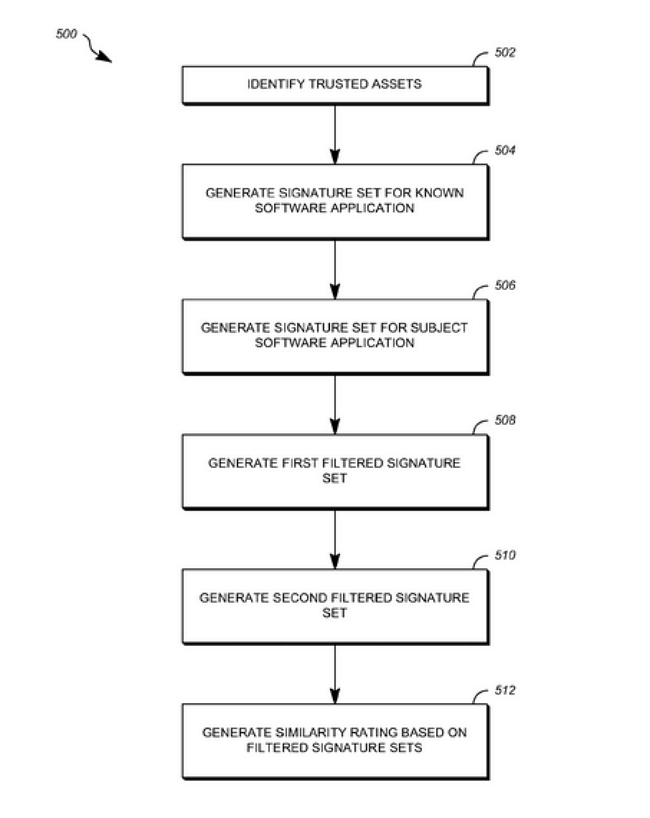
First of all, Google’s patent requires a reference database of all known ‘authorized’ apps that have already been uploaded to Google Play by legitimate software creators. It then compares submitted apps with the contents of the database in order to find instances where they contain assets that are already utilized by known software.

According to the patent the system won’t compare the submitted apps in their entirety, but will instead look for executable code, data files, images and audio files that appear in existing applications already on the store. Based on this a submitted app will receive a “similarity rating.”

Detecting a submitted pirated/cloned appGoogleApp2

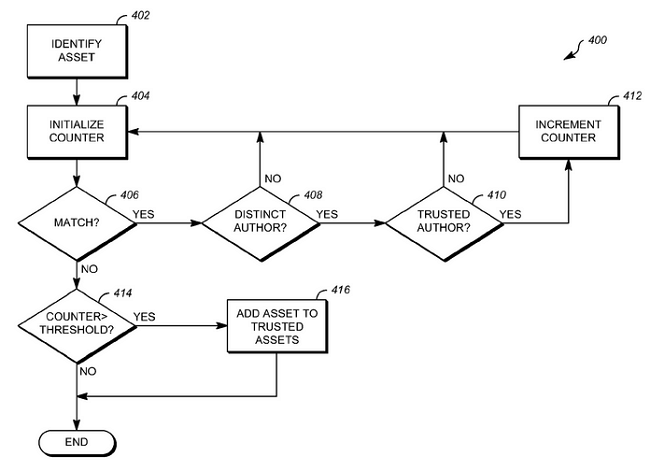
However, Google has recognized that a blanket scanning approach could cause problems. If many apps use open source code or freely available images or audio libraries, for example, the likelihood of completely legal apps becoming labeled as infringing increases. To deal with this type of problem, Google says it will use a filtering system.

“In order to prevent false positive results, the systems and methods herein filter these types of assets from the comparison. The determination as to which assets are considered to be trusted assets can be made based on data associated with the known software applications,” Google’s patent reads.

The system for filtering and recognizing ‘trusted assets’GoogleApp1

The complete patent, which doesn’t mention Google Play by name but clearly refers to it, is available here. In the meantime anyone who feels their app has been cloned will have to use the existing system to have unauthorized content examined and if necessary taken down.

Source: TorrentFreak, for the latest info on copyright, file-sharing and anonymous VPN services.

05 Apr 04:34

Oculus: Facebook’s new $2-billion acquisition that allow users to see images in 3D

Facebook's new bet — a $2-billion acquisition of a company that makes no money and ships no product — is straight out of science fiction. Oculus, the acquired company, is designing goggles that allow wearers to see images as solids. Hypothetically, a Facebook chat among a group of friends could soon turn into an immersive experience where each can actually see all the others in 3D.

An internet chat would become just that, a simulation of a reallife chat among people you can see. Marketmen and analysts might snigger at the size of the payout for what is a tiny company manned by engineers, but Facebook has shown that it is willing to bid heavily and decisively to acquire targets it likes. It paid $19 billion for WhatsApp, which has 450 million users, but little in the way of revenue and left analysts gasping. But messaging and user base are important tools to integrate with Facebook.

Some analysts are said to have questioned Facebook's strategy. One viewed virtual reality as having the same story as it did two decades ago, one of "hip, hype and hop". But if Facebook's Oculus bet pays off technically, in the sense that it becomes fully integrated with Facebook and its applications, then Mark Zuckerberg would have a killer product to sell. Indeed, the possibilities of 3D imaging are limitless. Television telecasts of, say, El Clasico matches featuring FC Barcelona and Real Madrid could be watched in 3D in an experience that would be akin to being present in the stadium itself. In James Cameron's 2009 film Avatar, security personnel remotely operate virtual versions of themselves on an alien planet. We could move one step closer to that, too, if this bet works out.

But it must be pointed out, advances in 3D glasses have been very few: essentially, today's 3D movie-viewing glasses are the same as what their cardboard green-and-redlens ancestors used to be decades ago. Why 3D movies have started to look more realistic is because digital cameras now work seamlessly with imaging and animation software to create superb images. Anyway, Facebook has apot of cash to spend and it seems it is spending money in an innovative way.

Copyright © 2014 Times Internet Limited. All rights reserved.

05 Apr 04:12

Nokia to launch dual-Sim smartphone Lumia 630 shortly in India

NEW DELHI: Nokia will shortly launch four Lumia smartphones in India, including its first dual SIM device Lumia 630 in May for around Rs 10,000, plus taxes, as the struggling handset maker tries to recover lost ground in a market considered among the world's fastest growing.

The Finnish company, who is expected to soon complete a deal to sell its devices business to Microsoft, will also start selling a low cost 4G smartphone Lumia 635, for $189 (around Rs 11,300), excluding taxes, in July, the company said in a release.

"The Nokia Lumia 630 is expected to roll out in May, beginning with Asia, India/Middle East, South America and Europe, at $159 (around Rs9,500) for the single-SIM variant, and $169 for the dual-sim variant before taxes and subsidies," the company said.

Both the models of Lumia 630 support 3G SIM, built on latest Windows platform, and have 4.5 inch screen, 5 megapixel auto focus camera, 8 GB internal memory and support for up to 128 GB external storage.

Lumia 635 is almost the same as Lumia 630, but will additionally support 4G, with mobile internet speeds of up to 100 megabit per second.

Another smartphone, Nokia Lumia 930 is "expected to roll out globally in June starting with Europe, Asia, Middle East and India, available from USD 599 (about Rs36,000) before taxes and subsidies," Nokia said.

The 4G devices launch announcement comes soon after India's major telecom operators Bharti Airtel, Vodafone India and Idea Cellular, along with from newcomer Reliance Jio Infocomm, bought 1800 Mhz spectrum in many circles with the intention of offering 4G services which offer high speed mobile internet, almost 10 times the speed of 3G.

While Bharti Airtel has launched 4G services in some circles, Reliance Jio is expected to launch its own services by the end of 2014.

Copyright © 2014 Times Internet Limited. All rights reserved.

05 Apr 04:07

Arvind Kejriwal accidently slaps himself while killing mosquito, AAP supporters beat him up

by idiot420

Delhi. While trying to kill a mosquito sitting on his cheek, AAP supremo Arvind Kejriwal accidentally ended up slapping himself. However, the sight of Kejriwal being slapped angered his supporters so much that they ended up attacking the assaulter i.e. Kejriwal himself.

Sources tell Faking News that the AAP supremo was constantly urging his supporters to calm down, but the emotionally charged up supporters didn’t listen to their leader.

Kejriwal Attacked

Kejriwal’s close aides taking him away from the angry supporters.

“We won’t let anybody hit Kejriwal sir, even if it is Kejriwal sir. We will teach a lesson to anyone daring to intimidate our leader,” said a furious AAP supporter when asked about the reason why he attacked his own party leader.

AAP supporters cooled down only after Kejriwal cleared the doubt and revealed that it was a mosquito that he was trying to kill, and that there was no intention of hurting himself.

Kejriwal further blamed BJP to clam down his supporters.

“What I felt from my short interaction with that mosquito that it was trained. I think BJP and Ambani are behind it. Considering the amount of money they have, they can do anything,” the former CM of Delhi lashed out at the saffron party.

“Those who have hatched this plan knew that my supporters were going to attack me if I accidentally slap myself. They capitalized on the anger of the AAP supporters and tried to disturb internal peace of my party,” Kejriwal exposed the devious plans.

While the AAP chief was successful in calming down the supporters, he was shocked to see such reaction from them. Sources say that the party is thinking of organizing anger management classes at their office in Delhi.

Meanwhile the allegedly “paid mosquito” is still at large and AAP members are searching it in the streets of Delhi.

Party insiders reveal that in Chandni Chowk area they have spotted a mosquito sitting along with a swarm of mosquitoes as if they were doing some kind of dharna.

“This must be him!” claimed an AAP member who menacingly advanced to kill the mosquito.

23 Mar 09:12

Comic for March 23, 2014

23 Mar 06:10

Laura Deming has been a venture capitalist since she was 18 and she is obsessed with curing aging

by noreply@blogger.com (brian wang)
Laura Deming is an 18 year old venture capitalist Partner at Floreat Capital. At 18, Deming is already a venture capitalist, working closely with biotech legend Corey Goodman. She is obsessed with curing aging, she began working in labs at 12, entered MIT at 14. Frustrated that such work was not being commercialized, she obtained the backing of Facebook founding investor Peter Thiel through the 20under20 fellowship to start an anti-aging focused VC fund.

Laura Deming told attendees at TEDMED 2013 how she found the next emerging market through her passion for extending the human healthspan.


Read more »
22 Mar 04:20

Yes, Fresh Air Now Comes In A Can

by Angela Shupe
Sandeep Monangi

The inevitable has happened !!

Although Chen Guangbiao is more worried about awareness than profit, he has still done something not many people could have expected. He has found a way to take something free and make a little money. In this case, he is selling canned fresh air.

China Daily:

The air is compressed into small metal containers the size of a soft drink can, and consumers can inhale it by pulling the ring off, putting the can close to their noses, and breathing, Chen said.

The cans sell for 4 to 5 yuan (63 to 79 cents) apiece, according to a report on China National Radio.

Photo by Cindy Andrie

21 Mar 05:43

Google says Gmail encrypted 'starting today'

Sandeep Monangi

Encryption keys for each user will be generated by NSA !!

WASHINGTON: Google said Thursday its popular Gmail service would use encryption to thwart snooping, in the latest move by the tech sector reassuring customers following revelations about US surveillance programs.

"Your email is important to you, and making sure it stays safe and always available is important to us," said Gmail engineering security chief Nicolas Lidzborski in a blog post.

"Starting today, Gmail will always use an encrypted HTTPS connection when you check or send email.. Today's change means that no one can listen in on your messages as they go back and forth between you and Gmail's servers -- no matter if you're using public WiFi or logging in from your computer, phone or tablet."

Google has already begun scrambling most of the traffic at its websites as technology firms grapple with moves by US intelligence agencies to spy on what people are doing and sharing online.

And similar moves have been announced by Yahoo, Microsoft and Facebook to use encryption that limits the ability of a third party to read messages or emails.

US tech firms have been ramping up encryption since last year's explosive revelations about the vast surveillance capabilities of the National Security Agency and other intelligence services, based on leaked documents.

Lidzborski said Google's latest move "ensures that your messages are safe not only when they move between you and Gmail's servers, but also as they move between Google's data centers -- something we made a top priority after last summer's revelations."

Some reports say the NSA had been able to access data centers of Google and other Web firms.

Copyright © 2014 Times Internet Limited. All rights reserved.

20 Mar 16:14

Comic for March 14, 2014

17 Mar 10:14

Competition Commission of India Orders Antitrust Probe on IRCTC; About Time!

by Jayadevan P K

IRCTC- logoFinally, some fresh air in the monopolistic world of online railway ticket booking. Last month, the competition watchdog found prima facie that the Indian Railways and its online ticketing subsidiary Indian Railway Catering and Tourism Corporation is abusing its dominant position against the provisions of India’s competition act.

The Competition Commission of India has launched a 60 day investigation into a complaint which alleged that the the IRCTC, which only provides a facility to transact with the Indian Railway’s PRS system through the Internet, is charging a premium on e-tickets (via).

Among other things, it also said that other fees such as the fee an agent has to pay to IRCTC to become one have no economic rationale. The complaint also pointed out how giving preference to development of facilities such as the Internet inside trains is discriminatory.

Let Competition In

This should have been done a long time ago as there is no reason why IRCTC should have a monopoly on online railway ticket booking. You don’t have to look any further than our own telecom sector to know this.

There are similarities between what is happening in the case of IRCTC and what has happened in the telecom sector. Incumbents or monopolies had to slowly give away their control on essential services to competition. As part of the Government’s liberalization agenda, monopolies, also called vertically integrated service providers (because they owned the pipe and the service), were asked to give access to competition in a non discriminatory fashion.

We all know that the sector saw unprecedented boom afterwards.

In sectors that the Government wants to liberalize, for instance, the telecom sector in the 90s, it is natural to unbundle competitive elements from the natural monopoly. This helps bring in private investment and also create competition in the market. Taking into account the inefficiencies in the IRCTC system, it is high time that the government let in competition.

Read the full order here.

The post Competition Commission of India Orders Antitrust Probe on IRCTC; About Time! appeared first on NextBigWhat.

11 Mar 11:55

The “Abiliti” to Eat Less

by Kate Laymon

Photo by PetitPlat Food Art - Stephanie Kilgast

Another weight loss solution is coming down the pike. A new medical implant, a gastric pacemaker, can be implanted in the stomach and acting as stomach nerves, signal to the brain a premature feeling of fullness. Popular Science explains just how it works:

The device, made by Mountain View, Calif.-based IntraPace, will be implanted in the first commercial patients later this week after trials showed fairly impressive results: 65 patients lost an average of 22 percent of their body weights after one year. Some patients shed as much as 38 percent of their poundage.

Abiliti, as the device is commercially called, is implanted laparoscopically inside the abdominal cavity but outside the stomach, with two leads connecting it to the stomach wall. The sensing lead passes through the stomach wall and detects when a person begins to eat. This in turn sends a signal to the second lead, an electrode, which stimulates stretch receptor nerves on the outside of the stomach. In other words, it tricks the nervous system into thinking that the stomach is stretching when it’s not and delivers that message to the brain through the vagus nerve.

It seems to beat stomach stapling and gastric bypass surgeries.

Photo by PetitPlat Food Art – Stephanie Kilgast.

09 Mar 07:07

Google Glass Still Needs a Killer App

Glass is still a pain to use, but a few apps reveal what it could become.

Aside from the fact that it’s not yet publicly available, there are plenty of reasons to not wear Google Glass even if you get the chance. To name just a few: it’s expensive, it looks and feels weird, it doesn’t work that well, and, whether you’re at home or walking down the street, people will stare at you and the small, prismatic display on your face.

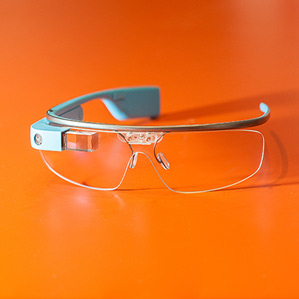
Will the negatives always outweigh the positives? To explore whether Glass could get more useful, I’ve been wearing a bright orange unit and testing a variety of free apps that make the most of Glass’s nascent capabilities and its prime placement on my head. Most of them are available from Google’s Glassware market, which means they’re among a small group of apps already approved by the company. But I also tested some that had to be sideloaded onto the device using a computer—a multistep process that Google warns is done at your own risk, and that, at least in my case, temporarily disabled Glass at one point and scrambled its functions a couple times.

Since Glass is still in its early stages and isn’t available to the general public, I didn’t expect any of the apps to be incredible. And I certainly didn’t find any killer apps that would make it worthwhile to buy Glass (which costs $1,500 now). But I did find several with potential to save time and make life easier, and a couple that are already effective even though Glass is clunky, finicky, and horribly obtrusive. 

Strava Cycling

When I go on long bike rides, I hate taking my eyes off the road to look down at the small bike computer on my handlebars to see my speed and mileage. The Strava Cycling app seemed like a neat way to avoid that: it shows that data and a ride timer in crisp, white text on Glass’s over-eye, see-through display, so it’s available at a quick glance up. A runner’s version is also available.

At first it was even more distracting to look at the data on the Glass display than it would be to look down at my bike computer, since it was hard to absorb what the display showed without ignoring the world beyond. But I grew used to it after a few rides and really liked being able to bring up this information quickly by just tilting my head, and have it disappear just as quickly. 

There are still some big issues hampering the app. I was concerned about the app’s ability to accurately track speed, as the numbers on the display seemed to lag behind when I rode up and down hills. Strava might be able to improve on that, but the company can only optimize its app so much to make up for another big problem: Glass’s poor battery life (Google says it’s good for “one day of typical use,” though in my medium-to-heavy use I never got more than several hours out of it). After a relatively short ride from home to the ocean and back—about six miles—with frequent checks of my stats, Glass had lost a significant amount of power. To last through a multi-hour ride, you’d really want to limit these checks, which defeats the purpose of seeing such information in real time.

Glass Hunt

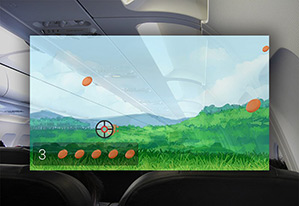
Though I played a few of Google’s approved games via a Glassware bundle called Mini Games, I had more fun and success with Glass Hunt, a first-person-shooter game that you can sideload.

Glass Hunt is exceptionally simple: You aim a target at clay discs flying over a verdant landscape, and shoot down as many as you can by using your head to move the crosshairs of a target over each disc. Google has an almost identical game called “Clay Shooter” in Mini Games, but it has a much more spartan design and requires voice commands that made it much harder to control.

Mostly, Glass Hunt gives a good glimpse at how gaming could work in the near future on head-worn computers like Glass. With improved head tracking and interaction methods, games like this could be a blast.

Allthecooks Recipes

The app that made the most sense with Glass—and was one of the most fully baked—was Allthecooks Recipes.

The app is available as approved Glassware from Google, and it allows you to both search for and follow recipes using Glass and record your own step-by-step recipes to share with others. When I cook I’m constantly running back and forth between a mixing bowl and a cookbook (or a recipe on an iPhone screen), so anything that could save me some time and mess sounded good.

Allthecooks worked surprisingly well. I decided to whip something up at the office, which gave me some pretty strict limitations since we have only a microwave and a toaster. I used Glass to search for “microwaveable desserts” within the app and quickly found a recipe for easy peanut butter fudge.

Within the Glass Allthecooks app, you can see the ingredient list for any recipe by tilting your head upward. So I walked into the Safeway near my office, looked up the ingredients (literally, in this case) while navigating the aisles, and bought what I needed.

Back at the office, each step of the recipe was easy to read on Glass’s display, and there wasn’t too much text on each screen. Generally, Glass’s display turns off when not in use, but here it stayed illuminated long enough for me to complete a somewhat complicated step (pouring melted chocolate and peanut butter into a dish and thoroughly stirring in condensed milk). And if I got confused about what I was doing I could just swipe back and forth between the steps.

Word Lens

Word Lens, a popular smartphone app that translates printed text in real time into a variety of languages, sounded like a great idea for a head-worn computer: if you’re in a new country, why would you want to keep glancing at your smartphone’s screen when you could see translations happen right in front of your eyes?

The problem, unfortunately, is that Glass’s display isn’t right in front of your eyes—it’s above your right eye. This means it takes some practice before you get used to focusing the display on what you want to translate.

Also, it’s not quite instantaneous: you need to focus the display on the words you want to understand, which the app will take as a cue to zoom in on those words and then translate them.

On the plus side, the app did a decent job of translating text, as long as I stuck with simple fonts and short phrases (such as what you’d see on signs). As expected, Word Lens had the most trouble with sentences, text that doesn’t have much contrast from its background, and text on a really busy-looking background.

Word Lens is like the rest of the apps I tried and Glass itself: it has a ways to go before it’s really worth using in everyday life.

Credit: Images courtesy of Giuseppe Costantino | Flickr; courtesy of Glass Hunt; courtesy of All The Cooks