Shared posts

16 Apr 13:54

More Punchycards

by sydney
Philipbrewer

We should totally get a room full of Jacquard looms.

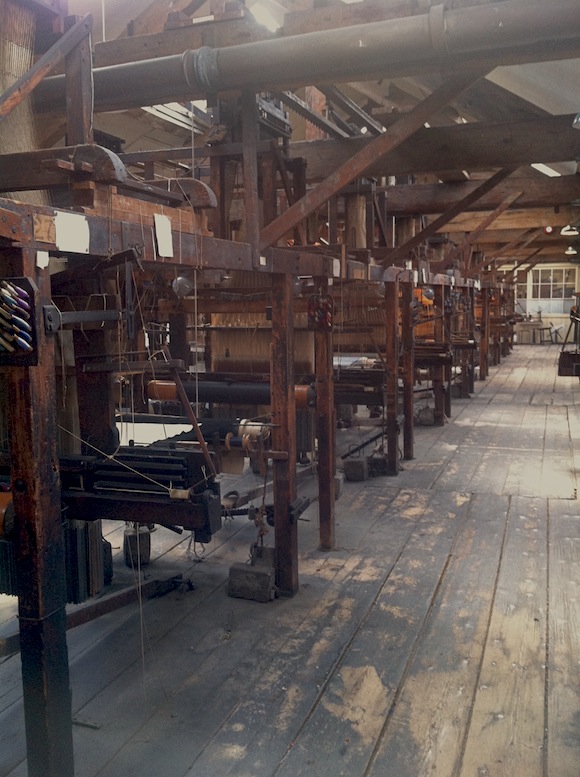
A couple of weeks ago I made a quick impromptu trip up to the town of Macclesfield, just south of Manchester. I went to see this:


Now that’s an actual punchycard room! It’s the Paradise Silk Mills, which is more than worth a visit, if you’re nearby (call first though, their opening hours are brief). Those are some of the 26 beautiful Jacquard looms, they worked away there for a hundred years up until the 1930s.  They all still work, though very slowly- a couple of inches a day! Because it’s hard to get someone to stand and push them back and forth these days.. More punchcards, this is an all-automatic modernish one:

(you can see a mechanical card one working here, which is pretty speedy, but nowadays they’ve done away with the cards all together, and go straight from the computer, they go like the very Dickens)

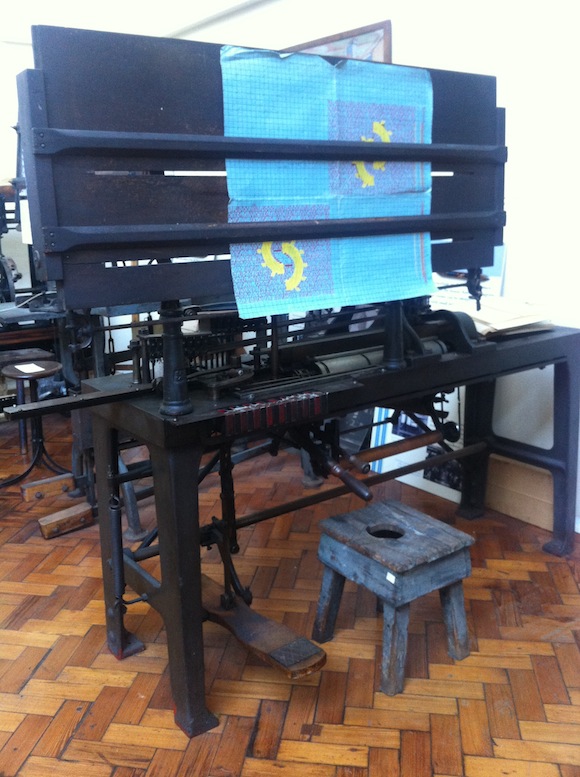
I was almost as fascinated by the machines used to punch the cards as the looms themselves- this marvellous thing is a ‘piano-type’ puncher. The treadle moves the card forward and you read the pattern of the sheet, and use the keyboard to punch it in, one line at a time. The spacing of the holes is called the ‘pitch’, you can ‘tune’ the puncher to the ‘pitch’ of the particular looms, this one is tuned to Macclesfield pitch of course:


They also had this fancy thing for lacing together the cards!

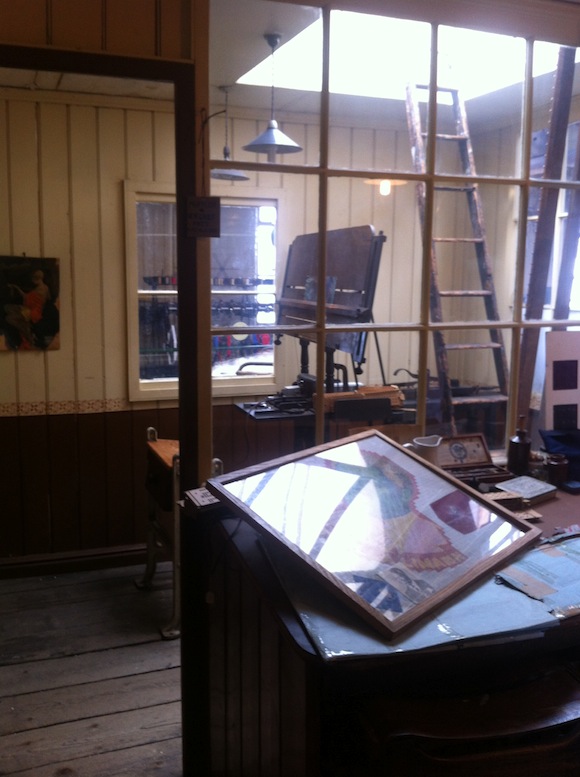
In the mill itself, there was a separate room for the designer and the puncher, with skylights, lovely space– you can see the piano punch in the background:

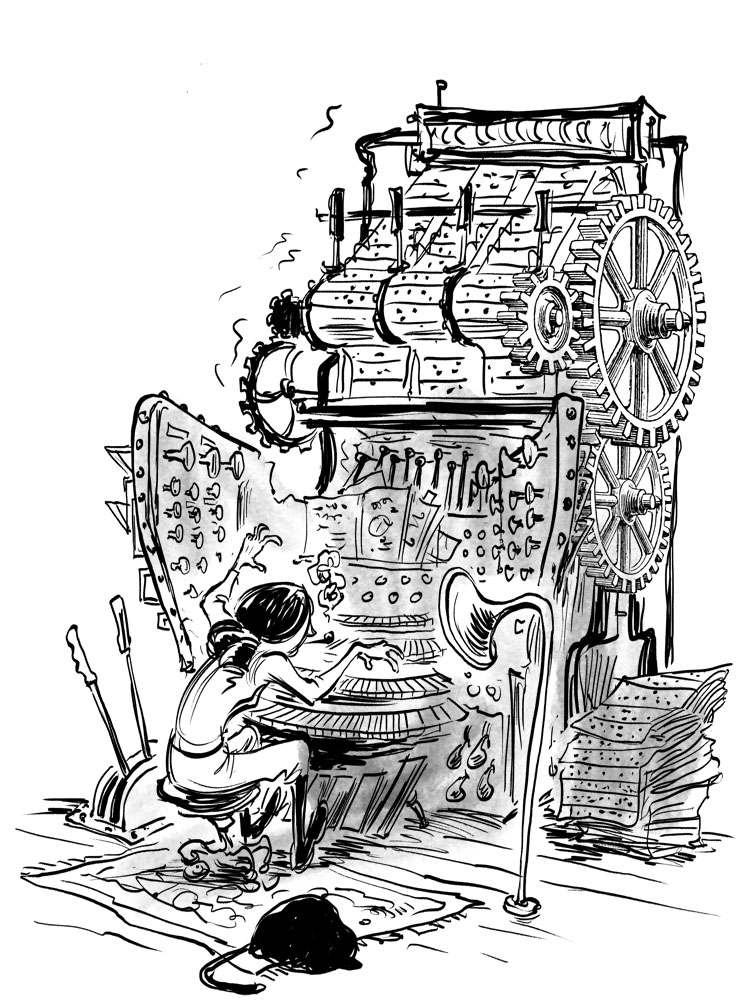
There were no cats! But it was impossible not to imagine Lovelace in her own elegant skylit programming room, up there at the very top of the engine… Of course she would need something much more elaborate! The stops are all her shortcuts naturally.


12 Apr 02:10

Hiroshi Yoshida Sacred Bridge 1931

Philipbrewer

Hiroshi Yoshida!


Hiroshi Yoshida

Sacred Bridge

1931

12 Apr 02:07

Administration pushing for big high speed rail investment over next five years

by Tobias Buckell
Philipbrewer

We like high-speed rail.

This will become another huge battle and explosion over it, but I’m thrilled as fuck to see a potentially big step forward in high speed rail still something the current administration is fighting for:

“The Obama Administration released its budget request for Fiscal Year 2014 today, and the President has once again put forth a bold plan for transforming and expanding train service in the United States, with $40 billion in passenger rail investment over the next five years.”

(Via National Association of Railroad Passengers – President Pushes Bold Plan for Passenger Rail | Trains For America.)

10 Apr 16:34

Cul-de-sacs kill community

by Tobias Buckell
Philipbrewer

I had kind of hoped for a tool for drawing this sort of map, and didn't find one.

This is certainly the way I feel about cul-de-sacs.

NewImage

There is a dead pool feel to them, isn’t there?

“The theory behind cul-de-sacs was that they lessened traffic, since they change the primary function of local streets — rather than offering a way to get anywhere, now they simply provide access to private residences. The problem is that this design inherently encourages car use, even for the shortest trips. It also limits the growth of communities and transportation options.”

(Via How Cul-de-Sacs Are Killing Your Community | INFRASTRUCTURIST.)

08 Apr 12:01

Magical Men

by Theodora Goss
Philipbrewer

And shared for Jackie, because I'm sure she'll like both the poem and the picture.

I wrote a blog post on magical women, so I thought I should write one on magical men as well. But the strange thing is that I know fewer magical men than I know magical women. I’m not sure why? I can tell you what magical men are like. Just like magical women, they are writers and artists who show you mystical, fantastical aspects of the world: artists like Brian Froude, Charles Vess, and David Shane Odom, for example. Or writers like Charles de Lint and Cliff Serutine. They show you different ways of thinking and being. I could certainly name others, so I’m not sure why it seems as though there are fewer of them than there are of the magical women I know. Perhaps I just know fewer personally, which means it’s my fault? Or perhaps our culture allows women to connect with the world in a magical way more readily. Perhaps they are not mocked for it, or told there is no profit in it. Perhaps there is something in nature, in the understanding and celebration of the natural world, that we still consider feminine? Even though it is men who have traditionally been though of as woodsmen, hunters. I don’t know.

What I do know is that I want there to be more magical men. We need them. (Of course, I think we need more magical women too. We need more magic generally.) We need men who are trying, not to climb the corporate ladder, but to save the world. (In whatever way presents itself. Because you know, there are a lot of ways to save the world. Some days, it may involve writing a poem, or planting a garden.) I suppose what this blog post expresses, really, is a kind of longing. Let there be men strong enough to march to the beat of their own drummers, as Thoreau said. I know, I know, they’re out there. I just wish there were more of them, and that the men I know (and I am lucky to have wonderful male friends) felt more free.

There is something about relative powerlessness that can, ironically, give you more freedom. Men are expected to be serious, motivated, ambitious. Women are allowed to create an Etsy store to sell their art or crafts.  It’s a shame, really. So yes, I suppose I wish men strength, freedom, courage — to be magical.

I’m going to end with a poem I wrote some time ago called “Green Man” that is a love poem. I’m not sure if it’s the appropriate way to end this post, but somehow it feels right.

Green Man

Come to me out of the forest, man of leaves,
whose arms are branches, whose legs are two trunks,
rough bark covered with lichen. Come and take
my hands in yours, and lead me in this dance:

In spring, green buds will sprout upon your head;
in summer they will lengthen into leaves.
Oak man, willow man, linden man, which are you?
In autumn, they will fall, and through the winter
you will be bare, with only clumps of snow
or birds upon your branches.

Come and love me,
my man of leaves, my forest man. For you,
I’ll be an alder woman, birch woman.
In spring I’ll wear pink blossoms like the cherry;
in summer ripening fruit will bend my boughs;
in autumn I will bear, distributing
a hundred seeds, our children. And the birds
will sing my praises. Let us learn to love
the sun and wind together; let us twine
our bodies, filled with sap, until we make
a single tree on which two different kinds
of leaves are growing, where birds build their nests,
among whose roots the squirrels hide their nuts,
storing them for winter.

A hundred years from now, we will still stand,
crooked perhaps, the sap running more slowly,
our two hearts beating, separately and together,
under the summer skies, in autumn rains.

Green Man


08 Apr 11:59

Sleeping Beauty

by Theodora Goss
Philipbrewer

Perhaps only interesting if you know Dora.

Since I’ve been teaching a class on fairy tales, I’ve been asked, by students and by people who are simply interested in the subject, what fairy tales “mean.” And I have to say that in my personal opinion, they don’t “mean” anything. Bruno Bettelheim thought they did: he thought he could use Freudian analysis to explain their psychological significance, which would be timeless and universal, since human beings were always the same everywhere. Except they’re not. They differ because of the times or cultures in which they live, because of race or gender or age. They differ even as individuals. Fairy tales have lasted so long precisely because different versions have meant different things to different people at different times.

So I think it makes as much sense for me to talk about what a fairy tale means to me personally as to try to find some sort of universal meaning. To me, fairy tales are about the journey of the soul, and the one I’ve been thinking about lately, because I’ve been teaching it, is “Sleeping Beauty.” So what does “Sleeping Beauty” mean to me?

The fairy tale falls into three parts: the gifts of the fairies, the hundred-year sleep, the awakening.

I. The Gifts of the Fairies

We are all given gifts by the fairies, and I think it’s useful to be honest about what they are. After all, they are gifts — we did nothing to deserve them, we can only be grateful for them. Seven good fairies came to my christening. (But be careful: it’s difficult to tell a good fairy from a bad fairy. Gifts come with a price, and what may seem like a curse can turn out to be a gift in disguise.)

The first fairy said, “I give her intelligence. She will always do well on standardized tests, and so she will be able to get into some of the best schools in the country. However, she will also be smart enough to see that the value systems she is is expected to live by are meaningless. This will make her try to live a different kind of life, which will cause her difficulty and heartache.” I told you, didn’t I? Gifts come with a price. Nevertheless, they are gifts, and we have to be grateful for them.

The second fairy said, “I give her strength. She will not always feel strong, but she will always be able to do what she needs to. She will always get through.” I’m grateful to that fairy.

The third fairy said, “I give her grace. She will be physically graceful, and will love to dance. But more than that, she will be able to accept defeat, and when it comes, she will be able to say, oh well, what next? She will have to do this more often than she would like.”

The fourth fairy said, “I give her empathy. She will feel what others are feeling, without wishing or trying to. She will not be able to stop doing so, and sometimes she will have to hide in a small room, or in a corner of her mind, simply to get away from other people.”

The fifth fairy said, “I give her beauty. However, she will never be able to see it herself, or believe in it, not when she looks into the mirror. She will, on the other hand, be able to see the beauty in the world, and in others.”

The sixth fairy said, “I give her poetry: the ability to hear the rhythms of language, and to write in language as though words were her natural element. This will be the most important gift she receives, and what will save her.”

Sleeping Beauty 1

That was, of course, when the bad fairy stepped in and said, “I curse the child. While she is still a child, she will lose her home: her country, her family. And she will never again find a place where she belongs.”

Of course, the seventh good fairy was hiding out (I think they’d been through this routine before). She stepped forward and said, “I can’t change the curse, but I can give her a gift that will help her bear it. She will always be a good traveler, able to pack efficiently and create temporary homes for herself wherever she goes.” I think that fairy was supposed to give me either humility or self-confidence, either of which would have been useful gifts. But she had to mitigate the bad fairy’s curse, you see.

We are all given gifts, we are all cursed in our own ways. That is the first way in which we are like the Sleeping Beauty.

II. The Hundred-Year Sleep

The sleep doesn’t always last for a hundred years, and it doesn’t necessarily happen once. It’s the state in which we fall asleep metaphorically, in which we forget who we are. I think I fell asleep for a while in my own life, during the years I was trying to finish the PhD. There’s one thing I can tell you about that experience. Awakening? Is so. Incredibly. Painful.

Sleeping Beauty 2

III. The Awakening

In different versions of “Sleeping Beauty,” the princess awakens in a variety of ways. Awakening to the prince’s kiss is actually a fairly modern development. In some of the earliest versions, the princess sleeps right through two pregnancies.

The thing about fairy tales is, we can always rewrite them. There are always new versions to be written. In my version, at some point the princess realizes she’s asleep, and she tries to wake up. She tries several times, each time thinking she is awake, but eventually she succeeds. She sits up in bed, and instead of a prince, sees a sign on the wall. I’m pretty sure it was left by the bad fairy. (I mentioned, didn’t I, that you can’t actually tell whether fairies are good or bad? They are both, and neither, and either at different times.) The sign says,

YOU MUST SAVE YOURSELF

Which, I’m pretty sure, is the beginning of a new fairy tale.

Sleeping Beauty 3


07 Apr 10:48

What will Henry Blodget do with Jeff Bezos’s millions?

by Felix Salmon
Philipbrewer

The quoted article has some interesting things to say about the future of internet journalism.

The news of the day in the media world is that Jeff Bezos has led a $5 million Series E funding round for Business Insider. Here’s the story, according to CEO Henry Blodget:

Jeff’s investment grew out of a dinner he and I had about a year ago. We talked about the business, and he was excited about it. (He sees some parallels with Amazon). A few months later, he expressed an interest in investing. My reaction was basically “Hell, yeah!”

Blodget has now articulated a simple public goal: “to become the best digital business publication on the planet”. It’s a conscious echo of Bloomberg’s stated aim to be “the world’s most influential news organization”. If he needs to invest millions of dollars of other people’s money to get there, that’s fine.

Blodget goes on to say that he’s obsessed with his customers — both readers and advertisers — and that his customer focus is the main thing he shares with Bezos. (Well, that and his famous Amazon call, of course.) He also says that Bezos’s money “will allow us to continue to invest in our editorial, technology, and client teams” — which almost certainly means that there’s no chance, now, of Business Insider being profitable in 2013. Six years after it was launched, the site is still in growth mode.

And frankly, there are quite a lot of things that Blodget could use the money for, if he is really focused on the reader experience — indeed, there are so many things that he could probably spend all that money quite a few times over, if he wanted. The site could use a redesign, for starters, to make stories pop more for readers and to provide more attractive opportunities for advertisers. On top of that, the architecture of the site should reflect the way that stories are covered. Here’s how BI’s editorial chiefs see the way that they work:

“We don’t really think of things we put up as ‘an article,’” said Carlson. “It’s a bit of information conveyed to people. One of my old colleagues used to say that the last sentence of your last post is the first sentence of your next post. Because by the time you reach the end you sort of come to a cliff, ‘Oh I have another thought on this and I’m just going to put it in the next post.’ In a way, it does sort of become a narrative. For sure, I think [that's] the attraction of reading something at Business Insider … It’s a live medium where the narrative is always coming out with the next thing.”

Weisenthal is often reminded how differently digital outlets such as BI work when it comes time to submit content for awards.

“They have the journalism competitions where they invite people to apply and they always say, ‘Submit your top three posts for consideration that you’re most proud of’ or something like that,” he said. “And I can never come up with the stuff. I don’t think I have a single great post last year that I’m really proud of. Everything I write is part of this bigger stream.”

He pointed to his real-time blanket coverage of the monthly U.S. jobs report as an example. “If you follow me on Jobs Day, within like 20 minutes of the report coming out, I have a summary posted,” he said. “Then I have another post singling out one detail I thought was interesting. I have another post saying what it might mean for interest rates and fed policy. I have another post talking about the political dimensions and so forth. I’m proud of the fact that it’s this whole suite of stories.”

I’m an admirer of this form of journalism, and I think that many media organizations, including Reuters, are going to move in this direction. But right now, if you go to one of Joe’s payrolls posts, it’s not easy to find all the other ones — to have them all in one place, together giving the bigger picture. In order to be able to allow that, Blodget will need to make some serious technology investments.

What’s more, a re-engineered website might well result in a website with significantly fewer pageviews. If you can see all of Joe’s payrolls posts on one page, then that means fewer pageviews for BI than if you call up all ten of them individually. For most of its existence, BI has been in an uncomfortable race, trying to increase the number of pageviews it serves up faster than its CPMs are falling. Investors are generally OK with losses, which reportedly reached $3 million last year, only so long as revenues are growing. And they are growing: Blodget tells me they were more than $10 million in 2012, up from about $7.5 million in 2011 and $4.7 million in 2010.

The problem is that in the chase for revenue growth, Blodget is sacrificing a pleasant user experience. He installs ugly automatic links under certain phrases, for instance, which when you mouse over them start playing video ads. Or he sells a lot of interstitial ads which force you to click another time before reaching the story you want to read. Quartz points out that there’s a good chance Business Insider is worth less than the much younger BuzzFeed, where CEO Jonah Peretti is adamant that he’ll never run a BI-style slideshow, or even “crappy display ads”, just because readers clearly prefer everything on one page and don’t get value from those ads.

The problem is that if Blodget decides to pare back on artificial revenue juicers which readers dislike, that hurts revenue growth as well as profits — even as BI is saying that it intends to accelerate revenues this year to something in the $15 million range. In order to keep revenues growing even as he re-engineers his site to make it sleeker and less optimized towards pageview maximization, Blodget would have to invest not only in technology, but also in sales — paying big money for expensive staffers to build relationships with brands. BI gets too much of its revenue from banner ads right now: it needs to diversify its ad revenue, and start finding more ways for brands to reach BI’s coveted readership. One of those new channels is conference sponsorship, and I expect that BI will use a bunch of its new money to invest aggressively in conferences. But one of the big hidden costs behind building a new kind of website is the fact that you need to build a new kind of sales team, too, selling the kind of products which are often referred to as “native”, whatever that’s supposed to mean.

Business Insider has always been run on something of a shoestring; it made the entirely understandable decision, for instance, to hold onto a large chunk of the capital it raised in the past, rather than blowing through it and then suddenly being forced to cut back for the sake of profitability. This new round allows BI to increase the amount it’s investing while still retaining a reassuring cushion. But $5 million is not remotely enough money to allow Blodget to pivot to a very different business model, even if he wanted to do so, which he probably doesn’t. For better or for worse, he’s stuck in a world of banner ads and CPMs, and although he’s done well in that world to date, the future of that world looks pretty bleak.

There are many sites, Gawker Media’s foremost among them, which have gone to great lengths to wean themselves off their addiction to banner ads. And in general it seems to me self-evident that “the best digital business publication on the planet” is not going to be one which aggressively chases pageviews and ad revenues at the expense of the user experience. By thinking of stories as streams, Joe Weisenthal found a great way of juicing pageviews, since every element of that stream, under the current architecture, is a new story and a new page. But he’s also stumbled upon a powerful and addictive new form of journalism, which is Blodget’s best hope for achieving his ambition. The question is: will Blodget be willing to give up his current business model, in order to let Weisenthal follow his editorial vision to its logical conclusion?

06 Apr 13:56

A Natural Swimming Pool That Works for You

by John Robb
Philipbrewer

For when you want to swim with the frogs and dragonfly larvae.

When I was a pilot, I spent years surveying the built environment from above.

One thing that amazed me is how many people own swimming pools. In some areas of the country, it seems that nearly everyone has a pool (often, the pool is almost as big as the footprint of the home itself).

But things have changed. We don’t have the luxury of allocating that much space to a sterile, unproductive pool of water that requires constant attention and financial support.

We need to put that space to work.

But are there any other options? Is it possible to build a pool that does more than just support our playtime?

I believe there is. It’s called a natural pool.

20130329-113853.jpg

The natural pool doesn’t fight nature tooth and nail. It embraces it in a very tangible way.

Instead of engaging in chemical warfare, the natural pool uses an ecosystem of plants to cleanse and filter your swimming water. To do this, designers create a wetland in a shallow and distinct area of a pool to act as a biological filter.

20130329-114229.jpg

This include the following components:

  • Microorganisms. For example, zooplankton eat algae to keep your water clear.
  • Aquatic plants. They absorb the nutrients that the bacteria break down. Indigenous plants are used as much as possible. You can also grow edible plants, for example, rice, watercress, or wasabi.
  • An inert substrate. This way the plants are forced to draw their nutrients from the water itself, thereby keeping the water clean.
  • Retaining wall. Enables water flow between the two areas but prevents the plants from doing so.

In practice, the shallow water of the wetland area is circulated into the deeper water of the swimming pool.

This circulation enables your bio-filter to cleanse the water as it goes. Upkeep is minimal – one simply has to trim the plants as necessary and remove fallen leaves.

There are no chemicals to buy, minimal electricity costs (one pump), and no PH level monitoring. If needed, the bio-filter can be supplemented with an automated skimmer or UV sanitizer.

As an added bonus, because the wetland is a distinct area, it can be added to an existing pool in a retrofit with minimal additional digging.

Resiliently Yours,


JOHN ROBB

PS: Because the pool is designed for circulating water, the threat of mosquitoes is minimized. Additionally, wildlife (frogs, dragonflies) will be attracted to the vegetation-filled part of the pool you don’t swim in. They’ll provide a free pest management service. In contrast, when a chemically treated pool isn’t maintained, it can quickly collapse into a cesspool of larvae (as we saw during the foreclosure tsunami a couple of years ago).

PPS: I’ve been experimenting with aquascaped environments over the last couple of months, and I can attest that these systems take care of themselves if built correctly.

Resilient communities editor, Shlok Vaidya, contributed to this letter.

JR Small


06 Apr 12:42

Citigroup predicts major drop in solar panel power prices/watt

by Tobias Buckell

Interesting:

“In the rooftop market, Citi notes that rooftop solar PV is already better than average residential prices in Australia, Germany, Spain, Portugal, and the South-West of the US and is not far away in other countries; it forecasts Japan will get there in 2014-2016, South Korea in 2016-2020, and the UK(!!!) in 2018-2021.

Even in countries that have solar insolation of 900 kWh/kW/year – think Germany, the UK and Russia – the LCOE of rooftop solar has declined from over 60$c/kWh to under 30$c/kWh.

In the utility scale market, Citi says solar PV will be competitive with gas fired power in the medium term in many regions, even if gas prices stay low. For regions with solar insolation of 1900 kWh/kW/year – as in the South-West US or Saudi Arabia – utility scale solar is already cheaper than gas-fired power at a natural gas price of $15/MMBtu, and by 2020 for a gas price of  around $6– 8/MMBtu.

Citi says utility-scale solar is rapidly approaching parity with wholesale electricity prices in a number of countries, including Italy, Spain, the US and China. Depending on the scenario, utility-scale solar could reach parity in Italy as early as 2018, and Spain as early as 2021.”

(Via Citigroup: How solar module prices could fall to 25c/watt : Renew Economy.)

05 Apr 16:39

"Whoa, whoa, whoa, evolution. There’s no way that’s...


"Whoa, whoa, whoa, evolution. There’s no way that’s going to fit."

"It’ll fit."

"No, it won’t."

"Yes, it will!"

"No, it won’t! You need to give the great blue heron some teeth or something if you expect it to eat fish bigger than its head."

"Teeth on a bird? That’s ridiculous. It’s fine, it’ll fit."

"It won’t. Don’t force it! What if the heron chokes to death?"

"Oh, come on. I made its throat a little stretchy; I’m sure it can deal."

27 Mar 19:06

The power of the RSS reader

Philipbrewer

I've deleted many feeds that were too-high-volume from my list. Now I'm thinking about deleting the rest.

With the decreasing use of RSS readers over the last few years, which will probably be accelerated by Google Reader’s shutdown in July, many are bidding good riddance to a medium that they never used well.

RSS is easy to abuse. In 2011, I wrote Sane RSS usage:

You should be able to go on a disconnected vacation for three days, come back, and be able to skim most of your RSS-item titles reasonably without just giving up and marking all as read. You shouldn’t come back to hundreds or thousands of unread articles.

Yet that’s the most common complaint I hear about inbox-style RSS readers such as Google Reader, NetNewsWire, and Reeder: that people gave up on them because they were constantly filled with more unread items than they could handle.

If you’ve had that problem, you weren’t using inbox-style RSS readers properly. Abandoning the entire idea of the RSS-inbox model because of inbox overload is like boycotting an all-you-can-eat buffet forever because you once ate too much there.

As I said in that 2011 post:

RSS is best for following a large number of infrequently updated sites: sites that you’d never remember to check every day because they only post occasionally, and that your social-network friends won’t reliably find or link to.

Building on that, you shouldn’t accumulate thousands of unread items, because you shouldn’t subscribe to feeds that would generate that kind of unread volume.

If a site posts many items each day and you barely read any of them, delete that feed. If you find yourself hitting “Mark all as read” more than a couple of times for any feed, delete that feed. You won’t miss anything important. If they ever post anything great, enough people will link to it from elsewhere that you’ll still see it.

The true power of the RSS inbox is keeping you informed of new posts that you probably won’t see linked elsewhere, or that you really don’t want to miss if you scroll past a few hours of your Twitter timeline.

If you can’t think of any sites you read that fit that description, you should consider broadening your horizons. (Sorry, I can’t think of a nicer way to put that.)

Some of my RSS subscriptions that my Twitter people usually don’t link to: The Brief, xkcd’s What If, Bare Feats, Dan’s Data (and his blog), ignore the code, Joel on Software, One Foot Tsunami, NSHipster, Programming in the 21st Century, Neglected Potential, Collin Donnell, Squashed, Coyote Tracks, Mueller Pizza Lab, Best of MetaFilter, The Worst Things For Sale.

Many are interesting. Many are for professional development. Some are just fun.

But none of them update frequently enough that I’d remember to check them regularly. (I imagine many of my RSS subscribers would put my site on their versions of this list.) If RSS readers go away, I won’t suddenly start visiting all of these sites — I’ll probably just forget about most of them.

It’s not enough to interleave their posts into a “river” or “stream” paradigm, where only the most recent N items are shown in one big, combined, reverse-chronological list (much like a Twitter timeline), because many of them would get buried in the noise of higher-volume feeds and people’s tweets. The fundamental flaw in the stream paradigm is that items from different feeds don’t have equal value: I don’t mind missing a random New York Times post, but I’ll regret missing the only Dan’s Data post this month because it was buried under everyone’s basketball tweets and nobody else I follow will link to it later.

Without RSS readers, the long tail would be cut off. The rich would get richer: only the big-name sites get regular readership without RSS, so the smaller sites would only get scraps of occasional Twitter links from the few people who remember to check them regularly, and that number would dwindle.

Granted, this problem is mostly concentrated in the tech world where RSS readers really took off. But the tech world is huge, and it’s the world we’re in.

In a world where RSS readers are “dead”, it would be much harder for new sites to develop and maintain an audience, and it would be much harder for readers and writers to follow a diverse pool of ideas and source material. Both sides would do themselves a great disservice by promoting, accelerating, or glorifying the death of RSS readers.

26 Mar 16:20

Some Things That Will be True After AI

by Stuart Staniford
Philipbrewer

Several things I want to think about here.

Kevin Drum muses about the advent of true artificial intelligence:
I agree, and something similar to this needles me periodically whenever my mind drifts into dorm room bull session mode.1 You see, I believe that we're only a few decades away from true artificial intelligence. I might be wrong about this, but put that aside for the moment. The point is that I believe it. And needless to say, that will literally change everything. If AI is ubiquitous by 2040 or so, nearly every long-term problem we face right now—medical inflation, declining employment, Social Security financing, returns to education, global warming, etc. etc.—either goes away or is radically transformed in ways we can't even imagine.
I agree with Kevin that AI is the biggest deal out there.  I also think it's coming, though I suspect it will take longer than 2040 to arrive fully* and that it will arrive in stages over the course of a number of decades.  Indeed, in important ways we can already feel the early effects.

It's worth thinking about some things that won't change as a result of AI, or at least not quickly.  Here's a draft list:
  • There will still be 9 or 10 billion humans on the planet (or may the gods and goddesses help us).
  • They will still want to live in big warm houses with lots of stuff, and travel around as much as they are able.
  • They will still want to have sex and raise children.
  • They will still be prone to getting very pissed if anyone tries to take their stuff away.
  • The economy will still consist of competing corporations regulated by governments (it's just that both the corporations and governments will over time employ fewer and fewer humans).
  • Humans will still have all the legal rights (I just don't see why we are ever going to think it's in our interest to give legal rights to algorithms).
It follows pretty immediately that most of our environmental problems, for example, won't be going anywhere as a result of AI.
On the other hand, we are going to have to go through some massive wrenching cultural adjustments in our ideas of work and dependency and how we derive meaning from our lives.  Jamais Cascio recently coined the term the Burning Man Future, which I like.  In particular, it captures the idea that the entire culture is going to increasingly have to become like what is currently a hippy artist fringe.  Either that, or we need to decide that there are some things we really don't want to invent and stop working on this stuff.
* It's probably worth pointing out that I have spent most of my career designing statistical reasoning algorithms for a living so my intuitions here are at least somewhat educated.  Of course, I could be as wrong as the next expert usually is.
26 Mar 13:53

Our Internet Surveillance State

by schneier
Philipbrewer

I'm still not ready to give up.

I'm going to start with three data points.

One: Some of the Chinese military hackers who were implicated in a broad set of attacks against the U.S. government and corporations were identified because they accessed Facebook from the same network infrastructure they used to carry out their attacks.

Two: Hector Monsegur, one of the leaders of the LulzSac hacker movement, was identified and arrested last year by the FBI. Although he practiced good computer security and used an anonymous relay service to protect his identity, he slipped up.

And three: Paula Broadwell, who had an affair with CIA director David Petraeus, similarly took extensive precautions to hide her identity. She never logged in to her anonymous e-mail service from her home network. Instead, she used hotel and other public networks when she e-mailed him. The FBI correlated hotel registration data from several different hotels -- and hers was the common name.

The Internet is a surveillance state. Whether we admit it to ourselves or not, and whether we like it or not, we're being tracked all the time. Google tracks us, both on its pages and on other pages it has access to. Facebook does the same; it even tracks non-Facebook users. Apple tracks us on our iPhones and iPads. One reporter used a tool called Collusion to track who was tracking him; 105 companies tracked his Internet use during one 36-hour period.

Increasingly, what we do on the Internet is being combined with other data about us. Unmasking Broadwell's identity involved correlating her Internet activity with her hotel stays. Everything we do now involves computers, and computers produce data as a natural by-product. Everything is now being saved and correlated, and many big-data companies make money by building up intimate profiles of our lives from a variety of sources.

Facebook, for example, correlates your online behavior with your purchasing habits offline. And there's more. There's location data from your cell phone, there's a record of your movements from closed-circuit TVs.

This is ubiquitous surveillance: All of us being watched, all the time, and that data being stored forever. This is what a surveillance state looks like, and it's efficient beyond the wildest dreams of George Orwell.

Sure, we can take measures to prevent this. We can limit what we search on Google from our iPhones, and instead use computer web browsers that allow us to delete cookies. We can use an alias on Facebook. We can turn our cell phones off and spend cash. But increasingly, none of it matters.

There are simply too many ways to be tracked. The Internet, e-mail, cell phones, web browsers, social networking sites, search engines: these have become necessities, and it's fanciful to expect people to simply refuse to use them just because they don't like the spying, especially since the full extent of such spying is deliberately hidden from us and there are few alternatives being marketed by companies that don't spy.

This isn't something the free market can fix. We consumers have no choice in the matter. All the major companies that provide us with Internet services are interested in tracking us. Visit a website and it will almost certainly know who you are; there are lots of ways to be tracked without cookies. Cell phone companies routinely undo the web's privacy protection. One experiment at Carnegie Mellon took real-time videos of students on campus and was able to identify one-third of them by comparing their photos with publicly available tagged Facebook photos.

Maintaining privacy on the Internet is nearly impossible. If you forget even once to enable your protections, or click on the wrong link, or type the wrong thing, and you've permanently attached your name to whatever anonymous service you're using. Monsegur slipped up once, and the FBI got him. If the director of the CIA can't maintain his privacy on the Internet, we've got no hope.

In today's world, governments and corporations are working together to keep things that way. Governments are happy to use the data corporations collect -- occasionally demanding that they collect more and save it longer -- to spy on us. And corporations are happy to buy data from governments. Together the powerful spy on the powerless, and they're not going to give up their positions of power, despite what the people want.

Fixing this requires strong government will, but they're just as punch-drunk on data as the corporations. Slap-on-the-wrist fines notwithstanding, no one is agitating for better privacy laws.

So, we're done. Welcome to a world where Google knows exactly what sort of porn you all like, and more about your interests than your spouse does. Welcome to a world where your cell phone company knows exactly where you are all the time. Welcome to the end of private conversations, because increasingly your conversations are conducted by e-mail, text, or social networking sites.

And welcome to a world where all of this, and everything else that you do or is done on a computer, is saved, correlated, studied, passed around from company to company without your knowledge or consent; and where the government accesses it at will without a warrant.

Welcome to an Internet without privacy, and we've ended up here with hardly a fight.

This essay previously appeared on CNN.com, where it got 23,000 Facebook likes and 2,500 tweets -- by far the most widely distributed essay I've ever written.

Commentary.

EDITED TO ADD (3/26): More commentary.

EDITED TO ADD (3/28): This Communist commentary seems to be mostly semantic drivel, but parts of it are interesting. The author doesn’t seem to have a problem with State surveillance, but he thinks the incentives that cause businesses to use the same tools should be revisited. This seems just as wrong-headed as the Libertarians who have no problem with corporations using surveillance tools, but don't want governments to use them.

22 Mar 14:54

March 18.

Philipbrewer

Ran Prieur is alwas interesting.

I'd rather have chickens than bees, but I'd really like to do both.

March 18. Some personal stuff. Last fall I grew a beard, and this is my new look. I just shaved it off for spring, but after getting used to the bearded look, I like it better than the shaved look and I'm going to grow it back. Notice the beehives in the corner of the photo. I just updated my Top Bar Hive page with a photo of the hives in their final position with the lids painted, and added some new info in the big paragraph about wax and comb.

I did my taxes, and my income last year was $8500. I didn't have to file but filed anyway to document my low income so I can try to get medicaid under ObamaCare. I overspent my income by a couple thousand dollars, so I'm getting more serious about frugality, and one thing I'm doing is eating less meat. Counting my cart the other day at Costco I noticed that a pack of two small organic chickens was over $20, and a giant bag of potatoes was under $5, and I know that potatoes are almost complete nutrition, so I put the chickens back. I've also been making lots of lentil soup after a friend found a local farmer selling dirty chaff-filled lentils for ten cents a pound. The dirt rinses out, the chaff can be picked out in half an hour for a large batch, and the flavor is just as good as the premium lentils I was buying for fifteen times the price.

If anyone likes tart cherries, Costco is also selling Evans (a.k.a. Bali) cherry trees for under $12. Evans will eventually surpass Montmorency as the standard for tart cherries. I don't know what the rootstock is but I bought one anyway and stuck it probably too close to the peach tree.

I'm still going to the library for internet, and still loving it. I get a nice bike ride every day, spend a few hours online, and then the late afternoons and evenings are open to do other things... not all of them "useful". I've been playing Twilight Princess on Wii and last night I beat the mini-boss in the desert dungeon. I've also been reading Charles Stross, and I want to read the first three books of Iain Banks's Culture series, but the library doesn't have them and my Kindle remains broken, so maybe I'll finally sign up for Paperback Swap.

21 Mar 01:11

Ever have one of those days where you’re supposed to...


Ever have one of those days where you’re supposed to concentrate on making orchids but just can’t stop thinking about monkeys? Because evolution does. All the time. Like, it thinks about monkeys a lot. That’s normal, right?

20 Mar 16:09

Hiroshi Yoshida Spring Rain 1935

Philipbrewer

Hiroshi Yoshida sakuroj!


Hiroshi Yoshida

Spring Rain

1935

18 Mar 19:34

One Plus One Equals Jail

by limako
Philipbrewer

Things are getting worse, not better.

Today, Andrew Auernheimer was found guilty for adding one to an integer in a URL and seeing what happened. There's more to the story, of course: after he discovered that it returned private information, he automated the process with a script, collected a bunch of the returned data, and provided it to the media.

You can do the same thing with my blog. This post is node 603. The legal case is arguing that if you subtract one from the URL and go to 602 when the developer didn't intend you to, you could be sentenced to years of prison. That's what this court decision implies.

Years ago, I was often horrified by the shocking ignorance of the courts and politicians regarding basic technical facts about computer technology. Frequently, you'd see howlers like when Alaska Senator Ted Stevens famously described the Internet as a series of tubes. You can listen to the recording right there on the wikipedia page.

For a long time, I expected a new generation of more technically sophisticated people to come along and fix the broken legislation and court decisions made in the early history of the internet. Unfortunately, I've come to recognize that the problem is getting worse, not better.

A lot of the revolutionary transformation that happened with the early internet was due to the use of simple, open protocols (like http and html) that could be easily inspected and remixed by anyone. A commercial entity would never have built it that way.

People often talk about how markets are efficient, but they're efficient like the old joke that goes "I don't need to run faster than the bear -- I just need to run faster than you." To which you might add, "And if I break your leg, I won't even have to run." Corporations are willing to invest huge amounts of money and make their products much less attractive and less useful to consumers if they think it will curtail competition and help their bottom line more.

As technology is increasingly commoditized and packaged for non-technical users, the underlying data structures and protocols are concealed. People using an "app" on an iPhone have no idea what's actually behind the scenes. If you're a mere consumer of technology, you don't have access to any of the really empowering features -- it makes it difficult or impossible to adapt the technology to your own uses.

Several years ago, I wrote a little script to transform data from CSV into a file written in "dot" that could be plotted by graphviz. It was cool because you could pipe the output of the script to graphviz and then to ps2pdf to go straight from csv to a PDF file. Or you could get the dot file and edit it by hand to add colors or make some things bold. When I had students use it, I found that they'd essentially never run a program at the command line before.

It doesn't bode well for the future that the next generation is being turned into consumers of technology. We need a commitment to open technologies and protocols that encourage remixing and reuse. We can't leave the market to the control of the corporations -- they won't build it that way unless we give them no other choice.

08 Mar 14:18

To Boldly Go Where None Have Been Before...

by Stuart Staniford

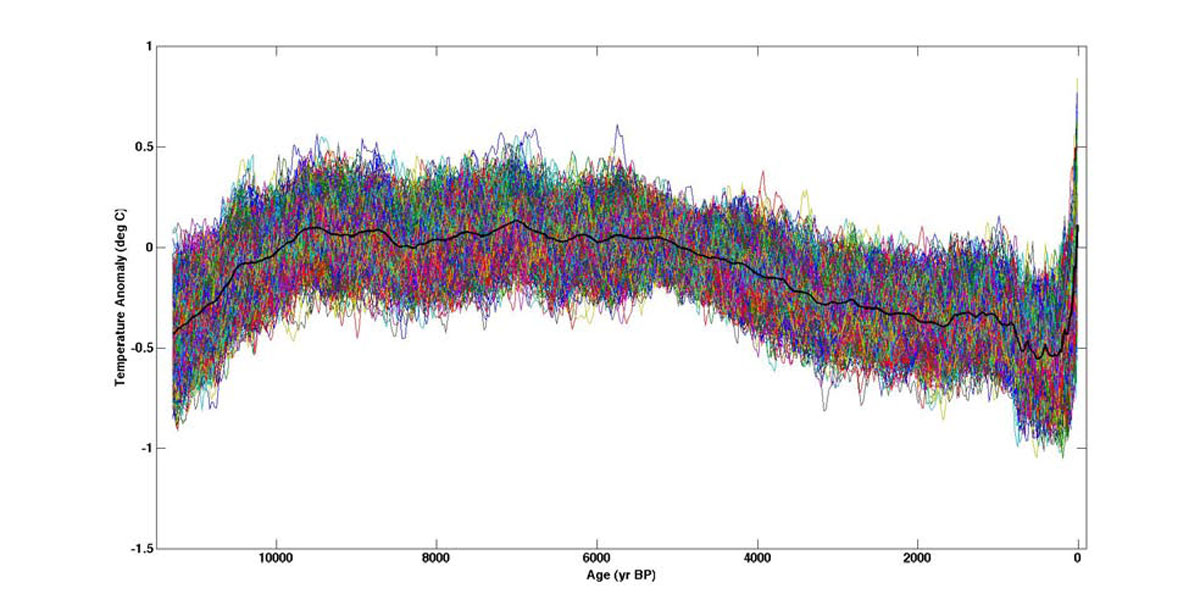
The amazing image of the day here is is Figure S3 from the supplementary material of Marcott et al, A Reconstruction of Regional and Global Temperature for the Past 11,300 Years, in the current issue of Science.  They combined 73 proxy records of temperature from around the globe - mainly from marine sediments - and used a Monte Carlo analysis to estimate the uncertainties.  The result is the above picture of the entire Holocene - the period in which agriculture and civilization have arisen on this planet for the first time - together with the spike of the Anthropocene on the right - the period of major human impact on the climate.

Note that the authors' work suggests that global temperature has not yet exceeded the mid-Holocene optimum, but obviously that is going to change in a hurry:
Our results indicate that global mean temperature for the decade 2000–2009 has not yet exceeded the warmest temperatures of the early Holocene (5000 to 10,000 yr B.P.). These temperatures are, however, warmer than 82% of the Holocene distribution as represented by the Standard5×5 stack, or 72% after making plausible corrections for inherent smoothing of the high frequencies in the stack (Fig. 3). In contrast, the decadal mean global temperature of the early 20th century (1900–1909) was cooler than >95% of the Holocene distribution under both the Standard5×5 and high-frequency corrected scenarios. Global temperature, therefore, has risen from near the coldest to the warmest levels of the Holocene within the past century, reversing the long-term cooling trend that began ~5000 yr B.P. Climate models project that temperatures are likely to exceed the full distribution of Holocene warmth by 2100 for all versions of the temperature stack (Fig. 3), regardless of the greenhouse gas emission scenario considered (excluding the year 2000 constant composition scenario, which has already been exceeded). By 2100, global average temperatures will probably be 5 to 12 standard deviations above the Holocene temperature mean for the A1B scenario based on our Standard5×5 plus high-frequency addition stack.
06 Mar 18:15

After the Flood

by wjw
Philipbrewer

Skim the first few paragraphs about the water leak, then read about what WJW found in his old Rolling Stone magazines.

My house doesn’t have a furnace proper, it has a boiler that pumps hot water to registers in each room.  Which is a terrific, energy-efficient system, right up to the point where the water pump springs a leak.  Oddly enough, it wasn’t the boiler room that flooded, but the closet of the room next door.  Which room happens to serve as our (desperately overcrowded) library.

All of which is by way of saying that it’s really lucky that Ty Franck got sick.  I was planning on gaming with Ty an’ Daniel an’ a bunch o’ them, and Ty got the flu, so we couldn’t play the game we intended, and I went to the library to dig into one of the boxes in the closet for a board game that might amuse us, and I thought to myself, “Hey, how come the Kingmaker game box is moist?”

If Ty hadn’t got sick, I might not have gone into the library for days, and the whole room could have flooded, with thousands of dollars in damage.  As it is, the damage was limited to a few boxes in the closet. (And thanks to PCH Plumbing of Peralta for fixing my leak late on a Friday afternoon, which as we know never happens.)

So now the contents of the boxes are strewn all over the house, by now mostly dry.  I’m very pleased to report that the Silver Age Marvel comics, the ones that have been following me from place to place since I was a kid, survived with no damage at all.

Some gaming stuff got good and soggy.  My copy of Cyberpunk 2020 may be a total loss.

The most intriguing item rescued from from becoming papier-mâché was a box of old Rolling Stone magazines that date from 1972-3.  They’ve followed me around for decades precisely because I never thought about them— at some point I put them in a box, and when you move, it’s easier just to move a box rather than take everything out and figure out which items you’re going to save.  So after the magazines dried out, I started reading them.  And I entered a very different world.

It was, to begin with, a Manichean world.  Richard Nixon, the Ultimate Evil, was running for re-election, and the Fundamentally Evil War in Vietnam had been going on for six or eight years, depending on when you think it actually started, and consuming endless blood (mostly Vietnamese) and treasure (mostly American) for purposes that no one seemed able to quite articulate in any kind of convincing way.

It was Us (the Good) versus Them (the Evil), and there were all sorts of signs and signifiers to enable you to tell one from the other.  Dress, hair length, vocabulary.  And of course drugs.  Of which more later.

The entire political establishment of both parties had been fundamentally tainted by the poison of Vietnam, though some, mostly populists like Fred Harris or George McGovern, could be standard-bearers against the Ultimate Evil provided that someone of sufficient authenticity was willing to vouch for them.  (That “someone of sufficient authenticity” might be Hunter S. Thompson was sort of incredible, even for the time.)

Insofar as we couldn’t trust the entirety of the establishment, who was left to trust?  The Troubadors, of course.  It was the job of musicians to tell us what was actually happening in the world.

Of course it had to be the true, authentic Troubadors, not the phony ones, and a good deal of energy was expended trying to sort one from the other.   As, come to think of it, it still is.

(Now, of course, the trustworthiness of the Troubadors has been pretty well nullified by the fact that their tours all require massive corporate support.  ”This political message brought to you by American Express” does not have quite the forceful authenticity of, I dunno, Neil Young’s “Ohio.”  And of course “Ohio” would never get airplay here in the world of Clear Channel.)

Politically Rolling Stone was not radical, especially considering what was going on in publications like the Berkeley Barb and LA Free Press.  (Or, for that matter, Screw.)  Rolling Stone was populist with a dose of libertarianism.   They took radicals like Angela Davis and John Sinclair seriously, but didn’t ally with them.  They were committed to democracy, not Maoist insurgency.

Rolling Stone wasn’t really a magazine then, it was a newspaper, a tabloid-sized journal that opened up to nearly the size of a regular paper.  There were no staples holding it together and you could just grab the pages you were actually interested in and carry them around with you.

There was a lot in there.  The paper was cheap newsprint, the typeface small, and there were a great many pages.  In the last few days I’ve been reading long, long interviews with the likes of Ray Charles, Paul Simon, and Truman Capote.  Some of those interviews must be 40,000 words.  Incredible.

The Capote interview is particularly amusing.  For some reason Rolling Stone (the magazine) thought it would be a good idea to send Capote along on the 1972 tour of the Rolling Stones (the band).  Capote duly followed the band for a while, but ultimately decided that the Rolling Stones weren’t interesting enough to write about for Rolling Stone, and never turned in the article.  So Rolling Stone, determined to get something from its investment,  sent Andy Warhol to interview Capote and try to ferret out his thoughts about the Rolling Stones, and what they got was an Interview-like piece of verite, with the two wandering around Manhattan from bar to bar, talking about anything they damned well pleased, which was followed by a second Capote interview, in which Jann Wenner tracked Capote down in Florida and made him talk about the goddam band, fer chrissake!

There’s some heavy-duty intellectual cred in these issues.  Capote, Norman Mailer, Tom Wolfe.  RS employed the biggest names available.

Rolling Stone is a much smaller magazine now than it was then, and I can’t imagine they would devote as much space to an interview these days.  (I haven’t read it in years, so I don’t actually know.)  In fact, I don’t think anyone would run interviews of that length today.  Interviews nowadays are puff pieces or pieces about celebrity fashion.   Why else would anyone do them?

(Does Playboy still run long interviews?  I don’t know.)

All of which has me nostalgic for the days when journals took journalism seriously enough to try to do it well, particularly in the long form.  William Shawn at The New Yorker would commission articles that would run in several issues, and you’d end up with In Cold Blood, Fire in the Lake, or John Hersey’s Hiroshima (which actually filled all of a single issue, but nevermind).  The New Yorker still does serious journalism well, but certainly not at that length.  (And Rolling Stone has good stuff by Matt Taibbi, so, um, yay.)

And did I mention the drugs?  Oh my god, they’re everywhere!  Those interviewed were more or less required to relate their drug experiences.  (Capote, the only actual drug addict, for some reason was not.)  The classified ads sold bongs, smoking supplies, “legal hash,” and featured books on how to brew your own psychedelics.

Drugs were one of those signifiers I mentioned.  The establishment lied more or less continually about drugs, making up all sorts of batshit insane stories, and the relentless lying perversely validated drug use.

Not that there weren’t lines being drawn (no pun intended).  Rolling Stone generally favored grass and acid, but spoke scornfully of heroine and cocaine.  Some drugs apparently increased authenticity, and others did not.  And in any case, they were pretty much everywhere.

For all that I’ve been wallowing in a certain nostalgia during my reading, that doesn’t mean I want 1972 back.  Though we’re in a war just as endless and expensive as Vietnam, the casualty lists aren’t nearly as long.  There was a war here as well— see Weather Underground, SLA, Jackson State, Kent State— and I sure as hell don’t want that back.  And though Manicheanism isn’t very far from the surface in American culture, it’s nowhere as omnipresent as it was back then.

Still could use authentic politicians (who aren’t authentically batshit crazy).  And certainly more authentic superstar musicians who aren’t jammed into narrow categories by Clear Channel, etc.  And longer interviews with interesting people.  And freaking public intellectuals that are actually known to the public.

And I still have a lot to look forward to.  Tom Wolfe’s three-part article on the Apollo astronauts— it’s not The Right Stuff, it’s sort of a prequel to The Right Stuff.  I have the two-part Fear and Loathing in Las Vegas, by “Raoul Duke.”  There’s much more 1972 to come!

Just in case I’ve left some of you younger readers completely puzzled, I thought I’d end with questions and answers for any of you who might not have experienced 1972 personally.

Q: Was Richard Nixon actually the Ultimate Evil?

A: Fuck yes!

Q:  Were you, like, a hippie or something?

A: I was far too young to be a hippie, but old enough to be a geek intellectual who wore blue velvet and beads, and who celebrated the fact that his draft lottery number came up 326.

Q: What do you think about the drug laws?

A: The purpose of the drug laws is to put Negroes in prison whenever we want.  That may not be the intention, but that’s what happens.  So if that’s not the intention, we should get rid of them, because just changing them doesn’t change what happens.

Q:  What was this “War in Vietnam” of which you speak?  My history textbook only went up to 1945!

A:  Oh, dear.  Where to begin?

06 Mar 15:18

The Choice for High School Grads

by Tim
Philipbrewer

Yes, exactly.

As a follow up to the last item about how many recent college grads who have been able to find jobs are underemployed (and companies appear all to happy to perpetuate this), comes a good depiction of the choices faced by high school grads aspiring to higher education.

From the Matt Davies cartoon archive.

04 Mar 02:43

Global Warming Perspective of 1958

by Stuart Staniford


Interesting to understand the perspective at that time.  They already knew that a few degrees warming was a really big deal.
01 Mar 19:52

CNN: Unlike - Why I'm Leaving Facebook

by Douglas Rushkoff
Philipbrewer

I have all these problems as well, but have not yet taken the step of getting off Facebook.

CNN - I used to be able to justify using Facebook as a cost of doing business. As a writer and sometime activist who needs to promote my books and articles and occasionally rally people to one cause or another, I found Facebook fast and convenient. Though I never really used it to socialize, I figured it was okay to let other people do that, and I benefited from their behavior.
 
I can no longer justify this arrangement. Today I am surrendering my Facebook account, because my participation on the site is simply too inconsistent with the values I espouse in my work. In my upcoming book Present Shock, I chronicle some of what happens when we can no longer manage our many online presences. I argue - as I always have - for engaging with technology as conscious human beings, and dispensing with technologies that take that agency away.
 
Facebook is just such a technology. It does things on our behalf when we're not even there. It actively misrepresents us to our friends, and - worse - misrepresents those who have befriended us to still others. To enable this dysfunctional situation -- I call it “digiphrenia” -- would be at the very least hypocritical. But to participate on Facebook as an author, in a way specifically intended to draw out the "likes" and resulting vulnerability of others, is untenable.
 
Facebook has never been merely a social platform. Rather, it exploits our social interactions the way a Tupperware party does. Facebook does not exist to help us make friends, but to turn our network of connections, brand preferences, and activities over time --  our "social graphs" -- into a commodity for others to exploit. We Facebook users have been  building a treasure lode of big data that government and corporate researchers have been mining to predict and influence what we buy and whom we vote for.  We have been handing over to them vast quantities of information about ourselves and our friends, loved ones and acquaintances. With this information, Facebook and the "big data" research firms purchasing their data predict still more things about us - from our future product purchases or sexual orientation to our likelihood for civil disobedience or even terrorism. 


The true end users of Facebook are the marketers who want to reach and influence us. They are Facebook's paying customers; we are the product. And we are its workers. The countless hours that we - and the young, particularly - spend on our profiles constitute the unpaid labor on which Facebook justifies its stock valuation. The efforts of a few thousand employees at Facebook's Menlo Park campus pale in comparison to those of the hundreds of millions of users meticulously tweaking their pages. Corporations used to have to do research to assemble our consumer profiles; now we do it for them.
 
The information collected about you by Facebook through my Facebook page isn't even shared with me. Thanks to my page, Facebook knows the demographics of my readership, their emails, what else they like, who else they know and, perhaps most significant, who they trust. And Facebook is taking pains not to share any of this, going so far as to limit the ability of third-party applications to utilize any of this data.
 
Given that this was the foundation for Facebook's business plan from the start, perhaps more recent developments in the company's ever-evolving user agreement shouldn't have been so disheartening. Still, we bridle at the notion that any of our updates might be converted into "sponsored stories" by whatever business or brand we may have mentioned. That innocent mention of cup of coffee at Starbucks, in the Facebook universe, quickly becomes an attributed endorsement of their brand. Remember, the only way to connect with something or someone is to "like" them. This means if you want to find out what a politician or company you don't like is up to, you still have to endorse them publicly.
 
More recently, users - particularly those with larger sets of friends, followers, and likes - learned that their updates were no longer reaching all of the people who had signed up to get them. Now, we are supposed to pay to "promote" our posts to our friends and, if we pay even more, to *their* friends. Yes, Facebook is entitled to be paid for promoting us and our interests - but this wasn't the deal going in, particularly not for companies who paid Facebook for extra followers in the first place. Neither should users who "friend" my page automatically become the passive conduits for any of my messages to all their friends - just because I paid for it.
 
Which brings me to Facebook's most recent shift, and the one that pushed me over the edge. Through a new variation of the Sponsored Stories feature called Related Posts, users who "like" something can be unwittingly associated with pretty much anything an advertiser pays for. Like email spam with a spoofed identity, the Related Post shows up in a newsfeed right under the user's name and picture. If you 'like' me, you can be shown implicitly recommending me or something I like - something you've never heard of - to others without your consent.
 
For now, as long as I don't like anything myself, I have some measure of control over what those who follow me receive in my name or, worse, are made to appear to be endorsing, themselves. But I feel that control slipping away, and cannot remain part of a system where liking me or my work can be used against you. The promotional leverage that Facebook affords me is not worth the cost. Besides, how can I ask you to like me, when I myself must refuse to like you or anything else?
 
I have always appreciated that agreeing to become publicly linked to me and my work online involves trust. It is a trust I value, but - as it is dependent on the good graces of Facebook - it is a trust I can live up to only by un-friending this particularly anti-social social network. Maybe in doing so I'll help people remember that Facebook is not the Internet. It's just one web site, and it comes with a price.


28 Feb 14:54

Mould explains the the strange properties of magenta

by James Gurney
Philipbrewer

Fascinating video!


(Video link) Using colored flashlights, science presenter Steve Mould explains why the color magenta doesn't appear in the rainbow.

---- photo rotating-dots.gif
In this optical illusion, the magenta dots switch on and off in series, producing a green afterimage on the retina. The effect is especially strong if you look at the cross in the center. Via Biotele, thanks, Damian J.

Related topic: the yellow we see on our computer monitor or our TV isn't really yellow; it's a blend of green and red, as explained in a V-Sauce video.

Previously on GurneyJourney
Mystery of Magenta
28 Feb 14:29

A Smart Way to Finance Local Energy Abundance

by John Robb
Philipbrewer

Back when interest rates were higher, it would be very hard for something like this to make economic sense. Now, between lower costs and very low rates, it should be happening all over.

This is a picture of all of the electricity a family will need for the next twenty years:

Price Solar

Doesn’t seem like much, does it?

It gets even better.

If every family in a community had an installation like this, the community would be close to never experiencing a blackout again.

On top of that, the community would be exporting energy.  Wealth would be flowing into the community and not out of it.

Amazing, isn’t it.   

So, why doesn’t everyone have an installation like this?

Until recently, even with government subsidies, it didn’t make economic or technological sense except in extreme situations.

That’s changed.  DIY solar energy is now ready for prime time (I’m currently working on a Solar Energy report that blows the lid off of this — stay tuned).

Despite that, many people still don’t have the upfront money needed to make it happen.

Here’s an innovative way to solve that problem:  Community Financing.

Community Micro-Financing for Solar Projects

Here’s an idea for a very simple community financing system from a company called Mosaic.

Currently, they make it easy for people to find, invest, and earn interest on high quality solar projects.

Mosaic Energy


The same mechanism could work as a way to finance solar in a community.

How?  By using the system like this to connect local DIY solar installations with individuals that are looking for tangible investments in their communities — everyone with a retirement account should be looking for this.  Not only is the outlook for global markets terrible, the current returns are abysmally low.

This is a win-win.

The local investors get returns 4% (!) higher than they get from treasuries and they are actually investing in something tangible in their own back yard.

The people doing the installation get electricity at a low (much less than they are currently paying) fixed rate and eventual ownership of the system.

Worth thinking hard about.


Resiliently Yours,
JOHN ROBB

John-Robb

PS:  Imagine that.  Investing retirement savings at well above market rates in an asset that is actually doing some good for the community!  I’ll have more detail on this in my upcoming solar energy report for Resilient Strategies customers.

PPS:  This month’s Resilient Strategies conference call is with people behind the Garden Tower Project on Kickstarter.


26 Feb 02:33

Sergeant 'kneed suspected burglar in groin'

by Yorkshire Post
Philipbrewer

It wasn't me, I swear.

Richard Wright, prosecuting, said Nicholls detained Thrush shortly before Pcs Philip Brewer and Johnny Frank arrived at the scene to provide back-up.
24 Feb 19:24

The Dorian Gray pill

by James Hamilton

On Friday I attended the U.S. Monetary Policy Forum in New York City. I will be posting some material about the paper I presented at the conference later this week. But today I wanted to mention an interesting talk at the conference by Harvard Professor Greg Mankiw on health care costs.

If we could figure out a way to deliver the same quality of medical care at a lower cost, that is certainly something we should be trying to do. But Mankiw argued that much of the rising cost of medical care is a result of advances in technology that offer new but expensive ways of treating our old health problems.

Mankiw suggested an interesting way of thinking about the economic and moral challenges for which we are trying to come up with solutions. He asked the audience to consider what we would do if the world made a new technological discovery that he called the Dorian Gray pill, named for the Oscar Wilde tale of a gentleman with a dark secret that gives him immortality. Each day that you take the Dorian Gray pill, you won't get sick, you won't age, and if you continue to take it, you'll never die. The only problem is it costs $100,000 to manufacture a year's supply.

How would we use such a technology, if it existed? It's obviously not feasible to give it to everybody-- the resources simply don't exist to do that. One system we might consider is that the people who get to take the pill are the ones who can afford it. Some would defend that system by arguing that it is the best way to increase incentives for people to make the things or provide the services that society values highly. If someone responds to this inducement by personally creating the resources necessary to pay for their expensive tastes, why not allow them to do so? Perhaps the greatest path to riches in such a world would be for someone to figure out how to make the pills for $50,000, or $20,000. Wouldn't we want to unleash the collective talents and resources of the world to try to produce such a prize?

But for other people, the only feasible way to get the pills would be through zero-sum or negative-sum economic activity. Keeping your $100 K bottle from getting stolen would itself require major resources. Surely a likely outcome would be that military and police power would be the ultimate resource that makes sure that the valuables end up in the hands of the elites in charge.

Or perhaps the best answer is that humans just aren't equipped to play God in this way. The original Dorian Gray arrived at his situation through a pact with the devil. Maybe we'd be better off if we never had such a technology?

I'm not sure what the answer is, and I pass along Mankiw's hypothetical question in part because I'm curious to hear how our readers would answer it.

But here's one thing I am persuaded of: the fact that we're not sure as a society how to answer such a question is related to the fact that we can't agree on how to control rising medical costs.

23 Feb 22:32

Shame.

by Steve Randy Waldman
Philipbrewer

I generally support the notion of leaving ordinary private economic transactions up to the individuals transacting them. Nevertheless, I think this hits the nail squarely on the head: Medical services are not delivered in a free market. There are many reasons for this, but one important one is that, in cases like this, one of the "independent economic actors" is too busy dying to do a good job at getting the best prices.

So, of course you should go read Steven Brill’s excellent article on health care price gouging. Or maybe you shouldn’t. It’s very long. Not everybody has to be a fucking policy intellectual, or even au courant in the “public affairs” covered by Time. You don’t have to read much (or, God forbid, write) about policy to be a good person and a good citizen.

But citizenship does carry burdens. Like this:

By the time Steven D. died at his home in Northern California the following November, he had lived for an additional 11 months. And Alice had collected bills totaling $902,452. The family’s first bill — for $348,000 — which arrived when Steven got home from the Seton Medical Center in Daly City, Calif., was full of all the usual chargemaster profit grabs: $18 each for 88 diabetes-test strips that Amazon sells in boxes of 50 for $27.85; $24 each for 19 niacin pills that are sold in drugstores for about a nickel apiece. There were also four boxes of sterile gauze pads for $77 each. None of that was considered part of what was provided in return for Seton’s facility charge for the intensive-care unit for two days at $13,225 a day, 12 days in the critical unit at $7,315 a day and one day in a standard room (all of which totaled $120,116 over 15 days). There was also $20,886 for CT scans and $24,251 for lab work.

Does Alice have neighbors? Does she have friends? Where were they, what did they — and by that I mean we in some earnest and patronizing way — do about this?

The burden of citizenship is to share in, and hold people to account for, the injustices experienced by our neighbors. Alice was fucking ripped off to the tune of any semblance of economic and financial security she might ever have had at the very moment that her husband was dying of cancer. This is beyond awful. This is mortal sin in any religion worth the name. This is pure evil.

Our problem is not a matter of shitty policy arrangements. We have plenty of those. Whatever. Policy is a third-order pile of bullshit. Our problem is that it is a sick excuse for a society when this sort of ass-rape is relegated by custom and practice into the sphere of the “private”, the sort of bureaucratic struggle one quietly hires professionals to deal with and hides as much as possible from friends and coworkers. Ass-rape of the more literal sort is also a private affair, in the first order. We insist upon it being public, because a society whose customs tolerated the maintenance of its first-order privacy would be a miserable, detestable place in which the powerful quietly ass-raped the powerless and were never held to account. The difference between literal ass-rape and what happened to Alice and Steven D. is not that ass-rape is criminal while health-care price-gouging, although regrettable, is not. To say that is to confuse cause for effect. Literal ass-rape is criminal because we-the-people as a broad-based mass are disgusted by it and insist upon it being a public and criminal matter rather than a quiet tragedy and struggle. When we hear about a Joe Paterno who overlooks this requirement, we literally hound the motherfucker to death. Perhaps unfairly, in any particular case — pitchforks are simultaneously sharp and blunt instruments! The sheer fear of which is why the powerful create laws. But where laws aren’t there, the pitchforks must always be. A society that expects laws to substitute for, rather than channel, public outrage, is a society not long for this world in any form worthy of the name. Outrage and shame are primary.

As soon as you delve into the policy wonkery in cases like this, you are submitting to a conspiracy by the powerful against the many. The greater the sphere of disagreeable things that are “complicated”, the more it is possible to construct intricate and inscrutable bureaucracies to “arbitrate”. There will be think-tanks and policy papers, funded by people who are well-meaning (in a narrow, idiotically un-self-aware way) but very rich and powerful. The conclusions of which will be earnest and carefully researched but confined to a window not very upsetting to the very rich and powerful. Undoing the ability of plutocrat hospital “CEOs”, or bankers or lobbyists or whatever, to continue the sort of ass-rape to which their lifestyles have grown accustomed will not be on the table. A good society depends on an active public, first and foremost. A society that has allowed the predations of the powerful to become purely private matters mediated via “markets”, courts, academies, and bureaucracies, that has delegated “activism” to a mostly protected professional class, is nothing more than a herd hoping that today it is somebody else who will be slaughtered.

Is that who we are?

Update History:

  • 22-Feb-2012, 8:50 p.m. PST: “economical economic“; “while although regrettable”; “its it being”; “that laws will to substitute”
23 Feb 21:41

Merriott's Railway Posters

by James Gurney
Watercolorist Trevor Chamberlain shared the following recollections about one of his heroes, Jack Merriott, whose work he saw when traveling to London by train: 
"Back then, in the glory days of steam engines, the railway companies commissioned some of the leading watercolour painters of the day, including Jack Merriott, Rowland Hilder and Charles Knight, to depict scenes from all around Britain to be displayed as prints in the passenger compartments. These prints always had a long, narrow format and were usually panoramic landscapes. I would clamber into the carriage wondering which ones I was going to see, and I got to know them all." 
Above is Merriott's poster of Aberystwyth, the historic market town in Wales.
Here is the approximate view as seen by the camera, a good deal duller and more spread out horizontally. 
Here is Merriott's preliminary watercolor study painted on location, with lines for scaling it up to the final painting.
Wikipedia on Aberystwyth
Images from Robert Kirk's blog
Travelling Art Gallery (selection of all of Merriott's Carriage Prints)
Merriott's book on watercolor can still be found inexpensively: Discovering watercolour;: A comprehensive home study course.
Chamberlain's watercolor book is harder to come by, but it's also excellent:Trevor Chamberlain: Light and Atmosphere in Watercolour Thanks, David Webb
22 Feb 14:41

a cowgirl, circa 1900

by Will Shetterly
Philipbrewer

Jackie told me a story of wanting a cowboy outfit, but when her brother got one, she got a cowgirl outfit instead. This cowgirl outfit doesn't look so bad.


from The Pictorial Arts: Cowgirls. It's obviously a studio shot, so it's not significantly more authentic than any fake historical shot, but I love it anyway.
22 Feb 13:59

Age Biases in Perceptions of Trust

by schneier
Philipbrewer

I haven't read the full article, but could probably get it via the UofI library.

Interesting research (full article is behind a paywall):

Abstract: Older adults are disproportionately vulnerable to fraud, and federal agencies have speculated that excessive trust explains their greater vulnerability. Two studies, one behavioral and one using neuroimaging methodology, identified age differences in trust and their neural underpinnings. Older and younger adults rated faces high in trust cues similarly, but older adults perceived faces with cues to untrustworthiness to be significantly more trustworthy and approachable than younger adults. This age-related pattern was mirrored in neural activation to cues of trustworthiness. Whereas younger adults showed greater anterior insula activation to untrustworthy versus trustworthy faces, older adults showed muted activation of the anterior insula to untrustworthy faces. The insula has been shown to support interoceptive awareness that forms the basis of "gut feelings," which represent expected risk and predict risk-avoidant behavior. Thus, a diminished "gut" response to cues of untrustworthiness may partially underlie older adults' vulnerability to fraud.