×You need to sign in to continue.
Andrew Webber
Shared posts
10 Aug 19:37

Rent Control in Stockholm
by Alex Tabarrok
Here’s an interesting letter from “Stockholm” to Seattle
Dear Seattle,
I am writing to you because I heard that you are looking at rent control.
Seattle, you need to ask your citizens this: How would citizens like it if they walked into a rental agency and the agent told them to register and come back in 10 years?

I’m not joking. The image above is a scan of a booklet sent to a rental applicant by Stockholm City Council’s rental housing service. See those numbers on the map? That’s the waiting time for an apartment in years. Yes, years. Look at the inner city – people are waiting for 10-20 years to get a rental apartment, and around 7-8 years in my suburbs. (Red keys = new apartments, green keys = existing apartments).
Stockholm City Council now has an official housing queue, where 1 day waiting = 1 point. To get an apartment you need both money for the rent and enough points to be the first in line. Recently an apartment in inner Stockholm became available. In just 5 days, 2000 people had applied for the apartment. The person who got the apartment had been waiting in the official housing queue since 1989!

In addition to Soviet-level shortages, the letter writer discusses a number of other effects of rent controls in Stockholm including rental units converted to condominiums and a division of renters into original recipients who are guaranteed low rates and who thus never move and the newly arrived who have to sublet at higher rates or share crowded space. All of these, of course, are classic consequences of rent controls.
Addendum: More details on Sweden’s rent-setting system can be found here, statistics (in Swedish) on rental availability in Stockhom are here and a useful analysis of the Swedish housing crisis with more details on various policies (e.g. new construction is exempt for 15 years but there isn’t nearly enough) is here. Jenkins wrote a comprehensive review of the literature on rent controls in 2009 that echoed what Navarro said in 1985 “the economics profession has reached a rare consensus: Rent control creates many more problems than it solves.”
Hat tip to Bjorn and Niclas who confirmed to me the situation in Stockholm and to Peter for the original link.
07 Aug 02:46

America fact of the day
by Tyler Cowen
Today, the most studied language in U.S. higher education, behind Spanish and French, is a homegrown one: American Sign Language.
The study of Spanish, by the way, is slightly in decline.
That is all from Charles King, “The Decline of International Studies: Why Flying Blind is Dangerous.“
07 Aug 00:26
Youth Movements
by Robin Hanson
Andrew Webbersome good owns in here
"This community has a strong overlap with a “rationalist” community wherein people take classes on and much discuss how to be “rational”, and then decide that they have achieved enough rationality to justify embracing many quite contrarian conclusions."
Have you heard about the new “effective cars” movement? Passionate young philosophy students from top universities have invented a revolutionary new idea, now sweeping the intellectual world: cars that get you from home to the office or store and back again as reliably, comfortably, and fast as possible. As opposed to using cars used as shrub removers, pots for plants, conversation pits, or paperweights. While effective car activists cannot design, repair, or even operate cars, they are pioneering ways to prioritize car topics.
Not heard of that? How about “effective altruism”?
Effective altruism is about asking, “How can I make the biggest difference I can?” and using evidence and careful reasoning to try to find an answer. Just as science consists of the honest and impartial attempt to work out what’s true, and a commitment to believe the truth whatever that turns out to be, effective altruism consists of the honest and impartial attempt to work out what’s best for the world, and a commitment to do what’s best, whatever that turns out to be. …
I helped to develop the idea of effective altruism while a [philosophy] student at the University of Oxford. … I began to investigate the cost-effectiveness of charities that fight poverty in the developing world. The results were remarkable. We discovered that the best charities are hundreds of times more effective at improving lives than merely “good” charities. .. From there, a community developed. We realized that effective altruism could be applied to all areas of our lives – choosing charity, certainly, but also choosing a career, volunteering, and choosing what ewe buy and don’t buy. (MacAskill, Doing Good Better)
This all sounds rather vacuous; who opposes applying evidence and careful reasoning to figure out how to do better at charity, or anything? But I just gave a talk at Effective Altruism Global, and spent a few days there chatting and listening, and I’ve decided that they do have a core position that is far from vacuous.
Effective altruism is a youth movement. While they collect status by associating with older people like Peter Singer and Elon Musk, those who work and have influence in these groups are strikingly young. And their core position is close to the usual one for young groups throughout history: old codgers have run things badly, and so a new generation deserves to take over.
Some observers see effective altruism as being about using formal statistics or applying consensus scientific theories. But in fact effective altruists embrace contrarian concerns about AI “foom” (discussed often on this blog), concerns based neither on formal statistics nor on applying consensus theories. Instead this community just trusts its own judgment on what reasoning is “careful,” without worrying much if outsiders disagree. This community has a strong overlap with a “rationalist” community wherein people take classes on and much discuss how to be “rational”, and then decide that they have achieved enough rationality to justify embracing many quite contrarian conclusions.
Youth movements naturally emphasis the virtues of youth, relative to those of age. While old people have more power, wealth, grit, experience, task-specific knowledge, and crystalized intelligence, young people have more fluid intelligence, potential, passion, idealism, and a clean slate. So youth movements tend to claim that society has become lazy, corrupt, ossified, stuck in its ways, has tunnel-vision, and forgets its ideals, and so needs smart flexible idealistic people to rethink and rebuild from scratch.
Effective altruists, in particular, emphasize their stronger commitment to altruism ideals, and also the unusual smarts, rationality, and flexibility of their leaders. Instead of working within prior organizations to incrementally change prior programs, they prefer to start whole new organizations that re-evaluate all charity choices themselves from scratch. While most show little knowledge of the specifics of any charity areas, they talk a lot about not getting stuck in particular practices. And they worry about preventing their older selves from reversing the lifetime commitments to altruism that they want to make now.
Effective altruists often claim that big efforts to re-evaluate priorities are justified by large differences in the effectiveness of common options. Concretely, MacAskill, following Ord, suggested in his main conference talk that the distribution looks more like a thick-tailed power law than a Gaussian. He didn’t present actual data, but one of the other talks there did: Eva Vivalt showed the actual distribution of estimated effects to be close to Gaussian.
But youth movements have long motivated members via exaggerated claims. One is reminded of the sixties counter-culture seeing itself as the first generation to discover sex, emotional authenticity, and a concern for community. And saying not to trust anyone over thirty. Or countless young revolutionaries seeing themselves as the first generation to really care about inequality or unwanted dominance.
When they work well, youth movements can create a strong bond within a generation than can help them to work together as a coalition as they grow in ability and influence. As with the sixties counter-culture, or the libertarians a bit later, while at first their concrete practice actions are not very competent, eventually they gain skills, moderate their positions, become willing to compromise, and have substantial influence on the world. Effective altruists can reasonably hope to mature into such a strong coalition.
Added 1a: The last slide of my talk presented this youth movement account. The talk was well attended and many people mentioned talked to me about it afterward, but not one told me they disagreed with my youth movement description.
Added 10a: Most industrials and areas of life have a useful niche to be filled by independent quality evaluators, and I’ve been encouraged by the recent increase in such evaluators within charity, such as GiveWell. The effective altruism movement consists of far more, however, than independent quality evaluators.
Added 8Aug: OK, for now I accept Brienne Yudkowsky’s summary of Vivalt, namely that she finds very little ability to distinguish the effectiveness of different ways to achieve any given effect, but that she doesn’t speak to the variation across different kinds of things one might try to do.
05 Aug 22:33

Buy Charity Now, While It’s Still Cheap
by Alex Tabarrok
Prior to 1800 or so there were no large differences in per-capita GDP between nations, differences were perhaps on the order of 2-3 at most. As modern economic growth took hold in some nations and not in others, between-country inequality increased dramatically with differences in per-capita GDP between nations of up to a factor of 100. As more and more nations enter a modern economic growth phase–which now includes a very rapid catch-up phase–between-country inequality has started to decline. In the future we may return to much smaller differences in per-capita GDP between countries.
As MacAskill points out in Doing Good Better (review here see also here) this means that we live today in an unusual time when charity is very cheap. Today, for example, it’s possible to save a life for as little as $4000. As other nations become rich that will no longer be true. More generally, the average person in a developed country can do a lot of good today by giving up relatively little. As MacAskill writes:
Imagine a happy hour where you could either buy yourself a beer for five dollars or buy someone else a beer for five cents. If that were the case, we’d probably be pretty generous–next round’s on me! But that’s effectively the situation we’re in all the time. It’s like a 99-percent-off sale, or getting 10,000 percent extra free. It might be the most amazing deal you’ll see in you life.
Ally likes this
05 Aug 22:25
 Buying a gift can feel like a test. You want the gift to show how thoughtful you've been, and how you've taken the recipient's interests and personality into account. Yet according to the authors of a new psychology paper, this isn't the optimal approach. You and the recipient will likely feel closer to one another if you buy them a gift that says something about you, not them.
Lara Aknin and Lauren Human began by confirming their suspicions: hundreds of people surveyed online said that when buying gifts, they prefer to choose an item or experience that reflects the personality and interests of the person they are giving to. Similarly, people mostly said that they preferred receiving gifts that were tailored to their tastes and personality. Other survey participants were asked to recall recent gift-giving and receiving experiences, and in line with the findings for preferences, they said that, yes, they mostly gave and received gifts that were recipient-centric.
However, contrary to this received wisdom, Aknin and Human reasoned that giving a gift that reveals something of your own true self could be more effective at increasing relationship closeness because it's an act of personal disclosure. We already know from past research that sharing intimacies with others – our private thoughts and feelings – is a powerful relationship catalyst. The researchers are suggesting that giving a gift that reveals something of your self can have a similar effect.
They put this to the test by recruiting 78 participants at a shopping mall before Mother's Day. Half the participants agreed to buy a card for their mother that "reveals your true self", the other half bought a card that "reveals your knowledge of the recipient". After they'd bought the card, the participants who'd chosen one that reflected their true self said they felt closer to their mother than the control participants who did the conventional thing and bought a card that reflected their knowledge of their mother.
Next, the researchers recruited over a hundred students to choose a musical track on iTunes to give to a friend, relative or romantic partner. Half of them were instructed to choose a track that "reveals your true self"; the others did the conventional thing and chose a track that "reveals your knowledge of the recipient". This time the choice strategy didn't make any difference to how close the gift-givers felt to the recipient. But when the researchers contacted the recipients, those who received a track that revealed something of the giver's interests and passions, said they felt closer to the giver, as compared to the control participants who'd received a track that was supposed to reveal something about themselves.
The researchers said their findings have practical implications. "... [P]eople may well be advised to offer more self-reflective gifts if building stronger social connections is the underlying goal," they wrote. Further analysis showed that recipient-centric music tracks could be as effective as giver-centric tracks at promoting feelings of closeness, but this seemed partly to depend on the giver's success at choosing an appropriate track.
This last detail may help explain the mismatch between folk wisdom and the findings of this study. There's a cultural expectation and preference for giving recipient-centric gifts, but it's often not easy to choose a gift that accurately reflects the recipient's true self, and a mistaken choice can go awry if it signals how little you actually know the recipient, especially if you're giving to a man.
You could try simply asking what the recipient would like, but if that's not possible or appealing, these new results show the effectiveness of choosing a gift that reflects your own self. By doing so you are showing the courage to share a slice of yourself with the recipient. The researchers acknowledged that more research is needed to confirm the truth of this. In particular, be warned their data say nothing of the long-term effects of repeatedly giving giver-centric gifts! In fact, they warned that doing so could backfire "because it could signal self-obsession or narcissism!"
_________________________________
Aknin, L., & Human, L. (2015). Give a piece of you: Gifts that reflect givers promote closeness Journal of Experimental Social Psychology, 60, 8-16 DOI: 10.1016/j.jesp.2015.04.006
--further reading--
The psychology of gift giving - just give them what they want
Why is it that people giving presents so often get it wrong?
The worst thing an unhappy gift recipient can do is not say thank you
Why you should take extra care when buying a Xmas gift for a man
Post written by Christian Jarrett (@psych_writer) for the BPS Research Digest.
Our free fortnightly email will keep you up-to-date with all the psychology research we digest: Sign up!


What we've been getting wrong about choosing gifts
by Research Digest

Lara Aknin and Lauren Human began by confirming their suspicions: hundreds of people surveyed online said that when buying gifts, they prefer to choose an item or experience that reflects the personality and interests of the person they are giving to. Similarly, people mostly said that they preferred receiving gifts that were tailored to their tastes and personality. Other survey participants were asked to recall recent gift-giving and receiving experiences, and in line with the findings for preferences, they said that, yes, they mostly gave and received gifts that were recipient-centric.
However, contrary to this received wisdom, Aknin and Human reasoned that giving a gift that reveals something of your own true self could be more effective at increasing relationship closeness because it's an act of personal disclosure. We already know from past research that sharing intimacies with others – our private thoughts and feelings – is a powerful relationship catalyst. The researchers are suggesting that giving a gift that reveals something of your self can have a similar effect.
They put this to the test by recruiting 78 participants at a shopping mall before Mother's Day. Half the participants agreed to buy a card for their mother that "reveals your true self", the other half bought a card that "reveals your knowledge of the recipient". After they'd bought the card, the participants who'd chosen one that reflected their true self said they felt closer to their mother than the control participants who did the conventional thing and bought a card that reflected their knowledge of their mother.
Next, the researchers recruited over a hundred students to choose a musical track on iTunes to give to a friend, relative or romantic partner. Half of them were instructed to choose a track that "reveals your true self"; the others did the conventional thing and chose a track that "reveals your knowledge of the recipient". This time the choice strategy didn't make any difference to how close the gift-givers felt to the recipient. But when the researchers contacted the recipients, those who received a track that revealed something of the giver's interests and passions, said they felt closer to the giver, as compared to the control participants who'd received a track that was supposed to reveal something about themselves.
The researchers said their findings have practical implications. "... [P]eople may well be advised to offer more self-reflective gifts if building stronger social connections is the underlying goal," they wrote. Further analysis showed that recipient-centric music tracks could be as effective as giver-centric tracks at promoting feelings of closeness, but this seemed partly to depend on the giver's success at choosing an appropriate track.
This last detail may help explain the mismatch between folk wisdom and the findings of this study. There's a cultural expectation and preference for giving recipient-centric gifts, but it's often not easy to choose a gift that accurately reflects the recipient's true self, and a mistaken choice can go awry if it signals how little you actually know the recipient, especially if you're giving to a man.
You could try simply asking what the recipient would like, but if that's not possible or appealing, these new results show the effectiveness of choosing a gift that reflects your own self. By doing so you are showing the courage to share a slice of yourself with the recipient. The researchers acknowledged that more research is needed to confirm the truth of this. In particular, be warned their data say nothing of the long-term effects of repeatedly giving giver-centric gifts! In fact, they warned that doing so could backfire "because it could signal self-obsession or narcissism!"
_________________________________
Aknin, L., & Human, L. (2015). Give a piece of you: Gifts that reflect givers promote closeness Journal of Experimental Social Psychology, 60, 8-16 DOI: 10.1016/j.jesp.2015.04.006
--further reading--
The psychology of gift giving - just give them what they want
Why is it that people giving presents so often get it wrong?
The worst thing an unhappy gift recipient can do is not say thank you
Why you should take extra care when buying a Xmas gift for a man
Post written by Christian Jarrett (@psych_writer) for the BPS Research Digest.
Our free fortnightly email will keep you up-to-date with all the psychology research we digest: Sign up!
02 Aug 14:38
At last! The fruit cutting championships!
by DoctorFedora
The Fruit Cutting Championships, a 2008 episode of the TV Tokyo variety show TV Champion 2, complete with commercials. Remarkably entertaining despite the language barrier (due to the visual nature of the competition). Event breakdown/explanation after the fold.
Stage 1: Four competitors; lowest total score is eliminated.
• Peel five apples as fast as possible.
• Peel and core pineapples, then cut them into as many unbroken slices as possible within the time limit.
• Cut five oranges into "flowers" as fast as possible.
Stage 2: Three competitors; loser is eliminated.
• 45 minutes to prepare a cut fruit arrangement.
Stage 3: Two competitors; best three out of five.
• 15 minutes, one apple each.
• Fruit arrangement using tropical fruits (durian, horned melon, dragonfruit, starfruit, rambutan, and mangosteen).
• "Character bento" made of cut fruit. (yes, that is a commercial for a product called "E-Dong Makkori")
• 45 minutes to prepare a fruit arrangement using three-tiered trays.

Stage 1: Four competitors; lowest total score is eliminated.
• Peel five apples as fast as possible.
• Peel and core pineapples, then cut them into as many unbroken slices as possible within the time limit.
• Cut five oranges into "flowers" as fast as possible.
Stage 2: Three competitors; loser is eliminated.
• 45 minutes to prepare a cut fruit arrangement.
Stage 3: Two competitors; best three out of five.
• 15 minutes, one apple each.
• Fruit arrangement using tropical fruits (durian, horned melon, dragonfruit, starfruit, rambutan, and mangosteen).
• "Character bento" made of cut fruit. (yes, that is a commercial for a product called "E-Dong Makkori")
• 45 minutes to prepare a fruit arrangement using three-tiered trays.
02 Aug 08:19
 Someone in a tip-of-the-tongue state will invariably writhe about as if in some physical discomfort. "I know it, I know it, hang on ..." they will say. Finger snapping and glances to the ceiling might follow, before a final grunt of frustrated submission – "No, it's gone".
Psychologists studying this phenomenon say it occurs when there is a disconnect between a word's concept and it's lexical representation. A successful utterance requires these two steps are bridged, but in the tip-of-the-tongue state, only the concept is activated (and possibly a letter or two) while the complete translation into letters and sounds fails. What's more, new research shows the very act of being in this state makes it more likely that it will recur.
Maria D'Angelo and Karin Humphreys provoked their participants into experiencing tip-of-the-tongue states by presenting them with the definitions for rare words (e.g. "What do you call an instrument for performing calculations by sliding beads along rods or grooves?"). Sometimes the students knew the word straight-off, other times they said they simply didn't know, but occasionally – and these were the important trials – they said they definitely knew the word, but couldn't quite spit it out.
The researchers quickly (after 10 or 30 seconds) put the students out of this last, uncomfortable tip-of-the-tongue state by telling them the answer. However, a key finding was that being in a tip-of-the-tongue state for a particular word on one occasion increased the likelihood of being in that state again for the same word on later re-testing, whether that second test came 5 mins, 48 hours or one week later (thus replicating and extending previous research by the same lab). This recurrence is despite the fact of having been told the word after the initial tip-of-the-tongue state.
This suggests the state involves an unhelpful learning process. Imagine a hiker who is lost en route to his destination – this is your brain trying to find the path between word concept and letters and sounds. The findings suggest that walking the wrong route once actually makes it more likely you'll get lost again as you unintentionally come to learn the wrong way to your destination.
Consistent with this account, spending more time deliberately but unsuccessfully attempting to resolve a tip-of-the-tongue state made it even more likely that it will recur (but note, contrary to the researchers' prior work, this time this effect was only found when participants put a lot of unsuccessful effort into resolving the tip-of-the-tongue state).
In real life, this means that if you're hopping about in a frustrated tip-of-the-tongue state and I tell you the word you're hunting for, I won't have done you any favours – next time you need that word, you're likely to get stuck again. The researchers believe this is because although I've told you the word, you haven't arrived at it through your own word-searching processes. To follow the hiking analogy, it's a bit like I've picked you up by car and fast-tracked you to your destination – by doing so, I will have done nothing to teach you the correct route.
So, is there anything you can do to help a person in a tip-of-the-tongue state? A clue comes from the fact that when the students in these experiments spontaneously resolved a tip-of-the-tongue state (i.e. they finally managed to find the word before the researchers told it to them), they were subsequently far less likely to get stuck again. Such spontaneous resolutions suggest that the word-search process has managed to resolve itself and when this happens, the correct concept-word connection is usually remembered. This is like the lost hiker managing to find his own way to the destination and remembering the route for future use.
The way to help someone in a tip-of-the-tongue state, then, is to nudge them towards a spontaneous resolution. When the researchers helped their student participants resolve a tip-of-tongue state by giving them the first few letters of the solution, this prevented the state from recurring on later testing. Point the hiker in the right direction and if he finds the right way himself, he will remember the correct route in future. This nicely complements an established phenomenon from research on word learning known as the generation effect: that is, generating words from clues (such as a word stem) leads to better memory for those words than being told them whole.
"These findings may have potential applications for both educational, and therapeutic settings, in which a student or a patient with neurological damage is trying to retrieve a difficult item," the researchers concluded.
_________________________________
D’Angelo, M., & Humphreys, K. (2015). Tip-of-the-tongue states reoccur because of implicit learning, but resolving them helps Cognition, 142, 166-190 DOI: 10.1016/j.cognition.2015.05.019
Post written by Christian Jarrett (@psych_writer) for the BPS Research Digest.
Our free fortnightly email will keep you up-to-date with all the psychology research we digest: Sign up!


Why words get stuck on the tip of your tongue, and how to stop it recurring
by Research Digest

Psychologists studying this phenomenon say it occurs when there is a disconnect between a word's concept and it's lexical representation. A successful utterance requires these two steps are bridged, but in the tip-of-the-tongue state, only the concept is activated (and possibly a letter or two) while the complete translation into letters and sounds fails. What's more, new research shows the very act of being in this state makes it more likely that it will recur.
Maria D'Angelo and Karin Humphreys provoked their participants into experiencing tip-of-the-tongue states by presenting them with the definitions for rare words (e.g. "What do you call an instrument for performing calculations by sliding beads along rods or grooves?"). Sometimes the students knew the word straight-off, other times they said they simply didn't know, but occasionally – and these were the important trials – they said they definitely knew the word, but couldn't quite spit it out.
The researchers quickly (after 10 or 30 seconds) put the students out of this last, uncomfortable tip-of-the-tongue state by telling them the answer. However, a key finding was that being in a tip-of-the-tongue state for a particular word on one occasion increased the likelihood of being in that state again for the same word on later re-testing, whether that second test came 5 mins, 48 hours or one week later (thus replicating and extending previous research by the same lab). This recurrence is despite the fact of having been told the word after the initial tip-of-the-tongue state.
This suggests the state involves an unhelpful learning process. Imagine a hiker who is lost en route to his destination – this is your brain trying to find the path between word concept and letters and sounds. The findings suggest that walking the wrong route once actually makes it more likely you'll get lost again as you unintentionally come to learn the wrong way to your destination.
Consistent with this account, spending more time deliberately but unsuccessfully attempting to resolve a tip-of-the-tongue state made it even more likely that it will recur (but note, contrary to the researchers' prior work, this time this effect was only found when participants put a lot of unsuccessful effort into resolving the tip-of-the-tongue state).
In real life, this means that if you're hopping about in a frustrated tip-of-the-tongue state and I tell you the word you're hunting for, I won't have done you any favours – next time you need that word, you're likely to get stuck again. The researchers believe this is because although I've told you the word, you haven't arrived at it through your own word-searching processes. To follow the hiking analogy, it's a bit like I've picked you up by car and fast-tracked you to your destination – by doing so, I will have done nothing to teach you the correct route.
So, is there anything you can do to help a person in a tip-of-the-tongue state? A clue comes from the fact that when the students in these experiments spontaneously resolved a tip-of-the-tongue state (i.e. they finally managed to find the word before the researchers told it to them), they were subsequently far less likely to get stuck again. Such spontaneous resolutions suggest that the word-search process has managed to resolve itself and when this happens, the correct concept-word connection is usually remembered. This is like the lost hiker managing to find his own way to the destination and remembering the route for future use.
The way to help someone in a tip-of-the-tongue state, then, is to nudge them towards a spontaneous resolution. When the researchers helped their student participants resolve a tip-of-tongue state by giving them the first few letters of the solution, this prevented the state from recurring on later testing. Point the hiker in the right direction and if he finds the right way himself, he will remember the correct route in future. This nicely complements an established phenomenon from research on word learning known as the generation effect: that is, generating words from clues (such as a word stem) leads to better memory for those words than being told them whole.
"These findings may have potential applications for both educational, and therapeutic settings, in which a student or a patient with neurological damage is trying to retrieve a difficult item," the researchers concluded.
_________________________________
D’Angelo, M., & Humphreys, K. (2015). Tip-of-the-tongue states reoccur because of implicit learning, but resolving them helps Cognition, 142, 166-190 DOI: 10.1016/j.cognition.2015.05.019
Post written by Christian Jarrett (@psych_writer) for the BPS Research Digest.
Our free fortnightly email will keep you up-to-date with all the psychology research we digest: Sign up!
Rachel Helps likes this
29 Jul 02:46

What’s The Optimal Speed For Exercise?
by Emily Oster
Andrew Webbertranslating the conclusion to metric:
running 3x 25 mins at 5.3-7.5 mins per km
There was a time when the optimal exercise speed was however fast you had to run to get away from a saber-tooth tiger. Even today, in much of the developing world, people exercise through activities such as farming and fetching water that are necessary for survival.
However, in the developed Western world, where exercise tends to be an extracurricular activity, there is apparently tremendous interest in just how fast you should move in order to improve your health. Consider, for example, the many posts on The New York Times’ Well blog on the topic (walking versus running, the “right dose of exercise,” “walk hard, walk easy”), all of which focus on the relative benefits of walking versus jogging versus running.
So is it better to walk? To walk fast? To run slow? To run fast? On its face, this question is poorly posed, since it says nothing about our goals or our constraints. Am I aiming to lose weight? To live longer? To win road races? Am I willing to exercise for three hours a day? Twenty minutes? Almost never? Clearly, these considerations matter when trying to determine the optimal speed. Here is how I would think about asking the question instead: What is the easiest way to reduce my chance of death?
To analyze the impact of walking or running, researchers need a way to describe the effort exerted. The ideal measure would combine the length of time spent exercising with the amount of energy expended — basically, we want to figure out a way to credit people who walk at half the speed for twice as long the same amount as those who walk faster for less time.
The way researchers do this is with a measurement known as MET — metabolic equivalent of task — which gives a numeric value to various activities depending on their energy intensity. By multiplying an activity’s METs by the time you engage in it, you can get an overall measure of how much energy you expend.
The goal here is to use these METs and their relationship to health to analyze the value of walking compared with jogging or running. At least in this article, I won’t say anything about other kinds of exercise — no yoga or SoulCycle — though these have their own MET measures.
Let’s first look at the results from two papers — here48 and here — that relate energy expenditures from walking (in MET hours per day) to the risk of death.
Doing this analysis is a little complicated. You can’t look at the relationship between exercise and the chance of ever dying, because ultimately everyone dies. Instead, these studies look at whether exercise changes the risk of death at a given time. But since the people in the studies are of different ages, researchers can’t just look to see whether they have, say, a 2 percentage point lower risk of death in a given year, since that lower risk would mean a lot more for someone who is 30 than for someone who is 90. Results in these two papers — and basically all the others we’ll look at here — therefore report their results in “hazard ratios.” A hazard rate of 0.90, for example, means a 10 percent reduction in the risk of death. If there is a 10 in 1,000 chance you’ll die in the next year without exercise, this means by exercising you’d reduce that chance to 9 in 1,000.
This research shows that those who walk have a lower risk of mortality relative to people in the comparison group, who don’t walk for exercise at all (they probably do still walk some, just not for exercise). This risk of death is lower even with a very minimal energy expenditure. The lowest-energy-expenditure group in each study is walking at about 3 mph for 20 to 40 minutes per day. In other words, a mile or two of walking. In exchange, their risk of death goes down by 10 percent.
Walking a bit farther — say, 2 to 3 miles at 3 mph — gets you an additional death reduction of about 30 percent. But walking more than that, or more than an hour a day at this speed, is no better.
Other studies of walking find similar magnitudes. A large meta-analysis found that, on average, walking 1 to 3 miles at about a 20-minute-mile pace results in a reduction in death risk of about 10 percent.
Many of these studies do not separate out speed and duration, but to the extent they do, it seems like walking faster may be better than walking slower. Here is one study that shows large mortality reductions for fast walking even for short periods, and here is another showing that very slow walking has fewer benefits than faster walking.
At first glance, it may seem obvious that the harder you exercise, the better. If walking faster is more energy-intensive than walking slower, and running is more energy-intensive than walking, it seems like the health benefits of running would be even greater. In some sense, you’d hope so, since most of us find running more difficult than walking.
Broadly, over some range, this seems to be right. The chart below shows results for two studies of runners that, again, relate METs to hazard rates of death. Running — even slowly, like 5 mph — is far more energy-intensive than walking. An energy expenditure of 1.19 METs per day (the lowest-energy-expenditure group in the second study here) means about 20 minutes of running a 12-minute mile, three times a week.

Slow running like this appears to have a much larger impact on mortality than walking. A hazard rate of 0.48 — compared with a sedentary group — suggests a much larger reduction in the risk of death than a hazard rate of 0.90. What is a bit surprising about this chart is that running faster or farther doesn’t seem to reduce death rates any more than running slowly and, in fact, in both cases is slightly worse.
In one of these studies it looks like running very intensely (faster than an eight-minute mile, more than four hours a week) increases your risk of death relative to not running at all. But a closer look at the data suggests that this is probably just a statistical artifact: This intense running group contains only 36 people and two deaths, versus hundreds of people in the more casual running groups.
Even if we dismiss the possibility that running harder is worse, it is probably useful to note that running harder or farther doesn’t seem to be better. I have occasionally felt guilty about my thrice-weekly 25-minute runs, especially in comparison to my brother, who runs a 2:45 marathon and once attempted the Leadville Trail 100. It is comforting to know that I can still outlive him.
One general problem with all of this research is that none of these studies is randomized. People who exercise are different from those who do not, and those who exercise more are different from those who exercise less. This should, as usual, give us some pause in trumpeting the virtues of exercise. However, I’d argue that the comparisons the studies make among runners are still valid.
To be more concrete: In most of these studies, the more intense runners are healthier (for example: less likely to smoke and thinner) than the less-intense runners. We may tend to attribute the health of this group to their running habits. The fact that even with this bias we see no large benefit — indeed, seemingly no benefit at all — to running more rather than running less reinforces the value of moderate running.
If we take this research at face value, we learn a few things. First, some exercise reduces your risk of death. Second, the optimal walking/jogging exercise is light to moderate jogging. The optimal speed is between 5 and 7 mph, and if you do 25 minutes about three times a week, you’re all set. Nothing in the data suggests that running more — farther, or faster — will do more to lower your risk of death.
29 Jul 02:16


What it means to ‘sound gay’
by Ana Swanson
AP Photo/Esteban Felix
Most of us are familiar with the stereotype of a “gay voice.” A man speaks at a higher pitch, and in a more melodious fashion. The man might pronounce his p’s, t’s and k’s very crisply, or have what’s sometimes (incorrectly) described as a “lisp." Think Nathan Lane in The Birdcage, or Buddy Cole of Kids in the Hall .
But is there any reality to this stereotype? Do gay men actually sound different than straight men? And if so, why?
These are the questions in a new documentary, “Do I Sound Gay?” It’s a fascinating and nuanced film, in which the filmmaker, David Thorpe, uses his feelings about his voice to look at attitudes toward homosexuality. It raises a complicated discussion about gay pride, lingering homophobia, disguised misogyny, and the extent to which we all alter the image that we present to the world.
As the film begins, Thorpe is disturbed because he realizes he doesn’t like his voice any more. He’s just gone through a break-up and is feeling unconfident and low. “Who could respect, much less fall in love with, an old braying ninny like me?” he asks.
With these feelings of self-loathing, Thorpe sets on a journey to see if he can become more comfortable with his voice again (and presumably, with himself). He enrolls in voice coaching that promises to give him a "powerful and authentic" voice.
Thorpe explores in other ways the meaning behind his voice and his discomfort with it. He carries out thoughtful conversations with his friends and prominent gay and lesbian figures – including George Takei, David Sedaris, Dan Savage, Margaret Cho and Don Lemon – about what it means to “sound gay.” And though these people are all proud of their sexuality, he finds many of them have surprisingly complex feelings about their voices.
The film asks more questions than it answers. But in so doing, it invites everyone to think about what their own voice says about who they are, where they came from, and where they want to go.
The science of “the gay voice”
To start with, the stereotypical “gay voice” isn’t necessarily gay.
In a study published in 2003, Ron Smyth, a linguist at the University of Toronto, found that participants readily separated recordings of 25 diverse voices into those who “sounded gay” and those who “sounded straight.” People picked up on features of the gay stereotype – voices that were higher and more melodious were more often labeled "gay."
The trouble was that these labels had little relationship with sexuality. In Smyth's study, people correctly guessed a man’s sexuality about 60 percent of the time, only a little better than random.
In another small study at the University of Hawaii, both gay and straight listeners were equally as likely to misclassify people as gay or straight. In fact, the straight men with so-called gay voices weren't aware that people thought they sounded gay at all.
Fabiana Piccolo, Perceived Sexual Orientation and Attitudes
Towards Sounding Gay or Straight
It turns out that what most people perceive as a stereotypical "gay voice" is just a male voice that sounds more stereotypically feminine -- mainly, higher pitched and more melodious. And that often has more to do with the voices that a person identified with as they grew up, rather than sexuality.
Smyth and other researchers say some men, both gay and straight, develop more feminine voices because they are influenced by women when they are young. They might be raised by women, or just gravitate toward female role models or friends, Smyth says. But that doesn't mean that they are gay.
"Some men with 'gay voices' are straight, and some men with 'straight voices' are gay," says Smyth. "There are butch and fem gay men, there are butch and fem straight men, there are butch and fem straight women." And so on.
Beyond the environment that a person is raised in, one's peers and self-identity can also influence their voice.
Linguists have long observed that people code-switch – slip into a different accent or way of speaking when they’re talking to different groups of people, sometimes without even realizing it. If you've ever found yourself talking to someone with a different accent and gradually emulating them, you're familiar with the idea.
For gay men, adopting what's called "camp" -- a theatrical gay accent, like an old-school starlet -- can be a way of embracing their identity. “As a freshly minted gay man, I learned how camping it up could be liberating,” Thorpe says in the film.
And there may be more subtle ways that sexuality and our sense of self influence our voices.
Benjamin Munson, who studies language and speech at the University of Minnesota, found in one study that gay men did use a slightly different pronunciation than straight men. However, the difference wasn’t the stereotypical “gay voice,” but a tendency to use a more contemporary, pan-American accent, rather than the old-fashioned Minnesota accent (like in the movie “Fargo").
Munson says that the gay men he interviewed may have wanted to convey an identity that is more stylish and cutting edge. “As speakers of a language, we have lots of freedom in how we pronounce sounds … People exploit that variation to create different social meanings," he says.
Even those who are proud can still feel stigma
“Do I Sound Gay?” shows that even men who are out and proud may still carry with them some shame about having a stereotypical “gay voice,” even if those feelings are subconscious.
Dan Savage, a gay activist and author, argues in the film that this is a natural consequence of boys being bullied for walking and talking a certain way when they are young. They grow up "policing" themselves for evidence that might betray them, like their voice, Savage says.
David Thorpe and Dan Savage in "Do I Sound Gay?" Image courtesy of Sundance Selects
Under-running these negative feelings is also a strong current of misogyny, an ingrained prejudice against women, say Thorpe, Savage and others.
Misogyny and homophobia are “evil twins,” which both have a root in sexism and devaluing things that are female, says Thorpe.
“[B]ecause we do still live in a misogynist and sexist culture, people criticize men who are effeminate, whether or not they are gay," says Thorpse. "So women and men who express themselves like women both suffer from misogyny and sexism."
“This is really an issue of gender that then becomes an issue of sexual orientation that then becomes an issue of homophobia," Thorpe said. "It’s like a Russian doll of hate."
Like most kids, Thorpe was painfully sensitive to what made him different. He grew up in the Bible Belt in the 1980s, when homosexuality was often considered evil and the cause of a new plague called AIDS, Thorpe says. He didn’t know anyone who was openly gay.
Liberace in 1987. (AP Photo)
At the time, there were also almost no positive gay characters in the media. As Thorpe points out in the film, there have long been public entertainers or artists with stereotypically “gay voices” – Liberace or Truman Capote, for example -- but few people openly talked about their homosexuality.
And when characters with “gay” mannerisms or voices appeared in popular culture, they were sometimes coded with negative or insidious meanings.
From the 1940s on, American film saw the rise of a snide, supercilious, and vaguely gay villain, starting with the manipulative Clifton Webb in the detective noir film “Laura.” That tradition of the effete, aristocratic villain has lived on.
For example, film historian Richard Barrios argues in the film that many of the Disney villains have simpering voices or mannerisms that are subtly – or not so subtly – stereotypically gay, including Prince John in "Robin Hood," Scar in "The Lion King," and many more,

In an interview, Thorpe pointed out what he viewed as one particularly egregious example – the bad guy in the 2012 Disney animated film “Wreck-It Ralph.”
“The villain in that film is called King Candy, and he is very conspicuously effeminate,” says Thorpe. “And at one point in the film the hero even refers to him as “nelly wafer.” (This is a play on a “Nilla wafer” – a kind of cookie -- and the word “nelly,” a derogatory term for gay men, says Thorpe.)
“It seems innocent and fun, but when you understand the tradition from which that stereotype and those villains come from, it’s not innocent, and it’s not harmless... This stereotype is still hanging out," Thorpe says.
Things are getting better, Thorpe says. He points to Hollywood's prominent “gaylebrities,” like Jesse Tyler Ferguson and Neil Patrick Harris, and young gay YouTube stars like Tyler Oakley, Kingsley and Lohanthony.
"We are pioneers in our time in changing societal perception of what it means to be gay,” George Takei, who played Sulu in "Star Trek," says in the film.
But homophobia still affects Hollywood. Many actors work to make their voices sound masculine: In the film, Bob Corff, a Hollywood speech therapist that Thorpe visits, says 20 to 50 people a year come to him to sound "less gay."
The tyranny of a voice
The voice coaching in the film follows the self-help narrative of actualization and improvement, but it has an unsettling undercurrent. How much effort should we really expend trying to change something like our voice? At what point does this stop being improvement, and start being prejudice?
Of course, many speech therapists help people who are struggling with issues that prevent them from communicating effectively. But others help people alter their voices to erase markers of race, class, gender and birthplace. As Munson points out, many speech pathologists are white, middle-class women, and most of their clients are not.
“For most of American history, certainly that straight, white, standard way of speaking has exemplified who is in charge,” Thorpe says.
Thorpe’s film focuses on his own experience, but a few interviewees hint at how this issue affects racial minorities. Don Lemon, the gay, African-American news anchor, talks about how he intentionally lost his black, Southern accent. Margaret Cho, the bisexual Asian-American comedian, discusses the great lengths her father took to lose his Asian accent.
These stories hint at a deep contradiction. No one would allow a major TV network to bar an anchor for being black, yet "sounding black" as an anchor may not okay. Many people believe that women should be free to do the same things as men, yet seeing a man adopt a feminine voice or other behaviors might faze them.
These are difficult things to talk about, but they are conversations worth having. As Thorpe says in the film, people often say you shouldn’t ask a question if you can’t handle the answer. But Thorpe maintains that if you can’t handle the answer, that’s a question you’ve got to ask.
The biggest response to the film, Thorpe says, is people "standing up to talk about their own voices, their own stories, their own anxieties -- about aspects of themselves that are inherent to who they are, but for one reason or another, they’ve been taught to devalue."
You might also like:
-How the rainbow became the symbol of gay pride
-What happens when a man with HIV asks strangers to touch him
-How a transgender teen’s cries for help powered a movement against ‘conversion therapy’
Laura B likes this
28 Jul 11:21
Trailer for a Steve Jobs documentary
by Jason Kottke
There's a documentary on Steve Jobs coming out called Steve Jobs: The Man in the Machine. The director is Alex Gibney, who directed the excellent Going Clear (about Scientology), We Steal Secrets (about Wikileaks), and Enron: The Smartest Guys in the Room. The trailer:
Tags: Alex Gibney movies Steve Jobs trailers video
26 Jul 22:51
semicolon tattoo
by flex
"A semicolon is used when an author could've chosen to end their sentence, but chose not to. The author is you and the sentence is your life."
the semicolon project: "Today I went to a tattoo artist, and for $60 I let a man with a giant Jesus-tattoo on his head ink a semi-colon onto my wrist where it will stay until the day I die. By now, enough people have started asking questions that it made sense for me to start talking, and talking about things that aren't particularly easy.
[...] I got this tattoo as a promise to myself that I would never willingly end my sentence. I got it as a reminder to take this summer as a pause, and then to keep going strong next year. I also got this this tattoo to open up conversations between myself and other humans about mental illness, because as difficult as mental illness is, what's more difficult is feeling stigmatized. Or like you failed. Or like people are feeling sorry for you."
*Project Semicolon: "your story isn't over yet"
*GIS for "semicolon tattoo"

the semicolon project: "Today I went to a tattoo artist, and for $60 I let a man with a giant Jesus-tattoo on his head ink a semi-colon onto my wrist where it will stay until the day I die. By now, enough people have started asking questions that it made sense for me to start talking, and talking about things that aren't particularly easy.
[...] I got this tattoo as a promise to myself that I would never willingly end my sentence. I got it as a reminder to take this summer as a pause, and then to keep going strong next year. I also got this this tattoo to open up conversations between myself and other humans about mental illness, because as difficult as mental illness is, what's more difficult is feeling stigmatized. Or like you failed. Or like people are feeling sorry for you."
*Project Semicolon: "your story isn't over yet"
*GIS for "semicolon tattoo"
21 Jul 10:35
(Let me be your) Foto-Eisbär
by elgilito
From the 1920s to the 1960s, German people loved to pose with actors dressed as polar bears. Large images here, smallish images here. In German: a gallery and a book article (The Foto-Eisbär: an unusual memento of beautiful moments). Other pictures from the internet: Wehrmacht soldiers with a person in polar bear suit. Revelers in polar bear costumes (with poodle), Berlin, 1929. And many, many others.
From the German gallery cited above: For photographers, the polar bear pictures were a good source of income. Such a photo cost 3 to 5 Marks at that time. Carl Bitterling, who operated a photo studio on Rügen Island in the 30s, took advantage of the "Foto-Eisbär" fad to encourage bathers to pose for such pictures. His son (photo) was playing the role of "Susi", a female polar bear. The bathing months were for the "Photo-Polar bears" a rather sweaty affair. Historian Michael Schimek thinks that the suits were made of sheepskin before WWII and later of fake fur

From the German gallery cited above: For photographers, the polar bear pictures were a good source of income. Such a photo cost 3 to 5 Marks at that time. Carl Bitterling, who operated a photo studio on Rügen Island in the 30s, took advantage of the "Foto-Eisbär" fad to encourage bathers to pose for such pictures. His son (photo) was playing the role of "Susi", a female polar bear. The bathing months were for the "Photo-Polar bears" a rather sweaty affair. Historian Michael Schimek thinks that the suits were made of sheepskin before WWII and later of fake fur
Ally likes this
17 Jul 13:00
 By guest blogger Dan Jones
If you want to improve your tennis swing, learn how to repair your car, or master the piano, you’re likely to seek the help of an expert tutor. Similarly, many people who want to sharpen up their critical thinking skills turn to one of the many books written by philosophers to help lay people identify and avoid the biases and failures of logic that cause us to be, in the words of psychologist Dan Ariely, "predictably irrational".
But what if philosophers are just as susceptible to bad – or at least not entirely rational – thinking as the rest of us?
Evidence that this might be the case began to emerge in 2012 [pdf], when Eric Schwitzgebel and Fiery Cushman reported a study that presented professional philosophers and two comparison groups (academic non-philosophers and non-academics) with a series of moral scenarios to see whether the order in which they were read made any difference to how they were judged, from moral to immoral – the guiding idea being that if scenario A is judged worse than B on rational and philosophical grounds, then it shouldn’t matter whether you read about A before B, or vice versa.
It was known that ordinary people’s moral judgments are affected by the order in which they encounter moral dilemmas, and Schwitzgebel and Cushman confirmed this. For example, many people would consider a drunk driver who passes out, loses control and kills a pedestrian to be more morally blameworthy than a similarly intoxicated driver who hits a tree. Yet people who read about the tree case before the killed pedestrian case are more likely to rate the two scenarios as equivalent in terms of moral blameworthiness than when they encounter them in the opposite order. Surprisingly, Schwitzgebel and Cushman found that professional philosophers were swayed by order too, even those with training in ethics (although, curiously, the order effect went in the opposite direction).
This was a disappointing result for the philosophers, but to be fair, it’s possible that irrational order effects might be lessened among philosophers with expertise in the specific scenarios used in the experiments, or who report stable opinions on these scenarios. Philosophers might also be less influenced by irrelevant factors like order of presentation, or the specific framing of dilemmas, if the scenarios only differ in phrasing and not content. Finally, these symptoms of irrationality might abate if philosophers are instructed to take time to reflect on the scenarios, and to consider alternative phrasings of them.
Now Schwitzgebel and Cushman have tested these possibilities, as reported in Cognition. The pair recruited, via email, 497 philosophers (97 per cent of whom held PhDs, with 21 per cent describing themselves as professors with a specialisation in ethics), and 921 non-philosophers (of whom 87 per cent held a PhD in subjects broadly representative of academia as a whole).
To further probe order effects, participants were presented with variants of the famous
"trolley dilemma", in different orders. In addition, Schwitzgebel and Cushman also looked at whether philosophers were susceptible to framing effects — another kind of well-documented irrationality — by having them make decisions about options for tackling a contagious disease or nuclear threat that were logically the same but differed in how they were phrased, or framed. (See Box: "What scenarios tripped up philosophers?" for more details.)
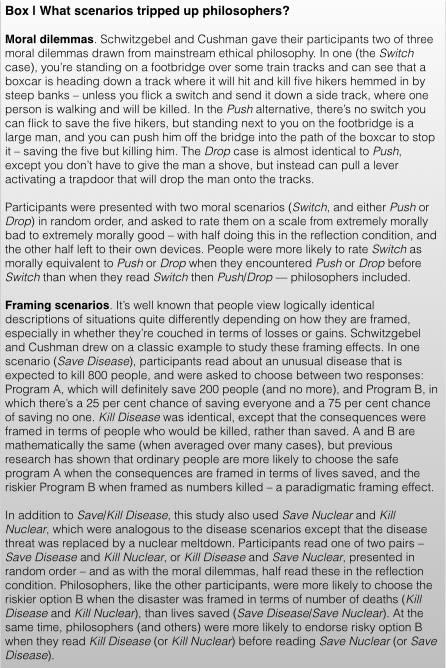 Half of the participants were put in a "reflection condition", in which they were encouraged, before being presented with the moral dilemmas or framing scenarios, to take time to think carefully about these cases, and afterwards were forced to wait at least 15 seconds before giving their answers. They were also asked to consider alternative ways of framing these scenarios, to provide an opportunity to overcome their immediate reactions. In other words, the researchers did all they could to encourage the philosophers to draw on their knowledge and experience.
None of this made any difference. Echoing their earlier findings, Schwitzgebel and Cushman found that, once again, philosophers are as vulnerable to order and framing effects as everyone else, even under the favourable conditions of the reflection condition, and despite some of the participants considering themselves to have specific expertise in ethics and framing effects!
Schwitzgebel and Cushman confess to being surprised by these results. They not only cast into doubt the supposed expertise of philosophers, even on issues within their speciality, but are also dispiriting for attempts to help ordinary people overcome their mental biases. Taking time to think about dilemmas, considering alternative ways of construing situations, gaining expertise in the issues at hand, and having a solid grounding in logical reasoning are all often touted as ways to achieve this end. Yet these findings suggest that none of these factors – all exemplified by at least some of the philosophers in this study – make much of a difference.
It’s possible that it simply takes an exceptional philosopher to overcome their mental biases and irrationality. But as Schwitzgebel and Cushman conclude, “if there is a level of philosophical expertise that reduces the influence of factors such as order and frame upon one’s moral judgments, we have yet to find empirical evidence of it.”
_________________________________
Schwitzgebel, E., & Cushman, F. (2015). Philosophers’ biased judgments persist despite training, expertise and reflection Cognition, 141, 127-137 DOI: 10.1016/j.cognition.2015.04.015
--further reading--
The unscientific thinking that forever lingers in the minds of physics professors
Post written by Dan Jones (@MultipleDraftz) for the BPS Research Digest. Dan Jones is a freelance writer based in Brighton, UK, whose writing has appeared in The Psychologist, New Scientist, Nature, Science and many other magazines. He blogs at www.philosopherinthemirror.wordpress.com. Check out his previous contributions to the BPS Research Digest.


Expert philosophers are just as irrational as the rest of us
by Research Digest

If you want to improve your tennis swing, learn how to repair your car, or master the piano, you’re likely to seek the help of an expert tutor. Similarly, many people who want to sharpen up their critical thinking skills turn to one of the many books written by philosophers to help lay people identify and avoid the biases and failures of logic that cause us to be, in the words of psychologist Dan Ariely, "predictably irrational".
But what if philosophers are just as susceptible to bad – or at least not entirely rational – thinking as the rest of us?
Evidence that this might be the case began to emerge in 2012 [pdf], when Eric Schwitzgebel and Fiery Cushman reported a study that presented professional philosophers and two comparison groups (academic non-philosophers and non-academics) with a series of moral scenarios to see whether the order in which they were read made any difference to how they were judged, from moral to immoral – the guiding idea being that if scenario A is judged worse than B on rational and philosophical grounds, then it shouldn’t matter whether you read about A before B, or vice versa.
It was known that ordinary people’s moral judgments are affected by the order in which they encounter moral dilemmas, and Schwitzgebel and Cushman confirmed this. For example, many people would consider a drunk driver who passes out, loses control and kills a pedestrian to be more morally blameworthy than a similarly intoxicated driver who hits a tree. Yet people who read about the tree case before the killed pedestrian case are more likely to rate the two scenarios as equivalent in terms of moral blameworthiness than when they encounter them in the opposite order. Surprisingly, Schwitzgebel and Cushman found that professional philosophers were swayed by order too, even those with training in ethics (although, curiously, the order effect went in the opposite direction).
This was a disappointing result for the philosophers, but to be fair, it’s possible that irrational order effects might be lessened among philosophers with expertise in the specific scenarios used in the experiments, or who report stable opinions on these scenarios. Philosophers might also be less influenced by irrelevant factors like order of presentation, or the specific framing of dilemmas, if the scenarios only differ in phrasing and not content. Finally, these symptoms of irrationality might abate if philosophers are instructed to take time to reflect on the scenarios, and to consider alternative phrasings of them.
Now Schwitzgebel and Cushman have tested these possibilities, as reported in Cognition. The pair recruited, via email, 497 philosophers (97 per cent of whom held PhDs, with 21 per cent describing themselves as professors with a specialisation in ethics), and 921 non-philosophers (of whom 87 per cent held a PhD in subjects broadly representative of academia as a whole).
To further probe order effects, participants were presented with variants of the famous
"trolley dilemma", in different orders. In addition, Schwitzgebel and Cushman also looked at whether philosophers were susceptible to framing effects — another kind of well-documented irrationality — by having them make decisions about options for tackling a contagious disease or nuclear threat that were logically the same but differed in how they were phrased, or framed. (See Box: "What scenarios tripped up philosophers?" for more details.)
Half of the participants were put in a "reflection condition", in which they were encouraged, before being presented with the moral dilemmas or framing scenarios, to take time to think carefully about these cases, and afterwards were forced to wait at least 15 seconds before giving their answers. They were also asked to consider alternative ways of framing these scenarios, to provide an opportunity to overcome their immediate reactions. In other words, the researchers did all they could to encourage the philosophers to draw on their knowledge and experience.None of this made any difference. Echoing their earlier findings, Schwitzgebel and Cushman found that, once again, philosophers are as vulnerable to order and framing effects as everyone else, even under the favourable conditions of the reflection condition, and despite some of the participants considering themselves to have specific expertise in ethics and framing effects!
Schwitzgebel and Cushman confess to being surprised by these results. They not only cast into doubt the supposed expertise of philosophers, even on issues within their speciality, but are also dispiriting for attempts to help ordinary people overcome their mental biases. Taking time to think about dilemmas, considering alternative ways of construing situations, gaining expertise in the issues at hand, and having a solid grounding in logical reasoning are all often touted as ways to achieve this end. Yet these findings suggest that none of these factors – all exemplified by at least some of the philosophers in this study – make much of a difference.
It’s possible that it simply takes an exceptional philosopher to overcome their mental biases and irrationality. But as Schwitzgebel and Cushman conclude, “if there is a level of philosophical expertise that reduces the influence of factors such as order and frame upon one’s moral judgments, we have yet to find empirical evidence of it.”
_________________________________
Schwitzgebel, E., & Cushman, F. (2015). Philosophers’ biased judgments persist despite training, expertise and reflection Cognition, 141, 127-137 DOI: 10.1016/j.cognition.2015.04.015
--further reading--
The unscientific thinking that forever lingers in the minds of physics professors
Post written by Dan Jones (@MultipleDraftz) for the BPS Research Digest. Dan Jones is a freelance writer based in Brighton, UK, whose writing has appeared in The Psychologist, New Scientist, Nature, Science and many other magazines. He blogs at www.philosopherinthemirror.wordpress.com. Check out his previous contributions to the BPS Research Digest.
16 Jul 02:56
 By guest blogger David Robson
Aristotle once compared the human mind to a wax tablet. When we are young, the wax is warm and soft; it is easy to make an impression and record our thoughts and feelings. With age, the wax hardens – the older impressions fade, and it is harder to carve out new images in their place.
This view of memory, at least among the general public, has changed little in the 2300 years since. Many of us still believe that the brain’s “plasticity” – its ability to adapt, change, and pick up new skills – decreases as we get older, much like Aristotle’s stiffening wax. Combined with a general cognitive decline, this is the reason why it’s assumed “you can’t teach an old dog new tricks”.
Yet modern science tells a more positive story: memory is more pliable than we imagine, even in old age. In fact, according to work by Dayna Touron at the University of Carolina, a large problem may simply be confidence – older adults don’t trust their memories, and so don’t realise their full capacity. She uses the example of learning a new route with GPS. Long after they have committed the route to memory, older adults are more reluctant than younger people to give up SatNav Sally. Indeed, over the last few years, Touron has amassed some compelling evidence for the importance of older people’s lack of confidence, which she presents in a recent review for Current Directions in Psychological Science.
For instance, Touron once asked participants to perform a tedious verbal task: they were given a table of random word pairs (e.g. dog-potato) and they then had to judge whether another list of word pairings contained any of the same word pairs that had appeared in the original table. Importantly, all the participants were told they could refer back to the original table if they wanted to, but they didn’t have to if they could remember the pairings. The older participants (aged between 60 and 75 years) were more reluctant to rely on their memories, and so continued looking up each entry – despite the fact that further tests revealed they had memorised just as many of the original word pairs as the younger participants.
In other experiments, volunteers were given a series of algebraic equations to solve. They could solve them initially using mental arithmetic, but each equation appeared multiple times, allowing the participants to learn the answers off by heart. Even so, the older volunteers reported going through the same calculations again and again, rather than relying on their memories of the solutions. Crucially, Touron found that they were perfectly capable of retrieving those memories if they were encouraged by the offer a small cash prize in return for a quick answer. Nor is their reluctance a form of “behavioural inertia” – the habit of sticking to the first strategy you use, however inefficient in the long run. In fact, the older participants are happy to change tack in other kinds of tasks, as long as they don’t involve actively recalling newly learnt information.
In other words, avoiding their memory seems to be a choice – a decision that may come from a poor understanding of the way their minds are working. Touron has found that her older participants underestimate the time and effort required to take the long route around the problems, rather than using their memories as a short cut; they also believe their memories are less accurate than they actually are. Indeed, as you might expect, the less confident they are in their own learning abilities, the less likely they are to make use of their memories during these trials.
Asking volunteers to complete diaries about their everyday activities, Touron has found that older people are just as reluctant to take advantage of their memories in their private lives as in the psych lab – whether they are cooking, driving or learning to use a computer. And that has big implications, she thinks. For one thing, it could be a case of use it or lose it – contributing to a more general mental decline as people age. A fear of misremembering could also lead to reduced self-esteem, perhaps making older folk less adventurous: they might avoid parties if they are scared of forgetting people’s names, for instance, contributing to further isolation and loneliness. For these reasons, Touron is now looking for measures that could encourage older people to have a more youthful confidence in their abilities.
The science makes intuitive sense. If the brain really were a wax tablet, as Aristotle imagined, the answer wouldn’t be to set our tools aside to gather dust and cobwebs; it would be to continue to work the wax with even greater fervour, melting it and moulding it until it was pliable once more.
_________________________________
Touron, D. (2015). Memory Avoidance by Older Adults: When "Old Dogs" Won't Perform Their "New Tricks" Current Directions in Psychological Science, 24 (3), 170-176 DOI: 10.1177/0963721414563730
--further reading--
Exploring people's beliefs about their memory problems
Different mental abilities peak at different times of life, from 18 to 70+
Introducing the SuperAgers - the elderly people whose brains have stayed young
Very old and very cool - recognising a distinct mental strength of the elderly
Companies are more successful when their employees feel young for their age
Post written by David Robson (@d_a_robson) for the BPS Research Digest. David is BBC Future’s feature writer.
Our free fortnightly email will keep you up-to-date with all the psychology research we digest: Sign up!


Older people frequently underestimate their own memory skills
by Research Digest

Aristotle once compared the human mind to a wax tablet. When we are young, the wax is warm and soft; it is easy to make an impression and record our thoughts and feelings. With age, the wax hardens – the older impressions fade, and it is harder to carve out new images in their place.
This view of memory, at least among the general public, has changed little in the 2300 years since. Many of us still believe that the brain’s “plasticity” – its ability to adapt, change, and pick up new skills – decreases as we get older, much like Aristotle’s stiffening wax. Combined with a general cognitive decline, this is the reason why it’s assumed “you can’t teach an old dog new tricks”.
Yet modern science tells a more positive story: memory is more pliable than we imagine, even in old age. In fact, according to work by Dayna Touron at the University of Carolina, a large problem may simply be confidence – older adults don’t trust their memories, and so don’t realise their full capacity. She uses the example of learning a new route with GPS. Long after they have committed the route to memory, older adults are more reluctant than younger people to give up SatNav Sally. Indeed, over the last few years, Touron has amassed some compelling evidence for the importance of older people’s lack of confidence, which she presents in a recent review for Current Directions in Psychological Science.
For instance, Touron once asked participants to perform a tedious verbal task: they were given a table of random word pairs (e.g. dog-potato) and they then had to judge whether another list of word pairings contained any of the same word pairs that had appeared in the original table. Importantly, all the participants were told they could refer back to the original table if they wanted to, but they didn’t have to if they could remember the pairings. The older participants (aged between 60 and 75 years) were more reluctant to rely on their memories, and so continued looking up each entry – despite the fact that further tests revealed they had memorised just as many of the original word pairs as the younger participants.
In other experiments, volunteers were given a series of algebraic equations to solve. They could solve them initially using mental arithmetic, but each equation appeared multiple times, allowing the participants to learn the answers off by heart. Even so, the older volunteers reported going through the same calculations again and again, rather than relying on their memories of the solutions. Crucially, Touron found that they were perfectly capable of retrieving those memories if they were encouraged by the offer a small cash prize in return for a quick answer. Nor is their reluctance a form of “behavioural inertia” – the habit of sticking to the first strategy you use, however inefficient in the long run. In fact, the older participants are happy to change tack in other kinds of tasks, as long as they don’t involve actively recalling newly learnt information.
In other words, avoiding their memory seems to be a choice – a decision that may come from a poor understanding of the way their minds are working. Touron has found that her older participants underestimate the time and effort required to take the long route around the problems, rather than using their memories as a short cut; they also believe their memories are less accurate than they actually are. Indeed, as you might expect, the less confident they are in their own learning abilities, the less likely they are to make use of their memories during these trials.
Asking volunteers to complete diaries about their everyday activities, Touron has found that older people are just as reluctant to take advantage of their memories in their private lives as in the psych lab – whether they are cooking, driving or learning to use a computer. And that has big implications, she thinks. For one thing, it could be a case of use it or lose it – contributing to a more general mental decline as people age. A fear of misremembering could also lead to reduced self-esteem, perhaps making older folk less adventurous: they might avoid parties if they are scared of forgetting people’s names, for instance, contributing to further isolation and loneliness. For these reasons, Touron is now looking for measures that could encourage older people to have a more youthful confidence in their abilities.
The science makes intuitive sense. If the brain really were a wax tablet, as Aristotle imagined, the answer wouldn’t be to set our tools aside to gather dust and cobwebs; it would be to continue to work the wax with even greater fervour, melting it and moulding it until it was pliable once more.
_________________________________
Touron, D. (2015). Memory Avoidance by Older Adults: When "Old Dogs" Won't Perform Their "New Tricks" Current Directions in Psychological Science, 24 (3), 170-176 DOI: 10.1177/0963721414563730
--further reading--
Exploring people's beliefs about their memory problems
Different mental abilities peak at different times of life, from 18 to 70+
Introducing the SuperAgers - the elderly people whose brains have stayed young
Very old and very cool - recognising a distinct mental strength of the elderly
Companies are more successful when their employees feel young for their age
Post written by David Robson (@d_a_robson) for the BPS Research Digest. David is BBC Future’s feature writer.
Our free fortnightly email will keep you up-to-date with all the psychology research we digest: Sign up!
14 Jul 09:03
The language we use reflects our attitudes but perhaps more important, it can shape those attitudes. A new study considers this power in the context of autism. Lorcan Kenny and his colleagues have conducted a UK survey of hundreds of autistic people; parents, relatives and carers of autistic adults and children; and professionals in the field, about their preferences for the language used to discuss autism. The research was conducted online with the help of the National Autistic Society.
The main finding is that there is no consensus about the preferred terms to use when talking about autism and people with the diagnosis. A key disagreement between and within the surveyed groups is whether the language we use should put the "person first", as in "people with autism", or put the diagnosis first, as in "autistic person". Overall, researchers and other professionals expressed a strong preference for the former. One professional said:
Another contentious issue is the idea of autism being a spectrum upon which everyone is located to some degree. This terminology was more popular among professionals and family members than among autistic people, some of whom felt that it trivialises the difficulties faced by those who are "truly autistic".
A notable point of agreement across the different groups who completed the survey was the dislike for the terms "high-functioning autism" (it downplays the everyday difficulties experienced even by autistic people who have good verbal and intellectual skills) and "low-functioning autism" (it undermines people's potential).
The researchers said the "fundamental finding" of their research was that "there are reasonable and rational disagreements between members of the autism community as to which terms should be used to describe autism." They said this "plurality" of views was likely to persist and evolve with time and that for anyone involved in autism, choosing the right language will be difficult and require care, reflection and "practical wisdom". They added: "The overriding principle for those who are unclear about appropriate terminology should therefore be to inquire of the people with whom they are working or describing for clarification."
_________________________________
Kenny, L., Hattersley, C., Molins, B., Buckley, C., Povey, C., & Pellicano, E. (2015). Which terms should be used to describe autism? Perspectives from the UK autism community Autism DOI: 10.1177/1362361315588200
--further reading--
Advice from the National Autistic Society on how to talk about autism.
Autism journal podcast about the new survey findings.
"Watch your language when talking about autism" co-author Liz Pellicano reflects on the new findings at The Conversation.
Autism – Myth and Reality
Post written by Christian Jarrett (@psych_writer) for the BPS Research Digest.


What is the correct way to talk about autism? There isn't one
by Research Digest
 |
| Image: National Autistic Society. |
The main finding is that there is no consensus about the preferred terms to use when talking about autism and people with the diagnosis. A key disagreement between and within the surveyed groups is whether the language we use should put the "person first", as in "people with autism", or put the diagnosis first, as in "autistic person". Overall, researchers and other professionals expressed a strong preference for the former. One professional said:
"I don’t like phrases which describe a person as their condition, so would always go for 'person' first, because that’s what we all are regardless of what conditions we have. I would never describe myself as a thyroidy, for example."In contrast, autistic people showed a clear preference for autism-first terminology. One of the autistic adults in the survey said:
"Separating the person from their autism is damaging, as it reinforces opinions about autism being a ‘thing’ that can be removed, something that may be unpleasant and unwanted, and something that is not just another aspect of a whole, complete and perfect individual human being. Describing oneself as autistic is an extremely important and positive assertion about oneself, it means that one feels complete and whole as one is."Related to this disagreement is the issue of whether autism is viewed as a "disorder" or a "difference", and whether any disability associated with autism is seen as located purely in the individual or as arising from society's failure to adapt to the needs of people with autism. Another adult with autism said:
"Autism is just another way of thinking, not some sort of disease that one can catch."Yet some parents and carers were wary of downplaying the impact of autism, often because they are the ones championing their children's needs. One of them said:
"I prefer 'disorder' to 'condition' because I think it conveys better the seriousness and the need for support and intervention."There was also disagreement about the appropriateness and value of the term Asperger's Syndrome (a diagnosis dropped recently by US psychiatry) or "Aspie". Some people felt it was an important part of their identity. Yet others believed continued use of the term undermined efforts to build a united autism community.
Another contentious issue is the idea of autism being a spectrum upon which everyone is located to some degree. This terminology was more popular among professionals and family members than among autistic people, some of whom felt that it trivialises the difficulties faced by those who are "truly autistic".
A notable point of agreement across the different groups who completed the survey was the dislike for the terms "high-functioning autism" (it downplays the everyday difficulties experienced even by autistic people who have good verbal and intellectual skills) and "low-functioning autism" (it undermines people's potential).
The researchers said the "fundamental finding" of their research was that "there are reasonable and rational disagreements between members of the autism community as to which terms should be used to describe autism." They said this "plurality" of views was likely to persist and evolve with time and that for anyone involved in autism, choosing the right language will be difficult and require care, reflection and "practical wisdom". They added: "The overriding principle for those who are unclear about appropriate terminology should therefore be to inquire of the people with whom they are working or describing for clarification."
_________________________________
Kenny, L., Hattersley, C., Molins, B., Buckley, C., Povey, C., & Pellicano, E. (2015). Which terms should be used to describe autism? Perspectives from the UK autism community Autism DOI: 10.1177/1362361315588200
--further reading--
Advice from the National Autistic Society on how to talk about autism.
Autism journal podcast about the new survey findings.
"Watch your language when talking about autism" co-author Liz Pellicano reflects on the new findings at The Conversation.
Autism – Myth and Reality
Post written by Christian Jarrett (@psych_writer) for the BPS Research Digest.
14 Jul 07:30
Last week Kathleen finally put aside her fears about public speaking to give a presentation… and it went pretty well! But when you caught her at lunch today and asked if she wanted future opportunities to present, you found she was as pessimistic about her ability as ever.
This story reflects an unfortunate truth: people with low self-belief are liable to hold onto negative assumptions about themselves despite concrete evidence of the contrary; that is, they fail to "generalise from success". Thankfully, in a new paper, psychologist Peter Zunick and his colleagues describe a technique, called directed abstraction, that can help the self-critical change their mindsets.
Direct abstraction means stopping to consider how a specific success may have more general implications – this is the abstraction part – and also ensuring this thinking is directed towards how personal qualities were key to the success. Let’s see what this means in practice.
In a first study, 86 students guessed the number of dots flashed up on screen, and were given fake but convincing positive feedback on their performance. Half the students were then asked to explain how they completed the task, which kept their thoughts on a very concrete, specific level. The other half were prompted to engage in directed abstraction by completing the sentence: “I was able to score very high on the test because I am: ... ” This query is not about how, but why – a more abstract consideration – and also focuses on the individual’s own qualities.
Engaging in directed abstraction appeared to give a particular boost to those participants who’d earlier reported believing they have low competence day to day: afterwards, they not only had more confidence in their estimation ability (than similarly self-critical control participants), they also believed they would do better at similar tasks (like guessing jelly beans in a jar) that they faced in the future.
In another experiment, Zunick’s research team sifted through hundreds of students to find 59 with low faith in their public speaking skills. Each of them was given a few minutes to prepare and then make a speech to camera on the topic of transition to college life, a fairly easy one to tackle. Each participant then watched themselves on video, with the experimenter offering reassuring feedback and implying that they did surprisingly well.
The same participants then engaged in directed abstraction (or the control "how" query) before being thrown once more into the breach with a second speechmaking experience, this time on a tough topic, with no coddling feedback afterward – this was the real deal. Did the directed abstraction participants gain confidence from their early success that could survive a rockier second round? They did, reporting more confidence for future public speaking than their peers.
The technique seems to be appropriate for a range of settings, although obviously it’s only useful to use it following an event that can be reasonably seen as a success, otherwise it could backfire. And it’s simple to use to help a friend or yourself, just by taking the time after a success to think through what it owes to your personal qualities. Then confidence can follow.
_________________________________
Zunick PV, Fazio RH, & Vasey MW (2015). Directed abstraction: Encouraging broad, personal generalizations following a success experience. Journal of personality and social psychology, 109 (1), 1-19 PMID: 25984786
Post written by Alex Fradera (@alexfradera) for the BPS Research Digest.


Here's a technique that helps self-critical people build confidence from a taste of success
by Research Digest
 |
| The directed abstraction technique acts a springboard, allowing the timid to gain confidence from initial success |
This story reflects an unfortunate truth: people with low self-belief are liable to hold onto negative assumptions about themselves despite concrete evidence of the contrary; that is, they fail to "generalise from success". Thankfully, in a new paper, psychologist Peter Zunick and his colleagues describe a technique, called directed abstraction, that can help the self-critical change their mindsets.
Direct abstraction means stopping to consider how a specific success may have more general implications – this is the abstraction part – and also ensuring this thinking is directed towards how personal qualities were key to the success. Let’s see what this means in practice.
In a first study, 86 students guessed the number of dots flashed up on screen, and were given fake but convincing positive feedback on their performance. Half the students were then asked to explain how they completed the task, which kept their thoughts on a very concrete, specific level. The other half were prompted to engage in directed abstraction by completing the sentence: “I was able to score very high on the test because I am: ... ” This query is not about how, but why – a more abstract consideration – and also focuses on the individual’s own qualities.
Engaging in directed abstraction appeared to give a particular boost to those participants who’d earlier reported believing they have low competence day to day: afterwards, they not only had more confidence in their estimation ability (than similarly self-critical control participants), they also believed they would do better at similar tasks (like guessing jelly beans in a jar) that they faced in the future.
In another experiment, Zunick’s research team sifted through hundreds of students to find 59 with low faith in their public speaking skills. Each of them was given a few minutes to prepare and then make a speech to camera on the topic of transition to college life, a fairly easy one to tackle. Each participant then watched themselves on video, with the experimenter offering reassuring feedback and implying that they did surprisingly well.
The same participants then engaged in directed abstraction (or the control "how" query) before being thrown once more into the breach with a second speechmaking experience, this time on a tough topic, with no coddling feedback afterward – this was the real deal. Did the directed abstraction participants gain confidence from their early success that could survive a rockier second round? They did, reporting more confidence for future public speaking than their peers.
The technique seems to be appropriate for a range of settings, although obviously it’s only useful to use it following an event that can be reasonably seen as a success, otherwise it could backfire. And it’s simple to use to help a friend or yourself, just by taking the time after a success to think through what it owes to your personal qualities. Then confidence can follow.
_________________________________
Zunick PV, Fazio RH, & Vasey MW (2015). Directed abstraction: Encouraging broad, personal generalizations following a success experience. Journal of personality and social psychology, 109 (1), 1-19 PMID: 25984786
Post written by Alex Fradera (@alexfradera) for the BPS Research Digest.
13 Jul 14:23
Prosopagnosia
by John Cohen
What it's like to be face-blind.
Here are some of the most interesting parts of this interview with an anonymous 47-year-old woman who's been face-blind all her life:

Here are some of the most interesting parts of this interview with an anonymous 47-year-old woman who's been face-blind all her life:
It doesn't matter if I know the person: I've walked right past my husband, my own mother, my daughter, my son, without being able to recognize them.Previously, previously, previouslier, and previousliest.
It can be very embarrassing, and it can offend people. I once had to drop a sociology class, because I told the professor, to her face, that she was a horrible lecturer. I thought I was complaining to a fellow student! It's as if I have a missing chip — you feel like you're just not trying hard enough. Faces are so important to humans that we have a special part of our brain dedicated to recognizing them. Most people remember them as a whole piece, but I don't. . . . Good-looking people are the most difficult to recognize. . . .
The other thing I have discovered is that there is a specific expression people have when they see somebody they know. I call it the "I know you face" — it's sort of a surprised micro expression. I'm convinced that it's completely involuntary. It looks a little like surprise. The eyebrows go up, and usually the mouth opens like they're about to say something. When I see it, I say hello, and then when I start interacting with them, I'll remember who they are. That's just one of a whole set of observational skills I've developed. Another is when I'm meeting somebody in public, I'll arrive early so they'll approach me.
I'm always looking for visual hooks. My daughter has a particular thing she does with her mouth. If there's several people who could be her, I look for the mouth thing. If she's nervous, or she's irritated, one side of her mouth goes up. She's done it since she was a baby. She doesn't like having her photograph taken, so when I look at a group photo, I look for the kid with the smirk and I know it's my daughter. . . .
My son had a distinctive blue and white camouflage hat that he wore for five years. It was great for me when we were in the playground because I could track him. The rule was that my kids had to keep me in their line of sight. If there was a crowd of kids and mine weren't wearing anything distinctive, I was totally lost. . . .
I've had to say to friends of mine, "Is that a picture of me? Who is that?" If I unexpectedly see myself in a mirror, I might think it's somebody else. It's like, Why is that woman staring at me? . . .
When I worked at a homeless shelter, I was often praised for the way I interacted with my African-American clients. I couldn't figure out what I was doing differently from the other white workers, but I was allowed into their circle and they bonded with me. When we lived in Louisiana, I was always being asked by African-American women if my husband was black. When I was tested at Dartmouth, I scored low on unconscious racism. Apparently babies show a preference for their own race at about nine months because that's when they start being able to recognize faces. My head doesn't do this.
08 Jul 22:23
I can't believe it's not newspaper
by Jason Kottke
Randall Rosenthal makes amazingly realistic wooden sculptures of everyday objects like newspapers, legal pads, baseball cards, and kitchen scenes. He carves each of his sculptures out of a single block of wood. So, this is carved entirely out of wood:
And so is this:

And this too:

And here's a look at that last sculpture in progress:

(via @pieratt)
Tags: art Randall Rosenthal
07 Jul 17:21
Laugh Now (while you can)
by Alex Tabarrok
Here’s a video of robots falling over on the first day of Darpa’s 2015 robot challenge, a challenge set up after Japan’s nuclear disaster at Fukushima in order to encourage development of robots capable of navigating a disaster area.
Keep in mind that the first Darpa Grand Challenge for driverless vehicles was held in 2004 and not a single vehicle came to close to finishing the course and most failed within a few hundred metres. Did I mention that was in 2004?
Laura B, Alejandro.lagorio and -1 others like this
05 Jul 12:37
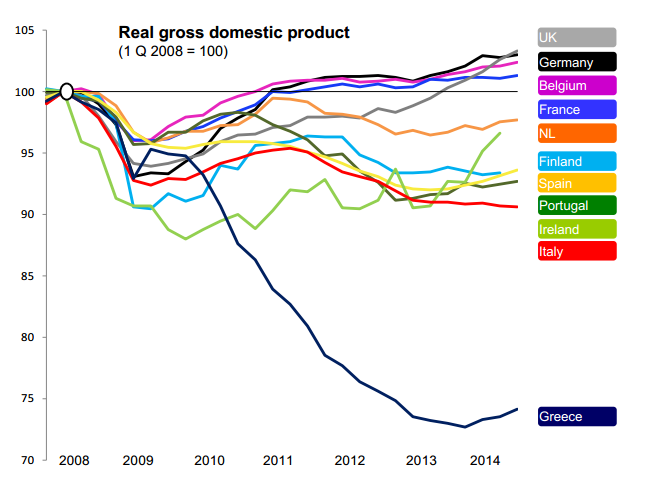
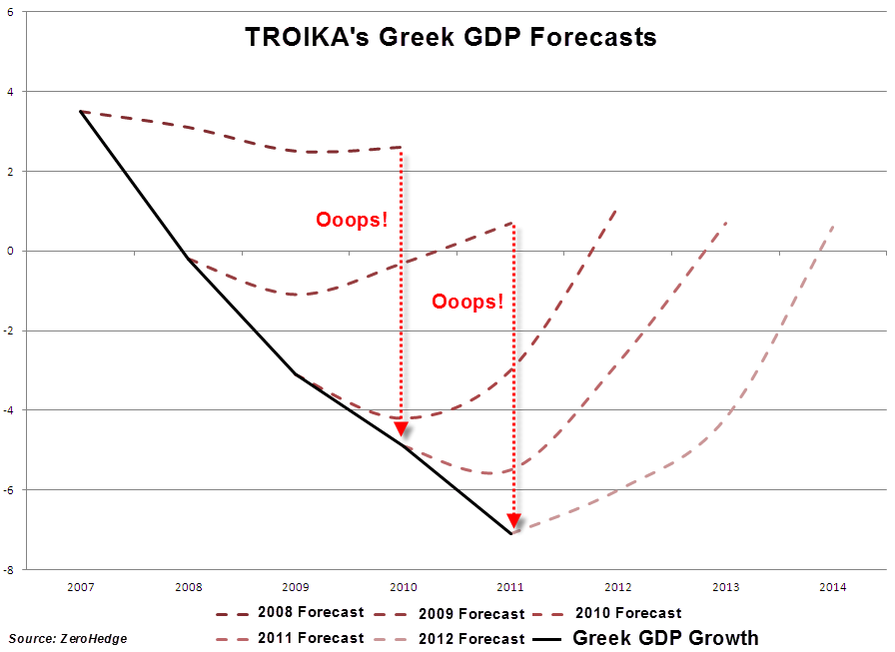
Greece
by Steve Randy Waldman
Greece is a remarkable country full of wonderful people, but along dimensions of development and governance, the place is plainly pretty fucked up. It has been fucked up that way for a long time, for decades at least. This has never been secret. Anyone who has visited Athens knows it has far more in common with Bucharest or Istanbul than with orderly Western European capitals. In the run up to Greece’s joining the Euro, everyone who wanted to know knew that Greece’s qualifications to join the Eurozone were, shall we say, ambitious. Mainstream establishment banks “helped” Greece and other Southern European countries with accounting fudges that, while perhaps obscure, were not secret even at the time. Despite protestations when these deals hit the news in 2010 that officials were “shocked, shocked”, they were explicitly blessed by the agency that compiles the statistics on which Eurozone entrance was based in 2002 and Greece’s gaming was extensively reported in 2003 (ht Heidi Moore, both cites). The Euro was and ought to be primarily a political enterprise. In order to sell the common currency to Northern European elites, its architects required Eurozone members to meet strict “convergence criteria” and especially the requirements of the Stability and Growth Pact. But in practice, those criteria have always been interpreted flexibly. Most Eurozone members have broken their promises at one point or another, including both Germany and France. The Euro was a unification project, and erred (not unreasonably, I think) on the side of building a big tent.
Germany and France may have missed their Stability and Growth commitments now and again, but they are not fucked up like Greece is. Greek governments — not the current, much maligned Syriza, but decades of its predecessors — treated the state like a teat from which clients and friends of electoral victors might suck. The Greek state has been a shady, opportunistic borrower, no doubt, the kind of character no one would lend money to with any great expectation of seeing it back.
And yet, that’s precisely what bankers in the relatively not-fucked-up Eurozone countries did! These people were not naïfs. They knew the Greek state was sketchy. But precisely because it was sketchy, prior to the financial crisis its debt paid slightly higher interest rates than that of safer Eurozone sovereigns. European banking regulations attached zero risk weights to all EU sovereigns, rendering it nearly costless for banks to simply manufacture deposits to purchase sovereign debt. Eurozone sovereigns were default-risk-free as a regulatory matter and currency-risk-free from the perspective of Eurozone banks. The European financial system was architected to make lending to Greece — and Spain and Portugal and Italy — a money machine for bankers with little career risk over a medium term. Sketchy credits tend to punch above their weight in terms of volume of issuance, so there was a lot of nice paper to buy. The bankers who lent to these states understood perfectly well that there was in fact a long-term risk, an uncertainty, a constructive ambiguity. They lent anyway, and took home very nice salaries and bonuses for doing so. It was conventional to lend, the mainstream consensus was that credit risk was over and worry warts were old-fashioned, Europe was strong and would work this out. If the worry warts turned out to be right, it was likely years away, IBGYBG.
When the game was up, when the global house of credit cards collapsed in the late Aughts, European leaders had a choice. They had knowingly and purposefully brought weak states into the Eurozone, because they genuinely, even nobly, wished to build a large, strong, United Europe. When they did so, they understood there would be crises. A unified Europe, they had always claimed, would be forged one crisis at a time. The right thing to have done for Europe at this point would have been to point out the regulatory errors and misaligned incentives that encouraged profligate lending and enabled corruption and waste among borrowers, and fix those. Banks that had made bad loans would acknowledge losses. The banks themselves would have to be restructured or bailed out.
But “bank restructuring” is a euphemism for imposing losses on wealthy creditors. And explicit bank bailouts are humiliations of elites, moments when the mask comes off and the usually tacit means by which states preserve and enhance the comfort of the comfortable must give way to very visible, very unpopular, direct cash flows.
The choice Europe’s leaders faced was to preserve the union or preserve the wealth, prestige, and status of the community of people who were their acquaintances and friends and selves but who are entirely unrepresentative of the European public. They chose themselves. The formal institutions of the EU endure, but European community is now failing fast.
It is difficult to overstate how deeply Europe’s leaders betrayed the ideals of European integration in their handing of the Greek crisis. The first and most fundamental goal of European integration was to blur the lines of national feeling and interest through commerce and interdependence, in order to prevent the fractures along ethnonational lines that made a charnel house of the continent, twice. That is the first thing, the main rule, that anyone who claims to represent the European project must abide: We solve problems as Europeans together, not as nations in conflict. Note that in the tale as told so far, there really was no meaningful national dimension. Regulatory mistakes and agency issues within banks encouraged poor credit decisions. Spanish banks lent into overpriced real estate, and German banks lent to a state they knew to be weak. Current account imbalances within the Eurozone — persistent and unlikely to reverse without policy attention — implied as a matter of arithmetic that there would be loan flows on a scale that might encourage a certain indifference to credit quality. These were European problems, not national problems. But they were European problems that festered while the continent’s leaders gloated and took credit for a phantom prosperity. When the levee broke, instead of acknowledging errors and working to address them as a community, Europe’s elites — its politicians and civil servants, its bankers and financiers — deflected the blame in the worst possible way. They turned a systemic problem of financial architecture into a dispute between European nations. They brought back the very ghosts their predecessors spent half a century trying to dispell. Shame. Shame. Shame. Shame.
Until the financial crisis, people like, well, me, were of two minds about the EU’s famous “democracy deficit”. On the one hand, I believe that good governance requires accountability to and participation of the broad public. On the other hand, before the crisis, I was willing to cut the Euro-elite a lot of slack. I’m an American born in 1970, but my life is largely framed and circumscribed by events in Europe during the Second World War. I grew up on a diet of “never again”. I am writing these words from my grandfather’s villa on the Romanian Black Sea, which my mother worked doggedly to recover in an act of sheer vengeance for what this continent’s history did to her father. I was inclined to support Europe’s democratic fudges when they were about diminishing and diffusing the still palpable possibility here of reversion to ethnonational conflict. To see European institutions deployed precisely and with great force in the service polarization across national borders has radicalized and made a populist of me (as have analogous betrayals among the political leadership of my own country). If I were Greek, I would surely be a nationalist now.
With respect to Greece, the precise thing that European elites did to set the current chain of events in motion was to replace private debt with public during the 2010 first “bailout of Greece”. Prior to that event, it was obvious that blame was multipolar. Here are the banks, in France, in Germany, that foolishly lent. Not just to Greece, but to Goldman’s synthetic CDOs and every other piece of idiot paper they could carry with low risk-weights. In 2010, the EU, ECB, and IMF laundered a bailout of mostly French and German banks through the Greek fisc. Cash flowed into Greece only so it could flow out to rickety banks. Now, suddenly, the banks were absolved. There were very few bad loans left on the books of European lenders, everyone was clean, no bad actors at all. Except one. There were the institutions, the “troika”, clearly the good guys, so “helpful” with their generous offer of funds. And then there was Greece. What had been a mudwrestling match, everybody dirty, was transformed into mass of powdered wigs accusing a single filthy penitent (or, when the people with their savings in just-rescued banks decide to be generous, a petulant misbehaving child). [antidote]
Among creditors, a big catchphrase now is “moral hazard”. We cannot be too kind to Greece, we cannot forgive their debt with few string attached, because what kind of precedent would that set? If bad borrowers, other sovereigns, got the idea that they can overborrow without consequence, if Spanish and Portuguese populists perceive perhaps a better deal is on offer, they might demand that. They might continue to borrow and expect forgiveness, and where would it end except for the bankruptcy of the good Europeans who actually produce and save?
The nerve. The fucking nerve. Lenders, having been made nearly whole on their ill-conceived, profit-motivated punts, now fear that if anybody is nice to somebody who doesn’t deserve it, where will it end? I’d resort to that cliché about chutspa, the kid who murders his parents then seeks leniency ‘cuz he’s an orphan. But it’s really too cute for the occasion.
For the record, my sophisticated hard-working elite European interlocutors, the term moral hazard traditionally applies to creditors. It describes the hazard to the real economy that might result if investors fail to discriminate between valuable and not-so-valuable projects when they allocate society’s scarce resources as proxied by money claims. Lending to a corrupt, clientelist Greek state that squanders resources on activities unlikely to yield growth from which the debt could be serviced? That is precisely, exactly, what the term “moral hazard” exists to discourage. You did that. Yes, the Greek state was an unworthy and sometimes unscrupulous debtor. Newsflash: The world is full of unworthy and unscrupulous entities willing to take your money and call the transaction a “loan”. It always will be. That is why responsibility for, and the consequences of, extending credit badly must fall upon creditors, not debtors. There is one morality tale that says the debtor must repay, or she has sinned and must be punished. There is another morality tale that says the creditor must invest wisely, or she has stewarded resources poorly and must be punished. We get to choose which morality tale we most use to make sense of the world. We do, and surely should, use both to some degree. But if we emphasize the first story, we end up in a world full of bad loans, wasted resources, and people trapped in debtors’ prison, metaphorical or literal. If we emphasize the second story, we end up in a world where dumb expenditures are never financed in the first place.
But don’t the Greeks want to borrow more? Isn’t that what all the fuss is about right now? No. The Greeks need to borrow money now only because old loans are coming due that they have to pay, and they have been trying to come to an agreement about that, rather than raise a middle finger and walk away. The Greek state itself is not trying to expand its borrowing. Greece’s citizens and businesses would like to expand the country’s borrowing indirectly, by withdrawing Euros from Greek banks that the Greek banks won’t be able to come up with unless they are allowed to expand their borrowing from the ECB. That is, Greece’s citizens are in precisely the place France’s citizens and Germany’s citizens were in 2010, at risk that personal savings maintained as bank deposits will not be repaid. Something was worked out for French and German citizens. Other than resorting to the ethnonational stereotypes that European elites have now revived in polite company, what is the justification for a Greek schoolteacher losing her savings that wouldn’t have applied just as strongly to a French schoolteacher five years ago? Because Greeks are responsible, as individuals, for what the governments they elect do? Well, then I deserve to be killed for what my government has done in Iraq and elsewhere. Is that where we want to go?
If citizens aren’t going to be held responsible for their governments’ bad debts, how will sovereigns borrow at all? Well, how do firms raise equity, when an equity claim makes no promise whatsoever that any cash will be returned? People invest in shares not because they have any sword of Damocles to hold over the enterprise, but because they believe the firm will engage in activities sufficiently productive that throwing some cash back to investors will not be burdensome, and because firms know repayment enhances access to continued finance. The same is true of sovereigns like the United States or the UK, which borrow easily in currencies they can print any time. Nothing prevents the US from conjuring $100T USD and handing it out to citizens, engineering a one-time inflation that leaves outstanding bonds nearly worthless. It wouldn’t even constitute a default. But the US has organized itself in ways that persuade creditors that their funds will be treated reasonably. Inflexible debt sows seeds of coercion and enmity between borrower and lender. Equity-like arrangements, including “debt” denominated in securities issuable at will by the debtor, require and encourage trust and collaboration. Sovereign debt in particular should always look like the latter, not the former, given the regularity with which government borrowings are disbursed into insiders’ bank accounts rather than used to aid the publics who might be pressured to foot the bill.
Greece should see its debts forgiven, pretty much wholesale. That forgiveness should be understood as a default, with future investors warned. Insured deposits in Greek bank accounts should be made whole, uninsured deposits should be “bailed in”, Greece’s banking system should be integrated into a much more carefully regulated European banking system that eschews investment in individual sovereigns entirely, Germany as much as Greece. Let sovereigns sell securities to the market, where incentives for careful credit allocation are sharper than they are within banks. Let European banks hold only claims against the ECB when they want a risk-free instrument. If Spain or Portugal or Italy wish to haircut or repudiate their existing debt, let them, at cost of future market access. Sovereigns have an option to default full stop. Investors in sovereign securities must price that. If perceived credit risk leaves public finance too expensive Europe-wide, then the EU should develop a mechanism whereunder states are permitted to sell equity securities to the ECB up to a fixed limit, set uniformly across Europe in per capita terms.
I’ll end this ramble with a discussion of a fashionable view that in fact, the Greece crisis is not about the money at all, it is merely about creditors wresting political control from the concededly fucked up Greek state in order to make reforms in the long term interest of the Greek public. Anyone familiar with corporate finance ought to be immediately skeptical of this claim. A state cannot be liquidated. In bankruptcy terms, it must be reorganized. Corporate bankruptcy laws wisely limit the control rights of unconverted creditors during reorganizations, because creditors have no interest in maximizing the value of firm assets. Their claim to any upside is capped, their downside is large, they seek the fastest possible exit that makes them mostly whole. The incentives of impaired creditors are simply not well aligned with maximizing the long-term value of an enterprise.
If it were 2009, I might have been persuaded that the corporate bankruptcy analogy is poor, that Europe’s interest in the development and cohesiveness of its empire would substitute for narrow economic incentives (which should in any case be blunted, since they are the incentives of 27 different fiscs). If the past five years had not happened, I might be open to the argument made here (ht platypus) that, having extended the maturity of a large quantity of debt far into the future, creditors’ position is more like equity, since the fraction of face value creditors eventually recover is dependent upon Greece’s long-term growth.
But we have had five years to observe creditors’ tender ministrations, under governments that complied with creditors’ every demand. This has been the result:
[Graph via David Ruccio, via Frances Coppola, originally due to Robin Wigglesworth I think]
Euroelite apologists cite the small upturn at the very end of the graph to say, “See! Things were going swimmingly until the five-month old Syriza government screwed it all up. They just had to stick with the program! It was working! The darkest hour comes before the dawn!” These people, they are sophisticated highly educated people. You can trust them. Check out this track record:
[Graph via Felix Salmon, via Zero Hedge evidently]
The fact of the matter is no country, not Germany, not France, would voluntarily put up with the sort of “adjustment” that has been forced on Greece, for the good reason that gratuitous great depressions are not actually helpful to an economy. Creditors have had five years to mismanage Greece and they’ve done a startlingly effective job. Syriza has had five months to object. However much you may dislike their negotiating style, however little you think of their competence, Greece’s catastrophe was not Syriza’s work. If creditors respond to Syriza’s “intransigence” with maneuvers that cause yet more devastation, that will be on the creditors. Blaming victims for having insufficiently perfect leaders is standard fare for apologists of predation. Unfortunately, understanding this may be of little comfort to the disemboweled prey.
Europe’s creditors are behaving exactly as one might naively predict private creditors would behave, seeking to get as much blood from the stone as quickly as possible, indifferent to the cost in longer-term growth. And that, in fact, is a puzzle! Greece’s creditors are not nervous lenders panicked over their own financial situation, but public sector institutions representing primarily governments that are in no financial distress at all. They really shouldn’t be behaving like this.
I think the explanation is quite simple, though. Having recast a crisis caused by a combustible mix of regulatory failure and elite venality into a morality play about profligate Greeks who must be punished, Eurocrats are now engaged in what might be described as “loan-shark theater”. They are putting on a show for the electorates they inflamed in order to preserve their own prestige. The show must go on.
Throughout the crisis, European elites have faced a simple choice: Acknowledge and explain to electorates their own mistakes, which do not line up along national borders of virtue and vice, or revert to a much older playbook and manufacture scapegoats.
Such tiny, tiny people.
Update History:
- 4-Jul-2015, 11:45 a.m. EEDT: Capitalize S in “Black Sea”, “then” ⇒ “than”
- 4-Jul-2015, 7:15 p.m. EEDT: “The brought back” ⇒ “They brought back”; add apostrophe to “debtors’ prison”.
Andrew Webber likes this
05 Jul 11:32
Why should it be limited to just two individuals?
by andoatnp
It's Time to Legalize Polygamy: Why group marriage is the next horizon of social liberalism.
No, Polygamy Isn't the Next Gay Marriage: Group marriage is the past—not the future—of matrimony.
The Case Against Polygamy: Chief Justice John Roberts says the Supreme Court's gay marriage ruling paves the way for plural unions. He's wrong.
Why Polygamy Is Inevitable
John Roberts: I ... can't help but think this decision opens the door to legal polygamy
The Fascinating Politics of Polygamy
Polygamy Attorney On Gay Marriage Decision: SCOTUS Opinion 'Resonates With Our Arguments'
Polygamy Is More Popular Than Ever
Emory Law Journal symposium on a constitutional right to polygamy [Direct Link]

No, Polygamy Isn't the Next Gay Marriage: Group marriage is the past—not the future—of matrimony.
The Case Against Polygamy: Chief Justice John Roberts says the Supreme Court's gay marriage ruling paves the way for plural unions. He's wrong.
Why Polygamy Is Inevitable
John Roberts: I ... can't help but think this decision opens the door to legal polygamy
The Fascinating Politics of Polygamy
Polygamy Attorney On Gay Marriage Decision: SCOTUS Opinion 'Resonates With Our Arguments'
Polygamy Is More Popular Than Ever
Emory Law Journal symposium on a constitutional right to polygamy [Direct Link]
03 Jul 11:17
Women in Magic
by yellowbinder
Magic: the Gathering is a fantastic strategy trading card game, currently in it's 22nd year and more popular than ever. But as it becomes more mainstream, an ugly issue is coming to light: there just aren't many women players. The official company line is that 38% of players are female, although that number is not represented in high level play. Gaby Spartz's article 6 Things You Can do to Get More Women Into Magic puts the percentage of women in tournament play closer to 1-2% of the field. Spartz's article, as well as her followup 7 Counterpoints to My Women in Magic Article, has sparked a debate that has raged over the past few months.
A few weeks back, Meghan Wolff of casual Magic podcast Magic: The Amateuring wrote a mini-manifesto, complete with links to a number of female players' social media accounts and podcasts. Jim Davis wrote a tone-deaf response that seemed to be well meaning but demonstrated a profound misunderstanding of a lot of the concepts of equality in male-dominated fields. The article was quickly pulled and apologised for, but not before the community erupted in debate and a number of thoughtful response pieces were published. Wolff and her co-host Maria Bartholdi could only sigh on the followup episode of their podcast.
Today it came to light that as a means to make sure all players feel safe playing the game, they have given player Zach Jesse a lifetime ban from organized play. Jesse has recently been putting up strong tournament results, and it came to light that he had a 10 year old sexual battery conviction. While Jesse took to Reddit to explain the efforts he's taken to get his life back on track, many weren't comfortable with the idea of a convicted rapist achieving success in a community that is generally trying to become a safer space for all players. Jesse commented on the ban on Facebook (reproduced here on Reddit), and while no one would condone his past crimes, a debate is currently raging regarding whether a player's criminal history or reputation should affect their ability to compete.

A few weeks back, Meghan Wolff of casual Magic podcast Magic: The Amateuring wrote a mini-manifesto, complete with links to a number of female players' social media accounts and podcasts. Jim Davis wrote a tone-deaf response that seemed to be well meaning but demonstrated a profound misunderstanding of a lot of the concepts of equality in male-dominated fields. The article was quickly pulled and apologised for, but not before the community erupted in debate and a number of thoughtful response pieces were published. Wolff and her co-host Maria Bartholdi could only sigh on the followup episode of their podcast.
Today it came to light that as a means to make sure all players feel safe playing the game, they have given player Zach Jesse a lifetime ban from organized play. Jesse has recently been putting up strong tournament results, and it came to light that he had a 10 year old sexual battery conviction. While Jesse took to Reddit to explain the efforts he's taken to get his life back on track, many weren't comfortable with the idea of a convicted rapist achieving success in a community that is generally trying to become a safer space for all players. Jesse commented on the ban on Facebook (reproduced here on Reddit), and while no one would condone his past crimes, a debate is currently raging regarding whether a player's criminal history or reputation should affect their ability to compete.
02 Jul 03:47
Google Ocean View
by Jason Kottke
Andrew Webberthe el capitan street view is fucked. i got heart palpitations

Google Street View includes views from under the Earth's oceans. You can tour shipwrecks, swim with humpback whales, and virtually dive down to dozens of coral reefs.
P.S. You can also climb Yosemite's El Capitan on Google Street View, which is SO OMG TERRFIYING THAT I CANT BE BOTHERED TO CORRECTM Y TPYING. Are anyone else's palms soaking wet right now? (via mr)
Tags: Google Google Maps Google Street View
02 Jul 03:14
Artificial Killing Machine
by Jason Kottke

Artificial Killing Machine is an art installation that listens to a public database on US military drone strikes. When there's a strike, a cap gun fires for every death.
This time based work accesses a public database on U.S. military drone strikes. When a drone strike occurs, the machine activates, and fires a children's toy cap gun for every death that results. The raw information used by the installation is then printed. The materialized data is allowed to accumulate in perpetuity or until the life cycle of either the database or machine ends. A single chair is placed beneath the installation inviting the viewers to sit in the chair and experience the imagined existential risk.
The goal of the project is to breathe humanity back into data:
When individuals are represented purely as statistical data, they are stripped of their humanity and our connection to them is severed. Through the act of play and the force of imagination, this project aims to reconnect that which has been lost.
(via prosthetic knowledge)
Tags: art death drones USA
Afishman126 likes this
30 Jun 10:35
The latest best image of Pluto and Charon
by amy27
Andrew Webberspace rulz
Raw images of Pluto document our progress to the dwarf planet! We are about 15 days away from the close encounter with Pluto. Raw images are being uploaded here, every day.
Other information and goodies can be found here.

29 Jun 23:23


The truth about dark chocolate
by Roberto A. Ferdman
Allergic to milk? You might want to avoid dark chocolate. (Eric Risberg/AP Photo)
Dark chocolate sold in the U.S. is often a little more like milk chocolate than manufacturers might want to admit.
An investigation by the Food and Drug Administration (FDA) conducted earlier this year found that a lot of dark chocolate contains milk—even when it says it doesn't. A new consumer update elaborates on the findings, as well as the risks posed by what the agency has identified as a worrisome area for consumer misinformation.
"Unfortunately, you can't always tell if dark chocolate contains milk by reading the ingredients list," the report warns.
Of the 94 total samples the FDA tested, only 6 listed milk as an ingredient. Over 60 percent of them, however, contained milk. Seventy-five percent of those that warned the chocolate "may contain milk," did indeed have dairy. Thirty three percent of those that didn't mention milk at all on the label, still contained it. And 15 percent of dark chocolate samples that said they were "dairy-free" or "lactose-free," actually weren't.
Manufacturers, to be clear, aren't purposely injecting their 75 percent cacao bars with dairy, according to the FDA. Rather, the reason why dark chocolate manufacturers seem to be having so much trouble keeping traces of milk out of their product is likely that the same equipment that is used to make dark chocolate is often also used to make milk chocolate, which is roughly 10 to 12 percent milk.
Still, the prevalence of milk in products that clearly promise to come milk-free is troubling. Dairy, after all, is one of eight major food allergens. All food products that contain milk must say so, according to U.S. law.
While chocolate can contain traces of milk and yet still be considered dark, the frequency with which samples were found to have dairy despite no intimation poses a risk to those with milk allergies, and may undermine the integrity of industry oversight. What's more, the findings raise questions about whether those hoping to avoid animal products entirely can count on commercially sold dark chocolate.
At the moment, the FDA recommends that consumers hoping to avoid milk be wary of dark chocolate products, including those that clearly state they are dairy-free.
29 Jun 23:21


Map: The price of marijuana in every state
by Ana Swanson
Andrew Webberhow much is it in australia?
It’s the law of supply and demand in action: When a commodity is illegal, it tends to become scarcer and its price rises on the black market. Make it legal again, and its price will fall.
That’s been the case for marijuana, as this map by Frank Bi of Forbes shows. Marijuana is now a lot cheaper in the states that have legalized it than in the states that have not.

The map shows the average price of an ounce of high-quality marijuana in each state. The data is crowd-sourced via PriceofWeed.com, a website where people anonymously submit the cost of weed in their area.
Nationally, the average price of an ounce of weed is $324. But in four states that have legalized or decriminalized pot – Washington, Oregon, Colorado and Alaska -- the price of an ounce of weed has fallen below $300. Oregon is the cheapest, where an ounce of high-quality marijuana goes for only $204, almost half the cost in North Dakota, the most expensive state.
In Washington, D.C., marijuana is legal for recreational use but not for commercial sale. Because of this restriction, the price of an ounce of weed is still relatively high, about $346, according to the data.
Many people believe that making drugs illegal restricts their availability and therefore their use. But some economists argue that making drugs illegal paradoxically fuels the drug trade. When drugs are illegal, the price goes up, giving people an added incentive to grow, make or distribute illegal drugs.
Map republished courtesy of Frank Bi.