When I first put up images of my trip to Scotland on [Instagram](https://instagram.com/notquitenigella/), people would comment "I love Scotland!" which is something that had never happened before with other countries. And by the end of our trip, had you asked me what I thought of this gorgeous country, I would end up saying the exact same thing. Come along with me on my trip to Scotland to celebrate 2015, the year of food and drink, starting with the capital city of Scotland, Edinburgh.
The right to speak freely is a right often confounded with other, more nebulous, unenumerated rights. Many, particularly online, conflate the right to speak with the right to be heard and the right to a platform.
But it gets more vicious than even that particular level of entitlement. Imagine, if you will, someone pinning you against a wall and screaming in your face, pushing their weight against you to prevent you from leaving. Only when they’re satisfied will your violent interlocutor release you, at a time and manner of their choosing. Is this what free speech looks like? To some petulant internet users the answer appears to be yes.
***
Over the last several months the reactionary, anti-feminist GamerGate movement has been pared down to its most extreme elements, still capable of organising harassment against the movement’s pet targets in spite of their vastly reduced numbers. GamerGate is now reduced to an almost pitiable recycling of their “greatest hits,” periodically resurrecting old targets and memes when they need inspiration to carry on for yet another tedious day.
The latest track on GamerGate’s golden oldies collection is the Good Game Autoblocker, or ggautoblocker, a tool developed by programmer Randi Harper that automatically blocks the vast majority of GamerGate’s Twitter activists. The tool was loathed by GamerGate from the moment it was publicly released and their rage found a new crescendo when the International Game Developers Association included it in a list of resources to combat online harassment (it is also worth mentioning that IGDA executive director Kate Edwards has been a frequent target of GamerGate as it leaves no prominent woman in the industry untrolled).
Bear in mind that what the ggautoblocker does, in practise, is prevent GamerGate tweets from showing up in ones mentions; it simply makes it harder for GamerGaters to use Twitter to contact you as an individual but otherwise inflicts no harm on anyone. It’s victimless.
But there is renewed rage about the autoblocker because, inspired by game developer Mark Kern, a newfound supporter of the movement, GamerGate wants to try to actually ban the tool and sue Randi Harper for “defamation.” In what universe does this make sense? Apparently some GamerGaters feel slighted by the supposed implication that every person blocked by the script is a misogynist harasser.
A particularly amusing thread on the GamerGate Reddit hub, Kotaku In Action, shows one user proposing to use nothing less than the Americans With Disabilities Act of 1990 to take down ggautoblocker. The rest of their post is dedicated to using what amounts to spammers’ tactics to circumvent peoples’ Twitter blocks.
An example of attempted block evasion. Also, no, that doesn’t actually work.
It should almost go without saying that during this pathetic farrago the banner of free speech has been waved until its edges frayed.
What offends GamerGaters about the autoblocker, aside from the fact that a woman found a technical solution to a social problem, is that it denies them the ability to impose themselves on targets. The idea that the women, people of colour, and queer folk who’ve comprised the majority of GG’s targets might be able to curate their online spaces and have certain discussions only with those of their choosing is repugnant to many GamerGaters. In the absence of genuine legal recourse, the worst thing you can do to a bully, harasser, or troll is ignore them after all.
Further, individual GGers are offended at the suggestion that they should be “lumped together” with the toxic elements of their movement. They’re polite and just want to debate, after all; they are the Socratic interlocutors, while nebulous others are the real harassers. How dare Randi Harper and her autoblocker conflate the two! But the reality, for those of us who have been living with this for the last several months is as follows.
GamerGate has offered nothing new under the sun ideologically. The “argument,” devoid of meaningful content as it is, was had in September and October of 2014. GamerGate was heard and most people decided they were not buying what GG was selling. The implication that some great ideological reckoning is yet to occur is absolute nonsense.
Journalistic ethics, the ethics of crowdfunding, political content in game reviews, the nature of the gaming community, and so on are discussions that are ongoing and happening quite productively in a number of spaces. Blocking GamerGate is not about silencing contributions to that discourse as much as it is about blocking toxicity.
Comic by David Malki of http://wondermark.com/, the work of art that gave us a perfect new phrase.
“Polite” GGers, defined as those who do not explicitly swear or use slurs, nevertheless harry the people they target because they do not take no for an answer and come in packs. The phenomenon of “sealioning”– barraging a target with politely worded but interrogating questions asked in bad faith– gained a name under GamerGate because of how common the tactic was.
The proof is in the pudding. Everyone who has activated ggautoblocker, myself included, has seen a marked improvement in the nature of our Twitter mentions. It has made gaming Twitter a somewhat safer, more manageable space for the women and minorities GG has made it their business to attack.
For months I resisted using the ggautoblocker because I was leery of handing over judgement and control over who I blocked to a pre-existing list so long that I could not conceivably check every single account. I wanted to do exactly as GamerGate wished– judge each person I interacted with as an individual and block or not block as needed. Never mind the fact that I was attacked many times over by individual GGers who felt my block was unfair, thus driving more aggression my way from their friends. Hilariously, many GamerGaters assumed I was using ggautoblocker when I really had only just blocked a handful of people manually.
I finally relented after GamerGate dug up my deadname and began using it against me on Twitter.
The blanked out name at the bottom is my old name. Originally posted on a thread about me on 8chan, GamerGaters took to using it on Twitter.
Enough was enough, and surely it was my right to decide that.
Also, who wants to see this in their mentions all day?
This is Ralph, leading muckracker of the GamerGate movement whose website Ralph Retort has begun to specialise in outing trans women. Other great hits of his include posting disturbingly detailed pictures of Brianna Wu’s home on his site. The Randi referred to here is Randi Harper.
This gentleman is a writer from the staunchly pro-GG gaming site Tech Raptor.
To GamerGate, doxing a trans woman and weaponsing their birth names is “free speech.” This also serves as a useful example of the “polite” disingenuous apologism I mentioned earlier.
GamerGate explains their dogpiling and aggression by arguing that their targets, myself included, are “public figures” who should expect feedback. While this repeats GamerGate’s favourite rhetorical slippage of conflating harassment with something noble, even on its face it’s more than a little strange because it’s precisely through being attacked by GamerGate that their targets became public figures in the first place.
Their own obsessive scrutiny becomes moral justification for more of the same.
Could anyone be blamed for using an admittedly blunt instrument to try and break that terrible cycle? Do we not have the right to choose who we talk to? Portraying this jury-rigged, last ditch attempt at victimless self defence as some grand assault on freedom of expression feels perverse considering that the GamerGate movement has, itself, striven to silence and drive out critical voices again and again. Often violently.
More than a few women online have pointed out that GamerGate’s mentality on this issue is similar to men who street harass, who catcall a woman and are then incensed when she ignores him, sometimes going as far as following the woman, touching her, or attacking her long after she made clear she wasn’t interested. GamerGate seems to be perfecting the digital version of this terrifying harassment. Indeed, it often seems they wish to pin us down and shout at us until they’re satisfied.
But this has been going on for nearly seven months. Who knows when that’ll be?
I'll always be thankful to Steph and Karen for introducing me to Malaysian food. I don't have the fond childhood memories of homemade Malaysian food growing up that they do, but I crave it in the same way I do my Mum's bolognese sauce. It's comfort food - everything from drinks to curries, to noodles and sweets. And after all these years, it's still our favourite way to catch up - over mugs of teh tarik and plates of hokkien mer or char kway teow.
While I made these pancakes a couple of weeks ago, life got in the way of me actually sitting down to write about them. But I think things happen for a reason, and maybe it's a weird coincidence that a few days ago I saw some uber cheap flights and within a few minutes had booked a much-needed holiday to Malaysia. It's not until later in the year, but it's so nice to have a holiday to look forward! I can't wait to get back to Penang and eat all my favourite things again!!
I've cooked with pandan a couple of times before and always loved the crazy vibrant green colour. The Tres Leches cake is still one of my favourite cakes ever. Pandan has a delicate floral taste that goes really well with coconut, and works in all manner or baked goods, ice creams and other desserts. If you haven't tried it, I'd really urge you to track it down at your local Asian supermarket and give it a go!
These pandan pancakes have been in the back of my mind for years now. Pandan waffles are a favourite every time I go to Cabramatta, and I thought the flavour would also work really well in a pancake. Instead of maple syrup, I doused them in gula melaka, a palm sugar syrup and piled berries and coconut chips high on top.
The recipe is super easy - just a small adaptation of my favourite pancakes that I make all the time. But here's a quick tip - to maintain that green colour, cook them more slowly and without butter in the pan so they don't start to turn brown as they cook. Try it with the kids, they will love the novelty of neon green pancakes!
Pandan Pancakes Makes 10
2 cups plain flour
3 teaspoons baking powder
1/4 cup caster sugar
1 egg
2 teaspoons pandan extract
1 teaspoon vanilla extract
3/4 cup buttermilk
1 1/3 cups milk
Berries, coconut chips and gula melaka syrup (optional) to serve
Sift flour, baking powder and sugar together in a medium size bowl. In another smaller bowl, whisk together the egg with the buttermilk, milk, pandan and vanilla extract, then whisk the milk mixture into the dry ingredients until smooth.
Heat a small non-stick frypan over medium-low heat. Add about ½ - ¾ cup of the pancake mixture. Make sure your pan does not get too hot, you want to maintain the green colour and not let the pancakes turn brown. This means cooking them a little more slowly than normal. When small bubbles begin to form over the pancake, carefully flip it over and cook for an additional 2-3 minutes. Transfer to a plate and keep warm.
Repeat with the rest of the pancake mixture. Serve with palm sugar syrup, berries and coconut chips
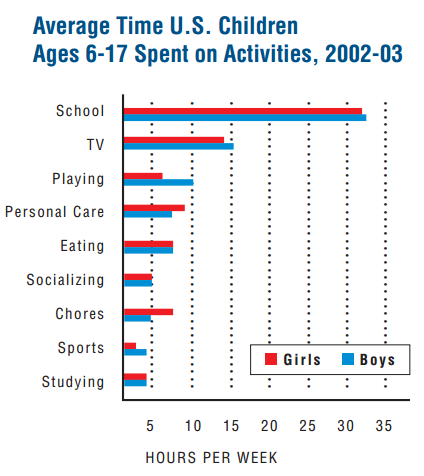
Girls do more chores than boys and are less likely to get an allowance in exchange for their work. When they do, they are paid less.
Researchprojects on children’s time use find that boys do 43 to 46 minutes of housework for every hour that girls do. When asked to list the chores they do, girls list 42 percent more chores than boys. Girls are as likely as boys to participate in outside chores and more likely to clean their own rooms, help prepare meals, and care for sibling and pets; the only thing boys report doing more often than girls is basic housecleaning.
Another study by the children’s magazine Highlights confirmed the finding: 73 percent of their girl readers reported being assigned routine chores, compared to 65 percent of their boy readers. Girls spend more time on chores than they do playing; the opposite is true for boys.
Not only are girls more likely to be asked to help out around the house, they are less likely to get paid. The Michigan study found that boys are 15 percent more likely than girls to get an allowance for the chores they do. And when they do get paid, they get a lower wage than their brothers. Male babysitters get paid $0.50 more an hour than females. Girls do 35 percent more work than boys, but bring home only $0.73 cents on boys’ dollar.
I encourage everyone to go read this very smart and very sad essay from Alex Andreuo at The Guardian. It’s a condemnation of defensive architecture, a euphemism for strategies that make the urban landscape inhospitable to the homeless.
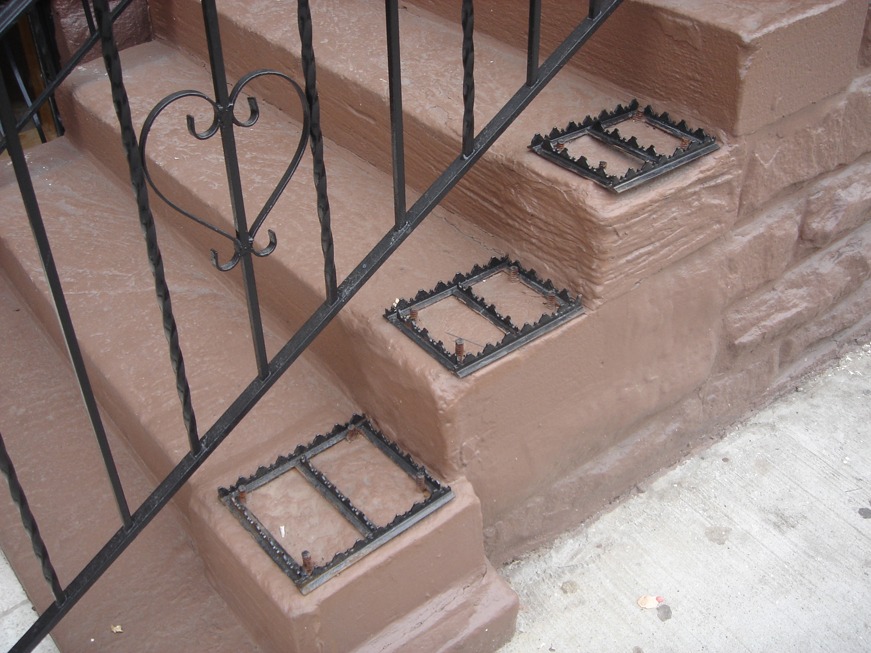
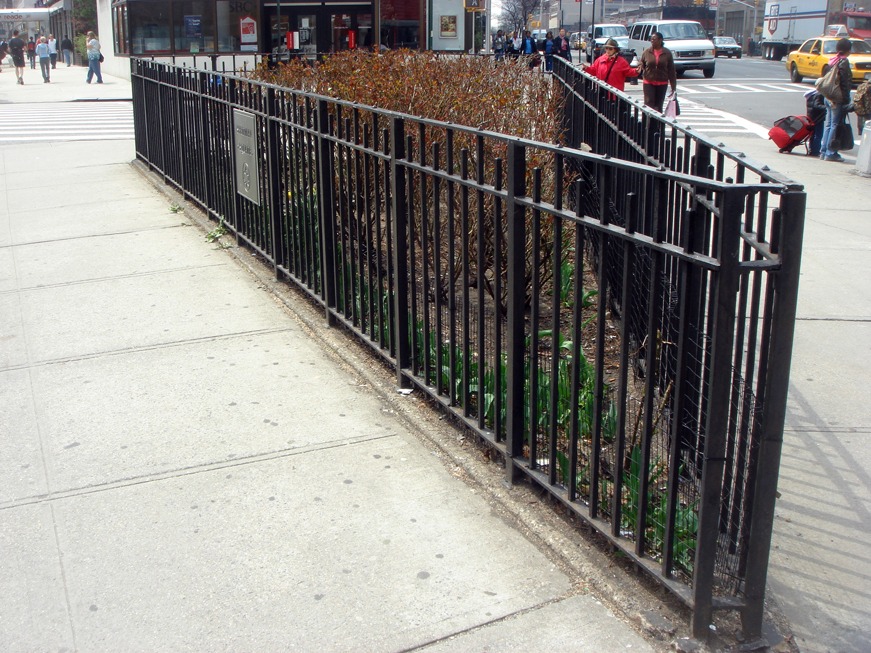
They include benches with dividers that make it impossible to lie down, spikes and protrusions on window ledges and in front of store windows, forests of pointed cement structures under bridges and freeways, emissions of high pitched sounds, and sprinklers that intermittently go off on sidewalks to prevent camping overnight. There is also perpetually sticky anti-climb paint and corner urination guards, plus “viewing gardens” that take up space that might be attractive to homeless people:
Here are some examples from a collection at Dismal Garden:
Here’s a picture of anti-encampment spikes featured at The Guardian:
Andreuo writes of the psychological effect of these structures. They tell homeless people quite clearly that they are not wanted and that others not only don’t care, but are actively antagonistic to their comfort and well being. He says:
Defensive architecture is revealing on a number of levels, because it is not the product of accident or thoughtlessness, but a thought process. It is a sort of unkindness that is considered, designed, approved, funded and made real with the explicit motive to exclude and harass. It reveals how corporate hygiene has overridden human considerations…
If the corporations have turned to aggressive tactics, governments seem to simply be in denial. They offer few resources to homeless people and the ones they do offer are insufficient to serve everyone. Andreuo continues:
We curse the destitute for urinating in public spaces with no thought about how far the nearest free public toilet might be. We blame them for their poor hygiene without questioning the lack of public facilities for washing… Free shelters, unless one belongs to a particularly vulnerable group, are actually extremely rare.
He then connects the dots. “Fundamental misunderstanding of destitution,” he argues, “is designed to exonerate the rest from responsibility and insulate them from perceiving risk.” If homeless people are just failing to do right by themselves or take the help available to them, then only they are to blame for their situation. And, if only they are to blame, we don’t have to worry that, given just the right turn of events, it could happen to us.
February’s edition of Contexts had a fascinating article by Amin Ghaziani titled Lesbian Geographies. Most of us are familiar with the idea of a “gayborhood,” a neighborhood enclave that attracts gay men. It turns out that lesbians have enclaves, too, but they’re not always the same ones.
Here’s the frequency of same-sex female couples (top) and same-sex male couples (bottom) in U.S. counties. Census data tracks same-sex couples but not individuals, so the conclusions here are based on couples.
What are the differences between where same-sex female and same-sex male couples live?
First, Same-sex female couples are more likely than their male counterparts to live in rural areas. Ghaziani thinks that “cultural cues regarding masculinity and femininity play a part.” As one interviewee told sociologist Emily Kazyak:
If you’re a flaming gay queen, they’re like, “Oh, you’re a freak, I’m scared of you.” But if you’re a really butch woman and you’re working at a factory, I think [living in the midwest is] a little easier.
If being “butch” is normative for people living in rural environments, lesbians who perform masculinity might fit in better than gay men who don’t.
Second, non-heterosexual women are about three times as likely as non-heterosexual men to be raising a child under 18. Whatever a person’s sexual orientation, parents are more likely to be looking for good schools, safe neighborhoods, and non-postage stamp-sized apartments.
Finally, there’s evidence that gay men price lesbians out. Gay men are notorious for gentrifying neighborhoods, but data shows that lesbians usually get there first. When non-heterosexual men arrive, they accelerate the gentrification, often making it less possible for non-heterosexual women to afford to stay. Thanks to the gender pay gap, times two, women living with women don’t generally make as much money as men living with men.
Or, they might leave because they don’t want to be around so many men. Ghaziani writes:
Gay men are still men, after all, and they are not exempt from the sexism that saturates our society. In reflecting on her experiences in the gay village of Manchester, England, one lesbian described gay men as “quite intimidating. They’re not very welcoming towards women.”
Originally hailing from Israel, La Mama del Gelato Anita or "Anita Gelato" specialises in over-the-top, rich combinations of flavours in their gelato. All gelato is made on the premises and the number one best seller is the Cookieman, a crunchy, chocolatey mix of chocolate, hazelnuts, meringue and biscuit that has to be tried to be believed. The unlimited frozen yogurt bar features 54 different hand made toppings.
Happy Thursday, friends! I've been to the beach more times in the last 2 weeks than I have during the whole summer. I was very serious when I said I aimed to get in a few more beach trips before the autumn weather sets in for good. I'm very lucky to have some beautiful beaches just a few minutes walk from home, and a freelancer's schedule that sometimes allows a spontaneous afternoon beach adventure!
Work has been busy lately - which is super awesome - but I find that my creativity suffers on those days that I don't get out of the office for some fresh air. No two days are ever the same, but when I can get a walk or a beach trip into my day, I definitely feel so much better for it.
After walking back up the hill after a swim, I get home feeling super hungry and thirsty. This Thursday Tipple is inspired by the end of summer and some of my favourite ingredients at the moment. My housemate and I always have lemons in the house, always. We recently bought a kaffir lime tree...and called him Lenny. Tell me I'm not the only one who names their plants?! I found some absolutely beautiful passionfruits at the Bondi farmers markets on Saturday morning. And of course, who doesn't love vodka and rum ;) I just knew all of these great flavours would work really well together in a drink.
I made a simple syrup infused with our home grown kaffir lime leaves, and added it to a boozy lemonade spiked with vodka and spiced rum. It's a really pretty drink and I love the look of the passionfruit seeds, mint and kaffir lime leaves. It's got a kick, but it's refreshing and super easy to make for a crowd in a pitcher or punch bowl. You can play around with the ratios of the different ingredients, adding a little more of the kaffir lime syrup for sweetness, because with the lemon and passionfruit, it can be a little tart. Experiment and find the combination that makes you happy!
Passionfruit and Kaffir Lime Lemonade Serves 2-3
Kaffir Lime Simple Syrup
1/2 cup caster sugar
1/2 cup water
8 kaffir lime leaves, bruised and crushed
Lemonade
3 lemons, juiced
4 passionfruits
2 shots vodka
2 shots spiced rum
Soda water or lemonade (like 7up)
Ice, mint leaves and kaffir lime leaves, to serve
To make the simple syrup, place caster sugar, water and kaffir lime leaves into a saucepan and place over medium heat. Stir until sugar is dissolved. Lower the heat and boil until slightly thickened and syrupy. Cool to room temperature, which allows the leaves to infuse into the syrup. You can make this in advance.
Pour lemon juice, passionfruit pulp, vodka, rum and sugar syrup to taste into pitcher and give a little stir with a long spoon. Add ice, soda or lemonade, mint and kaffir lime leaves. Taste for sweetness and add more syrup if desired. Serve immediately.
Sociologists Martin Weinberg and Colin Williams wanted to know. They and their team interviewed 172 college students about their habits and concerns about farting and pooping. They published their results in an article called Fecal Matters. They discovered that everybody farts and everybody cares, but not everyone cares all the time or equally.
They separated their results by gender and sexual orientation. When they asked people if they were worried that the hearer would “feel disgust,” heterosexual women were most likely to agree and heterosexual men the least, with non-heterosexual men and women in the middle, but flipped such that men were more worried than women.
Heterosexual men were the most likely to think it was funny and the most likely to engage in “intentional flatulence.” Almost a quarter said that they “often” did so, whereas only 7 percent of heterosexual women said the same. “Guys would say it’s raunchy and then say ‘Nice one,’” explained one heterosexual guy, “because if it’s strong it’s more manly. You know, because women would not try to clear a room with a fart.” Heterosexual women felt like they were violating gender norms if their farts were stinky: “The worse it stinks,” said one, “the nastier they think I am.”
Heterosexual women were the most concerned that it would affect their relationship with the hearer. They were also the most likely to do things to reduce the likelihood that others would detect their bathroom activities, like go into another room to pass gas or let their stool out slowly to avoid a kerplunk. Two thirds said they would wait until they were alone to poop and only women reported flushing repeatedly to ensure that the sights and smells of their defecation had disappeared.
As a counter example, one of the heterosexual men interviewed said that the only thing he was willing to do to protect others from his bathroom activities was close the door.
Non-heterosexual men were an interesting conundrum. They were as likely as heterosexual men to think that the hearer would think it was funny, but the least likely to engage in intentional flatulence and the most likely to make sure that when they poop, they do so alone.
Non-heterosexual women were also a conundrum. They were the least likely to think the hearer would laugh at a fart, but second only to heterosexual men in the practice of farting on purpose to get a reaction.
This study is a great example of what social scientists call doing gender, modifying our behavior to conform to gendered expectations. Generally, women are expected to have better control of their body, to be more polite, and to avoid offending others. All of these things are consistent with being more discreet with farts and poops.
The interesting data from non-heterosexual men and women may be explained by the conflation of sexual object choice and the performance of gender. It’s not universally this way, but in the U.S. today gay men are feminized and lesbians masculinized. This is a stereotype, but also gives non-heterosexual men and women some permission to deviate from gender rules. As one non-heterosexual man explained:
Only around people that I’m regularly naked with would I be comfortable with them knowing what I was doing in the bathroom. I’m on the self-prescribed “pretty pill”—where you don’t fart, sweat, burp, or use the bathroom… I learned it from my diva friends.
Similarly, some non-heterosexual women may feel a little less pressure to be as girly or girly all the time.
No it is because there are hardly any bus lanes and so the bus is always hopelessly late.
Look closely. Which would you rather ride?
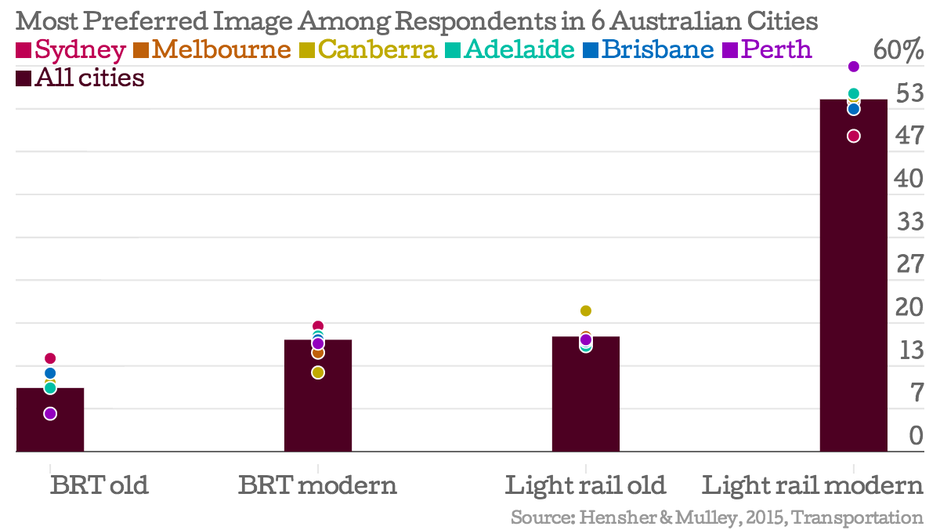
Transport scholars David Hensher and Corinne Mulley asked this question of residents of six cities in Australia. They included these ultra modern examples and also photographs featuring less modern trains and buses.
They found that people overwhelmingly preferred trains to buses, even though the modern bus has a dedicated lane just like the train and identical boarding and fare collection procedures.
We associate trains with romance and leisure travel or hip, urban places like Manhattan. In contrast, buses bring to mind traffic, exhaust, and being exhausted after getting off from a second job. Members of a focus group organized by the U.S. Department of Transportation, for example, had these things to say:
I’m ashamed to tell that I am taking buses…In Europe, I wouldn’t. But here, they would think, “Did he lose his job?”
The shame factor is majorly big.
I’m just saying that when I was in L.A. and I was in the car and just looking in at the bus…the people getting on….it just seems scary…
The bus has a bad rap.
But the authors found it wasn’t that simple. People from cities with better bus service tended to feel a little better about buses. If someone had recently had a good experience on a bus — like getting a seat for the whole trip — they felt better about buses. In fact, riding buses made people like buses more. People who rode more often had a better opinion.
Basically, give people good buses, good bus routes, and good service and they will come to love buses.
So, the authors argue that cities shouldn’t let the bad reputation of buses stop them from providing and improving bus service. Often buses are a better choice than trains. Bus routes are cheaper to get started and easier to change. High frequency and dedicated lanes can make them as efficient. So, if a bus is the right thing for the city, don’t give the people what they want, show them.
Ed. note: This post was originally published on the Community site.
Brace yourself for the irony: #Beijing20 is trending on Twitter in celebration of the 20th anniversary of the 1995 United Nations Fourth World Conference on Women, held in Beijing (when Hillary Clinton delivered her “women’s rights are human rights” speech.) But right before International Women’s Day 2015, police across China detained vocal, young Chinese feminist activists.
Li Tingting (Li Maizi) protests against the misogynistic 2015 Chinese New Year Gala, wearing a shirt that says, “This is what a feminist looks like” in Chinese. (Photo courtesy of anonymous friend)
On the evening of March 6, 2015, leaders of the Chinese feminist community were taken into police custody or put under house arrest in at least three Chinese cities: Beijing, Hangzhou, and Guangzhou. Police detained these feminists, who are all in their 20s or early 30s, on the grounds of “creating disturbance” (寻衅滋事.) According to the accounts by friends and colleagues, police broke into their apartments without arrest warrants. In addition to detaining at least ten activists, the police confiscated their phones, laptops, and other means of communication and documentation of activism. As of Sunday evening (March 8) Beijing time, five feminists remain in detention with no contact with the outside world or access to their attorneys.
Why were they detained?
The feminists had planned to publicly rally against sexual harassment on buses in Beijing and Guangzhou for International Women’s Day. The charge under which they were detained, “creating disturbance,” has been repeatedly used by the Chinese state to detain, arrest, or harass civil rights lawyers, liberal intellectuals, and civil society/human rights activists during recent months of intensified censorship and crackdown on civil liberties.
In November 2014, since Zheng Churan (Datu) was denied exit by the Chinese customs, her friend carried a large photo of Zheng and protested on Zheng’s behalf at the Beijing+20 CSO Forum in Bangkok, Thailand. (Photo courtesy of Zheng’s weibo)
Some commentators speculate that the “Two Sessions” underway (the Chinese legislature’s annual meeting) might explain why the feminists were taken into police custody, and expect that they will be released once the legislative sessions are adjourned. If we accept such analysis, which has validity in the Chinese one-party system that prioritizes stability above all else, the absurdity is beyond comprehension. On the one hand, Chinese state media celebrateswomen legislators and new anti-domestic violence legislation, which are both important; on the other, the state is so afraid of young, vocal feminists that they must be detained right before International Women’s Day, so as to assure the smooth running of national legislative sessions.
Who are the feminists detained by the police?
LI Tingting (李婷婷, pseudo-name Li Maizi, 李麦子) is a Beijing-based young leader for women’s rights and LGBTQ rights advocacy. She works for Beijing Yirenping Center, “a non-profit organization dedicated to promoting social justice and public health” that battles disease- and disability-related employment discrimination. Li has been the leader of campaigns to raise awareness on domestic violence, gender discrimination, and homophobia in China. The pinned post on her weibo (a popular Chinese micro-blogging site similar to Twitter) account before the detention commemorates the third anniversary of “Occupy the Men’s Room,” a provocative campaign advocating for unisex restrooms in urban China.
Wei Tingting holds a sign that says, “Because of love, zero tolerance of discrimination against AIDS patients.” (Photo courtesy of anonymous friend)
WEI Tingting (韦婷婷, nicknamed Waiting) is a Beijing-based advocate for public health, LGBTQ rights, and AIDS awareness. She works for Beijing Gender Health Education Institute (BJGHEI), an NGO focusing on the “issues of gender, sexuality and sexual health” in China. Her last post on her weibo account, dated March 5, says, “is it a good idea or not, to put oneself in a place of danger?”
ZHENG Churan (郑楚然, pseudo-name Datu or “giant rabbit”, 大兔) is a Guangzhou-based, 25-year-old feminist activist. She has publicly protested against sexual assault on college campus, employment discrimination against women, and the fact that rape of Chinese girls is considered “prostitution” rather than rape. In November 2014, Zheng was set to attend the Asia Pacific Civil Society Organization (CSO) Forum on Beijing +20 but was denied exit at the Chinese custom. (See photo) Her personal profile on her weibo account says, “The comments that make one uncomfortable are helpful tools that prompt one to leave one’s safety zone.”
WU Rongrong (武嵘嵘) is a feminist working for a Hangzhou-based women’s advocacy group. She has been active since 2005 and has worked on legal cases addressing violence against women in China. Her health is in bad condition; and her family has been trying, but so far has failed, to deliver medicine into police custody.
WANG Man (王曼) is a Beijing-based feminist. Her weibo handle says ,“Wang Man [dedicated to] eliminating poverty.” She has publicly spoken against gender discrimination in Chinese college admissions and has long been an advocate for women’s economic empowerment.
What will happen to these feminists? What will happen to Chinese feminist activism?
The feminists’ lawyers have been trying to locate them in the past 48 hours. The police have denied that they have detained them. According to their lawyers, these feminists might be “interrogated three times a day,” sometimes “with late-night or even all-nighter interrogations” which “are the most frightening.” Since they have been missing for more than two days now, the level of danger they face is considered “elevated” by the feminist community.
Wu Rongrong (left) and Wang Man (right) were both detained by police in Hangzhou and Beijing respectively. (Photo courtesy of anonymous friend)
Many Chinese feminists have written in their personal wechat (a popular Chinese mobile text and social media) platform, “This is a day marked by humiliation and sorrow.” While it is hardly surprising that women’s rights would fall short in a country where civil liberties are at risk, this is a day that should anger feminists across the globe. Chinese women, more than 600 million in number, make up about one tenth of humanity. This is a day marked by humiliation and sorrow for all of us.
Li (left) and Wei (right) dress up in bloodstained wedding gowns to raise awareness on domestic violence in China. Their signs: “Why are you still silent about intimate violence around you?” and “Love is not an excuse for violence”. (Source: artintern.net)
How can a feminist ally inside or outside of China help?
Spread the word: share the newscoverage and these Feministing profiles of the Chinese activists.
If you speak Mandarin Chinese and/or are based in China, please call the police bureaus. The Beijing bureaus (where Li, Wei and Wang are detained) can be reached at +86-10-82588210/82519110 (海淀, Haidian bureau) or +86-10-62275110/62210111 (太平庄, Taipingzhuang bureau)
Protest and speak out against sexual harassment, since the missing feminists were planning to do so themselves on International Women’s Day, which might have led to their detention.
Sign the petition“Calling for Beijing Police to Release Chinese Feminist Activists Detained before International Women’s Day”by emailing your signature to nvxingjiayou@gmail.com (Format: Name, Gender, Location, e.g. “Nancy Tang, She, DC”)
If you have legal expertise and/or political connections within China and are interested in helping out, please contact the author by tweeting at @NancyYunTang.
In Greco-Roman wrestling, boxing, and mixed martial arts, there is a rule that you never hit “below the belt.” The area of biggest concern is the testicles. As the Ultimate Fighting Championship rules specify, “groin attacks of any kind” are a foul. This is probably because groin attacks might make for short fights or ones where everyone just goes around protecting their balls. In any case, the skills being tested are of a different kind. But, even aside from that, this seems like a good idea and very civilized. I do not advocate for testicle kicking, not groin attacks of any kind, for what it’s worth.
I do think it’s somewhat odd, though, that men who fight each other outside of controlled conditions—men in street fights, bar brawls, and parking lot scuffles—also usually avoid hitting below the belt. These fights aren’t about training or skill, like those between professional athletes, they’re real attempts to do some damage out of anger or defensiveness. So, why no hits to the balls?
The question was posed by a woman on Yahoo! Answers: “If you dislike each other enough to want them to get hurt,” she asked, “why not do the worst?”
The answers, admittedly unscientific, were interesting. One of the common responses involved the idea that not hitting below the belt was “an unspoken rule.” Maybe it’s the Golden Rule—do onto others as you would have them do unto you—and some men mentioned that, but others suggested that it was a rule specific to manhood. It’s a “cheap shot,” said one. A “low blow,” said another.
But why? Why do men agree not to kick each other in the balls? Why is that part of the code?
I think it’s because it serves to protect men’s egos as well as men’s balls.
What would street fights between guys look like—or professional fights for that matter—if one could go below the belt? For one, there’d be a lot more collapsing. Two, a lot more writhing in pain. Three, a lot less getting up. All in all, it would add up to less time looking powerful and more time looking pitiful. And it would send a clear message that men’s bodies are vulnerable.
Not hitting below the belt, then, protects the idea that men’s bodies are fighting machines. It protects masculinity, the very idea that men are big and strong, pain- and impact-resistant, impenetrable like an edifice. So not hitting below the belt doesn’t just protect individual men from pain, it protects our ideas about masculinity.
When a man hits below the belt, he is revealing to everyone present that masculinity is a fiction. That’s why one guy said: “For ‘alpha male’ fights, nut shots are just wrong.” Alpha male fights are about figuring out which male is alpha, while preserving the idea that the alpha male is a thing that matters.
This is why men are quick to criticize other men who break the code. One of the best ways to control men is to threaten to kick them out of the man club. “If a guy kicks another guy in the balls on purpose during a fight,” one replied to the question on Yahoo, “he will forever be banished from manhood.” Another said: “Winning like this means that you cannot beat up the other guy by ‘real’ fighting.” It’s a matter of one’s own reputation: “A man who kicks another man in the balls,” said a third, “immediately loses all manliness and respect.”
So, men generally agree to pretend that the balls just aren’t there. The effect is that we tend to forget just how vulnerable men are to the right attack and continue to think of women as naturally more fragile.
I still don’t want anyone to get kicked in the balls, though, just to be clear.
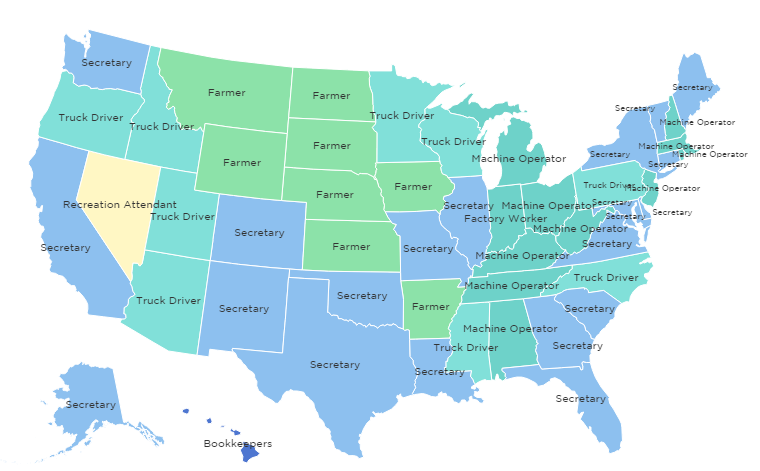
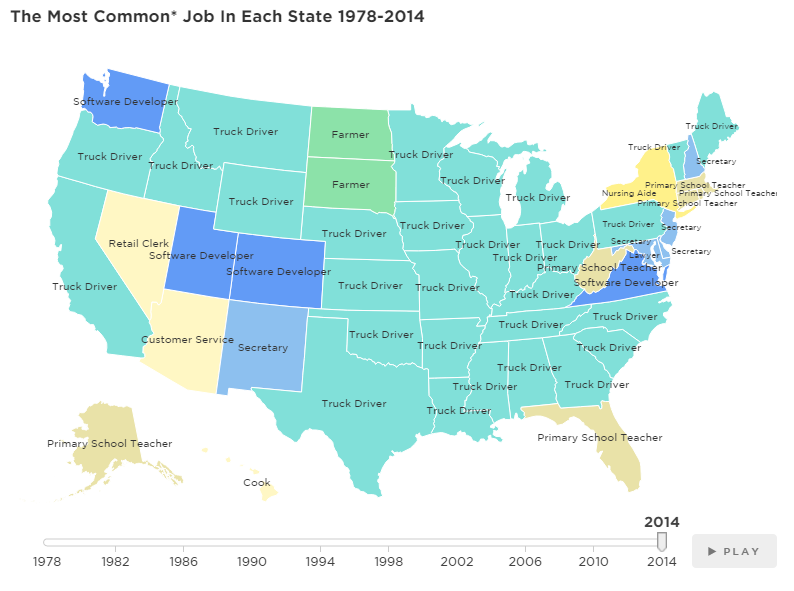
NPR put together a nice graphic showing the most common job in every state every two years from 1978 to 2014. It’s a fascinating ride from secretaries, farmers, and machine operators to truck drivers, truck drivers, and truck drivers. Click to enlarge.
1978:
2014:
Quoctrung Bui explains some of the trends:
Truck drivers came to “dominate the map” partly because the job can’t be outsources or automated (yet).
Much of the work of secretaries was replaced by computers.
Manufacturing jobs have been sent overseas (but you knew that).
And advances in farming technology means that we can grow more and more food with fewer and fewer people.
She also points out — with a “heh” — that the most common job in Washington D.C. is lawyer. But she didn’t mention that in 1996 it was janitors. There’s gotta be a politician joke in there, too.
Here are some of the changes I found interesting, with mostly uninformed commentary. The three boxes represent 1978, 1996, and 2014.
Methinks reality television is not telling me the truth about Alaska.
Well, we know what Nevada‘s for. Except I guess people used to go there to do stuff and now they just go there to buy stuff.
South Dakota and North Dakota, holding strong.New York, the only state on the list that’s top job is nursing. Take that, Florida!
Inspired by a recent report that calculated that there are more men named John, Robert, William or James than there are women on the boards of large companies, an economist at the New York Times has applied this index to a variety of institutional contexts.
Turning to the CEOs of those major companies, for example, reveals an even more egregious stat: For each woman CEO, there are four men named John, Robert, William or James. In fact, the number of companies run by men named John exceeds those run by women. (Same with David.)
Of course, the index isn’t a particularly accurate gauge of gender inequality in all contexts — in institutions that are more ethnically diverse, for example, or that draw from a younger generation with more Jacobs and Tylers than Johns and Bobs. But it’s still a revealing/depressing experiment.
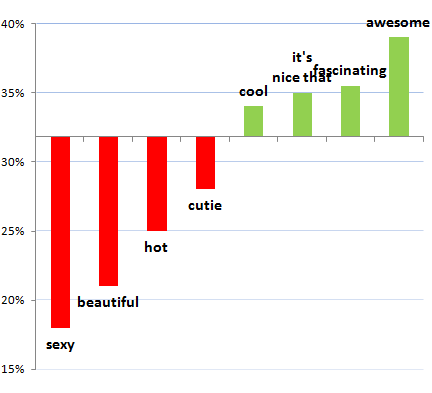
Dating site OKCupid did an analysis of 500,000 inquiry messages to determine what keywords correlate most strongly with getting a reply. It has some great lessons about dating and some counter-stereotypical news about what heterosexual women want from men.
This first graph shows that mentioning someone’s level of attractiveness decreased the likelihood of getting a response (for both men and women), though men were more likely to mention looks. But general compliments about one’s profile increased the likelihood of getting a response (the middle line is the average number of responses, the green bars signify an increase in the number of responses, and the red bars a decrease):
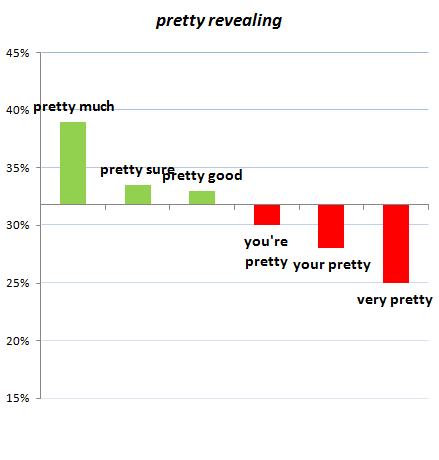
A good lesson in operationalization: “pretty” is used in two ways in our culture, so when they made sure to differentiate between pretty (meaning “sort of”) and pretty (meaning “attractive”), you can see clearly the way that commenting on looks decreases the recipients’ interest:
So, in contrast to stereotypes, many women cannot be flattered into a date (though the figure above includes men and women, I’m assuming most people being called “pretty” are female).
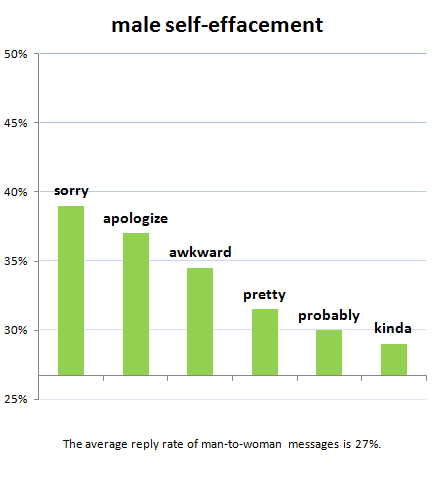
Further, the site found that when men sent messages, female recipients preferred humility to bold self-confidence. The words below all increased the chances of a woman responding to a man’s inquiry:
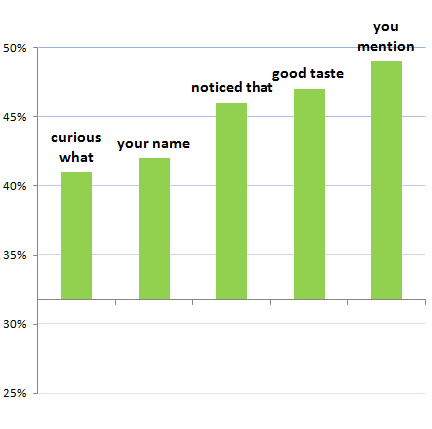
Instead of bravado and flattery, women appear to actually like men who take an interest in them. They respond positively to phrases that indicate that a guy actually read their profile and is interested in the content of their person:
The lesson: Treat a woman (on the OK Cupid dating site) like a human being and she will respond positively.
And to answer the question, “What do women want?” As my dear friend David Landsberg would say: “Everything!”
An Idaho lawmaker received a brief lesson on female anatomy after asking if a woman can swallow a small camera for doctors to conduct a remote gynecological exam.
The question Monday from Republican state Rep. Vito Barbieri came as the House State Affairs Committee heard nearly three hours of testimony on a bill that would ban doctors from prescribing abortion-inducing medication through telemedicine.
[...] Dr. Julie Madsen, a physician who said she has provided various telemedicine services in Idaho, was testifying in opposition to the bill. She said some colonoscopy patients may swallow a small device to give doctors a closer look at parts of their colon.
“Can this same procedure then be done in a pregnancy? Swallowing a camera and helping the doctor determine what the situation is?” Barbieri asked.
Madsen replied that would be impossible because swallowed pills do not end up in the vagina.
“Fascinating. That makes sense,” Barbieri said, amid the crowd’s laughter.
Rep. Barbieri later claimed he “was being rhetorical.” “I was trying to make the point that equalizing a colonoscopy to this particular procedure was apples and oranges….It was the response I wanted.” Whatever you say, dude.
Here’s the thing: A quote like this is just a particularly absurd illustration of the everyday reality that US lawmakers, with absolutely no expertise in medicine or public health, are regularly ignoring the scientific facts and advice of health professionals and passing laws that tell doctors how to practice medicine. Whether or not Rep. Barbieri actually thinks that the stomach is connected to the vagina, he for sure believes that he knows better than a physician whether it’s safe to provide abortions via telemedicine.
In reality, it is extremely safe, effective, and cost-effective. By increasing access to the procedure earlier in pregnancy, telemedicine results in improved health outcomes and is greatly appreciated by patients. Rep. Barbieri’s opposition to the practice is driven by his opposition to abortion in general, which he — like the rest of the anti-choice movement — wraps up in a veneer of concern for patient safety, while ignoring the consensus of the people who actually provide abortion care.
I do not blame anti-choice lawmakers from trying to impose their own beliefs about abortion on their constituencies, but pretending that they know better than health experts is an insult to the entire profession. And I think it’s long past time that the medical establishment — whether or not they provide abortions — fight back against the increasingly anti-medicine tactics of the anti-abortion movement, from politicizing health boards to mandating that doctors to lie to their patients.
A taste of Japan's famous Robot Restaurant comes to Sydney. With neon light, laser beams, booming J-Pop, two giant robots and plenty of skimpily clad girl and a pole dancer, it is a sight to behold and enormous fun to boot. Open for nine shows only over three nights, the events proved extremely popular selling out within three minutes.
Pharmaceutical companies say that they need long patents that keep the price of their drugs high so that they can invest in research. But that’s not actually what they’re spending most of their money on. Instead, they’re spending more — sometimes twice as much — on advertising directly to doctors and consumers.
The Mittagong railway mushroom tunnel is unlike anything you've ever seen. Cool, damp and eerily quiet, the long disused train tunnel has been used to grow mushrooms since the 1950s. The tunnel itself stretches for 650 metres, its curved archway soaring way above our heads. Since 1987 the tunnel has been home to Li-Sun Exotic Mushrooms, established by microbiologist Dr Noel Arrold.
Our tour
It’s been quite a while since I was last on the Gold Coast. I reckon the last time I was there I was about 12 and back in those days it was cheaper to road trip there than fly. I vaguely remember going to Sea World, Dream World and Movie World, and spending hours at the Timezone in Surfers Paradise but for some reason I remember very clearly receiving a deck of cards from Jupiters Casino which started my love for all card games.
Anywhos a couple of weeks ago I was flown up for a much needed weekend escape – hello chillaxing on the beach – but the primary purpose of my visit was to visit Chase Kojima’s newest restaurant, Kiyomi, which opened late last year at Jupiters on the Gold Coast. Chase’s Sokyo is one of my favourite restaurants in Sydney and I was keen to see if Kiyomi measured up.
After checking in and spending the day eating donuts with Helen, we return to our room and find a sweet surprise- a chocolate sculpture of the fruit that the restaurant is named after. The kiyomi is a small Japanese citrus fruit that has been cross-bred from a tangerine and an orange and it is deeeelicious.
We take the lift to the lobby level where Kiyomi is located and find that it is already packed – apparently all tables are booked out for the month!
Luckily we have a booking and as we’re led inside the restaurant I’m mesmerised by the fluorescent UV artwork by Tokyo-based Houxo Que, a Japanese street artist.
We start off with drinks, a refreshing Yuzu Collins ($18) and a Tengumai Umajun Junmai Sake ($10). I’m warned about the ice filled hole in the glass sake Tokkuri that keeps the sake cold without diluting it but still manage to knock all the ice out because I’m coordinated like that.
We design our own Sashimi Platter- bbq eel ($12), tamago ($8), tuna ($12), and salmon belly ($12), my fave of the lot being the silky, smoky eel.
We smell the Scallop, yuzu honey, scorched corn and mache ($18) before it even reaches our table, the yuzu force was strong with this dish! I love yuzu but woahhh easy there fella! I’m not the biggest fan of scallops but these were perfect specimens, plump and delicate and the addition of the charred corn was ace.
The Seared Scampi ($9 each) was just amazing. It just about blew me away and I fell head over heels in love with the combination of the clean flavour of the scampi, the richness of the foie gras and the tartness of the julienned green apple bringing everything home.
Moving onto the sushi and rolls section we order the Aburi Salmon ($19), the salmon is a generous fat slice draped over the pat of rice but it had barely a kiss from the blowtorch and we all know how much I love burning. That sounded sarcastic but really, who doesn’t love a good char :D
The Queensland Roll ($23) is certainly interesting in presentation, with soy paper instead of the usual seaweed wrapping morsels of sweet spanner crab and a creamy avocado puree squiggle on top.
I’d hoped there would be miso cod on the menu but the Dengakuman Toothfish ($37) soothes my soul with its caramelised miso glaze and smoky flavour.
The Wagyu +7 oyster Blade ($37) is another hit for me and thanks to the magic of cooking on the binchotan grill, each slice is so fricken tender and juicy!
We were pleasantly full at this stage but we really had to see how their tempura game stacked up against Sokyo. The Tempura Cuttlefish ($20) is perfection with golden batter so light and crisp it could make angels weep.
And last but not least, Chase’s signature Crispy Rice and Spicy Tuna ($20), a slice of ruby red tuna lies on a dollop of spicy mayo and a cube of sushi rice that has been fried until crisp. Smashing.
We were stuffed to the gills but there’s always room for dessert right? Our only problem was choosing which dessert to get and since we were indecisive we were brought a dessert platter. The Mango Shiso (full size $13), tastes like summer with fresh mango pieces, dollops of creamy mascarpone and sour cream, crunchy shiso meringue, toasted milk powder and mango sorbet.
The toffee tuille in the Apple Jack (full size $13) is eye catching though immediately plasters itself to my teeth and while the Jack Daniel’s foam may not be for everyone I loved the combination of the gingerbread and honey ice cream.
I’m glad to see that Goma Street (full size $14) has made it on the menu as it’s one of my faves at Sokyo. I love cracking through the discs of dark chocolate and black sesame crumble to reach the extremely addictive caramelised white chocolate mousse and the black sesame ice cream is super intense in flavour.
The service at Kiyomi is top notch but I did find it disconcerting that because the restaurant wasn’t enclosed we could see directly into the casino and cringed as the doof doof music from the bar downstairs slowly increased in decibels throughout the night.
We rub our bellies and stagger off to sleep away the food coma.
And then breakfast time at Food Fantasy! I love hotel buffets!
There are pastries galore and a pancake machine which is seriously like the best invention ever.
The line for omelettes was never ending so unfortch I skipped this and went straight for bacon and waffles :D
Then it was some quality time by the pool
I like long walks on the beach…
Farewell Gold Coast! You were bloody awesome!
ChocolateSuze dined at Kiyomi as a guest of Jupiters Hotel & Casino. Return flights from Sydney, one night’s accommodation and breakfast at Food Fantasy was included.
F came home one day after a doggy play date and announced that we should go The Henson: it is a dog-friendly pub with pretty darn good food.
Say no more, he had me at “dog-friendly pub”!
Dog-Friendly Pub
We’re always on the lookout for dog-friendly places, so I was pretty excited about coming here (Xander looks pretty happy about it too! Haha).
It’s also a kid-friendly place, complete with a shed that’s been converted into a play house; there were actually more kids than dogs – I think Xander was the only dog there that day.
Seared Scallops ($19)
I wasn’t prepared for how big this dish turned out. The tobiko-topped seared scallops came with an avocado, miso corn, and bean sprout salad, sprinkled with toasted sesame.
There was quite a lot going on, and while F thought it was the weaker dish of the three, I really enjoyed it. This is a salad I’d definitely have again, as I liked how the dish was light yet still had some substance to it.
Mac’n’Cheese ($15)
Mac’n’Cheese is one of the best comfort food for me; this one is jazzed up with cauliflower, kale, and truffle.
It came out close to being molten hot lava and despite (impatiently) waiting for it to cool (by eating other things), my first bite was still piping hot. Typical mac’n’cheese! I don’t think I’ve ever had one that wasn’t hot on the first mouthful.
It was so decadent and cheesy that it’s worth doing the open mouth breathing thing to cool it down (so classy, I know haha).
“Knuckle” Sandwich ($17)
The “Knuckle” Sandwich consisted of wagyu brisket, fennel slaw, Swiss cheese, and smoky mayonnaise on rye with chips on the side.
It may not look like it, but there was a lot more brisket under all that slaw; the sandwich was very well balanced! There was an unexpected kick from the mayonnaise, but I managed to push through the heat and enjoy my half (of course, F didn’t think there was much heat, if at all).
As one would expect, the brisket was the star: so tender, perfectly seasoned, and succulent. The chips were pretty good too, especially when we added the salt below.
Salt
F went to get our cutlery and came back with more; available condiments include a variety of salt! He grabbed the smoked chilli salt and rosemary rooster salt.
I was already struggling through the spicy mayonnaise, so I only tried the fancy chicken salt. It went very well with the chips.
The Henson
I loved how relaxed the atmosphere was at The Henson (even with the overly excited kids in the background) and I loved the food even more. Definitely going to make this into our regular hangout! There’s so many other dishes I’d love to try.
Just as heads up: we went on a Saturday around lunch time, so we had to do a couple of laps before finding a parking spot in a side street.
Emma Morano is an Italian centenarian who, at 115, is the oldest living person in Europe. In a profile in the New York Timesyesterday, she credits her longevity to eating three raw eggs a day and never remarrying after an early divorce.
Ms. Morano has no doubts about how she made it this long: Her elixir for longevity consists of raw eggs, which she has been eating — three per day — since her teens when a doctor recommended them to counter anemia. Assuming she has been true to her word, Ms. Morano would have consumed around 100,000 eggs in her lifetime, give or take a thousand, cholesterol be damned.
She is also convinced that being single for most of her life, after an unhappy marriage that ended in 1938 following the death of an infant son, has kept her kicking. Separation was rare then, and divorce became legal in Italy only in 1970. She said she had plenty of suitors after that, but never chose another partner. “I didn’t want to be dominated by anyone,” she said.
The Times notes that “gerontologists agree that there is no one key to longevity.” But just last month, Scotland’s oldest woman, 109-year-old Jessie Gallan, revealed that her secrets have been eating porridge every morning and “staying away from men” because “they’re just more trouble than they’re worth.”
Ed. note: This post was originally published on the Community site.
Fifty Shades of Grey premiered over the weekend, and I went to see it. Until that moment, I boycotted everything having to do with Christian and Anna for three reasons. 1.) The relationship between the two of them seemed to be abusive, and did not accurately depict BDSM play, relationships, or sex. 2.) It originated as Twilight fanfiction, and as someone who used to write (non-Twilight) fanfiction, I was infuriated by the rash of reporting and purging of good stories from fanfiction.net due to advertisers being upset about the presence of erotica on the website. 3.) Everyone was reading it, and I’m just not a bandwagon kid.
On Friday, however, I took the plunge, spending Valentine’s Day Eve in the movie theater, accompanied by my boo, and watching 50 Shades. The theater was a little less than half full, a disappointment from the viewpoint of the concessions worker. As a gender non-conforming person of color living in rural Ohio, I rarely expect to see people who look and/or express the way I do. North Face jackets, Bean boots, and monogrammed jewelry dominated my vision as I took my seat, reminding me that 50 Shades is definitely not a fringe movie.
While I maintain that the material in both the books and the movie (though less so) is dangerously problematic, the fact that 50 Shades even exists at all is worth a discussion about the power of women and women’s sexuality. Zoe Williams from the Guardian described it best when she discussed the popularity of the books: “James’s sex scenes are not incidental, they are the meat of the plot, the crux of the conflict, the key to at least one of and possibly both the central characters. It is a sex book. It is not a book with sex in it.” 50 Shades is a piece of erotica that sold 100 million copies and was consumed publicly by women. In 2011 and 2012, mothers, sisters, aunts, cousins, teachers, professors, colleagues, and friends read these books…and talked about it. A few years later, women poured into theaters around the globe to see the film adaptation, which also contained some of the most graphic sex scenes I have ever personally seen in an R-rated movie, thus cementing the phenomenon created by the sexuality of women. That’s pretty revolutionary.
Existing alongside this truth, of course, is the fact that 50 Shades, both book and film, contains giant swaths of content that are horrible when it comes to the messages sent to women (e.g. stalking is sexy). And while we should use our collective internet power to problematize that, we should also focus our energy on talking about what 50 Shades represents from a consumer perspective. Year after year, we lament the dearth of media and entertainment that stars and caters to women. 50 Shades of Grey demonstrated the consumption power of women in such a strong way that to ignore it would simply be stupid. I’m hopeful that the powers that be pay attention, so that the next phenomenon driven by women isn’t rife with problematic depictions of sex and relationships.
A couple of weeks ago it was wet and just absolutely freezing and it felt like the cold was seeping into my bones (yep I totally sound like an old person). I needed something spicy to warm me up so the boy and I ventured into Do Dee Paidang Thai Noodle Bar and Cafe (9/37 Ultimo Rd, Haymarket) after hearing stories of a noodle soup with 7 levels of hell. Ok I’m being dramatic but the noodle soup starts off at Level l and goes up to Level 7, although technically there’s only 5 levels of spiciness because 4 and 6 are bad luck numbers.
I start with the Do Dee Monster Level 1 (Small $5.50/Jumbo $10) thinking it can’t be thaaat spicy. I was wrong. I thought I’d been slowly building up my chilli tolerance but as it turns out, I’m still firmly in the unable-to-handle-spicy camp. I made it about half way because the soup was fricken tasty- sweet and rich but with a hint of sourness and packed full of coriander and shallots. There’s a choice of noodles- thin rice, glass, egg, flat rice, thai instant or wheat but I stick with the recommended fresh thin rice noodles which has a very satisfying chew to it. I absolutely loved the pork, braised until ridiculously tender and there was a jumble of fish and beef balls, pork slices that kinda reminded me of the pork in a banh mi and a handful of fried wonton strips.
Noods loves chilli but he pretty much started crying as soon as he dug into the Do Dee Devil Level 2 (Small $5.50/Jumbo $10). He manages to finish the bowl though he paid for it later :P I kinda want to go with someone who’s attempting the Level 7 just to see if they’ll be in tears after one spoon…
Trust me, you WILL need beverages to help with the burning! Noods goes with luridly pink and incredibly sweet Thai Ice Milky Cordial ($3.90) and I opt for the Thai Ice Volcano Ovaltine ($3.90) which has a generous heap of powdered Ovaltine on top.
When we return the next day I chicken out and go for the Do Dee Nursery (Small $5.50/Jumbo $10) which is absolutely perfect but feels like it’s missing something. Like chilli. Heh. There’s baskets of condiments filled with sugar and chilli powder on each table in case you want to tailor your soup to your liking but instead I spoon soup from Noods’ Level 1 into my bowl and it is perfect. I normally order the Jumbo but the Small size is perfect if you’re eating other foods. The noodles here don’t leave me with that heavy feeling you get when eating ramen but it’s also not too light that you’re hungry again after 2 hours which is tops.
We couldn’t resist the Deep Fried Crispy Pork Skin ($2) which comes in a little plastic packet on a plate with some Thai basil and bean sprouts that I’m assuming was meant to go in our noodles. The pork skin is everything I’d hoped for, crispy, fatty and addictive but it tastes exactly like the type that I buy from Pontip, the Thai grocery 2 stores to the left of Chat Thai near Capital Theatre. If you’re going, make sure you buy the ones in a takeaway box, not the bag and the brand is Penny’s. You’re welcome.
The Grilled Pork Satay Skewers ($2.50/skewer) is a hit with the family, the pork is nicely seasoned, tender and with caramelised edges. Is that a hint of lemongrass we taste? Whatever it is, it’s fricken tasty.
We were originally going to order a papaya salad but instead we order the Tom Tard Seafood Platter ($35.90) as it comes with the salad (actually there’s a choice of 7 salads but we go with the normal papaya salad), grilled prawns, mussels, salmon, squid, cold noodles and vegetables. The salmon is a tad on the dry side which is a shame but the papaya salad is the bomb! We chose a low level of spice and the julienned green papaya is mixed with chilli, tomatoes, lime juice, fish sauce, palm sugar, peanuts and dried shrimp and the whole shebang is super refreshing.
We’d planned on heading elsewhere next but all night we had watched desserts fly out of the kitchen so we ended up staying put and we’re glad we did!
Mango with Sticky Rice ($7) is always a must have whenever I see it on the menu, the mango was perfectly ripe and sweet and the sticky rice drenched in coconut milk.
The Bread with Pandan Custard ($5.50) looked ginormous when it arrived! The pah tong goh aka deep fried bread sticks are piping hot but sadly are a little on the dense side. We still manage to polish off the dish though I would’ve liked a bit more of that pandan custard to completely drown the bread in!
I wasn’t too keen on the Black Sticky Rice with Taro ($5.50), I love black sticky rice but I’ve never been a huge fan of taro so I pushed this over to the rellies who promptly demolished it.
Last but not least was the Durian with Sticky Rice ($7), the durian was fragrant but ah how I wanted MORE of it! Like, reverse the ratios of the durian and rice man!
Do Dee Paidang is a massive hit with the locals and especially all the Thai ex-pats and I can see why with awesome food at pretty affordable prices! I’ll definitely be back and will work on increasing my chilli tolerance so I can move up from Nursery!
Do Dee Paidang Thai Noodle Bar and Cafe
9/37 Ultimo Rd,
Haymarket
NSW
The Tart Sisters is a wholesale tart business that has been going strong for 20 years turning out delectable tarts. Originally Felicity Peel and her sister Katrina started rolling their pastries in an old fish and chips shop on Pier 1. Now Felicity runs the business in Ashfield and has incorporated cakes and cookies into the repertoire. One year ago she opened up a shop so that retail customers can buy these delicious morsels direct.
In an unintentionally viral video, a Saudi Arabian historian justified his nation’s ban against women drivers by arguing that it protects them from roadside rape.
Saudi Arabia’s prohibition on women driving instituted in 1990, has been defiedseveraltimes in recent years by women who have filmed themselves driving in protest. The government has responded with a crackdown, arresting women who break the law and even sending two women to a the Specialized Criminal Court in Riyadh which handles terrorism cases.
But don’t worry. There’s a good reason for this ban.
In a recent TV interview, historian Saleh Al-Saadoon claimed that the reason women are allowed to drive in Europe, America and parts of the Arab world is because women there don’t care about getting raped if their car breaks down: “They don’t care if they are raped on the roadside, but we do,” Al-Saadoon said on Saudi Rotana Khalijiyya TV.
The understandably incredulous host, who isn’t named, responds by saying, “Hold on. Who told you they don’t care about getting raped on the roadside?” To which Al-Saadoon replies, “In our case, however, the problem is of a social and religious nature.” When the host pointed out that the two other guests were shocked by the historian’s comments, he said, “They should listen to me and get used to what society thinks, if they are really so out of touch with it.”
Never fear — the women of Saudi Arabia may not be allowed to drive, but they are waited on by a gaggle of male relatives who have nothing to do but serve them: “Saudi women are driven around by their husbands, sons and brothers,”Al-Saadoon explained. “Everybody is at their service. They are like queens. A queen without a chauffeur has the honor of being driven around by her husband, brother, son and nephews. They are at the ready when she gestures with her hands.”
The host then wondered about the risk of being raped by these drivers, asking, “You are afraid that a woman might be raped by the roadside by soldiers, but you are not afraid that she might be raped by her chauffeur?”
“Of course, I am,” replied the concerned historian. And then he dropped a radical policy recommendation that could forever change the transportation system of Saudi Arabia: “There is a solution but the government officials and clerics refuse to hear of it. The solution is to bring female foreign chauffeurs to drive our wives.” No, he didn’t! He then asked the host, “Are you with me on this?”
Her response was a face palm, followed by laughter.
So, to summarize: the solution is to bring in foreign female drivers who may very well get raped on the side of the road if their car breaks down. But it’s all good, because it’s no big deal for them.
It's been a long time since I reviewed a restaurant. A really long time. I don't find myself trying as many new places these days, and when I do, I don't take my camera with me! But there's always an exception and this was a place I was excited to try, and have been excited to tell you about all week! The Butler made me wish I still worked in Potts Point.
It has only been open for about 2 months, situated in the space where Mezzaluna sat for 20 years. It seems to have found its feet quickly and got quite busy with a mixed clientele of people on dates, girls celebrating and the after work drinks crowd. One of the best things about summer is that you can have a leisurely dinner and still get great shots all in natural light. Especially when you are seated on one of the most beautiful terraces in Sydney. Just look at that view!
I love The Butler's decor, branding and great menu design. With a French-Caribbean vibe, there are tiny pineapples growing in pots, wicker chairs galore and palms on the wallpaper. I liked that the venue feels spacious and airy even when the place is busy, and I feel like you could have very different experiences depending on whether you sit on the terrace, at the bar or in the main dining room.
I had a little tipple to start, the Colonial Cobbler with Pineapple and Blueberry infused Bulleit bourbon, Lillet, lime, bitters, sugar and fresh mint. This kind of drink is perfect for a venue like this, modernising a cocktail that dates back to the 1830's with fresh fruit and the French aperitif Lillet. It was refreshing but more-ish at the same time, which is the perfect combination!
The menu has a great mix of dishes, from bar snacks to substantial shared mains like a slow roasted lamb shoulder. My housemate ordered a couple of oysters, which come from Merimbula ($4 each) on the Sapphire coast of NSW, and couldn't stop raving about how perfect and fresh they were. They were served simply with a squeeze of lemon and a mini bottle of Tabasco, but that's all you need when the oysters are this good.
The service is also excellent, with friendly chatty waitresses who offer some great recommendations. If we were feeling braver we would have tried the Lambs Brains, but based on the high standard of food we experienced I'm sure they would be done really well. Next time for sure. This time we tried the Beef and Spiced Pork sliders with creole mayo ($6 each). I thought they were a little bit under-seasoned, but were a good little bar snack.
The main reason I wanted to try the Lyonnaise Pork sausage rolls was the rum and pineapple relish ($12), which was really great. I liked the super flaky pastry and flavoursome pork filling. This was another clever French-Caribbean-Modern Australian fusion.
This was the standout dish by far - Tabasco prawns with mango salsa and coconut quinoa ($22). We just loved how fresh, summery and perfectly balanced it was with the sweet mango and hint of heat from the Tabasco and a lovely sauce that I'm sure was enriched with lots of butter. The prawns were plump, sweet and perfectly cooked. We tried to deconstruct it all the way home so we could attempt to replicate it.
We needed some vegetables along with all of this other deliciousness so we picked the Peas with Speck and Onion ($10). I loved the way it was served in a cute little jar, and it went well with the other dishes we picked, especially the sausage rolls. There's just something about peas and pastry together that always works so well.
We almost didn't order dessert, but my food blogger dessert stomach kicked in and we decided to try the Peach Melba. This was a brand new addition to the menu that day, and maybe even the first one that had ever left the kitchen! I loved every single part of it, especially when you tasted all of the elements together and got all the different flavours and textures in one bite. The peach was poached and had a raspberry sauce spooned on top with fresh raspberries hiding inside it too. I'm not entirely sure what was in the jelly, but I spotted hundreds of little vanilla bean seeds. My favourite part was the thyme that added a great hit of flavour. I'm a pretty big dessert snob, but this won me over on so many levels!











 February’s edition of Contexts had a fascinating article by Amin Ghaziani titled Lesbian Geographies. Most of us are familiar with the idea of a “gayborhood,” a neighborhood enclave that attracts gay men. It turns out that lesbians have enclaves, too, but they’re not always the same ones.


 Sociologists Martin Weinberg and Colin Williams wanted to know. They and their team interviewed 172 college students about their habits and concerns about farting and pooping. They published their results in an article called Fecal Matters. They discovered that everybody farts and everybody cares, but not everyone cares all the time or equally.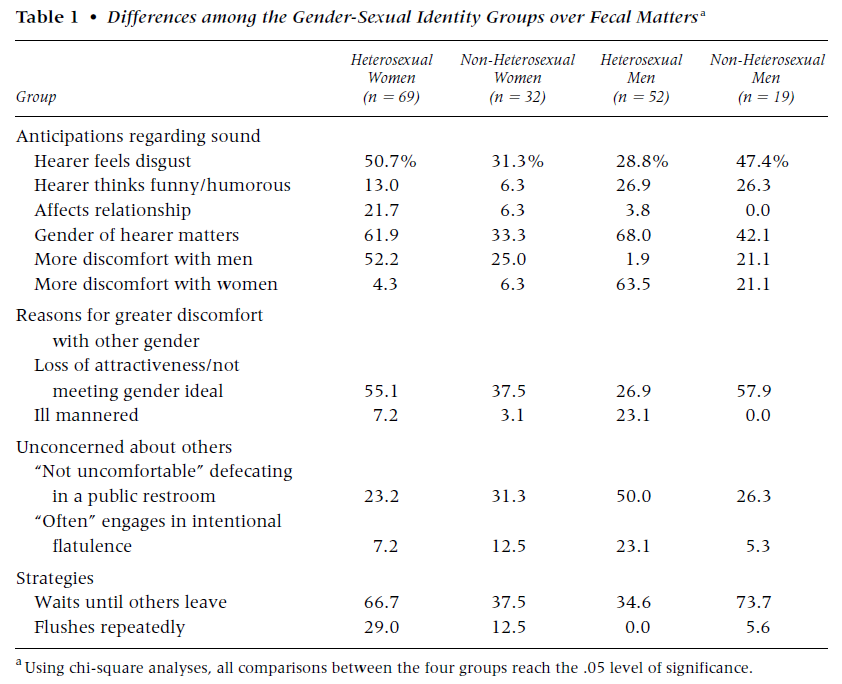












 New York, the only state on the list that’s top job is nursing. Take that, Florida!






 “When do you cross the line from essential profits to profiteering?,” asked Dr Brian Druker, one of a group of physicians asking for price reductions.


