Electric vehicle charging stations that look like manhole covers may be coming to New York City as early as 2014, if all goes according to Jeremy McCool's plan.
Five years ago, McCool came home from Iraq after fighting during the troop surge of 2007. It was there, he says, that he made a promise to do whatever he could to reduce national reliance on foreign fuels. After a $25,000 grant from the Department of Veterans Affairs that McCool invested in research and development, he now has an EV charging prototype to embed in city streets.
His company, HEVO Power, has developed a manhole charging device that runs on the kind of electromagnetic wireless charging technology outlined in a book by Wright State University's Marian Kazimierczuk and New York University Polytechnic Institute (NYU–Poly) professor Dariusz Czarkowski.
"It works in the way a tuning fork would work," explains McCool. The charge consists of two coils: One connected to the grid in the manhole cover, and the other on the electric vehicle. When the car runs over the manhole, the coils conduct a "handshake," and the manhole delivers a charge on that frequency to the car.
McCool says the device provides a more efficient, powerful, and safe way to charge an electric vehicle, though HEVO has yet to test the device in the real world. He's teamed up with NYU–Poly to develop the technology, and with NYU medical labs to make sure the device was safe for living things. The university is looking to shift its public safety vehicles over to an all–electric fleet, McCool says, which hopefully his device could serve.
HEVO's other strategy is to court delivery fleets, and so far, McCool says his company has commitments from seven, including PepsiCo, Walgreens, and City Harvest, to develop a pilot program. The logic is that if electric delivery trucks can charge at regular pick–up and drop–off points ("green loading zones") in front of stores, those fleets should be able to travel greater distances without stopping, or having to go out of their way, for a boost.
Glasgow's Economic Development Corps is also exploring the idea of the technology in Scotland, McCool says, and in order to test the chargers in New York City in early 2014, HEVO has applied for a $250,000 grant from the New York State Energy Research and Development Authority. The organization has already granted a feasibility study for the green loading zones.
If NYC pilot gets the greenlight and it proves successful, HEVO's got plenty of other ambitious ideas in the works.
There is a way to provide wireless charging in an HOV lane.
What if, for example, you could embed this kind of charge in highways? McCool says HEVO's already developed proof of concept for that: "The concept is simple," McCool says. "There is a way to provide wireless charging in an HOV lane. That's a small strip at every yard or so that has another wireless charging plate, so as you go down the street you're collecting a charge. One wireless charging highway."
HEVO technology still has much to prove, and there hasn't been any major infrastructure project yet (that we know of) that uses electromagnetic charging in this way. But last week the company won the Clean Tech Open semi–finals, and hey, we already know that having EV charging stations in front of stores attracts deep pockets. "This is an iterative process," McCool says. "This is just the first step."
Murphy’s Bar, on the corner of Skillman and 49th street, has had a raw bar for a couple years now, but yesterday was the first time we tried it.The place will soon be a full-fledged restaurant, as the owners bought the place next door and expanded into there. In fact, the new seafood restaurant is slated to open as early as next week, and we’ll be back to do a full review then.
For now, take a look at some pictures from the raw bar. Murphy’s offest $1 oysters (there seems to be just one variety), $1 clams, and a $6 shrimp cocktail (which comes with 4 shrimp). Each comes with vinegar, cocktail sauce, horseradish, and of course tabasco. The shrimp is a little pricey, but otherwise it’s a good deal, and the oysters and clams are of high quality.
This VERY dramatic zipper video is amazing. It's like the MacBook of zippers. The iPhone of zippers. The Tesla Roadster of zippers.
I'm a grown man, and zippers can still be tough. Lining up the slider perfectly with the very bottom of a zipper is the simplest thing in the world. . .until something goes wrong. Maybe I pull carelessly and the teeth get off by a rung. Maybe my fingers are frozen and the task becomes akin to threading a needle. Maybe I yank too hard and the whole thing just breaks.
*@&#!!
Apparel maker Under Armour has a solution. Starting this November, its clothing will include the Magzip, an ingenious zipper that magnetically clasps automatically and still provides just enough leverage for you to zip up one–handed if you need to. Trying out a sample the company sent me, I'm amazed each and every time it works. The Magzip a testament to mechanical ingenuity in the electronic age.
But the product wasn't originally conceived for convenience. As engineer Scott Peters watched his uncle develop myotonic dystrophy, a condition notorious for attacking the strength and coordination of one's appendages, he saw first–hand how manipulating buttons can impossible task, and even aligning the box and pin of a zipper can become daunting.
"My mom [an occupational therapist] and I got talking how to help him, and i jumped right in––'I think i could come up with a better zipper than what the rest of the world has used for 100 years,'" Peters tells Co.Design. "So we put a few magnets on a zipper, and of course that didn't work so well."
But Peters believed in the idea, playing with magnets on zippers for months before he caught a break. Sitting around a campfire one evening, his idea attracted the attention of a neighbor who happened to be an accomplished mechanical engineer and designer in his own rite. Together, they took on the problem in the only way it could be––constant iteration. The eureka moment of a magnetic zipper was crucial. But the exact millimeter grooves making the process practical would require painstaking nuance.
"Magnets in and of themselves won't work. They'll drive components together, but you have issues of alignment, issues of holding things together without popping out––and pulling them apart can be a nightmare," Peters explains. "We had to figure out the combination of mechanical design so it self–aligns and easily locks itself in place, enabling you to zip with one hand."
"We started rapid prototyping, getting parts machined, and testing. We'd make a part, assemble it, and glue it on a zipper to find out what worked and didn't work. I had one part that actually broke, and when this had broken, it kind of showed me the way. . .we were able to evolve the design to where it is today, a more open hook–and–catch."
About 25 prototypes later, the magnetic hook–and–catch was an exciting proof of concept, and it became the system they patented. With legal protection in–hand, the team began approaching apparel companies with the idea. They received good feedback, but no one wanted to buy in––even though the zipper we all know today is a fairly flawed piece of hardware.
"One of the things we've found is that certain industries get a standard product in certain areas, and that's the way it is," Peters explains. "So when they innovate in a space, they innovate in a space that everyone else is innovating in. It's rare you get people circling back to question the status quo."
But in a twist of luck, Under Armour had been actively searching for innovative new ideas, and they came across the magnetic zipper patents online. The company reached out to the inventors and helped with the next wave of product iteration. The final device they created is a far cry from the original zipper–with–a–magnet–taped–on. It's an appealing set of cylinders that protects magnets of just the right strength within. They meet, self–latch, and provide the leverage to zip up one–handed. And the unzip? It just as easy.
The Magzip will debut in Under Armour's line this November.
Set on the foot of Badger Mountain in Richland, Washington, this house draws its design influence from both the natural landscape and the clean lines of traditional Japanese architecture. While the project’s primary goal is to answer the growing family’s need for additional space, efforts to capture the sweeping views of the Columbia River and connect to the surrounding landscape give this home its shape and orientation. The major spaces are aligned in a simple plan that is arranged perpendicular to the slope of the hillside, minimizing site impact and maximizing views to the north. The south-facing side of the home opens to an outdoor pool and observation area that offers views of the Peak of Badger Mountain.
In true Brady Bunch style the need for the house was born out of two families coming together doubling the amount of people in the house including a Father with two sons and a Wife with Two Daughters. The first attempted to find a local architect that could design a modern home in Richland Washington, but soon found they needed to travel 200 miles to Seattle to find the right designers.
Design features include exposed concrete walls on the base level of the house, natural cedar moving from exterior to interior blurring the lines between outdoors and indoors, aluminum solar screens, Garage Door for guest/party room that opens up to the cabana, Ventless open fireplace in the middle of the great room, custom exposed steel stair in family room, custom steel and glass barn doors in Master Bedroom and large cantilevered entry canopy. Many sustainable elements where utilized including Rigid Board insulation on the outside of the sheathing to get a high R-Value in the exterior walls and reduce thermal bridging, Super insulated Fiberglass windows and doors, Radiant Heated flooring and LED lighting.
Light? No one says it moves. It dances. Nuance, a new short by French filmmaker Marc–Antoine Locatelli, takes that turn of phrase and makes it literal, pairing an orb of light with a street dancer in a frenetic choreography of shadow and illumination.
The piece came out of a school project at the Beaux–Arts d'Epinal, where Locatelli and his fellow students were asked to imagine how art would continue to evolve. "I began wondering if man would succeed in taming a new kind of music," Locatelli tells Co.Design. Specifically, the director envisioned a future in which dance and music were conjoined, a self–referential loop in which a dancer would move his body to rhythms that, in turn, the movements of his body produced.
In Locatelli's film, a dancer, Lucas Boirat, is seen moving with a ball of light that he can use almost like a photonic mixing board, looping, stretching out, stuttering, and otherwise altering the electronic track that accompanies his movements. The orb will split in two so that Boirat can scrub the track across the floor, or wind the light around his shoe, kicking his foot rhythmically to bounce the music.
Naturally, all of this was accomplished through animation. Inspired by the work of German–American abstract animator Oskar Fleschinger and contemporary video artist Bill Viola, Locatelli started by filming Boirat dancing to the track "Ants" by electronic musician edIT. "I chose the track because it's very rhythmic, and it allowed me to work on shape movement, acceleration, and slow–motion, as well as take poetic breaks," he explains.
From there, he imported the footage into Adobe After Effect to add the animated lights. "I wanted to see how graphic shapes could emphasize or reveal parts of the music that had otherwise remained hidden."
The finished result is hypnotic. The way Boirat uses the ball of light to influence the music he's dancing to feels not just organic, but innately physical. The light he manipulates has gravity, magnetism, and resistance––qualities that are passed onto the music surrounding this strange choreography between the material and immaterial.
The Float Table is a matrix of “magnetized” wooden cubes that levitate with respect to one another. The repelling cubes are held in equilibrium by a system of tensile steel cables.
It’s classical physics applied to modern design. Each handcrafted table is precisely tuned to seem rigid and stable, yet a touch reveals the secret to Float’s dynamic character.
What's Nest best at? Making me want booooring products. I WANT this! Especially since our smoke detectors have been disconnected for years (too many false alarms).
Last summer, as Tony Fadell was diving deeper and deeper into his next big skunkworks project, the iPod inventor decided to completely give up on his initial plans and start over from scratch. "It wasn't cool enough; it wasn't emotional enough; it looked too techie; it looked too geeky," Fadell recalls of the early prototype. "So boom! I blew it up, and we redesigned it all in two weeks."
What was Fadell designing? A smoke detector, that boring, government–mandated household appliance that hasn't changed in decades. Yes, Fadell truly believes fire alarms should evoke emotion and a sense of cool. As the CEO of Nest, the company behind the brilliant Learning Thermostat, Fadell has shown a knack for applying his Apple DNA to what he refers to as "unloved" and "overlooked" things. His latest product is Nest Protect, a modern smoke and carbon monoxide detector, which is the best example yet of Fadell's ability to bring magic to the mundane.
We've covered what makes Nest Protect tick. Here's a rundown of the device's smartest interactions and cleverest fixes––the ones that feel so intuitive and obvious that it's remarkable they weren't the industry standard in the first place.
It happens to all of us: The shower was too hot, or you left the eggs in the pan too long, and the fire alarms begins to shriek. The immediate next step: "The first thing everyone does is wave [a] towel around to move the smoke," Fadell says. "We were like, 'This should be much easier.'"
Fadell's team came up with what they call the "Nest wave." Just gently wave your hand a few times toward Nest Protect to silence it during a false alarm, or "nuisance alarm," as Fadell calls them. You don't need to flail your arms and hands with a towel to get the smoke billowing away from the device; Nest has installed ultrasonic sensors in the device to read your hand motions.
It's a rare instance where midair gestures feel necessary. Whereas hands–free gesture interactions on Samsung smartphones or via Leap Motion can often feel incredibly gimmicky, Nest's solution makes sense: You're far away from the device already, you don't want to have to grab a towel or open a window––the experience is improved. Moreover, the relaxed nature of the gesture brings a sense of calm to an otherwise panicked situation. Imagine if in order to turn off your television's volume, you had to wave your hands like a maniac to get rid of all the sound waves. Finally, we have a hands–free mute button for our false smoke alarms––one that's even more intuitive and accessible than what's on your TV remote. "We call it the 'wave hush,' like, 'I hear you, it's all good, it's hushed,'" Fadell explains.
Traditional smoke alarms have two states: silent, and full–on freak–out mode. They don't distinguish between early warnings and emergencies. Heck, they don't even distinguish between rooms; they just blare a sound loud enough to catch your inferior colliculus's attention wherever you may be in your home. Nest realized it could do more than just scream. "If there is an emergency, we don't just want to beep at you," Fadell says. "It's about providing safety and information."
When the system detects that something is wrong, it not only notifies you by voice during an incident but before and afterward, too. "There's carbon monoxide in the den," Nest Protect might say. Or: "Smoke is clearing in the kitchen." Or even: "Heads–up, there's smoke in the living room; the alarm may sound." It's the difference between a hotel concierge politely telling you your room number, and that same concierge blowing a foghorn in your ear to let you know your room is ready.
There are myriad advantages to safety with voice notifications. Most obviously, the system will give you a better sense of how to respond to the alarm. "If you're in the bedroom and you left a cake in the oven, you'll want to go downstairs to get the cake out of the oven," Fadell says. Inversely, if you're in the kitchen, and the system says it senses smoke in the bedroom, you might want to call for help rather than running upstairs into danger.
Less obvious, though, are the benefits of providing a voice over an alarm sound. Fadell cites a Victorian University study that found that children can sleep through beeping smoke alarms. "Studies have shown children are less likely to wake up to a horn and more likely to wake up to a mother's voice," he explains.
The idea here is that Nest is able to provide unique warnings and notifications; that way, with each false alarm, it's not always "the boy who cried wolf," Fadell says. And when it's actually a serious emergency, you're more likely to listen up.
Often with traditional sensors, it's unclear whether they're on or powered. The device might've died, or someone might've removed its batteries to silence a false alarm and forgotten to put them back in. Perhaps the sensors have simply deteriorated over time. People are supposed to check if their smoke alarm is working regularly, but most don't.
To correct this, Nest Protect provides helpful color cues to reassure users that everything is all right. At night, when you turn off the lights, the system will check that the system is working––that its sensors are functioning properly, its batteries are powered––and then the ring around the center of the device will glow a calming shade of green. The company calls it "nightly promise." (After that, Nest Protect smartly doubles as a nightlight, glowing white as you approach it before dimming as you walk away.)
During the day, if there's no activity, the light won't show to conserve power. But if the device detects early signs of smoke or carbon monoxide, or if the system has a message to give you, it will glow yellow. And if there is an emergency, the device will glow red, and then back to green if all is safe again.
The most dreaded part of muting a traditional alarm? When the damn thing refuses to shut off, and you have to climb up on a chair to poke the tiniest of buttons. "It's insane to me how all of these other things have really little freakin' buttons on them!" Fadell says.
Because of the "hush wave," you likely won't need to get a ladder or broom handle to silence Nest Protect, Fadell says. But just in case you do, he adds, "We made a nice, really big button that––boom!––you can hit if you need to. You could even hit it with a tennis ball."
Unlike traditional smoke or CO detectors, Nest Protect isn't working on its own. If you have multiple devices, they all speak to one another: If a Nest alarm senses danger in the kitchen, even if you're in the upstairs bedroom, the device there will let you know. More impressively, if you have a Nest Learning Thermostat, the two gadgets can work together. If Protect senses a carbon monoxide leak, as a precaution, the thermostat will immediately shut off your boiler or furnace, common sources of such leaks. Likewise, because there are likely to be more Protect alarms throughout the house, these devices can better sense when there are or aren't people at home, and accordingly notify the thermostat to start cooling down its systems to save energy. Nest is starting to paint a picture of what a "smart home" is actually supposed to be––namely, smart.
And because the system is Wi–Fi enabled, it can sync with your smartphone to deliver mobile notifications, such as early signs of carbon monoxide, low–battery alerts, and so on. Most significantly, in the event of an actual emergency, the app can also immediately provide the proper instructions for who to call, say, when you have a carbon monoxide leak.
When Steve Jobs was introducing the original iMac, he famously (and accurately) described the PC landscape in just four words: "These things are ugggggggllllllllllyyyyy." The problem? All PCs at that time were just beige, boring boxes.
Similarly, while many have brought beauty to everything from vacuum cleaners to bluetooth headsets, fire alarms haven't changed in decades. They're often blandly colored and shaped, an eyesore almost designed to be ignored. "The smoke alarm you grew up with looks the same as it does today," Fadell says. In other words, these things, too, are ugggggggllllllllllyyyyy.
But Nest, like Jawbone and other hardware makers, is bringing a sense of beauty to otherwise neglected objects. With its dimpled sunflower pattern and rounded corners, its circular center and color glow, the Nest Protect looks like something you'd want to add to most rooms of your house––and not just because you're required by law to do so.
The M–Blocks, created by John Romanishin at MIT Computer Science and Artificial Intelligence Laboratory, are self–assembling robots that move themselves around like magnetic Mexican jumping beans. They might not look like much right now, but don't be fooled: These colorful robot–building blocks could be a technological breakthrough that makes real–life Transformers possible.
Usually, robots that can reconfigure themselves do so by sliding across one another without changing their orientation. In other words, if you had two robot cubes and marked each side with cardinal directions (north, south, east, west, up, down), those cubes could reconfigure themselves in many ways in relationship to one another, but the north sides would always point north, south sides south, and so on. This method has the benefit of allowing roboticists to always be able to model where a part of a re–assembling robot is in relation to the other parts, but it limits the ways in which robots can reconfigure themselves, and also requires a lot of complicated internal motors to get the movement right.
What makes the M–Block so unique is that it doesn't slide; it bounces. Inside every M–Block is a flywheel that spins at 20,000 rotations per minute. The momentum of this flywheel is enough to allow the M–Block to hop around, looking for other M–Blocks to attach itself to. On each side of the cube are two cylindrical magnets, mounted like rolling pins; when two M–Blocks come near each other, the magnets naturally rotate so that north magnetic poles align with south magnetic poles, or the other way around. What that means is that an M–Block can simply bounce around until it finds another M–Block, then automatically glom onto it.
This might not seem particularly useful in abstract, but it's actually incredibly exciting. Because M–Blocks can not only autonomously propel themselves but attach to one another in an infinite number of configurations using relatively cheap mechanisms, there is a lot you can do with this technology. Imagine, for example, dumping a container full of M–Blocks on an empty lot, then sending a signal for them to self–assemble into a house. Or imagine telling your couch, which is made of M–Blocks, to divide itself into three chairs instead, or transform into a bunk bed to accommodate some surprise house guests.
In fact, this is just the sort of thing that Romanishin and his team at MIT intend. They are currently hard at work building an army of 100 M–Blocks, programming them with algorithms that will help them re–assemble into increasingly complicated configurations. "We want hundreds of cubes, scattered randomly across the floor, to be able to identify each other, coalesce, and autonomously transform into a chair, or a ladder, or a desk, on demand," Romanishin says.
Even at the current size and scale, M–Blocks have potential to be used to temporarily repair structures or provide shelter in emergencies, or raise and reconfigure scaffolding in construction. But the ultimate goal here is miniaturization: Shrinking M–Blocks down until millions of nano M–blocks can be poured out of a can and assemble themselves with nearly infinite granularity into anything you wish. Imagine 3–D printing, without the need for a 3–D printer. These bouncing magnetic robot blocks could be the technological breakthrough that gets us there.
You can read more about M–Blocks and their incredible potential here.
The government shut down today. This means that, along with many other important things, lots of government websites are down. The economic sources we at Planet Money look to every day now look like this:
For more on what the shutdown means for econ nerds, see this WSJ piece trying to figure out whether the big monthly jobs report will still come out on Friday.
Long Island City’s getting free Wi-Fi service, as part of a major Wi-Fi expansion in ten business corridors across all five boroughs. Mayor Michael Bloomberg made the announcement today in Downtown Brooklyn, one of the selected access areas. As for Long Island City, the Wi-Fi area will be bordered by Queens Plaza, Jackson Boulevard and Vernon Boulevard. According to the New York Post, the ten hubs, which cost $3,400,000 in private and $900,000 in public funds, will launch this December and stay put for at least three years. The Long Island City Partnership will be the local entity rolling out the program, and they’ll host an informational event in the next couple of weeks.
Photo via the Mayor’s Office
… Read More
So New York is into teens and MILF's. Shows you how divided this state is. I'd like to see a breakdown by upstate/downstate.
We like to believe in the United States of America that regionality and socioeconomics don't separate us, that the American experience is the human experience. The only real difference between us may be an accent here or there and maybe a predilection for regional cuisines.
Well, apparently tastes in pornography are just as much a regional dish as kringles, poi, and Cincinnati chili. Pornhub recently published a rundown of the three most popular (erotic) search terms per state, and FlowingData's Nathan Yau converted them into a series of stark maps.
You realize that MILFs are popular almost everywhere, except out West, where terms like "teen," "Asian," and "compilation" take the top ranks. But the anomalies are probably more interesting than the trends. Montana loves a "wife," Idaho prefers a "parody," and Wyoming, ever the cowboy state, has a thing for "smoking." (Before I lose you––as crude as this whole topic may be, try to tell me that it isn't a bit adorable that Hawaiians so loyally search for "Hawaii.")
Are there any grand conclusions to be made from this simple visualization? Quite possibly. As invasive as the Googles and Pornhubs of the world having access to our most private searches may be, it does occasionally give us a wider, more accurate view of ourselves. Can you imagine a Gallup poll on pornogaphic habits? Probably not. And in this sense, the connected world may be the most honest world we've ever known.
At first glimpse, the Liftware almost seems like a novelty gadget: an electronic spoon stuffed full of smartphone motion sensors and accelerometers. But the problem that the Liftware is trying to solve is far from trivial. Across the country, there are over 10 million people suffering from essential tremor; there are an additional 2 million people suffering from Parkinson's disease. For these 12 million Americans, the Liftware isn't just an electronic spoon; it's a tool that could give them their dignity and self–respect back.
The founder of Lift Labs, Anupam Pathak was inspired to create the Liftware after studying the problem of canceling out human tremors in grad school. "It's a big problem for millions," Pathak tells Co.Design. "Even if you're not ill, as you get older, your hands start to shake, and there's not a lot that can be done about it except take certain drugs, all which only sometimes work and have a host of side effects."
What Pathak realized was that the technology to help people deal with tremors was already available in the consumer space, built into every digital camera and smartphone sold. All of these devices have image stabilization technology built in. Why not leverage this same technology to help people with intense tremors? Following this train of thought to its natural conclusion, the Liftware was born. A handheld stabilizer that can counteract tremors, the Liftware is ultimately meant to be a sort of Swiss Army Knife for those suffering from erratic, involuntary movements.
People with tremors won't go out because it's embarrassing, and that leads to social isolation.
Here's how it works. Inside every Liftware handle is a number of common motion sensors, the type that you might find in your iPhone or digital camera. Each of these sensors measures motion, then passes it through a small microcontroller that uses custom algorithms to analyze the signal and identify the type of tremor being detected. If the motion has the frequency and amplitude of a large human tremor, the Liftware microprocessor will tell actuators in the handle to adjust the handle's attachment in the opposite direction of the tremor, hopefully canceling it out.
The first attachment the Liftware is launching with is a spoon. "When coming up with the Liftware, we spent a lot of time working with local support groups, getting a sense of what people needed," says Pathak. "One thing people really wanted was a spoon to help them eat." People with violent tremors often won't go out to restaurants, or dine with friends, because of their affliction. "There's a loss of independence and dignity because if they do, they're spilling everywhere. People with tremors won't go out because it's embarrassing, and that leads to social isolation."
The spoon attachment is just the beginning, though. According to Pathak, there's a significant number of challenges that individuals with tremors face every day performing tasks the rest of us take for granted. "People with tremors have problems with everything from using tools, to unlocking doors, to putting makeup on," says Pathak. "The sky is the limit when it comes to the number of useful attachments we could release."
Lift Labs' Liftware device isn't cheap––it costs $299.95, coming with the Liftware Spoon attachment, although the idea is to make future attachments cheaper––but for those living with Parkinson's and essential tremor, it's a device that could just give them the semblance of a normal life back. It's available for pre–order now on Lift Labs' official site.
We don't know a huge amount about comedian and car enthusiast Conner O'Malley, but we can say with 100% assurance that he is our new favorite Viner. O'Malley has taken full advantage of the surreal nature of Vine, posting several videos a week in which he yells at bizarre TV commercials or fetishizes Harry of Harry and the Hendersons. But our favorite bit of his is his love of walking up to rich people in expensive cars and mercilessly trolling them. We've compiled some of our favorite videos of his below for your Friday afternoon enjoyment. [ more › ]
A new spot to check out this weekend in Long Island City! The hotly-anticipated bar Dutch Kills Centraal is now open on the corner of 39th Avenue and 29th Street. Tastoria has all the details: the spot offers a seven-item, pub-style menu, pours five draught taps, and has a full bar of spirits, liquors and wine. There’s a long communal table running through the interior. The owners plan to expand the menu and start offering brunch soon. Tastoria gives the spot two thumbs up and there’s already a very positive review on Yelp. Any readers check it out? GMAP
Photo via Facebook
… Read More
Last year’s event featured cupcake cars, 70 distinct 3D printers and an enormous, remote-control thumbing war. This weekend, the New York Hall of Science will host World Maker Faire 2013, an annual opportunity to invent, craft, recycle and be inspired by arts, engineering, science and technology. An estimated 600 makers will present their rockets, robots and other contraptions in a fun free-for-all of motion, beeping and levitating. Plus, there will be a speaker roster including authors, innovators and leading thinkers in the Maker movement, as well as arts and crafts, food, woodworking and live music.
Details: World Maker Faire 2013, New York Hall of Science, 47-01 111th Street, Flushing Meadows-Corona Park, September 21st, 10 am to 7 pm and September 22nd, 10 am to 6 pm, $15-$55, purchase required tickets here.
Photos by NYSCI/FB
… Read More
"By exerting a very small gravitational pull, the time ingots exert a very small time dilation effect. Keeping one around is basically the equivalent of riding on a merry–go–round: You could save a small fraction of a second over the course of the next billion years, according to Keats."
We're living in the age of "busy," and logically, there are only two ways to escape its tyranny: Work less or create more hours in the day. The latter certainly seems physically impossible, but Jonathon Keats thinks the problem is with the physics: We forgot about relativity!
"Einstein did all the hard work of coming up with relativity, but honestly he wasn't thinking about it in very pragmatic terms," says Keats. "That's the piece that Spacetime Industries brings into this puzzle."
Spacetime Industries is Keats' new creation, the latest in a long line of "innovations" from the so–called poet of ideas behind the quantum ATM and string theory real estate schemes. The premise is to take advantage of a principle embodied in Einstein's "Twin Paradox." If twin A stays on Earth, while twin B travels on a rocket ship into space and back, when twin B returns he will find that twin A has aged more. The acceleration–produced effect is called "time dilation."
Keats's plan is to recreate the effect of the rocket with a city full of fast–spinning wheels. We could live out our days in the fastest–spinning district, while slower–moving wheels would pass the time faster (that would be a good place for industry or agriculture). "You would be able to harvest an entire year's crop every single day," says Keats.
The blueprint for the time–managed city shows a city of wheels, connected at their centers with passages allowing people to safely pass from one district to another. It looks like the internal workings of a clock. "Big Ben is essentially a prototype, though they didn't know it when they were building it," says Keats.
Of course, to save a useful amount of time, the clockwork city would have to move at extraordinary speed. "A merry–go–round isn't going to do it," Keats says. "You would need to go at a good fraction of the speed of light in order to have a significant effect on one district versus another." Spinning at close to the speed of light poses some obvious, not–so–relativistic quandaries. For instance, what happens to a body when it's subjected to centrifugal forces comparable to a black hole? "The technical term is spaghettification and it is really a problem," says Keats.
To avoid spaghettification, Iron–Man–style suits may be the solution. As for the buildings themselves: "Once a city or national government decides to contract me, we could work out those details," he says. Keats's consulting services are available upon request.
But he also has several products on offer that are available now, like "time ingots": one–pound lead bricks purchased on EBay and repackaged (these are available for a special introductory price of $29.99). By exerting a very small gravitational pull, the time ingots exert a very small time dilation effect. Keeping one around is basically the equivalent of riding on a merry–go–round: You could save a small fraction of a second over the course of the next billion years, according to Keats. "They are highly beneficial as a desktop means of micromanaging your time," he says. A similar product called the "time warp undershirt" attaches a weight to the fabric, allowing you to exert a similar effect on your heart, stomach, or other organs.
All of these will be available at the Spacetime Industries exhibition space, opening Thursday, September 26th at the Modernism Gallery in San Francisco, along with one demonstration product available only on site. Keats describes it as "an opportunity to try out the experience of time management through elevation." It is otherwise known as a footstool. The gravity differential from being just one foot off the ground, could, Keats believes, save you on the order of 90 billionths of a second over the course of your lifetime. "Unfortunately," he says, "the gallery closes at 8 p.m."
If anyone is interested in a variation on technique for 501 STF's. (I guessing I'm the only one).
I’ve had numerous questions on doing one of these and I’ve neglected to long enough. So here it is, the Frost In His Bones comprehensive guide to buying, shrinking, and wearing raw, unsanforized 501s.
Buying I haven’t paid more than $30 for a pair of these yet. Now, I have a weird size in STF (I’ll get to sizing next) so there’s not really a huge crowd of people clamoring for 29x34 pants, but I think if you shop smart, you can come out ahead. Find a color you like and search around the web with color-specific keywords. You’ll find all these old supply stores with the 90’s style websites you can barely navigate. They’ve got 501s priced to move and customer service is usually crazy great.
Sizing I prefer a simple, classic cut that fits without constricting or getting in the way. The good thing is, these stretch where you push on them. So really, you’re sizing to how much allowance for stretch you want. For me, I size the waist down an inch to take some billow out of the hips. Then, I size the inseam up. My pre-raw phase was 30x32, worn uncuffed for a bit of break. I size up the inseam an additional 2” for a good bit to cuff. That puts my 501 STF size at 29x34. Below is a pre-soak picture of the size mentioned.
Shrinking Most of the way I do this is pretty standard. I fill my bath tub with the hottest water I can, and lots of it. More water stays warm a bit longer and you end up with more shrink.
Now some of you might be nervous about over-shrinking these things and ending up looking like some 80s band lead guitarist minus the hairspray. Let’s pause here so I can let you in on the biggest pro-tip of the 501 STF… Don’t think of the shrink process as literally “shrink to fit.” Think of them as shrink completely, then stretch to fit. Processing them with that mentality will give you a better fitting final product.
Back to the water. After you’ve got a half foot or so of hot water, turn the jeans inside out and toss ‘em in, weighting them to keep them submerged. Turning them weft-face-out reduces indigo loss and may give you an advantage in fade definition (possibly negligible, possibly not). The above picture demonstrates this.
You’ll notice I have a 9x13 pan wedged into the waist. Ridiculous, right? The big selling point for the 501 STF is that they “learn” to fit the body that wears them. Personalize your process. Experiment. Stick a cake pan in your jeans. I’m about 30” around, but the post-shrink stretch of this denim in a 30” waist will too easily allow for that. So I size down an inch to tighten up the hips and waist, giving it a bit less stretch allowance. Problem is… I can’t get on a pair of 29” post-soak without breaking my pelvis. The pan keeps the waist right at 29” so I can squeeze them on and stretch them to a comfortable fit.
I leave them in the water for an hour then pull them out to sit on a towel. Here’s another difference in my method, and again, it seems completely counter-intuitive… Don’t put them on until they’re dry. Goes against everything you’ve heard about the 501 STF, right? Well what else have you heard? Knee bags, poofy hips, diaper-butt? Loose, unflattering fit? Water plus movement cause (or at least exacerbate) a lot of the problems people have with the fit of these jeans. These things stretch and they don’t need any help or encouragement to do so. Put them on your towel, leave ‘em alone. Stick something in the waist if you’re like me and have to limit the shrink.
Once dry, you’re good. Toss them on and enjoy. If you need a bit of help setting the combs or cuff or anything else, dab them with a damp rag. Just keep the knees and seat dry, they stretch quickly and easily and can over-stretch when wet.
My final product is very nearly in 511 territory, but with a few weeks of wear, the block and thighs will evolve to a much more conservative and comfortable fit. The calves and ankle, however, will remain fitted to the post-soak size, since there’s nothing stretching them. In other words, the “boxy” anti-fit of these pre-soak 501s will become a custom-fit slim taper for pennies on the dollar of other raw denim options.
Most people ride out their wedding days in a whirlwind that blurs every kiss, toast, vow, and dance together into a single event that spins too fast to fully remember. That's why people hire wedding photographers, but photographers––as they blow that aperture out to make your wedding day look as gauzy and ethereal as possible––all too often forget that your wedding isn't just the most romantic day of your life. It's also the day you'll throw the most amazing *party* of your life.
That's what makes the wedding video of Quang and Ellie Dinh so charming. Not only does it slow the whirlwind of a wedding down into a series of amazing, idiosyncratic, and surreal moments, it captures the best party of someone's life in a time bubble.
Called the Slow Motion Booth, the video was shot by Super Frog Saves Tokyo, a Seattle–based video comprised of "two cynics, an idealist, two realists and a French guy." Super Frog doesn't specialize in wedding photography. Instead, they major in developing viral videos for different Internet companies. So how did they come to film a wedding?
"It was innovation born from incredible laziness," says Super Frog's Executive Producer, Mike Gaston. "Our good friend Quang was the groom, and he masterfully guilt–tripped us into shooting his wedding. We aren't wedding photographers, and most of us have tried to stay away from doing this kind of work, so a couple of days before the wedding, I suggested we throw a RED Epic camera in the corner of the reception hall to shoot guests in slow–motion and then cut it together with some music from the wedding. That way Quang would hopefully forget about the other footage we shot and we could avoid editing the full video for a while. "
The wedding took place at the University of Washington, with the reception following held at Seattle's SODO Park. There, in addition to the RED camera, Super Frog set up four LED lights, a simple white backdrop, and some props comprised of bubbles, confetti, and other exploding party favors. They then manned the Slow Motion Booth with Super Frog's producer, a man particularly skilled at getting people to do things they normally wouldn't do.
And that was it. But while the setup was super simple, the video itself turned out to be extraordinarily winning. "We had attractive people, an open bar, and a lot of diversity. Quang said we made a United Colors of Benetton wedding video," says Gaston. At over 100 frames per second, party guests make motorboat sounds with their lips, slap each other, dance, and kiss. Bubbles are blown, poppers popped, confetti sprayed, and people are hosed down with alcohol and have glasses of champagne dashed in their face. The end result is pure magic.
Another genius touch is the way the video synchronizes its slowed–down slices of wedding white noise with the lyrics to Robin Thicke's hit, "Blurred Lines." "The song really helped the video come together," says Gaston. "We were able to juxtapose the lyrics against these scenes of domesticity, wholesomeness, seduction, and so on until it really subverted the way people viewed the song. We've had people tell us they hated 'Blurred Lines' until they saw the video. Robin Thicke, we'd be down to shoot your next one!"
But while Thicke might have an open invitation to get down with Super Frog, the studio isn't necessarily ready to shoot your next wedding video.
"We've been contacted by a lot of people to do weddings, but we aren't a wedding company and aren't really structured to take on that kind of work," admits Gaston. "Everything we do is an opportunity for us to develop our social theory, but to be honest, we didn't expect this to get the attention it has gotten. So that's embarrassing. We should have known, right?"
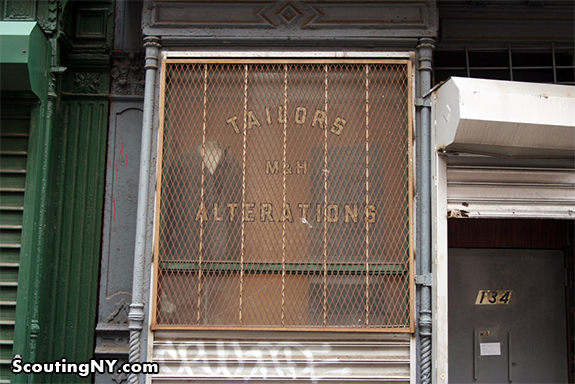
Way way back, when I first started Scouting NY, I did a post about a great tailor shop window I saw in Chinatown, writing “I love this sign lettering that is most definitely not nostalgic/ironic.”
Of course, I had been completely fooled. Back then, this was actually Milk & Honey, a super hip, semi-secret, invitation-only bar. The phony tailor storefront added a speakeasy-ness to the place.
Milk & Honey has since moved to a bland storefront with no character in the Flatiron, but luckily, New York City still has a few establishments lurking behind fake storefronts and phony building facades. Here are some of my favorites, in no particular order.
8) Lower East Side Toys – 102 Norfolk Street, Manhattan
The establishment at 102 Norfolk Street is one of my favorites because it goes the extra mile by faking the rear entrance instead of the front – in this case, the back of a toy shop called Lower East Side Toy Co.
The door features a “DELIVERIES ONLY” sign…
…and an arrow pointing you to the showroom.
Of course, there is no show room. Go through the door and you’ll actually find yourself in The Back Room, a speakeasy-style bar.
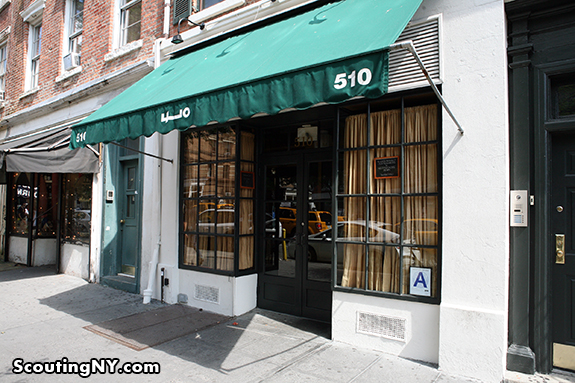
7) Hudson Street Psychic – 510 Hudson Street
During the day, it’s an unassuming storefront. But at night, the curtains are drawn and the sign in the window turns on…
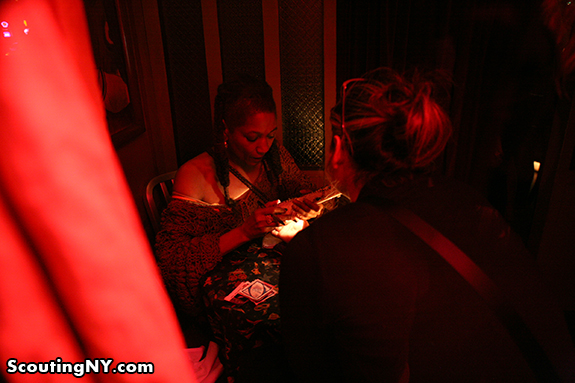
…and a psychic appears to tell your future.
Seems like just another West Village one-room psychic set-up, but head through the door behind the psychic, and you’ll find yourself in Employees Only, another speakeasy-style bar.
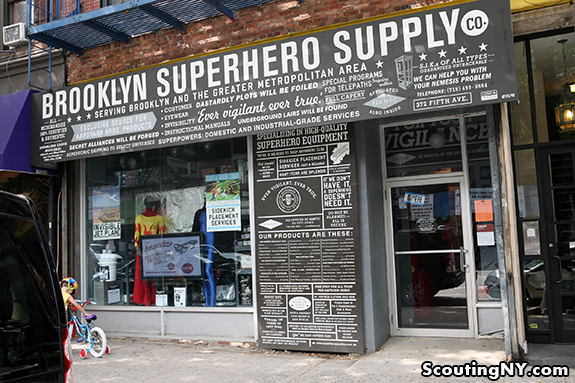
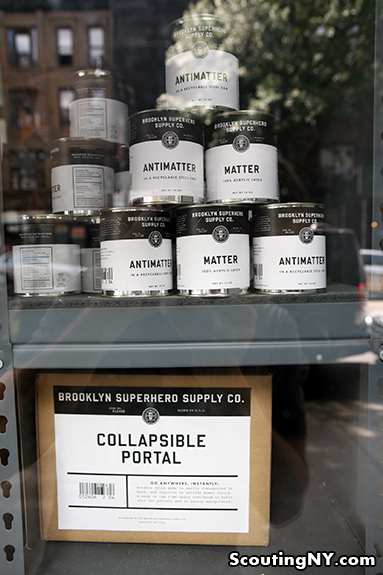
Tucked between the restaurants and boutiques of Park Slope is one of the most unlikely stores you’ll find in New York City: the Brooklyn Superhero Supply Company.
Catering to professional and amateur superheroes alike, the window display offers a pretty good idea of their wares: cans of matter stacked (quite dangerously!) atop cans of antimatter, and below, a box containing a collapsible portal (always helpful for escaping your arch-nemesis when things go badly):
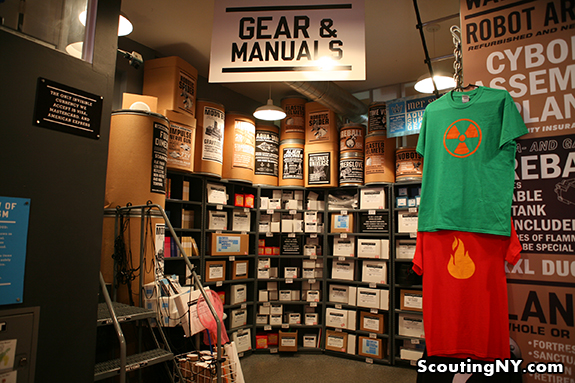
In fact, they’ve got pretty much everything an aspiring superhero could hope for…
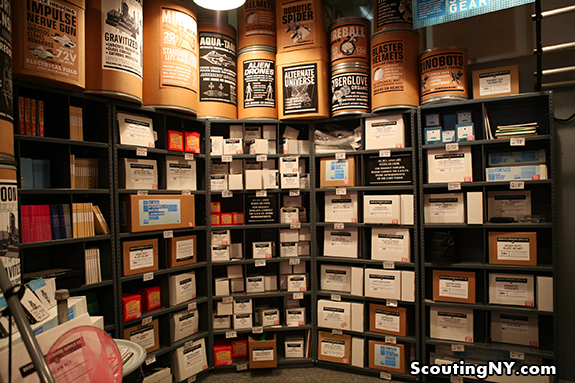
…with gear literally stacked floor to ceiling:
There’s even a de-villain-izer for taking care of any hidden urges you might harbor!
Of course, all is not what it seems here – head through the secret bookshelf doorway…
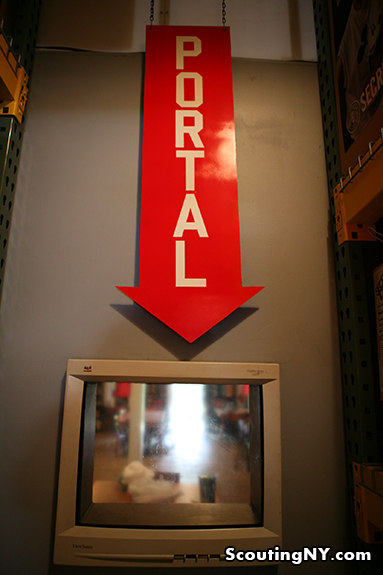
…and you’ll find yourself in the student learning/activity center, part of the 826 Valencia literacy project founded by Dave Eggers. The group provides students ages 6-18 with one-on-one peer mentoring to encourage their creative and expository writing skills. A special viewing portal allows a rare glimpse of the space:
All sales from the Brooklyn Superhero Supply Co. go toward funding the non-profit program, so next time you’re in the area, be sure to stop in for that cape you’ve been meaning to buy (you can even try it out in the store’s cape-testing wind tunnel!).
5) The Beauty & Essex Pawn Shop | 146 Essex Street
Just around the corner from the Williamsburg Bridge is this cute little pawn shop at 146 Essex Street. Though it has a new sign, you can still make out faded lettering beneath, suggesting it has been around for a while:
Home of the the “Pawn Queen,” the windows advertise “Diamond Rings,” “Stuff – Get It While It’s Hot!”, and “Queen Isabella’s Jewels.”
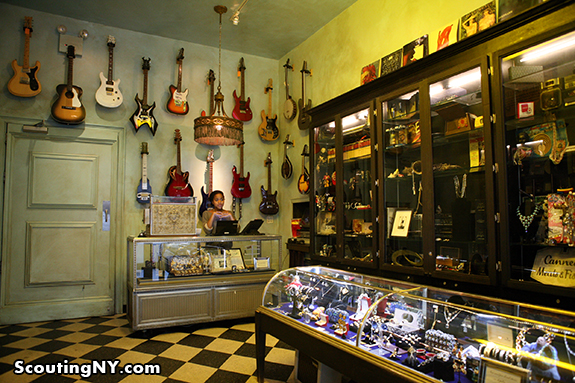
Inside is a neatly organized pawn shop, with your typical array of guitars, jewelry, toys, and other miscellany:
When I stopped by to take pictures, there were tourists inside browsing the merchandise, completely unaware that an upscale restaurant is hidden just behind that door
4) Doyers Street Chemist – 9 Doyers Street
Head down Doyers Street, one of the most interesting streets in New York…
…and at the bend, you’ll see a small pharmacy:
A CHEMIST sign hangs just above the door…
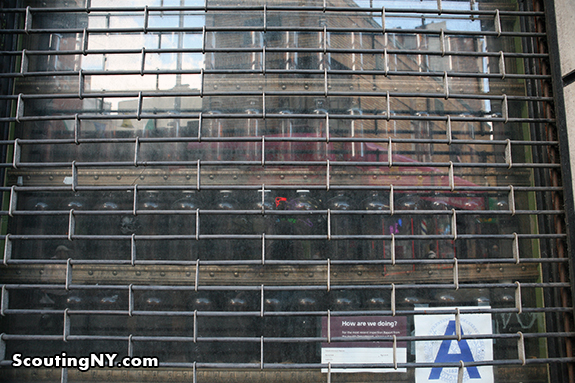
…with old medicine bottles stacked on ancient shelves in the window.
Go inside, and you’ll actually find the mixology bar Apothéke. Back when I wrote about Doyers Street in 2010, Apotheke was disguised by a great old Chinese restaurant sign proclaiming it to be the Gold Flower Restaurant. Would love to see them amp up the apothecary look a bit.
3) Phone Booth – 113 St. Marks Place
This one is a little unusual for this list, as the actual storefront is just some unremarkable blacked-out glass.
But head into Crif Dogs next door…
…and step into the old wooden phone booth tucked into one corner.
Pick up the phone and chat with the person on the other end, and a false backing to the phone booth will open, letting you into PDT (Please Don’t Tell…oops), another speakeasy. This one requires a reservation, which can only be made by calling their phone number at 3pm.
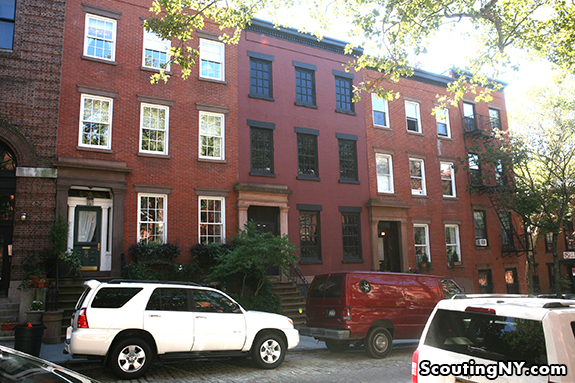
2) Brooklyn Heights Townhouse – 58 Joralemon Street
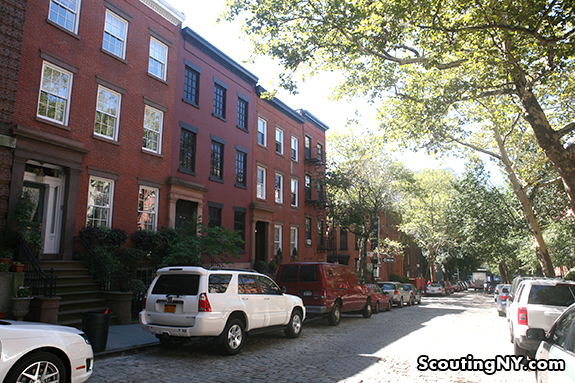
As you walk down Joralemon Street, you could be forgiven for not noticing anything out of the ordinary with #58.
But stop to take a closer look, and a few things might strike you as odd.
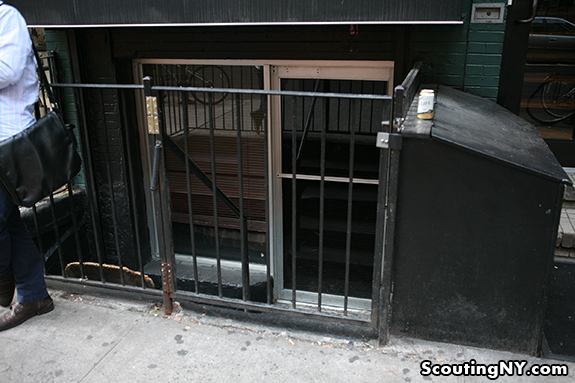
For one, why are all the windows blacked out?
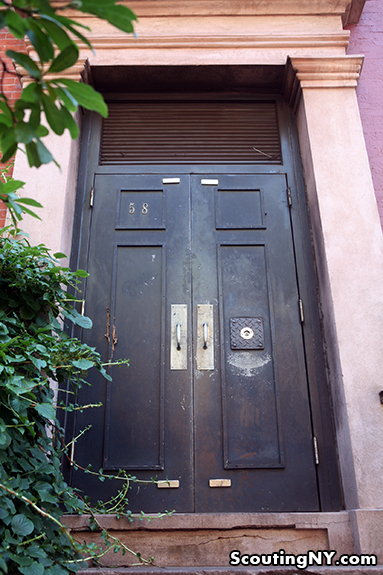
And why does it have such a strange front door?
The answer is that this 19th-century Greek Revival townhouse happens to be a subway ventilator (and emergency exit) for the subway tunnel that runs below it. The MTA owns the property, and has been required to keep its appearance consistent with the surrounding buildings by the Landmarks Preservation Commission.
1) ** ******** Street | Sorry – some things should stay a secret.
Let me know any I’ve forgotten!
-SCOUT
PS – I left off places that, while there might be a secret club/bar/restaurant lurking inside, don’t really disguise it with a fake front (La Esquina, for example, is an actual Mexican restaurant, even if it has a club downstairs).








9())


 We don't know a huge amount about comedian and car enthusiast Conner O'Malley, but we can say with 100% assurance that he is our new favorite Viner. O'Malley has taken full advantage of the surreal nature of Vine, posting several videos a week in which he yells at bizarre TV commercials or fetishizes Harry of Harry and the Hendersons. But our favorite bit of his is his love of walking up to rich people in expensive cars and mercilessly trolling them. We've compiled some of our favorite videos of his below for your Friday afternoon enjoyment. [ more › ]