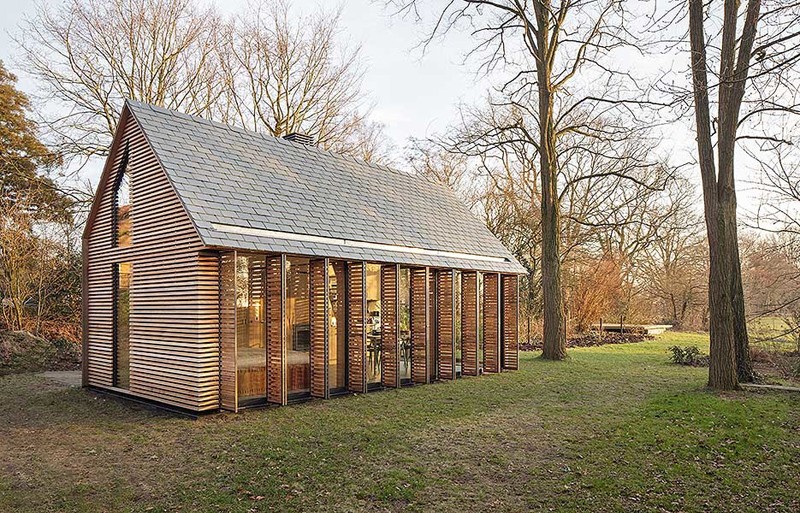
Zecc Architects, together with interior designer Roel Norel, have designed a small contemporary cottage in a rural area north of Utrecht in The Netherlands.
Andrew BaisleyNow THAT'S a cabin!
Zecc Architects, together with interior designer Roel Norel, have designed a small contemporary cottage in a rural area north of Utrecht in The Netherlands.

[Photo via Bowery Boogie]
Bowery Boogie turns our attention to this giant RV with corrugated siding and barred-over windows that has apparently been parked (on and off) on the Lower East Side, across from the Baruch Houses, as of late. It has been making the locals nervous, and who can blame them—this might be the scariest vehicle, recreational or otherwise, we have ever seen. Even looking at it in photograph fill us with fear and dread. An investigation from Bowery Boogie (they peaked in the windows) reveals a disappointingly simple explanation for the RV's existence, though—it's someone's house. That explains the chains and window bars, anyway.
· This Beat-up 'Mad Max' RV Near the Williamsburg Bridge has Locals Guessing [Bowery Boogie]
Andrew BaisleyLove it
"Being 12 means being a kid, a mature kid." Hear what these 12-year-olds think about navigating the most awkward year of their life. http://www.being12.org/
Andrew BaisleyTupperware is my favorite. Also, this site's RSS feed is jacked. No idea why this is so long/repeating.
According to infomercials, EVERYTHING we do is difficult. You can’t even eat food without dramatically dropping it to the floor and looking around like it was someone else’s fault. If real life was like an infomercial, I probably would’ve fallen out a window while trying to turn on my light. Let's be real — while infomercials overly dramatize the easiest of tasks, they sure are funny! Here are some of the best infomercial fails.
Which one was your favorite? Let me know in the comments below!


According to infomercials, EVERYTHING we do is difficult. You can’t even eat food without dramatically dropping it to the floor and looking around like it was someone else’s fault. If real life was like an infomercial, I probably would’ve fallen out a window while trying to turn on my light. Let's be real — while infomercials overly dramatize the easiest of tasks, they sure are funny! Here are some of the best infomercial fails.
Which one was your favorite? Let me know in the comments below!
According to infomercials, EVERYTHING we do is difficult. You can’t even eat food without dramatically dropping it to the floor and looking around like it was someone else’s fault. If real life was like an infomercial, I probably would’ve fallen out a window while trying to turn on my light. Let's be real — while infomercials overly dramatize the easiest of tasks, they sure are funny! Here are some of the best infomercial fails.
Which one was your favorite? Let me know in the comments below!
In a world where review sites like Yelp allow everyone to be a food critic, culinary experts Foodbeast put together a segment inspired by Jimmy Kimmel's Celebrities Read Mean Tweets series where chefs and owners read out some of their establishments' 1-star reviews. Check out the video above to see how three of California's prominent restaurant owners react to some of their harshest appraisals.
Andrew BaisleyOkay, you guys were right. Stuff of nightmares right there.

Try 2 find me lol u can’t
Andrew Baisley@Ivy


Instagram is like a birdhouse. No, I don’t mean that in the sense that its inhabitants like taking craps on top of each other. More like how you’re in the parrot room of an aviary, where you can give the parrots bird feed when they perfectly recite your rendition of Chief Keef’s “I Don’t Like,” but that doesn’t make them any more capable of making their own sentences, does it? Except instead of bird feed, the parrots of Instagram are fed with Likes when they perfectly recreate the compositions of popular Instagrammers, who in many cases are also the originators of said shots. So in a quest to prove there's artistically profound photography to be found on the platform, I ventured into the depths of #hbouthere and #createexplore, and... found little to be inspiring. It seems there's a lot of people on the bird feed. Not wanting to come up empty-handed though, I instead went about compiling and categorizing, for your reading pleasure, the most common offenses within what I like to call the HYPEBEAST x VSCO Filter Appreciation Society. Read on, my feathered friends.
 1 / 8
1 / 8 2 / 8
2 / 8 3 / 8
3 / 8 4 / 8
4 / 8 5 / 8
5 / 8 6 / 8
6 / 8 7 / 8
7 / 8 8 / 8
8 / 8Hallmarks:
- Perfectly centred vertically
- Often shot in corridors, on or under bridges, or long pathways with an infinity point
- Strong, arrow-straight lines lead eye towards center where object of interest may be placed
- Bonus points for: shooting in the middle of train tracks with an approaching train about to run you over
Whether it be by the misfortune of being afflicted with OCD, or a more profound interest for finding a higher order in this chaotic modern world, the rule of symmetry and hard lines is almost religiously adhered to in our universe. While an expansive subset that, by some scientific estimates, encompasses around 93% of all Instagram posts tagged with #hypebeast, we can further break down the "symmetry" category into finer examples, such as symmetrical railway tracks, symmetrical overhead bridge, symmetrical pedestrian overpass... you get the idea. With a Wes Anderson-esque fanaticism for centered compositions without the whimsy, symmetry is as hard-baked into the HYPEBEAST psyche as a tormented love-hate relationship with Kanye himself.
 1 / 8
1 / 8 2 / 8
2 / 8 3 / 8
3 / 8 4 / 8
4 / 8 5 / 8
5 / 8 6 / 8
6 / 8 7 / 8
7 / 8 8 / 8
8 / 8Hallmarks:
- Camera pointed exactly 90 degrees skywards
- Preferably, the sky is cloudy or foggy, and the buildings fairly geometric and characterless with reflective glass facades
- Two or more buildings should lead the eye towards the center of the frame
- Bonus points for: capturing a plane mid-flight in the very center
As our corner of Instagram becomes increasingly saturated with symmetrical everything, how does one differentiate themselves from the rest of the sheep flock? Angle your gaze 90 degrees skywards, of course. Best suited for foggy days where the skyscrapers of your nondescript city can fade into white, beware of the hazards associated with this pose, including debilitating neck cramps, being blinded by the errant wad of bird poo, and having a streetwear-inclined hoodlum swipe your beloved Supreme cap off your unsuspecting head as you struggle to center the frame on your iPhone.
 1 / 8
1 / 8 2 / 8
2 / 8 3 / 8
3 / 8 4 / 8
4 / 8 5 / 8
5 / 8 6 / 8
6 / 8 7 / 8
7 / 8 8 / 8
8 / 8Hallmarks:
- Camera centrally aligned with horizon line
- Composition should have busy freeway in foreground leading to an urban skyline in the background
- Use a high f-stop on your camera to achieve the starburst effect from streetlamps
- Up the saturation to absurd amounts in post-processing
- Bonus points for: shooting the scene from behind a chainlink fence, x10000 if tears are streaming down your face
The night offers many comfortable settings for the socially awkward hypebeast to lurk -- the mystery and grittiness of the urban jungle at night serves as the perfect space for them to immerse themselves in deep brooding. As these tortured souls find themselves wandering windblown on a pedestrian bridge above a roaring interstate, they pause in the middle and depress the camera's shutter. In the second or so it takes the sensor to record the light trails of the cars below, a tear trickles down from the photographer's eye. All that remains of this solitary experience is an over-saturated long exposure photo like the above selection, accompanied by a caption as cryptic as it is #deep.
 1 / 8
1 / 8 2 / 8
2 / 8 3 / 8
3 / 8 4 / 8
4 / 8 5 / 8
5 / 8 6 / 8
6 / 8 7 / 8
7 / 8 8 / 8
8 / 8Hallmarks:
- Choose a somewhat dangerous spot of considerable altitude with a compelling vista
- Wearing your newest/favorite sneakers, dangle your feet in front of you and angle them to best capture the view as well
- Stagger your feet horizontally to create the impression of levity
- Popular locations include skyscraper roofs and in winding stairwells
- Bonus points for: not falling off and dying
Although sneakers are very much front and center in HYPEBEAST culture, the hypebeast's natural impulse to, well, hype something up compels them to take this to all new heights. We find them perched recklessly on roofs and stairwell railings the world over, in a vain attempt to add some excitement to what would otherwise be an average composition. We patiently await the day that someone executing the Look-Up Game (see above) unwittingly snaps a photo of a sneakerhead mid-plummet, having unfortunately slipped off their perch while photographing their new Yeezy 750 Boosts.
 1 / 8
1 / 8 2 / 8
2 / 8 3 / 8
3 / 8 4 / 8
4 / 8 5 / 8
5 / 8 6 / 8
6 / 8 7 / 8
7 / 8 8 / 8
8 / 8Hallmarks:
- Camera at close to ground level with feet in center, and the frame extending no further than knee height
- One foot in front of the other for a good view of the medial and lateral sides of the shoes
- Optimum jump height is approximately 6-8 inches
- Bonus points for: not using Wingardium Leviosa
To those outside of sneaker culture, sneakerheads must seem positively alien, with their intense fascination with what the general populace consider glorified pieces of rubber and fabric intended to protect the furthest appendages of your body -- that is, your feet. As such, the Instagram cliché of people levitating in their sneakers needs little explanation, as it clearly depicts various members of this alien species plucked from everyday goings-on, only to return to their people on some distant planet where they never have to cry over another botched sneaker swap again.
Click here to view full gallery at Hypebeast.com
Andrew BaisleyShared for the gif

Bent, TheJetsBlog.com
Over the last several weeks, we’ve taking a look at some of the players the Jets added to their roster since the end of the regular season. Last week, we took a look at former Houston Texans linebacker Chris Young and you may also have missed our look at recent signing Ronald Talley, because that was published at around the same time as the news of the Brandon Marshall trade broke. Today we can bring ourselves fully up to date just in time for free agency with a look at former Indianapolis Colt Mario Harvey.The 27-year old Harvey has played in 28 NFL games, working at both inside linebacker and fullback, and signed to the Jets practice squad late last season before getting a futures contract in January. Listed at 6’0″ and 264 pounds, he’s been allocated the number 50 and is currently listed as a linebacker by the Jets, although it’s sounding like John Conner won’t return to the Jets this offseason so maybe he will get the chance to compete with Tommy Bohanon for a backfield role instead. Harvey was undrafted out of Marshall, where he played as a linebacker, and has spent time with the Steelers and Colts.
After the jump, I review footage from Harvey’s career so far to assess what he brings to the table.
Who is Mario Harvey?
Harvey was a solid linebacker at Marshall, improving his numbers for tackles, tackles for loss and sacks in each of his four seasons. His senior year saw him rack up 143 tackles, including 17.5 for loss and 8.5 sacks and he was projected as a mid-to-late rounder after an impressive pro day performance that saw him run a 4.46 forty at 257 pounds. However, he went undrafted in the 2011 draft and was signed as an undrafted free agent by the Pittsburgh Steelers.
Harvey didn’t make the Steelers roster in his rookie season, after having played in one preseason game and recorded three tackles. In 2012 he made more of an impact with the Colts in preseason (13 tackles and two passes defensed in four games) and saw action in 13 regular season games. In those 13 games, he played 11 snaps at linebacker and six at fullback, but did make good contributions on special teams with eight tackles.
In 2013, he remained with the Colts and saw action in 12 games. He made three appearances on offense – playing a total of six snaps at fullback – and six on defense – playing 72 snaps at inside linebacker. This included a 19-9 loss to the Chargers where he played 36 snaps and led the team with 10 tackles, including one for a loss. He again made contributions on special teams, with six tackles.
2014 was the first time he worked solely as a fullback. In preseason he carried the ball once for no gain and had two catches for 16 yards, but in the regular season he played just five snaps and was released after three appearances.
Here are my observations from watching the preseason footage on Harvey, divided into categories:
Usage
Harvey’s main role on defense with the Colts has been as an inside linebacker in a 3-4 system. However, he has played a handful of reps on the outside. Similarly, on offense, he’s played primarily as a blocking back, but has also lined up as an H-Back or tight end a few times and split out wide or in the slot a few times in preseason.
Measurables/Athleticism
Harvey’s college workout numbers are pretty impressive, especially given the fact that he’d bulked up from his playing weight of around 240 for his pro day. In addition to his 4.46 forty, he did 27 bench press reps and a 4.19 short shuttle, all of which are excellent for a player of his size. He also had a 32-inch vertical and a 113-inch broad jump which are less impressive, but not bad.
Pursuit
Harvey can certainly run well and closes to the ball over short distances with good burst. He has a pretty good knack for reading and anticipating to enable him to avoid traffic although at times if he hesitates it can prevent him from getting across laterally in time.
Tackling
Harvey is a good hitter, but also attacks the ball very aggressively which can lead him to overrun plays at times. He is strong, so has the ability to stop a runner in his tracks and also tries to rip the ball out at times, which he managed to do successfully in one preseason game. He did have four missed tackles on special teams in 2012, but showed improvement by having none in 2013.
Pass rush
Harvey had 21 sacks in his college career so he does have some ability in this area. He hasn’t rushed the passer much but did have one game in preseason in 2013 where he had three pressures, including a sack. The first one saw him read the play-action and burst into the backfield, hitting the quarterback and causing him to miss an open receiver. The second was a perfectly timed blitz up the middle, leading to an intentional grounding call. The third saw him get his sack on a stunt which saw him get to the quarterback cleanly.
Coverage skills
Harvey was required to drop into coverage at times and does close well on short passes, although again he will overpursue at times. However, he was easily beaten on a corner route after matching up with a tight end in the slot and looked a little lost in zone coverage when a receiver ran an in-route right in front of him.
Physicality
One thing Harvey did do at times was take on a lead blocker. With his size, he’s ideal for this kind of role and can disrupt plays with his burst and strength. When he does this, he does need to be aware of the ball carrier, because a couple of times, he probably could have disengaged from the block to get to the runner, but instead was too focused on creating a collision and let the ball carrier go past him. Pep Hamilton described him as “pound for pound one of the most physical guys on our team”.
Fullback skills
On the basis of the above, it made sense for the Colts to try and see whether Harvey would be effective on the other end of that collision. It’s going to be difficult to move him off his spot and his understanding of what the linebacker would be seeing will help him to know how to play this fullback role effectively (and vice versa). On one play he didn’t get across laterally in time to stop Ray Lewis from making a play in the backfield though, a similar issue to that which he sometimes has on defense. On the previous snap he had been able to stand Lewis up in the hole. He hasn’t worked much in pass protection, but again was beaten to the outside by Calvin Pace on one play where he didn’t show enough lateral quickness in transitioning from a three point stance at tight end to a pass protection stance. Still he managed to ride Pace and slow him down enough that the quarterback was able to get his throw off despite Pace winning the outside leverage and creating pressure. Harvey caught a 13 yard pass in preseason last year, catching the ball in the flat and turning upfield. He didn’t exactly look 100% comfortable catching the ball on that play, however.
Special teams
Harvey has played a variety of roles on special teams. He’s good at getting downfield on punts and kickoffs and can lay some good hits when not blocked. At times he has a tendency to overpursue and was penalized several times, with a few of them due to his over-aggressiveness as he took off too early and was flagged for a false start. Harvey also contributed well as a blocker in the return game which obviously his fullback training assists him with. Here’s a gif:

Instincts
As noted, when Harvey reads the play he can make some effective stops, but at times he reads the play late and doesn’t get there in time. That could be something that would improve with experience and scheme familiarity. As noted, he didn’t always look comfortable in coverage and there was one awful play where he turned his back on the play thinking it was over and his man was wide open in the flat, but that was hopefully an outlier.
Demeanor/Attitude
Harvey is very demonstrative when he makes a big play and looks like an energetic player and a popular teammate. I could not find any specific negatives about his attitude or any off-field concerns.
Scheme familiarity
Harvey played in a more conventional style 3-4 with the Colts, but did move about the formation a bit. He should have a good understanding of various scheme requirements having played on both sides of the ball.
Injuries
Harvey’s release last year came with an injury settlement as he was dealing with a hamstring issue. However, when he signed with the Jets later in the year, he was obviously over that. He also missed the last month of the season in 2013 when he was placed on injured reserve with an undisclosed injury.
Conclusions
Harvey certainly is an interesting prospect, albeit that he is 27 already so might not get too many more chances to display his untapped potential. His athleticism for his size is impressive, but his lack of size (despite being listed at 6’0″, he actually measured at less than 5’11” at his pro day) places a limit on where he can be successful at the pro level.
His versatility could lend the team to consider giving him a roster spot next year, if that means they can create roster space by being able to carry one fewer linebacker and one fewer back. The fact that he’s contributed on a special teamer in the past also helps him.
It will be interesting to watch where they employ him in camp and whether he can impress the coaches enough to get a chance to make a splash in preseason.
I’ll be back later this week with the next installment in my 2015 Draft series, where this week I’ll be looking at offensive tackles. I’ll also be doing scouting reports for any players the Jets sign once free agency is underway.


Andrew BaisleyIvy, should we try this?
A few months ago, I had to charter a boat to take scout pictures of Davids Island, located in Long Island Sound off the coast of New Rochelle. As we were curving around the southern side of the island, I noticed something in the distance…

A squat, one-story structure on its own private island.
 .
.
Though it seemed dilapidated and possibly abandoned from a distance, as we drew closer, I began to see signs of modern activity: a huge solar panel on the roof, along with construction equipment scattered about. My guide explained that this is Columbia Island, and that the owner is currently converting the building into what will be the only private island home off the coast of New York City.

What’s the story behind this strange little building? Here’s Columbia Island on a map, located just off the Bronx/New Rochelle.
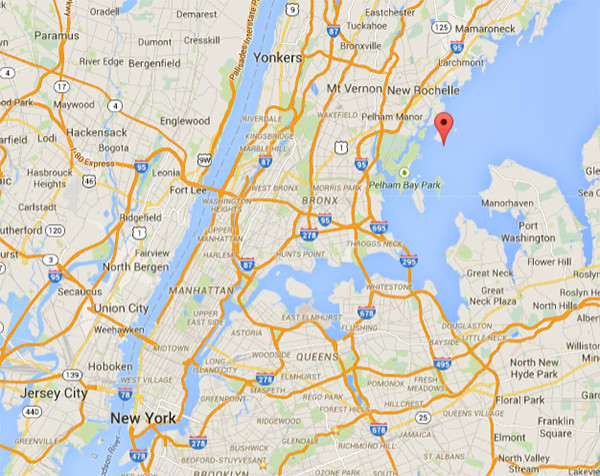
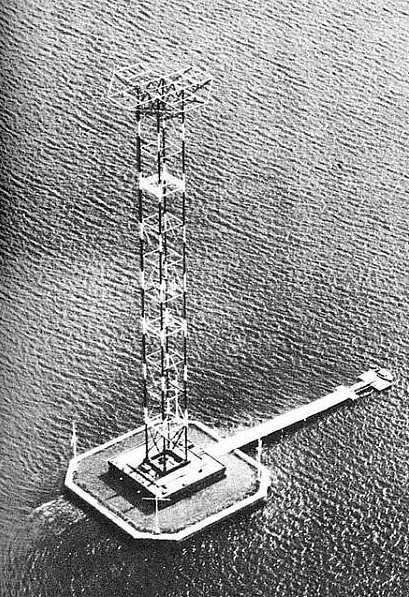
Originally known as Little Pea Island, it was purchased by CBS in 1940 for use as a broadcasting station and renamed Columbia Island. A concrete foundation was poured, and a 410-foot steel transmitter was erected, servicing a potential 14,000,000 listeners. The tower began broadcasting on October 18, 1941.
According to this 1941 NY Times article heralding the state-of-the-art construction, “the men who operate the station actually live within a grounded metal shell, under which are living quarters for engineers, workshops, electrical units to supply tube voltages, an auxiliary Diesel-electric generator that roars into use the instant a fault occurs in under-water electric cables from shore, and everything else that modern radio engineering can devise to keep a station on the air in spite of apparatus failure or fury of elements.” Below, a look inside the station:
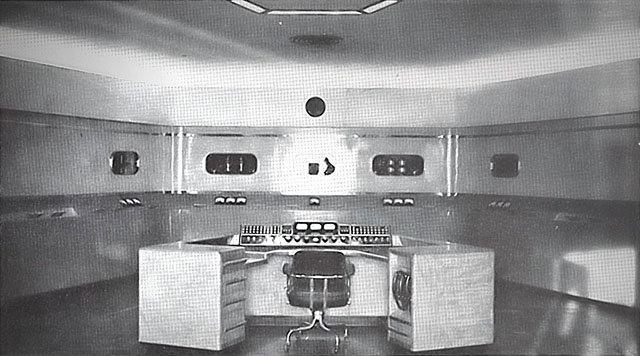
Photo from Jim Hawkins WCBS/WFAN Transmitter Tour Page – Click for more!
The station was in use until 1963, when it moved to nearby High Island (site of the famous 1967 plane crash that destroyed the island’s antenna, taking both WCBS and WNBC off the air). Below, Columbia Island today from above:

Since then, the island has switched hands several times, and now appears to be owned by filmmaker/actor Al Sutton, who has been retrofitting the old station into a “green” residence for a number of years. This article details the addition of the 1,200 sq-ft solar array in 2012 to power the home.

When the project’s done, I believe that’ll make Columbia Island the only private island residence off the coast of New York City. Al, if you’re out there, would love a peek inside!
-SCOUT
Andrew BaisleyNice job
You might recall that the master bathroom was a source of stress at various times throughout this renovation. :)
However, now that everything is said and done I can say that all the freaking out and second-guessing was worth it. Whew!

Originally, the bathroom was very pink and somewhat cramped.

It also functioned as a guest bathroom since it was accessible through a door in the hallway – probably not the private master bath that most people envision.

(The door to the “master bathroom” on the left in the foreground.)
So, when it came time to re-think the space, we jumped at the opportunity to make the bathroom more private by closing off the door while also expanding the bathroom by taking in a coat closet and part of a hallway off the entryway (see below).

I never would have thought of expanding into this space – it was my mom’s idea – and it made all the difference for this little bathroom! You can see these changes reflected on the floor plans below:

During the demolition and re-framing phases it all looked a little like this:

I was really concerned about the master bathroom feeling dark, since it doesn’t have any windows to let in natural light. Because of that, I made sure to include two recessed LED lights (one in the shower and one in the main part of the bathroom) and sconces with two bulbs each. All of that light bouncing off the white walls, mirrors and glossy subway tile make for one happy and bright bathroom.
And here’s a straight-on view of the double vanity. The drawers have tons of storage, and I think the rope on the captain’s mirrors plays nicely with the wood tones of the vanity.

Just through the doorway is the master bedroom!

You can really see in the master bedroom how we stuck with a palette of whites and rich browns and black throughout the house – all of the fixtures are black or oil-rubbed bronze, the window frames are bronze (almost black, really), and all of the hardware, door levers and hinges are black. Those little details make me happy.
Do you see the plethora of doors that used to lead into the master bedroom? It had direct access to two bathrooms – so strange!

The master bedroom itself is really a testament to what a little freshening up can do. We painted, swapped out the windows and light fixture, and restained the floor to take the room from this…

…to this!

I hope you’ll agree that it’s changed for the better. :)
Pssst! Hi! If you’re just joining us from Centsational Girl, welcome! If you’d like to catch up on the rest of this renovation just click here. And for you regular readers, I contributed to a post for my blog buddy, Centsational Girl – you can check it out here.
Andrew BaisleyDig it
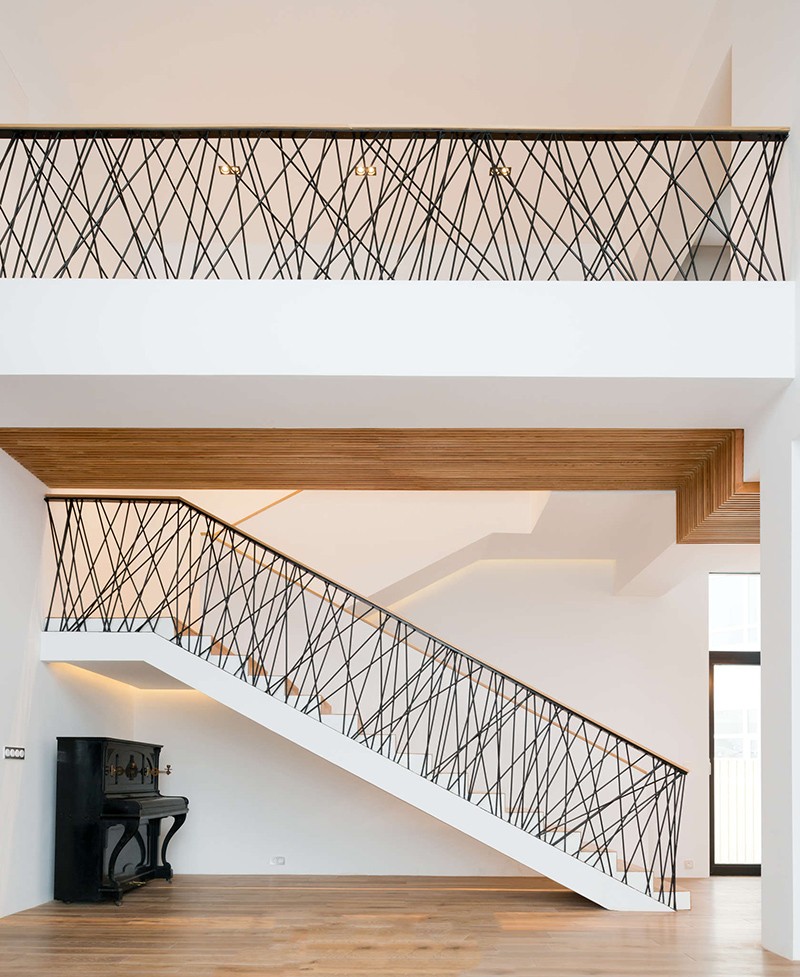
This home designed by Monoloko Design, features custom railings on the stairs and the top floor, made from randomly placed steel supports that have been powder coated black.


Our favorite new tumblr discovers a heretofore unrealized conversation between hip hop in 2015 and artwork from the 15th century:
http://bit.ly/1KLD0hZ
(via sideshow)
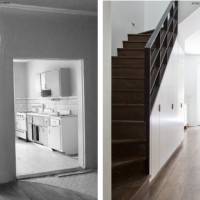
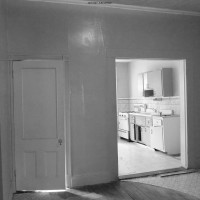
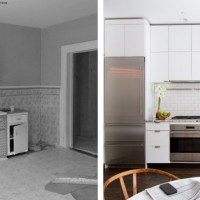
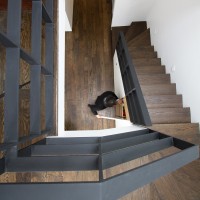
Office of Architecture have sent us some before and after images of a renovation and addition they have designed for a row house in Brooklyn, New York.

Description from the designers:
When we were approached by our clients to gut renovate and add to a 110 year old, 15′ wide row house, our goal was to create a home that could adapt to change over time.

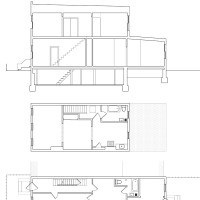
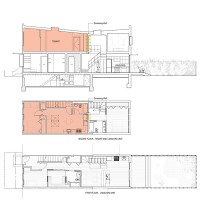
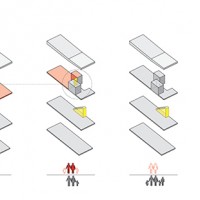
The building is designed to oscillate easily between a two-family and one-family configuration, giving the owners the ability to gradually grow into and out of the house as needed. 70% of the building can be used as a 2 bedroom / 2 bath unit, while the remaining 30% of the building is given over to a 1 bedroom/ 1 bath unit.


Depending on their priorities at any given time, the owners have the option to occupy one of the units themselves, while using the other for rental income. It also gives the owners the ability to combine both units to create a 2100SF one-family home for themselves simply by removing a small demising wall on the second floor and demolishing the rental kitchen – a job that can be executed over the course of a long weekend.


Elegant material choices, subtle detailing, and thoughtful spatial sensibilities belie the building’s intelligent space planning. Careful placement of bathrooms and kitchens, along with the integration of a second stair (highly unusual for a row-house this size) enable the architecture to accommodate its owners as their needs evolve from that of a young couple to a family of four to empty nesters. In doing so, the building becomes much more an active participant in the life of its inhabitants – always ready to anticipate and absorb change.












Design: Office of Architecture
Photography: Ben Anderson
Those crazy Canucks.

The temperature outside: -30°C
The temperature of the water: 40°C

After a year and a half of writing Wait But Why posts, I’ve noticed a theme: humans seem to come up a lot.
Sometimes we talk about where humans came from or where we might be going or how we’re all related; other times we look at how we interact and communicate and form relationships. We’ve talked about rich humans and famous humans and baby humans and dead humans and humans from all over the world. We’ve explored what it means to be a human, what it means to be a good human, and whether we’re all alone in the universe. And we’ve spent a lot of time trying to figure out what really matters most in this one, short human life.
But somehow, we made it through all of that discussion without ever asking the most important question of all about humans—
How big a building would you need to fit them all in it?
It’s a question that’s tantalized almost no one through the ages, and today we’re gonna tackle it hard.
But before we ask all 7.3 billion humans to stop what they’re doing so I can arrange and bunch them together at my whim, let’s discuss the number 7.3 billion.
The first thing to note is that when I did a post on population density in August of 2013, the number I kept referring to was 7.1 billion. The world population has grown by 194,000,000, or almost 3%, since then.
Second, 7.3 billion people is a lot of people. If each living human were represented by a dry grain of rice, the rice would fill a cube-shaped box with a side of 6.1 meters,1 or about 20 feet—around the size of a two-story house.

That’s a lot of rice grains.
And how about 7.3 billion grains of sand? Well according to this delightful chart, “sand” can mean a lot of things. 7.3 billion “very coarse” grains (about 2mm in diameter) would fill a large cubic room with a height of 4m (13ft). 7.3 billion medium-size grains (.25mm in diameter) would fill a medium, 46cm high (1.5ft) cardboard box. And 7.3 billion of the finest, .0625mm sand grains (any smaller and it wouldn’t be sand anymore—it would be silt) would take up about 1,700 cubic centimeters of space, almost but not quite filling a 2-liter soda bottle.
Also, walking 7.3 billion steps would take you around the Earth…150 times. (At two steps per second, that would take you 115 years.) (I’m doing that thing where I’m going on divergent math spirals during the post and then just putting what I figured out into the actual post. I’ll try to stay on topic here but it won’t be easy. Let’s keep going.)
7.3 billion humans in one-dimensional configurations
The first activity today will be putting all humans in a single file line. We’ll start near Quito, Ecuador, right on the equator, and the line will follow the equator. We’ll begin with Carlos. Stand here, Carlos.

Second in line will be Daniela. Third is you, Andrea.1 Since we’re trying to be efficient, I want everyone to stand as close as possible to the people in front of you and behind you without actually touching. Some people will require more or less space than others because people are different sizes, but let’s assume each person we add to the line will make the line one foot (about 30cm) longer on average.2

So we do this for a while and the line gets longer and longer. We build bridges over oceans and tunnels through mountains to make a clean line along the equator. Eventually, the line goes around the whole Earth gets back to Carlos. But we’ve only gotten through 131 million people—less than 2% of humans—so we’ll need to wind around the Earth again. And again. Finally, halfway through the 56th loop, on the Indonesian island of Sumatra, we get to the final human, and we’re done.
Okay that kind of annoyed me because it ended up in the shape of spring, not a line. Let’s try another way.
Carlos, stand on the X again. We’re gonna have Daniela stand on your shoulders, and then Andrea’s gonna stand on hers, and we’ll just keep going up from there.

The average human is 165cm (5’5″) tall, but about a foot of that is from the shoulders to the top of the head, so when we add someone onto the top person’s shoulders, the height of the tower rises by an average of about 134cm (4’5″).
We stack and stack and eventually, we reach the moon. Unfortunately, we’ve only used 286 million people at this point and have 96% of humans still left to go. By the time we finally finish, the tower is 9.8 million km (6.1m miles) high, and we’re around 1/5th of the way to Mars, 1/4th of the way to Venus, and 1/15th of the way to the sun.2
How about if we all held hands and formed a huge circle? Let’s say that we’ll stand side-by-side, holding hands, which is enough distance apart to take up about three feet (91cm) of the circle each.

Continuing like this, our final circle has a circumference of 6.6 million km (4.1m miles) and a diameter of 2.1 million km (1.3m miles).

While we’re all out there holding hands and dying instantly from being in space without suits, the Earth will look to us around the same size as the moon usually looks in our night sky.
Okay one dimensional shapes are pretty inconvenient for everyone—let’s reel things in and try this in two dimensions:
7.3 billion humans in two-dimensional configurations
The addition of a second dimension to our human shapes makes the species seem a lot smaller.
When arranging humans in two dimensions, the first question we need to ask is, “How much ground area does each human need when we’re bunching them all together as closely as we can without killing everyone?” The answer, for this post, is .1 square meters, giving us a rate of 10 people per square meter.
How Many People Can Fit in a Square Meter Comfortably-ish?
The quest for this answer brought me to the most obscure corners of the internet, where I came across two key groups of bored people. The first one shows nine Canadian journalists choosing to spend time positioning themselves together into one square meter. Doing so gives each of them an average of one 33cm x 33cm (13″ x 13″) square to stand in. You can see in the video that while it’s definitely tight, no one is forced to molest anyone else and everyone can breathe.
But that’s using all adults. The world’s median age is 29, and the youngest billion humans tend to be quite little. The second case brings us across the world to a random New Zealand elementary school, where a teacher has decided to get cute and cram as many kids as she can into a square meter. She maxes out at a shocking 22 kids.
Putting these two performances together, it seems reasonable to say that 10 humans per square meter is a safe estimate for what we can use as our human-bunching metric. Nine adults in the square managed fine and the addition of children into the mix should be able to easily increase that total by one to 10 (yes, some adults are much larger than average, but others are tiny—the world’s average adult is a not-that-large 62kg (137lb) person).
At 10 people per square meter, we can fit 1,000 people in a 10m x 10m square. A basketball court is 28m x 15m, which means we can fit 4,200 people on one, all in bounds.
We can fit 54,000 people on an American football field, which is large enough to hold the entire population of Liechtenstein or Monaco, and if we expand our field to the size of a soccer field—sorry, a football pitch—we can hold over 71,000 people, more than enough space to contain the population of Greenland.
Tiananmen Square is pretty huge—880m x 500m or just under half a square kilometer.

Credit: Keith Higgons
If it were empty, it could hold 4.4 million people, or the entire population of Croatia, Oman, Lebanon, Panama, Moldova, Uruguay, Kuwait, Mongolia, or Lithuania.
A full square kilometer could fit 10 million people—the population of a megacity—and you could pack all 26 million Scandinavians—everyone in Norway, Sweden, Finland, and Denmark3—into one square mile.

Central Park, with an area of 3.41 square km (1.3 sq mi), could easily hold the population of Australia, Morocco, Saudi Arabia, Peru, Venezuela, Malaysia, Nepal, Mozambique or Syria. You could fit all 13.9 million Jews into Central Park and still have room for the population of Romania, Chile, or the Netherlands. The entire human race in 5,000 BC, which historians estimate to be between 5 – 20 million people, would fill up at most a little over half of Central Park.
We’re just getting started, so settle in.
You could squeeze all 320 million Americans into a 5.7km x 5.7km (3.5mi x 3.5mi) square, which would take less than five hours to walk around.

And a square 10km x 10km (6.2mi x 6.2mi), or a small island about twice the size of Bermuda, could hold a billion people (which you could walk the perimeter of in about 8 hours). A slightly larger island, Martha’s Vineyard, has an area of 226km2 and could fit all the world’s Christians on it [insert your own wisecrack here]. Alternatively, Martha’s Vineyard could fit the entire combined population of North America and South America…and still have room for the entire population of Africa. As for the world’s females, if they ever got annoyed with men and wanted to start a club, they could hold their membership-wide meetings in the 360km2 Gaza Strip.
Anyway, what we really want to know is how big a piece of land we’d need to hold everyone—all 7.3 billion of us. And the answer is, a 27km x 27km (16.8mi x 16.8mi) square.

That square is smaller than Bahrain. And on top of Africa, it would look like this:

The square is also smaller than New York City.
NYC has an area of 786 square km, or 303 sq mi, and the whole human race could fit inside it—with room for another half a billion people. Specifically:
So let’s try it. First by geographic region:

How’s everyone doing down there?

Great. Now, let’s shift around and organize by religion:

So that’s how much ground space the human race takes up—but that’s only talking about the living humans.
Scientists’ estimates for the total number of humans who have ever lived4 tend to range from 90 to 110 billion people. The most common estimates are around 108 billion total humans. Using that assumption, a little under 7% of all people who have ever lived are alive right now:

We just had a Dinner Table discussion about which dead human we’d like to bring back to life—but what if we brought all dead humans back? How much space would we need to make room for them?
We’d need 10,800 square kilometers—a square with a side of 103km (65mi)—which would easily fit inside Jamaica, Qatar, Kuwait, The Gambia, or Connecticut.
Continuing into hypothetical world, we could fit a trillion people in South Korea, Iceland, Guatemala, or Cuba, and if we covered every square meter of the Earth’s land with people, it would fit 1.48 quadrillion people—200,000 times the current world population. To finish the job, let’s cover the entire surface of the Earth with people—including oceans—to bring the total people that could fit on an Earth-sized planet to a little over five quadrillion people.3
And that’s all fine, but my grandfathers didn’t fight in World War II so I could write posts about two-dimensional things. Time to get in the ring with the big boys.
7.3 billion humans in three-dimensional configurations
Sticking with our 10 humans per square meter of floor metric, we bring height into the equation using the worldwide average human height of 165cm (65in).4 So we can build ourselves a booth with a square meter base and a 1.65 meter height that will fit 10 average humans. This gives us our 3D metric—.165m3/person, or 6.06 people per cubic meter.
When we put lots of people in three-dimensional buildings, we’ll do it by building different height “floors”—some floors would be higher than 1.65m for taller people, others would be shorter than average for shorter people, but each person would be on a floor where the ceiling was just a few millimeters above their head, and the floors would average out to be 1.65m high each.
The Empire State Building has a volume of 1.05 million cubic meters, which when hollowed out and replaced with our new “floors” would hold 6.3 million very unhappy people.
AT&T Stadium, home of the Dallas Cowboys, is a huge domed structure with a volume of 2.94 million cubic meters. With the addition of floors, it could hold 17.6 million people. That’s big enough to fit the entire population of Dallas…plus the populations of New York, Los Angeles, Chicago, San Francisco, and Boston.
The largest building in the world, volume-wise, is the Boeing Everett Factory in Washington State. With a 900m x 495m base (which almost exactly matches the dimensions of Tiananmen Square) and a ceiling over 33m high, the factory’s volume is 13.3 million cubic meters—which we could fit all the world’s French people into with room left over for all the Belgians as well (78.7 million person capacity).
But if we’re gonna fit all of us into a single building, nothing currently on Earth is going to work—we have to build it ourselves.
At .165 meters per person, we’ll need a little over 1.2 billion cubic meters, or just over one cubic kilometer (1.204km3 to be exact).5 This cubic building would have a side of 1.07km (about 2/3 of a mile), giving it a base of about 1.1km—a little over double the size of the Boeing Factory base—and a height of 1,070m (3,511 feet), which is 29% taller than the Burj Khalifa, the world’s tallest skyscraper. That’s a large building, but neither the base nor the height alone are unfathomable by modern architectural standards. Here’s what it would look like if we built it in Manhattan (with other structures added for reference):


Somewhere in that building is you. Somewhere else are all your friends. Somewhere in there is a 16-year-old Cambodian girl and all her friends. Somewhere is a Somali pirate, his barber, and all his barber’s friends. Every NBA player is in there, along with every rockstar, movie star, supermodel, and politician. Every bartender and construction worker and priest and lawyer and prisoner and princess and soldier and dentist are somewhere in that building, along with all 1.4 billion Chinese people, every blond person, and every member of ISIS.
The human race, which seems overwhelmingly large in one dimension when it’s wrapping 55 times around the Earth or forming a circle that dwarfs the moon’s orbit, seems much more manageable when it can fit inside Bahrain or New York City with room to spare and almost quaint when organized neatly into a cube that would take you only 20 minutes to jog around.
And with that, our initial goal is accomplished. But what if, instead of ending this post here, we went just one step further? After all that work, who wants to stop now while there’s still so much empty space in all of our atoms?
7.3 Billion Humans Compressed Down to Their Atomic Nuclei
Every atom’s different, but a general ballpark rule is that an atom’s diameter is about 100,000 times larger than the diameter of its nucleus, the thing that carries nearly all of the atom’s mass. Translated into three dimensions, that means an atom’s nucleus makes up only around one quadrillionth of an atom’s total volume. The way I visualize this is by imagining an atom to be a cubic kilometer—a hollow cube taller than the tallest skyscraper (around the size of our humanity cube above). This building is so large that if you were inside it, hanging from the ceiling, and you let go, it would take you about 15 seconds of free fall before you hit the ground. If you’re standing on one side of the base, it would take you about 12 minutes to walk across to the other.
If that huge cube is an atom, somewhere in the middle is a 1 cm3 sugar cube—and that’s the nucleus. And the atom’s mass would be about exactly the mass of the sugar cube, which takes up one quadrillionth of the total space. Just about all of the other 999,999,999,999,999 quadrillionths of the atom is massless, empty space.
Your body’s mass is the combined masses of the sugar cubes in the middle of each of your body’s atoms.
So how big is the human race really? When we get rid of the empty space in all the atoms of all 7.3 billion people, what are we left with?
An M&M.

Not even, actually. The volume of a human is about .0664 cubic meters, putting the combined volume of all humans at about 485 million cubic meters. When we reduce that to one quadrillionth of its size, we get .485 cubic centimeters. An M&M is .636cm3, about 30% too large. A Skittle is too large too (.74cm3), as are a quarter (.809cm3) and a nickel (.689cm3). It’s pretty hard to find everyday objects as small as .485cm3 (a US penny works, but at .433cm3, falls just short of fitting us all in it).
And that’s where we’ll end things today. With an M&M weighing 450 million tonnes—heavier than 75 Pyramids of Giza—that we could all fit into if someone squished us hard enough.
___________
If you liked this post, here are four more posts in the Pointless Calculations category:
What Could You Buy With $241 Trillion? More cubes. Gold ones this time.
What Does a Quadrillion Sour Patch Kids Look Like? Candy cubes in space.
Putting the world’s oceans, lakes, and rivers in cubes. Water cubes.
What if all 7.1 Billion People Moved to Tunisia? No cubes, but another post experimenting with the human population (less abusive to the stick figures).
According to this possibly-accurate list of popular Ecuadorian names, Carlos, Daniela, and Andrea are red hot right now.↩
This metric system / non-metric system thing is unbelievably annoying. Almost half of WBW readers are from metric system countries, so I can’t just use imperial units, but a little over half of readers are from the US, so I can’t just use the metric system either, because feet and miles are a bit more intuitive to all those people. So I’ll just put calculations in both systems, which is annoying for everyone—because the US decided to stick with a totally nonsensical system of measurement.↩
Not useful information.↩
Super awkward to start this section with such a mundane sentence after rousing things up so much at the end of the last section.↩
While I was at it, I worked out that to fit all 108 billion humans that have ever lived, we’d need a cubic building with sides of 2.6km.↩
There are about 7,000 grains of rice to a cup, or to 240mL, which translates to 7.3 billion grains filling 251 cubic meters. (In this post, gray square footnotes will be for calculations and other technical details. Blue circles for extraneous thoughts and facts.)↩
At the closest they ever come to Earth, Mars is 33.9 million miles away, Venus is 24m miles away, and the sun is 93m miles away.↩
The definition of Scandinavia is a little confusing. Some people exclude Denmark or Finland, others include Iceland. The most common definition seems to be those four countries.↩
using 50,000 BC as a starting date for humans.↩
The post 7.3 Billion People, One Building appeared first on Wait But Why.
Andrew BaisleyAnother funky share, but nice bags.


The All-American way to show everyone how patriotic you truly are. From World Cup matches to 4th of July BBQ's, this hip bag will leave your mid-section the center of attention for everyone within a five mile radius. Holds three adult sodas quite nicely. Great for streamers, firecrackers and sunglasses. Keeps you hands-free while you celebrate summer. Small interior hot dog pocket for packets of ketchup and mustard.


This water-resistant convertible tote is great for light trips to the farmers market by foot or bicycle. This water repellent bag features brass hardware snaps, an adjustable strap and front utility pocket. Your purchase helps provide scholarships for students in need. Carry an Education™ Specs: 15" x 13.5" x 3.5" / 11L


A more sophisticated version of the backpack you grew up with. Made from cotton canvas, featuring antique brass hardware and a padded laptop sleeve. Your purchase helps provide scholarships for students in need. Carry an Education™ Specs: 17" x 11.5" x 4.25" / 13L


This school bag is a symbol for education. A more sophisticated version of the backpack you grew up with. This canvas bag features antique brass zippers and a padded laptop sleeve. Your purchase helps provide scholarships for students in need. Carry an Education™ Specs: 17" x 11.5" x 4.25" / 13L


This Product is on Backorder. Please allow two weeks for your product to ship. Our Fitz Roy Camo print is a celebration of the rugged mountains of Patagonia. Inspired by Mt. Fitz Roy, a majestic peak next to the small climbing town of El Chalten, the Fitz Roy Camo is the first of our Explorer Series. Featuring a reflective, orange zipper pull and heavy duty 18oz canvas. Your purchase helps provide scholarships for students in need. Carry an Education™ Specs: 18.5" x 12" x 4.5" / 16L


Our Fitz Roy Camo print is a celebration of the rugged mountains of Patagonia. Inspired by Mt. Fitz Roy, a majestic peak next to the small climbing town of El Chalten, the Fitz Roy Camo is the first of our Explorer Series. Featuring a reflective, orange zipper pull and heavy duty 18oz canvas. Made from cotton canvas, featuring antique brass hardware and a padded laptop sleeve. Your purchase helps provide scholarships for students in need. Carry an Education™ Specs: 17" x 11.5" x 4.25" / 13L


Our Fitz Roy Camo print is a celebration of the rugged mountains of Patagonia. Inspired by Mt. Fitz Roy, a majestic peak next to the small climbing town of El Chalten, the Fitz Roy Camo is the first of our Explorer Series. Featuring a reflective, orange zipper pull and heavy duty 18oz canvas. Wear the Fitz Roy Camo totepack as a totebag or a backpack. Your purchase helps provide scholarships for students in need. Carry an Education™ Specs: 15" x 13.5" x 3.5" / 11L


This Product is on Backorder. Please allow two weeks for your product to ship. Mountain spirit, city function. The Benson backpack is our flagship piece. A rucksack for daily commutes or weekend adventures. This canvas bag features antique brass hardware, a padded laptop sleeve and oxford stripe lining. This backpack gives back. Your purchase helps provide scholarships for students in need. Carry an Education™ Specs: 18.5" x 12" x 4.5" / 16L


This durable travel bag is water-resistant and improves with age. An upgrade from our classic canvas, our waxed canvas bags are best suited for the great outdoors. The Benson features brass hardware, a padded sleeve for your device and an oxford stripe lining. Your purchase helps provide scholarships for students in need. Carry an Education™ Specs: 18.5" x 12" x 4.5" / 16L


These tote bags double as backpacks. Great for trips to the market or light bike rides, this bag features brass hardware snaps and an adjustable strap to switch from a tote to backpack. Your purchase helps provide scholarships for students in need. Carry an Education™ Specs: 15" x 13.5" x 3.5" / 11L


The padded iPad sleeve or organizer. Compatible with devices up to 9.5" x 7.31" x .35". Your purchase helps provide scholarships for students in need. Carry an Education™


The perfect iPad protector or organizer made with 19oz waxed cotton canvas and oxford stripe lining. Compatible with devices up to 9.5" x 7.31" x .35". Your purchase helps provide scholarships for students in need. Carry an Education™


The protective case for iPad Mini. Compatible with devices up to 7.87" x 5.3" x .29". Your purchase helps provide scholarships for students in need. Carry an Education™


A water-resistant iPad Mini protector or organizer made with 19oz waxed cotton canvas and oxford stripe lining. Compatible with devices up to 7.87" x 5.3" x .29". Your purchase helps provide scholarships for students in need. Carry an Education™


Keep your passport, pocket journal, pencils and other goodies organized. Made in USA. Your purchase helps provide scholarships for students in need. Carry an Education™
Andrew BaisleyCool system
Designer Steffen Kehrle has created a wooden shelf that has zigzag pattern side panels so that you can easily move the shelves.
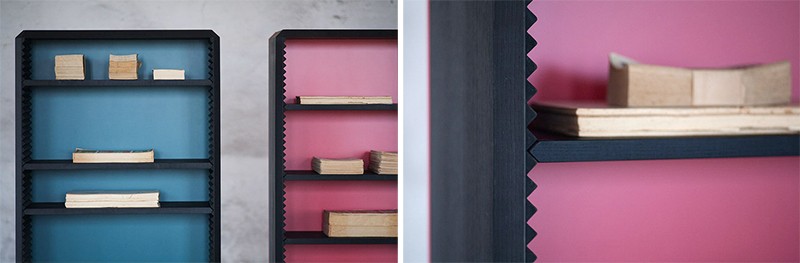
Andrew BaisleyI just bought two of these. For drinkin coffee. In jars. In my imaginary cabin.

My man @loyalstricklin is having a heck of a sale…go check it and him out.
It was a pretty good week for mashups. We got this bizarre Seinfeld / Limp Bizkit thing that really works, Metal Mary Poppins, and “Regulate” performed by Warren and Kenny G.
Here are the rest of the internet’s best treats this week: http://bit.ly/1JUHNxl
Andrew BaisleyCrazy
GoPro presents another incredible video that captures rare aerial action in high 4K quality. Brandon Mikesell recently flew over the vast mountains of Walenstadt, Switzerland in a wingsuit, with GoPro cameras attached to different parts of his body to provide different angles of both Mikesell and the landscape surrounding him. The footage follows him soaring through trees, craggy cliffs, lakes and blue skies. The views are just breathtaking.
Andrew BaisleyClick through to see pics of waves freezing on breaking in Nantucket.
We're chin deep in the work of getting this magazine ready to share, if you want to get involved contact us with the form on the right (if you like forms).
If you're into contributing pictures, video, music, words, secret maps, and that kind of creative adventure stuff email: [email protected]
If you're into booking ads, making ad-like content, setting up meetings, and that sort of stuff email: [email protected]
Andrew BaisleyI'd go crazy in most of these places

When micro spaces find their way into design magazines and architecture blogs, they reach a weird level of internet fame. Whether it's because an interior transforms into a mindboggling seven rooms or because a lofted bed feels kind of like a coffin, people just can't stop staring at miniature apartments. Here's a look back at 14 New York City microdwellings that made the media rounds, from the immaculately designed to the horrifyingly small and expensive, ranging from a roomy 450 square feet to an unbelievable 78 square feet.

↑ At 450-square-feet, this studio on West 73rd Street isn't all that micro, but thanks to its innovative, bright blue, origami-like system that hides the furniture, it garnered quite a bit of attention. Architects Michael Chen and Kari Anderson of Normal Projects created the folding contraption, which holds the bed, table, closet, and storage. The owner listed it for $469,000 in May 2014, and it sold a few months later for $1,000 more than the asking price.
 [Photo by Will Femia]
↑ When Huxley Somerville bought his 425-square-foot Upper West Side apartment for just $95,000 in 1994, it was in horrible shape. But a complete gut renovation opened up the duplex and made it impressively spacious, with stairs that double as storage, a coffee table that rises to full height, and a lofted sleeping space.

↑ Graham Hill, founder of TreeHugger and LifeEdited, hosted a design competition to outfit his 420-square-foot studio, and the result is this multi-tasking space that can accommodate a 12-person dinner party, two overnight guests, a home theater, an office, and more. He listed the Soho apartment for $995,000 in March 2014, and it sold in November for $790,000.
 [Photo via Reddymade Design]
↑ Open House New York brought dozens of people through this 375-square-foot former dentist's office designed by Reddymade Design. Everything can be put away and out of sight; even the dining table, which can be lifted up to the ceiling.
 [Photo via New York Magazine Design Hunting]
↑ It's one thing for a couple to share a tiny apartment, but this 300-square-foot space is shared by roommates, making this a very miniature two-bedroom. The common space fits just a table and chairs, but the tenants also have access to a rooftop deck

↑ By far one of the most uniquely designed microdwellings, this wood-filled studio on Thompson Street listed for an ambitious $1.3 million. The listing claimed the space was 400 square feet, but sans bathroom and small hallway, it only measures 233 square feet, so somewhere around 300 square feet is probably more accurate. It's filled with weird stuff, and still up for grabs.
 [Photo via Apartment Therapy]
↑ The design story of this 295-square-foot Upper East Side studio birthed a blog from its occupant. No fancy transforming furniture is used, but minimal decor leaves the space feeling cozy, but not claustrophobic. If it ever does get too cramped, there's a private patio.
 [Photo by Max Touhey]
↑ This perfectly-put-together 242-square-foot studio in the West Village makes use of double-duty furniture: a Murphy bed from Resource Furniture, a pocket table that folds up, and a foldable rolling island. Perhaps what's most impressive is that the apartment has a full kitchen with quality appliances, and the owners often have guests over for dinner.
 [Photo via Dwell]
↑ Here's another space that a designer completely transformed. Tim Seggerman drew inspiration from the ideals of furniture maker George Nakashima to build a "crafted jewel box" for this plain 240-square-foot space, creating a sleek kitchen, lofted bed, stairs with storage, and a crawl-in library, all in one connected piece.
 [Photo via Remodelista]
↑ The Post featured this 240-square-foot pad not long after the city's micro apartment challenge was announced, and people were amazed that a couple could happily live in this Brooklyn Heights studio. They paid $1,500 per month, which seems way too expensive for a place where the bed is lofted above the stove. Last year, the couple moved out because they were having a baby.

↑ This 175-square-foot West Village studio hit the market for $349,000 last November. Listing photos showed a jam-packed apartment that could definitely benefit from some small space hacks, so hopefully a design-minded individual saw its potential and snapped it up. It's not longer on the market.

↑ Coming in at just 100 square feet and asking an absurd $1,275/month, this Harlem studio is easily the saddest apartment in the city. It's located in a former SRO at 14 Convent Avenue and measures just eight feet wide. None of the eight apartmentsall studios, some asking $1,750!are still on the market, so there's a chance that people actually took claimed these pricey jail cells.

↑ Gawker caught wind of this 90-square-foot Upper West Side apartment after Fair Companies featured it in 2011, making it probably the most well-known micro apartment in the city. It cost just $700 and had a private bathroom, but the fame didn't work out so well for the tenant; it had been an illegal sublet, so she got kicked out, and now lives in much larger digs.

↑ And finally, the tiniest apartment we've ever come across: a 78-square-foot space in Hell's Kitchen. Also featured by Fair Companies in 2011, the closet-sized studio is in Hell's Kitchen and costs $775 per month. Considering the tenant, an architect, has to share a hallway bathroom with three other people, it doesn't seem like that great of a deal.
Andrew BaisleyUpstate NY
Architect David Jay Weiner designed this home, as a response to a client’s desire to build a small weekend house in Rensselaer County, New York, with southern views overlooking the Berkshire Hills.

Andrew BaisleySeems like it would be a pain to wash those windows
The "highest residence in all of Soho" has hit the market with a high asking price to boot. The four-story penthouse of Cary Tamarkin's triangle-shaped 10 Sullivan Street covers the building's 14th through 16th floors, as well as its rooftop, and has 8,359 square feet of interior space, six bedrooms, seven-and-a-half bathrooms, a private elevator, two wraparound balconies, a great room with 23-foot-high ceilings, a private rooftop, and not least, a private pool. And the pool is no crummy, compact lap pool; no, it's a full-on spa pool topped by a skylight and sided by a water feature wall. What else would do for a $45 million Soho penthouse?
The penthouse was expected to hit the market in late fall, but some kind of snafu executive decision drove its listing back to this week. Also this week, one of the development's four $20 million townhouses arrived on the scene.
· Listing: 10 Sullivan Street PH [Corcoran via StreetEasy]
· See the $45 Million Private Pool Atop Soho's Tallest Building-To-Be [Curbed]
· All 10 Sullivan Street coverage [Curbed]