

First there was Downown Abbey. Then there was Sherlock. Now you can add another British television import to your list, America. Rejoice, design lovers! Britain's favorite home design show is on Netflix. Grand Designs, which features wacky and ambitious builds and renovation projects, is one of Britain's longest running property shows (17 seasons!).
Lindsaycdavison
Shared posts
21 Apr 14:57

You Can Now Stream Britain's Most Popular Home Design Show on Netflix — Stream Team
by Marni Epstein-Mervis
21 Apr 14:27

Add Wallpaper to Your Bookcase for an Instant Style Upgrade
by Nancy Mitchell
Lindsaycdavison@ivy.


Bookshelves are a wonderful thing to have, because who doesn't need more storage, especially the kind that takes advantage of vertical space. But as I've discussed with some of my colleagues here at Apartment Therapy, bookcases can also be particularly difficult to style. Unless all you own is carefully curated coffee table books, or you only buy novels with white spines, a bookcase filled with your favorite tomes can result in a bit of visual chaos - and even more so when you are displaying something other than books. This post is about one of my favorite tricks for pulling a bookcase together visually, and also injecting a little style into your space: adding wallpaper.
21 Apr 14:27

Is "Goodbye, Things" the New "Life Changing Magic of Tidying Up"?
by Janel Laban


Marie Kondo is more than a household name. She's crossed over to the next level and has become a verb for those of us who write, think and obsess about all things home. Yes, "KonMari-ing" and "Kondoizing" are things now. We need our socks to spark joy if we are going to keep them around; why should we settle for anything less? Well, it's possible we should actually go for less - a lot less - according to a new book I've just read which aims to inspire us to consider living an ultra pared down minimalist life, right down to our socks.
21 Apr 02:40


Trump Donates Salary To National Parks Even As He Tries To Cut Interior Department
by Scott Horsley
Lindsaycdavisonthis is very shallow PR
Critics cried foul, including the head of the Sierra Club who called Trump's move a "publicity stunt."
(Image credit: Susan Walsh/AP)
21 Apr 02:38


Former Microsoft CEO Launches New Tool For Finding Government Data
by Camila Domonoske
Lindsaycdavisonpurty.
On Tax Day, Steve Ballmer announced USAFacts — a website where anyone can look up where government money comes from, and how it's spent, along with lots of other data.
(Image credit: USAFacts.org/Screenshot by NPR)
20 Apr 09:00
 This tiny 350-square-foot studio loft with laid-back vibes and tons of windows sits on the top of a tall building, glistening in the sky.
READ MORE...
This tiny 350-square-foot studio loft with laid-back vibes and tons of windows sits on the top of a tall building, glistening in the sky.
READ MORE...
You Have to See Inside This Teeny Tiny NYC Rooftop Studio
by Sherrie and Oliver
LindsaycdavisonThis place is tiny, but super cute.
This tiny 350-square-foot studio loft with laid-back vibes and tons of windows sits on the top of a tall building, glistening in the sky.
READ MORE...
20 Apr 08:16

IKEA Is Hiring Refugees Starting This Summer
by Kenya Foy
In addition to bringing furniture and housewares to the masses, IKEA is on a mission to create jobs around the world. The popular Swedish furniture company has ambitious plans to expand the workforce in Jordan, beginning with the opening of production centers in the country's refugee camps this summer.
19 Apr 09:46


Georgia Special Election Headed To Runoff As Republicans Avoid Nightmare Scenario
by Jessica Taylor
LindsaycdavisonThis is annoying. SO CLOSE to 50.1%!
Republicans escaped a potentially brutal loss — for now — by forcing a runoff in a closely watched special congressional election that Democrats have tried to cast as a referendum on President Trump.
(Image credit: Joe Raedle/Getty Images)
19 Apr 09:45


French Presidential Candidate Macron Takes Page From American Political Playbook
by Jake Cigainero
LindsaycdavisonHe's certainly more beautiful than Marine Le Pen.
Supporters of political newcomer Emmanuel Macron hope that talking to voters on their doorsteps — an unusual approach in France — will help him become their next president.
(Image credit: NurPhoto via Getty Images)
19 Apr 09:37

This Woodworker Carving Perfect Spiral Shavings Is Oddly Satisfying — Internet Interlude
by Tara Bellucci


How's your day going? Could you use a little break? Surely you could take 52 seconds to hit pause on life for a moment and give yourself a sense of calm. Good thing there's this soothing video of someone creating perfect spiral shavings that's exactly what we didn't know we needed to see.
19 Apr 08:51

Sale: Graham & Brown Has Wallpaper Up to 70% Off
by Tara Bellucci
Lindsaycdavisonpuuurrrttyyy


Looking to take the wallpaper plunge? Now is the time to snag some rolls at a steep discount: Graham & Brown's Spring Redecorating Event is going on right now and wallpaper (as well as some home décor) is up to 70% off. We picked a few stylish options to get you started. Check them out:
14 Apr 16:39

Here's the First Trailer For Netflix's Anne of Green Gables Series — Stream Team
by Tara Bellucci
Lindsaycdavisonthis feels super different from the original. although i haven't watched it since the early 90s probably so I'm sure my memory is shaky.
It's time to take a trip to Green Gables because today, Netflix released the trailer for "Anne," their remake of the classic story about a spirited redheaded orphan who goes to live on a Prince Edward Island farm.
13 Apr 02:24
Catch some rays while Honda's Miimo robotic lawn mower does your chores for you
by Lulu Chang
A robot can already vacuum your floor, so it follows naturally that one ought to be able to mow your lawn, too. Meet Miimo, a robotic mower that promises to be "convenient, intelligent, and automated."
The post Catch some rays while Honda's Miimo robotic lawn mower does your chores for you appeared first on Digital Trends.

13 Apr 02:23


TheSkimm Founders On What It’s Like To Start A Business With Your BFF
by Lydia Dishman
Lindsaycdavisonanyone heard of this?
Can best friends and roommates succeed in business–and still want to speak to each other?
TheSkimm’s founders, Carly Zakin and Danielle Weisberg, met when they were in college and reconnected several years later while working as news producers for NBC. Zakin and Weisberg sent out their first daily newsletter to a small group of their friends, family, and friends of friends on a Tuesday, in July 2012.
For a while, the pair worked on their own to build the startup that quickly became an essential daily news digest for millennial women (and men). Today, the ranks have swelled to over 40 staffers, and the subscriber base is now more than 5 million, boosted by a network of over 20,000 “Skimm’bassadors,” a community of passionate members who regularly join social chats on Facebook and other channels and help test new products and marketing initiatives. Last year, informed by this group, the iOS app Skimm Ahead launched to help members stay in the know about future events.
Here, Zakin and Weisberg share how they started theSkimm, and how they’ve engineered successful growth.
No Need For An A-Ha Moment
Contrary to some founders’ stories, Weisberg and Zakin maintain that they didn’t have a titular epiphany that sparked the idea for theSkimm. “It probably would be a much simpler story if there was,” Weisberg says. She adds that the foundation was laid well before the concept. “We grew up as news geeks, loved storytelling,” says Weisberg, “and always wanted to work at NBC News.” From there, she says, they were inspired by friends who basically asked the pair of news producers to skim what was going on in the world each day and deliver the highlights.
“At the same time, we were working in an industry trying to strategize ways to get female millennials’ attention,” Weisberg says, “but the way they were going about it didn’t really make sense, given modern news consumption and modern routines.” If anything provided the kindling to fire up the business, it was identifying this void. “We knew we could start something that gave [millennials] information every day in a way they trust, and in a way that fit into their routines.”
Risky Business
Everyone was telling them email was dead, but Weisberg maintains that there was a voice that was always in their heads cautioning them not to overlook the beauty in the simplicity of what could be created using that channel. “It’s something we use every day,” she says, not to mention that it had a low entry barrier. “It wasn’t just a good idea, there was a need for it,” she says. And at a certain point, Weisberg says, her parents got sick of hearing her talk about it and urged her to just give it a shot.
A post shared by theSkimm (@theskimm) on
On Being Besties And Business Partners
“I think the best thing that ever happened to us is that we were roommates first,” Zakin says. Neither of them were making a lot of money working in media, she admits, but they managed to save about $4,000.
“We did have a lot of conversations about credit card debt and what we were willing to do,” Zakin says. “We pushed each other off the ledge,” Weisberg says. (They tell Fast Company they just paid off their credit card debt, but didn’t say how much was owed.)
Starting theSkimm with a shared vision–from their shared couch–was the ultimate bonding experience. “It’s hard not to put a ton of hours in,” says Weisberg, “with a product that goes out at 6 a.m.” She recalls that for the first six months, they worked around the clock and slept in shifts.
They made a lot of progress during that time, in part because they were “feeding off the other’s enthusiasm and belief,” says Zakin, likening it to an out-of-body experience. It paid off. Previously, Fast Company reported that the startup had hit 100,000 subscribers “very early on” and built additional traction through word of mouth.
The other part was their commitment to what the company could be. “There’s been so much reported about how open we’ve been about all the things we didn’t know [about starting a business],” she continues, “but not about how much we did know. We really knew the audience.”
As for their friendship, Zakin contends that the roller-coaster ride of starting a business served only to cement the bond. “Honestly,” says Zakin, “you become family, your families become family.”
Weisberg is quick to point out that the reason their partnership and friendship could coexist was that they didn’t jump into it; it took years to develop. “We wouldn’t recommend eloping with someone you met the day before,” she says. In business, as in marriage, the two made a contract and a promise to each other, Weisberg says. And if you ask them what accomplishment makes them proudest, Zakin says it’s a tie between building theSkimm’s culture of transparency, authenticity, and “no bullshit,” and their special partnership.
No Management Experience, No Problem
One of the things that surprised the pair was how long it took to hire the first employees. The two did the bulk of the work for the first year and started to bring people on after they raised a seed round of $1 million in 2013. From there, thoughts naturally turned to culture and management. “We asked people what we didn’t know,” says Weisberg, noting they were fortunate to have a great network of founders and people who built brands to tap for management advice. “Our earliest employees helped to shape us into the managers we are today,” says Weisberg.
Building A ”Zero-Drama” Culture
When theSkimm was ready to add staff, Weisberg says they spent a lot of time and effort on finding people who could communicate clearly. “We are running a business, not a sorority.” Adds Zakin, “We get shit done.” She points out that one of the company values is: “We are confident and humble: Nobody is too senior to do something, nobody is too junior to do something.” The team is very collaborative, she says, and this keeps drama at their office to a minimum.
With that in mind, theSkimm has a chore chart for its staff. “Everyone takes out the trash,” Zakin says. As for hiring, she says potential candidates need to show that they can check their ego at the door. “We like to bring candidates back for repeat visits,” Zakin explains. “We have them sit with as many [employees] as possible, and try to mix it up across teams. It often slows down the hiring process, but we want to make sure we get it right.”
They say they recently hired a head of HR now that the company’s staff has grown. And they’ve implemented something called Skimm’cademy to onboard new staff. The goal is not only to teach new employees the mission and values of the company right away, but also to ensure that everyone knows what others do. For example, they wrote in a Medium post: “Every single person should know what each person actually does at the company. It’s not enough to say ‘sales’ or ‘engineer,’ but actually what they do and how it affects you.”
Houston, we have no problems… because these seats. Omg. #SkimmLife #superbowl
A post shared by theSkimm (@theskimm) on
Best Boundaries
We know that it can be good for productivity to have BFFs at work. And we also know that it can be a bad idea to be buds with your boss. But what happens when the founders are so close? Says Weisberg, “You don’t have to be best friends with your coworkers, but everyone wants to work in an environment where they feel respected and heard.” That’s especially important in a startup, she says, where it’s rarely just a job, especially not a nine-to-five one.
To ensure that, Weisberg points back to their hiring process and the importance of culture fit. “We also set aside time to bond in social settings,” she says, “whether it’s all 40-plus employees sharing weekly highs and lows at Friday Sip ‘n Skimm [weekly drinks and a catchup], or coming together to celebrate milestones with champagne and Skimm’aoke [team karaoke].” Zakin says the team can sometimes spend too much time at work. “We’re glad they love it here,” she says, but there have been times when someone has been told to take some time off to stave off burnout.
“It took us a while to be able to put intent into work-life balance,” Weisberg admits. But she says it was important to incorporate it for themselves as well as to model for their team. “You have to be a person” outside of work, she says she’s learned. “Sometimes the most creative thing you can do is take time for yourself,” she adds, because it keeps you healthy and keeps the creativity flowing. Zakin notes that Weisberg takes team members to spin class to encourage that healthy balance a bit more.
Building Out
“We took the biggest risk of our lives and started the company from our couch,” Weisberg muses, recalling the trouble they had raising money initially because they weren’t able to articulate their vision. Indeed, for the first 15 months, they weren’t sure how they were going to keep it up and running. But Weisberg says that what started as a daily newsletter aimed at capturing millennials’ attention first thing in the morning wasn’t the only thing they were hoping to create. “The intention was always to create a much larger company,” she says, “focused on making it easier for (both millennial women and men) to be smarter.” The pair plan to add video this year and are working on some other initiatives that they aren’t yet ready to discuss, but are excited to grow.
But if they’ve got one lesson they want to share with future entrepreneurs now, it’s this: “Go take a vacation before you start your business.” Weisberg says they didn’t take any time between working at NBC and sending out the first Skimm email. “And that was it, we were off to the races.”
12 Apr 08:16
Here’s a retro-styled Bluetooth keyboard that you might actually want to use
by Trevor Mogg
Retro-styled keyboards appear to be gaining in popularity recently, but the Penna looks like a solid effort you might actually want to use. It's already smashed through its Kickstarter target and should ship this summer.
The post Here’s a retro-styled Bluetooth keyboard that you might actually want to use appeared first on Digital Trends.

12 Apr 07:27

10 IKEA Hacks to Keep Your Houseplants Happy
by Katie Holdefehr


If you want to introduce more greenery into your home (while keeping more green in your wallet), IKEA once again comes to the rescue. By embellishing IKEA's inexpensive planters and turning baskets into hanging container gardens, you can create an indoor forest for a lot less than it would cost to stock up at your local garden center. Being a plant parent just got much more affordable.
10 Apr 10:45


Five New Rules My Company Set After A Hiring Disaster
by Baron Schwartz
Early in 2014, my year-old company faced a critical launch deadline. Feeling pressured and anxious, I started hiring in a hurry. To make a long story short, it didn’t go well.
I soon realized we’d wound up with some real misfits. A couple of them turned out to be openly contemptuous of the company’s norms and culture, as well as of my own directives as a leader. Others simply hadn’t yet developed the skills they needed to do their jobs well. I should’ve fired the troublemakers early on, but I was afraid of a nasty confrontation and embarrassed to admit my errors. Instead, I spent the next few months hoping things would get better. They didn’t.
But there was a silver lining to that painful experience: It made me realize I needed to step back and figure out a hiring strategy that was right for me as a leader, for my young company, and for our applicants. And it turns out the right strategy was a much slower one.
Point-Counterpoint:
- Why “Hire Slow, Fire Fast” Is A Better Strategy Than You Think
- Why “Hire Slow, Fire Fast” Is A Bunch Of BS
Five New Rules To Live By
My aim in opting for a “go-slow” approach to hiring was simple: improve my company’s chances of hiring only terrific people. I consulted with an outstanding executive coach, and together we thought hard about what we needed to do to make that happen. It was an intense—and, as it turns out, invaluable—period of introspection. Here’s what our hiring principles and processes look like now:
1. Make the job description painfully honest. We do everything we can to offer a crystal-clear description of what a job really entails, as well as what success is in that role. We even share which performance metrics we’ll be measuring. This takes time and a lot of forethought, especially for newly created roles. But it’s worth all the effort. We want our candidates to know exactly what they’re getting into.
2. Stop trying to “sell” the company to potential hires. “Employer branding” starts with the belief that you need to lure talent by talking about how great it is to work for you, but that can sometimes lead to misrepresenting what the company is really like. We’ve stopped doing that. Instead, we use a multistage interview process to try and listen more closely to what our candidates say their needs and interests are. Are they excited about the job, and about our industry? Are their skills and experiences appropriate to the position for which they’ve applied? Will they mesh with our company culture? To find out, we ask short, simple questions, and try hard not to lead interviewees (intentionally or not) to tell us what they think we want to hear.
Related: The Deceptively Simple Interview Question Every Interviewer Needs To Know
3. Focus on track records. We now look more closely than we used to at what applicants have actually achieved in the past, not their future trajectory or hopes for the next stage of their careers. It’s not that those other things don’t matter, it’s just that they’re less revealing than what they’ve already done. We also scrupulously check references, seeking confirmation of a candidate’s experience and skills and any other information on their strengths and weaknesses.
4. Ask candidates to take a personality assessment. This way we can understand how they work best and what motivates them, and also so we—and they—can honestly assess if the job is a good fit. This may sound like it’s a little over the top, but talent experts believe there’s a real need for more rigorous, psychologically grounded interviewing techniques. In our case, at least, this step has already proved to be an extremely valuable exercise on both sides of the table.
5. Remind candidates that they’re also interviewing you. Yes, this is something of a cliché by now, but it’s something candidates tend to forget in the thick of an interview. So remind them point-blank! Are they really interested in working in our industry? Are they comfortable working at a startup? Do their potential teammates seem like the kind of people they’d enjoy working with? At any rate, interviewing with us is a two-way street.
Risks And Rewards
It’s true that speed is often the name of the game in the startup world, but I’ve found that hiring slowly is actually the best way to get things moving fast. In the three years since we implemented this new approach, we’ve had zero turnover among our engineers and very little in the company as a whole—which means we’re significantly nimbler and more efficient. People are happier and more productive. Bad hires not only fail do to their own work but they tend to absorb other people’s time, too.
I realize that our slow-and-steady approach may mean that we miss out on some top talent. On the other hand, we’re also far more likely to bypass the headaches and setbacks that come with making bad hires. As I’ve learned the hard way, hasty hiring can put the brakes on the growth of your business. Taking the time to build a strong, positive, cohesive team is the only way I’ve found to accelerate.
Baron Schwartz is the founder and CEO of VividCortex. He is one of the world’s leading experts on MySQL and has helped build and scale some of the largest web, social, gaming, and mobile properties. Follow him on Twitter at @xaprb.
10 Apr 10:45


These Are Six Communication Styles That Every Single Person Uses
by Stephanie Vozza
If you’ve ever had a miscommunication or failed to comprehend what someone else was trying to say, it could be that your perceptual languages are getting in the way. Discovered by development psychologist Taibi Kahler, perceptual languages are the different processes of how people communicate. The way people communicate often carries more information than the words themselves, says clinical psychologist Nate Regier, cofounder of the communication-coaching firm Next Element.
“Perceptual languages are filters through which we interpret the world,” he says. “Six perceptual languages exist, and while we’re capable of speaking all of them, a preferred order becomes set by age 7. We have a favorite, and it’s called our base.”
People who learn to listen for other people’s perceptual languages connect better with others and improve their ability to recall information, says Regier. The way to identify which language someone is speaking is to listen for common words and phrases. You can also download the free smartphone app PocketPCM for Apple or Android, which gives examples of perceptual languages and helps diagnose personalities.
Here are the languages, and clues for identifying each one:
1. Thoughts Language. Someone who speaks in the thoughts language likes to talk about facts, details, characteristics, and features. They ask questions about who, what, where and why, and they want things to make sense. This language makes up 25% of the North American population, says Regier.
“Telltale signs of this person is someone who starts sentences with ‘I think’ or ‘Research suggests,’” he says. “They ask questions about data and time. They want to communicate in a logical way that is orderly and systematic.”
2. Opinions Language. A person speaking with the opinions language is like a judge and the world is their courtroom, says Regier. “Opinions are very different than thoughts because the language is based on values and judgment,” he says. “They start sentences with ‘In my opinion’ or ‘In my view.’ They use judgment words like ‘should,’ ‘could,’ ‘would,’ ‘ought,’ and ‘must.’”
Ten percent of people use opinions as their base perceptual language, says Regier.
3. Feelings Language. A person who speaks with the feelings language uses their heart as a compass, says Regier. “They focus on feelings and emotions,” he says. “They start sentences with ‘I feel’ or ‘I care.’”
Thirty percent of people have feelings as their base language.
4. Reactive Language. The person who uses the reactive language doesn’t have a filter and doesn’t think before they speak “They just say stuff,” says Regier. Look for words like “awesome” or sentences that start with, “I love” or “I hate.”
Twenty percent of people have reactions as their base language.
5. Action Language. The person who speaks with the action language uses a lot of verbs. “These people want to know, ‘What are we doing?’ and ‘Where are we going?’” says Regier. “They say phrases like, ‘Let’s go for it’ and ‘Cut to the chase.’ Life is about taking charge and getting it done.”
Five percent of the population uses action language as their base.
6. Reflections Language. A person who uses reflections language doesn’t talk a lot, but when they do their language is passive and nebulous, says Regier. “They say things like ‘Let me reflect on it,’ or ‘In my mind’s eye.’ Their mental process is uncontrolled and completely open.”
Ten percent of people use reflections language as their base.
How To Communicate Across “Languages”
Once you identify someone’s preferred perceptual language, use it to improve understanding, says Regier. “If you have a thinker boss who asks a feeling employee what they think, the employee might respond with, ‘It feels good to me,’ but they’re not answering the question and there can be miscommunications or assumptions,” he says.
When communicating an important message, translate the information into the listener’s perceptual language. “Determine what content you want to convey, then adjust the process of how you deliver it so it can be heard and understood,” he says. “The languages have nothing to do with the content of what is communicated, but the words will sound different depending on language.”
For example, a thinker boss can improve team communication by tailoring the message to the listener. If she’s talking to an employee who uses action language, she can change “What do you think?” to “Bring me up to speed on what’s happened and what we should do next.”
Focusing on perceptual languages can help you improve your memory. “It’s based on what cognitive psychologists call the Baker/baker paradox,” says Regier. “The more different associations your brain can make with what’s being said, the more easily it can be recalled later on.”
Recognizing someone’s perceptual language also allows you to anticipate other things about them, such as their character strengths, motivations, and values, says Regier. “Likewise, if we tune into the perceptual language, we can pick up on more of what the person intends and means when they are speaking, and therefore remember more of what’s most relevant to them,” he says.
A person who pays attention and speaks the listener’s perceptual language is often thought of as a great communicator. Bill Clinton is a master of using perceptual languages and studied under Kahler, says Regier. “He used it all the time and really tuned into other people,” he says. “Clinton and Trump have similar leadership styles, but Trump doesn’t care how he affects or connects and Clinton really did.”
07 Apr 04:42

Why You Don't Actually Need to Work Out Every Day (According to Science)
by Brittney Morgan
LindsaycdavisonI'm listening...


We all know working out comes with a lot of health benefits, but what if exercise is just not really your thing, or you have a too-busy schedule that doesn't allow for daily workout time? As it turns out, you don't have to exercise every day—you'll still get those healthy perks even if you're a less frequent gym-goer.
07 Apr 04:36
Now Gwyneth Paltrow Wants You To Walk Around Barefoot!
by Perez Hilton
LindsaycdavisonGP is really something...
No shirt, no shoes... YES service! Or so says Gwyneth Paltrow!
In its latest newsletter, goop published a piece about the benefits of "earthing therapy" where one walks around barefoot in order to be one with the planet.
Related: Gwyneth Wants You To Do ANAL!!!
According to the publication:
"Earthing therapy rests on the intuitive assumption that connecting to the energy of the planet is healthy for our souls and bodies. And while there's a definite, if New-Age, appeal to the concept of energetically connecting with Mother Earth, there's also a more scientific angle to the practice, which posits that access to the abundant supply of free electrons in the (subtly negatively charged) ground can help neutralize free radicals—if only we would take off our shoes and access them."
The Royal Tenenbaums actress apparently "swears by" the treatment, which can reportedly cure insomnia, arthritis, and depression.
Earthing-movement leader Clint Ober recommends you kick off your shoes and enjoy Earth's bare surface for at least thirty minutes a day.
"The simplest and most natural method of grounding is to go outdoors and place your bare feet and hands directly on the earth—many people choose to go for a barefoot walk in the park or on the beach.... It takes at least a half an hour of exposure to access significant health benefits, so I recommend a minimum of thirty minutes of barefoot time outdoors daily, if possible."
Sadly, walking around the house sans footwear will NOT do the trick!
"Walking barefoot in your home, where minimally conductive or nonconductive materials like concrete foundations and hardwood floors insulate us from the earth's electric potential, will not have the same effect."
The method -- also called "grounding" -- can also do wonders for one's emotional well-being as well!
"Grounding also affects emotional health through pain reduction—if you have pain, you're going to be emotionally stressed. If you reduce inflammation, the pain stops, you feel better, and the energy comes back. There have also been studies that indicate that grounding improves mood, reduces stress, and has a calming effect."
You heard it from GP herself... SHOES SUCK!!!
[Image via WENN.]
05 Apr 18:27

Here's the First Trailer for the Love Actually Sequel
by Tara Bellucci
Lindsaycdavisonummm have we talked about this yet??
Love Actually fans, the BBC has released the first trailer for the upcoming sequel—and in it, Andrew Lincoln picks up his famous cards once more.
04 Apr 11:53


The U.S. Cannot Be Run Like a Business
by Henry Mintzberg
LindsaycdavisonIt'd be interesting to ask bloomberg how he ran his company differently than his govt.
i'm sure i could google this actually.
Donald Trump ran his campaign with the promise to manage the U.S. government like a business. In fact, he just announced that his son-in-law, Jared Kushner, will head up a “SWAT team” dedicated to making this happen.
Trump assumes, as do many Americans, that the country’s major problem is too much government. In my view, the United States is not suffering from too much government so much as from too much business all over the government. This president came into office to challenge “the establishment,” only to ensconce the country’s powerful business establishment in his cabinet, at the expense of Washington’s weaker political establishment.
Should government even be run like a business, let alone by businesspeople? No more than business should be run like a government by civil servants. Each in its own place, thank you. Governments experience all kinds of pressures that cannot be imagined in many enterprises, especially the entrepreneurial kind run by Trump.
Consider this: Business has a convenient bottom line, called “profit,” which can readily be measured. What is the bottom line for terrorism: The number of countries on a list, or of immigrants deported, or of walls built? How about the number of attacks that don’t happen? Many activities are in the public sector precisely because their intricate results are difficult to measure.
Running government like a business has been tried again and again, only to fail again and again. In the 1960s, Robert McNamara introduced the Planning-Programming-Budgeting System as a “one-best-way,” businesslike approach to government. The obsessive measuring led to the infamous body counts of the Vietnam War. Later came new public management, a 1980s euphemism for old corporate managing: Isolate activities, put a manager in charge of each one, and hold them responsible for the measurable results. That might work for the state lottery, but how about foreign relations or education, let alone, dare I say, health care? People in government tell me that new public management is still promoted, though now it might better be called “old public management.”
Then there’s the question of customers. “Our hope is that we can achieve successes and efficiencies for our customers, who are the citizens,” Kushner told the Washington Post, echoing a misguided, overworked metaphor. (When he was vice president, Al Gore also referred to the American people as customers.) As I discussed in my Harvard Business Review article, “Managing Government, Governing Management,” I am not a mere “customer” of my government, buying some service at arm’s length. I am a proud and involved citizen of my country.
Business is essential – in its place. So is government, in its place. The place of business is in the competitive marketplace, to supply us with goods and services. The place of government, aside from protecting us from threats, is to help keep that marketplace competitive and responsible. In Washington, which government in recent years has been fighting vigorously for competition and responsibility?
A healthy society balances the power of respected governments in the public sector with both responsible businesses in the private sector and robust communities in what I call the plural sector — the clubs, religions, community hospitals, foundations, NGOs, and cooperatives with which so many of us engage. The plural sector, although the least recognized of the three, is large and diverse. Many of us may work in businesses and most of us may vote for governments, but all of us live much of our lives in the community associations of the plural sector. (The United States has more cooperative memberships than people.) This is the sector that can offset the destructive effects of the pendulum politics that keep so many countries swinging back and forth between public government controls and private market forces. Especially today, we may well have to rely on this sector to restore the balance that has been lost in the polarized, outdated politics of left versus right.
The most democratic nations in the world get closest to balancing themselves across these three sectors — for example, Canada, Germany, and the countries of Scandinavia. During the decades following World War II, the U.S. was closer to that balance. Recall the era’s prosperity and development, social as well as economic, despite high taxes and generous welfare programs.
Then the Berlin Wall fell. Arguably, it landed on the democracies of the West. That is because we misunderstood what brought it down. Western pundits, reflecting the bias that is now so prominent, claimed that capitalism had triumphed. Not at all. Balance had triumphed. While the communist states of Eastern Europe were utterly out of balance, in favor of their public sectors, the successful countries of the West retained a certain balance across all three sectors.
With this misunderstanding, a narrow form of capitalism has been triumphing ever since, throwing America, along with many other countries, out of balance the other way, in favor of private-sector interests. Seen this way, Trump himself is not the problem so much as an extreme manifestation of the larger problem: imbalance in favor of private interests, with too much business involvement in government.
In the United States, this problem has been developing for a long time. The Republic was barely a quarter-century old when Thomas Jefferson expressed the hope that “we shall…crush in its birth the aristocracy of our monied corporations which dare already to challenge our government to a trial of strength.” In the last century, trustbuster Theodore Roosevelt spoke of the “real and grave evils” of too-powerful corporations, arguing that “it should be as much the aim of those who seek for social betterment to rid the business world of crimes of cunning as to rid the entire body politic of crimes of violence.” A few decades later, Dwight Eisenhower warned that “in the councils of government, we must guard against the acquisition of unwarranted influence, whether sought or unsought, by the military-industrial complex.”
A skeptic might say, “If we’ve always been worried about something and it hasn’t happened yet, maybe it’s time to stop worrying.” But, in fact, the risks have been escalating steadily for some time, and they have sharply increased since capitalism’s triumph in the 1990s.
The Supreme Court granted corporations the right to personhood in 1886, and more recently extended that right to the funding of political campaigns — arguably a tipping point in two centuries of shifting toward private sector power in American society. Look around at the scandal of income disparities, at climate change, exacerbated by excessive consumption, and at the unregulated forces of globalization that are undermining the national sovereignty, and thus the democratic institutions, of so many nations. No wonder voters around the world are demanding change, even if some of the consequences are ill-considered. The valid side of their concerns will have to be addressed.
The relationship between business and government, a separation of powers no less vital than that within government itself, has become so confounded that it threatens American democracy itself. When free enterprise in an economy becomes the freedom of enterprises-as-people in a society, to paraphrase Abraham Lincoln, government of the real people, by the real people, and for the real people shall perish from the Earth.
31 Mar 06:32

5 Breakfast Machines for the Most Important Meal of the Day
by Tara Bellucci
LindsaycdavisonAnyone want to spend $300 on a griddle with a robot that can draw cool pancakes?
Do you love breakfast? If you're looking for ways to get creative with the most important meal of the day, here are five appliances that rank from cool and useful to niche and wacky that you can actually buy to build a better (or more complicated) breakfast.
31 Mar 06:23

3 Simple Things Happy Travelers Do Before They Leave for a Trip
by Brittney Morgan
LindsaycdavisonClean , basically.
Nothing beats the relaxation that comes with taking a much-needed vacation. A trip away from it all—whether you're headed somewhere warm and beachy or ready to bundle up somewhere colder—can be just the thing you need to help you unwind and de-stress. But there's one thing that can drag you right back to reality when you return: a messy home.
31 Mar 06:15

Make Your Home Smell Amazing with a Trip to the Supermarket
by Anne Momber


Is there anything better than coming home to a great-smelling home? (Aside from coming home to a great-smelling home that also happens to be beautifully clean, of course.) But why stock up on candles when you can find everything you need to freshen things up in the grocery store – possibly without even leaving the produce section? Here are three natural ways to make your home smell nice with the help of your favorite fruit, herbs and spices.
30 Mar 07:49

Have Your Couch's Back: Sofa & Console Tables Under $250
by Arlyn Hernandez
Lindsaycdavisonwe basically have that parsons table behind our couch :)


I tell anyone who's trying to figure out where to put their sofa that if they can help it and have the room that they should float it in the room (as opposed to having it up against the wall). It divides large, open spaces, creates intimacy in your seating area, not to mention is a creative solution when you don't have the right wall space for both a sofa and a focal point (or let's get real, your TV). The only down side to my favorite furniture arranging trick? Starring at the back of a sofa. That's where the sofa table comes in, because you shouldn't leave your floating sofa in the lurch.
30 Mar 07:08

The Mindy Project's 6th Season Will Be Its Last
by Tara Bellucci


Sad news, Mindy fans: Kaling's eponymous series, The Mindy Project, will be ending after next season. Here's what we know:
27 Mar 18:15


12 Genius Ways to Apply Emotional Marketing to Facebook Ads
by Today's Industry Insider
Facebook advertising is a big auction.
There are both winners and losers.
Now, you wouldn’t want to be on the losing side, would you?
So, what can you do to create Facebook campaigns that finish the race as champions, having collected many new customers in the process?
A smart move would be creating ads that catch people’s attention before any other Facebook post or ad can get to them. While there are many tips and hacks written about all across the web, here’s one that seems highly promising: playing on people’s emotion.
An analysis of 1,400 successful ad campaign case studies found that campaigns with purely emotional content performed about twice as well (31% vs. 16%) as those with only rational content.
Trend Hunter Marketing analyzed 55 emotional marketing campaigns, and found the average popularity score to be 8.0 — higher than in other categories.
By spicing up your Facebook campaigns with a pinch of emotion and a dash of thrill, you can allure your Facebook audience, making them click and purchase.
There’s no limit to the emotions you can bring into play – excited, melancholic, delighted, shocked – you name it.
This post will teach you how to apply emotional marketing to Facebook ads (and celebrate a landslide victory over the competition.)
Ready to win the Facebook ads race? Let’s go!
1. Master the Art of FOMO
If you’ve ever attended an event because you thought “Maybe something cool would happen,” it was likely due to FOMO – the fear of missing out.
What if all your friends go out while you’ll be missing out on all the fun…
A study of millennials found that as many as 69% experience FOMO when they are not able to attend an event where their friends are going.
People are afraid of being left without an amazing experience.
But FOMO doesn’t only apply to attending events. It also applies to other aspects of life and business.
For example, Sumo has written Facebook ad copy that makes the reader think that everyone else is already using their software and the person reading is the last one out.
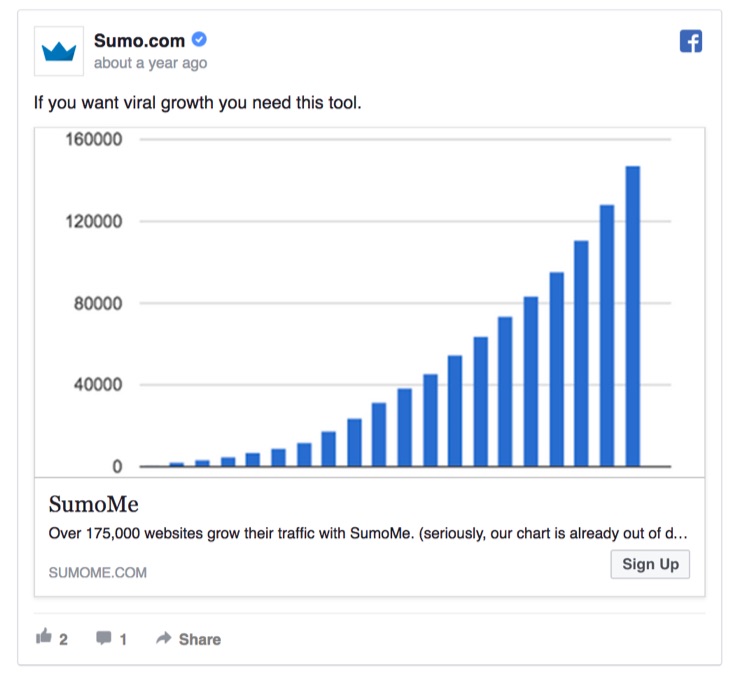
By saying that over 175,000 websites use their tool, Sumo makes the reader wonder if they’re missing out on something.
Now, you wouldn’t want to be left behind while all those other websites speed right past you. So, you’ll likely click on the ad to see how to get the tools yourself.
How to use FOMO in your Facebook ads:
- Mention the number of people already benefitting from your product.
- Pose a question, hinting that the person’s missing out on a great opportunity.
- Make the reader feel like there’s a fascinating community they’re not part of… Yet.
- Make your Facebook ad offer limited by time to nudge people to sign up faster.
2. Show the Excitement
Excitement is known for its ability to increase impulsivity and make people quicker to act.
So, if you’ll manage to get a person excited in your Facebook ad offer, they’re a lot more likely make the purchase based on the momentum.
The author of The Psychology of Social Shopping, Paloma Vasquez points out that:
“In a state of excitement or arousal, people think and behave very differently. Emotional states trump rational thinking; it’s easier to sell to consumers when they are excited.”
As you look at Try The World’s Facebook ad, you’ll notice that it breathes excitement for several reasons: the bright ad color, lots of exclamation marks, and the energetic tone of voice.
One can almost feel the excitement of opening the subscription box and discovering its treasures.
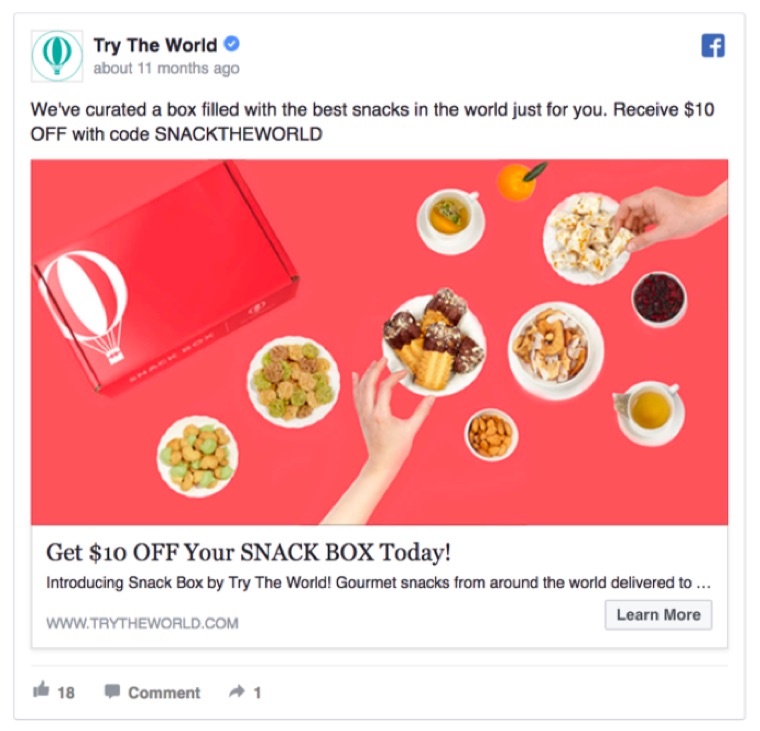
As you decide to use the excitement tactic in your Facebook ads, don’t let the sparkle fade before the purchase is made.
An article in the Wall Street Journal suggests that it takes 20 minutes for the feeling of excitement to pass.
In most cases, emotions fade even faster.
So, it’s best to keep your ad’s landing page as straightforward and compelling as humanly possible and lead the visitor to signup.
A few tips for creating exciting Facebook ads:
- Use bright colors in the ad design.
- Use exclamation marks and keep your ad copy short.
- Include an ad image that shows excitement.
- Showcase your product at the most exciting moment of its lifecycle.
- Make sure that your offer is actually interesting to the target audience.
- Include a discount offer to give the final nudge and make the ad irresistible.
3. Create a Curiosity Gap
If you’ve ever thought what makes Upworthy and Buzzfeed headlines so irresistible, here’s one of their secret weapons: the curiosity gap.
Put simply, the curiosity gap is the discrepancy between what we currently know and what we’d like to know.
And it works wonders if your goal is to get people clicking.
Copy Hackers was able to get a 927% boost in clicks on their Pricing page after applying the tactic.
And of course, curiosity gap can also be incorporated into your Facebook ad copy.
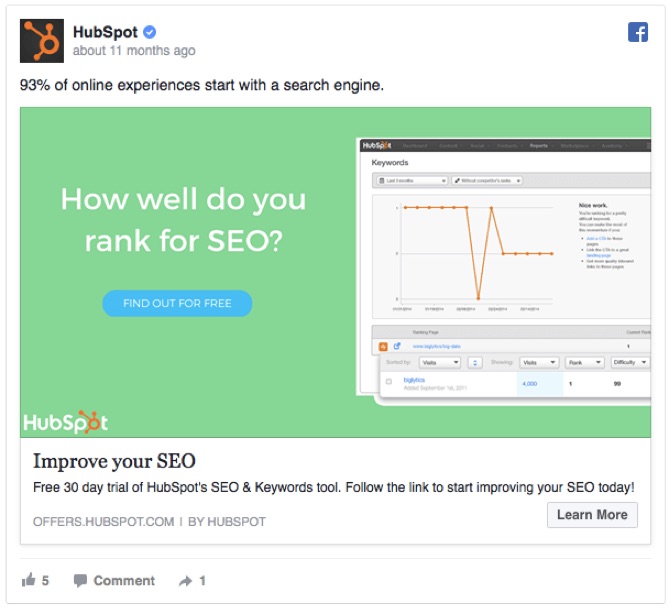
As someone spots HubSpot’s question “How well do you rank for SEO” in their Facebook Newsfeed, they’re bound to find out the answer. That is, if HubSpot’s targeting a Facebook audience of marketers.
The formula of curiosity gaps is simple: Ask people a fascinating question or tell them a cool story, and leave the best part untold.
SurveyMonkey, for instance, asks in the ad’s headline “Want a GoPro?” and sparks the reader’s curiosity to find out more.
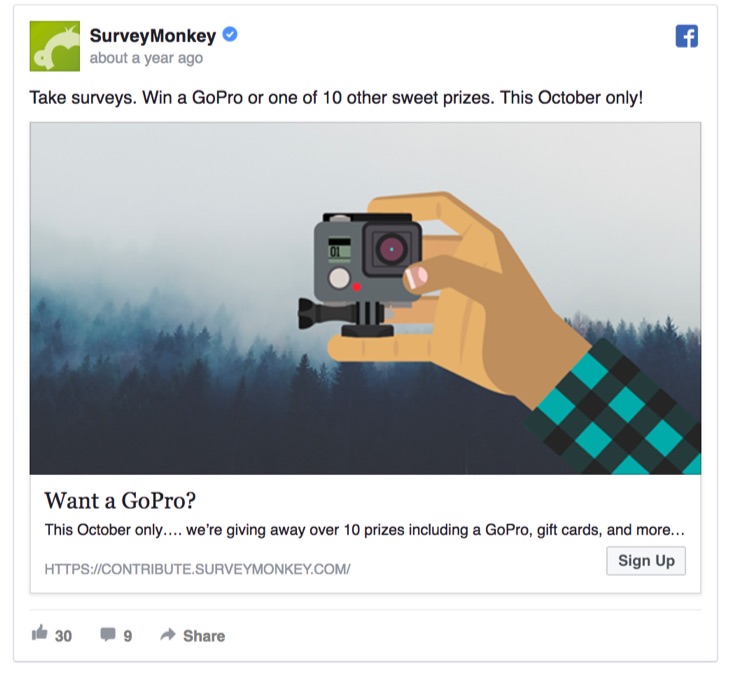
The reason why this works is that people have a natural tendency to connect the dots and discover the answers. It will be hard for them to resist reading and clicking on your Facebook ad after it has posed a fascinating question.
When targeting a cold audience, it’s best to fill in their curiosity gap for free. With warm audiences, you can ask for something in return, e.g. their email address.
Download Our New Facebook Advertising Guide! We outline how to create a Facebook customer acquisition machine that consistently delivers new sales and customers. Download today!
4. Make People Happy
A study in 2010 of the most-emailed New York Times articles found that emotional articles were shared more often. The study also noted that positive posts were shared more often than negative ones.
What if the same rule applies to your Facebook ads – will positive ads get more likes and clicks?
There are three main tactics to make use the emotion of happiness in Facebook ads:
- Brightly colored ad design.
- Including an ad image with smiling people.
- Using adjectives and verbs with positive connotations.
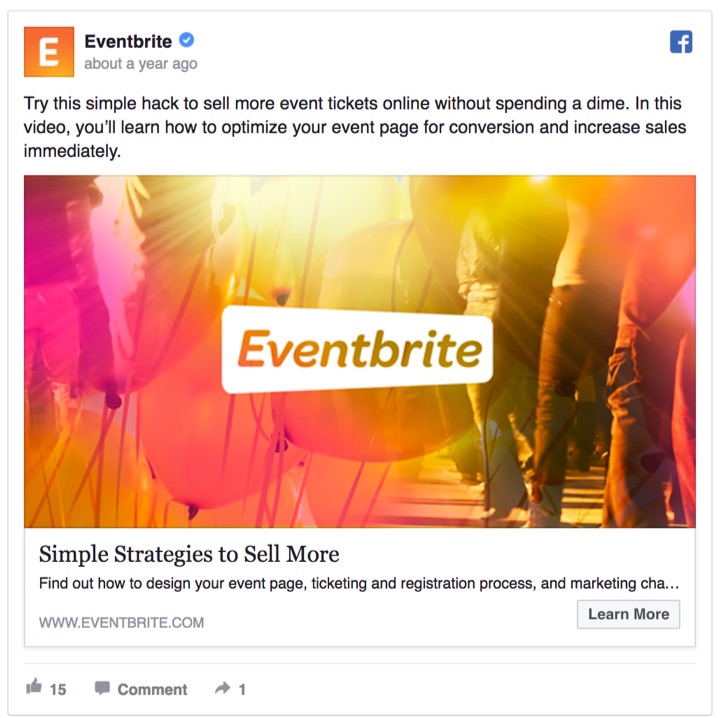
Eventbrite is applying all the three methods across their Facebook ad campaigns.
From the positive color scheme…
To smiling people:
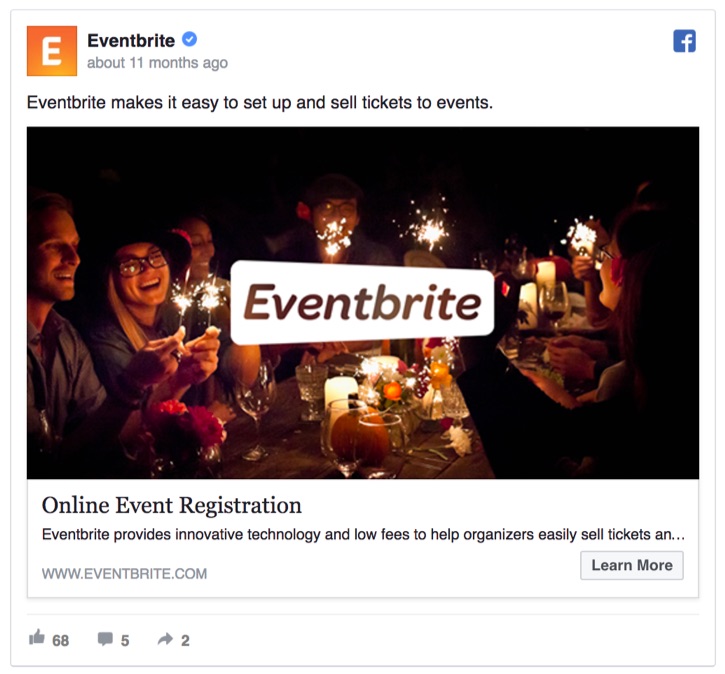
Not only Eventbrite’s ads spark positive emotions towards the offer, but people will learn to associate the entire brand with happy feelings.
A study analyzed more than 1 million online reviews on sites like TripAdvisor and found that restaurants received significantly better ratings on days with nice weather and worse reviews on any day with rain.
If your goal is to make people remember your brand as a mood-booster on a rainy day, create more positive ad designs.
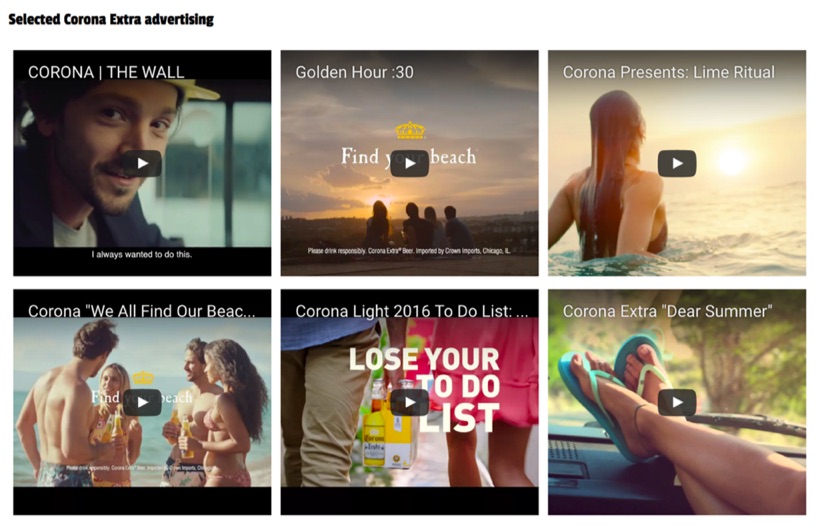
Happiness marketing can work especially well for B2C brands. For example, alcohol producers are often publishing commercials with people enjoying themselves on the beach or at a party. If you look at Corona’s ad profile, you’ll see that every ad follows this best practice.
5. Learn to Handle Negative Feelings
A Facebook ad sparking negative feelings isn’t always a bad thing.
Especially if it first ignites the negative thoughts and then offers a solution to cheer you up.
However, don’t overdo the negativity in your ads.
A study by researchers at Stanford GSB and Tel Aviv University discovered that small doses of mildly negative information — a so-called blemishing effect — might actually strengthen a consumer’s positive impression of a product or service.
The key to successful Facebook ads may lie in including just the right amount of negativity.
For example, Contently’s ad headline can make many marketers worry: “If the future of content isn’t blogging, what am I going to do?”

But just as the ad’s negative headline has grabbed the reader’s attention, it offers a solution: “More videos. More downloadable content. More infographics.”
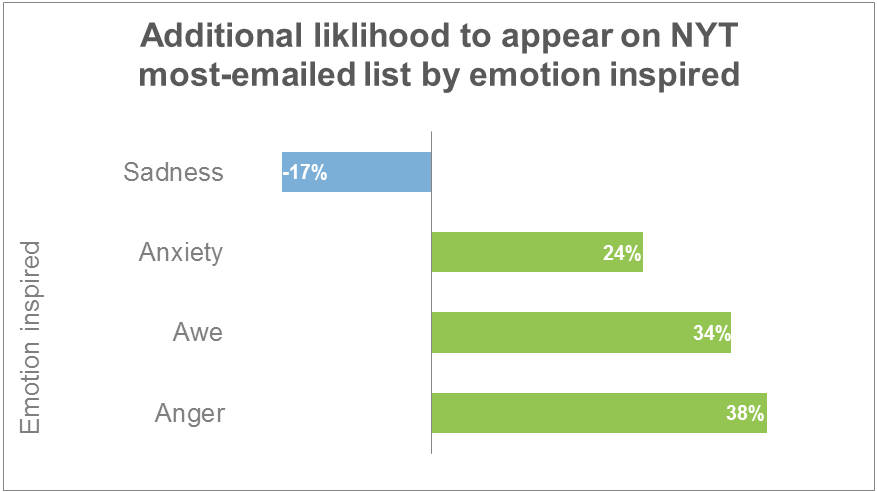
According to the viral content study by The New York Times, some negative emotions contribute more to virality than others. Most specifically, the negative emotion of anger.
Here’s how to put negative feelings to good use in your Facebook ads:
- Capture your audience’s attention with a negative headline.
- Let your audience know about a small default about your product to show you’re not hiding anything.
- Remind the readers of a negative fact or situation they encounter on a daily basis.
6. Offer Hope for Better Future
We all hope that we’re going to be prettier, smarter and funnier.
That’s one of the reasons we buy new things — to improve our lives.
While deep inside, everyone knows that most of the time material things won’t make us happy; we still keep hoping they will.
Shopify’s Facebook ad plays on the emotion of hope, using aspiring language and brilliant copywriting.
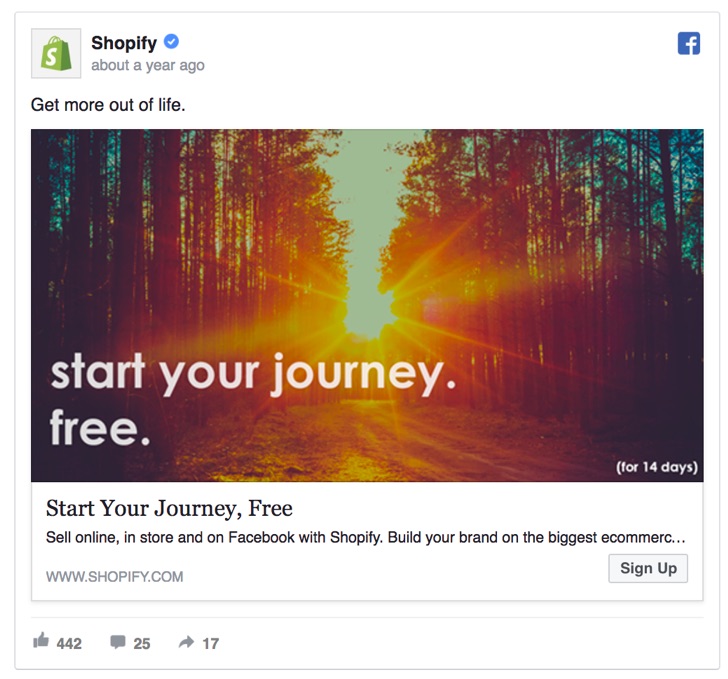
“Start your journey” and “Get more out of life” are both great slogans and talk to Shopify’s target audience.
Now that you already know that the emotion of hope can be activated by masterful copywriting. Is there anything else you can do?
In fact, there is — as you create a Facebook ad sparking hope, also provide a platform or a solution to reach the better future. For example, if you promise to double a company’s revenue, be clear about how you’ll do it.
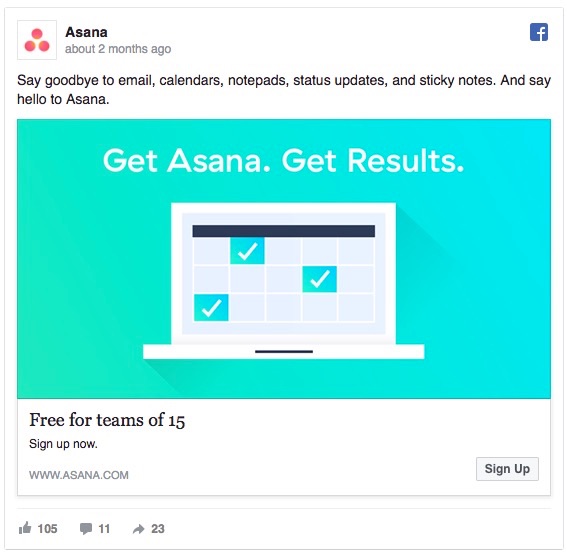
Asana’s Facebook ad promises many great improvements in teamwork, making a project manager wish their team could achieve even more.
7. Help People to Feel Proud
According to Dan Hill, author of Emotionomics: Leveraging Emotions for Business Success:
“Emotions process sensory input in only one-fifth the time our conscious, cognitive brain takes to assimilate that same input.”
This means that emotions have a strong effect on our immediate actions.
LEGO’s Facebook campaign makes moms proud of their kids, reminding them of the children’s capacity to create amazing things.
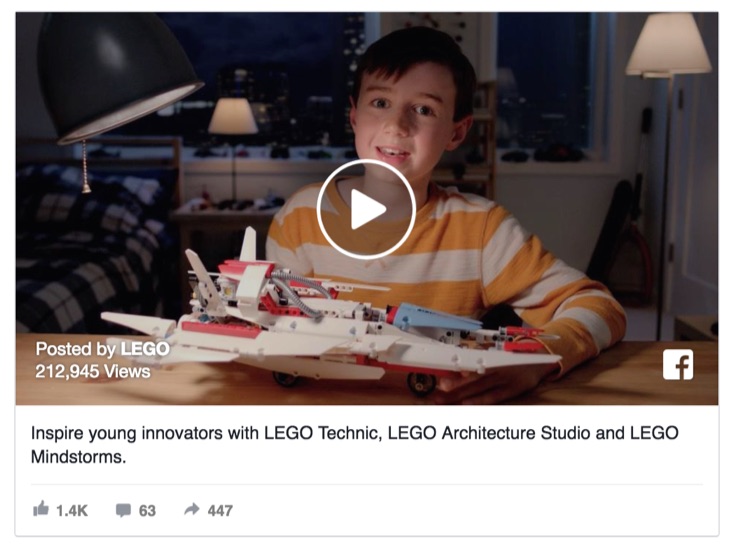
Moreover, LEGO’s campaign hooks with the previous point — using the emotion of hope. Many parents are drawn to the offer because they’d like to see their children learn and succeed.
Another way to make people feel great about their purchase is to remind them that they’re making a smart choice.
That’s exactly what the Dollar Shave Club does by saying their product is the smarter way to shave.
The person who buys the subscription will know they’ve made a clever deal and will feel good about it.

8. Create a Sense of Urgency
When you give people too much time to make a decision, they’re going to postpone the conclusion and will likely forget about it.
However, when presented with a limited time offer, people get worried about missing out on the awesome offer.
Applying scarcity and urgency on a website helped an entrepreneur increase sales by 332%. How much can you increase your ads’ click-through rate by using the same tactic?
For example, Target’s Facebook ad creates the sense of urgency by limiting their discount offer to a specific date.
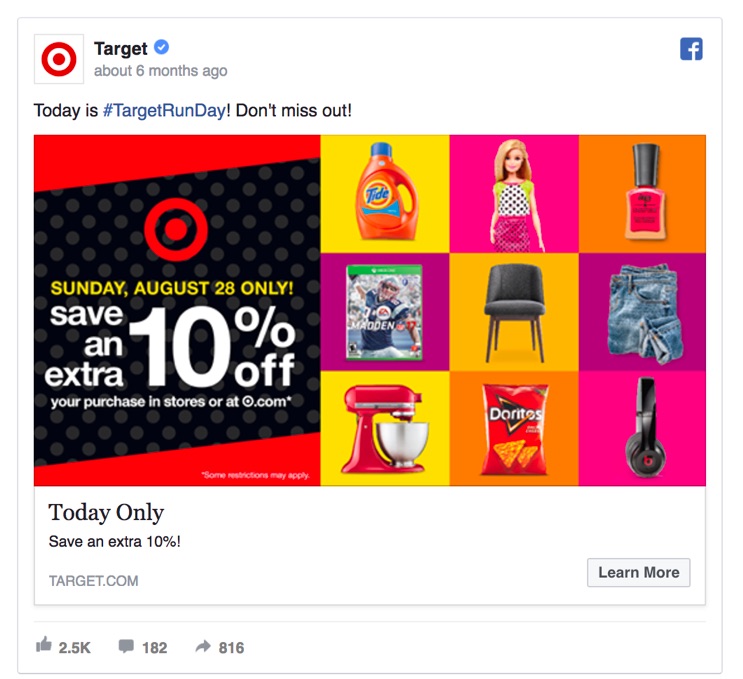
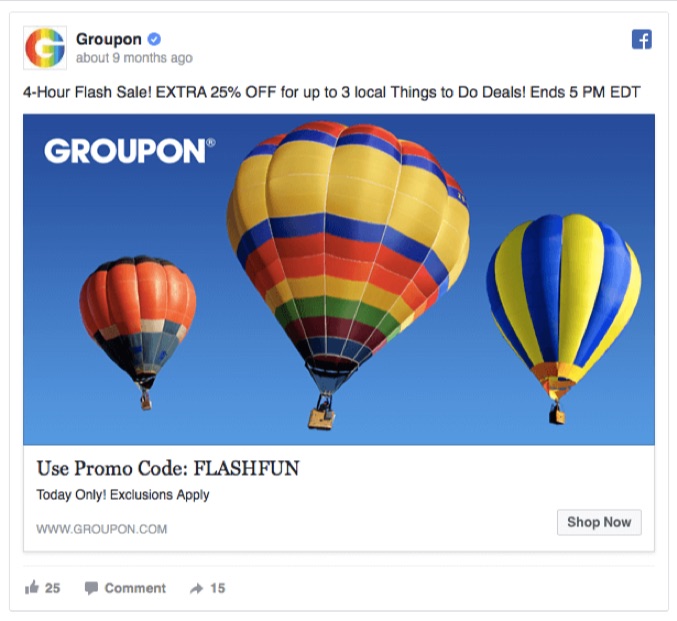
Groupon has even added the end time with the time zone specification to make their offer feel more urgent. This way, there’s no doubt when the offer’s going to end.
How to create a sense of urgency in your Facebook ads:
- Define clear dates, e.g. “Today only” or “Offer ends in 24h.”
- Offer a great discount, e.g. “Get 60% off today.”
- Keep your offer simple and brief.
- Place your best offer in the ad’s headline or the image.
- Match the ad’s offer on the landing page.
9. Surprise Your Audience
Psychology Today reports that fMRI neuro-imagery shows that consumers use emotions rather than information to evaluate a brand.
If you’re looking for a strong emotion that will immediately catch your audience’s attention, create an offer that’ll surprise them.
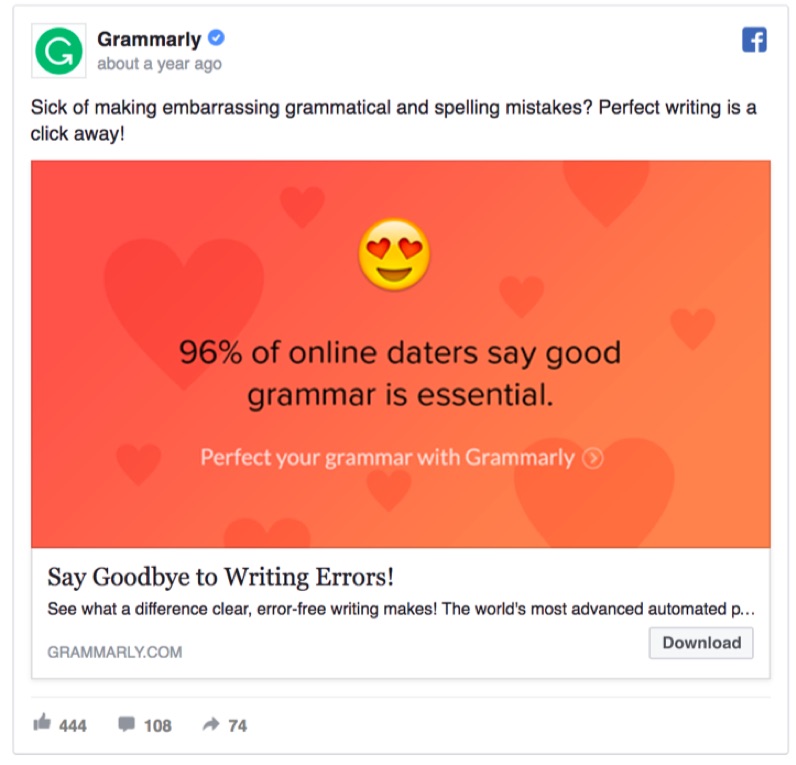
A simple way to surprise people is to conduct an original survey and share interesting stats with your ad audience. That’s exactly what Grammarly has done:
You can also learn to apply the surprise-and-delight approach that’s based on the principle that nice surprises make people feel special and important.
Offer a free coupon or some other pleasant surprise to win your Facebook target audience’s attention and trust vie a series of small gestures.
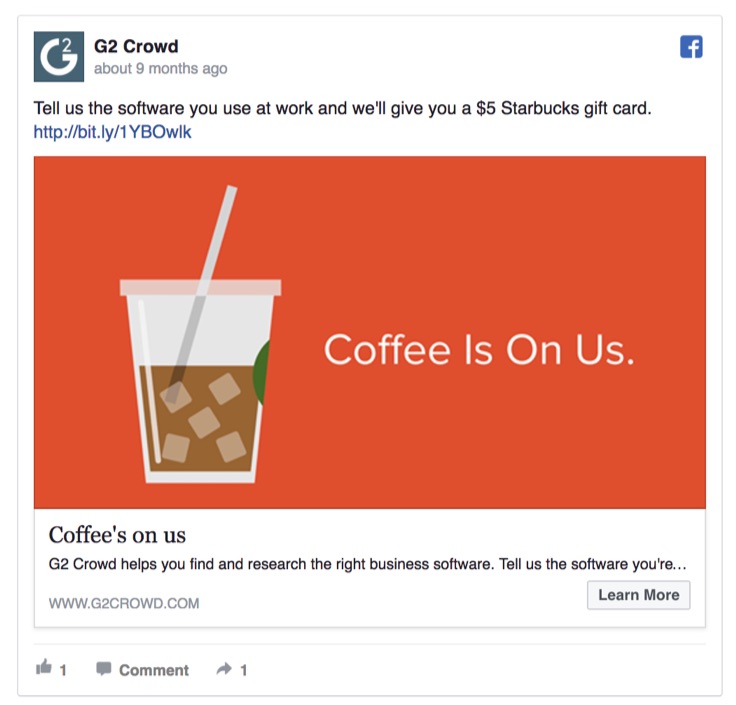
G2 Crowd offers a $5 Starbucks gift card in exchange for filling in a quick survey. This works for two reasons:
- People are pleasantly surprised to get the gift card.
- By filling in the survey, they’ll become familiar with G2 Crowd’s brand.
When you create noteworthy Facebook ads, they’ll distribute organically via the likes and shares of your target audience.
According to a Nielsen study, 83% of people say they always trust the recommendations of friends and family, which makes it ever more important to engage your target audience.
10. Spark the Sense of Belonging
Some of the world’s most successful brands were originally built through low-cost community-based marketing. Starbucks, Google, Apple … The list goes on.
People are hardwired to search for understanding and support from their peers. A sense of belonging to a large community improves our motivation, health, and happiness.
What if you could frame your Facebook ad offer as an invitation to an exclusive club of awesome members?
This approach is often used in event marketing. By presenting all the famous attendees, conferences make people interested in joining them at the venue.
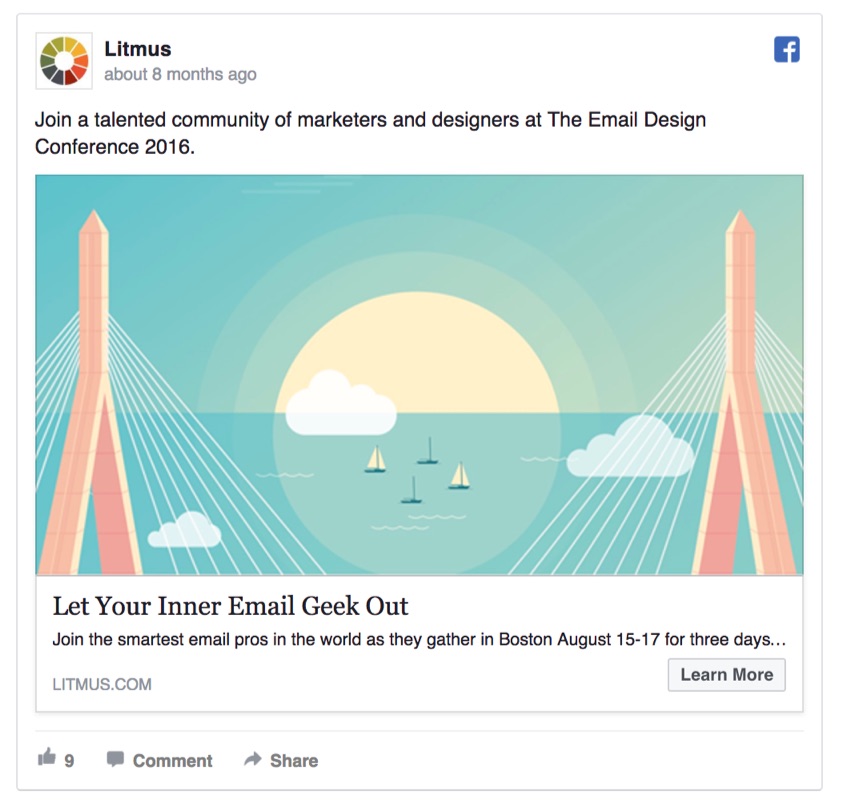
Here’s an example by Litmus, inviting the viewers to join “the talented community of marketers and designers.”
How to use emotional marketing to create a sense of belonging:
- Frame your offer as an invitation into an attractive community.
- Include the names of influencers using your product.
- Mention the size of your user base to convince people of the community’s worth.
- Make the entry challenging enough for the person to value the community.
11. Untap the Power of Guilt
People feel guilty about different things, but one thing’s for sure: if you can hit the right nerve, you’ll win their attention.
Consumers who feel guilty tend to respond well to small, short-term fixes. That’s why the number of new gym memberships soars after a long holiday period and declines shortly after.
A study published by researchers at The University of British Columbia suggests that guilt can be a powerful tool for motivating self-improvement and for selling self-improvement products and services.
But not only — guilt as an emotion can also be used in the B2B industry.
For example, Scoro’s Facebook post asks, “Are you working hard or hardly working?” makes a person think whether they’re really contributing enough.
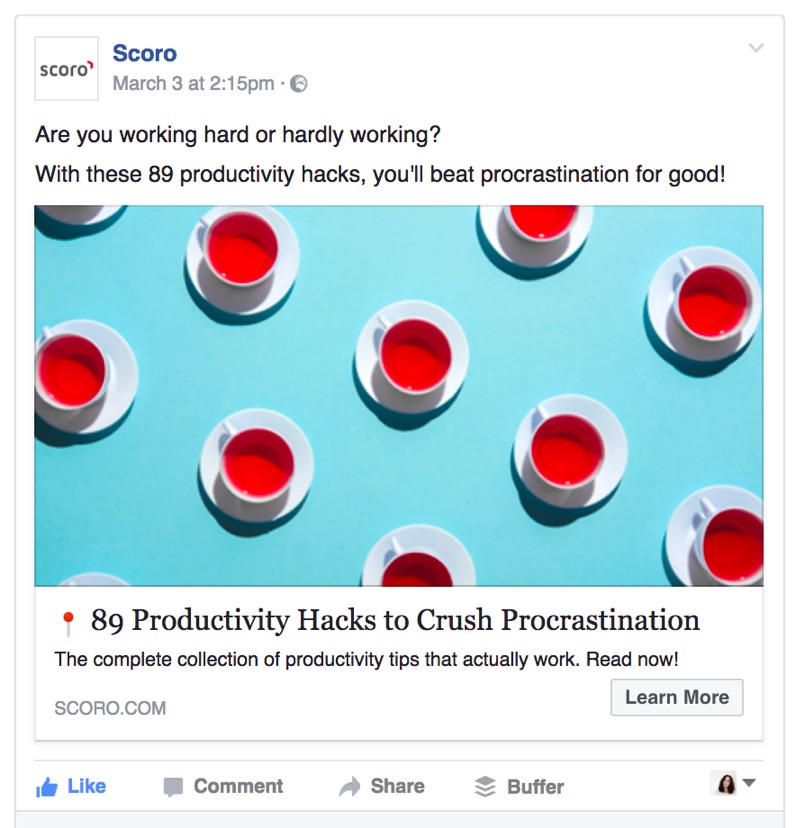
The Facebook ad also offers a quick solution: 89 productivity hacks to improve oneself.
Remember that emotional marketing with guilt works best if you also provide a quick fix to the audience’s problem.
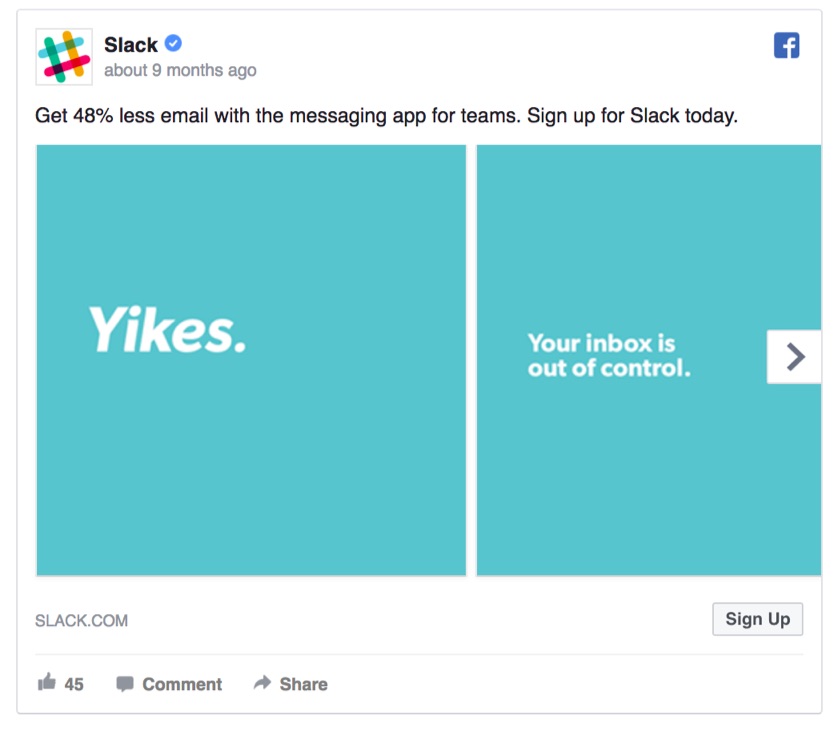
Slack’s Facebook ad has taken a similar approach by stating “Your inbox is out of control.”
Another reason why this ad works is the strong emotional word “Yikes” in the first ad image, instantly catching people’s attention.
How to use guilt for successful Facebook campaigns:
- Remind your audience of a small mistake they’re making.
- Offer a quick solution to their problem.
- Use strong words that spark negative feelings and help to grab attention.
12. Make People Feel Important
Performance coach Tony Robbins has named the feeling of being significant to be one of the six basic human needs.
We all want to feel important and valued by others. And smart marketers know how to use this knowledge to create irresistible ad campaigns.
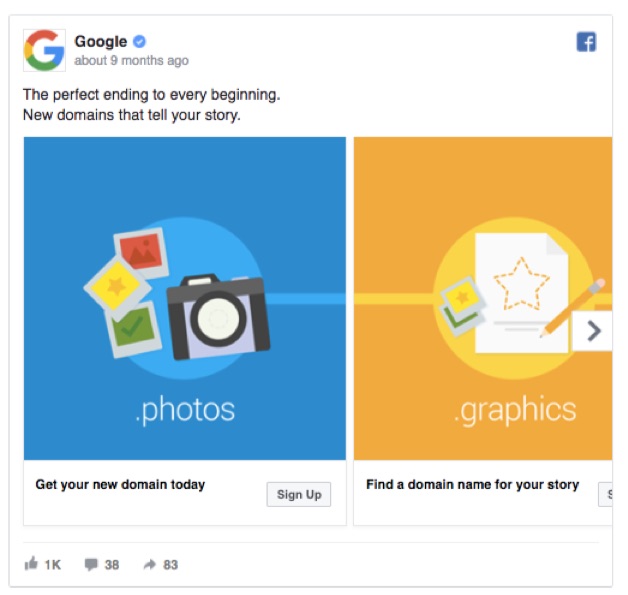
For example, Google’s Facebook ad looks at every benefit through the prism of you: New domains that tell your story. Get your domain today. Find a domain name for your story.
Here’s another clever Facebook ad example by Spotify:

By creating a highly personalized value offer, Spotify will ignite curiosity while also making the person feel important.
To make your ad audience feel important, create a personalized ad and use the word You to talk directly to the reader.
Conclusion
Emotions can go a long way in helping to create click-worthy Facebook ads.
According to a 2016 Nielson report, emotions are central to advertising effectiveness. The ads that generated the best emotional response also generated a 23% lift in sales volume.
Applying emotional marketing tactics to your Facebook campaigns isn’t as difficult as it seems. All it takes is smart copywriting and original ad design. And of course, a touch of creativity.
To wrap it up, here are all the emotions listed once more: The fear of missing out, excitement, curiosity, happiness, negative feelings, hope, pride, urgency, surprise, sense of belonging, guilt, feeling of importance.
Find out what works best for your target audience, and see your sales results grow.
About the Author: Karola Karlson is the founder & author of Aggregate, the most upright blog about marketing, growth, and data. She’s also a contributor to marketing blogs like AdEspresso, HubSpot, and KlientBoost, and works as the Digital Marketing Manager at SaaS startup Scoro. Karola’s all about random cool ideas, growth marketing, and taking new marketing approaches on a test drive. Connect with her by visiting her blog or on Twitter.
Andrewerose likes this
21 Mar 02:41

Netflix Is Testing a Button That Skips The Opening Credits
by Maggie Coughlan
Netflix just made binge-watching your favorite TV shows easier than ever. The streaming service is currently testing a "Skip Intro" button that allows users to skip the opening credits of television series.
21 Mar 01:57

Ellen DeGeneres & Portia de Rossi List Their Santa Barbara Villa for $45 Million — House of the Day
by Tara Bellucci
Lindsaycdavisonthat's a lot of money.
there isn't a picture of the pool, which is weird. Apparently there are multiple.
Ellen is on the move. The comedian, TV host, and designer has listed the Santa Barbara villa that she and wife, actress Portia de Rossi, bought in 2013.