Shared posts

15 Apr 16:28

Why Amazon Is Copying Zappos and Paying Employees to Quit

by Bill Taylor

Last week, Amazon founder and CEO Jeff Bezos released his annual letter to shareholders. As is the case every year, it is a tour de force of ideas and initiatives about the customer experience (Amazon Prime), disruptive technology (Fire TV), fast-growing product initiatives (Amazon Web Services), and strategic consistency. (As he does every year, Bezos attached his first letter to shareholders from back in 1997 to underscore the company’s long-term commitments.)

Still, for all these big, cutting-edge innovations, it was a small, pre-existing idea, something that Amazon borrowed from one its subsidiaries, that generated the most public attention. Bezos’s letter unveiled his well-named Pay to Quit program, in which the company offers fulfillment-center employees one-time payments to leave Amazon. Each employee gets the offer once a year. The first time, it’s for $2,000. The offer increases by $1,000 each year after that up to a maximum of $5,000.

If Pay to Quit sounds familiar, there’s a reason. The idea was invented several years ago at Zappos, the online retailer based in Las Vegas that has become iconic for its zeal about customer service. Tony Hsieh and his colleagues call their program The Offer, and it’s made as new recruits experience the company’s deep-dive training program. The Offer, which applies to all new Zappos employees, not just front-line service people, started at $100, went to $500, then $1,000, and now stands at one-month’s salary. Amazon bought Zappos back in 2009, and now Jeff Bezos is shipping some of this upstart’s ideas into his behemoth organization.

So what to make of this pay-to-quit boomlet? Why are high-profile innovators like Tony Hsieh and Jeff Bezos making it easy, even attractive, for employees they worked hard to recruit to leave their companies and move on to the next thing?

The first (and most obvious) answer is that unhappy people make for unsuccessful companies. As Bezos notes in his letter, “In the long run, an employee staying somewhere they don’t want to be isn’t healthy for the employee or the company.” This is not, it should be stressed, an indictment of the organization or people who choose to leave. Great companies are great precisely because they stand for something special, different, distinctive. That means, almost by definition, that they are not for everybody. It takes a certain personality type to thrive in the extroverted, almost theatrical, culture of Zappos, or the driven, no-nonsense culture at Amazon. If there isn’t the right fit, it makes perfect sense to quit.

But the more valuable role of these offers may be their impact on the employees who choose to stay. Once a year at Amazon, front-line employees, whose jobs are anything but glamorous, get a chance to sit back, reflect, and choose whether to re-commit to the company and their colleagues. In a sense, Pay to Quit is an annual performance review of the company by its employees: Can I imagine not working in this department, with these people, for this company? It is they who are making the call, they who are choosing not to take the money and run — which creates a deeper sense of engagement and affiliation.

Who can forget the memorable scene in The Godfather, when Michael Corleone explains to his older brother, “It’s not personal, Sonny. It’s strictly business.” (The Corleone’s, of course, had different techniques for persuading colleagues to, ahem, leave the organization.)  The spirit of enterprise today, the energy that makes great companies tick, is precisely the opposite of that much-quoted piece of management wisdom.

Work is personal. That’s the driving force behind the truly great companies I’ve gotten to know, an unshakable sense that a company’s capacity to create economic value for its customers connects directly to its ability to create a sense of meaning and camaraderie for its people at every level of the organization.

And that, I’d argue, is the real takeaway of these programs for leaders in other companies, whether they choose to implement some version of them or not. With all the threats and challenges and competitors in the world, so many of the business leaders I meet focus on the age-old question: What keeps you up at night? What are the problems and worries that nag at you? But the much more powerful question, especially for people on the front-lines of business is: What gets you up in the morning? What keeps everyone more committed than ever, more engaged than ever, more excited than ever, even as the competitive environment gets tougher than ever?

Sure, the most successful innovators think differently from everyone else — Hsieh and Bezos personify that mindset. But the most successful companies care more than everyone else — about customers, about colleagues, about how the organization conducts itself in a world with endless opportunities to cut corners and compromise on values.  You can’t be special, distinctive, compelling in the marketplace unless you’ve built something special, distinctive, compelling in the workplace. Your strategy is your culture, your culture is your strategy.

Here are the questions that matter: How engaged are people at every level of the organization in the company and their work — how personally do they take things? How much money would it take to persuade them to leave the organization? And, in the spirit of The Godfather, what are you doing to make sure Pay to Quit is an offer they can refuse?

15 Apr 14:40

How to Make Macaroni and Cheese Waffles

by J. Kenji López-Alt
Lindsaycdavison

i standby that these look super good

20140328-macaroni-and-cheese-waffles-19.jpg

[Photographs: J. Kenji Lopez-Alt]

Waffled macaroni and cheese might not rank quite as high on the list of "things you must try before you die" as, say, a fresh-from-the-water oyster, or a sliver of Parmesan sliced off of a wheel that has just been opened in front of your eyes, or skinny dipping in mixed company. But it's certainly good enough that it should immediately make your list of second-tier priorities.

That is, of course, if you do it right.

We're pretty thorough when we try to answer the question "will it waffle?" In this case, it meant waffling macaroni in three different ways before finally nailing it.

N.B. The Waffleizer recommends breading the macaroni and cheese in eggs and bread crumbs. His waffles look glorious, but we took a different approach.

Method 1: Waffle Batter

20140328-macaroni-and-cheese-waffles-04.jpg

My first idea was to go with the approach Kenny Shopsin uses with his famous mac and cheese pancakes: just throw macaroni and cheese into batter and cook it as normal.

To up the game a bit, I started with my Bacon, Cheese, and Scallion Waffles as the base, stirring in some fresh mac and cheese that I made on the stovetop, using a basic recipe of cooked macaroni and a roux-based cheese sauce (a tablespoon of flour cooked into a couple tablespoons of butter, a cup of milk whisked in, and 3/4 pound of cheddar cheese stirred in off heat, the whole thing whipped up in a blender with a touch of mustard and hot sauce).

20140328-macaroni-and-cheese-waffles-05.jpg

I folded it together then dropped it into the waffle iron to cook.

20140328-macaroni-and-cheese-waffles-08.jpg

The waffles that came out were...okay. The flour and egg-based batter sort of takes away from the gooey, macaroni-and-cheesiness of the whole thing.

20140328-macaroni-and-cheese-waffles-10.jpg

Don't get me wrong; It's a breakfast I'd eat with reckless abandon—particularly with plenty of hot sauce—but it wasn't quite what I was after.

Method 2: Sandwich

My second method was a big step up. Instead of a batter, I simply sandwiched my macaroni and cheese, along with a couple of extra slices of American cheese, between two slices of white bread that I'd slathered up with a bit of mayo.

20140328-macaroni-and-cheese-waffles-23.jpg

A definite improvement (it probably could have done with some bacon). The mac and cheese stayed gooier, and the bread provided a nice crisp crust.

Still, doesn't anything that's not actually macaroni and cheese distract from the macaroni and cheese? How much macaroni-er and cheesier could I get this?

Method 3: No Filler

This time I tried doing for macaroni and cheese what KFC did for the chicken sandwich with their Double Down: replace the bread with the filling.

20140328-macaroni-and-cheese-waffles-02.jpg

I started by pouring out my macaroni and cheese onto a buttered rimmed baking sheet and placed it in the refrigerator until it set up.

20140328-macaroni-and-cheese-waffles-03.jpg

A half hour later, it came out as a solid brick about a half-inch thick.

20140328-macaroni-and-cheese-waffles-12.jpg

Next, I sliced it into squares with a knife.

20140328-macaroni-and-cheese-waffles-13.jpg

With the help of a metal spatula and the careful application of physics, I was able to get the square out in single slabs. Slabs that just so happened to be about the size and shape of a slice of bread.

20140328-macaroni-and-cheese-waffles-14.jpg

I tried waffling a single slab on its own, but it was nowhere near cheesy enough. Instead, I decided to go with the grilled cheese sandwich approach, spreading a thick layer of grated cheddar cheese in between a couple of mac and cheese slabs.

20140328-macaroni-and-cheese-waffles-15.jpg

Now, you might be afraid that such a monstrosity will stick to the inside of your waffle iron and relegate it to the trash heap, but not so!

20140328-macaroni-and-cheese-waffles-16.jpg

Yes, the cheese oozes out from between the macaroni and cheese slabs and flows in rivulets through the waffle wells. Yes, the cheese breaks and pools of glorious fat start to bubble up.

But! As anyone who has ever made Parmesan crisps or eaten at the venerable Shady Glen in Manchester, CT knows, if you fry cheese for long enough, it'll fuse into a crisp, browned shell that comes right off your cooking surfaces.

After the mac and cheese "sandwich" cooked long enough to brown, it lifted straight out of the waffle iron, clean and easy, the cheese rivulets lifting straight up and hardening into lacy, crisp edges as they cooled slightly.

20140328-macaroni-and-cheese-waffles-18.jpg

This really might be the best way to eat macaroni and cheese ever. The center stays gooey and cheesy, while the edges get crisp and browned.

20140328-macaroni-and-cheese-waffles-21.jpg

If you really want to get down and dirty, you might consider filling those waffle wells with syrup and hot sauce. But don't blame me if you end up unsatisfied with every other aspect of your life after having tasted its glory.

About the author: J. Kenji Lopez-Alt is the Chief Creative Officer of Serious Eats where he likes to explore the science of home cooking in his weekly column The Food Lab. You can follow him at @thefoodlab on Twitter, or at The Food Lab on Facebook.

Get the Recipe!
15 Apr 14:21

Dinner Tonight: Cheesy Grits With Sautéed Ham and Kale

by Nick Kindelsperger

20140410-289473-dinner-tonight-cheesy-grits-sauteed-ham-and-kale.jpg

Cheesy Grits with Sautéed Ham and Kale. [Photograph: Nick Kindelsperger]

I love cheesy grits so much that I'd be happy to eat them as a meal all on their own, but for people saner than I (like my wife), a meal has to be more than just a bowl of ground corn and oozy cheese. For accompaniments, I could look to tradition and make something like shrimp and grits, but I was hoping for a little more textural contrast than that, which led me to a hearty green like kale—plus, you know, it adds color. As for the ham, do I really need to come up with an excuse for it?

You can make this with instant grits if you'd like, but real grits have a better flavor and texture and don't take much extra time to cook. (Just bring the milk and water to a boil, add the grits, turn the heat to low, and let it cook for 25 minutes or so, stirring every once in a while.)

Plus, that gives you the time to make the ham and kale. The more flavorful the ham, the better, so skip the water-logged deli slices in favor of something smokier and saltier. Country ham will work great here, though you'll need to add less salt to the rest of the dish. I went with some stunning slices from Smoking Goose in Indianapolis—it's so flavorful that the kale quickly takes on the taste of collards that have been slowly simmered with ham hocks. The final thing needed is just a touch of tanginess, which I add with a generous drizzle of vinegary hot sauce right before serving.

About the author: Nick Kindelsperger is the editor of Serious Eats: Chicago. He loves tacos and spicy food. You can follow him as @nickdk on Twitter.

Every recipe we publish is tested, tasted, and Serious Eats-approved by our staff. Never miss a recipe again by following @SeriousRecipes on Twitter!

Get the Recipe!
15 Apr 10:35

Triple Berry Dutch Baby

by joythebaker
Lindsaycdavison

bob's burgers christmas episode anyone?

Triple Berry Dutch Baby

It’s all well and good until someone has to stand in front of the stove and flip the pancakes.

It’s a thankless job and I wouldn’t wish pancake flipping onto anyone’s relaxed weekend.

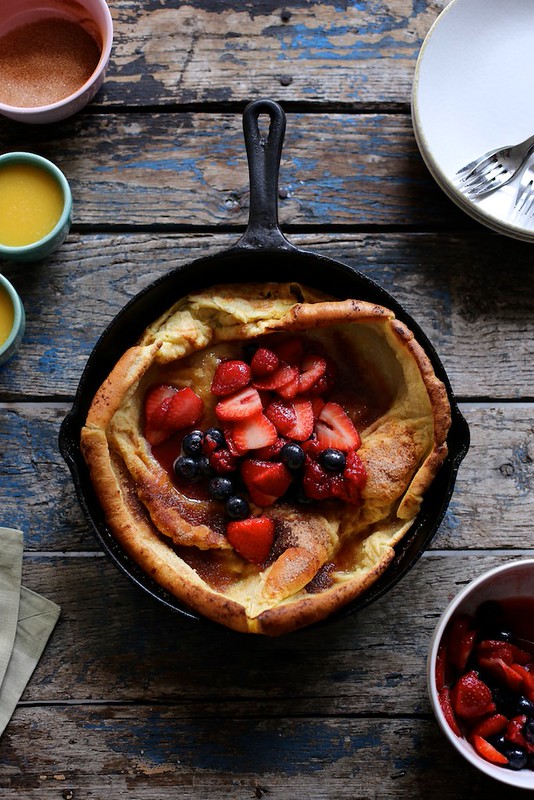
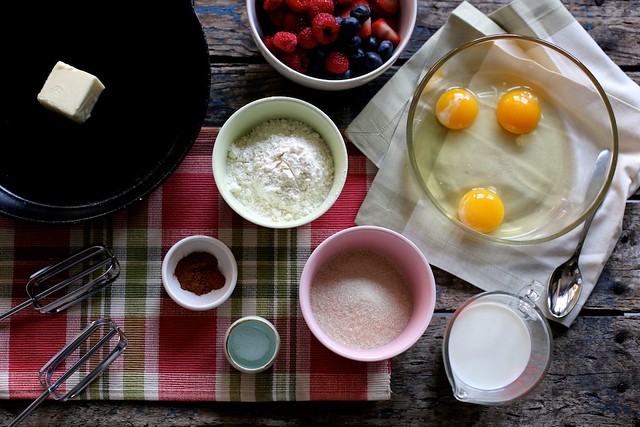
Luckily, where there are a few eggs, a bit of flour and milk, and a big ol’ handful of berries…. there is a Dutch Baby.  Pancake sans flip.

Triple Berry Dutch Baby

Dutch Babies exist in the delicious land between pancake and popover.  They’re tender and eggy, light and crunchy.  They’re also quite a spectacle coming out of the oven.  They’re show-offs.  It’s cool.  Breakfast can be dramatic.

Triple Berry Dutch Baby

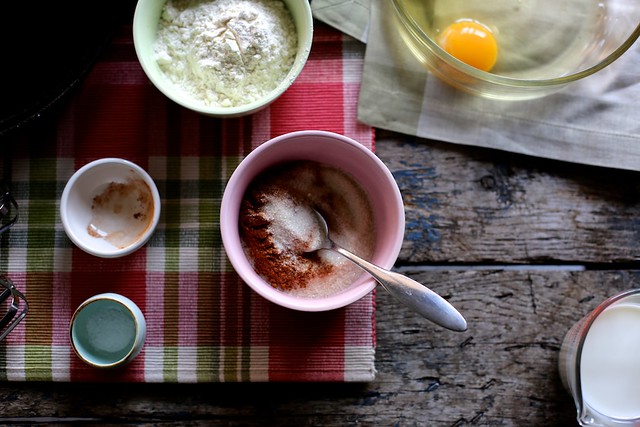
A simple mixture of cinnamon and sugar will work wonders for this breakfast.

Triple Berry Dutch Baby

Eggs do all of the heavy lifting in a Dutch Baby.  There’s no leavening from baking powder or baking soda.  It’s all whipped egg!  Eggs are whipped until pale and frothy.

An electric hand-mixer works wonders for a task like this.

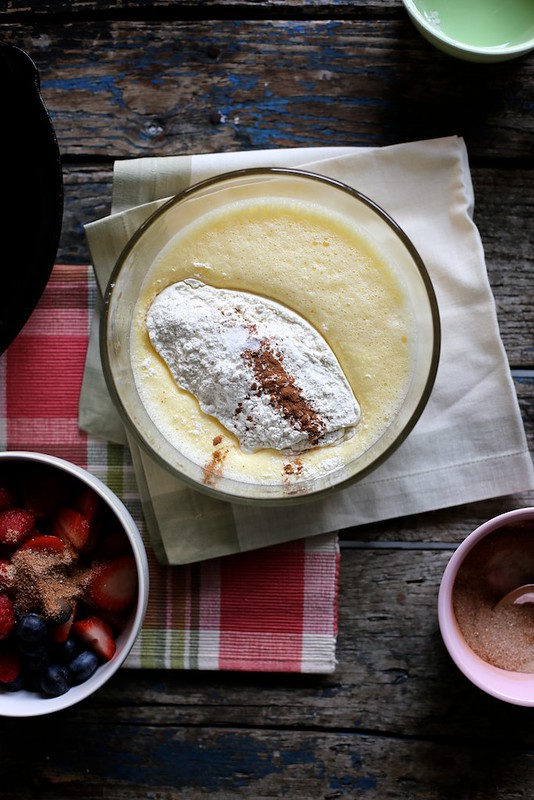
Once the eggs are whipped to a frenzy… milk, flour, cinnamon, and salt are added.  So sugar in the batter, if you can believe that.  All of the sugar gets sprinkled on top!

Triple Berry Dutch Baby

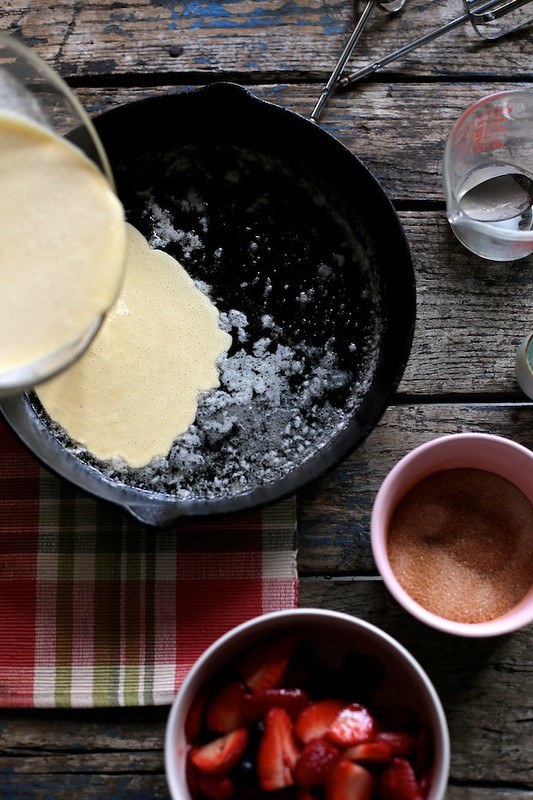
The rather thin batter is poured into the rather hot, butter laden skillet.

The batter is immediately placed in a very hot oven to puff like whoa!

I like to take the 20 minutes it takes to cook a Dutch Baby to do the following things:

- stir a bit of cinnamon sugar into the sliced berries.

- pour the orange juice.

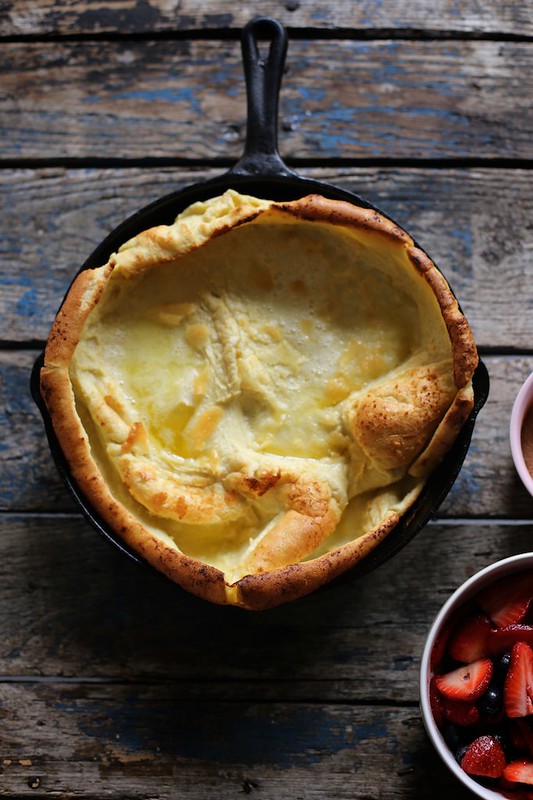
- quickly gather everyone around the oven for the big, puffed, dramatic, browned Dutch Baby reveal!    Seriously… gather round.  The puff only lasts a few minutes.

Triple Berry Dutch Baby

Pancake charm with not a single flip!  This feels pretty great.

Triple Berry Dutch Baby

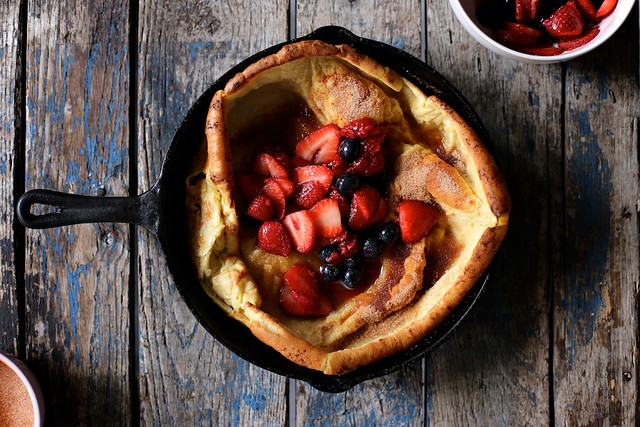
Cinnamon sugar adds a jolt of sweetness and a tiny bit of crunch from the sugar.  The butter keeps the Dutch Baby from sticking and also adds… you know, awesome buttery flavor!  Berries are bursting into season, and any excuse to shovel them onto breakfast food I’m all for!

This Dutch Baby is best served hot from the oven, sprinkled with cinnamon sugar, piled with sweet berries, and eaten gathered around the skillet with forks and orange juice.  Well… at least that’s how I did it.

Triple Berry Dutch Baby

makes 10-inch pancake, serves 4

adapted slightly from Epicurious

Print this Recipe!

For the Dutch Baby:

1/3 cup granulated sugar

1 teaspoon ground cinnamon

3 large eggs, at room temperature for 30 minutes

2/3 cup whole milk, at room temperature

2/3 cup all-purpose flour

1/4 teaspoon ground cinnamon

1/8 teaspoon salt

4 tablespoons unsalted butter

For the Berries:

2 cups  fresh berries (I used sliced strawberries, fresh raspberries, and fresh blueberries)

Place a rack in the center of the oven and preheat oven to 425 degrees F.

In a small bowl, stir together sugar and cinnamon.  Set aside.

Beat eggs with an electric beater or mixer on medium-high until pale and frothy, about 3 to 5 minutes .  Beat in the milk, flour, cinnamon, and salt.  Beat until thoroughly combined.  The batter will be very thin.

Place a 10-inch cast iron (or oven safe) skillet on the stovetop over medium heat.  Melt the butter in the skillet.  Remove from heat and immediately pour the batter into the pan.  Immediately place the pan in the oven and bake for 18 to 22 minutes or until golden-brown and puffed.

While the dutch baby bakes, add a few spoonfuls of the cinnamon sugar mixture to the fresh berries.  Stir and let rest until ready to serve.

Remove the baked and puffed dutch baby from the oven and immediately sprinkle generously with cinnamon and sugar. Add the berries.  Slice and serve.  Dutch babies are best served just after it comes out of the oven.

15 Apr 06:08

Ham and Asparagus Strata

by Elise
Asparagus Ham Strata on Simply Recipes

You know those times when you make something so good, you can’t wait for an excuse to make it again? This is one of those times. Wow. Perfect for a spring family gathering, such as an Easter brunch, Mother’s Day, or a graduation. This ham and asparagus strata is basically a breakfast casserole, taken up a notch or two. It’s a layered casserole with cubes of rustic bread, eggs, Gruyere cheese, milk, cream, diced ham, and asparagus.

It feeds a crowd. You can easily make ahead. Leftovers (if you have them, which I seriously doubt) will reheat beautifully for days.

Continue reading "Ham and Asparagus Strata" »

15 Apr 04:49

Salsa Verde Beef Street Tacos with Cilantro Slaw

Salsa Verde Shredded Beef Tacos

Well, I’m officially on a salsa verde shredded meat kick. Last week, it was pork tacos with salsa verde and some chopped jalapenos. This week, it’s this shredded beef with an simple cilantro slaw on top. Both meats were cooked in the slow cooker. (Because I NEED my slow cooker these days…here’s why. After this week, I wish to never see a doctor’s office or hospital again. Sigh.)

I love the balance of flavors and textures in these tacos. Perfectly soft shredded beef, delightfully fresh crunch from the cabbage, plus wonderful flavor combinations from the lime, cilantro and salsa verde.

Also, flour or corn…it’s entirely up to you. I’m on a bit of a corn tortilla/street tacos kick these days, hence the use of corn tortillas for us. Reason: they are c.h.e.a.p. You can get a bag of 50 corn tortillas here in San Antonio for less than $2. Yes, please. Plus, they store well in the freezer…so I don’t have to worry about them going to waste. Win-win!

Finally, look at this guy! He can’t wait for the ‘leftovers’ that fall from the baby’s highchair :)

Salsa Verde Shredded Beef Cody

He almost got this taco off the counter. (That wouldn’t be the first time he’s attacked a taco that I’m photographing.)

Hope you enjoy these tacos as much as we did!

Note: There is a print link embedded within this post, please visit this post to print it.

Salsa Verde Beef Street Tacos with Cilantro Slaw

Yield – 12 tacos, plus leftover beef

Preparation Time – 10 minutes

Cooking Time – 8 hours in slow cooker

Ingredients

  • 2-ish lb. chuck roast
  • 1 tsp ground cumin
  • Salt and pepper
  • 1 to 1 1/2 cups salsa verde
  • 12 oz. bag shredded cabbage or cole slaw mix
  • Small bunch of cilantro leaves, chopped
  • 3-4 Tbsp homemade or store bought vinaigrette
  • Goat cheese or cotija cheese, for topping
  • Other topping idea: sliced or diced avocado

Directions

  • Place the beef in the base of the slow cooker and season with the ground cumin, salt and pepper. Pour the salsa verde over the beef.
  • Set the slow cooker on low and cook for 8 hours.
  • Before serving, prepare the slaw in a mixing bowl by tossing together the slaw mix, chopped cilantro and vinaigrette.
  • Assemble tacos by placing some shredded beef in the middle of the tortilla, and top with the slaw and some cheese.
  • Serve Salsa Verde Beef Street Tacos with Cilantro Slaw and side of fresh fruit or veggies.
  

Related Stories

15 Apr 04:49

Learning The History Behind Design Trends

by Grace Bonney
Lindsaycdavison

cool if anyone in NY can go :)

AMY_TALK
One of the best parts of my job is getting to work with not one but two co-workers who have degrees in the History of Decorative Arts and Design. While I love and value my printmaking degree, I am always in awe of how much information and education Amy and Max can contribute to any design conversation we have. Amy has been teaching me about the history behind my favorite design objects for as long as I’ve known her, and this week she’ll be sharing her expertise at The New York School of Interior Design. From indigo and flocked wallpaper to the history of significance of the color black, Amy will be examining modern examples of historical design trends and their significance throughout history. I can speak from experience when I say this is a talk worth seeing. Amy’s passion for the fascinating history behind even the most everyday design objects is inspiring and any design fan will walk away feeling invigorated to investigate the stories behind their favorite design trends. Details are below, hope to see you there! xo, grace

Where: NYSID Auditorium, 170 East 70th Street, NYC.
When: Wednesday, April 16, 6:30pm
Register: here $12
General Admission $10
Seniors and Non-NYSID Students $12

AMYQUOTES


15 Apr 04:48

35 Ways to Decorate with Mirrors

by Grace Bonney

DESIGNSPONGEMIRRORS
The last few years of my life have been about a slow and gradual process of winnowing down the things I have in my home to only the most special, necessary and functional. Much like cutting my hair, I’ve always felt the stripping away of anything extra is one of the most liberating feelings. Not only do you get to give new homes and new lives to objects you once loved or needed (which you can even do with your hair), but you get to create a space that is free of distraction and clutter. For me, those sorts of spaces are always the most calming and comforting when you come home from a long day of work.

One of the few categories of objects I hold on to most strongly are mirrors. Not because of their ability to protect me from leaving the house with something in my teeth (although that is definitely a plus), but because of their ability to tell a story. Looking into an old mirror always begs the question of who looked in that same surface years, decades or even centuries ago. I am always on the hunt for beautiful old mirrors, small or large, so that hunt inspired last month’s hashtag challenge: #DSMIRRORS. After sifting through hundreds of entries, it was clear that this challenge was personal for all of you, too. I loved reading some of the details and captions behind these entries – from family heirlooms to mirrors that captured a special moment in someone’s day. Thanks so much to everyone who shared these photos with us. xo, grace

Click through for all 35 mirrors after the jump…

abcrepeau admgolub ameninspireddesign arlocations carolyn_cho_dupe carolyn_cho_dupe2 carolyn_cho chloeberk dailysomething duckeggblueblog eastashleystudio emilyjanegood erinpauls hunterjonesvntg mybestfriendcraig_dupe

(more…)


15 Apr 04:46

Reader Regrets: Jake's Short-Order Door

by Stephanie Strickland
Lindsaycdavison

“Hi. I have 3 graduate degrees. Unfortunately, none of them are in common sense.”

“Hi. I have 3 graduate degrees. Unfortunately, none of them are in common sense.”
Pin it button

Are you ready for a good tale of reno gone wrong? Today's Reader Regret is thanks to Leslie and the proud diy-er shown in the photo above, Jake. Jake tells his story: "'Measure twice and cut once.' That was my grandpa’s motto. Unfortunately, I don’t seem to be anything like my grandpa..."

READ MORE »

15 Apr 04:45

american blogger: what do you think?

by KIMMIE JONES
Lindsaycdavison

OMG wtf ...worth watching the trailer. it's ridiculous

As someone who spends a good percentage of her day consuming media, I am always surprised when something completely flies under my radar. [Tangent: Ugh. That made me sound really information entitled. Oh well, you know what I mean.] Last night, I got the following text from my ardent sister in popular culture, Laura.


I was so floored with my unfamiliarity on this topic that my fingers couldn't type "American Blogger"fast enough. After a thorough googling and trailer viewing, I felt super weird. When things hit close to home, it's very easy to be overly judgemental and find them cringe worthy...that's just science. [Tangent: I'm looking at you Crazy Hearts: Nashville and The Private Lives of Nashville Wives.] Of course I have been lazily campaigning for a blogger show on Bravo, but we all know the reality of that situation is- NO ONE would watch. I mean, watching me blog in my yoga pants while drinking coffee and talking back to the screen during The Chew isn't exactly appointment TV. Truthfully, that's what most bloggers do...It's not as epic as this trailer has you believe. Although I kind of wish it was.


My immediate response:


I agree with this director in that there are a lot of great bloggers out there with amazing back stories and it's great to see the connectivity and community that blogging creates being celebrated. [Tangent: You know how I feel about all my blogger friends!] But does it really address bloggers as a whole?

After sifting through the backlash, I kinda get the point from all the pushback...where IS the diversity? No one looks like me or a lot of bloggers I know. The whole point of blogging is for people to find their niche and celebrate what makes them unique, and despite being titled "American blogger", this film just seems to cover 30s white lifestyle bloggers who all look and dress similarly.

 It will be interesting to see if they talk real things like internet trolls and writers block and getting eye rolls from loved ones or being called obnoxious. I fear those things will take the back burner to sweeping shots of succulent gardens and chevron'd anthropologie throws...that's if I am judging a film by it's trailer.[Tangent: I mean everyone is blonde and gorgeous and living a perfect little boho chic "a beautiful mess" existence. The cinematography, though really pretty, may as well be brought to you by the Mayfield and Valencia filters.] It seems to reinforce a lot of cliches that bloggers are just self-important hipsters and I feel like in drawing attention to all the great things about blogging, it may also just get a collective "UGGHHHHHH, who gives a shit !?!" from everyone else. I'm really hoping that I am wrong and that the prettiness of it doesn't overshadow the message. I can't hate on anyone that is following a passion and doing what they love...and I don't envy these people for being "the voice" for such an outspoken opinionated movement of people.

In reading about the film and the controversy, I found the blog response of Chris Wiegand's wife (he is the director and dude in the airstream). The spirit of the film is a good one...I just fear that style will take a front seat to substance...and those aren't the kinds of blogs I like to read. [Tangent:....but of course I will be downloading it in June to see for myself.]
14 Apr 22:13

The 7-Year-Old Who Can Sing Like Billie Holiday Does An Even Better Nancy Sinatra

Lindsaycdavison

the bang bang cover is ultra impressive. although she looks a bit high...

Angelina Jordan Astar is ludicrously talented.

So you might remember this video going viral last month.

In which a seven-year-old girl wowed the judges on Norway's Got Talent with her rendition of "Gloomy Sunday." It's ludicrously good.

youtube.com

And the judges thought so too.

And the judges thought so too.

Via youtube.com

Well now she's covered "Bang Bang". And it's brilliant.

youtube.com

DAMN. Nancy would be proud.

DAMN. Nancy would be proud.

Via youtube.com


View Entire List ›

14 Apr 18:50

Stuff I found while looking around

by dooce
Lindsaycdavison

http://thedoghousediaries.com/5713 - THINGS I WOULD WISH ON MY ENEMIES... "the polite scorn of a canadian" lol

04_11_2014
This week's link roundup.
14 Apr 17:56

Design Can Drive Exceptional Returns for Shareholders

by Jeneanne Rae

It used to be about “us” and “them.”

“Us” were the people who believed that design could add significant value when tightly integrated with other business processes.  “Them” were the majority of managers who didn’t get what design was all about in the first place.

Today, however, the distance between “us” and “them” is getting smaller. And with good reason: From Target to Uber, business managers everywhere are starting to understand that the strategic use of design is making a difference in achieving outsized business results. At the same time, design is notoriously difficult to define, tough to measure, and hard to isolate as a function.

To better understand how design leads to returns, my company, Motiv Strategies, and the Design Management Institute worked together to produce a new tool that tracks the results of design-centric companies against those that are not. Called the Design Value Index, it shows that 15 rigorously-selected companies we believe institutionally understand the value of design beat the S&P by 228% over the last 10 years.

Design Value Index chart

The index was constructed in the same fashion as other indexes that seek to isolate an industry sector (banking, biotech), geography (China), or size (large cap), for example. In our version, we sought to identify only companies that are design leaders. Starting with a list of over 75 publicly-traded U.S. firms, we found only 15 that met our six criteria: publicly traded in the U.S. for 10+ years; deployment of design as an integrated function across the entire enterprise; evidence that design investments and influence are increasing; clear reporting structure and operating model for design; experienced design executives at the helm directing design activities; and tangible senior leadership-level commitment for design. Corporations who made the index based on this criteria include Apple, Coca-Cola, Ford, Herman-Miller, IBM, Intuit, Newell-Rubbermaid, Procter & Gamble, Starbucks, Starwood, Steelcase, Target, Walt Disney, Whirlpool, and Nike.

The latter company is a great example of what it looks like to place design at the center of corporate strategy. At Nike, a large and well-resourced design function reports directly to CEO, Mark Parker, who early in his tenure was a designer himself. Virtually everything the company makes, and is thinking about making, is highly influenced by this huge team of footwear, product, fashion, store, graphic, interaction, and brand designers. Using human-centered design methods, inspiration for the company’s signature products is drawn directly from its cadre of famous and not-so-famous practicing athletes, with whom the designers directly interact to devise authentic performance innovations and style updates.

In fact, no other company function is allowed to second guess the design team’s direction when it comes to the emotional and functional benefits for consumers, the interpretation of market trends, and, of course, aesthetics. Design is expected and trusted to lead Nike.

This is not to say that design “runs” the company, however. Rather, design is a highly influential force that, when effectively integrated with strategy, marketing, and so forth, can help the company stay out in front of its competitors by staying close to customers and commanding handsome price premiums. Of course, design also has a huge impact on the representation of Nike’s brand across the globe. Countless acts in the design details ladder up to one big, fat impression that Nike is the company for performance-minded athletes.

How can this type of commitment to design contribute to results? In Interbrand’s 2013 list of the World’s most valuable brands, Nike ranks 24th, two slots up from the prior year and a 13% increase in value to $17.085 billion. Next to Apple, Nike had the highest shareholder returns in our index — from 2003- 2013 Nike’s market cap increased from under $6 billion to $70 billion, or 1,095% over the last ten years.  Further, Nike was ranked the #7 most innovative company by Fast Company in 2014, and the 13th most admired company by Forbes magazine.

The bottom line is that companies that use design strategically grow faster and have higher margins than their competitors. High growth rates and margins make these companies very attractive to shareholders, increasing competition for ownership. This ultimately pushes their stock prices higher than their industry peers. The returns in our Design Value Index were 2.28 times the size of the S&P’s returns over the last 10 years. Neither hedge fund managers, nor venture capitalists, nor mutual fund managers came anywhere close to these results.

And thanks to the exemplar companies included in our index, as well as many international firms like Samsung, Ikea, and BMW, consumers now recognize, expect, and will pay for good design. This goes beyond traditional consumer products; government and B2B marketing, notorious for not-so-great aesthetics and customer experiences, are starting to make design a priority.

As a person who has spent part of her career helping companies appreciate and use design to their advantage, I will be the first to tell you that making it a central part of strategy isn’t always easy. But now that we know a lot more about how integrated design drives returns, companies across sectors can start thinking about managing design strategically at the enterprise level. There is clearly much value to unlock, and the only way to do this effectively is to do it together. I want no more talk of “them,” just “us.”

14 Apr 17:47

Rent Kate Moss' Former Apartment for $19,000 Per Month — Design News

by Tara Bellucci
Lindsaycdavison

not into the decor

Pin it button

Looking for a brick-walled Village stunner with a celebrity past? This two bedroom triplex was home to Kate Moss (and frequent appearances of then-fiancé Johnny Depp) in the 90s. The asking rent is $19,000 per month.

READ MORE »

14 Apr 17:47

Love Books? Check Out This One About Beautiful Libraries — Design News

by Tara Bellucci
Pin it button

What bibliophile doesn't get a bit awestruck in a stunning library? Libraries, a lavish coffee table book, showcase 44 temples to knowledge old and new from across the globe.

READ MORE »

14 Apr 16:14

This is a mommyblog, so it had to be addressed at some point

by dooce
Lindsaycdavison

seriously - she looks SO much like elsa.

elsa_featured
I apologize if the images alone get any part of that movie stuck in your head for two straight days. Worry not, you are not alone.
14 Apr 15:44

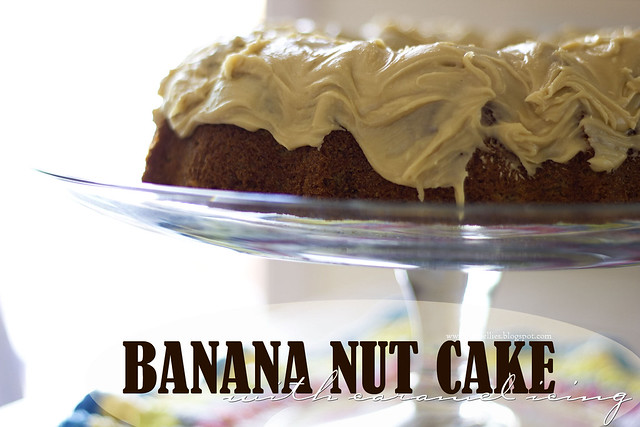
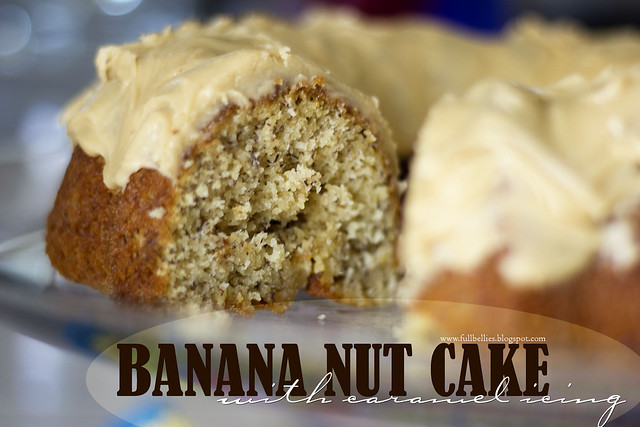
Banana Nut Cake with Caramel Icing

by Sandra
Lindsaycdavison

how is this different than banana bread with icing?

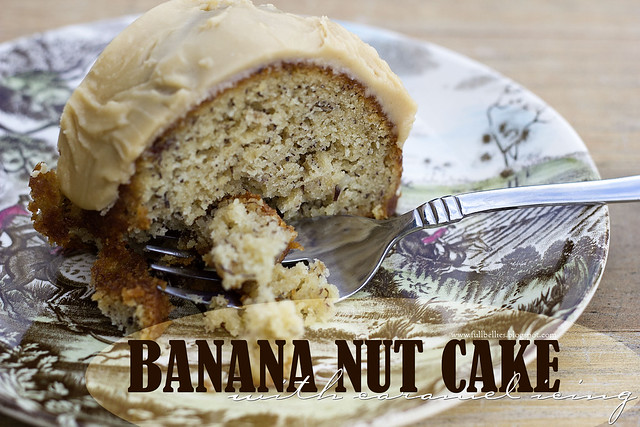
Banana nut cake with caramel icing

Oh my.....ooohhhhhhhh myyyyyyy!!!!

Ok so you all know Miss Kay from the Duck Dynasty series right?  Remember I shared her Honey Pecan Pie a while back?  And that was like, so good.

Well going through her cookbook earlier, I came across this recipe for banana cake, and what do you know, I actually have a bunch of bananas that are going bad and need to be made into bread, cake, smoothies etc.

THIS though, oh my goodness, it's so good.  Moist, flavorful all on it's own, but then throw in some caramel icing and it takes it to a whole other level.

If you have to make just one cake in the next week or two, let it be this one, you won't be disappointed.  And trust me when I tell you that Miss Kay's Duck Commander Kitchen is one cookbook every kitchen should have.

Banana nut cake with caramel icing

Banana Nut Cake with Caramel Icing
Adapted from:  Miss Kay's Duck Commander Kitchen

2 cups all purpose flour
1 2/3 cups sugar
1 1/4 teaspoons baking powder
1 1/4 teaspoons baking soda
1 teaspoon salt
2/3 cup shortening
1/3 cup buttermilk
2 medium ripe bananas
2 eggs
chopped almonds

Caramel icing
1 stick butter
1 cup packed brown sugar
1/3 cup milk
3 1/2 cups powdered sugar

Heat oven to 350 degrees.  Butter and flour the cake pans or bundt pan.

In a large mixing bowl, sift together the flour, sugar, baking powder, baking soda and salt.  Add the shortening, buttermilk and bananas.  Mix with the electric mixer on medium speed for 2 minutes.  Add the eggs and beat 2 more minutes.  Fold in the almonds.

Pour the batter into 2  9-inch pans, or a bundt pan.  Bake until the layers start to pull away from the sides and a toothpick inserted in the center of a layer comes out clean, 35 to 40 minutes.

Let the layers cool in the pans for a few minutes, then run a spatula around the sides and invert the layers onto a wire rack to cool completely.

While the layers are cooling, make the frosting.  In a saucepan on medium heat, bring the butter and brown sugar to a boil and boil for 2 minutes.  Add the milk and bring back to a boil.  Remove from heat and let cool slightly.  Stir in the powdered sugar.

When the cake layers are cool, frost the top of one layer.  Put the other layer on top and frost the top and sides.

Note:  I used my bundt cake and did not frost the inside or all around the cake, just the top.

Banana nut cake with caramel icing
14 Apr 15:38

In France, Grape Growers Use Price to Punish Nontraditional Winemakers

by The Daily Stat

Economists would have you believe that prices are determined by economic forces, but sometimes they’re used as rewards and punishments. In France, many of the 15,000 Champagne grape growers charge less to those among the 66 Champagne makers that fit the traditional mold of being old and independently managed by descendants of the founders, and that don’t produce supermarket brands. Makers that violate these unspoken rules typically have to pay as much as several euros per kilogram more for grapes, a substantial markup, given that the average price is 9 euros, say Amandine Ody-Brasier of Yale and Freek Vermeulen of London Business School.

14 Apr 15:25

Citi Held Back in Olive-Oil Deal

Lindsaycdavison

weird, no?

Citigroup declined to work on an Italian government-backed bid for Deoleo, the world's biggest olive-oil bottler, because of concern the deal would infuriate the Spanish government.
14 Apr 15:20

Are You Addicted To Bubble Tea?

Must drink and chew at the same time.

14 Apr 14:56

This Kid Totally Nails What Everyone Sounds Like In Chipotle

In case you haven’t witnessed this masterpiece already…

vine.co

"Oh my gooood, I love Chipotle!"

"Oh my gooood, I love Chipotle!"

vine.co

"Chipotle is my liiiiife!"

"Chipotle is my liiiiife!"

vine.co

14 Apr 08:37

Searchers to Deploy Submersible in Hunt for Missing Jet

by By KIRK SEMPLE, CHRIS BUCKLEY and MICHELLE INNIS
Officials said that after six days with no new possible black-box signals, it was time to take the search for Malaysia Airlines Flight 370 underwater.


14 Apr 08:33

The Sexiest Job of the 21st Century is Tedious, and that Needs to Change

by Sean Kandel

As organizations collect increasingly large and diverse data sets, the demand for skilled data scientists will continue to rise. In fact, it was dubbed “The Sexiest Job of the 21st Century” by HBR.

Unfortunately, the day-to-day reality of the role doesn’t quite match the romanticized version.

Starting in 2012, my colleagues and I began taking a closer look at the hands-on experience of data scientists. At Stanford, I conducted 35 interviews of data analysts from 25 organizations across a variety of sectors, including health care, retail, marketing, and finance. Since then I’ve spoken with another 200-300 analysts. What we found was that the bulk of their time was spent manipulating data − a mix of data discovery, data structuring, and creating context.

In other words, most of their time was spent turning data into a usable form rather than looking for insights.

Granted, this stems from a positive shift in analytics. Whereas companies once maintained tight control over data warehouses, they are now shifting toward more agile analytic environments because the drive for data-driven decision-making has catalyzed the need for a different type of work. Today, data quality is no longer about a central truth but is instead dependent on the goal of the analytic tasks. Exploratory analysis and visualization require that analysts can fluidly access disparate sources of data in various formats.

The problem is that most organizations aren’t set up to do this. In traditional data warehousing environments, IT teams structure data and design schemas when the data is loaded into the warehouse,and are then largely responsible for ensuring strict data quality rules. While this upfront design and structuring is costly, it worked fairly well for years. Now that companies are dealing with larger and more complex data sets, however, this old way of managing data is impractical.

To keep pace, most organizations are currently storing raw data and structuring on demand. Schemas and relationships between datasets are now derived at time of use instead of at the time of load. This shift gives data analysts more flexibility to find unexpected insights, but also places the time-consuming onus of discovery, structuring, and cleaning solely on them.

Indeed, in our 2012 study of data analysts, we characterized the process of data science as five high-level tasks: discovery, wrangling, profiling, modeling, and reporting. Most analytic and visualization tools focus on the last two phases of this workflow. Unfortunately, most of a data scientist’s time is spent on the first three stages.

These three involve finding data relevant for a given analysis tasks, formatting and validating data to make it palatable for databases and visualization tools, diagnosing data for quality issues, and understanding features across fields in the data. In these phases, data scientists encounter numerous challenges, including data sets that may contain missing and erroneous or extreme values. These tasks often require writing idiosyncratic scripts in programming languages such as Python and Perl, or extensive manual editing using tools like Microsoft Excel. But if not caught, this can cause any assumptions made to be wrong or misleading – poor data quality is the primary reason for 40% of all business initiatives failing to achieve their targeted benefits.

Because of this, the skills of talented data scientists are often wasted as they become bogged down in low-level data cleansing tasks or encumbered when they cannot quickly access the data they need. This creates a huge bottleneck, stalling the progression of data as it moves from data stores like Hadoop to analytic tools that allow for greater insights. Data cleansing and preparation tasks can take 50-80% of the development time and cost in data warehousing and analytics projects.

Instead of solving these problems, organizations are often adding to the amount of data that require a data scientist’s attention. Through activity and system logs, 3rd-party APIs and vendors, and other publicly available data, companies have access to an increasingly large and diverse set of data sources. But without the right systems in place, the prohibitive cost of data manipulation leaves much of this data dormant in “data lakes.”

And by making data analysis a core business function for many departments, skilled analysts and members of IT are spending large chunks of time helping others access the data they need via low-level programming instead of doing any analysis themselves.

According to Gartner, 64% of large enterprises plan to implement a big data project in 2014, but 85% of the Fortune 500 will be unsuccessful in doing so. These time-consuming data preparation tasks are largely to blame. Not only do they throttle individual data scientists, but they greatly decrease the probability of success for big data initiatives.

If we can ever hope to take full advantage of big data, data preparation is going to need to be elevated out of the manual, cumbersome tasks that currently make up the process. Data scientists must be enabled to transform data with greater agility, not just manually prepare data for analysis. Domain experts will need to be able to explore deeper relationships between data sets without data being diluted by prolonged IT programmer or data analyst involvement.

Ultimately, the goal of data analysis is not simply insight but improved business process. Successful analytics can lead to product and operational advancements that drive value for organizations, but not if the people charged with working with data aren’t able to spend more of their time finding insights. If data analysis ever hopes to scale at the rate of technologies for storing and processing data, the lives of data scientists are going to need to get a lot more interesting.

14 Apr 08:15

The Problem with Being Too Nice

by Michael Fertik
Lindsaycdavison

@all canadians... :)

Leaders are placed under a tremendous amount of pressure to be relatable, human and … nice. Many yield to this instinct, because it feels much easier to be liked. Few people want to be the bad guy. But leaders are also expected to make the tough decisions that serve the company or the team’s best interests. Being too nice can be lazy, inefficient, irresponsible, and harmful to individuals and the organization.

I’ve seen this happen numerous times. A few years ago, a senior staff member of mine made the wrong hire. This can happen to anyone, and the best way to remedy the situation is to address it quickly. Despite my urging to cut the tie, this staff member kept trying to make it work. While I laud the instinct to coach, fast forward two months later, and we were undergoing a rancorous – and unnecessary – transition process. There’s a key lesson here for any leader. Nice is only good when it’s coupled with a rational perspective and the ability to make difficult choices.

Here are a few other other recognizable scenarios where being nice isn’t doing you – or anyone – any favors:

Turning to polite deception. You’ve been in these brainstorming meetings – everyone is trying to hack a particular problem, and someone with power raises a ridiculous idea. Instead of people addressing it honestly, brows furrow, heads nod like puppets on strings, and noncommittal murmurs go around. No one feels empowered to gently suggest why that particular idea won’t work. At my company, rejecting polite deception is a big part of how we do business. When something isn’t right, we call each other out on it respectfully, then and there, without delay. Why? It’s not helpful to foster an everyone-gets-a-trophy mentality; you have to earn the honors to get the honors.

The long linger. Sometimes a hire just won’t cut it in a certain role. It might seem easier to keep an employee in place rather than to resolve the mismatch – but it actually is not. Resist the temptation to prolong confrontation, to see if things will get better. It is more of a disservice to let someone flounder, especially when it’s clear that he or she just isn’t hitting the mark. Be kind and communicate clearly, but don’t be nice. Be surgical about it. Make the clean cut. Help the person transition somewhere he or she can succeed. Handling employee issues immediately helps your culture and productivity – over time, you’ll attract employees with similar values and convictions.

Don’t be a doormat. When you’re too nice – to suppliers who can’t deliver on time, to colleagues who don’t do their work, to customers who refuse to pay – you’re actually letting others take advantage of you and your business. When you’re overly generous with your allowances for others, you create a fertile atmosphere for contempt to spread. Imagine the reactions of your most talented, focused, and motivated employees as they watch lackluster coworkers get pass after pass. Anger and resentment take root, morale plummets, and turnover starts to go up, up, up. Think of how loyal customers will react if they see how easy it is for others to take advantage of your services. Your reputation will surely suffer. These problems become more difficult to solve as they pile up. You don’t need to be severe to be respected, but you do need to hold your organization to certain standards — and you must be firm about people meeting them. Setting rules will help you when decisive action is needed. No more delays, no demurring, no debating.

Failing the introspection test. Are you too nice to yourself? Introspection is a powerful leadership tool, but we often forget to use it. When you ask yourself what behaviors hold you and your team back, you can recalibrate your leadership style for the better. When you give employees the space to give you the hard truths, without fear of repercussion, you’ll get valuable perspective and make a giant leap forward in maturing as a leader.

Of course, this doesn’t mean managers get a free pass to be disrespectful, cruel, or a bully in the workplace. There’s a world of difference between being an effective leader with high expectations and dealing with problem after problem caused by milquetoast management. Beware of confusing being nice – or being liked – with being a good leader.

14 Apr 08:11

What I Learned Watching 150 Hours of TED Talks

by Carmine Gallo
Lindsaycdavison

I love that Bill Gates brought a jar of mosquitoes and released them..."there's no reason only poor people should experience this." lol

What makes for a great presentation — the kind that compels people’s attention and calls them to action?  TED talks have certainly set a benchmark in recent years: HBR even asked Chris Anderson, the group’s founder, to offer lessons drawn from the three decades he’s run TED’s signature events in an article published last summer.

But experience and intuition are one thing; data and analysis are another. What could one learn by watching the most successful TED talks in recent years (150 hours’ worth), talking to many of the speakers, then running the findings by neuroscientists who study persuasion?  I did just that, and here’s what I learned:

Use emotion. Bryan Stevenson’s TED talk, “We need to talk about an injustice”, received the longest standing ovation in the event’s history. A civil rights attorney who successfully argued and won the Supreme Court case Miller v. Alabama, which prohibits mandatory life sentences without parole for juveniles convicted of murder, this is a man who knows how to persuade people.

I divided the content of his talk into Aristotle’s three areas of persuasion. Only 10 percent fell under “ethos” (establishing credibility for the speaker); 25 percent fell into the “logos” category (data, statistics) and a full 65 percent was categorized as “pathos” (emotion, storytelling). In his 18-minute talk, Stevenson told three stories to support his argument. The first was about his grandmother, and when I asked him why he started with it, his answer was simple: “Because everyone has a grandmother.” The story was his way of making an immediate connection with the audience.

Stories that trigger emotion are the ones that best inform, illuminate, inspire, and move people to action. Most everyday workplace conversations are heavy on data and light on stories, yet you need the latter to reinforce your argument. So start incorporating more anecdotes – from your own experience or those about other people, stories and brands (both successes and failures) – into your pitches and presentations.

Be novel. We all like to see and hear something new. One guideline that TED gives its speakers is to avoid “trotting out the usual shtick.” In other words, deliver information that is unique, surprising, or unexpected—novel.

In his 2009 TED presentation on the impact of malaria in African countries, Microsoft co-founder and philanthropist Bill Gates shocked his audience when he opened a jar of mosquitoes in the middle of his talk. “Malaria, of course, is transmitted by mosquitoes,” he said. “I brought some here so you can experience this. I’ll let these roam around the auditorium. There’s no reason why only poor people should have the experience.” He reassured his audience that the mosquitoes were not infected – but not until the stunt had grabbed their attention and drawn them into the conversation.

As neuroscientist Dr. A.K. Pradeep confirms, our brains can’t ignore novelty. “They are trained to look for something brilliant and new, something that stands out.” Pradeep should know. He’s a pioneer in the area of neuromarketing, studying advertisements, packaging, and design for major brands launching new products.

In the workplace your listener (boss, colleague, sales prospect) is asking him or herself one question: “Is this person teaching me something I don’t know?” So introduce material that’s unexpected, surprising or offers a new and novel solution to an old problem.

Emphasize the visual. Robert Ballard’s 2008 TED talk on his discovery of the Titanic, two and a half miles beneath the surface of the Atlantic, contained 57 slides with no words. He showed pictures, images, and animation of life beneath the sea, without one word of text, and the audience loved it. Why did you deliver an entire presentation in pictures? “Because I’m storytelling; not lecturing,” Ballard told me.

Research shows that most of us learn better when information is presented in pictures and text instead of text alone. When ideas are delivered verbally—without pictures—the listener retains about 10% of the content. Add a picture and retention soars to 65%.

For your next PowerPoint presentation, abandon the text blocks and bullet points in favor of more visually intriguing design elements. Show pictures, animations, and images that reinforce your theme. Help people remember your message.

14 Apr 07:52

19 Deliciously Stuffed Vegetables

Lindsaycdavison

guac-a-taco?!?!?!?!

Veggies, I knew you wouldn’t hold out forever.

Falafel-Stuffed Eggplant with Tahini Sauce and Tomato Relish

Falafel-Stuffed Eggplant with Tahini Sauce and Tomato Relish

This chickpea-based filling has just enough kick. Recipe here.

Joanne Bruno / flickr.com

Baked Stuffed Artichokes with Leeks

Baked Stuffed Artichokes with Leeks

Artichokes will make you work for it, but they're worth it in the end. Recipe here.

Elaine McCardel / theitaliandishblog.com

Guac-A-Taco (Vegan Taco-Stuffed Avocado)

Guac-A-Taco (Vegan Taco-Stuffed Avocado)

OK vegans, you win this one. Recipe here.

Kathy Patalsky / babble.com


View Entire List ›

14 Apr 07:49

Snapchat 'Live Film' Introduces Taco Bell's Next Locos Taco

by mcmorrison@adage.com (Maureen Morrison)

The name of the next Taco Bell Dorito taco is a mouthful: Spicy Chicken Cool Ranch Doritos Locos Tacos.

The chain is announcing the latest in the Doritos Locos Taco line in just as lengthy a format: a four to six-minute-long movie ephermal app Snapchat. Taco Bell said a film of length is a first for Snapchat, which is known for seconds-long messages that disappear after they're viewed. The new taco will be available May 1, with TV, radio and additional forms of advertising launching then, but the social media campaign is kicking off today.

The movie, called "Rush Order," has a script and a cast of Vine and Snapchat "influencers," said Nick Tran, social-media lead at Taco Bell. The plot is about an employee with a despotic boss who insists the employee find out not only what the next Doritos Locos Taco is, but also acquire one. "Rush Order" was directed by director Jason Zada, co-founder of digital agency Evolution Bureau, which was known for Office Max's Elf Yourself. (He's also known for the interactive short "Take This Lollipop.")

Continue reading at AdAge.com

14 Apr 07:20

Spicy Stir-Fried Tofu With Coconut Rice From 'The New Vegetarian Cooking for Everyone'

by Kate Williams
Lindsaycdavison

switch the tofu for seitan and i'm listening

20140403-new-vegetarian-cooking-for-everyone-spicy-tofu.jpg

[Photograph: Kate Williams]

I have many friends who are vegetarian and vegan, and tofu (as well as its related soy products) plays a big part in their diet. I myself eat cubes of the stuff a few times a month, and have grown from having a begrudging acceptance of it to a true appreciation of its subtle flavor. I most often sear cubes of extra-firm in vegetable oil before adding it to stir-fries; though efficient, it's not always the most exciting preparation.

In The New Vegetarian Cooking for Everyone, Deborah Madison adds far more flair to her tofu dishes. This particular stir-fry employs a sweet and hot blend of spices to add interest to the seared tofu, as well as a rich and brilliantly yellow pot of coconut rice on which to serve it. A generous squeeze of lime juice is crucial, adding zippy brightness and moisture to each bite.

Why I picked this recipe: I needed to re-boot my tofu repertoire.

What worked: The spiced tofu was great, but the big winner here is the coconut rice. Don't skip it.

What didn't: You'll want to stir-fry the tofu on a lower heat than you'd usually use for a stir-fry to prevent the sugar from burning. Shoot for somewhere between medium and medium-high.

Suggested tweaks: Sliced yellow onions work in place of scallions if that's what you've got at home. If your family is full of big tofu-eaters, you'll want to double what the recipe calls for. Cook it in two batches to avoid crowding the skillet or wok.

As always with our Cook the Book feature, we have five (5) copies of The New Vegetarian Cooking for Everyone to give away this week.

About the author: Kate Williams is a freelance writer and personal chef living in Berkeley, CA. She is a contributor to The Oxford American, KQED's Bay Area Bites, SFoodie, and Berkeleyside NOSH. She blogs at Cooking Wolves. Follow her @KateHWiliams.

Get the Recipe!
14 Apr 06:29

Easy DIY: From IKEA Dish Towels to Cloth Napkins — The Kitchn

by Jennifer Hunter
Lindsaycdavison

i do this

14 Apr 06:28

Live in New York and Looking for (a Little Bit of) Color? Let Us Help! — Enter for a chance to be part of our small paint projects makeover

by Anna Hoffman
Lindsaycdavison

@ newyorkers

Pin it button

Looking to add a little color to your home without painting a whole room? We're looking for readers in New York City who want to experiment with paint color this spring.

We're working with an advertiser to help our readers explore different ways to get bold, exciting paint colors in their homes. If you've been wanting to paint an accent, a piece of furniture, a doorframe, the back of a bookshelf, or any other small paint project, submit your information below, and you could have your before and after project sponsored and documented by our team!

READ MORE »