
Kids have it easy these days.
Lindsaycdavisontoo bad i don't have a house big enough to do such things

yes good let’s share a bunch of this stuff on the internet so that impressionable youths think that marriage is like a cute, more-twee version of Cato vs. Clouseau.
"Honey, come in here, we need to go over these accounts again. I don’t think we’re making enough return on the CD to justify not moving some of that into baby jeffery’s college account."
"BABE COME IN HERE I MADE A PILLOW FORT!"
[yo! i originally had something else fun planned for today but internet issues halted that. instead i'm boring-ly sharing some of my favorite things i recently jacked from my inspiration board on pinterest, which i'm still totally loving by the way. did you make one? it's like my virtual junk drawer for my favorite things. it's just a mess that i adore.
also, tonight you should probably make this pizza. it's what i am doing.
or you should grill some bread. am i a broken record yet? get ice cream too.
oh oh and what's your favorite quote? i am a basic sucker for inspirational quotes, always have been, for over ten years mine has been "when you want something you've never had, you must do something you've never done." so annoyingly simple right? obvi. xoxo]





I do love us!
Lindsaycdavisonlol
LindsaycdavisonLove


I have carpet in my bedroom, which I hate and hope to get rid of eventually. I've often daydreamed about the hardwood floors I'd choose instead, but installing tile floors never occurred to me. That is, until I saw these lovely bedrooms that make an unexpected element look serene and chic.
Lindsaycdavison@andrew! best
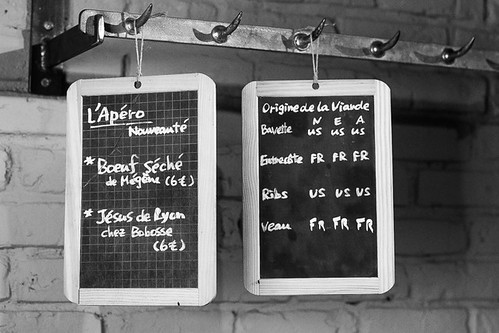
My perfect day in Paris is one that starts at the Marché d’Aligre. I’d get there first thing in the morning, around 9 A.M. as the flea market vendors are unloading their trucks, scoping out treasures as they unpack them. (Before the rest of humanity descends on the market.) I’d rifle through the boxes of knives, cast-off kitchenware, and perhaps score a vintage Le Creuset gratin dish, before doing some food shopping, bringing home the bacon.
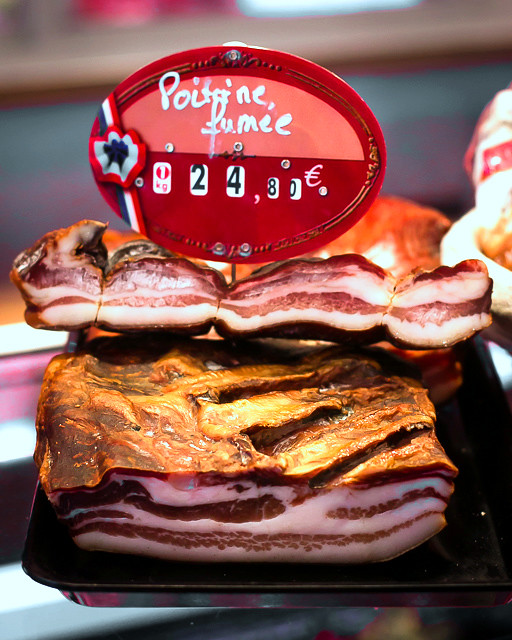
I’ve been going to this market for over ten years, and it’s still one of my favorites. For a while, there weren’t any stand-out dining options at the market, which was a shame, because you’re surrounded by all this food at the one of best markets in Paris, but few places were serving them. So I was happy to see that in the last year or so, a number of eateries have opened where you can sit down and enjoy everything from Portuguese pastries to steak-frites, a market staple dating back to the days of the old – and sadly displaced – Les Halles.
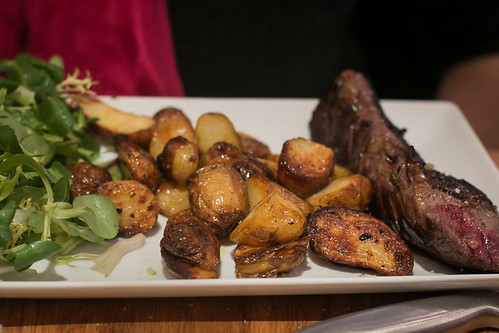
One place in particular that I was interested in trying was boucherie Les Provinces, a combination butcher shop and restaurant. While I had my head buried in boxes at the flea market, avoiding getting stabbed by vintage French forks, an SMS popped up on my phone from my friend, asking me where the heck I was. So I hightailed it over to meet her for lunch.
Continue Reading Les Provinces and Café des Abattoirs...

perfect for white supremacists who are looking to do some subtle home decorating.
 I tend to gravitate to postcards like this because of the rich detail in the buildings – the names of businesses, the façades of the old houses, the advertisements, the spire in the distance (it isn’t a church, it’s the mairie – city hall – of the 10th arrondissement). Most of the buildings are still there, recognizable in a modern view north along the Faubourg St. Martin.
 It’s only after a while that I focus on what is in the street, not just on either side. An omnibus pulled by three horses dominates the view, followed by two men on bicycles, with an assortment of delivery carts pulled up to the curbs on either side. Those vehicles have vanished forever, leaving only images in photos and postcards. But where did they come from?
 Omnibuses were a French invention, and have a curious history, less well documented than the history of the buildings in Paris.
The story begins not in Paris, but in Nantes, where a man called Stanislas Baudry built a steam-powered flour mill outside the city in 1823. Steam technology produces lots of hot water, and Baudry saw an opportunity to make some money on the side by opening a bathhouse. Unfortunately, the bathhouse was a very long walk from central Nantes, and there were few customers. Baudry hit on the idea of offering a shuttle service – a coach that left from the centre of town on a regular schedule. It held 16 passengers, seated eight to a bench on each side. But not all the people in the coach were necessarily going to the baths – some Nantais started to use the coach for short trips along the route.
>more.
LindsaycdavisonYUM

An ice cream sundae so good, you’ll want to eat the bowl. And you can. Should, rather. For real. I made these little handy dandy cookie bowls with Wilton’s Ice Cream Cookie Bowl pan and they’re totally life changing. A completely edible ice cream sundae. Actually, don’t eat the spoon. I love my little wooden chevron spoons, but don’t imagine they’d go down so easy. I need to ask Wilton to get on that one next.
As part of Wilton’s Treat Team, I get fun little packages every so often packed with Wilton surprises. Earlier this month, I got a box filled with ice cream-themed products, like this tin, Cookies and Cream sprinkles, ice cream cookie cutters, and more. The theme of my partnership with Wilton seems to be “try things I never would have considered trying in the past.” Cookie bowls? Not even on my radar a couple months ago. Now? I want to eat everything out of a cookie bowl. Especially cereal. I also want to make a crouton bowl for soup. And tortilla bowls for taco meat. Edible bowls for everyone!
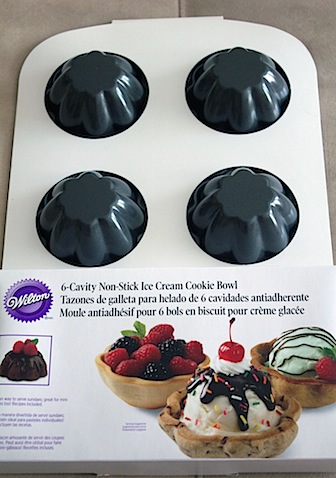
Double Cookie Marshmallow Ice Cream Sundaes:
Cookie Bowls (makes 12):
Double Cookie Marshmallow Ice Cream Sundaes (makes 2):
Pre-heat oven to 350 degrees
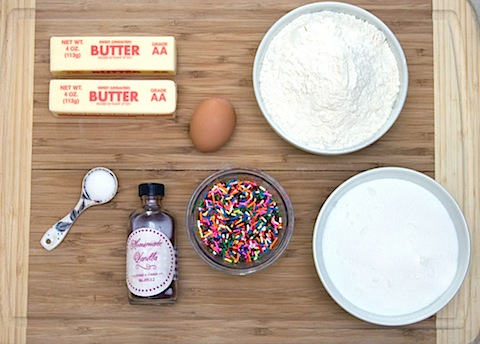
Start by spraying the outside of the cookie bowl tin with vegetable spray. Do not forget this step! Otherwise you’ll have cookie bowl disaster.
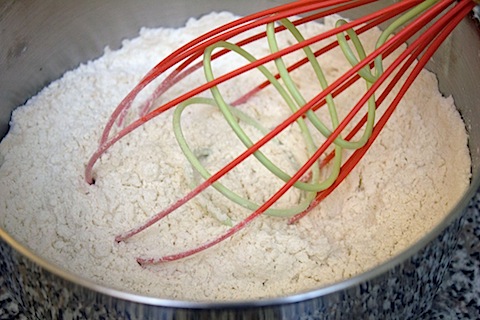
Whisk together flour and salt in a medium bowl.
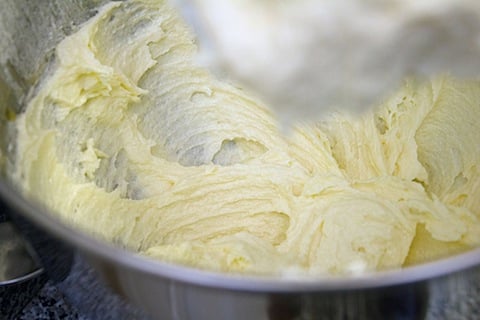
In the bowl of an electric stand mixer, beat butter and sugar together until light and fluffy.
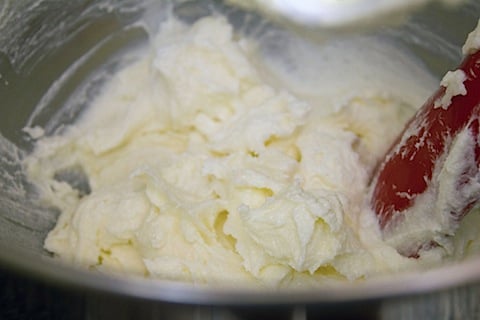
Then beat in egg and vanilla.
Slowly add flour mixture, one cup at a time, mixing after each addition until just incorporated.
Fold in sprinkles.
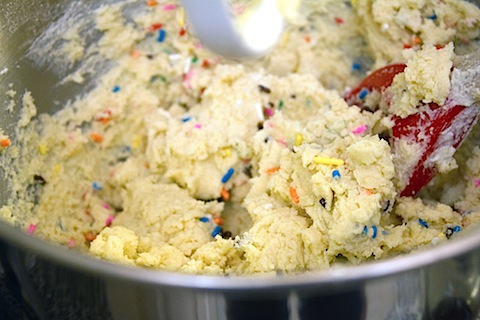
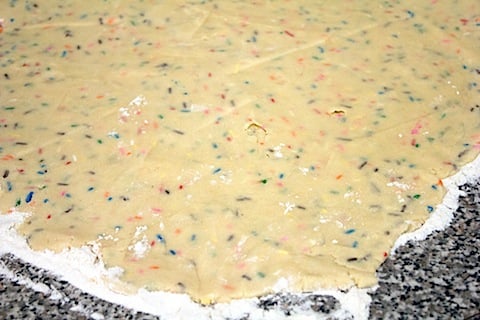
On a floured surface, roll dough out to 1/8 inch thickness.
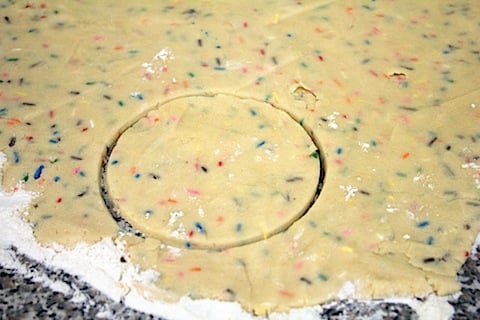
Then cut out 4 1/2 inch circles. I found a glass that measured 4 1/2 inches in diameter and used it to cut out my circles. You should be able to get 12.
Once dough circles are cut out, drape one circle over each bowl cavity of pan, pressing to form smooth surface.
I popped the pan in the fridge for about 15 minutes here, just based on some reviews people left on Wilton’s website.
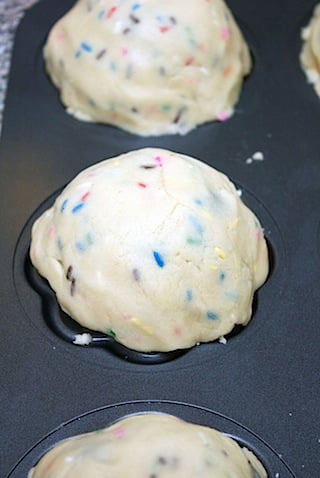
Then I baked for about 11-13 minutes, until the cookies were beginning to turn golden brown. I cooled them on the pan for 10 minutes and then removed them from the pan (Wilton says to use a small spatula, but mine came right off with a tiny bit of jiggling).
You can see that my bowls weren’t nearly perfect; some of them had some holes in them. I’m not entirely sure why that happened as I chilled m y dough to prevent spreading. I guess my circles may not have been quite thick enough, though I thought they were. Scratch that; they probably just weren’t completely even throughout. I patched them up with extra cookie pieces I trimmed from the edges of some of the bowls. Fixing cookie problems with cookies; I love this world!
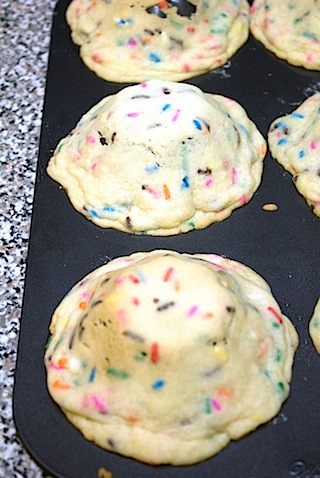
The cookie bowls then need to be completely cooled on a wire rack.
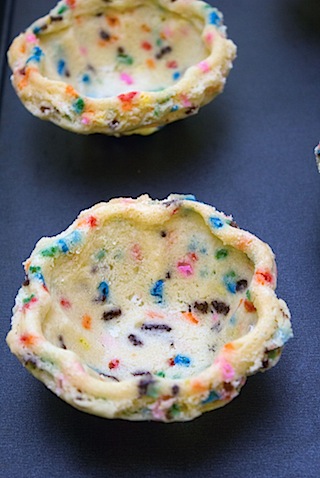
And your cookie bowls are done!
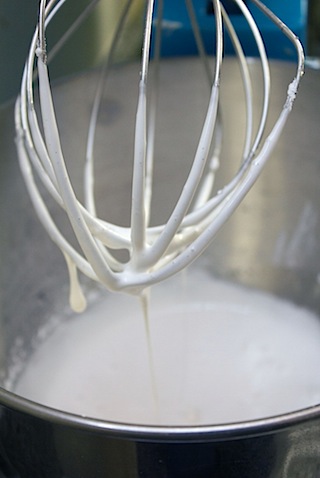
You should make your marshmallow fluff topping next. You could obviously buy this, too, but it’s so, so easy to make. You can get my recipe here… You’ll only need about 1/4 of the recipe for a couple ice cream sundaes. I usually make 1/2 recipe and keep half in my fridge for emergencies. You know.
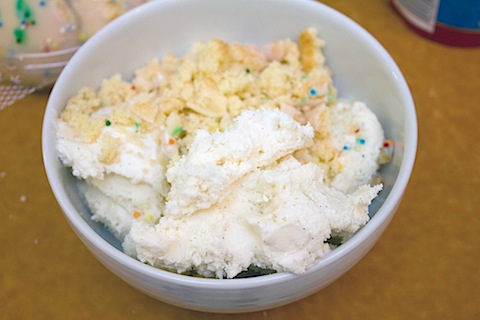
Now it’s time to serve the ice cream. I wanted to add more sprinkle and cookie fun to the sundae, so I asked Chris to pick up some sprinkle cookies at the grocery store. He got these Italian anise cookies and they were just perfect.
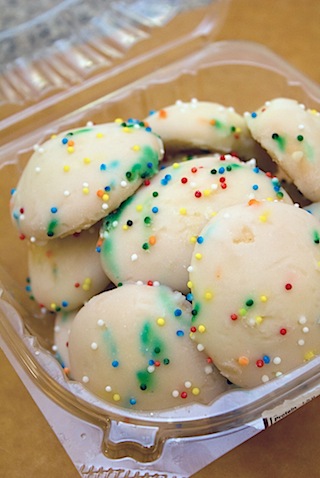
I crumbled the cookies into the ice cream and mixed them all up.
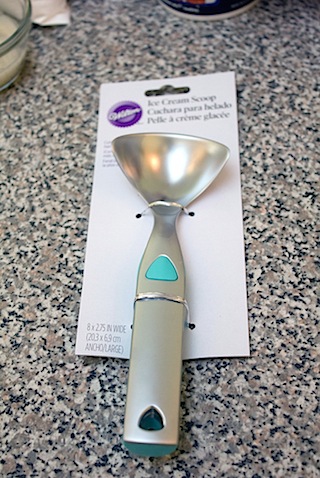
Wilton also sent me their ice cream scoop and it made scooping a super hard vanilla ice cream very easy. Plus, I love the pretty teal color!
Serve the cookie ice cream into the cookie bowls.
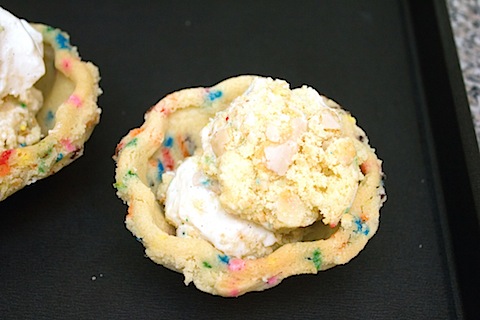
And top with a healthy dose of marshmallow fluff and sprinkles.

Is healthy dose of marshmallow fluff a total oxymoron. Or is using the word “healthy” anywhere in this blog post simply wrong? I won’t try to fight that one. But it’s the end of a long weekend and you need to wind it down in style.

This dessert contains basically all of my favorite things. Other than cocktails and quinoa. But that would be weird.
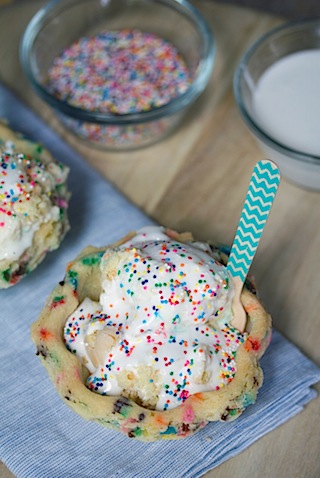
I can’t decide if this is more of a sprinkles overload or a cookie overload. I’m going to go with both and say that that is an extremely good thing.
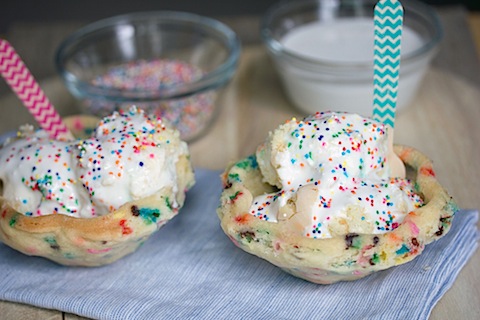
And it was kind of fun to eat a spoonful of ice cream, followed by a bite of cookie bowl. We just had to be careful not to bite the cookie bowl in a way that would cause the ice cream to leak. But if you think about it… this is really no different than an ice cream cone, but in bowl form. I rarely order ice cream cones because I am a very mess-prone person and ice cream cones pose a danger to me. So, an edible bowl really is the best option for me.

And I love that these cookie bowls can be completely customized with any ingredients you crave. I always crave sprinkles. Which kind of sound strange, considering they don’t taste like much. Is it so wrong to crave pretty things?
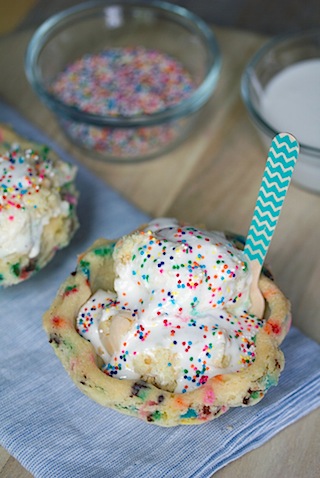
The only thing wrong with this dessert is that the spoon isn’t edible. Or covered in sprinkles.
But I’m still focusing on the fact that I can eat the bowls. Well done, Wilton. And me.
What’s your favorite kind of ice cream sundae?
[Sues]
Full disclosure: I used products that Wilton sent me in this recipe, but was not required to write a post. All opinions are 100% my own and I’ve always been an avid user of Wilton products!
Lindsaycdavisonthis stresses me out a bit...
Lindsaycdavisondream


Nope, it's not a Matt Damon movie and it's certainly not your average fixer-upper. Australian couple Katrina and Craig Waters were on the lookout for a simple, French farmhouse when they happened across Chateau de Gudanes, a crumbling 18th-Century Chateau on sale for a song. Now, nearly two years later, their permits have been approved (phew!) and the epic renovation is underway. It's gonna be a long journey from moldy, rotting house to restored castle, but we'll be following along every step of the way as we vicariously join in this romantic adventure. Want to see more?

From left: Lior Lev Sercarz of New York's La Boîte à Epices and Tom Erd of Wisconsin's the Spice House. [Photographs: Lauren Rothman and courtesy of the Spice House]
The world is smaller than it used to be. That's thanks, in part, to spices and the globalizing influences of colonialism that were fueled by our hunger for tastes from far away.
So it's a small irony that when we want to expand our culinary world view, we turn back to spices.
Think about what's in your pantry right now. Your black peppercorns might hail from India, your cinnamon from Indonesia; your coriander might have been harvested in Bulgaria, while the cumin you often pair with it was grown in Turkey. Allspice, that favorite ingredient in so many Scandinavian dishes? It's anything but Nordic—it's usually grown in Jamaica.
It's fascinating—and a little mind-boggling—to think about the intricacies of the spice trade, a millennia-old business traversing the globe. To help us wrap our brains around it, we turned to two of our favorite spice gurus: Lior Lev Sercarz, the master spice blender behind Manhattan boutique La Boîte à Epices, and Tom Erd, the co-owner, along with his wife Patty, of the Spice House, the premier mail-order Midwest spice shop that's been in operation for over 50 years. They shared some secrets of the trade with us.

A shelf at the Spice House. [Photograph courtesy of the Spice House]
"Nobody seems to understand shelf life," Erd says. Whole and ground spices are effectively separate products, each with their own shelf life. When left whole, spices' cell walls remain intact, but as soon as the spice is ground, those walls rupture and the spice's volatile essential oils—responsible for the very flavor and aroma of the spice—begin to dissipate at a rapid rate. "Now the clock starts ticking," Erd goes on.
His advice? When possible, buy whole spices and grind them just before cooking, as a coffee connoisseur does with beans. Stored whole, spices will keep for at least a year at full potency, if not several. A spare coffee grinder, like this affordable model, makes quick work of most whole spices.
When that's not an option, buy smaller quantities of ground spices and use them within a few months, or a year or two at most. Good spice shops will allow you to buy spices in small quantities.
When a spice merchant places an order, she does it blind: not knowing how fresh the spice is or what condition it'll arrive in.
"This business was started by pirates and there are still pirates in it," Erd likes to say. "Shippers will try to pass off crops that are one or two years old. I pay for this year's crop and I want this year's crop: you really gotta know your guy."
Spice trading, Sercarz agreed, is a profession where relationships are everything.
"It's still a bit old school," he says. "There's a lot of hand shaking. You need to know the right suppliers and you need to build on those relationships, on that trust."

Spice blends at La Boîte à Epices. [Photograph: Max Falkowitz]
Spice merchants deal with a volume of product that's hard to fathom—a bag of spices can weigh over 100 pounds—and the product inside is a ticking timebomb of freshness. So how do spice sellers store their product to maintain its quality? Well, preferably they don't do much storage at all.
"The goal is not to keep them here," Sercarz says. "The shorter time they can spend here, the better." That means ordering as little product as possible at a time, particularly when it comes to pre-ground.
"We buy smaller quantities of those items," Erd notes. "Just enough so that they'll be off our shelves in three weeks to a month."
Both Erd and Sercarz rely on a network of spice brokers and middlemen scattered all over the world, but most are concentrated in Asia where the majority of the world's spices are grown. These brokers use their own relationships to purchase spices directly from farms.
"It's very hard to buy directly from spice farmers," Sercarz explains. "Many of these people live in extremely remote places, and it's near impossible to get in touch with them." "Through the centuries, it's been a word-of-mouth thing, and it still is," Erd says.
But that's starting to change, if slowly. Sercarz now purchases directly from a few farms in Israel, France, and Cambodia, and here at home Erd buys some herbs from California farms.

Inside one of the Spice House's retail stores. [Photograph courtesy of the Spice House]
With hundreds of herbs and spices out there, how do spice merchants decide what to stock? For the most part they listen to their customers. And who do costumers listen to? The media.
"I don't set the pace," Erd explains. "That's TV chefs and food writers. If they're using Sichuan peppercorns, I better be selling Sichuan peppercorns. You have to follow the food trends."
20 years ago—in the era of Paul Prudhomme—Cajun seasoning flew off the Spice House's shelves so home cooks everywhere could get their taste of blackened fish. Today Erd struggles to keep Middle Eastern flavors in stock, thanks in large part to the continued popularity of 2012's wildly successful cookbook Jerusalem by Yotam Ottolenghi and Sami Tamimi.
It's a different story at Sercarz's business, where the chef-turned-spice-merchant lavishes his attention on minutely-tuned imaginative spice blends with names like Penang, Orchidea and Tangier. Sercarz mainly designs custom blends for high-end restaurants like Le Bernardin, and some of those blends then join his retail line. But he's noticed an increased demand for Middle Eastern spices as well.
While retail sales establish a spice merchant's brand and build visibility, contracts with restaurants are their bread and butter. A third of the Spice House's business comes from its sales to restaurants—in-store sales and internet sales make up the other thirds—and La Boîte supplies more than 80 restaurants, bakeries, and bars from here to Paris and beyond.
Both Sercarz and Erd sell proprietary spice blends to restaurants, either recipes they develop or ones that chefs provide based on their own tastes. "Every year it's a bigger part of our business," Erd says.

Inside Manhattan's La Boîte à Epices. [Photograph: Lauren Rothman]
You might think that a spice shop's big money-makers are the high-priced specialty seasonings like saffron (price: up to and over $10,000 a pound) and vanilla ($2 or more per bean). But Erd's most important items are reliable seasonal staples: baking spices like cinnamon in the winter and grilling spices like cumin and chili powder in the summer.
Small specialty spice merchants have a hard time competing against giants like McCormick. With high-volume orders, large companies can set the pace of the market and have far greater purchasing power. While Erd and Sercarz rely on broker connections, large companies' needs are so vast that they can approach a whole farm and buy out their entire stock during the late season: when prices are lower.
"At our level, we just can't do that," Erd says.
But small shops offer a different kind of value for consumers: freshness.
"We grind only about 100 pounds of spices at a time," Erd says, "and then we sell them within two days and grind again. Big companies grind only once every month or two, so by the time you get your hands on one of those bottles the spice inside may have been ground eight months ago. With our stuff? When you get it, it was probably ground only a week prior."
And, of course, as at any small business, owners Erd and Sercarz wear many different hats.
"I handle everything," Sercarz says. "I do finance, I do the books, I'm responsible for creativity, for purchases, the list goes on. I highly doubt McCormick's CEO does the purchasing."
Indian Spices 101: How to Work With Dry Spices »
LindsaycdavisonAnyone do this?


We've all worked in the office where you need a sweater in the summer and a fan in the winter. Crowd Comfort is an app that asks office tenants their comfort level on a one to five scale and recommends a temperature for each floor. The Boston-based startup will be running trials at GE and at MBTA stations and trains.
LindsaycdavisonI ADORE CANALES!

[Photographs: Niko Triantafillou, unless otherwise noted]
Up until very recently, a good canelé was not easy to find in New York City. The pastry, which originated in the Bordeaux region of France, features a thick caramelized sugar crust that gives way to a tender, custard-like interior that's permeated with the aromas of rum and vanilla. Although it's made with only six ingredients (eggs, sugar, flour, milk, vanilla, and rum), it's one of France's most interesting and surprisingly sophisticated pastries. And to my mind, it's a more fun eating experience than plenty of other fancier desserts.
Even now, though it's gained exposure and is coveted by pastry enthusiasts, canelés only make regular appearances in about 16 bakeries around New York—and in many, only on the weekends. We've spent the past few months paying repeated visits to them all to find the very best.

Three things make up a perfect canelé:
Crust: The single most important feature of a perfect canelé is a well-baked crust with just the right amount of caramelization. The exterior should have a decisive crunch but also be delicate, not burnt. Most sub-par canelés suffer from soft or leathery crusts.
Interior texture: The best canelés have an interior that's a cross between custard and cake, moist but not soggy or runny. A well-baked sample will feature a honeycomb-like crumb.
Aroma and flavor: You should smell aroma and rum before taking your first bite. But once you pierce the crust, the combination of vanilla, egg, and rum should be almost overpowering. (To accentuate these flavors, many chefs leave split vanilla beans and rum in the batter for one to three days before baking.)

Copper molds. [Photograph: Lauren Weisenthal]
Before we go on, let's talk molds.
A canelé's amazing crust is made possible through special baking molds that allow surface sugars to caramelize over high heat. Traditionally, the best molds were made of highly conductive copper, but more recently many chefs have taken to cheaper and easier-to-maintain silicone molds.
Many members of the pastry old school maintain that copper molds still make the crispiest, crackliest crust. Award-winning French pastry chef Francois Payard (who does not sell canelé in his New York City patisserie) doesn't mince words: "The best way to make a canelé is with a copper mold. You can't make a true canelé in a silicon mold, it's a bastard canelé. In a copper mold you get the perfect caramelization on the sides and they're cooked perfectly."
But not everyone agrees. At Breads Bakery, which makes quite a popular canelé, the bakers claim: "We used both copper and silicone molds, but we conducted several blind taste tests and couldn't tell the difference. We bake fresh canelés throughout the day, and to keep up with demand we chose to use the mold that was easier for our bakers to handle." That is: silicone.
Indeed, some of New York's top restaurants—and at least four on my list below—use silicone molds. But you should decide for yourself, so I've noted which molds each bakery uses below.

Bosie might be one of the most underrated pastry shops in New York City. Helmed by Top 10 Pastry Chef award winner Damien Herrgott, Bosie only makes about a dozen canelés each day. But if you really want to experience what this pastry is all about, pay them a visit.
Bosie's canelés have a crust that strikes the perfect balance between crunchy and delicate. They have a slightly blistered appearance that's lighter in color than most. Inside, specks of aromatic vanilla beans are visible. These canelés are sweet, but not vanilla pudding sweet. ($3. Copper molds.)

Cronuts may draw the crowds, but regulars and pastry fanatics know that canelés might be Dominique Ansel's finest pastry. The shop, which bakes 200 each day over three staggered shifts, can take at least partial credit in popularizing the pastry in New York. Ansel's canelés features a classic dark mahogany color and an extra-thick crust. They're also characterized by an extraordinary vanilla aroma from Tahitian vanilla beans. The very scent of these—even inside a paper bag—will make your mouth water.
The canelés also keep their crunchy texture marvelously well. Buy them in the late afternoon and they'll still be crunchy by evening. ($3. Copper molds.)

Runner and Stone in Gowanus has made a name for itself with its superb breads. But its canelés, only available on weekends, are just as worth a trip.
This canelé has a dark brown color and a distinctive matte finish thanks to a brushing of clarified butter on copper molds and it may feature the crunchiest crust on this list. The vanilla aroma is more subtle and light than Ansel's or Bosie's offerings. ($3. Copper molds.)

We've featured Epicerie Boulud on these pages many times, and for good reason: they sell a wide range of fantastic pastries and sweets. When fresh, their canelés are every bit as good as the best in the city, boasting a distinct rum and vanilla bouquet and a perfectly baked interior. Boulud's canelés are the most uniform of this group; each one is identical day in and day out, a hard thing to do with a craft product.
But a cautionary note: get these pastries before noon; their crusts soften significantly as the day goes on. ($3. Copper molds.)

Pastry chefs, residents of Queens, and just general French pastry fans have been traveling to this superb bakery in Jackson Heights for years. After 10 a.m. on weekends the bakery offers what is without a doubt the best deal on a first-rate canelé in the city; each is just $2. When fresh, these canelés offer a delicate but crunchy crust that satisfies. The crust is slightly thinner and the vanilla flavor less robust than our top four picks, but these are minor nitpicks. If you're planning a visit from another borough, call ahead to see what time they expect them to be ready. They will also take advance orders. ($2. Copper molds.)

We're huge fans of Lafayette Bakery's pastry and breads. Pastry Chef Jennifer Yee's tarts and desserts are among the best in the city, so it will come as no surprise that Lafayette's gorgeous mini-canelés are also excellent. Lafayette bakes their shiny mahogany-colored canelés multiple times throughout the day, so you know you're always going to get one that's fresh.
Resist the temptation to pop the whole pastry in your mouth at once; smaller bites let you appreciate their rich vanilla flavor. The mini pastries also offer most crust and less soft interior, if that's your preference. (Three for $4. Silicone molds.)

Since opening only 15 months ago, Breads Bakery has solidified its reputation for excellent pastry, bread, and (crushingly delicious) babka. Their very popular canelé is sweeter than most and has a particularly dense custard interior. The shiny crust is thin but has an excellent snap. Vanilla beans are used liberally and their spots are visible to the naked eye, resulting in a highly aromatic and flavorful pastry. Breads offers multiple bakings throughout the day for freshness. ($3. Silicone molds.)

Paris Baguette sells an ever-changing selection of excellent and reasonably priced baked goods. Their small, sweet canelés offer a compelling value in Manhattan at $2.25. Similar to Breads Bakery, this canelé has a dense, sweet, almost pudding-like custard. Real vanilla beans provide ample flavor. The crust is not as crispy as some may prefer, but the satisfying custard earns it a spot on this list.
Now with five locations and multiple bakings throughout the day, this is definitely New York's most accessible canelé. ($2.25. Silicone molds.)

Though Bouchon Bakery offers a wide array of exceptional sweets, they only recently began offering mini-canelés. These are without a doubt the crunchies canelés on this list. The crust is very crispy and thick, which leaves room for only a small amount of custard inside. But these mini-canelés are expensive: they cost $3 each, which is the same price as most bakeries sell a full size pastry. (Copper molds.)

Canelés By Céline is the only canelé-only bakery in New York and the only shop on this list to offer multiple flavors (12+), sizes, and savory options. Their extra-shiny mini-canelés are sweet and very crispy—especially early in the morning. The interior is as close to perfect as you can get, striking a nice balance between custard and cake.
Some purists might question the need for so many different flavor options when rum and vanilla yield such a great product. However, after many visits to Céline, I'm certain true canelé fans will enjoy the variety as I did.
If you're looking to go beyond the typical canelé flavor, go for the dark chocolate or lemon, which each compliment the pastry's rum and egg flavors. The savoy Parmesan version is also worth a try.
Célines colorful canelés look beautiful in a box and make a perfect gift for a dinner party. Sweet mini-canelé sare 3 for $4.90. See their website below for complete pricing information. (Silicone molds.)
If you want to try making your own canelés, check out our recipe here.
Since Reading Rainbow’s Kickstarter has raised almost $2 million and it’s only on it’s second day can I take my $50 back?
LindsaycdavisonYUM

[Photograph: Erin Kunkel]
Scratch-made chicken curry is a thing of beauty, with far greater complexity than anything that comes out of a jar. Add supple rice noodles and an array of toppings, and consider me satisfied for the next week. Leela Punyaratabandhu's curry noodles with chicken from her new cookbook, Simple Thai Food, are especially good. She provides options for making the dish using store-bought curry paste and for making everything from scratch. If you've got the time, I'd definitely recommend going for the fully homemade version; her curry pastes pair especially well with the array of toppings for the dish.
Why I picked this recipe: Give me a bowl of curry and noodles, and I'm happy.
What worked: The finished curry is quite complex when made from scratch, and it clings to the rice noodles with comforting ease.
What didn't: No problems here.
Suggested tweaks: Making the curry pastes from scratch is definitely a chore, but the fresh stuff really can't be beat. Consider making at least one of the two—you can freeze the leftovers for your next curry night. I made a second batch of the curry sans chicken and fish sauce (and using vegetable broth) for a vegan friend, and it was quite good. I'd suggest adding extra salt and lime juice, in addition to upping the tofu, if you choose to go that route.
As always with our Cook the Book feature, we have five (5) copies of Simple Thai Food to give away this week.
Lindsaycdavison@asd!

There was a time in my life when I relied almost exclusively on Mark Bittman. At the beginning of my sophomore year of college, I had moved off campus and was cooking completely on my own for the first time in my life. I had found a copy of How to Cook Everything (the yellow first edition) at a used bookstore and began using it as a guide for just about every meal. I doubt I am the only one of my generation to do so.
I may have not learned how to cook, well, everything, but my belief that recipes should be flexible, adaptable, and accessible was certainly founded in those early years of Bittman allegiance. I have, naturally, widened my sphere of culinary influence over the years. Likewise, Bittman has morphed as time has marched on, and he now writes with great confidence about the changes he's made to his diet. Last year, he published a guide to his diet, called VB6, or "Vegan Before Six." This plan is less dogmatic than it may seem at first glance; rather than asking others to stick to a strict timeline of meals, Bittman instead asserts the benefits of eating vegan meals twice a day, and allowing meat (and most anything else) at one meal. For him, dinner is the "treat" meal, while for others it could be breakfast, lunch, or afternoon snack time. The point is not to be vegan in a political sense, but to substantially increase the amount of minimally processed plant-based foods eaten throughout the day. It makes good sense.
This spring, Bittman released a companion cookbook to his diet guide. This book is organized by mealtime and, in keeping with Bittman's personal preference, all of the dishes are vegan except for the dinner chapter and a few of the desserts. The recipes with animal products use them in smallish quantities, making them what Bittman calls "flexitarian." Like all of Bittman's work, the recipes in The VB6 Cookbook are streamlined, simple, and come with at least two variations each. They aren't all fast—the eggplant meatballs, for example, will take an hour or so from start to finish, and they're in the lunch chapter. Yet they're easily made ahead of time and packed up for lunches on the go, just like most of the food he suggests eating for a noontime meal.
The VB6 Cookbook isn't exactly breaking new ground in terms of vegan cooking, but given Bittman's desire to convince others to hop on his bandwagon, I doubt that innovative recipe-writing is his goal. Instead, he wants to demonstrate that healthy, plant-based foods can be approachable for anyone—not just those of us who willingly spend hours each day cooking for fun. You don't need to make your own vegan cheese or ferment your own kombucha to improve your diet. He just wants to get more people in the kitchen.
This week, we'll cook through a day of VB6 eating. We'll start with a breakfast of "chorizo" tacos, and then nosh on those eggplant meatballs for lunch. As a snack, we'll blend up an avocado dip to serve with crunchy raw radishes. And for dinner, we'll add in some meat by making a bowl of pork and asparagus soba.
Lindsaycdavisonit is strange for a city that loves dogs, there are no dog parks! (well one now I guess)
 After lobbying by groups such as Chiens en Ville, Paris now has a real dog park, Le Square Jacques Antoine. It’s just off the Place Denfert-Rochereau in the 14th. It’s open 24/7, with special gates and chain-link fencing between the wrought-iron fencing to prevent escapes. You can let your dogs off leash, but you can’t bring in any toys.

Blogging this without context or an opinion because that is how I like my Internet.
Plus, 33K, amirite?
Dr Charlotte Jones said the Fifty Shades of Grey Trilogy has led to older couples being more adventurous in bed and could explain a rise in sexually transmitted diseases.
Good morning!
Lindsaycdavisonthis looks like it's worth taking a trip to seattle.... YUM

[Photographs: Alexandra Penfold]
When I hit the road, I always make a point to seek out awesome food. So when business travel brought me to Seattle, I knew that I needed to sample some of the city's tastiest desserts. I'll never say no to chocolate in any form, especially when it takes the form of a freshly baked molten chocolate cake. We gave you a first look at Hot Cakes Molten Chocolate Cakery in Seattle's Ballard neighborhood soon after it opened. In the time since, it's been drawing lines out the door for their menu of molten cakes, boozy milkshakes with sophisticated pairings like Scotch and smoked chocolate, and other decadent treats.
Because, no surprise, everything looks so good, you'll need a guide to ordering. And how could we give you that intel other than by trying all the items? So we did just that, trying all the items written on their chalkboard menu the day of our visit (as opposed to trying their takeaway sauces and cookies). Note: the folks at Hot Cakes rotate their menu on a regular basis to switch in seasonal ingredients, so be sure to check out their website to see what the latest offerings are.
They are open most days from 11:00 a.m. until 11:00 p.m., though the locals I've spoken to say the later in the day it gets, the more crowded the shop is liable to be. Monday through Friday they have $5 happy hour specials. Without further ado, here's a peek at the eats.

The namesake cakes require 10 to 15 minutes for baking, but are well worth the wait.

This cake ($8) is made with Seattle's Theo chocolate, salted caramel and nib toffee, and served up with vanilla ice cream. It's dark and decadent, and it's also the original, the alpha molten cake, if you will. How good is it? Good enough that you might consider breaking up with someone just to justify eating this. The word fudge-tacular comes to mind. Chocoholics, this is your cake for date night or when you want to treat yourself. For folks with dietary restrictions, this is both gluten-free and dairy-free (if you skip the ice cream, that is).

A molten cake with a Nutella-like center? Glory! This cake ($8) is ridiculously rich and was the seasonal offering when we made our visit. The hazelnut is a perfect counterpoint to the dark chocolate, creating an overall vibe that's a little more bitter than the other molten cakes but a must try for dark chocolate fanciers and those who can't get enough Nutella. A scoop of vanilla ice cream rounds this dessert out nicely.

If you're vegan, you'll rejoice, for this is a ridiculously good molten chocolate cake ($8). If you're not vegan, don't worry, it's so big on flavor that you won't even miss the dairy. Somehow the texture of this cake seemed, if possible, more molten, more dark and rich than the non-vegan cakes. What's the white stuff on the side, you ask? Vegan coconut ice cream drizzled with vegan salted caramel sauce—and it's delicious.

You might want to order a glass of milk because this cake ($8) sticks to the roof of your mouth. Rich and heavy, this is more in the peanut butter camp than the chocolate one, and with good reason—it has both peanut butter fudge and peanut butter caramel. If you're enchanted at the thought of a fudgy cake version of a peanut butter cup, this one is for you.

There's your run of the mill crème brûlée and then there's amazing crème brûlée. Hot Cakes' rendition ($7) is as close to perfection as I've had. Impossibly smooth and not too eggy, the custard is delicate and velvety. The seasonal rhubarb compote capably walks the line between sweet and tangy. If you love crème brûlée you must try this. If you think you don't love crème brûlée, you must try this.

Bread puddings can easily veer into leaden territory. Not so with this iteration ($8) which was light, spongy, and hard to resist. Topped with the same vanilla rhubarb compote as the crème brûlée, this bad boy came drizzled with caramel and a side of vanilla ice cream.

A grilled chocolate sandwich ($7.50) with caramel dipping sauce? Sounds like an utter sugar bomb, I know, but stay with me here, because this sandwich is awesome, and not in an I'm-a-kid-and-I-like-eating-things-so-sweet-they-make-my-teeth-hurt way. Firstly, the innards are filled with a dark chocolate ganache, but the game changer here is the potato bread. It has a pleasant sourness which balances out the sweetness of the caramel. It's a genius pairing, whimsical yet sophisticated and it comes adorably packaged in brown paper and tied up with string.

Dark chocolate, cream, olive oil, and breadcrumbs come together in this not too sweet, thick and rich pudding ($8) that's served up in an adorable jar and available to go. While this is a tasty pudding, it tastes like milk chocolate, so dark chocolate lovers may want to pass.

What can we say? This is an enormous, awesome chocolate chip cookie topped with creamy vanilla bean ice cream ($6). The cookie itself has that tasty, toffee-like quality to the crumb and it's studded with plenty of chocolate. If the aliens come, I hope their flying saucer looks like this: a perfect, buttery soft cookie, with a dome of vanilla ice cream on top.

This slab of chocolate cake ($6) could feed a small family, but you'll probably want to save it all for yourself. The whiskey is well integrated and compliments the smoked ganache. The overall effect is boozy, smoky, and mysterious. The cake crumb is light in texture yet the overall effect is substantial.

This trio of limited edition vanilla and caramel ice creams was a fun way to sample Hot Cakes' housemade caramel sauces ($9). This particular flight was made up of a sweet yet earthy dandelion caramel sauce, a super spicy pistachio paprika caramel, and a bright and luscious Meyer lemon caramel. You might not expect lemon and caramel to pair so well together, but the citrus is a nice counterpoint to the sweetness of the caramel.

Shhhh, don't tell Dumbledore, but this Butter Beer ($5) has a touch of alcohol. Specifically, it's a mix of butterscotch, fresh apple cider, ginger and sparkling wine, though you can get it sans bubbly for the kids. This drink was lighter tasting than the drinking caramel and you could taste the wine, in a good way.

Sure, you've heard of drinking chocolate, but how about drinking caramel? This drink ($4) is made with rich salted caramel and fresh cream. It's definitely on the sweet side, but surprisingly light. The foam compliments the sweetness nicely. Add some Mezcal ($9) to balance out the sugar rush.

You can choose from the Dark or Northwest drinking chocolates. We picked the Dark and it was just as rich yet balanced as you'd expect a drinking chocolate would be that was perfected by the former Head Chocolatier of Theo Chocolate. Try it with Scotch and Solerno ($9).

The milkshakes ($7) at Hot Cakes were a thing of great beauty. Ultra thick doesn't even begin to describe them; these guys took ages to melt, ensuring that every last sip was frozen and textured, not the equivalent of melted soup.
The trio of shakes pictured above was comprised of the gold standards: dark chocolate, vanilla bean, and salted caramel. The dark chocolate shake was dense with rich, and the vanilla bean was thick and sweet. If you've been shy about jumping onto the salted caramel bandwagon, this shake, with its sweet yet slightly dark caramel flavor, would be a good gateway beverage.

The folks at Hot Cakes are all about the smoked + chocolate pairing and naturally it works well in the context of s'mores. It's a bold flavor that's mellowed (or should it be mallowed?) out by the addition of a fancy marshmallow and graham cracker crumbs.

Attention, there are real rhubarb bits here. Like the rhubarb compote that made appearances on the crème brûlée and bread pudding, this shake skirted the pitfuls of rhubarb infused treats—it was neither too tart nor too sweet. A sprinkle of Hawaiian sea salt gives it a unique flavor boost. This shake just goes to show that strawberry isn't the only pretty pink shake in town.
Like their non-alcoholic counterparts, the boozy shakes ($10-$13) at Hot Cakes delivered on texture and thickness.

What would you do with a drunken sailor? Well, if it's from Hot Cakes, you'd drink that bad boy down. This peanut butter, caramel, and whiskey combo ($10) is salty yet sweet, just like you hope your drunken sailor would be.

This shake ($10) is made with espresso and rye. Though it goes by the name "Extra-Dark", we found it was actually lighter in flavor than the regular salted caramel. The espresso wasn't as prominent as serious coffee drinkers might hope. With such a rich menu to choose from, unless you're enamored of caramel, there are other drinks or treats that might be a better choice here if you're making a special trip.

This milkshake ($13) was easily the most divisive of Hot Cakes offerings. Those who love Scotch said it was very smokey and "tastes like you kissed a very bad French man" while others though the smokiness was overpowering after a couple of sips.

This mint julep ($13) was like a gentle grandma's mint julep—sweet and sort of cozy, and not overly minty. It's not so boozy that you'll get tipsy, but it's plenty tasty.

Visually arresting, this delicate-looking drink ($8) is comprised of elderflower liqueur and vanilla ice cream. The overall effect was very floral, and the taste was reminiscent of lychee. It's just the sort of drink you could imagine enjoying on the island of Kaui.

This float ($8) combines rich vanilla ice cream and Seattle Dry Cider, a locally made, small-batch hard cider that puts Washington state's famous apples to good use. The cider is made with a blend of Granny Smith, Fuji, Red Delicious, Golden Delicious, and Gala apples and promises it's "One of the driest ciders on the market."
But how does it taste with ice cream floating in it? Results were split. Those who loved hard cider liked the tartness and crispness of the drink, while others felt the overall effect was medicinal. Once the ice cream had a chance to melt, the overall effect was mellowed and it was largely reminiscent of those last bites of apple pie a la mode.

Last, but certainly not least, these gold foil wrapped treats ($5) are Hot Cakes' take on Hostess. You know the drill. Chocolate cake inside. Chocolate coating outside. The twist? Their snack cakes are organic and filled with dark chocolate cream.
I'll admit these were an impulse purchase as I walked out the door. They aren't on the proper "chalkboard menu", but you can find them on display in the store or order them online. If you've been drooling through this post with no immediate plans to travel to Seattle, they have a number of shippable items including the Bling Blings, a selection of their caramel sauces, cookies, and both their Dark Decadence and Vegan Molten Cakes.
LindsaycdavisonI want a bar cart! :)
Lindsaycdavison@ASD! Make me!
 I didn't know that May is salad month, but I guess it makes sense. It's this time of year when salad greens start looking more appealing, and they're traveling shorter distances to our tables. Weather is getting warmer, and lighter foods are more appealing.

Lindsaycdavisonok andrew, i believe you.
Got a question for Serious Eats? Email your questions to AskTheFoodLab @seriouseats.com and please include your Serious Eats user name in your email. All questions will be read, though unfortunately not all can be answered.

[Photographs: Robyn Lee]
Everyone seems to have a different idea about how to cook pasta, including using some of the pasta water in the sauce. Does adding pasta water to the sauce really make a difference? What about finishing the pasta in its sauce?
There's pasta. And then there's sauce. Put them together and you have dinner. Simple as that, right?
Of course not!
See, the thing is, pasta (the dish) isn't just about the pasta (the starch), and it's not just about the sauce either. It's about the marriage of the two. And like all marriages, there are some secrets to getting the union to work. It just so happens that I was recently working on a screenplay on this very theme. Take a look:
A piece of Penne stands opposite blushing bride Tomato Sauce, whose happy tears have reduced her to an absolute puddle (or maybe it's just her saucy streak). In the pews are hundreds of happy guests, including size-zero aunt Spaghetti and beefy uncle Bolognese, plump grandma Ravioli and wise old grandpa Sage-Butter. Priest Strozzapreti stands between the the soon-to-be-newlyweds, near a font of holy pasta water.
SCENE: INT OF A FRYING PAN - DAY
PRIEST STROZZAPRETI
Dearly beloved, we gather here today to witness the joining of Penne and Tomato Sauce in holy macaroni. Do you, Penne, and you, Tomato Sauce, take each other as lawfully wedded husband and wife?
PENNE AND TOMATO SAUCE TOGETHER
Al dente.
- CUT SCENE -
Pixar will totally buy the rights to this script, right? Anyway, the point is that getting pasta and sauce to unite is critically important for the dish to be truly great. The only question is, what's the best way to bring them together?
Most pasta aficionados will tell you that the best way to do it is by finishing cooking the nearly-done pasta on the heat in its sauce with a little of the pasta-cooking water. According to that line of thinking, the starchy pasta water helps to bind and thicken the sauce, and in some cases—such as buttery or oily sauces—emulsifies it into a creamy, non-greasy coating. All of my own pasta-cooking experience supports that theory, but I'd never done side-by-side tests to prove that it actually works better.
There are three basic ways to cook pasta:
So the first thing I decided to do was to do a side-by-side test of these three methods with spaghetti and tomato sauce, and see if one of them was clearly better than the others.

I served each pasta with grated cheese to my colleagues without revealing what I was testing, and asked them to pick their favorite. (Obviously, the pasta that had a puddle of sauce sitting on top was visibly different from the two that were coated in sauce, but otherwise I didn't divulge what I was up to.)
The pasta that had been cooked in its sauce with some of that pasta water won by a landslide. That method bound pasta and sauce together, making the two become one, in a way the other methods didn't.
As for the other methods, plopping some sauce on top of a pile of plain boiled noodles meant that no matter how much we tried to combine them on the plate, we always ended up with noodles that weren't evenly coated in sauce. Meanwhile, tossing the pasta and sauce together off the heat did a decent job of coating the noodles, but there wasn't the same level of fusion (and we all know you need some serious fusion or the marriage isn't really official, if you know what I mean).
Just because our first test demonstrated that it's best to cook pasta in its sauce with some of the starchy cooking water doesn't prove beyond a doubt that the starch itself is important. Maybe cooking pasta in its sauce is all that matters, starchy water or not.
To test this out, I prepared three new batches, with the goal of getting water with different levels of starchiness:
In all cases I salted the water, including the tap water, following our pasta-salting guide.

From left: The starchiest water was the result of cooking 1 pound of pasta in 1/2 gallon water; moderately starchy water from 1 pound of pasta in 1 gallon water; plain salted tap water with no starch in it was the control.
To really put this to the test, I used equal amounts of plain olive oil as the "sauce". As you all know from making vinaigrettes, mixing water and oil is never easy. If starch was going to prove its worth, it was going to have to do a better job of turning plain olive oil into a sauce than the tap water would.
After cooking all of the pasta until just al dente, I moved the batches to pans with the oil and 1/4 cup each of the three types of water, and cooked them. As the sauces reduced, the value of the starch became clear: the plain salted water formed a thin sauce that was very oily; the moderately starchy water formed a sauce with a thicker texture, but it still had a fair amount of oil on its surface; the starchiest water formed a sauce that was the thickest, creamiest, and silkiest, with the least oil on its surface.
The starchiest water produced the thickest, most emulsified sauce.
None of the sauces formed a totally perfect emulsion (that's what I get for trying to make a sauce from nothing more than oil and water), but the starchiest water was by far the most emulsified of the three. A little grated cheese tossed in at the end is all I would have needed to fully bind the sauce.
So now we have what I think is pretty conclusive evidence that it's not only best to finish pasta by cooking it in its sauce with a little of the cooking water, but that starchier water yields the best sauce. Hopefully most of you are convinced.
But I know that old habits die hard. If you're still not on-board, I'm going to give you a choice: Take this blue pill, and you can go on living your pasta life, eating bowls of so-so spaghetti and thinking it's all great. But if you want to know the truth, take this red pill. I warn you, though, your whole idea of what's real may never be the same...
...ah, so you took the red pill (or you're just curious and are still reading—that's fine too). So, what if I told you that you can bend pasta-cooking times to your will? What if I told you that there's a way to take pasta that typically reaches the al dente stage in 10 minutes and stretch it out so that it takes 12 or 15 minutes? What if I told you that there is no noodle?
Okay, there's a noodle...as far as my noodle can tell, anyway. But you really can change its cooking time, and the way to do it is—drumroll please—to transfer it to the sauce to finish cooking. The earlier you transfer the pasta to the sauce, the longer it will take to finish cooking, because pasta cooks more slowly in sauce (even sauce that's watered down with cooking water) than it does in boiling water. Just take a look at this photo to see what I mean.

At left, pasta that's been boiled for 14 minutes; at right, pasta that also cooked for 14 minutes, first in boiling water for 5 minutes, then in its sauce for 9 minutes. The sauce-finished pasta is less cooked (as evidenced by the white ring at its core) than the boiled pasta, despite cooking for the same amount of time.
Both the pieces of penne you see came from the same batch of pasta, which I started cooking at exactly the same time in the same pot of salted boiling water. About halfway through the pasta's suggested 12-minute cooking time, I fished out half the penne and immediately transferred it to a pan with some simmering tomato sauce, and cooked them together, gradually adding ladlefuls of the pasta-cooking water, much like making risotto. Here's what happened:
This is what I like to call Pasta Bullet Time, a state where pasta on the verge of being overcooked suddenly slides into a slow-motion crawl to doneness, buying you time to finish cooking the chicken that isn't quite done, or dress and toss the salad that you totally forgot about. Now you have the power!
If you want your pasta to have a long, happy marriage with its sauce, it's best to cook them together with a little of the pasta-cooking water. Plus, that method reduces the chance of overcooking the pasta, since the pasta cooks more slowly once it's simmering in its sauce.
Just one bit of caution when cooking pasta in its sauce: Because the pasta-cooking water is salted, there's a risk of the dish becoming too salty if you keep adding and reducing ladlefuls of it. Keep tasting the pasta and sauce as you cook them together—and switch to adding plain unsalted water if the pasta needs to cook a little longer but already has enough salt.
LindsaycdavisonLOVE Big apple bbq.... our first data right robyn?

[Photograph: Josh Bousel]
The Big Apple Barbecue Block Party, New York's biggest meatfest of the year, is coming up June 7th and 8th, and pit masters all around the country are already making game plans for the brisket, ribs, and hog they'll be serving to the hungry crowd.
Admission to the event is free (with a pay-per-plate system), but if you're looking to beat the line, the festival's fast pass and VIP tickets are the way to go. The $125 fast pass and new $265 "Big Picking Pass" both mean shorter waits for 'cue and include $100 to spend at the event.
But the real real way to go is to enter our giveaway, as we're offering two limited edition fast passes with $100 redeemable for food and drink. Each fast pass includes access for a guest and is valid for both days of the block party (normal fast pass and VIP passes are only good for one of the two days).
Take a look at our previous Big Apple Barbecue coverage here, then head on over to this year's pit master line up and tell us whose barbecue you're most excited for in the comments below. We'll select two winners at random this Friday, Mar 23rd, at noon. The standard Serious Eats contest rules apply.
LindsaycdavisonI think I'm a big fan of tex mex...

On the left, Chiles en nogada made at Pilar Cabrera's Casa de los Sabores cooking school in Oaxaca; on the right, queso dip. [Photographs: Nick Kindelsperger, Joshua Bousel]
Mexican food confused me when I first moved to Texas. What I considered to be quintessential Tex-Mex, like sizzling fajita platters and enchiladas smothered in yellow cheese, were on the same menu as "traditional" Mexican favorites, like tacos al pastor and chiles en nogada. I even encountered a restaurant serving the Lone Star state's famous queso dip next to cochinita pibil (a specialty from the Yucatán Peninsula) wrapped in flour tortillas. I didn't know what to make of it. But after talking to several chefs, I learned that the distinction between Mexican and Tex-Mex food has actually been evolving for years, and has even recently started to blur.

Tex-Mex Chili Con Queso [Photograph: Lisa Fain ]
The cuisine we now call Tex-Mex is rooted in the state's Tejano culture (Texans of Spanish or Mexican heritage who lived in Texas before it became a republic) and also Mexican immigrants who hailed largely from Northern Mexico. Until the 1970s, though, most people referred to it simply as Mexican food. In The Tex-Mex Cookbook, Texas food expert Robb Walsh credits Diana Kennedy with removing Tex-Mex from the discussion of traditional Mexican cuisine.
Rick Bayless, however, recently told me at the Austin Food and Wine Festival that when he wrote the draft of his first cookbook, Authentic Mexican, he featured seven culinary regions of Mexico, including the Southwestern United States. "You could even break that down further into the cuisines of Arizona, New Mexico, Texas, and even the ranchos of California," he added. Perhaps his view differs from Kennedy's because he grew up in Oklahoma eating Tex-Mex two or three times a week.

Cheese enchiladas with chili con carne is a favorite Tex-Mex dish. [Photograph: Lisa Fain ]
If you're looking to identify the distinguishing characteristics of Tex-Mex, enchiladas are a good case study. In the classic Tex-Mex version of cheese enchiladas, grated yellow cheese is wrapped in tortillas, and then covered in a dark red chili sauce mixed with ground beef. You'll also find other typical Tex-Mex ingredients like pinto beans and rice served on the side.

Rick Bayless's version of enchiladas suizas, a specialty of Mexico City. [Photograph: Nick Kindelsperger]
But Iliana de la Vega, the chef and owner of the Mexican restaurant El Naranjo in Austin, never ate cheese enchiladas while growing up in Mexico City. She recalls eating foods like chiles rellenos and salads composed of chayote or nopales. Beef was a bit of a rarity. "In traditional Mexican cooking, we eat a lot of chicken and a lot of pork," she explained. If they had enchiladas, they were usually smothered in a green tomatillo sauce or mole, and sprinkled with a white cheese. "My mother was from Oaxaca, so we had mole maybe twice or three times a month," she said.
Although Carlos Rivero, owner of El Chile Cafe y Cantina and several other Mexican restaurants in Austin, ate traditional Mexican mole and other dishes while growing up in San Antonio, he and Bayless both spoke nostalgically about cheese enchiladas in chili gravy. "They were probably one of my favorite dishes my mom made when my sister and I we were young," Rivero recalled.

Real Texas Chili con Carne [Photograph: J. Kenji Lopez-Alt ]
Another difference is the abundant use of cumin in Tex-Mex cuisine. "We use it a lot in the north, but it's not a spice we use much in the southern part of Mexico," says de la Vega. Robb Walsh links the heavy use of cumin to the first wave of Canary Islanders who emigrated to San Antonio in the 1700s. Today it's still a key ingredient in chili con carne, along with chili powder, which, according to Walsh, is a uniquely Texan invention developed by a German immigrant in New Braunfels in the late 1890s. In the late 1800's, chili con carne was regularly ladled out at bargain prices in the streets of San Antonio at its famed chili stands. "Tex-Mex was never the cuisine of the upper echelon of society," Bayless observes. "It's a peasant, working class cuisine."
The Tex-Mex that most of us think of, full of Velveeta cheese and pre-made taco shells, was shaped by the development of convenience foods in the 1950s. That time period left Tex-Mex, and even Mexican food in general, with a reputation as "just a cheap cuisine, full of sour cream and processed cheese, and that everything is greasy," says de la Vega.

Many Mexican restaurants don't make you choose between fajitas or cochinita pibil anymore. [Photograph: J. Kenji Lopez-Alt ]
Fortunately, that perception has changed. "Tex-Mex has now evolved to a different stage," says Bayless. "It was once a very simple cuisine, but now there are a variety of dishes on the menus."
Carlos Rivero agrees. "'Mexican' is a very broad term because that profile encompasses so many different flavors and ingredients," explains Rivero. "When you come to El Chile, you can have a modern take on Mexican or you can have the die-hard fajita platter. It's up to you."
As the line between traditional Mexican and Tex-Mex continues to evolve, it may become harder to separate the two. As Iliana de la Vega notes, "Either Tex-Mex or traditional Mexican, we can all live together. As long as it's well-executed food, then, why not?"
Lindsaycdavisongood idea for a party!

Here’s a project for your older kids (ages 8-12)…have them make dinner, specifically these taco bites! Cook up the beef for them and then have them load up all the taco bites, while you sit on the couch and read a magazine. (Who am I kidding? No mom has time to read a magazine right before dinner…and if you do, I want to know how you do it!!!) I know everyone at your dinner table will love these taco bites!
Get the full recipe for Taco Bites here!

Welcome to our 31 Days of Gluten Free Meals here on $5 Dinners. May is Celiac Awareness Month, so we thought it appropriate to recycle our old favorite gluten free recipes (and post some new ones too!) Each morning for the next 31 days, we’ll share meal ideas with you! If you aren’t gluten free, PLEASE SHARE them (using those cute buttons below!) with those in your life who avoid or are allergic to gluten!
Be sure to share all the 31 Days of Gluten Free Meals with your friends and family!


