Shared posts

22 Jan 10:14

A Message From Tom Doherty

by Tom Doherty

David Hartwell

Longtime Tor Senior Editor, colleague and friend David Hartwell passed away last night. Tom Doherty, President and Publisher of Tor Books shares his thoughts.

David Hartwell was a brilliant editor. I met David in the early 70’s when he was working for Berkeley and got to know him better as he was creating Timescape, an imprint at Simon and Schuster. I’ve worked with him closely for the last 33 years at TOR Books. In all that time, no editor was more influential in the shaping of science fiction and fantasy than he.

He was a founder of the New York Review of Science Fiction, a founder and chairman of the board of directors of the World Fantasy Convention, an administrator of the Philip K. Dick Award. A three-time winner of the Hugo Award for Best Professional Editor Long Form, David later withdrew his name from contention to give younger editors an opportunity to shine.

John Updike, in the New Yorker, aptly characterized David as a “loving expert.” David’s expertly selected list has been a solid rock in the foundation of TOR. In addition to bringing a vast selection of books to the field, he always found time to mentor younger editors as they learned the trade. David’s Year’s Best anthologies consistently placed high in the Locus reader polls. David’s legacy leaves an indelible mark on the literature and the culture of science fiction and fantasy—as an editor, a mentor, and a fan. He shaped our concepts, our tastes, and in some ways our expectations of these immense and beloved genres.

Fascinating to talk to on any aspect of science fiction, his perspective so fundamental to the building of our company, David was a very special man, and he was my friend. I and so many in the community will miss him.

18 Dec 12:18

Star Wars.


No spoilers, but I will discuss elements of the movies below, stream of consciousness.

I think the First Order is incredible successful at making the fascists be a bunch of infantile pricks who you immediately want to strangle & punch repeatedly, unlike the pretty friggin' cool Empire who are pretty much the coolest cats in cool town. Tantrum throwing Kylo Ren being the exception, being everything Anakin should have been. He's such a petulant godling, he's such a better embodiment of the sulky angry thing, & making him a Vader fanboy is absolutely perfect. Also I want all of his clothes so bad. Not like the mask or anything, just all the sweet capes & robes &...obis, I guess, & shit. I was really surprised by all of the characters! Poe immediately won me over with his "who talks first, do you talk first or do I talk first?" bit...& woah, that frozen blaster bolt was really the statement piece of the movie. I feel like it really set a technical & tonal level of what to expect from the special effects, a new vibe using the old elements. Finn & Rey's instant friendship is a wonderful inversion of the expected cynicism. Old characters aren't over-relied upon & are important to the story, not extraneous. Starkiller base was kind of meh, but then, the Death Star II was kind of meh. BB-8 is just plain swell & you already knew that.

Alright, now it's probably spoiler time. I feel like it's not a big deal?

So I was...probably half wrong about my prediction? Half. I thought it was going to be Rey & Kylo Ren as the Solo twins, with Kylo Ren as Luke failed apprentice & Rey as the one he abandoned in order to not go down that path. Or that she was not "Force-sensitive" & she was up to something. I sort of think she's Luke's kid, now. Obviously "No. I am your father" is a line they have right there, set up & waiting. Right? Not that I mind: the movie is not coy or built on twists, the story is right there, just not all revealed.

I suppose this is probably a real spoiler, or at least, I wouldn't want to know.

So I totally bought into the assumption that Finn was the "Force-sensitive" one. & I'm not convinced he won't be at some point, but that's definitely not what this movie was about. The moment I decided I liked Rey is when she yelled at Finn for being on the Hero Refuses the Call part of his monomyth & then goes into the basement to a literal call & is like, I for sure refuse this shit. She kicked a lot of ass without Kicking Ass™ & that was great, but also the way her climbing is important to the story? Because finally someone learned to climb-- all important Star Wars crap is build over a giant pit. That's standard. The Starkiller planet was not that interesting but it gave a nice backdrop to Solo's swan song.

I was worried Chewie was going to die-- in my head, Star Wars is like, a weird century for Chewbacca, but like, this is a blip on his radar. Dude's 900 years old. I'm partly convinced he's the modern Bigfoot-- & I sure hope he doesn't. I also thought he might lose a limb. I was waiting for a limb! I thought I saw a Skywalker Hand® fly off there, but no...I'll keep waiting though. I thought Solo was a gonner for sure, & I was really worried about the Falcon...but now I think she'll be iconic. I was positive Kylo Ren was Leia or Luke's kid, probably Leia's & probably Han's because it would be kind of a cheat on their romance not to do it. If Rey is Luke's kid, like I'm now thinking, I wonder what the mother's story will turn out to be.

What the hell is the deal with Snoke? The obvious theory is clone of Palpatine, but the mention of a "first Jedi Temple" makes me think there could be some "ancient evil" deal going on. I kind of hope that dude is like, just actually a giant though, by the way. I am curious about this vision of a whole crew of the Knights of Ren. I liked the visions, I thought it was just the right amount. There's a lot of mysteries in this movie! I wonder if Captain Phasma will like, seriously be a Boba Fett, who mostly just looks cool but doesn't do much? Also, how did that piece of crap General Hux not at all get murdered? Ugh, he's the worst! In a good way, in the way where we are supposed to hate that guy.
01 Dec 13:57

#MagnetosphereWasRight

So earlier this year Jennifer noticed the euro was weak against the dollar & decided to plan us a summer vacation in Europe, since I've never really travelled outside the country, besides Hawaii & Canada...& instead she booked us a vacation in the Arctic during the winter because she loves me & knows I want the forevernight of Fimbulwinter. The vacation is still ongoing-- we are in Helsinki, going to Estonia tomorrow, then eventually Iceland-- but we are back from the Arctic.


We stayed in a Skyrim mead hall turf house the first night with it's own sauna & lavish bathroom. I managed to light a fire & feel like all my years of Boy Scouts were worth something. I also was a master tracker of animals, which Jennifer said was cheating because it was snowy but I never claimed to be Aragorn son of Arathorn or have any levels in ranger. Just the Wasteland background!


After that we slept in a glass igloo! The point is to see the Northern Lights but it was overcast the whole time. That's okay, I saw 'em in Cleveland once upon a time. The glass igloo ruled, but the lack of a shower sucked, even with a public sauna as an option.


Jennifer took this picture of us snowmobiling. It's like a four by four.


We rode horses, too; I rode a Finnish horse & Jennifer had an Icelandic horse. My horse's gait was weird, her's was crazy, as is the case with Icelandic horses. It had to trot a lot to keep up with the bigger horses. I sympathize: trotting sucks. We were with some people who were very horse adept & we said we were intermediate because we'd ridden a bit as teenagers. It was a bit out of my grasp, especially when we cantered, but we kept it on lock down.


Then after a big meal of reindeer-- I had the sautéed reindeer, Jennifer the flank steak-- we went on an Aurora hunt at night in a sledge pulled by reindeer. I say "at night" but it was basically two hours of daylight, four hours of twilight bracketing that, but otherwise dark. It was heavenly, in a literal sense. Dark upon the waters.

27 Nov 10:24

Exclusive Cover Reveal & Excerpt: The Emperor’s Railroad by Guy Haley

by Joel Cunningham

emperorWe fell in love with the debut novella lineup from Tor.com Publishing, the digital-first imprint from Tor Books that helped bring back shorter-length SF/F in a big way in 2015. Word has started to leak out about what’s in store for us next year, and it looks like more of the same in the best way: this just might be the future of publishing—slimmer books that can be read in a sitting or two, produced with less lead time and lower overhead, allowing for tighter, quirkier, or more daring storytelling than you might find in a full-length novel.

Best of all? Tor.com Publishing treats them like what they are: real books. Their taste in cover art has been impeccable, and we’re pleased they’ve given us the chance to premiere the cover for one of their upcoming titles, The Emperor’s Railroad by Guy Haley, a celebrated author of Warhammer 40,000 titles as well as his own original stories. You’ll find the complete Chris McGrath cover art (designed by Christine Foltzer), along with an exclusive excerpt, following the publisher’s blurb.

Global war devastated the environment, a zombie-like plague wiped out much of humanity, and civilization as we once understood it came to a standstill. But that was a thousand years ago, and the world is now a very different place.

Conflict between city states is constant, superstition is rife, and machine relics, mutant creatures and resurrected prehistoric beasts trouble the land. Watching over all are the silent Dreaming Cities. Homes of the angels, bastion outposts of heaven on Earth. Or so the church claims. Very few go in, and nobody ever comes out.

Until now…

Haley_EmperorsRailroad_cover[1]
And here’s the excerpt.

Chapter 1: Bridge of the Ancients

Quinn had two swords. One for killing the living, and one for killing the dead.

He wore them on top of each other on his left hip. On his right he had a sixgun.

A knight’s weapons.

You’ve probably not seen a knight. There’s not been one through these parts for a long time, not since just after Quinn, and that was fifty years back. Back then I’d never seen one neither. Truth be told, when we first saw him we weren’t right sure if he was what he said he was. There weren’t many knights left in those days, most had fallen in the war. Times like these we live in, you wonder at people. A knight’s weapons are hard to get hold of if you ain’t sanctioned by the Dreaming Cities, but not impossible.

My mom, she had her suspicions. But I knew from the start that he was a good man, I swear.

So this here’s the story of how I met Quinn, a knight of the angels. As it happens, it’s also the story of how I ended up here in the Winfort, and got involved with a dragon along the way.

First I got to say this. Time goes, it rubs away at your memory sure as the Kanawha river rubs at its banks. Memory moves. The river is still there, but the course is different, do you understand? I’m telling you this story, and I’ve told it before. Maybe it changes a bit every time I tell it, even when I’m sure that’s exactly what happened and it couldn’t be no other way. This is a wise thing, pay attention.

It’s the way people are. You never been in a heated argument that your recollection is right and that of your friend or brother is wrong? That’s how bad people are at remembering truly. The words my mom said to me on our journey that I’m going to tell you, they sure as hell aren’t the exact same words she used. Things happened that I forget, things happened that I remember a bit different every time I bring them to mind. Bits get dreamed up to join up the parts I do remember. And I’m getting older. Real old. My mind ain’t what it was. I open my eyes and everything is colored gray. I close them and it looks like the past is drenched in gold. The future is ashes, the past is treasure, seems to me, but do you think that’s really how it is? I’m not far from dead, is all. When you get where I am, I’m sure the past’ll look brighter to you as well.

Memory. Biggest traitor there is.

You get others involved, telling their memories of my memories, well, when I’m gone and you tell this story to someone else, then it’ll change some more. That’s how memories become stories, and everyone with a lick of sense knows stories ain’t the truth.

Saying that, there are some few things that never change, no matter how many times you think on them. Jewels in a box, you take them out from time to time to look at them and they never change. Some things stick in the mind unchanged forever. There were a lot of times like that on our journey.

One of them was seeing Quinn fight the first time on the edge of the Kanawha river, at the Emperor’s railroad bridge. If I close my eyes, I see it clearer than I can see now, like I’m there again and seeing it for the first time.

This is how it is: My mom’s got her arms around my neck, like that’d protect me from the dead and they’d not just rip me from her. The sun is warm, but the morning cold, like they get to be in fall. The trees are got up in their finery, yellows, reds and orange. A Virginian morning, a late October morning. My mom’s heart’s beating so hard behind my head. I’m twelve, not long that age and afraid I’ll not see thirteen. She is scared. I’m scared. But there’s no shame in fear, not at time like this.

That’s what it’s like. It’s happening in my mind right now.

There was the roar of the rapids downriver, water pouring over the leavings of the Gone Before. The moans of the dead. Quinn’s weapons hacking into flesh, meaty and workmanlike, not like I imagined a knight’s blade craft should be. Sight, sound; but the smells are the most important. That’s when you can tell it’s a true memory. I can smell the soap and the light tang of sweat on my mother, the road dirt and the leaf mould from camping in the woods. The weedy smell of the river, heavy and round. The horsey smell at our backs. Quinn himself, strong sweat, but clean and sharp, almost like lemons. Leather and iron.

And the stink of the dead. That ripe, rank stink, the shit on their hindquarters, old blood, vomit. All the hidden nastiness of the human body worn on the outside. They’re the devil’s affront to God.

The railroad bridge wasn’t like it is now, with the trains coming over four times a week. This is still wild country, but it was wilder then. The new bridge is big, but you got to imagine it when it was in the Gone Before. In those days it didn’t have a deck of wood for the trains, but a wide road of concrete for their miraculous carriages, tens of feet wide, and a road on that so smooth you could roll a marble clear from one end to the other with a little flick of your finger. That had mostly gone into the river by the time I saw it. But the piers stayed sound. That’s why the old Emperor had chosen it for his railroad, laying a new bridge over the old piers. Back then it was the only way across the Kanawha north of Charleston. Still is.

The dead came out of the trees as we’d come up to it. Eight of them, hop-scrambling towards us, arms out, hands grasping. They don’t have no sense, they started moaning as soon as they smelled us, and Quinn had his heavy sword out before they were up the bank. If they’d waited, showed a bit of cunning, we’d have come off a lot worse. But the dead aren’t people no more. One lunged up out of the brush, ripping a nasty gash down the shoulder of Quinn’s big white horse. Quinn chopped down, spilling its rotten brains on the grass. The others were a ways off, staggering up from the nearer the water.

“Watch the horses,” he said. He never shouted, and he was never scared. He slid off his horse, Parsifal it was called, and walked into the dead. He didn’t charge, or yell. He walked down to them calmly, then set to cutting them down like he was reaping wheat.

We didn’t have no weapons. Simple folks like us are forbidden the likes of what Quinn had, sharp steel and gunpowder. The dead lunged at him, clacking their teeth, raking at him with their fingernails.

These dead ones were hungry. There’d not been many folk up this way since the Emperor’s fall, what few there were were right here in the Winfort and did not venture as far south as the river.

With nothing to eat, the dead had chewed their own lips off. Their teeth were long and brown. Clotted blood was thick round their chins and on their chests. I hate the teeth the worst, I seen too much ill come from teeth like that. You watch me next mealtime, you’ll see I can’t be looking at anyone’s face, in case they forget their manners and chew with their lips open. Makes me sick because it makes me think on the unliving.

The dead were naked. When they’re long gone over like that the clothes rot off or fall. Not a stitch on them. The nakedness makes them worse, somehow, makes them seem more human rather than less. I’ve seen men that reckon themselves brave turn and run at the sight of a pack like that. Not Quinn. I knew for sure he was a knight then, right at that moment, badge or not.

One of them got a hold of him, made my mom gasp out over and over, “Oh God, oh sweet dear Jesus.” Mom wasn’t one for blaspheming. That made it twice in one week, the other time being when the Walter died. It never was a habit with her.

Fingers thin as twigs but strong as roots wrapped themselves round the top of Quinn’s off arm. The unliving’s head lunged for his bicep. It broke its teeth on his armour, but it didn’t let up, gnawing on Quinn’s arm like a hungry man on a cob of corn, blood pouring out of its gums. Quinn paid it no mind, burying his sword in the head of another.

His heavy sword, the dead-killing sword, he called that a falchion. Quinn had lots of fancy words for things; for bits of his armour, for the past, for what he’d done, but he did it in that sort of way that made me think he was laughing at himself. This is a tasset, he’d say, this a pauldron, this is a falchion. The falchion was like the machetes we use to cut back the brush and clear a field, but heavier and longer, because his falchion was for the kind of weed that bites back.

The man-killing sword was lighter, four feet long. Straight where the falchion was curved, a fancy basket round the hilt that shone so bright I was sure it was silver, not steel.

That long sword stayed in its sheath most of the time. He wore his swords atop each other, and the hilts knocked together sometimes when he walked. When that happened, his hand went down, did this little motion to reset them so they wouldn’t tangle when he drew. He did it without thinking. It was a movement he must’ve done it a million times before. His gun he wore on his right hip, because it’s different pulling a gun to a sword. Gun goes up, swords across. I only saw him use his gun the once.

We’ll get to that.

Quinn cut the dead man diagonally between the eyes. The skull made hollow noise, like a gourd split with a big knife. The dead man’s eyes rolled up in his head, and he died a second time. Quinn wrenched his falchion free. The other dead man was still at his arm, stumps of his teeth grinding themselves away on the mail. Quinn caved in the dead man’s skull with three blows from his pommel. This was mighty big, a falchion’s got a heavy blade, and needs balancing.

That left five of the unliving, shambling in that way they have. Two were pawing at him, the other three still coming on, slowly. Their ribs were all showing in their skin, arms like sticks. They didn’t have it in them to run. They were starved.

Quinn cut down both by him. One lost its head, the other the use of its legs. Then he marched up to the others, bold as you like. The first one lost its hand to his sword, then its brains. Quinn was away to slam the second down with his left arm. The thing drops, and he steps over it, killing the last one with a single chop that took his blade clean down through its shoulder, most of the way to the heart. Then he pivoted on the spot, smooth as a cat, and cut the head right from the neck of the one he’d slammed down as it tried to get up.

He pulled off his helmet as he walked back to us, then the leather breathing mask under it. “Curse on the air, you ain’t got a care, curse in the mouth, you’re headed south.” You know the rhyme. You got to get bit, or get a lot of blood in you, to turn. Quinn wasn’t taking any chances. He said he always wore his mask under his helmet when he was fighting the dead. He pulled out raw cotton pads from pouches in the breathing mask and threw them away. He was sweating, but he wasn’t panting. He wasn’t even out of breath.

He checked around the dead. The one that he’d cut the legs out from moaned and scraped at the floor, the bones shiny white in the wounds. Thick blood pumped from the cuts, each spurt showing less of vigor.

“You okay?” Quinn said. He didn’t say much, and what he did say was quiet.

My mom nodded. “Yes, yes. Thank you.” Her voice was breathy. She hugged me closer.

I looked at him. I was awestruck. “You are a knight,” I said. I was raised on stories of his kind. He was a hero to me.

He looked down at me, his expression unreadable. He had leathery skin, eyes narrowed by looking into the sun too much, a thick brown beard shot with gray. What I thought of as an old man’s face, and by that I meant he looked forty, forty-five maybe. He wasn’t like any man I’d seen. He was pale, really pale, and when he opened his eyes up, they were round. Not narrow like with a lot of folks. Knights are all funny looking, you ask me. Not long after Quinn I saw two more knights coming through here, one with deep brown skin, another with bright red hair. That’s a story for another day. The point I’m driving at here is that knights are surely people, but they look different than you or me.

I asked him once how old he was. “Older than you,” he said. That was that.

My mom tugged me in her arms, a hug with a rebuke in it. “Forgive my son, sir.” I was pretty sure she doubted he was a knight still.

“He’s a boy,” said Quinn, as if that explained something. He went to his horses. He had two. The white – Parsifal – was a tall, powerful stallion. He warned us against surprising it, but he let mom and me ride it while he walked. The other horse was a round little pony that carried his gear. Clemente, he called it. Clemente took two strides for every one of the stallion’s, but it never tired. Both of them were cropping grass, neither bothered by the blood and stink. Quinn went to his charger and checked its wound. Shallow scratches, it turned out.

“Is she going to die?” I said.

“It looks worse than it is,” said Quinn. It did look bad, three parallel grooves, deep and bright with blood. He pulled out a fingernail from the bottom of one and threw it aside. That’s how strong the dead can be, strong enough to tear through horse hide. They rip their own fingernails out, and they don’t feel a damn thing.

He cleaned out the wound with a rag and something that smelled like moonshine.

“Why’s he doing that mom?” I asked.

“Infection, got to clean it,” said Quinn. “The animals don’t get the sickness, but they incubate it. And those things can give you a bad case of blood poisoning even if you don’t get what they’ve got.”

There was a moan from the dead on the ground. I started and clutched at my mom’s sleeve.

“Mr Quinn…” my mom began.

“That dead ain’t dead! You gotta kill it mister.”

Quinn glanced at the dead man, slowly bleeding his way to his second death. Quinn went back to cleaning out the scratch on his horse’s shoulder.

“They aren’t dead kid, they just seem that way. That one won’t last long. He’ll die soon enough. Takes longer for them to die than a healthy man, but a wound that will kill you will kill them. Eventually.”

Half the time Quinn spoke like regular folks. But the other half he spoke strangely, old fashioned like; you might say educated. My mother wasn’t a poor woman, not to start with. She had some learning, and she passed it on to me. Some of the children at New Karlsville used to tease me for it. Mom said they were afraid of what I knew and they didn’t. They had to slap me down to make themselves feel better about themselves. I still know a few things that some don’t, and that ain’t all down to the teachings of the Lord. But Quinn, the way he spoke made me sound like the worst kind of wildman from the deepest woods, the ones that think giants built the world Gone Before, and sacrifice their kids to the angels. And the things he knew…

“How can you be sure sir?”

“Are you afraid of blood, kid?”

“No sir!” I shook my head hard.

“Then go see for yourself. It won’t have the strength to hurt you. It will bleed out in a few minutes.”

“Why don’t you just kill it?” I didn’t like the moaning, but I wasn’t going to say that.

“I won’t risk the edge on my blade.”

“Show some pity Mr Quinn!” said my mom. She had a way about her, she was used to people doing what she said.

“Why?” he said, not looking at her. “It can’t feel anything. The mind’s all gone from that one. There’s no man in there. There’s nothing but animal left.”

She took in a deep breath, and tried again. “Could you show a little mercy, please, for the sake of my son? You say you are a knight, you should behave like one in front of him.” I pulled away from my mom then. She was angry and didn’t notice. “That poor man was once like you or I. He deserves a little dignity. Is there not something in your code of honor sir?”

Quinn shrugged, and carried on cleaning out his horse’s cut.

By that point, I was over by the dead man.

Mom noticed where I’d gotten to and cried out. “Abney! Stay away!” Sometimes she could get a bit shrill, overprotective, I felt. I was that age where I always I knew better. I didn’t pay her no attention.

The dead man was on the floor, his head rolling back and forth. I was fascinated and repulsed. I couldn’t look away from it. Quinn’s cut had smashed the bones in both thighs as well as cutting them deep. That’s how heavy a weapon a falchion is. It couldn’t move. It looked at me hungrily with those pale blue eyes they all have. Its mouth and nose were bloody holes. A black tongue, sore with self-inflicted bites, ran over its teeth. I hate the teeth.

Quinn shoved me back. His leather glove was rough on my chest, even through my shirt. He had his falchion in his hand.

“Not that close,” he said.

Although it’s a heavy sword meant for chopping, a falchion does have a point. Carefully, Quinn put this against the dead man’s left eye. The dead man groped at Quinn’s legs, but Quinn paid it no mind. He leaned on his sword pommel with both hands, pushing the point down through the skull. There was a scraping noise and a crack of bone. A slow breath escaped the dead man’s lips, the sigh of a man sinking into exhaustion after a hard day in the fields, and he was still.

“Dead now,” Quinn said.

Another rag came out. He wiped his sword with it. The rag went into a different pouch to the one it had come out of. Then he held the weapon up in line with his eyes, sighted down the blade for nicks, then slid the sword back into its scabbard. Then he checked his shoulder and his hands, not so much for bites to his flesh, I think, but for damage to his armor. The leather and steel were filthy with the blood of the unliving, but otherwise unmarked. “Going to take a while to clean this off,” he said.

“We do not have the luxury-” began my mother.

“I didn’t mean now.” He looked down at the rushes between the bank and the first pier. The old road approaching the bridge had been raised up on some sort of causeway, where it had sagged it’d been filled in with rubble and spoil by the Emperor’s men for their railroad, but that had been twenty years back. The repairs were beginning to fail. The Emperor’s engineers did not have the skill of the Gone Before. Trees were growing up between the sleepers. In one place the bank had been washed out, leaving rusty iron rails hanging in the air.

From the embankment to the bridge’s first pier was a wide gap in the old road, it having fallen in the Good Lord alone knows when. Being close to the river like that kept the rubble free of dirt, so we could see the worn slabs of it draped broke-backed over the bank and stretch of water. Thick ivy clogged the pier’s upper part. A gust of wind made the leaves rattle, passing on to ripple the brown river with silver waves. Any sound in a place like that can make you startle, and I did.

The old bridge had been made out of concrete, the molding stone of the gone before, the new bridge from wood and iron. The Emperor’s bridge had been made on a grand scale by the standards of this diminished era. It was wide enough for a train, with good, broad walkways for the draft horses on both sides.

All this was carried up on a big old latticework of huge wooden beams. These were arranged in squares ten feet by ten feet, with a diagonal brace across each, all tied up with iron. It looked real impressive, but twenty cold Virginian winters and twenty humid Virginian summers do a lot of damage. The beams were the kind of wet that don’t dry easy, the wood splintery, rotted right through in places. Moss clung to every surface not directly in the wind. It being that time of year there were about ten kinds of fungus on it. Vines and briars trailed off into the water. The iron of the rails and the ties was bright orange, and streaked the wood. We looked nervously at it, but this was the only way to get to Cousin Matthew up at the Winfort, so we were crossing it, happily or not.

“Wait here,” Quinn said. He went down the bank, picking his way through the wooden supports of the Emperor’s bridge, right down to where the water was pale with fallen rubble and the river foamed over the weirs they made. There were concrete caves with flat roofs there, and he checked them for more dead. A duck burst from the water’s edge twenty yards downriver. Wings clattering, it blared an angry alarm. An uneasy silence followed. Quinn came back. He breathed out one long, thoughtful exhalation, and scanned the banks with those wrinkled-in eyes of his. I don’t know what he saw. I couldn’t see anything but woods and reeds and the Emperor’s Railroad.

“We’ll not cross all the way tonight,” he said.

“You have changed your mind?” my mother said.

“Dead slowed us down. There’s an hour of daylight left, not enough to find us a good camp ground,” he said. He was so sure of everything he said. When he said there was an hour of daylight, well, that’s what there would be, pretty much exactly. “It’s twenty miles further to Winfort. We have to cross slowly, the wood’s rotted all to hell and the Emperor never did build as good as he boasted. By the time we’re over, it’ll be dark. We’ll camp on the middle section, where the road from the Gone Before stands.” He pointed to the middle, one of two points where concrete deck still stood. The other being just across from us between the first and second piers. The railroad had been laid directly onto those parts. “We’ll finish the crossing tomorrow. We’d be better trying to get all the way to Winfort in one day anyhow.”

“What about the bandits?” my mom said. “You’ve had us near running through these woods, Mr Quinn, for fear of them. Are you not worried by them any longer?”

Quinn shrugged. “Not as worried as I am by the dead,” he said. “These are old, long turned, and near starved. But where there is one pack, there’re always more. In the middle we can see anyone coming, living or dead.”

“And they, Mr Quinn, will be able to see us!”

Quinn’s jaw set. “Truth is ma’am, we are not going much further tonight. Last thing I’m wanting to do is come down on the far side of the river when night’s drawing in. The dragon’ll be most active then. I took on your employment on the understanding you’d do what I said. These are dangerous lands.”

“You said they weren’t dead mister,” I blurted. I felt the tension rising between the adults. I had to say something on my mother’s side. I was the man of the family, at least for a day or so more until we got to Winfort. There was a contradiction in what Quinn said, one I could understand. I seized on it.

Quinn gave me a quirk-mouthed look, the kind that tells you you’re being dumb.

“How can you be sure?” my mother asked. She was a pretty woman, even when she was stern. She commanded a high bride price for it. I didn’t understand all the business of matrimony back when I was a boy. Not until I got older did I look back and understand what I’d seen. When she and my step-father Gern were going through the endless step and counterstep of the marriage dance with each other, I wondered if he’d been blinded by her prettiness, thinking she had no brains to match. He found alright that she had plenty. My mom was not a woman to take orders from anyone, least of all a man.

Still, that was all done. Gern was dead, along with everyone else in New Karlsville. All we had of Gern was the Bride Price she’d saved all them years, and she’d promised a deal of that to Quinn.

“I’m sure ma’am,” said Quinn. He never looked at my mother when he spoke to her. There was that reserve to him, more than him simply being formal. “If you don’t like what I say, stay here.”

“That is not our agreement.”

“Well then,” said Quinn, as if that settled it. He went for his horses. “You first. This bridge’ll bear you better than my horses.”

By way of comment on his judgment, the Emperor’s bridge creaked.

“Wind’s picking up.” He sniffed the air. “We best be on our way.”

A prolific freelance author and journalist, Guy Haley is the author of Reality 36 and the Warhammer 40,000 novels Valedor and Baneblade, among others. He lives in Yorkshire with his wife and son.

The Emperor’s Railroad will be published April 19, 2016.

27 Nov 09:10

Twelve Tor.com Story Illustrations Make it Into Society of Illustrators Awards

by Irene Gallo

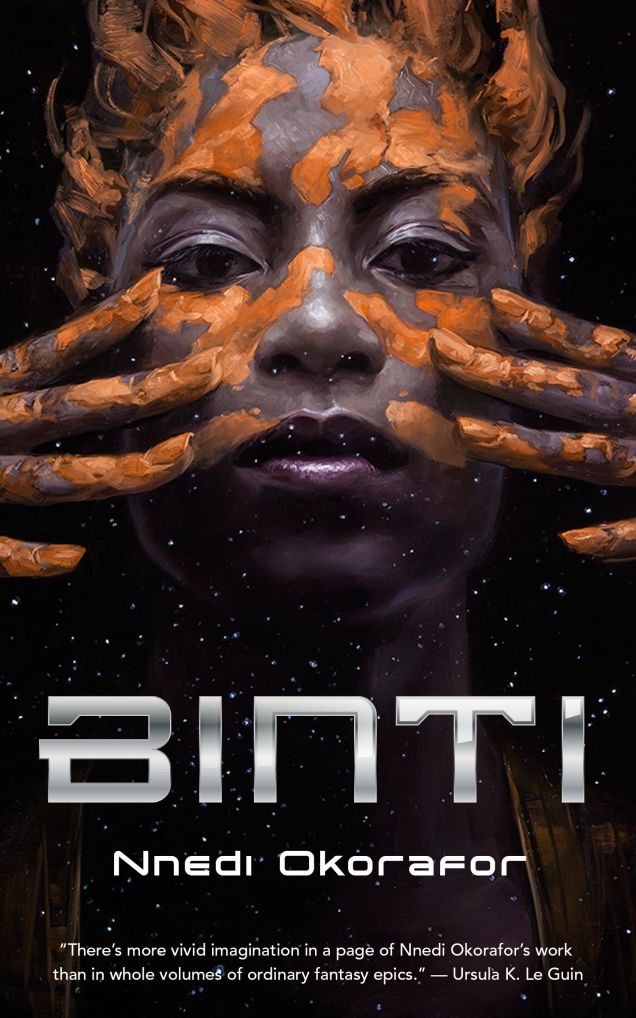
Binti

We talk a lot of about writers and stories on Tor.com but we always strive to give equal attention to our visual presentation. We are indebted to the artists who work tirelessly to make us, and our stories, look good and connect to readers. With that in mind, I’m sure you can appreciate how delighted and honored I am that 12 illustrations for Tor.com Publishing have been selected for this year’s Society of Illustrators annual exhibition.

A special congratulations to Sam Weber for having earned a Gold Medal for his illustration for Haralambi Markov’s story “The Language of Knives”. The Society of Illustrators Annual Awards are one the premiere showcases for outstanding work created worldwide throughout the year. Thousands of entries are received and juried by a team of illustrators and art directors. It is truly an honor to be selected for the annual, and a great honor to be one of the few chosen for a medal.

These will be on display at the Museum of American Illustration in February and March 2016 and will be included in Society’s annual, Illustrators, coming out in winter 2017.

I hope you can take a moment to enjoy these works outside of the context of illustration and appreciate them as artworks in themselves. Below, the twelve pieces unadorned.


Cynthia Sheppard for Emily Foster’s The Drowning Eyes

Cynthia Sheppard for Emily Foster's The Drowning Eyes


Karla Ortiz for Kai Ashante Wilson’s The Sorcerer of the Wildeeps

Karla Ortiz for Kai Ashante Wilson’s The Sorcerer of the Wildeeps


Dave Palumbo for Nnedi Okorafor’s Binti

Dave Palumbo for Nnedi Okorafor's Binti


Rovina Cai for K. M. Ferebee’s “Tom, Thom”

Rovina Cai for Tom, Thom


Greg Ruth for Michael Livingston’s “At the End of Babel

Greg Ruth for Michael Livingston’s At the End of Babel


Jeffery Alan Love for Andy Remic’s A Song for No Man’s Land

Jeffery Alan Love for Andy Remic’s A Song for No Man’s Land


Anna and Elena Balbusso for Angela Slatter’s Of Sorrow and Such

Anna and Elena Balbusso for Angela Slatter’s Of Sorrow and Such


Anna and Elena Balbusso for Charles Vess’ “Father Christmas

Anna and Elena Balbusso for Charles Vess’ Father Christmas


Victo Ngai for Usman Malik’s “The Pauper Prince and the Eucalyptus Tree

 Victo Ngai for Usman Malik’s The Pauper Prince and the Eucalyptus Tree


Richie Pope for Malka Older’s “Tear Tracks

Richie Pope for Malka Older’s Tear Tracks


Sam Weber for Haralambi Markov’s “The Language of Knives

Sam Weber for Haralambi Markov’s The Language of Knives


Robert Hunt, “The Killing Jar”

Robert Hunt Killing Jar


24 Nov 12:09

Tor.com Publishing Winter Cover Roundup

by Tor.com

Every Heart a Doorway

As a chill comes over New York we thought it would be a good time to round up all of our winter titles in one place. Below you can see all the novellas and novels that Tor.com Publishing will be bring out January though April. (As always, we will continue to publish free short fiction weekly.)

It’s an exciting season for us–a little scary, a bit futuristic, sometimes funny, often adventurous, and always (we hope) compelling.

All titles will be available world-wide in print, ebook, and audio. Most ebooks are priced at 2.99 (or the equivalent.)

The Drowning Eyes
Written by Emily Foster
Illustrated by Cynthia Sheppard
Designed by Christine Foltzer
Available January 12

Pre-order Now: iBooks | Kindle | Nook

Foster_DrowningEyes_Cover

What is it about?

When the Dragon Ships began to tear through the trade lanes and ravage coastal towns, the hopes of the arichipelago turned to the Windspeakers on Tash. The solemn weather-shapers with their eyes of stone can steal the breeze from raiders’ sails and save the islands from their wrath. But the Windspeakers’ magic has been stolen, and only their young apprentice Shina can bring their power back and save her people.

Tazir has seen more than her share of storms and pirates in her many years as captain, and she’s not much interested in getting involved in the affairs of Windspeakers and Dragon Ships. Shina’s caught her eye, but that might not be enough to convince the grizzled sailor to risk her ship, her crew, and her neck.


Patchwerk
Written by David Tallerman
Illustrated by Tommy Arnold
Designed by Christine Foltzer
Available January 19

Pre-order Now: iBooks | Kindle | Nook

Tallerman_Patchwerk_cover

What is it about?

Fleeing the city of New York on the TransContinental atmospheric transport vehicle, Dran Florrian is traveling with Palimpsest-the ultimate proof of a lifetime of scientific theorizing.

When a rogue organization attempts to steal the device, however, Dran takes drastic action.

But his invention threatens to destroy the very fabric of this and all other possible universes, unless Dran-or someone very much like him-can shut down the machine and reverse the process.


Lustlocked
Written by Matt Wallace
Designed by Peter Lutjen
Lizard photograph © shutterstock
Cover illustrations © Getty Images
Available January 26

Pre-order Now: iBooks | Kindle | Nook

Wallace_Lustlocked_final_cover

What is it about?

Love is in the air at Sin du Jour.

The Goblin King (yes, that one) and his Queen are celebrating the marriage of their son to his human bride. Naturally the celebrations will be legendary.

But when desire and magic mix, the results can be unpredictable.

Our heroes are going to need more than passion for the job to survive the catering event of the decade!


A Song for No Man’s Land
Written by Andy Remic
Illustrated by Jeffrey Alan Love
Designed by Christine Foltzer
Available February 9

Pre-order Now: iBooks | Kindle | Nook

remic_final_outline

What is it about?

He signed up to fight with visions of honour and glory, of fighting for king and country, of making his family proud at long last.

But on a battlefield during the Great War, Robert Jones is shot, and wonders how it all went so very wrong, and how things could possibly get any worse.

He’ll soon find out. When the attacking enemy starts to shapeshift into a nightmarish demonic force, Jones finds himself fighting an impossible war against an enemy that shouldn’t exist.

A Song for No Man’s Land is the first in an ongoing series.


The Ballad of Black Tom
Written by Victor LaValle
Illustrated by Robert Hunt
Designed by Jamie Stafford-Hill
Available February 16

Pre-order Now: iBooks | Kindle | Nook

BlackTom_cov

What is it about?

People move to New York looking for magic and nothing will convince them it isn’t there.

Charles Thomas Tester hustles to put food on the table, keep the roof over his father’s head, from Harlem to Flushing Meadows to Red Hook. He knows what magic a suit can cast, the invisibility a guitar case can provide, and the curse written on his skin that attracts the eye of wealthy white folks and their cops. But when he delivers an occult tome to a reclusive sorceress in the heart of Queens, Tom opens a door to a deeper realm of magic, and earns the attention of things best left sleeping.

A storm that might swallow the world is building in Brooklyn. Will Black Tom live to see it break?


The Absconded Ambassador
Written by Michael R. Underwood
Cover art and design by Peter Lutjen
Available February 23

Pre-order Now: iBooks | Kindle | Nook

AbscondedAmbas-final

What is it about?

Fiction is more important than you think. When stories go wrong, the Genrenauts step in to prevent the consequences from rippling into our so-called real world.

When a breach is discovered in Science Fiction World, rookie genrenaut Leah Tang gets her first taste of space flight.

A peace treaty is about to be signed on space station Ahura-3, guaranteeing the end of hostilities between some of the galaxy’s most ferocious races, but when the head architect of the treaty is unexpectedly kidnapped, it’s up to Leah and her new colleagues to save the day.

At any cost.


The Devil You Know
Written by K. J. Parker
Illustrated by Jon Foster
Designed by Christine Foltzer
Available March 1

Pre-order Now: iBooks | Kindle | Nook

DevilYouknow3b_chisel

What is it about?

The greatest philosopher of all time is offering to sell his soul to the Devil. All he wants is twenty more years to complete his life’s work. After that, he really doesn’t care.

But the assistant demon assigned to the case has his suspicions, because the philosopher is Saloninus–the greatest philosopher, yes, but also the greatest liar, trickster and cheat the world has yet known; the sort of man even the Father of Lies can’t trust.

He’s almost certainly up to something; but what?


Forest of Memory
Written by Mary Robinette Kowal
Illustrated by Victo Ngai
Designed by Christine Foltzer
Available March 8

Pre-order Now: iBooks | Kindle | Nook

forest of memory_final

What is it about?

Katya deals in Authenticities and Captures, trading on nostalgia for a past long gone. Her clients are rich and they demand items and memories with only the finest verifiable provenance. Other people’s lives have value, after all.

But when her A.I. suddenly stops whispering in her ear she finds herself cut off from the grid and loses communication with the rest of the world.

The man who stepped out of the trees while hunting deer cut her off from the cloud, took her A.I. and made her his unwilling guest.

There are no Authenticities or Captures to prove Katya’s story of what happened in the forest. You’ll just have to believe her…


Pieces of Hate and Dead Man’s Hand
Written by Tim Lebbon
Art by Gene Mollica
Designed by Christine Foltzer
Available March 15

Pre-order Now: iBooks | Kindle | Nook

piecesof hate_final

What is Pieces of Hate about?

During the Dark Ages, a thing named Temple slaughtered Gabriel’s family. A man with snake eyes charged him to pursue the assassin wherever he may strike next, and destroy him. Gabriel never believed he’d still be following Temple almost a thousand years later.

Because Temple may be a demon, the man with snake eyes cursed Gabriel with a life long enough to hunt him down. Now he has picked up Temple’s scent again. The Caribbean sea is awash with pirate blood, and in such turmoil the outcome of any fight is far from certain.

What is the free bonus novelette Dead Man’s Hand about?

In the wilderness of the American West, the assassin is set to strike again. Despite his centuries-long curse, Gabriel is still but a man, scarred and bitter. The town of Deadwood has seen many such men… though it’s never seen anything quite like the half-demon known as Temple.


Every Heart a Doorway
Written by Seanan McGuire
Cover designed by Fort
Photos © Getty Images
Available April 5

Pre-order Now: iBooks | Kindle | Nook

Every Heart a Doorway, Seanan McGuire

What it is about?

Eleanor West’s Home for Wayward Children
No Solicitations
No Visitors
No Quests

Children have always disappeared under the right conditions; slipping through the shadows under a bed or at the back of a wardrobe, tumbling down rabbit holes and into old wells, and emerging somewhere… else.

But magical lands have little need for used-up miracle children.

Nancy tumbled once, but now she’s back. The things she’s experienced… they change a person. The children under Miss West’s care understand all too well. And each of them is seeking a way back to their own fantasy world.

But Nancy’s arrival marks a change at the Home. There’s a darkness just around each corner, and when tragedy strikes, it’s up to Nancy and her new-found schoolmates to get to the heart of things.

No matter the cost.


The Emperor’s Railroad
Written by Guy Haley
Art by Chris McGrath
Designed by Christine Foltzer
Available April 19

Pre-order Now: iBooks | Kindle | Nook

emperorsrailroad_final (2)

What is it about?

Global war devastated the environment, a zombie-like plague wiped out much of humanity, and civilization as we once understood it came to a standstill. But that was a thousand years ago, and the world is now a very different place.

Conflict between city states is constant, superstition is rife, and machine relics, mutant creatures and resurrected prehistoric beasts trouble the land. Watching over all are the silent Dreaming Cities. Homes of the angels, bastion outposts of heaven on Earth. Or so the church claims. Very few go in, and nobody ever comes out.

Until now…

16 Nov 20:06

Sign Up For Tor.com Publishing’s Newsletter

by Tor.com

Tor.com Publishing

Starting in September, Tor.com Publishing will begin putting out novellas and short novels. These titles will be available globally as ebooks, print, and audiobooks. Pre-order pages are up, excerpts are rolling out, and excitement is building. Now you can keep track of our expanding fiction program by signing up for our dedicated newsletter!

The Tor.com Publishing newsletter will contain news and updates on all our titles and authors, plus excerpts, features, new acquisitions, sweepstakes and more. Find out first about everything related to our upcoming books. (Like right here!) Our newsletter will also help you keep up to date on our award-winning short fiction, which will continue building on our seven-year tradition of excellence.

14 Nov 00:51

Five Modern Books with Bad-Ass Fairies

by Sylvia Spruck Wrigley

wee-free-men_norweigan

I love fairy tales and fairy stories but being something of a traditionalist, I prefer pixies (or pictsies) who know their own mind, rather than those that seem to exist simply to add dew drops to spider webs and grant wishes when caught. When I wrote Domnall and the Borrowed Child, I went back to the Scottish myths. The fae were to be placated, not courted, and no one in their right mind would call them by name. Within the story, the humans are just not all that important to the Seelie court near Aberdeen, except when the Fair Folk want something of us.

To back up my viewpoint, I’ve collected five modern books, where modern is defined as post-Disney. All of them are books I love but, not coincidentally, they also include fairies that would rather steal your soul than sprinkle you with fairy dust.


Midnight Never Come by Marie Brennan

midnight-never-comeMarie Brennan is best known for A Natural History of Dragons but I first discovered her when a good friend read my drafts and told me I needed to read Brennan’s faerie world. I have good friends! The faeries in the Onyx Court series aren’t bit characters in a larger plot: they are the story, living their lives while being fully three-dimensional and bad-ass without even trying. No sparkles here! Funnily enough, it was Brennan who made me aware that it was possible to descend into the London sewers as a guest of Thames water, an amazing experience that formed the core of my novel-in-progress (not faeries).

The Onyx Court series takes place beneath London: a subterranean faerie realm full of politics and drama. The series is historical, running from 1499 to 1884. The first novel, Midnight Never Come, connects the dark Faerie court’s Machiavellian scheming to the reign of Queen Elisabeth the Virgin Queen. If you are interested in terrifying and captivating faeries with their own fully thought-out world, then I heavily recommended you start here.


The Wild Wood by Charles de Lint

wild-woodThe Wild Wood tells the story of Eithnie, a young artist who has retreated to her family’s cabin in the wood to work on her illustrations. One of the charming things about de Lint’s portrayal of the fae in the story is that they never take centre stage. The strange and ugly stickmen are on the periphery of the novel, pushing at the boundaries, just as his fairy world interacts with the real one. The world of Faerie is asking Eithnie to help but they won’t or can’t explain to her how. The faerie world of de Lint isn’t comprehensible to us, doesn’t rely on us, and doesn’t actually care about us. As a result, their attempts at communication are confusing and poor Eithnie starts to wonder if she might be losing her mind.

The silvery threads of the faerie sparkle in the shadows as Eithnie tries to work out how to save the grove. In the end, the answer is in her dreams and never really reconcilable with the modern world. This is possibly not the most comforting of fairy tales but feels more real than many more specific portrayals.


Tithe by Holly Black

titheTithe was Holly Black’s first novel and the first of her modern faerie tale series. The story follows sixteen-year-old Kaye’s descent into the faerie world that lives alongside ours. The protaganist is a strong character who happens to things, as opposed to things happening to her. Teenagers may not come out of this looking very good but Black does an amazing job of showing the darker side of faerie.

The Unseelie Court is, of course, visibly depraved but the Seelie court has its own politics and dark secrets. The solitary fae have always been a part of Kaye’s life, her childhood “invisible” friends, but they are also savage and selfish. Lutie-Loo may look like Tinkerbell but she spends her time tangling knots into the hair of everyone she loves. Black’s faeries are cruel, self-centred and just on the edge of sane—just the way they should be.


Ironskin by Tina Connolly

ironskinDescribed as “Steampunk Jane Eyre,” Ironskin tells the story of Jane Eliot, a young woman wounded in the Great Battle with the Fey. We never see the fey in Ironskin, which makes them all the more disturbing. Instead, we see the damage they left behind. Jane Eliot has to wear an iron mask to control the rage bubbling under the surface of her face where she was struck by shrapnel.

The result is a dark and brooding feeling of danger as we see the direct effects of the Great War on the general populace and the resulting fear and protections required to keep safe from the deadly Fey. The novel leaves you wanting more – which is good, as the series continues with Copperhead and Silverblind.


The Wee Free Men by Terry Pratchett

wee free menIt would be impossible to discuss modern faeries without a nod to Sir Pratchett. In The Wee Free Men, Tiffany Aching is forced into Fairyland to rescue her little brother with little more to defend herself with than an iron frying pan. This is no place of fairy dances and fine feasts but an ever-shifting landscape of confusion and terror, guarded by wolves and dromes. The Queen of the Elves is a cruel mistress of the shadow world and will stop at nothing to trap Tiffany within her own nightmares. But Tiffany also has fairy allies: the Nac Mac Feegle. The picties are the most feared of all the fairy races, “even the trolls run away from the Wee Free Men,” Miss Tick tells Tiffany.

Pratchett’s faeries of all stripes are perfectly frightful and utterly bad-ass.


Top image from the Norwegian edition of The Wee Free Men.

Sylvia Spruck Wrigley is an American/German writer of science fiction, fantasy and aviation non-fiction. Her upcoming novella, Domnall and the Borrowed Child, publishes November 10th from Tor.com. Read an excerpt from this fairy-story here.

11 Nov 11:48

Rocket Talk Episode 67: Matt Wallace and Kameron Hurley

by Justin Landon

RT-hurley-wallace

Welcome back to the Rocket Talk podcast!

Justin is visited by authors Matt Wallace and Kameron Hurley. The trio discuss the current status of Southern California, professional wrestling, reality television, and Playboy‘s decision to nix nudity. They even manage to make it all relevant to genre publishing and their recent releases, Envy of Angels and Empire Ascendant, respectively.

Matt Wallace is a novelist and screenwriter. He used to be a professional wrestler and combat instructor. His debut novel, The Next Fix, came out in 2008. Since then he’s written other novels and novellas, his most recent of which is Envy of Angels from Tor.com Publishing. He co-hosts the Ditch Diggers Podcast.

Kameron Hurley is the author of The Mirror Empire and Empire Ascendant, the first two novels in the Worldbreaker Saga from Angry Robot Books. He previous novels God’s War, Infidel, and Rapture, earned her the Sydney J. Bounds Award for Best Newcomer and the Kitschy Award for Best Debut Novel. She is the winner of two Hugo Awards, and has been a finalist for the Arthur C. Clarke Award, Nebula Award, Locus Award and the BSFA Award for Best Novel.


Rocket Talk Episode 67 (56:24):

Listen through your browser here:


On a mobile device or want to save the podcast for later?

Listen to Episode 67: Matt Wallace and Kameron Hurley

Get Rocket Talk on iTunes

Get the Rocket Talk feed

hurley-wallace

Also! If you have an idea for an episode of Rocket Talk or would like to come on as a guest, reach out to Justin Landon at justin.landon@gmail.com. Obviously, we can’t accommodate everyone, but we’re always looking for new ideas and fresh perspectives. You can find all of the episodes of Rocket Talk on Tor.com here.

09 Nov 01:30

“The Weasel’s Last Hand,” or Why You Should Read The Builders, by Daniel Polansky

by Joel Cunningham

buildersWe loved Daniel Polansky’s The Builders, a new novella from Tor.com Publishing about a band of outlaws on one last mission of revenge. It’s got everything you want from this kind of story—outsized antiheroes, last-minute betrayals, and bloody good action—with the added bonus that all of the characters are adorable woodland creatures. A ruthless mouse captain. A sharpshooting salamander with a draw so fast it bends time. A slow, careful, extremely patient sniper opossum. A stoat with a French accent and a proclivity for explosives.

We asked Daniel how he built this world of remorseless killer rodents and owls that kill on silent wings. Instead of answering, he wrote us this original piece of flash fiction, set in the world of The Builders. Enjoy.

There were five of them in the back of the bar, illuminating by the thin flicker of a hanging gas lamp. The wood of the poker table was pocked and scarred, as were the creatures themselves. Low-stacked was a plump, mean-looking chipmunk—or as mean as a chipmunk could look, she was really making an effort at it, a permanent snarl etched on her chubby red cheeks. Next to her an old armadillo sat half-spread out of his chair, with the dead-eyed stare of a professional card-player, eyes open a tiny flicker of an inch. Next to him was a brown-furred weasel, tall and broad-smiling, a big gun on his hip and a smaller sibling in a shoulder holster.

“Raise you three,” said the weasel.

The last spot at the table—the spot nearest the wall, offering a wide view of the bar—was taken up by a white-furred mouse. His feet did not reach the floor beneath him. His head rose, just barely, above the table. His head was lost in the wide-brimmed hat he wore, sunburned and weathered. He was drinking from an unlabeled jug which was nearly as tall as he was, but his hand was steady when he bid, which he did just then. “See you three, raise you seven.”

“Out,” said the chipmunk.

“Fold,” said the armadillo.

“Call,” said the weasel. He pushed in a handful of tattered greenbacks. The mouse flipped over his cards. The weasel smiled and waved him the pot, the rare creature who didn’t mind losing.

The mouse merged his new winnings with his already sizable stack, though it brought no hint of a smile to his face.

“I know you,” said the weasel.

The mouse began to shuffle the cards.

“I said I know you.”

“We never met,” the mouse said. His voice was a ragged soprano, an off-note at the high end of the register.

“I didn’t say we met,” said the weasel, smiling broad. “I said I knew you.”

The mouse didn’t respond.

“You’re famous, aren’t you? You’re the Captain.”

And now the mouse did move, though it was only to lift up the brim of his hat. From where he was—a nasty bar in a nasty part of town—and what he was doing—playing poker late at night—and from his clothes—weather-beaten and worn—you would have not expected it to be a handsome face. You might not have expected it to be quite so hideous, however, the pulped white eye staring ahead blindly, its partner a furious and undiluted blue, the sneer below it like the curved end of a boot-knife. “Been called that,” he admitted.

“I think I heard a story about you.”

“Yeah?”

“Ain’t you the one,” the weasel continued, “ain’t you the one got into all that trouble in the Capital, once upon a time?”

“Maybe.”

“Yeah, I thought so. Heard you used to be the chief minister for the whole Kingdom, the strong right hand of the old King.”

“You got big ears,” the Captain said.

“I pay attention to what goes into them,” the weasel admitted

The Captain had finished shuffling, he began to deal the cards around the table. “Hold ’em, two card, nothing wild and nothing cute.”

And indeed, there was nothing cute about the Captain. The animals assembled round the table looked at their cards a while. The armadillo folded rather than pay the ante. The other chipmunk and the weasel remained in. The Captain checked and turned over three cards.

“Heard you had a real rough crew running with you—a band of cold-eyed murders, gun-fighters and snipers, knife-hands and a badger with a the biggest gun anybody ever saw.”

“Maybe,” the Captain said a second time. “Raise you twenty-five.”

The chipmunk whistled, shook her head and threw her cards in. The Weasel smiled, reached into his vest pocket, counted out five crisp fives, then five more, set them on the table. “Raise you double.”

The Captive snarled and met the bet, then flipped over the turn card.

“Heard it went bad for you,” the weasel continued. “Hell, I heard it went bad for everybody. Lots of blood, lots of bodies.”

“What ever went right for anyone?” the Captain snapped. “And there are always more bodies.”

“There are, aren’t there?” the Weasel had a smile like molasses, like high-proof rum. “I heard your story is fast-paced and well-written, that it’s been positively reviewed and comes at a reasonable price.”

“Someone told you it was fast-paced and well-written?” asked the chipmunk, confused.

“Reasonably priced?” added the armadillo. “I don’t understand this conversation at all.”

“Shut up!” the weasel snapped, slapping the table loudly, and the two animals shrugged and returned to silence. The weasel pulled another roll from another pocket, added it to the stash on the table. The Captain shoved in a pile of his chips, almost arbitrarily. If you were a real suspicious sort, you might have gotten to thinking neither suspected the hand to come to its natural end.

“Guess there would be a lot of folk interested in hearing more of your story,” the weasel said, leaning back in his chair. “And there might even be some who’d pay to see that you don’t make any more.”

“Last card,” the Captain snapped, flipping over an ace of spades.

“Fifty,” the weasel said.

“Raise you twenty-five,” said the Captain.

“Call!” With one hand the weasel scattered his cards towards the Captain, and with the other he went for the pistol in his shoulder holster.

But the Captain already had his in his paws, a little hold-out gun he had shaken out of his sleeve on the River and held quietly in abeyance. A tiny thing, a purse gun, but it echoed loud in the confines of the bar, and the meat in the weasel’s shoulder erupted backward in a bright swathe of blood and flesh. The Captain was on top of the table before the Weasel had collapsed backwards in his chair, three swift steps carrying him over the cash and the cards, and then leaping atop the falling Weasel, pinning him to the ground with his shoulders..

The last chamber of his gun swiveled at the twp remaining players, who demonstrated the same caution they had during the rest of the game, putting their hands up and making no move to intervene. The weasel moaned a while. Above them the lamp swung back and forth, alternatively bathing them in light and then retreating, the Captain’s face a flickering mask of light and dark.

“Those stories,” the Captain said, pulling a very long knife from his boot. “They’re all true—and they’re worse than you heard.”

The weasel screamed.

The Builders is available now. Head here for a sneak preview.

07 Nov 11:14

Announcing A Taste of Honey by Kai Ashante Wilson

by Carl Engle-Laird

The Sorcerer of the Wildeeps Kai Ashante Wilson book reviews

I knew I wanted to edit Kai Ashante Wilson long before he sent me The Sorcerer of the Wildeeps on submission. Way back in 2013, when I’d just started working for Tor.com, I had the pleasure of putting his short story “Super Bass” on the website. Even though I was just checking the punctuation and making sure the HTML code didn’t explode, I knew I was reading something special. In 2014, when we published his novelette “The Devil in America,” I felt my mind stretch and deform under the weight of his writing, and I was downright envious of consulting editor Ann VanderMeer that she, not I, got to edit him. My mind was still reeling when, no more than a week after we opened to unsolicited submissions, I saw an email from him in my inbox. There waited for me The Sorcerer of the Wildeeps, albeit under a different name and in need of a small amount of editing. Working with Kai has been rewarding and enriching, and seeing the reception the book has received (cough cough PW best book of the year cough) has humbled me. I’d be a fool not to try to keep that excellence going.

Folks, I’m announcing A Taste of Honey, another novella from Kai Ashante Wilson set in the same world as The Sorcerer of the Wildeeps.

Long after the Towers left the world but before the dragons came to Daluça, the emperor brought his delegation of gods and diplomats to Olorum. As the royalty negotiates over trade routes and public services, the divinity seeks arcane assistance among the local gods. But Aqib bgm Sadiqi, fourth-cousin to the royal family and son of the Master of Beasts, has more mortal and pressing concerns. His pretty face and sweet nature have caught the eye of the king’s favorite daughter, and he seems ready to lift his family’s fortunes. But a chance encounter with a Daluçan soldier pulls Aqib’s heart away from duty, begging him to rebel against the wishes of his father, his family, his king… and the gods themselves.

Kai Ashante Wilson had this to say about A Taste of Honey:

While writing the first draft of “The Devil in America” in 2013, I was polishing the final draft of A Taste of Honey. The stories are very different from each other, but it was as challenging to achieve the light touch and happy ending A Taste of Honey needed as it was to go down deep into the dark for “The Devil in America.” I’m excited to have this novella come into print and I hope you all enjoy it!

A Taste of Honey will be available worldwide in ebook, trade paperback, and audiobook in the fall of 2016. Until then you can keep up on all the latest news about Tor.com Publishing by signing up for our newsletter.

07 Nov 11:13

THE DROWNING EYES by Emily Foster: Excerpt

by Ana

Today, we are delighted to host an exclusive excerpt of Emily Foster’s debut novella upcoming from Tor.com, The Drowning Eyes.

drowning-eyes-cover

When the Dragon Ships began to tear through the trade lanes and ravage coastal towns, the hopes of the archipelago turned to the Windspeakers on Tash. The solemn weather-shapers with their eyes of stone can steal the breeze from raiders’ sails and save the islands from their wrath. But the Windspeakers’ magic has been stolen, and only their young apprentice Shina can bring their power back and save her people.

Tazir has seen more than her share of storms and pirates in her many years as captain, and she’s not much interested in getting involved in the affairs of Windspeakers and Dragon Ships. Shina’s caught her eye, but that might not be enough to convince the grizzled sailor to risk her ship, her crew, and her neck.

Divider

Chapter One

“Not in this lifetime.” Tazir snatched two of the pebbles off of the pile for the equipment budget. “Or at least not after what you pulled coming into Hanshi.”

Her hatchet-nosed quartermaster locked her amber eyes on Tazir’s. “I told you, Cap, just because I can hack that together in a pinch don’t mean I plan on doing it every—”

“And how are we not in a pinch?” Tazir asked, dropping the pebbles back on the greasy wooden bartop with the rest of the pile for food.

Chaqal opened her mouth to say something, but Tazir could see her eyes taking in the scene around them. Young as Chaqal was, she had the good sense to be leery of this place—not so much an inn as a dockside canopy set up above a stack of rum barrels and the square bar surrounding them.

It had shade, and it had rum, and in the evenings it had a couple ribby dancers who came around to rub up against the customers—but ah, the customers. Whether tall and sinewy or short and ham-legged, whether adorned with tattoos or deliberate scars, whether trained with a hook-head spear or a Bahenji swinging club, the customers were bad news. It didn’t matter if they belonged to a tribe or an island or just a merchant Captain with a lot of cash to drop on security. Unless you were talking to a dancer, the barkeep, or someone you knew, you kept your eyes down and your elbows in tight while you were drinking at Shasa’s.

Chaqal glared at her little pile. “Can I just get one more dak?” she asked.

Tazir’s eyebrows sank together. “Can you just eat a little less?”

On Tazir’s other side, her first mate cleared his throat. “If it helps,” he said, “I’m inclined to give her both dakki and count on this passenger for the rest of your food money.”

“Dammit, Kodin,” Tazir said, rubbing her weathered forehead. “Look, we have no idea if we’ll even find anyone.” It had been her idea, coming to Shasa’s to pick up one of the travelers who came through looking for a cheap ride who didn’t ask too many questions. Last time she was in this place, it had been buzzing with “runaway bride” and “looking for my brother” and even the odd, honest, “I killed someone back in my hometown and I need to get halfway across the ocean as fast as I can.”

But last time had been almost a year ago, and nobody had even heard of the Dragon Ships back then. Since last time, Shasa’s had been gripped by the same fear and paranoia that was keeping the Giggling Goat out of her usual fishing grounds. No one—neither the goldsmiths of Luraina nor the blind weather witches of Tash—was safe from the vicious raiders in their fast ships, which meant that precious few people wanted to go anywhere. The ones who did preferred to travel with the most imposing and warlike crew they could find.

Now, although Tazir was deceptively strong and weathered by the sun and sea, she was just a little over five feet tall and slightly built. When it came to “imposing and warlike-looking,” she just wasn’t going to outdo the tall glowering women three seats down with intricate scars cascading down their broad shoulders and powerful legs. Or the trio of boulder-shaped Gurni men at the other corner, eyeing the crowd for passengers as blatantly as she and her crew were.

Chaqal could actually fight like a demon, but she looked even less warlike than Tazir. With big bovine eyes and plump, round lips, she still looked fifteen seven years after the fact. It didn’t help that she liked to wear a long, flowing skirt and a tunic printed with flowers when she wasn’t on the boat.

Of the three of them, Kodin looked the most useful in a fight. In fact, it was because of Kodin that their presence went unquestioned in Shasa’s—he used to do security with someone’s brother, who fought in a war down south with someone else’s cousin, and so on and so forth. From what Tazir knew, he’d been good at security. He certainly looked the part. Tall and wide, with big square shoulders and big square fists, Kodin was built to make people cooperate. Even now that his fighting days were (mostly) done and his bushy beard was starting to show white, all it took was a stern look from him to get most people to quiet down.

Together, the three of them were mean ugly enough that they’d had travelers rely on their protection in a pinch when they needed safe passage from one place to another. But, again, the last time that had happened, the Dragon Ships had not yet appeared on anybody’s horizon. Now that they’d hit storm temples on Vura and Tash, everything had gotten a little bit harder.

“We should go somewhere else,” Chaqal said, looking around. “In here, we look more like passengers ourselves.”

“We won’t be better off,” Kodin said. “Those guys who left were saying the wind is shut down from Kahiri to Nua’ali.”

Tazir shut her eyes for a moment, thinking of the havoc that was going to cause. “Perfect,” she said. “The Dragon Ships don’t need to bother burning our ports anymore—just scare us all until we lock ourselves in and starve to death.”

“It’s not that bad,” Chaqal said.

“I don’t know.” Kodin flattened his lips. “Last time the Windspeakers shut down that much water, it started all kinds of trouble—fighting, riots, all the shit bored people do when they run out of money.”

“But they can’t just—just shut down all the wind,” Chaqal asked. “Can they?”

“I guess sometimes,” Tazir said, “when things are bad enough. Like last time, they had that bleeding fever over on Nderema, and they calmed the water for twenty miles in every direction until it was gone.”

“When I was a kid,” Kodin said, “we had these three pirate boats just wrecking people all over the place for no reason. Nobody could catch them until a Lurainese Shadowguard saw them in Luraina’s waters. The Windspeakers had to shut down the entire island to give the Shadowguards a chance.”

“Is that what they’re trying with the dragon boats?” Chaqal asked. Instead of answering, Kodin picked up his wooden cup. He glared straight ahead as he drank the thick black rum inside, and Chaqal kept nursing her own drink. “Anyway,” she said to Tazir. “I’d worry a lot less if I had a little more money to throw at repairs.”

“I’ll give you one more dak,” Tazir said. “But if we run out of money next time we make port, you’re dancing on the tables.”

“Hey, that means we’re going somewhere nice, right?” Chaqal laughed, raucous barks of joy that seemed too big for her frame. “Yeah, fine, I’ll take the one dak and stop pestering you. For now.”

“Like you could just stop.” Tazir plunked the pebble from the food budget back on the equipment budget. “Hey, Kodin,” she said. “You want to write this down?”

The first mate dug in one of the pockets inside his embroidered vest until he found his tablet. He spit on his thumb and rubbed a corner clean, then started copying the budget down with the urba shell stylus tied to another corner.

“You’re final on seven dakki for bribes?”

“I hope so,” Tazir said. The Dragon Ships hadn’t driven the cost of doing business up that high, but she was certain she’d find some port officer who disagreed.
Kodin finished copying the budget and snapped the tablet’s leather cover shut again. “We’ve been tighter,” he said.

“Yeah?” Tazir snorted, and spit on the ground. “When we had Mati on board, maybe.”

“Maybe.” Kodin gave her a halfhearted nod. “She did like her white wine.”

Tazir shook her head and knocked on the bar for another drink. “The shit I did for that woman,” she muttered at her knuckles. White wine, and a fortune’s worth of it—now that was a way to remember a marriage. “Feh. It doesn’t—”

“Hey,” Chaqal said. She tapped Tazir on the shoulder and pointed to her right. “Coming down the dock. In the green.”

Tazir turned her head to see who Chaqal was talking about. It didn’t take her long. Tall and gangly, in a long skirt and short blouse of fine green silk, the kid stuck out like a sore thumb among the sailors and sellers who crowded Humma’s spiderweb of docks. She wore her wiry black curls cropped close to her head like Mati used to. She was walking with her shoulders pinned together behind her back, and her eyes’ frantic back-and-forth betrayed the calm on her pretty round face.

“Jingle, jingle, jingle,” Tazir said to Kodin.

He grunted with laughter, then turned to her with a jerk. “Wait,” he said. “You’re serious?”

Tazir was already straightening her creaky hips as she stood on the dock. “I’ll be back,” she said. “With company.”

“Captain, I’d bet money another crew’s already—”

Tazir laughed and swaggered down the dock toward the girl. “Excuse me, ma’am,” she said, holding her hand up as she approached. The girl stopped. A man walked right into her from behind and swore loudly in Djahrna.

“Sorry,” the kid said, turning around and pulling her skirt out of his way as he picked up a bundle he’d dropped.

“Don’t know where the fuck you think you from, girl—”

The girl’s face darkened with embarrassment as the man made his way down the dock.

“Excuse me,” Tazir repeated, stepping up to the girl and tugging at the sleeve of her blouse. “Are you looking for Shasa’s?”

She flinched and pulled back, but her eyes brightened at the word. “Maybe,” she said.
“Someone told me there was a bar here where sailors wait for passengers?”

“That would be Shasa’s,” Tazir said. “Come on in—I’ll buy you a drink.”

She tried to link elbows with the girl, but the girl pulled away. Not surprising behavior in a rich kid like that, Tazir supposed—and judging by the feel of the silk, she was real rich.

“Oh. Uh, sorry, I—uh—” The girl flapped her mouth for a few moments like a fish in a net; her cheeks grew even darker.

“Don’t worry about it.” Tazir chuckled and tucked a stray braid back behind her ear. “I’m Tazir, by the way,” she said.

“I’m Shina.” The girl gave her a weak smile. Her eyes kept darting to the grimy shade of Shasa’s Bar, and her eyebrows kept getting higher and higher on her forehead. “Is that—”

“Only the finest dockside drinking pit in Humma,” Tazir said, gesturing toward Kodin and Chaqal with a flourish. “There you see my first mate and my quartermaster.”

“Are you here looking for passengers?” The girl stopped and looked Tazir in the eye, her brows arched.

Tazir cocked her head to one side and rubbed her neck. “Well,” she said, drawing the word out. “I mean, plenty of people come through looking for passage, but obviously we can’t just take anyone who—”

“What if it was someone, uh, really clean and quiet?” Shina clasped her hands together. Her eyes were darting between the bar, Tazir’s face, and the ground. “Who doesn’t eat much?”

“This someone you know?” Tazir said, raising one brow.

“I, uh.” The girl chewed on her cheek for a moment. “I was actually hoping to get passage myself,” she said. “I—well, it’s—”

Tazir looked the girl up and down, frowning just severely enough to make her afraid that someone was going to disapprove. Rich girls hated thinking that someone was going to disapprove of them—her marriage had at least taught her that much.

“Well,” she said after a few moments, “let’s discuss it.”

Shina nodded; a smile flickered across her face. “Thanks,” she said. As she followed Tazir beneath the canopy of Shasa’s, her shoulders curled in around her chest like a turtle’s shell. Her eyes were saucers, darting to all the thick, scarred faces in the shade.

“Hey-ey,” Chaqal said. “Keep your eyes down, girl.” She gave Tazir the steely, tight-mouthed glare that she swore she hadn’t practiced in a mirror. “What does she want?”

“Says she wants passage somewhere,” Tazir said. “Her name’s Shina.”

Shina swallowed, staring at the ground between her feet. She wore cheap, crudely made shoes—probably didn’t want to get her embroidered slippers all covered in poor dust.

“My parents are making me get married to this cousin of mine,” she said. “I just can’t stand him, but they’re set on it.”

Tazir met Kodin’s eyes. Somebody had told this Shina girl what to say when she got to Shasa’s.

“All right,” Chaqal said. “They sending anybody after you?”

“I—I don’t know,” Shina said. “They might.”

Tazir and Kodin looked each other in the eye again. All things considered, it wasn’t unusual for a passenger to ask that they be ready to leave at any given moment. Depending on how dumb the passenger was, this could be a minor inconvenience or a major hazard.

“Where you planning on running to?” Chaqal asked.

“North.” For once, the girl sounded sure of something. “Doesn’t so much matter where in the north, just—I mean, I have a sister in Jepjep, so I need to see her, but north of Jepjep, at least—”

“We can do Jepjep,” Kodin said. “We can do north, too—we’ve been up as far as the long banks.”

“Pricey voyage,” Tazir pointed out. “Could take months.”

“I have plenty of money,” Shina said. “I’ll give you—”

“Hush, sweetheart,” Chaqal said. “This isn’t the place to go into detail about that kind of thing.”

It was too late. The girl’s voice had caught the attention of everyone in Shasa’s. Nobody got up yet, but eyes swiveled over to look at this gangly, awkward rich kid.

Tazir looked at Kodin again. One corner of his mouth twitched downward, and he took in a deep breath. There was no denying that this could be a risky job—dumb passenger, no plan, maybe being chased by someone. There was also no denying that this could be their last chance today to generate some cash.

Chaqal raised her hand and waited for the barkeep to acknowledge her. “Let’s talk about this some more out on the long docks,” she said to Shina with a sweet smile. “It would be wonderful to have someone my age on board for a while—sailing with these two grumps got old a while ago.”

The barkeep shuffled over with a tablet. “Two dakki,” he said to Chaqal.

“Got it,” she replied, reaching up beneath her linen tunic to get her coins from her purse. She dropped them in the barkeep’s waiting palm and hopped off her stool.

Tazir and Kodin followed suit. Shina followed them out of the bar, and would have stuck to the rear of the group if Chaqal hadn’t grabbed her by the wrist and shoved her forward.

“Be casual,” she said with another one of those practiced cheerful grins. “It’s a beautiful day, after all!” She wasn’t entirely blowing smoke on that one. The wind hadn’t yet been shut down in this part of the Jihiri Islands, and rolls of puffy white clouds gave the people a nice break from the sun now and then.

Shina opened her mouth, but then it dawned on her that she’d loudly told a bar full of big, crusty people that she was carrying plenty of money. She clamped her lips shut and picked up her pace. Behind them, the crowd was too thick to tell if anybody had followed them out of the bar.

“So,” Tazir said. “Where are you from?”

“Nijia,” the girl replied.

“Isn’t that down east?”

“It’s more south than east of here,” the girl said with a casual shrug. “My parents have some sugar fields.”

That took care of Tazir’s next question. She steered the girl a little to the right, over onto one of the seven docks that extended into the Bay of Humma. The Giggling Goat was moored out there a few hundred yards.

“When did you leave home?” asked Kodin.

“Four days ago—no, five,” Shina said. “They said I was going to start losing track of time.”

“Who said?”

“The sailors on the ship I took from Nijia,” she said. “They were nice—merchants, from Haresh.”

“Yeah?” Tazir asked. She cocked her head to one side. “What was wrong with their ship?”

“Their master doesn’t want them north of here,” Shina said. “He—I didn’t want to spend too much time talking to someone who might know my parents.”

“Fair enough,” Chaqal said.

That part of the story was probably more or less true. In Tazir’s experience, rich people all tended to know each other intimately so that they could hate each other more completely.

The crowd was thinning out now, a couple hundred feet offshore. The dock was getting thinner, too, but that didn’t stop the net repairers and fruit ice hawkers from setting up little boats full of wares they could sell to the sailors who were too hung over to make it all the way to the hub.

“How much money do you want?” Shina asked, finally hushing her voice. “I don’t want to be rude, but—”

“Depends on how far you want us to go.” Tazir pulled her pipe from a fold in the sash she wore around her waist.

“How far will you take me for forty thousand qyda?” Shina asked.

Tazir’s hand stopped in the middle of loading the pipe with tobacco. “What?”

“I have forty thousand qyda,” Shina said. “How far will it get me?”

Chaqal looked at Tazir. Tazir looked at Kodin. Kodin was grinning from ear to ear. Now, Tazir wasn’t the world’s best with exchange rates, but she remembered that a qyda was worth somewhere between six and ten dakki. Forty thousand was—was more money than she was going to see in one place ever again.

“That’ll get you to the long banks,” Kodin said. “Hell, if I’m in a good mood, it might even get you back.”

“So you’ll do it?” Shina said. “You’ll take me north?” Her eyebrows shot up her forehead, an excited grin tugging on the corners of her lips.

“Sure.” Chaqal laughed. “But don’t you want to see the boat first?”

Copyright © 2016 by Emily Foster

Emily Foster graduated from the University of Northern Colorado in 2012 with a bachelor’s degree in English. She has written and published a variety of work ranging from abstract poetry to Supreme Court briefs. However, her real passion is for fantasy fiction inspired by the unforgiving landscapes of her home in rural Colorado and the rugged people who live there. She is concerned that if she lists any pets or family members in her biography, it will somehow cause more of them to appear in her home.

The Drowning Eyes is out January 12 2016 and you can read more about it over at Tor.com.

The post THE DROWNING EYES by Emily Foster: Excerpt appeared first on The Book Smugglers.

31 Oct 10:27

The Sorcerer of the Wildeeps is one of PW’s Best Books of 2015!

by Tor.com

The Sorcerer of the Wildeeps Kai Ashante Wilson book reviews

We are thrilled to announce that Kai Ashante Wilson’s The Sorcerer of the Wildeeps has been selected by Publishers Weekly as one of their Best Books of 2015!

While we promise that we won’t gush every time one of our books gets an award or nomination (okay, okay, we may tweet enthusiastically), we’re particularly excited to see the title that launched our line receive this recognition. Congratulations to Kai, and thanks to the many readers and reviewers who have spread the word about The Sorcerer of the Wildeeps!

If you haven’t yet picked up the book, you can get started with our excerpts here. And stay tuned to all our publishing news here—we’ll have more exciting news about Kai Ashante Wilson next week!

29 Oct 12:21

Tor.com Acquires Two More Books in the World(s) of Seanan McGuire’s Every Heart a Doorway

by Lee Harris

McGuire-Doorway

Seanan McGuire’s Every Heart a Doorway (April 2016) is adored here at Tor.com, and everyone who has read it agrees—from editorial to art, from marketing to sales. With that much love for the book, there’s no way we could leave it there, and so I’m thrilled to be able to announce that we’ve just commissioned two sequels!

It’s a sign of a great book that, after reading it 5 or 6 times in the space of 10 months, you still find yourself gushing about it to everyone you meet, and wanting them to read it now. Such is the case with Every Heart a Doorway. I can’t wait for you all to read it, and I can’t wait to read Down Among the Sticks and Bones when Seanan has finished writing it. I love those kids!

Seanan McGuire said:

I was overjoyed when I got to invite other prospective students to visit Eleanor West’s School for Wayward Children. I grew up on portal fantasies, and the question of what happened to the chosen children after their tales were done has always haunted me. I thought I’d only get to audit one class there. I thought that would be enough.

It wasn’t enough.

I am beyond grateful and delighted to be going back to the school for two more classes—a bit of history, as we follow Jack and Jill through their own portal fantasy, and a bit of destiny as some old friends and some new surprises come back to campus to set right what once was wrong. These stories matter so much to me, and I am honored and determined to share them with all of you.

Down Among the Sticks and Bones will be published in 2017, with the third volume forthcoming the following year.

28 Oct 09:54

Halloween.

27 Oct 23:53

Catch Up With Tor.com Publishing Authors This Fall!

by Tor.com

tordotcom-authors

Tor.com Publishing is spread across the globe, and we have authors appearing at conventions and readings in New York, the U.K., and San Francisco before the year is out. Here’s everywhere you can see our authors, including Seanan McGuire, Angela Slatter, Victor LaValle, and Sylvia Spruck Wrigley this November and December! Plus catch our editor, Lee Harris, along with Angela and other members of the Tor.com Publishing team at the World Fantasy Convention 2015.

Check out the full list of events below!

November 4th
Angela Slatter (Of Sorrow and Such)
Reading at Kill Bar at Times Scare
New York, NY

November 5th to November 8th
Angela Slatter, Lee Harris
World Fantasy Con
Saratoga Springs, NY

November 9th
Seanan McGuire (Every Heart a Doorway)
7 pm Best American Science Fiction and Fantasy panel at Forbidden Planet
New York, NY

November 10th
Seanan McGuire
7 pm NYRSF Reading Series at The Commons Brooklyn
With Carmen Maria Machado and John Joseph Adams
Brooklyn, NY

Victor LaValle (The Ballad of Black Tom)
7 pm First Personal Plural Reading Series at Shrine in Harlem
With Rachel Eliza Griffiths, Margo Jefferson, and Emily Raboteau
New York, NY

November 11th
Seanan McGuire
7:30 pm Press Start to Play at WORD Jersey City
With John Joseph Adams, Robin Wasserman, and David Barr Kirtley
Jersey City, New Jersey

November 24th
Seanan McGuire
7 pm Mira Grant presents Chimera at WORD Brooklyn
Brooklyn, NY

November 27th-29th
Seanan McGuire
Chessiecon
Timonium, MD

November 29th
Sylvia Spruck Wrigley (Domnall and the Borrowed Child)
Wales Comic-Con
Glyndwr University, Wrexham, U.K.

December 5th
Seanan McGuire
3 pm Mira Grant presents Chimera at Borderlands Books
San Francisco, CA

And from December 13th to December 25th, Paul Cornell (Witches of Lychford) will run his annual Twelve Blogs of Christmas at his blog, paulcornell.com, with daily features, essays, guests, and surprises!

26 Oct 07:57

World War Bee.


26 Oct 07:42

#LillysPizzaParty


When fatbutts invited me to her bachelorette party, I was basically like, "uh...depends?" I have no problem being the lone guy, but depending on the activity, I can't imagine it being fun for anyone being the one husband on a girl's-night-out. Luckily, Jennifer & her new squad-- Yassmina, Lauren & Lilly, though she obviously didn't help-- planned the event, so I got the best of both worlds. During the day, we kayaked the East River, from Long Island City to DUMBO & back, & then everyone else went out to party & I came home. I got adventure & curmudgeon in one fell swoop; that's my idea of a good time. Lilly & Megan's kayak dumped them in the East River! Or well, the wake from a ferry capsized their kayak while they were launching from DUMBO. I got my underwear soaked on a crashing wake-wave coming in, myself. It really reminded me of Cleveland-- something about paddling small boats on a Super Fund river past abandoned factories, I guess. The Squad made shirts for the event: "Pizza Rolls Not Gender Roles." (Photo below by Lilly.)

22 Oct 10:01

The Mysteries of Gene Wolfe’s Peace (and Why They Keep Me Up at Night)

by Daniel Polansky

Gene Wolfe Peace

I’ve had trouble sleeping lately, found myself wide-eyed as the LED lights flicker beside me, my breaths labored, my mood dark. What past sin or future worry waits at my bedside, prods and pushes slumber away. Climate change? Business reverses? Lost love?

No. Well, yes, but not primarily. That question which has been tormenting my evenings like Poe’s lost Lenore is a simple one, though the answer itself is not: Who was it that got killed in the orange juice factory freezer? And who was it that killed him?

*

Say there was a library. No, say there was the library, the absolute repository of all human literature. Say I was walking amidst the stacks, found myself in the Fantasy/Science Fiction wing. A room vast and cavernous, hardwood shelves leading up to a distant and barely glimpsed ceiling, a rolling ladder with which to peruse the wares.

Say there was—heaven forbid!—a fire. Some embittered bibliothecary, some mad miscreant has set a spark, and I watch weeping as it swiftly grows beyond my capacity to combat. There is nothing to do but, in the few fleeting moments before this treasure trove is turned to cinder, grab a few works from off the shelves, to preserve some tiny portion of this vast catalog for humanity’s erudition and my own personal enjoyment.

What do I save? Not Lovecraft, whose existential ennui, tentacled horrors, and anti-Semitism would have no respite from the flames. Robert E. Howard and Fritz Leiber, I am sad to say, would go in the same direction—future generations would have to labor without their pulpy goodness. Poe would get a moment’s consideration, but not more than that. T.H. White, Tim Powers, and Martin himself I would consign, sadly and with regret, to the rising inferno. Murakami I would pass over without a glance. Le Guin, to the misfortune of the coming age, would remain on the shelves. King’s vast oeuvre would pass into oblivion. Grimacing, horrified, weeping and embittered, I would allow Borges’ great treasure trove of wit and wisdom to pass into ashes. I would let Gaiman go up in flames, I would ignore Tolkien, Dunsany, Delany, Heinlein, Dick, and Zelazny. I would sprint, burnt-handed, from this literary cenotaph carrying Gene Wolfe’s Peace, and afterward I would commend myself for such swiftness of thought.

*

Note: Some minor spoilers follow, or perhaps not; because who would be so arrogant as to imagine they can say, for certain, what exactly Wolfe has intended in any of his writings?

Peace is—is it?—the ramblings of one Alden Weer, an elderly man in a decaying house, looking back on his life, trying to make some sense of it. It leaps about in time, from his childhood in a Midwestern farmhouse, towards his maturity in post-war America, and an adulthood which sees financial success but little in the way of happiness of contentment. Embedded within it are any number of stories, some that are told to a younger Weer, some that he recalls reading, none of which ever come to a proper conclusion, each of which serves to shed some light on the broader narrative—that is to say, the life of Weer himself.

This is the surface reading, though of course with Wolfe a surface reading is like going snorkeling above the ruins of Atlantis. With the sort of cunning technical precision which reminds one that before and in addition to being a writer Wolfe was a mechanical engineer, the structure of the novel is crooked, bending back on itself in strange and fascinating ways. The narrative of Weer’s life is riddled with ambiguities and contradictions, with holes we are encouraged to investigate and riddles that can never quite be solved. His sins and shames are carefully hidden away, from Weer as much as from us, but they can be identified by the scars they leave in his memory. In time, they begin to consume us with their import, and we are left—as the intro to this essay makes clear—confused and saddened and in awe of Wolfe’s brilliance.

There is a story I came across while reading various critical discussions of Peace in the last few days, to the effect that when the book first came out, the reviews were generally positive, but no one identified the (reasonably) clear mystical hook to the story. Possibly apocryphal, but easy to believe. Because Peace works, first and foremost, as a moving and beautiful meditation on death, memory, youth, aging, family, love and loss—in short, all of the most important things a book could be about. If you were ignorant of Wolfe’s reputation as being one of genre fiction’s foremost geniuses—one which he had not yet acquired when this book was released—it would be altogether possible to miss the subtle clues with which the book is filled, to miss them altogether and to still walk away touched by the book.

More than anything else, more than the beautiful prose, more than his brilliant obfuscation, what Wolfe possesses is a profound moral sense, one all but unique not only within his genre but throughout the wider world of literature. This is a man who has thought clearly and deeply about the nature of sin, and evil, about its corrosive effect on the human spirit. Perhaps this is because of his religious background; perhaps it is because he was one of the very few genre writers who has direct experience with war; perhaps it’s just because he’s much, much smarter than most of the rest of us. I can’t say—what I can say is that it is this sense that elevates Peace into the highest and rarest ranks of literature. The mysteries of the novel are not simply ones of character and plot—who did what and why—they are more essential, more ineffable. They are about what it is to be human, in the best and deepest sense.

If you want to be frightened this Halloween season, go out and buy a copy of Peace. If you want to engage with a writer of rare prose styling, go out and buy a copy of Peace. If you want a master class in storytelling, go out and buy a copy of Peace. If you want a contemplation about the most fundamental concerns of existence, go out and buy a copy of Peace. In short, just goddamn go out and buy a copy of Peace—I’m not sure how much more clearly I can put it.

Finally, if anyone has any good answers to the question I asked in the first paragraph—also, what exactly was it which stopped Den and Margaret from getting married, what is the parentage of poor Doris the would-be carnie, and why Napoleon kept his hand in his vest (my understanding is that it was simply the fashion back in the day)—please drop me a line in the comment section. I would like to be able to get my nights back, if it’s all the same to Mr. Wolfe.

Daniel Polansky is the author of four novels, including the Low Town series which began with The Straight Razor Cure, and Those Above, the first book in the Empty Throne series, as well as the new Tor.com novella The Builders. He was living in Brooklyn when he wrote this, but by the time you read it he might be somewhere else.

14 Oct 09:47

The Shootout Solution Sweepstakes!

by Sweepstakes

The Shootout Solution sweepstakes

Michael R. Underwood’s new novella The Shootout Solution, a.k.a. Genrenauts Episode 1, comes out November 17th from Tor.com Publishing—and we want to send you a signed galley!

Leah Tang just died on stage. Well, not literally. Not yet.

Leah’s stand-up career isn’t going well. But she understands the power of fiction, and when she’s offered employment with the mysterious Genrenauts Foundation, she soon discovers that literally dying on stage is a hazard of the job!

Her first assignment takes her to a Western world. When a cowboy tale slips off its rails, and the outlaws start to win, it’s up to Leah – and the Genrenauts team – to nudge the story back on track and prevent a catastrophe on Earth.

But the story’s hero isn’t interested in winning, and the safety of Earth hangs in the balance…

Check out an excerpt, and comment in the post to enter!

NO PURCHASE NECESSARY TO ENTER OR WIN. A purchase does not improve your chances of winning. Sweepstakes open to legal residents of 50 United States and D.C., and Canada (excluding Quebec). To enter, comment on this post beginning at 3:30 PM Eastern Time (ET) on October 13th. Sweepstakes ends at 12:00 PM ET on October 17th. Void outside the United States and Canada and where prohibited by law. Please see full details and official rules here. Sponsor: Tor.com, 175 Fifth Ave., New York, NY 10010.

12 Oct 07:22

More Fine Dining at Matt Wallace’s Sin du Jour!

by Tor.com

wallace-covers

The first in Matt Wallace’s hilarious Sin du Jour series—Envy of Angels—comes out in a month’s time. When we commissioned Matt to write this, plus the sequel (Lustlocked—January 2016), we always hoped that others would get as big a kick out of them as we do. And it seems they are. As the reviews start to roll in, it’s becoming obvious that Matt’s series is something special (seriously—go read a sample here).

So, it’s with great delight that we’re able to announce that—even before Book 1 is out—we’ve asked Matt to write books 3 and 4 for us! To no-one’s great surprise (because Matt is awesome, and he loves these books just as much as us) he said yes!

Pride’s Spell and Idle Ingredients will both be published in 2016.

Matt asked us to tell you:

“I’m having more fun writing Sin du Jour than I did when I was quality control officer in that cupcake, fireworks, and ninja star factory back in ’03, and I’m thrilled to be continuing the series with Tor.com Publishing. They’re the most innovative crew of book weirdos I’ve encountered in all my travels. I want to thank my spectacular editor, Lee Harris, associate publisher Irene Gallo, and the rest of the team. On to glory!”

Senior Editor Lee Harris said:

“It’s so hard finding humorous fantasy or science fiction. Humour is so subjective—perhaps even moreso than mainstream SF/F. Matt’s one of those rare writers who can make a story exciting and funny. Publishers Weekly said that Envy of Angels will leave readers ‘grinning and hoping for more stories featuring the Sin du Jour gang.’ Well, rest assured, we’re bringing you more!”

11 Oct 15:53

World War Bee by Katie K.


07 Oct 09:28

The Shootout Solution

by Michael R. Underwood

shootout-solution

Leah Tang just died on stage. Well, not literally. Not yet.

Leah’s stand-up career isn’t going well. But she understands the power of fiction, and when she’s offered employment with the mysterious Genrenauts Foundation, she soon discovers that literally dying on stage is a hazard of the job!

Her first assignment takes her to a Western world. When a cowboy tale slips off its rails, and the outlaws start to win, it’s up to Leah – and the Genrenauts team – to nudge the story back on track and prevent a catastrophe on Earth. But the story’s hero isn’t interested in winning, and the safety of Earth hangs in the balance…

We’re pleased to present an excerpt from The Shootout Solution, episode one of Michael R. Underwood’s new novella series, Genrenauts—available in paperback, ebook, and audio format November 17th from Tor.com!


Prologue
Inciting Incident


Mallery York pressed her back against the outer wall of the saloon while bullets flew in Main Street. Her breath came fast as her hand fumbled, ripping the hem of her skirt and tying another bargain-basement tourniquet around her right arm. It’d keep the bleeding down, but she’d taken three hits, and addressing them all would transform her outfit from ‘Western’ to ‘Jane of the Jungle.’

The report of gunshots came around the corner, impacts sending splinters of wood flying in the dusty street. Mallery flinched at each one, every hit refreshing the sharp pain from only moments ago. She’d gotten lucky, in that ‘not all bullet wounds are created equal kind of way.’ But no matter what, the mission had gone down the latrine and it was time to bug out.

Mallery dug into her petticoats for the polished chrome and Gonzo Glass phone. Doubling over to make herself a smaller target, she pressed the big red button, shielding the phone from view. Even with bullets flying, she kept to the concealment protocol, just as regs demanded.

The call picked up on the second ring.

“This is King. What’s your status?”

“Floundering in a sea of gunfire and dust.”

“Just hold on,” King said. The voice of her boss and mentor was a life preserver. She grabbed it and held on for dear life.

“The showdown was a bloodbath. Our White Hats are down to the last man, and I saw him turn tail and run a minute ago. The bandits are going to finish off the wounded in a minute, and I need immediate evac.”

Someone moved on the other end of the line, set to speakerphone. Probably Preeti rolling over to another station. “What happened?” King asked. “You said you had the posse assembled, they had their bonding scene around the card table and everything.”

“Tell that to the three dead deputies in the street, boss. What’s my ETA on an extraction?”

Low chatter between Preeti and King. Then, “Roman will be there in ten minutes. Can the story be salvaged?”

Mallery risked a look out into the street, concealing the phone beneath her sweat-and-dust-stained hair. The bandits were tying bags from the bank to their saddlebags, but the gunfire had calmed down.

“Not today. We’ll need to assemble another posse.”

“Understood. Stay out of harm’s way, and Roman will be at your location in fifteen.”

Mallery winced. “I thought it was ten?”

“Dimensional disturbance. Preeti has plotted a new course, but it’s going to delay the crossing.”

“Well, I’ll just hang out here and bleed some more, then. No big problem.”

“Try to keep that to a minimum,” King said.

“Aye aye, captain.”

“Preeti will stay on the line with you until Roman arrives. Be careful, Mallery. King out.”

“Careful isn’t going to stop the bleeding,” Mallery said, watching her skirt go red. Next time she came to Western-land, she was wearing the chaps. They were at least something resembling armor. Though they couldn’t be turned into bandages nearly as easy. You give a little, you get a little.

“Roman is on his way. We’ve got your location locked, so just sit tight,” Preeti said.

“You know, this is why I prefer Romance world. At least there I’d be having mortal-danger makeouts while under fire.”

“I’ll put in the request on your duty roster. More mortal danger makeouts.”

“I don’t know about more, but I’ll take it.”

Preeti stayed on the line, trying to engage Mallery with small talk, keeping her bleeding friend focused when the world started to go black. Mallery leaned into the conversation, shutting her eyes and focusing on Preeti’s story about spending all Saturday digging through the source text archives to find her favorite childhood storybook.

Mallery ducked her head out to check on the bandits. The Williamson gang had finished loading up and was riding for the hills with half of the town’s silver. “When I get back, I am so kicking someone’s ass.”

Another impact hit mere feet from her head. She ducked and said through clenched teeth, “This is not how the story was supposed to end.”


Chapter One
Everyone’s a Critic. Even drunks. Especially drunks.


Leah Tang was dying on stage.

She knew she shouldn’t expect too much from a college bar crowd, but this was beyond the pale.

Her Last Action Hero bit? Interrupted every ten seconds by the table full of bros up front yelling for her to show some flesh.

Her breakdown of why the Star Wars prequels failed, from the lack of a scruffy-looking-nerf-herder rogue figure to the bungling misuse of the Jedi Order? Nothing but heckling.

Even her story about the Epic Ice Fortress Snowball Wars from when she was in middle school fell flat, and that bit had killed before.

It sure didn’t help that the drunk first-timer before her had gotten a hooting-and-hollering standing ovation with nothing more than five minutes of boob jokes.

He’d primed the audience so much that when she took the stage, one of the bros up front asked her to flash him. It was a testament to her professionalism that she didn’t just dump her water on his head to start off her set.

In fact, so far the only person in the room who seemed at all interested in her routine was the intense black guy sitting on his own in the second row by the entrance. He hadn’t taken his coat off even though the bros up front were sweating in the lights. This guy, this one appreciative audience member—he liked her genre commentary, so she’d be happy oblige.

This guy had been at her last open night too, if she remembered right. So he was either digging her work, a creeper, or maybe both. Hopefully not both. That wouldn’t bode well for her future fanbase. “I’m huge with the ‘overly-intense and creepy’ crowd!” Not so good.

Not that she had a fan base to begin with. The rest of the crowd—the townies at their regular tables and the drunk-ass students up front—the best they managed was polite disinterest.

Leah heard her father’s voice in her head. “Oh, Leah, don’t go to the coast and become a comedian. Make a responsible choice; stay here with your family and go to optometry school like your brother.”

The bros up front catcalled again, asking for her number for the third time.

“Come down here, baby!” one said. “I’ll make your fantasies come true.”

Cal, the owner, had a very high bar for throwing out belligerent hecklers, so she was on her own. It was three strikes and you’re out here at the Attic, and she was in the middle of Strike Three. So she might as well enjoy herself.

“Fantasy, eh?” Leah asked.

Perform for the audience you have, not the audience you want, she thought. She grabbed the available segue and ran with it, squaring off to the audience and zeroing in on the bros in the front row.

She affected a coquettish bedroom voice. “Let me tell you about my Fantasy.”

That got the bros’ attention.

“My fantasy,” hooting and howling nearly drowned her out. She resumed, trying to shut them out. “Discovery. New races, new kingdoms, new magics. I loved that when I opened a fantasy book or found a new author, I knew I was in for a tour through someone’s imagination.”

The bros were crestfallen, their interest shorted out. But the guy in the coat leaned forward, elbows on the table, his drink sitting forgotten beside him.

“But as I grew up, I realized something that was incredibly rare in fantasy: people that looked like me.

“In most fantasies, an Asian girl like me only shows up as a topless witch in need of rescue or killing, with snakes crawling over her boobs. And that is just not my scene.

“My Fantasy is less about the whips and the PVC, more about self-actualization and hope. And you know what? That’s just as sexy to me.”

That got a chuckle out of one of the college guys up front. From the look of him, thickly-muscled, wearing a tank-top that read ‘No Fat Chicks’, he was probably not laughing at the joke the way she meant him to be.

“In my fantasy, Asian girls like me can do anything we want. We can be fighters, wizards, and rogues. We can save the day and fall in love with the person we want, not be de-powered or married off as a prize for the square-jawed hero.

“When I was a kid, I read so much fantasy that I was convinced I was The Chosen One. My parents yelled at me for introducing my friends as my Sidekick or my Nemesis. Because heroes in fantasy can do it all—they learn magic, pick up languages in a montage, and become master swordsmen in a month on the road headed from their village to the Dark Lord’s tower, winning the heart of the elven princess and besting the champion swordsman from the pointy-hat-wearing Pseudo-French kingdom along the way.”

She saw a dim flicker of light coming from the back of the room, right next to the million candle power spotlight that would have her seeing dots through the weekend. It was Alex, the host, giving her the one minute warning.

At least she’d caught the signal this time. Last month, she hadn’t even seen the timer and they’d cut her mic when she went over.

Even low on time, she plowed ahead.

“So when I was eight, confident that I was The Chosen One, I decided to begin my heroic skills acquisition. I spent sixth months awaiting my parents’ tragic death with Wednesday Adams-level fascination.

“Thankfully, they lived, and I forged on un-orphaned. First, I tried to become a master alchemist. My parents bought me a My Little Scientist kit, but even after eight weeks, all I could do was almost blow up our garage. My older brother’s bike is still stained mad-scientist red, more than fifteen years later. Whatever, it’s not like he was using those eyebrows.

“So I gave up on alchemy and focused on riding—every good fantasy hero can ride, right? Except it wasn’t 14th Century England, and I wasn’t royalty, and my parents unsurprisingly did not accept my argument, in a bad British accent, that if they didn’t max out their credit cards on horse-related expenses that an evil wizard would rule the world.” Leah made the sad trombone noise into the mic. That was good for a couple of chuckles.

“And that’s when I knew. Sword fighting. Every good Chosen One knows their way around a sword. So I guilted my parents into enrolling me in a fencing class, and I tell you what. You have never seen someone happier than ten-year-old me running around with a kid-sized epee pretending to be Aragorn or Inigo Montoya.” Leah mimed some slashes and thrusts.

“I practiced and practiced—stayed with it way longer than anything else. Even got into some tournaments. I got all the way to the finals in my division.

“And you know what happened?”

She waited a second, let the suspense build.

Another flicker of light from the back. Her time was up. Just as she was getting some momentum.

Leah stopped, turning to the audience. She’d keep practicing her blocking and timing, even if she was performing to an effective audience of one.

“What happened is I got my ass handed to me six ways from Sunday by a kid from Iowa that had been fencing since he was four.

“I was fuming after the bout. But my parents made me go congratulate him. He introduced me to his parents, and guess what? They were farmers. And the kid? Adopted.

“You never choose to be the Chosen One. You just are.”

The guy in the coat nodded, his arms crossed.

“And you know what? That kid sent me a friend request two weeks ago. He’s headed to the Olympics.

“But even though I never won a tournament, I found something I loved even though it was hard, even though I would never be the best. Those stories made me believe in myself. That’s what fantasy means to me.”

Alex approached the stage, not remotely happy with her for going over time. His little light was flashing like a raver strobe.

“But I tell you what – if you come across a farm boy and an old wizard, shiv them, take their horses, and go make your own destiny.

“Thank you, and good night!” She bowed (shallow, so as to not give the bros anything to look at), then clomped off-stage, still grumpy about acquiescing to Cal’s creepy demand that all women wear heels to perform. Flats were wonderful, she loved flats. Even heels couldn’t make her tall on stage, so why even pretend?

Alex gave her a falsely-enthusiastic high-five, resuming his thankless job as host.

“How about that Leah Tang. Quite a kid! Keep it going now for our next comic, Kyle Jones!”

One person’s solid applause and another half-dozen golf-claps were her reward for the night.

Well, that and the free booze. Cal’s one bit of generosity. Even if you washed out, open mic performers always got a drink on the house.

Leah made a bee-line to the bar and ordered her customary post-gig Jack & Cola. She preferred Laphroaig on the rocks, but her comps didn’t go anywhere near that far. And she was expecting a whole lotta nothing in tips.

Though surprisingly, ‘No Fat Chicks’ tossed a ten-dollar bill in the can Alex walked around for her. That’d pay for her cab home, at least.

“Not the best night,” Inez the bartender said, mixing the drink. Inez could be counted on to enjoy the show, but she couldn’t play favorites. Not since her very noticeable dislike of a misogynistic-as-hell show a few months back got her in hot water with Cal.

The bartender kept her black hair short, since she “hated ponytails worse than she hated well tequila”—an exact quote that Leah had logged away for use in a future set. Leah had a thousand little lines like that jotted across a half-dozen notebooks which she used to stitch together ideas on the whiteboard in her room.

“I think the guy in the coat was paying attention to something other than my ass.”

“It’s a fine ass, kid. You should be proud of it. But if it’s ass they’re looking for, they should be at Whistlin’ Dixie’s, not here.” Inez topped off Leah’s drink with an extra pour of Jack.

Leah raised the drink to salute the bartender, then took a long swig.

Someone appeared to her right, and Leah turned to see ‘No Fat Chicks,’ drink in hand. Up close, she saw how sloshed he was.

“That was fantastic, Dude,” he said, slurring. “Hot and funny. Plus,” he whispered, “I’m really into reptiles and I think you’d look amazing covered in snakes.”

So not only had he completely missed her point, now he was going to sloppily hit on her. Ai ya.

“An impressive performance, Ms. Tang,” said another voice, stepping from around ‘No Fat Chicks’s broad shoulders. It was the dude in the coat.

Perfect timing.

“Thanks, man,” she said to the bro, then turned to face the guy in the cat, hoping her other admirer would get bored and wander off.

Leah saluted with her drink. “I wish a few more people here shared your perspective.” She took another sip.

The drunk bro stood there like a loading cursor, trying to figure out what to say.

“Perhaps your insights might be better used elsewhere,” the guy in the coat said. He reached into his pocket, and pulled out a business card with a Johns Hopkins logo.

“I’m Dr. Angstrom King, Department of Comparative Literature. I run a narrative immersion laboratory, and I’m looking for new staff. I think you might be an excellent fit.” King had the upper-class Yankee accent that she associated with the Ivies, but he wore it well. Some folks used that accent like a weapon, a constant reminder of their superiority.

He wasn’t coming off as scary, thank goodness. And Leah knew from scary, thanks to her share of sketchy dudes trying to pick her up after sets.

Speaking of which, ‘No Fat Chicks’ had lost interest and wandered off. Thank goodness.

“Immersive Narrative Laboratory?” Leah asked, looking at the business card, which announced King as a Visiting Professor of English. “Mind de-academia-ing that a bit for me?”

“My team are narrative specialists working with stories in very much the same way that your routine did. We have a big project running right now, and I could use someone with your perspective.”

“I’ve got a job, thanks,” Leah said, turning her back to King and reacquainting herself with her drink. She’d put college in her rear-view several years back and was glad of it. This ‘Immersive Narrative Laboratory’ was a load of crap if she’d ever heard of one. And while working the reception desk at the accountants’ office was far from glamorous, it kept her afloat financially and didn’t expect her to work overtime.

“I understand your reluctance, Ms. Tang. The Refusal of the Call is especially strong for persons of your generation. But we pay very well, and the benefits are quite hard to beat.”

“Going Campbell on me isn’t going to change my mind,” Leah said, taking another drink, “but I could stand to hear more about the pay.”

Leah looked to Inez for confirmation one way or another. “Is this guy legit?”

Inez nodded. “Word is he helped Tommy Suarez land that HBO special.”

Leah froze. Oh, he was that kind of weirdo. The ‘eccentric as all get-out but really well-connected and potentially very useful’ weirdo. She perked up.

Tommy hadn’t made it big yet, but he’d gone straight from working the regional circuit to an HBO special, which did not happen in the normal world. And if this was the guy who helped Tommy make that jump, she could take the time to check out this ‘lab.’

Plus, this place was tapped out, so she’d need a new lead. She’d made the rounds in the Baltimore circuit, and she was getting nowhere. She needed a break.

“You should have had Inez vouch for you in the beginning,” Leah said.

“It means more if you do the asking for yourself. If you’ve changed your mind, I’d like to introduce you to the team tonight. And if you come along, hear me out as I explain what our team does. I’ll ensure that you have a weekly gig here or at any other club in the Baltimore-DC area you want for as long as you like.”

A steady gig, indefinitely. She hadn’t gotten close to graduating out of the open mics. If this guy could guarantee her a steady gig, give her time to sort out her material, find an aesthetic that could connect with audiences… Leah tried to avoid salivating at the idea.

Leah checked her phone. “But it’s 11 o’clock. Your team work that late every Thursday night?”

“Tonight we do. Shall I bring my car around?”

Leah shifted her weight from one hip to the other. She took a long swig, and asked, “You have tell me if you’re going to axe murder me, right? Some kind of Professorial code of conduct?”

King’s expression brightened. He mimed a posh British accent. “Indeed. It’s a condition of my tenure. Along with the requirement that I be absent-minded and wear tweed jackets with patches.”

“Well, if that’s the case, sure.” Leah finished off her drink and left a tip for Inez, who made the glass and bills vanish with her magic.

King lead the way and Leah followed, reassuring herself that her mace was in fact where it was supposed to be in her jacket.

The two made their way out into the ever-humid Baltimore night. King worked a key fob and a too-nice-for-a-visiting-professor Mazda came alive three spots up the street.

“Where’s this lab of yours?”

King opened the door for Leah. “South of the city. Shouldn’t take but twenty minutes to get there.”

Leah held the door as King went to the driver’s side, not quite ready to climb in and commit to doing something quite this dangerous. “And a reminder. No axe murdering.”

King climbed into the car. “Ms. Tang, if I wanted to find someone to kidnap and axe murder, I’d be looking for victims that are far more trusting than you. And I wouldn’t be hunting in Baltimore. Things tend to go poorly for men that who look like me when we’re suspected of crimes in this city.”

“Point.”

King started the engine, which purred to life, running quiet. “As a university professor, I specialize in the disquieting reassurance. It means that my office hours are blissfully uneventful.”

The sound system turned on, leaping into an Eddie Izzard CD. One more layer of resistance peeled off, and she took her seat.


Chapter Two
The Story Lab


True to King’s word, about twenty minutes later, they arrived at a two-story-tall office building off I-97.

The car had already passed several turn-offs to nowhere in particular, so if he was going to axe-murder her, he was taking the long way there. That was comforting. Sort of.

The building had a dome on one side that arched up another story’s worth. IMAX, maybe? Maybe that’s what he meant by narrative immersion. She could think of worse jobs than getting paid to watch IMAX documentaries about penguins and hummingbirds.

King rolled the car into a spot that read ‘Team Leads.’

“What I’m going to show you may seem incredible, but know that it can all be explained by science. Our mission is one of exploration.”

“That’s not ominous at all,” Leah said, stepping out of the car. On the drive over, she’d texted two different friends to check on her in an hour to make sure she was okay. Mr. and Mrs. Tang didn’t raise no dumbass. Smartass, yes, but not dumb.

King opened the door with a quick scan of a passcard, revealing a stark corridor with an institutional look. The rooms were labeled innocuous things like ‘Archives, 1970-1979’ and ‘Personnel Files’ and odder things like ‘Probe Reports,’ ‘Skill-acquisition Lounge,’ and ‘Dimensional Barometric Chamber.’

Her nerves had resumed assembly of a worry-henge when King threw open a set of double doors at the end of the hallway, leading into a room that looked half like the NASA command center and half like a newsroom.

The room was nearly empty, only a half-dozen of the stations filled by men and women in polo shirts, each watching several screens of TV shows, none of them immediately recognizable.

“My team is through here,” King said, leading her along one side of the room. At the far wall, wide windows showed a room that looked for all the world like a hanger. If her spatial sense was working, that would be where the IMAX dome was.

King led her into another long hallway that spanned the length of the building. Part of the way down the hall, voices prompted Leah to turn and see a crash cart round the corner behind front of them. Lab coat and scrubs-clad figures pushed the cart, checking the IV drip, taking pulse, and more. The patient was a white woman, blond, very banged up, and wearing an outfit that belonged at a kitschy Wild West party. The cart raced by, and King peeled off to join them, pointing to a nearby room.

“Wait in there,” he said.

Leah stood befuddled for a moment as the cart and its entourage rounded a corner.

What was this place? A shiver ran down Leah’s spine, fear tackling curiosity into a confusing melee.

The doors King had pointed to revealed a break room, and a nice one at that. It had several flat-panel TVs on the walls, treadmills with built-in screens, a full kitchen, several fridges, couches, tables, and a library in one corner.

An older middle-eastern woman with silvery hair sat in the rocking chair amid the library. She held a massive hardcover in her lap.

Noticing Leah, the woman set her book down and stood.

“Hi,” Leah said.

“You must be Leah. I’m Shirin Tehrani.”

Shirin crossed, heels clicking on the floor, and extended a hand along with a warm smile. “Pleased to meet you.”

“So King told you I was coming, did he?”

“Of course. He keeps us appraised of candidates and solicits our input. Your evaluations in improvisational thinking and threat responses were very impressive. You have to be quick on your toes in this job.”

“Threat responses?” Leah asked, “I thought this was a lab. What is it, really? There was a crash cart or something, and King went off and said I should wait here.”

Worry crossed Shirin’s face, but didn’t stick. Why was she so calm?

Leah’s danger senses were going off. She had a few minutes left to send the all-clear text. It didn’t seem like anyone was hiding axes for murdering, but they might all be delusional.

Or maybe it was a cult. A story cult? Granddaughters of Grimm or something?

“It’s as he said—a narrative laboratory. This will go more smoothly if you wait for him to explain. Please help yourself to coffee or a snack or anything while you wait. But try not to worry about the woman you saw. Our medical facilities are top of the line.”

Shirin’s smile was gracious. The woman’s whole demeanor said ‘classy aunt.’ Leah could use some classy aunts in her life. All of her aunts were back in Minnesota.

Leah looked around for some normalcy to latch on to. Hey look, coffeemaker. Yes. Java was needed to face the fear. “Is the coffee any good?” she asked.

“It’s good for office coffee. And the granola bars are passable, if you’re hungry. They’re in the second drawer to the left of the fridge.”

When Leah looked back, Shirin had plopped back down and was once again consumed with her book. She was acting like this wasn’t weird, but it clearly was.

Leah’s pulse quickened, and she tuned in to her peripheral vision, wary.

Think about the gigs, Leah, she thought, trying to find her calm.

The coffee was, in fact, passable. More importantly, it was hot. She passed on the granola bar, and walked the room, not comfortable enough to sit down when she had a hundred questions and the only other person in the building she’d met so far didn’t seem interested in talking.

A few minutes later, Leah’s coffee buzz was full effect as Professor King returned. He wiped off his hands and tossed the bloodied rag in a bucket beside a waste bag.

Leah asked, “Are you going to tell me what this is all about, now? And who was that on the gurney?”

“The woman on the gurney is Mallery, a member of my team. She’s being treated now. As for what this is about, why don’t I just show you?” King said, his voice level. King escorted Leah to the command room-thing. Shirin put her book down and joined them.

As they entered the command room, King made straight for a woman Leah’s age with thick glasses and an incredibly bright wardrobe, patterns on patterns set against a traffic cone orange shawl. She sat in a wheelchair with a complex set of monitors and two keyboards within arm’s reach.

“This part is really cool,” King said. “Preeti, can you bring up the orientation video on Big One, please?”

“Sure thing, boss.”

The woman’s hands blurred, typing at court transcriptionist speed. A moment later, one of the large screens went dark. Preeti held her over-the-ear earphones out to Leah.

She took the wireless headset, which played the opening riffs of an orchestral score like an epic movie trailer.

Earth popped up on the screen, clouds and storms and oceans and all that jazz. The screen zoomed out, showing earth surrounded by a rough circle of red light, a dozen other worlds in fragments around it. The orbiting were replaced by circular logos—crossed revolvers, a heart, a magnifying glass, a rocket ship.

I am surrounded by crazy people right now, Leah thought, already prepping her escape strategy.

A familiar voice started to narrate. It was King.

“Stories are the DNA of the universe.”

Wait, what?

“We think of life in three dimensions. With time, that makes four. Some scientists posit that we live in 11 dimensions.

“But for our purposes, there are only five that matter.”

“The fifth dimension is narrative. In the fifth dimension, Earth is surrounded on all sides by worlds that are simultaneously familiar and irreducibly distinct.”

The camera panned to the side, zooming in on one of the adjacent worlds. Getting closer, every bit of land area on one continent was covered by city, towers and factories and the circuit-board of lights that reminded Leah of flying into Southern California by night.

“Each world hosts the inspiration for a narrative genre. This world inspires our stories of Science Fiction.”

The world spun, resolving into shots of iconic science fiction scenes—a launching rocket, a massive laboratory filled with androids, a cityscape with flying cars, a bustling space station.

“There are dozens of others.” The screen showed a Western boom town, a mine shaft entrance in the distance.

Next came a contemporary American city filled with people going about their lives. The camera moved inside a café, where every table was filled with couples. Some were awkward, stealing glances and then looking away. Others were twitterpated. One woman was on her knee, proposing to her girlfriend. Another was having a knock-down drag-out fight.

“Romance.”

The screen flipped through other worlds more quickly.

First, a fantasy kingdom, with gnomes, dwarves, and elves walking around a market town, castle towers in the background. A flourish of colorful magic erupted from the gnome’s hands as a crowd looked on. It was her bit come to life.

“Fantasy.”

Then the screen jumped through several more, offering views of worlds Leah pegged as noir, horror, and one world populated by pirates with shirts open to the waist, oiled chests, and tight breeches, and women in gigantic Elizabethan dresses corseted within an inch of their lives.

Finally, the screen returned to the picture of the earth, surrounded by the other worlds.

“Because of your specific skills, you’ve been selected to join this elite team and protect not only earth, but dozens of other worlds, from destruction.”

This was too much. Leah pulled one ear of the headset off and sniped back at King. “Are you serious? This is some Rylan Star League ridiculousness.”

She started walking for the door. The playback continued. “In any system, there is entropy. When something breaks down in one of these worlds, when a story goes wrong, it ripples back on Earth.”

“When a story breaches in the Western world, violence runs rampant on Earth Prime.”

She looked back as she passed Preeti, taking off the headset to hand it to the woman. On the screen, a newspaper showed the headline “Shooting Spree in Omaha. Seventeen wounded, two dead.”

Leah took the headset off entirely. “Hold up. You’re telling me that broken stories affect our world? Some kind of feedback?”

“Keep watching,” King said, his patience clearly wavering.

The video continued.

Leah’s curiosity grabbed her, and she donned the headset again.

“Every world has a different influence on Earth.”

The worlds again.

“The mission of the Genrenauts Foundation is to minimize these dangerous ripples between the worlds. When a story world goes off-track, it’s our job to set it right. Using inter-dimensional vessels launched from this and other facilities around the world, teams travel to the impacted world, investigate the story breach, and put it back on-track.”

The screen resolved to a logo—earth surrounded by a dozen worlds, with ‘GENRENAUTS—MID-ATLANTIC ASTRODOME’

Leah took the headset off and turned to the group. Her disbelief, her desire to not be caught by some weird gotcha took center stage.

“This is some kind of History Channel documentary, right? On after Ancient Aliens?”

King was nonplussed.

“Some kind of lab hazing prank or something? I thought this was going to be a touchy-feely writing job, like High Culture TwitFeed or something.”

Preeti paused the playback.

“It is exactly what the pretentious video says it is,” King said. “Maintaining balance between the worlds is of incalculable importance. We stand in one of several bases that monitor and respond to dimensional disturbances. There is one such disturbance right now, in the world that inspires our Western genre. One of our team has been severely injured in a failed attempt to patch the story breach, and I would like to bring you along with my team to observe as we resolve the situation.”

“Tell me more about these ripples.”

King had to be a professor, he had the ‘sigh of the put-upon’ down pat. “When a story breaks, that breach creates a thematic-semiotic ripple effect, which crosses over from that world to our own Earth. Each of those story worlds has its own distinct signature derived from the genre it represents, and each signature has a different effect on Earth when it ripples over. Identifying and patching story breaches as quickly as possible minimizes these ripple effects and keeps the Earth roughly as we know it.”

Heady stuff. No wonder they hired a lit professor to run the team.

Leah made the ‘go on’ hand gesture. “And now, unpack that one more time like I’m stupid. Because this still sounds crazypants.”

Another sigh, this one more exasperated. “Right now, a story is broken in the Western world. Western world’s signature is about violence, order vs. lawlessness, and taking the law into your own hands. Do you remember the shooting in Vegas yesterday?” King asked.

“Yeah.”

“That was only the first of several identified ripple events over the last forty-eight hours since the breach began.

King turned to Preeti, “Bring up the news feeds.”

Preeti tabbed through to another program, and pulled up a news site.

The headlines read:

Vigilante shooter kills five burglars in Evansville, IN

Unidentified gunman shoots seven in Washington public park. All in critical condition. Gunman still at large.

SWAT raid gone south: five officers in critical condition.

“And if we don’t fix this story breach,” King said, “the shootings will continue. The whole world will shift. More people will take the law into their own hands, will take what they think they deserve by force.”

King jabbed a finger at the screens. “That’s what I mean by thematic-semiotic resonance. A story breaks, and then people die, lives are ruined. I need to send a team to Western world and fix the story now. I brought you in because I thought you could help. Do you want to critique stories your whole life, or would you rather fix them?”

“Hold up. I have friends in Vegas, and you’re telling me they might have gotten killed because of some broken story in a whole other world?”

“Those are the stakes, Leah. Now it’s time to make a decision. You have ten minutes.”

King turned and made his way out of the room, apparently done with the conversation.

Shirin watched him go, saying, “He gets what we’d call ‘passionate’ about the job.”

Leah turned to watch the news feeds. She’d heard about the shootings, but had blamed it on the social media age, where a small story can become a huge story within an hour.

“So you’re script doctors, but for real worlds? And somehow also dimensional cops?” Leah said, trying to parse the unbelievable.

Shirin smiled. “That depends on what you mean by real. The people on these worlds have their own lives, their own desires, but they are bound by the rules of their world. We help keep their worlds running as they’re meant to. It’s the best job you could ask for. Adventure, excitement, a new challenge every mission.”

Preeti had turned back to her workstation, watching three screens, each showing a view of what had to be the Western world—Old West buildings, saloons, cowboys on horseback, and a trio of Native American men from a Great Plains tribe trading with a merchant on a street corner.

“So how finely sliced do the genre worlds get? Is there a Slasher world, a sports movie world?” Leah asked.

Shirin gestured to the wall of screens. Looking closer, she started to pick out different worlds. Each pack of 3×3 screens seemed to show one world, but with different styles. “Each world has one umbrella genre which sets the tone for that world. Fantasy world has dark fantasy, epic fantasy, and sword and sorcery, all on different continents far removed from one another. Slasher would be a region in Horror world. Sports stories happen all over, but something like A League of Their Own would go to Women’s Fiction world.”

“I hate that label, by the way,” Shirin added, “but unless we convince the High Council to rename it, that’s what it is.” That sounded like an argument that had gone around the block more than a few times. “I guarantee you that this will be more exciting than answering phone calls, scheduling meetings, and processing expense reports.”

“Don’t knock expense reports. There’s a kind of magic in paying bills with other people’s money,” Leah said.

Shirin said, “I could see the appeal in that. But what we do is storytelling at the highest possible stakes, determining the fate of individuals, nations, and entire worlds all at once.”

Gulp. “No pressure, right?”

Shirin nodded. The woman seemed to be shooting straight, not sugar-coating it to get her to sign her soul away.

But curiosity wouldn’t let her just walk away. She might as well see how deep the rabbit hole went before deciding whether to take the leap.

Leah waved at the screens. “So, what does it take to cross the dimensional barriers or whatever you do?”

“For that, we go to the Hangar.”

Excerpted from The Shootout Solution © Michael R. Underwood, 2015

04 Oct 19:07

Revealing Tor.com’s January Novella Covers

by Carl Engle-Laird

January-covers

Tor.com Publishing is releasing three great novellas in January 2016, and we’re excited to show off the great artwork we’ve got to match them! One of these stories takes place entirely on a boat—this changes everything. Another story features a heist where the prize is science itself. And in the third story, some party guests have a bad reaction to a magical food additive—a very bad reaction…

January sounds fun. Check out all the cover art below!

All of these titles will be available worldwide in ebook, audiobook, and trade paperback.

The Drowning Eyes
Emily Foster
Illustrated by Cynthia Sheppard
Designed by Christine Foltzer
Available January 12
Pre-order Now: iBooks  |  Kindle  |  Nook

drowning eyes cover

From the catalog copy:

When the Dragon Ships began to tear through the trade lanes and ravage coastal towns, the hopes of the archipelago turned to the Windspeakers on Tash. The solemn weather-shapers with their eyes of stone can steal the breeze from raiders’ sails and save the islands from their wrath. But the Windspeakers’ magic has been stolen, and only their young apprentice Shina can bring their power back and save her people.

Tazir has seen more than her share of storms and pirates in her many years as captain, and she’s not much interested in getting involved in the affairs of Windspeakers and Dragon Ships. Shina’s caught her eye, but that might not be enough to convince the grizzled sailor to risk her ship, her crew, and her neck.


Patchwerk
David Tallerman
Illustrated by Tommy Arnold
Designed by Christine Foltzer
Available January 19
Pre-order Now: iBooks  |  Kindle  |  Nook

Patchwerk-FINAL

From the catalog copy:

Sometimes all you need is an infinite number of heroes

Fleeing the city on the TransContinental airship, Dran Florrian is traveling with the Palimpsest—the ultimate proof of a lifetime of scientific theorizing.

When a rogue organization attempts to steal the device, however, Dran takes drastic action.

But his invention threatens to destroy the very fabric of this and all other possible universes, unless Dran—or someone very much like him—can shut down the machine and reverse the process.


Lustlocked
Matt Wallace
Designed by Peter Lutjen
Lizard photograph © shutterstock
Cover illustrations © Getty Images
Available January 26
Pre-order Now: iBooks  |  Kindle  |  Nook

Lustlocked-final

From the catalog copy:

At a Goblin Royal Wedding party a magical food additive turns the humans in the room into horny 6 foot lizards, and all they want to do is have sex.

With anything. For as long as they can.

And as lizard love isn’t something that interests Sin du Jour staff, something must be done, but the building’s magical defenses have kicked in, sealing off access to the outside world.


And finally, here are all three of the audiobook covers:

jan-audio

04 Oct 08:00

Over at Kirkus: BINTI by Nnedi Okorafor

by Ana

It’s Friday and we are over at Kirkus!

Today, Ana reads Binti by Nnedi Okorafor, one of the first novellas recently released by Tor.com.

Binti

Go HERE for the full scoop.

The post Over at Kirkus: BINTI by Nnedi Okorafor appeared first on The Book Smugglers.

03 Oct 15:51

Of Sorrow and Such

by Angela Slatter

sorrow-and-such

Mistress Gideon is a witch. The locals of Edda’s Meadow, if they suspect it of her, say nary a word—Gideon has been good to them, and it’s always better to keep on her good side. Just in case.

When a foolish young shapeshifter goes against the wishes of her pack, and gets herself very publicly caught, the authorities find it impossible to deny the existence of the supernatural in their midst any longer; Gideon and her like are captured, bound for torture and a fiery end. Should Gideon give up her sisters in return for a quick death? Or can she turn the situation to her advantage?

We’re pleased to present an excerpt from Angela Slatter’s upcoming novella, Of Sorrow and Such—available in paperback, ebook, and audio format October 13th from Tor.com!


Chapter One

Edda’s Meadow is a town like any other, smaller than some, larger than many.

Not quite a city.

No better, no worse. Folk, some rich, some poor, some clever, some as thick as two planks, go about their business and are generally polite to their fellows. The canny and the stupid are not confined exclusively to one economic class or the other.

At its centre is a market square where produce fresh and otherwise is for sale. Around the edges is a mix of shops (above which the owners live) for the purchase of items more permanent, less perishable, the mayory, and the pastor’s house. There is a large oval where no grass grows though it’s been nigh on ten years since the last burning. On the outskirts: a smithy on the western boundary, a tannery to the east, and most days it’s downwind so the smell of bread and buns from Keil’s bakery can overwhelm and seduce the inhabitants. The two flour mills act as bookends, the newer to the south and the old to the north, the latter unused for almost two decades since Karol Brautigan sent Erika Strauss out of business.

There are no walls around the town, and the meadow which was Edda’s is no longer much in evidence.

I wonder sometimes if that long ago Edda would recognise the place that bears her name. I wonder more often who she was, for she’s yet another woman lost to history. No one thought to make note of her, whether she committed some great deed or merely owned the field before it sprouted a village that grew prosperous and then grew some more. Females are seldom remembered once they’ve gone beneath the earth; indeed, many go unremarked while they’re still upon it.

The Tey River splits the town in two, but bridges—varying in expertise of construction and stability—have been thrown across the span every quarter-mile or so and no one need suffer too taxing a walk. The houses on both sides are a blend of affluent, middling, and impoverished, although the poorer ones are clustered in tiny ghettos, while the more prosperous spread around them in a loose kind of hug, not too close, but almost protective. My home, good enough to blend in yet not so fine as to excite envy, is on the northern boundary, with the old mill in sight, and not in such proximity to my neighbours that I feel over-looked, which is how I prefer it.

If the mood takes, follow the line of the Tey, past the new mill, drift by the farmhouses that supply the wheat, and meat and other crops. Continue on, through the fields dotted with flowers of all hues, until you come to a stand of trees. Step beneath the spreading branches, don’t be afraid of the shadows, for soon you’ll break into a sunny glade. The large pond there is called Edda’s Bath and the river runs in and empties out of it, winding off through the depths of the forest. Around the banks grow plants that are useful in my work, things that will heal and others hurt, though I sell the latter to no one in Edda’s Meadow; I’m not a fool.

I don’t pass myself off as a doctor—there’s one comes each month from the bigger city three towns over—but I live here and can be found day or night. I’m the person Edda’s folk turn to for everyday remedies even when Doctor Herbeau is visiting. Yet I harbour no illusions: I am tolerated. If a physician ever deigns to make his home here, then I shall become something of an embarrassment, an object of superstition, and a reminder that they’ve held to the old ways. A medical man will spout fancy terms they do not understand, patronise them, and hand out tablets that give a little relief, but no cure. They will worship his impenetrability as a sure sign of superiority and run back and back again for his expertise. My honesty about what I can and cannot do will no longer suffice. I promise no miracles for I know all too well that Dame Fate has a penchant for making a liar of the best-intentioned individual. A doctor with his empty vows will steal their hearts and hollow heads from me, and they’ll dismiss the times I saved their children from fever, or gave elderly parents a balm against lingering disease. The women will choose to forget that the “Widow” Patience Gideon (Sykes that was, if they did but know it) made their barren wombs a little more welcoming for their husbands’ seed, and those same husbands will deny that my potions enabled them to service those very wives.

It has happened before and I’ve no doubt it will happen again. For now I am comfortable and content, though I keep a weather eye out. I warn Gilly to do the same, but she is too young and neither blessed nor cursed by my kind of power to have a real sense of how quickly things can change.

I tread carefully down the slope of Edda’s Bath, and kneel at the edge. Reaching into the cool liquid makes me shiver though the day is more than warm. I pluck out handfuls of the waterweed growing there. My houseguest asked for it, however I don’t know what it’s for. Her knowledge is different to mine and I’ll ask her how to use it, then write it down in the book I keep wrapt and buried in the cellar. I pick more, shake away the excess water, and put it in my basket next to the nightshade and mushrooms, the angelica, rue, henbane, wood sorrel, mullein, willow bark, woodbine, and pepperwort. There was a time I thought I would never do magic again, but it would have been easier to stop breathing. I’m simply far more careful about what I do.

On the surface floats my reflection; not so bad. I’ve just crossed to the wrong side of fifty but could pass for younger, with my clear green eyes, still-pale skin, and dark hair as yet untouched by white. There are fine lines, though, around my mouth, and across my forehead, which Mother always claimed as a sign of intelligence. Her own brow was a maze of furrows, yet it wasn’t enough to help her evade the men of Bitterwood when they hanged—or tried to hang—her.

I look past my image, down into the depths, using the sight that was my dead father’s gift: the ability to not only see in the darkness as clear as day, but also to penetrate the earth and find what has been hidden. There’s a bundle, swaddled tight and weighted down with rocks. It’s small, so small. A newborn, I suspect, and unwanted. Brought here by its mother most like. I imagine the smell of sour breast milk, untapped and curdling. No point in telling anyone; they’d want to know how I knew about it and answering that question would only lead to more queries best left unasked. Whoever put it here will torment themselves quite sufficiently. Besides, how am I the one to judge a woman who leaves a child behind?

I rise and climb to the top of the bank. Dusk is threatening. I give a high-pitched whistle, hear an immediate answering crash in the undergrowth to my right. Fenric comes bounding towards me, all thick golden fur, caramel on his legs and paws, and honey-brown eyes. He alone seems untouched by the years, his devotion to me undiminished. The great head pushes against my hand and I put the basket down so I may pat him thoroughly. A deep thrumming comes from his chest, almost as if he’s a cat in a dog suit, rather than what he really is.

I peer out in the trees, where forest shadows and shapes dance, move. Sometimes they are sharply in focus, but mostly not. Figures tall and short, adults and children. They are creatures not confined to the woods, though they seem to like it best here. It’s well time to return home, before the sun sets entirely. What if I should recognise some of the shades drifting back and forth between the trunks?

I’m not fearful, though I am cautious.

How many of those shades I might be responsible for is something I cannot calculate.

I retrieve my basket, tell Fenric to come along, and head back towards Edda’s Meadow. Gilly will have supper ready soon.


Chapter Two

My house is three stories high, including a garret, and sits in a large garden where I grow flowers for pleasure and herbs for healing. Perhaps it’s too big for just Gilly and me, but we have visitors from time to time and the extra room doesn’t hurt. Where Fenric and I pause at the start of our street, we can see not just the dwelling and the apple trees inside the fence that surround it like sentinels, but also the old mill in the distance. Tales say it’s haunted and I’ve no surprise at that.

As we get closer to home two figures become apparent on the threshold. Gilly’s taken advantage of my absence to have a gentleman caller. I don’t object so much to the activity as to her choice of partner, not to mention the fact we’ve a houseguest who must remain unseen; I trust she’s keeping to her hidden room in the attic. I can make out Beau Markham, the mayor’s son, not as pretty as he thinks he is, but pretty enough to persuade more than one lackwit maiden to lift her skirts. I want better for Gilly, always have. I’d thought her smarter than this—yet he’s lingering, which I’ve not see him do before when spotted on other stoops in other parts of town. He’s always off at a quick pace, while dishevelled lasses stare after him as he waltzes away. They call Shall I see you at the dance, then? and he never bothers to answer unless it’s to laugh unkindly. Well, then perhaps my girl’s clever enough to keep her knees together.

Still and all, she can do so much better.

I wait in the shadows between two houses and watch as Beau Markham pulls himself away from Gilly and wanders in my direction. For her part she does not linger like some lovesick fool, but goes inside. Good. Fenric growls and I hush him gently. When Beau comes level with us, I speak.

“Good e’en, Master Markham.”

I watch as he jumps a little, his almost-purple eyes seeking the source. I take a kind of pity and step out where he might see me.

“Mistress Gideon,” he says and pats his heart, making a joke. I’m not fooled. His gaze is flat; he’s shown himself a coward and he’ll not soon forget it. “I trust you’re well.”

“Passing well. I see you’re visiting my Gilly,” I say and don’t give him time to explain himself. “I’ll not have her harmed.”

“I would do nothing to hurt Gilly, Mistress Gideon,” he lies most sincerely.

“Ah, but that’s not true, Beau, and I know it.” I lean close and exhale my hot angry breath into his smooth face. “I’ve seen you tomcatting on doorsteps for the past few years. I’ve given more girls than I care to think of cures for the ills you’ve planted in their bellies, and delivered a dozen bastard babies with their daddy’s sweet violet eyes for young women who’ll be unlikely to find husbands now. And as for the number who’ve come seeking creams and ointments for the rashes you’ve passed on with your nasty, festering little prick? Oh, almost beyond counting!”

He tries to move away, but Fenric has positioned himself immediately behind the boy, so he trips and tumbles backward over my sturdy beastie. Beau’s pasty in the dim light. I lean down and press a quick sharp finger under his chin, my nail nicking the baby roll of fat there that will grow as he gets older and apes his father’s eating and drinking habits.

“If you go near my Gilly again, if I find she’s been tampered with, carrying your by-blow or got some kind of rot between her legs, I swear to you, Beau Markham, no one will find the body for my wolf will be shitting you out for the better part of a week.”

“I didn’t touch her!” he fair shouts. “She won’t let me; she makes me ache, she teases me, but she hasn’t let me.”

“And that’s how it will stay, isn’t it?”

He nods.

“Bide by that and we’ll remain friends.” I offer my hand and help him up. Beau dusts himself off and Fenric growls louder this time, sending him off at a run.

Gilly won’t be pleased whenever she finds out, but she’s young; she’ll get over it. And there’s Sandor, who waits patiently for her to notice him. I shrug off the temptation to give that a kick along by means of my magics—it would not be fair, and it would be one of those rare things: an act to cause me shame.

*     *     *

It’s well past midnight when I’m woken by a hammering on the front door.

I stumble from my room, meet Gilly in the corridor; she looks as weary and nervous as I feel. No good news ever announces itself in the morning-dark. Gilly goes down the stairs ahead of me, hesitates at the doorknob until I say, “Open it.”

A woman stumbles in, powder blue dress streaked with blood and mud, face bleached, eyes wide with shock and pain. Around her right wrist is a filthy, sopping, makeshift bandage, and in her left hand is her right hand, which is no longer attached to her wrist.

Gilly swiftly checks outside, then shuts the door. The woman sways, but remains upright. Neither of us approaches; we wait.

“Help me,” she rasps. “Please.”

Normally, she’d bleed to death in my front room for I can’t assist. I have no power over this sort of life or death, and even if I could stem such bleeding, my magic is not of that kind. I’d have no choice but to apologise as she died, then hide her body, bury or burn her. Only a fool would go to the constable and report such a demise; he’d ask, first and foremost, why did she come to me for aid? What in you called to such a woman? It wouldn’t take long for tales to circulate, for I’ve no doubt whoever did this found her up to no good. A constable, even one as dim-witted and well-disposed towards me as Haddon Maundy, could make connections that would do no good at all.

Better she be thought lost and innocent, and thus mourned. Or run away, and loathed in the usual fashion. Better that than she drag me down with her.

But this night, oh this night, Flora Brautigan is lucky beyond all measure. This night I can help her.

“Gilly,” I say, “rouse Selke, and fast.”


Chapter Three

“Best when the wound’s fresh, the chances of it taking are much better,” says Selke as she works.

In the guest room with blue curtains Flora lies unconscious, completely insensible from the huge dose of poppy I poured down her throat. She would not have been able to bear what we did to the stump otherwise; scraping away the raw flesh and sheared bone edges, scouring out the dirt and debris embedded there, the traces of wherever she was when this injury occurred. Now her arm is propped on several pillows, Selke’s binding spell keeps the blood from gushing forth. I’ve sent Gilly to slink through the garden and nearby streets, to clear any sign that a woman in distress came to this house, then to wash away the scarlet puddles in the front room so there’s no trace of Flora Brautigan.

Selke, nightgown streaked with the substance of which she is mistress, her red locks pulled back into an enormous loose bun, sweat curls framing her face, is bent over the small writing desk beside the bed. On the surface before her is a clump of dead white that, when she is not kneading it this way and that, moves of its own accord, seeming to breathe and shiver. It’s living clay, dug from the earth of certain graveyards, replete with the juices of the dead, redolent with the scent of rot. She splashes it with lavender water to make the stuff more malleable and it has the added benefit of dampening the smell, then she sprinkles a fine pearly dust and works that in, explaining as she goes.

“This makes it set, fast and proper. I had a friend, once, used it to make those dolls, the ones with little slivers of soul inside so it was like they almost lived. I’ve experimented, over the years, found I can do all manner of other things. Even this.” She holds up one slurry-spotted hand, wiggles the pointer and middle fingers. “Lost these two when I was careless, couldn’t retrieve them from the gullet of a particularly angry wolf. Made myself new ones—and a lot of money.”

Selke is a stranger to me, one of an intermittent stream of wandering witches who come seeking refuge. They recognise the carving above the doorway of oak and rowan and birch leaves, know it’s a safe place. Much better than the forest huts my mother and I used to hide in when I was young. None of them stay more than a few days, but they pay their way with knowledge, swapping remedies and spells. Selke is more secretive than others, she keeps her own counsel for the most part. She’s admitted only to this ability and some herbcraft, but I’ve seen a lot of women on the run—been one myself—and my instincts tell me her powers are even greater than this one. They tell me, too, that whomever or whatever she is fleeing has much influence and a far reach. She’s a good bit younger than me, but there are streaks of white through her auburn locks.

“What’s that powder?” I ask, nodding towards the vial that shimmers white.

“Gravedust and silver shavings amongst other things, it adds a lifelike appearance. I’ll write the recipe down for you later if you think it useful.” She lifts her work from the table, proud and triumphant. “Now look.”

It is a hand of clay, deathly grey, though with a sheen now, and barely distinguishable from the model after she pressed it to the still living one so the lines and whorls would be transferred; no one will notice the miniscule differences. The thing quivers.

“You can’t just reattach that?” I ask and she shakes her head.

“Once it’s off, it’s dead. It won’t regrow. I don’t know why, something about the separation sunders the connection between body and extremity; the limb dies. But this does grow, perhaps because its life is independent of the corpus.” She shrugs. “Remove the binding and hold her steady, this must be done quickly.”

I nod and move closer to Flora. I grasp the arm just above the stump and say “Solvo” as Selke taught me. The magic dissolves with a sigh and a puff of barely perceptible smoke. Immediately blood pushes forward in a crimson tide, and Selke swiftly places the new hand against the welling, whispering a spell as she does so. I cannot make out all the words, but I think it’s a chant spoken over and over for a full five minutes, which seems to me far too short a time. Flora struggles briefly in her drugged sleep, but cannot wake and she soon subsides.

When Selke steps away, a smile lights her face.

The hand, now attached, lies on the pile of pillows. As we watch it grows pink as the circulation flows, enriching it, making it part of the whole. The fingers twitch and tap against the fabric as if to a tune we cannot hear. At the spot where the new flesh meets the old there is no mark, no join to show anything untoward happened.

“Beautiful,” I breathe, slightly envious of my guest’s gift.

“I was fortunate to have the original to copy.” We both glance at the desk where the severed item lies, unmoving, bloodless.

“You’re fortunate Flora uses her hands for nothing more taxing than choosing a dress and jewellery,” I say, and Selke snorts.

“Burn that,” she says. “Get rid of any trace.”

I nod. “I’ll do whatever I can. But we still don’t know what happened to her or who witnessed it. I may yet have to arrange an escape from Edda’s Meadow for her. Might she travel with you?”

“Aye,” she says. “I’ll take her for a few days, then she’s on her own. Moon-dark tomorrow—oh, today. That would be best.”

We both know what a burden she has taken on—indeed, the pair of us, for to save someone is to be responsible for their actions thereafter. If you help keep a person in the world, the good and ill they do is always partially yours. Selke says, “Do you think she’s one of us?”

I shrug. “It’s hard to believe she’d turn up here if not. It’s even harder to believe this would happen to her if not. We’ll have to wait and see.”

Excerpted from Of Sorrow and Such © Angela Slatter, 2015

29 Sep 09:54

Black Catsup.


A pretty lively weekend so far. At work on Friday I battled my emails down into the teens before leaving, & then met up with the trolls to go bowling! A crop of last minute cancellations, but that left us with a pretty good number for knocking down pins. The philosopher bartender was charmed by my spell, but I failed in my goal of breaking one hundred. After that I came home to find my apartment full of...g-g-g-gamers! Jennifer had invited over some folks & they were knee deep in Coup; after that they started Resistance-- mocked up with regular playing cards-- & I jumped in on that. I was a spy, but my partner & I couldn't coordinate who should throw the "betrayal" card & we just didn't lose enough missions, though we were pretty sneaky. Saturday I played oodles of Dark Souls.

Yeah, I am giving the old thing a playthrough; it's still pretty active, as far as summon signs go, at least at peak locations, like outside of Ornstein & Smough. Then book club! It was Pale Fire, littlewashu's pick; I barely started it so I had a lot of basic questions about the plot. So I was no help at all! Stylistically, it seems like my cup of tea, but it also sounds like I might find the frame sequence gross enough to wreck it for me. Like, laughably so. I went into book club thinking I would finish it & left it thinking I would "give it a shot." That brings us up to today! Some friends from work are having a Chopped party, & since I'm eager to know them better I was happy to jump at the chance to eat competitively cooked cuisine. Christine, my work-space mate, is coming with me; we're a publishing power couple! But first Olivia is coming over this morning to hang out.
29 Sep 08:44

The Builders

by Daniel Polansky

Builders-cover

A missing eye. A broken wing. A stolen country… The last job didn’t end well.

Years go by, and scars fade, but memories only fester. For the animals of the Captain’s company, survival has meant keeping a low profile, building a new life, and trying to forget the war they lost. But now the Captain’s whiskers are twitching at the idea of evening the score.

We’re pleased to present an excerpt from Daniel Polansky’s upcoming novella, The Builders—available in paperback, ebook, and audio format November 3rd from Tor.com!


1
A Mouse Walks into a Bar…

Reconquista was cleaning the counter with his good hand when the double doors swung open. He squinted his eye at the light, the stub of his tail curling around his peg leg. “We’re closed.”

Its shadow loomed impossibly large from the threshold, tumbling over the loose warped wood of the floorboards, swallowing battered tables and splintered chairs within its inky bulk.

“You hear me? I said we’re closed,” Reconquista repeated, this time with a quiver that couldn’t be mistaken for anything else.

The outline pulled its hat off and blew a fine layer of grime off the felt. Then it set it back on its head and stepped inside.

Reconquista’s expression shifted, fear of the unknown replaced with fear of the known quite well. “Captain…I… I didn’t recognize you.”

Penumbra shrunk to the genuine article, it seemed absurd to think the newcomer had inspired such terror. The Captain was big for a mouse, but then being big for a mouse is more or less a contradiction in terms, so there’s not much to take there. The bottom of his trench coat trailed against the laces of his boots, and the broad brim of his hat swallowed the narrow angles of his face. Absurd indeed. Almost laughable.

Almost—but not quite. Maybe it was the ragged scar which ran down half his face and through the blinded pulp of his right eye. Maybe it was the grim scowl set on his lips, a scowl that didn’t shift a hair as the Captain moved deeper into the tavern. The Captain was a mouse, sure as stone; from his silvery-white fur to his bright pink nose, from the fan-ears folded back against his head to the tiny paws he held tight against his sides. But rodent or raptor, mouse or wolf, the Captain was not a creature at whom to laugh.

He paused in front of Reconquista. For a moment one had the impression the ice which held his features in place was about to melt, or at least unsettle. A false impression. The faintest suggestion of greeting offered, the Captain walked to a table in the back, dropped himself lightly into one of the seats.

Reconquista had been a rat, once. The left side of his body still was, a firm if aging specimen of Rattus norvegicus. But the right half was an ungainly assortment of leather, wood and cast iron, a jury-rigged contraption mimicking his lost flesh. In general it did a poor job, but then he wasn’t full up with competing options.

“I’m the first?” the Captain asked, a high soprano though none would have said so to his face.

Si, si,” said Reconquista, stutter-stepping on his peg-leg out from behind the bar. On the hook attached to the stump of his right arm was slung an earthenware jug, labeled with an ominous trio of x’s. He set it down in front of the Captain with a thud. “You’re the first.”

The Captain popped the cork and tilted the liquor down into his throat.

“Will the rest come?” Reconquista asked.

A half-second passed while the Captain filled his stomach with liquid fire. Then he set the growler back on the table and wiped his snout. “They’ll be here.”

Reconquista nodded and headed back to the bar to make ready. The Captain was never wrong. More would be coming.


2
A Stoat and a Frenchman

Bonsoir was a stoat, that’s the first thing that needs to be said. There are many animals that are like stoats, similar enough in purpose and design as to confuse the amateur naturalist—weasels, for instance, and ferrets. But Bonsoir was a stoat, and as far as he was concerned a stoat was as distinct from its cousins as the sun is the moon. To mistake him for a weasel, or, heaven’s forbid, a polecat—well, let’s just say creatures that voiced that misimpression tended not to do so ever again. Creatures who voiced that misimpression tended, generally speaking, not to do anything ever again.

Now a stoat is a cruel animal, perhaps the cruelest in the gardens. They are brought up to be cruel, they must be cruel, for nature, who is crueler, has dictated that their prey be children and the unborn, the beloved and the weak. And to that end nature has given them paws stealthy and swift, wide eyes to see clear on a moonless night, a soul utterly remorseless, without conscience or scruple. But that is nature’s fault, and not the stoat; the stoat is what it has been made to be, as are all of us.

So Bonsoir was a stoat, but Bonsoir was not only a stoat. He was not even, perhaps, primarily a stoat. Bonsoir was also a Frenchman.

A Frenchman, as any Frenchman will tell you, is a difficult condition to abide, as much a privilege as a responsibility. To maintain the appropriate standards of excellence, this SUPERLATIVE of grace, was a burden not so light even in the homeland, and immeasurably more difficult in the colonies. Being both French and a stoat had resulted in a more or less constant crisis of self-identity—one which Bonsoir often worked to resolve, in classic Gallic fashion, via monologue.

And indeed, when the Captain entered the bar he was expounding on his favorite subject to a captive audience. He had one hand draped around a big-bottomed squirrel resting on his knee, and with the other he pawed absently at the cards lying face-down on the table in front of him. “Sometimes, creatures in their ignorance have called me an ermine.” His pointed nose trailed back and forth, the rest of his head following in train. “Do I look like an albino to you?”

There were five seats at the poker table but only three were filled, the height of Bonsoir’s chip stack making clear what had reduced the count. The two remaining players, a pair of bleak, hard looking rats, seemed less than enthralled by Bonsoir’s lecture. They shifted aimlessly in their seats and shot each other angry looks, and they checked and rechecked their cards, as if hoping to find something different. They might have been brothers, or sisters, or friends, or hated enemies. Rats tend to look alike, so it’s tough to tell.

“Now a stoat,” Bonsoir continued, whispering the words into the ear of his mistress, “a stoat is black, black all over, black down to the tip of his…” he goosed the squirrel and she gave a little chuckle, “feet.”

The Swollen Waters was a dive bar, ugly even for the ugly section of an ugly town, but busy enough despite this, or perhaps because of it. The pack of thugs, misanthropes and hooligans that thronged the place took a good hard look at the Captain as he entered, searching for signs of easy prey. Seeing none they fell back into their cups.

A swift summer storm had matted down the Captain’s fur, and to reach a seat at the bar required an ungainly half-leap. Between the two he was more than usually perturbed, and he was usually quite perturbed.

“You want anything?” The server was a shrewish sort of shrew, as shrews tend to be.

“Whiskey.”

A miserly dram poured into a stained glass. “We don’t get many mice in here.”

“We’re not partial to the stench of piss.” The captain said curtly, throwing back the shot and turning to watch the tables.

Back at the table the river card had been laid, and Bonsoir’s lady-friend rested on the vacant seat next to him. One rat was already out, the stack of chips on the table too much weight for his wallet to support. But the other had stayed in, calling Bonsoir’s raise with the remainder of his dwindling finances. Now he triumphantly tossed his cards down on the table and reached for the pot.

“That is a very fine hand,” Bonsoir said, and somehow when he had finished this statement his paw was settled atop the rat’s, firmly keeping him from withdrawing his winnings. “That is the sort of hand a fellow might expect to get rich off.” Bonsoir flipped his own over, revealing a pair of minor nobles. “Such a fellow would be disappointed.”

The rat looked hard at the two thin pieces of paper which had just lost him his savings. Then he looked back up at the stoat. “You’ve been taking an awful lot of pots tonight.” His partner slid back from the table and rested his hand on a cap-and-ball pistol in his belt. “An awful lot of pots.”

Bonsoir’s eyes were cheery and vicious. “That is because you are a very bad poker player,” he said, a toothy smile spreading across his snout, “and because I am Bonsoir.”

The second rat double-tapped the butt of his weapon with a curved yellow nail, tic tic, reminding his partner of the play. Around them the other customers did what they could to prepare for the coming violence. Some shifted to the corners. Those within range of an exit chose this opportunity to slip out of it. The bartender ducked beneath the counter and considered sadly how long it would take to get the bloodstains out of his floor.

But after a moment the first rat blinked slowly, then shook his head at the second.

“That is what I like about your country,” Bonsoir said, merging his new winnings with his old. “Everyone is so reasonable.”

The story was that Bonsoir had come over with the Foreign Legion and never left. There were lots of stories about Bonsoir. Some of them were probably even true.

The rats at least seemed to think so. They slunk out the front entrance faster than dignity would technically allow—but then rats, as befits a species subsisting on filth, make no fetish of decorum.

The Captain let himself down from his high chair and made his way to the back table, now occupied solely by Bonsoir and his female companion. She had resumed her privileged position on his lap, and chuckled gaily at the soft things he whispered into her ear.

Cap-i-ton,” Bonsoir offered by way of greeting, though he had noted the mouse when first he entered. “It has been a long time.”

The Captain nodded.

“This is a social call? You have tracked down your old friend Bonsoir to see how he has accommodated to his new life?”

The Captain shook his head.

“No?” The stoat set his paramour aside a second time and feigned wide-eyed surprise. “I am shocked. Do you mean to say you have some ulterior motive in coming to see Bonsoir?”

“We’re taking another run at it.”

“We are taking another run at it?” Bonsoir repeated, scratching at his chin with one ebony claw. “Who is we?”

“The gang.”

“Those who are still alive, you mean?”

The Captain didn’t answer.

“And why do you think I would want to be rejoin the…gang, as you say?”

“There’ll be money on the back end.”

Bonsoir waived his hand over the stack of chips in front of him. “There is always money.”

“And some action. I imagine things get dull for you, out here in the sticks.”

Bonsoir’s shivered with annoyance. So far as Bonsoir was concerned, whatever space he occupied was the center of the world. “Do I look like Elf to you, so desperate to kill? Besides—there are always creatures willing to test Bonsoir.”

“And of such caliber.”

Bonsoir’s upper lip curled back to reveal the white of a canine. “I am not sure I understand your meaning, my Cap-i-ton.

“No?” The Captain pulled a cigar out of his pocket. It was short, thick and stinky. He lit a match against the rough wood of the chair in front of him and held it to the end. “I think you’ve grown fat as your playmate. I think wine and females have ruined you. I think you’re happy here, intimidating the locals and playing lord. I think this was a waste of my time.”

The Captain was halfway to the door when he felt the press of metal against his throat. “I am Bonsoir,” the stoat hissed, a scant inch from the Captain’s ears. “I have cracked rattlesnake eggs while their mother slept soundly atop them, I have snatched the woodpecker mid-flight. More have met their end at my hand then of corn liquor and poisoned bait! I am Bonsoir, whose steps fall without sound, whose knives are always sharp, who comes at night and leaves widows weeping in the morning.”

The Captain showed no signs of excitement at his predicament, or surprise at the speed and quiet with which Bonsoir had managed to cross the distance between them. Instead he puffed out a dank blend of cigar smoke and continued casually. “So you’re in?”

Bonsoir scooted frontside, his temper again rising to the surface. “Do you think this is enough for Bonsoir? This shithole of a bar, These fools who let me take there money? Do you think Bonsoir would turn his back on the Cap-i-ton, on his comrades, on the cause!” The stoat grew furious at the suggestion, working himself into a chittering frenzy. “Bonsoir’s hand is the Cap-i-ton’s! Bonsoir’s heart is the Cap-i-ton’s! Let any creature who thinks otherwise say so now, that Bonsoir may satisfy the stain on his honor!”

Bonsoir twirled the knife in his palm and looked around to see if anyone would take up the challenge. None did. After a moment the Captain leaned in close and whispered, “St. Martin’s day. At the Partisan’s bar.”
Bonsoir’s knife disappeared somewhere about his person. His hand rose to the brim of his beret and chopped off a crisp salute, the first he had offered anyone in half a decade. “Bonsoir will be there.”


3
Bonsoir’s Arrival

Bonsoir made a loud entrance for a quiet creature. The Captain had been sitting silently for half an hour when the double doors flew open and the stoat came sauntering in. It was too fast to be called saunter, really, Bonsoir bobbing and weaving to his own internal sense of rhythm—but it conveyed the same intent. A beret sat jauntily on his scalp, and a long black cigarette dangled from his lips. Strung over his shoulder was a faded green canvas sack. He carried no visible weapons, though somehow this did not detract from his sense of menace.

He nodded brusquely to Reconquista and slipped his way to the back, stopping in front of the main table. “Where is everyone?”

“They’re coming.”

Bonsoir took his beret off his head and scowled, then replaced it. “It is not right for Bonsoir to be the first—he is too special. His arrival deserves an audience.”

The Captain nodded sympathetically, or as close as he was capable with a face formed of granite. He passed Bonsoir the now half-empty jug as the stoat bounced against a stool. “They’re coming,” he repeated.


4
The Virtues of Silence

Boudica lay half buried in the creek bed when she noticed a figure threading its way along the the dusty path leading up from town. The stream had been dry for years now, but the shifting silt at the bottom was still the coolest spot for miles, shaded as it was by the branches of a scrub tree. Most days, and all the hot ones, you could find Boudica there, whiling away the hours in mild contemplation, a hunk of chaw to keep her company.

When the figure was half a mile out, Boudica’s eyebrows elevated a tick above their resting position. For the opossum, it was an extraordinary expression of shock. Indeed, it verged on hysteria. She reflected for a moment longer, than resettled her bulk into the sand.

This would mean trouble, and generally speaking, Boudica did not like trouble. Boudica, in fact, liked the absolute opposite of trouble. She liked peace and quiet, solitude and silence. Boudica lived for those occasional moments of perfect tranquility, when all noise and motion faded away to nothing, and time itself seemed to still.

That she sometimes broke that silence with the retort of a rifle was, in her mind, ancillary to the main issue. And indeed, it was not her steady hands that had made Boudica the greatest sniper who had ever sighted down a target. Nor her eyes, eyes that had picked out the Captain long moments before anyone else could have even made him for a mouse. It was that she understood how to wait, to empty herself of everything in anticipation of that one perfect moment—and then to fill that moment with death.

As an expert then, Boudica had no trouble abiding the time it took the mouse to arrive, spent it wondering how the Captain had found her. Not her spot at the creek bed; the locals were a friendly bunch, would have seen no harm in passing on that information. But the town itself was south of the old boundaries, indeed as south as one could go, surrounded by an impenetrably barren wasteland.

Boudica spat a jet of tobacco juice into the weeds and set her curiosity aside. The Captain was the sort of creature who accomplished the things he set out to do.

Finally the mouse crested the little hill that led up to Boudica’s perch. The Captain reacted to the sight of his old comrade with the same lack of excitement that the opossum had displayed upon picking him out some twenty minutes prior. Though the heat was scorching, and the walk from town rugged, and the Captain no longer a pinky, he remained unwinded. As if to fix this, he reached into his duster and pulled out a cigar, lit it and set it to his mouth. “Boudica”

Boudica swatted away a fly that had landed on the top of her exposed tummy. “Captain,” she offered, taking her time with each syllable, as she did with everything.

“Keeping cool?”

“Always.”

It was a rare conversation where the Captain was the more active party. He disliked the role, though it was one he had anticipated playing when enlisting the opossum. “You busy?”

“Do I look it?”

“Up for some work?”

Boudica rose slowly from the dust of the creek bed. She brushed a layer of sand off her fur. “Hell, Captain,” the savage grin contrasting unpleasantly with the dreamy quietude of her eyes, “what took you so long?”


5
Boudica’s Arrival

When the Captain returned from the back Boudica was at the table, the brim of her sombrero covering most of her face. Leaning against the wall behind her was a rifle nearly as long as its owner, black walnut stock with an intricately engraved barrel. She was smiling quietly at some jest of Bonsoir’s as if she had been there all day, indeed, as if they had never parted.

He thought about saying something, but decided against it.


6
The Dragon’s Lair

The Captain had been journeying for the better part of three days when he crested the woodland path into the clearing. He was in the north country, where there was still water, and trees, and green growing things—but even so it was a dry day, and the heat of the late afternoon held its grip against the coming of the evening. He was tired, and thirsty, and angry. Only the first two were remediable, or the result of his long walk.

Inside the clearing sat a squat, stone, two-story structure with a thatched roof and a low wall surrounding it. In front of the entrance was a whittled sign which read ‘Evergreen Rest’. Inside a thin innkeeper waited to greet him, and a fat wife cooked stew, and a homely daughter set the tables.

The Captain did not go inside. The Captain swung round to the small garden which lay behind the building.

In recent years these sorts of hostelries had become less and less common, with bandits and petty marauders plaguing the roads, choking traffic and making travel impossible for anyone unable to afford an armed escort. Even the lodges themselves had become targets, and those that remained had begun to resemble small forts, with high walls, and stout doors, and proprietors that greeted potential customers with cocked scatterguns.

The reason the Evergreen Rest had undergone no such revisions—the reason no desperado within five leagues was foolish enough to buy a glass of beer there, let alone make trouble—stood behind an old tree stump, an ax poised above his head. Age had withered his skin from a bright crimson to a deep maroon, but it had done nothing to excise the flecks of gold speckled through his flesh. Apart from the shift in hue the years showed little on the salamander. He balanced comfortably on webbed feet, sleek muscle undiluted with blubber. His faded trousers were worn but neatly cared for. He had sweated through his white shirt, and loosened his shoestring necktie to ease the passage of his breath.

He paused at the Captain’s approach, but went back to his work after a moment, splitting logs into kindling with sure, sharp motions. The Captain watched him dismember a choice selection of timber before speaking. “Hello, Cinnabar.”

Cinnabar had calm eyes, friendly eyes, eyes that smiled and called you ‘sir’ or ‘madam’, depending on the case, eyes like cool water on a hot day. Cinnabar had hands that made corpses, lots of corpses, walls and stacks of them. Cinnabar’s eyes never seemed to feel anything about what his hands did.

“Hello, Captain.” Cinnabar’s mouth said. Cinnabar’s eyes said nothing. Cinnabar’s arms went back to chopping wood.

“It’s been a while,” the Captain added, as if he had just realized it.

“Time does that.”

“Time does.” The Captain agreed. “You surprised to see me?”

Cinnabar took another log from the pile, set it onto the tree stump. “Not really,” the denial punctuated by the fall of his ax.

The Captain nodded. It was not going well, he recognized, but wasn’t quite sure why or how to change it. He took his hat off his head and fanned himself for a moment before continuing. “You a cook?” and while waiting for the answer he reached down and picked up a small rock.

“Busboy.”

“It’s been a long walk. Think I could get some water?”

Cinnabar stared at the Captain for a moment, as if searching for some deeper meaning. Then he nodded and started toward a rain barrel near the back entrance. As he did so the Captain, with a sudden display of speed, pitched the stone he had been holding at the back of his old companion’s head.

For a stuttered second it sailed silently toward Cinnabar’s skull. Then it was neatly cradled in the salamander’s palm. But the motion which ought to have linked these two events—the causal bridge between them—was entirely absent, like frames cut from a film.

“That was childish.” Cinnabar said, dropping the stone.

“I needed to see if you still had it.”

Cinnabar stared at the Captain with his eyes which looked kind but were not.

“You know why I’m here?

“Are you still so angry?”

The Captain’s drew himself up to his full height. It wasn’t much of a height, but that was how high the Captain drew himself. “Yeah,” he muttered. “Hell yeah.”

Cinnabar turned his face back to the unchopped pile of wood. He didn’t say anything.

Gradually the Captain deflated, his rage spent. “So you’ll come?”

Cinnabar blinked once, slowly. “Yes.”

The Captain nodded. The sound of someone laughing drifted out from the inn. The crickets took to chirruping. The two old friends stood silently in the fading light, though you wouldn’t have know it to look at them. That they were old friends, I mean. Anyone could see it was getting dark.

Excerpted from The Builders © Daniel Polansky, 2015

28 Sep 10:21

Midnight in Karachi Episode 28: Paul Cornell

by Mahvesh Murad

Karachi-Cornell

Welcome back to Midnight in Karachi, a weekly podcast about writers, publishers, editors, illustrators, their books and the worlds they create, hosted by Mahvesh Murad.

Novelist, screenplay writer, comic book writer and Doctor Who fan Paul Cornell joins the podcast to talk about writing various forms, taking inspiration from his surroundings and his latest novella, Witches of Lychford—available now from Tor.com, you can read an excerpt from the novella here!

Episode 28: Paul Cornell (26:52)


On a mobile device or want to save the podcast for later?

Midnight in Karachi Episode 28: Paul Cornell

Subscribe in iTunes

Get the Midnight in Karachi feed


If you have a suggestion for Midnight in Karachi—a prospective guest, a book, a subject—please let me know at mahvesh@mahveshmurad.com and we’ll see what we can do for you!

26 Sep 09:11

Getting the Archaeology Right in Fantasy Fiction

by Alter S. Reiss

professor-indy

“Getting the archaeology right” doesn’t actually matter that much when it comes to fantasy. The fact is, when it comes to secondary worlds, a lot of the absolutely basic assumptions don’t make any sense. Why are there people in this world, whose history—whose natural history—is so different from ours? If dragons and elder gods and all that were around for hundreds of thousands of years, why are the horses and carrots and stews and pie in that world exactly the same as ours?

Once you’re willing to swallow that horses are the same despite gryphon-related predation pressures, why strain at faceted diamonds a few centuries too early?

Even if something is set in an actual time and place, the sort of mistakes that archaeologists notice don’t matter that much. Writing about anything—mainly horses and guns, but really, anything—will upset people who know the subject well, but there are very few works that fail artistically because they annoyed experts.

Nobody can do all the research about everything, and specificity works better than generalities, even if the specificity is wrong, because most readers aren’t going to notice things that are wrong. Provided it’s not wrong in well-known ways—for one reason or another, readers are able to accept “hello” in a pseudo-medieval setting but will reject “okay,” even if those words were both late coinages. Potatoes in medieval Europe will be rejected, while orange carrots are accepted, although those were introduced at about the same time.

And even though people might notice a subset of blatant anachronisms, even those aren’t necessarily going to actually cause them to fall out of the work. There are lots of people who are annoyed by the potatoes in the Lord of the Rings, but that’s seldom sufficient to cause them to reject the work as a whole.

There are a couple of things that archaeology can do, though. One of the pleasures of reading fantasy is seeing people in situations that are greatly different from our own, and seeing how people did things in pre-modern times is a short-cut to differences of that sort.

In one of my early manuscripts, which is deservedly never going to see the light of day, I had a bunch of convict laborers being taken out to a work site. And I had them brought there by ox-cart. The reason why I did that was because I had the default assumption that when people are going long distances, they go in vehicles. It was set in olden times, so they had an old-timey vehicle, but I didn’t look hard enough at the default assumption. Prisoners wouldn’t have gone in a cart—they’d have walked. Getting the precise details of a 12th century ox-cart right doesn’t matter nearly as much as noticing whether or not there’d be an ox-cart there in the first place.

Similarly, there’s a tendency when writing in pre-modern settings to have people cooking in iron pots or skillets. Iron is old-timey, it’s not too different from what we use now, good enough. But the fact is, right up until the industrial revolution, for every iron cook-pot that’s been excavated, there are dozens, if not hundreds, of clay cooking vessels. And glazed cooking vessels come in relatively late, and are relatively uncommon.

There are a lot of reasons not to make cooking vessels out of clay. Ceramics are excellent insulators, heavy, likely to shatter if dropped, and will occasionally explode when heated. In addition, unglazed pottery is porous. Those pores retain flavors and fats from everything that gets cooked in them; when that fat goes rancid, the pot will taint everything cooked in it. But the reason why pottery was preferred over the conductive, resilient, and much less explosive iron was because people could throw pots in their spare time. Not that every single person living in pre-industrial society could manage that, but it was a sort of common adult skill—a bit like being able to set up a wireless network, or change the oil on a car.

That isn’t to say that there need to be more scenes where the stalwart heroes have their pots explode because of thermal shock (though I’ll admit, I’d like that.) But before machines did more of the heavy work of mining and refining and fashioning tools, people had a different relationship to their tools, and a glimpse of that in a story can go a long way.

sunset-mantleClose attention to ancient material culture can cause dozens of similar insights into different ways people used to interact with their world. Light, let’s say. Oil lamps are a pretty common find, as are amphora used to transport and store olive oil. And using one of those lamps tells you that those lamps don’t give that much light.

Modern lighting is amazingly clean and bright, which causes the default assumption that if the light is on, you can see things. Oil lamps, or tallow candles, or even medieval fireplaces, simply didn’t give that much light. And when lamp oil was coming from overseas, and was also one of the best sources of calories available, people didn’t burn any more than they needed, not unless they were extremely wealthy. So there’d be a little bit of light; just enough to do let them see what they wanted to see, and no more than that.

There are similar things that could be mentioned about food storage, about the shapes of storage vessels, about the differences between dirt floors and stone floors, between ancient sheep and modern sheep, and so on, and so on.

Which is what archaeology does have to offer. Getting things wrong doesn’t necessarily matter. But getting things right, even just one or two small things right, can convey an authenticity that will carry the weight of any number of wrong assumptions.

History gives some of the same benefits for fantasy, as well as things that archaeology can’t offer. But history is what people who lived in those times thought was worth writing down. They had their blind spots, the same way we do; if all that survived of the culture of the 21st century were some histories, and a few novels and screenplays, it would be hard to figure out how we interacted with our wifi networks. Fiction that was based on those histories and novels might get some things right—it might get a lot right. But looking at the material culture could help people understand things about our lives that our history books don’t discuss.

Alter S. Reiss is the author of Sunset Mantle as well as an archaeologist and writer who lives in Jerusalem with his wife Naomi and their son Uriel. He likes good books, bad movies, and old time radio shows.