Shared posts

30 Oct 12:45

Oubliette Session Twenty-Four: The Castle-Town Monzen-Jo.


(Iroha Lung's family castle-town; art by Fang Ming.)

I've recently decided to embrace a new style of organizing my games. It isn't exactly new, but it is something I'm pursuing with more mindfulness: drawing up everything, including social encounters, as a dungeon. Previously I've mostly drawn up social encounters as vignettes, & tried to use them appropriately based on what the players do...& this is still that, in essence, but with the added layer of information that comes with having geography as well. It actually makes it more organic & adaptive, the same way that you can build a dungeon ecology that is actually a series of informal logic rules. "The goblins & the kobolds are at war" maps out terrain & relationships at the same time...& there's no reason that can't be mimicked with non-violent conflicts. Sort of like how I like using miniatures to represent parties-- so you can see the cliques & track where the important NPCs are, & whom they are hobnobbing with.

The major upshot is avoiding railroading, linear plotting, & having ready-made flow-chart...if the PCs don't go to a location or talk to an NPC at that location, knowing what is nearby makes it easy to figure out what the NPC does next. That's always been a hallmark of Oubliette: the world continues when you aren't looking at it. NPC agendas get resolved when the PCs are gone, based on the actions of the characters in the scene, both PC & NPC, & that includes secret plans or plans the PCs just never discovered because they chose option B instead of option A. This is just a way I'm finding to track that, & scenes, more easily. & I've always gotten great responses from players when I've set things up as dungeons. So that's the old school ethos in my new school story at the moment. Nothing original, just organizing my thoughts.


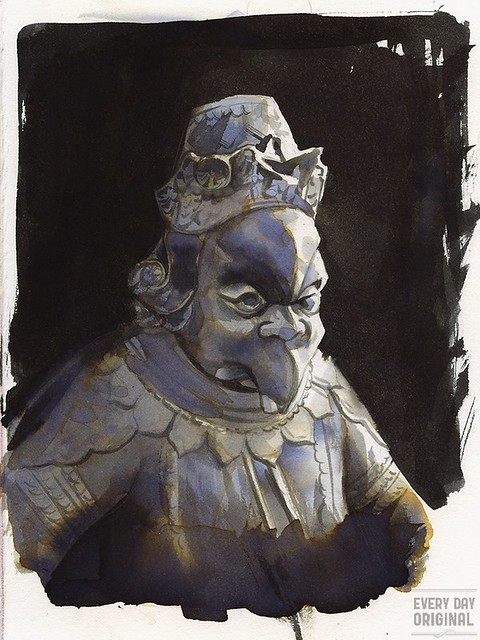
(The Bronze Colossus of Shojo; Wat Arun by Michael Marsicano.)

We had met a few weeks ago to set the scene; Eric showed up, getting to have his turn for once, but things had gotten busy at work & I hadn't had a chance to write up an adventure for that week. Sucks to be him...but I'm going to give him full experience for this session, which neither he nor Silissa could make it to, because it's not his fault the Dungeon Master didn't have his game prep done. That means the crew was the Kitsune nobility-- Haru o-Kitsune, played by Luke, samurai courtier on his way to get married, accompanied by Amina o-Kitsune, his samurai warrior cousin (both of whom are secretly blood mages), & Keku Kin, Nicole's wily cybord zaibatsu agent. They've traveled to Monzen-Jo, Iroha's family castle, deep enough into Lung territory that Watchtower Ochichimitsu is visible even during the day. We've established that Ren & the Royal Physician are in the Market of the castle-town, where a massive bronze colossus of Shojo the Monkey King stands...


(Moyo Lung; art from Atlantica.)

...& that Amina's been taken to the Clockwork Ashigaru Barracks to get patched up, filled with gearwork & cogs much like the Gates of Yomi. Though she's really not that bad off, since Keku's serpent familiar sucked the poison out & Haru used his blood magic to take some of her wounds to his body. There she met with Moyo Lung, an old man in heavy ashigaru armor with an antique gada mace-staff. He keeps ranting about ogres & Tonka Bay, so she bails. Haru, Keku & Gong, meanwhile, are searching for a resting house in the Underdocks, below the market-- & seeking a doctor to look at Haru's injuries. Haru, for good measure, sees some old Imperial script & tells all the locals, with his best oratory wiles, that it extoles the virtues of Nagini, the Serpent Queen.

Speaking of snakes, Keku's familiar, the somewhat-blasphemously, now-somewhat-ironically named "Nagini," has grown to be a four dot Background. That's some spirit, so Nicole & I are thinking of ways to reflect that. Lilly & I are in the same boat with Kreecher, her demonic kitsune. She put another dot into it, which is not a bad idea, because it solidifies her hold on the increasingly illusive creature. It also means it is more powerful, as well; as a goblin-fox, I think this should be an alternate form. Actually wait; hold on. Lilly decided not to spend that experience yet, & save up for an Attribute dot. The train of thought still holds true, for the possible future.


(Sensei Zenzo Yamashita; Rock Ji by Jubo Tsui.)

The doctor who looks in on Haru-- fetched by his loyal manservant-- is Sensei Zenzo Yamashita, a handsome man with an exotic fashion sensibility & a slung pouch of surgeons tools. Zenzo, is of course...Keku's husband? Wait, come again? We've been sitting on that for a little while now, the two of us secret hatchers, but I had two ways in my mind I was debating going...Zenzo was the winner. I've got plans for the other guy, don't you worry. He patched up Haru & then...well, he & Keku had a talk, & she went under the knife again for elective cybersurgery. Well, metaphorically "under the knife"; in practice, the way the metallic bone lacing was installed was through multiple & lengthy injections.

All in all, it was a nice, character driven set-piece. I did make a misstep in keeping Amina & the rest of the group apart; I should have probably fast-fowarded that bit, but then, I do find that players get up to hijinks on their own that can be fun story seeds. So the field was sown. & like I said, since I've designed this vignette as a "dungeon," with key NPCs as "bosses" & locations as "rooms," it is a clockwork box. Now that it is all wound up, all I have to do is let it run & let the chips fall where they may...
05 Oct 11:41

Envy of Angels Sweepstakes!

by Sweepstakes

Envy of Angels Matt Wallace sweepstakes

Matt Wallace’s Envy of Angels arrives from Tor.com Publishing on October 20th, and we want to send you one of our three gorgeous galleys now! (Check out the cover reveal, plus Wallace dishing on his dark novella series.)

In New York, eating out can be hell.

Everyone loves a well-catered event, and the supernatural community is no different, but where do demons go to satisfy their culinary cravings?

Welcome to Sin du Jour—where devils on horseback are the clients, not the dish.

Comment in the post to enter!

NO PURCHASE NECESSARY TO ENTER OR WIN. A purchase does not improve your chances of winning. Sweepstakes open to legal residents of 50 United States and D.C., and Canada (excluding Quebec). To enter, comment on this post beginning at 12:30 PM Eastern Time (ET) on September 24th. Sweepstakes ends at 12:00 PM ET on September 28th. Void outside the United States and Canada and where prohibited by law. Please see full details and official rules here. Sponsor: Tor.com, 175 Fifth Ave., New York, NY 10010.

25 Sep 09:39

OF SORROW AND SUCH by Angela Slatter: Excerpt

by Ana

Today, we are happy to be hosting an excerpt of Angela Slatter’s upcoming Tor.com novella Of Sorrow and Such.

Of Sorrow and Such

Mistress Gideon is a witch. The locals of Edda’s Meadow, if they suspect it of her, say nary a word—Gideon has supported them, and it’s always better to keep on her good side. Just in case.

When a foolish young shapeshifter goes against the wishes of her pack, and gets herself publicly caught, the authorities find it impossible to deny the existence of the supernatural in their midst any longer; Gideon and her like are captured, bound for torture and a fiery end.

Should Gideon give up her sisters in return for a quick death? Or can she turn the situation to her advantage?

Divider

Chapter One

Edda’s Meadow is a town like any other, smaller than some, larger than many.

Not quite a city.

No better, no worse. Folk, some rich, some poor, some clever, some as thick as two planks, go about their business and are generally polite to their fellows. The canny and the stupid are not confined exclusively to one economic class or the other.

At its centre is a market square where produce fresh and otherwise is for sale. Around the edges is a mix of shops (above which the owners live) for the purchase of items more permanent, less perishable, the mayory, and the pastor’s house. There is a large oval where no grass grows though it’s been nigh on ten years since the last burning. On the outskirts: a smithy on the western boundary, a tannery to the east, and most days it’s downwind so the smell of bread and buns from Keil’s bakery can overwhelm and seduce the inhabitants. The two flour mills act as bookends, the newer to the south and the old to the north, the latter unused for almost two decades since Karol Brautigan sent Erika Strauss out of business.

There are no walls around the town, and the meadow which was Edda’s is no longer much in evidence.

I wonder sometimes if that long ago Edda would recognise the place that bears her name. I wonder more often who she was, for she’s yet another woman lost to history. No one thought to make note of her, whether she committed some great deed or merely owned the field before it sprouted a village that grew prosperous and then grew some more. Females are seldom remembered once they’ve gone beneath the earth; indeed, many go unremarked while they’re still upon it.

The Tey River splits the town in two, but bridges—varying in expertise of construction and stability—have been thrown across the span every quarter-mile or so and no one need suffer too taxing a walk. The houses on both sides are a blend of affluent, middling, and impoverished, although the poorer ones are clustered in tiny ghettos, while the more prosperous spread around them in a loose kind of hug, not too close, but almost protective. My home, good enough to blend in yet not so fine as to excite envy, is on the northern boundary, with the old mill in sight, and not in such proximity to my neighbours that I feel over-looked, which is how I prefer it.

If the mood takes, follow the line of the Tey, past the new mill, drift by the farmhouses that supply the wheat, and meat and other crops. Continue on, through the fields dotted with flowers of all hues, until you come to a stand of trees. Step beneath the spreading branches, don’t be afraid of the shadows, for soon you’ll break into a sunny glade. The large pond there is called Edda’s Bath and the river runs in and empties out of it, winding off through the depths of the forest. Around the banks grow plants that are useful in my work, things that will heal and others hurt, though I sell the latter to no one in Edda’s Meadow; I’m not a fool.

I don’t pass myself off as a doctor—there’s one comes each month from the bigger city three towns over—but I live here and can be found day or night. I’m the person Edda’s folk turn to for everyday remedies even when Doctor Herbeau is visiting. Yet I harbour no illusions: I am tolerated. If a physician ever deigns to make his home here, then I shall become something of an embarrassment, an object of superstition, and a reminder that they’ve held to the old ways. A medical man will spout fancy terms they do not understand, patronise them, and hand out tablets that give a little relief, but no cure. They will worship his impenetrability as a sure sign of superiority and run back and back again for his expertise. My honesty about what I can and cannot do will no longer suffice. I promise no miracles for I know all too well that Dame Fate has a penchant for making a liar of the best-intentioned individual. A doctor with his empty vows will steal their hearts and hollow heads from me, and they’ll dismiss the times I saved their children from fever, or gave elderly parents a balm against lingering disease. The women will choose to forget that the “Widow” Patience Gideon (Sykes that was, if they did but know it) made their barren wombs a little more welcoming for their husbands’ seed, and those same husbands will deny that my potions enabled them to service those very wives.

It has happened before and I’ve no doubt it will happen again. For now I am comfortable and content, though I keep a weather eye out. I warn Gilly to do the same, but she is too young and neither blessed nor cursed by my kind of power to have a real sense of how quickly things can change.

I tread carefully down the slope of Edda’s Bath, and kneel at the edge. Reaching into the cool liquid makes me shiver though the day is more than warm. I pluck out handfuls of the waterweed growing there. My houseguest asked for it, however I don’t know what it’s for. Her knowledge is different to mine and I’ll ask her how to use it, then write it down in the book I keep wrapt and buried in the cellar. I pick more, shake away the excess water, and put it in my basket next to the nightshade and mushrooms, the angelica, rue, henbane, wood sorrel, mullein, willow bark, woodbine, and pepperwort. There was a time I thought I would never do magic again, but it would have been easier to stop breathing. I’m simply far more careful about what I do.

On the surface floats my reflection; not so bad. I’ve just crossed to the wrong side of fifty but could pass for younger, with my clear green eyes, still-pale skin, and dark hair as yet untouched by white. There are fine lines, though, around my mouth, and across my forehead, which Mother always claimed as a sign of intelligence. Her own brow was a maze of furrows, yet it wasn’t enough to help her evade the men of Bitterwood when they hanged—or tried to hang—her.

I look past my image, down into the depths, using the sight that was my dead father’s gift: the ability to not only see in the darkness as clear as day, but also to penetrate the earth and find what has been hidden. There’s a bundle, swaddled tight and weighted down with rocks. It’s small, so small. A newborn, I suspect, and unwanted. Brought here by its mother most like. I imagine the smell of sour breast milk, untapped and curdling. No point in telling anyone; they’d want to know how I knew about it and answering that question would only lead to more queries best left unasked. Whoever put it here will torment themselves quite sufficiently. Besides, how am I the one to judge a woman who leaves a child behind?

I rise and climb to the top of the bank. Dusk is threatening. I give a high-pitched whistle, hear an immediate answering crash in the undergrowth to my right. Fenric comes bounding towards me, all thick golden fur, caramel on his legs and paws, and honey-brown eyes. He alone seems untouched by the years, his devotion to me undiminished. The great head pushes against my hand and I put the basket down so I may pat him thoroughly. A deep thrumming comes from his chest, almost as if he’s a cat in a dog suit, rather than what he really is.

I peer out in the trees, where forest shadows and shapes dance, move. Sometimes they are sharply in focus, but mostly not. Figures tall and short, adults and children. They are creatures not confined to the woods, though they seem to like it best here. It’s well time to return home, before the sun sets entirely. What if I should recognise some of the shades drifting back and forth between the trunks?

I’m not fearful, though I am cautious.

How many of those shades I might be responsible for is something I cannot calculate.

I retrieve my basket, tell Fenric to come along, and head back towards Edda’s Meadow. Gilly will have supper ready soon.

Chapter Two

My house is three stories high, including a garret, and sits in a large garden where I grow flowers for pleasure and herbs for healing. Perhaps it’s too big for just Gilly and me, but we have visitors from time to time and the extra room doesn’t hurt. Where Fenric and I pause at the start of our street, we can see not just the dwelling and the apple trees inside the fence that surround it like sentinels, but also the old mill in the distance. Tales say it’s haunted and I’ve no surprise at that.

As we get closer to home two figures become apparent on the threshold. Gilly’s taken advantage of my absence to have a gentleman caller. I don’t object so much to the activity as to her choice of partner, not to mention the fact we’ve a houseguest who must remain unseen; I trust she’s keeping to her hidden room in the attic. I can make out Beau Markham, the mayor’s son, not as pretty as he thinks he is, but pretty enough to persuade more than one lackwit maiden to lift her skirts. I want better for Gilly, always have. I’d thought her smarter than this—yet he’s lingering, which I’ve not see him do before when spotted on other stoops in other parts of town. He’s always off at a quick pace, while dishevelled lasses stare after him as he waltzes away. They call Shall I see you at the dance, then? and he never bothers to answer unless it’s to laugh unkindly. Well, then perhaps my girl’s clever enough to keep her knees together.

Still and all, she can do so much better.

I wait in the shadows between two houses and watch as Beau Markham pulls himself away from Gilly and wanders in my direction. For her part she does not linger like some lovesick fool, but goes inside. Good. Fenric growls and I hush him gently. When Beau comes level with us, I speak.

“Good e’en, Master Markham.”

I watch as he jumps a little, his almost-purple eyes seeking the source. I take a kind of pity and step out where he might see me.

“Mistress Gideon,” he says and pats his heart, making a joke. I’m not fooled. His gaze is flat; he’s shown himself a coward and he’ll not soon forget it. “I trust you’re well.”

“Passing well. I see you’re visiting my Gilly,” I say and don’t give him time to explain himself. “I’ll not have her harmed.”

“I would do nothing to hurt Gilly, Mistress Gideon,” he lies most sincerely.

“Ah, but that’s not true, Beau, and I know it.” I lean close and exhale my hot angry breath into his smooth face. “I’ve seen you tomcatting on doorsteps for the past few years. I’ve given more girls than I care to think of cures for the ills you’ve planted in their bellies, and delivered a dozen bastard babies with their daddy’s sweet violet eyes for young women who’ll be unlikely to find husbands now. And as for the number who’ve come seeking creams and ointments for the rashes you’ve passed on with your nasty, festering little prick? Oh, almost beyond counting!”

He tries to move away, but Fenric has positioned himself immediately behind the boy, so he trips and tumbles backward over my sturdy beastie. Beau’s pasty in the dim light. I lean down and press a quick sharp finger under his chin, my nail nicking the baby roll of fat there that will grow as he gets older and apes his father’s eating and drinking habits.

“If you go near my Gilly again, if I find she’s been tampered with, carrying your by-blow or got some kind of rot between her legs, I swear to you, Beau Markham, no one will find the body for my wolf will be shitting you out for the better part of a week.”

“I didn’t touch her!” he fair shouts. “She won’t let me; she makes me ache, she teases me, but she hasn’t let me.”

“And that’s how it will stay, isn’t it?”

He nods.

“Bide by that and we’ll remain friends.” I offer my hand and help him up. Beau dusts himself off and Fenric growls louder this time, sending him off at a run.

Gilly won’t be pleased whenever she finds out, but she’s young; she’ll get over it. And there’s Sandor, who waits patiently for her to notice him. I shrug off the temptation to give that a kick along by means of my magics—it would not be fair, and it would be one of those rare things: an act to cause me shame.

***

It’s well past midnight when I’m woken by a hammering on the front door.

I stumble from my room, meet Gilly in the corridor; she looks as weary and nervous as I feel. No good news ever announces itself in the morning-dark. Gilly goes down the stairs ahead of me, hesitates at the doorknob until I say, “Open it.”

A woman stumbles in, powder blue dress streaked with blood and mud, face bleached, eyes wide with shock and pain. Around her right wrist is a filthy, sopping, makeshift bandage, and in her left hand is her right hand, which is no longer attached to her wrist.

Gilly swiftly checks outside, then shuts the door. The woman sways, but remains upright. Neither of us approaches; we wait.

“Help me,” she rasps. “Please.”

Normally, she’d bleed to death in my front room for I can’t assist. I have no power over this sort of life or death, and even if I could stem such bleeding, my magic is not of that kind. I’d have no choice but to apologise as she died, then hide her body, bury or burn her. Only a fool would go to the constable and report such a demise; he’d ask, first and foremost, why did she come to me for aid? What in you called to such a woman? It wouldn’t take long for tales to circulate, for I’ve no doubt whoever did this found her up to no good. A constable, even one as dim-witted and well-disposed towards me as Haddon Maundy, could make connections that would do no good at all.

Better she be thought lost and innocent, and thus mourned. Or run away, and loathed in the usual fashion. Better that than she drag me down with her.

But this night, oh this night, Flora Brautigan is lucky beyond all measure. This night I can help her.

“Gilly,” I say, “rouse Selke, and fast.”

Chapter Three

“Best when the wound’s fresh, the chances of it taking are much better,” says Selke as she works.

In the guest room with blue curtains Flora lies unconscious, completely insensible from the huge dose of poppy I poured down her throat. She would not have been able to bear what we did to the stump otherwise; scraping away the raw flesh and sheared bone edges, scouring out the dirt and debris embedded there, the traces of wherever she was when this injury occurred. Now her arm is propped on several pillows, Selke’s binding spell keeps the blood from gushing forth. I’ve sent Gilly to slink through the garden and nearby streets, to clear any sign that a woman in distress came to this house, then to wash away the scarlet puddles in the front room so there’s no trace of Flora Brautigan.

Selke, nightgown streaked with the substance of which she is mistress, her red locks pulled back into an enormous loose bun, sweat curls framing her face, is bent over the small writing desk beside the bed. On the surface before her is a clump of dead white that, when she is not kneading it this way and that, moves of its own accord, seeming to breathe and shiver. It’s living clay, dug from the earth of certain graveyards, replete with the juices of the dead, redolent with the scent of rot. She splashes it with lavender water to make the stuff more malleable and it has the added benefit of dampening the smell, then she sprinkles a fine pearly dust and works that in, explaining as she goes.

“This makes it set, fast and proper. I had a friend, once, used it to make those dolls, the ones with little slivers of soul inside so it was like they almost lived. I’ve experimented, over the years, found I can do all manner of other things. Even this.” She holds up one slurry-spotted hand, wiggles the pointer and middle fingers. “Lost these two when I was careless, couldn’t retrieve them from the gullet of a particularly angry wolf. Made myself new ones—and a lot of money.”

Selke is a stranger to me, one of an intermittent stream of wandering witches who come seeking refuge. They recognise the carving above the doorway of oak and rowan and birch leaves, know it’s a safe place. Much better than the forest huts my mother and I used to hide in when I was young. None of them stay more than a few days, but they pay their way with knowledge, swapping remedies and spells. Selke is more secretive than others, she keeps her own counsel for the most part. She’s admitted only to this ability and some herbcraft, but I’ve seen a lot of women on the run—been one myself—and my instincts tell me her powers are even greater than this one. They tell me, too, that whomever or whatever she is fleeing has much influence and a far reach. She’s a good bit younger than me, but there are streaks of white through her auburn locks.

“What’s that powder?” I ask, nodding towards the vial that shimmers white.

“Gravedust and silver shavings amongst other things, it adds a lifelike appearance. I’ll write the recipe down for you later if you think it useful.” She lifts her work from the table, proud and triumphant. “Now look.”

It is a hand of clay, deathly grey, though with a sheen now, and barely distinguishable from the model after she pressed it to the still living one so the lines and whorls would be transferred; no one will notice the miniscule differences. The thing quivers.

“You can’t just reattach that?” I ask and she shakes her head.

“Once it’s off, it’s dead. It won’t regrow. I don’t know why, something about the separation sunders the connection between body and extremity; the limb dies. But this does grow, perhaps because its life is independent of the corpus.” She shrugs. “Remove the binding and hold her steady, this must be done quickly.”

I nod and move closer to Flora. I grasp the arm just above the stump and say “Solvo” as Selke taught me. The magic dissolves with a sigh and a puff of barely perceptible smoke. Immediately blood pushes forward in a crimson tide, and Selke swiftly places the new hand against the welling, whispering a spell as she does so. I cannot make out all the words, but I think it’s a chant spoken over and over for a full five minutes, which seems to me far too short a time. Flora struggles briefly in her drugged sleep, but cannot wake and she soon subsides.

When Selke steps away, a smile lights her face.

The hand, now attached, lies on the pile of pillows. As we watch it grows pink as the circulation flows, enriching it, making it part of the whole. The fingers twitch and tap against the fabric as if to a tune we cannot hear. At the spot where the new flesh meets the old there is no mark, no join to show anything untoward happened.

“Beautiful,” I breathe, slightly envious of my guest’s gift.

“I was fortunate to have the original to copy.” We both glance at the desk where the severed item lies, unmoving, bloodless.

“You’re fortunate Flora uses her hands for nothing more taxing than choosing a dress and jewellery,” I say, and Selke snorts.

“Burn that,” she says. “Get rid of any trace.”

I nod. “I’ll do whatever I can. But we still don’t know what happened to her or who witnessed it. I may yet have to arrange an escape from Edda’s Meadow for her. Might she travel with you?”

“Aye,” she says. “I’ll take her for a few days, then she’s on her own. Moon-dark tomorrow—oh, today. That would be best.”

We both know what a burden she has taken on—indeed, the pair of us, for to save someone is to be responsible for their actions thereafter. If you help keep a person in the world, the good and ill they do is always partially yours. Selke says, “Do you think she’s one of us?”

I shrug. “It’s hard to believe she’d turn up here if not. It’s even harder to believe this would happen to her if not. We’ll have to wait and see.”

Copyright © 2015 by Angela Slatter

Specialising in dark fantasy and horror, Angela Slatter is the author of the Aurealis Award-winning The Girl with No Hands and Other Tales, the World Fantasy Award finalist Sourdough and Other Stories, Aurealis finalist Midnight and Moonshine (with Lisa L. Hannett), among others. She is the first Australian to win a British Fantasy Award, holds an MA and a PhD in Creative Writing, is a graduate of Clarion South and the Tin House Summer Writers Workshop, and was an inaugural Queensland Writers Fellow. She blogs about shiny things that catch her eye.

Of Sorrow and Such is out October 13th and you can read more about it over at Tor.com.

24 Sep 10:48

The Nation is Dead — Check Out the Cover for Infomocracy by Malka Older

by Carl Engle-Laird

Infomocracy by Malka Older

I’m thrilled to reveal the cover for Infomocracy by Malka Older, Tor.com’s first novel. Malka Older’s debut novel is a tense, fun, fast-paced story of electioneering, disaster response, and global sabotage, drawn from the author’s extensive experience in humanitarian aid and crisis relief. The cover had to express the mix of urgency and playfulness suffusing this post-cyberpunk adventure, and designer Will Staehle knocked it out of the park.

Here’s the synopsis:

It’s been twenty years and two election cycles since Information, a powerful search engine monopoly, pioneered the switch from warring nation-states to global microdemocracy. The corporate coalition party Heritage has won the last two elections. With another election on the horizon, the Supermajority is in tight contention, and everything’s on the line.

With power comes corruption. For Ken, this is his chance to do right by the idealistic Policy1st party and get a steady job in the big leagues. For Domaine, the election represents another staging ground in his ongoing struggle against the pax democratica. For Mishima, a dangerous Information operative, the whole situation is a puzzle: how do you keep the wheels running on the biggest political experiment of all time, when so many have so much to gain?

All three begin to realize that not everyone plans to play fair at the next election. The Liberty party is ascending on the back of subtle promises of warfare, and Heritage will do anything to keep itself in power. A perfect storm is brewing, one that might bring the new world order to its knees.

Infomocracy will be available worldwide in hardcover, ebook, and audio June 2016.

Carl Engle-Laird is an editorial assistant at Tor.com, where he acquires and edits original fiction. You can follow him on Twitter here.

23 Sep 10:21

#Merriment!


22 Sep 12:52

Of Jellyfish, Otjize, and Afrofuturism: Binti by Nnedi Okorafor

by Mahvesh Murad

binti-cover

In Nnedi Okorafor’s new novella, the titular Binti has left home for the very first time at age 16. Unknown to her parents or siblings, she has accepted a place to study at the prestigious Oomza Uni, a distant planet with only a 5% human population but filled with those from many planets who are ‘obsessed with knowledge, creation, and discovery’. Binti can not bring herself to tell her family that she is going—no one in her family has left their part of the earth, let alone the entire planet—and so she sneaks off to join the other students leaving for Oomza Uni, following her desire to learn regardless of the hostile treatment she receives from strangers at the launch port, people who can not understand why she is covered in red clay, why her hair is thickly rolled in it, and why she isn’t like anyone else they’ve ever seen.

Some spoilers ahead.

Binti is of the Himba poeple, a tribe in Namibia who use ‘sweet smelling otjize’, a mixture of ochre and butterfat over their skin, rolling it into their hair as protection against the desert sun. The Himba, as Binti points out, ‘don’t travel’. ‘We stay put,’ she says, ‘Our ancestral land is life; move away from it and you diminish. We even cover our bodies with it. Otjize is red land.’ But Binti’s tribe are also great proponents of and developers of superior, sophisticated technology, her father having passed three hundred years of oral knowledge about circuits, currents and mathematics to her, helping her become a ‘master harmonizer’ at age 12, communicating with the ‘spirit flow’ and convincing them to become one current.

But though Binti’s tribe is ‘obsessed with innovation and technology’, they remain ‘small, private, and [do not] like to leave Earth’. They ‘prefer to explore the universe by travelling inward, as opposed to outward’, with Binti herself ‘treeing’ into a sort of trance like clarity when need be. And yet, she leaves home and boards a ship, a ‘magnificent piece of living technology’ alongside many, many strangers, some of whom become her friends within a few days of travel. She is comfortable and the happiest she has ever been, until one perfectly average day on the lengthy voyage between planets, the dreaded Meduse board the ship and violently destroy everyone on it. The Meduse are strange, jellyfish like creatures probably inspired by the ‘little blue jellyfish…swimming in the Khalid Lagoon that Sunday day in Sharjah’ that Okorafor has dedicated the novella to. The aliens ‘move like water when at war’ and ‘there is no water on their planet, but they worship water as a god. Their ancestors came from water long ago’. But now the Meduse are space terrorists, violently destroying whatever stands in their way, wreaking havoc across deep space. Everyone on the Oomza Uni ship is dead except Binti, who is untouchable to the Meduse, thanks to an ‘edan’ she found years ago exploring the desert, a ‘device too old for anyone to know its functions, so old that [it is] now just art’. But it is through this device, Binti is eventually able to communicate with the Meduse. Okorafor describes the first time Binti understands the Meduse wonderfully: ‘through the clearest silence I’d ever experience, so clear, that the slightest sound would tear its fabric, I heard a solid oily low voice say, ‘Girl’. Communicating with the Meduse helps Binti understand why they do what they do, but ‘just because something isn’t surprising doesn’t mean it’s easy to deal with’.

The Arabic word binte or binti means ‘daughter of’. Okorafor’s Binti is more than just the daughter and representatives of her gifted parents and of the Himba. She is the sole representative of the human species when she remains the only thing standing between the Meduse and the destruction of the entire population of Oomza Uni. She’s smart, proud of her heritage and an fully realised, relatable protagonist, which makes her her eventual association with the Meduse and spectacular evolution all the more poignant. We see clearly that Binti really is the future and though she may have to give up some of her past to move forwards, she finds a way to remain true to her heritage.

There’s a lot going on below the surface of Binti, as there always is in Okorafor’s work. Her language is always simple, deceptively so, since there are multiple intriguing ideas and concepts at play in the narrative. As with many of Okorafor’s shorter works, Binti too is brimful of ideas that could easily be played out in greater detail, perhaps in other stories. The technology of the astrolabe communication device; the idea of ‘treeing’ and reaching a zen state via mathematics; the ship that is actually a large living creature, the idea of intergalactic species being connected to each other and yet choosing to remain racist or judgmental of different cultures within their own species—all this adds up to very effective and clever world building.

What is most important about Okorafor’s work is that she sees diverse races and cultures as being just as much of the future as they are of the present—something mainstream SF doesn’t always do. Not just does she put Africans from all over the continent in the futures she creates with great clarity and purpose, she makes certain that their various cultures travel forward with them, informing these futures, maintaining unique customs. Okorafor’s stories are where the ancient cultures of Africa meet the future, where what we have been and what makes us human meets what we can be and what we may be in the future.

Binti is available paperback, ebook, and audio formats September 22nd from Tor.com
Read an excerpt from the novella here.

Mahvesh loves dystopian fiction & appropriately lives in Karachi, Pakistan. She writes about stories & interviews writers the Tor.com podcast Midnight in Karachi when not wasting much too much time on Twitter.

21 Sep 07:21

Isle of the Dogs.


This might not technically be a Dead World game, since Tom didn't go with his usual zombie standby, but since Tom ran a horror one-shot, I'm putting it under this tag. We played Dread, which is an indie horror game where the clever mechanic is using a Jenga tower instead of dice for the "mechanics." I've heard of the game, & watched it on TableTop (Part II), & was anxious to give it a crack. Like Lasers & Feelings, this falls into a casual area of gaming that kingtycoon & I have been talking about a lot lately. Dread doesn't have anything mechanically that really applies to Oubliette, but this is as much an RPG as anything: we all pretended to be someone else & there was a randomizing element that made the game suspenseful to everyone, including the narrator.

& it was a solid one-shot! Tom always asks for feedback & I always give it to him but I'm notoriously terrible at one-shots-- they sprawl out longer-- so I am trying to learn from him, if anything. I think his best skill is his sense of escalation. He keeps pushing up the threat level when the shit hits the fan. That, & his use of visceral descriptions & a sense of vulnerability; in traditional RPGs, stepping on a trap has been contextualized as mundane, but when my character Meredith stepped on the board of broken nails...when Tom mentioned the nails were clipped into hooked points & I decided to step all the way down before I could change my mind....when I found out the board was 8' & I couldn't even crawl away. Yeah. Or further back, the moment when Luke's character Aleksander stepped in a bear trap & we all winced.

I played Meredith Palmer, the former pageant girl & spelling bee champ turned head cheerleader. I always play Tom's games with a "horror movie problem," like the film nerd who stays too long to shoot footage, or the special forces guy who is secretly working for a corrupt PMC, or a Lovecraftian "nervous condition." This time my "dark secret" was cocaine...& then half of the rest of the group were power drug users. Instead it became "frustrated that these stoners & pill poppers don't have any blow." Nicole played my boyfriend, Daniel Lee, the basketball jock & tinkerer. Lilly was the stoner, Luke the pyro nerd, Alicia the girl next door, James the rich kid.

The set-up: creepy abandoned island with mansion on it. The owners had tons of trained attack dogs & when they died the dogs went feral. It's a dangerous place, an urban legend, as the incest twins of the mansion part attests. Our boat crashes there. There is a creepy house with a very creepy flooded basement. The back yard is full of dog skeletons; the spooky woods are filled with traps. Twincest. I mean, obviously twincest. Then of course comes the slasher. & the rescue boat of dubious provenance. Pretty spooky stuff, but somehow, we survived! Not without some serious injuries, but we made it!
16 Sep 09:03

Of Sorrow and Such Sweepstakes!

by Sweepstakes

Of Sorrow and Such cover reveal

Angela Slatter’s Of Sorrow and Such arrives from Tor.com Publishing on October 13th, and we want to send you one of our three gorgeous galleys now! (Check out the cover reveal here.)

Mistress Gideon is a witch. The locals of Edda’s Meadow, if they suspect it of her, say nary a word—Gideon has been good to them, and it’s always better to keep on her good side. Just in case.

When a foolish young shapeshifter goes against the wishes of her pack, and gets herself very publicly caught, the authorities find it impossible to deny the existence of the supernatural in their midst any longer; Gideon and her like are captured, bound for torture and a fiery end.

Should Gideon give up her sisters in return for a quick death? Or can she turn the situation to her advantage?

Comment in the post to enter!

NO PURCHASE NECESSARY TO ENTER OR WIN. A purchase does not improve your chances of winning. Sweepstakes open to legal residents of 50 United States and D.C., and Canada (excluding Quebec). To enter, comment on this post beginning at 2:30 PM Eastern Time (ET) on September 14th. Sweepstakes ends at 12:00 PM ET on September 18th. Void outside the United States and Canada and where prohibited by law. Please see full details and official rules here. Sponsor: Tor.com, 175 Fifth Ave., New York, NY 10010.

13 Sep 20:26

WWB: It Happened.


10 Sep 09:10

In These Green Hills

by Paul Cornell

Witches of Lychford Paul Cornell Cotswolds

The Cotswolds are a range of hills, in the middle of Britain, which define a region. They rise from the Thames to an escarpment called the Cotswold Edge, above the Severn valley. As with many things in Britain, they’re characterised by their ill-defined boundaries. Several places on their fringes, or honestly nowhere near, claim, for the purposes of tourism, to be part and parcel. The Cotswolds are the home of crafts, dry stone walling, rolling hills, small market towns, country inns with good restaurants, hideaways for the rich. They’re laid back and gorgeous, like an aging slab of good cheese.

This is the region in which reside myself and my wife. She’s the vicar of a glorious parish church in a glorious Cotswolds market town. The only problem is, we have to solve so many surreal and whimsical murders. (Whenever I say that to Americans, they look anxious for a moment, as if it might be true.) My upcoming novella for Tor.com, Witches of Lychford, uses a very similar Cotswolds town as its setting. It’s an attempt on my part to connect with our new home and the people here, and to communicate some of the flavour of the place to those who’ve never been here. It’s about three women with experience of the other-worldly coming together to fight supernatural evil, said evil being, obviously, in the form of a chain of supermarkets.

I assumed, when I set out to write it, that I’d be joining in with a longstanding tradition, but there’s surprisingly little fantasy or science fiction set in the Cotswolds. J.K. Rowling, so good on the weight of every British signifier, has only one mention of the area, saying that many trolls live here, and that they clubbed to death, in 1799, while she was sketching, a specialist in their ways. Rowling lived here as a child, so she knows of what she speaks. Christopher Priest’s The Quiet Woman (1990) is set in the fictional Wiltshire village of Milton Colebourne, which has a Cotswolds feel to it, albeit a dystopian, indeed, radioactive, Cotswolds feel. It’s about the troubling things that lie underneath the comforting blanket of Englishness. Of course it is, it’s Christopher Priest.

Wilkie Martin’s humorous Inspector Hobbes novels go in the opposite direction, having fun with quaintness, as an ‘unhuman’ policeman keeps order in the town of Sorenchester, the name of which echoes the real-life Cirencester. John Buchan’s The Gap in the Curtain (1932), a rare venture into slipstreamery from that most belligerent of British thriller writers, features a drug-based attempt to see into the future at a Cotswolds country house. Chavenge, A Tale on the Cotswolds, 1648 (1845) by Richard Webster Huntley is set in a real location, a country house near Tetbury, and tells, in the form of a ballad, what’s meant to be a true story. One Colonel Nathaniel Stephens, a reluctant conspirator in the death of Charles I, and Lord of said manor, was, upon his own death, visited by a fine hearse driven by a headless man, which took him off, presumably, to hell. Every head of the family since is meant to have departed in the same manner, which makes it just as well the place is now owned by someone else. (You can imagine the conversation with the estate agent.)

On television, the fictional town of Leadworth, in Doctor Who the bucolic home of Amy Pond, is half an hour from Gloucester, and so could well be in the Cotswolds. Stockbridge, often featured in the Doctor Who Magazine comic strip is (sometimes) in the county too, and (sometimes) looks like it’s in the region. It’s possible Terry Nation was thinking of Evesham when he set the episode ‘The Android Invasion’ in Devesham. The thing all these places have in common is they’re absolutely not where you’d expect an alien invasion, if you’d expect one anywhere. The heroine of BBC children’s drama The Changes (1975), in a Britain where all technology has been rejected, journeys through the Cotswolds on her way to a confrontation with something truly terrifying in a cavern. It was described as being ‘for older children'; having seen it at the time, I still don’t feel old enough.

In comics, the region really gets exciting. In Thor (volume one) #347, part of Walt Simonson’s definitive run as writer and artist, we discover that Svartalfheim, home of the Dark Elves, led by Malekith the Accursed, can be accessed by a portal in the Cotswolds, though we don’t see much of the local scenery apart from a ruined castle. In the movies, Malekith is played by Christopher Eccleston, who doesn’t sound like he’s from Gloucestershire. Maybe lots of dark realms have a north. At Vertigo, DC’s mature readers imprint, streetwise mage John Constantine’s mate Rich the Punk, the true king of Britain, strides the same countryside as part of his drug-fuelled quest to find the Holy Grail, in Hellblazer (volume one), #112, part of Paul Jenkins and Sean Phillips’ run on the title.

In real life terms, from way back when Patrick Troughton was the Doctor and ‘The Invasion’ was filmed at Fairford’s local air base, to now, when that royalty-haunted manor I mentioned plays host to Poldark, the Cotswolds have a long history of standing in for other places on screen. But it seems strange that a region that touches on the numinous in such a British way, through a closeness to nature and enough calm for contemplation, shouldn’t have more of its own fantasy. (If you know of other titles, I’d love to hear from you in the comments.) Perhaps that sense of comfort seems to limit the possibilities. But I think J.K. Rowling got it right: In these hills, there are trolls.

With thanks to Geoff Hawkes, Alison Hobson and Graham Sleight.

Witches of Lychford is available on September 8th from Tor.com. Order now for iBooks, Kindle, and Nook.
Read an excerpt here, and learn more about all our upcoming novellas in the Fall 2015 sampler!

Paul Cornell is a writer of science fiction and fantasy in prose, comics and TV, one of only two people to be Hugo Award-nominated for all three media. He’s written Doctor Who for the BBC, Action Comics for DC, and Wolverine for Marvel. He’s won the BSFA Award for his short fiction, an Eagle Award for his comics, and shares in a Writer’s Guild Award for his television.

10 Sep 00:03

Binti Audio Excerpt

by Danielle Prielipp

Binti-audio

One of the golden voices of audiobooks lends her talents to the audio edition of Nnedi Okorafor’s Binti. Robin Miles—who has acted both on and off Broadway, and in television series including Law & Order—is a veteran, award-winning narrator/director of audio programs, who got her start thanks to an accidental audition with Talking Books in the 1990s. She won her first Earphones Award for her work on Cane River, which highlighted the versatility of Miles’ voice and her ability to “rely on accents and inflection” to “distinctly reflect personalities, family origins, and social status.”

This ability to characterize based on accent and inflection plays an integral part in the narration of Binti. In this science fiction novella, Binti is a brilliant young woman who is the first of the Himba community to be offered a place at the galaxy’s finest institution of higher learning. Within the first tracks of the program, listeners are introduced to a rich new culture through accent and articulation that was fine-tuned through the collaboration of the author and narrator. Listeners should be warned that once one starts listening to the program, one will be hard-pressed to press “pause” until it’s reached the thrilling conclusion!

Listen to Robin Miles reading an excerpt of Binti below.

Nnedi Okorafor’s Binti is available September 22nd in paperback, ebook, and audio formats from Tor.com! From the catalog copy:

Her name is Binti, and she is the first of the Himba people ever to be offered a place at Oomza University, the finest institution of higher learning in the galaxy. But to accept the offer will mean giving up her place in her family to travel between the stars among strangers who do not share her ways or respect her customs.

Knowledge comes at a cost, one that Binti is willing to pay, but her journey will not be easy. The world she seeks to enter has long warred with the Meduse, an alien race that has become the stuff of nightmares. Oomza University has wronged the Meduse, and Binti’s stellar travel will bring her within their deadly reach.

If Binti hopes to survive the legacy of a war not of her making, she will need both the the gifts of her people and the wisdom enshrined within the University, itself—but first she has to make it there, alive.

You can find the audio edition at Audible or pre-order the ebook edition at the links below!

10 Sep 00:03

Language and Code Switching in Kai Ashante Wilson’s The Sorcerer of the Wildeeps

by Leah Schnelbach

The Sorcerer of the Wildeeps Kai Ashante Wilson book reviews

It’s a question every writer asks as they begin work: how do I build my world? How do I create a universe teeming with life, vibrancy, heartache and hope, rather than a flat set filled with cardboard cutouts? One of the best, most immediate ways is to imbue your story with unique language. This technique has been used by many classics of SFF, but my favorite recent example is The Sorcerer of the Wildeeps by Kai Ashante Wilson.

I already loved Wilson’s story “The Devil in America,” published here on Tor.com in. And when I read Stories for Chip, a collection of fiction and essays honoring Samuel R. Delany, I was really taken with his inventive story, “Legendaire.” But now, in Wildeeps, he’s added an extraordinary voice to the Sword and Sorcery subgenre.

I’ve always been interested in the ways authors build future societies and fantasy societies. In A Canticle for Leibowitz, for instance, language itself is essentially the same, but the characters’ knowledge of the 1950s-era tech is nonexistent. It’s left to the reader to fill in the gaps, and alternate between amusement and horror as they build the story of nuclear devastation in between those gaps. Russell Hoban’s Riddley Walker gives readers a similar experience. Samuel Delany’s The Einstein Intersection and David Mitchell’s Cloud Atlas, however, both tell stories set so far in the future that our current era only appears as scraps of architecture and whispered myth. The fun here is to try to parse out what survived against all odds, and to see how the people of the future have reinterpreted things like Beatles’ lyrics and astronomy centers.

All of these stories feature human languages and mythologies that have evolved in the wake of catastrophe, redefining some words, and inventing new ones. In “Houston Houston Do You Read?” on the other hand, the main character obsesses over the fact that the language is the same, and holds onto that as his lifeline because that means they can’t possibly be in the future… but of course it’s just that those who survived the plague have tried their best to preserve language as it was, with the addition of Australian accents. A Clockwork Orange’s Nadsat combines this tactic with another useful writing trick—inventing teen slang. Since youth culture shifts and changes several times a day, any author using current slang risks dating the shit out of their work, but trying to use generic terms for things will make you sound like a square (Which would be why the best examinations of teen life invented phrases and trusted viewers to go along with it, e.g. Heathers, Mean Girls, Buffy, etc.), so Burgess gave us a cocktail of cockney rhyming slang, roughly translated Russian, and only a few authentically mid-1960s British phrases.

My favorite SFF story about language has to be Babel-17 (another Delany book) which explores how language shapes thought itself. For instance, if someone is raised in a culture that has no word for “I”, can they ever achieve a sense of individuality—at least, one that will be understood by a person who has a very definite definition of “I”? How will a person see themselves, if they have no word to express their separate-ness from others? Is language a virus? Can it be weaponized? The book came out of Delany’s fascination with the strong Sapir-Whorf hypothesis, an idea (which has since been debunked) that the language a person thinks in determines their perception of the world and self.

Sometimes you want to say things, and you’re missing an idea to make them with, and missing a word to make the idea with. In the beginning was the word. That’s how somebody tried to explain it once. Until something is named, it doesn’t exist.

What does all this have to do with Wildeeps, you’re asking? Well, what really excited me about the story was how Wilson used the language in a totally different way. He isn’t just using language to add some tapestry to the walls of his worlds, he’s using it to look at code switching. It’s a little more akin to the work of Junot Diaz, I think, where Dominican nerds in New Jersey have to constantly shift between nerdspeak, Dominican Spanish, street patois, and the “higher” white-coded language they’re expected to use at school and work. Wilson’s novella melds the usual fantasy language of gods and quests with the language of the current, modern, U.S. street.

This is different than what he did in “The Devil in America” (which you can read here, and which I am not recommending so much as I’m jumping up and down waving my arms and hollering Read it read it it’s so good go and read it holy crap). TDIA takes a real horror from U.S. history—the massacre of the black community of Rosewood, Florida—and transforms it into a mythic tale of satanic curses and old magic. The language is pure Southern country, sprinkled with New Orleans French and Mexican Spanish.

In one of Wilson’s early stories, “Legendaire,” he introduced us to three intersecting groups with multiple languages. Residents of Sea-john are called Johnnies, and speak a “lower” language, while people down in the Kingdom are the arbiters of high culture and consider their language “high.” Meanwhile, the gods have their own language, which wouldn’t be a big deal, but since the gods sometimes live amongst the people in Wilson’s work, it just becomes another language to weave in. The unnamed central character is being raised by his two mothers and a father, Redamas, who happens to be a god. Like the other characters, the young boy is fluent in both the high and low languages, and also has a smattering of god-speak thanks to his father.

But interestingly, Wilson doesn’t write out this invented vernacular in “Legendaire.” The fluidity of their language is such that at various points characters simply note that they’ve unconsciously switched back and forth, and once Redamas mentions enjoying his son’s “johnny” talk because he thinks it’s funny. The closest Wilson comes is a moment when Redamas speaks his own language in referring to “Discorporate Intelligences,” momentarily forgetting that he is supposed to use the Sea-john term “ghosts” when speaking to his son.

In Sorcerer of the Wildeeps, Wilson takes his language games to the next level. The plot, like Mad Max: Fury Road, is whisper thin and beside the point. Demane, a demi-god come to earth, travels with a caravan of merchants and the “brothers” who act as the richer men’s muscle. The group is about to start down The Road, which was considered the only safe route through the Wildeeps until a monster began snatching travelers.

We get the sense that Demane doesn’t need this work, and could do any number of things. He could, most likely, insert himself into a higher class if he chose. But he stays with the caravan because of his deep love for the Captain, Isa. (Isa, we eventually learn, is from Sea-john.) The regular humans he travels with can’t find a way to incorporate Demane’s godlike qualities into their every day lives, so they name him Sorcerer, and expect him to provide healing and charms as they need them. They can’t handle the Captain’s divine strength, so they just think of him as a very strong man. Captain and Sorcerer occupy a hazy liminal space in the social strata: they’re “better” than the brothers, but they’re also not equal to the elite merchants. When the caravan comes to a town, it’s assumed that the merchants will spend their time pursuing business opportunities and dining, while the brothers will get drunk, pick fights, and wake up in whorehouses, and when they’re on the road, it’s the brothers who will act as hired meat when danger nears. The brothers are expendable, silly, coarse—but they’re the ones we live with, and quickly come to love, during this story.

Demane notes the class distinctions within the first pages of the book:

While it was true that most brothers showed purer descent from that half of the mulatto north supposedly more blessed with brawn than brains, and for the merchants it was the other way around—brighter of complexion (and intellect?)—did it necessarily follow that one group deserved fine speech, while the other should get nasty words sprinkled on every single sentence? “You motherfuckers came here on our coin, our camels. And while you lot drink and whore tonight, we merchants must sell the salt, must empty the warehouses, must pack the goods, must swap the camels for burros. Therefore—right now—I need numbers for how many mean to press on with us. Tell Captain Isa your choice: you brave, you venturesome, you men who are men. And may God bless the cowardly cocksuckers we leave behind.”

We also get a brief splash of god language:

“You oughta let me take a quick look-see,” Demane said, not for the first time. “I won’t even touch my bag unless you say so. Promise.”
“I told you, Sorcerer.” Faedou threw an edgy glance up at Demane’s bag. “I put my hopes in God.”

After that last clash with bandits, Demane had tended the injuries of all the brothers save for Faedou, who, it seemed, feared the pollution of heathen arts even more than death by gangrene.

[Saprogenic possession], [antibiotic exorcism], the perils of [sepsis and necrotizing tissues]… Demane had perhaps doomed Faedou, in speaking such terms without knowing them in a common language. To superstitious ears, nothing distinguished those untranslated words from the veriest babble of demon worship.

While his rough attempts to speak the language of Mequerim mark him as lower class to the merchants, here Demane’s “higher,” scientific language sets him apart from the other brothers, and marks him constantly as an outsider. The segregation through language comes to a head when Demane meets Kaffalah, another brother, and attempts to speak to him about a creature who’s been attacking travellers on The Road. Kaffalah’s master goes on a long rant describing the beast but when Demane attempts to explain that they’ve tangled with a jukiere—a wizard cat—the best he can say is “Jooker, them…bad. Bad animal.” The merchant, who already sees him as an uncouth underling, dismisses him completely. Demane, with all of his wisdom and knowledge, cannot make them understand.

But more even than that is the constant weaving of the brothers’ language into the fantasy setting, from a long dialogue about the, ah, opportunities to be had in town:

“Yo, my dudes,” said a brother. “Heard they got hoes at the Station.”

The truth of this hearsay was by another brother affirmed. “Yeah. Down in some tents out past the big market.”

A latter beside the former two put forward his own intention, and inquired into other brothers’. “I’m heading down that way to see about one, damn betcha. Who else going?”

Nearly every brother was.

“’Bout you, Sorcerer?”

“I don’t do that.”

“Moi? I most certainly do,” said T-Jawn for the general edification; and then, confidingly, to Demane: “Has no one informed you then, Sorcerer? After Mother of

Waters, there shan’t be any further opportunities to, ah—what was that marvelously apt phrase of yours, Barkeem?” T-Jawn popped his fingers encouragingly.
“Get your dick wet.”

“Voilà—before we come to Olorum City?”

Here we have the conversation about what happens after the visit to the tavern—the conversation that is usually left out of fantasy. More importantly though, we have this conversation unfolding in vibrant language, with most of the men receding into a mass of plans and anticipation, while T-Jawn, who styles himself a dandy with his overstuffed volley of cockney and French, allies himself with the men, while also separating himself from them, and putting himself more on a par with Sorcerer, by ordering another man to utter the crudest phrase of the conversation. This one conversation highlights the jockeying for alpha status among the men, while underlining Demane’s utter solitude.

There are several such fireworks displays scattered across Wildeeps, hilarious conversations, rounds of insults, and arguments. Far simpler and even more effective, however is the constant flow of “ya’ll”, “yup”, “naw”, “ain’t”, and “son” that bathes Wilson’s language in Southern colloquialism, acting as a loving counterpoint to the high fantasy language around it. Wilson’s narration tends toward ornate, Delany-ish language, which creates an immediate tension between the brothers and the world they inhabit. For instance, this is how Wilson shows us a spark being thrown from a magical fire:

A single gobbet of bright jelly had splashed out of the wood tower, and glowed amidst the puddles of the Road. Undimmed by rain, like some imp from the fire-fields of Sol, it danced in the mud. Demane conjured a jar from his bag and with a single spilled drop quenched this molten errancy.

And this is how he describes a forest:

They stood atop a forested bluff, which commanded a view of valley, river running through, and surrounding ridges. At their feet the abrupt slope dropped off into depthless tangles of weed that overgrew the valley from end to end. This world or time was far ancestral to their own, Demane judged. Infusing the scent-drenched air was not one whiff of plant or animal known to him. Across the lush weedfields, in the middle distance, flowed a sludgy river. Sheersided crags, facelike, closed the valley in: the cliffs as smooth as cheeks, the dark bosky heights suggesting hair.

This language is further intercut with letters home from the merchants, fragments of prophecy and scripture, even a children’s song:

Ashe’s children wish us well,
But never trust them, born of Hell.
TSIMTSOA’s by far the best,
For weal and woe, than all the rest!

Wilson builds us an entire teeming world through the force of his language alone. But beyond even that, he illustrates both the frustration of the immigrant experience, through Demane’s relationship with his adopted home of Mequerim, and the constant discomfort of code switching, through all the interactions between the brothers and merchants. He has given us a marvel of sword and sorcery that melds high culture and low, and ultimately shows the absurdity of honoring one form of language over another.

The Sorcerer of the Wildeeps is available in paperback, ebook, and audio formats from Tor.com Publishing.
Read excerpts from the novella here on Tor.com.

Leah Schnelbach, much to her shame, is only fluent in one language. She is a heck of a sorcerer though. Come speak to her in the language of tweets!

07 Sep 10:47

Lasers & Feelings.


About a month ago I ran a game of Lasers & Feelings & I never posted about it. Mostly because I was being cagey with spoilers-- I had a pretty tight concept & it worked well, so I plan on re-using it. So eventually I'll throw up a spoiler tag, & if you think you might ever play a parlor game RPG with might one night, skip on over that part, 'kay? Alrighty then! What was most notable was that Mike, who played in my first full Oubliette campaign & whose Oisos campaign I ran roughshod over with multiple characters showed up, with Megan as well, to play with my current crop of players. Neato mosquito.

I found the game utterly charming, & my first impulse is to make a fantasy spinoff called "Swords & Sorcery" by the same logic, or a vampire one with "Beauty & the Beast" as the two poles. Click on the picture, the rules are only a page long, so I won't try to summarize further. It seems in some ways like the attraction of a Traits system distilled down, where "Hot-Shot Engineer" is your entire character sheet, with only one statistic. High numbers are more "Lasers," low numbers are more "Feelings." It worked like a charm, to the point where I played it with Olivia, & at four & a half she was able to play "D&D" with me. But that's another story.

The crew of the ISS Raptor were:

Ziggy Gobo, a Dangerous Soldier, 2. (Mike.)
Celeste Benoit, a Hot-Shot Pilot, 4, who wanted to find new worlds. (Nicole.)
Parker Lemtosh, an Android Soldier, 5, who wanted to shoot the bad guys. (Lilly.)
Nadia Diaz, a Savvy Explorer, 4, who wanted to solve weird space mysteries. (Megan.)
James Quark, an Intrepid Scientist, 5, who wanted to become captain. (James.)
Biff LeRoy, a Dangeous Engineer, 2, who wanted to keep being awesome. (Luke.)

In this story, the Raptor itself was Nimble & had Superior Sensors, but had a Grim Reputation, as Captain Darcy's last ship, the ISS Dauntless, he self-destructed with the crew on board after they got brain parasites. Darcy is in cryosleep in medbay when the story opens. I used the different rooms of my apartment to simulate the bridge, ops, engineering & medical, which worked really well, with a few minor hiccups, like Jennifer being home since her drinks out were canceled.

Spoiler time, so stop reading if yadda yadda. I went through the plots & well, I may have pretended that I rolled my plot up randomly-- the fragments of it were all pieced together from the tables, but I picked them out-- but that just adds spice to the story, the mystique. It's the reason there's a DM's screen. (Though much respect for the "let the dice lie" ethos, too.) The plot was, in a nutshell, here comes the spoilers, brain parasites. Alien Brain Worms want to Synthesize Void Crystals which will Rip a Hole in Reality, so I translated that as brain parasites which live in hyperspace, & want to reverse the polarity of the ships hyperdrive engines in order to condense the void crystals that drive the ship down & tear open a rift to hyperspace. Really though, it was just a scam to make the players do all the work: I rolled randomly, got Ziggy, took him aside & said "you don't have a character motivation, you have brain worms. If you get another player alone, you can try to infect them too." That was my plot, one & done. In the end? Everyone was turned into a brain parasite, except Celeste Benoit, who escaped in a shuttle, & the android Parker Lemtosh, who ruptured Darcy's containment tank & since he knew the ship was being invaded by brain worms...he self-destructed, killing himself & all on board.
07 Sep 10:47

World War Bee: Dress Rehearsal.


06 Sep 15:05

Sunset Mantle Audio Excerpt

by Danielle Prielipp

sunsetmantle-audio

We hope you’ve been enjoying our excerpts from the audio editions of Tor.com’s fall publications, from the rich character work of Kevin R. Free on Kai Ashante Wilson’s The Sorcerer of the Wildeeps to the magical voice of Marissa Calin on Paul Cornell’s Witches of Lychford.

In our selection from Alter S. Reiss’s Sunset Mantle, the gritty baritone of narrator Christopher Price gives life to the doomed realm of Reach Antach and a disgraced soldier who’s looking for a place to lay his head. Price’s gravitas is well practiced, as his many theater credits include works by Shakespeare, Arthur Miller, Sam Shepard, and David Mamet. Listeners will experience the drama of hand-to-hand combat and other sounds of battle as our hero Cete fights to turn the tides of war…

Listen to an excerpt of Sunset Mantle, read by Christopher Price, below.

Sunset Mantle by Alter S. Reiss is available September 15th in paperback, ebook, and audio formats from Tor.com! From the catalog copy:

Hero. General. Outcast.

With a single blow, Cete won both honor and exile from his last commander. Since then he has wandered, looking for a place to call home. The distant holdings of the Reach Antach offer shelter, but that promise has a price.

The Reach Antach is doomed.

Barbarians, traitors, and scheming investors conspire to destroy the burgeoning settlement. A wise man would move on, but Cete has found reason to stay. A blind weaver-woman and the beautiful sunset mantle lure the warrior to wager everything he has left on one final chance to turn back the hungry tides of war.

You can find the audio edition at Audible or pre-order the ebook edition at the links below!

01 Sep 09:52

Witches of Lychford Audio Excerpt

by Danielle Prielipp

Witches Lychford audio

Fans of Paula Brackston’s audiobooks will recognize a familiar, and appropriately “witchy,” voice when listening to the audio edition of Paul Cornell’s Witches of Lychford as read by voice actress Marisa Calin. Calin is a British actress, screenwriter, and novelist, who has narrated a number of audiobooks, including the aforementioned works from Paula Brackston, Kerstin Geir’s Ruby Red trilogy and Sophie McKenzie’s Close My Eyes.

Listen to an excerpt of Witches of Lychford, read by Marisa Calin below.


Paul Cornell’s Witches of Lychford is available September 8th in paperback, ebook, and audio formats from Tor.com! From the catalog copy:

Traveler, Cleric, Witch.

The villagers in the sleepy hamlet of Lychford are divided. A supermarket wants to build a major branch on their border. Some welcome the employment opportunities, while some object to the modernization of the local environment.

Judith Mawson (local crank) knows the truth—that Lychford lies on the boundary between two worlds, and that the destruction of the border will open wide the gateways to malevolent beings beyond imagination.

But if she is to have her voice heard, she’s going to need the assistance of some unlikely allies…

You can find the audio edition at Audible or pre-order the ebook edition at the links below!

Danielle Prielipp is the Assistant Manager of Digital Marketing for Macmillan Audio.

07 Aug 17:02

Sunset Mantle

by Alter S. Reiss

sunset-mantle

With a single blow, Cete won both honor and exile from his last commander. Since then he has wandered, looking for a place to call home. The distant holdings of the Reach Antach offer shelter, but that promise has a price: The Reach Antach is doomed.

Barbarians, traitors, and scheming investors conspire to destroy the burgeoning settlement. A wise man would move on, but Cete has found reason to stay. A blind weaver-woman and the beautiful sunset mantle lure the warrior to wager everything he has left on one final chance to turn back the hungry tides of war.

Read an excerpt from Sunset Mantle by Alter S. Reiss—available in paperback and ebook September 15th from Tor.com!


Chapter 1

It was a heavy wool mantle dyed black and lined with rabbit fur, the sort of cloak that might be worn by a captain at arms, or a prosperous merchant. The embroidery followed all around the edge of the cloak, all the reds and oranges and yellows of a sunset close threaded, twisting up until here and there the dark shape of a swallow could be seen. Farther up the mantle, there were more birds, and more, until the embroidered birds could not be distinguished from the black of dyed wool. It was the finest thing Cete had ever seen.

He stood there, in the street leading out of Reach Antach, looking at the mantle hanging beside the door of the seamstress’s shop, reaching out to touch it, and then pulling back, his fingers clumsy and blunt beside the glory of that cloak.

“Is there some help I can give you?” asked a woman coming out from the inside of the shop.

Cete turned like a startled cat. It had been time out of memory since someone had come upon him unawares. He had been so lost in the embroidery that he had neglected even the most basic caution.

The woman did not start back at his turn, just waited, with the same questioning look on her face.

“It is remarkable work,” said Cete, finding his voice.

“The mantle, you mean?” she replied. “Thank you. It is three years of stitching. A commission; bought, but not paid for.”

Cete looked again at the mantle, at the sunset, at the cloud of swallows rising up into the sunset. Even if he could afford it, it was not for him. It was beautiful, and it had looked like he could have it, but it was already gone. Much like the Reach Antach. It seemed a fine place, but Cete was sure it had already been given over to slaughter.

“I would give a great deal to own something so fine,” he said.

“Mm?” asked the woman.

Without thinking, without looking away from the mantle, Cete unhitched his belt. “Would this be sufficient?” he said, passing it over. “I cannot ask for a thing that has been sold, but… perhaps this could…”

“No,” she said. “No; this is of no use to me, and of great value to you. I cannot take it.”

Cete looked away from the mantle to see the woman. She was holding the belt, running her hands over the links. “The workmanship is no better than serviceable,” he said, “but it is not flawed. And there is the value of the silver, and the clasp and the boss are stamped; surely—”

“It is a merit chain from the prince of the Hainst clan,” she said. “Since I did not earn it, I could take no pride in what it is. The silver value is too much less than the chain’s true worth. This is of no use to me.”

As she talked, she held the belt out, but did not look at it. She didn’t look directly at Cete, either. Her clouded eyes rested a bit to the left of where she should be looking. Blind. Blind, but she could make a thing like that cloak. Blind, but she wore her hair in the braids of an unmarried woman, not loose like an outcast, and her shop was near the center of the Reach, not beyond the walls.

During the afternoon services, Cete had seen the Antach of the Antach speaking to a tribal chieftain. In an instant, he had seen the reasons for the Reach Antach’s prosperity, and the inevitability of its destruction. This came together just as neatly. Although she was blind, the community chose not to identify her as such. If she sold a merit-chain for its silver value, she would be seen as the ruin of a fighting man. It would erode the goodwill on which she relied. Cete took the belt back from her. “I understand,” he said.

“If you wish to commission an embroidery,” she said, “use the belt to earn coin; I will make something fine for you.”

“Thank you,” he said. And he hesitated. The Reach Antach had made an alliance that the city clans would have to destroy. It might be in a day, in a month, in ten years. But the Reach Antach would burn, and everyone who bore the name Antach would die. There was no reason for Cete to stay a moment longer than he had to, no reason to say his name within the walls of the Reach.

“I am Cete,” he said.

“Marelle,” she replied, and smiled. Her face showed the signs of long hours of hard work, rather than the untroubled smoothness of ease, and her hair was dark and coarse. She looked forward when she smiled, rather than to the side, and she showed her teeth, rather than merely turning up her lips. It was the smile of one man to another, rather than that of a woman to a man. But Cete could not help being struck by it.

“I will consider your advice, Marelle,” said Cete, and with one last look at the embroidered sunset, he left.

* * *

He had arrived at Reach Antach an hour previous, looking for somewhere to stay. The town was a fine one, built on a strong position on a hilltop, with groves of olive and apricot down on the lower slopes. From all reports, the silver mines were profitable, and the soil was black, and smelled rich. The church was well built, with a scholar-priest of the Irimin school sitting on the dais, her mantle bound up with gold and silver threads that told of a great lineage and notable achievements. When Cete had gone in for the afternoon services, he had let himself hope that Reach Antach would suit. When the services were done, he knew that he would have to leave.

The cities built the reaches. They defended the walls as they went up, they provided dressed stone and cut lumber, they opened their storehouses until the reaches could feed themselves. In return, the reaches provided men and silver to the cities that had founded them, until the debt was paid. Repayment took centuries, and the reaches were always looking for quicker ways out. The method that the Reach Antach had chosen would never be allowed to succeed.

Cete knew he had to leave, but rather than taking him to the gate that would lead to Reach Tever, his feet brought him to the Brotherhood Hall, where men who had no clan connection would look to sell their labor, and those who needed labor would go to buy. Perhaps the crisis he had seen brewing would be delayed, or perhaps he could find work that would spare him from what he foresaw. But while it was far more likely to mean his death, he could not leave Reach Antach, could not walk away from the glory of that mantle or the hope of having something that fine for himself.

The Brotherhood Hall was not far from Marelle’s shop, and its iron-bound doors were open. There were a half dozen older men inside, sipping cups of tea, chatting softly amongst themselves, and three times as many younger men standing in the artificially relaxed poses of men who felt they had something to prove. Exactly what one would expect from the Brotherhood Hall of a prosperous reach.

During the afternoon service, Cete had marked who had sat where. The man he had picked out as the factor of the mine—a thin man with little hair left and hands that showed no calluses—had sat among the scholars. Perhaps overly pious, but not excessively so, and unlikely to risk the smell of dealing badly. At least not in the open.

As Cete ambled towards him, the factor’s eyes marked his merit chain, the fine-grained wood and thrice-forged steel of the axe Cete wore at his side, and the breadth of his shoulders. Not a fighting man, but a man who knew what to look for when evaluating warriors.

“Come in, be welcome,” he said, standing. “Would you join us for tea?”

No contract.

If there were something to bargain for, the factor would have been less welcoming. “Thank you,” said Cete. “It is a kind offer, for a stranger in your halls.”

As was expected of him, he sat and drank tea for the better part of an hour. He talked with the older men, kept silent more often than speaking, showing his respect for their position and for their clan and for their Reach.

When enough time had passed, he finally broached the possibility of selling his labor. He had no expertise in pick or shovel, no apprenticeship in carpentry or fine metalwork, no training in the mathematics of pulley and lathe, of mine and trench. He had hoped that there would be some need for guards for the mines, or for the caravans carrying the silver back from the Reach to the city clans who owned the Antach debt, but at that suggestion, there was nothing but regretful shakes of the head.

“Full complement here,” said the factor. “The tribes have been quiet of late, praise God, and the work has been steady; not many leave.”

“I suppose the same is true of the private holders,” said Cete. Most families had no need of protection beyond that which the clan armies and the troops of the Reach provided. But there were wealthy families who had reason to fear an enemy attack, and there were those who engaged in risky ventures, and there were those who pretended to the status of the one group or the other.

“Yes, and my apologies for saying so.” The factor shook his head, an apologetic gesture. But there was nothing but pride in his eyes. “We are blessed in having veterans of the Reach army available for service, known to the heads of families and the private holders; there is little need to buy the work of outsiders, even from a man who wears a merit chain of the Hainst. Even the militia is at full complement.” A militia contract was two days of labor a month, for training and drill—it wasn’t enough to feed a man for a week. And not even that was available.

It all fit into place, all pointed to the same thing Cete had seen at the afternoon service. There was nothing unusual about a tribal chieftain attending services in a reach church during times of peace. The men of the tribes worshipped God with the same prayers as the men of the cities. But though one wore braids in his hair and beard, and a raw wool robe dyed red and blue, and the other had his hair closely cropped and wore the office chain of the head of a reach, there could be no mistaking the fact that chieftain and Antach were brothers. Of course the tribes had been quiet, of late. Of course peace had rippled out to the private holders. But when the ripples reached the cities, the wave would come crashing down upon them.

Well. Cete had made his choice; all that was left was to thank the mine factor for the tea, and get directions to the mustering grounds for the Reach army. No hope of winning a place in the Antach clan army, not without a connection. Besides, even if he could earn a place there, Cete would not take it. A remnant of the Reach army might survive the coming disaster. Of Clan Antach, there could be no survivors.

* * *

The army of Reach Antach mustered outside the wall, below the northern gate. So far as Cete knew, there were no reaches north of Reach Antach, and certainly no cities. Just tribal lands, and wastes, and the endless stretch of the unknown; that there was a gate in the northern wall was a testament to hope; the army mustered beneath showed the sensible limits of those hopes.

The encampment didn’t show any obvious rot. The clan and Reach banners were clean and crisp, there was no rust on the armor of the sentries, and the drills that Cete could see as he went down from the town towards the encampment were solid; footwork for long spear and training with axe and shield. There would be rot. If nothing else, Reach Antach had been enjoying an unnaturally extended period of peace and prosperity. But nothing could be seen on the surface.

The recruiting sergeant’s tent flew the banners of Reach Antach, of Clan Antach, and of Clan Termith—a city clan. Cete tried to remember what he knew of the Antach’s background. They’d been a family from the Coardur clan, and the Termith were one of the five city clans that had backed the Antach’s claim to build a reach and become a clan themselves. Presumably, the reach general was a Termith, and that’s why their flag was flying. Cete went in, provoking a scowl from the sergeant behind the table, who had scattered skewers and lamb gristle amidst parchment scrolls.

“Fancy chain,” said the sergeant. “How’d you get it?”

That wasn’t necessarily a sign of rot; sergeants were not known for their manners.

“By performing a service for the Hainst chief,” said Cete.

“Ha! Likely story. If you’re in with the Hainst, what’re you doing in the reaches?” There was a little gobbet of fat in the sergeant’s beard. It bobbed when he talked, and Cete felt an urge to brush it off. Possibly with the head of an axe.

“The madding took a Hainst lordling in battle. I slew him. The service and exile came as one.” It was a story that Cete preferred not to tell; his shoulders bowed with the weight of it. He ought to have anticipated. Eber Hainst was on the edge of madding often enough; Cete ought to have shifted his position so that he was not the one who had to kill Eber when the darkness swallowed him.

The recruiting sergeant shook his head, not quite dislodging the fat in his beard. “You never killed a warrior in the madding. Little guy like you, and old? More like it’s a merit chain for rolling drunks in an alley.”

If Cete fought this sergeant, he would be outlaw, win or lose. But when the time came, a reckoning would be paid.

The sergeant picked up a bit of bone and gristle, gnawed at it. “You want to list, you run the gauntlet.”

“Fine,” said Cete, his shoulders unlocking, his hands opening. There had been enough talk; it was time for blood. “Line it up.” The gauntlet was more used as a threat or a punishment than as a recruiting test—men were injured regularly, maimed often. But he had set his purpose towards work in Reach Antach. Fighting was the work he knew, and this was the only buyer of the labor of fighting men in the Reach.

“Damn fool,” said the sergeant. “Go on to field six, and wait there.”

Whatever else this Reach army was, it was scarcely a welcoming place. For a moment, Cete considered turning around and leaving, taking his pack and heading on to Reach Tever or beyond, and leaving Antach to its fate.

But there was that mantle and the woman who had made it. Cete was a rational man, but the glory of her work had trapped him like a boar in a pit. He went to field six, folded his cloak and tunic atop his pack, laid his axe beside it, sat himself down on the earth, and prayed.

Cete did not count himself a pious man, but this was a time for prayer. He said the war psalms, lost himself in the poetry, bathed in the fire of the living God. When the gauntlet was assembled, he was ready. He knew what he would do.

Cete stood, stretched, smelled the dirt in the summer air, looked across the field. There were two lines of men drawn up, holding bludgeons and blunted swords. They were young, and their cotton arming shirts were a clean white, showing none of the ground-in rust that marked veterans. Too far apart for a proper gauntlet; they each wanted room to swing. They were almost all taller than him, and some were larger. Those he could see wore smiles, all broad white teeth. Cete held back his own smile.

There was a line drawn in the dirt between the two rows, and the sergeant was at the other end, all smiles as well. So many smiles; it was as though Sheavesday had come in summer. Cete could feel the blood pulsing in his neck, feel the shivering starting in his fingers. “Whenever you’re ready, old man,” said the sergeant.

“What are your rules?” asked Cete.

“Pretend to wear a merit chain, and you don’t know the gauntlet?” laughed the sergeant. “Rule is this—walk the line from one end to the other. That’s it. No other rules, no—”

Cete stepped forward. The first man on the left, holding an overseer’s truncheon, moved first. He was tall and broadly built, with a child’s face. The first man on the right was smaller, with pale, almost brown hair and a neatly cropped beard. He held a practice sword, and he pulled it back to strike.

Cete grabbed the man with the truncheon by his elbow, pushing in close while the weapon was still raised, and punched him in the center of his chest at the same time, moving with all his weight. The man showed more surprise than pain at that, the sort of stupefied, half-embarrassed look that Cete had seen on countless faces of men who had taken a mortal blow in battle.

The sword was coming down. Cete pivoted, sent the big man into the man with the cropped beard. Cropped beard fell back, as did the man next to him, who’d gotten tangled in his fellow soldier’s elbows. If Cete had let go of the big man, all three of them would’ve been off the line until he was past. He didn’t. One hand on the elbow, the other on the wrist, and he twisted. The boy dropped to a knee. Cete let go of the elbow and drove a fist into his nose. The crunch of cartilage and blood, the tears of pain. Another punch, this one in his eye. That rocked his head back; the boy had enough muscle in his neck that it wasn’t a killing blow, but he was unquestionably out.

One last punch. Cheekbone, just under the eye. No point in that but showing the others what would happen to them. The head rocked back again. This time, Cete let the boy fall, pulling the truncheon loose from nerveless fingers.

The smiles were gone.

The young soldiers looked white around the edges, nauseated, afraid. Eighteen of them—seventeen, now—and one of him. Cete gave a battle roar, full-throated, from his core, and they took a step back. He walked forward, truncheon swinging loosely, and they blanched. They’d get their courage back, and there were too many of them, too young, for him to beat them all. But at least they knew that staying on the line meant a blooding.

Before he could get to them, the sergeant came roaring through. “I’ll see you bled for this, you outclan swine!” There was spittle on his beard and wildness in his eyes. Cete felt his muscles tense, felt the length of the truncheon in his hand. Could be that he would bleed for it, but he couldn’t help what he was about to do, any more than he could leave the mantle behind. It was the edge of the madding; it was his rage, not his mind, which would swing the truncheon.

“A three-year veteran, and you a grayhair trash!” shouted the sergeant. Just another step, two, and Cete would have the range on him. He could already hear the crack of wood on skull, feel the shock going up his arm. The madding had not quite swallowed him, but it was getting close.

“Attention!” came a shout from outside the field, and the sergeant stopped. Another step, another half a step, and Cete would’ve started his swing, would’ve killed or been killed.

“Sir!” said the sergeant.

“What’s this?” asked another voice, not shouting, but with a clear note of command. All eyes had turned to the interloper, but no pause had been called for the gauntlet. Cete could push past, he could step up and crack the sergeant’s skull open. He did neither, but nor did he turn away to see the man who was talking. Cete was balanced on the point of a knife.

“This outclan grayhair heard there was easy meat for no work here, sir, so he faked up some story with a merit chain. Then he cheated at the gauntlet, hurt young Arthran bad, sir. Nothing to concern you, sir; I’ll deal with it.”

A laugh. “You’ll get your fool head cracked open, Sergeant Mase. Arthran’s half his age and has a foot of height on him, and he’s a damn bloody pulp. Didn’t you hear that battle roar?”

The sergeant hesitated, took a half step forward, hesitated. Cete crouched, ready, willing himself back from the edge.

“Enough.” The man who had been talking vaulted the fence into the exercise yard, the smooth leap of a young man secure in his strength. All the soldiers stood at attention, including the sergeant and, after a breath, Cete. “You wear a merit chain of the Hainst.”

“Yes,” said Cete.

“Have you held command before?”

Cete hesitated. Before he had been cast from the Hainst, he had been a captain general; he had left that behind, and had not allowed himself to want it since. “Yes,” he said.

“I am Radan Termith; I am captain general here. How are you called?” Radan wore a commander’s armor, lacquered scale and inlaid plate, and he wore it well. Long hair, black and thick, and a close-cropped beard. Young, nearly as young as the soldier who Cete had laid out, but he wasn’t showing arrogance or deference, just the easy assurance of command.

“I am Cete.” Sergeant Mase ground his teeth at that, but Cete had no reason to defer to the commander; he was not under orders.

“Well, Cete,” said Radan. “You’re looking for work?”

“I am,” said Cete.

“I will buy from you three years of work as a fifty-commander, at the rate of one half-mark a day, one quarter paid in advance, one quarter on completion, and the rest every tenth day of service.”

Cete had been hoping for a short-term contract, something he could walk clear of if he saw the hammer start to fall. He’d hoped to temporize, rather than commit; it had been foolish.

“These terms are acceptable to me,” he said. “My labor is yours for the term you have specified, sir.”

Radan leapt back over the fence, where a half-dozen junior officers waited. “The contracts will be drawn up, and your first payment prepared. Report to the quartermaster after the evening services; he will have your contract, your initial payment, and your assignment.”

Radan gave the exercise yard one last look. “See to Arthran, Mase,” he said. “And be less of a fool, if that’s at all possible.”

“Yes, sir,” said Mase, and knelt beside the man whose truncheon Cete still held. A fifty-commander was a lieutenant-captain, and it was no longer appropriate for Cete to bear a grudge against a sergeant who was to serve alongside him. Which did not mean that there was no longer a reckoning due.

Cete dropped the truncheon and walked to the end of the line. The rest of the soldiers were no longer on the gauntlet, but if he left it undone, it would mean one thing, and finishing it meant another. Then he left the yard, headed back towards the Reach. It was not a wise decision, but it was made. He was a fifty-commander in the army of Reach Antach, sworn to the Antach of the Antach, and to his commander, Radan Termith. Their doom was his. Now he would see what that decision had gained him.

* * *

There was more of Marelle’s work hanging from the walls within her shop. A woman’s festival gown, with irises and orchids twined on the sleeves, a prayer mantle with broad stripes of geometric patterns, clothing embroidered with flowers and constellations, hawks and hounds, bold patterns and subtle. Nothing there could match the sunset mantle, but all of it was beautiful.

“I should like to commission from you a mantle,” he said. Marelle was sitting in a straight-backed chair, her fingers pulling a red thread through a white cloth as she stared off into the middle distance.

“How much?” she asked.

Cete considered. He would have a hundred and fifty marks as his first payment. As an officer, he would have to pay for lodgings, he’d need some money set aside to cover gaps in issued equipment and pay for festival meals for his command. The most he could spare was twenty marks from the initial payment, and then two of the five he’d receive every ten days. Fifty, if he could wait until the Sheavesday festival. Fifty marks could buy a man a house, or ten olive trees, or twenty-one sheep.

“Sixty,” he said, “I will give you twenty tomorrow, and the rest on delivery.”

“I will trust you to pay for what you purchase,” she said, drawing back slightly, the faintest hint of offense in her voice.

“I am now a fifty-commander in the Reach army,” said Cete. “And I have no friends or relations within two month’s travel.” Or within ten year’s travel, but that was of less concern to the law. “If I die, all I own will be given to charity. I do not want you to work for me and receive nothing.”

“Most men think that the Reach army is a safe, if dull occupation,” said Marelle.

“They are wrong,” said Cete.

Marelle nodded. He was an outsider, and she would have heard that the Reach army was safe from men who had lived in the Reach for decades, but she didn’t show any signs of surprise or disbelief at his pronouncement. “You think that war is coming?” she asked.

“When I went to the church for the afternoon service,” said Cete, “the Antach of Antach was there, at the dais. Next to him sat a man with the victory braids of a tribal chief in his hair and beard.”

“Tribesmen fear God as well as we do,” said Marelle. “If they come in peace, their chiefs are accorded all honor—that’s mere prudence.”

“Yes,” said Cete. “But for all their differences—the Antach in his city mantle, the tribesman in his robes—there could be no mistaking the fact that the men were brothers.”

Marelle’s lips quirked up in a smile. “It is supposed to be the deepest-held secret of the Reach,” she said.

Cete forbore mentioning that if a blind woman could see it, it could not be such a great secret as all that. “Then they ought never have been seen together. I cannot say how it was arranged, but the city clans cannot allow it. The enmity of the tribes is the leash around the neck of the Reaches. It extends their debts from years to centuries, forces them to rely on the arms of the city, to pay double for everything. If one reach slips its lead, the others will follow. A war is coming, and I do not think that the Antach will be permitted to win.”

“The Antach thinks,” started Marelle, and then shrugged. “But I think that he is wrong, and that you are right.” She stopped her embroidering, a length of scarlet thread between her hand and the white fabric. “If you joined the Reach army on my urging, I am sorry for it.”

“You spoke only good sense,” said Cete. “I will have the money for you tomorrow.”

“I will make something fine for you,” said Marelle. “Before Sheavesday.”

With that done, Cete felt almost giddy. That it was commissioned did not mean it would ever be completed. Death came to all men; he might never see it done, even if it were finished. But he had made his choice, and now he had made his commission.

“How comes it that a clan lord has a brother who is chief of a clan?” he asked. There had not previously been space in his mind for that question.

“In the clans, descent is through the father,” said Marelle. “In the tribes, the mother. The father of the Antach took two wives. With their knowledge and consent—they were both ambitious women.”

Within the law, but outside of custom. Ambitious, certainly, but foolish just as surely. They talked for a time about that, and about other things, until it was almost time for the evening services, and Cete had to make his hurried farewells. It was only later that he realized he had not spoken to Marelle about his commission, had not specified what colors he wanted, or what pattern. Well and good; he could not have imagined that sunset sky, clouded with birds. He had no doubt that Marelle’s eyes could not see, and he had no doubt that he lacked her vision.

Excerpted from Sunset Mantle © Alter S. Reiss, 2015

31 Jul 00:01

Gwyneth Jones, Walter Jon Williams and Kij Johnson Sign with Tor.com Publishing!

by Tor.com

publishing-banner

Welcome back to Editorially Speaking. Last week we told you about some books coming from Fran Wilde and Adrian Tchaikovsky. Consulting Editor Jonathan Strahan has acquired three new novellas for us by Gwyneth Jones, Walter Jon Williams, and Kij Johnson. Strahan is a World Fantasy and Locus Award winner and multiple Hugo Award nominated editor and podcaster.

From Jonathan Strahan:

“I’m delighted to be working with three of my favourite writers—Walter, Gwyneth and Kij—to bring some widely different but really exciting stories to Tor.com! I love Walter’s space opera, Gwyneth’s hard SF is some of the best the field has seen, and Kij’s re-imagining of Lovecraft is extraordinary. I think readers are in for a real treat.”


Gwyneth Jones and Proof of Concept

headshotsmallerA science fiction tale from one of our favorite writers!

On a desperately overcrowded future Earth, crippled by climate change, the most unlikely hope is better than none. Governments turn to Big Science to provide them with the dreams that will keep the masses compliant. The Needle is one such dream, an installation where the most abstruse theoretical science is being tested: science that might make human travel to a habitable exoplanet distantly feasible. A little closer to reality, Long Duration Mission teams are in permanent rehearsal for the next big push in solar-system space exploration. When the Needle ‘s director offers her underground installation (temporarily offline for equipment tests) to the LDM people as a training base, Kir Heilesen is thrilled to be invited to join the team. Even though she knows it’s only because her brain is host to a qAI called Altair.

Altair knows something he can’t tell. Kir, like all humans, is programmed to ignore future dangers. It’s frustrating. Between the artificial blocks in his mind, and the blocks evolution has built into his host, how is he going to convince her the sky is falling?

This one’s a long way out—you’re going to have to wait until early 2017 before you read this one, but don’t worry, we’ll remind you.


Walter Jon Williams and Impersonations

Walter Jon Williams underwaterNebula Award winning author Walter Jon Williams returns to the sweeping space opera adventure of his Praxis universe with an exciting new adventure featuring the hero of Dread Empire’s Fall!

Having offended her superiors by winning a battle without permission, Caroline Sula has been posted planet Earth, a dismal backwater where careers go to die.  But Sula has always been fascinated by Earth history, and she plans to award herself a long, happy vacation amid the ancient monuments of humanity’s home world.

Sula may be a fan of Earth’s history, but there are aspects of her own history she doesn’t want known—and exposure is threatened when an old acquaintance turns up unexpectedly.  There’s a mysterious warship in Earth’s dockyard.  Plus someone seems to be forging evidence that would send her to prison.  And then someone tries to kill her.

If she’s going to survive, Sula has no choice but to make some history of her own…

You’ll get to read Impersonations some time in 2016.


Kij Johnson’s The Dream-Quest of Velitt Boe

Kij-Johnson-2009Hugo, Nebula and World Fantasy Award winner Kij Johnson joins Tor.com with a major new novella that gives us an exciting modern interpretation of H.P. Lovecraft’s classic “The Dream Quest of Unknown Kadath.” Johnson wrote Tor.com’s first award-winning story, “Ponies,” as well as our perennial favorite “The Cat Who Walked a Thousand Miles,” so we’re thrilled to have her on board with a novella.

Vellitt Boe is the professor of mathematics at Ulthar Women’s College. When one of her most gifted students elopes with a dreamer from the waking world, Vellitt must retrieve her, which sends her on a quest across the Dream-lands and into her own mysterious past.

Look out for this next summer!


To keep up with Tor.com Publishing news, you can now follow us on Facebook and Twitter.

31 Jul 00:01

Witches of Lychford

by Paul Cornell

witches-lychford

The villagers in the sleepy hamlet of Lychford are divided. A supermarket wants to build a major branch on their border. Some welcome the employment opportunities, while some object to the modernization of the local environment.

Judith Mawson (local crank) knows the truth—that Lychford lies on the boundary between two worlds, and that the destruction of the border will open wide the gateways to malevolent beings beyond imagination. But if she is to have her voice heard, she’s going to need the assistance of some unlikely allies…

We’re pleased to present an excerpt from Paul Cornell’s Witches of Lychford, publishing in paperback and ebook September 8th from Tor.com!


1

Judith Mawson was seventy-one years old, and she knew what people said about her: that she was bitter about nothing in particular, angry all the time, that the old cow only ever listened when she wanted to. She didn’t give a damn. She had a list of what she didn’t like, and almost everything—and everybody—in Lychford was on it. She didn’t like the dark, which was why she bit the bullet on her energy bills and kept the upstairs lights on at home all night.

Well, that was one of the reasons.

She didn’t like the cold, but couldn’t afford to do the same with the heating, so she walked outside a lot. Again, that was only one of the reasons. At this moment, as she trudged through the dark streets of the little Cotswolds market town, heading home from the quiz and curry night at the town hall at which she had been, as always, a team of one, her hands buried in the pockets of her inappropriate silver anorak, she was muttering under her breath about how she’d get an earful from Arthur for being more than ten minutes late, about how her foot had started hurting again for no reason.

The words gave her the illusion of company as she pushed herself along on her walking stick, past the light and laughter of the two remaining pubs on the Market Place, to begin the slow trudge uphill on the street of charity shops, towards her home in the Rookeries.

She missed the normal businesses: the butcher and the greengrocer and the baker. She’d known people who’d tried to open shops here in the last ten years. They’d had that hopeful smell about them, the one that invited punishment. She hadn’t cared enough about any of them to warn them. She was never sure about calling anyone a friend.

None of the businesses had lasted six months. That was the way in all the small towns these days. Judith hated nostalgia. It was just the waiting room for death. She of all people needed reasons to keep going. However, in the last few years she’d started to feel things really were getting worse.

With the endless recession, “austerity” as those wankers called it, a darkness had set in. The new estates built to the north—the Backs, they had come to be called—were needed, people had to live somewhere, but she’d been amazed at the hatred they’d inspired, the way people in the post office queue talked about them, as if Lychford had suddenly become an urban wasteland. The telemarketers who called her up now seemed either desperate or resigned to the point of a mindless drone, until Judith, who had time on her hands and ice in her heart, engaged them in dark conversations that always got her removed from their lists.

The charity shops she was passing were doing a roaring trade, people who’d otherwise have to pay to give things away, people who couldn’t otherwise afford toys for their children. Outside, despite the signs warning people not to do so, were dumped unwanted bags of whatever the owners had previously assumed would increase in value. In Judith’s day . . . Oh. She had a “day” now. She had just, through dwelling on the shite of modern life, taken her seat in the waiting room for death. She spat on the ground and swore under her breath.

There was, of course, the same poster in every single window along this street: “Stop the Superstore.”

Judith wanted real shops in Lychford again. She didn’t like Sovo—the company that had moved their superstores into so many small towns—not because of bloody “tradition,” but because big business always won. Sovo had failed in its initial bid to build a store, and was now enthusiastically pursuing an appeal, and the town was tearing itself apart over it, another fight over money.

“Fuss,” Judith said to herself now. “Fuss fuss bollocking fuss. Bloody vote against that.”

Which was when the streetlight above her went out.

She made a little sound in the back of her throat, the closest this old body did to fight or flight, halted for a few moments to sniff the air, then, not sure what she was noting, carefully resumed her walk.

The next light went out too.

Then, slightly ahead of her, the next.

She stopped again, in an island of darkness. She looked over her shoulder, hoping someone would come out of the Bell, or open a door to put their recycling out. Nobody. Just the sounds of tellies in houses. She turned back to the dark and addressed it.

“What are you, then?”

The silence continued, but now it had a mocking quality. She raised her stick.

“Don’t you muck about with me. If you think you’re hard enough, you come and have a go.”

Something came at her out of the darkness. She sliced the flint on the bottom of her stick across the pavement and made a sharp exclamation at the same instant.

The thing hit the line and enough of it got past to bellow something hot and insulting into her face, and then it was gone, evaporated back into the air.

She had to lean on the wall, panting. Whatever that had been had almost got past her defences.

She sniffed again, looking around, as the street lights came back on above her. What had it been, to leave a smell of bonfire night? A probe, a poke, nothing more, but how could even that be? They were protected here. Weren’t they?

She looked down at a sharper smell of burning, and realised that had been a closer run thing than she’d thought: the line she’d scratched on the pavement was burning.

Judith scuffed it over with her boot—so the many who remained in blissful ignorance wouldn’t see it—and continued on her way home, but now her hobble was faster and had in it a sense of worried purpose.

 *  *  *

It was bright summer daytime, and Lizzie was walking by the side of the road with Joe. They were messing around, pretending to have a fight. They had decided on something they might one day fight about and they were rehearsing it like young animals, she knocking him with her hips, him flapping his arms to show how useless he’d be. She wanted him so much. Early days, all that wanting. He looked so young and strong, and happy. He brought the happy, he made her happy, all the time. A car raced past, horn tooting at them, get a room! She feinted at his flailing, ducked away, eyes closed as one of his fingers brushed her cheek. She shoved out with both hands and caught him on the chest, and he fell back, still laughing, into the path of the speeding car.

She opened her eyes at the screech and saw his head bounce off the bonnet and then again on the road. Too hard. Much too hard.

She woke slowly, not suddenly with a gasp like in the movies. She woke slowly and took on slowly, as always, the weight of having dreamed about him. She recognised her surroundings, and she couldn’t help but look over to what, until just over a year ago, had been his side of the bed. Now it was flat, and there were still pillows, pristine, and he still wasn’t there.

She found the space in her head where she prayed and she did that and there was nothing there to answer, as there hadn’t been for a while now, but after a minute or so she was able—as always—to get up and begin her day.

Today there was a parochial church council meeting. In Lychford, judging from the three she’d been to so far, these always involved whizzing through the agenda and then having a lengthy, intricate debate about something near enough to the bottom of it to make her think that this time they’d get away early. Before this afternoon’s meeting she had a home communion visit with Mr. Parks, who’d she’d been called to administer the last rites to last week, only to find him sitting outside his room at the nursing home, chatting away and having tea. It had been a bit hard to explain her presence. Vicars: we’re not just there for the nasty things in life. Before that, this morning, she was due to take the midweek Book of Common Prayer service. She looked at herself in the mirror as she put on her crucifix necklace and slipped the white strip of plastic under her collar to complete the uniform: the Reverend Lizzie Blackmore, in her first post as new vicar of St. Martin’s church, Lychford. Bereaved. Back home.


The Book of Common Prayer service was, as usual, provided for three elderly people with a fondness for it and enough clout in the church community to prevent any attempt to reschedule their routine. She’d known them all years ago when she was a young member of the congregation here.

“I wouldn’t say we’re waiting for them to die,” Sue, one of the churchwardens, had said, “oh, sorry, I mean I can’t. Not out loud, anyway. “ Lizzie had come to understand that Sue’s mission in life was to say the things that she, or indeed anyone else, wouldn’t or couldn’t. Just as well Lizzie did little services like this one on her own, except for the one elderly parishioner out of the three whose turn it was to read the lessons, boomingly and haltingly at the same time, hand out the three prayer books and collect the nonexistent collection.

When Lizzie had finished the service, trying as always not to interject a note of incredulity into “Lord . . . save the Queen,” she had the usual conversations about mortality expressed through concern about the weather, and persuaded the old chap who was slowly collecting the three prayer books that she’d do that today, really, and leaned on the church door when it closed behind them and she was alone again.

She would not despair. She had to keep going. She had to find some reason to keep going. Coming home to Lychford had seemed like such a good idea, but . . .

From the door behind her there came a knock. Lizzie let out a long breath, preparing herself to be the reverend once again for one of the three parishioners who’d left her glasses behind, but then a familiar voice called through the door. “Lizzie? Err, vicar? Reverend?” The voice sounded like it didn’t know what any of those words meant, her name included. Which was how it had always sounded since it and its owner had come back into Lizzie’s life a week ago. Despite that, though, the sound of the voice made Lizzie’s heart leap. She quickly restrained that emotion. Remember what happened last time.

She unlatched the door, and by the time she swung it back she had made herself seem calm again. Standing there was a woman her own age in a long purple dress and a woollen shawl, her hair bound with everything from gift ribbons to elastic bands. She was looking startled, staring at Lizzie. It took Lizzie a moment to realise why. Lizzie raised her hand in front of her clerical collar, and Autumn Blunstone’s gaze snapped up to her face. “Oh. Sorry.”

“My eyes are up here.”

“Sorry, only that’s the first time I’ve seen you in your . . . dog . . . no, being respectful now—”

“My clerical collar?”

“Right. That. Yes. You . . . okay, you said to come to see you—”

Lizzie had never thought she actually would. “Well, I meant at the vicarage . . .”

“Oh, yes, of course, the vicarage. You don’t actually live here at the church. Of course not.”

Lizzie made herself smile, though none of her facial muscles felt up for it. “Come on in, I won’t be a sec.” She made to go back to the office to put in the safe the cloth bag that didn’t have a collection in it, but then she realised Autumn wasn’t following. She looked back to see the woman who’d used to be her closest friend poised on the threshold, unwilling to enter.

Autumn smiled that awful awkward smile again. “I’ll wait here.”

 *  *  *

They’d lost touch, or rather Autumn had stopped returning her calls and emails, about five years ago, just after Lizzie had been accepted into theological college, before Lizzie had met Joe. That sudden cessation of communication was something Lizzie had been astonished by, had made futile efforts to get to the bottom of, to the extent of showing up on Autumn’s doorstep during the holidays, only to find nobody answering the door. She’d slowly come to understand it as a deliberate breaking of contact.

It made sense. Autumn had always been the rational one, the atheist debunker of all superstition and belief, the down-to-earth goddess who didn’t believe in anything she couldn’t touch. The weight of being judged by her had settled on Lizzie’s shoulders, had made thoughts of her old friend bitter. So, on coming back to Lychford to take up what, when she’d come here to worship as a teenager, had been her dream job, she hadn’t searched for Autumn, had avoided the part of town where her family had lived, even. She had not let thoughts of her enter her head too much. Perhaps she would hear something, at some point, about how she was doing. That had been what she’d told herself, anyway.

Then, one Friday morning, when she’d been wearing civvies, she’d seen a colourful dress across the Market Place, had found the breath caught in her throat, and had been unable to stop herself from doing anything except marching over there, her stride getting faster and faster. She’d hugged Autumn before she knew who it was, just as she was turning, which in Lizzie’s ideal and desired world should have been enough to begin again with everything, but then she had felt Autumn stiffen.

Autumn had looked at her, as Lizzie had let go and stepped back, not as a stranger, but as someone Autumn had expected to see, someone she’d been worrying about seeing. Lizzie had felt the wound of Joe open again. She’d wanted to turn and run, but there are things a vicar cannot do. So she’d stood there, her best positive and attentive look locked on her face. Autumn had quickly claimed a previous engagement and strode off. “Come to see me,” Lizzie had called helplessly after her.

Lizzie had asked around, and found that the guys down the Plough knew all about Autumn, though not about her connection to Lizzie, and had laughed that Lizzie was asking about her, for reasons Lizzie hadn’t understood. She’d looked for Autumn’s name online and found no contact details in Lychford or any of the surrounding villages.

Now, Lizzie locked up, and went back, her positive and attentive expression again summoned, to find Autumn still on the threshold. “So,” Lizzie said, “do you want to go get a coffee?” She kept her tone light, professional.

“Well,” said Autumn, “Reverend . . . I want to explain, and I think the easiest way to do that is if you come to see my shop.”

*  *  *

Autumn led Lizzie to the street off the Market Place that led down to the bridge and the river walk, where the alternative therapy establishments and the bridal shop were. Lizzie asked what sort of shop Autumn had set up. She was sure she’d already know if there was a bookstore left in town. Autumn just smiled awkwardly again. She halted in front of a shop Lizzie had noted when she first got here and stopped to look in the window of. Autumn gestured upwards at the signage, a look on her face that was half “ta daa!” and half kind of confrontational. Witches, the sign said in silver, flowing letters that Lizzie now recognised as being in Autumn’s handwriting, The Magic Shop.

You . . . run a magic shop?” said Lizzie, so incredulous that she wondered if the gesture might mean something else, such as “Oh, look at this magic shop, so against everything I’ve ever espoused.”

“Right,” said Autumn. “So.”

“So . . . ?”

“So I’m sure this isn’t the sort of thing you’d want to associate yourself with now that you’re a reverend.”

Lizzie didn’t know if she wanted to hug Autumn or slap her. Which was a pretty nostalgic feeling in itself. “If this is the new you,” she said, “I want to see it. I’m happy to step over your threshold.”

Autumn gave her a look that said “yeah, right” and unlocked the door.

 *  *  *

Inside, Lizzie was pleased to find herself in a space that said her old friend, scepticism apart, didn’t seem to have changed all that much. The displays of crystals, books about ritual and healing, posters and self-help CDs were arranged not haphazardly, but in a way which said there was a system at work here, just one that would make any supermarket customer feel they’d been slapped around by experts. Crystal balls, for example, which Lizzie thought would be something people might want to touch, rolled precariously in plastic trays on a high shelf. Was there an association of magic shop retailers who might send a representative to tut at the aisle of unicorn ornaments, their horns forming a gauntlet of pointy accidents waiting to happen? She was sure that, as had been the case with every room or car Autumn had ever been in charge of, she would have a reason why everything was as it was.

Autumn pulled out a chair from behind the cash desk for Lizzie, flipped over the sign on the door so it said “Open” again, and marched into a back room, from where Lizzie could hear wineglasses being put under the tap. At noon. That was also a sign Autumn hadn’t changed.

“You can say if you’re not okay with it,” she called.

“I’m okay with it,” Lizzie called back, determinedly.

“No, seriously, you don’t have to be polite.” Autumn popped her head out of the doorway, holding up a bottle. “Rosé? Spot of lady petrol? Do you still do wine? I mean, apart from in church when it’s turned into—if you think it does turn into—”

“Do you have any tea?”

Autumn stopped, looking as if Lizzie had just denounced her as a sinner. “There’s an aisle of teas,” she said.

“Well, then,” Lizzie refused to be anything less than attentive and positive, “one of those would be nice.”

Autumn put down the bottle, and they went to awkwardly explore the aisle of teas, arranged, as far as Lizzie could see, in order of . . . genre? If teas had that? “So . . . this is . . . quite a change for you.”

Autumn halted, her hand on a box of something that advertised itself as offering relaxation in difficult circumstances. “Look who’s talking. You were Lizzie Blackmore, under Carl Jones, under the Ping-Pong table, school disco. And now you’re a . . . reverend, vicar, priest, rector, whatever.”

“But I always . . . believed.” She didn’t want to add that these days she wasn’t so sure.

“And I always thought you’d get over it.”

Lizzie nearly said something very rude out loud. She took a moment before she could reply. “Autumn, we are standing in your magic shop. And you’re still having a go at me for being a believer. How does that work? Are you, I don’t know, getting the punters to part with their cash and then laughing at them for being so gullible? That doesn’t sound like the Autumn I used to know.”

Autumn wasn’t looking at her. “It’s not like that.”

“So you do believe?”

“I’m still an atheist. It’s complicated.”

“You don’t get that with craft shops, do you? ‘Will this fitting hang up my picture?’ ‘It’s complicated.’”

“Don’t you dare take the piss. You don’t know—!”

Lizzie couldn’t help it. The sudden anger in Autumn’s voice had set off her own. “You dropped me when I went away. You dropped me like a stone.”

“That was complicated too. That was when things got . . . messed up.”

Lizzie felt the anger drain from her. One facet of Autumn’s character back in the day had been that she came to you when she needed something. She was always the one who knocked on your door in the middle of the night, sobbing. Had something bad happened to make her come to Lizzie’s door again today? “Did you stay in Lychford back then? Or did you go away too?”

“A bit of both.” A clenched grin.

“Where did you go?”

Autumn seemed to think about it. Then she shook her head. “I shouldn’t have come to see you. I’m sure you’re busy, Reverend, I’ve just got to . . .” She gestured towards the inner door. “You see yourself out.”

Lizzie desperately wanted to argue, but just then the shop bell rang, and a customer entered, and Autumn went immediately to engage with her. Lizzie looked at the time on her phone. She needed to go to see Mr. Parks. “If you need me, Autumn,” she called as she left, and it was on the verge of being a yell, “you let me know.”

 *  *  *

The following evening, Judith decided to do something she had never deliberately done before. She was going to participate in the civic life of the town. Which meant that first she had to negotiate getting out of her house. She went to put the recycling out, having spent a relaxing five minutes crushing cans with her fingers, and found that her neighbour, Maureen Crewdson, was putting hers out too. Maureen had found herself running for mayor, unopposed, because nobody wanted to do it. “By accident,” she’d said, having one night had a few too many Malibus down the Plough. Of all the people Judith had to put up with, she was one of the least annoying. She had, tonight, the same weight about her shoulders that Judith had seen for the last few weeks. “I’m coming to the meeting tonight,” Judith told her, and watched as, imperceptibly, that weight increased.

“I didn’t think you’d be bothered with all that. Are you for or against the new shop?”

“I’ve decided I really don’t like it.” Since summat had had a go at scaring and then attacking her for considering voting against, that was.

The weight on Maureen’s shoulders increased again. “Oh. It’s going to bring so many jobs to . . . sod it, can we please not talk about it?”

There was some strangling emotion wrapped around her, something only Judith could sense, that would take a bit of effort to identify. Judith didn’t feel up for poking into her business that much at this point. She knew better than to go rummaging into private pain. Looks like it’s going to rain, dunt it?” Judith felt the relief as she left Maureen to it, and went back inside to make herself a cup of tea while considering her exit strategy. She waited until a few minutes before she had to go, then took a deep breath and called up the stairs. “I’m off to the meeting.” Silence. That was odd. What had happened to the noise from the telly? “Arthur? You hear what I said?”

This silence had something aware in it. Mentally girding her loins, Judith set off up the stairs.

 *  *  *

Arthur was sitting where he always sat—in the bedroom, in his favourite chair, which he’d had her haul up here, the sound of his ventilator sighing and heaving. It was normally obscured by the constant noise of the telly, but the mute was on, and Arthur was fiddling with the remote, trying to get the sound back. He was watching some quiz show. That and ancient whodunits were all he watched, the older the better. Judith kept the Sky subscription going just for him. He didn’t acknowledge her arrival. “Arthur, I said—”

“I heard you, woman. You’re leaving me again.”

She didn’t let her reaction show. “It’s only for an hour, and your programme’s on in a minute.” Waking the Dead. He loved gory mortuary dramas. Of course he did. She took the remote off him and tried to find the button to unmute it, which was hard in this light.

He looked up at her with tears in his eyes. “You’ll be sending me away soon. Your own husband. You’ll be putting me where you don’t have to see me.”

“If only I could!”

His face contorted into a sly grin, his cheeks still shining. “Will your boyfriend be there tonight, full of Eastern promise? Oh, that accent, he’s so lovely, so mobile!”

She kept on trying to work out the remote, not looking at him. “You don’t know what you’re talking about, you old fool.”

“That’d make it easy to send me away, wouldn’t it, if I was going mental? You reckon he can make you feel young again? You’re planning to get rid of me!”

“I bloody can’t, though, can I?” Judith threw the remote at somewhere near him, turned on her heel and marched out of the door, only for her conscience to catch up with her, along with his howls of laughter, on the first step of the stairs. With an angry noise in her throat, she went back in, managed to switch the sound back on, slapped the remote back into his hands, and then left the cackling old sod to it. She put on her coat. As she got to the front door she heard his laughter turn to stage sobs, or real sobs, but still she made herself get outside and close the door without slamming it behind her.

Excerpted from Witches of Lychford © Paul Cornell, 2015

25 Jul 11:12

Adrian Tchaikovsky and Fran Wilde Sign with Tor.com Publishing

by Lee Harris

publishing-banner

We’re just five weeks away from the launch of our first books, but we couldn’t wait to share with you some of the fabulous new authors we’ve signed recently!

Fran Wilde and The Jewel and Her Lapidary

FranWildeAuthorPhoto2015A novella-length high fantasy.

The kingdom in the Valley has long sheltered under the protection of its Jewels and Lapidaries, the people bound to singing gemstones with the power to reshape hills, move rivers, and warp minds. That power has kept the peace and tranquility, and the kingdom has flourished.

Jewel Lin  and her Lapidary Sima may be the last to enjoy that peace.

The Jeweled Court has been betrayed, and as screaming raiders sweep down from the mountains and Lapidary servants shatter under the pressure, the last princess of the Valley will have to take up a strength she’s never known. If she can assume her royal dignity, if Sima can master the most dangerous gemstone in the land, they may be able to survive.

The Jewel and her Lapidary will hit the stores in the spring or summer of next year.


Adrian Tchaikovsky and Spiderlight

Adrian TchaikovskyA novel-length sword and sorcery tale.

The Church of Armes of the Light has battled the forces of Darkness for as long as anyone can remember. The Great Prophecy has foretold that a band of misfits, led by the High Priestess Dion will defeat the Dark Lord Darvezian, armed with their wits, the blessing of the Light and a fang belonging to the spider queen.

Their journey will be long, hard and fraught with danger. Allies will become enemies; enemies will become allies. And the Dark Lord will be waiting…

This book has it all—some fantastic set pieces and a wonderful cast of characters. All the usual suspects are there in our band of merry travelers: the High Priestess, the Mage, the Warriors, the Thief, and the Giant Spider. Wait, what? This is an enormously fun read, and we can’t wait to share it with you!

Adrian said, “I’ve wanted for a long time to work with Tor.com, and I’m absolutely overjoyed that they will be publishing Spiderlight.” As are we, Adrian – as are we!

Spiderlight should be on your Summer 2016 reading list!


To keep up with Tor.com Publishing news, you can now follow us on Facebook and Twitter.

10 Jul 15:28

Tor Button Sweepstakes!

by Sweepstakes

Tor Button Sweepstakes

San Diego Comic-Con is in full swing, and we want to send you some Tor swag to celebrate! We have shiny new buttons for a number of upcoming titles, including Brandon Sanderson’s Shadows of Self (check out our excerpt here), Time Salvager by Wesley Chu, Truthwitch by Susan Dennard, Dragon Coast by Greg van Eekhout, Made to Kill by Adam Christopher, All the Birds in the Sky by Charlie Jane Anders, and Radiance by Catherynne M. Valente. Three lucky winners will receive a full set of Tor buttons!

You can also pick up extra buttons at the Tor Booth at SDCC, so definitely stop by (and check out the schedule to see when your favorite authors will be signing)!

Comment in the post to enter!

NO PURCHASE NECESSARY TO ENTER OR WIN. A purchase does not improve your chances of winning. Sweepstakes open to legal residents of 50 United States and D.C., and Canada (excluding Quebec). To enter, comment on this post beginning at 3:30 PM Eastern Time (ET) on July 9th. Sweepstakes ends at 12:00 PM ET on July 13th. Void outside the United States and Canada and where prohibited by law. Please see full details and official rules here. Sponsor: Tor.com, 175 Fifth Ave., New York, NY 10010.

01 Jul 22:45

wearewakanda: The Sorcerer of the Wildeeps, written by Kai...


wearewakanda:

The Sorcerer of the Wildeeps, written by Kai Ashante Wilson

Illustrated by Karla Ortiz, designed by Christine Foltzer

Since leaving his homeland, the earthbound demigod Demane has been labeled a sorcerer. With his ancestors’ artifacts in hand, the Sorcerer follows the Captain, a beautiful man with song for a voice and hair that drinks the sunlight.

The two of them are the descendants of the gods who abandoned the Earth for Heaven, and they will need all the gifts those divine ancestors left to them to keep their caravan brothers alive.

The one safe road between the northern oasis and southern kingdom is stalked by a necromantic terror. Demane may have to master his wild powers and trade humanity for godhood if he is to keep his brothers and his beloved captain alive.

Coming September 1st, 2015!

Like : Tweet : Pin : Blog

#WeAreWakanda

18 Jun 08:56

#TorDnD: Gugs & Green Slime.


My favorite thing about this session of #TorDnD was how effective Tasha's Hideous Laughter was. Not just because my PC is an enchanter, but because of the provenance of the spell. "Tasha" is the "daughter" of Baba Yaga, Natasha. It's what name she used in Castle Greyhawk. Later she went by the name...Iggwilv. My homegirl! Then there is the fact that gugs appear in the same Lovecraft story as nightgaunts, those weird ticklers, so incapacitation by horrible, horrible laughter has a meta-consistancy to it.

Two things happened in this session: one, they very carefully avoided some pockets of green slime, the corrosive ooze only causing some terrible caustic burns & destroying a shovel & a scabbard. Lots of tip-toes & a rope strung across the middle of the cavern & the occasional pratfall. Veins of slime, dripping up, gravity haywire. "Is the slime magical?" they ask? Well, "magical" in the sense that it is acidic anti-grav slime, sure, but magic as in, can you cast dispel magic on it, no. Sorry. Still, they get across, though possibly after making it more difficult than it really needed to be.

The rest of the session was a big enjoyable brawl. The tunnels & tubes of green slime in the ice culminate in H.R. Giger-esque pipes & tubes in another spherical room. In the center is something like an iron maiden, against one wall is a transparent cylinder like the two they've seen already, one on top of a juryrigged golem's head with a brain in it, one empty & with a brain in a web golem. This one has something white & feathery in it, whatever it is. & then also in the room is...a giant, hideous creature with a gnashing vertical grin & four arms, swathed in that creepy yellow fog.


The fight with the "Gug" is joined by another pair of white, four-armed apes with narwhal horns & a fuzzy mammalian centipede creature the size of a pony. It's really the center of the whole conflict & I think it went pretty well! Folks were getting torn up pretty badly, there is cloud kill lingering everywhere, folks are getting chipped away & just when they think they've got the Gug cornered, it teleports across the room. Luckily, as I said, the bard puts the laugh track whammy on it, which lets the rest of the party mop up the support. A few failed Stealth checks later & some of the party see into the next chamber, where a green & yellow filled glass tube is cracking, oozing, covered in...eggs?

(Art by Scott, photos by Liz D. & Mordicai.)

14 Jun 18:28

Tor.com Novella Cover Reveal Roundup

by Tor.com

The Builders Daniel Polansky cover

Our week of cover reveals has come to an end, and we can now show you what our first three months of Tor.com novellas will look like. Covers appeared on io9, A Dribble of Ink, the B&N Sci-Fi & Fantasy Blog, and right here on Tor.com. If you missed any of the reveals, enjoy this roundup of all the gorgeous art.


The Sorcerer of the Wildeeps
Written by Kai Ashante Wilson
Illustrated by Karla Ortiz
Designed by Christine Foltzer
Available September 1

Sorcerer of the Wildeeps Kai Ashante Wilson cover reveal

From the catalog copy:

Since leaving his homeland, the earthbound demigod Demane has been labeled a sorcerer. With his ancestors’ artifacts in hand, the Sorcerer follows the Captain, a beautiful man with song for a voice and hair that drinks the sunlight.

The two of them are the descendants of the gods who abandoned the Earth for Heaven, and they will need all the gifts those divine ancestors left to them to keep their caravan brothers alive.

The one safe road between the northern oasis and southern kingdom is stalked by a necromantic terror. Demane may have to master his wild powers and trade humanity for godhood if he is to keep his brothers and his beloved captain alive.


Witches of Lychford
Written by Paul Cornell
Designed by Fort
Available September 8

Witches of Lychford Paul Cornell cover reveal

From the catalog copy:

Traveler, Cleric, Witch.

The villagers in the sleepy hamlet of Lychford are divided. A supermarket wants to build a major branch on their border. Some welcome the employment opportunities, while some object to the modernization of the local environment.

Judith Mawson (local crank) knows the truth — that Lychford lies on the boundary between two worlds, and that the destruction of the border will open wide the gateways to malevolent beings beyond imagination.

But if she is to have her voice heard, she’s going to need the assistance of some unlikely allies…


Sunset Mantle
Written by Alter S. Reiss
Illustrated by Richard Anderson
Designed by Christine Foltzer
Available September 15

Sunset Mantle cover reveal

From the catalog copy:

Hero. General. Outcast.

With a single blow, Cete won both honor and exile from his last commander. Since then he has wandered, looking for a place to call home. The distant holdings of the Reach Antach offer shelter, but that promise has a price.

The Reach Antach is doomed.

Barbarians, traitors, and scheming investors conspire to destroy the burgeoning settlement. A wise man would move on, but Cete has found reason to stay. A blind weaver-woman and the beautiful sunset mantle lure the warrior to wager everything he has left on one final chance to turn back the hungry tides of war.

And from editorial assistant Carl Engle-Laird:

Sunset Mantle was the fifth novella submission I read for Tor.com, and the first I fell in love with. One of the first things I asked Lee Harris when we hired him as our Senior Editor was, “Can I finally buy this novella?” I’m glad he said yes.

Sunset Mantle is the kind of epic fantasy I want to read, with none of the drag. It has stalwart, desperate characters who must balance their needs against the laws they hold dear in a fascinating world, plus a heart-pumping plot that gets started immediately, without a hundred pages of preamble. I hope you’ll enjoy Sunset Mantle as much as I did.


Binti
Written by Nnedi Okorafor
Illustrated by David Palumbo
Designed by Christine Foltzer
Available September 22

Binti book cover Nnedi Okorafor

From the catalog copy:

Her name is Binti, and she is the first of the Himba people ever to be offered a place at Oomza University, the finest institution of higher learning in the galaxy. But to accept the offer will mean giving up her place in her family to travel between the stars among strangers who do not share her ways or respect her customs.

Knowledge comes at a cost, one that Binti is willing to pay, but her journey will not be easy. The world she seeks to enter has long warred with the Meduse, an alien race that has become the stuff of nightmares. Oomza University has wronged the Meduse, and Binti’s stellar travel will bring her within their deadly reach.

If Binti hopes to survive the legacy of a war not of her making, she will need both the the gifts of her people and the wisdom enshrined within the University, itself – but first she has to make it there, alive.


The Last Witness
Written by K. J. Parker
Illustrated by Jon Foster
Designed by Christine Foltzer
Available October 6

The Last Witness K.J. Parker cover reveal

From the catalog copy:

When you need a memory to be wiped, call me.

Transferring unwanted memories to my own mind is the only form of magic I’ve ever mastered. But now, I’m holding so many memories I’m not always sure which ones are actually mine, any more.

Some of them are sensitive; all of them are private. And there are those who are willing to kill to access the secrets I’m trying to bury…

A classic Parker tale with a strong supporting cast of princes, courtiers, merchants, academics, and generally unsavory people.


Of Sorrow and Such
Written by Angela Slatter
Illustrated by Anna and Elena Balbusso
Designed by Christine Foltzer
Available October 13

Of Sorrow and Such cover reveal

From the catalog copy:

Mistress Gideon is a witch. The locals of Edda’s Meadow, if they suspect it of her, say nary a word—Gideon has supported them, and it’s always better to keep on her good side. Just in case.

When a foolish young shapeshifter goes against the wishes of her pack, and gets herself publicly caught, the authorities find it impossible to deny the existence of the supernatural in their midst any longer; Gideon and her like are captured, bound for torture and a fiery end.

Should Gideon give up her sisters in return for a quick death? Or can she turn the situation to her advantage?


Envy of Angels
Written by Matt Wallace
Designed by Peter Lutjen
Photograph by Getty Images
Available October 20

Envy of Angels Matt Wallace cover reveal

From the catalog copy:

In New York, eating out can be hell.

Everyone loves a well-catered event, and the supernatural community is no different, but where do demons go to satisfy their culinary cravings?

When a heavenly delicacy is brought to the kitchen, newcomers Lena and Darren put their very souls on the line…

Welcome to Sin du Jour—deviled eggs never tasted so wicked!


The Builders
Written by Daniel Polansky
Illustrated by Richard Anderson
Designed by Christine Foltzer
Available November 3

The Builders Daniel Polansky cover reveal

From the catalog copy:

A missing eye.
A broken wing.
A stolen country.

The last job didn’t end well.

Years go by, and scars fade, but memories only fester. For the animals of the Captain’s company, survival has meant keeping a low profile, building a new life, and trying to forget the war they lost. But now the Captain’s whiskers are twitching at the idea of evening the score.


Domnall and the Borrowed Child
Written by Sylvia Spruck Wrigley
Illustrated by Kathleen Jennings
Designed by Christine Foltzer
Available November 10

Domnall and the Borrowed Child cover reveal

From the catalog copy:

The best and bravest faeries fell in the war against the Sluagh, and now the Council is packed with idiots and cowards. Domnall is old, aching, and as cranky as they come, but as much as he’d like to retire, he’s the best scout the Sithein court has left.

When a fae child falls deathly ill, Domnall knows he’s the only one who can get her the medicine she needs: Mother’s milk. The old scout will face cunning humans, hungry wolves, and uncooperative sheep, to say nothing of his fellow fae!

From Engle-Laird:

I primarily read fantasy, so I see a lot of sword-thumping, saber-rattling, marching, striving, and general toil. I live for that stuff, but sometimes when you read a book you kind of want to have fun. When I first picked up Domnall and the Borrowed Child, it came as a breath of fresh air. Something about the irascible faerie scout Domnnall’s curmudgeonly antics struck a chord with me, and before I knew it I’d swallowed the book whole.


The Shootout Solution
Written by Michael R. Underwood
Designed by Peter Lutjen
Available November 17

The Shootout Solution cover reveal

From the catalog copy:

Leah Tang just died on stage.
Not literally.
Not yet.

Leah’s stand-up career isn’t going well. But she understands the power of fiction, and when she’s offered employment with the mysterious Genrenauts Foundation, she soon discovers that literally dying on stage is a hazard of the job!

Her first job takes her to a Western world. When a cowboy tale slips off its rails, and the outlaws start to win, it’s up to Leah—and the Genrenauts team—to nudge the story back on track and prevent major ripples on Earth.

But the story’s hero isn’t interested in winning, and the safety of Earth hangs in the balance…

14 Jun 16:17

Exclusive Cover Reveal: Domnall and the Borrowed Child by Sylvia Spruck Wrigley (A Tor.com Novella)

by Joel Cunningham

domnallSince announcing its debut slate earlier this year, new digital-first/POD imprint Tor.com has been hard at work bringing exciting new shorter-length sci-fi and fantasy to market. With the first titles planned for release in the fall, more information is finally starting to leak out, including, this week, a raft of cover reveals from Irene Gallo’s art team at Tor.

We’re pleased to be able to show off one more of them: Domnall and the Borrowed Child, by Nebula-nominee Sylvia Spruck Wrigley, a book that Ishbelle Bee, author of The Singular & Extraordinary Tale of Mirror & Goliath, said, “Tastes like fairy wine; delightful and refreshing,” a quality that carries over to Kathleen Jennings’ art and Christine Foltzer’s design work.

Below the blurb, find the full cover, along with a few thoughts from the editor, Carl Engle-Laird.

The best and bravest faeries fell in the war against the Sluagh, and now the Council is packed with idiots and cowards. Domnall is old, aching,  and as cranky as they come, but as much as he’d like to retire, he’s the  best scout the Sithein court has left.

When a fae child falls  deathly ill, Domnall knows he’s the only one who can get her the  medicine she needs: Mother’s milk. To complete the crib swap, the old scout will face lumbering  humans, hungry wolves, and uncooperative sheep, to say nothing of his  fellow fae!

domnal_FINAL_hiresFrom the editor, Carl Engle-Laird:

I primarily read fantasy, so I see a lot of sword-thumping, saber-rattling, marching, striving, and general toil. I live for that stuff, but sometimes when you read a book you kind of want to have fun. When I first picked up Domnall and the Borrowed Child, it came as a breath of fresh air. Something about the irascible faerie scout Domnnall’s curmudgeonly antics struck a chord with me, and before I knew it I’d swallowed the book whole.

Sylvia Spruck Wrigley was born in Germany and spent her childhood in Los Angeles. She emigrated to Scotland where she guided German tourists around the Trossachs and searched for the supernatural. She now splits her time between South Wales and Andalucia where she writes about plane crashes and faeries, which have more in common than most people might imagine. Her short stories have been translated into over a dozen languages. You can find out more about her on her website.

Pre-order Domnall and the Borrowed Child, available in November.

13 Jun 17:32

Ellen Datlow Acquires The Ballad of Black Tom by Victor LaValle

by Carl Engle-Laird

VICTOR-LAVALLE

I’m thrilled to announce that Ellen Datlow has acquired her first novella for the Tor.com imprint. Coming in 2016, Victor LaValle’s novella The Ballad of Black Tom is a chilling tale in the Cthulhu mythos, set in Brooklyn and Harlem in the early 20th century. Ellen Datlow, winner of the Hugo Award, the World Fantasy Award, and many others, has been a consulting editor for Tor.com for 2013, and we’re thrilled to have her bring such a fantastic book to us.

From Ellen Datlow:

“I’ve been a fan of Victor LaValle’s fiction for several years, being dazzled by his novels Big Machine and The Devil in Silver, so it’s with great delight that I’m privileged to be working with him on The Ballad of Black Tom.”

From Victor LaValle:

“I’m incredibly happy to be part of Tor’s novella program, and to be working with Ellen Datlow as my editor. The Ballad of Black Tom was written, in part, during the latest round of arguments about H.P. Lovecraft’s legacy as both a great writer and a prejudiced man. I grew up worshipping the guy so this issue felt quite personal to me. I wanted to write a story set in the Lovecraftian universe that didn’t gloss over the uglier implications of his worldview. I also wanted it to be a hell of a lot of cosmic doom-filled fun.”

13 Jun 10:36

Revealing the Covers for The Builders and The Last Witness

by Tor.com

parker-reveal

Have you been keeping up with Tor.com’s week of cover reveals? You can check out covers for the new novellas from Kai Ashante Wilson, Nnedi Okorafor, Paul Cornell, and Michael R. Underwood on io9, plus get a look at the cover for Alter S Reiss’ Sunset Mantle on A Dribble of Ink, Sylvia Spruck Wrigley’s Domnall and the Borrowed Child at the B&N Sci-Fi and Fantasy Blog, and Angela Slatter’s Of Sorrow and Such and Matt Wallace’s Envy of Angels right here on Tor.com.

We’ve been saving some great covers for last. Today we’re revealing covers for K. J. Parker’s The Last Witness and Daniel Polansky’s The Builders. Click through for the scariest mouse you’ve ever seen.

First, we’re thrilled to present the cover for K.J. Parker’s The Last Witness, illustrated by Jon Foster and designed by Christine Foltzer.

last-witness-cover

With the recent announcement of the serialization of The Two Swords, K. J. Parker’s been getting a lot of attention. We’re excited to bring you a new novella from this skilled master of fantasy, publishing October 6th! From the catalog copy:

I’ve been told I have a forgettable face. Ironic, really.

I have a gift; I can browse through the library of your mind, and remove individual memories. You’ll never know I was there, and you’ll never miss what was taken. Useful for grieving widowers, moreso for ambitious politicians.

But I’m holding so many memories I’m not always sure which ones are actually mine.

Some of them are sensitive; all of them are private. And there are those who are willing to kill to access the secrets I’m trying to bury…

World Fantasy Award winner K. J. Parker has worked in journalism, numismatics and the law, and now writes for a precarious living. Parker also writes under the name Tom Holt—you can listen to Holt’s interview on the Coode Street Podcast here.


One of our most hotly-anticipated novellas, Daniel Polansky’s The Builders has been described as “The Redwall Wedding” and “No Country for Old Mice.” To sell that grimdark Redwall aesthetic, we needed an artist who could really make you fear a mouse, a badger, and a chameleon. After the success of the cover for Victor Milán’s Dinosaur Lords, we knew exactly who to call… Feast your eyes on this gorgeous cover illustrated by Richard Anderson and designed by Christine Foltzer!

Builders-cover

The Builders publishes November 3rd. From the catalog copy:

A missing eye.
A broken wing.
A stolen country.

The last job didn’t end well.

Years go by, and scars fade, but memories only fester. For the animals of the Captain’s company, survival has meant keeping a low profile, building a new life, and trying to forget the war they lost. But now the Captain’s whiskers are twitching at the idea of evening the score.

Author of the critically-acclaimed Low Town series, Daniel Polansky was born in Baltimore in 1984. He was living in Brooklyn when he wrote this, but by the time you read it he might be somewhere else.


Also look for the audio versions of The Builders and The Last Witness, available this fall from Macmillan Audio.

polansky-parker-audio

06 Jun 23:35

Crowd-Sourced Storytelling with Tor Authors!

by Mordicai Knode

torstory-panel

It all started with a just simple robotic unicorn. We thought the necromantic giant squid, brooding in his mountain top monastery, was behind it all. No one—no one, not even the Wise—was prepared for the true terror of the Loafer Conspiracy and Darth Weasley. Worlds within worlds, worlds without end. But through it all, looming Lovecraftian existential dread. This is not my beautiful wife! This is not my beautiful house! Well, how did I get here?

I’ll tell you how: the Tor.com Crowd-Sourced Storytelling panel at BookCon, featuring Fran Wilde, Seth Dickinson and Lawrence M. Schoen, hosted by yours truly!

The Crowd-Sourced Storytelling panelists are part of “Tor Books class of 2015,” debut authors that Tor is excited to present, and earlier in the week, they had already gotten whimsical at the “Would You Rather: SFF Edition” panel hosted by John Scalzi. The panel was primed and ready to go when I got them. It’s hard to capture just how the series of events went down—you can’t bottle lightning, but that doesn’t mean I can’t try. If you want to play along at home, you can try this MadLib I made!

In Lawrence M. Schoen, we had a former psychology professor, hypnotherapist and founder of the Klingon Language Institute. Qapla’ batlh je, Lawrence! He’s the author of Barsk, a story set after humanity’s extinction, featuring genetically uplifted elephants speaking to the dead.

Have you ever wondered who writes the little pieces of worldbuilding scattered throughout video games, hidden in item descriptions? As a Dark Souls fanatic and Skyrim fan, I know I have: well, Seth Dickinson worked at Bungie on Destiny doing just that. You’ve been reading all about The Traitor Baru Cormorant’s tale of intrigue and betrayal here, I’m sure.

Fran Wilde? Besides writing about science-fiction and fantasy for Geek Mom, Fran has a Masters in Interaction Design and Information Architecture as well as a Masters in Poetry, or as she puts it: she’s a code-poet. Her novel, Updraft, is about a city of living bone in the clouds, and a girl who flies amidst the towers and dares to question the capital-L Laws.

Together, they fight crime! (Or tell crowd-sourced stories, at least.)

tor story in process by marco p

Springing into action based on the audience suggestion of a robot unicorn, Lawrence turned the tables by making our cloven-hoved mechanical friend…a shoe store employee named Bruce. Bruce specializes on lacing shoes, but when the store begins to sell only loafers (on an audience nudge), he’s out of luck. Fran took over with his unemployment, and just when depression was setting in…suddenly, ninjas attacked, forcing him into weaponized robot unicorn mode. Weaponized, eh? Seth jumps on that, as Bruce is employed by the government as an agent of justice.

Or at least he calls it “justice,” but the things Bruce the weaponized robotic unicorn are called on to do leads him to question “violence in the service of the state.” This blossoms into a full-blown existential crisis, as Bruce wonders if, as a robot, what the rules he lives by even mean, and if he can just reprogram himself. A unicorn can only be touched by a virgin…but virginity is just a construct of the patriarchy!

Which is when Lawrence revealed that this has all been part of Secret Agent Loafer’s plans! A suggestion from the audience, Secret Agent Loafer is the sinister mastermind who planned this from the beginning, since back in the day when Bruce was a young colt. He gave him his first cyborg parts, he subtly altered Bruce’s life to guide him into the shoe wear industry…and then replaced them all with loafers. Secret Agent Loafer is a meta-ninja, who sent the ninjas to bring Bruce into the fold of the government agency. He created a crisis of self to make our robotic unicorn protagonist vulnerable to brainwashing and reprogramming!

To free himself of all these spiderwebs, and at the prompting of an audience suggestion, Bruce sets off on a quest for wisdom. Bruce sets off to find…the necromantic squid, which Fran explain lives at the top of a mountain. Why! Why did all of this happen, what great purpose is behind it all, that’s what Seth wants to know How! How did a giant squid get on top of a mountain, Lawrence asks. “It’s a mountain squid,” Fran replies. Of course, Bruce and the Squid fall in love, and though Bruce sprouts wings from his back after finding enlightenment, they fly to the ocean, and then below, and Bruce becomes, as Lawrence put it, the first weaponized underwater robotic unicorn shoe selling secret agent. (Your humble narrator may have missed an adjective or two in there…)

From there, we shifted scenes to talk about…the audience’s new suggested topic, a flatulent buffalo. Seth starts with a paean to methane and a North America filled with buffalo, to climate change and zoos, as the last flatulent buffalo is kept in captivity solely as an example of archaic biodiversity. Until one day, for unknown reasons largely related to audience participation, an elephant was transformed into a flatulent elephant! Though, as Fran tells us, this one expels nitrogen, and the dangerous combination of gases ravages the earth, killing everyone besides the two of them.

Everyone, that is, besides the noseless love child of Darth Vader and Ron Weasley. An evil so evil that, like Voldemort, we dare not speak it’s name. An evil that, like Voldemort, it…doesn’t have a nose. Which as Lawrence explains, is probably how this Ginger Dark Lord survived the flatulent buffalo. Seth questions if Darth Weasley serves a higher power, if he breaks the fourth wall, and Fran reveals: the red-headed Sith Lord is…Secret Agent Loafer! As the necromantic squid reaches for from under the waves with undead magics to raise all those killed by the farting buffalo. The zombies lurch across the land, with the sinister call of…”shoez…shoezz…SHOEZ!”

The morning ended with a vignette about a dating service for wizards and familiars. Fran took up the role of the matchmaker, negotiating the possibly homicidal history of Seth’s familiar with Lawrence’s mixed message magi. It was a bit of quick witted banter; a cross between Gilmore Girls and Harry Potter as well as a fitting conclusion. The group really hit their stride, and by group I mean not just the authors but the audience at BookCon as well. They were, as Buckminster Fuller would have put it, the trimtab. The crowd-sourced element really added creative chaos; there’s no way anyone could replicate these stories…which is all part of the fun.

Mordicai Knode wrote a Star Wars parody called “Shoe Wars” when he was in elementary school, so this hit close to home. Thanks to Marco P. for pictures of the event. Find Mordicai on Twitter or Tumblr!

28 May 17:41

What the Devil? Announcing a second Tor.com novella from K.J. Parker

by Lee Harris

TomHolt

K.J. Parker’s upcoming novella The Last Witness, out October 10th from Tor.com, was one of the first books we bought for the new novella line, and it’s so much fun. Parker is pretty much universally loved here in the Tor.com Tower, so when I was asked if we’d like another novella from the great man himself, I jumped at the chance.

The new book has the working title of The Devil You Know, and is due to be published in  spring of next year.

Want to know more about The Devil You Know? You know you want to, you devil…


The Devil You Know

The greatest philosopher of all time is offering to sell his soul to the Devil. All he wants is twenty more years, to complete his life’s work. After that, he really doesn’t care.

But the assistant demon assigned to the case has his suspicions, because the philosopher is Saloninus—the greatest philosopher, yes, but also the greatest liar, trickster and cheat the world has known; the sort of man even the Father of Lies can’t trust. He’s almost certainly up to something; but what?

Parker is undeniably one of the most talented fantasy authors working in the field, today, having been nominated for Best Novella in the World Fantasy Awards for the last three years running (and winning it, twice). He’s also the alter ego of fantasy humorist, Tom Holt, and a thoroughly entertaining chap, too. If you’ve not yet heard his Coode Street Podcast interview, grab a coffee and take some time out of your day to listen to it.

18 May 09:01

Introducing Seanan McGuire’s Every Heart a Doorway, with Cover Reveal!

by Lee Harris

Every Heart a Doorway, Seanan McGuire

When Seanan McGuire sent me her pitch for Every Heart a Doorway I was delighted. When the book arrived, and I read it, I was dumbfounded! Seanan had surpassed herself. And so I prayed to the gods of Tor to make this the first Tor.com book to get full retail distribution (in association with Tor Books) in April of next year.

Seriously—I have been telling everyone I meet how great this book is, and I’m more than a little jealous that you’ll have the opportunity to read it for the first time, and I won’t.

[What happens after Ever After]

Every Heart a Doorway tells the story of what happens after Ever After. When a portal fantasy has ended, and its young protagonist is no longer wanted, where do they go? And how do they cope with the transition back into the “real” world? It begins almost as a coming-of-age tale, but soon becomes something quite different and unexpected.

Remember the feeling you had when you read that last great book you were sad to have finished? Welcome to your next one…

Eleanor West’s Home for Wayward Children
No Solicitations
No Visitors
No Quests

Children have always disappeared under the right conditions; slipping through the shadows under a bed or at the back of a wardrobe, tumbling down rabbit holes and into old wells, and emerging somewhere... else.

But magical lands have little need for used-up miracle children.

Nancy tumbled once, but now she’s back. The things she’s experienced... they change a person. The children under Miss West’s care understand all too well. And each of them is seeking a way back to their own fantasy world.

But Nancy’s arrival marks a change at the Home. There’s a darkness just around each corner, and when tragedy strikes, it’s up to Nancy and her new-found schoolmates to get to the heart of the matter.

No matter the cost.

Every Heart a Doorway will be available in hardcover April 2016 and, like all Tor.com titles, will be available globally in audio and ebook formats.

Every Heart a Doorway, Seanan McGuire