Shared posts

06 Nov 00:05

Exercise And Depression Revisited

by Neuroskeptic
A new study has found little evidence that aerobic exercise helps treat depression, contrary to popular belief.


Danish researchers Krogh and colleagues randomly 115 assigned depressed people to one of two exercise programs. One was a strenuous aerobic workout - cycling for 30 minutes, 3 times per week, for 3 months. The other was various stretching exercises.

The idea was that stretching was a kind of placebo control group on the grounds that, while it is an intervention, it's not the kind of exercise that gets you fit. It doesn't burn many calories, it doesn't improve your cardiovascular system, etc. Aerobic exercise is the kind that's most commonly been proposed as having an antidepressant effect.

So what happened? Not much. Both groups got less depressed but there was zero difference between the two conditions. The cyclists did get physically fitter than the stretchers, losing more weight and improving on other measures. But they didn't feel any better.

If this is true, it might mean that the antidepressant effects of aerobic exercise are psychological rather than physical - it's about the idea of 'exercising', not the process of becoming fitter.

While many trials have found modest beneficial effects of exercise vs a "control condition", the control condition was often just doing nothing much - such as being put on a waiting-list. So the placebo effect or the motivational benefits of 'doing something', rather than the effects of exercise per se, could be behind it. In the current study though the stretching avoided that problem.

As I said in a post about a previous paper, I said that Exercise and Depression: It's Complicated
The idea that exercise is a useful treatment for depression: it's got something for everyone. For doctors, it's attractive because it means they can recommend exercise - which is free, quick, and easy, at least for them - instead of spending the time and money on drugs or therapy. Governments like it for the same reason, and because it's another way of improving the nation's fitness. For people who don't like psychiatry, exercise offers a lovely alternative to psych drugs - why take those nasty antidepressants if exercise will do just as well? But this doesn't mean it's true.
This was a moderate sized study, and one study by itself doesn't prove much - any more than one single political poll does. From personal experience I think there's a good chance strenuous aerobic exercise can boost mood... but this is a reminder that the picture on exercise and depression is not quite as clear as the recent enthusiasm for it suggests...

ResearchBlogging.orgKrogh J, Videbech P, Thomsen C, Gluud C, & Nordentoft M (2012). DEMO-II Trial. Aerobic Exercise versus Stretching Exercise in Patients with Major Depression-A Randomised Clinical Trial. PloS one, 7 (10) PMID: 23118981
05 Nov 22:52

Ohio burn

by Tobias Buckell

Ouch.

Human beings of vision and vitality will do almost anything to leave Ohio. This urge has benefited America’s space program. John Glenn got as far from Ohio as he could. Neil Armstrong, with better technology, got further.

-A biting TNR article titled ‘Why Ohio Shouldn’t Get To Pick The President.’

05 Nov 22:45

Gillette Venus says domestic violence can be caused by not shaving your legs.

Gillette Venus says domestic violence can be caused by not shaving your legs.
05 Nov 15:35

On the Ineffectiveness of Airport Security Pat-Downs

by schneier

I've written about it before, but not half as well as this story:

"That search was absolutely useless." I said. "And just shows how much of all of this is security theatre. You guys are just feeling up passengers for no good effect, which means that you get all the downsides of a search -- such as annoyed travellers who feel like they have had their privacy violated -- without any of the benefits. I could have hidden half a dozen items on my person that you wouldn't have had a snowball's chance in a supernova of finding. That's what I meant."

"Sir, are you hiding something?" he said, and as he did, I saw three other security guys coming our way. Oh dear.

"Of course not." I said. "But if I had wanted to, I could have."

"Why do you have such a problem with being searched?" another security guy said, presumably the first guy's supervisor.

"Look, I have absolutely no problem with being searched. But if you're going to do it, do it properly -- the plane is no safer at all after this gentleman half-heartedly stroked me for a couple of seconds" I said.

"How do you mean?" the supervisor asked.

"He was stroking me as if he was trying to get me to sleep with him, not as if he was trying to find anything on me." I said. "I've been searched many, many times, and in this case, I could have hidden things in my socks, taped to my thigh, taped to the small of my back, the insides of my upper arms, under my testicles or anywhere on my buttocks."

"Why have you been searched so many times?" the supervisor asked sharply.

"I'm a police officer. I help train other police officers. When we search someone, we assume that the person who searches us may have a knife or something else they can use to harm us, so we search properly. And yes, this means that you have to take a firm grip of somebody's groin, yes, this means that you search even the parts that are less comfortable to have searched, and yes, this means that you're probably going to incur a couple of sexual harassment accusations along the way." I nodded at the security guard who had searched me. "This fellow here did by far the most useless search I have ever been subjected to, and if I wanted to, I could have smuggled half a dozen knives onto the flight. I don't have a problem with being searched at all -- in fact, if you guys think it's necessary, I'd be the first to admit that I look a little bit suspicious before I've had my first cup of coffee in the morning -- but if you're going to stroke me gently in front of hundreds of people, you'd better buy me a fucking drink first, is all I am saying."

The security supervisor was standing there, frozen at my rant.

05 Nov 15:07

Comparing audio quality of AAC and mp3 at various rates.

Comparing audio quality of AAC and mp3 at various rates.
05 Nov 13:36

Comic for November 5, 2012


05 Nov 11:21

Super-Endorsements 2012:

by Caleb
05 Nov 11:20

What’s left of what I believe

by James Graham

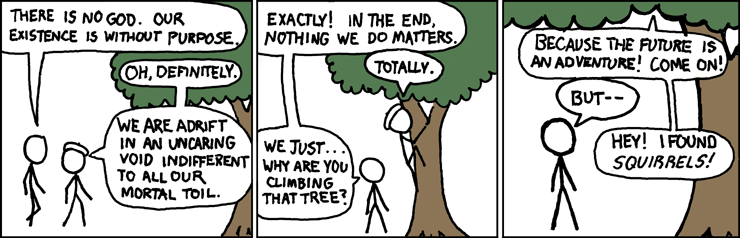
XKCD strip on nihilism
NaBloPoMo November 2012The main reason I’ve allowed this blog to fall into misuse over the past couple of years is that I stopped writing about politics. While my original concept behind this blog was always to write in the intersection between politics and geekery, at some point – specifically in May 2010 – I decided I could no longer really afford to vent my undiluted spleen about the state of the nation and had to start being a little more diplomatic and careful about what I say.

The problem is, I’m a little all-or-nothing and being careful quickly lead to me saying nothing at all. I figured it would get easier once the spotlight was off after the AV referendum; it didn’t. I figured I could be much less careful after I’d quit the party and thus my views became instantly irrelevant in the media’s eyes, but at that point I acquired a new problem: how can I write about politics without it either coming across as or actually being score settling following my resignation? I exchanged one set of anxieties for another and sclerosis quickly settled in once again.

And so, here I am, writing a blog about politics – which once again is really all about me. This is my problem in a nutshell. All I can do is plead for sympathy from you, dear reader: after 16 years, quitting a political party really is a big deal. It’s a wrench. It is no surprise at all that nearly eight months on I’m still a little defined by it. But at least you now know why it is that I’d much rather be writing about comics or, if you’ve seen my tumblr, even more esoteric things.

My article in September about quitting the Liberal Democrats had an interesting response. It was surprisingly positive, but I found it strange how so many people told me that they either loved or hated it but didn’t really engage with the issues at all. I had several Clegg loyalists tell me how much they loved it; curious given that I was not exactly nice about him. My favourite response was from a friend who told me that he agreed with “35% of it”. It was a strangely precise figure, yet he wouldn’t expand on what he actually meant by it.

Most of the negative feedback I did get from it, other than the abuse, centred around the accusation that I was being cynical and didn’t have anything constructive to say. I think the latter was fair comment and pretty much sums up where I am politically at the moment, but there is a difference between cynicism and nihilism. I don’t think I am cynical – indeed my decision to quit the party was about as far from cynical as it was possible to get. I took the decision to walk away rather that to stay on the inside and just feel bitter about things. The fact that I don’t have a fully worked out alternative to what the Lib Dems, and for that matter, politics more widely, doesn’t make me a cynic – it just makes me average.

But yes, I am a political nihilist at the moment, and as someone used to having a cause I can assure you that’s far more of a problem for me than it is for anybody else. All I have is a few scraps of ideas about what a possible way forward might look like, and they can be summed up as follows:

  • Triangulation is a doomed strategy for any political party – doubly so if you aren’t either Labour or the Conservatives. The people leading the political debate right now are the outliers who are working outside of the political mainstream but are successfully shifting the centre-ground to their direction simply by being well organised and disciplined. Right now, sadly, for the most part that means the weird axis of economic libertarians and social authoritarians who are exemplified by the Tea Party in the US but operate in different forms around the world. They aren’t succeeding electorally, but they don’t really need to. Everyone else is dancing to their tune.
  • Capitalism as we know it needs to die. Not trade, not commerce, but the system which commodifies and seeks to squeeze wealth from everything from people to ideas and natural resources is utterly anathema in terms of what humanity needs to do to survive the next millennium. That means critically reassessing what we regard as capital and property and thus what we believe can and cannot be owned. I feel I’ve just used a load of meaningless words there, but it makes sense to me. In terms of specific examples this means a fundamental shift from income and sales taxes onto things like land value taxation, and a massive global crackdown on the drift widening intellectual property laws to mean that every aspect of our culture ultimately becomes owned by a corporation out to make a quick buck.
  • It’s too bloody easy to blame the politicians. Our politico-economic system and media have infantilised the public, but as information technology spreads so does the onus on individuals to accept responsibility for the health of their democracy and culture. We have the tools to create a much better world, yet most people just sit there like good little consumers waiting for someone else to do it for them, and consider passively shrugging about it to be the mature response for when they don’t.

Beyond that? I’m lost. I have no idea about how you take those notions and turn them into something tangible which has any chance of being implemented. But I’m thinking about it – a lot. And perhaps I should write about it here a bit more often.

05 Nov 11:15

Poll Watching

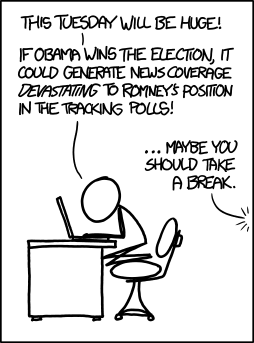
The choices we make Tuesday could have MASSIVE and PERMANENT effects on the charts on Nate Silver's blog!
04 Nov 21:03

The Seven Ages Of Britain

by Unmann-Wittering
I work in an eleven storey office block built in 1966. It's all doors and corridors. One day I noticed that the door hinges came in a variety of styles, and I became slightly obsessed with them and the story they had to tell.


The Empire.
The Commonwealth.
Austerity.
Modernism.
Treading Water.
Cheap Foreign Import.

04 Nov 21:01

Geoengineering and the Evils of Conservation

by Peter Watts

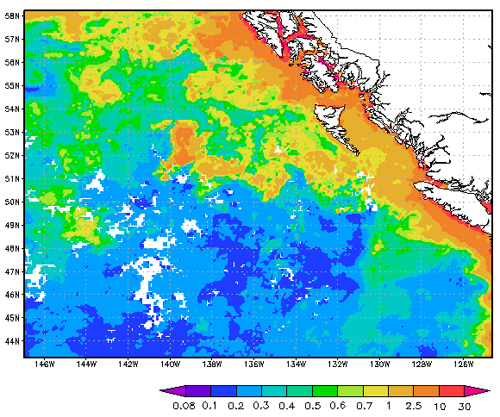
Can you tell which of these orange splotches is evil? (Image: Giovanni/GES DISC/NASA)

Well, traditional conservation, anyway. The kind where you presume to “manage” a wildlife population by ensuring, year after year, that its population remains stable.

The problem is that as any population varies, so too does its behavior. Mortality curves, reproductive rates, vulnerability to pathogens and predators — a hundred other variables — all change with population density. It’s a complex system, full of cliffs and folds and intertwined curves unwinding across a range of conditions; and when you keep your population from varying, you only acquire data from a very narrow band of that tapestry. But Nature’s a fickle bitch, and sooner or later she’ll kick your population out of that comfort zone despite your best efforts. When that happens you’ll be adrift in a dark, data-free wilderness where anything can happen.

Unless you kick it out there yourself beforehand, to get some idea of what’s waiting for you.

The term is Adaptive Management and back in grad school days my supervisor was one of its  early champions. The idea was that you combine “management” with research, that you don’t strive to keep your system stationary year after year. Every now and then you cut your salmon quotas to zero, leave the scaly little buggers completely alone. Other years you hammer the shit out of them. In all cases you take notes— and gradually, over time, you beat back those dark zones, scratch out here there be dragons and scribble Ricker curves and Lotka-Volterra parameter values in their place. You do what Nature would do eventually anyway, only you do it on your own timetable, to a degree of your own choosing.

That’s the trick, of course: because sometimes there are dragons out there, and what if one of them swallows your salmon stock to extinction because you hammered them too hard? It’s a balancing act. You have to tread carefully, weigh risk against opportunity; the techniques used to find that sweet spot are what distinguishes Adaptive Management from just rolling the dice and unleashing a series of shotgun blasts.

A bit of Adaptive Management has just broken out off the west coast — admittedly a poor example thereof — and boy oh boy has it got people pissed.

An executive summary for those who’ve been too transfixed to look away from the ongoing train wreck of US electoral politics: back in July the Haida Salmon Restoration Corp, in collaboration with a US business called Planktos, seeded a hundred tonnes of iron sulphate into the ocean off the islands of Haida Gwaii. The goal was purely economic: to provoke a massive phytoplankton bloom and consequent increased salmon stocks, not to mention sucking carbon into primary production and locking it away on the seabed (which would allow the HRSC to claim carbon credits for their role in off-setting global warming).

Proximately, the gambit seems to have paid off: the resulting bloom covered ten thousand square kilometers and greatly exceeds the penny-ante impact of more “legitimate” experiments. Whether it will actually increase salmon yield remains an open question, but it seems a reasonable expectation; the project was inspired by a paper in Fisheries Oceanography which connected the dots between volcanic ash-fall, diatom blooms, and record salmon catches. As to the potential long-term carbon-sequestration impact, nobody knows.

In fact, not only does nobody know, nobody even seems to give a shit. They’re too busy pointing fingers. Discovery News regards Russ George, the entrepreneur behind the project, as a “Geoengineering nut“. David Suzuki decries the effort as “stupid”. Scientists and lawyers fill endless column inches with quotes about bad experimental design and the breaking of international treaties. The UN is gravely concerned, and has granted the Harper government an actual award (“The Dodo”) for its role in this fiasco; the Harper government, those champions of the environment, has in turn condemned the entire affair and is “investigating” (although their misgivings have been a bit muted by credible reports that they knew about the project in advance and did nothing to stop it, which makes them complicit).

For my part, I’m not going to argue with those who point out that the project was poorly planned, that phytoplankton blooms are often toxic, and that even when they aren’t local eutrophication often leads to anoxic “dead zones”. (I will observe that some of these charges tend to cancel each other out: you can’t both buy into Jay Cullen’s complaint that strong eddy circulation compromises experimental design while at the same time worrying about Alyssa Danigelis‘s specter of neurotoxic dead zones.) I have no trouble believing that Russ George isn’t interested in anything other than turning a fast buck (although if there are laws on the book that make it illegal to profit from climate-mitigation research, you have to wonder if its author had ever spent more than two minutes observing human behavior).

In terms of environmental damage, however, I can’t help noticing that right around the corner from Haida Gwaii, the city of Victoria BC flushes the raw sewage of eighty thousand people directly into the ocean. I can’t help noticing a thousand-square kilometer dead zone off the Oregon coast, or the seventeen-thousand-square-kilometer dead zone in the Gulf of Mexico, or the continent-long daisy-chain of dead zones skipping merrily up the eastern seaboard. If I squint hard enough I can just barely keep myself from noticing the salmon farms along our coasts that not only generate their own local anoxic zones but which also spread disease, parasites, and bad genes to wild populations. (I trust I don’t have to remind you all of past and ongoing oil spills.) All of these impacts arise directly from human activity — and while few would claim to like any of these things, I find it curious that the one-time dumping of a load of nutrients into the open ocean would provoke such outrage while all these other, vastly more severe impacts get off with a shrug and a what-are-you-gonna-do?

The fact is, the Haida-Gwaii patch is vastly bigger than any similar project heretofore attempted. It’s way out into Here There Be Dragons territory, and you know what? It’s a fucking data point.

Bad experimental design? Let me remind you of another badly-designed experiment: that time about a decade back when a bunch of religious fanatics ploughed into the World Trade Center to prove that their invisible sky fairy was tougher than ours. Those guys didn’t check their flight plans with the research community at all, but that didn’t stop the scientists from making some serious inroads into the impact of jet contrails on climate change. (Granted, that particular inroad turned out to be a dead end. That’s science for you.)

This is nature, damn it. It’s a complex metasystem, if you think it’s ever going to let you run a “controlled experiment” in the laboratory sense then I’ve got some voting machines in Ohio to sell you. If you make the perfect into the enemy of the potentially-adequate you’ll never stop running simulations, because there is no perfect. Meanwhile, outside the window, Nature’s rolling her own D20. One day she’s going to kick over that anthill you’ve been too chickenshit to poke at all this time, and then where you gonna be?

This plankton stuff is small potatoes anyway; you want something to get scared about, stop looking out to sea and look up instead. Climate change is hitting the poles and the tropics especially hard — and the tropics are just chock full of small poor countries already sinking, increasingly impatient as the so-called developed world sits on its ass and mumbles oxymoronically about clean coal. I wouldn’t blame them in the least if they got tired of waiting and started their own stratospheric geoengineering program out of self-defense — and it would be kind of nice if we had a bit of real-world data on that front, too, before it happened.

Make as many caveats as you like. Be cautious in your extrapolations, by all means. Remember that correlation is not causation, keep alternative hypotheses firmly in mind, scrawl Nature Is Not A Petri Dish onto a piece of duct tape and stick it over the Far Side cartoons yellowing on the wall. Be Adaptive in your “Management”. But use the goddamned data you’ve got. Don’t piss and moan because someone without all your degrees, someone more interested in bucks than biology, went out and took the first step when you were too fucking timid. Do it better.

Forget the world at large; Russ George’s sins pale into insignificance even set next the city of Victoria. The difference is, we can learn from his.

We’ve already kicked the whole world off-balance. We’re running out of time to figure out which way it’s falling.

04 Nov 15:08

Meet Jon Husted – the Republican in charge of voting in Ohio and the reason why I am not going all in on Obama being re-elected

by Mike Smithson

Meet Jon Husted, boss of voting in Ohio & the reason why I am not going all in on Obama goo.gl/D4Owx twitter.com/MSmithsonPB/st…

— Mike Smithson (@MSmithsonPB) November 4, 2012

Punters should factor in the Ohio legal battles

There are huge legal battles taking place in Ohio against moves by John Husted, the Republican Secretary of State and the man in charge of the state’s crucial elections on Tuesday.

He’s already caused controversy by trying to limit early voting and this went to the Supreme Court. Now there’s news of further actions which seem aimed at depressing the Democratic party vote in the state. This is from the Cleveland Leader:-

Issued on Friday, the directive lays out the requirements for submitting a provisional ballot. The directive includes a form that puts the burden on the voter to correctly record the form of ID provided to election officials, and Husted instructed election officials not to count ballots if the form is not filled out correctly by a voter.

Voting rights advocates filed a lawsuit late Friday, stating that this is “contrary to a court decision on provisional ballots a week ago and contrary to statements made by attorneys for Husted at an Oct. 24 court hearing.”

Husted directive also appears to be in violation of Ohio law. The lawsuit states:

    Ohio Rev. Code § 3505.181(B)(6) provides that, once a voter casting a provisional ballot proffers identification, “the appropriate local election official shall record the type of identification provided, the social security number information, the fact that the affirmation was executed, or the fact that the individual declined to execute such an affirmation and include that information with the transmission of the ballot . . . .”

Ohio law also “ensures that any questions regarding a voter’s identification are resolved on the spot or, consistent with due process, the voter is informed that he or she needs to provide additional information to the board of elections. This protects the integrity of the voting process, and provides a reasonable opportunity to resolve deficiencies.”

Husted’s last minute directive changes this and puts the burden on the voter, which greatly increases the chances that legal provisional ballots will be discarded.

The court has given Husted until Monday to respond to the lawsuit, and said that it would resolve the dispute before provisional ballots are counted on November 17.

Given the time-scale then if the election is close we might not get an outcome from Ohio until November 17th. The result could be dependent on the courts.

The actions of Husted are not, as far as I can work out, being factored into the projection of the overall outcome.

    I’m a gambler who doesn’t like to lose, and this, together with similar actions in other swing states, raises a level of doubt about what’s going to happen.

I’m not moving from my current betting position that I win the same whoever gets elected. I’ve also closed down, at a profit, my “buy” spread-bet on Obama receiving more than 290 electoral college votes.

Mike Smithson

For the latest polling and political betting news from the US and UK

Follow @MSmithsonPB

04 Nov 13:22

A Londoner’s Guide to Living in New York part 2.1: Weather

So you know weather, right? When there’s a bit of rain, or winds blow stuff over, or the sun’s too hot or the snow is the wrong kind or leaves? And the tube throws up its metaphorical hands and announces that no public transport system should be expected to work in these conditions! And then all of London take to the Metro letters section to complain about how their lives have been ruined by rail replacement buses?

You know that, right?


Hahahahahahahah.

Amateurs.

This post can also be found at Thagomizer.net. Feel free to join in the conversation wherever you feel most comfortable.

04 Nov 01:44

American right-wing politics is full of lies; its fund-raising aims to deceive the feeble-minded.

American right-wing politics is full of lies; its fund-raising aims to deceive the feeble-minded.
03 Nov 18:00

3rd November 1793 – the Death of Olympe de Gouges

Olympe de Gouges

Although militant feminism and female agitation were major features of the French Revolution, the woman whose name is most closely associated with this world-shattering event remains the Queen of France, Marie Antoinette. But that distinction, by revolutionary rights, belongs in truth to Olympe de Gouges. Two years before she met her grizzly fate with Madame Guillotine aged 38, Olympe wrote: “A woman has the right to mount the scaffold; she must also have the right to mount the rostrum.” For a slew of similarly bold and visionary statements – radical even within that momentous milieu – Olympe has earned the distinction of “first modern feminist” among historians such as Benoîte Groult. There is strong support for this assertion; in 1791, one year before Mary Wollstonecraft’s Vindication of the Rights of Woman, Olympe published the very first charter for women’s rights – which remains one of the most powerful and concise expressions of feminism. But Olympe did not limit her vision solely to women’s struggles: in a flurry of political pamphlets, journal articles, and broadsides published between 1789 and 1792, she championed the causes of social justice and civil rights on behalf of all the disenfranchised and underprivileged: children, the poor, the unemployed and, most controversially, slaves. (A proto-abolitionist, Olympe’s play – Slavery of Negroes – caused such an uproar when it was first performed in 1788 that the mayor of Paris condemned it as an incendiary act, fearing it would cause revolt in the French colonies.) Despite a multitude of groundbreaking contributions as playwright, agitator, reformer and author, Olympe’s name has until recent years been conspicuously, disturbingly, absent from historical records. There can be only one reason: she was a woman. Let us therefore rectify such criminal neglect and recall her finest moment, namely: Olympe de Gouge’s authorship of the Declaration of the Rights of Woman and the Female Citizen.

“Woman, wake up; the tocsin of reason is being heard throughout the whole universe; discover your rights. The powerful empire of nature is no longer surrounded by prejudice, fanaticism, superstition, and lies. The flame of truth has dispersed all the clouds of folly and usurpation. Enslaved man has multiplied his strength and needs recourse to yours to break his chains. Having become free, he has become unjust to his companion. Oh, women, women! When will you cease to be blind? What advantage have you received from the Revolution?”

Thus wrote an outraged Olympe de Gouges in the summer of 1791 when the exclusion of women from active citizenship in the French Constitution inspired her greatest political pamphlet. In an act of rhetorical genius, de Gouges added or substituted “woman” for “man” in each article of Thomas Paine’s famous Declaration of the Rights of Man and of the Citizen – which was to French revolutionaries what the Declaration of Independence had been to Americans two decades prior. Unimaginably radical at the time, Olympe’s Declaration remains radical even today – insistent, as she was, on exact equality, including combat roles in the military. And it was with characteristic directness that she demanded an explanation for the hypocritical omission of women from the Constitution:

“Man, are you capable of being just? It is a woman who asks you this question. Who has given you the authority to oppress my sex?”

In speaking out on behalf of the rights of women, Olympe violated traditional social boundaries that even revolutionaries held dear. But when she dared to accuse Maximilien Robespierre of despotism, her impudence could no longer be tolerated and she was arrested for sedition. Olympe was accused before the Paris Tribunal on November 2nd   and condemned to die the following day.

As she ascended the scaffold, she spoke her last words to the assembled crowd: “Children of the Fatherland, you will avenge my death!”

Eight months later, Robespierre was guillotined without trial.

03 Nov 16:13

Day 4323: Now it's the Conservatories' Turn to be Burned by Labour's Hypocrisy

by Millennium Dome
Thursday:


Apparently Mr Milipede Senior... I want to say Milipede Prime, but that makes him sound like a TRANSFORMER (robot in disguise)...

...though I guess, wot with him being a DECEPTICON, he ought to be called MEGAPEDE...

...which, I suppose, would make the other one GALVAPEDE (the even-more-evil model sent back from the future to replace him)...

...I'm drifting...

...Apparently Mr DAVID Milipede was appearing on Questionable Time* in his role as his own representative on Earth (no one else will do the job) and described Hard Labour's SHAMEFUL SHACKING UP with the Tories' Europhobic Wingnut brigade as a "repositioning".

(*with one of the Dimbledonkeys. It's too early to tell which.)


This is, of course, the RANKEST hypocrisy. It was Hard Labour who agreed that the EU budget should rise to its current level in the first place.

But more than that, Hard Labour's policy on the economy is – Mr Bully Balls has bellowed it often enough – to SPEND more NOW to invest for jobs and growth for the FUTURE. Plus, they oppose every cut – even the ones they'd have done themselves... in fact, ESPECIALLY the ones they'd have done themselves – because they "hurt the least well off".

So why does that not apply to Europe as a whole? What happened to "workers of the world unite"? Don't Hard Labour BELIEVE in their own economic strategy? (Clue: no.)

Wouldn't it actually make SENSE for the EU budget to INCREASE (a bit) so as to provide some RELIEF to hard pressed citizens at a time when their own NATIONAL budgets are having to CONTRACT under AUSTERITY?

In fact, although you wouldn't know it from ANY of the commentary, most countries in Europe (24 out of 27 Union members) are INCREASING their own national spending budgets. Including GREAT BRITAIN.

At a hundred and forty billion euros, (equivalent to about a hundred and ten billion quid), the EU budget is about ONE SEVENTH that of Great Britain. Or about 1.05% of Europe's GDP – compared with Britain's spending escalating north of 40% of OUR domestic product.

Is the EU budget all spent WISELY? No, of course not. But 94% of it IS injected back into the European economy. Which is the kind of STIMULUS all Parties keep saying that they want.

And in a week when the Conservatory Defence Secretary Mr Hammond-Organ is splashing three-hundred-and-fifty million pounds on what as far as we can tell are ENTIRELY DECORATIVE nuclear willies missiles – not to mention the FO tossing off ten grand to re-stuff Mr Vague's SNAKE (I'm not going to ask how long Mr Vague has been wanting to say get stuffed to Matthew d'Anaconda) – it's a little bit (pardon my pun) RICH for the Right Wing (let's INCLUDE Labour in that now, shall we) to be telling someone else to CUT SPENDING.

What's more, since the Germans ACTUALLY pay for most of the EU budget anyway, isn't this in fact a way to achieve the MUCH-DESIRED "reverse fiscal transfer" (giving some money back-ness) where the better-off Germans help out their poorer neighbours in return for the favourable exchange rate that is powering their economic success?

Actually the contributions to the EU budget from Germany, France and Italy are all MORE than those from Great Britain. So you can understand why our constant WHINGEING is beginning to BADWORD them off. Plus we already HAVE a negotiating position agreed with them to keep to a real terms FREEZE. Reneging on that now is only going to BADWORD them off MORE!

What does Hard Labour really GAIN by joining forces with the like of Mr Bill Strapped-for-Cash, Mr Peter Bone-headed, Mr Mark "Utterly" Reckless, Ms Anodyne Dorries and all the rest of the chorus of discontent?

"Humiliation" for Mr Balloon, apparently. Humiliation? Really? Do you think ANYONE will remember another little embarrassment after the Omnishambles Budget and the Pleb-Plod-Gate-gate scandal?

They point to "divisions in the Coalition". Well durr! We're LIBERALS and the Conservatories are.... less so. Of course the Coalition is divided: WE are divided from THEM – but the Liberal Democrats AS A PARTY have been remarkably UNITED under enormous pressure; the Party that's SPLIT is of course the Conservatory Party; it's Mr Balloon who has lost all control over his militant tendency.

Personally, I think Labour LOSES MORE, by showing – once again – that they've got NO PRINCIPLES at all.

Apparently it's "hateful and outrageous" to vote with the Conservatories... but they end up following their Whips' orders anyway just to score a cheap point. And they have the chutzpah to call US "spineless".

Oh Labour, whatever happened to you? Remember the days when Lord Blairimort bestrode the World like a COLOSSUS? Okay, an evil warmongering, fascist colossus, complicit in murder and torture and intent on tearing up Britain's traditions of liberty and fair play, but... Actually, seriously, the FIRST DUTY of ANY Liberal in 2010 was to bring down that slathering zombie monster that Labour had become. EVEN if it meant supporting the lesser of two evils. But at least they were an enemy WORTH opposing.

I suppose we shouldn't EXPECT any better from Her Majesty's Loyal Opportunists. They were just the same under the so-called Saint John of Smith when they voted against the Maastricht Treaty (which they supported) just to tweak the nose of Mr Major Minor. (Like it made ANY difference to his IMPLODING ADMINISTRATION, but it showed us the way Labour would go in Power.)

But it's this "repositioning" that WORRIES me. When you add it together with Hard Labour's border-line RACIST policy towards immigration, it's in danger of sending out a really NASTY message. Not content with engaging in a race to the bottom with the British Nasty Party for the working class vote, it seems that they want to "reposition" to take advantage of the UKIP tendency too. After all, Mr Farago is such a NICER class of bingot, donchaknow. (Yes, do please vomit.)

Captain Clegg warns of a CATASTROPHE if we wrap ourselves in the Union Flag. And we all know that CATS wrapped in FLAGS are EVIL!

Great Britain has spent most of the last twenty to thirty years standing on the side-lines of Europe shouting "NOT LIKE THAT", haranguing and hand-bagging when we should have been HELPING, helping to build a consensus.

There's every chance to build alliances with friends across the continent who want to build a better, less top down, more democratic Union. And that does NOT mean Lord Blairimort's plan for a MORE top down Presidency, that presumably sees HIM elevated to President (and thence presumably Supreme Chancellor and then EMPEROR...). No, funnily enough, the DARK SIDE does NOT cloud our vision as far as THAT plan goes.

A toxically xenophobic press (ironically mostly foreign-owned) with their own self-interested agenda, aided and abetted by a complacently parochial BBC who have utterly failed to inform OR educate – let alone entertain – anyone about the culture, politics or daily lives of our nearest neighbours, have COMPLETELY DECEIVED the British people into thinking of Europe as AT BEST an expensive irrelevance and possibly, in the more FEVERED imaginings, a malign PLOT against us.

(Because if you're going to take over the World, then surrendering any claim to territorial expansion, sharing your sovereignty for the greater good, contributing from your own treasury to support the less well-off and not building ANY secret rocket bases inside volcanos are DEFINITELY the first steps you would take. If ONLY Mr Blofeld had seen it that way!)

The idea that the rest of Europe looks to Britain with JEALOUSY – of what? Our tattered industrial heritage? Our democratic institutions riddled with privilege and self-interest? Our swift and efficient and not in any way biased in favour of the super-rich and powerful legal system? Or those protections of our civil liberties that keep government at the service of the people, the constitution that is famously not worth the paper is isn't written on? – Perfidious Albion, they think. Invited to join the Jeux Sans Frontières but forever spoiling the game by shuffling the chairs like wayward children.

Of COURSE the Conservatories want it all back the way it used to be; when a quarter of the globe was pink, every schoolboy (girls not allowed) could quote that BADWORD poem by Tennyson and EVERYONE ON EARTH HATED US. They're Conservatories; they're always looking backward to an imaginary golden childhood.

But we don't have to behave like children any more.

And what is Labour's excuse (this time)? The great NANNY, actually ENCOURAGING the children to throw a tantrum, colluding with racists and press barons and Tories. Oh my. All to encourage us to "hold on to nurse for fear of something worse".

Repositioning, Triangulation, Opportunism. It's all too easy to say whatever you think people want to hear when you don't believe in anything at all yourself. But it doesn't earn you any TRUST.

We're still two-and-a-half years away from a General Election, but Labour are further away than ever from being a Party we could trust with the government of Great Britain again.
03 Nov 11:45

Silver lining

by Scott

Update (10/31): While I continue to engage in surreal arguments in the comments section—Scott, I’m profoundly disappointed that a scientist like you, who surely knows better, would be so sloppy as to assert without any real proof that just because it has tusks and a trunk, and looks and sounds like an elephant, and is the size of the elephant, that it therefore is an elephant, completely ignoring the blah blah blah blah blah—while I do that, there are a few glimmerings that the rest of the world is finally starting to get it.  A new story from The Onion, which I regard as almost the only real newspaper left:

Nation Suddenly Realizes This Just Going To Be A Thing That Happens From Now On

Update (11/1): OK, and this morning from Nicholas Kristof, who’s long been one of the rare non-Onion practitioners of journalism: Will Climate Get Some Respect Now?

I’m writing from the abstract, hypothetical future that climate-change alarmists talk about—the one where huge tropical storms batter the northeastern US, coastal cities are flooded, hundreds of thousands are evacuated from their homes, etc.  I always imagined that, when this future finally showed up, at least I’d have the satisfaction of seeing the deniers admit they were grievously wrong, and that I and those who think similarly were right.  Which, for an academic, is a satisfaction that has to be balanced carefully against the possible destruction of the world.  I don’t think I had the imagination to foresee that the prophesied future would actually arrive, and that climate change would simultaneously disappear as a political issue—with the forces of know-nothingism bolder than ever, pressing their advantage into questions like whether or not raped women can get pregnant, as the President weakly pleads that he too favors more oil drilling.  I should have known from years of blogging that, if you hope for the consolation of seeing those who are wrong admit to being wrong, you hope for a form of happiness all but unattainable in this world.

Yet, if the transformation of the eastern seaboard into something out of the Jurassic hasn’t brought me that satisfaction, it has brought a different, completely unanticipated benefit.  Trapped in my apartment, with the campus closed and all meetings cancelled, I’ve found, for the first time in months, that I actually have some time to write papers.  (And, well, blog posts.)  Because of this, part of me wishes that the hurricane would continue all week, even a month or two (minus, of course, the power outages, evacuations, and other nasty side effects).  I could learn to like this future.

At this point in the post, I was going to transition cleverly into an almost (but not completely) unrelated question about the nature of causality.  But I now realize that the mention of hurricanes and (especially) climate change will overshadow anything I have to say about more abstract matters.  So I’ll save the causality stuff for tomorrow or Wednesday.  Hopefully the hurricane will still be here, and I’ll have time to write.

02 Nov 23:13

Alexandra Gross: My Childhood Pen-Pal Was an Innocent Man on Death Row

by andrewhickeywriter
02 Nov 23:13

FAQ for White People: When Can I Say The "N Word"?

by andrewhickeywriter
02 Nov 16:57

Elephant imitates Korean

by Mark Liberman

Stoeger et al., "An Asian Elephant Imitates Human Speech", Current Biology (2012):

Vocal imitation has convergently evolved in many species, allowing learning and cultural transmission of complex, conspecific sounds, as in birdsong. Scattered instances also exist of vocal imitation across species, including mockingbirds imitating other species or parrots and mynahs producing human speech. Here, we document a male Asian elephant (Elephas maximus) that imitates human speech, matching Korean formants and fundamental frequency in such detail that Korean native speakers can readily understand and transcribe the imitations. To create these very accurate imitations of speech formant frequencies, this elephant (named Koshik) places his trunk inside his mouth, modulating the shape of the vocal tract during controlled phonation. This represents a wholly novel method of vocal production and formant control in this or any other species. One hypothesized role for vocal imitation is to facilitate vocal recognition by heightening the similarity between related or socially affiliated individuals. The social circumstances under which Koshik’s speech imitations developed suggest that one function of vocal learning might be to cement social bonds and, in unusual cases, social bonds across species.

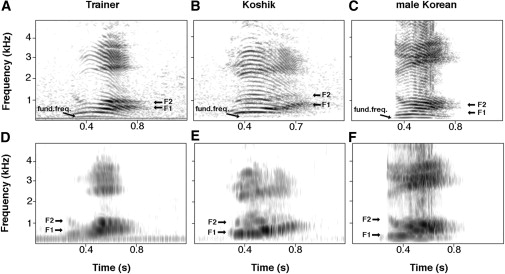
Here's Figure 1, whose legend reads:

Spectral Comparison of the Speech Utterance “nuo”: Spectrograms exemplifying the speech utterance “nuo” of the trainer (A and D) compared to the elephant’s (Koshik) imitation (B and E) and a 40-year-old male Korean native speaker (C and F) with no experience of Koshik’s Korean output (recorded via a head set and thus with higher recording quality than the other two sound samples). (A–C) represent narrow band spectrograms of “nuo” and (D–F) give wide-band spectrograms of each “nuo” utterance, respectively. The fundamental frequency (fund. freq.) and the first and the second formant (F1 and F2) are indicated.

Some audio examples — in each case, the trainer says a word and then Koshik imitates it:

annyong ("hello")
anja ("sit down")
nuo ("lie down")
choah ("good")

The other word in his vocabulary of imitation is aniya "no".

The fidelity of Koshik's reproductions is not as good as this method of presentation may make you think — when you know what a sound is supposed to be, your expectations make an attempt to imitate it sound more accurate, an effect noted by Solzhenitzyn in his description of (poor quality) vocoder testing in The First Circle:

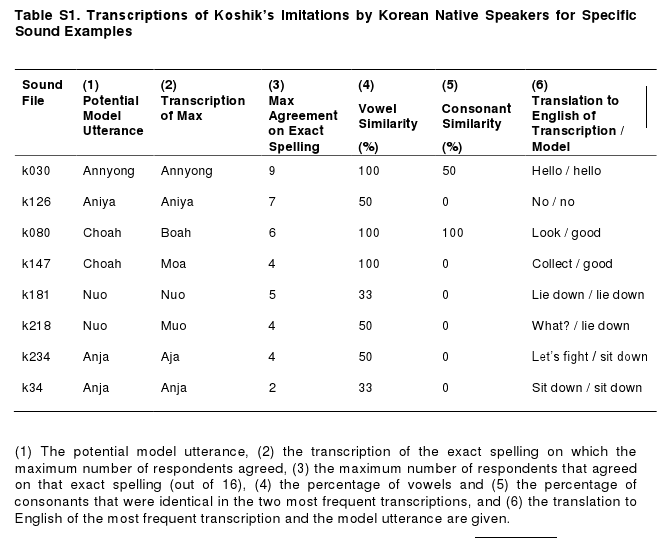
Koshik’s speech sound repertoire was said by his trainers to comprise six Korean words. We tested this hypothesis by analyzing transcriptions made by 16 Korean native speakers on 47 recordings of Koshik’s utterances (see Table S1 available online). The subjects were not informed about the supposed spelling or meaning of the imitations. This analysis largely confirmed the trainers’ claims, indicating that Koshik’s speech imitations correspond to the following five words: “annyong” (“hello,” Audio S1), “anja” (“sit down,” Audio S2), “aniya” (“no”), “nuo” (“lie down,” Audio S3), and “choah” (“good,” Audio S4). Agreement was high for vowels and relatively poor for consonants: vowel transcription similarity was 67% overall, whereas consonant agreement only reached 21% (Table S1). For example, “choah” utterances (according to trainers) were mainly transcribed as “boah” (“look,” 38%) or “moa” (“collect,” 23%), but neither of these utterances was used toward Koshik. As a result, transcriptions provided exact spelling matches (in Korean) for only one sound (“annyong,” “hello,” for which the majority of respondents [56%] agreed) and three additional imitations for which considerable agreement could be documented (“aniya”: 44%; “nuo”: 31%; “anja”: 15%). These results show that Koshik accurately imitates vowels, determined by formant frequency matching, but that consonant fidelity is relatively poor.

Here's a video showing Koshik producing several repetitions of "choah", illustrating the trunk-in-mouth technique of formant manipulation:

This case suggests that elephants must be added to the species known to be capable in principle of vocal learning; and the authors speculate that the application of this ability to the imitation of human speech has social and emotional roots:

Although elephants living under human care may be heavily exposed to speech from birth on, they do not imitate speech on a regular basis. Thus, early intensive speech exposure does not seem adequate to initiate speech imitation in elephants (although it might be a required precondition), as long as they are embedded within an elephant social environment. Koshik was captive-born in 1990 and translocated to Everland in 1993, where two female Asian elephants accompanied him until he was five years old. From 1995 to 2002, Koshik was the only elephant in Everland. He was trained to physically obey several commands and was exposed to human speech intensively by his trainers, veterinarians, guides, and tourists. In August 2004, his trainers first noticed that Koshik imitated speech. We cannot be certain whether Koshik started to produce speech sounds at 14 years of age (near the onset of Koshik’s sexual maturity; his first musth period occurred in March 2005) or whether earlier imitations went unrecognized by his trainers. However, the determining factors for speech imitation in Koshik may be social deprivation from conspecifics during an important period of bonding and development when humans were the only social contact available (this hypothesis may also hold for other known examples of speech imitation in mammals, Hoover the seal and the beluga Logosi, and also most talking birds.

Some mass media uptake for this story: "Loneliness 'forced elephant to speak Korean'", ABC News 11/1/2012; Rebecca Morelle, "Elephant mimics Korean with help of his trunk", BBC News 11/1/2012.

Past LL posts about elephant vocal learning or speech imitation, noted by various commenters: "Elephant talk", 4/3/2005; "Batyr", 10/11/2008.

[ht Shermin de Silva]

02 Nov 16:52

Comic for November 2, 2012

Andrew Hickey

I work in an open-plan office...


02 Nov 15:40

BBC News - Mahdi Hashi has British citizenship revoked for 'extremism'

by andrewhickeywriter
Utterly fucking obscene
02 Nov 15:18

What My Ears Taught Me About Mental Illness | Laura McInerney

by andrewhickeywriter
02 Nov 15:18

The Grantham Grocer Fallacy

by andrewhickeywriter
02 Nov 14:46

Vast riddles

by Shaun Usher


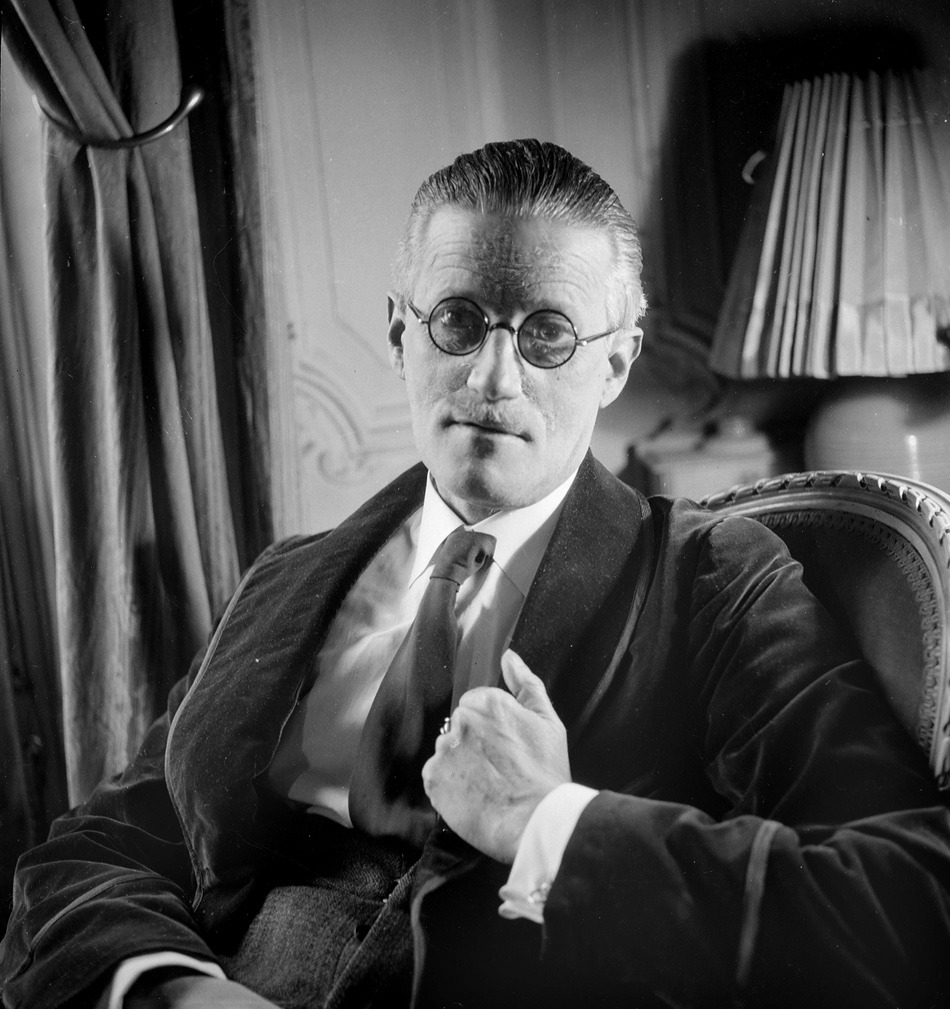
In the mid-1920s, a decade prior to the release of James Joyce's final novel, Finnegans Wake, extracts of what was then known as his "Work in Progress" were being published in journals and passed around literary circles, to a largely baffled audience. (If you've never read, or attempted to read Finnegans Wake, a quick look at its opening episode is advised.)

Below are two equally interesting letters written in response to those early glimpses, the first sent to Joyce in 1928 by an unimpressed H. G. Wells; the second written in the style of Finnegan's Wake a few months later by a Russian MIT graduate named Vladimir Dixon, a mysterious figure who for decades afterwards was believed by many, including Joyce's publisher, Sylvia Beach, to be Joyce himself.

(Sources: James Joyce's World & The Oxford Book of Letters; Image: James Joyce in 1934, via.)

Lou Pidou,
Saint Mathieu,
Grasse, A.M.

November 23, 1928

My dear Joyce:

I've been studying you and thinking over you a lot. The outcome is that I don't think I can do anything for the propaganda of your work. I have enormous respect for your genius dating from your earliest books and I feel now a great personal liking for you but you and I are set upon absolutely different courses. Your training has been Catholic, Irish, insurrectionary; mine, such as it was, was scientific, constructive and, I suppose, English. The frame of my mind is a world wherein a big unifying and concentrating process is possible (increase of power and range by economy and concentration of effort), a progress not inevitable but interesting and possible. That game attracted and holds me. For it, I want a language and statement as simple and clear as possible. You began Catholic, that is to say you began with a system of values in stark opposition to reality. Your mental existence is obsessed by a monstrous system of contradictions. You may believe in chastity, purity and the personal God and that is why you are always breaking out into cries of cunt, shit and hell. As I don't believe in these things except as quite personal values my mind has never been shocked to outcries by the existence of water closets and menstrual bandages — and undeserved misfortunes. And while you were brought up under the delusion of political suppression I was brought up under the delusion of political responsibility. It seems a fine thing for you to defy and break up. To me not in the least.

Now with regard to this literary experiment of yours. It's a considerable thing because you are a very considerable man and you have in your crowded composition a mighty genius for expression which has escaped discipline. But I don't think it gets anywhere. You have turned your back on common men — on their elementary needs and their restricted time and intelligence, and you have elaborated. What is the result? Vast riddles. Your last two works have been more amusing and exciting to write than they will ever be to read. Take me as a typical common reader. Do I get much pleasure from this work? No. Do I feel I am getting something new and illuminating as I do when I read Anrep's dreadful translation of Pavlov's badly written book on Conditioned Reflexes? No. So I ask: Who the hell is this Joyce who demands so many waking hours of the few thousand I have still to live for a proper appreciation of his quirks and fancies and flashes of rendering?

All this from my point of view. Perhaps you are right and I am all wrong. Your work is an extraordinary experiment and I would go out of my way to save it from destructive or restrictive interruption. It has its believers and its following. Let them rejoice in it. To me it is a dead end.

My warmest wishes to you Joyce. I can't follow your banner any more than you can follow mine. But the world is wide and there is room for both of us to be wrong.

Yours,
H.G. Wells

--------------------------

A LITTER TO MR. JAMES JOYCE

27 Avenue de l'Opéra, Paris I.

Dear Mister Germ's Choice,

in gutter dispear I am taking my pen toilet you know that, being Leyde up in bad with the prewailent distemper (I opened the window and in flew Enza), I have been reeding one half ter one other the numboars of "transition" in witch are printed the severeall instorments of your "Work in Progress".

you must not stink I am attempting to ridicul (de sac!) you or to be smart, but I am so disturd by my inhumility to onthorstand most of the impslocations constrained in your work that (although I am by nominals dump and in fact I consider myself not brilliantly ejewcatered but stil of above Avveroege men's tality and having maid the most of the oporto unities I kismet) I am writing you, dear mysterre Shame's Voice, to let you no how bed I feeloxerab out it all.

I am uberzeugt that the labour involved in the compostition of your work must be almost supper humane and that so much travail from a man of your intellacked must ryeseult in somethink very signicophant. I would only like to know have I been so strichnine by my illnest white wresting under my warm Coverlyette that I am as they say in my neightive land "out of the mind gone out" abd unable to combprehen that which is clear or is there really in your work some ass pecked which is Uncle Lear?

please froggive my t'Emeritus and any inconvince that may have been caused by this litter.

Yours veri tass

Vladimir Dixon


RSS Feed proudly sponsored by TinyLetter, a simple newsletter service for people with something to say.
02 Nov 14:43

Men and Women: From Earth, Not Mars & Venus?

by Neuroskeptic
Another day, another debate over how different men and women are, psychologically speaking. Bobbi Carothers and Harry Reis argue that Men and Women Are From Earth.

Their approach is rather interesting.
We sought to empirically determine whether standard gender differences are better conceived as taxonic or dimensional. Although men and women may differ on average in myriad ways, these differences may be dimensional, reflecting different amounts of a given attribute assessed along a single dimension, or qualitative, sorted into fundamentally distinct categories... this difference has considerable importance for understanding the fundamental nature of gender differences.
Using lots of previously published data (13,000 people) and subjecting it to three different methods of statistical "taxometric analysis", they claim that on most psychological measures, there's no evidence that the two sexes are qualitatively different. This is on things like sexual attitudes, personality, and interest in science according to self-report questionnaires.

They give the following hypothetical example to illustrate the idea (my picture based on theirs)
Men are taller than women and also have shorter hair. If you plot a scatterplot of height vs hair length including both genders, you find a negative correlation. However, there is no such correlation within each gender. So gender is a taxon - in this case. There is something qualitatively different between men and women here.

Their argument is that psychological differences between the genders are, in most cases, not because "male" and "female" are two distinct taxons.

So what? I previously covered a paper called The Distance Between Mars and Venus claiming that the difference between men and women on average are larger than previously thought, if you look at all the differences taken together. That's actually consistent with what Carothers and Reis are saying, I think, because it assumes that each of the differences is dimensional and quantitative.

In other words, maybe sexes differ only by a matter of degree, albeit by a larger degree than you'd think at first glance.

All of this leaves open the question of why they differ on average, though. According to yet another study just out, the size of the gap is correlated with the amount of gender inequality in different countries. Women from places where they have much lower incomes, career prospects, etc. compared to men, also endorse more 'feminine' traits.

Personally I consider the question of gender differences largely open because I'm skeptical of self-report questionnaire measures in psychology; objective measures of actual behaviour, stuff like crime statistics, seems to me more interesting.

The fact that the great majority of sex offenders are male, for example, must mean something; I'm not sure what, but I don't think questionnaires will help us find out...

ResearchBlogging.orgCarothers, B., and Reis, H. (2012). Men and Women Are From Earth: Examining the Latent Structure of Gender. Journal of Personality and Social Psychology DOI: 10.1037/a0030437
02 Nov 14:42

Autism Brain Scans Flawed? You Read It Here First

by Neuroskeptic

According to a piece in Nature today, a major line of research about autism might be seriously flawed:
One of the most popular and widely accepted theories on the cause of autism spectrum disorders attributes the condition to disrupted connectivity between different regions of the brain.

This 'connectivity hypothesis' claims that the social and cognitive abnormalities in people with autism can be explained by a dearth of connections between distant regions of the brain. Some flavours of this theory also predict more connections between nearby brain regions.

Recent studies, however, have found that when a person moves their head while undergoing functional magnetic resonance imaging (fMRI) - a method that maps how different neuroanatomical structures of the brain interact in real time, its functional connectivity - it looks like the neural activity observed in autism. That's a sobering discovery...
So the characteristic pattern of "abnormal connectivity" in autism might not be real: it might just reflect the fact that people with autism move around more during the scan.

A sobering idea, indeed... but not an entirely new one. I suggested it over a year ago:
Head motion affects estimates of functional connectivity. The more motion, the weaker the measured connectivity in long-range networks, while shorter range connections were stronger... Disconcertingly, this is exactly what's been proposed to happen in autism (although in fairness, not all the evidence for this comes from fMRI). This clearly doesn't prove that the autism studies are all dodgy, but it's an issue. People with autism, and people with almost any mental or physical disorder, on average tend to move more than healthy controls.
ResearchBlogging.orgBen Deen, and Kevin Pelphrey (2012). Perspective: Brain scans need a rethink Nature
02 Nov 14:33

Gay people are a greater fire risk than straight people, according to Hackney council.

Andrew Hickey

And obviously with bi people it depends on the sex of their partner, but we all know they don't exist...

Gay people are a greater fire risk than straight people, according to Hackney council.
02 Nov 13:27

Logical Pinpointing

Submitted by Eliezer_Yudkowsky • 54 votes • 308 comments

Followup to: Causal Reference, Proofs, Implications and Models

The fact that one apple added to one apple invariably gives two apples helps in the teaching of arithmetic, but has no bearing on the truth of the proposition that 1 + 1 = 2.

-- James R. Newman, The World of Mathematics

Previous meditation 1: If we can only meaningfully talk about parts of the universe that can be pinned down by chains of cause and effect, where do we find the fact that 2 + 2 = 4? Or did I just make a meaningless noise, there? Or if you claim that "2 + 2 = 4"isn't meaningful or true, then what alternate property does the sentence "2 + 2 = 4" have which makes it so much more useful than the sentence "2 + 2 = 3"?

Previous meditation 2: It has been claimed that logic and mathematics is the study of which conclusions follow from which premises. But when we say that 2 + 2 = 4, are we really just assuming that? It seems like 2 + 2 = 4 was true well before anyone was around to assume it, that two apples equalled two apples before there was anyone to count them, and that we couldn't make it 5 just by assuming differently.

Speaking conventional English, we'd say the sentence 2 + 2 = 4 is "true", and anyone who put down "false" instead on a math-test would be marked wrong by the schoolteacher (and not without justice).

But what can make such a belief true, what is the belief about, what is the truth-condition of the belief which can make it true or alternatively false? The sentence '2 + 2 = 4' is true if and only if... what?

In the previous post I asserted that the study of logic is the study of which conclusions follow from which premises; and that although this sort of inevitable implication is sometimes called "true", it could more specifically be called "valid", since checking for inevitability seems quite different from comparing a belief to our own universe. And you could claim, accordingly, that "2 + 2 = 4" is 'valid' because it is an inevitable implication of the axioms of Peano Arithmetic.

And yet thinking about 2 + 2 = 4 doesn't really feel that way. Figuring out facts about the natural numbers doesn't feel like the operation of making up assumptions and then deducing conclusions from them. It feels like the numbers are just out there, and the only point of making up the axioms of Peano Arithmetic was to allow mathematicians to talk about them. The Peano axioms might have been convenient for deducing a set of theorems like 2 + 2 = 4, but really all of those theorems were true about numbers to begin with. Just like "The sky is blue" is true about the sky, regardless of whether it follows from any particular assumptions.

So comparison-to-a-standard does seem to be at work, just as with physical truth... and yet this notion of 2 + 2 = 4 seems different from "stuff that makes stuff happen". Numbers don't occupy space or time, they don't arrive in any order of cause and effect, there are no events in numberland.

MeditationWhat are we talking about when we talk about numbers? We can't navigate to them by following causal connections - so how do we get there from here?

...
...
...

"Well," says the mathematical logician, "that's indeed a very important and interesting question - where are the numbers - but first, I have a question for you. What are these 'numbers' that you're talking about? I don't believe I've heard that word before."

Yes you have.

"No, I haven't. I'm not a typical mathematical logician; I was just created five minutes ago for the purposes of this conversation. So I genuinely don't know what numbers are."

But... you know, 0, 1, 2, 3...

"I don't recognize that 0 thingy - what is it? I'm not asking you to give an exact definition, I'm just trying to figure out what the heck you're talking about in the first place."

Um... okay... look, can I start by asking you to just take on faith that there are these thingies called 'numbers' and 0 is one of them?

"Of course! 0 is a number. I'm happy to believe that. Just to check that I understand correctly, that does mean there exists a number, right?"

Um, yes. And then I'll ask you to believe that we can take the successor of any number. So we can talk about the successor of 0, the successor of the successor of 0, and so on. Now 1 is the successor of 0, 2 is the successor of 1, 3 is the successor of 2, and so on indefinitely, because we can take the successor of any number -

"In other words, the successor of any number is also a number."

Exactly.

"And in a simple case - I'm just trying to visualize how things might work - we would have 2 equal to 0."

What? No, why would that be -
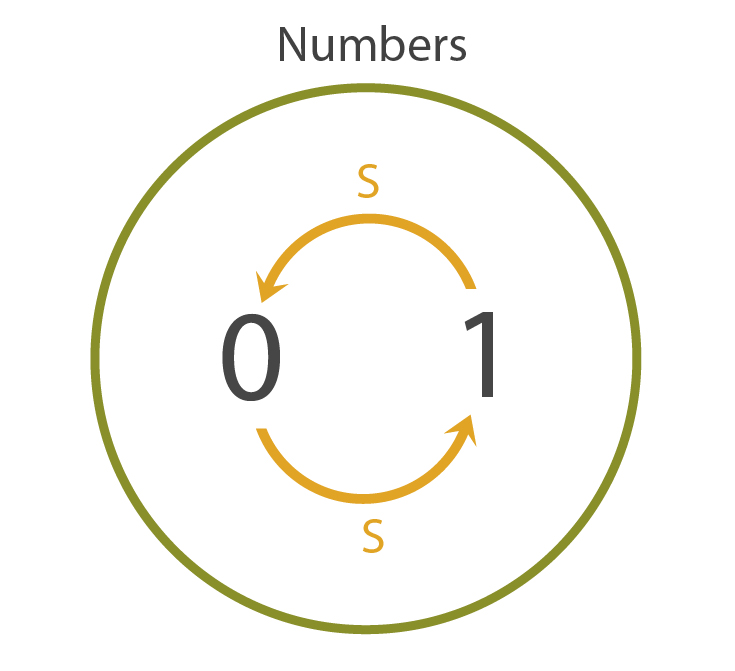
"I was visualizing a case where there were two numbers that were the successors of each other, so SS0 = 0. I mean, I could've visualized one number that was the successor of itself, but I didn't want to make things too trivial -"

No! That model you just drew - that's not a model of the numbers.

"Why not? I mean, what property do the numbers have that this model doesn't?"

Because, um... zero is not the successor of any number. Your model has a successor link from 1 to 0, and that's not allowed.

"I see! So we can't have SS0=0. But we could still have SSS0=S0."

What? How -

No! Because -

(consults textbook)

- if two numbers have the same successor, they are the same number, that's why! You can't have 2 and 0 both having 1 as a successor unless they're the same number, and if 2 was the same number as 0, then 1's successor would be 0, and that's not allowed!  Because 0 is not the successor of any number!

"I see. Oh, wow, there's an awful lot of numbers, then. The first chain goes on forever."

It sounds like you're starting to get what I - wait. Hold on. What do you mean, the first chain -

"I mean, you said that there was at least one start of an infinite chain, called 0, but -"

I misspoke. Zero is the only number which is not the successor of any number.

"I see, so any other chains would either have to loop or go on forever in both directions."

Wha?

"You said that zero is the only number which is not the successor of any number, that the successor of every number is a number, and that if two numbers have the same successor they are the same number. So, following those rules, any successor-chains besides the one that start at 0 have to loop or go on forever in both directions -"

There aren't supposed to be any chains besides the one that starts at 0! Argh! And now you're going to ask me how to say that there shouldn't be any other chains, and I'm not a mathematician so I can't figure out exactly how to -

"Hold on! Calm down. I'm a mathematician, after all, so I can help you out. Like I said, I'm not trying to torment you here, just understand what you mean. You're right that it's not trivial to formalize your statement that there's only one successor-chain in the model. In fact, you can't say that at all inside what's called first-order logic. You have to jump to something called second-order logic that has some remarkably different properties (ha ha!) and make the statement there."

What the heck is second-order logic?

"It's the logic of properties! First-order logic lets you quantify over all objects - you can say that all objects are red, or all objects are blue, or '∀x: red(x)→¬blue(x)', and so on. Now, that 'red' and 'blue' we were just talking about - those are properties, functions which, applied to any object, yield either 'true' or 'false'. A property divides all objects into two classes, a class inside the property and a complementary class outside the property. So everything in the universe is either blue or not-blue, red or not-red, and so on. And then second-order logic lets you quantify over properties - instead of looking at particular objects and asking whether they're blue or red, we can talk about properties in general - quantify over all possible ways of sorting the objects in the universe into classes. We can say, 'For all properties P', not just, 'For all objects X'."


Okay, but what does that have to do with saying that there's only one chain of successors?

"To say that there's only one chain, you have to make the jump to second-order logic, and say that for all properties P, if P being true of a number implies P being true of the successor of that number, and P is true of 0, then P is true of all numbers."

Um... huh. That does sound reminiscent of something I remember hearing about Peano Arithmetic. But how does that solve the problem with chains of successors?

"Because if you had another separated chain, you could have a property P that was true all along the 0-chain, but false along the separated chain. And then P would be true of 0, true of the successor of any number of which it was true, and not true of all numbers."

I... huh. That's pretty neat, actually. You thought of that pretty fast, for somebody who's never heard of numbers.

"Thank you! I'm an imaginary fictionalized representation of a very fast mathematical reasoner."

Anyway, the next thing I want to talk about is addition. First, suppose that for every x, x + 0 = x.  Next suppose that if x + y = z, then x + Sy = Sz -

"There's no need for that. We're done."

What do you mean, we're done?

"Every number has a successor. If two numbers have the same successor, they are the same number. There's a number 0, which is the only number that is not the successor of any other number. And every property true at 0, and for which P(Sx) is true whenever P(x) is true, is true of all numbers. In combination, those premises narrow down a single model in mathematical space, up to isomorphism. If you show me two models matching these requirements, I can perfectly map the objects and successor relations in them. You can't add any new object to the model, or subtract an object, without violating the axioms you've already given me. It's a uniquely identified mathematical collection, the objects and their structure completely pinned down. Ergo, there's no point in adding any more requirements. Any meaningful statement you can make about these 'numbers', as you've defined them, is already true or already false within that pinpointed model - its truth-value is already semantically implied by the axioms you used to talk about 'numbers' as opposed to something else. If the new axiom is already true, adding it won't change what the previous axioms semantically imply."

Whoa. But don't I have to define the + operation before I can talk about it?

"Not in second-order logic, which can quantify over relations as well as properties. You just say: 'For every relation R that works exactly like addition, the following statement Q is true about that relation.' It would look like, '∀ relations R: (∀x∀y∀z: (R(x, 0, z)↔(x=z)) ∧ (R(x, Sy, z)↔R(Sx, y, z))) → Q)', where Q says whatever you meant to say about +, using the token R. Oh, sure, it's more convenient to add + to the language, but that's a mere convenience - it doesn't change which facts you can prove. Or to say it outside the system: So long as I know what numbers are, you can just explain to me how to add them; that doesn't change which mathematical structure we're already talking about."

...Gosh. I think I see the idea now. It's not that 'axioms' are mathematicians asking for you to just assume some things about numbers that seem obvious but can't be proven. Rather, axioms pin down that we're talking about numbers as opposed to something else.

"Exactly. That's why the mathematical study of numbers is equivalent to the logical study of which conclusions follow inevitably from the number-axioms. The way that theorems like 2 + 2 = 4 are syntactically provable from those axioms reflects the way that 2 + 2 = 4 is semantically implied within this unique mathematical universe that the axioms pin down. And there's no way to try to 'just study the numbers without assuming any axioms', because those axioms are how you can talk about numbers as opposed to something else. You can't take for granted that just because your mouth makes a sound 'NUM-burz', it's a meaningful sound. The axioms aren't things you're arbitrarily making up, or assuming for convenience-of-proof, about some pre-existent thing called numbers. You need axioms to pin down a mathematical universe before you can talk about it in the first place. The axioms are pinning down what the heck this 'NUM-burz' sound means in the first place - that your mouth is talking about 0, 1, 2, 3, and so on."

Could you also talk about unicorns that way?

"I suppose. Unicorns don't exist in reality - there's nothing in the world that behaves like that - but they could nonetheless be described using a consistent set of axioms, so that it would be valid if not quite true to say that if a unicorn would be attracted to Bob, then Bob must be a virgin. Some people might dispute whether unicorns must be attracted to virgins, but since unicorns aren't real - since we aren't locating them within our universe using a causal reference - they'd just be talking about different models, rather than arguing about the properties of a known, fixed mathematical model. The 'axioms' aren't making questionable guesses about some real physical unicorn, or even a mathematical unicorn-model that's already been pinpointed; they're just fictional premises that make the word 'unicorn' talk about something inside a story."

But when I put two apples into a bowl, and then put in another two apples, I get four apples back out, regardless of anything I assume or don't assume. I don't need any axioms at all to get four apples back out.

"Well, you do need axioms to talk about four, SSSS0, when you say that you got 'four' apples back out. That said, indeed your experienced outcome - what your eyes see - doesn't depend on what axioms you assume. But that's because the apples are behaving like numbers whether you believe in numbers or not!"

The apples are behaving like numbers? What do you mean? I thought numbers were this ethereal mathematical model that got pinpointed by axioms, not by looking at the real world.

"Whenever a part of reality behaves in a way that conforms to the number-axioms - for example, if putting apples into a bowl obeys rules, like no apple spontaneously appearing or vanishing, which yields the high-level behavior of numbers - then all the mathematical theorems we proved valid in the universe of numbers can be imported back into reality. The conclusion isn't absolutely certain, because it's not absolutely certain that nobody will sneak in and steal an apple and change the physical bowl's behavior so that it doesn't match the axioms any more. But so long as the premises are true, the conclusions are true; the conclusion can't fail unless a premise also failed. You get four apples in reality, because those apples behaving numerically isn't something you assume, it's something that's physically true. When two clouds collide and form a bigger cloud, on the other hand, they aren't behaving like integers, whether you assume they are or not."

But if the awesome hidden power of mathematical reasoning is to be imported into parts of reality that behave like math, why not reason about apples in the first place instead of these ethereal 'numbers'?

"Because you can prove once and for all that in any process which behaves like integers, 2 thingies + 2 thingies = 4 thingies. You can store this general fact, and recall the resulting prediction, for many different places inside reality where physical things behave in accordance with the number-axioms. Moreover, so long as we believe that a calculator behaves like numbers, pressing '2 + 2' on a calculator and getting '4' tells us that 2 + 2 = 4 is true of numbers and then to expect four apples in the bowl. It's not like anything fundamentally different from that is going on when we try to add 2 + 2 inside our own brains - all the information we get about these 'logical models' is coming from the observation of physical things that allegedly behave like their axioms, whether it's our neurally-patterned thought processes, or a calculator, or apples in a bowl."

I... think I need to consider this for a while.

"Be my guest! Oh, and if you run out of things to think about from what I've said already -"

Hold on.

"- try pondering this one. Why does 2 + 2 come out the same way each time? Never mind the question of why the laws of physics are stable - why is logic stable? Of course I can't imagine it being any other way, but that's not an explanation."

Are you sure you didn't just degenerate into talking bloody nonsense?

"Of course it's bloody nonsense. If I knew a way to think about the question that wasn't bloody nonsense, I would already know the answer."

Meditation for next time:

Humans need fantasy to be human.

"Tooth fairies? Hogfathers? Little—"

Yes. As practice. You have to start out learning to believe the little lies.

"So we can believe the big ones?"

Yes. Justice. Mercy. Duty. That sort of thing.

"They're not the same at all!"

You think so? Then take the universe and grind it down to the finest powder and sieve it through the finest sieve and then show me one atom of justice, one molecule of mercy.

- Susan and Death, in Hogfather by Terry Pratchett

So far we've talked about two kinds of meaningfulness and two ways that sentences can refer; a way of comparing to physical things found by following pinned-down causal links, and logical reference by comparison to models pinned-down by axioms. Is there anything else that can be meaningfully talked about? Where would you find justice, or mercy?

Mainstream status.

308 comments
02 Nov 13:02

Judging Jimmy Savile

by Mark Pack

OK, I know due legal process and all that is important. Innocent until proven guilty and all that.

But sometimes you don’t have to wait until the police and legal systems have done their stuff to have a firm view.

And when you look at all the evidence the media has been reporting, it’s pretty clear he’s guilty, isn’t it?

It’s even become a standing joke that you just have to look at him to know he’s just the sort of person who would commit those crimes. Perhaps like me you heard the jokes on the last episode of the News Quiz and like the studio audience laughed along with them.

I mean, just look at him. He’s obviously guilty isn’t he?

So I’ve no doubt when the investigations concludes, we’ll know for sure that Chris Jefferies was guilty.

Oh, hang on…


(Yes, I do think Jimmy Savile was almost certainly guilty of horrendous crimes. But all that stuff about how you just have to look at him to know that? Count me out.)


* Mark Pack has written 101 Ways To Win An Election and produces a monthly newsletter about the Liberal Democrats.