Shared posts

24 Nov 18:52

Fourth World Fridays: Mister Miracle #5--"Murder Machine!"

by Prankster


I love that cover. I love that Vundabar wasn’t quite certain enough of the flamethrower and the gun and the A-bomb, so he added a dagger. To kill a guy fully encased in a metal casket.

Proving that shamelessly gratuitous cheesecake pinups are just as much a part of Kirby’s ouevre as any other adventure artist’s, this issue opens with a full-page splash of Barda in her red bikini mode, doing calisthenics. He even provides audience surrogates, in the form of a bunch of deliverymen who have come to deliver a civil war cannon Scott’s ordered, but get an eyeful of Barda and make construction-worker noises at her. She of course puts them in their place by picking up the 20-ton cannon (with one hand!) and carting it off, leading to the traditional “This ‘women’s lib’ thing is getting more serious than I thought!” reaction.

A word, please? If you don’t mind? Thank you. I’m 100% on the side of feminist superhero fans who find the subculture creepy and weird and misogynist at times, but I don’t think stuff like gratuitous shots of a muscular, bikini-clad woman exercising is what bothers them. I think the real sticking point is when female characters are badly or thinly written AND they’re constantly being offered up for oglement by the artist. The female character serves no point and is in no way memorable or interesting except as a sex object—hence “objectification”.

There’s a certain trope comics frequently use to try and spackle over this kind of exploitation, namely, the “Generic Kickass Female” argument. The character is superficially heroic, strong, can fight off an army of ninjas with one hand behind her back, etc. So, argue the writers and artists, she’s a positive female role model! That’s all well and good, but just making her “kickass” doesn’t totally mitigate the sexism. Turning a vapid, scantily-clad sexpot into a vapid, scantily-clad sexpot who punches people a lot is not exactly a great blow for women’s rights; it’s just a knee-jerk bit of ass-covering. And honestly, it’s become such a cliché that it always bothers me when it shows up.

So why don’t I think the brazenly cheescakey Barda sequences in Mister Miracle count against this? Well, the answer is more or less implied by the above. Barda is not only a memorable character, she often comes close to overshadowing the hero of the book by force of her personality alone. Furthermore, she’s not really a traditional image of beauty (maybe less so now than in 1971, but still). If anything, this whole sequence is a pretty solid example of being sexy without being exploitative. Still, I had to admit I was rolling my eyes a bit at the deliverymen’s “Bu-WHA?!?” reaction.

But on to the actual story, which, fortuitously for my purposes, involves one of those villains that only Kirby could have thought up. Okay, maybe he’s not the only one who could have thought him up, but he’s the only one who would have done so and then actually had the guts to build a comic book around him.

His name is Doctor Virman Vundabar.


And yes, he’s basically a cartoonish, 19th century Prussian dictator.

For the record, I’m pretty sure that Kirby was somewhat aware of the camp value of this comic and even saw it as a selling point; witness Big Bear’s comments about their décor in The Forever People #2. And this is a comic book, which at that time still benefited from being cheap, disposable entertainment for kids, and could thus get away with stuff most other media couldn’t.

Still, Vundabar is pushing it. And yet, Kirby manages to add another, interesting level to all this later on, as we’ll see.

At the moment, one of Vundabar’s lackeys, name of Hydrik, is displaying his prototype deathtrap which Vundabar, natch, intends to use on Mr. Miracle. The trap—in which a dummy is shackled to a hydraulic spinner—is a pretty spectacular failure; not only does it self-destruct, but the Mister Miracle dummy is thrown clear! The point being to demonstrate that Miracle would have escaped, but honestly, the fact that a lifeless mannekin was able to escape shows that Hydrik’s competence at building deathtraps is roughly akin to that of a Narwhal’s. To top it all off, Hydrik’s machine “severely impairs” him when it explodes, and a sneering Vundabar puts a bullet in his head as he lies there helplessly. You know, I know it’s standard M.O. for supervillains to cack a henchman or two to prove their evilness, but this one bordered on a mercy killing.

Meanwhile, Scott is setting up his new civil war cannon (where’d he get the money to afford that, again?) while Oberon complains that Scott’s got him dressed up in a Confederate outfit. Or maybe it’s a Union. Whichever one is blue. (Hey, I’m a Canadian. We didn’t learn this stuff in school.) Of course, Oberon’s complaints that Scott is robbing him of his dignity are entirely justified, but he continues to go along with it after Scott gives him an extremely perfunctory “Hey, you’re as important to the act as I am!” speech.

At least Oberon manages to wheedle some more information out of Scott and his backstory while he’s about it. Scott explains about Granny’s Orphanage between his escape from being strapped to the cannon while it’s lit (a pretty perfunctory escape, actually, though Oberon naturally does a lot of squealing about it). We get the basic idea that we’ve pretty much already figured out: that there’s a weird, never-fully-explained code of honour restricting the Apokoliptians from just tromping over and killing Scott…despite the fact that they fight dirty on several occasions.

Perhaps more interesting is that extra layer to the inherent campiness of the comic that I was talking about earlier. Vundabar, like Scott himself, is an alumnus of the orphanage, where, it’s now made clear, the orphans were given silly names in Kirby’s homage to Oliver Twist. But more than that, they were given ridiculous identities, themes, and traits by Granny, and by extension, Darkseid. Vundabar took his to extremes, but all the orphans of Apokalips have had their personalities, basically, assigned to them—which makes their goofiness kind of tragic, when you think about it. It’s a very nice fit with the themes of the comic, and the Fourth World as a whole: the various ridiculous personalities of the Apokaliptians are a cruel joke on the part of Darkseid, and a measure of just how determined he is to control everyone and everything. He’s essentially condemning his soldiers to lifelong humiliation, and getting them to play along with the joke. Scott’s escaped from this humiliation just as he’s escaped from his homeworld, by building his own personality.

(Though there’s a bit of an irony here, in that Granny named him “Scott Free”….so by rebelling and escaping, he’s still fulfilling the destiny Darkseid handed down to him. Which adds yet another level of complexity to Darkseid’s motivations, which I’ll discuss in a later entry.)

Anyway, while Scott and Oberon are rehearsing, Barda’s completing her cheesecake quota for the issue by splashing around in a nearby pond. She reflects on how much pleasant it is here than on Apokalips, though interestingly when she name-drops Darkseid, even negatively, she can’t help but add “great” to the beginning of his name, a nice, subtle way of reinforcing just how much brainwashing she’s undergone. Meanwhile, a bunch of Granny’s pointy-headed troops have snuck up behind her, but of course Barda’s too good to be taken by surprise like that; she activates her armour, which materializes around her, and begins laying waste. So naturally the pointy-heads have a secret weapon up their sleeve to conveniently neutralize her so they can carry her off. Even though she put in a good showing, I still say she went down a little too easily for the kick-assiest warrior babe of the Fourth World, but never mind.

Scott catches sight of the “Magna-lift” as it departs over the treetops, and somehow intuits that Barda’s been kidnapped, which means of course that it’s time to summon his aero-discs and follow after. Scott somehow further intuits that Barda’s been taken to the remote Barclay Canyon, and even more astonishingly, figures out that it’s Virman Vundabar who took her. Man, Scott’s become a psychic. Sure enough, he finds a bright orange complex waiting for him with Vundabar’s image greeting him on an image=screen at one end. “It probably also serves as a door to your trap! Very efficient, Virman!!!” Um, that’s how you prove Virman’s love of efficiency? What about the fact that he went to all the trouble of kidnapping Barda, even though Bedlam was able to sucker him in just by offering a challenge?

Vundabar starts ordering Scott to enter the compound. “What if I tell you to go blow your nose!?!” spits Scott, master of the snappy comeback. (As you’ll recall from the end of issue #2.) But of course, Vundabar’s offering Barda’s life in exchange for Scott’s compliance, so he steps onto the track and is immediately encased in the conveyor belt o’ doom pictured on the cover. On the next page, he’s battered by giant metal hammers and electrocuted by what Vundabar’s new henchman Klepp calls "a controlled atom blast”. Vundabar refuses to gloat until he knows for certain Scott is dead, but lest you gain any respect for him at this point, he then turns his attention away to provoke Barda. There’s an interesting exchange here:

BARDA: That’s why I deserted Apokolips! I can no longer soldier in the company of twisted fiends like yourself-who worship their power--more than Darkseid!
VUNDABAR: Silence! I want no further blasphemy! Great Darkseid rules Apokolips like a colossus!! His is the creed of destruction! --Not fair play! I accommodate my whims--but I also know that my opponent must be destroyed!

OK, that’s pretty confusing. Shouldn’t Vundabar be saying, “Darkseid accommodates my whims”? How do you accommodate your own whims? But the general idea here seems to be that Barda is accusing Vundabar of being disloyal to Darkseid, in a purely intellectual sense at least. What’s more, she seems to be admitting that she still feels loyalty to Darkseid! Or rather, that she’s still committed to the idea of Darkseid. This seems to be a case of being so faithful to the image of someone that you have to rebel against them when they fail to live up to their own standards. Anyway, it’ll be interesting to see what happens when the two of them meet…

Anyway, the Murder Machine passes through flamethrowers and then an acid pit at the end that melts it into nothingness. The toadying Klepp proceeds to ask “If I cannot laugh now, please allow me to applaud!!” To which Vundabar replies, “Laugh away, Klepp! Here -! I’ll join you! AHAHAHAHAHA!!” That’s pretty funny—Vundabar apparently doesn’t allow himself to laugh very often.

And need I point out that Mr. Miracle is standing right behind him in this panel, looking smug?

Yet again, the villains are horrified to find that Scott escaped from a locked cabinet which they couldn’t see inside of. “A mother-box!” Screams Vundabar. “With the aid of a Mother-box, you thinned your atomic structure and transferred yourself out of that coffer!” “Not so!” replies Scott. “Even in the ‘crunch’ I play it fair—and you know it!!! You thought of everything, Vundabar--except the soles of my shoes!! You couldn’t see the laser-jets activate!! The jets burned through my foot clamps but not those that held the coffer fast to the moving track! Then, with a short by powerful laser beam, I blasted downward!!” And crawled out through the hole, digging downwards and coming up behind Vundabar.

So, um. Using the Mother Box is cheating…but using foot-rockets isn’t? This is what keeps bothering me about this comic. Most of the time, Scott escapes simply by using whatever gadgets he happens to have brought with him, even if we’ve never heard of them up ‘til now. Scott rarely uses actual escape skill or even his wits to get away. Sometimes it’s worse than others—the “Paranoid Pill” business was actually pretty clever—but this falls under the discussion of whether Superman is a lousy hero because he can save lives and do what’s right without much exertion on his part.

Anyway, Vundabar immediately proceeds to try and cheat by blasting Scott at point-blank range, whereupon the floor collapses underneath them—Scott had dug it away, after all. He then lifts Barda in the classic “Creature From the Black Lagoon” pose and carries her off.


Wow, condescending much, Scott? So much for powerful female role models…
24 Nov 14:31

Day 4283: DOCTOR WHO: The Power of Twee

by Millennium Dome
Saturday (flashback):


It's possible that I may have been unkind to Mr Chris Chibnall, back at the start of season two of "Torchwood", when I suggested in my review that Russell Davies had written "Kiss Kiss Bang Bang" for him.

It becomes clear from "The Power of Three" that he can at least write a very good pastiche of RTD. All the tropes are here: the emphasis on character; the way they stand around and emote heavily at each other to tell us how very special they are; the kisses to the fans; the adoration of the Third Doctor/UNIT era; the failure to do the research; the hand-wavy non-resolution; the implicit xenophobia...

Let's start with the basics: if you want to call your story "the power of three" and especially if you want to finish with that as the valedictory line, then you really, really need a resolution that depends on a contribution from all three leads. Ideally, something unique to each of them, that proves how vital is the contribution each one makes, but failing that at least have each of them do something.

It is surely not beyond the wit of man to think of something. How about an invasion from the second dimension – moving shadows! – but which can be trapped when approached from three directions at once.

You would be better off calling this something like "Real Life (Interrupted)" or "How the Doctor Couldn't Sit Still" which at least would draw attention away from the largely-irrelevant invasion plot.

Because what we have here is just a bog standard invasion plot (and, judging by starship design and alien make-up, it's an invasion from the "Babylon 5" universe); it's the Master's "plastic daffodil stratagem" without the plastic daffodils. Or the Master.

Certainly, the cubes start off as intriguing. They spend a year carefully waiting, infiltrating human society, scanning us to identify our key vulnerability (which disappointingly does not turn out to be a weakness for the Apple company's product design), and then take advantage of that to suddenly wipe out a third of the human race.

(Handy, incidentally, that it's a third. So you can have the Doctor – who can survive it – get zapped and let his two companions be the "other two thirds". Though no one else who gets actual screen-time is among the casualties either. Brian, of course, has been conveniently kidnapped otherwise he'd have certainly been watching his cube and been killed by it. But we don't even get the horror of seeing someone we've "met" – the married lesbians, say, or Rory's friend from the hospital – collapse. Even without the absurd "nobody dies" miracle ending, this is shying away from the truth of the plot.)

Almost it would be better if there was no explanation. They do their thing and just as mysteriously vanish.

Sometimes, awful things just happen.

Thematically, that would go quite nicely with Brian's conversation with the Doctor about what happens to former companions, and would neatly foreshadow the events of next week, while at the same time being an almost literal "you could be hit by a bus tiny black cube tomorrow; you might as well get out there adventuring".

And, hey, after the events of "Miracle Day" maybe the cubes were just reversing Earth's massive overpopulation problem. Whadda ya mean 'how could Chris Chibnall be expected to follow plot developments in "Torchwood"?'. Oh...

Instead, we veer off sharply into a string of the most dreadful Who clichés: the ancient and terrible foe, known in the legends and bedtime stories of Gallifrey, who we hear of for the first and probably last time when the Doctor pulls an "oh, I know all about you" out of his fez; and their motive to unravel human history, to prevent humanity colonising space… we make the universe messy.

And they would have been unstoppable too so long as no one from Earth could make it onto the command ship and have the entire plot explained to them and then be left alone with the "off" switch... oh. These aliens are so dumb they don't even deserve to have nearly gotten away with it except for those meddling kids.

(Actually, I'm now regretting making that throw-away remark about "correcting" the events of "Torchwood", because the next biggest Dr Who cliché is of course the ancient and terrible thing from Gallifrey left behind by the Time Lords, because the Shakri are just begging to be renamed the Mother's Little Helpers of Rassilon.)

Given the brief "life with the Doctor from the Ponds' point of view"; given that this is the last adventure before their last adventure, couldn't we have had something more about what makes the Ponds so special to him, rather all the dialogue just saying they're "oh so special to him!"

Rory in particular is back to being badly served (a shame as one of the few good aspects of the dire Silurian two-parter from 2010 was that Chibnall handled Rory quite well).

Rory is exactly the guy you want to be stood next to when your heart gets stopped, because he can fix you... but he's been sent off to another part of the plot. (One which, for all its intriguing cube-mouthed orderlies, will just peter out and vanish).

But still – by an unbelievably massive coincidence – he's also the guy in exactly the right place to tell the Doctor where the portal to the alien ship can be found and... instead gets removed from that plot too and the Doctor just finds the portal anyway (and indeed rescues the now-unconscious Rory with a wave of his illicit smelling salts).

Amy doesn't fare much better, being all doe-eyed and "you're so wonderful, Doctor" a lot of the time – yes, yes, "I'm running towards you before you fade from me" is a lovely scene, and Matt acts it beautifully, but still – and of course she kills the Doctor stone dead with a defibrillator. Oh no wait, it's a magic defibrillator that doesn't work like any other defibrillator on Earth and can restart a heart that's stopped while not stopping one that's working properly. How clever is that!

(Seriously, folks: the clue is in the name – a de-fibrillator is used to normalise the pulse of a heart that is in fibrillation i.e. firing irregularly. If your heart has stopped you need CPR and pretty damn quickly too. It's quite bad that Amy doesn't know this, but when Nurse Rory suggest "mass defibrillation" as a response to all those people who've been cardiac arrested by the cubes... well, you wonder just how much professional training he's skipped while having larks in time and space.)

The fan-pleasing moments (Zygons under the Savoy aside) are, of course, the return of Mark Williams as Rory's dad Brian and the (re-)introduction of Kate Lethbridge-Stewart in the appropriate setting of UNIT's secret base under the Tower of London.

Or possibly an impressively-badly-done green screen of the Tower of London.

Kate is a lovely character. Not quite consistent with her single-mum appearance in the BBV story "Downtime" (aka the The Worldwide Web of Fear), but as a scientist leading the military, certainly a step on the way from the Brig's "action by havoc" UNIT to the "zen military" that the New Adventures repeatedly imply they evolve into. Played perfectly by Jemma Redgrave with a dry sense of humour that really did seem like she might have inherited it from the late, much-loved Nick Courtney, it would be nice if she was intended as a recurring character. If there's any truth in the rumour that Chibbers is being groomed as the next show runner (or at least is one of the possible candidates, along with Toby Whithouse and Mark Gatiss), then Kate may be "his River Snog".

But even if it's not Mr Chibnall setting out to create a recurring character (or Mr Moffat, for that matter – he too has form) I would like to see more of Kate Stewart and her UNIT bloodhounds. And her Ravens of Death.

It's sad that we're almost certainly not going to see Mr Brian "Pond" Williams again, as in just two appearances he's made himself the Wilf de nos jours. Grounded and dependable, occasionally the butt of the joke, but clear-sighted enough to cut through the Doctor's blether and speak it how it is.

I also rather like that he seemed to be able to stay awake for forty-eight hours solid watching the cubes while in the TARDIS. A property of the timelessness inside the time ship, or just "dad power"?

Brian, of course, is the one who first puts his finger on what's going on when he asks the Doctor about how companions leave.

That's the underlying sadness to this episode (which again is totally opposed to the "everybody lives" cop out of the conclusion). This is clearly playing out as a tragedy.

There's a wistfulness on the part of the Doctor: you can see that somehow he knows that this is his last time with the Ponds. He's already confessed to Amy in front of that green screen that he can tell they'll soon be going their separate ways. And from the moment of his conversation with Brian which is immediately followed by asking if he can stay with Amy and Rory, he does not want to leave them alone because – it seems – he is certain that the next time they part it will be forever. That's why he tries to wish them a hearty farewell at the end and, ironically, it's Brian himself who then urges them into the TARDIS for the fateful trip to New York that is coming.

Some people have taken this apparent foreknowledge to suggest that these first five episodes of season thirty-three are in the "wrong" chronological order, that, for example, the Doctor in "Asylum of the Daleks" is actually from after the events of "The Angels Take Manhattan".

I think that there is a possible case for the suggestion that "A Town Called Mercy" takes place within the seven weeks away during Amy and Rory's wedding anniversary party. (One episode inside another – how very "The Time Monster"!) A throwaway reference to King Henry VIII – Rory leaving his phone charger in the Tudor monarch's bed-chamber – takes on a different resonance when we see our heroes hiding in said chamber. Sloppy script editing or a sly tie-in? I prefer to give the benefit of the doubt in this case and accept that these are the same incident seen from two angles.

The case for "Asylum" being out of order is weaker. That the Daleks might kidnap Amy and Rory from earlier in their time stream is not impossible, collecting the 21st Century versions rather than the strictly contemporaneous back-to-the-20th Century Ponds, and thus "filling in" a gap in their lives that the Doctor had skipped over, namely Amy and Rory's temporary divorce – though I still cannot see how that fits with their characterisation in any other episode.

But otherwise... no, I think that these stories have to take place pretty much in broadcast order. Brian meets the Doctor for the first time in "Dinosaurs on a Spaceship" and the Doctor meets Brian for the first time in "Dinosaurs on a Spaceship"; it's not a tricky timey-wimey thing. They know each other in "The Power of Three" so those episodes must be in the right order. And, although it's not explicit, it would diminish the tragedy of Amy and Rory leaving on their final trip after Brian give them his blessing for them to pop back several more times. There's not really any coming back from "The Angels Take Manhattan".

So I think that the Doctor's behaviour is more a matter of being old enough and wise enough to see the cards on the table, perhaps with a dash of Eighth-Doctor prescience thrown in.

On the subject of relative time though, there is Amy's unexpected reference to having spent ten years of her (and Rory's) life with the Doctor on and off. Which seems like an awful lot of unseen adventures. Certainly the Moffat-era creators are far more willing to embrace the idea of lots of life being lived off-screen than almost any earlier era. The Troughton stories, for example, on occasion seem to take place all on the same afternoon, such is the tightness of continuity between episodes; while the UNIT era definitely appears to take place in "real time", despite disagreements about how far into the future said time is taking place.

It's possible that this explains Rory's "I'm thirty-one" remark in "Dinosaurs on a Spaceship", although not Brian's lack of incredulity, if Amy and Rory have been "doubling up" their time by having the Doctor return them to Earth "later that same day".

(And isn't that at least bending the Laws of Time? Oh well, there's no one left to spank him now. Except his wife!)

So what we have here is a mash-up between a series of character vignettes without a plot and a crude cartoon of old-style Doctor Who each getting in the way of the other.

(Was it just me, by the way, who thought that "Pond Life" was made from off-cuts from this episode? The fact that the first four "minisodes" are a minute each and that this under-runs by about four minutes? But it's not like "The Power of Three" needed more Ood-on-the-loo related fun, so why was Chibnall writing this instead of a much-needed explanation of what happed to the cube-faced porters or why they were kidnapping patients from Rory's hospital? And, whatever the reason for kidnapping them, the victims are definitely left behind to get exploded along with the Centauri cruiser Shakri spaceship. Which is a bit harsh.)

The character scenes are trying to tell us about death or separation being forever and that's directly contradicted by the Moffat-lite "everybody lives" invasion story. And lovely as Kate Stewart is – and she is lovely – she's still a bit of sleight of hand by a writer tossing some continuity red meat to the wolves of fandom to cover his lack of coherence.

Finally, if this was the power of three, why make such a fuss about the significance of seven? Seven minute countdown, seven portals, seven Shakri ships (which we never see). And why, like so much in this episode, does it not go anywhere?

It's not awful, but it is a mess. A sign of a writer, and a series perhaps, in transition, not yet either one thing or another.

Next Time... Angels 3... Doctor nil. Yes, it's time to "Blink" one last time, as River narrates her own flashbacks and the Ponds finally get permanently killed by living happily ever after to death. Prepare to be clubbed over the head with the meta-textuality of "The Angels Take Manhattan". Also, the Statue of Liberty... give me strength!


24 Nov 13:41

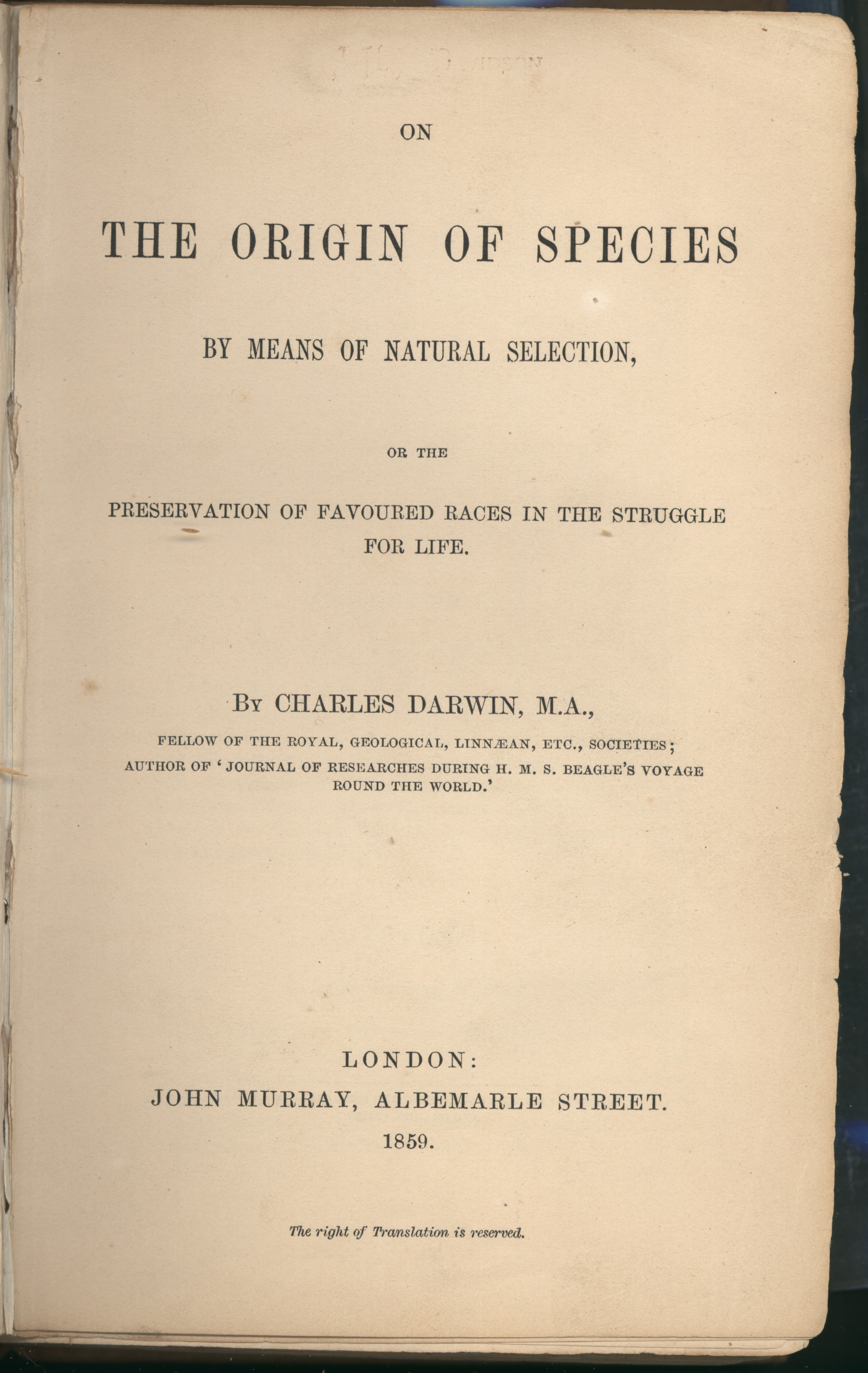
24th November 1859 – Charles Darwin Publishes ‘On The Origin Of Species’

On the Origin of Species, 1859

Today we’re looking back to November 24th 1859 and the publication of Charles Darwin’s On the Origin of Species. Although few of you reading this will be unaware of the significance of this remarkable book, it is worth taking a moment to consider the radical cultural shift it produced and the reverberations still being felt.

Though perhaps “produced” isn’t the right word. “Crystalized” might be a better choice. Change was already in the air just waiting to be unleashed and given form. It was a time of unprecedented upheaval. A time when the modern world as we know it was first taking shape. The comforting solidity of the past, with its apparently unassailable Truths and Certainties, was beginning to fragment. Even as technology, trade and the emergence of an international media were rapidly shrinking the world, revolutionary ideas were making it an ever-stranger, more complicated and precarious place.

A decade prior to On the Origin of Species, Karl Marx and Friedrich Engels had published The Communist Manifesto. And it wouldn’t be long before other revolutionary ideas would crystalize through the work of Nietzsche, Freud, Einstein and others. Humanity’s view of the world was being unhitched from its mooring. And few books accelerated that process like the one Darwin published in 1859.

The idea of evolution had, of course, been around before Darwin’s work. Fifty years earlier Lamarck had published Philosophie Zoologique in which, arguably, was first enunciated the question to which On the Origin of Species was the answer. And in the introduction to On the Origin of Species Darwin goes so far as to trace the development of Evolutionary Theory right back to Aristotle. But it wasn’t until November 24th 1859 that the world had a theory of evolution that not only made sense – in that it tallied pretty consistently with our observations of the world – but also successfully negated the need for a designer. For God. In fact, and although Darwin didn’t exactly take pains to stress this, his theory pretty much said outright that humans were just another animal. With unique adaptations, skills and abilities, yes, but still just the result of a bunch of biological laws and external stimuli.

It’s no wonder then that the reaction to On the Origin of Species was so hostile. The scientific establishment had yet to fully sever ties with organised religion and found evolution much more palatable when you could throw in a dash of Intelligent Design. Darwin’s ideas about Natural Selection were a template for atheism, or at the very least agnosticism. They took away the need for God. And resistance to that was so powerful that it was over thirty years before those ideas fought their way into the scientific mainstream. Still today there are sectors of society that don’t accept them.

Strangely, the Catholic Church never really had a big problem with Darwin. Partly because they’d got their fingers burnt with the Galileo debacle, and partly because they’d always been pretty relaxed about accepting the Old Testament as largely allegorical. The more fundamentalist protestant churches were a different matter. They were working hard to expel mystery and obscurantism from their midst and insisted on reading their bibles as historical fact rather than mythopoetry. For them, Darwin’s theories amounted to no less than the denial of the human soul. And they continue to challenge those theories today, in the schools and courts of the United States.

Conversely, Richard Dawkins and others of the militant atheist persuasion have appropriated Darwin as their symbolic figurehead. In doing so, On the Origin of Species has become the biggest of the sticks with which they use to beat fundamentalist Christians. It’s all a big misunderstanding, of course, and ultimately Darwin’s book represents the moment when that Great Misunderstanding began. The moment when a coherent alternative narrative about our creation took hold in our minds. An alternative narrative not only to the Christian myth, but to every culture’s creation myth.

In theory, of course, this shouldn’t bother a deeply religious person. It is possible to accept both the factual reality of Darwin’s theory of evolution and the mythical reality of your culture’s creation myth. Mythology can be a living, breathing thing; filled with power, wisdom and guidance. But it’s a different category of thing to factual, historical reality. Failing to spot that category error is at the heart of the Great Misunderstanding. Creationists who insist upon the factual reality of the Creationism are guilty of it. And while the militant atheists who bait them are usually aware of the distinction, their tendency to belittle the actual myths themselves suggests they too are missing the point.

But we shouldn’t blame Darwin for this cultural schism. Down through the years his ideas have been refined and reappraised. They’ve been passed through the prism of philosophy and backed up by many observations of science. Recast in the light of genetics, Darwin’s work itself continues to evolve. Modern evolutionary theory has moved on from Darwin much in the same way he moved on from Lamarck. But On the Origin of Species nonetheless represents the moment when the knowledge that we were a product of this planet rather than of a Sky God crystalized within modern human culture. It need not discredit our myths, no more than history books about King Henry need discredit Shakespeare. Instead it should provoke wonder, add to our wisdom and remind us just how precious and remarkable our world truly is.

[Written by Jim Bliss]

24 Nov 13:40

What’s Wrong with Labels?

by Leigh Forbes

People can’t help but label other people. Our fundamental labels of “friend” or “foe” are essential to basic survival, and the rest lead on from there. Subconsiously, we are asking ourselves “is this person going to hurt me?” or “is this person someone I want to become acquainted with?” or “is this person a potential partner?” In order to answer these questions, and calculate the potential threat-levels posed by other people (on all kinds of levels), we first work out how well they match with us: we look at their education, the way they speak, their ages, their clothes, their jobs, their interests, etc. And we label them in our minds. Ask anyone to describe the person sitting next to him, and he’ll say something like, “she’s thirty-something, brown hair, well dressed, middle manager…” or whatever. He can’t describe her (to himself or to other people) in any other way. He has to use labels.

The problem arises when people apply the wrong label. And I fall foul of this as much as anyone else: a mother at my children’s former school spoke in a particularly clipped manner, which I interpreted this as snobbery (the wrong label). I disliked her just for that reason. When someone told me she was foreign (the right label) – a fact that had been impossible to see through her impeccable English accent – my whole attitude towards her changed.

So, having said all that, some people worry that I allow myself to be defined by the “autistic label”. On the basis that I’ll never stop people sticking labels on me, I much prefer to be called “autistic” than all the other descriptives I’ve had stuck on me over the years.

So, there’s nothing wrong with labels, but there’s a awful lot wrong with the wrong labels.

Typical Autistic Characteristics How Society Choses to Label Them How Society Could Label Them
Uncoordinated cackhanded restricted proprioception
Keeping oneself to oneself unsociable private
Stimming retarded harmless
Doesn’t get the joke thick differently humoured
Laughs more loudly than others annoying gets your joke
Says the “wrong thing” rude mistaken
Identifies ways to improve critical useful
Doesn’t understand teasing oversensitive differently humoured
Prefers not to make eye contact guilty retiring
Likes routine and organisation awkward organised
Free thinking dissenting thinks outside the box
Keeps odd hours creepy polyphasic
Wears comfortable clothing scruffy self-caring
Interested in detail pernickety attentive
Uncertain of how to interact standoffish shy
Interested nosy interested
Trusting gullible trusting
Honest tactless trustworthy
Sticks to the rules dogmatic law-abiding
Keen to share ideas opinionated contributing
Happy to talk about interests boring sharing
Prone to anxiety weak has a lot going on
Likes to plan ahead fussy organised
Wary of others paranoid bullied
Hypersensitive to light/noise/etc. intolerant amazingly tolerant

Please help by not perpetuating negative terms, but by encouraging the positive terms instead.

24 Nov 13:35

November 24, 2012


Still about 40 minutes left to get 10% in the smbc store!


24 Nov 01:59

David Cameron is duly invited to the vomitorium.

by septicisle
All things considered, there are relatively few things I find so anathema that they make me feel physically ill.  Coming from someone who was so often throwing up at one point that I was ironically nicknamed "sick", factor in I barely feel comfortable in my own skin at most times, and this is quite the statement.  Compare me to David Cameron for instance, who finds the mere prospect of prisoners gaining the right to vote so terrible that he gets the urge to purge, and it's apparent my constitution is positively cast iron.

Cameron is by no means the only politician moved to blow chunks at having to give the franchise to those currently detained at her majesty's pleasure.  Truth be told, I'd wager the vast majority couldn't care less or quite probably even privately support giving some behind bars the opportunity if they so wish to vote.  It's that this is something being forced on them by the European Court of Human Rights.  If there's one thing politicians can't stand it's being told that they have to do something, unless of course it's the Daily Mail or the Sun doing the ordering, in which case they immediately hop to it.  Combine this with how it's the European court saying we have to change the law, even if the ECHR doesn't have anything to do with the European Union, as well as how this is about the supposed human rights of those who some on the right feel should count themselves lucky they aren't given just bread and water and left with only a bucket to piss and shit in, and it's a no brainer.  If they can't pontificate about this at pompous length, just what can they hiss and moan about?

Sadly, like it or not, the government has to look as though it's at least starting the process of changing the law or the Council of Europe might start imposing a few tiny fines over our intransigence.  In reality it's not so much the Council the government's worried about as it is prisoners starting legal action demanding compensation for being denied their rights, something that will almost certainly cost far more than any fines from Europe.

In line with the deadline set by the ECHR expiring tomorrow, the coalition has then duly set out the earliest possible draft of its prospective legislation (PDF).  In clear defiance of the court is that one of the options available to MPs will be to vote against any prisoners gaining the franchise, with the other choices to extend it to those serving sentences of less than 6 months and 4 years respectively.  Since the last skirmish over these proposals, the legal situation has changed slightly, as the draft bill sets out.  The grand chamber of the ECHR found in the case of Scoppola v. Italy (No.3) that it wasn't necessary for the judge at the time of sentencing to specifically remove the right to vote from the guilty party.  It did however reaffirm the principle that a blanket ban was discriminatory, so the inclusion of the do nothing option in the draft bill is the equivalent of sticking two fingers up to the court.

As Joshua Rozenberg (always worth remembering Rozenberg is married to Melanie Phillips, so he must have had a really enjoyable past week) sets out though, the government does still have significant leeway.  The ECHR doesn't demand that the law be changed immediately; merely that they set in motion the process of altering it.  This it has duly done, albeit at the last possible moment.  Whether the eventual published bill will make its way to the statute book before the next election is therefore highly doubtful.

Nonetheless, by including the status quo option at all the government seems to be setting itself up for a fall.  If it had really wanted to make things difficult for the ECHR while still complying with successive rulings, it could have gone for an even shorter limit than 6 months; why not 3 months, or 4 weeks?  It may well be that the joint committee will subsequently reject the option of offering no change in the bill, but that seems unlikely considering the strength of feeling among MPs.  The thinking appears to be that as long as the issue is defined in law, regardless of how, the court will have to bow to the will of parliament.

Not only is this foolish considering the legal advice, it's at odds with the coalition's somewhat enlightened views on attempting to reduce the level of reoffending.  Only this week Chris Grayling announced that all those sentenced to a year or less would be given a mentor on release who would try to guide them away from a return to crime, a sound idea, albeit one that needs resources and ingenuity the government and its favoured private sector contractors tend not to have.  Recognising that cutting those serving short sentences off from society until the day they're dumped back on the street is damaging rather than beneficial ought to be the first step towards designing a rehabilitation programme that truly works.  By allowing those serving under a year to vote if they so wish would be a further sign that regardless of what they've done, they will shortly be a member of their local community again, with all the rights and responsibilities (ugh) that entails.  Plus, if it means David Cameron and Tory backbenchers heaving as they go through the division lobbies, that's an incalculable bonus.
23 Nov 20:09

Why your distributed social network idea will not work.

Why your distributed social network idea will not work.
23 Nov 16:02

Comic for November 23, 2012


23 Nov 13:46

Flash Eleven - In the War

by noreply@blogger.com (Paul Magrs)


A very, very cold night in Weatherfield it was, late in 1963. The Rovers was deserted because they were all over at the Mission Hall for the wrestling again. This time Stan Ogden was taking on the Masked Marvel. 'Two great lummoxes rolling about on a mat in short little pants like two big babies,' Ena Sharples was heard to say, sniffily. 'It's not something decent folk would want to look at.' She stayed in the pub all Saturday night with the landlady, Annie, who she never usually saw eye to eye with. But these nights that the wrestling went on they'd become boon companions, sharing a glass or three of Cherry Brandy and sometimes even singing.


Talk often went back to the war years, which was twenty years ago by then. But it was fresh in the minds of the two women. Fresh as the chill wind that came in through the front door with the stranger in the battered leather coat.


Ena and Annie looked at him warily, for he looked a rough type in his work boots and his crew cut. He stood wavering at the bar and Annie was like a ship’s figurehead at the pumps, fixing him with her most formidable welcoming smile.


'A pint, is it, sir?'


He grinned at her broadly. 'Yes! A pint! Please!' His accent sounded local to her ears.


'Newton and Ridley's Finest, sir?'


'No, no! Ginger pop!'


Ena fixed the stranger with one of her looks and spoke to him bluntly, as was her wont. 'Mrs Walker and myself were just discussing the war years. You look like you've been a military man in your time. Where did you see action, if you don't mind me asking?'


The so-far nameless man stared at her as if he couldn't follow what she was saying. The smile had frozen on his face. Then he said, 'Yes, yes. I did. I saw action. I was in the war. But it's finished. The war's over now.'


Annie and Ena shared a glance as the noise from the Mission Hall across the road reached deafening levels. They seemed to say to each other, we've got a right one here. Seems to think the hostilities have only just ceased...!


He took his ginger pop gratefully and the pub started filling up again. Ena asked him a few more questions about his war, and was surprised by the answers she got.


The poor thing, she thought. The things he's seen must have sent him doo-lally.


Then others were calling on her to play them a tune on the piano and by the time she returned to the Snug, the stranger had gone.


23 Nov 12:01

A bad day at the office for Jim Wallace #no2secretcourts

by Caron Lindsay
First of all, some words of heartfelt thanks. People like Ros Scott, Sal Brinton, Tim Clement-Jones, Sally Hamwee and Dee Doocey simply don't strike me as the rebellious sort. That Tony Greaves is doesn't make me any less grateful to him, but he is pretty familiar with the grass on that side of the fence. Sixteen of our seventy - ish peers who were around to vote last night in the Lords chose to stick with party policy and vote to delete the secret courts provision from the Justice and Security Bill. That's a tough choice to make and I am grateful to each and every one of them. I was particularly chuffed to see Bob Maclennan in there, who was MP for Caithness and Sutherland where I lived when I first joined the SDP in 1983. The others on my Role of Noble Honour are Lords Hussein, MacDonald, Shipley, Strasburger, Tope, Roberts and Thomas and Baronesses Walmsley and Linklater. Thank you all.  There were some others, by the way, who seemed to have made themselves scarce between the earlier votes and this crucial division, so they didn't vote for the clause to stay in either.

I know exactly why I think it's wrong to have cases decided between a spook, a judge and a state appointed advocate for the defendant/complainant who isn't allowed to tell them of the case against them. I do, however, get a bit scared about writing about it, not being a legal person. My Lib Dem Voice colleague Nick Thornsby has written a hell of a good article for the Guardian on why secret courts are a bad idea. As he says:
It is difficult to comprehend just how fundamental a departure from centuries-old principles this would be. The right to see and hear the evidence of the other side, and subsequently to challenge the veracity or utility of that evidence, forms the basis of our entire civil justice system. The prospect, too, of claimants being told that they have lost their case but not being given any reasons why should send a chill through any believers in fair, open justice.
 The delete vote was the fourth out of five votes. The Government had been pretty heavily defeated on the first three which sought to add safeguards to the Bill. They certainly made it better - but that is a relative term. It was horrific and it's now merely bloody awful. The number of Liberal Democrat peers voting for the Government line was a whole 12. That is not a good day at the office for the man introducing the Bill, Jim Wallace, by any manner of means. If he could only take 11 colleagues with him, that should send enough shock waves through him to make him realise the strength of feeling in the party. Jim was a very good Deputy First Minister, and he should recognise this situation as the parallel to the 1999 Coalition. We had made very specific promises on tuition fees (which we did not implement) and free personal care (which we did bring in). If we had reneged on either of these, the party would have spontaneously combusted. This, I think, is where we are with secret courts, where the only people who seem to have any sort of time for it are those in Parliament. As I said on Lib Dem Voice yesterday, a glance at the list of the 172 party members who signed the letter to the Times shows unanimity across loyalists and the awkward squad, social and economic liberals, Lib Dems the length and breadth of the country. I hope that Jim heeds what he is being told and takes steps to get rid of the secret court provisions once and for all. It is really important for this party that he does.

The Bill is back in the Lords next week before it heads off to the Commons. For the Lib Dems against secret courts campaign, there is a long way to go. Jo Shaw wrote about last night's proceedings here.  If you're a Lib Dem member and you want to support the campaign you can do so by signing the petition here and following the blog or the Facebook page here.


23 Nov 11:57

23rd November 1936 – Robert Johnson Lays It Down

The Robert Johnson Commemorative Plaque at the Gunter Hotel

On this day in 1936, the legendary bluesman, Robert Johnson, made his recording debut in room 414 of the Gunter Hotel in San Antonio, Texas – one of only two recording sessions he would make in his short life, but whose sounds would ignite the entire post-war world, and – as the so-called devil’s music did its stellar work – signified the final stages of the re-paganising of Christendom.

23 Nov 11:30

A Holiday Reminder

by Dorian

22 Nov 17:53

A guide to libel for bloggers

by Jonathan Calder
There is a new irregular verb in widespread use at the BBC:
I recuse myself
You step aside
He/she/it is resigns
It seems to have caught on in Leicestershire too, as last night the ruling Conservative group on Leicestershire County Council announced that its deputy leader David Sprason had decided to "step aside".

Of course, we all wanted to know why. And my old friend Simon Galton, now the leader of the Lib Dem group on the county, tweeted as follows:

I understand the Leics mercury will report tomorrow that the latest scandal involving a member of @leicscc_cons is about porn!
— Simon Galton (@SimonGalton) November 21, 2012

I was about to retweet it when I realised that I did not know if it was true. I was pretty sure that someone as sensible as Simon would not tweet in this fashion unless he knew what he was saying was true, but I did now know it was true.

So I retweeted something else by Simon that mentioned the resignation but not the porn. Mind you, I reasoned that anyone sufficiently interested in the resignation would look at Simon other tweets and find the porn story for themselves.

The furore over Lord McAlpine, I suspect, has made many bloggers more aware of issues of libel. And today in the day job I come across a useful and approachable guide on the subject: So you’ve had a threatening letter. What can you do? by Sense About Science.

I recommend any blogger who aims at being controversial, particularly in the current climate, to read it.

As it turned out, the porn story was true. As today Leicester Mercury reports it:
The deputy leader of Leicestershire County Council has stepped down while an investigation takes place after it emerged a pornographic DVD was found in his council computer. 
Councillor David Sprason is now to be investigated by Tory party whips. He told the Mercury he made an "error of judgement" when he watched a movie entitled She Likes It Rough in his county council PC and voluntarily stepped down while the matter is looked into. 
The DVD was found on the CD drive of Coun Sprason's computer in 2007 when he returned it to IT officers at County Hall after it broke. 
The matter came to light after a copy of a confidential letter sent to Coun Sprason by former council monitoring officer Elizabeth McCalla about the DVD was passed anonymously to the Leicester Mercury.
My usual response to such stories is to say that if only councillors bought their own computers, as the rest of us do, then they could watch as much pornography as they like.

However, I was talking to a Labour councillor on another authority today. She explained that councillors are warned that if their own laptop is stolen, and it has confidential data on it, then they will be held legally liable. So it safer to use an encrypted machine paid for by the taxpayer for council business.
22 Nov 16:34

If some of the polls are right UKIP could end up with more votes than the LDs – but not win a single seat

by Mike Smithson

Labour lead at 8 in latest YouGovCON 33%, LAB 41%, LD 9%, UKIP 10%

— Mike Smithson (@MSmithsonPB) November 22, 2012

Ladbrokes make UKIP 9/2 to win more votes than the LDs at the general election. A good bet if polls are right. bit.ly/c5gpH6

— Mike Smithson (@MSmithsonPB) November 22, 2012

@mattstrong @msmithsonpb UKIP had 572 last time, virtually a full house. Will surely compete in all next time.

— The Happy Tramp (@Happy_Tramp) November 22, 2012

Ladbrokes are offering 2/1 that UKIP will win a seat at the general election. bit.ly/c5gpH6

— Mike Smithson (@MSmithsonPB) November 22, 2012

Virtually all the latest polls, except Ipsos-MORI which has UKIP at 3%, show UKIP equal with or even ahead of the Lib Dems and it is just possible to envisage that they could come in 3rd place in the popular vote in 2015.

    The art of general elections is not to have support spread out evenly across the nation but to be doing exceptionally well in seats where you are competitive and could win. Those are where you put your resource and effort.

The main general election battles will be fought in 80 or 90 seats where there’ll be high octane hugely intensive campaigns with effective GOTV operation by the parties defending and those on the offensive.

In the CON-LAB battle-grounds I’m expecting a heavy fall-of in the LD vote with yellows supporters going blue or red.

In these fights UKIP is going to find it much harder because there will little doubt in voters eyes that it’s LAB or CON.

But there will be 650 seats at stake and in more than 500 the outcomes are almost foregone conclusions. Here we could see a big growth in UKIP support which could, conceivably put them into third place in the overall national votes

But it’s hard at this stage to see them winning seats.

Mike Smithson

For the latest polling and political betting news

Follow @MSmithsonPB

22 Nov 11:47

The dangers of political groupthink

by Nick

There’s an interesting article on Buzzfeed about American right-wing bloggers and their determination to prove President Obama was somehow unfit or unqualified for office.

(Spoiler: they failed)

It’s interesting because it’s an examination because even though it doesn’t use the word, it’s an examination of political groupthink. We have a group – however informally constituted – who have decided on a plan of action and then continue to press on with that course of action despite evidence that it isn’t working. The article goes through a lot of the ideas that this group were pushing, having committed themselves to the belief that Obama was a dangerous radical and that all they needed was the single piece of proof that would bring him down. (In that light, the belief in, and desperate searching for, the seemingly mythical video in which Michelle Obama used the word ‘whitey’ becomes something like a grail quest)

The consensus that soon emerged on the right was that if Americans were fully aware of Obama’s relationship with extremists like Reverend Jeremiah Wright and the former Weatherman terrorist Bill Ayers, they never would have elected him. And since tank-dwelling mainstream reporters couldn’t be trusted to expose The Real Obama, it would be left to the crusading online right to get the job done.

The reality – that Obama is a moderate Democrat, whose political views would likely place him on the centre-right of European politics – just doesn’t get a look in. It’s very easy for us to point and laugh at the Tea Party types because their errors are so extreme. Outside of the bubble. the idea that he’s a radical socialist, a secret Muslim or Kenyan-born is obviously nonsense, but does that help us to forget that we’re sitting in our own bubbles?

It’s easy enough to point to groupthink on the extremes where it’s obvious – the belief that if the Tories swung hard to the right and embraced the UKIP agenda, they’d get a majority, for instance, or the old Left belief that Labour’s mistake was not being revolutionary socialist enough in 1983 – but I think that there are many examples within the mainstream of politics too.

In the closest parallel to Obama, consider the attempts to depict Ed Miliband as some kind of socialist firebrand dominated by the unions. As with Obama, the idea that ‘Red Ed’ wants to take the country back to some cartoon version on the 1970s is barely plausible in the real world but is an article of faith on the right. (The same applies to an extent on the left, though, where the caricature David Cameron drinks the tears of starving children with his nightly caviar)

The problem is that the web has made it much easier to slip into groupthink mode. It’s very easy now to launch an attack on a political opponent, get lots of support and back-slapping from an army of Twitter warriors and congratulate yourself on a job well done, despite the fact that your attack has never registered with the public at all. However, you can point at the blog hits you’ve got, the retweets you’ve received, the likes and +1s you’ve achieved while not drawing attention to the fact that all these are coming from the same pool. It’s a classic reward for groupthink – do something that appeases the group and reaffirms their central idea and get praise, criticise it and get ostracised. (Or at least, not linked to.) Compare that to the work the old political operatives had to do to create their networks.

Of course, you could argue that in order to exist and thrive, political parties have to practice some form of groupthink, otherwise they’ll splinter too easily over internal divisions.

And no, I’m not excluding myself and my fellow Liberal Democrats from falling victim to political groupthink. Indeed, I think much of the party is falling into groupthink mode over staying in the coalition where lots of evidence is being ignored or twisted in order to proclaim that it’s a good thing and that we must stick it out for the long term. Slivers of good news get praised to the skies, while bad news is ignored or rationalised away. Don’t worry about a lost deposit in Corby, praise some local by-election victories instead!

22 Nov 10:01

Sigh.

by Jacob Levy

Brian Leiter, who often mocks the ignorant and semiliterate invocations of philosophical ideas that bounce around the media, links approvingly [see his response in comments] to the following claim that manages to lower my already-low estimation of Elliot Spitzer’s intelligence.

The worldviews of Obama and Romney are really proxies for the theoretical debate about Keynesian economics vs. the more libertarian views of Frederick Hayek. Obama’s support for a government stimulus and expenditures to invest are traditional Keynesian; Romney’s shrink-government-at-all-costs view is akin to the hands-off approach of Hayek and the Chicago school. Keynes won, as well he should have. Likewise, John Rawls’ view of a government that is concerned about the well-being of the last well off member of society is akin to Obama’s interest in a progressive income tax where the wealthier pay more, and ensuring access to health care and food stamps for those who are needy. Romney’s statements about the 47 percent—even if one credits that he is more compassionate than those words might suggest—are more akin to the libertarian world of Nozick, where one eats what one kills, and if there are shortfalls, private charity not government should fill the void. When the choice was made, Rawls won over Nozick. As well he should have.

Wow. Where does one even begin?

Rawls’ “property-owning democracy” is not the American-style tax-and-redistribute welfare state, even if the latter were greatly expanded.

“One eats what one kills,” apart from being a singularly bizarre way to talk about someone with Nozick’s views on animal rights. is not even loosely a reasonable way to talk about Nozick’s views on cooperation in the market.

Rawls endorsed the inviolability of the basic liberties and the lexical priority of liberty; and Nozick, using different language, agreed with both thoughts. Their views on individual human liberty found not the faintest echo in a presidential election between two candidates competing to see who could expand the security state and the police powers brought to bear on the drug war the fastest.

The Chicago School does not oppose countercyclical stimulus.

A difference after ten years between government spending at 20.25% of GDP and government spending at 23.75% of GDP is not the difference between Nozick and Rawls on fundamental philosophical questions.

A projected federal government that spends 20.25% of GDP after ten years is not a “shrink-government-at-all-costs” view.

An inability to specify any actual spending cuts besides PBS is not a “shrink-government-at-all-costs” view.

Proposed expansions of defense spending above the current astronomical levels are not a “shrink-government-at-all-costs” view.

Romney’s comments on the 47% were in part a complaint that not enough people pay taxes. That is not a view one could easily associate with Nozick.


21 Nov 17:47

Panic On The Streets Of London

by Unmann-Wittering

Given its long time prominence as a major world city, it is perhaps surprising to realise that London has been menaced by Giant Apes only twice in its near two thousand year history, as well as slightly chilling to think what could have happened - and might very well happen again... In 1961, Konga, a chimpanzee from the Congo transformed into a 300 foot tall killer ape by bad science, terrorised the streets of the capitol, eventually ending up at Westminster, as if he were on his way to deliver a petition bearing ten thousand signatures asking that he not be massacred by a platoon of machine gun and mortar wielding soldiers.


Unlike the astronaut / alien hybrid attack on Westminster Abbey in 1953 (a mere two months after the Coronation of Queen Elizabeth II in the same building) there is, unfortunately, no live documentary footage of Konga's rampage, but the incident did immediately inspire a film version which contains my favourite line in any language from any time: ‘there's a huge monster gorilla that's constantly growing to outlandish proportions loose in the streets!’ As in real life, the filmic response to this poetic statement was, sadly, 'KILL IT!' and poor, sweet Konga was shot to bits by unsympathetic squaddies. Poignantly, Konga reverted to his original form on death: a rather sad little chimp - with five hundred holes in its tattered carcass.


Less than twenty years later, the city once again trembled at the mercies of a prodigious primate, this time of the female gender. The curvaceous Queen Kong was the unofficial ruler of the island of Lazanga until she was snatched away by a British expedition and brought back to London as a tourist attraction, never a good idea. 


Understandably pretty miffed, Her Majesty the Monkey escaped her captivity and, of course, made her way to the Houses of Parliament where, happily, the situation was resolved without fatalities because of her love for a squat, unfunny ape man hybrid,  although an Action Man helicopter was badly damaged. Queen Kong returned to Lazonga by barge and London breathed a sigh of relief, shrugged its shoulders and went back to thinking itself cooler and far more important than the rest of the UK.


Curiously, the city authorities continue to be remarkably complacent about the dangers of another giant ape attack. In the thirty five years since Queen Kong’s short reign of terror, the Thames Flood Barrier has been completed and stringent anti-terrorism measures introduced, yet London remains frighteningly vulnerable to the savage fury of a massive runaway killer monkey. It's bananas.    
21 Nov 11:17

Pop Between Realities, Home in Time for Tea 45 (Babylon 5)

by noreply@blogger.com (Philip Sandifer)

There is a moment familiar to everyone who has ever enjoyed Babylon 5 in which they make the cataclysmically dumb mistake of trying to get someone else to watch it. It goes like this: “It’s a huge five-season story arc that was planned out from the start. The first season is mostly crap, but the second one has some really good stuff in it. And the third and fourth are quite good…” and then somewhere around admitting that the fifth season is also a trainwreck you realize that the case for Babylon 5’s quality is actually enormously strained.

And it’s true. It’s much, much easier to list the things that are very wrong about Babylon 5 than it is to articulate the case for it. I mean, the case isn’t that hard: the show’s basic conceit, a five year novel in television form, plotted from the beginning to lead towards a pre-defined endpoint that would pay all of its threads off, is impressive. Yes, the use of television for a multi-episode story arc had precedent, but J. Michael Stracyznski was the first person to really try plotting an entire multi-season arc out and executing it. It’s a sprawlingly hubristic little number, but it’s also the first stab at the sort of thing that is these days taken for granted: of the things that Vince Gilligan is praised for in Breaking Bad, the fact that he had a coherent plot for the whole thing barely makes the list. It’s expected these days. Even if you don’t have one (*cough* Lost *cough*), you’re supposed to pretend that you do. (The zenith of this is the almost completely [and rightly so] forgotten Fox series Reunion, which featured a murder mystery as part of its central premise. When the show was cancelled the producers promised they’d reveal who did it before, a few months later, admitting that they hadn’t actually worked that out by the time the show was cancelled.)

Which, actually, is largely what Straczynski did. The original five-year-arc was reprinted in one of the volumes of the Babylon 5 scriptbooks, and basically completely diverges from what happened in the series somewhere in the rage of season four. Some of this, at least, was caused by Michael O’Hare departing at the end of the first season and a new lead character being created, but only some of it. The larger arc that Straczynski mapped out could well have played out with Bruce Boxleitner’s replacement character. Furthermore, whole major story arcs are missing. In the original outline the plot about the war with the Shadows (then still called the Shadowmen) spilled out past the five year mark and into the sequel series. In practice Straczynski wrapped it up towards the beginning of Season Four. This is partially down to the fact that it looked like there wasn’t going to be a fifth season and thus that Straczynski had to accelerate his plotting, but the compression isn’t quite as dramatic as people say - Straczynski has said that if he’d known for sure there was a fifth season then the eighteenth episode of the fourth season would have been the finale, involving only four episodes of compression. The storyline that occupied most of the fourth season, regarding the corruption of the Earth government and the bulk of Babylon 5 fighting to liberate the planet, wasn’t even in the original outline at all.

Which is to say that Straczynski, in practice, did what any decent writer would: he changed things as he went and developed new ideas. Nobody knows how their five-season television series is actually going to end when they start. Some writers - Straczynski apparently among them - write better when they have an outline and a defined end that they’re going for, but nobody gets to the end and finds out that their outline held. So if that’s the show’s claim to fame it’s a dodgy one to say the least.

Which brings us around to the host of obvious problems to identify with Babylon 5. The acting is stunningly uneven. Through to the final season the show veers back and forth between getting rock solid actors and ones that leave you staring at the screen wondering why on Earth they cast them when Matthew Waterhouse was available. The writing is similarly dodgy. Straczynski has Aaron Sorkin’s love of lengthy monologues without Sorkin’s ability to actually write them. This means that he’s drawn with alarming compulsiveness towards the straightforwardly moralistic. There’s a moment in his more recent film The Changeling where he self-plagiarizes a bit of Babylon 5 - a speech with the end advice “never start a fight but always finish one.” What’s notable here isn’t the self-plagiarism itself - after all, the overlap between the audiences of the two is actually pretty low. No, what surprises me is that Straczynski found it worthwhile to self-plagiarize such an embarrassing piece of moralizing tripe. Even Terry Nation had the good sense not to recycle “the only alternative to living is dying.”

Actually, Terry Nation is a decent point of comparison here, since both Babylon 5 and Nation’s work have their roots in the same pulp tradition. Which may seem odd at first blush, given that Nation’s major influence is clearly Dan Dare, while Straczynski’s biggest debt is to Robert Heinlein. But Heinlein and Dan Dare both belong to the same ultimately similar tradition of the pulp scene from which the Golden Age of Science Fiction extended. And while we’ve been asserting the terminal decline of science fiction in its Golden Age style for something around a year now, it’s worth looking at the legacy that it left on science fiction and the way in which that legacy poses a real problem going forward.

In many ways the biggest piece of prior reading for this, then, is the post on Survivors, a show that’s much more similar to Babylon 5 than anyone would normally remark upon. There the big criticism of the show - indeed, the iconic one for which the show is infamous - is that it’s the most preposterously middle class thing ever filmed. Babylon 5 isn’t quite that bad. It does actually acknowledge the working class, both in character backgrounds and in actual episodes. But it’s telling the way in which this is done. The key episode is one from the fifth season called “A View from the Gallery,” which shows a standard issue crisis on Babylon 5 from the perspective of two working joe maintenance guys. The problem is clear from the title alone. The gallery - i.e. where the working class people are - exists primarily as a perspective to view the real events of Great Men as they make history. Even when acknowledging them - and Babylon 5 goes further than space opera really had before in acknowledging the working class - their position is inherently and intrinsically marginal. Even in “A View from the Gallery” they’re just that: the comic relief peanut gallery that gazes upon the real plot.

And the real plot is, as ever, white dudes being historic. Because Babylon 5 is dominated by white dudes. Let’s pause here and note that Babylon 5 is actually one of the most impressively progressive shows of its time in terms of strong female characters and a diverse cast. It really is. But its lead is still a Great White Man of History both times such that the decision to have every single second in command be a woman is frustrating in the extreme. The only one of its three main alien ambassadors to be a woman is the one from the touchy-feely spiritual race. The chief of security position is always male. The station doctor is a man. Its female characters are reliably defined either by how they’re violated and used by men (either of the two main psychics) or rescued by dashing male heroes (Ivanova). And while it’s reliably colorblind in its casting, it’s colorblind in that frustrating way where they’ll cast any actor as long as the actor plays the part as if the character could just as easily be white. It’s telling that Straczynski freely filled in Ivanova’s Russian background as a major character trait, whereas Dr. Franklin, played by the (African American) Richard Biggs, never gets a single character trait that implies anything about his cultural heritage. And yes, of course this is all filed under the header of “but in the future we’ll have eliminated racism,” but that’s the whole point - racism is eliminated by collapsing every culture into white European culture.

The show tries to be progressive in other ways, but similarly misses the mark. It tries to be brave and do a “lesbians are OK and people have fluid sexualities” plot between Ivanova and Talia, but ends up burying it so deep in the mix that it feels like the show is ashamed about it, and furthermore seems to only do it so that it can then tragically destroy the couple because, after all, lesbian couples only exist for searing tragedy. And the show twice attempted to play with transgender issues with similarly tepid results. First there was the idea of having Delenn be male for the first season and only having Mira Furlan play the part in her own gender after her transformation at the start of Season Two, which was abandoned when they couldn’t get a male Delenn to look persuasive enough. (Because, apparently, it’s unpersuasive if the gender presentations of alien species don’t perfectly match human ones.) Then, later in the season, Straczynski waged an elaborate practical joke on Peter Jurasik and Andreas Katsulas in which he wrote a fake set of scenes in which their characters became lovers after Katsulas’s character transformed into a woman. Because, of course, trans people are funny. That Straczynski had a woman working on the show come up to him during the course of this joke and thank him for writing a positive portrayal of trans people on television only to be horribly let down when it turned out he was using trans people for a cheap joke is one thing. He had already done the damage there, and revealing the joke wasn’t going to fix anything. The problem is that it appears that Straczynski took no lesson whatsoever from the fact that his joke actually hurt someone. Instead he gleefully tells the story in the Babylon 5 scriptbooks, even including the anecdote about the person thanking him, and showing nothing resembling contrition. Which is… predictable, really.

Because that’s the problem with this sort of progressivism. It’s the same problem that the BBC is continually plagued by in many ways - it cannot escape a vicious paternalism that undermines all of its attempts at progressivism. Babylon 5’s heart is in the right place, but it simply can’t get past its creator’s privilege. It’s telling that Babylon 5’s idea of the most horrifying thing imaginable consists of witch hunts, brutal interrogations, and propaganda. Put another way, it’s clear that Straczynski thinks the absolute worst thing to happen in America in the twentieth century was the McCarthy era. Which, yes, that sucked royally, but it’s also the most privileged answer imaginable. And yet it makes total sense within Straczynski’s larger worldview. Straczynski is following almost directly from Heinlein, and is thus absolutely in love with individual liberty and self-identity as the greatest principles imaginable. So his nightmare scenario are things that make a man deny who he is, and his idea of virtue is that “never start a fight but always finish one” sort of steadfastness. You know. “If you can keep your head when all about you are losing theirs and blaming it on you” and all that. So of course he has everybody in the show taking up the white man’s burden. This is, at the end of the day, a show that believes in an end teleology of humanity in which we ascend to become higher evolutionary beings. And, more to the point, one that believes that this is a fate reserved only for the good species, and that other species and cultures are irredeemably flawed and cannot ever achieve that. Which, given that his alien species are flagrantly based on various Earth cultures, whereas his version of humanity is a triumph of western secular humanism, is very difficult to take in an even remotely sympathetic way.

The problem is that this approach is wedded in very, very deeply in science fiction. Because it is the default position of virtually all of a key generation in the genre’s development. Science fiction as a genre was driven by well-educated secular white men, and the ethos they put into it doesn’t come out easily. I’m thwacking Babylon 5 here, but the critique extends to an entire style that, in the mid-90s, was still hugely prevalent. More to the point, it extends to a style that’s still prevalent. This is at the heart of why the cult television model is sustained by middle class white men. The logic is that cult television can afford smaller audiences for more expensive shows because the audience it brings in are all middle class white men who are worth more to advertisers. And of course it does. Look at how it’s written. Even when it’s trying to be inclusive of women and minorities and the working class it’s blatantly, painfully a genre for white middle class American men.

The problem is a fundamental rot. It’s a rot that impacts anything whatsoever that tries to play off of the existing structures of sci-fi fandom that stretch back to the Golden Age. Because those structures have entrenched ideas and attitudes that simply cannot be separated out from their ideas. The only viable relationship left to have with it is open confrontation and parody. And, to be clear, that existed in the 1990s and well before. The feminist fandom tradition that Kate Orman comes out of was doing exactly that, and it was terribly important. And when, in early January, we get to the next stage of development of this line of thought that tradition is going to take center stage.

But for now we have Babylon 5. Which, ironically, despite its flaws is actually exactly as good as its fans say it is, albeit not at all in the way they mean, or, at least, not in the way they admit. Because it is the greatest sci-fi series of all time in, at least, the sense that it takes a particular vision of science fiction and the epic space opera  as far as it can reasonably go. You could refine the dialogue, perhaps, and hire some better actors, but that’s just trivial refinements. The biggest thing you could try to fix is to smooth out the seasons where the show is either figuring out what it wants to do or where it’s recovering from having done most of it and still having a season to fill. But even there one has diminishing returns. The truth of the matter is that Babylon 5 is really just a standard space opera show that bothers to show the sort of thing that most space opera shows push off to the backstory. So what you get is a standard issue space opera that slowly gets interesting as it does stuff that space opera on television is usually scared of, then, once it’s done, slowly settles back into being a slightly different standard issue space opera. That’s the real problem with Seasons One and Five - the first is the mediocre show that Seasons Two through Four disrupt, and the other is the mediocre show that spins out of Seasons Two through Four. It’s just that without the creativity to actually do the sprawling epic the fact that the show is poorly cast and has mediocre dialogue is a lot more obvious than it is when it’s doing something interesting.

But in finally accomplishing the massive epic of space opera on television and at a gloriously detailed length that even the most epic run of novels couldn’t hope for Babylon 5 ends up showing the fundamental limits of the approach. It does everything, conceptually speaking at least, as right as it can be done and still falls fundamentally short. The root problem is one that should be utterly familiar to anyone who’s read this blog at length: this model of science fiction believes that humanity has a destiny. That’s the impossible-to-remove problem. It believes that there is such a thing as what humanity will inevitably aspire towards, which is, in practice, indistinguishable from the belief that those forces privileged by contemporary ideological power are inherently good and are the future. And to be clear, this is more than the fact that television, as an instrument of power, is always going to tacitly support those forces. What’s uniquely pernicious about the shambling remains of Golden Age SF is that it weds that inherent institutional bias to a belief in historical teleology. That’s the trap that, despite its good intentions, Babylon 5 simply cannot find a way out of. Because, simply put, there’s not a way out without completely abandoning the western secular humanist tradition that underpins the entire genre. Which you can’t do without also aggressively abandoning the entrenched fandom structure that keeps genre shows afloat.

All of which is to say that this is where engagement with this line of thought ends on this blog except for where it actually enters Doctor Who. We’re not done with American sci-fi media, or even cult shows. But we are done with the specific style of fandom they cater to: the sort where the stereotype, at least, is middle-aged men who can’t find a girlfriend and have bad personal hygiene. (Which is not to say that this is actually what those fans are like - just that it’s what the stereotype of this sort of fandom is like.) Doctor Who’s association with that sort of fandom has always been oblique anyway; it’s vaguely what Eric Saward tried to chase during the period where Doctor Who was aggressively courting an American audience in the 1980s, but at every other point in its history Doctor Who has been at best openly hostile to that sort of fandom and at worst only incidentally connected to it. But shows that largely belong to that tradition, and I include several sacred cows that I’m sure chunks of my readership want me to cover, aren’t going to get posts simply because after the mid-90s this just isn’t the direction Doctor Who goes in anymore. There are plenty of other sci-fi shows we will cover, but they’re ones where there’s a clearly articulable way in which they break from the Golden Age tradition - much like Doctor Who does after 1996. To paraphrase its third season, Babylon 5 was the Golden Age’s last, best hope for viability.

It failed. Let’s move on.
21 Nov 10:03

Opinion: Can Labour be trusted on mental health?

by Tim Purkiss

In my last two articles for Liberal Democrat Voice I wrote about the current under provision in mental health treatment in the country and why it is important that properly addressing mental health is brought into the political mainstream.

Thankfully in recent weeks this has started to happen. Of course there was Ed Miliband’s speech to the Royal College of Psychiatrists in which he spoke of the need for improved provision in mental health treatments across the country. Many people will of course welcome this state of affairs and it is encouraging if Miliband is intending to put improved mental health provision at the forefront of Labour’s health policy.

Unfortunately there is reason to be sceptical regarding Labour’s new position. As Norman Lamb pointed out in a recent article for this website, the last Labour Government

consistently treated mental health as a second class service: introducing an 18 week waiting time target for physical health but not for mental health and specifically excluding mental health users from the right to choose where, and by whom, you are treated. The absurd but inevitable result was a health service in which the bias towards physical health has been institutionalised, despite all the evidence demonstrating the fundamental importance of mental health.

Indeed. Can we really have any confidence, given, the Labour’ Party’s recent record of hypocrisy, that a Miliband led Government would make good on the statements made in his recent speech?

Thankfully Lib Dems, and those like me who suffer from anxiety and depression, can rest assured that our party has consistently made improved mental health provision a cornerstone of health policy in recent months and years.

Many have previously commended the excellent work which the previous Lib Dem Health Minister, Paul Burstow did regarding mental health treatment, and now this has been sealed by the publication of the first mandate between the Government and the NHS Commissioning Board.

It is a great relief to me that placing mental health care on a par with physical health care is now written in to the mandate, alongside ensuring better access to psychological therapies.

Since first going to my doctor at the end of July and asking for a referral to a talking therapies service I have not yet had my first session and will not start it until December 12th. This has already felt like too long, and I am someone who is not at the more serious end of those who suffer. I am sure there are many people who read this website, are in a far worse state than I am and who feel let down by the lack of treatment they receive on the NHS.

I hope that it is some consolation for those people that there are many in this party – including those who spoke at and moved the excellent motion at conference – who will continue to ensure that mental health treatment is not pushed to the sidelines, as it has consistently been by previous Tory and Labour Governments.

* Tim Purkiss is a party member from Somerset and blogs at Nation Discussion

21 Nov 00:36

Time-Reversal Violation Is Not the "Arrow of Time"

by Sean Carroll

Looks like the good folks at the BaBar experiment at SLAC, feeling that my attention has been distracted by the Higgs boson, decided that they might be able to slip a pet peeve of mine past an unsuspecting public without drawing my ire. Not so fast, good folks at BaBar!

They are good folks, actually, and they’ve carried out an extremely impressive bit of experimental virtuosity: obtaining a direct measurement of the asymmetry between a particle-physics process and its time-reverse, thereby establishing very direct evidence that the time-reversal operation “T” is not a good symmetry of nature. Here’s the technical paper, the SLAC press release, and a semi-popular explanation by the APS. (I could link you to the Physical Review Letters journal server rather than the arxiv, but the former is behind a paywall while the latter is free, and they’re the same content, so why would I do that? [Update: the PRL version is available free here, but not from the PRL page directly.])

The reason why it’s an impressive experiment is that it’s very difficult to directly compare the rate of one process to its precise time-reverse. You can measure the lifetime of a muon, for example, as it decays into an electron, a neutrino, and an anti-neutrino. But it’s very difficult (utterly impractical, actually) to shoot a neutrino and an anti-neutrino directly at an electron and measure the probability that it all turns into a muon. So what you want to look at are oscillations: one particle turning into another, which can also convert back. That usually doesn’t happen — electrons can’t convert into positrons because charge is conserved, and they can’t convert into negatively-charged pions because energy and lepton number are conserved, etc. But you can get the trick to work with certain quark-antiquark pairs, like neutral kaons or neutral B mesons, where the particle and its antiparticle can oscillate back and forth into each other. If you can somehow distinguish between the particle and antiparticle, for example if they decay into different things, you can in principle measure the oscillation rates in each direction. If the rates are different, we say that we have measured a violation of T reversal symmetry, or T-violation for short.

As I discuss in From Eternity to Here, this kind of phenomenon has been measured before, for example by the CPLEAR experiment at CERN in 1998. They used kaons and anti-kaons, and watched them decay into different offspring particles. If the BaBar press release is to be believed there is some controversy over whether that was “really” was measuring T-violation. I didn’t know about that, but in any event it’s always good to do a completely independent measurement.

So BaBar looked at B mesons. I won’t go into the details (see the explainer here), but they were able to precisely time the oscillations between one kind of neutral B meson, and the exact reverse of that operation. (Okay, tiny detail: one kind was an eigenstate of CP, the other was an eigenstate of flavor. Happy now?)

They found that T is indeed violated. This is a great result, although it surprises absolutely nobody. There is a famous result called the CPT theorem, which says that whenever you have an ordinary quantum field theory (“ordinary” means “local and Lorentz-invariant”), the combined operations of time-reversal T, parity P, and particle/antiparticle switching C will always be a good symmetry of the theory. And we know that CP is violated in nature; that won the Nobel Prize for Cronin and Fitch in 1980. So T has to be violated, to cancel out the fact that CP is violated and make the combination CPT a good symmetry. Either that, or the universe does not run according to an ordinary quantum field theory, and that would be big news indeed.

All perfectly fine and glorious. The pet peeve only comes up in the sub-headline of the SLAC press release: “Time’s quantum arrow has a preferred direction, new analysis shows.” Colorful language rather than precise statement, to be sure, but colorful language that is extremely misleading.

“Time’s arrow,” in the sense that the phrase is conventionally used (by the kind of folks who would conventionally use such a phrase), refers to the myriad ways in which the past is different from the future in our macroscopic experiential reality. Entropy increases with time; we remember yesterday and not tomorrow; ice cubes melt, and don’t spontaneously generate in warm glasses of water; cream and coffee mix and don’t unmix; we are born young and grow older; we can make choices about our upcoming actions but not about our past. This new measurement in the B meson system — indeed, the entire phenomenon of T violation — has absolutely nothing to do with that arrow of time.

The reason is pretty simple to understand. The arrow of time centers on the concept of irreversibility — things happen in one direction of time but not the other. You can scramble eggs, but not unscramble them, etc. That’s not at all what’s going on in the B mesons. The oscillations between different types of meson happen perfectly well in both directions of time, just with ever-so-slightly different rates. What’s more, there aren’t any B mesons (or kaons) playing a crucial role in what happens when you scramble eggs.

The particle-physics processes in question, in other words, are perfectly reversible. Information is not lost over time; you can figure out exactly what the quantum state used to be by knowing what it is now. (It’s “unitary,” to use the jargon word.) That’s utterly different from the macroscopic arrow of time. Indeed, there’s a sense in which T-violation is simply an accident of nomenclature. We could simply choose to define what we mean by “time reversal” as what most textbooks now define as “CPT.” Then time reversal would be a good symmetry of nature! You can actually prove that any theory that is fundamentally reversible (unitary, information-conserving) will have an operation corresponding to time reversal that is a good symmetry. So the carefully posed physics question is not “why is T violated?”, but “why is the preserved notion of time reversal one that involves what we label C and P as well?”

The reason why this is a peeve worth keeping as a pet is that the confusion between time reversal and the arrow of time often leads smart working physicists to think they have discovered something interesting about the arrow of time when really they’re addressing a completely different problem. We understand why there is an arrow of time: because the early universe started with a low entropy, and generic evolution from such a state leads to an increase in entropy. If you have a theory that explains why the early universe had a low entropy, you have successfully accounted for the observed arrow of time; likewise, if you have a theory that does not explain the low entropy near the Big Bang, you have not successfully accounted for the observed arrow of time. Love the B mesons, but they aren’t the reason why we can’t put Humpty Dumpty back together again.

20 Nov 18:01

A Canticle for Leibowitz

by Lawrence Burton


Walter M. Miller Jr. A Canticle for Leibowitz (1959)

About six months ago I flew back to England taking with me Neal Stephenson's somewhat chunky Anathem as aeronautical reading material; and here I am once again crossing the Atlantic with another arguably classic science-fiction novel occurring within a post-apocalyptic monastic order. It's a coincidence entailing no more conscious choice on my part than what leapt out at me from the to-read pile; but an odd one, not least given that a significant theme of Miller's book is that of history repeating; and as with Anathem, whilst recognising obviously worthy qualities, I'm left somehow underwhelmed.

A Canticle for Leibowitz began as three novella length shorts in the pages of Fantasy & Science Fiction, so closely thematically linked as to inspire the author to a realisation of having effectively  written a single coherent novel following publication of the third. The story begins with efforts to posthumously canonise Leibowitz the scientist as a Saint by the brothers of a post-nuclear Christian order, the last outpost of reason in a new dark age of American history. Over the course of the next few hundred years - or the other two short stories if you prefer - civilisation is reborn, technology and science restored, mistakes repeated as they reinvent the weapons for which Saint Liebowitz was partially responsible first time around. In the story, Liebowitz is famously remembered as having regretted his work - doubtless a nod to both Oppenheimer and Einstein - and is thus posthumously revered, in case you were wondering.

The detail of the novel is often exemplary, notably circuit diagrams designed by Liebowitz treated as sacred relics, reproduced and illuminated by the monks without full understanding of what they represent; and some good meaty points are made - not least that, contrary to the doctrine of many a tub-thumping atheist, the church has traditionally been a patron of arts, culture, civilisation, learning, and progress. Furthermore, A Canticle for Leibowitz is beautifully written - I think I noticed Graham Greene referenced in comparison in some secluded corner of the internet, which seems fair enough; so much so that even those who don't really like science-fiction could probably be coaxed into reading it.

I guess the only problem for me was that for all that there may be to recommend A Canticle for Leibowitz, it felt very much like three novellas bolted together, and three novellas which each could have stood to be a little shorter. Whilst the detail is engrossing, it sometimes ambles along without really doing much. It's a good novel, but I'm not convinced it's a great novel, and as with Anathem,  the ambition of its ideas should surely have amounted to more.
20 Nov 15:38

From the E-Mailbag…

by evanier

Joaquim Ghirotti writes...

Mark, about the "Finish your shit" thing, I think it's an important point to make to "aspiring" writers because of a simple thing. Writing is very different from other artistic endeavours. For some reason "writers" can aspire, not write much, have "ideas" be "working on ideas" and so on, and people and even the writers themselves will buy it. Other artists, musicians, painters, sculptures, have to actually deliver. "Oh you paint? Let me see your paintings!", that's the first thing they hear.

By forcing yourself to "finish your shit" you actually produce something. Which is better than nothing. And why? Because it shows you what you can do, and if you can be a writer at all, or a good writer, and stop aspiring. It shows what kind of writer you are. Talking about writing doesn't, thinking about it doesn't as well, and so on.

So finishing your shit will show new writers, or people that think they wan't to write, if they can do it. And it will also show them what kind of writing they can do. That's why I think this advice is so important. It is a big, big filter, and clears a lot of things up. Don't you think?

I think it's important for writers to have finished work. I don't think it's important for them to finish everything they start writing. If you spend six hours writing something and you're halfway through and it ain't going in a good direction, why spend another six hours completing it? Put that six hours towards something that might be decent. Yes, it's important to finish the good (or possibly-good) stuff. It's also important to be willing to cut your own work or discard it outright if necessary. Too many writers think an investment of time and effort makes the work sacred or necessarily good.

You know where I really learned this? Writing jokes for stand-up comics. It is quite possible — at times, probable — for the following to happen. You write a joke. A comedian gets on stage. Said comedian tells that joke and it results in insufficient laughter. The comedian tries it again a few times — different deliveries in other venues before other audiences. There is still little or no laughter.

At some point in that process — hopefully, not too late — the professional learns it's time to throw the joke out and try something else. You have to be able to turn loose of it and write off the time 'n' effort you put into writing it. And in the same way, if you're writing something and it's not good, you have to be able to write off the time you've put into it and move onto something else. You don't necessarily have to throw it away forever. If that hurts too much, put it in a symbolic drawer somewhere and go back to it six months from now and see if it's fixable. But don't throw good effort after bad.

I do agree with you though that "working on ideas" is not writing. I run into people who consider themselves writers...or who even claim they're about to start writing. They have all these great ideas in their heads and they're just waiting for that perfect moment to put them down on paper or the digital equivalent. What you want to say to these people — and I have, usually to no effect, is "If you're a writer, write. And if you're not going to write, stop kidding yourself that you're a writer or will ever be a writer." Those ideas in your head are of no value if they remain there. A writer who doesn't write is like a chef who, while he thinks a lot about how he's going to make what he's going to make, never quite gets around to actually making it.

20 Nov 15:33

SILENCE! #40

by Gary Lactus

WHEN I GET HOME FROM SCHOOL EACH DAY, I FEEL MY TIME SHOULD BE MY OWN…

Listen. I’m celebrity guest host Jonathan Cohen from TV’s Music Time. Gary Lactus and The Beast Must Die have asked me to add my special brand of gently sensible fun education to this very special SILENCE! Thought Bubble 2012 Special. Listen. Gary and The Beast went to Leeds with a bag full of dreams and sat at a table for two days trying to sell those dreams. Along the way they met a host of exciting folk like Al Ewing and Keiron Gillen. They talked about the things they noticed about the table, on the table, behind the table, underneath the table and beyond the table.

These things include Cosplayers, Deadline, Crisis, Fantastic Four, Walking Dead, Roller Girls, Breakfast, Dinner and John Wagner doing star jumps.

listen.

click to download SILENCE!#40

SILENCE! is proudly sponsored by the two greatest comics shops on the planet, DAVE’S COMICS of Brighton and GOSH COMICS of London.

Share on FacebookShare on Facebook

Post to Twitter Tweet This Post

19 Nov 18:30

UK drops to 4th in “most snooped on population” league

by Zoe O'Connell

Some welcome (On the surface) news today, that the UK is no longer the most spied upon population online, going by Google’s data. The most recent half-yearly Transparency Report shows that, when analysed per-capita, we’ve dropped down into 4th place.

Rank Country Requests 2011H2
1 United States 25.7 3 20.4
2 France 23.6 2 21.5
3 Australia 23.3 5 19.8
4 United Kingdom 23.0 1 23.5
5 Germany 18.7 6 17.4
6 Singapore 17.5 4 20.1
7 Portugal 17.3 8 13.8
8 Italy 13.9 7 14.0
9 Taiwan 11.7 10 9.7
10 Spain 11.5 13 8.4

(Requests refers to the number of user data requests submitted to Google in the half year period, per million people)

Sadly, the real story is a little more depressing. The number of requests in the first half of 2012 has remained relatively static at 23 requests per million people. The UK has lost it’s top spot purely because other countries – the US, France and Australia – have all increased their activity.

China, traditionally regarded as more authoritarian online, remains relatively low down the list coming in at 31st with just 0.1 requests per million. This is probably due to the lower internet usage in that country, coupled with greater state snooping allowing them to figure out users identity without involving Google.

19 Nov 17:28

Wretched woman!

by Shaun Usher


In 1834, 21-year-old Jarm Logue (pictured above some years later) managed to steal his master's horse and escape the life of slavery into which he had been born. Sadly, his mother, brother and sister remained. 26 years later, by which time he had settled down in New York, opened numerous schools for black children, started his own family, become a reverend and noted abolitionist, and authored an autobiography, he received a letter from the wife of his old owner in which she demanded $1000.

That letter, and his furious reply, can be read below.

Note: After escaping slavery, Logue changed his name to Jermain Wesley Loguen.

(Source: Slavery in the United States; Image: J. W. Loguen, via.)

Maury Co., State of Tennessee,
February 20th, 1860.

To JARM:—

I now take my pen to write you a few lines, to let you know how well we all are. I am a cripple, but I am still able to get about. The rest of the family are all well. Cherry is as well as Common. I write you these lines to let you the situation we are in—partly in consequence of your running away and stealing Old Rock, our fine mare. Though we got the mare back, she was never worth much after you took her; and as I now stand in need of some funds, I have determined to sell you; and I have had an offer for you, but did not see fit to take it. If you will send me one thousand dollars and pay for the old mare, I will give up all claim I have to you. Write to me as soon as you get these lines, and let me know if you will accept my proposition. In consequence of your running away, we had to sell Abe and Ann and twelve acres of land; and I want you to send me the money that I may be able to redeem the land that you was the cause of our selling, and on receipt of the above named sum of money, I will send you your bill of sale. If you do not comply with my request, I will sell you to some one else, and you may rest assured that the time is not far distant when things will be changed with you. Write to me as soon as you get these lines. Direct your letter to Bigbyville, Maury County, Tennessee. You had better comply with my request.

I understand that you are a preacher. As the Southern people are so bad, you had better come and preach to your old acquaintances. I would like to know if you read your Bible? If so can you tell what will become of the thief if he does not repent? and, if the the blind lead the blind, what will the consequence be? I deem it unnecessary to say much more at present. A word to the wise is sufficient. You know where the liar has his part. You know that we reared you as we reared our own children; that you was never abused, and that shortly before you ran away, when your master asked if you would like to be sold, you said you would not leave him to go with anybody.

Sarah Logue.

----------------------

Syracuse, N.Y., March 28, 1860.

MRS. SARAH LOGUE:—

Yours of the 20th of February is duly received, and I thank you for it. It is a long time since I heard from my poor old mother, and I am glad to know she is yet alive, and, as you say, "as well as common." What that means I don't know. I wish you had said more about her.

You are a woman; but had you a woman's heart you could never have insulted a brother by telling him you sold his only remaining brother and sister, because he put himself beyond your power to convert him into money.

You sold my brother and sister, ABE and ANN, and 12 acres of land, you say, because I ran away. Now you have the unutterable meanness to ask me to return and be your miserable chattel, or in lieu thereof send you $1000 to enable you to redeem the land, but not to redeem my poor brother and sister! If I were to send you money it would be to get my brother and sister, and not that you should get land. You say you are a cripple, and doubtless you say it to stir my pity, for you know I was susceptible in that direction. I do pity you from the bottom of my heart. Nevertheless I am indignant beyond the power of words to express, that you should be so sunken and cruel as to tear the hearts I love so much all in pieces; that you should be willing to impale and crucify us out of all compassion for your poor foot or leg. Wretched woman! Be it known to you that I value my freedom, to say nothing of my mother, brothers and sisters, more than your whole body; more, indeed, than my own life; more than all the lives of all the slaveholders and tyrants under Heaven.

You say you have offers to buy me, and that you shall sell me if I do not send you $1000, and in the same breath and almost in the same sentence, you say, "you know we raised you as we did our own children." Woman, did you raise your own children for the market? Did you raise them for the whipping-post? Did you raise them to be driven off in a coffle in chains? Where are my poor bleeding brothers and sisters? Can you tell? Who was it that sent them off into sugar and cotton fields, to be kicked, and cuffed, and whipped, and to groan and die; and where no kin can hear their groans, or attend and sympathize at their dying bed, or follow in their funeral? Wretched woman! Do you say you did not do it? Then I reply, your husband did, and you approved the deed—and the very letter you sent me shows that your heart approves it all. Shame on you.

But, by the way, where is your husband? You don't speak of him. I infer, therefore, that he is dead; that he has gone to his great account, with all his sins against my poor family upon his head. Poor man! gone to meet the spirits of my poor, outraged and murdered people, in a world where Liberty and Justice are MASTERS.

But you say I am a thief, because I took the old mare along with me. Have you got to learn that I had a better right to the old mare, as you call her, than MANNASSETH LOGUE had to me? Is it a greater sin for me to steal his horse, than it was for him to rob my mother's cradle and steal me? If he and you infer that I forfeit all my rights to you, shall not I infer that you forfeit all your rights to me? Have you got to learn that human rights are mutual and reciprocal, and if you take my liberty and life, you forfeit your own liberty and life? Before God and High Heaven, is there a law for one man which is not a law for every other man?

If you or any other speculator on my body and rights, wish to know how I regard my rights, they need but come here and lay their hands on me to enslave me. Did you think to terrify me by presenting the alternative to give my money to you, or give my body to Slavery? Then let me say to you, that I meet the proposition with unutterable scorn and contempt. The proposition is an outrage and an insult. I will not budge one hair's breadth. I will not breathe a shorter breath, even to save me from your persecutions. I stand among a free people, who, I thank God, sympathize with my rights, and the rights of mankind; and if your emissaries and venders come here to re-enslave me, and escape the unshrinking vigor of my own right arm, I trust my strong and brave friends, in this City and State, will be my rescuers and avengers.

Yours, &c.,
J.W. Loguen

RSS Feed proudly sponsored by TinyLetter, a simple newsletter service for people with something to say.
19 Nov 16:30

COMPLICITY

by rkaveney@gmail.com
Two of the band had fed her drugs and booze
then fucked her arse. Their set that night was cool.
I played their album all the time at school.
Half of the harm we've done we did not choose.

There is a small component in my phone
that needs a metal, that is dug from soil
watered in blood. And then of course there's oil.
The soldier smashed his face to shards of bone.

He'd fought them for his land. Each time I fly
to see my love, or call, or send a note,
blood is the fuel, the ink in which I wrote.
That I live modestly, so many die.

I write in protest. My most honest verse
weighs less than their last scream, or sigh, or curse.
19 Nov 14:05

The Strange World Of Gurney Slade

by Unmann-Wittering
'A half hour television show. Half an hour to put the world right.
What can you do in half an hour? I need at least forty minutes'.
'The Strange World Of Gurney Slade' was originally shown between the 22nd of October and the 26thNovember, 1960. It’s one of the most radical pieces of television ever shown in this country, not because it attempts to turn the world upside down (although it does, in a small way) but because of how far away it was from the entertainment of the time. Indeed, it's still slightly baffling today.

Ostensibly a sitcom, the show stars polymath / show off Anthony Newley. Newley is the semi-forgotten man of British entertainment, perhaps because he disappeared off to Hollywood as quickly as he could. A man of several formidable talents: songwriter, actor, pop star, writer, egomaniac, Newley had been acting since his teens, and been having big hit singles since 1959. ‘Gurney Slade’ must have appealed to his well-developed sense of the absurd, his intellectual, sardonic sense of humour and his life-long desire to appear slightly hipper and smarter than everybody else. It also contained pathos, and Newley loved pathos – and his sad clown’s face was always able to communicate it brilliantly.


We begin by watching a scene familiar from dozens of soap operas, a friendly chat around the living rom. There’s a fairly typical family unit and an annoyingly friendly neighbour, the talk is of roses and the weather and how you like your eggs doing. At the edge of the group, however, is a little man who is becoming increasingly agitated. It’s Gurney Slade. Eventually, he stands up and puts his coat on. Offstage they try and feed him his lines, while the rest of the cast try and stay in character but Gurney gets up and leaves the studio shrugging off objections from a young Geoffrey Palmer and escapes out onto the street.


Free at last?
And that’s it in terms of plot. From here on in, anything can happen, from Gurney holding conversations with dogs and dustbins to dancing with a girl who appears out of a Hoover poster. It’s Una Stubbs, by the way, and she certainly can cha cha cha. Each episode has a different focus, a different feel, a different subject for Gurney to meditate upon (he spends a lot of one show pondering the counter sunk screw). In early episodes it's part Hancock, part Camus, part Buster Keaton, but it gets progressively more idiosyncratic as it goes along. It’s not quite a stream of consciousness, but the preferred delivery method is internal monologue, and some of the drama is strange and blurred and dreamlike - a stream of unconsciousness, if you like. Although developed and written in collaboration with Dick Hills and Sid Green, 'Gurney Slade' is an early exploration of two of Newley’s life long personal and artistic obsessions - himself, and the battle of the ordinary man against society, the fight for survival of the self against conformity and drudgery. Newley’s next project was the phenomenally successful musical ‘Stop The World, I Want To Get Off’ in which he played a character called ‘Littlechap’, a malcontent permanently searching for spiritual and sexual fulfilment - at the expense of those who really do love him.
In his later x-rated film musical 'Can Hieronymus Merkin Ever Forget Mercy Humppe and Find True Happiness?' (1969), an epic flop and masterpiece of artistic self-indulgence, profligacy and experimentation (like 'Gurney Slade' it was post-modern before the term gained common currency), Newley turns the most intimate details of his real life (his divorce, the death of his first child) into garish knockabout farce. 'Gurney Slade' is the first manifestation of this contradiction: the show off who wants to be left alone; the introvert who tells you all his business. At the end of the first episode of 'The Strange World Of Gurney Slade', for instance, a dyspeptic Gurney walks into the distance, dragging a hoover behind him and ranting:

“I'm a walking television show. I can't get away from 'em. Big Brother is watching me, and Big Dad and Big Mum. The whole family's watching me. I'm like a goldfish in a bowl. I'm a poor squirming squingle under a microscope. Leave me alone. Leave me alone, will you? I've got a right to my privacy...switch me off."

How typical of Newley to make a tv show about not wanting to make a tv show. 
Tony and Anneke Wills. They had a child together.

Gurney flexes his mandibles.

Gurney Slade is a real place, Cuckolds Comb not so much.

Dreamscape / bizarre bomb site.
As anyone who has seen both shows will have noticed, there are definite parallels between ‘The Strange World Of Gurney Slade’ and that other masterpiece of oblique British telly ‘The Prisoner’. Like Number Six, Gurney resigns without disclosing his reasons, walks out, and, like Number 6, finds himself adrift in a surreal, artificial world where everyone is playing a part. There is seemingly no escape, and no real explanation, only the desire not to be subsumed by the system. Ultimately, there will be answers of sorts, but they won’t necessarily be particularly welcome. The similarity is not just thematic: the structure of two of the episodes prefigure ‘The Girl Who Was Death’ and ‘Fall Out’ respectively.


Although the critics liked it, 'The World Of Gurney Slade' was not a big hit with the general public, and, after three episodes, with reactions running from bemused to annoyed to bored it was moved from prime time to an 11.10pm slot - in a world where most telly watching people went to bed at half past nine. As it became apparent to everyone that 'Gurney Slade' was not going to be a success, Hills, Green and Newley took it to new levels, even incorporating the negative reception of the programme into the programme itself. In the fourth episode, Gurney is put on trial for having produced a poor show and having no sense of humour. He is found guilty.


The last episode of the series has Gurney confronted by his own characters, figures of his imagination made flesh who, at the end of the show, will simply disappear. This Pirandello-esque conceit works well especially when, in a brilliant and disturbing twist, it becomes clear that Gurney Slade is as much an invention as they are. It’s hard to think of any British television show with such a bizarre ending.
Gurney's evil side.

Invisible Elephant.

On Air.

Nine characters in search of an exit.

The Crooner.

The Dummy.
Newley, of course, went on to bigger things, then, eventually, when his flops outweighed his hits and he started to get tired and drunk, much smaller things. His last appearance was as a weary gangster in ‘Eastenders’, but illness prevented him from becoming a regular character. He died in 1999, too early, of renal cancer and a surfeit of living, his ‘Richard III’ musical only partially completed.

The Talented Mr. Newley.
Newley was a rare and unique talent, but his genius was always odd and brittle, slightly ridiculous and prone to falling over at crucial times - at his best he is always trying hard, going too far, doing too much - deeply brilliant, deeply  flawed - but that's got to be better than boring old perfection, hasn't it?    

19 Nov 13:35

Dirty doorsteps (or why Johann Hari deserves to be harried out of journalism)

by Archie Valparaiso
In the '50s and '60s, my mum was a Guardian journalist.

That sentence has been spun for maximum impact, although it's essentially true (we'll come back to that in a bit). In fact, she was an old-school reporter - assizes, inquests and children’s page - on the Middleton Guardian, and an occasional stringer for the then-Manchester Guardian down the road. She told me that, as far as she knew, the only other woman reporter ever seen in a coroner's court outside London at the time was one from the Sheffield Telegraph. That was Jean Rook.

My mother's career path followed the only possible route for non-university-educated women back then: start in the typing pool and hope for the best. She eventually got to take letters for (rather than to) the editor, who, having noticed that she had a knack for turning a phrase after she'd knocked his rambling dictation – he enjoyed a drink – into some kind of usable shape, started sending her off to cover the occasional inquest. (He was very much a deep-end kinda guy. "Anything juicy?" he’d ask when she came back in. "Pfft," she’d reply. "Misadventure again. Sorry.")

One fateful day (as she would certainly never have put it), the editor assigned her to cover a Conservative party meeting before some local elections, an event that all the full-fledged reporters had managed to find an excuse to avoid. A local organiser, Mrs (Name Lost in the Mists of Family History), spoke at soporific length about how to get the most out of the chore of canvassing. "At some houses you needn't waste your time," she told the eager faithful after an hour or so of precise leaflet-folding instructions. "You can tell they vote Labour before you even knock on the door. Just look down. If you see a dirty doorstep, you can forget it. Try next door instead."[1]

My mother couldn’t believe what she'd heard. Well, she could, because she'd been taking the whole speech down verbatim in her erm-and-ah-perfect shorthand.

Front-page splash in the paper the next day: LABOUR VOTERS HAVE "DIRTY DOORSTEPS", TOP LOCAL TORY CLAIMS.

Mrs NLMFH rang the editor shrieking that she’d said no such thing. The local party chairman rang the editor, calling for the head of the "recklessly irresponsible young lady" who’d had the temerity to invent such a terrible slur.

The editor stood by his reporter, much as Simon Kelner stood by Johann Hari, except in this case not only was she able to show him her shorthand notes, she’d also had enough nous to take the contact details of a couple of other people who’d heard what Mrs NLMFH had said and would be willing to confirm it.

The local Tories lost the election, my mother was promoted to the newsroom proper and the paper got a healthy blip in its circulation.

The lesson my mother learned that day was one she passed on to me: "Say what you like, and be as shrill and sensationalist as you like, but always, always make sure you’ve got the facts right or it’s back to the typing pool for you, and you won’t get another chance."

It was advice I followed when I worked as an advertising copywriter. Yes, I polished every selling point so hard it gleamed – not unlike a Tory doorstep, in fact – but anyone checking up would find that although it had been spun with Hotpoint-like vigour it would always hold up under scrutiny.

It occurred to me over the last couple of days that Johann Hari has fallen foul not only of my mum’s standards as an old-school journalist but also of mine as an old-school copywriter. Because, let’s not kid ourselves, he’s essentially just as much a copywriter, propagandist or PR for Noble Causes as he is a journalist. (In a 2004 interview he said that his view of a columnist's role was "a sort of paid political campaigner for the causes you believe in," which explains quite a lot, really.)

So, if you met your interviewee on the terrace of a hotel beach bar, don’t say it was a Starbucks. If a psychologist is a flaky fringe figure, don’t call him a distinguished social scientist. And if Hugo Chávez said something to someone from Newsweek, don’t claim he leaned forward, patted your knee, shifted in his chair, took a sip of his coffee, looked out of the window and said it to you several years later. Because if you do, when you’re called on it – and some day you certainly will be called on it - you won’t be able to pull that little ring-bound notebook out of your handbag and point to where it says, in perfect shorthand, "dirty doorstep".

______

1. Or, as Johann Hari might have put it but for reasons best known to himself never did, words to that effect. The notebook and my mum's cuttings scrapbook haven't survived and the Middleton Guardian's online archive doesn't go back that far. Don't think I haven't checked.
19 Nov 13:19

Period Costume 101: First, dress the throat

by Archie Valparaiso
I'm watching - hopelessly late, as usual - the BBC's adaptation of a novel that I love, Michel Faber's The Crimson Petal and the White. It's very good indeed, transporting us in fine style to the coexisting extremes of splendour and squalor of Victorian London. All except for one jarring incongruity - or, more specifically,  a glaring anachronism - in the period setting: the way the characters speak.

Chris O'Dowd and Amanda Hale (as William and Agnes Rackham) make do with a sort of Modern Sloane or Contemporary Rah. It works as far as it goes, inasmuch as it does convey a certain degree of toffitude to modern ears, but the problem is that the London rich didn't talk like that 50 years ago, let alone 140.

Just compare the Queen's accent when she was young with the one she uses today - they're as different as Scouse and Brummy. All that "It makes us viddy heppeh" business, or "often" sharing its first syllable with "awful"? The Queen doesn't talk like that any more, and I'm sure that Kate Middleton never has. But Agnes Rackham certainly should.

I had the same problem with Colin Firth and, to a lesser extent, Helena Bonham Carter in The King's Speech. You'd think a film that doesn't just touch on but is actually about what a historical character sounded like when they spoke would go to some trouble to get this stuff right, but no. I'm sorry, Colin, a cracking stammer face and all that, but King George VI didn't, in fact, sound just like Jeremy Clarkson when he talked. He sounded - or, rather, he syne-did, like Harry Enfield as Grayson in the Mr Cholmondley-Warner sketches.

But, getting back to Crimson Petal, the actors playing lower-class characters don't do much better, I'm afraid. Romola Garai's performance is fantastic, except for her voice. A Cockney woman making an effort to talk a notch or two "above her station" should sound like Irene Handl, not like Victoria Beckham. In the shifting sands of the wacky world of accents, whiny Generic Estuary is a very recent comer-in indeed - as out of place in a Victorian period piece as a mobile phone.

The best of the bunch, the cast member who seems to have paid the most attention to the way her character would have sounded, all laced up in her corsets and swathed in crinoline, is the one who had the most work to do of all of them. Although Gillian Anderson spent several years in London as a child, she's still an American. Yet she pretty much nails that clipped, oddly sing-song sound of someone trying to "posh up" a proper Old Cockney accent.
19 Nov 12:54

That one time Roy Thomas almost inserted FDR/Churchill slash into All-Star Squadron

by Caleb
In 1982's All-Star Squadron #10, writer Roy Thomas and artists Adrian Gonzales and Jerry Ordway have President of the United States Franklin Delano Roosevelt and All-Stars The Atom and Liberty Belle about to pay a surprise visit to British Prime Minister Winston Churchill, who is staying at the White House while the two Allied leaders hammer out their plans.

"It's, er, still awfully early, Mr. President," The Atom asks, "Are you sure the Prime Minister will even be awake yet?"

Judging by the direction of the dialogue balloon's tail, it's Liberty Belle who answers, singing Churchill's praises, saying he "has a constitution as hardy as the one we wrote in 1787."

Roosevelt notice that Churchill's door is ajar, and they enter. They don't see Churchill though, and Roosevelt says, "Wait! Isn't that running bathwater I hear?"

Then, in the next panel, Churchill enters his room, naked save for a cigar , a towel and a complete lack of embarrassment:
He fixes the president with a puckish smile...
...and continues (in dialogue balloons too close to the spine to be clearly scanned): "The Prime Minister of Great Britain has nothing to conceal from the President of the United States! Now, what is on your mind, Mr. President?"

Nothing to conceal! Not even his own naked body! Yes, Mr. Roosevelt, what is on your mind*, now that you are confronted by your naked ally and his suggestive comments?

Jeez, talk about a "Special Relationship"...!


*The United Nations. The pair had been trying to think of a better name for their anti-Axis coaltion than "allies" or "The Associated Powers," and, after a sudden inspiration, FDR wanted to suggest "The United Nations" to Churchill.