Shared posts

11 Dec 12:02

Time is Money

by mike

So recently the GAO addressed the question of replacing the dollar bill with a dollar coin to save money. The idea is that a bill wears out in, say, ten months while a coin lasts ten years. The government would save the cost of printing dollar bills.

Also recently some economists have proposed that the Treasury avoid the debt ceiling crisis by simply minting two one trillion coins out of platinum.

Many years ago when I was researching Keeping Watch I interviewed a lobbyist, James Benfield, who lobbied on two issues only: daylight saving, and the dollar coin.

How can daylight saving have a lobbyist, you might ask? A whole series of industries benefit from daylight saving, mostly industries having to do with outdoor activities. The makers of charcoal briquets, mosquito repellant, and softball gear all support an extended period of daylight saving. Benfield discovered that fast-food franchises did more business under daylight saving—“up to eight hundred dollars per unit per day” and convinced them to help pay his salary.

The dollar coins’s constituents are more obvious and less numerous: the metal extraction and processing industries, which as NPR explains here, have convinced Senators Tom Harkin and John McCain to introduce a bill favoring those industries. On the other side, Crane Paper has hired its own lobbyists to protect the dollar bill and its exclusive monopoly on paper stock for same.

In 1918, when daylight savings was first tried, the main supporters were A. Lincoln Filene, of Filene’s department store, and his creature, the US Chamber of Commerce. They pitched DST as a patriotic measure to save fuel, as below in this ad and the congressional mailing card sponsored by “United Cigar Stores Company:”

;

At one time, a strong economic lobby opposed daylight saving: the movie industry. In 1930, Fox West Coast Theaters of Los Angeles led a second fight against daylight saving for California, which its spokesman claimed brought “unlimited possibilities for evil” to the movie industry.” Fox pledged $50, 000 to stopping such a measure.

In the case of daylight saving, time was and is money. In a more general sense, “time is money” is a phrase growing out of usury, and the lending of money, which was at one time considered imoral for many reasons including the fact that the lender profited from the passage of time, a quantity created by and belonging to god.

Daylight saving and the dollar coin both have the same odd relationship with the natural world. Both involve real things which have become abstracted. In the case of both money and time the symbols have come to replace the things they once represented.

Preindustrial people measured time by natural cues–the passing of seasons, the phases of the moon, the biometric schedules of farm animals. Time was inseparable from nature: “noon” was when the sun was directly overhead, and so noon was different ten miles to the east or west. Time was a local thing that depended on local conditions, and it existed in nature. A clock or watch was just a convenient symbol, a re-presentation, of this natural quality.

But by the mid nineteenth century, and the establishment of regional and national time zones, time had become what the clock said: noon in Bangor Maine was the same thing as noon in Detroit and St. Petersburg Florida. The sun had nothing to do with it. Daylight saving, first tried in WWI, epitomized this change. In 1850, Americans had changed the hours of operation to reflect changes in daylight.

notice the time is the “meridian” of Lowell, MA: that is, noon is exactly when the sun passes overhead. Instead of “daylight saving,” the mill changed its hours to match available daylight

;

In 1919, with daylight saving, they changed the clocks and pretended it was 6 am when it was actually 7. The symbol, the clock, had replaced the natural cues it once symbolized.

Similarly money is now a purely symbolic medium: it’s been largely divorced from the tangible commodities it once simply represented. Money was once gold or silver coins: paper money was orginally a symbol of the gold it merely represented.

United States. Gold Coin note, First National Gold Bank of San Francisco, November 30, 1870

Now there is no gold backing the paper. And just as “noon” is a standardized genralization covering a broad set of time zones, having little to do with what time the sun is overhead, paper money is a symbol of generalized social production, indexed roughly to the “gross national product.”

But in both cases the “natural” origins, or the origins of the concept in tangible artifacts of the natural world, persists. When we change to or from daylight saving we feel odd and slightly disoriented. We feel the difference between what “nature” says and what the clock says. Similarly, the origins of money haunt the present. We act as if money is a scarce natural commodity, like gold. To create two trillion dollars, we need to mint two platinum coins.

At this moment, we’re again approaching a fake economic crisis, in which congress, having agreed to spend X in its budget, has now declared that it will refuse to raise the borrowing limit required to fund the levels of spending it just authorized. It won’t vote to increase taxes, and it won’t vote to cut spending in any way close to what would be required to balance the budget and begin to pay down the debt and address the budget deficit. So we have this phony crisis, with a government shutdown being threatened.

The Obama administration has an option, though: it can simply mint two platinum coins and value them at a trillion dollars a piece. It would then deposit them at the local Federal Reserve bank, and voila, two trillion dollars. It’s just that easy. Just as the position of the sun no longer determines the time, except In a very general way, so money is not tied, except In a very general way, to scarce natural commodities.

Congress sets the budget, but it doesn’t determine how much money the government has. That’s determined by the Treasury, in cooperation with the Federal Reserve. The Treasury takes in tax revenue, and issues Treasury Bonds which people buy. It can issue as many Treasury bonds as the market will bear, or the Fed is willing to buy.

The trillion dollar coins won’t cause inflation, because–and this is the hard part to remember–they will only go to cover spending Congress has already authorized. Objecting that the Treasury is artificially “creating money” is exactly like objecting that daylight saving is artificially creating daylight. Time is indeed money.

11 Dec 11:59

Opinion: So what’s really wrong with the economy?

by Geoff Crocker

The autumn statement was reminiscent of the 1961 Sid James film ‘Carry on Regardless’. Austerity policy is not working, and the claim that it will work is constantly pushed to the far future. What’s wrong? There is nothing wrong with the real supply side economy. But there are two crucial things wrong with the financial economy, meaning that we have a crisis of demand, not of supply. These are:

1. Disposable income has grown significantly less than GDP

2. Financial orthodoxy insists on balancing government accounts

Between 2001 and 2007 when the crisis hit, GDP grew by 19.5% but disposable income by only 11.5% (ONS data in constant 2009 prices). This represents a demand gap of 4.5% of GDP. This was also true over a longer period from 1993 to 2007 when GDP grew by 58% and disposable income by 48%.

To enable consumer expenditure to also grow by 19.5%, the income gap was funded by increased household borrowing which left households and banks over-leveraged, causing some banks to fail and others to need refinancing. This familiar story is shown in the following graphs. Since 2007 it’s been a crisis which won’t go away.

How can disposable income grow more slowly than GDP? At a recent Festival of Economics in Bristol, three different answers were put forward. The Guardian’s Larry Elliot claimed that wage depression resulted from lack of union power. The Sunday Times’ David Smith claimed that it was due to increased tax to fund increased government expenditure. Paul Gregg, professor at Bath university, fingered the gap between productivity and real wages as the root cause, which he and Stephen Machin have explored in their recent Resolution Foundation paper.

What should be done about this income gap? Put simply, we can either increase income up to GDP, or reduce GDP down to income, as in current austerity policy. Would stronger trade unions resolve the problem? If productivity is an important driver, then the reduction in the income component of GDP is inevitable, and requires a more radical solution.

Such a more radical solution is available, i.e.:

1. Fund the income gap by a citizen income. My rough calculation of the amount of citizen income which would have been needed to fund the income gap each year is:

2. Do not count this as deficit spending added to cumulating government debt, but simply write it off each year.

3. Distribute it on smartcards with the value expiring at the end of the year to encourage the income to be spent.

4. Target lower income groups.

Here we come to the second thing wrong with the financial economy, the old chestnut that governments must balance their books. Households and businesses have to, so why not governments? The seemingly obvious nature of this dominant view doesn’t make it correct. A thought experiment of a totally automated economy soon shows a case in which the whole of GDP consumption would be deficit financed, and moreover that the deficit would be entirely written off each year. The inevitability of deficit in this thought experiment concurs with current real practical experience that, in fact, some deficit is here to stay unless we either drastically cut our economy, or implement a radical solution.

* Geoff Crocker is a professional economist whose book ‘A Managerial Philosophy of Technology’is published by Palgrave Macmillan.

11 Dec 00:07

Day 4362: Public Service Announcement: Do NOT Hire John Brown Advertising

by Millennium Dome
Sunday:

Please read Mr Andrew Hickey's diary: Do Not Hire John Brown Advertising.

They have COPIED pieces of his diary without permission and even worse DUMBED THEM DOWN.

To add (literal) insult to (criminal) injury, someone calling themselves John Brown has then posted comments in reply, starting with a false excuse claiming to have e-mailed (to the wrong address and then, getting no reply, used Mr Andrew's work without permission anyway), and escalating to... well, you'll have to see.

If this person is supposed to be in ADVERTISING, this is well into "How to Lose Friends and Alienate People" territory.


The LAW on COPYRIGHT in Great Britain is actually remarkably simple: if YOU create a piece of work (writing, art, music, television and so on) then YOU own the copyright. You don't need to DO anything; the right is yours AUTOMATICALLY.

If you're working as part of a COMPANY when you create the work, then the WHOLE COMPANY owns the work. e.g. episodes of Doctor Woo are the copyright of the BBC and not the individual actors or director.

BUT if you're SUBCONTRACTED or FREELANCE though – like the WRITERS of Doctor Woo – then, once again, the copyright is YOURS. This lead to a lot of trouble with the DALEKS. Notorious copyright infringers, those dustbins.

The ONLY exception is if you are COPYING someone else's work. You DO NOT get a copyright on a copy.

And that is where we came in.
10 Dec 20:01

The Daily Mail has spoken.

by septicisle

The great tradition when new reports on drug policy are produced is to see what the blessed Daily Mail thinks.  Last time round the Mail claimed the UK Drug Policy Commission's final report said using cannabis was comparable to eating junk food when it naturally said nothing of the kind.  If anything, the Mail has today misrepresented the Home Affairs Select Committee's ninth report on drugs to an even greater extent: it takes the committee's recommendation that ministers visit Portugal, where possession has been decriminalised, and implies this means the government's considering legalising "heroine and crack".  Getting quite so many distortions into one headline takes real talent.

As was inevitable then, this latest report has been dismissed by those wielding actual power.  It doesn't matter whether or not Jeremy Browne is prepared to go and visit Portugal, a no doubt very agreeable junket should he delay his journey until midway through next year, as David Cameron has already decided we don't need a royal commission into drug policy.  According to him, the current policy is working swimmingly as drug use amongst the population is at its lowest rate since 1996.  The same message has also come from the Home Office, which claimed quite incredibly that current laws "draw on the best available evidence".  As lies go, this ranks up there with the best produced by the Mail, considering that the HO have completely ignored the last two recommendations from the Advisory Council on the Misuse of Drugs to keep cannabis in Class C and downgrade MDMA to Class B respectively.

We've had so many similar reports produced now, all recommending more or less the same things, all recognising that prohibition has failed miserably and that we have to move from criminalisation towards decriminalisation that it's apparent we need a major, front line politician unafraid to take on the tabloid press in order to make progress.  Some, amazingly, thought David Cameron might be that politician, seeing as he served on the HASC prior to becoming leader of the Conservatives.  More realistically, it needs to be someone in opposition who can set out their stance and then claim a mandate for change should their party win the election.  The problem with this is that, if anything, the post-Brownite wing of Labour tends to be more authoritarian on drugs than even the Tories.  Could this be the perfect next campaign for Stella Creasy?
10 Dec 16:56

When is a religion not a religion?

by Fred Clark

Caryn Riswold has some fun with right-wing pundits’ laughable game of heads-we-win, tails-you-lose — “Meet the NotReligions: Christianity, Islam, and …?

Riswold notes Fox News host Bill O’Reilly’s recent claim that Christianity is not a religion, but a “philosophy,” as well as the claim by Mat Staver of Liberty University that Islam is not a religion, but a “political ideology.”

To make sense of this, understand that O’Reilly and Staver are both trying to justify Christian privilege. They want the free exercise clause of the First Amendment to apply to Christianity, and exclusively to Christianity (and maybe Jews, too, if they behave). And they want the no establishment clause of the First Amendment to apply to every religion except for Christianity.

Thus when O’Reilly is confronted with a situation in which civil authorities seem to be privileging Christianity in violation of the establishment clause, he makes the weird claim that Christianity is “not a religion.”

But that won’t keep O’Reilly from loudly defending the “religious” freedom of any Christians, should their free exercise be constrained in any way (even hypothetically).

This is similar to the popular theocratic game of pretending that secular government is, itself, a religion. Government cannot be secular, this “argument” says, because that would constitute an establishment of the “religion” of secularism. But of course the Christianists making this argument are not consistent in their logic. At the same time they argue that secularism is a “religion” that cannot be established, they insist that secular people have no free exercise rights because such people have no religion.

Staver is dealing with the opposite situation from O’Reilly. He’s trying to deny that Muslims have the constitutional right to the free exercise of their religion, so he makes the absurd claim that Islam isn’t really a religion.

When the subject is, instead, the supposed threat of “Sharia” law, of course, Staver reverses himself and shouts that it constitutes an attempt to establish religion in violation of the First Amendment.

The self-contradiction is necessary for Staver. When Muslims seek the constitutional right to free exercise, he wants to deny it to them by pretending that Islam is merely a “political ideology.” But if it’s a “political ideology,” then there’s no constitutional reason that Sharia law could not be legislated in America.

It’s difficult to tell whether Staver is just an appallingly cynical liar and bigot, or if he really is this stupid.

Probably both, but either ought to disqualify him from serving as dean of the Liberty University Law School.

As John Fea writes:

There are a lot of good and thoughtful teachers and scholars who work at Liberty University.  It is time for these cooler heads to prevail and do something about the Dean of the Law School, Mat Staver.

Maybe that’s too generous to Liberty. We’ll find out based on whether or not the school is willing to do anything to rein in — or rid itself of — this dishonest idiot.

10 Dec 16:38

A Little More Re: Writing For Free

by John Scalzi

To address a few things asked to me in e-mail, comments here and out on the Internets, about my previous entry on writing for free (and why I don’t):

1. I was asked if I’ve ever worked for free, and the answer is: No, not really. I started getting paid for writing while I was in college, took a job at newspaper, then went to AOL, and then went freelance for corporations and non-profits, then started writing books. Pretty much through all that time I got paid because I didn’t see the point in writing for other folks if they weren’t going to pay me, because this is what I did to make money. Not taking on work that didn’t pay me left me time to look for work that did pay me.

Now, you could probably argue that I was fortunate in that I never had to take on work that didn’t make me money, and I wouldn’t argue the point; I’ve always acknowledged that I’ve been very lucky in my career. However, luck has a lot to do with the particular choices we make and the circumstances that arise from those choices. I made the particular choice to get paid for my work, and not to do work for people who won’t pay me. One result of that is that in my career I’ve moved through circles of people in which it is understood that when people work, they get paid for it.

2. But what about charity and/or friends and/or [insert what you think is a good reason not to take money here]? Well, what about them? I’ll note that when I approach friends about doing work for me, I typically pay them for their time. I mean, you don’t think Paul & Storm or Jonathan Coulton wrote those songs for me for free, did you? No, I paid them. Do you think Jeff Zugale did that awesome Unicorn Pegasus Kitten painting out of the kindness of his own heart, or the writers of Clash of the Geeks did it for nothing? No, everyone was paid. Why do I pay them? Because when I do work, I like to get paid, so I assume my friends who are creative people like to get paid too.

As for charity, well, if it’s the actual charity group, the organization probably has a budget, and my work falls under that. If I do the work pro bono, then I get a nifty tax deduction, which counts as compensation for my time, but a charity would be foolish to assume that I should expect that to be the entirety of my compensation. Alternately there are times when I’ll decide to do something for a charitable reason without getting paid for it, but that’s me deciding to do it, not the organization asking me to; typically the organization is surprised when I show up with money for them because they didn’t know it was coming.

As for any other reason you might think of, look: When I want to write for fun, then I do it. But when people come to me — especially people I don’t know — looking for writing, they’re asking for work. The work might have the potential to be fun, or interesting, or morally edifying or whatever, but it’s still work, and the bright line for work is this: You want work? You have to pay. Because it’s my skill and talent and expertise and time you are asking for, and they are all worth something.

3. Over at Metafilter, where there’s a thread open on this topic, someone asks: “I dunno, couldn’t he just write a form letter and send it to people?” The response: What do you think that entry was? I wrote it to point people at. It serves other purposes too (as people on that thread have also noted), but one very big reason to write it is to point free-seekers at later, so I don’t have write all this crap again, or at least, not for a few more years.

But of course the other reason to do it this way is that I have a voice and an audience, a non-trivial portion of whom are writers and other creative people, and I think it’s useful for someone who’s had a reasonable amount of success in his chosen creative field to say this sort of stuff out loud. The sort of person who expects work for free, and/or preys on creative people by trying to convince them that working for free “is how it’s done” benefits when creative people are publicly silent about this sort of crap. So this is me saying to creators: Guys, in fact this is not how it’s done, and you deserve to be paid for your work. It’s also me saying to people who prey on creators: Fuck you. Pay me. Pay us.

4. Also, of course, some people think that way I said it wasn’t nice. Bah. It’s as nice as it should be. You want me to do work but you don’t want to pay me? What sort of response should you expect? A hug? Fuck you! Pay me!

5. That “Fuck you. Pay me.” icon above? Feel free to take it; right click on it and save it to your own computer. Use it, love it, send it to people who want you to work for free. No, I don’t expect you to pay me for it. But that’s because I did it for myself, for fun, and now I want to share it with you. That makes a difference, it does.


10 Dec 14:18

A hopeless cause…?

by Jac

(Edited to add: could an ME Wiki work? http://en.wikipedia.org/wiki/Wiki)

Patients with ME are often left to fend for themselves regarding tests and treatment. The International Consensus Primer for Medical Practitioners is a huge step forward in that it contains a fairly exhaustive list of tests – however, there are over 80 tests listed and few GPs are going to be prepared to spend the necessary time reading, let alone researching these. Because ME is so badly misunderstood by the medical profession, there are all too many stories of patients visiting their doctors with lists of symptoms and suggested tests and being dismissed as malingerers/hypochondriacs/self-diagnosers or worse. There seems to be a rule among many doctors that the more symptoms a patient ‘claims’ to have, the less likely it is that they’re genuinely ill. Giving your GP a list of 80+ tests you’d like is really not going to help that impression and could be detrimental to the GP/patient relationship.

Patient forums and message boards are full of PWME asking questions about tests. I know I’ve personally spent hour upon hour reading up on these things, trying to find out what’s significant, trying to find out if a test can be done in the UK, or where it could be done privately, or if a doctor will care about the results even when it’s done.

A few personal experiences:

My local CFS service offers no information or advice on tests. They do not advise any medical interventions.

I’ve had a brain MRI and a lumbar puncture. These were done to rule out MS, and both were negative. I’d like to be sure that if the radiologist was looking solely for MS lesions, would anything that might indicate changes due to ME have been noted? I’m assuming yes – these are, after all, medical professionals – but I’ve heard too many horror stories.

I’ve seen a neurologist. He looked at my list of symptoms. I tick all the neurological boxes on the ICC, but was told ‘none of these are neurological. There’s nothing neurologically wrong with you. You should be pleased!’ Pleased that I didn’t have MS or a brain tumour – *of course*. Pleased that there would be no further attempts to help me – well, not really. Telling me there’s nothing wrong with me hasn’t made my symptoms go away.

After this – getting up my hopes that they might actually find out what’s physically going wrong inside my body and perhaps even treat it – to be dismissed as a malingerer was shattering. I started desperately searching to find other tests that might somehow show that I was, genuinely, ill. In the end I had to stop, because it was consuming my life, and I have a family who are suffering enough already without putting up with a permanently stressed, distressed and angry mother (not to mention, I couldn’t afford to have any of the private tests anyway). But I found it infuriating that it was left to me – exhausted, brain-fogged, pain-ridden, housebound me – to do all this research, to be dismissed by the NHS because I didn’t fall into an approved category.

At one point, in desperation, I wrote to the helpline of a charity that deals with neurological matters. I knew I had to give up my search for the sake of my family and – ironic as this seems – my health, but needed to talk to someone who I thought would understand. Their reply? If you’ve had a negative MRI there’s no point in further tests. We suggest you try eating a healthy diet with plenty of fruit.

Yes, I cried.

(And I can feel, as I write this, people nodding with agreement at their verdict. What more do I want? I’ve had standard tests, I’ve seen a specialist, nothing’s been found, shouldn’t I even at least consider that what I have is functional, or psychological, a result of me being scared of exercising or wanting attention and the ‘benefits of sickness’ (!!!!)? I can understand why you’d be sceptical. I can, really. And I don’t know how to convince you otherwise – except with further tests. Except – d’oh!)

While I was searching for information, I became so, *so* frustrated with the detective work I had to do. Until we get the Norwich centre – and if you knew how many people’s hopes are resting on that you might cry – the sufferer has to keep fighting their own corner. It would be *so* useful to have an annotated version of the tests listed in the ICC Primer. Probably way too overambitious, but this is my suggestion…

http://www.hetalternatief.org/ICC%20primer%202012.pdf (page 11-2)

For each test, list:

Can an NHS GP order this test in the UK?

If no, what specialist can order this test – NHS or private? (Details of location, referral needed, cost etc. if poss.)

Are there particular requirements re test or equipment? (Eg for MRI, is a 3T or above scanner needed, is contrast needed?) If so, where can these be found?

Is it particularly suited to patients with particular triggers/symptom sets?

Is a specialist needed for interpretation? (Ie, will PWME’s results be obviously abnormal or might there be confusion? Will they know what to look for?)

Is result significant? (Eg can it be used to prove physical illness? Is it a test that is accepted by the medical establishment? Could it indicate other conditions?)

Can result lead to treatment options? (Ie is there medication that can deal with this condition/symptom?) I know that some specialists/charities don’t recommend certain tests because they are only useful in a research setting and cannot be used to help the patient. If a test ticks the ‘significant’ box above, though, this may be considered value enough.

PWMEs, what do you think? Can this be done? And, more importantly, if it can be done, is it *worth* doing? It’d involve sifting through the evidence already out there, such as the MEA’s purple booklet (and some of it is elsewhere in the ICC Primer). Have you had one of these tests, and if so, can you give us details? Mailshots to clinics/doctors/medical centres that offer scans? Potentially a lot of work.

I’ve just spent the morning thinking about and writing this where I should have been doing work or family-related stuff. Which almost proves my point.


10 Dec 01:23

Book Review

by Andrew Rilstone
Unapologetic 
by Francis Spufford
I am old enough and uncool to have sung "I serve a risen Saviour" without any sense of irony. (Irony not being something which Methodist youth groups named Sunday Session are known for.) You remember the one: 
“He lives!  He lives!  Christ Jesus lives today! He walks with me!  He talks with me!  Along life’s narrow way! He lives!  He lives!  Salvation to impart!  You ask me how I know he lives? He lives…! Within…! My heart…!”
I recall a (male) speaker at my college Christian Union taking issue with the song, pointing out that it invited the response “You ask me how I know he doesn't live? He doesn't live within my heart.” Had you asked St Paul how he knew Jesus lived, he suggested, he would have replied “He lives because a massive great stone was moved away from his tomb, and five hundred people actually saw him, go and ask them, they’re still alive.”  Which wouldn't have scanned.
Christian Unionists insisted on Christianity being historically based; objectively true; a God Who Acts in History; not a dead hero but a risen saviour, the Resurrection is the best attested event in history. Once you have memorized Who Moved The Stone? and can confidently show why it is impossible that Jesus Swooned On The Cross; The Disciples Moved The Body; or The Women Went to the Wrong Tomb then you've established the literal truth of Christianity with geometrical certainty. I wonder what they would make of this book?
In one sense, Francis Spufford is making an even weaker claim than "he lives within my heart". 
"I don’t know whether there is (a God). And neither do you and neither does Richard bloody Dawkins and neither does anyone. It not being, as mentioned before, a knowable item. What I do know is that, when I am lucky, when I have managed to pay attention, when for once I have hushed my noise for a little while, it can feel as if there is one. And so it makes emotional sense to proceed as if He’s there…"
Which does, I suppose, invite the Village Atheist to respond "I don't know whether there is a God either. But it doesn't feel as if there is one, and so it makes sense..." I doubt that he would have got even that far, actually: he knows in advance that nothing exists except "knowable items", and that "not being a knowable item" is the same as not existing. 
But that's what makes this book such a refreshing read. The New Atheists say that there is No Evidence and that you should just stop worrying and enjoy your life. The Evangelicals say that there jolly well is Evidence That Demands A Verdict and that you should take on the Atheists on their home turf.  (That rarely ends well.) Spufford sort of admits that there isn't, in that sense, any evidence, and that all he has got to go on is a feeling, and then has a pretty good stab at saying what that feeling is like and why it's the kind of feeling which makes the whole "evidence" thing seem pretty unimportant. 
Some parts of his description work better than others. He's rather more convincing about Jesus than he is about God, as you might expect, and he gets a bit stuck on the problem of evil. Even Old Atheists might lose patience with his lack of answers. How does he know there's a God? He doesn't. There may well not be. If there is a God, why is the world so obviously horrible? He doesn't know, but when you've come a certain distance in believing in God, it seems to stop mattering. Did the story of Jesus actually happen? "Well, I don't know. I think it did. Miracles, resurrection and all. But I don't know." What about all the terrible things the Church has done? Well, a lot of that's true: but on the plus side, there's Holy Communion. 
It's an exaggeration to say that nothing like Unapologetic has been attempted before: it's recognizably a spiritual autobiography, and in it's jaunty, witty, four-letter-word-including way it follows the trajectory of a lot of spiritual autobiographies: becoming conscious of sin; calling out to God; encountering Jesus; coming to the foot of the Cross. ("Grace Abounding to the Chief of Sinners" might have done nicely as a subtitle although "Why Despite Everything Christianity Can Still Make Surprising Emotional Sense" looks more snappy in Waterstones.) But spiritual autobiography normally forces psycho-spiritual experiences through the sieve of theological language (because that's what that language has been developed to talk about) or else turns them into allegories (because making up concrete symbols for things you can't otherwise describe is what allegory is for.) I can't off hand think of another book written from the point of view of the man in the pew trying to be as honest as possible about how (rather than what or why) he believes.  
It's very entertaining: a lot of the fun is in the digressions, where he wanders off the point to talk about John Lennon or the gnostic scriptures or the wealth of the Church of England. There are some terrific footnotes. He has a direct, engaging, funny style, full of pointed analogies, direct addresses to the reader and very long sentences. 
He gets in some good hits at deserving targets:
"In fact the're something truly devoted about the way that Dawkinsites manage to extract a stimulating hobby from the thought of other people's belief......some of them even contrive to feel oppressed by the Church of England , which is not easy to do. It must take a deft delicacy at operating on a tiny scale, like doing needlepoint, or playing Subbuteo, or fitting a whole model-railway layout into an attaché case."
This is good, crowd pleasing stuff (always depending on who is in the crowd) but when he gets into serious argument, Spufford can be very nuanced. Take this passage, talking about the popular myth which says that if only you can cast off the taboos and rules which are preventing you from being yourself, you'll become truly happy, stop worrying and enjoy your life:
"Like all potent myths it has a large amount of truth in it. Over the last fifty years we really have been escaping, as a culture, from a set of cruel and constricting rules, particularly about sexuality and gender roles which (yes) did have the sanction of religion behind them. (Not that religion caused those rules to exist, on the whole. There was a malignant cultural consensus in their favour, of which religion was a part."
I suspect that that kind of honest good sense — Christianity was involved with the Bad Thing, but it didn't cause the Bad Thing and it doesn't follow that if you just took Christianity away the Bad Things would go away as well — is likely to irritate both sides. You can just imagine the Village Atheist howling "So you are trying to MAKE excuses for the Church's HOMOPHOBIA, are you, you obviously AGREE with it" while the evangelical would want a more robust defence. His chapter on the Church ("the international league of the guilty") is one of the best things in the book: rejecting out of hand the Sixth form Religion-Causes-All-Wars canard, but painstakingly going through all the specifically bad things that the church has specifically caused (anti-Semitism, body-hating asceticism, fear of hell) and looking at how they came about.  (Twistings of the message in most cases, but it was always part of the nature of the message that it could be twisted in those particular ways.) Very few axes seem to be being ground. He doesn't seem to be translating pre-conceived theology into journalism-speak. He really seems to be saying what he actually feels, whether or not it is going to support his case.
At times, his style makes me uncomfortable -- embarrassed, even. Because he’s trying to talk about faith from the inside, he’s necessarily telling us about his most personal feelings. In his opening pages, talking about how Christianity is regarded, outside of the Dawkins bubble, as not so much wrong or evil as tragically uncool, he remarks that “we get down on our actual knees” and something in me said “Do we? I mean, of course we do. But I wish you hadn't mentioned it.” Maybe the shifts between the jokes and the piety sometimes happen too quickly; maybe a book which refers to original sin as "the human propensity to fuck things up" needs some hand signals before doing a right turn into churchgoers being engaged in “the impossible experiment of trying to see each other the way God sees us…as if we were all precious beyond price…” It’s like that cringe when the biology teacher shifts without warning from the reproductive organs of frogs to masturbation. A clash of register. But that may well be just the reaction he’s aiming for. 
The thrust of his argument is thusly. The Human Propensity To Fuck Things Up is a given; we all have the experience of waking in the night realizing that we have messed up our lives, though our own choices and that’s not pathological but a fact about what it is to be human. (Sin is “what flying a plane into a skyscraper has in common with persecuting the fat kid with zits” - bravo!) This can bring you to a point where you “turn to the space in which there is quite possibly no-one” and cry out “Hello? A little help in here, please?” and usually get no answer. I almost wish he’d left it there, and said that faith is precisely that: calling out to the empty space and not getting an answer. Noble Christian existentialism: I think that was probably what Kierkergaad believed in. 
Greatly to his credit, he doesn't do this, but instead gives us a rather awkward chapter about sitting quietly in church and just feeling that there is something real and loving underlying the universe. ("Behind, beyond, beneath all solid things there seems to be solidity.") Again, to his credit, he doesn't attempt the the manoeuvre that some Quakers, Hindus and Archbishops would attempt — that the feelings you experience in the silence are what is real, and “God” is simply a name we give to those feelings. He thinks that his experience of "bog standard transcendence" is a feeling about something: it sometimes feels as if God is there because he is. 
He admits that it's this experience of God which creates the "problem" of evil, because without the sense of a loving thing behind the universe, there isn't a problem, there's just stuff. He gives the standard theological solutions to the problem pretty short shrift: I was particularly pleased with his idea of the Eden story as a "cut out or circuit breaker (between) God and a derelict creation", and he's surely right to say that the story tries to have it both ways "We're fallen because of our HPtFtU; we have the HPtFtU because we're, um, fallen". But I think I have enough faith in Tradition to think that a story which has scriptural backing can’t be quite so easily rejected out of hand.  (A hypothetical Martian reader could, I think, get to the end of this book without realizing that the Hebrew scriptures were part of the book which Christians call the Bible, although his imaginative description of first century Judaism in the Jesus chapter is excellent.) If I felt slightly uneasy with his conclusion — that there is no answer to the problem of evil, but that most Christians find that it doesn't matter, they can still hold on to the thing they experienced in the quiet in church regardless of the obvious horrible stuff in the world — then I imagine that it would make the Village Atheist chuck the book across the room in disgust. But again, it’s the honesty which makes it such uneasy reading. And the fact that I think he’s probably right.
The impossibility of solving the problem of evil is preliminary to his quite brilliant chapter about Jesus, who he de-familiarizes as "Yeshua". I can see this chapter being taken out of context and used as devotional Easter-time reading for many years to come. I don't know if it's specifically intended as a riposte to Phillip Pullman's feeble book about the two Jesuses, but it feels as it could be: a novelistic synthesis of the gospels, at times very traditional (he seems to conflate Mary Magdalene and the woman taken in adultery) and at other times wittily iconoclastic:
"So tell me, teacher, says a solid citizen, as the remains of the baked eggplant are cleared away what must I do to be saved? Yeshua's gaze slides across the tapestries, the silver bowls for washing guests' feet, the candlestick blessed by the Chief Priest of the temple himself. I'd get rid of this lot for a start, he says."
I think he even allows Yeshua to say "fuck" at one point, although he doesn't put it in quotation marks. 

"This is the story that we have instead of an argument" he says -- meaning an argument which solves the problem of evil -- "and it is important that it is a story, making a story-like sense". In "The Child That Books Built" he used the expression "story-like sense" to gloss the argument that Tolkien famously made to his atheist friend Jack Lewis that Christianity was "a myth that really happened". Spufford mentions that Lewis's mad/bad/god trilemma is one of the all-time classic bad arguments; but no-one who has read the earlier book will be surprised to learn that his Yeshua sounds an awful lot like Aslan.  
I assume that everyone will take him at his word that the feelings he's describing are feelings that he has really had, and that they really are the source of his beliefs. ("It’s the feelings that are primary. I assent to the ideas because I have the feeling; I don’t have the feelings because I've assented to the ideas.”) You’d have to be a very uncharitable Dawkinsbot to read this kind of book and say “Oh, don’t try to pull the wool over my eyes: you really believe in an old chap with a beard who made the world in seven days and all this subjectivity stuff is just spin-doctoring." But he's specific enough about what he does feel and what he does believe that no-one is going to go the other extreme and say that he's replaced God with a vague, mushy, spiritual mood. 

He comes out as a fairly mainstream C of E believer. The Yeshua of his story is definitely God; the miracles and the resurrection are an important part of that story; Yeshua's death really was to save us from sin. He avoids the language of punishment and retribution, talking instead in terms of  Yeshua sort of sucking in all the guilt for the bad things we've actually done. At one point it sounds as if he thinks that nearly the whole point of the Church is Holy Communion, and he doesn't quite commit himself on which side of the miracle / symbol line he comes down. He may not be a fully-fledged Alpha Course evangelical, but he's a traditional enough Christian that Giles Fraser would probably denounce him as a death-cultist.
He says that he think the life of Yeshua was all about mending and forgiving broken people in the here and now and that he doesn't really think in terms of heaven. While I agree that the whole "watching and waiting, looking above" otherworldliness is unhelpful, and that Yeshua did have a lot of awkward things to say about this-worldly social justice, I think the whole story is seriously compromised if you don't think it leads, in the end, out of this world into a different one. I also think Spufford is a little optimistic to say that Hell has been abolished, except for a few extremists. Probably no-one sensible still thinks of Hell in terms of an eternal step on which God is going to make the naughty sit for ever and ever (that would, he rightly says "make God himself a torturer") but the idea that the HPtFtU is such that some people will not let Jesus mend then and are going to carry their fuck-ups into eternity is pretty widespread, and I think, pretty important. (It's hard to avoid the fact that the New Testament puts passages about God's judgement into the mouth of Jesus himself. I'm also, incidentally, not quite convinced that Jesus' relative silence on sexuality means that he didn't think that what we did in bed really mattered, or that his absolutism about divorce should be read as proto-feminism.) 
It isn't quite clear whether Spufford thinks that what are universal human feelings have, for him, flowed into the shape of Christian orthodoxy because he happens to live in a Christian culture; or whether he thinks that the twin facts of guilt and transcendence necessarily add up to the Christ-story, or something a lot like it. 
It's hard to know who the book is aimed at. Atheists almost certainly won't read it. (The first chapter was published in the Guardian, and the on-line comments from "New" Atheists ranged from bafflement to simple rage.) Christians, both of the old style evangelical mould and the new style Giles Fraser social gospel type, may feel that he's divorced Christianity from reality, immunized it from criticism and therefore made it pointless. (The real thing is not about how you feel: it's either about the objective fact that you were objectively going to an objective hell and now you are objectively going to live forever in an objectively real heaven; or else it's a social programme about not picking on the fat kid and erecting tents outside St Pauls Cathedral.) 
But I think its going to prove to have been a genuinely important book. Many of us read Dawkins and Hitchens and say "Well, what you say is sort of right, but it isn't really the point." Spufford has done a pretty good job of articulating what the point is. The idea of the book, the whole concept of "a defence of Christian emotions" is what's important. If you "get" what he's trying to do, then he's probably made his point, even if you don't in the end think he succeeds. Maybe some serious theologians and philosophers and (most importantly) saints will get to work on the book and say that faith has to have some objective elements as well as some purely subjective ones. But the book will have still been worth writing. What's important is that he's attempted the journey, even if you can't go with him right to the end of the road. 
10 Dec 01:14

The politics of The Hobbit

by Jonathan Calder
I once knew a Liberal student politician who was fond of dismissing green and communitarian ideas as "hobbit socialism". (He later went to work for Friends of the Earth and was awarded an MBE.)

But I have always had a weakness for such ideas, so I was taken by a Larry Elliott in today's Observer on the politics of The Hobbit:
Tolkien became a cult figure among hippies in the 1960s, for whom LOTR worked on a number of levels: peace-lovers versus warmongers; military-industrial complex versus local smallholders; the lust for power versus individual freedom. These days he would have celebrated the victory of the people of Totnes in their campaign to keep a branch of Costa out of their town.
Yet those who believe in a small state and self-regulated markets could also claim Tolkien as one of their own. The Shire had hardly any government: families, for the most part, managed their own affairs and the only real official was the mayor, who oversaw the postal service and the watch.
Hobbits enjoyed a pipe and a mug of ale: it is unlikely Tolkien would have been a fan of smoking bans and minimum unit prices for alcohol.
The most encouraging thing about the article is the comments of the economist Elinor Ostrom, the first and so far only woman to win the Nobel prize for economics, who died earlier this year.

I do not know when Elliott interviewed her, but he quotes her views in the article:
Ostrom would have been pleased by this rare meeting of minds across the political spectrum. She talked about the "panacea problem" – policymakers' belief that there was a "best way" of doing things. "For many purposes, if the market was not the best way, people used to think that the government was the best way. We need to get away from thinking about very broad terms that do not give us the specific detail that is needed to really know what we are talking about," she said. 
Governance systems that worked in practice were not those that stemmed from a theory of what ought to work but had, on the contrary, evolved from local conditions. "There is a huge diversity out there, and the range of governance systems that work reflects that diversity. We have found that government-, private- and community-based mechanisms all work in some settings."
What is particularly encouraging about this is that Elliott tells us that Ostrom was once invited to deliver the Hayek lecture by the Institute of Economic Affairs.

What passes for libertarian thought in Britain generally involves either a concern with lifestyle issues that would best be met by moving out of your parents' house and getting your own place or support for the naked exercise of corporate power.

If British libertarianism could find room for a little hobbit socialism it would be the better for it.
10 Dec 01:13

A Threat to the Internet as We Know It

by David Brin
A United Nations summit has adopted confidential recommendations proposed by China that will help network providers target BitTorrent uploaders, detect trading of copyrighted MP3 files, and, critics say, accelerate Internet censorship in repressive nations. Approval by the U.N.'s International Telecommunications Union came despite objections from Germany, which warned the organization must "not standardize any technical means that would increase the exercise of control over telecommunications content, could be used to empower any censorship of content, or could impede the free flow of information and ideas."

200px-Consent_of_the_Networked_book_coverInternet activists are warning that this month’s meeting of the International Telecommunications Union, a United Nations body charged with overseeing global communications, may have significant and potentially disastrous consequences for everyday Internet users. Some of the proposals for the closed door (though leaky) meeting could allow governments more power to clamp down on Internet access or tax international traffic, either of which are anathema to the idea of a free, open and international Internet. Other proposals would move some responsibility for Internet governance to the United Nations.  Things could get scary. Rule changes are supposed to pass by consensus, but majorities matter and can you imagine the internet run by majority rule in the UN?  Not by the world's people, but by the elite rulers of a majority of bordered nations?
To be plain, I consider one of the watershed moments of human history to be a period in the late 1980s and early 1990s when powerful men in the United States of America chose a course of action that, in retrospect, seems completely uncharacteristic of powerful men... letting go of power.  I know some of those -- for example Mike Nelson, now with Bloomberg Government -- who served on staff of the committee under then Senator Al Gore, drafting what became the greatest act of deregulation in history: essentially handing an expensively developed new invention and technology, the Internet, to the world.  Saying: "Here you all go. Unfettered and with only the slenderest of remaining tethers to the government that made it. Now make of it what you will."
Internet_map_1024And oh, what we've made of it! You, me, us... a billion other "usses" around the world. Mind you, there are many ways that I think the design can and must be improvede.g. in order to enhance the effectiveness of argument.  Still the Internet has become a spectacular thing -- the nexus of our rising human intelligence. What could have been a system wrought for the purposes of control (and there were plans afoot to do exactly that) was instead unleashed to become the chaotic and problematic but utterly beautiful thing that empowered private individuals across the globe.  Gore and Nelson and the other visionaries (assisted in the House  by then-Congressmen Newt Gingrich and George Brown, in bipartisan-futurist consensus) proved to have been right. And, by the way, elsewhere I discuss how -- in the struggle between underlying planetary memes - this was also the savvy thing to do.
net-delusionYet, it seems that now we're at a turning point. The world's powers, especially  kleptocratic elites in developing nations where middle class expectations are rising fast enough to threaten pinnacle styles of power, have seen what the Internet can do to all illusions of fierce, top-down control, fostering one "spring" after another.  Responding to reflexes inherited from 10,000 years of oligarchy they seize excuses to clamp down and protect national "sovereignty."
I am reminded of how the film and music and software industries, dismayed by the ease with which people could copy magnetic media, sought desperately for ways to regain control.  As you will see (in my next posting) I am not completely without sympathy for copyright holders! But those industries went beyond just chasing down the worst thieves, or fostering a switch away from magnetic media. They forced hardware makers to deliberately make our DVD players and computers cranky, fussy, often unusable, even when we weren't copying a darned thing!  Capitalism failed and consumers were robbed of choice, leaving us with products that were in many ways worse than before.
And yes, that is what will happen to the Internet. Not just a betrayal of freedom and creativity, but a loss of so many aspects that we now rely upon as cool, as useful and flexible. As our inherent right.

InformationQuoteNor is the threat only from one direction.  As Mike Nelson just commented: "while everyone is fixated on the UN meeting in Dubai, nations are taking independent actions that could have chilling effects.  It is not just the Great Firewall of China and Iran setting up its own easy-to-censor Iranian intranet.  It includes Australian efforts to block certain types of content, the French three-strikes-and-you're-out law, Korea's effort to prohibit anonymity online, and Russia's new Internet law." Worth noting, as an aside; some of these endeavors are being propelled not by brutal dictatorships, but by political correctness on the left. The all-too human impulse for control is ecumenical.
Few know the story of the way the Internet was set free... as, by a miracle, it was indeed freed, for a while. (In my latest novel we ponder: might this have been the fluke opening the way for us - and possibly only us - to take to the stars?)
But no generation can be forgiven for relying excessively on the miracles wrought by the previous one. It is our job to keep the Enlightenment filled with light... by crafting miracles of our own.
Read more at  the Internet Society Web site about the UN conference that is deliberating on these issues, as we speak. Urge the U.S. and its allies to - ironically - exert enough control to keep the Internet uncontrolled. And develop a taste for that thing.  Irony.
* Next time, a related matter. Is intellectual property (patents and copyrights) evil? . . ...a collaborative contrarian product of David Brin, Enlightenment Civilization, obstinate human nature... and http://davidbrin.blogspot.com/ (site feed URL: http://davidbrin.blogspot.com/atom.xml)
10 Dec 00:58

A Note to You, Should You Be Thinking of Asking Me to Write For You For Free

by John Scalzi

Because apparently it’s that time again.

1. No.

2. Seriously, are you fucking kidding me?

3. Did you wake up this morning and say to yourself “You know what? A New York Times bestselling author who has been working full-time as a writer for two decades, who frequently rails at writers for undervaluing their own work in the market and who is also the president of a writers organization that regularly goes after publishers for not paying writers adequately is exactly the person who will be receptive, through lack of other work or personal inclination, to my offer”? And if you did, what other dumb things did you do with your morning?

4. If you didn’t know that I was that guy in point three, and just asked me to write for free for you because, I don’t know, you heard I was a writer of some sort, although you couldn’t say what kind or what I had done, then what you’re saying to me is “Hey, you’re a warm body with an allegedly working brain stem and no idea of the value of your work — let me exploit you!” I want you to ask yourself what in that estimation of me would entice me to provide you with work, starting with the fact that you didn’t do even the most basic research into who I was. Rumor is, it’s not hard to find information about me on the Internet! Just type “John Scalzi” into Google and see!

5. If you try to mumble something at me about “exposure,” I’m going to laugh my ass off at you. Explain to me, slowly, what exposure you possibly think you could give me with your Web site or publication. Please factor in that this Web site gets up to 50,000 visitors on a normal day — with spikes into the hundreds of thousands when I write something particularly clicky — and that it’s regularly ranked one of the top ten book sites and top 100 entertainment sites on the entire Web by Technorati (at this moment, number five and sixty four, respectively).

6. If you try to mumble something at me about “Huffington Post,” I might smack you. Yes, there are some people writing for the Huffington Post for free. They typically are a) People in the 1% who aren’t working writers who don’t already have a well-established way to get their meanderings out there on the Internet; b) Writers and/or other creators promoting a book/album/TV show/whatever. I’m not a) and when I am b) I have a publicist who handles my media requests; talk to her and be aware I am picky. You’re probably not Arianna Huffington in any event. And if you were Arianna Huffington and asked me to write for free, I would send you over to points one through three. I might let Huffington Post reprint something I had already written here, if it amused me to do so (I’ve let Gawker’s sites do that a couple of times this year), but something new and original? Fuck you, pay me.

7. If you try to mumble something at me about writing for free on this site, I might feed you to wild dogs. When I write here, it’s me in my free time. When I write somewhere else, it’s me on the clock. Here’s a handy tip to find out whether I will write for you for free: Are you me? If the answer is “no,” then fuck you, pay me.

8. If this is your cue to complain to me how this attitude of mine suggests I am selfish, you’re right. I am very selfish with my time. This is all the time I will get in this universe, and I’m going to spend it how I see fit, and this does not generally include writing for free for people who are not me. There are lots of people who will pay me to write, which allows me to eat, shelter my family and otherwise live a tolerable life on this planet. I’m going to write for them instead. This plan has worked pretty well so far.

9. If this is your cue to complain about how this makes me an asshole, ask me if I care. Go on, ask!

10. But now that you mention it, saying “fuck you, pay me,” to you does not make me (or anyone else from whom you are hoping to extract actual work from without pay) the asshole in this scenario. It makes me the guy responding to the asshole, in a manner befitting the moment.

Update, 12/10: Some followup notes, plus a free gift.


09 Dec 12:45

Doctor Who 50 – Eleven More Great Scenes. And More

by Alex Wilcock
Fifty weeks from today will be Doctor Who’s fiftieth anniversary. Next week I’ll be starting my countdown of fifty great scenes spanning the TV series so far to illustrate why it’s the most marvellous show ever made. But I know what you’re thinking – how can I have chosen fifty scenes… How can I possibly cram so many times and places into such a minuscule number? That is, indeed, impossible. So today I’ll introduce what I’ll be doing every Saturday until November 23rd, 2013, and offer tantalising glimpses of still more wonder in some of the ones that got away…

My idea is to pick a brilliant scene each week and set out just why it’s so brilliant – with a bonus quotation from the series each time that’ll mostly speak for itself. Many of the scenes will be from crucial moments in their stories, so watch out for spoilers (and today’s selection is particularly spoiler-heavy). All the Doctors will be there – just not necessarily in the right order. I’ll be counting down these marvellous moments roughly in order of preference, though not entirely: some might be there to tie in to a particular date, or spread out a bit so that similar scenes don’t all turn up in a row. Some scenes or sequences lasted mere seconds on TV… The longest up to a quarter of an hour. Most tend to be a couple of minutes long if you watch them, though who knows how long my write-ups are going to be.

The Fifty spread over this year will include my few absolute favourites – though not necessarily a ‘top fifty’. Looking at my instinctive choices, certain Doctors, certain stories, certain styles (not least speeches – and scary bits) came up much more than others. So, because I love the whole of Doctor Who, I’ve striven for more balance. The Fifty will include at least one scene from every year in which the series has first aired, and at least one from each of its TV seasons. There will be no more than one scene from each story featured (with one exception) – though the quotes will be more random and less calculated, some reflecting that week’s scene, others ones that just popped into my head, even if I’ve striven not to make them all from The Talons of Weng-Chiang. And I’m afraid this Fifty will be drawn only from the TV series, though I showcased a wider range at the last big anniversary with forty-five stories illustrating Why Is Doctor Who Brilliant? It was hard enough trying to weigh every scene in over two hundred television adventures, and I simply couldn’t have done it with what must now be thousands of different stories in all the many formats. Hopefully, these choices will be variety enough.

Most of all, I’ve picked scenes that I enjoy, and I hope you will, too.

I thought of hundreds of scenes before whittling them down to the Fifty. I could have done the Five Hundred… Except I’d never have managed to get them into any sort of order, still less found time to write about them all. Last week, I whetted your appetite for the forthcoming Fifty with Eleven Great Cliffhangers – though not quite the greatest, which you’ll see across the year – and, this week, Eleven Runners-up of various other descriptions, some to cast a different light, others which so nearly made the Fifty but for other choices already from their year, or their story. Inevitably, there are speeches and scary bits – but also special effects, some things that make me laugh, sentiment, excitement and more. Read on…


The Deadly Assassin
“Through the millennia, the Time Lords of Gallifrey led a life of peace and ordered calm, protected from all threats from lesser civilisations by their great power.
“But this was to change. Suddenly and terribly, the Time Lords faced the most dangerous crisis in their long history…”


Doctor Who – Time Tunnel
First off: my favourite story of them all, beginning with the opening titles and a sombre introduction. This is less a scene than setting the scene, so it seems the perfect way to start. This arrangement of the fabulous Doctor Who Theme is still the best, ending in that marvellous stuttering echo as the titles fade, and the titles themselves the greatest titles ever made, a time tunnel swirling in different shapes and directions, carrying the TARDIS, the Doctor, the logo and credits through time and space and visibly inspiring the title sequence still used today. Then, for the first time, the story is introduced with a scrolling text read in the moody tones of the Doctor (Tom Baker). It promises something special. And it is.

The Doctor will crash into a premonition of death – and then, alone now, become a hunted fugitive in a city that was once his home… A film noir nightmare, political satire, dizzying virtual reality, reimagining the Master and the Time Lords, this will be the series’ most radical and creative story, both conceptually and visually (and upset Mary Whitehouse like no other). But it all starts with that unbeatable time tunnel. That’s Doctor Who.


The Dalek Invasion of Earth – Flashpoint
“One day, I shall come back. Yes, I shall come back. Until then, there must be no regrets, no tears, no anxieties. Just go forward in all your beliefs – and prove to me that I am not mistaken in mine.
“Goodbye, Susan. Goodbye, my dear…”


The Dalek Invasion of Earth – One Day, I Shall Come Back
The first time the Doctor (William Hartnell) ever said goodbye to a travelling companion was to his granddaughter, Susan. And it’s been painful for him ever since. She’s fallen in love but feels she can’t leave him – so he makes the decision for her at the close of this story. It’s the beginning of so many times that writers have had to find a reason for someone to want to stop travelling in space and time, and one of the more plausible but sexist ones, being married off (an idea intermittently challenged by the Ponds); here it’s done with a little more conviction and a little more sexism than most, though the Doctor does show his love and pride in her and give her credit for looking after him as much as he’d looked after her. It’s William Hartnell’s beautifully played address to his grandchild that makes this so special, her shut out of the TARDIS, him standing at the console, both still smudged with ash from exploding Dalek mines. His stirring benediction falters slightly at the end, and he has to leave before he changes his mind. Susan walks slowly away from the vanished TARDIS, leaving her key in the ruins. The selection of part of this scene to open The Five Doctors cemented fans’ love for it, and when – after a decade of making speeches – I at last used a Doctor Who quotation in a speech of my own, I closed with this one. My voice broke at the end, too.


The Brain of Morbius
“How far, Doctor? How long have you lived?”


The Brain of Morbius – The Fourth Doctor
The brain of Time Lord war criminal Morbius has been restored to physicality in a hideous body of bits (and in an inspired twist not just on Frankenstein but on one of the ’60s and ’70s most often-used great TV threats). As the Nuns of Doom march to his castle in the final episode, bearing the traditional torches, the Doctor (Tom Baker) challenges him to a mind-bending duel: pitting their mental powers against each other to see which can force the other back through their lives to nothingness. Tom Baker and Michael Spice (plus Stuart Fell within the body) are both outstanding in their electric confrontation, Morbius arrogantly proclaiming himself “a Time Lord of the first rank,” the Doctor scorning him as a failed dictator, all set to one of composer Dudley Simpson’s finest moments, deep, stately chords offset with a spine-tingling counter-melody.

Two more things stand out. One is that the Doctor is fighting a desperate rear-guard action against of the titans of his race – what’s special about our hero is his choices, not his intrinsic power, and he’s overwhelmed by Morbius’ mental power: all he does is hold out long enough for the energies to be too much for Morbius’ new brain-case to bear, not the brain itself, and even that nearly kills him. We see Morbius thrust the Doctor’s psyche back through Pertwee, Pat, Billy… And through many previous incarnations as he hurtles back to his beginning. Contradicted or supported elsewhere as these may be (and some fans jump through such hoops to deny their intention), for me they’re a sign that Doctor Who can always surprise us, an enthralling sight and concept, and all that could make them more so is if the pre-Doctors were not members of the production team but old actors’ faces. Just imagine, say, Alastair Sim appearing, firing your imagination to see his black and white Doctor Who movies from the ’40s.


Remembrance of the Daleks
“BANG!”


Remembrance of the Daleks – The Special Weapons Dalek
Doctor Who always beat its budget to create memorable images that no-one else could show you, from the first sight of the TARDIS’ impossible interior and the first alien world, with its petrified forest and gleaming city, to monsters like suckered embryos with a ship that seems grown rather than made and a howlingly alive alien jungle, to eerily beautiful robots in an Art Deco vessel, or multiple Mona Lisas, or an Escher painting that encloses you, to crossing the striations of the timelines wearing a splash of red upon strangely monochrome stately gardens, right up to a would-be tyrant’s face disintegrating horribly or a dying world with a stormily alien sky. All that without yet breaking into the series’ Twenty-first Century stories – until my next choice down. Out of all of them, to champion Doctor Who’s most visually exciting moments I’ve picked two where the series makes an impact on London: one in 1963, when Doctor Who started; the next in the Twenty-first Century, when it continues. This is the one with streetfighting Daleks blasting the hell out of each other and the fuck-off bazooka Dalek.

The Doctor (Sylvester McCoy) is juggling two warring Dalek factions: the wily old gun-metal veterans; the glorious white and gold new Imperial stormtroopers. In Part Four, the veterans have captured a superweapon – but the Imperials don’t intend to let them get away and land an attack squad to take it. The first engagement sees an Imperial force retreat under a hail of fire from the more experienced warriors, one blown satisfyingly apart… Only for the Emperor to order the Special Weapons Dalek into position. Daleks have always been one-being tanks: this one, with its heavier, grimier armour and one huge gun, takes that to extremes. Simply obliterating every rival in its path, when it reaches the enemy base it blasts the gate apart in an enormous fireball, a blizzard of energy bolts slashing through the blaze before it settles. Some of the explosions staged here were so outrageous they caused an anti-terror alert (I love the BBC) – yet the battle’s still more exciting in the novel. Thrill to the Abomination!


Aliens of London
“BONG!”


Aliens of London – Big Ben
I said before Doctor Who returned to our screens in 2005 that it would have to deliver not just impressive special effects – which everyone can do these days – but also memorable images with ideas behind them, and that year alone it delivered in spades, from looking at the Lady Cassandra’s beautiful flatness, to Daleks that were everything you ever darkly dreamed, to flying, shrieking time-eaters clawing at a church, to heads choking and splitting into gas masks, and since then keeping up the pace with a werewolf running amok in a stately home, the TARDIS bouncing along a motorway, a hospital on the Moon and right up to, yes, dinosaurs on a spaceship. But the most cheekily memorable image of that first new year? This is the one with the spaceship crashing into Big Ben.

The Doctor (Christopher Eccleston) has accidentally brought Rose back home not a day but a year after taking her on a trip through time and space, which has not gone down well. Both are at their most unlikeable as they bicker on a rooftop, and no-one else on Earth is going to believe Rose if she tries to talk about aliens and spacecraft… Only for a spaceship to fly straight overhead, trailing smoke, weaving across London and eventually crash-diving along Whitehall, smack into the clock topping St Stephen’s Tower, before belly-flopping into the Thames. Thank goodness it came along to snap them out of it, though their initial reactions are mixed… It’s the first and still best moment of its kind, as Russell T Davies enters his vocation to destroy ever major landmark in London. When Doctor Who does a story called ‘Aliens’, it looks like a bumbling comedy where they can’t even fly their ship… But the ominous truth is that they’re as greedy as a Ridley Scott corporation, and can destroy a whole planet much more quickly than something with sinisterly sexual gnashers.


The Talons of Weng-Chiang
“It’s good.”
“Oh. I’m so glad.”


The Talons of Weng-Chiang – Polite Horror
With something to delight and something to offend everyone, The Talons of Weng-Chiang might just be the most enjoyable and quotable and thoroughly unsuitable for children Doctor Who story of them all. Obviously, I’ve loved it since I was five, and remember many years ago standing in a video shop with the latest VHS release and being unable not to overhear another small boy arguing with his mum about which Doctor Who video to buy. He wanted several; she would only pay for one. He was oscillating between two that I didn’t think were much cop, so I felt the urge to intervene, but made the most appalling error in being grown up: I asked her what sort of thing he liked. Of course, she didn’t know. So I knelt and asked which stories he had already and were his favourites. Having listened to the right person, I recommended Talons to him because it was scary and funny – and to her, on the basis that it was six episodes for the same price as four. I’ve often wondered if she left him alone with it, or came in, saw any of it and disapproved of the young man who’d suggested such appalling viewing.

One especially entertaining sequence comes half-way through Part Two. We’re on the dark streets of late Victorian London. The Doctor (Tom Baker) has been auditioning for (he can play the Trumpet Voluntary in a bowl of live goldfish) and sleuthing with theatrical impresario Henry Gordon Jago, not quite the bravest man in the Empire; his warrior tribe companion Leela has remained with premier pathologist Professor Litefoot, a crustily congenial old cove. Someone should pair these two guest artistes. And the villains have been crawling the kerbs in their carriage in search of the plot (spot the Porsche!). That plot revolves around monstrous appetites, so even the comedy scenes that pepper it have disturbing overtones – and this one enriches the main themes even as Litefoot finds the usual late-night cold collation laid out by his housekeeper and innocently offers Leela dinner.


The Talons of Weng-Chiang – Quiet Despair
You think writing about special effects is doomed? What about describing comedy? I’d urge you to buy this on DVD and watch it, because the comedy of manners between Leela – raised in an alien jungle – and a perfect Victorian gentleman never fails to crack me up. Expecting a lady, Litefoot’s face as she picks up a joint and just tears into it is priceless. He quails (there’s one of those on the table too). But politeness demands he can’t criticise or embarrass a guest, still less a lady, and when Leela’s own understanding of hospitality makes her express her satisfaction with the food, all he can do is weakly pretend pleasure. Faintly proffering a knife or fork, he sees her seize a carving knife, the better to hack the beef apart, and is left with no option as a good host but to put down the plate he would usually stack with a dainty selection of slices and, instead, grab a whole leg of lamb in both hands and bite. The culture clash in their next scene, when Leela drinks from the trifle bowl while Litefoot looks on queasily, has been known to make me cry with laughter. His last gasp of Victorian propriety comes in trying to save the tablecloth from Leela so as not to mortify the housekeeper come the morning – but before the night is out, it’s doomed to the Doctor. And by the end of Part Three, Leela’s enthusiasm for chomping on a leg has its own darker payoff…


Revelation of the Daleks
“It is our duty to eradicate all those who wish to pollute the purity of the Dalek race… If you ever loved me, Natasha, kill me! Kill me! …It is vital that the Daleks are supreme in all things!”


Revelation of the Daleks – Stengos Revealed
The Doctor (Colin Baker) isn’t the only one who wants to know what’s happened to his old friend Arthur Stengos; by half-way into Part One, Stengos’ daughter Natasha has broken into the galaxy’s biggest funeral home to find his ‘sleeping’ body missing and Daleks on guard. Overseeing all is Davros, remaking himself as the galaxy’s greatest doctor and promising eternal life – but of the kind that’s red-lit, tortured and underground. And the greatest horror for her is finding what’s left of her father growing into a Dalek, caught between his own self and one of Davros’ new breed of fascists. In a story of black comedy and dreamlike horror, this is the most nightmarish moment, a dramatic and visual triumph as Stengos is revealed in close-ups of eye and mouth, as if dismembered, and struggles to remember his love for his daughter when in his ranting New Order instead “The seed of the Daleks must be supreme.”

Stengos’ fate draws from perhaps the most memorable scenes in two of the greatest Doctor Who novelisations – a glass Dalek, a human slowly transforming into something ‘other’ and begging for death – each of which were too challenging (perhaps too expensive, certainly then too horrific) to portray in the original TV versions of The Daleks and The Ark In Space. And if you’re going to write as the David Whitaker or Bob Holmes tribute band, you’ve certainly got great tunes to play. As, if you didn’t think Natasha’s terrible choice was weird enough, does the resident DJ…


The Curse of Fenric
“Objects can’t harm us – it’s human belief. And you stopped believing when the bombs started falling.”
“I’m not frightened of German bombs.”
“Not German bombs… British.”
“On German cities. British bombs killing German children.”
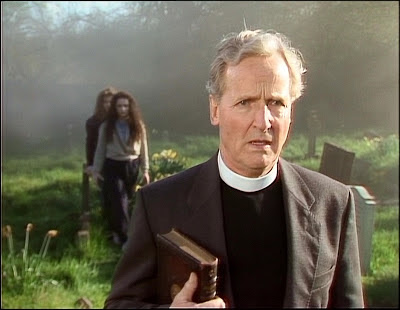


The Curse of Fenric – Bad Day For The Parson
In World War II, the Doctor (Sylvester McCoy) contests an ancient force of evil on the North-East coast. By the end of Part Two / half-way through the Special Edition of this most complex and layered story, the lively two young women Eastenders are made vampires, draining their self-righteous landlady then stalking through the graveyard mist to the local vicar. He tries to understand them… But they understand him much better. Reverend Wainwright flourishes his Bible, but they know it’s only faith that keeps them at bay – something with a stunning payoff later in the story – and that his is crumbling not under the horrors of the undead, but the horrors of war. Only the Doctor’s ferocity as he hurls himself in front of Wainwright makes them recoil, but they’ll return for him… Will he be able to find it in himself to triumph then? The Doctor and the bloodsuckers are almost forces of nature in this spellbinding scene that turns the traditional vampire story inside-out.


Love & Monsters
“You should take your jacket off.”
“No, I’m fine, I’ll just –”
“No, look, you must be boiling. Oh, look at your shirt. Sorry.”
“I – I – I’m fine. It’s all right.”
“I’ve ruined it.”
“No, honestly, i-i-i-it’s – it’s fine.”
“Take it off. I’ll put it in the wash.”
“Oh, come on! It’s only a little drop.”
“Oop! There now. Ruined.”


Love and Monsters – Jackie and Elton
Elton Pope’s been fascinated with the Doctor ever since he was a boy, and never been happier than with a little group of friends with the same interests. By half-way into the story, though, someone’s rather taken over, organised them, given them ways to track the Doctor (David Tennant) and his friends, but things are less fun. And some of Elton’s group have vanished. Be careful what you wish for… And Elton wishes he could find Rose, so he tracks down her mum Jackie. Turns out he’s not quite as in control of his infiltration plan as he thinks he is. She keeps inviting him round to fix all the things that keep going wrong about the flat, and it’s got nothing to do with the way Elton’s shirt keeps accidentally riding up to show his stomach as he changes a bulb or his jeans showing off his arse as he looks at the washing machine. It’s a complete coincidence that her tops are getting tighter and skirts shorter, too. But just as she flings herself – or at least her wine, twice – at him, a call from Rose spoils the mood. She feels ashamed of her ulterior motives, and shows it; so does he, but doesn’t. He goes off for pizza to make it up to her, but it’s too late – she discovers what he’s after and she’ll protect them until the day she dies…

Camille Coduri’s Jackie has long been a brilliant comedy creation by now, shot through with tragedy; this is her finest moment, never funnier and never more moving as the cracks show of how much she misses her daughter and even Mickey. “Put the telly on if you want – can’t bear it silent.” The way Elton’s unreliable narration within his unreliable narration collides with her at her most turbo-charged is hilarious, then she and the script turn in an instant and break your heart. It’s inspired how ELO’s Turn To Stone gives way to Jackie’s choice of romantic music as she takes control of the scene from the man who’s been narrating it; her joyous sexuality is brilliant; then she lets her defences down only to find herself betrayed, anger punching through her loneliness to show how selfless and ferocious her heart is. Rose never sees it.


Genesis of the Daleks
“Today, the Kaled race is ended, consumed in a fire of war – but from its ashes will rise a new race: the supreme creature; the ultimate conqueror of the Universe; the Dalek!”


Genesis of the Daleks – The First Extermination
The climax to Part Three of this story, one of Doctor Who’s best, is an odd beast. On screen, the cliffhanger is a slightly underwhelming threat to the Doctor (Tom Baker). On the truncated LP (and now CD) release, the half-way cliffhanger comes a couple of minutes later, with the annihilation in fire of the Daleks’ parent species, the Kaleds, by their ancient enemies, the Thals (a model city with a sense of scale as, for once, the explosions take an age to die away). But it’s Davros, the half-Dalek creator of and would-be Führer of the new race, who actually betrayed the secret of their defences – to stop their leaders bringing the Dalek project to a halt. And in the originally scripted climax to the overrunning Part Three, moved back to begin Part Four, Davros uses the moment of shock for his scientific Elite (now the only survivors save for their mutated, battle-tanked progeny) to destroy his only outspoken internal critic. Ronson has asked awkward questions about the future of the Daleks and aided the Doctor’s escape; biding his time to respond, Davros now denounces Ronson as traitor and spy, ordering in his new Daleks to carry out their first ever extermination and promising vengeance on the Thals, too, then the absolute power and glory to which he aspires.

Genesis of the Daleks is packed with great moments, and another will make my Fifty. It’s the finest example in Doctor Who of actors and writers coming together to forge proper speeches, rather than just assuming ‘speaking at length’ makes great rhetoric. Others might choose the Doctor’s key moral dilemma – asking “Do I have the right?” – but this scene captivated me growing up and listening to it again and again on scratchy vinyl. The sheer power of Michael Wisher’s performance as Davros; the sheer ruthless chutzpah of the character; the sheer horror of Ronson screaming in denial. On screen, it’s the negative blaze around him and the sight of his colleagues backing quickly away, shielding their eyes, that stays with you; on LP and CD, the raw immediacy of the sound design, Davros’ harshly escalating triumph, the crashing march as the Daleks enter and their gun-sticks seethe. Gripping.


An Unearthly Child: The Firemaker
“This knife has no blood on it.”


An Unearthly Child – The Doctor Holds Court
Of all the Doctor Who stories criminally underrated by fans, for me this is the most unfairly overlooked – or, at least, 75% of it is. The first ever Doctor Who story, nearly everyone (rightly) looks on the first episode as one of the greatest pieces of television ever made, but nearly everyone else then goes on to do down the following three episodes, in which the Doctor (William Hartnell) and his as-yet unwilling companions plunge into prehistory and are caught up in the power struggles of a Stone Age tribe. Yet I’ve argued that these episodes are not only brilliant, but crucial to the show’s story. One outstanding scene comes at the beginning of the fourth episode, by which time the TARDIS crew have escaped the tribe with the aid of an old woman, only to be pursued by Za, one of the two rivals to be chief. Meanwhile, the cleverer but nastier rival, Kal, murders the old woman on finding them gone – and pins the blame on Za. With Za and our heroes captured together, things look bleak. But the Doctor brilliantly invents a genre tens of thousands of years early to beat Kal…

Kal’s great strength has been as a demagogue – Za learns how to adapt over the course of the story, but he’s comparatively slow. Yet as Kal waves Za’s stone knife before the tribe, weaving his story before them, the apparently frail old Doctor shows he can not only defeat a physically much stronger opponent with superior brainpower, but beat him at his own simple declamatory style and even muster the physical force to drive him out. It starts with the Doctor’s simple observation that Za’s knife has no blood on it, and from that point Kal unravels: he calls it a bad knife for not showing what it has done; the Doctor needles his vanity, saying it’s much better than his; Kal falls for it, proudly pulling out his bloody weapon; and the Doctor parades it around the tribe like a prize lawyer. Rousing the whole tribe against the strong fighter, he throws a stone at him and gets everyone else to do the same, making him retreat under a barrage of rocks.

This is simply a terrific scene. William Hartnell is outstanding, slipping effortlessly between quiet, naturalistic instructions and a theatrical display of Stone Age rabble-rousing, but it’s a brilliant idea, too: years before Columbo ever aired, Doctor Who invents the format. We’ve already seen the murderer, and the Doctor exposes him through a combination of psychology and forensic evidence. And while he’s settling the rivalry between Kal and Za, at the same time he’s settling with argumentative teacher Ian Chesterton just exactly who is the leader of the TARDIS crew, and the star of the show (he still is). Just as with the Twentieth-Century humans, the Doctor can speak their language and then get into their mindset and manipulate it, which makes you wonder just how much he’s talking down to our level, too. And I still love the idea of taking a standard of crime drama and reinventing it in an utterly different setting: within a few stories after this, the Doctor will triumph in another courtroom drama, this time on an alien world, and go on in another story to solve both a locked room mystery and a whodunit…


The TARDIS Can Go Anywhere – Super, Super Fun!


Doctor Who – The TARDIS
Even with these Runners-up I could easily have chosen many more – or even many more fifties. Do you remember the Doctor looking entirely at home in a steaming Victorian laboratory until the devils the owners made a pact with appear in the mirrors? Or the Doctor explaining the TARDIS at its most Victorian with the aid of boxes and points of view, and getting it absolutely right (nine times out of ten)? The Doctor and Amy lying in a field with Vincent van Gogh and seeing the swirling stars he sees; the Doctor echoing, “Do we have a deal?” on a diamond planet; the Doctor dining with a monster, consumed with comedy and tragedy; the Doctor’s shoes and mind clicking into place at exactly the same moment; the Doctor roaring defiance at a murderous, self-perpetuating oligarchy only for them meekly to admit they, too, can’t make the decisions? The Doctor fading but determined as he goes to find his other selves; another self the Doctor would rather not find deriding his tawdry quirks; a man who isn’t the Doctor dreaming of a life with the woman he loves; the Doctor’s people dispassionately putting him on trial for caring too much and ripping away his own self and those who care about him…?

What about Daleks rolling off the production line and shrieking their crusade to conquer and destroy – or as masters of a ruined London – or whimsically playing trains, suddenly made childlike; the Master wielding the devilish charisma of a revivalist preacher to demand his enemies be burned – or telling his allies what fun it is to watch the Clangers, or the Teletubbies; Cybermen bursting free from their tombs to plunging, echoing music and owning those who’ve come to free them – or being mass-manufactured from other victims whose screams are drowned by tacky pop? A masked sordid sex murderer’s monstrous disfigurement revealed; a treacherous monk’s inner fire revealed; a police officer’s two-facedness revealed; a monstrous violation of the dead revealed as the lost leader himself undermining his people? Rose’s father sacrificing himself in the hope that grace may yet save the world; King Richard’s sister defying him with the Pope; an ancient monk unleashing a terrible substance from another dimension to overwhelm the Earth; a carefree couple woken by sacred stones out for blood…?

Think of a suave businessman in a beautiful suit jeering at a tortured Cyberman driven mad, or sneering at a mild-mannered scientist to shoot him – then only laughing as holes appear in his shirt front; a deranged schoolboy taunting his headmaster with deadly science projects; a woman’s mind and then body destroyed by a greedy alien and a bombastic warlord; an interplanetary agent with a licence to kill finding, like each of those others, exactly what happens when the Doctor isn’t there? A deposed princeling surrounded by his dead warriors hearing nothing but the clamour of old battles as he charges to his own death; plague-ridden commuters collapsing at a busy London station while a Cabinet Minister staggers through the streets, spreading the infection; the US President’s appeal to our shared humanity echoing to the stars as a huge spacecraft looms over Earth; the Master becoming Prime Minister of Great Britain and smiling a public smile at a secret joke; the head of a secret UN space defence force curtly telling an impromptu press conference he knows nothing about a man from space…?

I could go on. I will go on! But while I didn’t have room to more than hint at some of those marvellous moments above, the Fifty that do make it are on their way… Every one, you may be relieved to read, much shorter than this week’s post. And each week, you can try and guess which one’s coming next! I even have a special prize ready for the person who guesses the most of them over the next year, should more than one of you try in the comments each week.

So:

Next Time… Two words. The basics.
09 Dec 12:27

Smithsonian profiles Bryan Stevenson: ‘Mass Incarceration Defines Us’

by Fred Clark

Chris Hedges writes a long, inspiring profile of Bryan Stevenson for Smithsonian magazine. Stevenson, founder of the Equal Justice Initiative, was awarded the Smithsonian American Ingenuity Award for social justice. (He’s also a graduate of my alma mater, Eastern University.)

Hedges’ article is a hefty piece, but it’s well worth your time. You will feel sadness, anger and hope, sometimes all at the same time. Hedges tells Stevenson’s remarkable story, and in doing so conveys Stevenson’s important message: “Why Mass Incarceration Defines Us as a Society.”

Here’s a taste:

It was here in this square — a square adorned with a historical marker celebrating the presence in Montgomery of Jefferson Davis, the president of the Confederacy — that men and women fell to their knees weeping and beseeched slave-holders not to separate them from their husbands, wives or children. It was here that girls and boys screamed as their fathers or mothers were taken from them.

“This whole street is rich with this history,” he says. “But nobody wants to talk about this slavery stuff. Nobody.” He wants to start a campaign to erect monuments to that history, on the sites of lynchings, slave auctions and slave depots. “When we start talking about it, people will be outraged. They will be provoked. They will be angry.”

Stevenson expects anger because he wants to discuss the explosive rise in inmate populations, the disproportionate use of the death penalty against people of color and the use of life sentences against minors as part of a continuum running through the South’s ugly history of racial inequality, from slavery to Jim Crow to lynching.

Equating the enslavement of innocents with the imprisonment of convicted criminals is apt to be widely resisted, but he sees it as a natural progression of his work. Over the past quarter-century, Stevenson has become perhaps the most important advocate for death-row inmates in the United States.

… EJI’s office is in a building that once housed a school for whites seeking to defy integration. The building is in the same neighborhood as Montgomery’s slave depots. For Stevenson, that history matters.

Mass incarceration defines us as a society, Stevenson argues, the way slavery once did. The United States has less than 5 percent of the world’s population but imprisons a quarter of the world’s inmates. Most of those 2.3 million inmates are people of color. One out of every three black men in their 20s is in jail or prison, on probation or parole, or bound in some other way to the criminal justice system. Once again families are broken apart. Once again huge numbers of black men are disenfranchised, because of their criminal records. Once again people are locked out of the political and economic system. Once again we harbor within our midst black outcasts, pariahs. As the poet Yusef Komunyakaa said: “The cell block has replaced the auction block.”

In opening a discussion of American justice and America’s racial history, Stevenson hopes to help create a common national narrative, one built finally around truth rather than on the cultivated myths of the past, that will allow blacks and whites finally to move forward.

… Stevenson turns frequently to the Bible. He quotes to me from the Gospel of John, where Jesus says of the woman who committed adultery: “He that is without sin among you, let him first cast a stone at her.” He tells me an elderly black woman once called him a “stone catcher.”

“There is no such thing as being a Christian and not being a stone catcher,” he says. “But that is exhausting. You’re not going to catch them all. And it hurts. If it doesn’t make you sad to have to do that, then you don’t understand what it means to be engaged in an act of faith. … But if you have the right relationship to it, it is less of a burden, finally, than a blessing. It makes you feel stronger.”


09 Dec 12:24

For coalitions to work, there has to be trust

by Nick

Back in September, I explained my reasons for wanting to see an end to the coalition, and nothing I’ve seen politically in the last three months has caused me to change my mind on that issue.

One of the reasons I gave for wanting to see it end was that “the coalition’s no longer about trying to come up with a joint policy programme, but about horse-trading and threats”. I think this trend is perfectly exemplified in this story, where the Tories in government were supposedly negotiating with Liberal Democrats while also raising funds from donors to stop it from happening.

While this is just one incident, it’s a symptom of how this coalition is failing. For a coalition to work, there has to be mutual trust between the parties involved. No matter how closely the parties want to show they are in public, there will always be disagreements in private that have to be resolved in some way. However, you can’t expect disputes to be resolved if one party is not coming to the table in good faith and pretending to negotiate over something they’ve got no intention of conceding on and, indeed, are actively working against.

However, as I also wrote about in September, this is a trap the Liberal Democrats fall into when we commit to the ‘we have to show that coalition works‘ line. If one party is resolutely wedded to not leaving the negotiating table in any circumstances, then it encourages the other to not play fair – there’s no need for them to build a relationship of trust with their partner, as breaking that trust doesn’t lead to any penalties.

As I’ve argued before, there’s plenty of evidence from across the UK and across the world to show that coalitions can work, so to claim that we have to stick in government regardless to prove they can isn’t strong leadership, it’s reflective of an unwillingness to make a wider argument. (Yet again, it’s the crippling belief that only what happens in Westminster is important in British politics) A single-party government can fail (see 1992-97 for an example), but that doesn’t mean that all single-party administrations are doomed to failure. In the same vein, the argument can be made that coalitions can work, but that the bad faith of the Tories has made this one unworkable. Just as one couple getting divorced doesn’t mean all marriages are doomed to fail, one coalition ending because one party to it is wedded to an unsuccessful economic dogma does not mean that all coalitions will end the same way.

09 Dec 04:38

Flow My Tears, the Policeman Said

by Lawrence Burton


Philip K. Dick Flow My Tears, the Policeman Said (1970)

Award yourself two points if you now have the first Tubeway Army album on your internal stereo rather than the Blade Runner soundtrack. Recently on a plane I had the option of watching the remake of Total Recall, a cover version of a film loosely based on something Philip K. Dick scribbled in the margin of an overdue library book. I couldn't be arsed and instead ended up watching Ted, Mean Girls, and Men in Black 3, all of which were pretty great. The more Dick I read - or rather that I re-read by this point - the less well-disposed I become towards misjudged cinematic interpretations full of flashing lights and male models demanding to know what is real. Excepting Linklater's excellent A Scanner Darkly, not one of them has either the wit or charm of the novels with which they've taken such huge liberties. Gary Numan is therefore greater than Ridley Scott, but I expect most of you already knew that.

Flow My Tears is I suppose what you might call a transitional novel. The two halves of Dick's brain were still on speaking terms, but both had sights set on higher and different paths. It's a precursor to the full bipolar genius of A Scanner Darkly and those later, even stranger books. Here we have the archetypal Dick character as jet-setting, internationally known lounge singer and talk show host waking up to a world which contains no record of his ever having existed, a world which has adopted the habit of sending anyone lacking the requisite identification off to a labour camp.

Flow My Tears reads something like a dialogue between Dick and himself - Jason Taverner as the established but increasingly alienated author in his forties, very much aware that the world is moving on and that creatively speaking, the game is probably up: Police General Felix Buckman as the more objective voice, stood some way back, disdainful of Taverner's self-involvement, of his ever having bought into the illusion of his own fame. Throw in an incestuous relationship with a twin sister whose death restores reality, albeit a more sober reality for having been faced with its own absolute lack of meaning, and you have something which works on many levels. It would be pure autobiography but for the layered symbols.

It's been a long time since I read Flow My Tears, and I recall regarding it as one of my absolute favourite Dicks - if you'll pardon the expression - and now I remember why. One of his very best, in my view.
08 Dec 16:10

Day 4360: DOCTOR WHO: The Wizard Versus the Aliens

by Millennium Dome
Saturday:

Happy Advent!

“Doctor Who” is a series about TIME TRAVEL, so it makes sense to celebrate the series’ Fiftieth Anniversary by spending it travelling BACK IN TIME to all those futures it’s been to in the past.

Daddy Alex is doing ALL SORTS of INTERESTING things on his diary, but here I’ll be getting Daddy Richard to write reviews for stories from each of the first twenty-six seasons, two stories each, to last us through to November 23rd 2013.

Why the first twenty-six seasons? Well, because we have ALREADY done reviews of all the Twenty-First Century Stories. Or ALMOST…

In 2010, in the run-up to the new Coalition of Matt Smith and Steven Moffat, we tried to review all of Mr Dr Christopher Eccythump’s brilliant 2005 season. We tried… and failed, missing out on the first ever season finale… “The Evil of the Daleks”… no, hang on, that’s not what it says on this card from Mr Russell T Davies…

Previously… Russell is very much one for making each part of his two-parters very much its own story, never more so than here. So, as I said under "Bad Wolf", this is really a half hour story satirising television followed by an hour-long epic battle with Daleks that just happens to have the first fifteen minutes in the previous episode.

“The Parting of the Ways” is the first of three (so far) Dalek Invasions of Earth in the revived series. All of them have strengths and weaknesses: “The Parting of the Ways” cannot, for example compete with the huge staging of “The Stolen Earth” where we get to see from the ground up what a Dalek War would mean – compared with the announcement of Earth’s continents being bombed, presented on a screen as outlines being distorted, is far more visceral, more satisfying and of course more expensive. Nor does it have the fan-pleasing smackdown to finally settle who is better “Daleks or Cybermen” (like the side that came a close second in the Time War was ever going to be threatened by the hot-dog people). What it does have is a point.

Terrance Dicks – it’s always Terrance Dicks – wrote that the Doctor is never cruel or cowardly, a quote that has had people like Paul Cornell and Steven Moffat posting purple prose ever since to try and better it, so far without success. But what do you do if you are faced with a choice of cruel or cowardly?

“The Parting of the Ways” is full of variations on this moral dilemma: whether it’s Rose faced with a life of chips or trying to return to a future she knows is doomed; or the refugees of the Game Station – including Paterson Joseph’s deliciously narked Roderick (“It’s not fair! I won the game!”) – who have to decide whether to fight or hide; or, in a very Russell moment, Davitch Pavale who has to decide whether to ask the woman he fancies (Nisha Niyar’s “female programmer” – thanks, Russ) out on a date (while in the middle of a doomed fight for their lives against the invading pepperpots).

Only two characters do not face a moral dilemma, and both of them are, in their own ways, extremists. One is the Dalek Emperor. Who is insane. The other, though, is Captain Jack, who never doubts the Doctor, never doubts the need to fight the Daleks. Alex, reasonably, points out that this is because Jack has already had his own moment of enlightenment, faced his choice and moved on. No regrets, just a kiss goodbye.

Not that it helps you to make the “right” choice. Everyone’s going to get dead, whether they’ve been naughty or nice. But of course if you only have an inch to live – as Richard puts it in “The Lion in Winter” – then what matters is how you live that inch.

Nor is the Doctor’s dilemma an easy or obvious one to resolve.

To stop the Daleks, he would have to kill an awful lot of people: everyone on the station, regardless of whether they chose to stand and fight or to run and hide; everyone on Earth, whether they had too much or too little or just sat watching the cruel games that flooded out from the Gamestation; and even everyone on the Dalek fleet. Because, yes: Daleks are people too.

But if he lets the Daleks survive, it will inflict pain and suffering on countless billions of lifeforms, not least the benighted Daleks themselves (who he already knows are being driven insane by their own blasphemous, half-human genetics).

It’s not even clear which choice is “Cruel” and which is “Cowardly”. The Doctor clearly believes “Cowardly” is to surrender to the Daleks rather than launch an attack that will kill them and everyone else.

But I might make a case that it’s using the Delta Wave that’s being “cowardly” because killing everyone means taking the choice onto himself and away from every other thinking being within range, means not trusting that some of the humans might survive, or escape or defeat the Daleks. To let the Daleks live takes hope and hope requires courage.

The importance of the decision that the Doctor faces makes itself felt as the centre of one of the major set-pieces of the episode: the Doctor's second confrontation with the Dalek Emperor, and the way that their dialogue is juxtaposed with Rose's equally important debate with Jackie about leading a life that matters.

Alex raises the concern that so big is this clash that it renders all other characters unimportant: see, for example, the way that Rose is not going to be given a year to spend in post-traumatic stress because of her genocide of the Daleks. (Although, I suggest that "Rose" ceases to exist from the moment she looks into the heart of the TARDIS until the moment she recovers just before the Doctor's regeneration.) Does this add evidence to the theory that – as representatives of the two sides in the Time War – only the Doctor and the Emperor have "free will" in this Universe?

When people give their lives for the Doctor so that he will have time to build a device he ultimately choose not to use, is that a betrayal of their choices? Although, in so many ways, the ninth Doctor is the one who does most to "make people better" in the way he steps back and lets them get on with doing the right thing, sometimes that makes him more of a master manipulator even than Sylv's seventh Doctor. And yet this is where I think Russell has actually plotted this very carefully, to make sure that all of those people are dead before the Doctor completes the Delta Wave. The populations of Earth are being massacred. In almost every way the Daleks have made it easy for him.

The Emperor Dalek, the god of all Daleks, wants to see the Doctor become “the great exterminator”.

The Dalek from “Dalek” told the Doctor: “You would make a good Dalek”.

(In fact, the strongest evidence for them not being the same individual is that the Emperor doesn’t take the opportunity to say “I told you so”.)

But they’re wrong. To be a good Dalek is to be without remorse, to kill and not to think about it afterwards. The Doctor has done nothing but think about it afterwards.

The Doctor, in his ninth life, has been trying, and largely failing, to find a way of living with one terrible wrong choice. Yes, he ended the Time War, but at what cost? Not to the Universe – though the price of a Universe without Daleks was a Universe without Time Lords, one where, as he says in “Rise of the Cybermen” everything is just a bit less kind – but the price to himself.

Killing cuts your soul, as J K Rowling might have it. Genocide even more so.

And now I have to talk about “Wizards vs Aliens”.

For the uninitiated, this is a series made by the people who would have been out of work because the untimely death of Elisabeth Sladen meant the untimely end of “The Sarah Jane Adventures”, and as such it is the (massively dumbed down) inheritor of the true spirit of Doctor Who. Certainly it has its problems (many direct from the Russell era of the, what, grandparent series): the same inadvertent leaning to “alien = bad” xenophobia stemming from Russell’s conviction that the audience-identification must be with humans/Earth and by extension the antagonists will always be the alien; an occasionally alarming looking-down-on attitude to science, at the same time perversely worshiping a “geek ethic” that it doesn’t entirely understand; “hilarious” gunking of the hero characters when alien critters explode (I blame the movie “Men in Black” for that, actually). The fact that the series format – Tom the hero is a “jock with a secret” who forms a close friendship with Benny a “despised outsider” – lends itself to gay subtext (or indeed text) ought not to be a bad thing but it’s a bit… well… “Merlin”. Especially since the only female characters are Annette Badland, best thing in it as batty gran Ursula, and Lexi, who’s alien. And evil. Ish. But at its heart are two very important concepts: a love of wonder and the idea that you should not kill people, even if they’re yellow scaly people.

The (first) series is bookended by slightly faltering episodes from Phil Ford (who is usually better), strong on sci-fi ideas, weak on character. But in between there were good stories from Joe Lidster (touching on peer pressure, bullying and substance abuse without getting too unsubtle); Clayton Hickman (Tom and Lexi bond when placed in shared jeopardy, unintentionally setting-up the possibility of a love triangle between Tom, Benny and Lexi – yay for bisexual visibility. Er.); and Gareth Roberts, showing again the paradox of why he ought to write brilliant TV Doctor Who (but seemingly can’t) with a story about Benny trying to make the aliens leave by infecting their ship with a computer virus and accidentally very nearly killing them all.

The extraordinary thing is that in the current series of Doctor Who, this would be passed off by the Doctor as “Well, you had your chance but you were stupid enough to ignore my warning”. (Or – worse – doesn’t River look cool as she shoots them all!) Ursula even gets to make the very powerful point that the aliens came here and have been destroying wizards (they eat magic, effectively aging the wizard to death – we’re shown a scene where this is done to a young Japanese wizard, to remind us what the aliens do and to imply that they’ve been carrying on doing it all season while we’ve been enjoying Tom and the exploding muppet larks he’s been up to); death, it makes clear, is no more than the aliens deserve.

And the episode makes it flat out clear that this is wrong.

As Alex very wisely put it: this shows the harm that killing does to the killer better than any nonsense about Horcruxes.

The idea that he might have killed the aliens nearly destroys Benny, so much that Tom is willing to sacrifice his life so that his (boy) friend can have the chance to save their enemies, to set things right.

Somewhere between “The Christmas Invasion” and “Day of the Moon”, “Doctor Who” has lost that, lost its way. Perhaps it was the number of people who took Harriet Jones’ side when she committed her war crime; perhaps it was too many people thinking it’s okay to just kill Solomon in “Dinosaurs on a Spaceship”; perhaps it’s something missing in the hearts of the production team; perhaps it’s something we’ve all lost since the War on Terror made “killing the bad guy” justification enough. And between Season 2005 and Season 2010 the scripts very much swapped sides in the “War on Terror”.

Some of what comes later can be laid at the feet of “The Parting of the Ways”. The impact made by the visual spectacle of this finale is certainly a driver towards the “bigger, bolder, brighter” ethos of each year that follows (and presumable the application of appropriately escalating budgets too).

It’s certainly true that Doctor Who had never looked this good before.

The CGI Daleks in space are astounding, and unforgettable, so good that they kept doing the same trick for “Doomsday” and “The Stolen Earth” and “The Pandorica Opens” and the rest. Whether they need it or not.

Likewise, the Dalek Emperor, in all his madness, is a superb creation. Kudos to Mike Tucker and his model-builders for the physical construction and of course to Nick Briggs for bringing the Emperor to life as a sadistic, twisted, dribblingly bonkers, boiling blob of hate character.

All the little details are just right: from the look of the saucers, to the black domes on the Imperial Guards (yes, just like “The Evil of the Daleks”), to the pyroflame adaptation on one Dalek’s utility arm, to Lynda Moss getting officially Best. Extermination. Eveh!

But Doctor Who was never about the way that it looked, at least not entirely. Spectacle could never before be guaranteed to live up to hype. Which is why story always mattered more.

That is so true here, as we reach the concluding chapter, the climax and dénouement, of the “Trip of a lifetime”, the ninth Doctor’s lifetime.

It’s been called a deus ex machina, and of course that’s what TARDISes are: a goddess wrapped in a bottle, kept in a box that is bigger on the inside; a machine able to go anywhere in time and space, see the turning of the worlds, and capable of love…

And of course it’s love. Rose and the TARDIS both clearly love the Doctor. Love is the affinity that lets the TARDIS in, lets her soul meet Rose’s, but unquestionably it is the TARDIS speaking when she destroys the Daleks, to save “my Doctor”.

And she does save him. Not from Daleks, any old deus ex machina could do that; she saves him from doing the right thing, from the outcome of defeating his dilemma, from facing the consequences of refusing double-genocide a second time.

What does “deus ex machina” really mean? The cliché of Ancient Greek drama was that, when the hero had exhausted all possible actions, a “god” would be lowered into the scene by a crane “machine” and resolve the plot with a divine wave. The modern interpretation is that this is a “cheat”, introducing an element at the last minute that saves the day, pulling an answer out of the metaphorical arse.

But that’s not what the Greek dramatists were doing. For them, the conclusion of the play was the philosophical punch-line, not the cleaning-up afterwards. The god would not emerge until the hero had reached the proper moral conclusion.

Is it really a cheat when “god” has been all through the episode like a stick of Blackpool Rock (to be eaten at the Doctor Who exhibition, of course)? “The Parting of the Ways” opens with the reveal of “the god of all Daleks”, and the Doctor spends most of his time in the story debating with the demented deity.

“God” after all is only a word meaning “an idea too big to fit into our heads”, something that the Emperor Dalek is reminded of when a real goddess turns up. “You are tiny!”

And the TARDIS/Bad Wolf/Goddess/deus ex machina does not appear until after the Doctor has made his choice, made the right choice, this time. Better to die than to kill, better coward than cruel, better every time.

The climax of the story is nothing to do with golden fairy dust and exploding Dalek saucers. It’s the moment when the Doctor can destroy them all... and chooses not to.

And so he is redeemed.

The ninth Doctor has been haunted, hounded, plagued, destroyed by the knowledge that he killed them all, Daleks and Time Lords alike. He’s not lonely when he meets Rose: he’s annihilated; he’s looking to die. Rose gave him a reason to go on living, to live long enough that, over the course of this year, he could come back to the point where he’s ready to try to face that choice again. And this time get it right.

He takes the fire of the Time Vortex from Rose knowing that it will kill him because he’s at peace at last.

The extraordinary serenity that Christopher Eccleston brings to the part as the Doctor steps up to save Rose and the TARDIS from each other, even though – or perhaps because – being a conduit for the time energy will kill him, lifts the lid on his portrayal of the Doctor, reveals the layers of artifice that the Time Lord has been sheltering beneath. It’s reminiscent of Colin Baker’s sixth Doctor who concealed his huge heart under all that bluster and bombast, only letting it break through when it was breaking, when – “you killed Peri...” – he was most utterly betrayed by his own people. The reason that “The Parting of the Ways” is a triumph and “Trial”, er, isn’t, is not because one of them is the “better” actor, whatever that might mean. It’s because Eccleston is given the chance to do his extraordinary work completely supported by the script, direction, lighting, editing, even the music butts out of his way rather than everything tearing itself apart.

And “The Parting of the Ways” is a triumph.

If Doctor Who’s return had only lasted this one series in 2005, still it would be remembered and talked about as a bright and shining thing, one glorious year of television made out of farting aliens and lost dads and gas masks and Billie Piper and Christopher Eccleston and Russell Television Davies.

But it went stratospheric instead.

Next Time... (going forwards) “New Labour... That’s weird!” Harriet Jones shoots herself in the foot (and the Sycorax in the back); Captain Jack gets a winning hand; and listeners to the Audio Visuals rediscover the power of A Nice Cup of Tea. Set the oestrogen to Warp Factor Ten as the Doctor falls in love... with himself! It’s David Tennant in “The Christmas Invasion”.

But!

Next Time... (going backwards) “It’s a laboratory. Or a nursery. But the kids would have to be pretty advanced.” Ace solves the Doctor’s initiative test in her first line, but can she evolve into a ladylike or does his surprise have a sting in the tail? There’s a god in the cellar and bats in the belfry and the Reverend Ernest Matthews wants a word about this blasphemous theory of evolution. Welcome to Gabriel Chase and the “Ghost Light”. Don’t have the soup!
08 Dec 15:15

Moving Ahead Of The Weather

by plok

“Grab a shower.”

Sheep roaming on the green hills of Mortehoe. Blue sky. Clean, cold wind out of the west.

“No offence, mate, but you smell like a Frenchman.”

Thus, Bloggers, with the single most incredibly English remark I have ever heard IN MY LIFE, my November adventure began. And all the time I was moving ahead of the weather, though I didn’t know it.

One way or another.

So it was off to Sunny Devon, to Ifracombe and Woolacombe and all the other little -combes, to the jutting chaos of Morte Pointe, rambling all over it with a hyperextended knee like the guy in the movie where the ankle turns and the fog comes down, but…rocky coastline, cold water, lots of weather? EXACTLY MY TURF, and when you grow up on episodes of The Beachcombers you know all about turned ankles, you think about them constantly. So many people caught in Jack London scenarios not five miles from their homes, in that show! Stranded in the backyard. So maybe it wasn’t the best show we ever made, but HOO BOY the cautionary tale-ness of it for those who lived in Howe Sound! Because when the fog comes down and you’re thirty feet from shore, suddenly you might as well be thirty miles from it…if you’re not exceptionally mindful of your business…

So things went well, and I saw shows and played ping-pong with kids, enjoyed a civilized eating and drinking culture (GOD but I miss that when I’m back at home!), and I went to Wales. Such a pleasure to be back in a bilingual nation! And I had Proper Welsh Cheese, and Proper Welsh Ale, and Proper Welsh Rarebit, and got Proper Welsh Food Poisoning and had to take some Proper Welsh Codeine on the four-hour ride back in the car, but when you’re five thousand miles from home every point is the same distance away as any other point, really, and so then it was Off To Manchester, where they keep Dead Sea Scrolls in the public library. No doubt they have the King Tut exhibit going on alternate Wednesdays at the…

as seen on TV!

…Tattoo parlour across from Shudehill bus station, too! An important city in an important country, with an important history of pilfering stuff from other countries…so maybe the Dead Sea Scrolls came on loan, but still I was shocked to discover what I’d forgotten: that there’s noplace in this country where you might not happen upon archaeological treasures.

And then it was Glasgow again — Sunny Glasgow! — and the whole place quite mild enough to walk around it in a Hawaiian shirt and tablecloth-coloured shorts, and never did I come close to seeing any hint of violent tendencies wherever I went in the UK, but maybe that’s because I basically looked like a cartoon bear walking down the street, thus the street toughs (if such they were) no doubt took me for an hallucination, and thought it better not to appear disquieted just in case no one else could see me. So, y’know…

God bless the weather.

Though in Glasgow, that insouciant city, it does seem (albeit to a mere two-time visitor) that irreverence is the virtue most highly-prized among the people! “No act of spirit can be wrong against Karanada,” and all that: in Vancouver nobody likes a wiseguy, but in Glasgow everyone IS a wiseguy, and so if there’s nothing about you of the merry cosmic Go Fuck Yourself then you might’ve come to the wrong place, Traveller. And so I might have expected to do as well with the Hawaiian shirt even in colder weather. A guy on the bus tossing me the most enthusiastic thumbs-up I’ve ever seen…girls in coffee shops throwing in a little extra flirty sarcasm with the foam in the latte…kind Scottish ladies giving me directions on Garnet Hill, fareweel and adieu oh you ladies…well, what can I say, I really like the place. And for a while there it felt like scouting locations for Astro City UK, it really did…because surely there’s room yet, in this wide world, for a robot superhero named Irn-Bru?

Irn-Bro?

(Also, if you find yourself in St. George’s Cross, you could do a lot worse than to visit the William Bros. pub…)

…Aaaaand then it was back to Sunny Manchester, to continue my delightful stay in Levenshulme, then once again off to Sunny Leeds, where they had some sort of a comic book convention going on.

A few things to say:

1. Nobrow Publishing is like my new favourite publisher now.

2. There was some lovely poetry there.

3. I bought some quite nice things:

all good stuff...

...must come to an end

4. But didn’t get everything done that I’d meant to, because of all the places I might’ve chosen to go see Kate Beaton (which was my whole intention: I wanted to thank her for her bracing comments about the War of 1812, and also ask her what she thought of Chester Brown’s Louis Riel), this was the place where I had the LEAST chance of doing so, as this appealingly female-friendly con (so many girls who look like they play ukelele on YouTube!) with its gratifyingly VERY LONG lineup for the “Women In Comics” panel, was made for Kate Beaton fans. Seriously, I’d have a better chance if I just went to Cape Breton and sat on a bench ’til she turned up. Of course, I could have tracked her down at the afterparty…

G. Lactus and new herald the Grey Glaswegian at Taa-ship Xmas party 2012

But I was too busy playing chess with Steampunk HAL. Actually this party was quite amusing, as I got a chance to explain to Bobsy Mindless of the Clan Mindless what a “Gangnam Style” was — in the process reminding him, just as I’ll remind you, that we all agreed the Macarena must go, we all wanted it dead, so now we must live with the consequences of that decision — as the liquor flowed and the inhibitions dropped, and the comics folk that at the beginning seemed to feel a bit daunted by the space began to flood the floor in what I took for our own little Dance of the Saudi Princes, very heartening stuff indeed. “We belong here, in a room like this; we are the coolest of the cool now, and this is our time.” God is great, and only the Princes shall elect the King! Hah-ha, we used to be kings of sand, kings of nothing, but now look at us! It’s quite true, if you think about it…Janis Joplin pointed it out in the late Sixties, when it was true for musicians: “What’s the coolest city? San Francisco. And what’s the coolest neighbourhood in San Francisco? This one. And who’s the coolest person, in the coolest house, on this the coolest street, of the coolest neighbourhood, in the coolest city of the coolest country in the whole wide world?” ‘Cause as a matter of fact, as we discovered on the train, tomorrow never happens, maaaaan…

So: fun talking to Bobsy. But it didn’t stop there! For as the evening wore on I also got to see The Beast Must Die’s eerie teleportation powers at work, as he mysteriously shimmered into view — not unlike a boozy Jeeves — at odder and odder spots throughout the techno-zeppelin in question. Relocated on the supersphere! The Time-Traveller’s Drinking Buddy! Of course the beer at these things is always too pricey, and the bass too juddering for ears as ancient as mine once midnight rings, but it was worth it to see the genetically-engineered superbartenders and wait staff zip through the crowd on what must’ve been wires, because where I live we do not get that, we simply don’t get to see the effortless physical prowess of so many extraordinarily agile Spider-Women in clean white shirts and flat black pants practically pirouetting through the air to deliver drinks and remove trash! Where do these people really come from? How did they get so very, very good at this particular job?

But eventually one gets too tired for admiration, so off the Beast and I drifted, him to his hotel room and me to the hotel room of Messrs. Volume and Attack, where upon waking I beheld sunlight filtering through:

wake up screaming

A bottle of Irn-Bru, naturally; in that momentary lull before the hotel started to fold itself down into a fourth-dimensional sinkhole, toilets and elevators first…oh, you Lovecraftian Leeds!  And then it was back to the con.

And then Manchester again, and then on a bus to Sunny Somerset. Manchester was just starting to get tremendously grey as I left it, but it wasn’t just that weather I was ahead of. You know how in the States, when they make a movie about aliens possessing peoples’ bodies it always stands for Communism? Well, that happens in Doctor Who as well, but it isn’t about Communism.

It’s about the FLU. My God, I asked myself, is there nothing people in the UK are prepared to do about the onset of the flu? All around me on the train from Levenshulme, the tram to Shudehill, and all over the Northern Quarter, like the pitter-patter of tiny rainy feet: cough-cough, cough-cough. Cough-cough as they get on the tram, and cough-cough as they get on the coach, and the density of the sound always rising, like a chorus of frogs as night falls. Night falls, and in the morning we may not be the same as we were. Zombies, too, when seen through a British lens lose a bit of their philosophical heft for an altogether more quotidian sort of horror: cough-cough, cough-cough, you may be faster than us but you can’t outrun us. Aim for the head…

And then Exeter at last — and I should stress that each one of these cross-country trips was a lot like being mailed, another little glimpse of a science-fictional reality of the Galactic Empire kind…as Planet Manchester, so obviously the Trantor-like centre of the Galactic Empire we call the history of the Industrial Revolution, takes a good long while to get to from the Outer Planets, and a good long time to leave as well…for in Galactic Empires, even with hyperspatial people-mailing technology, the planets are still NOT VERY CLOSE TOGETHER if you want to get anywhere besides the very next planet over, so the thing works but it still isn’t easy, it works but it still demands exceptional effort from the individual to get along with it…as time and space still matter, and their proportionality still matters, even in the presence of transformative technology. The proportionality of space and time is not done away with by the miracle of rail line or motorway, only the impossibility of moving goods through it with any speed is done away with…and that doesn’t necessarily make things much easier on the people who have to do the moving, only on those doing the sending and receiving. But anyway only the courier, the soldier, and the spy move around as recklessly through time and space as the tourist does — perhaps because only to them is “home” so ludicrously distant as to make all locations as-good-as equidistant in the mind. Myself, I’m wont to travel with nothing but a knapsack — well, you would too, if there was no labour peace in your country anymore! — and my brain folds itself up in trains and buses and airplanes and ferries like a sweater long used as a pillow: anywhere you can recline is “home”, on a strictly provisional and temporary basis. So you don’t think about home, you think about where the knapsack is, and you just build a lot of contingencies into your plans, so you always have a Next Place to go to even if your Plan A screws up. But, Exeter…

Exeter was my one untethered leg of the trip, with no contingencies built onto it. What a strange place, is Exeter! Half the women in shapeless jeans of some apparently local manufacture, and the other half in tight leather pants. The other HALF in tight leather pants, just let that sink in. The strangest of places, in many ways by far the strangest place I’ve ever been. Exeter at night after the alternator belt blew on the bus, with time getting skinny for making it across town to the train station, from thence on the very last train to the station near my cousins’ house. The rain chasing me all the while, it should be said; as though when the rain caught up with me so would the space and so would the time, so would the flu and so would the shortcomings of the plan. Down, down to the Underworld! Out, out to the Galactic Rim! If there are many places in Britain that haven’t lost something they used to have, then I didn’t see them; if there are many places that haven’t chosen to take that loss on the chin and then keep on keeping on, somehow, then I didn’t pass through them. Everyplace you look, there was once a sturdily-anchored sort of wealth, that’s now gone…but that doesn’t seem to stop anyone, at least it doesn’t seem to be capable of stopping them forever. Down in Somerset at last, the sort of place people like the people in my family (including me) go to escape the frictions of a passing, possibly worsening time — such a talent we have for making cozy houses! — there was nonetheless a kind of weather beyond the kind that falls out of the sky at you and floods the roads…

Although my God, those roads! It’s been raining extra-heavy for a YEAR in some of the places I visited, and the modern infrastructure isn’t built to take it. Helicopters over the M5 certainly show that it doesn’t take any global-warming-driven hurricanes to lay the works of man low…even in the country, ten extra millimetres of rain a week will get that job done. So imagine what it’s going to be like in the cities! Those finely-tuned instruments, those meticulously-turned systems pressed into laminate…you don’t have to take them very far out of their operating parameters to get them losing money, and then it doesn’t even matter how much they lose, if they lose it year-over-year…

Yet even in Somerset, this still is: the chalk river in Dorchester flooding the nearby fields, while not too far away Prince Charles’ massive folly of a Model Village seems to be only missing Rover bouncing down its empty streets to signify a perfect horror. Machine-like, horrendous, it’s more Doctor Who villainy: the ghastly looming buildings only staying put while you’re looking at them, and when you look away off they go stamping out dreams of a livable life. Wind screams over the plain outside as you shop for little tidbits in the Waitrose in advance of Christmastime, inside a massive upended cereal box of cold brick — it definitely looks and feels like something, and unfortunately I’m only too well-placed to tell you what that something is: it’s the Arctic. Model town now; twenty years from now a place where Helen Mirren goes to convince people to testify about a murder, as all fiction is doomed to collide with reality at the other end, one day…as man is born to trouble, as indeed the sparks fly upwards! Last time it was impossible War-Of-The-Worlds windmills on the way up to Scotland, this time it’s Prince Charles as a villain whose grandiose plans Steed and Mrs. Peel have to foil. But back in Dorchester, back in Coker Marsh, and back in the rest of the non-Arctic UK generally, people still manage to keep ahead of the weather somehow, fictional and otherwise. I once said that London seemed to me like a place where people navigated shoals of fakery: new fakes that chafed, old fakes that soothed, and real things both new and old that every fake might be preferable to, except for the odd time when they were not. A hive of emotional activity, is London! is what I said then…

But perhaps that’s also true more generally, as clouds of all sorts threaten to roll in, and then out again, everywhere you look. People in specific seem quite capable of dealing with it all in good faith, even if people in general seem to lack this ability: the alternator belt blows, and driver and dispatcher execute a comedy routine with effortless grace over the radio — and everybody manages to get where they’re going. The man up the road in Coker Marsh digs out the old ditch that carries the water away from the flats, and the homes survive. Around the corner the goose farm has all the emergency provisions one could want, as doubtless back in Devon it’s not too hard to find a reason to stay out of Barnstaple for a few days. Perhaps the pub?

Perhaps the pub; but as for me, I managed to make it out, catching a train and then another bus when the rain briefly let up, and then I was heading east, just ahead of the weather, and just in time to see Heathrow vanish in the rear-view mirror as the plane took off and headed for Greenland…

Never to be heard from again!

At least, until next time.

terror in a teacup

man of the hour

sex sells, innit?


08 Dec 14:57

Comic for December 8, 2012

07 Dec 21:23

Blast from the past: Alarm Clock Britain

by Nick

I was thinking about Alarm Clock Britain today. I’m sorry, I shouldn’t remind you of an idea that’s hopefully long dead (though I have visions of people in the DPM’s office doing the occasional head-desk interface when Clegg decides he wants to try and push it again) but something prompted me to look up a couple of my old posts on it. Those, of course, reminded me of what’s probably the most vapid, soulless and content-free article ever published on Liberal Democrat Voice, but if anything, that’s got even funnier with the benefit of hindsight.

I know it’s not really fair to pick out old predictions and mock them, but it’s an article by a Nathan Barley-wannabe, and it’s amusing. But which of these two is your favourite?

Unfortunately and eventually, Labour is going wake up to this reality itself and will inevitability ditch Ed Miliband and for a David Miliband who, during the labour leadership election, was proved by various polls and focus grouping to emotionally connect.

Becoming closer with News Corp should be key to this as they are the gatekeepers and have a direct phone line to ‘Alarm Clock Britain’.

I like the first, partly for the fact it sounds like a random word generator attempting to sound like a human being, but the second – advising the party to get closer to News Corp and its ‘direct phone line’ surely wins.

Sadly, Mr LeVan-Gilroy has not shared any more of his thoughts with us through Lib Dem Voice since then, but maybe he’ll return in the future.

07 Dec 14:56

Thursday 6th December 2012

My wife has a very Ebenezer Scrooge attitude towards Christmas. She fucking loves it. Oh, did I confuse you, I obviously was referring to Scrooge's attitude once he had been visited by the four ghosts (don't fall into this trap pedants, you will be outpedanted -unless you're thinking of the Muppet Christmas Carol where I suppose it is technically five). He loves Christmas at the end of the story (sorry, SPOILER ALERT - ooops too late) so I presume that whenever anyone says someone is like Ebenezer Scrooge that is what they mean.
07 Dec 14:42

Turn Her Into a Weapon, Just to Bring You Down (So Vile a Sin)

by noreply@blogger.com (Philip Sandifer)
I'll Explain Later

Well, technically we’ve skipped the rest of the line.

So Vile a Sin, the fifty-sixth and final of the sixty-one New Adventures, concludes the Psi-Powers arc. The novel was infamously delayed when Aaronovitch suffered a hard drive crash and was unable to face the prospect of rewriting large swaths from scratch and in an ultra-compressed timeframe. Accordingly, Kate Orman stepped in to finish the job from what chapters remained and Aaronovitch’s outline, and the book was put out five months late, more or less the day that Virgin’s license to publish Doctor Who books expired. It has tons of big plot points, most notably the death of Roz Forrester. It’s once again quite acclaimed (noticing a pattern in the latter New Adventures?). Dave Owen says that “Ben Aaronovitch and Kate Orman utterly typify the very best of the New Adventures.” Lars Pearson praises how it “makes Roz one of the most determined and self-actualized companions ever.” Sullivan’s rankings lodge it in with the rest of the Kate Orman books at fifteenth, with a 77.5% rating. DWRG Summary. Whoniverse Discontinuity Guide Entry.

——
It’s November of 1996. The Spice Girls are, unsurprisingly, still at number one with “Say You’ll Be There.” More surprisingly, they’re unseated after a week, giving them only a two week run, as Robson & Jerome take number one with “What Becomes of the Broken Hearted.” That lasts two weeks, then Prodigy come in with “Breathe,” which finishes out the month. Tony Braxton, Michael Jackson,  the Fugees, the Backstreet Boys, and Madonna also chart, the latter with Evita’s weird zombie bonus track composed by Tim Rice and Andrew Lloyd Webber for the movie version.

In news, the Tories narrow the gap between them and Labour to a mere seventeen points. The Channel Tunnel catches a bit of fire, and the Stone of Scone is installed in Edinburgh Castle after seven hundred years of being in England, which is largely symbolic, but a very important symbol. Outside of the UK, President Clinton wins re-election and Benazir Bhutto is tossed out of power in Pakistan. And, because it’s fun to say, Tony Silva is sentenced to seven years in prison for an illegal parrot smuggling operation.

While in literature… nothing. No New Adventure comes out. There was supposed to be one, but, well, you know the story. This book forms the single weirdest whorl of chronology the blog will ever cover. Not only does it form part of the tail end of the New Adventures where they were still publishing Seventh Doctor novels after the TV Movie, it was released out of sequence even within the Virgin line. The usual line about this is that this ordering blunted the book’s major moment, the death of Roz Forrester, which was, inevitably, revealed in Bad Therapy the month after So Vile a Sin was meant to come out. Two problems present themselves here. First, the idea that Roz was marked for death was going around fandom for months prior to it being officially revealed. Anyone whinging about the surprise being spoiled was in the very communities it was being widely discussed in. The second, and on the whole more interesting problem, only became evident at the end of April 1997, which was that Roz’s death was never meant to be a surprise. The first chapter, self-referentially titled “The Body on Page One,” declares Roz’s death flat-out. The book then promptly jumps to its next most shocking moment, when the Doctor has a heart attack at Roz’s funeral.

This is, in other words, a book that self-consciously front-ends its biggest moments. In that regard its delay is almost irrelevant to its impact. Nothing in it is meant to unfold as a surprise as such. This is not just an incidental detail of the novel’s structure either. The book is, after all, largely about the notion of potential and possibility. A book that features multiple sections in which timelines unravel and multiple possible pasts and futures coexist simultaneously cannot be taken as being anything other than ruthlessly deliberate when it starts by collapsing all narrative possibilities into one unavoidable tragedy.

For all that the Psi-Powers arc is criticized for its supposed lack of focus, it is relatively clear-cut what’s been going on with it as of So Vile a Sin. The problem, if you want to call it a problem, is that what’s been going on has had little to do with psychic powers as such. In So Vile a Sin psychic powers get established as “the last magick to survive” the Time Lord’s imposition of rationality on the universe, resulting in “a network of ley lines” across the universe that were subsequently harnessed as weapons by the Time Lords. Psi-powers, in other words, are the irreducible against which the smooth rationality of the university grinds. They are the unerasable other that haunts the rational universe. And here they manifest in the most straightforward form imaginable: as all of the other possibilities of what the universe could have been.

Perhaps the first thing to say here is that for all that these are clearly Lawrence Miles’s ideas, it’s also clearly Aaronovitch and Orman who are finding a way to make them work in a definitive and compelling structure. Not to flip too far ahead, but it’s a trick Miles will nick for his next two Doctor Who books, which is to tie the haunting of the rational order of things directly to the disruption of the familiar aspects of Doctor Who’s mythology. In fact, his next two books directly employ this book’s two big tricks - Alien Bodies trades on the same frisson created by outright inevitability in a Doctor Who story, and Interference is all about exploring the idea of other ways that Doctor Who could have gone, both using Faction Paradox to play with the same narrative/irrational/magical alternative to the science fiction orthodoxy of the Time Lords.

This is not, of course, a slight on Miles. He’s picking up and running with good ideas every bit as much as Aaronovitch and Orman are picking up on his good ideas and running with them. That’s the way this works. You come up with a neat idea, other writers refine it. (Indeed, the dialogue between Miles and Orman on these issues will be an issue in the future) And So Vile a Sin refines these ideas nicely. It’s perhaps also telling that the alternate history of Doctor Who that the novel explores in the most depth is one in which the Third Doctor remained on Earth, a section that twice evokes Inferno. The Pertwee era, you’ll recall, is where Doctor Who began a complex engagement with the notion of what history and the arc of time is. On the one hand you had stories like The Curse of Peladon and The Mutants in which the series seems to point at a view of time and history in which there is some fundamental and underlying social tendency of history that time moves towards and that the Time Lords maintain.

But this was always opposed tacitly by Inferno and the Doctor’s muttered realization that “free will is not an illusion” upon his confrontation with the alternate universe. Several problems existed with this at the time, though, most of which were a variation on the fact that Inferno is not what you would call the most thoughtful and nuanced story of its era. But positioned opposite the “arc of history” stories there becomes an interesting tension. On the one hand is the Doctor’s fealty to history - a longstanding concept dating back to David Whitaker’s declaration that “what we are concerned with is that history, like justice, is not only done but can be seen to be done.” On the other is the fact that history is not set and that individual choice shapes the universe along a fairly standard sci-fi interpretation of the “many worlds” hypothesis from within quantum physics.

The Inferno perspective amounts to that of the irrational and magical - the idea that individual choices can put one outside of the grinding engines of the universe. The alternative, of course, is the rational perspective, with the Time Lords existing in order to keep those engines working as expected. And Roz is killed because she leaves the protection of the magical in favor of the arc of history. As the Doctor warns her, “if you step back into history, I won’t be able to protect you.” And as Kadiatu says in the epilogue, “she jumped down into history and history ate her whole.” What is key here, of course, is that Roz not only entered history but did so by choice. Given the freedom of the irrational, she chose the unrelenting arc of history.

On the one hand, then, the novel confirms the supremacy of history. It sets up the inevitable on page one, and then marches inexorably towards it over the remainder of the text. Nothing can actually escape it. And all the attempts to alter history within the book - mostly practiced by the Brotherhood - come to naught. The Doctor ends up on the side of rationality, which is why he can’t save Roz. Two things, however, interrupt this line of thought. The first is what you’d expect from a Kate Orman book - a bit at the end in which Kadiatu spurs the Doctor on to pick a new ending for the story besides his own grief. The Doctor admits that he tries “to make sure the story goes the way it should,” and Kadiatu reminds him to actually do so. The result is to put the Doctor back on the tightrope between reason and irrationality, spinning the structure on towards another story. Fair enough, and undoubtedly the “correct” ending, but also vague and emotive. It’s effective, but it’s actively not a resolution to the fundamental tension underlying the novel so much as a sustaining of it.

The second interruption is altogether more compelling: Roz’s response to the Doctor’s warning: This isn’t history, Doctor. This is family.” Here the disturbed ordering of the New Adventures plays in oddly affects how the novel is actually read. In the intended release order this is an innocuous enough declaration. But coming in the immediate wake of Lungbarrow, with its own explorations of the Doctor’s family, the line carries new resonances. There is a gesture here towards a different order - that of personal narrative and memory. This is, of course, something that’s been tied to Gallifrey before through the abandoned legacy of The Deadly Assassin. That train of thought itself dovetailed on Whitaker’s views of history, which always seemed based on personal identity and memory. You can’t rewrite history because to rewrite history would be to rewrite yourself. Roz can’t step outside of history because history is inexorably bound into her family, and thus her identity. And soon the Doctor will find himself drawn into a web of Gallifreyan history and family memory.

Free will is not an illusion after all. Nor, however, is it an unbounded and absolute force. Instead it exists eternally bounded, its possibilities circumscribed by the engine of history and the web of personal entanglements from which we spring. Free will is not an infinite number of possibilities but something that takes place within an identity defined by a pre-existing social order of memory and circumstance. And this brings us around to one of the unresolved issues of the Virgin era, which is just what is meant by “domestic” when Orman and Cornell prioritize it over the epic.

For Cornell, at least, the word has always evoked a specifically British order of things. This is not, of course, unreasonable: Doctor Who is British. The character stems out of British culture and history. And the vision of wondrous domesticity that Cornell espouses is self-consciously British. As he has Benny say in The Shadow of the Scourge in order to defeat yet another vast extra-dimensional fear monster, “It would all be OK if we could all just get our hands on some tea and scones, because those things are great.” Orman is similar - note the impish way in which she has her inevitable torturing-the-Doctor section in Return of the Living Dad eventually hinge on the Doctor’s inability to handle the vastly amplified pleasure of a cup of tea. Or Cornell’s endless couching of things in specifically Anglican terms. Or any number of other things.

Which is to say that the domestic that is praised is not merely the small and human scale of things, but the small and human scale within a specific ideological frame. One could even argue compellingly, if one was into that sort of thing, that this amounts to a sort of hedonism. Certainly reading the Doctor as a hedonist becomes easier in the wake of the Virgin books, with it amounting to one of the central premises of both Tennant and Smith’s Doctors. But crucially, this investment in domestic pleasures as the point of life exists only within the intersections of the historical with personal identity. In some ways this is a restatement of the great feminist maxim that the personal is political. The arc of history and one’s personal identity are inseparable. And so the domestic scale of things on which human happiness exists is perpetually defined and impacted in terms of the larger movements of history.

Another framing of this, of course, is the declaration that the secret of alchemy is material social progress. But the principle of alchemy is “as above so below.” That there is a structure that links the tiny domestic scene with the vast political machinations of the galaxy means that one can opt to reshape the latter from the former. And so when the Forrester family home is attacked by monsters, the inciting incident that causes Roz to fatally entangle herself with history, we get the incident from the perspective of Thandiwe, a child clone of Roz, as she is attached by a monster that is stopped by her amped up toy Fat Monster Eater. This is where the novel ends as well - with Thandiwe fearing the monster under the bed before what seems to be Roz’s ghost steps in and arrests said monster, somewhere between “I’m what monsters have nightmares about” and Father Christmas.

This, then, is the final statement of the Psi-Powers arc. In the face of the paranoia of a master narrative, whether an irrationally authored one or an rationally historicized one, the individual, human level remains a viable scale on which to make progress. The monster under the bed and the gaping maw of history’s end are interchangeable. To fight one is to fight the other. And yes, as Roz glares at the Doctor, “history kills people and sometimes even you can’t save them.” As it kills Roz, who fights the battles of history on family terms and, let’s be clear, wins them, albeit at a terrible cost.

Victory against hopeless odds at a terrible cost is, of course, a familiar structure to us. It is the structure and logic of narrative collapse. Here, however, we have something subtly different: a narrative collapse into the Holmesean, individual level. History is defeated by the personal scale, by family and scared children and the non-illusion of free will. The Whitakerian Eagle and Red Holmesean have at last had their union, here at the absolute end of the Virgin line. And if this, an achronological blip within an achronological blip within a quasi-official line of tie-in fiction not even on television and not even published by the BBC, is perhaps a lowly place for the chymic wedding, let us remember that there is no better place for so lofty an ideal.

07 Dec 09:34

Doctor Who – Survival: The Short Review

by Alex Wilcock
Before Doctor Who became the biggest non-soap opera TV drama and demanded a Radio Times front cover even a fortnight before it’s next on, it was once in a struggle to survive. Before Sylvester McCoy became a big movie star – will next week’s opening beat James Bond to the year’s biggest? – he was the Doctor. And exactly twenty-three years ago (checks watch) now, he walked off into the sunset at the end of a gorgeous adventure that was positively not the last of Doctor Who. It felt like a new start. And, in several ways, so it was…

Having picked a short and relatively classy trailer for Doctor Who’s no longer final year in my Eleven Great Trailers opening a celebration of the series’ fiftieth year, brace yourself. Survival has a superb guitar score that, like the story itself, is both part of and a critique of the ’80s. This trailer counts down to Doctor Who’s ‘final’ year without that critique, an overlong, overblown piece of – there’s no hope for me – irresistible cheese to get you in the mood.

With Richard and I re-reading Sylvester’s New Adventures twenty years on, I’ve also been watching his TV stories over again. Richard’s already reviewed Survival for Millennium’s blog; I hope to start a series of reviews to complete them all. But as tonight’s the anniversary of not the end, the end seems as good a place as any to start – so before I return to Survival on DVD in detail, I just happen to have a much shorter review to hand written by a much younger me in April 1996 (I suspect I’ve since evolved both more love for Survival than I had then and a greater resistance to fan clichés in my reviews). It was published in Liberator Magazine, looking at the VHS release and hoping desperately that the Doctor Who TV Movie starring Paul McGann and Sylvester McCoy would be a huge success…
“If we fight like animals, we’ll die like animals!”
For too long, we all thought this was to be the last TV Doctor Who story ever made and mourned it, even as we rejoice in Virgin’s superb series of original New Adventures novels. Transmitted back in 1989, a BBC production with a BBC budget, Survival has the same protagonists as the new TV Movie, but played by (mostly) different actors and almost certainly with a very different tone, with perhaps the last use of cliffhanger episode endings – all of which are refreshingly effective.

Survival is good, solid, average Who: story-driven, with something familiar, a few surprises, mostly rather well done drama and the odd let-down. Something is appearing in North-West London and carrying people away, aided by the Doctor’s arch-enemy. They turn out to be giant cat-people on horseback, a strikingly effective sight (although their animatronic cat ‘hunting dogs’ betray the budget). Their home world is falling apart as they fight – not just a quarry, but with a pink sky, the odd volcano and a satisfyingly stormy look. And while the inhabitants affect the planet, it casts its strange spell over them in turn…

There is a slightly dreamy air to this allegorical tale, which shows no love for machismo and ’80s values. A retired sergeant teaches ‘survival of the fittest’, but is killed in turn by a sharp-suited yuppie, and the Doctor in the end chooses not to fight. Both the Doctor’s companion, the self-reliant Ace, and his opposite, the Master, are possessed by the Cheetah Planet in superb performances (although some of the minor actors are a bit ropey). Sylvester McCoy’s seventh Doctor was by this stage far darker, less goofy and with a far greater presence than when he started; while Anthony Ainley’s Master had sometimes descended almost into panto, here he is underplayed and sinister, fighting to survive with the gadgets and the veneer stripped away. He positively smoulders as he and the Doctor circle each other in a fine send-off for the old leads.
“There are worlds out there where the sky is burning. Where the sea is asleep, and the rivers dream. People made of smoke, and cities made of song. Somewhere there’s danger. Somewhere there’s injustice. And somewhere else, the tea is getting cold.
“Come on, Ace – we’ve got work to do.”
And next month…
Well, the next month saw that TV Movie, and it wasn’t quite the huge success for which I’d hoped. Yet though that starred Sylvester and no previous Doctor appeared in Rose nine years later, Russell T Davies’ new series felt far more like Survival than the Movie ever did. Following this story with the glorious, inventive, emotional, allegorical New Adventures makes perfect sense; jumping straight to Rose, which takes the same real-world roots and family ties and does them so much more deftly feels equally right. I always wonder if the business with something nasty through the council estate cat-flap is a deliberate homage to this story, but I suspect Russell had better reasons for casting Noel Clarke than that his birthday is today. Though I can’t completely rule it out (it’s my Mum’s birthday too, though I don’t think she’d have been quite as right as Mickey). “I felt like I could run forever,” said Ace. And Russell made sure that it did.


I hope this has whetted your appetite for much more of the Sylvester McCoy years, a time when both on screen and on the page Doctor Who was determined to be strange and interesting – and under the surface of Survival more than most there’s a challenge to the viewer, to the times and to the series itself. When I return to it, I’ll look at how as well as reshaping the Master it looks right back across Doctor Who with an implicit critique of ‘standards’ like the Daleks, the Cybermen and UNIT era, while looking forward into the New Adventures, Professor Bernice Summerfield and of course Doctor Who’s triumphant return to TV.

But first, coming soon
07 Dec 09:21

"Possessing a copy of a terrorist publication is a serious offence."

by septicisle
As we've learned this year, taking trolling too far can net you a prison sentence.  Indeed, even expressing your strong personal views on a controversial subject can result in a 240 hour community order, while those who actually did call for you to be killed aren't so much as arrested.

Less well known is that you can be jailed for even longer simply for having a magazine in your possession.  Last year a German national was jailed for 16 months after he was found with a digital copy of Inspire magazine, the English language house journal of al-Qaida in the Arabian Peninsula.  Today Ruksana Begum was jailed for a year for having two separate issues of the magazine.

Inspire is notable for that one reason: it's in English, something that the wider media picked up on.  As Thomas Hegghamer pointed out at the time, this in itself wasn't an innovation, as previous jihadi publications had been translated into English, while newsletters had previously been produced in the 90s.  More to the point, most radicalisation isn't so much linked to the written word as it is to videos, which are now often the starting point for those who find themselves attracted to Islamic extremism.  English translations of the feature-length releases from jihadi groups have been around for years.

Nor is the actual content of Inspire anything special.  Wikipedia has a run down of the all the issues released so far, and most of the articles are either by notable leaders of the assorted franchises, doing the usual jihadi wittering unlikely to have an appeal beyond the already convinced, or actively plagiarised from elsewhere.  What it does have that seems to have worried the authorities is the odd do-it-yourself piece, such as the "build a bomb in the kitchen of your mom" article in the first issue, and the "It is of your freedom to ignite a firebomb" in the latest one.  Even then these articles for the most part are highly unlikely to be of use to anyone set on becoming a lone wolf jihadi, such is the usual quality and accuracy of the advice, and it's not as though there aren't dozens of similar documents available online or even from AmazonOnly rarely has possession of these resulted in prosecutions and convictions.

While it's unclear what the German man and his friend were intending to do on their visit to this country, no such ulterior motives have been found in the cases of Begum and Mohammed Abu Hasnath, who was also sentenced to 14 months for possession of Inspire.  Begum's explanation to the court as to why she had two issues on her mobile phone's SD card, that she wanted to attempt to understand what had motivated her brothers to plot to blow up the Stock Exchange, was accepted by the judge, while the worst Hasnath got up to was some grafitti.

It's true that Inspire can certainly be said to fall under Section 58 of the Terrorism Act 2000, in that it contains information of a kind likely to be useful to those involved in acts of terrorism.  The same could be said though of a whole myriad of novels and non-fiction works, let alone old army manuals.  Such information is only ever dangerous if those in possession of it have the resources, ingenuity and motivation to use it.  Begum and Hasnath did not, yet they were sentenced to terms of imprisonment that were out of all proportion to the offence.  Amazing as it might seem, you can still find yourself behind bars in 2012 in the United Kingdom for owning a work of literature, however disreputable.
07 Dec 09:19

Krampus in the Rue Morgue

by noreply@blogger.com (Paul Magrs)

Last night I watched the 1932 Universal 'Murders in the Rue Morgue', followed by 'The Raven', both starring Bela Lugosi. I don't think i've seen these before - they were somehow eclipsed by later Vincent Price / Poe schlockers and by Universal's own more famous monsterfests. But these are two wonderful movies. Lugosi is fabulous in them - twisty, grotesque, scheming, and madly wicked throughout. The scenes with the crazed gorilla dragging his love interest across the rooftops of Paris are wonderful.

I thought, it's a bit late for Hallowe'en Double Bills - though I never need an excuse to watch spooky old movies. But then I was reminded that last night was Krampus night - a hangover from Germanic custom - in which Santa's devilish counterpart comes to take the bad children away. It's just the hellish fall-out from the naughty-or-nice Christmas equation... and this year in particular I can think of one of two folk I'd be asking the Krampus to drag screaming and kicking into the filthy night.


I love these Krampus cards. Just imagine sending people Christmas cards telling them to bugger off to hell, with bells on.

Coincidentally, my friend Gillian sent me a copy of this card yesterday, that she had found online. A Christmas card with ghastly greetings from Bela Lugosi himself...!

I find that thought very cheering. Dracula himself hunched over his kitchen table, scribbling out his cards on Krampus night... and donning his cloak against the stinging rain as he goes out to pop them in the box.


07 Dec 00:00

Debi Watches Arrow (sydht!) 1.08: Vendetta

Yaaaaaaaaaaaaaaaaaaaaaaaaaaaaaaaaaaaaaaaaaaaaawn.

My goodness, this episode was dull, uninteresting, and failed to live up to all the potential set up last week. I didn’t even have L to watch it with this week, so the boredom had to be suffered all on my own.

Okay, so after sleeping with Oliver at the end of the last episode, Helena gets out of bed and leaves Ollie behind, riding to a dark and mysterious alley where China White and some Triad guys are getting into a car. Helena raises her gun to shoot, and is interrupted by Ollie jumping on her from a rooftop. The gun goes off and the Triad are warned, and start shooting at the both of them. Everyone escapes and Helena starts yelling at Ollie. Her plan was to kill the leader of the Triad – Zhi Shan – in order to instigate a war between the Mafia and the Triad. With all the Mafia men she’s been taking out recently, that would guarantee destruction for her father.

Ollie is shocked someone could come up with a plan that even he would consider batshit insane.

They argue about the difference between justice and revenge, but hey are empty arguments. And Ollie has the bright idea of going for a Big Belly Burger! Carly is there, and not entirely happy about serving them. Probably because the place is actually closed and all the other chairs are on the tables. Ollie has the audacity to call it the second date, even though it’s only an hour after they slept together, and the ‘first’ date was a business deal. Anyway, he thinks it’s appropriate second date behavior to lecture about how the way he kills people is different from the way she kills people, and then to invite her back to the Arrow Cave, because he thinks that she can have her revenge on her father without accidentally shooting people’s mothers.

Oliver Queen’s definition of Justice: Revenge without collateral damage.

She says no, and he goes back to the Arrow Cave for some topless brooding time. Topless brooding time is interrupted by Diggle, who asks him about last night, when Ollie had gone off to stop Helena and instead Helo and dudes ended up dead. Ollie explains that he and Helena went on a killing spree then slept together. Diggle’s response to Ollie sleeping with someone as kill-happy as Oliver himself is a round WTF. Oh and also, he points out, gang war.

Oliver is convinced that it’s more important he SAVE HELENA FROM HERSELF.

Interlude at Queen Manor, where Walter is on his way to work, and Moira suggests that maybe they want to talk about the yacht thing, and how she was trying to keep him safe. Walter and Moira are adorable and they agree to be honest with each other from now on. Then Thea wants a lift to school and Walter gets to be adorable dad to his step daughter..

I love Walter. I hope he doesn’t die.

At Bertinelli Manor, Helena comes down stairs to see Helo’s wife standing and crying in the hallway to Frank. Mrs. Helo leaves, Frank threatens ‘the guy who did this,’ and the doorbell rings again. It’s Oliver, but he’s not here to talk business, he’s here to publicly ask Helena out in front of her father.

OLLIE NO. Rule of superhero dating: if your codenames are dating, your secret identities can’t be seen together!

Alright, no one in the history of superheros keeps this rule, but they should, dammit.

Rule of general dating: if one of you says no, especially if it was just two scenes ago, you respect that.

Ollie’s idea of a great third date is to go to a graveyard and show Helena Sara’s grave. Because, um. Because once you’ve stalked a girl to her fiance’s grave it’s only polite to show her the grave of your ex-girlfriend’s sister with whom you cheated on that girlfriend.

He gives Helena a speech about how he was a horrible person who cheated on women and this is why Sara’s dead and Helena’s on an island too and – I have really no idea. NO IDEA AT ALL. Helena tries to tell him to back away by reminding him that the love of her life was murdered and OBVIOUSLY she’s not finished getting over that, but Ollie chooses not to listen.

Another rule of dating: if you dismiss “my last boyfriend was murdered” with “I would never hurt you,” you deserve to be punched in the face.

This time she does go back with him to the Arrow Cave and he tries to teach her archery, because he wants to teach her “control.” Then he gets distracted by showing off his archery skills. Really, it’s a scene about Ollie being awesome with a bow, which I’d usually welcome, but this is supposed to be an episode about Helena. All this does is highlight how incompetent they’ve made Helena in the show (remember the line last week about the shooter being an amateur?) and how shiny and sparkly Ollie’s magic bowskills are. Also, that bows are more JUSTICE than guns.

Oliver Queen’s definition of Justice: Revenge with a bow.

When it’s time to resume the lecture about JUSTICE, Ollie gets out his book and shows it to Helena. She recognizes the name Anthony Venza as a drug dealer who works for Frank.

They’re interrupted by Diggle wandering in, and Ollie introduces them both by name.

Ollie: “Diggle’s my…”

Me: “FRIEND. Say FRIEND, Ollie. You’re allowed to have one.”

Ollie: “…associate.”

Diggle is coldly rude to Helena, and she storms out, leaving the boys to argue about the stupidity of telling names to the killer ladies. Also with sleeping with killer ladies. Also with generally being Oliver Queen.

“You’re like a dope fiend,” says Diggle, “who thinks he can deal with his own addiction by making another addict go straight.”

Diggle always speaks the truth. Always. I would REALLY LIKE Oliver to listen to him at some point, please.

Because the Helena/Ollie story line is driving me so nuts, I’m relieved when we cut to Laurel and Tommy at her office. Tommy has reservations for the opening night at a ridiculously expensive restaurant, something that worries Laurel, because he’s broke. They remember that Ollie is opening that nightclub thing, and hey, maybe Tommy should work for him, because her knows nightclubs. He tells Laurel he’ll talk to Ollie later.

Even better than Laurel/Tommy is the Grown Ups’ Plot! Felicity Snoak walks straight into Walter’s office to talk about Tempest. When he says that’s all been resolved, she denies it. She’d continued to investigate the money transfer and discovered that someone else had been tracking it. Someone really good who managed to leave nearly no trace of their presence in Queen Consolidated’s system.

Well, except an image file.

I’m not much of computer hacker, but can someone explain to me exactly how you can hack into a system, track a money order, and erase all trace of your existence while accidentally leaving an image file behind? Or is that a deliberate mark, and the Squiggle Organization are just being ridiculous?

Anyway, this is the symbol from Ollie’s book, but Walter doesn’t know that. He tells Felicity to butt out of his wife’s affairs, thank you.

Ollie has invited Helena back to the Arrow Cave for a mission to go after Venza, take down a part of the Mafia, and not kill anyone, because at some point off screen he decided killing people was bad? I dunno, I’m going with it because I wanted him to have this arc, I just don’t think they’re doing it all that well right now. But he’s got presents for her: a crossbow, because “guns are a weapon of emotion and unpredictability” (what) and an outfit!

“Does it come in purple?” Helena asks, and Ollie presses a button on his computer.

They’re going out tonight in this, guys. Ollie can change the color of a real life, already made outfit with the click of a mouse button, but he needs Felicity Snoak to hack a laptop. Just so we’re clear on that.

Note for Non-Comics Readers: Huntress’ signature weapon is a crossbow, and she has always, in all incarnations, worn purple. Never has the crossbow been ‘because I suck at REAL archery.’

In the bad guys’ lair, Venza explains to his goons that what he’s dealing isn’t crack, but high quality oxycodone, for the target audience of rich kids at fancy parties. So – Thea, in other words. Thea who has had one scene so far and will not appear in any others this episode. Thea, Ollie’s sister. I wish they made a bigger deal of him going after the dealers that prey on her and her friends.

Anyway. Manninnahood and Womaninnatrenchcoat show up, give their dramatic ‘you have failed this city’ speech and proceed to a cool fight scene.

Fun fact: I own a trenchcoat that looks just like that and could probably cosplay this Huntress tonight if I could find a crappy looking mask.

Helena is shown to be actually really competent with the crossbow, which would be nice except that we’ve already spent so much time highlighting her incompetence, so it just looks like crossbows are really easy. they take down the bad guys, no one dies, and the cops come to shut it down.

Not Quentin or his partner. They are officers Not Appearing In This Episode.

Ollie tells Helena that her father’s suffered a hit to his operation and no one is dead. Justice.

Oliver Queen’s definition of Justice: Revenge without killing.

They kiss, but I’ve stopped shipping it so I don’t even care.

Afterwards, Helena meets her dad in his bar and he comments on how beautiful and happy she looks and how he likes that.

Meanwhile, Moira has to leave Walter because she’s got an art museum thing.

Line of the week:  ”I don’t know much about art, but I know how to pay for it.”

Left on his own, Walter starts looking through Moira’s things until he finds a box in a clock with the Symbol on it in the form of a clear bronze plaque. The Squiggle Organization suck at secrecy, but they sure have style. in the box, he finds a book. In the book: empty pages.

Tommy and Laurel are at the fancy restaurant, where they have been waiting half an hour to be seated. This isn’t exactly long for New York City, but maybe it’s ridiculous in Starling City. Tommy doesn’t have enough money to bribe the maitre d’ and so they wait. Until Ollie and Helena show up, and then it’s awkward! Well, for the boys. The girls are cheerful and polite and Helena invites them to share their table.

They chat about old times at the table and Laurel asks about the nightclub, in which it comes out that Tommy hasn’t asked Oliver for a job, yet. In that conversation, their history as exes comes up, and Helena isn’t happy. As shes reacting to that news, Tommy storms out and Laurel follows.

He’s unhappy, it seems, with the whole ‘asking Ollie for help,’ and that comes down heavily on the side of insecurity and jealousy. He accuses Laurel of always looking for a White Knight (proving he’s not been watching the same show I have for two months),

Out of a completely different door, Helena is also storming out, and Oliver is following, trying to apologize for – I don’t think he’s sure what. Helena rants at him about him still being in love with Laurel because she can see it in his eyes and he promised he wouldn’t hurt her and this is exactly like her fiance being murdered. And she’s DONE TALKING, and continues to storm off.

I don’t expect Helena to be stable or ready to date right now, but the show is doing its best to paint her as just another Crazy Woman. Sigh.

To prove that Laurel/Tommy is the stable couple here, Tommy goes over to Laurel’s apartment to apologize for his insecurity and outburst and how nervous he is of losing her, because now he’s broke he’s got nothing and she actually works for what she has and she’s way to good for him.

(She is. Way too good for him. She and Diggle still need to have their own show.)

In turn, she apologizes for pushing him to work for Oliver and says she thought working for him would be a good idea because they’re best friends. And that his losing his fortune doesn’t affect how she feels about him and they’re going to be supportive of each other because they’re a couple now.

Talking of apologizing to your SO: Ollie goes home to the Arrow Cave to apologize to Diggle (who I guess lives there now? IDK). Anyway, they both agree that Helena is a crazy lady and cannot be helped. They don’t just gendered terms, but I can’t help squinting at this scene somewhat. The show’s not really done a particularly good job of explaining why Helena’s supposed to be so much crazier than Oliver at this point.

Anyway, the Triad are playing cards, Womaninnatrenchcoat marches in with guns, SYMBOLIC of her descent into emotion and crazy ladyhood. Zhi shan quotes Confucius (may not actually be Confucius, my Google search was inconclusive) at her: “when you seek revenge dig two graves,” because a) he’s Chinese and all Chinese people quote Confucius and b) he MAGICALLY KNEW she was after revenge, I don’t even know. She kills him. And tells one of the survivors “hello from Frank!”

Walter changes his mind about having Felicity investigate things for him, and gives her the notebook, asking her to – um, use her hacking skills and hack into the notebook? Paper is like computers, right? He does have the good manners to warn her about what happened to Josiah Hudson, however, and she decides that she just wants to crack the puzzle.

Predictably, the Triad retaliate by showing up at Bertinelli mansion with a rampage in mind. They kill a couple of people and then Oliver turns up and starts killing them. Frank’s response to having his castle seiged is to run to a safe and get out a laptop. Which I get is the Laptop of Macguffin, but I still don’t know why he went for it. China White is about to kill Frank, but Oliver takes her down with an arrow to the leg, before going back to his obviously killing of unnamed characters.

Oliver Queen’s definition of Justice: only killing people you don’t know the name of?

Everyone is dying except Frank, who takes the Laptop of Macguffin and runs into the grounds, where he encounters his daughter! And a crossbow, from which she fires a bolt into her father’s leg. Speech about payback blah blah everything taken from me blah blah betrayal by family blah blah. Ollie shoots the crossbow out of her hand and they fight hand to hand.

At this point I am too bored to take screencaps, sorry.

While they’re fighting, Frank finds her crossbow and shoots her in the shoulder. And I get really mad ’cause I worried they were going to  do this whole “Helena can’t be saved by Ollie so she has to die!” storyline. Luckily, they don’t. He brings her back to the Arrow Cave and gives her a lecture about how she just doesn’t get it, and will never understand his pain!

“You think that just because you’ve killed you understand what it’s like to have blood on your hands.” <– actual quote.

Ollie is the MOST TRAUMATIZED, and no one gets to take that special little crown away from him. Not his friend who is an Afghanistan veteran, not his lover whose fiance was murdered for something she did. Not ANYONE, okay?

He tells her that the police found the laptop, and that Frank’s going to be put away for the rest of his life. This is Justice.

Oliver Queen’s definition of Justice: I don’t even know anymore!

Wouldn’t it be nice if Ollie was actually shown making this journey for himself, rather than being inconsistent with how he lectures people?

Helena tells him to get lost. Ollie says “everything I’ve done, I did because I care about you.”

I try to think of one thing this cold refer to, and fail miserably. Helena says she can’t say the same, which I guess is because she’s not a lying bastard.

Oliver deals with this by going to Big Belly Burger and ordering chilli cheese fries with jalapenos. Diggle turns up because Carly called him, and it is heavily implied that she took one look at Ollie ordering comfort food and ordered the only decent person she knows in that dude’s life.

Diggle tells Ollie that love shouldn’t ‘changing or saving a person’ but about finding someone who you can already love. He glances at Carly there, which makes me distinctly uncomfortable – there are too many men ending up with the ex of their dead or presumed dead best friend in this show already. But Diggle is proud of his man making some progress in being a human being, so that’s okay, right?

Walter is at his desk working when Felicity walks in, turns the lights out and tells him she has something to show him, but only in the dark. She hands him back the book and a pair of high tech goggles from Applied Sciences (that division that doesn’t exist yet because they’re still negotiating with contractors.)

These goggles are “able to pick up the subvisible variations in the UV spectrum. He looks through them at the book and BAM. Names.

Hey, Felicity, even assuming this book is invisibled using different chemistry from Ollie’s and that therefore, matches wouldn’t work, you do realize a blacklight would have been cheaper, right?

Frank Bertinelli’s name is conveniently on the List. The rest of the names I don’t recognize.

THE END.  Except for a touching scene between Tommy and Oliver in which Tommy finally admits he’s been cut off by his father, and Ollie offers access to his own money. Tommy turns this down and settles for a job at the nightclub. Which works, because I’m sure someone was going to worry about this nightclub never appearing. They are adorable. They even hug. Tommy is growing on me. He even asks after Helena, and Oliver admits they fell out.

“But I have a feeling I will be seeing her again.”

Cut to Helena riding out of Starling City on her motorcycle, and we’re done!

Ugh, such a boring episode, that would have been so good, if they ever put any words that made sense into Ollie’s mouth.

Sort it out, show.

This post can also be found at Thagomizer.net. Feel free to join in the conversation wherever you feel most comfortable.

06 Dec 23:55

Evangelicals vs. Persons With Disabilities: The real dangers of fighting against imaginary monsters

by Fred Clark

President George H.W. Bush signed the Americans with Disabilities Act into law in 1990, and he remains deservedly proud of having done so.

That American law came to be seen internationally as a model for other countries, and Bush’s son, President George W. Bush, helped to negotiate a treaty formally encouraging other nations to adopt for themselves the standards and reforms that Americans enshrined in the ADA.

Jesus isn’t fooled by this crafty ruse. He knows this is just a ploy to promote legal abortion and the Antichrist’s one-world government.

President Barack Obama signed the treaty — the U.N. Convention on the Rights of Persons With Disabilities — in 2009. The treaty has already been ratified by 126 countries. And, finally this week, the U.S. Senate voted on its ratification.

The treaty had the support of organizations that represent the disabled, veterans and business. It had the support of every living president from either party, and was endorsed by former Senate Majority Leader Bob Dole, who sat in a wheelchair in the Capitol this week to rally his party and his former colleagues in support of the treaty.

And then the Senate voted against the Rights of Persons With Disabilities.

Treaties must be ratified with a two-thirds majority in the Senate, but 38 Republican senators voted against ratifying this convention.

Because of abortion and because of the Antichrist.

Did this treaty have anything at all to do with abortion or the Antichrist? No. Nothing at all to do with either of those, but American evangelicals aren’t going to let a little thing like reality get in the way of some oh-so-enjoyable self-righteous masturbation.

So evangelical Christians led the fight against this treaty. They lobbied against it, helped prevent its ratification, and then celebrated their triumph against abortion and the Antichrist even though in reality it was actually a “triumph” against the rights of persons with disabilities all over the world.

Tim Fernholz tries to explain the inexplicable in a report titled, “Why the US just rejected a treaty based on its own laws“:

Here’s a lesson in America’s weird political institutions: How Christian conservatives led the Republican party to reject a treaty that endorsed existing American law.

The US Senate voted today on ratifying the UN Convention on the Rights of Disabled People 61-38, but the majority fell short of the 66 votes needed for ratification. The 38 votes against came from Republican senators, most of whom signed a letter promising not to support the bill. The letter was organized by Senator Mike Lee of Utah, who said the treaty threatened US sovereignty and could force the parents of disabled children to send them to public schools. It drew the support of home-schoolers who also fretted that the treaty was, among other things, a sly way to force America to adopt laws enshrining “abortion rights, homosexual rights, and demands the complete disarmament of all people.”

… The UN treaty is based on the Americans with Disabilities Act, enacted 22 years ago, and if it were ratified, no US laws would have to change. It was negotiated by the previous Republican president, George W. Bush, and is supported by prominent conservatives like Senator John McCain and former Senate majority leader Bob Dole (both of whom, thanks to war wounds, are Americans with disabilities). The US Chamber of Commerce supported the treaty, since it would help level the international playing field for American companies who already comply with the act, and potentially open foreign markets to US disabilities technology.

That’s a symbolic slap in the face to the 19 million Americans with disabilities, and an insult to all who love them.

The Republican senators’ weird rejection of this treaty won’t have much tangible effect on anyone here in the U.S., since the ADA is already the law of the land here. But this refusal to support the rights of the disabled internationally will tangibly harm people in other countries where such reforms and legal protections remain a distant dream.

This vote also harms America’s leadership, influence and reputation in the world. It makes America look ignorant, petty and spiteful. It makes us look that way because 38 Republican senators caused America to be ignorant, petty and spiteful.

And this ugly, harmful stupidity is all based on fantasy — based on nothing more than evangelicals’ preoccupation with pretending that they’re waging a heroic battle against Satanic baby-killer abortionists and against the one-world government of the Antichrist.

These monsters do not exist. But evangelicals’ fantasy role-playing battles against their favorite imaginary monsters has, once again, led them to behave monstrously.

06 Dec 18:41

Labour lefties help Liberal Democrats achieve election promise

by Caron Lindsay
Nobody was really expecting another rise in the Income Tax threshold in yesterday's Autumn Statement. A significant rise, to over £9,000 had already been announced. When Chancellor George Osborne revealed that there would be a further rise to £9440, he didn't add on the rest of the story - that this would mean that the Liberal Democrats' key pledge of raising the threshold to £10,000 by 2015, looked certain to be met.

The tax threshold pledge was right there on the front page of our manifesto. Nick Clegg had talked for years about making the tax system fairer, citing the example of the millionaire banker who paid a lower marginal rate of tax on his income than his minimum wage cleaner paid on hers. That was a scandalous situation and one which the Liberal Democrats have done much to remedy. The rate of Capital Gains Tax has gone up by 10%. The same banker who under Labour would have had tax relief to put  up to quarter of a million quid a year into a pension fund can now only put away £40,000.

But going back to the point of this post, the reason we can be pretty certain that the £10,000 target will be met is down to two Labour MPs in the 1970s. Audrey Wise was a bit of a leftie, while Jeff Rooker must have mellowed given that he served in the Blair Government. They put a rebel amendment to the 1977 Budget to ensure that tax thresholds would rise at the same rate as inflation.The Conservatives  and, I assume the Liberals, voted for it and statutory indexation of tax thresholds was born. The consequences today mean that the statutory increases alone should give us a £10,000 threshold by 2015.

I doubt that a couple of Labour awkward squad would have anticipated that their amendment would help a Liberal election pledge to come to fruition 35 years later. Thanks, by the way, to Adam Corlett on Twitter who pointed me to the exact piece of legislation.

£600 off the tax bill of every basic rate taxpayer, with millions taken out of paying tax completely is quite something.
06 Dec 17:12

Interesting Postcards

by Unmann-Wittering

Queen Boudica (from the painting by John McLean)
'Her Royal household was near Thetford, Norfolk. She led the revolt against the Romans in A.D 60 with a chariot pulled by ponies. They destroyed by fire Colchester, London and St. Albans. The revolt was defeated by the Roman army in A.D 61 after which Boudica may have taken her own life by poison.'
Not much is known about the formidable Boudica, but it's clear that she was a grotesquely proportioned ginger woman with the face of a surprised urchin and a body larger than that of a horse. Her fierce Iceni warriors apparently looked like Sting in 'Dune' and wore pedal pushers. To be absolutely fair to the artist (John McLean), he is better known for his abstract rather than figurative work, although, to be absolutely fair to everyone, his abstracts are shit as well. I don't mean to be cruel, but he put his name on this rubbish and took the money so I think my critique is valid.
06 Dec 16:22

Comic for December 6, 2012

06 Dec 11:11

The Court Jester

by evanier

I was always a big admirer of Danny Kaye, an amazing entertainer. I'm sure he was in something bad at some point but I can't recall what it might have been. He was funny. He could dance. He could sing. A lot of folks who worked with him didn't get along with the guy on a personal basis but even they acknowledged his talent and watched him as fans.

When I was around ten or so, my parents took me to see him perform one evening at the Hollywood Bowl. The place seats more than 17,000 people, it was pretty full that night...and from the seats we were in, Danny Kaye was about the size of a Rice Krispie. Still, he managed to make a personal connection with every single person in that amphitheater as he told stories and sang every single song for which he was ever known. We all came away dazzled.

In the sixties, he did four seasons of a variety show for CBS that I remember fondly. Some of them are coming out on DVD and the first release, which features two Christmas episodes, is now out. Click here to order one from Amazon.

The debut was celebrated tonight with an event at the Paley Center in Beverly Hills and I was there, courtesy of panel moderator Leonard Maltin. The panel consisted of Tony Charmoli (choreographer on Danny's CBS series), George Schlatter (producer of Laugh-In and other shows on which Danny appeared), Michele Lee (two-time guest on the series), Carl Reiner (occasional co-star) and Deena Kaye (Danny's daughter). Deena is spearheading and guiding the DVD project and others related to her father's legacy.

Good chat, followed by a nice party. My favorite moment of the party was congratulating Michele Lee on getting a better intro than she got the last time I saw her and us discussing what I wrote here about that night. I hope I made clear how good she was in that film. It was about as good as she's been in everything she's ever done, which is a pretty high bar. I also got to talk briefly to Julie Newmar and Vin Scully who were there and like Ms. Lee, handily defying age.

Also spoke with Karen and Kat Kramer. Karen is the widow of the great Stanley Kramer and we talked about a forthcoming deluxe DVD of It's a Mad, Mad, Mad, Mad World. It's still being assembled and I've volunteered to help in any way I can. Kat is her daughter, a very talented singer who I raved about back in this message and this one. And I went there with a superb comedy writer friend, Ron Friedman, who among his many other credits was a writer on Danny's CBS series. I'm leaving a few other people out.

Getting back to the program, they showed some wonderful clips, including a powerful scene with Mr. Reiner and Mr. Kaye in the TV-Movie, Skokie. The closer was a duet with Louis Armstrong from the CBS series which I believe was so popular that they had Armstrong back on a season or two later so they could do it again.

I think what they showed at the museum last night was the first time they performed it and what I've embedded below is the second but it's still great. If you don't love this number, you'll never "get" Danny Kaye and there's no point in trying. If you enjoy it like I do, you're going to want the DVDs...