Shared posts

06 Dec 09:39

Website Owners Go On Using SEO For The Same Reason Your Grandma Still Uses AOL

Allow me to put on my freelancer's hat for a minute and talk about something not only relevant to technology, but to my business as an online content creator...

A little while back, Forbes took notice of the tech entrepreneur world with an article on the "death" of SEO.

Every word in that article is spot-on, dead accurate, worthy of being proclaimed from the rooftops. Except the title. Because, contrary to all common sense, SEO, like a Lovecraft Eldritch multi-dimensional horror, will never die.

I've pointed out many times that the very premise of SEO is to game search engines, and search engines exist to find genuine content, not "optimized" content. So the very minute you start thinking of SEO for your website, you're beginning a war with the Internet, trying to steal their time redirecting them from the content they wanted to the sales-pages you want them to see. There is no such thing as "white hat SEO". It's like saying you're practicing "legal tax evasion".

"Common sense, but not common practice" indeed. Note the footer of that article where a hundred SEO cranks post flames back at the author and he caves a little, because Forbes is still a business with face to save, after all.

But I stand by every word of that article as originally envisioned, even if he doesn't. There are no "bad parts" to SEO. It is all bad, 100.1% of it. The Venn diagram is shaped like a circle.

That's why I never take any job offer for producing content for anybody who so much as mentions SEO or any of the associated buzzwords: "keywords", "SERP", "density", "meta tags", "backlinks", "landing page", and so on. Not for any amount of money, not for sexual favors from Hollywood starlets, would I do this. I'm too stinking proud, and besides, the kind of wingnut crank who blathers on about this meta-tag voodoo and keyword-density astrology is the kind of person of low morals and little sense who will attempt to cheat me out of pay, argue with me about every little detail, and expect a thousand times the effort of what they'd be paying me.

What I will do is produce organic content that I think actual humans beings at least might want to read. And then if that content has a business link next to it for an associated product or service, well, so be it, that's how the web should work.

SEO is the belief that you can reverse-engineer and "hack" a search engine using only the text on your webpage, causing said engine to magically send all the visitors to you no matter what they type. It's a kind of irrecoverable brain damage. There's a whole cult of it out there. Everybody wants one thing: To be the first result on Google. Now, how many people want that? How many number-one spots on Google are there? What does common sense tell you will happen to the 999,000 people who didn't make page one?

Now, let's logically ask ourselves, "Why do people come back to a search engine?" Why, because it gives them RELEVANT, USEFUL CONTENT, does it not? So what if you "win" your SEO game and redirect Google traffic to your one-page sales-letter full of boilerplate marketing copy? Users will quit using Google and switch to a different search engine. After all, any search engine which was so easily gamed would be a poor quality search engine and users would abandon it. So, the objective, the true, root goal of all SEO is to put Google out of business. You, with your $3/month GoDaddy domain and pirated 1996 copy of FrontPage Express.

What could possibly go wrong with your simple business plan?

Let's take a famously iconic contested keyword: "mesothelioma". It's an incurable lung disease caused by inhaling hazardous substances on the job (I've worked construction jobs and at a power plant so I have a touch of it myself, cough cough cough), which leads to a lot of top-dollar workman's comp cases and legal settlements. Hence, it's a cash cow for ambulance chasers. SEO wonks have been trying to rank #1 for this word ever since 1997 when Google first launched.

So, after 15 years of "progress" in the SEO industry, where does the search result page for this coveted keyword stand right now?

The #1 spot is the Wikipedia entry.

The #2 spot is a domain with the same name, a commercial enterprise.

The #3 spot is the US government's own National Institute of Health site.

The #4 spot is the Mayo clinic.

None of these are the result of SEO tactics, but genuine content produced to inform first. Two of them are even non-profit public services. What does this tell you about the effectiveness of SEO vs. being an actual credible source on the subject? But go to any freelance job-posting site on the web and search for that keyword. Pages and pages of keyword-crankers, all offering the lordly sum of about $2 if only someone will help them get their spam site to come out on top of Wikipedia, the Mayo clinic, and the US government.

You'll find this over and over again. These idiots clog the web with their search-spam, never winning, and never learning. It's a brain disease. Just like with any superstition, you can't drive any common sense into their heads about how search engines actually work. They have charts! They have keyword density formulas! They have magic meta-tag spells! "If we jack these secondary-related search phrases into our keyword probability matrix times our nofollow-tag formula and our backlink farm sends stealth links from the dark web, we get a 2.3657680012% keyword density substrate for our article-spinner."

These cranks will never die. They will never learn. They're flakes. Not just some of them or the "black hat" ones, but all of them.

Anybody out there thinking of using a website as part of a business strategy? Stay away from SEO. Google hates it. Forbes hates it. Internet users, your presumed customers, hate it the most of all. SEO, like alchemy and Orgone and flying saucers, is every kind of wrong it can be. It's broken, it's stupid, and it doesn't work.

Come at me, bro!

06 Dec 09:33

Assaulted by the Detail

by Leigh Forbes

I was sitting in a meeting, on the first floor of one of a local autism-charity’s support centres, considering that particular room’s suitability for people with sensory difficulties, when my aspie colleague observed how bright the glare from the window was. I couldn’t help adding that the sun’s reflections off passing traffic sent sequential flashes of light across the walls and ceiling. Our neurotypical colleagues smiled, shook their heads, and admitted they hadn’t noticed these details. At that moment, a green flash appeared, and the noise of a diesel engine sounded outside. Those clues, coupled with a particular rattle as the passing vehicle went over a bump in the road, signalled (to me) exactly what kind of vehicle it had been. “Green lorry!” I declared. The others grinned. We noted down “get blind for window,” and moved on to the next subject.

My brain, however, began analysing the tonal quality of the green, and a range of green-lorry images shot unbidden into my head: Asda, Waitrose, John Lewis, the Co-op, Yodel, Tuffnells, Eddie Stobart. The meeting’s attention had now turned to the clutter in one corner of the room, and the need to free up the table for other purposes, but part of my mind had darted off on a tangent, trying to decide which company the lorry had belonged to: the colour was too yellowy for John Lewis, but not yellowy enough for Yodel; too light and too far south for Eddie Stobart; it was a good match for Waitrose, but their lorries are only green front and rear (the sides are mostly white). My best guess was either ASDA, Co-op, or Tuffnells. At this point, something about the rattle returned to my consciousness, suggesting the lorry had been a lighter-weight non-articulated truck, rather than an HGV. This likelihood was supported by the fact that the road outside was a busy, but urban, route, and HGVs tend to take the dual-carriageway instead. One half of my brain had just agreed to put up a noticeboard by the door, while the other settled triumphantly on a Tuffnells 7.5-tonner.

This kind of detail often assaults me. I call it an assault, because I don’t choose to think about green lorries. We aspies can’t help consciously processing a huge amount of input at any given moment, whereas others can just subconsciously filter it out. People often think I’m rude if I can’t hide the fact I’m distracted, which is frustrating; if someone shouted in your face – which is what the green flash was like for me – you’d be distracted too. It doesn’t have to be a sudden event either; a large amount of general input can render me completely dysfunctional given enough time. It’s all about the quantity. Right now, I’m only having to deal with: the light input from four sources (laptop screen, and three lights); the feeling of my legs being crossed; the sound of my typing; the occasional car on the road outside; an ache in my back and shoulders; the smell of casserole wafting from the oven; hunger; and the sound of the children playing downstairs. If one of the kids started crying, or if the casserole began to burn, anyone would notice. But I’m aware of it all now – these things are occupying my attention, yet I can still write. I realise this makes me a good multitasker, something rarely considered an aspie skill.

Fortunately, the meeting I mentioned above was aspie-friendly: if my distraction had been spotted, no one would have taken offence, which is refreshing. So, please, spare a thought for everything else that’s going on in an aspie’s head and, if you spot him going off on a mental tangent, realise his distraction might be conscious, but it’s not necessarily voluntary.

And remember, if there’s ever a quiz round about green lorries, make sure to have me on your team.

05 Dec 21:10

Spielberg’s Lincoln

by mike

I just now saw Lincoln. Spielberg is a masterful filmaker and it’s a very enjoyable movie, but I have to agree with Kate Masur’s assessment in the New York Times. The film manages not to be Birth of a Nation, which is a really good thing, and it was really fun for me to see Thaddeus Stevens portrayed so well by Tommy Lee Jones. Stevens to my mind is one of the great neglected figures of American popular history. But it’s an entirely conservative movie in that white men, and white benevolence or lack of same, are at the core of the thing.

It’s a historical fact that black Americans were insisting on their freedom in 1864 in thousands of large and small ways: leaving plantations, crossing Union lines and demanding to serve: fighting in the USCT, organizing themselves politically to lobby for their rights. Elizabeth Keckley was a far far more impressive woman than Mary Lincoln; she overcame the greatest disadvantages and succeeded on her own terms. She ran a small business; she founded an effective relief organization for freedmen. She was smart, strong, capable, resourceful, principled. But the movie mostly relegates her to watching, doe-eyed, while Lincoln bestows a gift.

And in fact, that’s exactly how Stevens puts it when he goes to his mistress with the bill in hand: he has a gift for her. The camera lingers not on her, the recipient, but on him, the giver. Yes, I know, it’s the story of Lincoln and Stevens and the passage of the bill. That’s my point: it’s an extremely conservative film, telling the story of how white people decided to give freedom to black people.

Yes, white men voted for the 13th amendment, and the film rightly celebrates the passage of the 13th amendment as one of the greatest accomplishments in US history. That white men passed it happened, but that’s not all that happened, and it’s not the only way to tell the story of slavery’s end. The men who passed it had the example of the black men and women who were working to free themselves and to constantly pressure Lincoln to do more. Where is Frederick Douglass, a man every bit as intimidating an rhetorically forceful as Stevens?

The movie opens in a promising way, with black Americans fighting for themselves, and then asserting their presence to Lincoln himself. But that’s pretty much the end of it. A few scenes of Keckley being hopeful, Slade, the valet, looking fondly at Lincoln; some African Americans in the gallery as the measure passes.

It’s not a bad movie by any means, but there’s nothing at all surprising about it. It prefers sentiment to complexity, and in the end it reinforces the view that history as the thing that great white men make. And it ends by suggesting that had Lincoln lived, Reconstruction might have gone better. There’s no evidence at all to support that, other than the fact that Lincoln was a masterful politician. There’s plenty of evidence to suggest that Lincoln might  have been happy to sacrifice the expectations of freedmen and women on the alter of “reconciliation.”

I enjoyed it very much. Daniel Day Lewis is always compelling. The congressional Democrats were appropriately and delightfully nasty. The squalor of politics was well displayed. I wish, given the talent involved, that the film could have freed itself from an outdated model of history.


05 Dec 18:43

I love June Carter, I do

by Shaun Usher


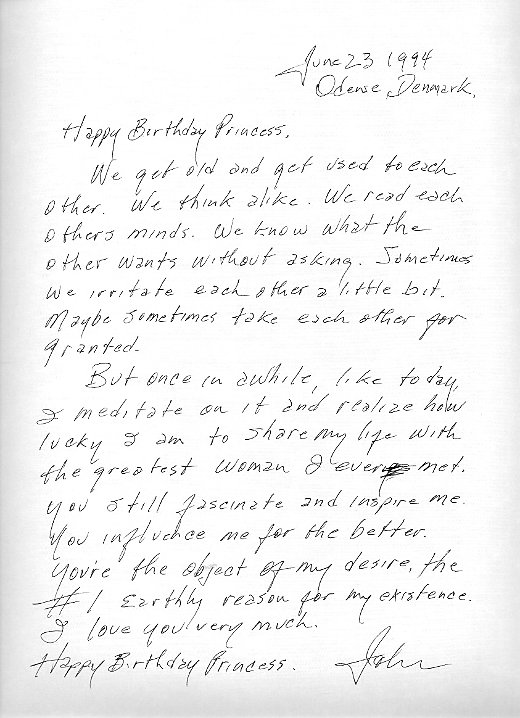
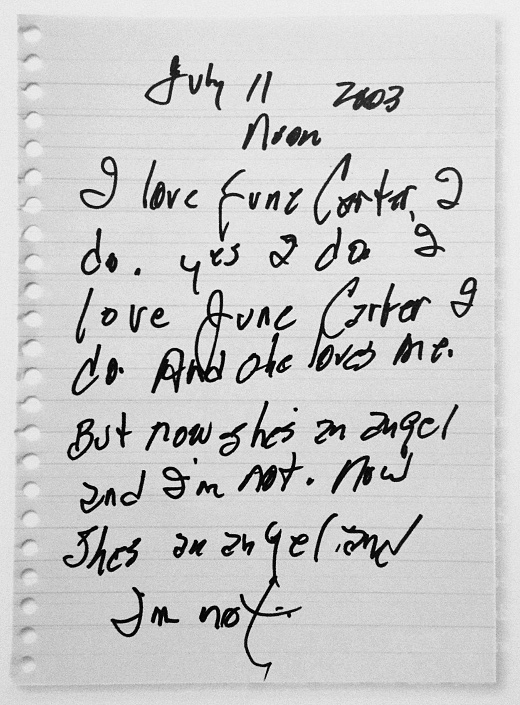
On March 1st of 1968, Johnny Cash married June Carter. They remained together until her death 35 years later. Below are two notes, both written by Cash — the first to June in 1994 on the occasion of her 65th birthday, and the second shortly after her death in 2003.

Johnny Cash passed away two months later, four months after his wife.

Transcripts follow.

(Source: House of Cash; Image above, via.)


Transcript
June 23 1994

Odense, Denmark.

Happy Birthday Princess,

We get old and get used to each other. We think alike. We read each others minds. We know what the other wants without asking. Sometimes we irritate each other a little bit. Maybe sometimes take each other for granted.

But once in awhile, like today, I meditate on it and realize how lucky I am to share my life with the greatest woman I ever met. You still fascinate and inspire me. You influence me for the better. You're the object of my desire, the #1 Earthly reason for my existence. I love you very much.

Happy Birthday Princess.

John


Transcript
July 11 2003
Noon

I love June Carter, I do. Yes I do. I love June Carter I do. And she loves me.

But now she's an angel and I'm not. Now she's an angel and I'm not.

RSS Feed proudly sponsored by TinyLetter, a simple newsletter service for people with something to say.
05 Dec 18:43

I put aside my childish things and then realised they were more important than I knew

by missheenan

I was excited about the film of The Hobbit, but now I’m not. It’s all my fault, I’m reading the book, because – well – one should – and apparently one shouldn’t have. As I wrote this paragraph yesterday, I had got to the point where the first film will leave us for a while* and in reading it I am reminded how much I don’t need a film of it – I’ve had a film of it in my head since I was six. I’ve been to Mirkwood and seen the boat tethered to the far shore in the darkness, I’ve watched the thrush knocking snails, I’ve longed for a fat little pony and a map with moon letters and held an elven blade in my hands and watched it glimmer, I’ve played riddles with Gollum in the dark and talked tricksily to dragons. As a child I walked everywhere I could barefoot and delighted in my extraordinary powers of night vision in the hope that I might actually be a hobbit. Why on Middle Earth would I want to watch the film?

I had the great good fortune to have a wonderful primary school teacher, Mrs G who read The Hobbit to us when we were 6, she still reads The Lord of the Rings every 2 years. It was Mrs G that nurtured my love of reading and reading between the lines.

I have no idea how many times I read The Hobbit between 1980 and 1992, but it was so often that reading it again seems almost unnecessary, but incredibly welcome in the disquieting times of moving to a new home and being terribly unsure of myself…it is very comforting to read the words and delight in Tolkien’s gentle prose. I remember every plot point, every little detail. I taught my sister to read using my long lost copy – the Smaug on that front cover was far more impressive than the weird bendy newt on the edition 10 years earlier. My sister’s first recognition of the word ‘The’ was the ‘The’ in ‘The Hobbit’. I loved many many books as a child, I would sometimes read three paperbacks on a Saturday, my book tokens couldn’t keep up with me. My favourites were these, I think. I am sure I could think of hundreds more.

The Phantom Tollbooth – it was the first book that seemed to get my synaesthesia** – the letter x definitely tastes of stale smoke, and the idea that a dawn sky is composed always thrilled me.
The Dark is Rising sequence (I think The Dark is Rising is my favourite – although Silver on the Tree is incredible) I have no idea where my boxed set of it is. I came back to it when I studied The Mabinogion at university, and I still thrill at reading the Croeso i Loegr’*** sign when I return to England from Wales.
Abel’s Island (I knew of this before I knew of William Steig’s Shrek, Abel is basically a mouse version of Robinson Crusoe…I loved stories of domesticity, in fact, it’s the moments of cosiness in hardship of Tolkien’s writing that I love the best)
The Magician’s Nephew is my favourite Narnia story. Obviously The Lion The Witch and The Wardrobe is perfect, but The Magician’s Nephew charmed me in a different way. I think it’s because I like guinea pigs so much.
I’d like to say I was a huge Roald Dahl fan, but that’s changed with age…I read everything he ever wrote, Matilda is his masterpiece and it was Charlie and the Chocolate Factory that drew me in, but it’s Danny the Champion of the World that I love the best. I think that was how I decided I would always smile with my eyes and not my mouth. What Katy Did at School is a brilliant tale of How Girls Should Be To One Another – when things go awry in my life, I always remember how Katy gets through a terrible injustice with dignity “I seemed to hear her voice in the air, saying over and over, ‘Live it down! Live it down! Live it down!’” I always longed for a friend like Rosy, but I suspect I am a Rosy myself.
Oh and Five Children and It. Everyone should have a Psammead and be as Beautiful As The Day for a day. No matter how troublesome it might be until sunset.
I read a lot of Enid Blytons, and wrote to her publisher(s) at the age of 8 in disgust when I found the same plots and characters reapeated in different books.
The Growing Summer by Noel Streatfeild**** – I’ve always wanted to be crazy old Aunt Dymphna, singing to the seals and listening to the gulls and caring about the things that are really important in life, rather than what adults say they should be.
Oh. I almost forgot – E.B. White, whose words are so wise and so funny***** (I love his essays) – my MacBook is named EB after him. And the best of all his books: Charlotte’s Web…’It is not often that someone comes along who is a true friend and a good writer, but Charlotte was both’ still makes me cry my eyes out every time.
Oh and The SIlver Sword and I am David. Argh that’s too many favourites. I read a lot of books. I wish I were that little girl still. She’d be annoyed at how little I read now.

*Thanks to rollicking insomnia last night I’m now well into the third film
**I have synaesthesia (I think everyone does, they just don’t know it or ignore it) numbers and days are colours and pictures (as a child I was brilliant at mental arithmetic because my times tables and fractions are incredibly colourful images – 6*7 = 42 involves trapezes) and I taste colours.
***And yes, to the Welsh, I am still a Saxon. Whereas to us they are The Foreigners.
****I devoured Ballet Shoes, The Painted Garden and White Boots – her books were very good at explaining why adults were always so worried about everything
*****Two things he said that make me love him very dearly…”I arise in the morning torn between a desire to improve the world and a desire to enjoy the world. This makes it hard to plan the day.”
“I can only assume that your editorial writer tripped over the First Amendment and thought it was the office cat.”

20121205-112733.jpg


05 Dec 18:41

The Beatles - Fan Club Christmas Flexi’s - Free Download

by Cookie
"Starting in 1963, the Beatles started recording and releasing a special 6 or 7 minutes Christmas single, in the shape of a 7 inch flexidisc (looks like a single, but is thinner and made of plastic), which they had distributed to members of their official fan club. These records are very rare today and difficult to get hold of. There have been several releases that include outakes, alternates, etc. These are the original recordings as The Beatles released them." Link via The Great White Wonders Buy The Beatles Stereo Vinyl Box Set (2012) Related articles 45's Of The Week: (San Jose, CA's) The Stained Glass The "Swiss Beatles" - Les Sauterelles - "Dream Machine" (Rendezvous In Bruxelles 4.7.69) - CONTEST: The Beatles Remastered Vinyl Prize Pack (Mixed Media) Britain's rarest record - yours for £200,000
05 Dec 16:41

Shares for rights: The right to have your opinion listened to has been ignored

by Nick

If you ever wonder why people think government consultations are just a matter of routine that they get out of the way before they go and do what they’ve always planned, then the Government’s response to their ‘shares for rights’ proposal (PDF file) won’t surprise you at all. It’s a masterpiece of setting out all the reasons people have objected to the policy and pointed out reasons why it’s not needed and why it won’t work, then blithely responding that the Government intends to press ahead anyway.

As the Guardian reports (and LabourList illustrates with nice graphs) the clear majority of responses were against the proposals, but the changes suggested within the government response are cosmetic at best.

It appears that yet again, ideology has trumped evidence, and George Osborne will be continuing to push ahead with this, regardless of the fact that almost no one appears to want it. The effort put into this could have been put into some real measures to promote employee ownership, mutuals and co-operatives, but instead we have this scheme which seems to be a way for unscrupulous employers to screw their employees out of rights in exchange for a few magic beans, or for rich investors and their ilk to find more ways to avoid paying capital gains tax.

What really annoys is that while the fingerprints of the Treasury are all over it, this scheme is being pushed by the BIS department, which is one with a Liberal Democrat Secretary of State and Minister. (Indeed, one of Jo Swinson’s first roles at the department was appearing in the introduction to the consultation) They surely must have seen the reaction that this has had from the party, so why did they not take the opportunity to kill it when they were given the tools to do so? Indeed, why were they even attempting to push it through in the first place (under the smokescreen that we supported employee ownership, so we should support this)?

There’s no evidence supporting this proposal, there’s clearly no will or desire for it, it’s not in the Coalition Agreement and has never been approved by the party conference, so Liberal Democrats in Parliament should have no hesitation in voting it down and removing it.

05 Dec 13:33

Competition winner and 19 years.

by Jac

Thank you so much to everyone who entered the Many Happy Returns competition. I was over the moon that so many people entered, and thanks and congratulations to Steve Chandler who my random number generator (ie a couple of D10s) picked out as the winner.

And thank you to everyone who’s bought Many Happy Returns. You’ve made me very happy. You may be forgiven for thinking I am in fact *not* very happy as the rest of this post is oh-so gloomy, but to the best of my knowledge there’s no law that says you can’t be two totally contradictory things at once, and if there is, I am prepared to break it.

I’ve now been ill for 19 years. That feels like quite a long time. I was 21, now I’m 40. In another 19 years my children will be 25 – heck, I might be a granny! – and that’s *really* hard to get my head around.

How can it be that there’s been no progress – if anything, there’s been the opposite – for us in the medical world in all that time? How come people *still* think it’s either a thing where you feel a bit tired or it’s a thing that maybe isn’t really a genuine disease after all? (I wish I could adequately describe the bone-deep weariness, the pain, the shivers and shakes, the ataxia, the pins and needles and the numbness and the blurred vision and the way your body and brain are on constant fight-or-flight alert while being simultaneously so exhausted you don’t know how to keep going for another minute. Oh, and the memory loss. I’m always forgetting the memory loss.) How can that possibly be, with so much evidence to the contrary? ME isn’t even diagnosed any more in the UK, we’ve been lumped in with something called ‘chronic fatigue syndrome’. That’s what I’m told I have now, my nearly-two-decades diagnosis being suddenly obsolete.  Oh, and how come we’re constantly battling the press, who want to tell the world that PWME are (a) easily cured with exercise and/or a positive attitude, (b) militant terrorists who scare off all decent researchers (and journalists) and (c) prejudiced against sufferers of mental illnesses. None of these are true! Today, I do feel quite hopeless. Not for my own situation – I am lucky enough to have an enormous amount of support – but for the world of ME in general. The internet has changed things, but it hasn’t changed things anywhere near enough. We can compare notes, and that’s great, and we can be supportive of each other, but it’s still us and them, and we’re still pretty much screaming into the darkness.

There was a news story that I found very exciting this week, as a EBV-triggered PWME: http://www.naturalhealthadvisory.com/daily/fatigue-lack-of-energy/first-ever-test-for-chronic-fatigue-syndrome-symptoms-is-close/ I want to have hope, but the chances are we’ll never hear of this again – as has happened with so many other promising headlines over the years.

The work of Dr Fluge and Professor Mella in Norway – they discovered by chance that a cancer drug, Rituximab, had a substantial effect on ME – seemed a huge breakthrough. This morning, it was announced that the Norwegian health authorities have refused to fund a further study.

The Countess of Mar – the only positive thing to come out of an unelected second chamber – has written an open letter to the man who many PWME see as the direct cause of the UK’s problems. Big cheer for her! But it won’t change anything. The chances of anyone reading it who hasn’t already declared a side is rather slim. http://www.investinme.org/Article-395a%20Letter%20from%20Lady%20Mar%20to%20SWessel.htm

And why Jenny’s story isn’t on the front page of all the newspapers, I just don’t know. http://www.jkrowbory.co.uk/2012/12/8-years/

We’re doing all we can. And you’re helping. Yes, you – you, the person reading this! (Unless you’re reading it to laugh at the poor deluded sick person, in which case I hope you get visited by four ghosts come Christmas.) I pray that in 19 years I will look back and remember 2013 as the year that everything changes for the better.


05 Dec 13:09

That NHS spending row in full

by Stephen Tall

The story: Conservative Health secretary Jeremy Hunt ‘rebuked’ for claiming the Coalition has increased NHS spending in England.

The promise: that the NHS budget in England would be increased in real terms during the Coalition. That promise was kept (just) — the 2010 Spending Review committed the Coalition to a 0.1% real-terms annual increase.

The reality: the NHS did not spend all its budget in 2011/12. As a result, the out-turn in NHS spending has, probably, marginally fallen since 2009/10. Though the UK Statistics Authority concludes: “Given the small size of the changes and the uncertainties associated with them, it might also be fair to say that real terms expenditure had changed little over this period.”

The analogy: If you get a pay increase but don’t spend it all, would you be right to argue that your employers had cut your pay?

The context: Spending on the NHS in England is planned by the Coalition to be higher throughout this Parliament than it was in any year under Labour.

The sting in the tail: Just because the Coalition is increasing the NHS budget in real-terms doesn’t mean there aren’t big, looming problems in the affordability of health-care, as the IFS has highlighted, especially if the Dlnot reforms of social care are implemented in full or in part.

* Stephen Tall is Co-Editor of Liberal Democrat Voice, a Research Associate for the liberal think-tank CentreForum, and also writes at his own site, The Collected Stephen Tall.

05 Dec 12:12

USA is the only major country not to support treaty covering books for the visually impaired.

USA is the only major country not to support treaty covering books for the visually impaired.
05 Dec 12:11

The New World of Publishing: How To Get Started Selling Fiction in 2013

by dwsmith

In the old days, meaning more than three years ago, the path to becoming a professional fiction writer was pretty simple to understand. You wrote stories and novels and mailed them to traditional publishers directly. When the story was rejected, you kept the story (or novel) in the mail until someone bought it. 

Well, not so much anymore. Fiction writers now have that dreaded word: Choice. And so, the path to being a successful fiction writer isn’t so clear anymore. In fact, I would call it downright muddy.

So as part of my series here at the end of 2012, looking back and looking forward, I thought I would do an article on the good stuff and the bad stuff you face in getting to a solid career as a fiction writer.

Warning: Some of you beginning fiction writers may not like my suggestions or observations. Just remember that there is no right way and there is no one way for all writers to take.

I’m just going to try to put some road markers up to keep a few of you out of the ditch. Follow or not follow. It’s your career. Your choice.

The Major Choices

Let me detail out what I see as the six major paths that a fiction writer can take in 2013 when starting out.

1… Follow the myths, write one novel, rewrite it to death, then spend all your time tracking down an agent. (This path seldom leads to a decent sale or decent writing, but most beginning writers still follow this path like blind sheep.)

2… Write a novel and mail a submission package for your book directly to editors. Then while that book is in the mail, write more novels and mail them as well while working on becoming a better storyteller. This is the way it’s been done forever in publishing and is still valid. (Only difference now from ten years ago is that now you need an IP attorney to work on your contract instead of an agent. Contracts are much more difficult these days.)

3… Follow the myths that have developed over the last few years. Write a novel, rewrite it to death, pay a gad-zillion bucks to have someone put it up electronically for you and then take a percentage of your work, then you promote it to your 200 friends on Facebook until they start fleeing out of disgust. This path seldom works, but it is part of the promotion myths.

4… Write a novel, learn how to do your own covers and formatting, put the novel up yourself electronically and in POD and then write the next novel and work on learning and becoming a better storyteller. Repeat. Do not promote other than telling your friends once each book is out. This is more of a standard, traditional path that will work, but takes time as you learn how to tell better stories that people want to read.

5… Follow #4 and #2 at the same exact time, telling the editors in the submission package that the book is self-published electronically and sending them a cover in the package. Very few beginning writers are trying this method  yet because they are afraid traditional editors will come to their houses and break their fingers (or some other fear just as stupid.)

6… Forget novels completely and only write short stories, selling to traditional magazines as well as publishing indie. This method has a lot quicker feedback loops and is a good way to learn how to tell great stories, but it takes a mind set most beginning writers do not have. And you must learn how to do all the indie publishing work yourself. This method was never a path to making a living writing fiction, but now it is possible if you really, really, really love short fiction. Otherwise, just write a few stories here and there to help your novels.

That’s the six major paths I see toward making a living selling fiction in 2013. (You won’t make a living starting in 2013, but they are all paths toward making a living in time.)

Or you can come up with your own slight variation on those paths. #1 and #3 don’t work unless you get fantastically lucky. #2 and #4 lead to long careers, but take time to build. #5 might get you to making money a little faster, but it will still take years, as it should. #6 only if you love short fiction.

In my opinion, all writers these days should be writing, selling, and publishing some short fiction along with writing novels. The short fiction market is booming and short fiction should just be a part of any business plan for a fiction writer. (Yeah, yeah, I know, you can’t write short fiction. So learn and stop whining.)

The Problems New Writers Face in 2013

Let me list a few of the big ones.

1) Myths.

These are everywhere, and are mostly flat stupid. But all beginning fiction writers (me included in my day) buy into myths because beginning writers look for the secret handshake, the shortcut, the way to sell books without learning how to write good stories.

The truth is that the best way to sell books is write a lot, work on learning how to be a better storyteller constantly, get your work in front of editors or readers or both, and plan for the long haul. But new writers ignore that advice.

Examples (not all by a long ways) of some major myths in 2013 are:

a) You need an agent to sell a book.

b) You need an agent to sell a book overseas.

c) You need an agent to sell to Hollywood.

d) Traditional publishing gives you better quality in production and editing.

e) If you lower your price to 99 cents on your novel, you will make more money.

f) As an indie publisher you can’t get your books into bookstores.

g) You can pay someone to help you sell a lot of books.

h) You need to promote your book.

Again, there are many more, but those are what I consider the top eight killer myths.

2) Reactions to information.

In this high-speed world of the information age, any person can offer an opinion. This blog is no exception. The problem beginning fiction writers face is what to believe, what to listen to, and what to ignore. Now granted, this was the problem when I came in as well back in the 1970s, but now the information is out for everyone to see no matter the source. In my day, we only had to sort out what the established professionals were saying. Now anyone who has a few short stories up can blog about how they did it and what everyone should do.

And then add on “information sharing” places like the Kindle Boards and Goodreads and you have information overload.

How to solve this problem? I have no easy solution.

One suggestion is set up a writing computer that is only for creation of new words. Have no games, no email, no internet connection on that computer. Make it only a writing computer. That way the creative side of things has a line between it and the information overload and opinions flooding at you from everywhere. It honestly will help and be worth the few hundred bucks for a new computer.

Second suggestion is to only listen to people who have more than ten or twenty novels in print and who have been in the business for more than twenty years. Also, make sure this person is also versed in both sides of the business of publishing, both traditional and indie. Some of the old professionals still have their heads in the sand and can hurt your worse than listening to a person with a few titles out indie only. Find the balance between the two extremes.

Third suggestion is listen to your little voice. If it sounds wrong to you, it might be. But if the advice coming at you makes business sense for you, then explore it.

In other words, it’s your career and there are no right answers. Learn to think for yourself.

3) Getting in a hurry.

This is the area that is also normal for beginning fiction writers. And I honestly don’t know the reason why, but I was no exception to this problem when I started out. Now, with the indie publishing, this problem is no longer hidden in each writer’s office, but is out on full display for the world to see.

When watched from the outside, and from a point of distance like I now have, this all seems laughingly funny to me. I watch new writers, who have managed to complete their first novel, promoting the life out of their “book” because they believe they should, and then complaining when there are very few sales.

From a place of perspective, this is like watching a brand new violin player stride onto the stage at Carnage Hall with their very first recital piece and wondering why no one showed up to listen even though they advertised their concert to everyone they knew. Let me simply say, “Duh.”

A first recital piece is not a professional piece of work. But new writers sure think it is.

All fiction writers, at some point, given enough time, start to understand that to become a good storyteller it takes time. John D. McDonald said every fiction writer has a million words of crap in them before they reach their first published word. I agree and could go on about why this is so, but don’t have the time in this article.

Some writers work out those early words in other ways. Orson Scott Card wrote ten years of plays before trying and selling his first short story. I did my early words all by writing fiction, right from the start. And for writers who do it my way, my pace was pretty normal in hindsight.

1975 to 1982 I wrote 14 short stories, about 50,000 words. (I was trapped in the rewriting myths.)

From 1982 to 1987 I stopped “polishing” everything to death and wrote about 200 short stories and two unpublished novels, about 1,200,000 words of fiction total. I sold my first novel in 1987, the third novel I wrote. (I had sold some short fiction along the way, but all mostly from from just having the right elements come together with a unique idea, not because I knew what I was doing.)

So I believe I started really writing in 1982 and it took me five years of intense work, sometimes a short story per week. I also focused heavily on learning in those five years while I got to my million words and started to sell decent numbers of copies.

So one of the worst problems new fiction writers have now is that inability to see that the fiction writing profession is an international profession and it takes years to learn, both on the craft side and the business side.

Another way of looking at it is a person who wants to be a lawyer hangs out a shingle and tries to get cases while he is a freshman undergrad in college. Laughable, right? And you are promoting your first written novel?

The solution to this is take a deep breath, focus on the writing and learning to write better stories and put the books out either indie or to editors or both and leave them alone. If you get a few buyers, great. If not, no big deal. Trust the audience and the editors to decide when you have graduated to professional-level storytelling.

 The Path in 2013

I’m going to give flat out advice right now. Please understand this is only my opinion and please take or leave what you want.

My advice to young writers for 2013:

1) Spend 80% of your focus and time on producing new fiction. Not rewriting, not researching, but producing new words on the page. Period. (Follow Heinlein’s Rules to the letter.)

2) Spend 15% of your time on learning craft and business. Both a little at a time. In any way you can.

3) Spend the remaining 5% of your time mailing finished work to editors or getting your work up indie published or both. (The #5 path above I believe in 2013 is the best if you have the courage.)

4) Think five and ten years out and set production goals. (Not selling goals, you are not in charge of those, but you are in charge of your own production and how much you learn.)

That’s it.

Simple.

The writers who follow my suggestions are following a path well-worn by generations of professional writers. All of us did it just slightly different in the details and time depending on our background, but we all walked that same basic road.

Even with the indie publishing side of things, which can help cash flow a little, this new world has not varied from the time it takes to learn how to tell a decent story.

Telling a good story is an art form. As with any art, the art takes time to learn.

Make writing new words your main focus.  Make learning business and craft your secondary focus. And get your work out for people to read.

Don’t get in a hurry.

It really, honestly, is that simple.

And that hard.

————————————————

Copyright © 2012 Dean Wesley Smith

Cover art copyright Philcold/Dreamstime
————————————————–

This chapter is now part of my inventory in my Magic Bakery.  

I’m now getting back to writing fiction, so every word I write here takes time from that. And I have to justify this column somehow in how I make a living.

So, if you feel this helped you in any way, toss a tip into the tip jar on the way out of the Magic Bakery.

If you can’t afford to donate, please feel free to pass this chapter along to others who might get some help from it.

And I would like to thank all the fine folks who have donated over this last year. I don’t always get a chance to respond, but the donations and the comments both after the posts and privately are really keeping me going on this. Thanks!

Tip Jar: Go To Paypal

05 Dec 12:01

The rise of UKIP: what does it all mean?

by Mike Smithson

By Dr. Rob Ford – University of Manchester

As pb.com readers are doubtless aware, the UK Independence Party had their two best ever by-election results in recent weeks – scoring a record 14% in Corby in mid-November, then topping this again with 21% in the Rotherham by-election last week. This sharp rise in support – and the continued polling and by-election misery of the Liberal Democrats – have understandably lead to a lot of discussion.

    Where is support for UKIP coming from? What do UKIP leaning voters want? And what are the implications of UKIP’s rise in the polls for British politics going forward?

To answer some of these questions, I can draw on a very large and comprehensive data sources to show this – the British Election Study Continuous Monitoring Survey, conducted by YouGov every month since about 2004. This is an invaluable resource, with detailed information on the views and political preference of hundreds of thousands of voters surveyed over the past 8 years.

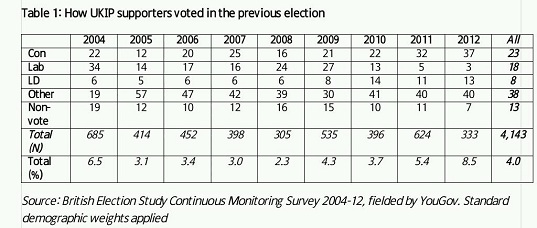
First, let’s take a look at where UKIP voters come from. Table 1 charts how current UKIP voters report having voted in the previous election. Since the Coalition began in 2010, UKIP’s support has more than doubled, from under 4% just after the 2010 election to nearly 9% in the most recent poll months. A big part of this rise is indeed due to Conservative defections – the share of former Conservatives among UKIP voters has risen. But it has risen from a low base. In 2009, roughly 2 in 10 UKIP voters had voted Conservative in the previous election. Now, it is 4 in 10. So, even now less than half of UKIP’s current support is coming from former Tory voters.

Another 40% or so voted “other” in the previous election – these are mostly UKIP loyalists who cast ballots for their current party at the last election. Might such voters be tempted over to the Conservatives? Perhaps, but research I have done with colleagues on UKIP loyalists suggests many come from working class, Labour leaning backgrounds, and are deeply hostile to all the establishment parties. This is borne out in the YouGov data – UKIP supporters’ views of all three parties’ leaders are strongly and persistently negative, and they are more likely to express alienation from politics and dissatisfaction with democracy. It is very doubtful that the Conservatives would sweep such voters if they allied with UKIP. And on top of this, a further quarter of recent UKIP support has come from Labour and the Lib Dems, or from abstainers. These are not groups the Conservatives are likely to win over with an alliance.

So, while some Conservative support seems to be leaking to UKIP recently, they are by no means solely a home for discontented Tories. This brings us to the second question – what motivates UKIP voters? UKIP politicians themselves tend to trumpet their growing popularity as vindication of their core agenda: Europe. While British voters have become more sceptical about the EU over recent years – unsurprising give the steady flow of “Eurozone crisis” news – there is little evidence that the rise in UKIP support is the result of a surge in concern about the EU.

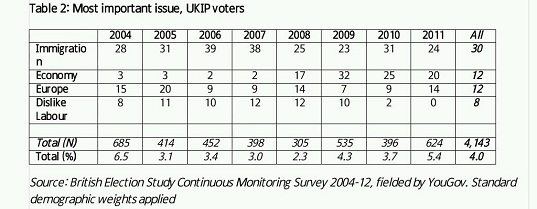
Table 2 shows the four most popular answers UKIP supporters have given since 2004 when asked what is the most important issue facing Britain. The most popular answer, by far, is immigration, named by 30% of UKIP respondents overall, and the most popular answer in every single year since 2004. Europe has seldom even been the second biggest issue in UKIP voters’ minds: since 2008, the economy has taken precedence, and before that voters were more likely to point to a general dislike of the Labour government. To put in bluntly, most UKIP voters (unlike most UKIP politicians) do not regard Europe as the main issue on the agenda.

So UKIP’s rise is clearly not the result of temporary defections by Conservative voters annoyed about Europe. What, then, is going on? My ongoing research with Matthew Goodwin suggests that UKIP shares many characteristics with “radical right” parties such as the Dutch Party for Freedom, the Danish People’s Party, the Austrian Freedom Party and the True Finns. Like these parties, UKIP mobilises voters who are primarily concerned about immigration, but are also typically nationalist, Eurosceptic and deeply disaffected with the existing political elite. In many cases these parties, or their leaders, began on the mainstream right, before breaking away to focus on a more populist agenda.

UKIP’s evolution has been similar – it began as a rebellion on the centre-right over Europe, but under Nigel Farage has developed a broader populist and anti-immigration agenda. UKIP’s appeal – anger over immigration, anxiety about national identity, hostility to the EU and a deep disaffection with “politics as usual” – cuts right across traditional party dividing lines, enabling the party to recruit angry voters regardless of who is in charge. As table 1 shows, UKIP was as successful winning over grumpy Labour voters during the previous government as it is at winning grumpy Tories now.

What lessons can the parties draw from all this? The Conservatives need to realise that Michael Fabricant’s plan for a blue-purple alliance is, in the words of one of my colleagues, “the politics of not understanding data”. UKIP voters are a more diverse, and disaffected, lot than right wing Conservative backbenchers seem to realise. Most are not former Conservative voters, and are unlikely to be thrilled if their party – which recently ran on the slogan “Sod The Lot: vote UKIP” – were to align itself with a political elite which disgusts them. A UKIP alliance will deliver few votes, and less seats. Indeed, by alienating moderate voters, such an alliance could do more harm than good.

Labour should not celebrate the rise of UKIP either. UKIP’s agenda – hostility to immigration, social conservatism, Euroscepticism and populism – proved almost as appealing to Labour voters in 2004-10 as it is to Conservatives right now. UKIP’s strongest support often comes from older working class voters, who often have traditional left wing loyalties. A strong UKIP will pose as many problems for an incoming Labour government as it does for the Conservative incumbents.

Finally, UKIP politicians and activists themselves need to develop a clearer understanding of what the surge in UKIP support means. UKIP’s voters, new and old, are angry about immigration, threatened by social change, and deeply hostile to the political class. This does reflect a coherent set of public concerns – we find it in other countries too – but it is not the concerns which most exercise many UKIP activists, who are often focussed on deregulation, tax cuts, and above all, Brussels.

This disconnect raises a serious problem for UKIP: it cannot become a genuine “third force” in British politics without an activist base able to mobilise voters. Yet the concerns which seem to attract activists to UKIP are very different to those which attract voters to the party. This may explain why UKIP’s persistent inability to break through in local elections – the party lacks the candidates and activists willing to undertake the hard slog of local politics, or a coherent agenda to sell to local voters.

This is the difference between the Liberal Democrats and UKIP. The Lib Dems have a relentless focus on local organisation, and use this to channel popular discontent into local election wins, by-election wins, and eventual Westminster success. Tip O’Neill once observed that “all politics is local”, and under first past the post this is the brutal truth: UKIP may carry on rising in the national polls, but without local strongholds they will win nothing in a general election. Nigel Farage is riding high right now, but without a radical shift in party strategy I wouldn’t bet on seeing him or any of his colleagues warming the benches of the House of Commons in 2015.

Doctor Rob Ford is a Politics Lecturer at the University of Manchester. He’s currently working on a book with Matthew Goodwin which looks at support for the BNP and UKIP. Due out in about a year.

05 Dec 11:55

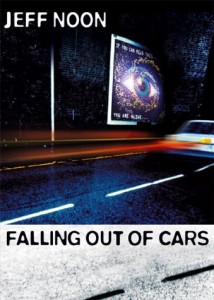
Welcome to the Pleasure Dome – The Jeff Noon Interview!

by Illogical Volume

In which two men enter and one frisky little blog post leaves…

With his feather-frazzled early fictions (Vurt, Pollen, Automated Alice and Nymphomation), Jeff Noon presented the world with a distinctly British (no, wait – English!) version of cyberpunk – one that side-stepped all those designer shades and phallic head jacks in favour of something that was a little bit less ashamed of its fantastical status. In his short stories (Pixel Juice, Cobralingus) and transitional ode to musical Manchester Needle in the Groove, Noon drifted even further from traditional modes of science fiction, working to match the ever-adapting techniques of then-contemporary electronic music and – in Cobralingus – offering a “how to” guide to the curious reader in the process.

Until recently, 2002′s Falling Out of Cars looked like it might be the last Jeff Noon novel. If the fractured mirror landscape of the book often proved to be as startling and dissociative for the reader as they were for the characters then that was probably a feature rather than a bug – Falling Out of Cars made the fact that all of Noon’s adventures in wonderland had been tainted by life on this side of the mirror horribly clear.

This notion was always there in Noon’s work – no amount of strain is going to make a looking glass show something that isn’t already here waiting to be reflected, after all – but in Falling Out of Cars it became inescapable. This made the subsequent absence of a “new Jeff Noon novel” seem more explicable, if still somewhat tragic – what better note for an author to stop writing on than this, a story about people whose very ability to comprehend the world and words around them was slipping away.

There were some signs of writerly life though, like 2008′s 217 Babel Street - a collaborative hyperlink fiction the served as the real world scaffolding on a fictional location – and 2012 has seen Noon’s strange pollen corrupting the air stream on a previously inconceivable scale. Noon’s endlessly imaginative twitter account is one of the best follows out there for those in a Mindless frame of mind, and if his microfictional “spore” fictions leave you craving more there’s always the echovirus12 account, to which Noon also contributes.

For those who like their fiction to occupy a more traditional form, there’s also a new novel, Channel SK1N, the story of a pop star who finds her skin overridden by the signals all around her as she transforms in a way that blurs the line between broadcaster and receiver. I’ve only just finished reading the book, and I hope you’ll forgive the ecstatic tone of this introduction because Channel SK1N combines the lysergically enhanced rush of Noon’s early fiction with the queasy comedowns of his later work, and in doing so reaffirms sci-fi’s status as the best tool available to writers who want to explore a future that’s here somewhere, already hidden.

Still buzzing off my contact with his SK1N, I got in touch with Noon to discuss his dazzling reemergence as a self-publishing internet invader…


GITWIllogical Volume: It’s been ten years since you slipped through the darkly reflective cracks of Falling Out Of Cars; ?dlrow rorrim eht ni emit ruoy saw woH

Jeff Noon: Falling Out Of Cars seemed like the end of a period in my life, work-wise, and also I’d just left Manchester (my home town), so it felt like a good time to make some changes. I fell into screenwriting, and had some fun days and some bad days in that world. I was working on various scripts for a number of production companies. I also went back into the theatre, which was my first love in writing terms. I did a play for The Crucible Theatre in Sheffield about the early days of the Mod movement and a science fiction audio play for Radio 3. I still hang onto hope regarding the film scripts, but it’s a difficult media to succeed in, no doubt about it. Eventually, I realised that I’d been without a proper audience for 10 years, so I started writing prose again. I dug out Channel SK1N, which I written a draft of a couple of years previously, and started working on that. And that was the transit point.

IV: Has it been difficult to transition back to Universe A, or have the many micro-realities of twitter helped to buffer your re-entry? I mostly ask this because for a writer who rose like a fluorescent Batman from the gaudy Gotham of a pre-internet Manchester, your writing seems uncannily well-suited to these times of ours, as both the image overload of Channel SK1N and the spooky precision of your twitter “spores” so skilfully illustrate.

JN: I’d never actually given up on writing stories and such, during the “dark years”. I mean, I experiment every day with words, shifting them around, searching out new combinations, new coinages, new alchemies. I love all that. The structure and subject matter of Channel SK1N allowed me to incorporate some of those experimental techniques into the narrative. So, on those terms, it wasn’t too difficult to get back on track. It was a matter of refocusing, more than anything else. I just tried to just have fun with the novel, and not worry too much about outcome or reception. To just write and see what happened. And then when it was finished, we decided to go down the self-publishing route, to explore the new possibilities of that sphere. I believe these next few years will be filled with experiments, and only self-publishing gives authors the freedom to do what they want, when they want. Regarding twitter: the spores are an outpouring of my natural self, as an ideas-creator. Twitter gives me the perfect medium to express those ideas via a more or less daily output. I love the engineering aspect of it as well; having to express a story or a feeling within such a tiny realm.

GITW

IV: Do you plan to collect your spores in the future? Twitter is almost as cruel as time itself when it comes to swallowing the past, after all…

JN: I will definitely be collecting the spores together in the near future. The volume will be called Pixel Dust, and will include other material as well, including some remixes. There are a number of other very exciting projects coming out of the spores, in music, in digital arts and so on. More news on all that, soon. It’s really funny, because when I started the spores I had no inkling that they would turn out the way they did; lots of different people seem to be very keen in using them as starting points for their own creations. That’s ideal, for me. A short story contains its own interpretation, so it’s quite difficult to follow on from it. But the spores are so tiny, they can be interpreted in many different ways.

IV: I read Channel SK1N after a heavy Ray Bradbury binge and it seemed to have some of the late, great author’s poetry about it – any dark rituals you want to confess to or does this connection only exist in my head?

JN: I read more or less everything by Bradbury in my late teens, early twenties, and I’ve re-read a few of his works over the subsequent years. I really loved his imagery and his atmosphere. I think he was an influence on my books. He was the SF writer who really understood the poetic, romantic nature of the material. And I see myself as following a similar pathway. Also, he had a very personal style, you know? I like writers who you can recognise from a couple of sentences, and Bradbury has that quality. So, with him it’s not just about the plot and the characters, but also with how the tale is told. And he has an extra element, a certain darkness that is never really expressed fully. It’s underlying. Form, content, the shadow. He was the whole deal. GITW

IV: While we’re talking about the poetic nature of your work, did you have any difficulty balancing the sinister with the romantic in Channel SK1N? I’ve never a read a novel that was so in tune with the romance of the busy screen or so attentive to the way these screens consume us, so to experience both feelings in the one book was pretty startling for me.

JN: I’m glad the book affected you this way, because this is very much what I’m aiming for in my work. I really don’t get on with art that tries to coerce you into believing the same things as the artist. So, I always try to present a subject from all angles, to presume that everyone is operating from their own hearts. All the characters, all the machines, all the systems; they all have their own intentions. I try to show these various aspects, as best I can. So Channel SK1N isn’t a novel, I hope, that just says television is bad for you, or that reality documentaries or talent shows are bad, or that commercial pop music is bad. I really wanted to look at the pulse behind all those things. So the protagonist of Channel SK1N, Nola Blue, is trapped in that mediated world to begin with, then she starts to question it, then she attempts to escape it. She’s a human being who has direct contact with the media as a living entity; the TV signal is taking over her body. Sometimes that appears to be a parasitic relationship; later on it’s more symbiotic. But it definitely is a dynamic, changing relationship, it’s not just victim and oppressor. Merging the sinister with the romantic creates a worldview and a way of writing that allows the characters and the subject matter to flourish, to be explored fully.

IV: Having mixed words with music on the Needle in the Groove CD, would you be tempted to go further in this direction? It strikes me that audio-novels could adapt well to the current tech-heavy landscape with the help of crafty thinkers like yourself.

JN: There is a company showing interest in audio novels, but I think just with an actor reading them. I agree it would be very interesting for people to create more involved versions using noises, music, dialogue, description and so on. It would be cool. Maybe, one day.

IV: Your Vurty fictions were formative for many a Mindless man, so I was wondering if there’re any comics built into YOUR foundations, and whether you’ve ever experimented with that form?

JN: I love comics. Always have done since I as a kid, collecting Marvel and DC comics back in the 1960s. In fact, it scares me to think of what I’ve lost over the years: complete early Spidermans, Daredevils, Fantastic Four, and so on. Of course, we were just kids; we loved them for the adventures and the fantasy elements, not for their future value. We didn’t view them as being art, or collectable in any way. We have a great comic shop here in Brighton called Dave’s Comic Shop. I love browsing in there, and I usually end up purchasing something of interest. I really like the way that comic writers and artists have such freedom when it comes to style and subject and form; they offer such a wide variety of formats and storytelling modes, it’s just crazy. Especially when you think of the novel, which in contrast always seems to be a story inside a box. I wish that novelists had the same freedom. So yes, I would love to write a comic one day. It’s on the bucket list. I’d always like to be involved in games creation. There are many ways to tell stories, and I really want to explore all the possibilities.

Share on FacebookShare on Facebook

Post to Twitter Tweet This Post

05 Dec 11:54

The all-or-nothing lie of fundamentalist Christianity (part 2)

by Fred Clark

(Part 1 of this post is here.)

I attended a private, fundamentalist Christian school. I also belonged to a fundamentalist local church.

Our church was an independent, fundamentalist, Baptist church. It had once been a Northern Baptist church, then split off to join the Conservative Baptists, then split off again to join the still-more-conservative General Association of Regular Baptists before eventually splitting off from the GARB to go it alone.

But our independent, fundamentalist and Baptist church should not be confused with an Independent Fundamentalist Baptist church, which is a very specific, and quite different, brand of fundamentalism.

There are many such different brands of fundamentalism. You’ve got your Calvinist fundies and your Arminian fundies, your premillennial dispensationalist fundies and your postmillennial dominionist fundies, your raucous holy rollers and your somber frozen chosen.

Denominations represented by the students at Timothy Christian School — my fundamentalist alma mater.

What all these groups have in common is that they all believe they have unambiguous access to absolute truth through the literal reading of the inerrant, infallible Bible.

I’ve strung together a bunch of adjectives there, but each is important for understanding the all-or-nothing, package-deal aspect of fundamentalist Christianity. The belief that the Bible is the “inerrant” and “infallible” word of God means that every word of it is true, without error, and thus it stands as the ultimate arbiter of absolute truth. The belief that this absolute truth should be read literally entails that it is accessible to us, which means it cannot leave room for ambiguity and honest disagreement between two well-intentioned, Spirit-guided readers.

So while the absolute truth of the Bible must obviously be defended against worldly enemies such as liberals, modernists and secular humanists, it’s even more important that this absolute truth be defended against other fundamentalists who disagree on any point of doctrine, however seemingly minor. We worldly types are a favorite bogeyman for fundies, but “the world” — a category just as comprehensive as it sounds — cannot pose an existential threat to the core of fundamentalist identity. Other fundamentalists can.

“The world” is wrong, but our errors reinforce fundie identity and fundie epistemology. We are wrong because we reject the absolute truth of the literal reading of the inerrant, etc., Bible. Those other fundamentalists, however, claim to accept the same epistemology, and that threatens to undermine the whole conceit, because if it is indeed true that the Bible provides us unambiguous access to God’s absolute truth, then all fundamentalists ought to believe exactly the same things.*

This is why if you go to a pre-Tribulation premillennial dispensationalist Bible prophecy seminar, you won’t hear speakers wasting their breath condemning historical or liberationist readings of the book of Revelation. They focus instead on the graver, existential danger posed by alternative fundamentalist readings, attacking the post-tribbers and mid-tribbers who distort God’s absolute truth even though they ought to know better.

That’s related, I think, to what Freud called the “narcissism of small differences,” but it makes a lot of sense from the fundies’ point of view. The belief that an inerrant Bible provides us access to absolute truth cannot be reconciled with the existence of competing fundamentalists who disagree on even the most esoteric points. Those groups can be attacked or avoided, but not accepted and accommodated. There’s no room for “let’s all agree to disagree.”

That helps to explain why there is such a multiplicity of fundamentalist denominations. And also why they tend to be so small.

And that smallness poses a big challenge for anyone trying to run a fundamentalist school. A functional school needs an adequate number of students and staff. Huge fundie mega-churches, like the sordid Hyles-Anderson creep-show in Indiana, are big enough to run their own schools, staffed and attended only by uniform members of their own churches. But most fundamentalist churches are nowhere near big enough to do that. For most fundie churches, having a fundie school for your kids means having to collaborate and co-operate with other churches — including with other churches that may not agree with yours on every detail of doctrine.

The website for my alma mater, Timothy Christian School, says that its students come from 150 different churches in 70 different towns. And as that pie-graph up above shows, those churches represent quite a diversity of religious traditions and perspectives.

When I was a student at TCS, I had many classmates and teachers who were members of Pentecostal and Assemblies of God churches. Those churches were just as fundamentalist as my own, and our churches were fully in agreement on many points of fundie doctrine — young-earth creationism, Rapture prophecy, inerrantism, literalism, KJV-onlyism, etc. (This was the late 1970s and early ’80s, so anti-abortionism hadn’t yet arisen to eclipse all of those as the pre-eminent identifier.)

But those Pentecostal and AofG churches also taught the charismatic gifts of the Holy Spirit, including a big emphasis on speaking in tongues, which they taught was the sign of the baptism in the Spirit and a necessary mark for any true Christian.

At my independent, fundamentalist Baptist church, speaking in tongues was forbidden. It was seen as, at best, a heresy, and at worst as evidence of demonic possession. Anything even slightly charismatic-seeming was frowned on at my church. I remember once someone raised their hands above their head during worship. Once.

One life-long member of our church graduated from Bible College and then went off to the Urbana missions conference where he went forward and committed his life to full-time Christian service as a missionary. Our church was very big on missionaries, providing financial support for dozens of them through our local mission committee. From a very young age, we were taught that full-time Christian service as a missionary was the highest calling for any Christian.

But it turns out that this guy from our church had signed up with a fundamentalist mission agency that our mission committee had come to regard with suspicion. The head of the agency, apparently, had been asked in an interview about speaking in tongues. He condemned the practice and said he had never done it himself, but he also said that he supposed, maybe, it might not be too grievous a sin if someone were to do it privately as part of their own personal prayer and devotions. This was regarded as an unacceptably lenient stance toward speaking in tongues, and so our mission committee denied the request for support from our own home-grown missionary to-be.

The point here is that the form of fundamentalism taught by our church was utterly incompatible with the form of fundamentalism taught by some of my classmates’ and teachers’ churches. Our church taught that they were not legitimate Christians, and their church taught that we were not legitimate Christians. Both sides took this disagreement very seriously, with the denial/acceptance of speaking in tongues regarded as a theological disaster equivalent to embracing evolutionary science or textual criticism. Each side regarded the other as violating the all-or-nothing package-deal of fundamentalist Christianity.

And yet there we all were at Timothy Christian School. We were studying together, praying together and taking turns sharing our personal testimonies in chapel together. We were agreeing to disagree, respecting one another despite our differences. We’d have shuddered to hear the word, but our practice was downright ecumenical.

We couldn’t both be right. We might both be wrong. We might both be partly right and partly wrong. And those weren’t supposed to be possibilities for people with direct access to the infallible word of God.

Our very presence there together forced us to acknowledge our difference of opinion. And that, in turn, forced us to acknowledge that such diversity of opinion seemed inevitable even among those of us committed to a literal reading of the inerrant, infallible Bible.

In other words it forced us to accept, at least implicitly, that unambiguous direct access to absolute truth might not be quite as accessible as we liked to pretend. And just like that, there goes the whole fundie epistemological construct and all the all-or-nothing, package-deal claims that go with it.

I could not have articulated any of that at the time, when I was still a student there at Timothy. But looking back, much later, I came to see this as a saving grace. It spared me from the intense crisis of faith I might otherwise have experienced when many of the ingredients of the package-deal I had been taught were destroyed in their collision with reality. The truths I had learned had been chained together with a ludicrous bundle of lies — young-earth creationism, PMD “prophecy,” etc. — but the chains did not hold because I had already come to see that the chains were not real.

Our teachers at Timothy Christian told us that our faith was an all-or-nothing package deal, but the diversity of traditions and theologies there at the school — as narrow as such diversity may have been — showed us otherwise. That provided us an advantage over the home-schoolers and other fundie kids who were schooled in more denominationally homogenous settings. Those kids were being set up for a crisis of faith.

We were too, but we were also — accidentally and inadvertently — being prepared to deal with it.

- – - – - – - – - – - -

* This isn’t to say that fundamentalists think that reading the Bible requires no interpretation at all. They acknowledge, at least nominally, that some parts of their doctrine are based on less-than surface-level readings of passages they admit can be confusing. So even a literal, common-sense approach to reading the Bible, they concede, may require what they like to call “rightly dividing the word of truth.”

But just as fundamentalists insist that the Holy Spirit guided every word of the Bible’s composition to guarantee its inerrancy, and — as many, if not all, fundies believe — that the Holy Spirit watched over every word of the Bible’s translation, to ensure the inerrancy of our English King James Version, so too they believe that the Holy Spirit will guide the faithful reader to ensure that reader is rightly dividing the word of truth. Inerrancy is not simply a claim about the nature of the Bible, but also a claim about our access to it — our ability to read the inerrant Bible inerrantly.

This framework ups the ante on any disagreement over the meaning of the Bible. If Bob and Jack disagree, then one of them must not be obeying the guidance of the Holy Spirit. And since Bob knows in his heart that he is a well-intentioned, real, true Christian who is genuinely seeking the Spirit’s guidance, that must mean that Jack is not. And Jack is assuming the same thing about Bob. It tends to get ugly from there.

05 Dec 11:48

Mixed Reference: The Great Reductionist Project

Submitted by Eliezer_Yudkowsky • 24 votes • 282 comments

Followup toLogical PinpointingCausal Reference

Take the universe and grind it down to the finest powder and sieve it through the finest sieve and then show me one atom of justice, one molecule of mercy.

- Death, in Hogfather by Terry Pratchett

Meditation: So far we've talked about two kinds of meaningfulness and two ways that sentences can refer; a way of comparing to physical things found by following pinned-down causal links, and logical validity by comparison to models pinned-down by axioms. Is there anything else that can be meaningfully talked about? Where would you find justice, or mercy?

... 
... 
...

Suppose that I pointed at a couple of piles of apples on a table, a pile of two apples and a pile of three apples.

And lo, I said:  "If we took the number of apples in each pile, and multiplied those numbers together, we'd get six."

Nowhere in the physical universe is that 'six' written - there's nowhere in the laws of physics where you'll find a floating six. Even on the table itself there's only five apples, and apples aren't fundamental. Or to put it another way:

Take the apples and grind them down to the finest powder and sieve them through the finest sieve and then show me one atom of sixness, one molecule of multiplication.

Nor can the statement be true as a matter of pure math, comparing to some Platonic six within a mathematical model, because we could physically take one apple off the table and make the statement false, and you can't do that with math.

This question doesn't feel like it should be very hard.  And indeed the answer is not very difficult, but it is worth spelling out; because cases like "justice" or "mercy" will turn out to proceed in a similar fashion.

Navigating to the six requires a mixture of physical and logical reference.  This case begins with a physical reference, when we navigate to the physical apples on the table by talking about the cause of our apple-seeing experiences:

Next we have to call the stuff on the table 'apples'.  But how, oh how can we do this, when grinding the universe and running it through a sieve will reveal not a single particle of appleness?

This part was covered at some length in the Reductionism sequence.  Standard physics uses the same fundamental theory to describe the flight of a Boeing 747 airplane, and collisions in the Relativistic Heavy Ion Collider.  Nuclei and airplanes alike, according to our understanding, are obeying special relativity, quantum mechanics, and chromodynamics.

We also use entirely different models to understand the aerodynamics of a 747 and a collision between gold nuclei in the RHIC.  A computer modeling the aerodynamics of a 747 may not contain a single token, a single bit of RAM, that represents a quark.  (Or a quantum field, really; but you get the idea.)

So is the 747 made of something other than quarks?  And is the statement "this 747 has wings" meaningless or false?  No, we're just modeling the 747 with representational elements that do not have a one-to-one correspondence with individual quarks.

Similarly with apples.  To compare a mental image of high-level apple-objects to physical reality, for it to be true under a correspondence theory of truth, doesn't require that apples be fundamental in physical law.  A single discrete element of fundamental physics is not the only thing that a statement can ever be compared-to.  We just need truth conditions that categorize the low-level states of the universe, so that different low-level physical states are inside or outside the mental image of "some apples on the table" or alternatively "a kitten on the table".

Now we can draw a correspondence from our image of discrete high-level apple objects, to reality.

Next we need to count the apple-objects in each pile, using some procedure along the lines of going from apple to apple, marking those already counted and not counting them a second time, and continuing until all the apples in each heap have been counted.  And then, having counted two numbers, we'll multiply them together.  You can imagine this as taking the physical state of the universe (or a high-level representation of it) and running it through a series of functions leading to a final output:

And of course operations like "counting" and "multiplication" are pinned down by the number-axioms of Peano Arithmetic:

And we shouldn't forget that the image of the table, is being calculated from eyes which are in causal contact with the real table-made-of-particles out there in physical reality:

And then there's also the point that the Peano axioms themselves are being quoted inside your brain in order to pin down the ideal multiplicative result - after all, you can get multiplications wrong - but I'm not going to draw the image for that one.  (We tried, and it came out too crowded.)

So long as the math is pinned down, any table of two apple piles should yield a single output when we run the math over it. Constraining this output constrains the possible states of the original, physical input universe:

And thus "The product of the apple numbers is six" is meaningful, constraining the possible worlds. It has a truth-condition, fulfilled by a mixture of physical reality and logical validity; and the correspondence is nailed down by a mixture of causal reference and axiomatic pinpointing.

I usually simplify this to the idea of "running a logical function over the physical universe", but of course the small picture doesn't work unless the big picture works.

The Great Reductionist Project can be seen as figuring out how to express meaningful sentences in terms of a combination of physical references (statements whose truth-value is determined by a truth-condition directly correspnding to the real universe we're embedded in) and logical references (valid implications of premises, or elements of models pinned down by axioms); where both physical references and logical references are to be described 'effectively' or 'formally', in computable or logical form.  (I haven't had time to go into this last part but it's an already-popular idea in philosophy of computation.)

And the Great Reductionist Thesis can be seen as the proposition that everything meaningful can be expressed this way eventually.

But it sometimes takes a whole bunch of work.

And to notice when somebody has subtly violated the Great Reductionist Thesis - to see when a current solution is not decomposable to physical and logical reference - requires a fair amount of self-sensitization before the transgressions become obvious.

Example:  Counterfactuals.

Consider the following pair of sentences, widely used to introduce the idea of "counterfactual conditioning":

  • (A) If Lee Harvey Oswald didn't shoot John F. Kennedy, someone else did.
  • (B) If Lee Harvey Oswald hadn't shot John F. Kennedy, someone else would've.

The first sentence seems agreeable - John F. Kennedy definitely was shot, historically speaking, so if it wasn't Lee Harvey Oswald it was someone.  On the other hand, unless you believe the Illuminati planned it all, it doesn't seem particularly likely that if Lee Harvey Oswald had been removed from the equation, somebody else would've shot Kennedy instead.

Which is to say that sentence (A) appears true, and sentence (B) appears false.

One of the historical questions about the meaning of causal models - in fact, of causal assertions in general - is, "How does this so-called 'causal' model of yours, differ from asserting a bunch of statistical relations?  Okay, sure, these statistical dependencies have a nice neighborhood-structure, but why not just call them correlations with a nice neighborhood-structure; why use fancy terms like 'cause and effect'?"

And one of the most widely endorsed answers, including nowadays, is that causal models carry an extra meaning because they tell us about counterfactual outcomes, which ordinary statistical models don't.  For example, suppose this is our causal model of how John F. Kennedy got shot:

Kennedy causes Oswald

Roughly this is intended to convey the idea that there are no Illuminati:  Kennedy causes Oswald to shoot him, does not cause anybody else to shoot him, and causes the Moon landing; but once you know that Kennedy was elected, there's no correlation between his probability of causing Oswald to shoot him and his probability of causing anyone else to shoot him.  In particular, there's no Illuminati who monitor Oswald and send another shooter if Oswald fails.

In any case, this diagram also implies that if Oswald hadn't shot Kennedy, nobody else would've, which is modified by a counterfactual surgery a.k.a. the do(.) operator, in which a node is severed from its former parents, set to a particular value, and its descendants then recomputed:

do Oswald=N


And so it was claimed that the meaning of the first diagram is embodied in its implicit claim (as made explicit in the second diagram) that "if Oswald hadn't shot Kennedy, nobody else would've".  This statement is true, and if all the other implicit counterfactual statements are also true, the first causal model as a whole is a true causal model.

What's wrong with this picture?

Well... if you're strict about that whole combination-of-physics-and-logic business... the problem is that there are no counterfactual universes for a counterfactual statement to correspond-to.  "There's apples on the table" can be true when the particles in the universe are arranged into a configuration where there's some clumps of organic molecules on the table.  What arrangement of the particles in this universe could directly make true the statement "If Oswald hadn't shot Kennedy, nobody else would've"?  In this universe, Oswald did shoot Kennedy and Kennedy did end up shot.

But it's a subtle sort of thing, to notice when you're trying to establish the truth-condition of a sentence by comparison to counterfactual universes that are not measurable, are never observed, and do not in fact actually exist.

Because our own brains carry out the same sort of 'counterfactual surgery' automatically and natively - so natively that it's embedded in the syntax of language.  We don't say, "What if we perform counterfactual surgery on our models to set 'Oswald shoots Kennedy' to false?"  We say, "What if Oswald hadn't shot Kennedy?"  So there's this counterfactual-supposition operation which our brain does very quickly and invisibly to imagine a hypothetical non-existent universe where Oswald doesn't shoot Kennedy, and our brain very rapidly returns the supposition that Kennedy doesn't get shot, and this seems to be a fact like any other fact; and so why couldn't you just compare the causal model to this fact like any other fact?

And in one sense, "If Oswald hadn't shot Kennedy, nobody else would've" is a fact; it's a mixed reference that starts with the causal model of the actual universe where there are actually no Illuminati, and proceeds from there to the logical operation of counterfactual surgery to yield an answer which, like 'six' for the product of apples on the table, is not actually present anywhere in the universe.  But you can't say that the causal model is true because the counterfactuals are true.  The truth of the counterfactuals has to be calculated from the truth of the causal model, followed by the implications of the counterfactual-surgery axioms.  If the causal model couldn't be 'true' or 'false' on its own, by direct comparison to the actual real universe, there'd be no way for the counterfactuals to be true or false either, since no actual counterfactual universes exist.

So that business of counterfactuals may sound like a relatively obscure example (though it's going to play a large role in decision theory later on, and I expect to revisit it then) but it sets up some even larger points.

For example, the Born probabilities in quantum mechanics seem to talk about a 'degree of realness' that different parts of the configuration space have (proportional to the integral over squared modulus of that 'world').

Could the Born probabilities be basic - could there just be a basic law of physics which just says directly that to find out how likely you are to be in any quantum world, the integral over squared modulus gives you the answer?  And the same law could've just as easily have said that you're likely to find yourself in a world that goes over the integral of modulus to the power 1.99999?

But then we would have 'mixed references' that mixed together three kinds of stuff - the Schrodinger Equation, a deterministic causal equation relating complex amplitudes inside a configuration space; logical validities and models; and a law which assigned fundamental-degree-of-realness a.k.a. magical-reality-fluid.  Meaningful statements would talk about some mixture of physical laws over particle fields in our own universe, logical validities, and degree-of-realness.

This is just the same sort of problem if you say that causal models are meaningful and true relative to a mixture of three kinds of stuff, actual worlds,  logical validities, and counterfactuals, and logical validities.  You're only supposed to have two kinds of stuff.

People who think qualia are fundamental are also trying to build references out of at least three different kinds of stuff: physical laws, logic, and experiences.

Anthropic problems similarly revolve around a mysterious degree-of-realness, since presumably when you make more copies of people, you make their experiences more anticipate-able somehow.  But this doesn't say that anthropic questions are meaningless or incoherent.  It says that since we can only talk about anthropic problems using three kinds of stuff, we haven't finished Doing Reductionism to it yet.  (I have not yet encountered a claim to have finished Reducing anthropics which (a) ends up with only two kinds of stuff and (b) does not seem to imply that I should expect my experiences to dissolve into Boltzmann-brain chaos in the next instant, given that if all this talk of 'degree of realness' is nonsense, there is no way to say that physically-lawful copies of me are more common than Boltzmann brain copies of me.)

Or to take it down a notch, naive theories of free will can be seen as obviously not-completed Reductions when you consider that they now contain physics, logic, and this third sort of thingy called 'choices'.

And - alas - modern philosophy is full of 'new sorts of stuff'; we have modal realism that makes possibility a real sort of thing, and then other philosophers appeal to the truth of statements about conceivability without any attempt to reduce conceivability into some mixture of the actually-physically-real-in-our-universe and logical axioms; and so on, and so on.

But lest you be tempted to think that the correct course is always to just envision a simpler universe without the extra stuff, consider that we do not live in the 'naive un-free universe' in which all our choices are constrained by the malevolent outside hand of physics, leaving us as slaves - reducing choices to physics is not the same as taking a naive model with three kinds of stuff, and deleting all the 'choices' from it.  This is confusing the project of getting the gnomes out of the haunted mine, with trying to unmake the rainbow.  Counterfactual surgery was eventually given a formal and logical definition, but it was a lot of work to get that far - causal models had to be invented first, and before then, people could only wave their hands frantically in the air when asked what it meant for something to be a 'cause'.  The overall moral I'm trying convey is that the Great Reductionist Project is difficult; it's not a matter of just proclaiming that there's no gnomes in the mine, or that rainbows couldn't possibly be 'supernatural'.  There are all sorts of statement that were not originally, or are presently not obviously decomposable into physical law plus logic; but that doesn't mean you just give up immediately.  The Great Reductionist Thesis is that reduction is always possible eventually.  It is nowhere written that it is easy, or that your prior efforts were enough to find a solution if one existed.

Continued next time with justice and mercy (or rather, fairness and goodness).  Because clearly, if we end up with meaningful moral statements, they're not going to correspond to a combination of physics and logic plus morality.

Mainstream status.

282 comments
05 Dec 11:28

sufficiently-advanced reindeer

archive - contact - sexy exciting merchandise - cute - search - about
← previous December 4th, 2012 next

December 4th, 2012: Holiday shipping deadlines have been posted! The next one is this Thursday, December 6th, so if you want to give only the most awesomest of things this Christmas, you need to get ON that!

– Ryan

04 Dec 18:26

English or Engelsk?

by Sally Thomason

A recent article in Science Daily has the headline `Linguist makes sensational claim: English is a Scandinavian language'. The claim in question is Jan Terje Faarlund's conclusion that `English is in reality a Scandinavian language' — that `Old English quite simply died out while Scandinavian survived, albeit strongly influenced of course by Old English.' The core of Faarlund's argument is that, in addition to many words that originally belonged to Norwegian and/or Danish, English has syntactic structures that are Scandinavian rather than West Germanic in origin. Specifically, Faarlund argues that `wherever English differs syntactically from the other Western Germanic languages — German, Dutch, Frisian — it has the same structure as the Scandinavian languages.' Faarlund then gives a few examples of syntactic parallelism between English and Scandinavian [that is, the Germanic languages of Scandinavia] and concludes that `the only reasonable explanation' for this parallelism `is that English is in fact a Scandinavian language, and a continuation of the Norwegian-Danish language which was used in England during the Middle Ages.'

Extraordinary claims require extraordinary evidence, as the saying goes. The evidence cited in the article is nowhere near extraordinary. Assuming that he is quoted accurately, there are some serious problems with Faarlund's claims.

First, some general comments about language contact. Faarlund says that `[e]ven though a massive number of new words are on their way into a language, it nevertheless retains its own grammar. This is almost a universal law….It is highly irregular to borrow the syntax and structure from one language and use it in another language.' He's mistaken in his belief that languages in contact can be counted on to retain their own grammar: there are hundreds of convincing examples of structural diffusion — including phonological, morphological, syntactic, semantic, and discourse features — in contact situations all over the world.

Here are a couple of examples. Probably the most famous case of all is Kupwar, a village in India in the border area between Indic languages in the north and Dravidian languages in the south. Morphosyntactic diffusion has been multidirectional in Kupwar, but the most extensive changes have affected the Kupwar variety of the Indic language Urdu, which has borrowed from the Dravidian language Kannada and from Marathi, the other Indic language spoken in the village. The changes include adoption of an inclusive/exclusive `we' distinction, subject-verb agreement rules in four different constructions, word order features, and about a dozen other features (details can be found in the 1971 Gumperz & Wilson article). Another striking case was reported by Andrei Malchukov in 2002: the Tungusic language Evenki has borrowed a volitional mood suffix and an entire set of personal endings from the Turkic language Yakut. It's worth noting that word order is the most frequently borrowed type of syntactic feature — a relevant point because two of Faarlund's examples of Scandinavian structure in English are word order features.

In short, there's a whole world of language contact phenomena out there. People borrow structures as well as words from their neighbors' languages, and people who give up their native language and shift to someone else's language make "learners' errors" that introduce foreign structural features into the target language.

Next, consider Faarlund's belief that the only reasonable explanation for parallelism between syntactic structures of Scandinavian languages and English is that English is a Scandinavian language: what about the possibility that English and Scandinavian languages independently developed some similar syntactic features? Parallel but independent innovations in closely-related languages are well known and reliably attested. The process is known as drift, and (apologies for oversimplifying slightly here) it results from structural imbalances that make particular bits of grammar hard to learn. English and the Germanic Scandinavian languages are all changed later forms of Proto-Germanic, and a thousand years ago (the relevant period when we're looking at intensive Norse-English contact) they were very closely related.

One of Faarlund's examples, for instance, is the split infinitive, which occurs in English and Scandinavian but not in West Germanic languages such as German, Dutch, and Frisian. But both English and Scandinavian have innovated an infinitive construction introduced by a particle (e.g. the to of the English infinitive phrase to go and the att of the Swedish infinitive phrase att regna `to rain'), while West Germanic languages other than English have no such thing — they have only an infinitive suffix on the verb, as in German Ich will gehen `I want to go'. There is no possible way to insert an adverb or any other word between a stem and a suffix; only in languages with at least a two-word infinitive phrase does the possibility of a split infinitive even arise, so it is trivially true that German, Dutch, and Frisian lack that possibility. It may well be that English and Scandinavian independently developed infinitive phrases introduced by a particle and then independently innovated split infinitives. (I don't know enough about the histories of these languages to know when the phrasal infinitives arose, so I don't know whether the innovation in English coincides with the period and location of intensive Norse-English contact.) Note too that the constructions are not completely parallel: Scandinavian languages retain an infinitive suffix, while English has lost its suffix entirely; and in Swedish, at least, the distribution of att is not uniform across either verbs or kinds of infinitive constructions.

Now, about old English-Norse contacts. In the following comments I'm relying primarily on the English case study that Terry Kaufman wrote for our co-authored 1988 book Language Contact, Creolization, and Genetic Linguistics — specifically his section `Norse influence on English' (pp. 275-306).

As Faarlund says, Viking chiefs and their descendants ruled the Danelaw for half a century (longer, in one area). The number of Norse settlers is estimated to have been in the hundreds (not thousands), so that they would have been far outnumbered by English speakers. How did the Norse and English speakers communicate (when they weren't killing each other)? The two languages wouldn't have been mutually intelligible at that period, but they would have been similar enough to make becoming bilingual easy. Or maybe they each spoke their own language and developed merely passive understanding of the other language. It is highly probable, at least, that the Norse had the prestige in the Danelaw — they were the rulers, after all. That's the easiest way to account for the hundreds of Norse loanwords in English.

After the period of Norse rule, when the former Danelaw was once again under English control, the available evidence indicates that Norse ceased to be spoken after just a few generations, about sixty years. One major piece of evidence for this conclusion is that all the objects with Norse inscriptions found in England were inscribed within sixty years after the end of Norse rule.

Faarlund comments on the striking differences between Old English and Middle English. One reason for these differences is that the vast majority of Old English materials were written in the West Saxon dialect, while most written Middle English was based (as is modern Standard English) on the dialect of London, a Midland dialect. These two dialects were quite divergent already in Old English times. The West Saxon kingdom was destroyed by the Normans in 1066, and with it went West Saxon as a written form; when writing in English picked up again, its center was London. It's quite true, though, that the dialect of London — in spite of being in an area that was not Norsified — later acquired a number of Norse features from people who immigrated from the former Danelaw.

Kaufman's survey of Norse influence on the English of the Danelaw focuses exclusively on phonological and morphological features. He counts 57 structural traits of Norse origin in Norsified English dialects, out of a total of at least 260 grammatical traits. That is, no more than 20% of the total set of comparable structural features of the most Norsified English dialects came from Norse. Even if Faarlund's percentage for the syntax turns out to be higher, his syntactic Norse features are unlikely to raise the overall percentage of Norse-origin structures to an unusually high level, compared to other instances of structural diffusion in intense contact situations. Moreover, 38 of the 57 Norse structural traits in those English dialects are (according to Kaufman) `mere phonological variants of what English had in the first place' — which makes them look like fashionable "accent" shifts rather than wholesale borrowings. The same is true of many of the Norse loanwords in English, among them sister, skirt, die, give, and guest.

Kaufman's conclusion: `The Norse influence on English was pervasive, in the sense that its results are found in all parts of the language; but it was not deep, except in the lexicon.'

Ironically, Faarlund's own scenario is a counterexample to his claim that grammar doesn't get borrowed: if, as he claims, English is a Scandinavian language, how did it get its numerous English structures? They would have to be borrowed from English, right? He emphasizes the borrowing into English of Norse grammatical morphemes; but the majority of English grammatical morphemes are native English forms, not from Norse. When he focuses on Scandinavian parallels to modern English syntactic structures, he says that these parallels exist `wherever English differs syntactically' from the other West Germanic languages; but this implies that there are syntactic structures in which English matches the rest of West Germanic — so again, if English is a Scandinavian language, it must have borrowed those English syntactic features. And English basic vocabulary items, in spite of all those Norse loanwords (and in spite of some French loanwords in the basic vocabulary) are mostly West Germanic in origin.

So it's English, not Engelsk. English, a West Germanic language whose closest relative is Frisian, with a substantial (but not an extreme) component of Norse-origin features in the lexicon and in all areas of the grammar. An interesting contact situation, with interesting results, but not out of the ordinary.

04 Dec 17:21

Torture: for or against?

by noreply@blogger.com (Simon Titley)
If Nick Clegg wants to do another ‘Leveson’ and distinguish the Liberal Democrats from the Conservative side of the coalition, he could do a lot worse than distance his party from successive British governments’ complicity in torture.

A new book Cruel Britannia (reviewed here) reveals an appalling record since the Second World War. The widespread use of torture during the Mau Mau rebellion in Kenya in the 1950s is only now being exposed in the High Court. Despite much high-minded posturing, the British have routinely used torture in every conflict in which they have been involved, right up to Afghanistan.

The government is responding to growing accusations and revelations not by cleaning up its act but by trying to maintain a cover up. The Justice and Security Bill, currently making its way through parliament, is (amongst other things) a desperate attempt to conceal all UK complicity in torture and rendition. September’s Liberal Democrat conference voted overwhelmingly to support a motion that opposed Part II of this Bill, a move that united all wings of the party.

So Nick Clegg should declare his complete opposition, both to the offending parts of the Bill and to the policy of covering up torture and punishing the whistleblowers. Not only would this distance the Liberal Democrats from the Conservatives, it would also distinguish the party from Labour, in particular its authoritarian wing in the person of former foreign secretaries Jack Straw and David Miliband. And it would force divisions in other parties by winning the support of civil liberties-minded politicians such as Tory MP David Davis.

Such a principled stand might not fit with the ‘Alarm Clock Britain’ strategy but it is the right thing to do.
04 Dec 13:07

Comic for December 4, 2012

04 Dec 07:06

Labour starts to love bomb the Liberal Democrats

by Jonathan Calder
This Andrew Grice report has just gone up on the Independent website and will presumably appear in tomorrow's paper:
A new cross-party group will be set up by senior Labour figures tomorrow in an attempt to heal the party’s rift with the Liberal Democrats and open the door to Lib-Lab co-operation in another hung parliament. 
Labour for Democracy will try to build bridges with other progressive parties, including the Greens. But it will reach out to Nick Clegg’s party, with whom relations were stretched to breaking point when he took the Lib Dems into coalition with the Conservatives in 2010. 
Although the launch was planned before last week’s Leveson report on press regulation, it is timely because Ed Miliband and Mr Clegg have backed the inquiry’s call for a new system to be underpinned by law, a move opposed by David Cameron ... 
Significantly, one of the driving forces behind the new group is John Denham, the former cabinet minister, who is now parliamentary private secretary to Mr Miliband. Mr Denham said: “While Labour values are most strongly supported by Labour voters, many supporters of other parties also share some of our values.
04 Dec 07:03

A Song For Pickles

Eric Pickles is apparently going on Desert Island Discs this week. We know this because he tweeted such, and asked for song suggestions. Leaving aside the fact that one is supposed to choose songs which have some special personal meaning, not crowdsoure it, many people have been making suggestions to him, some less polite than others. I can think of none more appropriate than this one, from my beloved father. I've bolded the most appropriat passage, in my view:
I am the man, the very fat man,
That waters the workers' beer
I am the man, the very fat man,
That waters the workers' beer
And what do I care if it makes them ill,
If it makes them terribly queer
I've a car, a yacht, and an aeroplane,
And I waters the workers' beer

Now when I waters the workers' beer,
I puts in strychnine
Some methylated spirits,
And a can of kerosine
Ah, but such a brew so terribly strong,
It would make them terribly queer
So I reaches my hand for the watering-can
And I waters the workers' beer

Now a drop of good beer is good for a man
When he's tired, thirsty and hot
And I sometimes have a drop myself,
From a very special pot
For a strong and healthy working class
Is the thing that I most fear
So I reaches my hand for the watering-can
And I waters the workers' beer


Now ladies fair, beyond compare,
Be you maiden or wife
Spare a thought for such a man
Who leads such a lonely life
For the water rates are frightfully high,
And the meths is terribly dear
And there ain't the profit there used to be
In watering workers' beer
Any of you lot got a better suggestion?

comment count unavailable comments
03 Dec 20:47

Monstrous but not alien

by Jacob Levy

Paul Finkelman’s NYT op-ed on Thomas Jefferson, “The Monster of Monticello,” has attracted much commentary: David Post, Tyler Cowen, Corey Robin, Scott Lemieux, Ta-Nehisi Coates, and again.

Fundamentally Post is wrong and everyone else linked to above is right: Jefferson was worse on slavery and worse on race that his contemporaries (in both the United States and France, a rare case in which he accorded no apparent weight to the views of his friends in the salons). Moreover, I think it is clear that he knew slavery to be wrong, at least early in his life; there’s no anachronism in our judging him on the basis of moral knowledge that was available to him. It’s surely absurd to say, as Post does, that Jefferson made crucial contributions to the end of slavery, no matter how much use abolitionists and Lincoln were able to make of the words of the Declaration.

I agree in particular with Cowen that Jefferson was not the wisest of political thinkers among the founders. He had a broad but shallow brilliance, and in his disagreements with either Madison or Adams he always comes across as more clever than insightful. He comes out somewhat better in the great debate with Hamilton, but not sufficiently so. Like Franklin, he left an institutional legacy outside the main institutions of constitutional government, but made no great innovations or discoveries within those institutions.

But I don’t much like the framing of Jefferson as a “monster.” It’s too distancing. Jefferson’s contradictions are central to American political life; white Americans in particular should view his contradictions as our own. It’s true that he enunciated principles of liberty that had enduring moral power; it’s also true that he committed great evil as a slaveowner. In his attempts to rationalize the contradiction he lent his legitimacy to, indeed helped to formulate, a new, ugly brand of “scientific” racism that was to badly infect the American psyche. Aristocratic monarchies, societies based on class distinctions, had no need for racist ideologies to justify their hierarchies; a society ostensibly founded on a doctrine of equality did. Montesquieu and Smith both understood the dynamic, and maintained that slavery would be particularly hard to eradicate in democratic republics; and so it was. Herrenvolk democracy is both egalitarian within the master race and viciously inegalitarian as between races, and one doesn’t understand the phenomenon if one insists that one side of that coin is more real than the other. White America was freer and more equal than contemporaneous European societies; America was a slave state to a far great degree, and for much longer, than they were. Keeping Jefferson fully in view helps remind us of this; holding him at arm’s length makes it too easy to believe the myth of universal principles naturally and gradually unfolding and expanding to include everyone. (Much the same could be said about the genocidal Andrew Jackson, the great champion of stealing land from the Indians to make it available to lower-class white homesteading farmers, though I find much more to admire in Jefferson than in Jackson.)

Moreover, Jefferson was an opportunistic federalist and strict constructionist, one whose own theories of constitutional interpretation most plausibly prohibited the Louisiana Purchase– and he knew it– yet for the sake of American power and expansion he went ahead with it. Again, that kind of contradiction is characteristically, almost constitutively, American. He was in principle in favor of laissez-faire economics, but harbored an agrarian distrust of cities, manufacturing, finance, and banks (very typically American) and pushed through a self-destructive embargo that required greatly expanded federal power to shut international commerce down. Likewise, the Kentucky and Virginia Resolutions vs. his later actions against the press as President. In both cases, the combination of (broadly) libertarian principle with opportunistic violations whenever “emergencies” arise (and they always do) seems to capture something important in American political life. And Jefferson often managed to moralize his own departures from principle into being new dictates of principle, such that he could still imagine his opponents as being venal and self-interested; what’s more typically American than that?

It seems to me that many of those who take Jefferson’s faults seriously then wrongly marginalize him. I’d prefer to take those faults seriously and still leave Jefferson in his central place in American historical narratives; those faults typically ended up deeply embedded American politics and thought. On slavery and race, the fact that he was worse than many of his contemporaries does not mean that he was worse than the subsequent American republic.

03 Dec 14:54

Things that keep me awake at night #1: The end of telephony

by Charlie Stross

(#1 in an irregular series of minor apocalypses.)

A couple of days ago, I was on the phone (mobile) with an elderly relative, when the phone (land line) began to ring. I glance at it and see a number I don't recognize, Birmingham area code. Pick up. "Hello Mr Stross, I'm [XXX], calling from [mumbled company] about claiming your free—"

Now, I don't know about you, but cold-calling folks to sell them stuff is, in my view, rude. And cold-calling an ex-directory number that's in the Telephone Preference Service do-not-call list and redacted from the Electoral Register (the public version that's sold to marketers) is more than rude: it's illegal (and a clear flag for scammers). So my immediate response was a snarled "fuck off!" and a terminated call: possibly excessive, but I don't get to talk to the relative in question that often, and I don't appreciate some random jerk interrupting.

(I should have known better: cue three subsequent callbacks by $JERK, who wanted to swear at me. Well, at least I trolled him successfully ...)

What makes this call so exceptional is that there was a human being on the other end of it, and it was dialing from a UK phone line. Most phone spam these days—and despite the TPS database I get an increasing amount of it—comes from overseas, and about 50% of it is pre-recorded messages. (As I get legitimate international calls on my land line about once a year, on average, I'm considering blocking them completely; it'd solve 80% of the phone spam problem at source.) But this got me thinking.

My land line exists for one purpose: to provide ADSL internet access. The phone handset is, if anything, a living fossil—a relic of an era when things were very different. Today I barely use it. Hell, I barely use my iPhone for voice calls: it's a pocket-sized portable texting and data terminal. Voice calls are generally an annoying interruption (and getting one while I'm working in flow can kick me out of concentration for up to half an hour, badly disrupting my ability to work). Things were different 30 years ago: the telephone was a lifeline, a form of realtime social contact you could experience while isolated at home, about the only instant form of messaging most people had access to before the internet. Now, it's an intrusive annoyance, and not even terribly useful. (Just try revisiting the edited highlights of a conversation and responding to them an hour later!)

But even as the telephone has dwindled in significance in my life, telephony has gotten cheaper. Monstrously, impossibly, cheaper. A phone call requires bidirectional communication at roughly 2400 bits/second, a vanishingly tiny data rate in an age when my home has 2,000,000 bits/second of outbound bandwidth (and eight times that incoming). Voice over IP gateways are relatively cheap and easy to set up, and a £250 PC sitting on a desk can do the work of a &pound,250,000 branch exchange from 20 years ago.

Hence all those spammy pre-recorded messages from a PC sitting in a rack in Texas. Hence all those phone calls from Adam (in Bangalore) from Microsoft about the infection that is slowing down my PC. The biggest cost in those call centre scams is the bums in the seats: phone calls from India to the UK, which used to cost an hourly wage per minute as recently as the early 1980s, are now essentially free.

And it's going to get much, much worse, because it's a wee bit difficult to enforce local jurisdiction laws about cold-calling at five thousand miles' remove.

Consider that we now have reasonably reliable speech recognition for limited subsets of our language: if you want to recognize the words "yes", "no", "one", "two" ... "ten" (and other common digits), spoken over the phone in a variety of accents, the software to do this with 98% or better reliability is available right now, and cheap. The same bots we're used to seeing on twitter and IRC and other IM systems can in principle be speech-enabled, and come to our phones from all over the internet.

Consider that we have cheap connectivity almost everywhere on the planet—there are black spots (try phoning a supertanker crossing the Pacific and you'll rapidly discover the joys of satellite phones; try phoning Syria this week—in the middle of a civil war, the authorities having cut the lines—or North Korea), but these are essentially anomalies in a sea of bandwidth. Which means the telesales scammers are as free as the email spammers to migrate their servers to jurisdictions that give them effective immunity, or boiler-room call centre labour at £0.5/hour (for skilled, English-speaking staff).

There's no obvious way for this to end well: the inexorable downward pressure on the price of bandwidth is pricing voice calls down into spam marketing territory.

One obvious answer is whitelisting: you may configure your phone to only accept incoming calls from numbers in your address book. Or only accept calls from numbers that support Caller ID. But that's ... unsubtle. Caller ID can be spoofed. And what if your teen-age son is out late, dropped his mobile and his wallet down a storm drain, and needs to phone from a payphone or a friend's mobile to request a lift home? What if a relative is trying to call you from hospital after a car crash?

A better alternative is to let the Cloud manage the whitelisting for you. Let's imagine for a moment that Facebook is the great, benevolent, cuddly entity we'd all prefer it to be, with only our best interests at heart. FB has for some time now been pushing users to give it their phone numbers—all part of the great personal data shakedown. But consider: FB knows who your "friends" (actually, passing social contacts) are. It knows their phone numbers. And it knows, by a minor miracle of graph theory, who your friends' friends are—a wider pool—and what their phone numbers are. Being able to configure your phone to accept phone calls only from my Facebook friends— or friends-of-friends, or unblocked (available to everybody) may be the only sane way out of the telephone spam maze. And if a FoaF phones you to cold-sell you a conservatory you can report them for spamming on FB, maybe even get their account frozen (freezing them in turn out of the mobile phones of everyone who is only accepting calls from FoaFs).

I don't like this solution because it gives Facebook too damned much extra power; they are already trying to replace all email communications, and this gambit would hand them effective control over actual voice calls. Nor do I trust any of the other multinational data aggregators to do better: Google, Apple, Twitter, Klout, whoever. Turn the paradigm on its head: what would stop Facebook from allowing commercial account holders to pay for "sponsored calls", or bare-faced voice advertising via Facebook? And then turning around and offering to sell us premium accounts that don't receive advertising (yes, thank you Livejournal for pioneering that business model)?

I see no good outcome for this: and while voice telephony hasn't outlived its usefulness yet, but if we don't find a solution to the spam problem the end is in sight.

03 Dec 11:46

Captain Scarlet and The Mysterons

by Unmann-Wittering


As you might expect from a programme about an interplanetary terrorist war where both of the main protagonists are dead, ‘Captain Scarlet and The Mysterons’ is a dark and nihilistic show, full of violence and mayhem, and with an absolutely enormous body count.

The first Gerry Anderson show to feature ‘realistic’ puppets rather than the big head caricatures of previous work (technology had moved on meaning that the lip sync devices could now be placed in the marionettes chests rather than their outsized bonces), ‘Scarlet’ is glossy, sexy and full of merchandising opportunities, but is somehow much less charming than ‘Thunderbirds’ and ‘Stingray’, not least because it is slow, somber and utterly devoid of humour. It's also fussy, too eager to create a puppet world comparable to the real one (interestingly, 'UFO' not only expanded on the theme of war between planets, but does the odd thing of having a live cast directed as if they were marionettes). That said, it's an amazing achievement and, as a kid, I found it unbelievably exciting.  

The Mysterons are great villains, sentient computers abandoned by the race who invented them – disembodied voices and artificial minds stretching their dread hands across the universe to wage endless war against the Earth – utterly malign, totally focused, tireless, ruthless and deadly and, happily for us, quite easily outwitted.

Their biggest mistake, I suppose, was in killing Captain Scarlet in the first place. It's never quite explained how his reanimated corpse retains the indestructibility of a Mysteron agent but the loyalty of a SPECTRUM officer but, in the end analysis, it doesn’t really matter - as long as Captain Scarlet keeps sacrificing himself to save the world and his twisted and broken or burned and disintegrated body keeps putting itself together to continue the war, we’ll be alright.   

03 Dec 11:43

#429 See-Scroll

by noreply@blogger.com (treelobsters)
02 Dec 22:03

J. Jonah Jameson, ‘ex-gay’ therapy scams, and biblical illiteracy

by Fred Clark

This is good news:

The fight against “ex-gay” conversion therapy continued in New Jersey today, where former patients of a group that promised to convert people from gay to straight filed a lawsuit in the Superior Court of New Jersey.

Four young men and two of their parents filed the lawsuit against the founder of Jews Offering New Alternatives for Healing (JONAH), Arthur Goldberg, and a counselor for the group, Alan Downing, alleging that the group violated New Jersey’s Consumer Fraud Act by claiming that they could “cure” gay people of their homosexuality.

Happy to hear about the lawsuit. Confounded to learn about the name of this group: “JONAH.”

What on earth are these people thinking? Have they never read the book of Jonah?

Just in case you couldn’t figure out that Peter Parker’s boss at The Daily Bugle is the bad guy, look at his mustache. And if that’s too subtle, consider that he was named “Jonah.”

Here’s a link to the entire book of Jonah.

That’s it — 48 verses in total. That’s the whole book. You can read the whole thing in 15 minutes, tops.

And if you do read the book of Jonah, here’s what you’ll notice: Jonah is the Bad Guy. He’s always wrong. He is, unfailingly, a jerk. He is the butt of every joke because he deserves to be. Jonah is an object of ridicule and withering scorn. His story comes to a miserable end because he did everything he could do to earn such an ending.

This isn’t subtle — it’s the whole point of the story and it’s reinforced at every point in the story.

And yet, people like these folks in Jersey continue to name things after Jonah as though he’s some kind of biblical hero. People continue to name their children after Jonah. What is the thinking there? “We were going to name him Daniel, but then we decided we really didn’t like our son very much, so we went with Jonah.”

Stan Lee seems like he actually read and understood the book of Jonah. When Lee used the name Jonah — for J. Jonah Jameson — it was because he wanted you to know that this was a character you weren’t supposed to like.

There’s a long list of names that you just shouldn’t use for sympathetic characters: Ahab, Jezebel, Humbert, Brutus, Iago, Vlad, Moriarty, Cruella … and Jonah.

Those are also all names to avoid if you’re starting some kind of religious charity scam.

The hucksters leeching money by fostering and then offering to “treat” discontent with sexuality identity knew enough not to name their operation “AHAB” (Alternative Healing for Any Body) or “MANASSEH” (Making Anyone New And Sexually Super by Extreme Healing), because they’d presumably read the scriptures and realized that Ahab and Manasseh are held up as icons of evil. But the scriptures also present Jonah as an icon — not so much of evil as of a petty, sour, resentful and pompous foolishness.

That probably makes “JONAH” an appropriate name for this New Jersey clinic, but you’d think they wouldn’t want to brag about that.


02 Dec 14:07

The Onion Makes Mental Illness Ridiculous

by Neuroskeptic
Despite being entirely fictional, The Onion offer some of the most perceptive political analysis anywhere.
Less well known, but likewise brilliant, is its coverage of mental health. The Onion's approach is to satirize the beliefs and perceptions that characterize psychiatric illness. The result is hilarious, but also insightful and, in a weird way, empathetic:

Local Anorexic Still Way Too Fat
Despite years of intense dieting and vigorous exercise, local anorexic Lisa Kimmel is still way too fat, it was reported Monday... Though Kimmel could stand to lose a few pounds in nearly every area of her body, worst of all are her arms. "I've got this totally disgusting flab on the back of my arms that swings back and forth when I move," said Kimmel, wearing an oversized Champion sweatshirt to conceal her obesity. "My arms totally look like my grandmother's."

Making matters worse is the fact that Kimmel's mother wants her to be overweight, constantly trying to get her to eat fatty foods like ravioli, mashed potatoes and broiled chicken with the skin still on. Other family members, as well as Kimmel's friends and doctors, also entreat her to eat because they want her to be fat, repulsive and unliked.
Pharmaceutical Company Says Its New Anti-Depressant Is 'Worthless And Dumb'
At a press conference Monday, Peter Cafazzo, CEO of Brunley-Hunt Pharmaceuticals (BHP), introduced his company's latest anti-depressant, Cyntrex, a product he described as "a totally stupid waste of time that probably nobody will ever want ever." ...
According to reports, top BHP researchers began having doubts about the drug during the early development stages, when they realized they couldn't do anything right ever ever ever, and that none of the pharmaceutical-industry leaders cared whether they lived or died. But work on the project continued, despite BHP's growing conviction that Cyntrex would be the worst product in pharmaceutical history.
Is The Government Spying On Paranoid Schizophrenics Enough?
Panelists discuss ways to care for the nation's paranoid schizophrenics, such as hiding cameras in their homes or audio transmitters in their ears. e.g. "We need to hide cameras everywhere they go, in the street, in their homes, in the eyes of people at the stores where they shop."
Some people might see this as making fun of the mentally ill, but I don't: it's making fun of the illness.

Suffering from a psychiatric disorder is a tragedy, but the disorder itself, and the distorted cognitions associated with it are, well, ridiculous. It's ridiculous to see yourself as fat when you're dangerously underweight. It's laughable to think you're worthless when you're successful and respected.

Coming to realize the absurdity of such beliefs is an important part of recovery, and an explicit goal of cognitive behavioural therapy although therapists don't tend to emphasize the funny side, it is certainly there.
02 Dec 13:21

Comic for December 2, 2012

02 Dec 12:56

Good news for caffeine fans

by noreply@blogger.com (Simon Titley)
One of the most irritating features of modern politics is the habit of politicians, who have lost power over many things that matter, compensating by intruding into areas of private morality, such as our diets.

So it is good to hear that, contrary to the advice of dietary moralists, there is a strong case for drinking as much coffee as you like.

Life is imitating art. In Woody Allen’s film ‘Sleeper’, health food restaurant owner Miles Monroe (played by Allen) wakes up 200 years in the future and discovers that everything he thought was true is wrong.

Two doctors supervising Monroe shortly after he has woken up discuss his case:
Dr. Melik: Well, he’s fully recovered, except for a few minor kinks.
Dr. Agon: Has he asked for anything special?
Dr. Melik: Yes, this morning for breakfast. He requested something called wheat germ, organic honey and tiger’s milk.
Dr. Agon: [laughs] Oh, yes. Those were the charmed substances that some years ago were felt to contain life-preserving properties.
Dr. Melik: You mean there was no deep fat? No steak or cream pies? Or hot fudge?
Dr. Agon: Those were thought to be unhealthy, precisely the opposite of what we now know to be true.
Dr. Melik: Incredible.
Later, another doctor gives Monroe some bad news:
Dr. Orva: You must understand that everyone you knew in the past has been dead nearly 200 years.
Miles Monroe: But they all ate organic rice.
POSTSCRIPT: More good news. It turns out that chips are healthy as well.
02 Dec 12:55

Goodbye protesters

by noreply@blogger.com (Mark Smulian)
Let’s keep a sense of proportion. UKIP has not won any by-elections; it has not even come close.

Anyone who has been around the Liberal Democrats for more than a few years will be well aware that even winning by-elections, not just doing respectably, is no guarantee of future general election success or even of holding the seats concerned.

What has been lost is the Liberal Democrats’ role as the natural repository of the protest vote. This was not a pointless or ignoble role – at times of voter discontent, voters expressed this by voting Liberal Democrat rather than for cranks or extremists, and the party acted as a sort of safety valve.

But since one cannot logically make a protest by voting for a party that is in government, protesters must look elsewhere, and an assortment of UKIP, the Greens, Respect, the BNP and various independents is sweeping up this vote. I’m not convinced this vote will stay with any of them for very long, since it never stayed long with the Liberal Democrats. Baths and open plugholes.

What the loss of the protest vote does show is that the Liberal Democrat core vote is alarmingly small. OK, no by-election during this parliament, apart from the peculiarity of Oldham East, has been in a constituency where the party might have done well but, even so, it ought to have done better than it did.

And since a party in government cannot chase protest votes, it must chase voters committed to what it stands for. At least the loss of the opportunity to exploit passing grievances in the belief that ‘we can win everywhere’ may force the party to do what it should have done years ago, and find and cultivate a core vote.