Shared posts

03 Jan 15:11

3 January, 2013 14:10

by Plucker

A CHRISTMAS PICKPOCKET

With so many problems in the world, I thought I’d spend a few minutes dealing with one of the most serious; which is that something I wrote a few years ago for an episode of the Mark Steel Lectures, has been purloined by someone else. I wouldn’t normally take much notice, but the writer who swiped it is the TV reviewer, Victor Lewis Smith, known for being magnificently caustic in his own columns about television, including, I suppose it’s fair to add, about the Mark Steel Lectures. It’s all very flattering really, so in the spirit of literary letters between figures like George Bernard Shaw and HG Wells, I’ve sent him a message to thank him.

Dear Victor,

I would like to express my deep gratitude for your change of heart regarding my writing, which you have previously been highly critical of. It appears that now, you have not only developed an affection for the show, but you value it to the extent that you copy whole sections of it in your Christmas TV column.

I was so flattered to read the paragraph you wrote about the monarchy that went “Don’t give me that spiel about them being good for tourism. Does that means no tourists ever go to republics like France or the US? Or if they do, do they climb to the top of the Statue of Liberty, look down on Manhattan, and say: “Well, it’s a lovely view, but the lack of a monarch spoils it somehow”?”

Because this is almost an exact recital of a joke I wrote for a column in The Independent, and which I used to perform in my stand-up shows. I notice you’ve made one change, which is to substitute the Statue of Liberty for the Eiffel Tower, so I’ll bow to your superior instincts on that one. Now, instead of being forgotten, the joke has been revived for a whole new audience.

Other, less principled writers, might try to hide their attempt to use other people’s jokes by placing it in publications the original writer may not see. But you’re clearly more honest than that, and included it in the paper I write for myself.

Who knows, maybe I’ll soon have two columns in The Independent, one of which I don’t have to bother to write, but is a compilation of old pieces you’ve kindly put together yourself.

Also, I’m aware it can be harrowing to keep finding new ideas for a long running column so the temptation to use other people’s material to pad it out can be overwhelming, and as this was your second column for the paper, it’s understandable that by now you were running out of ideas.

And if you’d like to use any more of my jokes for anything else you’re doing, please let me know and I’ll see what I’ve got. Yours in appreciation,

Mark Steel


03 Jan 13:46

CON in lead in local by-elections in 2012 with Ukip on 6.13 percent

by Mike Smithson

Aggregate vote shares from all 198 local by-elections in 2012 show: CON 33.74: LAB 29.22: LD 19.15: UKIP 6.13 twitter.com/MSmithsonPB/st…

— Mike Smithson (@MSmithsonPB) January 1, 2013

Thanks to Harry Hayfield for the data.

It is important to note that not all parties contest each local council by election and that they do not, of themelves, constitute a representative sample of voters. By-elections take place whenever there is a need to replace a sitting councillor and this means that aggregates, like above, are not representative.

Rallings and Thrasher from Plymouth University produce regular vote share projections based on this data where they do try to make their output representative.

Local election results can be a good pointer to local party organisation and the state of morale amongst activists. They can be particularly informative when they take place in what will be major battle-grounds at the general election.

Mike Smithson

For the latest polling and political betting news

Follow @MSmithsonPB

03 Jan 13:45

LAB could win an overall majority with not much more than a third of the national vote

by Mike Smithson

Given the way that the electoral system works in LAB’s favour then any maj price longer than evens looks like value twitter.com/MSmithsonPB/st…

— Mike Smithson (@MSmithsonPB) January 2, 2013

Why I’m now betting on a LAB majority

AndyJS, who’s done a splendid job on the US election, has produced an online spread-sheet showing Labour’s target seats for the election. It’s presented well with a lot of good data and links and I’ve little doubt that we’ll be referring to it more and more as we get closer to polling day.

One feature he highlights is a big reminder of the overwhelming factor in Labour’s favour – the way, with or without the boundary changes, the system works so well for EdM. Andy notes:-

    If you hold all the other parties’ vote constant apart from Con and Lab then Labour would need 34.72% to Con 31.98%, a lead of 2.74% for an overall majority of 1 seat, still below 35% to win (GB vote). That’s a direct swing from Con to Lab of 5.02%

The reasons for this have been well-rehearsed here. LAB sees much lower turnout levels in seats where the outcome is not at stake – its heartlands and CON ones. Also there’s little evidence of tactical voting by Tory supporters to keep LAB out in the way that anti-CON voters have worked in the past to block Cameron’s party.

In 2005 we all remember how the Tories won an overall majority on votes in England but were nearly 100 MPs down.

    These challenges for the blues are still there so that even if the Tories had a GB lead of 2.5% on the popular vote then LAB could still end up with about 10 more seats.

Over the holiday break I’ve started building up a Betfair position on a LAB overall majority. As I Tweeted earlier – anything longer than evens seems good value.

Mike Smithson

For the latest polling and political betting news

Follow @MSmithsonPB

03 Jan 13:38

The Currents of Space

by Lawrence Burton


Isaac Asimov The Currents of Space (1952)

Having been told I'd read all of Asimov's top shelfers, so to speak, I promised I would never again subject myself to another puzzle box narrative wherein some lady scientist with a face like a camel's arse exclaims Sizzling Saturn! and strives to keep her womanly but Einsteinian mind free of those despairing thoughts of how no man will ever ask her to be his wife by figuring out why the robots have downed their tools and taken up ping-pong instead; but this was just sat there looking at me from the shelf in Half-Price Books and I couldn't resist.

The Currents of Space turns out to be part of Asimov's Galactic Empire series, conspicuously occupying the same universe as Foundation, which I didn't enjoy at all. That said, aside from the presence of an archetypal Asimov female - obliged by cruel society to develop her intellect by virtue of being a bit of a double bagger - and the closing chapters clogged up with the usual conversation about all that has happened thus far, it's pretty reasonable for the most part.

I'm probably being a bit harsh in regard to Asimov's slightly odd depiction of females given that he was Germaine Greer by 1950s standards; and this chugs along nicely for most of the story, presenting a well constructed mystery and some interesting medium-sized ideas. It's also a reminder of how Asimov was at his best an impressive communicator with a style that, if lacking poetry, never fails to draw the reader in. The Currents of Space may not quite be up there with The End of Eternity or The Gods Themselves, but is not lacking in a charm of its own.
03 Jan 13:36

Stealing the Knife and Fork

by noreply@blogger.com (Lawrence Burton)
Sunday 19th September 1999: wondering whether maybe I really should steal the knife and fork.

I first went to Mexico in September 1999. For most of the previous five years I had been nurturing a growing obsession with the country and its history, and had arrived at the point where I just had to go there. A person who can name every aircraft manufactured by Lockheed-Tristar since 1950 in order of suggested tire pressure, yet has never been near an airfield let alone inside a plane, invites mockery, most of which will almost certainly be justified; and so it was with myself. I had begun to form strong opinions on Tlatilco and Zacatenco phase pottery fragments, and thus through the combined power of obsession and the need to maintain some sense of self-respect was I driven to acquire a passport and a plane ticket.

I was thirty-four years old and had never been outside the country of my birth, unless you count Wales; and nor had I ever had any strong desire to visit other lands prior to the whole Mexican thing; which seems peculiar now that I'm living in Texas. In any case, in terms of world travel this was probably the equivalent of flying before you've learned how to walk. I had spent a year or so idly dipping into spoken Spanish without any conspicuous success, and here I was travelling alone to a place on the opposite side of the world where I would almost certainly be kidnapped and bummed, or so just about everyone I knew believed. I lived in South East London and had reasoned that Mexico City would probably be similar in some respects. Whilst I'd probably be useless in a fight, I had done my best to develop invisibility, or at least that level of confidence that allows one to pass through shitty neighbourhoods without drawing too much attention, or looking too much like you're trying to avoid drawing attention.

To leap ahead, Mexico City actually was like South East London in some respects - warmer, with better food, better public transport and a lot more Mexicans - but essentially similar. I didn't have any trouble, but lacking an ability to see into the future, I had no foreknowledge from which to take comfort on the evening of Sunday the nineteenth of September, my last night in England, the night before I popped my international travel cherry. It wasn't that I necessarily anticipated disaster, or anything at all for that matter. I was unable to imagine what the next two weeks would hold. My state of mind was understandably that of someone about to make a huge leap into the unknown because that was what I was going to do.

Kind words of advice and understanding came to me that evening when the phone rang and Theban Dang suggested that once on board the aircraft, I might like to steal the knife and fork.

I knew Theban through Andy, the singer and lyricist for UNIT with whom I played guitar and keyboards. Andy worked for the patients' council of a large East London hospital specialising in care of the mentally unwell, and had met Theban in this capacity.

The story had been that Theban, a young Vietnamese man in his early twenties was apprehended one evening by members of Her Majesty's constabulary, some routine enquiry which went horribly wrong when Theban's poor grasp of the English language was taken for belligerence. Being a formidable practitioner of various martial arts, he supposedly put about eight officers in hospital before they got him into the van, then one thing led to another and he was incorrectly diagnosed as mentally ill and binned up, as they say.

Well, that's the version I heard, and it's true that whilst Theban struck me as being one of a kind, he never seemed like someone who might necessarily require psychiatric care. By the time I met him, his grasp of English had improved sufficient for communication, and certainly it was better than my Vietnamese. I'd gone over to see Andy one day, and Theban was there, sitting around drinking tea and cadging cigarettes.

'Will you please explain human evolution to Theban,' Andy pleaded, apparently having run out of patience. It might seem an unusual request, but I'd been reading a bit of Dawkins here and there, and Andy enjoyed discussing that sort of thing, and had been making admirable but possibly doomed efforts to engage Theban with subjects other than fighting and gambling.

'What do you want to know?'

'People they all come from Africa, right?' Theban had an arresting turn of phrase, a haphazard grammar which worked for him by virtue of a sly smile - which may just have been his face in repose - and a friendly tone which nevertheless suggested that even if he was interested, he wasn't going to lose any sleep over whatever it was you were saying. 'Cavemen and that they all come from Africa?'

I nodded and started to dredge up what I'd read of our supposed origins - Lucy, Australopithecus and so on - without much conviction as I wasn't entirely sure this was what he was after.

Andy gave me a sympathetic look that said he had tried his best.

'That don't make sense.' Theban wandered off towards the kitchen, shaking his head. 'Where Chinky come from?'

This was the first time I'd heard an Asiatic person use the term Chinky. It was sort of horrifying and yet funny. I'd only previously heard it used by inbred rural heavy metal fans in reference to takeaway food.

'How do you mean?' I asked. 'I guess Chinese people came from Africa just like everyone else.'

Theban wasn't convinced. 'Chinky not come from Africa. Where Chinky come from innit?'

Andy shrugged. How do you argue with that?

Months later, on the eve of the first day of the rest of my life, I picked up the telephone wondering which of those people I regarded as friends had called to wish me well and tell me not to drink the water.

'Lawrence. Andy say you going to Mexico innit.'

Bewildered, and unable to mistake the speaker for anyone but Theban, I said that this was true.

'Who you fly with?'

'British Airways. The flight is in the morning at—'

'Listen. When you get on plane they give you nice meal innit. Like chicken.'

I said that I didn't know, never having flown before.

He assured me that there almost certainly would be a meal, then went into detail, describing how I might steal cutlery by slipping it into my pocket while the stewardess wasn't looking. This done, I could then ask for more cutlery, innocently adopting the position of having been overlooked when the meals were handed out.

I tried to digest this information, falling silent for a moment.

Theban took my silence for a lack of confidence in his plan. 'They not find out. It easy innit,' he reassured me. 'Put knife and fork in pocket. Say miss I got no knife and fork and you get another innit. They give you it. They know nothing. Then you get off plane when you land and you got knife and fork. They not find out.'

I could tell he regarded this plan as foolproof.

'I er,' - I didn't even know where to begin. 'Why would I want to steal their knife and fork?'

'No,' he insisted. 'You wait for waitress to go away, then you put them in pocket innit. They not find out.'

The conversation carried on like this for another twenty minutes. Theban wasn't taking no for an answer, and God I wish I'd been able to record it. I explained that I already owned several knives and forks of my own, but he didn't really understand why I wouldn't want more. Eventually, keen to get Theban off the phone so that I might sit down and recover, I said I'd consider stealing the British Airways knife and fork if the opportunity arose.

The next evening I was in Mexico City, an entire new world opened up before me. My first flight was amazing, and I'd spent the whole eight hours with my face pressed up against the porthole like an excitable dog on a long car journey, and with all the euphoria, I somehow forgot to steal the knife and fork. Perhaps ultimately it doesn't really matter whether I stole the British Airways knife and fork so much as that I had considered the endless possibilities, even if  only just for a second.
03 Jan 13:31

Lincoln Blogs

by Scott

Sorry for the terrible pun.  Today’s post started out as a comment on a review of the movie Lincoln on Sean Carroll’s blog, but it quickly become too long, so I made it into a post on my own blog.  Apparently I lack Abe’s gift for concision.

I just saw Lincoln — largely inspired by Sean’s review — and loved it.  It struck me as the movie that Lincoln might have wanted to be made about himself: it doesn’t show any of his evolution, but at least it shows the final result of that evolution, and conveys the stories, parables, and insight into human nature that he had accumulated by the end of his life in a highly efficient manner.

Interestingly, the Wikipedia page says that Spielberg commissioned, but then ultimately rejected, two earlier scripts that would have covered the whole Civil War period, and (one can assume) Lincoln’s process of evolution.  I think that also could have been a great movie, but I can sort-of understand why Spielberg and Tony Kushner made the unusual choice they did: at the level of detail they wanted, it seems like it would be impossible to do justice to Lincoln’s whole life, or even the last five years of it, in anything less than a miniseries.

I agree with the many people who pointed out that the movie could have given more credit to those who were committed antislavery crusaders from the beginning—rather than those like Lincoln, who eventually came around to the positions we now associate with him after a lot of toying with ideas like blacks self-deporting to Liberia.  But in a way, the movie didn’t need to dole out such credit: today, we know (for example) that Thaddeus Stevens had history and justice 3000% on his side, so the movie is free to show him as the nutty radical that he seemed to most others at the time.  And there’s even a larger point: never the most diligent student of history, I (to take one embarrassing example) had only the vaguest idea who Thaddeus Stevens even was before seeing the movie.  Now I’ve spent hours reading about him, as well as about Charles Sumner, and being moved by their stories.

(At least I knew about the great Frederick Douglass, having studied his Narrative in freshman English class.  Douglass and I have something in common: just as a single sentence he wrote, “I would unite with anybody to do right and with nobody to do wrong,” will reverberate through the ages, so too, I predict, will a single sentence I wrote: “Australian actresses are plagiarizing my quantum mechanics lecture to sell printers.”)

More broadly, I think it’s easy for history buffs to overestimate how much people already know about this stuff.  Indeed, I can easily imagine that millions of Americans who know Lincoln mostly as “the dude on the $5 bill (who freed some slaves, wore a top hat, used the word ‘fourscore,’ and got shot)” will walk out of the cineplex with a new and ~85% accurate appreciation for what Lincoln did to merit all that fuss, and why his choices weren’t obvious to everyone else at the time.

Truthfully, though, nothing made me appreciate the movie more than coming home and reading countless comments on movie review sites denouncing Abraham Lincoln as a bloodthirsty war criminal, and the movie as yet more propaganda by the victors rewriting history.  Even on Sean’s blog we find this, by a commenter named Tony:

I’m not one who believes we have to go to war to solve every problem we come across, I can’t believe that Lincoln couldn’t have found a solution to states rights and slavery in a more peaceful course of action. It seems from the American Revolutionary war to the present it has been one war after another … The loss of life of all wars is simply staggering, what a waste of humanity.

Well look, successive presidential administrations did spend decades trying to find a peaceful solution to the “states rights and slavery” issue; the massive failure of their efforts might make one suspect that a peaceful solution didn’t exist.  Indeed, even if Lincoln had simply let the South secede, my reading of history is that issues like the return of fugitive slaves, or competition over Western territories, would have eventually led to a war anyway.  I’m skeptical that, in the limit t→∞, free and slave civilizations could coexist on the same continent, no matter how you juggled their political organization.

I’ll go further: it even seems possible to me that the Civil War ended too early, with the South not decimated enough.  After World War II, Japan and Germany were successfully dissuaded even from “lite” versions of their previous plans, and rebuilt themselves on very different principles.  By contrast, as we all know, the American South basically refused for the next century to admit it had lost: it didn’t try to secede again, but it did use every means available to it to reinstate de facto slavery or something as close to that as possible.  All the civil-rights ideals of the 1960s had already been clearly articulated in the 1860s, but it took another hundred years for them to get implemented.  Even today, with a black President, the intellectual heirs of the Confederacy remain a force to be reckoned with in the US, trying (for example) to depress minority voter turnout through ID laws, gerrymandering, and anything else they think they can possibly get away with.  The irony, of course, is that the neo-Confederates now constitute a nontrivial fraction of what they proudly call “the party of Lincoln.”  (Look at the map of blue vs. red states, and compare it to the Mason-Dixon line.  Even the purple states correspond reasonably well to the vacillating border states of 1861.)

So that’s why it seems important to have a movie every once in a while that shows the moral courage of people like Lincoln and Thaddeus Stevens, and that names and shames the enthusiastic defenders of slavery—because while the abolitionists won the battle, on some fronts we’re still fighting the war.

03 Jan 12:42

2012: The Year I Had Been Waiting For

by noreply@blogger.com (Jae Kay)
2004 marked an important moment in my personal life; it was the year I met and fell in love with Jim. It was also the year the then Labour Government introduced civil partnership legislation. It was then, at the very moment I found the man of my dreams, I started to feel annoyed at the lack of marriage equality.

8 years I've moaned and screamed here, and in other places, about this unfairness. Even as recently as 2010 I was pessimistic of the chances of equal marriage becoming reality any time soon. But things change and, as is often the case, it looks like I was quite wrong.

2012 not only saw a consultation from the Westminster Government on civil marriage equality, but the announcement of full(ish) marriage equality legislation being introduced for England and Wales and the same from the Scottish Government too. And we now have many organisations and campaigns, run by far cleverer and more political savvy people than me, pushing forward to see this legislation put on to the law books.

I feel like we have reached the point where my shouting and screaming no longer has a place in the fight. This pleases me greatly. 2013 shall, I have decided, be the year I leave the fight to my betters. There are still things to fight for (such as equal pension rights, equality for mixed-sex civil partnerships and restitution of marriages dissolved in the past) and against (the haters) but I'm pretty confident that these things are in hand. My grumpy and honest approach has been described as negative before, and I feel is probably not best-suited to win over the more politically minded people that marriage equality needs now.

So goodbye good ol' 2012, the year I never thought would come, and hello to 2013, the year that shall bring us ever greater freedom.

Happy New Year, Dear Constant Reader. Now what shall I find to moan about next....

If you feel benevolent and particularly generous, this writer always appreciates things bought for him from his wishlist
03 Jan 09:49

Talking Nerdy About Time

by Sean Carroll

Cara Santa Maria, science correspondent for the Huffington Post, does a series of videos there called Talk Nerdy To Me. See Martin Savage on physics and the simulation argument, Mark Jackson on cosmology and string theory, Mark’s PhD advisor Brian Greene on the multiverse, or a collection of interviews about Alan Turing.

The latest one features me talking about the arrow of time. Likely nothing you haven’t heard before, but it’s only five minutes! Could be a useful explainer for your friends who don’t understand why you keep mumbling about entropy under your breath. (People do that, right?)

Share

02 Jan 21:09

Day 4383: DOCTOR WHO: Ghost Light

by Millennium Dome
New Year's Eve:

To describe "Ghost Light" as Marc Platt's finest hour (all right, ninety minutes) seems very unfair.

He's a brilliant writer who has gone on to provide us with such highlights as, in novels, the bookends of the mythic arc of the New Adventures – "Cat's Cradle: Time's Crucible" and "Lungbarrow" (from which "Ghost Light" was first derived) – and, on audio, the poignant definitive origin of the Cybermen story in "Spare Parts" and the extraordinary alternative first Doctor of Geoffrey Bayldon in "Auld Mortality" and "A Storm of Angels", and, as they say, many more.

And yet it is.

Serendipity lends a hand, of course.

It would have been a great disservice to "Lungbarrow" to attempt it when it was unfilmable on 1989's Doctor Who budget. Maybe even on 2012's budget, unless you want to see the House of Lung as Cardiff's Temple of Peace. Instead we benefit from the sort of Victorian costume drama that the BBC had always done well, right at the end of the era of the studio-based three-camera drama, with John Birt closing in – and closing down – all the bits of the BBC that let them do this sort of thing at the drop of a hat.

The translation to Ace's past rather than the Doctor's serves it better as a part of the Season Twenty-Six arc. Filmed as the last Doctor Who television serial produced in the Twentieth Century, juggling of broadcast order meant that dealing with a haunted house in Ace's past in "Ghost Light" became a prelude to dealing with the evil god that haunts her present in "The Curse of Fenric" rather than a follow-up, thus immensely strengthening her story and darkening the Doctor's motivation.

And you get a cast to die for: Ian Hogg relishing it to his whiskers as Josiah Samuel Smith; Sylvia Simms as hard-as-nails Mrs Pritchard, endlessly watchable and seemingly everyone's enemy; John Hallam as Light in an era of fey angels – see also Peter Capaldi's Angel Islington in "Neverwhere" – shading his otherworldly camp from harmless confusion to apocalyptic sneer; Michael Cochrane deliciously demented as Redvers Fenn-Cooper, the finest explorer in the Empire, lost in his own mind; John Nettleton taking the character of Reverend Matthews, who could so easily have been a cypher, a caricature creationist, and making him seem first the villain and then the victim of the piece; Carl Forgione as Nimrod, the one character allowed much dignity; Sharon Duce who is both funny and touching as Control struggles up the social and evolutionary ladders on her quest to be a "ladylike".

Even a minor character, such as Mrs Grose (Brenda Kempner, to whom I always do the disservice of expecting her to be Pam Ferris) is vividly alive: the way she inhabits exactly the role we expect of her could easily be a cliché, except... the clichéd bits – all the "my dear"s and the "no one in their right minds would stay in this house after dark"s – are surrounded by genuine warmth towards Ace and the day maids and perplexity when Matthews unexpectedly arrives before the "dark" house has awoken. And who's to say that – in this madhouse of mesmerism – she hasn't been programmed by Josiah with the stock Victorian clichés to keep her from thinking too much about her employer's goings on. It would certainly explain why she hangs around keeping a house that appears empty during her working hours. And it's not like he hasn't hypnotised everyone else!

So "Ghost Light" is exactly the kind of thing that the BBC was in the right place to make, at the right time and with all the right people.

But even watched "cold" today, out of context and twenty years later, it is still brilliant television. The severe editing of the Cartmel Era left several stories with key scenes on the cutting room floor – see the extended editions of "Silver Nemesis", "Battlefield" and "...Fenric" if you want to know what's going on – but alchemically turns "Ghost Light" into a puzzle-box of delights.

Possibly the most text-dense production ever – snatching the title from "Dragonfire" at the last minute – you can just spend the whole running time spotting which line comes from CS Lewis, which reference is to Conan Doyle, which character belongs to Henry James, and arguably it spawned a whole sub-genre of Doctor Who fiction: the "can you spot all the references" novel (pick up a copy of "Iceberg", "War of the Daleks" or "Christmas on a Rational Planet" if you want to play along. But only "Christmas on a Rational Planet" if you want to read a novel).

But this is far more than just a game for Time Lords. Those references – even, perhaps especially, the Douglas Adams nod (he's the answer to "Who was it who said Earthmen never invite their ancestors around to dinner?" of course) – are all calculated to place you at the heart of the great Victorian debate that began with Darwin.

Ace may describe Light as "It's an angel, stupid," but there's really no question of to whom "Let there be Light" refers.

Evolution and God have always been at the heart of Doctor Who.

Evolution from before Regeneration, ever since "An Unearthly Child" which showed us the step change from "cave people" to "modern" humans and asks us to compare the same step change from Ian and Barbara to Susan (and it's surely no accident that "Ghost Light" uses the same metaphor in the person of Nimrod). The series has survived because it changes, leaving behind once-contemporary stable-mates and finding something new. From Sir Lancelot and Flash Gordon-style Saturday serial, to ITC spy-fi adventures, to Hammer Horror, to the quintessential Monty Python of science-fiction, to 'Eighties video-nasty, to graphic novel on the telly – and then into books and then into audio and then back to the television – into Russell Davies writing classic Northern soap mothers into a story about survivor guilt dressed up with some running around with colourful aliens, and then to Moffat using sit-com stylings to offer up puzzle-box plots about pride and paradox. And sometime soon, maybe 2014 after the eighth series, Moffat will move on and it will evolve again.

And God too has been in it from the very beginning, in the person of the Tribe of Gum's "Orb". Long before Moffat and Davies deified the Doctor – the lonely god – or before Cartmel asked if the Doctor could be God (and was told "no") but had him take down gods anyway, before Tom defeated Sutekh, before Pertwee took on the Devil, the series has over and again addressed questions of divinity, power and truth in religion ever since Barbara became a god in "The Aztecs".

(See also: "Who Died and Made the Dalek Emperor God?")

But don't think that it is as simple as saying "science is right / religion is wrong". I mean, it's fairly obvious which side Marc would be on in a fight, but this is far more thoughtful and subtle. What does for Light in the end is slithy toves and bandersnatches, Crowned Saxe-Coburgs and little Jackie Piper. Creativity – the power of creation – defeats Light. Light's catalogue is cold and dead, as lacking as his imagination. This is about the senselessness of making up a script and sticking to it in the face of all evidence and good sense.

Josiah's powers appear as so many tricks and misdirection: his night maids (Alex quite likes calling them ‘The Night Maid’, like ‘The Night Watch’ or indeed ‘The Nightmare’) emerge from hidden panels, he flourishes a pistol like a stage prop (see also "The Talons of Weng-Chiang"), and his hypnotism is of course a classic act. It's all a magic-show – another hint is Ace and Gwendolyn's transformation into David Devant eveningwear – but don't let that distract you from the fact that there are real powers at work here.

Sylv's style of acting is often (and unfairly) criticised – it's a very physical, a very theatrical style – but here his grizzling and physicality are transformative. There is a scene where he confronts Light and holds out a hand forming a fist in a warding gesture while hunching his shoulders and screwing up his face and voice. It conveys a sense that Light's very presence is – in the Lovecraftian way – slightly too much for our reality to bear, and that the Doctor is doing… something… to stop reality from being ripped away just by Light being here.

Even the ending, Light's firestorm redeployed to carry the stone spaceship on a new mission of discovery, is symptomatic of this ambiguity. Light's power in and of itself is neither good nor evil; it is the choice about how it is used in the hands of mortal, fallible creatures.

There is no one "truth" in this story. People who think that way – Light, Josiah – tend to end up broken when the blistering chaos of reality rolls uncaring over them. In contrast, Control, by the end of the story, is already surpassing Josiah and his "Victorian Values" in recognising that she has a responsibility to care for him, a hint of Dickensian social conscience there (and the answer to Dr Simeon's question "What's wrong with Victorian values" in "The Snowmen"). Nimrod – almost a hint of Asimov's Zeroth Law of Robotics here (see also “Robot”, before Asimov) – has recognised that loyalty to the planet supersedes his loyalty to "the burning one". And Redvers, who is insane by pretty much any measure, has constructed a view of the world that is not just consistent, but powerful and, in his own way, true.

And I'll say again that this is presented as a challenge for Ace, a quest, even, a quest in the Arthurian sense, where the physical deeds are secondary to the moral lesson. This is about her finding her truth, not about the Doctor just handing over the answers, imposing a "truth" on her.

All of which, of course, means I can no more tell you the "truth" of "Ghost Light" than explain why a butterfly is beautiful. You have to experience it.

(And be aware that when we tried this story to show a guest as an example of how much more than just a TV show Doctor Who could be… it unfortunately blew his mind!)

Roll up roll up for the End of the Series Show. Every viewing is different. Which is as it should be.

Awesome.

Next Time… going backwardsDoctor Who's most Thatcher-baiting, most Basset's Sweets-displeasing, and frankly gayest serial. I'm glad you're happy and I'm happy you're glad that it's "The Happiness Patrol".

And a very Happy MILLENNIUM BIRTHDAY New Year to everybody!

PS: this has been my 1400th diary!
02 Jan 20:13

Comic for January 1, 2013

02 Jan 20:12

How to Explain Your Unique Interests

by Scott Meyer

If you have to explain a joke, your time would be better spent writing a different joke. That said:

QI is an excellent show on the BBC where the host, Stephen Fry, and an ever-changing panel of guests, always including Alan Davies, discuss interesting trivia from science and history. It sounds dry, but it’s the most consistently funny show I’ve ever seen. The show is tremendously successful, but it does not air in America, and I don’t know of any plans for an American version (though I think John Hodgman would make a great host). I'm not going to link to it for fear of causing someone legal problems, but if you search YouTube for "QI," you can usually find some samples.

The Prisoner was a British TV series about a man kept in a nonsensical prison and tormented by a different jailer each week. One of the tools used against the Prisoner was a lethal automaton called Rover.

Basic Instructions is a self-indulgent, wordy web comic made by a man who has watched far too much TV, and who is grateful to you for using his Amazon Affiliate links (USUKCanada).


02 Jan 20:11

More road building? Listen to Hedgehog

by Jonathan Calder
The current issue of Private Eye has a column by 'Hedgehog' dissecting the deficiencies of Coalition transport policy that is worth studying.

Hedgehog points out that this policy is now effectively decided by George Osborne, who is on record as saying that new roads will equip Britain "to compete in the modern global economy".

Not so, says our spiky columnist:
Actually the modern economy in developed countries, including Britain and the US, is characterised by stagnating or falling volumes of road traffic as people find more efficient ways of working, shopping and socialising than devoting huge slices of their income and time to car travel. Some have rediscovered the logic of living close to work and services rather than on sprawling estates where everything is a car journey away. The internet and mobile telephony increasingly influence how and whether people travel.
Hedgehog goes on to consider the influence of various business leaders on Osborne's transport policies, before pointing out:
Britain's massive road-building spree from the 1950s to the early 1990s has allowed retail chains - including Next - to turn British high streets into carbon copies of each other at the expense of locally owned shops and pubs. 
What happens in retail is mirrored in less visible sectors where supplies are transported vast distances, allowing economies of scale to crush local producers. Being able to send juggernauts from distribution hubs to every corner of Britain certainly creates wealth for Wolfson and other captains of industry - but not necessarily for the UK as a whole. Many of Britain's poorest areas have abundant roads.
I have a lot of sympathy for this analysis, and the Coalition agreement has a lot to say about increasing the influence of local people over planning. Nothing of that approach now survives in the pronouncements of ministers. And in housing at least, Nick Clegg seems as keen on development without local consultation as any Tory.
02 Jan 20:07

Doctor Who 50 Great Scenes – 48: The Greatest Show In the Galaxy

by Alex Wilcock
Counting down towards the fiftieth birthday of Doctor Who with Fifty great scenes… It’s not a Saturday this time, but after a washout of a weekend, why not end the year with a blow-out? This is possibly Sylvester McCoy’s coolest moment as the Doctor – while at the same time almost certainly his hottest. And, as there’s not a lot of dialogue in it, I’m breaking my usual rule (it’s what rules are for) and illustrating this very dynamic scene with not one but three photos. Here comes Sylv’s hot arse to make the year go out with a…
“BOOM!”


Doctor Who 50 – The Greatest Show In the Galaxy: Flame
With my Fifty restricted to TV Doctor Who, there are sadly no New Adventures – but there is Sylv. And he doesn’t get much more televisual than this moment. At the climax of The Greatest Show in the Galaxy, the Doctor (Sylvester McCoy) has faced down gods, and as things start blowing up and falling apart he walks out of their little world, through the main doorway of a circus marquee. And then a rather small-looking climax becomes something much bigger.

As Sylvester turns and strolls away, a picture of calm and cool, there’s a sheet of flame from the circus entrance that becomes a vast explosion of smoke, sand and debris in a firestorm just behind him. It’s something they could only do in one take, and to his credit, he gives just the tiniest of blinks but not the slightest wobble in his saunter as all hell breaks loose in the background. Despite, as he’s said later, not knowing if there were any clothes left on his back or, indeed, if he still had a bum once he felt the blast hit him.


Doctor Who 50 – The Greatest Show In the Galaxy: Blast
For a story that’s been all about Doctor Who, how more perfect an ending could there be than this? Sylvester McCoy’s time as the Doctor is when the BBC’s pyromaniacs explosives experts reached their peak, achieving the firepower and enthusiasm to make explosions very, very much bigger than they were supposed to, but just before the BBC’s health and safety people started really meaning it. The seventh Doctor’s on-screen adventures had spaceships blowing up excitingly in space or still more excitingly on the ground, and out on the streets even Daleks blasting the hell out of each other (as I featured a few weeks ago). But it’s this that’s the biggest, most absurdly dangerous bang of them all, showing just how much they could get away with by shooting on location – and even followed by stallholder Peggy Mount postmodernly complaining to her horse that they’ve got “no consideration for those of us that live ’ere!”

This is the Doctor’s attitude to cleaning up the mess after each adventure summarised in one perfect shot of him sauntering off without a backward glance as everything goes to blazes behind him.


Doctor Who 50 – The Greatest Show In the Galaxy: Cool

Bonus Great Doctor Who Quotation – Vengeance On Varos

Another brilliant example of what happens after the Doctor (Colin Baker) wins – funny, hopeful and downbeat all at the same time. The planet of Varos will no longer be exploited, probably, and no longer placate its citizens and export markets with murderous reality TV, probably. At least, that’s what the planet’s Governor says, and it’s a good job he’s sounding kindly and vowing “justice and peace and tolerance” to the viewers at home now, because it looks like he’ll no longer have to face deadly vote-ins now, so there’s no way to get rid of him now, probably. Throughout the story, two of those viewers at home have been passively following events, and now Arak (Stephen Yardley) – grim – and Etta (Sheila Reid) – wondering – have to work out, for the first time in their lives, what they’ll do when they have a choice.
“No more executions… Torture… Nothing.”
“It’s all changed. We’re free.”
“Are we?”
“Yes.”
“What shall we do?”
“…Dunno.”
Because for the first time in their lives, there’s nothing on the empty screen to tell them. It’s a great coda to a story about television, beautifully played, and a satire on the old ‘moral to camera’ as epilogue. As well as anticipating by twenty years Russell T Davies’ Doctor Who in not just his love of reality TV, but ending where he started by asking, “Why Don’t You…?” No comfy New Year’s Resolutions here – just the chilly freedom of the future.


Next Time… One day he’ll come back… But what happened next?
02 Jan 15:10

January 02, 2013


Legend has it there'll be a science-themed smbc collection in a few weeks...
02 Jan 12:40

Lord Bonkers at the cinema

by noreply@blogger.com (Lord Bonkers)

Life of Pie

This drama set in Melton Mowbray’s pork pie industry tells the story of the hero’s rise from crust-raiser’s boy to that most trusted of positions – jelly man. Heartily recommended.

****
02 Jan 12:40

A new capitalism for a new year

by noreply@blogger.com (Simon Titley)
Nick Clegg has been going on lately about the need to occupy the ‘centre ground’, as if there were a big space between the Conservatives and Labour. But that hasn’t been the case since Margaret Thatcher and Micheal Foot battled it out thirty years ago.

Actually, the most striking thing about the three main parties, certainly since Tony Blair took over the Labour Party, is how close they are on matters of economics. None of the party leaders seriously questions the orthodoxy that took hold in the 1980s; indeed, they do not even recognise it as an ideology, preferring to see themselves as post-ideological pragmatists. Their argument is basically managerialist, about who can best manage the old orthodoxy rather than who has the best ideas for replacing it.

Whether the party leaders like it or not, the banking crisis of 2007/8 signalled that the dominance of the old orthodoxy is coming to an end. On The Browser, Anatole Kaletsky discusses the new capitalism that will replace it:
This crisis is going to be viewed as the fourth historic transition that capitalism has gone through since the modern market economy was created in the late 18th century. The argument that I make in my book on the crisis – perhaps one of the few predictions in it that has been fully realised – is that this was not just another financial boom and bust, nor a crisis in one particular country or one part of economy. This was, and still is, a crisis of the entire global economy of a kind that has only happened three times before.
I compare this crisis with the great inflation of the late 1960s and 1970s, which created a completely new form of capitalism – Thatcherism and Reaganomics were totally different from the Keynesian social democracy they replaced. The previous systemic transformation started with the Russian Revolution and culminated with the Great Depression. This also created a new form of capitalism, almost unrecognisable from the classical capitalism of the 19th century. And the systemic crisis before that was the one that created liberal capitalism in the first place – the American and French revolutions that broke down agrarian aristocratic economies and established the market-oriented capitalist globalisation that Marx so vividly described.
So in my view this is the fourth systemic crisis of capitalism, and it’s going to give rise to a new kind of capitalist system. One still based on private property, competition and profits, but fundamentally distinct from the classic capitalism of the 19th century – from the government-led Keynesian economics of the postwar period, and from the Reagan and Thatcher market fundamentalism of the last 30 years.
You can quibble with the details of Kaletsky’s analysis (and do read the complete article, not just this extract, before you quibble), but it is clear that the version of capitalism established by Reagan and Thatcher is now a busted flush – in Adair Turner’s phrase, it is “a fairly complete train wreck of a predominant theory of economics and finance”.

The global economy is at an historical turning point; its future is the really big issue of the decade, not the trivial gossip and the public relations games that normally preoccupy the Westminster Village.

The Liberal Democrats cannot put off recognising this situation any longer. The party’s new year resolution should be to start a serious debate about the sort of economy it wants to see emerge from the wreckage. One can argue about the precise form that economy might take, but one thing is clear: the past is not an option. Any party, not just the Liberal Democrats, that believes its role is nothing more than to tweak a dying economic orthodoxy will become increasingly irrelevant. The advantage will lie with the party that is first to have the courage to admit that the old orthodoxy is a dead loss and articulate a replacement.

And it is no good dismissing this debate as ‘academic’ and nothing to do with ‘real life’ or ‘ordinary people’. For most people, the effects of a failed economic dogma are only too real.
02 Jan 12:21

Pop Between Realities, Home in Time For Tea 50 (Neverwhere)

by noreply@blogger.com (Philip Sandifer)

For all that the TV Movie was a staggering aesthetic failure, it’s telling that so many people in the UK watched it. Yes, nobody actually liked it, but in a way that’s preferable from the perspective of someone who wants something resembling Doctor Who to come back on television and under the name “Doctor Who.” There is, in the wake of the TV movie, at least a clear mandate for Doctor Who’s return. The details on what that return should look like beyond “not like a generic piece of American cult television” were hazy, but it was at least clear that people wanted something Doctor Whoish on their television screens. Jonathan Creek, as we saw, did a good job of feeling like what Doctor Who would feel like if the BBC put some effort into it, but in many ways it is therefore Neverwhere that is more interesting, being as it demonstrates what mid-to-late 90s Doctor Who would look like if the BBC completely half-assed it.

It’s tempting to say that the answer is “not very good,” but saying that requires a slightly strange misreading of history. It’s true that there are many things that are deeply wrong with Neverwhere and that the series disappeared more or less without a trace initially. But one has to take a step back and look at this within the larger arc of Neil Gaiman’s career in order to quite understand what’s going on here. The first thing to realize is that in 1996, Neil Gaiman wasn’t Neil Gaiman yet. His career consisted of some time as a journalist/freelancer followed by considerable success in US comics. His lone novel was Good Omens, co-authored with Terry Pratchett. He was not even a star writer in the UK, little yet in the US. So his doing a fantasy series for BBC2 was a substantive increase in his profile. He wasn’t a novelist doing television - he was a jobbing writer who bounced around media. And in 1996, at least, Lenny Henry’s co-creator credit on the series undoubtedly carried more weight than Gaiman’s name.

On the other hand, Neverwhere was clearly the beginning of Gaiman’s breakout. The US release of his novelization of it and, a few years later, the text from his illustrated novel for DC Comics, Stardust, paved the way for his big debut with American Gods, the novel that firmly lodged him as a major writer. So whatever the inadequacies of the television version, Neverwhere is clearly seminal - the first real step in Neil Gaiman going from a writer who’s influential to a writer who is absolutely huge.

All of which said, there are some inadequacies to the television version. Put simply, and this is hardly an unusual criticism, Neverwhere looks kind of rubbish. It was set to be shot on video and then “filmized,” but the filmization was abandoned after it had already been shot. This means that it looks like it was shot on video, which is generally taken to be synonymous with looking cheap. This is, of course, terribly strange. We covered the film/video divide way back in The Sontaran Experiment, but it’s worth doing again. The short form is this: despite having a largely crisper image and higher frame rate, video is typically considered to look “cheaper” than film because it’s associated with cheaper productions like soap operas and because film has softer colors and lighting - to the point where The Hobbit has caught a lot of flack in its high frame rate version because it looks more like video, and is thus accused of looking cheap and nasty despite being, by any sane technical standard, “better.” So by leaving it in video the BBC ensured that Neverwhere looked cheap - especially because it was lit with the expectation that it would be filmized, making the lighting look especially bad. On top of that, there are some bad effects, including an attempt to give Peter Capaldi a luminescent gown as the Angel Islington that mostly ended up making him look like a he was wearing reflective tape.

In this regard, of course, it is a more faithful homage to Doctor Who than was intended, right down to an infamously bad effect involving a terrifying beast and some underground tunnels. This time the famed Great Beast of London is rather obviously a cow, but the resemblance to The Talons of Weng-Chiang is palpable. Similarly, the annoyingly “cheap” look of video makes Neverwhere look like nothing so much as what you’d expect to get if Graham Harper had directed an episode in the (all video) Sylvester McCoy era. The visual reference point for anyone watching Neverwhere was that it looks like Doctor Who. And this was not meant as a compliment.

But equally, it wasn’t really a dealbreaker. The television version is generally considered something of a curiosity in the face of the (quite solid) novel version of Neverwhere, with its effects being judged as having let the writing down. And yet its failings just aren’t that damning. Nobody is thrilled with Neverwhere, but it’s not treated as a grotesque embarrassment to be swept under the rug and never spoken of again. If one is so inclined they can argue this as a US/UK divide. Neverwhere made it out on DVD in the US years before it saw a UK release, coming out in 2003 here while it took until 2007 to sneak out in the UK. This may sound uninspiring, but it’s important to realize that this is almost completely backwards from how DVD releases worked in the early 2000s. For the most part the DVD Season Set was established much faster in the UK than in the US, even for American shows. Buffy the Vampire Slayer, for instance, saw every single season released first in the UK, sometimes more than a year early. So to see Neverwhere, a British show, released years earlier in the US suggests a peculiar imbalance. And, to be fair, Gaiman’s career as a whole reflects that imbalance: he didn’t just make the switch from the UK to the US, he has consistently been more popular in the US than the UK.

But another way of looking at this is that there is somehow a bit less anxiety over rubbish effects in the US than the UK. This is perhaps understandable: nobody has ever suggested that any piece of American television should get a British remake, and yet virtually everything in the UK is subject to pillaging US versions. Virtually anything we make is considered good enough for UK consumption, whereas we insist on redoing virtually everything from the UK. The TV Movie is emblematic of this: to bring Doctor Who back it had to be Americanized. This is, of course, nonsense - it’s astonishingly rare that the US improves on (or even renders watchable) a UK series, and most of the time British television should be the envy of the world. But the cultural bias exists, and it can hardly be called a surprise that there’s a bit of an inferiority complex.

The truth, however, is that the UK audience is entirely too harsh on their domestic production here. It’s perfectly possible to enjoy Neverwhere wart and all. And while I’d have to dramatically overplay my hand if I wanted to claim that Neverwhere wouldn’t be improved at all by the sort of visual flare that the BBC these days brings to, say, Doctor Who. It absolutely would be better if could visually evoke the glorious weirdness of London Below or if the Great Beast of London were properly a slathering terror.  All the same, the frailties of the production are not dealbreakers. Ropey effects are, broadly speaking, an acceptable price to pay for an inventive script and good dialogue. There are plenty of people who will happily trade in effects for a different sort of quality.

What sort of quality, though? It’s an easy argument that Neverwhere is Doctor Who-like. The arguments made about Jonathan Creek and the unraveling of familiar spaces apply perfectly well here. Even as the occasional tourist of London I was in 1997 the delight of monsters in “the gap” that is to be minded and of actual friars living in Blackfriars was obvious. It’s a masterpiece of making familiar cultural tropes strange and otherworldly.

What’s more interesting is the particularly Gaiman aspect of the approach. For all that Sandman was a massive influence on the Virgin (and for that matter on the better parts of the BBC) lines, it was still a comic book series doing a sort of ultra-high fantasy. It’s influential among writers, but Gaiman could have slipped into semi-obscurity as someone who made a living off their writing, but a far cry from the phenomenal wealth and success he enjoys today. What Sandman demonstrated, however, was that Gaiman has a superb grasp of how to make things into a mythology. This is different from making things mythic, a term that implies the headlong slide into the master narratives of the epic. Gaiman makes objects and concepts feel as though they have a mythology - a lived in set of stories that lurk below things. And in Neverwhere he goes from making obscure bits of comics history and the grand arc of the universe strange into making London strange, before finally hopping over and giving a slight outsider’s perspective on the US via American Gods and finding absurd success.

This is also an approach that applies well to Doctor Who. Gaiman and Lawrence miles have separately talked about learning Doctor Who as their first mythology, and this captures something sensible about its history, which is that it is a mythology to draw from. There are a wealth of compelling cases to be made for why this approach rose up in the late 90s (and  why it still dominates), but for my part, at least, I would posit it as the natural response to the same flood of information that engenders paranoid readings. Gaiman presented an enormously populist alternative. Gaiman’s work still relies on a flood of information and references, but that flood becomes an ever-variable playground for creating compelling images and character exchanges.

Gaiman, of course, is the popular end of this, and the more theoretical end is best left for another day. All the same, Neverwhere feels like a moment of catharsis - a reminder of the McCoy-era ethos that “good cheap-looking television” is a meaningful category worth exploring. And while it remains the case that Doctor Who, to come back as major television, would have to embrace decent production values, Neverwhere feels like a sort of permission slip. It’s the moment where we can at least say that it becomes clear that the heart of this sort of television is its conceptual approach, with its technical qualities providing a useful bonus. It is, if nothing else, a demonstration of where the thought in how to bring Doctor Who back needs to go.

All of which is to say that there is a real disjunct between how Doctor Who felt like it was doing in the aftermath of the TV Movie and how it was, in practice, doing. At the time it felt like the opportunity had been wasted and like the series was never coming back now. What series, after all, gets a second try at a comeback? And after the disaster of the BBC Books launch - the further details of which are still to unfold here - it seemed bleaker for Doctor Who than it had in the early 90s. In hindsight, however, we can see that the pieces were coming together. The failure of the TV Movie was not the final nail in the coffin but the necessary attempt at one approach that had to happen to finally shut a particular contingent of fans up for good. The question of what Doctor Who was for had finally been answered as other shows slipped into the gap and were simultaneously good and reminiscent of Doctor Who. And with Neverwhere, particularly when placed directly opposite the TV Movie, it’s clear what the actual important part of Doctor Who was. Once you’ve seen Neil Gaiman create an international career on the back of a Doctor Who knockoff (and one that’s utterly Campbellian in structure to boot) it becomes impossible to imagine that someone wouldn’t try it with Doctor Who itself. There are still a few pieces of the puzzle of how to make Doctor Who to snap into place. And so we have an odd situation. In 1997, nobody would believe you if you said that at the end of 2005 Doctor Who would be the breakout hit of BBC1. And yet in hindsight, looking at 1997, you can see why we’re only eight years from exactly that.
01 Jan 01:05

Read This If You're Bitter And Angry About The World

Here we are on the last day of 2012. Does it feel as if 2012 was discouraging?

In the US in the last few months, it feels like 2012 had it in for us. Hurricane Sandy, mass psycho shootings, and a government that gleefully accepted our votes and cheers over the supposed victories, and then went right back to being the stone-deaf bullshit factory it's always been.

Elsewhere in the world, 2012 was also grim. Yemen, Afghanistan, Pakistan, Syria, Gaza, Benghazi, Rustenburg, Congo, and South Africa in general have all seen their share of human-made atrocities and tragedies and the kind of civil-rights violations that lead to stories that typically begin with the phrase "Thousands took to the streets..." Greece and Spain have had economic crashes, also human-made. And can we even count the whack-job end-of-the-world predictions? It seems that humans can't go a day without making their own problems worse.

From a STEMmer or geek point of view, it's depressing. It's depressing because everybody around you just seems to get stupider and stupider every day. Make no mistake: In the United States of America, there IS an anti-intellectual movement going full-blast. Science and reason really ARE under attack, and will continue to be under attack for a long time yet. You're not imagining it.

If you're bitter and angry about the world's problems, chances are good that you have what they call "depressive realism". You have too clear a fix on reality and are too aware that the human condition is a giant ball of crap to really be optimistic about the future.


I know that depression.

And I know why it's not that bad.

Listen:


The human race is simply too young yet. The frustration we all feel is with the growing pains of advancing from animal to human.

The latest evidence shows that humans, in their earliest form, evolved around 5 to 7 million years ago (MYA) in eastern and central Africa. "Lucy", the earliest-known specimen of Australopithecus, lived about 3 MYA. Sometime during the next million years after Lucy, we started to make our earliest stone tools. First evidence of the ability to make fire has so far been pegged to about 1 MYA. So humans went some 6 millions years before they finally arrived at the ability to make fire at will - the trademark human advancement. About 350 to 200 thousand years ago (KYA), we saw the rise of the human prototype known as Neanderthals, the first type of human to show signs of social organization and hence, language. So humans took over 700 thousand years after they invented fire before they even communicated in anything but grunts and barks.

The first homo sapiens emerged between 200 and 100 KYA, again in East Africa. They demonstrated tool-making, social organization, and migration. What about agriculture? We didn't advance that far until just 12 KYA, with the Neolithic Revolution that happened spontaneously in various spots around the world. This is the first record of mankind willfully tending crops and herding livestock, transitioning from a nomadic hunter-gatherer species to creatures who, for the first time, had a reason to settle down in one place and call it "home". So humans were around 4 million, 88 thousand years before they could finally sustain themselves with a reliable food source and, for the first time, spend a few minutes of their day thinking about something besides how not to starve to death.

Earliest human writing is pegged to about 4000 BCE (6 KYA) in Mesopotamia. So humans lived another 6000 years after the advent of agriculture before the smartest of them figured out how to scratch down some kind of permanent record, and for the first time, gain the mere capability of handing down knowledge through the generations. The first true technology innovation, the wheel, shows up about this time, along with the earliest organized true cities. If you put fire and wheels together, you get cars, and if you logically extend writing, you get computers. So with transportation and information technology, you can see how those two disciplines alone still shape most of our society today. Pretty much all of human ability right now is confined within how fast and efficiently we can move either physical objects (including ourselves) or data, with a side order of how efficiently we can produce power (we still use fire a lot).

What we think of now as wonders of the "ancient" world, things like the pyramids and sphinx in Egypt, the Acropolis of Athens, the Great Wall of China, the founding of the Roman Empire, and so on, were all built within the last 6000 years. Even Stonehenge, just a damned circle of rocks planted with some notion of tracking the seasons, was only built between 3000 and 2000 BCE, just around 4,400 years ago. Rocks, the earliest computer, and it took us 6,990,000 years to dope that out.

Are you starting to understand why grandma can't cope with a tablet computer yet?

Stonehenge was only built during the most recent 1% of human history. Meanwhile, the human brain takes millions of years to have a slight change due to evolution.

As recently as only 500 years ago, average human life expectancy topped over 40 years for the first time. Up until that time of the 17th century, 2/3rds of all children born in northern Europe died before the age of four. So it's only been in the recent two millenniums that humans anywhere could expect as good as a 50/50 shot at living to see their own grandchildren. Even today, average life expectancy only runs between 40 and 60 years in most of Africa, and only reaches the peak 77-80 range in First-World countries (North America, Europe, Australia, and Japan). It's only been recently in the past few years that we are starting to see a spike in centenarians, humans living to see their 100th birthday, running from estimates of 23,000 centenarians worldwide in 1950 to 209,000 in the year 2000 and 455,000 in 2009. In just the last five centuries, average human lifespan worldwide has reached 67 years, just barely doubling. Think about how much intellectual value a human piles on in their later decades, and then consider that, barring a few historic individuals, it's only been the last five centuries that we're starting to get consistent access to that.

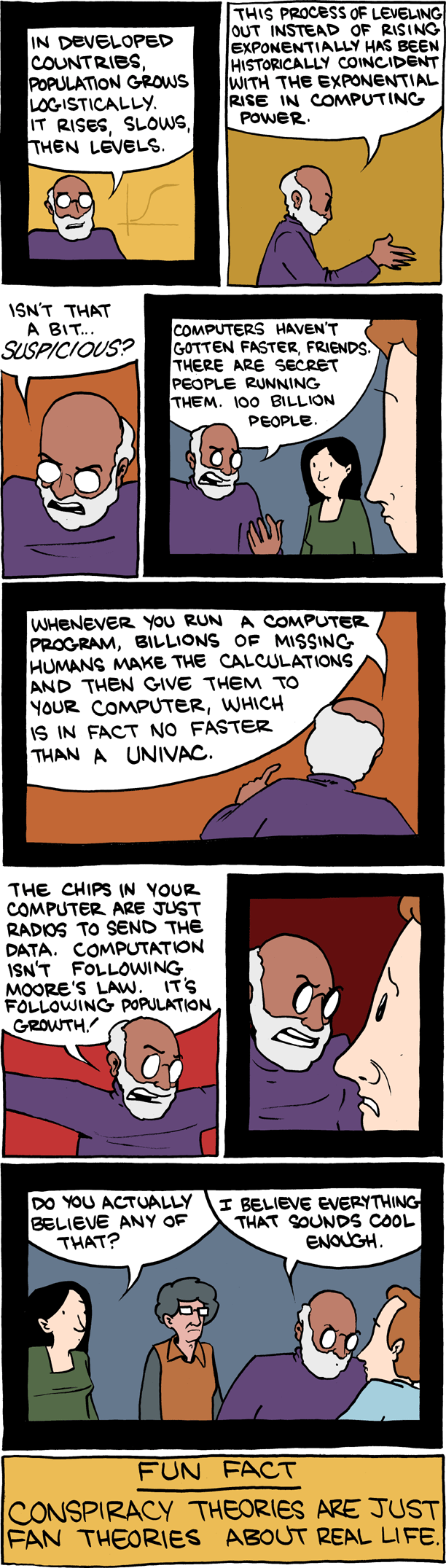
Meanwhile, electric engineering has only been around for just under two centuries. This marvel of modern science upon which we currently chat, the Internet, was not possible before the computer, which was not possible before the microprocessor, which was not possible before the invention of the integrated circuit, which first appeared in 1949, in a patent filed by Werner Jacobi. That's right, computers, and all of the wonders thereof, are only 63 years old! Only a couple of decades older than our very first visits to a non-Earth sphere.

In the United States, the Nineteenth Amendment to the United States Constitution, mandating the right of women to vote, is only 92 years old. The Thirteenth Amendment, which abolished slavery throughout all of the United States, is only 147 years old. The Civil Rights Act of 1964, finally mandating the concept of equal rights for all humans in the United States regardless of race, color, gender, or religion, is only 48 years old. The United States Federal Department of Education was only founded in 1867, meaning that the US was in business just under a full century before it attained, for the very first time, an organized method of ensuring that its citizens could simply read and write. And the idea that anyone could have the right to even a basic education goes back again to that Civil Rights Act. When was the last time we amended the Civil Rights Act? 1991, when we extended and strengthened the ability of employees to sue their employer for discrimination. Bush, Sr., vetoed the previous version of the act but had to buckle on that one.

Universal health care and gay marriage and pot legalization? It will happen. It's just that, you have to understand, it takes more than a few weeks wearing stupid costumes and waving stupid signs and getting stoned in Zuccotti Park.


Now, then: You are upset because the human race is not progressing faster? Sweetheart, we are just barely out of tails and flinging poo. WE ARE STILL ANIMALS! There is no escaping that we are animals, and we will remain animals for many, many millenniums to come. Yes, it is frustrating now feeling like you were born trapped in a primitive world without the wonderful societies that we dream about for the future.

I'm sorry, but you were born too soon for flying cars and colonizing space.

But at least you weren't one of the billions and billions of people who lived and died back there without ever having seen electronics... or machines... or tools... or reliable sources of food... or writing... or even speech! Pause a moment and bow your head for the Australopithecus Einsteins, who had to be content with chewing grubs out of bark and hooting at each other, maddened with the idea that they should be able to live more comfortably if only they could teach the others the value of sharpening a stick to use to dig out more food. Millions of them lived and died and lost in time back there, too discouraged to even write in the mud with their finger, because who the hell would come along who was smart enough to read it?

Do not be so vain, young and smart people, as to be discouraged for the human race because you could not fix it in one month. Quit feeling so sorry for yourself, and devote your life to aiding as much of human progress as you can. Live for the future, when more advanced humans will be able to appreciate what you were living with now.

31 Dec 21:10

Comic for December 31, 2012

31 Dec 13:54

My Dear Doctor, You Must Die (The Eight Doctors)

by noreply@blogger.com (Philip Sandifer)
I'll Explain Later

The Eight Doctors, by Terrance Dicks, is the launch of the Eighth Doctor Adventures line. Instead of getting all the Doctors together as you might expect, it’s got an amnesiac Eighth Doctor going linearly through his previous incarnations to regain his memories, meeting them during 100,000 BC, The War Games, The Sea Devils, State of Decay, The Five Doctors, Trial of a Time Lord, and immediately prior to the TV Movie. Plus you’ve got the Master three times, Rassilon, Borusa, Flavia, and the solutions to any stray continuity errors Dicks was bothered by. Dave Owen calls it “overambitious, perhaps, but nevertheless immensely enjoyable.” In the same issue of Doctor Who Magazine he rates all the New Adventures and gives Human Nature a three out of ten. So, moving on to sane critics, Lars Pearson calls it a “clusterfish.” It is merely the third worst of the seventy-three Eighth Doctor Adventures, but it is the worst one we will cover with a rating of 46.2%. DWRG Summary. Whoniverse Discontinuity Guide entry.
—— It’s June of 1997. Hanson are at number one with “Mmmbop.” That lasts until the end of hte month, when Puff Daddy takes over with “I’ll Be Missing You.” Radiohead, the Rembrandts, the Cardigans, Bon Jovi, the Red Hot Chili Peppers, Smashing Pumpkins, Blur, and Echo and the Bunnymen also chart. In news, there was a month gap in which Deep Blue defeated Gary Kasparov and Tony Blair defeated John Major. In the month itself, Timothy McVeigh is convicted of the Oklahoma City Bombing, the House of Commons votes to ban handguns in response to the year-ago Dunblane Massacre. (The US should be so wise.) And the first Harry Potter book comes out. 
In books, meanwhile, The Eight Doctors. Oh dear.

It is still, over a decade later, difficult to quite wrap one’s head around what went wrong. The TV Movie was awful and looked to have killed any chance of Doctor Who returning on television for the foreseeable future, yes. But most of us had merely allowed ourselves to be optimistic about that. It wasn’t as if anyone thought an American remake was a sure bet of success. Nobody could sincerely say they were surprised by its flaws, or that the series did not come back after it. For all its flaws, it wasn’t even the worst case scenario. Once word of the Leekley bible came out the merely terrible TV Movie started to look pretty good, and there remain those of us who are battle-hardened enough to allow ourselves to remember when the consensus rumor was that David Hasselhoff was going to be the Doctor. The TV Movie was positively merciful. It was merely disastrous. 
In context, The Eight Doctors felt far more glaringly wrong. We expected bad things from Fox. But this was Uncle Terrance himself come to deliver the killing blow. The man who had stepped in to show that the Virgin line had potential with Timewyrm: Exodus. A man about whom just about the worst thing that could be said was that Shakedown was a bit weak, but given that his brief there was to produce a novelization that wasn’t surprising. What should have been the absolute safest pair of hands to put the novel line in following the wreckage of the TV Movie and to get things back on track. And instead we get a legendary train wreck. What happened?
Two explanations present themselves: what we might call the Terry Nation option and the Robert Holmes option. Following The Dalek Invasion of Earth, Terry Nation’s Doctor Who writing career did not so much go off the rails as go to sleep. Subsequent efforts included half-completed scripts, shameless self-plagiarism, and other things that suggested that his only interest in writing Doctor Who was the paycheck. But in the middle of this painful period of abject laziness came Genesis of the Daleks, the best script Nation ever wrote for Doctor Who. This is, in practice, surprising. But it’s also explicable: he had a strong editor in Robert Holmes, and material that pushed him to do more than rely on his standards. Under those circumstances he excelled, but was otherwise turgid. 
In this analogy Dicks switched onto autopilot somewhere in the Nathan-Turner era, probably while revising a five-year-old script to Christopher Bidmead’s specifications. By his own admission he abandoned plot logic in The Five Doctors in favor of just checking all the boxes asked of him. In this interpretation Timewyrm: Exodus is his Genesis of the Daleks, a story where the mixture of Virgin’s emerging editorial vision and the opportunity to cut loose and write for adults led to a perfect storm where his best attributes got accented and enhanced whereas his worst got minimized. Since then he’s had bland but fun books like Blood Harvest, but has basically been coasting on his reputation and doing exactly what’s expected of him. 
And now The Eight Doctors is a perfect storm in the other direction. BBC Books started with an empty suit with no Doctor Who knowledge in charge. Its only creative vision was “less adult than Virgin,” a vision that ensured banality. And Dicks was picked as a safe pair of hands into which the launch could be entrusted. Give him a title and an order to introduce a new companion and send him on his way, basically. And with nothing to push him and no mandate whatsoever for innovation Dicks revealed himself as burnt out and past his prime. 
The other option, of course, is the Robert Holmes option. Like Nation, Holmes burnt out on Doctor Who with The Power of Kroll and basically walked off of it. Unlike Nation he had the dignity not to phone in efforts, or, worse, not actually remember to call. Instead he came back some years later and, told to produce something great, did exactly that. Subsequently, when given a horrible assignment, he simply began trolling the series, writing The Two Doctors as a conscious attack on the series. As, in hindsight, The Power of Kroll and The Space Pirates were. In this interpretation, The Eight Doctors is a cynical lark through the series’ history that serves as a bleak parody of what people ostensibly expect when they say they want a book called The Eight Doctors by Terrance Dicks. Certainly Dicks’s later career lends credence to this - it is, after all, the explanation we used to explain Warmonger.
But if The Eight Doctors is Terrance Dicks trolling it is the first real and thorough effort at it, and two major problems arise. The first is that nobody at the time had seen Dicks in troll mode, which meant nobody read it that way. Second, if it is the case then Dicks ended up with a strange case of first novel syndrome, mixing in an excess of snark and swipes at additional targets that end up detracting from his point. Either way, the result was the same: The Eight Doctors went over like a lead balloon. As such, in a practical sense, it was a titanically awful launch to the Eighth Doctor Adventures - one far worse than the Virgin line mustered. Which was, to say the least, a bit of a problem. The Virgin line at least had the advantage of launching with no discernible alternatives, and to an audience of fans to whom a generally poor quality of Doctor Who was at least familiar. By even the most generous of standards Doctor Who had been routinely problematic as recently as 1986, and the fact of the matter is that most fans thought it didn’t pick up until 1988. To launch a novel series three years later and after the series had been cancelled was fundamentally easier, carrying with it a low weight of expectations.
But the Eighth Doctor Adventures debuted after a botched effort at reviving the series and supplanted a popular and successful series of novels. The expectations were substantive. If these books weren’t going to be at least in the same league as Virgin’s efforts than what was the point? In this regard, even if Dicks was trolling it would be ill-advised. This just isn’t the book to do it with. This is a book that has to be regular good, not mocking genius good. 
And really, even as a mockery there are problems, simply because the breadth of mockery is too great. The swipe against the TV Movie as “full of improbable, illogical events” and the swift retconning of the “Eye of Harmony in the TARDIS” business is, at least, understandable. But the obvious disdain for the Fifth and Seventh Doctors is far more unfortunate. The Fifth is overtly portrayed as weak and useless, and the Seventh is absolutely skewered as bitterly depressed and borderline suicidal over his own actions. On top of that, Dicks goes out of his way to retcon out the New Adventures, or at the very least Lungbarrow, which just seems inordinately petty. That Dicks contradicts the end of Lungbarrow and its setting up of the TV Movie is, at least, excusable - after all, the two books were written around the same time. But Dicks was surely aware of the Loom mythology and the Romana Presidency, and yet goes to unnecessary length to contradict both. 
In the face of these bouts of cynicism the things Dicks does opt to focus on become at once perplexing and frustrating. Only the Third Doctor - i.e. The period Dicks script edited - gets all of his adventures to date explicitly listed, a tedious bit of ego-stroking. Indeed, it’s conspicuous that for every Doctor Dicks has written for the Eighth Doctor meets him during the story Dicks wrote. On top of that, the Seventh Doctor goes to Metebelis 3, and the Sixth Doctor section harkens back heavily to The Five Doctors. It’s frankly a wonder the Eighth Doctor didn’t meet the First in a rose garden right before a black trapezoid tumbled from the sky, but instead Dicks decides to smooth out the prickly bits of 100,000 BC and slap the Doctor around a bit for the skull-bashing incident. Very small favors.
Similarly bewildering is the decision to try to patch up the continuity errors of Trial of a Time Lord. That these exist is, of course, not in any dispute. But is there anyone who would even attempt to argue with a straight face that the kickoff to the Eighth Doctor Adventures is the place to try to resolve a decade-old continuity snarl. Except, apparently, for Terrance Dicks. 
For all the criticism of the Nathan-Turner era that Dicks unleashes here and elsewhere, the fact of the matter is that The Eight Doctors resembles nothing so much as The Twin Dilemma. It is a book that does not merely fail to do the job set out for it, but one that fails in such a systematic way at to leave the reader slack-jawed and trying to figure out how anybody thought this was a good idea. You even have the sense of moral outrage, with Terrance Dicks managing to be more prone to waxing poetic about the need for great and noble leaders to rule over the common rabble than ever. The stuff with the Shobogans in the Sixth Doctor segments is absolutely vomit-inducing, with Dicks establishing them as the Gallifreyan working class/criminal underworld (these seem to be the same thing in his mind) who the Doctor enjoys getting drunk with and dispensing favor to. With astonishing creepiness, Dicks ends their plot by saying “even the Shobogans were content with their lot” and leaving it at that, a line that comes horrifyingly close to just saying that the working class are just meant to be poorer than the nobles. 
Despite this, it’s tough to say that this is entirely Dicks’s fault. The entire enterprise is utterly misbegotten, from putting Nuala Buffini, who by her own admission knew little about Doctor Who, in charge of the line to taking the line away from Virgin with no actual ideas of what to do with it. The entire plan, it seems, amounted to the observation that Virgin was making money off a BBC property, so the BBC should probably do so instead. So other than taking out the thing that apparently some people objected to about the Virgin books, that they were too adult, there were no ideas beyond “cash in on the stupid anoraks.” Given this, is it any wonder that we got a book so insipid and downright insulting as The Eight Doctors? 
But the BBC has, within barely a year, managed to level Doctor Who to smoldering wreckage with even more efficiency than the Nathan-Turner/Saward team could muster. After selling Doctor Who to a Canadian liquor company so that Rupert Murdoch could air it in the US, putting out an execrable TV Movie as a result, and cancelling the actually very good Virgin series, they replace it with the most breathtakingly cynical novel line imaginable.
And so, in less than a year, the great relaunch of Doctor Who craters in the most spectacular of fashions. Seven years of progress and improvement in Doctor Who are effectively wiped out, and wiped out in a way that actually moves the series measurably backwards. There is next to no way to imagine how the series could possibly come back in the foreseeable future, and less of one to imagine how it could possibly be any good when it does. We have, in effect, reached the single darkest point in Doctor Who’s history. 
So now what?
31 Dec 03:03

Elvis Costello: The Other Side of Summer

by Jonathan Calder


I find that I featured Elvis Costello here back in 2009, so it is high time to hear from him again.

The Other Side of Summer comes from Costello's 1990 album Mighty Like a Rose. It has always sounded to me like a Beach Boys track but one that evokes a very different landscape from Californian beaches of the early 1960s.

Read the sleeve notes for the album and you will see I more or less had it right:
This album opens with “The Other Side Of Summer”. The arrangement is a pastiche of The Beach Boys after the fashion of The Beatles’ “Back IN The U.S.S.R.” In our case, the music and vocal parts take their cue from some of their early ‘70s album tracks like “The Trader” and “Funky Pretty”. 
The words are a catalogue of pop conceits, deceits, hypocrisies, and delusions. I include myself in this parade of liars and dupes. The track was cut in the vast Studio One at Ocean Way, Hollywood, where most of this record was recorded. It features our own version of the “Wall of Sound”: drums, two basses, two guitars, and four keyboard players (including my own efforts on electric and toy pianos). When this proved insufficiently powerful, we simply double-tracked the entire rhythm section before adding the glockenspiel, castanets, sleigh bells, and the vocal parts. 
It is not easy to isolate one instrumentalist in such a large ensemble, but I must salute Larry Knetchel’s towering piano part. Larry’s piano, organ, and bass credits include “Mr. Tambourine Man”, “Good Vibrations”, and “Bridge Over Troubled Water”, although you could barely get a word out of him about having played on these legendary cuts. His modest demeanour and utterly musical sense lent a lot to these sessions.
31 Dec 03:02

The Coalition Agreement now sounds excitingly radical

by Jonathan Calder
If you are looking for policy ideas that will help the Liberal Democrats break out of the sterility of presenting themselves as the centre party, may I suggest the Coalition Agreement as a source of ideas?

Take this paragraph from the Social Action section:
We will give public sector workers a new right to form employee-owned co-operatives and bid to take over the services they deliver. This will empower millions of public sector workers to become their own boss and help them to deliver better services.
While I was stuffing envelopes at the Corby by-election, a young Lib Dem activist said to me that we should be campaigning on this commitment under a slogan like "Sack your boss and run your service yourself".

I think he was right. It would certainly be far more attractive to workers than George Osborne's idea (which Lib Dem parliamentarians appear to be going along with, if only grudgingly) of encouraging them to give up their employment rights in return for shares.

More and more, the Coalition Agreement reads like the prospectus for the government Britain needed in 2010 but somehow did not get.
30 Dec 19:22

Junk economics

by noreply@blogger.com (Simon Titley)
It is unfashionable in the internet age to recommend that anyone should read a 10,000-word essay. But in this instance, it is worth putting away childish things and appreciating the art of deferred gratification.

The so-called ‘Fiscal Cliff’ has prompted Michael Hudson to analyse why America’s economy (and therefore the world’s) is in such a mess. And the basic reason is a problem familiar to Liberals for well over a century: rent seeking. In this instance, it is the self-interest of the banking and financial sector, justified by the ‘junk economics’ promoted by Wall Street’s lobbyists:
Today’s central financial problem is that the banking system lends mainly for rent extraction opportunities rather than for tangible capital investment and economic growth to raise living standards. To maximize rent, it has lobbied to untax land and natural resources. At issue in today’s tax and financial crisis is thus whether the world is going to have an economy based on progressive industrial democracy or a financialized and polarizing rent-extracting society.
and:
We are experiencing the end of a myth, or at least the end of an Orwellian rhetorical patter talk, about what free markets really are. They are not free if they are to pay rent-extractors rather than producers to cover the actual costs of production. Financial markets are not free if fraudsters are not punished for writing fictitious junk mortgages and paying ratings agencies to sell “opinions” that their clients’ predatory finance is sound wealth creation. A free market needs to be regulated from fraud and from rent seeking.
In other words, Wall Street (and its equivalents in the City of London and elsewhere) is creating a rentier economy and has become little more than a parasite on the productive economy. And Michael Hudson should know; he’s a Wall Street financial analyst.
30 Dec 19:05

Comic for December 29, 2012

30 Dec 19:05

Comic for December 30, 2012

30 Dec 16:32

Finally, Hard Evidence Against The "Autism Epidemic"?

by Neuroskeptic
The idea of an 'autism epidemic' has a lot of people very worried.


No-one disputes that diagnosed rates of autism have increased enormously over the past 15 years or so, around the world. However, other people write it off as essentially a cultural phenomenon: we're getting better at detecting the disorder and more willing to label kids as having it.

I subscribe to the latter view, but there's very little hard evidence for it. To prove that diagnostic changes have occurred, rather than a true increase in autism, you'd have to know what would have happened to today's kids, say, 20 years ago. Would they have been diagnosed? We have no way of knowing. At least not until someone invents a time machine.

However, a new study just out offers a valuable new perspective on the debate: Spatial clusters of autism births and diagnoses point to contextual drivers of increased prevalence.

According to authors Soumya Mazumdar and colleagues, there's a zone of high autism prevalence in California, areas where kids aged 0-4 years old are more likely to be diagnosed with the condition. The epicentre is L.A.; there's actually three overlapping hotspots centred on Santa Monica, Alhambra and North Hollywood.

In these clusters, autism rates are between 2 and 6 times higher than the rest of the state.

Now an interesting thing about these areas was that they're rich in paediatricians, autism advocacy organizations, and money. In other words, there's better access to health services and probably more awareness of autism. This is suggestive evidence that the reason lots of kids get diagnosed here is about diagnosis, not autism per se.

But the blockbuster result is that children born outside the cluster, who later moved home into one, had a higher chance of getting a diagnosis than those who stayed out. The effect was smaller than for kids born inside the hot zone, but it was significant.

That's also consistent with the idea that the clusters are clusters of diagnosis, not autism.

It's not proof. You could argue that there's some toxic chemical, say, present in the rich parts of L.A. that causes autism, even if you move into the toxic area only at age 3 or 4, and that's been getting worse recently, leading to rising rates.

But it seems a stretch. What's the chemical? And why hypothesize one, when the diagnostic services hypothesis nicely accounts for these findings? As the authors say:
The findings reported in this article do not fully reject the possibility that environmental toxicants drive some of the risk of autism ... since there are a plethora of possible toxicants, it is impossible to falsify all hypotheses that researchers have started to explore.

 ResearchBlogging.orgMazumdar S, Winter A, Liu KY, and Bearman P (2012). Spatial clusters of autism births and diagnoses point to contextual drivers of increased prevalence. Social Science And Medicine PMID: 23267775
29 Dec 12:00

Doctor Who and the Gays (and an interview with me)

by Alex Wilcock
My friend Nick Campbell recently interviewed me for his book blog, A Pile of Leaves. The whole chat’s in his imaginary garden, including what I think of eBooks, librarian’s perks, and how I was always a Fattypuff even when technically a Thinifer. But, being me, my answers went on a bit, so Nick edited down several of them, and there’s one that I’ve decided to publish in full here. Nick asked me:

Do you think Doctor Who is the gay man’s delight it once was? And do you have your own theory on why it was in the first place?
I’m not sure I have anything profoundly different to say about why Doctor Who was the gay man’s delight; I think it was because it was the gay boy’s delight, with its consistent appeal to the outsider and its being all about standing up to bullies of every kind. I’m sure ‘How Doctor Who appealed to me even before I knew I was gay’ has a lot in common with How Doctor Who Made Me A Liberal: the series hates prejudice and oppression, celebrates free will and non-conformity. It’s also frequently incredibly camp.

But I have a suspicion that beyond the individualist theme and intermittently camp veneer, it may just be that the Doctor has friends who are women and men, but ostentatiously doesn’t notice them sexually, let alone doesn’t shag them – not reading as ‘gay’ but being almost unique as a main character in hardly ever reading as ‘straight’. Both in being an individual rather than a ‘uniform’ and in being, seemingly, the only hero who doesn’t have a girl in every port, he was the opposite of Captain Kirk. Not that I didn’t enjoy Kirk sometimes growing up, but I never identified with him. The Doctor was someone you could identify with whoever you were, but most of all if you didn’t fit in, because he didn’t have any of the characteristics every other hero did that pushed you away if you weren’t like everyone else.

As for if it still is, you’d probably have to ask gay boys much younger than me now. I hope it still is, but both gay culture and the way the series approaches relationships has changed so much that I don’t know: it must still be as hard coming out for many, but much more mainstream for many others; there’s a lot more gayery, and positively, than there ever was; and under Russell Doctor Who suddenly was suddenly open to gay and bi characters on screen… But at the same time the Doctor was suddenly very heterosexual. Since Mr Moffat took over, we’ve become almost completely invisible again and the Ponds, while lovely, inevitably made the TARDIS crew its most thoroughly heterosexual ever. Though at the same time, the Doctor became strange and ‘other’ again, and not interested in that sort of thing (except when the lovely TARDIS came along, inevitably). So it’s a maelstrom. You need to do a survey of the under-20s!

Obviously, the contentious last paragraph – which the lovely Nick omitted – may seem a little unfair now after the return of Mr Moffat’s most popular characters, the kick-ass married lesbians (even if in the same story where the Doctor’s been described as going back to fancying a “hot chick”). But then I remember another dear friend of mine on top of Nick, Mikey Russell (you can get his very different books here and here), grappling with a Russell T Davies-era Steven Moffat story he found otherwise superb and in which Mr Moffat thought it an incredible step forward in screenwriting to come up with the groundbreaking idea of, as he himself put it, “Doctor Who Discovers Girls”:
“One of the reasons Doctor Who meant so much to me as a scared gayboy growing up in fundamentalist-choked Arkansas was that he could be a hero without showing the slightest interest in girls; in all other shows I saw back then, the male lead had to prove his worthiness to be a hero by chasing women around. So I’m glad they didn’t do this in the old series because that would have been one more slap in the face, one more statement from the world that I shouldn’t exist.”
This is something that, really, I should write a long and properly referenced article about, with qualifiers and fairness all round and studiously seeing the other point of view… But I thought instead I’d publish my instinctive answer when suddenly put on the spot, as otherwise I’d probably never get back to it. Because ever since I can remember, the Doctor’s not been like all the other men, and ever since the New Adventures, which Richard, Nick, Simon and I all separately remembered drinking in like a first snog, it had seemed that we might be starting to put flesh on our selves at last. Yet ever since The Eleventh Hour, it’s seemed increasingly that Doctor Who has the viewpoint of one straight man, and that’s that.

How is it for you?
28 Dec 15:20

The New World of Publishing: How To Keep Production Going All Year

by dwsmith

This is the fourth part of a series on how to set yourself set up and plan for 2013 writing and publishing. There have been three parts so far. Please read them first because this one will build on those four.
Part One: Some Perspective on 2012.

Part Two: How to Get Started Selling Fiction in 2013.

Part Three: Goals and Dreams.

So now we move to Part Four: How to Keep Production Going All Year.

Remember, any business and production plan you decide to set up for yourself is made up of goals that can be attained with work. The focus of the goals you set is to attain a dream. Read the third part again, but keep in mind a goal can be attained and is in your grasp. A dream is what you work toward with a series of goals.

So, this year-end series is continuing, but again, before reading this, please read those first three parts.

Setting Up For Failure

I’m starting this post with a warning: Understand what is failure in a goal and what isn’t failure.

Every time I do this post, or talk with writers at the end of the year, I hear goals being set that are seemingly impossible when you do the math. I’ve set a few of them myself, to be honest, over the decades.

I honestly have no problem at all with impossible goals. None, as long as the person setting the goal understands that the likely failure can also be deemed a success. But most writers I know don’t understand that simple detail.

For example: Two years ago here I set a goal to write from titles and publish here and online 100 short stories. And even though slightly behind, I felt I was pretty much on schedule to hit that goal when one of my best friends died and I took over his estate. I turned away from writing almost completely to do the estate and only did what deadline work I had.

So did I fail? Nope. I wrote and got out over thirty original short stories in the challenge, plus a number of stories for original anthologies that didn’t count in the challenge. Not the year I hoped, or even my best year, but not a bad year considering all the factors. It would have been far, far worse without the challenge.

But most writers I know, when faced with actually missing their goal, just stop all together. The problem is that the goal sets them up for a failure, and then they use the failure or life issue as an excuse to stop writing.

So caution when setting goals so extreme, you can’t make them in any fashion. And if you do set an extreme goal, have fall-back success levels.

A reminder of the first steps needed…

— I assume you have done the math to know how many original words you can produce of fiction per hour.

— I assume you have figured out how many hours you have each week to write original fiction.

— I assume you have started to set up a writing space, and have started telling your family and friends how important your writing is and have plans to start protecting your work, your time, your art in the new year.

All of this is from the previous posts. If you haven’t done the above, I wouldn’t worry about moving forward with setting goals, because without the knowledge, the goals will fail. Goals must be set from a position of knowledge, not from a position of wishful thinking.

A Sign of the Classic Want-To-Be-Writer: Another Warning

Every long-term professional fiction writer can spot a hopeless want-to-be fiction writer easily.

— They are the fiction writers who talk about writing, but never finish anything.

— They are the fiction writers who feel jealous of all your writing time because they can never find the time.

— They are the fiction writers who come up with one idea and spend years on it, talking about it, researching it, workshopping parts of it, but never finishing it and moving on.

— They are the fiction writers who believe they will never succeed because they don’t have a major fan base like a major writer, so why bother. Or worse, they finish one thing and spend all year “promoting it.”

— They are the fiction writers who decide they are going to write in the new year, but set no plans, no goals, no structure.

— They are the writers who just get to their fiction writing when they can, when the muse strikes, because ideas are hard and writing is hard.  They “just can’t find the time.” And then the following year they try the same thing that didn’t work every year before.

If you don’t want to be one of those “writers,” reread the first three posts I did in this series and set your time, set your defenses, and then set your goals for the year.

Be a writer who makes your production of new words important.

 How to Set Fiction Writing Goals in 2013

Now that I am done with the warnings and have the basics from the first three posts out of the way, it’s time to get to some ideas that might work for you.

Remember, I’m just tossing out suggestions here. There is no one way for every writer, or only one way for the same writer from year-to-year. Use what strikes you in these ideas, alter them to suit your needs, and set the goals for you.

And also I think it would be fine to combine some of these suggestions.

Idea #1

Set your plan to strictly follow Heinlein’s Rules.

The rules are:

1) Write

2) Finish what you write

3) Do not rewrite unless to editorial demand. (Meaning New York book editors who can buy your work, not someone who you hire. It is fine to fix mistakes first readers find and spelling mistakes.)

4) Put it on the market for someone to buy it. (Either a New York editor or readers indie published.)

5) Keep it on the market. (For indie publishers, this means leave it alone.)

If you are one of the very few who have the courage to even try this, let alone succeed with the attempt for an entire year, you will be stunned at how far you will move toward your writing dreams and how much fun you will have.

Warning on this one. Deceptively simple looking rules, fantastically difficult to actually follow because of all the myths that swirl around fiction writing. You will find yourself spending a ton of time coming up with excuses to not follow them. (Please, don’t comment on your excuses here. These rules are a Yoda situation. Either do. Or Don’t.)

As Robert Heinlein said about his own rules. “But they are amazingly hard to follow — which is why there are so few professional writers and so many aspirants…”

Idea #2

Set a new word count you would like to hit for the year.

“New words” means finished words that can be either indie published or sent to traditional editors. Rewriting, researching, and all the other excuses you have do not count. New words only.

(If you hear yourself say right there, “But…” you may have an issue to deal with.)

Here is how to do this:

Say you would like to finish a quarter of a million new words this year.  A very solid, but scary goal. A very large elephant.

1…. So divide the total word count desired into 50 weekly parts. (Two weeks off for vacation.) Example: 250,000 words divided by 50 weeks = 5,000 new words per week.

2… You have determined you can do about 1,000 words per hour.  So divide the 5,000 words by 1,000 = 5 hours of writing per week.

3… Look at the fiction writing time you have figured you have each week and find about eight hours total to get those five hours of writing done safely in your schedule. (The extra three will give you a cushion.)

4… Then protect those eight hours and write during that time every week to make sure you get the 5,000 minimum words per week done.

At the end of the year you will look back and have finished one quarter of a million words. And trust me, you will be a much better fiction writer at the end of the year with that much practice, and if you finished and mailed or published everything, you will be on your way.

A quarter of a million words a year sounds like a great big elephant. But 5 hours of writing per week does not. Yet one equals the other. Weird how that happens, isn’t it?

And note: I will be talking a great deal about a week as a unit. We can all handle keeping a week in our minds because the world has trained us that way. So use that training when setting these goals and stay focused only at a week level. And better yet, a daily level.

Idea #3

Set up a production goal.

A lot of people, me included, like production goals more than word-count goals.

When I started seriously writing, I set up a production goal to write and mail one short story per week. That sort of breaks down to the same word count as Idea #2 of 5,000 words per week. But the focus for me was on the finishing and mailing. (I was following Heinlein’s Rules religiously also during the challenge and still do, which is why I am still a professional writer.)

My ongoing challenge is also production based. (I will talk about it in a post right before the first of the year.)

The reason production-based goals sometimes work better is because of the end date. If your goal is to finish one short story every week, that keeps your mind off of the larger goal. You only focus down on one project at a time.

If you are writing novels, I would highly suggest you break it down into smaller goals, such as finishing a scene per day or a chapter per week. And then only focus on that small bite.

Again the key with eating an elephant is to not think of the task, just chew up one bite at a time, only thinking of the bite.

Idea #4

Get one new book up indie published every two weeks. (Take two weeks off, so you are aiming for 25 by the end of the year.)

This is a great challenge a friend of mine is running and a lot of people are taking part on a private list. Set up your own group.

The idea is that the book can be a short story or a collection or a novel. And the key is to have the total at the end of the year.

So if writing a novel, a month or so will go by with nothing new up, then do some short fiction and then a collection before going back to the next novel.

Also, if you have some stories you have written and haven’t sold, or backlist of stories that were published and you now have the rights back, get those up as well. They would count.

There are lots of ways of doing this, and it really works. And having 25 new books in print by the end of the year is something you are going to be very happy about. Trust me.

Reporting In To Someone

Here is the key to success for every major method of goal-setting. You must have someone, or some method, or some way to keep you on track.

If you don’t make your weekly goal or word count, you must tell someone you didn’t make it. If you did make it, you must tell someone you did.

When I started writing fiction seriously with my short-story-per-week challenge, I actually had a bet going with Nina Kiriki Hoffman. If I missed my story for the week, I had to buy her a steak dinner. I couldn’t afford a steak dinner.

Sometimes you can put your progress on your web site as a weekly update. Even if not that many people show up to your web site, you know some will and your failure or success will be out there in the open. You can even use one of those word counters that you can get as a plugin for your site if you are doing a word-based goal.

When I was writing media novels, I had very hard and fast deadlines. Sometimes I was trying to beat the movie out when I wrote novelizations. There could be no excuses. (I have done about twelve movie novelizations, including Rundown, The Core, 10th Kingdom, Final Fantasy, and so on.)

And with ghost novels, it has been the same way. The one I was going to blog about the writing in December was pushed back to January because they haven’t paid me yet. (I never write anything I don’t own unless I am paid first. Duh.) And when they do finally pay me, they will be in even more of a hurry. Not my issue, but I will have someone waiting for the novel that I will be responsible to. So I will get it done. (And yes, I will blog about the writing of it daily here.)

Sometimes this person you report to is just another writer, sometimes it is a family member, sometimes a post on your blog. But with every small goal achieved or missed, report to someone or post it somewhere where people will see it. Set it up ahead so that person knows what you are doing. (No I will not be that person for anyone and you can’t use these post messages for the task either. Sorry.)

And if you don’t report to the person you have set up, make sure they know to ask you how it is going.

If you hate this idea of reporting in some fashion or another, check in with yourself to see where the fear is coming from. And then use that fear to drive you even more.

An important reminder right here. NEVER SHOW A WORK IN PROGRESS TO ANYONE. Protect your art. You can say you finished chapter 52, but don’t show it until you are ready to release the entire book to the world. (I talked about this in one of the first three posts in this series.)

 What Happens When You Fail?

Everyone with a family and a day job and a life will fail on short-term goals set at the beginning of the year. There are almost no exceptions to that rule. And if you think you will be the exception in 2013, you are delusional, I’m afraid.

So what do you do when life derails you?

Climb back on the next week. Or as soon as you can.

Say you are doing a short story per week with the intent of getting to fifty by the end of the year. Suddenly life gets in your way and you miss three weeks in April.

DON’T TRY TO CATCH UP. Just get back on the focus of the weekly goal and keep going. Trust me, at the end of the year you will be very happy with 47 stories finished.

But if you let it stop you cold, you won’t be happy by the time the end of the year rolls around. And these year-end check-in-points just keep happening every year.

So here are my suggestions when life derails you and you miss your short-term goal.

1… Don’t even once think about catching up. Can’t happen and will make things worse.

2… Climb back onto your production challenge or weekly page goal as soon as you are able.

3… If life alters so much as to make the original weekly pace impossible, stop and reset a new goal for the year and for each week and then stick to that.

4… Somehow, with help or with some mechanism, remember these suggestions.

Chances are you will not remember.  Sadly. You will be buried in a life crisis and then when that clears you will be mad at yourself for not doing the impossible and protecting your writing time and meeting your weekly goals. And you will be swirling in the failure instead of just focusing on being successful the following week.

Wow, was that easy for me to type and so hard for any of us to do.

The real key to having a successful year writing fiction is that when you get stopped, and you will, to start back up as soon as you can.

In Summary

Follow the instructions in the first three posts of this series.

— Get your available writing hours figured.

— Get your writing speed per hour figured.

— Tell your family and friends around you how important what you are going to do is. Be prepared to remind them all the time.

— Get ready to protect your time. Set up an office without distractions and a computer without e-mail or games only used for fiction writing.

— Figure out a yearly goal for words or production, then back it down into weekly goals that will get to your yearly goal. Make sure your weekly goals have extra time in them for small life events.

— Plan in time to keep learning, to go to a conference or two, to take a class or two, to read some writing books.

— Set up someone or some place to report your progress and failures to.

— Then decide to have fun.

That’s right, I said have fun.

If the act of fiction writing isn’t fun for you, get out of this chase now.

If you aren’t excited and scared about the coming year and the learning and writing, get out of this chase now.

Fiction writing isn’t brain surgery. It is entertainment.

You are trying to be an entertainer in 2013.

For heaven’s sake, have fun doing it.

2013 is a brand new year. The world didn’t end. Traditional publishing didn’t fail. More fiction writers than ever are making money with their fiction.

It’s a new golden age for fiction writers.

Have fun.

————————————————

Copyright © 2012 Dean Wesley Smith

Cover art copyright Philcold/Dreamstime
————————————————–

This chapter is now part of my inventory in my Magic Bakery.  

I’m now getting back to writing fiction, so every word I write here takes time from that. And I have to justify this column somehow in how I make a living.

So, if you feel this helped you in any way, toss a tip into the tip jar on the way out of the Magic Bakery.

If you can’t afford to donate, please feel free to pass this chapter along to others who might get some help from it.

And I would like to thank all the fine folks who have donated over this last year. I don’t always get a chance to respond, but the donations and the comments both after the posts and privately are really keeping me going on this. Thanks!

Tip Jar: Go To Paypal

28 Dec 14:01

Gosh! You mean grassroots campaigning actually works?

by noreply@blogger.com (Simon Titley)
In the Boston Globe, Michael Kranish analyses the story behind Mitt Romney’s loss in this year’s presidential election campaign.

Amid a catalogue of errors, one mistake will stand out for most British Liberal Democrats:
Rich Beeson [one of Romney’s political directors] ...said that only after the election did he realize what Obama was doing with so much manpower on the ground. Obama had more than 3,000 paid workers nationwide, compared with 500 for Romney, and hundreds of thousands of volunteers.
“Now I know what they were doing with all the staffs and ­offices,” Beeson said. “They were literally creating a one-to-one contact with voters,” something that Romney did not have the staff to match.
One-to-one contact with voters? No kidding.

Admittedly, the Obama campaign’s grassroots techniques were somewhat more sophisticated than your average British local by-election operation:
Democrats said they followed the trail blazed in 2004 by the Bush campaign which used an array of databases to “microtarget” voters and a sophis­ticated field organization to turn them out. Obama won in part by updating the GOP’s innovation.
Nevertheless, the basic case for grassroots campaigning remains the same. A shame it was not understood by the Liberal Democrat leadership in the 2010 general election.

Nick Clegg elbowed Chris Rennard aside and installed a group of advertising and PR people to run the party’s campaign. These people had no serious experience of political campaigning but believed this did not matter. They were convinced that a ‘ground war’ (i.e. grassroots campaigning) was more or less redundant and that the Liberal Democrat campaign could rely on an ‘air war’ (i.e. a nationwide marketing campaign). The success of the first televised leaders’ debate and the ensuing ‘Cleggmania’ served only to reinforce their prejudices. When on polling day, support collapsed like a soufflé, they had no idea why.

Of course, general election campaigns (or any other nationwide campaign) cannot be conducted solely via a ‘ground war’ but require a judicious mix of ground and air tactics. But as voters become more individualised in their outlook, more consumer-savvy and more sceptical about politics, they will need and expect more human contact, not less.
28 Dec 02:32

David Herdson – “So Mr Obama – feeling brave”

by Mike Smithson

David Herdsonwonders how serious Obama really is about gun control. www7.politicalbetting.com/?p=54996 twitter.com/MSmithsonPB/st…

— Mike Smithson (@MSmithsonPB) December 22, 2012

How serious is he about gun law reform?

Barack Obama’s response to the dreadful murders in Newtown, Connecticut – that something must be done – could well make the contest to reform of gun laws the defining political battle of his second term, just as healthcare was in his first. It will not be a battle easily undertaken and certainly not easily won. The question is really whether he has the heart to embark at all or whether his response was just hot air.

That gun ownership is deeply embedded within the culture large parts of the US is indisputable. That powerful lobbies will stand up – as the NRA has already done – in vocal support of the status quo is equally obvious. Taking on such opponents will use up huge amounts of political capital. It may well mean that he can’t achieve much else of significance at all. If the reform fails, so will his second term.

Even so, even more powerful vested interests have been overcome in the past. Obama didn’t object to being compared to Lincoln, JFK or Martin Luther King during his 2008 campaign. Those men were prepared to risk and ultimately sacrifice much in defence of their values, both personally and on behalf of their nation (especially if Lyndon Johnson is tied in with JFK as part of the same administration). Now is the time for Obama to decide if those comparisons were grossly off the mark.

The reality is that even if the Feinstein bill to outlaw assault weapons becomes law – and there’s a good chance that it won’t – it may be ruled unconstitutional and struck down by the Supreme Court. Her law has been passed before but expired under its own terms. Since then, the Supreme Court has been more specific on what the Second Amendment means in practice and a ban sits awkwardly with those judgements.

That brings the debate to the nub of the matter: the Second Amendment to the US constitution, which states that “A well regulated militia being necessary to the security of a free state, the right of the people to keep and bear arms shall not be infringed”. However anachronous that may now sound, it remains the rock upon which opposition is founded.

It is of course possible to interpret that in such a way that the right to keep and bear arms is only protected for the purposes of membership (or potential membership) of a militia. It’s even possible to argue that the right is only protected while the opening assertion remains valid and that if it’s not, then neither is the right to keep and bear arms. However, the Supreme Court doesn’t even come close to the former interpretation, never mind the latter, and justices who might favour such an interpretation are unlikely to be appointed any time soon. In any case, such a law might well be unconstitutional under the Tenth as well as the Second Amendment.

So, if there’s little prospect of a ban succeeding then what to do? That’s where Obama has to decide how brave to be. If the Second Amendment is the blockage then the solution has to include its repeal. Such a notion will be heretical to many and yet unless it is voiced then it’s difficult to see what can meaningfully be done. Even then, it would only be the start of the journey: the individual states could stand behind or reinforce their own constitutional rights to bear arms.

There is of course no prospect of such a proposal presently gaining Congressional approval, never mind that of the states. Why then do it? Because as with the anti-slavery and Civil Rights movements, a change in the political culture in terms of what is acceptable is necessary before reform can take place and that change has to be led; the flag must be raised. Otherwise, the deaths of dozens of children will continue to be seen as a regrettable but acceptable price to be paid for ancient, if anachronistic, freedoms.

Will he make such a bold move? The answer is almost certainly no: the political costs are too high, the pay-off too small, and he has other more pressing practical priorities such as the looming Fiscal Cliff. But then he didn’t really mean that something must be done; he meant that something must be seen to be done, even if it’s all an illusion.

David Herdson