Shared posts

09 Jan 12:35

Lib Dems, welfare and the art of negotiation

by James Graham

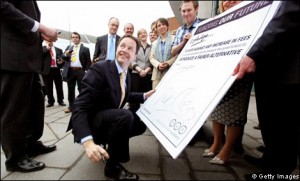
Nick Clegg signing the NUS anti-tuition fees pledge.As former, disgruntled party members go, I think it is fair to say that I’ve been remarkably discreet and reasonable. I’m not a huge believer in trashing my former colleagues (and still, in many cases, current friends) in some vanity exercise designed to justify my resignation ex post facto, and tend to distrust the judgement of people who feel the need to endlessly do so. Aside from a couple of blog posts, I’ve generally kept pretty schtum, and have very little time for those who denounce the Lib Dems as having sold out and failed to achieve anything in government, as if the position they were put into wasn’t fiendishly difficult or that the alternative – a Tory majority government – would be somehow better. Generally speaking, while I think they are getting the big picture pretty badly wrong, on a daily basis the Lib Dems are making a very real difference in government.

You can tell there’s a but coming, can’t you?

But, then. Tuesday. What, the actual, fuck? Just for the sake of argument, let’s completely ignore the human cost of yesterday’s vote on benefits. Let’s just focus on the politics. Back in September, flushed with his (non) apology about his handling of the tuition fees debacle going viral on YouTube, Nick Clegg issued an ultimatum: “For me, it is very simple. You can’t have more cuts without more wealth taxes.

Well, aside from some tweaking to the pension rules, he didn’t get any wealth taxes this autumn. But you know what? The cuts are happening anyway. So much for “it is very simple”.

Unless, apparently, you are Stephen Tall: “It’s the kind of compromise that happens within a Coalition government.” Well, er, no. The “compromise” was that the Tories would get a cut in benefits and the Lib Dems would get a wealth tax. Spinning retrospectively that all that has happened was Cameron and Clegg split the difference is delusional. What actually happened is that Clegg made an opening gambit, Osborne called his bluff, Clegg blinked, and got a pity concession so he could at least pretend to have saved some face. Carry out your threats or don’t make them; you won’t get a second chance.

Putting benefits at the centre of a horsetrading negotiation is one thing. Failing to carry out threats is quite another. You can argue that the Lib Dems have conceded too much in this coalition, but tuition fees aside, they haven’t actually done that bad a job of over-reaching or making pledges they weren’t prepared to stand by. Clegg, to his credit, has carried out his threat to block boundary changes in exchange for the Tories’ betrayal over House of Lords reform (although the fact that the zombie boundary review lives on within the pages of the Mid Term Review speaks volumes about the weak leadership of both Cameron and Clegg). Things were looking up. Today’s capitulation however can’t be put down to naivety. What it suggests is that for Clegg there ultimately is no bottom line and no point at which he is prepared to walk away. What it tells Osborne is that he can merrily keep salami slicing the welfare bill, and the Lib Dem response will be the Stephen Tall “genius” move of “splitting the difference” each time. It would be comedy gold if it didn’t affect the lives of so many vulnerable people.

Speaking of comedy gold, it should not be forgotten that the Lib Dems communications department would very much like its parliamentary party to keep pushing the line that “The Conservatives can’t be trusted to build a fair society.” Based on today’s performance, it is manifest that that assertion is not true. Of course you can trust the Conservatives. They have an agenda and they doggedly stick to it. They might not want a fair society (although by their standards, and many voters’, they do), but they can damn well be trusted. That consistency counts for an awful lot in the electorate’s eyes.

It is Clegg, and all those who go along with him, who can’t be trusted. From a communications point of view, flip-flopping in this way is more damaging to the Lib Dem brand than any number of backbench MPs going off message. The Lib Dems’ communications problem isn’t non-entities saying the wrong thing; Clegg himself is the living embodiment of the Lib Dems’ fundamental communications problem. Focusing on anything else is just displacement activity.

Oh, and a final thing. I really don’t understand why it is that so many Lib Dems are so up in arms about Ken Clarke’s secret courts legislation, with talk of special conferences and all out war coming my way from numerous sources, while the best welfare gets is a shrug of the shoulders. It isn’t that I don’t think civil liberties are worth standing up for; it’s the lack of a sense of proportion. Enabling the government to hold secret trials, at most, might affect thousands of people. Benefit cuts stand to affect millions.

Even if you agree with these cuts, from a civil liberties perspective, surely last year’s legal aid cuts were more onerous than the secret courts? I just don’t understand why so many seem prepared to die in the ditch over a principle that affects a tiny minority, while don’t appear capable of doing anything more than shrug their shoulders over cuts which affect a whole segment of society. Again, it appears dangerously to resemble displacement activity; the wider cuts are too hard and too vast, so it is easier to focus on small measures and exaggerate their importance (see also: this utter preoccupation with Labour hypocrisy and opportunism as if that somehow justifies anything whatsoever).

90% of the criticism of the Lib Dems is at best unfair, at worse downright mendacious. But what I saw on Tuesday was a party that has ceased to have any kind of strategic nouse or moral compass whatsoever; that will doom them more than anything.

09 Jan 12:26

Hmm - is it just me - or does this sound like Plan B?

by noreply@blogger.com (Richard Morris)
In the coalition agreement - the first one, that is, - it clearly says
"The deficit reduction programme takes precedence over any of the measures in this agreement'
and indeed we have been told this, over and over again....
Yet in the reboot version published today, we are told...
"Dealing with the deficit may have been our first task, but our most important task is to build a stronger, more balanced economy..."
which to me says something quite different. It sounds like we need to boost the supply side of the economy, to invest, to build, to grow.
It sounds to me...like Plan B.
Vince wins.
09 Jan 12:24

Pop Between Realities, Home in Time for Tea 51 (Buffy the Vampire Slayer)

by noreply@blogger.com (Philip Sandifer)
There are a vast number of potential paragraphs beginning with “the really brilliant thing about Buffy the Vampire Slayer is…” It is one of the most emphatically innovative and transformational shows in the history of television. There is no case to be made that it’s one of the most popular television programs ever - it toiled in the low ratings expected of The WB and UPN (more about which in a moment), but nor was it some televisual equivalent of the Manchester Lesser Free Trade Hall show, where nobody watched but everybody who did watch was terribly important. The show changed everything: the nature of fandoms, the standard model of how to write both genre television and “regular” television, and the landscape of American television.

The latter of these is perhaps the least interesting in terms of this blog, but it’s important both in understanding how the show came about in the first place and, at least somewhat interestingly, in understanding how Doctor Who could become a hit in its own right in the US. The key thing to understand about Buffy the Vampire Slayer is that it exists because the channel it debuted on, The WB, was an unsuccessful minor channel. Broadcast television in the US works very differently from how it does in the UK. The entire country is served by regional channels, the bulk of which affiliate with national networks. The big three up into the 1980s were NBC, CBS, and ABC, each of which have essentially 100% coverage of the country. An affiliate commits to showing certain numbers of hours of national programming in the correct time slot, but fills the rest of the schedule either with local programming or material bought for syndication. (There’s also PBS, which still uses the affiliate model, but is basically what Rupert Murdoch would have the BBC be if he got his way, i.e. Wholly dependent on continually running fundraisers to stay alive.)

In the 1980s the big three were joined by a fourth network, Fox. The way in which a new network launches is important to understand: it has to acquire affiliates from across the country, scooping up existing low-rated channels. In markets where no such channel exists or will sell the new network simply won’t exist, or will exist as a secondary affiliate of an existing network, showing programming at odd hours of the night. Accordingly, Fox was at first much smaller potatoes, having lower penetration and lower ratings, which meant that big ticket obvious hits went to the other three while Fox had to content itself with oddball programs like The Simpsons and The X-Files. Then, in 1995 two more networks launched: The WB and UPN. By then Fox was reasonably sized and they were the small potatoes - sufficiently small, in fact, that they merged together to form The CW in 2006 because they couldn’t stay afloat on their own.

Buffy the Vampire Slayer was originally made for The WB, although it jumped to UPN for its final two seasons. This is crucial to understanding why it was made in the first place. It was, after all, a remake/sequel to a flop movie that overtly flied in the face of the normal order of things by having a strong female protagonist in a genre show. (A note on this term. It is, of course, terribly annoying, pretending as it does that soap operas and detective series are not genres. However, it proves useful in this period as people begin to take seriously that it’s possible to do sci-fi, fantasy, or horror that isn’t done on the traditional “white male 18-34” cult audience model. Obviously all of this is is descriptive only in terms of the marketing of shows - in practice scads of women watched The X-Files and loads of men watched Buffy the Vampire Slayer, but it still reflects a significant split in terms of how the shows try to position themselves. So for our purposes, “cult” television refers to efforts to target the 18-34 white male demographic with sci-fi/fantasy/horror shows, whereas “genre” television refers to sci-fi/fantasy/horror with broader audience ambitions.) The WB, however, didn’t really have the luxury of attempting something more straightforwardly commercial, so went with Buffy.

What it got, in audience terms, was unusual. It had the small-but-devoted audience associated with normal cult television. But… they were girls! This is, of course, terribly cynical to note, but it’s also terribly important. This isn’t just true because it liberated sci-fi/fantasy/horror from the obnoxious tyranny of the white male audience that forms the standard cult audience. Buffy’s audience was, after all, still a devoted fandom. Which meant that it was possible to have a show that, in terms of its financials, worked like a cult show but appealed to a different sort of audience. Combined with the rise of smaller channels that The WB and UPN implied, this was an absolute revelation. Buffy was, in many ways, the advance guard for The Sopranos, which added the detail of being on cable, and started the boom in original drama produced by cable channels. Add the revenue of DVD sales, syndication, and subscription fees (whether directly from viewers a la HBO or from cable systems paying to include popular channels) and a very different sort of television emerged. Off of networks there were now ways for a show with a small but dedicated audience to survive simply because it was possible to get more money out of a single viewer. One consequence of this was that the BBC launched an American cable channel, BBC America, in 1998, which would eventually find huge success with an imported sci-fi program from the UK.

But Buffy started it by having a dedicated audience and a critical reputation wildly out of proportion to its actual popularity. And, as mentioned, by having a dedicated audience that looked nothing like the audience for most television of its type. It wasn’t just that it was a female audience, but that it was a female audience that on the whole worked like the female fandom that Kate Orman came out of. Buffy fandom unleashed shipping and portmanteaus and slash and the sheer, giddy perversity of female fandom onto the mainstream by creating an entire fandom made up of people like that. It was a whole new ballgame - the moment when a completely different way of interacting with pop culture burst into the mainstream. Suddenly social justice perspectives, critical theory, and the willfully perverse were just how you did fandom, whereas obsessive continuity-mongering, lists, and merchandise collections weren’t. Fandom sacked the anoraks.

It’s not that this was a tremendous and unprecedented advance. All of this had been going on in the background for ages. But the lucky combination of a damn good show and a network desperate enough to air it meant that it broke into the cultural mainstream. Which brings us around to the other really important thing about Buffy, which is that it was, in fact, a damn good show. And while a huge part of its influence is simply in the way in which what genre television could be changed in its wake, there are also specific creative lessons to learn from Buffy, and people did learn them.

The biggest innovation Buffy brought was to use horror movie tropes as metaphors for everyday teen life. The idea that fantastic concepts can be used as metaphors for things is not, of course, remotely new. But Buffy innovated in two ways. First, it made the decision to link the fantastic tropes to the tropes of high school teen drama. This is a fantastically weird and wonderful genre collision, and one that dramatically expands the frame of what horror can do. The use of vampires here is, of course, particularly clever given the longstanding metaphoric links between vampires and sexuality, but nothing like Buffy’s broad-based equation of a mundane genre like high school drama with the tropes of horror had been done. Up to this point even Doctor Who had never managed anything quite this completely bonkers, although to be fair parts of Season Twenty-Four gave it a solid go.

This gets at the second big innovation in terms of Buffy’s use of horror, which is how total and systematic the metaphor was. Buffy wasn’t just a show that used horror movie tropes as a metaphor for high school - it was a show that systematically and from the top down maintained a clear vision of what it was doing. A lot of this comes down to Joss Whedon, who was one of the first of the modern breed of “showrunners,” the writing figures who are responsible for maintaining the consistent vision of a series. He’s not the first by any measure - Chris Carter was a celebrity showrunner as well. But he had the benefit of being both a great writer and a solid manager. He wasn’t just capable of writing great scripts, he was capable of giving other writers the guidance they needed to write great scripts. He’s a phenomenal editor, and while there are certainly cases in which he had to step in and rewrite stretches, there are also cases where he was able to give killer notes and suggestions. He was extremely good at getting writers to keep their eye on the ball. If a story was, to take a reasonably classic but by no means revelatory example, about the horror and revulsion teenagers feel when confronted with the remnants of their own parents’ adolescence then by God every single scene of that episode was going to actively support that theme. Add to this the fact that Whedon was a solidly competent director and you had a series that was remarkably coherent in its vision.

Whedon also appreciated the artistic value of melodrama. This works well for his teenage characters, since adolescence is by its nature melodramatic, but there’s a larger sense to it. The appeal of using the fantastic as a metaphor for everyday concerns is that it allows us to make everyday life mythic and oversized. We’ve been playing with the problem of scale between the mythic and the everyday for months now, and this is a phenomenally clever way of handling it. So we get, to use Buffy’s single best arc, a story in which “I slept with a guy and he turned mean” gets turned into a searing, epic love story with the fate of the world in the balance, full of betrayals and heartbreaks and tragedy. It’s absolutely mad. And it’s brilliant, because every part of the epic is, at the end of the day, just part of a story of a girl learning what it’s like to be betrayed by someone you wrongly loved. It’s the Robert Holmes approach reversed - instead of crashing the epic down to the human scale, making everyday life into something vast and mythic. It’s what Paul Cornell and Kate Orman have been chasing after, finally perfected as a repeatable formula.

Another way of putting this is that Buffy has a tremendous knack for having it both ways. On the one hand it’s a deeply funny show that unrepentantly sends up horror movie conventions and itself on a regular basis. On top of that, it’s adamant in its embrace of camp and melodrama. The Buffy/Angel romance that animates the second season and the show’s best story line is a hopelessly cheesy mess that feels like a pastiche of Twilight almost a decade too early. And yet it all works. Way back in The Ark in Space, admittedly the lead-in to the era of Doctor Who that Buffy is most similar to up to this point, I coined the phrase “believing your bubblewrap” to convey the way in which something ridiculous (such as an alien hand made of green bubblewrap) can be gotten away with if everyone around it plays it straight. This is true. Later in the Tom Baker era, of course, the show functioned not by believing its bubblewrap but by, as the modern parlance goes, lampshading it. And what Buffy realizes is that the two are not only compatible but approaches that are made for each other. The Buffy/Angel romance works because its big scenes are played straight and the rest of the time the show admits that it’s ridiculous. It’s not unique to Buffy at all, but the realization that you can mock something in one scene and then take it seriously five minutes later and have it work is not only important but something that it is almost impossible to imagine modern television functioning without. Buffy didn’t invent it, but it mastered it and started using it to more profound dramatic heights than anything else around.

I would also be remiss not to talk about the dialogue. Like anybody who writes absolutely brilliant dialogue, all of Whedon’s characters sound alike. (See also Douglas Adams, Steven Moffat, and Aaron Sorkin) And, of course, they’re all also totally distinct because Whedon is able to distinguish masterfully between what a character sounds like and what a character does. Yes, many of his characters have similar tones, but a line of Cordelia’s dialogue is almost always distinguishable from one of Giles’s because the sorts of things Cordelia does and wants are totally different from the things Giles does. This is partially down to solid characterization, but it also goes back to Whedon’s consistency of vision: if Whedon has a character, Whedon knows exactly what that character is for and why they’re useful to his storytelling. Nothing that doesn’t advance the use of the plot as a metaphor is tolerated. Not even characters.

All of this adds up to an approach that is not merely coherent but thoroughly worked out. This is comparable in some ways to Pixar’s legendarily thorough and detail-oriented take on storytelling, and it’s certainly something Doctor Who adopted in 2005 via Davies’ famed “tone meetings.” Indeed, Buffy is, on a basic level, the formula for the new series. Virtually every story uses its fantastic concept as a metaphor for something on the human level. Melodrama is allowed to flourish. The dialogue is ear-catching, the characterization is sharp and distinct, and every part of every episode seems intentional and oriented towards communicating its point. This is clearly difficult to do, given how much television fails at it, but it’s also, since Buffy, been the clearest approach to top-notch genre television.

That it would apply well to Doctor Who is, of course, obvious in hindsight, much the way that Neverwhere, in hindsight, makes Doctor Who’s eventual return seem obvious. Perhaps more important, though, is that Buffy’s implications for Doctor Who seemed obvious at the time. It was self-evidently how to do a show like this: funny, dramatic, and capable of making things new. At this point it’s just BBC internal politics that stands between us and Doctor Who coming back. After all, if a wretched Kristy Swanson movie can get a brilliant do-over, surely anything can.

08 Jan 14:43

Liberal Democrats should not be voting to cut benefits for the poorest, working or not

by Caron Lindsay
I aIways knew when we went into Coalition that there would be moments when I would need to be locked in a cupboard with a bottle of gin. Tonight is one of them when MPs vote on a proposal, which, sadly is almost assured to pass, to raise benefits by only 1% for each of the next 3 years. The current inflation rate is 2.2%. To give the poorest in society less than half of what they need to stand still is simply not acceptable.

I do realise that Nick Clegg's position is different from the Tory undeserving poor rhetoric, but it's so subtle that nobody will really notice. People will hear his line that a nurse should not have less of a rise than someone not working and think it's the same thing. If you are a nurse, your sub inflation pay increase is unlikely to mean that you won't be able to feed yourself adequately. If you are existing on benefit income alone, it most likely will, especially if you are living on your own, without children. £71 a week Job Seekers' Allowance won't go very far if your shoes spring a hole, for example.

Nick Clegg insisted that the benefit rise was paid in line with inflation last year and I'm disappointed that he has not won the battle this year. Benefits are supposed to be the minimum people need to live on. If we effectively cut their value, then what are we saying? You can have less than you need to live on? That's not on. I would rather have foregone the extra rise in the tax threshold for this year. I sort of understand that achieving it this year means that we must get to £10,000 but it's still not right.

I am also not at all convinced by Iain Duncan Smith's claim that this will cut the deficit. Surely plunging people into worse poverty will only increase poor health which has its own NHS cost implications? We all know there's a link between poverty and ill health.

If I were an MP, I'd be with Sarah Teather tonight, voting against this plan. I really don't understand why the rest of them have agreed to support it. Voters are in favour of it, but that's because they're fed the scaremongering scroungers rhetoric by the Daily Mail, not the TUC's facts.

I feel profoundly depressed and frustrated by what has been agreed to in my name in this instance. But however upset I am, I will not be taken in by Labour's rhetoric. It's not as though they have much to be proud of - remember the 10p tax and the 75p pension increase? And they introduced the iniquitous Work Capability Assessment  that's still rubbish despite Coalition improvements. They bleat about cut in the top rate of tax, conveniently forgetting that the top rate of tax for all but a month of their 13 years in office was 5% dearer and Capital Gains Tax was 10% less until the Coalition's first budget.

Being able to demolish Labour's nonsense, though, gives little comfort when I know the harsh reality that people with jobs and  without, but whose circumstances make them need benefits, face in the future.

UPDATE: John Leech is joining Sarah Teather in the "no" lobby tonight. Of course I'm pleased, but I do take exception to part of his reasoning:

I find it objectionable that the Tories are ramping up the  “Skivers Vs Strives” rhetoric to justify a benefit cut to 7 million working families.
If you are one of those 7 million, you have made your choice to work. You should be encouraged by the system, whether that be through benefits or tax breaks.  That is why I strongly support rises in the tax threshold.
The phrase I've written in bold is an appalling phrase. Does John think that everyone out of work wants it that way? If so, he's very much mistaken. Some folk just can't get work and that's not for lack of trying. And what about those who are too sick to work? Thoughtless wording, really.
08 Jan 13:11

Laws scrapes home

by noreply@blogger.com (Simon Titley)
The Liberal Democrats’ Federal Policy Committee (FPC) last night voted by 14 to 8 to accept Nick Clegg’s nomination of David Laws to chair the working group that will draft the next general election manifesto. (See this blog’s previous reports here and here).

This decision was not a ringing endorsement. Clegg and Laws won the vote but lost the argument, with some of the 14 who voted for Laws nevertheless openly critical of his nomination. They reluctantly accepted Laws only after it was made clear that the working group would remain subordinate to the FPC.

This is not a good start to the manifesto drafting process. Laws does not have the full confidence of the FPC and, given his habit of making provocative statements, the working relationship is likely to deteriorate.

There is also a more fundamental problem. Leadership is about keeping the party together, not fracturing it still further. When you consider Clegg’s nomination of Laws together with his refusal to budge over the issue of secret courts, it seems that our leader thinks he has nothing to lose by arrogantly driving through his own agenda.

This hubris will be Clegg’s undoing. In British politics, leaders are never bigger than their party – as even Margaret Thatcher found to her cost.

POSTSCRIPT: A post on Liberal Democrat Voice disputes this version of events:
A motion from Gareth Epps saying the Manifesto Working Group shouldn’t be approved until a full process and remit was agreed was defeated 14-8. However, David’s position as chair was unanimously approved, 22-0.
We have checked with our sources. What Gareth Epps’s motion actually proposed was to decline to endorse all of the nominations for the working group, not just David Laws. It called for a hearing session with the chair of the working group to ensure that he accepted the primacy of mainstream thinking in the party. It also called for terms of engagement, and most of the debate at the FPC meeting was about that. This motion was rejected by 14 votes to 8. Separately, there was also a vote to add Lord John Shipley to the working group. There was no unanimous 22-0 vote to approve Laws’s position as chair.
07 Jan 19:13

Something you should probably know about the Child Benefit changes

by Caron Lindsay
So, I'm not getting Child Benefit any more, as of today. I can't complain, because I can see the sense behind this change.It's better that those earning over £50,000 take a hit than more is taken from those who have nothing, to put it bluntly. If the price I pay means that someone on the minimum wage can get their tax bill halved from the amount Labour charged them, then I can live with it. 
I am well aware that there is an inherent unfairness in the way the new rules apply. Two people earning £49,995, giving a household income of nearly £100k, will still get the full amount of child benefit. However, a family where only one parent is working will start to lose it at £50k. The thing that worried me, though, was that many stay at home parents, usually mothers, are given a National Insurance credit which goes towards their state pension until their youngest child is 12. What would happen to them if they were no longer claiming child benefit? Would they still get the credits towards their State Pension, or would they get a nasty surprise in a few decades' time?
I've spent some time on the phone to various government helplines this morning to find out. The HMRC helpline was very helpful but when I asked the question, the person I was speaking to actually had to go and look it up and actually said she wasn't very sure and recommended that I call the Child Benefit people.She told me that if a claim had been made and the claimant decided not to receive the payments, then they would still get the credits. I then phoned the Child Benefit line and they confirmed this, with a lot less faffing. Now that I've had it from two Government sources, I'm prepared to believe it.
My only concern is that this is all very well if your children are already here and you've made the claim. If, however, you have a baby at any point from now and your partner is a high earner, you might think that you shouldn't even bother claiming. This would be a mistake if you are not going to go back to work. You have to make the claim to get the credit towards your pension even if you don't end up taking the money.
I hope that makes sense. It might not affect very many people, but it's worth taking note.
06 Jan 19:00

White lines and dead armadillos - I'm a liberal, not a centrist...

by Mark Valladares
Apparently, I am in politics to anchor our government in the centre ground. At least, that is what my Party Leader thinks. And sadly, he's wrong. A Texan Democrat once said that the only things you'll find in the middle of the road are white lines and dead armadillos.
No, for me, the whole point of being a liberal is that I want to challenge the things that hold our society back, to enable people to take control over their lives, whilst ensuring that those who are vulnerable are protected and supported. Part of that is about personal responsibility, the idea that people should also have to face the consequences of their actions.
"Anchoring the Coalition in the centre ground" is, in those terms, pretty meaningless, even if it does reassure some voters. Perhaps that is why I'm a bureaucrat and not a politician. I suppose that politics is about a cause, be that a big, grand one like world peace, or equality, or a small, more personal one, such as representing your community and trying to do your best by, and for, it.
Yes, one does have to be pragmatic about it. Politics is about the art of the possible, and you are confined by budgets, or existing legislation, but with some things, such as equal marriage, you can do them because, fundamentally, they're the right thing to do. You should also try to bring the public with you, because change is more likely to last if it is broadly accepted.
But our politics is tainted already by a sense that the three main political parties are squabbling over some mystical middle England - which always seems to be somewhere else - leaving a vacuum to be filled by UKIP, the Greens or some bunch of racist lunatics.
So, instead of coming up with a slogan, why can't we just explain what we stand for and why, and leave the race to the bottom for the rest. As all the evidence is that they're better at it than we are anyway, I can't help feeling that it isn't the game we ought to be playing.
06 Jan 15:30

Martin Carthy: New York Mining Disaster 1941

by Jonathan Calder


It is easy to laugh at the Bee Gees for their disco heyday, but as the tribute programmes that have, sadly, been necessary in recent years have proved, they have written an awful lot of good songs over the years.

In fact, when they re-emerged in the second half of the 1970s it was as though dinosaurs had been sighted swimming up the River Welland. Beacuse I just remembered them from their first period of popularity some 10 years before.

Here, on his 1998 album Landfall, Martin Carthy makes a Bee Gees single from 1967 sound like an ancient folk song. And very good it is too.
06 Jan 12:09

The World of Everyday Experience, In One Equation

by Sean Carroll

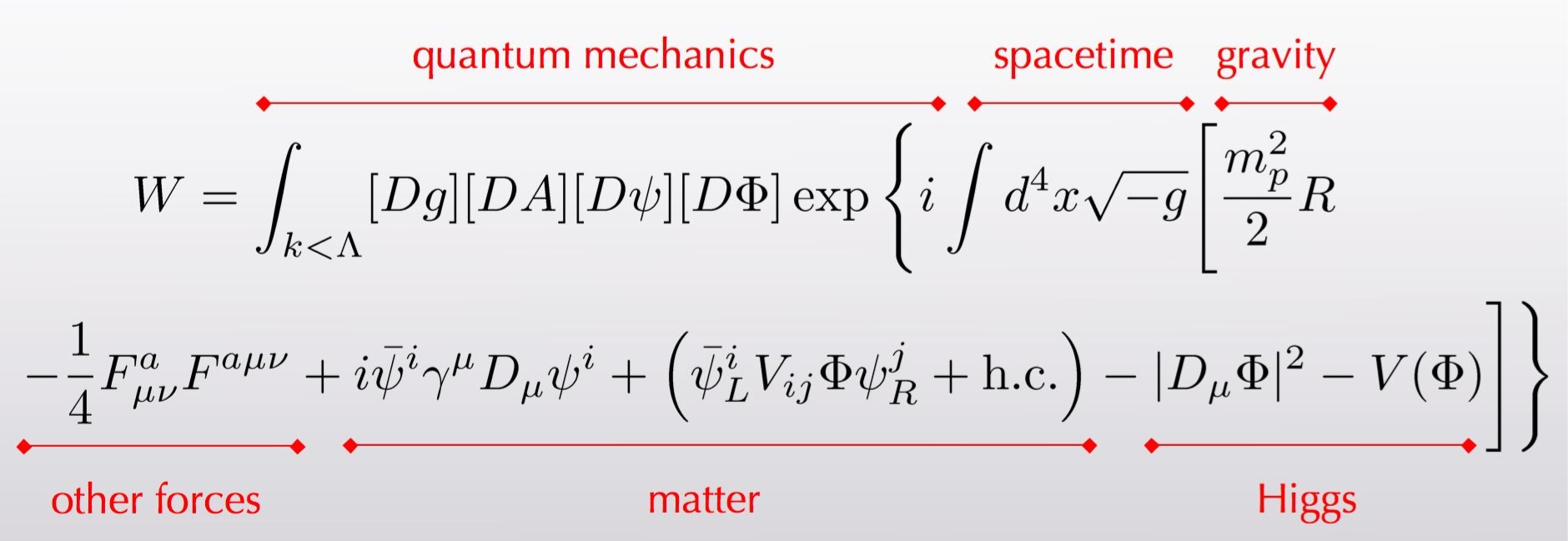
Longtime readers know I feel strongly that it should be more widely appreciated that the laws underlying the physics of everyday life are completely understood. (If you need more convincing: here, here, here.) For purposes of one of my talks next week in Oxford, I thought it would be useful to actually summarize those laws on a slide. Here’s the most compact way I could think to do it, while retaining some useful information. (As Feynman has pointed out, every equation in the world can be written U=0, for some definition of U — but it might not be useful.) Click to embiggen.

Everyday-Equation

This is the amplitude to undergo a transition from one configuration to another in the path-integral formalism of quantum mechanics, within the framework of quantum field theory, with field content and dynamics described by general relativity (for gravity) and the Standard Model of particle physics (for everything else). The notations in red are just meant to be suggestive, don’t take them too seriously. But we see all the parts of known microscopic physics there — all the particles and forces. (We don’t understand the full theory of quantum gravity, but we understand it perfectly well at the everyday level. An ultraviolet cutoff fixes problems with renormalization.) No experiment ever done here on Earth has contradicted this model.

(Obviously, observations of the rest of the universe, in particular those that imply the existence of dark matter, can’t be accounted for in this model. Equally obviously, there’s plenty we don’t know about physics beyond the everyday, e.g. at the origin of the universe. Most blindingly obvious of all, the fact that we know the underlying microphysics doesn’t say anything at all about our knowledge of all the complex collective phenomena of macroscopic reality, so please don’t be the tiresome person who complains that I’m suggesting otherwise.)

As physics advances forward, we will add to our understanding. This simple equation, however, will continue to be accurate in the everyday realm. It’s not like the Steady State cosmology or the plum-pudding model of the atom or the Ptolemaic solar system, which were simply incorrect and have been replaced. This theory is correct in its domain of applicability. It’s one of the proudest intellectual accomplishments we human beings can boast of.

Many people resist the implication that this theory is good enough to account for the physics underlying phenomena such as life, or consciousness. They could, in principle, be right, of course; but the only way that could happen is if our understanding of quantum field theory is completely wrong. When deciding between “life and the brain are complicated and I don’t understand them yet, but if we work harder I think we can do it” and “I understand consciousness well enough to conclude that it can’t possibly be explained within known physics,” it’s an easy choice for me.

Let me know if I’ve made any typos here, or have gone too far in trying to make things compact. For instance, can I get away without putting a “trace” around the gauge field kinetic term? I don’t want a notational shortcut to undermine my argument and leave the audience believing in God.

Share

06 Jan 00:08

Laws to write manifesto?

by noreply@blogger.com (Simon Titley)
“Sources in Westminster” (as they say in the proper newspapers) have informed Liberator of a strong rumour that David Laws is about to be given the job of writing the Liberal Democrats’ 2015 general election manifesto.

Is this what Nick Clegg means by getting his message across? The symbolism of appointing Laws would not be lost on Clegg, given Laws’s notoriety for holding views on economics well to the right of most party members.

The party’s 2011 policy document Facing the Future suggested that the next manifesto was likely to be a rather timid affair (which is why David Boyle and I wrote a more robust alternative). That prospect now seems attractive compared with a document written by Laws.

Meanwhile, it seems that the party is trying to take the credit for Liberator’s leak of the ‘message script’. In today’s edition of the ‘Letter from the Leader’ e-mailed to party members, Nick Clegg writes “We also got a bit of attention after the party’s central message for spokespeople was featured on the BBC.” Is this what they mean by ‘damage limitation’?

Clegg goes on to argue:
There’s nothing unusual about political parties wanting to ensure they get their message across, and our key argument – that the Liberal Democrats are building a stronger economy in a fairer society, enabling every person to get on in life – is one that I hope some of you are already starting to recognise.
A good test for the validity of any argument is to ask whether anyone would seriously propose the opposite: “We are building a weaker economy in an unfairer society, preventing every person from getting on in life.” I don’t think so.

POSTSCRIPT: Update here.
05 Jan 00:08

The Rise Of The New Puritans

by noreply@blogger.com (Jae Kay)
There is nothing quite like the phrase "A Conservative Case For Gay Marriage" to send shivers down the spine of any even slightly radical LGBT person. I have to say that when I began moaning about marriage equality, I really wasn't considering the wider consequences. I was simply annoyed at the unfairness of civil partnerships. Later I looked at equal marriage as a step down the road to liberty, not perfect but heading in the right direction.

Sadly, I realise now, many conservative supporters see it as a way of "taming" LGBT people rather than freeing them. And, before you think "Hang on, I thought you weren't doing marriage equality posts anymore", this sort of conservative, moralising attitude is becoming in vogue once again on a lot of topics.

Now I'm not pretending that moralising busybodies have suddenly reappeared after years of being sidelined. Of course they have always been there. But rather than your Mary Whitehouses and Tory MPs being the loudest, we now have far more worrying noise makers from quarters I wouldn't have expected (although once you look into the history you see the potential has always been there and I was just being blindly naive).

Our Coalition Government has been pushing at eroding individual rights "for our own good" recently. Minimum alcohol pricing has been proposed at a time when alcohol consumption is on the decrease. They are listening to Christian MPs and "women's groups" are pushing for the criminalisation of paying for sex. And, though thankfully less authoritarian than the original proposals, the Government is still trying to treat parents like children and tell them what is best for their household.

Meanwhile, on Opposition benches, Diane Abbott is calling for controls on those horrific evils: fast food, alcohol and children on the internet. She wants the minimum alcohol price to be higher than the one proposed by the Coalition. That's opposition for you...

There are real problems that need tackling... alcoholism isn't a joke, sex workers are abused and the internet (like a town) has its places that you wouldn't want children going to on their own. But bans, filters and taxes aren't going to change people, they aren't going to educate people and they will end up causing more problems. Alcoholics will just be poorer whilst occasional drinkers will cut back. Sex workers, especially those being forced/coerced into it, will still be abused whilst those who make a living out of sex work will be left without a source of income. Kids will still look at porn on the internet. They aren't stupid!

So for the next few posts I'll be focussed on looking at these issues, and more controversial ones, and looking at whether the busybodies have a point or if they are very wide of the mark indeed.
04 Jan 23:53

Crossover Deals from Self-Publishing to Traditional

by dwsmith

As I have been saying for some time, the indie side of publishing will slowly become a major way into traditional publishing. And a way with power that allows a writer to negotiate a better contract.

But up until this morning I didn’t have any real evidence on that other than a few news articles about the large or different books that started indie and went traditional and a few friends it had happened to.

Then this morning Publishers Marketplace gave out their information about six figure deals in publishing that were reported to them. Combining nonfiction, children’s, and fiction, there were about 300 six figure deals reported to Publisher’s Marketplace. (There were a ton more, of course, since most deals are not reported.)

Then Publisher’s Marketplace followed with the line:

“As everyone knows, originally self-published books made for a number of high-profile crossover deals in 2012–though in total numbers, we recorded 45 such deals in all.”

Of the 300 or so six figure deals that were reported to them in 2012, 45 were from books that started off self-published.

Indie publishing is now a clear route in.

In fact, I see no reason now why every book shouldn’t start indie published first, even if the ultimate goal for the book is traditional.

Reasons:

— You don’t waste all the time waiting for editors and agents.
— You are making money, return on your time investment, right from the start.
— You have negotiating power when offered a traditional contract.
— You have information on sales when offered a traditional contract.

Welcome to 2013 and the new world of publishing.

04 Jan 23:14

Second-Order Logic: The Controversy

Submitted by Eliezer_Yudkowsky • 23 votes • 154 comments

Followup to: Godel's Completeness and Incompleteness Theorems

"So the question you asked me last time was, 'Why does anyone bother with first-order logic at all, if second-order logic is so much more powerful?'"

Right. If first-order logic can't talk about finiteness, or distinguish the size of the integers from the size of the reals, why even bother?

"The first thing to realize is that first-order theories can still have a lot of power. First-order arithmetic does narrow down the possible models by a lot, even if it doesn't narrow them down to a single model. You can prove things like the existence of an infinite number of primes, because every model of the first-order axioms has an infinite number of primes. First-order arithmetic is never going to prove anything that's wrong about the standard numbers. Anything that's true in all models of first-order arithmetic will also be true in the particular model we call the standard numbers."

Even so, if first-order theory is strictly weaker, why bother? Unless second-order logic is just as incomplete relative to third-order logic, which is weaker than fourth-order logic, which is weaker than omega-order logic -

"No, surprisingly enough - there's tricks for making second-order logic encode any proposition in third-order logic and so on. If there's a collection of third-order axioms that characterizes a model, there's a collection of second-order axioms that characterizes the same model. Once you make the jump to second-order logic, you're done - so far as anyone knows (so far as I know) there's nothing more powerful than second-order logic in terms of which models it can characterize."

Then if there's one spoon which can eat anything, why not just use the spoon?

"Well... this gets into complex issues. There are mathematicians who don't believe there is a spoon when it comes to second-order logic."

Like there are mathematicians who don't believe in infinity?

"Kind of. Look, suppose you couldn't use second-order logic - you belonged to a species that doesn't have second-order logic, or anything like it. Your species doesn't have any native mental intuition you could use to construct the notion of 'all properties'. And then suppose that, after somebody used first-order set theory to prove that first-order arithmetic had many possible models, you stood around shouting that you believed in only one model, what you called the standard model, but you couldn't explain what made this model different from any other model -"

Well... a lot of times, even in math, we make statements that genuinely mean something, but take a while to figure out how to define. I think somebody who talked about 'the numbers' would mean something even before second-order logic was invented.

"But here the hypothesis is that you belong to a species that can't invent second-order logic, or think in second-order logic, or anything like it."

Then I suppose you want me to draw the conclusion that this hypothetical alien is just standing there shouting about standardness, but its words don't mean anything because they have no way to pin down one model as opposed to another one. And I expect this species is also magically forbidden from talking about all possible subsets of a set?

"Yeah. They can't talk about the largest powerset, just like they can't talk about the smallest model of Peano arithmetic."

Then you could arguably deny that shouting about the 'standard' numbers would mean anything, to the members of this particular species. You might as well shout about the 'fleem' numbers, I guess.

"Right. Even if all the members of this species did have a built-in sense that there was a special model of first-order arithmetic that was fleemer than any other model, if that fleem-ness wasn't bound to anything else, it would be meaningless. Just a floating word. Or if all you could do was define fleemness as floobness and floobness as fleemness, you'd have a loop of floating words; and that might give you the impression that each particular word had a meaning, but the loop as a whole wouldn't be connected to reality. That's why it doesn't help to say that the standard model of numbers is the smallest among all possible models of Peano arithmetic, if you can't define 'smallest possible' any more than you can define 'connected chain' or 'finite number of predecessors'."

But second-order logic does seem to have consequences first-order logic doesn't. Like, what about all that Godelian stuff? Doesn't second-order arithmetic semantically imply... its own Godel statement? Because the unique model of second-order arithmetic doesn't contain any number encoding a proof of a contradiction from second-order arithmetic? Wait, now I'm confused.

"No, that's correct. It's not paradoxical, because there's no effective way of finding all the semantic implications of a collection of second-order axioms. There's no analogue of Godel's Completeness Theorem for second-order logic - no syntactic system for deriving all the semantic consequences. Second-order logic is sound, in the sense that anything syntactically provable from a set of premises, is true in any model obeying those premises. But second-order logic isn't complete; there are semantic consequences you can't derive. If you take second-order logic at face value, there's no effectively computable way of deriving all the consequences of what you say you 'believe'... which is a major reason some mathematicians are suspicious of second-order logic. What does it mean to believe something whose consequences you can't derive?"

But second-order logic clearly has some experiential consequences first-order logic doesn't. Suppose I build a Turing machine that looks for proofs of a contradiction from first-order Peano arithmetic. If PA's consistency isn't provable in PA, then by the Completeness Theorem there must exist nonstandard models of PA where this machine halts after finding a proof of a contradiction. So first-order logic doesn't tell me that this machine runs forever - maybe it has nonstandard halting times, i.e., it runs at all standard N, but halts at -2* somewhere along a disconnected chain. Only second-order logic tells me there's no proof of PA's inconsistency and therefore this machine runs forever. Only second-order logic tells me I should expect to see this machine keep running, and not expect - note falsifiability - that the machine ever halts.

"Sure, you just used a second-order theory to derive a consequence you didn't get from a first-order theory. But that's not the same as saying that you can only get that consequence using second-order logic. Maybe another first-order theory would give you the same prediction."

Like what?

"Well, for one thing, first-order set theory can prove that first-order arithmetic has a model. Zermelo-Fraenkel set theory can prove the existence of a set such that all the first-order Peano axioms are true about that set. It follows within ZF that sound reasoning on first-order arithmetic will never prove a contradiction. And since ZF can prove that the syntax of classical logic is sound -"

What does it mean for set theory to prove that logic is sound!?

"ZF can quote formulas as structured, and encode models as sets, and then represent a finite ZF-formula which says whether or not a set of quoted formulas is true about a model. ZF can then prove that no step of classical logic goes from premises that are true inside a set-model, to premises that are false inside a set-model. In other words, ZF can represent the idea 'formula X is semantically true in model Y' and 'these syntactic rules never produce semantically false statements from semantically true statements'."

Wait, then why can't ZF prove itself consistent? If ZF believes in all the axioms of ZF, and it believes that logic never produces false statements from true statements -

"Ah, but ZF can't prove that there exists any set which is a model of ZF, so it can't prove the ZF-axioms are consistent. ZF shouldn't be able to prove that some set is a model of ZF, because that's not true in all models. Many models of ZF don't contain any individual set well-populated enough for that one set to be a model of ZF all by itself."

I'm kind of surprised in a Godelian sense that ZF can contain sets as large as the universe of ZF. Doesn't any given set have to be smaller than the whole universe?

"Inside any particular model of ZF, every set within that model is smaller than that model. But not all models of ZF are the same size; in fact, models of ZF of every size exist, by the Lowenheim-Skolem theorem. So you can have some models of ZF - some universes in which all the elements collectively obey the ZF-relations - containing individual sets which are larger than other entire models of ZF. A set that large is called a Grothendieck universe and assuming it exists is equivalent to assuming the existence of 'strongly inaccessible cardinals', sizes so large that you provably can't prove inside set theory that anything that large exists."

Whoa.

(Pause.)

But...

"But?"

I agree you've shown that one experiential consequence of second-order arithmetic - namely that a machine looking for proofs of inconsistency from PA, won't be seen to halt - can be derived from first-order set theory. Can you get all the consequences of second-order arithmetic in some particular first-order theory?

"You can't get all the semantic consequences of second-order logic, taken at face value, in any theory or any computable reasoning. What about the halting problem? Taken at face value, it's a semantic consequence of second-order logic that any given Turing machine either halts or doesn't halt -"

Personally I find it rather intuitive to imagine that a Turing machine either halts or doesn't halt. I mean, if I'm walking up to a machine and watching it run, telling me that its halting or not-halting 'isn't entailed by my axioms' strikes me as not describing any actual experience I can have with the machine. Either I'll see it halt eventually, or I'll see it keep running forever.

"My point is that the statements we can derive from the syntax of current second-order logic is limited by that syntax. And by the halting problem, we shouldn't ever expect a computable syntax that gives us all the semantic consequences.  There's no possible theory you can actually use to get a correct advance prediction about whether an arbitrary Turing machine halts."

Okay. I agree that no computable reasoning, on second-order logic or anything else, should be able to solve the halting problem. Unless time travel is possible, but even then, you shouldn't be able to solve the expanded halting problem for machines that use time travel.

"Right, so the syntax of second-order logic can't prove everything. And in fact, it turns out that, in terms of what you can prove syntactically using the standard syntax, second-order logic is identical to a many-sorted first-order logic."

Huh?

"Suppose you have a first-order logic - one that doesn't claim to be able to quantify over all possible predicates - which does allow the universe to contain two different sorts of things. Say, the logic uses lower-case letters for all type-1 objects and upper-case letters for all type-2 objects. Like, '∀x: x = x' is a statement over all type-1 objects, and '∀Y: Y = Y' is a statement over all type-2 objects. But aside from that, you use the same syntax and proof rules as before."

Okay...

"Now add an element-relation x∈Y, saying that x is an element of Y, and add some first-order axioms for making the type-2 objects behave like collections of type-1 objects, including axioms for making sure that most describable type-2 collections exist - i.e., the collection X containing just x is guaranteed to exist, and so on. What you can prove syntactically in this theory will be identical to what you can prove using the standard syntax of second-order logic - even though the theory doesn't claim that all possible collections of type-1s are type-2s, and the theory will have models where many 'possible' collections are missing from the type-2s."

Wait, now you're saying that second-order logic is no more powerful than first-order logic?

"I'm saying that the supposed power of second-order logic derives from interpreting it a particular way, and taking on faith that when you quantify over all properties, you're actually talking about all properties."

But then second-order arithmetic is no more powerful than first-order arithmetic in terms of what it can actually prove?

"2nd-order arithmetic is way more powerful than first-order arithmetic. But that's because first-order set theory is more powerful than arithmetic, and adding the syntax of second-order logic corresponds to adding axioms with set-theoretic properties. In terms of which consequences can be syntactically proven, second-order arithmetic is more powerful than first-order arithmetic, but weaker than first-order set theory. First-order set theory can prove the existence of a model of second-order arithmetic - ZF can prove there's a collection of numbers and sets of numbers which models a many-sorted logic with syntax corresponding to second-order logic - and so ZF can prove second-order arithmetic consistent."

But first-order logic, including first-order set theory, can't even talk about the standard numbers!

"Right, but first-order set theory can syntactically prove more statements about 'numbers' than second-order arithmetic can prove. And when you combine that with the semantic implications of second-order arithmetic not being computable, and with any second-order logic being syntactically identical to a many-sorted first-order logic, and first-order logic having neat properties like the Completeness Theorem... well, you can see why some mathematicians would want to give up entirely on this whole second-order business."

But if you deny second-order logic you can't even say the word 'finite'. You would have to believe the word 'finite' was a meaningless noise.

"You'd define finiteness relative to whatever first-order model you were working in. Like, a set might be 'finite' only on account of the model not containing any one-to-one mapping from that set onto a smaller subset of itself -"

But that set wouldn't actually be finite. There wouldn't actually be, like, only a billion objects in there. It's just that all the mappings which could prove the set was infinite would be mysteriously missing.

"According to some other model, maybe. But since there is no one true model -"

How is this not crazy talk along the lines of 'there is no one true reality'? Are you saying there's no really smallest set of numbers closed under succession, without all the extra infinite chains? Doesn't talking about how these theories have multiple possible models, imply that those possible models are logical thingies and one of them actually does contain the largest powerset and the smallest integers?

"The mathematicians who deny second-order logic would see that reasoning as invoking an implicit background universe of set theory. Everything you're saying makes sense relative to some particular model of set theory, which would contain possible models of Peano arithmetic as sets, and could look over those sets and pick out the smallest in that model. Similarly, that set theory could look over a proposed model for a many-sorted logic, and say whether there were any subsets within the larger universe which were missing from the many-sorted model. Basically, your brain is insisting that it lives inside some particular model of set theory. And then, from that standpoint, you could look over some other set theory and see how it was missing subsets that your theory had."

Argh! No, damn it, I live in the set theory that really does have all the subsets, with no mysteriously missing subsets or mysterious extra numbers, or denumerable collections of all possible reals that could like totally map onto the integers if the mapping that did it hadn't gone missing in the Australian outback -

"But everybody says that."

Okay...

"Yeah?"

Screw set theory. I live in the physical universe where when you run a Turing machine, and keep watching forever in the physical universe, you never experience a time where that Turing machine outputs a proof of the inconsistency of Peano Arithmetic. Furthermore, I live in a universe where space is actually composed of a real field and space is actually infinitely divisible and contains all the points between A and B, rather than space only containing a denumerable number of points whose existence can be proven from the first-order axiomatization of the real numbers. So to talk about physics - forget about mathematics - I've got to use second-order logic.

"Ah. You know, that particular response is not one I have seen in the previous literature."

Yes, well, I'm not a pure mathematician. When I ask whether I want an Artificial Intelligence to think in second-order logic or first-order logic, I wonder how that affects what the AI does in the actual physical universe. Here in the actual physical universe where times are followed by successor times, I strongly suspect that we should only expect to experience standard times, and not experience any nonstandard times. I think time is connected, and global connectedness is a property I can only talk about using second-order logic. I think that every particular time is finite, and yet time has no upper bound - that there are all finite times, but only finite times - and that's a property I can only characterize using second-order logic.

"But if you can't ever tell the difference between standard and nonstandard times? I mean, local properties of time can be described using first-order logic, and you can't directly see global properties like 'connectedness' -"

But I can tell the difference. There are only nonstandard times where a proof-checking machine, running forever, outputs a proof of inconsistency from the Peano axioms. So I don't expect to experience seeing a machine do that, since I expect to experience only standard times.

"Set theory can also prove PA consistent. If you use set theory to define time, you similarly won't expect to see a time where PA is proven inconsistent - those nonstandard integers don't exist in any model of ZF."

Why should I anticipate that my physical universe is restricted to having only the nonstandard times allowed by a more powerful set theory, instead of nonstandard times allowed by first-order arithmetic? If I then talk about a nonstandard time where a proof-enumerating machine proves ZF inconsistent, will you say that only nonstandard times allowed by some still more powerful theory can exist? I think it's clear that the way you're deciding which experimental outcomes you'll have to excuse, is by secretly assuming that only standard times exist regardless of which theory is required to narrow it down.

"Ah... hm. Doesn't physics say this universe is going to run out of negentropy before you can do an infinite amount of computation? Maybe there's only a bounded amount of time, like it stops before googolplex or something. That can be characterized by first-order theories."

We don't know that for certain, and I wouldn't want to build an AI that just assumed lifespans had to be finite, in case it was wrong. Besides, should I use a different logic than if I'd found myself in Conway's Game of Life, or something else really infinite? Wouldn't the same sort of creatures evolve in that universe, having the same sort of math debates?

"Perhaps no universe like that can exist; perhaps only finite universes can exist, because only finite universes can be uniquely characterized by first-order logic."

You just used the word 'finite'! Furthermore, taken at face value, our own universe doesn't look like it has a finite collection of entities related by first-order logical rules. Space and time both look like infinite collections of points - continuous collections, which is a second-order concept - and then to characterize the size of that infinity we'd need second-order logic. I mean, by the Lowenheim-Skolem theorem, there aren't just denumerable models of first-order axiomatizations of the reals, there's also unimaginably large cardinal infinities which obey the same premises, and that's a possibility straight out of H. P. Lovecraft. Especially if there are any things hiding in the invisible cracks of space."

"How could you tell if there were inaccessible cardinal quantities of points hidden inside a straight line? And anything that locally looks continuous each time you try to split it at a describable point, can be axiomatized by a first-order schema for continuity."

That brings up another point: Who'd really believe that the reason Peano arithmetic works on physical times, is because that whole infinite axiom schema of induction, containing for every Φ a separate rule saying...

(Φ(0) ∧ (∀x: Φ(x) → Φ(Sx))) → (∀n: Φ(n))

...was used to specify our universe? How improbable would it be for an infinitely long list of rules to be true, if there wasn't a unified reason for all of them? It seems much more likely that the real reason first-order PA works to describe time, is that all properties which are true at a starting time and true of the successor of any time where they're true, are true of all later times; and this generalization over properties makes induction hold for first-order formulas as a special case. If my native thought process is first-order logic, I wouldn't see the connection between each individual formula in the axiom schema - it would take separate evidence to convince me of each one - they would feel like independent mathematical facts. But after doing scientific induction over the fact that many properties true at zero, with succession preserving truth, seem to be true everywhere - after generalizing the simple, compact second-order theory of numbers and times - then you could invent an infinite first-order theory to approximate it.

"Maybe that just says you need to adjust whatever theory of scientific induction you're using, so that it can more easily induct infinite axiom schemas."

But why the heck would you need to induct infinite axiom schemas in the first place, if Reality natively ran on first-order logic? Isn't it far more likely that the way we ended up with these infinite lists of axioms was that Reality was manufactured - forgive the anthropomorphism - that Reality was manufactured using an underlying schema in which time is a connected series of events, and space is a continuous field, and these are properties which happen to require second-order logic for humans to describe? I mean, if you picked out first-order theories at random, what's the chance we'd end up inside an infinitely long axiom schema that just happened to look like the projection of a compact second-order theory? Aren't we ignoring a sort of hint?

"A hint to what?"

Well, I'm not that sure myself, at this depth of philosophy. But I would currently say that finding ourselves in a physical universe where times have successor times, and space looks continuous, seems like a possible hint that the Tegmark Level IV multiverse - or the way Reality was manufactured, or whatever - might look more like causal universes characterizable by compact second-order theories than causal universes characterizable by first-order theories.

"But since any second-order theory can just as easily be interpreted as a many-sorted first-order theory with quantifiers that can range over either elements or sets of elements, how could using second-order syntax actually improve an Artificial Intelligence's ability to handle a reality like that?"

Good question. One obvious answer is that the AI would be able to induct what you would call an infinite axiom schema, as a single axiom - a simple, finite hypothesis.

"There's all sorts of obvious hacks to scientific induction of first-order axioms which would let you assign nonzero probability to computable infinite sequences of axioms -"

Sure. So beyond that... I would currently guess that the basic assumption behind 'behaving as if' second-order logic is true, says that the AI should act as if only the 'actually smallest' numbers will ever appear in physics, relative to some 'true' mathematical universe that it thinks it lives in, but knows it can't fully characterize. Which is roughly what I'd say human mathematicians do when they take second-order logic at face value; they assume that there's some true mathematical universe in the background, and that second-order logic lets them talk about it.

"And what behaviorally, experimentally distinguishes the hypothesis, 'I live in the true ultimate math with fully populated powersets' from the hypothesis, 'There's some random model of first-order set-theory axioms I happen to be living in'?"

Well... one behavioral consequence is suspecting that your time obeys an infinitely long list of first-order axioms with induction schemas for every formula. And then moreover believing that you'll never experience a time when a proof-checking machine outputs a proof that Zermelo-Fraenkel set theory is inconsistent - even though there's provably some models with times like that, which fit the axiom schema you just inducted. That sounds like secretly believing that there's a background 'true' set of numbers that you think characterizes physical time, and that it's the smallest such set. Another suspicious behavior is that as soon as you suspect Zermelo-Fraenkel set theory is consistent, you suddenly expect not to experience any physical time which ZF proves isn't a standard number. You don't think you're in the nonstandard time of some weaker theory like Peano arithmetic. You think you're in the minimal time expressible by any and all theories, so as soon as ZF can prove some number doesn't exist in the minimal set, you think that 'real time' lacks such a number. All of these sound like behaviors you'd carry out if you thought there was a single 'true' mathematical universe that provided the best model for describing all physical phenomena, like time and space, which you encounter - and believing that this 'true' backdrop used the largest powersets and smallest numbers.

"How exactly do you formalize all that reasoning, there? I mean, how would you actually make an AI reason that way?"

Er... I'm still working on that part.

"That makes your theory a bit hard to criticize, don't you think? Personally, I wouldn't be surprised if any such formalized reasoning looked just like believing that you live inside a first-order set theory."

I suppose I wouldn't be too surprised either - it's hard to argue with the results on many-sorted logics. But if comprehending the physical universe is best done by assuming that real phenomena are characterized by a 'true' mathematics containing the powersets and the natural numbers - and thus expecting that no mathematical model we can formulate will ever contain any larger powersets or smaller numbers than those of the 'true' backdrop to physics - then I'd call that a moral victory for second-order logic. In first-order logic we aren't even supposed to be able to talk about such things.

"Really? To me that sounds like believing you live inside a model of first-order set theory, and believing that all models of any theories you can invent must also be sets in the larger model. You can prove the Completeness Theorem inside ZF plus the Axiom of Choice, so ZFC already proves that all consistent theories have models which are sets, although of course it can't prove that ZFC itself is such a theory. So - anthropomorphically speaking - no model of ZFC expects to encounter a theory that has fewer numbers or larger powersets than itself. No model of ZFC expects to encounter any quoted-model, any set that a quoted theory entails, which contains larger powersets than the ones in its own Powerset Axiom. A first-order set theory can even make the leap from the finite statement, 'P is true of all my subsets of X', to believing, 'P is true of all my subsets of X that can be described by this denumerable collection of formulas' - it can encompass the jump from a single axiom over 'all my subsets', to a quoted axiom schema over formulas. I'd sum all that up by saying, 'second-order logic is how first-order set theory feels from the inside'."

Maybe. Even in the event that neither human nor superintelligent cognition will ever be able to 'properly talk about' unbounded finite times, global connectedness, particular infinite cardinalities, or true spatial continuity, it doesn't follow that Reality is similarly limited in which physics it can privilege.

154 comments
04 Jan 16:20

Does IBM know that HAL is psychotic?

by Shaun Usher


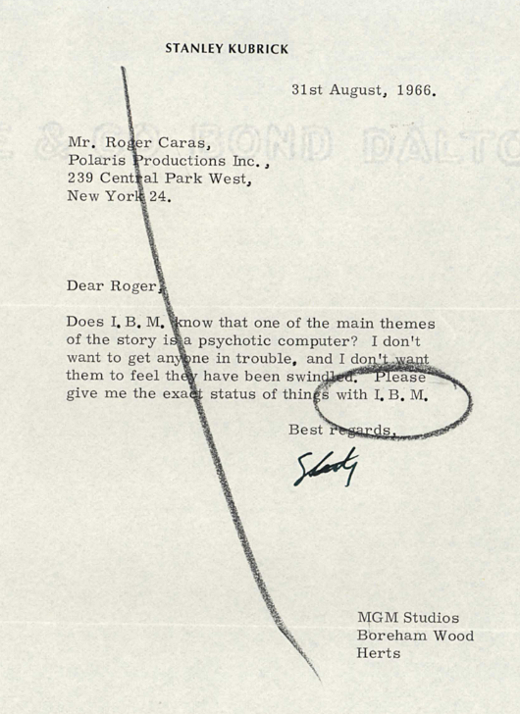
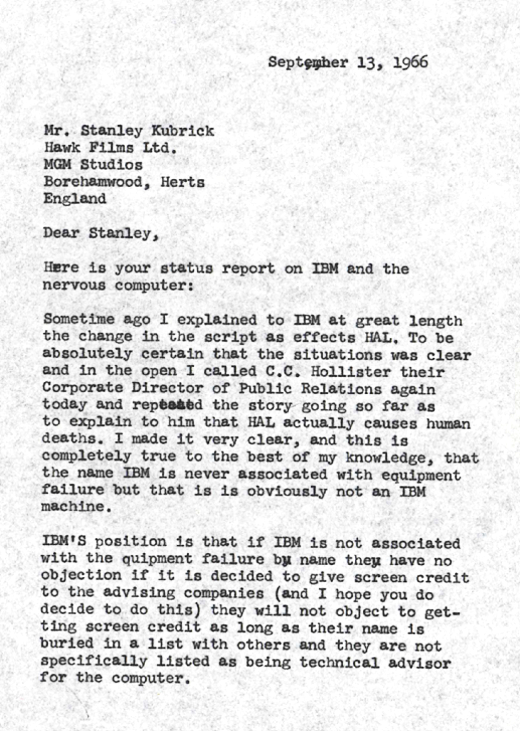
In August of 1966, 2 years prior to the release of 2001: A Space Odyssey, Stanley Kubrick wrote to the vice president of his production company and asked whether IBM — a company with whom Kubrick consulted during production, and whose logo briefly appears in the film  — were aware of HAL's murderous actions in the story. His letter, and Roger Caras's reply, can be seen below.

It's worth noting that both Stanley Kubrick and Arthur C. Clarke have since denied that HAL represented IBM, and have claimed that the "one-letter shift" between the names "HAL" and "IBM" is purely coincidental.

Transcripts follow.

(Source: LACMA; Image: HAL 9000, via.)


Transcript
STANLEY KUBRICK

31st August, 1966.

Mr. Roger Caras,
Polaris Productions Inc.,
239 Central Park West,
New York 24.

Dear Roger,

Does I. B. M. know that one of the main themes of the story is a psychotic computer? I don't want to get anyone in trouble, and I don't want them to feel they have been swindled. Please give me the exact status of things with I. B. M.

Best regards,

(Signed, 'Stanley')

MGM Studios
Boreham Wood
Herts


Transcript
September 13, 1966

Mr. Stanley Kubrick
Hawk Films Ltd.
MGM Studios
Borehamwood, Herts
England

Dear Stanley,

Here is your status report on IBM and the nervous computer:

Sometime ago I explained to IBM at great length the change in the script as effects HAL. To be absolutely certain that the situations was clear and in the open I called C.C. Hollister their Corporate Director of Public Relations again today and repeated the story going so far as to explain to him that HAL actually causes human deaths. I made it very clear, and this is completely true to the best of my knowledge, that the name IBM is never associated with equipment failure but that is is obviously not an IBM machine.

IBM's position is that if IBM is not associated with the quipment failure by name they have no objection if it is decided to give screen credit to the advising companies (and I hope you do decide to do this) they will not object to getting screen credit as long as their name is buried in a list with others and they are not specifically listed as being technical advisor for the computer.

RSS Feed proudly sponsored by TinyLetter, a simple newsletter service for people with something to say.
04 Jan 10:52

An eyewitness to President Lincoln's assassination appeared on television in 1956

by andrewhickeywriter
04 Jan 10:50

Martian Time-Slip

by Lawrence Burton


Philip K. Dick Martian Time-Slip (1962)

At the risk of writing the same Philip K. Dick review over and over, and further to the general theme of the disparity between that which Dick wrote and that which everyone seems to think he wrote, we come to Martian Time-Slip, a novel which so impressed me first time around that I actually got my mother to read it, no mean feat given how she seems to regard everything written, painted and performed since about 1400 as probably crap.

Aside from Martian Time-Slip being conspicuously lacking in android bounty-hunters screaming but am I even real? as they fall to their knees, arms cinematically outstretched to the heavens just as it starts to piss down; and aside from the complete absence of hard boiled action heroes - a quality shared with every single story Dick ever wrote - like We Can Build You from the same year, this would be a mainstream novel but for a few scenic details, at least in so much as any of Dick's writing can be considered mainstream. The story revolves around the desperate lives of Martian colonists scratching out a living in a hostile environment which harks back to the old west, or even to the Australian outback; water is scarce, and autism may turn out to be the condition of those with an unorthodox relationship to the passage of time. Of course, such elements constitute narrative language, the means by which the story is told rather than its subject.

Philip K. Dick's novels examine the nature of reality, often from the schizophrenic perspective of there being a different world hidden behind that which all but a few supposedly perceptive individuals can see. This, I would argue, is a structural aspect of Dick's perception rather than its central theme, said theme being truth itself: that which should be rather than that which is, the pure forms of being unsullied by entropic forces, or gubbish as they are rendered in Martian Time-Slip. I could be getting carried away here, but what I take from this, Dick's central idea, is a desire for progression or forward motion which relates to the notion of God equating to change - as I think Octavia Butler put it - change as differentiated from stasis, Dick's nightmare:

It is the stopping of time. The end of experience, of anything new. Once the person becomes psychotic, nothing ever happens to him again.

This passage is quoted in the foreword by Brian Aldiss - which I feel I should probably mention in case it appears that I'm trying to pass this off as some devastatingly original of my own - but it expresses a sentiment with which Dick remained preoccupied throughout his life, one which is restated a decade later in A Scanner Darkly:

That life had been one without excitement, with no adventure. It had been too safe. All the elements that made it up were right there before his eyes, and nothing new could ever be expected.

So, to get to the point - that's what the guy was on about, not all those Blade Runnerisms which are in any case thematically closer to the novels of William Gibson than anything Dick ever wrote.

Just sayin'.

Martian Time-Slip ambles along nicely, chuckling to itself without really trying for comic effect, its characters more in the spirit of Bukowski than Asimov; and like the man's best, it builds up a tremendous head of sorrow without conspicuously rooting for sympathy - a sad and beautiful song where most writers just about manage tunes. Instead of waiting for this to be stripped of all point and character as a shit film with some blandly photogenic cock playing Jack Bohlen - casting with all the sensitivity of Sylvester Stallone as two-fisted Franz Kafka - just read the fucking book, okay. Sometimes the book is how the story was meant to be told all along.
04 Jan 10:49

Free Fiction Monday: Love and Justice

by Kristine Kathryn Rusch

The Princess—once named Cinder Ella—murdered. The Prince missing. The King demanding justice. Only the sheriff knows that justice means destroying the kingdom. Can he do it? Can he convince the King to go along?

“Love and Justice” by USA Today bestselling writer, Kristine Kathryn Rusch, is available for $2.99 (with bonus story) on Kindle, Nook, Smashwords, and in other ebookstores.

The free story will only be available for one week.  If you missed this one, click on the links above.  There’s another free story lurking somewhere around this site. Track it down, read, and enjoy.

04 Jan 09:54

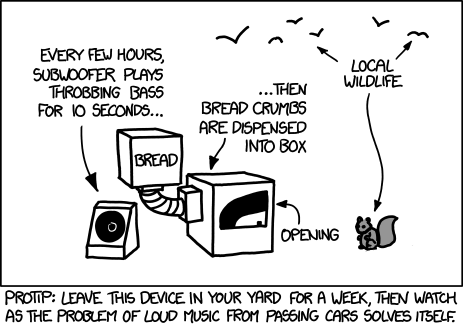
Conditioning

'Why are you standing in the yard wearing a papal hat and a robe covered in seeds?' 'Well, the Pope is visiting our town next month ...'
04 Jan 09:43

Tales of My Mother #10

by evanier

talesofmymother

During the last decade of my mother’s life, her eyes and legs increasingly failed her. In-between those parts of her anatomy, there were occasional problems like Congestive Heart Failure but the eyes and the legs were the ongoing problems.  There were long stretches when her heart was fine but her eyes and legs were awry every waking minute.

Her doctors told her that if she would just stop smoking, both would get better…or at least, wouldn’t continue to worsen at the pace by which they were worsening. She cut back on the Marlboros but didn’t stop until a few months before her passing, by which point it almost didn’t matter. One wrenching day about a year before she passed, I took her to an ophthalmologist appointment where she was asked, rather matter-of-factly, if she had or needed a document certifying that she was legally blind.

I can still hear her soft, stunned voice as she repeated, as if the term had never occurred to her, “legally blind.” She could see but not much more than about two feet in front of her…and not well enough to read a book or make out my face unless our noses were practically touching.

Her eyes had been deteriorating for some time. Macular degeneration, they told her. And then one day while out with our mutual cleaning lady, my mother fell and sustained a big scratch on the retina of what had up until that moment been her “good eye.” From that point on, she had to rely on her “bad eye” and worry that it would fail and leave her totally without sight.

Still, hearing those words — “legally blind” — came as a shock. Well, why wouldn’t they?

She had what seemed like a most competent ophthalmologist at Kaiser Hospital — not the person who asked the above question — and he struck me as properly balancing compassion with honest assessment of her situation. Some of the other eye doctors she saw there were a bit clumsy with their wordage but they told her the same thing; that her vision would continue to deteriorate. Certain treatments (like shots in the eye, which she hated) might slow things down but if she lived long enough, she would one day be totally, not just legally, blind. One of the things that tempered my sorrow at her death was the knowledge that she was approaching that day and she dearly wanted to go before it arrived.

The only thing I didn’t like about her main ophthalmologist wasn’t his fault. It was how little attention he could spare us as he handled some ridiculous number of patients per hour. We always had to spend long stretches in the waiting room, well past her appointment time. Then we’d finally be shown into Examining Room A while he was examining a patient in Examining Room B. Then he’d come into our room and attend to my mother while nurses loaded his next patient into B. Back and forth he’d go between the rooms, unable to spend enough quality time with anyone. At the end of each examination, he’d ask my mother, “Any questions?” And if she didn’t come up with one in two seconds, he’d be out the door and on his way to the next patient.

How I dealt with this: By blocking the exit.

I’m 6’3″ and something of a wide load. When the doctor came into the room, I’d subtly move to a spot between him and the exit, the better to prevent his escape before my mother had a chance to ask all her questions. The doctor knew exactly what I was doing and didn’t really mind it.  Once when I finally let him go, I heard him tell the patient in the adjoining room, “Sorry to keep you waiting but the patient I was just with…her son was blocking the door and wouldn’t let me out.”

Snagglepuss

Snagglepuss

But once he got past me. I wasn’t in position and he gave my mother a half-second to ask him anything before he said, “Exit, stage left!” and headed for the room next door.

“Oh, a Snagglepuss fan,” I remarked.

He stopped and said, “You know Snagglepuss?”

My mother said — in a dry delivery that Walter Matthau would have envied — “My son knows every cartoon ever made.”

The doctor eyed me with skepticism. “Oh, yeah? What was the name of Jonny Quest’s dog?”

I said, “Bandit. Hey, do you think my mother should be taking Lutein?”

He said, “Can’t hurt to try” and he recommended a dosage. Then he asked me, “What was the name of the Jetsons’ dog?”

I said, “Astro and his real name was Tralfaz. Hey, how about Vitamin D? You think that would do anything for her?”

That was how it went, not only on that visit but every one after that. Instead of giving us the minimum time, he’d keep others waiting and we’d talk about two topics: Cartoons and my mother’s eyes. I’d trade him info for info.  Sometimes, he had actual questions about the industry.  Other times, he just wanted to see if he could stump me.  Once, he tried the latter by asking, “On the Dungeons ‘n’ Dragons cartoon show, what was the name of the blonde kid who was their leader?”

I told him it was Hank. He told me I was wrong and that it was Frank. I told him it was Hank and added, “By the way, I wrote the pilot for that show.”  Whack!

But that wasn’t my favorite exchange. My favorite was when he asked me where Bullwinkle Moose went to college. I told him it was “Wottsamotta U.” He told me I was wrong. “Aha! I finally got you! It was Moosylvania University!”

I told him he was wrong. He told me he was right. I told him he was wrong. He told me he was right. I told him he was wrong. He told me he was right.

I offered to bet him.

The offer was this: If he was right, I’d give him a DVD of any cartoon show he named. Any one. If I was right, he’d give my mother a half-hour of his time. We’d come back at the end of the day after all his other appointments and he’d spend thirty solid minutes discussing things we might try to help her vision. He said, “It’s a deal…but how are you going to prove it?”

Easy. I whipped out my cell phone and dialed a number. A woman answered and I asked her, “May I speak to Rocky the Flying Squirrel, please?” The ophthalmologist stared at me like I was about two Jews short of a minyan. When another voice came on the line, I said, “Hi, Rocky. It’s Mark Evanier. How’s the weather in Frostbite Falls, today? Great. Hey, listen. I have a friend here. Would you please tell him where your friend Bullwinkle went to college? Here he is –!”

And I handed the phone to the eye doctor. You should have seen his face when Rocky said, “Hokey Smokes! Everyone knows Bullwinkle was a proud alumnus of Wottsamotta U!” There are many advantages to knowing June Foray and that was one of them.

My mother, who understood exactly what was going on, got hysterical. I used to make her laugh a lot but I think that was the all-time best. And the doctor was not displeased about losing our little wager. He stumbled around his office for some time after in a happy daze, telling everyone, “You won’t believe who I just talked to!”

He made good on the half-hour but unfortunately, there wasn’t much that could be done…by him. I took her to an outside specialist — a man my own ophthalmologist said was the best retina man in the field. The best retina man in the field said there wasn’t anything that could be done. After that, my mother asked me to stop. All she was going to hear from additional doctors was that there was nothing that could be done and she didn’t need to hear that over and over. So I stopped.

She became increasingly reliant on paid caregivers. She could, of course, no longer drive and her walking capabilities were such that she couldn’t even leave her home without considerable aid. The house had a large, beautiful back yard and she loved to stare out at the birds splashing about in the two birdbaths or feasting at a feeder I’d installed. She couldn’t see them very well but she could hear them and her imagination could fill out whatever imagery she could see.

Still, even with help, she could not physically get down the back steps and so couldn’t actually venture out into her own back yard. There were fewer steps in the front and I had a bannister installed to help her there. In the house, she got around with a walker. When out, she was pushed around in a wheelchair. I had a good, heavy-duty one in the trunk of my car and I also bought a lightweight one that was employed when caregivers took her to the market or the beauty salon…or to the kind of doctor appointments that didn’t require my presence.

The caregivers came from an agency that had been highly-recommended. It was licensed and bonded and the people there were awful nice. So were the caregivers…until one day, I went online to check my mother’s bank accounts and I found some mysterious charges. The next time I write one of these, I’ll tell you what happened but the audio clip below should give you some idea of the kind of story it’ll be…

03 Jan 23:50

'My Life at Crossroads' by Noele Gordon

by noreply@blogger.com (Paul Magrs)

BLURB:

"...Here, Noele Gordon (otherwise known as Meg Richardson) discloses all the secrets, the heartaches and the fun behind CROSSROADS, the programme which can boast a regular 14 million viewers.

"That Crossroads is a religion for millions has produced its own wealth of anecdotes. How Noele was offered a position as manager of a hotel... how one viewer rang to warn her that the motel would be burgled before it happened on TV and reality. Where fact meets fiction for the many fans is often blurred... And besides the many often humorous stories, Meg... sorry, Noele... discusses frankly her views on marriage (including the reasons why she never married) and other subjects of interest to women."

I plucked this off my over-full TBR bookcase on New Year's Eve as part of my resolution to start tackling those books I've left unread way too long. It's a behind-the-scenes book from 1975 about the famous daytime soap. The first thing to note is that this is six years before Noele Gordon gets unceremoniously dumped from the show that she had dominated since 1964. In 1975 Crossroads was still unthinkable without the flame-haired matron in charge. At the time of writing - or ghost-writing - this paperback she is very secure in her world, and it's a strange world for us to go back and visit. A time when this show could claim huge popularity and boast about its global appeal, and simply shrug at anyone pointing out its ropiness and lack of sophistication. It was in the business, Noele tells us, of portraying 'real' and 'mundane' life as it might happen to the staff and visitors to a Midlands hotel. It was much realer than, say, 'Coronation Street' because it didn't even try to be 'drama'. Even misreadings of lines and memory loss on the part of its actors were evidence of its keener realism.

The show and the book belong to an era when ordinary life seemed to be dramatic enough for the average viewer. The mundane was interesting enough to draw in audiences of fourteen million. Soap operas didn't need to have shoot-outs and serial killers and quite so much misery and upheaval. The Motel was all about chatter and kerfuffle and everyday stuff.

The book is like reading a terribly overlong TV Times article. Noele gives us a little background to herself and her career - with a little boastfulness, perhaps. But then, she had a very interesting career - in that she had already been a stage actress, TV executive and live daytime presenter before becoming a soap star. She actually comes across as rather modest, compared with all the showing off you tend to hear from just about anyone involved in TV these days.

There's not much gossip and filth here, though, which is a pity.

I like how keen she is to tell us how busy they were making Crossroads - producing four episodes weekly, every week of the year. The show was like an unstoppable juggernaut - constructed from painted plywood and driven by a woman in quite a lot of eye make-up.

It makes me long for a time when tv drama wasn't just about 'events' and spectacle and blockbusters. I ended up kind of wanting there to be a shonky soap opera filled with mundane goings-on. One I can rely on being there almost every day of the year. Soap characters these days are like ticking time bombs and we're waiting for them to turn into killers or pop stars or something else improbable. What happened to the days when we just watched ordinary people being fairly boring for decades on end...?  Days of instant coffee and flock wallpaper and trimphones and man-made fabrics. When motels seemed glamorous and Meg's sitting room or Jill's rustic kitchen at 'Windmills' seemed about as sophisticated as life ever got..?
03 Jan 23:44

Getting the source right

by Nick

I’ve seen a few people talking this morning about how ‘Westminster Council’ are planning to strip benefits from obese people who don’t exercise. Now, that’s a very silly idea – and Stavvers points out the reasons for that in this post – but the key point that people have missed is that these proposals don’t actually come from Westminster Council.

The stories are based on this report on the LGIU (Local Government Information Unit) website. While Westminster Council were part of the process in coming up with the report – through some vaguely described ’round table discussions’ with the LGIU – the executive summary of the report (on page 2) states quite clearly:

Recommendations are, however, made independently by the LGiU and do not necessarily reflect the views of WCC.

Which actually makes this worse. This isn’t a rogue report floating around one council – this is an officially sanctioned and published LGIU report that will be circulated to hundreds of councils all across the country. Westminster’s name is attached to it as they appear to have been the only Council consulted in drawing up the report and recommendations, but this isn’t their policy unless they choose to adopt it, just like anyone else.

It’s worth noting that most of the report is pretty standard stuff that’s been seen in many other reports and recommendations 4 and 5 particularly could appear in just about any LGIU report with ‘public health’ replaced by whatever the topic at hand was. The problems mostly stem from one line on page 6:

Where an exercise package is prescribed to a resident, housing and council tax
benefit payments could be varied to reward or incentivise residents.

However because of the nature of the report, this isn’t backed up with any evidence as to who or where it’s come from, why anyone thinks it might be effective or whether the person who wrote it stared deep into their soul before doing so and realised exactly what it was they were proposing. Unfortunately, that advice is now being pushed out all across the country, so expect it to emerge in lots of places other than Westminster with proponents claiming ‘it was in an LGIU report, it must be a good idea!’

03 Jan 22:06

"The data are": How fetishism makes us stupid

by Geoff Nunberg

Pedantry, Dr. Johnson said in the Rambler, is the unseasonable ostentation of learning. And learning is never so unseasonable as when its display impedes the workaday business of making sense. Take the sentence from The Economist that I ran across when I was writing my word-of-the-year piece for Fresh Air on "big data":

Yet even as big data are helping banks, they are also throwing up new competitors from outside the industry.

You can see what happened here—the copy editor (it had to be a copy editor, since nobody competent to write about big data would dream of treating the phrase as anything but singular) saw data followed by a singular pronoun and a singular form of be, and corrected them to plurals. The problem is that if you construe big data as a plural then it has to denote a collection of large things, in the same way that big elephants denotes a set of elephants that are each large, not a large set of elephants of any size. In that case, I suppose big data would have to be a collection of facts like this:

π = 3.1415926535897932384626433832795028841971693993751…

rather than, say

π > 3

which is a little bitty datum. If you took the sentence at face value, that is, it would be what we grammarians term “idiotic.” But I doubt whether the Economist's copy editor gave a toss, as they lot say. Sense, shmense—he or she wasn’t about to get caught out treating data as a singular noun.

The problem with such scruples is the reader is obliged to take note of them. Copy editors are meant to be gnomes working invisibly below decks to ensure that the engine of prose runs smoothly. They shouldn’t obtrude themselves conspicuously into the middle of a clause, so that the reader has to break off his attention to the writer’s argument and do a little mental stutter-step before he can remark to himself, “Oh, I see—it’s that data-must-be-plural business.” Copy-editors desirous of such notice should try another trade, one where they’re not required to hide their LittB under a bushel.

I’m not going to hash over all the arguments about the singularity of data, which has been hashed over at some length, to put it mildly. (For some generally sensible discussions of the issues, see, e.g., Motivated Grammar, Kevin Drum and the Economist’s own language critic Robert Lane Greene, writing as “Johnson,” here and here.) My own view is that there are contexts where it’s okay to treat data as a plural, but none in which you can’t treat it as a singular—and that contrary to what many “reasonable” usage writers counsel, this isn't simply a matter of “style and personal preference.” As the Economist example shows, there are times when treating data as a plural makes you sound not simply like a pedant but a fool. (There’s actually another, more substantive side to this that I want to explore, but I’ll leave that for another post.)

But it is instructive to look at the way defenders of the rule justify their position. Most simply point to the word’s etymology, but some devise synchronic explanations, comparting the word to pluralia tantum like trousers (the plural of trousum) or to British usage in sentences like “Manchester are playing Leeds” (“…and quite few of them are looking forward to it”). These arguments don’t deserve to be taken seriously, not just because they’re confused and irrelevant, but because they’re disingenuous: whatever arguments they come up with after the fact, the only reason anyone treats data as a plural nowadays is to show that they know it started its life that way.

For those purposes, it isn’t really necessary to think the rule through in all its subtlety. Usage fetishes turn copy-editing into a mechanical trade—and the machine they’re simulating doesn't need more than 64k of memory. The adherents seize on one easily identified context to demonstrate their erudition, and ignore others in which the rule would hold if it were being applied thoughtfully. In articles in The Economist, for example, data is and data are occur with roughly equal frequency, excluding cases in which data isn’t the head of the subject NP. But much (of the) data and little (of the) data occur 90 times, against 15 for few (of the) data or many (of the) data. (These figures exclude comments, explicit discussions of the plurality of the noun, and references to things like data centres, data sets and data points—the last being the way in which people nowadays most often refer to what used to be called a datum). And in these cases, too, insistence on treating data as a plural can lead to grammatical inconsistencies or semantic anomalies. My guess is that an editor’s interpolation is responsible for the number discrepancy here:

At the moment, says Anthony Tuzzolino of the University of Chicago, there is plenty of computer modelling going on of the distribution of space dust, but few data.

And in the following, the plural verb require suggests that the number-crunching applies to one datum at a time:

Repeated aerial surveys over the coming years will also give the researchers insight into how vegetation recovers from fires, how the beetles affect this process, how erosion and sedimentation affect the region’s water resources, and whether fire creates opportunities for new species to invade. So many data, of course, require a lot of number crunching.

As I said, this selective enforcement is typical of rules that have jelled into fetishes. Take the rule that unique cannot be compared, which adherents associate with modifiers like very, more, and most. People who wince at “the most unique restaurant in town” are less likely to object to a sentence like “Joyce seems to us less unique than he did to his contemporaries.” At the same time, writers overgeneralize these rules, turning them into dumb syntactic filters that block many sentences that wouldn’t have offended against the original version. That process is hard to observe directly, of course, since it manifests itself only in the absence of certain constructions. But you can draw it out in other ways, such as the responses to some items we gave to the American Heritage Usage Panel some years ago. In that survey, only 16 percent of the respondents accepted Her designs are quite unique in today's fashion scene, which is as you’d expect from a panel or writers and critics. But only 28 percent accepted The American Constitution is still nearly unique in that it allows no self-destruct mechanism. Yet even if you insist that unique is unequivocally an absolute term, there’s nothing in such sentences to object to—no more than in saying that a wound was nearly fatal. For the other 72 percent, the operating principle seems to be, "Don't modify unique with an adverb," which keeps copy editors at bay, but doesn't require any semantic insight.

I’m not troubled in the abstract by the critical attitudes that linguists condemn as prescriptivism (though I really dislike the term). But it’s a sign of what that tradition has come to that its principles so often devolve into empty gestures. The best argument against these fetishes isn’t that they’re irrational or pretentious—though there is that—but that they make us stupid.

Added 1/4: Going through my files, I found the following solecism from an article on plagiarism in the New York Times, 1/07/02: "Remarkably enough, in a profession that feeds on data, very little data have been gathered about the behavior of scientists themselves. " It's a kind of bookend to the Economist sentence.

03 Jan 18:02

How Intelligent is IQ?

by Neuroskeptic
"If your IQ is somewhere around 60 then you are probably a carrot'', according to a British spokesman for high-IQ club Mensa.


IQ's in the news at the moment thanks to a paper called Fractionating Human Intelligence from Canadian psychologists Adam Hampshire and colleagues. Some say it 'debunks the IQ myth' - but does it?

The study started out with a huge online IQ test...
Behavioral data were collected via the Internet between September and December 2010. The experiment URL was originally advertised in a New Scientist feature, on the Discovery Channel web site, in the Daily Telegraph, and on social networking web sites including Facebook and Twitter.
The test involved 12 different cognitive tasks, based on the usual IQ test kind of things, and they got a huge 45,000 usable responses.

However, the main part of the study used functional MRI (fMRI) to measure brain activity caused by each of the 12 tasks. There were only 16 volunteers in the brain scan study, which is pretty small.

The key finding was that although each of the 12 tasks made a different pattern of brain regions light up, there were two main components of this: one lit up mostly in response to tasks requiring short-term memory, and the other was associated with reasoning and logic: (EDIT: Picture corrected, oops.)


They did various other analyses that confirmed this, and they also found evidence for a third network responsible for language (verbal) skill.

Finally, the killer conclusion was that there was no reason to introduce the imfamous  'g factor' - a number representing general intelligence affecting performance on all tasks. Although there was a 'g factor' statistically, it was explained by the fact that tasks required both the memory and the logic networks (although to different degrees).

g is the most controversial aspect of IQ testing, because if it exists, that means that some people are just smarter than others across the board - not just better at a particular kind of thing. So has this study killed g?

Well, not by itself. There's a huge literature on IQ and g, going back almost 100 years. This stuff is not based on brain imaging, but just on IQ test scores, and it's a complex topic. I don't think one brain study with 16 people can really overturn that, although it does lend weight to the anti-g camp who have been arguing against g for decades.

There's a sense, though, in which it doesn't matter. If all tasks require both memory and reasoning (and all did in this study), then the sum of someone's memory and reasoning ability is in effect a g score, because it will affect performance in all tasks.

If so, it's academic whether this g score is 'really' monolithic or not. Imagine that in order to be good at basketball, you need to be both tall, and agile. In that case you could measure someone's basketball aptitude, even though it's not really one single 'thing'...

ResearchBlogging.orgHampshire, A., Highfield, R., Parkin, B., and Owen, A. (2012). Fractionating Human Intelligence Neuron, 76 (6), 1225-1237 DOI: 10.1016/j.neuron.2012.06.022
03 Jan 16:32

No Girls Allowed!

by Steve Horwitz

(co-authored with Steve Horwitz)

no-girls-allowed1

This morning Julie Borowski, who makes videos as “Token Libertarian Girl,” shared her answer to the question “Why aren’t there more female libertarians?” While we certainly agree with Borowski that this is a question worth asking, and while we also agree that in the long run her video answers the question, we think just about everything else she says in her two minute video is wrong.

Borowski argues that because libertarianism and liberty issues are not thoroughly integrated into popular culture, women—who are slaves to being “socially acceptable and fitting in with their peers”—find libertarianism unappealing. She excoriates popular culture and women’s magazines in particular as left-wing feminist (!?)  programmers of women’s minds, and damns women as passive recipients of everything the culture hands out.

Borowski then slut shames women who engage in casual sex, off-handedly dismisses the possibility that a libertarian could be pro-choice, and spirals off into an unfocused critique of the luxury goods market.  Every single one of these things that she criticizes women for doing should be seen not as causes for shame, but as complex choices that smart, thoughtful women can and do make, without destroying their lives in the process.  In addition, Borowski is making arguments that conservatives hurl at women all the time. If we want to pull young women away from liberalism and toward libertarianism, repeating the very same intellectually patronizing conservative arguments that pushed women to liberalism in the first place doesn’t seem to be the way to go.

Telling women that they aren’t libertarians because they are too stupid to choose something better for themselves isn’t great advertising for liberty. Claiming that women are passive, easily programmed, and incapable of critical interaction with political and cultural ideas is simply wrong—as centuries of history of women fighting against the state and decades of critiques from the left and the right of women’s magazines and popular culture have shown.

What Borowski does get right is that libertarianism does need to move into the popular culture. We do need more, and more vocal, libertarian authors, actors, musicians and so on—with the talent to produce good work that addresses themes of liberty without being dogmatically and annoyingly ideological.

But the way that Borowski’s video answers the question, “Why aren’t there more female libertarians?” is, sadly, just by being itself. There aren’t more female libertarians because libertarians say things exactly like this. Nearly every female libertarian we know can tell stories about being told, “Women aren’t really equipped to understand libertarianism. It’s a biological thing.” Or “Of course women are statists. They all just want to be taken care of.” Or “Women’s brains just can’t do economics.” Or “Women’s right to vote ruined the country.” Now Borowski has added yet another insult to the pile.

We are convinced that if a bright college-aged woman considering libertarianism saw this video, she’d think “I don’t want to be part of that movement if that’s what libertarians think women are like. And Borowski is one of the women! I can only imagine what libertarian men think…”  Borowski might want to ask herself what the reception of that video would be at something like an Institute for Humane Studies introductory seminar.  How would a several dozen smart, interested-but-not-yet-libertarian college-aged women respond to it?  We shudder to find out the answer.

The result is that female libertarians continue to look over their shoulders and wonder which of their fellow travelers thinks they don’t really belong in the movement.

Videos like this are yet another “No Girls Allowed” sign on the treehouse of the libertarian movement  and the nodding heads and “likes” by libertarians on Facebook and YouTube just add a few exclamation points and a larger font to that sign.

We’re libertarians. One of us is even a female one. And we’re going to spend yet another day being just a little embarrassed to admit it.

03 Jan 16:26

Jeremy Browne and the rigour of government

by Jonathan Calder
The Liberal Democrats have "undergone a big transformation” since going into government - or so Jeremy Browne told BBC Radio 4's World at One the other day:
“If you’re a party in opposition, you get used to being oppositionist – you can see this with Labour, even after two and a half in year in opposition they are making a completely wild set of incoherent and uncosted pledges. 
“We’d been in opposition prior to 2010 for 70 or 80 years, so it’s not surprising the way that you become used to the lack of rigour that opposition entails. 
“We came into government in 2010 I think with some policy proposals that weren’t going to survive the rigour of being in government. But it is, I acknowledge, and Nick Clegg has acknowledged, it’s a learning process, it’s a growing-up process for the Lib Dems.”
Is this at all true? For several general elections now, the Liberal Democrats' proudest boast has been that their manifesto is "fully costed".

A more cogent criticism would be that in our concern for demonstrating economic rigour on details of policy we failed to articulate a wider vision or philosophy sufficiently cogent or appealing to persuade people to change their habits and vote for us.

You could say that all the parties were overtaken by events and that whoever had come to power after the election would have found it hard to fund new spending commitments. But that is also to say that the Liberal Democrats were no more at fault than anyone else.

But maybe Jeremy disagrees. Maybe he was worrying that the party's policy programme was unaffordable for months or years before the last election.

In which case, where was he? Certainly not on the Federal Policy Committee.

Which displays another weakness of the Liberal Democrats, at least in the days when I was on FPC, is that the MPs just don't seem that interested in policy. I never got the impression that the parliamentary party's places on the committee were hotly contested. Perhaps they have taken the hard-headed view that their chances of being re-elected have little to do with the details of the party's manifesto?

If Jeremy believed we were heading for trouble then should he not have spoken out sooner? He is increasingly being spoken of as a future leader of the party (if only by right-wing journalists), but there is not a lot of evidence of leadership here.

Featured on Liberal Democrat Voice
03 Jan 15:39

The push-back against the push-back begins: ‘Mainstream’ evangelicals criticize critics of the religious right

by Fred Clark

Well, I told you this was coming.

Last month I wrote about a modest bit of push-back from “mainstream” evangelicals against the appalling things said by several religious right leaders following the massacre in Newtown, Conn.

Mike Huckabee, James Dobson, Bryan Fischer and Franklin Graham disgraced themselves by blaming the shootings on the separation of church and state, same-sex marriage and legal abortion, prompting widespread criticism from a wide variety of Christian leaders and just about anyone else who heard what they said.

But, as usual, mainstream evangelical leaders, magazines, bloggers and spokespeople were hesitant to condemn those remarks. Their constituency, after all, is the same white evangelical populace that watches Huckabee on Fox News, listens to Dobson and Fischer on the radio (on 7,000 and 200 stations, respectively), and that inexplicably regards Franklin Graham as the legitimate heir to his father’s legacy. They are thus, understandably, rather timid about criticizing those folks.

Yet a handful of “mainstream” evangelical types did clear their throats and respond to Huckabee and Dobson, including Out of Ur, which is the blog of Leadership Journal, the magazine for pastors put out by the folks at Christianity Today.

Out of Ur published a guest post by Michael Cheshire, an evangelical pastor from Colorado, who wrote, “They Think We’re a Hate Group, and They Might Be Right.” Cheshire compared the vocal and visible leaders of the evangelical religious right with a “crazy uncle”:

I feel like I’m with a crazy uncle who makes ignorant comments while you’re helping him shop. You have to stand behind him and mouth, “I’m so sorry. He’s old and bit crazy. He means well.” So to my gay friends, scientists, iPhone users, and others he blamed for the horrendous killing spree by that mentally ill young man, I stand here mouthing a few words of apology to you.

The rest of Cheshire’s piece was pretty forceful, so much so that I worried “… it might get him banished into the limbo of ‘controversial’ evangelical voices — Cizik-ed away to a seat beside folks like Tony Campolo and Jim Wallis, whose continued membership in the tribe is permitted mainly as a way of marking its boundary.”

And that didn’t take long. Less than two weeks later, Skye Jethani posted Out of Ur’s backpedaling semi-retraction of Cheshire’s comments: “No, We’re Not a Hate Group.”

Jethani explains that the religious right is not representative of the silent majority of American evangelicals. That’s a false impression, he says, created by sensationalistic journalists and, Jethani says — citing Timothy Dalrymple — created by wily progressive Christians. He links to Dalrymple’s unique explanation for the rise of the religious right. It’s due, he says, to:

… people like Fred Clark. I think Fred dramatically underestimates the extent to which he and his ilk shape the public and media perception of evangelicals when they shine a relentless light on every ridiculous and offensive thing an evangelical pastor or radio host does, and completely ignore the good and important work that the vast majority of evangelicals do on a regular basis.

Bryan Fischer speaks at the 2012 Values Voter summit in Washington. Organizers apparently asked Mitt Romney whom he would like to have speak just prior to his speech. Gov. Romney quickly consulted my blog, saw that I had written nearly a dozen posts criticizing Fischer, and requested Fischer precede him because, Romney said, “Fred and his ilk shape the public and media perception.”

Yes, it’s all true. I started this blog in 2002. At the time, James Dobson was an inconsequential figure broadcasting his radio message daily on a mere 7,000 stations (mostly AM). He’d only written a couple dozen books at that point, and only half of those had become national best-sellers. And only 500 or so of the thousands of newspapers and evangelical publications in America bothered to carry his weekly column.

But once I started shining my “relentless light on every ridiculous and offensive thing an evangelical pastor or radio host does,” that criticism — cleverly disguised as posts about the Iraq War, eschatology, Buffy, Niebuhr, subsidiarity and manufactured housing — catapulted James Dobson to national fame, leading Time magazine to dub him “the nation’s most influential evangelical leader.”

I’ve done the same thing for countless others — Franklin Graham, Rick Warren, Bryan Fischer, Tony Perkins and dozens of other such figures who I’ve managed to elevate without ever even mentioning them here.

My very first substantial post, on my original blogspot site, criticized Pat Robertson for selling “sentergistic” anti-aging milkshakes. The effect of that post was so powerful that it lifted Robertson to a second-place finish in the Iowa caucuses 14 years earlier.

My influence is vast, unstoppable and retroactive. Or, alternatively, Dalrymple and Jethani might be talking out of their backsides. It’s one of those.

In any case, Jethani’s endorsement of Dalrymple’s weirdly anachronistic history of the religious right is not the biggest problem with his attempted rebuttal of Cheshire’s piece. The biggest problem with Jethani’s post is that it’s pastoral malpractice. We’ll get to that in part 2.


03 Jan 15:28

Shaming Conventions

Ever since the first e-mail was sent, it was only a matter of time before governments worldwide would find a way to monetize the internet.  Its commercial potential revolutionized capitalism, but it fiercely resisted the inevitability of the state taking its traditional cut; despite the way it ran roughshod over traditional market models — or perhaps because of it — it soon developed the reputation as the one truly free market.

It was easy to see why e-commerce proved so appealing to doctrinaire libertarians:  if anything could be aptly describe as the last frontier of unregulated capitalism, it was the storefronts of the internet.  Right from the start, e-commerce was able to avoid the traditional pitfalls of local taxes, international trade restrictions, and even various forms of regulation that had so often taken a bite out of profitable industries like gambling, finance and telecommunications.  ”Information wants to be free”, went the rhetoric of the day; but judging from their behavior, the owners of the world’s most profitable websites meant ‘free from regulation’ as much as they did ‘free from restriction’.

As the 2010s dawned, everyone know that something had to give.  The web had been a mixed blessing for government revenue; it had created a whole new generation of multi-millionaires, but they were too well-versed in the mechanics of ‘avoison’ to add much value to the tax base.  Their favored forms of commerce allowed them to dance rings around sales and luxury taxes, and the new cycles of boom and bust they created threw hundreds of thousands out of work, creating widespread social dependency and a consequent drain on the federal coffers. It couldn’t keep up this way forever; there had to be some way for the government to get a cut of all that sweetly intangible e-money.  The question was, how?

The answer didn’t come until summer of 2013, and it came not from a seasoned government functionary, but from a radical refugee from the world of e-commerce.  Victor Benavides, the junior senator from New Mexico, had been responsible for several initially profitable though ultimately doomed start-ups, including cybersodas.com, telescarves.com, TierWasser.com (a mineral water delivery service for pets), and AtYourService.com, a company where, for a small fee, operators would pretend to be customer service representatives for a different company you were angry with and allow you to yell at them for a half-hour at a time.  Coming from the private sector, he knew from firsthand experience that any internet start-up worth its salt was prepared from the time the ink dried on the incorporation papers to devote significant resources to dodging taxation.

Benavides also knew that internet users were also a highly organized, extremely stubborn group of consumers when it came to added costs.  They expected to use the web for free, and while they paid for quality, convenience and/or usability, they had been traditionally very strongly against any kind of across-the-board user fee for internet access, even if it targeted high-volume internet users over casual surfers.  How to resolve this problem?  How to reconcile the government’s need for increased revenue with the fact that most of the wealthiest individual who owed their largess to ducking any kind of authority?

The  Utilities Self-Righteousness Excise Revenue, or USER tax, was the solution.  Its various provisions were implemented, it is true, in a somewhat stealthy fashion, being attached as riders to elder-care safety acts, collective bargaining agreement protocols, public transportation bills, and other legislation of no interest to the voting public.  Even such electronic-freedom watchdog organizations as noticed the elements of the USER tax raised relatively few objections; it was not a form of censorship, after all, and, as Benavides had predicted all along, everyone simply assumed it would apply only to other people.

Within six months of its initial passage, the USER tax — a simple pay-as-you-go program that generated revenue based on the frequency and intensity of self-righteous, self-aggrandizing, smug, patrician, sanctimonious, prescriptive, and self-flatteringly glib and spurious statements made in the internet — had generated so much income that the federal government was predicting its largest revenue surplus since the 1990s.  By year’s end, the amount of money generated by parenting sites, foodie blogs and music critic message boards alone was projected as enough to wipe out the entire federal debt.

The most important factor in USER’s success was that any movement against it only strengthened it.  Every outraged comment quoting Thomas Jefferson was posted on-line in protest of the idea of taxing self-righteousness added another few pennies to the federal coffers.  Perpetual outrage machines like mises.org, freerepublic.com, and the various Breitbart organizations soon found themselves fully funding the government agencies they had long sought to abolish.  Even the mighty Anonymous fell before the might of Victor Benavides’ brainchild; so addicted were they to grandiose statements of righteous striving that their very first attempt to strike back at the USER tax bankrupted them completely.

Like many ambitious internet entrepreneurs before him, Benavides eventually became a victim of his own success.  Plans to institute similar measures that would tax the use of phony tough-guy rhetoric met with great hostility from pretend veterans’ groups, and a proposed scheme to fine men who complain about fat chicks one dollar for each pound they themselves exceed the obesity limit would have placed the entire country into receivership.  Japan had recently undergone a massive debt crisis after placing a similar tax on posting photos of quirky-looking food, and Britain’s attempt to litigate the copyright of “Keep Calm and Carry On” parodies was tied up in unending and costly court proceedings.  And a temporary rise in reasoned, respectful on-line communication had its ugly mirror in a growing underground economy of self-righteousness, to which a huge spike in suicides amongst service industry employees had been linked.

But the massive success of the initial project led to worldwide fame for its founder.  Soon after being named Time Magazine’s Man of the Year for 2014, he retired from public service and rededicated himself to the private sector — specifically, the field of green energy, where he has recently seen great success in generating electricity from people who begin sentences by saying “I’m the kind of person who…”.

Mirrored from LEONARD PIERCE DOT COM.

03 Jan 15:25

THERE’S NO NEED FOR THAT

by Mark Steel

I swear these are the words I just heard, from a woman sat behind me on the train from Victoria to Crystal Palace. She’d just finished a phone call, and said to her friend in a VERY loud and shrill voice “Every time he sees his ex-girlfriend there’s trouble. She’s only gone and hit him on the head right where he had the operation. Then because he couldn’t have sex she’s got him viagra and it’s made him have a fit. I’m sick of her.”


03 Jan 15:22

WHETHER THERE’S A GOD AND STUFF

by Plucker

For some reason my column didn’t appear in the Independent today, so if your Christmas has been ruined by that, all is well as here it is……..

Having followed the latest debate about religion I’d say the conclusion is obvious, that the only thing as disturbing as the religious is the modern atheist.

I’d noticed this before, after I was slightly critical of Richard Dawkins and received piles of fuming replies, that made me think what his followers would like is to scientifically create an eternity in laboratory conditions so they could burn me there for all of it.

It’s not the rationality that’s alarming, it’s the smugness. Instead of trying to understand religion, if the modern atheist met a peasant in a village in Namibia he’d shriek “Of course GOD didn’t create light, it’s a mixture of waves and particles you idiot it’s OBVIOUS.”

The connection between the religious and the modern atheist was illustrated following the death of atheist Christopher Hitchens, when it was reported that “Tributes were led by Tony Blair.” I know you can’t dictate who leads your tributes, and it’s probable that when Blair’s press office suggested he made one to someone who’d passed on he said “Oh which dictator I used to go on holiday with has died NOW?”

But the commendation was partly Hitchens’s fault. Because the difference between the modern atheist and the Enlightenment thinkers who fought the church in the eighteenth century is back then they didn’t make opposition to religion itself their driving ideology. They opposed the lack of democracy justified by the idea that a King was God’s envoy on earth, and they wished for a rational understanding of the solar system, rather than one based on an order ordained by God, that matched the view everyone in society was born into a fixed status.

But once you make it your primary aim to refute the existence of God you can miss what’s really fundamental altogether. For example, the ex-canon of St. Pauls, presumably a believer unless he managed to fudge the issue in the interview, was on the radio this week expressing why he resigned in support for the protestors outside his old cathedral. He spoke with inspiring compassion, but was interrupted by an atheist who declared the Christian project is doomed because we’re scientifically programmed to look after ourselves at the expense of anyone else. So the only humane rational scientific thought to have was “GO Christian, GO, Big up for the Jesus posse.”

Similarly Hitchens appears to have become obsessed with defying religion, so made himself one of the most enthusiastic supporters for a war he saw as being against the craziness of Islam. But the war wasn’t about God or Allah, it was about more earthly matters, which the people conducting that war understood. And as that war became predictably disastrous they were grateful for whatever support they could find. And so a man dedicated to disproving GOD was praised in his death by the soppiest sickliest most irrational hypocritical Christian of them all.

So the only thing I know for certain is that I would become a Christian, if I could just get round the fact that there is no GOD.


03 Jan 15:21

JOHN ARLOTT – BASINGSTOKE REBEL

by Plucker

Lately, for a reason that may be coincidence or the result of cosmic forces I don’t understand, there seems to be a renewed interest in a man called John Arlott. An old TV show of him in conversation with cricketer Mike Brearleys was repeated, a documentary about him was on Radio 4 and I even got to mention him in my radio series, in the show about his home town of Basingstoke.

Arlott is especially loved within Basingstoke. This may not be all that flattering as, on the Wikipedia page about Basingstoke, under ‘Culture’, it says “An episode of Top Gear was once filmed in Basingstoke.”

The town has its connections with celebrity. Liz Hurley is from there, and her mum was a primary school teacher. I spoke to someone who was in her class, who told how Mrs. Hurley proudly addressed the whole school in an assembly once, suggesting they all stayed up to watch her actress daughter who was appearing in her first television role that night. So Basingstoke’s 7-11-year-olds all got permission to stay up late, then stared in awe as Liz rolled around topless for a scene or two, after which Mrs. Hurley never spoke of the matter again.

Sarah Ferguson is also from the area, as is Tara Palmer-Tompkinson, so the place is almost a factory for posh useless women.

But even Mrs. Hurley would have to accept that the most compelling character to emerge from the town was Arlott, despite never being a celebrity, and who died 20 years ago in the Channel Islands.

I first encountered him through his cricket commentary, when I was about eight years old, fascinated by his voice, not just gravely but rattly, like a broken lawnmower or a washing machine on the spin cycle when a pound coin’s slipped inside.

In this croaky burr he once replied to a co-commentator who’d said “And as the sun sets in the West I hand you over to John Arlott”, by saying “And you can rest assured that if the sun sets anywhere other than the West, I’ll be the first to let you know.”

There was something in his tone that suggested he was aware with every ball he was describing, he was part of a wider world. It seemed he might say at any moment ‘So England are 125 for 3 and there’s just time to initiate a debate on the Vietnam War before Dennis Lille resumes from the Vauxhall End.”

You might assume a cricket commentator’s role in making an impact on international affairs would be limited. But later I learned of Arlott’s role in defeating apartheid. In the 1960s a South African player, Basil D’Oliviera, was classified under apartheid law as Cape Coloured. Despite, or perhaps because of playing on rugged patches of ground he was a tremendous batsman and bowler, but with no prospect of playing professionally due to the race laws.

So he was advised to contact an English cricket commentator known to be an anti-racist, who may be able to find him a place in the English game. Arlott read his letters and arranged for D’Oliviera to come to England, and secured him a place in the Lancashire League. Eventually D’Oliviera was selected for the England side, so all was cheery until England were due to play in South Africa. In England’s last game before the tour, D’Oliviera was impertinent enough to score 158 so his selection was secured, but the South African government made it clear they wouldn’t waive their apartheid laws to let him play in a whites-only environment. So the English selectors got round the problem by saying they weren’t picking him anyway, as they didn’t think he was good enough.

I’ve often wondered how the meeting went that decided this. “Hmm, his trouble is he tends to struggle when he’s on 158.” “Yes and he won’t be suited to playing in South Africa, coming as he does from South Africa, where the conditions are very different.” “Yes and you can never trust the temperament of a player whose first name is a herb. That’s why we never picked Oregano Duckworth.”

When the news came through that the English selectors had taken the decision to leave D’Oliviera out of the team, the South African parliament erupted into wild celebrations. The English cricket establishment wasn’t just acting out of cowardice, many of them were ardent supporters of apartheid. For example Alec Bedser, later the chair of selectors, became a member of the National Association of Freedom, that campaigned against the boycott of the apartheid regime.

Arlott wrote and spoke with fury about this behaviour, and eventually when the player selected in place of D’Oliviera became injured, the selectors had to pick Arlott’s man. The South African government announced they wouldn’t let him in the country, so the tour was cancelled and South Africa were banned from taking part in international cricket until the end of apartheid over 20 years later.

Arlott’s role in this episode was a reflection of his place as a strident English liberal. On the one hand, his journey through Basingstoke Grammar School, after which he became a policeman, journalist, commentator and then wine critic, suggest he was a dependable member of the establishment.

But one peculiarity of Britain’s history is the empire was justified as a method of exporting the British sense of fair play and justice to its colonies. This was a dubious claim, as if the whole project was undertaken to teach manners to the natives, but throughout the upper levels of the education system, from Grammar schools to Eton, some students took this at face value. For those like Arlott, if ‘fair play’ was flouted, they saw it as their duty to speak out and put it right, in the manner of the uniquely defiant English middle class rebel.

In Arlott’s case he became an official Liberal, campaigning for the party from his youth onwards. This may be why three programmes were made for the BBC in the early nineteen-eighties, in which Arlott and England captain Mike Brearley sat chatting aimlessly to each other while drinking wine in front of a pile of dusty books. Brearley had joined the SDP, the new party that broke from Labour, and at one point launched into a question that lasted around three minutes, along the lines of ‘Given that the hitherto perceived impregnable structural divisions in society…….. and reappraisal of…. advancing towards revised orthodoxy……., is this an apt moment, in your view, for a new party such as the SDP?”

Arlott stared into the middle distance for a moment, swirled his wine round his glass and said slowly “Chateau Mouton 1958 – very good wine for politics.”

He could employ a similar disdain in his cricket commentary. For a while he was on television, and seemed to work on the basis that as you could see what was happening there was no point in him saying anything at all. Once, when a player was bowled, the batsman walked off the pitch, was replaced by a new batsman, and Arlott said nothing. He said such nothing I was convinced the set had broken and started haranguing my mum to call the repair man and tell him the sound had gone. Then, as the new batsman was about to receive his first ball, came a barely audible gruff sound – ‘That’s bowled him’.

But if there’s one story from his life that by itself summarises his character, it may be the one I came across while reading his biography ‘Basingstoke Boy’ as research for the radio show. Arlott was asked, in his mid-forties, as a prominent broadcaster, to speak at a Basingstoke Grammar School Old Boys’ Dinner, and toast the health of his old headmaster, Mister Percivall.

Arlott was a little surprised, as he’d always expressed a dislike for his old master, and describes him as “A man who enjoyed caning, carrying his heavy bamboo cane, thick as his thumb and three feet long, down the hem of his gown. He would survey the offender through partly closed eyes, then order ‘Get down’, then administer three or four powerful strokes. Most victims would fall forward, staggering through the fifth-form room, where friends would run water over their heads or hold them as they vomited.”

But the secretary of the Old Boys’ Association was aware of Arlott’s feelings, and said “We’d like you to say what you thought of him.” So this was his toast, delivered to a packed room over dinner….

“Gentlemen, allow me to recall a single moment in the life of the subject of this toast. One day in 1929 I was sent to his room to receive the inevitable. In cowardly fashion I hid behind the coats. After a few moments I saw a frail, timid, twelve-year-old named Woodcock come into the room. It was clearly his first time. Presently Percivall’s asthmatic wheezing could be heard, and the door shook in its frame as he came in and slammed it shut.

He saw Woodcock and said ‘Why have you been sent here’?

‘Talking, sir’.

‘Then we shall have to teach you not to talk, shan’t we, Woodcock?’

‘Yes sir’.

‘Get down, Woodcock’.

The boy got down, Percivall gave the cane a few preliminary swishes and brought it down. Woodcock stood and the cane hit the back of his legs. ‘That didn’t count’, Woodcock, get down again’.

He got down and this time the cane landed squarely across his ass. Then more strokes across this wisp of a boy, who lay on the floor, weeping.

‘Stand up, I’ve told you already, that didn’t count’.

Eventually Percivall turned him over gently with his foot. ‘Get up Woodcock, you fool’.

I remained unseen, which meant unpunished. And that, gentlemen, is an accurate eye-witness account of a happening that, until now, neither of the people concerned were aware was seen by anyone else. That may remind you, gentlemen, of the headmaster whose toast is now proposed, Charles W Percivall.”

Arlott adds “The toast was drunk in a mutter, Mr Percivall did not reply, left hastily and never returned.

And at close of play England were 187 for 5.