Andrew Hickey
Shared posts

28 Jan 11:38
 Dead Romance is, it seems, the best Lawrence Miles novel ever. Possibly the best Doctor Who-related novel ever. And so, whatever the larger argument I may be making about Lawrence Miles’s failings are, and I am, in fact, making one, we should probably stop and sort out the fact that this is bloody fantastic. Because it is. Whatever the flaws of the Morrison/Miles approach in general, Dead Romance is a book that works and works very well, and it illustrates the things that approach can do.
What everybody praises about Dead Romance is its twist ending. So here’s the thing. I kind of hate twist endings and, if someone were foolish enough to give me despotic powers over all fiction, I would impose a ten-year moratorium on them along with creepy children and procedurals with social misfit lead characters. The problem with twist endings is that they’re cheap. They’re a cheap way to get out of having to write an ending that actually follows from what comes before. They’re what you do when you can’t actually resolve what you have in an interesting fashion - you decide in the last act that you’re going to throw everything away and establish a new premise for your story.
And yet Dead Romance actually makes it work. There are a couple tricks here. The first is that the narrator is complicit in the deception. This makes a big difference, simply because it means that the deception is thoroughly motivated. When the book pulls the rug out from under us it does so for reasons that are intimately related to the things that Christine has wanted all book, most notably to feel as though she’s real. Everything about why she’d be lying to the reader is set up early on. Furthermore, the revelation itself is set up early on. The revelation that Christine is inside a bottle universe from the rest of the Virgin line is essentially the same revelation as the one that she was just a clone grown by Cwej.
Secondly, it turns on an entirely believable revelation about a character we already know. Cwej is a known quantity to readers of the New Adventures, even if he hadn’t actually appeared in a while. And while we might want to believe that he would never do the sorts of things depicted here, the fact of the matter is that it’s all too easy to believe that he could get this far in over his head and make decisions this bad. It’s quintessential Cwej, tragically enough. And because the twist hinges on that, it avoids the feeling of arbitrariness that plagues some twist endings.
Thirdly, and crucially, it ends up making Christine a more interesting character. Through most of the book we assume she’s the lone survivor of the world, which is interesting but arbitrary. We’re looking at the world through the eyes of the one person who happened to be lucky enough not to die. Fair enough, but ultimately arbitrary. But by establishing that she’s a clone with implanted memories we get a reason why she should survive, which is that she’s not really of the world in the first place. This is actually much stronger than the ending it looks like we’re getting, moving the emphasis away from “everything you thought you knew is wrong” and towards “everything you thought you knew is actually more correct than you thought.”
In interviews Miles describes this book as tragic, and to his credit, he seems to actually understand what that word means. This isn’t just a story that ends bleakly, it’s a story where the bleak ending follows inevitably from its starting conditions, and is in turn hidden behind a twist such that it is at once the inevitable resolution of everything we’ve seen and a complete sucker punch. This, in turn, is built into something larger by the way in which the novel tackles its ambitious ideas.
Let’s look back to The Invisibles for a moment, both so we can highlight the similarity between what Miles does and what Morrison does, and so we can look at a context in which it unequivocally works, since I’ve yet to get around to being particularly charitable to Morrison (or Miles, for that matter). For the most part The Invisibles is at its strongest in the early issues, where we get Jack’s look at the world around him. This is because this is one of the most rock solid and reliable structures ever. Not for nothing did the Hero’s Journey go and infest every nook and cranny of storytelling: it’s a gloriously straightforward structure that’s easy to make work. For anything fantastic it’s a joy because you have a character who constantly needs the plot explained to them. For anything visual effects laden it’s great because the perspective of awe is mirrored in the main character, so you can do the standard issue Spielberg trick of having the movie be about the act of staring slack-jawed at the spectacle. And in general it works because there’s a contrast. Doctor Who has made it fifty years off the basic formula of “put somewhere some place they don’t belong and watch the sparks fly,” and the structure of “someone steps through a portal into another world” is basically that. But once The Invisibles gets out to its big war across the nature of reality and loses the sense of an outsider looking in on it the story rapidly disappears up its own asshole.
And as we said last time, the single best moment of The Invisibles is the issue where Morrison tacks back and fleshes out the background of the random and ordinary person who just gets caught up in the war over reality and gets killed for it. Because as we learned from Robert Holmes the most interesting thing about the epic scale is its fractal nature such that the same concerns play out on the tiny individual scale as on the massive one. So by showing us the war from the perspective of the generic guard who just gets shot in the face Morrison gives us the best window in on the war he ever manages.
All of which said, there’s nothing in Grant Morrison’s entire career (save perhaps his underrated companion to The Invisibles, The Filth) that comes anywhere close to what Dead Romance manages, which is to provide an ordinary person’s reflection not on falling out of the world but on a reality-breaking apocalypse. Dead Romance goes toe to toe with any given arc of The Invisibles for its sheer density of mad ideas, but it does the entire thing from the perspective of a perfectly ordinary person.
There’s a cheat implicit in it, of course, which is that Christine Summerfield acts just like Benny. But Benny is still defined primarily as an adventurer who has normal-person reactions to things. So Miles pulls of a beautifully clever trick and has a character who acts like Benny but who is, in practice, not an adventurer at all. There is, admittedly, a bit of outright trickery here. One of the few big plot holes in Dead Romance is that the book hinges on the fact that Christine Summerfield is just like Benny, hence several paragraphs of recounting the Summerfield family history and the declaration at the end that Benny is the only person in the universe Christine feels any kinship with. But there’s no actual reason for this - nothing explains why Benny’s attitudes and worldview would manifest in Christine. Nevertheless, she’s unmistakably derived from Benny, given different origins and a different setting, but still functioning with Benny’s ability to provide a not entirely credulous meta-commentary on the events of a genre story.
In many ways this fulfills the original premise of Doctor Who, only on the sort of sprawling epics that characterize the series (and most science fiction) as of the late 1990s. Classically speaking, in the Hartnell sense - which is, let’s face it, the sense in which Miles actually likes Doctor Who - it’s a series about ordinary people facing terrifying other worlds. And when it’s in the sci-fi milieu as opposed to the historical one, those other worlds are often defined by their sheer alienness. So here we get a world of utter alienness, defined precisely by the way it just drops into our world and callously slaughters everybody, but we get it through the eyes of ordinary people and get to enjoy the frisson implicit in that contrast.
This is enhanced by the book’s slightly orthogonal relationship with Doctor Who. Although it plays with familiar concepts, including the War and the bottle universes that would be introduced and dealt with more thoroughly in Interference, as well as, obviously, the Time Lords, the nature of the Virgin line and its rights meant that these concepts had to be kept at arm’s length. So the Time Lords never get to be identified as such. It’s obvious what they are if you know anything about Doctor Who, but they’re presented as alien.
It’s a mistake to suggest that this makes Dead Romance a stand-alone book. It’s not quite. Certainly it’s accessible to new readers, but it can only be understood as something that exists within a line of serialized fiction. But more to the point, this approach works because it’s recognizable as a Doctor Who story with the names changed and the concepts pushed to their breaking points. Note how even the concepts that Virgin does have the rights to are stretched. There are bits that are self-evidently about Ben Aaronovitch’s People, but those don’t get named either. Because this is a book about seeing the familiar milieu of Doctor Who refracted back at us at an odd and chilling angle. If you don’t have the frame of familiarity you’ll still follow the plot, but that’s true of most Doctor Who books. But more even than something like Interference, and certainly more true of most generic Doctor Who novels, if you aren’t steeped in the underlying mythology than its fundamental impact is blunted.
But there’s another interesting dimension here, and one that has puzzling and somewhat implications for considering Miles’s broader career. Simply put, Miles is visibly better when he gets a bit away from Doctor Who. Dead Romance is successful because of its partial distance from Doctor Who. His previous best book, Down (which is far better than Alien Bodies) also benefited from an appreciable distance from Doctor Who. Because its obvious that Miles does want to question and undermine key premises of Doctor Who, and the distance he gets from working in forms that are more “outside the government” than attempts at straight Doctor Who. Which is to say that his inevitable stormy departure from Doctor Who is all but inevitable.
Which is to say that everything that makes this book work is irrepeatable, at least within Doctor Who. Even within the Benny books it’s a stretch, since it requires a version of Benny who is manifestly not a competent adventurer. It’s a consummate one-off: The Caves of Androzani for the 90s. Like The Caves of Androzani, it works by finding a set of things that cannot be replicated and doing them so as to escape from the traps that the rest of the era lays. And like The Caves of Androzani, its successes are ultimately damning for the status quo. As good as this is, it points directly towards a fundamental problem with the era - one that is badly obscured by the “greatest hits” approach we’re taking with the books. People have found several ways to make Doctor Who work in specific cases, but there’s no usable general case of Doctor Who right now. It is a concept that only works when it is being reacted against. It’s only by exploiting the tensions within it that it can work at all, and there’s only so far you can ride that horse before it collapses utterly. As we’re about to see.
Outside the Government 8 (Dead Romance)
by noreply@blogger.com (Philip Sandifer)
 Dead Romance is, it seems, the best Lawrence Miles novel ever. Possibly the best Doctor Who-related novel ever. And so, whatever the larger argument I may be making about Lawrence Miles’s failings are, and I am, in fact, making one, we should probably stop and sort out the fact that this is bloody fantastic. Because it is. Whatever the flaws of the Morrison/Miles approach in general, Dead Romance is a book that works and works very well, and it illustrates the things that approach can do.
 What everybody praises about Dead Romance is its twist ending. So here’s the thing. I kind of hate twist endings and, if someone were foolish enough to give me despotic powers over all fiction, I would impose a ten-year moratorium on them along with creepy children and procedurals with social misfit lead characters. The problem with twist endings is that they’re cheap. They’re a cheap way to get out of having to write an ending that actually follows from what comes before. They’re what you do when you can’t actually resolve what you have in an interesting fashion - you decide in the last act that you’re going to throw everything away and establish a new premise for your story.
And yet Dead Romance actually makes it work. There are a couple tricks here. The first is that the narrator is complicit in the deception. This makes a big difference, simply because it means that the deception is thoroughly motivated. When the book pulls the rug out from under us it does so for reasons that are intimately related to the things that Christine has wanted all book, most notably to feel as though she’s real. Everything about why she’d be lying to the reader is set up early on. Furthermore, the revelation itself is set up early on. The revelation that Christine is inside a bottle universe from the rest of the Virgin line is essentially the same revelation as the one that she was just a clone grown by Cwej.
Secondly, it turns on an entirely believable revelation about a character we already know. Cwej is a known quantity to readers of the New Adventures, even if he hadn’t actually appeared in a while. And while we might want to believe that he would never do the sorts of things depicted here, the fact of the matter is that it’s all too easy to believe that he could get this far in over his head and make decisions this bad. It’s quintessential Cwej, tragically enough. And because the twist hinges on that, it avoids the feeling of arbitrariness that plagues some twist endings.
Thirdly, and crucially, it ends up making Christine a more interesting character. Through most of the book we assume she’s the lone survivor of the world, which is interesting but arbitrary. We’re looking at the world through the eyes of the one person who happened to be lucky enough not to die. Fair enough, but ultimately arbitrary. But by establishing that she’s a clone with implanted memories we get a reason why she should survive, which is that she’s not really of the world in the first place. This is actually much stronger than the ending it looks like we’re getting, moving the emphasis away from “everything you thought you knew is wrong” and towards “everything you thought you knew is actually more correct than you thought.”
In interviews Miles describes this book as tragic, and to his credit, he seems to actually understand what that word means. This isn’t just a story that ends bleakly, it’s a story where the bleak ending follows inevitably from its starting conditions, and is in turn hidden behind a twist such that it is at once the inevitable resolution of everything we’ve seen and a complete sucker punch. This, in turn, is built into something larger by the way in which the novel tackles its ambitious ideas.
Let’s look back to The Invisibles for a moment, both so we can highlight the similarity between what Miles does and what Morrison does, and so we can look at a context in which it unequivocally works, since I’ve yet to get around to being particularly charitable to Morrison (or Miles, for that matter). For the most part The Invisibles is at its strongest in the early issues, where we get Jack’s look at the world around him. This is because this is one of the most rock solid and reliable structures ever. Not for nothing did the Hero’s Journey go and infest every nook and cranny of storytelling: it’s a gloriously straightforward structure that’s easy to make work. For anything fantastic it’s a joy because you have a character who constantly needs the plot explained to them. For anything visual effects laden it’s great because the perspective of awe is mirrored in the main character, so you can do the standard issue Spielberg trick of having the movie be about the act of staring slack-jawed at the spectacle. And in general it works because there’s a contrast. Doctor Who has made it fifty years off the basic formula of “put somewhere some place they don’t belong and watch the sparks fly,” and the structure of “someone steps through a portal into another world” is basically that. But once The Invisibles gets out to its big war across the nature of reality and loses the sense of an outsider looking in on it the story rapidly disappears up its own asshole.
And as we said last time, the single best moment of The Invisibles is the issue where Morrison tacks back and fleshes out the background of the random and ordinary person who just gets caught up in the war over reality and gets killed for it. Because as we learned from Robert Holmes the most interesting thing about the epic scale is its fractal nature such that the same concerns play out on the tiny individual scale as on the massive one. So by showing us the war from the perspective of the generic guard who just gets shot in the face Morrison gives us the best window in on the war he ever manages.
All of which said, there’s nothing in Grant Morrison’s entire career (save perhaps his underrated companion to The Invisibles, The Filth) that comes anywhere close to what Dead Romance manages, which is to provide an ordinary person’s reflection not on falling out of the world but on a reality-breaking apocalypse. Dead Romance goes toe to toe with any given arc of The Invisibles for its sheer density of mad ideas, but it does the entire thing from the perspective of a perfectly ordinary person.
There’s a cheat implicit in it, of course, which is that Christine Summerfield acts just like Benny. But Benny is still defined primarily as an adventurer who has normal-person reactions to things. So Miles pulls of a beautifully clever trick and has a character who acts like Benny but who is, in practice, not an adventurer at all. There is, admittedly, a bit of outright trickery here. One of the few big plot holes in Dead Romance is that the book hinges on the fact that Christine Summerfield is just like Benny, hence several paragraphs of recounting the Summerfield family history and the declaration at the end that Benny is the only person in the universe Christine feels any kinship with. But there’s no actual reason for this - nothing explains why Benny’s attitudes and worldview would manifest in Christine. Nevertheless, she’s unmistakably derived from Benny, given different origins and a different setting, but still functioning with Benny’s ability to provide a not entirely credulous meta-commentary on the events of a genre story.
In many ways this fulfills the original premise of Doctor Who, only on the sort of sprawling epics that characterize the series (and most science fiction) as of the late 1990s. Classically speaking, in the Hartnell sense - which is, let’s face it, the sense in which Miles actually likes Doctor Who - it’s a series about ordinary people facing terrifying other worlds. And when it’s in the sci-fi milieu as opposed to the historical one, those other worlds are often defined by their sheer alienness. So here we get a world of utter alienness, defined precisely by the way it just drops into our world and callously slaughters everybody, but we get it through the eyes of ordinary people and get to enjoy the frisson implicit in that contrast.
This is enhanced by the book’s slightly orthogonal relationship with Doctor Who. Although it plays with familiar concepts, including the War and the bottle universes that would be introduced and dealt with more thoroughly in Interference, as well as, obviously, the Time Lords, the nature of the Virgin line and its rights meant that these concepts had to be kept at arm’s length. So the Time Lords never get to be identified as such. It’s obvious what they are if you know anything about Doctor Who, but they’re presented as alien.
It’s a mistake to suggest that this makes Dead Romance a stand-alone book. It’s not quite. Certainly it’s accessible to new readers, but it can only be understood as something that exists within a line of serialized fiction. But more to the point, this approach works because it’s recognizable as a Doctor Who story with the names changed and the concepts pushed to their breaking points. Note how even the concepts that Virgin does have the rights to are stretched. There are bits that are self-evidently about Ben Aaronovitch’s People, but those don’t get named either. Because this is a book about seeing the familiar milieu of Doctor Who refracted back at us at an odd and chilling angle. If you don’t have the frame of familiarity you’ll still follow the plot, but that’s true of most Doctor Who books. But more even than something like Interference, and certainly more true of most generic Doctor Who novels, if you aren’t steeped in the underlying mythology than its fundamental impact is blunted.
But there’s another interesting dimension here, and one that has puzzling and somewhat implications for considering Miles’s broader career. Simply put, Miles is visibly better when he gets a bit away from Doctor Who. Dead Romance is successful because of its partial distance from Doctor Who. His previous best book, Down (which is far better than Alien Bodies) also benefited from an appreciable distance from Doctor Who. Because its obvious that Miles does want to question and undermine key premises of Doctor Who, and the distance he gets from working in forms that are more “outside the government” than attempts at straight Doctor Who. Which is to say that his inevitable stormy departure from Doctor Who is all but inevitable.
Which is to say that everything that makes this book work is irrepeatable, at least within Doctor Who. Even within the Benny books it’s a stretch, since it requires a version of Benny who is manifestly not a competent adventurer. It’s a consummate one-off: The Caves of Androzani for the 90s. Like The Caves of Androzani, it works by finding a set of things that cannot be replicated and doing them so as to escape from the traps that the rest of the era lays. And like The Caves of Androzani, its successes are ultimately damning for the status quo. As good as this is, it points directly towards a fundamental problem with the era - one that is badly obscured by the “greatest hits” approach we’re taking with the books. People have found several ways to make Doctor Who work in specific cases, but there’s no usable general case of Doctor Who right now. It is a concept that only works when it is being reacted against. It’s only by exploiting the tensions within it that it can work at all, and there’s only so far you can ride that horse before it collapses utterly. As we’re about to see.
28 Jan 02:38
Between Impression and Expression: Christopher Hill
Expressing these class tentions, there was a tradition of plebeian anti-clericalism and irreligion. To go no further back, the Lollards carried a popular version of John Wyclif’s heresies into the sixteenth century. Lollard influence survived in a popular materialist skepticism which makes one feel appreciably nearer to the age of Voltaire than is normal in the 16th century. A carpenter in 1491 rejected transubstantiation, baptism, confession, and said men would not be damed for sin; in 1512 a Wakefield man said ‘that if a calf were upon the altar, I would rather worship that than the holy sacrament. The date was past that God determined him to be in form of bread.’ The clergy, an earlier Lollard had declared, were worse than Judas, who sold Christ for thirty pence, while priests sold masses for a halfpenny. The commons, said another, ‘would never be until they had stricken off all the priests’ heads.’ There was a saying in the country, a north Yorkshireman pleaded in 1542, ‘that a man might lift up his heart and confess himself to God Almighty and needed not to be confessed at a priest’. A shearman of Dewsbury elaborated on this point: he would not confess is offenses with a woman to a priest, ‘for the priest would be as ready within two or three days after to use her as he’.
Such men tended to be called Anabaptists or Familists by their enemies. These names — familiar enough on the continent — were very loosely applied in England: most of our evidence comes from hostile accounts in the church courts. The essential doctrine of Anabaptism was that infants should not be baptized. Acceptance of baptism — reception into the church — should be the voluntary act of an adult. This clearly subverted the concept of a national church to which ever English man and woman belonged: it envisaged instead the formation of voluntary congregations by those who believed themselves to be the elect. An Anabaptist much logically object to the payment of tithes, the ten per cent of everyone’s earnings which, in theory at least, went to support the ministers of the state church. Many Anabaptists refused to swear oaths, since they objected to a religious ceremony being used for secular judicial purposes; others rejected war and military service. Still more were alleged to carry egalitarianism to the extent of denying a right to private property. The name came to be used in a general pejorative sense to describe those who were believed to oppose the existing social and political order.
Familists, members of the Family of Love, can be defined a little more precisely. They were followers of Henry Niclaes, born in Münster in 1502, who taught that heaven and hell were to be found in this world. Niclaes was alleged to have been a collaborator of Thomas Münzer in insurrection at Amsterdam. The Puritan divine John Knewstub said of him: ’H.N. turns religion upside down. He buildeth heaven here on earth; he maketh God man and man God.’ Like Francis Bacon, Familists believed that men and women might recapture on earth the state of innocence which existed before the Fall: their enemies said they claimed to attain the perfection of Christ. They held their property in common, believed that all things come in nature, and that only the spirit of God within the believer can properly understand Scripture. They turned the Bible into allegories, even the Fall of Man, complained William Perkins. Familism was spread in England by Christopher Vittels, an itinerant joiner of Dutch origin. In the 1750s English Familists were noted to be wayfaring traders, or ‘cowherds, clothiers and such-like mean people’. They believed in principle that ministers should be itinerants, like the Apostles. They were increasing daily by1759, numerous in the dicese of ELy in 1584, also in East Anglia and the north of England. They were particularly difficult for the ecclesiastical authorities to root out because — like many Lollards before them — they were ready to recant when caught, but not to give up their opinions. The Family of the Mount held even more subversive views. They were alleged to reject prayer, to deny the resurrection of the body. They questioned whether any heaven or hell existed apart from this life: heaven was when men laugh and are merry, hell was sorrow, grief, and pain.
The opening words of Bishop Cooper’s Admonition to the People of England (1589) speak of ‘the loathsome contempt, hatred and disdain that the most part of men in these days bear towards the ministers of the church of God’. He attributed such views especially to the common people, who ‘have conceived an heathenish contempt of religion and a disdainful loathing of the ministers thereof’. ’The ministers of the world,’ Archbishop Sandys confirmed, ‘are become contemptible in the eyes of the bases sort of people’. In 1606 a man was presented to the church courts for saying that he would rather trust a thief than a priest, a lawyer or a Welshman.
‘If we maintain things that are established,’ complained Richard Hooker, ‘we have to strive with a number of heavy prejudices deeply rooted in the hearts of men, who think that herein we serve the time and seek the favor of the present state because thereby we either hold or seek preferment.’ Thomas Brightman in 1615 confirmed that hostility to the hierarchy ‘is now favored much of the people and multitude’. We recall the oatmeal-maker who, on trial before the High Commission in April 1630, said that he would never take of his hat to bishops. ’But you will to Privy Councillors’, he was urged. ’Then as you are Privy Councillors,’ quoth he, ‘I put off my hat; but as you are the rags of the beast, lo! I put it on again.’ Joan Hoby of Colnbrook, Buckinghamshire, said four years later that she ‘did not care a pin nor a fart for my Lord’s Grace of Canterbury, and she did hope that she should live long enough to see him hanged.’ (Laud was in fact executed eleven years later, but we do not know whether Joan Hoby was still alive then.)
(Christopher Hill, from The World Turned Upside Down: Radical Ideas During the English Revolution.)
Mirrored from LEONARD PIERCE DOT COM.
28 Jan 02:07

Great Photos of Stan Laurel and/or Oliver Hardy
by evanier
Number three hundred and eight in a series…

Click above to enlarge.


26 Jan 14:40
26th January 1788 – Australia’s “First Fleet”
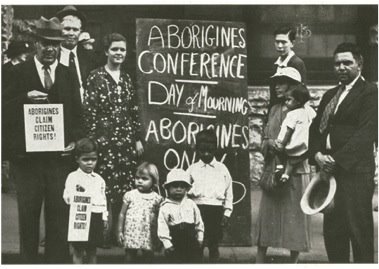
Australian Aboriginals commemorating the 150th anniversary of the First Fleet as a ‘Day of Mourning’
On this day in 1788, the “First Fleet” of eleven ships arrived at Sydney Cove, Australia. Its passengers were the first white settlers of this remote continent: some 750 convicted petty criminals and 500 marine guards and officers shipped out of Britain to a barely explored fringe of the world in order to establish a penal colony and take possession of New South Wales in the name of King George III and the British Empire. Eighteen years earlier in 1770, Captain James Cook ‘discovered’ Australia and declared it “terra nullius”, or “no man’s land.” But the land was not no man’s; it was of course already inhabited by over 500,000 Aboriginal people who had been there, as the Latin translation of ab origine indicates, “from the beginning.” Their stone-tool technology pre-dated that of Europe and Asia by thousands of years, their social organisation was highly sophisticated, their religion deep and complex, their art and myths rich and varied, and their relationship to the land profound and sacred. Relations between the settlers and Aboriginals were hostile almost from the beginning. Theft of land, the introduction of deadly European germs and diseases, kidnapping of children, rape of women, poisoning, shooting, beheading… is it any wonder the Aboriginals were ‘hostile’? By 1824, colonists were even authorised to ‘hunt’ these ‘wild animals’ for sport. One hundred and twenty years after British settlement, the Aboriginal population had been reduced to only 31,000.
The anniversary of the First Fleet’s arrival in Australia came to be a day of celebration amongst the colonists – a tradition that’s continued to the present is recognised as “Australia Day”. But to celebrate this national public holiday on January 26th perpetuates the myth that Australia was peacefully settled and is, for the indigenous population, a painful and offensive reminder of the theft of their sacred land, the White Australia Policy, the Stolen Generations and racial genocide.
On 26th January 1938, the first Aboriginal activists to protest this objectionable celebration declared a ‘’Day of Mourning’ to mark “the 150th anniversary of the Whitemen’s seizure of our country … You took our land by force … You have almost exterminated our people, but there are enough of us remaining to expose the humbug of your claim to be civilised, progressive and humane.” In recent years, the Indigenous population has adopted “Invasion Day” as an alternative observance of Australia Day – while a movement spearheaded by the Australian Natives Association has called for the nation’s official holiday to be held on a different date in order to ‘truly reconcile’ Australia. According to Mick Dodson – Aboriginal Law Professor and Australian of the Year for 2009:
90 per cent of people are saying Australia Day should be inclusive of Aboriginal and Torres Strait Islander cultures. I firmly believe that some day we will choose a date that is a comprehensive and inclusive date for all Australians.
Ninety percent? That so many feel so strongly should be evidence enough of the need for the extension of a symbolic and long overdue olive branch to the First Australians.
26 Jan 14:37
The Lovely Horrible Stuff: “In my dreams, I have a plan…”
by Illogical Volume
PART 1: PENNY FOR YOUR THOUGHTS
For Christmas this year I was given the prospect of impending joblessness, a gift that has a fine Dickensian heritage, though unfortunately it’s not Dickens but Shakespeare who has a cameo in the comic at hand:

You don’t need a Shakespearean imagination to understand that redundancy is not the sort of gift I’ve always dreamed of receiving, or to appreciate that it’s not the sort of unwanted gift that you can easily pass on to an unsuspecting relative…

Not that I’m so lacking in compassion for others that I’d *want* to inflict that on anyone else. Even in this post-Monneygeddon age, there’s a limit to what I’m willing to admit in public!

A few weeks ago an alternative version of this present drifted into view, a hot air balloon that looked like it might be capable of taking me somewhere:
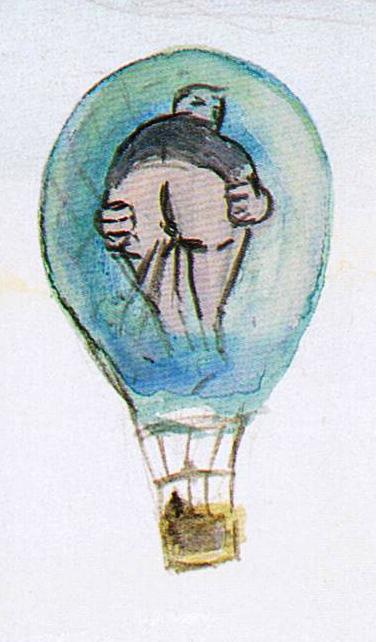
For fourteen hazy days it seemed like there might be the chance of me getting an “enhanced” redundancy package out of all of this, the sort of parting gift that could potentially see me right for the most part of a year, testing out Campbell’s replacement for the old TIME=MONEY theory in the process:

This sort of thought is doubly appealing for an insubstantial character like me. After all, what better basis could there be for a future in fiction than a speculative surplus of something that only has value because we agree that it does?

In the end it turned out that there was no “enhanced” package, and that my redundancy pay-off, if it comes, is unlikely to last me until the kettle boils on my first day of unemployment…

I’m only capable of laughing at this right now because it’s all still a story that can be framed in the future tense. I can try to make a point out of “if it comes”, but I’d be a lot less sure of my ability to do the same with “when it came”. It might seem daft and exciting to think that the hot currents of finance can lift you up so far, but the thought of the fall back down is far less amusing. As a colleague of mine is fond of saying, “Miss a few mortgage payments, then see who really owns your house”.

And so what am I left with that I can be sure of in this scenario? A head full of stories about how this could be my moment, stories that go down smooth but which threaten to leave a bitter aftertaste…

In truth, my throat’s already starting to burn right now. The atmosphere in my workplace is curdling, alliances are being formed, and all around me people are delivering monologues to an unseen audience like it’s eviction night in the Big Brother house. I’m trying to position myself as an observer here, but I can feel the camera crew circling round, trying to spot the next corpse, and the words “I’m not here to make friends” are minutes away from my lips.
It’s okay though! In my dreams, I have a plan – a grand artistic adventure in which I shed this story like a suit and sell it on eBay…

Life becomes story becomes money becomes time. It’s a nice theory, but would you want to risk your livelihood on your ability to turn a panic about money into a fresh supply of the same?

Let’s just hope it doesn’t come down to that, eh?

***
PART 2: ADVENTURES IN THE UNCANNY VALLEY

If I start by saying that Eddie Campbell‘s The Lovely Horrible Stuff is a worthy follow up to The Fate of the Artist, I hope you’ll understand that it requires a long and thoughtful critique. Like Fate, this is the sort of comic that it’s easy to get carried away by, until you’re floating off like Campbell does from the cover image onwards.
Unfortunately for you, dear readers, the most likely destination for me to arrive at is – as always – right up my own backside. I’ll try to keep this short and to the point – ALWAYS BE CLOSING – but please forgive me if I start to drift, and if you end up feeling like you’re still in the dark remember that I warned you about this possible outcome at the beginning.
That’s enough about my arse for now though! My objective here is to chart out a very different sort of landscape, the “uncanny valley” that some observers have evoked while describing the mix of painted art and photography that Campbell deploys in The Lovely Horrible Stuff. The combination of these elements – both present in the artist’s work since his adaptation of The Birth Caul but never so frequently and thoroughly integrated as they are here – is disconcerting throughout the book, with Campbell’s vivid, scribbly evocations of people and places…

…blurring into pictures of the same subjects ripped from real life, and vice versa:

My eyes find the artist’s renditions of the people in this book to be pretty much perfect, in their own rough way. So perfect, in fact that the appearance of actual people and villages and living rooms somehow pushes the whole thing over the edge into unreality.
Please try to bear in mind that I’m not criticising Campbell’s technique here – quite the opposite, in fact! If Campbell’s use of photographic elements didn’t feel so in keeping with the seemingly effortless arrangement of organic moments into lyrical form that characterised his Alec strips, then the results wouldn’t be even half as unsettling.

Like Campbell’s previous autobiographical works, The Lovely Horrible Stuff seems to suggest a certain porousness in the borders between life and fiction. You might find yourself describing Campbell’s narrative style as conversational, as I have before, but there’s a reason why Campbell is one of Alan Moore’s finest collaborators – few comics creators are as mindful of the big literary picture as these two, and the fearsome symmetry of The Lovely Horrible Stuff is yet another example of Campbell’s eye for a pattern.
Actually, The Lovely Horrible Stuff might be the place where Campbell finally tips his hand in this regard. The first half of the book is built around various financial anecdotes from Campbell’s work and family life, and as such it has the reassuring familiarity of After the Snooter and The Fate of the Artist working in its favour, as well as a setting that will have points of intersection with the daily lives of most of those who are likely to find themselves reading it. The back half of the book, in which Campbell takes a trip to the Micronesian island of Yap in order to discuss the strange stone circles the islands inhabitants use as currency (or rather, as stores of wealth), is left feeling strangely exposed in comparison.
The Yapese provide Campbell with a convenient Other, a mirror in which to reflect the first half of his tale by way of a series of abstracted expressions of and contrasts with his (our?) concept of money. Which is to say, with our values:

And so both the grand folly of the business of art and Campbell’s shipwrecked relationship with his father-in-law find themselves literalised in the grand adventures of the Yapese and their tongue-in-cheek mythology, and Campbell’s dependence on unseeables is paralleled with the overpoweringly physical presence of the Yapese currency. As if this textual neatness wasn’t enough, the territory won’t stop breaking through the map. The woman in the panel above is hardly alone in being framed against a reassuring background of real leaves, which has the paradoxical effect of making Campbell’s narrative cartography seem like an elaborate fabrication. After all, why else would the map-maker leave those tears in the fabric, if not to insist a little bit too thoroughly that the place they’ve described definitely exists?
That’s when it occurred to me: there is no Island of Yap. The photographs in the book and on the internet? Mocked up. The various tentacles that reach out from the wikipedia article? No need to worry, we’ll fix it when we get home.

Once the illusion of Yap fell away from eyes, I started to see everything else more clearly. You see, there’s no “Eddie Campbell” either, that’s just a pseudoname Alan Moore uses when he wants to get a way from ideaspace for a while, a secondary life he pretends to have lived, inky li(n)es trailing off into nothing like the hair on his face. The people you see in the book, claiming to be Campbell’s friends and family? Actors, all actors, and as such there’s no reason to worry about their drama being traded in for the cold taste of coins.
Me? I don’t exist either. All of my financial worries are fake – did you really think it possible that I could propose to live off my thoughts alone if I lose my job? Thankfully, Illogical Volume is just a work-in-progress, a computer programme designed to vent words and neurosis on an irregular basis. This blog is a dry run for deliberately useless AI; thank you for participating in the beta test.

And as for money, well, don’t be ridiculous – of course that exists! It’s one of the few “real” things in The Lovely Horrible Stuff, a terrifying fantasy in which family breakdowns and human sacrifice are shown to be just another type of currency, put to the service of a strangely unconvincing story that somehow manages to keep the world going round…

26 Jan 13:13


A Moment of Financial Clarification
by John Scalzi
Every once in a while someone in the comments here says, usually as an aside to something else, that no one becomes a writer to get rich. So as a point of clarification, and to give everyone else who is slightly exasperated by this sort of comment something to point at:
Hey, I became a writer to get rich. I’ve always been in the writing business not just to write, and not just to make money, but also to make a lot of money — basically, to get rich at it. Why? Because speaking from experience, being poor sucks, and in the world we live in, things are a whole lot easier if you have a lot of money. The thing I do best in the world in a professional sense is writing, so if I were to become rich, getting rich through writing seemed like the most likely way for me to do it.
Making money — and making a lot of it — has always been part of my professional writing game plan. It’s one reason why I have been both shameless and unapologetic about the commercial aspects of my writing, whether it’s me working as a writing/editing consultant for business or writing accessible novels. The money I make from writing means less time now I have to devote to sources of income other than writing, and less time later having to find other sources of income when (inevitably) my career slows down from its current happy level. The money I make from writing allows me to do nothing other than writing. So it helps to make a lot of it if at all possible.
Do I write only to make money? No; I write for lots of other reasons as well. Do I only consider money when it comes to choosing writing projects? No; I’ve written things for the pure enjoyment of writing them as well as for other factors, although once I was done with them I often looked to see how best to profit from them. Does writing with money as a consideration and being rich as a goal mean that waving money at me is the magic key to unlock my participation in something? Not always, because not all money is created equal, and the money I’m looking at is not only what’s being waved in front of me now, but what taking the project will make available in the future. I can afford to look long term because making lots of money was always part of my thinking, and because it has been (along with many other factors including staggering good luck) I have the ability to turn down work that doesn’t meet the long-term financial goals, and work that just doesn’t appeal to me, for whatever reason.
(Nor do I think that everyone has to write with the goal of getting rich or making money. People like to quote/paraphrase Samuel Johnson, who once said “No one but a blockhead ever wrote except for money,” but Johnson is as full of shit as any writer on the subject. You can write for all sorts of reasons, money being only one. If you want to be a professional writer, writing for money helps. Otherwise? Optional.
Also, sadly, acknowledging you write for money (or to get rich) will not guarantee success in that endeavor. Yes, that sucks. But there it is.)
At the end of the day, however: This is what I do for money. I don’t want to have to do anything else, now and (as far as I can imagine) in the future. As luck would have it, much of what I like to write, and the style I prefer to write it in, appears to lend itself to the acquisition of money. So, yes, I write to become rich. It’s always been part of my plan. I suspect that there are at least a few other writers probably write for the same reason. I imagine, like me, it’s not their only reason. But it’s still a reason.
As a final thought on the point, one of the reasons that “no one writes to get rich” and “no one writes to make money” bug the crap out of me is that this is the sort of thinking, intentional or otherwise, that gives bad people cover to screw writers with regard to money, and gives uncertain writers a reason to shrug off being screwed. If you as a writer buy into the idea you can’t/won’t make money and that you can’t/won’t get rich, then you are more than halfway to ensuring that you won’t, in fact, make money (much less get rich).
So don’t accept it. When someone says it, feel free to contradict them. Some of us do write to make money, and maybe even to get rich. It doesn’t lessen what one does as a writer to acknowledge that making money, and maybe even hopefully making a lot of it, is one of the reasons to do it — if in fact it’s one of the reasons one does it. It is for me.
26 Jan 13:08
Antigua government to launch WTO-approved pirate website in retaliation for US gambling ban.
Antigua government to launch WTO-approved pirate website in retaliation for US gambling ban.
26 Jan 01:36
Verisign is considering enforcing its patents against other DNS registries.
Verisign is considering enforcing its patents against other DNS registries.
25 Jan 20:56
When the church runs welfare
by The Heresiarch
Freedom of religion is a noble ideal. Historically, it is the freedom from which other freedoms flowed: freedom of thought and conscience was first defined, by philosophers like John Locke, as freedom to believe, in opposition to the age-old supposition of kings and governments that they could require the religious adherence of their subjects. Establishing freedom of religion in law, originally in Virginia, was Thomas Jefferson's proudest achievement, and when the US Bill of Rights came to be drafted the freedom of religious observance from government control was given pride of place. Today, the list of countries where religious freedom is most curtailed is a close match for those least free in other ways, with Saudi Arabia and North Korea vying for the top spot.
Like all freedoms, though, it is one that properly belongs to individuals. When institutions demand freedom for themselves there can be a danger that it comes to the detriment of the rights and freedoms of others. We should be particularly concerned when churches and other manifestations of organised religion insist, in the name of religious liberty, on exemptions from laws that apply to others. Conscience must be respected, but not unfair privilege. In the United States, Catholic bishops used the freedom of religion argument to campaign against a measure giving their employees access to contraception as part of workers' health insurance packages. Because the Roman Catholic church officially disapproves of contraception, they argued (largely successfully) that the rights of even non-Catholic employees should count for less than that of the institution. The argument did not even concern the consciences of individual bishops, priests or school or hospital administrators. It was about the "conscience" of the church itself.
And it's not just in the United States, a country which for all the constitutional separation of church of state remains by European standards highly religious, that such problems can arise. Modern Germany, like the UK, is largely secular. Nevertheless, churches continue to wield huge interest in many areas of life and do so largely funded by public funds. It's not "establishment" in the C of E sense of bishops in Parliament, but something in many ways stronger and more far-reaching. Germans who don't formally declare themselves non-religious have to pay taxes to support of their church. If they choose to opt out, they lose any right to a religious wedding or funeral. And even then they may find themselves using public services paid for by the state but supplied by churches and subject to religious authority.
The Roman Catholic Church alone is the second-largest employer in the country, after the government, involved not only in education but in some cases in the provision of basic healthcare. In some parts of Germany, according to a report in Der Spiegel, the Catholic Church operates a near monopoly on social provision, catering for people from kindergarten to nursing home. Spiegel describes this world of church-run institutions as "a state within a state; a cosmos subject to its own rules, which are monitored by the pope and his bishops; and a world in which federal, state and local governments have little say."
Your local hospital might well be one of the 420 run by the Catholic church. In one shocking case from Cologne, doctors at two hospitals run by an order of nuns turned away a rape victim, apparently because it was feared that she might need the morning after pill (thus tampering with evidence, perhaps). In fact, the medication had already been prescribed by her doctor. The action was in accordance with the church's principled opposition to anything that might be construed as abortion, but as a source from a women's emergency hotline put it, "a woman who has been raped needs comprehensive assistance right away. She can't simply be turned away for religious reasons in the middle of treatment and consultation." If a hospital can't provide the full range of services its patients might require, it's not doing its job properly. If the Catholic Church can't in conscience cater to rape victims in need of treatment, it should get out of the health business.
But far from being a relic of a bygone era, like faith-based education in Britain, faith-based social provision is expanding in Germany. There are almost ten times as many Germans directly employed by church institutions as there were in 1950, even as the proportion of the population attending services has declined, as it has in the rest of Europe. To a large extent this is the result of a policy of government outsourcing, which in the UK has tended to favour large companies like Serco and Capita. The report notes that "since doctors, educators and caregivers often have no alternative to working for Catholic organizations, they are forced to comply with their guidelines." Employees of church organisations who get divorced, who use IVF or even merely "express sympathetic views toward homosexuality" can find themselves out of a job; German courts "have repeatedly upheld the historical special status of religious orders." This seems very different to the approach of UK courts, who have for example repeatedly ruled against Catholic-run adoption agencies who wished to decline same-sex couples.
Do we really want to see German- or American-style "faithfare" in Britain? Thus far, leaving aside the recent expansion in faith schools (though that is an issue in itself) it has largely been avoided. But for how much longer? This week Demos, once New Labour's favourite think-tank, brought out a slim report urging local authorities to make more use of the "faith sector" in areas such as employment, drug rehabilitation and youth work. Jonathan Birdwell's report Faithful Providers laments the "squeamishness" shown by some councils, complaining that despite the government's Big Society rhetoric, "faith-based providers have seen little uplift in opportunity, often being overlooked due to local authorities’ fears that they might discriminate or proselytise to service users."
Birdwell accepts the assurances offered by the groups he spoke to that they are motivated by humanitarian concerns rather than a desire to proselytise, even though some admitted that they didn't proselytise because local authority rules strictly forbade it. In fact, he thinks the rules are too strict: there is "nothing wrong with service providers openly discussing their faith" with clients who are willing to listen. As for discriminating in employment, for example by favouring co-religionists, Demos seems entirely comfortable with this: "while some organisations spoke about hiring members of their own faith exclusively as employees, we argue that this practice is not discriminatory."
The report is part of a project by a committee chaired by the former Labour minister Stephen Timms and funded by the Bill Hill Trust, an evangelical organisation whose primary objective is "the advancement of the Christian religion." On the right, meanwhile, the same line has been pushed strongly by the likes of Eric Pickles and Baroness Warsi. Part of it comes down to money. In an era of funding cuts, there's an obvious temptation to use people prepared to work long hours for less, or even no, pay to provide social services. If God will provide, after all, the taxpayer has less need to.Demos makes much of the "value for money" and potential "cost efficiencies" offered by faith providers , whose "faith service ethos" it compares to the altruistic motivation fondly attributed to public sector workers in the Leftie imagination. (But public sector workers need pensions and employment protection, and certainly aren't doing it for the love of God.)
Faithfare worked in the 19th century, when groups like the Salvation Army emerged to provide services that the state did not. But society then was much more religious, and few people saw a conflict between religious indoctrination and social welfare provision. If religious charities distingiuished between the deserving and undeserving poor, at least the deserving poor were getting some help. That was progress. Today? Well, perhaps there are some areas where the use of "faith providers" might be justified by pragmatism if not by principle. Drug rehabilitation may be one such. Drug users are typically damaged people with addictive and self-destructive personalities; God can provide a good substitute for the crutch offered by narcotics, and born-again Christians, on balance, are less socially problematic than junkies. Charismatic religion and drugs can produce similar highs. But acknowledging this would require, not just permit, full-scale proselytising of addicts; and this is something that not even Demos seems to envisage.
Interestingly, the strongest criticism of Birdwell's proposals has come from the Left-wing Christian think-tank Ekklesia. Simon Barrow criticises the report's "predominantly functionalist language and assumptions" and worries that Christians might find themelselves "sucked into the role of patching up and rendering workable a system that is based on accepting some fundamentally unacceptable inequalities and imbalances." He would prefer them to exercise a "prophetic" role by condemning government cuts.
Barrow also fears that the religious discrimination already allowed to faith schools could be extended to welfare services. "Imagine a hospital run by groups that reserved the right to give priority treatment to members of their own communities," he writes. That's unlikely, but you don't have to imagine the possibility of a hospital refusing basic treatment to patients based on the theological opinions of its religious overseers. You just need to go to Germany.
© 2013 Heresy Corner, all rights reserved.


Like all freedoms, though, it is one that properly belongs to individuals. When institutions demand freedom for themselves there can be a danger that it comes to the detriment of the rights and freedoms of others. We should be particularly concerned when churches and other manifestations of organised religion insist, in the name of religious liberty, on exemptions from laws that apply to others. Conscience must be respected, but not unfair privilege. In the United States, Catholic bishops used the freedom of religion argument to campaign against a measure giving their employees access to contraception as part of workers' health insurance packages. Because the Roman Catholic church officially disapproves of contraception, they argued (largely successfully) that the rights of even non-Catholic employees should count for less than that of the institution. The argument did not even concern the consciences of individual bishops, priests or school or hospital administrators. It was about the "conscience" of the church itself.
And it's not just in the United States, a country which for all the constitutional separation of church of state remains by European standards highly religious, that such problems can arise. Modern Germany, like the UK, is largely secular. Nevertheless, churches continue to wield huge interest in many areas of life and do so largely funded by public funds. It's not "establishment" in the C of E sense of bishops in Parliament, but something in many ways stronger and more far-reaching. Germans who don't formally declare themselves non-religious have to pay taxes to support of their church. If they choose to opt out, they lose any right to a religious wedding or funeral. And even then they may find themselves using public services paid for by the state but supplied by churches and subject to religious authority.
The Roman Catholic Church alone is the second-largest employer in the country, after the government, involved not only in education but in some cases in the provision of basic healthcare. In some parts of Germany, according to a report in Der Spiegel, the Catholic Church operates a near monopoly on social provision, catering for people from kindergarten to nursing home. Spiegel describes this world of church-run institutions as "a state within a state; a cosmos subject to its own rules, which are monitored by the pope and his bishops; and a world in which federal, state and local governments have little say."
It dictates the kind of life its doctors, educators, teachers and cleaning women are allowed to lead. It determines how children are raised. And it also decides -- on its own authority -- how patients are to be treated or, in some cases, turned away.
Your local hospital might well be one of the 420 run by the Catholic church. In one shocking case from Cologne, doctors at two hospitals run by an order of nuns turned away a rape victim, apparently because it was feared that she might need the morning after pill (thus tampering with evidence, perhaps). In fact, the medication had already been prescribed by her doctor. The action was in accordance with the church's principled opposition to anything that might be construed as abortion, but as a source from a women's emergency hotline put it, "a woman who has been raped needs comprehensive assistance right away. She can't simply be turned away for religious reasons in the middle of treatment and consultation." If a hospital can't provide the full range of services its patients might require, it's not doing its job properly. If the Catholic Church can't in conscience cater to rape victims in need of treatment, it should get out of the health business.
But far from being a relic of a bygone era, like faith-based education in Britain, faith-based social provision is expanding in Germany. There are almost ten times as many Germans directly employed by church institutions as there were in 1950, even as the proportion of the population attending services has declined, as it has in the rest of Europe. To a large extent this is the result of a policy of government outsourcing, which in the UK has tended to favour large companies like Serco and Capita. The report notes that "since doctors, educators and caregivers often have no alternative to working for Catholic organizations, they are forced to comply with their guidelines." Employees of church organisations who get divorced, who use IVF or even merely "express sympathetic views toward homosexuality" can find themselves out of a job; German courts "have repeatedly upheld the historical special status of religious orders." This seems very different to the approach of UK courts, who have for example repeatedly ruled against Catholic-run adoption agencies who wished to decline same-sex couples.
Do we really want to see German- or American-style "faithfare" in Britain? Thus far, leaving aside the recent expansion in faith schools (though that is an issue in itself) it has largely been avoided. But for how much longer? This week Demos, once New Labour's favourite think-tank, brought out a slim report urging local authorities to make more use of the "faith sector" in areas such as employment, drug rehabilitation and youth work. Jonathan Birdwell's report Faithful Providers laments the "squeamishness" shown by some councils, complaining that despite the government's Big Society rhetoric, "faith-based providers have seen little uplift in opportunity, often being overlooked due to local authorities’ fears that they might discriminate or proselytise to service users."
Birdwell accepts the assurances offered by the groups he spoke to that they are motivated by humanitarian concerns rather than a desire to proselytise, even though some admitted that they didn't proselytise because local authority rules strictly forbade it. In fact, he thinks the rules are too strict: there is "nothing wrong with service providers openly discussing their faith" with clients who are willing to listen. As for discriminating in employment, for example by favouring co-religionists, Demos seems entirely comfortable with this: "while some organisations spoke about hiring members of their own faith exclusively as employees, we argue that this practice is not discriminatory."
The report is part of a project by a committee chaired by the former Labour minister Stephen Timms and funded by the Bill Hill Trust, an evangelical organisation whose primary objective is "the advancement of the Christian religion." On the right, meanwhile, the same line has been pushed strongly by the likes of Eric Pickles and Baroness Warsi. Part of it comes down to money. In an era of funding cuts, there's an obvious temptation to use people prepared to work long hours for less, or even no, pay to provide social services. If God will provide, after all, the taxpayer has less need to.Demos makes much of the "value for money" and potential "cost efficiencies" offered by faith providers , whose "faith service ethos" it compares to the altruistic motivation fondly attributed to public sector workers in the Leftie imagination. (But public sector workers need pensions and employment protection, and certainly aren't doing it for the love of God.)
Faithfare worked in the 19th century, when groups like the Salvation Army emerged to provide services that the state did not. But society then was much more religious, and few people saw a conflict between religious indoctrination and social welfare provision. If religious charities distingiuished between the deserving and undeserving poor, at least the deserving poor were getting some help. That was progress. Today? Well, perhaps there are some areas where the use of "faith providers" might be justified by pragmatism if not by principle. Drug rehabilitation may be one such. Drug users are typically damaged people with addictive and self-destructive personalities; God can provide a good substitute for the crutch offered by narcotics, and born-again Christians, on balance, are less socially problematic than junkies. Charismatic religion and drugs can produce similar highs. But acknowledging this would require, not just permit, full-scale proselytising of addicts; and this is something that not even Demos seems to envisage.
Interestingly, the strongest criticism of Birdwell's proposals has come from the Left-wing Christian think-tank Ekklesia. Simon Barrow criticises the report's "predominantly functionalist language and assumptions" and worries that Christians might find themelselves "sucked into the role of patching up and rendering workable a system that is based on accepting some fundamentally unacceptable inequalities and imbalances." He would prefer them to exercise a "prophetic" role by condemning government cuts.
Barrow also fears that the religious discrimination already allowed to faith schools could be extended to welfare services. "Imagine a hospital run by groups that reserved the right to give priority treatment to members of their own communities," he writes. That's unlikely, but you don't have to imagine the possibility of a hospital refusing basic treatment to patients based on the theological opinions of its religious overseers. You just need to go to Germany.
© 2013 Heresy Corner, all rights reserved.
25 Jan 18:01
Debi Watches Arrow (sydht!) 1.10: Trust but Verify
IT’S A DIGGLE-CENTRIC EPISODE.

Diggle remains close enough to being awesome that it excites me, but still doesn’t quite manage to make past “whatever Ollie tells me too.” But there is some insight into his character that might explain this, maybe, if I let go of what Diggle might be and start looking at the character as written? Maybe?
The good news is, I don’t have much to say in the “Ollie’s Got Issues” section, because he’s actually playing secondary character to all the more interesting plots. Which is good and how it should be, and actually makes this episode much better! In fact, the only part of that subplot is the Island of Low Saturation.
Theme of the Week: Seeing the best in people, naivete vs cynicism. Or: Why Laurel and Diggle are better than everyone.
Villain of the Week

We open on the robbery of an armored truck: a man in black clothes, military boots and a whole heck of a lot of weapons, steps out in front of a money truck, leveling a grenade launcher at them. Then a van pulls up behind the stopped vehicle and similarly clad bad guys pour out. The grenade launcher fires a pellet of gas into the truck, expelling the guards, and the money is acquired from the back.
Ollie catches news of the robbery (which is the latest in a series) on the news, and goes over to the Arrow Cave to investigate it and get in some one armed topless pushups. When Diggle finally rolls into work with coffee, he actually calls it “The Arrow Cave,” and I am vindicated.
Note to Non-Comics Readers: Yes, in comics it is actually called the Arrow Cave. And you thought I was riffing on the Batcave.
Anyway, the reason Ollie investigated the technique is that the CCTV footage on the news had looked familiar, and he was able to compare it to an identical MO employed by the Marines in Afghanistan in 2009, to take out a taliban transport vehicle. Diggle agrees the techniques are exactly the same and would like to know please, where Ollie found this Afghanistan footage?
Turns out Ollie’s been investigating someone: Ted Gaynor, currently working for private security firm Blackhawk Squad Protection Group.
BLACKHAWK BLACKHAWK BLACKHAWK
NNCR: The Blackhawk Squadron are a team of crack fighter pilots assembled in WWII from a range of different Allied countries, including some occupied territories. Later in DC history, Blackhawk Airways appears as a private aviation company. Ted Gaynor served briefly with the Blackhawks, but was kicked out for being too militaristic. Later he reappeared as an ally of the Blackhawk’s biggest nemesis, Killer Shark.
(Killer Shark is not actually a shark, and therefore isn’t to be confused with King Shark, who is a shark.)
In Arrow-universe, Ted Gaynor was Diggle’s commanding officer on his first tour. He is also on THE LIST.
Diggle ain’t buying it. Gaynor is not rich, and he saved Diggle’s life, and Diggle refuses to accept the Book or the tactical similarities and believe that he might be a highwayman. They’ve been in contact since returning – Diggle was even offered a job at Blackhawk six months ago. Ollie counters with further evidence – Gaynor’s training specialty was the exact sort of grenade launcher used in the heists.
Blah blah Diggle and Ollie fight about whether THE LIST is important now that they know it’s all the Squiggle Organization and the Other Archer and stuff, and I have to accept that even though Diggle has every reason to deny the evidence and stand by his senior officer, and that loyalty makes people change their minds, it’s perhaps time to accept that the general inconsistency that the writers exhibit in Diggle’s lines as turned the character into a textual hypocrite.
Not as big a hypocrite as Ollie, of course. But every episode Diggle takes whatever argument that counters Ollie, and Ollie is Always Right, so of course, Diggle has to be Always Wrong. And you know? Diggle’s loyalty to Gaynor is ENTIRELY UNDERSTANDABLE in the context of just this episode, but it’s meaningless, because last week he was all “the list is the best thing!” because the writers needed him to say it to Ollie.
…I got distracted there. didn’t I?
“I understand if you want to take the week off,” says Ollie.
“No thank you,” Diggle replies, and adds meaningfully, “sir,” and on that line I understand Diggle so much more, because he’s a soldier, not a bodyguard, and he has this super strong unwaivering loyalty and somehow he cast Ollie into the role of “commanding officer” rather than “partner” and THAT’S why he takes so much of Ollie’s crap and I do wish he wouldn’t.
But I am a crazy sucker for ridiculously loyal characters.
Ollie tells Diggle that he’s planned to have a “pointed conversation” with Mr. Gaynor that night. See what he did there? Point? Arrowhead? Geddit? Ollie’s a funny man, is what I’m saying.
Anyway, off he goes to Blackhawk HQ, where he interrupts Gaynor in the middle of downloading some files onto a flash drive. But then that “pointed conversation,” (haha I’m still laughing) is interrupted by the arrival of Diggle, who turns out to be actually a competent bodyguard when he’s not working for Ollie. Maninnahood contents himself with shooting an arrow into a computer monitor and making off with the flash drive (that was convenient.)

Diggle stays behind and asks Gaynor why he might be a target for Maninnahood. Gaynor is evasive and asks Diggle what he thinks, which is a pretty good non-answer. The upshot is, Diggle is offered a job.
In the ArrowCave, Ollie and Diggle have their tiff of the week about why Ollie trusts Diggle less than the List, or rather, than his father, because “a few years ago I found a message [Robert] left me, explaining the List.” Turns out, Ollie didn’t exactly spend the entire five years on the island. DUN DUN DUN. Anyway, fight aside, Diggle is now working for Blackhawk, so he can find out either way.
Diggle takes Gaynor out to Big Belly Burger to catch up and gossip. Carly delivers food to Gaynor, but not Diggle, because she’s policing Diggle’s food intake and he’s okay with that. Gaynor decides that this is flirting, sister-in-law or not.
Eeeeeeeeeeeh show how come you like people moving in on their best friend/brother’s widows so much? Can’t Diggs and Carly have platonic awesomeness? NO, apparently.
They are interrupted by the arrival of another member of Blackhawk, Paul Knox. He was also in Afghanistan, and Diggle doesn’t like him one bit, for reasons Gaynor understands. “People change, John. And everyone deserves the chance to prove it.” Knox gives him a line about keeping him off the street, and if Knox hadn’t got a job here, he’d be out being an armed criminal.
Ollie is unable to crack the encryption on the flash drive, so he goes to Felicity Smoak, telling her it’s for a scavenger hunt being run by a friend of his, where the prize is a case of Lafite Rothschilde, and if she can crack the key, he’ll give her a bottle. Felicity’s all “this is military grade security, the rich are weird” and starts looking at Ollie barfingly longingly. Then she cracks the key and discovered all the schematics and plans for hitting all the armored car carriers in the city. She phones Ollie and suggests going to the police, but he asks her to send them to him instead, so he can go to the police and she keeps her nose clean.
Ugh, Felicity, why are you so ridiculously gullible?
Heist time! Another armored car is being held up, but they are interrupted by Maninnahood, who takes on machine guns with a bow and arrows because of previously established bow > guns set up. He shoots the grenade launcher guy’s mask off, then hits him in the collar, before being forced to retreat to a pile of trash. The robbers stop to haul their wounded into their truck (Labelled “Inter Globe Cable”), and drive off.
NNCR: The injured man is called “Blake” – a nod to Zinda Blake, Lady Blackhawk, who feel through a time portal from the 1940s to the ‘modern day,’ and became personal pilot and transport specialist for the Birds of Prey – Black Canary’s team.
At the Party of the Week, Ollie confers with Diggle. Grenade launcher guy wasn’t Gaynor, and Gaynor was with Diggle the whole time. Diggs tells Ollie about Knox, and Ollie tells Diggs about shooting the guy, so Diggs goes off to investigate the trucks for blood they can trace for Knox.
If they’d stopped to trade physical descriptions, this wouldn’t be necessary, as Blake and Knox are visibly different races.
Before Diggs leaves, Ollie VERY UNSUBTLY plants a bug on him. Diggs even watches him. It’s kind of adorable.
Diggle goes to the Blackhawk garage and starts investigating vans. Finding blood in one, he checks the side and discovers that the Blackhawk logo peels off to reveal a “Inter Globe Cable” one underneath. This discovery turns up just as Knox arrives with gun. He knew Diggs was trouble because of Felicity successfully hacking just as Diggle signed up. Knox takes Diggle prisoner just as DUN DUN DUN Gaynor walks in!
Gaynor’s the man in charge! “My men, my mission.” His motivation, as he monologues to Diggle, is… um, that the army made him power mad? I’m not sure on this one. Anyway, after Blake being shot, he’s down a grenade launcher dude – even though Gaynor himself wasn’t at the last one, so really that means they have JUST ENOUGH people, not down a man. But then he wouldn’t have an excuse to TAKE CARLY HOSTAGE to blackmail Diggle into helping them.
Sigh.
But at the party, Ollie is hearing all this, so off he goes!
Heist time! The bad guys and Carly sit in the truck, and Diggle steps out into the road with his grenade launcher. The armored car approaches… and Diggle stands down, letting him pass. Obviously, this makes a lot of people very angry, but what the Blackhawks have forgotten, is that DIGGLE IS HOLDING A GRENADE LAUNCHER, BITCHES.
Oh yeah.
Grenade in the ground produces enough shock and smoke for Carly to escape, and Diggle picks up a dropped gun and pursues the fleeing Gaynor. Knox gets up, and picks up a sniper rifle to shoot Diggle down, but he is interrupted by Maninnahood. Fight fight fight!
Carly runs, Gaynor chases her, and Diggle chases him. He catches up, and threatens Gaynor with a gun, but Gaynor calls his bluff. Diggle still can’t shoot his ex-commanding officer.
Fortunately, Ollie has just finished with Knox and comes around the corner in time to shoot Gaynor in the chest with an arrow.
I had – rather thought that Ollie’s character development over the last few episodes had been away from “Punisher with a bow.” GUESS NOT. I don’t suppose Ollie’s never going to give a ‘killing is wrong’ speech again? No? Thought not.
“You’re late,” Diggle says to Ollie. Because he knew about the bug, dude. That was ridiculously unsubtle. “I wish you trusted me, though.”
“I trusted you,” says Ollie. “But them? Never.”
COMMUNICATION, GENTLEMEN. I can’t imagine “so go investigate inside but I’ma give you a bug to wear so I can cavalry in, okay?” would have been met with a negative. Unless the writers were being tools.
Ollie flees, Carly comes back, and Diggle checks she’s okay before the police come onto the scene. They are happy with the first round of questioning, apparently, because Diggle returns to the Arrow Cave to debrief with Ollie (and not to check on Carly and her son, who I guess are fine dealing with it on their own?)
“I screwed up,” says Diggle. I don’t know what version of events he’s thinking of, but he didn’t do anything wrong. He went undercover, he discovered proof of their activities, and he got to the bad guys in a way Ollie couldn’t. But no, Diggle isn’t the White Hero, so he has to be in the wrong. Blegh.
OTOH, Ollie also admits he was wrong to trust the List over Diggle. Because he chose Diggle to be his partner for a reason.
Because Diggle had more or less figured it out and it was getting to be a pain hiding from him
Because Diggle “sees the best in people.”
Ollie lets Diggle cross out Gaynor’s name, and for some reason that isn’t obvious to me, Diggle says that he doesn’t want to know about the rest of the names until Ollie chooses to tell him.
Eeeeeh I don’t know.
The Island of Low Saturation
Dressed in the dead man’s gear, carrying the dead man’s gun and using the dead man’s map, Ollie finds Fyers’ base camp. Pulling his balaclava over his face, he walks in and joins the line for foods. Everyone has their balaclava down, so he fits right in. He is joined by another man, who instantly pegs Ollie as new. All we can tell about the guy is that he has an accent and eyes that suggest he is East Asian, and I’m going to go with Chinese.

Playing up the ‘new guy’ role, Ollie explains he’s supposed to be transporting a prisoner, “a Chinese guy who wears a green hood,” and the Unidentified Chinese Mercenary says that sounds like the guy who was taken to the East Camp, and he’s going over there now, so maybe Ollie can hitch a ride? Just as they’re getting into the jeep, however, they are joined by Fyers. DRAMA.
In the jeep, Fyers quizzes MYSTERIOUS NEW RECRUIT, with the usual kind of questions bad guys who suspect good guy infiltration use. “Anything to report on the perimeter?” “Did a new submarine arrive with new recruits?” To which Ollie replies, “I thought every one arrives by plane.” “Indeed they do.” It LOOKS like Ollie passes, but he does a shitpoor job of lying, does Island!Ollie.
When they get to the East Camp, Fyers shows Ollie all the prisoners being kept there, and then punches Ollie to the ground and unmasks him. When Ollie comes to, he is in one of the cages, chained to the rails. Fyers wakes him up, standing by Unidentified Chinese Mercenary. He monologues at Ollie for a bit, about balaclavas revealing only the eyes and how you can tell everything by looking into a person’s eyes. He goes on to talk about trust, and then UCM unmasks..
…DUN DUN DUN it was Sao Fei.
Like I’ve said before: Worst. Mentor. Ever.
The Grown Ups’ Plot which is really the Thea Plot
Thea’s 18th birthday is coming up, and she wants a car! Ollie got a car when he was 18, she points out, but Ollie tells her he could back it out of the driveway without hitting a tree. Also, the parenting of Oliver didn’t produce the kind of visibly responsible young man that Moira presumably wants Thea to grow up into. Me, I’d use the “Walter would get me a car!” line, but not even Thea Queen would stoop that low. Anyway, Moira and Thea are taking a couple of days to meet party planners and go shopping and generally pass Bechdel all over the place.
Meanwhile Tommy asks Ollie about Moira, and he says she seems okay, except “Thea thinks she’s actually been a little bit ‘too okay.’” What with the being cheerful, running the company, erratic behavior &c. Tommy and Ollie are willing to dismiss this as stress behavior, because of course what they don’t know is that Moira’s under a very different kind of stress than they know. She knows where Walter is, after all!
In the car after some successful shopping, Moira and Thea reminisce about Robert and how he was not looking forward to Thea turning 18, and how she now misses him. They are interrupted by John Barrowmerlyn calling Moira and she has to cut her Thea time short, to the other’s disappointment and anger. Moira also lies about who was on the phone.
Moira and Merlyn meet at Queen Consolidated, where he informs her that they have a problem with a guy called Carl Ballard, a friend of Moira’s, who is ‘trying to gentrify the Glades” through unspecified means. This is bad because of Squiggle related reasons, so could Moira tell him not to? Thanks.
NNCR: Carl Ballard is a minor villain who apparently turned up in The Atom. Googling things sydht – all part of the service.
Moira insists that in return she gets proof of life for Walter. Doesn’t she trust Barrowmerlyn. No, she quotes the epsiode’s title “Trust but Verify.” Fine. BUT WAIT, who is that outside the glass fronted office that this secret meeting is taking place in? IT’S THEA. And she’s not happy. She goes straight to Ollie to tell him that Moira and Barrowmerlyn are having an affair.
Ollie’s reaction is along the lines of WTF.
Thea tells him that in the months preceding the boat crash, Robert and Moira had been fighting a lot, and Thea noticed a lot of ‘lunch meetings’ with Barrowmerlyn. She’s seeing similar things after Walter’s disappearance, and putting two and two together, she’s made 4.1. (Having an affair/evil conspiracy. I’ll call them close enough.)
Ollie refuses to believe this of his Mom. Thea points out that he has her on a pedestal rather, and that she (Thea) knows their mother better. Ollie’s response is to go straight to Moira with this information and ask her what was going on.
Moira’s answer is… not an answer. She tells Ollie that Robert “was unfaithful to me repeatedly.” This could mean sleeping around, but it could also mean he was repeatedly unfaithful to Squiggle. But this is really just an excuse for someone to say further things along the lines of finding out someone you thought was perfect is in fact not perfect. Moira also explains that the reason she’s been hanging out with Merlyn is so he can give her “being CEO” advice.

The Party of the Week is Thea’s birthday party and she got a car, yay! She’s also wearing a fabulous dress and I wish L was here to see it. Her bad influence best friends show up with a new drug for her: called Vertigo. Thea, terrified of one of her adult figures finding her with it, goes upstairs to hide.
NNCR: Count Vertigo is probably the second most significant member of Green Arrow’s rogue’s gallery after Merlyn. He has the power to make people incredibly dizzy – which is way more effective than it sounds I swear.
Upstairs, however, Thea runs into Moira and Barrowmerlyn, exchanging a camera photo of Walter for a promise that she’ll “take care of it.” Seeing Barrowmerlyn touch Moira in a smarmy way as he leaves, Thea confronts her. Angry and teenage, she tells Moira she wishes it had been her on the boat, and storms off out of the party and ther house, holding both drugs and the keys to her new car. The next time we see her, she’s clearly doped out of her head, driving, crying, and drowning her sorrows in loud music. (She’s driving along Princess Road, guys. Princess Road!)
But then she takes a corner poorly and almost ploughs straight another car, swerves and ends up in a ditch, unconscious. Oh no!
Cur straight to the hospital, and Ollie and Moira arriving to check on her. It takes no time at all for her to kick Moira out of her room. Ollie says that Moira says she isn’t having an affair, and Thea says she’s not going to trust her.
An unspecified time later, Thea is discharged and leaving, when a policeman (not anyone we already know) turns up, and says that her doctor called them after blood tests. And in front of Ollie, she is arrested for driving under the influence of narcotics. (And guess what? She’s 18 now…)
Tommy and Laurel Need Their Own Show
Tommy isn’t just managing a club, he’s acting as foreman to the construction of the club! It’s adorable, really, how competent he seems. A rich kid with a real building crew instead of LEGO. Of course, he’s not wearing a helmet on the building site, but he’s not that competent. Anyway, his dad (John Barrowmerlyn, remember?) calls to take credit for Tommy getting a job, and to invite himself to Tommy and Laurel’s dinner date tomorrow night.
“I’ve said some pretty hurtful things and I regret them” – NOT AN APOLOGY. “But I still want what I’ve always wanted, for us to be close.” - Guys, I really need to tell you about this super melodramatic KDrama I’m watching and why it’s both the same and better than Arrow in many ways. Becca knows what I’m talking about!
Tommy tells Laurel about this, and how apprehensive he is about Daddy’s motivations. Laurel suggests that maybe Barrowmerlyn does want to build bridges, and Tommy remarks on how she likes to see the best in people.
NNCR: Again, the writers on this show might be inconsistent with the other characters, but they have Dinah Laurel Lance’s optimism down perfectly.
At dinner, John Barrowmerlyn has his pants charmed off by Laurel, and we learn that Tommy’s mother was killed when Tommy was eight – before he knew Laurel. At the end of dinner, casual as anything, Barrowmerlyn hands Tommy a bunch of papers and asks him to sign. On a contract authorizing the closure of his Mom’s free clinic. (Mrs. Merlyn was Thomas Wayne, apparently.) Tommy refuses, seethes at his Dad for not having changed, and storms out. Laurel stays to give Barrowmerlyn a piece of her mind.
“His mother taught him a lesson I’ve been trying to. That the world is a harsh and unforgiving place.”
“When did she teach him that?”
“When she was LYING DEAD IN THE STREET WITH A BULLET IN HER HEAD.” (Emphasis mine.) Yep. Definitely Thomas Wayne.

The next day, Tommy is lounging on Laurel’s couch, and Laurel – who looks DAMN FINE in her lacey boy shorts, says that Barrowmerlyn’s started calling her phone to get in touch with his son. Tommy sulks at it. Laurel agrees that Barrowmerlyn is a joke “But he’s still your father.”
One of those lines that no adults actually say in real life. If parents are jerks they get to be treated like jerks. Are my adult friends the only adults who actually treat their parents like real human beings? Anyway, Laurel says she gets the impression Barrowmerlyn thinks he’s somehow protecting Tommy. Tommy says that his dad completely shut eight-year old Tommy out after his wife’s death, and disappeared for two years -
The cut at this point to Barrowmerlyn’s Evil Arrow Cave and all his swords and bows suggests he disappeared to get Batman training. Also, Barrowmerlyn is creepily stroking a picture of him, his wife and baby Tommy. So there’s more story there and I guess Laurel was right about the protecting? Anyway, I expect someone will try and recruit Tommy into the Squiggle Organization before season 2 is out.
Anyway, that’s the plot! It was full of Diggle. And my favorite version of Diggle, too: the unerringly loyal, intelligent soldier who isn’t afraid to call Ollie out on his shit. If only the show would let him be right occasionally, this would be a perfect episode. As it is: remember that the best Arrow episodes are those where Ollie is a supporting character.
This post can also be found at Thagomizer.net. Feel free to join in the conversation wherever you feel most comfortable.


25 Jan 17:52
Marriage (Same Sex Couples) Bill – Trans issues
by Zoe O'Connell
The equal marriage bill (PDF Link, HTML links are inline below) has finally been published. From a trans perspective, schedule 5 is the interesting bit and it’s pretty much as expected from the consultation response.
There will be no equal civil partnerships, but for those seeking a Gender Recognition Certificate it’s possible to convert to marriage first. (Section 9) This is an extra set of hoops to jump through which isn’t ideal, and seems to be at odds with the initial claims that conversion and issuing a GRC could be done as a single process. That it’s possible at all is positive however.
Supposedly you can put in a simultaneous Gender Recognition application in the (unlikely) even that both halves of a civil partnership transition and keep the civil partnership. However, the intention was also that annulment and remarriage for a GRC under the old rules would also happen on the same day, whereas in practice that’s not the case.
The bill makes it clear that any converted marriage is to be treated as continuous from the original date of marriage.
If you’re married and your partner consents, you can get a Gender Recognition Certificate and stay married. (Schedule 5) Foreign marriage and marriages in Northern Ireland would still cause a problem here by the looks of things, but realistically there isn’t much the UK Government can do about those.
I don’t see anything on consummation in the bill, which might be of concern to anyone who is non-op. (I.e. retaining their birth genitals) I need to read the bill cover-to-cover to check that one though.
Finally, what’s missing is any provision to restore marriages lost under the old forced-divorce Gender Recognition provisions. That will upset many people,
(Caveat: I only saw the bill for the first time 25 minutes ago so I may have missed something. I’m sure we’ll hear soon enough from those with more time to analyse it)
25 Jan 16:32
 There is a fascinating essay by Thomas Laqueur covering a number of recent books on the sinking of the Titanic in the current issue of the London Review of Books.
He argues that the class analysis of the disaster, as popularised by the James Cameron film, is not well founded. Facilities for steerage class passengers were far better on the Titanic than on most ships and the casualty list defies crude analysis:
Anyway, does this analysis mean that the price of women having the vote their being more likely to drown the next time a liner runs into an iceberg?
It is a really good article and well worth reading. After more than a century the Titanic story has lost note of its grip on our imaginations.
Sexual politics and the sinking of the Titanic
by Jonathan Calder
 There is a fascinating essay by Thomas Laqueur covering a number of recent books on the sinking of the Titanic in the current issue of the London Review of Books.
He argues that the class analysis of the disaster, as popularised by the James Cameron film, is not well founded. Facilities for steerage class passengers were far better on the Titanic than on most ships and the casualty list defies crude analysis:
The highest mortality rate was not in steerage but among the men in Second Class, who died at twice the rate of men in steerage and five times the rate of women there.Besides, as Laqueur says, this class analysis misses the big story of the Titanic: gender. He writes:
First-class passengers were indeed 37 per cent more likely to survive than third-class. But men in all classes were 58 per cent more likely to die than women. Since there were three times as many women as men in Third Class and more or less even numbers in First, sexual selection took its greatest toll there. Put differently, women in steerage survived at a higher rate than men in first.He goes on:
On board the ship Edwardian codes of masculinity were on occasion enforced with insane zealotry. Second Officer Charles Lightoller, the most senior survivor of the crew, interpreted the captain’s orders, ‘women and children first’, to mean women and children first and only. No men. He forced boys as young as 11 out of boats.And this zealotry was self-defeating:
Men on the starboard side fared better because First Officer William Murdoch interpreted the order to mean that men could board if no women and children were waiting for a place. And some men – most important, some lowly crew members and strong labourers among the passengers – sneaked onto boats on the port side when Lightoller was turned away. This was a good thing, because they were able to row the boats away from the sinking ship.And this chivalry, in many ways admirable, was explicitly used as a way of arguing against women's rights:
Davenport-Hines quotes Churchill’s letter to his wife: ‘The strict observance of the great traditions of the sea towards women and children reflects nothing but honour upon our civilisation.’ And he hoped it would set right ‘some of the young unmarried lady teachers’ – aka suffragettes – ‘who are so bitter in their sex antagonism and think men so base and vile’.
That view was widespread. ‘When a woman talks women’s rights, she should be answered with the word Titanic, nothing more – just Titanic,’ a correspondent in the St Louis Post-Dispatch observed.Lightoller, let us remember, was the character played by Kenneth More in the 1958 film. As Matthew Sweet once said, "You almost get the feeling watching A Night To Remember that the ship goes down simply to wipe the smug grin off of Kenneth More's face."
Anyway, does this analysis mean that the price of women having the vote their being more likely to drown the next time a liner runs into an iceberg?
It is a really good article and well worth reading. After more than a century the Titanic story has lost note of its grip on our imaginations.
25 Jan 16:26
Opinion: we must force the Tories to follow the evidence on khat
by Duncan Stott
I feel sorry for the Academic Council on the Misuse of Drugs. It’s this panel of drug experts’ task to try and inject some sense into our country’s failing drug policy. Sadly, in the latter years of New Labour’s reign, it became the default option to ignore their advice on drug classification. On magic mushrooms, then on cannabis and then again on ecstasy, Labour couldn’t resist ignoring the ACMD, opting instead for populist posturing in an attempt to appear ‘tough’.
The Labour government’s unscientific urges on drug classification were deeply frustrating to Liberal Democrats, and this led us to a 2010 manifesto commitment to “always base drugs policy on independent scientific advice”. It’s now time for us to step up to the mark.
On Wednesday, the ACMD published a report on khat, a currently-legal leaf that induces a mild stimulant effect when chewed, and has strong cultural bonds with the Somali community in Britain. Since there is no evidence that khat causes any significant harm, the ACMD has recommended that the government refrains from prohibiting it.
This isn’t the first time that khat’s relative harmlessness has been noted. The ACMD had already reviewed khat in 2005, coming to the same conclusion. In a separate independent scientific comparison of twenty drugs, khat came out as the least dangerous (heroin came out top, alcohol fifth, cannabis eleventh).
Nevertheless, several of our Conservative colleagues have shown they are looking to make another populist gesture on drugs policy. Baroness Warsi pledged a ban back in 2008, Chris Grayling backed a ban in 2009, and backbencher Mark Lancaster has been keen to nag the current government to ban the drug.
There’s only one hurdle to the Conservatives continuing Labour’s miserable approach. It’s their Coalition partners. That would be the Liberal Democrats.
Our minister in the Home Office is Jeremy Browne, who has taken responsibility for drugs policy as part of his brief. I expect him to be doing everything he can to ensure his department keeps to the ACMD’s expert advice.
We must also consider the effect that a khat ban will have on the Somali community. Alcohol, by all accounts a far more dangerous and addictive drug than khat, is given special treatment by the government because of its prevalence in our culture. The award-winning documentary The House I Live In (available now on BBC iPlayer) demonstrates how targeting the culture of a smaller black community is oppressive, discriminatory and completely illiberal.
Last month Nick Clegg became the first ever serving member of a British government to say that a new approach towards drugs is needed. Heeding the ACMD’s advice on khat would be a fantastic start.
* Duncan Stott is a Lib Dem member in Oxford.
25 Jan 16:21
Holocaust Memorial Day, and a response to David Ward
by Julian Huppert MP
I find Holocaust Memorial Day personally incredibly difficult. It reminds us of an astonishing period in human history, when a developed European country exterminated millions of fellow humans – six million Jews, and many Roma, Slavs, Communists, Socialists, homosexuals and the disabled.
But for me it always reminds me of my own family tree, and the many relatives who appear there with a small asterisk – ‘died as a result of Nazism’. I find it hard to speak about, to think through the horrors of what happened. But I do find myself absolutely adamant that we must stop anything like it ever happening again. The quest for international human rights is what got me into politics in the first place.
Sadly, it has become a shorthand for almost anything bad that happens. Sometimes, discussion of Hitler and the Nazis has become so trivialised, that it has even given birth to the online rule of Godwin’s law – any discussion will eventually lead to a comparison to the Nazis or Hitler.
There are particular problems when discussing Israel and Palestine. There are particular sensitivities – especially when people conflate Israel’s current policies to the opinions of ‘the Jews’.
Despite my Jewish background, or more likely because of it, I am deeply critical of Israel’s approach. I have spoken out on this in Parliament, and visited Gaza to see for myself what the situation is like there. I think Israel’s current policies, around settlements, the treatment of Palestinian people, and so much more, are profoundly wrong. I think they are wrong in terms of international law and human rights, and I think they are wrong from the perspective of Israel’s own self-interest. Many in the diaspora, and even a number in Israel, share similar perspectives, and a determination to try to change this.
It is quite right to condemn the Holocaust, and to criticise Israel’s current behaviour. But quite wrong to say the two are one and the same.
* Julian Huppert is Liberal Democrat MP for Cambridge.
25 Jan 16:11
Batman Incorporated Volume 2 #6
by bobsy

Script by Grant Morrison. Art by Chris Burnham and Nathan Fairbairn. DC Comics.
NO JOKER.
[The term 'Batman' here simultaneously refers both to both the well known character/intellectual property featured in a variety of widely distributed cultural products that bear his brand, and to those products themselves.]
Darkseid God of Evil, rampant and triumphant both yesterday and today, with hope for tomorrow growing fainter, defeated Batman with a weapon called the Hyper-Adapter. With the contours of time itself as its teeth, it appeared in various forms across history, but struck its fatal blow as a large, beaten old bat that one night crashed through a window in bleeding billionaire Bruce Wayne’s mansion. Darkseid’s victory against Earth’s favourite superhero IS: Batman was his servant all along.
The Batman’s career heretofore was an elaborate shell game: to build trust; neutralise (recruit) potential enemies; and establish networks, infrastructure and materiel. The fascist Incorporated project represents the culmination of Apokolips’ plan – open appropriation of transnational military-security processes.

Talia Al Ghul (Leviathan) plots to dismantle and replace the energy systems currently destroying the human biosphere. Despite the usual misogynistic slurs – bad mother, wrathful and irrational, holder of deathly mysteries – it is clear from this alone that she is the necessary hero of the piece. Batman (Behemoth) - polluted and possessed by malignant extraterrestrial entities from the moment he reached for a bell to summon his first servant to his conspiracy – opposes her. The desired catastrophe resulting from continued use of existing energy systems is i) crisis to precipitate global imposition of Batman Incorporated control solutions (Anti-Life) and ii) terraforming.

This is an unusual direction for a superhero narrative to take. The form in its monthly churn is as hungry for novelty – or its appearance through superficial recombination of standard elements – as any other facet of showbusiness, so it’s not as if the Batman’s turn into villainy real and fictional was impossible to predict.
The casual – and almost deliberately self-deluding – revelation of Batman himself as planetary-level threat does however bespeak a genuine perversity beyond that which other current examples of the form commonly strive for, making this an unusual and noteworthy example beyond its considerable thrill-power levels. In any form a high thrill count is often a successful mask for subcutaneous irregularities in the text, but here they actively draw attention to them. The splicing of The Raid with The Ten Ox-Herding Pictures, forced and fuzzy as it gets (who’s the ox again?), is the kind of dazzling placatory gesture that all adventure-combat narratives should be able to deploy as necessary. But Talia’s mockingly over-effusive commentary of Batman’s explosive acrobatics oversell the misdirection: if the putative villain is being employed to tell you how good the hero is being, you’re probably being lied to. You should not have to be told that the superhero is doing well. The superhero should be engaged in pursuits that do not require context or description – their goodness should be self evident.
This is a Batman with ulterior motives. It might not, for instance, want you to notice the skin colour of the people the superhero is assaulting.
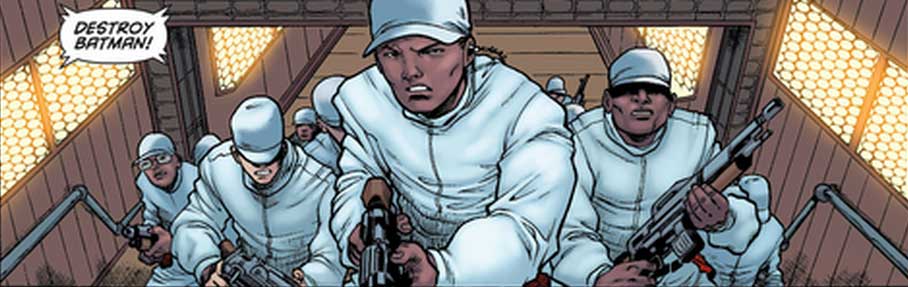
The Hyper-Adapter has weaponised the paper in your hand to further Darkseid’s agenda. It does not have your best interest at heart – it just wants your money and your mind’s eye. In the face of Talia’s strategy, her understanding and instrumentalising of king mob (the realisation of proletarian desire being an important aspect of Batman’s ultimate nightmare, as we saw last issue), the comic itself will play dirty in its attempt to get the reader back onside.
Talia’s critique of the Batman Incorporated project is so devastating it can only be counterbalanced by an appeal to the reader’s crudest sympathies: go for the heart strings and pray the head stops working. Here the emotional manipulation is a generic staple – kill the hapless helper / sadface sidekick: poor old never-quite made it Cyril Sheldrake aka The Knight, dead and shown dead – just to remind you in the basest way who the baddie is supposed to be here.
There lies the crux of this problem, the toxic nature of the vile poison leaking from the comic, the invisible serrations on the paper’s edges. Wear gloves. Wash your hands. Because childishly redrawing the battle lines in a super hero comic that’s in danger of getting too complex and discovering something important about itself by having a Muslamic Bat-Wrong coldly execute a lovably bumbling member of the British ruling class (one of the world’s longest running and most murderous crime organisations), today, places you firmly on the wrong side of human decency. Bending your knee before the Queen of Evil England lets everyone know.
If you assert or advocate the existence of a ‘meritocracy’ you invoke its logical corollary. If the good are rewarded, the rewarded must be good. Your masters deserve their wealth, you deserve your subservience. This is one of the many ideological positions enforced in recent years to keep reactionary social relations like the British class system in place. Plucky strivers like Beryl are allowed in, because their labour is required – temporarily – and can be counted on to continue supporting the existing system, at the expense of the welfare of who she left behind: She’s super now, so she needn’t worry about the little people, the victims to be fought over, kept obediently safe to validate the adventurism of the overlords. Justified by Batman-Darkseid’s flattery and lies she needn’t recognise the reality of their desire or seek to empower it.
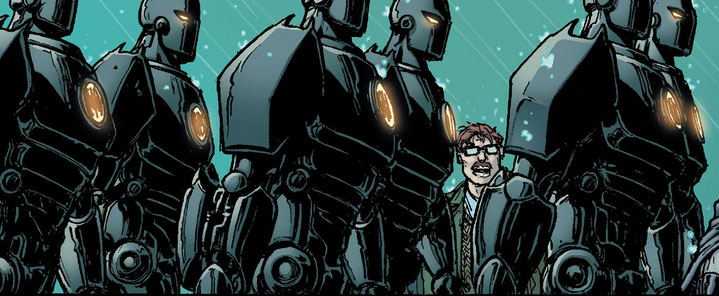
I’m glad Cyril’s dead, only sad he’ll be replaced. Where do I sign up for Leviathan?
25 Jan 16:10
Is Clegg's problem that he is too honest?
by Mark Thompson
We see it time and time again with Nick Clegg.
He is asked whether he slept with "no more than 30 women" and agrees with the statement (that could mean anything from 1 to 30) and is pilloried for not being serious about politics. He just answered the question!
He apologises for a mistake in pledging before the election to prevent tuition fees going up which in retrospect was an impossible thing to make happen given how many other MPs were elected on a platform where they made no such pledge. He is vilified across the political spectrum and in the media for being weak, inconsistent and duplicitous. He is simply being as honest as he can be.
There have been various other occasions like this and we saw two more examples yesterday:
Firstly Nick Ferrari on LBC grilled him on whether he is likely to send his children to private schools. Clegg answered candidly explaining that he hasn't decided yet, that he hopes to be able to send them to a state school if they can find a suitable one and that his wife will be heavily involved in the decision. Cue derision from the left about how he is adding to his woes by answering this question in this way (he should simply use his kids as political pawns as far as I can tell is the argument) and from other quarters about how he is "hiding behind his wife". Never mind the fact that his position is the same as pretty much any father living in London with a household income in his bracket.
Secondly in an interview for House magazine he questioned the government's approach to capital spending in its early months and conceded that they could have approached things differently. Cue an avalanche of criticism from the media and Labour. He is merely stating the bleeding obvious. Things have not worked out brilliantly in this area. I would far rather have a politician in office admit where they think there have been problems. It gives me confidence they are likely to change tack in response to events rather than blindly ploughing on.
What all these incidents demonstrate is that the constant cry we hear for politicians to "tell the truth" and "give it to us straight" that you hear from media pundits and members of public on phone in shows aren't really true. Clegg is one of the most honest politicians in front line politics today. And yet his very candour is so often used against him.
The only conclusion I can draw is that what we really want is to be lied to.
He is asked whether he slept with "no more than 30 women" and agrees with the statement (that could mean anything from 1 to 30) and is pilloried for not being serious about politics. He just answered the question!
He apologises for a mistake in pledging before the election to prevent tuition fees going up which in retrospect was an impossible thing to make happen given how many other MPs were elected on a platform where they made no such pledge. He is vilified across the political spectrum and in the media for being weak, inconsistent and duplicitous. He is simply being as honest as he can be.
There have been various other occasions like this and we saw two more examples yesterday:
Firstly Nick Ferrari on LBC grilled him on whether he is likely to send his children to private schools. Clegg answered candidly explaining that he hasn't decided yet, that he hopes to be able to send them to a state school if they can find a suitable one and that his wife will be heavily involved in the decision. Cue derision from the left about how he is adding to his woes by answering this question in this way (he should simply use his kids as political pawns as far as I can tell is the argument) and from other quarters about how he is "hiding behind his wife". Never mind the fact that his position is the same as pretty much any father living in London with a household income in his bracket.
Secondly in an interview for House magazine he questioned the government's approach to capital spending in its early months and conceded that they could have approached things differently. Cue an avalanche of criticism from the media and Labour. He is merely stating the bleeding obvious. Things have not worked out brilliantly in this area. I would far rather have a politician in office admit where they think there have been problems. It gives me confidence they are likely to change tack in response to events rather than blindly ploughing on.
What all these incidents demonstrate is that the constant cry we hear for politicians to "tell the truth" and "give it to us straight" that you hear from media pundits and members of public on phone in shows aren't really true. Clegg is one of the most honest politicians in front line politics today. And yet his very candour is so often used against him.
The only conclusion I can draw is that what we really want is to be lied to.
25 Jan 16:08
"Just letting it go", picking battles, and other overrated skills I don't have
by Neurodivergent K
Alright, context: I just got off a bus where a 19 year old douchecanoe called me a dyke (but he totally isn't homophobic! Just ask him!) after I mentioned that his constant, loud use of the r word is ableist. This is kind of a regular occurrence in my life, strangers hurling invective at me-often oppressive invective-because I call an ism an ism, even in front of 70 strangers on the bus.
And people always ask me, "why don't you just let it go sometimes?"
Why do you?
That whole "don't sweat the small stuff-and it's all small stuff" attitude? It's exactly the attitude that has prejudice all sorts of not-going-anywhere. Because we're supposed to "let it go" sometimes. But then if we let that "small stuff go, we have to let everything of equal or lesser magnitude slide, then "oh but what makes that any worse than this other thing?" and before you know it, we are not taking a stand on a single thing.
You don't wait to stop a fire until the whole forest is ablaze, right? You stamp out the sparks. Well, we have way more blaze than spark going on here where systemic devaluation of disabled people goes-so you bet your ass I am going to stamp on every spark that flares up in front of me. That one person might be a lost cause, but there were 70 other people on the bus who might think a bit, and even if not a single one thinks anything through, I'm totally ok with letting bigots and their ilk know that's exactly what they are.
As far as picking my battles goes, I have: All of them. Every one I win, the next person won't have to, won't have to rely on someone who "lets things go", or waits until Rome is burning to start looking for a bucket. I can't just pick a few rights that matter and some that are optional. It does not work that way. There are not acceptable levels of dehumanization, ways in which it's ok to treat us like second class not-citizens. No. I am having none of it. I will not play that game. All of them are important. None of it can wait for another day.
These supposed skills are really great for not making waves, for not rocking the boat-but activism is all about rocking the boat. We need a whole ocean to clean the layer of filthy ableism (and other oppressions) off our society. Change upsets people. People with power do not like losing it-even (especially?) unfair, unearned power. Civil rights struggles are all about making waves and rocking the boats. "Letting things go" is not how social change happens.
So no, I will not let things go. I cannot, I never have been able to, and I see no reason to figure it out now. And I choose all the battles. They all matter. If they don't, why is the other side fighting me so hard?
And people always ask me, "why don't you just let it go sometimes?"
Why do you?
That whole "don't sweat the small stuff-and it's all small stuff" attitude? It's exactly the attitude that has prejudice all sorts of not-going-anywhere. Because we're supposed to "let it go" sometimes. But then if we let that "small stuff go, we have to let everything of equal or lesser magnitude slide, then "oh but what makes that any worse than this other thing?" and before you know it, we are not taking a stand on a single thing.
You don't wait to stop a fire until the whole forest is ablaze, right? You stamp out the sparks. Well, we have way more blaze than spark going on here where systemic devaluation of disabled people goes-so you bet your ass I am going to stamp on every spark that flares up in front of me. That one person might be a lost cause, but there were 70 other people on the bus who might think a bit, and even if not a single one thinks anything through, I'm totally ok with letting bigots and their ilk know that's exactly what they are.
As far as picking my battles goes, I have: All of them. Every one I win, the next person won't have to, won't have to rely on someone who "lets things go", or waits until Rome is burning to start looking for a bucket. I can't just pick a few rights that matter and some that are optional. It does not work that way. There are not acceptable levels of dehumanization, ways in which it's ok to treat us like second class not-citizens. No. I am having none of it. I will not play that game. All of them are important. None of it can wait for another day.
These supposed skills are really great for not making waves, for not rocking the boat-but activism is all about rocking the boat. We need a whole ocean to clean the layer of filthy ableism (and other oppressions) off our society. Change upsets people. People with power do not like losing it-even (especially?) unfair, unearned power. Civil rights struggles are all about making waves and rocking the boats. "Letting things go" is not how social change happens.
So no, I will not let things go. I cannot, I never have been able to, and I see no reason to figure it out now. And I choose all the battles. They all matter. If they don't, why is the other side fighting me so hard?
25 Jan 15:53
 That I’d have to deal with Grant Morrison before tackling Lawrence Miles in full is obvious. They are, of course, constantly compared. But exactly why is actually a bit tricky. Miles, at least, has been a bit grumpy about this in interviews, snarking, “Oh, that's right. Start suggesting links between my books and the work of Grant Morrison, why don't you? It's not like I've heard that before.” And yet there’s not an obvious point of similarity besides a (largely undeserved) reputation for being complex and full of ideas. And yet the comparison is irresistible. Even before I’d gotten around to reading any of Miles’s books I knew, implicitly, that the point where I dealt with Interference was also when I was going to deal with Grant Morrison. Something about them seems inexorable and impossible to disentangle. And having worked my way through quite a lot of Lawrence Miles now, the connection seems at once more obscure and more straightforward. The fact of the matter is that there is little particularly Morrisonesque about Miles’s work beyond the fact that both of them are a bit mad and cerebral.
So, the big Grant Morrison post, in which we look at his work. Except, as I’ve already noted, that’s a monstrous rabbit hole. I don’t want to derail this blog into a meticulous study of Grant Morrison. But equally, he is an important influence on sci-fi media, and it’s impossible not to deal with him. So let’s look, with fantastic superficiality, at Morrison’s magnum opus, namely The Invisibles. The Invisibles is a comic series published from 1994 to the start of 2000 in which Morrison depicts a magical war between the Invisibles, punk anarchist magicians, and the Outer Church, paragons of order and conformity. It’s a philosophically dense and convoluted work - in no way incoherent, but undoubtedly difficult. The book is also notoriously semi-autobiographical; Morrison loves to boast about how he based most of The Invisibles on his own life experience as a practicing chaos magician, and about how the book in turn changed his life, with things he wrote taking place in his life. Which sets up what it is, but not what it’s like.
To be honest, for the most part, The Invisibles is a bit of a mess. Individual moments of splendor stick out, but the book is adept at self-sabotage and when it doesn’t take itself out in a spectacular own goal DC Comics/Vertigo are usually right behind it and ready to clean up. The crowning dishonor are issues 4-2 of the third series, which was published as a countdown to the millennium starting with issue #12 and ending with #1. Aside from overshooting due to delays and finishing six months past the millennium, the big climactic storyline in issues 4-2 were done as an artists’ jam of most of the artists to have worked on the series previously, along with a few others. Unfortunately the end result was sloppy, with several artists failing to follow directions and several more failing to be given them such that the actual plot and exposition of the series’ entire cosmology was hopelessly unclear. Even with key pages redrawn by Cameron Stewart the issue is a mess, and it’s a mess that falls at a deeply inopportune moment for the series at large. The result is a series that doesn’t quite live up to its own potential. Which is oddly fitting for a capsule introduction to chaos magic.
So. Chaos Magic. The typical start date of chaos magic as an occult system and worldview is 1976, in a meeting between Peter J. Carroll and Ray Sherwin, but if you want to give it a date of public appearance you’d have to pick 1978 and the publication of Liber Null. It’s important to sort out what was going on here, and this requires flipping back in our playbook a bit because we haven’t actually dealt seriously with the evolution of modern occultism since about The Daemons. The signposts for this blog being what they are, Chaos Magic was invented in the Tom Baker era right around the transition from Hinchcliffe to Williams. It is, at least in its basic form, occultism’s reaction to punk. Where previous magical approaches focused on reinventing or subverting existing structures and traditions, chaos magic’s basic attitude was “fuck it.” Its core belief is that magic is simply the exertion of will upon reality, and that the trappings of magic are just there to shape what one believes in and thus what one can will. The core chaos magic belief is that of “consensus reality,” the default order of things that persists because we all believe it to be so, and the chaos magician’s basic tactic and maneuver is to defy consensus reality by imposing their own beliefs on the world, often changing their beliefs to fit the circumstances.
While Chaos Magic may have kicked off in the late 1970s, however, it rose to prominence in the 1980s and particularly the 1990s. The Invisibles is often credited with this, but the claim is problematic in a couple of directions. First of all, The Invisibles was the mass cultural explosion of a trend that was progressing successfully through the magical community already. To pick only one example, White Wolf Publishing put out the roleplaying game Mage: The Ascension in 1993, a year before The Invisibles started publication, and is drenched in Chaos Magic theories and approaches. Indeed, given the extent to which Grant Morrison enjoys pointing out that The Matrix clearly nicked ideas from The Invisibles, it’s telling how much of the basic structure of a secret war over the nature of reality where one side is punk and sexy and the other represents ossified order is prefigured by Mage.
I am not, of course, claiming that Grant Morrison nicked The Invisibles from White Wolf. In practice the stuff they share is intensively generic, as is the stuff The Invisibles shares with The Matrix, all of it being variations on the same British children’s fantasy tradition that Doctor Who hails from as well. It is barely interesting to list off stories in which secret wars over the nature of reality cropped up before 1994, but for the sake of thoroughness, C.S. Lewis, Susan Cooper, and Madeline L’Engle all did them. The primary “innovation” of Mage, The Invisibles, and The Matrix is the porting of the structure to an overtly adult milieu. Falling out of the world with latex and drugs can hardly be called a searing innovation.
Which isn’t a criticism by any measure. It’s just that the basic premise of The Invisibles is in no way the most interesting thing about it, and was indeed part of a general tendency in sci-fi/fantasy media to embrace structures like that in the era, and, more to the point, ideologies like that. What’s notable about The Invisibles isn’t its existence but its magnitude - it’s the exploration of this chaos magic ideology that goes on the longest and at the most detail. But in terms of its basic tone, it’s strictly what was in the air at the time.
It’s always worth paying attention to what’s in the air with occultism, though, as it tends to be deliciously indicative of its times. As the 1960s peaked occultism was starting to become very interested in the possibilities of the bad trip and the netherworld, even as new age hippies seemed to reign supreme in the larger culture. In the early 1970s pop occultism was studiously exploring the spaces left by science’s decline as an all-encompassing ideology. And in the 1990s, as the punk-inflected realm of chaos magic hit its creative peak, we get something else.
The problem with Grant Morrison in general, and The Invisibles is certainly among the works guilty of it, is that Morrison’s sense of the anarchic is fundamentally shallow. If one wants to identify the fundamental difference between Moore and Morrison it is that Moore ultimately decided that his principles were incompatible with a career of working for multinational corporations with disquieting histories of how they treat their creators. Morrison, on the other hand, can’t bring himself to abandon the world of major corporate comics, nor, increasingly to stop offering up apologias for the treatment of Jerry Siegel and Joe Shuster. For all his anarchism, everything about Morrison’s career demonstrates a near-obsessive focus on the basic phenomenon of fame. Morrison wants to be a rock star (indeed, he didn’t pick up comics until his music career decisively failed to pan out), and has always positioned himself near the center of popular culture. Whereas Alan Moore, however close to massive popular he ever gets, ultimately wants to live in Northampton and be left more or less alone.
And this is ultimately what sends his approach off the rails. To quote from “Pop Magic!,” his essay on the nature of magic, “before you set out to destroy ‘the System,’ however, first remember that we made it and in our own interests… For every McDonald’s you blow up, ‘they’ will build two. Instead of slapping a wad of Semtex between the Happy Meals and the plastic tray, work your way up through the ranks, take over the board of Directors and turn the company into an international laughing stock… What if ‘The System’ isn’t our enemy after all? What if instead it’s our playground?” Which all sounds very nice, but in practice, as Grant Morrison’s career has demonstrated, working your way up through the ranks in an effort to subvert the very existence of corporations is much like the old adage about the man who set out to conquer China and discovered when he had finished that he had become Chinese.
But there’s a more fundamental problem that gets at the nature of chaos magic as a worldview. It is, ultimately, a worldview based on a radical individualism. In one regard it seems the perfect counterpart to the sort of hedonism implied by The Scarlet Empress, but there is far more to it. Central to chaos magic is the idea of imposing one’s will upon the world. However much one rejigs it to be about changes in perception and internal consciousness, the crux of it is still an immensely practical sort of magic that’s focused heavily on the idea that it is, in fact, possible to alter the world through the exertion of one’s will. It’s magic with a single-minded goal of doing things.
Which is to say that in hindsight chaos magic fits perfectly into the narrative of the nineties that has in hindsight proved so disastrous: the “third way” liberalism of Bill Clinton and Tony Blair that took for granted that it was possible to achieve meaningful social justice while fawning obsequiously at the feet of the most powerful people in the world. While it is largely a given that any attempt at radical reform of political institutions will swiftly be watered down and compromised, the triangulating leftism of the 1990s made the somewhat astonishing decision to sell our the possibility of major social change as its opening gambit, foreclosing on the possibility of revolution first and trying to bring one about second. In hindsight we can look at the consequences of the neoliberal consensus - a massively expanded wealth gap, a financial sector that can crash the global economy on the back of what is in practice little more than a terribly complex version of video poker and see no significant regulation in exchange, and all that good stuff.
No, of course Grant Morrison didn’t cause the financial crash. But as a form of radicalism, the one he spells out is fundamentally and irretrievably complicit in it. Chaos magic is magic for libertarians. It sprung up, unsurprisingly, in the late nineties because it was a flavor particularly suitable for the techno-libertarians who disproportionately dominated the early Internet. And it was, in hindsight, a complete and utter bust. It’s just another flavor of the Heinlein-style science fiction that animated Babylon 5 and space opera in general. It amounts to Robert Heinlein in fetish gear, which is mostly just redundant.
This is not, however, to say that The Invisibles is without merit. A complete dissection of it is, of course, a matter for those million words. But let’s pick one good bit to look at briefly. The single best moment of The Invisibles is also the one that most straightforwardly links up with Doctor Who, namely issue #12, a one-shot called “Best Man Fall,” which goes back and tells the life story of a previously featureless guard who was casually killed by King Mob in an earlier issue. Illustrated by Steve Parkhouse to boot, it’s the point where The Invisibles most thoroughly considers the human scale of its big magical war. Its implicit message is terribly clever, precisely because nobody reading The Invisibles gave a second thought to poor Bobby Murray when he got gunned down. The genre conventions of The Invisibles push the reader towards accepting that sometimes people get casually shot dead for the sake of a dramatic fight scene, and so Morrison’s decision to go and flesh him out into a character we can sympathize with violates all the rules of the genre, but it does it in a way that is a significant commentary on the nature of those rules and the problematic assumptions within them. Since we’re not making any effort to hide things over the next few posts, let’s note that this is the basic playbook for Dead Romance, the novel that swiftly refutes at least most of the criticisms of Lawrence Miles’s writing.
But this is a good moment that ends up revealing the fundamental problem with The Invisibles. Because the issue is an outlier. Morrison has said in interviews that he considers the real point of The Invisibles to be all the genuinely emotional stuff going on in the background, behind the giant war. And he’s right, in many ways, that that’s the better material. But implicit in this observation is the real criticism: that the loud and often barely coherent philosophy and sense of the epic is constantly allowed to drown out the human moments. And, worse, this seems ideological. For all that Morrison knows he’s supposed to care about the little people, and for all that he wants individualized revolutions, he can’t bring himself to break off from the oppressive social order he decries.
Blake famously said of Milton that he was of the devil’s party and didn’t know it. This, in many ways, describes Morrison’s anarchic spirit in reverse. For all that Morrison wants to be of the devil’s party, he’s not. He’s invested in the ability of the system to make a few people into bald punk sex gods, and, more to the point, with getting to be one of them himself. Morrison boasted that The Invisibles was designed as a hyper-sigil to bring about a fundamental shift in human awareness. It’s tempting, after blazing past both eschatological events he obsessed over, to suggest that he missed. But perhaps the more unnerving possibility is that he succeeded in creating a world where rebellion is superficial and exists entirely as a defined and accounted for reaction to the prevailing social order - a world in which every bit of rebellion and radicalism has already been recuperated by the spectacle, and where anarchy is just another brand.
Which, in an odd and not entirely self-evident way, brings us around to Lawrence Miles.
Pop Between Realities, Home in Time for Tea 52 (The Invisibles)
by noreply@blogger.com (Philip Sandifer)
 That I’d have to deal with Grant Morrison before tackling Lawrence Miles in full is obvious. They are, of course, constantly compared. But exactly why is actually a bit tricky. Miles, at least, has been a bit grumpy about this in interviews, snarking, “Oh, that's right. Start suggesting links between my books and the work of Grant Morrison, why don't you? It's not like I've heard that before.” And yet there’s not an obvious point of similarity besides a (largely undeserved) reputation for being complex and full of ideas. And yet the comparison is irresistible. Even before I’d gotten around to reading any of Miles’s books I knew, implicitly, that the point where I dealt with Interference was also when I was going to deal with Grant Morrison. Something about them seems inexorable and impossible to disentangle. And having worked my way through quite a lot of Lawrence Miles now, the connection seems at once more obscure and more straightforward. The fact of the matter is that there is little particularly Morrisonesque about Miles’s work beyond the fact that both of them are a bit mad and cerebral.
So, the big Grant Morrison post, in which we look at his work. Except, as I’ve already noted, that’s a monstrous rabbit hole. I don’t want to derail this blog into a meticulous study of Grant Morrison. But equally, he is an important influence on sci-fi media, and it’s impossible not to deal with him. So let’s look, with fantastic superficiality, at Morrison’s magnum opus, namely The Invisibles. The Invisibles is a comic series published from 1994 to the start of 2000 in which Morrison depicts a magical war between the Invisibles, punk anarchist magicians, and the Outer Church, paragons of order and conformity. It’s a philosophically dense and convoluted work - in no way incoherent, but undoubtedly difficult. The book is also notoriously semi-autobiographical; Morrison loves to boast about how he based most of The Invisibles on his own life experience as a practicing chaos magician, and about how the book in turn changed his life, with things he wrote taking place in his life. Which sets up what it is, but not what it’s like.
To be honest, for the most part, The Invisibles is a bit of a mess. Individual moments of splendor stick out, but the book is adept at self-sabotage and when it doesn’t take itself out in a spectacular own goal DC Comics/Vertigo are usually right behind it and ready to clean up. The crowning dishonor are issues 4-2 of the third series, which was published as a countdown to the millennium starting with issue #12 and ending with #1. Aside from overshooting due to delays and finishing six months past the millennium, the big climactic storyline in issues 4-2 were done as an artists’ jam of most of the artists to have worked on the series previously, along with a few others. Unfortunately the end result was sloppy, with several artists failing to follow directions and several more failing to be given them such that the actual plot and exposition of the series’ entire cosmology was hopelessly unclear. Even with key pages redrawn by Cameron Stewart the issue is a mess, and it’s a mess that falls at a deeply inopportune moment for the series at large. The result is a series that doesn’t quite live up to its own potential. Which is oddly fitting for a capsule introduction to chaos magic.
So. Chaos Magic. The typical start date of chaos magic as an occult system and worldview is 1976, in a meeting between Peter J. Carroll and Ray Sherwin, but if you want to give it a date of public appearance you’d have to pick 1978 and the publication of Liber Null. It’s important to sort out what was going on here, and this requires flipping back in our playbook a bit because we haven’t actually dealt seriously with the evolution of modern occultism since about The Daemons. The signposts for this blog being what they are, Chaos Magic was invented in the Tom Baker era right around the transition from Hinchcliffe to Williams. It is, at least in its basic form, occultism’s reaction to punk. Where previous magical approaches focused on reinventing or subverting existing structures and traditions, chaos magic’s basic attitude was “fuck it.” Its core belief is that magic is simply the exertion of will upon reality, and that the trappings of magic are just there to shape what one believes in and thus what one can will. The core chaos magic belief is that of “consensus reality,” the default order of things that persists because we all believe it to be so, and the chaos magician’s basic tactic and maneuver is to defy consensus reality by imposing their own beliefs on the world, often changing their beliefs to fit the circumstances.
While Chaos Magic may have kicked off in the late 1970s, however, it rose to prominence in the 1980s and particularly the 1990s. The Invisibles is often credited with this, but the claim is problematic in a couple of directions. First of all, The Invisibles was the mass cultural explosion of a trend that was progressing successfully through the magical community already. To pick only one example, White Wolf Publishing put out the roleplaying game Mage: The Ascension in 1993, a year before The Invisibles started publication, and is drenched in Chaos Magic theories and approaches. Indeed, given the extent to which Grant Morrison enjoys pointing out that The Matrix clearly nicked ideas from The Invisibles, it’s telling how much of the basic structure of a secret war over the nature of reality where one side is punk and sexy and the other represents ossified order is prefigured by Mage.
I am not, of course, claiming that Grant Morrison nicked The Invisibles from White Wolf. In practice the stuff they share is intensively generic, as is the stuff The Invisibles shares with The Matrix, all of it being variations on the same British children’s fantasy tradition that Doctor Who hails from as well. It is barely interesting to list off stories in which secret wars over the nature of reality cropped up before 1994, but for the sake of thoroughness, C.S. Lewis, Susan Cooper, and Madeline L’Engle all did them. The primary “innovation” of Mage, The Invisibles, and The Matrix is the porting of the structure to an overtly adult milieu. Falling out of the world with latex and drugs can hardly be called a searing innovation.
Which isn’t a criticism by any measure. It’s just that the basic premise of The Invisibles is in no way the most interesting thing about it, and was indeed part of a general tendency in sci-fi/fantasy media to embrace structures like that in the era, and, more to the point, ideologies like that. What’s notable about The Invisibles isn’t its existence but its magnitude - it’s the exploration of this chaos magic ideology that goes on the longest and at the most detail. But in terms of its basic tone, it’s strictly what was in the air at the time.
It’s always worth paying attention to what’s in the air with occultism, though, as it tends to be deliciously indicative of its times. As the 1960s peaked occultism was starting to become very interested in the possibilities of the bad trip and the netherworld, even as new age hippies seemed to reign supreme in the larger culture. In the early 1970s pop occultism was studiously exploring the spaces left by science’s decline as an all-encompassing ideology. And in the 1990s, as the punk-inflected realm of chaos magic hit its creative peak, we get something else.
The problem with Grant Morrison in general, and The Invisibles is certainly among the works guilty of it, is that Morrison’s sense of the anarchic is fundamentally shallow. If one wants to identify the fundamental difference between Moore and Morrison it is that Moore ultimately decided that his principles were incompatible with a career of working for multinational corporations with disquieting histories of how they treat their creators. Morrison, on the other hand, can’t bring himself to abandon the world of major corporate comics, nor, increasingly to stop offering up apologias for the treatment of Jerry Siegel and Joe Shuster. For all his anarchism, everything about Morrison’s career demonstrates a near-obsessive focus on the basic phenomenon of fame. Morrison wants to be a rock star (indeed, he didn’t pick up comics until his music career decisively failed to pan out), and has always positioned himself near the center of popular culture. Whereas Alan Moore, however close to massive popular he ever gets, ultimately wants to live in Northampton and be left more or less alone.
And this is ultimately what sends his approach off the rails. To quote from “Pop Magic!,” his essay on the nature of magic, “before you set out to destroy ‘the System,’ however, first remember that we made it and in our own interests… For every McDonald’s you blow up, ‘they’ will build two. Instead of slapping a wad of Semtex between the Happy Meals and the plastic tray, work your way up through the ranks, take over the board of Directors and turn the company into an international laughing stock… What if ‘The System’ isn’t our enemy after all? What if instead it’s our playground?” Which all sounds very nice, but in practice, as Grant Morrison’s career has demonstrated, working your way up through the ranks in an effort to subvert the very existence of corporations is much like the old adage about the man who set out to conquer China and discovered when he had finished that he had become Chinese.
But there’s a more fundamental problem that gets at the nature of chaos magic as a worldview. It is, ultimately, a worldview based on a radical individualism. In one regard it seems the perfect counterpart to the sort of hedonism implied by The Scarlet Empress, but there is far more to it. Central to chaos magic is the idea of imposing one’s will upon the world. However much one rejigs it to be about changes in perception and internal consciousness, the crux of it is still an immensely practical sort of magic that’s focused heavily on the idea that it is, in fact, possible to alter the world through the exertion of one’s will. It’s magic with a single-minded goal of doing things.
Which is to say that in hindsight chaos magic fits perfectly into the narrative of the nineties that has in hindsight proved so disastrous: the “third way” liberalism of Bill Clinton and Tony Blair that took for granted that it was possible to achieve meaningful social justice while fawning obsequiously at the feet of the most powerful people in the world. While it is largely a given that any attempt at radical reform of political institutions will swiftly be watered down and compromised, the triangulating leftism of the 1990s made the somewhat astonishing decision to sell our the possibility of major social change as its opening gambit, foreclosing on the possibility of revolution first and trying to bring one about second. In hindsight we can look at the consequences of the neoliberal consensus - a massively expanded wealth gap, a financial sector that can crash the global economy on the back of what is in practice little more than a terribly complex version of video poker and see no significant regulation in exchange, and all that good stuff.
No, of course Grant Morrison didn’t cause the financial crash. But as a form of radicalism, the one he spells out is fundamentally and irretrievably complicit in it. Chaos magic is magic for libertarians. It sprung up, unsurprisingly, in the late nineties because it was a flavor particularly suitable for the techno-libertarians who disproportionately dominated the early Internet. And it was, in hindsight, a complete and utter bust. It’s just another flavor of the Heinlein-style science fiction that animated Babylon 5 and space opera in general. It amounts to Robert Heinlein in fetish gear, which is mostly just redundant.
This is not, however, to say that The Invisibles is without merit. A complete dissection of it is, of course, a matter for those million words. But let’s pick one good bit to look at briefly. The single best moment of The Invisibles is also the one that most straightforwardly links up with Doctor Who, namely issue #12, a one-shot called “Best Man Fall,” which goes back and tells the life story of a previously featureless guard who was casually killed by King Mob in an earlier issue. Illustrated by Steve Parkhouse to boot, it’s the point where The Invisibles most thoroughly considers the human scale of its big magical war. Its implicit message is terribly clever, precisely because nobody reading The Invisibles gave a second thought to poor Bobby Murray when he got gunned down. The genre conventions of The Invisibles push the reader towards accepting that sometimes people get casually shot dead for the sake of a dramatic fight scene, and so Morrison’s decision to go and flesh him out into a character we can sympathize with violates all the rules of the genre, but it does it in a way that is a significant commentary on the nature of those rules and the problematic assumptions within them. Since we’re not making any effort to hide things over the next few posts, let’s note that this is the basic playbook for Dead Romance, the novel that swiftly refutes at least most of the criticisms of Lawrence Miles’s writing.
But this is a good moment that ends up revealing the fundamental problem with The Invisibles. Because the issue is an outlier. Morrison has said in interviews that he considers the real point of The Invisibles to be all the genuinely emotional stuff going on in the background, behind the giant war. And he’s right, in many ways, that that’s the better material. But implicit in this observation is the real criticism: that the loud and often barely coherent philosophy and sense of the epic is constantly allowed to drown out the human moments. And, worse, this seems ideological. For all that Morrison knows he’s supposed to care about the little people, and for all that he wants individualized revolutions, he can’t bring himself to break off from the oppressive social order he decries.
Blake famously said of Milton that he was of the devil’s party and didn’t know it. This, in many ways, describes Morrison’s anarchic spirit in reverse. For all that Morrison wants to be of the devil’s party, he’s not. He’s invested in the ability of the system to make a few people into bald punk sex gods, and, more to the point, with getting to be one of them himself. Morrison boasted that The Invisibles was designed as a hyper-sigil to bring about a fundamental shift in human awareness. It’s tempting, after blazing past both eschatological events he obsessed over, to suggest that he missed. But perhaps the more unnerving possibility is that he succeeded in creating a world where rebellion is superficial and exists entirely as a defined and accounted for reaction to the prevailing social order - a world in which every bit of rebellion and radicalism has already been recuperated by the spectacle, and where anarchy is just another brand.
Which, in an odd and not entirely self-evident way, brings us around to Lawrence Miles.
24 Jan 23:58
The conflicting agendas of hucksters and true believers
by Fred Clark
I’ve written before about a distinction between the true believers of the religious right and the hucksters. These two groups seem to share a common agenda — they have similar “stances” on just about everything, and they advocate for the same policies, politics and cultural goals.
But they’re actually working at cross-purposes. Atrios had a good post recently describing the way the agenda of the true believers is often actually opposed by the agenda of the hucksters they think of as their allies:
I imagine that there’s more money to be made when the Rs are mostly out of power than there is when Rs are in power, so there isn’t much incentive for the grifters to actually win elections.
Nothing motivates donors like a picture of the kenyan muslim socialist behind a podium with a presidential seal on it.
He’s talking about the incompatible goals of Republican true believers and the grifters of the conservative entertainment complex, but I think the same thing applies to true-believer social conservatives and their supposed allies among the hucksters of the religious right.
 Most of that 78 percent of white evangelicals who voted for Mitt Romney in the last election did so because they’ve bought the whole social-conservative package deal. They were voting to stop abortion and gay marriage and health care and progressive taxation and all of those other evils because they truly believe (somehow) that is what Jesus wants.
But a Romney win would have been bad news for someone like Tony Perkins. His fundraising depends on the imminent liberal menace of President Barack Hussein Abortion and his Big Gay FEMA workcamps.
Or think of another illustration from the world of politics. Senate Minority Leader Mitch McConnell and Rush Limbaugh seem to share a set of common goals. On any given item of policy or legislation or foreign policy, they’re sure to agree. But McConnell is trying to achieve those goals, and to do that, he wants to be a Senate majority leader, with a Republican president who will sign his agenda into law. Limbaugh, on the other hand, is trying to boost his ratings and make more money next month than he made last month. Limbaugh knows that his ratings were higher during the Clinton years than they were during the Bush years, and that Obama’s election — and re-election — would be good for his ratings. As Atrios said, “there isn’t much incentive” for Limbaugh to help his party “actually win elections.”
That word “incentive” is the key. That’s the main difference between the true believers and the hucksters. My referring to them with those terms may seem like I’m suggesting the biggest difference between the two groups is their sincerity. That is a difference. Most — but not all — “true believers” are utterly sincere. And most — but not all — hucksters are either wholly insincere or simply unconcerned with sincerity at all.
But what really matters is not the sincerity or insincerity they bring with them to their respective tasks, what really matters is whether or those tasks, and success at those tasks, rewards or punishes sincerity.
Neither Rush Limbaugh nor Tony Perkins has any incentive to be sincere. Limbaugh is after ratings and ad sales. Perkins is in the direct-mail fundraising racket. Both of them, daily, condemn President Obama in the harshest terms they can muster. His re-election means they get to keep doing that — and that’s good news for both of them.
That’s not to say that either Limbaugh or Perkins deliberately sabotaged the efforts of their true-believer allies/victims to defeat Obama, only that neither of them had any incentive to work for that defeat. I think both Limbaugh and Perkins did sabotage the true believers’ efforts to defeat Obama, but it was probably not intentional, just an unavoidable consequence of their usual business of chasing ratings and direct-mail donations.
I spent a day in late October knocking on doors doing GOTV for Obama for America. About half the names on my list were Republican women. Yes, they said, they would be voting on Election Day. For Obama, of course, they said. I never mentioned Rush Limbaugh or Todd Akin, but several of them did, citing Limbaugh’s attacks on women who use birth control and Akin’s comments on “legitimate rape” as reasons they were fired up to vote against their own party’s candidates.
(Akin is an interesting case in terms of these categories of true believers and hucksters. I think he was a true believer, but one who was so fecklessly sincere that he swallowed and adopted all of the rhetoric and tactics employed by the hucksters.)
Socially conservative evangelical true believers imagine they’re in a “culture war” and they think the professional hucksters of the religious right are their allies in this war. But the hucksters are not their allies. The true believers are trying to “win,” but the hucksters have no incentive to try to win. Their only incentives are to keep the true believers convinced that A) they’re in a “culture war,” and B) they’re in imminent danger of losing. What the true believers think of as “victory” or “success” is not part of the hucksters business model.
24 Jan 22:52
Ezra Klein explains the filibuster
by Michael Leddy
Writing in the January 28 New Yorker, Ezra Klein explains the filibuster:
[Cloture: “(in a legislative assembly) a procedure for ending a debate and taking a vote” (New Oxford American Dictionary). The New Yorker piece is for subscribers only.]
You’re reading a post from Michael Leddy’s blog Orange Crate Art. This work is licensed under a Creative Commons 3.0 License.
There is no perfect measure of how frequently filibusters occur. The closest thing we have to a count is the number of cloture votes the majority mounts. From 1917 to 1970, the majority sought cloture fifty-eight times. Since the start of President Obama’s first term, it has sought cloture more than two hundred and fifty times. Even that is probably in undercount, as it misses all the moments when the majority just gave up on an issue before a vote was melted. The truth, filibuster scholars say, is that almost everything in today’s Senate is effectively filibustered, since at least sixty members have to want to let anything move forward for it to do so. And, in the past thirty years, the only time the party has held or controlled sixty votes out right was in 2009, when the Democrats did for just six months.And in the Washington Post, Klein writes about today’s Senate “deal” on filibuster reform:
A pro-reform aide I spoke to was agog. “Right now, you have to negotiate with McConnell to get on a bill,” he said. ”Tomorrow, if this passes, you still need to negotiate with McConnell to get on a bill. It changes nothing on how we move forward.”Klein’s conclusion: “filibuster reformers have lost once again.”
[Cloture: “(in a legislative assembly) a procedure for ending a debate and taking a vote” (New Oxford American Dictionary). The New Yorker piece is for subscribers only.]
You’re reading a post from Michael Leddy’s blog Orange Crate Art. This work is licensed under a Creative Commons 3.0 License.
24 Jan 22:51


[Low-hanging fruit, before and after.]
A new Microsoft ad for Internet Explorer gets it wrong: an apostrophe, not a left quotation mark, should precede 90s. What makes the mistake interesting to me is that such mistakes often occur with word-processing, in the ’90s and today.
Related reading
All punctuation posts (Pinboard)
[I made the correction using the free Mac app Seashore.]
You’re reading a post from Michael Leddy’s blog Orange Crate Art. This work is licensed under a Creative Commons 3.0 License.
Punctuation fail
by Michael Leddy


[Low-hanging fruit, before and after.]
A new Microsoft ad for Internet Explorer gets it wrong: an apostrophe, not a left quotation mark, should precede 90s. What makes the mistake interesting to me is that such mistakes often occur with word-processing, in the ’90s and today.
Related reading
All punctuation posts (Pinboard)
[I made the correction using the free Mac app Seashore.]
You’re reading a post from Michael Leddy’s blog Orange Crate Art. This work is licensed under a Creative Commons 3.0 License.
24 Jan 22:12
Welcoming a law change that will increase freedom of speech
by Jonathan Calder
Ask Liberal Democrat activists what they believe in and they will tell you that it is, above all, individual liberty.
Yet it can be difficult to discover just what it is that we would be free to do under a Liberal Democrat government that we cannot do now. We are often to be found on the side of the argument that favours restrictions on liberty for the sake of desirable outcomes like better public health.
So I was pleased to see Jeremy Browne's article on Lib Dem Voice celebrating the fact that the government is to remove the words “insulting words or behaviour” from Section 5 of the Public Order Act 1986.
However, we shall have to see more gains like this if we are to justify his words:
And the commenter on Lib Dem Voice, though he grievously overstates his case, has a point when he says this may feel less like a government that is increasing individual freedom if you are a benefit claimant - especially a disabled claimant.
Yet it can be difficult to discover just what it is that we would be free to do under a Liberal Democrat government that we cannot do now. We are often to be found on the side of the argument that favours restrictions on liberty for the sake of desirable outcomes like better public health.
So I was pleased to see Jeremy Browne's article on Lib Dem Voice celebrating the fact that the government is to remove the words “insulting words or behaviour” from Section 5 of the Public Order Act 1986.
However, we shall have to see more gains like this if we are to justify his words:
Civil liberties are not often cause célèbre. It has been too easy, for too long, for governments to eat away at our freedom without most people noticing. Now, in government, Liberal Democrats are steadily reversing that tide.In particular, our ministers are going to have to resist the new Communications Data Bill which Theresa May and other Conservatives are determined to bring in.
And the commenter on Lib Dem Voice, though he grievously overstates his case, has a point when he says this may feel less like a government that is increasing individual freedom if you are a benefit claimant - especially a disabled claimant.
24 Jan 22:10


RUSSIAN SHERLOCK HOLMES
by lanceparkin
Last year, a Russian version of The Hound of the Baskervilles was released on DVD in the UK. It’s part of a series that’s probably – there’s stiff competition – my favourite screen version of Sherlock Holmes.
Sherlock Holmes had quite a following in the Soviet Union. As outlined in the book Sherlock Holmes in Russia, a collection of all the Conan Doyle stories appeared in Russian before there was an edition in English and there was a long tradition, as in the West, of Sherlock Holmes pastiches.
The Hound of the Baskervilles is actually the sixth and seventh episodes of an eleven-part series that ran from 1979 to 1986. There is an excellent summary of history of the show here, which fills in a lot of the background and impact it had. The British Government honoured the series’ Holmes, Vasily Livanov with an MBE. He met Mrs Thatcher in Moscow. A statue of him as Holmes (with his Watson, played by Vitaly Solomin) stands close to the British Embassy.
The history and background of the show, then, is fascinating and there are far more qualified people than me to tell you about it, and I’d encourage you to have a good Google around.
I’ll tell you why I love the series. Some of the appeal is definitely the Russianness. The posh men, like Henry Baskerville, are invariably portrayed as decadent capitalist pigs who dress like Mr Monopoly. Victorian London was recreated in Riga, and so occasionally doesn’t look like London at all:

There are places where it looks like a nineteenth century Russian novel, rather than something set in the UK.

There’s also some real quirkiness. Henchmen look like wolfmen. There are some extremely odd moments. Here’s Watson getting kicked in the nadgers, and if this photo doesn’t make you want to hunt down the show, then I’m not sure what will:

But for all these slightly jarring exotic moments, this is a show that understands Sherlock Holmes, knows the original stories. This is a show that looks like Sherlock Holmes. Here’s Holmes and Watson.

Here’s Holmes and Moriarty at the Reichenbach Falls:

It’s not afraid to play around with the source material. It’s a series. The eleven episodes follow on from each other, and Holmes and Watson are noticeably older and changed by the last episode. The first episode is a pretty faithful adaptation of A Study in Scarlet, but one which plays up Watson’s suspicion of Holmes, who he comes to believe is some kind of master criminal. It’s a pilot episode for a TV show, one that takes pains to establish Watson first, then Holmes, with plenty of Mrs Hudson (who, in this version is a sweet old lady who’s utterly, and playfully complicit in Holmes’ activities, in places becoming almost Alfred to Holmes’ Batman).
The central performances, needless to say, are what makes the show a success. Livanov’s Holmes is instinctively secretive. It’s a Holmes who is very clearly a little mad, but can bottle everything up. We see a lot of things from Watson’s perspective, and Solomin’s portrayal is a very nice balance of a man who’s a little stiff, but extremely smart and utterly reliable.
Most modern versions of Watson are careful to show that he’s not a bumbling idiot, but the ‘strong’ Watsons tend to lapse into being an everyman who’s there just to deliver exasperated variations on ‘oh, what are you up to now?’. There’s always that element of subservience. It’s become typical to have Holmes and Watson as, basically, a relationship where Watson is the least butch soldier you’ve seen in your life and he’s happy to submit to a bullying dom uber-geek. There’s an essay to be had on gender politics, there, and I think instead of the low hanging fruit of queer readings of the relationship, it might be worth looking at how the Cumberbatch and Robert Downey Jnr versions of Holmes appeal to women viewers, how Holmes is portrayed – in very interesting ways – as ‘sexy’. Watson has remained a viewpoint character, is still not sexually attracted to Holmes … but he has been feminised. Elementary just comes right out and makes their Watson a woman, but, y’know, the Robert Downey Jnr version kinda beat them to it by casting Jude Law. Watson is no longer an Everyman, he’s an Everywoman. Discuss.
Anyway, back in the Soviet Union, this Watson – uniquely, I think – isn’t Boswell to Holmes’ Johnson, he’s not looking up at him in the same way at all. It’s a relationship that’s an interesting portrayal of masculine friendship. Holmes actually seems to like Watson, not just see him as a way of explaining how clever he is.
Perhaps the cleverest aspect, though, and one that’s lost a little if you only get The Hound of the Baskervilles, is that a vast number of Conan Doyle stories have been woven into an interesting running story. The eleven episodes are a condensed version of the canon, but they’re happy to chop things up, move them around.
The most interesting example comes right at the end. The last episodes are set noticeably later than the others – suddenly there are cars and telephones. Again, this is perfectly consistent with the original stories. We tend, I think, to see Holmes as being ‘Victorian’ in the sense of Dickens, of him existing in that same chocolate box time of carol singers, gaslight and workhouses. Conan Doyle died fifty years, one month, one day after Dickens. Two generations separate them.
In the last episodes of the Russian series, Holmes comes out of retirement and the series ends with a mash up of pretty much every Conan Doyle story where foreign agents are stealing secret plans (The Second Stain, Bruce Partington, The Engineer’s Thumb and His Last Bow). In the original adventures, Doyle was usually very coy about which foreign power or powers were up to no good, it was a generic way of raising the stakes. Here, though, the enemy is specifically Germany, and it’s a co-ordinated effort. Joltingly, the story is not set in some High Victorian fantasyland, it’s 1914. The Greatest Detective has reached the eve of the Great War.
It is, of course, the First World War that provided the catalyst for the Russian Revolution, and German aggression that would prove to be the Soviet Union’s greatest struggle. The series ends with footage of fleets of warships heading out to sea. It’s an extremely effective finale, one that shows Holmes at his most powerful, but also helpless in the face of an impending apocalypse. Holmes – like his audience – knows world war can’t be avoided, and that when it comes, it will consign his world of drawing room mysteries to history, render him quaint, quirky, something that sounds like it came from a storybook.
Track down the whole series, if you can. It’s available as a boxset in, I think, at least semi-legitimate form. It’s a beautifully-made, weird, faithful and fascinating version of Sherlock Holmes.
24 Jan 22:07
Is Medical Science Really 86% True?
by Neuroskeptic
The idea that Most Published Research Findings Are False rocked the world of science when it was proposed in 2005. Since then, however, it's become widely accepted - at least with respect to many kinds of studies in biology, genetics, medicine and psychology.
Now, however, a new analysis from Jager and Leek says things are nowhere near as bad after all: only 14% of the medical literature is wrong, not half of it. Phew!
But is this conclusion... falsely positive?
I'm skeptical of this result for two separate reasons. First off, I have problems with the sample of the literature they used: it seems likely to contain only the 'best' results. This is because the authors:
Secondly, I have doubts about the statistics. Jager and Leek estimated the proportion of false positive p values, by assuming that true p-values tend to be low: not just below the arbitrary 0.05 cutoff, but well below it.
It turns out that p-values in these Abstracts strongly cluster around 0, and the conclusion is that most of them are real:
 But this depends on the crucial assumption that false-positive p values are different from real ones, and equally likely to be anywhere from 0 to 0.05.
The statement is true in theory - by definition, p values should behave in that way assuming the null hypothesis is true. In theory.
But... we have no way of knowing if it's true in practice. It might well not be.
For example, authors tend to put their best p-values in the Abstract. If they have several significant findings below 0.05, they'll likely put the lowest one up front. This works for both true and false positives: if you get p=0.01 and p=0.05, you'll probably highlight the 0.01. Therefore, false positive p values in Abstracts might cluster low, just like true positives.
Alternatively, false p's could also cluster the other way, just below 0.05. This is because running lots of independent comparisons is not the only way to generate false positives. You can also take almost-significant p's and fudge them downwards, for example by excluding 'outliers', or running slightly different statistical tests. You won't get p=0.06 down to p=0.001 by doing that, but you can get it down to p=0.04.
In this dataset, there's no evidence that p's just below 0.05 were more common. However, in many other sets of scientific papers, clear evidence of such "p hacking" has been found. That reinforces my suspicion that this is an especially 'good' sample.
Anyway, those are just two examples of why false p's might be unevenly distributed; there are plenty of others: 'there are more bad scientific practices in heaven and earth, Horatio, than are dreamt of in your model...'
In summary, although I think the idea of modelling the distribution of true and false findings, and using these models to estimate the proportions of each in a sample, is promising, I think a lot more work is needed before we can be confident in the results of the approach.
Now, however, a new analysis from Jager and Leek says things are nowhere near as bad after all: only 14% of the medical literature is wrong, not half of it. Phew!
But is this conclusion... falsely positive?
I'm skeptical of this result for two separate reasons. First off, I have problems with the sample of the literature they used: it seems likely to contain only the 'best' results. This is because the authors:
- only considered the creme-de-la-creme of top-ranked medical journals, which may be more reliable than others.
- only looked at the Abstracts of the papers, which generally contain the best results in the paper.
- only included the just over 5000 statistically significant p-values present in the 75,000 Abstracts published. Those papers that put their p-values up front might be more reliable than those that bury them deep in the Results.
Secondly, I have doubts about the statistics. Jager and Leek estimated the proportion of false positive p values, by assuming that true p-values tend to be low: not just below the arbitrary 0.05 cutoff, but well below it.
It turns out that p-values in these Abstracts strongly cluster around 0, and the conclusion is that most of them are real:

"if we consider only the P-values that are less than 0.05, the P-values for false positives must be distributed uniformly between 0 and 0.05."
The statement is true in theory - by definition, p values should behave in that way assuming the null hypothesis is true. In theory.
But... we have no way of knowing if it's true in practice. It might well not be.
For example, authors tend to put their best p-values in the Abstract. If they have several significant findings below 0.05, they'll likely put the lowest one up front. This works for both true and false positives: if you get p=0.01 and p=0.05, you'll probably highlight the 0.01. Therefore, false positive p values in Abstracts might cluster low, just like true positives.
Alternatively, false p's could also cluster the other way, just below 0.05. This is because running lots of independent comparisons is not the only way to generate false positives. You can also take almost-significant p's and fudge them downwards, for example by excluding 'outliers', or running slightly different statistical tests. You won't get p=0.06 down to p=0.001 by doing that, but you can get it down to p=0.04.
In this dataset, there's no evidence that p's just below 0.05 were more common. However, in many other sets of scientific papers, clear evidence of such "p hacking" has been found. That reinforces my suspicion that this is an especially 'good' sample.
Anyway, those are just two examples of why false p's might be unevenly distributed; there are plenty of others: 'there are more bad scientific practices in heaven and earth, Horatio, than are dreamt of in your model...'
In summary, although I think the idea of modelling the distribution of true and false findings, and using these models to estimate the proportions of each in a sample, is promising, I think a lot more work is needed before we can be confident in the results of the approach.
24 Jan 19:38
Tagged: ASD, autism, change, discrimination, homophobia, LGBT rights, racism, sexism, society, stimming, tw: rape, victim-blaming

Change: It happens. (TW: A brief reference to rape)
by feministaspie
“It’s sad, but it’s a fact of life.”
“It happens, there’s nothing you can do about it.”
“The world’s never going to just change, you have to accept it.”
This train of thought seems to be a recurring theme encountered in virtually all forms of discrimination. The general consensus is that society can’t be changed, and if it doesn’t like you, the onus is on you to conform – and if that isn’t possible, tough.
Let’s think about this for a second. A “society” is formed by its people. A society IS its people. It’s you. It’s me. It’s everyone we know. In years to come, it will be our children. In short, if you’re participating in society, you have a say (albeit a very minor one) in society. Together, those little pieces of power soon add up.
Change happens, and it happens more quickly than you would think. Evidently, discrimination is still rife across the world, but think about how the rights of women, ethnic minorities and the LGBT* community have improved over the last 50 years. Change HAS happened. And it can happen again. It isn’t likely to happen overnight, but it can happen nevertheless.
In the meantime, the often well-meaning people who tell others that they “have to put up with it” (even if there’s a “sadly” or “unfortunately” in there somewhere) are part of the problem. Imagine if everybody thought like that. The status quo wouldn’t change, because there wouldn’t be anybody to change it.
While I’m on the subject, discrimination is never the victim’s fault. Assuming that discrimination has to be “put up with” and instead trying to change those who suffer it is not okay. Don’t tell women not to go out alone to avoid being raped; instead, tell rapists not to rape. Don’t tell a homosexual couple not to act as a couple in public to avoid homophobia; instead, speak out against homophobia. If an autistic person’s stim is harmless but leads to bullying, don’t stop the stim; stop the bullying. (I know it’s a rather obscure example to use, especially next to sexism and homophobia, but it’s there for a reason). Don’t tell anyone to stop being themselves to avoid discrimination and/or isolation; instead, act to end discrimination so that everyone can be themselves.
The alternative is victim-blaming, and that’s just wrong.
Tagged: ASD, autism, change, discrimination, homophobia, LGBT rights, racism, sexism, society, stimming, tw: rape, victim-blaming