Andrew Hickey
Shared posts
24 Feb 11:38
Saturday, February 23, 2013
Andrew HickeyHolly said she should show this to her boss...
Pearls Before Swine by Stephan Pastis for February 23, 2013
24 Feb 11:35
Alan and Rick by Dave and Ger
by Rick
 Sim skewers Moore and Veitch in Cerebus 239, with backgrounds by Gerhard and my dialogue lettered by me.
24 Feb 00:33
Recommended Reading
by evanier
As I’ve probably made clear here, I think we have a real Health Care Crisis in this country — one that’s bankrupting some people, killing others and even bankrupting and killing a certain number. If one armed man was doing a hundred-thousandth as much damage, we’d have every cop for miles around working overtime to stop him and bring him in. But we let the Health Care problem continue, at most applying small band-aids like “Obamacare.” What I like best about Obamacare is that it does something, as opposed to every single one of the alternatives proposed which have all been to do nothing but pretend it’s something. I also like that Obamacare opens the door to doing more.
Recently, a journalist I like named Steven Brill authored a 26,000 word article for Time that deals with the simple question of why everything costs so much when you go to a hospital. You may have seen him the other night on The Daily Show with Jon Stewart. If you didn’t, watch the extended interview that was posted online. If you did see him, watch it also because so much more of interest is said in this version.
Here’s a link to the entire article. It’s long and I’m not suggesting you not read it. I will suggest you not read it until you have the time and stomach to be outraged about the situation. But I will quickly summarize it for you…
Hospitals charge so much because they and their suppliers want to make as much as possible and they know you have no choice but to come up with the money.
That’s pretty much it. If you’re brought in with a broken leg and it would cost them $500 to set it, they could charge you $500 or they could make a 100% profit and charge you a thousand. So they weigh the pros and cons of each alternative and then they decide to charge you $12,000 because they know you’re stuck. It is also significant in Brill’s piece to note how little of these windfall profits go to the actual doctors and nurses who treat patients. Most of it goes to super-well-compensated executives, drug companies or suppliers of medical equipment.
As I said, it’ll make you mad. This is not about Free Enterprise and The Free Market. There can be no Free Market when you’re carried in on a stretcher and the folks treating you can do whatever they feel proper to do to you and then hand you an inflated bill for it. For a market to be free, both buyer and seller have to have the power to opt out. No, this is all about gouging the ill and injured.
23 Feb 21:43


A Personal History of Libraries
by John Scalzi

The first library I ever remember visiting was the library in Red Bluff, California. I was five at the time, and living with my aunt while my mother was recovering from surgery. I remember the children’s area of the library, and in my recollection of the place today, the rows of books went all the way up to the ceiling. I remember specifically, although not by name, a picture book a pulled down from the rows, about children leaping for the moon. It was explained to me that I could take the book home — and not just that book, but any book I wanted in the entire library. I remember thinking, in a five year old’s vocabulary, how unbelievably perfect. I took home a book about stars, which started a life-long love of astronomy.
The second library I have a strong memory of was the Covina Public Library, in my then hometown of Covina, California. My mother and then-stepfather worked all day and I would walk or bike to the library most afternoons, and read magazines and look through reference and trivia books. I also remember specifically spending a lot of time with a book about dragons.
I remember the library at Ben Lomond Elementary School, also in Covina. It was there I first made the acquaintance of Robert Heinlein, in a library-bound edition of Farmer in the Sky. It was the start of a beautiful relationship.
At the West Covina library, I discovered that one could borrow LPs and listen to them at turntables in the library! I remember sitting in a chair, next to a turntable, headphones on, listening to Bill Cosby LPs and giggling as quietly as I could (it was a library) while simultaneously flipping through a Time-Life book called The Planets, written by one Carl Sagan.
The library in Glendora was where I stayed in the afternoons when my now-divorced mother worked. I would sit in the just outside the kids’ area, eating Jujyfruit candies (you could buy a whole big box for 49 cents at the Ralph’s just down the street), reading what were called “juvies” then and are called “Young Adult” books now. It was the first place I was exposed to a real live computer: A TRS-80 Model III. I remember programming the computer in BASIC to play simple games. It was there I met Mykal Burns, who was (and remains) one of my best friends. I also met — actually met, not just in a book — Ray Bradbury there, which to me was something like meeting a wizard.
The library at Sandburg Middle School is where I would be in the early morning before school started, reading science fiction and rushing through my homework. It was also the scene of some of greatest junior high triumphs, as I participated in a school-wide “science bees” staged there, for the Red team (the school divided alphabetically into colors), and would single-handedly utterly slaughter entire opposing teams. All those years of checking out trivia and science books paid off with a vengeance.
At the Thomas Jackson Library at the Webb Schools of California I met Dorothy Parker, Robert Benchley, James Thurber, Harold Ross — heck, the whole of the Algonquin Round Table — plus Ben Hecht, H.L. Mencken, P.J. O’Rourke, Molly Ivins and Hunter S. Thompson, Tom Stoppard and George Bernard Shaw. In the science fiction section I was introduced to Robert Silverberg, Larry Niven and Ursula K. LeGuin. Here was where I discovered many of the writing idols of my youth.
The University of Chicago unsurprisingly had many libraries; the one I spent the most time in was the Harper Library, where the University kept most of its fiction. The space these days would remind people of Hogwarts, I suppose; at the time I thought of it like a cathedral, filled with books, and also, very comfortable cushions to read (and, sometimes, nap) on.
When I left the University of Chicago, my relationship with libraries changed, because my position in life changed. I had a job and money, and for me that meant I could buy books. So I did: I bought new books by the authors I was introduced to in the library, and bought the old books that checked out so many times from the library, because now I could afford to own them. I bought books on the subjects I first became interested in by wandering through the library stacks. I bought as gifts the books I had grown to love and wanted others to love, too. I had become a fervent buyer of books because libraries made it easy to become a fervent reader of books — to make them a necessary part of my life. For about a decade I didn’t use the library much, because I was in the bookstore. It was a natural progression.
I remember the library in Sterling, Virginia, because that was where I lived when I got my contract for the very first book I would have published: a book on online finance. As part of my research for writing the book, I went to the library and checked out just about every book on finance they had, to see how those authors had written on the subject, and to make sure I didn’t have any obvious gaps in my own knowledge of the subject. When it was published I went back to the library and was delighted to find my new book there too. And it had even been checked out! More than once! I felt like a real author.
Finally I arrive at my present library, the one in Bradford, Ohio. It’s a small library, but then, Bradford is a small community, of about 1,800. For that community, the library holds books, and movies, magazines and music; it has Internet access, which folks here use to look for jobs and to keep in contact with friends and family around the county, state and country. It hosts local meetings and events, has story times and reading groups, is a place where kids can hang out after school while their parents work, and generally functions as libraries always have: A focal point and center of gravity for the community — a place where a community knows it is a community, in point of fact, and not just a collection of houses and streets.
I don’t use my local library like I used libraries when I was younger. But I want my local library, in no small part because I recognize that I am fortunate not to need my local library — but others do, and my connection with humanity extends beyond the front door of my house. My life was indisputably improved because those before me decided to put those libraries there. It would be stupid and selfish and shortsighted of me to declare, after having wrung all I could from them, that they serve no further purpose, or that the times have changed so much that they are obsolete. My library is used every single day that it is open, by the people who live here, children to senior citizens. They use the building, they use the Internet, they use the books. This is, as it happens, the exact opposite of what “obsolete” means. I am glad my library is here and I am glad to support it.
Every time I publish a new book — every time — the first hardcover copy goes to my wife and the second goes to the Bradford library. First because it makes me happy to do it: I love the idea of my book being in my library. Second because that means the library doesn’t have to spend money to buy my book, and can then use it to buy the book of another author — a small but nice way of paying it forward. Third because I wouldn’t be a writer without libraries, hard stop, end of story. Which means I wouldn’t have the life I have without libraries, hard stop, end of story.
I am, in no small part, the sum of what all those libraries I have listed above have made me. When I give my books to my local library, it’s my way of saying: Thank you. For all of it.
And also: Please stay.
23 Feb 19:56
Day 4436: Is the Maria Hutchings (No) Show a Taste of Tory Tactics for the 2015 Election?
by Millennium Dome
Friday:
Here's a cynical thought for a fluffy toy: the Prime Monster is making a lot of FUSS about the BBC "empty chair-ing" his Conservatory Candidate in the B'Eastleigh By-Election; is this a DRY RUN for the Prime Ministerial Debates?
We know he's expressed "doubts" about facing Cap'n Clegg and that Milipede bloke in 2015. Could he have decided – with this by-election slipping from his fingers – to write-off his chances here and instead test the waters, and the BBC's mettle, for a Prime Ministerial no-show in the debates?
Would they really have the BALLS to Empty Chair him?
Turns out, that they probably WOULD have the Balls.
(No, not MR Balls – they'd have HIM for the Chancellor's Debates!)
And now the PM is testing the waters with his "Blame the Beeb for our failings" posturing.
"The candidates are more important than you," he says.
Well, actually, your Balloonship, the VOTERS are the most important, and your candidate ought to be up to facing them in an open hustings.
Your excuse that Ms Hutchings was unable to attend because she was with you at the time will not wash ...because the hustings was organised first.
"Maria Hutchings regrets she is unable to attend due to a SUBSEQUENT engagement."
It also turns out that the event with you wasn't until 45 minutes later. At a location 10 minutes' walk away. As attested by the journalist who attended both.
Now you might want to DISMISS this as just the HURLY-BURLY of a by-election – I'm sure that the Conservatory Chair-person the accident-prone Ms Shapps (not his real name) will try – but we need to make sure that they DO NOT GET AWAY with this.
DEMOCRACY requires that voters are INFORMED and that representatives are ACCOUNTABLE.

And the VOTERS aren't DUMB. They can TELL. It might SEEM like the SAFE option to keep your candidate out of the FIRING LINE... especially if she's getting a reputation as a LOOSE CANNON... but it's really not.
Daddy Alex tells me of when HE was standing for election in STEVENAGE, and the Conservatory was Mr Tim Nice but Dim Wood. When HE didn't turn up for a public hustings and my Daddies always said he could not have done himself more HARM by showing up than he did by CHICKENING OUT!
Mr Balloon changed his diary to give Ms Hutchings her excuse. What if he changed it again? And again? Should all the other candidates all be held hostage to fit his convenience? And if – as seems to be the case – he doesn't think his own candidate is FIT to FACE the public, should he get to stop all the other candidates from facing the voters' questions? No, the answer is clearly not!
If he IS field-testing his responses for the General Election we HAVE got to let him know that he has FAILED!
The BBC were QUITE RIGHT to use the Empty Chair on the Missing Maria. And if it comes to the Prime Ministerial Debates and Mr Balloon is another no-show, I hope that they stick to their guns and do it again!
Here's a cynical thought for a fluffy toy: the Prime Monster is making a lot of FUSS about the BBC "empty chair-ing" his Conservatory Candidate in the B'Eastleigh By-Election; is this a DRY RUN for the Prime Ministerial Debates?
We know he's expressed "doubts" about facing Cap'n Clegg and that Milipede bloke in 2015. Could he have decided – with this by-election slipping from his fingers – to write-off his chances here and instead test the waters, and the BBC's mettle, for a Prime Ministerial no-show in the debates?
Would they really have the BALLS to Empty Chair him?
Turns out, that they probably WOULD have the Balls.
(No, not MR Balls – they'd have HIM for the Chancellor's Debates!)
And now the PM is testing the waters with his "Blame the Beeb for our failings" posturing.
"The candidates are more important than you," he says.
Well, actually, your Balloonship, the VOTERS are the most important, and your candidate ought to be up to facing them in an open hustings.
Your excuse that Ms Hutchings was unable to attend because she was with you at the time will not wash ...because the hustings was organised first.
"Maria Hutchings regrets she is unable to attend due to a SUBSEQUENT engagement."
It also turns out that the event with you wasn't until 45 minutes later. At a location 10 minutes' walk away. As attested by the journalist who attended both.
Now you might want to DISMISS this as just the HURLY-BURLY of a by-election – I'm sure that the Conservatory Chair-person the accident-prone Ms Shapps (not his real name) will try – but we need to make sure that they DO NOT GET AWAY with this.
DEMOCRACY requires that voters are INFORMED and that representatives are ACCOUNTABLE.
And the VOTERS aren't DUMB. They can TELL. It might SEEM like the SAFE option to keep your candidate out of the FIRING LINE... especially if she's getting a reputation as a LOOSE CANNON... but it's really not.
Daddy Alex tells me of when HE was standing for election in STEVENAGE, and the Conservatory was Mr Tim Nice but Dim Wood. When HE didn't turn up for a public hustings and my Daddies always said he could not have done himself more HARM by showing up than he did by CHICKENING OUT!
Mr Balloon changed his diary to give Ms Hutchings her excuse. What if he changed it again? And again? Should all the other candidates all be held hostage to fit his convenience? And if – as seems to be the case – he doesn't think his own candidate is FIT to FACE the public, should he get to stop all the other candidates from facing the voters' questions? No, the answer is clearly not!
If he IS field-testing his responses for the General Election we HAVE got to let him know that he has FAILED!
The BBC were QUITE RIGHT to use the Empty Chair on the Missing Maria. And if it comes to the Prime Ministerial Debates and Mr Balloon is another no-show, I hope that they stick to their guns and do it again!
22 Feb 22:19
New Study Shows 3D Movies Make Over 50% of Audience Members Feel Like Barfing | Movie News | Movies.com
by andrewhickeywriter
22 Feb 21:47
Nebula Voters HATE WHITE DUDES!!!
by Jim C. Hines
SF Signal posted the Nebula Award Finalists yesterday, with links to lots of free fiction. (Huge congratulations to all the nominees, by the way.) I’ve seen a lot of discussion about the diversity of the nominees this year. Rose Fox did a breakdown over at Genreville.
So of course it didn’t take long for someone to pop up in the SF Signal comments to say:
Sure is a huge slant towards women and the non white male. If we don’t start counteracting all the relentless one sided articles soon. Then SF is going to look a lot like the Romance Genre. And the funny thing is there wasn’t even a fight.
Thats my Counterpoint Mirror to todays Half Truths(its the other half that will complete you)
Another commenter jumped in to say how girly the list was, and to talk about how he reads a very broad and diverse range of male authors.
I wish I was making that up.
(He did concede that he’d be willing to check out Mary Robinette Kowal’s book, though. I assume it’s because she’s proven her manliness credentials.)
The fact that there are dumbasses on the internet should come as no surprise to anyone. And plenty of folks have been happily mocking the clueless trolls. But maybe we’re not giving the poor troll enough credit.
Sure, he packs an impressive amount of idiocy into a single comment. But what if it’s not just a dude who doesn’t want women and non-white folks in his genre, with a bonus scoop of “Romance is icky!!!” What if, instead of being a dumbass, he’s trying to make a sneakier point?
After all, some of us have complained time and again when we see an awards ballot or anthology list dominated by white men. If I mock these commenters for complaining about a list dominated by…um…well, people who aren’t white men, then I’M A FLAMING HYPOCRITE AND MY ENTIRE SOAP BOX WILL COLLAPSE UNDER THE WEIGHT OF MY DOUBLE-STANDARDS!
Why, if this was his devious plan all along, then we the PC Thought Police of Doom have DRASTICALLY underestimated our opposition! This isn’t a clueless, sexist, racist dumbass after all! This is a Moriarty-type genius of–
No, wait, sorry. My bad. Still a clueless, sexist, racist dumbass. Tell you what, dude–when you can demonstrate a pattern of historical discrimination against white male authors, if you can show how we’re persistently under-reviewed, under-nominated for awards, underrepresented in “Best of” anthologies, then we’ll talk.
In the meantime, my condolences to the good folks at SF Signal. It’s never fun when the neighbor’s ill-behaved dog shows up to take a dump in your yard.
ETA: Changed the title because penis =/= dude. My apologies. Dammit, I’m supposed to be smarter than that.
22 Feb 21:03

Inspiration Mars: WTF?
by Tobias Buckell
Universe Today is suggesting, based on some info Jeff Foust dug up, that Dennis Tito is creating Inspiration Mars and plans to use a modified Dragon SpaceX capsule to do a 501 day trip for two people around Mars and back.
501 days in a capsule is… extreme. Here is the capsule in question:
A year and a half in that?
Or as Karl Schroeder put it on twitter:
“Okay, I’ll say it: going to Mars in 2018: great idea. Spending 500 days in a tiny modified Dragon capsule? Batshit crazy. (Sorry, Elon)”
Agreed.
They need to talk to Bigelow Aerospace about adding an inflatable module to the mission.
I gather we’ll find out sometime next week if this is truly the plan.
22 Feb 20:13

“SO I SING FOR EVERYONE WHO FEELS THERE'S NO WAY OUT”: RIP KEVIN AYERS
by Gavin Burrows

Sometimes the brightest lights really do hide beneath a bushel.
Kevin Ayers, who sadly died earlier this week, was perhaps not the most household of names. He shunned the limelight and eschewed a music business career to a degree eclipsing even his sometime compatriot Robert Wyatt. His Wikipedia entry describes him as “a self-imposed exile in warmer climes, a fugitive from changing musical fashions, and a hostage to chemical addictions.” Never prodigious in his output, in the Nineties and Nighties he managed an output of one album per decade. (Neither of which I've heard, to be honest.)
When he is remembered now it's as a founder member of the legendary Soft Machine (though he left after their first release), or for the live album 'June 1st 1974'. Featuring John Cale, Brian Eno and Nico as well as Ayers, it's virtually the trump card to bring out when know-nothings claim nothing happened in Seventies music before punk. Though Ayers headlined the gig, ironically these days he's probably the least-known name of the line-up.
You could call that unfortunate, but really - it was the way it had to be. Ayers' musical explorations were undertaken the way previous generations of well-bred Englishmen had their more literal explorations – the preserve of the gentleman amateur. Where he was going, that was the only way to get there.
Quality was admittedly uneven. But the point was to tread the most eccentric of paths. Tracks were too playful, too song-based to be labelled as underground, experimental or avant-garde. But they were too quirky, too idiosyncratic to file under pop. They'd often sound like the soundtrack to some hip Seventies children's show, broadcast from behind the looking glass. (See for example 'Girl On a Swing.') A compilation album was called 'Odd Ditties'(after the working title of 'Up Against the Dried Fruit at Tescos' was nixed), which probably sums things up better than I ever could.
Put it this way... it was Ayers who started off Mike Oldfield's career. And I still love him!
22 Feb 19:54
bad guy is named "brussels samoa", nobody else get character names from maps because i called it and it's AMAZING
Andrew HickeyTold, the meteorite is the source of the light
And the meteor's just what we see
And the meteoroid is a stone that's devoid of the fire that propelled it to thee
And the meteorite's just what causes the light
And the meteor's how it's perceived
And the meteoroid's a bone thrown from the void that lies quiet in offering to thee
| archive - contact - sexy exciting merchandise - cute - search - about | |||
 |
|||
| ← previous | February 19th, 2013 | next | |
|
February 19th, 2013: A poem!
Let's have some fun
– Ryan 
| |||
22 Feb 12:42
Cover Reveal!
by noreply@blogger.com (Paul Magrs)
Andrew HickeyThe University Of Frodsham? Bwa-ha-ha-ha!!!
This could be really good...
www.Bigfinish.com have just revealed the cover of my Fifth Doctor story they're releasing in May.

Directed By: Ken Bentley

Synopsis
The TARDIS brings the Doctor, Tegan, Turlough and Nyssa to the University of Frodsham, close to where the warrior queen Æthelfrid fought a desperate and bloody rearguard action against the savage Danes. Over a thousand years later, in 1983, battle is still being raged, with student activists taking on savage funding cuts… and disrupting a conference about Æthelfrid convened by history professor John Bleak. Meanwhile, over in the Physics Department, Dr Philippa Stone is working night and day on a top-secret project – but can her theoretical time machine really be the solution to the university's problems? Present and past are about to collide – and the results, as the TARDIS crew is about to discover, will be far from academic! Written By: Paul MagrsDirected By: Ken Bentley
Cast
Peter Davison (The Doctor), Janet Fielding (Tegan), Mark Strickson (Turlough),Sarah Sutton (Nyssa), Anthony Howell (Professor John Bleak), Abigail Thaw (Dr Philippa Stone), Rachel Atkins (Queen Æthelfrid), Catherine Grose (Princess Ælfwynn), Kieran Bew (Arthur Kettleson), Stephen Critchlow (Earl of Wessex)
21 Feb 13:32

The Business Rusch: Out! All of You!
by Kristine Kathryn Rusch
 Those of you who read this blog regularly know I have a magpie brain. I find shiny things here and there, and then I put them together—not to create a nest (I have one, thanks)—but to help me form a realization or to figure out the solution to a problem or to reinforce things I already know.
I have been reading Peter Guralnick’s Lost Highway, a collection of his 1970s essays on music—from blues to rockabilly to country. Lost Highway collects articles he wrote about musicians from Rufus Thomas to Hank Snow. Art is art is art, and musicians are artists, just like writers, struggling with the business and trying to hang onto their creativity in the face of difficult economic forces.
I picked up the book because I love Guralnick’s writing. He has a way of making music and musicians come alive. His two-volume biography of Elvis Presley is one of the best biographies I’ve ever read, and his book on Sam Cooke is equally impressive. These essays, written earlier in his career, show the same talents that informed his bestselling biographies.
The essays also form a snapshot in time. Written as the music industry was completing its change from regional performers to national hit makers, the essays occasionally lapse into an argument I haven’t heard in more than thirty years.
Every artist in this book has an audience, Guralnick wrote in 1979, every artist in this book has a mass audience—whether of five thousand, fifty thousand, or even half a million—but that is not enough. In order for a record to be successful, it has to sell millions. In order for a performer to be successful, he has to appear on the Johnny Carson Show. In order to appear on network television, it is necessary to appeal to the lowest common denominator; all regional identification must be smoothed over….If Elvis came along today, you have the feeling, he would not get the airplay, simply because he was, well—too strange, too out of the ordinary.
And there is some truth to that. Music that appeals to millions of people sounds different than music that appeals to an educated or traditionalist few. But, as Guralnick points out over and over again, it’s the originals, the artists who have a flat sound or make a banjo sound like a harp, who inspire other artists. He begins the entire book with a short essay on Jimmie Rodgers, because he felt—even then!—that his readers had no idea who Rodgers was.
I hadn’t heard of Rodgers until I heard the Alannah Myles hit, “Black Velvet,” about Elvis Presley. The first verse mentions baby Elvis on his mother’s shoulder as she plays Jimmie Rodgers on the Victrola. If you look up the lyrics, you’ll see that most transcriptions misspell both of Rodgers’ names. He’s not well known any longer, but he was in his time. He died in 1933, after influencing musicians as diverse as Elvis, Howlin’ Wolf, and Gene Autrey.
What goes around comes around, however. Now, the music industry discusses how impossible it is to appeal to that “lowest common denominator,” that the age of million-selling albums is over. Many artists, who came of age in their industry after 1980, lament the loss. Other, younger artists see the potential of the new system.
As Maroon 5 lead singer Adam Levine said in Vanity Fair:
The diversity in people’s tastes now is so much cooler. Everyone is saying MP3s and the Internet have ruined the music business—and it’s sad there are no record stores—but music is just so present now in the culture. More than it’s ever been. That’s a result of the [technological] advancements we’ve made. I’m such a huge fan of where music is right now.
I am too, just like I’m a fan of the diversity that’s springing up in the publishing business. RT Book Reviews had a recent article on a new publishing category that they call New Adult—something between adult fiction and young adult fiction, dealing with college age protagonists. Apparently, traditional publishing felt books with college-age protagonists did not sell, until indie-published writers proved that myth wrong.
The audience is there. It’s just impossible for the suits and sales forces to recognize something new, or to see the value in something older, something that isn’t the flavor of the month.
The older artists in Guralnick’s book talk about the things we discuss on my blog—surviving in changing times. Their world was falling away. At the time of the book’s first publication in 1979, Ernest Tubb had been dropped by his record label after forty years because he wouldn’t change with the times. But he still had his fan base, and he was still making music. He wasn’t happy, but he was rolling with the punches.
That’s what it takes to have a long-time career. But it takes more than an ability to pick yourself up after each knockout punch. You also need to believe in yourself with a fierce passion. You need to know that your vision is the correct vision for you, and then you need to defend it.
I started the Guralnick book the same day Sally Field was interviewed on Nightline. She told a story she has told a hundred times before. I’d read it, but I’d never seen her tell the story. Watch her face, starting at the 2:45 minute mark. You’ll see a fierce woman, who defended herself at great cost.
Defended herself against what? you might ask.
Against her agents, her business manager, and her then-husband. In 1972, Field wanted to go from television—oh, let’s be honest here: from being typecast as the beloved airhead Gidget—to a career in the movies. Her agents told her she wasn’t pretty enough or good enough.
Field’s response? “You’re fired.”
You’re fired.
She didn’t bow her cute little head and listen to their advice. She didn’t let them bully her. She left her agents, her manager, and her husband (who agreed with them). She ends the anecdote with this:
[That time] was like ‘Out! All of you!’
Four very important words.
Out! All of you.
All of you who don’t believe, who offer bad advice under the cloak of good advice. Who recommend that something innovative get tossed because it is unusual. Better to blend in, better to try to be like everyone else. All of you who are afraid of risks. You—out!
Field has had a fascinating career, filled with ups and downs, but she’s not the only long-time actor who took risks.
My third little example from my weekend of examples is from the Los Angeles Times. In an interview with Bruce Willis strategically timed to go with his latest movie, the Times shares this little nugget of wisdom:
Industry observers think that [Willis’s] longevity over the last three decades as a die-hard working man’s actor can largely be attributed to one thing: diversity of roles and types of movies.
How did Willis end up with those diverse roles in an unpredictable grouping of films? He listened to advice, but made decisions for himself. After he had become a successful action hero, he says, he wanted to play supporting roles too. His agent told him “Don’t do it. You’ll ruin your career.”
Instead, Willis guaranteed that he has a career at 58. Yes, he still does action, but not exclusively. His two old friends Sylvester Stallone and Arnold Schwarzenegger had action films die at the box office this year, while the fifth Die Hard movie, A Good Day To Die Hard, hit number one on its opening weekend. Even if the movie hadn’t hit number one, it wouldn’t have mattered to Willis’s career. He had six films come out in 2012 alone.
He also brought very little vanity to his approach to the roles. When he took a small part in one of my favorite movies, Nobody’s Fool (based on an equally wonderful Richard Russo novel), he did so in order to work with Paul Newman.
His agent, clearly distressed, told Willis that they didn’t have a billing for him in the credits. Lacking a billing doesn’t mean that they couldn’t be bothered to put his name on the film. What it means is that they couldn’t pay him to put his name in the proper place for a movie star on the credits. Each slot, especially above the title (which was where the Willis name should have gone) brings with it extra money—sometimes a lot of extra money.
Willis’s response to the agent? “I said, ‘I don’t need a billing.’ He said, ‘You’re out of your mind.’ Later, [Paul] Newman called me and said, ‘That’s the [gutsiest] thing I’ve heard anyone say for a long time.’”
And that gutsy thing is why these days the LA Times is comparing Bruce Willis to Academy-award winner Michael Caine, not to Sylvester Stallone. Caine, who has acted (bit parts to starring roles) in more than 100 films so far.
Sally Field displayed the same gutsiness. Imagine how hard it was for twenty-something Field, mother of two and the family breadwinner, to tell her agents, manager, and husband to take a flying—well, not nun. That gutsiness brought her Oscars and Emmys as well as an Oscar nomination for a role this year that she had to fight to get. She had to prove to Steven Spielberg that she was right to play Mary Todd Lincoln. If she hadn’t fought, he wouldn’t have cast her.
What these biographies and feel-good stories don’t tell you is the difficult times between the “Out! All of You!” and the next success. Think about this: Field fired her entire support crew in 1972 and worked on rebuilding. It couldn’t have been easy. I’m sure that she had almost daily doubts about the choices she had made. And those doubts probably lasted for the four years between the firings and her next success. That success was in 1976, as the title character in the TV movie Sybil. But her true vindication didn’t occur until she won an Oscar for her role as the title character of the movie, Norma Rae.
I’m sure the fired agents, manager and husband were surprised.
Was that vindication enough? Probably not. Because if you choose to remain active in the arts—to have a lifelong career—you can’t rest on your laurels. If you do, you’ll become that actress—you know, the one who won the Oscar for playing that woman union organizer? You know. Her.
To avoid the whatever-happened-to fate, you have to prove yourself—or reinvent yourself—over and over again.
Sometimes you do it, not because you fired your support team or because you decided to work with Paul Newman [sigh], but because the industry has changed around you.
Guralnick talks about the changes in music in-depth in his profile of Ernest Tubb. Tubb, without his original label, reinvented himself a second time (the first was in the 1950s). As an article on legacy.com says quite succinctly:
But as he’d always done, Tubb weathered audience vicissitudes, relying on a loyal fanbase he’d built over 30 years. Constantly on the road, he reportedly logged 3 million miles on his tour bus from 1970-1979.
He did what he had to in order to maintain his career and the music he loved. I would wager some suit told him to learn what was then called “countrypolitan” music—the so-called “sophisticated” music that had risen to the top of the country charts in those days—and I’ll wager that was one of the many reasons Tubb and his label parted ways.
An artist must remain true to himself, if he plans to remain an artist.
It’s the only way to survive.
I have to remind myself of it repeatedly. Oscar season helps, because it’s usually filled with stories like Sally Field’s—an acclaimed, award winning actress, nearly denied a role that she would triumph in because someone didn’t see her that way. Or Willis, choosing to play a rather despicable character for little money and no credit, just to stand side by side with (and presumably learn from) Paul Newman.
I’m thinking about the ebbs and flows of careers a lot lately because the changes in publishing are allowing me to revive and/or finish old series. I know why I had to quit writing most of them. Early on, I took the loss of each series personally, figuring I had made a mistake. Eventually, I realized I was becoming one of the many casualties of an earlier change in publishing—the one Guralnick decried that happened in music in the 1970s.
Parts of my work had become widgets that didn’t have a high enough sales volume to reach the mass audience the corporations needed to keep up their hefty bottom lines. Other things I wrote did just fine; they made that sales volume.
But those things forced me into a series of ever smaller boxes, the idea that I should write only certain things, even though I wanted—and was capable of—writing several other kinds of things. To make matters worse, many of those boxes formed because other opportunities died because of someone else’s incompetence, or simple dumb luck. It wasn’t because I was best at the things I ended up doing; it was because those were the things that had had better breaks.
It all seemed random, and that made it even more frustrating.
And then there was the changing role of advisors. Instead of making wry commentary like Bruce Willis’s agents, mine were treating me like Sally Field’s treated her. One agent flat-out told me I wasn’t talented enough to write in genres other than science fiction. Another wrote a cover letter on one of my manuscripts that he had mailed to an editor, apologizing for the submission because it was clear to both of them I couldn’t write, but admitting that I had forced him into mailing the book anyway.
I wasn’t as bold as Sally Field in the case of the first agent: I didn’t fire her right away, although I eventually did. In the case of the second: I didn’t find out what he had done until I had fired him for other reasons and then I got copies of all the correspondence.
Somewhere along the way the advisors felt they should control my career rather than allowing me to control it. All of this was before 2007, and since then things have only gotten worse.
Only instead of saying “Out! All of you!” to advisors like that, most writers embrace the criticism or the snide comments, and try to shove themselves into the tiny boxes, not realizing that they’re destroying the one thing that makes them unique.
Dean and I have moved back into what we call our teaching season again. We teach to pay forward, since we can’t repay our own marvelous instructors for the boost they gave us—at least not in any meaningful way. All we can do is offer the same kind of assistance to a new generation of writers.
What disturbs me every teaching season is the way that writers wait for someone to tell them what box they fit in or what box they should go to. Every year, writers tell at least one of us that we need to give them better instructions. If we give better instructions, the writers insist, then they can write what we want them to write, so that we’ll be happy with them.
These writers entirely miss the point. The point isn’t for us to be happy, but for those writers to find their own voice. Sometimes they’ll fail an assignment and have to do it all over again from scratch. Oh, well. All that means is that they have to invest more time into their craft.
But for a certain type of writer, it means that they have screwed up completely, that they’ll never succeed, that they didn’t receive the help they needed to mold themselves into something someone else wanted.
We can’t help those writers. We try not to teach them, because we teach writers to stand on their own, defend their own vision, and become who they want to be, not who they’re told to be. It’s a tougher road to walk, because it means that there’s no one to blame when things go wrong.
Yeah, I get it. Up above, I said that series of mine failed, sometimes because of someone else’s incompetence. When I’m talking about that, I’m only discussing the business side of the equation—sending me on a book tour, but failing to provide books or to fulfill orders from bookstores. (Lawrence Block blogged on this very topic last week.) Refusing to do a second printing on a book that was nominated for half a dozen awards because “it wasn’t time” for a second printing yet (whatever that meant) even though there were orders for the book.
When a book sold poorly because of something I could control—the wrong pacing for a certain genre, being ten years ahead of a trend (which is common for me), tackling a difficult subject that no one wants to read about except maybe me, I take responsibility for that. And I should.
But I also know that those failed projects have helped me grow into a stronger writer. If I don’t reach for the impossible, if I don’t stretch and write what frightens me each and every day, I’m failing as a writer.
Failing as an artist, really. Because all long-time successful artists talk about the same thing. If they aren’t frightened at the beginning of a project, if they’re not worried lacking the ability to do a scene or a story justice, then they’re not stretching themselves. And artists who don’t stretch eventually become artists who stop improving.
The most important thing an artist can do when she’s working is to clear out all of the naysaying voices. Sure, someone told you that you can’t write from the point of view on an unlikeable person. Try it anyway. Sure, someone told you that books about college students don’t sell. Write whatever you want to write.
An agent told a friend of mine that teens don’t buy books longer than 200 pages. When my friend pointed out the last few Harry Potter books, all weighing in at 600-plus pages, the agent said, “Well, that’s Harry Potter.” As if J.K. Rowling hadn’t been a beginner once. As if teens weren’t buying those books.
The world’s worst editor told me one afternoon that I couldn’t mix science fiction, romance and mystery. I had to write a romance with “trappings” of the others, but not the plots. I said, “What about J.D. Robb? Her books sell.” “Well,” the world’s worst editor responded, “That’s Nora Roberts. Of course, she sells.” And so I started listing all the other writers whose work fell into all three categories. “You’re not them,” the world’s worst editor snapped.
Nope, I wasn’t. And maybe my crossover fiction didn’t work because the manuscripts were flawed. But the world’s worst editor didn’t even want to try marketing that work because it was “different.”
I found another editor. I write crossover fiction all the time.
But if I’d let that voice into my head, into my workspace, I would have stopped writing crossover fiction, which is 90% of what I write. Sometimes you have to fire the person who gives you bad advice or leave them or just walk away from the publishing house.
Most of the time, however, you need to clear those voices out of your head.
The best way to do it is exactly what Sally Field said: Out! All of you!
Watch that little segment. See her tone, her half smile, feel the passion in those words spoken in reminiscence of an event forty years in her past. She doesn’t regret what she did, and she’s still angry about what they said.
As she should be.
Fight for yourself with that same kind of tenacity.
It’s the only way you’ll have a long career. It’s the only way you’ll survive.
Part of my long career includes nonfiction. I never thought I’d be a blogger, but I’ve become one. And since these posts do take time from my fiction writing, I would like these posts to earn their way, which is why the nonfiction is the only part of my website with a donate button.
If you got anything of value out of this post or any previous post, please leave a tip on the way out.
And for all of you who have sent e-mail, pointed me to articles, or tossed a few dollars this way, thank you!
“The Business Rusch: “Out! All of You!” copyright © 2013 by Kristine Kathryn Rusch.
21 Feb 11:47
Together Again for the First Time!
by evanier
American Airlines and U.S. Airways are merging. This is good only because it will mean we’ll have one less dysfunctional, money-losing airline out there.
I know this is a bad idea but to find out just why, I turn to my buddy who knows everything about airlines, Joe Brancatelli. Here’s one article by Joe about it and here’s another.
19 Feb 23:25
The Liberal Democrats must rediscover why they even exist- or extinction is certain
by noreply@blogger.com (Cicero)
The Eastleigh by-election is a must-win for the Liberal Democrats- that is a given.
The party has a lock on the council, and a loss here would be devastating for internal morale and for the public perception that the party can ride out its current unpopularity in the opinion polls and survive, and even thrive at the next general election.
Yet, from overseas, while I see the energy and commitment that the party is putting into the by-election, I am filled with foreboding, for this energy masks an a profound, even existential, crisis. The fact is that the burden of the by-election is falling on fewer and fewer members- I have received at least ten contacts over the past week urging me to donate, go and campaign, work on phone banks and all the other sundry by-election work. Even to a committed political, social and economic Liberal like myself it is intrusive. To the voters in the constituency it must be unbearable.
To be honest, for the first time, I am genuinely irritated with the party leadership- both the executive and the Parliamentary leaders seem to be competing with Labour and the Conservatives to be the most reductionist. The gall of Labour, having trashed our ideas and philosophy for years now seeking to adopt a policy platform comprising several key Lib Dem policies is political transvestism at its most cynical. Yet the Liberal Democrats, still, apparently the ideas power-house of British politics, seem ever less involved with philosophical debates and ever more with the mechanics of power and the tactics of politics. OK, I'll admit I expected that entering government would increase the significance of tactical position taking. What I was not prepared for was the wholesale abandonment of our Liberal culture of political debate. We are being reduced to foot soldiers in a party, whose leadership equates debate with dissent. In short, the party is in danger of losing its very ethos, indeed, its very soul.
I have watched over the past two years as first the Socialist-lite faction abandoned the party, and I was not so concerned about that- the keepers of the Liberal flame were always nervous of collective solutions, even as we embraced- indeed embodied- radicalism and anti-establishment ideas. Then I watched the self-declared Green Democrats gradually peel away. Then, and most grievously, I watched self-declared "Social Liberals", like James Graham, back away from the coalition. In the end much of the core membership has remained, but close to the Parliamentary party I see too many fresh-faced cynics in cheap suits. The synthetic cheap thrills of proximity to power seem to have trumped the intellectual tension that led so-called social Liberals and so-called economic Liberals to work together to craft intelligent and intellectually honest policy. Now, the membership is being used simply to support the mechanics of political tacticians- it is altogether cut out from policy.
Some would say that this is a result of the inevitable new disciplines of being in a coalition government. I say it is selling out the proud radical dissenting Liberal tradition for a mess of pottage.
I am not interested in whether the personality of Nick Clegg- or any other politician, however Liberal- achieves his personal political ambitions. I'm interested in the promotion of a radical Liberal political agenda, built around an open appraisal of our country's needs and and honest presentation - including admitting drawbacks- to our country's voters.
Ed Miliband is a pusillanimous pustule of a professional politician. His whole career has been marked by the ceaseless striving for position on the greasy pole of left-wing cant. It would be a tragedy if the voters can not determine the difference between the cynical reductionism of the failed Socialist agenda- which even Labour has all but abandoned- and the intellectually robust radical agenda of modern Liberalism. Yet, to be honest, even I find it difficult to tell one set of populist sloganeering from another, and not just because Labour are seeking to steal the Liberal Democrats' political clothes.
The executive and the leadership of the Liberal Democrats - even if Eastleigh is held- need to be called to account. The fact is that the tactics for this by-election have brought out my deepest fears for the future. In seeking victory, the leadership has continued to choke-off the very core what our party stands for- the right to publicly dissent. Rightly, the British electorate can smell a rat- and that is- in my view- a significant contributor to our current dire position in the polls. If Eastleigh is lost, then the party leadership- indeed the party itself- will be in the last chance saloon. Even if it is held, there is no doubt that the ties of friendship and loyalty that have kept so many of us on the Liberal road have been tested to the limit. If the next conference is another stage-managed love-fest of the Parliamentary party, as it is in the other two parties, then do not be surprised if the Radical Liberals are the next, and final, group to grow disenchanted, even with the Liberal Democrats- the party that was supposed to challenge and renew the moribund, broken British political system.
After 35 years of campaigning.
After thousands of Pounds donated.
After hopes raised by great victories and defeats mourned.
After decades of friendship
I can not watch the great Liberal ideology, which I have been proud to support all my adult life, reduced to a hobby-horse for the politically ambitious but personally inadequate. I will be going to conference in the Autumn with fire in my heart. The political bromides offered up by Labour and Conservative must be challenged and defeated and the political life of our country remade- and if Liberal Democrats lose sight of this great task- what hope is there for the economic, social or political future of our country?
Eastleigh- win our lose- must be where the party rediscovers its political soul.
The party has a lock on the council, and a loss here would be devastating for internal morale and for the public perception that the party can ride out its current unpopularity in the opinion polls and survive, and even thrive at the next general election.
Yet, from overseas, while I see the energy and commitment that the party is putting into the by-election, I am filled with foreboding, for this energy masks an a profound, even existential, crisis. The fact is that the burden of the by-election is falling on fewer and fewer members- I have received at least ten contacts over the past week urging me to donate, go and campaign, work on phone banks and all the other sundry by-election work. Even to a committed political, social and economic Liberal like myself it is intrusive. To the voters in the constituency it must be unbearable.
To be honest, for the first time, I am genuinely irritated with the party leadership- both the executive and the Parliamentary leaders seem to be competing with Labour and the Conservatives to be the most reductionist. The gall of Labour, having trashed our ideas and philosophy for years now seeking to adopt a policy platform comprising several key Lib Dem policies is political transvestism at its most cynical. Yet the Liberal Democrats, still, apparently the ideas power-house of British politics, seem ever less involved with philosophical debates and ever more with the mechanics of power and the tactics of politics. OK, I'll admit I expected that entering government would increase the significance of tactical position taking. What I was not prepared for was the wholesale abandonment of our Liberal culture of political debate. We are being reduced to foot soldiers in a party, whose leadership equates debate with dissent. In short, the party is in danger of losing its very ethos, indeed, its very soul.
I have watched over the past two years as first the Socialist-lite faction abandoned the party, and I was not so concerned about that- the keepers of the Liberal flame were always nervous of collective solutions, even as we embraced- indeed embodied- radicalism and anti-establishment ideas. Then I watched the self-declared Green Democrats gradually peel away. Then, and most grievously, I watched self-declared "Social Liberals", like James Graham, back away from the coalition. In the end much of the core membership has remained, but close to the Parliamentary party I see too many fresh-faced cynics in cheap suits. The synthetic cheap thrills of proximity to power seem to have trumped the intellectual tension that led so-called social Liberals and so-called economic Liberals to work together to craft intelligent and intellectually honest policy. Now, the membership is being used simply to support the mechanics of political tacticians- it is altogether cut out from policy.
Some would say that this is a result of the inevitable new disciplines of being in a coalition government. I say it is selling out the proud radical dissenting Liberal tradition for a mess of pottage.
I am not interested in whether the personality of Nick Clegg- or any other politician, however Liberal- achieves his personal political ambitions. I'm interested in the promotion of a radical Liberal political agenda, built around an open appraisal of our country's needs and and honest presentation - including admitting drawbacks- to our country's voters.
Ed Miliband is a pusillanimous pustule of a professional politician. His whole career has been marked by the ceaseless striving for position on the greasy pole of left-wing cant. It would be a tragedy if the voters can not determine the difference between the cynical reductionism of the failed Socialist agenda- which even Labour has all but abandoned- and the intellectually robust radical agenda of modern Liberalism. Yet, to be honest, even I find it difficult to tell one set of populist sloganeering from another, and not just because Labour are seeking to steal the Liberal Democrats' political clothes.
The executive and the leadership of the Liberal Democrats - even if Eastleigh is held- need to be called to account. The fact is that the tactics for this by-election have brought out my deepest fears for the future. In seeking victory, the leadership has continued to choke-off the very core what our party stands for- the right to publicly dissent. Rightly, the British electorate can smell a rat- and that is- in my view- a significant contributor to our current dire position in the polls. If Eastleigh is lost, then the party leadership- indeed the party itself- will be in the last chance saloon. Even if it is held, there is no doubt that the ties of friendship and loyalty that have kept so many of us on the Liberal road have been tested to the limit. If the next conference is another stage-managed love-fest of the Parliamentary party, as it is in the other two parties, then do not be surprised if the Radical Liberals are the next, and final, group to grow disenchanted, even with the Liberal Democrats- the party that was supposed to challenge and renew the moribund, broken British political system.
After 35 years of campaigning.
After thousands of Pounds donated.
After hopes raised by great victories and defeats mourned.
After decades of friendship
I can not watch the great Liberal ideology, which I have been proud to support all my adult life, reduced to a hobby-horse for the politically ambitious but personally inadequate. I will be going to conference in the Autumn with fire in my heart. The political bromides offered up by Labour and Conservative must be challenged and defeated and the political life of our country remade- and if Liberal Democrats lose sight of this great task- what hope is there for the economic, social or political future of our country?
Eastleigh- win our lose- must be where the party rediscovers its political soul.
19 Feb 22:44
Do something useful with those recruiting emails.
Andrew HickeyThis is really good:
"Whenever I get an email from a recruiter, no matter what the position, no matter what the company, I reply (link included):
Thanks so much for reaching out. Quick question before we set anything up: are ’s health plans fully trans-inclusive?"
Do something useful with those recruiting emails.
19 Feb 22:27
Why MPs should not job share
by Jonathan Calder
There is a danger, as a traditionally minded Liberal, of saying that you are in favour of more women MPs but finding yourself opposed to any measure proposed of bringing that end about.
That said, I do worry about the idea of two people sharing the role of constituency MP, as suggested in a proposal to be put to the spring Lib Dem Conference.
I worry because I fear it would further undermine the basic premise of representative democracy - that is that an MP uses his or her judgement on the issues that come before parliament and is judged by constituents at the next election.
Yes, that view ignores the overwhelming importance of parties, but I would not to see it undermined any further.
We seem now to be governed by politicians who regard elections, not as a chance to justify the way they have voted over the past few years, but as an occasional hazard thrown up by the profession they have chosen.
So all parties have found Europe too hot to handle in general elections and instead pushed the issue away, saying it will one day be the subject of a referendum - a referendum that ever seems to take place.
And at the last election there was something approaching a conspiracy between the parties that saw no one admitting just how severe were the economic problems we face.
Having people sharing the role of MP risks accepting the view that they party politicians are more or less interchangeable. The way that British MEPs think themselves justified in resigning their seats and passing them on to someone else on their party's list halfway through a term suggests it is already accepted in those circles.
And what happens if the two people sharing disagree on an issue? I suspect the answer would be that they would both abstain, which would do nothing for out politics either.
Perhaps this is too pessimistic. There are plenty of MPs who are not smooth professional politicians or party animals. In fact I suspect this parliament has set some sort of record for rebellions against the whip, thought that is probably a function of the unique circumstances of the coalition.
But I still cling to Edmund Burke's view of the role of an MP:
That said, I do worry about the idea of two people sharing the role of constituency MP, as suggested in a proposal to be put to the spring Lib Dem Conference.
I worry because I fear it would further undermine the basic premise of representative democracy - that is that an MP uses his or her judgement on the issues that come before parliament and is judged by constituents at the next election.
Yes, that view ignores the overwhelming importance of parties, but I would not to see it undermined any further.
We seem now to be governed by politicians who regard elections, not as a chance to justify the way they have voted over the past few years, but as an occasional hazard thrown up by the profession they have chosen.
So all parties have found Europe too hot to handle in general elections and instead pushed the issue away, saying it will one day be the subject of a referendum - a referendum that ever seems to take place.
And at the last election there was something approaching a conspiracy between the parties that saw no one admitting just how severe were the economic problems we face.
Having people sharing the role of MP risks accepting the view that they party politicians are more or less interchangeable. The way that British MEPs think themselves justified in resigning their seats and passing them on to someone else on their party's list halfway through a term suggests it is already accepted in those circles.
And what happens if the two people sharing disagree on an issue? I suspect the answer would be that they would both abstain, which would do nothing for out politics either.
Perhaps this is too pessimistic. There are plenty of MPs who are not smooth professional politicians or party animals. In fact I suspect this parliament has set some sort of record for rebellions against the whip, thought that is probably a function of the unique circumstances of the coalition.
But I still cling to Edmund Burke's view of the role of an MP:
Your representative owes you, not his industry only, but his judgment; and he betrays, instead of serving you, if he sacrifices it to your opinion.I fear that job sharing would accelerate the retreat from that approach. Perhaps our problem is precisely that we now see being an MP as a 'job'.
19 Feb 21:02
Opinions and Assholes
by Dave
So DC Comics announced that Orson Scott Card would be writing an upcoming Superman story and people all just froke out. Personally, it wouldn’t matter to me if a Superman story was written by Thomas Pynchon, Umberto Eco, or Kurt Vonnegut speaking through a medium, I couldn’t care less about modern superhero stuff.
But I do care about real human beings, and that’s why Orson Scott Card bugs me and others. Card is rabidly anti-homosexuality and has spouted at times thing like homosexuality should be illegal and stuff like, “The dark secret of homosexual society — the one that dares not speak its name — is how many homosexuals first entered into that world through a disturbing seduction or rape or molestation or abuse, and how many of them yearn to get out of the homosexual community and live normally.”
A lot of folks spoke out against Card writing Superman and have petitioned DC. Dallas comic store owner Richard Neal won’t carry the comic in his shop and a lot of folks are saying they won’t buy it.
Of course, for every person speaking out against Card there are two or three other mouthbreathers who are once again putting the lie to the idea that geek culture is so tolerant and open-minded and liberal by saying that Card is being punished for “thoughtcrime” and “having opinions” and that somehow boycotting or protesting this violates Card’s Freedom of Speech. It helps that Orson Scott Card wrote the classic sci-fi book King Nerd Saves The Earth, but honestly, they’re mostly just looking to show what cool bros they are by hating on the queers and libtards. And some are just plain stupid, not understanding Freedom of Speech, opinions, or boycotts.
Orson Scott Card isn’t being taken to task solely for his opinions, idiotic and thuggish as they are, but also for his actions. He sits on the board of the National Organization for Marriage, which lobbies and works against basic civil rights for gay people. He is not merely a tool spewing hatred and bile at gay people, though it would be enough if he were; he’s also actively working against them.
And yet, numerous troglodytes have shuffled into comment sections to accuse the people speaking against Card of “bullying” and “intolerance”. Asking people to not support homophobia is “intellectual terrorism”; working to deny a group basic civil rights is “an opinion”. (One noted Comics Internet Asshole pretended to be a real journalist by rubbing his stupid punchable British face and wondering aloud at the dangerous precedent being sent by “silencing” Card.)
This idea, that we’re supposed to take someone who says gay people are subhuman creatures created through rape and go, “hang on, let’s hear him out” is nonsense. If he were speaking against blacks or Jews I doubt he’d have as much support (though, let’s face it, we’re talking about nerds here, and he DID write Wonder Nerd Plays Videogames…Too Well???) Freedom of Speech does not include freedom from consequences of that speech. It’s right and natural that people who support gay rights wouldn’t want to do anything that might help this guy hurt them. And a boycott is the most American way to do this, given that our form of government is Capitalism. It’s called voting with your wallet and people on all sides of the political spectrum do it all the time.
What’s DC’s reaction to this? They released a statement saying that Card’s “personal views” were just that, and shouldn’t interfere with his freedom of expression. Again, downplaying Card’s vileness with a shrug and “look, that’s just his opinion.” You know, it’s just one side of a controversy in which one of the sides want to be treated like human beings and the other side wants to put them in rehabilitation camps.
When comics companies give Frank Miller work, they’re enabling a racist, reactionary asshole who at least draws pretty. I’m still told that I need to read Cerebus because Dave Sim writes amazing comics when he isn’t being a sexist shithead. I personally can do without anything those two are doing because hey, there are a lot of other good comics I can read that don’t involve supporting or even giving mental real estate to trolls. In Card’s case, though he doesn’t even have any previous comics works to really justify the defense, only They Laughed At Him About Warhammer But Who Got The Last Laugh, Huh??. For that we let him write Superman, the Champion of Justice. And admittedly, he probably won’t have Supes convincing a gay kid to go get help for his moral sickness, but still.
Do I want to silence Orson Scott Card? You bet I do, and no, I don’t feel even the slightest twinge of guilt or hypocrisy for doing so.
19 Feb 10:15
3/5ths of a Biz Ad Professor
by mike
Historians are astonished at the essay written by James Wagner, President of Emory University. Writing in the Emory’s monthly magazine, Wagner extolled the virtue of compromise, and held up, as his shining example, the THREE FIFTHS COMPROMISE(!!!!) of the US Constitution.
This is wrong on so many levels that it’s hard to know where to begin. The three fifths compromise was about slavery. When deciding how many congressmen a state was entitled to, would slaves count as people? That would give the South vastly larger representation. Or, since they had no legal status except as property, would they not count at all? That would favor the North, where slavery was much less common. The solution was that slaves would count as 3/5ths of a human being.
It’s a notorious compromise, in which a bunch of white men got together to decide how much relative advantage they could get from slaves without upsetting the status quo. It’s what lead William Lloyd Garrison, the great abolitionist, to term the Constitution “a covenant with death, an agreement with hell.” Garrison would regularly burn copies of the Constitution to dramatize his point: Wagner, on the other hand, said of this compromise, which enshrined slavery so firmly it would take a Civil war to end it,
Both sides found a way to temper ideology and continue working toward the highest aspiration they both shared—the aspiration to form a more perfect union. They set their sights higher, not lower, in order to identify their common goal and keep moving toward it.
This is both true and ridiculous. Compromise isn’t good in and of itself: if tow people decide to compromise by not robbing you of everything you own the fundamental act is still immoral. The “common good” and common goal, in his view, did not include and should not have included the slaves: the “they” in this case is a group of white people for whom slaves are purely the subject of white men’s self interested rational calculation. And for Wagner, apparently that’s how it should be. It’s simply astonishing that a University President–particularly the President of a southern university with deep roots in slavery itself–could write this.
But it’s offensive on several other levels. The “3/5ths” number was not arrived at because the “founders” believed African Americans were 3/5ths of a white man. It was based on the widely held belief, described by Adam Smith and others, that a slave would only do three fifths the work of a free man. It was all about productivity. Your slave would only produce 3/5ths the yield of a wage worker or free person.
Wagner’s editorial, remarkably, is about the necessity of cutting the humanities.
All of us who love Emory share a determination that the university will continue trailblazing the best way for research universities to contribute to human well-being and stewardship of the earth in the twenty-first century. This is a high and worthy aspiration. It is tempered by the hard reality that the resources to achieve this aspiration are not boundless; our university cannot do everything we might wish to do, or everything that other universities do. Different visions of what we should be doing inevitably will compete. But in the end, we must set our sights on that higher goal—the flourishing liberal arts research university in service to our twenty-first-century society.
But you just held up the 3/5th compromise as a noble example. “We,” undefined here, need to compromise to preserve the University. Students and teacher in the humanities, in his imagining, must play the role of slaves–of no importance in and of themselves, except as they advance a larger agenda which they have no part in shaping. That;s what comes out of the example of the 3/5ths compromise
It’s not a surprise that Wagner’s Ph.D. is in engineering. He probably thought to himself that the return on investment for humanities–measured in the thing most dear to he heart of University professors, alumni donations–was much higher for defense contractors and biz school profs. possibly 2/5ths higher. An English prof will only generate 3/5ths of the revenue generated by a n engineering prof.
The value of the humanities has always been contested in American universities, and always will be–the humanities don’t reduce easily to a pure dollar value.
Instead they translate into something more difficult to define in monetary terms: a sense of history, of morality, of justice, of proportion, a sense of context, and understanding of the meaning of compromise and the meaning of equality.
Update: Wagner has issued a response in which he apologizes for hurting anyone’s feelings–the classic non-apology–and reiterates that he thinks slavery was a bad, bad thing. He writes:
The point was not that this particular compromise was a good thing in itself. It was a repugnant compromise. Of course it is not good to count one human being as three fifths of another or, more egregiously, as not human at all, but property. Rather, the first point of the essay was that the Constitution had to be a deeply compromised document in order to be adopted at all.
Of course, that’s not what you wrote the first time, Mr President. In humanities classes, among the students, there are direct consequences for this kind of thing.
18 Feb 22:50


Vegan on the ridiculous
by missheenan
There’s nothing like spending £30 on nothing much really. Vitamin supplements and fake fish oil. *sigh*
I’m making a concerted effort to go vegan again. Not because I love ickle animals (well, I do, I just choose not to spent every hour of my precious internet time looking at pictures of tiny creatures (apart from the bucket of sloths, there were sloths in a bucket, that was pretty cute))
I find veganism largely easy as I like eating like that and if there’s anything the last few weeks have taught me, if your food ain’t the raw ingredients, you can’t trust what the label says. I’ve eaten horse in my youth whilst on the continent – it was rather nice…but I suspect as it wasn’t secret surprise horse off the back of the “special meats” lorry it wasn’t full of any interesting not fit for human consumption horse drugs. Then again, I’ve been vegetarian in Moscow, and I still to this day swear I was given the same meaty mush as everyone else. You can’t trust anyone really, but you’ve gotta eat, so you have to trust someone, sometimes.
The only reason I don’t be a vegan all the time is it’s quite annoying. You think you’ve found something naturally vegan, but some knobend on a committee somewhere will have thrown milk and egg into it. Also it tends to be assumed that vegans don’t like food (or judging by some blogs, food that pretends to be really quite awful versions of meat – the amount of soyrizo and slices of weird mush make into ham and chicken slices I see people consume scares me – that stuff is as bad for you as equineporcineslurryofnoknownorigin), I love food. It’s amazing – I rather like the challenge of cooking without anything animal derived, but food manufacturures inexplicably shove milk powder in everything that doesn’t need it – nuts for example. Much like supermarkets coat their grilled deli chicken in sugar to make it tastier and more addictive so you’ll keep coming back. Depending on our build, we need between 1600 and 3000 calories a day, food retailers, there is a limit to how much you should be selling us.
You see, once again, the government is banging on about obesity. I’ve been obese for a few years of my adult life – a few days ago I became merely overweight again, so phew, I’m no longer a burden on society so put down your pitchforks. When I have been, it’s usually because I have comfort eaten my way out of dreadfully bad situations, as I have got better at managing how I react to dreadfully bad situations. Then once you’re obese, things like Zumba, Parkour and Triathlons become less appealing than pints of wine, chips and watching every episode of Press Gang (that was a bad winter).
I know how to lose weight, I know how to stay the sameish weight, I don’t know how to not eat everything in sight when I’m a bit broken. It’s just the way I am. What I have noticed, time and again, when I was horribly skint is that when you are down to your last 80p before payday, you can spend it on a bag of crappy apples or you can go nuts in the Morrisons cheap fridge – 15p will get you 6 tiny pork pies, 15p will get you 6 lurid sausages, 50p will probably get you a big back of lowgrade pasta. When you only have 80p in the world – what are you going to do? Forget about vegetables or fruit or anything with fibre or nutrients in it. If you’re really lucky 10p will get you an entire bag of stale donuts. That is the problem. Since ‘healthy eating’ and ’5 a day’ became all the rage, fruit and veg have become luxury items. You can tax sugary drinks an extra 20% – but they’re still cheaper than fruit. The problem is, and I’m sorry, but the government really aren’t going to do anything about this because they are in thrall to them, is the supermarkets.
The suggestion of a tax on empty calories in fizzy drinks is entirely irksome for me – probably my last remaining vice and the only thing manufactures seem not to chuck milk, egg or horse into (because it would be weird even for them) is crappy fizzy drinks. Gimme a break!

18 Feb 11:42
CINDY & BISCUIT in ‘OBEDIENCE’
by The Beast Must Die

Here’s a brand new Cindy & Biscuit strip for you. I’ll be doing these on a semi-regular basis here on Mindless Ones.
Also, don’t forget to get yourself a copy of the brand new Cindy & Biscuit no.3 from my shop at Milk The Cat. You can pick up my other comics while you’re there.


18 Feb 11:42


The Darwinian Dead
by Peter Watts
So I’m spending all this time dealing with the legacy of the stationary dead, only to come up for air and notice that the walking ones are back on the march.
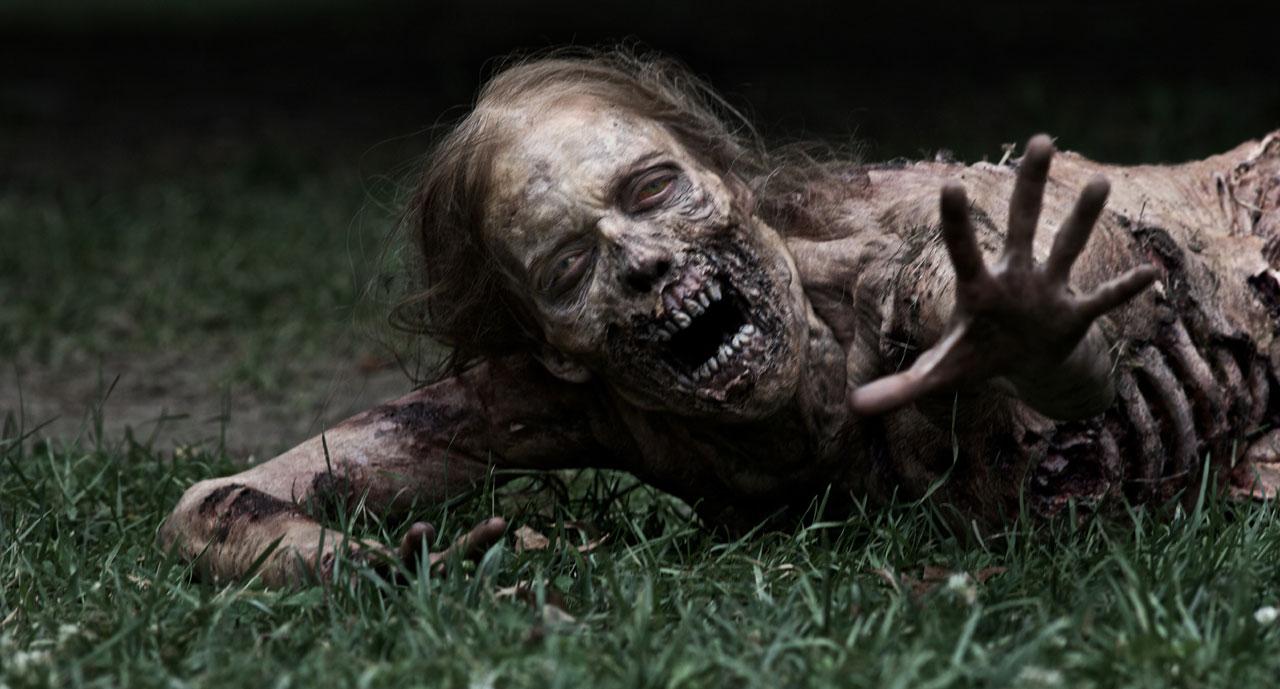 I’ve never read the Walking Dead graphic novels (unlike, apparently, every thirteen-year-old at Bowmore Public School), but I’m a big fan of the AMC series. I’ve been a fan from the first episode. I even liked the second season, experiencing it not as the wheels of plot spinning ever-deeper into the mud, but as the kind of slow burn necessary to set up an explosive and devastating payoff. (There are other views, I know. After the second season, one person of my acquaintance described the show as an abusive spouse who promised to never do it again if you’d just give it another chance. Which implies either an unhealthy degree of emotional investment in a TV show, or a curiously lighthearted perspective on domestic violence.)
What I truly admire about this series is a sense of verisimilitude uncommon in any genre show, much less one about zombies. Of course, the Walking Dead isn’t really about zombies; it’s basically a grown-up Lord of the Flies, an exploration of how ‘civilized’ people react when the rug gets yanked out from under them. It’s got more in common with McCarthy than with Romero. Many of the series’ set-pieces— the napalming of the cities, the tense hair-trigger negotiations between groups of survivors encountering each other in the aftermath, the grim gritty recognition that this ain’t a democracy any more— would be just as suited to the aftermath of a meteor strike or a Mitt Romney presidency. The issues explored here carry more than a whiff of Ron Moore’s Galactica before it went down the New-Age toilet on us.
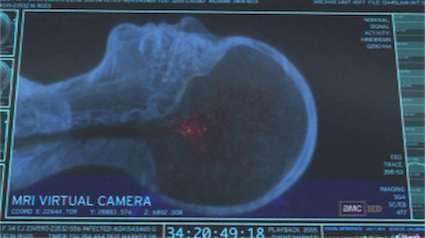 And yet, there are zombies. Pretty convincing ones, too, at least on a visceral level. There are even hints, here and there, of a quasi-biological basis for their existence: occasional glimpses of walkers just standing there, immobile, conserving energy until kickstarted by some external stimulus. The Governor’s tame scientist, observing that Michonne’s armless jawless pack zombies (and decapitated zombie heads, for that matter) were starving to death very slowly. The revelation of some kind of viral involvement during that ill-fated sleepover at the CDC — not to mention the localization of neural reactivation in the brain stem (although this begs the question of why, if the cerebral hemispheres are suddenly so irrelevant, all those forehead shots are so damn effective).
But only hints. There’s never been any kind of explicit explanation for the zombie apocalypse that kicked off the AMC edition of The Walking Dead, and my understanding is that the graphic canon hasn’t dealt with it either.
This will not stand. And since the series has pretty explicitly described the apocalypse as biological in nature, who better to handle the retcon than the fallen biologist who singlehandedly redeemed the crucifix glitch?
Let’s start with evolution. Why do walkers attack the living in the first place? How does the consumption of living flesh promote the fitness of dead flesh? Doesn’t the fact that the flesh is dead mean that it’s pretty much out of the whole Darwinian race by definition?

Photo credit Hans Hillewaert
Obviously it’s not the agenda of the flesh — living or dead — that’s at issue here. The flesh is simply a delivery platform for something still subject to natural selection— and in terms of real-world biology, it’s almost too easy. Readers of my rifters books (or of Carl Zimmer‘s more plausible nonfiction ones) may remember fireside tales of Sacculina, the parasitic barnacle that rewires the behavior of infected crabs so that they stop worrying about their own welfare and instead spend their time aerating the larvae growing inside them, even helping them disperse once they hatch. Or you may be reminded instead of Ophiocordyceps, the mind-controlling fungus that leaves its host’s motor nerves intact while it devours everything else — and which finally, when its victim is little more than an exoskeletal husk stuffed with fungus, takes the reins and forces that poor hollowed-out insect to assume a perch oriented at the optimum angle for spore dispersal just before it dies.
My own personal favorite is Dicrocoelium, a fluke that uses ants as a stepping-stone into the ruminant it targets as its definitive host. Each night Dicro forces its ant to climb to the top of the nearest convenient blade of grass and lock itself in place with its mandibles, leaving it vulnerable to the grazing habits of any nearby cow or sheep. It’s also smart enough to release its ride when the sun comes up, to let it resume its usual anthill duties (remaining locked to that blade of grass during daylight would toast the host beneath the noonday sun, which would benefit neither rider nor ridden). Recent studies have shown that the reins tugged by Dicro are neurological: it actually hacks into the central nervous system to work its magic.

Photo credit Parisitology1000.blog.com
And I’m not even going to bother to link to our old friend Toxoplasma gondii.
The take-home message is that any number of real-world parasites conscript unwilling flesh in the service of their own dissemination, even to the point of hijacking the motor control systems. It doesn’t matter whether the agents who walk the dead are viral, bacterial, or helminth: natural selection will promote any behavior that spreads the infection. Jumpstart the most basic locomotory responses; reboot the ancient reptile drives; shock the carcass into motion. What does it matter that those ancient predatory reflexes no longer serve to nourish the corpus, that meat instinctively bitten chewed and swallowed won’t ever be digested in the service of mammalian metabolism? The biting and chewing itself is enough to spread the infection. The swallowing is mere collateral: an irrelevant side-effect of some macro evolved for one function, then repurposed to another.
Starting from those ground rules, the serial sieve of natural selection will tweak the specs towards some caricature of optimality. Variants which always run their engines hot will burn out sooner, lose ground to those who idle on neutral until triggered by sound or motion. Lineages which waste effort biting flesh that’s already infected will lose out to those who ignore their fellow walkers in favor of live game. Perhaps some extremely lucky mutation partially reboots necrotic host systems, the way a dead frog’s leg kicks in galvanic response to an electric shock: a diaphragm that still clenches now and then, pumps air in and out of rotting lungs like some half-assed bellows. Just enough to keep a few RBCs swapping O2 for CO2 way past their best-before date, residual room-temperature metabolism ticking over just enough to keep limbs in motion longer than Nature might consider normal. Microbes can cram a thousand generations of evolution into the space of a single prime-time episode; from a standing start, they won’t take long to converge on the walkers we know and love. It’s basically drug-resistant syphilis, writ large.
The only question is whether Nature did this herself, or whether some Human agent gave her a boot in the ass. I don’t know whether either television or graphic canon will ever give us an answer to that one.
Happy Valentine’s Day. Hang on to your hearts.

18 Feb 10:37


Politics: The peoples flag is deepest red, it shrouded oft the martyred dead.
by Iain Donaldson
As we approach the tenth anniversary of Britain’s last Labour Government taking our country into an illegal war in Iraq, we should reflect on what should really be seen as the lasting legacy of the last Labour Government.
You can improve the lot of our pensioners, reverse the damage done to our education system, pay off our PFI debts and stop the further unnecessary privatisation of our NHS. You can prosecute the politicians who fiddled their expenses and create a sensible divide between politics and journalism, you can even reverse the encroachment on our civil liberties of the National Identity Card, or the ASBO or the detention without charge, or the telephone hacking.
All of those things hurt, did damage and undermined our trust in the state, but all of those things can be reversed.
What can not be replaced are the lost lives and lost limbs. Post traumatic stress disorder can strike at any time 20, 30, even 60 years after the events and whilst this coalition Government has ensured that whenever it strikes our former serving military they will get the care they need, this Government can not turn back time on the lies and deceit of the last Labour Government that took us into that illegal war.
What can not be undone is the resulting in the murder of over 200,000 innocent civilians and involving Britain in some of the most heinous war crimes since WWII.
- Labour imprisoned people in Belmarsh Prison without charge, let alone trial;
- Labour allowed the extraordinary rendition of prisoner through this country to places where they could be tortured for information;
- Labour restricted the freedoms of british people;
- Labour attempted to introduce a national identity card system.
All of this was done in the name of fighting a terror that had not threatened this country until Labour launched it’s illegal war on the back of a pack of lies, half truths and innuendo.
The Lib Dems may have made mistakes in Government and the Lib Dems may have had to trade some of their policies to get others enacted, but the Lib Dems have not sent our troops into an unwinnable illegal war that resulted in the maiming and killing not only of our troops but of hundreds of thousands of civilians.
It is little wonder that Labour don’t sing the red flag any more, it has taken on a whole new meaning.
17 Feb 22:55
This post has been shown to contain over 60% rant, or, why blaming the poor for eating bad food is nastier than a horseburger « Churchofnom's Blog
by andrewhickeywriter
17 Feb 02:36
One to Lie and One to Listen
Oh, lies. Lies are what make us human, what keep us from being bored to death; lies are the very foundation of our civilization. (Sure, when Pablo Picasso says stuff like this, you say he’s profound; when I say it, you roll your eyes at me.) Lies form the basis of our faiths (“There is no God but Allah, and Mohammed is his prophet”), our politics (“All men are created equal”), and our societies (“Anyone can grow up to be a millionaire”), and what’s more, they grant us nobility by allowing us excuses to fuck and kill each other, rather than doing it for no reason like some stupid animal.
And yet, why is there no taxonomy of lies? To lump them all together, to commingle through lack of effort the lies of Nixon with the lies of Swift, is to mock the great and wonderful human capacity for compartmentalization. Sure, every kid in Boogie Down has a poster of Linnaeus on the wall of his bedroom, and any hipster chick worth her Asthmatic Kitty baby tee can tell you the difference between an ignorantio elenchi and a dicto secundum quid ad dictum simpliciter. But where is the man who will teach us to keep our crookedness straight, to show us the difference between a dirty lyin’ dog and a dissimulating son-of-a-bitch, to remind us that not only is A not always A, but that there’s more than one way of saying that A is in fact Q?
Ladies and gentlemen, I am that man. I bring you Initial Notes on a Taxonomy of Lies, with the formal names of each bogosity in cod-Japanese because Latin is played.
KYOGEN TAI-WAGAMI (The Lie Against Myself). This lie, known as “rationalization” in the Freudian idiom, is an extremely common sort of lie, commited on an almost minute-by-minute basis by almost everyone. Unlike the other-directed falsehoods that follow, the purpose of this lie is to forestall suicide by convincing yourself that your current path is really for the best, and that there’s no need to take particular notice of the festering gut-bag that you are in reality. It can take the form of simple self-deception (“This job isn’t so bad, and besides, I’m really making a difference”) to outright fabrication (“I don’t need to work out today, because I worked out harder than usual on Wednesday”). This is generally an extremely desirable type of lie, and even if it weren’t, it’s impossible to get rid of, like capitalism and groin comedy.
Example: instead of “I am unattractive and have a repellant personality”, say “I can’t relate to the women of today”.
KYOGEN I-DATSUROU (The Lie of Omission). This lie, a favorite of the elderly, convalescents, residents of Wisconsin and Minnesota, and other people leading a low-energy lifestyle, allows one to lie without actually saying anything. In more primitive times, before we learned that it was never appropriate to have unspoken thoughts, it was known as “tact”. It is still the lie of choice for many self-important people because they don’t consider it to actually be lying, and for some reason they think not lying is desirable. Note that this lie is not to be found on the internet.
Example: instead of “Thank you for reading your poetry to me; it was boring, pretentious, and horribly clumsy, and to call it sophomoric would be to unjustly slander many talented second-year college students”, say ” “.
KYOGEN TAI-HONMEI (The Lie Against Certainty). This lie is similar to the kyogen i-datsurou, especially insofar as people who don’t like to be thought of as liars often employ it so that they may later congratulate themselves on not lying; but here, rather than not saying anything, one says something that can be interpreted as neutral, or even positive — anything but the mockery and disdain that usually lies behind it. Any time the word “interesting” is employed, a kyogen tai-honmei has been committed.
Example: instead of “That dress makes you look disgustingly fat, even for you”, say “That dress really emphasizes your figure”.
HIRUTAI KYOGEN (The Simple Lie). This lie is the most basic of other-directed lies, consisting of a statement contrary to actual events or opinions. It is easily mastered, low-maintainence, and useful in any number of situations — all the hallmarks of a classic. Unlike the more subtle and graceful sorts of lis, it can be used by anyone of any age or level of experience; indeed, children are often more adept at it than their adult counterparts. The downside of this type of falsehood is that its very democratic nature works against it: its commonality has rendered it the least socially acceptable kind of lie. When somone calls you a “lying fuckface”, it is usually in response to a hirutai kyogen. Nonetheless, it is a perennial favorite that is never out of style.
Example: instead of “I am fucking your girlfriend”, say “No, I am not fucking your girlfriend”.
KYOGEN AIRONIKARU (The Ironic Lie). This lie, while deceptively similar to the Simple Lie, is in fact a form of lying so subtle and profound that some people do not believe it to be lying at all. The Ironic Lie, which requires a lifetime to truly master and has been perfected by only a few extremely brilliant practicioners in New York, Paris, and parts of Ireland, consists of saying something that is, generally speaking, exactly the opposite of what you mean, and then — and here is where the devilish difficulty comes in — placing the burden on the listener to recognize that you are lying. Not only does this elevate it beyond the level of base and common lying, but it allows the liar to place the blame on his audience, rather than on himself, if he is ever caught in the lie. While incredibly effective and remarkably graceful, the Ironic Lie is fiendishly difficult, requiring not only sharply honed lying skills and a judicious use of language, but a significant financial investment in the quotation mark industry. Simply put, the kyogen aironikaru is the Cadillac of lies. (Note: rumors have been circulating since fall of 2001 that irony is, in fact, dead. Experts are said to be looking into the matter.)
Example: instead of “I am fucking your girlfriend”, say “Oh, yeah. I’m ‘fucking’ your girlfriend”.
KYOGEN I-SHOUHOU (The Lie of Commerce). This lie, which is well on its way to supplanting most of the other types of lies though a vigorous breeding rate, is the other-directed lie perfected. The art of it lies not so much in the nature of the lie itself, but rather in the liar’s ability to convince her audience that the lie is not only true, but in fact quite outstanding. While looked down upon by traditional practitioners of lying, the Lie of Commerce has attracted some of America’s best and brightest, who say that it’s pointing the way to the future and that other types of lying had better get on board for the big win. If you have no particular talent or skill, but are gifted at stringing together a lot of words and concepts that don’t really mean anything, the kyogen i-shouhou is probably for you.
Example: instead of “Give me $300 a month for the rest of your life”, say “You’re in good hands with Allstate”.
KYOGEN I-GESAKU (The Lie of Fiction). This lie, of which your author has reluctantly become a practitioner in the wake of rampant rumors about the death of irony, is unique among falsehoods in that it is not only acceptable, but actively encouraged. Some people even attribute a sort of nobility, a greatness to this form of systematized lying, which is amazing considering how complete its falsity; it’s quite simple for a skilled practitioner of kyogen i-gesaku to construct a standard English sentence in which every single word is a lie. The trick is to know when it is appropriate and when it is not; for instance, following a confession that you have stolen your friend’s car, used it to rob several convenience stores, and employed it in aid of the vehicular manslaughter of a handful of municipal law enforcement officers, it is usually improper to say it was just for a story you made up.
Example: instead of “I am a neurotic guilty Catholic with a variety of sexual dysfunctions”, say “Stately, plump Buck Mulligan came from the stairhead, bearing a bowl of lather on which a mirror and a razor lay crossed.”
Mirrored from LEONARD PIERCE DOT COM.
15 Feb 15:33
Tagged: actuallyautistic, allistic privilege, ASD, asperger's syndrome, autism, neurodiversity, neurotypical privilege

I’m Not Sick: A rant about neurotypical privilege.
by feministaspie
I am autistic, and I’m sick of neurotypical privilege.
I’m sick of hearing that I and others like me can’t live a full life. We can, and we do. We just need a little help sometimes.
I’m sick of being told my experience isn’t real, that I’m just an attention-seeker or a special snowflake, or having those accusations directed at my parents.
I’m sick of the myth that vaccines cause autism. And even if that were true, I’m sick of people avoiding vaccinating their children because they’d rather they get ill or even die than be like me.
I’m sick of autism being compared to cancer and AIDS. The latter two are diseases which can and do kill. Autism is not.
I’m sick of hearing that autism is an “epidemic”. The reason that more people are diagnosed with autism now is that there is so much more awareness regarding autism. The numbers will probably continue to increase for a while, for that reason.
I’m sick of being told I have to pass for neurotypical to be liked and accepted by my peers. I have a great circle of friends who are really understanding and supportive. If people judge me for not being neurotypical, that says more about them than it does about me.
I’m sick of hearing that stimming is a bad thing. If it’s not hurting anybody, I don’t see what the problem is. And if rocking and flapping and twitching is what’s going to stop me having a meltdown, that’s what I’ll do. I’m sick of being told in one breath that you have to learn to cope and in the next breath that you can’t do that to cope.
I’m sick of being told not to scream after I’ve screamed at a sudden loud bang. Emphasis on the word sudden. It’s not like I thought about it and made a conscious choice to scream.
I’m sick of the people around me saying “Stop that, it’s embarassing” or “That must really annoy your friends” when it doesn’t. I’m especially sick of that under the guise of “We’re used to you, but other people…” when they seem to have more of a problem with it than other people.
I’m sick of all this driving me to a meltdown and then being told that that’s embarassing too.
I’m sick of “quiet hands”.
I’m sick of most of the “treatment” for autism being based on making people on the spectrum pass for neurotypical, rather than social skills or advocacy or something else that might actually solve some problems. I’m sick of living in a society in which the most important thing, above all else, is to comply.
I’m sick of conditioned compliance.
I’m sick of literally greeting people with apologies because of the constant fear that I’m screwing up, that I don’t know how to comply. Everyone who knows me is sick of it, too.
I’m sick of struggling to make minor decisions in public (like what to order for food) because there’s only one right answer, only one way to comply, and I’m sick of not believing people (at the time) when they tell me they really don’t mind what I choose. Again, everyone who knows me is sick of it. Everyone is sick of conditioned compliance, so it seems.
I’m sick of being spoken for.
I’m sick of all the media, the panels, all the publicity surrounding the autistic spectrum focusing on people who aren’t actually on the spectrum – the family, the friends, the “experts”, everyone but the person who knows what it’s like. I don’t want to attack all those people – they’re usually well-meaning and really want to help, and please keep fighting the good fight – but seriously, an all-male panel discussing sexism clearly isn’t a good idea, and I’m sick of people not seeing that an all-neurotypical panel discussing autism isn’t a good idea either. Especially when they don’t listen to people who are actually on the spectrum
I’m sick of not being listened to because I don’t have a child or another relative on the spectrum. I am autistic. Is that not enough?
I’m sick of being treated like a child.
I’m sick of people telling me I’m “not really autistic” because I’m not like another autistic person they know. It’s called a spectrum for a reason. This counts double when they’re a child; if I’m a lot older than them, of course I’m going to be more able with some aspects of life, autism or no autism. Nowadays, I rarely have public meltdowns and I can follow the major social rules (e.g. personal space), but I’m sick of people assuming this also applies to my childhood. It doesn’t.
I’m especially sick of the above when the person telling me I’m “not autistic enough” isn’t on the spectrum themselves. How is it logical that I’m “not autistic enough” to know what I’m talking about, but you’re qualified when you’re not autistic at all?
I’m sick of functioning labels and the assumptions they carry with them.
I’m sick of the assumption that people who are verbal are “high-functioning” and people who are non-verbal are “low-functioning”.
I’m sick of people on the spectrum being told they’re either too “high-functioning” to know what they’re talking about, or too “low-functioning” to know what they’re talking about.
I’m sick of worrying that people won’t understand my needs because I’m apparently “high-functioning”. Similarly, I’m sick of the potential of other people on the spectrum being ignored because they’re apparently “low-functioning”.
I’m sick of being told that Asperger’s syndrome isn’t “really autism”. I’d imagine that people with PDD-NOS are sick of being told the same about that.
I’m sick of the constant thought that one day, there might be a pill or an injection that could wipe out people like me, that could turn me into the norm, that could make me comply, that wouldn’t care that most of my personality is eradicated along with it.
I’m sick of being told I’m selfish for not wanting such a cure, and that the people telling me I do need a cure are somehow not selfish.
Autism isn’t a sickness. Neurotypical privilege is.
Tagged: actuallyautistic, allistic privilege, ASD, asperger's syndrome, autism, neurodiversity, neurotypical privilege
15 Feb 15:06
The Matter Of Britain
by Tom
The death that shocked me most that Spring wasn’t Kurt Cobain, or even Ayrton Senna. It was the passing of an owlish man in his 50s who people assumed – and hoped, in many cases – would be running the country before too long. Later on, John Smith’s heart attack became a locus for all sorts of counterfactual speculation – after the landslide of ’97 you heard people saying, well, tragic of course, you understand, but as things turned out not all for the bad…? And later – as the golden era of the Great Empathiser sank into a miasma of gossip, inertia and war – the wondering and what ifs turned sad and angry.
At the time – and since, really – what hit me was a sense of unfairness, based mainly on how hard Smith and his colleagues had worked. Also – and this didn’t last, at least not in this form – an irrational gloom, the feeling that things would never change, and that somehow the moribund, comical Tories would pull through again.
But then everything did seem to change, and quickly, with the facts of politics shifting last of all.
Two summers ago, as the phone-hacking scandal spread through the British establishment like fire through cobwebs, a friend tweeted that this was like “Britain: the season finale”. It was a moment where everything seemed connected and fragile and impossibly dramatic. The Summer of 1994 didn’t feel like that. In fact it felt torpid – the same films, the same records, the same bloody record from the same bloody film crowding out anything else – but with hindsight it was more like “Britain: the season opener”. It introduces charismatic new stars, it teases fresh plots, it establishes a few themes.
The theme of the 1994-1997 season of Britain – there’s no real question of what the finale was – was somewhat inward looking. It was Britain itself – what kind of country it was, could be, and wanted to be. This is the sort of thing politicians always want as the theme, but in this case politicians weren’t in charge: the ideas kept bubbling up through culture. On the day after John Smith’s death, Four Weddings And A Funeral was released. Four Weddings isn’t explicitly about Britishness, and “Love Is All Around” – its soundtrack hit – is no Britpop anthem, but the film plays fondly with types and stereotypes of Britishness, suffuses matters in a British marinade that’s essentially a feelgood strategy. Britpop was precisely the same, though with enough distance to allow an ironic getaway if things turned nasty. Four Weddings is at the cosy end of mid-90s British culture, but still feels like its product.
By the end of May, “Love Is All Around” had reached No.1. During that song’s smothering reign, Tony Blair became leader of the Labour Party and Oasis released their debut album. Blair, Hugh Grant, Noel Gallagher – the new cast of Britain taking intriguing shape, with more in the wings.
Politically, the mid 90s seem like a phantom prelude to the Blair Administration, where a paralysed Tory government could do little except let its citizens daydream about good times before and good times to come. Culture, not politics, took centre stage, and pop was (for the last time?) at the centre of culture. So for all sorts of reasons – mostly dramatic neatness – it’s very easy to take things one step further and make Britpop the centre of pop, to turn the narrative arc of the mid-90s into the narrative arc of Britpop. Doing this makes for an excellent story.
But is it the right story? The great thing about doing Popular is that its merciless slicing of the charts into their most successful records takes decisions of focus out of my hands. By this time the charts themselves aren’t an accurate fossil record of UK cultural concerns – and, if you just look at No.1s, Britpop ends up underrepresented – but at this particular moment they do a better job than storytelling.
Because what we see over the next few years is that wider cultural spasm – all those jostling dreams of “British” – pushing through into the charts again and again, giving a sense of something far wider happening than a bunch of indie bands trying to work out how to cope with fame. It’s not a bad story, exactly – but the bigger picture, British Pop not Britpop, holds so much more. Ravers, actors playing old soldiers, boyband heretics and true believers, second-generation immigrants, comedians, and most importantly and successfully young women – all shouldering their way to number one; all offering ideas, stated or implied, about Britain; all shown in the topsy-turvy mirror of the charts. What a time!
We’ll get to them all, but first of all I have to decide whether that pesky Wet Wet Wet record is actually any good….
15 Feb 15:05
Think Like a Publisher 2013: Chapter 5: Return on Investment
by dwsmith
This chapter is brand new to any version of Think Like a Publisher. I’ve honestly been afraid to tackle this issue for some time, but think I might have a handle on it.
Keep something clearly in mind as I talk about this: An indie publisher is still a publisher, the same as any traditional publisher.
Think Like a Publisher 2013 is an updated version of the book from about a year ago, including some of what has changed and what I have learned over the last year or more. And some new chapters such as this one. I’m sure in another two years I’ll do a fourth edition.
Every few days I will post a chapter for free here with a link under the tab above. The 2012 edition is still available in book and electronic form. After I get done with these posts and reformatting the book, this edition will appear replacing the old one. But that will take a month or so.
Comments on each chapter are welcome and help us all learn, but keep the comments focused on the topic of the chapter, please.
I hope these chapters help you get a jump on learning how to be a publisher. And on finding an audience for your writing.
Chapter Five:
Return on Investment
As a professional writer, when I am asked by another writer what they would be better off writing, my standard and correct answer is “Anything you are passionate about. Any story that motivates you. Any topic that scares hell out of you or excites you.”
And when asked “What’s the best length in this new world?” my answer has been “Whatever length the story demands.”
Those are my writer-to-writer answers and they are correct. No second thoughts at all. Those answers come from the art of writing. Those answers come into play for all writers and should be followed where possible by all writers. Those answers will help a writer find their best work, their best art.
That is my opinion, my answers, and I am sticking with them as a writer.
Now… let’s switch hats and think like a publisher. Or better yet, the accountant working for a publisher. And that’s where this chapter is going to be a problem for some people.
This chapter is my attempt to answer all the questions I keep getting about what length is better because my writer answer sure doesn’t seem to satisfy some people.
Indie publishers are, for the most part, writers first and foremost. So back to the advice I always give above. It is the right advice, the best advice to turn out the best stories, and that’s what matters.
But… let’s pretend for a second here to help you learn how to figure “return on investment” as if you are not a writer.
Some of my background here as a writer.
Can I write to length? Oh, heaven’s yes. You must have that skill if you work for any time in media of any sort. If a novel needs to be 70 thousand words to fit a contract, it better darned well be within a thousand or so of 70 thousand words. Period. Every time. No exceptions.
If I need to write a short story under 6,000 words to fit a certain topic of an anthology, can I do it? Of course. Easily.
Would a book be better if I let it go to its natural conclusion as a writer? Most of the time I would say yes. But often I didn’t have that wonderful freedom to do that. I had to hit word count within a certain time and at a certain quality.
That’s called being a professional commercial fiction writer. It’s a good job. And not a job that most writers can do, actually. It takes the ability to mimic a voice in words so the readers hear the character’s voice. (Think trying to write the cadence and syntax of Kirk, Spock, McCoy, Picard, Janeway and so on in a way that readers hear the actor’s voices in their heads as they read your words.)
Being a commercial fiction writer takes the ability to spend long hours doing nothing but being creative, it takes the skill of being able to understand author voices and even mimic another author’s voice if you get hired to ghost write, which I did a lot as well.
Most writers are lucky to get to the end of a novel with anything more than a gut sense of what they did. Commercial fiction writers have to know exactly what we did, and why, and we do that to length, and on demand. And the demand is usually for a very short deadline. Commercial fiction writers must learn extreme control of most aspects of fiction writing skill. (Which is why I can teach craft and help other writers.)
But all that said about my writing life, I still tell other indie writers to just let a story go its natural length to create the best art possible.
Granted, sometimes you can create art within the constraints of being a commercial fiction writer hitting deadlines to length. Not often, but sometimes.
Art is better left free to roam where it wants to go and for how long.
So what do you do as a publisher when you put on the publisher hat?
Can you pretend that because math says one way is better than another, one length of story is better than another, one genre sells better than another, should you push to write that way? Oh, heavens, NO!
But you must understand the business. As Kris and I have shouted over and over for decades now, writers are business people. Writing is a business. And an art.
We all must keep working on the art AND the business. Learning both.
So I am going to try here (for just a short moment) to pretend I am just a publisher, not a writer, and work out some expected return on investments. In a vacuum. Without any thought of being a writer. A publisher talking to other publishers who are not writers.
In other words, I’m going to pretend to look at this business like an accountant in a publishing company would look at it. (In very, very, VERY simple terms.) And again, remember, I am doing this chapter in direct response to hundreds of questions on this topic from writers who might think they are in control of their writing enough to write to length and to topic in a quality fashion. Chances are they are not, but at least I have given an answer.
If you have any fear that this post will change your writing in any way, just skip this one. Please.
What is Investment in Indie Publishing?
We covered all that in the first chapters. It’s expenses, overhead, and time. Time is the critical element here, since the rest are pretty set per project. So I’m going to just assume all of the overhead and expenses are wrapped into the total and focus only on time from here on out in for this post.
The time it takes to write a story or a novel.
(Publisher/accountant hat firmly on.)
Let’s say a product can be produced at a rate of 1,000 words per hour. Each hour is valued at $50.00. (Set your own.)
So it takes 10 hours for a 5,000 word short story to produce and post to sales channels .
Short story has a cost of $500.00. (10 hours)
A 50,000 word novel is 10 times as long, so $5,000 cost. (100 hours to produce and put out)
A 100,000 word novel is 20 times as long, so $10,000 cost. (200 hours to produce and put out)
(I said I was going to be simple, didn’t I? So don’t quibble on the small stuff, follow the logic and then do your own math for your own work and time and value of hours and add in all the factors you want.)
Income Projections
Before we go any farther, I need to lay out what I use as minimum sales numbers for this kind of mind game we are playing here with this chapter.
As I have said in the past and many writers numbers seem to back this up, the following sales figures apply if you have 50 or more titles up under the same name. (And yes, I know, genre and series help a lot.)
Assumptions of Sales for this chapter.
Short stories average over all titles about 5 sales per month total through all sites around the world.
Collections average over all collections about 5 sales per month total through all sites around the world.
Short novels and novels tend to average about 25 sales per month total through all sites around the world.
Now I’m going to ignore all the details of pricing and percentages (again, I’m being simple here) and just assign a figure for gross income per sale per item. (Again, I have talked about this a great deal in other posts on my blog.)
Short story $2.00 per sale gross.
Five-Story Collection $4.00 per sale gross. (Say $.75 per story per sale.)
Novel $5.00 per sale gross.
So to the math.
Short story: $2.00 x 5 sales = $10.00.
Then add in the amount per story from sales of collections. $.75 x 5 = $3.75.
So that means you would get $13.75 gross income per short story per month total.
Novel: $5.00 x 25 sales = $125.00 gross income per novel per month total.
Say the novel is 50,000 words long and took 100 hours to write and produce. Each short story took 10 hours to write and produce.
So to equate the two you would take the short story and multiply by 10 to get the same amount of time used on the novel.
Ten short stories = $137.50 per month gross income. (36 months to recoup the $5,000 investment in time on those ten short stories.)
One 50,000 word novel = $125.00 per month gross income. (40 months to recoup the $5,000 investment in time to write the short novel.)
If your novel is 100,000 words, it would take 200 hours to write.
Twenty short stories = $275.00 per month gross income. (36 months to recoup the $10,000 investment in time on those twenty short stories.)
One 100,000 word novel = $125.00 per month gross income. (80 months to recoup the $10,000 investment in time to write the novel.)
Summary
If you take the writing side out for an indie publisher, it is clear from the math that writing shorter novels is better than longer novels and writing short fiction is the best when looking at only income.
36 months to recoup investment on short fiction
40 months to recoup investment on a 50,000 word novel
80 months to recoup investment on a 100,000 word novel.
Other factors:
— It has been proven that writing in series helps increase sales.
— It has been proven that some genres sell better in some forms than others.
— It has also been proven that new product out helps sell older stuff. (Which goes back to writing shorter novels and short fiction because you have more product on a regular basis.)
— Novels have better outlets in paper than short fiction.
— Novels can sometimes take off and you get a great contract from New York.
— Short stories can make you money selling first to good magazines and also will be great promotion for your other work.
So if you are mercenary and are only thinking like an accountant, writing short novels (30-40 thousand words) and a ton of short fiction in certain genres in series is the best way to go. You get the best of both sides.
That means turning yourself into someone like me who can write to length, in any genre, and quickly and knows story and fiction at such a deep level that you can mimic anything with words.
Yeah, that’s going to happen.
Now back to reality.
Most indie publishers are writers first and the best way to produce good stories is write what we care about, what we love, what we are passionate about. If your novels go long, let them. If you hate short stories, don’t write them.
And the truth of the matter is that if you write great stories and novels from your passion, they also sell better.
So this chapter was to answer a bunch of questions I keep getting about which is the best length to write in indie publishing.
Short fiction and short novels are the best.
But even better is to write what you want and say to hell with the accountants.
And have fun.
————————————————
Copyright © 2013 Dean Wesley Smith
Cover Photo by Edward Fielding/Dreamstime.com
————————————————–
Speaking of “Return on Investment,” these chapters took me time to write. This chapter is now part of my inventory in my Magic Bakery. I’ve talked about the Magic Bakery a few times in various posts, but just think of this column as a pie and I am allowing samples of the pie here. Understanding the Magic Bakery is critical to making good money as a publisher. So I will talk about it in these chapters coming up as well.
If you feel this helped you in any way, toss a tip into the tip jar on the way out of the Magic Bakery. That will help me with a better return on my investment of time and keep me going on these.
If you can’t afford to donate, please feel free to pass this chapter along to others who might get some help from it.
And I would like to thank all the fine folks who have donated over this last year. The donations and the comments both after the posts and privately are really keeping me going on this. Thanks!
Tip Jar: Go To Paypal