Andrew Hickey
Shared posts
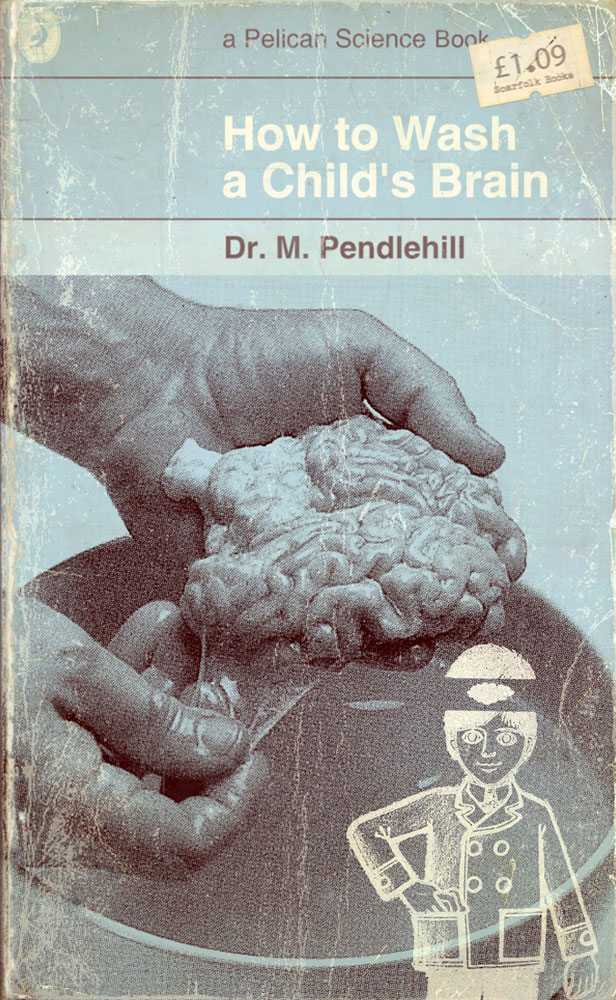
"How to Wash a Child's Brain" Pelican Books, 1971
In 1971 Scarfolk Council collaborated with Pelican Books to produce this handy 21-page guide to brain and cranial cavity cleansing.
An excerpt from the book:
"... Always wear woollen gloves (or mittens) [...] After the child's brain has been removed with the two brain spoons, rinse it in a solution of vinegar, ammonia and curry powder, then rest the brain on a soft cloth or tea towel for a few minutes, or for as long as is convenient. During this time remove all your clothes and incant pagan ritual #23, as found in the appendix (of this book, not your child) [...] Do not spit on the brain or leave it near a hungry or rabid pet, such as a guinea pig [...] If the brain has swelled outside the cranial cavity and will no longer fit, simply snip away part of the frontal or temporal lobe with nail clippers and discard. This will not affect your child's development. [...] If your child has a seizure slap it and insist that bad behaviour will not be tolerated..."
The Passage of Time…
You know how sometimes you’re standing in a line and it makes you feel oddly better if others come and line up behind you? You’re just as far from the front as you’d be if they weren’t there but somehow, it’s comforting that you’re no longer at the end. There are times when it’s also comforting to have more people ahead of you.
I got into comic books in 1970, a date which seems like months ago — sometimes, weeks ago — to me. The musician Eubie Blake used to ask, “How old would you be if you didn’t know how old you were?” I think I’d be around 28…around enough to learn some stuff, including how much I didn’t know…but still a kid with a long way to travel. I’m really 61 and unable to process the hard fact that I’m now almost ten years older than Jack Kirby was when I met him in 1969.
Last year at WonderCon, I stunned my friends Marv Wolfman and Len Wein with a realization. There were 40,000 people there and the three people who’d been in the comic book industry the longest were the three of us. As far as I know, no one who set foot in that hall that year had worked in comics before we did. This year, there were a few who had. Russ Heath was there. And Jim Steranko. And Neal Adams. And I heard Stan Lee slipped in for one panel…but I think that was it. This year, there’ll be 130,000+ people at the Comic-Con International in San Diego. I’ll be surprised if there are ten people in that convention center who were in comics before I was.
People keep asking me, “Why don’t you have those great Golden Age Panels anymore?” Well, I didn’t do the math on it last year but the year before, insofar as I could tell, there were only three people at the convention who’d been in comics before Kennedy was shot. They were Stan Lee, Ramona Fradon and Jerry Robinson. Jerry’s since passed away and Stan won’t do panels about “the old days.” So that’s why no Golden Age Panel. That year, we couldn’t have done a Silver Age Panel, either.
Someone called and asked me the other day who’s still with us who drew Superman in the forties. I think that would be Al Plastino, who started in 1948. In the history of the Man of Steel, the next person to draw him professionally who’s still alive would probably be Neal Adams who started doing covers in 1967. For Batman? Well, with passing of Carmine Infantino, I think the honor goes to Joe Giella, who began inking Infantino’s Batman stories in 1964 and later pencilled the Batman newspaper strip and a few stories. Next in line is, again, Neal Adams.
Those of you who are around my age may remember Neal Adams as “the new guy in comics.”
There are still people around who were in comics in the forties — by my count, about fifteen — but they don’t get to conventions much. Happily, the guy I believe holds the record for the longest career of anyone alive is still drawing the occasional comic book. That would be Sam Glanzman, who started in 1939 and recently did some new “U.S.S. Stevens” stories based on his World War II memories. He’s one of the few people left in comics who has any.
I mention all this not to be morose. We need to be reminded to celebrate the ones we can while we can and I’m delighted to hear that Joe Sinnott will be out for San Diego. Joe began working in comics in 1950. If you make it to the con, don’t miss the chance to tell him what his work has meant to us.
http://whenwillthehurtingstop.blogspot.com/2013/04/well-please-allow-us-still-luxury.html
He'd Get Into Heaven Just For Having Written This

Miracleman #16 (December 1989) by Alan Moore and John Totleben
A town without poverty? A 1970s Canadian experiment with Citizens' Income.
Andrew Hickey"Only two segments of Dauphin's labour force worked less as a result of Mincome—new mothers and teenagers. Mothers with newborns stopped working because they wanted to stay at home longer with their babies. And teenagers worked less because they weren't under as much pressure to support their families.
The end result was that they spent more time at school and more teenagers graduated. Those who continued to work were given more opportunities to choose what type of work they did."
"In the period that Mincome was administered, hospital visits dropped 8.5 per cent. Fewer people went to the hospital with work-related injuries and there were fewer emergency room visits from car accidents and domestic abuse. There were also far fewer mental health visits.
It's not hard to see why, says Forget.
“When you walk around a hospital, it's pretty clear that a lot of the time what we're treating are the consequences of poverty,” she says."
Why Does the Gimp Development Team Hate Gimp?
Try this: Do a Google search for these three words, in separate quotes just like I have here:
"gimp" "developers" "morons"
376,000 results, says Google. Anybody would wonder at the way the word "morons" is being bandied about with such gay abandon in Gimp's general proximity and wonder if the project had gone awry. Anybody with sense, that is.
Gimp was perfect at 1.0. Since then, every release of Gimp has seen things get more and more broken. Quite deliberately. But now, if you've fired up Gimp 2.8 lately, you have the most audacious insult to users yet: You cannot save the image you're working on.
No, I'm not kidding. Try editing something and hitting "Ctrl-S." Now it comes up with a dialog insisting that you save an ".xcf" and ONLY an .xcf. You have to export the file to its own original format. You know, just in case you're going to do anything off-the-rails crazy like actually USE THE IMAGE in some other context besides editing it in Gimp. Check out the convoluted Mexican Hat Dance that now constitutes the process of merely saving an image file.
Many have complained about this. Just for a few cases, Bring back normal save, and Bring back normal handling of other file formats, and HATE the new save vs. export behavior, and this complaint on Twitter, and this complaint on Google+ and this long-time user. ... I could go on all day. Pick an insult, any insult, and search for it in conjunction with "Gimp." It's somebody complaining about the save behavior.
How are the handlers... handling it? The response from the Gimp development team has been "go to Hell!" full stop. No, seriously:
From this link:
"Do you think you could ever get used to the idea that there's more
than one way to teach people safety?"
Well, Alexandre Prokoudine, you arrogant asshole, it's not your place to teach anybody anything. We had an image editor before you came to the project, and we want an image editor, and we're going to get an image editor whether you like it or not.
"This might be the most stupid garbage that has ever been written on this
list, but anyway...I tried to make it clear once before but for the hard of hearing: the
save/export stuff is going to stay, it will not become optional, and it
will not go away.If this doesn't please you, nobody forces you to use GIMP."
Uh, yes, Michael Natterer, you arrogant asshole, we are, indeed, being forced to use Gimp. I am forced, by common sense and decency, to use Free and Open Source Software while I am also forced, by necessity, to earn a living. I was doing both of these things for years using Gimp before I ever heard of you. Go take your politics elsewhere and leave MY Gimp alone; nobody's forcing YOU to come sabotage our toolbox.
Or from this link:
"A lot of people over at GIMPUSERS.com want the old save and "export" mechanism back. The conclusion to draw from that is that they are not part of the user group we are targeting. We are not trying to make GIMP into an excellent JPEG touchup application, we are making GIMP into a high-end photo manipulation application where most of the work is done in XCF."
Well, Martin Nordholts, you arrogant asshole, I AM a professional graphics artist, I do it for a living, I have blogged and educated and advocated so extensively within the original Gimp community for so many years that my name is recognized everywhere I go in the computer graphics community - and I'm telling you you're stark, raving mad.
Except that nobody gets this crazy or stupid, so we have to assume that you are, in fact, deliberately sabotaging Gimp. One of the cornerstone tools of the FOSS desktop that's stood for 18 years as a necessary utility. What you are doing is stealing that from US. No, the answer isn't "if you don't like it, fork it". How about we nuke your house, and if you don't like it, you can build it again? You obviously have a lot of time and resources on your hands to spare, after all.
Open any file in any other program and save it. Open a text file in a text editor and edit it and save it. What does it do? Open an SVG file in Inkscape and edit it and save it. What does it do? Open an HTML file in Bluefish and edit it and save it. What does it do? Use any other program also aimed at "high-end photo development" (whatever that is supposed to mean) and open a file and edit it and save it. What does it do?
The Gimp development team's troll logic would have us believe that every other program, proprietary or FOSS, from the dawn of computing to the present day on every platform is doing the wrong thing, while they - and they alone - have Teh Won Twue Vision!!! and will save the ignorant masses from themselves. To the point where they'll tell the whole website gimpusers.com (Alexa traffic rank 183,406) to go straight to hell, every last one of them.
My fellow FOSS citizens: When will we oust these dictators? How much more obvious and blatant does the criminal hijacking of Gimp have to get?
Episode IV: A New Hope While I am leading the effort to issue an official patch to change Gimp back to sanity, I have looked around and have deemed Krita and Pinta The New Gimp. We will be discovering their wonderfulness together later. I still want Gimp patched anyway, just to SPITE the bastards!
Who Remembered Hills (10)
Actually, the title it really needed is the one which Andrew Hickey has already taken. "So, Do I Even Like Doctor Who?"
[*] e.g But accidents will happen by land and by sea
Fourth World: Mister Miracle volume two
Jack Kirby Fourth World: Mister Miracle volume two (1974)
I seem to have heard loads about Kirby's Fourth World without ever quite working out what it was, beyond the greatest story ever told, apparently. A cursory level of research revealed it be some massive cosmic scale saga originated by the man who effectively invented Marvel Comics, or at least who effectively invented how Marvel Comics looked in the 1960s and 1970s providing you pretend Steve Ditko never happened. Fourth World was what our boy cooked up once he got tired of Stan Lee's alliterative bullpen and went to work for DC, creating an entirely new mythos spread across a series of titles looking forward to comics as something other than just newsstand fodder - well, this is what the internet seems to think, which is probably why I had somehow taken the impression of Fourth World being revolutionary beyond human imagination, sort of like Aeschylus with capes and people who behold things over yonder instead of merely looking at them.
Unfortunately none of the proverbial hot cakes were ever invoked as a result of Fourth World sales figures, and by the time Kirby came to produce these last eight issues of Mister Miracle, cancellation loomed, obliging him to wrap up a much larger story whilst trying to take the book off in its own direction in the hope of staying afloat; so this is probably a somewhat shitey place to start with this Fourth World stuff, but anyway...
Okay. Given that what we're dealing with here is caped superhumans having fights with evil looking men who turn out to be as dastardly as their moustaches imply, lumpy looking henchmen called Lefty, and other elements that wouldn't seem too inconsistent with your average episode of Scooby Doo, it's probably an idea to remind ourselves of context when referring to Fourth World as revolutionary. It isn't Kierkegaard, it's a comic book tailored for the enjoyment of small children who also like Batman; but true enough, it is a very good comic book tailored for the enjoyment of small children who also like Batman.
Thing is, I'm not really even sure what makes it good. Having little of the apparently impressive Fourth World back story related in earlier titles for reference, I'm left with just the adventures of a superhero escape artist repeatedly cornered by criminal types. In terms of narrative it's hokey as fuck and yet somehow transcends the limitations of its genre, the terrible science, the bad guys failing to get away with it due to meddling kids. Possibly it's not so much the stories - which should by all rights be nothing special - so much as how they're told, the even pace, the economy of language, and most significantly, the astonishing art. More than any other comic artist I can think of, Kirby seems to represent some sort of pinnacle and as such is most at home right there on the page - it would just seem arch and insincere given the Roy Lichtenstein treatment. It's too much its own thing, which is probably why none of Kirby's imitators ever really achieved the same sort of reputation.
Cough cough. Herb Trimpe.
Kirby's panels are crowded with detail and yet often seem surprisingly simple, clear solid forms reaching out towards the reader and a tremendous sense of depth. It's odd, and even quite ugly in places, but more in the way of that accomplished, expressive brand of ugly associated with Modigliani and certain Cubists. I think I read most of this collection with my mouth hanging open. Much as I hate to repeat what everyone else has been saying for years anyway, Kirby's art really was amazing.
Published elsewhere: Nick speaks on immigration. and proves that my fears were justified...
Last June, in one of the Coalition's less glorious moments, the idea of insisting that those wishing to bring a foreign spouse into the country should have a minimum level of income was mooted. Naturally, I wasn't impressed.
It was bad enough that the Government adopted it, but it was the Labour response that was even more dubious? Here's what Yvette Cooper said at the time;
It is not clear that the best way to protect the taxpayer is to focus solely on the sponsor’s salary. For example, in the current economic climate, someone on £40,000 today could lose their job next month, and then, of course, there is no way to protect the taxpayer. The system does not take account of the foreign partner’s income, which might have a differential impact on women. Will the Home Secretary explain why the Government ruled out consulting on a bond that could have been used to protect the taxpayer if someone needed public funds later on?So, when Nick Clegg talks about the idea of introducing a security bond for visitors from certain countries, it isn't original and it isn't clever. In fact, the security bond for foreign spouses option is already used in Denmark.
But the justification was that it would act as a disincentive against false marriages. The Government, having consulted the Migration Advisory Committee, chose to go down the route of minimum income levels for the British spouse instead.
And, one can see the logic. If you're going to set the bond at a particular level, how do you choose it? Too high, and you punish those whose intentions are entirely honourable, too low, and you set the rate for those whose intentions are less so. Nick does at least see that;
The basic premise is simple: in certain cases, when a visa applicant is coming from a high risk country, in addition to satisfying the normal criteria, UKBA would be able to request a deposit – a kind of cash guarantee. Once the visitor leaves Britain, the bond will be repaid. Clearly, we need to look into the detail and seek a wide range of views, including from the Home Affairs Select Committee.
However, his naivety is astonishing. If you target the bonds, they by definition discriminate against particular groups. Is he really telling me that the bonds will apply to the United States but not India, Japan but not Botswana? Does he not understand that we already make it difficult for citizens of many countries to get a visa, insisting on payment without guarantee of success, dealing with applications remotely so that decisions are not made locally? For example, if you are Jamaican and applying for a visa, your application is not processed in Kingston, but overseas. You are not interviewed, merely scored against criteria decided upon by the Home Office. Hardly a sensitive, accurate process.
The bonds would need to be well-targeted – so that they don’t unfairly discriminate against particular groups. The amounts would need to be proportionate – we mustn’t penalise legitimate visa applicants who will struggle to get hold of the money. Visiting Britain to celebrate a family birth, or a relative’s graduation, or wedding should not become entirely dependant on your ability to pay the security bond.
It might not be the case that Nick means to give the impression of racism, but if you are an ethnic minority, you might not be quite so generous of spirit.
You might ask, "Wouldn't it be better to improve the visa application process?", and it's a perfectly good question. Unfortunately, we've already cut back our network of consulates as a cost-cutting exercise, so the tick-box method of processing applications is the only currently practical option. It just isn't a very good one.
So, if my uncle wants to visit me from Mumbai, how much should he be charged? On top of his airfare, any accommodation costs and expenses? Does it depend on how long he plans to stay? He is family, so my father or I might choose to pay the bond.
But it can't apply only to family visits, or you would create an incentive to lie about the purpose of your visit, so it must potentially apply to all visitors from the designated countries, which brings me to the potential effect on tourism and trade.
If you are a tourist, you have a choice - Paris or London, Berlin or Edinburgh, for example. If you're like me, you're price sensitive, and if the United Kingdom wants to add a large chunk to the potential upfront cost, I might decide that it isn't worth the bother and go to Prague instead. And what will the cost of that be to our tourism industry?
And then, there is the risk of retaliation. Proposals to tighten the visa regime for Brazilians coming to this country were shelved when it became abundantly clear that the Brazilian government would simply retaliate in kind. Trade trumping principles, you might conclude, and I would agree with you.
In June, I wondered if this was a sign of things to come. I didn't think that the answer would come quite so soon, and certainly not from the Leader of the Liberal Democrats...
Against Nature in Electronic Shops Now!
Margaret Thatcher and Lloyd George
Opinion: Dr Strangelove: or how I got utterly fed up with the Left
Yesterday Margaret Thatcher died.
Predictably social media exploded with chatter about the passing of an epoch-defining politician. Perhaps it says something about the kind of people I associate with, that I found myself reading one comment after another proclaiming “Ding dong the witch is dead”. Some of my Facebook ‘friends’ have even posted grinning photographs of themselves celebrating the happy event.
Whatever it says about my social circle, it says plenty about the Left.
I grew up in a left-wing household. My parents were of the CND generation, Labour party members who supported the miners’ strikes. I had only just started school when Thatcher was forced out by her own party to everyone’s delight. It is the earliest political event I can remember. I was brought up in the shadow of her memory. At school she was like Voldemort: She Who Must Not Be Named.
In the leafy, bohemian part of Oxford where I grew up, there was moral security in knowing that, though none of us had ever met any Tories, the struggle against them was one of good versus evil. Tories, personified by Margaret Thatcher, didn’t care about poor people. They took away the miners’ jobs. They didn’t give the NHS enough money. And all because they were rich, selfish, and greedy.
Even when I grew up and joined the Liberal Democrats, I thought hating Tories was in my blood. The Labour government’s insouciance towards civil liberties disturbed me. But the Left had been betrayed by Tony Blair and Gordon Brown, and I knew which side I was on.
As I got swept up in the 2010 General Election campaign, I got to see more of the arrogance of Labour in power on the local council: their wasteful spending, favouritism of their own areas, and disdainful attitude towards the people whose views they were supposed to represent.
But the coalition government taught me a lesson about the Left I shall never forget.
As soon as the Lib Dems crossed the floor to the Government Benches, we seemed to cross that line between good and evil – in other words ‘left’ and ‘right’. Never mind that we had always said we were equally willing to work with Labour or the Tories. Never mind that we had never sought to identify ourselves as being on Labour’s ‘side’.
A few months after the election I was working in an MP’s constituency office. Every day I opened letters with foul-mouthed abuse scrawled across them. When I knocked on doors people told me I was a traitor because we had let the Tories in, that they would ‘never’ vote for the Lib Dems again.
I knew I hadn’t changed my views just because the electoral maths had forced my party into coalition. I knew the Lib Dems were exactly the same party as before the General Election.
What had changed was how people on the Left perceived us. We were on the ‘other side’ now, which literally meant we were bad people. And that meant it was OK for the NUS to publish chants about killing Lib Dems.
This is the kind of de-humanisation that makes it socially acceptable for educated people – who oppose the death penalty – to publicly rejoice at the death of a long-retired grandmother.
My parents were attracted to the Left because it seemed to offer humane values, like caring for the poor and vulnerable, and protecting minorities. That’s what they brought me up to believe in, and I still do.
No doubt there are people on the Left who say they only hate the Right because they care so strongly about the poor and vulnerable. But it is a strange kind of love that leads us to hate our fellow human beings.
* Jack Williams is a Lib Dem member who lives in London and works for an MP
Who Remembered Hills (9)
continues....
Annette Funicello, R.I.P.

I’ve had several e-mails from folks waiting eagerly for my great Annette Funicello anecdotes. Wish I had one for you. I never met Ms. Funicello. I never heard much about Ms. Funicello. I never even had a crush on Ms. Funicello, perhaps because she was a bit too old for me. I admired her work and accomplishments but so did we all. Sorry I can’t offer more than that.
This also applies, by the way, to Margaret Thatcher.
A serious blog post I wrote about Thatcher in 2005
What everyone forgets is that the rise and rise of Margaret Thatcher was politically contingent and not inevitable. Had, for example, Wilson’s debilitating brain disease kicked in a year or two later, Callaghan would not have been able to scoop the succession and be so colossally inept. Had Dennis Healey been the leader that confronted Thatcher every day in the Commons, the sense that Labour was doomed like a rabbit in headlights would never have crept up on us. Had the Labour leader been someone who would talk frankly to the union bosses about the likely alternatives they faced, rationality might have returned to Left politics. Had Michael Foot’s vanity not been so great that he acquired a leadership for which he was even more inadequate than Callaghan, Thatcher would have had proper principled opposition during the Falklands War. Had Owen and Williams and Jenkins put principle and party and allegiance ahead of being stroked by a fundamentally Conservative media, there would not have been a fourth party to split the anti-Thatcher vote.
And so on. It was not inevitable even that she become Conservative leader, let alone that she win the election, or the one after that. Part of the myth promulgated at the time was just this, the idea that she was the archangel of history and that everything that happened was part of some vast upheaval built into things from the dawn of time.
It was also a myth that the intellectual balance had swung to the Right. If you look at the rightwing intellectuals much praised at the time, they are a sorry bunch. Roger Scruton is about the best of the bunch and he is a crazy, objectively considered. Milton Friedman’s economics have been largely discredited by their operations in the real world and Hayek’s claims about the coming dominance of evil statists have ended up as the justification of corruption and gangsterism everywhere he and Friedman have become doctrine.
This takes me inevitably to one of Thatcherism’s main claims to the high ground – privatization. I will acknowledge, because I am a truthful girl, that one privatization worked – British Telecom provided a better service, adapted to rapidly changing technology and became an international player. However, the same cannot be said for the privatization of the power companies, the water companies and above all the railways. Forcing hospitals to put cleaning contracts out to the cheapest tender has given the UK some of the dirtiest hospitals in the world and the epidemic of MRSA that helped kill my father and many like him. (Railways came later, but it was the gray Major acting as she would have done had she had time.)
There is a paranoid theory that one of the reasons why American insurance companies gave money to think tanks that put a lot of support into Thatcher is that they really really wanted to ensure that the NHS stopped working well.
Thatcher, given the claims of people like Hayek about coming dictatorship, was anything but a democrat. When it became clear that the inner cities were going to go on voting Labour even if she sold them council housing cheap, she simply abolished the GLC and various metropolitan councils. She couldn’t win at a local level, and so she took away the playing field altogether. Purely considered as an ethical choice, that stinks. And moreover, the very moment Labour gave us a London government again, the popular vote went to the man Thatcher removed by administrative fiat. (And there are problems with Livingstone, of course there are, but that is not the point here.)
Thatcher was prepared to govern by racism and homophobia when it suited her. Her handling of immigration was both inept and unpleasant; she made something of a hash of the epidemic; she played to the gutter on gay rights via Clause 28. Inadvertently, she helped reunite a gay movement which had spent two decades divided by gender.
She stopped pretending that things were fair and created a society in which looking after number one and screwing your enemies were legitimated as well as what actually happened. Ironically, the control freakery that is one of the worst things about Blair is a consequence of her. In a whole bunch of areas, from the smashing of the miners and the abolition of the councils to the decision to shelve rail and tube links to Labout constituencies in inner London, she made spite the order of the day. And she treated her own ministers with contempt and scorn – the only time I ever dreamed about her, I found myself shouting at her for her rudeness to other Tories.
She even got up the Queen’s nose.
And then there was the Council Tax – one of several occasions where Thatcher got people out onto the street burning things down.
She was in the right place to get some of the credit when Communism collapsed – along with Reagan she has to take much of the blame for the failure to help Eastern Europe and Russia acquire working civil society.
Above all, she destroyed hope for half the population. She wrecked the best bits of my adult life and turned half of my former friends into zombie yuppies obsessed with house prices and share issues. And she wasn’t actually all that good or cunning or clever – just lucky in some horrible ways.
The soundtrack for those years for me is always going to be ‘Ghost Town’ by the Specials. When you hear people praise her, just play it loudly until you can’t hear them any more.
Margaret Thatcher – humbug alert
There will doubtless be a few ill-judged reactions in poor taste but don’t waste your disapproval on them. Instead, watch out for the unscrupulous politicians who exploit the memory of Thatcher to justify what they are doing now. Because however much today’s politicians pay fulsome tribute to Thatcher, they are actually deeply uncomfortable with her main attribute.
Whatever you thought of her ideology, the key thing about Thatcher was that she had an ideology. She was a conviction politician with a clear vision of what she wanted to achieve. Her famous statement “there is no alternative” (‘TINA’) was an expression of that conviction, not of consensus politics or convergence on a mythical ‘centre ground’. Her conviction was based on a moral idea of right and wrong, not on the bogus grounds that her preferences were obvious or inevitable. Thatcher’s agenda was above board, not smuggled in under the guise of non-ideological ‘pragmatism’. She thought radical change was possible; she did not accept conventional wisdom as a given and never attempted to merge into an homogeneous political class. She welcomed argument and did not respect people who always agreed with her. This is the antithesis of what mainstream politicians believe today.
Thatcher’s convictions have left an appalling legacy and many of the major problems we face today, such as the consequences of financial deregulation or inflated house prices, can be traced back to decisions of her government. But the problem was that her convictions were wrong rather than that they were convictions per se. It will require convictions of equal strength to challenge the consensus she created.
So as you listen to the tributes between now and the funeral, beware of the politicians who invoke Thatcher and ‘TINA’ to justify the status quo without providing any kind of substantive argument. Anyone who suggests that Thatcher’s victories in the 1980s mean we have no choice today will reveal that they do not understand Margaret Thatcher’s conviction politics and do not understand why, by severely limiting the range of political options, they are undermining democracy.
Postscript: As predicted, Francis Maude appeared on Monday evening’s edition of BBC2 Newsnight, arguing that Thatcher had settled a whole host of political issues in perpetuity.
Lord Bonkers pays tribute to Margaret Thatcher
I first met the young Margaret Roberts (as she then was) because I was in the habit of buying my dog biscuits from her father’s shop in Grantham and she would sometimes serve me.This evening of all evenings is not an occasion to record that she generally kept her thumb on the scales.
Read more from Lord Bonkers on Liberal England.
That Mrs Thatcher
As across the internet tubes we all burble about Margaret Thatcher's death, I tried coming up with the good things she did and there were three or four that immediately sprung to mind(1). Then you go on to the other column and eight or nine things rather than three or four. Mostly bad, but like everyone, and like every government, a bit of a blend.
A lot of what is being attributed to Mrs T today came in under Labour in the 70s - monetarist economics and a selfish short-termist "I'm alright jack" view of wider society. And when she left office we had a nationalised railway network and no such thing as university tuition fees: can you imagine!
But that's the trouble with what's largely social history tied up in the stories we tell ourselves: we all have some idea what Thatcherism was, whereas Callaghan...ism..? No one knows what that might have been. Eleven years of change for better and worse glows bright in the memory in the way that the previous decade of greyness, decline and stagnation - and indeed the next seven years of much the same again - cannot fire the imagination.
And so beware false tales in the mix this week: lots of people will recall that Margaret Thatcher believed that there is "no such thing as society"' - ironically this based on a deliberate malquote of her, where the full context of the phrase was a warning about extremes of selfishness and individualism. A warning that had it been borne in mind by Brown and Blair we might not be quite as deep in the financial doo-doo as we are.
(1) - good things like legalising sex between men in Scotland and in Northern Ireland. Bad things like legislating to make homosexuality a thought crime. Good things like the trades union reforms in 1980, 82 and 84. Bad things like selling off the social housing stock at a knock-down price and preventing replacements being built. Good things like privatising the phone networks; bad things like privatising the water board.
Thoughts on the death of Margaret Thatcher
Perhaps it is because it has made me aware of the passing of time. My own activist years took place mainly while she was prime minister and it all seems a long time ago now.
And in part it must be because Margaret Thatcher – our first woman prime minister and liberator of the Falklands from Fascism – wrote herself into history in a way that only Churchill and Lloyd George also managed in the 20 century.
Besides, two of the beliefs held by those who are crowing at Thatcher’s death are quite mistaken.
The first is the idea that Britain in the 1970s was an Eden of neighbourliness and public spirit which her policies trashed. I don’t remember it quite like that. In particular, one of the reasons that she won in 1979 was because many British voters had come to see the Labour movement as selfish. What came next may have been worse, but we should not rewrite history because of it.
The second false belief is that the changes of the 1980s were wholly the product of Margaret Thatcher’s wickedness. Yet as time passes we see more clearly that many of those changes were inevitable and happened in countries with very different leaders.
To argue that the post-war economy of steel and coal would still be thriving but for Thatcher is nonsense. Coal mining could have been run down more humanely, though Arthur Scargill bears a share of the responsibility for the conflict that ensued, but it would still have run down under any government.
Incidentally, those who were most angry at the run down of coal tend to be the same people who are now most exercised by global warming. Yet that run down of coal is the only reason Britain is anywhere meeting its carbon reduction targets, and that is an irony with which these people have yet to come to terms.
Of course there was much to deplore in the Thatcher years – the rise of Rupert Murdoch, the more partisan tone of public life. Yet those are precisely the elements of her legacy that Labour was happy to keep in place.
Doctor, Why?
'He into his bikes, is he?' The question was asked by Peter Sweet, someone my father knew through mutual love of massive, noisy motorcycles. Even though I was not yet ten years old, we lived on a farm and I was male so I suppose it had seemed reasonable to assume that I was probably into Status Quo, Aston Villa and motorbikes.
'Oh no - he's a Doctor Who man,' my father explained as they headed out the door, intent on keeping a date with a lake of beer and lively conversation about gear boxes.
Without even knowing quite why, even then I resented the label, even though it was certainly fitting. I'd been terrified by Doctor Who up until the age of five at which point, having just watched Jon Pertwee menaced by a man pretending to be an animated stone gargoyle without quacking my pants, I informed my mother that I would be okay to watch the programme from that point on; and I was, never missing an episode until Colin Baker took to the screen and I moved away from home and into a house with no television set, which was possibly ironic in so much as I had relocated in order to study film and video production at Maidstone College of Art. Inevitably I drifted away from the programme because I was eighteen and, without wishing to cast doubt on the quality of either the Colin Baker or Sylvester McCoy years, I had other, more interesting things to do.
Roughly a decade went by without my giving so much as a passing thought to this phenomenon which had once been so integral to my childhood, but then the same is true of Enid Blyton's Adventures of the Wishing Chair, so it's really not such a big deal. Then some time in the early 1990s my friend Andrew gave me a VHS tape of an old Jon Pertwee Doctor Who story for my birthday, and like Clark Kent recalling his secret origin, it all came flooding back in one massive bolus of memory sherbert. I bought some more of these tapes and was surprised at how well the stories had endured for what was essentially a children's programme without much in the way of a budget. Those later years during which the show had tried so hard not to fall off the bottom of the screen had completely passed me by, and I was intrigued by the idea that the clown from Vision On had somehow ended up in the lead role; so I bought tapes of episodes from the Sylvester McCoy era and found I even liked those. This in turn led to my reading the novels published by Virgin Books which continued the story on from the show's cancellation in 1989, with efforts made towards being decent science-fiction novels in their own right - which some of them certainly were.
In summary, Doctor Who was never my reason for living, but I had an investment I suppose you would say. I wouldn't go so far as to claim it for my native mythology as does Lawrence Miles, but it meant something and, more importantly, it led me to other, more interesting places. I can trace, for one example, at least half of the music I now listen to back to the soundtrack of jarring electronic farts scored by Malcolm Clarke for 1972's The Sea Devils.
Then in 2005, Doctor Who was once more recognised as being a viable entertainment franchise and returned to our television screens with Christopher Ecclescake in the lead role. I tried with this revived version but ultimately found myself forced to admit that it really wasn't for me. It's difficult to place the blame on any one thing that has remained consistently poor since its return - aside from Murray Lead's unrelenting incidental music which has remained efficiently and intrusively crass from the beginning - so I tend to attribute its failure to a combination of general shoddy workmanship and the stench of corporately regulated spontaneity and leave it at that.
Of course, I strive to keep such views to myself most of the time. Regardless of whether love or loathing are involved, centring each day around one's feelings for a television programme can never be healthy. I've seen what happens on internet forums gripped by the hysteria of such product overinvestment, and it isn't nice; and nor is there anything to be gained from arguing with someone for whom a fictional character is their life. They won't listen, and the more intellectually inert of their brethren will only counter your argument with viewing statistics, because if Fifty Shades of Gray, The X-Factor, Sex and the City, Justin Bieber and Adolf Hitler's rise to power have taught us anything at all, it is that the cultural or historical value of a phenomenon is apparently proportional to the quota of bums on seats. E.V. Rieu's 1946 translation of Homer's Odyssey sold three-million copies; Dan Brown's The Da Vinci Code has sold eighty-million copies worldwide and is by this logic the artistically superior title.
Where Doctor Who in its heyday was spawned of a BBC populated with cranky eccentrics who tended not to play well with others but were good at imaginative programming, now it is imagineered by committee according to the guidelines of focus groups, and if it isn't, then it feels like it is to me, having more in common with Friends or Sex and the City than with its predecessor. Someone somewhere decided that the eccentric charm of the original could be rebranded and marketed with a 45% increased efficiency per unit of metric quirk to the benefit of shareholders and audience alike, floating the selfsame adventuresome zanyplex on the open market thus allowing it to compete with the likes of Spielberg, Buffy the Vampire Portfolio, and other wilfully culty TV shows about teenagers in warehouses full of stuff that fell off the back of a UFO. Even some of Doctor Who's fans now refer to it as a franchise.
Characters routinely undergo modular emotional journeys - the usual generic tripe about how daddy was never there and so on, standard soap-opera fare - scored without exception to a deafening barrage of boo hoo music just in case we didn't realise that a crying girl with big eyes is supposed to make us have a sad and because no-one trusts the script to deliver anything beyond tiresomely snappy wordplay and plot explanations; and it's no wonder when said scripts amount to a collage of time-tested set pieces already proven to have got the job done on other shows - the Doctor pleading you don't have to do this to the pissed-off alleged Silurian just like a million Nicholas Cages before him all talking the terrorist out of detonating the bomb, and nine times out of ten building up to the worst ever threat to the continued existence of everything ever yet again. It's all piss, wind, and bluster - just meaningless scale presented over and over because the steering committee understand sales targets and viewer ratings better than they understand the basic mechanics of telling a story, or why anyone would even want to tell a story without first consulting the Financial Times. This is why Doctor Who now so closely resembles proven-sellers - Indiana Jones, Star Wars, Harry Potter as the the camera zooms in for a close up, the music swells, Matt Smith looking directly into the camera to deliver one of those lines you only ever hear in the bronchial voiceover of a cinematic trailer: this ends here; the time for something or other is over; there's one thing you don't ever put in a trap; bring it on, numbnuts and so on and so forth. It's a magical funtime ride of wonderment and adventure because Tim Burton didn't win all those awards just for combing his hair. That's commercial, as Borgia Ginz observes in Derek Jarman's Jubilee.
I object to this because I dislike being condescended to by anything more stupid than myself, anything which assumes that like a south-sea island tribesman I will be impressed by bright flashing lights and loud music and so fail to notice the absence of content, or that the dribbling stream of trite jokes and twee observations aren't actually that funny. The sheer insincerity is breathtaking.
I've worked hard over the years to elevate myself above the level of gurgling idiocy to which I was born, and unfortunately this has meant that as I grow older and hopefully a little more discerning, some things just don't cut it any more. I get bored easily, particularly when confronted with the sort of mechanically-reclaimed science-fiction that has recently become so popular, and was actually already somewhat limited in its scope thirty years ago when Star Wars put an untimely end to those pleasantly cerebral science-fiction films of the early 1970s by reintroducing us to the Flash Gordon method of storytelling. I dislike being sold the same idea over and over, particularly when the idea really wasn't that amazing in the first place. Doubtless this may sound elitist, but I prefer to think of it as having standards, the ability to tell the difference between McDonalds and actual food. If that makes anyone feel threatened or somehow inadequate, that's really a shame.
I dislike contemporary Doctor Who because it smothers any story it might be trying to tell with the narrative equivalent of sex aids - something novel to spice up that which lacks the proverbial wood - and because it just isn't anywhere near so clever as it wants us to believe it is. It has been suggested to me that this is simply the way television is made these days, as though I might like to try getting used to it or else piss off back to my penny farthing and wax cylinders. That this is simply the way television is made these days is not strictly accurate, but rather seems to be one of those stock phrases people tend to repeat because they've heard someone else say it and it saves them having to think about whether or not it's true. There's really quite a bit of television employing narrative language entirely unlike that of Doctor Who, mostly television scripted by people who can actually write, who don't require smoke and mirrors to compensate for any lack in the production; and to condense all of the above into a single sentence, I dislike contemporary Doctor Who because it's Nickelback trying to fool us into thinking they're The Sex Pistols.
A few might agree with the above, or at least with some of the above, and there are many, many who would disagree in the strongest possible terms. Being able to cope with the notion that others might hold views different to my own, I don't have a problem with that. If people wish to spend their time watching Doctor Who then fine. Not everything has to be The Deer Hunter, and as for myself it'll be a cold day in hell before I get tired of Godzilla movies, absurd though they may well be. However, I do object to those individuals who seem unable to cope with anyone holding opinions so wildly divergent to their own, and who for some reason seem to take any insult to their beloved yet entirely fictitious Doctor Who Magic Telly Man as an assault upon them, their children, their children's children, and everything that is right and true. If you hate it so much, they bleat because they've seen the question posed before and it seemed to work for the previous guy, then why do you watch it?
Truthfully, I don't. I gave up after struggling through the first ten minutes of Hitler, Go Home or whatever it was called. Matt Smith had just made an amusing remark about wearing either a fez or a bow-tie. The woman who played Dirty Den's second wife in Eastenders had quipped hello, darling to hilarious effect whilst Rory died and Amy McBoggle pulled that feisty popeyed face she does every few minutes, and I knew I just couldn't stand it any longer. I knew it was never going to improve, and that both Steven Moffat and I were wasting each other's time. Later I trawled the internet seeking commentary upon the episode and found I know Hitler was a bit of a bad lad and all, but surely even he deserved better than that..
Unfortunately Doctor Who, whether you watch it or not, has become difficult to avoid, and it's impossible to entirely disassociate oneself from something you enjoyed for at least a few decades of your life, particularly when you still have some sneaking regard for the previous version. It's also difficult to prevent strong opinions such as those expressed above boiling to the surface when any view you might share is pounced on by ravening hordes driven by the sort of religious bloodlust that Tomás de Torquemada would have regarded as slightly creepy. You are the ones, they scream, who can't let go, the jealous losers who take it all too seriously, who can't stand that it's back and that it's more brilliant than ever before, and so on and so forth to paraphrase a Doctor Who author whose books I will never buy. More than anything it comes across as terrible insecurity: tread softly because you tread on my dreams...
Well, that's how it sounds with the slightly more rabid defenders of the faith, but who knows what they're thinking? I suppose you might argue that in writing this I too am failing to let go, but I really feel the accusation would be rendered somewhat flaccid by the word count of material I've written which has nothing to do with Magic Doctor Who Man Telly Adventure Time. Often it is suggested that my fellow naysayers and I might like to shut the fuck up lest we somehow spoil other's enjoyment, because if history has taught us anything it is that those who made unkind comments about the Bay City Rollers, Kenny, Curiosity Killed the Cat, the Jo-Boxers, Bros, Oasis, Take That, Westlife, Busted, and One Direction must ever live with the shame of knowing how their hurtful remarks have destroyed people's lives and engulfed orphanages in the terrible killing flames of death; which is why wanting something to not be rubbish is frowned upon, I suppose.
Essentially I like people, and try to see the best in everyone. I like to see people making something of themselves and doing whatever it is they do well, generally speaking, developing themselves and learning to appreciate what a great world we live in. Therefore it pisses me off when I see people wilfully wasting their time on that which doesn't matter, or coming out with moronic drivel because they've never made the effort, or even been inspired to make the effort, to expand themselves - like the person who in intellectual terms lives in the same town their entire life, never once expressing an interest in the world beyond the horizon of their television set, who justifies such myopia with reasoning amounting to well I think you'll find Solihull has a lot to offer on the face of it. I don't understand why anyone wouldn't want more, and the sheer lack of curiosity about experiencing that which one might not have previously experienced is terrifying - failing to engage with any form of culture not bearing a specific logo, for example. There is no-one on Earth who eats at McDonalds to the complete exclusion of all other gastronomic options, and yet there do seem to be people who bifurcate the world into Doctor Who and all that other stuff.
Where Doctor Who was once a show that at least aspired to inspire, to open up a wider world to young viewers without giving any attendant adults too much of a headache, now it is concerned principally with the perpetuation of its own mythology. It has become a marketing exercise garnished with tried and tested signifiers of authenticity - generic emotive or humorous sequences as the televisual equivalent of McDonalds deciding to sell fruit or using twee folk music as part of their advertising campaign - and its only purpose seems to be the occupation of as much cultural bandwidth as it can appropriate before everyone wises up and starts spending their money elsewhere. What this boils down to, at least for me, is an issue of fundamental curiosity regarding what's out there, all the books I will never have time to read, films I may never see, or places I may never visit. I try to broaden my horizons as I proceed through life, to experience as much as I can, not least through reading; and I read a great deal of science-fiction because that's what I enjoy, but I try not restrict myself to any one genre. It depresses me that there are people out there who will never pick up a book without it bearing some relation to Doctor Who, who may bang on about science-fiction literature on some stupid forum without actually quite knowing even who Isaac Asimov or Clifford Simak were; or worse, who might not even read at all, just sit there drooling over the same crappy DVD they've seen a million times whilst assuming that a broadened horizon means watching fucking Stargate instead. I don't want to live in a world full of morons. I don't want to live in a culture where you have to drive fifty miles to find a Denny's or a Jim's because no-one understands why you would want anything other than a Big Mac. The great energy harvester of western society feeds us quite enough fake homogenised culture as it is without our encouraging it further.
Of course, in the end it's up to the individual, and I have many valued friends who I actually hope don't read this because I know it will piss them off, and it needn't because it really isn't about them (apart from Steve*). I don't tend to make friends based on mutual appreciation of the same bands because I'm not sixteen years old, and I can make a distinction between the individual and whatever they have printed on their T-shirt; and I can even, under the ordinary circumstances of friendship, respect their holding views differing wildly from my own. By extension, I'm not interested in discourse with any individual unable to extend the same courtesies to others, and so I don't see why anyone should be expected to shut up about something they dislike, particularly if they are able to offer some illuminating reason as to why they dislike it.
Doctor Who has often been sold as an ongoing story with almost limitless possibilities, mainly because that's a neat little phrase and no-one really stops to think about it too hard; but its possibilities are only limitless within the confines of every single variant requiring the involvement of a man in a box having adventures whilst his chums stands around asking questions. You might just as well say Garfield is an ongoing story with almost limitless possibilities, then accordingly revise Crime and Punishment in order to illustrate this, having Raskolnikov debate the morality of his actions with a wisecracking pizza-scoffing cat. If it really is about the story rather than the franchise, then why would anyone settle for an inferior model simply because it carries a familiar logo?
So there you go. It took a lot of squeezing but I think that's most of the pimple in so much as there's nothing much I could add without further repeating myself. That's my view pretty much in full and set to a semblance of order so that I shouldn't need to do it again. Hopefully the reader will have gained something from the above, one way or the other, and may at least appreciate why I hold such views: it's not so much about my opinion of, for example, Moffat as an alleged writer, whether new Doctor Who episodes will ever attain the giddy creative heights of The Twin Dilemma or Timelash, or any of the specific and deeply uninteresting details. It's mostly about possibilities, people bothering to look outside their front door, accepting that views divergent from their own may be equally or even more valid, and maybe even learning to recognise when they're being diddled; and to invert the stock challenge so beloved of a certain type of contemporary Doctor Who fan, if you hate all of that so much, then why did you read this?
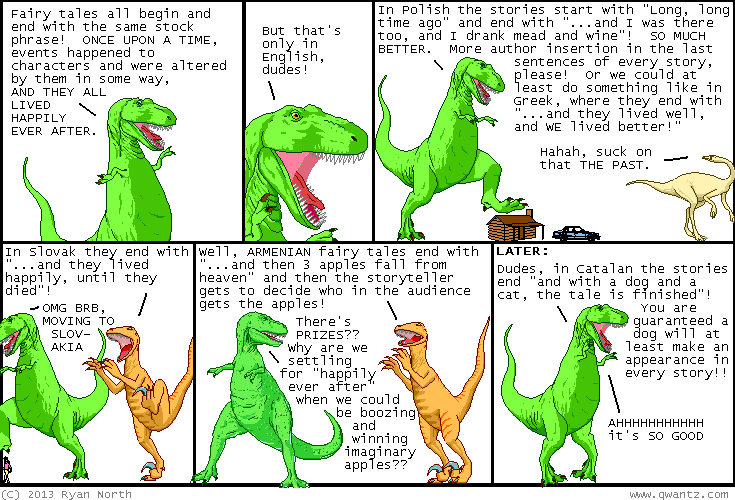
once upon a time they all lived happily ever after
| archive - contact - sexy exciting merchandise - cute - search - about | |||
![]() |
|||
| ← previous | April 8th, 2013 | next | |
|
April 8th, 2013: Adventure Time books! I wrote 'em! And you can now buy them in my internet e-shoppe 2000!
![]() – Ryan
| |||
How to Decide If You Should Call in Sick

Thanks again for checking out my book Off Be the Wizard, (Available for Kindle (US, UK), Nook, old-school, dead tree form, and as a free sample), and for using my Amazon Affiliate links (US, UK, Canada).
http://www.andrewrilstone.com/2013/04/nothing-is-more-ungentlemanly-than.html
Exaggeration, causing needless pain,
It's worse than spitting, and it stamps a man
Deservedly with other men's disdain.
Weigh human actions carefully. Explain
The worst of them with clarity. Mayhap
There were two sides to that affair of Cain
And Judas was a tolerable chap.
Belloc
Hi. My name’s Clive, and it’s been ten years since ‘Firefly’ got axed.
June is going to be a busy month for me; after two years a new Mervyn Stone Mystery is going to surface, this time on a shiny CD…
…in which Mervyn is challenged to solve a murder, and comes face-to-face with Phyllis Trilby, the TV executive who cancelled his show in 1992.
Any fan of a Television programme that gets suddenly ripped from their screens will sympathise with the murderous rage this person inspires…
‘Cos it ain’t fair, is it? We don’t want the story to ever end, and we never have. The frustrated grinding of teeth from deprived fans are, ironically, over-familiar sequels from years past; it’s probably the distant ancestors of ‘Babylon 5′ fans who bullied Homer into recounting ‘The Odyssey’, that disappointing follow-up to the Iliad.
Queen Elizabeth used the force of her magisterial power to fight wars, kill catholics, and nudge Shakespeare into rolling out Falstaff one more time in a crowd-pleasing but ultimately unwelcome prequel. In many ways she was the first ‘Star Wars’ fan.
(Apropos of nothing, are the ‘Star Wars’ prequels the most sophisticated textual joke ever played on a movie-going public? The message in the films is ‘those who do not learn from history are doomed to repeat it’, a cautionary motif that is contained both within the narrative of the story and the fact they exist at all. Is the should-have-seen-that-coming impending doom visited on the Jedi actually a metaphor for the gullible optimism that fans deluded themselves that ‘this time round it’s not going to be a disaster’?)
Scheherazade saved her own life with the promise of ‘just one more story’. Perhaps like many fans today, that Persian king might have looked back on his huge Scheherazade box set, and actually wondered if staying up red-eyed for a thousand and one nights was worth it, and he should have just chopped her head off and gone out to play football, or learned to play the piano, or something.
Writers pretend to share the fan’s rage, but secretly, we love it. I’m sorry to tell you that, but yes, we do. Joss Whedon may have popped his bottom lip out when ‘Firefly’ and ‘Dollhouse’ got the chop, but he’s a writer and writers are unsentimental bastards; his brain had finished with them the precise second they died, and already busy forming quips that could be delivered by buff men and women in spandex. I’m sure the only reason why Chris Boucher regrets there was no ‘Blakes’ 7′series five is because then fans would not keep asking him WHAT THE F*CK HAPPENED NEXT? because i’m sure he had no idea either. He had the best thing that could ever happen to a writer. He got to write a fantastic cliff-hanger and never had to resolve it. As ‘Sherlock’ series three advances on us, and we are on the verge of what happened after that impossible ending, Steven Moffat knows full well what a lucky bastard Chris was, because if the BBC pulled the plug after series two, Steven could still tantalise the viewers for years with ‘what could have happened’ anecdotes on chat shows, but he could have also powered down the macbook and gone to the pub.
We writers love it because it give us a feeling of power without having to do any work. Someone has very helpfully taken our creations hostage on our behalf, put a gun against their head, and reminded the fans why they care about them. And how much do fans care about them? A lot more than the writer does. We get bored much quicker than the audience, because we have to write the f*cking words. Just look at Sherlock Holmes again; most of the time we just kill them off ourselves, Conan Doyle stylee, just to see if anyone cares anymore. Marvel and DC comics do it every other week, to jolt some passion into their readers. Shame they’ve done it far too many times and it doesn’t work anymore.
To this end, I have given ‘The Axeman Cometh’ a subheading of ‘Mervyn Stone’s Last Story’. Modelled as it is on Agatha Christie’s ‘Curtain’, Poirot’s final bow, I am going to tantalise you and enrage with the possibility that this is the last you will ever hear from Mervyn Stone EVER again.
Of course it’s all rubbish, but you can’t blame a lazy writer for trying, can you?
‘The Axeman Cometh’ is available from here:
http://www.bigfinish.com/releases/v/the-axeman-cometh-908
Move along folks, nothing to see here
It turns out that there will probably not be hordes of Bulgarians and Romanians descending on Britain on 1st January 2014 (when restrictions on the free movement of workers from Bulgaria and Romania will be entirely lifted across the European Union).
EurActiv reports:
A Foreign Office-commissioned report has directly challenged claims by UK Prime Minister David Cameron that Britain faces a massive wave of immigration from Bulgaria and Romania when labour restrictions applying to these countries are lifted next January.
The 60-page report [pdf] by the National Institute of Economic and Social Research (NIESR) says that Britain is unlikely to be the preferred destination for Bulgarians and Romanians when labour restrictions are lifted.
And those who do plan to come are unlikely to take advantage of the UK’s social security system, it adds in a direct rebuttal of arguments put forward by the UK Prime Minister.So, panic over.
Unfortunately, it’s not quite the end of the story. The Daily Express refuses to have its fox shot. It dismisses the NIESR report as a “whitewash” and has found a red under the bed:
The NIESR, whose director is Left-leaning economist and well-known immigration enthusiast Jonathan Portes, unsurprisingly seems to talk down the potential downsides of this impending migration.Not just reds, but “liberal intellectuals”:
Instead of being soothed by warm words from cabals of liberal intellectuals, ministers should wake up to a looming disaster.Well, it’s a free country and you are free to choose who to believe: “intellectuals” who have conducted serious research and produced a detailed and reasoned report, or an anonymous third-rate hack employed by a “porn baron” to churn out ignorant, hateful, racist bile.
Loony joins the Conservatives
Croydon Conservatives have welcomed a Loony to their ranks this week. John Cartwright, known as John Loony, changed his allegiances to the Conservative Party this week after 17 years at the Monster Raving Loony Party.
On Tuesday, the Croydon Conservatives tweeted: “It is with great pleasure that we welcome John Loony, latterly of the Official Monster Raving Loony Party (OMRLP) to the conservatives in Croydon.”
Mr Cartwright, who received 110 votes in the recent Croydon North by-election when he stood for the Monster Raving Loony Party, joined the Monster Raving Loony Party in 1996 after a spell with the Chocolate Fudge Cake Party.
Who Remembered Hills (7)
- Series of fifty minute episodes
- Humanistic in outlook
- Idealized humans encountered aliens who were mainly characterized by cultural differences.
- Human / alien conflicts generally settled peacefully
- Conflicts involve a moral dilemma without a right answer
- Often involved not-very subtle metaphors for some contemporary issue
- Had Gene Roddenbury at the helm
- Included characters called 'Vulcans'
- Included characters called 'Klingons
- Space ships said to have 'warp drive'
- Hero is an alien
- Travels through time and space
- Travels with pretty ladies.
- Helps people
- Mostly helps people foil alien invasions.
- Hero travels around and does stuff.
- Has Silurians
- Has Daleks
- Has Cybermen
- Has Tardis
- Has Sonic Screwdriver
- Has Time Lords
continues....
IS LES MISERABLES SCIENCE FICTION? (NO, OBVIOUSLY NOT)
What genre is the musical Les Miserables? It’s always reminded me of something, but it was only when I watched the DVD that I realised what that was.
The novel it’s based on is a great example of social realism, a heavy tome written by an old man who, thirty years before, had himself dodged the bullets during the June Rebellion. Victor Hugo painstakingly reconstructs the period, expands on the context. When our hero makes his escape through the Paris sewers towards the end, Hugo is sure to include an eleventy-billion page discussion of the layout and construction of those sewers. Les Miserables is a great novel, but the title does make it sound a lot more fun than it actually is.
You could not mistake the musical for social realism, of course. You could easily mistake it, in fact, for bombastic nonsense. Built into the fabric of the musical version, there’s a mismatch of the medium and the source (whether you count the source as the book or the events that inspired it), and also between where the play’s set and how it’s staged. This leads to some issues when we try to categorise it, or find something else even a bit like it.
Les Miserables is not like other musicals. You can, of course, sing catchy songs about misery, personal heartbreak and social injustice. You can even do it in musical theatre. West Side Story is an adaptation of Romeo and Juliet that’s about teen gangs murdering each other, Chicago’s about a women’s prison full of murderers, Cabaret’s about the rise of the Nazis. I’m no expert, but I’m always surprised how darn dark the genre is.
Even something as apparently cheerful as The Music Man has a story where, in its own terms, the bad guy wins. A travelling salesman persuades a small Midwestern town to put on a wholesome marching band show. But Harold Hill, the salesman, is not wholesome. He scares the townsfolk into giving him their money to solve a problem he’s created. He gets the girl, but only after mistaking her for a fallen woman, like all the others he’s bagged over the years. (‘I smile / I grin / When the gal with a touch of sin walks in / I hope / and I pray / for a Hester to win just one more A’). It’s an astonishingly sly, cynical narrative in which a wolf devours an entire flock of lambs and gets the lambs to pay for the meal. I love The Music Man.
What musicals tend to do is create a bubble, and then follow a small group of people. This is surely, function dictating form – you want to keep the cast and number of sets as small and stagey as possible. Musicals like Cabaret and The Phantom of the Opera take that so literally that they’re are set within theatres. The historical setting is backdrop, or catalyst, and the end result tends to be oddly unanchored in time. They’re not typically ‘timeless’, they’re set in an imagined period in the hinterland between when they’re set and when they’re first staged. The Music Man could almost take place at any point in the first half of the twentieth century. Cabaret exists at some checkpoint on the border between the mid 1930s and the early 1970s.
Les Miserables is different: it encourages us to extrapolate and expand out. It’s not merely spectacular, its unique selling point is that it crowds the stage, that it’s absurdly lavish and opulent, that the huge and overpopulated set also moves and transforms. The movie, of course, only scales this up, so that it’s Hollywood movie stars doing it all, with great panning shots and crowd scenes.
Thematically, Les Miserables is trying to make universal archetypes out of really rather specific characters. It takes one of many popular uprisings Paris saw in the nineteenth century, a sequence of events that lasted a few days and which barely registers in the history books. Jean Valjean is a man with superhuman strength who spent nineteen years in prison for crimes he did commit, has a religious conversion and opens a Rosary bead factory. That is not a generally applicable stock musical type like ‘small town boy’, ‘lovesick teen’ or even ‘wannabe singer’. The story asks us to identify with, say, Fantine – Crib sheet: Anne Hathaway’s character – and her specific circumstances, and at first that’s relatively easy: she’s a single mother who earns slightly less than she needs to support her young daughter. But she zooms from there to the worst case scenario within a few verses, and has prostituted herself (in a coffin!), sold her teeth and died of TB before the end of the first act.
The structure of Les Miserables goes like this: someone sings about how awful their life is, no, really it’s even worse than it was until recently, seriously it’s no fun at all, wish it was different. At this point, the character might actually drop dead – all but four of them do before the end. Then reset, change cast member and repeat. It’s basically round after round of ‘can anything get any worse … oh, yes, turns out it can’, set in a world so wretched it makes a Dickensian workhouse look like a Culture Orbital.
Yet, somehow, they ramp up the aggrometer to the point where it kind of overwhelms your emotional barricades and you find yourself identifying with Fantine because, hell yeah, you spent an hour on the phone to Comcast this morning, so you know hardship, too. No bread? It’s true, they were out of poppy seed bagels this morning at Panera. Yeah, I’m drowning in the churning waters of modern life, too, because I really need to clear out my email inbox. The system’s broken, man, we should be out on the streets. Les Miserables is really rather stirring, does make you switch off the old thinky whatchermacallit and just sweep you away.
If you’re in the right frame of mind.
If you think about it for even a second, it’s ridiculous. When you watch it critically, there is much meat for a cynical person. The plotting relies entirely on coincidence. Javert’s ‘pursuit’ of Valjean involves bumping into him at random every eight years. The whole thing is a crass product of one of the most indulgent artistic sectors of the loadsamoney decade. The makers could achieve broadly the same effect, only with slightly more nuance, if they just tear gassed their audience.
Watching it, it’s not hard to work out when Les Miserables was written, and it’s a perfect test subject for a critique of the eighties mindset. American Psycho, a novel exploring that very topic, is soaked in references to the musical. At one point, a character literally stomps on a homeless man to get past him to buy a $200 limited edition T-shirt bearing the image of the homeless. American Psycho draws attention to the fact that the audience is complicit in the disconnect between what the story’s about and the form it takes. This is never more obvious than when you remember how much it’s cost you to watch the show. Every song is about life being about scraping together the coins you need to eat that day. The price of one ticket would feed a family for several weeks. And normally, y’know, that’s not a problem because you go to the West End or Broadway to watch escapist fantasy nonsense about things with no connection to the real world, like talking cats, Spider-Man or Mormons. Les Miserables is actually about poverty, that’s the theme.
It’s tempting to see this as the height of hypocrisy. Anne Hathaway’s Oscar acceptance speech saw a woman who is paid millions to be in movies, wearing a Prada dress declaring that poverty is bad.
While.
Clutching.
A.
Gold.
Statue.
But the thing is … that’s basically what the musical is like, from start to finish. It is an inescapable fact. Anne Hathaway, by all accounts one of the smarter actresses out there, clearly gets it.
But ‘it’ here is a huge disconnect between what we’re seeing and what we’re told.
Watching Les Miserables, the thing that strikes me is that it shares a characteristic of science fiction and fantasy: while all art demands a suspension of disbelief and acceptance of conventions and necessities of the form, SF tends to raise the price of buying in. The relationship between ‘science fiction’ and ‘reality’ is a surprisingly complex boundary. Most science fiction seeks to make a point about the real world by, essentially, a process of heightening and exaggerating. Frank Herbert was inspired to write Dune, a story set tens of thousands of years in the future on a giant desert planet that’s one of innumerable worlds of a theocratic galactic empire, because he was concerned about beach erosion. It’s not the only science fiction that, at heart, goes ‘yeah, imagine a planet where it’s all like that, all the time’.
Despite the presence of Wolverine, Catwoman and Jor-El, not even the movie version of Les Miserables is science fiction. But it’s clearly not attempting something literal, either. It’s not made by idiots, they understand exactly what they’re doing. And, at some level, yes, it gets relatively rich people to empathise with the poor, and blimey, there isn’t exactly much art even trying to do that, let alone that’s packed them in for thirty years.
Les Miserables has always reminded me of something, though, and it was only when I was watching the DVD that I worked out what:
Exhibit A, Exhibit B, Exhibit C
Les Miserables is in the same genre as TV commercials for pet adoption charities.
It’s actively odd, in fact, that there aren’t songs in Les Miserables called Am I Going to Die Today? or We’ve Been Caged Together Too Long. You can hear the chorus chanting For Hundreds of Others Rescue Came Too Late or She Could Be Saved For A Few Coins A Day.
Stirring music, naked emotion, and above all they’re calculated and precisely formulated to get you to throw your money at them.
(As a final note, I think it’s only right that I note that I’m not making light of animal cruelty or equating Hugh Jackman playing a man with a sad face with the thousands of real dying kittens out there. I have a rescue dog, adopted from the Philadelphia SPCA, and if you feel moved to, please donate a little to them, here.)
Stupid drug laws having stupid effects
I do try to give the benefit of the doubt to those who disagree with me on this. It can be difficult sometimes though when the evidence seems to be deliberately ignored.
A good example of this comes today with a report that Professor David Nutt, former advisor to the government who was unceremoniously sacked for telling the truth (and who I once interviewed) is saying that the current drugs laws are preventing him from doing research properly. Specifically he has been trying to source clinical grade psilocybin which is the primary active ingredient in magic mushrooms. Psilocybin was recently added to the list of "controlled substances" and Professor Nutt now cannot get hold of it. Regarding the study he wants to do to see if the substance could help with depression he said:
"It hasn't started yet because the big problem is getting hold of the drug. Finding a company to provide a clinical-grade psilocybin had proved impossible as none is prepared to go through the regulatory hoops".
"So we are between a rock and a hard place, which is very unfortunate, because if this is an effective treatment for patients then they're obviously being denied that possibility so one of the things we have to do now is have a more rational debate about the way the drugs laws are being implemented."
For me though the most noteworthy aspect of this report is the response of the Home Office. A spokesperson said:
"Our licensing regime enables legitimate research to take place while ensuring that harmful drugs don't get into the hands of criminals. We have no evidence to suggest that the current listing of psilocybin as a schedule one substance is a barrier to attracting funding for legitimate research."
But we have one of the most respected psychopharmacologists in the country saying that there is precisely this problem. I can only assume that the reporter who got the quote was telling the spokesperson about the problem Nutt had encountered which elicited that response.
I don't think I have ever seen a clearer example of the Home Office wilfully ignoring the evidence that is in front of them. They are being told that there is a problem with the sourcing of psilocybin. In other words they are being given evidence that their policies are preventing legitimate research and their response is to say there is no evidence for that.
Yes there is. Nutt just gave it to you.
Until we can get around this kafkaesque culture of wilfully ignoring the evidence in the Home Office we are never going to get anywhere in trying to get a more sensible drug policy.
Day 4479: DOCTOR WHO: Ring Modulator
I miss “Episode Three”s.
In many ways this was exactly the sort of thing that the Doctor should be doing: travelling to exotic places to see astounding events.
And this was visually stunning, a triumph for the visual and physical effects people: from the first reveal of Akhaten to that really terrific “alien bazaar”, from the golden pyramid to the giant space pumpkin, it delivered on Clara’s request for something awesome. For thirty/thirty-five minutes the episode builds, mood darkening and tension growing, as events spiral out of control. And then, as happened last week, it falls off a cliff, resolving itself far too quickly (and with yet another variant of “love conquers all”), defeated by the forty-five minute movie-of-the-week format once again.
What I missed was the “episode three” bit where the mummy chases them up and down corridors in the pyramid for a while.
That’s not just padding; it’s breathing space so that your plot developments don’t collide, so that your viewers have time to take in the exposition.
It’s the era of montage. After last week’s remix of “The Idiot’s Lantern” by way of “Partners in Crime”, this week we were doing “The End of the World” meets “The Beast Below” with a touch of “The Satan Pit” at the end (and just a soupçon of “Pyramids of Mars”). It’s not like the original series never reworked an old plot (notoriously, “The Cave of Androzani” is “The Power of Kroll” done right) but twice in a fortnight – “zat is most embarrazzing” – suggests a dimming of the creative juices somewhere, which is a shame as this is only the second outing for Luther-scribe Neil Cross (his first is the yet-to-be-screened “Hide”).
(And on the same day that Ben Aaronovitch plumped for Luther himself, Idris Elba, as the Doctor and rowed with Terrance Dicks about it at their mutual books-relaunch, too.)
The plot hangs around two fairly catastrophic misconceptions: Clara’s failure to realise what the young Queen of Years Merry’s role will entail – “don’t put your daughter on the stage, Mrs Worthington,” Alex wanted to cry; the Doctor’s mistaken belief that the mummy in the pyramid and the old god everyone’s worried about are one and the same. Neither of these are well delivered, and would be so easy to fix.
After all her fears about getting her song wrong, it is far from clear that being snatched into space in order to get eaten is what happens to Merry because she got her song right. What fails to sell this is the lack of reaction from the crowd.
With all the aliens looking superior to… well frankly Lucasfilm’s efforts, never mind Russell’s on Platform One… it’s easy to overlook that they lacked interaction: excepting Doreen (and why were her barks not translated by the TARDIS?), this was a dumb show. The singing, at least initially, was entirely in keeping with the weird/fantastical vibe, but when Merry is taken, there are neither cheers nor alarm, so we are without cues to whether this is supposed to happen or a break with tradition. When Clara leaps up to try and save the little girl, no one helps, but no one tries to stop her either.
If only someone had done the Tlotoxl thing of warning her not to interfere with the sacrifice, we would have been much clearer that Clara – and then the Doctor – were interfering, not trying to save a situation that had gone awry.
This in turn has knock on effects. The song of a million years coming to an end ought to have been a much bigger deal. The Doctor should have deeply regretted the loss of another of the seven hundred wonders of the universe. Or made the point that it was about time, if the song requires the repeated sacrifice of girls. Instead it’s all a bit ho-hum that’s over.
(And while we’re at it, if the lullaby is so important to you, wouldn’t you have more than one chorister on hand? Just in case one gets a frog in his throat or a touch of stage fright?)
Next, the Vigil turn up, another great piece of design, nicely creepy, but totally wasted. They’ve not been given the chance to build up their sinister presence – they didn’t really do anything in Clara and Merry’s game of hide and seek at the start and now they just stand there and face off against the Doctor and his sonic lightsabre. Er.
At least Russell knew to throw in the odd death to keep raising the tension (and here, aside from the planet-god itself, once again nobody dies). An increased role for the Vigil, having them as the religious police of this society, giving them the “don’t interfere with the sacrifice” line, having them kill someone for a transgression, all this would have strengthened them and unified the episode.
Then there’s the way the mummy smashes its way out of the glass case only to collapse. Surely this should be played as a huge dramatic anti-climax; we’re expecting the big fight and we’re wrong-footed. (If you’re already quoting “Indiana Jones” in the way that the Doctor rescues his sonic from the falling pyramid door, then you must be familiar with the way Indy just shoots that big scimitar-wielding fellow.) But the director doesn’t seem to bother. It’s just cut the strings and have the Doctor go “oops, no the threat is somewhere else”. Now my preference, as above, would have been for the mummy to pursue them into the pyramid, the Doctor do something very clever and/or drop another door on it, only to realise that he’s actually released the soul of the planet and made everything so very much worse. But failing that, at least a heavy beat where everyone freezes and goes “huh?” as the mummy carks it.
And then the resolution. The Doctor’s big speech appears to have divided opinion. A wonderful example of those “big” Doctor Who moments from “some corners of the universe” to “he burns in the centre of time”. Or a five-minute soliloquy for Matt Smith to prove he can “do a David Tennant”? (And hadn’t we all had enough of La Tennant wallowing in the acting by the end?)
Or did Neil just leave them a five minute gap in the script and Moffat said “oh, Murray and Matt can just busk it”…
I would have minded less if it had been clear that the Doctor was going to kill Akhaten at the expense of killing himself. Yes, that’s been done before but at least it’s in character. Having the Doctor’s sacrifice not be enough – but Clara’s does it because she’s oh so special – just undermines the character. Because you’re saying the loss of Gallifrey and everyone he’s ever loved is outweighed by Clara’s merely human grief for her mum. I know how much that grief weighs and I don’t believe this.
(And of course the planet should have imploded under the Doctor’s grief, but exploded under the infinity of Clara’s lost hopes.)
The bigger flaw, as in “The Satan Pit” from which the ending borrowed, is that Akhaten doesn’t get any lines. You’ve set up an epic confrontation there, between gods, between grandfathers, and you kind of miss it by just having the Doctor emote at it for a bit.
There are so many unanswered questions here: why do the people call this god grandfather? Was the (lovely) reference to the Doctor visiting with Susan significant? Or just a suggestion that the Doctor also gets through a lot of young girls? Is there any truth to the story that all life originated here? Who imprisoned the god in the first place? Are the rings actually the bars on Akhaten’s prison? This federation that seems to have brought together so many diverse alien races seems like a good thing, was that just a – “Genesis of the Daleks”-like – fear of a bigger bad? Or was Akhaten a god that did good as well as the eating little girls bad? Giving the planet-god voice would have helped add shading to these questions. (The simplest touch might have been to show Akhaten giving life to the Vigil – or turning a humanoid into one, depending on preference.)
There’s been a certain amount of grumbling about “Dawkins-esque” religion-as-parasite bashing. There may be a taste of that, but more because fake gods are a part of Doctor Who’s DNA than out of any atheist agenda inspired by Mr Lalla Ward. Nevertheless, giving Akhaten a voice would – ironically – help distance the show from that. It’s easier to believe a god is a phoney if they can talk to you like any other conman.
Built around all this (almost literally, as it’s mostly in the pre-titles and at the end of the story) we have the more Moffat-y parts of the story – which at least fold into the main plot reasonably, by use of the loss and hope motif. Clara’s mum passed away in March 2005, so just before Doctor Who returned (though I think it was March 5th rather than 26th, the actual broadcast date of “Rose”) in keeping with the metatextual referencing that keeps going on. And we meet her dad who seems much nicer than the man who went on at length about the government (apparently) in “The Bells of St John”. We do have the rather odd point that if the Doctor is now retroactively inserting himself into Clara’s earlier life, is he changing her memories – e.g. she now remembers that he was there at her mother’s funeral. Equally, there’s some mystery as to whether the TARDIS likes Clara – why does she expect to be able to get in? Surely the Doctor has just – entirely sensibly – locked the doors. You can’t just have any old alien wandering in. But it seems to be played more significantly than that. That would seem to suggest that it’s not, as I had previously suspected, the TARDIS who is responsible for Clara’s “perfect companion” status, which in turn makes things more sinister.
(Nice that Clara’s nanny/governess/child-minder status was played into her instant rapport with the child Merry.)
By rights, this should have been a magnificent success. It certainly has so much going for it visually and imaginatively. Where it doesn’t work are again down to pace, structure, editing and a reliance on the crutch of artificial emotion instead of a proper ending. If anything, it shows once again, as if it were in doubt, what a genius Russell Davies is, because when he takes these elements he somehow alchemically makes them work. So far Neil Cross – nor yet Steven Moffat – is no Russell Davies. And that might just be the problem if you’re going to try and recreate a Russell story.
Next Time… Cold Warriors meet really cold warriors, and never mind base under siege, we’ve got a submarine. Under water! With Game of Thrones’ worthy ex-smuggler Ser Davos Seaworth in command, no less. Mark Gatiss pitches us into a “Cold War”.
Iain Duncan Smith's finances: fantasy and reality
"The honest truth is I don’t need any lessons from these people. I have worked hard all my life for what I’ve achieved and nobody has given me a damn penny. My earnings are what I live on."
Daily Mail, 3 April 2013
The Reality
The cabinet minister lives rent-free in the mansion at Swanbourne after he was allowed to move in by the previous owner, his father-in-law Baron Cottesloe.
Metro, 7 April 2013