Shared posts

22 Aug 07:34

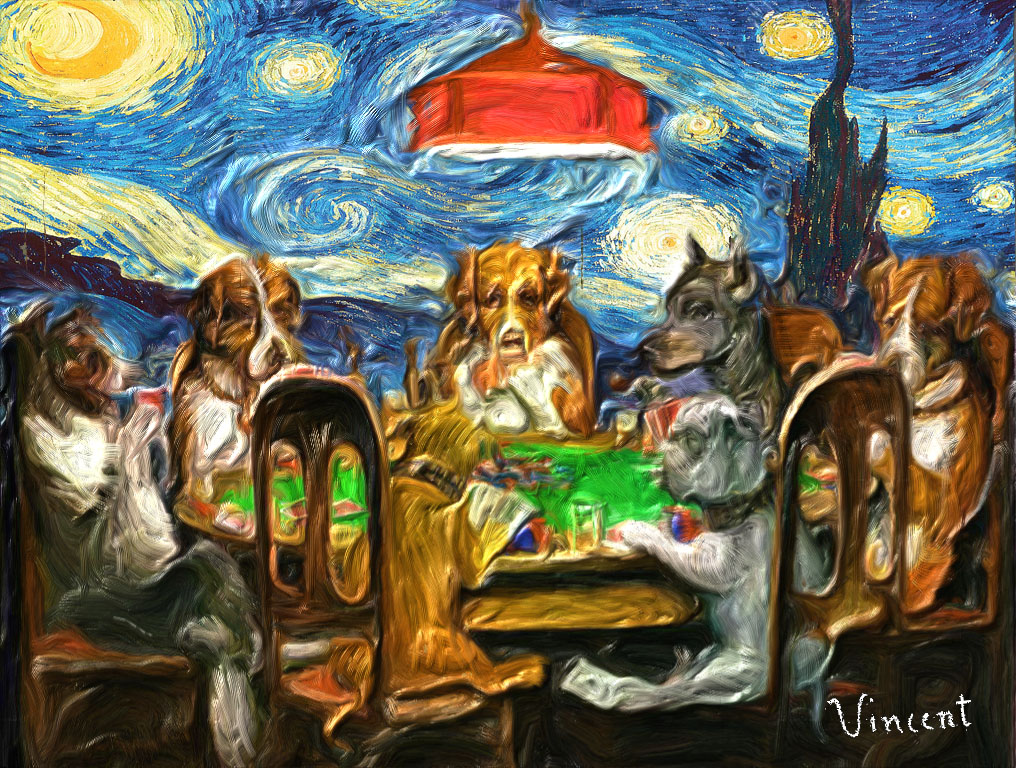
Recent acquisitions: the Lost Van Goghs

by Kyle Baker


I have always prided myself on two things: My investment acumen and my artistic taste.


Usually, I hesitate to brag about my material possessions, but in this case I believe that the cultural and educational contributions of this post more than mitigate the tackiness of conspicuous consumption.


These recently unearthed rare artistic treasures must be shared with humanity, not merely hoarded away in my private collection. Bask in the digital glow of these masterpieces before they are locked in my vault forever.


You would not believe the price I acquired these at. I suspect the seller had no idea of the true value of what he was selling.
Click on the images to truly appreciate the detailed brushwork of the legendary Vincent Van Gogh.


17 Jul 16:37

Not With A Bang

by Jack Graham
Some assumptions 'Closing Time' relies upon: a man being rubbish at looking after a baby is richly hilarious; James Corden has talent of some kind; it's still amusing when someone wrongly thinks two men are a couple.  All very questionable.

And, as ever, (heteronormative) love conquers all.  It kills Cybermen because emotions 'n' stuff, yeah?  Okay, they did something like that in 'The Invasion', but at least there it was any emotion, and it made the Cybermen go bonkers instead of just conveniently dying of endoftheepisodeitis.  Notice the utterly pedestrian, idea-free logic here.  You kill the loveless things with love.  That's like saying you kill poor people with money.  I know the gold thing was stupid, but at least that suggested the logic of using a magical metallic talisman against the zombies.  And at least, when the Cybermen got killed by gold or gravity or radiation, they were simply defeated and chased off rather than being negated or solved.  Kill a Cyberman with radiation and you simply defeat his physical presence.  Kill him with love and you solve him.  You explain him away.  You fill the empty space that he once was... with syrup.  The Cybermen are worthless now.  They have been emptied out of all threat because their hollowness has been stuffed with candyfloss.  Thus is the rump gothic ritually defeated by the power of comforting banalities.

By the way... remember when Gareth Roberts scathingly wrote about how silly 'The Green Death' was because nobody in the audience needed to be told that pollution was bad?  Well... does 'Closing Time' mean that he now believes people need to be reminded that loving your baby son is good?  Are we to understand that banal statements about political issues are a Bad Thing while banal statements about personal feelings are Inspirational Drama?  I guess so, since the former is about boring stuff like public health and business ethics, while the latter is about interesting stuff like oooo i wuv my pwetty ickle baby.  Why are the British public assumed to need weekly reminders that love is a good thing?  Why, furthermore, must love always be reduced to a simple and unambiguously positive thing, as though it's a kind of neurological Angel Delight?  And why is it thought that they need to be constantly reassured that it can conquer absolutely anything just by being felt?  What right to these fucking hacks have to inform us how we are obliged to feel in order to be normal and earn the Doctor's gormless yawp of excited approval?  And isn't this constant emphasis on love as something overpowering and perfect just an emotional version of the media peddling of body images?  Just as we are constantly told how we should look, are we not also being told that our feelings should be just as glossy and perfect and swaggeringly healthy?  There is a catwalk for the feelings, and yours must be capable of poseurising their way down it, looking just right.  Fuck off.

There is something repellently wholesome and healthy about garbage like 'Closing Time'.  If it were a person, it would be the jogger with a muesli bar who sneers down his nose at you as you eat your Twix.  (Yes, yes, I know James Corden is fat.  It's a metaphor.  Give me a fucking break.)  Babies and fatherhood and duty and love, love, love... and all that stuff that, if left alone, is just normal life for most people, but which gets turned into a kind of public school P.E. lesson for the brain when turned into saturday night ideology by people like Gareth Roberts and the BBC.

On top of all this, the Doctor is allowed to notice the revolting sentimentality of saying that James Corden defeated the Cybermen with love... and instead he briefly falls back on reductionist biological determinism.  Before relenting and going back to the sentimentality.  These are the two permitted poles.

Still, at least it has lots of emotional beats in it.  In the same way that a Barbie house has architecture, I suppose.

This is the way the show ends, not with a bang but a simper.
17 Jul 16:35

If Only We Had a Reasonable Negotiating Partner...

by Jack Graham
Anniversary of the Nakba today, an event that shaped the modern world, creating a festering sore of injustice that still infects global politics.

Also, less importantly, the origin of a situation that provides the basis for a vast number of trite, naive, glib, uninformed political allegories in sci-fi TV shows.

The Silurians got the treatment in their first reappearance in the new series, 'The Hungry Earth' / 'Cold Blood' (2010).

The funny thing is that, wheras the intentional Palestine allegory worked up in these episodes doesn't fit the real facts, patronises the oppressed, excuses the oppressors, etc, the accidental allegory works.  Indeed, it chimes surprisingly well witth the Silurians generally.  Every time the Silurians come back they are still squeezed out, displaced, outnumbered... and every time they are condemned when they dare to get angry about it, and exhorted by the liberal hero to stay indefinitely patient, warned that if they don't then they'll have lost the moral high ground, effectively informed that its up to them to be forebearing to the people who've stolen their world. And they never get anywhere near getting redress or restitution.

Most recently, the solution offered to the matter was for the Silurians to retire again and wait for humanity to become more liberal and tolerant all by itself.  As Charles Daniels argued on the comment threads, this is repulsive.  It says that the oppressed must wait for their oppressors to see the light.  The agency lies with the oppressors.  The oppressed must simply be patient.  Such things happen because humans are just intolerant.  But luckily there's (in Dawkins' vacuous phrase) an "ever changing moral zeitgeist" which will inevitably lead us to greater heights of liberalism, without us having to do anything.  (A millenarian idea if ever I heard one.)

Meanwhile, back in storyland, the best solution is for the Silurians and the humans to live apart.  Well, there's a word for that.  A word increasingly being recognised as an apt description of the Israeli domination of Palestine: Apartheid.

The only bit that doesn't tesselate beautifully is the origin of the situation. The Silurians retired voluntarily because they thought the Moon was going to crash into the Earth.  A natural disaster / tragic misunderstanding with no cause and no agency behind it is the official, mainstream narrative, not the reality.
16 May 23:05

Today's Commons debate on mental health

by Jonathan Calder
Last year the Commons held an historic backbench debate on mental health. Historic not just because it tackled what was once almost a taboo subject, but also because a number of MPs spoke about their own mental health problems.

The two most prominent were Charles Walker and Kevan Jones - so much so that in today's debate Jones said that they had become "the Eric and Ernie of the mental health conference circuit". (He added: "I leave it to you, Madam Deputy Speaker, and the House to discern which of us is Eric and which is Ernie.")

Today Charles Walker again made a significant contribution:
I remain terribly concerned about psychosis and schizophrenia. I mentioned a few minutes ago that anyone with a diagnosis of psychosis or schizophrenia is likely to be unemployed. If one is not unemployed at the time, one will end up unemployed. Life expectancy, which has already been mentioned today, can be up to 20 years shorter than for someone who does not have that diagnosis. That is not acceptable in a civilised society and should not be tolerated. I have spoken about this before in an Adjournment debate and I want to revisit it because it is so important. 
My concern, having talked to people who care for loved ones with schizophrenia—sons, daughters, mothers or fathers - is that sometimes the NHS is more interested in managing the illness than with the overall health needs of the patient. Symptoms are managed down so that patients do not make a nuisance of themselves and take up time, but when one stands back and looks at them, they are desperately unhappy. It does not matter if they are smoking 70 or 80 cigarettes a day, because they are not making a nuisance of themselves. It does not matter if they weigh 20 to 25 stone, because they are not making a nuisance of themselves. It does matter, however, because that patient is slowly killing himself or herself and we have to address that.
16 May 15:40

Giving Up on Life.

by Peter Watts

The ‘crawl’s been kinda quiet lately, mainly because I am (for the second time in as many years) on the last lap of this dumb novel. I am, in fact, committed to delivering the damn thing to  Tor before I leave for FinnCon — and I’m on track to do that, if I don’t let myself get distracted. As a result, any occasional posts you might read here over the next month or so will most likely be limited to Echopraxian fiblets.

(That said, I am typing this while sitting on our front porch, twilight deepening around me. I have fond hopes for a replay of last night’s three-way dust-up between rival gangs of cats, possums, and raccoons, all of whom converged pretty much simultaneously on the kibble we leave out here as an offering to the local wildlife. If that happens — and if I escape with all my toes and some decent pictures — I might post those too. Although I don’t know how long it might take to upload a toe using my Telus account.)

Anyway. While this project sprints for the finish line, others unwind around the world. One such is a little e-collection which is about to come out from Fata Libelli, in Spain— and over the past week or so I’ve been sneaking away from Echopraxia now and then to answer some questions they e-mailed me in hopes of spurring interest amongst their base.

Tonight’s impoverished offering, therefore, is an prexcerpt from that interview, with a bit of a semantic bent. Because we all know that if there’s anything more fascinating than watching a bunch of panelists sitting around arguing about the definition of “science fiction”, it’s gotta be watching a bunch of people sitting around arguing about the definition of “life”:

FL:

Your aliens have been widely praised for looking genuinely different, not just like green humanoids. Sometimes, those aliens are so weird (no genes, no cephalisation, hive minds instead of individual selves) that even the main characters have trouble identifying them as living beings. Is there a basic definition of ‘life’ suitable for humans, aliens and IAs?

PW:

Up until recently, Dawkins’s definition would have done just fine: Life is information, shaped by natural selection. Of course, that means that computer viruses have the potential to qualify as life forms, not just metaphorically but literally. I can live with that. A-life can meet Darwin’s criteria as well as any other kind.

The problem now is that we’re actually in the process of creating synthetic life — squishy bugs with real genes and metabolic processes — pretty much from scratch. Those things are undeniably alive, yet were not shaped by natural selection. You could make an analogous case for any conscious AIs not derived via genetic algorithm.

Darwin coined the term “natural selection” to distinguish it from the “artificial selection” that characterizes things like the selective breeding of dogs and pigeons. So perhaps tweaking Dawkins definition to “Information, shaped by natural or artificial selection” might be enough to cover the synthetics coming up through the ranks.

Or maybe it’s time to give up on defining “life” in terms of the way it was derived, or what it’s made of, and to concentrate instead on what it does. So: How about defining life as any complex of structured energy pathways that restricts entropy increase below some threshold rate?

What do you guys think? Anybody have any thoughts on where that threshold might lie?  Hell, judging by your past comments it’s pretty obvious that  most of you know how to define “entropy”, and I bet a few of you even know what units it goes by. Which, offhand, is more than I can claim right now.

Shhh. Something rustling under the porch…

16 May 14:18

Liberal Democrat MPs to be given free vote on all aspects of Same Sex Marriage Bill

by Caron Lindsay

Rumours reach my ears of a surprise decision at last night’s Liberal Democrat Parliamentary Party Meeting. The Same Sex Marriage Bill comes back to the Commons next Monday for two days of debate on a number of amendments.

At Second Reading in February, no votes were whipped. Chief Whip Alistair Carmichael stepped out of the shadows to explain why to Lib Dem Voice readers.

The view of my parliamentary colleagues that came up time and again was that they supported equal marriage and were keen to see it on the statute book. They wanted, in fact, not just to support the bill but to be seen to support it because they do and not because they have been told to. Incidentally no MP who spoke in the discussion last night opposed the idea of equal marriage. That is not to say that a few of my colleagues do not have significant concerns about the proposal as I know that some do. I strongly suspect that any colleague who does harbour doubts would not have these doubts addressed just by the application of an instruction to the vote.

He made it clear that decision only applied to the actual Second Reading vote, not on every single vote on the Bill:

For any other vote to be a free vote there would have to be a genuine element of conscience. Merely being a vote on this bill will not automatically make it a free vote.

My understanding is that it was  initially suggested that votes on the Report stage proceed along the same lines. Genuine issues of conscience would be free votes while votes on the more toxic amendments proposed by the more socially conservative elements on the Government benches would be whipped.

A number of MPs opposed this course of action and their wish that all votes should be unwhipped, including those on obviously wrecking amendments, won the day. These are not necessarily the same people as those who opposed it in February. Nor should we assume that wanting a free vote is  the same as signalling an intent to for any particular amendments.

The Parliamentary Party was whipped to deliver many aspects of policy which make activists very uncomfortable – secret courts, aspects of welfare reform and tuition fees to name but a few. I expect people will be surprised that free votes have been given on matters which should be easy for Liberal Democrats to reject.

Let’s take a look at some of the amendments which will now be subject to a free vote:

No school shall be under any duty as a result of the guidance issued under subsection 1A to promote or endorse an understanding of the nature of marriage and its importance for family life and the bringing up of children that runs contrary to the designated religious character of that school.

Don’t you think that’s got more than a look of its Daddy about it?  Remember the iniquitous Section 28 that we campaigned so long and hard against?

A local authority shall not intentionally promote homosexuality or publish material with the intention of promoting homosexuality” or “promote the teaching in any of the acceptability of homosexuality as a pretended family relationship.

Then there’s the amendment which suggests that this measure should be put in a referendum on the same day as the General Election. That’s clearly a wrecking amendment and no Liberal Democrat should expect to be allowed to vote for it.

And to cap it all, there’s an amendment to exempt registrars who object to carrying out same sex marriages from having to do so. If you are going to work as a public servant, you have to serve all of the public with services they are legally entitled to seek. Imagine the entirely justified outcry if someone said they wanted to opt out of conducting inter-racial marriages. This is no different.

You can find all the documents and amendments, including some very helpful ones filed by our MPs, including Julian Huppert, here.

The Bill already has so many protections for religious organisations who don’t want to carry out same sex marriage ceremonies. It’s not just belt and braces. We have superglue, staples and sellotape too. The Scottish Bill is much more liberal with perfectly adequate protections. The end result is the same north and south of the Border. No religious body will be compelled to marry two people of the same gender if they don’t want to.

I know that many party members have been contacting MPs to ask them to support the Bill. They may not be aware that these particular amendments are proving so controversial and may therefore wish to particularly address these issues in their communications.

If this issue is important to you and you want to get in touch with our MPs, Stephen Tall helpfully told us how they voted the last time round so that may help you to prioritise your contacts.

The Bill passed with a 225 vote majority the last time. We can’t be complacent that it will be passed unencumbered by silly amendments, though. As it heads to the Lords, the larger the majority, the greater the momentum it has behind it, the greater the impetus for the Upper House to pass it without inserting its own set of wrecking amendments.

Update: A tweet from Mary Clarkson, a Labour Oxford City Councillor, indicates that Ed Miliband may whip Labour MPs to support the Bill.

Just heard that @ed_miliband may whip MPs to support 3rd Reading of Same Sex Marriage bill tho’ he allowed free vote on 2nd Reading.

— Mary Clarkson (@maryoxford) May 14, 2013

This is backed up by a story in the Guardian from earlier this week.

* Caron Lindsay is Co-Editor of Liberal Democrat Voice and blogs at Caron's Musings

16 May 14:12

Opinion: The same sex marriage bill is not perfect, but Lib Dem MPs should get behind it

by Ed Fordham

In the next week it is likely that The Marriage (Same Sex) Bill will pass it’s third reading in the House of Commons and then will go up to the House of Lords. This is without hesitation good news for Liberal Democrats – a key part of the fight for equality will move forwards, it’s party policy and something that many members, individuals, charities and support groups have been pushing for.

The debate has been loud, full and genuine and sincere – the first debate in the House of Commons was emotional, real and heartfelt as members on all sides of the House spoke about why the time had come for this legislation.

The committee stage in the House of Commons –with Liberal Democrats Stephen Williams MP and Stephen Gilbert MP for the Liberal Democrats – was a model on taking evidence thoughtfully and intelligently.

At every stage of this LGBT+ Liberal Democrats have been engaged with our Parliamentary Party in the Commons – sending our magazine, letters, briefings and a booklet on the need for Equal Marriage.

Many people were surprised and disappointed when four of our MPs voted against the Bill at first and second readings. I can say that Sarah Teather, Sir Alan Beith, Gordon Birtwhistle and John Pugh all engaged and met with myself and LGBT+ Liberal Democrats. We disagreed, but their opinions and views were heartfelt – but I say to them now, you have made your objection known –now the Bill is ready to become law. Please do not stand on the wrong side of history – allow this Bill to pass – respect the changes that have occurred in society and at the very least abstain next week.

But I say to all our MPs now – as I will say to our Lords – if you have doubts, concerns – please do speak to us (LGBT+ Liberal Democrats) before the vote. This is an issue that really matters and it’s important as a Party that we get it right.  You can contact either myself ed.fordham@gmail.com or Adrian Trett on trett8@aol.com

It looks like the pension rights of Transgender citizens will be recognised, that an amendment on humanist marriages might have all party consensus and that the Government may consult on extending civil partnerships to all – there will all be improvements. They are improvements we should all welcome.

The bottom line is that another piece of equality moves closer – the bill is not perfect, few bills are – but it’s a major step in the right direction.

LGBT+ Liberal Democrats is one of the party’s leading campaigning groups for equality, is the fastest growing SAO in the party and has been working for equal rights for all. Ed Fordham is it’s Vice-Chair.

* Ed Fordham was the Liberal Democrats parliamentary candidate for Hampstead and Kilburn in 2010.

16 May 13:13

New Blog Announcement: Voyage with Vaka Rangi

by noreply@blogger.com (Josh Marsfelder)
The very first television programme I ever fell in love with was Star Trek: The Next Generation. I'd watched cartoons, of course, and had flipped through the channels enough to have a working knowledge of late-80s early-90s prime time TV, but I never considered myself a fan of anything. When I discovered Star Trek: The Next Generation, however my entire conception of what TV was and what it could do suddenly reoriented. It was the first scripted drama I followed religiously and remains in many ways my standard-bearer for what the genre should be. The image of being adrift in a cosmic dreamscape, gazing at the Milky Way's river of stars, a soaring comet, a shimmering dust cloud and thoroughly alien-looking planets sailing by, and then of the Enterprise slowly materializing out of the void before blasting away back into the blackness of space is firmly burned onto my psyche and has haunted me almost my entire life.

For years I've wanted to write something substantial about Star Trek, but could never figure out how best to go about structuring it. When I began Soda Pop Art last year it was one of the first things I absolutely knew I wanted to cover. I've been working on a draft for a blog post on Star Trek: The Next Generation pretty much constantly in the background since then, but it kept getting bigger and more unwieldy the more I toyed with it. It became clear pretty quickly that there was no way I could condense my thoughts on this show and my history with it to just one entry, especially as my relationship with the show and its parent franchise is long, complicated and at times openly difficult to reconcile with how my personality and ethics developed. Star Trek was my entire life for a good five or six years before I went through a period of trying to distance myself from either all of it or different parts of it. Today I frequently acknowledge my debt to the franchise and remain awed by select parts if it in spite of a recent progressive movement to violently reject it that puts me in a bit of an awkward position.

If there was one group I never expected to turn on Star Trek it was the progressives. Growing up it was Star Trek's supposedly leftist utopianism that was one of the biggest things I loved about the franchise, and hearing it labeled imperialistic, sexist, racist, anti-GLBTQ and heteronormative would have puzzled me. The unfortunate fact is though, a great deal of leftist criticism of Star Trek does fit and is in point of fact solid enough to make it difficult to rebuke. That said, I'm of the belief a lot of Star Trek's staunchest detractors are engaging in patently facile critique, or at least barking up the wrong tree with the things they choose to level at it. So the, ahem, logical response was for me to do one big comprehensive redemptive reading of the whole franchise where I try my absolute damnedest to turn Star Trek into something refreshingly, and uniquely, radical.

The end result of all these factors is this, Soda Pop Art's very own spin-off project, a move that seems as I write this to be delightfully fitting for a franchise like Star Trek. Entitled Vaka Rangi, this is my attempt to do a redemptive reading of Star Trek, and the concept of the voyaging starship show more generally, through the lens of Ancient Polynesian philosophy and spirituality. Yes, you read that right. This blog is my journey through the intersections between my personal history and that of the franchise set against the backdrop of an ocean of sea and sky, and I'll be covering most, though crucially not all, of the works that went out under the Star Trek name on an episode-by-episode basis and with frequent tangents to look at related shows, books and movies. I have a bunch of material to get through, so I made the decision to make Vaka Rangi serialized: I plan to update it every Monday, Wednesday and Friday from here on out until I run out of things to talk about. And, seeing as how the blockbuster film Star Trek Into Darkness comes out Friday as of this writing, this seemed like the perfect time to set sail.

I'd also like to stress the existence of Vaka Rangi does not render this blog obsolete: Like Star Trek: The Next Generation and Star Trek: Deep Space Nine, Soda Pop Art and Vaka Rangi are going to run concurrently. I'll continue to post my thoughts on things not Star Trek related over here and my thoughts on video games (and Alice) on Forest of Illusions, though the posts probably won't be quite as frequent as I'm not sure I have either the time or stamina to juggle multiple twice- or thrice-weekly blogs. I do have quite a few other big marquee projects I'd like to start over here and that I'd like some input on, so keep an eye out for those and you can hit me up in the comments or elsewhere if you're curious.

But for now, you're welcome to join me over at Vaka Rangi as I revist Star Trek three times a week. We'll be putting our navigation and survival skills to the test and we'll have to contend with nasty tropical storms that threaten to rip our canoe to pieces, but I do think we'll grow spiritually, emotionally and philosophically through our journey.
16 May 10:50

Slammed, Ergo, a Teaser

by noreply@blogger.com (Philip Sandifer)

New Wave Superfriends, by Butcher Billy


The wedding last weekend has me a day behind on all my writing, and I'm stuck with two or three extra projects this week as well, so I've just been slammed busy this week and haven't had time to bash out even a little bit extra to post. At some point I suppose I'll have to master the art of conversational chattiness. Or linkblogging. That's what people do these days, isn't it. Link blog. So I guess I could link to this interview with Jaron Lanier, which raises various troubling questions about the economy I'm making money in now and the like. That said, I cannot shake the sense that Lanier is just a really crappy futurist.

In any case, and more extensively, I figured I'd share the introduction to the eventually forthcoming Wonder Woman book. Still no release date yet, but I know it's been clanking about for a while, so I figure I should show something.

----

Nobody indulges in utopian visions anymore. On the rare occasions when people do - the playing at classless society offered by the Occupy movements in late 2011, for instance - the general reaction is, at best, one of condescending pity. Utopians, in our culture, aspire towards harmlessness. The best of them are charmingly naive people you might want to invite over for dinner, but would never actually want to put in charge of anything. More often, though, utopianism is viewed as outwardly sinister. You can see it in the line of political attack taken against Barack Obama. Not just the outright false claim that he’s a socialist (a political view that has produced a disproportionate amount of utopian literature), but the basic claim that he wants to transform America. That this is prima facie a bad thing - that the desire to engage in radical change to improve things is self-evidently terrible and evil - shows just how far utopianism has fallen.

On the rare occasions we do allow ourselves to dabble in the utopian, our visions are almost exclusively eschatological. If there is to be a utopia it can only come after a cathartic purging of society, whether at the hands of the gods or at the hands of humanity’s own folly run amok at last. Some better world may follow from the ashes of this one, but the idea of transforming this world into a better one, as opposed to simply leveling it and starting over, is all but completely gone.

It wasn’t always like this, of course. Our cultural landscape is littered with the debris of abandoned utopias. Many, though not all, emerged from the years following World War II, a golden age of utopian thinking. These were the days of gleaming space colonies and cute robotic servants that allowed everyone a life of perpetual leisure. Entire popular genres emerged from these dreams, only to, starting in the late 1970s, find themselves shell-shocked survivors: a set of images without a purpose. The idea that, in 2012, we’d not have colonized Mars, little yet that we wouldn’t even have a clear vision of how we were getting there someday, would be unthinkable to the world of the 1960s.

Some years ago, there was a briefly popular book called Where’s My Jetpack? that mused on the various futuristic technologies that never arrived. Implicit in the book is a sort of jaded longing - a sense that the future we were promised never arrived. This is, on the face of it, strange. The machine I’m writing this on is more advanced and sophisticated than the wildest dreams of post-War science fiction. I carry a telephone around with me that outdoes anything Star Trek imagined for the 23rd century. Clearly the future arrived, and from a purely technological standpoint, while markedly different from what post-war futurists imagined, it’s pretty impressive. But it’s not utopian. The longing for the jetpack is less a longing for individual human flight as for the lost utopian vision it was a part of.

Wonder Woman was not the last of the utopian visions that followed the Second World War. If anything she was one of the first, created during the war itself to serve both as an anti-German propaganda tool and as a vision of what post-war society might look like. But she is the last one standing. The reasons why aren’t terribly complex: she always avoided the most common utopian iconography. Her utopianism was not one of rocket ships and gleaming cities, and so when the steam went out both of those technologies and of utopia she was not as straightforwardly discredited. She escaped the purge of utopias by disguising herself as a silly superhero comic.

In another sense, however, she survived because her utopia was discredited so early on that it never had time to negatively impact the character. Her creator, William Moulton Marston, envisioned her as the avatar for a sexually liberated female supremacist utopia so lacking in any real-world credibility that it was unceremoniously abandoned before the end of Wonder Woman’s first decade. Having learned to suppress her utopian zeal early, Wonder Woman had fewer problems enduring the wave of cynicism that felled her utopian contemporaries. She was already used to playing down her own radicalism.

Either way, she survived. And while there are only a handful of moments in her history where she’s been prone to laying out an explicitly utopian manifesto, she’s survived as an essentially utopian character in a world that has little, if any, use for utopianism. This has, unsurprisingly, not always been a smooth ride. Wonder Woman is a character who is extremely well-known and well-liked, but with only a few exceptions her comics have sold at best mediocrely, and she’s never done as well as Superman and Batman when adapted into other media. She is at once a universally recognized media icon and an arcane, niche character.

It also means that her history does not track well with any larger political movement. It would be convenient if a history of Wonder Woman paralleled a history of feminism neatly, but it doesn’t. At her debut she was far more radical than the feminism of the time. But at the political height of feminism in the late 1960s/early 1970s came at a moment where feminism and Wonder Woman were cast on opposite sides of a debate, and even though Wonder Woman adorned the first issue of Ms., Gloria Steinem’s feminist magazine, the actual relationship between the two was fraught at best.  In the early 2000s she was ahead of the curve in terms of the emerging strands of feminist geek/sci-fi fandom, but in the present day, when that fandom is considerably more advanced, she’s suffered more than a few setbacks.

But equally, it would be foolish to suggest that Wonder Woman’s history is somehow insulated from larger social movements. Wonder Woman has changed with the times. But her relationship with social change is neither to follow the trends nor to establish them. Rather, she is something else - a persistent thorn in the side of cultural progress. She is the ghost of abandoned and “childish” utopianism stubbornly refusing to sit quietly in the corner while the grown-ups are talking.

As such, her history is a strange one. She frequently finds herself marginalized and silenced, often by her almost exclusively male collection of writers and artists, many of whom are clearly openly hostile to what she represents. Equally, she often finds odd perspectives on the margins that subvert and undermine assumptions, giving a voice to viewpoints that would otherwise be completely overlooked. Often, in fact, she does both at once, her basic concept finding odd ways to reassert itself in the face of overt attempts to diminish both it and her.

This book traces that history, telling the story of Wonder Woman’s evolution in her primary medium: the comic books published by DC Comics since 1941. Though her comic book appearances form the main spine of the book, there are frequent excursions into her appearances in other media, and into the larger context in which the comics exist. The book does not endeavor to explain the plots of every Wonder Woman comic that it covers; it is not a guide to her continuity or character history, but rather to the history of her publication and the approaches taken to her.

That said, it is not written with the assumption that the reader will have read all of, or indeed any of the comics discussed. I’ve tried to provide enough context to follow the argument, although anyone seeking to consult the original comics will no doubt find plenty of surprises and details that I’ve not mentioned. Many, though not all or even most of the comics discussed have been reprinted by DC in various collections, and I recommend those. For the ones that are not in print, Chris Hayes has a phenomenally detailed website called the Amazon Archives available at amazonarchives.com, which provides rough summaries of most of Wonder Woman, and which was an invaluable aid in jogging my memory over the course of this project as I forgot which of the hundreds of issues of Wonder Woman comics I read a given story appeared in. Also essential is the Grand Comics Database at comics.org, which provides detailed information not only on Wonder Woman comics but on nearly a million different comics.

This thorough and completist approach to Wonder Woman’s history, by its nature, risks losing the forest for the trees. I have generally speaking  spent more time on those periods that were historically important, but the nature of Wonder Woman’s history is that it is messy and disorganized.She is the product of dozens of writers and artists over the course of nearly seventy-five years of history, and her history is not the product of any ordered or organized process. Consequentially, substantial focus is given over to periods of Wonder Woman’s history that have had little influence on the whole. In many cases it is precisely this lack of influence that is interesting, as it reveals the various secret histories and alternative visions of what Wonder Woman could have been.

More to the point, however, the messiness this approach engenders is well-suited to the project. When it comes to Wonder Woman, the idiosyncrasies of the trees are more interesting than the homogeny of the forest. Various themes and motifs will recur throughout the history, but they do not do so in an orderly way that progresses towards some grand and unifying conclusion. Nor could they possibly, given that Wonder Woman’s history is ongoing and this book will be outdated by the time it is in your hands. But this is appropriate. But more to the point, this messy and unfinished process is, I think, an accurate account of what material social progress looks like.

Wonder Woman’s history is the history of a discredited utopia that refused to lie down or go away. It is neither a triumphant nor a tragic story. But it is, I think, the story of how the determination to make the world a better place plays out in that world. And in that regard it is, at least, a story brimming with wonder.


15 May 12:35

Derek's Weekly 45's: The Zombies at 45 RPM

by Dereksdaily45

  Since there are severaThe zombies just out of reach 1l fine bios that tell the tale of The Zombies quite well (the box set Zombie Heaven is essential stuff with a fabulous booklet/ history), I'll spare the history here and just present these amazing 45 sides for your listening pleasure.

The Zombies' first two US singles became massive smashes in '64-'65 ("She's Not There" and "Tell Her No") and the group's moody, organ-driven sound charted far higher in the US than their English home. Organist Rod Argent penned both of these classics, yet when the group was approached in the summer of '65 with a two week deadline to provide two songs for a film called Bunny Lake Is Missing, Argent's pen ran dry. Vocalist extraordinnaire Colin Blunstone was given his first shot as a compsoer for the a-side, and he penned the jaw droppingly incredible "Just Out Of Reach". The track is classic Zombies through The zombies butcher's taleand through, with an aching Blunstone vocal, hard driving beat sound and an organ break that show off the instrumental brilliance of Rod Argent. Sadly, the song made only the bottom rung of the US charts, and the film also tanked.

Just Out Of Reach

After several years of gruelling touring and waning commercial success, the Zombies decided to call it a day in 1967, and went into Abbey Road studios to record their swan song, the legendary Odessey And Oracle LP. Looking back with the hindsight of the status that this album has received in the years after it was released (it's easily in my personal top 20 favorite LP's ever recorded), it's almost unfathomable to think that Columbia Records in the US desided against releasing the LP. Thanks to the urging of Al Kooper who bought the LP on a trip to England and fell in love with it, Columbia decided to release the album nearly a yeThe zombies imagine the swanar after its initial UK release. As public opinion of the Vietnam War was souring by the second in 1968, the strong anti-war statement of the avant-garde "Buthchers Tale (Western Front 1914) was released as the first single. Sang with strong emotion by bassist/ writer Chris White, this haunting song failed to chart but, just like the LP, is one of the most revered cuts in the Zombies catalog. The 45 presents the mono mix, as does "This Will be Our Year", a far more commercial track that may have been a better choice commercially for the a-side.

Butchers Tale (Western Front 1914)

This Will Be Our Year (mono)

"Time Of The Season", pulled from Odessey  became a massive US hit in 1969. The session for

The zombies i must move

the record found tempers within the group flaring, as Colin Blunstone stormed out of the session due to Rod Argent directing his vocals (Colin returned and cut the amazing vocal as directed by Rod for the released take). For all intents and purposes the Zombies were finished after the sessions were completed, bar for a few final live gigs at the end of '67. However, thanks to the massive belated success of "Time Of The Season", CBS UK and Columbia US wanted more Zombies product, and the single release "Imagine The Swan" was released. Essentially drawn from the earliest sessions of the group Argent (featuring Zombies Rod Argent and Chris White), the record certainly has the "feel' of a Zombies record with lovely Blunstone-esque vocals from Chris White. The amazing instrumental b-side "Conversation of Floral St" strikes me as being one of the last gasps of a swirling mod fantasy land that flashes images of Carnaby Street and well dressed folks dancing and clapping along with this track that, once again, highlights Rod Argent's superb musicianship and just generally sets an incredible mood.

Imagine The Swan

Conversation Of Floral Street


Bonus sides:

The zombies friends of mineWhile "She's Coming Home" followed up 'Tell Her No' in early '65 and is a lovely song in its own right, it failed to chart as high as the previous two records. It was issued with a cool picture sleeve in the US, and the b-side "I Must Move" is one of my favorite Zombies tracks. The Zombies were fortunate enough to have three superb writers in the band, and Chris White takes on a subject that's not easy to deal with on this track that shows off the groups' sophistication, class and grace in such a beautiful way.


I Must Move

"Friends Of Mine" was released as the lead-in single for Odessey And Oracle in the UK, where it never made the charts. The track is a favorite among Zombies fans, and with its sweet sentiment of love and friendship it has become a staple song heard at many a mod wedding! Columbia records wisely chose to release the track as the (US) b-side to "Time Of The Season", making the mono mix of the track easy to find for us mono-minded folks

Friends Of Mine (mono)


15 May 12:30

Skype with care – Microsoft is reading everything you write

by liquidat

Anyone who uses Skype has consented to the company reading everything they write. The H's associates in Germany at heise Security have now discovered that the Microsoft subsidiary does in fact make use of this privilege in practice. Shortly after sending HTTPS URLs over the instant messaging service, those URLs receive an unannounced visit from Microsoft HQ in Redmond.

15 May 10:53

Cupertino of the year (?)

by Mark Liberman

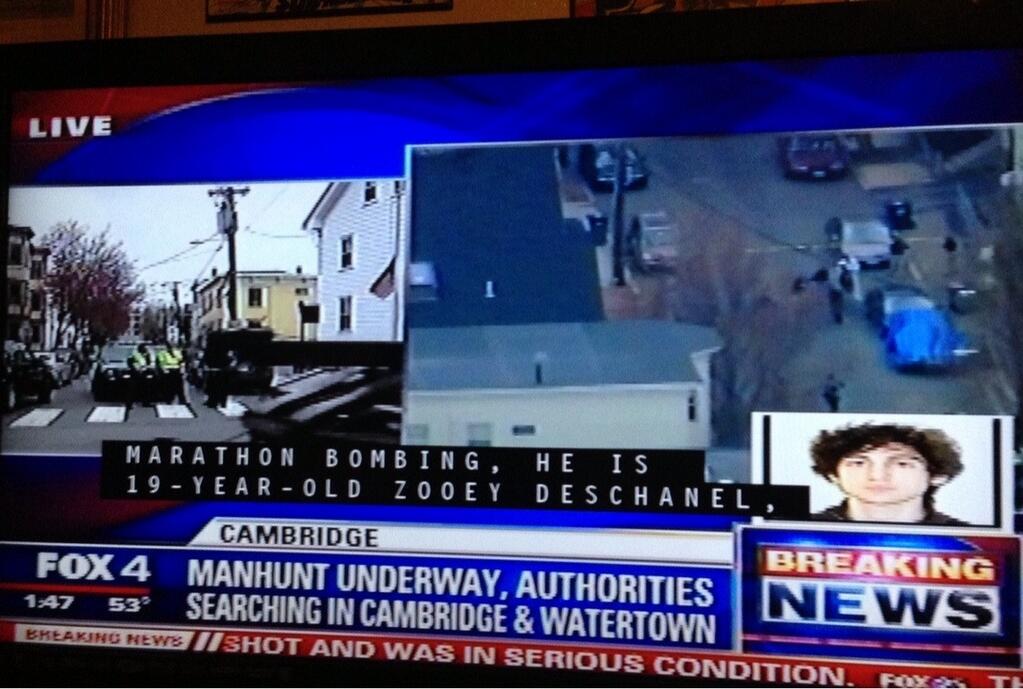
Alex Baumans asks, "Could this be a Cupertino?" Liz Rafferty, "Oops! Zooey Deschanel Captioned as Boston Marathon Bombing Suspect", TV Guide 4/21/2013:

Who's that girl? It's … the Boston Marathon bomber?

During the intense lockdown and manhunt for the Boston Marathon bombing suspects Friday, a local Fox affiliate in Dallas, Texas misidentified one of the suspects as none other than New Girl star Zooey Deschanel. The closed-captioning error came as the station was attempting to name Dzhokhar Tsarnaev, the second suspect in the attack who was being hunted by police on Friday.

"He is 19-year-old Zooey Deschanel," the caption faux pas read.

Here's a screen shot:

It certainly seems like some sort of autocorrection gone wrong — it's likely that this is the result of automatic reconstruction of real-time transcription, either this kind or this kind.

15 May 10:49

A new CINDY & BISCUIT one-pager…

by The Beast Must Die!

Here you go troops:

SHARK


15 May 10:40

Newt Gingrich, Whorfian theorist

by Geoffrey K. Pullum

Barbara Scholz died exactly two years ago today. Had she lived, I would have been drawing her attention to Newt Gingrich's latest YouTube video "We're Really Puzzled". Not because she would have liked this latest Gingrichian piece of Republican-oriented self-promotion (she would have hated it), but because he appears to be flirting with what she used to call strong or global or metaphysical Whorfianism, in a naive lexical variant form. (You can read Barbara's discussion of strong and weak Whorfian theses in this section of the Stanford Encyclopedia of Philosophy's article on philosophy of linguistics.) Holding up a smartphone, Gingrich says:

We're really puzzled here at Gingrich Productions. We've spent weeks trying to figure out: What do you call this? I know, you probably think it's a cell phone . . . But if it's taking pictures, it's not a cell phone."

Now, this may at first sound ridiculous; but in fact I do have an inkling of what moved Gingrich to embark on his piece of burbling.

I only recently abandoned my old cell phone (an ancient castoff from my brother, who still likes dumbphones) and acquired my first full-function smartphone. And indeed, phone doesn't seem quite the right root, not even with the smart- prefix. There is no way this thing is a telephone. It is a text-sending web-surfing FM radio alarm clock calculator calendar camera chronometer database e-reader task-manager music-player photo-editor navigator newspaper notepad stopwatch video-player voice-recorder phone. And that's really very different.

I have often tried here on Language Log, in playful or polemical ways, to critique naive lexical strong Whorfianism, which seems to take up most of the discussion of language that you find among the general public. And Gingrich's point is really grist to my mill.

Naive lexical global Whorfianism comes in two flavors. One, the world-to-word flavor, says that when a nation or tribe becomes enormously interested in some new activity or concept they feel impelled to make a new word to denote it. The other, the word-to-world flavor, says that we can't form a concept if we don't have a word to serve as the name for it. For real enthusiasts of the word-to-world flavor, the world as we perceive it is just a patchwork of concepts created by the network of words that we have.

Either way, it is alleged, you can tell what interests the members of a culture simply by examining the dictionary of their language. Nonlinguists are just entranced by this idea, as you can learn from magazine articles just about every week. Here's an absolutely typical recent example: a page devoted to a map of 19 emotions that English allegedly has no words for.

Let's take the tired old example of Schadenfreude. The idea is either (world to word) that (i) the feeling of experiencing joy at the misfortune of another person is so important for Germans that they made sure they developed a special word to name it, or (word to world) that (ii) German speakers only see Schadenfreude because they have that word, and English speakers in exactly the same contexts don't see it because they don't have the word for it (unless they manage to borrow the word Schadenfreude for it, of course, which seems to drive a coach and horses through the notion we're talking about; but set that aside for now).

Well, we English speakers have never had a word for a text-sending web-surfing FM radio alarm clock calculator calendar camera chronometer database e-reader task-manager music-player photo-editor navigator newspaper notepad stopwatch video-player voice-recorder phone. The concept was almost unimaginable as recently as about 1990. Yet the developers of these devices formed the concept quite easily, and invented products such as the iPhone.

Moreover, we all latched onto the idea of these devices quite easily without having a word to name them with. We had absolutely no noun that was remotely appropriate as the name for a text-sending web-surfing FM radio alarm clock calculator calendar camera chronometer database e-reader task-manager music-player photo-editor navigator newspaper notepad stopwatch video-player voice-recorder phone, and yet we have proved capable of learning about them, buying them, and using them everywhere all the time.

To refer to them we simply made use of a word we already had: phone. We used that as a lexical workaround for the magic things. Not that it mattered: we could have called them navigators, or web-searchers, or palm-browsers, or nanocomputers, or (borrowing from Star Trek) tricorders . . .

It doesn't matter that you don't have a word to name a certain concept (which is why Gingrich's appeal to his viewers to think one up is unnecessary). You get by. You cope.

Naive lexical global Whorfianism, in either flavor, is bunk.

15 May 10:31

Lib Dem attitudes to poverty and welfare: 3 interesting findings from today’s Joseph Rowntree Foundation report

by Stephen Tall

Three interesting findings from today’s report for the Joseph Rowntree Foundation (JRF) — Public attitudes to poverty and welfare 1983-2011 — carried out by NatCen Social Research, exploring public attitudes to poverty and welfare over the past three decades.

1) Interestingly… Lib Dem supporters are less likely than Labour supporters to believe that people live in need because of laziness or a lack of willpower.

nat cen jrf laziness

… the individualistic viewpoint, that people live in need because of laziness or a lack of willpower, gained favour among supporters of all three main political parties between 1994 and 2003, a period which covered much of the Labour Party’s first two terms in office. However, whilst by 2010, this belief among Conservative and Liberal Democrat supporters had fallen back to the levels measured in 1986, among Labour supporters the increase in this view has been sustained (13% held this view in 1986 compared with 22% in 2010).

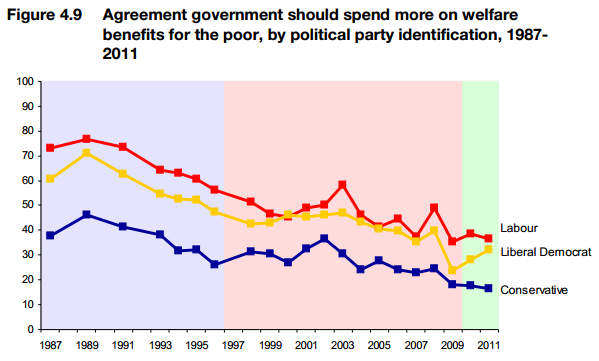
2) Interestingly… there seems to have been a sharp up-tick in Lib Dem supporters supporting increased spending on welfare benefits since the Coalition began — a finding at odds with the common perception that the party’s supporters must now be more ‘right-leaning’ since 2010.

nat cen jrf spending

we see that Labour Party supporters have always been the most likely to agree that the government should spend more on welfare benefits for the poor, but that their support for this proposition has declined more than any other group over time. In 1987, 73% of Labour Party supporters agreed that the government should spend more on welfare benefits for the poor, compared with 36% now (a decline of 36 percentage points). The support of Conservative Party and Liberal Democrat supporters for extra spending in this area declined by 21 and 28 percentage points respectively during the same period. As show in Figure 9, this decline occurred throughout both the Conservative and Labour terms in office, though we cannot yet be confident that it is continuing into the Coalition term.

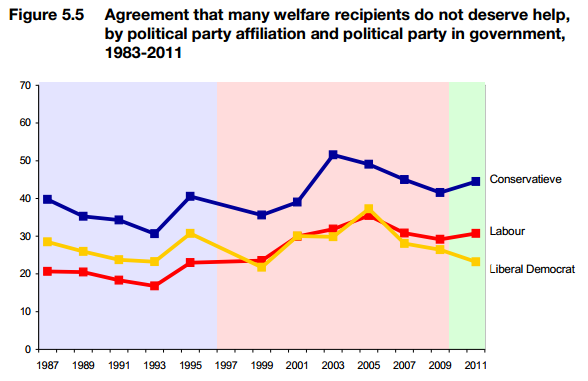
3) Interestingly… the proportion of Lib Dems agreeing welfare recipients do not deserve help has fallen since the formation of the Coalition.

nat cen jrf deserve help

Figure 5 reveals that, nevertheless, the attitudes of supporters of different political parties have behaved in far from consistent ways. Among Labour supporters, the proportion holding a negative view increased by 10 percentage points between 1987 and 2011 (and by 14 percentage points when it had reached its high point in 2005), with the bulk of this increase occurring during the period in which Labour were in power. This endorses the view, reported elsewhere, that during this period, the views of Labour supporters followed the policy directions adopted by their party (Curtice, 2010). Over the entire period, the proportion of supporters of other parties who agreed with this view, despite some fluctuations, remained relatively stable.

* Stephen Tall is Co-Editor of Liberal Democrat Voice, a Research Associate for the liberal think-tank CentreForum, and also writes at his own site, The Collected Stephen Tall.

15 May 10:19

Tory Minister Has To Remind Senior Lib Dem What Equality Is About

by noreply@blogger.com (Jae Kay)
Simon Hughes has never really been my cup of tea. This blog post of Younger (Angry) Jae got quoted in the Guardian just because of my deep seated dislike of the man. Whilst I apologise now for the harsh tone, the sentiments have very much returned today as Maria Miller, a Tory might I remind you, had to tell Hughes exactly what believing in freedom and equality actually mean:

“One factual error in what you said is that there was a very clear statement by the Conservative Party around looking at same-sex marriage in our Contract for Equalities that was issued at the general election. It was in a very extensive manifesto commitment document around equalities and it highlighted commitment to equality in this area.”  
She added: “Any claims that this has been fast-tracked is not accurate. The amount of consultation, the largest consultation that Government has ever seen, really took place over a year. Since the consultation, extensive analysis of that, then discussion around the bill.”
And fast tracked? Whilst we've been labouring from consultation to consultation, changed Equalities Minister and suffered through some seriously unfunny arguments from our opponents (remember old O'Brien's grotesque comments?), Minnesota went from voting on whether to ban same-sex marriage 6 months ago to voting it into law today! We are moving at a snail's pace as marriage equality becomes law in more and more countries.

Simon Hughes once answered a question of mine and confirmed his support for marriage equality. Obviously "support" means "drag my feet kicking and screaming whilst paying lip service to supporting it" in Hughes' language.
15 May 10:18

Churchill and the Stigma of Depression

by Neuroskeptic
The BBC today has an interesting article by Mark Brown of British mental health magazine One in Four: Do famous role models help or hinder? The context is that in Britain, charities and other advocates for people with mental illness have become fond of pointing to famous people, past and present, who suffered from a psychiatric disorder. The hope is that highlighting these 'role models' will fight stigma and provide hope. Winston Churchill and Steven Fry are especially popular in t
15 May 09:42

Half of Labour supporters believe the welfare state is too generous.

Half of Labour supporters believe the welfare state is too generous.
15 May 09:42

UK government study agrees with previous research: top downloaders spend the most on legit media.

UK government study agrees with previous research: top downloaders spend the most on legit media.
15 May 09:30

hockey as she is played

archive - contact - sexy exciting merchandise - cute - search - about
← previous May 14th, 2013 next

May 14th, 2013: STILL BIG INTO TCAF OVER HERE. I just wanted to say thanks to everyone who came out and said hi - I met so many awesome people and it was terrific! In conclusion: YAY TCAF.

One year ago today: medusa fan comix

– Ryan

15 May 09:16

Who do you love? 22: The Massacre

A thing to love about The Massacre, or at least about one version of The Massacre that you can see: Here's William Hartnell about to be killed.

TheMassacre
Yes, the full media player window. Yes, it's important.

(Or maybe it's a picture of William Hartnell from some different story, reacting to something else. Reconstructions).

The plot to assassinate The Sea Beggar has gone wrong.


TAVANNES: So, the Sea Beggar lives. You have failed! Call the guards! It is strange, Father Abbot, that since you came everything which had been so carefully planned has gone wrong.
(Colbert returns with the guards.)
TAVANNES: This man is a traitor to the Queen. Kill him. You heard my order, kill him!


And, as far as we can tell, the Abbot, who may be the Doctor, doesn't protest. Here the limitations of the reconstruction really help. This stony-faced non-reaction ratchets up the tension, making this scene both convincing and terrifying.


The scene’s worth digging into a little deeper, because it may be the key to unlock the intertwined mysteries of The Massacre. There are a lot of mysteries here:


  • Why is the Abbot a double for the Doctor?

  • Are we, the audience, meant to think he’s actually the Doctor or not?

  • If he isn’t, what’s the Doctor doing during the middle two episodes?

  • How can Dodo and Anne having the same surname have any significance whatsoever?

  • If the whole point is that we don’t know the massacre is coming, why is it called The Massacre?

  • Why doesn’t the Doctor intervene, even to save one person? Why is he so insistent that you can’t change history, even in his great monologue at the end when there’s no-one to listen? What are we meant to think of him, in a show that’s been moving to reconfigure him as a hero who makes things better?

And this last question can’t be waved away by saying that on general principle the Doctor thinks you can’t mess with history. Remember, at the end of the last story he used a TIME DESTRUCTOR. As strange_complex says, “There are only so many times that debate can come up while the Doctor is simultaneously becoming more and more of a hero-figure in the space-travel stories, without the tension between the two approaches becoming unsustainable.”

Outside the series, it’s clear why these questions arise: the development of the script was a mess, Donald Tosh was clear about what to move away from but didn’t have time to get it to where he wanted, and the production team was about to undergo a complete overhaul. John Lucarotti wanted the Huguenots to use the Doctor to try to discredit the Abbot (as still happens in the novelization, see nwhyte’s review here), and the last fossil of that plot where the Abbot is accused of treachery is so strong that it ends up surviving into today’s Scene We Love. It is strange, Father Abbot, that since you came everything which had been so carefully planned has gone wrong.

But it’s also hard to see how you do a mistaken-identity plot like that without having it turn into a romp, and a romp would be inappropriate for the material. This is a classic recipe for ending up with a script that’s full of the best ideas available, but doesn’t quite know what its core is, and that’s what we appear to have.

Within the series, however, there’s an interpretation that I think makes it all hang together: the Doctor is the Abbot, and the Doctor does die.

Here’s what happened. The Doctor has defeated the Daleks with the Time Destructor. It was at a great cost, but he did it. After running from his past mistakes for so long, he’s beginning to stop thinking of himself as a fugitive and to start thinking of himself as a hero. Maybe he can make things better after all.

The Massacre of St Bartholemew is an appropriate test case: an event terrible enough that he can improve things even if he doesn’t prevent the event altogether, but also one that Steven doesn’t know about, so a change won’t affect him (remember my theory that history doesn’t matter, what matters is history you know). For it to work, Steven must not know what the Doctor’s up to, so he slips away. Frustrating for us who have Steven as our viewpoint character, of course, that the narrative focus has to stay with Steven as he’s the stable point, but there you go.

On his own and unobserved, the Doctor can try to act. The real Abbot is waylaid on his way to Paris. The Doctor gambles everything on the hope that preventing the assassination, one tiny change that a real historical person could have made, will avert the massacre. And he manages to prevent the assassination, but for some reason the force of existing history is too strong. It is strange, Father Abbot, that since you came everything which had been so carefully planned has gone wrong. He is revealed as a traitor. He is killed and his body dumped in the streets. His death, blamed on the Huguenots, replaces the assassination as the catalyst for the killing of the next days. He is blasted back to Preslin’s shop. The timelines judder back together.


My dear Steven, history sometimes gives us a terrible shock, and that is because we don't quite fully understand. Why should we? After all, we're all too small to realise its final pattern. Therefore, don't try and judge it from where you stand. I was right to do as I did. Yes, that I firmly believe... Even after all this time, he cannot understand. I dare not change the course of history... None of them could understand. Not even my little Susan.


If you believe my take above, this otherwise bafflingly opaque monologue (“I was right to do as I did” in a story where we've barely seen the Doctor do anything; all the references to the companions not being able to understand history as if that had been an important theme anywhere other than in The Aztecs) makes sense: the Doctor has tried to change history, been rebuffed, and is now on his own and ready to give up.

(We also explain the mystery of the story's name: yes, Steven doesn't know about the Massacre, but the subtext of the entire story is the Doctor's attempt to prevent it. And we get thematic unity: the Doctor's plotting in private mirrors the plots and counterplots onstage. Clearly, no writer thought that this was what was going on in the story, but from now on this is my canon).

And then history throws him a bone: a girl with the same name, a lifeline of hope that he made a small difference and got away with it. A girl who won't be missed, who looks just like Susan. Surnames aren't matrilineal? Doesn't matter here; if history's sending you a message, it will use whatever channel it can.

There is hope. You can make a difference. Some things are permitted. Onwards.

15 May 09:08

The Most Beautiful Fraud: The Great Gatsby

by LP

And now, a review of the trailers I saw tonight prior to a screening of Baz Luhrmann’s The Great Gatsby.

Wish You Were Here:  This Australian mystery/thriller seems to revolve around two identically scruffy-looking numbskulls, one of whom disappears while on Holiday.  At first this makes his girlfriend and the other scruffy-looking numbskull sad, but then they find out he may or may not have been involved with drugs, and begin a deadly game of cat and mouse with a nondescript late-model compact car.  This has to be more interesting than it looks, just based on the odds.

Scatter My Ashes at Bergdorf’s:  Even leaving aside my general distaste for the fashion industry, showy displays of frivolous consumerism, and fabulosity in general, this whole thing seems like less of a documentary than it does a two-hour commercial for Bergdorf Goodman.  At one point, Isaac Mizrahi, who will probably eat bugs for a dollar, declaims that if your clothes are not featured at Bergdorf’s, no one will buy them, which must be bad news for all those dumb fatties at Wal-Mart.  The only way I would see this movie is if it were accompanied by a live reading of some of the more spicy passages from Thorstein Veblen’s The Theory of the Leisure Class.

Stories We Tell:  Another documentary of extremely narrow focus, this one on the identity of actress/director Sarah Polley’s father.  I like Polley just fine, but watching her home movies isn’t exactly my idea of a good time, especially when accompanied by dreary indie rock and mawkish voice-overs about how it brought her family closer together.  This thing has won a lot of accolades, though, so what do I know?  I know that I’m not as excited about Sarah Polley’s family as Sarah Polley is, I guess.

Love is All You Need:  This appears to be an attempt to revive the acting career of Pierce Brosnan, an activity that should be strongly discouraged.  He plays a rich Irishman who accompanies a less-rich Dane to a lemon plantation in Italy where their children will be getting married.  Does the world need another movie where monied assholes trek around Europe shoving its grace and romance in our faces, when we have to go to work the next day?  Especially one starring Pierce Brosnan?  I think not, but points for being Danish.  Not enough things are Danish nowadays.

Much Ado About Nothing:  Here is all you need to know about Joss “The Joss” Whedon’s latest self-massaging vanity project. In the trailer, the credits inform us that it is “A film by Joss Whedon, based on the play”.  The play by who?  Not important, let’s see that *JOSS WHEDON* up in lights again.  Should you wish to know more than this, however, please go see the film, after which I predict you will know that Joss Whedon’s stock company consists of a bunch of actors who are not really very good at acting.

Oh, how was Gatsby?

Sometimes they say about a film that was both very expensive and very terrible that you can see the money just burning up on screen.  Never has that symbolism been more appropriately applied than with Baz Luhrmann’s The Great Gatsby, which is particularly ironic given its overall tone, theme, and message that money cannot necessarily purchase contentment.  This one has to go down in the Book Adaptations of Novels Whose Point Was Largely Missed By the Director, second only to Roland Joffé’s The Scarlet Letter; Jay Gatsby, at the very least, bonfires money by the barrel-full in order to recreate his fleeting happiness with Daisy Buchanan, while Baz Luhrmann spends the GNP of a South Asian country for no better reason than to make a Baz Luhrmann movie.

What’s really surprising isn’t that Luhrmann manages to fuck up the book so badly (after all, what did we expect?), but how many ways and on how many levels he manages to fuck it up.  The framing device — of Nick Carraway recovering from the DTs in a sanitarium and ‘writing’ the novel at the bequest of his jolly, Wilford Brimley-ish physician — has been roundly mocked, and for good reason; it’s apparently the only way Luhrmann could think up to wedge F. Scott Fitzgerald’s exquisite prose into the movie, and it’s straight-up laughable at every turn.  Fidelity to the source only gets Luhrmann so far, as well; the plot of Gatsby is fairly minimal to begin with, and the screenplay never lets a moment go by without telegraphing upcoming events, lest our minds wander away from all the spectacle and start asking uncomfortable questions about what it all means.

What it all means, of course, has been drilled into your head from a variety of different angles if you have ever taken a literature class in the United States.  That the wicked excess of the Roaring Twenties seems, to Luhrmann’s read, to be the point of the novel rather than the means by which its cautions are delivered, may be forgivable in light of the fact that he is not an American, but what are we to make of his gob-smacked misinterpretations of class issues?  The working-class bash held at the love nest Tom Buchanan maintains for Myrtle Wilson is portrayed as downright slimy in its sweaty, nasally accented decadence, while Gatsby’s night-long ragers are so fancy, so classy, well, who are we to find them hollow or destructive?  Maybe Daisy really was sad about wasting all those expensive shirts, after all.

Much has been said about The Great Gatsby‘s anachronistic soundtrack, but that’s the least of its crimes against setting.  The movie, for all its massive cost, isn’t very pleasant to look at; East and West Egg, Daisy’s green light and Gatsby’s lonely mansion, are separated by a CGI harbor that looks less like something out of a movie, and more like something from the logo of the production company that made the movie.  There are minor anachronisms that give informed viewers a giggle — it’s unlikely enough when Nick is shown to have a first edition of Joyce’s Ulysses, and downright impossible that he listens to Gershwin’s “Rhapsody in Blue” at a party — but far worse than these piddly details is the fact that the whole movie doesn’t do much with its 1920s setting.  The shattering of American innocence after the Great War, the vast money flowing into criminal coffers as a result of Prohibition, the Jazz Age’s uncomfortable relationship with black music and culture at a time of profound racism, the easy credit and fast fortunes of the Roaring Twenties bringing great wealth to those outside the traditional class structure — these are all intrinsic, not accidental, components of The Great Gatsby, and to minimize them in service of a stylistic decision knocks the whole meaning of the story out of kilter.

There are other problems as well:  for nearly incomprehensible reasons, Luhrmann does not mention the fact that Nick and Daisy are cousins until nearly the end of the film, giving their relationship a completely different feel, especially for those who have not read the book.  And while he may be a visionary of sorts, Luhrmann is no Kubrickian perfectionist:  again in mockery of the vast sums of money spent on the film, Gatsby is filled with meaningless but distracting continuity errors and laziness from a directorial eye that cares everything about style and nothing about professionalism.  Cigarettes unlit in one shot smolder in the next; corpses breathe; martini glasses turn into wineglasses; violence plays out in unintentionally comic Zack Snyder slo-mo; and the extras playing musicians and revelers are as out of sync with the soundtrack and each other as any underpaid Italian musclemen waving swords at each other in the background of a cheap shields-and-sandals epic.  Even the fashions, which had an opportunity to replicate the bold, gorgeous patterns and styles of the 1920s, don’t resemble any actual American historical period; they come straight from the Age of Baz Luhrmann’s $10 Million Costume Budget.

Vincent Canby once said of Heaven’s Gate back in the days when critics were too sensible to pretend there was anything worthwhile about that film that it was “something very rare these days:  an unqualified disaster”.  With The Great Gatsby, only its box office redeems it; in artistic terms, only a scrap of the acting poses a saving grace.  Tobey Maguire’s Nick is the world’s most unconvincing alcoholic, his wide-eyed golly-pie act in marked contrast to his lines about being a distrustful cynic; and Carey Mulligan is given little to do with Daisy and does it.  Elizabeth Debicki does a decent job as Jordan Baker, and is compelling to look at, but with all the shady elements stripped from her character, those unfamiliar with the novel are left to wonder why they should care about her.  Amitabh Bachchan is a clever bit of stunt casting in the role of Meyer Wolfsheim, but he plays him like a Bond villain and renders him senseless unless you believe, as Luhrmann apparently does, that Gatsby is about “criticizing the often irresponsible lifestyles of wealthy people”.  Only Leonardo DiCaprio (in the title role) and Joel Edgerton (as Tom Buchanan) put in solid performances — DiCaprio, in fact, is downright terrific, delivering one of his finest performances ever, and the scenes between him and Edgerton are the only ones that cut to the heart of the brutal contempt between New and Old Money that dominates the novel and its battle between East and West Egg.

But it’s not enough, it’s never enough, particularly in a film where the two aren’t on screen together for much of the time, and when they do, Tom practically sprouts horns and tries to puncture Jay’s halo.  Nothing will stop the movie from making a mountain of cash — it’s made close to $70 million in its first week even though its title character cannot fly or shoot lasers — but even charitably, by any critical measure, as a film and as an adaptation of a great novel it’s a huge, expensive failure. DiCaprio’s performance aside, its primary accomplishment is to make you want to read Fitzgerald’s novel, and wonder how the filmmakers could have gotten it all so wrong.

14 May 15:39

Battle of the Andrews over 5 Days in May: Lib Dem Stunell lambasts Labour’s Adonis for “spurious rubbish”

by The Voice

adonis stunellLord (Andrew) Adonis, a former SDP councillor and the very model of a modern Blairite New Labourite, has a new book out offering his assessment of those five heady days in May when the alternative Lib-Con and Lib-Lab coalition options were discussed.

In the main it confirms what was already known: that Labour had not given any thought to the fact they might have to work with the Lib Dems in the event of a hung parliament.

But his Lordship, having conceded how ill-prepared Labour was, is nonetheless mustard-keen to lay much of the blame for the failure of the Lib-Lab option at the door of Nick Clegg and the Lib Dems. Andrew Stunell, Lib Dem MP and one of the party’s five-strong negotiating team, is having none of this revisionism — as he points out punchily in a letter in today’s Guardian.

(I hope he and the paper don’t mind us re-printing in full, below: a snippet just wouldn’t do it justice.)

Your interview with Andrew Adonis made fascinating reading for me, as one of the Liberal Democrat team negotiating with the Labour party in 2010.

Lord Adonis rightly spells out Labour’s lack of preparation, which certainly astonished us at the time. But he doesn’t mention that they made up in arrogance what they lacked in comprehension. Their offer was for us to join them to deliver Labour’s programme unconditionally. It took two days to wring out the only “concession” ever offered – to cancel Heathrow’s runway 3. Indeed, when Danny Alexander, Chris Huhne, David Laws and I met Adonis and the rest of the Labour team, they wouldn’t even commit to supporting legislation on alternative voting, despite Labour being the only party that had such a proposal in its manifesto.

I can appreciate how keen he now is to avoid making the same egregious mistakes twice. But it is a pity that he feels the need to cloak that welcome reappraisal in some spurious rubbish about the Lib Dem approach to the same negotiations.

The fact is that Labour was lamentably unprepared, disunited on the merits of coalition, and never accepted that give and take would always be of the essence of it. Slagging off Nick Clegg ill serves the facts of the case. Those are that both Clegg and our team made it clear to our parliamentary colleagues every step of the way just what an intransigent shambles Labour presented. Hardly misleading, as it’s a view I see that Adonis now shares.

And Clegg said loudly and clearly throughout the campaign that we would, if the need arose, enter negotiations with the largest party first. We did just that – no tricks, and no surprises.

In the event, it would have been odd to do otherwise, with the election outcome meaning no Lib-Lab government on its own would be possible, and would have also had to include various stripes of nationalists. Interestingly enough, that was the one aspect the Labour team was most blasé about. It seemed their lack of understanding didn’t stop with us but embraced an assumption that the SNP and the DUP would happily string along with them, too. In return for what?

Coalitions are new to British politics, so it’s all the more important to ensure they’re seen as legitimate. That’s why our approach was right, and is the one we’ll adopt again in future.

Andrew Stunell MP
Liberal Democrat, Hazel Grove

14 May 11:22

A Bit of Tutoring?

by noreply@blogger.com (Paul Magrs)


I must say, I'm missing doing a bit of teaching.

I love my writing life, don't get me wrong. But I've been wondering just lately about doing a little freelance manuscript reading.

Nothing too massive. I still haven't recovered from being given 2.5 million words to read in a fortnight by somewhere that will remain nameless...

However, all those years of teaching workshops and tutorials - seven years on the MA and undergraduate at UEA; seven years at Manchester Metropolitan University, that co-editing of the Creative Writing Coursebook... all those many times since 1996 teaching residential courses for Arvon, by correspondence for the Open College of the Arts, etc etc... It's hard to imagine a life without giving a bunch of writers (at all stages of their development) constructive criticism and feedback.

So what about...  if I decided to do some critiquing - of short stories or chapters from novels? Up to five thousand words at a time? Would people out there be up for that?

I'd supply a 500 word critique - about such things as characterisation, plot, structure, further suggestions for exploration or reading. I wouldn't be offering a full copy-edit or proof-reading - it would all be more about giving you pointers for developing your next draft. And, of course I'd work in any genre of fiction (literary, SF, historical, romance, everything!), plus memoir, and narrative non-fiction.

What do you think? Would you - or your writing friends - be interested?

Serious queries about details and rates - you can contact me on my usual email address - pmagrs@gmail.com

Before I leave you with that thought - here's a quote I've just received from one of my favourite former writing students, the soon-to-be-published Amy Beeson-Uddin, as a recommendation:

"As a writing tutor Paul Magrs opened up my world to a lifetime of writing. His ability to pass on his unique insight into narrative has enabled me to grow as a writer and to transfer those skills into my professional life. He gave me continued support over the years it took to find my voice and the journey I had from writing for business, to finding a literary agent to getting published. Without Paul I don't think I would now be a professional writer. Ten years on I still find inspiration and direction from his words now."
Amy has a three book deal with Harper Collins. Here at the links to find out more about her and her books: http://www.wordsbycommunications.com and http://amyibeeson.wordpress.com
Now here's a picture of some coffee and a cake - from when we went to one of my favourite Edinburgh cafes - Patisseries Florentin - in Edinburgh for a flying visit on Friday. This very table was the scene of lots of writing for me, back when I lived there...


14 May 11:03

I don't buy it: Commercials as Narrative and Social Entropy

by noreply@blogger.com (Josh Marsfelder)


One of the unwritten rules I have for this blog is that I don't really cover nonfiction works here. I've occasionally mentioned my love of nature documentaries, most notably when I was writing about The Little Mermaid, but up until now I haven't really looked at something like that in extensive detail. The reason for this is that by my original definition of the term, Soda Pop Art refers to some kind of mass-market work of narrative fiction that has become part of the larger cultural consciousness in spite of its corporatist overtones. However, events of the past week (as of this writing) have got me to re-think this rule and I'm starting to have a hard time keeping track of where we draw the boundary lines of what is and what is not narrative fiction.

Upon reflection it was silly of me to have avoided nonfiction before now. One of the first things they teach you (or at least one of the first things I was taught) in Intro to Cultural Anthropology is the role the ethnographic film plays in shaping people's interpretation of a society. It is exceptionally easy to use strategic edits and combinations of camera angles, jump cuts and voice-over narration to craft an implicit narrative within a documentary to convey a certain message or encourage a specific reading. This is of course inevitable and unavoidable: A documentary is not a silent witness and record of an event, it's a particular interpretation of a series of events that comes about through the interaction of a number of positionalities including, but not limited to, those of the film crew. Nonfiction can no more represent reality than fiction can: The only reason it has that reputation is because it comes out of the cinematic and photographic intellectual tradition which has always had pretenses of realism about it. A documentary is just as much a creative work as a story is. Documentaries are also especially interesting in the context of a Western society, with all its troubling associations with exoticism, imperialism, patriarchy and corporatism. Which brings me to the thing that's been gnawing at me for the past week or so.

As I write this the special tenth anniversary season of MythBusters is currently airing on The Discovery Channel. I've been watching the show for pretty much that entire span of time, and in my opinion few TV shows have undergone the sort of comprehensive and frequently troubling transformation it has, at least shows that are ostensibly nonfiction. My feelings on MythBusters are complicated and not strictly relevant to what I want to talk about here so I won't go into a ton of detail about them. For our purposes right now the most striking thing about MythBusters is that it began life as a kind of unstable hybrid of documentary and reality show structures whose primary appeal was that it took an intriguingly workmanlike group of builders and put them in an environment they were not at all qualified to deal with, that is, being responsible for large-scale science experiments. The whole point of the show as conceived was to watch a team of VFX experts with a diverse background and set of skills and experiences and watch the unique and unorthodox approach they take to working with the scientific method. That changed about four seasons in however, when MythBusters exploded in popularity and, as a result of the dearth of comparable shows, quickly became seen as the torch-bearer for science edutainment children's television, despite that being not at all what the show was supposed to be.

When this happened, the show quickly began to reorient and reconceptualise itself: Where formerly the show's signature had been its almost cinéma vérité approach of sticking a camera in M5 and filming Jamie Hyneman and Adam Savage hash out plans for a complex build and than watching them methodically put it together, the retooled show forgoes any attempt to document the team's thought process and methodology in favour of speedy montages, rapid-fire editing and lengthy, scripted pieces-to-camera. Furthermore, the hosts themselves became very obviously “Celebrity Presenters” with caricatured personas that, given MythBusters' new status as edutainment, are constructed out of programmatic children's television character archetypes: Tory Belleci is now “The Silly One”, Grant Imahara is “The Nerdy Asian One” and Kari Byron becomes “The Girl One” and, of course, “The Hot Sexy One” “For The Dads”, I suppose.

The key thing I want to emphasize here is that there's a point in the history of MythBusters where the hosts stop seeming like real people being filmed in the act of doing their job and start to feel like they're playing a role, and a very stereotypical one, in a complex meta-narrative. I'm usually the first one to champion performativity in television, but not so much in this case. The reason I embrace performativity is because it breaks artifice and prevents us from reading things as representationalist that really shouldn't be read that way. That's not what MythBusters is doing here, though: Far from breaking artifice, it's going out of its way to take something that was already designed to give viewers a look under the hood and constructing an artifice out of that. I'm uncomfortable when nonfiction shows do this because, even though they're rejecting any attempt to be representational, thus reinforcing the fact that documentaries are born of positionalities just like anything else, this has the added consequence of blurring the lines between the plays and turning real people into cartoon characters. It's one thing to do this to a fictional character, who is purely imaginary and by default more flat than a real person; It's quite another to reduce an actual living, breathing human to a series of verbal tics and personality quirks. When you do that, it crudely conveys their positionalities as artifice, which gets repeated through the act of broadcastXdissemination and written back into the text, an act which transforms their lived experiences into artifice as well.

All of this sort of reached a zenith for me last week when the new episode of MythBusters, which was a special crossover with the cast of Deadliest Catch focused on “Bering Sea Crab Fisherman myths”, was backed by a series of lengthy ad spots that defy any attempt at categorization or explanation. There was the Geico Gecko talking about how lucky he was to get a backstage tour of the MythBusters set and how fun it was to meet the team and the Deadliest Catch captains and, following that, a truly inexplicable pitch for Microsoft where Kari, Grant and Tory sit around in different rooms IMing each other in a clearly scripted and staged manner about their favourite MythBusters moments using Windows 8 on a Microsoft-branded tablet. This came in the wake of an event I witnessed while (reluctantly) catching the tail end of Restaurant Impossible (Food Network's knockoff me-too version of Gordon Ramsay's Kitchen Nightmares) where host Robert Irvine gets his client a deal with industrial caterer Sysco (complete of course with gratuitous shots of the Sysco logo on vans and boxes). On a commercial break for this very show, Food Network actually had the gall to run an ad for Sysco featuring Robert Irvine and name-checking Restaurant Impossible itself in which Irvine talks at length about how any restaurant needs a good food supplier and how Sysco is the only one he trusts for quality, service and freshness.

In my more cynical moments, I'll claim the TV ad spot is the US's only quintessential form of narrative storytelling. As I am in a particularly cynical and depressed mood at the moment, I'll go ahead and claim that. I understand this-The US is a corporatocracy: Capitalism, and a certain kind of large-scale capitalism, is deeply ingrained in US society at a basic level and irreducible from it. That's why this blog exists. I also get product placement, especially in a show like this which is already fundamentally about capitalist fantasies and has to fund things like design budgets. But what we have here is the logic of both Restaurant Impossible and the Sysco commercial being fused and boiled down to reductio ad absurdum levels. It's as if the texts themselves have been downsized: The whole point of this is to get people to watch our show and patronise our catering service, so let's just cut out the middleman and make everything about forcibly coercing consumers to buy our shit. In days past while it was always clear what both commercials and commercial television were meant to do, at least they tended to strive for something a little bit more ambitious and less blatant than this.

In the MythBusters example this is even more distressing given that show's problematic associations with artifice: Here Discovery is not just trying to get us to watch the show or use a certain food service, it's overtly selling a cult of personality built around Kari, Grant and Tory, who are now little more than mascots pitching not only their own show (while that selfsame show is still physically airing), but Microsoft, Geico, Deadliest Catch and themselves all at once. MythBusters is a near-textbook example of the way Western society has fused populism, cinematic voyeurism and commodity fetishism into a twisted monster where we pay to ogle people's bodies and emotions. Through its systematic caricaturing of the people who work on its show, and now this extra layer of crass cross-promotion, Discovery has distorted the real, lived experiences of three people, turned them into fetish objects in every definition of the term and put them up on the market.

As I was watching this train wreck of late-stage capitalism slowly unfold before me, I was reminded of a piece I'd read earlier in the week by Phil Sandifer. In his analysis of the Doctor Who episode “The Unquiet Dead”, Phil made the claim that in a world where extensive behind-the-scenes documentation of the production of television shows exist, especially things like Doctor Who Confidential (which amounts to a reality show about the making of Doctor Who) we have to consider such documentation part of the actual text of the work itself. Which leads me, frankly, to come to a rather dark conclusion: Is it possible, using this reasoning, that we need to consider product placement, and indeed the very commercial nature of commercial television, text as well? This isn't even artifice as text, it's artifice-as-artifice-as-text. It's recursive artifice: Debord's Society of the Spectacle not only writ large, but jacked up on steroids and mutated into a daikaiju. Artifice isn't just replacing everyday life anymore, artifice is replacing the artifice of everyday life and selling that artifice back to us as part of a never-ending cycle of self-destructive consumption and submission. If there's a better sign in our discourse true social entropy has arrived and the collapse of Western civilization is not just an eschatological fantasy but something we seriously need to take into practical consideration and plan for, I can't think of it. Granted I'm a depressed, bitter, unfeeling anarcha-feminist who's prone to saying things like that, but even I couldn't have dreamed of finding evidence this good at backing up my hunches and theories nor, if I'm honest, would I have wished to.

Throughout this blog I try to stay positive about the benefits of Soda Pop Art despite the conflicts of interest of which it is comprised. I genuinely do think there is some worth and value to be gleaned out of it, if only to learn a little bit more about late-stage capitalism in the Western world; that dangerous, unsustainable thing we all take for granted as “The Way Things Are” and “The Way Things Should Be”. But I'm at almost a total loss here: This is so crass, so bald-faced and so blatant about demanding money from its audience in exchange for nothing but more demands for money I can't tease anything out of this situation other than to lament how absolutely pathetic it is.

As I was putting the finishing touches on this post, I was made aware that the 2012-2013 US network TV season has seen an abnormally high number of cancellations, with at one point more than 18 shows getting axed within 48 hours. It's been increasingly my belief that television is a dying medium, and with what I've just witnessed over the past week it may well be within its actual death throws. To survive, our Soda Pop Art may well need to change what it is: It will need to transcend its origins and transition into the hands of those to whom it means the most, the people who its resonated with, not the corporatist media producers. For if there was ever a sign the stewardship of our cultural heritage or the well being of the people who share it was not in the interests of those who own it, this week was it.
14 May 10:48

#475 Chain of Demand

by noreply@blogger.com (treelobsters)
14 May 10:21

#937; The Tramp Stamp of Advertising

by David Malki !

Just tell us this...What is the simplest thing we can do to both: justify our jobs, AND pawn off responsibility for all decision-making

14 May 10:18

If Clegg does move on my money would now be on Tim Farron

by Mike Smithson

Michael Gove’s claims about plots to overthrow Clegg haven’t impacted on the betting.Tim Farron still 5/2 favourite twitter.com/MSmithsonPB/st…

— Mike Smithson (@MSmithsonPB) May 13, 2013

He had a good Reynard-gate and Vote2013 aftermath

After Michael Gove’s little mischief yesterday in which he talked of a plot to oust Nick Clegg it is probably a good moment to look at the Lib Dem succession.

The electoral process involves the party’s MPs making the nomination but the decision being down to a postal ballot of the members.

There was a lot of talk last year about Vince Cable and if there had been a vacancy in 2012 then he’d have stood a good chance. But there wasn’t and things move on.

I’m not sure that Vince, now 70, would run. He’d have made a good care-taker with another contest taking place after the general election.

In the past I’ve been sceptical of Tim Farron’s chances because he’s not a minister. Now I think that’s less important and he’d be the one most likely to garner support from the membership.

As party President he’s been very much the public face and has earned the respect of many for the blunt and straightforward way he handled the Reynard case and the recent local elections.

Mike Smithson

For the latest polling and political betting news

Follow @MSmithsonPB

14 May 10:04

What do they think “racist” means?

by mike

Jason Richwine got a Ph.D. in public policy from Harvard in 2009 He wrote his dissertation on comparative IQ and its role in immigration policy. Richwine’s dissertation argued that Hispanics had consistently lower IQs than other Americans and that this difference persisted over time. He further argued that we must consider this when formulating immigration policy. He got a job after grad school working for the Heritage Foundation, where he argued that we should restrict hispanic immigration to the US on the grounds that hispanics have lower IQs. To give an example of the flavor of his work, at a 2008 panel organized by the American Enterprise Institute he said:

“Decades of psychometric testing,” said Richwine, “has indicated that at least in America you have Jews with the highest average IQ, usually followed by East Asians, and then you have non-Jewish whites, Hispanics, and then blacks. These are real differences. They’re not going to go away tomorrow.”

richwineRichwine was pressured into resigning from Heritage when these comments were written about by David Weigel at Slate. On the right, he has become a martyr to political correctness: Michelle Malkin and Rush Limbaugh and Charles Murray have rushed to his defense.

Richwine himself recently denied he is a racist. He says his public remarks “lacked nuance” and added that:

It still amazes me that it would be me who is portrayed this way.. I have a pretty good educational background, I have a good background in doing very good quantitative work. The idea that I am some sort of foaming-at-the-mouth extremist never even crossed my mind.

To this I just have to ask–what does he think “racist” means? Richwine believes there is such as thing as a “hispanic” race, even though that term was made up in the 60s and has no clear meaning or boundary, and includes people from vastly different backgrounds. He believes there is such a thing as an Asian race, and he believes that jews are an objectively distinct race. That is, he believes these are objectively real biological categories. He further believes there are real and verifiable differences between these races, and these differences can be measured by an IQ test. And he concludes further that some “races” are inferior to others. And finally, he concludes that we should use this information to restrict immigration on the basis of racial intelligence.

racist

racist


not a racist

not a racist

If this isn’t racist, then what in the world does the term mean? To take the obvious example, if Hitler was using this kind of argument to enact the expulsion of jews, as in fact he did, we would all agree it was racist, would we not? It seems as if, to Richwine and his defenders, a “racist” is someone who foams at the mouth and is “extreme,” while someone with charts and an education is de facto not a racist, even though their work is entirely about racial differences and their centrality to policy, and he wants to prevent the immigration of the racially inferior.

Jason Richwine is a racist. He may be a very nice guy, he may have hispanic friends, he may enjoy tacos y burritos. He may take every person on their own individual merits. But he is a racist who wants to use the argument that “hispanic” people are genetically inferior to restrict their immigration to the US. There is no other way to frame this.

He’s perfectly entitled to pursue this line of thinking. It’s a free country. The complaint seems to be that he can’t do this work without being accused of racism. Well, that’s because this work is thoroughly racist in its assumptions. Racism–and racism buttressed by scientific research–has an old and repulsive history. It’s entirely reasonable to point out racist thinking; being educated, using statistics and charts, being a nice guy, loving puppies: none of these things negate the fact of these racist assumptions.

And just to be clear: I’m not a racist, because I don’t believe in race as a real, biological category. There are physical differences between people, and we have made up the idea of “races” to organize those differences in broad ways. There is no clear boundary line between these alleged races: the president of the United States is himself neither white nor black, though we identify him and he identifies himself as black. That doesn’t mean I’m free of bigotry, or stereotyping, or prejudicial behavior: I very much doubt that I am, though I make my best effort. A racist is a person who makes the assumption that “races” are real, and that we should make policy based on these real differences


14 May 09:59

Conservative backbenchers are scribbling on the constitution

by Jonathan Calder
I have just watched Jacob Rees-Mogg trying to defend the absurdity of Conservative backbenchers voting to amend their own government's Queen's speech.

But then respect for the constitution, which used to be a hallmark of Conservatism, has pretty much been thrown out of the window. Forget Burke and representative democracy: the reaction of modern Conservative MPs when they find themselves part of a minority in the Commons, is to demand a referendum.

The latest example, reports the Guardian, is over the Coalition's plans to bring in equal marriage.

Political Animal reminded us on Twitter earlier today that Margaret Thatcher once quoted with approval Clement Attlee's argument that the referendums "a device of dictators and demagogues". He was right and so was she.

Tory backbenchers opposed AV and the reform of the Lords (even though the latter was in their own manifesto), but they are quite ready to trash the constitution if they think it is to their advantage.