The Ipsos Mori poll published last week showed a perhaps surprising amount of simple ignorance amongst the British Public. In major areas of public policy, it seems that large numbers of people do not have even a most basic understanding of the data behind the issues of the day. Alex Massie in the Spectator put forward the idea that this ignorance is why some kind of political class is necessary. Robert Sharp at Liberal Conspiracy rebutted this, making the fairly valid point that the ignorance on display can in fact be blamed on media failures as much as educational or political ones. The Liberator Blog, rightly points out that the ignorance of the Public does not let politicians off the hook.
So where does this shocking display of political ignorance leave us?
Aside from the structural failures of education, I think it clearly does underline the spectacular failure of the British media to either inform or educate- and the failure of the British public to ask the right questions, but it also opens up a whole raft of issues to do with our democracy too.
At the moment the issue of MP's pay is a political hot potato and there have been a variety of proposals- including Richard Branson's idea that MPs pay should be improved substantially, but that the numbers of MPs should be reduced. As an aside I note that most national journalists earn a fair bit more than a backbench MP does, but they have been more than happy to pander to the visceral witch hunt response that MPs should not really earn anything at all. Of course one major source of added income for MPs is journalism, and several significant political figures earn large sums to top up their Parliamentary pay. All of this does rather get in the way of a sensible debate about what the role of MPs really is- or should be- and yet this role lies at the heart of our democracy.
As a Liberal, I share the view that the mistakes of economic and public policy that have been made since the Second World War have their roots in the very fabric of our constitution. In the eyes of most Liberals the closed shop of British politics has prevented new ideas and necessary change from entering the system, and unless and until greater competition forces change upon the system, then the British government will continue to grow ever more sclerotic. The failure of both journalism and politics to explain even basic facts to the electorate does not make me optimistic that such radical change can be made attractive, however necessary it is. Even still, I think it is incumbent upon Liberals of all persuasions to stand up and speak for ideas which may not merely be unpopular, they may not be even understood.
I shall continue to speak up for radical reform, and just hope that the public ignorance on this and, as it turns out, on so many other issues can finally be defeated.
Andrew Hickey
Shared posts
20 Jul 11:40
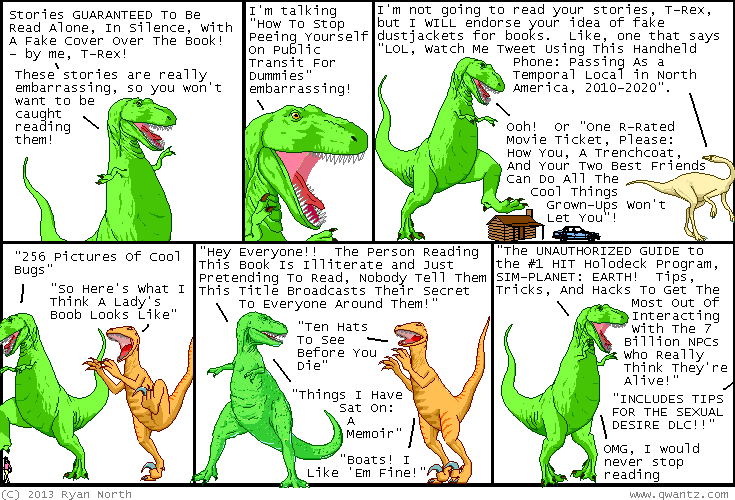
andrew hussie and i discussed making this book a few years ago. WE STILL MIGHT, WHO KNOWS
| archive - contact - sexy exciting merchandise - cute - search - about | |||
 |
|||
| ← previous | July 16th, 2013 | next | |
|
July 16th, 2013: This Is How You Die is out today! It's an awesome book I helped edit! I keep saying how great this book is! I think you should buy it! THIS IS HOW YOU DIE <-- click that link, make magic happen via capitalism
 One year ago today: racisms against non-utah raptors – Ryan 
| |||
20 Jul 11:38
where did this problems come from? what did these problems come out of? where and what did these problems come out of, and how.
| archive - contact - sexy exciting merchandise - cute - search - about | |||
| thanks for an awesome SDCC!
|
|||
| ← previous | July 18th, 2013 | next | |
|
July 18th, 2013: This Is How You Die is out now! It's an awesome book I helped edit! I keep saying how great this book is! I think you should buy it! THIS IS HOW YOU DIE make magic happen via capitalism
In non that-book news, I am in San Diego today, tomorrow, and all weekend for the San Deigo Comics Convention! Here's where to find me! One year ago today: in which i present a sincere argument of how fanfiction will save the future – Ryan 
| |||

Heather.holbus, Emily.f.hamilton likes this
19 Jul 22:39
Survival Of The Hittest
by Tom
Now That’s What I Call Music! 85 (Not A Review)

It’s no secret that Popular, my main feature for this website, and a project that’s now run through almost 10 years of my life, spent much of last year beached – only 6 entries in 6 months. I never imagined I’d given it up, but I turned over possibilities as to why my enthusiasm had so clearly dimmed. More responsibilities? Sputtering energy? Reading too many comics? Maybe, maybe, but there was another factor too. Popular is a journey of indefinite length, but one where I can always see the future mapped out, and in 2011 and 2012 that map showed a miserable prospect. Clouds of grey hits in a chart I hardly paid attention to. Was this it? Had I stopped caring about pop? Bound to happen one day, of course – and it doesn’t need me as a listener. But if I had stopped caring, why care to write about it?
But then something happened. The pop songs I noticed seemed to be the ones a lot of other people noticed, but then – to my surprise – they were also the ones a lot of other people bought. Even better, songs people bought that I hadn’t yet heard turned out to be crackers too. 2013 has been a springtime for the Top 40, with a remarkable sequence of good Number Ones, some the kind of records I can’t wait to write about, others singles I know I’ll struggle to capture – but I’ll enjoy trying anyhow. Something has changed in my appreciation, though. For the first time I don’t have a mental model for who is buying singles, and how (and with whose money) – overall sales keep twitching up, setting new records each year, so “mostly digital, mostly cheap” feels like a good starting assumption. But how singles get to Number One? I could hardly even guess.
That detachment makes it more exciting waiting for what the charts will fling up next. So far in 2013, they’ve rarely disappointed. And I’m looking forward to this latest Now That’s What I Call Music! installment – Number 85! – as a return to the reason I originally liked the series, an inexpensive way to snap up a bunch of great pop singles. As opposed to… what? Why else would anyone buy one? Now albums are high sellers through the bad times as well as the good: their appeal doesn’t shift depending on my (or anyone’s) subjective take on the temperature of pop. But in one way this is quite strange. Now albums are the cultural equivalent of an alligator or a shark: they are surviving unchanged in an era of rapid evolution.
In particular, Now albums represent something that used to be central to pop, and is now far more marginal: they are among the last of the bundles. Pop used to be absolutely full of what marketers and accountants call bundled content. A week in pop might involve listening to Radio 1, buying the NME, and watching Top Of The Pops on a Thursday. If you were old enough you might go to the pub and put some money in the jukebox. And from 1983 on, you could go to Our Price and spend your wages or your pocket money on a Now album.
Radio 1, the NME, TOTP, the Jukebox, Now – all bundles, all based on the idea that the price of getting to indulge your tastes is that you have to experience other people’s. I doubt the notion of the chart as a Reithian endeavour – an educational space where different ideas of quality and creativity rubbed shoulders – was high in the minds of Radio 1’s founders. But that’s what it was, nonetheless.
Most of those bundles are gone now, or much altered. The NME is a slender magazine relying increasingly on the past; jukeboxes are no longer common; Top Of The Pops is dead. Radio 1 is still a bundle, but a lot more of its emphasis falls on specialist shows than it used to. Only the Now albums remain unchanged – 40 or so tracks across two CDs, the pick of the last 4 months.
The whole direction of web-era culture is anti-bundle: a turn away from the set menu and towards the buffet. Give people the chance to opt out of the stuff they don’t care about and – surprise! – they take it. This applies to humble websites too, of course. If Popular was a print fanzine – 20 write-ups an issue, say, plus a letters page – it would be a bundle: I’d have not much idea which of the write-ups people actually read, and I’d happily assume the answer would be “all of them”. But with social media and Google Analytics and other content management tools, I can see that Oasis and Blur bring in ten times the hits of poor Shaggy, and the imaginary venture capitalists behind Freaky Trigger might well be asking me to ‘pivot’ into reviewing every track on the Shine albums instead*.
So if bundles are ailing, why is the Now series so healthy? Its very fixity helps it, of course: it’s British pop’s equivalent to Wisden, or the CIA Factbook, or Jane’s defense guides – a journal of record. So a certain segment of Now buyers – people for whom being into ‘the charts’ is a very British sort of hobby, like steam trains or model soldiers** – simply pick it up and file it away (or play it once, and grimace). It’s also a very good deal, and a snapshot for those too lazy or disenchanted to keep up with high-selling pop. In a physical format, at least, it’s a solid gift. And, who knows, maybe the format retains a lucky-dip appeal, bucking the unbundling trend. I like bundles, after all – I can’t be alone. Turns out, for the moment, I like pop too.
*I am not going to do this, sorry Carsmile.
**No slight on these people. I’m at least halfway one myself.
19 Jul 22:12
Crime rates have been falling consistently in Britain since a peak in the 1990s. This should be good news for politicians, but rather inconveniently it has fallen steadily under Conservative, Labour and now under LibDem/Conservative coalition governments. It has also fallen despite a drop in police numbers – down by 14,000 since 2010. It has fallen during times of recession as well as economic growth. It has also fallen during times of high immigration and rapid population increase. And, perhaps most inconveniently, it has fallen in most developed countries, regardless of whether they have adopted repressive or liberal policies.
Inconvenient Good News on Crime
by noreply@blogger.com (Alun Wyburn-Powell)
Crime rates have been falling consistently in Britain since a peak in the 1990s. This should be good news for politicians, but rather inconveniently it has fallen steadily under Conservative, Labour and now under LibDem/Conservative coalition governments. It has also fallen despite a drop in police numbers – down by 14,000 since 2010. It has fallen during times of recession as well as economic growth. It has also fallen during times of high immigration and rapid population increase. And, perhaps most inconveniently, it has fallen in most developed countries, regardless of whether they have adopted repressive or liberal policies.
Maybe it’s time for a complete, non-partisan, re-think about crime – and the causes of crime. Surely the evidence points away from prison regimes, longer sentences, economic causes or size of police forces.
Some underlying hidden, but generally positive, forces seem to be at work here and yet politicians and the media seem to be stuck on the same old analysis.
Evidence seems to be pointing at factors such as the removal of lead from paint and petrol, which used to cause brain damage in young people. More likely it was poison at work, not prison.
Head injuries often result in a reduced ability to assess risks, so it is no surprise that a significant proportion of prisoners suffered head injuries prior to offending. Cycle helmets probably reduce crime.
Over 70% of the prison population has two or more mental health issues and as many as 10% of the prison population are ex-service personnel, who will have been at risk of Post-Traumatic Stress Disorder.
Do we really want to stigmatise people with mental health issues, head injuries and former soldiers, or do we really want to understand the causes of crime, so that we can direct our toughness where it may actually do some good?
But perhaps that might just be too inconvenient for the police, the media, politicians and the armed forces.
19 Jul 10:51


The Pomodoro Technique: How I Write 5,000 Words Every Day
by Passive Guy
From author Ryan Casey:
One of the most common questions I’m asked is how I manage to write so much whilst seemingly also having, y’know, a life.
Usually, I find this question quite funny, because I never really considered myself a prolific writer, not until recently, anyway. I used to write one-thousand to two-thousand words every day, which usually took me an hour to an hour and a half. To me, that wasn’t really a lot. If anything, I felt guilty for not spending more time writing than I did. ‘If I could spend three hours writing, I’d get five-thousand words written per day…’
But two things made me resist my target.
Firstly, it’s because I was doing what I was told by other writers too much.
Allow me to elaborate: every corner of the web you visit (bar a few. How many corners does the web have, actually?), you’ll find advice on what a ‘respectable’ amount of words per day is. I think the most common upper word limit, we can safely agree, is one-thousand words. For some reason, one-thousand words per day appears to be some sort of holy grail for writers. Anything higher, and the writer is either a.) rushing, or b.) writing crap.
. . . .
The second reason I resisted my pursuit for 5k per day is because three to five solid hours at a desk sounds like a hell of a long time. There’s no way my creative juices could solidly run for that long, I believed.
I was wrong. Well, kind of.
. . . .
You may or may not have heard of the Pomodoro Technique. I hadn’t up until a couple of weeks ago, but since I’ve started implementing it, my daily wordcount has doubled, and I feel refreshed and a sense of achievement because of it.
Basically, the Pomodoro Technique is this: you set a timer for twenty-five minutes and you do whatever task it is you want to do (in our case, writing). You work solidly on that task for twenty-five minutes, and then when the time is up, you take a five minute break, no matter what. Nip to the loo, refill your glass of water — Pomo’ don’t discriminate.
Then, you repeat the cycle again. After four full cycles, you take a longer break.
Can you see how beneficial this is to writing? I usually start writing somewhere around ten-thirty in the morning. I complete four cycles and then take a lunch break. On a typical day, I’ll have four-thousand words written by the time I take lunch. On a good day, I’ll have hit 5k already.
. . . .
I’m a sucker for keeping track of myself. I used to have so many of those days where I don’t feel like I’ve done as much as I actually have, so I realised I needed to create something to keep myself in check.
Now, I have a spreadsheet. I know, I know — I hate spreadsheets too, or at least I did. Now, I kind of love the things. All I have is columns for the date, hours written, word count for that session, and then two extra columns for the daily total hours and words.
Link to the rest at Ryan Casey
Click to Tweet/Email/Share This Post
19 Jul 10:46


25 Things I Learned From Opening a Used Bookstore
by Passive Guy
From Open Salon:
3. If someone comes in and asks where to find the historical fiction, they’re not looking for classics, they want the romance section.
4. If someone comes in and says they read a little of everything, they also want the romance section.
5. If someone comes in and asks for a recommendation and you ask for the name of a book that they liked and they can’t think of one, the person is not really a reader. Recommend Nicholas Sparks.
. . . .
11. Under no circumstances should you put the sex manuals in the free baskets. Parents will show up.
12. People buying books don’t write bad checks. No need for ID’s. They do regularly show up having raided the change jar.
. . . .
15. If you open a store in a college town, and maybe even if you don’t, you will find yourself as the main human contact for some strange and very socially awkward men who were science and math majors way back when. Be nice and talk to them, and ignore that their fly is open.
. . . .
20. If you don’t have an AARP card, you’re apparently too young to read westerns.
Link to the rest at Open Salon
Click to Tweet/Email/Share This Post
19 Jul 09:56

 Send to Kindle
The Business Rusch: Blame The Writer
by Kristine Kathryn Rusch
 Over the weekend, The Sunday Times of London revealed that mega-bestseller J.K. Rowling published a mystery novel under the pen name Robert Galbraith. The entertainment media and the blogosphere has been having a field day with this—how could they have missed it? Why would this fabulously wealthy woman ever sell a book under a name not her own?
Perhaps to get rid of the incredible scrutiny?
The entertainment media politely pointed out that the book, The Cuckoo’s Calling, got excellent reviews, generally refraining from admitting that once Rowling had become famous, her Harry Potter books usually got savaged by “real” reviewers, as did the literary novel she wrote last year under her name. (Although Time Magazine, in an article published Tuesday, hinted at the way that Rowling’s reviews changed depending on which name was on the book.)
Unknown and “new,” Galbraith got a fair shot from the reviewing class, untainted by money and the belief that any writer who hit the bestseller list was awful, and the critics liked what they saw.
While the initial articles about the Big Reveal mostly turned on the modest sales of Galbraith’s book followed by the gigantic boost in sales once Rowling’s name was on the title, the articles in the publishing blogosphere turned sour almost immediately, doing what traditional publishing does best: Blaming the author combined with a complete misunderstanding of the very business that the publishers (or at least those running publishing blogs) profess to know so very well.
This part of the story began when editor Kate Mills of Orion Publishing admitted via Twitter that she had turned down Galbraith’s book, not knowing that the book had come from Rowling. Mills wanted other British editors to confess that they turned the book down because—obviously—they had.
The key for me in this little part of our fractured publishing fairy tale is this: Mills saw the book more than a year ago. How do I know this? It takes time to make book deals and then to publish the book. It takes a minimum of a year to negotiate that tortured labyrinth. So Mills read the book and remembered it.
Editors don’t remember books that fail. Editors don’t have time to read books that fail all the way to the end.
Mills read the book, remembered it, and actually considered it. When asked about her tweet, she gave the appropriate editorial response, and one I believe entirely. She said, “As an editor you’ve got to love what you publish. I didn’t love it…”
Exactly. I’ve said that hundreds of times, usually to my husband, after some writer who had just won an award with a story that I had turned down when I was editing for Pulphouse or F&SF, shook the award at me and said, “Regret not buying the story now?” I never did. Editors are hired for their taste, after all, and that story, whatever it was, wasn’t to my taste.
Just like Cuckoo’s Calling wasn’t to Mills’ taste. She will probably keep her job after this because the book was so super-secret; most editors who turned the book down are probably cowering in their cubicles right now, because their publishers might not be as understanding. Time Magazine was accurate to call Mills “brave” for her admission; in some places, it could cost her job.
The fact that the same imprint, Sphere, of Little Brown Book Group published the book in the UK doesn’t surprise me either. Even though the editors there did not know, any more than Mills did, that the book came from Rowling, they like Rowling’s work. They published The Casual Vacancy. Writerly voices are writerly voices are writerly voices. Reader/fans feel an affinity to a certain voice, even if they don’t recognize it.
It wouldn’t surprise me if Mills never read Harry Potter or started the books and decided they just weren’t for her.
Publishing is not an exact science. If it were, a pseudonymous JK Rowling book would do the exact same business as a book with Rowling’s name on it. Exactly the same.
Publishing learned that same lesson twenty-eight years ago, when a Washington DC bookseller named Steve Brown read an advanced reading copy of a book called Thinner. About two pages in, Brown thought that either the book, published under the name Richard Bachman, was written by Stephen King or “the world’s best imitator.” Brown did some research, tied the books to King, and then wrote King to ask.
The story broke that Richard Bachman, who had quietly publishing since 1977, was indeed mega-bestseller Stephen King. Bachman, who had had published four novels before Thinner, was actually King. Bachman’s sales rose by a factor of ten within the week, and then continued selling at King levels ever after.
Bachman was born in a different publishing era. No computer programs to compare the sentences, no quick and easy access, no anonymous tweets to a newspaper outing the author. Bachman had a chance to build a fan base, and he did: by the time the pre-King announcement had been made, the sales on Richard Bachman books had more than doubled, from an early print run of about 20,000 books to 40,000 books for Thinner. Bachman was slowly building a name, a reputation, and a midlist success.
He was doing what King wanted him to do: He was providing a safe place for King to experiment. In “The Importance of Being Bachman,” his 1996 introduction to The Bachman Books, King wrote:
The importance of being Bachman was always the importance of finding a good voice and a valid point of view that were a little different from my own. Not really different; I am not schizo enough to believe that. But I do believe that there are tricks all of us use to change our perspectives and our perceptions – to see ourselves new by dressing up in different clothes and doing our hair in different styles – and that such tricks can be very useful, a way of revitalizing and refreshing old strategies for living life, observing life, and creating art. …I love what I do too much to want to go stale if I can help it. Bachman has been one way in which I have tried to refresh my craft, and to keep from being too comfy and well-padded.
Sound familiar? There are echoes of this in J.K. Rowling’s public statements about being outted as Robert Galbraith. She said:
I hoped to keep this secret a little longer, because being Robert Galbraith has been such a liberating experience! It has been wonderful to publish without hype or expectation and pure pleasure to get feedback from publishers and readers under a different name.
After the publicity died down, King said he had this reaction to his outing:
Bachman was never created as a short-term alias; he was supposed to be there for the long haul, and when my name came out in connection with his, I was surprised, upset, and pissed off.
Clearly Galbraith wasn’t conceived as a short-term alias either; Rowling had sold another book under that name, and she was planning to slowly build a series. I’m sure her reaction to the outing was similar to King’s, no matter what she says in public.
Her experiment was working; she was getting good reviews and the book was selling exactly the way a hardcover mystery novel with a bad cover sells in England. Little Brown UK told The Bookseller.com that The Cuckoo’s Calling (which was released in April) sold 1,400 print copies and 800 ebooks domestically, plus 2,000 export copies and 3,800 audio downloads. That’s a good run for a first British mystery. Time’s article claims that the book sold 500 copies in the US according to Bookscan (which only tracks about 50% of sales). Galbraith was on the right kind of growth track for a classic mystery novel.
Before she knew who Galbraith was, bestselling mystery writer Val McDermid blurbed the book, saying, “The Cuckoo’s Calling reminds me why I fell in love with crime fiction in the first place.”
After she found out who wrote it, McDermid laughed. She had no idea. She had liked the book so much that she had invited Galbraith to speak on a panel, only to be told he was unavailable.
Writers—readers—don’t do that if they don’t like the book.
The book’s quality is in dispute in only one place. Traditional publishing. Before the publishing industry started arguing on Tuesday whether or not Rowling did this as a stunt to generate publicity on the book (really? Seriously? Are you people that insane?), it was defending Kate Mills, the editor who had passed on the novel.
Michael Cader best defined the industry attitude in his comments on Publisher’s Lunch. He wrote:
At least one other UK editor, Kate Mills at Orion — another part of Hachette UK — was offered the manuscript and turned it down. She said, “I thought it was well-written but quiet. It didn’t stand out for me and new crime novels are hard to launch right now.” And to an extent her instincts were right, given the poor sales.
(Those of you who don’t subscribe to Publisher’s Lunch might want to look at former agent Nathan Bransford’s blog where he makes similar statements. He wrote (among other things), “Some of [the book’s lack of commercial success] may have had to do with the fact that it was by most accounts, a quiet novel.”)
So let’s parse this analysis, shall we?
First, the British mystery tradition—which Galbraith’s book falls into—is quiet. Agatha Christie’s novels are quiet. Dorothy L. Sayers novels are quiet. Multiple New York Times bestseller, P.D. James—who has had a mystery writing career with books published worldwide—writes quiet novels.
“Quiet” does not equal “poor sales.”
Secondly, as I said above, the sales are spot-on for a debut UK crime novel. Not great, not bad. But not J.K. Rowling numbers either because—clue stick, Cader!—the book wasn’t published under her name. It deliberately went under the radar, and that anonymous tweet short-circuited the book’s trajectory. Would Galbraith’s books have grown? We don’t know. Now the secret is out, and the experiment is over.
Mills was right to pass on this book; she didn’t like it, so she couldn’t nurture its growth. That’s the defense the industry should have given her, if, indeed, she needs a defense at all.
But what’s striking to me—and what I’m seeing on many publishing blogs I read—is that they all blame the author. If she had written a “bigger” book, if she had published it under J.K. Rowling, this book would be a success.
Traditional publishing is now claiming that the editors who rejected the book were right, and the author—in her insistence on anonymity and in writing a “quiet” book—is the one who ruined the sales of this novel.
Welcome to traditional publishing in the 21st century.
Their job isn’t to nurture books. It’s not to publish books that readers want to read. Their job is to publish blockbusters, and any book that isn’t a blockbuster is the fault of the author, not the fault of the acquiring editor or the fault of the sales force or the fault of the publishing company itself.
 Have any of you looked at the cover of The Cuckoo’s Calling? Tell me what genre that is supposed to represent. Women’s fiction? YA? Before some of you jump on me by telling me this is a British book, realize this: I buy British mysteries in hardcover and I know what a good mystery book cover looks like from the UK.
This isn’t it.
Would Galbraith have sold another 5000 copies with a better cover? I doubt it, because the publisher did a standard print run for a debut mystery. The publisher did not promote the book beyond sending it to the publishing trade magazines for review, and it didn’t expect the book to find a level until the second book was published next year.
By not hyping this book, the publisher planned to show growth in the series, so that they could then buy the next two or three or whatever.
That’s how it’s done.
The bad cover was a mistake, but a survivable one.
The book did exactly what it was supposed to do. It came out within the contained British mystery field. It generated some buzz. It got in-genre readers and a few others, and theoretically, the next book would have sold double, and the next book would have sold even more, and Galbraith would slowly have become a reliable mystery name.
That was the same trajectory that Richard Bachman was on before his cover was blown in 1985. And for Bachman—and for King—and for readers—it was working.
Bachman and Galbraith are midlist authors, following midlist career paths. King and Rowling are blockbuster novelists because their novels hit the zeitgeist and became the next big thing.
What Michael Cader and Nathan Bransford and all of those industry insiders forget, if they even know, is this:
Stephen King’s first novel, Carrie, sold to Doubleday at a beginning writer advance. Only a few thousand copies of that hardcover were printed, and King’s work took off with the paperback, because publishers had just realized that The Exorcist by William Peter Blatty had sold millions of copies—a surprise—and publishers were looking for the next Blatty. Instead, they stumbled on King.
This sort of thing happens all the time: Scott Turow wrote Presumed Innocent and it became a blockbuster, and publishers, searching for “something just like Turow” happened upon a working midlist writer named John Grisham who used to sell copies of his first novel out of the back of his car because bookstores didn’t want it.
JK Rowling’s first advance? Modest. She wrote a small fantasy novel that caught on with kids and became a phenomenon. She was not born JK ROWLING, BESTSELLING AUTHOR, when she finished that first book. The Harry Potter series grew, just like Galbraith’s series might have grown, like all the other bestsellers that were waiting, as midlist books, for something to tip them into the stratosphere.
Traditional publishing has become such a blame-the-writer game. The royalty statements aren’t accurate? Blame the writer for asking. Negotiate a contract? Blame the writer for insisting on good treatment. The book sold to expectations, but expectations changed? Blame the writer for writing a “quiet” book…
…or for not promoting enough or for not telling the editors her real name or for not providing a platform. Or, or, or…
Gee, traditional publishing folks, could it be that your expectations are off? Could it be a problem in your current business practices? You guys all wonder why independent publishing is taking off, why readers are reading self-published books in as great of numbers as they are reading books published by the Big Five.
Have you ever considered that it’s because you forgot how to build books, how to support authors, what readers really look for?
JK Rowling hasn’t forgotten. She just wants to be left alone and write.
Which, interestingly enough, was exactly what Stephen King wanted as he was writing the Bachman books. What kind of literature would we see now if King had the room to experiment without all the hype? What’s going to happen to Galbraith now that Rowling has to feel all those expectations—and now that she knows the books will be savaged in the reviews because she wrote another “quiet” book in a literary tradition she obviously loves?
You want to see the contempt traditional publishing holds for the people who it has built its business on? Read the industry comments about the Rowling/Galbraith incident. Not the comments from readers—who are happily lapping up the book—or the comments from the newspaper writers who are simply quoting press releases. Read what the industry bloggers are saying, think about the kind of cynicism it takes to believe that Rowling would do this as a publicity stunt, and realize that these people are the gatekeepers. People who have no idea about their industry’s history, no idea about what readers want, no respect for the writers who provide the content on which these vast publishing empires are built.
Remember that these gatekeepers just attacked JK Rowling for her choice of publication method, for her “quiet” book, and for her “publicity stunt.” JK Rowling, who has made billions for the industry.
What she is going through now is but one example of what all of us who have been in traditional book publishing for the last ten years have experienced. That contempt, that lack of respect, that blame, when something goes “wrong” by traditional publishing’s definition.
It’s a toxic environment in traditional publishing right now, and it will only get worse as the mergers continue. Welcome to the Blockbuster World. If you can’t provide an instant hit, we don’t want you. Even if you are JK Rowling, but prefer to be called Robert Galbraith. You’re a brand, not a writer. And you’d better be successful, no matter what traditional publishing throws at you, otherwise, it will toss you under that proverbial bus. Like it’s doing with JK Rowling right now.
I’m in the middle of teaching the advanced master class along with several other speakers, all geared at showing writers how to survive in this new world of publishing. I won’t have a lot of time to respond to comments this week, but I will read them all.
And remember, this blog is an example of the new world of publishing. Ten years ago, I would have said everything I just mentioned to all of the professional writers at that master class, but I wouldn’t have written about it in public, because I would have been billed a “troublemaker.” Maybe I am a troublemaker, but I can survive on my own now—and this blog is part of that.
The blog must pay for itself. So, if the spirit moves you, please leave a tip on the way out.
Thanks!
“The Business Rusch: Blame The Writer,” copyright © 2013 by Kristine Kathryn Rusch
Note: A few folks have pointed out that the original British cover is better (and honestly, my fault for not double-checking in the middle of this workshop). Here it is, and it is a proper British mystery cover, which explains the debut novel’s good British sales. (And yes, those of you who have come over from indie and are thinking only indie thoughts and making indie-oriented comments, those are good debut sales numbers for the UK, as I said above.)
Send to Kindle
19 Jul 09:44
Where “equal marriage” leaves trans folk
by Zoe O'Connell
To tidy up a few loose ends, now that the Marriage (Same-Sex Couples) Act 2013 is an Act and not merely a Bill, here is a summary of its effects on the trans community.
None of this takes effect until the necessary procedures are put in place and the Secretary of State gives it the green light to go ahead – that’s not currently expected to happen for at least a year. As things stand, the first same-sex marriages will happen before the trans-related provisions are put into effect. It is also possible that procedures in practice will differ slightly from what’s intended from the legislation for practical or other reasons. We saw this happen with the Gender Recognition Act 2003.
Applying for a Gender Recognition Certificate
If you are applying for a Gender Recognition Certificate and you…
- Transitioned after 2008 & are not married or civil partnered then there is no change.
-
Transitioned before 2008 & are married at the time of application, then you may be able to use the “Fast Track” procedure. The date is set at 6 years prior to the commencement of the relevant section and we don’t know when it will come into force yet, so it may end up being a cutoff date in 2009 if commencement doesn’t happen until 2015. The caveats for this are:
- Your marital status at the time of transition makes no difference. If you transitioned a decade ago but didn’t get a GRC because you were married but have subsequently been widowed, you can not use the Fast Track process. Conversely, you do not need to have been married at the time of transition and could get married for the sole purpose of obtaining a Fast Track GRC
- You must be “ordinarily resident” in Great Britain, i.e. excluding Northern Ireland. This appears to have been put in place to avoid complications with Northern Ireland but unfortunately rules out anyone born in this country and living abroad.
- “Fast Track” isn’t any faster from the Gender Recognition Panel’s point of view, it is a reduced documentary requirement – evidence of surgery or a diagnosis of gender dysphoria. I do not know if anyone tried this under the old Fast Track system when the GRA2003 first came into force, but it would appear that the surgery does not need to have been as an adult. This potentially allows someone with an intersex condition who is married to obtain Gender Recognition, something they were previously unable to do due to the lack of a diagnosis of gender dysphoria.
- The spousal veto still applies to fast track applications, regardless of how long you have been transitioned for.
-
Are married at the time of application, then you can apply for Gender Recognition and remain married. Recognition would be subject to the Spousal Veto. If the spouse does not consent, then the old process applies which can take some time and is more expensive – apply for an Interim Gender Recognition Certificate, initiate annulment proceedings and hope your spouse isn’t looking to drag things out.
Interim GRCs do not grant any rights beyond the ability to apply for annulment of a marriage. It is likely quicker to apply for a normal divorce as that can be done without needing to wait to become eligible for a GRC. The intent of the Interim Gender Recognition Certificate was largely to allow couples to remain together after transition, as you cannot apply for a normal divorce if still living together.
-
Are civil partnered then you need to convert your civil partnership to a marriage first, then apply for gender recognition as above. If you do not wish to convert to a marriage and remain together as a couple the only option is the Interim Gender Recognition Certificate and annul the Civil Partnership.
This is a consequence of mixed-sex civil partnerships being unavailable.
After obtaining Gender Recognition
- If you gave up your marriage and potentially pension rights under the old system by getting an Interim Gender Recognition Certificate and annulling the existing marriage/CP and were re-married/CPed, there is no mechanism for restoring that relationship or pensions.
- The situation for a wife of a trans woman (And only in that specific combination) is improved in the case where the trans person dies first and the wife is left with a survivors pension.
- Sections 12(h) of the Matrimonial Causes Act 1973 and the civil partnership equivalent, section 50(e) of the Civil Partnership Act 2004 remain in force – if you acquired gender recognition prior to getting married/civil partnered and your partner claims they did not know this, they may be able to get the marriage or civil partnership voided.
- The wording to be used in marriage ceremonies abd on marriage and birth certificates is, at this moment, unchanged. There is likely to be some further work in this area with post-enactment secondary legislation.
18 Jul 09:29
Liberal Democrat John Leech wins Patchwork Foundation’s Lib Dem MP of the Year award
by Caron Lindsay
 Good news for Manchester Withington MP John Leech from the Manchester Gazette:
At a packed awards ceremony at the House of Commons tonight, south Manchester MP John Leech was presented with the first ever “Lib Dem MP of the Year” award for his work with deprived and minority groups.
He received the award from House of Commons Speaker John Bercow at an event organised by the Patchwork Foundation.
The Patchwork Foundation is the first BME charity to ever give awards out, following nominations from members of the public, and applications considered by an independent judging panel. John was chosen out of over a dozen Lib Dem MP’s nominated.
Nick Clegg praised John and the Patchwork Foundation’s work.
I want to congratulate Patchwork Foundation for all the excellent work they have done over the last 12 months to help encourage the positive integration of deprived and minority communities into British political society and for establishing the ground breaking awards. I also congratulate all the Liberal Democrat Members of Parliament on their nominations as MP of the Year and especially John Leech for winning the Liberal Democrat MP of the Year Award.
John has been a tireless champion for this constituents for over 8 years and has ensured that he has represented all the views of those communities traditional excluded by the political process. John is a fantastic example of how Liberal Democrat Members of Parliament believe it is important we work with all our deprived and minority communities to help build a stronger economy and fairer society.
* Caron Lindsay is Co-Editor of Liberal Democrat Voice and blogs at Caron's Musings
18 Jul 09:22
Marriage Equality: Taking Stock And Preparing For The Future (AKA It Ain't Over)
by noreply@blogger.com (Jae Kay)
Stonewall, yes that lot, have been crowing with victory over the Marriage (Same-Sex Couples) Act. Celebrity friends have been pouring gratitude upon them and fawning over "man of the moment" Ben Summerskill as if he was the Messiah (and not just a very naughty boy). Perhaps we should pin this law wholly upon Stonewall as another mark against them.
During the process of the consultations on religious civil partnership implementation and then same-sex marriage Stonewall moved from "Meh" through supporting only civil marriage to accepting the Government's plans for religious and civil marriages. At no time did they lead the debate, simply following the suggestions of the Government rather than lobbying them for more. But more telling still is that they seemed oblivious to the flaws of the bill as it proceeded through Parliament and were hellbent only on seeing it pass unamended as originally proposed. This sort of uncritical devotion speaks volumes of Stonewall's lack of real emotional investment in the outcomes of the legislation.
I've said it during the debates and I'll say it again: this act is flawed. That doesn't mean I don't celebrate its passing. It is a brave step in the right direction. But, as I'd wished those who introduced civil partnerships had done back in 2004, I can both celebrate the Royal Assent and commiserate over the missed opportunities (and grave injustices).
When I took the time to really consider why I found civil partnerships so deeply unsatisfying, I discovered the terrible consequences the passing of the Civil Partnerships Act had had on the relationships and well-being of trans people. I won't pretend I knew about these all along, but once I did they persuaded me fully of the rightness of fighting for marriage equality. Before I'd just been grumpy, after I was truly enraged. (Christine Burns does a remarkable job of giving us some history here).
However the Act that has now been passed is not only insufficient in remedying the situation but is, in fact, only making things even more intolerable. Sarah Brown has been involved in bringing the problems with the "Spousal Veto" to everyone's attention and summarises the situation here.
As the situation cools and Stonewall loses interest and moves off in search of footballers who can be persuaded to wear one of their t-shirts, we must begin lobbying the Government to fix this issue.
Another inequality remains undecided. Pension equality was a sleeper issue, though well-known among marriage equality enthusiasts for a long time, and didn't really take off in the Parliamentary debates until the very end with people like Mike Fryer MP and Lord Alli championing the matter. They managed to get an amendment through that will ask the Department of Works and Pensions to reconsider the current restrictions. But that doesn't mean we'll get what we need so we must be vigilant and not let this review pass without careful monitoring.
Civil partnerships for opposite-sex couples is often considered somewhat of a joke but to those who want it, and to trans people in civil partnerships awaiting a GRC, it is important. Another review has been proposed and again we must be careful to ensure it happens transparently.
On a "minor" note, I'm still deeply concerned at the language of the bill which fails to create marriage equality in the style of most nations but instead creates a separate institution known as "same-sex marriage".
And we have the humanist wedding consultation ahead of us, an important challenge to the monopoly religion and the Government hold over marriage.
So there is still plenty to campaign on, to fight for and to defend. It is time to prepare ourselves for battles ahead.
During the process of the consultations on religious civil partnership implementation and then same-sex marriage Stonewall moved from "Meh" through supporting only civil marriage to accepting the Government's plans for religious and civil marriages. At no time did they lead the debate, simply following the suggestions of the Government rather than lobbying them for more. But more telling still is that they seemed oblivious to the flaws of the bill as it proceeded through Parliament and were hellbent only on seeing it pass unamended as originally proposed. This sort of uncritical devotion speaks volumes of Stonewall's lack of real emotional investment in the outcomes of the legislation.
I've said it during the debates and I'll say it again: this act is flawed. That doesn't mean I don't celebrate its passing. It is a brave step in the right direction. But, as I'd wished those who introduced civil partnerships had done back in 2004, I can both celebrate the Royal Assent and commiserate over the missed opportunities (and grave injustices).
When I took the time to really consider why I found civil partnerships so deeply unsatisfying, I discovered the terrible consequences the passing of the Civil Partnerships Act had had on the relationships and well-being of trans people. I won't pretend I knew about these all along, but once I did they persuaded me fully of the rightness of fighting for marriage equality. Before I'd just been grumpy, after I was truly enraged. (Christine Burns does a remarkable job of giving us some history here).
However the Act that has now been passed is not only insufficient in remedying the situation but is, in fact, only making things even more intolerable. Sarah Brown has been involved in bringing the problems with the "Spousal Veto" to everyone's attention and summarises the situation here.
As the situation cools and Stonewall loses interest and moves off in search of footballers who can be persuaded to wear one of their t-shirts, we must begin lobbying the Government to fix this issue.
Another inequality remains undecided. Pension equality was a sleeper issue, though well-known among marriage equality enthusiasts for a long time, and didn't really take off in the Parliamentary debates until the very end with people like Mike Fryer MP and Lord Alli championing the matter. They managed to get an amendment through that will ask the Department of Works and Pensions to reconsider the current restrictions. But that doesn't mean we'll get what we need so we must be vigilant and not let this review pass without careful monitoring.
Civil partnerships for opposite-sex couples is often considered somewhat of a joke but to those who want it, and to trans people in civil partnerships awaiting a GRC, it is important. Another review has been proposed and again we must be careful to ensure it happens transparently.
On a "minor" note, I'm still deeply concerned at the language of the bill which fails to create marriage equality in the style of most nations but instead creates a separate institution known as "same-sex marriage".
And we have the humanist wedding consultation ahead of us, an important challenge to the monopoly religion and the Government hold over marriage.
So there is still plenty to campaign on, to fight for and to defend. It is time to prepare ourselves for battles ahead.
18 Jul 07:47
Four things that happened
by Fred Clark
Here are four things that happened, one after the other, over the course of the past three weeks. The sequence is undeniable. Whether that sequence means anything in terms of causality or of culpability I will leave for the reader to decide.
1. This happened: Remarks by President Obama and President Sall of the Republic of Senegal at Joint Press Conference, June 27, 2013, Dakar, Senegal
PRESIDENT OBAMA: Well, first of all, I think the Supreme Court ruling yesterday was not simply a victory for the LGBT community, it’s a victory for American democracy. I believe at the root of who we are as a people, who we are as Americans is the basic precept that we are all equal under the law. We believe in basic fairness. And what I think yesterday’s ruling signifies is one more step towards ensuring that those basic principles apply to everybody.
… Now, this topic did not come up in the conversation that I had with President Sall in a bilateral meeting. But let me just make a general statement. The issue of gays and lesbians, and how they’re treated, has come up and has been controversial in many parts of Africa. So I want the African people just to hear what I believe, and that is that every country, every group of people, every religion have different customs, different traditions. And when it comes to people’s personal views and their religious faith, et cetera, I think we have to respect the diversity of views that are there.
But when it comes to how the state treats people, how the law treats people, I believe that everybody has to be treated equally. I don’t believe in discrimination of any sort. That’s my personal view. And I speak as somebody who obviously comes from a country in which there were times when people were not treated equally under the law, and we had to fight long and hard through a civil rights struggle to make sure that happens.
So my basic view is that regardless of race, regardless of religion, regardless of gender, regardless of sexual orientation, when it comes to how the law treats you, how the state treats you — the benefits, the rights and the responsibilities under the law — people should be treated equally. And that’s a principle that I think applies universally, and the good news is it’s an easy principle to remember.
Every world religion has this basic notion that is embodied in the Golden Rule — treat people the way you want to be treated. And I think that applies here as well.
2. And then this happened: “African religious leaders reject Obama’s call to decriminalize homosexuality”
NAIROBI, Kenya (RNS) Religious leaders in Africa strongly rebuked President Obama’s call to decriminalize homosexuality, suggesting it’s the reason why he received a less-than-warm welcome during a recent trip to the continent.
In a news conference in Senegal during his three-nation tour, just as the U.S. Supreme Court struck down a federal ban on same-sex marriage, Obama said African nations must grant equal protection to all people regardless of their sexual orientation.
… But Obama’s words rubbed religious and political leaders the wrong way. In Senegal, the West African nation where Islam is the predominant religion, homosexuality is a crime.
Christianity and Islam are growing fast on the continent, and religious leaders in both faith communities responded with vehement denunciations.
Indeed, some clerics said Obama’s statements on gays spoiled the welcome religious leaders and their followers could have accorded the first African-American president.
3. And then this happened: Politically conservative Christians in America cheered African religious leaders for their rejection of Obama’s call for “equal protection to all people regardless of their sexual orientation.”
A few of many such examples:
- “Africa bristles at Obama’s same-sex marriage ‘morality’ lesson,” World magazine said.
- “Thank God for our courageous African counterparts who aren’t capitulating but are instead standing strong amidst this moral storm,” wrote Larry Tomczak in Charisma magazine, “Thirty-seven nations there outlaw homosexuality.”
- “Oh, to be Senegalese,” said Christian talk radio host Janet Mefferd.
- Self-proclaimed culture-warrior Bill Muehlenberg congratulates those African religious leaders for “falling down in subservience to [Obama's] deviant demands.”
4. And then this happened: “Cameroon’s Eric Lembembe: Gay rights activist murdered.”
Eric Lembembe
Prominent Cameroonian gay rights activist and journalist Eric Lembembe has been killed in the capital, Yaounde, a rights group says.
Mr. Lembembe’s neck and feet appeared to have been broken and his face, hands, and feet burned with an iron, Human Rights Watch (HRW) said.
The cause of the killing is not known, but Mr. Lembembe is the latest activist to be targeted in Cameroon, it added.
Homosexual acts are illegal in socially conservative Cameroon.
… Mr. Lembembe, the executive director of the Cameroonian Foundation for Aids, was a courageous activist who campaigned for equal rights, despite severe discrimination and violence, HRW said.
His friends discovered his body at his home in Yaounde on Monday, after being unable to reach him by phone for two days, it said.

This happened. And then that happened. And then that happened. And then that happened.
18 Jul 07:26
The Joy of Dumbness.
by Peter Watts

Let’s get it out of the way right up front: this movie doesn’t have a single original rivet in its huge, skyscraper-sized, monster-nose-punching body. It is in fact a classic sort of monster in its own right, a crazy Frankensteinian chimera stitched together from the rotting corpses of so many other creatures you’d be hard-pressed to count them all. Transformers, ID4, Blade Runner, Cloverfield, every Godzilla movie ever made, every Robotech/Macross/mecha mashup that ever made it across the Pacific. For starters.
But two things:
First, Shakespeare was hardly the first guy to write about star-crossed lovers or treacherous kings, either. He just did it way better than most.
Second, you’re not gonna get literature for the ages when you let a kid loose in a sandbox full of plastic dinosaurs and toy robots. What you are going to get is a kid having an awful lot of fun.
Pacific Rim is Guillermo del Toro’s sandbox, and — as had been said many times this past weekend, by people with much bigger megaphones than I — it is a lot of fun. If I had to hang a fifty-dollar word on the thing, I would use exuberant.
It is not perfect. The plot is neither airtight nor logical, and as far as I can see it doesn’t try to be; that’s not what you’re going for when you play in a sandbox. But I can embrace Pacific Rim’s joyful dumbness in a way that I could not embrace, say, this year’s Star Trek or last year’s Prometheus (especially last year’s Prometheus).
Prometheus wanted to be profound, and failed. Star Trek wanted to be, well, Star Trek, and also failed (although not quite so badly as Prometheus). What neither of them even tried to be, as far as I can tell, was consistent.
You want to play with magical tech? Fine. Making a cell phone call from Klingon space to a San Francisco bar goes pretty far beyond the capabilities of classic Trek communicators, but then again, this timeline was forked into existence by the appearance of a mysterious time-travelling alien colossus that wiped out Starfleet’s finest in the time it takes to snarf a muffin. I’m guessing that threat may have bootstrapped a whole lot of breakneck technological advancement. Likewise, classic transporters wouldn’t be able to beam you directly from Earth to the Klingon homeworld — those things could reach from a planetary surface up to geosynch at best — but then again, Scotty-classic never developed a theory of transwarp beaming while stuck on Delta-Vega, either (and for that matter, Delta-Vega-classic was way the hell out at the rim of the galaxy, not in a mutual orbit with Vulcan).
But.
If you want us to accept that Starfleet has matter transmitters with a range of five thousand parsecs, you don’t send your posse after the bad guy in some clunky old Edsel starship that’s just been rendered obsolete by the very technology your villain used to escape: you send them using the same instantaneous miracle-transporter that Khan used, or you damn well explain why you can’t. (While you’re at it, you can also explain why you need conventional spaceships at all anymore, for anything.) Likewise, if you want to make your villain some kind of dark-mirror Christ metaphor whose magical blood can raise the dead— welllllllll, okay, I guess. But given that you’ve already got seventy of his buddies in cold storage, all with the same blood chemistry, there’s no real need to risk the lives of senior officers in a running game of knock-down-drag-out-leapfrog played on the backs of flying garbage scows swooping and clanking through the air a thousand meters up. (And don’t get me started on the logic of that whole opening volcano sequence.)
See, I’m not completely anal-retentive about plausible science. You can declare any bullshit you like through authorial fiat, and I’m there; but once you’ve made that declaration, you fucking well abide by it. You don’t forget your own rules the moment it costs you a few seconds of cheap pyrotechnics.
 And this is why I can revel in the dumbness of Pacific Rim where I could only snarl at those other pretenders; because having established his absurd premise, del Toro stays reasonably faithful to it. He runs with it, even interrogates it a little. How do you get rid of a monster the size of the TD Center, rotting in the heart of the business district? PR lets us glimpse a sight right out of Perdido Street Station, a metropolitan streetscape where vast bleached ribs arc up between reconstructed apartment buildings and office towers (Ah, sometimes it’s just cheaper to leave them where they are). Kinks and fetishistic subcultures spring up around a black-market trade in monster body-parts: blue blood and faux aphrodisiacs, exoparasites like chitinous isopods the size of poodles (whether they’re used as pets or for food is never established— but judging by the fervor of the teams that pick them off fresh carcasses, there’s obviously a thriving trade in Kaiju lice). Ron Perlman has an awesome cameo as a dealer.
(On the minus side, for all the joy inherent in monster-punching, you gotta wonder why the Jaeger-pilots didn’t just cut to the chase and use those chest-fired missiles right off the top. Those seemed to work pretty well.)
 And yet, even hamstrung by relative fidelity to its premise, Pacific Rim does not skimp on the pyrotechnics. These have got to be the coolest, shiniest, most eye-catchingly crisp visuals I’ve seen in years, maybe ever. The battle scenes aren’t just frenetic and eyeball-filling, they’re coherent. And all this glorious love and attentive perfectionism has been bestowed, let’s not forget, on a movie that exists for no other purpose than to show us giant robots punching monsters in the nose!!!!
I attended Friday’s showing in a group of three. Caitlin Sweet, to my left — literary fantasist, fiction instructor, abiding fan of deep characterization — who rolled her eyes at Iron Man and Man of Steel and Steel Irons and all those gritty Batman reboots — leaned over at the halfway mark and whispered, “Just so you know, I’m absolutely loving this movie.” Leona Lutterodt, to my right, didn’t say much— but five minutes in she’d completely forgotten about surfing for Sharknado updates on her cell phone, which in its own way was even more telling.
As for me, no surprise, I loved it. Iron Man 3 was deeper, insofar as you can apply the term to a comic-book movie — thicker characters, more visual symbolism of the armored against the ones you love variety — but it got awfully cluttered and incoherent there at the end. (Although if Tony Stark ever loses his fortune and has to start over, he could always patent whatever went into Pepper Potts’s sports bra; that fabric was indestructible.) But in terms of sheer dumb popcorn-munching fun, no other movie I’ve seen in the past year comes close to Pacific Rim.
Claes Mogren likes this
18 Jul 07:24
DHS Puts its Head in the Sand
by schneier
On the subject of the recent Washington Post Snowden document, the DHS sent this e-mail out to at least some of its employees:
From: xxxxx
Sent: Thursday, July 11, 2013 10:28 AM
To: xxxxx
Cc: xxx Security Reps; xxx SSO; xxxx;xxxx
Subject: //// SECURITY ADVISORY//// NEW WASHINGTON POST WEBPAGE ARTICLE -- DO NOT CLICK ON THIS LINKI have been advised that this article is on the Washington Post's Website today and has a clickable link title "The NSA Slide you never seen" that must not be opened. This link opens up a classified document which will raise the classification level of your Unclassified workstation to the classification of the slide which is reported to be TS/NF. This has been verified by our Mission Partner and the reason for this email.
If opened on your home or work computer you are obligated to report this to the SSO as your computer could then be considered a classified workstation.
Again, please exercise good judgment when visiting these webpages and clicking on such links. You are violating your Non-Disclosure Agreement in which you promise by signing that you will protect Classified National Security Information. You may be subject to any administrative or legal action from the Government.
SSOs, please pass this on to your respective components as this may be a threat to the systems under your jurisdiction.
This is not just ridiculous, it's idiotic. Why put DHS employees at a disadvantage by trying to prevent them from knowing what the rest of the world knows? The point of classification is to keep something out of the hands of the bad guys. Once a document is public, the bad guys have access to it. The harm is already done. Can someone think of a reason for this DHS policy other than spite?
Matthew.w.stephan and -1 others like this
18 Jul 07:21
Same-Sex Marriage Turns Out To Be A Quiet Revolution
by noreply@blogger.com (Jae Kay)
Remember how much press was given whenever Cardinal O'Brien used to totter out to declare homosexual relationships as grotesque or some such tomfoolery? When the Church of England issued concerns about the same-sex marriage bill it was given prominent place on almost every news site, including the BBC.
Yet over these last three exciting days barely a whisper can be heard of the good news that same-sex marriage is now legal (if not practicable just yet). In fact Google trends suggest there was more coverage last year, before any of the debates, than there has been of it's successful passing.
Weird. It is almost as if the media, including our liberal friends at the Guardian, were really only interested in what our opponents had to say and when they discovered no one else was interested in that they just gave up. The smooth, though nerve-wracking, passage of the bill through both Houses shows that all the scaremongering of our opposition were mere lies. We won. We won easily. We won not despite the opposition but partly because of it (our opponents seriously need to take a good hard look at their campaign methods after this debacle). There was no need for all the big scary headlines.
We've done it. Not completely, there are so many loose ends that need tying up, but we've got enough to pat ourselves on the backs and hopefully look back at where we went right and where we went wrong. Because our opponents aren't going away. They will still be around "defending religious freedom" (but only for their friends). We must be prepared to defend liberalism, secularism and full blooded religious freedom rather than their corrupted version.
The battle is won yet again. The war for freedom and liberty for all remains undecided.
Oh what a joyous week it has been though.
Yet over these last three exciting days barely a whisper can be heard of the good news that same-sex marriage is now legal (if not practicable just yet). In fact Google trends suggest there was more coverage last year, before any of the debates, than there has been of it's successful passing.
Weird. It is almost as if the media, including our liberal friends at the Guardian, were really only interested in what our opponents had to say and when they discovered no one else was interested in that they just gave up. The smooth, though nerve-wracking, passage of the bill through both Houses shows that all the scaremongering of our opposition were mere lies. We won. We won easily. We won not despite the opposition but partly because of it (our opponents seriously need to take a good hard look at their campaign methods after this debacle). There was no need for all the big scary headlines.
We've done it. Not completely, there are so many loose ends that need tying up, but we've got enough to pat ourselves on the backs and hopefully look back at where we went right and where we went wrong. Because our opponents aren't going away. They will still be around "defending religious freedom" (but only for their friends). We must be prepared to defend liberalism, secularism and full blooded religious freedom rather than their corrupted version.
The battle is won yet again. The war for freedom and liberty for all remains undecided.
Oh what a joyous week it has been though.
17 Jul 15:14
Trident: no alternative.
by septicisle
When it comes to pointless reviews, the Liberal Democrat initiated Trident Alternatives paper has to be one of the most worthless reports authored by government in recent times. Commissioned as part of the phony war between the coalition parties over whether or not our "independent nuclear deterrent" should be replaced like for like, it comes to the surprising conclusion that Trident is superb and you can only be sure it's truly a deterrent if there's continually a submarine at sea. Of course, we don't know whether there actually is a Vanguard out there somewhere right now, doing the equivalent of waiting for Godot, but then neither do our enemies. Then again, we don't currently have any enemies that are capable of launching a pre-emptive nuclear strike, but who knows what the next five years, let alone the next fifty might bring?
It does then strike (ho ho) as just a little rich for Danny Alexander to criticise the Tories who have been belittling him and sending letters to the Daily Holocaust, err, I mean Telegraph, as having failed to get out of a cold war mentality. After all, the preferred option of the Lib Dems isn't to unilaterally disarm, or even to switch the position of say Japan, which has the capability to quickly produce a nuclear weapon should a crisis arise, but err, to reduce the number of submarines by either 1 or 2, and not have one constantly at sea. To be sure, this is far saner and less costly than the position advocated by both Labour and the Tories, where we can't step back an inch from the status quo of the past 50 years, yet it's still surely out of date when you consider the way the threat from nuclear weapons has reduced massively since the collapse of the Soviet Union.
The report didn't even consider complete disarmament or the "nuclear latency" option, so we don't know how much could have been potentially saved by not replacing Trident, although there are plenty of estimates. What we do have is an estimate of how much would be saved by only having 3 submarines and putting an end to the constant at sea presence, which comes in at about £4bn. It sounds like a lot, until you consider that this would be the amount saved over the entire period the authors of the report considered, which goes right up to 2060. Suddenly it doesn't seem such a massive saving.
This isn't to say there aren't a few interesting nuggets in the report. The idea that Trident is in any way independent takes a battering just 6 paragraphs into the executive summary, where it points out that the "deterrent" is also available to NATO as "a contribution to the Alliance's collective deterrent". In other words, if NATO decides that it's time to put the nuclear umbrella up, it's extremely unlikely that the prime minister of the day would decline to do so. Indeed, this has always been the main problem with describing Trident as independent, for in just what circumstances would we use it without our closest allies also using theirs or giving their OK? An attack on a NATO country is still regarded as an attack on all. The reality is that we are completely dependent on America for Trident: the missiles are American; Aldermaston is part owned by Lockheed Martin; and the report makes clear that even the non-nuclear parts are also sourced from the US (paragraph 18).
As to whom Trident is meant to be deterring, we're still none the wiser almost 7 years after Labour first decided it had to be renewed. In fact, nothing has really changed since then. The two main "threats", North Korea and Iran have all but remained in stasis. Iran still doesn't have the bomb, although it has the potential to make one, while North Korea has the bomb but doesn't have a reliable delivery mechanism that can reach the US as yet. Neither country could currently or likely in the near future carry out a first strike on this country, nor is there any reason to imagine they would want to when both have enemies closers to home. It's possible if not entirely plausible that relations with either China or Russia could deteriorate to such an extent that we could re-enter cold war territory, but there isn't so much as a hint of that on the horizon as it stands. The only other threat is from the spectre of nuclear terrorism, but even in the extremely unlikely event that al-Qaida acquired such a device, how would Trident deter them from using it and who would we strike back against it if it was used?
What it all comes back to in the end is the prestige of being one of the main five nuclear states under the non-proliferation treaty. The report itself suggests as much. "Any change ... may have the potential to impact not only on the credibility of the deterrent, but also on our wider national interests and foreign relations." Noted peacenik Tony Blair has said much the same, writing in his autobiography that "the expense is huge" and "the utility non-existent". He only didn't push for disarmament as he thought it would be "too big a downgrading of our status as a nation". Trident isn't so much a deterrent as it is the political equivalent of a medallion round the neck of certain men in the 70s, or the Rolex, Wag and Bentley of the modern day footballer. The same Thatcher lovers who don't have a problem with cutting the rest of the military to the bone imagine that dispensing with Trident would be the ultimate example of accepting decline. We might not be able to defend the Falklands if it came to it, but at least we've got the capability to start a war that would end human civilisation if we so wanted. That means something, doesn't it? Doesn't it?
It does then strike (ho ho) as just a little rich for Danny Alexander to criticise the Tories who have been belittling him and sending letters to the Daily Holocaust, err, I mean Telegraph, as having failed to get out of a cold war mentality. After all, the preferred option of the Lib Dems isn't to unilaterally disarm, or even to switch the position of say Japan, which has the capability to quickly produce a nuclear weapon should a crisis arise, but err, to reduce the number of submarines by either 1 or 2, and not have one constantly at sea. To be sure, this is far saner and less costly than the position advocated by both Labour and the Tories, where we can't step back an inch from the status quo of the past 50 years, yet it's still surely out of date when you consider the way the threat from nuclear weapons has reduced massively since the collapse of the Soviet Union.
The report didn't even consider complete disarmament or the "nuclear latency" option, so we don't know how much could have been potentially saved by not replacing Trident, although there are plenty of estimates. What we do have is an estimate of how much would be saved by only having 3 submarines and putting an end to the constant at sea presence, which comes in at about £4bn. It sounds like a lot, until you consider that this would be the amount saved over the entire period the authors of the report considered, which goes right up to 2060. Suddenly it doesn't seem such a massive saving.
This isn't to say there aren't a few interesting nuggets in the report. The idea that Trident is in any way independent takes a battering just 6 paragraphs into the executive summary, where it points out that the "deterrent" is also available to NATO as "a contribution to the Alliance's collective deterrent". In other words, if NATO decides that it's time to put the nuclear umbrella up, it's extremely unlikely that the prime minister of the day would decline to do so. Indeed, this has always been the main problem with describing Trident as independent, for in just what circumstances would we use it without our closest allies also using theirs or giving their OK? An attack on a NATO country is still regarded as an attack on all. The reality is that we are completely dependent on America for Trident: the missiles are American; Aldermaston is part owned by Lockheed Martin; and the report makes clear that even the non-nuclear parts are also sourced from the US (paragraph 18).
As to whom Trident is meant to be deterring, we're still none the wiser almost 7 years after Labour first decided it had to be renewed. In fact, nothing has really changed since then. The two main "threats", North Korea and Iran have all but remained in stasis. Iran still doesn't have the bomb, although it has the potential to make one, while North Korea has the bomb but doesn't have a reliable delivery mechanism that can reach the US as yet. Neither country could currently or likely in the near future carry out a first strike on this country, nor is there any reason to imagine they would want to when both have enemies closers to home. It's possible if not entirely plausible that relations with either China or Russia could deteriorate to such an extent that we could re-enter cold war territory, but there isn't so much as a hint of that on the horizon as it stands. The only other threat is from the spectre of nuclear terrorism, but even in the extremely unlikely event that al-Qaida acquired such a device, how would Trident deter them from using it and who would we strike back against it if it was used?
What it all comes back to in the end is the prestige of being one of the main five nuclear states under the non-proliferation treaty. The report itself suggests as much. "Any change ... may have the potential to impact not only on the credibility of the deterrent, but also on our wider national interests and foreign relations." Noted peacenik Tony Blair has said much the same, writing in his autobiography that "the expense is huge" and "the utility non-existent". He only didn't push for disarmament as he thought it would be "too big a downgrading of our status as a nation". Trident isn't so much a deterrent as it is the political equivalent of a medallion round the neck of certain men in the 70s, or the Rolex, Wag and Bentley of the modern day footballer. The same Thatcher lovers who don't have a problem with cutting the rest of the military to the bone imagine that dispensing with Trident would be the ultimate example of accepting decline. We might not be able to defend the Falklands if it came to it, but at least we've got the capability to start a war that would end human civilisation if we so wanted. That means something, doesn't it? Doesn't it?
17 Jul 13:11

[Foxtrot, November 3, 2002. Click for a larger view.]
I just found a print copy of this Foxtrot strip in a box of odds and ends. The joke reminds me of Alain’s 1955 New Yorker cartoon of an Egyptian life class: there too the idea of codes or conventions of representation gets turned on its head, with artists depicting reality as it really is. I must have clipped this Foxtrot to use in teaching.
The little window on the fourth apple is a near-lucaflect. If it were a four-pane window, Paige’s drawing would really, really look like a photograph.
[Bill Amend’s fair-use policy is a model of generosity and sanity: “For non-commercial websites, I’m generally okay with people reposting a strip now and then, so long as you include a link back to foxtrot.com.” This strip is available online. Alain’s cartoon is the opening exhibit in Ernst Gombrich’s Art and Illusion (1960).]
You’re reading a post from Michael Leddy’s blog Orange Crate Art. Your reader may not display this post as its writer intended.
This work is licensed under a Creative Commons 3.0 License.
Foxtrot and representation
by Michael Leddy

[Foxtrot, November 3, 2002. Click for a larger view.]
I just found a print copy of this Foxtrot strip in a box of odds and ends. The joke reminds me of Alain’s 1955 New Yorker cartoon of an Egyptian life class: there too the idea of codes or conventions of representation gets turned on its head, with artists depicting reality as it really is. I must have clipped this Foxtrot to use in teaching.
The little window on the fourth apple is a near-lucaflect. If it were a four-pane window, Paige’s drawing would really, really look like a photograph.
[Bill Amend’s fair-use policy is a model of generosity and sanity: “For non-commercial websites, I’m generally okay with people reposting a strip now and then, so long as you include a link back to foxtrot.com.” This strip is available online. Alain’s cartoon is the opening exhibit in Ernst Gombrich’s Art and Illusion (1960).]
You’re reading a post from Michael Leddy’s blog Orange Crate Art. Your reader may not display this post as its writer intended.
This work is licensed under a Creative Commons 3.0 License.
17 Jul 13:11
The Value of Breaking the Law
by schneier
Interesting essay on the impossibility of being entirely lawful all the time, the balance that results from the difficulty of law enforcement, and the societal value of being able to break the law.
What's often overlooked, however, is that these legal victories would probably not have been possible without the ability to break the law.The state of Minnesota, for instance, legalized same-sex marriage this year, but sodomy laws had effectively made homosexuality itself completely illegal in that state until 2001. Likewise, before the recent changes making marijuana legal for personal use in WA and CO, it was obviously not legal for personal use.
Imagine if there were an alternate dystopian reality where law enforcement was 100% effective, such that any potential law offenders knew they would be immediately identified, apprehended, and jailed. If perfect law enforcement had been a reality in MN, CO, and WA since their founding in the 1850s, it seems quite unlikely that these recent changes would have ever come to pass. How could people have decided that marijuana should be legal, if nobody had ever used it? How could states decide that same sex marriage should be permitted, if nobody had ever seen or participated in a same sex relationship?
This is very much like my notion of "outliers" in my book Liars and Outliers.
Massa and -1 others like this
17 Jul 10:05
“Positivity Ratio” Criticized In New Sokal Affair
by Neuroskeptic
British psychology student Nick Brown and two co-authors have just published an astonishing demolition of a top-ranked paper in the field of positive psychology: The Complex Dynamics of Wishful Thinking
One of the authors of the critique is Alan Sokal, the physicist who, in 1996, famously wrote a parody of then-fashionable postmodernist theorizing and had it published as a serious paper in a cultural studies journal, thus sparking years of controversy.

It might happen again. The target this time is the ‘critical positivity ratio’ – the idea that if your ratio of positive to negative emotions is over a certain value, 2.9013, then you will ‘flourish’; any lower and you won’t.
The ‘critical positivity ratio’ is a popular idea. Fredrickson and Losada’s 2005 paper on it has been cited a massive 964 times on Google Scholar, just for starters.
And yet – that paper is complete rubbish. As are Losada’s previous papers on the issue. I criticize a lot of papers mysef, but this one really takes the biscuit. It’s an open and shut case.
As Brown et al write, the idea of a single ‘critical ratio’ that determines success or failure everywhere and for everyone is absurd in itself:
The idea that any aspect of human behavior or experience should be universally and reproducibly constant to five significant digits would, if proven, constitute a unique moment in the history of the social sciences.
But even were there a magic ratio, it wouldn’t be 2.9013. The whole analysis in the 2005 paper was based on taking a poorly-described dataset and then making it fit a mathematical model, purely by means of elementary misunderstandings.
Losada observed positive and negative emotions change over time, and that we can model this process in the form of a Lorenz system. The Lorenz system is a mathematical function famous for being pretty (e.g. ooh!).
There are infintely many Lorenz systems, based on three set-up ‘parameters’, each of which can be any number. It turns out that Losada set two of those three variables to the values used by a geophysicist in 1962, who picked them purely to make a pretty illustration for his paper about air flow.
If you set up a Lorenz system in exactly this way, and set it running, you can get a number out, 2.9013. This number is meaningful only within this particular system, with those particular paramaters.
Yet by means of an epic series of assumptions, Losada declared this meaningless quantity to be the Key to Happiness and Success. There’s loads more detail in the Brown et al paper, and it’s surprisingly readable for something so depressingly stupid.
As Brown et al say:
One can only marvel at the astonishing coincidence that human emotions should turn out to be governed by exactly the same [Lorenz] equations that were derived as a deliberately simplified model of convection in fluids, and whose solutions happen to have visually appealing properties.
An alternative explanation – and, frankly, the one that appears most plausible to us – is that the entire process of “derivation” of the Lorenz equations has been contrived to demonstrate an imagined fit between some rather limited empirical data and the scientifically impressive world of nonlinear dynamics.
But why has it taken eight years for someone to point this out, given the size of the claim combined with the paucity of the evidence?
[The 2.9013 critical positivity ratio] would, if verified, surely require much of contemporary psychology and neuroscience to be rewritten; purely on that basis we are surprised that, apparently, no researchers have critically questioned this claim, or the reasoning on which it was based, until now.
The Emperor’s New Clothes analogy is horribly overused, and but in this case, it seems apt – or at least, I hope so.
The alternative is worse: that no-one spoke out simply because no-one in the field of positive psychology could see anything wrong with it.
On that note, it would obviously be wrong to dismiss all of positive psychology research just because of one bad paper. However, positive psychologists do have a case to answer, for letting this get 964 citations.
For example, the guru of the field, Martin Seligman, quoted the Losada 2.9 ratio in a talk, although he did warn that it should not be taken as universally valid.
Everyone who cited this either did so without understanding it, or didn’t bother to check.
 Brown, NJL, Sokal, AD, & Friedman, HL (2013). The Complex Dynamics of Wishful Thinking: The Critical Positivity Ratio American Psychologist DOI: 10.1037/a0032850
The post “Positivity Ratio” Criticized In New Sokal Affair appeared first on Neuroskeptic.
17 Jul 10:04
Sarah Teather: Liberal Democrats must tell positive story on immigration because nobody else will
by Lester Holloway
Ex-minister Sarah Teather made an impassioned plea to Liberal Democrats yesterday not to give in to fear of the Daily Mail on immigration but instead to “stand for something” on the issue.
Delivering the Gladstone Lecture in Westminster the MP for the heavily-diverse seat of Brent Central repeated her call in a recent Guardian article to bravely challenge popular language that “dehumanises and degrades” immigrations who make a positive contribution to British life and culture.
She accused the coalition government of splitting up thousands of families just so that David Cameron can boast about reducing numbers of immigrants at the next TV debate and said that the negative public discourse on the subject was having a corrosive effect on migrant communities and served to divide society as a whole.
Recent reports suggest that up to 18,000 families in the UK will remain without the husband or wife as a result of government policies making it harder for spouses to join their families in the UK, and many thousands of highly talented international students will be hit by a tightening of entry rules, a policy previously criticised by the business secretary Vince Cable. In fact, at the Social Liberal Forum conference on Saturday, Vince said:
I salute Sarah Teather’s comments in the Guardian.
Teather said that the cap on migrants was not working and other changes, such as restrictions in legal aid, proposals to limit hospital treatment and the threat of prosecuting landlords and friends of illegal immigrants who house them, were unworkable and morally wrong. The NHS policy in particular was “barking mad”, she said.
Speaking to a packed room in an event organised by the Liberal Democrat Christian Forum she said it was a “national disgrace” that politics and the media had poisoned the debate around immigration and the consequence was “wasted talent” who were banned from working and kept on the margins of society.
The former education minister argued that the Liberal Democrats should challenge the national discourse on these issues and stand up for what many party members really believe.
Her comments come after party leader Nick Clegg backed the idea of a “visa bond” which would charge visitors from handpicked countries as a guarantee that they would not become illegal immigrants. The move has been criticised by migrant groups who warned it would prevent thousands of legitimate visitors attending family weddings and other occasions.
Teather said:
Illegal, criminal, bogus, scrounger, liar, cheat, terrorist, health tourist. Words matter, they frame the story. Politicians and journalists affect decisions made by individuals such as how we approach our neighbours or what school we send our children to or where we choose to live.We detain, disperse and disbelieve them, render them destitute, prevent them from working, We dehumanise, disrespect and disable. The way we treat people seeking our protection is nothing short of a national disgrace.We have turned asylum seekers into a burden by our own design and have placed that burden upon the shoulders of groups least able to bear it.We have split up families essentially just to allow David Cameron to stand before the electorate in the next TV debate and say he has driven down the numbers of foreigners in our country.We have got ourselves into a cycle entirely devoid of ethical perspective. As a Liberal Democrat I believe Britain is the better for immigration. I am proud of the diversity of my own constituency, of culture and ideas, of talents and interests.We have to decide what story we want to tell on immigration. We must decide whether we have the courage to tell [a positive] story. If we don’t no-one else in politics will.
17 Jul 09:03

McDonald’s own McBudget shows workers underpaid
by Fred Clark
McDonald’s adds insult to injury for its underpaid workforce by partnering with Visa on a bitterly clueless website claiming to help teach personal financial skills. The site combines the usual common-sense clichés of personal finance advice columnists with a Super-sized portion of victim-blaming moralizing and an Extra Large serving of insular, privileged ignorance.
This guy wants you to get a pre-paid debit card so he can charge you fees to access your own money.
“They start by assuming that you’re working two jobs,” Matthew Yglesias notes of the sample budget, which is based on income from roughly 60 hours a week, “and then that your monthly budget doesn’t include money for extravagances such as heat.”
Or, as Annie-Rose Strasser writes for Think Progress, “While the site is clearly meant to illustrate that McDonald’s workers should be able to live on their meager wages, it actually underscores exactly how hard it is for a low-paid fast food worker to get by.”
The sample budget, Strasser says, “gives wholly unreasonable estimates for employees’ costs: $20 a month for health care, $0 for heating, and $600 a month for rent.”
Consumerist’s Laura Northrup offers a line-by-line evaluation of the sample budget. Of that $600 line item for rent, Northrup writes:
This is a realistic figure in most of the country if you share a home with family or roommates, but not so much if you live by yourself or don’t yet have good enough credit to get a fixed-rate mortgage on a modest condo.
The McDonald’s/Visa budget is utter nonsense without a roommate — at least one — but whoever put this thing together doesn’t seem to realize that. The other line items covering utilities presume an independence that this $600 rent figure does not allow for.
Remember, this budget was designed for McDonald’s employees — designed by people who ought to know some such employees, or at least know where to find them. So the fact that McPay isn’t enough to cover the rent anywhere in America shouldn’t have been a mystery.
The National Low Income Housing Coalition also makes this data easily available in its well-publicized “Out of Reach” annual report. NLIHC takes HUD’s fair-market rent data and works backwards, calculating what someone would need to earn in order to afford that rent. “Afford,” in this case, means that rent accounts for no more than a third of a worker’s monthly budget. The arithmetic underlying this is pretty simple: a Housing Wage is roughly three times the fair-market rent + utilities for a given area.
In 2013, the national Housing Wage in the U.S. is $18.79 an hour — far more than the average wage of renters in the U.S., which is only $14.32 an hour. Here’s NLIHC’s breakdown of the figures for my state:
In Pennsylvania, the Fair Market Rent (FMR) for a two-bedroom apartment is $895. In order to afford this level of rent and utilities – without paying more than 30 percent of income on housing – a household must earn $2,984 monthly or $35,802 annually. Assuming a 40-hour work week, 52 weeks per year, this level of income translates into a Housing Wage of $17.21.
The combined income of two people both working full time at minimum wage is not enough to afford a two-bedroom apartment in Pennsylvania.
Bottom line: If your monthly budget only includes $600 for rent, then you have to have a roommate or a working spouse. How is it possible that McDonald’s doesn’t know that?
Northrup tries to be charitable in evaluating McDonald’s proposed sample budget for its workers. “Someone meant really well. We think,” she writes. “Unfortunately, whoever wrote these materials had no grasp of what it’s actually like to live on $8 or so per hour.”
But her generosity is strained when she encounters things like that $20/month line item for health insurance:
I don’t know what planet has health insurance plans that cost $20/month, but can I move there? … Plus, insurance is nice and all, but there are these things called “co-payments” that also cost money. The cheaper your health insurance is, the higher those payments will be. Also, I miss those heady days when I was so young and healthy that I never had to buy cold medicine, bandages, painkillers, or cough syrup. Which was never.
Northrup commends the effort for at least offering some “helpful and slightly condescending money-saving tips.”
I think it’s more than slightly condescending, as Strasser noted for Think Progress:
On another section of the site, it concludes, “You can have almost anything you want as long as you plan ahead and save for it.”
Sure. Just get a third job, or a third roommate, and maybe someday you’ll be able to afford community college tuition.
But Northrup also finds the kicker — the thing that pushes all this from merely insulting to outright predatory: “The first page on the navigation bar of this site produced by McDonald’s and Visa extolls the benefits of prepaid debit cards.”
The whole thing, in other words, is a scam. McDonald’s has handed over its employees to Visa, possibly in exchange for a cut of whatever fees and interest rates they can gouge out of those workers by duping them into unregulated cards that charge poor people fees to use their own money. When a McDonald’s employee signs up for a prepaid debit card, Visa is able to skim a cut from every financial transaction that person makes — every line in that awful, clueless budget.
That’s Mickey D’s business model: make up for low profit-margins with massive volume. You can’t get a lot of money by fleecing a single poor worker, but if they all sign up for this prepaid debit card scam, then those nickels and dimes start to add up.
17 Jul 08:19
How to Not Sell My Wife a Car
by Scott Meyer

The day has finally come! Asking the Wrong Guy now has its own website! This week's columns will be posted on this site as well, but from then on, you should go to askingthewrongguy.com.
On the "Other Stuff" page there is a donation button. I only mention it because I know he won't.
Anyway, thanks everyone for helping us get this thing off the ground. It was killing me that Ric had no outlet for his brilliance, and now, thanks to all of you, he does.
16 Jul 23:40
Labour’s plan for Tea and Coffee prohibition
by Zoe O'Connell
Clearly the result of a poorly thought out clause rather than any deliberate attempt to ban the popular hot drinks, the following amendment (PDF link – page 15, New Clause 2) proposed to the Anti-social Behaviour, Crime and Policing Bill rather oversteps the mark. It appears those drafting the amendment did not realise that the scary sounding phrase “psychoactive drugs” includes caffeine.
To move the following Clause:—
‘(1) It is an offence for a person to supply, or offer to supply, a psychoactive
substance, including but not restricted to—
(a) a powder;
(b) a pill;
(c) a liquid; or
(d) a herbal substance with the appearance of cannabiswhich he knows, or has reasonable cause to believe, to be so acting, that the substance is likely to be consumed by a person for the purpose of causing intoxication.
Maybe it’s an attempt to get back at Starbucks for tax dodging, because I’m pretty sure this amendment would put them, and many other similar chains, out of business…
(H/T to Dr Julian Huppert MP and Tom King for pointing this one out!)
16 Jul 23:39
Ranting at the BBC about factually inaccurate trans reporting
by Zoe O'Connell
The below was sent to the BBC today at 23:18. It will be interesting to see how long it takes them to fix the article – or if they even bother, given they don’t usually cover trans issues at all. (I count exactly one direct reference since the start of June – the Cory Mathis bathroom case in the US. The remainder are references in passing, generally as part of defining what “LGBT” means and discussing pride events.
It seems you’re more likely to get referred to on BBC News for being a cis person making boots in large sizes or being a cis person getting an MBE for volunteering to help trans people than you are if you’re actually trans and campaigning on something. (The first story does mention a trans person in passing. It old-names them and uses some problematic and transphobic language presumably due to missing context in their quoting)
Dear BBC,
I am writing in relation to the article “Same-sex marriage set to enter law later this week” posted today on BBC News Online. It says:
“MPs decided not oppose a number of minor changes agreed by the House of Lords. Among these were protections for transgender couples, which will allow people to change sex and remain married.”
Ignoring the misleading statement about “opposing minor changes” (They were mostly, if not entirely, government amendments in the first place) the mention of amendments for transgender couples is incorrect. The provision to allow people to gain recognition of their gender whilst staying married, subject to a spousal veto, was part of the original bill. The Lords amendments altered the wording used to define the spousal veto and reintroduced a simplified version of gender recognition for those who transitioned many years ago.
The amendments would not allow anyone to gain gender recognition and remain married who would otherwise have been unable to do so.
Regards,
Zoe O’Connell
16 Jul 21:20
A Few Random Notes on Self-Publishing
by noreply@blogger.com (Philip Sandifer)
I just spent most of today fighting with book formatting for a thing I'll talk about in good time, which led me to dust this set of notes I drew up off for your reading pleasure. Because occasionally people have asked me for advice about self-publishing. Which is funny, because it assumes I know what I'm doing, which I don't, but here, at least, are some things I used to not know that I have since learned.
1) Recognize that everyone will assume you are an unprofessional git. This is potentially true, but equally, may well not be. It doesn’t matter. You’re self-publishing, which means you couldn’t get a real publisher, which means you must suck. Never mind the myriad of sane reasons to self-publish and the fact that you might just be working in a niche market where the overhead of professional publishing renders your book financially unsound. You’re a hack because you’re self-publishing. Therefore almost everything you do has to be done with the knowledge that this is how people see you.
2) There is shit you have to pay for. You cannot edit your own book. You just can’t. Nor can you give it to a friend to edit unless that friend is a professional editor or at least should be. Just having been an English major isn’t enough. My main two copyeditors are a professional editor and a former student whose work I was particularly impressed by. I have many, many friends with English degrees, graduate and undergraduate, who I would not let near my prose in a million years. That said, if you can work with a fan or friend who will subsidize the cost out of love for you or your work, it helps.
3) Your editor is right. I know. You loved that line. You thought it was brilliant. Tough. Your editor is right. Your editor is always right. This is, in fact, the primary thing to look for in hiring an editor: that they will always be right. You want someone you will grudgingly defer to every time. You’re allowed some raging against the dying of the light - I routinely mark things as “leave this as I wrote it, but also leave this comment in place so I can meekly change it back next round of edits." My editor pretends to allow me dignity. It’s very nice of her. But frankly, the number of times you overrule your editor should be miniscule if you have a good editor. This requires you to be careful in choosing your editor. But it’s the key trait - that they will be someone who is always, obnoxiously, right.
4) You probably can’t do your own cover design. You can probably buy some stock photo or something and slap some writing on it, but your cover will look like shit and everyone will know that you’re a self-publishing hack the moment they look at your book. Pay an artist real money. Again, a fan or friend is ideal, but make sure they’re good at it, and more to the point good at the style you want out of them. Simple covers can be fine, but make sure it looks professional. Look to the covers of academic presses - they’re usually done very cheaply but don’t look like crap. (I'm very lucky here - James is phenomenally good and works for a song because he's terribly nice.)
5) You’ll notice a recurring theme here. Making it as a visionary solo artist is insane. Get a community. I am a big proponent of always getting paid, but of working for free or cheap among colleagues and friends. This requires having colleagues and friends. Even that way, self-publishing is expensive - a book costs me nearly $1000 to put out, and I get very, very good rates from my freelancers and am willing to do a lot myself.
6) Marketing. It’s actually a thing. A sustained marketing campaign is exhausting, frustrating, and you spend lots of time doing things for few rewards. But unless you’ve got a sizable built-in audience, it’s the only way to work. I can convert roughly 10-15% of my daily readership into book sales for a given book. I have no idea if that’s a good conversion rate, a crappy one, or a normal one, but it’s what I get. So do the math and make sure you know what you’re doing. If you’ve got 200 readers a day then your book isn’t going to sell much. Maybe a few people will find it on Amazon - in non-fiction, at least, that happens. Otherwise, you need to know how to market your book.
7) You do not know how to market your book. It is as different a skill from writing a book as doing cover art is. If you think you have the gift for this, go for it, and remember that you’re going to spend a week or two mainly doing something very different from the writing you actually enjoy. If you don’t, hire a publicist.
8) You also don’t know how to format an ebook. You never do, actually - every book I’ve put out has had some bizarre formatting snafu, and I’ve started to just plan on losing two days to one every book. Your first book will be longer than two days unless you do it very wrong, i.e. badly. (This is what I did. I don’t recommend it.) For God’s sake, take an ebook and a print book and look at the formatting. Make yours resemble it. Learn how to do a linked table of contents. If you haven’t thought extensively about font choice, you’re doing it wrong. You can pay someone for this as well, but I at least found it relatively easy to pick up on from tutorials on Amazon, Createspace, and Smashwords.
9) Incidentally, those are the three companies to deal with. You can sub Lulu in for Createspace. I don’t, but plenty of people do. Smashwords will be a small segment of your income, but a lovely one, as they get you into every ebook store save for Amazon. Amazon you need to deal with directly, which is simple. Yes, they’re evil. Tough. You want to put a book out, you have to get in bed with Amazon. Maybe 3% of my annual writing income doesn’t pass through Amazon’s bank accounts at one time or another. Createspace and/or Lulu are for print editions. Amazon owns Createspace, incidentally.
1) Recognize that everyone will assume you are an unprofessional git. This is potentially true, but equally, may well not be. It doesn’t matter. You’re self-publishing, which means you couldn’t get a real publisher, which means you must suck. Never mind the myriad of sane reasons to self-publish and the fact that you might just be working in a niche market where the overhead of professional publishing renders your book financially unsound. You’re a hack because you’re self-publishing. Therefore almost everything you do has to be done with the knowledge that this is how people see you.
2) There is shit you have to pay for. You cannot edit your own book. You just can’t. Nor can you give it to a friend to edit unless that friend is a professional editor or at least should be. Just having been an English major isn’t enough. My main two copyeditors are a professional editor and a former student whose work I was particularly impressed by. I have many, many friends with English degrees, graduate and undergraduate, who I would not let near my prose in a million years. That said, if you can work with a fan or friend who will subsidize the cost out of love for you or your work, it helps.
3) Your editor is right. I know. You loved that line. You thought it was brilliant. Tough. Your editor is right. Your editor is always right. This is, in fact, the primary thing to look for in hiring an editor: that they will always be right. You want someone you will grudgingly defer to every time. You’re allowed some raging against the dying of the light - I routinely mark things as “leave this as I wrote it, but also leave this comment in place so I can meekly change it back next round of edits." My editor pretends to allow me dignity. It’s very nice of her. But frankly, the number of times you overrule your editor should be miniscule if you have a good editor. This requires you to be careful in choosing your editor. But it’s the key trait - that they will be someone who is always, obnoxiously, right.
4) You probably can’t do your own cover design. You can probably buy some stock photo or something and slap some writing on it, but your cover will look like shit and everyone will know that you’re a self-publishing hack the moment they look at your book. Pay an artist real money. Again, a fan or friend is ideal, but make sure they’re good at it, and more to the point good at the style you want out of them. Simple covers can be fine, but make sure it looks professional. Look to the covers of academic presses - they’re usually done very cheaply but don’t look like crap. (I'm very lucky here - James is phenomenally good and works for a song because he's terribly nice.)
5) You’ll notice a recurring theme here. Making it as a visionary solo artist is insane. Get a community. I am a big proponent of always getting paid, but of working for free or cheap among colleagues and friends. This requires having colleagues and friends. Even that way, self-publishing is expensive - a book costs me nearly $1000 to put out, and I get very, very good rates from my freelancers and am willing to do a lot myself.
6) Marketing. It’s actually a thing. A sustained marketing campaign is exhausting, frustrating, and you spend lots of time doing things for few rewards. But unless you’ve got a sizable built-in audience, it’s the only way to work. I can convert roughly 10-15% of my daily readership into book sales for a given book. I have no idea if that’s a good conversion rate, a crappy one, or a normal one, but it’s what I get. So do the math and make sure you know what you’re doing. If you’ve got 200 readers a day then your book isn’t going to sell much. Maybe a few people will find it on Amazon - in non-fiction, at least, that happens. Otherwise, you need to know how to market your book.
7) You do not know how to market your book. It is as different a skill from writing a book as doing cover art is. If you think you have the gift for this, go for it, and remember that you’re going to spend a week or two mainly doing something very different from the writing you actually enjoy. If you don’t, hire a publicist.
8) You also don’t know how to format an ebook. You never do, actually - every book I’ve put out has had some bizarre formatting snafu, and I’ve started to just plan on losing two days to one every book. Your first book will be longer than two days unless you do it very wrong, i.e. badly. (This is what I did. I don’t recommend it.) For God’s sake, take an ebook and a print book and look at the formatting. Make yours resemble it. Learn how to do a linked table of contents. If you haven’t thought extensively about font choice, you’re doing it wrong. You can pay someone for this as well, but I at least found it relatively easy to pick up on from tutorials on Amazon, Createspace, and Smashwords.
9) Incidentally, those are the three companies to deal with. You can sub Lulu in for Createspace. I don’t, but plenty of people do. Smashwords will be a small segment of your income, but a lovely one, as they get you into every ebook store save for Amazon. Amazon you need to deal with directly, which is simple. Yes, they’re evil. Tough. You want to put a book out, you have to get in bed with Amazon. Maybe 3% of my annual writing income doesn’t pass through Amazon’s bank accounts at one time or another. Createspace and/or Lulu are for print editions. Amazon owns Createspace, incidentally.
16 Jul 09:34
Lib Dems accuse Tories of Cold War fixation on Trident
by Jonathan Calder
From the Daily Mirror this morning:
Any questioning of Trident has been a hard sell in the past, but the Conservatives' insistence on spending £80bn or more on Trident when money is so short looks increasingly ridiculous.
That insistence comes from a desire to make the other parties look weak by opposing the decision. But it also suggests that, deep down, the Tories fear they would appear weak too.
Trident needs a more modest replacement and the Conservatives would find it easier to do this than Labour. But they lack the courage to make that leap.
Conservatives have a Cold War fixation with keeping Britain’s nuclear deterrent, Lib Dems will say today.
The war of words with their Coalition partners comes as the party publishes its long-awaited review into the alternatives to Trident.
The document is expected to recommend building two new nuclear submarines to replace the current four - ending the policy of having a continuous at sea deterrent (CSD).
The Tories have already dismissed the report and have vowed to press ahead with like-for-like renewal despite the £80billion plus cost.
But a Lib Dem source hit back saying it was time for all parties to end their “Cold War” mentality
“We are throwing down the challenge to everyone. Let’s sit down and look at what the report says and let’s approach this seriously and not from the position that the Cold War days are still with us,” said a party source.It will be interesting to see how much support the Lib Dem position gets beyond the party.
Any questioning of Trident has been a hard sell in the past, but the Conservatives' insistence on spending £80bn or more on Trident when money is so short looks increasingly ridiculous.
That insistence comes from a desire to make the other parties look weak by opposing the decision. But it also suggests that, deep down, the Tories fear they would appear weak too.
Trident needs a more modest replacement and the Conservatives would find it easier to do this than Labour. But they lack the courage to make that leap.
15 Jul 22:11
Social Liberal Forum responds to the motion on the economy
by Caron Lindsay
While some of us were melting in the Friends Meeting House in Manchester at the Social Liberal Forum conference on Saturday morning, Stephen Tall was telling us about the leadership’s motion on the economy to be discussed at our Glasgow Conference in two months’ time.
It’s to be noted that the biggest cheers of the day came when Vince Cable was talking about the need to differentiate from the Conservatives, calling George Osborne’s declaration that there should be no more tax rises in a new Conservative Government “cavalier and “ideological.”
Co-chair Gareth Epps was also applauded when he said that Liberal Democrats should not go into the election defending and pledging to continue Osbornomics.
With that in mind, Social Liberal Forum have published their response to the economy motion on their website. They say:
… While Nick Clegg and Danny Alexander’s motion contains a number of positive messages and policies, it paints an overly-optimistic picture at a time when living standards continue to fall and recovery is fragile and unbalanced.
In Manchester, we heard a very clear message from our members: that the Liberal Democrats must bring forward a coherent alternative to George Osborne’s economic strategy. Since the formation of the Coalition Government in 2010 the SLF has consistently stated that the Liberal Democrats must maintain independence as a political party, and develop policies that are distinctive, radical and progressive.
While it is indeed important to highlight Liberal Democrat achievements in government, our 2015 Manifesto must look forward and not be bound by the previous Parliament in its scope. George Osborne’s dogmatic approach to reducing the deficit distorts economic recovery by curbing the ambition of the very policies promoted in the motion to be debated in Glasgow. Hence the Lib Dems must not endorse this particular approach to fiscal policy, a compromise made for the purposes of this coalition, as Party policy for the next election. The only party going into that election defending Osbornomics should be the Conservative Party.
In the coming weeks we will be listening to Party members, as we hope the movers of the motion will too, on this important debate. It is crucial that Liberal Democrats demonstrate we are capable of independent thought – the future of our Party, not to mention the British economy, depends on it.
The SLF are owed quite a lot. Last year, a very credible amendment was rejected by Federal Conference Committee in favour of one that was easier to defeat from Liberal Left. In Spring, an SLF Emergency Motion was not selected for debate despite coming second in the ballot. Yes, conference representatives had been warned that FCC had decided it would take both emergency motion slots, but Conference only narrowly defeated a call to suspend standing orders to overturn that decision.
Do we want to go into the election with an economic policy that we can all happily promote, or do we not? I’ve said on occasions too numerous to mention that the leadership needs to engage constructively with members and activists. It would be good if the next two months were spent in constructive debate to build a policy we can all feel happy with.
* Caron Lindsay is Co-Editor of Liberal Democrat Voice and blogs at Caron's Musings
15 Jul 22:07
The Dr Speaks
by Jack Graham
Against my better judgement, I allowed myself to get dragged into the latest "is 'Talons' racist?" debate at Gallifrey Base. (You'd think, wouldn't you, that this one would've been settled long ago and been filed away in the same drawer with "is the world a sphere?" and "is the Tomorrow People reboot bound to be shit?" but nope, apparently not.)
I won't rehearse it here, since everyone likely to read this blog is likely to be able to imagine exactly what has been (and remains to be) said.
I just wanted to post this...

...which occured during my (increasingly and pointlessly irate) involvement. Click to make it bigger.
You know, I disagree with Phil Sandifer about a lot... but the above just made me want to hug him.
I won't rehearse it here, since everyone likely to read this blog is likely to be able to imagine exactly what has been (and remains to be) said.
I just wanted to post this...

...which occured during my (increasingly and pointlessly irate) involvement. Click to make it bigger.
You know, I disagree with Phil Sandifer about a lot... but the above just made me want to hug him.
