Shared posts

31 Oct 08:40

The "Little White Sam" Book Ban (1977)

by About me
"Little White Sam" had always been a very popular book among Scarfolk children, but in 1977 the Scarfolk Association of Teachers caused controversy by withdrawing it from the school curriculum.

This had been triggered by a slew of international complaints: Children from developing countries (many of which had been liberated from themselves by the benevolent British Empire) were terrified and offended by the book's pale-skinned, blonde protagonist. He reminded them of days under British and European rule and the suffering (or 'learning' as the government preferred) that they had endured.

Historically, white people had always been unfairly picked on for trying to help the world be more like them and Jesus, so this was another major blow.

A legal battle over the book ensued, and when it was finally reprinted stringent efforts were made to completely remove any contentious material regarding race, colour and even gender. In the updated 1979 edition Sam was reimagined as a completely transparent flatworm which changed gender at will. 

However, sales plummeted and, before long, environmentalists were reporting that crimes against flatworms had risen by as much as 23%.

30 Oct 23:41

Heiligen Hymne der Sündenbock

by noreply@blogger.com (Lawrence Burton)

Recently there has been much slanderous talk about the political leanings of various members of Pure Blood SS, particularly following the release of the album Songs of Celebration Sung at the Funerals of Ethnic Minorities. Indeed, the scandal-mongering Bum the Nazis website suggested a racial agenda might inform such songs as Cleanse This World and White Roses. This is of course nonsense typical of those who see no irony in pointing accusatory fingers at artists such as ourselves whilst claiming to be proponents of free speech; but still the clamour of voices continues, and so we happily address the accusations.

Although it is true that our former trombonist Trevor Hardboard was indeed an enthusiastic member of the National Front for a few short months between April 1978 and May 1995, those days are distant memories, distant memories which he happily puts behind him in order to concentrate on Valhalla Imperium, his long term musical project which definitely isn't racist. Nevertheless, just as history caught up with the Führer in 1945, so too does it return to bite our long suffering comrade on his bottom, over and over until he turns his face to the heavens and asks what he must do to silence these snakes and authors of hurtful comments.

Hardboard is a big, fat Nazi, claims one barely literate article on a blog which shalt not to be named here; and yet does this accuser know Trevor Hardboard the man? Has this person broken bread with the internationally respected musician who recorded the neofolk classic The World Would Be Better Without Certain Types of People, Not Mentioning No Names or Nothin' ?

By Odin's hat, I should say not!

Only last week Trevor and I enjoyed hot dogs together, served by one of his many, many, many black friends and purchased from a van parked outside the venue in which we were performing on a bill featuring Valhalla Imperium, Pure Blood SS, Reichenschnitzel and the Goombay Dance Band.

'How much?' Trevor asked his black friend as the hot dog was handed down to him.

'One-fifty, mate,' quipped the black gentleman jovially, showing that there were no hard feelings, and that he was able to respect those who are simply exploring controversial ideas and imagery without feeling the need to call them all sorts of unreasonable names.

Would the cowardly and quite possibly Jewish author of that craven blog still have dubbed my colleague in such damning terms had he been there with us that night as we purchased hot dogs from a very close personal friend who is also a black man? Perhaps if he were, he too may have eaten heartily, and eaten not a hot dog but his own filthy words of accusation!

Of course, the apple of destiny falleth not far from the tree of Yggdrasil, and so it is that now that the Zionist eye of criticism and leftist censorship has fallen upon Pure Blood SS for the crime of simply exploring controversial ideas and imagery with our new album, something which we are apparently not allowed to do.

We have always been open and willing to discuss our fascination with Adolf Hitler and our humble considered opinion that the wrong side won the second world war, providing that discussion is conducted in a spirit of openness and without prejudice. Now it seems we are to be tarred with rude names and our words censored, but the artist who is true to his soul has ever been ahead of the curve, and ever left thankless for going where others wouldst be afeared to tread. They said that Picasso's admittedly degenerate work was like that of an untalented child; they said that Bob Marley the famous reggae singer whose records are heartily enjoyed by many of our group was just a rip-off of Elvis Presley; they said that Adolf Hitler's paintings were uninspired even though you can quite clearly see what it's supposed to be, the blind fools; now Pure Blood SS are also to suffer similar outraged arrows and slings of misfortune cast by those who probably won't even listen to Songs of Celebration Sung at the Funerals of Ethnic Minorities but will instead follow sheeplike as some other bloke, probably one with a fairly big nose if you catch my drift, tells them that it is now racist to simply wish for one's homeland to be inhabited only by those of pure white blood. Well fine, if it's racist to dress oneself in a black uniform and then march up and down in front of a Bavarian castle innocently singing a hymn of praise to the blood that runs true from the heart of the Rhine, and with none of those disco boats going up and down playing any of that thumpathumpa music, then our testimony, it seems, is worth naught, for the jury has already reached its corrupt decision; and you, dear reader, must decide whether you're content to be blinded by the so-called truth of the facts, or whether you have the courage to keep an open mind...
28 Oct 17:24

Why zombies?

by Todd

walking-dead-vatos-zombieBoehner


The current wave of zombie entertainment began with 28 Days Later, moved on to Zack Snyder’s remake of Dawn of the Dead, which spawned a remake of Day of the Dead, and, from George Romero, Land of the Dead, Diary of the Dead and Survival of the Dead. Pride and Prejudice and Zombies was a hit novelty book, and suddenly zombies were everywhere, culminating in The Walking Dead and now World War Z, which became a smash hit in spite of a wave of negative buzz.

vBulletin statistics

Why is this happening? I’d accepted the success of well-made zombie entertainment, but The Walking Dead and World War Z aren’t just hits, they’re phenomenons. Out of nowhere, “zombie holocaust” memes have sprouted all over the internet. People talk about it jokingly, but Americans have spent tremendous numbers of hours studying this hypothetical event, debating its possible causes, running a kind of fantasy-baseball game where they try to think of how best to prepare for one. “Zombie holocaust” is currently one of the defining terms of our culture. We are officially obsessed with zombies.

I’ve been thinking about this for a while, and then, suddenly, the answer struck me during the government shutdown. “Zombie Holocaust” is the game-plan for the GOP, and has been since George W. Bush was elected stole the election in 2000.

The thing that makes zombies terrifying, cinematically, is that they are everywhere, they destroy everything, and they don’t stop coming. Just when the protagonist has shot one in the head, five more burst through a door and grab his legs. The most well-laid plans in dealing with them fall afoul of their imperviousness to pain, their multitudes and their ability to just keep coming. And so, instead of rebuilding civilization, the protagonists’ time is all taken up with simply surviving, keeping everyone alive, defending the stronghold.

During the recent government shutdown, I realized that the GOP has been studying zombie movies to glean a viable attack strategy against the hated Democrats. Since the election of Bill Clinton, they have had no ideas for governance, they have existed purely for the sake of destruction. They didn’t like the results of the 1992 election, so they spent all their energy trying to reverse the results of it. In eight years of Bush II, they plundered the treasury, destroyed American infrastructure, squandered our resources and killed millions of people. When they didn’t like the results of the 2000 election, they fought to reverse them until it came down to Bush illegally petitioning the justices of the Supreme Court that his father has instated before he could “win.” When they saw that they were going to lose in 2004, they rigged the results in Ohio as well. When they realized they could no longer win any elections because there just aren’t enough racist whites left in the country, they redistricted all their states so that they could stack the deck of Congress while losing the popular votes.

Finally, in 2008, a black man was elected president by a margin so overwhelming that even the GOP had to concede defeat. They couldn’t take the 2008 vote to the GOP-purchased Supreme Court, so they’ve done the next best thing: turned into full-time zombies. They have no ideas, they have no plan for governance, they have no alternate vision of civilization, they wish only to destroy. They wish to destroy the presidency of any Democrat, and if they can’t they will destroy the government they were elected to preserve. In so doing, they gladly, enthusiastically harm their own constituents, oblivious to their pain, inhuman in their lack of empathy. They’re slow and stupid but they just keep coming, brainless, mindless, impervious to pain and incapable of even recognizing the harm they’re doing to themselves.

Horror movies have always reflected their times, brought the society’s deepest fears to light. Godzilla echoed the horror of the atomic bomb, the Body Snatchers evoked McCarthy, and now zombies impersonate the Republican party. It is the prime metaphor of our national moment.

UPDATE: The Political Omnivore, by the way, has another, equally valid, take on the phenomenon.

21 Oct 10:03

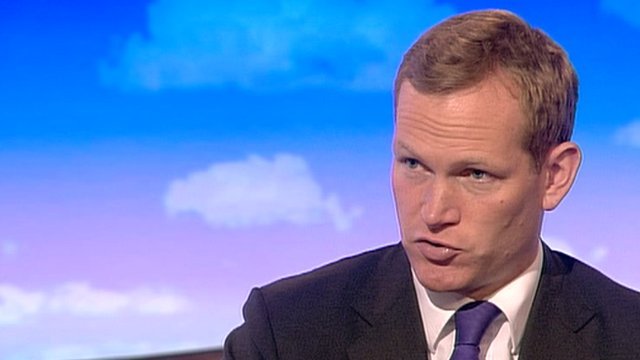
Jeremy Browne: off his trolley

by James Graham

Jeremy BrowneThe Times’s interview with Jeremy Browne today (link to the Guardian because it doesn’t have a paywall and there’s nothing in the Times original that you’re missing) highlights for me the inherent contradiction of the Lib Dem right wing.

They’ve always veered between two modes. One is that the wicked left of the party have tainted the party with social democracy and the purity of liberalism. This was the general approach of the Orange Bookers and the narrative that Nick Clegg presented during his rise to prominence. The other is to denounce the left for wanting to be a party of protest in permanent opposition. Notoriously, this was the subject of a Nick Clegg speech earlier this year, but it was also the main tactic 15 years ago when the right (the majority of whom were the same people), were arguing that the Lib Dems ought to be repositioning for a permanent alliance with the Blairite New Labour.

In Jeremy Browne’s flounce in the Times, he manages the double: the wicked left both want to be in permanent opposition and are not proper liberals. What’s interesting though is that it appears to be an open secret that the main reason he was sacked from the home office was because he was so comfortable with the Tories’ anti-immigration and increasingly authoritarian policies.

In theory, the one thing that unites Lib Dems across the spectrum is that they are liberal on social issues. The Orange Book narrative was always that the left, with its suspicious closeness to the Labour Party and love of the state and positive freedoms were the most susceptible to drifting into a “nanny state knows best” mindset. In practice however, it has consistently been the right which has ended up professing a love for Big Brother. Back when Mark Oaten was the right’s golden boy, he came up with the term “tough liberalism,” the only substantial application of which was support for ID cards.

Jeremy Browne can’t be entirely blamed for the Lib Dems’ tacit support for authoritarianism in government, even if it does appear to have accelerated since his promotion to the Home Office last year. It does appear however that the right in the party has a problem with definition. 10 years ago, the Orange Book launched on the premise that the right was economically liberal but still share the socially progressive goals the 20th century Liberal Party championed. Over the course of that decade, they have gone further back, increasingly ditching economic liberalism in favour of the classical liberalism of Gladstone where the only thing that mattered was unfettered markets. With the right’s poster child having now revealed his true disdain for basic liberal values such as civil liberties and the freedom of movement of people, you’ve got to ask yourself: what, aside from conservativism, do they have left?

21 Oct 10:02

the Vinyl Archive

by mike

There’s a well known article by the photographer and critic Allan Sekula which points out that from the beginnings, photographs posed a problem of archiving. You’d go on vacation, take some pictures, send them off to be developed, and they’d come back in an envelope, or as slides. Then what? For most people, it was “put them in a shoebox and put the shoebox under the bed/in a closet/in the attic.”

The photos were an organizational burden. What was the subject? Was it “Yosemite vacation, 1981?” or was it “Timmy, age 8?” Was this a picture of El Capitan, or of the vacation, or of mom and dad?  Lots of parents would set up an album for each kid. But then what do you do with a picture that has Timmy and Susie in it? You need a duplicate, or if it’s Timmy and Susie at Yosemite, triplicate.

Sekula points out that photographs were instantly useful to political authority–as a record of events, as a way to track identity, as a way to observe racial and eugenical differences in immigrant populations. There they posed the same kind of problems, on a magnified scale–is this a forger, or an Italian, or an example of atavistic physiognomy? How do we file this?

This was always an issue with records. They were heavy and bulky and visible in your room: they made a record not just of a musical performance, but a record of your personal taste, an archive. You had to think about how to organize them. Alphabetical order, sure, but really, do the Beatles really belong between Bach and Art Blakey? It made more sense to organize records by genre: this is rock, this is folk, this is jazz, this is folk rock, this is fusion, this is gospel, this is contemporary gospel, this is traditional gospel, uh oh a contemporary gospel artist just released a traditional gospel album.… Eventually, you’d run into the problem of the boundary transgressing animal, a record that was both or neither, and really, you’d need two of that one.*

You could just shove them on a shelf in any order, and of course people did, but the vinyl archive was deeply personal, a record of taste and experience. Barry Levinson summed it up poignantly in this scene from Diner, in which a young married couple is not having much luck figuring out how to live with each other.

This is a moment enabled by gender politics and the specific form of vinyl. He’s deeply obsessed with records and their “metadata” and she could not care less. Appropriately, the comments on the scene on YouTube include this:

What’s really funny about this scene is the camera focuses on the label of the record playing– a turquoise Capitol label that would accompany a Gene Vincent or Tennessee Ernie Ford Capitol label LP. But what is playing? “Having Fun” by Memphis Slim, recorded for Chess Records, which would have been on a black label with silver lettering.

Indeed.

Records always posed this problem of archiving and category making. If you had more than a dozen, they compelled you to come up with some kind of organizational scheme, and as Levinson points out, those organizational schemes could be deeply important. Visiting someone’s house and perusing their record collection told you all sorts of things about them–not just that they preferred disco to classical, or preferred the obscure and the odd to the popular, but that they had imposed a structure of meaning on the music.

I’d be inclined to argue that the form of the record itself compelled this kind of organizational obsessiveness. It’s physical shape and size mattered. The carefully chosen cover art, twelve inches square, reinforced this. It the record against various cultural personae: earnest folkie, groovy swinger; honky tonker; jazzbo.

Jazz lovers will easily recall the cover of Miles Davis’ Porgy and Bess: stylish, racially transgressive, ambiguous, hip, sophisticated.

porgy

You couldn’t put this next to a country and western record, or an R&B record, or some folk music.

Records were carefully chosen by their owners; they were commodities that marked out the bounds of the buyer’s self. The vinyl record needed to be ordered and classified and stored: needed to you to place it, both physically and mentally, and that placement was a personal statement.

Here’s a youtube clip of a person explaining his record collection–because other record collectors had asked him to:

This looks pretty obviously like gendered behavior; where women might occasionally pull the family snapshots out from under the bed and organize them into meaningful photo albums, this kind of obsessive record-organizing seems to be mostly a guy thing.

But the photo album and the obsessive record-categorizing stem from the same impulse, the desire to make consumption more meaningful. When you take commodities and re-organize them, re-purpose them, you’re trying to give them meaning. Maybe you’re simply reinforcing the meaning assigned by whoever is selling the commodity, and insisting that Ray Charles is a R&B singer, regardless of what he thinks, or jazz must be thought of in the way the Porgy and Bess cover demands. Or maybe you organized the records because you liked drawing up aesthetic taxonomies and chains of “influence.”

But the act of organizing is an act of thinking about what the commodities mean and how they should be understood. Vinyl buyers wanted to impose taxonomies on their records, or reinforce existing categories, and they’d use the physical objects to map out the differences between individual performers and different kinds of music.

At the same time, record-organizing looks like what Max Weber described as the rationalization of life. Weber argued the late nineteenth century. Modern methods of information storage and retrieval that makes possible larger systems of management. If you go to the Building Museum in DC, you can see how someone tried to manage millions of pension records before the invention of the vertical filing cabinet. It’s a not quite modern building.

In his essay on photography Sekula points out how photographs served the state’s need to organize and classify its citizens–police records, passport photos, public health programs with a eugenical bent. File cabinets full of photographs were both a tool of the state and an organizational dilemna.

We can see traces of the state all over that Miles Davis album cover: the woman flirtatiously touching his trumpet speaks to role assigned to women as muse, not creator. Her racially ambiguous character speaks to the culture of segregation. The music itself was enmeshed in cultural politics, a jazz version of an opera based on southern African American folk themes by George Gershwin, the New York-born son of Jewish immigrants. Choosing that record, and placing it in the jazz category, both reinforced the commercial meaning of jazz and placed the buyer in some degree of opposition to prevailing racial norms and categories the state acted to reinforce.

But digital media just completely eliminates these problems/complications//pleasures. A single digital file takes up no physical space: it doesn’t need to be displayed–in fact really can’t be displayed, if it’s not on a cd–and doesn’t invite perusal. You can tag an mp3 file as whatever you want, as multiple genres, because it doesn’t have to occupy physical space; it can be simultaneously country/jazz/rock. There’s no need to categorize it in a fixed way, because it doesn’t have much of physical existence. The whole tiresome obligation of the archive is discouraged or eliminated, and so to the conscious negotiation with the state’s needs and demands. It’s been automated. Instead of actively working to classify the object, the mp3 can come to the listener as part of an algorithmic  matrix of personal preference, mapped by Pandora or Amazon.

One comparison might be to time and timekeepers. When standardized time didn’t exist, people needed public clocks to track time, being on time, tracking the time, was a conscious effort and a relationship with a physical object, the watch. Today thoroughly standardized time is everywhere, and automated. Watches are now like vinyl records; unnecessary, nostalgic hipster status objects.

This may be one reason why music sales have declined. The record imposed or enabled the “value added” of making categories. The categories were deeply meaningful both personally and politically, as Barry Levinson pointed out so well. They spoke to who you were in relation to the realities politics imposed. The mp3 more or less makes that process pointless, and it makes the stakes much lower.


*I feel like I need to proclaim that I don’t own any records and don’t have a turntable and don’t want one. If they sound better I don’t care. While I loved the record covers, storing and maintaining record albums was a pain in the neck. And I don’t want to tangle with genre formation. This isn’t a nostalgic post, just an effort to figure out what the difference in different technologies means.


18 Oct 16:34

The Liberal Democrats, social mobility and the perils of being a centre party

by Jonathan Calder
Nick Clegg had an article in the Daily Telegraph responding to the publication of Alan Milburn's report on social mobility.

It was not a bad article, but the passage that all the other news outlets picked up and gave prominence (and which was presumably spun to them) was the one where Nick claimed the report makes:
debatable assertions, about the appropriate balance of fiscal consolidation between different age groups, for example – punishing pensioners isn't going to help a single child achieve more in life.
Alliteration is often a bad sign in politicians, and "punishing pensioners" is not an exception to that rule.

The problem here is that Nick is instinctively a reformer, yet his first reaction to a serious piece of work on perhaps the most important problem facing the country is to emphasise what will not change.

I suspect that the problem here is his often-declared strategy of making the Liberal Democrats a centre party. Because being such a party can easily turn you into the champions of the status quo and thus the opponent of anyone who proposes radical reforms.

And, as so often, I wonder who Nick expects to vote Liberal Democrat next time.

On average the younger generations are the most Liberal and the older generations are the least. Yet here the leader of a Liberal party hurries to rule out any idea of helping the struggling younger generations at the expense of wealthier members of the older ones.

Maybe Nick reasons that the debacle over tuition fees means we now have little appeal to younger voters, but I am still struggling to understand the political logic here.
18 Oct 16:33

The soup dragon in Market Harborough

by Jonathan Calder
News of plans to remake The Clangers reminds me of a time, nearly 30 years ago, when I was working at Golden Wonder in Market Harborough.

The company was part of the same group (Imperial Foods) as HP Foods and Symington's, who made, amongst other things, packet soups.

The staff shop for all three firms was housed at Symington's, and the woman who ran it was rather fierce.

So if  at Golden Wonder we were going over to the staff shop at lunchtime we used to say: "I'm going to see the soup dragon."
18 Oct 16:33

My Today programme debut talking about Jo Swinson and saying we should all look out for each other.

by Caron Lindsay
At 8:20 this morning I made my first ever foray into the world of the Today programme, talking about something that should never really have been a story - the fuss over Jo Swinson's lack of a seat at Prime Minister's Questions on Wednesday.

If you look at who did most of the kicking up of fuss, the Daily Mail, then their track record on women is not the best, as I wrote on Liberal Democrat Voice last night.

What was getting quite worrying is that Jo Swinson's views were not being properly represented. She does not think that offering a seat to a pregnant woman is sexist and she tweeted so last night.

About to get on the tube - seat offers welcome & definitely not sexist :o) But I was happier standing at pmqs yesterday
— Jo Swinson (@joswinson) October 17, 2013


The way Twitter was going on, you'd think she'd said quite the opposite. I could just imagine playing Trivial Pursuit in 10 years' time and finding a question "Which Equalities Minister said it was sexist to offer a seat to a pregnant woman?" and then getting all enraged like Ross did over his sandwich in Friends.

Even today, when there was no possible excuse to do so, Cristina Odone published a highly uncharitable piece in the Telegraph entitled "Does Jo Swinson hate women?" in which she repeated the false assertion. Two tweets from me just to make things clear:

What @joswinson said, for benefit of @CristinaOhqAbout to get on the tube - seat offers welcome & definitely not sexist :o)
— Caron Lindsay (@caronmlindsay) October 18, 2013


What @CristinaOhq said @joswinson said: Jo Swinson, a Lib Dem, says that men who stand up for a pregnant woman are sexist. #untrue #wrong
— Caron Lindsay (@caronmlindsay) October 18, 2013


But back to the point. I'd gone to bed last night when I noticed a tweet from the Today programme asking me to ring them. After a bit of going back and forth with midnight phone calls and me sneaking downstairs and firing up my laptop because I couldn't remember my Skype name, it was arranged that I'd take part in a discussion with James Forsyth, the Political Editor of the Spectator.

It was actually quite a good natured discussion. James and I were not far away from each other. The only difference I could see was that I didn't think our lot were being deliberately rude because I reckoned they were all looking away from Jo towards the pantomime at the other end of the Chamber. I didn't, by the way, get to slip in that in Scotland and Wales we have modern parliaments where every member has their own desk, and we don't have the antiquated voting system that involves standing in a lobby for much longer than Jo was standing at Question Time.

I also said that it was a pity that, out of all the things Jo had done this week, this fleeting moment was what we were all talking about. I mean, she's done stuff about getting more women into science and technology, to penalise rogue employers who lose at tribunals, to speaking at a conference on shared parental leave to working on consumer rights. She also fitted in a campaign trip to Dunfermline where the only sign of her pregnancy was that people were actually sometimes able to keep up with her as she knocked on doors.

I was asked people were worried about offering seats to women for fear of being branded sexist. I said that the world would be a better place if we all showed each other a bit of empathy and looked to see if others needed our seat more. I also said that when I was pregnant, the time I most needed a seat was during the first 3 months when I was hit by nausea and exhaustion when I didn't have a bump. I open doors for anybody and I give up my seat if there is someone around us who needs it more.

Anyway, you can listen to the whole thing here.


18 Oct 15:46

The Aftermess

by John Scalzi

Some not-terribly well-organized thoughts on the Shutdown and its immediate aftermath, in no particular order:

1. If there was one quote that for me crystallized the whole idiocy of the shutdown debacle, the sheer inchoate, juvenile foot-stompery of it, it was this one, from Indiana Representative Marlin Stutzman:

“We’re not going to be disrespected. We have to get something out of this. And I don’t know what that even is.”

Stutzman later tried to qualify his all too-honest statement, for which he was deservingly pilloried, but the original works well enough. Once it became clear that the ACA wasn’t going to go away, the House GOP was looking for something, anything, that they thought Obama might agree to so they could declare victory to the people who would be willing to see something, anything that they got from Obama as a win. What it was didn’t matter, as long as they got something.

And, I don’t know. Maybe that was the plan all along — say they were aiming for Obamacare, which they knew they weren’t going to get, and actually settle for a whole raft of other legislative goodies they wanted but couldn’t get any other way, like pipelines and drilling and killing net neutrality. Basically, whatever they could get away with. I don’t think it was this because I don’t credit the legislators who pulled this stunt with a surfeit of genuine political savvy, and in any event rank and file schmoes like Stutzman certainly weren’t clued into any deeper political machinations. But maybe it was. Maybe.

Obama gave them jack. They got nothing, or something as close to nothing (income verification for ACA recipients, which Rachel Maddow noted was a thing already in the law) as to make no difference. And all it cost was an estimated $24 billion divot out of the economy, the shutdown of the government and hundreds of thousands out of work, a whole bunch of points in every poll taken during the shutdown, and one of the great legislative faceplants in modern political history.

A relevant question for Stutzman and every other House GOP legislator who thought shutting down the government and taking the country to the brink of default to try to blackmail the president and Senate into giving them things they couldn’t otherwise get was a useful idea: Dude, what makes you think you deserve respect in the first place? Grinding the government to a halt as a form of legislative extortion is, in the most polite word I can think of which applies here, shameful. To do it with no clear idea of the purpose of your actions makes you a tool. Stutzman, et al got what they deserved out of the shutdown: Nothing, including respect. 

Mind you, Stutzman is back in his district saying he doesn’t regret the shutdown. I wouldn’t expect him or any other of the folks who precipitated the shutdown to say anything but that , for one of two reasons. The first is that it hurts when your ass is handed to you and so you try to scrape up some pride. The second is that some people are simply too deluded to never not declare victory. I don’t know which Stutzman is; I will charitably ascribe him to the first.

2. I noted a week ago that there were three options as to why John Bohener was allowing the rabble-rousing wing of his party as much latitude as he did, the second (and most likely in my opinion) option of which was that they would turn on him if he didn’t give them enough rope to hang themselves with, after which he could pass a sane bill raising the debt limit and getting the government back to work. And in fact that’s pretty much what happened.

With hindsight being 20/20, Boehner seems to be getting some credit for managing an unmanageable group of members as best as was possible under the circumstances. I think that’s true, although I think it should be noted that when your best includes a government shutdown, that’s a pretty large asterisk. Politico, which labels him a “winner” of the shutdown because his stature has increased with the hard right in the House, wonders if he’ll be able to capitalize on this new stature to get those folks to pass reasonably sane legislation.

I’m gonna go ahead and answer that one now: Not a chance, in part because many of the folks who precipitated this late crisis think the problem was they they didn’t go far enough. The Dunning-Kruger caucus of the House GOP is still open for business, and they’ll still be causing Boehner headaches, and he’ll still have to deal with them like he’s dealing with angry children made of boom. He must really love being Speaker, is all I can say about that.

3. On a related note, apparently Mitch McConnell is assuring various and sundry that Obamacare won’t be the cause of another government shutdown. That’s nice, but McConnell is in the Senate, not the House, and as noted above, there’s at least a few folks in the House who seem to think the problem with their strategy this time wasn’t that it was foolish and stupid, but that they didn’t execute on it perfectly, and practice makes perfect. So call me unconvinced the lesson has been entirely learned. Hell, McConnell can’t even get the “no more shutdown” memo to Ted Cruz.

4. About Ted Cruz: Look, the dude’s an asshole, and it shouldn’t be entirely surprising that an asshole who declared at Harvard Law that he wouldn’t have anyone who attended a “minor Ivy” in his study group is the same asshole who accuses his fellow Republican senators of “carpetbombing” the House GOP. It’s also fairly obvious that Cruz sees his senatorial tenure as an inconvenient but necessary way station on the road to the White House, so it should additionally be not terribly surprising that he’s not interested in playing nice with the other senators, including the ones in his own party, or cares what damage his actions do to them. He doesn’t plan to be there that long.

(Dear GOP: please have Ted Cruz as your 2016 presidential candidate. Oh, please. Oh, please.)

5. Obama: Dude looks tired these days, and that pretty much sums it up.

I have a friend who maintains that the whole plan for the shutdown and debt limit debacle was to drive the country to default so that Obama would be obliged to try to raise the debt limit via executive authority, or authorize a trillion-dollar coin, at which point the House would vote to impeach him. I think this is basically an entertaining paranoid fantasy, and even if it weren’t it would be a debacle for the GOP, first because the Senate is held by the Democrats and second because Obama would be impeached for acting to protect the full faith and credit of the US because the House refused to do so because they wanted to impeach Obama for something. Again, I don’t credit the GOP for much in the strategy department these days, but I suspect even they can see how that would work out for them. So, yeah: Don’t think so.

On the other hand, the GOP are still who they are, and that’s not going to change until January  2015 at least. I expect to see Obama looking even more tired by then.


18 Oct 11:06

Actual European Discoveries

by Tobias Buckell

Thank you Andrew Sullivan:

NewImage

Historian Bill Rankin has this to say:

Every Columbus Day, we’re reminded of the difference between discovery and “discovery” – and rightly so. But let’s not sell Europe short; after all, European explorers found plenty of diminutive islands that no human had ever seen before, along with extravagant amounts of ice and snow. Just the islands alone add up to more than 0.14% of the world’s total land area, and today they’re home to more people than live in all of Connecticut!

All sarcasm aside, it’s worth remembering that almost everywhere Europeans went, they were met by existing inhabitants. Even in the vast Pacific and the barren Arctic, only a few isolated coasts were truly terra nullius. (Indeed, this map particularly underscores the maritime expertise of Pacific Islanders. Unlike the islands of the Atlantic and Indian Oceans, nearly all of the Pacific was settled by the 14th century.)

Also, today you should be reading The Oatmeal.

Seriously.

NewImage

18 Oct 11:06

How to Deal with Change

by Scott Meyer

The fourth Basic Instructions book, Dignified Hedonism, is now available in digital (http://bi4.us/18iQwVp) and dead tree format (http://bi4.us/17s01xK).

Note: I WILL be selling signed copies, and said signed copies WILL be available internationally, but with a hefty shipping fee. I will have more information about that when the signed books are available.

Thanks for your support.

18 Oct 10:40

Own-goal from Stonewall over transphobic Paddy Power campaign

by Zoe O'Connell

In what appears to have been a colossally mis-judged own goal, an article published today in the Guardian and written by Stonewall UK’s media manager endorses the use of transphobia if it helps further their anti-homophobic campaign.

The trouble stems from an advertising campaign featuring run by Paddy Power in early 2012 that the Advertising Standards Authority banned, branding the campaign “likely to cause serious offense” and “irresponsible”. When it was announced that Stonewall were teaming up with Paddy Power with a rainbow laces campaign, it was met with some grumbling from trans activists, but given Stonewall’s long history of working with transphobes it was hardly news.

However, today’s article appears to be the first time Stonewall UK have said the transphobic actions of someone else are actually helpful in working against homophobia:

It was clear from the very start of the campaign that working with an organisation like Paddy Power would allow us to communicate directly with fans, players and clubs in a way we simply wouldn’t have been able to had we worked alone. This, coupled with Paddy Power’s reputation for eye-catching, and yes, at times risqué campaigns would allow us to draw attention to the issue of homophobia in football.

Just in case the reader was in any doubt what was meant by “risqué campaigns”, the link (Yes, that’s in the original article) points to another article discussing the banning of the transphobic Paddy Power adverts.

Looks like Stonewall UK are back to being S’onewall again.

Update: The author of the original article has now “unambiguously condemned” the Paddy Power transphobic campaign, stating that the link to stories about it was added by the Guardian after the article was written.

@auntysarah Hi Sarah, we've said 100% that Ladies Day ad was wrong. Guardian has added that hyperlink to the word risqué without permission.

— Richard Lane (@Politicana) October 17, 2013

@auntysarah I was trying to refer to PP general reputation. I unambiguously condemn the ad. V sorry this is now not clear.

— Richard Lane (@Politicana) October 17, 2013

18 Oct 09:35

"A Court Order Is an Insider Attack"

by schneier

Ed Felten makes a strong argument that a court order is exactly the same thing as an insider attack:

To see why, consider two companies, which we'll call Lavabit and Guavabit. At Lavabit, an employee, on receiving a court order, copies user data and gives it to an outside party -- in this case, the government. Meanwhile, over at Guavabit, an employee, on receiving a bribe or extortion threat from a drug cartel, copies user data and gives it to an outside party -- in this case, the drug cartel.

From a purely technological standpoint, these two scenarios are exactly the same: an employee copies user data and gives it to an outside party. Only two things are different: the employee's motivation, and the destination of the data after it leaves the company. Neither of these differences is visible to the company's technology -- it can't read the employee's mind to learn the motivation, and it can't tell where the data will go once it has been extracted from the company's system. Technical measures that prevent one access scenario will unavoidably prevent the other one.

This is why designing Lavabit to be resistant to court order would have been the right thing to do, and why we should all demand systems that are designed in this way.

Also on BoingBoing.

18 Oct 07:18

What voters think would happen if the Tories were able to govern alone without LDs?

by noreply@blogger.com (Richard Morris)


H/T to Mike Smithson of Political betting (fairly obviously)(click to enlarge)


18 Oct 07:16

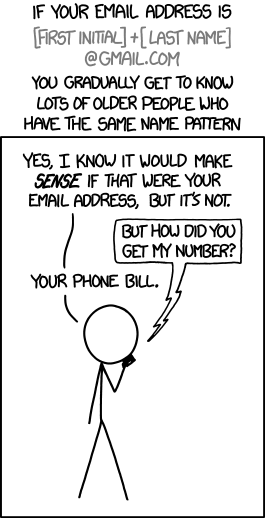
Reverse Identity Theft

I asked a few friends whether they'd had this happen, then looked up the popularity of their initials/names over time.  Based on those numbers, it looks like there must be at least 750,000 people in the US alone who think 'Sure, that's probably my email address' on a regular basis.
18 Oct 07:13

#520 Prime Factor

by noreply@blogger.com (treelobsters)
18 Oct 07:13

#973; The Perfect Imitator

by David Malki !

I'm doing a gallery show called ''These Things Are Bad And You Shouldn't Come.'' You should come!

18 Oct 07:11

Jersey's problem

by Abigail Brady

Jimmy Carr is not the problem. Why does this always have to come down to personalities? Perhaps Jersey is the problem. Jersey has a strange constitutional relationship with the UK - it is another territory of the Queen, not part of the UK and not subject to Parliament's laws 1, and is not in the European Union, even. It gets the benefit of relying upon the UK's defence and foreign affairs networks 2. And there's an implicit guarantee of rule of law that the UK provides. It's used this pseudo-sovereignty to reduce taxes to attract corporations, to provide employment and revenue.

You'd, therefore, think that the States of Jersey were rolling in it from all the foreign companies having nameplates there, right? It turns out that it's a bit more complicated than that. Supposedly, the UK exchequer subsidises Man, which has therefore been able to put its corporation tax to nil. Consequently Jersey and Guernsey have had to put their taxes down to match, and their public finances are running at a deficit! I had assumed Jersey was actually getting some benefit out of this arrangement. But no, they're being screwed as well. They even had to introduce a new VAT-like tax in 2007 - at the height of the bubble, to cover the gap, and then had to raise it from 3% to 5%, while looking at cutting spending by several millions still.

Ultimately, it doesn't matter whether this is the result of subsidy from the UK to Man - either way, it's a dangerous game for Jersey to be in. The only reason they're competing against Man in terms of tax rates is to be the best English-speaking northwest European tax haven. It's not like you'd decide to put your business in either Man or Jersey on some other criteria and then pick the lower taxed one as a second factor. So presumably they must see some benefit in playing that game in the first place? A non-tax haven Jersey might be more like the Isle of Wight than the Isle of Dogs. It could be better off like that in the long run, but that would be a fairly revolutionary change, and the current state is probably a local maxima. If they raise corporate taxes slightly, then everyone goes to Man, and revenue declines.

In short, this is a classic race-to-the-bottom situation. There's a simple solution, though. Give it (and Guernsey and the Isle of Man) a choice: incorporation into the United Kingdom (presumably as additional home nations with devolution akin to Scotland's, or greater), or full independence. If you want to be part of our polity to the extent that you are, you have to pay our taxes. If you don't, that's cool, you can go off and become a Commonwealth Realm or republic or whatever you like. No business of ours. If you chose annexation, we'd hope to raise so much extra revenue as a result that we can afford to offer subsidy to you, for improvements in people's lives there, that you can't afford because of being trapped in this tax-haven rut. We'll even guarantee that subsidy if the revenues don't materialise. I see both options as better than the status quo for everyone, and there's also the extra bonus of addressing the undemocratic nature of the crown dependencies status.

  1. Parliament still claims the right to legislate for Jersey, but it would be pretty undemocratic considering there isn't an MP for Jersey
  2. which it does, in fairness, pay a contribution toward
  3. an earlier version of this said, rhetorically, "protected by our Navy". Of course, the last time this came into question, the Navy wasn't much use.
17 Oct 10:06

Tattoo U.

by LP

Do I remember lung-scripting? Kid, I’m old enough to remember when tattoos were a big deal.

Oh, believe me. There was a time. I know you don’t think there ever was a 20th century, but I was born way back in 1972. When I started working in the business, there weren’t even tattoo-and-piercing salons — because nobody had piercings except circus freaks and 12-year-old girls. And we had to charge, like, $300, $400 for a tat, because not a lot of people had them. We actually thought we had it good in the mid-’90s when everybody started getting them — hell, I started your dad’s college fund out of ankle butterflies and Bulls logos on the biceps of a thousand drunken sorority girls and frat boys. We thought we were on the verge of a golden age when everyone started getting tongue studs and belly button rings in the late ’90s; what we really were was on the skin of a bubble.

It all started to fall apart when places like Hot Topic opened up, and by the time you could get tattoos and piercings at flea markets, I was about ready to go to business school, I was so desperate. Luckily, your grandmother was always more dedicated than me. She handled the business end and I did the designs, but don’t let that fool you: she was really the artist, the visionary. She realized that with every hipster and college kid sporting ink and rocking Prince Alberts, the real money would be in catering to the extreme body-mod crowd who were now stuck without a way to get attention. They weren’t so special anymore now that everyone with a credit card had a tattoo of a flaming guitar on their calf; shit — oops, pardon my French, kid, don’t let your mom know I said that — you should have seen the look on some of my regulars’ faces when New Hampshire elected a senator with a chin spike. And a Republican, too! It was like they just found out there was no Santa Claus.

What? Oh, fuck! No, sorry, boy. Of course there’s a Santa Claus! That’s just, uh, that’s just a phrase we had back when I was a boy.

Anyway, the missus, she was the one who realized we could really make bank by anticipating the new extremes in body mods. When branding crossed over into the mainstream in the early 2000s, we’d already been doing it for a good ten years. Same thing with voluntary amputations — and even then, when it became trendy to cut off a toe or the first joint of your little finger — hell, that would have gotten you laughed at in our circles. You weren’t even allowed into the Chop Shop unless you were missing your nose, a whole foot, or your arm up to the elbow. And by the time that got mainstreamed, we had already passed it by and were doing stuff like partnered limb-grafting, where you and your girlfriend would each get an arm severed and then you’d attach their remaining arm to your stump. In fact, the way I knew your grandma really loved me is, she had her own name tattooed on her left leg before she had it grafted to where my left leg used to be. Some people laughed at us because of the staggered way we walked, but when we’d stroll side by side, we’d kiss each other on the downstroke.

(By this time, of course, getting a tattoo was kind of quaint, like having a church wedding or calling your wife “Mother”. They were so ordinary hardly anyone got them anymore, and when they did, it wasn’t by a tattoo artist; having a tattoo artist was like having a personal laundress or a scullery maid. People just got them in the supermarket, from one of those converted blood pressure sleeves.)

So of course I’ve heard of lung-scripting. In fact, we did some of the first ones at the Chop Shop. Lung-scriptings, heart tattoos, heart tattoos of hearts – the whole deal. We always tested out the equipment on each other first, of course — has Grandma ever showed you the CAT scan? So you’ve seen the tiger on her right kidney? I did that. It was the first organ-scripting we ever did with the ol’ InternoScribbler 4000, back in 2013. In fact, we also did the first liver-piercing, the first muscle-studs, and — it was either the third or fourth guy in Nevada to get racing stripes on his intestines, we did that too. Blood-dyeing, stem-to-stern decorative chains that hook into your cerebellum and come out your rectum so you can hook it to a wallet chain, tongue reversals — you name it kid, and I’ve done it. Why do you ask?

What? Oh, Henry. You’re not really thinking of getting one of those monkey spines, are you? I don’t know why people would do that to themselves.

17 Oct 10:04

A Country of Which Nothing is Known but the Name.

by Stanislav

If you came here via a search engine, you were probably looking for Pierre Cartier’s wonderful mini-biography of the mathematician Alexander Grothendieck – from which I shamelessly stole the title. Please go straight there. Otherwise…


“And so no one, except for two people, enters the top floor of the Aedificium. …”

The abbot smiled. “No one should. No one can. No one, even if he wished, would succeed. The library defends itself, immeasurable as the truth it houses, deceitful as the falsehood it preserves. A spiritual labyrinth, it is also a terrestrial labyrinth. You might enter and you might not emerge. And having said this, I would like you to conform to the rules of the abbey.”

“But you have not dismissed the possibility that Adelmo fell from one of the windows of the library. And how can I study his death if I do not see the place where the story of his death may have begun?”

“Brother William,” the abbot said, in a conciliatory tone; “a man who described my horse Brunellus without seeing him, and the death of Adelmo though knowing virtually nothing of it, will have no difficulty studying places to which he does not have access.”

Umberto Eco, “Name of the Rose”

In 1979, the American journalist Howard Morland fought – and won – a lengthy court battle for the right to publish a magazine article, “The H-Bomb Secret: To Know How is to Ask Why.” Morland’s objective was to infer and publish the basic facts of the famous Teller-Ulam hydrogen bomb design, drawing solely from unclassified sources.

Even a lackluster student of the 20th century ought to feel a little surprised: the article was indeed printed, and Morland even escaped with his life! Why the inquisitors relaxed their grip and turned the man loose, I cannot say. Perhaps his model of the H-Bomb’s inner workings was sufficiently wrong, and was thought to be useful as disinformation. If this was indeed so, I should hope that what follows is equally wrong – and, like Morland, I will be permitted to continue sharing my crackpot ruminations with you, dear reader. Otherwise, to the gasenwagen I shall go, where I might perhaps meet with some of you!

So, dear inquisitor: nothing found below came from anywhere other than deathly-boring, public documents, placed on the Net by American public officials, merchants, and military historians.

While we’re on the subject of disinformation: I find it intriguing that the supposed Snowden leak appears to consist entirely of minor operational details – of surveillance programs which have been known to the public, under various names, for some years! And likewise, neither the fact of the NSA supplying the world with diddled crypto – nor that of the American software industry’s collusion with the agency really qualifies as “news.”

So what would qualify as a genuinely-newsworthy NSA leak? Why, naturally, the crown jewels! These would conceivably be: facts – or at least, solid clues – shedding light on two great mysteries:

  1. What weaknesses in commonly-used ciphers, unknown to the public, are known to the world’s favorite spy agency?
  2. What proprietary ciphers does the U.S. government reserve for its own use? And how do these differ from ciphers available to the public?

The “armchair general” community’s endless speculations, well-founded and otherwise, seem to focus entirely on the first conundrum. Yet the second strikes me as considerably more interesting.

The NSA publishes two official lists of cryptographic algorithms approved for use by U.S. government employees, known as “Suite A” and “Suite B.” Suite A consists of “classified algorithms that will not be released.” Suite B contains well-known public favorites, ones commonly regarded as strong – such as AES.

All that is publicly known of Suite A ciphers is their names; a tantalizing “WinAmp Playlist” of monikers such as ACCORDION, BATON, JOSEKI, SAVILLE, SHILLELAGH, and a number of others.1 Truly, “a country of which nothing is known but the name!” Clearly it is impossible to learn anything meaningful regarding these marvels of mathematical engineering, without stealing national secrets and paying the price. Or is it?

The traditional “folk” explanation for the existence of Suite A is that the NSA (and the NATO military establishment it is part of) has advanced many decades beyond the public state of the cryptographic art2, and knows of certain weaknesses in popular cipher systems (including those found in Suite B.) The implication is that Suite A ciphers lack these weaknesses, and are therefore considered fit to protect the most valuable national secrets.

The folk explanation is simple and convenient, but the facts – as revealed by perfectly ordinary public (rather than leaked, or “leaked”) documents 3, simply do not add up. Consider the case of the ViaSat KG-200 Inline Media Encyptor, “designed to conveniently fit between your computer’s motherboard and hard drive. In the event that a classified computer is lost, stolen, or tampered with, its hard drive remains encrypted so no classified information is compromised.” 4 Notice anything peculiar? The cipher used in the KG-200 is: AES-256. Plain old AES, aka Rijndael, known to every computer programmer on the planet. Turns out that AES is approved for “Top Secret” use. ViaSat’s other disk encryption products also rely on AES.

So, what products are advertised as including Suite A ciphers? It appears that the latter are found exclusively in equipment intended to secure voice and data traffic in the field. SAVILLE, for instance, is thought to have made its appearance in army field radios as early as the late Vietnam War era. It – along with some other Suite A ciphers – was shared with NATO members, including the UK and Norway, and was put to use in their own radio systems. BATON, a somewhat newer cipher, was – and continues to be – used in field radio equipment, such as the “Project-25″ walkie-talkie issued to many public servants. 5 Other Suite A stream ciphers appear to serve similar purposes. VALLOR, for example, is said to be used in securing TTY broadcasts to submarines. 6 American military satellite uplinks are also known to use Suite A ciphers.

There is an apparent contradiction: if AES is judged fit to secure the hard disks of top bureaucrats, why is it placed only in radio sets issued to policemen, while those given to soldiers feature Suite A ciphers? The folk explanation would hold that Suite A algorithms are thought to be stronger. But if anything, a soldier’s field radio is rather more likely than a policeman’s walkie-talkie to fall into the hands of a hostile reverse-engineer. Military equipment is routinely taken as spoils, and often finds its way to the highest bidder.

One interesting clue is that U.S. military personnel are never permitted to generate their own cipher keys. The latter are always generated at an NSA facility, and are delivered to soldiers inside a “key fill device”. At one point these made use of paper tape; now they live in a Windows CE (!) palmtop.

By my reckoning, a most logical way to generate keys for military field radios would be a portable hardware entropy source, which would be plugged into a gang of radios connected together for synchronization inside a shielded enclosure. Standing in a commander’s tent. But instead, they choose to fly keys across the ocean… What might be the reason for taking this risk?

In his encyclopedic work, “Applied Cryptography” (1996) Bruce Schneier mentions “GOST”, a Soviet block cipher having a curious design detail. The GOST specification did not specify a fixed set of values for the cipher’s S-boxes. From this, one could infer that certain GOST users (perhaps the less loyal among the Warsaw Pact nations) were given weakened S-boxes so that they could be spied upon at the KGB’s leisure. This, however, is a rather ham-handed approach to back-dooring a cipher, and American mathematicians surely conceived of something more subtle.

Some ciphers are known to possess “weak keys” – that is to say, a certain subset of the possible keyspace will result in ciphertext which can be cracked with considerably less effort than using plain brute force. Let’s carry on with the “folk theory” and assume that NSA experts know of a class of weak AES keys, while having crafted Suite A algorithms which have strictly “linear” keyspaces. Yet AES is approved for certain “Top Secret” applications not involving radio communication. Given that all such applications use NSA-supplied key material, they would surely take care to supply only strong keys – or else, in the “KGB scenario,” could easily supply weak keys to any public servant suspected of disloyalty. Which would leave the purpose of Suite A a mystery. The folk theory holds that NSA engages in mere “security by obscurity,” hiding the proprietary ciphers in an effort to keep the public from discovering weaknesses. This sounds reasonable until you consider the official seal of approval on AES for “Top Secret” disks; while military radios are required to use Suite A ciphers.

So here comes the crackpot hypothesis, which resolves the apparent contradiction:

Suite A ciphers slowly leak keys.

NATO military doctrine famously allowed for the possibility that Soviet forces would overrun Western Europe, making liberal use of captured supplies of every kind. Even though such an invasion never took place, quite a few examples of American cipher equipment have been taken as spoils by various armies. Consider, for instance, the famous USS Pueblo: an American spy vessel taken prisoner by North Korea in 1968 – with a complete set of cipher machines, which the crew did not have a chance to throw overboard. Or the countless radios captured in Vietnam. 7

My theory: cryptographic equipment used by NATO armies leaks key bits into ciphertext. Slowly and subtly. Such that routine key swaps, at the rate supplied by the high command, prevent an enemy from gathering a complete key, even if he knew how. But if said enemy were to capture (and perhaps clone) NATO equipment, and take to using Suite A ciphers himself, he would begin to leak secrets meaningfully and continuously. It is also conceivable that NSA can supply keys which result in varying leakage rates, as appropriate to a particular military situation. And it is by no means certain that countries other than the U.S. possess the secret of extracting “dripping” keys.


  1. Interestingly, Wikipedia once featured considerably more discussion of the Suite A ciphers. Said discussion has mostly – but as you can see, not entirely – vanished. I imagine the remainder will probably disappear at some point. 
  2. This belief is not entirely unfounded
  3. Documents have been known to lie. But in this case we speak of spec sheets published by U.S. military contractors, and they – and the official statute regarding the suitability of AES for “Top Secret” use – would have to agree on the same lie. A difficult, though admittedly not impossible feat. 
  4. The fact of nothing remotely like the KG-200, despite the simplicity of the concept, being available to the public at large – at any price – should not be regarded as an accident. 
  5. See pg. 31 of the Daniels Electronics, Ltd. “P25 Radio Systems Training Guide.” SAVILLE and BATON are valid algorithm identifiers, along with AES. The latter, interestingly, is the only cipher included in P25 devices issued to police agencies.
  6. Is VALLOR simply a proprietary moniker for the traditional One Time Pad? I know of no reason why a submarine commander would use anything else. 
  7. The timing does seem to coincide rather closely with the introduction of SAVILLE. 
17 Oct 09:37

Saying goodbye to Twitter

by Mike Taylor

I’ve been on Twitter for a couple of years now, first as @SauropodMike and more recently as @MikeTaylor. I have to admit, it’s hugely surpassed my expectations. I thought it was a medium for the trivial, but instead I’ve found a wealth of pithy observations, witty asides and links to all sorts of fascinating longer reads.

goodbye-twitter

So now I’m leaving it.

The problem is not that Twitter is trivial — it’s precisely the opposite. It’s immersive and informative and, most of all, time-consuming.

I follow 300-odd people, and they’re pretty much all fascinating in their various ways. They link to hefty articles about weighty matters. I read a lot of these. As a result I am much better informed now than I’ve ever been before, about a whole swathe of issues. Not only open access, which I’m passionate about, but British freedom-of-speech erosion, the US government shutdown (thank heavens they finally grew up), the astonishing rate of overnight imprisonment of children in the UK, and much much more.

These are issues that bother me deeply but that I can’t do anything about. Whereas open access is one that I can influence, in my small way. Knowing about all these other things is bringing me stress and unhappiness, but not opening a window for me to actually help. Avoiding that state is why I deliberately don’t follow the news in conventional media (TV, radio, newspapers), so it makes no sense that I’ve let myself get sucked into following news in this medium.

More important still, Twitter is just taking so darned much of my time. I tend to be quite a depth-first person, perhaps tending towards obsessive. The result is that whenever I get back onto my computer after a break, I feel an obligation to catch up on everything I’ve missed on Twitter, and to read all the interesting links. That’s eating into time I would otherwise use for blogging (hence how quiet it’s been here at The Reinvigorated Programmer), and for writing papers. It’s also slowed progress on another project I’m working on, which I hope to announce here is a week or two.

So I’m going to quit reading Twitter.

I’ll still tweet occasionally — not least, to let people know when I post something here or at Sauropod Vertebra Picture of the Week, and also to respond when I get an email notification that someone’s tweeted about me. But in general I’m going to treat Twitter as a read-only medium; and in practice that’s going to mean I’m writing much less on it, too.

Hopefully I can make better use of the hour a day, or however much it is, that I recover.

Anyone who’s been used to contacting me on Twitter can always get hold of me either by commenting on any of my blogs (I see all comments) or of course by good, old-fashioned email to mike@miketaylor.org.uk.


16 Oct 15:27

Wage Slavery Without The Wages

by LP

It is often said by those in the business of making dire predictions about our current political system that the goal of the current generation of Republican radicals is the reduction of the American working population to the status of serfs. With all due respect to the thinkers who have given us the splendid notion of neo-feudalism, this is not quite right. Serfs and vassals were, after all, at least allowed to produce for themselves a subsistence living, with any excess production going to the local lord who was, at least in principle, obligated to protect them from predation. If the nobility was under no obligation to answer to them, it at least afforded them the illusion that their lives had some value; even the meanest peasant, for example, was not likely to be turned out onto the road unless it was through some great upheaval like a war or a natural disaster. He was unlikely to become homeless just because the closest baron decided to move all the farming jobs to Taiwan.

No, what the fringe right – that portion of the party which now holds the entire government hostage to its petulant defiance of imaginary socialism, that group of self-identified patriots who identify the greatest good by its ability to fatten the pockets of billionaires and who owe their strongest allegiance to a Russian-born novelist and not to Washington or Lincoln – wants is not the return of serfdom, but of slavery. In their every action – from their economic views to their perception of society to the complete lack of compatibility of their political standards with the concept of democracy – they clearly yearn not for the Gilded Age (for that goal has already been achieved), nor even for the days of a foreign extrusion like the Czar, but for those golden years of the Antebellum South. Regardless of whether they are themselves Northern or Southern, in origin or in temperament, they clearly believe that when it comes to labor relations, America got it right only below the Mason-Dixon Line, and only before 1850.

The struggle between capital and labor has rarely been a pretty one, nor an equally contested one. But in the short-lived days of the liberal consensus, it was at least understood, even by what are now quaintly referred to as ‘traditional’ conservatives, that it was not a total war: the left would fight for shorter hours, higher wages, more security, and greater workplace safety, and the right would fight for longer hours, lower wages, more flexibility, and less regulation, but neither side would achieve, or even seek, total victory. It would be a push and pull that attenuated itself around a set of common interests that formed the spine of the post-war world: national prosperity, widespread consumerism, and a shared goal of higher standards of living for everybody. If people spoke of a global marketplace, it was in terms finding new buyers for new products, not in terms of a perpetual reduction in the options of the labor classes. We even had a name for it: the American Dream.

That dream is now as dead as Eisenhower, and the struggle has shifted: labor is now essentially dead as a class element, and the battle is over how far to the right the country will go. The faction now known as liberals (who, properly understood, would be called conservative technocrats) have almost entirely accepted the notion of transnational corporatism as the default means of governance, and restrict their efforts largely to minor social issues; their interest in economic issues is generally confined to making sure the pie has at least two slices, no matter how tiny the second one is. Conservatives (or, rather, radical reactionaries), on the other hand, fight for a total annihilation of the social contract, a self-serving plutocracy in which the sole functions of government are the direction of public resources into private hands and the protection by force of the material gains generated by that redirection. Their view of labor is not that of a wily foe with which to contend; it is not even that of a machine, for machines must be maintained, operated skillfully, and tended to with respect. It is that of a man towards a toiling beast, a thing to be literally worked to death and then disposed of, whose only real value is its ability to reproduce its own replacement: a slave.

A laborer, be he a union man or a serf, must at least be kept from predation and disease. He must be fed, clothed, and given a modicum of protection from ill health, if only to keep him capable of further labor. He must have some sense that he is a member of his clan, tribe, or nation, with a place in society, even if that place is at the bottom; and there must be a sense of value and of continuity to the work that he does. And if he happens to live in anything approaching a reasonable capitalist economy, he ought to make enough money to spend, because you can’t have industrial consumerism without industry and consumption.

A slave, on the other hand, being no more human than a cow or a mule, needs none of these things, and every recent movement by the radical right seems less a recognition of their always-present social Darwinism than it does a tacit admittance that the rich never had it so good as when they sat in the big chair on the largest plantations. Security? Let it protect those who can afford it. Disease? Not the problem of society; those with money may purchase a cure, and those without may die and be easily replaced. Knowing one’s place is only useful during brief interactions with one’s superiors; otherwise, one’s place is nowhere. Skill, craft and pride are things of the past, easily got on a truly free market now that the dragon of unionism has been slain; every new child born under the sun must start afresh, unless his parents are rich enough. And, while the money owed by the wealthy to the state approaches 0%, the money owed by the poor to business interests approaches 100%. Why let them spend their meager wages on what they will, when you can charge them every penny they make just to stay alive on the face of the world?

Seen through this lens, virtually every decision made by the radical right makes perfect sense. Of course, unions needed to be eliminated because they allowed the working class the kind of collusive power enjoyed by their corporate masters in perpetuity; but once pensions and retirements were eliminated as a possibility for the future, it became time to seize the ones already earned and guaranteed, for who puts money on the well-being of a slave who can no longer work? Restrictions on women’s reproductive rights ensures a large and desperate population, laden with unplanned and unwanted children, who will do anything to support their kids and make sure that there’s always more workers than needed so they need never answer with decent wages the problems of scarcity. Religion and culture are used, now as then, as a means of social control, tamping down unrest by promising a cheap bauble or a glorious reward in the world to come. Keep health insurance tied to employment, and make it ruinously expensive, for a healthy slave will run if he can stay healthy. Make education equally costly, for an educated woman is one who is less likely to accept the life of a slave.

The use of prison labor drawn from a system designed to make almost everything a poor minority might do illegal; the allergy to land reform and debt relief; the introduction of arcane financial instruments and punitive debt structures that snare working people in a lifetime of money owed from the time they can even be called adult: it is all part of a plan, intended or happily accidental, to reintroduce slavery under another name. Every restraint by government on the rights of labor (ironically done in the name of smaller government) is designed to restrict the freedom of the worker (ironically done in the name of preserving freedom), so that he is reduced to taking whatever job is offered, at whatever pay is available, under whatever conditions that exist. This is slavery, for at least the serf would inherit his father’s trade.  And not only is the idea of a cheap, labor-intensive economy powerfully attractive to the boss class, but it’s one far more easily transferred to the post-industrial world than you might imagine; the link has been there since the beginning.

Slavery is hardly an American invention, but the way it manifested here was unique to this country. In a way, our modern plantation bosses and their lickspittles are truly as innovative and revolutionary as they claim; for while they embrace the colors of the Old South and forever defend its reputation, cheering the Lost Cause while ignoring the horrors of chattel slavery, they also seek to remove its one sole unique quality in the American Experiment: that the slave was once only permitted to be black. In the America envisioned by the Tea Partiers and the Shruggalos, there is no more white man’s burden; there are only fat masters and contented slaves.

16 Oct 09:27

Blatant Advertising

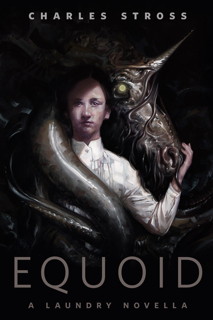
by Charlie Stross

My latest novella, "Equoid", is available in print ebook from Wednesday October 16th. It's only $1.99, or about £1.49 if you're in the UK (a chunk of that is sales tax). As it's my birthday on Friday, if you feel like buying an ebook I'll consider it a donation to my beer fund :)

You can buy it from various American ebook stores:

[Amazon] [Barnes&Noble] [Apple iBooks] [Google Play] [Kobo]

You can also buy it in the UK:

[Amazon.co.uk] [Apple iBooks (UK)] [Google Play]

(No W. H. Smiths link currently available because whoops).

(No, Microsoft Word was not used in the creation of this work.)

15 Oct 23:41

New York Comic Con 2013

by lanceparkin

I went to New York Comic Con on Saturday, to sign copies of Magic Words: The Extraordinary Life of Alan Moore. I’ve been to one comics convention before, Bristol in 2003. I have never been to one as large as New York. In part, this is because very few people have – it’s probably the second largest in the world US (after San Diego – see Greg’s comment below), with an estimated 160,000 attending at some point over the four days. Let’s just get this into perspective: if every person at NYCC bought one issue of a particular comic and no one else did, it would be the bestselling comic most months. It’s more people than live in York. It’s more people than voted for John Boehner in 2010.

The overall impression, then, is one of size. You wander the crowded hall for an hour, think you’ve completed your circuit, and then realise that’s only half the exhibition space. Later, you discover that there’s a downstairs, too. And another downstairs below that. Every part of this space is packed with attendees. The aisles are wide as a motorway lane (as evidence, here’s a photo taken ten minutes before the doors opened. This isn’t some main aisle, this is just one of the rows),

Image

but you have to jostle to get anywhere. People move around in currents and tides. And it quickly becomes clear that this covers the entire menkosphere. Comics, video games, board games, trading cards, books, movies, magazines, TV, websites, toys … and, I’m sure, plenty more.

The impression I got wasn’t that this was one big convention, it felt more like half a dozen big conventions, all piled on top of each other, and not always having very much to say to each other. The one thing I really didn’t think I’d have to explain at a comic convention was who Alan Moore is, but a significant chunk of people didn’t know, and a few hadn’t even heard of Watchmen. At the same time, someone would walk past in an elaborate costume, and I’d have no idea which series, or even medium, it was from. But individual fans mix and match some weird interests. That these four things are on the same shelf shouldn’t make sense, and none of them are really my bag, baby, but it could have been precision-targeted at dozens of people I know:

 Image

It’s all a little too busy and jostling to have much of a conversation, or to make friends, it’s a little too loud and hurried to chat with people you already know. It’s not quite like anything I’ve been to before. The closest experience I’ve had to it, the thing I realised it reminded me of, was going to IKEA the first day of the sales.

So, what was it like, apart from big, noisy and all-encompassing?

I went into Manhattan by train, and knew I was on the right platform when I spotted two people dressed as the TARDIS. The Doctor Who panel was at 11pm. They were planning to arrive about nine and start queuing for it straight away. This was the pattern – if you want to get into a panel, you had to plan on queuing for at least an hour. I arrived at the Doctor Who panel with about a quarter of an hour to go. People in Doctor Who costumes were wandering away from it. The doors were already closed. Not many people seemed particularly upset by this – they’d concluded it was their own fault for just not showing up early enough. It was a huge room, but clearly nowhere near huge enough. Was this a bug or a feature? Did the organisers want to make sure every panel was standing room only to add to the sense of energy and importance? If they didn’t, they’d ended up there by accident.

As for the attendees, a couple of things struck me. The first was to do with diversity. My rough guess is that there was almost gender equality there, it was extremely ethnically diverse. Some of that is that it’s taking place in New York, of course, but even so the people there were not quite as pasty as I was expecting. A large Asian contingent, due in part I’m sure – and judging by their cosplay – to the presence of so many anime and manga exhibitors. There were a huge number of African-Americans, too, and again judging by the cosplay, they tended to be fans of the mainstream superhero comics. I’m 42 – yikes – and I didn’t feel uncomfortably old, but I’d guess most people there were under thirty. There is a massive new generation of fans.

I’ll talk about the cosplay in my next post. In the meantime … is there a word for someone that’s probably not cosplaying, they just look like that because they have appalling dress sense? It’s a word we need, if one hasn’t already been coined.

We come to what I think, is the elephant in the room. Ironically, I think just about the only thing that wasn’t in the room was an elephant. I say that, but I’m only about 90% sure there wasn’t an elephant. There could have been, or at least someone dressed as one.

Comics are clearly being read by all sorts of people, but a trudge down Artists’ Alley demonstrates they’re equally clearly mainly made by balding white men. And the problem is not so much the white, male thing. Comics used to be created by the young. Siegel and Shuster were teenagers when they created Superman. Alan Moore was 33 when he wrote Watchmen. How many of the creators in Artists’ Alley were younger than that? Now, OK, the creators of a story don’t have to look like their audience. Before this weekend, I’d have moaned that the problem with comics is that the readership were all middleaged white manchildren like myself. This is clearly not the case, at least judging by Comic Con attendees. And, clearly, comic book creators who draw a crowd are going to be the ones with long and successful careers.

That’s not the elephant in the room. It’s not the age, maleness or whiteness. The elephant is the disconnect between creators and audience.

NYCC formalises the division between creators and attendees – Anthony Daniels wandered past at one point, someone who looked like Brian Bendis did and I assume he looked like Brian Bendis because he was Brian Bendis. Apparently Whoopi Goldberg had been spotted the previous day. On the whole, though, the guests stayed in green rooms and Artist’s Alley, a cavernous space below the main hall, safe behind tables.

It comes down to the central fact of NYCC: it is not a community gathering, it’s a trade fair. Attendees pay money to walk around for opportunities to pay money for things. Beautiful shiny things we’ve yearned for and were promised and which you can’t get anywhere else except fever dreams:

Image

And that’s great, I guess. I mean … look, action figures that actually look like the characters. I’d have loved that Christopher Reeve Superman figure as a kid.

Image

But it’s not just the lovely, shiny stuff. Everything is so … transactional. You pay to get a photograph with an actor. Hell, you pay to get a photograph in front of a backdrop. Many autographs cost money … OK, again, there might be people there looking to flip things on eBay, and believe me I understand that freelancers aren’t going to turn down cash, but … it’s not friendly. It’s not just money. Cosplay seemed quite transactional, too – you can take my photo, I will be paid in attention (as I say, I’ll talk about this more next time). There’s no real communal space, there’s no place – or at least I didn’t find it – where you see actors and creative types just hang out with the muggles. Creators don’t mingle with the attendees, attendees line up to meet creators. It’s a relationship I found a little uncomfortable, to be honest, a little unhealthy for both parties.

Why would creators wander the halls? What’s in it for them? Well, for no other reason than that they might find some nice material. I saw one group of people in their early twenties all clearly there together dressed as the X-Men. They trooped past about four in the afternoon, clearly a little footsore, being led on by – appropriately enough – Cyclops. One of them moaned ‘the restrooms are right there’, and Cyclops turned round and glared at them as best he could through his visor. Lots of meaningful looks passed around the group when he had his back to them again. There was a whole day’s story there, perhaps many years’ worth, and I wish I knew it. It struck me that those kids were about the same age as the characters, and I’d just seen a clip from the X-Men as directed by Wes Anderson for free. Just an informal, human moment in a day that, I’m going to be honest, was pretty light on those. And I didn’t have to pay $20 to queue in line for an hour to see it.


15 Oct 12:56

King-Kubrick/33°

by LP

Rodney Ascher’s Room 237, a documentary (well, actually, a film essay, but why should we split hairs?), has recently come to Netflix Instant after a run on the festival circuit that generated a noisy buzz. Ascher’s film concerns itself with a number of convoluted, complicated, possibly brilliant and definitely insane theories about the alleged hidden meanings behind Stanley Kubrick’s great psychological horror film from 1980, The Shining.  Curiously, though, the filmmaker felt it best not to include perhaps the most famous, and decidedly the most insane, theory about Kubrick’s film.  That theory is that the film is at best an inferior version of, and at worst an affront to, the novel upon which it is based, and that its mere existence constitutes an unforgivable Dolchstoß of the book’s author, Stephen King.  The originator, and to this day the most vociferous defender, of this theory is Stephen King himself.

The tension between a literary work and its filmed version is nothing new, of course, and so long as authors are alive to see their writing adapted for the screen, there will be those who scream treason.  Some of them are more right than others.  What makes the King/Kubrick row special is its particular circumstances, and the concatenation of events which have placed it back in the public consciousness at this exact moment.  Room 237 was released for home viewing just a week before King’s latest goliath of a novel, a sequel to The Shining called Doctor Sleep, was released to the book-buying public, and, as King has been in the public eye promoting it, he has chosen this moment of cultural cross-pollination to remind the world exactly what he thinks of Stanley Kubrick’s The Shining as compared to Stephen King’s The Shining.  Spoiler alert:  contrary to the opinion of most critics, he thinks it sucks.

An odd circumstance kept King silent on the issue for a number of years; in order to regain the film rights to The Shining, Stanley Kubrick asked him to stop publicly slagging the movie, which he agreed to do.  (The end result of this, King’s own 1997 television adaptation, was such an embarrassment that it should have put an end to the entire debate once and for all, but self-restraint has never been a prominent feature of King’s character.)  Recently, though, King has admitted rather churlishly in interviews that since Kubrick is too dead to make any formal complaints, he intends to return to vocally savaging the best film ever made from something he wrote.

What’s curious about the revival of this row is that, for the first time, a number of prominent critics and writers have chosen to leap to King’s defense.  I’m not sure if it’s ignorance, contrariness, or just the curious manifestation of reverse class snobbery, where populist art must always be treated as a maligned underdog even when the artist in question is possessed of far more fame, wealth, praise, and power than his alleged highbrow detractors.  But no fewer than four major online publications specializing in arts and culture have trotted out their finest critics and commentators to make tut-tut noises at that dead jerk Stanley Kubrick and his brainwashed pseudo-intellectual flunkies for daring to suggest that Kubrick did anything better than ruin a perfectly fine novel.  So what if Kubrick managed to create a film of brutal psychological intensity and breathtaking visual imagery out of a middlebrow horror novel?  King’s book is about important things, like alcoholism and family and, er, telekinesis, and, after all, the author’s word is the word of God, and in their view, that makes Kubrick a heretic.

I’ve written before, at some length, about what I think of Stephen King as a novelist — not only the bad things (he overwrites, he falls into easy and predictable patterns, his characters are an inch deep, his prose lacks elegance, he doesn’t know how to end stories), but the good (he’s a populist in the best way, he’s a truly masterful storyteller, he writes terrific action sequences, and he’s probably a better writer than any other American novelist who’s even close to being as popular as he is).  But if this nonsense is any indication, as a film critic, he’s an absolute dunce.  Obviously, we are dealing in aesthetic preference here, and the folks must have their strokes, but almost everything he claims as a weakness strikes me as a strength.  His complaint that Kubrick strips The Shining of all its supernatural qualities is the worst of his gripes; the fantastic aspects of his books are almost always the weakest elements, and it is unfathomable how he does not understand that retaining the scenes where topiary animals literally come to life and menace the Torrance family does not make the story more terrifying, but merely more silly.  It is almost incomprehensible how any of this goblinated gibberish would result in a better film rather than a worse one.

His widely quoted line that the novel of The Shining is about a normal man who goes crazy, while the film is about a crazy man who goes bonkers, works perfectly well as a description, but is terribly short-sighted as a criticism.  Who would rather see a normal man go crazy instead of a crazy man go crazier?  The former is pathetically banal, while the latter is the stuff of high drama.  So, too, does Kubrick take King’s metaphor of a family disintegrating from within when subjected to pressure from without and make it better by making it less obvious, less easy, and infinitely more intense.  Even the alcoholism angle falls short:  King, again, seems peeved that Kubrick merely takes it as read, showing us in Jack Torrance’s snarling resentment, murderous mood swings, and helpless rage emotional patterns familiar to anyone who’s grown up around alcoholics, rather than beating us over the head with it the way the novel does.  (Presumably, in King’s ideal version, Jack wanders around the hotel, weaving around singing “Sweet Adeline” and swigging from a jug with three Xs written on the side.)

King’s critiques of the acting in The Shining ring with a greater honesty to the casual observer, but those more familiar with his public statements may be less forgiving.  His main criticism of the casting of Jack Nicholson as Torrance is grounded in the claim that Jack Nicholson is only ever able to be *JACK NICHOLSON*, a man so renowned for playing blustery, outsized personalities teetering on the precipice of sanity that we, the audience, cannot accept him as a normal human being from the very beginning — we instantly perceive him as *JACK NICHOLSON*, and thus his descent into madness lacks a certain depth and tragedy.  Now, I don’t happen to agree with this when it comes to cases, as, for one thing, I think Nicholson is good to great in the role of Jack Torrance, and secondly, as noted, I think it’s far more interesting to think of Torrance as profoundly damaged before he ever arrives at the Outlook Hotel, and so when it turns out it’s a quick trip to the liquor store to drive him crazy instead of a long journey down the interstate, I don’t have a problem with it.  But even if I agreed, the inherent argument — that certain actors can’t be cast in certain roles because their iconic qualities make them incapable of subsuming themselves into a role — is weakened by the fact that King himself has often engaged in fantasy casting, and invariably picks actors as indelible as Nicholson to populate the imaginary movies of his books.  It’s not that King objects to superstar casting; he just can’t afford it.

Possibly the most objectionable of King’s criticisms is calling the Wendy Torrance of the film, as portrayed by Shelley Duvall, a “misogynist” creation, a weak and ineffectual sob-sister in irreconcilable opposition to the character King thinks he has created.  Anyone who has read the book knows better, of course; like many of the women in his novels, Wendy is a bit of a cipher, drawn in vague lines and defined largely by her relationship to a man.  But she is certainly not much different from her film equivalent in degree, and very little in kind; she is largely a weak woman who acts like an apologetic doormat to an abusive husband, but finds her limit when the safety of her son is threatened.  So, too, is Shelley Duvall’s portrayal; if she seems especially hysterical, weak, and scattered, consider only this:  she is an ordinary person who finds herself trapped, with no one else around for miles and miles, in a situation where the person who was supposed to love her and care for her more than anyone else is suddenly trying to murder her and her helpless child.  It is a nightmare scenario, too familiar to too many people, and more to the point of The Shining, it is a situation almost anyone would react to with terror — which is exactly what Duvall does, while still managing to show resourcefulness and physical courage when it is demanded of her, and unlike in the novel, she doesn’t need a man to tug her hand to ultimate safety.  (Kubrick and Nicholson wanted exactly this reaction, and did their best to keep poor Duvall in a constant state of near-breakdown; the tactics are pretty questionable, but as to whether the strategy worked, the results are right there on the screen.)  It’s hard to know whether King genuinely believes his own rap about Duvall’s character being a misogynist portrayal of the character, or if he’s just pandering to a newly vocal audience segment of viewers raised in a feminist world who are keenly sensitive to genuine misogyny, but it’s not a very admirable stance either way.

Irrespective of whether the whole King/Kubrick conflict is one of true creative difference, frustrated feelings based on a passionate clash of aesthetics, or just petulance and jealously, it’s one that, unfortunately, King seems to have won.  (He’s not yet urging everyone to rush out and watch the 1997 version, which ought to tell you something.)  He’s outlived his enemy and his obligations to the peace treaty he made with that enemy; he’s still creating best-selling art after Kubrick’s legacy has fallen into the undeserving hands of Steven Spielberg; and, in a turn of events he’s no doubt relishing like the last jellybean in the bag, for once, a lot of critics are lining up on his side.  But in defending the popular purveyor of the obvious against the artsy creator of the subtle, in demanding a robotic fidelity to the source material like all the comics fans who demand panel-for-panel remakes of their favorite books on the big screen without ever asking why, then, a movie needs to be made at all, those critics are doing the exact opposite of what Kubrick intended, and succeeded, in doing with The Shining:  mining the depths of a work to its deepest veins, and extracting nuance and meaning that was hidden, or even absent.  King should be happy that millions enjoyed his own presentation of the story in book form, and not spend his remaining days sourly spitting on the enjoyment of those of us who see it as the necessary source of something even greater.

14 Oct 16:12

Lib Dem councillor Sarah Brown 27th most influential on Indy’s 2013 Pink List

by The Voice

Sarah_Brown_(politician)Many congratulations to Sarah Brown, Cambridge Lib Dem councillor, who has been ranked in today’s Independent on Sunday Pink List 2013 as the 27th most influential campaigner making a difference for a more equal society. That, incidentally, puts her one place higher than Eddie Mair…

27. (34) Sarah Brown
Councillor

The Cambridge Councillor is the only out transgender politician in Britain. Representing the Liberal Democrats for the Petersfield Ward, Brown has been made the Executive Councillor for Community Well-Being this year. A member of the LGBT and Liberal Democrats Executive, she is also an advocate for equal marriage.

If you want to read more about Sarah, then you can read her Wikipedia entry here, her councillor website here, and follow her on Twitter @auntysarah.

14 Oct 16:10

Opinion: Being tough on drugs means being pro-reform

by Ewan Hoyle

The Sunday Times is claiming to have knowledge of the results of Jeremy Browne’s drug policy “grand tour”. In an article today, Put that in your pipe, Mrs May, the paper describes many conclusions expected to feature in the final report which will bring great cheer to the ordinary Liberal Democrat member:

“A review ordered by Nick Clegg, the deputy prime minister, and due to be published before Christmas, is expected to suggest Britain could benefit from emulating two American states where the use of recreational cannabis is legal. The Home Office report is also expected to call for the introduction of heroin “shooting galleries” where hardcore addicts are given the drug on prescription in an attempt to reduce crime; and a new approach to club drugs. …also expected to suggest that primary responsibility for drug policy should be shifted from the Home Office to the Department of Health.”

This is all very positive — and in keeping with the drug policy motion passed by conference in 2011. But there are things in the article that give me cause for concern.

The first is the connotations of the language used by The Sunday Times. Their phrase, “… the Lib Dem ministers want a dramatic relaxation of the law after concluding that the government is losing the war on illegal substances”, describes a party throwing their hands up in despair and throwing in the towel. If we could persuade the broadsheets to adjust their language and instead say things like, “…the Lib Dem ministers want sweeping changes to the law so that government can more effectively restrict the ability of drugs to do harm”, then we might instead be framed as brave warriors striding onto the battlefield with the most up-to-date anti-drugs weaponry.

Nick Clegg has already started well in exploring this route with the phrase: “I’m anti-drugs – it’s for that reason I’m pro-reform.” But we need to work more with the broadsheet press (largely supportive on this issue) to put across the message that we are actually “tough on drugs”, but that we feel it unjust to persecute the people who use them.

I am also concerned at the attention being paid to the cannabis legalisation models of the US states of Colorado and Washington as opposed to that being proposed in Uruguay. I worry about the ability of a nation steeped in free-market fundamentalism to protect young people from the potential dangers of cannabis. I’d hope Norman Baker could visit Uruguay before the report is concluded so that he could take in the arguments for a more tightly controlled market, proposed as a solution to health and crime problems, and bravely in defiance of public opinion.

This has the potential to be an area in which we differentiate ourselves strongly from the Tories before the next election. If we can persuade allies in the press to help us present our policies as by far the toughest and most responsible course of action, then we could be proud of doing the right thing while transforming a “third rail issue” into a major source of new votes and members.

* Ewan Hoyle is the founder of Liberal Democrats for Drug Policy Reform and member of the Scottish Liberal Democrat policy committee.

13 Oct 15:22

Labour will be more right wing than the Tories.

Labour will be more right wing than the Tories.
13 Oct 15:21

Channel 4 News’s problem with women

by James Graham

Channel 4 News(Disclosure: I am friends with both a number of the women who have made allegations against Lord Rennard and Jo Swinson.

Channel 4 News’s interview with Sarah Teather summed up the misgivings I have had with its coverage of the whole Chris Rennard scandal.

Ostensibly about the coalition’s increasingly harsh line against immigration and welfare, on which Sarah Teather is outspoken, interviewer Matt Frei midway switched topic entirely to instead focus on the Lib Dems’ “women problem”, attempting to link her experience within the party with those women who have made allegations about Chris Rennard of sexual harassment. Two weeks ago it emerged that the Metropolitan Police had dropped its investigation into Rennard’s conduct.

Channel 4 News’s Cathy Newman of course broke this story earlier in the year, and so I suppose it is understandable that they feel a sense of ownership of it, but it is hard to see how ambushing Sarah Teather in this way is justifiable. She had agreed to appear to discuss immigration policy, something which has implications for far more people (including women of course) than the Lib Dems’ internal culture. Teather’s sacking last September served to highlight Nick Clegg’s failure to include enough women in his own frontbench team, but there is nothing to suggest that Teather was sacked in any way because of her gender. It is equally hard to see how, had Teather been a man, Matt Frei would have spent half the interview wanting to discuss this issue at all.

That double standard has, sadly, undermined Channel 4 News’s coverage throughout. Going right back to Cathy Newman’s initial piece, it was clear that Channel 4 News had identified Jo Swinson and Ros Scott as their main targets, despite the fact that the allegations focused around two complaints made to Bridget Harris’s manager and the Chief Whip Paul Burstow. Newman continued to focus on Swinson in her subsequent reports and Telegraph columns.

Now, it is true that Swinson was the equalities spokesperson at the time the allegations were put to her. However, this is largely irrelevant because the role of a spokesperson is to focus on policy matters, not on personnel matters. We are also talking about someone who, in 2007, had been an MP for a grand total of two years and had just been sacked by the then leader Menzies Campbell as the shadow Scottish secretary. I have no doubt that neither Jo or the women making these allegations made no mistakes in their conduct but regardless of how she did respond, one thing that is not in doubt is that when the allegations were first made, she lacked the authority to do anything about them. The people who did have that authority at the time – Paul Burstow, (then president) Simon Hughes and (then leader) Menzies Campbell – entirely escaped media scrutiny.

Channel 4 News, and especially Cathy Newman, have consistently applied a double standard in this story, whereby the implication has been that in issues concerning sexual harassment, women should be expected to behave to a higher standard than men. That theme came up repeatedly in Newman’s coverage, and Matt Frei returned to it yet again this week. It is a repellent world view that ultimately undermines both men and women; if scandals such as this are to avoid getting dragged into a blame game then the focus needs to be on the people with authority at the time and what they did; not, as the media likes to play it all to often, on whoever knew anything regardless of what position they were in to do anything about it.

In terms of the allegations themselves, I declined to blog about it at the time, but following the Metropolitan Police decision I feel the need to state for the record that I don’t personally doubt the integrity of any of the women who made allegations against Chris Rennard; nor can I understand what possible ulterior motive they might have for making them. I’ve known about these allegations for years and offered to give a formal statement to the police, but they declined my offer (not entirely surprisingly as all I could really do is corroborate dates and facts; I’m not a primary witness). I didn’t decide to leave the Lib Dems for any specific reason, but it is fair to say that this debacle was one of the various ones which lead to my disenchantment of it, inexplicably linked as it is to the narrow campaigning focus which Rennard represents.

In fairness to the party however, since these allegations were made public and Nick Clegg’s initial appalling mishandling of it, the party has done much to pull itself out of the quagmire it had got itself into; much credit for that must go to Tim Farron. And even after the Met decision, it has been made quite clear that the party is continuing to take those decisions seriously.

13 Oct 15:17

“We Cannot Succeed When Half of Us Are Held Back”

by LP

The best examples of social progress are always those who are themselves a living testament to the change they wish to make.  When Frederick Douglass electrified the nation with his righteous speeches about the horrors of slavery, many in the South doubted that he was ever a slave, because no savage Negro could possibly be so articulate.  His very existence was a testament to the truth of his words, that blacks were human beings and no society worth saving could countenance treating them like beasts.

So it is with Malala Yousafzai.  The Pakistani student who was nearly murdered by the Taliban for daring to attend school against the prohibitive sexism of their flavor of religious dictatorship was in the United States this week after having been nominated for the Nobel Peace Prize, and while she did not win, she got the kind of exposure for her cause that can lead to a hundred, a thousand, a million other people to follow its calling.  That cause is a simple enough one:  education for women.  It is so simple that to those of us in the West, spoiled by the kind of opportunities granted to girls even in our still-sexist society, it seems almost ridiculous, but in many parts of the world — particularly those suffering under the crushing burden of poverty, where it is considered an unaffordable luxury, or those living with the cruel dogmas of theocratic governance, which thinks it an affront to a terribly small-minded god — the whole idea of schooling of any kind for girls is unthinkable.  Malala is from just such a place, and her astonishing bravery, resilience, intelligence and focus are the best possible example of why universal education is so necessary.

Greatness of the sort manifested by this tiny 16-year-old (Ban Ki-Moon towered over her when they met at the United Nations) is usually a combination of good character and good fortune; Malala is no exception.  She was born lucky inasmuch as her father, a small-town educator in the Taliban-dominated region of Swat, believed that it was senseless to deny girls the kind of opportunity that only education can provide, and, accordingly, opened up his school to girls.  She was also lucky to live in the information age, where her simple struggle to get an education in an environment poisonous to learning was broadcast to the world through her own blog, and amplified by the arrival of a sympathetic documentary crew that spread her name across the media-literate globe.   But none of those things would have been enough if Malala herself, a teenage girl with the poise and composure of a woman three times her age, was not such a remarkable human being.  She was determined to pursue an education from a time that most children think of school as a terrifying new burden.  Public exposure did not distract her from her purpose, but only led her to speak out for others less lucky than herself.  Her father, torn between belief in his principles and the desire to protect his child at any cost, nearly faltered when Malala began to receive threats from the Taliban; but, at only twelve years old, she was courageous enough for both of them, and convinced him that she must continue going to school every day, or his own act of courage would be wasted.  It cannot be an easy thing for any father to have to lean on the strength of his child, but the boundless and inexpressible pride he shows in her to this day proves that the payoff has been enormous.

It was only a year ago that the Taliban made good on their threat, and blasted the school bus carrying Malala and her friends with gunfire.  She took a bullet to the head.  If she had died, it would still have made an incredible and inspirational, though tragic, story; but she was made of stronger stuff.  Less than one year after an experience that literally came within centimeters of ending her life, she was meeting presidents and prime ministers, finishing her first book, and being nominated for a Nobel Prize.  Whatever you did in the last year, it wasn’t as amazing as what she did.  It is that particular quality that is so impressive about the truly heroic among us:  we get the sensation that no one could ever be as great as they are, and yet their message is that, given the opportunity, everyone can be as great as they are, because they do not aspire to greatness.  All they want is opportunity, recognition that they deserve the chance to be as human as we are, the ability to join the greater world of human beings instead of living forever in the shadowy back-worlds of the segregated minority.

Economic justice and the rights of the working class have always been my key social issues, but the older I get, the more I believe that universal educational opportunity for women is a crucial part of those issues.  A society cannot succeed — economically, socially, or on any other level in which success can be measured — if it deliberately excludes over half its population from the means to better itself.  Just as there are great artists, scientists, inventors, and innovators in every slum in the world, their potential pissed away against the concrete walls of poverty, there is, in every group of girls denied an education, a healer, an activist, a technician, a liberator who will never emerge if not given the chance to say what is inside her with the language she can only achieve from study.   That is Malala’s real lesson — that for all her grace, her brilliance, and her bravery, she is not a unique creation, but an example of the possible.  And, indeed, evidence of that can be found among her friends:  some of the girls with her on the bus that day she caught a bullet in the eye have followed her example, furthering their own education and becoming advocates for girls’ education in their own right.  In such ways are movements born.

It’s rare that even the noblest public figures are without their detractors, and sadly, Malala isn’t one of them. (Check out this article, which features some pretty depressing points of view from her own home town, from dupes and rubes to the cowardly and the cowed to one guy who tries to mansplain that he’s the guy who should be getting all the attention.)  But the fact remains that it’s a rare enough thing to see someone so determined, so brave and bright, so fierce and yet so understanding and so forgiving at such a young age, let alone so completely devoted to such an unimpeachable cause.  Malala Yousafzai (and please consider clicking on her name to donate to her charitable organization for girls’ education) stands as a stunning example of why it is so vitally important to support that cause, and a crushing rebuke to those in every part of the world who believe that women’s rights should be eliminated at worst or minimized and ridiculed at best.  She is a glorious echo of what Frederick Douglass said about the importance of unity and cooperation over a century ago:

“I would unite with anybody to do right, and with nobody to do wrong.”