Quer dizer que o Purple Wedding é o grande evento da temporada? Vão precisar de outra temporada pra esse livro.
Doctor Who's reveals a huge number of hi-res photos, Samuel L. Jackson wants in on the next Star Wars movie, and Kevin Feige says we may have to wait a while to see Loki again. Plus, there's a ton of rumors from Batman vs. Superman, including a possible new female cast member and a possible CW crossover.
Neil Gaiman has just confirmed on his AMA Reddit with Amanda Palmer that while his book American Gods is still in development as a TV show, it is no longer with HBO. This is sure to lead to fervent speculation about what network will eventually pick it up! What do you think? Should it be AMC now that they’re down Breaking Bad? Netflix? Let the debate begin!
This story originally ran on Nov. 20, 2013. We're rerunning it for Vulture's TV Couple Scuffle, in which we to determine the greatest couple on television in the past 30 years, and for those who were upset by the outcome of this round. As Friends wrapped up its fourth season
...
More »
Okay, let me clarify that: David Goyer is definitely pitching a Sandman movie, and Badass Digest is reporting that The Dark Knight's Rises' Joseph Gordon-Levitt is somehow involved. It's possible that JGL wants to direct it, but it seems much more likely that might play Dream in such an adaptation (or both, hell).
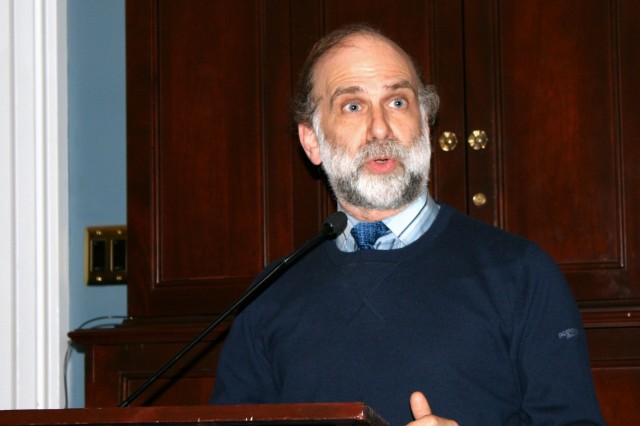
Bruce Schneier, at an Open Technology Institute presentation on Capitol Hill last Friday, said the NSA had created vulnerabilties in the Internet that criminals could exploit within the next two to three years.
Sean Gallagher
WASHINGTON, DC—To say that there are a lot of people who are angry with the National Security Agency right now would be an understatement. But the things that are getting the most political attention right now—such as the invasion of the privacy of American citizens and spying on the leaders of American allies—are just a fraction of the problem, according to cryptographer and Harvard University Berkman Center for Internet and Society fellow Bruce Schneier.
At a presentation in a conference room inside the US Capitol on Friday, Schneier—who has been helping The Guardian review the trove of documents provided by Snowden—said that in its haste to "weaponize" the Internet, the NSA has broken its mechanisms of security. And those breaks—including the backdoors that NSA convinced or coerced software developers to put into the implementations of their encryption and other security products, are so severe that it is now just a matter of time before others with less-noble causes than fighting terrorism will be able to exploit the holes NSA has created.
Schneier said that the vulnerabilities inserted into security products by NSA through its BULLRUN program could easily be exploited by criminals and other nation-stats as well once they are discovered. And the other attacks and surveillance methods used by NSA "will be tomorrow's doctoral theses and next week's Science Fair projects."
Google's chief internet evangelist, Vint Cerf, suggests that privacy is a fairly new development that may not be sustainable. "Privacy may actually be an anomaly," Cerf said at an FTC event yesterday while taking questions. Elaborating, he explained that privacy wasn't even guaranteed a few decades ago: he used to live in a small town without home phones where the postmaster saw who everyone was getting mail from. "In a town of 3,000 people there is no privacy. Everybody knows what everybody is doing."
"It will be increasingly difficult for us to achieve privacy."
Rather than privacy being an inherent part of society that's been stripped away by new technology, Cerf says that technology actually created it in the first place. "It’s...
The United States is silently watering down the text of an anti-spying UN resolution introduced by Germany and Brazil in order to ensure any extra-territorial violation of online privacy remains legal, according to a document obtained by The Cable. Read Full Article at RT.com
During Breaking Bad's remarkable run, there was a theory that at the end of the show, Walter White would be sent into witness protection — and he'd take on his new identity as Hal Wilkerson, the Malcolm in the Middle patriarch.
But what if, instead of a prequel to Malcolm in the Middle, Breaking Bad was just a dream within the show? A dream where Hal was free to use the B-word, to be married to a beautiful blonde woman, and to actually enact his Scarface fantasies. A shockingly logical alternate ending explores just that. The video's origins are slightly mysterious, though the name on the uploader's YouTube account, Michael Davies, matches the producer of discussion show Talking Bad. And, with the Breaking Bad DVD set due November...
Eu tinha ficado feliz, mas daí lembrei que Preacher não é essa coca-cola toda. E Seth Rogen :P A AMC é a melhor coisa do pacote.
Comic book adaptations have been coming to both the big and small screen at a dizzying pace lately, and rumor has it AMC will be the next outlet to get involved. The home of such critically-acclaimed shows as Mad Men and Breaking Bad is planning to launch an adaptation of Vertigo comic Preacher, says a report from Badass Digest. Actor Seth Rogan fanned the flames of this report on Twitter last night, saying that he "may get to bring one of my favourite stories ever to life." He followed that tweet up simply by saying "Arseface. John Wayne, The Saint of Killers," referencing two of Preacher's most notable characters.
Looks like about seven of years of hard work are about to pay off. I may get to bring one of my favourite stories...
Dear Lifehacker, I've read your complete guide to getting started with Linux, but I'm still a little nervous. You talk a lot about the advantages of Linux, but what about the disadvantages? I'm worried about not having the right apps, or having to constantly fix things that are breaking. Am I worrying for nothing, or are there real concerns?
Sincerely, Linux Learner
Dear Learner, Just like any operating system, Linux has its pros and cons. You've heard the pros before: It's free, it's super customizable, and it helps you learn a lot more about how your computer works. There are also a ton of distros, which means you can find the perfect one for you. While some have gotten a lot easier to use in the past few years, none are foolproof. I used Linux as my primary OS on and off for a year or so, and here are some of the things I found (and why I eventually switched back to Windows).
Linux Has Some Great Apps, but Is Missing Quite a Few
Linux's app situation is interesting. If you're worried about not having a good image editing program, photo library, or music player, you might be surprised—Linux has some pretty great offerings (just check out our Linux App Directory if you don't believe me). Apps like digiKam compete with professional-level apps on other operating systems, and you have a lot of choices in some categories.
However, if you use services like Evernote, Wunderlist, or Spotify, you're going to have a little more trouble. Wunderlist and Spotify do have Linux versions available, but they're often a step or two behind their Windows and Mac bretheren. Evernote has no official Linux client, and the third-party client Everpad isn't really very good. If you can rely on webapps for most of your services or are willing to switch to a Linux-native app, you'll be golden—but if you really like how Evernote works, you're going to be really frustrated and disappointed with Linux's offerings.
Linux Can Take a Lot of Initial Setup, Especially for Certain Hardware
Installing Linux is pretty easy these days, but getting everything "set up" the way you like it can take a little more work, depending on your hardware, your distro, and your preferences. For example, I have a five button mouse, but by default, only the left- and right-click buttons work out of the box. For the rest, I have to install a command line program, edit a config file to map the buttons to a function that I want, and set that program to run on startup—and all that takes a little trial and error to get working properly. On Windows, it comes with software that helps me do all this in a few minutes. I've experienced similar things with video drivers, laptop touchpads, secondary hard drives, and other specialized needs that don't work out of the box.
Again, a lot of this depends on your hardware and preferences—some people may be good to go on day one, but others may spend a week just getting things working the way they want them. And the pickier you are, the more trouble you're going to have. Linux may have more customization options than other operating systems, but they aren't always easy.
Linux Is Less Polished Than More Professional, Established Operating Systems
Even the most well put-together distros have some bugs and annoyances, and in my experience, they were far more numerous than Windows or OS X. Some are fixable by the user, but will add up to even more time just "getting things working." Heck, in my 30 days of using Linux Mint earlier this year, I experienced these known and documented annoyances:
Again, some of these are fixable, and some are bugs that may have already gotten fixed down the line—but for a distro that is supposed to be polished and beginner-friendly, it certainly caused a lot of headaches for me.
None of this is to say Linux is bad or that you shouldn't try it. As we've said many times, Linux has a lot of advantages—you may just need to put in a little extra work to get things up and running properly. Which apps, bugs, and frustrations you run into depend completely on your specific setup, and some may be much better off than others. But after a year or so of Linux use and multiple distros, this has been my experience.
In the end, Linux is great for a lot of things, even if you don't use it as your main OS. It's perfect for setting up a home theater PC without buying Windows, or reviving a super old machine. But if you want to really dig deeply and use it as your main operating system, just know that things are going to be a little different than Windows or OS X. For some, it's well worth the effort, but others may find that it's too much work for little payoff. The only way you can know is to try it out for yourself.
A Senate bill called the "Consumer Choice in Online Video Act" takes aim at many of the tactics Internet service providers (ISPs) can use to overcharge customers and degrade the quality of rival online video services.
Submitted yesterday by US Sen. Jay Rockefeller (D-WV), the 63-page bill (PDF) provides a comprehensive look at the potential ways in which ISPs can limit consumer choice, and it boots the Federal Communications Commission's power to prevent bad outcomes. Let's take a look at a few of the areas the bill targets.
Online video degradation
"It shall be unlawful for a designated Internet service provider to engage in unfair methods of competition or unfair or deceptive acts or practices, the purpose or effect of which are to hinder significantly or to prevent an online video distributor from providing video programming to a consumer," the bill states. A little more specifically, it would be illegal to "block, degrade, or otherwise impair any content provided by an online video distributor" or "provide benefits in the transmission of the video content of any company affiliated with the Internet service provider through specialized services or other means."
Os de 3 caracteres já estão pra lá de 30.000 euros.
Since she took over as CEO, Marissa Mayer has been working hard to revitalize Yahoo. She's insisted employees stop working from home, axed unproductive workers, and purged the rolls of unused email accounts. Today Yahoo announced that it has discovered a trove of domain names the company purchased but never ended up doing anything with. So in the spirit of renewal, they're putting them up for auction.
Neil Gaiman’s The Sandman is a must read for, well, for everyone. There are several printings of the many volumes in existence, but to celebrate the series’ 25th anniversary, DC Entertainment has announced the release of an epic The Sandman Omnibus Silver Edition.
This commemorative set comes in the form of a special slipcased edition that collects the entire groundbreaking series in two deluxe hardcover volumes and includes a page personally signed by Neil Gaiman. Only 500 of these bad boys were printed, and each one is numbered, which explains the “ask-for-it-as-a-present” price of $499.95.
If you’re Bruce Wayne, Tony Stark or some other millionaire playboy (or playgirl), you can order it for yourself here. They’re limiting purchases to one per person, but this is the Internet, and I promise someone will figure out a way to circumvent that, buy a bunch, and sell them for double on eBay, so act fast!
In keeping with the theme of the post, please also direct your attention to the Times Square Jumbotron, where DC Entertainment has placed an easy-to-see commercial for The Sandman: Overture, drawn by J.H. Williams, III. The commercial (which is also running on TV) features art from the new series written by Gaiman, as well as appearances of fan-favorites Death, Mer-Pumpkinhead and The Sandman himself, Morpheus.
The problem with creating Stuxnet, the world's most sophisticated malware worm, is that it could eventually go rogue. Which is precisely what has happened. The US- and Israeli-built virus has spread to a Russian nuclear plant — and even the International Space Station.
A Russian artist stripped naked outside Lenin's Mausoleum and nailed his testicles to a Red Square cobblestone in front of horrified passersby. It was a "metaphor for apathy, political indifference and fatalism of modern Russian society," he explained. Read Full Article at RT.com
Some of you know Pythagoras as the guy who correctly came up with the ratio of the sides of a right triangle. Now it's time you know him as a murderous cult leader. Maybe.
Fox's project of enabling Seth MacFarlane to offend everyone in America will now extend to the issue of immigration. The Family Guy creator has been given yet another show on the network — one about “the undergoing cultural shift in America.” Deadline reports that the network gave a thirteen-episode order ... More »
I'm a pragmatic father. There are things people should be scared of: chainsaws, power sockets and cars driving past at 60mph while you are walking. And then there are things that are just not scary: strangers, superstitious mumbo-jumbo, and bugs.
So I was a bit surprised when Dev showed signs of a fear of the dark. He wanted me to read in the kitchen rather than the living room. My wife suspected that the living room had a large window, which was dark. The recent Daylight Savings Time change made early evenings darker than a week ago. Even at 6pm, it was dark outside. Thankfully, my son can identify whether some thing bothers him, and I asked him if the dark was bothering him or if he was scared of it. He said that he was scared of the dark, and said it while staring at the dark window, shrinking back from it. No time like the present: we decided to tackle the issue right then.
First, we had a talk about it. I held him and told him that there was nothing scary about the dark, and that lots of beautiful things are visible at night: the Moon, stars, street-lights. We looked outside and asserted that there really wasn't anything scary there, and that he was safe in my arms. We both looked to see if there was anything particularly strange as we looked out of the window. Neither of us found anything.
Then, I asked him if we should step outside for a peek. He was hesitant, but he agreed. So we put on jackets and shoes and stepped out. Initially, my son clutched my hand tight. He was walking close by, he was subdued and quiet. We listed all the beautiful things about the night as we passed by them. We walked by some shrubs which were beautifully lit by street lighting. We walked by some decorative lighting in people's homes. Then we reached a prominent road. At this point, my son and I continued walking alongside the road, on the pavement. We saw some traffic lights, which were brightly visible from a distance away, we looked at road signs. After two intersections, we walked back.
On the way back, my son asked me to stop holding his hand. He was secure enough and holding my hand is uncomfortable for long walks. Then, he started singing in a happy and loud voice. He sang all the way back home. The only reason he wanted to enter the house was to tell mommy about our peek outside.
Parenting is about giving the child the right tools to survive as an adult. Feeding myths and falsehoods about the world are a terrible disservice to a curious child: stories about evil creatures in the night to get the child to stay silent, or stories made to get the child to eat. These stories are far from harmless. Fears grip their mind and children embellish their own fears with stories and falsehoods. Not starting myths and falsehoods is a start, and it is even better to address myths and irrational fears and reveal them as false nonsense.
Children are more capable than we give them credit for.
Vocês sabem o que as pessoas que deixam o WiFi aberto têm mais do que eu ou vocês. Né?
Brazil has called for an explanation from internet giant Google over allegations it gathered data on Brazilians through Street View. Following reports of the program being used to spy on EU citizens, Brazil has demanded data on its activities. Read Full Article at RT.com
Virtucon writes "This one goes to the old adage 'closing the stable door after the horse bolted.' A French court on Wednesday ruled that Google must remove from its search results photos of a former Formula One racing chief, Max Mosley, participating in an Nazi-themed orgy. Google could be fined up to 1,000 Euros/day for not complying. What's strange here is that Mosley A) Sued in a French Court B) Didn't go after anybody else other than Google and C) has definitely strange tastes in extracurricular activities. In this day and age it's laughable to think that once your private photos/videos hit the Internet that you have any expectation of reigning them in or filtering the embarrassing parts out. Google isn't the only game in town so to speak in terms of Internet search. I wonder if his lawyers checked out Yahoo or WebCrawler?"
Marvel and Netflix are teaming up for a sprawling, multi-year content partnership that will focus on NYC heroes centered in the Hell's Kitchen neighborhood, the company announced today. This will involve the creation of four new serialized shows, culminating in a multi-part miniseries tying the characters in each together. It's probably the most ambitious original programming initiative announced by Netflix to date, and it's also Marvel's biggest bet on non-film live action content.
The four shows will foucs on Daredevil, Jessica Jones, Iron Fist and Luke Cage, characters familiar to hardcore comic fans but possibly not to the broader audience Marvel has brought in to its comic book universe via blockbuster films like Iron Man and The Avengers. These characters are often portrayed as neighborhood watch-type heroes, or blue collar superhumans who fight more street crime than laser-toting aliens.
All four shows will have a minimum of 13 episodes, and these should culminate in a mini-series called The Defenders (after the Marvel superhero team of the same name, and with a different makeup to that pictured in the comic cover above), in which Daredevil, Jones, Iron Fist and Cage team up. That's as far as either Marvel or Netflix are going in terms of revealing plot at this point.
Marvel has already dabbled in live action serial TV recently, with Agents of S.H.I.E.L.D. on ABC. The show premiered this fall, to high expectations because of the success of the Marvel film franchises, the inclusion of popular character Agent Phil Coulson from the Avengers movie, and Joss Whedon's name being attached to the project. Fans and critics haven't enjoyed the show so far, however, and ratings continue to drop precipitously, raising questions about its future.
This series of shows with Netflix raises hope that Marvel's next TV outing might not be such a clumsily executed affair. It's got superheroes, for one thing, instead of people mopping up after those with powers, and there seems to be a grand plan in place that might avoid a formulaic freak-of-the-week pattern of disconnected episodes, like we've been getting with Agents. Of course, only time will tell how good or bad it is, and we'll have to wait until 2015 to find out, since that's when the air date of the shows is set to begin. These are great characters with a lot of potential (Ben Affleck Daredevil movie travesty aside), so let's hope Marvel gets it right this time.
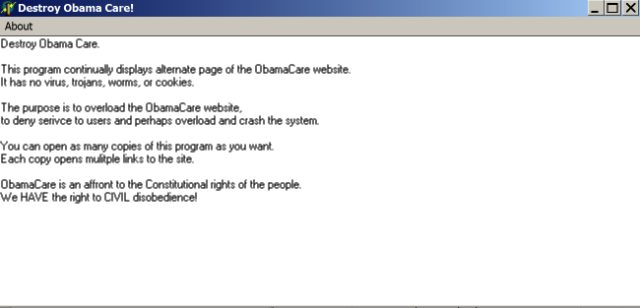
Researchers have uncovered software available on the Internet designed to overload the struggling Healthcare.gov website with more traffic than it can handle.
"ObamaCare is an affront to the Constitutional rights of the people," a screenshot from the tool, which was acquired by researchers at Arbor Networks, declares. "We HAVE the right to CIVIL disobedience!"
In a blog post published Thursday, Arbor researcher Marc Eisenbarth said there's no evidence Healthcare.gov has withstood any significant denial-of-service attacks since going live last month. He also said the limited request rate, the lack of significant distribution, and other features of the tool's underlying code made it unlikely that it could play a significant role in taking down the site. The tool is designed to put a strain on the site by repeatedly alternating requests to the https://www.healthcare.gov and https:www.healthcare.gov/contact-us addresses. If enough requests are made over a short period of time, it can overload some of the "layer 7" applications that the site relies on to make timely responses.
Texto vazio. Nenhum ponto objetivo e 1/4 falando de cores. Como é isso de com excessão da Lenovo? Pq? Sai fora Alienware também?
A primeira geração do Macbook Air foi apresentada por Steve Jobs em 2008, naquela célebre cena do envelope. Veja o vídeo aqui:
No dia seguinte, já vendia feito água.
Os primeiros concorrentes surgiram quase um ano depois. Falharam e saíram de linha. Hoje, quase seis anos desde 2008, estamos vendo uma chuva de notebooks parecidos ao Air.
Com Windows, há notebooks com hardware superior aos modelos da Apple. Mas, por que precisam usar a mesma cor do Macbook e, até mesmo, teclado e trackpad tão parecidos para convencer?
Talvez porque não seja preciso um PhD em psicologia ou MBA em administração para dizer que a gente compra primeiro com os olhos e depois com o bolso.
O problema é o legado de atraso que as principais fabricantes de PCs estão nos deixando.
Em um mercado movido a inovação, é incompreensível que as principais marcas não consigam apresentar uma novidade digna de destaque e, principalmente, de investimento na compra.
Atestado de incompetência duplamente exposta, porque também revela a ineficácia na gestão do capital humano entre design e engenharia.
A Apple descobriu isso cedo e soube capitalizar em cima do design, às vezes passando por cima até mesmo do hardware.
É claro que muita gente abandona o Windows porque não aguenta mais tanto vírus, tanta dificuldade e tanta frescura. Mas o design do Macbook e do iMac é, por si só, um trunfo comercial que até agora ninguém conseguiu sequer chegar perto.
Conheço muita gente que não gosta do iPhone por causa da Apple e do iOS. Sim, elas existem. Pergunte se elas topariam ter um iPhone se pudessem colocar Android no lugar do iOS. Ou se o aparelho fosse 300 dólares mais barato.
O próprio iOS é um trunfo de design. Mantendo as devidas e sempre presentes exceções, quem se acostuma ao iPhone nunca mais quer saber de outro aparelho.
Eu não pago 700 dólares no iPhone 5S porque ele vai me oferecer exatamente a mesma coisa que o iPhone 4 oferece hoje, dentro das minhas necessidades estritamente individuais.
Mas, se tivesse 700 dólares de bobeira, compraria porque ele é mais bonito, mais leve e mais resistente. E só.
Design de manada
Esse legado decorre não somente pela incapacidade de replicar um design de sucesso; mas, sobretudo, da incapacidade de oferecer novidades visualmente atraentes.
Por que as fabricantes insistem no mesmo design desde os primeiros notebooks lançados no mercado, há décadas? Uma peça preta, quadrada, que utiliza muito mal os espaços internos e externos. E com teclados incrivelmente ruins, com a notória exceção da Lenovo, que herdou o que havia de melhor dos antigos Thinkpad da IBM.
Por que tanta gente procura – e não encontra – um notebook que tenha teclado retroiluminado para escrever no escuro? Um recurso tão simples, tão fugaz, tão necessário, mas com Windows parece artigo de luxo.
Por que esperaram a Apple se arriscar com uma tela de alta definição (retina) para somente depois lançarem notebooks com resolução equivalente ou maior?
Os notebooks de hoje me lembram o velho Santana, da Volkswagen. Um carro grande por fora e pequeno por dentro. Você entrava e se sentia apertado, mesmo sem conseguir entender ou explicar como isso acontecia se de longe o carro era enorme.
A Apple não é a única a ter engenheiros e designers de qualidade. Então do que se trata? Custo de produção? Medo de inovar e as pessoas não comprarem?
Quem usa Mac há pouco tempo talvez não lembre, mas o Macbook também foi preto. Bem parecido a todos os outros.
A Apple resolveu acabar com o Macbook preto e, anos depois, o Macbook White. Detalhe: milhares de pessoas adoravam aquele tijolo branco. Quase uma arma branca, literalmente.
Foi uma decisão corajosa e comercialmente duvidosa. As concorrentes, em vez de entrarem com os dois pés neste nicho que se abriu, ficaram a ver navios. Continuaram oferecendo notebooks quase que exatamente idênticos. Pretos e quadrados.
Um ano depois do primeiro Macbook Air, a Dell ofereceu durante um curtíssimo tempo um produto incrível chamado Adamo. Foi minha máquina dos sonhos e, se a Dell ainda vendesse, provavelmente eu teria um hoje. Lançaram em 2009 e pararam de produzir em 2010. Quem comprou, dançou.
A Sony também tinha um notebook finíssimo, revestido em fibra de carbono, pesando 0,7 kg. Você não leu errado. São 700 gramas. Significa quase 0,4 kg a menos que o atual Macbook Air de 11 polegadas, que pesa 1,08 kg. Isso ali em meados de 2009 também.
O Adamo não vendeu simplesmente porque a Dell cobrava três vezes mais e entregava três vezes menos em termos de design e engenharia. A Sony cobrava um valor um pouco mais honesto, porém a máquina era lenta demais já para os padrões da época. E com 700 gramas, a bateria durava duas horas em uso real.
Tenho um até hoje, cujo modelo atende pelo inspirado nome de VPCX 115 KX. Típico da Sony.
O Adamo, da Dell, era tudo que o modelo da Sony queria ser e não conseguia. Foi apenas um dos vários produtos bons que a Dell não soube administrar estrategicamente. Tiraram de linha. O Adamo e a própria Dell.
Hoje, quem consegue resistir ao visual do Macbook Air? Muita gente não compra porque é mais caro, porque não quer aprender outro sistema operacional, porque vai dar confusão com os arquivos do trabalho.
Ou simplesmente porque não precisa. E nem por isso deixa de suspirar quando coloca um nas mãos, por ser tão leve e ao mesmo tempo atraente. Além de mais rápido do que a maioria dos notebooks concorrentes com Windows.
Asus, Acer, Toshiba, Lenovo, Samsung e várias outras marcas oferecem concorrentes ao Macbook Air. Se você tirar o nome da fabricante, dificilmente vai ver muita diferença entre eles.
Não existe inovação no tribunal
A Samsung processa a Apple seguidas vezes (e vice-versa) por causa de patentes. Faz isso ao mesmo tempo que fornece hardware e matéria-prima para os produtos da mesma Apple.
Ou seja, a Samsung não tem problema de logística, fornecimento, matéria-prima e nem de hardware. Da máquina de lavar roupa às telas de alta resolução, os produtos da Samsung são ubíquos. Uma palavra que os coreanos adoram.
Por que a Samsung não oferece um concorrente do iMac? Por que os tabletes da Samsung parecem tijolos pretos?
Nada contra a Samsung. Queria mesmo que eles fossem os primeiros – por terem condições reais para isso – a oferecer uma concorrência real ao iMac e ao Macbook.
Até porque, hoje, se a gente quiser comprar um iMac, vamos ter que vender o carro. E a patroa não vai entender essa troca justa. [Webinsider]
AMC was careful to specify that Better Call Saul would be a prequel when it first announced its plans for the spinoff series, but the ending of Breaking Bad left us wanting to know what happened after that grand finale. Luckily, Bob Odenkirk says there’s a chance we could still find out.
According to him, Vince Gilligan and Peter Gould have also discussed the idea of doing Better Call Saul as a sequel, or perhaps a prequel/sequel hybrid. Hit the jump to read his comments. (Spoilers for Breaking Bad follow, duh.)
Although Saul was one of the characters to survive the series, his current life is a mystery. The last time we saw our favorite sleazy TV lawyer, he’d called the vacuum cleaner repairman, and was leaving Albuquerque behind to start fresh in Nebraska.
The idea of loud, obnoxious, flamboyant Saul trying to “manage a Cinnabon in Omaha,” as he imagined it, seemes rife with comedy gold, so IGN asked the actor whether his new show might incorporate scenes from the character’s post-”Granite State” life. Odenkirk acknowledged that it was a possibility.
Well, I’ve talked to Vince (Gilligan) and Peter (Gould), who are writing and creating the series, about this and I’ve said that a lot of people do want to see what happens to next to Saul. So, I don’t know what they’re going to do. I know they’ve talked about prequel, but they’ve also talked to me about sequel, and they’ve also talked to me about a mix of prequel and sequel.
AMC previously described Better Call Saul as centering on “the evolution of the Goodman character before he ever became Walter White’s lawyer,” but of course that was before we knew whether Saul would even live through the end of the season. Odenkirk’s comments suggest that the decision hadn’t actually been made at that point. Perhaps the network felt compelled to confirm that it’d be a prequel just to avoid dropping a potential spoiler.
Either way, Gilligan and Gould should be setting a course soon. “Well, supposedly the writers are starting up in two or three weeks, so they’re trying to get that ready,” said Odenkirk.
And while Gilligan has said that Breaking Bad stars Bryan Cranston and Aaron Paul could pop up from time to time, Odenkirk stressed that “this is its own thing.” “Oh my God, I told Peter and Vince, right away I said, ‘Look man, let us make this fresh for everyone,’” he said. “There might be a cameo here or there, but I don’t know. We’re going to do a new show.”
Would you rather see pre-BB Saul, post-BB Saul, or both? Or neither?
If you have an extra monitor sitting around and love the idea of making it a bit more unique, then this monitor hack may be the perfect ‘trick’ to use for your next DIY project.
Here is extra footage compiled during the making of the video above that you can enjoy watching.
Possibilidade de prelúdio para qualquer holocausto que você prefira acreditar.
Dengue fever is one of the most virulent mosquito-borne diseases afflicting the planet. According to the World Health Organization (WHO), 2.5 billion people worldwide are currently at risk of contracting dengue, and the organization estimates that there may be 50–100 million new infections each year. However, The Associated Press reports that scientists are now releasing dengue-resistant mosquitos into Vietnam in the hopes of curbing the spread of the disease. The key is engineering the mosquitoes to carry Wolbachia, a bacteria that prevents dengue from being transmitted.
Wolbachia infects the cells of up to 70 percent of the world’s insects. Research has shown that it also prevents the replication of diseases like yellow fever,...
O cara esqueceu de dizer que parte da espionagem da NSA parece ter caráter comercial. O que é pra lá de escroto.
Earlier today a Brazilian newspaper broke the story that ABIN, the top intelligence agency in that country, has employed low-tech spying techniques on foreign diplomats.
This is sticky for the country as it has been intensely critical of the NSA and its practices of mass surveillance the world around. If the NSA is spying, and ABIN is spying, do we come to a wash, all walking away simply saying that everyone spies, so calm down?
Not in the least.
Let's review a few facts. Governments spy. They even joke about how they all do it. This is the normal state of affairs, as it has always been the state of affairs.
Here's the New York Times discussing Brazil's efforts to spy on people, as originally reported by Folha de São Paulo:
The statement followed a report in the newspaper Folha de São Paulo describing how the Brazilian Intelligence Agency, commonly known as Abin, had followed some diplomats from Russia and Iran on foot and by car, photographing their movements, while also monitoring a commercial property leased by the United States Embassy in Brasília, the capital.
So, we're talking about activities so basic that they aren't uncommon among ex-partners who are a bit hung up on the end of a relationship. And if the United States didn't expect that its embassies on foreign soil might be target for local surveillance, I'll shave my head.
Now for context, here's a partial roll of the NSA's activities that have been recently revealed:
That's just a taste and doesn't include the domestic efforts of the agency and even most of its foreign work.
If governments are going to spy, why am I unhappy with the NSA and its efforts? Because there is a difference between walking behind a visiting diplomat to see where she goes than ending digital privacy for all global citizens. If you can't feel the difference between the two, I doubt that we are going to be able to come to comity on this issue.
I find it frustrating that people are comparing two things of utter disparate scale as if they are commensurate. They are not.
And no, I would not be either offended or surprised if the United States government dispatches gumshoe hacks to walk 15 feet behind certain diplomats. Sure. Go for it. But the fact that governments do that has nothing to do with the NSA's offenses to privacy, and therefore democracy. Don't trivialize the destruction of the fundamental core tenet of democracy.
I know this is terribly radical, but 1) the privacy rights of Americans matter, and 2) the privacy rights of non-Americans do, too.
I haven't said much about this. I don't know exactly what to say that others haven't said better, and I honestly fear what stepping in to becoming a big part of this discussion as a non-American might mean – a fear that surely resonates with a lot of my peers. The only thing I can say, is that it has made me paranoid in that "privacy is my right" kind of way – much to the joy of my paranoid computer science friends who now get to quote me on saying "dammit, you guys were right." But, to seeguys from one of the big "targets," Google, start publicly lash out at the NSA is pretty unexpected. Among everyone who's spoken about this, Brandon Downey says it better than anyone else has:
Fuck these guys.
[...] seeing this, well, it's just a little like coming home from War with Sauron, destroying the One Ring, only to discover the NSA is on the front porch of the Shire chopping down the Party Tree and outsourcing all the hobbit farmers with half-orcs and whips.
While "fuck" is probably not the single most constructive word to use in this context, Mike Hearn took a step back and got it right:
O sonho de muitos usuários deste hobby é montar o seu home theater não com uma tela de TV, mas com um projetor de vídeo de alto ganho. Embora o número de usuários de projetores diversos tenha se mantido ou até possivelmente aumentado ao longo dos últimos anos, ele provavelmente não chega nem perto do número de pessoas que usam a TV como display para filmes de cinema. E, justiça seja feita, as telas de TV evoluíram rapidamente de qualidade e aumentaram de tamanho, dando hoje uma qualidade de imagem que rivaliza ou é até melhor do que a tela de uma sala de cinema, se devidamente calibrada.
A adoção sem restrição de projetores esbarrou, e ainda esbarra, em uma série de empecilhos. Entre eles está o fator custo de manutenção: as lâmpadas convencionais custam quase o preço do aparelho, sua vida útil é relativamente curta e precisa ser instalado com cuidado, para se evitar queima dos elementos emissores de luz. Além disso, existe o problema da luminosidade do ambiente, pois projetores exigem salas com certo grau de obscuridade, para funcionarem corretamente.
Mas agora, com novas tecnologias emergentes, este cenário irá mudar drasticamente, e eu me arrisco a afirmar que os empecilhos de instalação ficarão restritos a preço e facilidade de montagem em um determinado ambiente.
O que permitirá que isto aconteça está justamente na tecnologia de iluminação e filtros, com capacidade potencial do aumento do número de lumens, gama de cores e resolução. Alguns modelos já são desenhados para vídeo com 4K, e isto certamente estimulará a mudança de tela de TV para telas convencionais.
A tecnologia de fonte de luz com raio laser e LEDs
Segundo analistas, 2013 será o ano da fonte de luz com raio laser para projetores. Neste momento, existem dois tipos básicos de design, ambos com o uso de laser azul, mas um deles servido pelo acoplamento de dois LEDs, tornando-o assim um modelo híbrido.
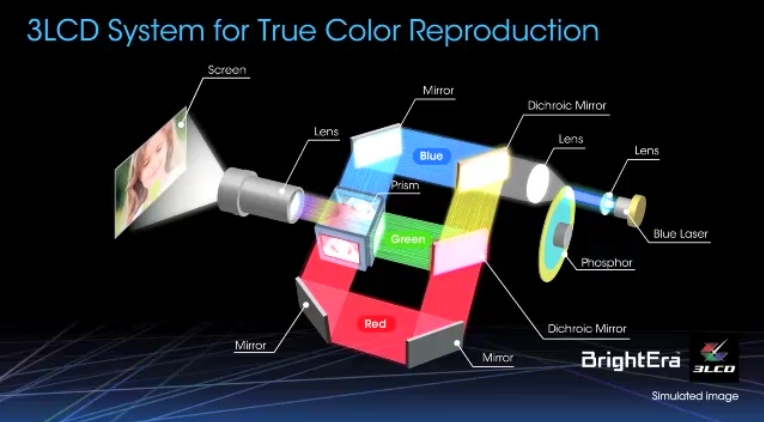
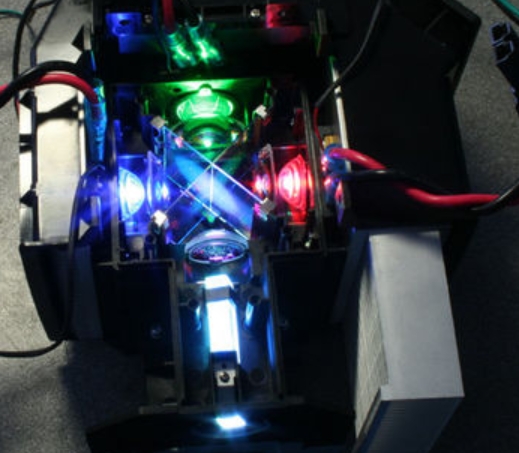
Em ambos os designs um feixe de raio laser azul (emissão de 505 nm) incide sobre uma camada de fósforo separada da fonte, chamada de “remote phosphor” (“fósforo remoto”), que pode ser aplicada em qualquer posição diante deste feixe. De acordo com o seu tipo de fósforo, o fósforo remoto é excitado pelo laser azul e emite uma luz intensa: branca (RGB) no caso do modelo somente com o uso de um único laser, e verde, no caso do modelo híbrido. Este último consiste no uso do raio laser emitindo a cor verde (G) e LEDs para a emissão de cor azul (B) e vermelha (R).
A propósito, o fósforo remoto é também uma alternativa para o LED branco em muitas aplicações, uma vez acoplado a um LED azul. A montagem das placas de fósforo diminui significativamente o desvio de luz, ao mesmo tempo em que diminui o gasto de energia e custo de fabricação. A obtenção de cor branca é possível pela combinação dos fótons das luzes azul e amarela. No caso de um LED coberto por uma camada de fósforo, que é o exemplo mais simples, os fótons da luz azul do LED passam direto, enquanto o fósforo é excitado e emite fótons na cor amarela, permitindo a combinação na luz final emitida.
Os designs das modernas lanternas para projetores de vídeo, seja com emissão de LED ou laser, tem a vantagem precípua de transformar a fonte de luz de um tipo qualquer de filamento para componentes em estado sólido. Na prática, isto significa maior durabilidade (previsão de 20 000 horas de uso, ou oito anos no caso do laser), ausência de danos por movimentação acidental do aparelho (filamentos podem facilmente queimar por algum tipo de choque físico), possibilidade de uso do projetor em qualquer ângulo, maior controle sobre o espectro de emissão da fonte luminosa, e finalmente a eliminação virtual da manutenção do equipamento.
A fonte de sinal de vídeo pode tanto ser convertida em imagem pelo uso de LCDs, DLP ou LCOS. Ultimamente, o design com 3 LCDs tem sido favorecido por vários fabricantes, independentemente do uso de raio laser ou LED. A Sony, por exemplo, lançou em 2013 um modelo com laser azul, fósforo remoto, e montagem de espelhos dicroicos, de modo a obter RGB, antes da integração do sinal:
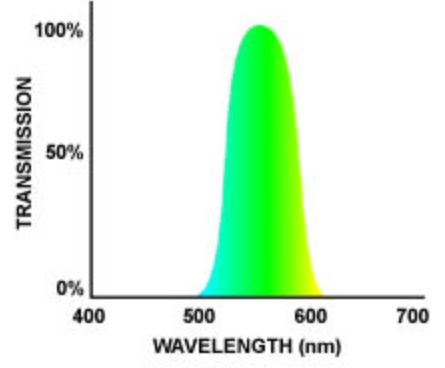
A introdução de filtros dicroicos (filtros de interferência), no lugar de filtros de barreira (filtros de absorção), aumenta a acuidade da faixa de luz transmitida. Tipicamente, filtros de luz deixam passar energia nas faixas de comprimento de onda adjacentes, motivo pelo qual eles são imprecisos.
O filtro dicroico deixa passar luz de um comprimento de onda e reflete a luz de outro comprimento de onda, com a ajuda de um depósito de filme metálico na superfície do vidro. O espelho dicroico é a mesma coisa, mas é caracterizado pela luz refletida ao invés da luz transmitida.
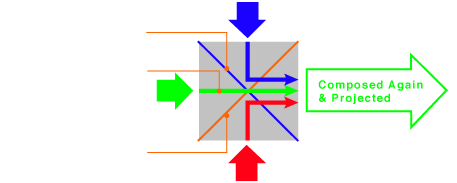
Na montagem do conjunto de 3 LCDs é usado uma matriz transmissiva feita de poli silicone cristalino de alta temperatura (HTPS). A integração é conseguida através de um prisma, com o somatório das imagens RGB.
Lanternas com um feixe único de laser são mais recentes no mercado. Anteriormente, as lanternas mais modernas foram desenhadas com a ajuda de LEDs e DLP, e posteriormente com o uso de um design híbrido à base de laser e LED.
LED/DLP
Laser/LED Híbrido
Evolução
Cada fabricante se esmera para oferecer alternativas de fonte de luz com economia, durabilidade e acuidade cada vez maiores. O que está em jogo não é só o número de horas de vida a ser atingido nem a quantidade de watts gasta, é também e principalmente a representação do espaço de cores necessário à qualidade da melhor imagem possível.
Está cada vez mais patente que o desgaste das lâmpadas convencionais levará a maioria dos fabricantes a diminuir a oferta de projetores com este tipo de fonte de luz. É bastante provável que em um futuro próximo estas lâmpadas se restrinjam ao mercado de reposição.
O uso de projetores em home theaters continua, entretanto, condicionado à existência de ambiente com luminosidade interna adequada, o que nem sempre é possível. O mercado de projetores visa principalmente o uso dos mesmos em instituições de ensino e ambientes corporativos, motivo pelo qual o segmento não para de introduzir novos, mais econômicos e duráveis modelos.
O dia-a-dia das pessoas fora destes ambientes é bem mais complexo. As instalações de áudio e vídeo precisam contemplar usos diversos, com a adoção, no caso da imagem, de mais de uma fonte de sinal. Isto torna o uso de projetores pouco prático, a não ser que o usuário vislumbre uma maneira de conciliar interesses.
De qualquer forma, parece evidente que o futuro dos atuais projetores de vídeo ainda tem muito para evoluir. E nós teremos que ser pacientes para descobrir que tipo de futuro é. No momento, projetores com 4K domésticos estarão por aí, mas os aparelhos de TV com esta resolução saíram mais rápido no mercado e poderão deixar em dúvida a decisão do consumidor potencial deste segmento. [Webinsider]
…………………………
Conheça Home Theater Básico, o livro de Paulo Roberto Elias. Disponível para Kindle na Amazon.




 The United States is silently watering down the text of an anti-spying UN resolution introduced by Germany and Brazil in order to ensure any extra-territorial violation of online privacy remains legal, according to a document obtained by The Cable.


 A Russian artist stripped naked outside Lenin's Mausoleum and nailed his testicles to a Red Square cobblestone in front of horrified passersby. It was a "metaphor for apathy, political indifference and fatalism of modern Russian society," he explained.


 Brazil has called for an explanation from internet giant Google over allegations it gathered data on Brazilians through Street View. Following reports of the program being used to spy on EU citizens, Brazil has demanded data on its activities.