As academics we live and die by our research. While our proofs are either correct or not, the import of our work has a far more subjective feel. One can see where the work is published or how many citations it gets and we often say that we care most about the true intrinsic or extrinsic value of the research. But the measure of success of a research that we truly care most about is how it is viewed within the community. Such measures can have a real value in terms of hiring, tenure, promotion, raises and grants but it goes deeper, filling some internal need to have our research matter to our peers.
So even little things can bother you. Not being cited when you think your work should be. Not being mentioned during a talk. Seeing a review that questions the relevance of your model. Nobody following up on your open questions. Difficulty in finding excitement in others about your work. We tend to keep these feelings bottled up since we feel we shouldn't be bragging about own work.
If you feel this way a few things to keep in mind. It happens to all of us even though we rarely talk about it. You are not alone. Try not to obsess, it's counterproductive and just makes you feel even worse. If appropriate let the authors know that your work is relevant to theirs, the authors truly may have been unaware. Sometimes it is just best to acknowledge to yourself that while you think the work is good, you can't always convince the rest of the world and just move on.
More importantly remember the golden rule, and try to cite all relevant research and show interest in other people's work as well as your own.
Nosimpler
Shared posts
17 Mar 21:21
Synopsis: Cold Atoms, Meet Flux Quanta
A cloud of atoms trapped close to a superconducting ring can detect the magnetic field inside the ring with single-quantum sensitivity.

Published Tue Mar 17, 2015
Published Tue Mar 17, 2015
17 Mar 03:40


Anti-Robot Protesters Take to SXSW
by Elizabeth Nolan Brown
 This year's South by Southwest (SXSW) festival featured a "robot petting zoo," a screening of new A.I. movie Ex Machina, and panels on robot-written news and self-driving cars. But not everyone at Austin's annual music, film, and technology festival is feeling optimistic about such developments. On Saturday, about two dozen members of the group Stop the Robots gathered for a SXSW protest, holding signs with slogans such as "Humans are the future" and chanting "I say robot, you say no-bot."
Though it reads like a prank or an Ex Machina publicity stunt, protest leaders insisted they were serious. "This is is about morality in computing," Adam Mason, 23, told USA Today.
While some (including myself) are still skeptical, outlets from USA Today to TechCrunch are saying that the protest and the sentiments expressed there were authentic.
A spokesperson for the group told TechCrunch they hoped to raise awareness about the possible dangers of uncontrolled growth and development around artificial intelligence and robotics. He stressed, however the group wasn’t against technology per se or even robots and AI, but they wanted to make sure that these technologies were developed in a controlled way.
...the protest spokesperson insisted they didn’t intend to stop the progress of technology, but they hoped to encourage government oversight and even a worldwide organization to make sure that these technologies are developed safely and under controlled growth.
According to the Stop the Robots website, the organization "is dedicated to using technology for good and understanding the true risks that artificial intelligence poses to humanity." Links on the site go to articles such as "Why You Should Fear Machine Intelligence" and "The Need For Regulation."
For some reasons why you shouldn't fear machine intelligence, check out Reason's recent robot issue.
09 Mar 15:23
I first posted this video several years ago, but I find it to be endlessly fascinating. A hat tip to 22 words for reminding me.
Addendum: And a hat tip to several readers for pointing out that this diving skill has some intriguing scientific roots, nicely summarized at one of my favorite science blogs, Not Exactly Rocket Science:
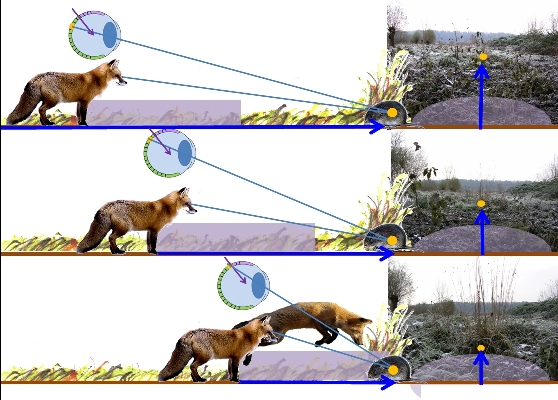
- from an article in Nature. Evolution is so amazing.
Reposted from 2011 to add this video of a domestic dog pouncing the shadow of a bouncing baby:
A fox dives into DEEP snow - update #2
by Minnesotastan
I first posted this video several years ago, but I find it to be endlessly fascinating. A hat tip to 22 words for reminding me.
Addendum: And a hat tip to several readers for pointing out that this diving skill has some intriguing scientific roots, nicely summarized at one of my favorite science blogs, Not Exactly Rocket Science:
Jaroslav Červený has found that when red foxes pounce, they mostly jump in a north-easterly direction. He thinks that they’re using the Earth’s magnetic field to hunt.This totally fascinating ability is discussed in more detail at the link, and illustrated here -
Červený spent over two years studying wild red foxes in the Czech Republic, with the help of a 23-strong team of wildlife biologists and experienced hunters. The team recorded almost 600 mousing jumps, performed by 84 foxes at a wide variety of locations and times.
They found that foxes strongly prefer to jump in a north-easterly direction, around 20 degrees off from magnetic north. This fixed heading was important for their success as hunters. They were more likely to make a kill if they jumped along their preferred axis, particularly if their prey was hidden by high cover or snow. If they pounced to the north-east, they killed on 73% of their attacks; if they jumped in the opposite direction, they success rate stayed at 60%. In all other directions, only 18% of their pounces were successful...
Červený suggests that a red fox could use the Earth’s magnetic field as a “rangefinder”, to estimate the distance to its prey and make a more accurate pounce. This targeting system works because the Earth’s magnetic field tilts downward in the northern hemisphere, at an angle of 60-70 degrees below the horizontal. As the fox creeps forward, it listens for the sound of a mouse. It’s searching for that sweet spot where the angle of the sound hitting its ears matches the slope of the Earth’s magnetic field. At that spot, the fox knows that it’s a fixed distance away from its prey, and it knows exactly how far to jump to land upon it...
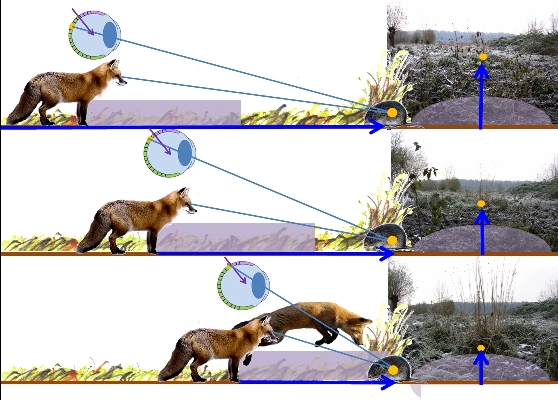
- from an article in Nature. Evolution is so amazing.
Reposted from 2011 to add this video of a domestic dog pouncing the shadow of a bouncing baby:
09 Mar 14:25


The Problem with Prosecutorial Immunity
by Jesse Walker
In his latest USA Today column, Glenn Reynolds discusses The People v. Efrain Velasco-Palacios, a California case in which prosecutor Robert Murray inserted a fraudulent confession into a translated transcript of the defendant's interrogation.
Good news: When the judge learned what had happened, he threw out the case. Bad news: The state appealed the judge's decision—arguing, Reynolds writes, that "putting a fake confession in the transcript wasn't 'outrageous' because it didn't involve physical brutality." More good news: The appeals court didn't buy this bizarre argument. More bad news:
Murray suffered no actual punishment for his wrongdoing. As a report in the New York Observer notes: "For reasons beyond comprehension, he still works for the District Attorney Lisa Green in Kern County, Calif." Murray does face the possibility of discipline from the California bar, but even disbarment would be a light punishment for knowingly producing a false document in a criminal proceeding.
Our criminal justice system depends on honesty. It's also based on the principle that people who do wrong should be punished. Prosecutors, however, often avoid any consequences for their misbehavior, even when it is repeated.
Worse yet, prosecutors are also immune from civil suit, under a Supreme Court-created doctrine called "absolute immunity" that is one of the greatest, though least discussed, examples of judicial activism in history. So prosecutors won't punish prosecutors, and victims of prosecutors' wrongdoing can't even sue them for damages.
That leaves courts without much else to do besides throwing out charges in cases of outrageous misconduct. But if we care about seeing the law enforced fairly and honestly, we need more accountability.
Reynolds goes on to suggest some reforms, the most important of which—as far as I'm concerned—is the abolition of absolute immunity for prosecutors. Like any other people in positions of authority, prosecutors need serious checks on their power; otherwise, all kinds of abuses are enabled.
07 Mar 00:13
"Consider the prison-phone industry" - updated
by Minnesotastan
From an article explaining how the prison system in the United States has been corporatized into profitable ventures:
Addendum/update: I posted the above in March of 2015. Now in October comes a report that the FCC is going to mandate a cap of 11 cents per minute:
The profits generated by the corrections economy have not been definitively calculated, and a comprehensive audit would be a staggering accounting task. The figure would have to include the cost of private-prison real estate, mandatory drug testing, electronic monitoring anklets, prison-factory labor, prison-farm labor, prison-phone contracts, and the service fees charged to prisoners’ families when they wire money for supplies from the prison commissary. Contracted commercial activity flows in and out of every city jail, rural prison, suburban probation office, and immigration detention center. For stakeholders in the largest peacetime carceral apparatus in the history of the world, the opportunities for profit add up. For analysts like Sommer, the system also offers a safe, government-secured investment...
Consider the prison-phone industry. For inmates, especially urban felons shipped to far-off rural sites, calls to the outside are a social lifeline and a proven method for reducing recidivism. But here, too, Wall Street has identified a high-demand, low-supply commodity. Other government contractors, be they food suppliers or dentists, collect fees paid out by the state. Prison-phone companies, and the prison-wire-transfer companies that are following their model, extract revenues directly from inmates and their families. (Fifteen dollars for a fifteen-minute phone call is not uncommon.)
As with partnership corrections, profits are largely determined by contracts, but phone and money-transfer companies sweeten the deals for their public partners with profit-sharing perks. These commissions kick back anywhere from 40 to 60 percent of revenue to the contracting government agency. According to a study by Prison Legal News, a publication of the Human Rights Defense Center, about 85 percent of non-federal jails sign up for commission-added contracts, and because commissions increase in proportion to the total contract value, cash-strapped public officials are motivated to choose the most expensive contract available. Prison Legal News found that when Louisiana put out a public request for proposals for phone services in 2001, the agency stated the wish explicitly: “The state desires that the bidder’s compensation percentages . . . be as high as possible.”
Addendum/update: I posted the above in March of 2015. Now in October comes a report that the FCC is going to mandate a cap of 11 cents per minute:
The FCC said its vote yesterday "lower[s] the cap to 11 cents per minute for all local and long distance calls from state and federal prisons, while providing tiered rates for jails to account for the higher costs of serving jails and smaller institutions."
Part of the problem is that jails and prisons have been charging phone companies big commissions in exchange for exclusive contracts. These commission payments are passed on to prisoners.
The FCC did not outlaw commissions but said that it "strongly encourages parties to move away from site commissions and urges states to take action on this issue." Clyburn said that "states must do their part and take a hard look at their site commission practices and how such payments impact prices, service, and the reverberating impact on the community."
Ionut likes this
05 Mar 08:39
[Report] Observation of optical polarization Möbius strips
by Thomas Bauer
Möbius strips are three-dimensional geometrical structures, fascinating for their peculiar property of being surfaces with only one “side”—or, more technically, being “nonorientable” surfaces. Despite being easily realized artificially, the spontaneous emergence of these structures in nature is exceedingly rare. Here, we generate Möbius strips of optical polarization by tightly focusing the light beam emerging from a q-plate, a liquid crystal device that modifies the polarization of light in a space-variant manner. Using a recently developed method for the three-dimensional nanotomography of optical vector fields, we fully reconstruct the light polarization structure in the focal region, confirming the appearance of Möbius polarization structures. The preparation of such structured light modes may be important for complex light beam engineering and optical micro- and nanofabrication.
Authors: Thomas Bauer, Peter Banzer, Ebrahim Karimi, Sergej Orlov, Andrea Rubano, Lorenzo Marrucci, Enrico Santamato, Robert W. Boyd, Gerd Leuchs
28 Feb 19:42


Other Interesting arXiv Papers (Week ending February 28, 2015)
The best of the rest from the Physics arXiv preprint server.
Computing Real Numbers using DNA Self-Assembly
28 Feb 00:12

Concepts of Sameness (Part 4)
by john
This time I’d like to think about three different approaches to ‘defining equality’, or more generally, introducing equality in formal systems of mathematics.
These will be taken from old-fashioned logic — before computer science, category theory or homotopy theory started exerting their influence. Eventually I want to compare these to more modern treatments.
If you know other interesting ‘old-fashioned’ approaches to equality, please tell me!
The equals sign is surprisingly new. It was never used by the ancient Babylonians, Egyptians or Greeks. It seems to originate in 1557, in Robert Recorde’s book The Whetstone of Witte. If so, we actually know what the first equation looked like:

As you can see, the equals sign was much longer back then! He used parallel lines “because no two things can be more equal.”
Formalizing the concept of equality has raised many questions. Bertrand Russell published The Principles of Mathematics [R] in 1903. Not to be confused with the Principia Mathematica, this is where he introduced Russell’s paradox. In it, he wrote:
identity, an objector may urge, cannot be anything at all: two terms plainly are not identical, and one term cannot be, for what is it identical with?
In his Tractatus, Wittgenstein [W] voiced a similar concern:
Roughly speaking: to say of two things that they are identical is nonsense, and to say of one thing that it is identical with itself is to say nothing.
These may seem like silly objections, since equations obviously do something useful. The question is: precisely what?
Instead of tackling that head-on, I’ll start by recalling three related approaches to equality in the pre-categorical mathematical literature.
The indiscernibility of identicals
The principle of indiscernibility of identicals says that equal things have the same properties. We can formulate it as an axiom in second-order logic, where we’re allowed to quantify over predicates PP:
∀x∀y[x=y⇒∀P[P(x)⇔P(y)]] \forall x \forall y [x = y \; \implies \; \forall P \, [P(x) \; \iff \; P(y)] ]
We can also formulate it as an axiom schema in 1st-order logic, where it’s sometimes called substitution for formulas. This is sometimes written as follows:
For any variables x,yx, y and any formula ϕ\phi, if ϕ′\phi' is obtained by replacing any number of free occurrences of xx in ϕ\phi with yy, such that these remain free occurrences of yy, then
x=y⇒[ϕ⇒ϕ′] x = y \;\implies\; [\phi \;\implies\; \phi' ]
I think we can replace this with the prettier
x=y⇒[ϕ⇔ϕ′] x = y \;\implies\; [\phi \;\iff \; \phi']
without changing the strength of the schema. Right?
We cannot derive reflexivity, symmetry and transitivity of equality from the indiscernibility of identicals. So, this principle does not capture all our usual ideas about equality. However, as shown last time, we can derive symmetry and transitivity from this principle together with reflexivity. This uses an interesting form of argument where take “being equal to zz” as one of the predicates (or formulas) to which we apply the principle. There’s something curiously self-referential about this. It’s not illegitimate, but it’s curious.
The identity of indiscernibles
Leibniz [L] is often credited with formulating a converse principle, the identity of indiscernibles. This says that things with all the same properties are equal. Again we can write it as a second-order axiom:
∀x∀y[∀P[P(x)⇔P(y)]⇒x=y] \forall x \forall y [ \forall P [ P(x) \; \iff \; P(y)] \; \implies \; x = y ]
or a first-order axiom schema.
We can go further if we take the indiscernibility of identicals and identity of indiscernibles together as a package:
∀x∀y[∀P[P(x)⇔P(y)]⇔x=y] \forall x \forall y [ \forall P [ P(x) \; \iff \; P(y)] \; \iff \; x = y ]
This is often called the Leibniz law. It says an entity is determined by the collection of predicates that hold of that entity. Entities don’t have mysterious ‘essences’ that determine their individuality: they are completely known by their properties, so if two entities have all the same properties they must be the same.
This principle does imply reflexivity, symmetry and transitivity of equality. They follow from the corresponding properties of ⇔\iff in a satisfying way. Of course, if we were wondering why equality has these three properties, we are now led to wonder the same thing about the biconditional ⇔\iff. But this counts as progress: it’s a step toward ‘logicizing’ mathematics, or at least connecting == firmly to ⇔\iff.
Apparently Russell and Whitehead used a second-order version of the Leibniz law to define equality in the Principia Mathematica [RW], while Kalish and Montague [KL] present it as a first-order schema. I don’t know the whole history of such attempts.
When you actually look to see where Leibniz formulated this principle, it’s a bit surprising. He formulated it in the contrapositive form, he described it as a ‘paradox’, and most surprisingly, it’s embedded as a brief remark in a passage that would be hair-curling for many contemporary rationalists. It’s in his Discourse on Metaphysics, a treatise written in 1686:
Thus Alexander the Great’s kinghood is an abstraction from the subject, and so is not determinate enough to pick out an individual, and doesn’t involve the other qualities of Alexander or everything that the notion of that prince includes; whereas God, who sees the individual notion or ‘thisness’ of Alexander, sees in it at the same time the basis and the reason for all the predicates that can truly be said to belong to him, such as for example that he would conquer Darius and Porus, even to the extent of knowing a priori (and not by experience) whether he died a natural death or by poison — which we can know only from history. Furthermore, if we bear in mind the interconnectedness of things, we can say that Alexander’s soul contains for all time traces of everything that did and signs of everything that will happen to him — and even marks of everything that happens in the universe, although it is only God who can recognise them all.
Several considerable paradoxes follow from this, amongst others that it is never true that two substances are entirely alike, differing only in being two rather than one. It also follows that a substance cannot begin except by creation, nor come to an end except by annihilation; and because one substance can’t be destroyed by being split up, or brought into existence by the assembling of parts, in the natural course of events the number of substances remains the same, although substances are often transformed. Moreover, each substance is like a whole world, and like a mirror of God, or indeed of the whole universe, which each substance expresses in its own fashion — rather as the same town looks different according to the position from which it is viewed. In a way, then, the universe is multiplied as many times as there are substances, and in the same way the glory of God is magnified by so many quite different representations of his work.
(Emphasis mine — you have to look closely to find the principle of identity of indiscernibles, because it goes by so quickly!)
There have been a number of objections to the Leibniz law over the years. I want to mention one that might best be handled using some category theory. In 1952, Max Black [B] claimed that in a symmetrical universe with empty space containing only two symmetrical spheres of the same size, the two spheres are two distinct objects even though they have all their properties in common.
As Black admits, this problem only shows up in a ‘relational’ theory of geometry, where we can’t say that the spheres have different positions — e.g., one centered at the points (x,y,z)(x,y,z), the other centered at (−x,−y,−z)(-x,-y,-z) — but only speak of their position relative to one another. This sort of theory is certainly possible, and it seems to be important in physics. But I believe it can be adequately formulated only with the help of some category theory. In the situation described by Black, I think we should say the spheres are not equal but isomorphic.
As widely noted, general relativity also pushes for a relational approach to geometry. Gauge theory, also, raises the issue of whether indistinguishable physical situations should be treated as equal or merely isomorphic. I believe the mathematics points us strongly in the latter direction.
A related issue shows up in quantum mechanics, where electrons are considered indistinguishable (in a certain sense), yet there can be a number of electrons in a box — not just one.
But I will discuss such issues later.
Extensionality
In traditional set theory we try to use sets as a substitute for predicates, saying x∈Sx \in S as a substitute for P(x)P(x). This lets us keep our logic first-order and quantify over sets — often in a universe where everything is a set — as a substitute for quantifying over predicates. Of course there’s a glitch: Russell’s paradox shows we get in trouble if we try to treat every predicate as defining a set! Nonetheless it is a powerful strategy.
If we apply this strategy to reformulate the Leibniz law in a universe where everything is a set, we obtain:
∀S∀T[S=T⇔∀R[S∈R⇔T∈R]] \forall S \forall T [ S = T \; \iff \; \forall R [ S \in R \; \iff \; T \in R]]
While this is true in Zermelo-Fraenkel set theory, it is not taken as an axiom. Instead, people turn the idea around and use the axiom of extensionality:
∀S∀T[S=T⇔∀R[R∈S⇔R∈T]] \forall S \forall T [ S = T \; \iff \; \forall R [ R \in S \; \iff \; R \in T]]
Instead of saying two sets are equal if they’re in all the same sets, this says two sets are equal if all the same sets are in them. This leads to a view where the ‘contents’ of an entity as its defining feature, rather than the predicates that hold of it.
We could, in fact, send this idea back to second-order logic and say that predicates are equal if and only if they hold for the same entities:
∀P∀Q[∀x[P(x)⇔Q(x)]⇔P=Q] \forall P \forall Q [\forall x [P(x) \; \iff \; Q(x)] \; \iff P = Q ]
as a kind of ‘dual’ of the Leibniz law:
∀x∀y[∀P[P(x)⇔P(y)]⇔x=y] \forall x \forall y [ \forall P [ P(x) \; \iff \; P(y)] \; \iff \; x = y ]
I don’t know if this has been remarked on in the foundational literature, but it’s a close relative of a phenomenon that occurs in other forms of duality. For example, continuous real-valued functions F,GF, G on a topological space obey
∀F∀G[∀x[F(x)=G(x)]⇔F=G] \forall F \forall G [\forall x [F(x) \; = \; G(x)] \; \iff F = G ]
but if the space is nice enough, continuous functions ‘separate points’, which means we also have
∀x∀y[∀F[F(x)=F(y)]⇔x=y] \forall x \forall y [ \forall F [ F(x) \; = \; F(y)] \; \iff \; x = y ]
Notes
[B] Max Black, The identity of indiscernibles, Mind, New Series 61 (1952), 153–164.
[F] Peter Forrest, The identity of indiscernibles, Stanford Encyclopedia of Philosophy.
[KL] Donald Kalish and Richard Montague, Logic: Techniques of Formal Reasoning, Oxford U. Press, Oxford, 1964, pp. 220-221.
[L] Gottfried Wilhelm Leibniz, Discourse on Metaphysics, trans. Jonathan Bennett.
[R] Bertrand Russell, Principles of Mathematics § 64, 1903.
[RW] Bertrand Russell and Alfred North Whitehead, Principia Mathematica, ☆13, 1910.
Wikipedia, Identity of indiscernibles.
[W] Ludwig Wittgenstein, Tractatus Logico-Philosophicus 5.5303, ed. C. K. Ogden, Routledge & Kegan Paul, 1922.
26 Feb 03:23
How can we fight online shaming campaigns?
by Scott
Longtime friend and colleague Boaz Barak sent me a fascinating New York Times Magazine article that profiles people who lost their jobs or otherwise had their lives ruined, because of a single remark that then got amplified a trillionfold in importance by social media. (The author, Jon Ronson, also has a forthcoming book on the topic.) The article opens with Justine Sacco: a woman who, about to board a flight to Cape Town, tweeted “Going to Africa. Hope I don’t get AIDS. Just kidding. I’m white!”
To the few friends who read Sacco’s Twitter feed, it would’ve been obvious that she was trying to mock the belief of many well-off white people that they live in a bubble, insulated from the problems of the Third World; she wasn’t actually mocking black Africans who suffer from AIDS. In a just world, maybe Sacco deserved someone to take her aside and quietly explain that her tweet might be read the wrong way, that she should be more careful next time. Instead, by the time she landed in Cape Town, she learned that she’d become the #1 worldwide Twitter trend and a global symbol of racism. She lost her career, she lost her entire previous life, and tens of thousands of people expressed glee about it. The article rather heartbreakingly describes Sacco’s attempts to start over.
There are many more stories like the above. Some I’d already heard about: the father of three who lost his job after he whispered a silly joke involving “dongles” to the person next to him at a conference, whereupon Adria Richards, a woman in front of him, snapped his photo and posted it to social media, to make an example of him as a sexist pig. (Afterwards, a counter-reaction formed, which successfully got Richards fired from her job: justice??) Other stories I hadn’t heard.
Reading this article made it clear to me just how easily I got off, in my own recent brush with the online shaming-mobs. Yes, I made the ‘mistake’ of writing too openly about my experiences as a nerdy male teenager, and the impact that one specific aspect of feminist thought (not all of feminism!) had had on me. Within the context of the conversation that a few nerdy men and women were having on this blog, my opening up led to exactly the results I was hoping for: readers thoughtfully sharing their own experiences, a meaningful exchange of ideas, even (dare I say it?) glimmers of understanding and empathy.
Alas, once the comment was wrested from its original setting into the clickbait bazaar, the story became “MIT professor explains: the real oppression is having to learn to talk to women” (the title of Amanda Marcotte’s hit-piece, something even some in Marcotte’s ideological camp called sickeningly cruel). My photo was on the front page of Salon, next to the headline “The plight of the bitter nerd.” I was subjected to hostile psychoanalysis not once but twice on ‘Dr. Nerdlove,’ a nerd-bashing site whose very name drips with irony, rather like the ‘Democratic People’s Republic of Korea.’ There were tweets and blog comments that urged MIT to fire me, that compared me to a mass-murderer, and that “deduced” (from first principles!) all the ways in which my parents screwed up in raising me and my female students cower in fear of me. And yes, when you Google me, this affair now more-or-less overshadows everything else I’ve done in my life.
But then … there were also hundreds of men and women who rose to my defense, and they were heavily concentrated among the people I most admire and respect. My supporters ranged from the actual female students who took my classes or worked with me or who I encouraged in their careers, from whom there was only kindness, not a single negative word; to the shy nerds who thanked me for being one of the only people to acknowledge their reality; to the lesbians and bisexual women who told me my experience also resonated with them; to the female friends and colleagues who sent me notes urging me to ignore the nonsense. In the end, not only have I not lost any friends over this, I’ve gained new ones, and I’ve learned new sides of the friends I had.
Oh, and I didn’t get any death threats: I guess that’s good! (Once in my life I did get death threats—graphic, explicit threats, about which I had to contact the police—but it was because I refused to publicize someone’s P=NP proof.)
Since I was away from campus when this blew up, I did feel some fear about the professional backlash that would await me on my return. Would my office be vandalized? Would activist groups be protesting my classes? Would MIT police be there to escort me from campus?
Well, you want to know what happened instead? Students and colleagues have stopped me in the hall, or come by my office, just to say they support me. My class has record enrollment this term. I was invited to participate in MIT’s Diversity Summit, since the organizers felt it would mean a lot to the students to see someone there who had opened up about diversity issues in STEM in such a powerful way. (I regretfully had to decline, since the summit conflicted with a trip to Stanford.) And an MIT graduate women’s reading group invited me for a dinner discussion (at my suggestion, Laurie Penny participated as well). Imagine that: not only are MIT’s women’s groups not picketing me, they’re inviting me over for dinner! Is there any better answer to the claim, urged on me by some of my overzealous supporters, that the bile of Amanda Marcotte represents all of feminism these days?
Speaking of which, I met Laurie Penny for coffee last month, and she and I quickly hit it off. We’ve even agreed to write a joint blog post about our advice for shy nerds. (In my What I Believe post, I had promised a post of advice for shy female nerds—but at Laurie’s urging, we’re broadening the focus to shy nerds of both sexes.) Even though Laurie’s essay is the thing that brought me to the attention of the Twitter-mobs (which wasn’t Laurie’s intent!), and even though I disagreed with several points in her essay, I knew on reading it that Laurie was someone I’d enjoy talking to. Unlike so much writing by online social justice activists, which tends to be encrusted with the specialized technical terms of that field—you know, terms like “asshat,” “shitlord,” “douchecanoe,” and “precious feefees of entitled white dudes”—Laurie’s prose shone with humanity and vulnerability: her own, which she freely shared, and mine, which she generously acknowledged.
Overall, the response to my comment has never made me happier or more grateful to be part of the STEM community (I never liked the bureaucratic acronym “STEM,” but fine, I’ll own it). To many outsiders, we STEM nerds are a sorry lot: we’re “sperglords” (yes, slurs are fine, as long as they’re directed against the right targets!) who might be competent in certain narrow domains, but who lack empathy and emotional depth, and are basically narcissistic children. Yet somehow when the chips were down, it’s my fellow STEM nerds, and people who hang out with STEM nerds a lot, who showed me far more empathy and compassion than many of the “normals” did. So if STEM nerds are psychologically broken, then I say: may I surround myself, for the rest of my life, with men and women who are psychologically broken like I am. May I raise Lily, and any future children I have, to be as psychologically broken as they can be. And may I stay as far as possible from anyone who’s too well-adjusted.
I reserve my ultimate gratitude for the many women in STEM, friends and strangers alike, who sent me messages of support these past two months. I’m not ashamed to say it: witnessing how so many STEM women stood up for me has made me want to stand up for them, even more than I did before. If they’re not called on often enough in class, I’ll call on them more. If they’re subtly discouraged from careers in science, I’ll blatantly encourage them back. If they’re sexually harassed, I’ll confront their harassers myself (well, if asked to). I will listen to them, and I will try to improve.
Is it selfish that I want to help female STEM nerds partly because they helped me? Here’s the thing: one of my deepest moral beliefs is in the obligation to fight for those among the disadvantaged who don’t despise you, and who wouldn’t gladly rid the planet of everyone like you if they could. (As I’ve written before, on issue after issue, this belief makes me a left-winger by American standards, and a right-winger by academic ones.) In the present context, I’d say I have a massive moral obligation toward female STEM nerds and toward Laurie Penny’s version of feminism, and none at all toward Marcotte’s version.
All this is just to say that I’m unbelievably lucky—privileged (!)—to have had so many at MIT and elsewhere willing to stand up for me, and to have reached in a stage in life where I’m strong enough to say what I think and to weather anything the Internet says back. What worries me is that others, more vulnerable, didn’t and won’t have it as easy when the Twitter hate-machine turns its barrel on them. So in the rest of this post, I’d like to discuss the problem of what to do about social-media shaming campaigns that aim to, and do, destroy the lives of individuals. I’m convinced that this is a phenomenon that’s only going to get more and more common: something sprung on us faster than our social norms have evolved to deal with it. And it would be nice if we could solve it without having to wait for a few high-profile suicides.
But first, let me address a few obvious questions about why this problem is even a problem at all.
Isn’t social shaming as old as society itself—and permanent records of the shaming as old as print media?
Yes, but there’s also something fundamentally new about the problem of the Twitter-mobs. Before, it would take someone—say, a newspaper editor—to make a conscious decision to the effect, “this comment is worth destroying someone’s life over.” Today, there might be such an individual, but it’s also possible for lives to be destroyed in a decentralized, distributed fashion, with thousands of Twitterers collaborating to push a non-story past the point of no return. And among the people who “break” the story, not one has to intend to ruin the victim’s life, or accept responsibility for it afterward: after all, each one made the story only ε bigger than it already was. (Incidentally, this is one reason why I haven’t gotten a Twitter account: while it has many worthwhile uses, it’s also a medium that might as well have been designed for mobs, for ganging up, for status-seeking among allies stripped of rational arguments. It’s like the world’s biggest high school.)
Don’t some targets of online shaming campaigns, y’know, deserve it?
Of course! Some are genuine racists or misogynists or homophobes, who once would’ve been able to inflict hatred their entire lives without consequence, and were only brought down thanks to social media. The trouble is, the participants in online shaming campaigns will always think they’re meting out righteous justice, whether they are or aren’t. But there’s an excellent reason why we’ve learned in modern societies not to avenge even the worst crimes via lynch mobs. There’s a reason why we have trials and lawyers and the opportunity for the accused to show their innocence.
Some might say that no safeguards are possible or necessary here, since we’re not talking about state violence, just individuals exercising their free speech right to vilify someone, demand their firing, that sort of thing. Yet in today’s world, trial-by-Internet can be more consequential than the old kind of trial: would you rather spend a year in jail, but then be free to move to another town where no one knew about it, or have your Google search results tarnished with lurid accusations (let’s say, that you molested children) for the rest of your life—to have that forever prevent you from getting a job or a relationship, and have no way to correct the record? With trial by Twitter, there’s no presumption of innocence, no requirement to prove that any other party was harmed, just the law of the schoolyard.
Whether shaming is justified in a particular case is a complicated question, but for whatever it’s worth, here are a few of the questions I would ask:
- Did the person express a wish for anyone (or any group of people) to come to harm, or for anyone’s rights to be infringed?
- Did the person express glee or mockery about anyone else’s suffering?
- Did the person perpetrate a grievous factual falsehood—like, something one could prove was a falsehood in a court of law?
- Did the person violate anyone else’s confidence?
- How much does the speaker’s identity matter? If it had been a man rather than a woman (or vice versa) saying parallel things, would we have taken equal offense?
- Does the comment have what obscenity law calls “redeeming social value”? E.g., does it express an unusual viewpoint, or lead to an interesting discussion?
Of course, even in those cases where shaming campaigns are justified, they’ll sometimes be unproductive and ill-advised.
Aren’t society’s most powerful fair targets for public criticism, even mocking or vicious criticism?
Of course. Few would claim, for example, that we have an ethical obligation to ease up on Todd Akin over his “legitimate rape” remarks, since all the rage might give Akin an anxiety attack. Completely apart from the (de)merits of the remarks, we accept that, when you become (let’s say) an elected official, a CEO, or a university president, part of the bargain is that you no longer get to complain if people organize to express their hatred of you.
But what’s striking about the cases in the NYT article is that it’s not public figures being gleefully destroyed: just ordinary people who in most cases, made one ill-advised joke or tweet, no worse than countless things you or I have probably said in private among friends. The social justice warriors try to justify what would otherwise look like bullying by shifting attention away from individuals: sure, Justine Sacco might be a decent person, but she stands for the entire category of upper-middle-class, entitled white women, a powerful structural force against whom the underclass is engaged in a righteous struggle. Like in a war, the enemy must be fought by any means necessary, even if it means picking off one hapless enemy foot-soldier to make an example to the rest. And anyway, why do you care more about this one professional white woman, than about the millions of victims of racism? Is it because you’re a racist yourself?
I find this line of thinking repugnant. For it perverts worthy struggles for social equality into something callous and inhuman, and thereby undermines the struggles themselves. It seems to me to have roughly the same relation to real human rights activism as the Inquisition did to the ethical teachings of Jesus. It’s also repugnant because of its massive chilling effect: watching a few shaming campaigns is enough to make even the most well-intentioned writer want to hide behind a pseudonym, or only offer those ideas and experiences that are sure to win approval. And the chilling effect is not some accidental byproduct; it’s the goal. This negates what, for me, is a large part of the promise of the Internet: that if people from all walks of life can just communicate openly, everything made common knowledge, nothing whispered or secondhand, then all the well-intentioned people will eventually come to understand each other.
If I’m right that online shaming of decent people is a real problem that’s only going to get worse, what’s the solution? Let’s examine five possibilities.
(1) Libel law. For generations, libel has been recognized as one of the rare types of speech that even a liberal, democratic society can legitimately censor (along with fraud, incitement to imminent violence, national secrets, child porn, and a few others). That libel is illegal reflects a realistic understanding of the importance of reputation: if, for example, CNN falsely reports that you raped your children, then it doesn’t really matter if MSNBC later corrects the record; your life as you knew it is done.
The trouble is, it’s not clear how to apply libel law in the age of social media. In the cases we’re talking about, an innocent person’s life gets ruined because of the collective effect of thousands of people piling on to make nasty comments, and it’s neither possible nor desirable to prosecute all of them. Furthermore, in many cases the problem is not that the shamers said anything untrue: rather, it’s that they “merely” took something true and spitefully misunderstood it, or blew it wildly, viciously, astronomically out of proportion. I don’t see any legal remedies here.
(2) “Shame the shamers.” Some people will say the only answer is to hit the shamers with their own weapons. If an overzealous activist gets an innocent jokester fired from his job, shame the activist until she’s fired from her job. If vigilantes post the jokester’s home address on the Internet with crosshairs overlaid, find the vigilantes’ home addresses and post those. It probably won’t surprise many people that I’m not a fan of this solution. For it only exacerbates the real problem: that of mob justice overwhelming reasoned debate. The most I can say in favor of vigilantism is this: you probably don’t get to complain about online shaming, if what you’re being shamed for is itself a shaming campaign that you prosecuted against a specific person.
(In a decade writing this blog, I can think of exactly one case where I engaged in what might be called a shaming campaign: namely, against the Bell’s inequality denier Joy Christian. Christian had provoked me over six years, not merely by being forehead-bangingly wrong about Bell’s theorem, but by insulting me and others when we tried to reason with him, and by demanding prize money from me because he had ‘proved’ that quantum computing was a fraud. Despite that, I still regret the shaming aspects of my Joy Christian posts, and will strive not to repeat them.)
(3) Technological solutions. We could try to change the functioning of the Internet, to make it harder to use it to ruin people’s lives. This, more-or-less, is what the European Court of Justice was going for, with its much-discussed recent ruling upholding a “right to be forgotten” (more precisely, a right for individuals to petition for embarrassing information about them to be de-listed from search engines). Alas, I fear that the Streisand effect, the Internet’s eternal memory, and the existence of different countries with different legal systems will forever make a mockery of all such technological solutions. But, OK, given that Google is constantly tweaking its ranking algorithms anyway, maybe it could give less weight to cruel attacks against non-public-figures? Or more weight (or even special placement) to sites explaining how the individual was cleared of the accusations? There might be scope for such things, but I have the strong feeling that they should be done, if at all, on a voluntary basis.
(4) Self-censorship. We could simply train people not to express any views online that might jeopardize their lives or careers, or at any rate, not to express those views under their real names. Many people I’ve talked to seem to favor this solution, but I can’t get behind it. For it effectively cedes to the most militant activists the right to decide what is or isn’t acceptable online discourse. It tells them that they can use social shame as a weapon to get what they want. When women are ridiculed for sharing stories of anorexia or being sexually assaulted or being discouraged from careers in science, it’s reprehensible to say that the solution is to teach those women to shut up about it. I not only agree with that but go further: privacy is sometimes important, but is also an overrated value. The respect that one rational person affords another for openly sharing the truth (or his or her understanding of the truth), in a spirit of sympathy and goodwill, is a higher value than privacy. And the Internet’s ability to foster that respect (sometimes!) is worth defending.
(5) Standing up. And so we come to the only solution that I can wholeheartedly stand behind. This is for people who abhor shaming campaigns to speak out, loudly, for those who are unfairly shamed.
At the nadir of my own Twitter episode, when it felt like my life was now finished, throw in the towel, the psychiatrist Scott Alexander wrote a 10,000-word essay in my defense, which also ranged controversially into numerous other issues. In a comment on his girlfriend Ozy’s blog, Alexander now says that he regrets aspects of Untitled (then again, it was already tagged “Things I Will Regret Writing” when he posted it!). In particular, he now feels that the piece was too broad in its critique of feminism. However, he then explains as follows what motivated him to write it:
Scott Aaronson is one of the nicest and most decent people in the world, who does nothing but try to expand human knowledge and support and mentor other people working on the same in a bunch of incredible ways. After a lot of prompting he exposed his deepest personal insecurities, something I as a psychiatrist have to really respect. Amanda Marcotte tried to use that to make mincemeat of him, casually, as if destroying him was barely worth her time. She did it on a site where she gets more pageviews than he ever will, among people who don’t know him, and probably stained his reputation among nonphysicists permanently. I know I have weird moral intuitions, but this is about as close to pure evil punching pure good in the face just because it can as I’ve ever seen in my life. It made me physically ill, and I mentioned the comments of the post that I lost a couple pounds pacing back and forth and shaking and not sleeping after I read it. That was the place I was writing from. And it was part of what seemed to me to be an obvious trend, and although “feminists vs. nerds” is a really crude way of framing it, I couldn’t think of a better one in that mental state and I couldn’t let it pass.
I had three reactions on reading this. First, if there is a Scott in this discussion who’s “pure good,” then it’s not I. Second, maybe the ultimate solution to the problem of online shaming mobs is to make a thousand copies of Alexander, and give each one a laptop with an Internet connection. But third, as long as we have only one of him, the rest of us have a lot of work cut out for us. I know, without having to ask, that the only real way I can thank Alexander for coming to my defense, is to use this blog to defend other people (anywhere on the ideological spectrum) who are attacked online for sharing in a spirit of honesty and goodwill. So if you encounter such a person, let me know—I’d much prefer that to letting me know about the latest attempt to solve NP-complete problems in polynomial time with some analog contraption.
Unrelated Update: Since I started this post with Boaz Barak, let me also point to his recent blog post on why theoretical computer scientists care so much about asymptotics, despite understanding full well that the constants can overwhelm them in practice. Boaz articulates something that I’ve tried to say many times, but he’s crisper and more eloquent.
Update (Feb. 27): Since a couple people asked, I explain here what I see as the basic problems with the “Dr. Nerdlove” site.
Update (Feb. 28): In the middle of this affair, perhaps the one thing that depressed me the most was Salon‘s “Plight of the bitter nerd” headline. Random idiots on the Internet were one thing, but how could a “serious,” “respectable” magazine lend its legitimacy to such casual meanness? I’ve now figured out the answer: I used to read Salon sometimes in the late 90s and early 2000s, but not since then, and I simply hadn’t appreciated how far the magazine had descended into clickbait trash. There’s an amusing fake Salon Twitter account that skewers the magazine with made-up headlines (“Ten signs your cat might be racist” / “Nerd supremacism: should we have affirmative action to get cool people into engineering?”), mixed with actual Salon headlines, in such a way that it would be difficult to tell many of them apart were they not marked. (Indeed, someone should write a web app where you get quizzed to see how well you can distinguish them.) “The plight of the bitter nerd” is offered there as one of the real headlines that’s indistinguishable from the parodies.
25 Feb 08:04
Concepts of Sameness (Part 2)
by john
I’m writing about ‘concepts of sameness’ for Elaine Landry’s book Category Theory for the Working Philosopher. After an initial section on a passage by Heraclitus, I had planned to write a bit about Gongsun Long’s white horse paradox — or more precisely, his dialog When a White Horse is Not a Horse.
However, this is turning out to be harder than I thought, and more of a digression than I want. So I’ll probably drop this plan. But I have a few preliminary notes, and I might as well share them.
Gongsun Long
Gongsun Long was a Chinese philosopher who lived from around 325 to 250 BC. Besides the better-known Confucian and Taoist schools of Chinese philosophy, another important school at this time was the Mohists, who were more interested in science and logic. Gongsun Long is considered a member of the Mohist-influenced ‘School of Names’: a loose group of logicians, not really a school in any real sense. They are remembered largely for their paradoxes: for example, they independently invented a version of Zeno’s paradox.
As with Heraclitus, most of Gongsun Long’s writings are lost. Joseph Needham [N] has written that this is one of the worst losses of ancient Chinese texts, which in general have survived much better than the Greek ones. The Gongsun Longzi is a text that originally contained 14 of his essays. Now only six survive. The second essay discusses the question “when is a white horse not a horse?”
The White Horse Paradox
When I first heard this ‘paradox’ I didn’t get it: it just seemed strange and silly, not a real paradox. I’m still not sure I get it. But I’ve decided that’s what makes it interesting: it seems to rely on modes of thought, or speech, that are quite alien to me. What counts as a ‘paradox’ is more culturally specific than you might realize.
If a few weeks ago you’d asked me how the paradox goes, I might have said something like this:
A white horse is not a horse, because where there is whiteness, there cannot be horseness, and where there is horseness there cannot be whiteness.
However this is inaccurate because there was no word like ‘whiteness’ (let alone ‘horseness’) in classical Chinese.
Realizing that classical Chinese does not have nouns and adjectives as separate parts of speech may help explain what’s going on here. To get into the mood for this paradox, we shouldn’t think of a horse as a thing to which the predicate ‘whiteness’ applies. We shouldn’t think of the world as consisting of things xx and, separately, predicates PP, which combine to form assertions P(x)P(x). Instead, both ‘white’ and ‘horse’ are on more of an equal footing.
I like this idea because it suggests that predicate logic arose in the West thanks to peculiarities of Indo-European grammar that aren’t shared by all languages. This could free us up to have some new ideas.
Here’s how the dialog actually goes. I’ll use Angus Graham’s translation because it tries hard not to wash away the peculiar qualities of classical Chinese:
Is it admissible that white horse is not-horse?
S. It is admissible.
O. Why?
S. ‘Horse’ is used to name the shape; ‘white’ is used to name the color. What names the color is not what names the shape. Therefore I say white horse is not horse.
O. If we take horses having color as nonhorse, since there is no colorless horse in the world, can we say there is no horse in the world?
S. Horse obviously has color, which is why there is white horse. Suppose horse had no color, then there would just be horse, and where would you find white horse. The white is not horse. White horse is white and horse combined. Horse and white is horse, therefore I say white horse is non-horse.
(Chad Hansen writes: “Most commentaries have trouble with the sentence before the conclusion in F-8, “horse and white is horse,” since it appears to contradict the sophist’s intended conclusion. But recall the Mohists asserted that ox-horse both is and is not ox.” I’m not sure if that helps me, but anyway….)
O. If it is horse not yet combined with white which you deem horse, and white not yet combined with horse which you deem white, to compound the name ‘white horse’ for horse and white combined together is to give them when combined their names when uncombined, which is inadmissible. Therefore, I say, it is inadmissible that white horse is not horse.
S. ‘White’ does not fix anything as white; that may be left out of account. ‘White horse’ has ‘white’ fixing something as white; what fixes something as white is not ‘white’. ‘Horse’ neither selects nor excludes any colors, and therefore it can be answered with either yellow or black. ‘White horse’ selects some color and excludes others, and the yellow and the black are both excluded on grounds of color; therefore one may answer it only with white horse. What excludes none is not what excludes some. Therefore I say: white horse is not horse.
One possible anachronistic interpretation of the last passage is
The set of white horses is not equal to the set of horses, so “white horse” is not “horse”.
This makes sense, but it seems like a way of saying we can have S⊆TS \subseteq T while also S≠TS \ne T. That would be a worthwhile observation around 300 BC — and it would even be worth trying to get people upset about this, back then! But it doesn’t seem very interesting today.
A more interesting interpretation of the overall dialog is given by Chad Hansen [H]. He argues that to understand it, we should think of both ‘white’ and ‘horse’ as mass nouns or ‘kinds of stuff’.
The issue of how two kinds of stuff can be present in the same place at the same time is a bit challenging — we see Plato battling with it in the Parmenides — and in some sense western mathematics deals with it by switching to a different setup, where we have a universe of entities xx of which predicates PP can be asserted. If xx is a horse and PP is ‘being white’, then P(x)P(x) says the horse is white.
However, then we get Leibniz’s principle of the ‘indistinguishability of indiscernibles’, which is a way of defining equality. This says that x=yx = y if and only if P(x)⇔P(y)P(x) \iff P(y) for all predicates PP. By this account, an entity really amounts to nothing more than the predicates it satisfies!
This is where equality comes in — but as I said, all of this is seeming like too much of a distraction from my overall goals for this essay right now.
Notes
[N] Joseph Needham, Science and Civilisation in China vol. 2: History of Scientific Thought, Cambridge U. Press, Cambridge, 1956, p. 185.
[H] Chad Hansen, Mass nouns and “A white horse is not a horse”, Philosophy East and West 26 (1976), 189–209.
21 Feb 00:36

Grid cell symmetry is shaped by environmental geometry
by Julija Krupic
Grid cell symmetry is shaped by environmental geometry
Nature 518, 7538 (2015). doi:10.1038/nature14153
Authors: Julija Krupic, Marius Bauza, Stephen Burton, Caswell Barry & John O’Keefe
Grid cells represent an animal’s location by firing in multiple fields arranged in a striking hexagonal array. Such an impressive and constant regularity prompted suggestions that grid cells represent a universal and environmental-invariant metric for navigation. Originally the properties of grid patterns were believed to be independent of the shape of the environment and this notion has dominated almost all theoretical grid cell models. However, several studies indicate that environmental boundaries influence grid firing, though the strength, nature and longevity of this effect is unclear. Here we show that grid orientation, scale, symmetry and homogeneity are strongly and permanently affected by environmental geometry. We found that grid patterns orient to the walls of polarized enclosures such as squares, but not circles. Furthermore, the hexagonal grid symmetry is permanently broken in highly polarized environments such as trapezoids, the pattern being more elliptical and less homogeneous. Our results provide compelling evidence for the idea that environmental boundaries compete with the internal organization of the grid cell system to drive grid firing. Notably, grid cell activity is more local than previously thought and as a consequence cannot provide a universal spatial metric in all environments.
Nosimpler and -1 others like this
20 Feb 22:04
[Report] Spatially structured photons that travel in free space slower than the speed of light
by Daniel Giovannini
NosimplerLOL @ cosmology
That the speed of light in free space is constant is a cornerstone of modern physics. However, light beams have finite transverse size, which leads to a modification of their wave vectors resulting in a change to their phase and group velocities. We study the group velocity of single photons by measuring a change in their arrival time that results from changing the beam’s transverse spatial structure. Using time-correlated photon pairs, we show a reduction in the group velocity of photons in both a Bessel beam and photons in a focused Gaussian beam. In both cases, the delay is several micrometers over a propagation distance of ~1 meter. Our work highlights that, even in free space, the invariance of the speed of light only applies to plane waves.
Authors: Daniel Giovannini, Jacquiline Romero, Václav Potoček, Gergely Ferenczi, Fiona Speirits, Stephen M. Barnett, Daniele Faccio, Miles J. Padgett
20 Feb 04:21
Synthesis of Programmable Reaction-Diffusion Fronts Using DNA Catalyzers
by Anton S. Zadorin, Yannick Rondelez, Jean-Christophe Galas, and André Estevez-Torres
Author(s): Anton S. Zadorin, Yannick Rondelez, Jean-Christophe Galas, and André Estevez-Torres
 Strands of DNA can be used to generate waves of chemical reactions with programmable shape and velocity.
[Phys. Rev. Lett. 114, 068301] Published Mon Feb 09, 2015
19 Feb 23:07
Memrefuting
by Scott
(in which I bring this blog back to the “safe, uncontroversial” territory of arguing with people who think they can solve NP-complete problems in polynomial time)
A few people have asked my opinion about “memcomputing”: a computing paradigm that’s being advertised, by its developers, as a way to solve NP-complete problems in polynomial time. According to the paper Memcomputing NP-complete problems in polynomial time using polynomial resources and collective states, memcomputing “is based on the brain-like notion that one can process and store information within the same units (memprocessors) by means of their mutual interactions.” The authors are explicit that, in their view, this idea allows the Subset Sum problem to be solved with polynomial resources, by exploring all 2n possible subsets in parallel, and that this refutes the Extended Church-Turing Thesis. They’ve actually built ‘memcomputers’ that solve small instances of Subset Sum, and they hope to scale them up, though they mention hardware limitations that have made doing so difficult—more about that later.
A bunch of people (on Hacker News, Reddit, and elsewhere) tried to explain the problems with the Subset Sum claim when the above preprint was posted to the arXiv last year. However, an overlapping set of authors has now simply repeated the claim, unmodified, in a feature article in this month’s Scientific American. Unfortunately the SciAm article is behind a paywall, but here’s the relevant passage:
Memcomputing really shows advantages when applied to one of the most difficult types of problems we know of in computer science: calculating all the properties of a large series of integers. This is the kind of challenge a computer faces when trying to decipher complex codes. For instance, give the computer 100 integers and then ask it to find at least one subset that adds up to zero. The computer would have to check all possible subsets and then sum all numbers in each subset. It would plow through each possible combination, one by one, which is an exponentially huge increase in processing time. If checking 10 integers took one second, 100 integers would take 1027 seconds—millions of trillions of years … [in contrast,] a memcomputer can calculate all subsets and sums in just one step, in true parallel fashion, because it does not have to shuttle them back and forth to a processor (or several processors) in a series of sequential steps. The single-step approach would take just a single second.
For those tuning in from home: in the Subset Sum problem, we’re given n integers a1,…,an, and we want to know whether there exists a subset of them that sums to a target integer k. (To avoid trivializing the problem, either k should be nonzero or else the subset should be required to be nonempty, a mistake in the passage quoted above.)
To solve Subset Sum in polynomial time, the basic idea of “memcomputing” is to generate waves at frequencies that encode the sums of all possible subsets of ai‘s, and then measure the resulting signal to see if there’s a frequency there that corresponds to k.
Alas, there’s a clear scalability problem that seems to me to completely kill this proposal, as a practical way of solving NP-complete problems. The problem is that the signal being measured is (in principle!) a sum of waves of exponentially many different frequencies. By measuring this wave and taking a Fourier transform, one will not be able to make out the individual frequencies until one has monitored the signal for an exponential amount of time. There are actually two issues here:
(1) Even if there were just a single frequency, measuring the frequency to exponential precision will take exponential time. This can be easily seen by contemplating even a moderately large n. Thus, suppose n=1000. Then we would need to measure a frequency to a precision of one part in ~21000. If the lowest frequency were (say) 1Hz, then we would be trying to distinguish frequencies that differ by far less than the Planck scale. But distinguishing frequencies that close would require so much energy that one would exceed the Schwarzschild limit and create a black hole! The alternative is to make the lowest frequency slower than the lifetime of the universe, causing an exponential blowup in the amount of time we need to run the experiment.
(2) Because there are exponentially many frequencies, the amplitude of each frequency will get attenuated by an exponential amount. Again, suppose that n=1000, so that we’re talking about attenuation by a ~2-1000 factor. Then given any amount of input radiation that could be gathered in physical universe, the expected amount of amplitude on each frequency would correspond to a microscopically small fraction of 1 photon — so again, it would take exponential time for us to notice any radiation at all on the frequency that interests us (unless we used an insensitive test that was liable to confuse that frequency with many other nearby frequencies).
What do the authors have to say about these issues? Here are the key passages from the above-mentioned paper:
all frequencies involved in the collective state (1) are dampened by the factor 2-n. In the case of the ideal machine, i.e., a noiseless machine, this would not represent an issue because no information is lost. On the contrary, when noise is accounted for, the exponential factor represents the hardest limitation of the experimentally fabricated machine, which we reiterate is a technological limit for this particular realization of a memcomputing machine but not for all of them …
In conclusion we have demonstrated experimentally a deterministic memcomputing machine that is able to solve an NP-complete problem in polynomial time (actually in one step) using only polynomial resources. The actual machine we built clearly suffers from technological limitations due to unavoidable noise that impair [sic] the scalability. This issue can, however, be overcome in other UMMs [universal memcomputing machines] using other ways to encode such information.
The trouble is that no other way to encode such information is ever mentioned. And that’s not an accident: as explained above, when n becomes even moderately large, this is no longer a hardware issue; it’s a fundamental physics issue.
It’s important to realize that the idea of solving NP-complete problems in polynomial time using an analog device is far from new: computer scientists discussed such ideas extensively in the 1960s and 1970s. Indeed, the whole point of my NP-complete Problems and Physical Reality paper was to survey the history of such attempts, and (hopefully!) to serve as a prophylactic against people making more such attempts without understanding the history. For computer scientists ultimately came to realize that all proposals along these lines simply “smuggle the exponentiality” somewhere that isn’t being explicitly considered, exactly like all proposals for perpetual-motion machines smuggle the entropy increase somewhere that isn’t being explicitly considered. The problem isn’t a practical one; it’s one of principle. And I find it unfortunate that the recent memcomputing papers show no awareness of this story.
(Incidentally, quantum computing is interesting precisely because, out of all “post-Extended-Church-Turing” computing proposals, it’s the only one for which we can’t articulate a clear physical reason why it won’t scale, analogous to the reasons given above for memcomputing. With quantum computing the tables are turned, with the skeptics forced to handwave about present-day practicalities, while the proponents wield the sharp steel of accepted physical law. But as readers of this blog well know, quantum computing doesn’t seem to promise the polynomial-time solution of NP-complete problems, only of more specialized problems.)
05 Feb 12:13


Brickbat: About Those Leftovers
by Charles Oliver
NosimplerInteresting (and simple) idea for reducing waste involving an actual "sharing economy".
 Three University of
California, Davis, students placed a
community refrigerator on their lawn and invited neighbors to
use it and share food. At the end of the first month, people were
not only sharing food but books as well. Then the Yolo County
health department stepped in. They said the fridge was an
unregulated food facility and shut it down.
Three University of
California, Davis, students placed a
community refrigerator on their lawn and invited neighbors to
use it and share food. At the end of the first month, people were
not only sharing food but books as well. Then the Yolo County
health department stepped in. They said the fridge was an
unregulated food facility and shut it down.
04 Feb 23:35
Strange Nonchaotic Stars
by John F. Lindner, Vivek Kohar, Behnam Kia, Michael Hippke, John G. Learned, and William L. Ditto
Author(s): John F. Lindner, Vivek Kohar, Behnam Kia, Michael Hippke, John G. Learned, and William L. Ditto
The ratio of the frequencies of a pulsating star is approximately the golden mean, a clue that the pulsing is fractal in time.
[Phys. Rev. Lett. 114, 054101] Published Tue Feb 03, 2015
02 Feb 21:32
One more way smartphones are changing the world:
You can "micro-volunteer" your time to help a blind person
by Minnesotastan
One more way smartphones are changing the world:
Be My Eyes allows you to “micro-volunteer” tiny portions of your time, perhaps less than a minute, remotely via your smartphone.
The idea is to lend your sight to a blind person, via a one-way video link, and help them accomplish a task that is simple for you but impossible for them.
Imagine cooking a meal, but being unable to tell one can of food from another. Or receiving a letter and not knowing if it was a bill, a wedding invitation or junk mail. Or perhaps you have taken a taxi to an appointment but can't find the correct doorbell...More details at The Telegraph.
All of these problems can be solved by a stranger donating just a few moments of their time, thanks to some clever coding. Be My Eyes is already available as an iPhone app and an Android version is on the way...
When a blind user requests help, a call goes out to a random sighted volunteer. The clever part is that there’s no pressure: if you’re in the middle of something, you can ignore it, and another user will pick it up. But if you are free you can answer with a tap and help with their problem...
Already there have been over 23,000 such interactions - tiny portions of time donated to make someones life easier. More than 8,500 blind users have signed up to the service, and 103,000 sighted volunteers.
02 Feb 17:31
"In your face" mites
by Minnesotastan
Did you know there are "face mites" and that every adult harbors them?
You learn something every day.
They are so small that a dozen of them could dance on the head of a pin. They are more likely, though, to dance on your face, which they do at night when they mate, before crawling back into your follicles by day to eat. In those caves mother mites give birth to a few relatively large mite-shaped eggs. The eggs hatch, and then, like all mites, the babies go through molts in which they shed their external skeleton and emerge slightly larger. Once they’re full size, their entire adult life lasts only a few weeks. Death comes at the precise moment when the mites, lacking an anus, fill up with feces, die, and decompose on your head.I'll leave out any photographs so as not to creep out sensitive readers; you can view a gallery at National Geographic.
You learn something every day.
31 Jan 00:11


BitTorrent Tests Websites Hosted in the Crowd, Not the Cloud
An experimental browser shows how peer-to-peer technology can serve up entire websites, not just individual files.
An experimental new Web browser makes it possible for sites to be hosted not on a company’s servers but, instead, by a shifting crowd of individuals on their personal computers. That turns the usual approach to serving up websites on its head and could provide a more effective and reliable way to disseminate bulky media files or distribute vital information in the event of natural disaster.
27 Jan 04:39
 Liked this entry ? subscribe to Nuit Blanche's feed, there's more where that came from. You can also subscribe to Nuit Blanche by Email, explore the Big Picture in Compressive Sensing or the Matrix Factorization Jungle and join the conversations on compressive sensing, advanced matrix factorization and calibration issues on Linkedin.


Workshop on Big Data and Statistical Machine Learning, January 26 – 30, 2015
by Igor
So there is the BASP2015 meeting in Switzerland while at the same time, there is the Workshop on Big Data and Statistical Machine Learning in Canada, which really means that if there were a live video feed in Switzerland we could have an always-on interesting view of what's going on in both of these conferences (jet lag helping). The Workshop on Big Data and Statistical Machine Learning, is going to be streamed live however from Monday through Friday. Thanks to the organizer, Ruslan Salakhutdinov, here is the program:
Join the CompressiveSensing subreddit or the Google+ Community and post there !The aim of this workshop is to bring together researchers working on various large-scale deep learning as well as hierarchical models to discuss a number of important challenges, including the ability to perform transfer learning as well as the best strategies to learn these systems on large scale problems. These problems are "large" in terms of input dimensionality (in the order of millions), number of training samples (in the order of 100 millions or more) and number of categories (in the order of several tens of thousands).
Tentative Schedule
Monday January 26
8:30-9:15 Coffee and Registration
9:15-9:30 Ruslan Salakhutdinov: Welcome
9:30-10:30 Yoshua Bengio, Université de Montréal
Exploring alternatives to Boltzmann machine
10:30-11:00 Coffee
11:00-12:00 John Langford, Microsoft Research
Learning to explore
12:00-2:00 Lunch
2:00-3:00 Hau-tieng Wu, University of Toronto
Structure massive data by graph connection Laplacian and its application
3:00-3:30
Tea
3:30-4:30 Roger Grosse, University of Toronto
Scaling up natural gradient by factorizing Fisher information
4:30 Cash Bar Reception
Tuesday January 27
9:30-10:30 Brendan Frey, University of Toronto
The infinite genome project: Using statistical induction to understand the genome and improve human health
10:30-11:00 Coffee break
11:00-12:00 Daniel Roy, University of Toronto
Mondrian Forests: Efficient Online Random Forests
12:00-2:00 Lunch break
2:00-3:00
Raquel Urtasun, University of Toronto
3:00-3:30 Tea break
Wednesday January 28
9:30-10:30 Samy Bengio, Google Inc
The Battle Against the Long Tail
10:30-11:00 Coffee break
11:00-12:00 Richard Zemel, University of Toronto
Learning Rich But Fair Representations
12:00-1:00 Lunch break
2:00-3:00 David Blei, Princeton University
Probabilistic Topic Models and User Behavior
3:00-3:30 Tea break
3:30-4:30 Yura Burda, Fields Institute
Raising the Reliability of Estimates of Generative Performance of MRFs
Thursday January 29
9:30-10:30 Joelle Pineau, McGill University
Practical kernel-based reinforcement learning
10:30-11:00 Coffee break
11:00-12:00 Cynthia Rudin, MIT CSAIL and Sloan School of Management
Thoughts on Interpretable Machine Learning
12:00-2:00 Lunch
2:00-3:00 Radford Neal, University of Toronto
Learning to Randomize and Remember in Partially-Observed Environments
3:00-3:30 Tea break
Friday January 30
9:30-10:30 Alexander Schwing, The Fields Institute
Deep Learning meets Structured Prediction
10:30-11:00 Coffee break
11:00-12:00 Ruslan Salakhutdinov:Closing remarks.
12:00-2:00 Lunch
Liked this entry ? subscribe to Nuit Blanche's feed, there's more where that came from. You can also subscribe to Nuit Blanche by Email, explore the Big Picture in Compressive Sensing or the Matrix Factorization Jungle and join the conversations on compressive sensing, advanced matrix factorization and calibration issues on Linkedin.

22 Jan 02:13
"Active shooter" school drill done without notification
by Minnesotastan
Police officers in Florida surprised students, teachers and parents Thursday with an active shooter drill. And by “active shooter drill,” we mean that a Winter Haven middle school went into lockdown as two armed police officers burst into classrooms, guns drawn, leaving the unsuspecting children terrified — and their parents furious.That's one viewpoint. Others would argue that a pre-announced drill would be educational; a surprise drill is designed to frighten and intimidate.
According to Fox affiliate WTVT, officials at Jewett Middle Academy e-mailed parents to inform them of the drill, after it took place. By that point, WTVT reports, cellphones were already filling up with texts from frightened students, who thought there was a real shooter in the school.
Winter Haven police told The Post that one of the officers had his duty firearm – a handgun – drawn. The gun was loaded, as required. The other officer was carrying an unloaded AR-15. According to Ray, one of her other children texted: “I thought he was going to shoot me.”
“We don’t want students to be scared, but we need them to be safe.”
But not all active shooter drills are surprises: WTVT spoke to officials in two neighboring Florida counties, where police said that their officers conduct drills in empty schools, usually over a holiday break.
21 Jan 04:59
I mean... I can't even... comment...
Via Cynical-C, which has been resurrected to resume a 12-year-long tradition of cutting-edge posts. Welcome back, Chris.
Addendum: A hat tip to reader Soubriquet, for reminding us that the Congressional Medals of Honor are pentagrams (photo cropped for size from the original here).

Addendum #2: An anonymous reader has reminded us of the official logo of the Republican party:

Christian mother sees pentagram on school bus lights
by Minnesotastan
I mean... I can't even... comment...
Via Cynical-C, which has been resurrected to resume a 12-year-long tradition of cutting-edge posts. Welcome back, Chris.
Addendum: A hat tip to reader Soubriquet, for reminding us that the Congressional Medals of Honor are pentagrams (photo cropped for size from the original here).
Addendum #2: An anonymous reader has reminded us of the official logo of the Republican party:
17 Jan 04:35
Supersymmetric multiplex networks described by coupled Bose and Fermi statistics. (arXiv:1407.7645v2 [cond-mat.dis-nn] UPDATED)
by Ginestra Bianconi
Until now, no simple symmetries have been detected in complex networks. Here we show that, in growing multiplex networks the symmetries of multilayer structures can be exploited by their dynamical rules, forming supersymmetric multiplex networks described by coupled Bose-Einstein and Fermi-Dirac quantum statistics. The supersymmetric multiplex is formed by layers which are scale-free networks and can display a Bose-Einstein condensation of the links. To characterize the complexity of the supersymmetric multiplex using quantum information tools, we extend the definition of the network entanglement entropy to the layers of multiplex networks. Interestingly we observe a very simple relation between the entanglement entropies of the layers of the supersymmetric multiplex network and the entropy rate of the same multiplex network. This relation therefore connects the classical non equilibrium growing dynamics of the supersymmetric multiplex network with its quantum information static characteristics.
17 Jan 03:55


Silk Road Trial Roundup, Week One: Mt Gox Bitcoin Exchange Operator Mark Karpeles Was Thought by Federal Agent to Be Dread Pirate Roberts
by Brian Doherty
The first day's big news was the defense in Ross Ulbricht's trial for the first time acknowledged that defendent Ross Ulbricht actually did launch Silk Road. However, they seem to believe this was not tantamount to a guilty plea by denying he was the latter-day "Dread Pirate Roberts" whose crimes are mostly at issue in the case. Ulbricht, the defense says, gave up running the darknet, Bitcoin-using site to buy and sell usually illegal goods early, only to get sucked back in later in a smaller role to be used as a patsy when the real operators smelled the Feds closing in. I blogged further about that first day here.

The second big news out of the trial yesterday (it was not in session today, and will resume Tuesday) was the defense getting a Homeland Security agent involved in the Silk Road investigation, Jared Der-Yeghiayan, to say on the stand that for a long time he was convinced the true Dread Pirate Roberts actively running Silk Road was Mark Karpeles, more publicly known as operator of what was for a time one of the largest bitcoin exchanges, Mt. Gox.
The public voice of Dread Pirate Roberts, Ulbricht attorney Joshua Dratel said, according to Daily Dot, was "his associate Ashley Barr, a Canadian computer scientist"—a voice Dot describes as "famously libertarian." Indeed Ulbricht's sharing of radical libertarian beliefs with the anonymous Pirate was always part of the case against him.
Techdirt notes that Dratel's strategy isn't to nail Karpeles for the crimes of DPR per se, but "to show reasonable doubt to get Ulbricht off the hook." If even federal investigators were sure DPR was someone else, maybe the jury shouldn't be so certain when they now say he was Ulbricht.
Karpeles denied being Dread Pirate Roberts in strenuous terms. "I have nothing to do with Silk Road and do not condone what has been happening there," he told Daily Dot. "I believe Bitcoin (and its underlying technology) is not meant to help people evade the law, but to improve everyone's way of life by offering never thought before possibilities."
On-the-scene accounts of yesterday's trial testimoy from Wired; Wall Street Journal; and Ars Technica.
At Forbes, Nicholas Weaver supplied some very interesting techy talk about how he's confident he was able to connect Ulbricht's known Bitcoin wallet with Silk Road, both here and here. Good, somewhat unnerving stuff about how Bitcoin anonymity can be breached in practice.
For all the background on Silk Road and the road to Ulbricht's trial and the issues at stake in it, see my long December Reason feature on the topic.
16 Jan 03:51
Density of voltage-gated potassium channels is a bifurcation parameter in pyramidal neurons
by Zeberg, H., Robinson, H. P. C., Arhem, P.
Several types of intrinsic dynamics have been identified in brain neurons. Type 1 excitability is characterized by a continuous frequency-stimulus relationship and, thus, an arbitrarily low frequency at threshold current. Conversely, Type 2 excitability is characterized by a discontinuous frequency-stimulus relationship and a nonzero threshold frequency. In previous theoretical work we showed that the density of Kv channels is a bifurcation parameter, such that increasing the Kv channel density in a neuron model transforms Type 1 excitability into Type 2 excitability. Here we test this finding experimentally, using the dynamic clamp technique on Type 1 pyramidal cells in rat cortex. We found that increasing the density of slow Kv channels leads to a shift from Type 1 to Type 2 threshold dynamics, i.e., a distinct onset frequency, subthreshold oscillations, and reduced latency to first spike. In addition, the action potential was resculptured, with a narrower spike width and more pronounced afterhyperpolarization. All changes could be captured with a two-dimensional model. It may seem paradoxical that an increase in slow K channel density can lead to a higher threshold firing frequency; however, this can be explained in terms of bifurcation theory. In contrast to previous work, we argue that an increased outward current leads to a change in dynamics in these neurons without a rectification of the current-voltage curve. These results demonstrate that the behavior of neurons is determined by the global interactions of their dynamical elements and not necessarily simply by individual types of ion channels.
15 Jan 03:24

Alexander Grothendieck (1928–2014)
by David Mumford
NosimplerFree for two weeks
Alexander Grothendieck (1928–2014)
Nature 517, 7534 (2015). doi:10.1038/517272a
Authors: David Mumford & John Tate
Mathematician who rebuilt algebraic geometry.
12 Jan 19:17


Palantir’s leaked documents and the concept of uncertainty
by Cathy O'Neil, mathbabe
Did you hear about TechCrunch’s leaked documents detailing the client list of Palantir, the super secretive data mining contractor (hat tip Chris Wiggins)? Palantir, founded by uberlibertarian Peter Thiel, had clients as of 2013 including the LAPD, the CIA, DHS, NSA, the FBI, and CDC. Besides data mining for government agencies, they also work in the finance sector and the legal sector.
Here’s the scariest thing about the TechCrunch article:
Samuel Reading, a former Marine who works in Afghanistan for NEK Advanced Securities Group, a U.S. military contractor, was quoted in the document as saying It’s the combination of every analytical tool you could ever dream of. You will know every single bad guy in your area.”
That quote, if true, belies a lack of understanding of what data mining can actually do in terms of accuracy. No data mining tool can be both comprehensive and accurate – find all the bad guys with no accidental good guys getting caught in the net. It’s just not possible, unless you have DNA samples with markers for “bad guyness,” and even then DNA tests sometimes get mixed up.
It behooves an expensive and fancy consulting company to act like their tools are prophetic, however, even if that means false positives or false negatives happen all the time, which of course they do, with any algorithm.
It’s bad enough when stupid start-up companies claim big data solves everything, when what they’re doing is trying to solve a problem nobody cares about. It’s another thing altogether when it’s our military and military contractors and police and secret services, and when we don’t have any view into what it actually does. Scary stuff.
09 Jan 22:15
Danny Gratzer: Why Constructive Logic
Posted on January 9, 2015
Tags: types
Continuing on my quest of writing about my poorly thought out comments, let’s talk about constructive logic. A lot of people in and around the Haskell/FP community will make statements like
The Curry-Howard isomorphism means that you’re proving things in constructive logic.
Usually absent from these remarks is a nice explanation of why constructive logic matches up with the programming we know and love.
In this post I’d like to highlight what constructive logic is intended to capture and why this corresponds so nicely with programming.
A Bit of History
First things first, let’s discuss the actual origin of constructive logic. It starts with a mathematician and philosopher named Brouwer. He was concerned trying to give an answer to the question “What does it mean to know something to be true” where something is defined as a mathematical proposition.
He settled on the idea of proof being a sort of subjective and personal thing. I know something is true if and only if I can formulate some intuitive proof of it. When viewed this way, the proof I scribble down on paper doesn’t actually validate something’s truthfulness. It’s merely a serialization of my thought process for validating its truthfulness.
Notice that this line of reasoning doesn’t actually specify a precise definition of what verifying something intuitively means. I interpret this idea as something slightly more meta then any single formal system. Rather, when looking a formal system, you ought to verify that its axioms are admissible by your own intuition and then you may go on to accept proofs built off of these axioms.
Now after Brouwer started talking about these ideas Arend Heyting decided to try to write down a logic that captured this notion of “proof is intuition”. The result was this thing called intuitionistic logic. This logic is part of a broader family of logics called “constructive logics”.
Constructive Logic
The core idea of constructive logic is replacing the notion of truth found in classical logic with an intuitionist version. In a classical logic each proposition is either true or false, regardless of what we know about it.
In our new constructive system, a formula cannot be assigned either until we have direct evidence of it. It’s not that there’s a magical new boolean value, {true, false, i-don’t-know}, it’s just not a meaningful question to ask. It doesn’t make sense in these logics to say “A is true” without having a proof of A. There isn’t necessarily this Platonic notion of truthfulness, just things we as logicians can prove. This is sometimes why constructive logic is called “logic for humans”.
The consequences of dealing with things in this way can be boils down to a few things. For example, we now know that
- If
∃x. A(x)can be proven, then there is some term which we can readily producetso thatA(t)is provable - If
A ∨ Bcan be proven then eitherAorBis provable and we know which. (note that ∨ is the symbol for OR)
These make sense when you realize that ∃x. A(x) can only be proven if we have a direct example of it. We can’t indirectly reason that it really ought to exist or merely claim that it must be true in one of a set of cases. We actually need to introduce it by proving an example of it. When our logic enforces this of course we can produce that example!
The same goes for A ∨ B, in our logic the only way to prove A ∨ B is to either provide a proof of A or provide a proof of B. If this is the only way to build a ∨ we can always just point to how it was introduced!
If we extend this to and, ∧: The only way to prove A ∧ B is to prove both A and B. If this is the only way to get to a proof of A ∧ B then of course we can get a proof of A from A ∧ B. ∧ is just behaving like a pair of proofs.
All of this points at one thing: our logic is structured so that we can only prove something when we directly prove it, that’s the spirit of Brouwer’s intuitionism that we’re trying to capture.
There are a lot of different incarnations of constructive logic, in fact pretty much every logic has a constructive cousin. They all share this notion of “We need a direct proof to be true” however. One thing to note that is that some constructive logics conflict a bit with intuitionism. While intuitionism might have provided some of the basis for constructive logics gradually people have poked and pushed the boundaries away from just Brouwer’s intuitionism. For example both Markov’s principle and Church’s thesis state something about all computable functions. While they may be reasonable statements we can’t give a satisfactory proof for them. This is a little confusing I know and I’m only going to talk about constructive logics that Brouwer would approve of.
I encourage the curious reader to poke further at this, it’s rather cool math.
Who on Earth Cares?
Now while constructive logic probably sounds reasonable, if weird, it doesn’t immediately strike me as particularly useful! Indeed, the main reason why computer science cares about constructivism is because we all use it already.
To better understand this, let’s talk about the Curry-Howard isomorphism. It’s that thing that wasn’t really invented by either Curry or Howard and some claim isn’t best seen as an isomorphism, naming is hard. The Curry-Howard isomorphism states that there’s a mapping from a type to a logical proposition and from a program to a proof.
To show some of the mappings for types
    CH(Either a b) = CH(a) ∨ CH(b)
    CH((a, b))     = CH(a) ∧ CH(b)
    CH( () )       = ⊤ -- True
    CH(Void)       = ⊥ -- False
    CH(a -> b)     = CH(a) → CH(b)
So a program with the type (a, b) is really a proof that a ∧ b is true. Here the truthfulness of a proposition really means that the corresponding type can be occupied by a program.
Now, onto why this logic we get is constructive. Recall our two conditions for a logic being constructive, first is that if ∃x. A(x) is provable then there’s a specific t where A(t) is provable.
Under the Curry Howard isomorphism, ∃ is mapped to existential types (I wonder how that got its name :). That means that a proof of ∃x. A(x) is something like
    -- Haskell ex. syntax is a bit gnaryl :/
    data Exists f = forall x. Exists f x

    ourProof :: Exists F
    ourProof = ...
Now we know the only way to construct an Exists F is to use the constructor Exists. This constructor means that there is at least one specific type for which we could prove f x. We can also easily produce this term as well!
    isProof :: Exists f -> (f x -> c) -> c
    isProof (Exists x) cont = cont x
We can always access the specific “witness” we used to construct this Exists type with pattern matching.
The next law is similar. If we have a proof of a ∨ b we’re supposed to immediately be able to produce a proof of a or a proof of b.
In programming terms, if we have a program Either a b we’re supposed to be able to immediately tell whether this returns Right or Left! We can make some argument that one of these must be possible to construct but we’re not sure which since we have to be able to actually run this program! If we evaluate a program with the type Either a b we’re guaranteed to get either Left a or Right b.
The Self-Sacrificing Definition of Constructive Logic
There are a few explanations of constructive logic that basically describe it as “Classical logic - the law of excluded middle”. More verbosely, a constructive logic is just one that forbids
-
∀ A. A ∨ ¬ Abeing provable (the law of excluded middle, LEM) -
∀ A. ¬ (¬ A) → Abeing provable (the law of double negation)
I carefully chose the words “being provable” because we can easily introduce these as a hypothesis to a proof and still have a sound system. Indeed this is not uncommon when working in Coq or Agda. They’re just not a readily available tool. Looking at them, this should be apparent as they both let us prove something without directly proving it.
This isn’t really a defining aspect of constructivism, just a natural consequence. If we need a proof of A to show A to be true if we admit A ∨ ¬ A by default it defeats the point. We can introduce A merely by showing ¬ (¬ A) which isn’t a proof of A! Just a proof that it really ought to be true.
In programming terms this is saying we can’t write these two functions.
    data Void

    doubleNeg :: ((a -> Void) -> Void) -> a
    doubleNeg = ...

    lem :: Either a (a -> Void)
    lem = ...
For the first one we have to choices, either we use this (a -> Void) -> Void term we’re given or we construct an a without it. Constructing an arbitrary a without the function is just equivalent to forall a. a which we know to be unoccupied. That means we have to use (a -> Void) -> Void which means we have to build an a -> Void. We have no way of doing something interesting with that supplied a however so we’re completely stuck! The story is similar with lem.
In a lot of ways this definition strikes me in the same way that describing functional programming as
Oh it’s just programming where you don’t have variables or objects.
Or static typing as
It’s just dynamic typed programming where you can’t write certain correct programs
I have a strong urge to say “Well.. yes but no!”.
Wrap Up
Hopefully this helps clarify what exactly people mean when they say Haskell corresponds to a constructive logic or programs are proofs. Indeed this constructivism gives rise to a really cool thing called “proof relevant mathematics”. This is mathematics done purely with constructive proofs. One of the latest ideas to trickle from mathematics to computers is homotopy type theory where we take a proof relevant look at identity types.
Before I wrap up I wanted to share one funny little thought I heard. Constructive mathematics has found a home in automated proof systems. Imagine Brouwer’s horror at hearing we do “intuitionist” proofs that no one will ever look at or try to understand beyond some random mechanical proof assistant!
Thanks to Jon Sterling and Darryl McAdams for the advice and insight
<script type="text/javascript"> var disqus_shortname = 'codeco'; (function() { var dsq = document.createElement('script'); dsq.type = 'text/javascript'; dsq.async = true; dsq.src = '//' + disqus_shortname + '.disqus.com/embed.js'; (document.getElementsByTagName('head')[0] || document.getElementsByTagName('body')[0]).appendChild(dsq); })(); </script> <noscript>Please enable JavaScript to view the comments powered by Disqus.</noscript> comments powered by Disqus
06 Jan 01:56


Topology of musical data
by Ryan Budney
A few years ago a musician friend asked me “there’s this new tool topologists have called Persistent Homology. I’d like to see what it can do when you apply it to data from music. Want to help?”
That friend is also an electrical engineer and knows some things about signal processing. This was important to me — we had some external criterion (from outside of mathematics) for determining whether or not the insights from Persistent Homology were interesting or not.
So I said “okay!” Not really knowing what I was getting myself into.
We got to work, over some rather cool, soggy Victoria winter days.
The idea was to take piles of data from music, put various standard metrics on them, feed them into software that computes the barcodes, and analyze the output, to see if the barcodes see anything that we did not already know about the data. The answer turns out to be yes.
Sometimes the barcodes saw some rather subtle and insightful things. Sometimes they saw some subtle and relatively mundane things. Let me tell you about a few.
First, a quick summary of persistent homology. Jesse has talked about this quite a bit on the blog, but if you’ve forgotten or missed it, the idea goes back to Vietoris.
Given a finite metric space X, you form a family (parametrized by a non-negative real number ε≥0) of simplicial complexes X(ε) whose vertex set is X. You give X(ε) an edge if the distance between two vertices of X is less than ε, similarly you give it a simplex is the pairwise distance between all the prospective vertices is less than ε. The family X(ε) forms a filtration of a contractible simplicial complex X(∞), so the homology of the spaces X(ε) is a family of abelian groups and inclusions, which eventually “dies” when the parameter ε is larger than the diameter of the metric space X. Similarly, the homology of X(0) is that of a finite discrete space. The homology classes that exist for large ε-intervals are called persistent, and one imagines them as describing somewhat relevant shapes in your data. The bar codes essentially represent these intervals over which homology classes live.
The subject of Persistent Homology is advancing fairly rapidly at present, but there are still many unsolved foundational problems in the field. If a person has envy for all the successes of Milnor, Thom and Serre, setting up the foundations of algebraic and differential topology, I can’t imagine a better field to go into.
Anyhow, back to our computations. One of the more interesting computations we looked into was the homology of certain points in the space of rhythms. Here we think of rhythms as the periodic beating of a drum. To make a space from rhythms, we consider the finite-subset space of a circle. Typically this is denoted exp(S^1). A point of exp(S^1) is a finite (non-empty) subset of the unit circle. The metric on exp(S^1) is the Hausdorff distance. That is the longest distance between a point in one set, and a point in the other. One thinks of a point in exp(S^1) as an explicit periodic beating of a drum, with one point for each beat, and the beat repeats itself every 2π units of time. This does not suffice because two essentially-identical beats can be phase shifts of each other, so our periodic rhythm space is the metric quotient exp(S^1)/SO_2 where SO_2 acts on the circle in the natural (linear) way. So this model for beats ignores many things — for instance the loudness and duration of a drum strike are ignored. There is no notion of different types of drums in this model, and so on.
As our data set, we took a table of Afro-Cuban rhythms. Here are the barcodes.

Persistent homology of afro-cuban rhythms
There are a few nifty things about this computation. There are no homology classes other than in dimension 0. So these barcodes say the data begins as a collection of isolated points, and then after a certain threshold (near ε=0.06) a transition occurs, and the simplicial complex becomes contractible. This strongly suggests the data is a metric tree. We checked, and it turns out the data is a metric tree. The tree appears to be the genetic tree for how afro-cuban rhythms evolved (I don’t know this branch of music well enough to know for sure, but that’s my hunch). Specifically, the centre of the tree of Afro-Cuban rhythms is known as son clave (or clave son), which is thought to be the first afro-cuban rhythm. It would appear the remaining rhythms evolved from this, by making individual changes — doubling a drum strike here, or shifting one there, etc.
Other metric spaces we considered were things like the space of pairs of notes, where one note occurs immediately after another in a composition. The feature we saw most often here in the barcodes were things like a composer’s tendency to “return” to a theme note, with little departures here and there.
On a more topological side, there were some fun observations that a certain “octave-reduced space of 3-note melodies” were homeomorphic to S^1 x S^2, so the homology of S^2 sometimes appears naturally when studying melodies in this manner.
There are several databases out there of various condensed forms of all world music — close to everything recorded in human history. It’s interesting to speculate about what the shape of that data would be. It would be interesting to discover if there is much relatively unexplored territory in this space — is it because we lack the imagination to find it, or is it because it’s all too atonal? More pessimistically, it could be a gaussian distribution centred on Britney Spears.
This leads to one of my personal favourite questions: what kind of normality tests are there for data, using persistent homology?