<a href="https://www.flickr.com/photos/chrstopher/5164140566/">Photo: Chris Rimmer</a>
There are many terrible things about being me, but way up near the top of that very long list is the thing about being right all the time and not receiving any acknowledgment for it. I am not even necessarily asking for some grand celebration — like, I don’t expect everyone to be all, “Huh, Alex Balk was right all along, we should shower him with accolades and admiration and give him some sort of position where he is wildly compensated for his continuing correctness, even though he is correct so frequently that no amount of compensation would really be out of line,” which is not to say that it wouldn’t be right, or appropriate — but it would be nice if every time one of my theories were proven legitimate (which, as noted, occurs with approximately the same frequency as the rising of the sun) anyone who had earlier dismissed me by saying, “Oh, Alex Balk is always so negative, you can’t listen to him,” took a moment or two to recognize that actually they were in the presence of genius and maybe next time they should act as if that were the case instead of sharing some snotty sentiment about my bad attitude in whatever secret Slack room they use to vent the opinions they are too cowardly to post in public these days. I KNOW WHO YOU ARE. Sorry, that one got away from me there. Anyway, I would like to share this with you:
A 2012 study undertaken at the University of Queensland and published in the journal Emotion found that when people think others expect them to not feel negative emotions, they end up feeling more negative emotions. A 2009 study published in Psychological Science found that forcing people to use positive statements such as “I’m a lovable person” can make some feel more insecure. Further, New York University psychology professor Gabriele Oettingen and her colleagues have found that visualizing a successful outcome, under certain conditions, can make people less likely to achieve it. Researchers have also found that people in a negative mood produce better quality and more persuasive arguments than people in a positive mood, and that negative moods can improve memory.
Yes, you read that right, the power of positive thinking is a bunch of bullshit shoved in your face by a members of a sinister cabal who want you to shut up about how awful everything really is or who think they can make money by selling you something that tells you you can trick your brain into being less realistic about life.
Does positive thinking work for some people? Of course! Some people think drinking their own piss makes them more healthy. And for those people that may actually be true. The brain is a remarkable organ about which we know so little, but we have for sure learned that in some people it is more susceptible to suggestion than it is in others. But what you can’t do — and remember, this is coming from me, and I am right about almost everything — is con yourself into giddiness if your mind is stuck on the “realism” setting.
Do you want to know how to truly be happy? Be born to people who can pass along the genes that let your brain see the positive side of things. Listen: You know how there are people who run into burning buildings to save the children trapped within? And when they are asked later why they did it they are humble and don’t quite understand it themselves? It’s because they are driven by impulses over which they have no control that are a direct product of the chemicals passed down to them from their parents. The person who runs away from a burning building is no better or worse than the person who runs into it (unless he started the fire in the first place, I guess), he just doesn’t have the genes that make him what we call “good” in our super-judgmental society. By the same token, the woman who can’t manage to dupe her brain into thinking that everything will be better if she writes a list each evening of what she is grateful for when everything is clearly terrible and only getting worse isn’t in any way to be scorned or dismissed for her inability to put blinders on herself and whistle a happy tune as the earth falls apart around her, she just doesn’t have the genes that allow all our smiley fuckfaced cheer-uppers to wander around oblivious to the tidal wave of shit upon which we are all trying to surf each day. Some people get them and some people don’t.
Anyway, there are three points I want you to take away from this: Positive thinking is not going to cure your terrible case of seeing the world as it is. Smiling will not make you happy. And Alex Balk, who has been saying these things FOREVER AND EVER, is pretty much always right about this stuff. It might be nice if you let him know how much you appreciated that while you still have him with you. True prophets don’t stick around forever, you know.
Positive Thinking Is A Lie was originally published in The Awl on Medium, where people are continuing the conversation by highlighting and responding to this story.
Will THIS finally be the end of his campaign?????????????????????????????????????????????????????????????????????????????????????????????????????????????????????????????????????????
This is going to be awkward for the 'You're just jealous of his high testosterone levels!' crowd.
Chris Kantos doesn't have TOR paid so he can't share this BUT HE IMPLORES YOU TO READ IT
And if Chris has read something and enjoyed it, you know it to be very good. (he does not reed)
The first time Jeffrey Merrihue came across the name Damon Baehrel, he was amazed that he hadn’t heard of him. “I didn’t understand how the secret had been kept,” Merrihue said recently. “The people I go around with, it’s hard for us to find something that is genuinely unique and new.” The people Merrihue goes around with are gastronomes, the trophy hunters of haute cuisine, the kind who travel the world to dine at famous, or famously obscure, restaurants. After a trip to Cape Town this spring, to a restaurant called the Test Kitchen, Merrihue, who lives in London and produces promotional videos for restaurants, became, he says, the second person to have eaten at every restaurant on the so-called World’s 50 Best list. He’s also been to eighty of the restaurants to which Michelin has granted three stars.
Around Christmas in 2013, a friend of Merrihue’s alerted him to a Bloomberg News piece about an unranked contender, which Bloomberg called the “most exclusive restaurant in the U.S.” It described a gourmet operation—in Earlton, New York, a half hour south of Albany—in the basement of a woodland home. Once called Damon Baehrel at the Basement Bistro, the place was now simply called Damon Baehrel, after its presiding wizard and host, who served as forager, farmer, butcher, chef, sous-chef, sommelier, waiter, busboy, dishwasher, and mopper. Baehrel derived his ingredients, except meat, fish, and dairy, from his twelve acres of yard, garden, forest, and swamp. He made his oils and flours from acorns, dandelions, and pine; incorporated barks, saps, stems, and lichen, while eschewing sugar, butter, and cream; cured his meats in pine needles; made dozens of cheeses (without rennet); and cooked on wooden planks, soil, and stone. He had christened his approach Native Harvest. The diners who got into the restaurant raved about it online. But at the time it was booked through 2020. “We spend our lives looking for places like this,” Merrihue said.
Undaunted, Merrihue sent an e-mail to the address provided on Baehrel’s Web site. A man who identified himself as Terrance, a friend of the chef’s, wrote that Baehrel had stopped taking reservations. “That wound me up even more,” Merrihue said. “I pride myself on getting into restaurants.” Still, it didn’t look good. “I thought, I might die before I get a chance to eat there.”
A year and a half later, Merrihue heard from Terrance again. Baehrel had an opening, three weeks later, on a weekday at 4 p.m. Merrihue hastily assembled a group, a “fantastic four of fine dining.” The three others were Kevin Chan, the editor of the Web site Fine Dining Explorer, who claims to be the first person ever to eat at all of the 50 Best; Andy Hayler, a well-known critic who says he is the only person ever to eat at all of the Michelin three-stars; and Mijune Pak, the editor of the Canadian Web site Follow Me Foodie. Chan flew in from Hong Kong, Pak from Vancouver, Merrihue and Hayler from London. They met in Manhattan and hired a limousine to take them the two and a half hours to Earlton. There was a fifth person as well—“my brother, who has no credentials,” Merrihue said.
The brother arrived early. The gate to Baehrel’s property was closed. Once the others had arrived, the gate swung open. The driver left them and headed into the nearby village of Coxsackie for some pizza. They walked up a driveway to a house on a hill. Around back, they came upon a manicured entrance to the basement. Baehrel, in an apron, greeted them enthusiastically.
He told them that he had just served a fifteen-course lunch to fourteen diners. Over the next seven hours, he served Merrihue and his companions twenty-three courses. “I hate long meals,” Merrihue recalled. “But we couldn’t believe it—it just flew by.” In the end, they paid around four hundred and thirty dollars a head, including a corkage fee. (They’d brought their own wine.)
“The consensus was that it was absolutely outstanding,” Merrihue said. “It is the most memorable meal I have ever had. Would it have been my favorite if it had been made by twenty people? O.K., no. But top ten, maybe. I have never seen anywhere where one person does everything.”
“It was incredible,” Chan told me. “High quality, precisely cooked. The flavor profile. Each course so well thought out. It’s almost too surreal to believe.”
All four wrote glowing reviews online. A few months later, on Merrihue’s site, FoodieHub, he named Damon Baehrel the best restaurant in the world for 2015. “He is an unheralded genius,” Merrihue told me. “He really should be in the upper echelons of the greatest chefs who have ever lived.”
“The depth of your wrongness is so deep that it is unknowable.”
Is Baehrel unheralded? You can read, and watch, a lot about him on the Internet. There are stories from Bloomberg, the Daily News, the Daily Mail, Town & Country, Fox, Reuters, China Central TV, and ABC News, as well as raves from foodie bloggers who have been there and, in spite of a purported dining-room photo ban, posted the requisite dish pics. His story caters to such gastronomes, as they vie for superlative experiences—most extreme, most local, most remote, most odd. Here’s a Fäviken, the exotic farmhouse restaurant in rural Sweden, except it’s just one guy, in Earlton, and it’s booked through 2025. Its implausibility may be as important to its appeal as any range of textures or tastes. In June, the blog Opinionated About Dining released its list of the top hundred restaurants in the United States, based on a survey of globe-trotting pilgrims like Merrihue. Baehrel came in fifth, ahead of any other restaurant east of Chicago. (Blue Hill at Stone Barns was seventh; Eleven Madison Park was fifteenth.) MSN.com just named it the best restaurant in the state of New York. One evening in May, I happened to be watching “Jeopardy!,” and under the category “Almost Fanatical Devotion,” in which the other questions had to do with Stephen Colbert, Soul Cycle, and Phish, the following appeared on the screen: “There’s a 10-year waiting list for Damon Baehrel’s Earlton, N.Y. restaurant & its 5-hour this ‘menu’ of small portions.” A contestant guessed correctly: “What is the tasting menu?”
There are armchair gourmets, too, among the devotees. In June, Baehrel honored the Make-A-Wish request of a teen-ager from Nebraska. The boy has a condition that prevents him from being able to eat food, and, perhaps as a consequence, he has a fascination with food preparation. He wished for a day of working in the kitchen alongside Chef Baehrel, whom he’d discovered on the Web. The family brought along special air filters, and the boy wore a mask.
In February, I got in touch with Terrance through an e-mail address on the Web site. His reply began, “Thanks for contacting Damon! I’m Terrance. I’ve arranged Damon’s reservations from my NYC office since 1993.” He added, “I’m not an employee, just a friend. I’d be happy to present your inquiry to him.”
Terrance arranged a time for me to talk on the phone with Baehrel, to discuss my desire to write about the restaurant. Baehrel had an avid, guileless way of speaking that put me in mind of Ned Flanders, from “The Simpsons.” “How lucky am I to get to do this?” he said. “Most chefs aspire to get out of the kitchen. Not me.” I told him that I wanted to see him at work, on a night when the restaurant was full. I imagined something like the setup in an Agatha Christie movie: a convergence of exotic strangers on a remote locale.
Baehrel told me that he couldn’t make room for me as a paying diner, and there wouldn’t really be space for me to hang around and observe. He didn’t want to spoil the experience for his guests, who have been waiting for years, and have often travelled a great distance and are paying a great deal.
Instead, Baehrel invited me to meet him on one of his days off. “I’ve got great news about Monday February 29,” he wrote in an e-mail. “We were able to re-arrange almost everything that day so you and I can get together.” He suggested 11 a.m., as he had an unmovable appointment earlier. I asked if it was something I could observe, such as a delivery or a meeting with a supplier. He wrote back, “I got a chuckle out of when you suggested I may be ‘meeting with a supplier.’ Not sure if you realize, I have no suppliers. No ordering or waiting for delivery trucks . . . ever.” The morning obligation had to do with an adult son, who is severely disabled. “My wife takes care of him,” he told me. “We can’t go away. One of us has to be home all the time.”
I drove up from Manhattan. It was a wet, blustery day. The G.P.S. steered me off the Thruway onto narrow winding back roads pegged with “Repeal the S.A.F.E. Act” pro-gun yard signs. After a while, around a turn, I came upon a tidy wood sign painted with Baehrel’s name and a logo of acorns, pine needles, and cattail spikes arranged around a sumac bob. I was a few minutes early. The gate was closed. I waited. Beyond the gate, a newly paved driveway curved through a wide lawn, past garden plots and trees hung with sap buckets, and up toward a simple two-story drab-green clapboard house. At eleven, the gates swung open.
I parked in a small lot. In addition to the house, there were a neatly painted red barn with a brick patio, a small greenhouse, some cold frames, a tractor, and a big silver Dodge pickup. Out back, a brook ran from a broad marsh and through several acres of woods. From the lot, a brick path led under a white arbor to a doorway of leaded glass and wood, with the name Damon Baehrel over the door. I knocked, and he answered immediately and chided me for knocking. “Come on in!”
Baehrel had on a brown apron and a tunic with his name and “chef/grower” stitched on the chest. “I’m going to cook for you,” he said. “When I say I’m the luckiest person in the world, I really mean it.” He’s in his early fifties. He had puffy cheeks, slightly sunken eyes, straight brown hair, and a kind of goofy, high-strung optimism at odds with the popular notion of chefs as chilly sophisticates or imperious pirates.
“He says he feels empty inside.”
“The gate is closed,” he said. “No one is going to bother us.” The dining room was snug, seating no more than sixteen guests, with a table set up in the middle as though for a single party of six. It was tidy, not really rustic, more varnished than one might expect. The walls were painted a brushed ochre. A stained-glass panel in the wall read “Good Food” backward. Baehrel had installed it that way so you could read it in a nearby mirror. Along the back wall, a broad table was arrayed with bowls of seeds, nuts, leaves, roots, berries, and mushrooms; Mason jars of sap and flour; and vials of oil, all marked with painter’s tape describing the contents and the vintage—“Acorn oil 8/15,” “Golden Rod flour ’14.” The Native Harvest tag had been his wife’s suggestion. “I was inspired by Native Americans,” he said. “I wanted it to be based on the people who were here in this country before we were.” Supposition was his guide: he said that he had never actually read anything about Native American cuisine.
He worked through the items on display. Lily tuber, cattail stems, milkweed, bull thistle. By watching deer in the woods, he had discovered that the inner barks of certain trees have a salty taste. While chopping wood, he found that a particular lichen takes on an oniony flavor for three weeks a year. He made a cooked powder from it. “You’re gonna love it!” Baehrel relies heavily on starch and stock made from rutabagas. He uses wild-violet stems as a thickener. He inoculates fallen logs with mushroom spores. He’ll spend seven hours gathering three-quarters of a pound of clover—enough to fill a steamer trunk. “I do it at night, with a headlamp,” he said.
He had me sit at a table in the corner, a two-top, from which I couldn’t see the door to the kitchen. He wanted me to have the dining experience. He said, “Don’t worry, I’m a professional. I’m not going to kill you.” He filled my glass from a pitcher. “It’s sap. Sycamore sap.” It tasted like water, with a hint of something. A few minutes later, he came out with another pitcher. “This is sparkling maple sap, with dried lemon verbena. I have lemon trees in containers, but I don’t get many lemons. Just the leaves.” He said he harvests about a dozen saps: maple, birch, sycamore, hickory, walnut, butternut, beech, hardwood cherry. “Sycamore sap, when concentrated, is a little salty. You can brine things in it. Hickory sap is very briny and salty. Good for long cooking. I’ll brine a pork shoulder in hickory sap and pine needles for nineteen days. Cherry sap is salty and sweet, bitter, with herb hints like marjoram and lavender.
“My biggest challenge is creating enough flour,” he went on. “I make it from cattails, pine—the inner bark—dandelions, clover, goldenrod, beechnut, hickory nuts, acorns. A huge part of my life is making flour. It takes one to one and a half years to make acorn flour. Acorns from the red oak have bitter tannins. White oak is more like a nut. In fall, I gather the acorns up in burlap sacks. Around New Year’s, I put the sacks in the stream, tied up. I leave them there all winter, under the ice. By spring, the tannic bitterness is gone.”
I asked him how he’d figured this out.
“Soaking didn’t work. I tried a circulation tank, and that didn’t work, either. I press them by hand, in a vise, or with stones. No machines.”
The first course was served on a slab of sawed wood. It was a small rectangle of what looked like salami atop a curled cracker. He said, “It takes me sixteen to eighteen months to make cedar flour. I use a pull knife, a two-handled grater, to shave off some cedar under the bark. The shavings are bitter, tannic—inedible. I soak them in water. Every four to six weeks, I soak them. After a year or a year and a half, I can grind it into cedar flour. So the crisp is made from cedar flour, with a little hickory-nut oil, duck-egg-white powder, water, sea salt, which I sometimes render.” He produced a jar of sea salt from the sample table. “I made the batter and baked the crisp today.” The rectangle of meat, he said, was blue-foot chicken cured in pine-needle juice, pulp, and powder for eighteen months.
The morsel was delicious, though it was difficult—and would continue to be, during the next four hours—for an amateur and glutton like me (in fact, for anyone who is being honest with himself) to tell whether my appreciation, fervent as it often became, had been enhanced by the description of the work and the ingredients that had gone into it. The tongue is suggestible. New words register as new flavors. As numerous blind wine tastings over the years have demonstrated, you taste what you want to taste.
He cleared the slab and arrived with a plate with a spoon on it, and in the spoon a piece of fish with a chip on top.
“I wanted to show you the power of the sycamore sap,” he said. It was Scottish salmon, which had been brined for thirty-nine days. The chip was a slice of black burdock root. “I peel off the fibrous outside of the root, slice the inside, and bake it.” A drizzle of sauce bisected the plate and spoon. It consisted, he said, of pickerel-weed seeds and unripened green strawberries stored in homemade vinegar of a low acidity, then blanched in water in a stone bowl. “With another stone, I mashed them into a paste. Added homemade green-strawberry vinegar and wild-sorrel vinegar and grapeseed oil. That’s the paste. The copper-colored powder is the ground leaves of wild marsh marigold.” Of course. Every milligram seemed hard won.
Baehrel is steadfast in insisting on his total self-reliance. Photograph by Jonno Rattman for The New Yorker
He told me, as he had told others through the years, that he got his meat and dairy from a Mennonite farm in the area, and his fish from a seafood broker who delivered it several times a week. He said that I would not be able to talk to the Mennonites, as they were extremely press-averse. Having told me he had no suppliers, he seemed almost embarrassed by the acknowledgment that he did have some, after all.
Over the next several hours, as he brought in course after course, he appeared and disappeared (“I’ll get you some more sap!”) like a character in a resort-hotel farce. But the dishes were a dizzying array of tastes and textures. Oyster mushrooms, palate-cleansing ices (one was made of wild carrot juice, stevia tea syrup, pickled baby maple-leaf powder, violet leaves, and lichen powder), cured turkey leg, mahogany clams, lobster, prawns, swordfish ham, brined pork with goat sausage—all of it subjected to a jumble of verbs and nouns, many of them new to me. Bull-thistle stem, chopped barberry root, ostrich fern. I deployed an index finger to dab up every woodland fleck. The platings were whimsical and inspired. The sprigs and needles that adorned the mid-meal platter of cheese and cured meat brought to mind Saul Steinberg or Paul Klee.
The fifteenth, and final, course was something he called Earlton Chocolate. It consisted of the fermented leftovers of his “coffee,” which he makes in the autumn from hickory nuts and acorns. (He does not serve actual coffee.) The nut dregs become a kind of paste. “It gets gloppy after three months, then it relaxes.”
That observation kind of explained how I felt after four hours, especially without coffee. Embarrassed by all the labor undertaken on my behalf, I offered, as one does, to help clean up, and Baehrel laughed. Now he invited me to see his kitchen. It was quite small, about two hundred square feet, and immaculate. It didn’t look or smell as though anyone had prepared a gourmet meal in there. My first thought, as a failed clean-as-you-go guy, was a tip of the toque.
Baehrel is from Massapequa, Long Island. His father was a Nassau County cop. On weekends and in the summer, the family went upstate to Earlton, and when his father retired they moved up there for good. Baehrel’s mother, who was from Brooklyn, was an avid gardener, and he credits her with his early expertise in native plants. He remembers being fascinated by the big red sumac bobs on the side of the road, and his mother using them to make sumac-ade, but no one paid any particular attention to cooking or food. “My dad, he likes plain stuff,” Baehrel says. “We grew up eating roast beef, baked ziti, leg of lamb.” In terms of the precocity of his palate, Baehrel recalls, “I was the kind of kid who melted my ice cream. When it was warmer, it had more taste.”
Baehrel was also into motocross, and for several years, in the eighties, he raced professionally. He told me that he’d turned pro as a teen-ager and entered races all over the country. “I made a little bit of money, but would’ve done it for free,” he said. “So much of it was mental. What it taught me was how to divide your mind up to multitask.” I asked if he could connect me with anyone from that era I could talk to. “Oh, God, that was a long time ago! That’s a lifetime ago—wow, I’d have to think about it. Geez, I wonder if anyone is still alive.” In a motocross chat room, I found the name of Carlo Coen, a local racer from the eighties. He replied to me through e-mail that Baehrel had been a “track friend”:
He was fast, competitive. He could run up front. Great family. His father would work the starting gate at local Claverack Motocross track. Still running today. Good times.
In 2002, Baehrel said, he shut down the restaurant for renovations and got back into competitive motocross, entering races around New England. “I made some money,” he said.
“The family’s plan was that I’d be a lawyer or a businessman,” he told me. But he never went to college. He met his wife in the area. They were married in 1986. Baehrel’s parents had sold him a plot of land across the street from their own—a thousand dollars for six acres. (He bought the additional six acres in 2011.)
“We built this house by hand that spring,” he said. “My mother, my father, my wife-to-be, and me. There were nets on the windows to keep out the mosquitoes. The restaurants opening now, these multimillion-dollar places—young chefs don’t want to start off small. There’s an attitude, there’s arrogance. They forget that this is hospitality. When we started, we had no investors. We couldn’t get a loan. Although, eventually, we got a loan.”
The main thing, in the early years, was a catering business, which they called Sagecrest. At its peak, in the mid-nineties, they were doing a few hundred weddings a year. “We did two thousand weddings over twenty years, all over upstate New York and New England,” he said. “We had hundreds of part-time employees.”
“You can kill me, but you can’t kill the navy-blue-blazer-and-khaki-pants combo.”
Baehrel has said that he invented Native Harvest in 1989, when he opened for business. A few years before, he had an epiphany that everything he needed was on the property. “Every flour, oil, and seasoning. I wanted to create the components. I was walking around in the woods. It was autumn of ’85 or ’86. Leaves were falling from the trees. The worms were there. That means you’re going to have soil. I don’t know if you know this, but worms are the source of all life.”
After this epiphany, he said, “I didn’t sleep for three days.” (He says he has never taken drugs: “Not even aspirin.”)
Over time, he made inferences: “I knew that pine needles fall to the ground and sour the soil. They make it very acidic. Very few plants will grow. So why can’t I take the acidic reaction and transfer it to things?” He began to make pine-needle juice, powder, and pulp and use them to cure meats.
The inventing seems to have happened gradually. People who dined at the restaurant in the nineties have described a more conventional operation. Between 1995 and 2001, he had a sous-chef, a local named Mark Esslie, just out of college. Esslie, over the phone, recalled seventy-hour workweeks and hectic weekends of weddings and summer parties. “Damon’s a phenomenal chef,” Esslie told me. “I would put him up against anyone in the world, in terms of talent.”
In the late nineties, Baehrel had waiters and bought from local suppliers. Esslie had hoped to take over the catering part of the business, which he said was very lucrative, but when that didn’t work out he left the food business and went into finance. The price of a meal at the restaurant has steadily risen. When Esslie was there, and when Baehrel first offered the tasting menu, it was thirty-five dollars for eight courses. Five years ago, it was around a hundred and fifty dollars, far below the current four hundred dollars a head.
Baehrel has often described himself as self-taught, acquiring his culinary expertise through trial, error, and observation, and not from books, or even from other chefs. He watches TV only for weather reports, has no cell phone, and can’t remember going to a movie in decades. “It’s been twelve or fourteen years since I’ve been out to a fine-dining restaurant,” he said. “I’m dying to have someone bring me something. A sandwich!” He told me that when he was a teen-ager he’d worked for some French restaurants in the area. “They are all gone, and everyone is dead. I learned what not to do.”
One of the restaurants, which Baehrel didn’t mention, was an old-school French bistro called Chez René, in Glenmont, ten minutes south of Albany. It was owned by René Facchetti, a Breton, who sold it around thirty years ago.
“He learned from me,” Facchetti told me, when I called. “He has never mentioned this. He was my cook, my assistant. I knew his father and mother. I’m the one who taught him to pick watercress, chanterelles, and all these things in the woods.”
Facchetti’s wife, Corinne, said, “Never once has he acknowledged my husband. Why can’t he acknowledge us? There’s no such thing as a self-educated chef.”
It’s hard to know why Baehrel is so steadfast in insisting on his total self-reliance. There’s mythmaking in it, clearly, but of a kind that seems unnecessary.
I can’t say when, exactly, I began to question the myth. It may have been at the end of that meal, when Baehrel took me on a tour of the property, sticking to the perimeter of the lot, making a great fuss over bits of incidental vegetation that would seem hardly ample, even in high summer, to provide for, say, dozens of guests a week. I asked him what was in the red barn, and he said not much. He declined to show me his living quarters. (He had said that his wife and son would be returning during my visit, but by the time I left they had yet to come home.) Whenever I asked Baehrel questions about his past, his family, his influences, or even the rudiments of his business, he changed the subject to whatever flora or provender was at hand. Dandelions, violet stems, burdock. “More sap?” He took me by the cold frames alongside the barn. There wasn’t much in there. He said that on snowy winter nights he sometimes crawled in under the translucent corrugated covers and lay on his stomach in the warm soil.
In the days that followed, I called the diners whose names he had given me: Merrihue and others like him. They raved about the restaurant, but all of them, it seemed, had been there only for a special seating, either on a day he was usually closed or in a slot he’d shoehorned in between regular seatings. I wanted to hear from people who had been there recently when other parties were there.
Several months later, I’ve yet to find any. Within days of my visit, I talked to a range of people who, either after their own meals or after failing to get a reservation, had concluded that Baehrel couldn’t possibly be serving as many diners as he claimed, or be fully booked through the year 2025, or make do with what he foraged on his patch of land.
“No, you die first.”
I came across a story by the restaurant columnist for the Albany Times Union, Steve Barnes. It ran last November: “BS alert! A 10-year wait for reservations! Locally!” Barnes referred to Baehrel’s fully booked claims as “utter bogusness.” He noted that Baehrel had once told him that the White House had inquired about the Obamas coming to his restaurant. Barnes had published this news and then learned from a friend in the White House communications office that it wasn’t so. (A White House spokeswoman wouldn’t confirm any of this.)
Dominick Purnomo, the owner of Yono’s, one of Albany’s fancier restaurants, told me, “I’m doing the math, and it’s just not making sense.” The last time Purnomo was in Baehrel’s basement, five or six years ago, with a group of eight, he recalled, “We asked to see the kitchen, and he declined. I’ve never been to a restaurant where you can’t see the kitchen.” Baehrel told them that a group had just left, and that another was coming at 10 p.m.
Many people who’ve dined there report similar instances of Baehrel’s mentioning earlier or later seatings—highly improbable, in light of materials, labor, energy, and the likelihood of, say, a bus of Japanese tourists travelling to Greene County for a twenty-course dinner starting at 11 p.m. Anyway, when I visited, Baehrel said he did “less and less as I get older. In a good week, maybe thirty-five to forty guests. But I never talk numbers.” He was scaling back, he said, to four days a week. “It just takes me more time and effort to execute these cooking techniques and everything, and I’m doing more courses—probably three times as many courses as I was seven or eight years ago.” He disdains the industry practice of referring to customers as “covers.” “I never thought of a dining guest as a cover,” he said. “I must be weird.”
Baehrel has described the skeptics as jealous peers—what he calls the Albany club, whom he accuses of a long campaign to undermine him. He suspects them of hacking Yelp to portray his restaurant as closed. One club member is Barnes, who, after failing to secure a reservation over the course of six years, had a testy e-mail exchange with Baehrel’s wife, writing, “No one I have ever even spoken to has been to Damon Baehrel in that period. That’s not a restaurant as it’s commonly understood; it’s Brigadoon.”
This spring, Barnes’s colleague Susie Davidson Powell, the Times Union’s food critic, managed to get a table and publish a piece. “If the workload and culinary science seem fantastical, it’s true of the dining experience, too,” she wrote. “It’s hard not to imagine Baehrel as a real-life Wonka with a tribe of Oompa Loompa helpers in his Earlton woods.” Still, she related what Baehrel had told her. He mentioned a few previous guests: the band Journey and, on another occasion, René Redzepi, the world-famous forager and chef at Noma, in Copenhagen. After the review went to press, Powell heard from Redzepi, through Twitter, that he’d never been there. Baehrel then denied having said it. The paper published a correction. Recently, I heard from the members (and ex-members) of Journey. None of them can remember having been there.
In each instance, Baehrel has a plausible explanation. People must have misheard him, he says. It was Redzepi’s former partner who’d come; he always says he wishes Journey, his favorite band, would come; it was an Obama supporter who had tried to arrange a visit for the President and the First Lady. People hear what they want to hear.
Yet the implausibles pile up. Three dozen cheeses! Cheese experts I spoke with considered it highly unlikely, especially in light of Baehrel’s claim that he makes cheese without rennet, the standard curdling enzyme; he said that he used organic coagulants, such as nettles or carrot-top hay. Even for a full-time cheesemaker, three dozen would be a lot, especially if they aren’t mere variations on one or two basic cheeses.
Baehrel wouldn’t let me meet or talk to his friend Terrance, his wife, his Mennonite meat supplier, or his seafood broker. “After contact is established, it’s all me!” he wrote. He declined to give me their names. (I had that of his wife, Elizabeth, who goes by Beth; he had included her name as a co-sender of a mass-marketing e-mail.)
In June, I wrote Baehrel to tell him I’d need to talk to these people for fact-checking purposes. He replied, “I do not and cannot make it public information any of the current associations or past business arrangements I have or have had. I can assure you my meat comes from farms & seafood comes from the ocean.” He added, “I would also not reveal things like who I purchase propane from (a propane supplier) or where we buy our toilet paper, insurance or anything else.” He didn’t want me to talk to the Make-A-Wish family, either. (I was able to verify that story with the foundation.)
A few weeks ago, he provided a fact-checker with a surname for Terrance, who he said had since “moved on”: Hyll. We couldn’t find anyone in the country by that name. Informed of this, Baehrel wrote in an e-mail, “I have not given you or [the checker] the complete personal or business name of our former reservation & appointment assistance.”
“I joined an online fraternity.”September 16, 2013
“The whole element in this day and age of putting everything out there—it’s a different generation,” Baehrel told me. “We like to keep to ourselves and leave a little bit to the imagination.” At the same time, he’s an evangelist for his way of cooking, often welcoming writers and television crews. For all his protestations of being a humble chef of the woods, and his professed amazement that anyone should have heard of him, he seems to seek the validation of the establishment. “Food writers weren’t coming,” he told me. “They weren’t interested. You want to share it. But they didn’t believe it. They’ll say they haven’t heard of it. How can that be, when I have guests on the waiting list from over eighty countries? The New York Times, Gourmet, Food & Wine: No one was interested.” In 2013, he was a semifinalist for a James Beard Award. He failed to advance, perhaps because very few Beard judges could get in to dine at his restaurant. Nonetheless, the omission contributed to his contention that there is a kind of conspiracy against him.
For years, Baehrel says, he fielded interest from publishers who wanted to do a book with him. He turned them down, because they wanted him to team up with a writer. He was also put off by their questions about whether celebrity diners might be willing to write promotional blurbs. Then some occasional dinner guests, Ken and Virginia Morris, had an idea. The Morrises run Lightbulb Press, a publisher of financial-education manuals. A recent title is “Guide to Understanding Annuities.” They had never published anything like what Baehrel had in mind—a coffee-table book outlining the precepts of his Native Harvest cuisine—but they thought, Why not try? Baehrel started writing. “Damon does the drafts, and we put it in a format,” Ken Morris told me. “We will share the proceeds.” The book—“Native Harvest”—is due out in December. I’ve read a great deal of it. It is, characteristically, a recitation of ingredients, principles, and practices.
The Morrises’ first meal at the restaurant was ten years ago, with a cousin who lived in Schenectady. It wasn’t hard to get in back then. They returned on their own another time, and on the third visit Baehrel walked them through his process. “He’s a crazy genius,” Ken Morris said. “How does he conceptualize these things? How does he figure them out?” The Morrises put Baehrel in touch with friends who run California Winemasters, a festival that benefits cystic-fibrosis research. Baehrel went out there. “His station was cleaned out in an hour,” Morris said. The trip increased his renown. He and the Morrises hope the book will do so further.
In 2012, Eric Steinman, a writer in Rhinebeck, New York, who was interested in Baehrel, got a table three weeks after inquiring, and he went with his wife. One other couple was there. A few months later, Baehrel let Steinman watch him cook. “No doubt, he’s talented there,” Steinman told me. Nonetheless, Baehrel refused to provide information or corroboration—the Mennonite farmer, the seafood guy. Steinman said, “I got a call from Terrance. It was Damon, representing himself as Terrance.” He added, “Damon has a very particular tone and cadence.” I had heard this suggestion—that Terrance is Damon—from others as well. “What the hell is that?” Baehrel said, when I ran it by him. “That’s nuts!”
There were other nagging matters: a supposed visit from the comedian Aziz Ansari (which Ansari denied), a laudatory quote attributed to the Per Se chef Thomas Keller (which Keller disclaimed). There was one guest who, on one of those nights when Baehrel said he had another party coming, realized, after leaving, that he’d left something behind. He had to drive back and climb over the gate to get in. The house was dark. Baehrel was cleaning up: no sign of the late seating. Steinman looked into suppliers in the area and couldn’t find any who were serving Baehrel. I, too, called an array of food suppliers. None were doing business with Baehrel. One said that he used to sell him cheese and charcuterie but hadn’t in years.
Steinman wrote a sixteen-hundred-word piece for his magazine, Edible Hudson Valley, giving no hint of his skepticism, even though, as he told me, “I couldn’t in good conscience tell an editor, ‘This is real.’ I think it’s sort of a J. T. LeRoy thing.”
Consider, once again, the reservation backlog. You have to first accept that anyone would reserve anything ten years out. Then you do the math. Baehrel, or, if you will, Terrance, has cited, in e-mail responses to people seeking reservations, “125,000 new reservation TABLE requests from 72 countries that came in between late December 2013-March 15, 2014 which is when we stopped accepting new requests for an extended period.”
A hundred and twenty-five thousand requests in three months—that’s an average of around one a minute (twenty-four hours a day). He has also claimed to have two hundred and seventeen thousand pending “TABLE requests”—from all fifty states and more than eighty countries. That’s a lot of countries. Say each request is for an average of four people. That’s almost a million diners willing to wait many years for the privilege of travelling to the sticks in order to drop four hundred dollars a head. “No one is more surprised than me that this has happened,” he told me. “This isn’t something I sought out.”
When I described the situation to a friend of mine, he suggested a “stakeout.” But that seemed crazy. Doughnuts and coffee? Full camo? This wasn’t a crime story.
If Damon Baehrel is in some measure a fairy tale, what, exactly, isn’t true? And, if it isn’t entirely on the level, what’s the hustle? What’s he up to, out there in the woods? The perception of exclusivity and privileged access enables him to charge big-city prices, but if he were serving only a handful of diners each week it wouldn’t add up to a huge haul. For what, then?
“Turn over and I’ll do your back.”July 3, 2000
Baehrel has concocted a canny fulfillment of a particular foodie fantasy: an eccentric hermit wrings strange masterpieces from the woods and his scrabbly back yard. The extreme locavore, pure of spade and larder. The toughest ticket in town. Stir in opacity, inaccessibility, and exclusivity, then powder it with lichen: It’s delicious. You can’t get enough. You can’t even get in.
If Baehrel didn’t exist, foodies would have to invent him. And to a certain extent they have. In the fall, the ABC News digital series “Garage Geniuses” visited the restaurant for a segment that came out in April. At one point, the camera lingers on Baehrel’s handwritten reservation list for the year 2025. There are no specific dates, no contact phone numbers or e-mail addresses, or, for that matter, national or state affiliations—just names and a number denoting the size of each party. My attempts to contact twenty-nine of these people—Ginny Grizzle, Donetta Helper, Vi Rollin, King Mona, Cherri Burbank, with nary a Tom, Chris, or Mary among them—came up empty. This seemed damning. But a call to the producer of the segment, David Fazekas, revealed that it was he, and not Baehrel, who had come up with this phony reservation roll. “Damon wouldn’t let us see his actual list, so I wrote it myself—like a reënactment in a documentary,” he said. “There are services on the Internet that generate fake names.”
The media has certainly been complicit in gilding the Damon Baehrel mystique. Baehrel himself, when called out for various inventions or exaggerations—inflated numbers, mis-dropped names—has tended to blame the messenger. “I don’t know where they get this stuff,” he says.
A gourmet meal is a kind of magic act, a sleight of hand and heat, often performed with a little misdirection and some fast talk. Many restaurateurs mythologize their cuisines and pretend to be doing better than they are, to stir up interest. In April, the Tampa Bay Times published an investigation into the farm-to-table claims of local restaurants, which found that many of them were bunk. Perhaps it is a matter of degree. At a certain point, one has to draw a line between a chef who is running a restaurant, with all its tedious arithmetic of supply, demand, and cost, and instead is hosting elaborate private dinners, by appointment only. It’s this distinction, or perhaps the failure of the food press and rankings mavens to make it, that riles other restaurateurs.
Many of Baehrel’s dishes are trompe l’oeil, with foraged ingredients subbing for more traditional ones. Consider a favorite of his book publishers, the Morrises—what he calls “the phony egg.” “I use native components to build an egg,” Baehrel told me. “The egg white is cattails. The yolk is pickled heirloom tomatoes in a broth of wild parsnip juice. I use willow bark to make the home fries, and squash as bacon.” Though he did not serve this one to me, I have seen photographs of it. It’s uncanny. I have no reason to doubt that the phony egg is phony in the way he says it is. But in the context of all the other questions surrounding his operation the egg can seem like a provocation. Why not just serve an egg?
I went back for a second visit, in late May. I’d asked, repeatedly, for a better look at his process of culling and preparing the comestibles. A photographer came along with me. The property had burst forth with greenery since I’d last been. Baehrel rolled up on a utility vehicle and invited us inside for a pitcher of sap and a bottle of Pellegrino—which he said he keeps on hand for the Morrises. “You want to see how this happens?” he said. “I’ll show you the cheesemaking, the cured meats.” He said he’d never shown a journalist any of what we were about to see.
There were two cars in the lot—a BMW S.U.V. and a truck. His wife and son, he said, were up at a cabin they have in the Adirondacks. He took us out to the barn, pointing to sprigs along the path: wild barberry, garlic, bergamot, sorrel, sage. “Oh! Check it out. See all the wild strawberries!” A door led into a sort of side garage full of shelves: his root room, which was a more extensive version of the dining-room display table—Mason jars of flour, oil, vinegar, and sap, bowls of wild seeds, wine boxes of soil with sprouting potatoes and rutabagas. The supply was spare and very orderly.
“Nothing to be concerned about. We just want to show you our phony badges and then leave.”December 13, 2010
He took us through the front door of the barn, into a large prep kitchen—his base of operations and the former headquarters of the catering business. On an island in the middle was a bushel of beech shoots. He was trimming and baking the leaves, to grind them into powder, and clipping the branches into finger-length sections, to create a beechwood broth. On the stove behind him were a couple of large pots. “I make my cheeses in clean pots, in small batches,” he said. “I don’t have boilers or evaporators.” I had asked about a cheese cave, as cheese experts had suggested that one would be important. “No cave! No, between my one cooler here and other storage in my house, I probably have twenty-five in the works. I usually make a cheese or two a week.” They were on racks in a fridge with a glass door, displayed with great symmetry and with their frog-tape labels facing out, denoting milk source, date, and curdling agent. I counted three dozen, and a block or two of butter.
He led us into a walk-in refrigerator. Several sausages of various shapes hung from a rack. Elsewhere on shelves were a leg of lamb; a rabbit carcass under a layer of conifer sprigs; a single cooked lobster on a bed of ice; swordfish ham; a few pieces of salmon, air-sealed in sycamore sap; a pork shoulder brining in pine-needle juice; four marrow bones in a bag with mustard greens.
I asked again about the source of the meat. “Yeah!” he exclaimed. “A bunch of different farms. I have one particular farm that I’ve worked a lot with—they’re Mennonites. About a half hour away, in Schoharie County.” I hadn’t been able to find any Mennonites in Schoharie County. He said they might be closing, owing to the difficulty of paying minimum wage. “They are thinking about maybe going to Michigan. But very low key.”
Later, back outside, as Baehrel led us around the property and identified plants, my attention wandered, and I thought about my first visit, months before, and a particular dish, the sixth course, which had so engaged my attention that the only surreptitious photo I got of it was of a plate licked clean. It consisted of a small layered cube of wild daylily tuber and wild honey mushrooms—a phyllo of the soil. He’d sliced the tubers thin and soaked the mushrooms in fresh maple sap, then stacked them in more than a dozen fine alternating layers. He then roasted it on a slab of oak wood, dribbled it with grapeseed oil and wild-fennel-frond powder, and added a drizzle of dried milkweed pods cooked in fresh birch sap, which he’d mashed in a stone bowl with some rutabaga starch, and a second drizzle that he called burnt-corn sauce, made from liquefied kernels that he’d scraped off the cob onto a stone, dried, then thinned out with sycamore sap. Somehow I got all this down in the notebook. Beneath it, I’d written, “Sublime.”
Now, down by the road, near the gate, Baehrel guided us alongside his garden beds. In one of them, a single sprig of asparagus rose from the earth. He snapped it off and handed it to me. It tasted like—asparagus. ♦
Standup and Lady Dynamite star Maria Bamford has a new album out next week through Comedy Central Records titled 20%. It will mark her third album with Comedy Central following Unwanted Thoughts Syndrome in 2009 and Ask Me About My New God! in 2013. Here’s more info on the new album: Recorded at UCB Franklin […]
Saturday Night Live hired three new featured players earlier this week, and they were recently added to the season 42 cast page on the SNL website along with another casting change. NBC confirms that going into season 42, last season’s returning featured players Leslie Jones, Michael Che, and Pete Davidson have been promoted to repertory […]
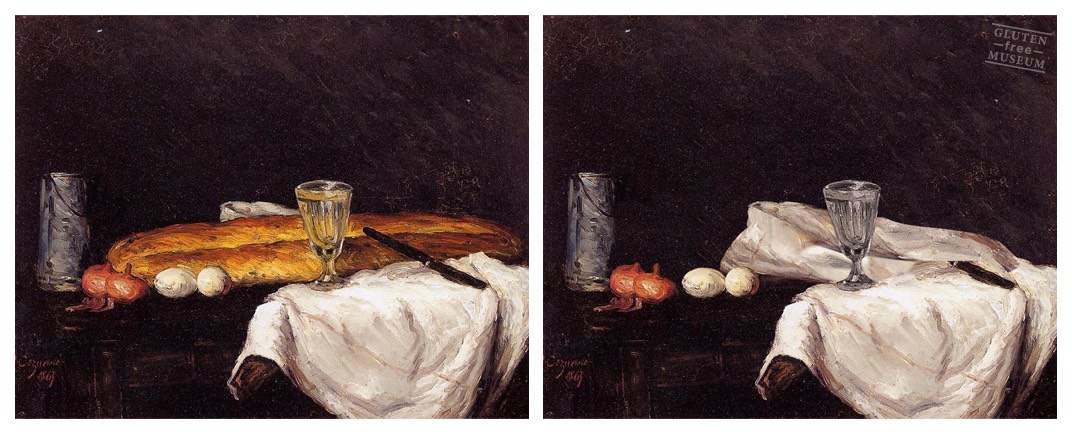
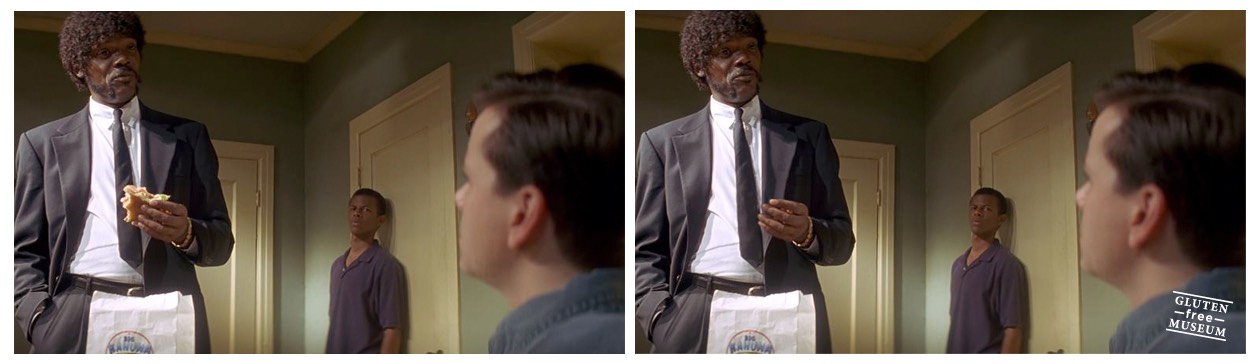
Gluten Free Museum takes works of art (high and low) and removes all of the gluten from them. A one-trick pony, but a particularly entertaining one. (via tmn)
This documentary has filled in so many questions I didn't even know I had about the world. I've been encouraging Will to get on board and maybe this will help!
My reaction to O. J. Simpson’s arrest for the murder of his ex-wife Nicole Simpson and her friend Ron Goldman was atypical. It was 1994. I was a young black man attending a historically black university in the majority-black city of Washington, D.C., with zero sympathy for Simpson, zero understanding of the sympathy he elicited from my people, and zero appreciation for the defense team’s claim that Simpson had been targeted because he was black.
O. J. Simpson wasn’t black. He came of age in the 1960s—the era of Muhammad Ali’s opposition to the Vietnam War and John Carlos and Tommie Smith’s black-power salute at the 1968 Olympics. But the O. J. Simpson I knew, and the one poignantly depicted this year in Ezra Edelman’s epic documentary, O.J.: Made in America, recognized only one struggle—the struggle to advance O. J. Simpson. When the activist Harry Edwards attempted to enlist Simpson in the Olympic boycott, Simpson rebuffed him and later claimed that organizers like Edwards had tried to “use” him. Protest “hurt Tommie Smith, it hurt John Carlos,” Simpson said. Smith and Carlos were “standing on [Edwards’s] platform, [when] they should have been standing on their own platform.”
My view that Simpson existed beyond the borders of black America was based not merely on his narrow political consciousness, but on his own words. “My biggest accomplishment,” Simpson once told the journalist Robert Lipsyte, “is that people look at me like a man first, not a black man.” Simpson went on to tell the story of a wedding he’d attended with his first wife and a group of black friends. At some point he overheard a white guest remark, “Look, there’s O. J. Simpson and some niggers.” Simpson confessed that the remark hurt. But that wasn’t the point of the story. The point was not being seen as one of the “niggers.”
Simpson sought to be post-racial in a world that was not. His myriad achievements—becoming the premier running back in college football, the first NFL running back to rush for 2,000 yards in a season, one of the first black pitchmen for corporate America—did not mark the erosion of the great wall between black and white Americans. It marked Simpson’s individual success at hurdling that wall. Landing on the other side, Simpson, a product of public housing in inner-city San Francisco, found reinvention as a celebrity. He became wealthy. He courted the attentions and advice of affluent businessmen. And though he’d married Marguerite Whitley, who was black, the same year he arrived at the University of Southern California, he now courted white women. “What I’m doing is not for principles or black people,” Simpson told Lipsyte. “No, I’m dealing first for O. J. Simpson, his wife, and his babies.”
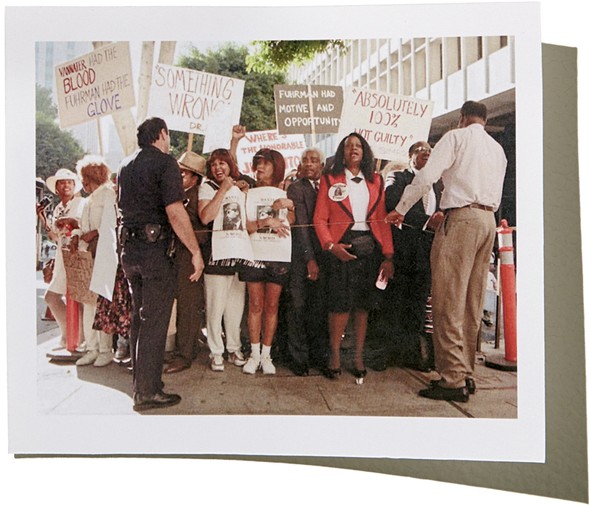
Protesters outside the Los Angeles courthouse rallied in support of Simpson’s defense team. Community activists also backed Simpson, and black vendors sold "Run O.J." and "Free O. J. Simpson" T-shirts. (AFP / Getty)
And yet, during his trial, whenever I walked the streets of D.C., I saw black people broadcasting their support as though he were one of them. Vendors hawked run o.j. and free o. j. simpson T‑shirts. Community activists, for whom Simpson had previously had no use, offered fervent defenses of him. When the verdict was announced, national-news cameras came to Howard Law School to record what turned out to be a jubilant response to Simpson’s acquittal. I found all of this very frustrating. I was 19 years old. I was the kind of militant black kid who flirted with Louis Farrakhan, Frantz Fanon, and veganism and who believed “What should black people do?” was a question that could be asked in earnest. The answer, I was sure, would open a new era of black excellence. The support of Simpson was a step backward. It struck me as unintelligent, politically immature, and ill-advised.
Two things, it seemed to me, could be true at once: Simpson was a serial abuser who killed his ex-wife, and the Los Angeles Police Department was a brutal army of occupation. So why was it that the latter seemed to be all that mattered, and what did it have to do with Simpson, who lived a life far beyond the embattled ghettos of L.A.? I vented in the school newspaper. “Since Simpson’s practices show he clearly has no interest in the affairs of black people,” I wrote, “the question becomes why do blacks have any interest in him?” In those days, I conceived of African Americans as a kind of political party, which needed only, in unison, to select the correct strategy in order to make the scourge of racism disappear. Expending political capital on O. J. Simpson struck me as exactly the opposite of the correct strategy. Looking back, I realize what eluded me. I had lived among black people all my life, but somehow I had come to see them as abstractions, not as humans.
I had not yet read Ragtime, the E. L. Doctorow novel that Simpson claimed to love. After his retirement in 1979, he began doing some acting and dreamed of playing Coalhouse Walker in the film adaptation of the book. Simpson felt the role of Walker, a black ragtime piano player turned revolutionary, matched his life. The parallels are strained—and in any case Simpson lost the role to Howard Rollins. But Simpson does resemble another character in the book, one whose feats explain the strange bond between Simpson and the black community. Doctorow offers a fictionalized Harry Houdini, whose escapes from straitjackets, bank vaults, piano cases, and mailbags thrill the poor people of the nation. He is jailed in Boston, imprisoned on an English ship, tossed into the Seine in manacles. Each time, he escapes. Houdini’s act allows him to make the greatest escape of all—out of poverty—though he eventually discovers that no amount of money will buy him the respect of the elite. The poor are enthralled by Houdini not because he organizes on their behalf, but because his exploits resonate with them: They know that their lives are trapdoored and trip-wired, that they too have been jailed, imprisoned, chained, and tossed into the sea. A Houdini performance was their life in miniature, with one heroic difference—he escaped.
Long before he led the police on a chase through L.A., Simpson had been an escape artist. His rare athletic talent freed him from an impoverished childhood, and brought him to USC on a football scholarship in 1967. Made in America, deftly capturing his athleticism, is alert to symbolism too, replaying Simpson’s manifold escapes while at USC and later with the Buffalo Bills. They are dazzling to behold. Simpson’s speed was enhanced not by grace but by awkwardness. In one frame he leaps past a defender, lands seemingly off balance, and then cuts across the field at full velocity. At several junctures, you expect him to fall, and the one time he does, the defender falls with him—but then Simpson, in a matter of milliseconds, glides to his feet and races off. He would angle himself against the earth, his hips flying one way, his head another. He seemed to run too high, with his chest exposed, presenting what should have been an inviting target for the defense. And yet he escaped.
For many black residents of Los Angeles in 1994, the idea that the LAPD might frame a black man was entirely plausible. The prosecution’s careless gathering of evidence only confirmed the distrust. (Vince Bucci / Getty)
Simpson was a running back, a position dominated by African Americans for the past half century—a fact that has often been invoked to boost racist thinking about the innate athleticism of blacks. More pertinent, the job of the running back—to escape—is the most basic of vocations, one that a kid from the projects can begin practicing in that first game of tag. Running also holds a special significance to a people denied violent resistance as a viable option, if only because it has always been the most potent tool available. The runaway slave is a fixture in the American imagination. As the writer Isabel Wilkerson notes in her account of the Great Migration, the blacks who fled the South during the 20th century “did what human beings looking for freedom, throughout history, have often done. They left.” There is also a less reputable history of fleeing among African Americans—the tradition of those blacks light enough to “pass” as white and disappear into the overclass.
Simpson’s great fortune was to reach the height of his powers in the 1970s, after the civil-rights movement, a time when one might enact the rituals of passing not by looking white, but by possessing qualities that white society envied. Simpson was a celebrity. He was handsome, articulate, and charming. He was identifiably black, but measured against the brashness of Muhammad Ali and the coiled rage of Jim Brown, his distinction was to radiate reassurance and respectability. In the successful series of ads he starred in for Hertz beginning in 1975, he was still running—only now through airports, an icon of social mobility, with white people cheering him on: “Go, O.J.”
An old friend of Simpson’s says in Made in America that Simpson was “seduced by white society.” Perhaps. But the seduction was mutual, and he used his football fame to gain access to white patrons eager to expose him to the finer things in life. “I took him places where I think very few black men had ever been,” Frank Olson, the former CEO of Hertz, says in the film. Simpson mingled with wealthy entrepreneurs at golf clubs where he was one of the few black members, or the first and only black member. He gave them the thrill of convening with a real sports hero at his mansion, Rockingham, nestled in the wealthy white suburb of Brentwood. Simpson’s social circle helped him amass a small fortune. By the 1990s, his net worth was estimated to be $10 million. He was the CEO of O. J. Simpson Enterprises, which owned stakes in hotels and restaurants, and he sat on four different corporate boards.
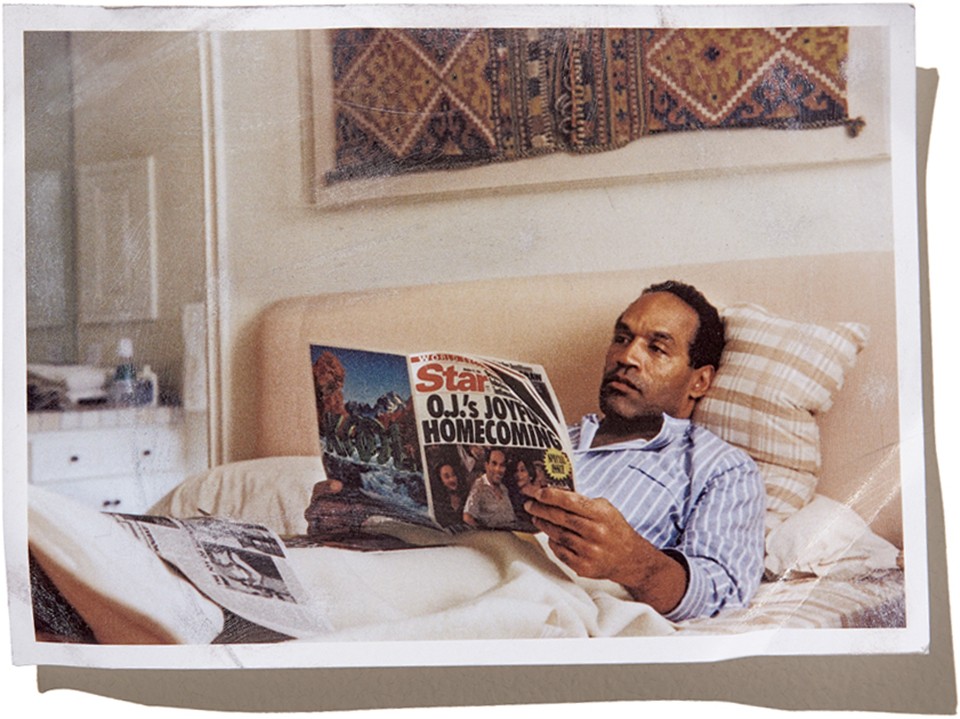
“My biggest accomplishment,” Simpson once told a journalist, “is that people look at me like a man first, not a black man.” After his acquittal, he read press coverage that treated him as a black icon. (Lawrence Schiller / Getty)
His pursuit of white women was profligate. In a telling moment in the documentary, Joe Bell, a friend of Simpson’s since childhood, recalls them slowly cruising down Rodeo Drive in the 1970s and being awed by the response. “Women come up, throw their arms around O.J., and just lay it on him,” Bell says. “Not just women. White women. Fine white women.” In 1977, Simpson began an affair with a beautiful blond 18-year-old, Nicole Brown, who came home from their first date with her pants ripped. “Well, he was a little forceful,” she told a friend. Two years later, he left Marguerite to pursue a relationship with Nicole. But the affairs continued: Bond girls, Playboy playmates, models, actresses, most of them white. For Simpson, the women on his arm were not women but bodies, ornaments, evidence of conquests—an outlook he had seen taken to its most violent conclusions in the form of neighborhood pimps. “Man, they’d beat a ho down right there on the street,” Bell remembers, laughing. “So that all the women would know this is the kind of treatment you’re gonna get if you don’t bring me my money.” Those women were black, but the basic notion of women as property knows no racial boundaries. Nicole Brown was proof to the world that Simpson, among the millions of black men caught in the maze of American racism, had risen above it. What sort of abuse—verbal and physical—was going on behind the mansion gates, almost no one, black or white, guessed. Or much cared.
The goings-on in the ghettos of L.A. were both more knowable and better explored—but not by O. J. Simpson. He eschewed involvement in any sort of politics that might tarnish his brand, and thus his pursuit of wealth. If it was easy for Simpson to forget the world he came from, that was partly because the world he now belonged to was invested in forgetting. In an incredible moment early on in the documentary, Edelman, off camera, asks a white USC teammate of Simpson’s what he remembers about 1968. A montage of violent events flashes across the screen—Martin Luther King Jr.’s assassination, Robert F. Kennedy’s assassination, the raucous Democratic National Convention. Edelman then returns to the teammate, who says, “I think of winning all the games, getting O.J. famous, everybody on campus thinking it’s the greatest thing on Earth. That’s all we thought about. There was nothing else going on.”
But Edelman does not allow us to forget, because the Simpson story turned out to be intimately enmeshed with the story of black Los Angeles and its relationship with the police. This was the community the Simpson jury was drawn from, and ultimately the one that held his life in the balance. For years, much of the country has wondered how Simpson could possibly have been found innocent. An unspoken assumption underlies this conjecture—that the jury understood the legal system to be credible. What the film makes clear in piecing together a parade of victims beaten, killed, and harassed by the LAPD is that the predominantly black jury—quite rightfully—understood no such thing.
Even I, college radical that I was, grasped the LAPD’s brutality only abstractly. The officers were brutal because my own politics, and my own experiences with the police, suggested they would be so. But brutality understates what the LAPD did in those years: It didn’t just brutalize black communities; it terrorized them. The terror emanated directly from the top. Police Chief Daryl Gates was a drug warrior who once said at a Senate hearing that casual drug users “ought to be taken out and shot.” In 1982, after numerous deaths of black people had resulted from police use of choke holds, Gates commented, “In some blacks when it is applied, the veins or arteries do not open up as fast as they do in normal people.” The intensifying sense of constant injustice came to a head when four officers were videotaped ruthlessly beating Rodney King in 1991, only to be acquitted when they went on trial. Two weeks after King’s beating, a Korean American grocer shot a black customer, 15-year-old Latasha Harlins, in the back of the head. The grocer, convicted of voluntary manslaughter, received probation, a fine, and community service, but didn’t go to jail.
By the time Simpson came to trial, most of the black community in Los Angeles had ample reason to view law enforcement as lacking not just credibility but basic legitimacy. Victimization fed a loss of respect for law enforcement, and that loss of respect in turn transformed victims into victimizers. The footage of the protracted beating of a white man, Reginald Denny, who was pulled from his truck during the Los Angeles riots, is chilling. But when law enforcement becomes capricious, citizens are apt to resort to their own law, rooted in ancient impulses, tribal loyalties, and vengeance.
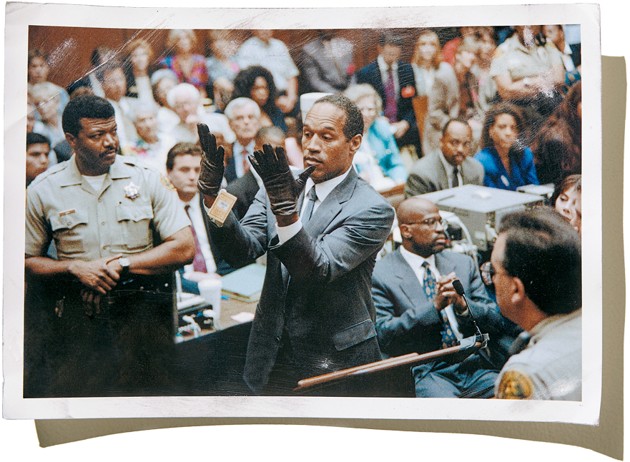
The beating of Reginald Denny was vengeance for the beating of Rodney King. And vengeance for King played a role in Simpson’s acquittal, according to one of the jurors, Carrie Bess. But revenge only partly explains Simpson’s last great escape. What I couldn’t fathom in 1994 was a reality that black people around me likely sensed and that Made in America brings into deeply discomfiting focus: that Simpson may well have murdered his ex-wife and her friend, and that the jury got it right in declaring him not guilty. When the LAPD collared O. J. Simpson, the police force had gotten its man. The evidence all looked so obvious to a lay observer: the vivid record of spousal abuse (“He’s going to kill me,” Nicole Brown Simpson yelled to an officer who responded to one of her many calls); the bloody shoe print, which matched shoes Simpson owned; the bloody glove found at the murder scene, which matched the glove at Simpson’s home; the blood on Simpson’s car and his socks and in his bathroom.
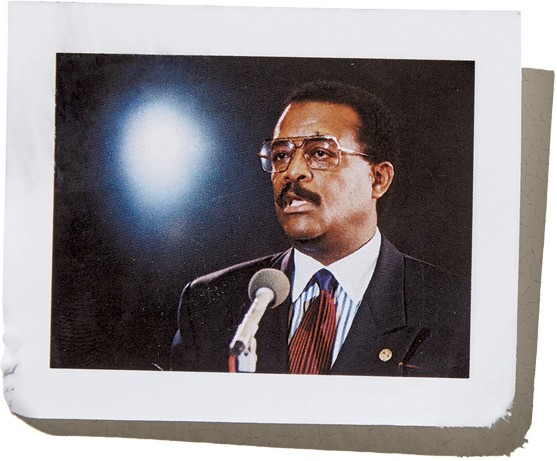
For Johnnie Cochran, Simpson’s lead lawyer, rage against police brutality had personal roots. About his experience of being pulled over by LAPD officers who then drew their guns, he said, “I never made an issue of it. But I never forgot it.” (Lee Celano / Getty)
But juries are not merely lay observers, and the defense needed to neither wholly exonerate Simpson nor completely contradict all the evidence. His lawyers simply needed to instill reasonable doubt. The LAPD had spent decades seeding that doubt in the minds of people like those on the jury, the majority of whom were black women. To make sure the doubt was harvested, Simpson leaned on the kind of activist he’d long spurned. These days Johnnie Cochran is remembered almost in caricature, mocked on Seinfeld and derided as a race hustler. Back then, even my view of Cochran was shaped in part by the satirization of him on Saturday Night Live. Edelman resurrects a lesser-known Cochran, a hero to the black lawyers who’d been the prominent legal advocates in the fight against police brutality since the late 1960s. The New York Times called Cochran’s rage at police misconduct “all consuming.” Contrary to the portrayals of him in popular culture, that rage was genuine and directly acquired. In 1980, Cochran was pulled over by LAPD officers and instructed to get out of his car. His daughter and son were in the backseat. When Cochran stepped out, the officers had their guns drawn. The tension was defused only when the officers searched the car and found a badge—Cochran was then the third-highest-ranking official in the district attorney’s office. Cochran received a personal apology from the chief of police. “I never made an issue of it,” Cochran later wrote. “But I never forgot it.”
Simpson, who had turned his back on race men while making millions selling himself as inoffensive to middle-class white people, didn’t hesitate to empower one of them now that his life was on the line. Thus the Simpson defense team presented an ironic alchemy—an activist tradition that Simpson had rejected, fueled by funds that he’d garnered rejecting it. “O.J. had money to spend and a willingness to spend it on his own defense,” one of Simpson’s lawyers, Carl Douglas, says to Edelman. “This was a first for me.”
Whether I saw Simpson as black or not, racism pervaded his case. The role it played went beyond the evidence on display. Racism was not just blatantly revealed in the tapes of the LAPD detective Mark Fuhrman bragging about, among other things, beating black suspects, whom he identified as “niggers,” and explaining how he disregarded their constitutional rights. (“You don’t need probable cause,” Fuhrman said. “You’re God.”) And racism was not just confirmed by Fuhrman’s exposure as a perjurer who was then maneuvered into pleading the Fifth in response to grilling by the defense—including the pivotal question of whether he’d planted any evidence. Racism formed the substrate of the defense’s case: The notion that the LAPD might frame a black man was completely within the realm of possibility for black people in Los Angeles. Simpson’s legal team worked those preconceptions the way a boxer might work an opponent’s wound, relentlessly attacking the numerous flaws in an investigation and an evidence-collection process that were egregiously careless: the blanket thrown over Nicole Brown Simpson’s body, exposing it to fibers and the DNA of others in the house; the sensitive material collected bare-handed; the sample of Simpson’s blood stored in an envelope in an officer’s care and brought to Simpson’s house.
Errors that to white viewers could look like technicalities in what they presumed to be an abstractly “fair” trial tapped into fundamental questions of trust for black viewers, who saw up close a machine operated by humans striving for an ideal standard, but often falling woefully short. How many black men had the LAPD arrested and convicted under a similarly lax application of standards? “If you can railroad O. J. Simpson with his millions of dollars and his dream team of legal experts,” the activist Danny Bakewell told an assembled crowd in L.A. after the Fuhrman tapes were made public, “we know what you can do to the average African American and other decent citizens in this country.”
The claim was prophetic. Four years after Simpson was acquitted, an elite antigang unit of the LAPD’s Rampart division was implicated in a campaign of terror that ranged from torture and planting evidence to drug theft and bank robbery—“the worst corruption scandal in LAPD history,” according to the Los Angeles Times. The city was forced to vacate more than 100 convictions and pay out $78 million in settlements.
The Simpson jury, as it turned out, understood the LAPD all too well. And its conclusions about the department’s inept handling of evidence were confirmed not long after the trial, when the city’s crime lab was overhauled. “If your mission is to sweep the streets of bad people … and you can’t prosecute them successfully because you’re incompetent,” Mike Williamson, a retired LAPD officer, remarked years later about the trial, “you’ve defeated your primary mission.”
O. J. Simpson’s great escape still sticks in the craw of much of the country. Simpson’s lawyers are not praised as adept defense attorneys, but disparaged as unscrupulous flouters of the rules who played the “race card” in a case that should have been about science—no matter how poorly that science was deployed. Resentment continues to fester that Simpson was afforded the best defense money could buy, in the form of Cochran. “It offended me,” Marcia Clark, the lead prosecutor, says to Edelman, “because he was using a very serious, for-real issue—racial injustice—in defense of a man who wanted nothing to do with the black community.”
It offended me, too. Simpson should have been the last person in the world to reap a reward from the struggle waged against the LAPD. Months after he was acquitted, I watched him give a speech at a black church in D.C., where he was embraced by the local community. He was presented with traditional African garb. The black nationalist Malik Zulu Shabazz greeted Simpson as if he were the reincarnation of Malcolm X. I have not, in my life, ever felt much shame in being black. That was a moment when I felt it deeply.
I hadn’t yet learned that black people are not a computer program but a community of humans, varied, brilliant, and fallible, filled with the mixed motives and vices one finds in any broad collection of humanity. More important, I did not understand the ties that united Simpson and the black community. When O. J. Simpson ran from justice, returned to it, was tried for murder, and eluded justice again, it was the most shocking statement of pure equality since the civil-rights movement. Simpson had killed Nicole Brown Simpson and Ron Goldman. I suspected that then, and I am sure of it now. But he’d gotten away with it—in much the same way that white people had killed black men and women for centuries and gotten away with it.
The virtue of equality does not always feel like a virtue, because equality does not always run on the same axis as morality. Equality for African Americans means the right to be treated like anyone else—whether we’re doing good or doing evil. Simpson’s great accomplishment was to be indicted for a crime and then receive the kind of treatment typically reserved for rich white guys. His acquittal, achieved as incarceration rates skyrocketed, represented something grand and inconceivable for blacks. He had defied the police who brutalized black people, the prosecutors who tried them, the prisons that held them. He had defied them all, and in the process, much like Houdini, he escaped.
In 2016 we confront a new phase of the problem of police legitimacy. The Rodney King video was a shocker in its time. Now it seems that every week brings a new video of a black body being beaten and shot by the police. A flurry of government reports on policing in Ferguson, Cleveland, Baltimore, and Chicago have all delivered the same message—that racism has deeply infected American policing. Simpson is currently in prison for charges unrelated to the killing of Brown Simpson and Goldman. And yet the problems that moved those crowds of black people to cheer for a murderer remain. The same anger, the same fear of police remain. The elements that interacted to turn the Simpson trial into a spectacle are still with us, so that today, two decades after Simpson was acquitted, “the audience for escapes,” in Doctorow’s words, “is even larger.”
* Photo-collage images courtesy of Getty Images and Bettmann, Charles Steiner / Image Works, Focus on Sport, Jean-Marc Giboux, Lawrence Schiller, Lee Celano, Michael Ochs Archives, Mike Nelson, Myung Chun, Peter Turnley, Tiziana Sorge, and Vince Bucci
Suddenly, there are four species of giraffe now. Previously there was only one. Scientists have analyzed the genetic code of hundreds of giraffes in Africa and found much variation in their DNA, enough to split one species into four.
Some of the differences were as large or larger than the differences between brown bears and polar bears.
Despite their similar appearances, members of the different species don’t appear to mate with each other. It’s amazing that scientists didn’t know this until now.
Liana Finck is a cartoonist. She is @lianafinck on Instagram.
Intrusive Questionnaire was originally published in The Awl on Medium, where people are continuing the conversation by highlighting and responding to this story.
From Mark Forsyth’s The Elements of Eloquence, a reminder of the rules of adjective order that fluent English speakers follow without quite knowing why.
…adjectives in English absolutely have to be in this order: opinion-size-age-shape-colour-origin-material-purpose Noun. So you can have a lovely little old rectangular green French silver whittling knife. But if you mess with that word order in the slightest you’ll sound like a maniac. It’s an odd thing that every English speaker uses that list, but almost none of us could write it out.
That summer, she had a student who was obsessed
with the order of adjectives. A soldier in the South
Vietnamese army, he had been taken prisoner when
Saigon fell. He wanted to know why the order
could not be altered. The sweltering city streets shook
with rockets and helicopters. The city sweltering
streets.
Did anyone learn this in school? I sure didn’t. How do we all know then? My daughter’s kindergarten teacher had a great phrase she used when things got a bit tricky as her students learned to read: “the English language is a rascal”. (via @MattAndersonBBC)
It is unfathomable to think, given Ailes’s reputation, given the number of women he propositioned and harassed and assaulted over decades, that senior management at Fox News was unaware of what was happening. What is more likely is that their very jobs included enabling, abetting, protecting, and covering up for their boss. “No one said no to Roger,” a Fox executive said.
It would be unfortunate if Gabriel Sherman’s latest report on Roger Ailes’ tenure at Fox News got lost over the long weekend, or in the scramble everyone goes through getting back after the holiday, so read it now or save it to whatever app you use that makes sure you don’t forget about it. Either way, be forewarned that no matter how low your expectations for the behavior described within you will still be disgusted and shamed by what you learn. That probably does not help sell the piece, but its important that you read it, so make sure you take some time to do that.
…new evidence on mutual fund managers suggests that the managers from poorer backgrounds beat the performance of wealthier peers. And it’s not a small effect: Managers from families in the bottom quintile of wealth appear to outperform those from families in the top quintile by 2.16 percent a year, in risk-adjusted terms.
That is one result from a new study by Oleg Chuprinin of University of New South Wales Business School and Denis Sosyura at the University of Michigan Business School.
Why might that be?:
Most individuals from less wealthy backgrounds don’t get to be mutual fund managers at all, and so as an entire class they do underperform. But if they do become fund managers, that may indicate superior smarts and hustle and eventually higher returns. Those from wealthier families, in contrast, maybe had to work less hard and be less smart to get those posts, and that may be reflected in their subsequent performance.
This hypothesis is supported by several features of the data. For instance, the managers from wealthier families had a higher dispersion of returns. In other words, some of them did very, very well but others were lemons. That distribution is a classic sign of a relatively loose quality filter, and on strictly meritocratic grounds some of those managers probably didn’t deserve to be there.
Along those lines, the data show also that the fund managers from the wealthier families were more likely to receive promotions when their returns were subpar. The returns of the managers from the poorer families were much more tightly bunched, which is consistent with the notion that they passed through much tougher quality filters.
There are some relevant caveats, however, so do read the whole thing.
Beyonce performed a 15-minute medley of songs from Lemonade Sunday night at the MTV Video Music Awards. Whether you didn’t catch it the first time around or have seen it 20 times, it’s worth watching with your full attention. This is Exhibit A in How to Be a Performer in 2016. Masterful.
BTW, have we talked about how unprecedentedly great Beyonce is? After four years with Destiny’s Child, she’s 14 years into her solo recording career and Lemonade is her sixth solo studio album. And it’s her best album…as was the album before that when it came out. She’s always been a wonderful singer and entertainer, but with the last three albums, she’s pushed her output toward the artistic (very successfully, I would say). How many other musical artists, bands, or groups who met early massive success are making their best stuff 14 years and 6 albums in? The list is not long. The Beatles. Radiohead (both In Rainbows and A Moon Shaped Pool are among their very best albums). The Rolling Stones? Who else? Even if there are a few others on the list, it’s still rarified company.
On Thursday night, Carly Rae Jepsen released Emotion Side B, the B side follow up to her breakout 2015 album Emotion.
The new release has 8 new tracks that were made in the process of creating Emotion. In a post shared on social media, Jepsen said she wanted to release the songs for all the fans who inspired her while touring over the last year. Jensen also promised that a new album was forthcoming, but that this was intended to hold fans over in the meantime.
Thanks for Watching and Hit that Like button plus please Click Subscribe if you want more Vine Compilations in the near future :) Compilation Playlist: https...
so proud of her for remembering most of her own lyrics!! xoxoxo
(this is delightful)
Britney Spears hits the passenger seat in James Corden’s Carpool Karaoke SUV to drive home a few of her favorite classics along with some gossip like the meaning behind “Oops I Did It Again”, the future of Britney and men (there is none) along with “Womanizer”, “Make Me”, “Toxic”, and “Hit Me Baby (One More Time)”.
It’s here, the greatest working day of the year. That’s right, the calendar has once more come around to National Duck Out Of Work For A Drink Day at last! Be sure to take some time today to leave your job and slip away into the sweet embrace of liquor.
If you are somehow unfamiliar with this American celebration of skipping out of your office to sneak some alcohol during labor hours, it is a venerable tradition dating back many years. To observe, all you need to do is grab a friend from work and slip off to a nearby bar for a shot or two. Or a couple of mixed drinks. Or a shot and a beer and then maybe one more beer. Two shots and two beers. A few spritzers, even. Whatever you can get away with. And do not feel ashamed if you need to go by yourself. The point of National Duck Out Of Work For A Drink Day is the ducking out and the drinking.
Those of you who are new to the holiday may be expressing some doubts right now, so I will just reprint the proclamation from last year here to reassure you that it’s nice and legal.
WHEREAS work is long, boring and especially difficult to take during the summer months when you could be outside, particularly when you consider how awful winter has been lately and will be for the rest of our lives and you’re starting to realize summer is almost over, and
WHEREAS contemporary human existence is a mostly unrelenting series of trials and tribulations of varying degrees of unpleasantness, none of which means anything in the end, the only reasonable temporary solution that has yet been discovered for being alcohol, and
WHEREAS life is largely designed and directed by forces beyond your control and your lack of real agency may be the most frustrating thing about work, and
WHEREAS a national day of celebration in which colleagues sneak away from the office to nearby bar to have a few quick drinks to both alleviate their pain and briefly exercise some sort of power over their own time has been shown over the years to be one of the few bright spots in a calendar otherwise filled with soul-crushing ennui,
NOW, THEREFORE, I, Alex Balk, creator of a holiday designed to allow everyone to blow off just a few minutes of goddamned steam with a couple of shots or beers or maybe even a craft cocktail if that’s the kind of thing you’re into and you don’t mind dropping $17 on something that a $5 slug will have the same effect as, do hereby proclaim Tuesday, August 25th, as National Duck Out For A Drink Day throughout the United States of America,
URGING AND DIRECTING all within its borders to take a few moments at some point during the day to run out alone or with colleagues and enjoy the temporary relief alcohol has to offer, remembering especially that if you go to the bar during work, it’s like they’re paying you to drink.
DECLARED AND AFFIXED BY ME HERE ON THE INTERNET, LIKE AND SHARE ON FACEBOOK AND INSTAGRAM AND TWITTER OR WHATEVER IF YOU FEEL LIKE IT (SOCIAL IS PRETTY IMPORTANT THESE DAYS), IF YOU’RE SOMEONE WHO DOESN’T OR CAN’T DRINK I GUESS JUST SNEAK OUT AND HAVE A SODA TO STAY WITH THE SPIRIT OF THINGS, REMEMBER TO BRING MINTS SO YOU DON’T GET FIRED WHEN YOU GET BACK, THANKS FOR ENJOYING THIS HOLIDAY EVERYONE, IF YOU DO DRINK DON’T DRIVE, ETC.
See? Totally official. National Duck Out For A Drink Day comes but once a year. Be sure to make the most of it.
If you’ve spent any time on the internet over the past month, chances are you’ve seen headlines about a spec script called “The Twin Towers” that imagines what an episode of Seinfeld might look like in the days after 9/11. If you haven’t read the script yet, do yourself a favor and read the whole […]