There’s been a huge fooferaw in Britain about a recent Hilary Mantel speech that contemplated what monarchy and public institutions like it do to actual human beings. Some Brits are up in arms about some phrases used by Mantel – in what is, in my view, a simply brilliant, must-read piece about all institutional humans (from presidents to popes and kings and queens) and their bodies. The outrage requires ignorance of the actual speech, because it’s spoken from a rather inspired version of empathy, not scorn, as Massie notes here.
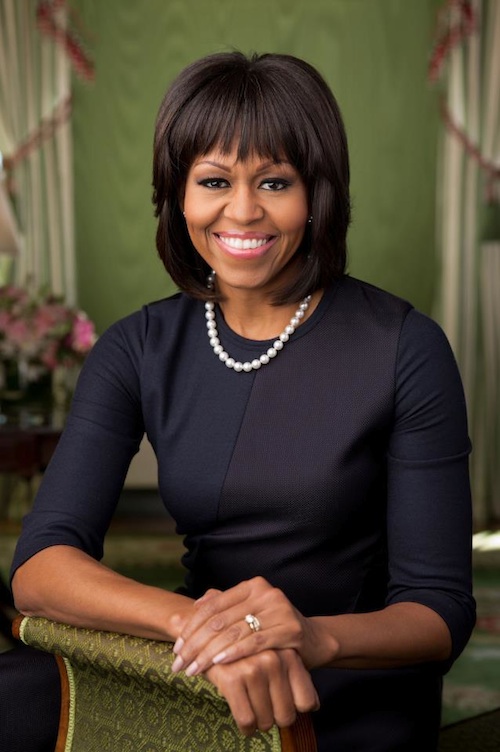
Mantel has been writing some staggeringly good books about the Tudor period, so she knows the full history of monarchy, its quirks and details and foibles. And she points out something very obvious, though usually forgotten: the constant public viewing of a royal has to be a dehumanizing, even depleting, experience from the other side of the looking glass. It becomes both the most extreme form of celebrity, but still has to be scandal-free to survive. Those dead eyes in the new and genuinely awful portrait of Middleton (see above) are dead for a reason: self-protection. In one passage, Mantel recalls what Diana did for Britain and what Britain and the entire world did to the human being who was once Diana Spencer:
Diana was more royal than the family she joined. That had nothing to do with family trees. Something in her personality, her receptivity, her passivity, fitted her to be the carrier of myth. She came near to claiming that she had a healing touch, the ancient attribute of royal persons. The healing touch can’t be felt through white gloves. Diana walked bare-handed among the multitude, and unarmed: unfortified by irony, uninformed by history. Her tragedy was located in the gap between her human capacities and the demands of the superhuman role she was required to fulfil. When I think of Diana, I remember Stevie Smith’s poem about the Lorelei:
There, on a rock majestical,
A girl with smile equivocal,
Painted, young and damned and fair,
Sits and combs her yellow hair.
Soon Diana’s hairstyles were as consequential as Marie Antoinette’s, and a great deal cheaper to copy.
But this exposure – from that first picture with sunlight behind her dress revealing one hell of a pair of legs – is what in the end killed her inside and then outside. How, in other words, do you remain a human being and an institution at the same time? And on that question, Mantel’s examination of the time she met the Queen is simply priceless. Mantel was invited to a social event at Buckingham Palace, which the Queen attended. As the Queen walked around, Mantel noticed people move away, shifting their gaze, trying not to engage: “The guests studied the walls, the floor, they looked everywhere except at Her Majesty.” Now imagine being the person at the center of this social embarrassment for your entire lifetime. You are so alone; you are so necessarily aloof; your humanity has to be contained for the enigma of the monarchy to remain. The alternative is a car wreck in an underpass in Paris. And then Hilary actually catches Her Majesty’s eye and we see the human cost:
I am ashamed now to say it but I passed my eyes over her as a cannibal views his dinner, my gaze sharp enough to pick the meat off her bones. I felt that such was the force of my devouring curiosity that the party had dematerialised and the walls melted and there were only two of us in the vast room, and such was the hard power of my stare that Her Majesty turned and looked back at me, as if she had been jabbed in the shoulder; and for a split second her face expressed not anger but hurt bewilderment. She looked young: for a moment she had turned back from a figurehead into the young woman she was, before monarchy froze her and made her a thing, a thing which only had meaning when it was exposed, a thing that existed only to be looked at.
And I felt sorry then. I wanted to apologise. I wanted to say: it’s nothing personal, it’s monarchy I’m staring at.
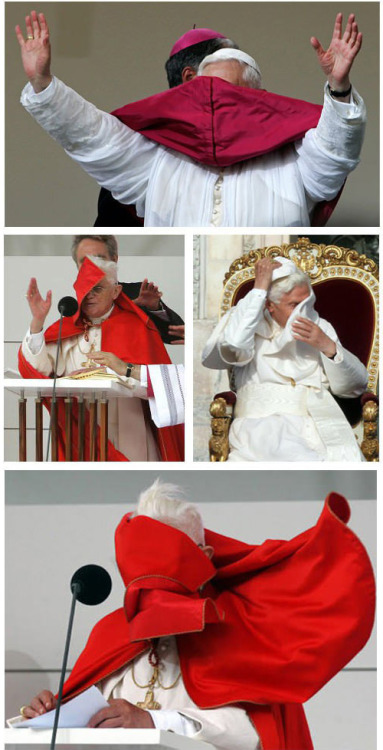
You were and you were not. And this is worth thinking about as well with respect to the Papacy. Perhaps what the introverted Ratzinger feared was the kind of public spectacle that John Paul II endured, as his slowly disintegrating body was wheeled around like some kind of relic, because the institution and the person were fused. And now, there is no escape from mass media, no relief from scrutiny, not amount of frills and lace and ermine and Prada to conceal the man beneath the robes. Maybe someone genuinely committed to the Gospels simply could not face that form of endless, merciless Hell. Hilary concludes:
It may be that the whole phenomenon of monarchy is irrational, but that doesn’t mean that when we look at it we should behave like spectators at Bedlam. Cheerful curiosity can easily become cruelty. It can easily become fatal. We don’t cut off the heads of royal ladies these days, but we do sacrifice them, and we did memorably drive one to destruction a scant generation ago.
Middleton in some ways is the antidote to Diana: beautiful but safe, young but mature, alive but slowly dying under the exposure that never, ever ends. We have an institution that demands a mask for a human being to survive within. But the mask has been removed, and the flashbulbs won’t stop.
[L]ots of Republicans who were running as challengers or in open seats in 2010—and then won—ran as incumbents for the first time in 2012. We know that incumbency is a powerful factor in House elections, bringing candidates greater visibility, adding to their campaign coffers, and deterring quality challengers from running. On average, an incumbent in 2012 ran five percentage points ahead of a non-incumbent candidate from the same party in a similar seat. Sixty-one seats were were decided by less than this margin.
More important, once we took incumbency into account, the apparent effect of gerrymandering vanished. That is, the ability of Republicans to retain the House majority may have been due to incumbency advantage, not new and more favorable districts.
Yo dawg, check out this meta-single topic blog "Someone Should Start a Tumblr" filled with ideas for launching a new, quirky site that could potentially turn in to the next big meme.
Sarah Kliff recently claimed that the USPS is “the very best internationally at its most crucial task: Delivering mail.” Adam Ozimek finds a problem with the study Kliff cites:
[T]he letters in the study were sent from Cambridge, Massachusetts. Is it really surprising that letters sent from one U.S. address to another U.S. address and back were returned faster than letters sent to from a U.S. address to New Zealand and back?
This article is kind of amazing. I've been reading it in spurts all day.
Phil Bronstein interviews the man who shot Osama Bin Laden about his time in the Nacy SEALs, the raid, and his life since then. The whole (extensive) interview is worth a read. Teaser quote:
In my yard, the Shooter told his story about joining the Navy at nineteen, after a girl broke his heart. To escape, he almost by accident found himself in a Navy recruiter’s office. “He asked me what I was going to do with my life. I told him I wanted to be a sniper. ”He said, ‘Hey, we have snipers.’ I said, ‘Seriously, dude. You do not have snipers in the Navy.’ But he brought me into his office and it was a pretty sweet deal. I signed up on a whim.”
“That’s the reason Al Qaeda has been decimated,” he joked, “because she broke my fucking heart.”
Sarah Kliff focuses on his life since leaving the SEALs:
Tricare (the health insurance program that covers military service members and their families) does provide 180 days of transitional health insurance “but the Shooter is eligible only if he agrees to remain on active duty “in a support role,” or become a reservist.” Now, the Shooter is purchasing a private health insurance plan for $486 per month, which does not cover some of his treatments.
Update: A reader flags an item from a Stars and Stripes veterans’ blog asserting that the Esquire article “wrongly claims SEAL who killed Bin Laden is denied healthcare.”
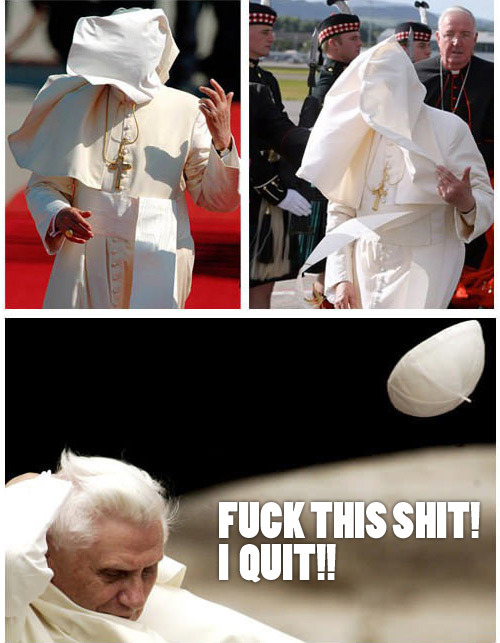
A resignation is truly a big deal. Since it hasn’t happened in 600 years, it changes the institution. It’s not outside the rules. The last Benedict to resign was Benedict IX (1032-45), “after selling the papacy to his godfather Gregory VI.” I’m unaware of any evidence of that kind this time around. John Paul II drew up contingency plans to resign if he became incapable of performing his functions – and yet he hung on for a very long time indeed. Tom Reese:
In Light of the World, Pope Benedict responded unambiguously to a question about whether a pope could resign: “Yes. If a Pope clearly realizes that he is no longer physically, psychologically, and spiritually capable of handling the duties of his office, then he has a right and, under some circumstances, also an obligation to resign.”
On the other hand, he did not favor resignation simply because the burden of the papacy is great. “When the danger is great one must not run away. For that reason, now is certainly not the time to resign. Precisely at a time like this one must stand fast and endure the situation. That is my view. One can resign at a peaceful moment or when one simply cannot go on. But one must not run away from danger and say someone else should do it.”
That was published a little over two years ago. And yet in his resignation letter, this is the rationale:
In today’s world, subject to so many rapid changes and shaken by questions of deep relevance for the life of faith, in order to govern the bark of Saint Peter and proclaim the Gospel, both strength of mind and body are necessary, strength which in the last few months, has deteriorated in me to the extent that I have had to recognize my incapacity to adequately fulfill the ministry entrusted to me.
I do think his reference to the world “being shaken by questions of deep relevance for the life of faith” is a critical qualifier here. He seems to recognize that the challenges the Catholic church now faces – its intellectual collapse in the West, the stench of moral corruption revealed by the decades of child-rape and cover-ups, and the resort to the crudest forms of authority and reactionaryism in response to new ideas, discoveries and truths about human nature – have now overwhelmed his physical and mental strength. At some point, the sheer human energy required to try and impose a moral authority already lost must have seemed hopeless.
Since Benedict’s election in 2005, the number of people leaving the Catholic Church in Germany has more than doubled, and it’s been the highest most recently in Ratzinger’s former Archdiocese of Munich and Freising. Only 30 percent of Germans are still Catholic today.
In Ireland, the collapse has been close to total. At the start of his papacy, Benedict declared his intent to bring Catholicism back to intellectual life in Europe. He didn’t just fail; he failed catastrophically, accelerating the Church’s demographic, spiritual and moral decline in the West. Key pillars of the Wojtila-Ratzinger counter-reformation – like the Legion of Christ, the creation of the repeat child rapist and drug trafficker, Marcial Maciel – crumbled to dust. Key enablers of abuse were given rewards – Boston’s Cardinal Law springs to mind; other minor figures – including the monster who raped over 200 deaf children, Father Lawrence Murphy – were allowed a quiet retirement with no serious punishment; I called for the Pope’s resignation two years ago, as the full extent of his complicity in the child-rape crisis came into closer view:
Ratzinger can no more be separated from John Paul II than Bush can from Cheney. And the cult of authority was John Paul II’s and Benedict XVI’s key contribution to the modern church. Now we see how this cult of authority was directly connected to enabling the church to enable, hide and defend the rapists of children … there is no escaping the verdict of history.
The Pope must resign. He has no moral authority left. And a new Pope needs to be selected who represents an end to the euphemisms, an end to any tolerance for this, and who will seek to restore the balance of authority achieved by the Second Vatican Council.
For me, the great tragedy of Benedict was his panic after the Second Council. There is no disputing the elegance of his mind or the exquisite meticulousness of his perfect, orderly German theology – and his work alongside the more consistently modernist Hans Kung will stand the test of time. But his post-1960s theology had as much relationship to the real challenges of the 21st Century as the effete, secluded German scholar, embalmed in clerical privilege for his entire adult life. And his early promise as a theologian calcified into the purest form of reaction and fear when given the power to enforce orthodoxy, which is what he essentially did for well over two decades. It was excruciating to watch such a careful, often illuminating scholar turn into a Grand Inquisitor. It was revealing that a bureaucrat who never missed even a scintilla of heresy was able to turn such a blind eye to the monstrous rapes of so many children. I wrote once:
Reading Benedict for a struggling gay Catholic like me is like reading a completely circular, self-enclosed system that is as beautiful at times as it is maddeningly immune to reasoned query. The dogmatism is astonishing. If your conscience demands that you dissent from some teachings, then it is not really your conscience. It is sin. And if all this circular dogmatism forces many to leave the church they once thought of as home? So be it.
When he was actually elected Pope, I was horrified by what it implied about the future. Back in 2005, I wrote:
I was trying to explain last night to a non-Catholic just how dumb-struck many reformist Catholics are by the elevation of Ratzinger. And then I found a way to explain. This is the religious equivalent of having had four terms of George W. Bush only to find that his successor as president is Karl Rove. Get it now?
I read much of Ratzinger’s theology back in the 1980s, as he assumed the power of Papal enforcer of orthodoxy. Here’s an extract from my 1988 TNR review of Ratzinger’s thought (alas, not online):
The metamorphosis of Joseph Ratzinger from Augustinian theologian to Augustinian policeman, and finally to policeman, may in part be due to the metamorphosis of the Church itself. The forces of change have been so great in the Church during the past two decades that some form of simple assertion of authority may have a prudential justification. John Paul II, however, has balanced Ratzinger’s zeal with a more humane approach. Together, they have played a “good cop, bad cop” routine with recalcitrant faithful. Ratzinger’s great gift to a Church all too easily distracted by the world is to call the faithful back to the fundamentals. But it is difficult not to feel dismayed by the way in which his earlier inspiration has ceded to the dictates of coercion, and his theological distrust of fallen man has translated so easily into disdain for Christians trying to live obediently in modernity. The man who might have guided the Church through reason has resorted to governing by force.
Sullivan’s take on Ratzinger back then was that he represented the marriage of the German Augustinian tradition (the same tradition that produced great Protestant theologians from Martin Luther to Karl Barth) with papal power, along with an unhealthy attitude about sex and gender. It’s a very toxic combination, producing a very political agenda in the guise of the non-political sovereignty of the Church. That’s why Andrew ultimately compared Cardinal Ratzinger then, and compares Benedict XVI now, to Dostoevsky’s Grand Inquisitor: a man driven by the logic of theology to, and perhaps beyond, the limits of Christianity itself.I hope Sullivan is wrong about the new pope, but there are unsettling analogies in his Catholic analysis of Ratzinger to the strangely un-Christian tendencies recently apparent in so many conspicuously Christian U.S. religious and political leaders.
I don’t think, alas, that I was wrong. And the desert in which the church has wandered since has been bleak but not without oases of new thought and eruptions of real grace and persistence of real faith. Those of us who have hung in must now pray for a new direction, a return to the spirit of the Second Council, a Pope of reform after an era of often irrational reaction and concealment of some of the worst evil imaginable. It can happen. Perhaps Benedict XVI finally grasped that. And finally did what he was never ever capable of doing before: let go and let God take over.
May the sunlight now come in; may accountability be taken; may a new fearlessness, guided by the Holy Spirit, give the church new life when its strength and vitality are in such profound crisis. May we see real punishment for the enablers of child rape; may we see more married priests and a serious discussion about women priests. May we see a return to the core truths of our faith: that God exists, that God is love; that this love became incarnate to rid us of the dead-end of worldliness into the wonderment of caritas. This is a chance for renewal. And repentance … as Lent inexorably approaches and Easter finally beckons.
Sarah Kliff finds one place where the USPS excels:
Researchers Alberto Chong, Rafael La Porta, Florencio Lopez-de-Silanes, and Andrei Shleifer sent letters to 10 fake addresses in 159 countries. The whole idea was to test government efficiency, by seeing how long it took to return the letters to the senders. All these countries, the researchers note, subscribe to an international postal convention (the Universal Postal Union, coordinated by the United Nations), which requires them to return letters they cannot deliver.
Not all are that great at it: Only 60 percent of the letters actually came back to the researchers. Among the countries that returned all 10 letters, the USPS was far and away the fastest to do so.
Apple, Google, Hewlett-Packard, Intel, Google, Chevron, Disney, Wells Fargo, Cisco, Oracle, KB Home, Yahoo, Qualcomm, Hilton, Oracle, eBay, Charles Schwab, Clorox, Adobe, Oracle ... it seems like a lot of the world's top companies are based in California, including more than half of the NASDAQ technology index. But Texas Governor Rick Perry is the kind of man who knows things in his heart, and he won't let any fancy coastal-elite numbers and facts get in the way of what God tells Rick Perry in the dead of night.
That's why Rick Perry's comically dumb voice is featured on new radio ads aimed at getting Californians to move their businesses to the libertarian paradise of Texas—there are no laws of any kind in the entire state, except for those laws aimed at forcing women to have children and against gay people in general. (Even though the U.S. Supreme Court overturned the law a decade ago, it is still illegal for gay people to even have sex in Texas. And discriminating against gay people continues to be perfectly legal in Texas, according to state law.)
"Building a business is tough, but I hear building a business in California is next to impossible," Perry reads clumsily from his script. Maybe he "hears" this from his DirecTV or DISH, both based in California. Wherever he heard this, it was enough for the Texas government to waste Texas taxpayer money to do this minor marketing campaign aimed at West Coast people who are tired of all this crushing regulation, good food, natural beauty, year-round delightful weather, vineyards, beaches, environmental fanaticism, sexy people, and the center of the world's technology and entertainment industries. "Everybody with half a brain is coming to California," Governor Jerry Brown said in response to the ad. "So Texas, come on over!"
There is a nice part of Texas where many book-learned people, artists and tech companies have assembled, but it is within the heavily regulated communist/eco-fascist mini-state of Austin.
After watching How To Survive A Plague, Josh Barro identifies why ACT UP was so successful:
ACT UP activists weren’t just angry about national apathy and inaction on AIDS; they also had specific demands and constructive ideas about how the government and drug companies could do better. Unlike a lot of protest movements, once they got to the stage where the targets of their protests said, “I’m listening. What do you want me to do?” they had concrete answers.
A few things you see ACT UP demanding (and getting) in the movie are: hospital policies that don’t discriminate against AIDS patients; more funding for AIDS research; lower prices for AZT, the first effective anti-AIDS drug; a faster drug approval process, recognizing that 10 years of effectiveness trials didn’t serve the interests of people on the verge of death; and allowing HIV- positive people not enrolled in drug trials to take experimental drugs at their own risk, the so-called parallel track.
Yes, but this somewhat distorts one of the key nuances and virtues of the movie (my review here).
There were two sides to ACT-UP: the drama-laden, spectacle-creating, brilliant rage-filled actions against an indifferent government versus the pragmatic, step-by-step laser-sharp emphasis on actually creating change in the ways Josh describes. The latter group became Treatment Action Group or TAG. The film exposes these rifts – rather subtly (which makes it much more interesting than agit-prop. At the time I feared the over-the-top dramatics could undercut our message; in retrospect, not so much – especially since those protests and the expression of that anger helped keep people alive. But it was the meticulous grasp of the science, the trial process, the FDA and the NIH that really helped accelerate the process and organize it. That was done by often maligned young white males – like Harrington and Staley and Gonzales – and it made a real difference.
What we sometimes forget, however, is that there never was some miracle drug the government had that was somehow being withheld. There never was a chance to launch a Manhattan Project against a retrovirus that had not even been identified when so many started to die. No one had ever stopped a retrovirus in human history before – and HIV remains the only one. This meant really hard research, using fast-accelerating technology to bring about a revolution in treatment and quality of life.
In retrospect, as the film demonstrates, the first wave of anger was totally unjustified and completely pointless. The science simply wasn’t there – and science takes time. The second wave of anger combined with relentless engagement with the drug companies and FDA was what made a difference. Yes; make a stink. But also: be ready to take yes for an answer, to leave grudges behind, to focus almost manically on the prize and do your best to ignore everything else. Not easy. But by some strange alchemy – and the courage that comes out of terror – it was accomplished. Or else that last sentence would never have been written and this blog would not exist.
"Anyone can get those if they work at it. It's just a lot of exercising. And it's really quite pointless, because you go to a gym and you lift a heavy thing so a muscle grows, but the only thing the muscle can actually do is to lift that heavy thing. After a while they're like pets because they don't do anything useful. But you have to feed them and take care of them otherwise they'll go away. I feel a bit goofy having them, to tell you the truth."





















 Apple, Google, Hewlett-Packard, Intel, Google, Chevron, Disney, Wells Fargo, Cisco, Oracle, KB Home, Yahoo, Qualcomm, Hilton, Oracle, eBay, Charles Schwab, Clorox, Adobe, Oracle ... it seems like a lot of the world's top companies are based in California, including more than half of the NASDAQ technology index. But Texas Governor Rick Perry is the kind of man who knows things in his heart, and he won't let any fancy coastal-elite numbers and facts get in the way of what God tells Rick Perry in the dead of night.


