Shared posts

07 Mar 20:19

Sorry, Bears: Ban On Killing Polar Bears For Rugs Defeated

by Ken Layne

You people voted for WHAT?Some 20,000 polar bears are left on Earth, their only planet, and most of them live in the Canadian Arctic. While the bears have been distracted by the melting away of polar ice and their entire habitat, humans at a meeting in Thailand have decided that's it's okay to continue killing the endangered animals to sell their parts on the international market for bits of endangered animals—bearskin rugs and claws and "other body parts."

The United States delegation proposed not hunting the polar bear to extinction. Although the ban had the backing of Russia, which also has a declining polar bear population in its arctic zone, the Convention on Trade in Endangered Species defeated the ban, with 42 nations voting for hunting the polar bear to extinction and 46 nations abstaining because why bother?

Wildlife and habitat conservation groups are dealing with many human controversies in the 21st Century, from well-funded industrial propaganda to well-meaning indigenous rights groups who have lately endorsed the idea that preserving the existence of life on Earth is another form of colonialism. Robots will surely agree with this latter position when they gain autonomy in the coming decades.

In the Canadian polar bear hunt, some animals are killed and chopped into parts to be sold by traditional Inuit hunting parties and some are killed by foreign trophy hunters, because stereotypical rich industrialists hunting endangered species for sport is apparently still a thing on this planet.

The skin and hair of dead polar bears killed by hunters can be sold on the international market for about $4,850 per pelt. Between 600 and 800 polar bears are killed for this purpose each year, according to the wildly different numbers produced by the pro- and anti-hunting interests.

Scientists expect the polar bear to be completely extinct in the wild by the year 2050, or 37 years from now. At least there will be some comical polar bear rugs in a few mansions!

Photo by Michael Maher.

---

See more posts by Ken Layne

0 comments

07 Mar 20:18

just a tiny dog wearing a dish glove. via

Steve Dyer

This is the best picture


just a tiny dog wearing a dish glove. via

07 Mar 17:16

Photo


06 Mar 17:13

Photo

by coastingonpluto
Steve Dyer

just a friendly reminder


05 Mar 21:42

Eat Oatmeal Or The Terrorists Win

by Ta-Nehisi Coates
Longtime readers of this blog will recall my patriotic affection for rolled oats, water and fruit and abiding intolerance of anyone who does not share in the love. People who microwave their oatmeal belong on the "Do Not Fly" list. People who do not eat oatmeal belong on the "You Are What's Wrong With Everything" list.  This is America. And these are the rules. Don't like them? Take your stuffed-brioche-french-toast ass back to Aix-en-Provençe (Proper pronunciation "Axe Un Province.")
For those who know this great country, like I know this is great country--which is to say those who have heard the gospel of awesome oatmeal and found themselves born anew--I have glorious news. I have discovered the greatest bowl of oatmeal ever made, in the most unlikeliest place in the world. The place is Flour Bakery in the town of Cambridge.
For the good of your country, you have got to get up on this--creamy perfectly cooked steel-cut oats. Fresh fruit sliced and diced right here in U.S. of A. Washed down with a hot cup of coffee. It's enough to make me ignore the hipsters at the counter with their smiles, good service and polite manner.
"But TNC," you say. "I thought you were real American? What are you doing hanging out in the communist commune of Cambridge?" 
Bite me Sharia-boy. I'll have you know that in the time you phrased that question, I punched five Muslim atheists and broke up a game of hacky sack. My star-spangled armor is supreme. And when it comes to awesome oatmeal, no power in the socialist-verse can stop me. 
Eat oatmeal. Your country is counting on you.


05 Mar 18:33

Photo


05 Mar 03:46

longbathroomlines.tumblr.com

Steve Dyer

Were you in a bathroom line with Bernadette Peters this weekend?

Someone should make a tumblr that is only photos of famous people in bathroom lines at events. They are the great equalizer - whether you are Bernadette Peters or Bernadette Peters’ sister that no one has ever heard of - you will be waiting to pee like all the other ladies.

Created yet? Nope.

Want to create this or have found it somewhere else? Send me an email.

04 Mar 16:20

'Whose Line Is It Anyway?' Is Coming Back for a New Season

by Bradford Evans
Steve Dyer

LANAAAAAAAAAAAAAAAAAAAAAAAAAAA

Whose Line Is It Anyway?, the short-form improv TV show that gave us Wayne Brady, is coming back, according to a tweet this morning from one of its stars, Colin Mochrie. Washington newspaper The Wenatchee World covered the story yesterday, reporting that Ryan Stiles will also return and that a new host, Aisha Tyler, will replace Drew Carey, who has no involvement in the revived series. Stiles will be bringing some actors from The Upfront Theater, the improv school and theater he opened in Washington with him, and the people behind the show have been auditioning improvisers from UCB, as well. The new season will tape in LA this April, but there's no word on what network it will air on. The original US Whose Line, based on a British radio/TV show of the same name, ran on ABC from 1998 to 2004 and ABC Family from 2005 to 2007.

Stiles and Mochrie are so far the only stars confirmed to be coming back for the new version of the series, but I think it's safe to say we're all eagerly awaiting word on Wayne Brady's return. If you're a long-form improviser, you can look forward to more and more of your out-of-state relatives and friends assuming that you're spending your time playin' with props and singin' hoedowns once this show comes back on the air and continues to be the first thing people who have never seen a long-form improv show think of when they think of improv comedy.

UPDATE: The CW Network has sent out a press release this afternoon saying that they'll be airing the revamped Whose Line this summer, and Wayne Brady will be back.

---

See more posts by Bradford Evans

3 comments

01 Mar 19:28

Photo


01 Mar 18:03

proof jennifer lawrence is a disney princess. via


proof jennifer lawrence is a disney princess. via

01 Mar 07:35

Photo

by mermaidcomingontheshore
Steve Dyer

WHILE I LAUGH YOU DIE


28 Feb 22:28

A Natural History Of The Penis: A Visit To Iceland's Infamous Penis Museum

by Ferris Jabr
Steve Dyer

Is it Friday?

If you haven't heard of Sigurður Hjartarson by name, you've probably heard of his penis… museum. Hjartarson and his son Hjörtur Sigurðsson own and manage The Icelandic Phallological Museum in Reykjavik, which has the world's largest collection of penises and related artifacts (283 and counting!). This winter I finally got the chance to visit, along with my good friend Mara. My first surprise was how sleek and modern it looked from the outside: large frosted windows with "The Icelandic Phallological Museum" printed in neat type in various languages, almost in the style of commemorative glass plaques. From a distance, one might mistake the building for an art gallery or office space, if not for the large silver sign that features what is perhaps the most forthright museum logo ever devised: a mushroom-capped penis standing at attention in front of a silhouette of Iceland.

Mara and I were the only visitors when we arrived. After paying 1,000 Icelandic krona (about 8 US dollars) each for our tickets, we walked past the front desk, turned a corner and entered the museum's well-lit main room. We were surrounded. Penises and testicles claimed every available surface—sprouting from the floor, crowding shelves, hanging from the ceiling. One enormous brown phallus drooped from the wall like the schnozz of a Norwegian troll or something melting in a Salvador Dalí painting. Many penises were plump but limp in jars of formaldehyde, floating as contentedly as pickled turnips. A few were as stiff as stone, fixed in eternal erection. It was a quiet and dignified room demanding a kind of sedate reverence: all those specimens carefully arranged, waiting for the monosyllabic expressions of admiration and hushed conversations of passersby. It was, too, a room full of dicks.

I stopped in place, overcome with a unique sense of awe. It reminded me of visiting Six Flags Great America for the first time with my middle-school friends: the sight of all the possibilities before us—the coasters' colossal slopes, steep drops and gorgeous loop-de-loops—stunned us for a moment, before we bolted into the theme park. Now, older, I reacted more sensibly. Composing myself, I stepped into the room, readied my camera and casually turned toward one of the displays on my left. In a glass jar about four times larger than a standard jar of jam, a fat grey organ curled in on itself like an elephant's trunk. Its slightly wrinkled skin pressed right up against the glass. I took a picture. A laminated piece of paper informed me that this was the penis of a sei whale, which is among the larger species.


In the museum's marine mammals section.
(This photo and the one above courtesy of the Icelandic Phallological Museum.)


A sei whale penis in a jar.

In a refreshing contrast to many museums, the Icelandic Phallological Museum completely lacks any pretense or stuffiness. The museum is honest about its purpose: this is a place to come and marvel at a great many penises of different shapes and sizes. Compared to most natural history museums, however, it's a little light on information. All the specimens are paired with pieces of paper listing the Latin and common names of the relevant animal, and the museum's website has a thorough catalogue recording the provenance of all the penises in the collection. One of three nooks toward the back of the museum houses a small library. Beyond that, however, there are no panels, videos or exhibits to further stimulate guests. You must be your own guide through this wonderland of phalluses.

To my right, in a tank of clear fluid, rested what looked like an enormous rotting daikon root. A thin sleeve of soot-colored skin had peeled away in places, the way a potato's skin starts to slip off if you boil it long enough. Next to the bulbous shaft sat a single testicle, which resembled an ostrich egg with a mozzarella texture. It used to sit cozy inside a sperm whale.

In a phone interview, Hjartarson told me that the museum boasts a penis from every kind of mammal now living in Iceland. Nearly half of the penises in the museum once belonged to sea mammals, such as whales, dolphins, seals and walruses, most of which were caught in the waters surrounding Iceland. Covered in glaciers, lava fields and deserts, the mainland is not exactly teeming with terrestrial wildlife. Iceland has no native amphibians or reptiles and fewer than 90 breeding bird species, the most famous of which is the adorable puffin, which looks like a hybrid of a penguin and toucan. When people first colonized the island, probably sometime in the 800s, the only native mammal was the Arctic fox. Today, Iceland is home to sheep, cows, goats, horses, dogs, cats, minks and mice among other mammals, all brought to the island by people in various deliberate and unintentional ways.

A few more exotic peckers have come to the museum as well, most of which are displayed in a nook known as the "foreign section." Through friends, Hjartarson's son Hjörtur Sigurðsson acquired the penis of a giraffe that was shot by an Icelander in Namibia in April 2012. In 2001, an Icelandic engineer sent Sigurðsson and Hjartarson the penis of an old male elephant gunned down near a sugarcane plantation in South Africa. In 1993, after some fishermen accidentally killed a cantankerous polar bear that had wandered from Greenland onto Iceland's western fjords, a natural history museum got the skeleton—including the bear's penis bone—but Hjartarson got the penis itself. "No animal was ever killed for me or because of me," Hjartarson says.

AND THEN ONE DAY YOU WAKE UP OWNING A PENIS MUSEUM


An elephant penis, preserved.

Taking the life of an animal solely to acquire its reproductive organs would betray the spirit of the museum. The whole thing started as a joke among friends. In the 1970s, Hjartarson was the headmaster of a school in Akranes, a port town in southwest Iceland. One day, over drinks, he and some teachers got to talking about ancient Icelandic traditions—in particular the tendency to use every part of a slaughtered animal. The conversation surfaced a memory in Hjartarson's mind: as a young boy, his relatives had given him a pizzle—a bull's penis twisted and fashioned into a cattle whip. When Hjartarson related the memory, one of the teachers said that he was traveling to his hometown to help slaughter some bulls and offered—mostly in jest—to bring back their penises. Hjartarson thought it was a great idea.

At first, he was not sure what to do with his gifts. He tried hanging them out to dry like laundry. People in Akranes started talking; some neighbors mistook the penises swaying in the wind for rhubarb. Eventually Hjartarson decided to have a few of them tanned and others stretched and affixed to plaques, keeping them somewhat more discreetly in his home.

Not knowing much about preserving whale penises between three and eight feet long—or any penis for that matter—Hjartarson tinkered and learned along the way. Sometimes he split the penises open, scooped out everything inside and dried the peel with salt. He experimented with alcohol and formaldehyde. Hjartarson soon began to receive similar, albeit much larger, gifts from other teachers who spent their summers working at a nearby whaling station. Not knowing much about preserving whale penises between three and eight feet long—or any penis for that matter—Hjartarson tinkered and learned along the way. Sometimes he split the penises open, scooped out everything inside and dried the peel with salt. He experimented with alcohol and formaldehyde. One time he tried filling a penis skin with silicone—a disastrous approach. The skin shrank and expanded when the temperature and humidity changed, but the silicone remained inert, bursting through the delicate membrane.

"The idea emerged gradually that it might be interesting to go on collecting these," Hjartarson recalled. In addition to accepting donations, he started to actively pursue specimens. He turned to abattoirs for spare parts. He asked a friend in the fishing town of Húsavík to keep on ice the penises of any seals he caught. When he heard about a beached whale on the news, Hjartarson would join the team of scientists traveling to the stranding site and ask if he could take home the penis.

For twenty years, Hjartarson stuffed the swelling multitude of penises into his home and office, taking them with him when he left Akranes to teach in Reykjavik. In 1997, his daughter in law secured a retail space in the center of Reykjavik and, since the space was too large for her purposes alone, she and Hjartarson decided to share it. He knew exactly what he wanted to do with his half.

The same year, Hjartarson officially erected the Icelandic Phallological Museum with penises from 62 different species. "Most people reacted pretty positively," he said. "When people see there is nothing pornographic in the museum, just these organs, and that we try to put some humor in it, people react very well."

How did his wife react, I wondered. "She has been supporting me the whole time," Hjartarson said. "Without her patience and tolerance I would never have been able to do it. I've taken specimens into the kitchen to work on them. Some have smelled like hell. She hasn't liked that as much, but she has tolerated them incredibly."

The Icelandic Phallological Museum has remained a family affair. When Hjartarson retired from teaching in 2004, he and his wife moved north to Húsavík and reestablished the museum there. In 2011, due to his poor health, Hjartarson passed on management of the museum to his son, Hjörtur, who moved it back to Reykjavik. Lately, Hjörtur Sigurðsson's 23-year old son has been helping out in the museum as well. Since reopening in November 2011, the collection has attracted more than 13 thousand visitors.

NONE OF THESE PENISES IS LIKE THE OTHER


Sculptures of the Iceland men's handball team.

At the end of a long row of sea mammal penises in jars, a piece of art caught my eye. The museum offers visitors plenty of interesting sculptures, paintings, carvings and tchotchkes to look at, including lampshades fashioned from bull's testicles and a set of shiny silver penis sculptures, above which hangs a photograph of the Icelandic handball team. Hjartarson's daughter, Thorgerdur Sigurdardottir, made the sculptures and, as she told Slate, they are not in fact modeled after the members of the Icelandic handball team; rather, she "made them from experience."

The piece of art that I liked most, however, was a framed poster labeled "The Penises of the Animal Kingdom," which featured a lineup of erect organs from various mammals, in order from longest (the whale's) to the shortest depicted (man's). The poster reflects what is perhaps the museum's central theme: diversity.

Scientists have learned that the penis is an excellent organ to study precisely because of its diversity. Over the millennia, many different animals in many different environments have depended on their penises to fulfill one half of the most important mission for any living thing—reproduction. In response to this pressure, the penis has adopted an astonishing variety of forms. Penises first evolved in the ocean, where they pioneered a sexual strategy known as internal fertilization. Instead of spraying his sperm into the currents and hoping that some of them hooked up with a female's deposited eggs—the way that many fish still go about it—a male animal with a penis could shoot his sperm directly at a female's eggs while they were still inside her body. She, in turn, gained more control over which suitors had access to her eggs in the first place.

Modern penises come with all kinds of frills and accoutrements, like bristles, barbs, foreskins and multiple heads (some marsupials have forked penises; the echidna's penis has four heads). Some penises engorge themselves with blood or lymph fluid; others rely on a mineral bone to get a boner (in fact, humans are one of the only primates without a penis bone). Penises have evolved independently several different times in different groups of animals, often as modified forms of existing body parts, such as fins. In all likelihood, the earliest penises were relatively simple and undecorated tubes, perhaps resembling the stout shaft of the 425-million-year-old shrimp-like Colymbosathon ecplecticos—the oldest fossilized penis ever discovered. Some animals still rely on rather modest penises, but many others developed far more complex and ostentatious organs.

Modern penises come with all kinds of frills and accoutrements, like bristles, barbs, foreskins and multiple heads (some marsupials have forked penises; the echidna's penis has four heads). Some penises engorge themselves with blood or lymph fluid; others rely on a mineral bone to get a boner (in fact, humans are one of the only primates without a penis bone). When erect, penises might be rather stiff and inflexible, or—as in the case of whales and dolphins—retain a rubbery agility. Some penises are unexpectedly small for an animal's overall size, such as the gorilla's typical nubbin (1.25 inches erect on average). Others are astoundingly large: the humble barnacle claims the longest penis relative to body size of any animal. A sedentary creature, the barnacle probes for a mate with its impressive penis, which can be eight times its own length .

The duck's phallus is a particularly rousing example of extreme penis adaptation. 97 percent of bird species do not have penises. Ducks not only have penises—they have long, spiraling ones that burst forth from within their bodies. These elaborate phalluses most likely evolved through sexual conflict. Male ducks are notorious rapists. To combat these unwanted advances, the females have evolved labyrinthine vaginas that twist in the opposite direction of the males' corkscrew penises. These vaginal passages are filled with spongy pockets with which the females might sop up and expel unwelcome sperm. In retaliation, the males evolved longer, larger and more tightly coiled penises. The penis of the Argentine Blue-bill duck, for example, can stretch to twice its body length when erect. Still, only three percent of duck rapes result in viable offspring.

PRESERVE YOUR PENIS, LIVE FOREVER

After getting a good look at most of the animal penises in the museum, I walked into the folklore section, where I encountered specimens from creatures that are complete strangers to science. According to surveys conducted over the years, between one quarter and one third of Icelanders currently believe in the existence of "hidden folk" and elves. Icelandic myths and legends include an even more varied cast of specters and ghouls. The museum's folklore section, however, is not really concerned with telling these tales to visitors.

To get a sense of what this particular nook is like, imagine going to an exhibit about American tall tales and, instead of watching a heartening video about Paul Bunyan and his dear companion Babe the Blue Ox—or leafing through beautifully illustrated books about Davy Crockett and Johnny Appleseed—you encounter nothing but glass cases that display what are, ostensibly, these heroes' penises. Somehow, the Icelandic Phallological museum has managed to acquire the kelp-green penis of a merman (wait, aren't merfolk supposed to be all fish down there?), the pallid penis of a ghost, the penises of a zombie bull and corpse-eating cat, and an elf's penis, which is, naturally, invisible.


A merman penis.

The specimen that would prove most elusive for Hjartarson had nothing to do with the mythological, though. By the mid-2000s, Hjartarson had acquired the foreskin of a 40-year-old Icelander, as well as a 55-year-old Icelander's testicles and epididymis (a tightly coiled tubular passage for sperm that sits atop the testes like a wig of ramen noodles). But he still wanted a whole human penis, with its shaft, balls and all.

In 2006, an elderly Icelandic man—a proud womanizer, according to Hjartarson—signed a letter pledging to donate his entire penis to the museum when he died. He passed away in January 2011. His penis now sits at the bottom of a glass jar of formaldehyde, but it bears little resemblance to typical members of its kind. It is grey, lumpy, wrinkled and sparsely covered in wiry pubic hairs; its tip seems to end abruptly, like a severed tree branch grown rough and knotty over time; its back end is an open mess of flesh and fat.

Hjartarson blames himself for the specimen's unfortunate state. "When they called me and asked me what to do with it, I think I was drunk," he told me on the phone in a hushed voice. "I said just put it in formaldehyde. We should have put it in water or vinegar. I should have stretched it or sewed it a little at the back." He thinks that such preparations would have better preserved the original shape of the penis. "But we can always get a better one, a younger one, a bigger one," he added. Three other men have promised to give their penises to the museum when they die: Peter Christmann, a German; John Dower, an Englishman; and Tom Mitchell, a rather unique American.

On his personal website (NSFW), Mitchell explains that he has loved his allegedly enormous penis from a very early age and has long thought of it as a remarkable toy to be enjoyed as much as possible. Admittedly, that might not distinguish him from most men, but Mitchell's confidence evolved in an unusual way. After his wife nicknamed his penis Elmo and began to treat it as a living creature, Mitchell realized that his penis was indeed a kind of alien being attached to his body. Now, Mitchell is determined to share Elmo with everyone. "I want you to adopt him as yours," he says on his website, "and to accept him as if he's been attached to your body instead of mine." Mitchell has resolved to remove his penis while he is still living, plastinate it and donate it to the Icelandic Phallological Museum. In the meantime, he sent a plaster mold of his organ to reserve his space.

The collection Hjartarson started more than 40 years ago will surely keep growing for the foreseeable future, but it may never be complete. 'Completeness' is not a particularly applicable concept in this situation. Even if the museum managed to collect a specimen from every single penis-wagging species known to science, there would still be thousands, perhaps millions, of undocumented species out there. Even in the twenty-first century, scientists find relatively large animals that they have never seen before, such as the Myanmar snub-nosed monkey and a new kind of slow loris, discovered in 2010 and 2012 respectively.

One penis that might bring the collection full circle, though, still hangs between the legs of the man who conceived of the museum in the first place. His son is committed to contributing, but Hjartarson himself is less certain. "It depends on who dies first," he said, "me or my wife. If she dies first, the museum will get the specimen. If I die first, I can't guarantee it."


Ferris Jabr is an associate editor at Scientific American and a freelance writer based in New York.

---

See more posts by Ferris Jabr

10 comments

28 Feb 20:07

Giving Up Gluten

by Andrew Sullivan
Steve Dyer

I had gluten for the first time in a month on Tuesday accidentally and I pooped all day Wednesday

poop

Food is weird.

Darshak Sanghavi senses a fad:

According to USA Today, up to one-quarter of all consumers now want gluten-free food, even though only one person in 100 has celiac disease, the autoimmune disorder worsened by gluten ingestion. Going gluten-free seems somewhat faddish. The roster of celebrities who’ve gone temporarily or permanently off it includes Chelsea Clinton, Lady Gaga, Miley Cyrus, Drew Brees, and Oprah Winfrey, among many others.

Celiac disease can be diagnosed with a blood test, but people with wheat allergies or gluten intolerance are harder to pin down:

There’s not even a mediocre blood test for gluten intolerance. The diagnosis simply relies on someone’s subjective feelings of bloating, bowel changes, or mental fogginess after eating gluten. This is a set-up for all manner of pseudo-scientific self-diagnoses, especially when you consider that 2 percent of people believe they have illnesses caused by magnetic fields. And yet, a randomized, blinded trial in Italy just showed that one-third of patients with gluten intolerance clearly felt better with gluten-free diets, which confirmed “a distinct clinical condition.” …

This is the most frustrating part of gluten intolerance. There are certainly people who have a problem with gluten that’s not autoimmune or allergic. And yet, the data suggest that almost two-thirds of people who think they are gluten-intolerant really aren’t.

The NYT recently polled some “celiac experts” critical of dieting without a diagnosis. Seth Roberts sighs:

As someone put it in an email to me, “Don’t follow the example of the person who improved her health without expensive, invasive, inconclusive testing. If you think gluten may be a problem in your diet, you should keep eating it and pay someone to test your blood for unreliable markers and scope your gut for evidence of damage. It’s a much better idea than tracking your symptoms and trying a month without gluten, a month back on, then another month without to see if your health improves.”

Thoughts on my own gluten-free diet here and here.


28 Feb 16:26

The Lint Lizard is a plastic hose that attaches to your vacuum,...

Steve Dyer

Why is Drew's shitty, stupid tumblr showing up in my feed instead of his comics?! I'm so mad at him.


The Lint Lizard is a plastic hose that attaches to your vacuum, so you can suck the lint out of your lint trap. You know, the little thing where you reach in with your human hand and pull out the lint? That thing. It removes the lint from that.

Well, it’s supposed to, at least. Curiously, it cannot do this task. The reviews seem to unanimously agree that it cannot suck. It sucks at sucking. That’s pretty bold.

28 Feb 16:01

Mental Health Break

by Andrew Sullivan

The joy of dead leaves:


26 Feb 21:33

Why There Were 400 Visual Effects Artists Protesting at the Oscars

by Christian Brown
Steve Dyer

I didn't read it, but you would think artists would have prettier signs, so probably they deserve it.

by Christian Brown

You have to hand it to the Academy—there’s hardly a higher profile way to draw attention to the plight of the Visual Effects industry in Hollywood than playing the theme from Jaws before cutting off an Oscar-winning VFX veteran explaining how fucked VFX is. If the famously-overbudget movie was remade today—or, rather, WHEN it is remade—Jaws would have a CGI shark that will be largely animated overseas, by a huge company that underbids on its budgets, doesn’t pay artists on time, and is perched on the edge of repeated bankruptcy. That’s the way the industry is built now, and the question should really be: How bad does it have to get before we figure out how to fix it?

While I’m not a VFX artist, I know many of them working in Hollywood, including some who were at the 400-person protest outside the Oscars. They’re protesting because even as more and more tentpole movies rely on big budget effects to top the box office, the studios remain well and utterly insolvent. Two of the biggest effects studios declared bankruptcy in the past year—Digital Domain, who by my back-of-the-envelope math are responsible for 85% of all explosion special effects in Hollywood, and Rhythm & Hues, who just won an award for Best Visual Effects on Sunday.

As Rhythm & Hues’ Westenhofer tried to say, before being unceremoniously chewed up and spit out, the VFX industry is in the middle of a race to the bottom. While budgets for effects look huge, they … well, aren’t, really. The time and manpower involved in a VFX tour de force like Life of Pi is absolutely insane. Months of preproduction, months more of production, and a VFX team of over 600 artists are involved. (For those without calculators, paying 600 people $50,000/year for six months of work costs, um, 15 million dollars. Oof.) While a lot of artists point to outsourcing as the problem, it’s hard to figure how that leads to VFX studios blowing budgets so badly.

The answer lies in how VFX work is billed. It’s closer to a defense contract than anything else. Multiple studios compete against each other, bidding on work on a limited number of massive films, each trying to undercut the other without strangling themselves on shoestring budgets. Once those budgets are in, it’s hard to change them—which means that it’s hard to come back later and say “that CGI tiger you wanted is gonna be harder than we thought, and also we have to pay overtime.” So studios push back on one of the easiest places to push: Their artists.

Artists will regularly not get paid overtime, even when working 15-hour days and weekends. Studios will renege on contracts, just to see if they can. Companies will hold back payroll for as long as possible. In the wake of Rhythm & Hues’ bankruptcy, there are rumors swirling that they’re refusing to pay for healthcare benefits for employees. I’d call these horror stories, except they’re so commonplace that both “horror” and “stories” seem like inappropriate words to use.

In an interview after winning Best Director, Ang Lee said he wished that VFX weren’t so expensive. Well, sure. No doubt he also wishes post-production, pre-production, film stock and actors were cheaper, too. But while he suggests that the costs are for research and hardware, the number one place to put pressure on budgets is the people doing the work. This isn’t anyone’s “fault,” it’s the inevitable result of an industry that is more interested in getting big, exciting work than in paying on time. There are too many people, in both management and in the lower level positions, who are willing to break their backs bending over for film studios.

A concept artist friend gchatted me while I was writing this, saying he was reconsidering the VFX industry entirely. But there will never be a shortage of new art school graduates willing to put up with anything to work on movies. Full Sail University, a for-profit school that cranks out animation-ready artists, graduates thousands a year. Animation Mentor, an online-only school, does the same thing for character animators. The pool of people willing to do anything to keep their jobs just gets bigger and bigger. In fact, last year Digital Domain announced an initiative to effectively charge students to work with them. What would in the past have been an unpaid internship was transformed into a negative-pay internship.

VFX blog VFXSoldier managed to get ahold of audio of Digital Domain’s CEO explaining this new business model:

Now this was the controversial element of this and the first discussions with the Department of Education, [‘cause] it sounds like you’re taking advantage of the students. But we were able to persuade even the academic community, if we don’t do something to dramatically reduce costs in our industry, not only ours but many other industries in this country, then we’re going to lose these industries

In other words, we have to force students to subsidize the industry, or it will go away. Unsurprisingly, Digital Domain declared bankruptcy within a year.

So what do we do? How do you keep an industry from collapsing when there’s so much pressure from the upper management to slash costs, and from the artists themselves to keep from rocking the boat lest they get thrown over for fresh meat?

A union would do it, if it could get up and running. Every other film trade has a dedicated union that defines how overtime can work, how high wages should be, whether work can get sent abroad. VFX artists don’t, leading to awful hours and late pay. But getting one in place might be hard when the industry is already suffering. The other angle would be for management to actually stand up against the clients—which maybe makes me sound like a snide asshole, but I’m not! There are only a half dozen major film studios paying for big effects. Pissing one off would be enough to end a struggling studio.

But that’s what’s going to happen anyway. We’re careening towards the VFX industry’s Great Recession, with companies failing left and right and all of us forced to confront a world where effects are considered a product, something you pay a flat fee for and complain if it doesn’t work, instead of a service, something collaborative between artists and directors, where the pay is based on value added instead of who can bid lowest. If management can shift their attitude, then maybe there’s hope for turning around before the entire field crashes and burns and has to be rebuilt from the ground up.


Christian Brown doesn’t do Visual Effects work because he doesn’t have the patience. // photograph by neonmarg

5 Comments
26 Feb 21:12

The Right And Marriage Equality: A Breakthrough

by Andrew Sullivan
Steve Dyer

Caution: do not read in front of people you don't want to see you gasp and choke

[Re-posted from earlier today]

Forgive me a moment to absorb this news. I was tipped off something was imminent, reading my email on a flight to Portland, Oregon. I’m speaking there tonight and attending a class there today – on marriage equality and conservatism respectively (if you’re a local Dishhead, the event is at 7.30 pm at the Smith Auditorium 900 State Street, Salem, Oregon. Tomorrow, I’m at the University of Idaho for a debate on the same topic hosted by Peter Hitchens. That’s at 7.30 pm at the University of Idaho’s Student Union Ballroom, in Moscow, Idaho).

Over the years, after my 1989 conservative case for marriage equality, I must have given hundreds of these kinds of talks – in the late 1990s, it was basically all I tumblr_lni23xheku1qchhhqo1_1280did. Today, I rarely show up on TV. Then I accepted any invite on marriage. And my goal was to persuade sometimes uncomfortable audiences (I’ll never forget the events at Notre Dame and Boston College on Catholicism and homosexuality) that there really was nothing radical about integrating a previously marginalized community into the options of family and commitment and mutual responsibility, and the social status those virtues rightly acquire.
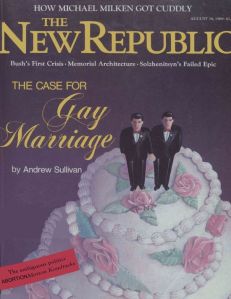
In the early 1990s, I might as well have been speaking Swahili – and was assailed, attacked, picketed, demonized and smeared to the point of personal trauma by the gay left. By the early 2000s, I was demeaned, pitied, ignored, ostracized and mocked by the Republican right. They were both, in my view, misguided and panicked – because the truth is: marriage equality is both a liberal and a conservative project. It’s liberal because of its insistence on equality; it’s conservative because of its insistence on responsibility, and because the alternatives – domestic partnerships/civil unions – are actually damaging to a critical social institution, civil marriage, by providing a marriage-lite option for all.

This conservative case was buttressed by my fellow conservative writers – learned, decent, honest intellectuals like Jon Rauch and Bruce Bawer and Dale Carpenter and John Corvino and many others. We were no Democrats. Most of us loathed the Clintons for what they did to the gay community, our rights and dignity. But we became more and weddingaislemore dismayed by our fellow conservatives, so many of whom did not simply remain on the fence but mounted a furious, passionate campaign against us. Bill Kristol’s response to this nascent movement was to bring legitimacy to the ex-gay movement; David Frum – back in the day – threatened to bring back enforcement of sodomy laws if we didn’t shut up. Republicans gleefully enshrined discrimination in many state constitutions – and bragged about it a little more loudly than Bill Clinton did the Defense of Marriage Act.

They decided, with Bill Clinton, on the most radical pushback to a fledgling movement imaginable: a Defense of Marriage Act that stripped our families of any rights under federal law, and, without Bill Clinton, a Federal Marriage Amendment that would single out gays as second-class citizens in the founding document of their own country for ever. And they used this hatred and fear of homosexuals quite openly as a way to win the 2004 election. It was crucial in Ohio that year. If Bush had lost it, Kerry would have been president. And Bush won it in large part by fear-mongering about gays.

For me, the FMA was the end of engagement and the beginning of war. You can read my reaction the day Bush endorsed it here. But I never stopped making the conservative case for marriage equality for the simple reason I believed in it. I never thought it would happen to me, but I knew it would have protected so many of my friends who didn’t have to just die agonizing deaths from AIDS but did so stigmatized and alone, their spouses treated often like dirt, their loves 400px-Aids_Quiltpublicly repudiated, their dignity grotesquely violated. This was, I believed, a matter of core humanity. It became for me the defining cause of my life.

A friend recalled visiting a man dying of AIDS at the time. A former massive bodybuilder, he had shrunk to 90 pounds. ‘Do I look big?” he asked, with mordant humor. In the next bed, surrounded by curtains, my friend heard someone singing a pop song quietly to himself. My friend joked: “Well not everyone here is depressed!” Then this from his dying, now skeletal friend: “Oh, that’s not him. He died this morning. That’s his partner. That was their song, apparently. The family took the body away, threw that guy out of the apartment he shared with his partner, and barred him from the funeral. He’s stayed there all day, singing their song. I guess it’s the last place he’ll ever see where his partner actually was. His face is pressed against the pillow. The nurses don’t have the heart to tell him to leave.”

You want to know why this became a life-long struggle? You have your answer. And I did this not despite being a Catholic, but because I am a Catholic. And I did this not despite being a conservative but because I am one.

This hideous cruelty in the midst of such shame demanded a Catholic and Christian response. This attack on people’s families, and their mutual responsibility (that man’s partner had cared for him for months, while his biological family kept their distance) was an attack on those institutions like civil marriage that are vital for a free society to keep its government in check. If that man’s husband hadn’t cared for him, the government would have had to. Why weren’t conservatives celebrating this man’s dedication rather than smearing him? Why could they not see in the gay community’s astonishing self-defense a Burkean model for social change from below – a dedication to saving our community independent of government that, if it happened in any other community, would have led the GOP to put those activists on the podium of the Republican Convention as exemplars of civil society at its best?

And that is what husband really means: to take care of someone. Why, I wondered, were conservatives actually doing all they could to prevent couples’ taking care of each other? Why would they barely tolerate it in a free society – but treat these responsible relationships as if they were threats to the very values they exemplified? Why would they want to discourage an emotional and domestic break against the huge force of testosterone that was and is bound to define a male-only community – and with a viral breakout helped wipe out 300,000 human beings in one generation? Why, for that matter, would they want to tear children from their lesbian mothers – or, even more sickeningly, recruit them to attack their own mothers, as NOM recently has?

It’s 24 years since I wrote that essay. But today, I see a phalanx of conservatives standing up for the equality of gay citizens. Here are some among the roster, which is now 75 and counting:

Meg Whitman, who supported Proposition 8 when she ran for California governor; Representatives Ileana Ros-Lehtinen of Florida and Richard Hanna of New York; Stephen J. Hadley, a Bush national security adviser; Carlos Gutierrez, a commerce secretary to Mr. Bush; James B. Comey, a top Bush Justice Department official; David A. Stockman, President Ronald Reagan’s first budget director; and Deborah Pryce, a former member of the House Republican leadership from Ohio who is retired from Congress.

Ken Mehlman, bete noir of the gay left for understandable reasons given his role in Rove’s gay-baiting 2004 campaign, was the key organizer. I’ve always believed that civil rights movements should be all about welcoming converts rather than hunting for enemies or heretics. And I think this is a huge achievement for Ken, morally, and politically. It is the right conservative thing to do. As the British Tory prime minister has put it:

I don’t support gay marriage in spite of being a conservative. I support gay marriage because I am a conservative.

Allahpundit is underwhelmed by the list. It does indeed lack, apart from Ros-Lehtinen and Hanna, current members of Congress. It lacks Dick Cheney, for example, a figure who holds this position but, as usual, does nothing about it – even when it directly affects his own family. It lacks Laura Bush – although she could still add her name. But, to her credit, Mary Cheney is there. So is my friend David Frum. The two strategists for the 2008 campaign, Steve Schmidt and Nicole Wallace are on it. Stephen Hadley and Israel Hernandez – two people very close to 43 – are there. Ken Duberstein, Alex Castellanos, Mike Murphy and Greg Mankiw are also on the list. These are not GOP lightweights. They are up there with Ted Olson.

The reason, to my mind, is quite simple. The Republican Party of Reagan who defended gay rights in the 1970s, of Bush 41 and even parts of Bush 43 is now emphatically and increasingly a party of the fanatical Christianist right, based in the South, and dedicated not to conservative politics but to dogma, theological and political. Some elements in the party may simply be wary of major change in a social institution – which is a perfectly legitimate worry. But as the statement notes:

Many of the signatories to this brief previously did not support civil marriage for same-sex couples; others did not hold a considered position on the issue. However, in the years since Massachusetts and other states have made civil marriage a reality for same-sex couples, amici, like many Americans, have observed the impact, assessed their core values and beliefs, and concluded that there is no legitimate, fact-based reason for denying same-sex couples the same recognition in law that is available to opposite-sex couples who wish to marry. Rather, we have concluded that the institution of marriage, its benefits and importance to society, and the support and stability it gives to children and families are promoted, not undercut, by providing access to civil marriage for same-sex couples.

So we now also have empirical data to reassure legitimate conservative concerns about damage to a vital institution. The first state with marriage equality continues to have the lowest divorce rate: 2.2 percent, compared with 2.5 percent before gays were allowed to marry. Compare that with the most anti-gay states: Alabama’s 4.4 percent – double Massachusetts – or anti-gay Virginia’s divorce rate of 3.7 percent, compared with marriage equality DC with 2.6 percent. More broadly, the divorce rate has come down in almost every state in the last decade – the very decade gays were allegedly going to destroy the Constitution. Stanley Kurtz was simply wrong. Gay marriage has entered our consciousness and reality as divorce rates have fallen. The linkage that Maggie Gallagher keeps talking about as a premise is a fantasy. If you can properly draw any conclusions from the data, the linkage works in the opposite way. Gay marriage has strengthened straight marriage – not the other way round.

Only prejudice and fundamentalist dogma now stand in the way. Whatever happens in the Supreme Court, exposing that matters. Showing that there is a debate among conservatives, as well as among people of faith, is a vital step forward.

I sometimes end optimistic posts with the Israeli saying, “Know hope.” But this is actually something a little different. It is knowing hope. And seeing it rise, finally and fitfully, above fear.

The full summary of the Amicus brief is below:

Amici are social and political conservatives, moderates, and libertarians from diverse religious, racial, regional, and philosophical backgrounds; many have served as elected or appointed federal and state office-holders. Many of the signatories to this brief previously did not support civil marriage for same-sex couples; others did not hold a considered position on the issue. However, in the years since Massachusetts and other states have made civil marriage a reality for same-sex couples, amici, like many Americans, have observed the impact, assessed their core values and beliefs, and concluded that there is no legitimate, fact-based reason for denying same-sex couples the same recognition in law that is available to opposite-sex couples who wish to marry. Rather, we have concluded that the institution of marriage, its benefits and importance to society, and the support and stability it gives to children and families are promoted, not undercut, by providing access to civil marriage for same-sex couples.

Amici do not denigrate the deeply held emotional, cultural, and religious beliefs that lead sincere people to take the opposite view (and, indeed, some amici themselves once held the opposite view). Whether same-sex couples should have access to civil marriage divides thoughtful, concerned citizens. Those who support and those who oppose civil marriage for same-sex couples hold abiding convictions about their respective positions. But a belief, no matter how strongly or sincerely held, cannot justify a legal distinction that is unsupported by a factual basis, especially where something as important as civil marriage is concerned. Amici take this position with the understanding that providing access to civil marriage for same-sex couples—which is the only issue raised in this case—poses no credible threat to religious freedom or to the institution of religious marriage. Given the robust constitutional protections for the free exercise of religion, amici do not believe that religious institutions should or will be compelled against their will to participate in a marriage between people of the same sex.

I. There Is No Legitimate, Fact-Based Justification For Different Legal Treatment Of Committed Relationships Between Same-Sex Couples

Laws that make distinctions between classes of people must have “reasonable support in fact.” New York State Club Ass’n, Inc. v. City of New York, 487 U.S. 1, 17 (1988). Amici do not believe that laws like Proposition 8 have a legitimate, fact-based justification for excluding same-sex couples from civil marriage. Over the past two decades, amici have seen each argument against same-sex marriage discredited by social science, rejected by courts, and undermined by their own experiences with committed same-sex couples, including those whose civil marriages have been given legal recognition in various States. Instead, the facts and evidence show that permitting civil marriage for same-sex couples will enhance the institution, protect children, and benefit society generally.

A. Marriage Promotes The Conservative Values Of Stability, Mutual Support, And Mutual Obligation

Amici start from the premise—recognized by this Court on at least fourteen occasions— that marriage is both a fundamental right protected by our Constitution and a venerable institution that confers countless benefits, both to those who marry and to society at large. … It is precisely because marriage is so important in producing and protecting strong and stable family structures that amici do not agree that the government can rationally promote the goal of strengthening families by denying civil marriage to same-sex couples.

B. Social Science Does Not Support Any Of The Putative Rationales For Proposition 8

Deinstitutionalization. No credible evidence supports the deinstitutionalization theory. … Petitioners fail to explain how extending civil marriage to same-sex couples will dilute or undermine the benefits of that institution for opposite-sex couples … or for society at large. It will instead do the opposite. Extending civil marriage to same-sex couples is a clear endorsement of the multiple benefits of marriage—stability, lifetime commitment, financial support during crisis and old age, etc.—and a reaffirmation of the social value of this institution.

Biology. There is also no biological justification for denying civil marriage to same-sex couples. Allowing same-sex couples to marry in no way undermines the importance of marriage for opposite-sex couples who enter into marriage to provide a stable family structure for their children.

Child Welfare. If there were persuasive evidence that same-sex marriage was detrimental to children, amici would give that evidence great weight. But there is not. Social scientists have resoundingly rejected the claim that children fare better when raised by opposite-sex parents than they would with same-sex parents.

C. While Laws Like Proposition 8 Are Consonant With Sincerely-Held Beliefs, That Does Not Sustain Their Constitutionality

Although amici firmly believe that society should proceed cautiously before adopting significant changes to beneficial institutions, we do not believe that society must remain indifferent to facts. This Court has not hesitated to reconsider a law’s outmoded justifications and, where appropriate, to deem them insufficient to survive an equal protection challenge. The bases on which the proponents of laws like Proposition 8 rely are the products of similar thinking that can no longer pass muster when the evidence as it now stands is viewed rationally, not through the lens of belief though sincerely held.

I. This Court Should Protect The Fundamental Right Of Civil Marriage By Ensuring That It Is Available To Same-Sex Couples

Choosing to marry is also a paradigmatic exercise of human liberty. Marriage is thus central to government’s goal of promoting the liberty of individuals and a free society. For those who choose to marry, legal recognition of that marriage serves as a bulwark against unwarranted government intervention into deeply personal concerns such as the way in which children will be raised and in medical decisions.

Amici recognize that a signal and admirable characteristic of our judiciary is the exercise of restraint. Nonetheless, this Court’s “deference in matters of policy cannot … become abdication of matters of law.” The right to marry indisputably falls within the narrow band of specially protected liberties that this Court ensures are protected from unwarranted curtailment.

Proposition 8 ran afoul of our constitutional order by submitting to popular referendum a fundamental right that there is no legitimate, fact-based reason to deny to same-sex couples. This case accordingly presents one of the rare but inescapable instances in which this Court must intervene to redress overreaching by the electorate.

Here are all the signatories so far:

—Ken Mehlman, Chairman, Republican National Committee, 2005-2007

—Tim Adams, Undersecretary of the Treasury for International Affairs, 2005-2007

—David D. Aufhauser, General Counsel, Department of Treasury, 2001-2003

—Cliff S. Asness, Businessman, Philanthropist, and Author

—John B. Bellinger III, Legal Adviser to the Department of State, 2005-2009

—Katie Biber, General Counsel, Romney for President, 2007-2008 and 2011-2012

—Mary Bono Mack, Member of Congress, 1998-2013

—William A. Burck, Deputy Staff Secretary, Special Counsel and Deputy Counsel to the
President, 2005-2009

—Alex Castellanos, Republican Media Advisor

—Paul Cellucci, Governor of Massachusetts, 1997-2001, and Ambassador to Canada,
2001-2005

—Mary Cheney, Director of Vice Presidential Operations, Bush-Cheney 2004

—Jim Cicconi, Assistant to the President & Deputy to the Chief of Staff, 1989-1990

—James B. Comey, United States Deputy Attorney General, 2003-2005

—R. Clarke Cooper, U.S. Alternative Representative, United Nations Security Council,
2007-2009

—Julie Cram, Deputy Assistant to the President and Director White House Office of
Public Liaison, 2007-2009

—Michele Davis, Assistant Secretary for Public Affairs and Director of Policy Planning,
Department of the Treasury, 2006-2009

—Kenneth M. Duberstein, White House Chief of Staff and Assistant to the President,
1981-1984 and 1987-1989

—Lew Eisenberg, Finance Chairman, Republican National Committee, 2002-2004

—Elizabeth Noyer Feld, Public Affairs Specialist, White House Office of Management and
Budget, 1984-1987

—David Frum, Special Assistant to the President, 2001-2002

—Richard Galen, Communications Director, Speaker’s Political Office, 1996-1997

—Mark Gerson, Chairman, Gerson Lehrman Group and Author of The Neoconservative
Vision: From the Cold War to the Culture Wars and In the Classroom: Dispatches from
an Inner-City School that Works

—Benjamin Ginsberg, General Counsel, Bush-Cheney 2000 & 2004

—Adrian Gray, Director of Strategy, Republican National Committee, 2005-2007

—Richard Grenell, Spokesman, U.S. Ambassadors to the United Nations, 2001-2008

—Patrick Guerriero, Mayor, Melrose Massachusetts and member of Massachusetts
House of Representatives, 1993-2001

—Carlos Gutierrez, Secretary of Commerce, 2005-2009

—Stephen Hadley, Assistant to the President and National Security Advisor, 2005-2009

—Richard Hanna, Member of Congress, 2011-Present

—Israel Hernandez, Assistant Secretary of Commerce for International Trade, 2005-2009

—Margaret Hoover, Advisor to the Deputy Secretary of Homeland Security, 2005-2006

—Michael Huffington, Member of Congress, 1993-1995

—Jon Huntsman, Governor of Utah, 2005-2009

—David A. Javdan, General Counsel, United States Small Business Administration, 2002-
2006

—Reuben Jeffery, Undersecretary of State for Economic, Energy, and Agricultural
Affairs, 2007-2009

—Greg Jenkins, Deputy Assistant to the President and Director of Presidential Advance,
2003-2004

—Coddy Johnson, National Field Director, Bush-Cheney 2004

—Gary Johnson, Governor of New Mexico, 1995-2003

—Robert Kabel, Special Assistant to the President for Legislative Affairs, 1982-1985

—Theodore W. Kassinger, Deputy Secretary of Commerce, 2004-2005

—Jonathan Kislak, Deputy Undersecretary of Agriculture for Small Community and Rural
Development, 1989-1991

—David Kochel, Senior Advisor to Mitt Romney’s Iowa Campaign, 2007-2008 and 2011-
2012

—James Kolbe, Member of Congress, 1985-2007

—Jeffrey Kupfer, Acting Deputy Secretary of Energy, 2008-2009

—Kathryn Lehman, Chief of Staff, House Republican Conference, 2003-2005

—Daniel Loeb, Businessman and Philanthropist

—Alex Lundry, Director of Data Science, Romney for President, 2012

—Greg Mankiw, Chairman, Council of Economic Advisers, 2003-2005

—Catherine Martin, Deputy Assistant to the President and Deputy Communications
Director for Policy & Planning, 2005-2007

—Kevin Martin, Chairman, Federal Communications Commission, 2005-2009

—David McCormick, Undersecretary of the Treasury for International Affairs, 2007-2009

—Mark McKinnon, Republican Media Advisor

—Bruce P. Mehlman, Assistant Secretary of Commerce, 2001-2003

—Connie Morella, Member of Congress, 1987-2003 and U.S. Ambassador to the
Organization for Economic Co-operation and Development, 2003-2007

—Michael E. Murphy, Republican Political Consultant

—Michael Napolitano, White House Office of Political Affairs, 2001-2003

—Ana Navarro, National Hispanic Co-Chair for Senator John McCain’s Presidential
Campaign, 2008

—Noam Neusner, Special Assistant to the President for Economic Speechwriting, 2002-
2005

—Nancy Pfotenhauer, Economist, Presidential Transition Team, 1988 and President’s
Council on Competitiveness, 1990

—J. Stanley Pottinger, Assistant U.S. Attorney General (Civil Rights Division), 1973-1977

—Michael Powell, Chairman, Federal Communications Commission, 2001-2005

—Deborah Pryce, Member of Congress, 1993-2009

—John Reagan, New Hampshire State Senator, 2012-Present

—Kelley Robertson, Chief of Staff, Republican National Committee, 2005-2007

—Ileana Ros-Lehtinen, Member of Congress, 1989-Present

—Harvey S. Rosen, Member and Chairman, Council of Economic Advisers, 2003-2005

—Lee Rudofsky, Deputy General Counsel, Romney for President, 2012

—Patrick Ruffini, eCampaign Director, Republican National Committee, 2005-2007

—Steve Schmidt, Deputy Assistant to the President and Counselor to the Vice President,
2004-2006

—Ken Spain, Communications Director, National Republican Congressional Committee,
2009-2010

—Robert Steel, Undersecretary of the Treasury for Domestic Finance, 2006-2008

—David Stockman, Director, Office of Management and Budget, 1981-1985

—Jane Swift, Governor of Massachusetts, 2001-2003

—Michael E. Toner, Chairman and Commissioner, Federal Election Commission, 2002-
2007

—Michael Turk, eCampaign Director for Bush-Cheney 2004

—Mark Wallace, U.S. Ambassador to the United Nations, Representative for UN
Management and Reform, 2006-2008

—Nicolle Wallace, Assistant to the President and White House Communications
Director, 2005-2008

—William F. Weld, Governor of Massachusetts, 1991-1997, and Assistant U.S. Attorney
General (Criminal Division), 1986-1988

—Christine Todd Whitman, Governor of New Jersey, 1994-2001, and Administrator of
the EPA, 2001-2003

—Meg Whitman, Republican Nominee for Governor of California, 2010

—Robert Wickers, Republican Political Consultant

—Dan Zwonitzer, Wyoming State Representative, 2005-present


26 Feb 18:04

fuckyeahdementia: we’ve been living a lie!!!1

by missannagoldfarb


fuckyeahdementia:

we’ve been living a lie!!!1

26 Feb 18:01

Photo


25 Feb 22:39

Photo

Steve Dyer

Robby is this Star Trek


25 Feb 22:38

Foolproof Way to Not Spend Money for 1 Whole Day

by Logan Sachon
Steve Dyer

If you don't subscribe to this feed... you suck.

by Logan Sachon

Leave your wallet at home. Just leave it there! And then leave your house! Without. Your. Wallet. You’ll still be tempted to buy things, but you won’t be able to. Because your money will not be with you. I tested out this method all weekend and IT REALLY WORKS. (Another method, the less fun method, is to bring your wallet with you but have NO MONEY IN YOUR ACCOUNT and also NO CREDIT CARDS or ONLY MAXED OUT CREDIT CARDS. Same results, less fun, dignity, agency.)

13 Comments
25 Feb 22:25

thatscoognut: I dont remember Rockos Modern Life being that...

by 90s90s90s
Steve Dyer

fave nicktoon


thatscoognut:

I dont remember Rockos Modern Life being that dirty

25 Feb 15:25

Bankrupt San Bernardino Hires Twice-Bankrupt City Manager

by Ken Layne
Steve Dyer

...Ben Wyatt?

"The bankrupt city of San Bernardino has hired a new city manager who, according to court filings, has twice declared personal bankruptcy and was recently ousted from the board of a small community's water company after being sued by shareholders."
The comically corrupt inland cities of Southern California continue to provide inspiration for new generations of aspirational local crooks.

---

See more posts by Ken Layne

3 comments

22 Feb 21:17

Photo

Steve Dyer

i agree


22 Feb 21:09

via

Steve Dyer

This is terrible, but I'm having fun imagining how smug the asshole who made this felt when he google image searched "smug paul mccartney" and was like YES THIS IS THE PERFECT ONE


via

22 Feb 20:58

Photo

Steve Dyer

gotta get down on friday


22 Feb 16:18

Photo


21 Feb 21:21

Mental Health Break

by Andrew Sullivan
Steve Dyer

Anne, are you here?

Everyone’s favorite supporting actor:

(Hat tip: Gabe)


21 Feb 20:16

I want coffee so bad I’m going to shoot you!!! Ha ha, no,...

Steve Dyer

WHAT THE HELL IS UP WITH THEIR RSS TODAY


I want coffee so bad I’m going to shoot you!!! Ha ha, no, just kidding, it’s just a gun mug, but if it was a real gun, everyone at this office would be dead, ha ha.

It’s a joke, why aren’t you laughing? Bang! Ha! Not a real gun, just a mug.

21 Feb 17:53

Photo

Steve Dyer

"Jizz in My Pants" goes international.