17 Nov 12:50
by Alex Yong Sheng Eng, Zdeněk Sofer, Štěpán Huber, Daniel Bouša, Miroslav Maryško, Martin Pumera

Magnetic Properties In their Full Paper on page 16828 ff., M. Pumera et al. discuss the hydrogenation of graphene using a Birch reduction method. The choice of alkali metals and alcohols/water as quenching agents has been studied and a systematic survey of electron (Li, Na, K, Cs) and proton sources (tBuOH, iPrOH, MeOH, H2O) has been performed to identify the optimal conditions.
17 Nov 12:40
by Masooma Ibrahim, Valeriu Mereacre, Nicolas Leblanc, Wolfgang Wernsdorfer, Christopher E. Anson, Annie K. Powell

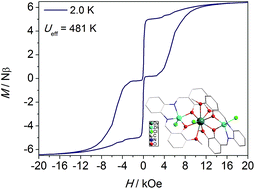
A giant 3d/4f/POM tetrahedron was prepared through a one-pot self-assembly process which combines 4f and 3d/4f coordination cluster chemistry with polyoxometalate (POM) chemistry. In their Communication on page 15574 ff., M. Ibrahim, A. K. Powell et al. describe how trilacunary [GeW9O34]10− POMs are used as superligands to construct the nanoscale hybrid anion [{(GeW9O34)2DyIII3(µ-OH)3(H2O)}6{CoII2DyIII3(µ3-OH)6(OH2)6}4]56−, which contains 30 DyIII, 8 CoII, and 108 WVI metal centers, and exhibits single-molecule magnet behavior. It contains the largest number of 4f ions of any POM system reported to date.
16 Nov 04:37
by Juan-Juan Wang, Juan Sun, Meng Yang and Li-Cun Li

Inorganic Chemistry
DOI: 10.1021/acs.inorgchem.5b01915

16 Nov 04:37
by Zaichao Zhang, Yong Liu, Rong-Min Wei, Zhen-Huan Sheng, Peng Wang and You Song

Inorganic Chemistry
DOI: 10.1021/acs.inorgchem.5b01852

31 Oct 11:11
by Lucy Clark, Farida H. Aidoudi, Cameron Black, Kasun S. A. Arachchige, Alexandra M. Z. Slawin, Russell E. Morris, Philip Lightfoot
Abstract
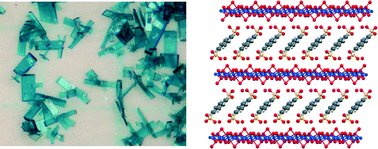
The ionothermal synthesis, structure, and magnetic susceptibility of a novel inorganic–organic hybrid material, imidazolium vanadium(III,IV) oxyfluoride [C3H5N2][V9O6F24(H2O)2] (ImVOF) are presented. The structure consists of inorganic vanadium oxyfluoride slabs with kagome layers of V4+ S= ions separated by a mixed valence layer. These inorganic slabs are intercalated with imidazolium cations. Quinuclidinium (Q) and pyrazinium (Pyz) cations can also be incorporated into the hybrid structure type to give QVOF and PyzVOF analogues, respectively. The highly frustrated topology of the inorganic slabs, along with the quantum nature of the magnetism associated with V4+, means that these materials are excellent candidates to host exotic magnetic ground states, such as the highly sought quantum spin liquid. Magnetic susceptibility measurements of all samples suggest an absence of conventional long-range magnetic order down to 2 K despite considerable antiferromagnetic exchange.

All in a spin: Antiferromagnetic crystalline solids with a kagome network of
ions are desired as realizations of two-dimensional quantum spin liquids. Until recently, the few examples of these materials were all based on Cu2+ ions. Now, the ionothermal synthesis, structure, and magnetic properties of a family of inorganic–organic hybrid solids that contain antiferromagnetic kagome layers of
V4+ ions is presented.
31 Oct 10:41
by Hai-Ying Wang, Yue Wu, Chanel F. Leong, Deanna M. D’Alessandro and Jing-Lin Zuo

Inorganic Chemistry
DOI: 10.1021/acs.inorgchem.5b01803

31 Oct 10:40
by Wen-Min Wang, Hong-Xia Zhang, Shi-Yu Wang, Hai-Yun Shen, Hong-Ling Gao, Jian-Zhong Cui and Bin Zhao

Inorganic Chemistry
DOI: 10.1021/acs.inorgchem.5b01404

30 Oct 13:43
by Chang-Dai Si, Dong-Cheng Hu, Yan Fan, Xiu-Yan Dong, Xiao-Qiang Yao, Yun-Xia Yang and Jia-Cheng Liu

Crystal Growth & Design
DOI: 10.1021/acs.cgd.5b01124

28 Oct 09:10
by Maria G. F. Vaz, Rafael A. Allão, Handan Akpinar, John A. Schlueter, Sauli Santos, Paul M. Lahti and Miguel A. Novak
Inorganic Chemistry
DOI: 10.1021/acs.inorgchem.5b02360

24 Oct 07:31
by Dongdi Zhang, Fan Cao, Pengtao Ma, Chao Zhang, You Song, Zhijie Liang, Xiaojing Hu, Jingping Wang, Jingyang Niu
Abstract
By deliberately using a metastable polyanion [(NbO2)6P2W12O56]12− (1), which was formed in situ, we have discovered the unprecedented hexameric cluster {Mn15(Nb6P2W12O62)6} (2), in which the six polyanions [Nb6P2W12O61]10− are alternately connected by four intriguing trinuclear {MnIII3} moieties and four {MnII} linkers. This discovery is the first in which the phosphoniobotungstate has been made accessible by using transition-metal ions; furthermore, polyanion 2 represents the largest niobotungstate cluster reported to date. Analysis by means of electrospray ionization mass spectrometry (ESI-MS) provides insight into the self-assembly process, and the peaks observed relate to the different charge states of the parent cluster, thus confirming the stability of 2. In addition, magnetic-susceptibility measurements reveal that each {MnIII3} subunit is a separate single-molecule magnet (SMM). This discovery results from the exploration of the reverse effect of metastable polyanion 1 possessing high reactivity, thereby turning a disadvantage into an advantage. This finding could define a new synthetic strategy for the design and synthesis of magnetic polyoxometalate (POM) clusters.

Turning a disadvantage into an advantage: A facile strategy for the use of {(NbO2)6P2W12} formed in situ with paramagnetic manganese ions has led to the discovery of the unprecedented hexameric cluster {Mn15(Nb6P2W12O62)6} (see figure), which represents the first phosphoniobotungstate-based transition-metal derivative and largest niobotungstate cluster reported to date. In addition, the title compound behaves as a single-molecule magnet (SMM).
24 Oct 07:30
by Fabrice Pointillart, Boris le Guennic, Olivier Cador, Olivier Maury and Lahcène Ouahab

Accounts of Chemical Research
DOI: 10.1021/acs.accounts.5b00296

24 Oct 07:28
by Yoshihiro Doi, Ryo Suzuki, Yukio Hinatsu, Katsuaki Kodama and Naoki Igawa

Inorganic Chemistry
DOI: 10.1021/acs.inorgchem.5b01619

23 Oct 11:55
by Thais Grancha, Alvaro Acosta, Joan Cano, Jesús Ferrando-Soria, Beatriz Seoane, Jorge Gascon, Jorge Pasán, Donatella Armentano and Emilio Pardo

Inorganic Chemistry
DOI: 10.1021/acs.inorgchem.5b01854


 Open Access