18 Sep 14:09
by Caren Wanzke,
Alexander Jussupow,
Fabian Kohler,
Hendrik Dietz,
Ville R. I. Kaila,
Job Boekhoven

Keep it moving: The self‐assembly of peptides into vesicles is coupled to a dynamic chemical reaction cycle. These vesicles emerge in response to fuel, and continuously remodel and decay when all fuel is depleted.
Abstract
Synthetic lipid membranes have served as important models for cellular membranes. However, these static membranes do not recapitulate the dynamic nature of the biological membranes which are frequently remodeled to support cellular function. An ideal membrane model would thus also display dynamic exchange of lipids. In this work, we achieve such a system by coupling the self‐assembly of peptides into membranes with a chemical reaction cycle. The reaction cycle activates and deactivates the peptides for self‐assembly at the expense of a chemical fuel. The resulting membranes are dynamically remodeled, and, over their 40 min lifetime, they emerge, grow, and are torn apart before they eventually decay.
13 Sep 07:59
by Beth Mundy, Web Writer
We all know what happens when materials take too much mechanical stress – they eventually break.
What if you could easily tell when something like a support was close to its maximum stress, before it undergoes a catastrophic event, just by looking at it? One option is to incorporate a mechanochromic polymer, a polymer that changes color when under sufficient mechanical stress, to provide a visual indicator that a material has reached a specific stress threshold. The polymers don’t need to be entirely composed of mechanochromically active moieties to exhibit useful properties; many studies have focused on a single active mechanophore at the center of a large polymer chain. In fact, the mechanical force is greatest at the center of a chain and is directly proportional to the length of the chains. This holds for polymers in solution but hasn’t been extensively studied in the types of bulk systems useful for applications.
Recently, researchers in Japan set out to characterize the effects of chain length and branching on mechanochromic dendrimers, polymers with monodisperse and regularly branched globular structures. Showing that dendrimers exhibit mechanochromism is already a novel result, but their well-defined nature allowed the researchers to draw correlations between structure and bulk responsiveness. They employed diarylbibenzylfuranone (DABBF) as the mechanochromic moiety since it generates arylbenzofuranone (ABF) radicals, which are blue, air-stable, and electron paramagnetic resonance spectroscopy (EPR) active, when exposed to mechanical force (Figure 1).
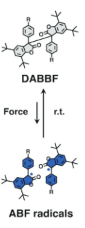
Figure 1. Structure of the DABBF moiety and the active ABF radicals generated by its dissociation.
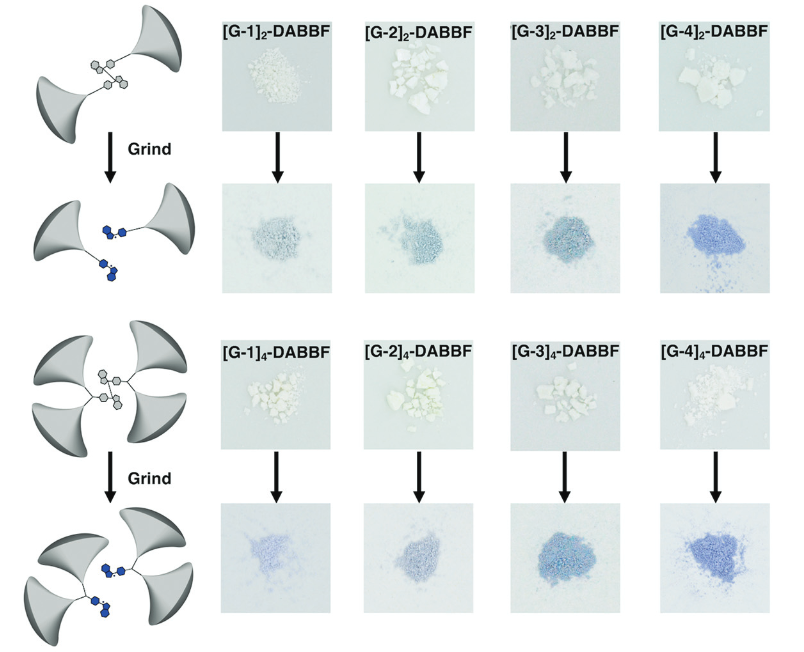
These characteristics allow for straightforward qualitative and quantitative analysis. The team coupled the DABBF moiety with two series of dendrimers, with increasing generations having larger and more highly branched monomer units, to create a range of molecular weights and degrees of branching for study. The dendrimers showed a color change from white to blue (Figure 2) when ground in a ball mill, which was used to ensure the reproducibility of the force applied to all samples.
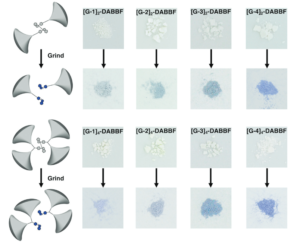
Figure 2. Photographs of the first (top) and second (bottom) mechanochromic dendrimers before and after grinding, showing the color change associated with the generation of ABF radicals.
EPR measurements confirmed the presence of the ABF radicals in the samples after milling, demonstrating that the color change is due to the cleavage of the DABBF. The integrated EPR spectra were used to quantitatively determine the percentage of DABBF moieties that dissociated. The responsiveness of the dendrimers increased exponentially with increasing generation and branching. However, the primary factor governing ABF generation was found to be molecular weight. Two dendrimers with different levels of chain entanglement, but similar molecular weights, exhibited comparable cleavage ratios. The question then became does molecular weight increase the transfer efficiency of force to the DABBF or does the increased steric bulk make it harder for the ABF radicals to recombine? To probe the kinetics of this process, the researchers varied the grinding time and saw that within 5 minutes all the highly branched samples reached their maximum dissociation level. Additionally, monitoring the ABF recombination showed that even after 6 hours approximately 95% of the radicals remained dissociated in all 3rd and 4th generation dendrimers. These data suggest that the enhancement in responsiveness can be attributed to better force transmission to the DABBF.
This work shows mechanoresponsiveness in a range of dendrimers with varying degrees of branching and rigidity. Not only did they demonstrate novel activity, but the researchers also probed the mechanism of the enhanced activity with increasing molecular weight. This initial study opens avenues to explore polymer rigidity, surface functionality, and other dendrimer features to design new, functional materials.
To find out more, please read:
Mechanochromic dendrimers: the relationship between primary structure and mechanochromic properties in the bulk
Takuma Watabe, Kuniaki Ishizuki, Daisuke Aoki, and Hideyuki Otsuka
Chem. Commun., 2019, 55, 6831-6834.
About the blogger:
 Beth Mundy is a PhD candidate in chemistry in the Cossairt lab at the University of Washington in Seattle, Washington. Her research focuses on developing new and better ways to synthesize nanomaterials for energy applications. She is often spotted knitting in seminars or with her nose in a good book. You can find her on Twitter at @BethMundySci.
08 Sep 14:11
Nature, Published online: 04 September 2019; doi:10.1038/d41586-019-02616-2
Evidence is stacking up that a small number of strategically placed bots can influence the choices of undecided voters.
04 Sep 10:04
by M. Nieves Corella-Ochoa†, Jesu´s B. Tapia‡, Heather N. Rubin‡, Vanesa Lillo†, Jesu´s Gonza´lez-Cobos†, Jose´ Luis Nu´n~ez-Rico†, Salvador R.G. Balestra?, Neyvis Almora-Barrios?, Marina Lledo´s†?, Arnau Gu¨ell-Bara†, Juanjo Cabezas-Gime´nez†¶, Eduardo C. Escudero-Ada´n†, Anton Vidal-Ferran*†#, Sofi´a Calero*??, Melissa Reynolds*‡§, Carlos Marti´-Gastaldo*?, and Jose´ Ramo´n Gala´n-Mascaro´s*†#

Journal of the American Chemical Society
DOI: 10.1021/jacs.9b06500

31 Aug 08:15
by Natalie L. Mutter†§, Jana Volaric´‡§, Wiktor Szymanski*‡?, Ben L. Feringa*‡, and Giovanni Maglia*†
![TOC Graphic]()
Journal of the American Chemical Society
DOI: 10.1021/jacs.9b06998

29 Aug 10:39
by Jiankang Zhong‡§, Liang Zhang†‡§, David P. August‡, George F. S. Whitehead‡, and David A. Leigh*†‡

Journal of the American Chemical Society
DOI: 10.1021/jacs.9b06127

16 Aug 12:34
Chem. Soc. Rev., 2019, 48,5016-5032
DOI: 10.1039/C8CS00888D, Review Article
Sofía Mena-Hernando, Emilio M. Pérez
An overview of the progress in mechanically interlocked materials is presented. In particular, we focus on polycatenanes, polyrotaxanes, metal–organic rotaxane frameworks (MORFs), and mechanically interlocked derivatives of carbon nanotubes (MINTs).
The content of this RSS Feed (c) The Royal Society of Chemistry

16 Aug 06:33
by Xin Wu,
Jennifer Small,
Alessio Cataldo,
Anne M. Withecombe,
Peter Turner,
Philip Alan Gale

Voltage‐switchable ion transport: A group of synthetic anion transporters including a tetraurea macrocycle facilitate HCl transport that can be attenuated by applying a membrane potential. This property is related to strong lipid phosphate headgroup binding and the lack of chloride uniport activity.
Abstract
Synthetic anion transporters that facilitate transmembrane H+/Cl− symport (cotransport) have anti‐cancer potential due to their ability to neutralize pH gradients and inhibit autophagy in cells. However, compared to the natural product prodigiosin, synthetic anion transporters have low‐to‐modest H+/Cl− symport activity and their mechanism of action remains less well understood. We report a chloride‐selective tetraurea macrocycle that has a record‐high H+/Cl− symport activity similar to that of prodigiosin and most importantly demonstrates unprecedented voltage‐switchable transport properties that are linked to the lack of uniport activity. By studying the anion binding affinity and transport mechanisms of four other anion transporters, we show that the lack of uniport and voltage‐dependent H+/Cl− symport originate from strong binding to phospholipid headgroups that hampers the diffusion of the free transporters through the membrane, leading to an unusual H+/Cl− symport mechanism that involves only charged species. Our work provides important mechanistic insights into different classes of anion transporters and a new approach to achieve voltage‐switchability in artificial membrane transport systems.
24 Jul 06:34
by Weicheng Zhang†, Ayan Pal†‡, Alonso Ricardo§, and Jack W. Szostak*

Journal of the American Chemical Society
DOI: 10.1021/jacs.9b06453

23 Jul 06:41
by Nathaniel Wagner
Nature Chemistry, Published online: 22 July 2019; doi:10.1038/s41557-019-0301-2
The chemical functionality necessary for the origin of life may have emerged from simple reactions assembled into complex networks. Now, it has been shown that prebiotically relevant heterogeneous reaction networks can generate robust oscillations within complex mixtures comprised of precursors that do not oscillate on their own.
23 Jul 06:41
by Daniela Kroiss, Gonen Ashkenasy, Adam B. Braunschweig, Tell Tuttle, Rein V. Ulijn
How life originated on Earth remains one of the biggest unresolved questions of our time. Here, we discuss the potential of systems chemistry to improve our understanding of how simple biomolecules interact to give rise to novel functions. We provide examples ranging from the initial selection of minimalistic building blocks to the development of increasingly more complex and integrated molecular systems and debate how this might ultimately enable the design of artificial cells in the future.
06 Jul 15:29
by Clemens Richert,
Peter Tremmel,
Helmut Griesser,
Ulrich E. Steiner

Organocapture, in which a small heterocycle captures reactive intermediates by reacting with them, thereby suppressing their hydrolysis and modulating their reactivity, could have facilitated the formation of biosynthetic networks in the absence of enzymes on the early earth.
Abstract
Organisms use enzymes to ensure a flow of substrates through biosynthetic pathways. How the earliest form of life established biosynthetic networks and prevented hydrolysis of intermediates without enzymes is unclear. Organocatalysts may have played the role of enzymes. Quantitative analysis of reactions of adenosine 5’‐monophosphate and glycine that produce peptides, pyrophosphates, and RNA chains reveals that organocapture by heterocycles gives hydrolytically stabilized intermediates with balanced reactivity. We determined rate constants for 20 reactions in aqueous solutions containing a carbodiimide and measured product formation with cyanamide as a condensing agent. Organocapture favors reactions that are kinetically slow but productive, and networks, over single transformations. Heterocycles can increase the metabolic efficiency more than two‐fold, with up to 0.6 useful bonds per fuel molecule spent, boosting the efficiency of life‐like reaction systems in the absence of enzymes.
04 Apr 10:45
by Melissa Ball, Boyuan Zhang, Yu Zhong, Brandon Fowler, Shengxiong Xiao, Fay Ng, Michael Steigerwald, Colin Nuckolls

Accounts of Chemical Research
DOI: 10.1021/acs.accounts.9b00017

28 Feb 11:40
by Tom Keijer
Circular chemistry to enable a circular economy
Circular chemistry to enable a circular economy, Published online: 21 February 2019; doi:10.1038/s41557-019-0226-9
By expanding the scope of sustainability to the entire lifecycle of chemical products, the concept of circular chemistry aims to replace today’s linear ‘take–make–dispose’ approach with circular processes. This will optimize resource efficiency across chemical value chains and enable a closed-loop, waste-free chemical industry.
28 Feb 11:15
by Alberto Credi

Thanks for the lift, mate! A molecular machine based on a rotaxane embedded in a lipid bilayer can carry potassium ions across the membrane by taking advantage of the stochastic shuttling motion of its macrocyclic ring.
Abstract
The controlled transport of molecular and ionic substrates across bilayer membranes is a fundamental task for the operation of living organisms. It is also a highly fascinating and demanding challenge for artificial molecular machines. The recent report of a synthetic transmembrane molecular shuttle that can transport potassium ions selectively down a gradient in a liposomal system makes a small but significant step towards this goal.
28 Feb 11:14
by Hoshika, S., Leal, N. A., Kim, M.-J., Kim, M.-S., Karalkar, N. B., Kim, H.-J., Bates, A. M., Watkins, N. E., SantaLucia, H. A., Meyer, A. J., DasGupta, S., Piccirilli, J. A., Ellington, A. D., SantaLucia, J., Georgiadis, M. M., Benner, S. A.
We report DNA- and RNA-like systems built from eight nucleotide "letters" (hence the name "hachimoji") that form four orthogonal pairs. These synthetic systems meet the structural requirements needed to support Darwinian evolution, including a polyelectrolyte backbone, predictable thermodynamic stability, and stereoregular building blocks that fit a Schrödinger aperiodic crystal. Measured thermodynamic parameters predict the stability of hachimoji duplexes, allowing hachimoji DNA to increase the information density of natural terran DNA. Three crystal structures show that the synthetic building blocks do not perturb the aperiodic crystal seen in the DNA double helix. Hachimoji DNA was then transcribed to give hachimoji RNA in the form of a functioning fluorescent hachimoji aptamer. These results expand the scope of molecular structures that might support life, including life throughout the cosmos.
28 Feb 11:09
by Benedikt Rieß,
Job Boekhoven

In supramolecular materials, molecular building blocks are held together by non‐covalent interactions. These materials typically exist in equilibrium with their environment. Living biological materials exist out of equilibrium. They require constant dissipation of energy to be sustained. Here, we show the crucial differences between equilibrium and dissipative supramolecular materials. We focus on one unique property of the emerging materials: their tunable lifetime. With recent examples, we show the principles involved and how we can apply these materials in the future.
Abstract
Supramolecular materials are materials in which molecular building blocks are held together by non‐covalent interactions. These materials exist in equilibrium with their environment. In contrast, most biological materials exist out of equilibrium. They require constant dissipation of energy and consumption of nutrients to be sustained. As a result of their non‐equilibrium nature, biological materials have superior properties compared to their in‐equilibrium counterparts. These properties include spatial and temporal control over their presence, the ability to self‐heal and even the ability to self‐replicate. Inspired by biology, researchers have developed analogs of such dissipative supramolecular materials. This Focus Review introduces the crucial differences between in‐equilibrium and dissipative supramolecular materials. We focus on one unique property of the emerging materials: their tunable lifetime. With recent examples, we show the principles involved and how these materials can be applied in the future.
28 Feb 11:09
by Falk Wachowius,
Philipp Holliger

Stuck like glue: Non‐enzymatic ligation of 5′‐phosphorimidazolide RNAs programmed by short splint (“guide”) RNAs allows assembly of an active RNA polymerase ribozyme from RNA oligomer fragments no longer than 30 nucleotides in a “single pot” reaction.
Abstract
Central to the “RNA world” hypothesis of the origin of life is the emergence of an RNA catalyst capable of RNA replication. However, possible replicase ribozymes are quite complex and were likely predated by simpler non‐enzymatic replication reactions. The templated polymerisation of phosphorimidazolide (Imp) activated ribonucleotides currently appears as the most tractable route to both generate and replicate short RNA oligomer pools from which a replicase could emerge. Herein we demonstrate the rapid assembly of complex ribozymes from such Imp‐activated RNA fragment pools. Specifically, we show assembly of a newly selected minimal RNA polymerase ribozyme variant (150 nt) by RNA templated ligation of 5’‐2‐methylimidazole‐activated RNA oligomers <30 nucleotides long. Our results provide support for the possibility that complex RNA structures could have emerged from pools of activated RNA oligomers and outlines a path for the transition from non‐enzymatic/chemical to enzymatic RNA replication.
18 Feb 10:01
by Minglu Zhu, Qiongfeng Shi, Tianyiyi He, Zhiran Yi, Yiming Ma, Bin Yang, Tao Chen, Chengkuo Lee

ACS Nano
DOI: 10.1021/acsnano.8b08329

18 Feb 09:52
by Jean-François Ayme, Jonathon E. Beves, Christopher J. Campbell, David A. Leigh

Journal of the American Chemical Society
DOI: 10.1021/jacs.8b12800

18 Jan 16:15
by Bin Liu, Charalampos G. Pappas, Ennio Zangrando, Nicola Demitri, Piotr J. Chmielewski, Sijbren Otto

Journal of the American Chemical Society
DOI: 10.1021/jacs.8b11698

16 Jan 11:35
by Pengyang Xin,
Huiyuan Kong,
Yonghui Sun,
Lingyu Zhao,
Haodong Fang,
Haofeng Zhu,
Tao Jiang,
Jingjing Guo,
Qian Zhang,
Wenpei Dong,
Chang-Po Chen

Old pals: A pillararene‐cyclodextrin hybrid molecule with artificial K+ channel function is presented. The cation transport selectivity of the artificial channel is tunable. The high selectivity of this artificial channel for K+ over Na+ ensures specific transmembrane translocation of K+, and generated a stable membrane potential across lipid bilayers.
Abstract
A class of artificial K+ channels formed by pillararene‐cyclodextrin hybrid molecules have been designed and synthesized. These channels efficiently inserted into lipid bilayers and displayed high selectivity for K+ over Na+ in fluorescence and electrophysiological experiments. The cation transport selectivity of the artificial channels is tunable by varying the length of the linkers between pillararene and cyclodexrin. The shortest channel showed specific transmembrane transport preference for K+ over all alkali metal ions (selective sequence: K+ > Cs+ > Rb+ > Na+ > Li+), and is rarely observed for artificial K+ channels. The high selectivity of this artificial channel for K+ over Na+ ensures specific transmembrane translocation of K+, and generated stable membrane potential across lipid bilayers.
07 Jan 09:27
by Yuzhong Liu, Christian S. Diercks, Yanhang Ma, Hao Lyu, Chenhui Zhu, Sultan A. Alshmimri, Saeed Alshihri, Omar M. Yaghi

Journal of the American Chemical Society
DOI: 10.1021/jacs.8b12177

07 Jan 09:21
by Huang Wu, Yong Chen, Long Zhang, Ommid Anamimoghadam, Dengke Shen, Zhichang Liu, Kang Cai, Cristian Pezzato, Charlotte L. Stern, Yu Liu, J. Fraser Stoddart

Journal of the American Chemical Society
DOI: 10.1021/jacs.8b10526

05 Dec 08:39
by Zihao Zhang,
Jennifer A. Schott,
Miaomiao Liu,
Hao Chen,
Xiuyang Lu,
Bobby G. Sumpter,
Jie Fu,
Sheng Dai

Learn on me: The artificial neural network, a type of machine learning algorithm, is used to model the relationship between CO2 adsorption capacity and the textural properties of porous carbon. Then, it is used as an implicit model to precisely predict the CO2 adsorption capacity of unknow porous carbons based on its textural properties.
Abstract
Porous carbons with different textural properties exhibit great differences in CO2 adsorption capacity. It is generally known that narrow micropores contribute to higher CO2 adsorption capacity. However, it is still unclear what role each variable in the textural properties plays in CO2 adsorption. Herein, a deep neural network is trained as a generative model to direct the relationship between CO2 adsorption of porous carbons and corresponding textural properties. The trained neural network is further employed as an implicit model to estimate its ability to predict the CO2 adsorption capacity of unknown porous carbons. Interestingly, the practical CO2 adsorption amounts are in good agreement with predicted values using surface area, micropore and mesopore volumes as the input values simultaneously. This unprecedented deep learning neural network (DNN) approach, a type of machine learning algorithm, exhibits great potential to predict gas adsorption and guide the development of next‐generation carbons.
29 Nov 08:35
by Shinji Ikejiri, Yoshinori Takashima, Motofumi Osaki, Hiroyasu Yamaguchi, Akira Harada

Journal of the American Chemical Society
DOI: 10.1021/jacs.8b11351

27 Nov 08:23
by Fernando T. Maestre
Seven steps towards health and happiness in the lab
Seven steps towards health and happiness in the lab, Published online: 23 November 2018; doi:10.1038/d41586-018-07514-7
A productive lab need not be a negative environment, says Fernando T. Maestre.
23 Nov 08:52
by Liang Chen, Hao Min, Weilan Zeng, Xiaoming Zhu, Yun Liang, Guobo Deng, Yuan Yang

Organic Letters
DOI: 10.1021/acs.orglett.8b03078

16 Nov 10:55
Chem. Sci., 2019, Advance Article
DOI: 10.1039/C8SC04561E, Edge Article

Open Access
Petr Slavík, Dustin W. Kurka, David K. Smith
From waste to wealth – a self-assembled hydrogel remediates palladium from solution down to sub-ppm levels, and the resulting gel, which has embedded Pd nanoparticles, acts as a green and efficient catalyst for Suzuki–Miyaura cross-coupling reactions.
To cite this article before page numbers are assigned, use the DOI form of citation above.
The content of this RSS Feed (c) The Royal Society of Chemistry

23 Oct 06:53
by Nirob K. Saha, Nirmal K. Mitra, Kara F. Johnson, Bradley L. Merner

Organic Letters
DOI: 10.1021/acs.orglett.8b02979