By incorporating a multilayer network and time-decaying memory into the original voter model, the coupled effects of spatial and temporal cumulation of peer pressure on consensus are investigated. Heterogeneity in peer pressure and time-decaying mechanism are both found to be detrimental to consensus. The transition points, below which a consensus can always be reached and above which two opposed opinions are more likely to coexist, are found. A mean-field analysis indicates that the phase transitions in the present model are governed by the cumulative influence of peer pressure and the updating threshold. A functional relation between the consensus threshold and the decaying rate of the influence of peer pressure is found. As to the time to reach a consensus, it is governed by the coupling of the memory length and the decaying rate. An intermediate decaying rate may lead to much lower time to reach a consensus.
Edmilson Roque
Shared posts
A generalized voter model with time-decaying memory on a multilayer network. (arXiv:1603.06650v1 [physics.soc-ph])
The distribution of path lengths of self avoiding walks on Erd\H{o}s-R\'enyi networks. (arXiv:1603.06613v2 [cond-mat.dis-nn] UPDATED)
We present an analytical and numerical study of the paths of self avoiding walks (SAWs) on random networks. Since these walks do not retrace their paths, they effectively delete the nodes they visit, together with their links, thus pruning the network. The walkers hop between neighboring nodes, until they reach a dead-end node from which they cannot proceed. Focusing on Erd\H{o}s-R\'enyi networks we show that the pruned networks maintain a Poisson degree distribution, $p_t(k)$, with an average degree, $\langle k \rangle_t$, that decreases linearly in time. We enumerate the SAW paths of any given length and find that the number of paths, $n_T(\ell)$, increases dramatically as a function of $\ell$. We also obtain analytical results for the path-length distribution, $P(\ell)$, of the SAW paths which are actually pursued, starting from a random initial node. It turns out that $P(\ell)$ follows the Gompertz distribution, which means that the termination probability of an SAW path increases with its length.
Planetary science: Signs of a wandering Moon
Planetary science: Signs of a wandering Moon
Nature 531, 7595 (2016). doi:10.1038/531455a
Authors: Ian Garrick-Bethell
The presence of ice at two positions on opposite sides of the Moon suggests that the satellite's orientation was once shifted away from its present spin axis — a finding that has implications for the Moon's volcanic history. See Letter p.480
Criterion for noise-induced synchronization: application to colloidal alignment. (arXiv:1603.07231v1 [cond-mat.soft])
Colloidal bodies of irregular shape rotate as they descend under gravity in solution. This rotational response provides a means of bringing a dispersion of identical bodies into a synchronized rotation with the same orientation using programmed forcing. We use the notion of statistical entropy to derive bounds on the rate of synchronization. These bounds apply generally to dynamical systems with stable periodic motion with a phase $\phi(t)$, when subjected to an impulsive perturbation. The impulse causes a change of phase expressible as a phase map $\psi(\phi)$. We derive an upper limit on the average change of entropy $\left<\Delta H\right>$ in terms of this phase map; when this limit is negative, alignment must occur. For systems that have achieved a low entropy, the $\left<\Delta H\right>$ approaches this upper limit.
Tweaking Synchronisation by Link Addition. (arXiv:1603.07157v2 [nlin.CD] UPDATED)
Natural and man-made networks often possess locally tree-like sub-structures. Taking such tree networks as our starting point, we show how the addition of links changes the synchronization properties of the network. We focus on two different methods of link addition. The first method adds single links that create cycles of a well-defined length. Following a topological approach we introduce cycles of varying length and analyze how this feature, as well as the position in the network, alters the synchronous behaviour. We show that in particular short cycles can lead to a maximum change of the Laplacian's eigenvalue spectrum, dictating the synchronization properties of such networks. The second method connects a certain proportion of the initially unconnected nodes. We simulate dynamical systems on these network topologies, with the nodes' local dynamics being either a discrete or continuous. Here our main result is that a certain amount of additional links, with the relative position in the network being crucial, can be beneficial to ensure stable synchronization.
Criterion for noise-induced synchronization: application to colloidal alignment. (arXiv:1603.07231v1 [cond-mat.soft])
Colloidal bodies of irregular shape rotate as they descend under gravity in solution. This rotational response provides a means of bringing a dispersion of identical bodies into a synchronized rotation with the same orientation using programmed forcing. We use the notion of statistical entropy to derive bounds on the rate of synchronization. These bounds apply generally to dynamical systems with stable periodic motion with a phase $\phi(t)$, when subjected to an impulsive perturbation. The impulse causes a change of phase expressible as a phase map $\psi(\phi)$. We derive an upper limit on the average change of entropy $\left<\Delta H\right>$ in terms of this phase map; when this limit is negative, alignment must occur. For systems that have achieved a low entropy, the $\left<\Delta H\right>$ approaches this upper limit.
Schrödinger Approach to Mean Field Games
Author(s): Igor Swiecicki, Thierry Gobron, and Denis Ullmo
Models that treat economic and biological behavior in terms of game-play resemble quantum mechanics.

[Phys. Rev. Lett. 116, 128701] Published Wed Mar 23, 2016
Beyond the locally treelike approximation for percolation on real networks
Author(s): Filippo Radicchi and Claudio Castellano
Theoretical attempts proposed so far to describe ordinary percolation processes on real-world networks rely on the locally treelike ansatz. Such an approximation, however, holds only to a limited extent, because real graphs are often characterized by high frequencies of short loops. We present here …
[Phys. Rev. E 93, 030302(R)] Published Wed Mar 23, 2016
Fluctuations in complex networks with variable dimensionality and heterogeneity
Author(s): H.-H. Yoo and D.-S. Lee
Synchronizing individual activities is essential for the stable functioning of diverse complex systems. Understanding the relation between dynamic fluctuations and the connection topology of substrates is therefore important, but it remains restricted to regular lattices. Here we investigate the flu…
[Phys. Rev. E 93, 032319] Published Wed Mar 23, 2016
Coexistence of intermittencies in the neuronal network of the epileptic brain
Author(s): Alexey A. Koronovskii, Alexander E. Hramov, Vadim V. Grubov, Olga I. Moskalenko, Evgenia Sitnikova, and Alexey N. Pavlov
Intermittent behavior occurs widely in nature. At present, several types of intermittencies are known and well-studied. However, consideration of intermittency has usually been limited to the analysis of cases when only one certain type of intermittency takes place. In this paper, we report on the t…
[Phys. Rev. E 93, 032220] Published Wed Mar 23, 2016
Discrete-time systems with random switches: From systems stability to networks synchronization
In this article, we develop some approaches, which enable us to more accurately and analytically identify the essential patterns that guarantee the almost sure stability of discrete-time systems with random switches. We allow for the case that the elements in the switching connection matrix even obey some unbounded and continuous-valued distributions. In addition to the almost sure stability, we further investigate the almost sure synchronization in complex dynamical networks consisting of randomly connected nodes. Numerical examples illustrate that a chaotic dynamics in the synchronization manifold is preserved when statistical parameters enter some almost sure synchronization region established by the developed approach. Moreover, some delicate configurations are considered on probability space for ensuring synchronization in networks whose nodes are described by nonlinear maps. Both theoretical and numerical results on synchronization are presented by setting only a few random connections in each switch duration. More interestingly, we analytically find it possible to achieve almost sure synchronization in the randomly switching complex networks even with very large population sizes, which cannot be easily realized in non-switching but deterministically connected networks.
Editorial: Chaos—From simple models to real-world problems
Coupled transport in rotor models. (arXiv:1603.06847v1 [cond-mat.stat-mech])
Steady non-equilibrium states are investigated in a one-dimensional setup in the presence of two thermodynamic currents. Two paradigmatic nonlinear oscillators models are investigated: an XY chain and the discrete nonlinear Schr\"odinger equation. Their distinctive feature is that the relevant variable is an angle in both cases. We point out the importance of clearly distinguishing between energy and heat flux. In fact, even in the presence of a vanishing Seebeck coefficient, a coupling between (angular) momentum and energy arises, mediated by the unavoidable presence of a "coherent" energy flux. Such a contribution is the result of the "advection" induced by the position-dependent angular velocity. As a result, in the XY model, the knowledge of the two diagonal elements of the Onsager matrix suffices to reconstruct its transport properties. The analysis of the nonequilibrium steady states finally allows to strengthen the connection between the two models.
The distribution of path lengths of self avoiding walks on Erd\H{o}s-R\'enyi networks. (arXiv:1603.06613v1 [cond-mat.dis-nn])
We present an analytical and numerical study of the paths of self avoiding walks (SAWs) on random networks. Since these walks do not retrace their paths, they effectively delete the nodes they visit, together with their links, thus pruning the network. The walkers hop between neighboring nodes, until they reach a dead-end node from which they cannot proceed. Focusing on Erd\H{o}s-R\'enyi networks we show that the pruned networks maintain a Poisson degree distribution, $p_t(k)$, with an average degree, $\langle k \rangle_t$, that decreases linearly in time. We enumerate the SAW paths of any given length and find that the number of paths, $n_T(\ell)$, increases dramatically as a function of $\ell$. We also obtain analytical results for the path-length distribution, $P(\ell)$, of the SAW paths which are actually pursued, starting from a random initial node. It turns out that $P(\ell)$ follows the Gompertz distribution, which means that the termination probability of an SAW path increases with its length.
The distribution of path lengths of self avoiding walks on Erd\H{o}s-R\'enyi networks. (arXiv:1603.06613v1 [cond-mat.dis-nn])
We present an analytical and numerical study of the paths of self avoiding walks (SAWs) on random networks. Since these walks do not retrace their paths, they effectively delete the nodes they visit, together with their links, thus pruning the network. The walkers hop between neighboring nodes, until they reach a dead-end node from which they cannot proceed. Focusing on Erd\H{o}s-R\'enyi networks we show that the pruned networks maintain a Poisson degree distribution, $p_t(k)$, with an average degree, $\langle k \rangle_t$, that decreases linearly in time. We enumerate the SAW paths of any given length and find that the number of paths, $n_T(\ell)$, increases dramatically as a function of $\ell$. We also obtain analytical results for the path-length distribution, $P(\ell)$, of the SAW paths which are actually pursued, starting from a random initial node. It turns out that $P(\ell)$ follows the Gompertz distribution, which means that the termination probability of an SAW path increases with its length.
Different Types of Synchronization in Coupled Network Based Chaotic Circuits. (arXiv:1603.06250v1 [nlin.CD])
We propose a simple and new unified method to achieve lag, complete and anticipatory synchronizations in coupled nonlinear systems. It can be considered as an alternative to the subsystem and intentional parameter mismatch methods. This novel method is illustrated in a unidirectionally coupled RC phase shift network based Chua's circuit. Employing feedback coupling, different types of chaos synchronization are observed experimentally and numerically in coupled identical chaotic oscillators {\emph{without using time delay}}. With a simple switch in the experimental set up we observe different kinds of synchronization. We also analyze the coupled system with numerical simulations.
Statistical physics approach to earthquake occurrence and forecasting
Source:Physics Reports, Volume 628
Author(s): Lucilla de Arcangelis, Cataldo Godano, Jean Robert Grasso, Eugenio Lippiello
There is striking evidence that the dynamics of the Earth crust is controlled by a wide variety of mutually dependent mechanisms acting at different spatial and temporal scales. The interplay of these mechanisms produces instabilities in the stress field, leading to abrupt energy releases, i.e., earthquakes. As a consequence, the evolution towards instability before a single event is very difficult to monitor. On the other hand, collective behavior in stress transfer and relaxation within the Earth crust leads to emergent properties described by stable phenomenological laws for a population of many earthquakes in size, time and space domains. This observation has stimulated a statistical mechanics approach to earthquake occurrence, applying ideas and methods as scaling laws, universality, fractal dimension, renormalization group, to characterize the physics of earthquakes. In this review we first present a description of the phenomenological laws of earthquake occurrence which represent the frame of reference for a variety of statistical mechanical models, ranging from the spring-block to more complex fault models. Next, we discuss the problem of seismic forecasting in the general framework of stochastic processes, where seismic occurrence can be described as a branching process implementing space–time-energy correlations between earthquakes. In this context we show how correlations originate from dynamical scaling relations between time and energy, able to account for universality and provide a unifying description for the phenomenological power laws. Then we discuss how branching models can be implemented to forecast the temporal evolution of the earthquake occurrence probability and allow to discriminate among different physical mechanisms responsible for earthquake triggering. In particular, the forecasting problem will be presented in a rigorous mathematical framework, discussing the relevance of the processes acting at different temporal scales for different levels of prediction. In this review we also briefly discuss how the statistical mechanics approach can be applied to non-tectonic earthquakes and to other natural stochastic processes, such as volcanic eruptions and solar flares.
Three Formulations of the Kuramoto Model as a System of Polynomial Equations. (arXiv:1603.05905v2 [math.OC] UPDATED)
We compare three formulations of stationary equations of the Kuramoto model as systems of polynomial equations. In the comparison, we present bounds on the numbers of real equilibria based on the work of Bernstein, Kushnirenko, and Khovanskii, and performance of methods for the optimisation over the set of equilibria based on the work of Lasserre, both of which could be of independent interest.
Unveiling causal activity of complex networks. (arXiv:1603.05659v7 [q-bio.NC] UPDATED)
We introduce a novel tool for analyzing complex network dynamics, allowing for cascades of causally-related events, which we call causal webs (c-webs), to be separated from other non-causally-related events. This tool shows that traditionally-conceived avalanches may contain mixtures of spatially-distinct but temporally-overlapping cascades of events, and dynamical disorder or noise. In contrast, c-webs separate these components, unveiling previously hidden features of the network and dynamics. We apply our method to mouse cortical data with resulting statistics which demonstrate for the first time that neuronal avalanches are not merely composed of causally-related events.
Graphlet characteristics in directed networks. (arXiv:1603.05843v2 [cs.SI] UPDATED)
A number of network structural characteristics have recently been the subject of particularly intense research, including degree distributions, community structure, and various measures of vertex centrality, to mention only a few. Vertices may have attributes associated with them; for example, properties of proteins in protein-protein interaction networks, users' social network profiles, or authors' publication histories in co-authorship networks. In a network, two vertices might be considered similar if they have similar attributes (features, properties), or they can be considered similar based solely on the network structure. Similarity of this type is called structural similarity, to distinguish it from properties similarity, social similarity, textual similarity, functional similarity or other similarity types found in networks. Here we focus on the similarity problem by computing (1) for each vertex a vector of structural features, called signature vector, based on the number of graphlets associated with the vertex, and (2) for the network its graphlet correlation matrix, measuring graphlets dependencies and hence revealing unknown organizational principles of the network. We found that real-world networks generally have very different structural characteristics resulting in different graphlet correlation matrices. In particular, the graphlet correlation matrix of the brain effective network is computed for 40 healthy subjects and common (present in more than 70 percent subjects) dependencies are raveled. Thus, negative correlations are found for 2-node graphlets and 3-node graphlets that are wedges and positive correlations are found only for 3-node graphlets that are triangles. Graphlets characteristics in directed networks could further significantly increase our understanding of real-world networks.
Modeling, dynamics and optimal control of Ebola virus spread. (arXiv:1603.05794v1 [q-bio.PE])
We present a mathematical analysis of the early detection of Ebola virus. The propagation of the virus is analysed by using a Susceptible, Infected, Recovered (SIR) model. In order to provide useful predictions about the potential transmission of the virus, we analyse and simulate the SIR model with vital dynamics, by adding demographic effects and an induced death rate. Then, we compute the equilibria of the model. The numerical simulations confirm the theoretical analysis. Our study describes the 2015 detection of Ebola virus in Guinea, the parameters of the model being identified from the World Health Organization data. Finally, we consider an optimal control problem of the propagation of the Ebola virus, minimizing the number of infected individuals while taking into account the cost of vaccination.
Maximizing algebraic connectivity in interconnected networks
Author(s): Heman Shakeri, Nathan Albin, Faryad Darabi Sahneh, Pietro Poggi-Corradini, and Caterina Scoglio
Algebraic connectivity, the second eigenvalue of the Laplacian matrix, is a measure of node and link connectivity on networks. When studying interconnected networks it is useful to consider a multiplex model, where the component networks operate together with interlayer links among them. In order to…
[Phys. Rev. E 93, 030301(R)] Published Mon Mar 21, 2016
Hamiltonian dynamics for complex food webs
Author(s): Vladimir Kozlov, Sergey Vakulenko, and Uno Wennergren
We investigate stability and dynamics of large ecological networks by introducing classical methods of dynamical system theory from physics, including Hamiltonian and averaging methods. Our analysis exploits the topological structure of the network, namely the existence of strongly connected nodes (…
[Phys. Rev. E 93, 032413] Published Mon Mar 21, 2016
Phase-selective entrainment of nonlinear oscillator ensembles
Article
Organizing and manipulating dynamic processes is important to understand and influence many natural phenomena. Here, the authors present a method to design entrainment signals that create stable phase patterns in heterogeneous nonlinear oscillators, and verify it in electrochemical reactions.
Nature Communications doi: 10.1038/ncomms10788
Authors: Anatoly Zlotnik, Raphael Nagao, István Z. Kiss, Jr-Shin Li
Self-Induced Switchings between Multiple Space-Time Patterns on Complex Networks of Excitable Units
Author(s): Gerrit Ansmann, Klaus Lehnertz, and Ulrike Feudel
Natural systems such as the brain and the heart can occasionally switch to harmful patterns. Now, researchers suggest a new mechanism for these changes with the goal of better predicting what modulates pattern switchings.
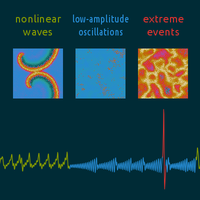
[Phys. Rev. X 6, 011030] Published Thu Mar 17, 2016
Nature of phase transitions in Axelrod-like coupled Potts models in two dimensions
Author(s): Yerali Gandica and Silvia Chiacchiera
We study F coupled q-state Potts models in a two-dimensional square lattice. The interaction between the different layers is attractive to favor a simultaneous alignment in all of them, and its strength is fixed. The nature of the phase transition for zero field is numerically determined for F=2,3. …
[Phys. Rev. E 93, 032132] Published Thu Mar 17, 2016
Growing networks of overlapping communities with internal structure. (arXiv:1603.05566v3 [physics.soc-ph] UPDATED)
We introduce an intuitive model that describes both the emergence of community structure and the evolution of the internal structure of communities in growing social networks. The model comprises two complementary mechanisms: One mechanism accounts for the evolution of the internal link structure of a single community, and the second mechanism coordinates the growth of multiple overlapping communities. The first mechanism is based on the assumption that each node establishes links with its neighbors and introduces new nodes to the community at different rates. We demonstrate that this simple mechanism gives rise to an effective maximal degree within communities. This observation is related to the anthropological theory known as Dunbar's number, i.e., the empirical observation of a maximal number of ties which an average individual can sustain within its social groups. The second mechanism is based on a recently proposed generalization of preferential attachment to community structure, appropriately called structural preferential attachment (SPA). The combination of these two mechanisms into a single model (SPA+) allows us to reproduce a number of the global statistics of real networks: The distribution of community sizes, of node memberships and of degrees. The SPA+ model also predicts (a) three qualitative regimes for the degree distribution within overlapping communities and (b) strong correlations between the number of communities to which a node belongs and its number of connections within each community. We present empirical evidence that support our findings in real complex networks.
Strength of weak layers in cascading failures on multiplex networks: case of the international trade network. (arXiv:1603.05181v2 [physics.soc-ph] UPDATED)
Many real-world complex systems across natural, social, and economical domains consist of manifold layers to form multiplex networks. The multiple network layers give rise to nonlinear effect for the emergent dynamics of systems. Especially, weak layers that can potentially play significant role in amplifying the vulnerability of multiplex networks might be shadowed in the aggregated single-layer network framework which indiscriminately accumulates all layers. Here we present a simple model of cascading failure on multiplex networks of weight-heterogeneous layers. By simulating the model on the multiplex network of international trades, we found that the multiplex model produces more catastrophic cascading failures which are the result of emergent collective effect of coupling layers, rather than the simple sum thereof. Therefore risks can be systematically underestimated in single-layer network analyses because the impact of weak layers can be overlooked. We anticipate that our simple theoretical study can contribute to further investigation and design of optimal risk-averse real-world complex systems.
"Conjectural" links in complex networks. (arXiv:1603.05059v1 [cs.SI])
This paper introduces the concept of Conjectural Link for Complex Networks, in particular, social networks. Conjectural Link we understand as an implicit link, not available in the network, but supposed to be present, based on the characteristics of its topology. It is possible, for example, when in the formal description of the network some connections are skipped due to errors, deliberately hidden or withdrawn (e.g. in the case of partial destruction of the network). Introduced a parameter that allows ranking the Conjectural Link. The more this parameter - the more likely that this connection should be present in the network. This paper presents a method of recovery of partially destroyed Complex Networks using Conjectural Links finding. Presented two methods of finding the node pairs that are not linked directly to one another, but have a great possibility of Conjectural Link communication among themselves: a method based on the determination of the resistance between two nodes, and method based on the computation of the lengths of routes between two nodes. Several examples of real networks are reviewed and performed a comparison to know network links prediction methods, not intended to find the missing links in already formed networks.
Explosive percolation transitions in growing networks
Author(s): S. M. Oh, S.-W. Son, and B. Kahng
Recent extensive studies of the explosive percolation (EP) model revealed that the EP transition is second order with an extremely small value of the critical exponent β associated with the order parameter. This result was obtained from static networks, in which the number of nodes in the system rem…
[Phys. Rev. E 93, 032316] Published Thu Mar 17, 2016