Self-organized criticality elucidates the conditions under which physical and biological systems tune themselves to the edge of a second-order phase transition, with scale invariance. Motivated by the empirical observation of bimodal distributions of activity in neuroscience and other fields, we propose and analyze a theory for the self-organization to the point of phase-coexistence in systems exhibiting a first-order phase transition. It explains the emergence of regular avalanches with attributes of scale-invariance which coexist with huge anomalous ones, with realizations in many fields.
Edmilson Roque
Shared posts
18 May 23:22
Self-Organized Bistability Associated With First-Order Phase Transitions. (arXiv:1605.05161v2 [cond-mat.stat-mech] UPDATED)
by Serena di Santo, Raffaella Burioni, Alessandro Vezzani, Miguel A. Muñoz
Edmilson Roque likes this
18 May 23:22
Hybrid dynamics in delay-coupled swarms with "mothership" networks. (arXiv:1605.05290v1 [nlin.AO])
by Jason Hindes, Klementyna Szwaykowska, Ira B. Schwartz
Swarming behavior continues to be a subject of immense interest because of its centrality in many naturally occurring systems in physics and biology, as well as its importance in applications such as robotics. Here we examine the effects on swarm pattern formation from delayed communication and topological heterogeneity, and in particular, the inclusion of a relatively small number of highly connected nodes, or "motherships", in a swarm's communication network. We find generalized forms of basic patterns for networks with general degree distributions, and a variety of new behaviors including new parameter regions with multi-stability and hybrid motions in bimodal networks. The latter is an interesting example of how heterogeneous networks can have dynamics that is a mix of different states in homogeneous networks, where high and low-degree nodes have simultaneously distinct behavior.
Edmilson Roque likes this
17 May 22:23
Chimera states in purely local delay-coupled oscillators
by Bidesh K. Bera and Dibakar Ghosh
Author(s): Bidesh K. Bera and Dibakar Ghosh
We study the existence of chimera states in a network of locally coupled chaotic and limit cycle oscillators. {\bf The necessary condition for chimera state in purely local coupled oscillators is discussed.} At first, we numerically observe the existence of chimera or multichimera states in locally …[Phys. Rev. E] Published Wed May 11, 2016
Edmilson Roque likes this
17 May 22:23
Complete synchronization equivalence in asynchronous and delayed coupled maps
by Juan Carlos González-Avella and Celia Anteneodo
Author(s): Juan Carlos González-Avella and Celia Anteneodo
Coupled map lattices are paradigmatic models of many collective phenomena. However, quite different patterns can emerge depending on the updating scheme. While in early versions, maps were updated synchronously, there is, in recent years, a concern to consider more realistic updating schemes, where …[Phys. Rev. E] Published Wed May 11, 2016
Edmilson Roque likes this
17 May 22:22
Bifurcation and scaling at the aging transition boundary in globally coupled excitable and oscillatory units
by Hiroaki Daido and Kazuho Nishio
Author(s): Hiroaki Daido and Kazuho Nishio
Following a previous paper (Phys. Rev. E {\bf 88}, 052907 (2013)), we study in detail the mechanism of aging transition in globally and diffusively coupled excitable and oscillatory units. Here two of the three models taken up in the earlier work are used, each composed of a large number of units wi…[Phys. Rev. E] Published Thu May 12, 2016
Thomas, Edmilson Roque likes this
17 May 22:22
Precision of collective oscillations in complex dynamical systems with noise
by Fumito Mori and Alexander S. Mikhailov
Author(s): Fumito Mori and Alexander S. Mikhailov
Two kinds of oscillation precision are investigated for complex oscillatory dynamical systems under action of noise. The many-cycle precision determined by the variance of the times needed for a large number of cycles is closely related to diffusion of the global oscillation phase and provides an in…[Phys. Rev. E] Published Mon May 16, 2016
Thomas, Edmilson Roque likes this
17 May 21:27
Phase transitions in disordered systems: The example of the random-field Ising model in four dimensions
by Nikolaos G. Fytas, Víctor Martín-Mayor, Marco Picco, and Nicolas Sourlas
Author(s): Nikolaos G. Fytas, Víctor Martín-Mayor, Marco Picco, and Nicolas Sourlas
By performing a high-statistics simulation of the D=4 random-field Ising model at zero temperature for different shapes of the random-field distribution, we show that the model is ruled by a single universality class. We compute to a high accuracy the complete set of critical exponents for this clas…[Phys. Rev. Lett.] Published Mon May 16, 2016
Edmilson Roque likes this
17 May 21:27
Self-organized bistability associated with first-order phase transitions
by Serena di Santo, Raffaella Burioni, Alessandro Vezzani, and Miguel A. Muñoz
Author(s): Serena di Santo, Raffaella Burioni, Alessandro Vezzani, and Miguel A. Muñoz
Self-organized criticality elucidates the conditions under which physical and biological systems tune themselves to the edge of a second-order phase transition, with scale invariance. Motivated by the empirical observation of bimodal distributions of activity in neuroscience and other fields, we pro…[Phys. Rev. Lett.] Published Mon May 16, 2016
Edmilson Roque, Thomas likes this
17 May 18:34
Statistical Analysis of Bus Networks in India. (arXiv:1509.04554v3 [physics.soc-ph] UPDATED)
by Atanu Chatterjee, Manju Manohar, Gitakrishnan Ramadurai
Through the past decade the field of network science has established itself as a common ground for the cross-fertilization of exciting inter-disciplinary studies which has motivated researchers to model almost every physical system as an interacting network consisting of nodes and links. Although public transport networks such as airline and railway networks have been extensively studied, the status of bus networks still remains in obscurity. In developing countries like India, where bus networks play an important role in day-to-day commutation, it is of significant interest to analyze its topological structure and answer some of the basic questions on its evolution, growth, robustness and resiliency. In this paper, we model the bus networks of major Indian cities as graphs in \textit{L}-space, and evaluate their various statistical properties using concepts from network science. Our analysis reveals a wide spectrum of network topology with the common underlying feature of small-world property. We observe that the networks although, robust and resilient to random attacks are particularly degree-sensitive. Unlike real-world networks, like Internet, WWW and airline, which are virtual, bus networks are physically constrained. The presence of various geographical and economic constraints allow these networks to evolve over time. Our findings therefore, throw light on the evolution of such geographically and socio-economically constrained networks which will help us in designing more efficient networks in the future.
Edmilson Roque likes this
17 May 18:33
A hybrid multiscale coarse-grained method for dynamics on complex networks. (arXiv:1605.04511v1 [physics.soc-ph])
by Chuansheng Shen, Hanshuang Chen, Zhonghuai Hou, Jürgen Kurths
Brute-force simulations for dynamics on very large networks are quite expensive. While phenomenological treatments may capture some macroscopic properties, they often ignore important microscopic details. Fortunately, one may be only interested in the property of local part and not in the whole network. Here, we propose a hybrid multiscale coarse-grained(HMCG) method which combines a fine Monte Carlo(MC) simulation on the part of nodes of interest with a more coarse Langevin dynamics on the rest part. We demonstrate the validity of our method by analyzing the equilibrium Ising model and the nonequilibrium susceptible-infected-susceptible model. It is found that HMCG not only works very well in reproducing the phase transitions and critical phenomena of the microscopic models, but also accelerates the evaluation of dynamics with significant computational savings compared to microscopic MC simulations directly for the whole networks. The proposed method is general and can be applied to a wide variety of networked systems just adopting appropriate microscopic simulation methods and coarse graining approaches.
Edmilson Roque likes this
17 May 15:54
Synchronization in the random field Kuramoto model on complex networks. (arXiv:1605.04733v2 [cond-mat.dis-nn] UPDATED)
by M. A. Lopes, E. M. Lopes, S. Yoon, J. F. F. Mendes, A. V. Goltsev
We study the impact of random pinning fields on the emergence of synchrony in the Kuramoto model on complete graphs and uncorrelated random complex networks. We consider random fields with uniformly distributed directions and homogeneous and heterogeneous (Gaussian) field magnitude distribution. In our analysis we apply the Ott-Antonsen method and the annealed-network approximation to find the critical behavior of the order parameter. In the case of homogeneous fields, we find a tricritical point above which a second-order phase transition gives place to a first-order phase transition when the network is either fully connected, or scale-free with the degree exponent $\gamma>5$. Interestingly, for scale-free networks with $2<\gamma \leq 5$, the phase transition is of second-order at any field magnitude, except for degree distributions with $\gamma=3$ when the transition is of infinite order at $K_c=0$ independently on the random fields. Contrarily to the Ising model, even strong Gaussian random fields do not suppress the second-order phase transition in both complete graphs and scale-free networks though the fields increase the critical coupling for $\gamma > 3$. Our simulations support these analytical results.
Edmilson Roque likes this
17 May 09:44
Synchronization in the random field Kuramoto model on complex networks. (arXiv:1605.04733v2 [cond-mat.dis-nn] UPDATED)
by M. A. Lopes, E. M. Lopes, S. Yoon, J. F. F. Mendes, A. V. Goltsev
We study the impact of random pinning fields on the emergence of synchrony in the Kuramoto model on complete graphs and uncorrelated random complex networks. We consider random fields with uniformly distributed directions and homogeneous and heterogeneous (Gaussian) field magnitude distribution. In our analysis we apply the Ott-Antonsen method and the annealed-network approximation to find the critical behavior of the order parameter. In the case of homogeneous fields, we find a tricritical point above which a second-order phase transition gives place to a first-order phase transition when the network is either fully connected, or scale-free with the degree exponent $\gamma>5$. Interestingly, for scale-free networks with $2<\gamma \leq 5$, the phase transition is of second-order at any field magnitude, except for degree distributions with $\gamma=3$ when the transition is of infinite order at $K_c=0$ independently on the random fields. Contrarily to the Ising model, even strong Gaussian random fields do not suppress the second-order phase transition in both complete graphs and scale-free networks though the fields increase the critical coupling for $\gamma > 3$. Our simulations support these analytical results.
Edmilson Roque likes this
17 May 09:44
Contagion on complex networks with persuasion. (arXiv:1605.04710v1 [physics.soc-ph])
by Wei-Min Huang, Li-Jie Zhang, Xin-Jian Xu, Xinchu Fu
The threshold model has been widely adopted as a classic model for studying contagion processes on social networks. We consider asymmetric individual interactions in social networks and introduce a persuasion mechanism into the threshold model. Specifically, we study a combination of adoption and persuasion in cascading processes on complex networks. It is found that with the introduction of the persuasion mechanism, the system may become more vulnerable to global cascades, and the effects of persuasion tend to be more significant in heterogeneous networks than those in homogeneous networks: a comparison between heterogeneous and homogeneous networks shows that under weak persuasion, heterogeneous networks tend to be more robust against random shocks than homogeneous networks; whereas under strong persuasion, homogeneous networks are more stable. Finally, we study the effects of adoption and persuasion threshold heterogeneity on systemic stability. Though both heterogeneities give rise to global cascades, the adoption heterogeneity has an overwhelmingly stronger impact than the persuasion heterogeneity when the network connectivity is sufficiently dense.
Edmilson Roque likes this
13 May 23:19
Fragmenting networks by targeting collective influencers at a mesoscopic level. (arXiv:1605.03694v2 [physics.soc-ph] UPDATED)
by Teruyoshi Kobayashi, Naoki Masuda
A practical approach to protecting networks against epidemic processes such as spreading of infectious diseases, malware, and harmful viral information is to remove some influential nodes beforehand to fragment the network into small components. Because determining the optimal order to remove nodes is a computationally hard problem, various approximate algorithms have been proposed to efficiently fragment networks by sequential node removal. Morone and Makse proposed an algorithm employing the non-backtracking matrix of given networks, which outperforms various existing algorithms. In fact, many empirical networks have community structure, compromising the assumption of local tree-like structure on which the original algorithm is based. We develop an immunization algorithm by synergistically combining the Morone-Makse algorithm and coarse graining of the network in which we regard a community as a supernode. In this way, we aim to identify nodes that connect different communities at a reasonable computational cost. The proposed algorithm works more efficiently than the Morone-Makse and other algorithms on networks with community structure.
Edmilson Roque likes this
13 May 23:19
How to Build Your Network? A Structural Analysis. (arXiv:1605.03644v1 [cs.SI])
by Anastasia Moskvina, Jiamou Liu
Creating new ties in a social network facilitates knowledge exchange and affects positional advantage. In this paper, we study the process, which we call network building, of establishing ties between two existing social networks in order to reach certain structural goals. We focus on the case when one of the two networks consists only of a single member and motivate this case from two perspectives. The first perspective is socialization: we ask how a newcomer can forge relationships with an existing network to place herself at the center. We prove that obtaining optimal solutions to this problem is NP-complete, and present several efficient algorithms to solve this problem and compare them with each other. The second perspective is network expansion: we investigate how a network may preserve or reduce its diameter through linking with a new node, hence ensuring small distance between its members. We give two algorithms for this problem. For both perspectives the experiment demonstrates that a small number of new links is usually sufficient to reach the respective goal.
Edmilson Roque likes this
13 May 16:20
Different kinds of chimera death states in nonlocally coupled oscillators
by K. Premalatha, V. K. Chandrasekar, M. Senthilvelan, and M. Lakshmanan
Author(s): K. Premalatha, V. K. Chandrasekar, M. Senthilvelan, and M. Lakshmanan
We investigate the significance of nonisochronicity parameter in a network of nonlocally coupled Stuart-Landau oscillators with symmetry breaking form. We observe that the presence of nonisochronicity parameter leads to structural changes in the chimera death region while varying the strength of the…
[Phys. Rev. E 93, 052213] Published Fri May 13, 2016
Edmilson Roque likes this
13 May 16:20
Maxwell Demon Dynamics: Deterministic Chaos, the Szilard Map, and the Intelligence of Thermodynamic Systems
by Alexander B. Boyd and James P. Crutchfield
Author(s): Alexander B. Boyd and James P. Crutchfield
We introduce a deterministic chaotic system—the Szilard map—that encapsulates the measurement, control, and erasure protocol by which Maxwellian demons extract work from a heat reservoir. Implementing the demon’s control function in a dynamical embodiment, our construction symmetrizes the demon and …
[Phys. Rev. Lett. 116, 190601] Published Fri May 13, 2016
Sonny Rhim, Edmilson Roque likes this
12 May 17:22
Spectral gaps, additive energy, and a fractal uncertainty principle. (arXiv:1504.06589v3 [math.SP] UPDATED)
by Semyon Dyatlov, Joshua Zahl
We obtain an essential spectral gap for $n$-dimensional convex co-compact hyperbolic manifolds with the dimension $\delta$ of the limit set close to $(n-1)/2$. The size of the gap is expressed using the additive energy of stereographic projections of the limit set. This additive energy can in turn be estimated in terms of the constants in Ahlfors-David regularity of the limit set. Our proofs use new microlocal methods, in particular a notion of a fractal uncertainty principle.
Edmilson Roque likes this
12 May 17:17
Competition of simple and complex adoption on multi-layer networks. (arXiv:1605.03479v2 [physics.soc-ph] UPDATED)
by Agnieszka Czaplicka, Raul Toral, Maxi San Miguel
We consider the competition of two mechanisms for adoption processes: a so-called complex threshold dynamics and a simple Susceptible-Infected-Susceptible (SIS) model. Separately, these mechanisms lead, respectively, to first order and continuous transitions between non-adoption and adoption phases. We couple the two adoption processes in a complex network with two interconnected layers. We find that the transition points and also the nature of the transitions are modified in the coupled dynamics. In the complex adoption layer, the critical threshold required for extension of adoption increases with interlayer connectivity whereas in the case of an isolated single network it would decrease with average connectivity. In addition, the transition can become continuous depending on the detailed inter and intralayer connectivities. In the SIS layer, any interlayer connectivity leads to the extension of the adopter phase. Besides, a new transition appears as as sudden drop of the fraction of adopters in the SIS layer. The main numerical findings are described by a mean-field type analytical approach appropriately developed for the threshold-SIS coupled system.
Edmilson Roque likes this
11 May 22:25
Estimating the number of communities in a network. (arXiv:1605.02753v2 [cs.SI] UPDATED)
by M. E. J. Newman, Gesine Reinert
Community detection, the division of a network into dense subnetworks with only sparse connections between them, has been a topic of vigorous study in recent years. However, while there exist a range of powerful and flexible methods for dividing a network into a specified number of communities, it is an open question how to determine exactly how many communities one should use. Here we describe a mathematically principled approach for finding the number of communities in a network using a maximum-likelihood method. We demonstrate the approach on a range of real-world examples with known community structure, finding that it is able to determine the number of communities correctly in every case.
Edmilson Roque likes this
11 May 22:19
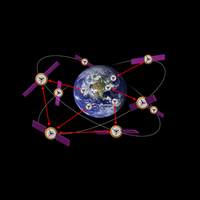
Synchronization of Distant Optical Clocks at the Femtosecond Level
by Jean-Daniel Deschênes, Laura C. Sinclair, Fabrizio R. Giorgetta, William C. Swann, Esther Baumann, Hugo Bergeron, Michael Cermak, Ian Coddington, and Nathan R. Newbury
Author(s): Jean-Daniel Deschênes, Laura C. Sinclair, Fabrizio R. Giorgetta, William C. Swann, Esther Baumann, Hugo Bergeron, Michael Cermak, Ian Coddington, and Nathan R. Newbury
Free-space laser links have been used to synchronize optical clocks with an unprecedented uncertainty of femtoseconds.
[Phys. Rev. X 6, 021016] Published Wed May 11, 2016
Edmilson Roque likes this
11 May 22:15
Bifurcations and singularities for coupled oscillators with inertia and frustration. (arXiv:1605.02990v1 [cond-mat.stat-mech])
by Julien Barré, David Métivier
We prove that any non zero inertia, however small, is able to change the nature of the synchronization transition in Kuramoto-like models, either from continuous to discontinuous, or from discontinuous to continuous. This result is obtained through an unstable manifold expansion in the spirit of J.D. Crawford, which features singularities in the vicinity of the bifurcation. Far from being unwanted artifacts, these singularities actually control the qualitative behavior of the system. Our numerical tests fully support this picture.
Edmilson Roque likes this
11 May 22:15

Synchronized mitochondrial and cytosolic translation programs
by Mary T. Couvillion
Nature advance online publication 11 May 2016. doi:10.1038/nature18015
Authors: Mary T. Couvillion, Iliana C. Soto, Gergana Shipkovenska & L. Stirling Churchman
Hyeshik Chang, Edmilson Roque and -1 others like this
11 May 09:47
Bifurcations and singularities for coupled oscillators with inertia and frustration. (arXiv:1605.02990v1 [cond-mat.stat-mech])
by Julien Barré, David Métivier
We prove that any non zero inertia, however small, is able to change the nature of the synchronization transition in Kuramoto-like models, either from continuous to discontinuous, or from discontinuous to continuous. This result is obtained through an unstable manifold expansion in the spirit of J.D. Crawford, which features singularities in the vicinity of the bifurcation. Far from being unwanted artifacts, these singularities actually control the qualitative behavior of the system. Our numerical tests fully support this picture.
Edmilson Roque likes this
10 May 23:00
Exponential energy growth due to slow parameter oscillations in quantum mechanical systems
by Dmitry Turaev
Author(s): Dmitry Turaev
It is shown that a periodic emergence and destruction of an additional quantum number leads to an exponential growth of energy of a quantum mechanical system subjected to a slow periodic variation of parameters. The main example is given by systems (e.g., quantum billiards and quantum graphs) with p…[Phys. Rev. E] Published Mon May 09, 2016
Edmilson Roque likes this
10 May 23:00
How complexity emerges in urban systems: Theory of urban morphology
by Segun Goh, M. Y. Choi, Keumsook Lee, and Kyung-min Kim
Author(s): Segun Goh, M. Y. Choi, Keumsook Lee, and Kyung-min Kim
Human beings develop the land and transform the land use patterns, constructing artificial structures. Among them, the city is a representative system and its morphology has attracted much attention. While most existing studies have been devoted to individual dynamics and focused on proximity of spe…[Phys. Rev. E] Published Mon May 09, 2016
Edmilson Roque likes this
10 May 23:00
Emergence of coexisting percolating clusters in networks
by Ali Faqeeh, Sergey Melnik, Pol Colomer-de-Simón, and James P. Gleeson
Author(s): Ali Faqeeh, Sergey Melnik, Pol Colomer-de-Simón, and James P. Gleeson
It is commonly assumed in percolation theories that at most one percolating cluster can exist in a network. We show that several coexisting percolating clusters (CPCs) can emerge in networks due to limited mixing, i.e., a finite and sufficiently small number of interlinks between network modules. We…[Phys. Rev. E] Published Mon May 09, 2016
Edmilson Roque likes this
10 May 23:00
Self-attracting walk on heterogeneous networks
by Kanghun Kim, Jaegu Kyoung, and D. -S. Lee
Author(s): Kanghun Kim, Jaegu Kyoung, and D. -S. Lee
Understanding human mobility in the cyberspace becomes increasingly important in this information era. While the human mobility, memory-dependent and sub-diffusive, is well understood in the Euclidean space, it remains elusive in random heterogeneous networks like the World Wide Web. Here we study t…[Phys. Rev. E] Published Tue May 10, 2016
Edmilson Roque likes this
10 May 15:18
Coherence and incoherence collective behavior in financial market. (arXiv:1605.02283v1 [q-fin.ST])
by Shangmei Zhao, Qiuchao Xie, Qing Lu, Xin Jiang, Wei Chen
Financial markets have been extensively studied as highly complex evolving systems. In this paper, we quantify financial price fluctuations through a coupled dynamical system composed of phase oscillators. We find a Financial Coherence and Incoherence (FCI) coexistence collective behavior emerges as the system evolves into the stable state, in which the stocks split into two groups: one is represented by coherent, phase-locked oscillators, the other is composed of incoherent, drifting oscillators. It is demonstrated that the size of the coherent stock groups fluctuates during the economic periods according to real-world financial instabilities or shocks. Further, we introduce the coherent characteristic matrix to characterize the involvement dynamics of stocks in the coherent groups. Clustering results on the matrix provides a novel manifestation of the correlations among stocks in the economic periods. Our analysis for components of the groups is consistent with the Global Industry Classification Standard (GICS) classification and can also figure out features for newly developed industries. These results can provide potentially implications on characterizing inner dynamical structure of financial markets and making optimal investment tragedies.
Edmilson Roque likes this
10 May 15:18
Basin entropy: a new tool to analyze uncertainty in dynamical systems. (arXiv:1605.02342v3 [nlin.CD] UPDATED)
by Alvar Daza, Alexandre Wagemakers, Bertrand Georgeot, David Guéry-Odelin, Miguel A.F. Sanjuán
In nonlinear dynamics, basins of attraction link a given set of initial conditions to its corresponding final states. This notion appears in a broad range of applications where several outcomes are possible, which is a common situation in neuroscience, economy, astronomy, ecology and many other disciplines. Depending on the nature of the basins, prediction can be difficult even in systems that evolve under deterministic rules. From this respect, a proper classification of this unpredictability is clearly required. To address this issue, we introduce the basin entropy, a measure to quantify this uncertainty. Its application is illustrated with several paradigmatic examples that allow us to identify the ingredients that hinder the prediction of the final state. The basin entropy provides an efficient method to probe the behavior of a system when different parameters are varied. Additionally, we provide a sufficient condition for the existence of fractal basin boundaries: when the basin entropy of the boundaries is larger than $\log 2 $, the basin is fractal.
Edmilson Roque likes this