
ACS Sustainable Chemistry & Engineering
DOI: 10.1021/acssuschemeng.2c03058

In this mini-review, we have presented the recent progress in dual palladium – photoredox catalyzed C−H functionalization reactions such as C−H arylation, acylation, olefination & hetero atom functionalization.
Functionalization of unactivated C−H bonds is a highly desirable process in organic chemistry as it gives direct access to new functional groups in a single step. This process is generally achieved using transition metal catalysts, and among them, palladium plays an important role due to its unique reactivity. Recently, photoredox catalysis has witnessed a huge surge, and many new and valuable organic reactions are uncovered periodically. Dual transition metal – photoredox catalysis on the other hand, has taken organic synthesis to new heights by achieving transformations that were previously not possible or difficult to achieve by both forms of catalysis independently. In this direction, many new and interesting dual palladium-photoredox catalyzed C−H functionalization reactions combining the synergistic effects of both palladium and photoredox have been reported in the past few years, and it is imperative to summarize these reactions for further developments in this area.
Synthesis
DOI: 10.1055/s-0040-1719884
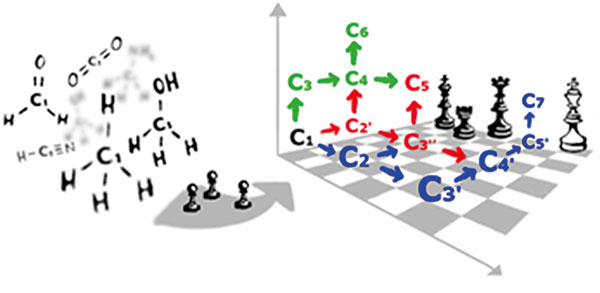
This review provides an overview of different C1 building blocks as substrates of enzymes, or part of their cofactors, and the resulting functionalized products. There is an emphasis on the broad range of possibilities of biocatalytic one-carbon extensions with C1 sources of different oxidation states. The identification of uncommon biosynthetic strategies, many of which might serve as templates for synthetic or biotechnological applications, towards one-carbon extensions is supported by recent genomic and metabolomic progress and hence we refer principally to literature spanning from 2014 to 2020.1 Introduction2 Methane, Methanol, and Methylamine3 Glycine4 Nitromethane5 SAM and SAM Ylide6 Other C1 Building Blocks7 Formaldehyde and Glyoxylate as Formaldehyde Equivalents8 Cyanide9 Formic Acid10 Formyl-CoA and Oxalyl-CoA11 Carbon Monoxide12 Carbon Dioxide13 Conclusions
[...]
Georg Thieme Verlag KG Rüdigerstraße 14, 70469 Stuttgart, Germany
Article in Thieme eJournals:
Table of contents | Abstract | Full text

Nature, Published online: 09 August 2022; doi:10.1038/s41586-022-05175-1
Molecular Editing of Aza-arene C–H Bonds by Distance, Geometry and Chirality
Rhodium complexes bearing a guanidine based NCN pincer ligand were designed and successfully applied to catalytic acrylate synthesis from carbon dioxide and ethylene. The repulsion between pπ-electron of guanidine and filled dπ orbital of Rh center increases the electron density on Rh, allowing the first structural characterization of rhodalactone formation.
Rhodium-catalyzed acrylate synthesis from CO2 and ethylene was accomplished by using a guanidine-based NCN pincer ligand. The repulsion between pπ-electron of guanidine sidearms and occupied dπ orbital of rhodium center raised the level of d-electrons close to those of formerly known d 8-ruthenium catalyst, thereby promoting the metallalactone formation from carbon dioxide and ethylene. This work fills the absence of group-9 metal based catalyst for the acrylate synthesis and provides a designing approach for pincer-ligated d 8-metal catalysts to utilize pπ-dπ interaction for promoting desirable redox processes.
 Open Access
   This article is licensed under a Creative Commons Attribution-NonCommercial 3.0 Unported Licence.

Jonas WuytsDeserves a nomination for the IG nobel prizes
Nature, Published online: 05 August 2022; doi:10.1038/d41586-022-02097-w
A watercraft subject to ‘gunwale bobbing’ travels on waves generated by the bobbing itself.Nature Communications, Published online: 05 August 2022; doi:10.1038/s41467-022-32351-8
Guiding chemical reactions in a predictable and controllable manner is an ultimate goal of chemistry. Here, the authors show tuning of the single-molecule Mizoroki-Heck catalytic cycle through electrical gating and direct in-situ detection.


The Cover Feature shows an illustration of a Rubik's Cube symbolizing the molecular isomerization of methyl formate to acetic acid. The seemingly simple rearrangement occurs via a complex catalytic manifold comprising NaOMe for the decarbonylation of HCO2CH3, NaI for the activation of methanol, and a molecular Pd-complex for the recombination of the components. This isomerization of methyl formate, which in turn can be produced from CO2 and green H2, offers a a “Power-to-X” route to acetic acid. More information can be found in the Research Article by P. Jürling-Will et al.
Nature, Published online: 03 August 2022; doi:10.1038/d41586-022-02092-1
Cutting out single-use plastics was the beginning of a sustainability transformation, says Jane Kilcoyne.
Open Access   This article is licensed under a Creative Commons Attribution 3.0 Unported Licence.


