Shared posts

25 Sep 14:18

Agile Instructional Design

by diannerees

But first, a few words about ADDIE.

Next to religion, politics, and whether you’re a PC or a MAC user, ADDIE, with its sequential steps of analysis, design, development, implementation, and evaluation, tends to arouse a lot of fervor in instructional designers.  ADDIE’s an important model and for a discussion of its history and morphing, see the always excellent site, Big Dog Little Dog’s Performance Juxtaposition.

However, time constraints, client logistics, and the natures of dynamic organizations often make ADDIE (at least in its older incarnations) untenable. For many instructional designers, ADDIE’s become synonymous with a bygone era with a much slower pace , though arguably ADDIE was never intended to be so rigidly applied.

Agile design is an alternative approach that has a lot of merit.

Agile has its origins in the software development industry, famous for its rapid cycle times. Agile embraces the idea that development occurs in steps and iteratively, as analysis inputs are collected from busy cross-functional teams. It’s about flexible responses to a changing picture of what the situation on the ground is really like.
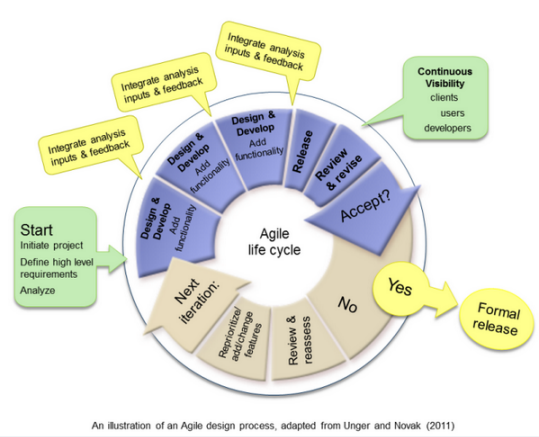
The  important difference between Agile and ADDIE is that in Agile design, recommendations, preliminary mockups, and pieces of a project are shared with clients and target audiences early to see if they’ll fly. Adjustments are made throughout the design and development process rather than after development and/or implementation.

Although ADDIE is an important foundational model, I think that Agile design reduces the risk of spending a lot of time creating a very polished product that ultimately isn’t very useful. Agile turns clients and potential learners into active participants throughout the design process, which makes it more likely that your solution will actually be integrated into an organization’s workflow.

Whether you’re using Agile or ADDIE, there are some  important tenets to stick to:

  • Make sure everyone has a shared vision about what the goal is and how to measure success
  • Ask first whether an instructional solution is really the one that’s needed
  • Think like a designer (have a systematic, but creative, approach that’s open to solutions from analogous fields)
  • Make pilot testing part of your project plan
  • Stay hungry to do better

References

Clark, D. (2011). ADDIE Model. Retrieved September, 29, 2012, from http://nwlink.com/~donclark/history_isd/addie.html#dynamic

Unger, K., & Novak, J. (2011). Excerpt: Mobile game development – going into production. Retrieved March 20, 2012 from http://www.gamecareerguide.com/features/1011/excerpt_mobile_game_development__.php?print=1


09 Nov 18:37

Workforce Optimization: improve productivity, reduce costs, and meet service goals

by ssonetwork.com
*  Do you have a busy schedule? Make sure you can attend by saving this webinar to your  Outlook calendar   Whether you’re a shared services organization or a BPO, your greatest assets are your people. Improving the productivity, utilization, and effectiveness of
15 Sep 15:04

Free eBook/iBook: “Advances in Technology Enhanced Learning” #edtech

by David Hopkins

Advances in Technology Enhanced LearningThis is a great free eBook / iBook, for the iPad, from The Open University: ”Advances in Technology Enhanced Learning”.

The eBook aims to present a “range of research projects which aim to explore how to make engagement in learning (and teaching) more passionate” and to introduce “methodological and technological breakthroughs” to learners, instructors, and decision-makers in schools, universities, and workplaces.

“The Open University’s Knowledge Media Institute and the EU TELMap project have brought together the luminaries from the European research area to showcase their vision of the future of learning with technology via their recent research project work. The projects discussed range widely over the Technology Enhanced Learning area from: environments for responsive open learning, work-based reflection, work-based social creativity, serious games and many more.”

Available, for free, from iTunes, it’s worth a look: “Advances in Technology Enhanced Learning”

Advances in Technology Enhanced Learning

15 Sep 15:04

From creating content to building new connected workplace skills – this is the NEW work for learning professionals

by Jane Hart
Read my latest blog post here.
15 Sep 15:01

Managing Multiple Learning Managment Systems - The High Cost of Choice

by dpoulos
Post Type: 
Blog post

Did you know that today there are approximately 500 Learning Management System vendors in the market?1  Did you also know that no one vendor, or small group of vendors, have significant market share? In fact, it’s a scattered and fragmented market, one that is wreaking havoc on Learning & Development. 

2013 Projected Global LMS Market Share

The Reason

read more

06 Sep 11:23

Interview: Trent Batson On the Value of E-Portfolios

by gbayne

Trent Batson is President and CEO for the Association for Authentic, Experiential, and Evidence-Based Learning. In this interview by Jennifer Sparrow, Batson discusses the value and role of e-portfolios.

Uploads
BLOG
EDUCAUSE Library Items
Discussions
06 Sep 11:11

ELI Podcast: Intelligent Tutoring

by gbayne

Ken Koedinger is a professor at the Human-Computer Interaction Institute at Carnegie-Mellon University. In this interview with ELI Director Malcolm Brown, Ken discusses intelligent tutoring.


Uploads
PODCAST
EDUCAUSE Library Items
02 Sep 14:51

Free school pioneers offer advice

Dozens of groups aiming to open free schools next year are meeting to get tips from pioneers of the movement, the West London Free School.
02 Sep 14:49

As we were saying… (Coursera as Provider of Courseware)

by mikecaulfield

Given the recent Coursera news, in which Coursera has essentially become a supplier of courseware to higher education, I made a snarky comment on twitter that I was surprised that so few people had seen this coming. Martin Weller quite politely replied that he hadn’t seen it coming, at least not clearly, and could I link to the piece of mine that discussed this.

It’s a good question. Unfortunately, I tend to advance arguments over a series of blog posts (which is probably why I end up permanently a niche blogger — most people coming to my blog for the first time probably have no idea what I’m on about).

So Martin’s question is a good excuse to do a “story up until now post”, and point to posts over the last six or seven months that have advanced the argument. The most free standing one is probably January’s “Both MOOCs and Textbooks Will End Up Courseware” but the earliest one is from October 2012′s “Coursera Praises MOOC-Wrapping as They Attempt to Ban It“:

We now understand the endgame here. We now get the business model. The idea is not “send your students to us!”. The idea is to become yet another online vendor of services to higher ed.

[It also worth noting that a number of others have been making this argument as well. Michael Feldstein's April 2013 article is probably the most complete example, but Downes, Wiley, Phil Hill, Bryan Alexander, Amy Collier, Derek Bruff and others have alluded to aspects of this transition too. (I missed people there -- I'm sorry, not intentional)]

But here we go, working backwards. Just a sample, because, as I said, it’s been an obsession:

May 2013. “The Bigger Picture is Corporate-Built Online Delivered Through Traditional F2F Institutions

Schools are going to have to build online resources with someone. It could be CourdacityX, it could be Pearson, or it could be with each other. The online resources are coming. It’s really just a matter of choosing how we want to build them.


February 2013: “The Oddity of MOOCs as OER and the Issue of Integration Cost

In other words, as the hype about classroom use of MOOCs is beginning to hit the inflection point, we find that MOOCs in face-to-face classrooms are essentially being used as OER and OCW.


January 2013. “Both MOOCs and Textbooks Will End Up Courseware

What’s happening right now is that xMOOCs are moving backwards into replicable content from the interaction and assessment pole while textbooks are  are moving forward into interaction and assessment from the replicable content pole.

The end result of this is not necessarily massive classes. It’s broadly used courseware — software that provides much of the skeleton of standard classes the way publisher texts do today. In other words, the best way to think of a MOOC isn’t really as a class brought to your doorstep — it’s more a textbook with ambitions.

October 2012, “MOOCs = OCW + Cohorts

What I think is missed in the hoopla about xMOOCs is — if you look at this long term — this is precisely what has happened. Right now, as we look at the first pass of these courses we are looking at new video, new pieces, etc. We think of it as a new course being “run”. But these courses will start to be rerun soon, and at that point it is basically OCW with a cohort. 


 October 2012  ”Coursera Praises MOOC-Wrapping as They Attempt to Ban It“:

We now understand the endgame here. We now get the business model. The idea is not “send your students to us!”. The idea is to become yet another online vendor of services to higher ed.


January 2011 (Oh, why not, just for fun — to show this issue existed pre-MOOC): Course Redesign @ KSC: A Courseware Approach [Slides from AASCU Winter Meeting]

“What’s a better idea [than traditional OCW]? Framework-based, open teaching materials with assessment baked in…A project where multiple campuses draft up a couple frameworks that work, and start building 2-8 hour modules on the basic skills stuff that is a barrier for our students…In ways multiple campuses can use out-of-box, from web-enhanced, to blended, to online.”