Shared posts

09 Oct 09:39

Indian HE and eLearning in India

by dkernohan

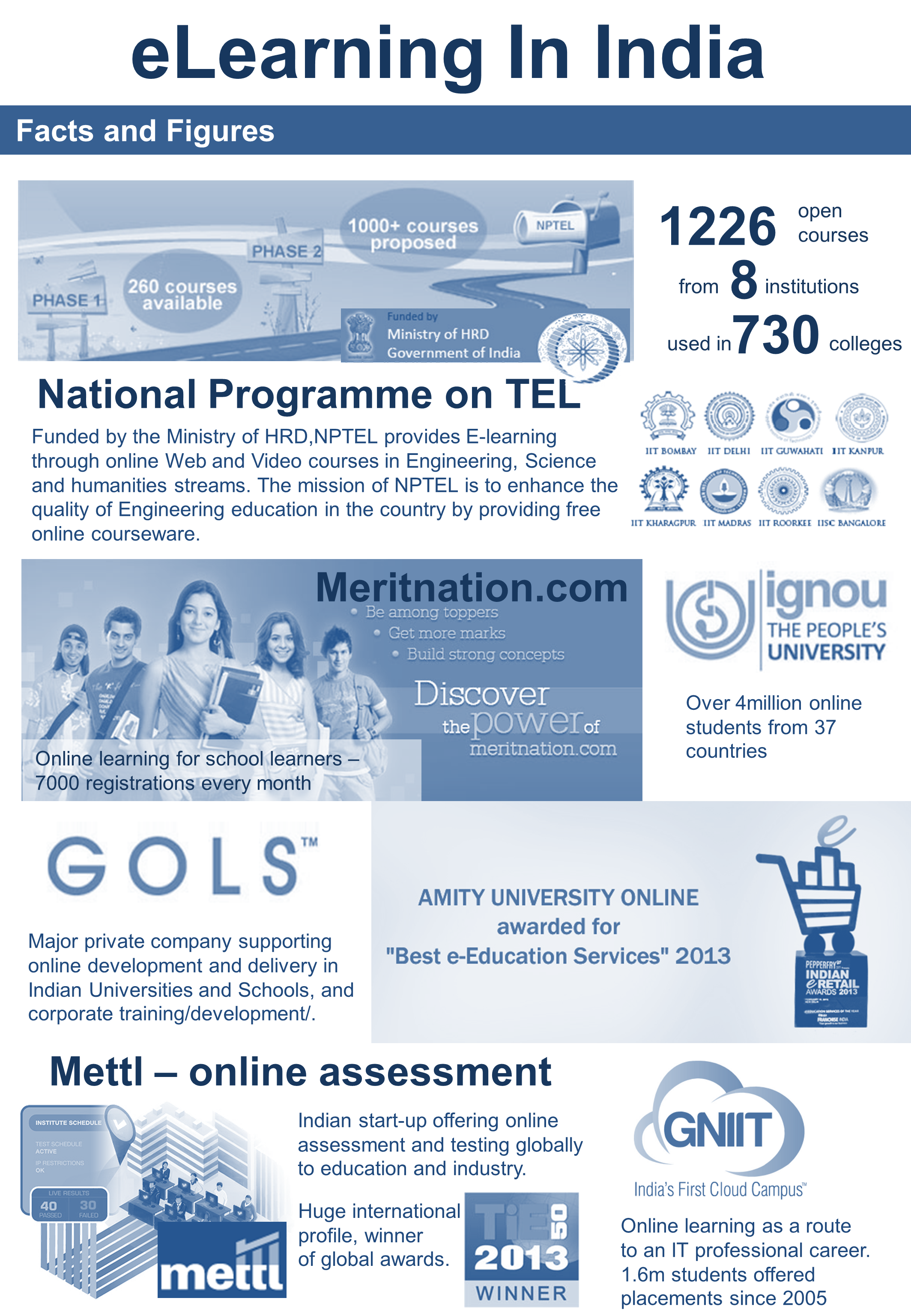
Someone asked me about Higher Education and Online Learning in India, so I made a couple of infographics to get some background information together in order to start a conversation with colleagues.

The information draws on official Indian Government stats and news articles. I’m sharing them in case anyone else finds them useful.

Page 1 - Indian HE Page 2 - Indian eLearning


[update: just spotted that the President of India, Pranab Mukherjee, has called for vast improvements to the Indian HE sector.

"I don’t find any reason why India cannot go back to dominating the higher education scene. We have talent, capacity and dedicated teachers who can inspire and who can rekindle the interests in the minds of students. All these elements have to be properly coordinated and integrated to have a high ranking and occupy our rightful place in academic excellence"

You can read more about that here.]

09 Oct 08:15

Jisc signs framework agreement with Google Apps for Education

by vreeve

Landmark agreement makes it easier for colleges and universities to sign up to Google’s free cloud services such as Gmail, docs and spreadsheets 

Janet, part of the Jisc group, whose primary purpose is to provide network infrastructure and related services for schools, colleges and universities in the UK, is today announcing a major framework agreement with Google Apps for Education. The agreement will make it easier for colleges and universities to make the move to Google Apps for Education and open up the free online collaboration and communication benefits it offers to more staff and students.

The framework agreement will mean that colleges and universities in the UK are now eligible to sign up to Google Apps for Education using a contract approved by Janet, as meeting UK legal requirements.  This Cloud Services for Education Agreement will give colleges and universities peace of mind in relation to security, resilience, legal and data compliance, cost and functionality.

Speaking to a number of university chief innovation officers (CIOs) at the framework agreement signing event at the Google office in London, Dan Perry, director of product and marketing at Janet said:

“Over the years we’ve had huge interest from our members in moving to Google Apps for Education. Yet these same universities and colleges did not have the time nor resources to explore and understand the contractual complexities of cloud security, safety and data protection. So, we worked closely with Google to create a Cloud Services for Education Agreement. This agreement removes the need for colleges and universities to conduct their own due diligence, saving approximately £20,000 in time and cost for each UK higher and further education organisation.”

Liz Sproat, head of education for Europe, the Middle East and Africa at Google, said:

“We’re always looking for ways to make it easier for schools, colleges and universities to take advantage of our free online collaboration and communication tools. One third of all UK colleges and universities already use Google Apps for Education. We hope this new framework agreement with Janet will enable even more students, professors, lecturers and teachers to collaborate and communicate more easily whilst also saving money for their educational institutions.”

There are more than 25 million Google Apps for Education users worldwide and many different use cases. Students working on group projects can work simultaneously in real-time in documents, spreadsheets and presentations, no matter where they are based, making it easier to share ideas and preventing the difficulty of version control. Professors and teachers can comment directly within student assignments, streamlining the faculty feedback process. Lecturers can even run entire seminars on Google Hangouts, meaning that students can catch their classes online, even if they’re not on campus. Student committees can also host their social calendars on easily accessible Google Sites and post pictures of their events on Google+. Google recently signed a similar agreement in the Netherlands and since that time half the country’s universities and colleges have moved to Google Apps. 

Visit the Janet website for more information about the framework agreement.

Google apps for education logo

09 Oct 08:14

Using Google Apps for learning and teaching - an overview

by Graham McElearney


Google logo


Photo Credit: Tiger Pixel via Compfight cc

Introduction


From Apps Scripts to perform mail merge and use forms as quiz tools, through to the use of Google Sites to create a lightweight VLE, we’ve had a quite a few postings looking at the use of Google Apps over the last 18 months, and some of them in some depth. So in the run up to another new academic year, we thought we’d take a step back and take a bit of a general overview of how we can use these tools to support learning and teaching. I’ve been doing a few presentations on this recently so as well as this posting, 

I've done a recording of a few of these, which will enable me to illustrate some of the points below with some demos. The recording I’m using for this is available here goo.gl/76xjix.


What are “Google Apps For Education”?


Firstly it;s probably worth making sure we know exactly what Apps we are talking about when we refer to the “Google Apps For Education”,  or GAFE Suite. The core apps included in these are


Mail
Calendar
Docs (including text docs, spreadsheets, presentations, drawings and forms)
Sites
Groups


These are the ones that are covered by the special agreement that universities, colleges and schools enter into with Google that govern certain aspects of data protection, intellectual property ownership and a few other factors - i.e. the sorts of things we would want to have in place if we were running these services in house, such as our VLE and web servers. It’s worth making this distinction as Google offer so many other services, such as YouTube, Google + and Blogger, and these are so easily accessible from our University accounts that they all appear to be part of the same thing, but there are important differences in the terms and conditions that govern their use, and that might make them unacceptable for “official” University use.


Before looking at some of the Apps more specifically, there are a few they all have in common, which we think make them suitable for supporting learning and teaching. Firstly, all the Apps above are based around an infrastructure that fosters collaborative working. Collaboration, where we work together to achieve a shared goal, is of course a hugely important element in learning. At University, as in life, people learn by constructing their own knowledge, and this is in part achieved by interacting and working with others.  Google Apps allow this very easily, and the way we have our Google domain set up at Sheffield means that this collaboration can take place amongst staff and students alike.  The Apps are also fairly easy to use, which means in many cases we can get on with what we want to do without the technology acting as a barrier. They are also web based, which largely means that they are easily accessible to anyone with a browser, without having to install any software, or worry about managing versions and incompatibilities.


Setting up appointment slots with Calendar


Whilst the Calendar App may not look like the sort of tools with which we can ascend the dizzy heights of social constructivism, there are a few features within it that can help in the administration of learning and teaching. One of these is the ability to create Appointment Slots. Appointment Slots are a specialised type of Calendar entry, which allow you designate time slots in which people can book to have appointments with you. You designate a chunk of your time, say 2- 4 on monday, allocate the length of the slots, and then Calendar creates the slots for you in a specific version of your Calendar. This has it’s own URL, which you can then distribute amongst your students, and so is ideal for arranging tutorial slots, supervision meetings etc, without having to have some kind of physical sign up sheet. Once an appointment with you has been booked, it creates an entry in both yours and your appointees’ calendars. As well as simplifying the booking procedure, colleagues who use this tell us that it also vastly improves attendance at tutorials. If this seems a bit abstract, it’s demonstrated in the recording at around 05.50.


Other things to bear in mind with the Calendar, is that that it can also be used to schedule access to resources as well as people. This could be rooms, items of equipment, lab apparatus etc. Calendar also greatly simplifies arranging meetings with people too. You can use it “manually” to visibly identify gaps in your colleagues’ calendars, or you can use the Suggested Times feature to go and hunt down times when a given list of people are available. So no more Doodle polls or typing in lists of availability to send to people in emails, which are of course totally out of date by the time they read them and reply…….


Real time collaboration using Docs


Collaboration proper becomes a lot more apparent when we start looking at using Google Docs. Google Docs are in fact subdivided into text Docs, Spreadsheets, Presentations and Drawings. They all do pretty much what you’d imagine from their titles. They also have several key features in common. They are all pretty simple to use, as they have focused on just those core features that you would use most of the time when using say the Microsoft equivalents. They are also all “cloud based”, which means all the work you do in them is normally stored on Google’s servers, not on your own computer. I find this particularly useful, as you never have to worry about copying your files onto a memory stick to take home with you - as long as you have an Internet connection and a relatively up to date browser, you can access the latest version of your work from anywhere. Being cloud based in this way, it also enables them to be so easily shared out with others for collaborative work. All you need to do is specify the email addresses of your collaborators and you’re in business (they have to have Google accounts though - whether privately, through work, school or University). You can collaborate with your colleagues both synchronously or asynchronously. When you do the former you see each other’s cursors on screen in different colours denoting where in the document they’re working.


Either way, what this crucially means is that you don’t have to email copies of document files round to your colleagues, and hope that everyone’s has got the discipline to make sure that they are storing and working on the latest versions of files. Even with Track Changes on in Word, this can be a nightmare, as can being the poor soul who has to make sense of collating all the changes back into one document. A useful safety net here is also the Revision History function, that stores incremental versions of the document as it is being changed. It also indicates each author’s contribution at any stage by different colored text. This can be particularly useful should you need to resolve any disputes about who has done what with your students.


These features lend themselves extremely well to supporting a myriad of collaborative exercises with your students, and are demonstrated in the recording between  11.30 and 25.15.  As an example, a class of students could e divided up into groups, with each group collaboratively writing a Doc about a sub-topic they are studying, similar to how a Wiki is constructed.. Other suggested uses for Docs could be for submitting draft essay plans that you can comment on for giving formative feedback, or for collaboratively authoring and commenting on PhD or other research supervision meetings. You're really only limited by your imagination at this point and there are many many sites on the web illustrating proposed ideas for their use.


Collecting Data with Google Forms


Forms, because of the way they capture data directly into a Google Spreadsheet, offer a very versatile learning tool. If students are tasked with collecting data or measurements in a lab or field class, the tutor could create a single Google form into which the students could add their data. This would populate a spreadsheet which can be shared by the whole class, so there’s no need for the tutor to collate data into a single repository. The process is so speedy this can be done in a classroom environment and the class’s data can be viewed immediately for analysis and interpretation.


Forms do not just have to be limited to conducting numerical data - they can also gather qualitative data. An approach I’ve tried a few times is to use Forms in a classroom setting to help collect work resulting from small group activities. Students were set a group exercise - in this case to design how the GLOMaker tool (http://www.glomaker.org/) could be used to create an online heritage resource for presenting to the public. Rather than fill out their ideas on a Google form and then these could be viewed and discussed by the whole class in the plenary. The underlying spreadsheet was then shared out with the whole group afterwards giving them the capacity to go back and reflect on the whole group’s work


Forms can also be used to collect survey data for yours or your students’ research projects. This importantly eliminates the need to use external services such as Surveymonkey. Please remember though if you are collecting survey data from people that you  may need research ethics clearance, and you will need to adhere to Data Protection guidelines. A final attraction of forms is that their underlying Spreadsheets allow a very rapid summarising of your responses, in a combination of bar charts, pie charts and summaries of free text responses. The use of forms is demonstrated in the recording between 25.21  and 30.30

Website creation with Google Sites


Google Sites also present a huge range of opportunities. The digital literacy skills acquired in constructing a Site are very valuable, as we expect more employers to require familiarity with new forms of communication and publishing. Sites allow students to plan, create and publish a website via a single tool, without the need to worry about hosting and uploading files.


In addition, Sites offers full access collaboration control. As well as creating their own Sites, students can share Sites amongst themselves, or individual students or groups can easily be given read access to a full site but only write access to a part of it. They can create sub-pages within their area. into which they can add new content, media, or “Gadgets” - small self-contained widgets allowing a range of functions such as displaying a google calendar or playing an audio clip. They can also browse through the work being done by the other students or groups on their course.


Sites are also very easy to use, which means that students can be shielded from some unnecessary complexities whilst being able to focus on the task at hand. This is normally to gain and demonstrate a knowledge of how to structure and present information on the web, rather than gain mastery of HTML or very complex web design packages. Because Sites are part of our Google Apps domain, there is no need to worry about where to host them, and they are online as immediately as they are created.


We’ve had a number of excellent uses of Sites in Sheffield over last few years, and All About Linguistics  is a great example of these. Level 1 students in Linguistics were divided up into groups, and each group was set a topic in introductory linguistics to research. Each group was also given their own area of a Site set up by their lecturer, Gary Wood, into which they would put their findings using a combination of text, images, and any other appropriate resources they wanted to use. Because the Site was set up using Page Level Permissions, each group had write access to their own areas but could see  the work being done by all the other groups, which allegedly fostered a healthy level of competition between the groups and raised the collective game accordingly. The resulting collaboratively created Site (http://allaboutlinguistics.com/) is now used by the School of English as a powerful outreach tool with schools, where linguistics is rarely taught as a discipline in their own right.  The level of engagement that the students had with the project was quite palpable, as as visible from a presentation given about the project available at goo.gl/OuBJNx. We weren’t the only people to be so very excited by this project too, as in 2012 it won the first ever Joint award from Google and the Association for learning Technology for the best use of Google Apps in learning and teaching (goo.gl/9vRHxA)


There are many other uses for Sites apart from getting students to create them in this way - a huge array of Site templates are freely available to use which enable activities like blogging, portfolio creation and many more. Google Sites are demonstrated in the recording between 30.34 and 38.25

Important Considerations

There are a number of important matters that you must consider before using Google Apps with your students. These are fairly easy to resolve and are valuable learning opportunities for students in their own right.

Copyright.

Understanding and respecting the copyright of others is an essential component of contemporary digital literacy skills, whether in academia or the commercial world. Google  Docs or Sites must not contain any copyrighted media,. This is particularly important using these tools as it is so easy to publish directly to the Internet using them.


Data retention
Any assessed work created using Google Apps that counts towards students’ final degree classification must be retained by the department according to the same guidelines governing other forms of assessment. We strongly recommend that as part of the submission process, students transfer the ownership of any such work to the department, using a departmental email address as the new owner. This will then enable the department to retain the data and to “freeze” the work in its submitted state. For more advice on this contact mole@sheffield.ac.uk

Privacy

There have been concerns over the use of Google Hangouts On Air with students. These are video conferencing sessions that can be conducted via Google+ and recorded for subsequent viewing. Because of copyright implications, and the way in which these Hangouts broadcast any meetings directly to a YouTube channel, we would strongly advise colleagues not to use these with students.


Please note this problem only applies to hangouts On Air - conventional (unrecorded) Hangouts do not suffer this problem


Contact us

For those reading here at Sheffield, If you are interested in exploring the possibilities offered by Google Apps in learning and teaching our staff can help get you started, and provide advice on some of the issues involved, including managing submission of work, and giving students necessary copyright guidance. For more information contact mole@sheffield.ac.uk


04 Oct 13:27

Twitter’s global challenge: 77% of its users bring in only 25% of revenue

by VentureBeat

Twitter released its IPO S-1 documentation to the public today, and all kinds of internal company goodies are now on display for investors and the general public to poke, prod, and investigate.

Including the fact that Twitter’s international success, while impressive, is still bringing in only a fraction of its overall revenue.

Users outside the United States constituted a massive 77 percent of Twitter’s monthly average users, Twitter says in its S-1 filing. However, they provided only 25 percent of Twitter’s revenue. One of the major risk factors cited in the S-1 is exactly that: Increasing revenue from international users.

It’s not like there’s no hope.

In 2012, Twitter made $53 million from international revenue, representing just 17 percent of its total income. But in the first six months of 2013, Twitter pulled in $62.8 million internationally as overall revenue jumped to $253 million — a nice uptick to 25 percent. So Twitter is growing topline revenue from all over the world, which is good. Twitter has huge reach in many developing countries, with the company’s mobile app on no less than 64 percent of the iPhone in Indonesia.

But the problem is that those users don’t bring in the dough like U.S. or even European users.

It’s the same issue that Facebook has faced for years: A lower and lower percentage of U.S.-based users over time as the service grows, and a higher percentage of users in countries in Asia, South America, Eastern Europe, and Africa … where the sheer economics of personal income make revenue generation difficult.

As an example, in 2012, Facebook’s revenue-per-user looked like this:

  • US/Canada: $3.20
  • Europe: $1.43
  • Asia: $0.55
  • Rest of world: $0.44

Which means that massive overseas growth, while good, will have a negative impact on revenue per user, and, even in best-case scenarios where developing countries actually … develop … a lag effect on overall earnings potential.

Twitter knows all this, of course, and one of the risk factors cited in the S-1 documentation lays it all out: “Our inability to successfully expand internationally could adversely affect our business, financial condition and operating results.”

The company is hard at work on solving that problem, and seems to be focusing primarily on five developed countries with larger amounts of disposable income: Australia, Brazil, Canada, Japan, and the United Kingdom. In other countries, it is relying on resellers to bring its suite of promoted products to the market. Currently, the number of countries it has sold promoted products in via resellers or its own personnel is rather low — just 20.

So there’s lots of room to grow.

Image Credit: Ideagirl Media

The post Twitter’s global challenge: 77% of its users bring in only 25% of revenue appeared first on Tech City News.

04 Oct 09:08

How to Get to Most Out of University LinkedIn Pages

by Kristen Hicks
Universities owe it to their students to pursue activities likely to help them professionally, and a presence on LinkedIn has just about become a prerequisite for professional success in today’s...

Please visit edCetera for the full article.
03 Oct 14:13

New Ambassador for ALT with a focus on Further Education and Skills

by astevens

At ALT's 20th annual conference in September, Jane Williams, Vice Chair of Birmingham Metropolitan College and former Executive Director for FE and Skills at Becta, formally stood down as Ambassador of ALT.

read more

03 Oct 10:43

The Emergence of Virtual High Schools – What You Need to Know

by Pamela Rossow

The Number of Virtual High Schools is Growing. What are the Answers to Some of the FAQs about this new Trend in Online Education?

Most people have heard about online colleges and students who earn degrees as elearners. Fewer people are aware of the virtual high schools that are emerging which permit students to earn on their high school diplomas online. While some individuals may have concerns regarding virtual high schools, there are numerous benefits that should be explored. What do you need to know about virtual high schools?


Here are answers to commonly asked questions . . .

If I attend a virtual high school, can I attend college after earning my virtual high school diploma?

While you should double check to make sure your virtual high school program is accredited, most of them are. As long as your virtual high school program is accredited by the appropriate agency, you should be able to apply to colleges—just like students from physical high schools—after graduation.

Are virtual high schools considered public or private schools?

Virtual high schools can fall into 4 categories:  public, private, charter, or college-sponsored. Public, virtual high schools are like traditional public schools. They are run by individual states or local school districts. One example of a public, virtual high school is the Minnesota Virtual High School that is offered by Minnesota Transitions Charter School. It includes AP and foreign language classes and is free for qualified students.

Aren’t virtual high schools the same as homeschools?

Public virtual high schools are not thought of as homeschools because they have state assessment tests, state-certified educators, require parent conferences and report cards, and they have attendance policies—along with other differences.

Are virtual high schools more flexible when it comes to coursework than traditional schools?

Often times, virtual high schools are more flexible since students may be able to move ahead with their studies and/or work their school schedule around their lives. While students may have to log in to online discussion boards during school hours, it really depends on the program they are enrolled in.

How are parents involved in the virtual high school process?

Parents should speak with their children’s teachers on a regular basis, check to make sure their children are completing their lessons, act as guides when children need assistance, and keep a record of their child’s progress.

Will getting a virtual high school diploma negatively affect my ability to get a job after graduation?

It should not since a virtual high school diploma is equal to a traditional diploma with regards to employment. If you are a virtual high school grad, you shouldn’t have to specify that you earned your high school diploma online.

Enrolling in a virtual high school is a big decision. It is one that should only be made after gathering information about different programs, speaking to virtual high school teachers, and asking about accreditation. Also ask about socialization opportunities like community service, field trips, clubs, and even sports. Virtual high school attendees have many options, but it is vital that you research these choices well before making any decisions.

Of course, it will be some time before we can start to examine the track records of these virtual institutions – grades, retention, how the students feel about the experience, how successful they are at going on to higher education or directly to the workplace, and so on. Only time will tell.

*Image courtesy of Shutterstock.com

Related Posts (if the above topic is of interest, you might want to check these out):
The 10 Most Important Emerging Instructional and Education Technologies and Concepts (2013 Update)
Combining 1:1 and OER is an Educational Game Changer
Introducing the Future Trends Technology and Education Newsletter by Bryan Alexander

Share

02 Oct 12:08

Moodle holds steady at #11 on the Top 100 Tools for Learning 2013

by Joseph Thibault
Moodle was the top Course/Learning Management System on this year’s Top 100 Tools for Learning. Moodle weighed in at 11, the closest other LMS, Edmodo at 29th, EFront at 67 and Blackboard Learn...
01 Oct 12:05

Windows Phone doubles share in Europe, trails iPhone by only 1% in Germany

by VentureBeat

Windows Phone is continuing to make inroads over the Atlantic, almost doubling its share of new phones sold in France, Germany, Italy, Spain, and the UK.

According to Kantar Worldpanel, Windows Phone has now hit 9.2 percent share in those key European countries, up from just 5.1 percent share last year.

Most interesting of all, perhaps, is Windows Phone’s performance in Germany, where Microsoft’s mobile platform hit 8.8 percent.

That’s just one single percentage point below iPhone — a massive achievement. In addition, Windows Phone hit 10.8 percent share in France and 12 percent share in Great Britain, the first time it has ever hit double digits in either of those two countries.

brand share smartphones europe

“Windows Phone’s latest wave of growth is being driven by Nokia’s expansion into the low and mid range market with the Lumia 520 and 620 handsets,” said Dominic Sunnebo, a director at Kantar Worldpanel.

“These models are hitting the sweet spot with 16 to 24 year-olds and 35 to 49 year-olds, two key groups that look for a balance of price and functionality in their smartphone.”

Android, of course, is by far in the lead, with 70.1 percent market share.

However, Google should not rest on its laurels:

“Android remains the top operating system across Europe … but its dominant position is increasingly threatened as growth trails behind both Windows and iOS,” Kantar Worldpanel said in a release. Kantar Worldpanel’s data typically reflects the latest three months of actual smartphone sales, which the research company gets by interviewing actual consumers.

Interestingly, Samsung’s share is starting to dip as well. Sony, Nokia, and LG are beginning to “broaden the competitive landscape,” Sunnebo said, as they mount a sustained comeback.

smartphone market share europe

The post Windows Phone doubles share in Europe, trails iPhone by only 1% in Germany appeared first on Tech City News.

01 Oct 11:47

Neuroscience and its impact on people development - podcast

David Rock and Peter Cheese discuss how neuroscience is changing the way we think about key areas of people development in the workplace, including how people learn, how leaders are developed and how people are motivated
27 Sep 12:00

What is Heutagogy?

by fred6368

Self-Determined Learning

Edited by Stewart Hase and Chris Kenyon; the book Self-Determined Learning – Heutagogy in Action is published by @BloomsburyAcad on September 26th 2013 and we are calling September 26th World Heutagogy Day to promote the book, heutagogy and heutagogic practice. There will be a second World Heutagogy Day on September 26th 2014

The book is more than just a primer on heutagogy, in a way that was achieved with their “From Andragogy to Heutagogy“. The book has been written more than 10 years later and captures a range of ideas and practice that build on those original ideas from a range of practitioners and educationalists, all of whom add to the theory of heutagogy directly or indirectly. They are pulling this together on the Heutagogy Community of Practice blog

What is Heutagogy? on Slideshare is a “curated conversation” introducing the book chapter by chapter…

Twitter Hashtag #wHday13 more Twitter @HeutagogyCop and list of Heutagogy Tweeters 

This blog will be updated with more on the book. Meanwhile how about reading the Scoopit on Heutagogy

Or the blog post on the Pedagogy, Andragogy Heutagogy Continuum?

27 Sep 11:57

Part-time Learning; HEA Report

by David Hopkins

Flexible pedagogies: part-time learners and learning in higher educationMany of us have talked and written about the benefits of part-time learning, either online and at a distance or in the classroom. Now we have something to reference that can give our own views credibility, or something to argue against (whichever your standpoint).

“This report has been developed as part of Flexible pedagogies research project. Part-time learners and learning is one of five main focus strands embedded within the theme of flexible learning.”

Authored by Michael McLinden the report focuses on the types of flexibility that can enhance part-time study, including:

  • identifying drivers for an increase in part-time learning,
  • literature review to highlight the challenges and opportunities created by part-time learning,
  • current activities, relating to pedagogical theory and practice, are surveyed, collated and evaluated with the focus on part-time learners,
  • relevant pedagogies and approaches identified and analysed within the context of flexible learning and delivery for part-time learning,
  • a selection of case studies presented which illustrate and support part-time learning pedagogies, and
  • recommendations made about why, and how, institutions “might work towards the implementation of these pedagogies and approaches within the context of flexible delivery.”

Read the full report here: Flexible pedagogies: part-time learners and learning in higher education


26 Sep 13:12

Why 90% of KPMG Employees See the Value of Enterprise Social Networking

by Emilie Doolittle

Social collaboration is critical to getting work done in today’s highly fast-paced global economy. Employees need to easily work together, share ideas and gather expertise, from wherever they are – especially if they’re about to meet a prospective customer.

The global audit, tax and advisory firm, KPMG saw a need for social collaboration. And, after surveying employees who were already piloting internal social media (a.k.a. enterprise social networking) the firm really started to see the demand:

  • 90% see benefit in cross-firm collaboration
  • 93% see benefit in building and establishing networks
  • 87% see benefit in sharing and accessing knowledge
  • 76% see benefit in finding experts

(Source: KPMG Pilot 1 Social Networking Survey, April 2012)

In the upcoming webinar, KPMG’s Global Lead for Social Collaboration, Alex Chapel will explain how KPMG used ESN to break down geographic silos, enhance collaboration, and discover the knowledge and expertise they needed to better serve their customers.

Join the Webinar: The KPMG Hub: Business Value through Social Collaboration.

When: Tuesday October 1, 2013 at 9:00 a.m. PT/ 12:00 p.m. ET

Here’s a quick peek at some of the use cases Alex will be sharing:


Don’t miss it!

26 Sep 13:11

Create stunning interactive charts and graphs instantly with the updated preview version of Power BI

by Steve Wiens

Microsoft Office now puts even more self-serve business intelligence capabilities at your fingertips, thanks to a round of significant updates announced in a Data Platform Insider blog post on Wednesday. The updates beef up the data analysis and visualization features of online service Power BI for Office 365, as well as a couple of key complimentary add-ins for Excel, all of which are currently available in preview versions.

Here’s a look at what’s new:

Power BI now includes a new feature called Q&A that lets users instantly create slick-looking interactive charts and graphs just by entering a query using everyday language. Here’s an example of what Q&A can do with a simple search on a spreadsheet:

image
Power BI for Office 365


Power Map (the Excel add-in formerly known as GeoFlow) is a popular tool for visualizing geographic and temporal data in 3D, and the latest version lets you create and share interactive video “tours” through your data. Conveniently, the videos work well on a variety of mobile, tablet, desktop and HD devices. The Power Map add-in also now includes region-based visualization that will color-code by geopolitical area (i.e. zip code, county, state, country/region). You can download the latest version of Power Map here, and to learn more about how it was developed, check out this post on Inside Microsoft Research.

image

Power Map 


Power Query is another Excel add-in, this one for mashing up existing data sets, and it’s been refreshed with an improved search experience, simplified data importing for SQL Server/Windows Azure SQL Database, more filter capabilities and the addition of new datasets including data.gov and the Windows Azure Marketplace.

image

Power Query


Used together or separately, the business intelligence capabilities of Power BI for Office 365 put the power of big data in the hands of a billion users worldwide, making data analysis more engaging and impactful. Read more in this post on the Data Platform Insider Blog.

Steve Wiens
Microsoft News Center Staff

23 Sep 08:21

The library profession says “We have no confidence in you, Mr Vaizey”

by Ian Anstice

Editorial

In what has been one of the most memorable weekends in UK public libraries in a period full of notable events, the annual general meeting of the library professional association CILIP voted through two key motions and a march of up to 400 walked through Lincoln to protest against the cuts there. Let’s go through these one by one.

By far the most important motion of the two (to everyone but a few) was the one passing a vote of no confidence in the current minister for libraries, Ed Vaizey.  This man has made non-intervention an art form over the last couple of years of the deepest cuts to public libraries in peacetime history, despite a history in opposition stridently advocating the opposite of what he is doing now.  It is therefore no surprise that 669 voted for the following motion with less than a third of that figure (200) against.  The full motion was:

“”n view of his failures to enforce the 1964 Public Libraries and Museums Act, this Annual General Meeting of CILIP has no confidence in Ed Vaizey, Parliamentary Under Secretary of State for Culture, Communications and Creative Industries, and instructs Council to work with all other interested parties to protect library, information and knowledge services”

The other motion, from the CILIP leadership, to change the name of the organisation to that of Information and Library Professionals UK, was lost by a margin of 356 in favour and 644 against.  This margin is made even larger being that two-thirds needed to vote for it in order for it to proceed.  This vote effectively ends the, in the eyes of many observers, distracting renaming debate in CILIP (although it does not end other parts of the rebranding process, as the official press release made clear).  Let us now hope a veil is drawn across the whole renaming affair and, as the membership made clear in the other motion, energies are now spent on campaigning.  An example of what is meant by this is the open letter by the Scottish part of CILIP against the cuts in Moray: to my knowledge, there has been no such letter by CILIP itself against particular cuts in particular authorities. Perhaps now that will change.

In another example of the new militancy associated with libraries, quite separately, up to 400 people marched through Lincoln demanding an end to the cuts in the county.  The photographs are quite astonishing. The message from this weekend has been clear: the library profession and library users have had enough.  Push us so far and don’t be surprised if we push back.  In a familiar phrase (well, at least to me): you know the situation is  bad if the librarians are protesting.

Changes

East Ayrshire - Some libraries may be under threat – employees face redundancy months after moving into East Ayrshire Trust from council.  

News

  • 10 Cats Who Live at the Library – Mental Floss. “A library can operate without a cat, but a library with a cat is special. They draw new patrons to the library, they make people smile, calm the staff, and they keep mice away. Some also work to promote literacy, library use, and pet adoption. And curling up with a cat and a good book is a pleasant way to spend time at the local library.”.  With pictures.  Nine from US, one from Russia (yes, that one). [Sadly, none from UK - Ed.].
  • A ‘clearly expressed vision’ for London Libraries? – Stop the privatisation of public libraries. Survey of London library websites shows lack of clear policies and strategy. Also, a strong trend to place libraries in “Leisure and Culture” departments
  • Chinese State-Owned CNOOC Makes Largest-ever Donation to Calgary Public Library – Library Journal (Canada). “A Chinese state-owned oil company’s $1.5-million donation to the Calgary Public Library is its foundation’s largest ever, and marks the start of the library’s major fundraising drive that will offer corporate branding on sections within branches, but not the buildings themselves. CNOOC will become the title sponsor for a high-tech “learning commons” area in the new central library when it opens in 2018 in East Village.”
  • CILIP rejects name change and has no confidence in Vaizey – BookSeller. “The vote of no confidence in Ed Vaizey was proposed by CILIP members Jo Richardson and Tom Roper.Roper said this week: “There has never been a minister who has presided over so many closures yet done so little. This vote can start a discussion on the problems we are facing, in the same way the British Medical Association expressed their lack of confidence in Jeremy Hunt.” The motion was passed by 669 votes to 200, with 103 abstentions.”
  • Government has failed on library closures, says children’s laureate – Guardian.  Malorie Blackman urges Government to intervene to stop closures. Notes importance of libraries to literacy and to budding authors, such as she herself once was.  DCMS responds by saying its the job of local councils to run libraries. [NB. the article says Hertfordshire but means Herefordshire - Ed.]

“Blackman noted that while Ed Vaizey, the minister for culture, communications and creative industries, intervened to prevent Jane Austen’s ring leaving the country by designating it a national treasure, “our public libraries are just as much of a national treasure as Jane Austen’s ring and yet I have seen no such outrage from Vaizey at their closure”.” Malorie Blackman

  • Milwaukee unveils new $20 million public library project – Fox (USA). “Over the next five years, Milwaukee Mayor Tom Barrett is hoping to revamp the Milwaukee Public Library system with a $20 million proposal. The most notable project, announced Saturday, September 21st, is the replacement of four libraries — Forest Home, Mill Road, Capitol, and King.” … ““By good management of our long-term debt and restructuring and taking advantage of refinancing over the last several years, we are not going to have to make, in this instance, cuts in other areas,””
  • No confidence in Ed Vaizey – Voices for the Library. “Proposed by Jo Richardson, and seconded by Tom Roper, both members of Voices for the Library … There are detailed arguments for the motion on the No Confidence in Ed Vaizey blog. We’d urge support; it will show that CILIP is outward-looking, and wants to work with campaigners in practical ways on the ground. The debate will take place at roughly the same time as Save Lincolnshire Libraries‘ #BigLibraryMarch. The best support CILIP can give them is to pass the motion.”
  • Outcomes from CILIP AGM - CILIP. Notes CILIP is still “committed” to the rebranding process (of which the renaming was just part) and emphasises the campaigning work the organisation does.
  • Public Libraries: A Look at the New $185 Million San Diego Central Library That Will Be Dedicated on Saturday – Library Journal (USA). “The new San Diego Central Library will open for a sneak preview on September 28th and will officially open for service on September 30th. A Library Journal article a couple of weeks ago, pointed out that the new facility is opening debt free and has a $10 million matching grant to cover operating costs for the next five years.”
  • What libraries do for us: and meGuardian/Comment is Free/Malorie Blackman. “Libraries are the best literacy resource we have. For children they provide an equaliser that allows everyone access to books, story-telling sessions, homework clubs; expert librarians who give non-partisan assistance and advice regarding books; and warm and safe environments within which to discover and explore the world of literature. Libraries switch children on to a love of reading, with all the ensuing benefits, and can make them lifelong readers. Without them, literacy may increasingly become the province of the lucky few, rather than the birthright of everyone.”
  • Will 3D printing kill IP? – Computer World (USA).  Points out 3D printing will destroy intellectual property and threaten businesses, starting with toys and moving up [in one possibly future, I see libraries being the only legal place for the public to do 3D printing, with only "allowed" files in place - Ed.]
  • Yes of course, Mr Weasel – Question Everything. “I’m sure one of the arguments put forward by supporters of the ministers policy of non-intervention while the library service is culled is that if the professions speak out against him then the influence of the profession will be lost. The problem with this argument is the profession is already frozen out. “

“I’m sure when Ed turns up for the odd event and talks of the service not being in crisis and how he is “horizon scanning” you can grab the odd word over coffee, but really you’re deluding yourselves if you think he is listening”

Conferences 

  • Lean:  Libraries as Customer Value Catalysts Thu 21 Nov 13 (0945 – 1545), Far Cotton REC Centre, Northampton, NN4 8LG. How libraries can build on their assets to move from process to peopleThis one-day conference will showcase examples of library services that are moving from process to people, by re-designing what they do and by embracing partnerships with growing ambition and boldness.  Confirmed speakers for this conference include: Paul Blantern, Chief Executive, Northamptonshire County Council; Andy Appleyard, Head of BL Information Services & Customer Services, British Library;  Julie Blaisdale, Assistant Director, Library and Community Services, North Yorkshire County Council; Janice Malone, Macmillan Programme Manager, Glasgow Life; Barbara Leigh, Principal Librarian, Northamptonshire County Council. This day is also a great opportunity for networking and sharing best practice with colleagues from across the country – time for this is built into the programme, both morning and afternoon.  The venue is conveniently located near Northampton train station and J15A of the M1 (with access to free parking). Cost: £90 (includes refreshments and lunch)

Local news

  • Brent - ‘Faked’ emails support flats plan for library – London Evening Standard. “Fraudulent emails have apparently been sent to a London council supporting plans to turn a treasured library into private flats. Members of the Friends of Kensal Rise Library campaign group — which unsuccessfully fought the closure of the library and five others by Brent council — say they have discovered that false addresses, as well as some of their own, had been used to champion the redevelopment.”
  • Brent – Our new volunteer library - Friends of Barham Library. Two years after the closures, a volunteer-run library opens in underground station.
  • Brent - Planning Committee says no – Save Kensal Rise Library. “The Friends of Kensal Rise Library are very pleased that the planning committee have voted to reject the proposals of the developer … We are also heartened, as many communities in England will be, that the Asset of Community Value designation helped to protect the building for community use.”
  • Bristol - Ade Couper, borrower in Bristol Library Services and University of Bristol Library – Voices for the Library. “So, what am I going to talk about? In Bristol there is a bit of a library controversy at the moment, as the Mayor wants to put a school in the Central Library, so we’ll definitely talk about that:also I want to look at libraries as therapeutic environments…..Now, don’t be scared- it’s just I think that libraries are good for the mind and the soul, so hopefully we can get some debate on that going.”
  • East Ayrshire - Libraries, games halls and community centres could all be closed in East Ayrshire – Daily Record. “the charitable organisation could be left with just 40 if East Ayrshire Council follow recommendations from the group, who are looking to off load dozens of village facilities in a bid to save £2.09 million in the next three years. All sites facing the chop will be offered to community organisations. But if members of the public can’t take on the facilities, they will close.”
  • “There are also fears about what the move will mean for the workforce who run the facilities. Until the sites moved to East Ayrshire Leisure, all the staff worked for the council, but they were transferred to the charity when the facilities were. Now they could face redundancy. And trade unions are slamming the way their workers have been treated.”
  • Herefordshire - Author joins Herefordshire’s libraries campaign – Ludlow Advertiser. “Deborah Moggach is throwing her support behind Herefordshire’s rural libraries ahead of a September 17 meeting that could see their closure. Ms Moggach, whose bestsellers include The Best Exotic Marigold Hoteland Tulip Fever, believes that would be a disaster, and joined campaigners to hand a 300-strong petition against the possible loss of Leintwardine Library to Herefordshire Council on Monday.”

“All over the UK, the passionate outcry against library closures shows how absolutely essential they are for the health of our communities,” … “In an increasingly fractured and isolated society they are more important than ever – places where we can widen our knowledge and deepen our imaginations.” Deborah Moggach

“Tolkien … wanted to make the point that anybody, no matter how ordinary, how small, or how poor, could make a vital difference in the fight against evil. That everyone’s contribution counted for something.  It’s a lesson that will be lost to many if these cuts go through. When the Nine meet to decide the fate of our libraries I want you to remember that all it took was the work of one little hobbit to change everything. So, people of the ‘Shire, don’t let anyone say to you, “The budget has already been set; you have no power to change things”. You’re the only ones who have the power. These cuts shall not pass!” Cllr David Hall

  • Lincolnshire - County Council’s library cut plans: Protest march – BBC. BBC estimates number at 250. “”The turn-out shows how loved our library services are and we are committed to fighting to keep them in public hands, run by public servants and not by volunteers.”"
  • Lincolnshire – Letter: Let me know your views on Lincolnshire Libraries - Horncastle News. “We are told they must save £2m but they have the money in the revenue budget. The real truth is that this as an asset stripping process. The money from selling off property will go into a general budget and it will not support libraries in the future. The volunteer budget model offered to community groups lasts for only four years. What happens next?”

“The 1964 Act promised a comprehensive service for all. What has the Minister getting paid for this role contributed to the debate? No one seems to have heard from them.” Cllr Julia Pears

  • Lincolnshire - Librarian makes 200-mile round trip to support Lincoln protest - This is Lincolnshire. “A Cambridge University librarian turned out in support of nearly 400 protestors who brought Lincoln city centre to a standstill this afternoon. Astronomy specialist Mark Hurn said each and every one of the campaigners at today’s Save Lincolnshire Libraries march and rally was a true star.”

Peter said: “The thing about libraries is you can take a book out, read it and return it for someone else to enjoy. That’s why we’re here because we want to keep ours.” Peter (aged 10)

“The public library system in this country is one of the finest achievements that we have, alongside the BBC and the British Museum. To close libraries is to close minds, especially young minds, and I do hope that the opposition to these plans will persuade the county council to think again and reverse what could be an act of irreparable damage to the future of learning and the enrichment of minds.”” Michael Rosen quoted in Lincolnshire - Library campaigners to march through Lincoln to oppose cuts – Boston Standard.

  • Lincolnshire - Lincoln public fight back against library cuts – Linc. “Around 400 people marched against the plans that involve the closure of 32 libraries in the county, leading to 170 job losses but saving £2million. The leaflet handed out to people on the street who came across the protest included information about other cuts the council plans, which involve the reduction of 400 community mobile libraries to 126, the “slashing” of the hours for remaining libraries and the selling off of the buildings currently used for libraries.”
  • Lincolnshire - Save Lincolnshire Libraries protest march, Lincoln – This is Lincolnshire.  Loads of pictures from the massive protest march to save libraries in Lincoln on Saturday,
  • Lincolnshire - Spilsby community rejects alternative library proposals – Skegness Standard. “All alternatives to Spilsby’s current library service were angrily rejected at a public meeting last night. Fortnightly mobile visits were dismissed as ‘woefully inadequate’, while setting up a community-run library was deemed too costly by most of those present.”
  • Moray - Campaign group formed to save Moray’s libraries – Scotsman. “Communities affected by Moray Council’s decision to close seven libraries and one mobile library have formed a single campaign group. ‘Save our Libraries Moray’ met for the first time on Thursday and formally adopted a constitution aimed at protecting all library services in Moray.”
  • Moray - Cuts to Moray Libraries: Open letter from CILIPS Council - CILIPS. “CILIPS Council are deeply concerned by the decision of Moray Council to close so many libraries after dismissing the advice of its own officials, public protest and the Equalities Impact Assessment which highlighted that the closure would disadvantage communities affected.”

“It is CILIPS’s view that the closures will diminish the service in such a way that it may well fail to meet the requirement of an adequate strategic network delivering core provision. The cuts will be significant and damaging, impacting on the ability of the service to continue delivering innovative work with partners to attain key policy goals such as employability, digital participation, lifelong learning and health promotion.” CILIPS

  • North Lanarkshire - Booking in to launch reading campaign – Motherwell Times. “A campaign for fair and improved access to e-books from public libraries was backed by politicians when it was launched at Motherwell Library.” … MEP says “ I must say North Lanarkshire is performing well on a Scottish level and I am particularly supportive of Culture NL’s scheme which offers downloaded materials to its home delivery service clients and visually impaired book group members.””
  • Sheffield - Demand the first-class library service we deserve – Star. “Sheffield now looks set to have just as many non-profit libraries left in the city as there are Starbucks; that’s 11 of each. Sheffield City Council also seem willing to turn over a huge amount of library space into privately run cafes and bars.”: letter from SCALP (Sheffield Communities Against Library Privatisation)
  • Sheffield – Libraries could become winebars - BookSeller.
  • Torfaen - Training opportunities at Cwmbran library – Free Press. “opportunity at Cwmbran library from the Conserving Local Communities Heritage (CLOCH) project. The project is part of the Heritage Lottery Fund‘s Skills for the Future programme and will provide work-based training opportunities in the heritage sector. Each cohort of trainees starts with a three month induction at Glamorgan Archives, followed by a range of placements in partner libraries, archives or museums.”

20 Sep 14:57

Universities to upload work online

Universities in Wales agree to upload lectures and research to the internet in the future so they can be freely accessed around the world.
20 Sep 14:56

Is the Next Direction of Online Education…Offline?

by Thomas Bryan

Saylor.org book logo with a "download" arrowHere at the Saylor Foundation, we pride ourselves on providing access to high quality, openly licensed, college level courses and education.  We use our resources to distribute our information to countless people around the world at absolutely no cost.  Over the past few years, we have created over 300 online courses for individuals in every walk of life and in any stage of their education. It has been — and will always be — our mission to get our educational content to anyone who wants to learn. I love telling people about our site, informing them that, so long as they have access to the Internet, they can take any of our courses for free. However, over the past couple of months, I’ve been thinking more about people who have limited web access.

How could we get our educational content to people who have little or no access to the Internet but who want to learn?
There are millions of people who lack what I have taken for granted for most of my life: the ability to use the Internet whenever I want. Recently, we have set some of our best minds to look into getting our content to anyone who wants to learn – even absent regular Internet access.

ENGL002 Offline Course

I am proud – - and very excited — to announce that The Saylor Foundation is able to offer English Composition II: ENGL002 as a downloadable course for completely offline use. The file download includes every piece of instruction and content that the online version of the course uses, less the final exam and mobile apps, for anyone who has a computer.

But will you still need Internet to use this course?
This is a several-part answer: 1. You will only need to use the Internet to download the course. 2. Once downloaded onto a computer, you will have the entire set of ENGL002 course resources/content and the complete course syllabus. The syllabus acts as the actual course itself: the document includes clickable hyperlinks which will automatically pull the specific file from the folder downloaded on your computer –- there is absolutely no need to be connected to WiFi or an Ethernet cable! 3. If you want to attempt the final exam, for now, you’ll need to access the online version of the course. However, we are working on creating an offline exam to include with the course download.

Not just for individual learners
The open-licensed resources used in this course allow for re-use and re-distribution (although not always commercially). Working within the licenses, most anyone can put these files on a disc, drive, or local network server and share them more widely. Many projects — sponsored by individuals, organizations, and governments alike — have sprung up to easily, cheaply create local network servers for low-electricity and low-network areas. A few examples:

  • PirateBox (David Darts) – “PirateBox is a self-contained mobile communication and file sharing device. Simply turn it on to transform any space into a free and open communications and file sharing network.”
  • LibraryBox (Jason Griffey) - LibraryBox is a digital distribution tool for education, libraries, healthcare, and emergency response. Anywhere there is a lack of open internet access, LibraryBox can bridge the gap of information delivery.”
  • Raspberry Pi LAN (University of Michigan Medical School) – “Raspberry Pi as a potential solution to common challenges in resource-constrained areas, such as high technology cost, limited technology availability (equipment, understaffed dept.), and unpredictable infrastructure.”
  • Commotion (Open Technology Institute) – “Commotion is an open-source communication tool that uses mobile phones, computers, and other wireless devices to create decentralized mesh networks” and which can “provide a platform for building community wireless networks and hosting local applications.”
  • Internet in a Box (Braddock Gaskill, et al.) - Not a server, but a curated, well-organized, terrabyte of offline information containing “ Wikipedia in 40 languages, a library of 40,000 e-books, most of the world’s open source software and source code, hundreds of hours of instructional videos, and world-wide mapping down to street level.”

This has been one of the most gratifying projects I have worked on at Saylor in the year that I have been here. I am so excited to be able to tell everyone that we offer our free online courses offline. We’re expanding the impact of our overall mission –- to make education free and freely available –- on and offline.

20 Sep 14:55

OverDrive Adds YouTube Executive to Lead Streaming Video Efforts

by Matt Enis

OverDrive logoIn a move that underscores OverDrive’s plans to support a robust selection of streaming video for libraries, the company on Tuesday announced the appointment of Lee C. Milstein to the newly created position of chief strategy officer. Milstein was most recently head of the news content partnership team for Google’s YouTube division, and previously held positions at leading tech and media companies including AOL and DivX. In his new role, Milstein will lead a market development team for OverDrive from a new office in New York City, according to company officials.

“We expect that streaming video, in the next two years, is going to quickly become one of the fastest growing use models that people turn to in public libraries, and is going to be a platform to help schools and educational institutions reach their students,” OverDrive President and CEO Steve Potash told LJ. “First and foremost, Lee [Milstein] is leading our new streaming video business, which … will go live this year before the holidays, both with existing inventory and [content from] some new major studios.”

OverDrive already has five employees working from home offices or leased desks in New York, and executives from other offices visit the city frequently to meet with publishers, Potash noted. However, this new office will represent the first time the company has maintained a permanent space in the city, and Potash said the goal was “a space that’s designed to build a growing business development and publisher relationship team there.”

OverDrive is one of several library suppliers that have recently begun supporting streaming media via new platforms and new partnerships with studios and distributors. In January, OverDrive announced that its next generation library services platform would include streaming video capabilities, enabling patrons to view digital video content using any device with a browser, and shortly after this summer’s American Library Association Annual Conference in Chicago, OverDrive officially announced that a deal had been reached with Criterion Pictures USA, a major distributor that will give libraries access to a significant collection of popular movies for its new platform.

Meanwhile, in January, Recorded Books officially launched a partnership with online movie service IndieFlix. This summer, MidWest Tape concluded an extensive beta test and officially launched its new Hoopla platform, and Library Ideas announced Freegal Movies and Television at the ALA Annual conference.

Major Import Agreement Reached in China

Steve Potash

OverDrive CEO Steve Potash meets with a CNPIEC official at the recent Beijing International Book Fair

Separately, OverDrive last week announced that it had signed an E-Publications Import License Agreement with the China National Publications Import and Export Corporation (CNPIEC), the largest importer of publications in China. CNPIEC is a state-owned enterprise that approves or rejects imported books and other publications according to the regulations of the Chinese government, and provides materials to over 10,000 domestic libraries, universities, and institutions.

“OverDrive is now enabled, through this agreement, to bring its proven school and library vending platform into the People’s Republic of China, with a process [in place] where CNPIEC is going to be evaluating and approving all of the OverDrive-supplied foreign titles to meet with government regulations,” Potash explained, adding that CNPIEC is responsible for the import and approval of about 80 percent of all English language print materials imported into China.

The opportunity came about partly due to OverDrive’s success bringing Chinese-language ebooks to North American libraries that serve large immigrant populations, such as Los Angeles and San Francisco.

The company currently works with several major Chinese publishers, including Cloudary Corporation, Zhejiang Publishing, Publishing House of Electronics Industry, Posts & Telecom Press, Xinjiang Juvenile Publishing House, and Hebei Guanlin Digital Publishing.

“Because we’ve been successful with Chinese ebooks worldwide, we are now poised to bring, not only Chinese ebooks, but also the largest catalog of English and European-language books, and make those available to the Chinese market,” Potash said. “They currently have approximately 500 million English speakers or English learners, so the size of the English readership is possibly larger than [the English-reading population of] North America.”

20 Sep 12:14

Human Resources and Social Media

by us-national-events@kpmg.com (KPMG International)
Tim Payne, Partner in KPMG's HR Center of Excellence, explains how social media presents an opportunity for HR to enact long-overdue reinvention.
19 Sep 14:15

We’re contributing to Learningpod™, a free practice test question platform for all

by Sean Connor

The Saylor.org contributor page on Learningpod.comA new practice test question site, Learningpod™, launched yesterday with 20,000 questions in its database and more on the way. The Saylor Foundation is among the founding contributors to the site, along with Kaplan Test Prep, Manhattan Prep, OpenStax College, National Assessment of Educational Progress (NAEP), and the Council for Economic Education.

List of initial contributors to Learningpod

One tough thing for education organizations, teachers, and students alike is developing a lot of good practice or exam questions. Learningpod lets anyone build “pods” of questions to share, but organizations and developers win, too: the platform comes with an API so that other applications can tap into this vast question bank.

And that’s just what we plan to do. Devon, our special projects guru, mentions that he’s excited for an impending possibility that we can write new test questions in the Learningpod environment (making them widely available for others to use and practice with) and port them back to school.saylor.org for our students to use.

Our first contribution is a unit assessment from POLSC231: American Government. You can try your hand without needing to sign up by clicking on the image.

Saylor Political Science on Learningpod

As for the author, he did okay (like, around 100% or so…not a big deal) on a five-question Mandarin quiz (and there are plenty more pods to cruise through on the homepage).

Mandarin Chinese pod on Learningpod.com

We’re looking forward to a fruitful collaboration with Learningpod, but while we ramp up our contributions to the site, we encourage you to visit, practice, and have fun!

Images: author screenshots from Learningpod.com

19 Sep 14:12

Microsoft UK Education Free Resources App

by Helene Fyffe

Today, we are excited to share with you a brand new Education app freshly released on the Windows Store, designed by our very own Stuart Ball from the Microsoft UK Education team.

With many excellent education resources in our archives, Stuart designed the Microsoft UK Education Free Resources App with the purpose of centralising our tools and resources into one hub to provide educators with the ease and flexibility of accessing resources at any time, for free!

Stuart shares his inspiration for creating the app, along with his short (three week) journey from 'coding-beginner' to 'app designer'.

clip_image001

So what compelled Stuart to create the app?

During the summer break, I set my self the challenge of learning to be a Developer. My starting point was to find a coding package to learn. That was easy, there are so many free resources available, so I chose Touchdevelop . Next , I needed some help. On the Touchdevelop site, I found a series of helpful tutorials and courses and also stumbled across a couple of names I recognised from the Partners in Learning Network, David Renton and Ray Chambers. A few tweets later and I was ready to go. Or so I thought. Ray asked me ‘What did I want to make?’. That sort of stumped me for a while, but I suspect it may be a wall many app designers also stumble into. ‘What shall I make?’ A game seemed the obvious choice, but I have Kodu for that. Then Ray offered me a piece of advice. He asked me whether there was something that I seemed to do repeatedly, that an app could replace. This gentle suggestion set my thoughts into motion, and quickly directed them to the following: Until today, I regularly spent time emailing educators lists of links to free Microsoft Education resources, and this could be replaced by an App.

So during my holiday instead of reading, I coded! On my Surface RT I might add. As I worked through my plan , I discovered different techniques, some of which you will probably see in the App. I have purposely left it ‘hobbyist’, hoping that it will inspire people that learning to code is not the difficult task they might perceive it to be and that they too can get an App in the Windows Store after three weeks of learning. I can’t lie to you, I feel quite proud of myself.

What does the app do?

The App is a simple menu interface that links the many free resources that not just Partners in Learning have, but have been produced by the whole Microsoft UK Education Team.

The app is effectively a ‘one stop shop’ for the following resources:

  • Resources to support Computer Science
  • Windows 8 E- Books
  • A list of Free Win 8 Apps for Education
  • Links to our Education Blogs, Slideshare, Youtube Channel
  • and even links to the blogs of our Rockstar teachers who share their best practice and resources.

You can download the App for free at the Windows Store

Stuart would welcome any comments and feedback on his App which he will be updating it regularly. Now what will he try next?

17 Sep 14:54

Higher Ed's Cloud Computing Forecast: Stormy

Cloud services may not be the right fit for your institution. Here's why.
17 Sep 14:52

Leading a Controlled Revolution

by noreply@blogger.com (chris sexton)
Interesting case study from Schneider Electric about how they introduced a social enterprise program.

Big company, 150,000 employees in 100 countries. Introduced the programme to tap into the knowledge held by the employees, to connect to people. To make sure people are connected to each other, and connected to information.
IT department is a key player in the programme. Part of IT strategy is working smarter.

3 main objectives.
One window to the world of Schneider electric
Know what's happening around us
Bring collaboration to our line of work

Designed an enterprise wide social collaboration platform using Tibbr, and are building a collaborative and personalised employee portal. Integrating a collaboration layer, wikis, blogs etc. Will eventually integrate with business apps to create a desktop.

Deployed in a phased way using focused communities and locations, and influential teams. Trained them, showed them carefully how to get best out of solutions. Then let it spread out of pilot group, ie let it go viral. Eventually opened it up to whole company. Gone from 6000 users to 50,000. 70% of users return every week.

Three phases, connect, contribute, collaborate.
Connect- learn what a network is, understand how to use it, observe conversations.
Contribute - use new media to broadcast content, post new content, engage in 2 way dialogue, launch and participate in conversation, develop working relationships
Collaborate - really use the tools to collaborate across teams to support business objectives of the organisation. It's all about adding value.

Using it for IT support, users posting questions on social platform instead of going to Helpdesk, crowd sourcing solutions.
Also being used to share information on vendors, to get help with engineering problems.
Communities are being formed on the platform, >100. Communities of experts, of practice, of interests. Has caused big culture change. Comms used to be top down, now much more bottom up, and much more interactive. Comms team not happy at first, didn't like concept of comments etc, wanted to keep top down communication. Have changed now :-)

Some challenges
Technology - fix the basics, check the quality of product before release, have clarity on technology landscape, have a roadmap for future, develop apps in house if cant get functionality from vendors.

Collaborators
Leadership involvement is necessary - actual participation, not sponsorship.
Set up communities, communication and training, celebrate successes
Is a space called Cafe Schneider for non work related conversations.


Good presentation. Glad our comms team aren't like theirs :-)


- Posted using BlogPress from my iPad
17 Sep 10:00

25 Question Stems Framed Around Bloom’s Taxonomy

by TeachThought Staff

25 Question Stems Framed Around Bloom’s Taxonomy While critical thinking is a foundation rather than a brick, how you build that foundation depends on the learning process itself: exposing students to new thinking and promoting...

The post 25 Question Stems Framed Around Bloom’s Taxonomy appeared first on TeachThought.

17 Sep 10:00

The Social Portal

by noreply@blogger.com (chris sexton)
Final session of the day from Jim Murphy on Your Next Intranet, the Social Portal.

The old intranet vs the new social portals. Main differences:

Company centric vs People centric
Broadcast vs Engaging
Authoritative vs Empowering
Controlled vs Flexible
Orchestrated vs Open
Stable vs Adaptive
Business to Employee vs Employee to Employee
One place to go vs Omnipresent

Lots of people looking to replace their company intranets with more socially orientated platforms.

Intranet/portal can have many uses ranging from a gateway to applications, to a web based workplace.
Moving more from company centric, corporate news, corporate applications, through to people centric with voluntary, free form profile pages, social software, self directed team support.

Revenue of enterprise portal vendors is declining, enterprise social software revenue is growing,

Employee portal used to be there to improve adoption of enterprise systems. Now using social to help adoption of portal. Should be thinking how we can improve adoption of social. Stop thinking about technology, think about what the user experience is and what they want.
Not, what's in it for the organisation, but what's in it for me. Don't create an environment that someone has to go to, but an environment that goes to them, ie is wherever they're working.

Social intranets require new skills and disciplines:
Traditional cf. Social:
Executive sponsor. cf. Leadership participation
Site administration cf. community management
Content management. cf. content curation
Site design cf. User experience design

Need interaction and interoperability between mobile apps, enterprise apps, people centred services.
Provide services where people need them. Don't make them go to another environment.
Social capability should be in all portal strategies
But, "social" is no panacea, compliment it with business process strategies, content management, portal.


- Posted using BlogPress from my iPa
17 Sep 09:59

The drag-and-drop MBA

by jeremy
A few days ago, the Wharton School of the University of Pennsylvania put the first year of its MBA online for free (with the help of Coursera). This is hugely significant and here’s why. Currently ranked no. 3 in the world by the Financial Times behind Harvard…
09 Sep 15:07

A Comparison of Five Google Online Courses

by Research @ Google
Posted by Julia Wilkowski, Senior Instructional Designer

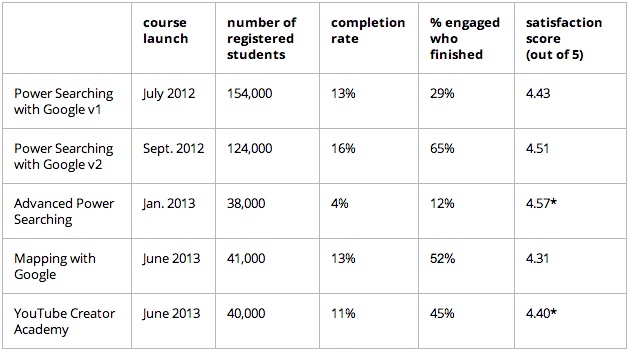
Google has taught five open online courses in the past year, reaching nearly 400,000 interested students. In this post I will share observations from experiments with a year’s worth of these courses. We were particularly surprised by how the size of our courses evolved during the year; how students responded to a non-linear, problem-based MOOC; and the value that many students got out of the courses, even after the courses ended.

Observation #1: Course size
We have seen varying numbers of registered students in the courses. Our first two courses (Power Searching versions one and two) garnered significant interest with over 100,000 students registering for each course. Our more recent courses have attracted closer to 40,000 students each. It’s likely that this is a result of initial interest in MOOCs starting to decline as well as students realizing that online courses require significant commitment of time and effort. We’d like other MOOC content aggregators to share their results so that we can identify overall MOOC patterns.

*based on surveys sent only to course completers. Other satisfaction scores represent aggregate survey results sent to all registrants.

Observation #2: Completion rates
Comparing these five two-week courses, we notice that most of them illustrate a completion rate (measured by the number of students who meet the course criteria for completion divided by the total number of registrants) of between 11-16%. Advanced Power Searching was an outlier at only 4%. Why? A possible answer can be found by comparing the culminating projects for each course: Power Searching consisted of students completing a multiple choice test; Advanced Power Searching students completed case studies of applying skills to research problems. After grading their work, students also had to solve a final search challenge.

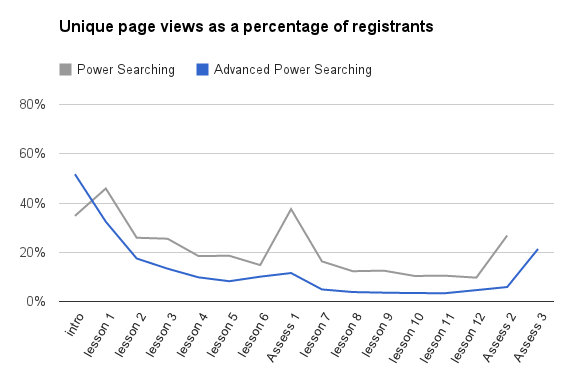
Advanced Power Searching also differed from all of the other courses in the way it presented content and activities. Power Searching offered videos and activities in a highly structured, linear path; Advanced Power Searching presented students with a selection of challenges followed by supporting lessons. We observed a decreasing number of views on each challenge page similar to the pattern in the linear course (see figure 1).
Figure 1. Unique page views for Power Searching and Advanced Power Searching

Students who did complete Advanced Power Searching expressed satisfaction with the course (95% of course completing students would recommend the course to others, compared with 94% of survey respondents from Power Searching). We surmise that the lower completion rate for Advanced Power Searching compared to Power Searching could be a result of the relative difficulty of this course (it assumed significantly more foundational knowledge than Power Searching), the unstructured nature of the course, or a combination of these and other factors.

Even though completion rates seem low when compared with traditional courses, we are excited about the sheer number of students we’ve reached through our courses (over 51,000 earning certificates of completion). If we offered the same content to classrooms of 30 students, it would take over four and a half years of daily classes to teach the same information!

Observation #3: Students have varied goals
We would also like to move the discussion beyond completion rates. We’ve noticed that students register for online courses for many different reasons. In Mapping with Google, we asked students to select a goal during registration. We discovered that
  • 52% of registrants intended to complete the course
  • 48% merely wanted to learn a few new things about Google’s mapping tools
Post-course surveys revealed that
  • 78% of students achieved the goal they defined at registration
  • 89% of students learned new features of Google Maps
  • 76% reported learning new features of Google Earth
Though a much smaller percentage of students completed course requirements, these statistics show that many of the students attained their learning goals.

Observation #4: Continued interest in post-course access
After each course ended, we kept many of the course materials (videos, activities) available. Though we removed access to the forums, final projects/assessments, and teaching assistants, we have seen significant interest in the content as measured by Google and YouTube Analytics. The Power Searching course pages have generated nearly three million page views after the courses finished; viewers have watched over 160,000 hours (18 years!) of course videos. In the two months since Mapping with Google finished, we have seen over 70,000 unique visitors to the course pages.

In all of our courses, we saw a high number of students interested in learning online: 96% of Power Searching participants agreed or strongly agreed that they would take a course in a similar format. We have succeeded in teaching tens of thousands of students to be more savvy users of Google tools. Future posts will take an in-depth look at our experiments with self-graded assessments, community elements that enhance learning, and design elements that influence student success.
09 Sep 14:56

The Monstrous Cost of Work Failure

by Randy

The Monstrous Cost of Work Failure infographic

The Monstrous Cost of Work Failure infographic from AtTask looks closely at the cost of failure within companies.  How many at-bat attempts does your company take before hitting a homerun?

Projects fail, budgets blow up, fire drills reign and chaos abounds

Work failure plagues all types of teams – from marketers working on a campaign to IT teams deploying a major software system. The root of the problem – impacting 70% of teams – is work chaos. And it can be conquered. Click on the image below to view or download the full graphic and learn more about work failure and how to avoid it.

Fun design with monster characters to help tell the story to readers.  The design does a good job telling a 3-part story to the audience:

  1. Introduction - What is the problem?
  2. The Main Event - How big is the impact?  How can this effect me?
  3. Call To Action - How do I fix the problem? 

Big fonts are not data visualizations, and in this design I would liked to see more of the statistics visualized.  Visualization would help put the data into context for the audience.  The footer of the design should also include the copyright information and the URL to the original infographic landing page so readers can see the full-size infographic.

Thanks to Matt for sending in the link!

03 Sep 20:39

Now There Are 5

by LJ

ljx130901webcoverStory1a Now There Are 5News of the completion of the Penguin Random House merger on July 1 came with a roster of the new global corporate hierarchy. At the top: Marcus Dohle, chief executive of Random House, is the new CEO of Penguin Random House, now the world’s largest consumer book publisher. Penguin’s John Makinson, head of Penguin worldwide, chairs the new company.

The newly formed company will have $3.9 billion in revenue, 10,000 employees, nearly 250 imprints, and a global reach, combining Random House’s strength in Latin America with Penguin’s hold in India and China. Penguin Random House will publish 15,000 new titles a year, about one-quarter of the world’s English-language books.

Bertelsmann, which owned Random House before the deal, is the controlling partner, with 53 percent to Penguin-parent Pearson’s 47 percent. Bertelsmann CEO Thomas Rabe ticked off the strategic advantages of the match: “Together, we can and will invest on a much larger scale than separately in diverse content, author development and support, the publishing talent, the entire spectrum of physical and digital book acquisitions, production, marketing, and distribution, and also in fast-growing markets of the future.”

Big enough to fight back?

What will this mean for the publishing landscape? Now that we are down to the Big Five—Hachette, ­HarperCollins, Macmillan, Penguin Random House, and Simon & Schuster—will we see the U.S. market boil down to a Big One within a decade, as consultant Mike Shatzkin predicted at this year’s Publishers Launch conference in June? Will consolidation bring homogenization and dampen risk-taking, as others have speculated, echoing a charge levied against big publishers for years?

For more on this story see PubCrawl’s Penguin Random: Bigger Is Better—Or Not, by Francine Fialkoff

“I don’t think it’s dire,” says Lorraine Shanley, president of Market Partners International, a consulting firm that specializes in traditional and digital publishing in the United States and internationally. “Publishers are all rowing in the same direction on this one, in reaction to Amazon,” Shanley ­continues.

The silver lining, Shanley says, is that Penguin Random House is large enough that even Amazon, with its $61 billion in annual revenues, most from nonbook sales, can’t ignore it when it comes to books. “And that will help the others. This is a potential plus for the industry. Penguin Random House can be a market leader,” Shanley says, by standing up to the massive online retailer’s aggressive tactics, including price slashing. A single player that can push back at Amazon may be particularly appealing because a previous attempt to do so by multiple companies with Apple backfired, leading to expensive price-fixing lawsuits and settlements.

Inside the house

The first 100 days of a new corporate regime tend to telegraph the future. Changes announced so far at Penguin Random House emphasize retaining valued executives and employees, authors, and readers and a collaborative rather than a “winner take all” approach, blending the companies gradually, over a two- to five-year period. Industry watchers venture that while it’s likely that cuts will happen, they won’t be drastic. Because the merged companies didn’t ramp up billions in leverage to get the deal done, there is no external pressure to crank up profitability. As a result, the top executives can take the time to make thoughtful decisions.

Dohle has said that the integration of Penguin Random House will take place over the next two to three years, not months, according to Penguin Random House spokesman Stuart Applebaum: “In the immediate months ahead, our byword is continuity, not disruption. Cross-divisional collaborations were indispensable to our premerger integration processes with our IT, human resources, and communications groups, and now we are expanding this approach to virtually every department and division.

“Our senior management team is specifically drawn from both sides of the company, and the long-term and day-to-day strategic, operational, and publishing decisions—including library-centric ones—will be evolved jointly by Random House and Penguin executives, sharing their knowledge and experience, determining what we hope will be a right course for all. In the beginning weeks of our united company this coming together has been productive—and fun.”

Developing and expanding digital platforms will be “a crucial priority” for Penguin Random House, Applebaum adds, with plans to invest heavily capital and talent resources and provide training courses for emerging digital platforms, social media tools and programs, and metadata analytics ­companywide.

Possible downsides

Not surprisingly, outsiders have been more open to voicing the potential negatives of combining two already-massive publishers. The newly merged company is “a huge behemoth with a lot of moving pieces and an enormous number of imprints and editors,” says Shanley. “It will take a certain amount of time to figure out how to sell a significantly larger list.”

That’s not the only concern. Others in the close-knit book industry focused on the back office: publishing veterans predict that postmerger, the first obvious changes will be in operations—one contracts’ department instead of two, one sales force instead of two, one warehouse, and so forth—and that ultimately editorial cuts will fall on “redundancies.”

Ethan Nosowsky, editorial director of Graywolf Press, expressed the feelings of many in the industry about cutbacks. “Several of us at Graywolf have worked at larger publishers, so right now we are looking on with concern for our friends and former colleagues—the many talented and hardworking editors, publicists, and salespeople who inevitably lose their jobs in these mergers.”

And what about the 250-some imprints in the new company? Will some be put to bed or combined? “Penguin Press publishes the best serious nonfiction around,” said Grove Atlantic publisher Morgan Entrekin, rattling off an extensive list of imprints and editors. “One would hope these imprints will stay intact….” Anticipating such speculation, Dohle addressed a letter to literary agents in late October 2012, shortly after the merger was announced. “In this new partnership with Penguin, we will be retaining the distinct identities of both companies’ imprints,” he wrote.

“The divisional publishers—not corporate leadership or shareholder fiat—will determine the priorities for their individual imprints,” Applebaum says, postmerger. “Surely, there will be changes they will implement over time, as they always have done, but this will be gradual and in response to the marketplace, the editorial affinities of their staff, and feedback from readers.” Bolstering Dohle’s statement, he points to the parallel literary, business, and genre imprints that coexist among Random House’s three adult divisions. “This will continue cross-company with Penguin Random House,” he says.

The impact on other publishers

Each of the other Big Five players is figuring out a way to get its “moment in the sun,” Shanley says. “The ebook market is growing, the English-language market is growing worldwide. There are lots more opportunities to find new markets outside the United States. Look at Harper. It’s really made inroads in terms of being able to offer print on demand worldwide. Macmillan is doing far more English-language publishing and ebook distribution worldwide. HarperCollins—with its recent alignment with the Dow Jones side of News Corp—is doing a huge ebook initiative with the Wall Street Journal. Hachette has more ebook best sellers than even Random. Everyone’s going to be more aggressive, partner up, and be as efficient as they can.”

For smaller companies, the effects of the merger may be less noticeable. “Random House is 100 times my size, Penguin is 75 times my size,” says Entrekin. “Together, they are 175 times my size. I don’t see it as having that much impact on how Grove Atlantic operates. I’m never going to be able to measure up to their advances. We’ll still have authors who will leave us at some point. That’s the way it’s been for 20 years…. If anything, it differentiates us more. We are markedly different in terms of size and shape.” That is a plus, says Graywolf’s Nosowsky, pointing out that consolidation provides opportunity for smaller houses to seize some literary territory. “We’re going to do that happily,” he says. “But I think all of us would rather be talking in terms of healthy ecosystems than battlefields.”

The impact on authors

What if you’re an author published by Penguin, and suddenly you’re on a list with hundreds of your competitors? Penguin Random House is taking a lot of time and effort to soothe authors and their agents. But no one can tell what is going on behind closed doors.

“It remains to be seen what impact this merger will have on our clients’ ability to have their books successfully published,” says literary agent Gail Hochman, president of the Association of Authors Representatives. “We want the most vigorous marketplace possible for our clients’ books, where they can be published in increasingly effective and creative ways.”

While Penguin Random House has the talent and money to publish authors “effectively,” other factors may narrow authors’ ability and opportunity to get the best deal. Penguin Random House will have “a more robust top-tier list of authors to support and be supported by, which may mean less need and/or motivation to develop authors who are considered to be underperforming or solidly midlist,” says Sylvia Day, president of the Romance Writers of America and a best-selling author. (She closed a multimillion-dollar deal in June for two erotic novels with Penguin, which published her “Crossfire” series.) “The resources at their disposal have magnified (sales force, marketing and publicity talent, and networks), and their industry footprint is considerably larger,” she says. “[But] other publishing houses [will] have one less house to compete against in auctions. This may—in some ways—be a boon for other houses but is a huge loss for authors and agents.”

Previous mergers have affected auctions, too, with prohibitions against bidding wars when more than one imprint of a house is involved. According to Penguin Random House’s Applebaum, however, “The respective bidding process for both sides of the company will essentially remain unchanged. When more than one house has a shared interest in a title, there can be competitive bidding between the Penguin imprints and the Random House imprints in the acquisition mix, which can continue as long as there is at least one outside publishing house bidding.”

The new competition

Author Day also pointed to the growth of self-publishing as a game-changer in the way big houses compete for authors. “As more authors become independent publishers, the Big Five will find that they’re competing less against one another and more against the lucrative and less frustrating path of self-publication,” she says.

Authors like Stephen King and Seth Godin already have opted for Amazon and Kickstarter, notes Minda Zetlin, president of the American Society of Journalists and Authors and a business/technology author (The Geek Gap). But so have many other authors she knows, who “work with some combination of smaller publishers and self-publishing in addition to the Big Six-Now-Five. As authors have come to understand that sales of their books is their own responsibility, it’s less and less clear why we need these giant houses at all,” she says.

“While this is certainly a major transformation from the viewpoint of bookstores and the publishing industry, from the viewpoint of workaday writers…it’s just another item in a long-familiar trend,” continues Zetlin. “The big houses are becoming fewer and more corporate-driven. Big advances are rare, promotional support rarer. So in a way, Simon & Schuster’s partnership with self-publishing company Author Solutions seems as significant to me as the Random House/Penguin merger.”

Entrekin agrees that publishing will “morph” into many types and forms over the next ten years. “Self-publishing, Amazon publishing. There will be tiers of publishers that won’t be so corporate in size. Pottermore is an interesting form of publishing,” he says, referring to the site J.K. Rowling established to sell Harry Potter ebooks. As consolidation drives new models, those same new models also drive consolidation. “The large corporate publishers traded on the public markets will have even more pressure,” Entrekin hazards.

The library connection

Continuing the strong relationships they’ve had with Penguin and Random House under the new regime is a priority for librarians. “During the past two years, we have had numerous interactions—via in-person meetings and other communications mechanisms—with representatives of both companies and with library marketing executives and executives at the highest level of each company,” says American Library Association (ALA) president Barbara Stripling. “We do not agree on every issue, but we have had substantive and respectful conversations. ALA is hopeful about continuing this good relationship with Penguin Random House.”

For the foreseeable future, Penguin and Random House will continue to advance their partnerships with libraries under their current distinct and separate policies and terms, says Applebaum. A “collaborative approach will be the hallmark of how Penguin and Random House will be working together in the time ahead to formulate a unified, shared strategy, together with sales terms, for libraries,” he says.

He offers no time line for the new policies to take effect. “We will take the time we need to think this through and plan it properly and to try to get it right for all parties. In doing so, we will actively be reaching out to the library community for their views and recommendations about our respective best practices for every aspect of our relationships. We want them to have a voice in determining our future together.”

In the meantime, top executives from both sides of Penguin Random House underline the importance of continuing their ongoing partnerships with libraries.

Skip Dye, Random House VP for library and academic marketing, went on a weeklong “listening tour” of Ohio public libraries in early August, culminating at OverDrive’s Digipalooza user group meeting in Cleveland. His goal: “To re­affirm and reassure people we will still be doing what we do.”

Dye and his Penguin counterpart, Alan Walker, VP, senior director of academic and library sales and marketing at Penguin Group, expresses mutual respect and the wish to collaborate and continue seeking feedback from librarians.

“Skip and I right now are talking quite often about how we can work together,” says Walker. “We’ve always had a friendly collegial relationship.” Penguin and Random House have a shared philosophy, Dye says. “We believe in supporting librarians and in the importance the library plays in the community. We’ve become active listeners within the library community. We do listen. And after the merger, we’re still listening.”

Adds Walker, “We’re trying to make it a two-way conversation.”

About Those Ebooks

Will there be uniformity in Penguin Random House lending policies? This key question was raised by ALA president Barbara Stripling.

“The library ebook lending business models for Penguin and Random House differ greatly,” Stripling says. “Penguin employs a model centered on a one-year duration with pricing somewhat comparable to consumer ebook pricing. By contrast, Random House provides perpetual licenses, but typically pricing is several times the consumer ebook pricing. Another important difference lies in how ebooks are made available to libraries through different distributors.”

Currently, Penguin ebooks are available only through 3M and Baker & Taylor’s Axis 360, not through OverDrive, the largest distributor of ebooks to libraries.

Penguin Random House spokesman Stuart Applebaum addressed some of these issues. “There eventually will be uniform companywide Penguin Random House terms of sale and lending conditions for our print and ebook titles,” says Applebaum. “We have no time line in place for it to start. Its formulation will be a gradual process for us, incorporating lots of recommendations we will be soliciting from all quadrants of the library universe nationwide. We want to get this policy right, and we will take the time to try to do so. For now, and until new ones are set, the distinct library sales terms and practices for Penguin and Random House, respectively, remain unchanged.”

ALA advocates for more choice for librarians, Stripling notes. “A business model with options—for a shorter-term license (such as one-year availability) and a longer-term option (such as perpetual access)—would provide librarians with improved ability to customize collections and better serve community needs. We also continue to believe that library ebook pricing is too high and continue to advocate for lower pricing that takes into account the value of library engagement, such as promoting the discoverability—marketing—of publisher titles.”

“ALA is contemplating further issues and hopes to talk about all of them with Penguin Random House this fall,” Stripling concludes.

Jane Ciabattari (www.janeciabattari.com) is Vice President/online and former President of the National Book Critics Circle and author of the short-story collection Stealing the Fire, just released as an ebook in Dzanc Books’ rEprint Series. She contributes regularly to NPR.org, the Daily Beast, the Boston Globe, and many other publications

printfriendly Now There Are 5email Now There Are 5twitter Now There Are 5facebook Now There Are 5google plus Now There Are 5tumblr Now There Are 5reddit Now There Are 5share save 171 16 Now There Are 5

03 Sep 20:20

Blog - The Rise of Enterprise Social Networks

The following white paper was released this week and available for download from Microsoft: The Rise of Enterprise Social Networks. This 26 pages whitepaper from Mark Fidelman is a good read to help you help understand the business value of Enterprise Social and how to get started :

Social technologies, combined with data analysis and mobile technologies are significantly enhancing an organization's ability to be responsive to market changes and will enable employees to work on the tasks that most benefit the company at any given point in time. In the near future, companies utilizing enterprise social software will be able to spot trends, provide information to thier employees in context, and leverage the wisdom of the organization to rapidly complete tasks and surface previously hidden pockets of valuable information. 


Chapter summary:

  • Welcome to the Enterprise Social Revolution
  • You Need a Digital Village
  • The Evolution of Enterprise Collaboration
  • The Business Value of Enterprise Social
  • The Four Building Blocks for a Successful ESN Building
  • Mapping the Strategy for the Rest of the Business
  • Success initiatives for enterprise social companies
  • Why Microsoft is Best Positioned in the Space
  • Tying it all together
  • Action items & Questions to ask your organization


0243_screenshot _63_24B86D5E

Download Now>>>


I have also read this book from Mark Fidelman which I also recommend: Socialized! How the Most Successful Businesses Harness the Power of Social (Social Century Series).

Happy reading!


For more expert information on Social check out this FREE eBook 'Socialized! How the Most Successful Businesses Harness the Power of Social' by Mark Fidelman. Download Now>>