Shared posts

12 Dec 15:12

The eLearning manifest-no.

by samt77

This first came to my attention through Donald Clark’s blog post last week .  I hadn’t heard or seen anything else about it, so the notion of a serious eLearning manifesto came and went, and then Clive Shepherd blogged about it on Thursday. Then my twitter time line exploded with the launch of “The serious elearning manifesto”.

Strip away the word serious and the word manifesto and I agree with the underpinning principles of good design, but I won’t be adding my name to the list of pledges. The more I read, the more I saw, the more something niggled at the back of my mind.

Why?  Because I don’t like the hoopla around it.   I don’t like the word serious, or the word manifesto – needlessly politicising something which shouldn’t be politicised.    I didn’t much care for some of the slightly aggressive tweets in the surrounding twitter time line about people being unprofessional if they didn’t follow the manifesto.

Why else? Because despite the fact I’ve been pushing for any content I’ve been involved in designing over the last 5 years to be designed well, to be engaging (for years my internal work mantra has been “scrap the crap”), I think it’s not looking at the root cause.

Let’s take a step back.  Are we focusing on the right issues and audiences?

1)       the need to stop looking at the components and think generally about learning differently – there may be no need for (e) learning at all (may have just done myself out of a job. Again.).   As Lesley Price said on twitter – it isn’t just about eLearning, or learning technologies, the core principles – cover all learning.  Let’s stop focusing on one particular medium and view it as a whole.

2)       Who really is creating eLearning these days? The initial supporters of the principles are well known industry names, but sadly as I find on a daily basis those names are pretty much unknown outside of our circle. The bulk of the population creating the “not so good basic information” content won’t ever hear about it.  Most people creating content for their organisations don’t have an eLearning background. Some of them don’t even have a learning background.  They have been tasked with turning out something online in a couple of weeks. Some of it’s rubbish, some of it is okay.   And you know what?  Many of their audiences who’ve never seen any eLearning still think the not so good stuff is great.  (Probably totally ineffective, but still better than what they’ve had)

3)      The people we really need to target are those commissioning the learning in organisations, who ask for it to be developed in a couple of weeks, the “we need a course” brigade.   They might be in the learning department (even leading it) or it might be the business itself. These are the ones who demand the “information-giving-not-performance-related” content.

I have lost track of the time that I have spent trying to get to the root cause of a perceived training need. Sometimes you win the debate, sometimes you still need to buckle down and make the best of a bad situation, as you’re being paid to design.  Here you just have to make the learning as sound as possible and fit for the need, making incremental changes to our designs.

4) Andrew Jacobs raised an interesting point. Some eLearning vendors do need to step up more (not all, it’s not a moment for vendor bashing). I’ve had conversations with vendors before who themselves have admitted that as an industry they may have got complacent; just churning out the usual “click next” material.  We saw last year at the eLearning age awards that the usual stuff wasn’t winning awards. I’ve seen it in the tenders I issue.  Over half the returned submissions parrot back a version of my scoping document.  No calls to question, dig deeper, or clarify.  Literal interpretation. If that’s what happens in the tenders, what chance does the eLearning have of being any good? Maybe I’ve seen too many eLearning projects now, but half the initial scripts I get are all carbon copies of one another.   Lather, rinse, repeat. Perhaps this will be the lasting legacy of the manifesto.

Although this manifesto has it’s heart in the right place, it feels as if it’s used the wrong language and targeted only a tiny part of the audience. That feels like a design fail to me.

Ultimately, I don’t need to sign my name to something; I am and always have been committed to sharing my knowledge and the best practice I’ve learnt to the people I engage with in both my business and my network.

30 Jun 12:01

The Evolution of LMS and how it impacts learning today

by Eduongo
An interview with Annie Agnew, the Head of Solutions Design at Circulus Education Long before schools had access to Learning Management Systems (LMS), Annie Agnew was...
26 Jun 13:36

IT Demand Management – Principles for Both Consumers of IT and Suppliers of IT

by us-national-events@kpmg.com (KPMG International)
N. Dean Meyer explains the best way to balance demand and budget for IT services.
26 Jun 09:30

How does L&D innovate?

by Sukh Pabial

A while back, I wrote about how there’s no new shiny in L&D. When I wrote that post, I was asking a question I didn’t know I was asking. I wasn’t asking why is there no new shiny in L&D. I was asking why is there no new innovation in L&D. Now there’s a question open to debate.

Consider all of the advancements we’ve made in the L&D field in the last twenty years. Then consider whether those advancements would have happened had it been left up to an L&D professional. I would guess not.

When did mindfulness suddenly become a thing? And how is it something that’s suddenly become a mainstream language in business, and now there are consultants making money off it? More importantly, when did L&D decide this concept was something worth pursuing in helping people to be their best self? I’m not arguing it doesn’t have relevance, because it absolutely does. I’m arguing that L&Ders on their own wouldn’t have decided this was somewhere to gain some organisational learning from.

How did neuroscience burst onto the field of L&D and leadership as a way of understanding the human condition and how to create or put in place activities that are brain friendly. That this is even part of the lexicon shows how well it’s understood as an approach to learning. And yet, had a bunch of L&Ders come together to discuss the future of learning, would they have known that brain friendly techniques are where we should be looking next?

If social technologies never existed, would L&D pros have been the ones to step up and say “Hey, there’s a new way of learning available via this thing called the internet, and this is how you do it.”

I’m not beating up L&D. Really I’m not. I’m just reflecting on where innovation in the field comes from.

Mindfulness, neuroscience, emotional intelligence, social technologies (and their application to organisational living) and so much more happened because of determined research in some cases, and because of human curiosity in others. Some bright bod within the L&D sphere then sparked up and realised they could monetise what that is. That’s clever thinking, opportunism, and being in the right place at the right time.

What advancements have L&D made to life in general? You take any of those topics I’ve mentioned, and people will be able to relay anecdotes about how they’ve helped improve their life.

When did you last hear someone talk about how great the e-learning they completed was?

When did you last have someone highly endorse a webinar they attended as being core and fundamental to the way they lived their life?

When did you last hear someone describe a competency framework in a way which made you want to go and pick one up to read for fun?

When did someone last commend a workshop so much that you were sought out for media opportunities to do more with it and spread the word to countless thousands?

When did you last have someone speak so enthusiastically about informal learning that you could see the difference it made in their life?

There’s something there about why this doesn’t happen in L&D. There’s something about why advancements in L&D tend to happen because insight and research in other parts of life are found to have clear organisational relevance (except NLP which should just die a complete and utter death).

What am I saying? That as L&Ders we are great at curating and facilitating the sharing of information. We are great at facilitating learning sessions and we understand the human learning process better than most.

I am also saying that L&D will never truly be an innovative function. It will always be a slave to the organisation they’re part of, and they will never truly be a strategic function no matter how aligned they are to the business. This isn’t because we can’t do that, but mostly because this is not our raison d’etre.

What am I not saying? I am not saying that L&D haven’t improved organisational life. One of the great beauties of working in this profession is that there is no right way of helping people learn. There are better ways than others, but it’s all useful. I am not saying that L&D isn’t vital for organisational success. Any organisation that truly learns, never stops innovating – that doesn’t necessarily happen because of a hit squad of L&Ders though.

I am not saying that L&D can’t be innovative. What we do, and how we deliver it can be at the forefront of learning processes and that’s incredibly exciting. If I can provide a learning environment where regardless of the method I use, you learn something new and are able to apply it, then that’s the best I can hope for. I have seen and been part of some amazingly good learning sessions in respect to this.

What am I suggesting? I suggest that for L&D to be innovative, they forget about looking at how the function performs and measures its success, and instead learns from sources they would never have considered. Not business books, and not in trade journals. But explore the unknown. Who knows what could exist out there that has relevance to organisational learning?


26 Jun 09:26

Structuring Learning in Institutional Banking

by Human Capital Media

Dave DeFilippo of BNY Mellon explains how learning is structured in the financial services sector to meet regulatory commitments and reach both individual and organization-wide levels.

Cast: Human Capital Media

Tags: LearningElite

16 Jun 14:54

Very British L&D?

Last night BBC Two showed an inside view of how things work at British Airways. Love or hate BA they are a well known British institution and because of this I was looking forward to finding out a bit more about how they work.

I’m not sure I’ve felt so disappointed in a long time. 

I’m no fan of BA. I make no secret of this. I find their service stuffy, their aircraft in need of refurbishment (or just basic cleaning) and their staff often quite rude. I now know why.

The programme followed some new recruits to BA. They were young people who were extremely passionate about BA, travel and their new job. They were excited. It must be great to work on the induction training of some really eager new recruits who have been through a long selection process to get their job and are genuinely excited about getting started. Which is why I cannot understand why the training programme seems to have been designed to break their spirit as quickly as possible.

We saw one new starter being tested at adopting the crew brace position and wearing a smoke hood. She was allowed to continue with both exercises and only when she finished them was she told by a very serious assessor that her brace position was slightly wrong and some of her hair was visible when wearing the smoke hood. The assessor then took her to see an even more serious person (imagine librarian meets HR person) who informed her, with a witness present, that her failure was a serious, formal issue and it could result in the termination of her contract with BA. 

The voice-over told us how many applications BA get for cabin crew and basically implied that these processes might be strict but if one person fails, they are easily replaced. We’ve already been told that BA have now decided to pay their staff the same price as budget airline staff, which isn’t much (especially when it was also revealed they have to purchase their own shoes).

One candidate was thrown off the course in the first episode, he struggled with reciting the seat configurations of various aircraft despite saying that he did know the answer. We didn’t witness anyone from BA offer him additional support or help with this task.

So, in summary, I learnt that BA receive excited, energetic, enthusiastic staff and put them through hell on a training programme. Those who don’t give in and perform perfectly are rewarded with a job working for the company.

That’s not how it should be these days. Learning and Development should involve coaching and encouragement. It should take that enthusiasm and energy and harness it to make staff brilliant at what they do. BA admitted that their only differentiator in the market is their service which makes it even more difficult to understand why they think it is acceptable to treat their staff so poorly in induction. 

My sole piece of advice to BA is to treat your employees the same way that you want them to treat your customers. If you patronise your employees like children, they’ll do the same to your customers. If you’re abrasive in how you talk to them, they’ll be abrasive with your customers. You’re lucky, you have a great brand which people want to work for, don’t ruin that. The perception you give off will make people want to go and work for the budget airlines instead, what’s your differentiator to keep staff rather than them work for a competitor? 

(Obviously, I know programmes are edited to make them entertaining but the presentation of this does not help BA’s image. Also I do understand that it is important that staff are fully trained and up to speed with safety requirements, I just think there’s a better way to do it.)

09 Jun 14:18

Crowdsource Your Competencies

by James Tyer

In the standard learning and HR press we hear every day about competencies and competency assessment. I find "competence" a strange description for a set of skills and behaviours that mean you may become a success in any given organization. I would always hope to be more than competent. 

But why should L&D or HR "own" competency assessment. I found this confusing as the people who most understood what it meant to be a success in a role were others in the role. HR competencies tend to be vague and company-wide ("a team player"), rather than specific to a role.

An Experiment

I decided to try an experiment. Different expertise groups (i.e. developers, designers, PMs, sales) would collaborate to create their own shared measures of being successful in the organization. I ran a brainstorming exercise to help them work together to uncover the skills and behaviours for different levels of expertise (and shared values of the group as a whole). Once the levels of expertise were agreed upon, everyone self-assessed and the group agreed or discussed any disagreements. The discussions continued in the enterprise social network.

The goal was that for any project requirement, a project manager would know exactly what needed to request from resourcing and trust the people on their team. It also meant that hiring requirements could be more specific and cultural fit interviews more effective. We also then tailored onboarding more specifically to a new hire's needs.

Crowdsourcing and assessing levels of ability also meant each group was responsible for judging when someone progressed to a higher level of ability. This could involve project work, internal mini projects, presentations, coaching others, showing their work on the enterprise social network and - yes because the groups themselves decided - sometimes a test as a gap assessment.

The idea fits well with Eric Mosley's Crowdsourced Performance Review.

Was it a success?

I was lucky. I worked in a matrix organization with no real hierarchy and a high degree of trust. This kind of thing fitted very much with the culture of the organization, freeing up HR time that could be focussed on other business outcomes. I believe the crowd as gatekeeper to your success, rather than a reporting manager, is a better solution to performance assessments if the crowd decides and owns the criteria.

09 Jun 14:18

What Does a Chief Collaboration Officer Do?

by Jenny Thompson

2014-05-June-Adkins-Mark

In a recent interview by David Coleman, our very own Dr. Mark Adkins was interviewed on his expertise as a Chief Collaboration Officer. David Coleman wrote, “In my 25 years covering and analyzing the vendors and end users in the collaboration space, I have never run across anyone with the title of Chief Collaboration Officer.” With this rare job title and fascinating background the interview touched on Adkins’ previous experience with collaboration as well as what the daily life of a Chief Collaboration Officer entails.

Read the full article here: http://www.cmswire.com/cms/social-business/what-does-a-chief-collaboration-officer-do-025430.php


27 May 11:31

A learning culture critical to driving high performance

A learning culture is what enables Cisco and Apple to ‘out-innovate’ their competitors… it is what enables ING Direct, Zappos and Starbucks to grow at rates 10 -100 times their competitors. And it is what prevented Digital Equipment Company, Tandem, Apollo Computer, Silicon Graphics and hundreds of other defunct companies

Read more...

12 May 19:04

Brains in L&D

by Helen Amery

So how DO we use Neuroscience to enhance L&D effectiveness?

Geoff setting the session up that we’ll be talking AT you and that it’s not ideal, as we all know from an L&D perspective, but that needs-must with the set up. However they’ve then actually quite a lot of interaction and discussion during the session and allowed lots of time for it.

What was less great was the fairly lengthy sales pitch about their business’s products & services. Is this to show their credibility to be here talking about this subject? Everyone’s different but I have trust in the CIPD to only put credible people on the stage.

This session should help application of knowledge of the brain to
- improve L&D content
- engage stakeholders in L&D activity

Quote from George E P Box. – remember that all models are wrong. The practical question is how long so they need to be to not be useful?

There’s no panacea solution but this is one thing in your toolkit. I like that they’ve set this context and expectation. Stop the bandwagon effect! There’s no one silver bullet solution!

They’ve shared some neuroscience essentials to start a discussion of how these are currently applied at work and in L&D.

20140501-113622.jpg

Neuroplasticity – underpins a lot of this work – our brain continues to develop & change and we can self-direct this by taking deliberate control and take actions to re-wire our brain in a way we want. But people need to do this for themselves – you can’t make them. Same as we can’t make people change their behaviour – but we can create environments to enable them.

Habit – the brain likes to save energy by doing as much by habit as possible but this can hinder us at work because it stops us responding to change. Greater frequency, duration and quality of doing ‘new’ will re-wire the brain faster.

Emotion – the emotional part of the brain processes everything and then can pass to the rational brain. So we want learning to be in environments that are non-threatening, positive, enjoyable, rewarding. What’s the perspective of your learners who are coming to your session? What’s their reality? How can you adjust your content?

Executive Functioning – 2 bits to the brain – conscious, prefrontal context above your eyeballs. Processes things at the rate of small change in your pocket. The subconscious brain processes at rate of NY stock exchange. So prefrontal runs out of energy fairly quickly and needs to be re-charged.

It’s a common story for learning to lose budget when times get tough. Instead of compromising on quality, how else can we design content?

- Flipped classroom – get the content in advance – the stuff that can be learnt outside of classroom – so when you come together you can have a discussion, break it down and rebuild it to learn more and faster
Post-learning activities. Assessments to check learning done away from the classroom so session can be tailored more for learners.

- Short focused sessions – maximise the time when together to keep people engaged – 20-40 mins per session – change something to keep the brain interested. Change type of activity, change speaker, change tech.

Insight – spend more time reflecting to get an ah-ha moment – these moments come from your quiet subconscious brain being heard when you stop your prefrontal cortex getting in the way. Create time and space. Shower thinking!

Think about how you structure sessions because concepts need more subconscious brain reflection than sharing facts. What does this mean for evaluation of learning?

Memory – short term (RAD) made up of Reticular Activating System (looks for stuff to confirm what it already knows/believes/what has been raised in your consciousness), Amygdala (can help make connections if environment’s relaxed & conducive) and Dopamine (chemical pat on the back). Long term Potentiation (LTP) made up of Neuroplasticity & Habit. How can you create dynamic and novel content for learning to stimulate the brain out of habit, to look for new ideas instead of relying on what it’s used to.

Brain Health – what you do out of work impacts how you feel in work. When you sleep some parts of your brain are more active than when you’re awake – the Hippocampus – some of which needs 6 hours of solid sleep to actually start whirring. This part will help you store things from the day in your memory.
Eat well, exercise – and chocolate is good for your brain because it uses lots of energy!!

So how to engage the rest of the org? How to break the bad habits we get into between L&D and others?

What we see is behaviour – often habitual (models, tools & techniques)
What happens underneath is thinking and perception of a situation (neuroscience & psychology)
And all 3 are linked to shape your reality (PTB Model)

But we can shape this for ourselves to influence different perception-thinking-behaviour in others?

- What do we do based on perceptions, stories and opinions from others? Or who in your organisation do you have an unhelpful opinion of?

- What of this information is fact?

- If not much, what can you do to find out what the true reality is so you can move to a different perception, different thinking and different behaviours.

Despite the initial selling, and a bit of drip feed selling through the session, it’s been a good summary of those essentials and of how you can start to build that both into content design and how to engage and influence others to make L&D more effective for the business.


12 May 12:23

Google launches new learning management tool

by OEE Webmaster
Summary: 

Google has launched the latest addition to their Apps for Education, Google Classroom, a product designed in collaboration with teachers to help them save time, keep classes organised and improve communication with students.

Interest Area: 
Schools
Higher Education
08 May 15:41

10 Tips for Running Effective Meetings

by James Sweetman
Effective-meetings-delegation-v2
How to Excel at Interviews
This is a guest article by Bookboon author James Sweetman

To paraphrase Tolstoy, productive meetings are all alike; every unproductive meeting is unproductive in its own way. As forums, meetings can inform and educate, decisions can be made, actions agreed, conflicts resolved, risks assessed and consensus reached. They can also be an enormous waste of time.

Meetings are where time management and communication skills intersect. Meetings also magnify the best and worst aspects of a company’s culture.

Here are ten tips to ensure your meetings are as effective as they can be.


1. Know your result

How will you know when the meeting is successful? What do you want the meeting to achieve? You won’t know if you are on track, unless you know your destination. Remember, a meeting is always a means to an end, not an end in itself.


2. Circulate the agenda beforehand

I’m always amazed how frequently this doesn’t happen. Attendees need to know why the meeting is taking place and what it will be about. If you are invited to a meeting without an agenda, seek one. If you expect people to read material beforehand, make this explicit in the pre-meeting communication. Effective meetings do not regurgitate material that attendees should have read in advance.


Effective Meetings Start and End on Time


3. Timebox

An effective meeting will have both a start and an end time. It is the responsibility of the person running the meeting to ensure timescales are adhered to. Starting a meeting on time is a threshold competency, finishing the meeting on schedule; having achieved the meeting’s outcomes, is where the real skill lies.


4. 90 minute limit

Effective meetings are rarely more than 90 minutes in duration. People have limited attention spans. If the agenda is long, can the meeting be split?


5. Fluid attendees

Do all the attendees need to be present for the entire meeting? Can people come and go depending on the agenda items? What would be the most effective use of everyone’s time? In mature organisations (where people are trusted to make the best decisions for themselves and the company) people have the freedom to determine how their time is best spent, so meetings have revolving doors.


6. Keep the actions visible

Use a flipchart or whiteboard to visibly note the action points from the meeting – who, what and when. This ensures greater clarity. For regular meetings the actions from the previous meeting should be the kick-off point for the next one.


Questions transform monologues into dialogues


7. Prepare questions not just statements

If you are putting the agenda together, rather than listing your topics as statements, list them as questions. For example, rather than ‘customer service,’ or ‘bad debts,’ rephrase as ‘how can we enhance customer service?’ or ‘how can we minimise bad debts?’ Questions engage the brain, so attendees are invited to think about solutions before the meeting even starts.

In additional, just because something is said doesn’t mean it is heard or understood. Questions are how we test for understanding. Questions also transform monologues into dialogues. We might know what we want to say on certain issues, but statements won’t necessarily stimulate discussion, – questions will. So if you are preparing what you want to say at the meeting, make sure you give some thought to questions that will engage the attendees, not just statements.


8. Harness technology

How could smart phones, blackberries, tablets or laptops be used effectively during a meeting? If an action point is allocated, could that person act on it during the meeting, by sending an email, forwarding a report? Of course, trust is required. Yes, someone could be playing angry birds, but why not get curious about how technology could be used more effectively during meetings. Wouldn’t it be cool if most of the action points were actually ticked off before the meeting was over? (I’ve seen it happen!)


9. Stand up

We think on our feet! Traditionally Privy Council meetings take place standing up, to keep them short and punchy. I know many executives who have their Monday morning meetings standing up to keep them snappy. When the weather is fine, could you have your meetings walking around the block (a common occurrence in Spain.) Not all meetings need to take place in a formal boardroom or even around a table.


10. Monitor your effectiveness

If you are serious about improving the effectiveness of your meetings, have ‘meeting effectiveness’ as an item on your agenda. At the end of the meeting ask the attendees if they achieved their meeting outcomes and seek their opinion about how the meeting could have been more effective.


From my experience of working with many organisations, the one area where productivity enhancements can always be found is meetings.

Some meetings are vital, central to the success of the organisation; some meetings need to happen more frequently and of course some meetings should never take place at all.


About the author: James Sweetman is an experienced Business & Personal Coach, Soft Skills Trainer, Motivational Speaker and Author. He specialises in a number of areas including Interview Preparation, Career Fulfillment, Motivation and Leadership Skills.

His popular eBook “How to Excel at Interviews“ can be downloaded on bookboon.com.

More information about James and his work can be found at www.jamessweetman.com.

How to Excel at Interviews


06 May 08:24

Tibco Buys Jaspersoft: A Deal With Transformative Potential

by Martha Bennett

Will this deal change the BI and analytics landscape?

25 Apr 13:48

Imperial College becomes first university to accept mobile payments

by Jeremy Evans

Imperial College London has become the first UK university to support paying for goods on campus using a mobile app.

London-based startup Yoyo is now handling in excess of 30,000 transactions each month at the university’s South Kensington campus.

It serves over 20,000 students and staff within 32 retail outlets and counting, including cafes, bars and shops.

Up and down

For retailers, Yoyo provides a marketing platform for customer engagement and a set of tools to better target their customers with relevant rewards, offers and incentives.

Founder Michael Rolph says there is a false perception that there are “millions” of companies doing the same thing asa Yoyo.

Michael_rolphYoyo is the only app combining payment and loyalty to make mobile relevant for in-store retail.

With Yoyo, retailers sell more, waste less and provide a great customer experience.

Royal glory

Earlier this month, Yoyo participated in Pitch@Palace, an initiative run by The Duke Of York in support of early-stage entrepreneurship.

The app collected two out of three awards, including ’Best Pitch’ and ‘Most Innovative Idea’.

Big plans

In an effort to further reduce queues across campus, Imperial College London is now in the process of introducing Yoyo fast-track tills.

Yoyo will be rolling out across many of London and the UK’s leading universities before the new academic year, and is also in discussions with a number of high street retailers.

The post Imperial College becomes first university to accept mobile payments appeared first on Tech City News.

23 Apr 13:36

Adaptive Learning Systems: Empowering the Learner

by tatainteractive

Moving from learning to performance is no easy task—either for individuals or for organizations. Formal learning can no longer enable a worker to perform in this age of complex work where best practices are not a constant. The call is thus to give the power to the people—to choose content, to learn, and to perform. Adaptive Learning Systems (ALS) are facilitating that by providing learners with an ecosystem in which they can explore the world of formal, informal, and social learning, select content of choice and create their own learning path.

The business case for investing in an ALS to personalize learning experiences will be the strongest if it is possible to leverage existing assets and minimize the initial cost. The case should also circle back to the possibility of empowerment and motivation. And like the proverbial pot of gold at the end of the rainbow, there are dollar benefits from investing in a system that allows personalization of learning and performance improvement. These outcomes are likely to have a positive impact on business results.

Variations of a pure ALS, though, are gaining in popularity. While many may not have all of the features of an ALS, they score on their ability to create a personal environment for learning. They offer a framework for applying models like Pervasive Learning, 70:20:10, Evidence-based Learning, and even some aspects of the adaptive learning methodology.

For more on how organizations are leveraging the power of Personal Learning Environments to support performance, see TIS’ white paper “Mapping ID to Performance Needs”.

- Sarbani Mukherjee, Principal Learning Designer – Accounts North America, Tata Interactive Systems

23 Apr 07:52

Ad giants enforcing web standards? Hmmph.

The Wall Street Journal says Google is considering giving a boost in its search-engine results to websites that use encryption.

Is Google being a bully? Are they a force for good? I’m not sure it matters. What concerns me is the idea that a company is now so powerful and influential that it can force the rest of us on the internet to make decisions that may or may not be in our best interests.

I know a lot of people lost their faith in the company when they dropped Google Reader. But I think we all more or less understand why it happened.  I recently got one of those calls confirming recent credit card transactions and they described Google as an advertising company.  Nothing about technology or the internet.

Google’s power comes from the fact that, to a very large extent, they control what people see on the Internet. They create the system and they game the system to their own ends. They offer a service for free to the end user- provided they can make money off that service. 

It is probably inevitable that almost all technologies we depend on for our online experience will be heavily influenced by a few powerful organizations. The question is, where does that influence and control end?

Here’s a useful thought experiment. Imagine that Google takes away search results. Search may seem like the company’s essential function. But why does Google have to keep serving up search results from the Internet? Very few people look beyond the first couple results anyway.

Why wouldn’t a company in a position of almost total control serve up nothing but sponsored content if they could? Or just content only from sites that jump through their hoops. (Content from unencrypted sites would almost never be seen if Google changes its algorithm to de-value their content.)  

In fact, Google would probably make more money than they already do if they took this approach. The idea that a search engine doesn’t show search results isn’t too far fetched once you think about it.  No different than Facebook neglecting to show you posts from a person or company that you follow.

I don’t expect everyone to trust me or assume that we have their best interests at heart. We want people to gravitate to the Old Reader because it gives them what they ask for. It’s not altruism- it’s just how the open web works. We will certainly make decisions about how to run the service that not everyone will agree with.

Critics have said that RSS has not always been as consumer-friendly as social media. But what is more user-friendly than giving you exactly what you want to see, and not what a single company wants you to see? That’s how the Internet is supposed to work. 

By its very nature, The Old Reader is not a closed system and will never have the kind of concentrated market power to control what you see. The very nature of RSS is that it delivers the content that you request.

We don’t need some Advertising firm telling us how to consume or construct our web.  Do we?

22 Apr 12:54

5 Ways Yammer is Improving Communication, Connections, and Learning in our Schools

by Kelly Smith

Share

Social Networking Tools can Facilitate Excellent Communication and Build Connections and Community When They are Limited to the Community They’re Intended For!

Teachers across the world are increasingly embracing the potential of digital tools to make learning content more accessible and engaging for students. There are many powerful, fun, free tools that can be used to this end. One of them is a private social networking tool called Yammer. Here are some productive ways that the proprietary social networking tool is being used in the classroom.

Yammer

What is Yammer?

For those who are not already familiar with Yammer, it’s an enterprise social network service developed to serve as an internal communication system for organizations and companies (sort of a much more private version of Facebook). Any organization can use Yammer for free, and many educational institutions have jumped on the Yammer train. Not surprisingly, its functionality in fostering collaboration and discussion has made Yammer popular into the context of training and education.

5 Ways Yammer is Being Used in Schools

So let’s check out some different ways that Yammer is being used in today’s classrooms!

  1. Communication Simplified with Yammer
    Yammer allows faculty, staff and students to easily communicate across barriers, including those that can be hard to breach with the typical means of communication, like phone calls, e-mails, etc.. By posting questions and creating polls, teachers can also keep in touch with the students and get a better sense of their expectations. Click here to listen to an NMSU instructor explaining a rich use of Yammer in the context of online teaching (jump to 1:00 to get to the Yammer-specific part of the dialogue).
  2. Yammer Creates a Great Environment for Debating
    Debating can be a wonderful way to explore a topic. By encouraging students to actively participate in a discussion and develop respect for points of view different than their own, we can facilitate thought and learning on so many levels. Yammer is a tool specifically designed to promote collaboration of various kinds, and, since it’s similar to other social networks, students learn to use it very fast – a fact that allows instructors to focus on the content of the debate (rather than on technical issues). To see a great detailed example, read the account of Victoria Raish on the introduction and use of Yammer in classroom debates.
  3. Yammer Helps in Keeping Students Up to Date
    In order to communicate better with their students, instructors can create private class groups, where they’re able not only to post relevant information and feature course updates, but also to upload useful content and schedule events, such as office hours or due dates set for assignments.Yammer can be used for posting real-time homework as well, creating a collaborative research space that will keep the students involved and informed. Phil Andersson of Deliotte Australia posted a comment about using Yammer in their training programs, saying: “Using Yammer allowed participants to connect prior to arriving on the actual day. A great tool to begin networking as soon as possible.”
  4. Yammer Helps to Save Time
    Using its multiple functionalities that foster communication and collaboration, Yammer can help in cutting down on the number of traditional or synchronous online meetings you need to communicate effectively. This can let you use actual meeting time more effectively as all participants are well informed and have other business covered already.Managing large projects that involve plenty of people is usually time-consuming and Yammer helps to reduce the time and effort spent on coordination and material sharing. To see what the tool’s most important benefits are, according to its users, check this survey of 10,000 Yammer users that reveal its benefits for various environments, professional and educational alike.
  5. Yammer Offers New Networking Opportunities
    With Yammer, students, who would otherwise be unable to contact each other, get a chance to communicate. Full-time and part-time students can make valuable cross-program connections and establish a wider network that can include the previous alumni in topic-driven conversations. Creating those connections is useful not only for the purpose of exploring various topics, but also for facilitating peer-to-peer support and creating a strong sense of community. To see what the actual students think of using Yammer, check this entertaining video of Pepperdine MBA students’ viewpoints on Yammer.

Yammer can provide a great learning environment, beneficial to students, as well as teachers. By communicating and collaborating with ease, teachers get a better chance at detecting and solving problems associated with the classroom activities.

Related Posts (if the above topic is of interest, you might want to check these out):
Using Instagram in an Educational Context
How Teachers are Using Tumblr in the Classroom
Three Ways Pinterest is Getting Used by Teachers

14 Apr 12:15

Windows Phone 8.1 Review

by Daniel Rubino

Our comprehensive overview and review of Windows Phone 8.1

After eighteen months of being, Windows Phone 8 is getting its first major OS update from Microsoft. While Windows Phone 8.0 has had three minor updates between late 2012 and 2013, it is Windows Phone 8.1 that will finally bring a small avalanche of new features and improvements to users. The update is free and expected to arrive for all current Windows Phone 8 devices in the coming months, though starting today, a Preview for Developers is now live should you want to take the OS for an early spin.

I have been using the Preview release of Windows Phone 8.1 for nearly the last two weeks on a Nokia Lumia Icon. Reviewing a whole OS, especially one as robust as Windows Phone is no small feat. Regardless, I’ll go through what I think are the biggest new features and even some small changes that I think users want to hear about.

Is Windows Phone 8.1 really a game changer? And has Microsoft finally delivered a product that the masses can adopt? Let’s find out.


14 Apr 11:51

5 Tools For Teachers To Create And Publish Apps Of Their Own

by TeachThought Staff
create-publish-apps

5 Tools For Teachers To Create And Publish Apps Of Their Own by Viviana Woodbury, appdeveloper.org What with the almost universal proliferation of smartphones among students, even at the elementary school level, it would seem like...

The post 5 Tools For Teachers To Create And Publish Apps Of Their Own appeared first on TeachThought.

10 Apr 08:25

1893: Proposed designs for Tower Bridge

by Amanda

Proposals Tower Bridge 1 Proposals Tower Bridge 2 Proposals Tower Bridge 3 Proposals Tower Bridge 4 Proposals Tower Bridge 5 Proposals Tower Bridge 6 Proposals Tower Bridge 7 Proposals Tower Bridge 8 Proposals Tower Bridge 9 Proposals Tower Bridge 10 Proposals Tower Bridge 11 Proposals Tower Bridge 12

31 Mar 08:55

What does the science of attention mean for e-learning?

by peterphillips535
In the fourth and final part of his review of Learning Solutions Conference 2014, Peter Phillips reflects on two inspirational key note speakers with a common theme.. Theme 4 Innovative Thinking Soren Kaplan, “Leapfrogging to innovation”, and Cathy Davidson “the Science of Attention”, bookended the Conference with great keynotes, very different but with notable common messages. […]
29 Mar 12:51

edX to start offering MOOCs for K-12 in partnership with GEMS Education

by Editorial Staff
Summary: 

edX is branching into K-12 education, starting with a new partnership with GEMS Education. GEMS Education will provide courses on the edX platform aimed at pre-university students, who currently make up 5% of edX users. 

Interest Area: 
Higher Education
29 Mar 12:48

Are Instructional Designers Making Themselves Irrelevant?

by dpoulos

How PowerPoint Is Ruining Higher Ed, Explained in One PowerPoint http://t.co/gLv58vwjoO via @slate

— Dawn Poulos (@dawnpoulos) March 7, 2014

I've read a lot of articles about the disadvantages of PowerPoint—how it stifles discussion, critical thinking, and thoughtful decision making—but no article conveys the agony of sitting through a slide presentation better or more humorously than this one. Once you have read it, it will become clear that "PowerPointless" applies to any learning environment, not just higher education.

This excellent anti-presentation got me thinking about how much training today is actually delivered via PowerPoint. The answer is, over 50%, through instructor-led and virtual classrooms and another 22% through rapid authoring tools that convert PowerPoint presentations to eLearning. So what does that mean for the poor instructional designer when over 70% of the learning they create delivers poor customer experiences?

The easy thing for an instructional designer to do is to rely on simple instinct and maintain the status quo. Staying with a certain concept or product because it has performed adequately or even well in the past makes sense, at least on the surface. The problem is that expectations, both from learners and business stakeholders, have changed dramatically. Being static means being stale, and for instructional designers, stale content is the fastest road to irrelevancy.

Accepting that your current method of creating learning content isn't meeting the needs of your learners is an extremely difficult thing to do, but it's the only thing that drives change. We recently spoke to the L&D group at Nielsen—the measurement company famous for letting the world know what consumers watch and buy—who shared with us their moment of truth regarding the need for change and the incredible journey they took to change the way they design and develop content.

An LCM...what?

When Nielsen realized that they needed a new set of tools and processes for developing their content, they didn't know what an LCMS was (it stands for "learning content management system"). What they did know, however, was that they had specific business problems to solve and that those problems weren't going to be solved with a new PowerPoint template or yet another rapid eLearning course. So Nielsen adopted a brilliant mindset and approach to creating content:

"We realized that an LCMS would really meet our needs and that we needed to implement it. The approach that we took was we don't know what we don't know yet, and so we decided to start small. We picked two small pilot projects—really taking that agile approach of starting with these small projects—a small core team of people, and the view that we will learn best by just trying to do this. So basically, we didn't do a lot of training. We kind of just jumped in."

Keeping an open mind allowed Nielsen to shift their mindset from courses to bite-sized learning that could be easily consumed and delivered in a myriad of ways. So, as they started thinking about content as small granular objects (like Legos), they experienced a series of "Aha!" moments that changed forever their notion of what content can be to their learners.

"Aha!" Moment No. 1: Reusing Content is a Game Changer

When you're a global organization operating in a dynamic environment, such as Nielsen, the ripple effect of a manual cut-and-paste process can bring an organization to its knees when things change or a new brand is introduced. What Nielsen realized was that instead of spending its time raising the bar for its learning content, the vast majority of its time and resources were spent just maintaining and updating its PowerPoint slide-ware. Here is their experience moving to single-source authoring environment that enables reuse:

"So that's what we did [single-source], and it actually amazed and surprised us. I don't know if you've had this reaction, but initially, when our designers went in, they were like, ‘Oh, you know, it's not as nice or it's not as interesting as some of the other tools we've used,' but we got over that learning curve, and what we published really wowed the business in the speed at which we published. Even though we were in pilot mode, we actually got some stuff out there in different modalities to the business faster than we would have otherwise, and they were very excited about the quality of the learning and the content that we published as well. So we felt that that was a huge win."

"Aha!" Moment No. 2: I Can Share My Content Outside the L&D Organization

Content created by rapid authoring tools locks that valuable content inside of an eLearning course. And that's a shame because the ability to leverage content across the enterprise is what drives performance. What if other functions were able to reuse relevant pieces of your training content for their own purposes? Here's Nielsen's take on the subject:

"With reuse, we started to think about our content much differently, instead of in the silos. For example, this overview that we're doing for this particular product curriculum could also be part of new hire onboarding. Or, wow, not only could it be used for a new hire onboarding, we could also put it in executive onboarding. You know what? It actually would be good for everybody on the sales force to have a general idea of some of it to understand other products across the portfolios. And so, as we started thinking about the content more broadly, it really made us re-think how we authored that content."

Aha! Moment No. 3: Collaboration Lets Us Deliver Better Content Faster

When content resides in the cloud as Lego building blocks instead of full courses on an instructional designer's desktop authoring tool, collaboration and non-linear content development reign supreme. For Nielson, it fundamentally changed the way content is developed and delivered to their users:

"Now that our content is in the cloud, we realize that we can collaborate and work in a different way, in that we can have multiple designers working on the same content at the same time. Instead of having three designers working on three different curriculums that would each take three months, we can actually put multiple people on the same curriculum and publish a curriculum each month for three months. The last curriculum still hits the business at the same time, but the other two are early, which, as you can imagine, stakeholders just love."

Aha! Moment No. 4: Yes, I Really Can Personalize Learning Content

The first step on the path to learning personalization is the ability to matching relevant pieces (Legos) of learning content to individual learner profiles. This sets the stage for the holy grail of personalization: a one-size-fits-one learning experience. For those L&D organizations that rely on PowerPoint and rapid authoring tools for content development, personalization is nothing more than a pipe dream. For Nielsen, it's quickly becoming a reality:

"Now, I can reuse content; I can configure it; I can pull these [Lego] blocks together into new content, which is great because it allows us to do something we could never do before because it was just too inefficient, which is that we can personalize our content. And now that I can personalize my content, I need to know better who my audience is, and so we started adopting personas. We started thinking about really who is our target audience and how do they want to see the content? When do they want to see it? How much of it do they want at one time? This has really been impacting how we're designing things."

Aha! Moment No. 5: Structure Provides Flexibility

Efficient content reuse means that instructional designers will need to take a more structured approach to content development. The prevailing thought among designers is that structured development will limit them in terms of creating interesting and engaging content with varied layouts. Though it seems counter-intuitive, structure doesn't limit creativity; it actually enables you to go further. Let's see what happened with Nielsen:

"One of the things that we learned is that we need to put a tighter structure around our content. That's kind of a tough one, in that, as a designer, it's a very creative process, and they need to let go of some of that. But in the past, we spent 80% of our time just putting the content in and we then spent 20% of our time around the stories, examples, and the rich activities and exercises that we could do. But if we put the structure and these templates around the content and really standardize, then we can flip that. We spend 20% of our time getting the content in and 80% of our time on the stories and the rich activities and how this applies to my job, which we feel adds more value to our learners. So we're really excited about that."

What the Nielsen case study tells me is that instructional designers are nowhere near irrelevant. In fact, they have the opportunity to be rock stars. It simply takes the courage to break out of old mindsets and embrace the unknown. You're probably not going to get fired by using PowerPoint or rapid authoring tools, but you're also not going to provide any extra value to business stakeholders by using them either.

To download the Nielsen case study click here.


21 Mar 16:27

Harvard moves towards Moocs

HBX, the online learning platform, will offer finance accounting, business analytics and economics for managers aimed at the pre-MBA market
19 Mar 12:32

Teaching the Teachers: Upcoming Free Online Courses for Educators

by Jemima Sandhu


OnlineCoursesTeachersWith so many great online courses available, it’s easier than ever for educators to keep on top of all the exciting changes happening in education and pedagogy. From media literacy, through to exploring the very meaning of education itself, you’ll be impressed and amazed by these seven free online courses designed just for teachers. Some of them start this week, so sign up now if you’re interested!


1. Education in a Changing World

Date: March 24 (4 weeks).

Available at:  Open2Study.

Given the many day-to-day practicalities of running a classroom, it’s easy to lose touch with what teaching means in a wider context. So why not just take four weeks to look at your profession from a different perspective? Learn how the aims of education have changed in response to changing views of a ‘good society’ and ‘good person’, and how it continues to change with new communication technologies, and globalization. Teachers will also become acquainted with the main positions on the aims of education (including a skilled workforce; and redressing social inequalities), and current curriculum debates including how “literacy” must be rethought as a result of rapid changes in information and communications.

2. Foundations of Teaching for Learning: Being a Teacher

Date: 17 March (6 weeks).

Available at: Coursera.

If you are a teacher with no formal teacher education, you know how indispensable MOOCs are for filling in any gaps in your background. That’s particularly true of “Being a Teacher”, just one of the courses on Coursera’s fantastic “Foundations of Teaching for Learning” certificate program. Teachers get the chance to critically reflect on their professional development, and enhance their understanding of how to promote learning. There are numerous practical activities available, and attendees can document what they learn through developing a portfolio that can help them with future opportunities.

I earned 83.0% Distinction in Foundations of Teaching for Learning 2: Being a Teacher on @Coursera! https://t.co/nS3akLUaRX #teach2

— Pagoda Arts (@PagodaArts) November 12, 2013


3. Task-based Language Teaching with Digital Tools

Date: 24 March (6 weeks).

Available at: Canvas Network.

If you want to implement task-based language teaching and digital tools, don’t miss this course. You’ll get a chance to examine more than 300 digital tools (mostly online) used to teach English. After an introduction to task-based learning, teachers will evaluate digital tools, design digital tasks, and develop task-based lesson plans and a syllabus. The course is collaborative, so participants should expect to contribute to the list of digital tools.  By the end of the course, teachers will be able to draw on an extensive bank of digital-tasks when developing task-based lessons.

Finally a MOOC that’s right up our alley! Task-based Language Teaching with Digital Tools started earlier this week.https://t.co/K6Y4pD28RG

— Adi Rajan (@adi_rajan) August 25, 2013


4. Teaching Character & Creating Positive Classrooms

Date: May (5 weeks).

Available at: Coursera.

Can you teach grit in the classroom? What about a growth mindset? And how does such “character development” help kids learn algebra? This course answers these questions through examining the key ideas of positive psychology. You’ll discover how the goals of, for example, being “happy”, and learning academic content are actually complementary halves of great teaching. Learn about fascinating positive psychology concepts such as growth mindset, constructive responding, and character behavior language. Through lectures, discussions, and interviews with scholars and educators, attendees learn how to integrate character-based objectives into teaching.

We’re taking the MOOC on teaching character by Dave Levin of @kipp. Really excited. Building A Positive Institution http://t.co/D1jaJW9Na4

— The Possible Project (@ThePossProj) January 8, 2014


5. The Dynamic Earth: A Course for Educators

Date: 14 April (4 weeks).

Available at: Coursera.

A great example of how a subject-based course for educators should be structured and run. The Dynamic Earth explores the evolution of the Earth, and provides resources for educational use. Topics include the latest research on geological time scales, radiometric dating, how scientists “read the rocks”, and an exploration of participants’ local geologic history. After completing the course, teachers will be able to implement what they learned (using course resources, discussion questions, and assignments) into their classrooms.

6. Media Literacy for Teachers (in German)

Date: Available soon. Check the website for exact start date and course details.

Available at: OpenCourseWorld.

Given the rapid pace of change, you can never learn enough about media literacy. In this simple course, teachers learn different methods through which media can be used efficiently in classrooms. The course is offered in partnership with Microsoft, so it uses Office as an example. Teaching is done through a combination of video lectures, discussion, and practical exercises.

7. Re-engineering Your Science Curriculum

Date: 7 April (4 weeks).

Available at: Coursera.

A fantastic subject-based course that demonstrates how teachers can integrate interdisciplinary learning into existing subjects. This course deals with integrating engineering practices into science lessons and lab investigations. The course contrasts research methods used by scientists and engineers, then demonstrates how teachers can create lessons to help students understand and apply engineering principles (ie, learning to design within constraints). Upon completion, teachers will be able to effectively teach engineering processes.


18 Mar 16:10

Learning and Emergent Leadership at Google

by Harold

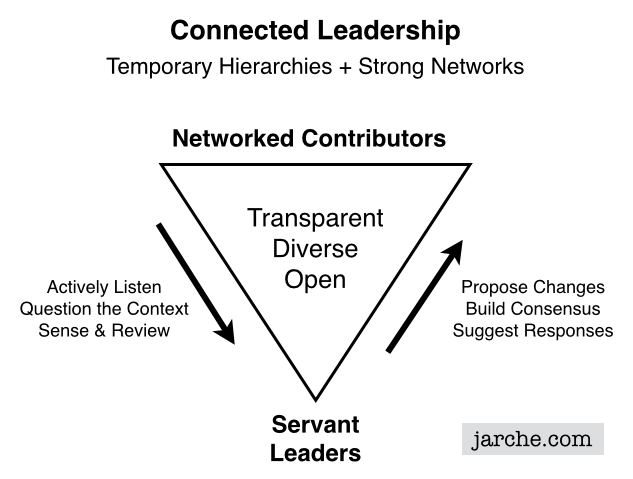
Two themes I have discussed here for a number of years are: 1) work is learning and learning is the work; and 2) leadership is an emergent property of networks. Helping people work on complex problems in networks is one of our management challenges for this decade. Learning has to be part of the workflow. In addition, leadership in networks does not come from above, as usually there is no top. This challenges the practice of management by hierarchical position. Leadership is an emergent property, not something bestowed from on high. Some companies understand this, but most do not. Google seems to get it. Gideon Rosenblatt highlights a conversation in the New York Times that Thomas Friedman had with Google’s VP of People Operations, Laszlo Bock.

Work is Learning:

For every job, though, the No. 1 thing we look for is general cognitive ability, and it’s not I.Q. It’s learning ability. It’s the ability to process on the fly. It’s the ability to pull together disparate bits of information.”

Leadership is Emergent:

The second, he added, “is leadership — in particular emergent leadership as opposed to traditional leadership. Traditional leadership is, were you president of the chess club? Were you vice president of sales? How quickly did you get there? We don’t care. What we care about is, when faced with a problem and you’re a member of a team, do you, at the appropriate time, step in and lead. And just as critically, do you step back and stop leading, do you let someone else? Because what’s critical to be an effective leader in this environment is you have to be willing to relinquish power.”

connected leadershipFurther Reading:

Work is Learning & Learning is the Work

Learning is the Work

Connected Leadership is not the Status Quo

Connected Leadership is Helping the Network Make Better Decisions


18 Mar 16:03

What’s a Thought Leader?

by Matt Reed

What’s a thought leader? And how do you know one when you see one?

18 Mar 15:59

Anything but Google – Top Tips

by Karen Blakeman

This collection of Top Tips is a combined list nominated by those who attended the autumn and spring UKeiG workshops on “Anything but Google”. The participants came from all sectors and types of company, and included a couple of self employed researchers. The sessions covered both general search tools and specialist services, and the list is an interesting mix of strategies and specific sites.  A big “Thank- you” to everyone who participated in the workshops.

1. Get to know the advanced search commands and options.
Google is not the only search tool that uses them and they can help focus your search, especially when using general search tools such as Bing.

2. If you are conducting serious research don’t stop with the first reasonable looking results.
Information of dubious quality can infiltrate even the most well respected of specialist websites. Put on your “skeptical goggles” as one delegate said! There are plenty of alternative tools and resources out there so get some corroboration from additional sources before acting on the information you find.

3. Allocate time for your search.
If you are carrying out in-depth research don’t leave it to the last minute. You will probably need to tweak your strategy and try different search tools to ensure that you are retrieving the best information. It can sometimes take longer than you anticipate.

4. Plan your strategy.
Think about the type of search you want to conduct and the type of information you are looking for. For example if you are carrying out a systematic review and want to use Boolean operators forget about Google; head for Bing instead. And if you need official statistics or company information go straight to specialist sites that provide that data.

5. Don’t stick with what you regularly use.
Experiment with other resources, especially if you suspect your default search tool is not telling you the whole story.

6. Country versions of search tools.
Many search tools offer country versions that give priority to the country’s local content, although that might be in the local language. This is a useful strategy when searching for industries, companies and people that are active in a particular country.

7. Learn when to try something else.
If a site’s navigation or internal search engine seems to be returning rubbish don’t struggle with it. Try another route to get to the information. Either try an alternative source of information or use the ‘site:’ command – available in Bing as well as Google – to search inside the site.

8. DuckDuckGo http://www.duckduckgo.com/.
This was recommended for its clean, straightforward layout and the range of resources it offers on a topic. A school librarian commented that the pupils at her school loved it.

9. MillionShort  http://millionshort.com/.
If you are fed up with seeing the same results from Google again and again give MillionShort a try. MillionShort enables you to remove the most popular web sites from the results. Originally, as its name suggests, it removed the top 1 million but you can change the number that you want omitted. The page that best answers your question might not be well optimised for search engines or might cover a topic that is so “niche” that it never makes it into the top results in Google or Bing.

10. Carrot Search http://carrotsearch.com/

Carrot-Search
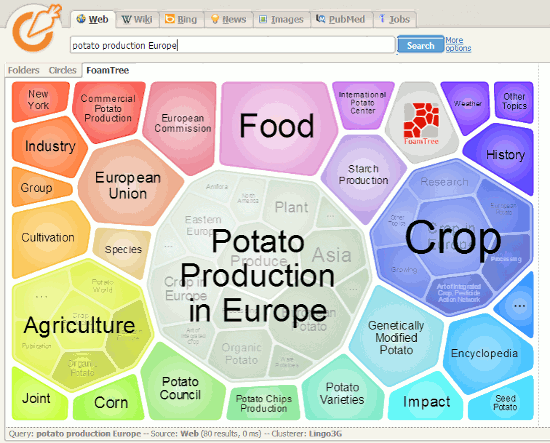
Carrot Search foam tree

This was recommended for its clustering of results and also the visualisations of terms and concepts via the circles and “foam tree”. There is a link to the live web demo on the left hand side of the home page.

11. Microsoft academic Search  – charts http://academic.research.microsoft.com/
This is a direct competitor to Google Scholar. The site can be slow to load and it sometimes assigns authors to the wrong institution. Nevertheless, the visualisations such as the co-author and citation maps can be useful in identifying who else is working in a particular area of research. The visualisations can be accessed by clicking on the Citation Graph image to the left of the search results or an author profile.

12. Creative Commons and public domain images.
Use the Bing license option (US version only) to search for images with creative commons or public domain licenses, but do go to the original webpage and check that the license is indeed associated with the image you want to use. Alternatively use one of the following:

Flickr  Creative Commons http://www.flickr.com/creativecommons
Flickr The Commons http://www.flickr.com/commons/
Wikimedia Commons http://commons.wikimedia.org/
MorgueFile.com  http://www.morguefile.com/
Geograph http://www.geograph.org.uk/
Nasa http://www.nasa.gov/

13. Tineye Multicolr http://labs.tineye.com/multicolr/.
“Search 10 million Creative commons Flickr images by colour.”  You can specify more than one colour and move the the dividing bar between two colours to increase/decrease their prominence within the image. Click through to the original Flickr image to double check the license.

14. Company Check http://www.companycheck.co.uk/
Company Check repackages Companies House data and provides 5 years of accounts, and graphs for some financials free of charge. It also lists the directors of a company. Click on a director’s name and you can view other current and past directorships for that person. It provides more free information than Companies House but you have to register (free) to gain full access. Additional information such as credit risk, CCJs, credit reports, and many Companies House documents are priced or available as part of a subscription.

15. Guardian Data Store http://www.guardian.co.uk/data/
For datasets and visualisations relating to stories currently in the news. As well as the graphs and interactive maps the source of the data is always given and there are links to the original datasets that are used in the articles.

16. Zanran http://zanran.com/
This is a search tool for searching information contained in charts, graphs and tables of data and within formatted documents such as PDFs, Excel spreadsheets and images. Enter your search terms and optionally limit your search by date and/or format type. One delegate said “It has changed my life!”. (We think/hope she meant her working life.)

17. Keep up to date.
Keep up to date with what the search engines are up to, changes to key resources and new sites. Identify blogs and commentators that are relevant to your research interests and subject areas, and follow them using RSS or email alerts.

11 Mar 16:47

Tata Interactive Systems announces white paper on Instructional Design models

by tatainteractive
  • Explores learning models and approaches for the connected, networked learners in a complex world
  • Provides an overview of models like Pervasive Learning, Flipped Learning, Evidence-based Learning, Adaptive Learning Systems, and 70:20:10, with a few case studies

Tata Interactive Systems (TIS), one of the leading developers of learning technology solutions across the globe, today announced the release of a new white paper “Mapping ID to Performance Needs”. TIS has developed this white paper as part of its ongoing effort to resolve the learning-performance conundrum and provide alternative frameworks for practitioners to learn from.

It is evident that the world of learning and performance—workplace, higher education, and individual—is undergoing a fundamental shift. To encourage and assist in this effort, TIS’ white paper on Instructional Design (ID) methodology reviews current models like Pervasive Learning, Flipped Learning, Evidence-based Learning, Adaptive Learning Systems, and 70:20:10, with a few case studies, and includes some specific Case Studies that demonstrate the optimal path to learning.

In the paper, TIS says, “There has been a significant shift in corporate learning design to suit a new multi-generational workforce and address the need to streamline the learning function. With easy access to information via the internet and social media, longer working hours, and remote working, learners want instant gratification of training needs. At the same time, research shows that while 70% of workplace learning happens on the job, 20% is achieved through coaching and mentoring. In the light of these developments, an organization needs to have a collaborative learning framework, where learners generate content and learn from each other. Shorter, focused programs address the need for knowledge that’s relevant and also act as just-in-time performance support, over multiple devices (web, mobile, etc).”

The white paper also focusses on TIS’ learning effectiveness evaluation framework called EAR – Evaluation, Analysis, and Revisit, and serves as a blueprint for the Learning and Development function in the current business environment. Several of TIS’ recommendations include:

  • Given the effort spent on developing eLearning modules, there is a greater scrutiny on the performance improvement a module facilitates. It’s not enough to learn; the learning needs to translate to performance.
  • Course design should be about a holistic approach including performance support tools; a much broader spectrum than a pure learning-oriented philosophy.
  • Since the opportunity cost of an eLearning program is high, there should be a clear connect between the course and performance.

To read the complete ‘Mapping ID to Performance Needs’ white paper click here.

11 Mar 16:44

LMS Proposals – It is more than saying “I do”

by Craig Weiss

Few things in this world are universal.  Taxes, Death, Bad food, irritating salespeople, people singing who have no right to do so, and overpriced goods and services.

Yep, they are all universal.  But did you know, there is another universal item for those in e-learning?

If you said, proposals, then you deserve to have someone sing at your office – I would say me, but while I am popular with the neighborhood dogs who howl, when I belt out a few, I’m not sure that would work at your place of business.

Anyway, within e-learning you can be assured of a few items when it comes to proposals:

  • Some vendors loathe doing them, actually more than you might expect
  • Very popular with LMS/learning platform and web conferencing vendors
  • Tend to range between a few pages to an encyclopedia in size
  • Vendors always stick the numbers (costs) in the back of the proposal
  • Vendors assume that you as the decision maker are going to read the entire thing – of course you won’t (admit it)

Do the Numbers

During my days as a Director of Training, I would seek out and purchase learning management systems. And each time, I sought and received a proposal.

I did it for a couple of reasons (even if I already knew the price)

  • I wanted to gauge the true level of interest by the LMS vendor – beat my deadline, and you go up the ladder
  • I wanted to see whether it was truly built for me, or merely a template with loads of pages about who they were (didn’t care), who were their other clients (didn’t care), their approach (curious to see if it was based on our discussions or just generalized), project process including implementation strategy (a must for me), itemized pricing and details (important), listing all the features they had (nice to know, but since I already had those details ahead of time – otherwise they would have never been considered, not really useful to me), and any other pertinent information related to me (sensing a pattern here?)
  • Viewable screen shots of your product – while not really relevant to me, it might be of use, if I have to show the proposal to someone else, who hasn’t see the product.  But, do not create screenshots that require me to use a magnifying glass to see them.

What I did not want to see

  • A contract – It creates a presumption that a deal is imminent. Since I always negotiated beyond what they priced out to me, I found vendors who did this to lack professionalism.  That is like saying, hey you test drove this new car – here is the contract, let’s sign (all before you actually sit down to discuss whatever).
  • Estimates.  I stated what I needed, I listened and responded to your inquiries.

I viewed the demo and asked questions. I sought additional insight and you did as well. So, why did you give me an estimate?  You already have run the numbers and know your profit margin.

  • A book – in terms of length of pages

LMS Proposals that fail

There are two kinds or proposals – ones that people want to read and ones that cure insomnia. Ideally you want the former.

However, in many cases, potential customers receive the latter and here’s why:

  • They are excessively long.  I have seen ones that are over 40 pages in the length. One time I had one that went nearly 60 pages.  Who is going to read that? Oh, wait I know – no one.
  • They have a Table of Contents, but it is not clickable – thus you are forced to go through the document using your forward button on your PDF viewer.  It takes just a few minutes to create hyperlinks within a PDF.  Invest the time.
  • The pricing numbers are always in the back of the document.

Let me provide you with a little secret. Any person who is buying a LMS, goes first to see how much it will cost, before they read anything. I mean if it is not even near their budget (even if they do negotiations), then why read the proposal?  So, why shove it in the back of the proposal?

I’ll tell you why – because that is what we have learned via books, seeing other proposals, etc. and thus we do it.  But the days of someone reading the whole thing no longer exists. People do not have the time or inclination to do so.  You don’t have to list the pricing on the first page, but it should be within the first two or three pages.

As someone who receives proposals for my clients who have hired me to find them a learning management system, I am always appreciative of vendors who follow my request on doing so.

LMS Proposal Length

As mentioned earlier, the number of pages on some of them, can be outrageous. I often wonder if the salesperson creating the proposal, would (if they were on the receiving end) actually read the entire document themselves.  I seriously doubt it, so why are they forcing it on the prospect to do so?

Take a look at any LMS proposal and you will invariably will see loads of pages that is nothing more than a “shove in the documents, we already have created for other prospects.”

Besides the eco issues that exist today – how much paper is really needed to present the key information?  I say paper, because there are plenty of people who print them out to read elsewhere.

I am a fan of getting right to the point, presenting the key and important details that I need to know to make an informed decision.  This can be done in as few as four pages to eight pages. 

I see no reason, that any LMS Proposal should be more than 10 pages, unless the customer asks for additional information that must be included in the proposal.

Wait, did I just say “customer requests” it?

As a LMS vendor there is nothing wrong with asking the customer what information they would like to see in the proposal, besides the pricing and timeline of the project (or project process/implementation schedule). 

In some cases, they may not want the project timeline, but you wouldn’t know that unless you ask them.

Vendors will always tell you that they ask the prospect what they would want or like to see in a demo (even if they actually don’t do it), so why isn’t this included in the proposal?

Think Differently

I have created proposals that included video and other elements beyond just text, to potential clients.  Does it make a difference? Maybe yes, maybe no, but it stands out.  It shows this is not the same ol same proposal they get from everyone else.

As a LMS vendor you are telling prospects that your system is different in so many ways, so how about showing it your own proposal? Go beyond just text and tables.

I can’t speak for all people looking/considering a system, but for me, having the salesperson on a quick video, recognizing my value as a future customer and providing some specifics all in less than three minutes, would impress me. 

It shows I am special to that vendor and they actually care about my business.

Go the extra mile

Follow up.  I’m not talking about hounding someone a day or two later, rather wait five business days and then politely follow up. Find out what is their preferred method of contact (this info should be asked even before the proposal is sent to them). 

In my days as a training executive and even now, I prefer e-mail contact and always state so.  However, in the case of a LMS proposal, I always requested that the proposal be sent via e-mail and as a hard copy via mail.

Again, I wanted to see what does my business mean to the vendor. If I am not worth UPS, FedEx or DHL overnight, then I am probably not as important to them, as they say I am.

Yeah, I admit it can be seen as a jerk move, but here is the thing – you as the LMS vendor are still in the “wooing phase”.

Bottom Line

If you have ever proposed to someone, you do not ramble on for an infinite number of hours.  You do not treat the person as though they are just like everyone else.  Present information that is basically, “Enter their name” and use the same content as your friend did with his proposal.

You want them to feel special. You want them to be a part of your life.

You care.

As a LMS vendor you can present your proposal in the same manner

And you don’t need a ring to show it.

E-Learning 24/7


Tagged: learning management system, LMS, LMS Proposal, LMS Sales Proposal