Shared posts

06 Nov 10:10

KLOUT gets taken seriously in the UK

by jennybrewster

Its time to take KLOUT seriously   The KLOUT score is a number between 1-100 that represents your influence, the more influencial you are – the higher your KLOUT score, its that simple, or is it? KLOUT has been gripped by the USA, it launched in 2008 and reluctantly I say this, the UK are... View Article

The post KLOUT gets taken seriously in the UK appeared first on Podcasting Academy.

28 Oct 13:26

7 Things You Should Know About New Directions for the LMS

Most of today’s learning management systems were developed in an era when virtually all of higher education was organized around courses and credit hours. Changes in pedagogy, new models of learning, and new opportunities made possible by technology have outpaced developments in LMSs. In response, LMSs are beginning to evolve toward being platforms on which a college or university can build a learning ecosystem. By being learner focused, future LMSs are more likely to meet the needs of institutions and students and to accommodate the new structures of higher education, including developments such as competency-based education, prior-learning assessment, badging, and others.

The 7 Things You Should Know About... series from the EDUCAUSE Learning Initiative (ELI) provides concise information on emerging learning technologies. Each brief focuses on a single technology and describes what it is, where it is going, and why it matters to teaching and learning. Use these briefs for a no-jargon, quick overview of a topic and share them with time-pressed colleagues.

In addition to the 7 Things briefs, you may find other ELI resources useful in addressing teaching, learning, and technology issues at your institution. To learn more, please visit the ELI Resources page.


read more

28 Oct 13:22

Learning Design Patterns as an Alternative Model of Course Design

by mikecaulfield

I’ve discovered Chris Alexander’s work on architecture, and I cannot read it without hearing every line as a statement on problems in course design.  Alexander approaches architecture not through top-down design or bottom-up chaos, but through generative constraints, that is, he begins with the environment and then runs through a “grammar” of building. The design emerges through these constraints the way a sentence arises from grammatical templates/rules (depending on your view of grammar).

I’m new to this, but the way it seems to work is you have a pattern such as “Light on Two Sides“. This pattern notes that people naturally gravitate to rooms with windows on at least two walls. This pattern is made possible by attending to some higher order patterns dealing with the “edge” of the house: Positive Outdoor Space, Wings of Light, and Long Thin House. If Light on Two Sides is impossible in spaces where you need it, you may need to revisit the higher order patterns.

This Light on Two Sides pattern when executed then becomes the higher order pattern to a number of even lower order patterns: Windows Overlooking Life, Deep Reveal, and Roof Layout. In other words the work proceeds in the way you might write a song or form the plot of a book. You write a series of notes that determines the key, which generates more melodies and suggests a bridge in the relative minor key. You add a drum beat which suggests for you the rhythmic structure of the bass. The bass suggests a keyboard hook. Layer by layer the song emerges as a living thing. Everything ends up original, but it is the process of putting one piece in place guides the next piece of work.

In pedagogy how would this work? I have a 150 year old book on teaching I recently read, and scattered through it are comments such as “Place Hard Work First” (e.g. students have limited metal effort to expend, put the activities requiring the most effort towards the front of the lesson). That might be placed alongside a pattern about Peer Learning — and if peer learning is effortful it would suggest the position of peer learning in your course. The use of peer learning might require a higher order pattern about the length of the class or the format of the furniture.

So if the patterns are the same, how do designs end up different? Because you start with different constraints. The same way the shape of the land or relationship to other houses will trigger certain solutions in Alexander’s pattern language:

“Above all, the shapes of the building must spring from the land, and buildings around, like a tree springing from a coppice — it fits perfectly, the moment of inception.”

Your students have certain backgrounds, various strengths. Your institution has certain facilities and your technology has certain affordances. Just as a limited number of grammar rules produce an infinite number of sentences based on the needs of the moment, so learning design patterns combined with the circumstances and aims of instruction can produce infinitely expressive learning designs.

What excites me about this is it is a way to combine research and practice without succumbing to an industrial paradigm. This isn’t “wing it on the whiteboard” or the class as the artistic expression of the instructor. This is a framework which is as rigorous in its own way as any ADDIE-fueled design monster. It’s premises can be challenged. It identifies right and wrong ways to go about things. It would evolve in reaction to new data. It is a distinct methodology which can be shown to produce either good or bad results. But, unlike many methodologies. it seems to me to work in the natural directon of our thought. And as Alexander points out it’s this pattern of a work reacting to itself and its environment that gives it the spark of life.

I am placing some quotes of Alexander’s here to give you the flavor of his thought. They come from random places with no original sourcing, so I paste them here without links. If you find them as powerful as I do the context will eventually present itself.

“In an organic environment, every place is unique, and the different places also cooperate, with no parts left over, to create a global whole – a whole which can be identified by everyone who is part of it.”

“In the past century, architecture has always been a minor science — if it has been a science at all. Present day architects who want to be scientific, try to incorporate the ideas of physics, psychology, anthropology in their work . . . in the hope of keeping in tune with the “scientific” times. I believe we are on the threshold of a new era, when this relation between architecture and the physical sciences may be reversed — when the proper understanding of the deep questions of space, as they are embodied in architecture will play a revolutionary role in the way we see the world and will do for the world view of the 21st and 22nd centuries, what physics did for the 19th and 20th.”

“Every building, every room, every garden is better when all the patterns which it needs are compressed as far as it is possible for them to be. The building will be cheaper; the meaning in it will be denser.”

“I’ll tell you a story. I was in India in 1961. I was living in a village most of the time. I studied that village, tried to understand what village life was all about. And I got back to Harvard, a few months later, and I got a letter from the government of [the town in India], saying ‘We’ve got to re-locate our village because of the dam construction. Would you like to build it?’. I think about 2000 people were being moved. And I thought about it. And then I was very sad. And I wrote back, and I said, ‘You know, I don’t know enough about how to do it. Because I don’t want to come in and simply build a village, because I don’t think that will make life. I know that the life has got to come from the people, as well as what’s going on physically, geometrically. My experience of living in the village is that I do not know enough about how to actually make that happen. And therefore I very very regretfully decline your kind offer.’ And I was actually chagrined beyond measure, that I had to give that reply. But it was honest, and in fact, it was because of that letter that I wrote A Pattern Language. Because, I thought and thought, and I said, ‘You know, this is crazy. What would I have to do, to put in people’s hands the thing with which they could do this, so that it would be like a real village and not like an architect’s fantasy?”

“We are searching for some kind of harmony between two intangibles: a form which we have not yet designed and a context which we cannot properly describe.”

“If you have a feeling-vision of the thing – a painting, a building, a garden, a piece of a neighborhood – as long as you’re very firmly anchored in your knowledge of that thing, and you can see it with your eyes closed, you can keep correcting your actions… It’s not a question of holding onto every little detail, but of holding onto the feeling.”

“From a sequence of these individual patterns, whole buildings with the character of nature will form themselves within your thoughts, as easily as sentences.”

“Nowadays, the process of growth and development almost never seems to manage to create this subtle balance between the importance of the individual parts, and the coherence of the environment as a whole. One or the other always dominates.”


03 Sep 15:55

Reconciling ADDIE and Agile by Megan Torrance

article thumbnail image
Many instructional designers know and use the linear ADDIE approach to development projects. At the same time, many are also aware of agile methods that offer significant flexibility and facilitate changes. Does a designer have to choose one or the other? Not really—and this article explains why.
03 Sep 15:54

Early Review of Google Classroom

by Phil Hill

Meg Tufano is co-Founder of SynaptIQ+ (think tank for social era knowledge) and leader of McDermott MultiMedia Group (an education consulting group focused on Google Apps EDU). We have been checking out Google Classroom – with her as the teacher and me as the student. I include some of Meg’s bio here as it is worth noting her extensive experience designing and teaching online courses for more than a decade.

Meg posted a Google Slides review of her initial experiences using Google Classroom from a teacher’s perspective, which I am sharing below with minimal commentary. The review includes annotated slides showing the various features and Meg’s comments.

I have not done as much work to show the student view, but I will note the following:

  • The student view does not include the link to the Chrome Store that Meg finds to be too confusing.
  • The biggest challenge I’ve had so far is managing my multiple Google accounts (you have to be logged into the Google Apps for Edu as your primary Google account to enter Classroom, which is not that intuitive to students).
  • I wonder if Google will continue to use Google tools so prominently in Classroom (primary GDrive, YouTube, GDocs) or if the full release will make it easier to embed non-Google tools.
  • I have previously written “Why Google Classroom won’t affect institutional LMS market … yet”, and after initial testing, nothing has changed my opinion.
  • I have one other post linking to video-based reviews of Google Classroom here.

The post Early Review of Google Classroom appeared first on e-Literate.

03 Sep 15:53

The Knowledge Management Genius of Amazon.com by Marc Rosenberg

article thumbnail image
How does Amazon.com so effortlessly connect “zillions” of people with “zigabytes” of product information? The answer, in part, is through using advanced knowledge-management (KM) techniques. In the eLearning field, we can learn a lot from how Amazon approaches the relationship between customers and information.
01 Sep 15:38

Findings from ALT survey on Learning Technology

by astevens

This consultation survey was set up as part of ALT’s work for the Education Technology Action Group (ETAG), reporting to the Secretary of State for Education, the Minister for Higher Education, and the Minister for Skills, in 2014 and led by Prof Diana Laurillard, Chair of ALT. 

ETAG was initiated by the Minister for Skills to extend the work of his previous initiative, which set up the Further Education Learning Technology Action Group (FELTAG) in 2013. 

05 Aug 12:31

LMS State of Affairs

by Craig Weiss

620 and counting. 

Learning Systems. Learning Platforms. Learning Management Systems.

Maturity stage? Not close.

Fastest growing verticals – Healthcare/Medical care, Content Providers, Technology, Education (K-12, first and foremost, then HE)

Global markets

  • United States – Biggest player
  • Latin America – Brazil, Chile, Argentina, Mexico
  • Africa – Kenya, Nigeria, South Africa, Uganda – continent as a whole is rocking, minimal competition
  • Western Europe – United Kingdom, Germany, France, Spain
  • Eastern Europe – Russia, a tad of Czech Republic
  • Asia –  China, India
  • Middle East – Saudi Arabia,Israel, UAE, Qatar
  • Pacifica – Australia, Indonesia, New Zealand
  • Caribbean –  Across the board, virtually every island is doing e-learning – not one truly stands out

Market with high revenue potential, yet has minimal competition – Content providers, B2B – unique angle – many systems do not understand the space, nor have a system that truly delivers what these markets need.

Space with the most competition - Internal Employees

Must Have Features – HOT!, Sizzling!

  • Gamification
  • Mobile for tablets with responsive design
  • Video
  • E-Commerce with significant capabilities
  • Competency Management including Skills
  • Compliance – but just because a vendor says they have it, they be turning items that really aren’t into something that works
  • HRIS integration
  • Salesforce.com integration
  • Modern UI for learners and administrators
  • Personalization

Features on the Rise – Roadmap if not in play

  • On/Off synch for mobile – self-contained app for iOS, Android
  • Built-in authoring tool – If you are expecting something like Storyline, forget it – not there yet; unless vendor has a partnership with an authoring tool vendor – example: Claro
  • App store and/or integrations across the board – example MailChimp
  • Learning communities tied to courses, groups
  • Video courses without being wrapped in an authoring tool
  • Tin Can API
  • Ranking, Rating Courses
  • Active vs inactive users (ideal for B2B, associations/non-profits, content providers, e-commerce focused buyers including trainers/facilitators/consultants)

Features to Watch – My Top 10

  • Curating
  • SMS notifications
  • Content/Courses coming with the system (at least two) at no charge to buyer
  • Predictive Learning
  • LRS
  • Enhanced administrative functionality
  • Learner and Admin dashboards upon entering the system
  • Big Data
  • Knowledge Management – but not the way you remember it
  • Training communities – not actually part of the system, but provides a wealth of information including how to videos for administrators

Must have feature even if you have a lame version of it or see it as a waster

  • Social

Break it down – What is it?

Right now there is something taking place in the industry, that is creating confusion among buyers – the term Learning Management System. 

Talk to folks seeking systems and what you could hear will surprise many vendors – the perception that a LMS is an outdated solution, archaic in nature that cannot provide the latest capabilities and functions needed in the market.

First and foremost, this is totally bogus.  Anyone who tells you that a Learning System is something more magical than a LMS, should perhaps check out the industry, learn more about what is a LMS and not just on the first two pages of Google and fully grasp what is e-learning.

I don’t care if you call your solution a learning system, learning platform, something that is so strange that people go “what?” and something whacked, at the end of the day it is a LMS.

It’s all about semantics. Vernacular if you will.

Key Points to Remember

  • A LMS, learning system, learning platform, whatever term is infrastructure. It could be SaaS infrastructure, PaaS infrastructure, a hybrid infrastructure, sitting on your own servers infrastructure, but it is infrastructure.
  • It holds courses, content, provides analytics, a learning environment, administration functionality, learner functionality and other components
  • It can offer mobile learning with responsive and on/off synch, social with vast capabilities, gamification, curation, LRS or Tin Can, PENS (type of compliance standard), video courses, video converter and much more
  • It can provide a modern UI and all the nuggets that go with it
  • It can be a self-service system (more on that in a sec.)
  • A learning community or hub or portal
  • A multi-tenant, parent-multi children, PAAS with instances
  • Can sit on your own servers, SaaS or a hybrid
  • It might provide things you never thought was possible, but is out there

In other words, depending on the vendor, it can do all that you want and need, or not.  The same applies to a learning system or learning platform.  Assuming that a learning system or platform is some advanced solution that is better or more modern that a LMS, is nonsensical.

Don’t buy into the hype, rather buy the system that works the best for you.

Why does the confusion exist?

Many people are only aware of the bigger names such as Cornerstone, Saba, SuccessFactors, Oracle Learn, Infor and Sum Total. They are all soft HCMS (human capital management systems), albeit SuccessFactors can be more than that i.e. HRIS platform and Oracle Learn can be too – heck even as an ERP if you go with the Oracle offering as a whole. 

Many modules including compensation, recruiting, performance, etc., with other platforms (besides those above) doesn’t help. Sure there is a need there for these solutions and people either love them or hate them and just stick with them because the fear of looking again is too much to deal with at the present time.

But they are not the only ones out there. 

Advantages of 620+

  • Gives you more options that ever before
  • Give you more options than ever before, thus selecting A vs B isn’t as easy as it once was, more is more, not always better – especially with systems that Pitch A but cannot even do A or B

Time Period

With the influx of more systems, the average age of the systems as a whole is two to three years.  There are more systems out there that are five or less years old as a true LMS than ones that are 6-10 or even 1o plus.  Consolidation rates continue to be extremely low and hello (newbie) versus goodbye (leave the market) is heavily sliding with “hello”.

Wild West

The industry in 2000 was the wild west, with plenty of snake oil salespeople out there, telling you what you want to hear, even if it wasn’t the case. Sadly, in 2014, it hasn’t changed. 

In fact, I have seen an increase – very likely do to more newbies – that do not even understand what is e-learning, how it works and for example, a LMS/learning system/learning platform is under the umbrella term of e-learning.  Social learning? Under E-Learning. Mobile? Under E-Learning. Talent Management – slowly sliding under E-Learning (good or bad from your perspective).

For soft HCMS whereas learning is just one of many components, that learning is still under e-learning. The HRMS? No, not even close. 

Type of Solution on the upswing

A self-service LMS (or whatever you want to call it to sell more of your solution as the anti- LMS or outdated perceived LMS).  Self-Service is creating such buzz, that there are vendors who have a LMS with long implementation times, developing self-service systems under another name – i.e. not identified from that vendor.

How is a Self-Service System defined?

  • Buy now, go live now – in just an hour or a few hours depending how long it takes to change the skin (sometimes provided as a theme from the vendor), add your logo, change some wordage, maybe fonts if they let you, upload users, assign courses and so on
  • Training often comes in the form of webinars whereas there could be many clients on it, rather than just you; videos, guides, FAQ, Knowledge bases
  • Support – Most of the times e-mail; some times phone too, but want priority – you buy that
  • Pricing tends to go either up to 100 users or with some vendors up to 500, BUT Wait – you want enterprise or over the amounts presented – no worries, we can do that
  • Typically modern UI – although some are dated and duds in my book
  • Video plays a nice role, feature set can be robust or limited (often more robust than you might expect)

Best way to think of a self-service system? Gas/Petrol station.  Drive up, fill up yourself, pay for it on your own (without stepping in and paying the clerk) and leave. 

Bottom Line

This is where we are.

Feel free to agree or disagree.

Feel free to ponder.

Feel free to question.

Feel free to acquire new knowledge or insight.

Feel free to ask “why” this and not “that”.

Feel free to see it for what it is

A state of affairs.

E-Learning 24/7


Tagged: learning management system. LMS state of affairs, learning platform, learning system, LMS
22 Jul 14:01

E-learning vs E-working

by Architela

Remote vs on site

This will be a short post today just pointing out a hypocrisy that was made apparent to me recently when I responded to an advert for e-learning contractors at a well-know university.

I emailed the project leader to ask about remote working, as I am not located near the university but could certainly travel up for occasional meetings. Having been in business for myself since 2007 and routinely working remotely for my clients, I was a bit surprised at his response:

There may be scope for occasional home working, and the University has implemented agile working, whereby all staff can apply to work in a variety of flexible ways. However, this is a creative role that calls for close working with other media specialists and academic and other partners. We believe that creativity comes through collaboration, therefore we expect these role holders to be on site.

I find this attitude astounding. How can anyone who believes that creative collaboration can only come through face-to-face working be a proponent of online and digital learning? And why can’t he see the contradiction?

People may want to compartmentalise learning and working as separate and different realms that have nothing to do with each other, but that just serves to highlight the shallowness of their commitment to the transformations that digitial technologies are engendering in the world.

Share

22 Jul 09:48

Stop the Glorification of Busy and Thrive

by Beth


I just returned last week from vacation with my husband and children at the Jersey Shore where I grew up.   It was great to sit on the beach and do nothing, get lots of walking in, and hang out with family.    Above all, it is a great escape from your never ending to do list.   I did take along a few books, including Ariana Huffington’s Thrive: The Third Metric to Redefining Success and Creating a Life of Well-Being, Wisdom, and Wonder.

The book is about how to reframe success away from money and power to a third metric.  She identifies this as “thriving,” where you get enough sleep, take care of yourself, and work isn’t your whole life.    Over the past year,  I’ve been trying to incorporate thriving into my life – most recently with integrating “walking” into work and embracing the personal analytics movement to pay attention to health.

When I got back online, I discovered Guy Kawasaki’s excellent visual review of the...

Read the whole post... »

       
21 Jul 10:49

BbWorld14 Day 1

by iain.maclaren@nuigalway.ie (Iain MacLaren)
The first day of BbWorld is over, and I am turning to my responsibilities as an official conference blogger. These notes will be very much from my own experience and my own point of view.

From registration it was clear that BbWorld is unlike any conference I have been to before - it is massive! There are 2500 delegates, with lots of different backgrounds. There may be 14 sessions happening in parallel at any time. The logistics involved in moving people between rooms, up and down escalators, and organising them in the large auditorium for keynotes, is an exercise in complexity. 

With all this happening, trying to find people is impossible without using electronic communication of some kind. Luckily, the conference wifi has been fairly reliable during the day. 

The twitter stream (#BbWorld14) has been constant - with some contributions from myself - and during the keynote was more like a firehose. I found it difficult to keep up - though that might have also have something to do with my jet lag.

With such a full programme, it's inevitable that you sometimes feel you should have gone to a different session, especially if the tweets from another room appear much more interesting. In almost all time slots, I can identify at least two presentations I would like to be at. But I haven't mastered bilocation yet. 

I was at 3 quite different parallel sessions this afternoon. The first, Social Media: It's not just what you had for breakfast was given by Steven Anderson, @web20classroom. Aimed at schools, Steven gave some good reasons for using social media and some great advice about how to establish a social media presence. His main message is that it's all about storytelling, and social media gives schools the opportunity to be in control of their message, to tell their own story. I have followed @web20classroom on twitter for a number of years, so it was great for me to finally hear him present. 

My second session today was the Overview of Product Innovations for International Clients, a Blackboard led session, involving Matthew Small and Jim Hermans. In this, we were told how International clients have helped shape product development, and also how Blackboard wants to work with us as a local partner in the future. Most of the innovations I already knew about, from the Blackboard TLC in Dublin earlier this year. But I was interested to hear about the development of an app for instructors, which will include grading - I imagine a little bit like the GradeMark app. Also of interest is that Blackboard is looking at offline capabilities for mobile. Initially this will allow learners to "consume static eLearning content", but will be extended to other types of content. 

My third session was a panel session on Rethinking Student Services to meet the changing learner. This involved a distinguished panel of leaders in higher education: Scott Jaschik, founder and editor of Inside Higher Education; Joan Zanders from Northern Virginia Community College; Gloria McCall from Kentucky Community and Technical College System; and Kent Hopkins from Arizona State University. This was a tough one for me to understand without knowing the context of the US higher education system.  What is clear is that we have in common: increasing student numbers; a more diverse student population; and limited resources. 

Finally it was time for the big keynote of the conference, Joi Ito of the MIT Media Lab. We were ushered into the Venetian Ballroom with loud throbbing music. I took my place at the bloggers area, next to @skyvking, where we have our own power sockets! After a short intro from Jay Bhatt, who will speak tomorrow, we were treated to a very nicely crafted, very visual, presentation from Joi. His message wasn't particularly unique: we need to change education. But he delivered it in such an interesting way, really drawing us in. I particularly enjoyed the section on synthetic biology, which illustrated nicely his point about the need for Anti Disciplinary spaces. (Although, now it has been named, is synthetic biology a new discipline?) He finished with a point about the role of serendipity, or just good luck, in innovation. If you keep meeting the same people all the time, with the same agenda, how can you hope to be creative?

With that in mind, I will conclude day 1 with the observation that my own attendance at BbWorld is serendipitous, and I am certainly not with the same group of people. In particular I had a lovely lunch with a completely new person, who was put in touch with me via a twitter connection. 

If you are in the area tomorrow morning, do join me and my student co-presenters at 8:15 in Murano 3205 to hear about student involvement in developing a campus app. I know there are 13 other sessions you could attend - but you won't regret it!

Tweet
21 Jul 10:09

Blackboard’s Big News that Nobody Noticed

by Michael Feldstein

This week was both D2L’s FUSION conference and Blackboard’s BbWorld. The conventional wisdom going around is that there was no big news out of either conference. In Blackboard’s case, that’s just not true. In fact, there was an astonishing amount of very significant news. It’s just that Blackboard didn’t do a very good job of explaining it to people. And that, by itself, is also news.

The big corporate keynote had to be one of the strangest I’ve ever seen. CEO Jay Bhatt ran through a whole long list of accomplishments for the year, but he only gave each one a few seconds as he rattled through the checklist. He mentioned that the company has a new mission statement but didn’t bother to explain it. It took nearly an hour of mostly talking about big macro trends in education and generalities about the categories of goals that the company has set before he finally got around to new product announcements. And then commenced what I can only describe as a carpet bombing run of announcements—a series of explosions that were over by the time you realized that they had started, leaving you to wonder what the heck had just happened. Vice President of User Experience Stephanie Weeks gave a 10-minute talk that was mostly platitudes and generalities about goals for students while some truly significant UX work that her team had done played on the video screen in the background, largely unexplained. There was something mentioned about cloud. Collaborate without a Java plugin! A new mobile app. Wait, another new mobile app, but something about jobs. Wait! Go back to the last slide! I think that was…. Is it over already? It seemed like simultaneously the longest and shortest keynote ever.

Phil and I had a chance to talk to Jay about it later in the day and asked him (politely) what he was thinking. He said, “I don’t view BbWorld as a selling conference. At all.”

Wait. What? This is the Blackboard conference, right?

Apparently it was. This executive team is nothing if not earnest about wanting to talk about the real issues in education. In fact, they’re so earnest about it that they’d rather talk about that than sell you their product. As a result, what was announced in Vegas stayed in Vegas. They made a serious mistake with their keynote plan. But as far as serious mistakes go, it was kind of awesome. And revealing. In and of itself, it is a strong indicator that, having begun a major cultural shift under Ray Henderson, the Blackboard of today is under Jay Bhatt is a very different beast than the Blackboard of five or six years ago. Many of your assumptions about what the company is and what you can expect from them probably aren’t safe ones to make anymore.

Anyway, it’s not surprising that people observing the conference from afar (and even from anear) missed the announcements. So what were they?

Major UX Overhaul

In the past, a “major UX overhaul” for Blackboard typically meant “we moved around some stuff in the admin panel and put on a skin that looks 5 years out of date rather than 15.” Not this time. The new UX is very different. It takes a lot of design cues from iOS (and, to a certain degree, from Windows Mobile). Forget about the 15 different submenus. They’re moving everything to a single-page model with contextual overlays that fly in when you need them. Workflows have been greatly simplified, and many of them rethought. As I sat in on a demo later in the day, I’m pretty sure that the woman in the row in front of me started crying when she saw how much easier it is to import content from an old course.

To be fair, this isn’t shipping code. “Oh, Michael,” you’re thinking about now, “How can you be such a sucker as to fall for the old vaporware bait and switch?” Well, Phil and I spent some time in their UX lab. We were given access to what was clearly a live system (as was anyone else who came to the UX lab). The UX guy managing the lab gave us a script and warned us that this is still a system in development so if we wanted to see what is actually working today we should stick to the script. But of course, we didn’t. The workflows covered by the script were significant, and a lot that wasn’t on the script was also actually already working. This is real, folks. It may not be done yet, but it’s credible. And if the alpha we saw was any indication, it’s not crazy to imagine that Blackboard could raise the bar on LMS UX design by the time that they release. I kid you not.

Underneath all of this, some serious technical work has been done. Blackboard UX is now 100% separated from the business logic, using Node.js to deliver it and putting presentation code in the browser. Also, the new UX is fully responsive. It dynamically adjusts to the size of the browser window (and device).

Even more impressive was the overhaul of Blackboard Collaborate. The Java plugin is gone.1 It’s been replaced by a simple—dare I say elegant?—WebRTC-based UX. We saw a live demo of it. If Google had designed Hangouts specifically for education, they probably would have built something like what Blackboard is showing off. And it works. We saw it in action.

The UX overhaul would be a pretty significant development all by itself. But it wasn’t all by itself.

Blackboard Learn Is Going to the Cloud

Wait. What?

Phil and I are still trying to nail down some of the details on this one, particularly since the term “cloud” is used particularly loosely in ed tech. For example, we don’t consider D2L’s virtualization to be a cloud implementation. But from what we can tell so far, it looks like a true elastic, single-instance multi-tenant implementation on top of Amazon Web Services. It’s kind of incredible. And by “kind of incredible,” I mean I have a hard time believing it. Re-engineering a legacy platform to a cloud architecture takes some serious technical mojo, not to mention a lot of pain. If it is true, then the Blackboard technical team has to have been working on this for a long time, laying the groundwork long before Jay and his team arrived. But who cares? If they are able to deliver a true cloud solution while still maintaining managed hosting and self-hosted options, that will be a major technical accomplishment and a significant differentiator.

This seems like the real deal as far as we can tell, but it definitely merits some more investigation and validation. We’ll let you know more as we learn it.

Bundled Products

This one may sound like a trivial improvement unless you’ve ever actually dealt with Blackboard’s sales force and trivial to implement unless you’ve ever worked in a big software company with lots of business units, but Blackboard has ended the practice of separately licensing 57 different products, each with its own sales rep and price sheet. In some cases—like xpLOR and myEDU—they’re merging the functionality into the core product. In others, they’re creating tiers of service.

Here’s how their website currently describes the tiers:

  • Learning Core: Bb Learn. (But remember, they’re merging previously separate offerings into it.)
  • Learning Essentials: Everything in Core plus Collaborate.
  • Learning Insight: Everything in Essentials plus Analytics for Learn
  • Learning Insight & Student Retention: Everything in Insight plus “retention services.” I didn’t catch this at the conference, but if it’s what it sounds like then the company is beginning to move away from differentiating between products and services and toward integrated solutions.

This should deliver more value to customers with less hassle.

Other Stuff

Those were the big announcements, but there was a lot of other stuff that floated by. It seems like they’re doing significant work on their mobile app, separate from the responsive UX work. I didn’t get a chance to even see what that is about. They’re working on a content store in partnership with MBS Books that could be more significant than it looks at a glance. There was some sort of jobs or career mobile app that whizzed by in the keynote. And who knows what else.

When I take a step back and look at this as a whole, a few thoughts run through my head. First comes, “Yeah, they had to do most of this in order to compete with Instructure. The holes they are filling are fairly clear.” Next comes, “I really didn’t believe they could pull some of this off at all, never mind as quickly and well as they seem to be doing it. Time will tell but…wow.” Then comes, “How the hell did they manage to get through a keynote with all of this in it and not blow people out of their chairs?” And finally, “Who would have thought in a million years that the LMS space could become interesting again?”

But there you have it. This is just a news post; the implications for Blackboard and the market are many and significant. Phil and I will have more to say about it in the days and weeks ahead. For now, the take-home message can be summed up thusly:

Game on.

  1. Many Bothans died to bring you this enhancement.

The post Blackboard’s Big News that Nobody Noticed appeared first on e-Literate.

21 Jul 10:02

Gove Gone….. 7 top tips for the new Secretary of State for Education

by David Price
Last Friday saw another round of inflationary gifts to teachers in England. As The Independent reported ,Tiffany bracelets, opera tickets – even a brace of pheasants – were given to teachers as the academic year drew to a close. But there…
21 Jul 09:55

L&D, Credibility and Knowledge

by Sukh Pabial

We have a tough old battle in L&D when it comes to establishing credibility. If you’re an internal practitioner, are you meant to be credible in L&D management, delivery, design, evaluation, or procurement? If you’re an external practitioner are you meant to be expert in certain topics, jack of all trades, or have had internal experience gone external? Mix into both of those, and what about skillsets around technology for learning, facilitation methodologies, creative thinking and other theories and models of personal development.

Sure there’s context wrapped around all of that too. What does the business need? Is the time right for it now? is L&D best placed to provide the solution? Does that person have the right skills?

For me, a constant challenge I place on myself is to be knowledgeable about a lot. I don’t want to be caught out with not knowing about certain parts of L&D because I didn’t bother taking the time to learn about them. There’s a lot to learn about the human condition, and it offers massive insight into human behaviour.

The fundamentals don’t change in the workplace. People are there to do a job. They want to be paid well. They want to feel good about what they do. They want to have some influence as to the outcome of what they’re doing. It’s the nuances that slide and slip between those factors that fascinate me.

But I have a belief, and one that I am very careful not to impose on others, that in order for me to have credibility I need to know what’s being said in this space. It means I come across information which resonates with me, that I am indifferent to, or that I have a firm view against.

Personally, I find doing this has made me fundamentally more liberal and inclusive in my thoughts and my practice. As I learn more about various models of human development, I learn that there is so very little that makes us different and yet so much that makes us unique. That’s truly humbling.

So we’re back at that challenge up above. What does it mean to be credible? Big question.

What is it that you think helps you be credible in your practice?


15 Jul 15:04

New Imperial and KPMG institute will harness the power of corporate data - Imperial College London


New Imperial and KPMG institute will harness the power of corporate data
Imperial College London
KPMG and Imperial College London today announce the launch of a major new partnership to create the 'KPMG Centre for Advanced Business Analytics'. KPMG will invest over £20m, with the aim of putting the UK at the forefront of data science. The project ...

and more »
11 Jul 14:02

BLOG: Tin Can & Creating A Continuous Improvement Culture

by karenzam12
In the latest part in his blogs from last month’s NextGen LMS conference, Unicorn’s Stuart Jones asks how do we create a continuous improvement culture? Aaron Silvers, formally of ADL – the organisation responsible for SCORM and now stewards of the Tin Can standard. Aaron recently set up his own company called Making Better  to help […]

11 Jul 10:34

Innovation Roundup – 11 July 2014

by Vinciane

ir-01

Yes, Big Corporations Can Innovate Too. Do you think that large companies cannot innovate? I used to think they were too large, too riddled with politics and institutional inefficiency to move quickly and to innovate. But there are ways that large firms CAN, in fact, innovate.

Don’t Dictate a Culture of Innovation – Influence It! Have you heard of these firms that set off to meet innovation with no idea of what lies ahead, no planning, and quickly retreat into ”business as usual”?  Then don’t make the same mistake: Take ownership of the innovation challenge!

THE framework to guide your innovation process. Here is what every company dreamt of: a framework organizations can use to guide their sustainable pursuit of innovation – the Eight I’s of Infinite Innovation.

Why We Need Innovation To Prepare For The Global Aging Society. By 2050 there will be more pensioners than children. The elderly will soon become a major burden on society. But what if we find a way to turn the elderly into an asset by seeing them as sources of innovation?

How to Create an Oil Lamp out of an Orange. To finish, let’s have some fun. Innovation is also looking at things a little bit differently. Watch this video to learn this video how to make an oil lamp out of an orange.

Wait! Before you go: subscribe to our weekly innovation round-up to receive interesting articles every week!


The post Innovation Roundup – 11 July 2014 appeared first on Wazoku.

11 Jul 10:06

How to Avoid Collaboration Fatigue

by Nick Tasler

It’s nearly impossible to escape a meeting or conference call without someone touting the virtues of collaboration. After all, researchers have linked collaboration to increased innovation, and many have compellingly argued for collaboration’s role in better leadership performance. Collaboration just feels right — like a big hug or a warm puppy.

But collaboration also has an overlooked dark side.

Picture this: A complex issue is identified. A diverse, cross-functional team is assembled to solve it. Key stakeholders are gathered. Information is collected. Options are debated. Approval is sought. And then… nothing happens. So more information is gathered. More stakeholders are invited. More conference calls are logged. More debate ensues. More approval is sought. Round and round the project goes — when, where, and how somebody will decide, nobody knows.

This is a recipe for collaboration fatigue, and if consumed in large doses for prolonged periods, this potent blend of abdication, confusion, and indecision will poison your team. So the question is: How can you leverage the advantages of collaboration while limiting your exposure to the morale-sucking effects of collaboration fatigue?

You can start by answering the two questions below. If you have clear answers to these questions, there’s a good chance that a lot of your collaborative woes will subside.

What is the project’s purpose? It’s easy to assume that everyone on your team already knows the project’s purpose. “We’re here to solve the supply chain problem” or “we’re here to build a new product.” And it’s easy to assume that your team will know that its objective is to produce the highest quality solution at the lowest possible cost in the shortest amount of time. These are flawed assumptions, and they usually turn good collaboration into bad collaboration. For example, when your team inevitably has to choose between the lowest cost solution and the speed-enhancing solution for the supply chain, which objective wins? Should the new product address the needs of a premium customer segment, or be a market disruption aimed at attracting non-consumers? These decisions require a shared strategic direction, not an on-demand cost/benefit analysis.

So before you begin, make sure everyone is crystal clear about the primary strategic objective. It will help your team make hard choices going forward.

Who will make the decision? At some point, your team will have to make a decision based on the insights and research it has gathered. And although defining the project’s purpose will be a huge help in guiding the way, there’s sure to be conflicting opinions and unavoidable tradeoffs. When the time comes, who will make the call? Is it a single person, or a vote? If it’s a vote, who is the tie-breaker?

The best time to answer this question is at the beginning of the project before the pressure has mounted and the temptation to schedule just one more meeting, one more round of data collection, or one more conference call grows too strong to overcome.

To be sure, some collaboration fatigue just comes with the territory. The reason you pursue collaborative ventures in the first place is because you need to address an ambiguous, highly visible, boundary-crossing issue for which responsibility and control is spread evenly across many people. Decades of research show that these high demand/low control situations are a veritable petri dish for job stress and burnout.

But you can mitigate the fatigue even in a situation like this. The fact is collaboration also has a bright side over and above its (occasional) connection to performance. Human beings are wired to connect. It just feels good. You can leverage that positive inclination in order to produce more positive results — objectively and emotionally. All it takes is a little direction and a lot of decision making.

11 Jul 10:06

Anglo Saxon Map of London

by Archivist

Anglo saxon London mapLook around any map of London and you’ll find the echoes of long-forgotten individuals. Cena, Padda, Fulla… ancient farmers who had no idea their names would live on down the centuries as Kennington, Paddington and Fulham.

Could the dairyman whose cheese farm (Ces wican) once graced the banks of the Thames have conceived that his humble business would live forever as Chiswick? People of Croydon: whatever happened to the valley of crocuses (Crogdene) after which your town is named. And who knew that the perennial football chant of ‘Wember-ley, Wember-ley, Wember-ley’ is actually pretty close to the area’s original name of Wemba Lea (Wemba’s forest clearing).

We’ve never seen these Anglo-Saxon hamlets and farms mapped out before, so we thought we’d give it a go. The period shown covers 500-1050 AD, between the retreat of the Romans and the coming of the Normans. Once the Romans had cleared off, the area around Londinium was settled by a hotch-potch of Germanic peoples usually termed Anglo-Saxon. Their main trading port of Lundenwic was probably centred on what is now the Covent Garden and Aldwych (meaning ‘old port’) areas, but we know little about the full extent and organisation of this early London.

Anglo Saxon Map of London is a post from: Medieval Archives

The post Anglo Saxon Map of London appeared first on Medieval Archives.

07 Jul 09:26

1980: Atari 800 ad “It will never become obsolete”

by Chris

Atari 800 ad "It will never become obsolete"

30 Jun 08:28

Bet You Don’t Know The Answer: Why Do Books Smell?

by Katie Lepi

Physical book vs. e-book. Both have their pluses and minuses, and while many readers are moving to e-books for the ease and convenience of not having to lug around a bunch of physical books, those piles of paper pages really still have a following. In fact, 65% of people who say they prefer physical books […]

The post Bet You Don’t Know The Answer: Why Do Books Smell? appeared first on Edudemic.

30 Jun 08:22

Reading in The Mobile Era Infographic

by Christopher
Reading-in-The-Mobile-Era-Infographic

Reading in The Mobile Era

Book shortages continue to represent a significant obstacle to literacy, worldwide. Common in areas where books are scarce, inexpensive mobile phones can bring reading material to all. UNESCO study shows effectiveness of mobile phones in promoting reading and literacy in developing countries.

The Reading in The Mobile Era Infographic shows how mobile technology can advance literacy and learning in underserved communities around the world.

Millions of people do not read for one reason: they do not have access to text. But today mobile phones and cellular networks are transforming a scarce resource into an abundant one.

Drawing on the analysis of over 4,000 surveys collected in seven developing countries and corresponding qualitative interviews, this report paints the most detailed picture to date of who reads books and stories on mobile devices and why.

The findings illuminate, for the first time, the habits, beliefs and profiles of mobile readers. This information points to strategies to expand mobile reading and, by extension, the educational, social and economic benefits associated with increased reading.

Mobile technology can advance literacy and learning in underserved communities around the world. The Reading in the mobile era: A study of mobile reading in developing countries report shows how.

Via: www.unesco.org

29 Jun 20:21

Reward Failures to Crush Employees' Fear of Innovation

by Charles Coy

Rewarding employees for successful, creative ideas is nothing new, but a handful of companies are flipping the traditional model on its head by rewarding failures in order to encourage creativity on a broader scale. While many ideas are submitted by employees at companies like 3M and Google, which allow their workforces to spend 15 to 20 percent of their time on their own projects, those ideas often get caught in a crowded innovation pipeline and never come to fruition. This cycle can instill a fear of failure in employees, crushing their motivation to contribute new projects and reaping nothing for the company. Several companies, including Google X, WPP’s advertising firm Grey Group and Tata Group, have decided to tear down the fear of failure by rewarding duds — as long as the company has learned something from the innovative ideas. 

“Programs such as these help people get over the fear of failure and stimulate employees to stretch themselves — to go far beyond the ‘acceptable’ innovations that they think management wants to hear,” Oliver Baumann, associate professor of management at the University of Southern Denmark, and Nils Stieglitz, professor of management at the Frankfurt School of Finance and Management, write on HBR

Baumann and Stieglitz suggest that the most innovative ideas are born at companies that encourage serendipity, random interaction and play. While companies may feel inclined to set up a workplace culture that encourages constant innovation and new ideas, companies need to resist the temptation to set up highly-trafficked innovation pipelines. 

A study by Baumann and Stieglitz found that high-powered rewards (those that share 30 percent or more of the value with the inventor) generate excitement but produce few actual innovations. While they generate more ideas, they often create a congested project pipeline that inhibits the company from sifting through ideas and acting on them due to the extra resources required. When employees’ ideas aren’t put into action, employees become discouraged and reduce their motivation to contribute to these innovations. Baumann and Stieglitz suggest using low-powered rewards (which share 5 to 10 percent of the value) because they result in fewer ideas that are often better thought out and are more realistic to implement.

“Performance-based rewards thus appear to be a blunt tool to harness the long tail of innovation,” Baumann and Stieglitz say in their study.

Companies Continue to Reward Innovation

In spite of research, it’s instinctual for companies to reward employees for coming up with good ideas. Post-it notes were born from 3M's Genesis Grants, which allot $30,000 to $75,000 to six to eight employees with innovative ideas for 12 months of research. Volkswagen uses a tiered approach by sharing up to 50 percent of the value of small ideas but only 10 percent for high-value ideas since smaller ideas are easy to act on, but big ideas require more resources, according to Baumann and Stieglitz.

Other companies including Penn Medicine hold innovation tournaments to encourage new ideas, which David Asch, executive director of the Penn Medicine Center for Health Care Innovation, calls “an employee suggestion box on steroids.” Tournaments work best for well-defined but unstructured problems, and are especially good for smaller companies, says Christian Terwiesch, a professor at Wharton and author of "Innovation Tournaments: Creating and Selecting Exceptional Opportunities." While tournaments don’t work for all companies, they can create new energy and make employees feel like valued team members.

“There’s that old saying: ‘If you build it, they will come.’ But here’s a new one: If you build it with them, they will already be there,” Asch tells Knowledge at Wharton. “People need to be engaged in the process. Intuitively, people want to be asked to make a difference.”

While employees want to feel engaged, providing employees with high-powered incentives to innovate may actually be hurting the creativity pipeline rather than helping it. Instead companies should consider low-powered rewards and innovation that isn't entirely prompted by incentives.

Q/h: Harvard Business Review

Photo: Can Stock

Talent ManagementTalent ManagementManaging ExpectationsFear of Failure
26 Jun 09:17

NetDimensions Expands Mobile Portfolio with Mobile Assessments on Award-Winning NetDimensions Talent Slate

26 Jun 09:17

4 tips to measure innovation

by Filippo Brunello

“There is a clear correlation between capability in innovation measurement and innovation success, yet less than 20% of companies believe they have a decent innovation measurement capability” says the 8th Arthur D. Little’s Global Innovation Excellence Study.

Few business processes are more critical to a company’s continued performance than innovation. But when it comes to the question “what should I measure?”,  there isn’t a fixed answer which can help an organization to quantify the return on innovation investments. Finding practical indicators that clearly measure innovation is a difficult task and even harder is how to implement innovation measurement as a self sustaining-process.

Having worked with many companies across different industries, here are our 4 tips to measure innovation.

  • Define a few, clear (maximum 5)  Key Performance Indicators (KPIs) as a constant reference. “What gets measured gets done” the saying goes.
  • Measurement must be made a priority and the organisation should stick to it from day one. In order to get the most out of your metrics, you need to know where you started, what you achieved, over what time and from what inputs.
  • Look beyond the short term. What you are investing in really matters to the long-term value of the business and therefore should not be assessed against short-term metrics or business targets.
  • Keep it going. Innovation measurement has to become a core capability of the organisation and has to cross every business function, involving the entire staff as an everyday management practice.

An idea management platform can help you track the outcomes of the innovation process with consistent metrics across every function. Keeping the entire stream monitored is essential to a sustained competitive advantage: how many resources invested, for how long, who are the main contributors and what are the net benefits are only some of the indicators you can rely on.

The post 4 tips to measure innovation appeared first on Wazoku.

26 Jun 09:17

The debate about open plan offices is not helped by its use of stereotypes

by Mark Eltringham

Open plan offices and national stereotypesThe incessant debate about open plan offices is informed by a number of assumptions that can lead us to misunderstand the issues involved. Nigel Oseland eviscerates several of them excellently here, making it plain that a great deal is lost in translation somewhere over the mid-Atlantic. In truth, the European and US experiences of the open plan are very different and while we in the UK could always laugh along with our US counterparts at the organisational insanity of Dilbert, the cubicles themselves were largely alien to us. Another red herring in the debate is the idea that the open plan office is for extroverts and its alternatives for introverts. There is something in this but it’s too simplistic an idea and is often built around the stereotypes associated with sectors such as TMT, the age of workers (especially Gen Y) and supposed national characteristics, not least the reserve of Brits and the brashness of Yanks.

Such national stereotyping is never a great basis for decision making and now a new report from psychometric testing firm Thomas International puts such lazy ideas to the sword. Based on analysis of its own database of nearly 500,000 people in the UK and over 70,000 in the US, the report concludes that British workers may actually be significantly more extrovert than their American contemporaries. Around three quarters (76 percent) of the British subjects were categorised as extrovert based on tests to gauge how ‘positive, communicative, friendly, more verbal and likely to share personal feelings’ they were compared to just two thirds (65 percent) of American subjects.

The post The debate about open plan offices is not helped by its use of stereotypes appeared first on Workplace Insight.

26 Jun 09:14

Medieval Desktop: Castle Wallpaper Collection

by Archivist


Standing majestic over the countryside castles excite the imagination. Once bustling with activity they now stand empty. But their stone walls still have stories to tell, stories of knights, kings, sieges and war. Now you can have your own castle, well at least on your desktop. Seek out the castle that appeals to your inner medieval spirit in the first of our series of Castle Wallpaper Collections.

Click on the picture to see the full size image. Right-click on the full size image and choose ‘Save Image as’ or ‘Set As Desktop Background’ to make. Sizes vary and may need adjusting to git your screen resolution.

Castle Wallpaper Collection 1

Castle-Rainbow

Castle-Lake

Dunluce-Day

Bodiam-Castle

Castle-at-Night

Castle-Bluff

Castle-BW

Castle-Clouds

Castle-Cross

Castle-Gravensteen

test

Medieval Desktop: Castle Wallpaper Collection is a post from: Medieval Archives

The post Medieval Desktop: Castle Wallpaper Collection appeared first on Medieval Archives.

23 Jun 08:32

Introducing Drive, the new way to manage your storage

by Jolicloud Team

A couple of days ago we have launched our new app Drive.

Drive is the missing filesystem for the cloud. Most of us are using many different storages, but it has never been easy to access them all at one time. This is why we have created Drive. It combines all your storages and makes it easy to access and share your files. If you are already a Jolicloud user, you just need to log with your existing account and start adding new storage.

For intensive and professional users, we are introducing a Pro version. Drive Pro is the ultimate storage interface. It enables you to add multiple accounts of the same service – such as your work and personal accounts. It also makes it possible for the first time to move files from one storage to another. Just drag and drop and voilà!

We hope you will love Drive and we can’t wait to listen to your feedback. How much space do you have combined? What are the features you want to see, the services you want us to add?

We are looking forward to hear all your feedback, in the meantime pay a visit to our new website and check out more details about Drive.

Happy Joliclouding!

16 Jun 15:03

It’s Official: Unizin Is Real

by Michael Feldstein


A giant deity from the confines of space and time, Unizin has orbited the Earth like a comet, appearing once every twelve years of Christmas Eve. One man by the name of Dr. Kori wanted to study Unizin after seeing the monster himself when he was a boy. Even though he was called a con artist trying to capture Unizin he never gave up his search. On Christmas Eve day, he was working on his self made radar that would find Unizin when Elly came and was shocked by the device. After Dr. Kori repaired her the two made a trap to capture Unizin. That night, the dimensional kaiju made himself known as both DASH and Dr. Kori captures it in a mystical trap, but time around him began to disappear. Kaito turned into Ultraman Max and made a barrier to slow down the process. Not wanting the graceful giant to be hurt Dr. Kori let it go, restoring everything to normal. Unizin gave the doctor the branch of a tree he had not seen in some time, whether it was intended to be given to him or a reward for releasing him was unknown, but he was grateful nonetheless.

- The Ultraman Wiki

No, not that Unizin. This Unizin. The secret university consortium is no longer secret. Phil and I wrote a few posts about the consortium before the group went public:

So far, four of the ten universities we reported were considering joining have officially and publicly joined: Indiana University, University of Michigan, Colorado State University, and University of Florida.

Here’s a roundup of the news coverage:

Probably most important to read, in addition to IHE’s coverage and ours, is the “Why Unizin?” blog post on the Unizin website.

There was a press call this afternoon, so I expect we will be seeing more articles over the next few days. Of course, Phil and I will be providing some additional analysis as well. Stay tuned.

The post It’s Official: Unizin Is Real appeared first on e-Literate.

16 Jun 15:01

Why Google Classroom won’t affect institutional LMS market … yet

by Phil Hill

Yesterday I shared a post about the new Google Classroom details that are coming out via YouTube videos, and as part of that post I made the following statement [emphasis added]:

I am not one to look at Google’s moves as the end of the LMS or a complete shift in the market (at least in the short term), but I do think Classroom is significant and worth watching. I suspect this will have a bigger impact on individual faculty adoption in higher ed or as a secondary LMS than it will on official institutional adoption, at least for the next 2 – 3 years.

The early analysis is based on this video that shows some of the key features:

There is also a new video showing side-by-side instructor and student views that is worth watching.

Here’s why I believe that Classroom will not affect the LMS market for several years. Google Classroom is a slick tool that appeals to individual instructors whose schools use Google Apps for Education (GAE) – primarily K-12 instructors but also to higher ed faculty members. The tight integration of Google Drive, Google+ and GAE rosters allows for easy creation of course sites by the instructor, easy sharing of assignments and documents (particularly where the instructor creates the GDrive document and has students directly edit and add to that document), and easy feedback and grading of individual assignments. Working with the GAE framework, there are a lot of possibilities for individual instructors or instructional designers to expand the course tools. All of these features are faculty-friendly and help Google’s promise of “More time for teaching; more time for learning”.

But these features are targeted at innovators and early adopter instructors who are willing to fill in the gaps themselves.

  • The course creation, including setting up of rosters, is easy for an instructor to do manually, but it is manual. There has been no discussion that I can find showing that the system can automatically create a course, including roster, and update over the add / drop period.
  • There is no provision for multiple roles (student in one class, teacher in another) or for multiple teachers per class.
  • The integration with Google Drive, especially with Google Docs and Sheets, is quite intuitive. But there is no provision for PDF or MS Word docs or even publisher-provided courseware.
  • There does not appear to be a gradebook – just grading of individual assignments. There is a button to export grades, and I assume that you can combine all the grades into a custom Google Sheets spreadsheet or even pick a GAE gradebook app. But there is no consistent gradebook available for all instructors within an institution to use and for students to see consistently.

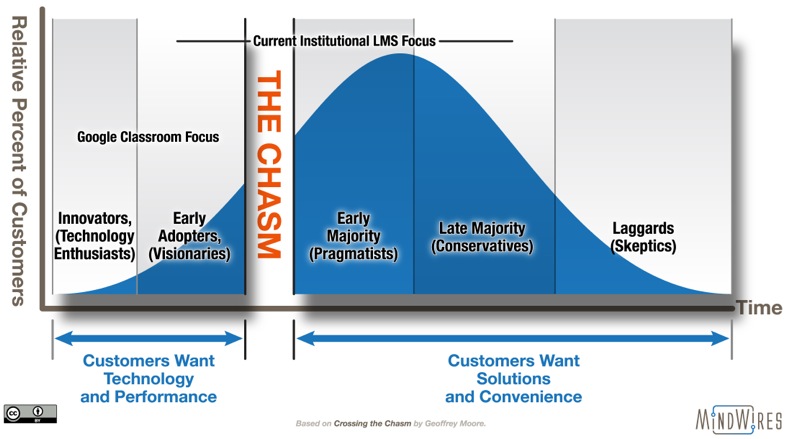
For higher ed institutions in particular, we are just now getting to the stage where the majority of faculty use the institutional LMS. I am seeing more and more surveys on individual institutions where 70+ % of faculty use the LMS for most of their courses. What this means, however, is that we have a different categories of adopter for institutional LMS – the early majority (characterized by pragmatic approach) and late majority (characterized by a conservative approach) as shown by the technology adoption curve. I am showing the version that Geoffrey Moore built on top of the Everett Rogers base model.

chasmDiagramLabels

With adoption often above 50% or more of faculty, the institution has to serve both the group on the left (innovators and early adopters) and the larger group on the right (early and late majority more than laggards). As poorly designed as some of the institutional LMS solutions are, they typically allow automatic course and roster creation with updates, sharing of multiple document types, integrated standard gradebooks, and many others.

Institutions can (and really should) allow innovators and early adopters to try out new solutions and help create course designs not bound by the standard LMS implied pedagogy, but institutions cannot ignore the majority faculty who are typically unwilling to spend their own time to fill in the technology gaps – especially now that these faculty are just getting used to LMS usage.

None of this argues that Google Classroom is an inferior tool – it is just not designed to replace the full-featured LMS. Remember that Google is a technology-vision company that is comfortable putting out new tools before they understand how the tools will be used. Google is also comfortable playing the long game, getting more and more instructors and faculty using, giving feedback, and pushing forward the new toolset. This process will take some time to play out – at least 2 or 3 years in my opinion before a full institutional LMS may be available. If Google like the direction Classroom usage is going.

Google Classroom does attempt to partially understand the instructor use cases, but is not designed as a holistic product. Think of Classroom as ‘let’s see how to tie existing Google tools together to advance the ball in the general course site world’. It is still technology first and tied more specifically Google technology first. The use cases are simple (e.g. one instructor sharing GDrive-based assignment to students who edit and then submit for feedback), but there are many possibilities for clever faculty to innovate.

In the near-term, Google Classroom will likely be a factor for individual faculty adoption (innovators, early adopters) at schools with GAE licenses or even as secondary LMS. But not as a replacement.

The post Why Google Classroom won’t affect institutional LMS market … yet appeared first on e-Literate.