Shared posts

15 Oct 08:42

Why corporations should experiment on us without our consent

by James Choi
Can it ever be ethical for companies or governments to experiment on their employees, customers or citizens without their consent?

The conventional answer — of course not! — animated public outrage last year after Facebook published a study in which it manipulated how much emotional content more than half a million of its users saw. ...

But this outrage is misguided. Indeed, we believe that it is based on a kind of moral illusion.

Companies — and other powerful actors, including lawmakers, educators and doctors — “experiment” on us without our consent every time they implement a new policy, practice or product without knowing its consequences. ...

Why does one “experiment” (i.e., introducing a new product) fail to raise ethical concerns, whereas a true scientific experiment (i.e., introducing a variation of the product to determine the comparative safety or efficacy of the original) sets off ethical alarms?

In a forthcoming article in the Colorado Technology Law Journal, one of us (Professor Meyer) calls this the “A/B illusion” — the human tendency to focus on the risk, uncertainty and power asymmetries of running a test that compares A to B, while ignoring those factors when A is simply imposed by itself.

Consider a hypothetical example. A chief executive is concerned that her employees are taking insufficient advantage of the company’s policy of matching contributions to retirement savings accounts. She suspects that telling her workers how many others their age are making the maximum contribution would nudge them to save more, so she includes this information in personalized letters to them. ...

You can’t answer these questions [of whether the letters worked] without doing a true scientific experiment — in technology jargon, an “A/B test.” The company could randomly assign its employees to receive either the old enrollment packet or the new one that includes the peer contribution information, and then statistically compare the two groups of employees to see which saved more.

Let’s be clear: This is experimenting on people without their consent, and the absence of consent is essential to the validity of the entire endeavor. If the C.E.O. were to tell the workers that they had been randomly assigned to receive one of two different letters, and why, that information would be likely to distort their choices.

Our chief executive isn’t so hypothetical. Economists do help corporations run such experiments, but many managers chafe at debriefing their employees afterward, fearing that they will be outraged that they were experimented on without their consent. A company’s unwillingness to debrief, in turn, can be a deal-breaker for the ethics boards that authorize research. So those C.E.O.s do what powerful people usually do: Pick the policy that their intuition tells them will work best, and apply it to everyone.

Most of the policies and practices that we live by aren’t evidence-based, and good intentions don’t guarantee desired outcomes. The C.E.O. who goes with her gut and tells her employees how much their peers are saving? According to one study, she may actually cause them to save less. ...

We aren’t saying that every innovation requires A/B testing. Nor are we advocating nonconsensual experiments involving significant risk.

But as long as we permit those in power to make unilateral choices that affect us, we shouldn’t thwart low-risk efforts, like those of Facebook and OkCupid, to rigorously determine the effects of those choices. Instead, we should cast off the A/B illusion and applaud them.
--Michelle Meyer and Chris Chabris, NYT, on misguided outrage
02 Jul 13:41

This video of Nicholas Winton, who saved hundreds from the Nazis, will break your heart

by Zack Beauchamp

One of the world's heroes died today at the age of 106.

British man Sir Nicholas Winton wasn't a career activist: he was a stockbroker, brought to Czechoslovakia in 1938 by a friend. The next year, when it became clear Germany would annex the entire country, Winton turned his hotel room into a sort of unauthorized immigration office. He raised enough money for about 670 children to be transported to the UK, where he was from, and raised by British families. He ended up saving the lives of several hundred children, many of them Jews.

Winton's heroism wasn't public knowledge for decades. According to the US Holocaust Museum, it only became widely known after 1988, when Winton's wife happened upon a notebook with photos and names of the children. That year, Winton went on the British television show That's Life, which reunited Winton with some of the now-grown children that he'd saved from the Holocaust. The footage is just extraordinary:

Winton, in the video, is genuinely surprised to be see these adults he'd helped save decades earlier — he didn't know the show was planning to do this — and, overwhelmed, tears up.

"It was an amazing surprise, but no more so than to Mr. Winton who had come to the studio, totally unprepared that he was going to be confronted by us," Milena Grenfell-Baines, a woman rescued by Winton, told the BBC.

"I just thought it was amazing that a single human being could save 669 children and nobody knew about it," Ruth Halova, another one, added.

"Nicky, I am so proud to be one of your very many children."

If you want to learn more about Winton's story, this interview with the BBC — taped not long before his death — is excellent:

02 Jul 07:56

The Art Of Tour Guiding | Robert Skinner | The Monthly | 15th June 2015

Tips for keeping a tour group happy through a week in the Australian Outback. Start by getting them to bond: “Bush camping works for many reasons, chief among them that no one wants to die alone”. Germans are prickly but not unreasonable: “What sounds like complaining is really just Germans having a good time”. Beer soothes: “You can tell the non-drinkers because they are impatient for something to happen”
02 Jul 07:55

The Crisis In Non-Fiction | Sam Leith | Guardian | 27th June 2015

General publishers have lost their appetite for serious non-fiction, save for potential blockbusters. They want “talking-point books” which take a seductive idea and attach a string of anecdotes to it; Malcolm Gladwell is the genre’s patron saint. Happily, this ‘crisis’ has already found a solution. Serious non-fiction has migrated to the university presses. Yale has the best non-fiction list in the world right now
02 Jul 07:43

Nineteen Natural Experiments | Mark Egan | Stirling Behavioural Science Blog | 30th June 2015

How much starvation can an unborn child endure? Are poorer people more prone to psychosis? Is military service a good career move? You can’t run controlled experiments to answer questions such as these because you can’t starve mothers-to-be or force random civilians into the army. But if nature or government does the sorting — as with the Vietnam War draft — you have the conditions for a natural experiment
01 Jul 14:32

Everything Is Yours, Everything Is Not Yours | Clemantine Wamariya & Elizabeth Weil | Matter | 29th June 2015

Third prize in The Browser’s Golden Giraffe Awards for 2015. The writing is so measured, the story so shattering, that the only possible response upon reading it is: Wow. An astonishing piece of prose. The narrator escapes the Rwandan genocide at the age of six, criss-crosses Africa as a refugee, gains asylum in America, wins a scholarship to Yale, and meets her long-lost parents on the Oprah Winfrey show
01 Jul 13:17

Misty Copeland, Athlete

by Megan Garber
Image

There’s an obligatory scene in pretty much every movie about ballet, be it comedy or drama or dramedy: the scene that shows a ballerina—a svelte, usually very pale, usually very pretty ballerina—taking off her pointe shoes to reveal feet that are covered in bruises and blood. The scene is meant to evoke the various ironies and self-contradictions of ballet as art form: lightness enabled by strength, daintiness enabled by determination. Artistry and athleticism. Grace and grit. Whirling skirts and floating arms, all spinning and balancing and relying on flesh and bone.


Related Story

Misty Copeland on the Physicality of New Classical Ballet


But if ballet has traditionally both embraced and eschewed its core humanity, Misty Copeland, in her athleticism and in her fame, embodies it. She is, on top of everything else, an athlete. And she isn’t shy about presenting herself as such. So it’s significant that what ballet watchers have long expected has come to pass: Copeland has finally been named a principal at New York’s American Ballet Theater. This has come after her spending more than 14 years with the company, nearly eight of them as a soloist. The promotion makes Copeland the first African American female principal dancer in the company’s 75-year history. It also marks, however, a new chapter for ballet—not just as an art, but as a sport.

Copeland’s fame, The New York Times points out, has recently extended beyond dance circles. She has written both a memoir (2014’s Life in Motion), which carries the tag line “My Story of Adversity and Grace,” and a children's book. She’s been featured as one of Time magazine's 100 Most Influential People—oded by Nadia Comaneci as “ballet's breakout star”—and as a profile subject on 60 Minutes. She’s the subject of a documentary, A Ballerina's Tale, that premiered at Tribeca this year. She was a presenter at this year's Tony Awards. She currently has more than 500,000 followers on Instagram. She’s sponsored by the sports clothing manufacturer Under Armour.

The last of these might well be the most significant. The Under Armour sponsorship came in 2014, and it was a deal whose compensation, she said, exceeded her yearly ABT salary. Copeland has also starred in T-Mobile ads, and in Dr. Pepper ads. She’s endorsed Capezio dance wear and Sansha dance shoes and Lavazza coffee and Payless Shoe Source and Proactiv Solution. She works with the Boys and Girls Club.

All of this is to say: Misty Copeland doesn’t just look like an athlete or act like an athlete; she is an athlete—commercially on top of everything else. Her public image is not just one of a lovely ballerina, be-jeweled and be-tutu-ed, but also of an athlete who is also a savvy businessperson. She has made, just like any famous athlete will, commercial gain from her talents.

Which is an important declaration not just for Copeland herself, but for her sport. Which also happens to be her art.


01 Jul 10:34

"For Germans, economics is still part of moral philosophy": why Germany won't help Greece

by Dylan Matthews

Jane Kramer's profile of Italian prime minister Matteo Renzi in last week's New Yorker only mentions Greece by name once. But toward the end, there's a paragraph that perfectly sums up why Germany has been pushing policies on Greece that look clearly unsustainable to most outside observers:

[Former Italian prime minister Mario] Monti told me that, when he was Prime Minister and visited Barack Obama at the White House, Obama admitted to being at a loss to know "how to engage Merkel on matters of economic policy." Obama asked his advice, and Monti replied, "For Germans, economics is still part of moral philosophy, so don’t even try to suggest that the way to help Europe grow is through public spending. In Germany, growth is the reward for virtuous economics, and the word for ‘guilt’ and ‘debt’ is the same."

Even since World War II, German economic thinking has been dominated by "ordoliberalism," a philosophy developed by Chancellor Konrad Adenauer and other policymakers as West Germany recovered in the late 1940s. Ordoliberalism isn't purely laissez-faire, and maintains a role for state intervention in the economy, but it strongly emphasizes keeping debt to a minimum. This anti-debt economic dogma is very deeply held. University of Helsinki researchers Timo Harjuniemi and Markus Ojala analyzed German newspaper coverage of the eurozone crisis and found that the coverage overwhelmingly blames Greece and other indebted countries: "their fiscal policies have been too lax, social spending has been too generous, and the public sector has become overblown. As a result of countries living beyond their means, the public debt burden has become too heavy, thus causing the debt crisis." Harjuniemi and Ojala find that this consensus is held by both center-left and center-right German newspapers.

And because Germany is by far the most powerful actor in Europe, European policy toward Greece has reflected the ordoliberal consensus within Germany. The whole approach is premised on the idea that Greece needs to pay back what it owes, both to private investors who bought the country's bonds and to the European Commission, European Central Bank, and International Monetary Fund, the "Troika" that has been funding Greece's bailouts. The Europeans — led by Germany — have also insisted that Greece not take on any more debt and pass austerity budgets.

Those budgets have, in turn, prevented Greece from growing, raising the prospect that growth requires letting Greece deficit-spend. But as Monti notes, Germans' ordoliberalism is so deep as to be more of a moral principle than an economic theory. That — and the fact that German taxpayers want their bailout money paid back — eliminates any chance of chancellor Angela Merkel and other European policymakers letting Greece spend more.

30 Jun 20:56

Book Short: From Beirut to Jerusalem

by Ben Casnocha

I finally got around to the book many have recommended over the years: Tom Friedman’s From Beirut to Jerusalem.

This is the book that put Tom Friedman on the map. At the time of publication, 1989, he wasn’t super well known. This book, which won the National Book Award, really raised his profile and justifiably so. It’s wonderfully written. He integrates extensive on the ground reporting over years of living in the region with historical vignettes and research. For those who primarily know Friedman today as a D.C.-based commentator/columnist, From Beirut to Jerusalem is a throwback to him as journalist not pundit.

As a novice to the complex issue of Israel-Palestinian relations, I learned a ton. It’s fantastic background for those looking to understand some of the core issues at work in the Middle East. Sadly, not much has changed since 1989 at a macro level, so the book doesn’t feel dated.

Among other lessons and insights, I was amazed to learn about how arbitrary many of the national boundaries are in the Middle East. E.g., Britain carving out land and calling it Jordan, France (effectively) creating Lebanon. And how, historically, men did not identify themselves with countries so much as with religious affiliation or with tribe, clan, village. “Many of the states today — Egypt being the most notable exception — were not willed into existence by their own people or developed organically out of a common historical memory or ethnic or linguistic bond; they also did not emerge out of a social contract between rulers and ruled. Rather, their shapes and structure were imposed from above by the imperial powers…boundaries were drawn almost entirely on the basis of foreign policy, communications, and oil needs of the Western colonial powers…”

Many other lessons that I’ll type up in the months ahead.

30 Jun 08:53

Run to the Devil: The Ghosts and the Grace of Nina Simone

by Brian Phillips

So much was going to happen, but before any of it did, there was a little girl in Tryon, North Carolina, who wanted to be a concert pianist. Her name was Eunice Waymon; she was black. This was in the late 1930s, when the daughters of poor African American families in the small-town South were not routinely embraced by the classical-music establishment. Not that they ever have been. There was a woman named Florence Price, from Little Rock, a composer who’d had a piece premiered by the Chicago Symphony Orchestra; there was the great contralto Marian Anderson, whose father sold ice in the Reading Terminal in Philadelphia and who became an internationally famous concert singer. Mostly, though, classical music was for privileged people, people with connections. White people.6

The 1930s, keep in mind: not a bad moment for African American musical talent in general. The year 1933, when Eunice Waymon was born, was also the year John Hammond first saw Billie Holiday perform at Covan’s on West 132nd Street, the year Duke Ellington released “Sophisticated Lady.” Black blues and jazz musicians were rewriting the story of American music on a weekly and nightly basis, but the ones who brushed against the classical world tended to be treated as quasi-novelties, not quite serious. Composers who arranged spirituals for symphony orchestra, that sort of thing. Little Eunice, the child of a revivalist-preacher mother and a jack-of-all-trades father, wanted to play Bach at Carnegie Hall.

It says something about both the intensity and the talent of this child that people around her actually thought she could do it. “We knew she was a genius by the time she was 3,” her brother remembered later. As a baby, she’d clapped along in rhythm to the hymns at church. As a toddler, she could play tunes on the organ by ear. By the time she was 6, she was playing piano at her mother’s revival meetings, her feet barely reaching the pedals. Mrs. Waymon cleaned house for a white woman in Tryon, and this woman, hearing Eunice play one day with what you can only imagine was a nova of disbelief, offered to do what Eunice’s family couldn’t — pay 75 cents a week so that Eunice could take lessons. Her teacher was another white woman, Mrs. Mazzanovich. Eunice walked two miles to her lesson every Saturday morning, crossing the railroad tracks.

Mrs. Mazzanovich was herself a sophisticated lady, an English emigrant and the wife of a painter, and she realized what she had. She set out to make Eunice a great classical musician. The girl practiced six hours a day, seven hours, eight. Bach, Chopin, Beethoven; etudes, arpeggios, scales. She’d later describe the loneliness of these years, the feeling that she was not only special but remote, separate. Still, she learned. Tryon, white and black, came together to support her. Miss Mazzy, as Eunice called her teacher, got together a fund to help launch her star pupil’s career, and with the help of that fund she made it to New York, to Juilliard, where she studied in the summer of 1950. Her teacher was an elderly German pianist named Carl Friedberg, who as a youth had studied with Clara Schumann — that’s how far she’d come, from the Jim Crow South to almost the living memory of Brahms. She must have felt as if her dream were opening up to receive her.

Friedberg helped her prepare for what they believed would be the pivotal moment of her career, an audition at the prestigious Curtis Institute of Music. Eunice had chosen Curtis carefully: It offered scholarships to all of its students, a necessity as Eunice’s fund from Tryon wouldn’t cover long-term study. Curtis would remove the constant worry about money, the labyrinthine grind of that. It would make her an insider. It was where she would become what she knew she was meant to be.

She auditioned in the spring of 1951. She was rejected. The pain she felt — how do you even start to categorize that? She’d given her childhood to this ambition. She’d come this close, and she’d failed. She was split open. She heard a rumor that she’d been rejected because she was black, and she seized on that, although people close to the situation at Curtis later denied it.7 She tried to work out a plan for re-auditioning, but now she needed work, too. There was pressure to help her family. After knocking around in various accompanist- and teaching-type jobs for a couple of years, studying when she could, she wound up in Atlantic City, playing piano at a working-class bar called the Midtown. Sawdust on the floor, that kind of place. A far sight from Juilliard and Clara Schumann.

The man who hired her told her she’d have to sing, too. Eunice had no vocal training, but she agreed because she needed the money. He asked for her name, and that was scary, because Eunice didn’t want her Methodist mother to find out she’d set foot in a place like the Midtown, much less gone to work there. She thought for a second, then said to call her Nina Simone.

♦♦♦

Nina Simone at home in 1959 in Philadelphia.

Herb Snitzer/Michael Ochs Archive/Getty Images Nina Simone at home in 1959 in Philadelphia.

The story of Eunice Waymon takes up only a few minutes of Liz Garbus’s powerful new documentary, What Happened, Miss Simone?, which is out today on Netflix. But it’s important, because it’s here that we see the first iteration of the conflicts that play out over and over across Nina Simone’s astonishing career. For instance, in her name. In the archetypal pop-genius narrative, she’d have chosen it in an act of creative invention, as the assumption of a kind of ideal identity: Think of Norma Jean Baker becoming Marilyn Monroe. Nina Simone becomes Nina Simone in an act of shame. Her whole life, she’s haunted by a sense that she’s on the wrong track, that she’s lost her real self. The more she succeeds, in a way, the more she feels she’s failing, because she’s not playing classical music. When she finally plays Carnegie Hall, she’s delighted, but also and in a deeper way depressed, because she’s playing pop songs, not serious music. And there, too, is the kind of mind-roiling contradiction that only an artist of her stature could sustain. Because Nina Simone is one of the towering figures of African American music, which is in turn the towering category of 20th-century American music. And what she really wants to be doing is playing Bach.

Bach is what she hears in her soul. Not in the way Charlie Parker heard Bach, not as an echo of something already present in the art she’s driven to create, but as a beauty sufficient to itself. “I think I would have been happier,” she says in old age to an interviewer, imagining the life she didn’t have. “I am not very happy now.” Curtis rejects her, and everything after that is an attempt to cope with a fallen world, a world that had already failed her. She is open about this, mostly: She never felt she had any choice. She started playing bars for money, and when she built a following she recorded a single, a version of Gershwin’s “I Loves You Porgy,” as a favor to a friend. When the single became a top-20 hit, she recorded an album, 1958’s Little Girl Blue, and then another, and so on, until she became a legend, feeling all the time angrier, more despondent, more lost.

What did the audience hear, that first night at the Midtown Bar? If you’re a writer, you think about describing Nina Simone’s voice and you just shake your head. It’s deep, deeper than some men’s voices, almost a baritone. But it doesn’t sound like a man’s voice. It can be booming and harsh, it can be airy and slight. It can be as hollow and clear as a flute, or it can twist into nasality, into a kind of deliberate half-strangulation, as though it is fighting itself. I have thought about this more than anyone probably should and the best adjective I can find is comfortless. Not merely inconsolable; not believing in consolation. As Simone’s career was taking off, Sam Cooke was on the radio crooning, “Soothe me, baby, soothe me.” But Simone knows that soothing is a lie. Or if it isn’t, it’s still of no use to her. The thorn is inside her, out of reach.

That isn’t to say she can’t be funny, sexy, vivacious, sly. She can be, and often is, all those things. Her charisma as a performer turns out to be volcanic, her shows so overcharged with energy that even the recordings can actually feel dangerous. But there’s always that note of hurt. Not beneath the rest but coloring it, like the tint in stained glass. It’s what fuses genres and styles together, why she can move so seamlessly between pop, jazz, blues, and folk: It’s because she has the chops to do it, yes, but also because the wound inside her is huge and dark and strange enough to contain them all.

If you read song lyrics literally, you’ll often find that they describe emotional states far more extreme than they can really be intended to evoke, emotional states verging on insanity. Life can’t mean anything when your lover, when your lover has gone. I’m half-alive and it’s driving me mad. I would wander around, hating the sound of the rain. Probably you take these, most of the time, merely as gestures. Maybe once every great while, when heartbroken or grieving, you feel that earthquake-in-the-cells pain that upends your whole existence while you feel it, and then you listen differently.

The great and impossible secret of Nina Simone’s voice is that it almost always lives on that literal level. It short-circuits your ability to hide from a feeling by taking the feeling as a metaphor. When she sings, “With gloom everywhere, I sit and I stare, I know that I’ll soon go mad,” you don’t hear, “I’m lonely.” You hear I am in such sorrow that I am about to lose my mind.

♦♦♦

Simone sings for a crowd of supporters and marchers during a rally prior to the last day of the Selma to Montgomery march in 1965.

Robert Abbott Sengstacke/Getty Images Simone sings for a crowd of supporters and marchers during a rally prior to the last day of the Selma-to-Montgomery march in 1965.

In the mid-1960s, Simone found the civil rights movement. Garbus’s documentary focuses on this period in her life, when the quest for social justice gave her a sense of purpose she’d been lacking since her classical-music dream fell apart. In the wake of Ferguson and Charleston, this section of the film is wrenching. At one point, you watch Simone sing “Mississippi Goddam,” her landmark protest song, a song she wrote after the church bombing in Birmingham, to the marchers at Selma, and the yesterday-today echo is desolate. We see her befriend figures like Malcolm X — who was her neighbor — Langston Hughes, and Lorraine Hansberry. We hear about her meeting with Martin Luther King Jr., when she told him straight out, “I’m not nonviolent.” And she was not. Throughout these years, which also coincide with her marriage to an abusive ex-cop named Andrew Stroud,8 we hear her fantasizing about guns, about murdering white people. She asks an audience, “Are you ready to kill if necessary?” She wants black Americans to stage an armed revolution and build a separate state. A lot of blood will be spilled, she says, but it’s necessary. Anger, as it has since the still-hot injustice of the Curtis rejection, keeps her going and pulls her apart.

This section of the documentary seems framed to give Simone’s life contemporary relevance, and it does; there are moments when her music seems to speak as much to the pain of 2014-15 as to that of the 1960s. (Missouri, goddam.) But in another way, what Simone’s art offers is deeper than relevance: It offers timelessness. That’s because what makes her music, including her political music, so overwhelming is not its sense of injustice but its sense of dread. Not everyone has experienced real injustice; everyone, or at least every type of person, has experienced dread. Injustice can be systemic; dread is personal. Dread runs beneath politics. Dread is the fear of being erased, abandoned, alone. The fear of having nothing to rely on. The fear that pain is arbitrary, that you have missed what you were supposed to have, that you have lost who you were supposed to be. That you are worthless. That you have no choice.

Serious art may or may not have an obligation to confront social injustice. It certainly has an obligation to confront dread. Or if not to confront, at least to be aware of. At least to say, I know this is out there, for all of us, and that is the universe I inhabit, too. This is why the art of historical winners tends to grow thin over time — why, say, so many white male American novelists of the 20th century curdle after the war years, when they start to fetishize pretty imagery and lose their fear of any fate worse than humiliation or disappointment. Think of the slightly forced obsession with sex in a lot of these writers. Doesn’t it often feel like an attempt to play up the one primal force with which privilege has left them in contact? No hunger anymore, no death, no real threat. But at least we can fashion a nihilism out of this.

What Nina Simone knows — as a black woman, as a genius, as herself — is just so, so much more terrifying than this. And so she can sing about systemic oppression in a way that hits you intimately, on the level of emotional pain. I don’t mean to suggest that oppression is ever not intimate for those who experience it. But protest songs tend to be impersonal by nature. They’re righteous excoriations (“Masters of War”) or calls to arms (“Ohio”) or determined anthems (“We Shall Not Be Moved”). Compare those to Simone’s stunning “Four Women,” a song that, true to its title, describes four representative black women through quick, first-person sketches. The music is simple, built on one repeated, incantatory riff. The claims in each verse are simple: I have a strong back to bear the pain. My white father forced my mother late one night. I belong to any man with money to buy me. The effect is — and OK, I get that these are tricky categories to conflate, but it’s a trick that testifies to the greatness of her art — to make you feel injustice as a form of heartbreak. To make you feel the dread underlying both. The song states a truth for the black audience for which Simone intended it while implicating white listeners through the force of their own captivated sympathy.

She faces demons whenever she sits down at the piano. And so her performances, political or nonpolitical or both, take on a quality of something like heroism. You can see it in the posture of her neck, in her straight frown, her wide eyes. You can see it, on a good night, in her ecstatic smile. She is summoning strength on the edge of the abyss. The problem, as her daughter Lisa says in the movie, is that she didn’t only act this way onstage. She was this brilliant and smoldering, this hideously conscious, all the time. She was intolerable to herself, more so as she grew older, at least until she was diagnosed with bipolar disorder and put on medication late in life.

It is very painful, I think, to be told: You enchanted the world for me, you made me feel things I never knew I could, now please be normal at dinner. We are always saying this to people in one way or another, of course; maybe we have to. But hearing it didn’t make her less angry, or less erratic. She fled the country, first for Barbados,9 then for Liberia, and then for Europe, where she eventually settled in France. She beat her daughter. She shot a gun at a record executive in 1985 (she missed) and shot an air rifle at a neighbor boy whose laughter annoyed her in France (she hit him). Dr. King, I am not nonviolent. But in her classic 1965 cover of the old spiritual “Sinnerman,” a song she’d performed as a little girl in her mother’s church, she sang:

The Lord said go to the devil,
He said go to the devil,
All along dem day

And you knew that you were hearing someone who had lived that moment. I ran to the devil. He was waiting. All on that day.

If this were the archetypal pop-genius narrative, there’d be a familiar turn toward the end. The clouds would lift and she’d find some sort of peace. But it isn’t that, not really. Her career waned. She enjoyed a late renaissance of a kind after going on mood medication, touring into the 2000s. Her old songs started playing in commercials. Often she felt a little better, though occasionally she’d still, say, wander out of her hotel room naked and carrying a knife, looking to stab a friend with whom she was furious. In 1990 she played the Montreux Jazz Festival in cornrows and dangly earrings and sang a version of the chanson “Ne Me Quitte Pas,” an old favorite of hers, that showed how overpowering she could still be, even when not quite in tune. Do not leave me, the song pleads in French. I will invent for you senseless words, which you will understand …

Which is as good a definition of what the artist does as any. She was diagnosed with breast cancer in the early 2000s. She had a stroke. She missed performing, after resenting the need to perform for most of her life. She got sicker. The Curtis Institute gave her an honorary degree two days before she died.

30 Jun 08:48

The Value of Art No One Alive Will Ever Experience

by Rowland Manthorpe
Image

Mark your grandchildren’s diaries: The year 2114 will be an eventful one for art. In May of that year in Berlin, the philosopher-artist Jonathon Keats’s “century cameras”—pinhole cameras with a 100-year-long exposure time—will be retrieved from hiding places around the city to have their results developed and exhibited. Six months after that, the Future Library in Oslo, Norway, will open its doors for the first time, presenting 100 books printed on the wood of trees planted in the distant past of 2014.


Related Story

From Paint to Pixels


As Katie Paterson, the creator of the Future Library, puts it, “Future Library ... is an artwork for future generations.” These projects, more than a century in the making, are part of a new wave of “slow art” intended to push viewers and participants to think in time frames beyond their own lifetimes. As initiatives, they aim to challenge the prevailing short-term thinking of contemporary institutions and the brief attention spans of modern consumers, forcing people into considering works more deliberately. In a similar fashion, every April on Slow Art Day, patrons are encouraged to gaze at five artworks for 10 minutes at a time—a tough ask for the average museum visitor, who typically spends less than 30 seconds on each piece of art. But in delaying gratification from art beyond the reach of current generations, “century art” borrows from the ethos underlying the “slow art” movement and extends it even further.

In its way, too, it represents a protest against the commodification of culture—not just regarding money, but also the way in which artistic worth is measured by attention. In an era that prizes “snackable content”—items that are short and easily digestible—century art is the opposite. Some contemporary artists reacting against the idea that art should be accessible and shareable have turned to ephemerality: The popular German-British artist Tino Sehgal, for instance, makes art from fleeting interactions such as kisses and refuses to allow his “constructed situations” to be documented. Century art goes the other way, seeking solidity in the accumulation of time.

In preparation for 2114, Future Library’s editorial panel will choose one book each year for a century, starting with a manuscript from the Booker Prize-winning novelist Margaret Atwood. The unpublished, unread texts (the rules for writers state that the work can be of any length, but must be words, not pictures, and must remain entirely secret) will be stored in a specially designed room in the new Oslo City Library when it opens in 2018. The room, described as “a space of contemplation,” will be lined with the wood of a thousand-tree forest, planted especially for Future Library in the parkland just outside the city.

The work was commissioned by a Norwegian property developer, whose representatives didn’t immediately see the appeal of a project that would remain unseen until long after they were dead. It’s perhaps a question many readers and art patrons share. But for its contributors, Future Library seemed to represent a gesture of faith—in both the written word and in humanity itself. “It’s very optimistic to do a project that believes that there will be people in a hundred years [and] that those people will still be reading,” Atwood said when she accepted the commission. The second writer chosen for the project, the English novelist and Cloud Atlas writer David Mitchell, said he agreed to participate because “contributing and belonging to a narrative arc longer than your own lifespan is good for your soul.”

It’s a sentiment with some precedent. Astronauts who see the Earth from space report a profound sense of wholeness, as worldly divisions fall away and the fragility of life becomes suddenly very apparent. The philosopher Frank White coined the phrase “overview effect” to describe the experience. As he told the makers of the 2012 short film Overview: “[Astronauts] see things that we know but we don’t experience, which is that the Earth is one system, we’re all part of that system, and there is a certain unity and coherence to it.” Looking at humanity from the grand overview of generational time seems to produce a similar shift in perspective.

A related desire for intergenerational connection motivated the century cameras project. Keats, a conceptual artist who has previously copyrighted his own mind and served gourmet sunlight to plants, invited one hundred Berliners to rent steel pinhole cameras, calibrated to let in light gradually over the course of a century. In exchange for a €10 deposit (to be returned in 2114, if the currency still exists), the new photographers could plant their century cameras anywhere around the city. If the devices remain stable, the resulting photographs will provide a compressed image of the passage of time itself, with buildings knocked down after 30 years appearing as a faint white blur, while the constant rush of traffic on a busy road emerges as a permanent landmark.

What will future generations make of century art, and will they see it as the gift that it’s intended to be?

Keats, who has also initiated century camera projects in San Francisco and Phoenix, Arizona, sees the devices as a form of benign surveillance. The cameras function as an invisible spectator, prompting city-dwellers to think about the impact of their actions on future generations. Or as Keats put it, “The ways in which the decisions we make tend to most impact those who have the least power, that is to say, those who are not yet born.” Like the Future Library, the century cameras are very much an urban project, since it’s in cities that time runs fastest and the pace of life is most hectic. “Since I became an urban woman ... I’ve somehow been quite disconnected,” said Anne Beate Hovind, the Future Library project manager, who described how working on the library drew her back to the timescale she knew when she was growing up on a farm in her youth.

Works like Future Library and the century cameras raise all sorts of questions, ranging from the existential to the practical. Will any of the cameras survive? If they do, will they produce legible images? Will any of the Future Library works be any good—and does it matter if they are? What will future generations make of century art, and will they see it as the gift that it’s intended to be? More concretely, for those of us wrestling with what the philosopher Matthew Crawford labels “a crisis of attention,” the question seems to be: How can we adopt this attitude now, in everyday life? When we struggle to look up from our smartphones, how can we look beyond the present moment and think broadly and generously across time?

With their deliberate pace, works such as Future Library and the Century Camera Project resemble another Norwegian art form known as Slow TV. These live, uninterrupted broadcasts of ordinary events have become an unlikely hit, drawing millions of viewers to watch hours of knitting, or to observe the five-and-half-day progress of a cruise ship meandering gently along Norway’s western coast. For Keats, however, there’s more to century-long projects than a leisurely pace. “It has less to do with trying to slow down in any way and more to do with being able to experience more expansively the decisions that we make,” he said.

His century cameras are a study for a larger work: a set of millennium cameras that Keats hopes to set up in cities across the world. He’s already installed two, one in Tempe, Arizona, and another in Amherst College in Massachusetts. These copper-and-gold devices will produce images of such density that it may take “tens of thousands of years” to figure out how to develop them.

Deep time, the concept of the timespan within which the Earth has existed (around 4.5 billion years), is enjoying a flood of attention in the art world at the moment. Imagining Deep Time, a recent exhibition at the National Academy of Sciences, collected works that tried to explore and express a history that goes back well before humans existed. Chief among these projects is the Long Now Foundation's 10,000-year clock, a mechanical timepiece that will keep time for 10 millennia. The clock “models for us the creation of projects on a much larger scale than our own individual experience,” said the show’s curator, J.D. Talasek, echoing the rationale of Paterson and Keats. “It raises questions of how you plan for, finance, manage a project that will be in place for generations.”

For all its audacity, however, the 10,000-year clock's sense of its own importance can seem absurd, especially next to the low-cost communal efforts of Paterson and Keats. The first full-scale prototype is being backed to the tune of $42 million by Jeff Bezos, who has also donated space on his Texas ranch, and will have a chime composed by Brian Eno. Best-selling science-fiction author Neal Stephenson, who has also contributed to the Foundation, has written a novel inspired by the clock, including the notion that a quasi-religious order will have to arise to maintain it.

For slow art to succeed, it must be able to grow as time passes.

Even more exclusive is another slow-art project that launched this year: the Wu-Tang Clan album Once Upon a Time In Shaolin. Described by its creators as “a capture of time,” the 31-track album is being sold to the highest bidder by private auction, on the condition that it can only be released to the public after 88 years. To preserve the scarcity of their creation, which they expect to sell for “millions of dollars,” Wu-Tang Clan have only made a single copy of the album, carefully destroying all other versions, both physical and digital. For the group, this uniqueness is what makes Once Upon a Time In Shaolin art, as well as justifying its eye-watering asking price. As Wu-Tang member RZA put it, “We’re making a single-sale collector’s item. This is like somebody having the scepter of an Egyptian king.”

At a moment when time is seen as the ultimate luxury, Wu-Tang Clan have turned slow art into a luxury good. By restricting Once Upon a Time In Shaolin to a single, very rich, owner, they’ve also effectively buried their music, thus taking their place in the grand American tradition of time capsules. Whether anyone will still be paying attention in 2103 is another matter—as the historian William E. Jarvis notes in Time Capsules: A Cultural History, most attempts to leave items for the future are greeted by their recipients with a mixture of disappointment and amusement. Will Once Upon a Time In Shaolin meet a similar fate? By the time its contents are available for public listening, the true oddity about the album may be its format: This dazzling one-off, set in a jeweled silver-and-nickel-plated box, is recorded on, of all things, a CD.

For slow art to succeed, it must be able to grow as time passes. Keats’s century cameras will evolve in private, but the Future Library appears more likely to prosper, because it will develop in plain sight, as year by year new writers add their work to the collection. Just as importantly, this time capsule is public in a concrete sense, because it is embedded in the fabric of the city. Atwood and Mitchell refer to the Future Library as a hopeful project, which in an existential sense it is, but its infrastructure does more than hope: It will survive as part of Oslo's institutional framework. Over time, the boundary between the artwork and its location will become indistinguishable—perhaps, the project suggests, the city itself is a form of slow art, created every day by its inhabitants for the benefit of future generations.

Paterson, whose previous works include a map of all the dead stars known to humanity and a live broadcast of the sounds of a melting glacier, admits that the span of the Future Library isn’t “vast in cosmic terms” like the 10,000-year clock. Yet, perhaps because it is closer—only 100 years away—the artwork feels more directly challenging. It is sufficiently awe-inspiring to remind visitors and contributors of their insignificance. But rather than simply daunting with its scale, Future Library prompts those who see it to consider their own role in its survival, not as a generic member of the human race, but as individuals with the capacity to act. “It gives hope,” said Hovind, the project manager. Hope not only in the future, but also in the possibilities of the present.


30 Jun 08:42

Your eyes get red in the swimming pool because of urine

by James Choi
The red, bloodshot eyes that people get after being in a swimming pool aren’t caused by chlorine, as thought — but by what happens when people urinate in the water.

People weeing in the pool means the urine reacts with chlorine to create a chemical compound that hurts the eyes, according to the US’s Healthy Swimming Program. And those chemicals can also create poisonous gases that can damage lungs, hearts and nervous systems.

“That ‘chlorine’ smell at the pool isn’t actually chlorine,” said Chris Wiant, chair of the US Water Quality and Health Council. “What you smell are chemicals that form when chlorine mixes with pee, sweat and dirt from swimmers’ bodies.”

Experts have pointed out that despite the story told to children that a dye in the water will show if they’ve urinated in the pool — as almost half of Americans believe — it’s actually very difficult to tell when it has happened. In fact, having red eyes are the biggest indicator, according to the National Swimming Pool Foundation.
--Andrew Griffin, The Independent, on another reason not to go swimming. HT: KSL
29 Jun 12:50

How a crisis in Estonia could lead to World War III: A flowchart

by Max Fisher

How World War III became possible

A nuclear conflict with Russia is likelier than you think. Read the full story.

When you talk to the analysts and policymakers who worry about the possibility of war between the US and Russia, the scenario you most often hear begins in the tiny Baltic nation of Estonia, along Russia's border. Estonia is today part of NATO, which obligates the US and most of Europe to defend it from attack, and the US is deploying heavy military equipment there to deter possible Russian aggression. Estonia, formerly part of the Soviet Union, still has a large Russian minority that is served by Russian state media and has participated in incidents of unrest in the past.

The fear is that Russia could attempt to exploit or stir up unrest among Estonia's Russian minority, as it did in 2014 in eastern Ukraine. If such a crisis escalated, NATO's member-states could split over whether to respond — effectively dissolving NATO, as may be Vladimir Putin's hope — or, all too easily, the violence could escalate out of control into war, even nuclear war.

This flowchart, designed by Javier Zarracina, illustrates the decisions that US and Russians might make in a crisis, and where those decisions would take us. Many of the threads, as you can see, end in peaceful resolution, or something short of all-out war. But many do not, and at a certain point the logic of escalation become more difficult to resist:

28 Jun 14:08

Learn By Doing, Not Watching

by Robin Hanson

Decades ago the famous “gondola kitten” experiment demonstrated that one must actively explore if one is to learn. One littermate in the set-up was free to explore its environment while another hung passively suspended in a contraption that moved in parallel with the exploring kitten. The gondola passenger saw everything the exploring kitten did but could not initiate any action. The mobile kitten discovered the world for itself while the passive kitten was presented a fait accompli-world in the same way that screen images are passively delivered to us. The passive kitten learned nothing. Since this classic experiment we have come to appreciate how crucial self-directed exploration is to understanding the world.

This holds true for humans as well as kittens. In an update of the gondola kitten experiment, researchers recently videotaped an American child’s Chinese-speaking nanny so that a second child saw and heard exactly what the first one did. The second child learned no Chinese whatsoever, whereas the first child picked up quite a lot. (more)

This supports my suggestion to Chase Your Reading; you more learn to figure things out by trying yourself to figure things out, and less by passively listening while writers figure things out in front of you.

27 Jun 16:15

Crafted by Morgan Spurlock

by Jason Kottke

Crafted is a 25-minute documentary from Morgan Spurlock about artisanship in the contemporary age, profiling knife makers, potters, and restaurateurs who still do things more or less manually. A trailer:

The documentary was created to explore the mindset of today's artisan and determine how artisanship has evolved along with -- or, at times, in spite of -- new technologies that allow instantaneous sharing of knowledge and sourcing of ingredients. Brave creators are breaking from the norm and returning to their roots to master age-old art forms that are more relevant than ever in today's world.

I have often joked about what I do here at kottke.org as being artisanal or handcrafted. (Free range links! Ha!) But watching the trailer the other day, I realized that maybe it's not so much of a joke. Compared to the industrialized information factories of Buzzfeed, Facebook, and Twitter (or even the NY Times or Gawker), what I do is handcrafted. There's no assembly line. I read a bunch of stuff and then write about just a few relevant things. It's inefficient as hell, but most of the time, it results in a good product. (I hope!) In the site's best moments, it really does feel, to me, like I'm treating people "like they're in my house" rather than just pumping out content widgets.

The moment in the trailer that particularly resonated with me was the discussion of risk.

A single injury can have far-reaching consequences. If I injure my hands, I can't feed my family.

I worried we'd be forced to quit from bankruptcy.

"If I injure my hands, I can't feed my family"; I don't handcraft knives, but that applies to me as well. If my wrists go, goodbye computer time. And I've been thinking a lot about how sustainable my business is in the age of industrialized content...my job seems a lot riskier to me than it did just a couple of years ago. But there's still room in the world for handcrafted knives and food in a world of Henckels and McDonald's, so maybe it's possible for a small handcrafted information service like kottke.org to survive and even thrive in the age of Facebook and Buzzfeed. (via @mathowie)

Tags: journalism   kottke.org   Morgan Spurlock
27 Jun 11:28

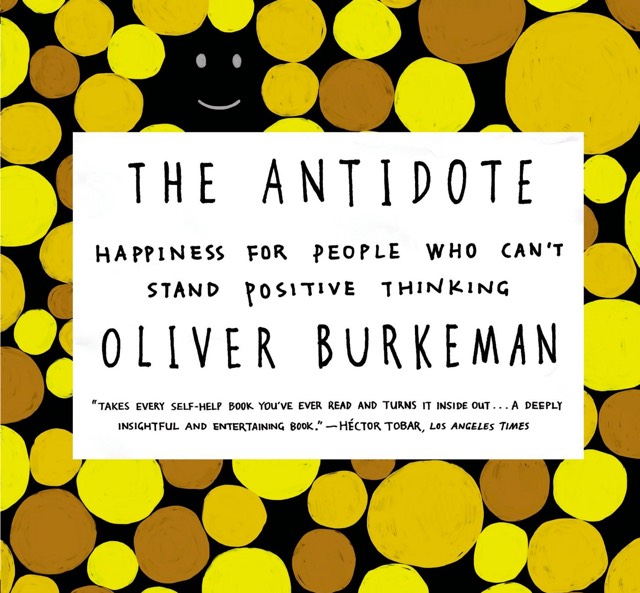
Happiness for People Who Can't Stand Positive Thinking

by Jason Kottke

Antidote Book

"Success through failure, calm through embracing anxiety..." This book sounds perfect for me. The Antidote: Happiness for People Who Can't Stand Positive Thinking by Oliver Burkeman.

Self-help books don't seem to work. Few of the many advantages of modern life seem capable of lifting our collective mood. Wealth -- even if you can get it -- doesn't necessarily lead to happiness. Romance, family life, and work often bring as much stress as joy. We can't even agree on what "happiness" means. So are we engaged in a futile pursuit? Or are we just going about it the wrong way?

Looking both east and west, in bulletins from the past and from far afield, Oliver Burkeman introduces us to an unusual group of people who share a single, surprising way of thinking about life. Whether experimental psychologists, terrorism experts, Buddhists, hardheaded business consultants, Greek philosophers, or modern-day gurus, they argue that in our personal lives, and in society at large, it's our constant effort to be happy that is making us miserable. And that there is an alternative path to happiness and success that involves embracing failure, pessimism, insecurity, and uncertainty -- the very things we spend our lives trying to avoid. Thought-provoking, counterintuitive, and ultimately uplifting, The Antidote is the intelligent person's guide to understanding the much-misunderstood idea of happiness.

I learned about the book from Tyler Cowen, who notes:

[Burkeman] is one of the best non-fiction essay writers, and he remains oddly underrated in the United States. It is no mistake to simply buy his books sight unseen. I think of this book as "happiness for grumps."

Given Cowen's recent review of Inside Out, I wonder if [slight spoilers ahoy!] he noticed the similarity of Joy's a-ha moment w/r/t to Sadness at the end of the film to the book's "alternative path to happiness and success that involves embracing failure, pessimism, insecurity, and uncertainty". Mmmm, zeitgeisty!

Tags: books   Inside Out   movies   Oliver Burkeman   The Antidote   Tyler Cowen
27 Jun 10:08

Slavery And Silence | Corey Johnson | Marshall Project | 24th June 2015

by Corey Johnson
Stunning interview with Bryan Stevenson, lawyer and civil-rights campaigner, about the sanitising of slavery and segregation in American history. “In the South we have done something worse than silence, we’ve actually created a counter-narrative and invited people to take pride in their southern heritage. We’ve ignored the lynchings and the struggles and the violence and terror created by decades of segregation”
27 Jun 09:55

The Psychology Of Negotiation | Nick Kolenda | 18th June 2015

Starts off a touch uninspiringly, but soon picks up speed and by the end is serving up an a-ha moment with every paragraph. Among the many plausible-sounding tips: “After any negotiation, you should compliment the other party’s negotiating skills. Not only will your counterpart be more satisfied with the deal, but he or she will also be more likely to sign the paperwork and negotiate with you again in the future”
27 Jun 09:34

Andrew Sullivan's 1989 "case for gay marriage" is still the best I've ever read

by Matthew Yglesias

Here's the lead of Andrew Sullivan's 1989 article making the case for same-sex marriage for the first time in a prominent American journal. It argued for a principle that few found compelling at the time but that most now endorse. But precisely because it was written at a time when the argument was so unfamiliar and so unpopular, it's extremely tight and persuasive — zeroing in on one key point: If not equal marriage rights, then what?

Last month in New York, a court ruled that a gay lover had the right to stay in his deceased partner’s rent-control apartment because the lover qualified as a member of the deceased’s family. The ruling deftly annoyed almost everybody. Conservatives saw judicial activism in favor of gay rent control: three reasons to be appalled. Chastened liberals (such as the New York Times editorial page), while endorsing the recognition of gay relationships, also worried about the abuse of already stretched entitlements that the ruling threatened. What neither side quite contemplated is that they both might be right, and that the way to tackle the issue of unconventional relationships in conventional society is to try something both more radical and more conservative than putting courts in the business of deciding what is and is not a family. That alternative is the legalization of civil gay marriage.

This was a great question in 1989, and it's a great question in 2015. The more you think about it, the more you are relentlessly pushed to the conviction the Supreme Court reached today. If not marriage equality, then what? An endless series of ad hoc decisions about in what respects same-sex couples should and shouldn't receive the same legal treatment as married couples? A parenthesis attached to every single law, regulation, and corporate policy saying "or gay couples in a registered civil union"? For what purpose?

If you're not going to ban same-sex relationships, then you need to offer them some form of legal accommodation. Offering the same legal accommodation that exists for heterosexual relationships is a much simpler, much fairer solution than any alternative.

In the 25 years since Sullivan wrote that article, opponents of his viewpoint have raised many objections, but they've never put forward a coherent alternative view of how things should work.


27 Jun 09:28

Amy Schumer nails why privilege isn't the same thing as respect for women

by Margarita Noriega

Comedian Amy Schumer's reflection on the unexpected consequences of privilege is a great reminder of how women were historically mistreated, no matter how high on the social ladder they lived.

Schumer plays a lowly peasant who is suddenly turned into a princess by a member of the royal court, played by fashion guru Tim Gunn:

Gunn enters the home where Schumer, with dirt on her face, is told the seemingly good news:

She initially welcomes the news, presumably as a reference to the fact that marriage was much more popular, and mandated for many royal families throughout world history:

But privilege isn't the same thing as respect, as Amy discovers when she is told she is going to meet a prince to marry him.

The prince (played by Amy) is actually her cousin, which disgusts her:

Princess Amy doesn't realize that the people around her have no intention of respecting her wishes, though:

What saves her life at the end? Watch the full video to find out. Here's a hint: It's not gender equality.

27 Jun 09:27

The most radical changes to marriage happened decades ago

by Timothy B. Lee

Opponents of same-sex marriage like to portray it as an unprecedented change in the institution. And obviously, that's true in a sense — marriage had long been defined as being between men and women, until people started proposing a broader definition a few decades ago.

But in her 2006 book, Marriage: A History, which was cited in today's Supreme Court ruling, historian Stephanie Coontz argued that marriage isn't the static institution that traditionalists imagine. It has been in a state of flux for more than two centuries.

Coontz argues that the expansion of marriage to include same-sex couples is the logical consequence of the more egalitarian marriages that were created by the feminist revolution. As marriage has become less gendered — with women becoming breadwinners and men doing more housework and child care — it became more difficult to explain why two men, or two women, couldn't participate in the institution as well as a man and a woman could.

Here's a transcript of our phone conversation, lightly edited for clarity.

Robin Gorsline, left, and his partner Jonathan Lebolt at their home in Richmond, Virginia. Gorsline is president of People of Faith for Equality in Virginia. Gorsline and Lebolt have been together for 16 years. (The Washington Post/Getty)

Timothy B. Lee: Traditionalists have portrayed same-sex marriage as an unprecedented break from traditional marriage. Are they right, or has marriage changed before?

Stephanie Coontz: Heterosexuals pioneered all of the major changes that almost made same-sex marriage inevitable. There are so many myths about what same-sex marriage means. People say that marriage is between one man and one woman. In fact, the most preferred form of marriage through the ages was one man and several women.

What we think of as traditional marriage, based on love and mutuality, was a new invention in history. For thousands of years, marriages were arranged — or at least parents had veto power — because marriage was a way you gained advantageous in-laws, made business deals, and expanded your labor force.

It was only in the late 18th century that we told people they should marry for love and that young people should be free to choose their own mates. For 150 years after that, marriage was still expected to be a relationship between a dominant man and a subordinate woman. Only in the 1920s did it become acceptable to say that a respectable couple should explore their sexual attraction before and within marriage and that sexual fulfillment was an important part of marriage. It was only in the 1950s and 1960s that people gained the right to choose not to have children or the right to have children through assisted reproduction even if they could not biologically have children.

And it was only in the late 1960s that the Supreme Court ruled that individuals have a right to marry even if we disapprove. [In addition to striking down a ban on interracial marriage in 1967], the Supreme Court also said prisoners have a right to marry [in 1987].

TBL: How did these changes shape the argument over same-sex marriage?

SC: All of these things paved the way for gays and lesbians to say that if marriage is about love and sexual attraction, not necessarily about children, if it's a human right, then it should apply to us. The one thing that stood in the way until recently was that marriage was a gendered institution that gave some rights to men and a different set of rights to women. When that changed, I think it was inevitable that gays and lesbians would say, "Hey, what about us?"

So I think many things paved the way for gay marriage. I think the civil rights movement paved the way; I think the feminist movement paved the way.

Another important thing was the willingness of gay and lesbian activists themselves to come out of the closet. People said, "These are not perverts from another planet, these are our sons and daughters, or at least our neighbors." There was this incredible change in consciousness. People are saying the Supreme Court is imposing something. The Supreme Court did impose something against the will of a majority of Americans when it ruled on interracial marriage. But today, a majority of Americans approve of same-sex marriage. This has been a stunning transformation in the last 10 years, and it preceded the Supreme Court decision.

TBL: Were earlier changes in the institution of marriage as controversial as same-sex marriage has been?

SC: One thing that surprised me when I was doing my research on the history of marriage was how shocked many traditionalists were about the idea that you should let people choose to marry for love. They were horrified. They said this would lead to chaos because some people wouldn't marry at all because they weren't in love. They also predicted — correctly — that it would lead to more divorces.

One American politician I read predicted — again, correctly — that this emphasis on love would cause men to relinquish their authority over their wives.

Interracial marriage was extremely controversial. It had much less popular support than gay marriage does today.

The equality of women in marriage was also controversial. In 1977, we'd already passed the first marital rights law in one or two states, the court had ruled that segregated want ads were illegal, and we'd passed the Civil Rights Act. Even then, an overwhelming majority of Americans believed the man should be the breadwinner and the woman should be the homemakers, and should defer to her husband's judgment.

Some people have real religious and moral objections to homosexuality. But I think part of the reason same-sex marriage is so vehemently opposed is that it really drives home the extent to which marriage is no longer a gendered institution. Some of the people who oppose it most viscerally are people who just hate the idea of men and women playing the same kind of role in marriage. They really want to go back to a more strict division of labor.

(Zoran Milich / Getty)

TBL: Critics have argued that same-sex marriage will lead us down a slippery slope toward other changes, such as legal recognition for polygamist marriages. Do you expect that to happen, or will marriage settle down for at least a few decades?

SC: I think marriage will settle down. We already have much more openness to nonmarital arrangements, whether those are open marriages or cohabitation or whatever. Those sort of things have already existed, but they are all coming out of the closet now.

That doesn't mean that they'll demand equal marriage rights. It's perfectly reasonable for a state to say, "Look, we have an interest in helping two people sustain their commitments, developing exit rules for when they break those, giving them support systems. But we can't afford to extend this to five people or six people."

So I don't think there's going to be that kind of slippery slope. To the extent that we're going to see more acceptance of unconventional family arrangements, that was a done deal before this ruling. It was a partial cause of the ruling rather than being a result of it.

TBL: Do you think the growing acceptance of same-sex marriage will affect heterosexual marriages?

SC: In fact, one of the exciting things about this is that as we embark on a really new experiment with heterosexual marriages that are egalitarian, where both partners share housework and breadwinning, having the model of heterosexual marriage creates new opportunities to look at what works and what doesn't.

One of the flashpoints in heterosexual marriages is how to divide the housework and child care. We're finding that throughout Europe, there's been this shift where women's dissatisfaction is an increasingly important cause of marital conflict and divorce. So to have the model of a group that has traditionally divided this more evenly and discussed it more thoroughly than heterosexuals have done suggests to me that it may strengthen, not weaken, heterosexual marriage.

27 Jun 09:23

Read President Obama's moving eulogy for Charleston shooting victim Clementa Pinckney

by Ezra Klein

On Friday, June 26, President Obama delivered a powerful eulogy for Rev. Clementa Pinckney, who was murdered in the Charleston shootings. In the emotional, wide-ranging speech, Obama connected the mass killing to "a long history" of violence meant to intimidate and terrorize African Americans, and warned that it would be "a betrayal of everything Reverend Pinckney stood for" if America let itself "go back to business as usual."

The full text of Obama's remarks follows.

The Bible calls us to hope. To persevere, and have faith in things not seen.

"They were still living by faith when they died," Scripture tells us. "They did not receive the things promised; they only saw them and welcomed them from a distance, admitting that they were foreigners and strangers on Earth."

We are here today to remember a man of God who lived by faith. A man who believed in things not seen. A man who believed there were better days ahead, off in the distance. A man of service who persevered, knowing full well he would not receive all those things he was promised, because he believed his efforts would deliver a better life for those who followed.

To Jennifer, his beloved wife; to Eliana and Malana, his beautiful, wonderful daughters; to the Mother Emanuel family and the people of Charleston, the people of South Carolina.

I cannot claim to have the good fortune to know Reverend Pinckney well. But I did have the pleasure of knowing him and meeting him here in South Carolina, back when we were both a little bit younger. (Laughter.) Back when I didn't have visible grey hair. (Laughter.) The first thing I noticed was his graciousness, his smile, his reassuring baritone, his deceptive sense of humor -- all qualities that helped him wear so effortlessly a heavy burden of expectation.

Friends of his remarked this week that when Clementa Pinckney entered a room, it was like the future arrived; that even from a young age, folks knew he was special. Anointed. He was the progeny of a long line of the faithful -- a family of preachers who spread God's word, a family of protesters who sowed change to expand voting rights and desegregate the South. Clem heard their instruction, and he did not forsake their teaching.

He was in the pulpit by 13, pastor by 18, public servant by 23. He did not exhibit any of the cockiness of youth, nor youth's insecurities; instead, he set an example worthy of his position, wise beyond his years, in his speech, in his conduct, in his love, faith, and purity.

As a senator, he represented a sprawling swath of the Lowcountry, a place that has long been one of the most neglected in America. A place still wracked by poverty and inadequate schools; a place where children can still go hungry and the sick can go without treatment. A place that needed somebody like Clem. (Applause.)

His position in the minority party meant the odds of winning more resources for his constituents were often long. His calls for greater equity were too often unheeded, the votes he cast were sometimes lonely. But he never gave up. He stayed true to his convictions. He would not grow discouraged. After a full day at the capitol, he'd climb into his car and head to the church to draw sustenance from his family, from his ministry, from the community that loved and needed him. There he would fortify his faith, and imagine what might be.

Reverend Pinckney embodied a politics that was neither mean, nor small. He conducted himself quietly, and kindly, and diligently. He encouraged progress not by pushing his ideas alone, but by seeking out your ideas, partnering with you to make things happen. He was full of empathy and fellow feeling, able to walk in somebody else's shoes and see through their eyes. No wonder one of his senate colleagues remembered Senator Pinckney as "the most gentle of the 46 of us -- the best of the 46 of us."

Clem was often asked why he chose to be a pastor and a public servant. But the person who asked probably didn't know the history of the AME church. (Applause.) As our brothers and sisters in the AME church know, we don't make those distinctions. "Our calling," Clem once said, "is not just within the walls of the congregation, but...the life and community in which our congregation resides." (Applause.)

He embodied the idea that our Christian faith demands deeds and not just words; that the "sweet hour of prayer" actually lasts the whole week long -- (applause) -- that to put our faith in action is more than individual salvation, it's about our collective salvation; that to feed the hungry and clothe the naked and house the homeless is not just a call for isolated charity but the imperative of a just society.

What a good man. Sometimes I think that's the best thing to hope for when you're eulogized -- after all the words and recitations and resumes are read, to just say someone was a good man. (Applause.)

You don't have to be of high station to be a good man. Preacher by 13. Pastor by 18. Public servant by 23. What a life Clementa Pinckney lived. What an example he set. What a model for his faith. And then to lose him at 41 -- slain in his sanctuary with eight wonderful members of his flock, each at different stages in life but bound together by a common commitment to God.

Cynthia Hurd. Susie Jackson. Ethel Lance. DePayne Middleton-Doctor. Tywanza Sanders. Daniel L. Simmons. Sharonda Coleman-Singleton. Myra Thompson. Good people. Decent people. God-fearing people. (Applause.) People so full of life and so full of kindness. People who ran the race, who persevered. People of great faith.

To the families of the fallen, the nation shares in your grief. Our pain cuts that much deeper because it happened in a church. The church is and always has been the center of African-American life -- (applause) -- a place to call our own in a too often hostile world, a sanctuary from so many hardships.

Over the course of centuries, black churches served as "hush harbors" where slaves could worship in safety; praise houses where their free descendants could gather and shout hallelujah -- (applause) -- rest stops for the weary along the Underground Railroad; bunkers for the foot soldiers of the Civil Rights Movement. They have been, and continue to be, community centers where we organize for jobs and justice; places of scholarship and network; places where children are loved and fed and kept out of harm's way, and told that they are beautiful and smart -- (applause) -- and taught that they matter. (Applause.) That's what happens in church.

That's what the black church means. Our beating heart. The place where our dignity as a people is inviolate. When there's no better example of this tradition than Mother Emanuel -- (applause) -- a church built by blacks seeking liberty, burned to the ground because its founder sought to end slavery, only to rise up again, a Phoenix from these ashes. (Applause.)

When there were laws banning all-black church gatherings, services happened here anyway, in defiance of unjust laws. When there was a righteous movement to dismantle Jim Crow, Dr. Martin Luther King, Jr. preached from its pulpit, and marches began from its steps. A sacred place, this church. Not just for blacks, not just for Christians, but for every American who cares about the steady expansion -- (applause) -- of human rights and human dignity in this country; a foundation stone for liberty and justice for all. That's what the church meant. (Applause.)

We do not know whether the killer of Reverend Pinckney and eight others knew all of this history. But he surely sensed the meaning of his violent act. It was an act that drew on a long history of bombs and arson and shots fired at churches, not random, but as a means of control, a way to terrorize and oppress. (Applause.) An act that he imagined would incite fear and recrimination; violence and suspicion. An act that he presumed would deepen divisions that trace back to our nation's original sin.

Oh, but God works in mysterious ways. (Applause.) God has different ideas. (Applause.)

He didn't know he was being used by God. (Applause.) Blinded by hatred, the alleged killer could not see the grace surrounding Reverend Pinckney and that Bible study group -- the light of love that shone as they opened the church doors and invited a stranger to join in their prayer circle. The alleged killer could have never anticipated the way the families of the fallen would respond when they saw him in court -- in the midst of unspeakable grief, with words of forgiveness. He couldn't imagine that. (Applause.)

The alleged killer could not imagine how the city of Charleston, under the good and wise leadership of Mayor Riley -- (applause) -- how the state of South Carolina, how the United States of America would respond -- not merely with revulsion at his evil act, but with big-hearted generosity and, more importantly, with a thoughtful introspection and self-examination that we so rarely see in public life.

Blinded by hatred, he failed to comprehend what Reverend Pinckney so well understood -- the power of God's grace. (Applause.)

This whole week, I've been reflecting on this idea of grace. (Applause.) The grace of the families who lost loved ones. The grace that Reverend Pinckney would preach about in his sermons. The grace described in one of my favorite hymnals -- the one we all know: Amazing grace, how sweet the sound that saved a wretch like me. (Applause.) I once was lost, but now I'm found; was blind but now I see. (Applause.)

According to the Christian tradition, grace is not earned. Grace is not merited. It's not something we deserve. Rather, grace is the free and benevolent favor of God -- (applause) -- as manifested in the salvation of sinners and the bestowal of blessings. Grace.

As a nation, out of this terrible tragedy, God has visited grace upon us, for he has allowed us to see where we've been blind. (Applause.) He has given us the chance, where we've been lost, to find our best selves. (Applause.) We may not have earned it, this grace, with our rancor and complacency, and short-sightedness and fear of each other -- but we got it all the same. He gave it to us anyway. He's once more given us grace. But it is up to us now to make the most of it, to receive it with gratitude, and to prove ourselves worthy of this gift.

For too long, we were blind to the pain that the Confederate flag stirred in too many of our citizens. (Applause.) It's true, a flag did not cause these murders. But as people from all walks of life, Republicans and Democrats, now acknowledge -- including Governor Haley, whose recent eloquence on the subject is worthy of praise -- (applause) -- as we all have to acknowledge, the flag has always represented more than just ancestral pride. (Applause.) For many, black and white, that flag was a reminder of systemic oppression and racial subjugation. We see that now.

Removing the flag from this state's capitol would not be an act of political correctness; it would not be an insult to the valor of Confederate soldiers. It would simply be an acknowledgment that the cause for which they fought -- the cause of slavery -- was wrong -- (applause) -- the imposition of Jim Crow after the Civil War, the resistance to civil rights for all people was wrong. (Applause.) It would be one step in an honest accounting of America's history; a modest but meaningful balm for so many unhealed wounds. It would be an expression of the amazing changes that have transformed this state and this country for the better, because of the work of so many people of goodwill, people of all races striving to form a more perfect union. By taking down that flag, we express God's grace. (Applause.)

But I don't think God wants us to stop there. (Applause.) For too long, we've been blind to the way past injustices continue to shape the present. Perhaps we see that now. Perhaps this tragedy causes us to ask some tough questions about how we can permit so many of our children to languish in poverty, or attend dilapidated schools, or grow up without prospects for a job or for a career. (Applause.)

Perhaps it causes us to examine what we're doing to cause some of our children to hate. (Applause.) Perhaps it softens hearts towards those lost young men, tens and tens of thousands caught up in the criminal justice system -- (applause) -- and leads us to make sure that that system is not infected with bias; that we embrace changes in how we train and equip our police so that the bonds of trust between law enforcement and the communities they serve make us all safer and more secure. (Applause.)

Maybe we now realize the way racial bias can infect us even when we don't realize it, so that we're guarding against not just racial slurs, but we're also guarding against the subtle impulse to call Johnny back for a job interview but not Jamal. (Applause.) So that we search our hearts when we consider laws to make it harder for some of our fellow citizens to vote. (Applause.) By recognizing our common humanity by treating every child as important, regardless of the color of their skin or the station into which they were born, and to do what's necessary to make opportunity real for every American -- by doing that, we express God's grace. (Applause.)

For too long --

AUDIENCE: For too long!

THE PRESIDENT: For too long, we've been blind to the unique mayhem that gun violence inflicts upon this nation. (Applause.) Sporadically, our eyes are open: When eight of our brothers and sisters are cut down in a church basement, 12 in a movie theater, 26 in an elementary school. But I hope we also see the 30 precious lives cut short by gun violence in this country every single day; the countless more whose lives are forever changed -- the survivors crippled, the children traumatized and fearful every day as they walk to school, the husband who will never feel his wife's warm touch, the entire communities whose grief overflows every time they have to watch what happened to them happen to some other place.

The vast majority of Americans -- the majority of gun owners -- want to do something about this. We see that now. (Applause.) And I'm convinced that by acknowledging the pain and loss of others, even as we respect the traditions and ways of life that make up this beloved country -- by making the moral choice to change, we express God's grace. (Applause.)

We don't earn grace. We're all sinners. We don't deserve it. (Applause.) But God gives it to us anyway. (Applause.) And we choose how to receive it. It's our decision how to honor it.

None of us can or should expect a transformation in race relations overnight. Every time something like this happens, somebody says we have to have a conversation about race. We talk a lot about race. There's no shortcut. And we don't need more talk. (Applause.) None of us should believe that a handful of gun safety measures will prevent every tragedy. It will not. People of goodwill will continue to debate the merits of various policies, as our democracy requires -- this is a big, raucous place, America is. And there are good people on both sides of these debates. Whatever solutions we find will necessarily be incomplete.

But it would be a betrayal of everything Reverend Pinckney stood for, I believe, if we allowed ourselves to slip into a comfortable silence again. (Applause.) Once the eulogies have been delivered, once the TV cameras move on, to go back to business as usual -- that's what we so often do to avoid uncomfortable truths about the prejudice that still infects our society. (Applause.) To settle for symbolic gestures without following up with the hard work of more lasting change -- that's how we lose our way again.

It would be a refutation of the forgiveness expressed by those families if we merely slipped into old habits, whereby those who disagree with us are not merely wrong but bad; where we shout instead of listen; where we barricade ourselves behind preconceived notions or well-practiced cynicism.

Reverend Pinckney once said, "Across the South, we have a deep appreciation of history -- we haven't always had a deep appreciation of each other's history." (Applause.) What is true in the South is true for America. Clem understood that justice grows out of recognition of ourselves in each other. That my liberty depends on you being free, too. (Applause.) That history can't be a sword to justify injustice, or a shield against progress, but must be a manual for how to avoid repeating the mistakes of the past -- how to break the cycle. A roadway toward a better world. He knew that the path of grace involves an open mind -- but, more importantly, an open heart.

That's what I've felt this week -- an open heart. That, more than any particular policy or analysis, is what's called upon right now, I think -- what a friend of mine, the writer Marilyn Robinson, calls "that reservoir of goodness, beyond, and of another kind, that we are able to do each other in the ordinary cause of things."

That reservoir of goodness. If we can find that grace, anything is possible. (Applause.) If we can tap that grace, everything can change. (Applause.)

Amazing grace. Amazing grace.

(Begins to sing) -- Amazing grace -- (applause) -- how sweet the sound, that saved a wretch like me; I once was lost, but now I'm found; was blind but now I see. (Applause.)

Clementa Pinckney found that grace.

Cynthia Hurd found that grace.

Susie Jackson found that grace.

Ethel Lance found that grace.

DePayne Middleton-Doctor found that grace.

Tywanza Sanders found that grace.

Daniel L. Simmons, Sr. found that grace.

Sharonda Coleman-Singleton found that grace.

Myra Thompson found that grace.

Through the example of their lives, they've now passed it on to us. May we find ourselves worthy of that precious and extraordinary gift, as long as our lives endure. May grace now lead them home. May God continue to shed His grace on the United States of America. (Applause.)

Watch: What makes the Charleston shooting terrorism

18 Jun 10:38

Migration is the most effective development intervention on the planet, part XXVI

by Chris Blattman

there is something of a tyranny of ideas in seeing the political divisions of states (primarily, national states) as being, in some way, fundamental, and in seeing them not only as practical constraints to be addressed, but as divisions of basic significance in ethics and political philosophy.

That is Amartya Sen in The Idea of Justice. It comes from a masterful slide presentation by Dani Rodrik on the economic and moral imperative for further opening. Maybe not masterful from a graphic design perspective, but for content and brevity it’s a winner.

The bottom line of his calculations: letting someone migrate to the West does so much for their wealth, at so little cost to Western workers, that we have to care about a random person inside our borders five times as much as someone on the other side to justify not letting the outsiders in.

Or we have to value whatever we think we get from closed borders (protecting the culture) so much that we’re willing to deny other human beings a path from poverty.

Here is one counterargument I seldom see: Theory and history tell us that rapid changes in economic and political power lead to conflict, some of it violent, some of it so bad the state collapses. This is a big, bad spillover that economists tend to ignore more than they should.

The West’s institutions are pretty strong, so I don’t fear collapse unless big migration came at the same time as a massive economic disaster. But I’d expect far right and nativist parties to grow in power and this could pervert politics in unfortunate ways for a few generations.

On the other hand I think there are positive spillovers too. And at worst I think this conflict counterargument is merely a case for gradual change. But not glacial, which is the current pace.

Nonetheless, read Dani’s slides for much more. It sounds like a terrific book underway.

And hat tip to Tyler Cowen.

The post Migration is the most effective development intervention on the planet, part XXVI appeared first on Chris Blattman.

17 Jun 11:38

The Hidden World of Matchmaking and Market Design

by Alex Tabarrok

Roth Cover

Al Roth’s Who Gets What and Why: The Hidden World of Matchmaking and Market Design is an excellent addition to the pantheon of popular economics books. It’s engagingly written, covers new material and will be of interest to professional economists as well as to the broader audience of intelligent readers.

review the book more extensively for the Wall Street Journal. (Google the title, Matchmaker, Make Me a Market to get beyond the paywall for non-subscribers). Roth is well known for helping to design kidney swaps–when donor A and patient A’ and donor B and patient B’ are mismatched it may yet be possible for A to give to B’ and B to give to A’.

Mr. Roth, however, wants to go further. The larger the database, the more lifesaving exchanges can be found. So why not open U.S. transplants to the world? Imagine that A and A´ are Nigerian while B and B´ are American. Nigeria has virtually no transplant surgery or dialysis available, so in Nigeria patient A’ will die for certain. But if we offered a free transplant to him, and received a kidney for an American patient in return, two lives would be saved.

The plan sounds noble but expensive. Yet remember, Mr. Roth says, “removing an American patient from dialysis saves Medicare a quarter of a million dollars. That’s more than enough to finance two kidney transplants.” So offering a free transplant to the Nigerian patient can save money and lives.

It’s hard to think of a better example of gains from trade (or a better PR coup for the U.S. on the world stage).

One of the most interesting aspects of the book is that Roth has created a new typology of market failure but a very different way of addressing such market failures. Read the whole review for more.

17 Jun 11:15

The slow adoption of the three-pointer technology in the NBA

by Jason Kottke

Tyler Cowen writes about Steph Curry, the current dominance of the three-point shot, and how the reality of new technology lags in relation to its promise.

What took so long? At first the shot was thought to be a cheesy gimmick. Players had to master the longer shot, preferably from their earliest training. Coaches had to figure out three-point strategies, which include rethinking the fast break and different methods of floor spacing and passing; players had to learn those techniques too. The NBA had to change its rules to encourage more three-pointers (e.g., allowing zone defenses, discouraging isolation plays). General managers had to realize that Rick Pitino, though perhaps a bad NBA coach, was not a total fool, and that the Phoenix Suns were not a fluke.

This longer article on the rise of the three-pointer in the NBA by Tom Haberstroh provides further context to Cowen's thoughts.

Tags: basketball   sports   Stephen Curry   Tyler Cowen
16 Jun 15:16

African Take-Aways | David Evans et al | Development Impact | 10th June 2015

by David Evans et al
Main points from 50 papers presented at a World Bank conference on Africa. “When a mine opens in South Africa, crime doesn’t increase. But you may not want to be around when the mine closes”. “Higher rainfall significantly reduced civilian participation in the [Rwandan] genocide”. “Members of ethnic groups exposed to greater historical missionary activity [in 19C Nigeria] express significantly less trust today”

Subscribe to the Browser to receive a feed with direct links to the recommended content

15 Jun 14:27

In praise of Porto

by Tyler Cowen

Porto is Portugal’s second largest city, but when you turn the corner you never know what is coming: a Baroque or even Romanesque church, wondrous blue tiles, a rotted out building, a coffee and pastry shop, port warehouses and embankments, or a steeply plunging street.  If a store displays the sign “Novidades,” that is an indication they don’t have any.  Porto is (not) the only European city with six bridges.  My conference was held in a very fine Rem Koolhaas venue.

Magellan lived and studied here, and J.K. Rowling’s Porto stint shaped parts of Harry Potter.  Libreria Lello is perhaps the most striking bookshop in Europe.

This politically incorrect shop sign would have been taken down a while ago elsewhere in Europe; it is a reflection of the city’s remnant status.  The modern parts of town, along the ocean, remind me of California.  But the English language section of a used book store will have the titles which were British bestsellers in the 1920s.  A 1970s tribute store is called “Spock,” and its sign outlines the Starship Enterprise.

Eat the tripe and white beans at Flor de Congregados, or for fancy try DOP restaurant, worthy of a Michelin star or two but not priced to boot.  Peer into the apartments which open out onto the streets of the old town, due to the lack of air conditioning, and check out their crumbling wallpaper and tightly packed collections of icons.  Here are ten things to like about Porto.

If you took the brain of Maria Popova, and turned it into a Mediterraneo-Atlantic city, loaded with debt, you would have Porto.  Definitely recommended.

15 Jun 11:24

Silicon Valley’s Brutally Funny Indictment of the Tech Industry

by David Sims
Image

In the penultimate episode of Silicon Valley’s second season, the Internet startup Pied Piper finally got its big break. The company’s video-compression software had been boxed out at every turn by its moneyed competitors, and its one contract, a live-stream of a nest of condor eggs, had attracted no viewers. That is, until a museum worker arrived to remove an unhatched egg, fell, and grievously wounded himself on-camera, instantly turning the live-stream into a worldwide online event. Silicon Valley, which ends its second season Sunday, is a comedy first, but a dark indictment of an industry as a close second—one that never lets its viewers take for granted why they’re laughing.


Related Story

Revenge on the Nerds: Why It's So Cool to Laugh at the Tech World Now


The cleverest thing about Silicon Valley’s satire is that the show presents its central plot as a seemingly straightforward story arc: the path of shy, nervous programmer Richard Hendricks (Thomas Middleditch) to startup superstardom after he creates an algorithm that compresses data with revolutionary ease. Mike Judge’s comedy seems to be taking the audience through the various stages of a nascent tech company’s growth in the Bay Area, from initial venture-capital investments to large-scale hiring. But in Silicon Valley’s second season, Richard’s journey has become a Sisyphean struggle against an evil conglomerate hell bent on blocking him at every turn, and nearly every episode contains a plot twist that turns Richard’s small triumphs against him, whittling his idealism down to nothing.

To recap: This year, Pied Piper attracted handsome investment offers from many venture-capital firms, all of which were withdrawn when the evil tech giant Hooli (clearly modeled on Google and/or Apple) sued the startup for copyright infringement. So Richard turned to the unstable, self-made billionaire Russ Hanneman (Chris Diamantopoulos) for funding, but his meddling only added to Pied Piper’s bad reputation around town. Then another company ripped off Richard’s algorithm. Then Pied Piper lost a chance to win a big contract when Russ rested a bottle of tequila on someone’s delete key during a coding session. Then Hooli won its lawsuit against Pied Piper because Richard tested his software one time on a company computer. And finally, he got his big break—but only because someone might die on camera on one of his live-streams in the finale.

Again, this is supposed to be a comedy. Silicon Valley mines laughs from its well-drawn characters, like the stoned, pigheaded entrepreneur Erlich (T.J. Miller) or the reserved, polite-to-a-fault business adviser Jared (Zach Woods). But like all of Mike Judge’s best work (the film Office Space, or the TV series King of the Hill), the one-liners are just momentary distractions from the creeping truth that the world is a cruel place where only the most ruthless can truly succeed.

Silicon Valley’s approach to plotting can make for a frustrating viewing experience. The Pied Piper programmers typically insult each other and goof off for 25 minutes before another devastating twist arrives. Part of the reason for this is surely that everyone on the show is a coder, and the writers see little dramatic potential in their simply doing their jobs. There’s admittedly not much excitement to be found in watching someone tap furiously at a keyboard, but the nerdy testosterone thrown around by programmers Bertram (Martin Starr) and Dinesh (Kumail Nanjiani) proves to be an amusing substitute.

“I don’t want to live in a world where somebody else makes the world a better place than we do,” the Hooli CEO tells his executive board.

Even funnier are the show’s glimpses into the internal politics of Hooli, a replication of those geeky programmer wars on a CEO scale. The company’s preening founder Gavin Belson (Matt Ross) wants Pied Piper destroyed not just because it could be a potential rival, but because Richard made the unthinkable choice of refusing his corporate oversight. “I don’t want to live in a world where someone else makes the world a better place than we do,” he tells his executive board in a tone of utmost seriousness.

Richard’s sad but noble choice was trying to strike out on his own, and while testifying on a case he knows he’s doomed to lose, he decries his foolish idealism. “I just wanted to be different,” he said. “The law says that I lose everything, my whole company, everything that I worked for, because I used one Hooli computer to test and modify one block [of code]. To me, if the system says that’s fair, I guess I’m probably not meant to be part of it.” It’s a rare moment of sincerity for such a brutal satire, perfectly delivered by the stuttering Middleditch, and it finally lands the punch Judge has been jabbing with all season. The irony of the tech world’s model of free enterprise, Silicon Valley shows, is that there’s nothing remotely free about it.


15 Jun 10:32

The winners and losers from the empirical shift in economics

by Chris Blattman

Noahpinion proves why he is one of the best economics tweeters, with a riff on the winners and losers from the quasi-experimental shift in economics.

1/I just wanted to riff on this blog post about the shift toward quasi-empirical methods in econometrics.

2/Here’s who I see as the winners and losers from the shift (besides people who *do* quasi-experiments, obviously).

3/The biggest winner: The public and policymakers. The results of these experiments are often easy enough for them to understand.

4/When academic econ results are hard to understand, policymakers tend to ignore them and go with politically inspired simple stuff.

5/But quasi-experiments can often bring research insights to policymakers in a way they can understand and apply, to everyone’s benefit.

6/Another winner: Women in economics. When theory doesn’t rely on data for confirmation, it often becomes a bullying/shouting contest.

7/Women are disadvantaged in bullying contests. But with quasi-experiments, they can use reality to smack down bullies, as in the sciences.

8/A big loser from the shift: Free market purists. In fights between “Econ 101 theory” and quasi-experiments, the science tends to win out.

9/Theory lends itself to simplicity (for tractability reasons), and simple theories of markets tend not to have lots of market failures.

10/But reality is a thicket of market failures, and quasi-experiments let the results of that thicket be viewed in reduced form.

It continues. And the original blog post.

The post The winners and losers from the empirical shift in economics appeared first on Chris Blattman.

12 Jun 08:12

Baboons like to hang out with other baboons who are similar

by Research Digest
By guest blogger Mary Bates

The saying "birds of a feather flock together" might apply to non-human primates, as well. A new study shows chacma baboons within a troop spend more of their time with baboons that they resemble, choosing to associate with those of a similar age, status, and even personality. This is known as homophily, or "love of the same."

The researchers, led by the University of Cambridge and the Zoological Society of London, discuss these findings in light of the evolution of culture in primate societies. The research was published in May in the journal Royal Society Open Science.

Alecia Carter and her colleagues tracked two baboon troops in Namibia's Tsaobis Nature Park over six years. All the individuals in these groups had been given personality tests to determine their boldness and propensity to either generate or exploit information. Carter and her colleagues analysed how these personality traits, along with age, dominance rank, and sex, affected how baboons associate with one another. To define an association, the researchers measured time spent in proximity and time spent grooming.

Individual animals can acquire information first-hand, by directly interacting with their environment, or socially, by paying attention to the behavior of others. An individual's personality can affect its propensity to both generate social information (i.e. bolder baboons are more likely to act as a demonstrator) and exploit it from information generators (i.e. bolder types also tend to learn more than their shyer peers through observation).

Boldness also influences a baboon's response to an unfamiliar food item, like a hard-boiled egg or bread roll dyed green. More confident individuals spend more time inspecting and ultimately eating a novel food while shy types stick to the food they know. And in a previous experiment, Carter and her colleagues discovered that juveniles and their bolder elders were more likely than shyer animals to learn about a novel foraging task by watching another baboon demonstrate, and to later serve as demonstrators themselves.

Given these differences in personality and propensity to either generate or use social information, the researchers next focused on which baboons hung out with one another. They found that, like humans, baboons prefer others who are similar to themselves.

Carter and her colleagues show that, especially when it comes to grooming networks, baboons show homophily for boldness, age, rank, and propensity to both generate and exploit information, but not for sex.

The problem with these patterns of assortment is that they may impede the transfer of information between individuals. Social learning allows the rapid spread of novel information among group members. It has been implicated in the formation of traditions and cultures within species. But if information-generators – those baboons more likely to solve novel foraging tasks on their own, such as younger and bolder baboons – spend their time in the company of other information-generators, their knowledge might not spread throughout the troop. In this case, homophily could preclude some individuals from learning from others.

Carter and her colleagues hope that understanding baboons' personalities and social preferences will shed light on the conditions that may facilitate or retard the formation of culture in primate societies. It seems likely that both personalities and social networks play a role.

In baboon societies, it appears that the information producers, those individuals that find out new information, tend not to associate with individuals who need to access new social information. This would stop the formation of a tradition, as information cannot pass from informed individuals to uninformed ones. This tendency to associate with similar baboons could explain why these animals are not known for their cultural traditions in the same way that humans and great apes are. In this case, "birds of a feather flocking together" leads to cultural stagnation and a lower likelihood of new knowledge spreading throughout the group.

Although humans are known for their rich culture, Carter says that homophily could also slow down the transmission of ideas in human social groups. Conversely, diversity can help idea exchange, as shown in some tentative research on Twitter.

_________________________________ ResearchBlogging.org

Carter, A., Lee, A., Marshall, H., Tico, M., & Cowlishaw, G. (2015). Phenotypic assortment in wild primate networks: implications for the dissemination of information Royal Society Open Science, 2 (5), 140444-140444 DOI: 10.1098/rsos.140444

--further reading--
We sit near people who look like us

Post written by Mary Bates (@mebwriter) for the BPS Research Digest. Mary Bates is a freelance science writer specializing in the brains and behavior of humans and other animals. She has been published in National Geographic News, National Geographic's Weird & Wild blog, New Scientist, the Society for Neuroscience's BrainFacts website, Psychology Today, the Scientific American Mind Matters blog, on the Howard Hughes Medical Institute’s News website, as well as in other online and print publications. Her Wired Science blog, Zoologic, was published from 2013-2015. She earned her PhD from Brown University, where she researched bat echolocation and bullfrog chorusing. You can follow her on Twitter and Facebook and see all of her work at her website.