Shared posts

26 Feb 08:55

Heterogeneous Single-Atom Catalyst for Visible-Light-Driven High-Turnover CO2 Reduction: The Role of Electron Transfer

by Chao Gao, Shuangming Chen, Ying Wang, Jiawen Wang, Xusheng Zheng, Junfa Zhu, Li Song, Wenkai Zhang, Yujie Xiong

Abstract

Visible-light-driven conversion of CO2 into chemical fuels is an intriguing approach to address the energy and environmental challenges. In principle, light harvesting and catalytic reactions can be both optimized by combining the merits of homogeneous and heterogeneous photocatalysts; however, the efficiency of charge transfer between light absorbers and catalytic sites is often too low to limit the overall photocatalytic performance. In this communication, it is reported that the single-atom Co sites coordinated on the partially oxidized graphene nanosheets can serve as a highly active and durable heterogeneous catalyst for CO2 conversion, wherein the graphene bridges homogeneous light absorbers with single-atom catalytic sites for the efficient transfer of photoexcited electrons. As a result, the turnover number for CO production reaches a high value of 678 with an unprecedented turnover frequency of 3.77 min−1, superior to those obtained with the state-of-the-art heterogeneous photocatalysts. This work provides fresh insights into the design of catalytic sites toward photocatalytic CO2 conversion from the angle of single-atom catalysis and highlights the role of charge kinetics in bridging the gap between heterogeneous and homogeneous photocatalysts.

Thumbnail image of graphical abstract

The single-atom Co sites coordinated on the partially oxidized graphene nanosheets can serve as a highly active and durable heterogeneous catalyst for CO2 conversion, wherein the graphene bridges homogeneous light absorbers with single-atom catalytic sites for the efficient transfer of photoexcited electrons. This design enables a turnover frequency of 3.77 min−1, superior to those obtained with conventional heterogeneous photocatalysts.

26 Feb 07:50

Heterobimetallic metal-organic framework nanocages as highly efficient catalysts for CO2 conversion under mild conditions

J. Mater. Chem. A, 2018, 6,2964-2973
DOI: 10.1039/C7TA09082J, Paper
Lei Tang, Shengbo Zhang, Qilong Wu, Xinru Wang, Hong Wu, Zhongyi Jiang
It is of critical importance to design and fabricate highly active and stable catalysts for CO2 conversion.
The content of this RSS Feed (c) The Royal Society of Chemistry
26 Feb 06:51

Cocatalysts in Semiconductor-based Photocatalytic CO2 Reduction: Achievements, Challenges, and Opportunities

by Jingrun Ran, Mietek Jaroniec, Shi-Zhang Qiao

Abstract

Ever-increasing fossil-fuel combustion along with massive CO2 emissions has aroused a global energy crisis and climate change. Photocatalytic CO2 reduction represents a promising strategy for clean, cost-effective, and environmentally friendly conversion of CO2 into hydrocarbon fuels by utilizing solar energy. This strategy combines the reductive half-reaction of CO2 conversion with an oxidative half reaction, e.g., H2O oxidation, to create a carbon-neutral cycle, presenting a viable solution to global energy and environmental problems. There are three pivotal processes in photocatalytic CO2 conversion: (i) solar-light absorption, (ii) charge separation/migration, and (iii) catalytic CO2 reduction and H2O oxidation. While significant progress is made in optimizing the first two processes, much less research is conducted toward enhancing the efficiency of the third step, which requires the presence of cocatalysts. In general, cocatalysts play four important roles: (i) boosting charge separation/transfer, (ii) improving the activity and selectivity of CO2 reduction, (iii) enhancing the stability of photocatalysts, and (iv) suppressing side or back reactions. Herein, for the first time, all the developed CO2-reduction cocatalysts for semiconductor-based photocatalytic CO2 conversion are summarized, and their functions and mechanisms are discussed. Finally, perspectives in this emerging area are provided.

Thumbnail image of graphical abstract

Active and stable CO2-reduction cocatalysts can obviously enhance the efficiency, selectivity, and stability of semiconductor-based photocatalytic CO2 reduction. All of the developed CO2-reduction cocatalysts are summarized, and their functions and insightful mechanisms are discussed. This can pave new avenues to the exploration of novel highly active and selective cocatalysts, toward high-performance solar fuel production.

26 Feb 03:59

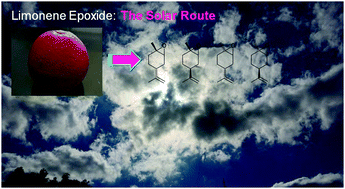
Photocatalytic partial oxidation of limonene to 1,2 limonene oxide

Chem. Commun., 2018, 54,1008-1011
DOI: 10.1039/C7CC09788C, Communication
Rosaria Ciriminna, Francesco Parrino, Claudio De Pasquale, Leonardo Palmisano, Mario Pagliaro
The silylation of crystalline TiO2 P25, commonly used for photocatalytic degradation of pollutants, results in an exceptionally selective catalyst for the aerobic limonene epoxidation to 1,2-limonene oxide under solar light irradiation.
The content of this RSS Feed (c) The Royal Society of Chemistry
26 Feb 03:23

CuWO4 as a photocatalyst for room temperature aerobic benzylamine oxidation

Chem. Commun., 2018, 54,1101-1104
DOI: 10.1039/C7CC07611H, Communication
Aaron D. Proctor, Shobhana Panuganti, Bart M. Bartlett
We report the first example of a controlled photo-oxidation reaction on CuWO4, the aerobic oxidative coupling of benzylamine.
The content of this RSS Feed (c) The Royal Society of Chemistry
26 Feb 03:18

Artificial Photosynthesis: Ni-Nanocluster Modified Black TiO2 with Dual Active Sites for Selective Photocatalytic CO2 Reduction (Small 2/2018)

by Tadesse Billo, Fang-Yu Fu, Putikam Raghunath, Indrajit Shown, Wei-Fu Chen, Hsiang-Ting Lien, Tzu-Hsien Shen, Jyh-Fu Lee, Ting-Shan Chan, Kuo-You Huang, Chih-I Wu, M. C. Lin, Jih-Shang Hwang, Chih-Hao Lee, Li-Chyong Chen, Kuei-Hsien Chen
Thumbnail image of graphical abstract

In article number 1702928, Indrajit Shown, Li-Chyong Chen, Kuei-Hsien Chen, and co-workers report a black titania with dual active sites (Ni-nanoclusters and oxygen vacancy) for photocatalytic carbon dioxide (CO2) reduction via artificial photosynthesis with H2O and simulated sunlight. The intentionally introduced dual active sites lead to not only high photocatalytic activity, but also to selective solar fuel production under simulated solar light. The CO2 adsorption and activation capability of the catalyst is demonstrated using computational study and the underlying mechanism in charge transfer and product formation is highlighted.

26 Feb 03:14

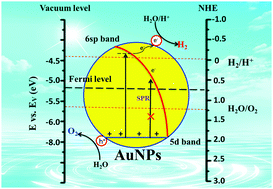
UV-driven overall water splitting using unsupported gold nanoparticles as photocatalysts

Chem. Commun., 2018, 54,1845-1848
DOI: 10.1039/C7CC09770K, Communication
Bining Tian, Qin Lei, Bin Tian, Wenxing Zhang, Yanxia Cui, Yue Tian
UV-driven water splitting was achieved over Au nanoparticles (>10 nm) for the first time without the assistance of cocatalysts.
The content of this RSS Feed (c) The Royal Society of Chemistry
26 Feb 03:05

Efficient charge separation between UiO-66 and ZnIn2S4 flowerlike 3D microspheres for photoelectronchemical properties

Publication date: 15 June 2018
Source:Applied Catalysis B: Environmental, Volume 226
Author(s): Baibai Liu, Xinjuan Liu, Junying Liu, Chengjie Feng, Zhu Li, Can Li, Yinyan Gong, Likun Pan, Shiqing Xu, Chang Q. Sun
It is still a great challenge to develop efficient semiconductive photocatalysts responding to visible light radiation. We show an efficient ZnIn2S4/UiO-66 hybrid photocatalysts with flowerlike 3D microspheres synthesized via a facile solvothermal method. A 20 wt.% UiO-66 emersion raises the Cr(VI) reduction rate up to 99% and higher after 60 min visible light irradiation. The substantial enhancement of photocatalytic and photoelectronchemical activity of pure ZnIn2S4 by UiO-66 addition is attributed to the ZnIn2S4/UiO-66 interfacial charge transferring and more active sites for pollute adsorption.

Graphical abstract

image
26 Feb 01:44

Facile synthesis of oxygen defective yolk-shell BiO2-x for visible-light-driven photocatalytic inactivation of Escherichia coli

J. Mater. Chem. A, 2018, 6,4997-5005
DOI: 10.1039/C8TA00336J, Paper
Hongli Sun, Ho Yin Yip, Zhifeng Jiang, Liqun Ye, Irene M. C. Lo, Po Keung Wong
Oxygen deficient yolk-shell BiO2-x microspheres prepared by facile solvothermal method showed great inactivation ability toward Escherichia coli, due to its enhanced light absorption ability and separation ability of photoinduced carriers. Reactive species O2- and H2O2 guaranteed this prominent oxidation ability toward bacterial cells.
The content of this RSS Feed (c) The Royal Society of Chemistry
26 Feb 01:40

Photocatalytic synthesis of Schiff base compounds in the coupled system of aromatic alcohols and nitrobenzene using CdXZn1−XS photocatalysts

Publication date: March 2018
Source:Journal of Catalysis, Volume 359
Author(s): Yahui Wu, Xiangju Ye, Sujuan Zhang, Sugang Meng, Xianliang Fu, Xuchun Wang, Xuemei Zhang, Shifu Chen
Achieving green synthesis and transformation of organics is always an ambition of scientists under mild conditions. In this paper, a series of CdXZn1−XS (0 ≤ X ≤ 1) samples were synthesized by a simple wet-chemical method using cadmium nitrate, zinc nitrate and sodium sulfide as precursors, and were thoroughly characterized by many techniques, including X-ray diffraction, UV–vis absorption spectra, nitrogen adsorption-desorption isotherms, scanning electron microscopy, transmission electron microscopy and (photo)electrochemical measurements. The photocatalytic performance of the as-prepared samples was evaluated by photocatalytic synthesis of Schiff base compounds in the coupled system of benzyl alcohol and nitrobenzene under visible light irradiation. Results reveal that when X is 0.78 (Cd0.78Zn0.22S), the sample exhibits the highest photocatalytic performance. The yield of Schiff base is 55.2% under visible light illumination for 4 h, and the theoretical yields of benzaldehyde and aniline could reach 96.6% and 67.9%, respectively. The quantum efficiency (QE) of the sample with λ = 450 ± 10 nm is 15.8%. In addition, many other Schiff base compounds were also synthesized from the different coupled systems of aromatic alcohols and nitrobenzene. A possible reaction mechanism involving the oxidation of benzyl alcohol to benzaldehyde by photogenerated holes and the reduction of nitrobenzene to aniline by photoinduced electrons, followed by a condensation reaction between benzaldehyde and aniline to generate Schiff base compound was proposed. It is expected that the current work could offer an avenue to fabricate a high-performance photocatalyst used in the fields of photocatalytic selective organic transformations under mild conditions.

Graphical abstract

image