Shared posts

24 Mar 12:57

Photoswitchable basicity through the use of azoheteroarenes

Chem. Commun., 2016, 52,4521-4524
DOI: 10.1039/C5CC10380K, Communication
Claire E. Weston, Robert D. Richardson, Matthew J. Fuchter
We report an azoheteroarene photoswitchable base, where proton stabilisation in Z isomer is facilitated by neighbouring imidazole rings. A 1.3 unit difference in pKa is observed between the E and Z isomers, which leads to the ability to reversibly control solution pH.
The content of this RSS Feed (c) The Royal Society of Chemistry
24 Mar 12:53

Organocatalysis by Networks of Cooperative Hydrogen Bonds: Enantioselective Direct Mannich Addition to Preformed Arylideneureas

Organocatalysis by Networks of Cooperative Hydrogen Bonds: Enantioselective Direct Mannich Addition to Preformed Arylideneureas

Caught in the net: The standard roles that the actors (nucleophile, electrophile, and catalyst) perform during the catalytic act in the arena of bifunctional catalysis were switched in the search for bioinspired organocatalysts. It was thus found that the network of hydrogen bonds provided by salan derivatives catalyzed the Mannich reaction of arylideneureas with acetoacetates in an enantioselective, biomimetic manner (see scheme).

[Communication]
Victor J. Lillo, Javier Mansilla, José M. Saá
Angew. Chem. Int. Ed., February 25, 2016, DOI: 10.1002/anie.201511555. Read article

24 Mar 12:48

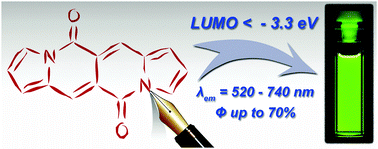
Dipyrrolonaphthyridinediones - structurally unique cross-conjugated dyes

Chem. Commun., 2016, 52,5108-5111
DOI: 10.1039/C6CC01017B, Communication
Marek Grzybowski, Irena Deperasinska, Maciej Chotkowski, Marzena Banasiewicz, Artur Makarewicz, Boleslaw Kozankiewicz, Daniel T. Gryko
Previously unknown dipyrrolo[1,2-b:1[prime or minute],2[prime or minute]-g][2,6]naphthyridine-5,11-diones possess intense fluorescence in the range of 520-740 nm.
The content of this RSS Feed (c) The Royal Society of Chemistry
21 Mar 13:05

Direct Asymmetric Reductive Amination for the Synthesis of Chiral β-Arylamines

Direct Asymmetric Reductive Amination for the Synthesis of Chiral β‐Arylamines

Asymmetric reductive coupling of a ketone and amine is a straightforward and atom-economic approach for preparing optically enriched amines. The highly efficient and direct asymmetric reductive amination of arylacetones, catalyzed by an iridium complex, supplies enantiomerically pure β-arylamines. The new phosphoramidite ligands reported show superb reactivity and enantioselectivity in this reductive coupling. M.S.=molecular sieves, TFA=trifluoroacetic acid.

[Communication]
Haizhou Huang, Xiaoyan Liu, Le Zhou, Mingxin Chang, Xumu Zhang
Angew. Chem. Int. Ed., March 16, 2016, DOI: 10.1002/anie.201601025. Read article

21 Mar 12:57

Halogenase-Inspired Oxidative Chlorination Using Flavin Photocatalysis

Halogenase‐Inspired Oxidative Chlorination Using Flavin Photocatalysis

Chlorination of arenes with chloride anions: The photochemical analogue of the enzymatic chlorination of Flavin-adenine dinucleotide (FAD)-dependent halogenases is possible in the presence of riboflavin, air, acetic acid, and blue light (see scheme: RFT=riboflavin tetraacetate).

[Communication]
Thea Hering, Bernd Mühldorf, Robert Wolf, Burkhard König
Angew. Chem. Int. Ed., March 17, 2016, DOI: 10.1002/anie.201600783. Read article

26 Feb 08:07

Highly Strained Iron(II) Polypyridines: Exploiting the Quintet Manifold To Extend the Lifetime of MLCT Excited States

by Samuel G. Shepard, Steven M. Fatur, Anthony K. Rappé and Niels H. Damrauer

TOC Graphic

Journal of the American Chemical Society
DOI: 10.1021/jacs.5b13524
18 Feb 09:18

Hot Paper: Biodegradable Inorganic Nanovector: Passive versus Active Tumor Targeting in siRNA Transportation

Dr. Dae-Hwan Park, M. Sc. Jaeyong Cho, Dr. Oh-Joon Kwon, Prof. Dr. Chae-Ok Yun and Prof. Dr. Jin-Ho Choy

Biodegradable Inorganic Nanovector: Passive versus Active Tumor Targeting in siRNA Transportation

Cancer therapy: An inorganic layered double hydroxide (LDH) nanovector with a folic acid (FA) conjugated surface showed siRNA-based cancer therapeutic efficacy in vivo through receptor-mediated active targeting (see picture). A 1.2-fold higher accumulation of the drug was achieved in tumor tissue, resulting in 3.0-fold higher suppression of tumor volume.

Read more now

15 Feb 09:07

Diastereoselective synthesis of isoxazolidines and spiroisoxazolidines via catalytic 1,3-dipolar cycloaddition reactions in the presence of Fe3O4-l-proline nanoparticles as a magnetic organocatalyst

Publication date: 9 March 2016
Source:Tetrahedron Letters, Volume 57, Issue 10
Author(s): Javad Safaei-Ghomi, Safura Zahedi
An efficient, one-pot, three-component protocol for the synthesis of a small library of chiral isoxazolidines and spiroisoxazolidines with high diastereoselectivity, from the reaction of N-arylhydroxylamines, arylaldehydes, isatins, and α,β-unsaturated aldehydes is described. l-Proline functionalized Fe3O4 nanoparticles as a magnetic organocatalyst gave isoxazolidine products in high yields as single isomers with an endo-configuration. Notable features of this methodology were: short reaction time, good to excellent yields, and use of an easily recovered heterogeneous catalyst that could be reused many times without significant loss of its catalytic activity.

Graphical abstract

image
15 Feb 08:57

Synthesis of highly water-soluble trisulfonated phthalocyanine with single carboxylic acid via palladium-catalyzed cyanation reaction

Publication date: 9 March 2016
Source:Tetrahedron Letters, Volume 57, Issue 10
Author(s): Anil Kumar Mutyala, Jong S. Park
Unsymmetrical trisulfonated zinc phthalocyanine with single carboxylic acid (trisulfo-Pc-COOH) was newly prepared via the hydrolysis of cyanotrisulfo-Pc which was obtained from the palladium catalyzed cyanation of iodotrisulfo-Pc. The product exhibited good water solubility along with excellent absorption and emission characteristics in an aqueous condition, proving its feasibility for use in bio-imaging applications.

Graphical abstract

image
15 Feb 08:52

A facile naphthalene-based fluorescent ‘turn-on’ chemodosimeter for palladium ions in aqueous solution

Publication date: 9 March 2016
Source:Tetrahedron Letters, Volume 57, Issue 10
Author(s): Yu Chen, Bo Chen, Daijun Luo, Yiyu Cai, Yaning Wei, Yifeng Han
A novel and simple depropargylation-triggered spontaneous cyclization reaction based fluorescent turn-on chemodosimeter for the detection of Pd2+ has been reasonably designed and developed. Based on the specific reactivity of palladium ion-promoted hydrolysis reaction, the probe exhibited a high selectivity and sensitivity for Pd2+ with a low detection limit (53nM, 5.7μg/L) under physiological conditions in neutral PBS (only containing 1% organic cosolvent) without any additional reagents.

Graphical abstract

image
10 Feb 14:36

Hot Paper: Stereoselective Synthesis of Functionalized Pyrrolidines by the Diverted N−H Insertion Reaction of Metallocarbenes with β-Aminoketone Derivatives

Simon M. Nicolle, Dr. William Lewis, Prof. Dr. Christopher J. Hayes and Prof. Dr. Christopher J. Moody

Stereoselective Synthesis of Functionalized Pyrrolidines by the Diverted N−H Insertion Reaction of Metallocarbenes with β-Aminoketone Derivatives

The metal-catalyzed reaction of diazocarbonyl compounds with β-aminoketone derivatives leads to highly substituted pyrrolidines with excellent diastereoselectivity under mild reaction conditions. The reaction starts as a metallocarbene N−H insertion but is diverted by an intermolecular aldol reaction.

Read more now

07 Feb 13:47

Synthesis and Dynamics of Nanosized Phenylene–Ethynylene–Butadiynylene Rotaxanes and the Role of Shape Persistence

Synthesis and Dynamics of Nanosized Phenylene–Ethynylene–Butadiynylene Rotaxanes and the Role of Shape Persistence

Escape artist extraordinaire: How shape-persistent is “shape-persistent”? Novel phenylene–ethynylene–butadiynylene rotaxanes synthesized by a covalent-template approach were found to undergo unthreading of the wheel from the axis (see picture). The detailed unthreading mechanism was investigated theoretically by state-of-the-art DFT-based molecular mechanics and a string method for the simulation of rare events.

[Communication]
Christopher Schweez, Philip Shushkov, Stefan Grimme, Sigurd Höger
Angew. Chem. Int. Ed., February 02, 2016, DOI: 10.1002/anie.201509702. Read article

07 Feb 13:43

Development of a Two-Photon Fluorescent Probe for Imaging of Endogenous Formaldehyde in Living Tissues

Development of a Two‐Photon Fluorescent Probe for Imaging of Endogenous Formaldehyde in Living Tissues

Shine a little light: The first two-photon fluorescent formaldehyde probe, Na-FA, was engineered by condensation of a hydrazine moiety with FA. This unique strategy grants the probe highly favorable properties: a very large turn-on signal, a low detection limit, and a very fast onset, which collectively enable tracking of endogenous FA in living tissues for the first time.

[Communication]
Yonghe Tang, Xiuqi Kong, An Xu, Baoli Dong, Weiying Lin
Angew. Chem. Int. Ed., February 04, 2016, DOI: 10.1002/anie.201510373. Read article

02 Feb 15:01

Solvent-promoted highly selective dehydrogenation of tetrahydroisoquinolines without catalyst and hydrogen acceptor

Publication date: 17 February 2016
Source:Tetrahedron Letters, Volume 57, Issue 7
Author(s): Guang-Shou Feng, Yue Ji, Hui-Fang Liu, Lei Shi, Yong-Gui Zhou
An unusual solvent DMF-promoted dehydrogenation of 1-substituted 1,2,3,4-tetrahydroisoquinolines to synthesize cyclic imines is described. This environmentally friendly reaction features no requirement of any metal catalysts, oxidants, or hydrogen acceptors. A wide range of structurally varied 3,4-dihydroisoquinolines can be obtained with good yields and excellent chemoselectivities.

Graphical abstract

image
02 Feb 14:57

A novel azo-thiourea based visible light switchable anion receptor

Florian Fischer

Hans? Gruber?

Publication date: 24 February 2016
Source:Tetrahedron Letters, Volume 57, Issue 8
Author(s): Ying-Xue Yuan, Liang Wang, Yi-Fei Han, Fen-Fang Li, Hong-Bo Wang
A novel azo-thiourea based anion receptor can be synthesized by coupling a bis-azoaniline motif with butyl isothiocyanate with 45% yield under mild conditions. It was found that azo-thiourea was an excellent receptor to recognize various di-carboxylate anions. It can serve as a colorimetric sensor for azelate ion and led to a significant change in the absorption spectrum. Furthermore, a reversible trans–cis isomerization of azo-thiourea induced by visible lights was confirmed by 1H NMR spectroscopy.

Graphical abstract

image