Shared posts

28 Oct 17:56

A room, a bar and a classroom: how the coronavirus is spread through the air

by Mariano Zafra,Javier Salas

The coronavirus is spread through the air, especially in indoor spaces. While it is not as infectious as measles, scientists now openly acknowledge the role played by the transmission of aerosols – tiny contagious particles exhaled by an infected person that remain suspended in the air of an indoor environment. How does the transmission work? And, more importantly, how can we stop it?

Seguir leyendo

Subscribe to EL PAÍS for just €1 the first month

Subscribe to EL PAÍS for just €1 for the first month and enjoy unlimited access to all the content on our website and app. You can use up to three devices simultaneously, comment on articles and read our stories with fewer advertisements. Subscribe here.
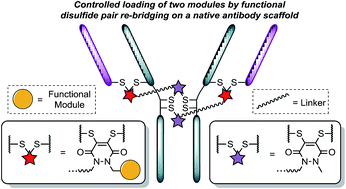
16 Dec 01:13

Enabling the controlled assembly of antibody conjugates with a loading of two modules without antibody engineering

Chem. Sci., 2017, 8,2056-2060
DOI: 10.1039/C6SC03655D, Edge Article
Open Access Open Access
Creative Commons Licence&nbsp This article is licensed under a Creative Commons Attribution 3.0 Unported Licence.
Maximillian T. W. Lee, Antoine Maruani, Daniel A. Richards, James R. Baker, Stephen Caddick, Vijay Chudasama
A novel reagent/strategy enables the controlled assembly of antibody conjugates with a loading of two modules without antibody engineering.
The content of this RSS Feed (c) The Royal Society of Chemistry
08 Nov 15:58

Measuring and Reporting Electrical Conductivity in Metal–Organic Frameworks: Cd2(TTFTB) as a Case Study

by Lei Sun, Sarah S. Park, Dennis Sheberla and Mircea Dincă

TOC Graphic

Journal of the American Chemical Society
DOI: 10.1021/jacs.6b09345
13 Oct 14:25

Iridium-Catalyzed Continuous Hydrogen Generation from Formic Acid and Its Subsequent Utilization in a Fuel Cell: Toward a Carbon Neutral Chemical Energy Storage

by Miklos Czaun, Jotheeswari Kothandaraman, Alain Goeppert, Bo Yang, Samuel Greenberg, Robert B. May, George A. Olah and G. K. Surya Prakash

TOC Graphic

ACS Catalysis
DOI: 10.1021/acscatal.6b01605
08 Jul 01:29

Hantzsch二氢吡啶合成法(Hantzsch Dihydropyridine Synthesis)

by LuWenjie

概要

β-酮酯与醛,含氮化合物的多组分反应,反应生成二氢吡啶化合物。二氢吡啶继续被氧化可以转化成吡啶产物。


基本文献

  • Hantzsch, A. Ber. 1881, 14, 1637. doi:10.1002/cber.18810140214
  • Hantzsch, A. Ann. 1882, 215, 1, 72.
  • Singer, A.; McElvain, S. M. Org. Synth. 193414, 30. [website]
  • Kellog, R. M. et al. J. Org. Chem. 198045, 2854. DOI: 10.1021/jo01302a020


反应机理

首先通过Knoevenagel缩合生成缺电子的烯烃,然后与氨反应生成烯胺,然后进行Micheal加成,脱水缩合得到产物。

hantzsch_py_3

反応例

Nifedipine的一步合成法

hantzsch_py_2

实验步骤


实验技巧


参考文献


本文版权属于 Chem-Station化学空间, 欢迎点击按钮分享,未经许可,谢绝转载!

关联记事

08 Jul 01:17

Charge Generation Pathways in Organic Solar Cells: Assessing the Contribution from the Electron Acceptor

by Dani M. Stoltzfus, Jenny E. Donaghey, Ardalan Armin, Paul E. Shaw, Paul L. Burn and Paul Meredith

TOC Graphic

Chemical Reviews
DOI: 10.1021/acs.chemrev.6b00126